Month: July 2026

We found Wowcher’s cheapest UK spa days and pamper weekends

SOMETIMES all you need is to get away from the stresses of life and book in a spa break.

And good news – if you’re overdue some relaxation, a spa session or overnight break doesn’t have to destroy your budget.

You could book a spa day at one of 35 Bannatyne spas across the UK Credit: Wowcher

Whether you want a countryside spa weekend with afternoon tea, a Bristol break with breakfast and bubbly, or even to try your luck on a mystery spa voucher – we’ve got you covered.

Here’s our pick of the best spa day and overnight stays across the UK, which are all on sale or up for a very cheap price on Wowcher.

Bannatyne Spa Day – pick from 35 locations – £32.99

Book yourself in for some me-time at Bannatyne Spa, where this Wowcher offer gets you spa time, a treatment plus some goodies to take home.

Choose a 30-minute treatment from the following: a Swedish back, neck & shoulder massage, manicure, seasonal body scrub, or a tailored facial.

Read more on Wowcher deals

HOT RIGHT NOW

Wowcher holiday and hotel deals – from UK spa breaks to trips abroad for £99


BED IN

Big Wowcher offer has stay at TV Chef’s UK spa hotel with 3-course meal for £139

Then switch off from the world and enjoy a relaxing dip in the pool.

Plus there’s 35 locations to choose from in spots like London, Norwich, Cardiff, York, Durham and more.

Save up to 66% on a spa day at Bannatyne Spa – from £32.99

Somerset spa break with breakfast and bubbly – £84

Stay at the DoubleTree Cadbury House in Somerset with breakfast and bubbly from £84pp Credit: Wowcher

Set in the Somerset countryside, the four-star DoubleTree Cadbury House hotel makes for a stunning staycation.

The hotel has its own spa with an indoor pool, outdoor hot tub, gym, thermal suite plus plenty of spots to lay back and relax.

Pick between a one or two-night stay and enjoy a glass of bubbly on arrival, as well as a freshly-cooked breakfast each morning.

You can also choose to upgrate for an extra £20 each to enjoy dinner in the on-site Marco Pierrre White Steakhouse.

Book a spa break at the 4* DoubleTree Cadbury House from £84

Mystery spa break – £9.99

You could even win a spa holiday to a luxurious hotel in Paris with a mystery voucher Credit: Wowcher

This is the ultimate lucky dip – go for a £9.99 mystery deal and you could land a spa break at over 500 luxurious locations.

You could enjoy packages such as lunch, a treatment and a smoothie at Elan Spa, plus overnight breaks for two or a fancy spa day at Shangri-La The Shard in London.

You could even land a glamorous mini spa holiday abroad, winning a city break in Paris at a five-star spa hotel for two.

Once you’ve bought the mystery voucher, you’ll be sent a link to redeem it where will you see which prize you have won.

Bag a mystery spa voucher for £9.99

Four-star Essex Spa Day with Lunch included – £69

Save up to 51% off of full-price with this spa day in Essex Credit: Wowcher

Bag a spa day with lunch at the four-star Greenwoods Spa in Essex for £69, saving up to 51% off full price.

The deal includes a spa day experience with full access to all the facilities, as well as a two-course lunch.

Meal options include a pan-roasted chicken supreme, pork loin or fish of the day for main, as well as a mango cheesecake or warm chocolate brownie for dessert.

After lunch, settle down for the afternoon in the Greenwoods Spa, where you can have a gentle swim in the pool or a detox in the sauna.

Save up to 51% on a spa day with lunch at Greenwoods Spa – from £69

Overnight spa break in Northamptonshire countryside – £154

Sink into your relaxing countryside surroundings with a stay at York Cottage Spa Credit: Wowcher

This countryside spa retreat in Northamptonshire is the ideal place to go to clear your mind.

Stay in the rustic York Cottage Spa in a spacious king-sized suite, and make use of the spa with its swimming pool, sauna, and relaxation zones.

This deal is for two people, and also includes a traditional afternoon tea and cosy, fluffy robes to borrow.

Outside of your vibrant green countryside surroundings, you could head into the market town of Wellingborough to soak up its history.

Book an overnight spa break for two at York Cottage Spa for £154 (£77pp)

Source link

The August Talks Are All About Managing Defeat

Dinorah Figuera has a signature with limited value

“Venezuela cannot stand another communiqué” has become something of a political meme, but it captures the central problem with the process beginning on August 1. Washington has assembled a negotiation between an interim president whose continued rule it chose to preserve and an opposition counterpart it helped revive, hoping to combine Delcy Rodríguez’s control of the state with the residual democratic legitimacy of the 2015 National Assembly. The question is not merely whether they can reach an agreement. It is whether two actors whose authority is partial, externally enabled and detached from the country’s current popular leadership can legitimize a transition roadmap whose broad contours appear to have already been decided in Washington—and whether anything they sign can survive without María Corina Machado’s endorsement.

Everyone involved acknowledges that the mechanism was promoted by the United States. What nobody has explained clearly is what kind of mechanism it actually is. Is this a negotiation between two autonomous Venezuelan parties? Is it a broader national dialogue? Or is it an implementation process for a transition whose direction Donald Trump and Marco Rubio have already chosen?

The distinction matters because both sides are selling versions of the process that exaggerate their freedom to negotiate. The opposition presents it as the beginning of a democratic transition. Primero Justicia has listed substantial objectives: a new electoral authority and calendar, the restoration of political parties, an end to political disqualifications, the liberation of political prisoners, the dismantling of the repressive apparatus, freedom of expression and an independent Supreme Court.

Chavismo presents the same process as a necessary concession to preserve peace, obtain sanctions relief and protect the revolution. In its telling, sitting down with the opposition is not surrender but adaptation. “Dialogue does not mean capitulation,” Diosdado Cabello has insisted.

Neither story is entirely realistic.

The opposition may negotiate how political life is reopened and how future elections are organized. Still, it does not appear free to reopen Washington’s decision that stabilization and institutional reconstruction will precede an electoral transfer. Trump accepted Delcy’s continued presidency and has publicly argued that Venezuela is not yet prepared for another election, so the opposition is unlikely to be permitted to demand the immediate transfer of power it once said had already been decided by the 2024 presidential election.  

Delcy’s room for maneuver is also limited. She cannot seriously defend all the old red lines of chavismo: no foreign supervision, no negotiated reform of state institutions, no conditions on sanctions relief and no binding electoral horizon. The existence of an American-sponsored process involving the 2015 Assembly already violates much of the sovereignty theater through which the revolution previously justified itself.

Her real prohibitions are more practical. She cannot accept a settlement that fractures the military, dismantles the governing coalition, exposes its leadership without guarantees, or leaves chavismo incapable of competing in the order that follows. This is regime learning: not preserving the revolution exactly as it existed, but reducing the meaning of survival till it becomes achievable. If chavismo retains its organization, protects much of its elite and remains a viable electoral force, it can describe retreat as continuity.

The opposition is conducting a retreat of its own. It once insisted that the sovereignty expressed in 2024 had already resolved who should govern Venezuela. It is now negotiating the conditions under which Venezuelans may be allowed to decide that question again.

The two sides are not choosing freely between victory and defeat. They are negotiating the distance between two defeats and deciding which concessions each can successfully rename as victory.

Washington’s role goes well beyond providing the room and the refreshments. Delcy Rodríguez is interim president because the United States chose continuity under Maduro’s vice president over an immediate transfer of power to the leadership produced by the 2024 election. Venezuelan institutions administered the oath, but American recognition made that continuity politically viable.

Dinorah Figuera’s return to relevance followed an equally American route. She did not reemerge because a renewed domestic constituency demanded her leadership or because the forces behind the 2024 campaign selected her as their representative. One of her first consequential official appearances after years of political obscurity was a meeting with Michael Kozak at the State Department. She later returned to Venezuela at Washington’s invitation and became Jorge Rodríguez’s counterpart.

Washington helped produce both sides of the table. It accepted Delcy as the administrator of the interim order and activated Dinorah as the institutional representative needed to negotiate with it.

That does not make either woman a simple American puppet. Delcy controls the state machinery required to implement or sabotage any agreement. Dinorah can withhold the opposition stamp Washington needs to sell Trump’s latest South American peace project. But both operate inside a structure whose outer limits appear to have been drawn elsewhere.

The revival of the 2015 National Assembly is understandable. Delcy possesses effective authority but lacks democratic legitimacy. Her government can implement reforms and enforce agreements. What it cannot provide by itself is a convincing democratic chain of authorization.

The 2015 Assembly offers the missing signature. It remains, at least internationally, Venezuela’s last legitimately constituted national institution. Its participation can make institutional appointments, economic agreements and the broader reopening of the country look less like arrangements reached exclusively between Washington and the surviving chavista elite. That matters to governments, creditors and corporations seeking reassurance that future democratic authorities will not repudiate everything agreed during the interim.

But legal usefulness is not political legitimacy.

The Assembly elected in 2015 was a broad and plural legislature supported by millions of Venezuelans. The body negotiating today is a diminished delegated commission represented by only part of the coalition that originally composed it. Its leaders possess little independent national recognition, and the institution itself is deeply unpopular.

Its problem is not merely that it cannot enforce its decisions. For years, it often declined to act at all. It preserved itself as a constitutional necessity while withdrawing from political life, avoiding renewal and becoming increasingly detached from the society it claimed to represent. It remained alive enough to retain recognition and administer assets, but too frozen to lead.

It has now thawed itself back into relevance because Washington needs its pedigree.

Democratic legitimacy cannot simply be placed in constitutional cryogenic storage and reheated intact. The 2015 Assembly survived by refusing to die. It did not spend those years proving that it knew what to do next.

Primero Justicia has tried to bridge that gap by claiming that the delegated commission represents the sovereignty expressed in the 2024 election. But the commission was not elected in 2024, was not selected by the leadership of that campaign and does not represent the full coalition that supported it. The same communiqué reaffirms the leadership of María Corina Machado and Edmundo González while welcoming their willingness to observe a process they have publicly refused to buy into sight unseen.

The contradiction is striking. The people said to embody the country’s current democratic mandate are assigned the role of observers while an older institutional remnant claims to negotiate in their name.

Yet María Corina is not simply outside the process. She may be formally locked out of the negotiating room, but continues to have a relationship with both Trump and Rubio, based at least on her perceived importance. Dinorah has procedural access to the table. María Corina retains strategic access to the people who arranged it.

That may be intentional. Keeping Machado outside allows the delegated commission to absorb the least attractive compromises over sequencing, guarantees and appointments. It preserves her political capital for the moment when the settlement requires popular endorsement. If the process succeeds, she can validate its results without defending every concession. If it fails, she can truthfully say that she neither designed nor controlled it.

But Washington may be delusional if it believes Dinorah Figuera and Jorge Rodríguez can emerge from a closed room, announce an agreement and expect Venezuelan society to accept it without Machado’s endorsement. Their signatures may produce legal validity. Washington may provide international recognition. Foreign corporations may decide that the arrangement offers enough reassurance to begin investing.

Neither Dinorah nor Jorge can manufacture a national constituency.

The mechanism is an attempt to assemble a legitimacy that none of its participants possesses alone. Delcy supplies control of the state. The 2015 Assembly supplies constitutional pedigree. Washington supplies leverage and guarantees. María Corina supplies contemporary popular legitimacy. The problem is that the last component remains outside the formal process and has not promised to endorse whatever it produces.

August 1 does not need to resolve Venezuela’s political crisis. It does need to establish whether this mechanism can produce anything beyond the language of its communiqués. Its credibility will not come from another declaration of democratic intentions, but from evidence that someone can compel chavismo to share power with forces outside its orbit. The first test is not simply whether the parties promise another election. As chavismo reminds us at every opportunity, Venezuela has held plenty of those. The real test is whether the country can move credibly beyond replacing red chavismo with a poorly disguised blue version of the same political order.

The first meaningful agreement should not merely tell Venezuelans when they might vote. It should begin dismantling the police state we somehow cannot escape, even under American tutelage. Without the freedom to speak, organize, report and return without fear, another election would merely place a democratic label over the same machinery of control.

The organizers must also explain what they are asking the country to trust. If this is a negotiation, they should say what remains negotiable. If it is a dialogue, they should identify who participates and what authority the table possesses. If it is an implementation mechanism, Washington should disclose the roadmap being implemented. And if it is genuinely a transition, someone must eventually announce the date on which the interim order ends.

Venezuela cannot stand another communiqué because communiqués allow everyone to declare intentions without assuming ownership. Dinorah Figuera and Jorge Rodríguez may be able to sign an agreement. Washington may guarantee it. María Corina Machado may eventually persuade Venezuelans to give it a chance.

But only results can turn it into a transition.

Hope may be vigilant. Legitimacy is less patient.

Source link

How to beat Ryanair’s hand luggage rule with clever ‘Sudoku’ packing hack

TRAVELLERS heading abroad this summer can beat Ryanair’s hand luggage rule with this clever “Sudoku” packing hack.

The trick has gone viral online and whittles your wardrobe down to just the essentials.

A woman wearing glasses and a blue scarf with text overlay "5 Steps to Build a Packing Sudoku" and a grid filled with "TOP," "LAYER," and "BOTTOM" in a Sudoku-like pattern.
The Sudoku Packing hack has gone viral on social media Credit: @ thenatalieway1/TikTok
Nine folded pieces of clothing on a bed, labeled "top," "bottom," or "outerwear" with the text "Okay, let's play packing Sudoku."
Travellers need to pick just nine items to create 27 outfit combinations Credit: @thenatalieway.travel/Instagram

Anyone trying to scrimp on flights knows the frustration of added baggage fees.

While your Ryanair ticket may only cost £30, adding hold luggage can top up the bill with a £59.99 per flight.

Even a cabin bag can land you with a charge of up to £36.

So many of us try to save some cash by choosing to carry all our belongings in just one small bag, but sizing down your suitcase to this meagre amount can be tricky.

TAKING OFF

Ryanair launches sale with VERY cheap August flights for £14


DON’T BE LATE

Ryanair boss warns they WON’T wait for passengers in huge airport queues

A Ryanair flight offers a tiny 40 x 30 x 20cm bag for free, while easyJet offers a slightly larger 45 x 36 x 20cm size for hand luggage.

However, a handy travel hack might be the solution, and it’s known as “Sudoku Packing”.

The hack has blown up on TikTok and Instagram, promising to whittle your wardrobe down to just nine essential items needed for a short trip.

The trending technique first went viral earlier this year, when influencer Natalie Shaquer shared how the hack was transformative for her travels.

In her video, Natalie recommends “visualising your trip” before beginning the packing phase and taking a few moments to think through the types of outfits you’re going to need.

Then, all travellers need to do is pick three tops, three bottoms and three layering items that all harmoniously coordinate.

Layers can be anything from scarves to jackets to cardigans or jumpers, and should be picked according to the climate of the upcoming destination.

When laid out in a 3×3 grid, the Sudoku selection creates up to 27 different clothing combinations made up of a top, bottom and layer.

Natalie also recommends bringing three pairs of shoes to go with your coordinated clothing selection.

Packers are reminded that each pair of bottoms, whether trousers, a skirt or shorts, will need to work with at least two pairs of the shoes, otherwise they must go “back in the closet”.

With your clothing streamlined, you should still have plenty of space for toiletries and accessories in your bag, but this hack is likely only useful for those planning on being away for a few days.

However, travellers heading out on longer trips will likely need more than nine items of clothing, so then it may be worth forking out for hold luggage.

Source link

Fifa World Cup: Uefa to boycott tournament if Gianni Infantino’s investment plans go through

Uefa’s 55 member associations have voted to boycott the World Cup if Fifa proceeds with its plan to sell stakes in its competitions to private investors.

The decision was made at an emergency meeting on Thursday to discuss the proposals announced by Fifa – world football’s governing body – on Tuesday.

Uefa, which governs European football, had made its opposition clear by releasing two damning statements about the plans – and that strength of feeling has now been reaffirmed.

The boycott would cover all Fifa competitions, including the men’s and women’s World Cups and Club World Cup and be triggered if Fifa president Gianni Infantino’s proposals are voted through by member associations.

The first time this stance will be tested is October, when the Women’s World Cup play-offs are due to be held.

More to follow.

Source link

Is Pakistan ‘using India’s playbook’ in Kashmir? | Politics

NewsFeed

Pakistan is facing accusations that its security forces have killed dozens of unarmed protesters in the past week of demonstrations in Pakistan-administered Kashmir. Al Jazeera’s James Bays asked panellists on Inside Story if Islamabad is borrowing tactics from Indian-administered Kashmir.

Source link

Will The F-47 Have To Fly Initially With Inferior Engines?

The U.S. Air Force says a prototype jet engine developed under the Next Generation Adaptive Propulsion (NGAP) program could be ready for integration onto an actual aircraft in 2030. The fruits of NGAP have long been expected to power the new F-47 fighter, and potentially other aircraft. The schedule here, however, raises the question of what engine will be used on the F-47, at least to start with, as that jet is expected to fly for the first time in 2028. Depending on how long full development lasts, the first operational F-47s might use different engines than the ones the design is ultimately expected to receive to unlock its full potential.

An official rendering of the F-47. USAF

John Sneden, the Portfolio Acquisition Executive in charge of the Propulsion Directorate at the Air Force Life Cycle Management Center (AFLCMC), recently shared new details about the NGAP effort. Sneden provided the update on the next-generation engine program at the Life Cycle Industry Days conference in Dayton, Ohio, which opened yesterday. Dayton is home to Wright-Patterson Air Force Base, which is where the AFLCMC is headquartered.

The Air Force is “get[ting] ready for potential [NGAP] integration activities in the 2030 timeframe,” Sneden said, according to a report today from Breaking Defense. “What we’re doing right now is we’re building our system today, and we’re getting ready for the future.”

This is in line with the Air Force’s 2027 Fiscal year budget proposal, released earlier this year, which says NGAP’s “Prototype Fabrication & Engine Assessment” phase will run through at least September 2031. The budget documents also show a planned surge in NGAP spending over the next three years or so. The Air Force is asking for nearly $513.7 million for the program in the upcoming fiscal cycle, and then expects to request $905.7 million and $865 million in Fiscal Years 2028 and 2029, respectively. Projected annual funding then drops into the roughly $300 million range in Fiscal Years 2030 and 2031, which is as far out as the currently available outlay extends.

What is reflected in the budget outlay “is really about building engines, testing engines, and then we’ll be rolling through that competitively over the next few years,” Sneden said at the conference in Dayton, according to another report from Air & Space Forces Magazine.

John Sneden, head of the Propulsion Directorate at the AFLCMC, at far right, speaks at the Air & Space Forces Association’s main annual conference in 2022. Also on stage are Dr. Michael Gregg, Director of the Aerospace Systems Directorate at the Air Force Research Laboratory (AFRL), at far left, and Dr. Shawn Phillips, chief of AFRL’s Rocket Propulsion Division, in the middle. USAF

“The Air Force is still evaluating its options,” Sneden added, per Breaking Defense, when asked about what aircraft might fly first with an NGAP engine. The F-47 “could” be one option, but the advanced nature of the technology might “open up” the door to other possibilities, he noted. The F-47 program is highly classified, which also limits what can be said about the jets and their expected capabilities, in general.

When it comes to where NGAP stands now, “initial hardware is procured, their design meets our standards, everything is clean from that end, and both vendors have been able to do that,” Sneden said, per Air & Space Forces Magazine.

The two vendors in question are General Electric and Pratt & Whitney, the latter of which is a subsidiary of Raytheon (now formally called RTX). Both firms announced they had completed assembly readiness reviews of their respective designs, known as the XA102 and XA103, in May. The two companies have already been working for years on their competing prototypes. Last year, they both saw the cost ceilings on their existing NGAP contracts rise to $3.5 billion. Those deals cover work through 2032.

NGAP has also been leveraging work done under an earlier Air Force effort called the Adaptive Engine Transition Program (AETP), which both General Electric and Pratt & Whitney also participated in. In 2023, the service canceled AETP, which was exploring options for a new engine for variants of the F-35 Joint Strike Fighter (JSF). Upgrades for the existing Pratt & Whitney F135 engine, which currently powers all versions of the F-35, are now in the works instead.

An engine test rig at the Air Force’s Arnold Engineering Development Complex (AEDC) being used to test a three-stream fan as part of work on Pratt & Whitney’s XA101 design. USAF

More specific details about the XA102 and XA103 continue to be limited, but both are known to be so-called adaptive cycle designs. In very broad terms, jet engines of this kind can perform like a turbofan when optimal and more like a turbojet when needed. This offers benefits in terms of fuel economy and power in the same engine. Being able to conserve fuel while transiting to and from an operating area would help extend range and increase loiter time. This could also help reduce demands on already strained tanker fleets and offer more general cost benefits.

P&W XA103 thumbnail

P&W XA103


To provide some additional context, General Electric has said in the past that the XA100 design it developed for AETP was around 25 percent more efficient than the F135. It was also said to offer between 10 and 20 percent more thrust than the Pratt & Whitney engine in certain flight profiles.

GE's XA100 Adaptive Cycle Engine thumbnail

GE’s XA100 Adaptive Cycle Engine


This is all seen as especially valuable for traditionally fuel-hungry tactical jets like the F-47. Extended range and loiter time, and reduced need for tankers, would also be of particular utility in any future high-end fight against China across the broad expanses of the Pacific. TWZ touched on all of this in our recent detailed feature on what is currently known (and unknown) about the F-47’s design, which you can find here.

As already mentioned, a big question now is what engines will be used on the F-47, at least to begin with. The Air Force has consistently said that it is targeting a first flight for the F-47 in 2028. Sneden, head of the Propulsion Directorate, has now said that the service is not expecting to have an NGAP engine ready for integration until 2030.

Air & Space Forces Magazine reported that Air Force Col. Timothy Helfrich, the Portfolio Acquisition Executive for Fighters and Advanced Aircraft, declined to speak to F-47 propulsion plans when asked separately at the conference in Dayton.

It is not entirely uncommon for new aircraft prototypes to use a different engine from the one planned for production examples. As one example, Lockheed’s Cold War-era F-104 Starfighter was developed around the General Electric J79 turbojet, but that engine was not ready for the start of flight testing. So early XF-104 prototypes used older and less powerful Wright J65 turbojets instead.

One of the J65 engine-powered XF-104 Starfighter prototypes. USAF

In some cases, the initial production batches of aircraft have even entered operational service with different engines than were originally expected due to various factors. Spiral developments can include new engines regardless of what the original might have been, too. For instance, Northrop Grumman originally planned to use Pratt & Whitney F401 turbofans on the F-14 Tomcat, but that engine program was cancelled. Pratt & Whitney TF30 turbofans were used instead on early F-14As. However, problems and limitations surrounding those engines led to General Electric F110 turbofans being integrated onto later examples of the Tomcat.

An F-14A Tomcat seen with its afterburners engaged. USN

Similar spiral engine developments for combat aircraft have been seen outside the United States, too, including with China’s J-20 and Russia’s Su-57.

For the F-47, there are certainly existing in-production designs with relevant performance, such as the F135 and F100 from Pratt & Whitney, and the General Electric F110, which are used on various tactical jets today. Another possibility might be to use an otherwise available design like Pratt & Whitney’s F119 (currently only found on the F-22 Raptor), at least for initial flight testing. The F135 is based on the F119, but the latter is optimized for higher performance, including operations at higher altitudes and cruising at supersonic speeds (supercruise). The F119 is also out of production, at least as far as we know.

Pratt & Whitney F135 Overview thumbnail

Pratt & Whitney F135 Overview


At the same time, the F-47 is a highly optimized and integrated platform with range and performance targets being key aspects of the design. The jet will likely have to be capable of supercruise and be able to fly at very high altitudes, pointing to a need for an F119-like or similar design.

The physical trade space on the F-47 allotted for any engine, as well as the fuel system, and any other associated components, will be largely static. There will be cooling and accessory power demands to factor in. There is then the matter of the jet’s intakes to consider, which is a critical aspect to consider for safe and reliable engine function. They also have to be optimized for the chosen engine and its airflow demands throughout the expected flight envelope. Furthermore, historically, stealthy inlets have been especially complicated to design in a way that blends seamlessly with the rest of the planform while still providing sufficient airflow.

Planning for a redesign of the F-47’s airframe down the line to accommodate an NGAP engine might well be a non-starter. The cost and complexity of integrating an AETP engine into the F-35, which might not have been feasible at all for the F-35B variant with its unique design constraints, directly factored into the cancellation of that program.

Again, this all depends on the F-47’s core design and to what degree the ability to accommodate new engines down the line has already been baked in.

Another official rendering of the F-47. USAF

It is worth noting here that some existing type or types of engine have already been powering the flying demonstrators that helped give birth to the F-47. New engine types that have yet to be disclosed might have been used on those aircraft, though it seems less likely to have two similar programs unless there were very special requirements that we do not yet know about. Regardless, how reflective any of those designs might be of the expected production configuration of the F-47 is unclear.

The initial batch of production F-47s could enter operational service with a different engine than what is expected to be integrated onto future versions, if this is not already the plan. The Air Force has said it is hoping to start fielding these jets in the early 2030s. There have also been reports that the service might not reach a real operational capability with the type until the middle of the next decade.

As an aside, having multiple true alternative engine options for a single aircraft can also help guard against disruptions in the supply of one particular type across the life of the program. The decision to axe procurement of the General Electric/Rolls-Royce F136 as an alternative for the F-35 family, ostensibly as a cost-cutting measure, was notably controversial at the time. It has since come to be seen as somewhat short-sighted given issues with F135 production.

The F-47 is not the only potential application for NGAP engines or technology derived from them, either. In particular, whatever sixth-generation fighter design the U.S. Navy ultimately selects as the winner of its F/A-XX competition would also benefit from next-generation adaptive cycle propulsion. The Air Force also talked in the past about advances from the preceding AETP effort filtering down to its F-15, F-16, and F-22 fleets, as well as the F-35.

A U.S. Air Force briefing slide, dating back to at least 2018, showing potential benefits that could be released through the AETP program and follow-on efforts for various aircraft types. USAF

“We built NGAP as essentially an agnostic system,” Sneden said in Dayton, according to Air & Space Forces Magazine. “It was, build the system first, open up options for the future, and then when those options come to the forefront, we’ll be able to take advantage of it. You have to lean into propulsion technology first.”

“Not everything has to have an adaptive fan,” he added per that same outlet. “So we can actually take that backwards as well and incorporate it in some of our legacy platforms. So there is a great utilization for this type of tech.”

The Air Force is clearly very committed to NGAP, as underscored by the planning and budgeting around the program in the coming years. From what the service has disclosed to date, the work done already has been very fruitful and is now on track to result in at least one design being ready for flight testing in the next four years.

At the same time, the Air Force seems confident that an NGAP engine will not be available for integration before the F-47 is expected to make its maiden flight. There is also immense pressure to get the F-47 into service on an accelerated timetable, and for Boeing then to meet key milestones.

If the schedules hold for the two programs, this means that another propulsion option will have to be used on the F-47 at the start, no matter what happens with either program further down the line.

Contact the author: joe@twz.com

Joseph is TWZ’s Deputy Editor, helping to oversee the site’s highly experienced and dedicated team, while also writing informative and impactful defense and national security content. He lives right in the thick of it in the Washington, D.C. area.


Source link

Major record labels propose guidelines for AI music on the charts

As the threat of artificial intelligence continues to creep into the music industry, major record labels are proposing new guidelines for how music generated by artificial intelligence should be treated on the charts.

The coalition of labels, which includes the industry’s biggest players like Sony Music, Universal Music Group and Warner Music Group, as well as some smaller independent labels like BMG and Concord, is trying to establish a new framework for official charts that better separates human creativity from purely synthetic and unauthorized AI creations.

The proposed guidelines unveiled Wednesday say that AI music would qualify for the charts if the AI service used to create it is “properly authorized and lawful” and if it doesn’t violate any copyright laws. The track also has to be “substantially human-made,” and it shouldn’t raise concerns about stream or chart manipulation.

“The principles are intended to provide a unified roadmap for the consideration of official chart compilers, industry bodies and affiliated stakeholders worldwide,” wrote the coalition. “Together, the organizations proposing these principles stand ready to work with charts and industry bodies around the world to discuss these principles and support implementation of these important safeguards for human creativity by charts and industry bodies.”

The labels are hoping that official charts can both “accommodate appropriate use of AI” and maintain “an authentic celebration of human artistry.”

AI-generated tracks are becoming increasingly prevalent on streaming platforms.

Recently, Spotify added a verification badge to distinguish human artists from AI, and Tidal banned AI-generated music from receiving royalties on its platform. Deezer, a French streaming platform, was the first to detect, tag and exclude AI-generated music from algorithmic recommendations.

The company recently disclosed that up to 90,000 AI tracks are being uploaded to the platform daily, representing more than 50% of its new music uploads.

Despite the coalition’s effort to introduce AI guardrails, some labels involved have already inked partnerships with AI companies such as Suno, Udio and Nvidia. Several music advocacy groups have previously raised concerns about artists facing “non-negotiable AI usage clauses.”

Source link

British Airways jet ‘seconds from disaster’ in UK’s ‘most serious near miss in years’

British Airways flight BA919 was due to land at Heathrow Airport but before it could safely land it encountered an issue mid-air which has been reported as “the most serious ‘near miss’ in the UK in years”

A British Airways plane was “seconds from disaster” after a “serious incident” above London, it has been reported.

On Monday July 6, Flight BA919 from Dusseldorf was due to land at Heathrow Airport but before it could safely land it encountered an issue mid-air. Just before it was due to land the pilot reportedly faced a terrifying moment while the plane was above Canary Wharf.

Sources said the first officer’s error required a physical intervention by the captain as the Airbus A320 was on on route to land at Heathrow Airport.

It is said the jet suffered a stall and the captain had to step in to overide the first officer’s initial input to try and fix the problem.

Experts told The Sun the situation could have resulted in ‘hull loss’, where an aircraft is destroyed or seriously damaged. They added it was “The most serious ‘near miss’ in the UK in years”.

Following the incident the captain is now understood to be on “stress leave”.

The Air Accidents Investigation (AAIB) Branch are investigating the ‘serious incident’. AAIB is an independent agency and is responsible for the investigation of civil aircraft accidents and serious incidents in the UK and its Overseas Territories and Crown Dependencies.

A spokesperson for British Airways said: “We’re assisting the AAIB with its investigation and are legally unable to comment further at this stage.”

Source link

Olwethu Makhanya: South Africa defender becomes Rangers’ eighth summer signing

South Africa defender Olwethu Makhanya has become Rangers’ eighth summer signing, joining for an undisclosed fee from Philadelphia Union.

The 22-year-old centre-back played for the Major League Soccer side 53 times after breaking into the first team last year.

He has signed a four-year deal at Ibrox with the option of a further year.

“I can’t even explain how I am feeling right now, it is honestly a big honour and a huge blessing for me to join such a big club with so much history. I can’t wait to get started,” Makhanya said.

“For me, it has always been a dream to play football in Europe, ever since I was a kid, so to be here is a dream come true.”

Makhanya, who started his career with Stellenbosch in his homeland, was rewarded for his impressive club form by being included in South Africa’s 2026 World Cup squad.

The defender did not play at this summer’s finals, but Rangers boss Derek McInnes feels he has all the tools to thrive in Scotland.

“He’s got a lot of athleticism and good potential,” McInnes said prior to his side’s Scottish Premiership opener at Dundee United on Friday.

“And while he’s coming from the MLS, to a different country and a different type of football, we feel he’s got the attributes that can cope with that.”

Source link

Authorities in France, Spain allow some wildfire evacuees to return

A handout photo made available by the Fire and Rescue Departmental Service 33 shows firefighters crew battling a fire near Le Porge, in southwestern France on Wednesday as a wildfire rages through the forest in Gironde. Photo by EPA

July 30 (UPI) — Tens of thousands of residents in Spain and France are returning home Thursday after being evacuated from wildfires that have torn through Europe.

Firefighters have contained wildfires near Madrid in Spain and in France’s Bordeaux region for the moment. However, authorities in both countries warn that there is still work to be done while Europe withstands conditions that are conducive to the fires spreading again.

Spanish Prime Minister Pedro Sánchez said Wednesday that firefighters were making progress, focusing on hot spots to prevent the fires from regaining momentum. Authorities later began lifting some evacuation orders.

France lifted evacuation orders for about 84,000 residents in the southwest region of the country Thursday. In total, about two-thirds of evacuees have been given the go-ahead to return to their homes.

While progress is being made in the fight, the heatwave in Europe continues. It has been one of Europe’s hottest summers ever recorded. Fires are still raging from Spain to Turkey. Northern Africa has also been battling wildfires for more than a week.

France is bracing for weather conditions Thursday that Sophie Brocas, prefect of the French department of Gironde, has called “unfavorable.” High winds, falling humidity and a chance of thunderstorms have increased the chances of renewed intensity.

Bordeaux received some rainfall Thursday.

In Spain and France alone, more than 300,000 acres have burned.

Source link

‘Go back to your own country’: NZ foreign minister faces backlash | Politics News

NewsFeed

New Zealand Foreign Minister Winston Peters is facing backlash after telling a Chinese-born MP to ‘go back to your own country’ during a parliamentary debate. The remarks drew criticism at home, while China urged New Zealand politicians not to invoke Beijing in domestic disputes.

Source link

Horror maestro Kiyoshi Kurosawa pivots to samurai intrigue

To know Japanese filmmaker Kiyoshi Kurosawa’s work is to feel his love for danger.

Inexplicable malevolence, dread-filled moods and worrisome behavior haunt his genre-speckled oeuvre, from 1997’s unnerving serial-killer freak-out “Cure” through his vengeance-fueled internet cautionary tale “Cloud” from two years ago.

“What makes for good movies is a plot driven forward progressively through things that actively happen,” the 71-year-old director says recently over Zoom from his home in Tokyo, using a translator. “Audiences need to be drawn to this idea of: What will happen next?”

His fans don’t necessarily get an explanation for the unease Kurosawa sometimes generates, but it’s part of the draw. That mindset has made him a horror maestro for over three decades. Outside that genre, he enjoys a reputation for being an acutely psychological chronicler of contemporary anxieties, as in his award-winning 2008 drama of job loss and family secrets, “Tokyo Sonata.”

Now, though, Kurosawa has not only made his first film set prior to Japan’s modernizing Meiji era — a category of feudal period dramas known as jidaigeki — but an old-fashioned murder mystery to boot, complete with solutions to satisfy the most die-hard Agatha Christie reader.

A samurai master stands among kneeling subjects.

Masahiro Motoki in the movie “The Samurai and the Prisoner.”

(Janus Films)

“The Samurai and the Prisoner,” which Kurosawa adapted from Honobu Yonezawa’s acclaimed 2021 novel (it recently premiered at Cannes), unfolds during the fractured Sengoku period in the 16th century, the same era as one of his favorite jidaigekis, “Throne of Blood,” directed by his unrelated namesake, Akira Kurosawa. In a besieged mountainside castle, rebellious Lord Murashige (Masahiro Motoki), trying to consolidate disparate clans of warriors, engages in a battle of wills with his nemesis’ emissary, Kanbei (Masaki Suda), whom he’s imprisoned. But when a succession of murders threatens to undermine his leadership, Murashige turns to his crafty hostage for help.

The result, broken up into seasons and marked by an impending sense of doom, is a multipart puzzle box as intricately folded and tucked as the traditional clothing on display. But it’s also a savvy, deliberative portrait of leadership in a fractured time, with a unique takeaway: Knowing oneself is as essential to the job as knowing who one’s friends and enemies are.

Kurosawa had always wanted to make a jidaigeki — the furthest he’d ever gone into the past was his World War II film “Wife of a Spy” — and yet creating one from scratch sounded too difficult and expensive. But the book’s scenario of a put-upon samurai leader compelled to unravel a series of puzzles to keep his castle’s unity appealed to his taste in a particular crime-solver: someone representing a wider system of responsibility and codes, rather than the classic American private eye.

“I’m drawn to police detectives, not private detectives,” he says, pointing to the duty-bound, badge-wearing protagonist in “Cure,” a Criterion-anointed classic now held in the same pantheon of serial killer tales as “Seven” and “Manhunter.”

“Police are part of an organization, with orders from above that make them responsible for figuring out the crime. If they could, they’d love to live their life peacefully without conflict, but they can’t because of their profession.” He considers his disinterest in gumshoes working on their own a quintessentially Japanese perspective. “Why try to solve a mystery and in the process end up in all these horrible situations, when you can just quit?” he asks with a wry smile.

A man sits chained in a cellar.

Masaki Suda in the movie “The Samurai and the Prisoner.”

(Janus Films)

In “Samurai,” Murashige hews closer to someone overwhelmed by responsibility. Says Kurosawa, “Murashige is neither a police or private detective. It’s that he is in a minor position of power, but to maintain order, he must let go of that power to solve the mystery. It’s not curiosity leading him. The chain of mysteries is a trial he must go through.”

It’s a gauntlet made thornier whenever Murashige, who believes in mercy over violence, engages with Kanbei, chained in a dungeon but with a dangerous mind nonetheless. “In that era, hierarchy was incredibly important, very visible,” says Kurosawa. “If one person is standing, the rest must be kneeling. With Kanbei and Murashige, there is always a shifting of the power, and when they begin to see eye to eye, suddenly we don’t know who holds the power.”

To play the wily Kanbei, Kurosawa enlisted his young “Cloud” star Suda, whom he calls a genius. Directing Suda was its own destabilizing experience, he says.

“He had an almost demonic, devil-like quality and it was hard to tell if the lines he was saying as Kanbei were truths for the character or complete lies — or if he didn’t know,” recalls Kurosawa. “It was mesmerizing to me, his words becoming something that we increasingly can’t trust.”

His interest in Murashige, meanwhile, a real-life tactician fictionalized here as an under-the-gun leader presented with myriad problems, poses the question: Did Kurosawa make a film about directing films? “I never thought about that, but that might be,” he considers. “I’m constantly having to ask things of people, ordering people around, sometimes negotiating. But filmmaking is something I love. There are times when I wish I could escape those scenarios, but I can’t. I’m always held back by that sense of responsibility. That’s how I’ve been working for decades. It’s the first time I’m probably saying that out loud, but the various contradictions I hold within myself as director are reflected in Akira Murashige.”

A woman kneels before her husband in feudal Japan.

Yuriko Yoshitaka, left, and Masahiro Motoki in the movie “The Samural and the Prisoner.”

(Janus Films)

Kurosawa is a late bloomer as an auteur. His breakthrough, “Cure,” hit Japanese theaters when he was 42. But he’d been directing features since 1983, first, Japan’s homeground adult movies called “pink films,” then, in the 1990s, direct-to-video yakuza gangster films known as “V-cinema.” (That’s “V” as in video.)

“It was a good training ground,” he remembers. “They had to be under 90 minutes, had limited shoot days, had to use certain actors, had to have scenes with yakuza. I learned that when you keep to the constraints you’re given, there’s also a kind of freedom. I had no personal interest in yakuza but I had to think: What’s the most unique yakuza I could come up with?”

With V-cinema behind him, Kurosawa came to exemplify the J-horror phenomenon with 2001’s “Pulse,” an ultra-disturbing, early tech apocalypse about online ghosts that was infamously bought by Harvey Weinstein and held from American release for years so it could be remade. Moving on from the trauma of his Hollywood flirtation, he’d distinguish himself with festival awards and a varied career.

But Kurosawa isn’t exactly precious about his filmography. “If possible, I’d love to forget all of my past works and go forward with new films with a completely fresh perspective,” he says. “However, I realize that often I’m repeating past themes. I think of this as something that’s very unfortunate.”

That doesn’t mean he won’t ever return to the horror genre, which he still likes and tries to keep up with. “I have a feeling viewers wouldn’t find scary what I find scary,” he worries, with a smile. “But it excites me that young directors are exploring the genre’s possibilities.”

Kurosawa can sound philosophical about the challenge each new film represents. Making one means coming from “a place of zero, from nothing.” As he puts it, “What one wants to do is a pretty unstable concept. You could want something today and not tomorrow. So instead of chasing that, I should be considering: What is correct?”

There is a professorial tone to Kurosawa. He taught for 18 years at Tokyo University of the Arts, including to future Oscar winner Ryusuke Hamaguchi (“Drive My Car”).

“I’ve probably said something similar to my students,” he acknowledges, adding that he and Hamaguchi were closer to likeminded friends than to student-teacher. “But in filmmaking, he never listened to a single thing I said. I would tell him to make adjustments and he was always concrete in what he wanted to do. And I thought that was very admirable.”

Now, they’re festival peers — both had films at Cannes this year — and Kurosawa’s cinematographer on “Samurai” was Sasaki Yasuyuki, who had previously worked with Hamaguchi. Kurosawa takes the opportunity for a friendly jab. “I thought, ‘I’m going to steal him away from Hamaguchi.’ And I was successful!”

Now, when he meets younger fans and budding filmmakers, their enthusiasm excites him, though it seems to cause him some consternation. Apparently, a lot of people pirate his films so they can be completists. “They tell me this happily,” he says. “I have mixed feelings about this, because they shouldn’t be doing that, but there’s a sparkle in their eye, and I have to accept they really wanted to see my films. So while carrying these complex feelings, I tell them, ‘Thank you.’”

Kurosawa is also of two minds regarding what he frequently hears from Japanese film students, that their goal is getting into top festivals, winning awards and securing global recognition.

“Maybe they need to interrogate what’s in front of them more closely,” he says. “I question it a bit.” He pauses. “I want to say, ‘Have you thought about making a 90-minute yakuza film first?’”

Source link

UK’s steepest road that daredevils flock to was used to test military tanks

This road has a long history studded with soldiers, cyclists and tourists

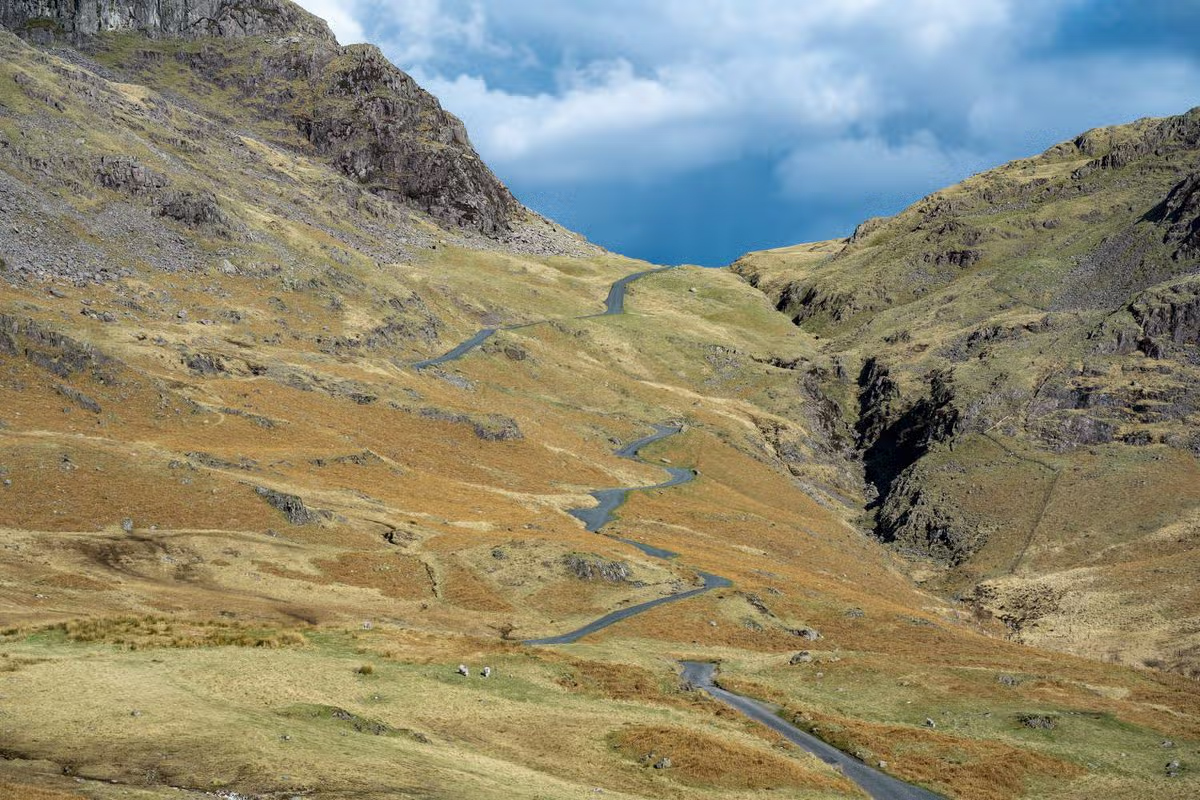
Tucked in the hills of the Lake District is a twisting road that is so steep and challenging it’s often brought up as one of the most dangerous in the UK. Hardknott Pass, between Eskdale and the Duddon Valley, links the Lake District with West Cumbria.

Often impassable in the winter due to snow and ice, it is also one of the steepest in the UK. It has a maximum gradient of 33%, and winds through the mountains with a series of hairpin turns that would put fear in any casual driver.

This steep gradient draws endurance cyclists from across the world. It’s steeper than any other mountain stage in any other European races, including the Tour de France.

Every year, cyclists flock to the pass to complete the Fred Whitton Challenge – an 112 mile ride around the Lake District.

From Romans to tank training

A version of what is now Hardknott Pass was built by the Romans around AD110 to link the coastal fort at Ravenglass to their garrisons in Ambleside. They called it the tenth highway, but it fell into disrepair in the early 5th century when the Romans left Britain. For years it was used as an unpaved packhorse route to transport lead and farming goods.

In the 1880s, the road was improved by the English Lake District Association – a group of hoteliers. They hoped that making the road better would encourage more people to travel there but by 1891 it had failed to attract the number of people they had wanted.

Instead, the route was popular with cyclists and motorists. Even then, it was described as a challenging road to pass, with the Guide to North-West England describing the old coach road as “difficult going West, cruel coming East”.

Fast forward to World War 2 and the remote mountain pass was in regular use by British forces who used it to train tank drivers, completely destroying what was left of the road surface.

After the war it was finally tarmacked and opened to vehicles.

The road today

Now, the road is a thrilling drive where anyone coming downhill must be prepared to reverse into tight passing bays to allow those coming up the right of way.

However, despite the challenge of driving the road, the views at its 393 metre summit are well worth the effort.

The peak of the mountain offers breathtaking panoramic views stretching toward the Scafell range.

As you drive along the route, you pass the haunting ruins of Hardknott Roman fort, where the same soldiers who used to travel the pass stood watch over the mountain wilderness.

Source link

Drivers will add 41 minutes to a journey for better views, but lack ideas

UK motorists would rather take a scenic UK drive than the fastest option for a staycation road trip – with 52% saying beautiful scenery was important when planning a long drive.

Three quarters of motorists would prefer to take the scenic route rather than the quickest option for a staycation. A poll of 2,000 drivers revealed that beautiful scenery (52%) was a key consideration when planning a long drive – with the average motorist willing to add 41 minutes to their journey for a more impressive view.

Four in ten find a road trip ‘boring’ as it typically involves motorways and staring at the back of a lorry – with the M25 voted the most tedious road to drive on. However, 21% admitted they wouldn’t know how to find a more scenic route, while 57% rarely or only sometimes have enough time to plan one before heading off.

A further 49% confess they rely too heavily on their sat nav, meaning they seldom discover new or picturesque routes by chance.

The study, commissioned by temporary car insurance provider Tempcover, revealed that when taking a scenic route, 37% found it took a similar amount of time to a motorway journey, while 25% said it actually took less – thanks to avoiding traffic and congestion.

Adam Craddock, temporary car insurance expert for the brand, said: “With the UK staycation market seeing strong demand this summer, we wanted to give motorists the best of both worlds.

“Motorways are essential for efficient travel, but we also want to give holidaymakers an easier way to discover stunning scenic detours alongside their usual routes.

“The UK possesses world-class landscapes that genuinely rival top global destinations – from the spectacular vistas of the Scottish Highlands to the serene beauty of the Lake District – and our new interactive tool is designed to unlock them all.”

Discover an alternative scenic route by entering your start and end UK postcodes with this new online tool.

The research revealed scenic views are the source of many arguments in the car, with 13% accusing passengers of ‘hogging the best views’ – leaving 70% of drivers feeling that passengers are the only ones who get to enjoy it.

Despite 41% citing stop-offs as essential during a long car journey, 31% rarely or never do this – with the Angel of the North (33%) and Yorkshire Dales (22%) among places travellers have never stopped to visit.

However, the country’s beauty doesn’t go unnoticed as 34% believed the Scottish Highlands rivals the Norwegian Fjords, while 24% compared Cornwall to the Amalfi Coast.

Kaiser Chiefs frontman and musician, Ricky Wilson who regularly travels across the country for festivals and gigs, contributed his own top spots to the tool.

He said: “As a band we’ve driven thousands of miles this year alone, and after recently hitting the milestone of 1,500 live shows, you realise how much of the country you miss by sticking rigidly to the sat nav.

“Some of our best moments on tour – like all of us jumping out of the bus to check out Stonehenge – only happened because we took a scenic detour.

“Now with four-year-old twins, pit stops are non-negotiable, and swapping grey motorway service stations for incredible scenic spots is a game-changer.

“We’ve had some legendary detours over the years, and taking the scenic route turns a boring drive into pa rt of the holiday. “

The countryside (68%) and beach and coastal routes (63%) were amongst the most enjoyable scenery to take in while driving, according to those surveyed via OnePoll.com.

The typical driver is comfortable going 113 minutes before requiring a break – however, 41% would never split driving responsibilities as 47% prefer being behind the wheel. But 27% would refuse to hand over the keys because of insurance reasons, while 15% claimed adding an extra driver to their annual policy is too much hassle.

Adam Craddock at Tempcover added: “A great trip should start the moment you get into the car, not just when you reach the destination.

“It’s all about making the most of the journey together and sharing the adventure every mile of the way. The right cover gives drivers the flexibility to share the wheel and we are all about removing the hassle with temporary comprehensive cover in minutes – making it easy to share the drive and swap over so one person doesn’t hog all the views.”

Source link

Greggs set to ‘open more stores abroad’ after Spanish airport success

Interior of Greggs cafe at Tenerife South Airport with a counter displaying pastries and hot drinks, and a dining area.

YOU could soon be able to grab a Greggs sausage roll when your on holiday.

The chain recently opened a store at Tenerife South Airport in Spain‘s Canary Islands and is eyeing up opening more spots abroad.

Greggs restaurant and shop at Tenerife South Airport.
Tenerife South Airport opened a Greggs site earlier this year Credit: Tenerife South Airport

Greggs CEO Roisin Currie told Reuters: “If (Tenerife) is ​positive then ⁠it will be a sort of look to see where else could this go in the future.

“It ‌is ⁠only one shop, so far though it’s hit every sales hurdle.”

Inside the Tenerife South Airport store – which is in the departures side of the airport – travellers can find Greggs’ core menu.

There are also some items tailored to the local market such as Spanish omelette breakfast rolls and blueberry muffins.

Read more on travel inspo

SO FLY

Our fave beach hols under 5 hours from UK with Caribbean dupes & £2 bottles of wine


ALL IN

I found the best value all inclusive London hotel… just £55pp with free food & booze

At the time of opening, Currie said: “Tenerife South Airport is a hub for millions of UK and international passengers each year, making it the ideal location to test spreading our wings in an overseas setting.

“It’s an exciting milestone for Greggs as we bring a slice of home to the Canaries, and we’re confident our great-value offering will resonate just as well under the Spanish sun as it does on the UK high street.”

The popular airport handles 13million passengers a year, with around 50 per cent of them being from the UK.

Taking to Reddit, Greggs fans shared their thoughts on the new store.

Collage of travel items including a plane, sunscreen, passport, suitcase, and plane tickets, advertising The Sun's travel Instagram account.
Interior of Greggs cafe at Tenerife South Airport with a counter displaying pastries and hot drinks, and a dining area.
And now Greggs is thinking about opening more stores abroad in the future Credit: Tenerife South Airport

One person said: “I won’t be satisfied until we have a Greggs in Paris.”

Another person added: “Come to Canada already. Tim Hortons exists in the UK, return the favour.”

Greggs did use to have stores in Belgium, but they were closed in 2008.


Source link

The UK flight routes most likely to be cancelled this summer and it’s bad news for a Spanish island

An image collage containing 3 images, Image 1 shows Aerial view of Gatwick Airport with multiple airplanes parked at gates, Image 2 shows Aerial image of San Antonio Bay on the island of Ibiza, with boats in the bay and buildings, hotels, and beaches lining the coast, Image 3 shows Beach view of Magaluf in Calvia Municipality, Mallorca, Balearic Islands, Spain

THERE’S nothing worse than looking forward to your summer holiday, arriving at the airport and then being told your flight is cancelled.

And now the worst flight routes for cancellations have been announced, with some of the most popular holiday hotspots coming out on top.

The UK flights to Europe with the worst cancellations have been revealed Credit: Alamy
The London Luton and Ibiza route came out on top as the worst Credit: Alamy

According to new analysis of flight data by AirAdvisor, flights between London’s key hubs and Majorca and Ibiza are most likely to be cancelled this summer.

The study looked at routes between the UK and European airports that had more than 100 flights scheduled per month.

Coming out on top is the route between London Luton and Ibiza with a cancellation rate of 5.56 per cent between June 1 and August 31.

London Heathrow to Majorca came up second worst for cancellations, at a rate of 1.6 per cent.

Read more on travel inspo

SO FLY

Our fave beach hols under 5 hours from UK with Caribbean dupes & £2 bottles of wine


PITCH UP

Best £9.50 Holiday parks for families & how to travel on a budget – by our expert

Rounding out the top three is London Gatwick to Lisbon in Portugal, with a cancellation rate of 1.43 per cent.

In fact, out of the routes with the most cancellations 10 out of the top 12 are from London airports.

Bristol to Málaga came in seventh worst for cancellations, at 1.2 per cent.

This route was followed by Birmingham to Palma de Majorca, at 1.02 per cent.

Out of the top 12 worst routes for cancellations, 10 are from London airports Credit: ©Jeffrey Milstein

Overall, four of the top 10 routes from the UK with the highest cancellation rates are to Majorca.

More than two million Brits travel to Majorca during the peak summer season, with the airport also being one of the busiest airports in Europe.

According to AirAdvisor, so far this summer 36 of 1050 flights departing from Gatwick and Heathrow airports heading to Majorca have been cancelled – which is around 3.44 per cent.

Anton Radchenko, CEO of AirAdvisor said: “Cancellation risk on UK routes to Europe is not spread evenly, and this summer the Balearics are carrying a bigger share of the risk than anywhere else.

“That’s worth understanding before you travel, because a cancellation is not just a long wait at the gate. You lose your slot. Same-day options dry up quickly.

“And from that point on, the airline decides what happens next, not you.

“Under UK261, if you’re told your flight is cancelled less than 14 days before departure, you may be entitled to between £220 and £520 in compensation, depending on how far you were flying.”

Top 10 worst routes for cancellations

THESE are the worst airport routes from the UK for flight cancellations over the summer period:

  1. London Luton – Ibiza = 5.56 per cent
  2. London Heathrow – Palma de Mallorca = 1.60 per cent
  3. London Gatwick – Lisbon = 1.43 per cent
  4. London Heathrow – Ibiza = 1.38 per cent
  5. London Gatwick – Palma de Mallorca = 1.31 per cent
  6. London Luton – Palma de Mallorca = 1.30 per cent
  7. Bristol – Málaga = 1.20 per cent
  8. Birmingham – Palma de Mallorca = 1.02 per cent
  9. London Gatwick – Ibiza = 0.92 per cent
  10. London Gatwick – Málaga = 0.63 per cent


Source link

The Sports Report: Dodgers win, give updates on Ohtani and trade deadline

Dodgers defeat the Mariners

From Maddie Lee: Dodgers president of baseball operations Andrew Friedman all but confirmed Wednesday that the team would be in contact with the Tigers to gauge their asking price for reigning AL Cy Young winner Tarik Skubal.

“There just aren’t that many star-level players in the game,” Friedman said Wednesday afternoon when asked how aggressive the Dodgers would be in pursuing big-name players. “Any time one is available, we’re always going to participate in those conversations. We’ve shown to be very aggressive in the past. … We’ve traded a lot of really talented young players.

“But we’re able to be in those conversations because of the incredible work by our scouts and our front office and our player development group that has our farm system in such a strong spot to be able to talk to any team basically about any player.”

All that was expected. Checking in is simply due diligence.

Friedman avoided showing his hand when asked the odds of the Dodgers (68-40) acquiring a player like that at the Aug. 3 deadline.

“I don’t know,” he said. “I’m not in the handicapping business.”

Before the Dodgers’ 4-2 win against the Mariners on Wednesday, they activated closer Edwin Díaz and designated left-hander Charlie Barnes for assignment. Díaz earned the save in his first major-league appearance since undergoing surgery to remove loose bodies from his elbow in late April, giving up two hits and a run.

Continue reading here

‘Do we consider pushing this?’ Shohei Ohtani’s return to the mound remains unclear

Dodgers box score

MLB standings

Go beyond the scoreboard

Get the latest on L.A.’s teams in the daily Sports Report newsletter.

Angels trade O’Hoppe, Silseth

The Angels traded reliever Chase Silseth and struggling catcher Logan O’Hoppe to the Texas Rangers for minor league third baseman Angel Arredondo on Wednesday night.

The deal, announced a few minutes before the Angels’ series finale against the Houston Astros, could mark the beginning of an extensive rebuilding process for the Angels, who entered play Wednesday with an American League-worst 42-66 record and 13 1/2 games behind the Rangers in the AL West.

“We know we have to start shaking up this roster, and today was day one,” Angels interim general manager John Mozeliak said. “Clearly, where the Angels are at right now, we need to do things differently.”

Continue reading here

Angels are swept by the Astros

Shaikin: Can a new minor league team in Irvine attract fans if the Angels are so affordable?

Angels box score

MLB standings

Update on how to get Olympics tickets

From Thuc Nhi Nguyen: After 4 million tickets sold and maybe a million more headaches, the Olympic ticket booth opens again this week.

LA28 sold a record number of tickets during its first drop in April, signaling unprecedented interest in the Olympics as they return to Southern California for the first time since 1984. High prices, service fees and unavailable seats frustrated fans but did not deter them. In fact, interest in the Games has only grown since April’s first drop.

LA28 announced Wednesday that more than 12 million people from more than 200 countries have registered for tickets, a dramatic increase from the 5 million registrants the organizing committee boasted in late February before the first ticket drop.

Sports from the traditional standbys (artistic gymnastics) to the newest additions (flag football, lacrosse and squash) all sold through their first-drop availability. The second drop that begins Wednesday offers “refreshed inventory across all Olympic sports,” LA28 said.

Here’s what to know about the next ticketing phase:

Continue reading here

Bob Chesney is ready to win

From Ryan Kartje: In the nearly nine months since he was hired as head coach at UCLA, Bob Chesney has won over a lot of hearts and minds with his unwavering sense of belief.

First, he won over his star quarterback, Nico Iamaleava, who opted to stick with the Bruins after a 3-9 season a year ago. He won over 45 new transfers, who came to UCLA as part of the portal’s 11th-ranked class and seems to be winning over recruits, too, with UCLA currently ranked in the top 10 among 2027 classes. He even won over once-dormant Bruin donors, who, according to the school’s athletic department, have now poured over $41 million in private support into UCLA athletics over the last fiscal year, an increase of 80% from the previous year.

“It’s his energy, man,” Iamaleava said. “He brings a different type of energy.”

At this point, the only thing it seems Chesney hasn’t won yet at UCLA is an actual football game.

He couldn’t do anything about that Wednesday from the podium at Big Ten media days. But as the season draws nearer and a new era of Bruin football begins, all the enthusiasm does beg the question: What does a successful debut actually look like for Chesney at UCLA?

Chesney said Wednesday he had no interest in setting those expectations or “in putting artificial limits on ourselves.”

“Outcomes have to be earned,” he said. “And I think in the end, potential is a gift, right? The work is becoming. That’s the work.”

Continue reading here

It’s time for the Sparks to trade Kelsey Plum

From Bill Plaschke: Another failed summer. Another broken promise.

The most underachieving team on the Los Angeles sports landscape is embarrassingly stumbling through another season.

The Sparks stink. Again.

They’re not making the playoffs. Again.

There’s no reason to watch them even though there’s more than a month left on their schedule. Again.

For the sixth consecutive season, one of the WNBA’s legacy franchises has come apart at the seams, tattering the franchise’s three-championship history with a sordid record that mandates a clear response.

Trade your best player.

Trade Kelsey Plum.

The trade deadline is Sunday so do it quickly, and do it boldly, sending her to the sort of playoff contender who would find her worthy of young talent and draft picks.

Trade KP and do it now.

Continue reading here

Chargers feel good as camp opens

From Sam Farmer: If there’s a day of uncontaminated enthusiasm on the NFL calendar it’s the first day of training camp. Everyone’s healthy, everyone’s hopeful, and the Super Bowl is seemingly in reach for everyone.

A few thousand Chargers fans were at the team facility Wednesday to watch the inaugural practice, and afterward coach Jim Harbaugh and many of the players stuck around to sign autographs, pose for selfies and make small talk. It was the kind of scene unfolding all around the NFL.

“It was amazing,” said All-Pro safety Derwin James of the practice. “Kind of like the first day of school.”

Were they to receive a grade for their first two seasons under Harbaugh, the Chargers might get an incomplete. They played well enough to make the playoffs in both seasons — overcoming a dizzying array of injuries on the offensive line a year ago — yet failed to show up in the postseason, suffering lopsided losses at Houston and New England.

Harbaugh said the first day of camp feels like “Christmas morning” to him. When asked whether the entire team was full speed and ready to go, he made the analogy of an airplane gathering speed down a runway before achieving flight. There’s a deliberate ramp-up to the intensity of training camp, he said.

Continue reading here

This day in sports history

1870 — Monmouth Park opens with a five-day meet.

1930 — Host Uruguay beats Argentina 4-2 for soccer’s first World Cup in Montevideo.

1932 — The 10th modern Olympic Games open in Los Angeles.

1961 — Jerry Barber edges Don January by one stroke in a playoff to win the PGA title at Olympia Fields in Illinois.

1966 — England beats West Germany 4-2 at London’s Wembley Stadium to capture soccer’s World Cup.

1971 — In the NFL Chicago All-Star Game, the Baltimore Colts beat the All-Stars 24-17.

1976 — Bruce Jenner sets the world record in the Olympic decathlon with 8,618 points, breaking Nikolai Avilov’s mark by 164 points.

1984 — Michael Gross of West Germany sets a world record in the 200-meter freestyle with a time of 1:47.44 at a meet in Munich.

1996 — The American softball team wins the gold medal, beating China 3-1 behind a controversial two-run homer from Dot Richardson in the first Olympic competition in that sport.

2009 — Seven more world records on the fifth night of the world swimming championships in Rome are set, pushing the total to 29 and moving past last summer’s Beijing Olympics. Ryan Lochte gets things rolling by breaking Phelps’ mark in the 200-meter individual medley. The Chinese women finish it off, eclipsing the 800 freestyle relay mark by more than two seconds, with the Americans also breaking the previous record but only getting silver.

2012 — In London, Missy Franklin, a 17-year-old from Colorado, wins the women’s 100-meter backstroke. Franklin has a brief 13-minute break after taking the final qualifying spot in the 200 freestyle semifinals before she had to get back into the water for the backstroke final. Ruta Meilutyte, 15, becomes the first Lithuanian to win an Olympic swimming medal by holding off a late charge from world champion Rebecca Soni of the U.S. in the 100 breaststroke.

2013 — Katie Ledecky crushes the world record in the 1,500 freestyle for her second gold medal at the world swimming championships in Barcelona, Spain. The 16-year-old American finishes with a time of 15:36.53 to beat the previous mark by more than 6 seconds — Kate Ziegler’s 15:42.54 in 2007.

2015 — North Korea wins its first gold medal at the world aquatics championships through 16-year-old Kim Kuk Hyang in women’s 10-meter diving. In her first international competition, Kim produces a stunning final dive, earning two perfect 10 scores from the seven judges, for a total of 397.05 points. On the next dive, the leader up to that point, world champion Si Yajie of China, makes an error to drop to fourth.

2021 — South African swimmer Tatjana Shoemaker sets a new women’s 200m breaststroke world record of 2:18.95 at the Tokyo Olympics.

Compiled by the Associated Press

This day in baseball history

1917 — Ty Cobb, Bobby Veach and Ossie Vitt, each went 5-for-5 in Detroit’s 16-4 romp over Washington.

1933 — Dizzy Dean struck out 17 Cubs for the St. Louis Cardinals, who beat Chicago 8-2.

1947 — The New York Giants defeated Ewell Blackwell and the Cincinnati Reds 5-4 in 10 innings, ending Blackwell’s 16-game winning streak.

1959 — Willie McCovey had four hits in four at-bats in his major league debut, with the San Francisco Giants. His hits included two triples in a 7-2 win over the Philadelphia Phillies.

1962 — The American League, led by homers from Leon Wagner, Pete Runnels and Rocky Colavito, powered past the National League 9-4, in the second All-Star Game of the year. Wagner of the Angels was named MVP.

1968 — Washington shortstop Ron Hansen pulled off an unassisted triple play, but the Cleveland Indians still won the game 10-1.

1969 — Houston, behind grand slams by Denis Menke and Jim Wynn, scored 11 runs in the ninth inning to pound the New York Mets 16-3 in a doubleheader opener at Shea Stadium. Mets pitchers Cal Koonce and Ron Taylor gave up the slams, marking the first time this century that two grand slams were hit in the same inning of a National League game.

1973 — Jim Bibby of the Texas Rangers pitched a 6-0 no-hitter against the Oakland A’s.

1980 — Houston Astros pitcher J.R. Richard had a stroke during a workout at the Astrodome and underwent surgery to remove a blood clot behind his right collarbone.

1982 — The Atlanta Braves returned Chief Noc-A-Homa and his teepee to left field after losing 19 of 21 games and blowing a 10½-game lead. The teepee was removed for more seats. The team recovered to regain first place.

1988 — John Franco of the Cincinnati Reds set a major league record with 13 saves in one month. Franco was tied with Sparky Lyle, Bruce Sutter and Bob Stanley.

1990 — George Steinbrenner was forced to resign as general partner of the New York Yankees by Commissioner Fay Vincent.

2008 — Kelly Shoppach of Cleveland tied a major league record with five extra-base hits, including a game-tying homer in the ninth, but Detroit beat the Indians 14-12 in 13 innings. Shoppach had two homers and three doubles.

2011 — The New York Yankees broke loose for 12 runs in the first inning of the nightcap of a day-night doubleheader, setting a franchise record en route to a 17-3 rout of Baltimore.

2012 — Kendrys Morales homered from both sides of the plate during a nine-run sixth inning, capping the burst with a grand slam that sent the Angels romping past the Texas Rangers 15-8. Morales became the third switch-hitter in major league history to homer as a lefty and righty in the same inning. Carlos Baerga did it for Cleveland in 1993 and Mark Bellhorn of the Chicago Cubs duplicated the feat in 2002.

2017 — Jeff Bagwell, Tim Raines and Ivan Rodriguez are inducted into the Baseball Hall of Fame.

Compiled by the Associated Press

Until next time…

That concludes today’s newsletter. If you have any feedback, ideas for improvement or things you’d like to see, email me at houston.mitchell@latimes.com. To get this newsletter in your inbox, click here.

Source link

Detained Ugandan opposition leader Besigye in intensive care, wife says | Politics News

Kizza Besigye, who faces treason charges, is reported to be ‘unconscious’ in hospital after collapsing in court.

Detained Ugandan opposition leader Kizza Besigye has been hospitalised in an unresponsive state after he collapsed during a court hearing on Wednesday, according to his wife.

Besigye, who has been in prison since late 2024 on treason charges, is now “unconscious, unable to speak, and unresponsive”, his wife, Winnie Byanyima, said in a post on X on Thursday.

Recommended Stories

list of 3 itemsend of list

He has been admitted to the intensive care unit at Mulago National Referral Hospital in the capital, Kampala, added Winnie Byanyima, who also ‌heads the United Nations AIDS programme UNAIDS.

Byanyima has called for her husband to be transferred out of Mulago hospital, a public facility, and into a private facility where he can be treated by his personal physician.

“[Besigye’s] family is saying he needs special treatment and they do not trust the government hospital,” reported Al Jazeera’s Catherine Soi from Nairobi in neighbouring Kenya.

“There’s a lot of frustration. The court has not granted that permission for him to be transferred.”

‘Not responding to anything’

Besigye, 70, was seen falling into the dock during his Wednesday courtroom session while protesting against his trial without lawyers of his own choosing, after authorities also detained and charged his main lawyer, Erias Lukwago.

“Before he collapsed, he cried out that he was being injured,” said Byanyima.

Ingrid Turinawe, a close confidant of Besigye, told The Associated Press that she and others were not allowed to see Besigye at Mulago hospital.

“He is in the ICU, and he is not responding to anything,” she said, adding that Besigye’s personal physician was able to see him several hours after he collapsed.

Besigye, a former ally-turned-critic of longtime President Yoweri ‌Museveni, has been in custody since November 2024. He was jailed together with his aide Obeid Lutale in Kenya and ⁠both were repatriated to Uganda where they were subsequently charged with treason.

Besigye’s lawyers, ⁠supporters and rights activists say ⁠that the charges are politically motivated and that his prolonged detention is part of an ongoing crackdown on opponents by ‌Museveni.

Both Museveni and his son, military chief Muhoozi Kainerugaba, have already weighed in against Besigye.

Kainerugaba, alleging that Besigye plotted to kill his father, has previously described the opposition figure as “a dead man walking”. And Museveni himself has said Besigye must answer for “the very serious offences he is alleged to have been planning”.

In recent days, prosecutors have moved to present evidence they say will prove Besigye and others plotted to overthrow the government

Museveni, 81, was declared winner of the last election in January although the results were rejected by ‌runner-up ‌Bobi Wine, who has since gone into exile in the United States.

Source link

Jet2 ‘could be rejected’ travel alert for passengers with common health conditions

Jet2 has issued an important travel insurance alert for passengers that affects anyone with these common health conditions

Jet2 has issued a travel alert to passengers about an important declaration they must make, or they could face ‘rejection’. It comes as millions of flight seats are set to depart from UK airports during the six-week summer break as Brits make the most of the school holidays.

As exciting as it can be to go on holiday, plans could easily be ruined if certain documents aren’t filled out correctly – including travel insurance. Sorting travel insurance as soon as you book a holiday is crucial, as it is not just for medical emergencies abroad, but for protecting your upfront investment from day one.

It’s important to declare all health conditions when you’re buying travel insurance. This is because standard policies usually don’t cover pre-existing medical conditions, and if you don’t mention them, you could lose your coverage entirely.

Jet2 reiterated this point in a social media alert posted on X this week. The popular UK airline told passengers: “Going away this summer? Declare your medical conditions when you buy travel insurance – it could save you thousands. If your details aren’t up to date, your claim could be rejected.”

Medical conditions can include, but are not limited to:

  • Heart conditions/stroke
  • Diabetes
  • High blood pressure
  • Respiratory conditions (such as asthma)
  • Mental health conditions
  • Any form of cancer

For passengers with common health conditions, such as diabetes and high blood pressure, declaring them is vital as these conditions are major risk factors for heart and metabolic issues. Insurers typically see them as directly related to serious and expensive medical emergencies.

Content cannot be displayed without consent

Even if your health is stable and controlled with medication, these conditions are still seen as serious warning signs for possible health problems. If you don’t disclose them, your emergency medical coverage could be completely void, and you would be responsible for hospital costs that could easily amount to tens of thousands of pounds.

A statement on the Gov.uk Travel Aware page explains: “You must declare all pre-existing medical conditions when buying travel insurance. If you already have cover, you should check that your list of medical conditions is updated before each trip abroad.

“Failure to do this could mean your claim is rejected if you have a medical emergency while travelling. You must be honest about any medical conditions you have, to avoid risking a big bill. Check your policy to see what you need to declare.”

It added: “A British national was hospitalised and admitted to intensive care following a stroke while abroad. The insurance provider refused to cover the medical costs after it emerged the individual had not declared a previous stroke. As a result, the family was left to meet significant medical expenses.”

What is a pre-existing medical condition?

According to Jet2, any of the following medical conditions from which you have suffered or received medical advice, treatment (including surgery, tests, investigations by your doctor/consultant /specialist) or prescribed drugs or medication in the last five years include:

  1. Any cancer condition (including leukaemia, non-Hodgkin’s lymphoma and any type of skin cancer)
  2. Any heart-related or blood circulatory condition (including high blood pressure and high cholesterol)
  3. Any diabetic condition
  4. Any neurological condition (including stroke, brain haemorrhage, multiple sclerosis, epilepsy, and dementia)
  5. Any breathing condition (including asthma, bronchitis and chronic obstructive pulmonary disease)
  6. Any renal, kidney or liver condition
  7. Any psychiatric or psychological condition (including anxiety, stress and depression)
  8. Any chronic condition that can be controlled but not cured (including back pain, Crohn’s, diverticular and coeliac disease and ulcerative colitis)

And/or any other medical condition for which you have been prescribed medication or which you have received or are waiting to receive treatment (including surgery, tests, or investigations) within the last 12 months.

Source link

Victims of Legacy boss Robert Bush ‘unable to get funeral plan refunds’

Some victims of disgraced undertaker Robert Bush have not been refunded for fake funeral plans he sold them, a court has heard.

The 48-year-old defrauded 172 people over 11 years to the tune of £562,000, Hull Crown Court was told.

He previously admitted 67 offences in relation to his business, Legacy Independent Funeral Directors in Hull, including failing to bury and cremate people, theft from 12 charities, fraudulent trading in funeral plans, and fraud.

On the fourth day of his sentencing hearing, one woman said her parents, who paid £2,649 each for funeral plans, were not alive “to see the justice they deserved”. Another said she had not been refunded £5,000 for two policies.

This story contains details some might find distressing.

Wiping her eyes with a tissue, Maxine Hill told Mr Justice Hilliard the bank refused to refund the money fraudulently taken by Bush, whom Hill knew personally.

Bush visited both her parents, Margaret and John, in their own home and issued a handwritten receipt to her mother who paid him in cash.

The bank initially refunded the amount paid by Hill’s father but 90 days later, the bank took the money back saying “there was no evidence that he hadn’t received a product”, the court heard.

Both have since died – Margaret in May 2024 and John in June 2025.

Source link

‘Spider-Man: Brand New Day’ review: Tom Holland as lonely hero

In a summer of Gen Z-driven blockbusters and ancient Greek juggernauts, the 38th entry in the Marvel universe can’t help smelling like your uncle’s sweaty Comic-Con ball cap. At least the core ensemble of “Spider-Man: Brand New Day” is still young, even after four “Spider-Man” movies together in nine years — unlike the mature super squad in last summer’s “The Fantastic Four: First Steps,” who boasted an average age of 42.

“Brand New Day” stars buzzy A-listers Tom Holland and Zendaya as Peter Parker and MJ Jones-Watson, sweethearts estranged after he was forced to save the multiverse by wiping all memories of his existence at the end of 2021’s “Spider-Man: Far From Home”. Adding drama to the couple’s onscreen breakup, the actors recently got married in real life. So kudos to the extras who steal scenes from them in the background, flailing like avant-garde dancers when a vicious mental parasite leaps from grandmothers to joggers to security guards on a quest to find something awful. Choreographed by Nathan Kim, the practical effect looks fantastic.

Fittingly for a film with body-snatching, director Destin Daniel Cretton (“Short Term 12,” “Shang-Chi and the Legend of the Ten Rings”) has made a story about letting people in. New York City’s brain-barging antagonist (“Stranger Things’” Sadie Sink in a fun character reveal) disrespects personal boundaries. Meanwhile, Peter, scarred by the murder of his dear Aunt May (Marisa Tomei) in 2021’s “Spider-Man: Far From Home,” keeps to himself in fear of revealing his secret identity. Forced to skip college while his former high school friends MJ and Ned (a lovable Jacob Batalon) attend MIT, this Spider-Man endures the rise-and-grind routine of an anonymous gig worker. His phone app pings; he puts on his protective mask and heads out wearily to fight crime. It’s a living. Barely.

Peter’s only physical connection to humanity is via webs and fists. Otherwise, he’s restricted to impersonal helpers — a detective (Liza Colón-Zayas) willing to take his phone calls, an AI assistant (ew) and a network of facial recognition cameras (double ew). He’s so isolated that his closest friend is a frenemy: Jon Bernthal’s Punisher, an equally lonely brute.

Screenwriters Chris McKenna and Erik Sommers add too much padding with their need to include the Hulk (Mark Ruffalo), the new Black Widow (Florence Pugh) and the government’s increasingly radicalized Department of Damage Control before this December’s “Avengers: Doomsday.” Perversely for a film with a two-hour-and-25-minute running time, the climax still feels rushed.

Cretton must shoulder an overburdened franchise. His film is likable as heck but never quite achieves liftoff. The soundtrack’s needle drops of Tame Impala and Bad Bunny add swagger. Better, Cretton seizes small moments to put his stamp on this installment. Just as Zendaya’s aspirationally chill MJ insists she won’t work for some “soulless corporation,” he’s quietly made a humanist super-flick: A shot of agents in black SUVs separating a telekinetic family could come right from the news. Likewise, Cretton allows the Punisher his rage while silently noting that the vigilante’s gun-toting tactics usually make things worse.

Peter’s inner despair gets externalized when he invents a genetic inhibitor neck implant to tamp down his sensitivity. The arachnid hormones in his body are surging, causing his pupils to turn black and his temper to explode. His emotions — and that sticky goo in his wrists — are about to burst. On a related note, between this second spider-puberty and Holland’s supporting turn as a mother-henned Telemachus in Christopher Nolan’s “The Odyssey,” will Hollywood ever allow 30-year-old Holland to play a grown man? I suppose when he proves he can carry his own movie. For now, he keeps squandering his Marvel breaks on whiffs like “Cherry” and “Uncharted.”

At least he’s an earnest, open-faced hero — the best live-action Spider-Man of the bunch. Holland holds onto his buoyancy even as his character battles the blues. His Peter fends off despair by insisting that he’s fine. The bruises on his body disagree. So does the glowing inhibitor on his spine, which seems to ask if we’re too quick to prescribe medication for our problems.

Cretton is the rare former indie filmmaker who pushes himself to stage clever action sequences. The web-slinging scenes in “Brand New Day” are designed to let the audience ride Peter’s mood swings. When he’s up, we soar from girder to girder in a tight POV that allows us to barely make out the tips of his boots. When he’s unsteady, every leap is perilously close to a free fall.

During the best fight scene, Peter takes on a squadron of gravity-defying ninjas in a brawl that takes place as much in the air as on the ground. Brett Pawlak’s camera spins a cartwheel alongside a flying kick, then plunges into the eye of a tornado of bad guys trapped in a web. Overall, there’s too much use of hurled rubble. But I dug how Cretton gooses our spidey senses with dramatic sound effects. The thud of a hammering Hulksmash rattles our seats; later, a cocked rifle is so crisp we perk up like a dog hearing the mailman.

“Brand New Day” manages a few strong images: a dive-bombing pigeon, a cityscape at dusk, a close-up of headstrong MJ getting yanked through the sky, still determined not to let a stranger sweep her off her feet. And, of course, there’s that army of extras each making the most of their five seconds of fame. After order is restored just enough to prod us to a sequel, Cretton circles back to those civilians in an end credits montage of normal New Yorkers hanging out on stoops and playing chess in the park. These faces couldn’t matter less to the plot. But Cretton’s affection for people over pixels is his entire point.

‘Spider-Man: Brand New Day’

Rated: PG-13, for sequences of action/violence and some language

Running time: 2 hours, 25 minutes

Playing: Opening Friday, July 31 in wide release

Source link

Spanish island with the cheapest package holidays to get new British Airways flights this year

An image collage containing 2 images, Image 1 shows Atlantic dream bay on the west coast of Fuerteventura Playa del Viejo Rey / Spain, Image 2 shows British Airways Boeing 777 taxiing for take-off with other British Airways aircraft tails in the background

THERE’S no doubt that Spanish islands are popular and soon you will be able to fly to one with British Airways for the first time, from the UK’s biggest airport.

BA is launching flights between London Heathrow Airport and Fuerteventura Airport in the Canary Islands from winter 2026.

British Airways is launching flights from London Heathrow to Fuerteventura Credit: Getty
The flights will take off on December 13 Credit: Getty

Starting December 13, the flights will take off twice a week on Thursdays and Sundays.

Thursday departures will leave Heathrow at 7:05am, arriving into Fuerteventura at 11:30am.

The return flight will then leave Fuerteventura at 12:30pm and arrive back at Heathrow at 4:50pm.

Then the Sunday departure will take off at 10:05am from Heathrow and return from Fuerteventura at 3:40pm.

Read more on travel inspo

CHEAP BREAKS

UK’s best 100 cheap stays – our pick of the top hotels, holiday parks and pubs


SO FLY

Our fave beach hols under 5 hours from UK with Caribbean dupes & £2 bottles of wine

The route will replace British Airways‘ Euroflyer route which was planned between London Gatwick Airport and Fuerteventura.

And it will be the first time the airline flies direct to the destination from Heathrow.

Fuerteventura boasts more than 3,000 hours of sunshine every year and compared to the other popular Canary Islands spots such as Tenerife and Lanzarote, it is more affordable.

In fact, Fuerteventura holiday packages can be between 30 per cent and 40 per cent cheaper during peak periods compared to higher-demand spots, like Tenerife.

Fuerteventura gets more than 3,000 hours of sunshine a year Credit: Alamy

Fuerteventura holiday offers

*If you click on a link in this story, we will earn affiliate revenue.

The cheapest holiday packages for a five- night break between August 11 and 16 on On The Beach arein Fuerteventuraa.

The absolute cheapest is Bluesea Puerto Caleta in Caleta De Fuste.

You’d fly from Bournemouth Airport and at the hotel find a family pool, sun terrace and the beach just 250 metres away.

This holiday costs £193 per person.

BOOK HERE

The second cheapest offering for these dates is the Servatur Alameda de Jandia in Morro Jable.

You’d also fly from Bournemouth Airport and at the hotel find a large swimming pool, a number of watersports activities on offer and the beach just 300 metres away.

This holiday costs from £210 per person.

BOOK HERE

Fuerteventura is the Canary Islands’ second largest island and when exploring you can head to a number of beaches including Sotavento Beach and Playa de Cofete.

If with the family, there is also Acua Water Park, which boasts a number of waterslides as well as a wave pool and a lazy river.

The island is home to Corralejo Natural Park too, which is ideal for keen hikers wanting to discover the volcanic landscape.

Source link