STAFF who will find any excuse to have a few drinks after work strangely never celebrate employee of the month awards, it has emerged.
Employees who are happy to drunkenly socialise for the birthdays and leaving dos of people they barely know have an odd lack of interest in recognising a colleague being good at their job.
Sales executive Martin, not his real name, said: “I think part of the problem is it’s more of a burden than an actual prize. A poisoned chalice, if you will. Except they’re too stingy to give you a chalice.
“You only get ‘preferential’ treatment that would delight the worst sort of corporate drone, like being asked your opinion on shitty work strategies and having the boss sit on the edge of your desk asking which minion is deserving enough to be the next recipient.
“The unlucky winner gets their fake, smiley ‘Meet the team’ webpage photo plastered on the wall in the corridor leading to the toilets. You also get a tacky trophy with a gold briefcase on top for a month. You don’t even get to keep it, not that you’d want to.
“The borderline alcoholics I work with will go for a drink for anything: birthdays, training days, even baby showers. Christ, last month we got pissed to celebrate Darren buying an air fryer. But employee of the month never results in going to the pub. It’s weird.”
Office manager Hannah, not her real name, said: “Now you mention it, it is strange that our office never celebrates employee of the month. But I think we can put that down to them usually being a loathsome, arselicking little crawler.
NEW YORK — Lost amid the headlines about Tarik Skubal, the Dodgers face this unexpected reality as the trade deadline looms: They would like to add a starting pitcher, but they need to add a catcher.
Will Smith has not played in six weeks. In a “best case” scenario, Dodgers manager Dave Roberts said Friday, Smith would miss another month.
That left Roberts to make a jolting admission, when I asked him if the team really can count on Smith returning this season.
“We don’t know,” Roberts said, “but we certainly are counting on it.”
Would it be nice for the Dodgers to get their three-time All-Star catcher back in time for October? Of course.
Should the Dodgers count on it? Of course not.
The Dodgers won’t know where Smith stands by the Aug. 3 trade deadline. That means now is the time to acquire a catching option they may or may not need later.
Dalton Rushing, the primary catcher in Smith’s absence, has a .799 OPS. Among the 24 major league catchers with at least 200 plate appearances entering play Friday, Rushing ranked fifth in OPS.
He is hitless in his last 13 at-bats. His batting average: .266 before Smith’s injury, .233 since then.
On defense, Rushing ranks next-to-last in defensive runs saved among major league catchers, ahead of only the Angels’ Logan O’Hoppe. On Friday, in the Dodgers’ 2-1 victory at Yankee Stadium, the Yankees scored their only run on Rushing’s passed ball.
In past Octobers, the Dodgers have prioritized defense at catcher. In the 2020 World Series, Austin Barnes caught ahead of Smith in four of the six games, including the final two.
In 2025, with Smith recovering from a hand injury, Ben Rortvedt started ahead of Rushing in the Dodgers’ first four postseason games. Rortvedt was a trade deadline acquisition last summer, picked up with pitcher Paul Gervase from the Tampa Bay Rays for catcher Hunter Feduccia.
Will Smith bats for the Dodgers against the San Francisco Giants on April 22.
(Ezra Shaw / Getty Images)
Rortvedt, currently playing in triple-A for the New York Mets, fits the profile of what the Dodgers need now: a defense-first catcher with major league readiness. With Smith injured, the Dodgers first tried and then cut minor league journeyman Chuckie Robinson at backup catcher. Their current backup, Eliezer Alfonso, made his major league debut in his ninth professional season; he is hitless in nine at-bats.
Could the Dodgers pursue an established catcher, say Ryan Jeffers of the Minnesota Twins or Francisco Alvarez or Luis Torrens of the New York Mets? Possible, but probably not necessary.
Rushing could be their guy. Smith could be back.
Smith has started and re-started baseball activities, only to find out that the inflamed disk in his neck flares up.
“He hasn’t been able to get over the hump,” Roberts said.
The Dodgers are trying another round of complete rest before asking him to try hitting or throwing again.
“We felt that, if he’s inactive, it gives it a good chance to get all the inflammation out, the soreness out, the pain, increase flexibility, all of it,” Roberts said. “Then he has a fighting chance to work his way back. Trying to do everything — even at a lesser dosage — just wasn’t feasible.”
Trying to trade for Skubal might not be feasible, at least so long as his Detroit Tigers remain in the American League wild-card race. The Tigers won seven of their final 10 games in the first half, and they face teams with losing records in 13 of their 16 second-half games ahead of the trade deadline, starting with the Angels this weekend in Anaheim.
The Dodgers do not need a depth starter. However, they might do well to find someone they would feel comfortable starting the third or fourth game of a playoff series, lest they count on Blake Snell (elbow) and Tyler Glasnow (back) and Shohei Ohtani (knee) all returning to the mound healthy and effective.
Important, yes. As important as another catcher, no.
For a team that will spend almost half a billion dollars on its player payroll and luxury tax this season, its most important trade deadline pickup could be a catcher making maybe $1 million.
PM Narendra Modi says successful launch will ‘encourage countless youngsters to dream bigger and innovate fearlessly’.
Published On 18 Jul 202618 Jul 2026
India has successfully tested its first private-sector orbital rocket, marking a milestone in New Delhi’s ambition to become a major player in the global space economy.
The three-stage 22-metre Vikram-1 was launched from the Satish Dhawan Space Centre in Sriharikota and deployed customer payloads into a 450km (280-mile) low-Earth orbit, making India the third country to achieve orbital launch capability through private enterprise.
Recommended Stories
list of 3 itemsend of list
Vikram-1 can carry a payload of up to 350kg (772lb) and is equipped with robotic arms that can clear space debris.
It also carried experimental equipment, a lab-grown diamond and a miniature 18-carat gold sculpture commemorating India’s national space programme.
Vikram-1 blasts off from the Satish Dhawan Space Centre [R Satish Babu/AFP]
India Prime Minister Narendra Modi hailed the achievement, saying that it will “encourage countless youngsters to dream bigger and innovate fearlessly”.
The test validated the rocket’s propulsion, avionics, telemetry, guidance, navigation and control systems during flight, according to manufacturer Skyroot Aerospace.
Founded in 2018, Skyroot is among a new generation of Indian space startups that have attracted backing from global investors following the sector’s liberalisation.
It became the first space-sector company in the country to hit a $1bn valuation earlier this year.
Skyroot celebrated the successful mission with a post on X stating: “Hello space, we have arrived!”
The company plans further test flights before starting routine commercial missions. It is another milestone for India’s burgeoning private and public space programmes.
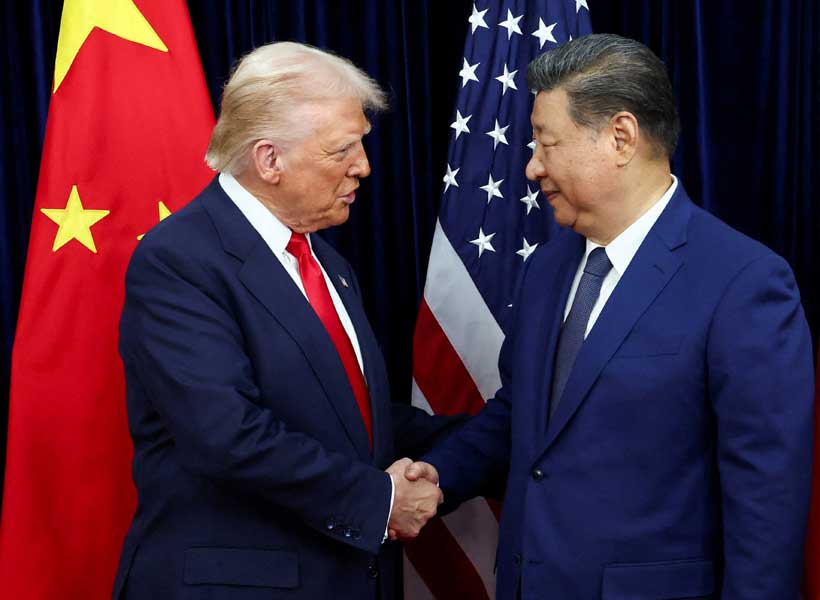
When Washington celebrates the 250th anniversary of the Declaration of Independence on July 4th, the celebrations will arrive bruised. There will be the customary funding disputes, a federal commission fighting against a more partisan task force from the White House, and a public worn by years of political turmoil, all of which will turn what could have been an occasion of civic healing into another USA ‘celebration’ in the world. None of this has gone unnoticed in Beijing, given that this ‘celebration’ is being interpreted more as a diagnosis than a birthday. What is being asked throughout the commentaries from Qiushi (求是), on CCTV, in Tsinghua and Peking University, is simply put, what kind of America is turning 250?
Within the last five years, the interpretation given from both the official channels and the more informal academic channels in Beijing has varied considerably. Most importantly, these streams have been diverging for some time and therefore offer significant insight into how Beijing has been interpreting the country it has been comparing itself to for the last 20 years.
From “the East rising” to a measured retreat
Many are familiar with the upbeat version of the story. After 2020, the phrases that framed China’s worldview included “great changes, unseen in a century” (百年未有之大变局) and “the East is rising, the West is declining” (东升西降). The latter, used by Xi Jinping in remarks to senior officials in early 2021 and again in 2023, provided the slogan for the official narrative. The Covid-19 pandemic, the insurrection at the US Capitol, and a decade of US political instability seemed to provide the empirical evidence for a thesis, rooted in Chinese Marxist theory, that capitalist systems contain the principle of their own disintegration. This was rationalized and systemized after the 2008 financial crisis and has remained largely unchanged.
Stay ahead of the geopolitical week.
MD Briefing delivers expert analysis across five global fronts — the Indo-Pacific, energy, geoeconomics, European security, and the Middle East — every Monday morning. Free.
However, the reality is far more complicated than the slogan implies. Researchers who have traced the terminology in Chinese academic publications through the CNKI database have found that scholarly use of “the East is rising, the West is declining” (东升西降) peaked around 2021 and has subsided since then, even though the idea itself remained more prevalent than it was during the entire duration of Donald Trump’s first presidential term. In other words, the slogan was being diplomatically retracted within scholarly circles at the very moment it was most associated with official optimism. When Xi’s speech in 2023, which was published in Qiushi in January 2025, described the West’s decline, it was more a formal, official copy of a sentiment than a newly published speech.
The official rhetoric, however, did not soften. A Brookings study found a near doubling in the use of “American decline” terminology in official Chinese documents from 2025. State Security Minister Chen Yixin wrote in Qiushi in December of 2025, what could be described as a near complete inventory of the ills of the world: the usurpation of unipolar dominance gives way to economic decline and social disintegration, a domestic credit crisis and the collapse of foreign mythic structures. Around the same time, a popular phrase borrowed from gaming, the “kill line” (斩杀线) found its way to official Chinese publications. A Qiushi article from January 2026 described an America, the working class of which had been pushed (beyond the point of no return) along the path of ruin by an unrepairable (decomposing) industrial base while financial capitalism strangled the benefits. The conclusion that was drawn was that we had already entered the post-American world.
The correction of early 2026
Then the story changed once more, and the correction was from within Beijing’s own strategic community.
The consensus in Chinese policymaking following the Busan summit in October 2025, was that China had won the trade war and forced the US into a stalemate. The years of maximum pressure, they said, did not lead to the systemic concessions China had sought, but rather worsened American inflation and reduced productivity. For a few months, the optimism was high. However, by 2026, the optimism was replaced by apprehension. A series of adverse events for China, from losing equity in a German port buyout, to the Nexperia debacle, to the Iran war, led many to wonder if China’s victory was, in fact, a loss. The dominant question that the strategic community was debating was whether American power was in decline or if it was in fact, power rebounding.
What was most interesting was who took the cautious side. Both Chen Wenling and Yan Xuetong argued that the US had, and has, the military and economic capability to project power. In their view, the US had the edge, and Trump’s high stakes, risky policy decisions were based on the belief that the US had the dominant position. The gap was definitely closing, but was not yet a reality. The advice they gave was to be patient. If China was able to “manage its own affairs well,” it was likely that the US would be compelled to return to a more stable relationship.
The key observation regarding prominent intellectuals in Beijing is this. They have never been champions of the triumphalist position. Yan Xuetong has spent a great deal of time dismissing talks of “The East is rising and the West is declining” and multipolarity as delusional. His recently published book, Inflection of History (历史的拐点), which was published by CITIC Press in December of 2025, predicts a US-China bipolarity which, during the next decade, would be expected to stabilise rather than destabilise. In this scenario, over the next decade the gap in capability between the two powers would be expected to converge, although the US would retain an overall advantage. In this scenario, the US would retain overall dominance in services, cyberspace and global influence, while China would retain relative superiority in manufacturing and be dominant in the international arena. In this scenario, Yan does argue that Trump would be expected to damage American power, especially with regards to the international balance, through the closure of laboratories, the loss of researchers, and a declining international trade. However, damage to the leader of the bipolar order is not the same as the collapse of the order, and Yan is very cautious not to make confuse the two.
As China’s foremost authority on US studies, Wang Jisi (王缉思) of Peking University, has placed the greatest emphasis on the need for a clear and level-headed approach. His influential essay, titled, “Has America really declined? Chinese people should hold a sober understanding” ( 美国到底有没有衰落?中国人应有清醒认识), leads with the argument that the most important factors influencing the relationship are domestic political issues, and are not to be found in some quantifiable assessment of relative national strength, or within the confines of the Thucydides Trap. He has argued that the effects of Trump’s immigration restrictions would be more symbolic than real, and would not negatively impact the long-term potential of the US economy. Along with American scholar David Lampton, he wrote, that while both societies have convinced itself that the other is an existential threat, which is a dangerous narrative trap, similar to a noticeable shift of power.
Why AI keeps rewriting the script
If the quest for technological dominance was to be provided as a single reason for the inconsistency in the narrative, it would be the most accurate. The same confidence that characterized 2025 is the same that will characterize the sobriety of 2026. When Trump had his second inauguration in January 2025, DeepSeek had launched their R1. It disrupted the presumption of AI dominance in America and had a day effect of 200 billion on Nvidia’s valuation. For Chinese decision makers, since then, it has been electric. Carnegie researchers described it as the rediscovery of technological confidence. The effect was the realization of the theory of “The East is rising and the West is declining” (东升西降): a monumental achievement with controls on exports from a young lab in Hangzhou.
The second installment was more sobering. The launch of DeepSeek’s next model, V4, in April 2026, was received with indifference. In fact, DeepSeek’s own internal product documentation stated that V4 was between three and six months behind American models. Furthermore, V4 was reliant on domestic chips from Huawei, and was, in most assessments, dependent on American technology that was not easily replaceable. For Chinese analysts, this was not a case of falling behind, but one of the more difficult problems of maintaining the technological edge. Reshoring and tariffs told a similar story. The American industrial base, which the “kill line” (斩杀线) commentary presumed was a terminally stagnated industrial base, was the target of a renewed, aggressive, and partially successful push to bring industry back to America. A competitor with such a focus on rejuvenation and renewal is not, on the surface, a declining competitor.
The G2 Puzzle
There’s another element coming from Washington that adds to the complexity of the story of American decline. This element relates to Trump. Before the Busan meeting, Trump used the term “G2,” and several Washington officials followed suit. The decline thesis cannot account for this. If America is indeed in decline, why is it offering G2 (shared leadership) with China?
Chinese reflexive responses are interesting. The official position, as expressed in Zhou Li’s (周力) December 2025 article, is that G2 as a hegemony is incompatible with China’s commitment to a multipolar world and would alienate the Global South which China is trying to court. These scholars have found their own workarounds. Yan Xuetong and Zheng Yongnian have suggested that G2 is more a description of a scenario of existing bipolarity than a policy to adopt. Xia Liping of Tongji University has suggested that G2 be rephrased as “China-US coordination” (中美协调) instead of “China-US co-governance” (中美共治), which makes it easier for Beijing to accept peer status while not succumbing to a duopoly. The attempt to manage the terminology suggests that the US at 250 is still sufficiently powerful that its offer of co-leadership is significant, even to a China that is more confident than ever.
A mirror, not a verdict
What emerges from five years of this commentary is not a single Chinese view of America at 250 but a layered one. The loudest polemical phrase is that the US, a hegemon, is in an irreversible decline. Within a Chinese context, this serves a purpose unrelated to the US. The state media have found it convenient to juxtapose gun violence and homelessness against the backdrop of Chinese economic performance. The decline of the US economy flouts the-premise, as socialism is the ultimate victor among capitalist competition.
But that was in the loud tier. In the reserved tier, the people in Beijing who are actually relying on reading Washington have converged on a more cautious and, frankly, more accurate assessment. They have described America as a relative decline, but erratic, and still very formidable as well as technologically advanced, especially in the field of the upcoming and new challenges of competition. The assessments have consistently referred to America as “declining but dangerous,” and this phrase has proven to be the most accurate of the lot. Reality has justified the phrase. The same cannot be said of unqualified and total victory.
The inconsistency in narratives can be attributed to the fact that the accounts are serving two purposes simultaneously. They are both analysis and propaganda, and the two types of work are at odds with each other. After AI successes or trade wins, the propaganda is ahead of analysis. After the impacts of reshoring or when a Chinese model stays behind, the analysts bring it back. The occasion is provided by the anniversary, but the underlying reason is that China has not decided, and maybe cannot decide, if they think that simply waiting will work in their favour or if the gap they have slowly been closing over the past 25 years is going to be a stubborn gap.
At 250, in other words, the United States functions in Chinese discourse less as a subject to be judged than as a mirror. What Beijing sees in it, in any given month, tells you a great deal about how confident Beijing is feeling about itself
Corporate flight from the Golden State has increased in recent years, with many California-based companies fleeing for lower taxes and more lax business regulations. For the first time this year, California was not the state with the most Fortune 500 companies, after Texas dethroned it in June.
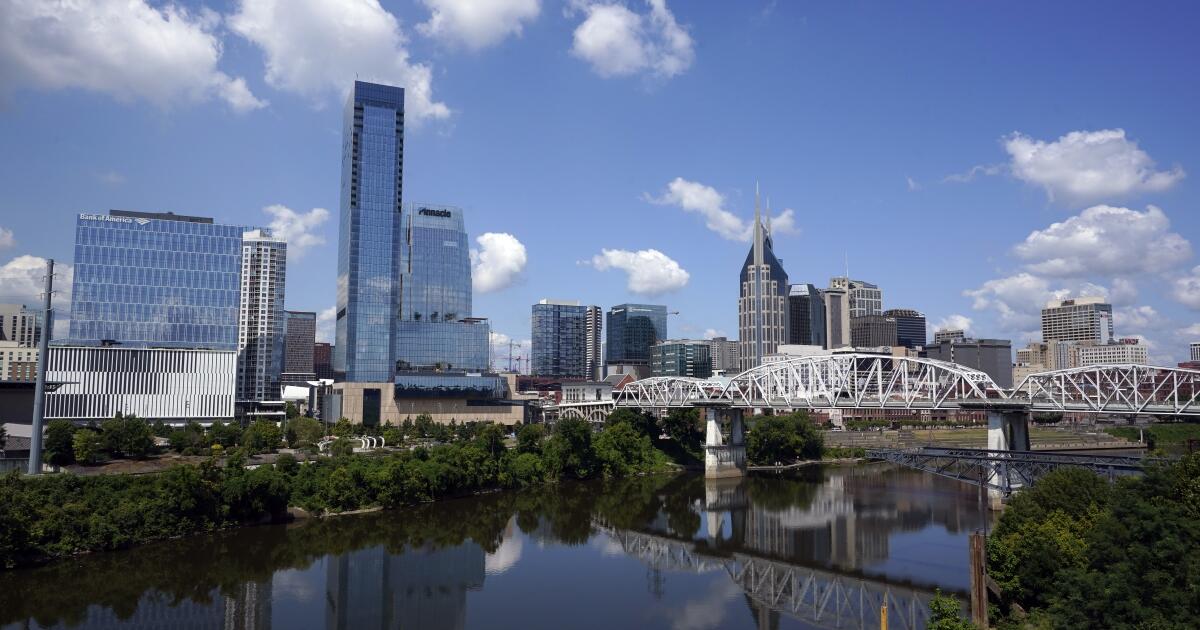
In a July 2 letter to Paramount Chief Executive David Ellison, Tennessee Deputy Gov. Stuart McWhorter pitched a relocation of the studio’s Hollywood headquarters to the Volunteer State. In the middle of a brutal legal battle with California regarding the proposed Warner Bros. merger, Tennessee may appear more appealing to Ellison. Paramount relocated its headquarters from New York to Los Angeles in August of last year.
“As Paramount Skydance writes its next chapter, Tennessee offers a compelling proposition: a state where creativity and technology converge, where talent is developed intentionally, and where innovation is embraced,” said McWhorter in the letter viewed by The Times. “We would welcome the opportunity to share our vision for how Tennessee could help shape the future of Paramount Skydance and its talented team.”
Though many in Hollywood have giggled at the idea of a major studio moving to the South, it isn’t totally ridiculous.
Ellison has backing from his father, tech billionaire and Oracle co-founder Larry Ellison. Oracle, once a California-based company, is now moving its headquarters to Nashville.
In December of 2020, the software tech company left California, where it was founded in 1977, to relocate to Texas. In April 2024, it chose Nashville as the home for Oracle’s “world headquarters,” which began construction in February.
Have other companies moved to Tennessee?
Oracle isn’t the first company to set up in Tennessee. Nissan, which had operated its U.S. headquarters out of Gardena since 1960, left the state in 2005 for Franklin. Nissan chose Tennessee for its drastically lower operational costs.
Mitsubishi Motors also moved its headquarters to Franklin from Cypress in 2019. Mitsubishi moved for lower operational costs and to be in a state with less-strict business regulations than California‘s.
Two beloved California burger chains moved to Tennessee.
In 2018, CKE, the parent company of Los Angeles-founded Carl’s Jr., also left California for Tennessee. CKE consolidated Carl’s Jr. and its St. Louis chain, Hardee’s, under its headquarters in Franklin.
In-N-Out — arguably California’s most iconic burger spot known for its animal fries and double doubles— began a transition out of California in 2023. It established a corporate office in Franklin, and last summer, owner and Chief Executive Lynsi Snyder announced her own move to Tennessee.
Last year, Snyder said pandemic-era restrictions and California policy motivated her decision to leave, but she has no plans for In-N-Out to expand farther East. The majority of In-N-Out locations are still in California.
“There’s a lot of great things about California, but raising a family is not easy here. Doing business is not easy here,” Snyder said.
What is so special about Tennessee?
The southern state’s highly business-friendly tax incentives make it an extremely desirable location. Businesses and billionaires are drawn to Tennessee by its lack of state income and property taxes. Instead, the state relies on a 7% sales tax as its main source of tax revenue. Tennessee also offers a number of tax credits and grants for businesses, including many designed to support newly relocated businesses, cover costs of training new employees, and construction.
Tennessee’s central location and well-connected infrastructure support supply chain logistics. Seven interstate highways run through Tennessee, and six of the United States’ class 1 rail lines operate there, allowing companies to cut transportation costs dramatically. Memphis is also home to the busiest cargo airport in the country.
Tennessee Gov. Bill Lee attributes the success to the state’s competitive tax policy, workforce, and quality of life.
“Companies choose Tennessee because they recognize the strength of our workforce, our strategic location and our ability to support long-term growth,” Lee said in an emailed statement. “Tennessee’s success comes from our commitment to helping businesses thrive.”
AS the Sun’s Deputy Travel Editor, I’ve certainly racked up the countries, hitting 60 this year.
This has included some insanely beautiful islands along the way, some of which you might not have heard of.
I’ve been to loads of islands around the world, and these are my favourites
When it comes to island holidays, there is a strict criteria I always look for.
Stunning beaches and beautiful blue waters are obviously a must.
However, I also want a mix of relaxation and adventure, not just one or the other – after all, I want my hiking offset with a sunlounger cocktail.
So here are my top 11 picks I think everyone should visit, ranging from established Spanish islands to barely-known ones further afield.
Holbox
Isla Holbox is a must visit if staying in CancunCredit: Alamy
While Tulum and Cancun are great holiday destinations in Mexico, let me pitch you Isla Holbox. It’s a two-hour bus from the airport, followed by a quick ferry ride – but it is worth the trip.
Expect no cars, only golf buggies, people playing live music and dancing into the night and brightly graffitied coffee shops and taco stands.
White sandy beaches, palm trees and slightly dodgy electricity… but it truly makes you feel like you’re a million miles away from the world.
You can get some insanely beautiful hotels to stay in for really cheap as well – try Alcobas Del Mar which is from £30 a night, with an indoor pool. Flights to Cancun start from £507 return.
Tenerife
Tenerife is for relaxation, and the hidden beach at Ritz Carlton AbamaCredit: Alamy
Sometimes, all you want is a beautiful fly and flop hotel resort – enter Tenerife.
Of course, the Spanish island has its iconic Siam waterpark, named the best in the world for years, its volcanic beaches and crazy Santa Cruz de Tenerife Carnival every year.
I never left thanks to its Villa Ambassadors who are on call for your every need, from better pillows to booking massages.
If you’re looking for that hallowed 1 euro holiday pint you’ll be searching for a while as most of the cheap bars have put their prices up to a minimum of 1.50 (£1.30) euros a pint now – to find these deals, head to the strip in Los Cristianos, Playa De Las Americas and Costa Adeje.
Not every holiday has to be an adventure, and I came away being so relaxed I almost missed my flight back. Deals can be found for £839 each for a seven-night and flight package, via loveholidays.
Mauritius
Mauritius is one of the most beautiful African islandsCredit: Alamy
If you asked me where the best sunsets are found in the world, I’d say Mauritius, an African island which had gorgeous bright pink skies every night.
Yet I was transported to Dubai thanks to the hotel rooftop infinity pools, Bora Bora from the thatched lobbies and Maldives for its overwater restaurants. That’s before exploring the beautiful history via L’Aventure du Sucre, and some rum cocktails at the beach bars….
It’s the kind of island where you never want to leave your resort, with friendly locals always cracking jokes as you laze by the pool.
You can fly directly there with Air Mauritius from £536 return, while you can easily find seven-night package holidays for under £1,000pp.
Ria Formosa
Stay in Faro and explore the Ria Formosa islands, rather than head straight to the AlgarveCredit: Supplied
Don’t overlook Faro as a holiday destination, despite it being the gateway to the Algarve – it is home to some tiny, crowd-free islands in Ria Formosa, that only locals know about.
Ilha Deserta is just a few euros and 20 minutes by boat, where its golden sands are compared to the Caribbean of Portugal. The only thing on it? The fabulous Estamine restaurant, serving fresh fish and local wine.
Or there is Isla Armona, with a few more local houses and cafes, and is just as quiet to visit, along with islands Cabanas, Culatra and Tavira.
You’ll have to stay back on the mainland, with Faro hotels from around £80 a night. Flights to Faro start from £30 return with Ryanair.
Naifaru
The Maldives is a bucket list trip for a reason, and always lives up to the hype
At this point, the Maldives is on everyone’s bucket list, but there is a way to see the real side of the country, outside of the resorts.
I went on a day trip to Naifaru, where I met rehabilitated turtles at Atoll Marine Center that were injured from boats, as well as learned more about the local way of life from the people themselves.
Of course, if you want luxury you have a lot of options on nearby islands – if you want a larger, more established resort, opt for Atmosphere Kanifushi, while a smaller and more intimate resort is something like VARU by Atmosphere.
Deals for the Maldives are insanely cheap right now – loveholidays has some for as little as £1,179pp for a seven-night and return flight package.
Crete
Crete may be Greece’s biggest islands, and also one of the best especially when it comes to exploring the cities like RethimnoCredit: Alamy
Trying to name the best Greek island when there are hundreds to choose from seems like an impossible task. But the largest of them all sold itself as the perfect places for both couples and families.
I explored two sides of Crete, with Numo Ierapetra going up there as one of my favourite hotels. Adults-only, live DJ pool sessions, quiet beach and fantastic breakfast buffet – all boxes ticked.
Or head to the other side of the island and swap Chania for the Venetian city of Rethimno, where I hopped between cafes and trendy shops, as well as the tiny village of Margarites known for its ceramics.
Flights to Crete with easyJet are around £56 return, while stays at Numo Ierapetra start from £137 a night.
Sri Lanka
Sri Lanka is one of the hottest places to visit this yearCredit: Alamy
Mix palm-tree lined beaches with the best cup of tea in the world, and you’ll find Sri Lanka. It’s the size of Ireland, so it’s easy to get around, but with an insane amount of things to do.
Catch some waves at Weligama Beach, followed by an elephant safari in Yala, ending on some of the best – albeit spicy – curries of your life. Make sure to spark up a conversation with the locals, where it won’t take long to get onto the topic of cricket.
Hotels are crazy cheap – as little as £25 a night – but it has some of the world’s best hotels for a relatively reasonable price given the quality, like Jetwing Vil Uyana (from £271) or Cape Weligama (from £364).
Or keep it simple with a package deal with On The Beach from £870pp.
St Kitts
St Kitts is great if you love outdoor spots and adventure
If you like hiking volcanos, paragliding in bright blue waters and ziplines through the jungle – St Kitts is the island for you.
Adventure tourism is a huge thing here. Think horse riding, jet skis, snorkelling and buggy rentals, which are the tip of the iceberg of what you can do there.
Although it still has its beautiful beach bars serving cheap cocktails and tasty lobster, alongside live reggae music.
Even better? You can fly there directly with British Airways, with return flights from £420pp. Hotels start from £68 a night, although most tend to sit around £100-£140.
Iceland
Sometimes you want a holiday away from the tech and people, which Iceland is perfect forCredit: Alamy
Sometimes you don’t want a sweaty, overly-hot holiday – which is where Iceland comes in. Even as a hot-weather girly, I was left in awe of the island’s natural landscape.
I spent my mornings in the famous Blue Lagoon, before getting cosy with a hot chocolate in front of my hotel fire.
Crazy geysers, rocky road trips, Northern Lights – it felt like I was going back in time to a more basic, rural way of living.
You can do it on a budget if you know where to look. Icelandair have a “Just the Basics” package trip from £421 which is return flights and two nights at a hotel.
Puerto Rico
Puerto Rico has a fantastic food and drink sceneCredit: AlamyIt was one of the most colourful places I’ve ever been, especially in the Old Town
If there is one island that surprised me in how much I loved it, it was Puerto Rico. While it’s popular with Americans, Brits often overlook it as a holiday destination, most likely because it requires a stopover flight.
It was a fascinating mix of American and Caribbean culture, where Medalla Light Beers were just £2.50 chased by great-value pork sandwiches to soak it all up. A tour of the Casa Barcardi distillery includes a lot of cocktails along the way too…
Definitely get a boat trip to Flamenco Beach, frequently classed as one of the best in the world, with the unique feature of a WW2 US army tank stranded on the shoreline, as well as a visit to El Yunque National Forest to see the glowing bioluminescent waters.
Don’t expect super cheap hotels, but you can find some guesthouses for under £100 a night. Return flights start from £610.
Turks & Caicos
Turks & Caicos is one of my favourite Caribbean islandsCredit: Alamy
Turks & Caicos is no longer as easy to get to, after Virgin Atlantic scrapped flights there – but it is 100 per cent worth the trip.
It’s a place for lazy days spent at resorts. All I did was explore sunrises on Grace Bay (another world’s best beach), kayak in glass-bottomed boats alongside chilled turtles, and drink alcohol on floating pontoons.
Don’t even try to compare it to its nearby neighbours of Jamaica and Barbados – it feels worlds away when it comes to the paradisical island.
Seven-night holidays start from £1,159pp with loveholidays.
Grace Bay is still one of the most beautiful beaches I’ve ever seenCredit: Collect
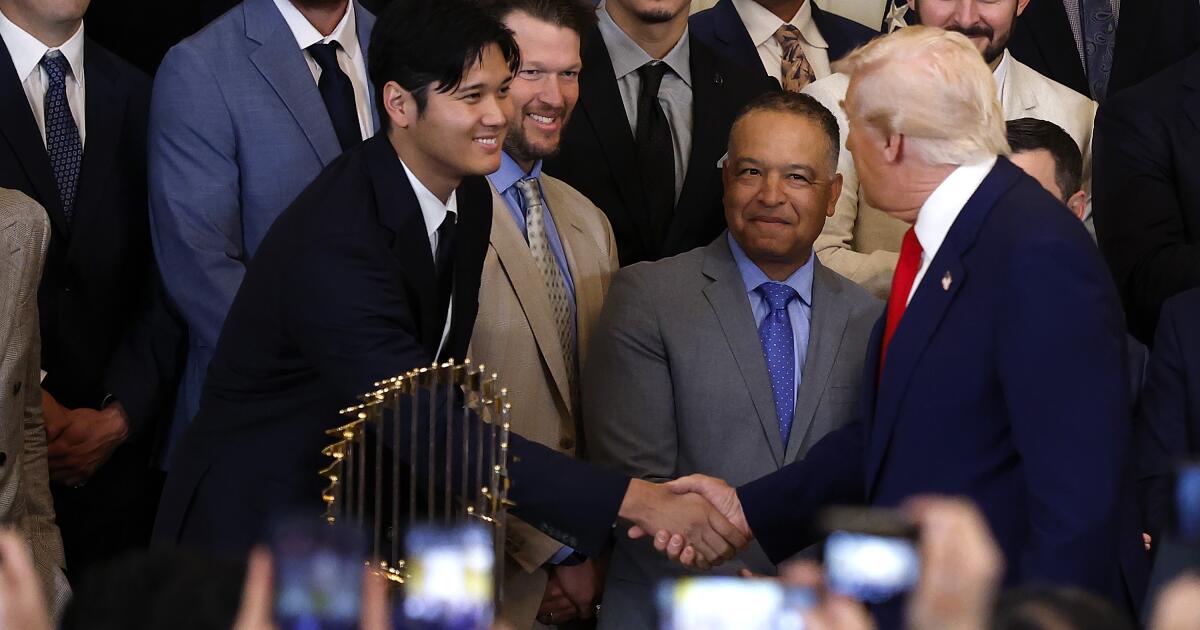
It is difficult to find words to express my disgust for the coming White House visit. Like the man they are going to see, the Dodgers are without honor.
Rico Gardiner San Diego
Sports do not transcend or evade association with politics, especially in the current period of America’s decline under President Trump. It’s disgraceful that the Dodgers would again honor a rank authoritarian, a brazenly corrupt kleptocrat, criminal, malignant narcissist and wrecker of our democracy and rule of law.
Trump is not honoring the Dodgers; he’s using their presence to honor him and give him a bit more gaslight glory. The organization has smeared itself with the dishonor, serving the PR agenda of our vainglorious tyrant. If they cared about the optics, their civic duty and the good of the country, they would decline.
T.R. Jahns Hemet
Dodgers, you are out. Out of our house. In normal times, a White House visit is a grand honor for a championship club. I get that. These are NOT normal times. For you to pretend they are and honor this man with your presence is unforgivable. Spineless. A statement that makes the wrong statement. We will not be watching or rooting for you this season. You are out at home. Our home.
William Lewis Burbank
Ever since the Dodgers accepted their World Series visit to the White House, they’ve been error-prone on the field, and losing most games. In the All-Star Game, the players were hitless and the pitcher served up the only home run. To add more insult, their former player received the MVP award! Most importantly, is the disappointment and loss of respect from the fans. Karma has a way to haunt.
Robert Torres Torrance
Your letters to the editor section regarding the Dodgers’ planned visit to the White House continues the left bias of the L.A. Times. Four letters were published praising the article and one was published critical of the article. I doubt that the 4-to-1 ratio reflects the opinions of the L.A. population, but it may reflect the opinions of readers that your left-leaning paper attracts. I read the paper only to see what the lefties are up to.
July 17 (Asia Today) — The U.S. Department of Homeland Security announced a final rule Thursday limiting stays by international students and exchange visitors to no more than four years and requiring them to undergo federal review when seeking extensions.
The rule replaces the open-ended “duration of status” system for holders of F student visas and J exchange visitor visas with fixed admission periods tied to their programs and capped at four years.
About 1.5 million current F- and J-visa holders will automatically be transferred to the new system.
The change, combined with a shorter post-graduation grace period and mandatory extension reviews for students seeking Optional Practical Training, could disrupt the fall semester and reduce demand for study in the United States.
Exchange visitors will also be limited to four-year stays. Foreign journalists holding I visas will generally have to renew their status every 240 days.
Federal review required for extensions
F- and J-visa holders who need to remain in the United States beyond their authorized period will have to apply to U.S. Citizenship and Immigration Services for an extension of stay.
Applicants will be required to submit biometric information and undergo security, identity and fraud screening. They must also demonstrate satisfactory academic progress and financial stability, The Wall Street Journal reported.
The change ends a system in place since 1978 that allowed students to remain in the country as long as they maintained the required course load and complied with the conditions of their immigration status.
Homeland Security officials said more than 2,100 F-1 students who entered the United States between 2000 and 2010 were still maintaining F-1 status in 2025.
The department said the rule was intended to prevent people from repeatedly enrolling in classes to avoid leaving the country, a practice officials described as creating “forever students.”
“For nearly half a century, the outdated duration-of-status system has undermined national security and created an environment where immigration fraud could flourish,” Homeland Security Secretary Markwayne Mullin said.
“By enforcing clear and finite periods, the United States is restoring its ability to properly screen and manage those who remain in our country,” he said.
Nearly 24,400 Koreans and family members affected
The roughly 1.5 million F- and J-visa holders currently staying in the United States under the duration-of-status system will receive fixed admission periods of up to four years beginning on the rule’s effective date, Bloomberg reported.
Foreign journalists entering on I visas will generally be admitted for 240 days and must apply for additional 240-day periods. Chinese journalists will be limited to 90-day extensions.
More than 1.8 million entries were recorded on student visas in 2024, an increase of more than 11% from the previous year, according to the Department of Homeland Security.
The United States also hosted about 500,000 J-visa exchange visitors and 37,000 foreign journalists holding I visas.
Students from India, China and South Korea are expected to be among those most affected by the rule, Bloomberg reported.
According to the South Korean Embassy in Washington, 11,861 South Korean students held F-1 visas in 2025 and 1,347 family members held F-2 visas.
Another 7,985 South Koreans held J-1 exchange visitor visas and 3,180 family members held J-2 visas, bringing the total number of South Korean F- and J-visa holders and their dependents to 24,373.
An additional 349 South Koreans held I visas.
The rule is scheduled to be published in the Federal Register on Friday and take effect 60 days later, in mid-September.
Its implementation during the fall semester could create confusion involving visa extensions and student enrollment records, Bloomberg reported.
Shorter grace period could disrupt employment pathway
The rule cuts the grace period after graduation from 60 days to 30 days for students preparing to leave the United States, transfer schools or change immigration status.
It also bars graduate students from changing their educational objectives and requires government approval before they transfer to another institution, Reuters reported.
Doctoral students, whose programs commonly take about six years, may have to apply for extensions before completing their studies and face the possibility of denial, The Wall Street Journal reported.
Doctors participating in long-term training programs will also have to seek extensions after four years, according to Bloomberg.
Nearly all students using Optional Practical Training, which permits eligible graduates to work in the United States for up to three years, will effectively be required to apply to U.S. Citizenship and Immigration Services for extensions for the first time.
Visa holders who remain beyond their authorized periods could face three- or 10-year bans on re-entering the United States, depending on the length of the overstay.
Technology and financial companies frequently hire international graduates through Optional Practical Training before sponsoring them for H-1B specialty occupation visas.
More restrictive access to practical training could narrow that employment pathway, The Wall Street Journal reported.
David Bier, director of immigration studies at the Cato Institute, said the restrictions on changing educational objectives and transferring schools lacked a legal basis.
He said graduates who fail to find an employer sponsor within 30 days could “immediately become unlawfully present.”
Education groups consider challenge
Fanta Aw, president and chief executive officer of the Association of International Educators, called the rule a misguided and unnecessary policy change.
She said it would inject “uncertainty, bureaucracy and fear” into a system that had operated effectively for decades and said the association was considering all available options to challenge it.
Todd Lyons, a former acting director of U.S. Immigration and Customs Enforcement, said in May that the agency had launched an investigation into fraud involving Optional Practical Training.
Lyons said investigators had identified 10,000 international students employed by companies suspected of fraud and described the program as a “magnet for fraud,” Bloomberg reported.
The number of international students in the United States fell 1.4% during the previous fall semester, while new international student enrollment declined 17%.
Student visa issuance fell 36% during the previous summer, and the new rule could accelerate the decline as it takes effect during the fall semester, Bloomberg reported.
The regulation will also be subject to congressional review before its implementation, Reuters reported.
Doug Rand, a former Homeland Security official, said most Americans understand both the value of welcoming international students and the need to eliminate unnecessary regulation.
“This rule will achieve precisely the opposite result,” he said.
International education expert Rajika Bhandari said students would consider not only whether they could obtain visas and enter the United States but also whether they had viable long-term options after completing their studies.
She said Asian students and graduate students in science, technology, engineering and mathematics fields would be particularly affected.
“The implications of this change are not yet fully understood by students, but they will be profound,” Bhandari said.
The greatest geopolitical and economic challenge facing the United States today is the proliferation of international Sovereign Wealth Funds (SWFs.) While the United States has the “sweet geopolitical spot in the world’s geography and topographic landmass,” its economic dominance is being challenged by the proliferation of international SWFs. It is true, at present, that the United States has the largest reserve of oil and mineral wealth in the world, yet with SWFs gaining traction in the world economy, the oil reserves and mineral wealth may not matter.
Those countries that have initiated SWFs as part of their economic and geopolitical life are on an upward trajectory. The United States, on the other hand, is on a downward path by not marshalling its vast mineral wealth in a comprehensive and dynamic SWF. If things continue on their present course, those countries utilizing their mineral wealth and excess cash surplus will eventually catch up and overtake the size of the US economy. This is an evolving threat to the national security of the United States and to its very polity.
The most immediate threat to the United States is the race to develop mining facilities on the Moon to harvest and transport the critical element of Helium-3 (He-3.) He-3 is a critical element for the increasing economic demands of a modern world economy. Whoever can establish mining dominance for this critical element will become the world’s leading economic power in the world, regardless of that nation’s mineral wealth on Earth.
However, with its present economic and political strength, the United States has the means to reverse that trend if its two major political organizations can compromise on the very nature of the framework that establishes a United States SWF; this challenge is not easily dealt with.
Stay ahead of the geopolitical week.
MD Briefing delivers expert analysis across five global fronts — the Indo-Pacific, energy, geoeconomics, European security, and the Middle East — every Monday morning. Free.
This article discusses the legislative gridlock surrounding the creation of a United States SWF and the accelerating international competition that challenges the current United States dominance in space technology.
Commonwealth Fusion Systems (CFS) is currently constructing the SPARC at Devens, Massachusetts. CFS is constructing the SPARC to demonstrate to the world that it has solved the fusion problem. Despite some technological setbacks, CFS is on schedule to make the SPARC operational by the end of 2026, or early 2027. At the same time, CFS is currently constructing a fusion reactor (called a tokamak) in Virginia, which is scheduled to go online in the early 2030s. Critical to the ARC’s development is a shortage of the element He-3. He-3 is ignited by radio frequency and is the sparkplug that begins the plasma process, which is fusion energy, in the ARC tokamak.
The Commercial Landscape: U.S. Private Frontrunners
Terrestrial Helium-3 supply—derived primarily from nuclear stockpile maintenance—is severely capped at 22,000 to 30,000 liters annually. With surging demand for ultra-low-term quantum computer cooling, private aerospace firms are leading the transition to lunar harvesting:
Interlune: Founded by former Blue Origin executives, the company unveiled a full-scale prototype harvester developed with Vermeer to process one hundred metric tons of regolith per hour. Backed by a $6.9 million NASA contract for its Prospect Moon payload, Interlune secured a historic $300M+ supply agreement with Finnish quantum firm Bluefors. Its first mapping payload is scheduled for an upcoming commercial lunar launch.
Lunar Helium-3 Mining (LH3M):This firm holds five U.S. patents on a non-invasive, gas-separation architecture designed to extract solar wind volatile gases while bypassing traditional, high-wear mechanical regolith excavation.
The U.S. Sovereign Wealth Fund Gridlock
While Helium-3 is valued at roughly $20 million per kilogram, the asset cannot currently be utilized to seed an American Sovereign Wealth Fund due to severe political domestic gridlock:
The Legislative Catch-22: The U.S. Commercial Space Launch Competitiveness Act explicitly protects private enterprise, granting corporations exclusive ownership over extracted space resources. To capture this value, Congress would need to enact “space-severance taxes” or equity-for-infrastructure deals—both of which face massive ideological pushbacks in a deeply divided legislature. It should be noted that American taxpayers have invested some $1.9 trillion (adjusted for inflation) in technology developed by NASA. Since the American people invested this money, they should be entitled to a return on investment.
The Deficit vs. Surplus Dilemma: Traditional SWFs rely on state-managed resource surpluses (e.g., Norway’s oil). The U.S. operates at a massive structural deficit. Republicans propose seeding a fund via tariffs or fossil-fuel extraction, while Democrats demand funding via corporate wealth taxes or clean-energy equity. These disputes, combined with immediate 2026 midterm election priorities, have stalled the SWF framework completely.
Global Geopolitical Competitors: State-Driven Alternatives
While the U.S. model depends heavily on the private market, international adversaries are leveraging unified state power to establish dominance over lunar resources:
China (CNSA): China’s Chang’e lunar exploration program is systematically mapping Helium-3 concentrations. Unlike the U.S. focus on near-term quantum cooling, Beijing explicitly views lunar He-3 as a long-term strategic energy priority to fuel Earth-based Deuterium-Helium-3 nuclear fusion reactors.
The China-Russia Coalition: Beijing and Moscow have formalized a binding industrial partnership to construct an automated nuclear reactor on the Moon’s South Pole by 2035–2036. This autonomous reactor is designed to resolve the “Lunar Night” problem, providing continuous power to massive, automated mining rovers and scientific labs under the International Lunar Research Station (ILRS) framework.
Japan (ispace): In the allied sector, Japanese lunar robotics firm ispace has partnered with European mining tech developers to pioneer its own automated, energy-efficient recovery models for lunar Helium-3.
· Conclusion
· The race for Helium-3 represents a critical shift from symbolic space exploration to deep-space industrial supply chains. While U.S. commercial tech is moving quickly, domestic policy gridlock risks ceding permanent, state-backed infrastructure dominance to the China-Russia ILRS coalition.
· While the concept of using outer space resources to build national wealth is actively discussed by think tanks, Congress has separate, targeted pieces of legislation addressing artificial intelligence revenue, foreign transparency, and space resource exploration rules.
·
· The primary draft bills and legislative vehicles currently stalled in committee reveal how Congress is attempting to navigate these frameworks:
The American A.I. Sovereign Wealth Fund Act (S. 4825)
Introduced in June 2026 by Senate Finance Committee member Bernie Sanders (I-VT), this is the most direct legislative attempt to create a federal wealth fund.
The Mechanism: The bill proposes imposing a specialized excise tax on systemically critical artificial intelligence models and automation infrastructure. The revenue would seed a citizen-owned national wealth fund.
Why It’s Stalled: It is currently deadlocked in the Senate Finance Committee. The bill faces severe pushback from lawmakers who argue that taxing emerging domestic tech sectors will cause the U.S. to lose the AI race to China, preferring instead to seed a potential fund via tariffs or natural resources.
2. The Sovereign Wealth Fund Transparency Act (S. 1488)
Introduced by Senator Richard Blumenthal (D-CT), this bill tackles the national security and foreign policy side of state-owned investment vehicles.
The Mechanism: Rather than creating a U.S. fund, this bill forces heavy disclosure requirements, financial auditing, and security screening on foreign sovereign wealth funds operating within U.S. critical infrastructure, high-tech, and aerospace sectors.
Why It’s Stalled: Referred to the Senate Committee on Foreign Relations, it has remained stagnant due to concerns that over-regulating allied sovereign wealth funds (such as those from Gulf state allies or Singapore) could chill necessary foreign direct investment into U.S. tech startups.
There is currently no singular active bill trying to place federal royalties on lunar Helium-3 mining. Instead, the debate is gridlocked during budget reconciliation and agency authorizations within the House and Senate Commerce, Science, and Transportation Committees.
The Conflict: Congressional research reports on space resource extraction outline a widening gap in regulatory authority. NASA’s Artemis framework pushes heavily for in-situ resource utilization (ISRU) via public-private partnerships. However, some factions in Congress are pushing for strict government-owned procurement models to prevent private monopolies over lunar sites, effectively freezing long-term policy development
Midterm Postponements: Broad commercial space bills have been repeatedly delayed because committee attention is entirely consumed by urgent federal budget reconciliation battles and defense appropriations.development.
Summary of Bill Statuses
Bill / Initiative
Primary Committee
Current Status
Core Roadblock
S. 4825 (American A.I. SWF Act)
Senate Finance
Stalled / Introduced
Bipartisan disagreement over taxing tech vs. utilizing tariffs.
S. 1488 (SWF Transparency Act)
Senate Foreign Relations
Stalled / Introduced
Fear of discouraging foreign venture capital in U.S. aerospace.
NASA Authorization & ISRU Policies
Senate Commerce / Science
Blocked in budget cycle
Disagreements on private extraction rights vs. national ownership.
NASA Authorization & ISRU Policies
Senate Commerce / Science
Blocked in budget cycle
Disagreements on private extraction rights vs. national ownership.
Conclusion
Until the two major political organizations can begin to compromise for the good of the American people, the United States will eventually revert to a second-class power.
Beloved presenter Fern Britton is best known for hosting ITV daytime programme This Morning
Fern Britton has returned to screens with her popular ITV series(Image: ITV/Love Monday TV)
Fern Britton has a very famous father and fans will be floored at who he is.
The former This Morning presenter is currently appearing on screens in Fern Britton: Inside the Vet’s. The ITV documentary series follows Fern as she goes behind the scenes at a Bristol surgery.
The programme has recently returned for a second season at The Grove Vets, with the latest instalment set to feature a 10-month-old cat with an injury sustained in a fight. That’s not all, as Dr James Greenwood also provides emergency care to a whippet with a nasty throat injury, and delivers a masterclass on doggy dental hygiene with special help from his own pet.
As Fern continues to delight audiences on ITV1, some viewers may be surprised to learn that she comes from a very famous family, reports the Express.
Who is Fern Britton’s famous dad?
Fern’s dad was the actor Tony Britton. Tony was best known for starring in BBC sitcom Don’t Wait Up alongside Nigel Havers in the 1980s, as well as many British films including The Day of the Jackal.
He also appeared in Robin’s Nest alongside Richard O’Sullivan and Tess Wyatt, and films Operation Amsterdam, as well as Sunday Bloody Sunday. In 1975, he won the Broadcasting Press Guild’s best actor award for his role in The Nearly Man.
Fern announced her father’s death in 2019, just one year after the passing of her mother, Ruth. The deaths of her parents were followed by more heartbreak, as her marriage to TV chef Phil Vickery soon “fell apart”.
The couple announced their split after two decades together in 2020. Fern and Phil haven’t spoken in several years, with Fern claiming that her ex “stopped talking to me” after her mum died.
“My mum died in 2018 and my dad died in 2019, and then my marriage died,” Fern previously told The Telegraph.
Fern Britton’s body transformation
The 68-year-old star recently revealed her weight loss to fans on social media, after losing five stone.
Fern has since spoken about the massive change she made to her diet and how it has influenced her weight loss journey.
Speaking on the Postcards From Midlife podcast, she said: “I realised the sugar intake. I’m addicted to sugar and, funnily enough, if you’re not eating doughnuts, biscuits, cake, jam, you know… it makes you feel a lot better. So, now if I’m eating sugar, it’s too sweet for me because I used to be able to tolerate an awful lot.”
She added: “And like cigarettes as well, I used to be able to tolerate anybody smoking anything in my face, but now it’s like, ‘Stop it’. Apart from that, it was very much kind of sensible.”
Fern Britton: Inside the Vet’s is available to stream on ITVX
The Crown Prosecution Service sees first-hand the impact that domestic abuse has on victims.
It says that of every five cases the police refers to it, four result in charges being brought.
Olivia Rose, the CPS’s National Stalking Lead, says it does not just see physical abuse. There is coercive and controlling abuse too.
“It’s crucial for victims to spot the signs early,” Rose said. “What our prosecutors see can include monitoring of victims’ phones and social media, often inundating them with dozens of messages.
“There’s also emotional blackmail, such as threatening to kill themselves if their partner leaves.
“It’s incredibly important that we get the message out to say that behaviour like this is not just unacceptable: it’s illegal.”
The CPS, the government department responsible for prosecuting criminal cases, say it works closely with the police and women’s charities to ensure that action is taken to stop such behaviour and to help victims to get away.
It says it needs help from communities too. And it is urging people to look out for friends, family and neighbours who could be vulnerable during the World Cup.
“If you can step in to help, you could be making a life-changing difference,” Rose said.
She also wants to get the message to victims that they will be supported if they speak out.
“We understand how difficult it can be to report domestic abuse,” she added. “But if you come forward, you will be taken seriously, and we will bring offenders to justice.
“The World Cup should bring communities together, and it should never be an excuse to fuel abusive behaviour.”
Anyone experiencing domestic abuse who is in immediate danger should always call 999. Victims can also report abuse to the police on 101.
Confidential support services are available. Anyone affected can contact the National Domestic Abuse Helpline on 0808 2000 247 in England, or the Live Fear Free helpline on 0808 80 10 800 in Wales.
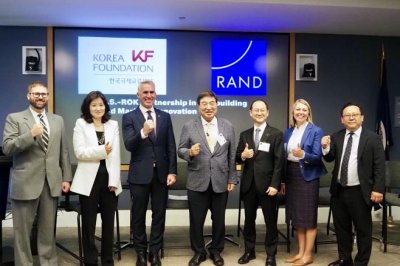
1 of 4 | Korea Foundation and shipbuilding industry representatives attend a South Korea-U.S. shipbuilding and maritime innovation forum Thursday at RAND in Arlington, Va. Photo by Asia Today
July 17 (Asia Today) — A senior U.S. lawmaker proposed building as much as 80% of some American naval vessels in South Korea while reserving sensitive technology and final assembly for the United States.
Rep. Ami Bera of California, the top Democrat on the House Foreign Affairs subcommittee overseeing East Asia and the Pacific, said Thursday that relying exclusively on domestic shipyards was unrealistic because the United States lacks sufficient workers and production capacity.
Bera spoke at a South Korea-U.S. shipbuilding and maritime innovation forum hosted by the Korea Foundation and the RAND research organization in Arlington, Va.
“To say we are going to build everything in the United States is wrong,” Bera said, urging Washington to make greater use of allied manufacturing capacity.
He suggested that South Korean shipyards could produce hulls and other components accounting for 75% to 80% of a vessel, while highly sensitive systems could be manufactured and installed in the United States.
Bera also proposed a distributed construction model under which components would be produced at different locations before being brought to the United States for final assembly.
“If we do not have the workers or construction capacity in the United States, we have to build where ships can be built,” he said.
Bera said combining the capabilities of the United States and its allies would strengthen deterrence and help prevent a military conflict with China.
Technology controls and visas remain obstacles
Bera said President Donald Trump had discussed nuclear-powered submarine construction with South Korea.
Such cooperation would require the two countries to address technology sharing and export control restrictions, he said.
Bera cited the security partnership among the United States, Britain and Australia as a possible model for resolving issues related to joint naval construction.
The partnership, commonly known as AUKUS, includes plans for Australia to acquire nuclear-powered submarines with American and British assistance.
Bera also called on the United States to facilitate the entry of South Korean engineers and technicians needed to support investments by Korean shipbuilding companies.
He described the detention of more than 300 South Korean workers in Georgia in September as an “embarrassing fiasco” and said the visa problem must be resolved.
The United States has encouraged South Korean companies to invest in American manufacturing while immigration restrictions have complicated the deployment of specialized Korean personnel to construction sites and shipyards.
Expert says U.S. rebuilding could take decades
Shin Jong-gye, a professor emeritus of naval architecture and ocean engineering at Seoul National University, said China’s overall shipbuilding capacity by gross tonnage was more than 230 times that of the United States.
He said China had more than 50 dry docks large enough to accommodate aircraft carriers.
Newport News Shipbuilding in Virginia is the only U.S. shipyard capable of designing and building nuclear-powered aircraft carriers.
Shin said the United States must expand both its physical shipyard capacity and its ability to build vessels quickly and efficiently.
South Korea, Japan and China benefit from building commercial and naval vessels within the same industrial ecosystems, allowing them to share technology, workers and supply chains, he said.
The United States lacks a comparable commercial shipbuilding base and therefore cannot obtain the same economies of scale, Shin said.
South Korea, Japan and China together account for more than 95% of global commercial shipbuilding.
Shin said rebuilding an industry requires accumulated experience, technology and repeated construction cycles.
He estimated that rebuilding the U.S. shipbuilding sector independently could take 20 to 30 years, while cooperation with South Korea could significantly shorten the process.
Shin proposed initially building complete ships in South Korea while developing supply chains in the United States. American production could then be expanded gradually.
He said protecting South Korean intellectual property, providing appropriate compensation and resolving visa restrictions for Korean specialists would be essential.
Hanwha, HD Hyundai respond to Navy request
Michael Coulter, president and chief executive officer of Hanwha Defense USA, said protectionism was one of the largest obstacles to industrial cooperation.
He said South Korea and the United States often viewed each other primarily as export markets rather than partners sharing a common industrial base.
Coulter said the U.S. Navy had issued a request for information after consulting the South Korean government and Korean shipbuilders.
The request examined the possible use of a vessel construction manager who would help finalize a ship’s design before construction begins.
South Korean shipyards generally complete designs before starting construction, while U.S. Navy projects often undergo design changes after work has begun, increasing costs and delaying delivery, Coulter said.
The U.S. government has asked Hanwha about options ranging from building combat vessels and supplying motors to constructing hulls in South Korea before installing American technology, he said.
Coulter said, however, that the administration and Congress had not reached a unified position.
He called on the two countries to integrate portions of their industrial bases rather than treat each investment or contract as a conventional export transaction.
Hong Suk-hwan, president and chief executive officer of HD Hyundai USA, proposed a two-track strategy involving investment in U.S. shipyards and partnerships with existing American companies.
Hong said HD Hyundai had built about 5,000 vessels during the past 50 years and could apply its skilled workforce, manufacturing experience and supply network to the United States.
He also proposed a “bridge strategy” in which American workers would train at South Korean shipyards for about three years while ships were being constructed there.
The trained workers could then return to the United States as supervisors and production managers at American shipyards.
U.S. law limits overseas warship construction
Brittany Clayton, a senior operations researcher at RAND, said complicated U.S. defense procurement procedures, unpredictable orders and design changes during construction remained major barriers to cooperation.
The Navy, Defense Department and Congress all play roles in funding and policy decisions, making rapid action difficult, she said.
Clayton said companies needed consistent and predictable demand from the U.S. government before making long-term investments.
She also cited proposed legislation restricting the overseas construction of American combat vessels.
Rep. Jared Golden of Maine, whose district includes the Bath Iron Works shipyard, introduced an amendment to the fiscal 2027 defense authorization bill that would restrict foreign construction of combat ships.
Clayton said distributed construction could provide an alternative, with components built at multiple locations before being integrated and tested in the United States.
She also suggested beginning cooperation with strategic sealift vessels, which contain fewer sensitive military technologies than combat ships.
The Senate Armed Services Committee included language in its fiscal 2027 defense authorization legislation that would permit the acquisition of up to two noncombat vessels from allied shipyards, including bulk fuel carriers and strategic sealift ships.
Trump said Wednesday that his administration was examining shipbuilders in South Korea and other countries and could purchase some vessels built outside the United States.
Kristin Gunness of San Diego State University said the university had signed an agreement with Samsung Heavy Industries to establish a marine engineering and shipbuilding center.
She said the university was also developing exchange programs with Seoul National University and other South Korean institutions.
Shin proposed short-term educational programs involving retired South Korean professors and American universities to train ship designers and production managers.
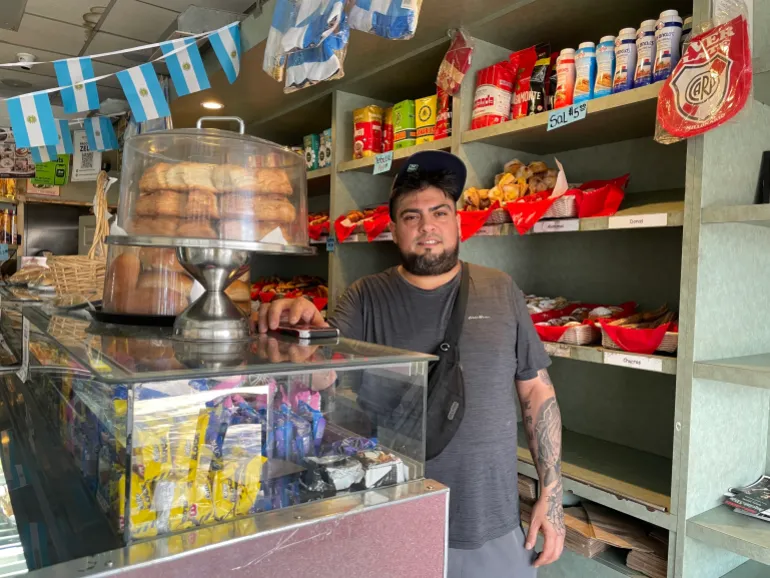
New York City – It’s dubbed “Little Argentina”, but lifelong resident Christian Gimenez says much has changed in the neighbourhood he grew up in.
Once an epicentre of the Argentinian diaspora that settled in New York City, most relocating during the so-called “dirty war” of the 1970s, only a handful of Argentinian restaurants and bakeries remain as a foothold of what once was in the Elmhurst, Queens neighbourhood.
Recommended Stories
list of 3 itemsend of list
But when the FIFA World Cup comes around, the block swells with revellers, clad in white and sky blue. With Argentina heading to the final against Spain on Sunday in East Rutherford, New Jersey, just a few kilometres (miles) away, everything on the block – from the asphalt, to the benches, to the store fronts, and even the fire plugs – bears the iconic colours.
As a child, “everywhere you would go, it was Argentinian,” Gimenez, who owns Rio de la Plata Bakery and is among those who spearheaded the decorations, told Al Jazeera. “So what I do is try to keep it alive.”
Christian Gimenez in the Little Argentina area of Queens, NY [Joseph Stepansky/Al Jazeera]
To be sure, the 40-year-old is clear that the commitment to Argentina’s national team goes far beyond the monthlong tournament. The World Cup may come only once every four years, but the vaunting mural of Lionel Messi and Diego Maradona on the side of his bakery is a mainstay.
To many, it is a reminder of the generational significance of the country’s football tradition, one that has for decades been a glue for Argentinians in New York City, even as the community has dispersed.
Seventy-four-year-old Beatriz Jaime recounted watching Argentina’s 1978 routing of the Netherlands in a broadcast at Madison Square Garden, and returning to the neighbourhood soon after to find it “loaded with people” celebrating into the night.
“The thing is that the roots are here, and they’re in Argentina,” said Jaime, who grew up in Queens but now lives on Long Island.
“You never forget that. I get goosebumps.”
A shop sells Argentina gear in Little Argentina [Joseph Stepansky/Al Jazeera]
For Henry Pachaco, 45, who is also from Queens, fandom is a family affair. He stood clad in the national team jersey, his mother wearing a blue shirt with a single phrase, “Hand of God”, a reference to the infamous hand-ball goal scored by Maradona in the 1986 quarterfinal match against England.
Pachaco called the block “the centre” for Argentinian fans in the city, offering a stadium atmosphere on game day – complete with a closed street, music, an outdoor television, and street food – without the price tag.
For Argentina to be in the final, for Messi to possibly be playing in his last national team match, and for all of it to be happening on New York’s doorstep, he said, represents a convergence of worlds.
“It’s like bringing Argentina to New York … wherever you go, anywhere in the world, when Argentinians get together. That that same passion is equal, no matter what.
A crosswalk is painted in the colours of Argentina in Queens, NY [Joseph Stepansky/Al Jazeera]
“You’re always gonna be accepted here and have the best time of your life,” he said.
Gimenez echoed the sentiment, while addressing several racist incidents from Argentinian fans that have tarnished La Albiceleste’s run in this World Cup and the last. He said that was not representative of the fan base.
“Whatever your race or whatever your ethnic background is, we don’t look into that,” he said.
“If you’re supporting us, we love you. Straight up, just like that.”
A new fandom grows in Brooklyn
It is a message that is likely to be well received a borough away, in the Kensington neighbourhood of Brooklyn, home to an rapid-growing Bangladeshi community that has earned the area the title “Little Bangladesh”.
NYC data shows the diaspora population has tripled in the last two decades, one of the fastest-growing groups in an ever-changing city. Last year, the community elected the first-ever Bangladeshi American to the NYC Council.
Shafiqul Alam, 66, who has lived in the neighbourhood for 36 years, said the area has transformed, bringing with it a passionate new base of support for Argentina’s national team.
On match days, large-screen televisions have been set up in pedestrian squares in the neighbourhood. If the weather turns, he said, it is not uncommon for people to crowd inside his shop to watch on his own television.
“Bangladeshi people love Argentina,” he said, “and Argentina loves Bangladesh.”
Shafiqul Alam says his shop in Brooklyn becomes an impromptu watch party for Bangladeshi fans of Argentina [Joseph Stepansky/Al Jazeera]
Many factors have coalesced to fuel support for Argentina within South Asia, and particularly Bangladesh, notably a newfound access to televisions in the 1980s, which aligned with the Maradona-led national team’s 1986 defeat of England.
The match held potent political significance for countries still grappling with the legacy of British colonialism. But for many younger fans, support comes down to one man: Messi.
“Knowing this could be Messi’s last match, everyone will want to watch,” said Sajid Bhuyan, 31, a resident of the neighbourhood.
He had trouble imagining that any less than 90 percent of the local Bangladeshi community in Kensington backed Argentina.
Argentina fan Sajid Bhuyan sits on an NYPD barrier in Kensington [Joseph Stepansky/Al Jazeera]
While the origin stories of their fandom may be different, Bhuyan felt the passion from Little Bangladesh to Little Argentina was the same.
He recounted a tournament that has repeatedly seen Argentina come back from the brink of defeat, most recently in a stunning turnaround in the semifinal against England.
“I almost died when Argentina scored the two goals in just minutes,” Bhuyan said. “I couldn’t breathe, I couldn’t talk, I had to take five or six minutes to calm down.
“So if it happens again,” he said, “we will enjoy!”
Katie Price’s podcaster pal Lewis Nicholls shares sweet moment with HarveyCredit: lewisjnicholls/InstagramThe pair grew close when Lewis hosted Katie and Kerry Katona’s tourCredit: Instagram / lewisjnicholls
Lewis took to his Instagram to post a heartwarming video of him and Harvey, 24, in his apartment.
Harvey is filmed giving Lewis a flower as a gift as the two share a sweet moment.
Sign up for the Showbiz newsletter
Thank you!
As Lewis filmed the gesture, he said: “Best gift ever. Harvey, what did you give me?
“You got me a flower. It says to Lewis, you look handsome Lewis. Love from Harvey Daniel Price. Thank you so much,” he added.
The video then ends with Harvey sweetly kissing Lewis and saying “Love you”.
He captioned the post: “Harvey just melts my heart. Came back to the apartment and had this gift waiting for me (heart emoji)”
Lewis is close with the family and most recently went on holiday with Katie to Cornwall.
The pair snapped themselves whilst away, dressed in matching harnesses and helmets with Go Pro cameras attached to them.
“What have we just done,” Lewis captioned the photo of them with an eye emoji.
In another fresh blow it was revealed that Conman Lee Andrews’ father joined him in Dubai’s notorious Al Awir prisonCredit: wesleeeandrews/InstagramSources have said a patient Katie has finally snapped and is now “at the end of her tether” with husband LeeCredit: Instagram/@wesleeeandrews
Katie reshared the image on her Instagram Story and wrote: “Such a fun day with friends in Cornwall.”
She also hung out with Lewis’ parents at a pub, with Lewis sharing photos of them having dinner and cocktails.
The pair grew close when Lewis hosted Katie and Kerry Katona’s tour around the UK, An Evening With Katie Price & Kerry Katona.
“Katie – well, what can I say, the most random, funniest and loyal person I have met and we have had lots of laughs from our daily shopping trips, sunbeds and car singalongs,” Lewis wrote alongside photos of them on tour in November.
Speaking of his relationship with Harvey, Lewis said: “Also spending a week with Harvey was the best and to see how much of an amazing mum she is and their bond is just the best, he loved my voice-over.”
The controversial businessman was arrested for unpaid debts.
Many of Lee’s victims have told The Sun he took thousands of pounds from them in supposed investment schemes only to be left high and dry.
Lee has already boasted he’s raised the cash to get out of Al-Awir prison and is expected to be a free man by the end of the week, The Sun exclusively revealed.
In another fresh blow it was then revealed, that Conman Lee Andrews’ father joined him in prison earlier this week, after being reported to officials by a third party.
Father and son are understood to have seen one another inside the jail, with both believed to be facing allegations of fraud.
Conducted in partnership with TUI, the research looked into the average price of ten typical getaway items for a family of four in some of the most popular short-haul holiday destinations.
Sign up for the Travel newsletter
Thank you!
These items included a cup of coffee, a bottle of beer/lager, a can of cola, a glass of wine, a large bottle of water, sun cream, insect repellent, children’s pizza or pasta, a two-course lunch for two adults and a three-course family meal with wine and soft drinks.
Overall, the Algarve was shown to be the least damaging to wallets with a total cost of £139.65 for all the above items.
This is a 2.7 per cent dip in overall costs from the previous year, pushing the sun-soaked region ahead of Bulgaria’s notoriously affordable Sunny Beach on the budget scale.
Sunny Beach still came in second place overall, however, despite a staggering 9.3 per cent hike in costs since 2025, with all ten holiday items coming in at a total of £142.16 — just a few quid more than the Algarve.
It is still the most affordable place for a meal out, though.
According to the research, dinner for a family of four will set the average holidaymaker back around £73, compared with £78 in the Algarve.
In general, the report looks promising for Brits who love Spain’s gorgeous costas and islands, too.
On the whole, the country was shown to be widely affordable with six destinations making it into the top ten most budget-friendly regions for 2026.
It was shown to be the cheapest spot for both a bottle of beer (£2.18) and adult lunch (£15.73), although some items like sun cream were found to be a bit more pricey.
Menorca, the Costa Brava and Tenerife came in fourth, fifth and sixth place on the list, with overall holiday item costs of £151.28, £155.02 and £158.31 respectively.
Each of these Spanish hot spots is new to the barometer for 2026, with TUI reporting increased demand for these destinations and Western Europe on a whole this year.
In all three holiday regions, a glass of wine was shown to be under £4 on average, with tipples in the Costa Brava and Tenerife costing less than they would in the Algarve.
On the other hand, if you’re a family with multiple hungry mouths to feed, you may want to set your sights on Marmaris, which came in seventh place overall.
The Canary isle of Lanzarote came in third place with overall costs of £147.42Credit: Getty
TOP TEN BARGAIN DESTINATIONS
The Algarve, Portugal (£139.65)
Sunny Beach, Bulgaria (£142.16)
Lanzarote, Spain (£147.42)
Menorca, Spain (£151.28)
Costa Brava, Spain (£155.02)
Tenerife, Spain (£158.31)
Marmaris, Turkey (£158.33)
Costa del Sol, Spain (£163.17)
Costa Blanca, Spain (£173.41)
Paphos, Cyprus (£177.18)
According to the report, this Turkish destination has the most affordable kids meals of all 22 spots, setting holidaymakers back £10.24 on average for pizza or pasta for two kids.
That’s over £3 cheaper than in the winning budget destination, the Algarve, and could make a huge difference on a week-long getaway.
Laura Plunkett, head of Post Office Travel Money, said: “It is more important than ever to do some research before heading off on your holiday to inform how much holiday cash you’ll need for meals, drinks and other tourist staples.
“For those families who haven’t already booked and are looking for a late deal, the low resort prices in Portugal and Spain make these countries great value for money, while Bulgaria’s Black Sea resorts are strong contenders, too.”
At the opposite end of the scale, Italy’s Sorrento appeared to be the most expensive of all 22 destinations, with all ten of the holiday essentials costing £268.23 in total — almost double the price of the same items in the Algarve.
Holidaymakers visiting this Italian gem would be shelling out around £5.68 for a bottle of beer, £4.37 for a cup of coffee and a staggering £150.28 for a three-course family meal. Mamma Mia!
For Seattle, Awa Fam carved out a slice of history for herself, becoming the youngest player ever at the age of 20 to hit four three-point shots in a single quarter.
Dominique Malonga scored 28 points, the second most in her career, and 14 rebounds – but it wasn’t enough for Seattle, who set a team record for points scored in a normal-time loss.
Clark’s record-breaking night came a day after she was labelled a “political football” by NBA commissioner Adam Silver.
The star point-guard has become one of the biggest draws in the WNBA since being drafted by the Fever in 2024, and there has been a lot of attention paid to the way she is treated by opposing teams and the tactics they employ to try to limit her impact during games.
Last month, Phoenix Mercury forward Alyssa Thomas received a retrospective one-game ban and a $1,000 (£743) fine for appearing to knee Clark in the groin and push her fist into her neck during a tussle for possession.
A group of 11 Republican lawmakers then sent a letter to WNBA commissioner Cathy Engelbert asking the league to take “accountability”, and expressed concern that “attacks against Clark may be racially motivated”.
Political commentators on the right have also weighed in, suggesting the treatment of Clark is rooted in racism and jealousy.
Speaking as part of a panel at an event in New York on Thursday, Silver said the debates surrounding Clark had become about broader political and cultural issues in the United States rather than basketball alone.
“That particular incident is not about whether a foul should have been called at the time of the game or whether that was ultimately a flagrant non-review,” said Silver.
“I’ve come to know Caitlin really well. She’s an incredible player and also an incredible person.
“And she wants to focus on being the best player she can. And she’s become a bit of a political football in this country, and I think it’s incredibly unfair to her.”
During a match, fans of Palestinian club Shabab Al-Khaleel raised a banner thanking Egypt coach Hossam Hassan for his support for the Palestinian cause. Hassan raised the Palestinian flag after Egypt’s national team defeated Australia in the World Cup round of 16.
The 48-team FIFA World Cup 2026 tournament now comes down to one game: Spain against Argentina.
It is hard to argue that the European champions and world number one team taking on the South American champions and World Cup holders is not a fitting finale.
Recommended Stories
list of 4 itemsend of list
France had stormed into the pole position as favourites during the tournament, while England seemed to have their best chance since their only win 60 years ago.
Nevertheless, there is plenty to pick through when it comes to the finalists, so Al Jazeera does exactly that:
Argentina – World Cup holders and South American champions
Previous World Cup appearances: 18 Best performance: Winners (1978, 1986, 2022) First appearance: 1930 (Uruguay) Overall World Cup record: P94 W53 D17 L24 F171 A103 FIFA world ranking: 3
Overview: If their 2022 challenge in Qatar got off to a shocking start, with defeat by Saudi Arabia, then the 2026 campaign for Argentina could be seen as a flyer in comparison.
The truth, however, is that this has been far from a vintage Argentina, especially with Lionel Messi still the pivot of the team. The 39-year-old is, nevertheless, the reason that the title defence is ongoing.
The last side to win back-to-back World Cups was Brazil in 1958 and 1962. Italy have also retained a title, so it is a very short list that Argentina are seeking to join.
Strengths: Look no further than Messi for Argentina’s clear and unmatched – at least at this tournament – strength. The Inter Miami forward is set to win the Golden Boot with eight goals. The midfield trio holding in front of the back line: Enzo Fernandes, Alexis Mac Allister and Paredes, have been seen as the enforcers of the tournament, protecting Messi as much as the back line; they have even been compared to personal bodyguards for the Argentina legend.
Weaknesses: Due to the weight of reliance on Messi, Argentina’s weakness has to be their ability to replace their main man. Should Messi sustain an injury, Argentina’s odds – already wide – would stretch further. They have pace and guile in Giuliano Simeone and Julian Alvarez, and goals in Lautaro Martinez; they also have power in their defence and holding midfielders, but do they have a spark without Messi? Arguably, no team at World Cup 2026 has been more reliant on one player.
Form guide: Argentina have not lost a match since they were beaten 1-0 in Ecuador in a FIFA World Cup qualifying match. Since then, the South American champions have gone on a 14-game winning streak.
The Argentinians rattled in eight goals as they swept the group stage of the World Cup, conceding only once – in their final game against Jordan when already qualified for the round of 32.
The knockouts have proved far trickier, with 3-2 wins recorded in the last 32 and last 16, against Cape Verde and Egypt, respectively.
Their progress from the quarterfinals was secured by a 3-1 win against Switzerland, but that game – much like the Cape Verde win – required extra time.
The 2-1 semifinal win against England saw a second great turnaround at the tournament, having trailed the Egyptians 2-0 with 11 minutes of the 90 remaining.
Players to watch: Argentina not only threw the kitchen sink at England, but they also threw the extent of their attacking talent that started on the bench.
Along with Lautaro Martinez, coach Lionel Scaloni threw on Rodrigo De Paul and Nicolas Gonzalez. Although Messi is irreplaceable, the Argentinians are likely to need the full extent of the resources around him if they are to claim the win.
At the other end, Lisandro Martinez remains the main man at the heart of the defence.
Spain – European champions and world’s number one team
Previous World Cup appearances: 17 Best finish: Winners (2010) Overall World Cup record: P74 W37 D18 L19 F121 A76 FIFA ranking: 1
Overview: Spain
Spain have recovered from two terrible World Cup campaigns – having not reached the quarterfinals at the last two editions – to have the chance of becoming the reigning European and World champions for the second time.
The Spanish lifted the global title for the only time in their history in 2014, two years after their first continental crown.
Their number one ranking by FIFA on entering the tournament is in large part based on the victory at Euro 2024.
Strengths: Lamine Yamal and Nico Williams, now 19 and 24, respectively, were the rising stars of Spain’s continental win in 2024, but neither has fired at the World Cup.
Yamal’s fitness entering the tournament was a concern, given he missed the end of the domestic Spanish season with a hamstring injury, while Williams has mostly been restricted to cameos from the bench in North America.
As lauded as Argentina’s defence has been, Spain have only conceded one goal at the tournament so far. Their organisation as a nation, be it at club or international level, is rarely anything other than immaculate.
The rapid, short passing game “Tiki-taki” started in Spain during Pep Guardiola’s time with Barcelona – ironically, when Messi was leading the line for the Catalan club and was the main reason for its success.
The Spaniards will once again look for their heavy possession-based game to win the day, with Rodri and Fabian Ruiz acting as the fulcrums in midfield.
Weaknesses: As in most walks of life, a strength can also be a weakness. Where question marks have been raised about Spain at this edition, it has mostly surrounded a pedestrian pace.
The short passing game remains, but it has not been as swift and effective this time around, especially against the low block – something they are likely to face against Argentina.
Most of the sides have set up that way against the Spanish so far, with Cape Verde, Uruguay, Portugal and Belgium all making life exceptionally difficult. The neutral will be hoping very much for an early Spain goal, therefore bringing the Argentinians out to play.
Form guide: The opening match of the tournament was against Cape Verde, and the 0-0 draw that the debutants from Africa secured was regarded as one of the great World Cup shocks in the group stage.
A much-needed win against Saudi Arabia followed, also with a more than useful 4-0 margin, before a narrow 1-0 win against Uruguay saw Spain through as group winners.
Austria were dismissed 3-0 in the last 32, but then came the big tests against Portugal and Belgium. Neither was shaken off easily, with one-goal winning margins, but they were victories nonetheless.
The ultimate test at this edition, for all teams hopeful of lifting the trophy, was France – it was a challenge that Spain passed with flying colours.
Spain have not tasted defeat in 37 matches, dating back to a 1-0 reverse in an international friendly against Colombia in March 2024.
Their last defeat in a competitive match came against Scotland in a Euro 2024 qualifier in March 2023.
Players to watch: Yamal has only netted once at this edition, in the trouncing of Saudi Arabia, while their other starlet, Williams, has yet to score.
It feels as though something special must come from one of them, even if it is in a late moment of desperation, as per Messi’s two late shows to save Argentina already.
A large factor of the final is whether at least one of the megastars on show will shine, and in doing so leave their indelible impression.
It is hard to imagine the tournament will pass without Yamal producing something to remember. The winger secured a second successive La Liga title with Barcelona this season and was named Player of the Season.
Both sides will happily take a dull 1-0 win, if that is what it takes. The expecting global audience will hope for anything but.
Richard Gere cosies up 28-year-old on-screen love interest for new controversial filmCredit: GettyRichard Gere and Diana Silvers are seen filming at the “Asymmetry” set in New York CityCredit: Getty
The actor is back doing what he does best, and is gearing up for his new flick Asymmetry, which is adapted from Lisa Halliday’s same named novel.
The film centres around an intense love affair between author Ezra (Gere) who is in his seventies and an aspiring writer called Alice.
Sign up for the Showbiz newsletter
Thank you!
The book itself had sparked massive controversy due to the character’s shocking more than four decade age-gap.
As filming began in New York City, Gere and actress Diana Silvers were snapped getting cosy on set.
The Hollywood star embraced and held hands with his much younger co-star, with the two keeping things strictly professional off-screen.
The pair shot scenes on a bench in Central Park, which is a crucial scene where the two characters meet, before beginning a steamy romance.
The actor can be seen in a white shirt and jeans as he sits alongside Diana who’s styled in a floral mid length dress.
Both stars were also seen walking around the park laughing and smiling together.
Oscar-winning producer Edward Zwick is directing and writing the film.
He said to People: “It’s about two people who discover that what the world calls asymmetry can in fact have another name: love.”
The Hollywood star embraced and held hands with his much younger co-star with the two keeping things strictly professional off-screenCredit: GettyGere is happily married within his own age-gap marriage to his 43-year-old wife Alejandra SilvaCredit: Getty
Pretty woman actor Gere, is happily married within his own age-gap marriage to his 43-year-old wife Alejandra Silva.
From 1991-1995 he was also married to supermodel Cindy Crawford.
The star has starred in many blockbuster hits, but when he was 41 he was cast in Pretty Woman.
The film, which came out in 1990, saw him star alongside Julia Roberts – and told the story of a romance between a wealthy businessman and a Sunset Boulevard prostitute.
At the time he was already a famous face in Hollywood after the huge success of An Officer and a Gentleman in 1982.
In 2002 he appeared in the film version of the musical Chicago which won six Academy Awards including Best Picture in 2003.
A woman has been arrested by Spanish police as she attempted to board a flight out of the country, having allegedly left a £2,000 hotel bill unpaid
The tourist was led away by police(Image: National Police)
Restaurant owners have complained that “dine and dash” offences are on the increase, with some customers ducking out on bills of hundreds of pounds. But as shocking as those losses are, they are dwarfed by a massive £2,000 bill left unpaid after one family’s 11-night holiday at an all-inclusive resort in the Canary Islands.
Officers of Spain’s National Police have arrested a foreign tourist on suspicion of fraud after she allegedly left a hotel in San Bartolomé de Tirajana (Gran Canaria) without paying for her stay, which was valued at 2,483 euros (£2,125).
In a press release, the National Police explained that hotel managers had reported that a family of two adults and a child had left the premises after an 11-night all-inclusive stay without settling the bill.
The stay had been booked through the resort’s website, and the customers had provided a credit card number as a security deposit. However, when hotel staff attempted to process the bill at the end of the guests’ stay, they were unable to complete the transaction.
Despite making several attempts to contact the customers, no payment was received and police officers were mobilised to intercept the guest as she attempted to leave the country.
Video footage provided by the National Police shows the as-yet-unnamed suspect being arrested at Gran Canaria Airport. After her arrest, the woman was taken to the Maspalomas police station for processing and was subsequently placed at the disposal of the judicial authorities.
The National Police emphasised its commitment to protecting the Canary Islands’ tourism sector and reminded visitors that any attempt to avoid payment for goods or services will be prosecuted to the fullest extent of the law.
Here in the UK, a 2018 survey found that one in 20 people had walked out without paying for a meal.
Donna Jones, the Conservative police and crime commissioner for Hampshire and the Isle of Wight, told The Daily Mail that there has been a dramatic increase in the number of “dine and dash” offences in recent years.
While some have blamed the ongoing cost-of-living crisis, Ms Jones dismissed that suggestion, saying, “They’re driving away in their own cars.” She urged any businesses affected by crimes of this kind to “share images online … and to name and shame those individuals”.
Kate Nicholls, the CEO of the industry organisation UKHospitality, told the Guardian that while only a minority of customers behaved in this way, incidents of people avoiding paying for meals could be “a serious matter” for the bars and restaurants involved.
“These businesses operate on very tight net-profit margins – less than 4% – and often it can be quite big-spend items that people are going for,” she explained.
Adding that referring to the offences as “dine and dash” escapades trivialised what could be a very serious problem for hospitality businesses: “Let’s call it what it is,” she said. “This is theft and fraud and it should be prosecuted as such. It’s not a victimless crime. It is money that is being taken from a business for goods and services consumed – it’s exactly the same as shoplifting.”
ACROSS the globe are lots of beautiful islands with incredible beaches, jungles, even mountains – and I’ve been lucky enough to visit the world’s best.
Off the coast of Thailand, Koh Samui is a tropical paradise with inexpensive luxury hotels along with cheap restaurants and cocktails for a few quid.
Koh Samui has been named the ‘world’s best island’ by Travel + LeisureCredit: Alamy
It was recently crowned the ‘Best Island in the World’ by Travel + Leisure.
Hundreds of thousands of readers voted for their top island destination to form the list of the 25 best.
Sign up for the Travel newsletter
Thank you!
Koh Samui took the crown and was praised for its “array of elevated accommodations, luscious jungles, and roaring waterfalls—has become a leading destination for self-care.”
While I can’t say I went to Koh Samui for self-care per se, I did feel incredibly relaxed when checking into one of its many gorgeous resorts.
During my stay last August, I checked into the beautiful the Anantara Lawana on the northeastern side of the island.
It did give serious White Lotus vibes, and with good reason as the cast of series three actually filmed bar scenes in its Singing Bird Lounge.
The five-star hotel is reasonably priced as well considering just how beautiful it is.
A seven-night stay for two at the Anantara Lawana Koh Samui Resort with Expedia starts from £1,131.24 or £95pppn.
This is in a Deluxe Lawana room with breakfast included, a garden view and a beautiful outdoor balcony.
However, you can actually book an Anantara Pool Suite – which has its own private plunge pool and an outdoor rain shower for an extra £160.
I visited Koh Samui last August and saw for myself its beautiful beaches and jungleCredit: Alice Penwill Silver Beach in Koh Samui is considered one of the prettiest beachesCredit: Alamy
The resort itself has its own beach which, while it’s not private, was incredibly quiet with sunloungers dotted about.
I found it to be perfect for a paddle after a long day in the sun as the sandbank made it incredibly shallow.
The hotel also has a spa and daily activities like sunrise yoga – there’s plenty to choose from at the buffet breakfast too which comes with an impressive ocean view.
When it comes to dinner, the on-site restaurants have lots of tasty meals like pineapple fried rice – which is served in an actual pineapple and Mai Tai cocktails.
While Koh Samui does have elements of luxury, I would say that venturing outside of these hotels is a whole other adventure.
It’s not the peaceful retreat you see in The White Lotus – instead, it’s scruffy and a tad chaotic with locals darting along the road in mopeds, hectic food markets and late night beach parties.
But having the best of both worlds is what makes it so brilliant.
Tucked away along the bustling streets are tiny restaurants with sticky tables and handmade menus serving up Pad Thai and spicy tom yum soup, with cocktails for £2.
Anantara Lawana Koh Samui Resort has stays from £95pppnCredit: AnantaraAnother popular spot is Choeng Mon Beach on the northeastern coast of Koh SamuiCredit: Alamy
Bars are constantly advertising happy hour too – so quite often I could even bag two drinks for this price.
One of the restaurants I popped into was a five-minute walk from the hotel, and while it didn’t look like much – in fact it still had Christmas decorations up in August, the food was delicious.
Mango sticky rice is a Thai staple and could be picked up all over the island for as little as £1.65.
Food wasn’t the only cheap thing I found on the island – for anyone wanting an authentic Thai massage, these were as little as £6 for an hour.
The island is known for having some of the most beautiful beaches too with either golden or powdery white sand and bright blue waters.
Chaweng is one of the most popular — but there are many pockets of coast where you’ll find secret sandy spots and likely be the only people around.
Other popular spots include Lamai Beach, Choeng Mon Beach and Thongtakian Beach.
From Koh Samui, it’s easy to visit other beautiful spots too like Koh Nangyuan, Koh Tao and the Instagram-worthy Mu Ko Ang Thong National Marine Park.
Here’s the full list of the ‘best islands in the world’…
Here are Travel + Leisure’s best islands in the world – and their scores out of 100…