
Month: July 2026

Gatwick Airport left without running water at both terminals

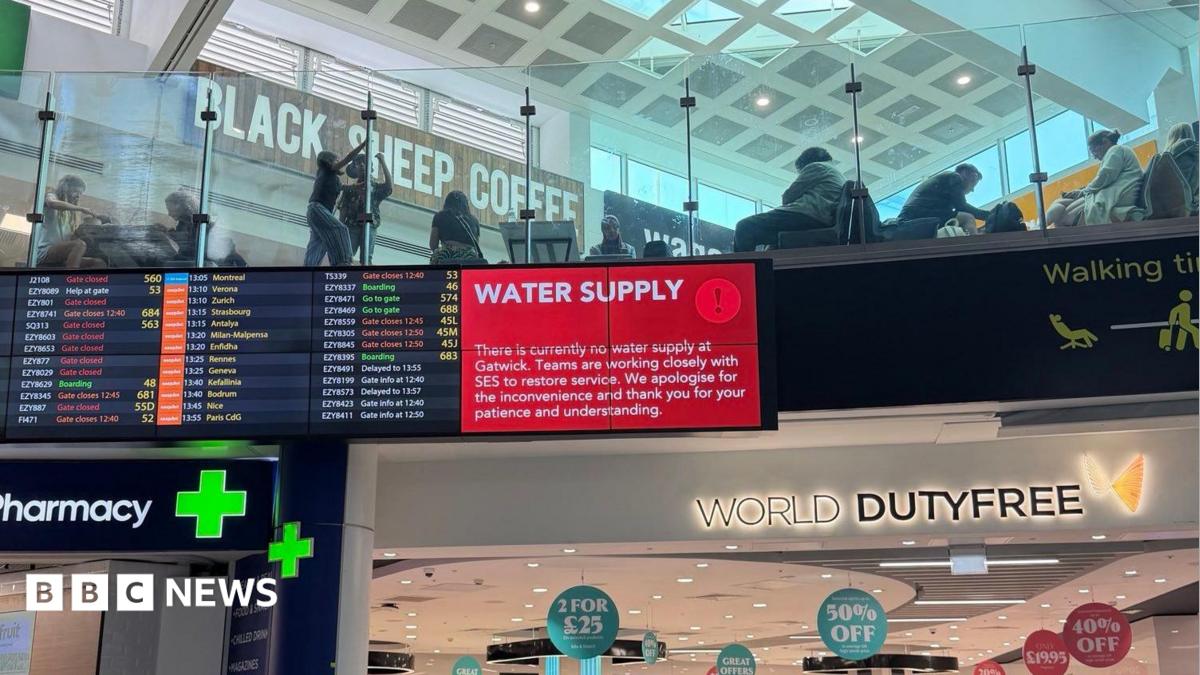
Passengers at both terminals of Gatwick Airport are being affected by a water supply issue, with toilets reported to be out of order and restaurants closed.

In a statement on X, the airport in West Sussex apologised for the disruption, external and said a problem in the Horley area was affecting supplies and was under investigation.

Bottled water is being made available to passengers and staff and contingency measures have also been put in place, it said.

SES Water, which covers parts of Kent, Surrey and south London, as well as the airport, has said its service is resuming after an earlier power outage at its treatment works.

It said complications caused by a power outage at its Bough Beech water treatment works meant some customers had experienced low water pressure or a temporary loss of supply.

A spokesperson had earlier confirmed that Gatwick Airport was affected.

In an update just before 13:45 BST, they said: “Our Bough Beech water treatment works are back up and running.

“We now need to treat the water before returning services to normal as quickly as we possibly can.”

Gatwick said the supply issue was continuing to cause disruption on Sunday afternoon.

In a statement, it said: “There is currently no water supply in either terminal.

“Our staff are on hand to support passengers and provide assistance where needed, some restaurant partners have opened to provide additional seating.”

The airport said it was working closely with the water company to restore supplies as quickly as possible.

Source link

‘I’ve watched every series of Love Island – here’s where they keep going wrong’

After devouring 13 series and over a decade of Love Island, one glaring problem has become clear: Each series there is a female villain, pitted against the others… but who is really to blame?

Love Island is almost over and with that, the 2026 summer of love (or influencers building their brand in a Spanish villa) has come to an end. Every time it happens, I am left devastated by the loss of the ITV2 show, despite complaining to anyone who would listen about how angry that year’s season made me.

My love for the show and the bereavement I feel when its gone has not only had me going back and watching the seasons I was too young to watch the first time, but had me watching them again and again. One thing has become clear – our female villains are often born when men misstep and aren’t allowed to bounce back in the same way.

We keep entering an era where our bad girls are pitted against each other until they are relegated to the depths of obscurity after the show ends and not even allowed to be iconic anymore.

Yes, these woman’s actions are often undeniably bad. But compared to those of the men around them, who get redemption arcs, huge social media followings and get to continue working within the Love Island world, the women’s punishments rise to the top of villain lists seem unbefitting of their crimes. To illustrate my point, here is a timeline of the seasons and who their biggest villains are…

Series 1 – Naomi Ball

Bombshell Naomi is largely considered the biggest villain from the first series that aired when Love Island was rebooted. She was sharp-tongued and her confrontations with Jess Hayes were one of the reasons the latter girl won the series with Max Morley.

Her intense rivalry with Jess was was fuelled by a love triangle between the two and Josh Ritchie, especially when Josh dumped Naomi for not being willing to sleep with him.

He then brazenly asked: “Do I now carry on with Jess, get my end away, have a good three-weeks sh*gging, or do I start something with Naomi, where something can be long term and something maybe outside of the villa but not have sex, not have as much of a laugh? It’s a genuine penis/head dilemma.”

With a love interest like that, who needs enemies? Though Naomi still consistently crops up as the Villain of Series One, Josh has gone on to redeem himself on All Stars.

Series 2 – Olivia Buckland

Thankfully, Olivia is now mostly beloved, but for years after her series was released, she was painted by fans as manipulative and mean. She was blamed for Javi Shephard and Dan Lukakis fighting over her, even though that’s the nature of the game. She was blamed for hurting Dan when Terry Walsh came along, even though they’d only known each other three days by that point.

Worst of all, she was blamed for sleeping with Rykard Jenkins when he was getting close to Rachel Fenton, when it was Rykard who was pursuing a relationship, not Olivia. Olivia was not only free from any romantic attachments, she was in a couple with Rykard.

Olivia was able to regroup and rebuild after Love Island, especially since she and now husband Alex Bowen stayed together. The same cannot be said for all the women on this list.

Series 3 – Jonny Mitchell

Series three is the first where our main villain is a man. Jonny arrived on day four and was in a couple with Camilla Thurlow for most of his time on the show. Whilst in a couple, he clashed with Camilla, telling her that he thought feminists “believe in inequality” and would feel emasculated if a woman tried to pay on a date.

Jonny then went on to make Camilla cry by dumping her for Tyla Carr – and he wasn’t even going to be honest about it. Very manly, macho Jonny was too chicken to be upfront and instead decided to try and do a gradual fade out instead, until he was forced to fess up by Dom Lever. And yet, while Naomi never got her redemption and Olivia had to wait until after the show, Jonny ended his run on the series on good terms with everyone.

Series 4 – Adam Collard and Megan Barton-Hanson

Love Island has never known a villain like Adam Collard. He moved from girl to girl to girl and blamed some of them for “pushing him away” and into the arms of another. When he accused Rosie Williams of being jealous of his connection with Zara McDermott, he smirked as she cried in front of him and Women’s Aid came out with a statement against him.

Despite Adam sparking a huge national conversation about gaslighting, he was brought back for series eight, in which he was given the opportunity to prove himself a good guy after all.

Meanwhile, Megan, who also moved from guy to guy but without gaslighting them, was also labelled a villain and constantly shamed by the public for her career as a stripper.

Series 5 – Michael Griffiths

Michael is another instant where the villain ultimately crowned the winner. Prior to coming back from Casa Amor with another girl, his partner Amber Gill wasn’t viewed favourably by the public. But when he not only played away at Casa but then started calling her “childish” for being upset, Michael became the bad guy and Amber became a champion.

Since the show ended, Michael has gone down in history as one of the most iconic islanders. He spawned the ‘Destiny’s Childish’ memes, in which people who seem like players on the show are all put in a group with Michael. It’s helped him get roles on Celebrity Ex on the Beach, Eating with my Ex and MTV’s Living the Dream. He has been rewarded for his actions, in a way the women on this list rarely are.

Series 6 – Connor Durman and Rebecca Gormley

Connor had everyone talking during the first winter Love Island with his rather questionable behaviour. To the shock of his partner Sophie Piper, he bragged about having a threesome with a girl and her housemate after a first date in a game of Truth or Lie. When Sophie made a joke about it, Connor then folded his arms and backed away, telling a confused-looking Sophie “You hate me tonight. You’re hating me.”

And when she tried to keep things light, he angrily insisted, “You’re digging me out already, you are,” leaving fans begging her to head for the hills. Despite this, its Rebecca that fans remember as a villain. She a rivalry with Siannise Fudge over her interest in Luke Trotman, a storyline that is not uncommon on this show and yet was enough to make Rebecca a villain.

Series 7 – Faye Winter

Faye has received the most Love Island complaints in the show’s history after yelling at Teddy Soares. The argument followed the first ever Movie Night, in which Teddy was seen having a flirty exchange during Casa Amor.

The public knew the clips were taken out of context and that Teddy had been faithful to Faye. 25,000 complaints were made to Ofcom and Faye’s family had to release a statement, reminding the public that the show was edited for entertainment.

Faye received online abuse and death threats after the incident. What makes it so infuriating is that much of the public were angry with Faye for reacting to Teddy’s actions as they knew the clip was taken out of context and fumed that she should have known he was a good guy. To summarise: Fans who knew what Faye had seen wasn’t the whole truth were angry with her for reacting to it rather than those who took the clips out of context.

Series 8 – Tasha Ghouri

Tasha’s series was largely defined by both Islanders and the public deciding she was stringing her partner Andrew Le Page along. She was subjected to constant online vitriol about how she was just waiting around for someone else to sweep her off her feet, and using Andrew to stay safe.

Yet when it came to Casa, it was Andrew who played away. “I licked her t*t, or whatever,” he told Tasha after being forced to come clean about his bedroom antics with Coco Lodge. Notably, Andrew wasn’t as hated for actually doing something as Tasha was for what people thought she wanted to.

Series 9 – Olivia Hawkins

Olivia was branded as a villain after clashing with several islanders, particularly those she had coupled up with before like Kai Fagan and Tom Clare. She was branded as messy and a hypocrite for being upset with Kai for recoupling in Casa, even though she’d done the same.

By the time she joined series two of All Stars, Olivia was so known as a villain that she had to hit back at the title, telling the Mirror that she thought it was “tiring”. She was called a bad guy again when she clashed with Grace Jackson, catching heat despite no longer being on the show anymore. She has since seemed to prefer sticking to a quiet life away from reality TV and I’m not sure anyone can blame her.

Series 10 – Molly Marsh

Molly was villainised after being honest with partner Mitch Taylor. Her crime was telling him that she wanted to talk to other people just days into knowing each other. From then, both Mitch and Jess Harding accused her of using him and being two-faced… despite the fact that she’d been upfront about her feelings.

This was the start of the Love Island “divides”. In series since, we’ve seen time and time again how there is a divide among the girls as they are pitted against each other by the men and form two camps. This time it was Molly vs Jess, a battle that Jess ultimately won, as she won the whole series.

The hate Molly received has since been viewed as unwarranted, and Molly has faded into the background of many Love Island conversations, while Mitch, whose behaviour towards Molly was very possessive, has become one of the show’s icons.

Series 11 – Harriett Blackmore

Harriett Blackmore, much like Olivia Hawkins, was labelled a villain and a drama queen when she clashed with Ciaran Davies. But why did they clash? Well, just before, Harriett had told Ciaran, whom she had been coupled up with since the start, that he was her top boy.

After that, he took Nicole Samuel to the Hideaway, leaving Harriett in tears. Was Ciaran a bad guy for this? Of course not! Our sweet Welshman made it to the final of the show.

Series 12 – Meg Moore and Helena Ford

This was a season filled with villains. Meg Moore and Helena Ford were two of the biggest, with fans slamming Meg for her rude and aggressive attitude towards girls her partner Dejon Noel-Williams was talking to and Helena for constantly going after boys Shakira Kahn and Toni Laites were talking to.

Though neither behaved well, Meg’s behaviour often came amid Dejon telling her that the girls were obsessed with him and that he wasn’t open to getting to know them, even though he was. Similarly, Helena’s came as Harry Cooksley and Harrison Solomon both told her that she was their number one.

The behaviour of all three men caught the attention of the public, who slammed them as toxic. Dejon undeniably came off the worst and seems to have shrunk back from the limelight, but despite this, the season became about the divide between the girls. It was defined by Shakira and Toni’s camp vs Meg and Helena’s.

Helena did appear on All Stars, hoping for a redemption. So did Harrison, even though Women’s Aid had put out a statement about his behaviour. Since both shows, Helena and Meg have faded away, while Harrison and Harry have both gained a huge social media following for their Love Island commentary.

Series 13 – Every woman on the show

Then we have series 13. In this series, pretty much every woman has been villainised at some point, often when a man was also involved and received much less hate.

Priya Jaswal was demonised for saying Samraj Toor’s behaviour was “pathetic”, even though he was also attacking her and never apologised. Jasmine Muller was hated on for her interactions with Kavan Murphy, when his brother Aidan kept stirring the pot and again when it was Kavan who brought someone else back from Casa Amor.

Lola Deal and Julia Majchrzak have both received hate amid their feud, which was all started by Sean Fitzgerald’s conversations with people in Casa Amor. Elicia Chadwick has also been on the public’s bad side for her reaction to Aidan picking Priya, despite him having kissed his way up her body while on their date.

Even former Islanders turned debriefers Shakira, Toni and Yasmin Pettet have received more hate this season than the men on the show. And if this doesn’t summarise the modern divide between men and women, I don’t know what does. Men think they can get away with anything, while women have to micromanage every emotion so as not to come off wrong.

No wonder, when men’s bad behaviour is caught on camera and still excused, while the slightest comment or odd look from a woman is enough to make her the nation’s most hated.

Like this story? For more of the latest showbiz news and gossip, follow Mirror Celebs on TikTok, Snapchat, Instagram, Twitter, Facebook, YouTube and Threads.



Source link

The beautiful lost village of Spain that was abandoned for 50 years and people say it looks like a movie

TUCKED away in the mountains of Malaga is a tiny village that was abandoned for five decades.

El Acebuchal was only rediscovered in the late 90s and brought back to life.

El Acebuchal is in the Malaga region of Spain and was left abandoned for 50 years Credit: Alamy

The little white-washed village was once used by travelling merchants for hundreds of years as a place to meet and transport goods between the Costa del Sol and Granada.

The village was small and home to around 200 people.

But in 1949, the village was officially closed by the Spanish leader at the time, Francisco Franco.

He believed that those who lived there opposed his regime, so he sent officials in to disperse the village residents.

ISLE GO

Why Maldives holidays are cheaper than EVER – with crazy bargains from £1,437pp


BAG A BREAK

UK hotel deals with FREE breakfast, golf breaks, spa stays and 80’s discos

It remained a ghost town until 1998 when Antonio Sanchez or ‘El Zumbo’, who once had ancestors in the village, moved there.

He and his family began to rebuild houses where everything was restored by hand.

The village didn’t even have running water or electricity until 2003.

Now, the village has around 30 homes, a chapel and restaurant called Bar El Acebuchal which is actually run by Antonio Sanchez himself.

It’s slightly off the beaten track according to diners, but well-worth it for the food.

Lots of the homes are holiday rentals – there’s also a B&B in the village called ‘The Lost Village el Acebuchal’ which is highly-rated on Tripadvisor.

El Acebuchal has been restored and has just a few houses, chapel, B&B and restaurant Credit: Alamy
It sits high up in the mountains near one of the ‘prettiest villages in Spain’ Credit: Alamy

It has just three rooms along with a roof terrace, seasonal outdoor pool and there are even spa services.

One visitor described it as “a 1950s movie scene” and another described it as a “hideaway”.

The village isn’t overly modern with limited phone signal.

A popular hiking route is between Acebuchal and Frigiliana which stretches on for about eight miles.

Frigiliana is another place to add to the list, as it is considered one of the most beautiful villages in Spain.

It has white-washed buildings, bright blue accents, terracotta tiled rooftops and mosaic streets.

The steep paths are lined with colourful plant pots full of greenery with blooming flowers like the classic Mediterranean pink bougainvillea.

The town was built on top of a hill so it has incredible views of the Costa del Sol and Mediterranean Sea.


Source link

More than $100 million spent on battle over dialysis industry profits in California

A war between a healthcare union and the dialysis industry it wants to organize has morphed into one of the most expensive ballot measure campaigns in California history.

Proposition 8, sponsored by the Service Employees International Union-United Healthcare Workers, would shrink the profits of hundreds of dialysis clinics across California. If enacted by voters, the measure would require clinics to provide rebates to insurers and pay a penalty to the state on business revenues that exceed 115% of certain costs to deliver care.

A coalition led by DaVita and Fresenius Medical Care, the two companies that control a combined 72% of the dialysis market in California, has given $110 million to a campaign to beat the measure — contributing to the most money raised for such a campaign in state history.

Opponents view Proposition 8 as an existential threat to the dialysis industry and its patients, and say the 95,000-member SEIU-UHW is using the ballot measure to deliver an ultimatum to its foes: Acquiesce to the union’s demands or pay for an expensive campaign.

“Proposition 8 puts California patients at risk in an effort to force unionization of employees,” DaVita Chief Executive Kent Thiry said in a statement. “There is an established and accepted process for employees to vote a union up or down. Instead of following that process, SEIU-UHW is pursuing a dangerous initiative that puts patients at grave risk.”

Thiry’s group warns that dialysis clinics may open for fewer hours, or would shutter altogether if the measure becomes law.

Dave Regan, head of SEIU-UHW, says his union wants to rein in a dialysis industry he says is “predatory.” The union has raised $18.8 million for the Proposition 8 campaign.

DaVita and Fresenius reported billions in operating income last year and have been accused by critics of various tactics to increase profitability, such as steering patients to private insurance or not giving employees enough time to adequately clean stations.

DaVita has been ordered to pay damages and settled lawsuits for more than $1 billion in the last five years, including $253.5 million in damages awarded in June to the families of two patients who died of cardiac arrest after receiving care at its California clinics. The company has said it would appeal that decision.

“The reason Prop. 8 is on the ballot is because they have a terrible business model and they’re gouging patients and insurers,” Regan said.

After years of expensive squabbles in the Capitol, Regan traveled to Denver, home to DaVita headquarters, to meet with Thiry for the first time on the eve of the June deadline to withdraw ballot initiatives this year.

Assemblyman Adam Gray (D-Merced), the leader of a moderate bloc of Democrats in the Legislature, acted as intermediary. Gray said he spent weeks trying to bring the two sides together in hopes of breaking a stalemate and finding common ground.

But the eleventh-hour conversation over dinner came too late to negotiate a cease-fire and call off the proposal.

Regan initially described the visit as a “social meeting” he attended at Gray’s request. He later said the timing was coincidental and he never intended to strike a deal with Thiry to pull Proposition 8 from the ballot.

“Nothing consequential even came up,” Regan said. “Nothing was proposed. There was no kind of an agreement of any sort and it was a social discussion.”

Thiry said it “was definitely not a social meeting,” but declined to elaborate.

Now voters are left to decide the fate of the 80,000 patients who receive dialysis treatment at nearly 600 licensed clinics each month in California, according to figures from the Legislative Analyst’s Office.

SEIU-UHW argues its measure will provide an incentive to dialysis companies so they invest more money into patient care. Under the measure, clinics could keep more of their profits if they increase costs for care.

Kathy Fairbanks, a spokeswoman for the opposition campaign, said the industry believes that voter approval of Proposition 8 would force most clinics in California to operate in the red.

“You can’t keep doing that week after week, month after month, year after year,” she said. “This is going to devastate the clinics in California and, by extension, all the patients.”

An analysis by the Legislative Analyst’s Office, the Legislature’s nonpartisan fiscal advisor, said reducing revenues would make for-profit clinics “less profitable or could even be unprofitable.”

Proposition 8 excludes the salaries of managerial staff and some overhead charges from the cost calculation for patient care, which would further reduce profits.

“This to me is classic labor trying to, not just regulate a business, but affect how they operate,” said Rob Stutzman, a Republican political consultant who is not involved in the Proposition 8 campaign.

Scrutiny of dialysis clinics sparked a legislative proposal to establish staff-to-patient ratios in the industry for the first time. The bill, sponsored by SEIU-UHW, stalled in the state Legislature last year.

Gov. Jerry Brown vetoed another bill this year aimed to halt an alleged dialysis industry practice of encouraging patients to sign up for private insurance and funneling money to nonprofits to help patients pay off premiums. Dialysis corporations make most of their profits off group or individual insurance plans, which are billed much more than Medi-Cal or Medicare for the same services.

“Right now they have every financial incentive to keep staffing and other direct patient services at a bare minimum because then they reap every dollar in profit margin,” Regan said.

SEIU-UHW has a history of turning to the ballot amid labor disputes.

Regan called off a pair of ballot initiatives in 2012 to limit charges for care at private hospitals and require nonprofits to spend at least 5% of revenues on charity care after the California Hospital Assn. agreed to a partnership that could help the union’s organizing efforts.

The partnership soured and the union filed two measures the next year to limit prices for care at private hospitals and executive salaries at nonprofit hospitals.

The union pulled the initiatives back in 2014 as part of a new agreement with the hospitals to campaign together to raise Medi-Cal reimbursement rates in exchange for an easier path to organizing thousands of potential union members, among other provisions.

A Sacramento judge shot down another SEIU-UHW ballot initiative to cap hospital executive pay in 2016. That same year, the union pushed a ballot initiative to increase pay for workers, which helped spark a legislative deal to raise California’s minimum wage.

This year alone, the union filed 11 ballot initiatives in California — seven at the local level and four statewide initiatives. Most of the initiatives failed to qualify or the union abandoned its effort.

One of the local measures would have placed revenue caps on the Watsonville Community Hospital. The union withdrew the initiative after it reached a collective bargaining agreement with the hospital, said Duane Dauner, the former chief executive of the California Hospital Assn. and a leader of the campaigns against the local initiatives. The hospital also agreed to form a committee to monitor and control pricing, said Sean Wherley, a spokesman for SEIU-UHW.

SEIU-UHW also sponsored five local initiatives in cities with Stanford Health Care community clinics. Measure F in Palo Alto and Measure U in Livermore, the only two to appear on the Nov. 6 ballot, would limit the amount of money hospitals can charge for patient care. Stanford claims the union pushed the measures to pressure its hospitals to make it easier to unionize.

Wherley said the union is not organizing at Stanford’s healthcare facilities.

“He thinks initiatives are the solutions to bypass ordinary labor relations activity and tries to literally force the hospitals, doctors, dentists and others into unionization or he will proceed,” Dauner said of Regan.

Gray, the state legislator, pointed to several state policy battles this year, including a ban on soda taxes and a deal on consumer privacy protections, as examples of other special interests using the ballot as leverage.

“I support direct democracy, but I certainly think the initiative process, by everybody, has been used in ways that certainly weren’t intended,” Gray said.

Regan said SEIU-UHW didn’t qualify Proposition 8 to pressure the dialysis industry to strike a deal. He said the union wants to improve healthcare, and ballot initiatives are an effective way to make important policy changes.

He pointed to 17 minimum wage and Medicaid expansion initiatives the union supported in other states since 2016 that he said were not linked to organizing efforts.

“Most of the stuff that we do is in pursuit of the common good, whether it’s the minimum wage or Medicaid expansion,” Regan said. “The dialysis industry should be required to do more than criticize the union because they don’t want to talk about their business models or profits.”

Get the latest California politics news »

taryn.luna@latimes.com

Follow @tarynluna on Twitter and sign up for our daily Essential Politics newsletter.


Source link

One Day Cup: Middlesex thrash hapless Glamorgan

The team changes suggested the home side would be favourites, but not the scale of the one-sided encounter that followed.

Middlesex recalled Roland-Jones for Jack Nelson, while Glamorgan gave debuts to two seamers – 18 year old academy product Tom Edwards and Aussie Connor O’Riordan, who has been on an extended second team trial.

Both teams have five players at the Hundred, but Glamorgan also chose to rest the overworked Timm van der Gugten as well as veterans Colin Ingram and Chris Cooke, with Zain ul Hassan on paternity leave, teenage prodigy Tom Norton missing at least most of the competition with a back issue, Jamie McIlroy suffering a minor niggle, and Billy Root not selected.

Sharma was quickly into his stride having Callum Nicholls adjudged lbw, but with Byrom getting the ball away for six fours, Glamorgan got to 44 before they fell apart, losing wickets in six consecutive overs.

Sharma had Henry Hurle (10) caught by keeper Joe Cracknell, Jack Hope-Bell caught to mid-off and Will Smale given lbw.

Meanwhile Roland-Jones induced Byrom (29) and Dan Douthwaite to edge to slip, Sam Robson snaffling two smart grabs, while Alex Horton feathered a catch behind.

Roland-Jones bowled his 10 over allocation straight through, while Sharma was replaced after seven by Cornwell, who wrapped up the last three while Cracknell finished with four catches.

The difficult bounce did not excuse the extent of Glamorgan’s struggles against an accurate seam attack.

With 20 coming off a nervous first over from O’Riordan, Josh de Caires got Middlesex off to a flyer.

Captain Andy Gorvin took himself off after just two overs just to give Edwards a bowl, but the 50 came up in just six overs as De Caires and Nathan Fernandes were able to attack with freedom.

Fernandes (14) drove Edwards to mid-on to give the youngster a first senior wicket, and a second quickly followed when Sam Robson was caught behind.

But De Caires (45 not out off 30) hit the winning run off the first ball of the 10th over to complete the rout.

Middlesex next travel to Worcester on Friday 31 July.

Glamorgan are set to come up against former England captain Ben Stokes at Durham on Wednesday, with further away fixtures against Derbyshire and Hampshire to follow as they try to rebuild confidence.

Source link

India’s education minister resigns after massive youth-led protests

Supporters of the youth-led political movement Cockroach Janta Party celebrate the resignation of Education Minister Dharmendra Pradhan. Photo by Divyakant Solanki/EPA

July 25 (UPI) — India’s education minister resigned Saturday amid a scandal that led hundreds of thousands of young people and students to the streets in one of the country’s largest protests.

Demonstrations began in New Delhi in early June, after it came to light that answers to one of the country’s most prestigious college-entrance exams, taken by millions of students, had been leaked.

At least a dozen students died by suicide after the government announced they would have to retake the exam.

The protests, organized by the youth-led Cockroach Janata Party, swelled to hundreds of thousands of people across the nation early this week, forcing the hand of Prime Minister Narendra Modi‘s government.

“This is one of the most historic days for our country,” one protester, Rochelle Cope, told The Guardian. “For the first time in 12 years, someone from the government has been held accountable for wrongdoing. And it wasn’t political parties that did this — it was the people.”

The education minister, Dharmendra Pradhan, said in his resignation letter “the events of the past ten days have saddened me deeply.”

“During this period, individuals holding responsible positions also tried to mislead many students and create obstacles, which caused me deep anguish,” he said in a statement.

Pressure began to grow this week after police brutally cracked down against protesters, using tear gas and batons to clear them out.

Opposition leader Rahul Gandhi said he would raise the issue in India’s parliament, holding Home Minister Amit Shah “directly responsible for the violence inflicted.”

“He authorized the firing on our students, authorized the use of lethal weapons, and authorized the use of pellet guns against them,” Gandhi told the BBC. “That’s a fundamental issue.”

Modi’s government announced late Saturday that the education ministry would be assigned to Pralhad Joshi, who’s already the minister for consumer affairs, food and public distribution, as well as new and renewable energy.

Following the education minister’s resignation, leaders for the protests instructed the crowd to disperse.

“All our demands have been accepted, so we request the protesters to withdraw immediately and return home peacefully,” Saurav Das, a spokesperson for the Cockroach Janata, told reporters.

Source link

President Ahmed al-Sharaa: Syria seeking security deal with Israel | Israel-Palestine conflict News

In an exclusive interview with Al Jazeera, Ahmed al-Sharaa discusses regional security, Lebanon’s crisis and domestic challenges.

Syrian President Ahmed al-Sharaa has revealed that Damascus is actively working to reach a security agreement with Israel with the participation of several countries.

Speaking in an exclusive interview on Al Jazeera’s Al Muqabala programme, the full interview, to be broadcast at 19:00 GMT, al-Sharaa said he hopes the deal with Israel could serve as a gateway to a comprehensive peace.

He also assured that such an agreement would not compromise Syria’s right to the occupied Golan Heights, which Israel has illegally occupied since 1973.

He said Syria is avoiding any clashes with Israel, and that a security arrangement could pave the way for a broader and more comprehensive resolution to the crisis.

It comes after repeated Israeli incursions and strikes in southern Syria, since al-Sharaa came to power in December 2024 following the collapse of Bashar al-Assad’s government.

Lebanon’s crisis and regional fears

Al-Sharaa also confirmed that Syria has no intention of launching any military intervention into neighbouring Lebanon, despite repeated rumours on the issue.

Instead, his government is currently discussing ways for Lebanese authorities to help the country overcome its current crisis and steer it towards safety.

Southern Lebanon is currently being occupied by Israel, amid months of fighting between Hezbollah and Israeli forces. The Lebanese state is seeking to reclaim these occupied territories and have a monopoly on all weapons in the country.

Furthermore, he declared Damascus’s firm support for restricting weapons and containing decisions of war and peace exclusively to the Lebanese state.

Al-Sharaa said that Syria has no intention of intervening in Lebanon
Al-Sharaa said that Syria has no intention of intervening in Lebanon [Screengrab/Al Jazeera]

Al-Sharaa stressed that addressing the Lebanese crisis requires more than just a security approach but a comprehensive solution tackling a range of issues.

Any descent into chaos in Lebanon would have direct and immediate repercussions on Syria, and the potential expansion of the US-Israel war on Iran in the region would lead to a severe regional fall-out, he warned.

Sanctions, the SDF and missing persons

On domestic and economic fronts, al-Sharaa argued that merely lifting the economic sanctions imposed on his country by the US and other countries would not be effective unless Syria was also removed from the list of state sponsors of terrorism.

Addressing the internal agreement with the Kurdish-led Syrian Democratic Forces (SDF), an alliance of Kurdish and Arab armed groups that controls parts of northern and eastern Syria, the president acknowledged a delay in its implementation.

However, he affirmed that the government remains fully committed to the agreement and continues to bet on its ultimate success.

Al-Sharaa also announced that Syrian authorities have established a special committee to manage the issue of people missing during Syria’s war, between 2011 and 2024.

The UN estimates that around 100,000 people were forcibly disappeared during the war, while Syria’s National Commission on Missing Persons believes as many as 300,000 Syrians could be missing.

Al-Sharaa said the committee will operate strictly according to international standards, working in close cooperation with countries that possess specialised expertise in this field.

Source link

Wayne Manor from TV’s ‘Batman’ lists for $32 million in Pasadena

A piece of iconic Los Angeles architecture and one of pop culture’s most recognizable exteriors is on display as the Pasadena home featured as Wayne Manor in TV’s original “Batman” hits the market this month for $32 million — less than a year after it was last sold.

The seven-bedroom, 11-bathroom Jacobean Tudor Revival home on 5 acres of gated land was built in 1928 by the L.A.-based architectural firm Morgan, Walls & Clements. This is the same firm responsible for some of L.A.’s most fantastical and beloved architectural creations including the Wiltern, El Capitan and Mayan theaters. It’s located at 380 S. San Rafael Avenue in Pasadena, in a lush, wooded area above the Arroyo Seco near the Rose Bowl.

The home, which features a stately mahogany main staircase and a genuine butler’s pantry worthy of Alfred Pennyworth, was made famous by the “Batman” TV series, which originally aired on ABC from 1966-68. During that time a man named Norman Preston van Valkenburgh lived there with his family. Film crews shot at the home for three days in 1966, but only external shots ended up being used as stock footage for Wayne Manor.

Over the years fans began to confuse the mansion with another nearby estate — the work of one of the city’s most prominent Africa American architects Paul R. Williams . The home, which The Times cheekily called an “imposter” in a 1989 article, burned down in 2005 while being renovated by its owner, Michael Hammer, grandson of the late oil tycoon Armand Hammer. At that time, crowds of “Batman” fans gathered before the smoldering ashes lamenting the loss only to discover they had the wrong house.

If the real Wayne Manor sells for its $32 million asking price it will break its own record for a residential sale in Pasadena. That record was set only last year when the current owner bought it for $20.5 million.

It will take just one super fan with Bruce Wayne-deep pockets to snap up this dreamy estate. Spoiler alert: There is no Bat Cave, but there is a pickleball court, a resort-style pool, a private theater and an Architectural Digest pedigree.

I’m Arts editor Jessica Gelt counting the money in my swear jar and dreaming big. This is your arts and culture news for the week.

You’re reading Essential Arts

Our critics and reporters guide you through events and happenings of L.A.

The week ahead: A curated calendar

FRIDAY

Jeff LeBeau and Tim Cummings in the West Coast premiere of Samuel D. Hunter's "Grangeville."

Jeff LeBeau, left, and Tim Cummings in the West Coast premiere of Samuel D. Hunter’s “Grangeville” at the Ruskin Group Theatre Arts Center, directed by John Perrin Flynn.

(John Perrin Flynn)

Grangeville
The West Coast premiere of Samuel D. Hunter’s two-hander about a pair of estranged brothers concludes its acclaimed run at the Ruskin next weekend. In his review, Times theater critic Charles McNulty wrote that the playwright “turns his characters inside out in a play that powerfully illuminates a subject that has rarely been treated onstage with such unflinching honesty and sensitivity: How does one integrate a past that took everything to escape?”
8 p.m. Fridays and Saturdays; 2 p.m. Sundays through Aug. 2. Ruskin Group Theatre, 2800 Airport Ave., Santa Monica. app.arts-people.com

Sounds of LA County
Country music in Sylmar and Quartz Hill; disco, soul and R&B in South L.A.; regional Mexican music in Florence-Graham and La Puente; deep house, Afrobeats, hip-hop and funk in East Compton; global acoustic in Willowbrook; and live salsa in East L.A. are this week’s offerings in the free summer series from LA County Parks and Nextfest LA. The program continues through August.
6-9 p.m. Friday, Saturday and Thursday. Check website for exact days and locations. soundsoflacounty.com

SATURDAY

Joe Hisaishi presents Music Future
Coming off three nights at the Hollywood Bowl, the Japanese composer moves to a more intimate setting to celebrate the work of contemporary composers, including Nico Muhly, Bryce Dessner and Max Richter, with the LA Phil New Music Group.
8 p.m. The Ford, 2580 Cahuenga Blvd. East theford.com

The Hour of the Star
Brazilian actor Bruna Fachetti stars in the world premiere of a stage adaptation of the novella by Clarice Lispector about an impoverished woman dreaming of a better life in Rio de Janeiro. The limited, five-performance engagement was conceived and will be directed by Alex Tietre from the English translation by Pulitzer Prize-winning author and Lispector biographer Benjamin Moser.
7 p.m. Saturday, Sunday, Thursday, July 31 and Aug. 1. The Broadwater Black Box Theatre, 6322 Santa Monica Blvd., L.A. eventbrite.com

SUNDAY

Boris Brejcha performs during the 2023 Coachella Valley Music and Arts Festival .

Boris Brejcha performs during the 2023 Coachella Valley Music and Arts Festival .

(Matt Winkelmeyer / Getty Images for Coachella)

Boris Brejcha with the Hollywood Bowl Orchestra
The masked German DJ makes his global orchestral debut. The techno DJ duo Frieder & Jakob open the show. Be prepared to dance.
7 p.m. Hollywood Bowl, 2301 N Highland Ave. hollywoodbowl.com

Murder on the Orient Express
Sidney Lumet’s 1974 version of the Agatha Christie mystery, adapted by Paul Dehn, earned six Oscar nominations. Alfred Finney, nominated for leading actor, stars as the meticulous Belgian detective Hercule Poirot investigating a killing aboard the famous train. Also starring Lauren Bacall, Martin Balsam and Ingrid Bergman, who won the Oscar for supporting actress. Part of the Oscar Sundays series.
2 p.m. Academy Museum, David Geffen Theater, 6067 Wilshire Blvd. academymuseum.org

TUESDAY

Rhapsody in Blue & Shostakovich
Marin Alsop conducts the Los Angeles Philharmonic in Anna Clyne’s “Masquerade,” Gershwin’s soaring American classic (with pianist Conrad Tao) and Shostakovich’s Fifth Symphony.
8 p.m. Hollywood Bowl, 2301 N Highland Ave. hollywoodbowl.com

THURSDAY

Peter Finch in 'Network.'

Peter Finch in ‘Network.’

(TCM)

Network
“I’m mad as Hell and I’m not going to take it anymore!” shouts Peter Finch as news anchor Howard Beale in this 1976 satire directed by Sidney Lumet and written by Paddy Chayefsky. The film was nominated for ten Academy Awards, winning four: leading actor, posthumously, for Finch, leading actress for Faye Dunaway, supporting actress for Beatrice Straight, and original screenplay. Fifty years later, it feels as prescient as ever.
2 p.m. Vidiots, Eagle Theatre, 4884 Eagle Rock Blvd. vidiotsfoundation.org

Arts anywhere

The cast of Hadestown perform onstage during the 2019 Tony Awards at Radio City Music Hall.

André De Shields, left, Reeve Carney, center, and the cast of Hadestown perform onstage during the 2019 Tony Awards at Radio City Music Hall.

(Theo Wargo / Getty Images for Tony Awards Productions)

Hadestown: The Musical
The hit Broadway show, winner of eight Tonys and a Grammy, comes to movie theaters for a special five-day engagement. “The show travels to the underworld and back again with liquified grace,” wrote Times theater critic Charles McNulty. “Unfurling like a dream, ‘Hadestown’ speaks most eloquently through its sultry jazz score.” With Reeve Carney as Orpheus André De Shields as Hermes, Amber Gray as Persephone, Eva Noblezada as Eurydice and Patrick Page as Hades.
Friday through Wednesday, theaters everywhere. bleeckerstreetmedia.com

— Kevin Crust

Culture news and the SoCal scene

The Hollywood Bowl during a summer concert.

The Hollywood Bowl during a summer concert.

(Myung J. Chun / Los Angeles Times)

The Hollywood Bowl recently debuted its biggest sound system upgrade in decades (featuring AI-powered vocal isolation and immersive, surround-sound), and Times classical music critic Mark Swed weighed in on why audiences should be careful of what they wish for. Still, the jury is out: “It is far too soon to say what ways the fabulous new Bowl sound system, which happens to be AI-endowed, might become friend and/or foe. In the first two L.A. Phil classical concerts, the white speakers brought out wonders and caused problems. But the minimal Bowl rehearsal time allows little opportunity to fine-tune,” Swed writes.

Swed also attended a showing of two of Yoko Ono’s famous performance pieces at REDCAT (in collaboration with the Broad, which is currently showing a major Ono retrospective). Titled “Sky Piece” and “Cut Piece” the music-driven works featured compositions by Ono’s friend and collaborator John Cage (Swed writes about the pair’s complicated relationship in New York during the 1960s). Swed also extols “Cut Piece” as performed bythe artist known as MPA, who sat stoically as the audience lined up to cut patches of her clothing off piece by piece.

Sean Luc Rogers and James Tupper in "F— Strangers" at the Echo Theater Company.

Sean Luc Rogers and James Tupper in “F— Strangers” at the Echo Theater Company.

(Cooper Bates)

Times theater critic Charles McNulty headed to Echo Theater Company to see playwright Erik Patterson’s “F— Strangers,” directed by Echo Theater Company founding artistic director Chris Fields. McNulty found the show, which features scene after scene of intimate encounters, “intriguing and frustrating in equal measure.”

“It’s over 8 feet tall, nearly 11 feet wide and travels by 53-foot semitrailer. It’s covered in more than 20,000 beads and weighs almost 1 ton — or about 2,000 pounds,” writes The Times’ Eloise Rollins-Fife in her charming profile of “Gillian,” the chandelier featured in “Phantom of the Operas” current North American tour.” “And eight times a week, it’s dropped atop the heads of people who pay for the privilege — just a few feet short of actually hitting anyone.” “Phantom” is currently playing the Hollywood Pantages Theatre before it moves on to Segerstrom Center for the Arts in Costa Mesa.

Enjoying this newsletter? Consider subscribing to the Los Angeles Times

Your support helps us deliver the news that matters most. Become a subscriber.

Performers in an opera.

Kihun Yoon, Michael J. Hawk, Nicholas Brownlee and Salmir Pirgu, from left, perform during an L.A. Opera dress rehearsal for Barrie Kosky’s “La Bohéme” at the Dorothy Chandler Pavilion on Sept. 12, 2019.

(Dania Maxwell / Los Angeles Times)

Bernard A. Greenberg, a founding board member and former chairman of L.A. Opera, has died at 95. Throughout his life Greenberg was a devoted opera fan and a champion of establishing a dedicated opera company in the city, which ultimately led to the 1986 creation of L.A. Opera. As a philanthropist, civic leader and arts advocate, Greenberg dedicated more than seven decades to steering L.A. Opera and creating the renowned company that it is today. He served on the board of directors for 40 years and held almost every major leadership position during that time. He and his wife, Lenore, also founded the Bernard A. and Lenore S. Greenberg Opera Fund — an endowment that continues to support some of the company’s most vital work.

“If anyone could be called the founder of LA Opera, it is Bernie Greenberg,” said Keith R. Leonard, Jr., Chairman of LA Opera’s Board of Directors in a statement about Greenberg’s death. “For more than 70 years, he devoted his extraordinary wisdom, leadership and generosity to building this company into the institution that serves our audiences today. Bernie believed deeply that opera could enrich lives and strengthen our community, and he worked tirelessly to make that vision a reality. His legacy is woven into every chapter of our history, and all of us at LA Opera are profoundly grateful for his friendship, his guidance and his unwavering commitment to this company.”

IAMA Theatre Company has announced its 2026-2027 season, including three world premieres, as well as its ninth New Works Festival, featuring a variety of new plays by fresh talent. The season kicks off with “Bobby Robotowitz” by Matt Schatz and directed by Casey Stangl, which will be performed from Oct. 15-Nov. 23 in two secret venues — one on the Westside in October and one on the Eastside in November. (When you buy a ticket you find out the location.) The season will end with IAMA’s first collaboration with Geffen Playhouse: the world premiere of “Closing Costs” by Grace McLeod, which was originally developed during IAMA’s 2024-2025 Emerging Playwrights Lab. For the full season lineup, and to buy tickets, click here.

— Jessica Gelt

And last but not least

This adventurous family of four is raffling off their $2 million home just outside of London in order to travel the world. I tip my hat to them because this is something I would think of doing but never actually do. Instead, I think I’ll buy a ticket or two.

Source link

Nobody in office interested in details of boss’s charity challenge

THE boss of a company has informed staff of his intention to do an endurance challenge and received no follow-up questions from anyone.

When chief operating officer Martin, aged 49, not his real name, asked for a moment of his staff’s time he expected cheers, awe and promises of vast sums but instead got carefully blank faces and barely perceptible nods.

He said: “I’d been building up to the moment I announced I was doing the Swansea Bay Ironman Triathlon next year, so convened a special lunchtime meeting.

“But the big reveal got me nothing. I can’t understand why. It wasn’t from any lack of enthusiasm on my part, or the quality of the PowerPoint and spiral-bound brochures.

“I outlined the course: a mile swim, then biking out through Mumbles into the hills of the Gower peninsula, then a final 13.1k loop along the bay. I invited them along to spectate, but they were staring at their shoes and checking their phones. This is 70.2 kilometres! It is a big deal!”

Team leader Cad, not his real name, said: “So that’s a year of training, boring on about his hydration levels and telling the girls to prod his calves, frequent absences we’ll have to cover and he’s asking us to pay him £50 each.

“Sorry, it’s for charity. Though he didn’t mention which one, presumably because that’s beside the f**king point.”

I took my daughter on a bucket list European river cruise

Collage of scenes from a Danube River cruise, including a city aerial view, a pedestrian street, a statue, and a ship cabin.

JUST like her 54-year-old mum, my daughter Lola likes the finer things in life.

So instead of backpacking around Europe like a Gen-Z, 20-year-old Lola and I ticked off four countries and six cities on a week’s river cruise down the Danube.

Lola in the ancient city of Linz Credit: Supplied
Passau is known as the ‘City of Three Rivers’ Credit: Viking

Tempted by Vienna, Bratislava and Budapest, we chose Viking’s Danube Waltz itinerary — an eight-day cruise along the Danube River.

Flying in to Munich, we wind through Lower Bavaria to our ship docked in Passau — and Lola grins as she boards Viking Vilhjalm.

With its smart and comfortable cabins, two restaurants and airy lounge bar, it’s a far cry from the backpacker hostels that she’s used to.

Our first day is spent in Passau — an historic Bavarian city, where the Danube, Inn and Ilz rivers meet.

HOLI-PAY

Will I get a refund if my Spain or France holiday is cancelled due to wildfires?


SUN SAVERS

Our pick of the best ‘kids eat free’ deals this summer to help you save cash

Pottering around the Old Town, all cobblestone streets, Baroque architecture and cute German cafes, we stop by St Stephan’s Cathedral, a huge white and green onion-domed church — so my girl can inform Instagram.

Back on board, and dinner is a sociable affair — the conversation oiled by the included wine and beer.

We dine with a group of Americans — Vicky and Jay, a lovely couple from Montana, and Dillon and Robert from Georgia, who are celebrating Robert’s 40th birthday on the ship.

The food on board is so good, and plentiful, that I just wish I’d packed more elasticated clothes.

Each morning on the al-fresco Aquavit Terrace, we breakfast like queens — eggs Benedict, buttermilk pancakes with fresh berries, smoked salmon.

And there’s a view of a new port each day.

We always make it back to the ship in time for the excellent three-course lunch, too. With wine, of course.

Dinner is the most formal affair, served on the lower deck in the restaurant.

A Classics menu, featuring dishes like ribeye steak, poached salmon and roast chicken, is available every night but the chef also prepares a Regional Specialities menu that changes to reflect the country we’re in.

I particularly enjoy the Austrian evening.

To a backing track of oompah music, staff dressed in gingham shirts welcome us with shots of schnapps before serving platters of cured meats, cheeses and pickles, followed by roast pork, schnitzel and spaetzle.

I roll back to the cabin that night.

The Wachau Valley in Austria is beautiful Credit: Comofoto – stock.adobe.com
A room with a view on the Viking Vilhjalm Credit: Viking

While Lola is by far the youngest guest, it doesn’t stop her making friends.

Docking in Linz, I’m enjoying a glass of wine in the lounge, listening to Peter, the resident pianist, work through his Smooth FM setlist, when Lola appears with a glint in her eye.

“I’ve made friends at the bar and we’re hitting the town,” she announces.

Little encouragement is needed as I join her and new friends, Pam, Nick and Kate, also from the US, in the bars of Hauptplatz, the main square.

In the Pink Panther bar, Lola chats to local girls who introduce us to strawberry schnapps — a Linz favourite.

It’s a slow start the next morning, but we drag ourselves out to explore more of Austria’s third-largest city.

We take the vintage tram up to Postlingberg, the local mountain, to be greeted by panoramic views across the city.

We stumble across Linz Grottenbahn, a kitsch grotto inspired by Grimm’s fairytales, which opened in 1906.

Inside, a dragon train trundles through fairy-lit caves past dioramas of gnomes and taxidermy animals.

Despite our ages, it’s a real highlight of our cruise.

Back on board, and cruise life suits us. Over breakfast, we check out the Viking Daily — the newsletter detailing the day’s programme.

Our next stop is Krems, in the scenic Wachau Valley — Austria’s wine region.

We visit Gottweig Abbey, a Baroque wonder overlooking the river, where Lola (remembering her A level in History of Art) is mesmerised by the ceiling fresco of Emperor Charles VI as Apollo — by Paul Troger, Austria’s Michelangelo.

Tracey and Lola stop off in the Austrian capital Credit: Supplied
Tracey by the river in Passau Credit: Supplied

Vienna is another favourite port of call — and on the Viking walking tour of Ringstrasse, we learn about the naughty antics of Klimt and “Sisi” — Empress Elisabeth of Vienna, who bathed in milk and got a tattoo aged 51.

After dinner, we attend a classical music concert in a Viennese music hall, where Lola falls in love with the music of Mozart and Strauss.

I had feared my girl might get bored — but docking daily in a different port, she thrives on the variety.

Our next stop is Bratislava — the small and charming capital of Slovakia.

We dock moments from the Old Town, near the UFO Bridge, and tick off Bratislava Castle, Michael’s Gate and Hlavne Namestie Square.

Lola loves the Baroque architecture and cute shops which, under a blissful blue sky, feature heavily on her Instagram feed.

Our final stop is Budapest, Hungary’s buzzy capital.

Our coach tour captures the highlights — Buda Castle, the vast Hungarian Parliament and St Stephen’s Basilica — but we decide to ditch the walking tour to see the Shoes on the Danube Bank.

This haunting art installation of dozens of iron shoes is a memorial to Hungarian Jews lost in the Holocaust.

Before we return to the ship for our last dinner, I take Lola for a beer at Szimpla Kert — the first of Budapest’s ruin bars, created since the Noughties from abandoned or derelict buildings.

As we sit around an old Trabant car-turned-table in a graffiti-strewn courtyard, I look at my gorgeous girl — grinning and in her element — and decide that our mum-and-daughter river cruise has been a rip-roaring success.

GO: DANUBE CRUISE

SAILING THERE: Viking’s eight-day Danube Waltz river cruise is from £1,895pp including return flights, transfers, all meals with wine, beer and soft drinks at lunch and dinner plus included excursions and gratuitites.

To book, go to viking.com or call 0800 319 66 60.

Source link

Political consultant Clint Reilly built a lasting legacy

Every election produces a campaign strategist whose victory bestows upon them, for at least a little while, the unofficial title of reigning political genius.

James Carville, Karl Rove, David Axelrod and Stephen K. Bannon have all worn the crown.

For many years, and many election cycles, California’s reigning political genius was Clint Reilly.

In an age before the internet, before social media, before the cable-TV chat shows and before Carville and the like, Reilly came as close to celebrity as a political operative possibly could. He was the subject of fear, admiration, contempt, envy and lengthy newspaper and magazine treatments.

His cherry-red Jaguar, Italian suits, designer eyewear and seaside mansion made Reilly an influencer before there even was such a thing. (A connoisseur of the finer things, he served visitors coffee in bone china when they called on his San Francisco office.)

“It used to be that political consultants and political mechanics were something that only a handful of people thought about,” said Eric Jaye, one of generations of campaign strategists who were trained or inspired — directly or indirectly — by Reilly. “Clint was the original star consultant who made news himself and shaped the political discussion.”

Reilly, a working-class product of Oakland who crossed the Bay and scaled the heights of San Francisco business, culture and politics, died earlier this month at age 79.

For someone who never held political office — a 1999 bid for San Francisco mayor was a notable flop — Reilly wielded considerable influence.

A list of the many Democrats he helped elect — among them Nancy Pelosi, Dianne Feinstein and Barbara Boxer — reads like a scroll of modern California history. At one time, the sitting mayors of both San Francisco and Los Angeles were clients of Reilly.

He wasn’t flawless as an election strategist. Like any political operative, he had his share of defeats.

Reilly’s particular genius lay in the methodology — vertical integration — he brought to campaigns. Typically, one consultant would handle television advertising, another direct mail, another polling, another big-picture strategy, and so on.

“Everything was in-house with Clint and, at least in San Francisco, he was the first to do that,” said Jerry Roberts, who was a scruffy reporter for the city’s alt-weekly when he met a shaggy-haired Reilly more than 50 years ago. At the time, campaigns were a sideline for Reilly, who supported himself selling doodads and other salvaged wares in a movable flea market he operated on Fisherman’s Wharf.

“It was a smart business model,” said Roberts, who went on to lead two major California newspapers.

It made Reilly very rich.

In 1988, he managed what, at the time, was the most expensive political campaign in California history, a $64-million effort by the insurance industry to beat back a Ralph Nader-inspired reform initiative. Reilly lost, but his firm cleared at least $6 million on that contest alone — or about $17 million in today’s dollars.

“So that’s where our premiums went,” one guest observed with a low whistle as he arrived at the state-of-the art headquarters Reilly built not long after the Proposition 103 campaign. (Naturally, he threw an open house; for all his affluence, Reilly never did entirely shake the proletariat chip on his shoulder.)

A onetime seminarian — he left three years shy of being ordained a Catholic priest — Reilly was no saint.

He was hot-tempered, profane and egotistical. He embraced the nickname “Satan,” which a former client affixed after Reilly went to work for an archrival, as a reflection of his reputation for intimidation and mastery of the political dark arts.

In one fit of pique, Reilly took the unheard step of firing a client — Feinstein — via faxed press release because, he said, the former San Francisco mayor lacked the requisite fire to run for governor. The two eventually reconciled, though Feinstein stuck with members of the team that replaced Reilly and helped guide her to successive terms in the U.S. Senate.

If Reilly was at times overbearing — and known for being the kind of hellacious boss who gave employees night sweats — he was also generous and a genuine bleeding heart.

Before his career took off, Reilly volunteered for the United Farm Workers and lived an ascetic life, sheltering in church halls, as he ministered to the poor. Once he established his high-end consulting firm, Reilly retained his political staffers at no small expense, even during the lull between campaigns, rather than hiring and firing them as seasonal workers, which was the norm.

After leaving professional campaign consulting in the mid-1990s, and making a substantial fortune in real estate, Reilly gave prolifically to various charities and assorted civic caucuses. He started a charitable foundation of his own, Bay Scholars, which helps poor and underserved youth attend Catholic high schools throughout the area.

In 1987, when Reilly arguably resided at the height of his power and influence, he took on Pelosi as a client.

She was running for a rare open congressional seat in San Francisco and, though well known in political circles as a prodigious Democratic fundraiser and high-level activist, Pelosi was a blank slate to many voters. Reilly came up with a slogan that played on Pelosi’s Washington connections and many important friendships: “A voice that will be heard.”

More than that, he made a key tactical decision in the waning days of the campaign.

Pelosi was one of 14 candidates, several of them well-known Democratic officeholders. Ignoring Pelosi’s objections, Reilly sent out a mail piece to the city’s vastly outnumbered Republicans suggesting that a Democrat was bound to win the congressional seat and arguing that Pelosi was the best — or, at least, not the worst — of the bunch.

On election day, Pelosi lost the Democratic vote to Harry Britt, who succeeded Harvey Milk on the Board of Supervisors after Milk’s assassination. Still, Pelosi prevailed, by less than 4,000 votes out of nearly 108,000 cast. The winning margin was her Republican support.

The rest, as they say, is history.

Source link

Hall of Famer Joe Torre passionate about going to bat for kids

Some people don’t need an introduction.

Joe Torre, for one.

You know him. Baseball icon. Hall of Famer. The only big leaguer with 2,000 hits as a player and 2,000 wins as a manager, he steered the New York Yankees to four World Series championships — and the Dodgers to consecutive National League West crowns and NLCS appearances in 2008 and 2009.

So you’re well-versed on Torre’s baseball bonafides, but you might not be aware of the most meaningful part of his legacy: He’s spent the past 24 years helping people who actually would need to be introduced to him.

Kids who are too young to know Torre the player, manager, color commentator — but who can, unfortunately, relate with what he went through when he was their age. Kids who, like him, are growing up afraid and anxious because of domestic violence at home, and who need what Torre didn’t have — somewhere safe to go to for help.

Since 2002, Torre and his wife, Ali, have been behind the expanding the Joe Torre Safe at Home Foundation. Across the nation, they’ve set up safe spaces in schools, specialized classrooms that feel more like living rooms and that are manned by professional counselors trained in domestic violence intervention.

San Francisco Giants assistant manager Ron Washington hugs Joe Torre before a game at Dodger Stadium on May 14.

San Francisco Giants assistant manager Ron Washington hugs Joe Torre before a game at Dodger Stadium on May 14.

(Gina Ferazzi/Los Angeles Times)

They’re at schools in New York, Cincinnati, Tahiti and in L.A., at Bellflower Middle/High School and John Adams Middle School, John H. Glenn High and McKinley Elementary School, Palisades Charter High, Santa Monica High, Waite Middle School and Washington Preparatory High.

And they’re open to all, whether you’re a kid experiencing violence or you want to be able to help peers who are.

This past year, the foundation says it reached more than 28,000 students. And since it began, more than 425,000 young people, families, schools, and communities.

These Safe at Home spaces are all named “Margaret’s Place,” in honor of Joe’s mom, who was for years the victim of his father’s violent ire.

“It’s a tough subject to talk about,” Joe Torre said. “But you can’t run away from it.”

He did, though. He’s 85 now, but until he was 54, Torre didn’t reveal that baseball had been his refuge when he was growing up. He didn’t tell anyone that when he was a kid, if he saw his dad’s car in front of his house, Joe would go to a friend’s house and wait until he left for his job as a New York police detective. Joe didn’t share memories like he would later, of seeing his big sister, armed with a knife, standing between their mother and their father, who was going for his pistol.

St. Louis Cardinals third baseman Joe Torre poses swinging a bat prior to a game in 1971.

St. Louis Cardinals third baseman Joe Torre poses swinging a bat prior to a game in 1971.

(Dave Pickoff / Associated Press)

He didn’t recognize what those traumatic experiences he’d tried to bury did to him, not until he started to talk about them.

“I thought I was born with this shyness and this nervousness,” Torre said before a Dodgers game in May, when the club introduced him and Ali and players and coaches wore T-shirts during batting practice that read: “Everyone deserves to be safe at home.”

“During my playing career,” Torre continued, “if we lost a game and I didn’t get any hits, I’d beat myself up. I was fortunate, I had a good career, but there was always something missing. I really probably could have enjoyed it a lot more than I did.”

That didn’t change until 1995, when he started talking about the domestic violence he experienced. He was surprised, he said, to find himself sharing his story, opening up for the first time at a “Life Success” seminar in Cincinnati, Ali’s hometown.

“Ali, she says, ‘You want to go to this Life Success symposium with me?’” Joe said. “And she’s eight months pregnant with our daughter and I’m not about to say no to anything she asks me to go. So we go in and they separate you, and they put you in groups of six strangers — and I’d just been named manager of the Yankees, so I’m very self-conscious.

“But after a day or so, you’re in it, you know? And then we went home and I called my sisters and asked them questions. Because they always tried to protect me, so I had to drag it out of them … ‘Did dad hit mom?’

“The biggest thing for me was knowing that my dad bringing fear down on the home was what caused my feelings that I was embarrassed to have. Once I went through that, I was able to go deeper.”

Yankees manager Joe Torre bumps fists with catcher Jorge Posada after a win in April 2004.

Yankees manager Joe Torre bumps fists with catcher Jorge Posada after a win in April 2004.

(Brian Kersey / Associated Press)

Speaking about what was previously unspeakable helped him cope with his trauma. He said it made him a more empathetic manager and a more confident man. It also made him want to speak out publicly and to encourage others to do the same, to break the cycle of silence.

So they’re getting the word out at — where else? — ballparks. There was the stop at Dodger Stadium in May, and before that, in 2025, seven major league teams had activations at games, as did 63 minor league clubs who hosted a “Safe At Home Awareness Game.”

Because often we do need an introduction, to connect kids with people who can keep them safe, who can assure them they’re not the only ones in their position.

“He’s talked about this many times: If he had access to a program like Margaret’s Place, he wouldn’t have felt like he had to carry this burden alone,” said Rose Robles, the foundation’s senior director of programs. “That was one thing he’s really stressed, he felt he was the only one that was going through this.

“And he would have had some options, some choices for how to respond to what he was experiencing and how to understand it. One thing that we say is that violence thrives in silence, and that is basically what he was experiencing.”

Forty-four percent of the kids Margaret’s Place counselors helped in 2024-25 were dealing with some form of violence at home. Twenty-seven percent have experienced some form of relationship or dating violence. They also help kids who’ve been exposed to community violence or other traumatic events, or who are grieving a traumatic loss.

Dodgers manager Joe Torre pauses for a moment while answering questions in August 2010.

Dodgers manager Joe Torre pauses for a moment while answering questions in August 2010.

(Jae C. Hong / Associated Press)

At Bellflower Middle and High School, Principal Jessica Cummings said a Teen Dating Violence Awareness Week and parent workshops focused on fostering healthy relationships increased awareness on her campus.

“We are grateful,” she wrote in an email, “for this partnership and the positive impact it has had.”

Of the students surveyed after receiving services, Safe at Home indicated that 99% reported feeling safer and 93% said they used the tools they learned in counseling.

Torre has absorbed decades of anecdotal feedback too — the knowing nods he sees in the crowd when he’s talked to groups of kids about this, the cameraman who slipped him $20 to put toward the foundation, the interviewer who shared his account of having grown up in a violent household.

“Anyone can become a victim,” Ali Torre said, “Our goal is to intervene and prevent. There are little boys we can have conversations with: ‘You don’t have to repeat the cycle.’ To little girls, ‘There’s an option for you…’

“And Joe has opened a lot of doors for us.”

When you think of Joe Torre, it’s as a former Dodgers skipper. A nine-time All-Star and the 1971 National League Most Valuable Player.

You should also think of him as a champion of children who now know that they aren’t alone, and that they have people who will go to bat for them.

Source link

Iran’s army issues warning ahead of Netanyahu’s US visit | US-Israel war on Iran

NewsFeed

Iran says it has halted ‘retaliatory operations’ in the Gulf but warns that if the US continues its attacks, the conflict will expand across the region. Army spokesman Mohammad Akraminia had a message for the US ahead of Israeli Prime Minister Benjamin Netanyahu’s visit to Washington.

Source link

‘No accountability for settler war crimes against Palestinians’ | Occupied West Bank

NewsFeed

Israel is intensifying its crackdown on Palestinians in the occupied West Bank after an attack by Israeli settlers resulted in the deaths of six people. Author and activist Phyllis Bennis says we’re seeing an ‘increase in direct war crimes’ with no accountability.

Source link

Aitch’s net worth and heartwarming bond with youngster sisters as new documentary airs

Aitch has released a brand new documentary and it can be streamed today

Manchester rapper Aitch has shared his heartwarming relationship with his family as he embarks on his toughest challenge yet.

Aitch: Don’t be afraid has today (Sunday, July 26) been released on Netflix as it chronicles the rapper’s journey up Africa’s highest peak with friends and family. Aitch has climbed Mount Kilimanjaro to raise awareness for the Down’s Syndrome Association in honour of his sister Gracie.

An official synopsis reads: “Inspired by his sister, rapper Aitch scales Mount Kilimanjaro to raise funds for people with Down syndrome and to fight for greater inclusivity.”

Already, Netflix subscribers are tuning in as one person wrote on social media: “Defo be watching @OfficialAitch netflix documentary! Such a great guy.”

Another replied: “Can’t wait to see this. Congratulations team!” As the brand new documentary airs, here’s all you need to know about Aitch’s sisters as well as the star’s incredible net worth.

Aitch’s relationship with his sisters

Aitch, whose real name is Harrison Armstrong, has an inspiring bond with his younger sisters Hattie and Gracie, often stating he makes music to support them. With a strong bond with both of his siblings, he has a publicly documented relationship with one sister, Gracie, who has Down syndrome.

In the brand new release, Aitch shares his special relationship with Gracie as he tells the cameras: “It’s just the best relationship ever. If there’s a blueprint of what a human should be, it probably is her.

“She couldn’t love the people around her more if she tried, she smothers you with love.”

Hattie and Gracie are non identical twins, but equally have a loving bond with their older brother, who worships everything they do.

Previously speaking at the Pride of Britain, the star said his sisters were his personal heroes, before paying special tribute to Gracie who he said was an “absolute soldier”.

Previously appearing on I’m a Celebrity Get Me Out of Here last year, he held pictures of his younger siblings near his camp bed as he said his sisters were his “whole heart”.

In one episode, speaking about Gracie he told his campmates: “She’s the GOAT honestly. There’s not one person that’s ever met her that’s said a bad word.”

Content cannot be displayed without consent

In his 2022 song My G, featuring Ed Sheeran, there was a touching tribute to Gracie as all profits went to the DSA, which Aitch is also an ambassador for.

The star often takes to social media to share heart-warming videos, with fans loving his close bond with his siblings.

Just recently, teasing the new documentary, Aitch wrote on Instagram: “GRACIE, THIS IS FOR YOU AND THE OTHER 40,000 BEAUTIFUL PEOPLE JUST LIKE YOU DONT BE AFRAID! 26/07/26 @netflixuk.”

The support came pouring in as one person replied: “GRACIE WE LOVE YOU”, as another echoed: “You’re an inspiration . Your sisters are so lucky to have such an amazing big brother.”

Aitch’s net worth

Aitch’s net worth was estimated to be around £3.5million in 2025, which has been accumulated through his skyrocketing career as a rapper.

However, Heat’s 2025 Rich List, as reported by Bauer Media, Aitch found himself number 9 with an estimated £14.4m.

Aitch: Don’t be afraid can be streamed on Netflix now

Source link

Justice Kennedy reflects on his time deciding the Constitution’s promise of liberty and equality

Justice Anthony M. Kennedy, the Supreme Court’s most influential member prior to his retirement, has watched quietly for eight years as a new conservative majority took charge.

He was troubled by partisan gerrymandering, but a year after he stepped down, a 5-4 ruling closed the federal courts to challenges to state voting maps that allow one party to rig the elections in its favor.

Though he believed abortion was a moral wrong, he cast the crucial vote in 1992 to uphold Roe vs. Wade and the principle that a woman, not the government, had the right to decide on ending an early pregnancy.

Four years ago, that decision was overturned on a 5-4 vote.

While Kennedy has refrained from commenting on the current court or President Trump, he has written a memoir that tells his life story and explains the reasoning behind the major decisions of his era.

It has become common for the justices to write books, but they steer clear of writing about the work of the court. Kennedy’s book, “Life, Law & Liberty,” is, like the justice, the exception to that rule.

An Irish Catholic from Sacramento and a Reagan Republican, Kennedy had a generally conservative voting record over 30 years on the high court. But he had a distinct view of liberty and justice.

“The nature of injustice is that we may not always see it in our own times,” he wrote in 2015.

Kennedy rejected the “rigid” view that the Constitution’s promises of liberty and equal protection of the law, as well as the protection against cruel and unusual punishment, were limited to their “original” meaning in the Bill of Rights of 1791 or the 14th Amendment of 1868.

After all, slavery and segregation were legal for much of American history, and women were not protected from discrimination by the promise of “equal protection” in the 14th Amendment.

Kennedy remained open to new rights and liberties. The goal, he wrote, was “a decent society in which the Constitution and the rule of law treat all with dignity and equality.”

He was the justice who made the difference in several areas of law, none more significant than in LGBTQ+ rights.

He wrote the court’s four major rulings rejecting discrimination based on sexual orientation. In 2015, he spoke for the 5-4 majority to uphold same-sex marriages nationwide.

“No union is more profound than marriage, for it embodies the highest ideals of love, fidelity, devotion, sacrifice, and family,” he wrote. “Many same-sex couples provide loving and nurturing homes to their children, whether biological or adopted. And hundreds of thousands of children are presently being raised by such couples.”

They “ask for equal dignity in the eyes of the law. The Constitution grants them that right,” he concluded in Obergefell vs. Hodges.

He also believed that teenagers who commit crimes are not as culpable as adults. He wrote a court opinion in 2005 ending executions for murderers who were under age 18 at the time of their crime.

Five years later, he wrote the court’s opinion holding it was cruel and unusual punishment for judges to impose a sentence of life in prison with no chance for parole for a teenager’s crime that did not involve homicide. In the case before the court, a Florida teen was given a life term for committing an armed robbery and a home burglary prior to his 18th birthday.

Kennedy marked his 90th birthday on Thursday and says his favorite topic of conversation is not the nine justices but his nine grandchildren. He still goes to the court some days and says he is worried by the tone in Washington and around the country.

“It is too partisan and confrontational,” he said in a recent interview with The Times. “I’m concerned that the divisiveness may be reflected at the court.”

Democracy requires “reasoned and respectful debate,” he said, not personal attacks and name calling.

Kennedy may be the last justice of his kind, said Washington University law professor Daniel Epps, a former Kennedy clerk.

“I don’t think we’ll see another justice who is so ideologically unpredictable and who votes against his party of appointment in some of the hugest cases in our lifetimes,” he said. Kennedy emerged from “an appointments process that was less polarized, where there were conservative Democrats and liberal Republicans and a Senate filibuster, which all made it possible for moderates to be appointed.”

While Kennedy describes himself at times as a small-town lawyer from Sacramento, he knew the two California governors, both Republicans, who reshaped the Supreme Court.

Kennedy’s father was a friend of Gov. Earl Warren, and young Tony played with Warren’s children. He also worked as a young page in the state Capitol when Warren was governor.

He was a high school senior in 1954 when Warren, the new chief justice, spoke for a unanimous court to strike down racial segregation in the case of Brown vs. Board of Education.

He and his father agreed the ruling was long overdue. It also provided an early lesson in how justices can uphold the fundamental principles of the Constitution despite intense opposition in much of the nation.

He said he later learned a second lesson. The Brown decision was “a historic step forward” but it “just a beginning” in the fight against entrenched racial injustice.

In writing the same-sex marriage case, Kennedy cited Warren’s opinion in the 1967 case of Loving vs. Virginia which struck down the bans on interracial marriages in 16 states.

As as young lawyer, Kennedy worked on special projects for Gov. Ronald Reagan and admired him greatly. He was just 38 years old when, at Reagan’s behest, he was appointed to the U.S. 9th Circuit Court of Appeals.

As president a decade later, Reagan had appointed Justices Sandra Day O’Connor and Antonin Scalia to the Supreme Court and elevated William Rehnquist to be the chief justice. But his third nominee — Judge Robert Bork — was voted down as too conservative by the Senate.

Reagan invited Kennedy to the White House and offered him the nomination. Kennedy recalled telling Reagan that he and his wife Mary were happy in Sacramento where all their friends and family lived. We don’t know anyone in Washington, he said.

President Reagan gestures toward Judge Anthony M. Kennedy's family after nominating Kennedy to the Supreme Court in 1987.

President Reagan gestures toward Judge Anthony M. Kennedy’s family after nominating Kennedy to the Supreme Court in 1987.

(Dennis Cook / Associated Press)

In his best imitation of Reagan’s voice, he recounted the president’s response: “You know me. And you know Nancy.”

Kennedy accepted the nomination and was confirmed in February 1988 by a 97-0 vote, the last justice to win unanimous approval from the Senate.

His three decades on the court were shaped in part by his relationship with Scalia.

Kennedy and his wife bought a house in the same northern Virginia neighborhood where Scalia lived. In their early years on the court, they appeared to be friends and allies.

They broadly supported freedom of speech. To the surprise of many, they cast the deciding votes in 1989 to rule that the 1st Amendment protects the right to burn an American flag in protest.

A year later, Kennedy and Scalia dissented vehemently when the court ruled the Michigan Chamber of Commerce and its corporate supporters could be barred from advertising their support for state candidates.

The decision triggered a decades-long dispute that ended with the Citizens United ruling in 2010. Kennedy spoke for a 5-4 conservative majority to rule that corporations, unions and other groups were free to spend money independently to oppose or support candidates.

But when the court was closely split in major cases, Kennedy was likely to be in majority while Scalia wrote scathing and increasingly personal dissents.

“I would hide my head in a bag,” Scalia wrote in dissent in the same-sex marriage case, rather than join an opinion “couched in a style that is as pretentious as its content is egotistic.”

Kennedy was put off by a different jab. Scalia said the justices do not represent the full country. For example, the court lacks a “genuine Westerner (California does not count),” he wrote.

Since Scalia’s death, his influence has grown especially with the younger generation of conservatives.

Two of Trump’s appointees — Justices Neil M. Gorsuch and Brett M. Kavanaugh — were clerks for Kennedy in 1993, but they are far more likely to cite Scalia and his views on interpreting laws or the Constitution. Justice Amy Coney Barrett, Trump’s third appointee, was a clerk for Scalia.

While Kennedy did not respond to Scalia’s harsh dissents, they hung over their last year together on the court.

One day in early February of 2016, Scalia stopped by Kennedy’s office to talk.

“Nino said he had come to regret deeply the tone of his Obergefell dissent and its personal references. He apologized for being intemperate,” Kennedy wrote. “Neither of us is big on hugging, but we hugged, both of us smiling.”

They agreed to get together for dinner with their wives when he returned from a hunting trip to Texas.

A week later, Scalia’s wife Maureen called to tell them of his death.

“Nino and I spent 28 years on the court together,” Kennedy wrote. “We sometimes agreed and sometimes disagreed, but I respected him and miss him very much.”

Source link

Malaysia set to host F1 race in October as replacement for Bahrain Grand Prix called off earlier this year

The Bahrain and Saudi Arabia Grands Prix were initially scheduled for April but were called off in March as a result of the war launched by the US/Israel against Iran.

F1 is keen to host at least 21 races, because any less than that would activate contractual clauses that could see the sport have to pay rights fees back to broadcasters and may also mean the same for teams with sponsorship budgets.

The arrangement between Bahrain and Malaysia was heavily influenced by Bahrain’s Crown Prince Salman bin Hamad Al Khalifa.

The Bahrain race has been Prince Salman’s pet project since it made its debut in 2024. Bahrain’s sovereign investment fund is also the owner of the McLaren F1 team.

F1 president and chief executive officer Stefano Domenicali said: “We are delighted to confirm that Malaysia will host the Bahrain Grand Prix in 2026. Once again, the sport has demonstrated its ability to adapt, find solutions, and deliver, creating an exciting moment for everyone who follows Formula 1.

“I would like to express our sincere thanks to His Majesty King Hamad bin Isa Al Khalifa, King of Bahrain, His Royal Highness Prince Salman bin Hamad Al Khalifa and His Majesty Sultan Ibrahim, King of Malaysia, as well as their respective governments for making this extraordinary outcome possible through their vision, commitment, and decisive action.”

Sepang, which last hosted a race in 2017 and made its debut on the F1 calendar in 1999, is a popular track with fans and Domenicali added: “Malaysia is an incredible country, and Sepang holds a special place in Formula 1 history. It will provide a spectacular setting for racing and an unforgettable experience for fans at the circuit and watching around the world.”

Source link

U.S. lifts ban on cattle imports from Mexico

All cattle imports from Mexico were halted by the Biden administration in November 2024, when the first cases of the flesh-eating New World screwworm were detected in the south of the country. File Photo by Matias Martin Campaya/EPA

July 25 (UPI) — The Department of Agriculture on Friday lifted a ban on cattle imports from Mexico that had been in place to contain the spread of a parasite threatening U.S. livestock.

USDA Secretary Brooke Rollins said Douglas, Ariz., would be the first port of entry to be open on Aug. 24.

All cattle imports from Mexico were halted by the Biden administration in November 2024, when the first cases of the flesh-eating New World screwworm were detected in the south of the country.

“The closure of the Southern ports of entry for the last year has been a tough but necessary action to control the spread of NWS in Mexico and protect the American livestock industry,” Rollins said in a statement.

But closing the border came at a cost, Rollins said, causing “a significant economic challenge to various sectors of our industries in Texas.”

“There is no doubt that closing the ports last May caused higher prices in beef,” the agriculture secretary told reporters last month. “We’re obviously very focused on affordability, but the president agreed when we briefed him that we had to keep our livestock producers as safe as possible with this outbreak moving through Mexico.”

Despite border closures, there have been multiple cases of New World screwworm detected in the United States.

Source link

Fury Loyal Wingman Arrives At Creech AFB For Agile Combat Deployment Trials

Anduril’s YFQ-44 Fury Collaborative Combat Aircraft (CCA) caught the attention of aircraft trackers yesterday evening when it appeared to leave its developmental home at the Southern California Logistics Airport in Victorville and flew alongside its Learjet chase aircraft west. The pilotless ‘fighter’ would end up recovering at America’s central hub for uncrewed aircraft operations, Creech Air Force Base in southern Nevada, home of the MQ-9 Reaper and RQ-170 Sentinel. It is the first time that we know of that Fury has been hosted at Creech. TWZ has now found out what Fury will be doing there and what it will soon be joined by.

The USAF’s CCA program is really picking up steam, with both of the Increment One down-select aircraft – Anduril’s YFQ-44 Fury and General Atomics’ YFQ-42 Dark Merlin – having been chosen for production. Now, the next step in their ongoing development is imminent. Both types will be hosted by Creech for an exercise that will test the CCAs’ ability to operate from austere locales with minimal logistical footprint, and often on the move from location to location, under the USAF’s Agile Combat Employment (ACE) combat doctrine. This operational concept was baked into the CCA requirements from the get-go, which you can read all about here.

A USAF spokesperson responded to our inquiry about Fury’s arrival at Creech with the following statement:

From July 20-24, 2026, the Air Force Collaborative Combat Aircraft (CCA) Experimental Operations Unit (EOU) is conducting an Agile Combat Employment (ACE) exercise at Creech AFB, Nevada. Military operators are leading end-to-end ground and flight operations for both the YFQ-42 and YFQ-44 to build tactical concepts, test lean sustainment, and refine Air Force-led human-machine teaming alongside observers from the Royal Netherlands Air Force.

CCA testing is taking place at a combination of government-owned and contractor-owned facilities. Testing is occurring at sites that allow us to evaluate CCA performance in realistic operational scenarios. Further details are protected for operational security.

YFQ-44 Dark Merlins on the ramp. (General Atomics)

The CCA EOU was stood up exactly for these kinds of trials. The unit is working to blaze a path for the service to operationalize its CCA ambitions, and its personnel certainly have their work cut out for them. Some of the biggest concerns surrounding the CCA concept have more to do with logistics, maintenance, integration with the manned fighter force, and above all else, building trust, than with how they will shoot down other aircraft. This exercise is clearly aimed at reducing risks in these areas and adding clarity to what pages will be needed in the USAF’s future CCA playbook.

The timing is especially relevant, too. The EOU just got done with testing the same ACE concepts in the Pacific with Boeing’s MQ-28 Ghost Bat CCA as part of Exercise Valiant Shield. This should provide a good baseline to compare with the capabilities of the YFQ-44 and YFQ-42.

An MQ-28 during the proof-of-concept Forward Arming and Refueling Point at Rota, Commonwealth of the Northern Mariana Islands. U.S. Air Force photo by Senior Airman Austin Salazar

A similar exercise happened at Edwards Air Force Base in California in April of this year, but, at the time, just the YFQ-44 Fury could attend. The Dark Merlin had an accident and was in a stand-down period while the cause was understood and resolved. Dark Merlin has been back in the air for some time now, and the USAF placed a huge vote of confidence in both designs with their decision to move them into production.

Fury at a similar exercise at Edwards AFB in April. (USAF)

It’s also worth noting that the Fury that flew to Creech AFB, serial number 25-1003, was the same one that recently made history as the first American CCA to fire an air-to-air missile.

There is a remarkably large amount of pressure on the CCA program, overall. Much is being bet on this technology as a way to help provide the USAF’s aging force with a tactical edge and to furnish the combat mass needed to confront a near-peer opponent on their own turf – China. And this adversary is moving ahead with its own loyal wingman efforts at what appears to be a rapid pace.

Regardless, there is still much to learn about actually employing CCAs in a true end-to-end combat context, and this appears to be what this latest exercise at America’s premier drone base is all about.

Contact the author: Tyler@twz.com

Tyler’s passion is the study of military technology, strategy, as well as foreign policy, and he has fostered a dominant voice on those topics in the defense and national security space. Tyler was the creator of the hugely popular defense site Foxtrot Alpha before developing TWZ, which he continues to lead as the Editor-In-Chief to this day.


Howard is a Senior Staff Writer for TWZ. He writes frequently about conflict, focusing heavily on the Middle East and Ukraine, and interviews with military and intelligence officials and industry leaders from around the globe. He lives near Tampa, Florida, home of U.S. Central Command, U.S. Special Operations Command.


Source link

Sam Neill fans fear Netflix remake will ‘butcher’ his ‘brilliant’ film

Netflix has just released a trailer for a brand new period drama, but some are not impressed

My Brilliant Career: Philippa Northeast stars in trailer

Netflix trailer for a remake of a “brilliant” Sam Neill film has left some fans fearing the worst.

Sumptuous six-part period drama My Brilliant Career will be launching globally on Netflix next month and takes its cue from Australian author Miles Franklin’s 1901 classic novel of the same name, reports the Express.

The autobiographical book follows Sybylla (played by Philippa Northeast) as she rails against her family’s wishes to marry and instead pursues her dreams of becoming a published author.

My Brilliant Career also stars Pride and Prejudice icon Anna Chancellor, Genevieve O’Reilly from Andor, and Slow Horses actor Christopher Chung.

Netflix recently shared a trailer from the tongue-in-cheek show that sees Sybylla pushing back against society as she daydreams, writes and spends time with the swoon-worthy Harry (Chung).

The new adaptation comes after the beloved 1979 film version of My Brilliant Career starring Judy Davis as Sybylla and Sam Neill as Harry.

Many fans of the 1979 movie shared their thoughts about the forthcoming iteration of My Brilliant Career on YouTube.

One person said: “Nice try Netflix, but the original movie version with a young Judy Davis portrayed this brilliant novel written in 1901 Australia with way more authentic adolescent sass and much less millennial pop star angst.”

A second wrote: “I’m scared this new one will butcher a beloved story, like ’Anne with an E’ did for me.”

A third commented: “Nothing beats Julie Davis and Sam Neill. I wish that remakes would stop being made unless you’re going to adhere to the original story.”

However, others hit back at the detractors as one person noted: “The original will always have its place. This is just another take on it. Like all the other classic remakes. You don’t need to watch it if it’s not your cup of tea.”

Someone else said: “This series going adding more details that Miles Franklin wrote [sic].”

A third wrote: “I look forward to this. I so enjoyed the ’79 version with Judy Davis…this looks to be just as entertaining.

A fourth compared it to many other costume dramas: “This is like if they combined every single period piece into one movie it’s got little women, pride and prejudice, Bridgerton etc. I don’t know how they managed to fit every single trope into one.”

Yet another added: “Looks great. Loved the 1979 adaptation and not gonna miss this one.”

My Brilliant Career has been adapted numerous times, with the 1979 movie only being the first one.

The story was also adapted for the stage in a 2020 play and later turned into a musical in 2024.

Get Netflix free with Sky

This article contains affiliate links, we will receive a commission on any sales we generate from it. Learn more
Content Image

£5.99

£0

Sky

Get the deal here

Sky is giving away a free Netflix subscription with its new Sky Stream TV bundles, including the £15 Essential TV plan.

This lets members watch live and on-demand TV content without a satellite dish or aerial and includes hit shows like Stranger Things and The Last of Us.

Netflix’s TV series is just another retelling of the well-loved story of following one’s heart over the strict rules of society.

Treasured star Neill died aged 78 from pneumonia on July 16. His career spanned back to the 1970s and some of his biggest roles include Jurassic Park, Peaky Blinders, ITV’s Tutankhamun, and Event Horizon, among many others.

My Brilliant Career will be released on Netflix on August 13

Source link

Never get caught out by ‘hidden charge’ when going on holiday

This important question can easily cost holidaymakers extra cash

People going on holiday this summer should know this simple money mistake to avoid as it could needlessly cost you more without realising. The ‘rule’ to remember is very simple, according to money and travel experts.

Travel specialist Kate Donnelly (@Thedonelleyedit) claims that all British people heading abroad this summer should remember one important thing that could result in hidden fees when on holiday. She said that we all have the option to avoid these, even if the choice seems clear and convenient.

She said: “When you are abroad, you should always pay in the local currency. Whether that’s euros or dollars, depending on where you are, and you should never select the option of paying in Great British Pound (GBP).”

Why does it matter what you choose?

Whether you’re buying a meal or using a cash machine, you should always have the option to pay in local currency instead of DCC. Nobody should choose on your behalf.

Content cannot be displayed without consent

Kate confirmed: “When you’re abroad, and you choose to pay in pounds, you are allowing the ATM or the shop to do the exchange. Within this, there will also be a conversion charge, which is notoriously a really poor rate, meaning you will end up paying significantly more if you pay in the local currency.

“It’s your bank or the card provider that does the exchange. Even if they add on a transaction fee, you are still going to be getting a better rate if you choose to pay in pounds.”

Choosing dynamic currency conversion (DCC) means the amount is converted from the local currency to pounds at the point of sale. But, “DCC usually costs you more”, according to HSBC.

The bank said: “You might choose DCC and pay in pounds because it’s a currency you’re more familiar with. It could give you a better understanding of how much you’re spending. But there are extra fees, and the exchange rate is usually higher.”

Kate added: “The best thing to do when going on holiday is to invest in a fee-free card, such as a Monzo or a Starling. They add no transaction fees, and they also offer the best exchange rate.”

Martin Lewis previously appeared on ITV’s This Morning to talk about this exact issue. He said that the best thing to do, wherever you are in the world, is to pay in local currency to avoid inflated fees.

Source link

Full list of 7 major UK airports that have SCRAPPED 100ml liquid rule ahead of summer holidays

SEVERAL UK airports have scrapped the 100ml liquid rule, just as the summer holiday rush gets underway.

The policy change comes in as airports prepare for their busiest time of the year.

Illustration of airport security checkpoint with luggage on conveyor belts leading to X-ray scanners.
Seven UK airport are removing the 100ml liquid hand luggage rule for the summer holidays Credit: Getty
Passenger placing liquids and personal items in a security bin at an airport.
Now, up to two litres of liquid can be taken in hand luggage at some major airports Credit: Getty

Until this year, liquids in hand luggage were restricted to 100ml, with all bottles required to be removed to go through security.

However, seven UK airports are removing the 100ml liquid hand luggage rule in a major change to security measures.

Due to technology developments, a number of airports will accept containers of up to two litres in hand luggage.

This includes Heathrow, Gatwick, Edinburgh, Birmingham, Bristol, Belfast International, and Belfast City.

PLANE RUDE

What YOUR aeroplane habits say about you…armrest hogs, barefoot brutes & callers


HOL-D OFF

Two countries where holidays are now BANNED – months after warning was lifted

Heathrow Airport has confirmed that containers of up to two litres can be taken in hand luggage in Terminals 2, 3, 4 and 5, but metal or insulated bottles must be emptied first.

Gatwick, Edinburgh, and Bristol similarly require metal, or double-walled containers, to be completely emptied before security checks.

Birmingham and Belfast City allow liquids, as well as gels and pastes of up to two litres to stay in cabin bags.

17 major airports, however, have reported to retain the 100ml liquid limit throughout the summer period.

Seven UK airports removing the 100ml liquid hand luggage limit this summer

The following airports will allow liquids of up to two litres to be kept in hand luggage:

  • Belfast International
  • Belfast City
  • Birmingham
  • Bristol
  • Edinburgh
  • Gatwick
  • Heathrow

The following airports still apply the 100ml liquid rule:

  • Aberdeen
  • Cardiff
  • East Midlands
  • Glasgow International
  • Glasgow Prestwick
  • Inverness
  • Isle of Man
  • Leeds Bradford
  • Liverpool
  • London City
  • London Luton
  • London Stansted
  • Manchester
  • Newcastle
  • Norwich
  • Southampton
  • Teesside 

Airports not introducing the rule have made some changes, with Manchester, London Luton, London City, and Teeside allowing 100ml liquids to remain inside hand luggage, and not be put in plastic bags.

Passengers, however, have been urged to check the rules at overseas airports, as many may not operate on the same regulations as the UK.

Items that are commonly treated as liquids include drinks, creams and lotions, mascara, lipgloss, toothpaste, hair gel, shaving foam, and liquid-filled toys.

Before travelling, it is important to check the exact rules of your departure airport before packing any restricted items.

Source link