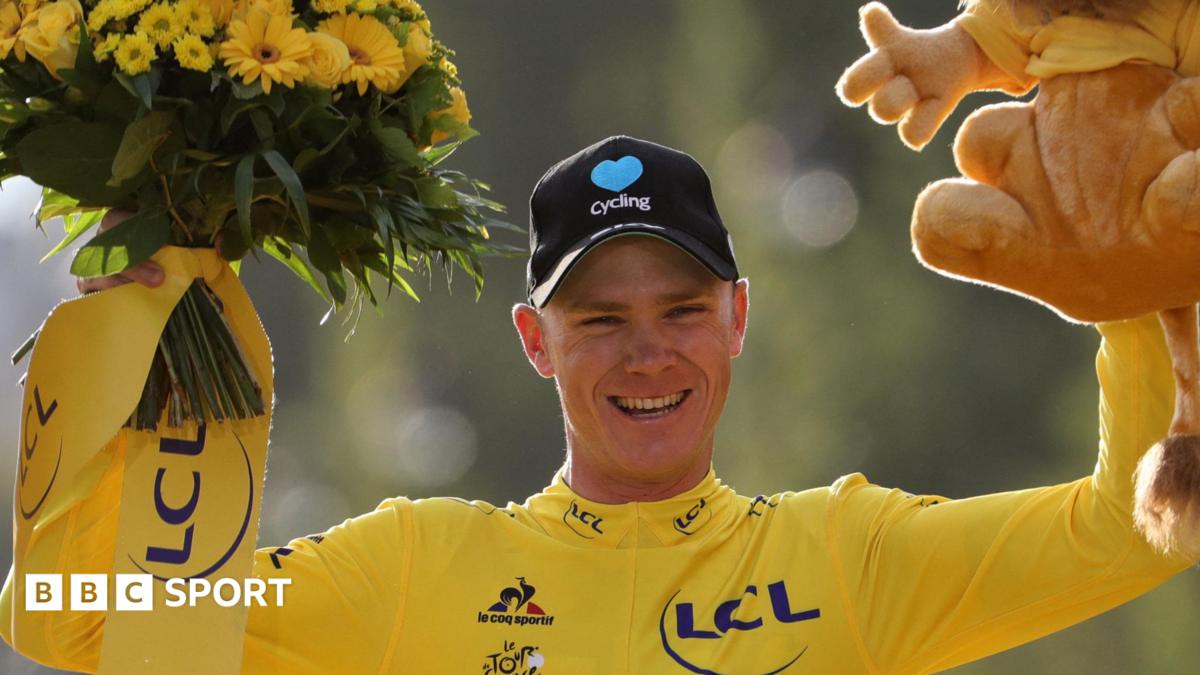
Four-time Tour de France winner Chris Froome has brought an end to his illustrious career in professional cycling.
The 41-year-old British rider has not raced since a serious crash in August 2025 when he collided head-on with a road sign at more than 30mph and suffered five broken ribs, a collapsed lung and a lumbar vertebrae fracture.
Froome’s wife later said doctors discovered a pericardial rupture – an injury where the sac that surrounds the heart is torn – during surgery and were able to repair it.
“Unfortunately, there was that crash last summer – that was not the way I wanted it to end. But even then, I knew it was over,” Froome told Belgian broadcaster Sporza.
The Kenyan-born rider retires as one of the most decorated cyclists in history, winning seven Grand Tours with Team Sky (now Team Ineos).
His four Tour de France victories came in 2013, 2015, 2016 and 2017. Only four men – Jacques Anquetil, Bernard Hinault, Miguel Indurain and Eddy Merckx – have won more Tour de France titles.
He also won the Giro d’Italia in 2018 and Vuelta a Espana in 2011 and 2017, and claimed two Olympic bronze medals in the individual time trial in 2012 and 2016.
Froome was made an OBE for his services to cycling in 2015.
Switzerland remain unbeaten at the 2026 World Cup and will face either Colombia or Ghana in the next game.
Published On 3 Jul 20263 Jul 2026
Switzerland striker Breel Embolo struck early and winger Dan Ndoye added a second as their side cruised to a 2-0 win over Algeria on Thursday and into the last 16 at the FIFA World Cup, where they will meet Colombia or Ghana back in Vancouver next week.
Murat Yakin’s Swiss side put on a tactical masterclass, shifting formations and laying traps for Algeria before hitting them with two sucker-punch goals that decided a contest short on excitement, but full of intrigue and nuance.
Recommended Stories
list of 3 itemsend of list
Pitted against a familiar foe in Algeria coach Vladimir Petkovic, who had seven years at the helm of Switzerland between 2014 and 2021, Yakin set his team up to absorb early pressure and strike on the break, and that is exactly what they did.
Their opener was as simple as it was effective.
Breel Embolo #7 of Switzerland celebrates scoring his first goal of the tournament [Fran Santiago/Getty Images via AFP]
The Swiss won the ball in their own half and sent 20-year-old Johan Manzambi off down the left on the counter, and he squared for Embolo to steer the ball into the net from close range in the 10th minute.
The lead secured, Switzerland shifted to a five-man midfield out of possession, snuffing out the space and challenging the Algerians to play through them, but Petkovic’s charges struggled to break their opponents down.
Algeria’s best chance came in first-half stoppage time when Ibrahim Maza dragged a snap shot wide of the near post, one of the few efforts on goal they managed in the game.
Switzerland’s Dan Ndoye celebrates scoring their second goal [Lee Smith/Reuters]
The Swiss struck again almost immediately after the break, attacking down the right before a half-hearted clearance from Rafik Belghali ended up at the feet of Ndoye, and the winger placed his shot beyond the dive of goalkeeper Luca Zidane.
Algeria captain Riyad Mahrez could have pulled a goal back moments later, but he fired straight at a defender from a central position, summing up a frustrating evening for the Algerians.
With Granit Xhaka steering Switzerland’s defensive shape, they reverted to their original game plan of ceding possession and launching lightning-fast counterattacks, but the Algerians were wary of committing players forward, lest they concede again.
Despite the sellout crowd at BC Place, the last 15 minutes were played in virtual silence, only broken by cheers and then groans as Swiss substitute Fabian Rieder somehow contrived to miss with the goal at his mercy, scuffing his shot back across goal where a grateful Zidane was able to avert the danger.
Fortunately for Switzerland, it had no bearing on the outcome as they celebrated moving into a last-16 clash on Tuesday.
Algeria’s Riyad Mahrez looks dejected after the second goal scored by Switzerland’s Dan Ndoye [Anne-Marie Sorvin/Imagn Images via Reuters]
In the afternoon of May 31, 2026, the Anguwan Hausawa area of the Mokwa Local Government Area of Niger State, North-Central Nigeria, was thrown into mourning. The news of Abubakar Usman’s death in the lodge water had spread through the area, and people were trooping to the house to extend their condolences to his parents.
Abubakar, a 13-year-old, had gone out to play with his friends. Hours later, he was brought back lifeless while his other friend was rushed to the hospital, having drowned in floodwaters caused by a blockage the construction workers working on a culvert had put in to hold the water as they worked.
As the lastborn of his parents, Abubakar was the kind of boy whose presence lit up every corner of the community. He attended the Islamic school close to his house, and his teachers admired how brilliant he was. Residents say he was respectful, and the elders in his community often praised him as he never passed by without greeting people warmly—a rare quality that made him beloved by all.
His father, Usman Shekare, an elderly man in his late sixties, stood heartbroken at the sight, lying on a mat, fixing his gaze on his beloved son. The only words he had the courage to utter were, “God gave him to me, and He has collected him back.”
What broke him further was a simple question: “What message do you have for the government?” He instantly broke down in tears, unable to speak further.
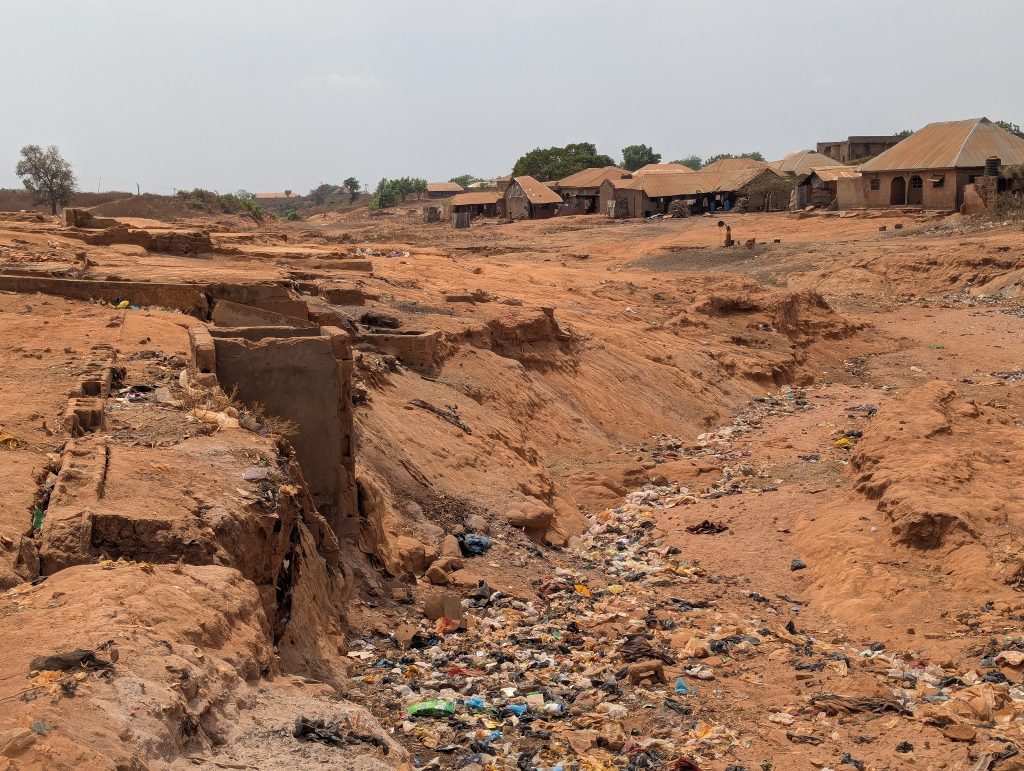
This tragedy is not an isolated incident. Just weeks earlier, residents told HumAngle that three boys fell into the clogged waters and were luckily rescued. The water continues to gather at last year’s Mokwa Flood site, fed by the heavy downpour flowing from the Zugurma and Yagbagba axis, and worsened by another source from gully erosion sites in nearby communities.
One of the flood zones along the Mokwa-Jebba Road in Mokwa LGA, Niger State. Photo: Isah Ismaila/HumAngle.
Hussaini Ibrahim, the Spokesperson of the Niger State Emergency Management Agency (NSEMA), told HumAngle almost a month after the incident that the agency is not aware of any loss of life due to the blockage but will reach out to the community leader and affected family for further actions.
In Mokwa, the echoes of last year’s devastating flood still haunt the community. Residents told HumAngle that farmers had raised alarm before last year’s disaster, warning that water was accumulating, but their concerns were ignored until after the flood struck. Now, the same warnings are being repeated, with little sign of preventive action.
“Barely a year after the flood, Mokwa is once again staring at water lodging in the same vulnerable zones,” Isah Mokwa, a community leader and activist in the community, told HumAngle. “The bridge and waterway reconstruction, meant to symbolise recovery, has inadvertently blocked water channels, creating a dangerous buildup. As we speak, the town is sitting on a ticking bomb.”
Residents told HumAngle how the first rainfall they witnessed in May made them apprehensive. That evening, they revealed, the sound of rushing water sent shivers down their spines. Mothers were seen rushing to gather their children as fathers stood at the site of collapsed structures, staring at the lodging of water in the same flood-prone channel that swallowed over 150 lives and many homes last year, with hopes of it not wreaking havoc again.
Studies indicate that the mental health and wellbeing of individuals, especially children affected by flooding in Nigeria, can deteriorate for extended periods, often lasting months or even years after the event.
The cumulative stress of rebuilding homes, restoring livelihoods, and coping with displacement has been shown to exert a heavier toll on affected populations than the initial impact of the flood, underscoring the need for comprehensive psychosocial support in disaster management strategies.
“The water was coming right from Yagbagba,” Ndako Usman, a resident, said. “It’s accumulating just behind the blockage. Once it gets bigger and more powerful, it could hit our homes again.”
Hussaini told HumAngle that the blockage was caused by construction workers working on the ongoing drainage construction, and the management has taken swift action to address the issue.
“During last year’s flood, we were taken unaware, but we have taken proactive measures to ensure that it does not repeat itself this year. We have a monitoring team, and also volunteers who constantly update us on the flow of water so that we take immediate action.”
“Regarding the culvert, we have written to relevant stakeholders, including the Ministry of Water Resources, to study and assess the situation of the culverts to see if they can handle the water volume in case of a flood-related disaster and advise appropriately,” Hussaini added.
A catastrophe remembered
The fear is not irrational. In May 2025, Mokwa was the epicentre of one of Nigeria’s deadliest flood disasters in recent memory. Torrential rains combined with structural failures to unleash devastation that claimed hundreds of lives, displaced thousands, and left the town grappling with hunger and grief.
Flooding has become one of Nigeria’s most persistent natural disasters, wreaking havoc on communities across the country almost every year. Heavy rainfall, poor drainage systems, deforestation, and the release of water from dams often combine to create devastating outcomes.
In 2024 alone, floods claimed over a thousand lives, displaced millions, and destroyed farmlands and infrastructure worth billions of naira, but the situation dropped in 2025, according to the National Emergency Management Agency (NEMA).
The agency revealed that floods killed 241 people and affected 459,995 residents across 27 states and 128 local government areas. Also, the disaster displaced 158,588 people, injured 839, and damaged 54,684 houses while destroying 96,649 farmlands.
Get our in-depth, creative coverage of conflict and development delivered to you every weekend.
Subscribe now to our newsletter!
The newly constructed culvert in the Anguwan Hausawa area of Mokwa, one of the hard-hit areas of last year’s flood. Photo: Isah Ismaila/HumAngle
Early warnings had been issued by the Nigerian Meteorological Agency (NiMet), but local authorities failed to act.
The disaster struck suddenly. Heavy rainfall battered Mokwa, but the real trigger was the collapse of a railway embankment and blocked drainage channels that redirected torrents into residential areas.
Within hours, homes were submerged, bridges collapsed, and farmlands were washed away. Reports varied, but estimates suggested between 200 and 700 people lost their lives, and about 3000 houses and properties were destroyed, leaving families stranded in makeshift camps.
In the wake of the disaster, the Minister of Information and National Orientation, Mohammed Idris, revealed that President Bola Tinubu approved the release of ₦16.7 billion for the immediate reconstruction of the Mokwa Bridge, which was destroyed by flooding, noting that the project would involve constructing a bridge with 10 spans.
In the months that followed, HumAngle published a damning investigation into the Mokwa flood, among other issues. Our findings painted a picture of systemic neglect. The investigation established that gully erosion in Mokwa has remained a destructive force despite years of significant financial allocations. The erosion continues to expand, damaging infrastructure and farmland and worsening during rainy seasons.
Equally, the report uncovered that billions of naira from ecological funds and World Bank loans were earmarked for erosion control, yet no substantial work has been executed. While officials claimed contractors were engaged, there was no evidence of transparent bidding processes. Field assessments confirmed that erosion control activities remain absent, exposing a gap between official pronouncements and actual implementation.
Last month, NEMA listed Mokwa among high flood-risk local government areas in Niger State for 2026. Yet on the ground, little seems to have changed.
Isah Mokwa, the activist based in Mokwa, confirmed to HumAngle that the bridge constructed to contain the water has proven inadequate. According to him, the community braces for the worst, fearing that heavier downpours could unleash destruction far greater than before.
“Nothing has changed. In fact, the situation has deteriorated even further. In the same direction where the water started gathering before the flood, farmers have raised the alarm that water is already accumulating,” he said.
“We believe there is no accountability for the funds contributed to the state government. What happened to the billions donated after the 2025 flood? Even the shelter that was promised for victims of last year’s flood has not been provided. Just recently, there was a flag-off ceremony, but no contractor has been mobilised to the site, no details were given about the number of houses to be built, and no project timeline was shared,” he said.
According to residents, some of the affected families who were lucky to receive ₦500,000 ($360) in financial support last year to rent houses have exhausted their funds, and the majority are now struggling to renew their rent.
For many in Mokwa, the suspicion is that the tragedy of 2025 has been reduced to a political talking point, while the lived reality of survivors remains ignored.
However, experts warn that Mokwa cannot afford another disaster.
Abbas Idris, the president of the Risk Managers Society of Nigeria (RIMSON), in an interview with HumAngle, said that before now, the government should have taken a proactive disaster management approach through risk assessment and hazard categorisation.
This, according to the risk expert, would help not only the government and state emergency management agency but also residents to put in place measures or tackle the disaster even before it strikes.
In the longer term, Abbas revealed that the Niger State government must enforce urban planning regulations, preventing construction on floodplains and investing in climate adaptation strategies.
“Neglecting risk assessments leaves communities defenceless when disaster hits,” Abbas stressed. “We must address corruption, weak governance, and poor ecological management as root causes of the crisis and pave the way for transparent, science-driven interventions to mitigate future disasters.”
It has been a year since the flood, and despite repeated appeals from the community, the state government, under the leadership of Umar Bago, has yet to provide a lasting solution. Families like the Shekare’s are still left to brace for waters that rise too quickly and claim too much.
And until their demands are met, Mokwa remains vulnerable — a place where the memory of one brilliant boy reminds everyone of both the fragility of life and the urgency for change.
Popular lifestyle and fashion influencer Nara Smith spoke out about her daughter’s private health battle, revealing on Wednesday that the 2-year-old is battling cancer.
Smith, 24, said in an Instagram video that her daughter Whimsy was diagnosed late last year when she and husband model Lucky Blue Smith noticed “something suspicious” on the toddler’s body and sought immediate medical attention. The models first took their child to the emergency room and eventually to the pediatrician, who urged the parents to take their daughter to the nearest children’s hospital, she said.
“I just remember him going really quiet and calm, and my heart dropped in that moment,” Smith recalled of that pivotal visit with the pediatrician.
The content creator said her daughter underwent numerous X-rays, ultrasounds and a biopsy before the hospital team determined the cancer diagnosis. Smith did not specify the type of cancer, but said the illness had spread and Whimsy needed to begin chemotherapy. Smith, who went viral in late 2023 for her absurdly elaborate videos crafting processed snacks from scratch in fabulous outfits, said her daughter’s health battle is partially why she has taken a break from social media. She also spoke about finding comfort and community online via forums and social media and connecting with families who have loved ones also battling cancer.
“Processing this and navigating this as a family has been really hard,” she said. Smith added that in addition to Whimsy’s cancer battle, she found it challenging to balance caring for her other children, recovering from the fall 2025 birth of her youngest daughter and her social media work. “Some days are a little easier. Some days are really hard,” she said.
Nara and Lucky Blue Smith, 28, married in 2020 and share four children: eldest daughter Rumble Honey, son Slim Easy, Whimsy Lou and infant Fawnie Golden. Lucky Blue Smith also shares a daughter with his ex-girlfriend, social media star Stormi Bree.
Though Nara Smith kept most details about Whimsy’s cancer battle private, the thumbnail for Wednesday’s video appears to be her husband and a doctor next to an MRI machine. “Thankful for each and every nurse and doctor along our journey who helped us get through and out the other end,” she captioned the video.
Roki Sasaki’s abysmal appearance faded away in the Dodgers’ 12-7 win over the San Diego Padres after Los Angeles rose from a catatonic first inning. The Dodgers roared back from a 6-0 deficit as Andy Pages skirted a tying double down the left-field line, and Mookie Betts and Max Muncy each drove in runs to give them the lead in a four-run fourth inning. All of which sent the sellout crowd into jubilant celebrations, some jumping, others breaking out World Cup chants.
“I don’t know,” manager Dave Roberts said of the team’s ability to turn the game around. “Thankfully, it played out the way I didn’t expect, or the way it started.”
By the time the game ended, Sasaki’s three-inning start seemed like a murky nightmare the Dodgers awoke from in a sweat. Except the Dodgers weren’t dreaming, and the team hadn’t done much to assuage the concerns with Sasaki.
The problem with Sasaki isn’t his stuff. On his best nights, when the velocity and command combine, Sasaki blows past batters with a triple-digit fastball and cutting off-speed pitches. The problem has been how to tick the radar without making the strike zone look like a Jackson Pollock painting — and recently, it has.
Sasaki’s June swoon, impervious to the calendar change, continued into Thursday’s series opener against the Padres, in which the right-hander gave up three home runs and seven hits before Roberts called it quits going into the fourth inning.
“They were on everything,” Roberts said. “You could see it.”
One possible concern? Tipping pitches. While Roberts and catcher Dalton Rushing said the team would need to do some more research into Sasaki’s start, both left the door open to this answer.
“That would be a big explanation as to how they felt like they were on every pitch,” Rushing said.
As San Diego chugged through its lineup, Sasaki struggled to keep up. With his first pitch, he gave up a double to Fernando Tatis Jr., who scored on Manny Machado’s home run that left center fielder Pages staring at the ball’s path as it plopped down on the other side of the blue outfield fence.
The inning was only a preview of the Padres’ power. Each of the nine San Diego batters got his chance against Sasaki in the second, and the team quickly dug the Dodgers into a six-run hole. He surrendered two home runs in the second inning. First, Jackson Merrill blasted a ball to left-center field, and, two outs later, Jake Cronenworth drove in two runs with a shot to right-center.
Sasaki said through interpreter Kensuke Okubo that he felt like he needed work on his command to improve, but he felt like his fastball was good.
Roki Sasaki has his head down after giving up a solo homer to Jackson Merrill in the second inning.
(Gina Ferazzi / Los Angeles Times)
“I don’t think my stuff was bad today,” Sasaki said. “Overall, it wasn’t great but a lot of things evolved.”
Part of Sasaki’s issue lies with his approach. Roberts said he wants the second-year pitcher to be aggressive, to play the cat-and-mouse game required to beat batters in the box. But when given the opportunity, Sasaki has shrunken in recent outings, struggling with his command and his ability to pitch deep into games.
“We had a great May, so let’s just get back to competing and making pitches,” Roberts said.
When reliever Will Klein walked out to the mound in the fourth to the aggressive, rambunctious clamor of the Dropkick Murphys’ “I’m Shipping Up to Boston” and collected two scoreless, one-hit innings, the relief was immediate: The Dodgers took the lead.
The lineup already was revving, as Dalton Rushing homered in the second inning while Sasaki was still in the game, and both Kyle Tucker and Max Muncy drove in runs in the third, cutting the deficit to two. The Dodgers broke through against the Padres’ bullpen to score six runs in the fourth and fifth innings.
“The bullpen was fantastic tonight, and then the offense came up big,” Roberts said.
A late catch by Pages helped close out the game after he gloved a ball despite ramming into the padding of the center field wall. A combined effort by Paul Gervase and Tanner Scott shut down San Diego’s ninth-inning momentum after it pushed across a run.
“Turned back around, was able to find the ball and make a really good catch right there,” Tucker said. “That was a huge out.”
The Dodgers (57-31) beat their division rivals for the fifth time in seven games to open a 13-game lead over both San Diego and Arizona. The Padres, meanwhile, have given up 65 runs over the last six days, the most in such a span in franchise history.
But San Diego’s flaws don’t negate the Dodgers’ as they burned through six relievers in their win. So, while the Dodgers crawled out of the hole with a season-high 17 hits, the steep cost heightens the pressure on the rest of the rotation the rest of the series.
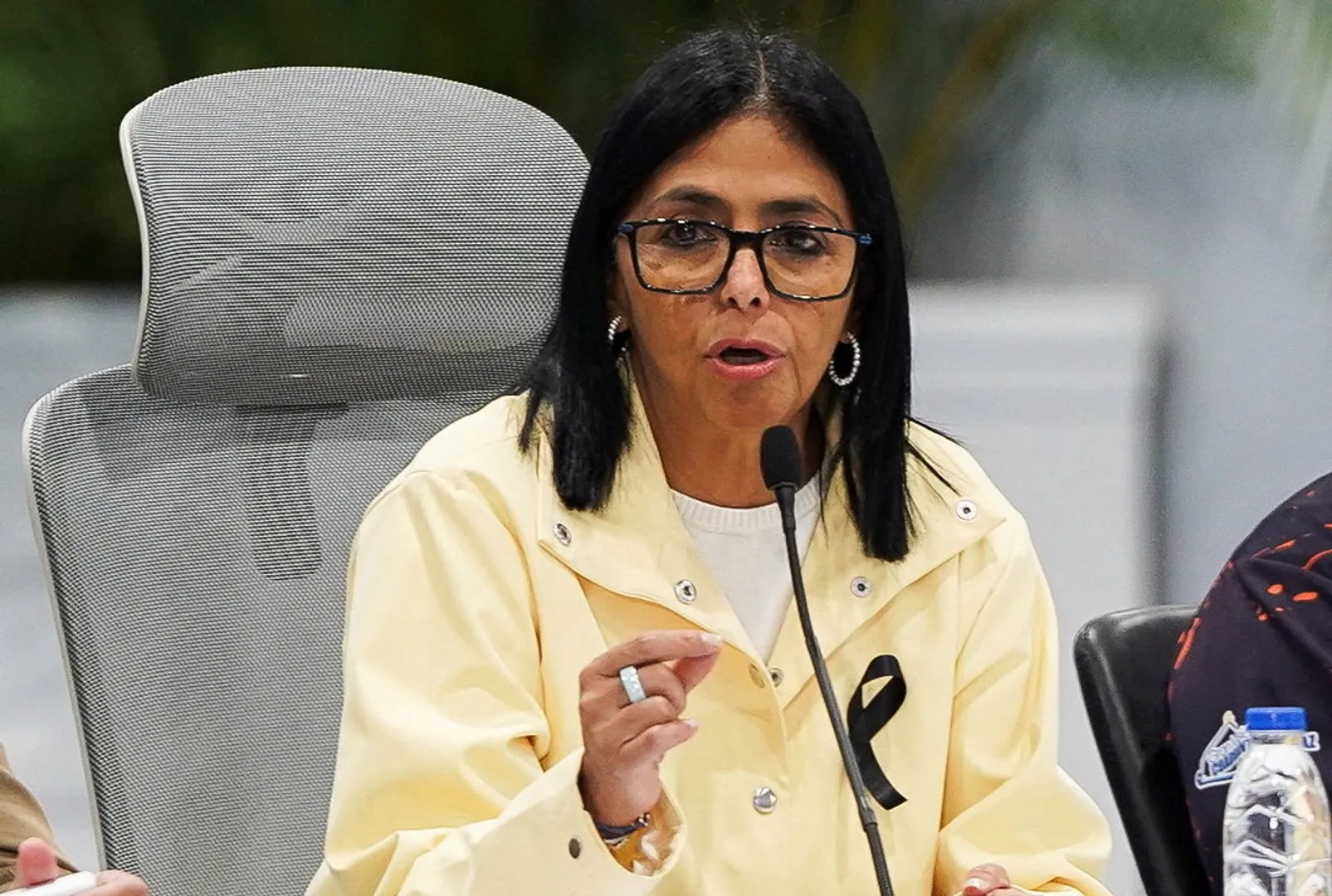
Interim President of Venezuela, Delcy Rodriguez, says 80% of the buildings that collapsed in back-to-back earthquakes were privately developed. She also confirmed that more than 2,500 people are dead and that search and rescue operations still continue.
Temperatures in Europe hit a new high this summer, with hotter early-summer heatwaves triggering illness, deaths and the collapse of infrastructure across the continent.
Transport buckled on Sunday as temperatures hit 40C (104F) across Germany, the Czech Republic and Poland. In France, days averaging 29.8C (85.6F) – spiking to 44C (111.2F) in one town – gave way to storms, leaving an estimated 1,000 excess deaths behind.
Scenes like this may well be the new normal.
Last summer’s heatwave alone caused an estimated 2,300 climate-related deaths in 12 European countries, WWA says.
A study by World Weather Attribution (WWA) has found that intense heat on this level is now tens to hundreds of times more likely than it was in 2003, and was unheard of 50 years ago.
“Heat-related mortality is likely to remain a feature of Europe’s warming climate,” warns Dr Hans Kluge, the World Health Organization (WHO)’s regional director for Europe. Deaths have already risen by an average of 52 per million people annually since the 1990s, he told Al Jazeera – a trend he says shows little sign of reversing on its own.
So what does this mean for the future? Are these temperatures the new normal, and if so, why?
We asked the climate experts:
Is this really the new normal?
Yes, it certainly looks that way. According to WWA, heatwaves were generally about 3.5C cooler in June 1976, and 2C cooler even in 2003.
“Think of it like a race where the starting line has been moved much closer to the finish,” Dr Akshay Deoras of the University of Reading told Al Jazeera. Ultimately, this is down to global warming, he says.
Europe has warmed at roughly twice the global average since the 1980s, according to the European Commission’s climate change service, Copernicus.
Deoras says this amounts to “loading the dice” towards once-rare extremes.
WWA’s modelling goes further: at current emissions rates, an event of the magnitude of this summer’s heatwave is expected to occur every couple of decades – and today’s extremes are effectively a preview of what an ordinary summer could look like by the middle of the century.
Why is this happening in Europe now?
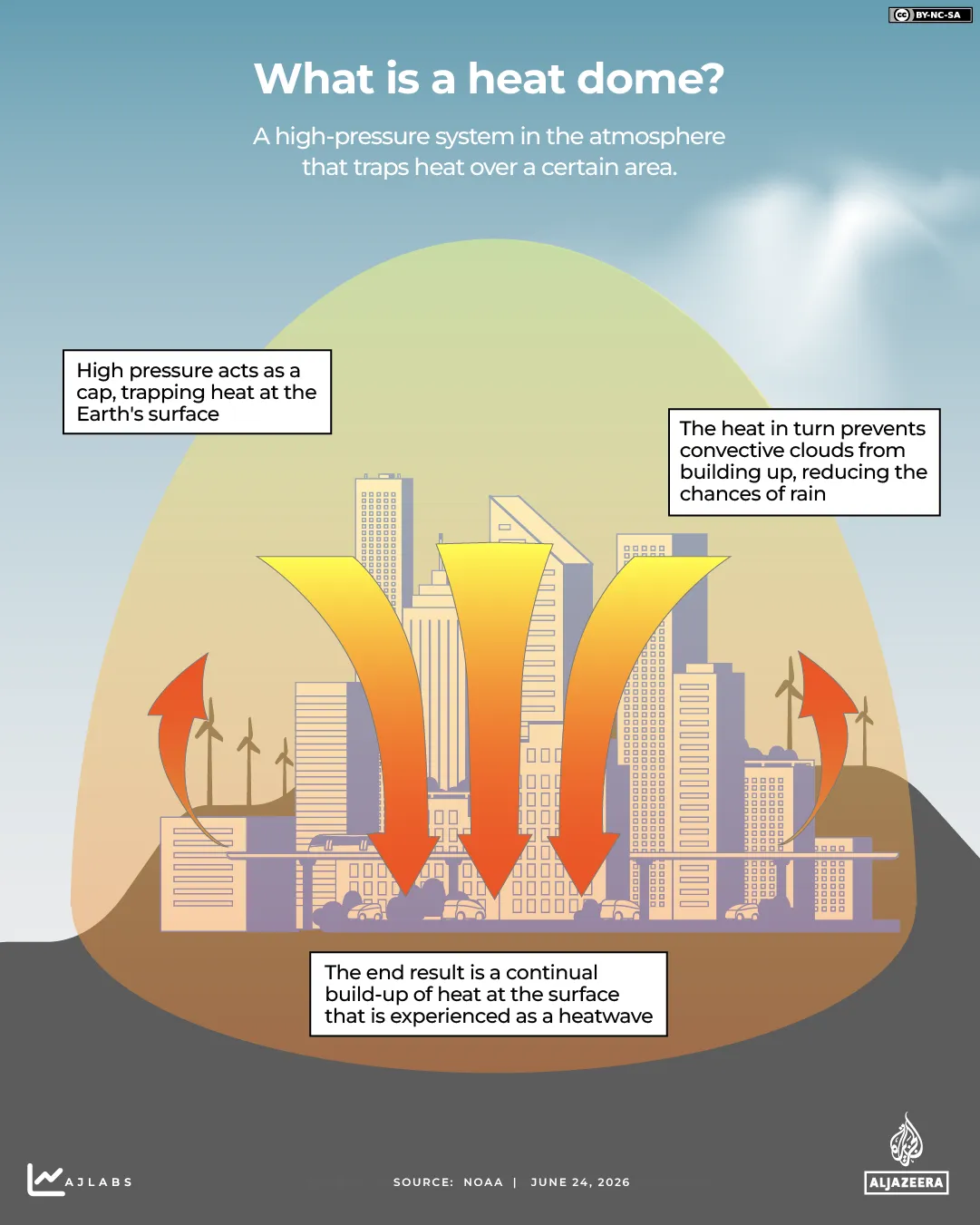
The immediate trigger is a stalled high-pressure system, or a “heat dome”, which traps heat in one concentrated area for days or weeks.
Heat domes aren’t new, but Europe’s already-shifted baseline means the same pattern now produces far hotter outcomes than decades ago, Deoras told Al Jazeera.
Professor Hannah Cloke of the University of Reading told Al Jazeera that’s because the warming behind new, extreme weather patterns comes from emissions released decades ago, and the climate system takes time to respond – so we’re feeling the effects now of pollution from the past.
Copernicus’s European State of the Climate 2025 report confirms this: more than 95 percent of the continent saw above-average annual temperatures last year, alongside record Alpine glacier loss and the highest sea-surface temperatures ever measured in Europe.
And because Europe is warming roughly twice as fast as the rest of the planet, that gap with the global average is projected to keep widening – meaning whatever the world experiences on average in the coming decades, Europe will likely see first, and worse.
Is this trajectory irreversible?
Partly. Some of the damage is permanent. Some of it isn’t – yet.
Take glaciers. Because the effects of pollution from decades ago are cumulative, “some of what we are experiencing this summer is already locked in”, Cloke says.
Alpine glaciers, which feed major European rivers, she says, have already shrunk past the point of recovery, and their contribution to summer river flow is “permanently reduced”.
Not everything is set in stone, however. “Every tonne of emissions avoided changes the odds of what comes next,” Cloke says.
What we do now, therefore, will decide the difference between summers that are simply hard to live with in the future, and summers that become “genuinely beyond our ability to cope with”.
Some resources, like groundwater in northern Europe, can still recover – “but the window to act is narrowing with each dry year”, she says.
What is this doing to human health?
The toll is already severe and likely to worsen.
The Lancet Countdown Europe calculates that there were 62,000 heat-related deaths across the region in 2024 alone, with projections showing a steep further rise by 2050 if we don’t make changes.
Much of the problem, Kluge told Al Jazeera, is architectural and largely unaddressed.
“Most of the housing stock across this region was designed for a colder climate – to retain heat, not shed it,” he said, warning that without large-scale retrofitting, deaths could keep climbing past 2050 regardless of how good warning systems become.
His prescription: treat heat as predictable, not an emergency.
“Governments need to plan for heat the way they plan for winter flu – as a recurring, predictable challenge requiring permanent infrastructure, not a one-off crisis requiring emergency improvisation.” The highest-return step, he added, is identifying who’s most at risk – often older people living alone – and reaching them before a heatwave hits, not after.
What else can be done?
Cloke points to two priorities: early warning systems that reliably reach the people who most need to be protected, and an overhaul of water infrastructure in Europe which has been built for rainfall patterns that no longer exist.
Deoras says emissions also still matter: cutting them won’t eliminate heatwaves, which are “a natural part of the climate system”, but doing so would make them “less intense, less frequent and shorter-lived”.
None of the experts who spoke to Al Jazeera describe this as hopeless.
They do warn that the window of opportunity for addressing the issue is narrowing: infrastructure can still be retrofitted, emissions can still be cut, warning systems can still be improved – if the decisions to do so are made now, rather than after the next heatwave.
What a “normal” European summer looks like in 2050 is still being written, they say.
IT’S everybody’s worst nightmare bumping into their ex-partner, let alone when they are with their new girlfriend – But we can reveal that Laura Hamilton is said to be bracing herself for just that.
Yesterday, The Sun told how her former husband had moved on with a stunning PR girl and now, insiders tell us how the A Place in the Sun presenter really feels about it – and why their two worlds could collide.
Laura Hamilton is said to be unimpressed by her ex-husband’s new romanceCredit: Instagram/laurahamiltontvAlex has actually been dating Becky for over a year, but has only just gone publicCredit: instagram/knowles_bk
Laura, who split from Alex Goward in 2022 after 13 years together, is understood to be unhappy about his new romance with stunning PR guru Becky Knowles – a relationship we can reveal has actually been quietly underway for more than a year.
Alex, 45, and Becky, who bears a striking resemblance to his ex-wife, went public with their relationship this week.
However, Alex does in fact appear on Becky’s social media as far back as June last year, with the couple also enjoying a romantic holiday together last September.
The pair are said to have kept things low-key out of respect for Laura and the children she shares with Alex – Rocco, 12, and 11-year-old Tahlia – but felt that after a year together, it was the right time to make things public.
However, Laura is said to be worried about coming face-to-face with her ex’s new girlfriend as they move in similar showbiz circles.
She is also said to be uncomfortable with Becky’s high-profile friendship group, which includes Pussycat Doll Ashley Roberts, Louise Redknapp and singer Cheryl.
“Becky has always moved in fabulous circles – even more so than Laura!” a source said.
“She has lots of showbiz friends and her sister Emma Lucy is a famous crystal healer who regularly appears on This Morning and is best friends with Holly Willoughby. Becky was also very close to Caroline Flack.
“One person not so happy about it all is Laura. She’s had a while to come to terms with it all privately, but now it’s out in the open; it’s opened old wounds – nobody wants to see their ex with someone younger and more beautiful, let alone so successful.
“Laura is also very worried about bumping into them because Becky moves in the same showbiz circles. She attends the premieres, celebrity launches and has lots of A-list friends, so she’s dreading bumping into her ex and Becky in public. It will be incredibly difficult and awkward for her.”
Becky and Alex went Instagram official this week, sharing snaps of the pair enjoying a date night together.
In one photo, he rested his hand on Becky’s leg as she, dressed in a short black skirt and heels, posed alongside him at a bar. A second image showed the couple holding drinks, with Becky kissing him on the cheek.
Stunning Becky uploaded the snaps with the caption: “Us” and a love heart emoji, before Alex reposted them to his story.
Friends say she is “smitten” and that it’s the happiest they’ve ever seen her.
One said: “We all knew this was very serious as soon as she posted him on her Instagram – everyone was like ‘omg who’s this guy’? Because Becky has been single for years and years and years!
“She’s very confident, outgoing, smart and has got extremely high standards. She’s also so incredibly beautiful. She has always had admirers, but she is far too driven and busy with work and her friends to be tied down to just anyone – so we knew that he must be the one.
“They’ve actually been together for over a year now, but kept things low-key out of respect for Laura and his children. It felt like the right time to go Instagram official this week – they are so in love and the happiest they’ve ever been.”
Laura has also been trying to move on following her split – but has found Alex’s news hard to take.
Alex’s partner has a number of celebrity palsCredit: InstagramLaura has found it tough seeing the new relationship in the pressCredit: Instagram/laurahamiltontv
Our source said: “Laura wants her ex to be happy, but she can’t help feeling a bit irked by Becky and all this. The last thing she wants to see is him draped all over his beautiful new girlfriend in the press. That’s her world!”
In 2023, Laura opened up about her “tough” divorce from Alex, saying she had to stay strong for their children.
She said: “You say content, but I have moments when I feel this is tough, this is hard, this is not what I expected my life to be. But I’m a glass-half-full person, and I have to be positive. I have to be strong. Am I making the best of the situation as I can right now? Yes, 100 per cent.
“But I do get sad because things went the way they did. I might look like everything is fine all the time, and that’s how things come across on social media, but no, I’d be a robot if I didn’t have those emotions.
‘Do I let myself cry? Yes, all the time. And I encourage Rocco and Tahlia to always share their feelings. It is better to talk and let the emotions out than bottle up.”
Two years after their divorce, Laura was linked to married businessman James Pettigrew, who was said to also be going through a divorce at the time, and the pair were seen kissing in her car.
But she later refused to be drawn on the relationship.
She said at the time: “I’m dating. I’m having fun. No, I don’t have the apps. I’ve tried those in the past three years. I went on Raya and thought: ‘This is not for me.’ I like to meet people organically.
“People do look at me and say: ‘I know you from somewhere…’ and that starts a conversation.
“I did go out on a date with somebody, and the only thing he wanted to talk about was buying a property in the sun. I’m not here to be your property consultant!
“But it’s quite difficult for me to date when you look at my life and how busy I am. I’ve got two children and I’m abroad every other week.”
But while dating has been difficult for Laura, it seems it’s not been quite so much of a struggle for her ex.
We first noticed Milos as we travelled home from Crete, flying directly above it and deciding that was where we must go next. It didn’t disappoint. The island was calm, peaceful and strikingly beautiful. Milos isn’t well known, but it should be; the true home of the Aphrodite of Melos, displayed in the Louvre, Paris as the Venus de Milo. The northern coast was spectacular, shaped by volcanic activity and particularly picturesque. Sarakiniko is the perfect stop for photographs with its white rock. Truly an unforgettable trip. Chris Rimell
Profile
Readers’ tips: send a tip for a chance to win a £200 voucher for a Coolstays break
Show
Guardian Travel readers’ tips
Every week we ask our readers for recommendations from their travels. A selection of tips will be featured online and may appear in print. To enter the latest competition visit the readers’ tips homepage
–
Chasing waterfalls on the Pelion peninsula
Damouchari. Photograph: Iosif Lucian Bolca/Alamy
We visited the incredibly beautiful Pelion peninsula in east, central Greece, and based ourselves in the tiny town of Damouchari, staying at the Kastro Studios above the village shop with a prime position overlooking the harbour and a one-minute walk to the white pebble beach. We swam in the harbour and off the beach, snorkelling with interesting fish and crustaceans, and took a very hot walk (take plenty of water) along the coast to the Fakistra beach where we cooled off under a waterfall and my daughter spent the afternoon doing handstands in the sea. Our walks included eating home-cooked meals at tiny roadside restaurants and drinking very strong coffee under a 1,000-year-old plane tree in a village square. A perfect, slow and really memorable trip full of exploration and fun. Layla Astley
Beach boat trips on Symi
Goats roam the beach at Marathounda Bay. Photograph: Image Image/Alamy
Getting the ferry from hectic Rhodes, we had heard that something special was waiting for us on Symi. Tucked away just off the Turkish coastline, this hidden little island in the Dodecanese was the perfect place to switch off for a week. Every day was a different boat trip to a new beach, such as Marathounda Bay, with its free-ranging goats searching for scraps between the sunbeds and stones. However, the true highlights were the shaded tavernas found on the edge of each shore where we refreshed ourselves to our hearts’ content with seafood, salad and a cold Mythos. Steve
Strolling around Venetian palazzos on Syros
A vivid sunset at Agios Stefanos. Photograph: Hercules Milas/Alamy
Syros – the administrative capital of the Cyclades – is a wonderful place. Between relaxed strolls around Venetian palazzos (large houses) and swimming off the rocks in Ermoupoli, we got a bus to the other side of the island to Galissas beach. Here, after asking locals, we made an anecdotal map and hiked to Agios Stefanos, a chapel in a cave almost in the sea. Watching the sunset there was a magical experience. The story goes that a fisher was saved here from being dragged under the sea by a giant octopus, after praying to Saint Stephen, and so he built this chapel to thank him. Rosie
The healing power of Hydra
Hydra proved perfect for a quiet, relaxing holiday. Photograph: Jen Lombardo/Alamy
After my mum, June, died, our family decided to go somewhere warm of heart and chose Hydra in the Saronic Gulf, off the east coast of the Peloponnese. Still rumpled from our flight, we took a ferry from Piraeus and sailed off towards a kindly family hotel, the Hydroussa. A tiny, car-free island with a long history was explored in an afternoon. We mostly just took dips (in the clearest seas I’ve ever swum in), read, ate, remembered and gently healed. Dawn
An archaeological gem near Preveza
The remains of ancient Kassopi. Photograph: Clairy Moustafellou/Alamy
The little-known archaeological site of ancient Kassopi was one highlight of our visit to the charming little port of Preveza, on the central west coast. The mountainside was drowning in wildflowers, and the bees, butterflies and lizards were our only companions – apart from the warden who seemed agreeably surprised to see us. We had the entire site to ourselves and wandering through the remains of the city and its third-century BC theatre, with an azure sea in the background, was an unforgettably romantic and quintessentially Greek experience. Later that day, we went dolphin-watching in the Ambracian Gulf, followed by wonderful Preveza prawns for dinner. Gerald Willmore
Most guidebooks recommend doing a day trip to Antiparos from Paros, its much bigger neighbour, but we stayed for five days – the best decision of our trip to the Cyclades. Like stepping back decades into a much less-touristed Greece, the island has a modest beauty and peaceful aura that charmed and calmed us. We stayed in Statheros Garden and enjoyed morning dips in the turquoise waters at Panagia beach, just a few metres away. Paros is only a few minutes away by ferry so there’s plenty of scope for exploring beyond beautiful Antiparos Town and Sifneiko bay. Alice
Amorgos is as epic as in the Big Blue
The path up to the monastery of Hozoviotissa. Photograph: Lemonan/Getty Images
The Big Blue is a film I have watched countless times and seeing the 11th-century monastery of Amorgos rise out of the rock face as Eric Serra’s soundtrack kicks in has stayed with me. Seeing it in real life when I travelled to this most charming of Greek islands was truly unforgettable. Ed Simpson
A true adventure on Kefalonia and Ithaca
Our reader Dan enjoyed a motorboat adventure from Kefalonia. Photograph: Jon Taylor/Alamy
As a boy, I went to Kefalonia with my parents and stayed in the fishing village of Fiskardo in the north. Beautiful beaches, fantastic food and sun aplenty, yet a highlight for me was hiring a small motorboat with my father and darting across the bay to the island of Ithaca. We may have got a little carried away exploring, leading to us running out of fuel and having to be rescued! Nevertheless, it was a true adventure. My father passed in 2022, and our speedboat adventure is a memory I hold dear to this day. Dan Law-Jones
Winning tip: wildlife deep in the Vikos gorge
The Vikos gorge harbours a wide array of wildlife, from snakes to bears. Photograph: George Pachantouris/Getty Images
We’ve just returned from a road trip in beautiful northern Greece, a highlight of which was the awe-inspiring Vikos gorge – the deepest gorge in Europe by ratio of depth to width. We frequently saw tortoises trundling along on our hiking route through the gorge, and also had a brief encounter with a horned viper (one of Europe’s most venomous snakes), underlining the array of wild creatures that are resident here, which include brown bears, wolves, Egyptian vultures and wild boar. We enjoyed the tranquility of the Voidomatis Springs, a crystal clear pool at the bottom of the gorge. It’s a perfect place for a dip if you’re feeling brave – the water is a bracing 4-7C year round! Beatrice
From its famous monthly markets to artisan boutiques, this charming town should be on your radar
07:00, 03 Jul 2026Updated 07:18, 03 Jul 2026
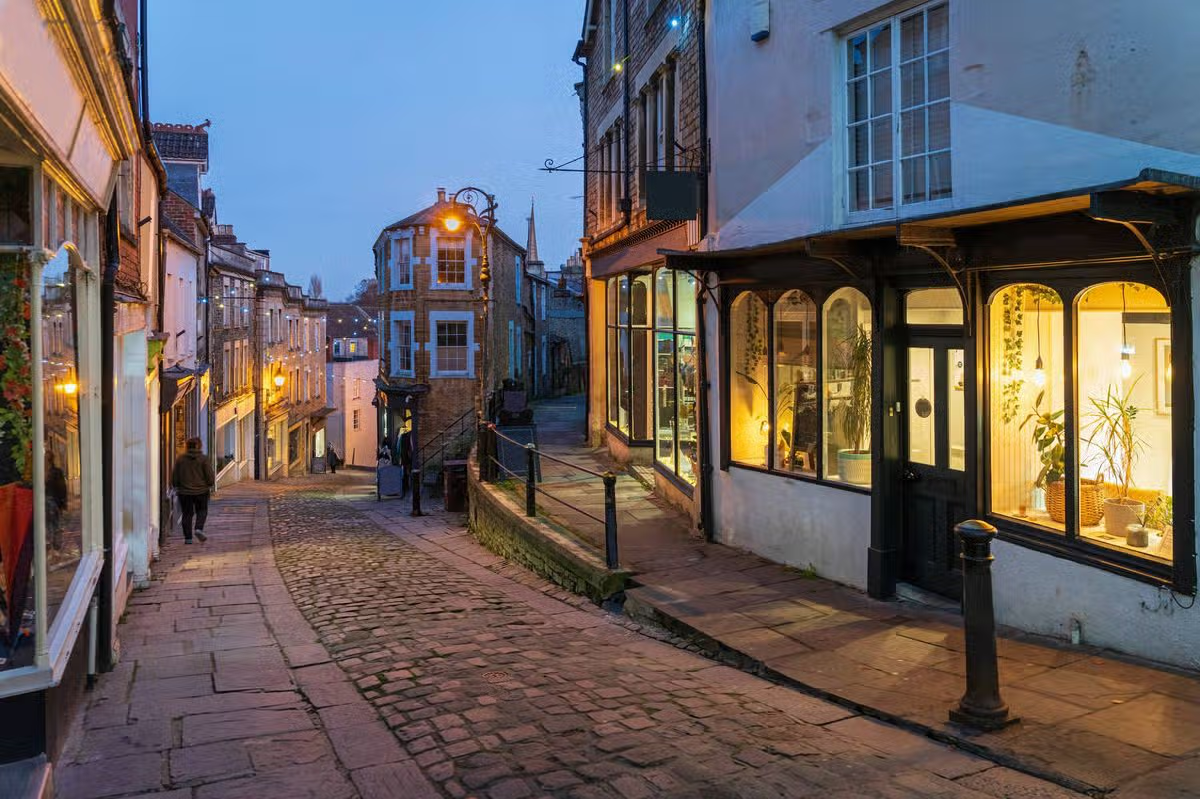
I visited a quiet UK town with cobbled streets and independent shops – I’d live there(Image: GordonBellPhotography via Getty Images)
The UK is brimming with stunning towns and villages, and I’ve been fortunate enough to explore quite a few. One aspect that has consistently struck me is how distinct they all are, even when they’re situated close together.
Some are bustling and contemporary, while others seem stuck in the past. That’s precisely why I adore discovering the UK, as you’re never quite sure what you’ll encounter.
Frome in Somerset is one of those destinations that genuinely lingers in your memory afterwards. It isn’t one of those household-name tourist hotspots like Bath or Wells, but that’s part of what makes it special.
Nestled in eastern Somerset near the Wiltshire border, Frome wasn’t particularly high on my list of places to visit, but I’m absolutely delighted I made the trip.
Frome, pronounced Froom, is positioned in a valley along the River Frome, roughly 13 miles from Bath. Historically, it flourished as a wool and textile town, and you can still spot remnants of its heritage in the architecture and street patterns today.
What made the town particularly memorable for me was its blend of historic and contemporary elements, which seemed to resonate with virtually everyone.
There are twisting medieval lanes, Georgian terraces, and former industrial structures sitting alongside modern cafes and independent retailers.
It has long been a market town, and that heritage remains central to its character, which is largely why I chose to visit after spotting it on TikTok.
The highlight is the Frome Independent Market, held on the first Sunday of each month. The entire town centre essentially transforms for the day.
Streets become packed with stalls offering everything from artisan food and freshly baked bread to handcrafted goods, antiques and clothing. There’s frequently live music and street food on offer too.
Even when the big monthly market isn’t on, smaller regular markets maintain that community atmosphere throughout the week.
Its high street has also been recognised as one of the finest in the UK on multiple occasions, and it was easy to see why.
Beyond markets and shopping, one of the most enjoyable aspects of Frome is simply wandering around it. It’s compact enough to navigate with ease, yet packed with hidden treasures waiting to be discovered.
Catherine Hill is arguably the most iconic street in the town. It’s steep and cobbled, lined with independent shops.
But it’s also among the finest vantage points, offering views back across the town’s rooftops.
There’s also a thriving arts and culture scene there. Galleries, studios and numerous creative venues are dotted throughout the centre, and the Frome Festival in July brings the town alive with music.
If you’re after something more peaceful, there are numerous riverside walks, as well as being far from open fields and rolling hills. The town is ideal for anyone and everyone.
SEATTLE — Bryce Miller took a no-hitter into the seventh inning and the Seattle Mariners edged the Angels 1-0 on Thursday night to finish a three-game sweep.
Cal Raleigh coaxed a bases-loaded walk from rookie starter Walbert Ureña with two outs in the sixth to force home the only run. Seattle stayed tied with the Texas Rangers for first place in the American League West at 45-43.
Andrés Muñoz pitched a shaky ninth for his 16th save. Muñoz gave up a leadoff walk and two singles but retired Wade Meckler on a grounder with two runners aboard to end it.
Zach Neto walked to begin the inning but got picked off at first base attempting to steal second.
Seattle center fielder Julio Rodríguez was removed in the top of the third, two innings after being hit in the back of the helmet by a thrown ball while running the bases. He was replaced by Victor Robles, who got hit by a pitch on the right wrist in the bottom of the third and was lifted in favor of Weston Wilson in the fifth.
Miller (4-2) struck out eight and walked none in seven splendid innings. He lost his no-hit bid when Nolan Schanuel blooped a leadoff single to right-center in the seventh. Denzer Guzmán followed with a single, but Miller retired the next three batters to preserve the lead.
Eduard Bazardo struck out two in a perfect eighth.
The Angels’ lone baserunner through six innings came when Guzmán reached second on a throwing error by Mariners third baseman J.P. Crawford with two outs in the fourth.
Crawford, playing his 1,000th career game, doubled to start the bottom of the sixth for the first hit of the night. Dominic Canzone and Randy Arozarena walked to load the bases with one out before Josh Naylor struck out swinging. Raleigh fell behind 0-2 in the count but worked a nine-pitch walk that scored Crawford and chased Ureña (5-7).
Up next for the Angels: Host the Boston Red Sox for a three-game series beginning Friday night. LHP Reid Detmers (3-5, 3.88 ERA) starts the opener against LHP Jake Bennett (2-3, 3.27).
July 3 (UPI) — A man, identified by Tibetan exile media as a Tibetan activist, died Thursday evening after setting himself on fire outside the United Nations’ headquarters in Manhattan, authorities said.
Video of the incident posted online shows the man dressed in robes and holding a Tibetan flag, which he places on a pole that keeps it erect, before he is seen flicking an apparent fire starter and becoming engulfed in flames.
Responders arrived with extinguishers more than a minute later and putting out the fire. The man had crumpled to the ground.
Voice of Tibet, a Tibetan exile media outlet, identified the man as Tibetan activist Lobga Rangzen who self-immolated after “a live appeal for Tibetan independence and unity.”
Gonpo Dhundup, a Tibetan exile parliamentarian, said in an online statement that the man made “the ultimate sacrifice through self-immolation to protest China’s occupation of Tibet and its repression of the Tibetan people.”
Rangzen was taken to Bellevue Hospital, where he was pronounced dead, according to police, the New York Post reported.
UPI has contacted the New York Police Department for comment.
China has controlled Tibet since 1951 and views the region as having been an integral part of Chinese territory since ancient times. The Chinese Communist Party considers the Tibetan independence movement to be one of the so-called Five Poisons that threaten its territorial claims, along with Taiwanese independence and Chinese democracy movement.
The International Campaign for Tibet, a Washington, D.C.-based human rights group, called Rangzen “a tireless advocate for Tibet who devoted himself to peacefully raising awareness of the human crisis in Tibet.”
The organization said in a statement that Rangzen had in his final statement warned that “China’s policies threaten the very survival of Tibetan identity, language and culture, and called on all Tibetans to be united in their fight for the cause of the Tibetan struggle.”
Self-immolation is not an unprecedented form of Tibetan protest.
According to the International Campaign for Tibet, a Washington, D.C.-based human rights group, 159 Tibetans have self-immolated in Tibet, China and in exile since 2009.
“We assess it is likely that Russian-linked vessels and the ‘shadow fleet’ were used as launch/recovery platforms for UAVs as part of the Kremlin’s wider unconventional war on Europe,” the report added.
This report assesses that it is highly likely the Kremlin conducted a coordinated Uninhabited Aerial Vehicle (UAV) campaign over Europe between August 2024 and February 2026, spanning a dozen NATO states and Ireland.
Investigators rely heavily on circumstantial evidence and open-source information. TWZ cannot independently confirm these findings, which offer new insights, if not concrete answers, about who could have been behind the flights.
The drone incursions over the bases we were the first to write about were among the earliest in the wave over Europe investigated by IISS. Around this same time, there were also flights over Ramstein Air Base in Germany, the report notes. We covered those incidents as well.
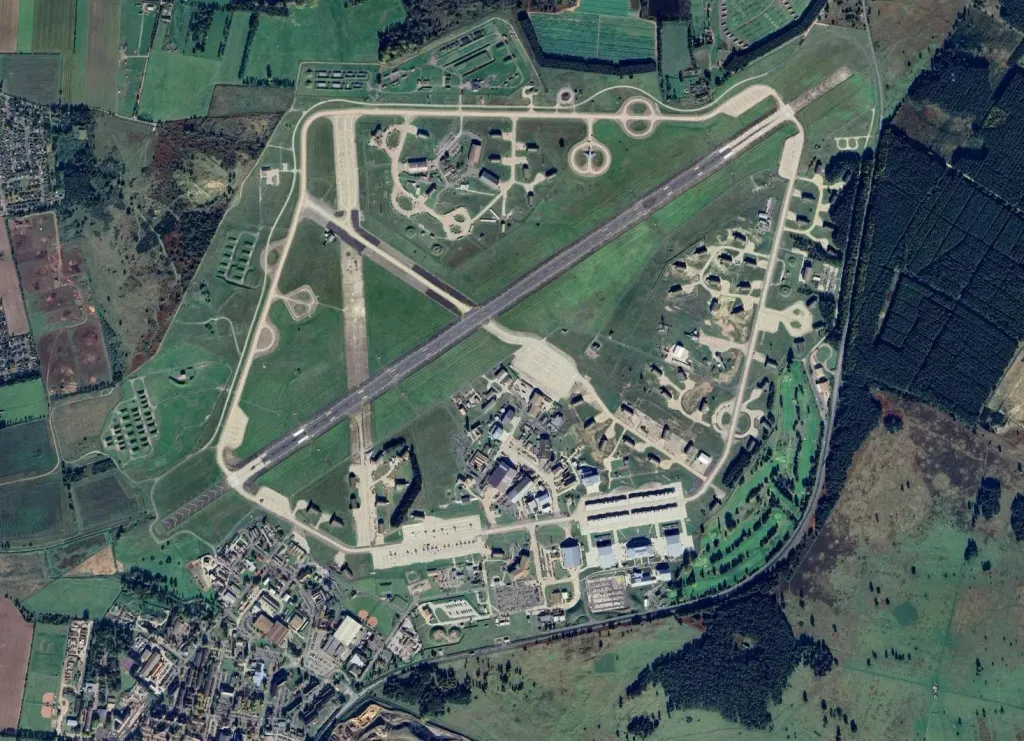
As we reported at the time, drones of an unknown origin were first spotted over RAF Lakenheath and then over RAF Fairford, RAF Feltwell, and RAF Mildenhall.
RAF Lakenheath. (Google Earth)
The report makes particular note of the importance of RAF Lakenheath, which is being readied to host nuclear weapons, a topic we previously covered.
“A public appeal for information drew roughly 170 reported sightings, about half of which were deemed credible, either corroborated by multiple witnesses or backed by imagery that couldn’t be explained away as ordinary air traffic.”
“Operational security appeared sophisticated,” IISS posited. “The UAVs entered the airspace around the RAF bases at low altitude with their lights visible and departed at higher altitudes. Arrival and departure directions varied across the incident period.”
Witness reports “indicate more than one platform type may have been involved,” the report proffers. “Some observations were consistent with multirotor UAVs; others with fixed-wing platforms. The propulsion noise of the UAVs was inconsistent across accounts, with some observers describing sounds more typical of petrol engines than electric motors.”
“Notably, the Hav Dolphin, a vessel later linked to a 2025 drone incident in Germany, happened to be docked in the UK at the time,” the investigators found.
That vessel was one of many either operated by Russia as part of its so-called “dark fleet” of sanctioned ships, or those connected to Russia, that the report goes into great detail to link to drone incursions throughout Europe after the incidents at U.S. bases there. The report describes these vessels as “Russian-linked commercial vessels, including shadow-fleet tankers, coastal freighters, and smaller craft.”
IISS
IISS suggested that the Russian Orlan-10 drone could have been one of the platforms used during the incursions.
“Orlan-10, a compact, multi-purpose UAV in service with Russian Armed Forces since 2010, has a range and payload profile consistent with stand-off collection against coastal and inland targets and fits the deck space of a mid-sized commercial vessel,” IISS stated.
“Commercial specifications for the platform, including those published by Russian geospatial firms using the Orlan-10 for civilian aerial survey operations, document an operational range of 500 kilometers, endurance of up to 12 hours, and speeds of 90–130 km/h, performance parameters consistent with maritime launch from a vessel operating well beyond visual detection range of the European coastlines in question.”
Moreover, “the Orlan-10’s power is an internal combustion engine, a detail that may be relevant in light of witness accounts from November 2024 incidents at RAF Lakenheath, where propulsion noise was described by some observers as more characteristic of petrol engines than the electric motors typical of consumer and first-person view (FPV) drones.”
In addition, the Orlan-10’s available payloads “include a satellite navigation spoofing module and a Global System for Mobile Communications network monitoring module alongside optical and thermal sensors, indicating the Orlan-10 family has active electronic warfare capability as well as passive ISR.”
The Orlan-10 has been widely used as an intelligence, surveillance and reconnaissance drone by Russia in its ongoing war on Ukraine. Given that, however, using it for a clandestine operation like this seems very strange. The report critically recognizes this, stating “the use of identifiable Russian UAV platforms carries inherent attribution risk.”
“An alternative, and operationally credible, hypothesis is that commercially available or modified platforms were used precisely to preserve deniability, including long-range [first-person view] FPV systems, home-built fixed-wing aircraft or commercial UAVs modified to use cellular rather than radio frequency (RF) communications,” IISS added.
Russia uses ‘Orlan-10’ drones to help detect and attack Ukrainian military positions
The think tank acknowledges that its maritime-launch hypothesis “rests on a convergence of opportunity, demonstrated capability and a consistent geographic pattern — but no European government has yet publicly tied a specific shadow-fleet vessel to a specific incident, despite officials suggesting privately that they could. The rest of this report treats the maritime-UAV link as the most plausible explanation for where and when the incidents occurred, while acknowledging that confirming it will require evidence that isn’t yet public.”
IISS
This is not the first time Russia was accused of being behind the drone incursions.
That investigation spurred some politicians to call for further investigation.
“Julian Lewis, the former Tory Chair of the Defense Select Committee said: ‘When the US and British authorities detected the drone intrusions at both airbases last November, they stated that investigations were underway,’” the outlet reported. “‘Meanwhile, there is credible evidence here of the possible presence of GRU-linked operatives near Lakenheath and Mildenhall. I shall be asking Ministers to consolidate the findings of all these investigations and to make a Statement in the Commons as soon as possible.’”
Tom Tugendhat, the former Security Minister, told Thei Paper that the findings “demand urgent investigation by the MOD and UK intelligence services.”
Less clear are results from investigations into the other three bases involved.
“The UK takes the security of military bases seriously and works closely with allies, law enforcement partners and other authorities to protect Defense people, sites and capabilities,” the U.K. MoD told us Thursday morning when we asked about the allegations made by IISS that the Russians were likely behind the drone incursions and for their assessment of who was operating them.
“Through the Armed Forces Bill, we’re giving our defense personnel greater powers to defeat drones threatening our bases and we have invested significantly in counter-drone capabilities. We continue to strengthen our ability to detect, deter and respond to potential threats,” MoD added.
MoD declined to provide further details, saying it “does not comment on intelligence matters or on the specific security arrangements at Defense sites.”
A U.S. Air Force F-16 Fighting Falcon from the 555th Fighter Squadron, Aviano Air Base, Italy, taxis out to the runway in preparation for takeoff for a training flight prior to the start of Cobra Warrior 24-2 at Royal Air Force Mildenhall, England, Sept. 11, 2024. (U.S. Air Force photo by Karen Abeyasekere Karen Abeyasekere
We also asked U.S. Air Forces in Europe-Air Forces Africa (USAFE) whether the IISS allegations about Russian involvement in these events were accurate.
“We can confirm small Unmanned Aerial Systems activity took place over several of our UK installations in 2024,” a spokesperson told us. “These events were monitored, and it was determined there was no impact on personnel or operations.”
“Due to operational security, we cannot speak to intelligence matters,” the spokesperson added. “We continue to work closely with our UK partners to ensure the safety and security of our installations.”
The command said it is working on a response to our question about who was behind these incursions, but that it would not be ready before the July 4 holiday.
The IISS report does not go into any of the cases outside of Europe. It does, however, clearly point the finger at Russia as the culprit behind the drone overflights that have bedeviled Europe, including U.S. bases in England and Germany.
In an era hallmarked by what experts call a “sexrecession,” Six Sex is a symbol of liberation.
The Argentine baddie fashions herself as a baby-voiced, bikini-clad fembot, beamed in from the clubs of Buenos Aires — and has become known for cheeky, instructive celebrations of desire. Her songs are designed to galvanize like-minded club rats into Dionysian revelry, or, in the case of the song “How to Make Your Ass Bigger,” squats.
To a certain subset of the Latine underground, she represents a pure-hearted hypersexuality. Yet, for the artist behind the persona, Francisca Agustina Cuello, this wasn’t always the intention.
“I don’t know if it was because I still had to keep my innocence or what, but I didn’t envision the project that way,” she said, calling from a hotel room in Barcelona. “That response sort of came about from the people, towards me. So, I said OK, I’m making it my own.”
In doing so, Cuello has churned out six thumping EPs as Six Sex, a campy character that she describes as a “fable” — a mix of “fantasía y hedonismo.”
That dynamic is taken to extremes on her debut album, “Ultra”, released June 6. It’s a dark and propulsive journey through decades of electronic dance music, best described by its own opening words portending “ultra terrorific fantasy.” (The phrase conjures up images of grandeur, but really, it evokes that “Blades of Glory” quote: “no one knows what it means, but it’s provocative.”)
“I feel like nothing I say is all that serious,” she said about her lyrics. “It’s a thing about my personality to be silly and goof around.”
“Ultra” centers Cuello’s winking, suggestive sense of humor. “Not Your Mom” features a conversation with a garbled, omnipotent voice akin to the parents in Charlie Brown; “FUchi!” features schoolyard taunts about “low dickie energy;” the album ends with “No More Porn,” a playful yet powerful subversion of sexual expectations.
“At the same time, for me, that acts as a filter,” she added with a laugh. “Weeding out the people who get scandalized by it, and identifying the people who get it and say: ‘Yas, yo también quiero tener cuatro novios.’”
Earlier this year, Cuello took the stage at Don Quixote, performing in front of a sold-out crowd for her Los Angeles debut. The smell of sweat permeated the air as she ripped through several of her hits — including collaborations with Reysha Rami and German producer MCR-T. Every single one of her signature ponytail flips sent the room into hysterics. The audience screamed every word at the top of their lungs; it was the loudest, most raucous show I’d been to in years.
Cuello took a breather in the middle of her world tour to chat with De Los over Zoom about all things Six Sex: her new record, her writing style and how it feels to connect with fans spun into febrile intensity.
This interview has been condensed for clarity and was translated from Spanish to English.
“[I’m] weeding out the people who get scandalized,” says Six Sex of her provocative music.
(Catalina Jacobo)
I was really taken by the “Ultra” album cover. You’re wearing a white bikini and in this “come to Jesus” pose. What was the goal? [laughs] It was hard, because I wanted the cover to represent what the entire journey of the album meant to me. I was looking for something strong and heavy in visual terms, because with “Ultra”, this is the first time I’ve finished a long, heavy project and I see the start of something. It’s like something new was unlocked. I found a new way to convey feelings, and a new way to create as well. It’s not like I just finished, and it is what it is. Rather, it is the beginning of something bigger.
Is there an element of separation at all between the artistry and you as a person? I think they’re pretty close. It’s as if Six Sex was sort of a fable, or like a hentai or comic [version of] my life. It’s also happened that things I wrote as a joke later became reality. But generally, I draw inspiration from things that actually happened to me.
Is it weird to put those intimate experiences on an album? No, not for me. Because I’m not speaking so seriously, I don’t feel exposed. Even though my persona and my character are very close to one another, I don’t have to prove anything to anyone. I’m not trying to make you believe in something. The songs stop being about me as soon as someone else listens to them. There are certain things we can all see ourselves represented in, and I think my music aims for that, too.
I want to ask about your performance style. I saw you live in Los Angeles and was really taken by the energy exchange between yourself and the crowd. How do you approach live performance? Nowadays, I’m in a balance between performance and being a human being that connects with people and can pause to look in the eyes of the audience to register how they feel. I like being in a showgirl role, and at the same time, knowing when to step out of it.
Sometimes I go up there after having a crappy day, thinking that I’m gonna screw it up. And when I get up there and connect with the people, everything flows in a perfect way.
Does the music transform when it’s performed live, versus on a record? A lot of your music seems designed to be played in the club. I think it’s very personal. For me, I’m a bit autistic; sometimes when I’m at a show, I get different sensations. It really depends on the person. I like seeing people’s reactions live when I start playing these songs for the first time. People were super hyped. They were enjoying them and jumping around a lot. It feels really fresh.
You reference ‘90s club classics all over “Ultra,” including by U.K. band the Prodigy on “Bitch Up.” How did these sounds come into your life? These sounds evoke a special kind of nostalgia for me. Even though I hadn’t been listening to them lately, they sounded like something I wanted to bring back to the table — songs my uncle used to listen to when I was really young. Like a CD [of] pirated songs that somehow ended up at my house, and at the time I was like, “Wow, what is this music?”
There’s an element of Six Sex that gives “fembot,” like a female, sexy robot. I’m curious if you feel that playing out in your work. [laughs] I didn’t know about the fembot thing. I don’t use Twitter. I [keep] a bubble… against some things that I don’t know. But I’ve always liked the idea that people have that perception of me, to some extent.
How do you feel about the rise of AI as a musician, especially considering your persona adopts that perception? I mean… I don’t have a formed opinion on the matter. I do think that, I don’t know, it’s all very relative. For one thing, I obviously feel like it strips away the human value, but at the same time, it’s also a tool for humans. So it’s kind of contradictory. I feel weird about it…. I don’t know.
Zooming out, I’ve noticed Argentina has been having a musical moment over the last few years between yourself, Ca7riel y Paco Amoroso, Juana Rozas… How do you feel Argentina being represented or even challenged in your music? I feel that culturally, Argentina is a very rich country. However, I do feel like, over generations, a paradigm was broken, and new sounds have been created that don’t necessarily abandon the roots of our music, but were created out of counterculture.
That same kind of counterculture is what makes Argentina be in such turmoil. It’s also the context of our country. Economic, political, social. The key Argentinian figures we refer to nowadays are constantly changing. And that allows you to listen to a variety of genres from Argentina, from people doing different things, and at the same time raising the flag and saying: “Yo soy argentino.” And we love that.
Pembina Pipeline (PBA) has signed a preliminary agreement with Canadian federal and provincial governments, alongside Trans Mountain, to participate in a major nation-building energy infrastructure initiative aimed at expanding global market access for Canadian crude oil.
That was England coach Thomas Tuchel’s advice for parents on whether children should be allowed to stay up to support England in their early morning World Cup match against Mexico on Monday.
The time difference means the round of 16 clash against the co-hosts in Mexico City will not kick off until 01:00 BST – and would not finish until closer to 04:00 should it go to penalties.
Speaking to the media after the Three Lions’ victory over DR Congo on Wednesday, a smiling Tuchel said: “There’s so much school to go to, but the World Cup is every four years. Let them watch.”
But some parents and teachers are concerned about the knock-on impact.
In the past, some schools have suspended lessons to allow children to watch games in the knockout stages of tournaments – but the awkward timing of the Mexico match poses some tricky logistical questions.
Let children stay up and risk a wasted school day on Monday – or force young fans to miss what could be a vital victory on the way to World Cup glory?
Unsurprisingly, parents are divided.
One mum, from Epping in Essex, said of the prospect of her two young children staying up: “They couldn’t even if they wanted to.
“They struggled to make it to the 21:00 kick off for the Ghana match.”
Another parent said they would allow the kids to watch the match live, but expected them to be ready for school the next morning.
They wrote on X: “Mine will be watching and still going into the school the next day.
“What’s the big deal? The recent thunderstorms woke then up at 2am and kept them awake for hours and they were fine the next day going to school.”
A third parent praised Tuchel’s comments and called for every pupil to be given Monday off of school.
A rebel group of Roman Catholics has ordained its own bishops in direct defiance of Pope Leo XIV and the Vatican order. The Society of Saint Pius crisis has caused fears the Church could rupture. Soraya Lennie breaks it down.
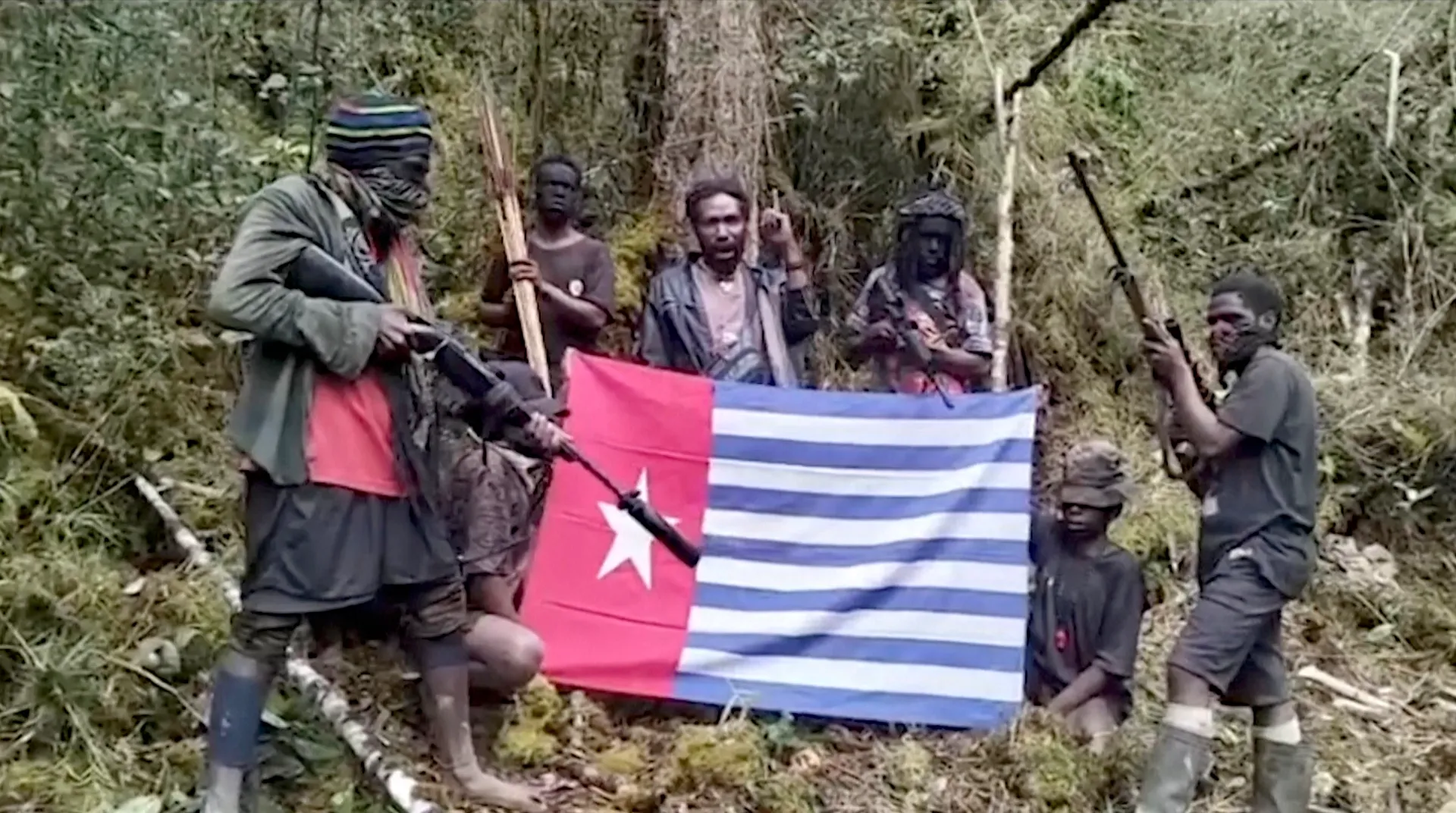
A US pilot has been killed in Indonesia’s Papua region after separatist rebels said they shot him and set his aircraft on fire. The attack highlights the decades-long independence struggle, which has displaced more than 122,000 people since 2022.
A-LIST celebrities have begun to arrive for Taylor Swift’s rumored rehearsal dinner on Thursday ahead of her lavish wedding.
Taylor and Kansas City Chiefstight endTravis Kelce are expected to tie the knot at Madison Square Gardenon Friday in front of around 1,000 guests.
Sign up for the Showbiz newsletter
Thank you!
Adam Sandler was seen arriving at Madison Square Garden on Thursday afternoonCredit: Felipe Ramales for the U.S. SunTravis Kelce and Taylor Swift are reportedly getting married on Friday at Madison Square Garden in New York CityCredit: GettySelena Gomez shared a video of herself in a car reportedly heading to Taylor Swift’s rehearsal dinnerCredit: Instagram / selenagomezTaylor’s close friend and main musical collaborator Jack Antonoff was also spotted in New York CityCredit: TheImageDirect.com
A few celebrities were spotted in New York ahead of the couple’s big day, where roughly 100 guests are expected to attend the rehearsal dinner on Thursday evening.
The comedian was dressed in his signature casual style, wearing shorts, a baggy shirt and sneakers and appeared to be joined by his wife, Jackie, and their daughters, Sadie and Sunny.
Travis joined the big screen alongside Adam in the sequel to the classic film Happy Gilmore and invited the movie star to his podcast, New Heights, which he hosts with his brother Jason Kelce.
On the podcast, Adam talked about taking his two daughters to the Eras Tour concert film premiere.
“What a girl … She means so much to our house,” Adam said of Taylor.
Selena Gomez shared a video on her Instagram story on Thursday of her in a floral lace black dress applying one of her Rare Beauty lip products, possibly on her way to the rehearsal dinner, although it has not yet been confirmed.
She paired the dress with a pair of Flicker earrings,featuring 1.92 carats of pear-cut diamonds totaling $29,000 and an $11,000 Flicker ring, according to Page Six.
Most read in Entertainment
Selena and Taylor met in 2008 and were first spotted together stepping out to dinner with Nick and Joe Jonas, whom they were respectively dating at the time.
In a 2020 interview withWSJ Magazine,the duo opened up about their friendship, which Taylor compared to “sisterhood.”
“I knew from when I met her I would always have her back. In my life, I have the ability to forgive people who have hurt me. But I don’t know if I can forgive someone who hurts her,” Taylor said of Selena.
Jack Antonoff, Taylor’s close friend and main musical collaborator who recently worked on The Tortured Poets Department, was also spotted in New York City, dressed in a white-collared shirt and dark blazer.
His sister Rachel was also spotted in New York City, dressed in a long pink frilly gown and a red purse.
San Francisco 49ers tight end George Kittle and his wife Claire were spotted in New York City ahead of the wedding.
Jack Antonoff’s sister Rachel was also spotted in New York City ahead of the reported rehearsal dinnerCredit: TheImageDirect.comAdam Sandler’s wife and kids appeared to arrive with him at Madison Square GardenCredit: Felipe Ramales for the U.S. SunSan Francisco 49ers tight end George Kittle and his wife Claire were seen in New York CityCredit: Katy Forrester for the U.S. SunTaylor’s distinct gray SUV was seen outside Madison Square Garden but the bride-to-be has yet to be spottedCredit: Felipe Ramales for the U.S. Sun
The fellow NFL player will apparently not be attending the rehearsal dinner, but will attend the wedding, which he told ExtraTVhe plans to give Travis an old coin despite the couple saying “absolutely no gifts.”
Supermodel Gigi Hadid and actor Bradley Cooper were seen heading to the rehearsal dinner, with Bradley in a formal suit and vest, in photos obtained by Page Six.
The main wedding ceremony is expected to take place on Friday, although it remains unclear if it will be a legal wedding or a lavish celebration as rumors circulate that the pair are already married.
Travis’ longtime friend Reggie “Regrunt” King and his wife, Sarah, are also expected to attend in addition to several people in sports media, like sports commentator Charissa Thompson and sports reporter Erin Andrews along with her husband, former NHL player Jarret Stoll.
Celebrities close to Taylor have been spotted around New York City, including Suki Waterhouse, who opened for one of Taylor’s Eras Tour shows in London.
A tent was seen being set up outside of Madison Square Garden ahead of the rumored weddingCredit: Jessica Finn for the U.S. SunA catering truck from Sartiano’s, one of Taylor’s reported favorite New York restaurants, was seen outside of MSGCredit: BackGridPink curtains were hung up inside Madison Square GardenCredit: Jessica Finn for the U.S. SunTaylor Swift’s bodyguard was seen outside Madison Square Garden appearing to direct carsCredit: Felipe Ramales for the U.S. Sun
Suki told Variety in an interview published in May that she will be attending and hopes to gather inspiration for her wedding to her fiancé Robert Pattinson.
“I’m gonna go to Taylor’s wedding, and maybe I’ll get some inspiration It will be amazing,” she said.
Graham Norton, an Irish comedian and actor who made a cameo in Taylor’s music video for her song Opalite, touched down at John F. Kennedy International Airport alongside his husband Jono McLeod.
Taylor’s pal, English actress Phoebe Waller-Bridge, was also seen in New York City with her family ahead of the celebration.
Taylor and Travis’ full guest list has not yet been revealed, but some eagle-eyed fans speculated singer Katy Perrymay not be in attendance as she is set to perform in the UK on their rumored wedding day.
Some other famous faces are expected not to be attending, such as Blake Lively,Ryan Reynolds,Charli XCX andMatty Healy following past fallouts.
Portugal beat Croatia 2-1 with goals from Cristiano Ronaldo and Goncalo Ramos after a chaotic second-half in Toronto to set up a last 16 tie with Iberian rivals Spain.
Military command issues threat a day after Qatari mediators hailed ‘positive progress’ in indirect US-Iranian talks.
Published On 3 Jul 20263 Jul 2026
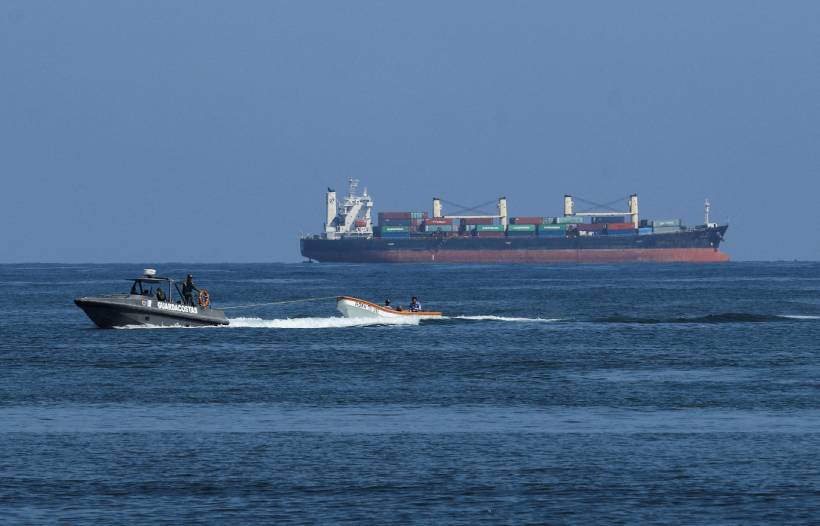
Iran’s military command has threatened ships that attempt to cross the Strait of Hormuz using unapproved routes with a “forceful response,” casting new doubt over trade flows in the critical conduit for global energy supplies.
Iran’s Khatam al-Anbiya Central Headquarters issued the threat on Thursday, a day after Qatari mediators hailed indirect negotiations between US and Iranian officials as making “positive progress” towards a peace deal.
Recommended Stories
list of 4 itemsend of list
“Any failure to comply with and depart from the designated route or disregard for the navigation protocols of the Islamic Republic of Iran in the Strait of Hormuz will be met with an immediate and forceful response from the armed forces, and will endanger the security of the offending vessels,” the military command said in a statement carried by the country’s semi-official Tasnim news agency.
While Tehran did not specify what prompted the warning, it came after US Central Command (CENTCOM) on Wednesday said it had presided over a security dialogue in Bahrain during which regional leaders expressed their commitment to the “free flow of commerce” in the strait.
Iranian Deputy Minister of Foreign Affairs Kazem Gharibabadi hit out at CENTCOM’s statement on Thursday, saying the forum “cannot establish legal order and security for the Persian Gulf”.
“The region’s security will be ensured through the end of interventions and the US withdrawal from the area, respect for countries’ sovereignty, and acceptance of new geopolitical realities – not under the military umbrella of America,” Gharibabadi said in a post on X.
The Strait of Hormuz, which facilitated about one-fifth of the global trade in oil and liquefied natural gas before the US-Israel war on Iran began in late February, has become a major sticking point in Washington and Tehran’s talks aimed at turning their fragile ceasefire into a lasting peace.
While Iran agreed to make its “best efforts” to arrange the safe passage of ships in the strait in the memorandum of understanding it signed with the US on June 17, Tehran has repeatedly threatened to attack ships that do not use its preferred route close to the Iranian shoreline.
At least 49 attacks on commercial vessels have been recorded in the strait since the start of the war on February 28, according to MarineTraffic.
Most of those incidents, including drone attacks on a Singapore-flagged cargo ship and Panama-flagged merchant vessel on Thursday and Saturday, respectively, have been blamed on Tehran.
While transits through the waterway have risen since US President Donald Trump and Iranian President Masoud Pezeshkian signed their MoU on June 17, they remain far below the roughly 130 daily crossings that took place before the conflict.
At least 45 vessels crossed the strait on Wednesday, up from 34 on Tuesday, according to MarineTraffic data.
After dropping to pre-war levels on Thursday on reports of productive talks in Doha, oil prices largely held steady as markets opened in Asia on Friday.
Brent futures for August delivery stood at $72.07 per barrel as of 02:30 GMT, after dropping below $71 for the first time since the war the previous day.
Until not so long ago Latin America had been considered a quiet region, located far from the world’s superpower main strategic confrontations, with sporadic but crucial moments that helped to shape the international order as we know it today. The Cuban Missile Crisis is the clearest example: it became the starting point for a series of agreements and treaties on nuclear and strategic security, involving both the US and the Soviet Union at first, and later extending to other actors of the international community, from Europe, Asia and Latin America, which became the first region free from nuclear weapons after the signing of the Treaty of Tlatelolco in 1967, 5 years after the crisis. After this episode, the region’s relevance seemed to fade, and Latin American countries appeared condemned to a destiny of surfing between weak political cohesion internally and relatively stable economies, even as most of its governments remained closely aligned with Washington on foreign policy matters.
It was precisely during this period of perceived irrelevance that China began building its presence in the region, very gradually and over the course of a little more than two decades. Washington largely ignored this process, even as it became clear that the Asian giant was becoming the largest trading partner for several South American countries, such as Peru and Brazil, and in many cases also the main investor in their economies. This neglect was not born of ignorance: it reflected, instead, a confidence that local governments would remain compliant regardless of who was investing in them. President Trump’s first term illustrates this well. Despite isolated clashes with the governments of Mexico and Venezuela, these episodes looked minor when compared to the “tariff wars” waged against the EU and China. In fact, the only time Trump ever set foot in the region during his entire first term was in November 2018 when he attended the G20 Forum in Buenos Aires. Significantly, there was a planned short visit in Colombia after this event, but I was cancelled. This was widely read at the time as a confirmation that Latin America remained a low priority for Washington’s foreign policy agenda, more due to the expectable compliance of local governments than ignorance of the importance of the region as a resource base capable of fueling US power projection in other regions.
It was only during Trump’s second term that American foreign policy has shifted towards the Western Hemisphere, attributing strategic importance to the region and setting the objective to maintain a near-absolute dominant presence, involving both economic and military dimensions, as is stated in the latest National Security Strategy of 2025.
By the time this shift was formalized, China’s footprint in the region was already deep and country-specific. In Brazil, China had been the largest trading partner since 2009; bilateral trade hit a record $171 billion in 2025, with China accounting for 27.2% of Brazil’s total foreign trade, besides, EV plants and a still planned bi-oceanic railway linking Brazil to Peru’s Pacific coast were being negotiated as part of the Chinese investment strategy in both countries. In Argentina, China became the primary supplier of mobile network infrastructure, part of a broader Chinese push into Latin American 5G and data-center markets. And in Peru, China invested around $1.3 billion in the strategic port of Chancay, a deepwater facility that entered full operation stage in November 2024, and set a new phase for trade between China and South America, bypassing the traditional deepwater ports located in the US, like the ports of Oakland and Stockton. Reinforcing this, China pledged in May 2025, at the CELAC forum ministerial meeting in Beijing, to ramp up its regional engagement even further. These were not isolated transactions but a structural presence, one that the 2025 National Security Strategy now identifies strictly as the rival foothold it intends to dislodge.
Stay ahead of the geopolitical week.
MD Briefing delivers expert analysis across five global fronts — the Indo-Pacific, energy, geoeconomics, European security, and the Middle East — every Monday morning. Free.
Now, within this context in 2026 the declared shift of interests proved it wasn’t merely rhetorical. The year started with the launching of Operation Resolve, when a group of American special military forces conducted a military raid and captured President Nicolás Maduro and his wife in Caracas, transporting them to New York to face narcoterrorism charges. Trump declared that the US was now “in charge” of Venezuela until a transition takes place. This meant in practice that the US would hold control over the country’s oil exports, which during the first four months after Maduro’s capture were estimated at $8 billion, but the data on how much oil has been sold, the revenue from it and the use given to those funds remains secret. The main importers of Venezuelan oil during this period were the United States (43 percent), India (26 percent, part of the strategy to reduce Indian import of Russian oil), and Spain (8 percent). This episode, condemned by critics as a return to the old days of imperialism, set the tone for the rest of the year: a hemisphere where Washington would use military force, tariffs, and other mechanics for pressuring countries to sign economic deals where American core interests prevail.
An example of this is the new and controversial Trade and Investment agreement signed by the United States and Argentina in February of this year. According to the text, Argentina shall adapt the regulatory framework to implement US trade standards and prioritize American direct investment in the country, while the counterpart shall “try to review its tariffs” and “consider supporting investment financing”. Milei’s government has justified this as the price for ideological loyalty and continued financial support after the $20 billion credit line that helped to stabilize the local currency (peso) last year.
On the other hand, Brazil took the opposite path: rather than just seeking accommodation to this policy, the government of Lula da Silva accelerated diversification, finalizing the long-delayed EU-Mercosur agreement in January, deepening trade with China and signing a memorandum of understanding with aims for further strategic partnership with Russia. Notably, the US has implemented another mechanism of pressure here, condemning the imprisonment of former president Jair Bolsonaro and holding a meeting with his son Flavio Bolsonaro, who will participate in the presidential elections this October. This gives clear signs of indirect support for this far-right candidate, following the regional trend with Milei in Argentina and Keiko Fujimori in Peru.
Peru, meanwhile, illustrates a third pattern and an interesting case, because alignment here is imposed less by negotiation than by sheer state fragility. Amid a presidency turning over for the ninth time in a decade, the US State Department warned in February that China’s control over the Chancay megaport threatens Peru’s sovereignty, following a Peruvian court ruling that exempted the port from national oversight. Peru’s case pictures a scenario where both counterparts keep pushing for concessions and more privileges. Under the government of José María Balcázar, the ninth president in 10 years, the country has been involved in the controversial purchase of 12 F-16 jetfighters with a cost of around $3.5 billion. On April he postponed the official ceremony where this deal was supposed to be signed arguing that it would have to be the responsibility of a new president, the decision was met with pushback, both internally, with declarations from the Ministry of Defense and in the US Embassy, with ambassador Bernardo Navarro declaring “If you deal with the U.S. in bad faith and undermine U.S. interests, rest assured, I, on behalf of [President] Trump and his administration, will use every available tool to protect and promote the prosperity and security of the United States and our region.” After this, with both internal and diplomatic pressure, the deal was signed on the 17th of April.
Taken together, these cases suggest the current US approach to Latin America is not fueled by a single ideological logic, but by transactional calculations that value compliance and heavily punishes resistance, exploiting weaknesses here and there and aiming to these policy goal indifferently to whether the country in question is led by a right, left or ideologically undefined government. What seems quite clear is that the decades of quietness in Latin America have ended, not necessarily because the region has changed, many of the deep challenges for development are still present, but because the rivalry that once defined the Cuban Missile Crisis has returned, this time fought over trade tariffs, infrastructure and technology access rather than missiles.