In the final innings of her international career, Tammy Beaumont is bowled first ball by India’s Kranti Gaud at Lord’s on day three of the one-off Test, with England needing 457 to win.
Sen. Lindsey Graham, R-S.C., died on Saturday night at age 71 after a sudden, short illness, his office announced. File Photo by Bonnie Cash/UPI | License Photo
July 12 (UPI) — Republican Sen. Lindsey Graham died suddenly on Saturday night, two days after his 71st birthday, his office announced.
“On the evening of Saturday, July 11, U.S. Senator Lindsey Graham passed away from a brief and sudden illness,” his office said in a statement posted to X.
“Senator Graham’s family appreciates prayers at this time and asks for privacy during this incredibly difficult period,” the statement said.
Graham had been scheduled to appear on NBC’s “Meet The Press” on Sunday morning, which instead featured an interview with President Donald Trump, who said that he’d spoken with the senator on Saturday after he’d returned from Ukraine.
“Other than being tired, he was fine,” Trump said.
Graham, who was first elected to the Senate in 2002, had already won South Carolina’s Republican Senate primary and now will have to be replaced on the ticket.
The state is expected to hold a special primary in the next few weeks so that voters can choose a new candidate.
Bonnie Tyler
Singer Bonnie Tyler performs the song “Believe in Me” during the dress rehearsal for the Eurovision Song Contest in Malmo, Sweden, Sweden, on May 17, 2013. Tyler, best known for her hit songs “Total Eclipse of the Heart” and “Holding Out For a Hero,” died at the age of 75 on July 8. Photo by Jessica Gow/EPA
Republican Senator Lindsey Graham, a close ally of US President Donald Trump, has died at the age of 71. He died on Saturday evening following a “brief and sudden illness”, according to his office.
Elected to the Senate in 2002, the South Carolina politician was one of Washington’s most influential voices on foreign policy, often pushing for US military intervention overseas.
Donald Trump said Graham was a “true American Patriot” who would be “greatly missed”.
Graham had just returned from Kyiv, where he met Ukrainian President Volodymyr Zelensky on Friday. There were no known health concerns ahead of his trip.
Graham was a staunch supporter of arming Kyiv and applying sanctions against Moscow. Zelensky said in a post on X, external that he was “deeply saddened” by his death.
“America and the world have lost a determined leader,” he added.
Graham’s relationship with the US president had evolved since Trump first ran for office.
In a CNN interview during his campaign for the presidency in 2015, Graham called Trump “a race-baiting, xenophobic, religious bigot”. The next year, he said: “If we nominate Trump, we will get destroyed… and we will deserve it.”
After the US Capitol riots in 2021, Graham gave a speech on the Senate floor in which he said: “Trump and I, we’ve had a hell of a journey. I hate it to end this way.
“All I can say is a count me out. Enough is enough.”
The ‘beautiful’ BBC period drama is perfect for fans Jane Austen and is based on a literay classic.
2005’s Pride and Prejudice stars Keira Knightley and Matthew Macfadyen(Image: Publicity picture)
Pride and Prejudice fans have been encouraged to rediscover a “brilliant” overlooked period drama.
The sweet romance on Prime Video, situated in the mid-19th century, has earned acclaim for its “beautiful” landscapes and “heartwarming” narrative.
Originally broadcast on the BBC in 2005, the production boasts a stellar ensemble headed by Miss Austen’s Keeley Hawes. Additional cast members include The Crown’s James Murray, Inside No. 9 actor Steve Pemberton and Lark Rise to Candleford star Ben Miles.
Now that the film has become available to stream, audiences have been revisiting the adaptation based on Thomas Hardy’s celebrated novel of the same name.
Under the Greenwood Tree marks the second published work by the English writer Thomas Hardy, initially released anonymously in 1872, reports the Express.
It chronicles the tale of a romance between schoolmistress Fancy Day (Hawes) and church musician Dick Dewey (Murray).
The official synopsis reads: “In this lighthearted romance from Victorian novelist Thomas Hardy, the beautiful new village school teacher is pursued by three suitors: a working-class man, a landowner, and the vicar.”
Helmed by Nicholas Laughland, the production carries a 6.9/10 rating on IMDb and appears not to have received extensive critical assessment at the time of its release.
Audiences have flocked to IMDb to express their admiration for the overlooked period drama, describing it as ‘brilliant’ and ‘perfect comfort viewing’.
Get Amazon’s Prime Video free for a month
This article contains affiliate links, we will receive a commission on any sales we generate from it. Learn more
TV lovers can get 30 days’ free access to tantalising TV like The Boys, Reacher and Clarkson’s Farm by signing up to Amazon Prime. Just remember to cancel at the end and you won’t be charged.
One viewer wrote: “In the tradition of Pride and Prejudice, Sense and Sensibility, there is the mix of position, miscommunication, and the delightfulness of authenticity of period. A treat to watch. The acting, script, and setting all played well together. If you adore period romances, then this should go on your list to watch.”
Another fan gushed: “Superb. This film, although made for TV, will be a classic, just like the 1995 Pride and Prejudice directed by Simon Langton. The sets seemed remarkably authentic, and all the cast were excellent […] I have watched it 3 times in two days.”
A third viewer reflected: “The scenery was stunning, the plot had depth and kept me and my family gripped throughout. I thoroughly recommend it to anyone with a warm heart, as it certainly warmed mine.”
“Beautiful film in every way, from the classic Thomas Hardy novel,” another viewer said, while a further admirer agreed: “A thing of beauty and wonder.”
However, not everyone was won over by the film, with one critic labelling it a ‘big let down’ and another commenting: “I usually don’t like Hardy’s stuff… I guess that continues.”
Under the Greenwood Tree is streaming now on Prime Video.
It was never actually in doubt. Dearica Hamby was going to stay a member of the Sparks. That was just how she worked.
Even when Nneka Ogwumike came into the fold and the frontcourt became crowded, Hamby didn’t doubt her decision to return to the organization that traded for her four years ago.
Loyalty mattered more than anything else.
“That’s who I am,” she said. “I don’t run away from things. I wanted to stay here and help L.A. get back to where it was and is capable of being.”
In a loaded frontcourt, the 32-year-old Hamby has still found ways to shine. Hamby has led the Sparks in scoring four times and led or tied for rebounding 16 times this season after signing a three-year, $3.5-million contract.
She ranks in the top 20 in the league in rebounds and field-goal percentage (plus 25th in scoring) and is eighth in offensive rebounds in establishing herself as an essential piece to the Sparks’ “win now” attempt.
“I think it’s the challenge, because we are so good and we have so much talent,” said Hamby, who is averaging 14.8 points, 7.7 rebounds and 2.3 assists while shooting 52.8% from the field. “You’re forced to produce, but it’s also a blessing. I know it’s probably hard for coach to manage the three’s playing time and stuff like that, but it’s a beautiful problem.”
Hamby was in the headlines when the Aces traded her after she was pregnant. In September of that year, she filed a federal discrimination complaint against the team and league, claiming she was traded because she was pregnant. The two sides resolved matters before trial.
The new CBA this year created a new rule that requires a pregnant player’s consent to be traded.
“I feel like she’s such an anomaly,” said forward Rae Burrell. “I remember when she had her son, and it was crazy because everybody was saying she was coming back so early, I thought that was insane, but now being her teammate, I see it, she’s just kind of a freak of nature, like she’s so athletic, she can do all types of things on the court that you think looks unorthodox, but she makes it happen, but also just love being her teammate. She’s just good people.”
Since that trade, she has been a regular in the Sparks’ starting lineup while averaging double-digit scoring and around eight rebounds per game. She’s one of the most efficient scorers in the league, too.
But Hamby’s games have been all over the board. Against the Aces, she missed all seven of her shots. Against Dallas and Indiana, she made six of eight shots. She’s had eight games with a shooting percentage above 60% and four games under 40%.
Sparks forward Dearica Hamby, left, tries to steal the ball from Mercury forward DeWanna Bonner during a game in Phoenix.
(Christian Petersen / Getty Images)
Having the three frontcourt players has been an adjustment for coach Lynne Roberts to find how to implement them all in the offense.
“I’m trying to implement the new offense, we’re plugging pieces into play, and things that I may have been able to do last year as freely I’m not as able to do this year,” Hamby said. “So just adjusting for sure, but I think that’s across the board for everybody.”
Before the season, Roberts said that Cameron Brink would come off the bench and Hamby would start. Brink, the only natural center on the team, averages just 17.5 minutes per game primarily because of her 3.7 fouls.
“She’s my vet,” Brink said of Hamby. “I think she’s just such a grounding force for us, and she’s someone that does everything, so I just really feel like I learn from her every day, and I’m just very thankful to be in her presence.”
Hamby averages 3.2 fouls per game and has expressed frustration about the new officiating norms this season, but has avoided true foul trouble. She and Ogwumike work as two fours instead of a team with a traditional five.
“She has a lot of energy,” Ogwumike said. “I think she does a really good job of just having a high motor and going out there and kind of like doing the dirty work. I feel like it’s beneficial to have a loaded frontcourt, to be able to have so many different types of players and a depth where anytime one of us is in, there’s no letdown.”
The Sparks have been the worst defensive team in the league this season and struggled to score when point guard Kelsey Plum was out of the lineup with an ankle injury. Ogwumike might be the other veteran leader, but Hamby has stayed with this Sparks team the past two seasons while Ogwumike was in Seattle.
Now her role has changed, even with that loyalty. She’s playing just over a minute less and they’re asking for better defense and efficiency.
Hamby chose to come back. Now she’s choosing to help build the Sparks up.
“I know my usage is a lot lower,” Hamby said. “A goal of mine the last two seasons was to have those numbers, so to have the same numbers just at a more efficient rate, and so I mean offensively, but with like two fewer shots a game, that’s pretty impressive.”
Atlas Energy Park, a solar and energy storage complex Qcells is building in Arizona. Photo courtesy of Qcells
July 10 (Asia Today) — Qcells is accelerating its push into the North American renewable energy market as investment in power infrastructure grows rapidly amid the expansion of artificial intelligence data centers in the United States.
The Hanwha unit said Friday it will handle engineering, procurement and construction for Atlas Energy Park, one of the largest solar and energy storage complexes in the United States. The project will be built in La Paz County, Ariz.
Atlas Energy Park will include 2.8 gigawatts of solar generation capacity and 5.7 gigawatt-hours of energy storage capacity by 2028. The complex will consist of 14 solar and energy storage projects and cover an area about 22 times the size of Yeouido, Seoul’s main financial district.
Qcells will handle engineering, procurement and construction for all projects in the complex and supply all solar modules.
The company completed the sale in May of two solar power plants with a combined capacity of 357 megawatts after carrying out their early-stage development and construction. The deal is seen as evidence that Qcells has expanded beyond equipment supply into project development, construction and asset sales.
The company’s competitiveness is backed by its U.S. supply chain. Qcells operates Solar Hub, a solar manufacturing complex in Georgia, giving it module supply capacity. It has also built a supply chain for energy storage equipment.
Industry analysts say companies with U.S. production bases are gaining a stronger advantage as Washington expands policies favoring domestically made equipment.
Analysts also expect Qcells’ expansion in North America to help improve earnings. Hana Securities projected Hanwha Solutions’ second-quarter operating profit this year at 230.7 billion won, about $153 million, roughly 29% above market consensus.
“The oversupply of solar modules in the United States is easing, and prices are continuing to rise, while the expansion of local production capacity in the United States will drive earnings improvement,” said Yoon Jae-sung, an analyst at Hana Securities.
Analysts say AI will further accelerate growth in renewable energy demand.
“Power demand is structurally increasing because of AI data centers, electrification and manufacturing reshoring, making solar power and energy storage key pillars of global power infrastructure,” said Han Byung-hwa, an analyst at Eugene Investment & Securities. “In particular, rising power consumption by AI data centers will continue to increase demand for large-scale projects combining solar power and energy storage.”
Qcells has completed or is pursuing more than 11 gigawatts of solar and more than 6 gigawatt-hours of energy storage projects in North America, expanding its local business base.
“Atlas Energy Park is a symbolic project that once again demonstrates Qcells’ EPC capability, U.S. supply chain and comprehensive business capacity from development to construction and asset sales,” said Chris Hodrick, head of Qcells’ EPC business division.
“We will lead the growth of the North American renewable energy market by increasing customer value and business competitiveness through integrated solutions that combine solar power and energy storage,” Hodrick said.
A pilot’s wife has shared some handy airport security tips for anyone asked to remove their shoes – and it’s all about being prepared with a few simple travel essentials
No one wants to get mucky feet when walking through airport security(Image: interstid via Getty Images)
Being asked to remove your shoes at the airport is a fairly routine occurrence. The extra checks largely stem from an incident in 2001, when a passenger attempted to conceal explosives in his shoes while boarding a flight.
While it remains an important safety measure – making it far easier for airport security to check footwear for items that could be smuggled through – it can be rather tiresome for those of us simply heading off on a well-earned holiday.
There’s no denying it feels a bit awkward padding through security in just your socks or bare feet. Not only is it uncomfortable, but it can also leave your feet dirty, given the sheer number of people passing through the area.
Fortunately, a pilot’s wife named Laurie has some handy advice to share. The travel expert, based in Houston in the US, regularly posts useful content on her popular Instagram page.
She has put forward two top tips for when you find yourself faced with this security request. So here’s what you need to do to prepare yourself:
1. Clean your feet with an antibacterial wipe
Most travellers don’t have access to showers at the airport – and trying to use a sink might attract some rather odd looks from fellow passengers.
However, that doesn’t mean you can’t freshen up. Packing antibacterial wipes in your hand luggage could prove to be a real game-changer.
You can swiftly clean your feet if you’re required to walk through security barefoot, taking just a matter of seconds without holding up your journey.
Even better, antibacterial wipes serve other purposes too. Many passengers like to wipe down surfaces on the plane to avoid picking up any unwanted germs.
We recommend giving aeroplane windows a swift wipe if you’re planning to rest against them.
Other commonly touched surfaces – such as TV screens, remote controls or tray tables – may also require a quick clean. So don’t forget to pack those wipes!
2. Pack an extra pair of socks
Content cannot be displayed without consent
Even when wearing socks, the thought of treading over a grimy floor can be quite unpleasant. It’s also less than ideal if you’re going to be travelling in the same socks all day, meaning they’ll stay dirty throughout.
Travel expert Laurie shares two tips for handling this situation effectively. She recommends: “Wear a pair of ratty old socks through the [security] line and toss them when done.”
If chucking them isn’t possible, Laurie suggests bringing along a spare pair with a small plastic bag. You can then change into clean socks, pop the dirty ones into the bag, and wash them once you’ve reached your destination.
Laurie’s advice has proved popular online, racking up over 1,100 likes since being posted, with many voicing their gratitude.
One user commented: “Always the best tips!”. Meanwhile, another agreed: “Very good tips.”
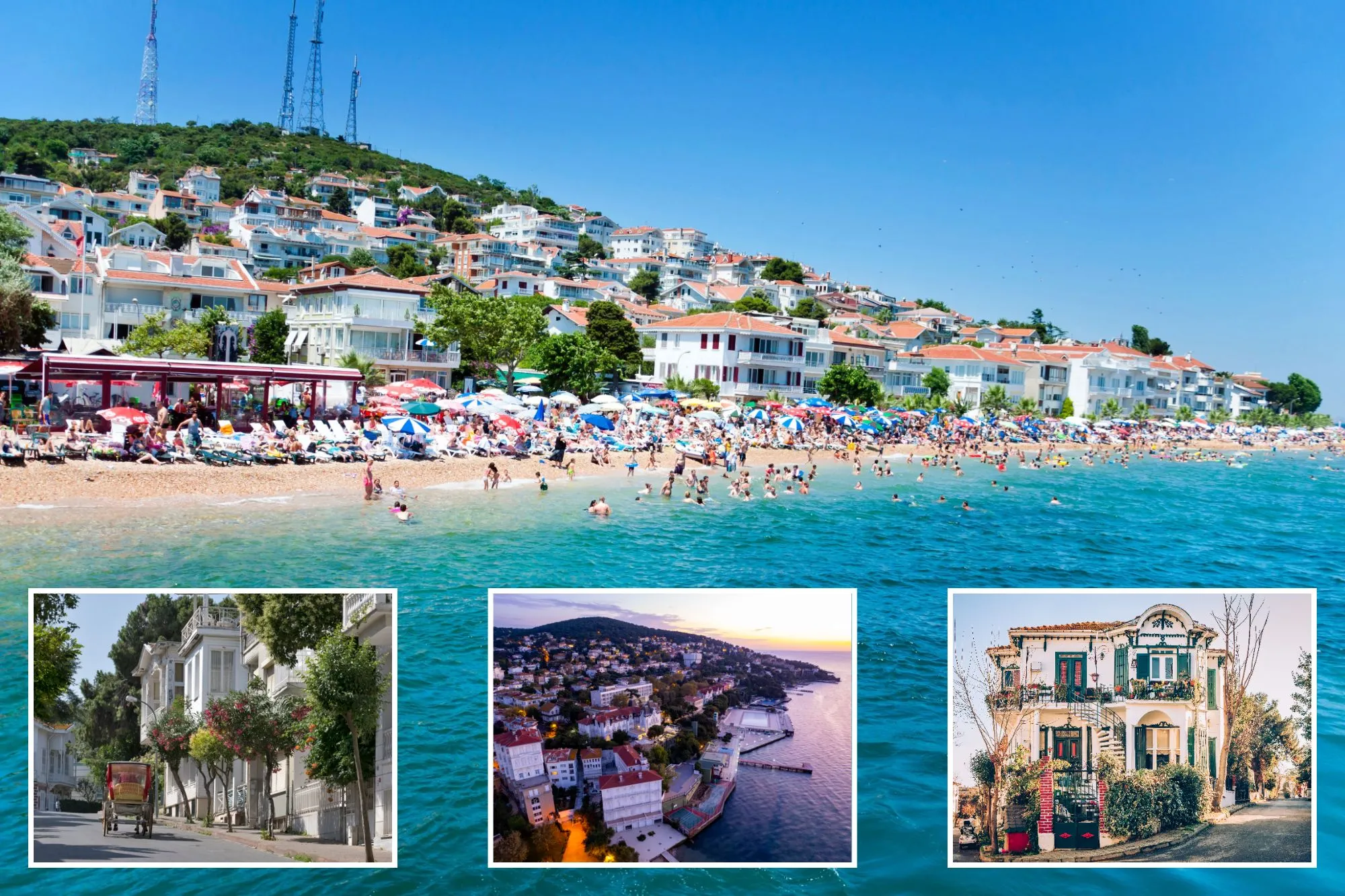
I BET you’ve heard of Istanbul – but did you know a short boat ride from the city there is a hidden gem island?
Meaning ‘Big Island’ in Turkish, Büyükada is the largest of the three Princes’ Islands in the Sea of Marmara, which is near Istanbul.
Meaning ‘Big Island’ in Turkish, Büyükada is the largest of the three Princes’ Islands in the Sea of MarmaraCredit: Alamy
Despite being the largest, the island itself only spans two-square-miles.
And from Istanbul, you can hop on a ferry (there are two different companies that head there) with tickets ranging from £2.50 to £3.20 per way and taking between 45 minutes and an hour and a half to get there.
Sign up for the Travel newsletter
Thank you!
Tie in your visit to Buyukada, with the other two islands – Heybeliada and Burgazada – before heading back to Istanbul.
As for what to see and do on Buyukada, until recently the only public transport on the island were horse-drawn carriages.
But now, thanks to the island becoming more popular with tourists, you can hop on a number of electric buses – with no cars allowed on the island.
At the north end of the island, you can expect to see streets lined with 19th century, wooden villas.
Famous ones in particular include the Con Paşa Mansion, which was built by a Venetian merchant and Mizzi Mansion, which boasts a red brick tower.
Make sure to stop by the Nizam neighbourhood too, where you’ll find more Ottoman era villas including white buildings draped in vibrant, purple flowers.
The area isn’t too big, but do make sure you head down Cankaya Caddesi which is often named the most beautiful street in Turkey.
History fanatics should also drop by Trotsky House, which is where Leon Trotsky lived in exile between 1929 and 1933.
You can get a ferry from Istanbul to the islandCredit: AlamyWhen there you can explore historic wooden mansionsCredit: Alamy
On the other hand, the southern end of the island is mostly home to great walking and hiking routes, thanks to being home to the Büyükada Ecotourism Area.
You’ll find Mediterranean pine forests and the island’s highest peaks to explore.
You’ll also find Prinkipo Greek Orphanage, which is the largest wooden building in Europe and the second largest in the world.
The island is home to some beautiful beaches as well, including Aya Nicola Beach.
For around £6.40, you can hire a lounge chair with an umbrella and also access showers and changing rooms, making it the ideal spot for a beach day.
Alternatively, you could head to Viranbağ Plajı, which also boasts a restaurant.
Many of the mansions date back to the Ottoman eraCredit: GettyAnd the southern end of the island is known for hikingCredit: Getty
While you do have to pay an entry fee to the beach (which usually is a few quid), it is often less crowded than other spots on the island.
A popular way to explore the entire island is by hiring a bike – and thanks to its size, it only takes a couple of hours to cycle around.
The best way to get to the island is by flying to Istanbul and then taking a short and scenic ferry ride across to the island itself.
Flights to Istanbul cost from £108 per way in July.
And if you want to extend your time on the island, you can stay in one of the hotels or guesthouses.
For example, there’s Hillora Hotel Buyukada, which has views, a sauna, a sun terrace and a garden.
The ferry to from Istanbul takes up to an hour-and-a-half and costs a few quid each wayCredit: GettyFlights to Istanbul in July cost from £108 per wayCredit: Getty
Plus it is just a six-minute walk from the beach.
The hotel costs from £149 per night.
For something more historical but also cheaper, head to Büyükada Anastasia Meziki History Mansion, which has its own restaurant, bar, terrace, patio and mountain views.
Yulia Svyrydenko to step down as prime minister amid government shake-up aimed at prioritising foreign policy and security goals.
Published On 12 Jul 202612 Jul 2026
Ukraine’s President Volodymyr Zelenskyy has announced a government reshuffle, as well as proposing the replacement of Prime Minister Yulia Svyrydenko and the heads of some law enforcement agencies.
“Ukraine is changing its political strategy. Each priority foreign policy direction will be overseen by a specific individual with substantial experience who is capable of delivering on the agreements reached at the leaders’ level and fulfilling the expectations of the Ukrainian people,” Zelenskyy said on Sunday in a lengthy post on social media.
Recommended Stories
list of 3 itemsend of list
“I discussed the details with Ukraine’s Prime Minister, Yulia Svyrydenko. We agreed that implementing these changes requires a renewal of the Cabinet of Ministers.”
Svyrydenko became prime minister a year ago, succeeding Denys Shmyhal. She previously served as first deputy prime minister and economy minister, roles that brought her into close contact with the administration of US President Donald Trump. She was widely credited with negotiating a critical minerals agreement between Washington and Kyiv last year that helped thaw what had initially been a frosty relationship between Trump and Zelenskyy.
“I am proud to have had the honour of leading the Government during one of the most difficult periods in Ukraine’s modern history. I thank every man and woman defending Ukrainian land. Our warriors are our strength and the foundation of our independence,” the 39-year-old wrote on X.
Zelenskyy also said there would be changes in the leadership of law enforcement agencies.
He said the new political strategy would focus on key foreign policy priorities, including agreements to manufacture Patriot air defence systems under licence, advancing Ukraine’s bid for European Union membership and deepening ties with the Gulf region, which he described as one of the world’s “most promising” areas for security and economic cooperation.
Zelenskyy thanked Svyrydenko for her offer to lead a “new significant direction in relations with a key partner”.
The Lucas Museum of Narrative Art, which is moving at light speed toward its Sept. 22 opening, announced Thursday that it will give free annual passes to its South L.A. neighbors living in the 90037 ZIP Code. The 300,000-square-foot, $1-billion museum located in Exposition Park will also host a special community preview day on Sept. 13, more than a week before the general public gets to step inside.
The 90037 ZIP Code has a population of more than 65,000 and is bordered roughly by the 110 Freeway to the west, Slauson Avenue to the south, Central Avenue to the east and Martin Luther King Jr. Boulevard to the north. Residents can register for passes at lucasmuseum.org/lm37 and will be alerted in August when the program launches. Pass holders can reserve tickets for themselves and one guest.
“Storytelling has the power to bring people together and create a sense of community,” said Lucas Museum Chief Executive Tracey Bates in a news release about the program. “Through LM37, we are inviting our South Los Angeles neighbors to make the museum part of their lives and take their own path of discovery through the art, programs and experiences that will help shape this new cultural hub for Los Angeles.”
The community preview day is designed to give local business owners, community partners, civic leaders and registered LM37 pass holders a sneak peak of the 10,000 square feet of exhibition space, as well as the expansive gardens with 11 acres of park space.
The opening programming, curated by co-founder George Lucas, features 20 inaugural exhibitions across more than 30 galleries, including one titled “Star Wars in Motion,” containing vehicle designs, high-speed racers, flying vessels, props, costumes and illustrations from the first six films in the beloved franchise.
More than 1,200 objects will be on display from Lucas’ personal collection of narrative art. Highlights include work by Norman Rockwell and Dorothea Lange, as well as a variety of manga, children’s book illustrations and comics.
Designed by British architect Norman Foster, it features clever engineering secrets to keep drivers safe
The bridge was designed by British architect Norman Foster(Image: David Taljat via Getty Images)
When we consider enormous infrastructure projects, we typically picture major superpower economies like China and America, which are home to some of the planet’s largest factories, tallest skyscrapers, and sprawling cities. Yet, when it comes to bridges, it isn’t China or America that holds the crown. Rather, France claims the title of the world’s tallest bridge.
The Millau Bridge, located in the Aveyron district, forms part of the motorway linking Paris to the Mediterranean. Designed by British architect Norman Foster, it opened in the early-2000s to widespread acclaim.
Standing at 1,104ft high, it remains the world’s undisputed tallest bridge with a roadway positioned so high that a skyscraper could fit beneath it.
Beyond building and bridge comparisons, there is more to the Millau Bridge than initially apparent. According to Enjoy Travel, it features several design secrets to ensure driver safety, reports the Express.
One of these is the fact that the bridge is neither straight nor flat, with a 3% incline and a gentle curve incorporated into its design.
Enjoy Travel explained: “It has two lanes in each direction and interestingly, the bridge is not straight as this could induce a sensation of floating for drivers.
“To remedy this, the architects designed the bridge to have a slight curve, which is 20km in range. Another design feature that improves safety, is the road’s slight incline of 3%, which improves visibility and reassures the driver.
“The bridge is exposed to high winds of up to 151km/h. So, the designers placed side screens on the bridge that reduce the effects of the wind by 50%.”
Thanks to its striking design, the bridge has become an essential destination for motoring enthusiasts and tourists from across the globe.
On TripAdvisor, numerous visitors have marvelled at the bridge’s construction and appearance. Simon N said: “An amazing piece of engineering and architecture spanning an even more beautiful gorge. If you’re an engineering/architecture enthusiast, this is a must-see, but you don’t have to be one to be blown away by this marvel of a bridge.”
Bluebellplasnewydd added: “This bridge is spectacular and you should plan your car journey to go over it. There are observation posts and a visitor centre but it doesn’t matter if you miss these. The experience is in the approach and transit across.”
Fellow user boruthedog exclaimed: “It is a beautiful and extraordinary piece of engineering, and the visitors centre (accessible also from the south) has an exhibition, a good cafeteria and a viewing platform from which you can get an idea of the enormity of the project. After this, get back in the car and drive over it.
“The bridge is cleverly curved so that you get a good feel for its length and can clearly see its pylons and supporting cables.”
Croatia’s World Cup was seconds away from being over and Portugal was seconds away from the round of 16 when Ivan Perisic sent a long, desperate cross into the penalty area. The ball bounced off bodies like a pinball before magically, unbelievably, caroming into the net.
Gooooooallllllll!!!!
Fate had given Croatia a reprieve.
But as pandemonium broke out in the stands and on the pitch, Norwegian referee Espen Eskas stood in the middle of the celebration in Toronto, hand to his ear, listening to a voice half a continent away in Dallas.
So Eskas trotted over to a TV monitor, watched a video replay over and over again, and more than 2½ minutes after the goal was recorded, he took it off the board. Perisic’s cross had brushed the hair of teammate Igor Matanovic, leaving Mario Pasalic in an offside position when the ball reached him near the far post. The contact was imperceptible to the naked eye, but a space-age sensor in the ball had confirmed it.
A VAR review led a referee to overturn a Croatia goal during its 2-1 World Cup loss to Portugal in Toronto, eliminating Croatia from the tournament.
(Dan Mullan / Getty Images)
Croatia’s World Cup was over, another victim of VAR, which has had an outsized influence on this summer’s tournament.
It wasn’t supposed to be this way. When VAR was introduced to soccer nine years ago, its mission was clear: to alert the head referee to potential clear and obvious errors or serious missed incidents. At least that’s what Major League Soccer, one of the first leagues to use the system, wrote in the news release introducing it.
“It was really to stop the headlines,” said Mark Geiger, who helped implement VAR as an MLS referee. “These super-egregious errors in a game that impact the outcome. The mantra for VAR was always minimum interference but maximum benefit.”
Under the VAR system, officials sitting before a bank of monitors in a centralized control room review match footage in real time and advise the on-field referee of potential errors. If the video assistant referees believe a mistake has been made, they communicate that through an earpiece the match referee is wearing. If the match official agrees, they will stop play, signal a review by motioning their hands in the shape of a rectangular TV screen, then watch the play themselves on a pitch-side monitor before either confirming or reversing the original decision.
It is comparable to the Automated Ball-Strike review added this year in Major League Baseball, tennis’ Hawk-Eye line-calling system and long-standing centralized instant replay review in the National Football League and National Basketball Assn., systems that have both corrected errors and stoked debate.
But VAR has morphed into something far greater. In this World Cup, there have been more than 100 VAR interventions, encompassing both confirmed on-field calls and overturned decisions, through the end of the round of 16, according to Antonio Vuksanovic, a publication relations and communications professional at Sofascore, a Croatian technology company and sports statistics website.
“When it comes to actual overturned decisions, we’re looking at roughly 0.5 per match, which is higher than the last World Cup and higher than what we saw across the most recently completed club season,” Vuksanovic said.
Even though the officials have gotten most of those calls right, many of the infractions reviewed have been so imperceptible yet so consequential, it has raised a question: if human error on the part of players and coaches is part of the sport, is allowing a game to be decided by electronic evidence of a touch detectable only through NASA-level technology violating the spirit of the game?
Iran’s Shoja Khalilzadeh shoots past Egypt’s Mostafa Shobeir, but the goal was overturned after VAR review during a World Cup match in Seattle on June 26.
(Maddy Grassy / Associated Press)
Christina Unkel, a former FIFA referee, state referee administrator in Florida and a rules of the game analyst for multiple TV networks, believes it does.
“Football is an art. And that’s why we love it,” she said. “It truly isn’t the referee’s fault. We’re not the ones seeking more advanced technology. We don’t want to look like robots out there. But the stakeholders are like ‘more, more, more.’
“When you do pursue black and white — objectivity is what they’re trying to get to, and I get it; they want to eliminate as much subjectivity as possible — what everyone is hating is this perfection thing.”
FIFA, the major stakeholder in the World Cup, declined multiple requests to answer questions about the officiating, but it has clearly doubled down on the technology for this tournament, introducing the semi-automated offside system which uses player-tracking cameras, computer-generated offside lines and, in some cases, data from a measuring instrument inside the match ball, to identify everyone’s position on the pitch when the ball is played.
“The whole genesis of VAR was not to fix every mistake or to make the referees perfect,” said Geiger, the first American to officiate a World Cup knockout game and now general manager of the Professional Referees Organization (PRO), which oversees referees for MLS and the NWSL. “Is the referee correct? That’s not the right question. They should be asking themselves, ‘is the referee clearly and obviously wrong?’”
Geiger, however, remains a huge proponent of the system and was careful not to criticize how it’s been used in this World Cup.
Belgium’s Youri Tielemans on a penalty kick that sails by Senegal goalkeeper Mory Diaw during a World Cup round of 32 match in Seattle on July 1. The game-deciding penalty kick was awarded after VAR review.
(Manu Fernandez / Associated Press)
Still, the frequent use of VAR and other technologies has clearly robbed the World Cup of much as its drama, with spontaneous celebrations of game-winning goals turning to grief moments later when the referee steps away from the monitor and takes away a score.
Reviews not only ended Croatia’s tournament, but they showed Shoja Khalilzadeh was a toe offside when he scored the goal that would have sent Iran to the knockout stages, one of three goals Iran had disallowed by VAR in the tournament; it gave Belgium a late penalty, based on light contact, that Youri Tielemans converted to end Senegal’s World Cup; and it cost Egypt a goal for a perceived foul that took place nearly 100 yards away from the ball in its 3-2 loss to Argentina.
“What happened to us wasn’t fair,” Egypt coach Hossam Hassan said.
Unkel agreed with that sentiment too.
“Everyone hates it,” she said. “According to VAR, that’s correct to take that goal away. That’s not the spirit of the game. But it’s the correct decision by law.”
What Unkel would prefer — and she believes a majority of officials are on her side — is for referees to have discretion to ignore or even overrule VAR if common sense and their understanding of the game suggest they should, just as judges have discretion to use common sense in applying the law.
“A lot of our game, the majority of it, is very subjective,” she said. “When we’re all sitting there saying, ‘No, that doesn’t gain an unfair advantage,’ then that’s when we have to start reconsidering things back to the spirit of the law. That’s the catchall loophole for saying, ‘Do we want this to be part of our game?’
“And I think everyone’s universally saying there a lot of different kinds of decisions we do not want part of our game. Toenail offsides, hair follicle arguments.”
Without the use of video replays, its unlikely any of those calls would have been made and the World Cup quarterfinals would probably look quite different.
England players react as referee Alireza Faghani shows a red card to England’s Jarell Quansah during a World Cup match against Mexico on July 5.
(Natacha Pisarenko / Ap Photo/natacha Pisarenko)
England coach Thomas Tuchel, upset about a penalty call on captain Harry Kane and a red card given to defender Jarell Quansah, both following video reviews in his team’s round-of-16 win over Mexico, said rulings were being overturned in the tournament “in a very questionable way.”
“The referees can send any team out in any moment,” he added. “It’s just not good enough. It’s just erratic. It’s just unreliable.”
An apparent misuse of the technology also led to the most controversial incident in the tournament. In the second half of an elimination game between the U.S. and Bosnia-Herzegovina, American Folarin Balogun stomped on the ankle of Bosnia’s Tarik Muharemovic, something Brazilian referee Raphael Claus initially decided did not merit even a caution. But after VAR official Juan Soto of Venezuela urged him to watch a replay, Claus flashed a red card at Balogun, expelling him from the game and banning him from the next match in the round of 16.
Claus had watched the replay in slow motion, allowing him to see what wasn’t apparent at game speed. FIFA later intervened by lifting Balogun’s one-game suspension, igniting ever greater controversy because it was just the second time that has happened in a World Cup.
U.S. forward Folarin Balogun steps on Bosnia-Herzegovina defender Tarik Muharemovic’s foot and received a red card after VAR review during the World Cup.
(Robert Gauthier/Los Angeles Times)
The heavy use of VAR has also interrupted the flow of games by halting matches that weren’t meant to be halted, leaving everyone standing on the field while the referee goes off to watch TV, sometimes for minutes at a time.
“When calls are reviewed and when goals are reviewed, sometimes it could take away from the momentum,” U.S. defender Chris Richards said. “Look under anything with a microscope, you could probably find something. But ultimately it was meant to be helpful for the game.”
And it has been. Because if officials have become over-reliant on VAR to review decisions that were not, or could not, be seen in real time, at least they’re getting those decisions right.
“I wish we had it in the 2002 World Cup,” said Bruce Arena, who coached the U.S. in that tournament. “We might have made it to the semifinals.”
In the quarterfinals of that tournament, with Germany leading 1-0 in the 40th minute, an obvious handball by Germany’s Torsten Frings kept out a shot from American Gregg Berhalter. If VAR had been available, Scottish referee Hugh Dallas could have corrected the missed call, awarding a penalty and giving Frings a red card, expelling him for the final 40 minutes.
“Look at every sport now in the world,” said Arena, coach of the San José Earthquakes. “They have some version of VAR. Why not make decisions correct?”
“There are still plenty of opportunities for the referees to control the game and make mistakes and not make mistakes,” he continued in reference to the human element. “It’s not like every moment is evaluated. But key moments are.”
As for interrupting the flow of play, Arena says the three-minute hydration breaks FIFA has introduced each half — ostensibly for player welfare, but in practice to give the TV networks additional commercial breaks — have been more disruptive.
“You don’t want VAR to officiate the game completely,” Arena said. “You have to pick your spots. For the most part, I think VAR is good.”
The leader known as Qatar’s father emir was able to redefine his nation’s position on the political map of the Middle East.
Published On 12 Jul 202612 Jul 2026
From a tiny state struggling to survive to a country punching above its weight with soft power, wealth and influence felt in the region and beyond, Qatar and its success story were propelled by late Father Emir SheikhHamad bin Khalifa Al Thani.
Sheikh Hamad, who died on Sunday aged 74, was able to redefine Qatar’s position on the political map of the Middle East, moving it from the margins of the Gulf to regional prominence in the political, diplomatic, national and humanitarian fields, relying on his vision that transcended the country’s modest size and narrow borders.
Recommended Stories
list of 3 itemsend of list
Those who knew Sheikh Hamad said he was aware, even before assuming power in 1995, of his country’s lack of traditional elements of strength and understood the need to invest in soft power.
From the early days of his reign, he implemented enormous projects in education, health, scientific research and sports in addition to the vital energy sector, transforming his country’s wealth into international diplomatic weight and not merely a source of prosperity for his own people. The former emir also understood the power of media when he created Al Jazeera, one of the most successful news channels in the Arab world, which later transformed into a powerful media network.
Qatari diplomacy led fruitful mediations in complex disputes and conflicts across a vast geographic expanse from the Eastern Mediterranean to the Horn of Africa.
Doha brought together leaders in Lebanon in 2008, concluding a historic agreement that quelled the risk of another civil war. Qatar sponsored negotiations that lasted 30 months between the Sudanese parties over the Darfur crisis, culminating in 2011 in the signing of the Doha Document for Peace.
Qatar continued to sponsor dialogue between Hamas and Fatah, the two sides in the Palestinian divide, and settled disputes in Yemen and Somalia and between Eritrea and Djibouti in a rare diplomatic model.
During the Father Emir’s era, Qatar established the Al Udeid military base, which hosts the largest United States military force in the Middle East. Not far from it, Doha hosted the leadership of Hamas, a stance that prompted some residents to describe Sheikh Hamad as the “emir of the resistance” when he visited southern Lebanon in 2010 to inspect villages that had been rebuilt with Qatari funding after the 2006 Israeli-Hezbollah war.
He was the first Arab leader to visit the Gaza Strip in the aftermath of the Israeli war in 2012, announcing from there the launch of housing and reconstruction projects with a grant worth $400m.
Hamas Prime Minister Ismail Haniyeh (3rd-L) of the Palestinian National Authority and the Emir of Qatar Sheikh Hamad bin Khalifa al-Thani (4th-L) arrive to a cornerstone-laying ceremony for Hamad in Khan Younis in the southern Gaza Strip [ FILE: Mohammed Salem-Pool/Getty Images]
Qatar’s mediation role remained shielded from affecting its political principles, especially the Palestinian cause, considering it had to maintain open communication channels with all parties to the conflicts, including Israel.
The Gulf state supported the “Arab Spring” revolutions, and it adopted policies that explicitly backed the right of the region’s peoples to freedom and dignified lives.
The Qatari project during the father emir’s era was not focused solely on economic modernisation but also built an independent political identity capable of regional and international influence.
Sheikh Hamad left his post in 2013 after his vision for Qatar became a reality, and during the era of his son and successor, Emir Sheikh Tamim bin Hamad Al Thani, he witnessed Qatar’s transformation into an energy and mediation power.
A TRAINEE bartender who asks questions like ‘sorry, what’s a Guinness?’ cannot wait to serve thirsty patrons during his shift covering this evening’s England’s match.
Ineffective, bumbling Jack, not his real name, was pleased to see his first go at pulling pints, processing card transactions and figuring out who should rightfully be served next would take place during England’s first group game at a pub showing it live.
He said: “I haven’t had any training, and it’ll just be me because everyone else has already called in sick, oddly. Still, should be fun!
“Everyone will have to bear with me because I don’t know my way around the bar or recognise the difference between an IPA and a lager. But I’m sure the cheerful atmosphere of a high-level football competition will improve everyone’s patience.
“I asked my boss if he thought it would be busy tonight and he laughed, so I’ll take that as a no. Should I struggle to hear orders I’ll just turn off the telly for a minute. That should quell any rowdiness.”
He added: “If it starts to get out of hand I’ll switch over to BBC Two.Only Connect’s on. Though I worry that will make the regulars a bit competitive.”
Four former champions have qualified for the FIFA World Cup semifinals for the first time since 1990. Argentina, England, France and Spain capitalised on the inexperience of lesser-pedigreed foes to reach the final four.
For the Albiceleste, it was an unwise Swiss dive.
For the Three Lions and La Roja, opposing goalkeepers spilled rebounds.
And Les Bleus benefited from an inexplicable, forward-less, Morocco lineup.
Here are the key takeaways from the quarterfinals:
France too good for Morocco in 2-0 route in Boston
What we learned:Nothing works against France, so far.
Morocco tried a unique approach to unsettling the French. Mohamed Ouahbi went with a striker-less lineup, which, predictably failed to threaten.
Post-match, France’s coach Didier Deschamps said what everyone else in the room was thinking: “I was quite surprised by the starting 11. I tried to understand why [Ouahbi] made these choices, no real forwards.”
Part of the reason would have been the absence of injured forward Ismael Saibari, who had a breakout tournament, though the Morocco roster included three other forwards, including Soufiane Rahimi, who entered in the 60th minute. That was just after Kylian Mbappe’s dipping right-footer inside the far post the opened the scoring for Les Bleus.
Ouahbi’s reasoning remains a mystery.
He might have been hoping for a France own goal, which was narrowly avoided as a Dayot Upamecano shank landed on top of the net. Or perhaps the game strategy was that goalkeeper Yassine Bounou would continue to bail out Morocco, as he did earlier in the quarterfinal tie when he saved Mbappe’s first-half penalty kick, following a two-minute-plus VAR review.
France’s Kylian Mbappe celebrates after winning the 2026 World Cup quarterfinal against Morocco at Boston Stadium on July 9, 2026 [Franck Fife/AFP]
Spain snatch late winner to see off Belgium 2-1 in Los Angeles
What we learned:Pau Cubarsi is not in over his head.
A Barcelona teenager’s shot led to the deciding goal for Spain against Belgium – but no, it wasn’t wonderkid Lamine Yamal, who was held to a single score in the tournament.
With the score even, and superb Belgium goalkeeper Thibaut Courtois on the bench injured, Cubarsi advanced and unexpectedly fired from close to 30 metres out.
Reserve keeper Senne Lammens could have been taken by surprise – this was Cubarsi’s first attempt since the first half of Spain’s opening 0-0 draw with Cape Verde on June 15.
In any case, the shot handcuffed Lammens (actually, Lammens handcuffed himself), leaving the rebound for Mikel Merino, who converted from close range to score the game winner in the 88th minute.
So, no, Cubarsi is not there to generate offense. But the fact a 19-year-old is starting on the Spain back line is significant. Few successful World Cup teams have gone with youthful centre backs, an exception being Italy’s Giuseppe Bergomi, who was 18 when he played in 1982, as a substitute for injured Fulvio Collovati.
Cubarsi struggled at times against the Belgians, but was not troubled by imposing substitute forward Romelo Lukaku. Belgium became the first team to score against La Roja in the tournament but the key to Spain’s defending is much less battening it down, but rather Barcelona-style keep-away, and that’s where Cubarsi is most comfortable.
Meanwhile, substitute forward Merino is providing close to instant offense, scoring two minutes after entering against Belgium, and five minutes in against Portugal in their 1-0 last-16 victory.
What we, and France, also learned is that Jeremy Doku’s double-teaming easily shut down 18-year-old Yamal, which means expect more of the same from Desire Doue in the semifinals.
Spain’s Mikel Merino, second from right, scores the match winner against Belgium keeper Senne Lammens in the quarterfinal in Inglewood on July 10, 2026 [Paul Ellis/AFP]
England defeats Norway 2-1 in Miami
What we learned:First off, Norway still has a lot to learn. Also, don’t believe your eyes when it comes to the World Cup “connected” ball, whose “heartbeat” insisted a Orjan Nyland goal kick did not strike a TV camera cable.
During the first round, Norway coach Stale Solbakken let everyone know that his nation was not some “naive country, playing for fun,” when he rested everyone before a 4-1 loss to France.
The idea was to keep stars Erling Haaland and Martin Odegaard in the tournament into the elimination stages. Solbakken’s strategy worked well, until the quarterfinals, when the Norwegians were exposed.
Sure, England’s Elliot Anderson went down as if he had taken a Zinedine Zidane circa 2006 head-butt. But, no, it was only a Haaland shove, leading to a Norway goal being disallowed, following a VAR replay. That would not be the only moment of Norwegian naivety.
Late in the first half, a 2-on-1 ended with Alexander Sorloth failing to square for Haaland, and unable to get past John Stones.
Then, instead of milking stoppage time to protect a 1-0 lead, Nyland sent a long goal kick that appeared to suddenly change trajectory and land at the feet of Anderson, triggering the TV cable-gate accusation from Solbakken to the match officials. Nothing to see here – that’s the FIFA version, anyway. Anderson quickly found Anthony Gordon, on to Jude Bellingham, and an England equaliser ensued before halftime.
It didn’t help Norway’s defending on the wings when Julian Ryerson went out injured. But it took until the third minute of extra time before Bukayo Saka earned a corner against Marcus Holmgren Pedersen. Nyland tipped away Harry Kane’s chip for another corner – and there was Bellingham, again, this time to convert the rebound of a Morgan Rogers shot.
Then, with Haaland on the bench, Norway had a final chance. At least, that is what lanky Norway defender Kristoffer Ajer thought, after England goalkeeper Jordan Pickford and a defender collided, leaving an open goal. Not so, French referee Clement Turpin, who stopped play, and cautioned Ajer for dissent.
Thomas Tuchel said his team got “lucky.” But evidence, and experience, points to the Three Lions making their own luck.
England’s Harry Kane, left, Jude Bellingham, centre, and Morgan Rogers celebrate after winning their quarterfinal match against Norway at Miami Stadium on July 11, 2026 [Patricia de Melo Moreira/AFP]
Defending champions Argentina eliminate Switzerland 3-1 in Kansas City
What we learned:Don’t dive.
Switzerland appeared to have momentum against Argentina when Bree Embolo went down near the halfway line just before a drinks break.
Joao Pinheiro cautioned Leandro Paredes, then switched the call to an Embolo yellow card for simulation, following a VAR review. The official call was “mistaken identity,” for the first time VAR invoking a directive to intervene in case of a “potential” red card.
Whatever the justification, the result was Embolo – earlier cautioned for taking down Paredes – was ejected. Embolo’s flop seemed out of character – this was his first red card with the national team, second at the senior level, and first since a 2015-16 Europa League match with FC Basel.
We also learned Argentina doesn’t need Lionel Messi to score.
But it helps when Messi is taking corners – he pinpointed one for Alexis Mac Allister to head in for the opening goal on 10 minutes. The Albiceleste coaching staff celebrated by congratulating assistant Walter Samuel, who, possibly, figured out Mac Allister could find space in the midst of a Swiss team whose shortest player is four centimetres (an inch and a half) taller than him.
Argentina’s Lautaro Martinez, right, scores the match winner against Switzerland in their quarterfinal at the Kansas City Stadium on July 11, 2026 [Odd Andersen/AFP]
“Little House on the Prairie” is the third television adaptation to bear the name of Laura Ingalls Wilder’s 1935 autobiographical novel of life on the Kansas plains in 1869 to 1870. The first, the Michael Landon television series that debuted in 1974, set in Walnut Grove, Minn., is really based on Wilder’s subsequent volume, “On the Banks of Plum Creek,” while a 2005 miniseries, shown as part of “The Wonderful World of Disney,” was generally faithful to the letter and spirit of the text. The record shows that I liked it.
The new “Little House,” created by Rebecca Sonnenshine and streaming on Netflix, is fairly faithful to its spirit, and less so to its letter. At its center is the Ingalls family: father Charles (Luke Bracey), or Pa; mother Caroline (Crosby Fitzgerald), or Ma; serious older sister Mary (Skywalker Hughes), and adventurous Laura (Alice Halsey), whose story this is. They are heading out to Kansas to what they imagine is free land, though they will have a thing or two coming on that account. “This will be our new forever,” says Laura, who doesn’t yet know that her future will be in Minnesota.
To be sure, the character relations remain essentially the same. Pa will play his fiddle. Laura and Mary will dance, when not getting in one another’s hair, or sulking. There will be singing, frequently. Major episodes from the book — when Jack got lost, (Jack is the dog, and he will be found), the incident of Mr. Scott (Maclean Fish) down the well, Christmas, the one about malaria, and all the business of building the eponymous log house — are accounted for, if in some cases expanded upon or altered. So extensive are its innovations that, although I am going to point out certain departures from or additions to the text, because I am that sort of pedant, it may be best just to regard this “Little House” as an original thing, a variation on a theme by Laura Ingalls Wilder, or a reboot of the television show.
Some touches are drawn from Wilder’s own history. Her mother was a teacher before she married Charles Ingalls; her maternal grandfather died from drowning. The black cowboy hat Laura sports is straight from a photograph of Wilder as a girl. Laura is made a sort of mini-Scheherazade to foreshadow the writer she’ll become (though she’ll also ask, “What am I ever going to need in a book?”). Baby Carrie, in the novel from the start, is born, as she really was, in Kansas, meaning that Ma is pregnant through much of the season — a condition that may have seemed too complicated for a 1935 children’s book, but which adds new strains of drama to the miniseries. It also introduces a theme in which Ma, who has lost “so many” babies, is trying to give Pa a boy, though he is not the sort to be disappointed in another girl.
Also new to the story is Independence, Kan., itself, which in the book is an offstage place to which Pa will sometimes go to fetch necessities, disappearing from the story until he returns. Here it’s nearby — a nicely realized little movie town to which the whole family will sometimes repair, to shop, raise a church or join in a Founders Day celebration. It’s dominated by a less than transparent booster, Eli James (Michael Hough), who comes with a self-important wife, Jemma (Mary Holland), and a pair of teenage twin girls who might be described as all dressed up with nowhere to go.
Notably, the series’ treatment of Native Americans feels intended to rectify, or at least deepen, their portrayal in the book — naive or romantic, maybe, though not, I’d argue, negative — with added native characters and discussions regarding the land and treaties and such. While Ma frets about the natives in the neighborhood, for no reason she can articulate — one juvenile delinquent steals her cherished china figurine, but we understand that there are social causes for his behavior — Pa, who has built his house unwittingly on an Osage trail, has sympathy and perspective. (Ma will soften considerably, because this is that kind of show.)
It’s not an issue for guileless, outgoing Laura, who acquires an Indigenous best friend, Good Eagle (Wren Zhawenim Gotts). Her father, Mitchell (Meegwun Fairbrother) will be a friend to Pa and her mother, White Sun (Alyssa Wapanatâhk), will provide a skeptical counterpoint to Ma. Mission-educated, they live in a nice house with a crucifix on the wall and shelves full of literature.
Most every character gets some backstory, some traumatic. The Ingalls left Wisconsin under a cloud. (“Why didn’t anyone come to say goodbye?” wonders Laura.) (Still, it’s good to see Martin Donovan as Pa’s angry father in a fever-induced flashback.) Ma married Pa, her social inferior, against her mother’s wishes. Caleb (Kowen Cadorath), a new character who works for another new character, Emily Henderson (Barrett Doss), at the general store, was abandoned as a small child. Echoing the character played by Victor French in the TV show, Mr. Edwards (Warren Christie) has a drinking problem, brought on by a family tragedy. (In the book he describes himself as a “wildcat from Tennessee”; here he has wild … cats.) Much of the time, someone is sad. Halsey and Hughes, who are very watchable throughout, are especially good with worried looks, and Fitzgerald, perhaps the series’ MVP, is an artist when it comes to expressing concern.
Sonnenshine also invents tentative romances between Edwards and Lacey Aubert (Rebecca Amzallag), who is French, independent, runs the saloon, I guess you’d call it, dresses in black and wears trousers; between Emily and Dr. Tann (Jocko Sims), who is in the book, but much more established here; and between Mary and Caleb. All these storylines sacrifice the centrality of Laura as a character and observer and makes this “Little House” less a story of a family out on its own than a family in the context of community. (That’s for later volumes in Wilder’s nine-book saga.)
It’s very sentimental — which the novel, with its matter-of-fact, if sensually evocative prose, and its child’s-eye view, is not. The dialogue here is ripe with sampler sentiments and weighted with meaning (“Hope is everything,” “What if this is where we finally become who we’re meant to be,” “Life can get away from you if you don’t speak your heart.”) Much of the added material would have easily fit the TV series — temperamentally, it’s very much a case of late 20th century broadcast television — which to some may be a recommendation.
It’s pretty, often very pretty, to look at. The flat expanse of Winnipeg, Canada, where it was filmed, makes a good topographical match for east Kansas. Prairies are prairies.
Ford Motor (F) has reached a tentative three-year labor agreement with Canadian auto union Unifor, covering more than 5,000 unionized employees in Canada, the automaker said Saturday.
Financial terms and other details were not immediately disclosed. The agreement still must be
The largest single piece of federal housing legislation to come out of Congress in at least a generation is is now law.
It happened in the middle of night early Saturday, without fanfare — or even President Trump’s signature — and it might be a while before many Californians notice its effects.
That’s because the bill, though politically monumental — both chambers approved it overwhelmingly — doesn’t do one big thing. Instead, it does a lot of little things. Individually, none of the bill’s 56 regulatory tweaks, pilot programs and low-cost loans and grants are likely to move the needle on the nation’s housing affordability woes, nor on California’s specifically.
Supporters hope that collectively, they just might.
Even the law’s path to enactment had an under-the-radar quality to it. The White House abruptly canceled a planned signing ceremony late last month, with Trump vowing not to sign the bill until Congress first passed his restrictive national voter ID proposal. That bill has stalled out in the Senate.
Still, Trump did not veto the housing package, so it automatically became law Saturday just after midnight, as per the Constitution.
For all that, supporters say this is still a big deal: a major, bipartisan piece of legislation aimed at boosting housing construction from a hyperpartisan legislative body that doesn’t typically touch the topic.
“We don’t often gather to celebrate federal housing legislation,” Stephen Russell, president of the San Diego Housing Federation, said at a news conference Thursday. “I think the last time Congress passed anything of this magnitude, many of you were not even alive. … It is almost a once-in-a-lifetime event.”
That’s thanks in part to a growing caucus of lawmakers aligned with the “Yes In My Backyard” movement that helped push the bill into law. Many hail from California, a state that has had more experience than most contending with wildly unaffordable housing. But the cause of making housing more affordable, and attributing high housing costs to a lack of sufficient supply, has become a national and bipartisan concern. Case in point: The bill originated as a joint proposal by Sens. Tim Scott (R-S.C.), an ardent conservative, and Elizabeth Warren (D-Mass.), among the most liberal members of the Senate.
While the constituent parts of the bill are relatively narrow and none is specifically focused on California, experts highlight a few provisions that could leave a notable imprint on the state.
Build now (or else)
For high-cost cities that don’t build much housing, as in much of urban California, the federal bill includes a novel carrot and stick.
This portion of the bill would change the Community Development Block Grant, one of the largest sources of federal funding for affordable housing and local economic development. Pricey cities — defined through a variety of data benchmarks like median prices and vacancy rates — with a track record of under-building that continue to see below-average housing construction will have their grant funds cut by 10%. The savings will go to their municipal counterparts that build at a faster clip.
That’s likely to have “real implications for cities like Los Angeles and San Francisco that have traditionally lagged behind” in adding housing supply, said David Garcia, the deputy director of policy at UC Berkeley’s Terner Center for Housing Innovation.
The city of Los Angeles received $48.4 million in its last award from the block grant program in 2024, according to U.S. Department of Housing and Urban Development data. San Francisco received $18.9 million.
Those numbers aren’t enough to make or break the budget of either city.
“I think this will be a small nudge,” said Laura Foote, executive director of YIMBY Action, in an email. “Which taken across the country could still have a good impact! Little nudges add up.”
More dramatic than the number of dollars involved may be the precedent the policy sets. Even in California, where the state government has aggressively incentivized cities to plan for more housing development and penalized those that don’t, lawmakers have never punished municipalities for failing to actually grow — an outcome that may not always be under a city government’s control.
Such an idea would have been “inconceivable in previous congresses,” Garcia said.
Despite that, the provision hasn’t engendered much public opposition from local government groups yet. In an online summary, Michael Wallace, a lobbyist with the National League of Cities, applauded the overall housing bill as an example of the federal government “choosing partnership with local governments over preemptions.” He singled out other provisions of the bill that provide expanded flexibility for Community Development Block Grant spending, new incentive programs for adding supply, and new supports for local urban planning.
Chassis change
Manufactured housing units are often colloquially referred to as mobile homes, but they don’t tend to move around much. Built on assembly lines and shipped to where they’re needed, these naturally affordable houses — the likes of which lawmakers across California and the United States claim we need in droves — are often placed upon permanent foundations where a fewer than 1 in 10 ever move again.
Even so, the federal building code applied to manufactured housing includes a costly, vestigial reference to its mobile origins: a permanent chassis.
A giant steel frame with removable axles and wheels, the chassis ostensibly exists to make it easier to pick up and move a manufactured house by truck. In practice, it serves as a 10- to 12-inch-thick floor beneath the floor. Because it cannot be removed upon delivery, it just serves as “dead space and wasted money,” said Jess Maxcy, president of the California Manufactured Housing Institute, the industry’s trade group. Aside from adding thousands of dollars in added costs per unit, it also makes it harder for manufactured units to be stacked into double story homes or multifamily apartment buildings.
The federal housing bill removes the permanent chassis requirement, something that manufacturers and some housing policy experts have been pushing for since the mid-1980s.
“That relatively minor change will expand access to one of the most affordable forms of home ownership available,” Rep. Scott Peters (D-San Diego) said at the Thursday news conference. Maxcy said he doesn’t expect the end of the chassis requirement to trigger an overnight building boom in the manufactured home industry. But especially in California, where, due to the high price of land, new single-family homes are more likely to be built stacked on small lots, the regulatory change “provides more opportunities and helps us reduce the price.”
Recovering after disaster
In the months after a natural disaster, long after emergency federal dollars have come and gone, Congress has provided communities with long-term rebuilding grants through the Community Development Block Grant—Disaster Recovery program. Over the last three decades, the program has spent more than $100 billion on the long-term work of recovery, like home construction, infrastructure repair and rental and relocation assistance. That money tends to be reserved for low-income people and communities “who are not going to bounce back without the funds,” said Marion McFadden, who used to run the program under the Biden administration and now works at the disaster preparation and recovery consulting company IEM.
Unfortunately for California, the program only kind of exists. Since the mid-1990s, it’s been stood up and funded on an ad hoc basis, one appropriation bill at a time. That presents a challenge for communities planning in the middle of post-disaster planning. It also means the rules that govern the program — when the money goes out, to whom, under what conditions and for what purposes — are redrafted with each political administration. That’s had the effect of slowing things down considerably. No program funding has gone to Los Angeles in the wake of the 2025 fire storms, according to the Carnegie Endowment for International Peace. Congress has yet to appropriate any.
The new housing bill would officially write the program into law for at least three years.
“It creates the ability for HUD to have money on hand before a disaster and then make a decision within 15 days about whether they’re going to provide funding,” McFadden said.
What the housing bill doesn’t do: provide fresh funding. Disaster-prone communities will need to wait for Congress to take that up later.
A ‘bottleneck’ removed
For the last two decades, public housing authorities in Los Angeles and the Bay Area have been turning to the federal Rental Assistance Demonstration program to help repair and upgrade their aging stock of increasingly dilapidated public housing. The program works by switching up funding sources in a way that gives locals more flexibility to borrow money and attract private investment dollars.
Until the new law took effect this weekend, the federal government was only authorized to permit 455,000 of these conversions. The law raises the cap by an additional 100,000.
“This has been a bottleneck in California for years and that bottleneck just got removed,” said Russell with the San Diego Housing Federation. Not all affordable housing advocates are cheering the development. The National Low Income Housing Coalition has consistently opposed expansion of the program on the grounds that the change in funding source could weaken existing tenant protections. It’s unclear whether and to what extent that might be true. A study from last year found no evidence that conversions under the program lead to more evictions.
Wall Street out of suburbia
If you’ve heard only one thing about this housing bill, it’s that it bans “large institutional investors” from buying up more single family homes.
Caveats apply in the final version of the law. The bill defines “large” as any of a number of business structures with control over more than 350 single-family homes. It doesn’t apply retrospectively, so current investors with portfolios brimming with houses need not divest. Exemptions exist for new construction, renovations and senior housing. In California specifically, where corporations and other major investors do not play a significant role in the housing market, the effect is likely to be muted.
The measure “takes a hyper-salient issue for lots of people across the country and does a pretty modest intervention to address it,” said Chad Maisel, a fellow at the liberal-leaning Center for American Progress and a former housing policy advisor to President Biden.
Even so, the provision has plenty of bipartisan appeal. Earlier this year, Trump called for an even stricter crackdown on so-called corporate landlords. Gov. Gavin Newsom followed suit the same week.
The anti-investor language was considerably watered down from earlier this year, when a related provision threatened to undermine “build-to-rent” projects: well-financed subdevelopments of single-family homes reserved for renters. That prompted a revolt by many developers and YIMBY activists who had otherwise enthusiastically supported the bill, who argued that such communities are one of the fastest growing sources of the U.S. housing stock and provide some of the few opportunities for renters to live in suburban-style, family-sized housing.
After the build-to-rent provision was left on the cutting room floor of Congress, state Sen. Aisha Wahab, a Fremont Democrat who is now running for Congress, introduced a bill that picked it back up again. SB 880 would have banned the bundled sale of multiple single-family homes, striking at the heart of the build-to-rent business model. That bill died in the Assembly Judiciary committee in late June.
U.S. forward Christian Pulisic heads to the locker room at halftime during the loss to Belgium.
(Allen J. Schaben / Los Angeles Times)
More Americans are playing for bigger clubs and having more success in Europe than ever before, but that pipeline has yet to produce a true superstar. Many of the teams that have had success in this tournament have at least one player — Mbappé, Haaland, Lionel Messi, Harry Kane — who can change the game on their own.
The U.S. doesn’t have anyone who would be sure to start on any of the World Cup semifinalists and until it does, closing the gap will be difficult.
“We are USA and [we’re] competing against Belgium, Portugal,” Pochettino said last March. “I think for sure Belgium and Portugal have [players] in the top 100. We don’t.”
He is right. When the Guardian published its annual list of the world’s top players last winter, Christian Pulisic, the top American, didn’t make the top 100. And he didn’t play a full game in this tournament, missing one to injury, leaving three early and entering another as a late second-half substitute. He played just 223 minutes — 19 more than Ricardo Pepi — and finished with one assist.
Landon Donovan was arguably the closest thing to a game-changing player the U.S. had, so it’s no surprise he scored key goals in the team’s most important World Cup games in the last 32 years: one against Algeria in stoppage time in 2010 that allowed the Americans to finish atop their group for the first time since 1930, and another against Mexico in the round of 16 in 2002, sending the team to the quarterfinals for the only time.
If those are structural things that have long held U.S. Soccer back, there also were issues specific to this team, a supposed Golden Generation whose core was formed in the wake of the failure to qualify for the 2018 World Cup.
The talent was undeniable, which led to great expectations. But what has this generation accomplished? Two round-of-16 exits in the World Cup, one Gold Cup title in the last four tournaments — the team’s worst stretch this century — a fourth-place finish in the last Nations League and a group-stage departure in the last Copa América.
Impressive wins over Paraguay and Australia to start the World Cup gave the Golden Generation a bit of a shine and suggested progress. But when the Americans met a top-10 team in Belgium, the matchup proved a mismatch.
“We want to have higher hopes,” Pulisic said. “We want to be able to go and compete with some of the best in the world. We just still have that next step to climb.”
Against Belgium, that step looked as steep as Mt. Everest.
Qatar’s Father Emir Sheikh Hamad bin Khalifa Al Thani has died at the age of 74. During his 18 years in power, he transformed Qatar into a global energy, diplomatic and media powerhouse, overseeing the expansion of its LNG industry, the founding of Al Jazeera, and the country’s rise on the world stage.
He stepped down voluntarily in 2013, handing power to his son, Emir Sheikh Tamim bin Hamad Al Thani. Mohammed Jamjoom looks back at his life and legacy.
AFTER a bargain family break? All-inclusive getaways to far-flung sunshine spots are seeing huge price cuts for this summer – so get booking.
The United Arab Emirates boasts the largest price drop, with holiday providers and hotels launching mega deals to entice Brits back after the outbreak of war in Iran, according to data from TravelSupermarket and icelolly.com.
Take a plunge and have a dip with some family funCredit: GettyUAE holiday favourite and sunshine city, DubaiCredit: Getty
All-inclusive family breaks in particular are looking cheap as chips, with the nightly cost of getaways down 25 per cent on the previous year in the UAE.
The study looked at all-inclusive seven-night family breaks departing in August to popular holiday destinations, factoring in inflation, and found that, on average, a Middle East holiday would set families back just £169pp per night in August this year.
Sign up for the Travel newsletter
Thank you!
Last year, it would have been £226pp per night.
Chris Webber, Head of Holidays and Deals at TravelSupermarket, said: “Events in the Middle East have made some families think twice about where they travel this summer, and tour operators have responded by cutting prices.
“The result is destinations like the UAE and Egypt are offering some of the best value we’ve seen in years.”
The Dominican Republic has seen the second largest fall in prices, with dips of around 11 per cent on average from the previous year.
The average cost of a family getaway there would be £228pp per night this year, compared with £257pp per night in 2025.
Mauritius placed third in the price drop table, having seen a 10.9 per cent dip since 2025.
Mid-haul destinations such as Egypt, Morocco and Tunisia are also looking more affordable than they were last year, with reductions of 8.1 per cent, 6.5 per cent and 2.5 per cent respectively.
Malta is the only European destination to see prices drop in 2026.
The average August cost fell from £137pp per night in 2025 to £136 in 2026, a dip of 0.9 per cent.
By comparison, some of Brits’ favourite European holiday hotspots have seen hikes since August last year.
Prices for Greece have risen by five per cent on all-inclusive family holidays.
Spain had the second-largest hike, with average costs rising by 3.9 per cent on the previous year.
But it was still one of the poll’s less expensive destinations for August 2026, with an average nightly cost of £155pp.
Overall, research shows Morocco looks set to be the cheapest destination.
An all-inclusive family holiday there will cost families as little as £120pp per night in August – a proper bargain when you consider flights, accommodation and all food and drink is included.
This was followed by Tunisia, Bulgaria and Malta, where the average August breaks are £124, £126 and £136pp per night respectively.
Chris said: “After a few years of holiday prices only seeming to move one way, it’s encouraging to see all-inclusive prices looking pretty steady for 2026.
“For families who are comfortable travelling further afield, there are genuine savings to be had — and comparing prices across providers is the best way to see where your budget stretches furthest.”