Sir Jeffrey Donaldson, the former Democratic Unionist Party leader, is on trial for 18 sex abuse charges, including one count of rape, all of which he denies.
Following Jeremy Clarkson’s emotional cancer admission, questions are being asked about the future of Clarkson’s Farm, which has already been rocked by behind-the-scenes health battles
Jeremy Clarkson warns Clarkson’s Farm viewers of ‘difficult watch’
The latest episodes of Clarkson’s Farm have taken a devastating turn, with Jeremy Clarkson announcing his shock cancer diagnosis.
The former Top Gear host reduced farm manager Kaleb Cooper to tears as he revealed he’d known about the “aggressive” prostate cancer since May. Following treatment, Clarkson confided in Kaleb that he’d had “10 per cent” of his prostate removed via ultrasound, explaining: “The prostate, 10 per cent of it’s dead. The 10 per cent where the cancer is.”
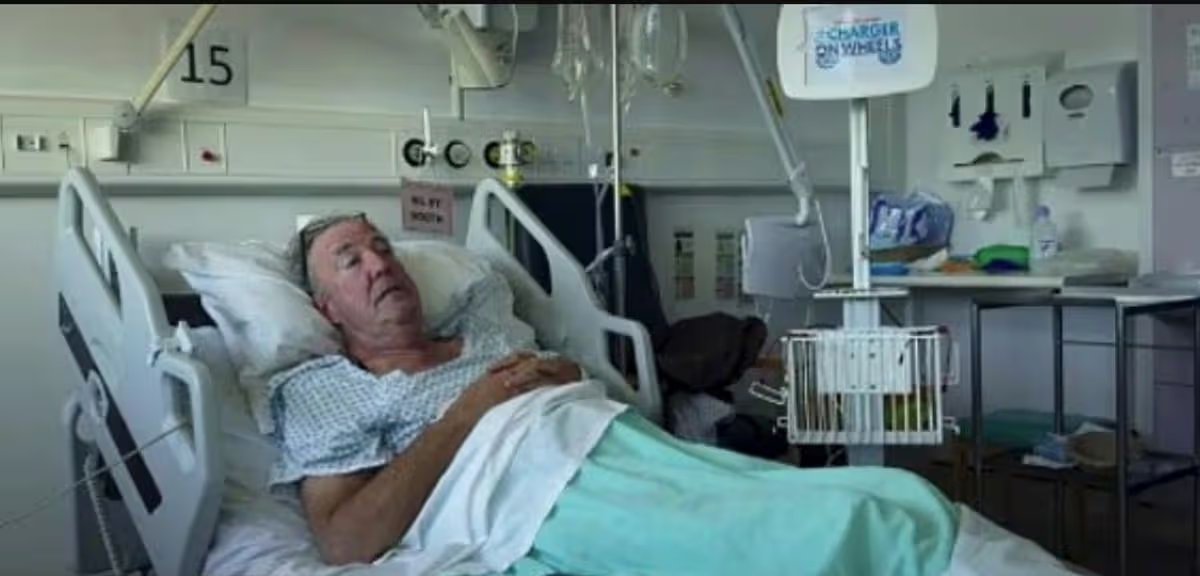
In the season finale, Clarkson addressed viewers from his hospital bed, sharing that there had been complications during treatment. The 66-year-old told fans: “What I wanted to say was if this is all successful, I’ll see you for season six, and if it isn’t, I won’t. Take care, everyone.”
Over on Instagram, ahead of the new episodes dropping, an emotional Clarkson warned followers that a “really, really difficult watch” was in store.
Holding back tears in a candid post, Clarkson said on Tuesday: “Ordinarily, we try to keep the show bucolic and charming and cheerful. But the final two episodes, which drop in the middle of the night tonight, are none of those things really. They’re a difficult watch. They’re really, really, difficult.”
Fans of the hit farming show will know all too well that Clarkson is not the first cast member to share his health battles, with other stars being struck with serious illnesses throughout its five-year run.
Now questions have emerged about the future of Clarkson’s Farm, which has been running since June 2021, with Prime Video yet to issue a formal statement on its continuation.
At present, the show has not been officially recommissioned. In February, Clarkson himself confirmed that, while some recording for the upcoming series had already taken place, some pausing had been required due to the weather.
In his column for The Sunday Times, the presenter wrote: “There’s no filming happening on the farm at the moment. Or farming. It hasn’t stopped raining since the beginning of the year, so I can’t plant anything, and I can’t do anything with my cows either because we are still locked down by TB.”
But planning documents submitted to West Oxfordshire District Council reportedly suggest that season six is in the works. According to The Independent, part of it reads: “Season five will air this year and season six has been commissioned and will air in summer 2027.”
Clarkson’s enthusiasm for the farming show shows no sign of waning. Speaking previously with The Sun, he said: “We’ll definitely do six – Amazon want to (do series six), and I want to. I’ve got a good idea for six. I said I’ll stop doing them when there are no more ideas. But I’ve got two quite good ones, so we’ll do six, and then we’ll see…”
The beloved farm has been plagued by setbacks and personal health struggles. Back in 2024, during the show’s third series, farmhand Gerald Cooper revealed he had prostate cancer.
The fan favourite, known for his distinctive mullet, has since confirmed that he is thankfully cancer-free. Discussing his diagnosis with Prostate Cancer UK, Gerald shared: “It was a shock – but everyone has really supported me.”
He added: “I received tremendous support from family, friends and Prostate Cancer UK – which was also a lifeline. I made it through, and I’m now cancer-free.”
Wanting to do something “joyful” following his recovery, the 77-year-old went on to launch a racehorse syndicate to help raise some all-important awareness of prostate cancer. The horse itself is, of course, named ‘The Mullet’.
Then, in June 2025, it was revealed that castmate Alan Townsend – aka Alan the Builder – was awaiting heart surgery. While carrying out building work on the Farmer’s Dog Pub, Alan confirmed to Clarkson that he had a “quadruple bypass coming.”
When asked whether he had any fears about the procedure, Alan admitted: “Oh, [I’m] frightened to death. I don’t even like thinking about it. That’s why I keep going to work — keep out of the way. They told me to really just take it easy and stay at home. But if you stay, you’ll be worrying to death about it.”
In the latest season, fans were delighted to see Alan back at work after undergoing a gruelling procedure. Opening up to Clarkson about returning to normality, Alan confirmed that the op had been “very painful”, adding, “I don’t want to show you on camera, but it’s a nasty cut.”
Alan shared that he’d been hospitalised because of issues with the arteries in his heart. He explained: “One had collapsed and curled itself up, and the others were about 85-90 per cent blocked. Horrible. I had a bit of a problem with the lungs, I lost 36 per cent of the lungs.”
Coincidentally, Alan and Clarkson had been neighbours at the same hospital, with Clarkson undergoing follow-up heart check-ups at the same time.
The presenter underwent a heart procedure in October 2024, after experiencing a tightness in his chest. Medics revealed he’d been mere days away from a heart attack, in a scare that led to him having a stent fitted.
Opening up about his brush with catastrophe on the first episode of season five, Clarkson blamed his health woes on the pressures involved in launching The Farmer’s Dog. He told Kaleb, “I’m back and not dead. The Grim Reaper will have to wait. It was f***ing close, though.”
Clarkson’s Farm season 5 is on Prime Video
Do you have a story to share? Email me at julia.banim@reachplc.com.
The era of Chair Warsh begins in earnest this Wednesday, as US President Donald Trump’s pick to run the Fed presides over his debut rate decision and steps before the cameras for his first press conference in the role.
ADVERTISEMENT
ADVERTISEMENT
Few economists anticipate dramatic action on day one, but the meeting carries unusual weight for what it might reveal about the months ahead.
Policymakers are expected to hold the benchmark rate steady at a target range of 3.50% to 3.75%, which would mark the fourth consecutive meeting without a move. The committee cut 25 basis points in December 2025.
The bigger question is the language, with officials potentially revising their post-meeting statement to drop any hint that the next step will be a reduction, signalling instead that rates may stay elevated for some time, or even rise should inflation prove sticky.
Warsh inherits a far less accommodating picture than the one he faced when he was widely seen as campaigning for the job last year.
At that time, he argued forcefully for lower rates, echoing US President Donald Trump’s demands, and pointed to AI as a force that could expand the economy’s productive capacity and tame prices over time.
Many economists doubted that thesis even then, noting that the surge of investment in semiconductors and computing equipment was adding to inflationary pressure rather than easing it.
A changed economic backdrop
Inflation has indeed accelerated since the outbreak of the Iran war in late February, climbing to a three-year high of 4.2%, driven largely by costlier petrol.
US President Donald Trump has announced a framework for a peace deal that could end the conflict, but it is unclear whether the truce will hold, and prices for fuel, groceries and airfares could take months to cool even if Middle Eastern oil flows freely again.
By the Fed’s preferred gauge, inflation has now run above its 2% target for more than five years. Hiring, meanwhile, has remained resilient.
May brought 172,000 new jobs, a third straight month of solid gains, removing much of the rationale for the two rate cuts the Fed had pencilled into its January projections.
Because the rate itself looks settled, attention turns to the Fed’s updated Summary of Economic Projections and its closely watched “dot plot”, the quarterly projection of future interest rates.
According to Bank of America economist Aditya Bhave, the new dot plot could show the Fed keeping rates on hold for the rest of 2026, with at least three of the committee’s 12 voting members potentially pencilling in rate hikes this year.
Communication is the other wildcard. Warsh has argued that the central bank should speak less often and keep a lower profile, on the view that publicly stated positions can trap policymakers into defending them well past their usefulness.
One option would be to thin out the calendar of press conferences, reverting to the every-other-meeting rhythm favoured by Ben Bernanke, who chaired the Fed from 2006 to 2014, when the format was introduced. Leaner guidance, however, risks unsettling markets long accustomed to clear direction.
Adding intrigue, predecessor Jerome Powell remains on the board as a governor, a seat he can hold until January 2028, and is expected to vote on Wednesday’s decision, denying the Trump administration an additional vacancy to fill.
EUROPE’S largest funfair is returning to the UK this weekend, as the huge stretch of rides comes back for its 144th year.
Over 400 spectacular attractions will be on offer for all the family, including a new record-breaking ride for the ultimate thrillseekers.
Sign up for the Travel newsletter
Thank you!
The Hoppings is back for another year, as the summer funfair hits Newcastle’s Town MoorCredit: Get into NewcastleThe funfair spans over half a mile in the city centre, making it the biggest in EuropeCredit: Get into Newcastle
The Hoppings is back for its 144th year this weekend, as Newcastle’s Town Moor anticipates the return of Europe’s biggest funfair.
Located at the heart of the city centre, the funfair offers over 400 attractions and rides for thrillseekers and families alike – from the giant ferris wheel, to the classic helter skelter.
Despite occupying a smaller space than previous years, due to drainage works on the Moor, the fair still keeps all its excitement, and visitors can expect to see a jam-packed line-up.
After centuries of history, and a deep-rooted sense of North East nostalgia the fair evokes, generations of Geordie families love returning to The Hoppings year after year.
The fair includes a whole host of classic rides, and brand-new thrillseeking funCredit: AlamyJGA1A6 Hook-a-duck, The Hoppings, Town Moor, Newcastle upon TyneCredit: Alamy
This year, the fair has unveiled a whole host of adrenaline-pumping rides, including the return of fan-favourites Atmosfear and Extreme.
The stage has been set for the arrival of a record-breaking high-flying experience with the launch of the brand-new Elevate85 attraction.
Climbing up to 80metres, this drop tower with flying chairs has been hailed as “the world’s highest travelling ride” – only 10metres shorter than London’s Big Ben.
Foodies have another reason to celebrate with a brand-new Spud Bros stall joining the line-up, only weeks after the launch of its popular North Tyneside store.
The fair has spent the last week in June on the Town Moor since 1882Credit: AlamyThe Hoppings typically attracts 500,000 visitors every yearCredit: Alamy
The daily line-up also includes a Live Lounge stage with country, rock, and pop music, alongside delicious treats on offer from the Feast Street food village.
The arrival of the Hoppings in the last week of June is a fixture of the Geordie calendar, and has been since 1882.
Opening on the Town Moor over a century-and-a-half ago, the fair was initially marketed as a tee-total event to counteract the boozy activities of Newcastle Race Week.
Its initial form included traditional amusements and roundabouts, as well as kite-flying contests and military shows – a step away from its current form.
The Hoppings has evolved to represent the warmth and welcoming nature of Geordies themselves, and shows a city beyond bustling nightlife and football passion.
Now, the fair attracts over half a million annual visitors to indulge in the vibrant lights, exhilirating rides, and all the fun of the fair.
For those wanting to visit Newcastle, The Hoppings is the perfect starting point for organising a tour, with the city centre situated a 30-minute walk away from the Town Moor.
From there, a walk along the Quayside to see the famous Tyne Bridge, The Glasshouse and River Tyne is a must, with foodstalls often lining the streets on weekends.
Newcastle city centre offers lovely views and exciting shopping experiencesCredit: AlamyTynemouth Longsands, only a 30-minute commute away, is one of Britain’s best beachesCredit: Alamy
Newcastle, and surrounding North East towns, are incredibly well-connected with the Tyne and Wear Metro, with 60 stations and two separate lines.
Many may not know that the city has some of the best coastlines in the UK – travel 30 minutes east on the Metro and visit Tynemouth Longsands and enjoy the scenic views from the coastal villages.
Entry to The Hoppings is completely free this year, with standard ride prices ranging from just £3 to £5 and high-thrill attractions costing slightly more.
The Hoppings is returning for its 10-day bonanza between June 19 and June 28, running from 2pm to 11pm on weekdays, and 1pm to 11pm on weekends.
FOOTBALL fans better strap in as there is a huge new attraction themed all around the sport landing in Europe.
Viva Mundo is a new football-inspired theme park in Santarém, Portugal, due to open in time for the next World Cup in 2030 – which will be hosted by Portugal, alongside Spain and Morocco.
Sign up for the Travel newsletter
Thank you!
A new football theme park is planned for EuropeCredit: YouTube/Viva MundoThe theme park called Viva Mundo, will be split into six main areasCredit: YouTube/Viva Mundo
The attraction won’t be themed around specific clubs but rather a love for the sport.
The theme park, which is expected to cost £389million, released a video this week showing potential rides and attractions that could feature at the park.
The video shows the park could include a Vegas-like sphere, a 4D cinema experience and even a water obstacle course.
Across Viva Mundo there will be 28 attractions in total.
Football fans can expect a fan zone, as well as 28 attractionsCredit: YouTube/Viva MundoAttractions include a dual rollercoaster where families can race alongside each otherCredit: YouTube/Viva MundoThere will also be a rollercoaster that launches riders at high speedCredit: YouTube/Viva Mundo
There will be rollercoasters including a dual rollercoaster, where families can race against each other and another that will launch riders at high speed.
Other rides will include a log flume and rapids as well as a drop tower.
According to Local Online, the theme park will be split up into six different areas – the entrance, the ‘Memory’, ‘Flavours’, ‘Fans’, the ‘Spectacle’ and ‘Football World’.
The Welcome Gate area will be where visitors enter the theme park, then Memory will be where they can visit a shop and museum, showcasing the sport’s history as well as iconic memorabilia from around the world.
Other attractions at the park include areas for younger kidsCredit: YouTube/Viva MundoAnd there could be a Vegas-like sphereCredit: YouTube/Viva Mundo
In the Flavours area, fans will be able to grab a bite to eat with several different restaurants with food from around the world.
As for the Fan Zone, the area will replicate the energy of a stadium on a match day, with virtual reality experiences for fans.
In the Spectacle area, fans can expect a 4,000 seat arena for live concerts and performances.
And last but not least will be Football World, located around a central lake and divided into sub-zones that include: Passion – a tribute neighbourhood; Glory – a area dedicated to football legends with trophies; and Fantasy – a playground-like area for younger fans.
The park is due to open in time for the 2030 FIFA World CupCredit: YouTube/Viva Mundo
And visitors won’t need to stay outside of the park as there will also be a 300-room themed hotel onsite.
The park is planned to open on April 29, 2030, which would be in time for the 2030 FIFA World Cup, which Portugal is due to co-host alongside Morocco and Spain.
The park will be 40 minutes from Lisbon and an hour and a half from Porto.
Santarem, where the theme park will be located, is a historic city worth exploring in its own right.
And it will be just 40 minutes from LisbonCredit: YouTube/Viva Mundo
Dubbed the ‘Gothic capital’of Portugal, the city boasts fascinating architecture as well as amazing views of the Tagus River.
One spot to not miss is the Portas do Sol Gardens, which is the city’s old castle.
The park expects to welcome between one and 1.5million visitors a year when open, according The Portugal News.
It started in Texas, where Trump strong-armed Republican lawmakers into redrawing their congressional map in hopes of boosting the GOP’s chances of keeping control of the House. That led California voters to pass an eye-for-an-eye measure aimed at boosting Democratic prospects.
For a short time, it looked as though Trump’s move had backfired and Democrats might actually come out ahead, at least on paper, by a seat or two.
And then?
And then the courts stepped in.
In a 4-3 decision in May, the Virginia Supreme Court struck down the state’s new congressional map, ruling that the Democratic-run legislature had violated procedural requirements when it placed the constitutional measure on the ballot.
But the more significant legal decision came a week prior, when the U.S. Supreme Court nullified a major part of the federal Voting Rights Act, freeing several Southern states to hastily redraw a number of congressional districts to Republicans’ advantage.
What’s the bottom line?
It looks as though the GOP has come out ahead, but not by more than a handful of seats, give or take. It’s important to note that all that cartographic competition offers no guarantee of success.
“Cartographic competition?”
Those gerrymandered maps were drawn for the express purpose of helping out one party or the other, but the partisan manipulation doesn’t make all those redrawn districts a lock come November.
California Gov. Gavin Newsom signs legislation calling for a special election to redraw the state’s congressional map
(Godofredo A. Vasquez / Associated Press)
In California, for instance, the Central Valley seat held by Republican David Valadao — a perennial Democratic target — remains highly competitive. In Texas, GOP lawmakers redrew their map assuming the substantial Latino support that Trump enjoyed in 2024 would carry over to Republican candidates in this year’s midterm election. That seems increasingly less likely, given shifting Latino attitudes, which means at least two of those redrawn Texas seats are more competitive than Republicans would like.
Bottom line, where does that leave things in the fight for control of the House?
There are no certainties …
… Beyond death and taxes. Understood.
It still seems more likely than not that Democrats will win the House in November.
They just need to gain three seats. Going back more than half a century, the out party (which is to say the one not in the White House) has gained an average of more than two dozen House seats in the midterm election. So Democrats have that going for them.
President Trump kicked off a redistricting battle by strong-arming Texas into redrawing its congressional map.
(Alex Brandon / Associated Press)
Also, more significantly, Trump’s approval ratings — in a word — stink. There’s a very strong correlation between a president’s standing in polls and his party’s performance, given midterm elections are almost always a referendum on the party in the White House. Since disgruntled voters are more likely to turn out, that means the out party typically gains seats.
“It would be one thing if Republicans were trying to buck a historical trend and they were doing so strengthened by a popular Republican president,” said Jacob Rubashkin, an analyst with the authoritative nonpartisan political guide Inside Elections. “But that’s simply not the case. … [Trump] is less popular than any president heading into a midterm election in a very long time.”
What about control of the Senate?
Advantage Republicans.
How so?
Part of it is straight-up math. Democrats need to flip four seats. There are 35 Senate races being decided this fall, but only 10 or so are even remotely competitive. Nearly all are in states that Trump carried.
There’s much less correlation between presidential approval and the outcome of Senate races. Still, Trump is putting up some pretty strong headwinds that Republicans will have to overcome this fall, including in battleground states such as Georgia, Michigan and North Carolina. (His gaseous effusions — “I love the inflation,” “Affordability is a con job” — are not helpful, to put it mildly, when gasoline and hamburger are costing hard-pressed voters an arm and a leg, respectively.)
And Democrats have done about as well as they could have hoped in landing their preferred candidates in the Republican-leaning states of Alaska, Ohio and Iowa, making those contests far more competitive than they would have been.
That started out as Democrats’ top target this election cycle. Five-term incumbent Susan Collins has the distinction of being the only Republican senator running in a state that Kamala Harris won. The race is still considered a toss-up.
But the nomination of Graham Platner, an oyster farmer and Marine Corps veteran with a history that is, um, problematic — a tattoo resembling a Nazi SS symbol he did or did not apprehend; extramarital sexting; coarse online commentary — could turn the race into more of a referendum on the Democrat than either Trump or Collins.
Democrats are giddy again, this time over 37-year-old state Sen. James Talarico, who’s built a national following with his telegenic, Christian-infused progressive platform. More pertinent, he’s running against a singularly flawed Republican nominee, state Atty. Gen. Ken Paxton, whose dubious resume is muddied with a felony indictment, impeachment by the GOP-run Texas House and allegations of repeated adultery.
But on the streets of L.A. over the last week, something very different has happened.
Fans from a kaleidoscope of cultural backgrounds have come together to act out the kind of world — and city — they want to live in.
On the shuttle bus from downtown to Inglewood on Monday, there were scores of people with Farsi-emblazoned shirts and crowds of grinning Kiwis as one would expect for the Iran-versus-New Zealand showdown that evening. However, there were also clusters of striped blue Argentina T-shirts, plenty of Team USA jerseys, and a loud group of fans chanting “Viva Mexico” from the back of the bus.
The mood was joyful before Monday’s match among fans of Iran’s national team. The players, because of restrictions by the Trump administration, have had to commute to the games from Tijuana.
(Allen J. Schaben / Los Angeles Times)
Similar scenes played out on the Metro K Line as World Cup-goers from all over traded stories of how they scored tickets, tips for navigating L.A.’s transit system, and wistful memories of tournaments past.
“This festival is about unity and bringing the whole world together; there are 48 nations and everybody is having a good time,” said Ardy Salem, an Iranian American dentist who traveled from the Bay Area to attend the game, as he surveyed the crowd outside SoFi Stadium on Monday with unabashed glee.
“Just for a moment,” he said, “we get to leave all the politics behind.”
David Leon, 32, of Watts was grinning from ear to ear as he stood outside the stadium entrance in his forest-green Mexico jersey, despite the fact that he initially didn’t support having the World Cup in Los Angeles.
“I thought it was going to be a big issue for a bunch of different people to come here,” Leon said.
Fans of New Zealand show their support as they perform the haka, a traditional Maori dance and chant, at Monday’s match.
(Allen J. Schaben / Los Angeles Times)
Leon worried that people from other countries would be turned off by American politics and fearful about traveling to the U.S.
“It really does bring people together from all these different ethnicities,” Leon said, looking at the lines of people waiting to get into the stadium. “I’ve seen Colombians, I’ve seen Mexicans, people from New Zealand, people from Iran, Germans, Spaniards.”
And for his own community of Mexican Americans, he said the matches had brought a much-needed infusion of joy. This time last year, Immigration and Customs Enforcement raids were roiling Los Angeles, instilling fear throughout immigrant households.
Fans of Mexico are on hand at Monday’s match at SoFi Stadium. Before the World Cup, there were widespread fears of ICE presence at the games.
(Kelvin Kuo/Los Angeles Times)
Just last month, about 2,000 SoFi Stadium workers threatened to strike if they didn’t receive assurance that immigration agents would be kept out of the venue during the World Cup.
Leon said he was definitely worried that ICE would take advantage of crowds gathering for the matches to perform further immigration enforcement.
But, so far, that has not been the case. Instead, many people in his hometown of Watts have been consumed with “World Cup fever,” calling out of work to attend watch parties at local bars and walking down the streets with eyes glued to a livestream of a game on a phone, he said.
While joy was the overriding mood among soccer fans gathered in Inglewood on Monday, the day was not entirely free of tension or pangs of grief for the people who were missing out on the fun.
James Carling, 63, of Ventura said it pains him to know that many fans from countries such as Iran, Haiti and Senegal are unable to attend the matches because of the Trump administration’s travel restrictions.
“Let’s face it, our government hasn’t made it easy for people to visit us, which is a shame,” he said outside the stadium. “There were people from countries whose teams made it [to the World Cup] who were not allowed to come and, sorry, that’s wrong.”
The shadow of the U.S. war with Iran and the anger many Iranian Americans feel over Iran’s current government were also present in Inglewood on Monday. Outside the stadium, some Iranian soccer fans had heated encounters with protesters who felt that supporting the Iranian national team was synonymous with supporting an oppressive regime.
Yet the atmosphere among the Iranians attending Monday night’s game was one of cathartic celebration, where for a few hours they could set aside geopolitical tensions and unite over the simple love of soccer.
In the stadium parking lot, David Arias, a Mexican American resident of Inglewood, gave a fist bump to Kam Pirouz, an Iranian fan who had traveled from Washington, D.C., to see the game.
Mexico and Iran are “homies right now,” Arias said, referencing the fact that the Iranian players are commuting to the Los Angeles games from Tijuana because of restrictions placed on them by the Trump administration.
Fans watch the World Cup group stage match between Iran and New Zealand at SoFi Stadium on Monday.
(Ronaldo Bolanos/Los Angeles Times)
Although Arias did not have tickets to the match, he said he could not resist the chance to meet people from all over the world. So he decided to take his local barbershop to the parking lot outside the stadium and offer free haircuts to fans.
With an hour to go before Monday night’s game, all three seats at his pop-up shop were occupied; Pirouz, the Iranian fan, was getting a fresh fade while seated next to a Mormon missionary from Utah and an Egyptian fan.
“It’s the World Cup, man, the entire world comes together, and it’s beautiful,” Pirouz said mid-haircut. “Best sport in the world.”
Times staff writer Seamus Bozeman contributed to this report.
The small constituency of Makerfield in northwest England has found itself in the eye of the storm of British politics with a by-election on Thursday that will not only produce a new member of parliament but could also pave the way for a new prime minister.
The by-election was triggered last month when the previous MP, Josh Simons, stood down to allow Manchester Mayor Andy Burnham to contest the seat. If Burnham wins, he intends to challenge UK Prime Minister Keir Starmer for the leadership of the ruling Labour Party.
Recommended Stories
list of 4 itemsend of list
Starmer is facing mounting pressure to step aside following dismal council election results last month and this week’s resignation of Secretary of State for Defence John Healey and Armed Forces Minister Al Carns over the United Kingdom’s defence budget.
Seeking to derail Burham’s hopes for the Labour leadership, however, is far-right Reform UK candidate Robert Kenyon, whose campaign has been dogged by controversy over alleged sexist and misogynistic social media posts but who remains within striking distance in the polls. Reform came second at the last election in Makerfield, however, and are seen as presenting a real challenge to Labour, which has held the seat since its creation in 1983.
Here’s a closer look at the race, why it matters and how its consequences could extend far beyond Makerfield.
Why is a by-election happening in Makerfield?
Despite winning the 2024 general election in a landslide, Labour’s popularity has tanked over the past two years as support for the far-right, anti-immigration Reform UK has soared. In council elections last month, Reform swept up hundreds of council seats at Labour’s expense. Overall, Labour lost nearly 1,500 local council seats while Reform surged from 100 to about 1,450 seats.
On the right, Labour’s rhetoric on immigration has failed to stem support for Reform UK, which continues to attract both former Conservative voters and sections of Labour’s traditional working-class base – particularly in the north of England. On the left of the party, many voters who feel aggrieved by Starmer’s stance on Israel and cuts to welfare have shifted towards the Green Party.
Now, according to polling group Ipsos, Starmer is the most unpopular prime minister since it began voter surveys in the late 1970s.
As Labour’s internal tensions have grown as a result, Burnham has consistently emerged as one of the party membership’s preferred alternatives to Starmer. Recent polling suggests Starmer would defeat most potential challengers in a leadership contest, with one notable exception: Burnham.
As Mayor of Manchester, Burnham is not an MP and cannot currently stand for leadership of the Labour Party. Earlier this year, he was blocked from standing for Parliament via another by-election in Gorton and Denton, a seat Labour ultimately lost to the Green Party.
As pressure on the prime minister has mounted, however, Labour’s National Executive Committee has been increasingly unwilling to block Burnham from standing as an MP again.
Announcing his resignation as Makerfield MP following the council elections, Simons said Labour was heading towards a divisive leadership contest with “no hope, no energy that anything would change”. He described Makerfield as “where Andy Burnham has lived for 25 years” and said the mayor was “coming home”.
“Labour needs to change and the whole government needs to change,” Simons added.
Who is standing and what are they campaigning on?
Labour: Andy Burnham
Burnham currently serves as the highly popular Mayor of Greater Manchester, having left Westminster after previously serving in several cabinet positions under former Labour prime ministers Tony Blair and Gordon Brown.
As mayor, Burnham has built a reputation as one of Labour’s most recognisable politicians, benefitting from his distance from Westminster while arguing that it could learn from what he calls “Manchesterism” – a blend of pro-business policies designed to attract investment while bringing essential services back under public control.
Known by some supporters as the “King of the North”, Burnham gained national prominence for challenging the Conservative government during the COVID-19 pandemic and for his long-running campaign for justice for the victims of the Hillsborough disaster.
His appeal to Labour’s working-class base in the north of England has led some party members to view him as Labour’s strongest candidate for winning back the so-called “Red Wall” – former industrial constituencies that have increasingly shifted towards Reform UK in the north of England.
Political commentator and journalist Aaron Bastani told Al Jazeera that Burnham’s personal reputation “makes a difference” and that he represents Labour’s best chance against Reform UK.
“A lot of Reform voters actually like him. Many people have a good word to say about him, and he’s been a politician in the area for 25 years.”
But he added that, among some voters, he is still tarred by his “association with Labour as the party of government”.
“Many Reform voters see Labour as the party that backed the Iraq war, and there’s a deep sense of disillusionment with the political establishment … What’s interesting is that some Reform voters were making left-wing criticisms of Burnham, such as the cuts to winter fuel payments and broader dissatisfaction with the government’s direction.”
Reform UK: Robert Kenyon
Hoping to spoil Burnham’s chances is Reform’s Kenyon, affectionately referred to by some members of the UK media as “the plucky plumber” in reference to his profession. He represents a party whose rapid rise and anti-immigrant message has transformed Britain’s political landscape.
Reform UK’s rise has largely been driven by Nigel Farage, the architect of Brexit, whose party has capitalised on the collapse of support for the former ruling Conservative Party. Many big names from the Conservatives have defected to Reform in recent months. That has enabled Reform to attract both traditional right-wing voters and some former Labour supporters, largely on a platform that directs local grievances towards migration.
“For many voters, the proliferation of vape shops and takeaways on high streets has become a shorthand for a sense of decline,” Bastani told Al Jazeera.
“It’s often one of the first things people talk about when discussing immigration and changes to their local area. The concern isn’t really about vape shops themselves – they’re seen as visible symbols of a declining economic model, the loss of local identity and a feeling that places are deteriorating.”
Bastani, however, described Kenyon as “unimpressive”. His campaign has been overshadowed by allegations relating to historic social media activity.
Anti-extremism group HOPE not hate published posts attributed to Kenyon that included COVID-19 conspiracy theories, endorsements of sexualised comments about television presenter Carol Vorderman and remarks about female rugby players.
The group also highlighted comments on an online forum in which Kenyon allegedly described himself as sexist and suggested women make false rape allegations to obtain abortions.
Restore Britain: Rebecca Shepherd
Another factor is Restore Britain, a breakaway far-right party founded by former Reform UK MP Rupert Lowe, who argues that Reform UK has become too mainstream and is no longer hard enough on combating undocumented immigration.
Lowe, a former Reform member, was suspended by Reform UK in March 2025 after publicly criticising party leader Nigel Farage and was later expelled following a series of workplace bullying allegations and complaints from female staff members, which he denies.
Since launching the new party less than four months ago, Restore Britain claims to have attracted more than 96,000 members and 13 councillors, many of them former Reform figures. Should a significant share of those voters ultimately switch from Reform UK, it could dent Reform’s share of the vote just enough to benefit Labour.
Conservative: Michael Winstanley
Winstanley is the former mayor of Wigan, standing as candidate for the former ruling Conservative Party. He was elected as a councillor for the local ward of Orrell and 2000, and served for 16 years.
Conservative leader Kemi Badenoch called Winstanley “an excellent champion of the area having lived in, worked in and represented the local community for years”.
Observers do not expect any great show of Conservative voters at this election, however. In May’s local elections in Wigan, Labour won 42 seats, Reform 25, and the Conservatives got none. And, in the last general election in Makerfield, the Tories came in third – behind Labour and Reform – with just over 10 percent of the vote.
What do the polls say about the candidates?
Polling suggests the contest is effectively a two-horse race between Labour and Reform UK. The largest survey of the campaign, conducted by Opinium for Forward Democracy, indicates Burnham holds a narrow lead.
Based on a mixed-method survey of 543 local residents, Burnham leads Kenyon by five percentage points among voters most likely to cast a ballot. Among those rating themselves at least seven out of 10 likely to vote, Burnham stands on 46 percent compared with Kenyon’s 41 percent.
However, Kenyon’s share may have been damaged by the 7 percent that Shepherd is expected to win in Restore Britain’s first parliamentary outing. The Conservatives are polling at just 2 percent.
Furthermore, while Labour currently leads in the by-election campaign, the constituency’s longer-term political trajectory may ultimately favour Reform UK. When respondents were asked how they would vote in a future general election, Reform UK led with 42 percent compared with Labour’s 34 percent, suggesting that Burnham’s personal appeal may be helping Labour outperform its own national reputation.
In May, Labour lost all eight of its local council seats in Makerfield to Reform.
Tom de Grunwald, founder of Forward Democracy and StopReformUK.Vote, said tactical voting could prove decisive. “If you live in Makerfield and you would normally vote Green, Liberal Democrat, or anyone else, and you don’t want Reform UK to win this seat, the maths is clear: Andy Burnham is the only candidate who can stop them,” he said.
However, Bastani said he is sceptical that many Restore Britain supporters will ultimately return to Reform UK. “A lot of those voters now see Farage as part of the establishment,” he said, adding that Restore Britain could outperform expectations on polling day – which could split the far-right vote and benefit Burnham. While he expects Burnham to win, Bastani said the result should not obscure the rise of Reform.
“I’d be surprised if Burnham didn’t win. But if Reform were running a stronger candidate, this could look very different. If Farage somehow managed to win a seat like this against someone with Burnham’s profile, it would rank among the most significant political achievements of his career.”
Weekly insights and analysis on the latest developments in military technology, strategy, and foreign policy.
There are so many questions to be answered about what led to yesterday’s fatal mishap involving a B-52H bomber at Edwards Air Force Base. The crash was tragic on a level the base, which sits at the center of America’s flight testing ecosystem, has not experienced, at least to our knowledge, for 75 years. The human impact here is just hard to quantify at this time. At the same time, there will be a major developmental impact, too, especially when it comes to work that is being done to modernize the B-52. This is a constellation of programs that are seen as vital to U.S. national security, and are also already running far behind schedule and over budget.
“It was a B-52 that was on initial takeoff, supporting the Radar Modernization Program,” Air Force Col. James Hayes, Deputy Commander of the 412th Test Wing at Edwards, said at a brief press conference yesterday. “It was a local test sortie. It took off, and immediately after takeoff, crashed and burst into flames.”
U.S. Air Force Boeing B-52H Stratofortress strategic bomber crashed at the Edwards Air Force Base in California shortly after take-off.
The crash occured at approx. 11:20am local on Monday.
“Emergency crews immediately responded to the scene and the situation is ongoing. More… pic.twitter.com/u4IRGGjlV2
— Status-6 (War & Military News) (@Archer83Able) June 15, 2026
The 412th is the main unit at Edwards. As noted, the base serves as the Air Force’s main test and evaluation hub.
“After reviewing the footage of the crash, it was deemed that this was an unrecoverable crash and unsurvivable,” Col. Hayes added. The B-52 had “a mixed crew of military, government civilians, and government contractors supporting this test mission.”
“Right now, our thoughts and prayers are with the families of those that lost their loved ones,” he also stressed. “This is a tragedy.”
When reached by TWZ for comment today, Boeing reiterated a brief statement it made yesterday that confirmed two of its employees died in the crash. The company’s full statement is as follows:
“We extend our deepest condolences to the loved ones of the eight crew members who lost their lives in the B-52 crash at Edwards Air Force Base, California. It is with great sadness that we confirm two Boeing employees were among those on board. We are in contact with their families and are offering support.”
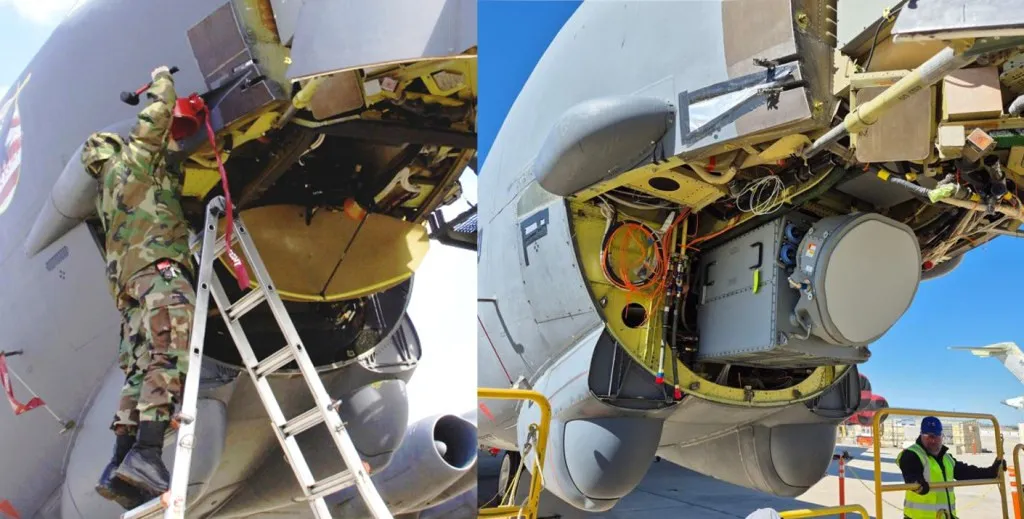
A side-by-side look at the existing AN/APQ-166 radar on a B-52, at left, and the new AN/APQ-188 integrated onto one of the bombers, at right. USAF
The RMP is one of many major upgrades planned for the Air Force’s entire fleet of 76 B-52s in the coming years. The bombers are also set to get all-new engines, improved communication suites, and more. The changes will be so substantial inside and out that the designation of the bombers will switch from B-52H to B-52J in the process.
B-52 Future Stratofortress: The Upgrades That Will Transform The B-52H Into The B-52J
“It is too early to tell,” a U.S. Air Force official told TWZ today when asked about potential impacts to the RMP.
We have also reached out to Raytheon.
The publicly stated plan for the RMP has called for the integration of the AN/APQ-188 radar onto two B-52s to support initial testing. Modification of those bombers began in Fiscal Year 2023, and the first example with the new radar touched down at Edwards in December 2025. Air Force budget documents say the second radar test B-52 is expected to be ready some time in Fiscal Year 2026, which began on October 1, 2025. Whether that milestone has already been reached is unclear.
The first B-52 equipped with the new AN/APQ-188 radar arrives at Edwards in December 2025. USAF
It is also not known how many AN/APQ-188s may be available at all at present. “The remaining test-phase radars are expected to be delivered through the summer of 2024,” Raytheon said in a press release back in 2023.
As noted, the RMP has already suffered significant delays. Under the original program schedule, flight testing was expected to start in 2024. The initial goal was for AN/APQ-188-equipped B-52s to begin flying operational sorties in 2027. As it stands now, the Engineering and Manufacturing Development (EMD) phase of the program is expected to run into the middle of 2029, with initial operational capability then coming in 2030.
These delays have also come along with substantial cost growth. In 2021, the estimated price tag for development of the AN/APQ-188 and integration of those radars onto the Air Force’s full fleet of 76 B-52s was pegged at nearly $2.4 billion, according to the Government Accountability Office (GAO). By 2023, the RMP’s costs had risen by 12.6 percent, per GAO. The program was eventually subjected to an extensive legally required review of its requirements and cost targets, which led to a scaling back of planned capabilities, at least initially.
“Part of what we did to control cost is to work at what are the main things that we need on this radar? As you may recall, we’re buying a radar that is largely a F-18 Hornet radar with some small modifications. We did that intentionally because that is what was on the market at the time,” Air Force Lt. Gen. Andrew Gebara, Deputy Chief of Staff for Strategic Deterrence and Nuclear Integration, explained in August 2025. “It would actually cost us more if we asked [a contractor] to design the new radar.”
An AN/APG-79 radar installed on an F/A-18 Hornet. Raytheon
Gebara’s remarks came during a virtual talk hosted by the Air & Space Forces Association’s Mitchell Institute for Aerospace Studies.
“Having said that, it doesn’t mean that we need everything on that radar that the Hornet had on it,” he continued. “We have a certain number of minimum things that we need to do to be able to do our B-52 mission. And so part of the cost saving [review] was looking at what are those things, to make sure that we’re prioritizing precious dollars on things that we need.”
Gebara said at that time that the revised RMP plan still kept the door open for “opportunities for growth in the future, if it comes to that.”
The AN/APQ-188 is still set to provide essential new capabilities, in part just by being a more modern AESA design. As TWZ has written in the past:
“In general, AESA radars offer greater range, fidelity, and resistance to countermeasures, as well as the ability to provide better overall general situational awareness, compared to mechanically scanned types. Increasingly advanced AESAs bring additional capabilities, including electronic warfare and communications support.”
“For the B-52, any new multi-mode AESA will improve the bomber’s target acquisition and identification capabilities, including when used together with targeting pods available for the bombers now. New radars for the bombers will also be helpful when it comes to guiding networked weapons over long distances to their targets and could provide a secondary ground moving target indicator (GMTI) and synthetic aperture radar surveillance capabilities. The radar upgrade could help defend B-52s from air-to-air threats, including through improved detection of incoming hostile aircraft.”
A B-52 bomber with its nose open for maintenance. USAF
“Boeing has already looked at some schedule improvement that we’ve seen,” Air Force Gen. Dale White, the service’s Direct Reporting Portfolio Manager for Critical Major Weapon Systems, also told TWZ and others more recently at a roundtable at the Air & Space Forces Association’s (AFA) annual Warfare Symposium in February. White was speaking at the time collectively about progress on the RMP and the Commercial Engine Replacement Program (CERP) for the B-52 fleet.
At that time, Gen. White also highlighted how the relatively small size of the B-52 fleet, combined with the operational demands placed on it, had created additional challenges for modernizing the bombers. The B-52s are in high demand to support conventional combat operations, as underscored by their heavy use in the recent conflict with Iran. A portion of the fleet is also a key element of the air leg of America’s nuclear deterrent triad, which imposes additional hard operational requirements for available aircraft.
USAF B-52 taking off from England on an Iran strike mission yesterday, carrying a load of 500-pound GPS-guided JDAM bombs. pic.twitter.com/23RGpCe8GB
“The challenge with B-52 that I think everybody forgets, it’s such a small fleet that has such a tremendous requirement in terms of readiness,” White said. “You’ve got to have a certain number on the ramp. That’s a requirement.”
With the B-52 fleet expected to fly into the 2050s, it is extremely likely that the Air Force will move to regenerate a bomber from storage to replace the one lost yesterday, just to meet general operational demands. That is typically a weeks-long process, at best, for an aircraft of this type and size.
A B-52H bomber nicknamed “Wise Guy” seen at Tinker Air Force Base in Oklahoma in the process of being regenerated to service back in 2020. USAF
With CERP and the other modernization efforts underway, there is high demand for resources to support B-52 test and evaluation work overall. This is reflected in a nearly tenfold year-over-year increase in the planned budgeting for B-52 test aircraft asset support at Edwards. The Air Force received just over $1.5 million to help pay for “the test aircraft, manpower, Bomber Modular Data Acquisition System (BMDAS), and facilities at the Air Force Test Center” in Fiscal Year 2026, according to official budget documents. The service is now seeking nearly $11 million in this same line item for the next fiscal cycle.
In the meantime, as mentioned, the Air Force has rightfully made clear that its immediate priorities following yesterday’s B-52 crash are engaging with the families of those who perished and working on the investigation, which could take months to complete. Edwards has also at least shut down flight operations today, primarily due to the state of the runway following the mishap.
The full scale and scope of the impacts to the RMP from yesterday’s loss remain to be seen.
The programme has received 508 complaints about the show that aired on June 9, the watchdog reported.
In a statement sent to The Daily Mirror, Ofcom confirmed the “complaints related to comments made during a discussion about the Scottish World Cup Bank Holiday”.
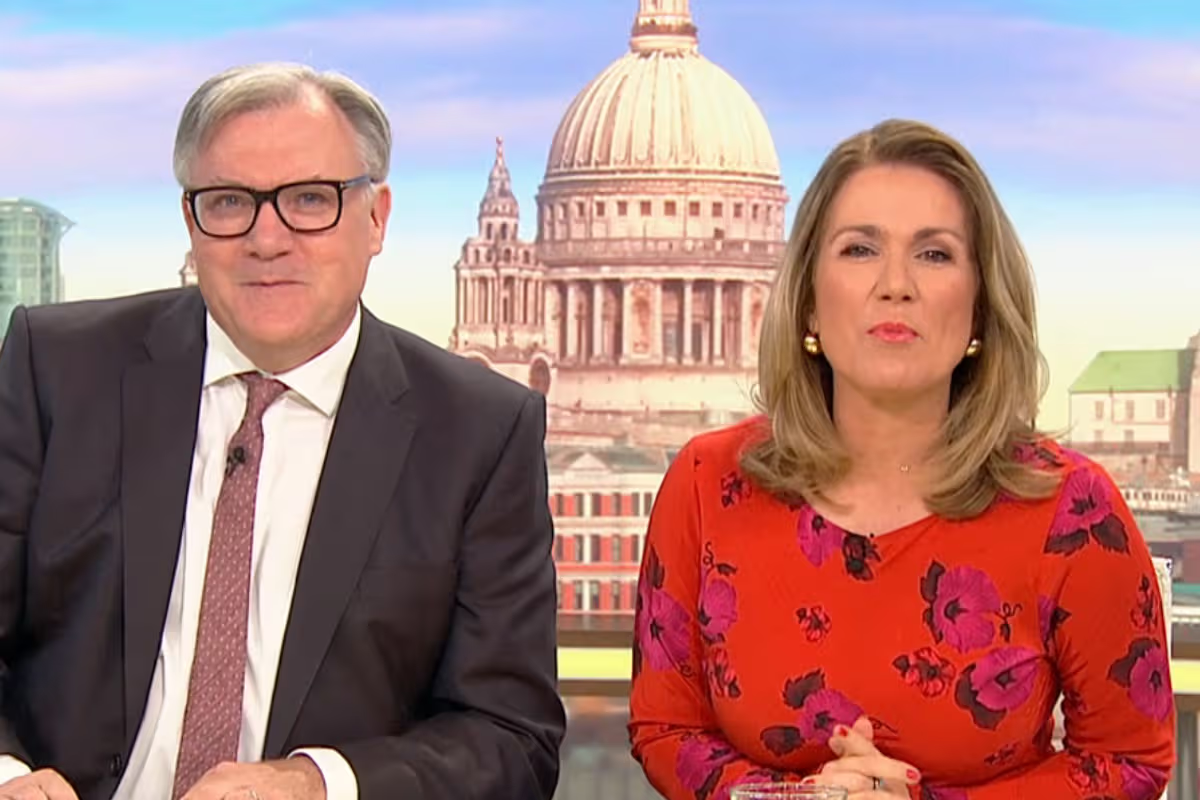
Good Morning Britain that day had seen Ed Balls and co-host Susanna discuss the news that Scotland would receive a Bank Holiday for qualifying for the World Cup.
Ed had said on the ITV daytime show: “This morning, in our five o’clock meeting, Susanna said, ‘I can’t believe this, the game’s on the Sunday morning, and they get bank holiday [more than] 24 hours later.’
“I said, ‘What?’ I couldn’t believe it. It never occurred to me that that was going on.”
Responding to viewers’ reactions, Susanna said, “It’s really outrageous. I mean, how long does it take Scots to get over the fact that they’ve played their first match?”
Viewers had been left fuming after hearing, with Susanna later issuing an apology.
One had seethed: “So many anti-Scottish comments from your presenters and guests this morning. Do you realise your show is shown on Scottish television? Unfortunately.”
Another blasted: “Extremely anti-Scottish. Not everyone is getting it, and not everyone wants it. I don’t even like football, but thought your comments were uncalled for!!!”
Yet another seething viewer said, “Not everyone is getting it. Jumping on the anti-Scotland bandwagon, I see.”
ITV also released a statement following the backlash, which read, as per The National Scot: “The editorial team feel discussion of the fact that some football fans would be drinking alcohol while watching the match is something that would be referenced in the discussion of any home nation’s participation in an international tournament.
“No sleight was intended toward Scottish fans in particular – it was more a reflection of football watching culture in the UK.”
It went on: “We’re aware this coverage has been distorted on social media by brief edited clips that do not represent the full four-minute discussion. Having reviewed the full segments, our feeling is that the issue of drinking and football would have been raised in a discussion of any home nation having an extra day off work following a game. We do note, however, that such discussions can play into national stereotypes. This was not the intention, and in no way was the focus of the discussion.”
The publication noted that ITV also said that the Good Morning Britain editorial team had taken on board “concerns about Ofcom’s rules relating to generally accepted standards, due accuracy and due impartiality, but taking into account the light-hearted nature of the news review discussion and the discussion that followed later in the programme, consider that the programme was in line with Ofcom’s standards”.
Susanna later issued an apology, admitting she had left fans “irate” and being accused of “jealousy”.
After welcoming two Scottish broadcasters on the programme earlier this week, who questioned Susanna on her comments, the former BBC Breakfast star said: “My Scottish ancestors would be turning in their graves, I can only apologise.
“Let me say, it’s outrageous that not everyone in Scotland has got today off as a bank holiday.”
Good Morning Britain airs weekdays from 6am on ITV1 and ITVX.
BRITS are jetting away in record numbers, but landing abroad to a shock mobile phone bill can instantly ruin your holiday vibe.
Thankfully, savvy travelers are dumping traditional setups for a clever digital alternative powered by Swiss tech pioneer Yesim.
Sign up for the Travel newsletter
Thank you!
eSIMs make staying connected while abroad easy aaaffordable
Yesim eSIM – claim exclusive 15% discount with code: GETYESIM15
Why is traditional roaming outdated?
Ever since Brexit, major UK mobile providers have reintroduced painful daily fees just to use your standard phone data in Europe.
Big networks like EE and Vodafone hit travellers with charges up to £2.75 a day, which easily scales up to nearly £100 for a family holiday in Spain.
Worse still, traditional roaming ties your phone to a single local network provider, meaning your data speeds will completely tank if that specific partner has weak signal.
You also face the terrifying risk of automatic out-of-bundle charges if you accidentally slip past your hidden data allowance while streaming or video calling.
What are travel eSIMs and how do they work?
An eSIM is a clever digital microchip already baked directly into modern iPhones, Samsung Galaxies, and Google Pixel devices.
While the physical chip is built into your phone, a travel eSIM is a dedicated service that lets you download a cheap, temporary data profile over the air.
You simply install the profile at home while having a cuppa, and the internet connection automatically kicks in the very second your flight lands abroad.
Best of all, your primary UK SIM card stays completely active in parallel, meaning you can still receive emergency calls and crucial banking verification texts on your usual number.
What is Yesim, and how does it work?
Swiss tech brand Yesim is an industry pioneer making mobile connectivity a seamless, budget-friendly digital service.
Operating for seven years with over 800 partner operators, Yesim provide unstoppable coverage across 200 world destinations.
However, two terms are often confused in the market, and understanding the difference matters.
What is an eSIM?
An eSIM is simply the hardware: a microchip built into modern smartphones that allows profiles to be downloaded remotely, but it doesn’t guarantee lower prices or reliable connections abroad.
What is a travel eSIM?
A Travel eSIM, however, is the complete service ecosystem built around that chip.
It provides an app for choosing plans, 24/7 customer support, automatic connection to the strongest network, and transparent, fixed pricing.
That service layer is what you are actually paying for.
Why choose Yesim?
Yesim delivers that exact ecosystem, offering tailored data options for every holiday style, backed by multi-lingual support with a rapid six-minute average response time.
First-time users can even test the network with a 500MB trial plan for just £0.45.
To get started, check your phone’s compatibility on their website and install the profile via the app.
Sun readers can score an exclusive 15% discount right now by using the promo code GETYESIM15 – claim here
Why you should consider a travel eSim for your next trip?
Unlike network providers that lock you into one signal, travel eSIMs like Yesim seamlessly switch in the background to whatever local network is strongest.
They offer total cash predictability by forcing you to look at the exact data limit, pricing, and expiry period before you spend a single penny.
Whether you need a quick 5GB chunk for a week in Turkey, or a Global Package (80+ countries) or Global Plus Package (140+ countries) for backpacking across South America, you choose a plan tailored perfectly to your trip.
For trips with unpredictable routes, the Pay & Fly plan offers a flexible pay-as-you-go model available in more than 170 countries.
You can even safely use your smartphone as a personal hotspot to share the internet with your tablet, laptop, or the rest of the family.
The Yesim app utilises switchless connection technology to automatically connect to the strongest network from over 800 partner operators globally.
The brand’s Multiple eSIMs feature allows you to manage connectivity for several devices from a single account.
The main app owner can share eSIM profiles with family members or colleagues without needing to install the app on every device.
easyJet issued a new alert on Tuesday(Image: e55evu via Getty Images)
Holidaymakers bound for a popular destination have been cautioned about extended airport queues and advised to factor in additional time when travelling.
easyJet issued a fresh alert to British passengers on Tuesday, June 16, warning them about substantial changes at the border that could throw travel plans into disarray. The airline updated its official guidance following the gradual introduction of stringent new security measures and evolving border rules.
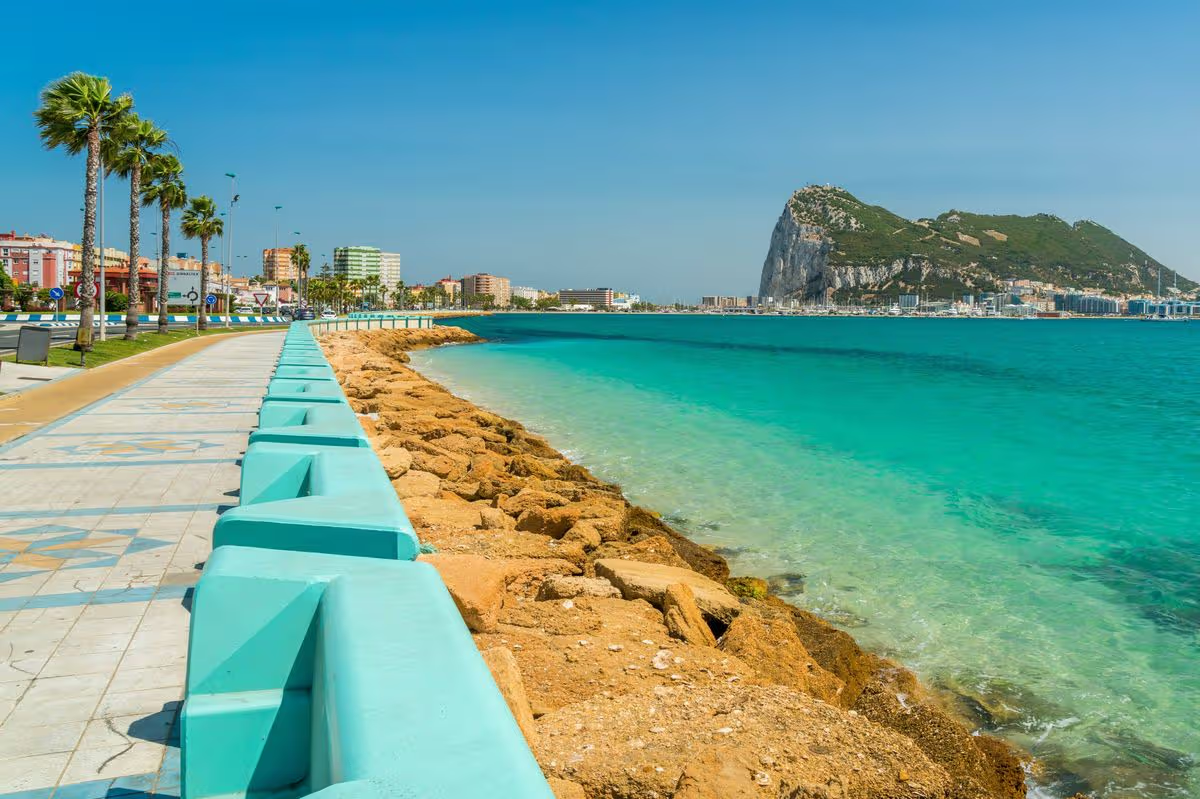
Brits are also being reminded about the length of time they’re permitted to remain in the Schengen Area, following rule changes that have been introduced post-Brexit. easyJet’s ‘important updates’ message is aimed specifically at those flying to and from Gibraltar.
The alert explains: “EES border checks may be carried out for both arrivals and departures at Gibraltar Airport, which could result in longer waiting times when entering or leaving the country. Please allow extra time when planning both legs of your journey.”
The travel operator goes on to clarify that UK nationals can still visit Gibraltar visa-free for brief stays. The update continues: “For non-EU nationals, including UK nationals travelling visa-free, time spent in Gibraltar now counts towards the 90-day Schengen allowance.”
Additional guidance on Gov.uk clarifies that British passport holders are permitted to stay for no more than 90 days in any 180-day period across the following countries – Austria, Belgium, Bulgaria, Croatia, Czechia, Denmark, Estonia, Finland, France, Germany, Greece, Hungary, Iceland, Italy, Latvia, Liechtenstein, Lithuania, Luxembourg, Malta, Netherlands, Norway, Poland, Portugal, Romania, Slovakia, Slovenia, Spain, Sweden, and Switzerland.
easyJet’s alert adds: “Non-EU / Third-Country nationals may require a Schengen visa to enter Gibraltar and should check visa/entry requirements before travelling.”
It’s Friday afternoon in North Hollywood and Ziggy Marley is perched on a stool inside his newly built Rebel Lion Studio, tucked in one of the neighborhood’s creative enclaves.
The nine-time Grammy winner is surrounded by a collection of lion figurines, guitars, traditional hand drums and a piano. Along the walls hang two replicas of backdrops his legendary father, Bob Marley, used on tour in the 1970s. The murals, depicting Rastafari icons and Haile Selassie I and Marcus Garvey, were featured in the 2024 biopic “Bob Marley: One Love.”
“These are what we used as the backdrop for the concert scenes. Them spiritual to me,” Marley says in patois as the smell of palo santo dances around the rehearsal space.
Music has been both an inheritance and lifelong pursuit for Marley. From sitting in studio sessions with his father as a child to building a five-decade career of his own, he has remained a curious student of the craft, one willing to challenge convention in search of a deeper meaning. That spirit is evident on “Brightside,” his ninth solo album, which was released on vinyl on April 18 (Record Store Day) and May 1 on streaming.
Rather than recording the eight-track project in 440 Hz, the standard tuning frequency for most modern music, he opted for 432 Hz, a tuning some musicians and theorists believe creates a warmer, more meditative listening experience. He also slowed down his songwriting process, giving each lyric room to carry its message of hope through turbulent times. The album, which may be his most personal yet, also features “Many Mourn for Bob,” the first song he has written directly about his late father.
“I think it shows the next stage that I probably am in,” says Marley, adding that he felt connected to his father on a spiritual level. “We took another step in the relationship, to another place that it’s never been before.”
Ziggy Marley is bringing his “Brightside” tour to the Hollywood Bowl on June 21 alongside reggae star Burning Spear.
(Dania Maxwell / For The Times)
He adds, “When I was doing the song, it kind of came to me like this song could’ve been my father’s song. It could’ve been a song that he wrote.”
The reflective nature of “Brightside” arrives at another pivotal time in Marley’s career. This year marks the 20th anniversary of “Love Is My Religion,” the Grammy-winning album that launched his solo career and crystallized a personal philosophy he still carries today. He is also set to release his sixth children’s book, “True to Myself,” in September.
As we wrap up our conversation, Marley has only a few minutes before Rebel Lion Studio shifts back into work mode. Within minutes, bandmates, background singers and production crew members begin funneling into the space, hauling in stacks of equipment as promotion and preparations continue the “Brightside” tour, which stops at the Hollywood Bowl on June 21.
This interview has been lightly edited for length and clarity.
You recorded your latest album, “Brightside,” here at Rebel Lion Studio, which you designed and built from the ground up. Can you take me back to the beginning of that process and why you wanted to do it?
I grew up around my father and my mother as growing musicians trying to succeed and there was one thing I kept hearing over and over throughout my life: independence. Their whole mission was to be independent. I saw them work and I saw my father build a studio. I saw him have a space where he can do more music and control his own time. That was a dream of mine for a long time, ever since I started doing music because usually we use other people’s studios. I couldn’t have this in my house. It’s too much. It’s a dream come true.
We’re surrounded by two beautiful murals. Is there a particular item that is personal to you?
The murals are replicas of my father’s backdrops that they used. The original artwork is by Neville Garrick, but he helped us re-create them for the Bob Marley movie. These are the murals we used as the backdrop for the concert scenes. They are spiritual to me cause that’s Haile Selassie and Marcus Garvey, two very important beings for us. Inspirational.
On “Brightside,” Ziggy Marley dedicated a song to his father, Bob Marley, for the first time in his career.
(Dania Maxwell / For The Times)
“Brightside” is your ninth solo album. What mindset were you in emotionally and spiritually when you started working on it?
I never thought about making an album, I was just writing songs. You just tap into things in your subconscious that are waiting to become music, I feel like. Then when the time comes for writing songs, the time comes. It’s like a season. Like you have blueberry or orange season. So there’s a season for me when I write songs. Then you say, “All right, let’s make an album then.” But you don’t think about an album before. It’s just an expression or a feeling just to make music, not for any reason but to make it. It happened over a period of years. Ideas and experiences that eventually come out. But closer to the time I [made] the album, I remember writing some of the later songs like “Why Let the World.” It was a song that I wrote because I was feeling down and everything that was happening in the world and the country. Just so much negativity and I just felt like I needed to take a break from it. To recharge yourself. We cannot fight every day. We need to take a break and then get back to it. I needed to teach myself to take some time. It was more of a mental thing than an emotional thing. Stuff I deal with my father, personal life and stuff with my spirituality and my faith. So there’s a lot of me in this record.
“Many Mourn for Bob” is the first song you’ve explicitly written about your father. Your brother, Stephen, is also on the vocals. What surprised you emotionally once that song was finished?
I’m not sure I thought about it like that. The experience of expressing that emotion, it’s a spiritual experience. I think it shows the next stage that I probably am in and even my relationship with my father on that spiritual level. It’s a different place. We took another step in the relationship, to another place that it’s never been before. When I was doing the song, it kind of came to me like this song could’ve been my father’s song. It could’ve been a song that he wrote. That’s how I felt about it. This is partly his song. It’s me and him making this song. This song is his song too.
How has your relationship with grief changed over the years?
It’s more of a comrade, understanding, empathy and having the maturity and the experience to understand what he went through as a man, as a human being. I think that’s what it is, really. A better understanding of what he went through, not the glory. The pain, the mental and emotional state. You’re more than just an idol. You’re more than just a legend. You’re more than just a father. To go deeper than that, so that’s the next level.
Yeah, the skit you used of him saying “I’m just a man from the ghetto” on the song really summarizes that.
That’s the real him. That’s him right there. Even in the tone of his voice, you can hear the real Robert coming out.
Another standout song from the album is “Racism Is a Killa.” One thing that you do well is having a heavy topic, but finding a way to still make it feel hopeful and joyful. Why was it important for you to approach the track this way rather than from a place of anger, heaviness or sounding preachy?
I think it started out preachy and angry, but over time, it kind of evolved and I kind of evolved too ‘cause my own evolution is represented in the music. And you know something, doing that song helped me evolve because I had to think about it differently without the anger. The song made me do that. Like how else can I approach this? It’s inspiration that causes these things. It’s not an intellectual thing. I didn’t do that intellectually. Like over time, something just started coming out of me. I never really thought about it before, but I can see it now.
In the video, which features your daughter, Zuri, you referred to the condition as “Racismosis” in the video and sang about how it can be cured.
It’s kind of like a sickness, a disease. It’s a virus. We can minimize the virus and stop the disease. It’s true. Racism is a killa. This virus can kill ya. Literally kill ya. Spirtually kill ya. Emotionally kill ya. Mentally kill ya. It kill ya in different ways. It kills the victim and it kills the person perpetrating it. It’s killing everyone, but we can cure it though. It starts with the children. I have a friend of mine who said, “Yo, my little son loves this song. He doesn’t want to stop. He says ‘Put on “Racism is a Killa.”’ So that’s where the antidote is starting. The minds of the children. The music with a conscious message gives them the right consciousness that they grow up with. That is how we take our time and lower the spread of the virus.
You recently released an alternate version for “Racism Is a Killa” with Big Boi. How did that collaboration come together and what excited you about working with him?
I’ve loved Big Boi and Outkast from a long time ago. He’s a legend and a strong voice. There’s different layers to it and I feel like Big Boi took it to that other layer. So yeah, we just love Big Boi and I’m going to jump on something he does. [Laughs]
I’d be remiss if I didn’t ask your approach for your album and how you swapped the typical 440 Hz for 432 Hz. Do you remember the first time you heard the music played back that way?
It’s a long journey because for most of my life in music, I’ve tried to be a student. I’ve tried to keep an open mind and learn more and more. With this album, there’s an inspirational side of music and that’s where I lean into most of the time, but as I grew up, I started to understand there’s also a science too. It’s also mathematics. The universe, it’s all mathematics and science, and I shouldn’t shun the science of music just because I think the inspiration is all it should be. I think a part of that was learning that for myself and opening up and saying, “Yo, let me put some science into this.” Frequency. What does frequency do to people? Frequency affects people. Frequency is a weapon. It’s a tool. I’m sure the army has some kind of frequency thing. So frequency is powerful. I wanted to try something different anyway. I want to be different. I want my frequency to be different from the majority of frequencies that’s being played out there, because it’s fun for me to be different.
When I was working on the demos, I was like “Let me try this 432 Hz thing” and I like how it feels for me personally, how I sing on the frequencies. It resonates differently and makes me feel different. We did it and it felt good, and we did it live, and from my point of view, I felt a different energy with the audience too. So all of those experiments led me to the final conclusion to say, “Yeah, let me do the record in 432.” It’s really nice vibes, which the world needs a different frequency. We can use it.
This year marks the 20th anniversary of “Love Is My Religion,” your first solo Grammy-winning album. When you think back to that era of your life, who was Ziggy back then?
A lot was changing because I moved to L.A. during that time.
You got married around that time too, right?
Yeah. I don’t really fight change. I just try to navigate them and figure them out cause sometimes change is hard. There was a lot of change living here, moving around, trying to find a place, music, but then it’s like we are continuously updating ourselves. I’m continually updating. You know how you update your OS. I’m updating my OS. My operating system is being updated throughout my experience in life. There’s always something else out there for me to evolve to. So during that period of my life, “Love Is My Religion” came to me when someone asked me, “What religion are you?” And I just said “Love is my religion.” I never thought about it before, never contemplated it, never even thought of those words together before in my life, and they just came out to me that day. So the album represents a time in my life when I realized there’s a spiritual awakening that I had. “Love Is My Religion” is a spiritual awakening. That’s my thing. That’s who I am. That’s why it’s a milestone.
“If you think you’re going to change this world with music and you’re trying to send a message out there, you have to speak to children,” Ziggy Marley says.
(Dania Maxwell / For The Times)
You’re kicking off the “Brightside” tour this month, which includes a stop at the Hollywood Bowl. What are you most excited about when it comes to bringing this album to people for the first time live?
I’m excited about playing the music. I think it’s about the music. These new songs, they vibrate very highly for me and I’m excited about experiencing and expressing that. And also kind of not doing it for the audience. I don’t want to do it for the audience. I want the audience to experience what I’m experiencing, what I’m expressing. I want them to feel me. I don’t want them to be like “Hey look at me.” [Laughs] There’s still connectivity going on, but I want them to feel the songs the real way. That’s what I’m excited about for people to feel it the way that I feel it.
You even posted the lyrics and told fans to get to practicing, so they can really understand the message.
Yeah. Just reading them for me, I really like the writing I did on this. I also took some time with this too. I was saying to someone that I developed a deeper relationship with the lyrics and the words than I did before. My relationship with the words here are very mature. I feel good about it. That’s why I want people to know the words because words are very important. Words are very important. If you know the words you get a deeper understanding of what I’m talking about and what I’m feeling.
After nearly 50 years of making music, Ziggy Marley built his own studio in North Hollywood called Rebel Lion Studio. He plans to turn it into a multipurpose creative space.
(Dania Maxwell / For The Times)
Look on the bright side is a phrase that people say often, but what do those words mean to you right now?
Sometimes we can get in a place [where] we can’t see the other side of things because we’re so caught up in that one place. Like the cliché, there’s two sides to a story, ya know? The universe is always yin and yang, but there’s always another side of things. But I feel like the way we are being programmed in a way through media and everything, it’s like there’s only one side. Everything is like this, there’s nothing else going on over there that we need to see, we only need to see this. This is all that’s going on in the world. There’s nothing good, there’s nothing nice, there’s no good people, there’s no love. So it’s a realization too. A realization that there’s the other side. Never get to that place where we think it’s just that side alone because we get so much of it. It’s a reminder, I think, for us like “Come on guys.” The thing about it too, sometimes you can feel like — even for me — some people say, “Hey look on the bright side,” some people find that like “Why are you happy? Why you so chirpy?” [Laughs]
That’s true.
I’m proud that I’m on the bright side. I’m living on the bright side, I don’t care. You don’t like me because I’m living on the bright side? You want me to be like you, you want me just live on the dark side with you, right? So it’s like a proudness of being positive and having that outlook in life, and not feeling like you have to [fall to] peer pressure. More positivity in life, not just the negativity. I’m confident in that too. So it’s kind of like that too, you know, like being proud, lifting up that side of me. Yeah, I’m happy to be living on the bright side.
Midfielder Bernardo Silva has joined Real Madrid on a two-year deal, linking up with manager Jose Mourinho.
Silva, 31, left Manchester City at the end of last season, bringing an end to a trophy-laden nine-year spell.
Silva was heavily linked with a move to Spain, with Barcelona and Atletico Madrid also reportedly chasing his signature.
He becomes Real’s second signing of the summer as a free transfer after defender Marc Cucurella joined from Chelsea in a deal worth £52m.
Real did not win a trophy last season.
They finished eight points behind La Liga champions FC Barcelona and were knocked out in the quarter-finals of the Champions League.
Silva is at the World Cup with Portugal and is expected to play a pivotal role for his country.
Real are understood to be targeting departing Inter Milan defender Denzel Dumfries, while France defender Ibrahima Konate is set to join after leaving Liverpool.
Defender Antonio Rudiger this week signed a contract extension with Real until 2027.
London, United Kingdom – Activists who gained access to the widely condemned Great Israeli Real Estate Event in London have shared photos with Al Jazeera that show property in illegal settlements being marketed.
The invite-only event, held at Edgware United Synagogue, was part of a roadshow promoting the sale of land and property in Israel, but in reality, these included homes in areas such as Givat Zeev and Tivuch Shelly in the occupied West Bank, as well as settlements in East Jerusalem.
Recommended Stories
list of 4 itemsend of list
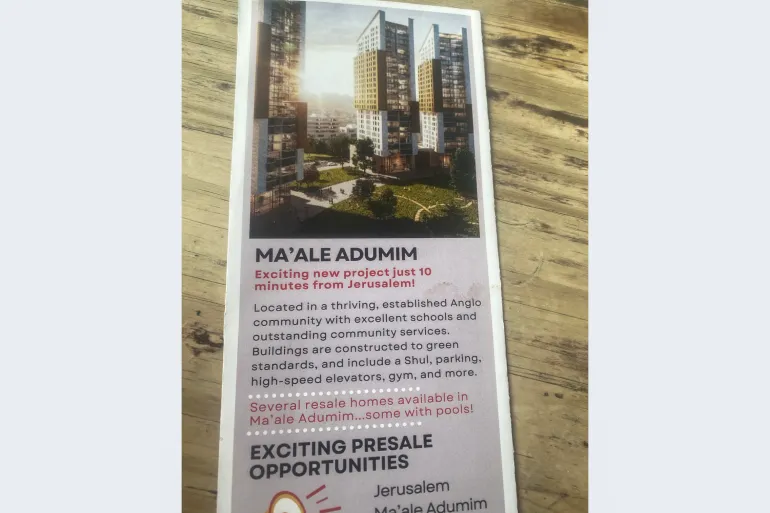
“Exciting new project just 10 minutes from Jerusalem!” read a leaflet advertising homes, “some with pools!” in Maale Adumim, a West Bank settlement illegal under international law.
Activists saw leaflets marketing homes in illegal Israeli settlements at the controversial property fair [Courtesy of Jewish Anti-Zionist Action group]
Isabel, a member of the Jewish Anti-Zionist Action group who spoke to Al Jazeera on condition of anonymity, said that the mood at the fair was peaceful and heavily protected, including by plainclothes men fitted with body cameras.
She did not hear any participants mention Palestinians, she said, adding that when it came to the occupied Palestinian territory, real estate agents spoke of “Anglo-communities” where English-speaking people from the United States, the UK and South Africa could relocate to.
She said a popular selling point used by real estate agents was that due to the war on Gaza, it was a good time to buy property in Israel, as prices had dropped and they might be willing to offer a discount.
The atmosphere reminded her of the opening week of university with social chatter, stalls and strangers pushing flyers at attendees.
“Unlike outside the synagogue, where there was lots of protests, it was calm inside with a heavy police presence, [security] people even wearing body cams. The room was all set up with stalls, in what I would describe as like freshers’ fair. On the tables were free pens, chocolates.”
Brochures offered people information about buying homes in ‘the heart of Israel’ [Courtesy of Jewish Anti-Zionist Action group]
When Isabel spoke with representatives from the Israeli real estate company Harey Zahav, she was shown advertisements for properties in Jerusalem as well as Netanya, a resort city in central Israel.
More than 100 British legislators, including members of Prime Minister Keir Starmer’s Labour Party, had signed a letter on Friday urging the government to “uphold its obligations under international law” and ensure the event “promoting illegal activities does not proceed”.
Layla Moran, a British MP of Palestinian descent and one of the letter’s signatories, described the sales as “unacceptable”.
Gaza war could mean discounts, said participants
When Isabel told participants she was interested in something a little quieter, they said in hushed tones that they also had a portfolio of properties in “Judea and Samaria”, the Israeli term for the occupied West Bank.
One representative said that organisers asked them not to advertise properties in these locations. When asked why, he said it was due to these “crazy times” when people wanted to stop purchasing property in Israel.
He said they had all the information packs for those properties, but requested her details so he could send them to her afterwards.
Pro-Palestine protesters, MPs and several rights groups had called on the UK to ban the event [Toby Shepheard/Reuters]
At the stand of Tivuch Shelly, another Israeli real estate company, Isabel said representatives were more reticent to discuss properties in the occupied West Bank, but were openly advertising properties in Givat Hamatos and Ramat Eshkol, two settlements in occupied Jerusalem, on their flyers.
An activist with Jewish Anti-Zionist Action at one point shouted out that “this event sells property on illegally occupied stolen Palestinian land” before he was removed by security.
But the overall mood inside the fair was in sharp contrast to the protests and tense atmosphere outside the event.
In the buildup, rights groups, including Amnesty International, as well as the mayor of London, Sadiq Khan, slammed the event for openly advertising the sale of land in illegal Israeli settlements.
Outside, hundreds of protesters shouted slogans and held posters reading, “Stop Israel’s illegal sale of stolen Palestinian land” and “Thou shalt not steal”.
The Metropolitan Police said 15 people were arrested during the demonstrations “for a range of offences, including public order matters”.
Green Party leader Zack Polanski has written to Khan, calling for the event to be investigated by the Metropolitan Police.
Khan earlier said he had discussed the event with the London police force and had been told that any allegations of criminality relating to the potentially unlawful sale of property at the fair would be assessed by the Met as part of a probe.
Israel started building illegal settlements after capturing the West Bank, East Jerusalem and the Gaza Strip in the June 1967 Six-Day War, and now, more than 700,000 settlers – 10 percent of Israel’s population – live in 150 illegal settlements and 128 outposts spread across the occupied West Bank and East Jerusalem.
The government has openly funded and built settlements, and Israeli authorities give their settlers in the occupied West Bank about $5.6m a year to monitor, report and restrict Palestinian construction in Area C, which is administered solely by Israel and comprises more than 60 percent of the West Bank.
United Nations bodies and most countries view the West Bank settlements as illegal, citing international conventions.
But the US has provided diplomatic cover to Israel for decades, with Washington consistently using its veto power at the UN to protect Israel from diplomatic censure.
A police officer stands guard near counterprotesters, as people from pro-Palestine groups gathered near the Edgware United Synagogue for a demonstration against the property fair organised by real-estate agency My Home in Israel, which markets property in illegal Israeli settlements in the occupied West Bank, in London, June 14, 2026 [Toby Shepheard/Reuters]
Jadon John keeps a diary in which he records reference numbers for government-mandated registrations. Based in Jimeta, a commercial district in Adamawa State, northeastern Nigeria, one page of Jadon’s diary contains his voter registration details and another lists his Bank Verification Number (BVN). The 34-year-old has also noted down his National Identification Number (NIN), records for Subscriber Identification Module (SIM) registration, and information for his driver’s licence renewal.
All of these are national digital identifiers that Nigerians require for most official documentation. For him, these entries feel like variations of the same repetitive process.
“It has been stressful from the beginning,” he said, sitting outside a phone repair shop near the Jimeta Modern Market in Adamawa. “I first registered for my voter’s card, then later did BVN at the bank, and after that, I spent almost two days trying to get my NIN. Every place asked for almost the same information and biometric capture.”
The queues were always long, he said, and sometimes the network would fail after hours of waiting. His experience has become a normal routine for many people in Nigeria, a country that has devoted years to developing digital identity systems aimed at modernising governance, enhancing financial inclusion, and minimising fraud.
Experts have described the government’s efforts as Digital Public Infrastructure (DPI), which encompasses the collective digital frameworks that facilitate effective online interactions between governments and citizens. Despite the government’s investments in identity infrastructure, many citizens experience cycles of repeated registrations, record mismatches, and fragmented databases. At the heart of the problem is a simple contradiction: Nigeria now has multiple powerful identity systems, but they do not fully connect with one another.
One person, many registrations
Jadon, for instance, says he struggles to remember how many times he has submitted his fingerprints for similar digital identity registrations. “Every agency takes my fingerprints, passport photo, phone number, and address again, as if I have never registered anywhere before,” he complained, especially about how repetitive and tedious these processes can be.
Nigeria has multiple agencies managing different biometric databases for identity verification, banking security, voting, and driver licensing. The National Identity Management Commission (NIMC) manages the NIN database to build Nigeria’s foundational identity system. The Central Bank of Nigeria (CBN) introduced the BVN in 2014 to secure the banking sector and combat fraud. The Independent National Electoral Commission (INEC) maintains its own voter register for elections, while the Federal Road Safety Corps (FRSC) operates another biometric database for driver licensing. Each system has its own valid purpose, but when combined, they frequently function in isolation. Experts say this lack of coordination can sometimes lead to significant problems.
Jadon said that on many occasions, he has suffered service disruptions due to identity mismatches. His bank account was once restricted because his NIN details did not exactly match the BVN record. One system had his middle name fully written, while another used only initials. A similar incident occurred in 2020, when his SIM was blocked amid the government’s NIN-SIM linkage policy.
“When my SIM was blocked because of the NIN-SIM linkage issue, I lost customers because people could not reach me,” he recalled. “I could not receive calls, bank alerts, or access mobile banking for days simply because my records did not match properly across the systems.”
As with the NIN-SIM linkage policy, people also face difficulties linking their BVN to their NIN records. The BVN was introduced in 2014, when Nigeria’s national identity system was not yet fully developed for seamless nationwide interoperability. Abubakar Nuhu Buba, the Deputy Manager of the Currency Operations and Branch Management Department at the CBN in Yola, said the BVN emerged during a period when Nigerian banks urgently needed stronger identity verification systems.
“The original goal of the BVN system was to address the absence of a unique identifier across the Nigerian banking industry,” Abubakar noted. “The banking industry faced an urgent security crisis that the national identity system was not yet equipped to handle.”
The CBN official revealed that the current BVN-NIN integration presents a complex dual effect on financial inclusion. While it builds a more secure foundation for credit and digital banking, he said, it also creates significant friction that risks pushing vulnerable rural populations back into the informal sector. That friction is often felt most sharply in rural communities where internet access is weak, enrolment centres are scarce, and transport costs are high.
CBN Yola Branch Office. Photo: Obidah Habila Albert/HumAngle.
The unified identity dream
Nunaya David, a senior enrolment officer with NIMC in Adamawa, said the NIN is intended to serve as Nigeria’s official foundational identity number. Its primary goal is to establish a unique identity for every Nigerian and legal resident, serving as a central reference point across various platforms and services.
“The long-term goal is one person, one identity across all sectors,” he noted.
In theory, that would mean a citizen registers biometrics once, and authorised institutions securely verify identity digitally, rather than repeatedly capturing fingerprints and photographs. But in practice, the systems continue to function as separate databases.
Nigeria’s broader digital interoperability efforts are also coordinated by the National Information Technology Development Agency (NITDA), which has developed frameworks to improve secure data exchange and interoperability across government institutions. Through initiatives such as the Nigerian e-Government Interoperability Framework (Ne-GIF) and the Nigeria Data Exchange framework, NITDA seeks to enable Ministries, Departments, and Agencies (MDAs) to securely share and verify data across platforms rather than operate disconnected databases. The agency has repeatedly stressed that interoperability is essential to achieving Nigeria’s “One Citizen, One Identity” vision.
“The main reason citizens still repeat biometric registration is that most agencies still maintain independent databases and legal mandates,” Nunaya said. He identified several challenges affecting Nigeria’s digital identity systems, including varying database architectures, inconsistent data formats, outdated legacy infrastructure, network disruptions, and issues regarding data ownership.
“Many citizens have different names, dates of birth, or phone numbers across BVN, voter registration, passport, and NIN records,” he added, noting that minor spelling differences can prevent systems from recognising the same person.
Registration for a voter’s card through the Independent National Electoral Commission (INEC) also presents similar interoperability challenges. INEC officials in Yola told HumAngle that their biometric registration process serves a different purpose from the NIN database. Grace Akpan, an electoral officer in the state, said the electoral body is mandated to conduct its own biometric registration because the voter register is legally separate from the NIN and BVN databases. The commission also captures biometrics specifically for the Bimodal Voter Accreditation System (BVAS) used during elections.
“INEC currently does not use NIN as a mandatory verification requirement during voter registration,” Grace said.
Get our in-depth, creative coverage of conflict and development delivered to you every weekend.
Subscribe now to our newsletter!
Citizens can still register to vote without a NIN because the law allows other forms of identification, including passports, birth certificates, and driver’s licences. The official said that while discussions on collaboration exist between INEC and NIMC, real-time nationwide interoperability has not yet been achieved.
It is the same challenge of duplicated effort for Nigeria’s road safety administration. Samuel Danladi, an Assistant Corps Commander of the FRSC in Adamawa, said biometrics are collected during driver’s licence registration to prevent fraud and maintain unique driver records. Although most applicants already possess NIN or BVN records, the FRSC still performs separate biometric capture.
“Nigeria’s identity systems were developed independently by different agencies with separate mandates,” Danladi argued. “Systems are not fully interoperable, biometric standards differ, and agencies lack full real-time access to one another’s databases.”
Since December 2020, FRSC has made the NIN compulsory for driver’s licence applications and renewals, but citizens still submit fingerprints and photographs during the licensing process. “What exists now is mostly verification-based connectivity, not full data-sharing interoperability,” Danladi said.
FRSC Head Office, Yola, Adamawa State. Photo: Obidah Habila Albert/HumAngle.
The human cost
For ordinary Nigerians, however, the consequences go beyond inconvenience. The burden often falls hardest on people who depend on daily income and cannot afford to spend days correcting identity records. Mercy Barka, a caterer in Yola, encountered an issue while attempting to transfer money to a supplier via her bank’s mobile app. The transaction repeatedly failed despite sufficient funds in her account.
When she visited her bank branch, she was told that her account name did not exactly match the name attached to her BVN records. One database contained her full middle name, while another used an abbreviated version. “The bank told me I needed to correct the information with NIMC first or obtain an affidavit before they could update the records,” she said.
What appeared to be a minor discrepancy eventually took five days to resolve. The resolution required Mercy to shuffle between the bank, a court registry, and the NIMC enrolment centre. “I spent money on transport, affidavit fees, and photocopies,” she said. “The amount I spent trying to correct the problem was painful because I was only trying to access my own money.”
Identity mismatches do not merely create administrative inconvenience; they can interrupt business activities, delay transactions, and impose additional costs on already strained incomes. “It affects everything,” Jadon said quietly. “I lose workdays anytime I have to visit these offices. I spend money on transport, passport photographs, and photocopies.”
Throughout Nigeria, individuals frequently undertake long journeys to resolve discrepancies in records between various databases. This can occur due to a missing middle name, an incorrect birth date, or issues with fingerprint synchronisation during verification. Sometimes, entire systems may just go offline.
“Sometimes one office tells you their server is down after waiting for long hours,” Jadon said. “Other times, they say your information does not match another system. You keep moving from one office to another, trying to correct problems you do not even understand.”
For Charles Anthony, a student who secured a scholarship under the Adamawa State Government, the frustration came during the renewal of his passport. Although immigration authorities already possessed biometric records linked to his previous passport, he was required to submit fresh fingerprints and another facial photograph during the renewal process.
“I thought renewal meant they would simply verify the information they already had,” Charles said. “Instead, it felt like starting the registration process from the beginning.”
The repeated capture was not unique to passport services. Charles noted that he had previously submitted similar biometric information during NIN registration, voter registration, and banking enrolment. “Sometimes it feels like the offices do not know that they are dealing with the same person,” he said.
The privacy question
Beyond the interoperability problem facing Nigeria’s digital identity systems, a growing concern over data protection has also emerged among citizens and digital governance experts. Different government agencies now hold enormous amounts of biometric and demographic information about citizens, including fingerprints, facial scans, phone numbers, home addresses, and financial records. Yet many Nigerians remain uncertain about how securely that information is managed.
“I worry about it sometimes,” Jadon said. “Different agencies already have my fingerprints, face, phone number, and personal details, but nobody explains clearly how the data is protected or who can access it.”
Data protection experts say the concern is legitimate. Vincent Olatunji, the National Commissioner of the Nigeria Data Protection Commission (NDPC), believes that effective identity management requires “harmonised policies, secure technologies, and inclusive systems.” Vincent warned that identity systems must align closely with privacy and data protection frameworks to build public trust. He also said that disconnected databases can increase security vulnerabilities because agencies often duplicate sensitive information rather than securely verify identity through shared infrastructure. He noted that the risks include inconsistent records, unauthorised access, identity theft, and data breaches across multiple systems.
Mohammed Bello Buhari, a digital governance and democracy expert, noted that as Nigeria develops its Digital Public Infrastructure, the primary challenge is ensuring efficient information exchange across systems without repeatedly collecting the same personal data. Mohammed argued that the purpose of modern digital identity systems is not to create more databases but to enable trusted verification across institutions.
“The goal is not to collect more data about people, but to create trusted ways of verifying identity while minimising unnecessary data sharing,” he said, warning that when agencies continue collecting the same information independently, citizens are exposed to greater privacy and security risks because sensitive personal data is duplicated across multiple databases rather than verified through interoperable systems.
Alan Gelb, a senior fellow at the Centre for Global Development and a long-time researcher on identification systems, also argued that global digital identity systems create the greatest value when they are interoperable and trusted across sectors rather than operating as isolated databases. According to him, fragmented systems often increase costs for both governments and citizens while reducing the efficiency that digital identity programmes are meant to achieve.
The World Bank’s Identification for Development (ID4D) programme advocates that trusted digital identity systems should be accompanied by strong safeguards for privacy and data protection. The World Bank noted that digital identity reaches its full potential when combined with secure data-sharing frameworks that allow institutions to verify information without repeatedly collecting it from citizens.
For Jadon, however, those debates remain far from everyday reality. His concern is that several government agencies already possess the same fingerprints, photographs, and personal records, yet he is still asked to provide them.
Learning from other countries
Countries around the world have faced similar identity challenges, but several have moved further towards interoperability. In India, the Aadhaar system allows citizens to authenticate identity across banking, telecoms, and public services through a shared digital identity infrastructure. In Estonia, a European country in the Baltic region, the digital identity ecosystem enables citizens to access healthcare, taxes, voting, and banking through interoperable platforms connected by secure data-sharing systems. The ID4D programme also encourages countries to build interoperable identity ecosystems as part of Digital Public Infrastructure.
As of early 2026, Nigeria had already issued more than 127 million NINs, according to figures released by NIMC, which shows the massive scale of the country’s digital identity expansion. Meanwhile, Nigeria aims to issue up to 180 million NINs by December 2026 and has begun upgrading its identity infrastructure under the NIMS 2.0 platform, which is supported by the World Bank.
Despite the current frustrations, officials across agencies agree on one thing: the future lies in interoperability.
“The key reform needed in Nigeria’s identity system is establishing the NIN as the single foundational identity across government services,” Samuel of the FRSC said, calling for stronger interoperability standards, reduced repeated biometric capture, improved digital infrastructure, and stronger cybersecurity protections.
The CBN official also told HumAngle that Nigeria would soon achieve interoperable digital systems. “There are major plans to move towards a single, unified identity system by December 2026,” the official claimed.
For citizens like Jadon, however, reforms cannot come soon enough. He says he is tired of standing in endless queues to repeatedly provide the same fingerprints. “If the government already has my information, why should I still start from the beginning every single time?” he asked.
This report is produced under the DPI Africa Journalism Fellowship Programme of the Media Foundation for West Africa and Co-Develop.
Venezuela Fury’s new husband Noah was heard complaining about the static home her parents bought for themCredit: TiktokThe young wife looked unimpressed with her husband’s commentCredit: Tiktok
The couple moved into their static home after they got marriedCredit: TikTok/ @venezuelaffuryThe couple got married in a lavish wedding last monthCredit: Splash
At 42ft long and 14ft wide, the static home spans 588 square feet – roughly the same size as a large London studio flat.
They also gave them a nice little nest egg of £5M, to get them started out, as well as paying for their lavish wedding.
Meanwhile, the new couple have found their marriage has been lucrative so far for them.
Since then, the newlyweds have been showing of their new life on social mediaCredit: TikTokThe young couple have proved hugely popular with fansCredit: Getty
A TV insider said: “The couple are not A-list celebrities but everyone has become obsessed with their love story.
“People are genuinely intrigued by them.
“Whether it’s the fact they have married so young, Venezuela’s famous family or their gypsy lifestyle, they have the ‘X factor’.
“Several TV executives think a proper fly-on-the-wall series following their lives as newlyweds in the gypsy community would be fascinating.”
Netflix is likely to win any bidding war for the show, as the streamer already has a working relationship with the Fury family.
Their series, At Home With The Furys, became an instant hit when it dropped in 2023 and filming is already under way on a third series, which is due later this year.
Elon Musk’s space and AI conglomerate ended its third day of public trading worth roughly $2.65 trillion (€2.28tn), having displaced Amazon in the global market-capitalisation rankings.
ADVERTISEMENT
ADVERTISEMENT
The stock settled at $201.8 per share, in a debut week that has rewritten the upper reaches of the world’s equity leaderboard at remarkable speed.
The milestone caps an already extraordinary stretch for the company, which listed on the Nasdaq under the ticker SPCX only last Friday.
SpaceX priced 555.6 million Class A shares at $135 each, raising around $75 billion (€65bn) in what was the largest initial public offering in history, comfortably eclipsing the $29.4 billion (€25.3bn) that Saudi Aramco raised in 2019.
The company also increased the total capital raised to $85.7 billion (€73.8bn) after underwriters exercised the “greenshoe” option to purchase additional shares on Monday due to exceptional demand.
At Tuesday’s close, the stock was trading more than 50% above its IPO price.
During the trading session, share prices climbed as high as $225.6, briefly pushing SpaceX’s valuation above $3 trillion (€2.58tn) and, for a moment, ahead of Microsoft as the world’s fourth most valuable company.
The stock later pared those gains, closing below that threshold, but the intraday spike underscored the intensity of investor appetite for the listing.
Based on Tuesday’s closing prices, only Nvidia ($5tr), Alphabet ($4.5tr), Apple ($4.4tr) and Microsoft ($2.9tr) had larger market capitalisations than SpaceX. Eight of the world’s ten most valuable listed companies are tied to the technology and AI sector, a concentration that has defined markets throughout 2026.
The Cursor deal fuels the surge
Tuesday’s advance coincided with a significant strategic move.
Before the opening bell, SpaceX announced an all-stock agreement to acquire Anysphere, the developer behind the AI coding assistant Cursor, in a deal valuing the startup at $60 billion (€51.7bn).
According to a regulatory filing, a SpaceX subsidiary will merge into Anysphere, leaving Cursor as a wholly owned arm of the group, with completion expected in the third quarter, subject to regulatory approval.
The purchase deepens SpaceX’s push into enterprise AI, a market where rivals such as OpenAI and Anthropic have gained early commercial traction, and it follows the company’s merger with Musk’s xAI venture in February.
The acquisition stems from an option SpaceX secured in April, under which it agreed either to acquire Cursor for $60 billion (€51.7bn) later this year or pay $10 billion (€8.6bn) for a more limited partnership to access its computing technology.
However, despite all the positive news, the speed of the climb has drawn caution.
Sceptics argue that SpaceX remains overvalued, given that it has yet to turn a profit and only 3% to 4% of its total equity is publicly traded.
A fast-track route into major stock indices, which compels passive funds to buy the shares, is expected to further amplify demand for the limited supply of shares in the opening days of trading.
This article does not constitute financial advice, always do your own research and invest according to your specific circumstances.
The airline shared an update for passengers in a post on social media
The airline posted an update for passengers(Image: Getty)
Ryanair has shared a ‘fuel update’ for passengers. The airline shared the news on social media, explaining that it is making changes to flights. Posting on YouTube, Ryanair shared an overview of its plans to improve flights over the coming years.
The video was titled: “Pathway to net zero carbon emissions goal.” As part of the changes, the airline said flights will produce less noise and require less fuel, among other benefits. Ryanair describes itself as Europe’s largest airline group.
In the post, Ryanair told customers: “We’ve developed a pathway to achieve our net-zero carbon emissions goal by 2050, which aligns with the Paris Agreement and the aviation industry’s Destination 2050 initiative. Ryanair’s pathway aims to show incremental progress in decarbonising in line with EU climate targets are possible.”
In the video, the airline highlighted key areas of change. Ryanair started by discussing the benefits of new technology, such as 210 ‘game-changer’ aircraft, which deliver 16% less fuel usage and 40% less noise.
Ryanair also shared how sustainable aviation fuel can reduce lifecycle emissions by 80%. As well as how measures, such as single-engine taxiing and dynamic flight planning, can improve efficiency.
On its website, Ryanair shared further details for passengers interested in its plans. The airline said 32% of its carbon-emission reduction targets would come from technological and operational improvements, 34% from increased use of sustainable aviation fuel, 10% from the Single European Sky initiative, and 24% from offsetting and similar measures.
Ryanair’s website says: “We have teamed up with Trinity College Dublin to put in place a number of innovative actions to accelerate the use of sustainable aviation fuel (SAF). By appointing best-in class researchers, we’ll achieve our goal of powering 12.5% of our flights with SAF by 2030.”
Destination 2050 describes itself as an industry alliance committed to climate-neutral European aviation. The website says: “We believe that together, policy-makers and the industry we can make net zero CO2 emissions happen by 2050. European aviation is committed to play its part and ensure that air transport can continue to grow sustainably in the future.
“By 2030, net CO2 emissions from intra-European flights would be reduced by 55% compared to 1990 levels through a combination of fleet renewal, sustainable aviation fuel (SAF), operational improvements and the EU Emissions Trading System (ETS) –in line with the new EU climate goal for 2030.”
Why is CO2 bad for the environment?
Carbon dioxide (CO2) is a greenhouse gas that holds heat in the Earth’s atmosphere. Although it is essential for maintaining the planet’s warmth, human actions have led to a significant increase in its levels, intensifying the greenhouse effect and causing global warming, severe weather events, and ocean acidification.
This method of transport is a cheap and easy way to get around the city, but it has caused hundreds of accidents in the past year. Now there are calls for a ban across the European Union
The city is clamping down on the method of transport(Image: Getty Images)
A European city has banned a mode of transport that’s popular with tourists on day trips, after a huge number of accidents were reported in the past year alone.
Brussels will rid its streets of shared e-scooters as of January 2027, with authorities in the Brussels-Capital Region announcing the move last week. Currently, the Belgian capital has two remaining scooter operators offering shared e-scooters, Bolt and Dott, and once their licences expire at the end of 2026, they will not be renewed, according to the Brussels Times.
Authorities voiced their safety concerns around the use of e-scooters and the nuisance they can cause to local residents. The move means Brussels follows other European cities who’ve removed shared e-scooters, including Paris, Madrid, and Prague.
Brussels mobility minister Elke Van den Brandt and minister-president Boris Dilliès made a shared statement about the ban, calling shared e-scooters a “growing nuisance to other road users”, and pointing out that 666 accidents involved e-scooters in 2025, a year on year increase of 26%.
They also highlighted that rental scooters were often used for criminal purposes, and were involved in the cases of 25 shootings in Brussels last year.
Boris Dilliès said: “The decision to exclude self-service scooters from the Brussels urban landscape is part of a clear and consistent policy. Often synonymous with disorder, self-service scooters are a source of nuisance, cause serious injuries, clutter the streets and are, unfortunately, increasingly being used by organised criminals. Self-service bicycles, on the other hand, remain for us an essential part of a mobility policy.”
However, in a statement, e-scooter rental firm Bolt argued: “When scooters are the subject of public debate, whether regarding road safety or parking, private and shared scooters are almost always lumped together, even though they are fundamentally different.
“Banning [shared scooters] will not stop people from getting around. It will drive users towards private, unregulated, untraceable and genuinely dangerous scooters, or towards more polluting modes of transport. Neither of these scenarios serves Brussels’ objectives regarding safety, congestion or the climate.”
Since the ban was announced in Brussels, the Benelux Union, a partnership between Belgium, the Netherlands, and Luxembourg, has called for the European Commission to create a single framework for all EU countries, which could make it easier for other countries to make their own regulations.
Benelux pointed out there are inconsistent safety standards among member states, and not all vehicles on the market were safe and suitable to be used on public roads. The lack of guidelines also make it difficult to prevent unsafe vehicles from being put out for hire.
The UK has banned privately owned e-scooters from public roads and pavements, meaning the only legal place to ride your own e-scooter is on private land. There are a handful of legal rental schemes in some areas of London, Birmingham, and other cities, with strict criteria such as limiting the e-scooters to 12.5mph, banning riders under 18, and requiring a provisional licence to hire one.
Have a story you want to share? Email us at webtravel@reachplc.com
Hannah and her daughters, Molly (6) and Poppy (2) enjoyed their stay at Club Med, Bodrum
As a mum to a six year old and a two year old, I love an all inclusive hotel. There’s plenty of food options, and I don’t groan every time one of my children tips their drink into the sand. But they’re often pretty big, and pretty expensive. So when I checked into Club Med in Bodrum, I was quickly won over.
While it’s quite large, with 242 rooms on the pretty hillside site, it still manages to feel boutique and exclusive. A high return rate, plenty of the guests we met were on their second or third visits. One, an elderly Belgian man on holiday with his wife, was on his seventh. “It’s just perfect,” he told me. Why would we go anywhere else? And I have to say I agree. Here’s why…
The rooms
There are three different room types at Club Med, Bodrum: superior, family deluxe and suites. As a family of four, we were given a deluxe, which was split over two floors. There were two single beds downstairs and a king upstairs, in a large living space that doubled as a living room.
There were two bathrooms and a spacious balcony with chairs for lounging that looked out over the archery courts below. As far as decor goes, it was simple – white walls, minimal accessories. Functional for a family who would be spending most of their time on the beach. Beds were comfy, and a cot was provided. The whole thing was immaculately clean and the thread count was high. It was an ideal base to set up camp for the week.
The food
While in Bodrum, we ate a lot of our meals out, but the ones we enjoyed at the hotel were very good indeed. The hotel’s main buffet restaurant, La Terrasse, is at the top of the site, with stunning breezy terraces overlooking the sea, all draped in purple flowers. The view, it has to be said, is breathtaking. The scenery served up is almost as good as the eggs.
Breakfast is varied, with omelettes made to order, a bakery, cereals and salads. A juice bar serves up brightly coloured drinks, and there’s a fruit station with enough bananas to keep my kids happy all day. Coffee is best sourced at the bar, which does a great flat white with fresh beans. Throughout the day, delicious picky snacks like olives and flatbread are served at the beach bar, and to the delight of the little ones, fresh watermelon was delivered to them on the sand.
La Terrasse opens once more for lunch and dinner, with a banquet of options for all tastes and palates, from grilled prawns to pizza. There were even snails one night – a nod to Club Med’s French brand heritage. A gentle theme runs each night, say Mexican, Chinese, and so on. And there’s plenty of Turkish treats to delight too. Once a week, a white party takes over the pool area and guests are all given light-up crowns to wear as they dine. My six year old absolutely loved this – as did I. Down the mountainside, the a la carte Halikarnas restaurant provides a more intimate, upmarket setting, with incredible seafood and meat options.
The activities
While Club Med isn’t specifically a family hotel, and in fact most of the guests we met during our stay were friends or couples, it really does welcome children with open arms. Staff remember names and drinks orders, and a fuss is made of young guests wherever they go. The pool area is large and luxurious, with plenty of sunloungers, many of which are set under the shade of surrounding trees, and there’s a little baby pool for paddlers too.
Elsewhere, there’s a small playground set down a shady path and activities like archery and beach fit to keep everyone occupied when on a break from the beach. A complimentary twice-daily boat trip, which leaves from the hotel pier at 10am and 3pm each day to tour the beautiful coastline, lets the little ones on with lifejackets.
The beach
At the foot of the hill lies the jewel in Club Med’s crown – its pristine, private, beach. Set in a long bay, ensuring calm, safe water, it can be accessed via stairs or a lift, with a regular supply of buggies taking guests up and down the hill to reach it. Once at the shore, turning left takes you to a section of Bali beds set over the waves on the rocky cliffs, with some more to be found on a wooden pier.
We, however, turned right – to the main stretch of beach. With more than enough sunbeds, each with a generous umbrella for shade, there’s no jostling required. The beach is cleaned daily and the water is crystal clear. It’s paradisical. Little fish came to say hello as we built sandcastles by the water’s edge. The perfect place to wile away the day.
The surrounding area
If you can bear to leave Club Med Bodrum, there is plenty to explore nearby. A trip to Bodrum castle is a must to wander through the historic fortress. Built by the Knights of St John, it now houses one of the world’s most important collections of ancient shipwrecks and relics. There are a flock of friendly peacocks in residence too, which I have to say were the highlight for both my girls.
Elsewhere, Bodrum Antik Tiyatrosu (Bodrum Antique Theatre) is a remarkably preserved 4th-century BC Greco-Roman amphitheatre carved into the slopes of Mount Göktepe. Overlooking the city and the Aegean Sea, it stands as one of Anatolia’s oldest surviving theatres. Later, a walk up to the 18th-century windmills between Bodrum and Gümbet then provided sweeping views, and we headed down to the glamorous Bodrum marina to dine by the water at Liman Koftescisi, a renowned Turkish restaurant. The meatballs with aubergine were divine.
For those who love wine, Bodrum is abundant. Karnas Vineyards is a family-owned, boutique winery and agricultural estate located in the Karaova region of the Bodrum peninsula. Spanning over 20 hectares, it is famous for being the first vineyard to plant the Zinfandel grape variety in Turkey, producing award-winning wines using sustainable and traditional techniques. Featured in the Michelin Guide, the vineyard features a terrace restaurant serving local, farm-to-fork meals made from ingredients grown on-site or by local farmers.
And just down the road, Mehmet Vuran is the owner and winemaker at Garova in the Karaova Valley of Bodrum. A visit to his estate is as much of a delight for children as it is for the grown ups thanks to a menagerie of animals, with cows, chickens and baby chickens running around. As the golden sun dipped behind the horizon, as our visit to Bodrum drew to a close, we toasted to our return.
*For more on planning a trip to Türkiye, see Go Türkiye
Getting there
Without Flights: Seven nights all-inclusive stay at Club Med Bodrum, Palmiye, Turkey from £2,490 (based on a family of four). Price based on departure date 06.06.26. Book now at www.clubmed.co.uk/r/bodrum/y or call 03453 676767
London Flights: Seven nights all-inclusive stay at Club Med Bodrum, Palmiye, Turkey from £4,014 (based on a family of four). Price based on departure date 06.06.26. Book now at www.clubmed.co.uk/r/bodrum/y or call 03453 676767
Sipping coffee in a grand square at one of Europe’s oldest cafe’s, Lucy Williamson discovers a Mediterranean escape that manages to be a city break, beach holiday, and history lesson all at once
09:30, 17 Jun 2026Updated 09:30, 17 Jun 2026
Malta: The Ultimate Lazy Traveler’s Weekend Guide
A spa day in the UK can easily set you back £150 before you’ve even ordered lunch. So when I found myself sipping coffee in a grand Maltese square at one of Europe’s oldest cafes, watching the morning sun bounce off honey-coloured limestone buildings after a £40 flight from London, I couldn’t help feeling I’d stumbled across one of Europe’s best-value city breaks.
Malta has long been a favourite with British travellers. Yet somehow it still feels slightly overlooked when conversations turn to weekend escapes. People talk about Lisbon, Barcelona and Rome. Meanwhile, sitting in the middle of the Mediterranean, Malta quietly enjoys more than 300 days of sunshine a year; making it one of the sunniest in Europe.
I spent three days there for a spontaneous solo trip and quickly realised Malta has cracked something many destinations haven’t. It manages to be a city break, a beach break and a history lesson all at once, without requiring military-grade holiday planning.
The first thing working in Malta’s favour is its size. This is not a destination where you’ll spend half your holiday staring at Google Maps, wondering whether the slightly disappointing mural is really worth a 45-minute metro journey and an existential crisis in the heat. Most places are close together. The capital city, Valletta, is wonderfully walkable.
Do you have a travel story to share? Email webtravel@reachplc.com
Things to do
If you stay in neighbouring Sliema, as I did at the Preluna Hotel (about £200 for two nights, includes its own beach club) accommodation is often cheaper than inside the capital itself. And the short ferry across to Valetta costs just a few euros. It glides over the water toward a city that looks like an enormous sandcastle built by a giant child who grew up to become an architect.
Many of the highlights cost nothing. The Upper Barrakka Gardens offer some of the finest views in the Mediterranean. Down below, crowds gather for the Saluting Battery (every day at 12pm and 4pm) where cannons are still fired in a tradition dating back centuries. Men in historical uniforms are responsible for the blasts which are to let everyone know what time it is. I loved it, but it seems an incredibly loud and dramatic alternative to just looking at your phone.
Jokes aside, it is an impressive tradition, although you only need to forget it’s happening once to understand why locals still flinch.
You also cannot miss the staggering Baroque interior of St John’s Co-Cathedral (€15 for adults) a church so violently covered in 24-carat gold leaf that it looks like the inside of a divine Ferrero Rocher.
Elsewhere, the city’s streets themselves do much of the heavy lifting. Ornate balconies lean over narrow lanes while laundry flutters overhead on washing lines. It is a deeply moving reminder that even though Valletta was built by the Knights of St John to defend European civilization from the Ottoman Empire, your romantic view of a historic fortress city is occasionally interrupted by a pair of massive beige knickers blowing in the wind.
Locals treat the sea like a public swimming pool that happens to have excellent views. Rocky platforms replace sand. Towels appear. People jump straight into the Mediterranean without the usual British negotiation involving sunbeds, parasols and passive aggressive towel placement.
No one seems to be running a system. It works anyway.
British nostalgia with better weather
Malta occasionally feels like Britain left something behind and never quite bothered to come back for it.
The island was part of the British Empire for more than 150 years, and the influence is still visible in ways that feel slightly surreal. English is an official language. Red phone boxes still stand in corners like they are waiting for a call that will never come.
I wandered into the local branch of Marks and Spencer to check on the progress of British civilization. I can confirm they did not have any picky bits in the Malta store; the traditional British tapas. But they did have tinnies – the traditional fuel for a British explorer. A Monsoon sits nearby. Even a copy of that day’s Daily Mirror at the local newsagent’s.
Where to eat
That blend of influences extends to the food scene. Malta borrows happily from Italy, North Africa and Britain, creating a character all of its own.
One street that perfectly captures the atmosphere is St Lucia Street. By day, it’s an attractive stepped lane. By night, it transforms into one of Valletta’s most buzzy dining spots, with tables cascading down the stone steps like a very tasty avalanche. I spent my second evening at Taste nursing an Aperol Spritz and a plate of rigatoni, which seemed to accidentally on purpose precede a huge tiramisu (€25 bill).
One of Europe’s oldest cafes
For a deeper glimpse into Malta’s past, I found myself at Caffe Cordina, one of Europe’s oldest cafés and one of Valletta’s most enduring institutions.
You will have to resist the temptation to just wander into the air-conditioned void of Starbucks just down the road for some whipped cream and regret. Keep walking, because you will be rewarded with an establishment that has spent nearly two centuries serving Maltese society.
The family’s story began in 1837, when their ancestors arrived from Italy and sold nougat from a donkey cart. They eventually opened a small shop that was destroyed by a German bomb during the Second World War. Yet, as the current owner, Luca Cordina, told me, that bomb was ironically “the best thing that ever happened to us”. It forced his grandfather, Cesare, to take out a bank loan, pivot, and establish the café in its current Valletta location in 1944.
It was a massive gamble. “My grandfather’s friends actually questioned him about the decision, calling him crazy,” Luca explained, noting that the bustling square we see today was little more than a garden at the time. But Cesare believed in the location when very few people did. His response to the doubters was simple: “When the sun rises, it warms everyone”.
That warmth has since attracted a staggering mix of patrons, hosting everyone from Queen Elizabeth II and King Charles to the 1984 Italian national football team. The café inspires just as much loyalty from its staff as its customers, with one employee noted to still be working the floor at 76 years old.
I had a coffee and a traditional ricotta pastizzi (€5.70 bill) and watched the world go by – stunning.
‘The Silent City’
My other favourite lunch spot was in Mdina, the former capital and one of the most atmospheric places on the island.
Game of Thrones fans will recognise parts of it immediately. Everyone else will spend the visit walking past groups who are absolutely certain they are standing exactly where something important happened and are more than willing to explain it in detail whether you asked or not.
It is known as the Silent City because it is incredibly quiet, which is a nice change from London, where the soundtrack is the incessant beeping of a stolen Lime bike.
That wonderful silence was much enjoyed on the roof terrace of the family-run cafe – Fontanella Tea Garden – which is built into the city wall and offers one of the best panoramic views around (Pizza + coffee came to €19).
Mdina is completely enclosed within ancient walls to stop medieval enemies from entering, though it seems they let any old person in these days – especially if you are wearing shorts and carrying a bottle of Fanta Lemon.
The verdict
Three days felt about right. Long enough to see Valletta, Mdina and the coastline without rushing. Short enough that it never drifted into routine. May was an ideal time to go – still warm, not baking, and a little quieter.
Malta works best for couples or solo travellers (like me on this occasion!) who like variety without effort. You get history, sea swims, good food and a walkable city without needing to plan your day around transport logistics or opening times.
Flights from London can be found for around £40 one way. I flew from Luton and returned to Gatwick using Avios points via British Airways, which made the trip back feel particularly smug.
By the time I got home, I’d spent less than many people pay for a day wrapped in a fluffy robe somewhere in the Home Counties.
The cost
Flight from London to Malta (one-way): £40
Preluna Hotel, Sliema (2 nights): £200
St John’s Co-Cathedral entry: €15
Dinner at Taste (Aperol Spritz, rigatoni, tiramisu): €25
Coffee and ricotta pastizzi at Caffe Cordina: €5.70
Pizza and coffee at Fontanella Tea Garden: €19
Sliema–Valletta ferry: €5
Return flight: Not included (paid using Avios points via British Airways) – would have been about £80