


Emanuel M Schwermer/DigitalVision via Getty Images

Arnautovic scores a late penalty as Austria beat World Cup debutants Jordan 3-1 in Group J.
Source link
Brent crude drops to lowest price since early March before signing of framework deal to end US-Israel war on Iran.

Published On 17 Jun 202617 Jun 2026
Oil prices are continuing to drop, as hopes rise for a return to stability in global energy markets before the signing of a framework agreement on ending the United States-Israel war on Iran.
Futures for Brent crude due for delivery in August dipped nearly 1 percent on Wednesday, extending declines of about 5 percent on each of the previous two days.
list of 4 itemsend of list
The international benchmark stood at $78.24 a barrel as of 08:00 GMT, the lowest price since March 3, three days after the start of the war.
After rising more than 50 percent during the conflict, the price of crude on Wednesday afternoon in Asia was only about 7 percent higher than before the US and Israel launched attacks on Iran on February 28.
“The immediate prognosis, it seems, is optimistic and assumes no significant setbacks,” Tamas Varga, an analyst at PVM Oil Associates in London, said in a commentary.
“Over the last four trading sessions, Brent, for example, has fallen by $17 [per barrel], a discernible vote of confidence that the worst, at least as far as supply disruptions are concerned, is behind us,” Varga said.
Vandana Hari, the founder of the Singapore-based oil market analysis provider Vanda Insights, said that while the announcement of the US and Iran’s memorandum of understanding (MoU) has brought relief to markets, the “hardest part, on delivering the pledges and promises, is yet to come”.
“Crude’s slide is entirely sentiment-driven,” Hari told Al Jazeera.
“The market is front-running the prospective reopening of the Strait of Hormuz and likely pricing in the best-case scenario for the normalisation of flows, which means the potential hiccups from logistics to renewed geopolitical tensions are not being adequately factored in,” Hari said.
While many details of the MoU due to be signed on Friday remain unclear, Iran is expected to end its near-total closure of the Strait of Hormuz in exchange for the US lifting its blockade of Iranian ports, among other concessions.
The full reopening of the strait would be a crucial step towards restoring confidence in energy supply chains, after nearly four months of turmoil arising from the war.
Maritime traffic in the strait, which flows between Iran and Oman, has been reduced to a trickle due to the threat of Iranian missiles, drones and mines, reducing the global oil supply by an estimated 14 million barrels each day.
Even if the war does end, global energy flows are expected to take months to fully recover.
More than 500 vessels are estimated to be waiting to exit the Gulf through the strait, while the process of ensuring the channel is free of naval mines is likely to take weeks at a minimum.
Stephen Cotton, the general-secretary of the International Transport Workers’ Federation, said the signing ceremony scheduled to take place in Geneva, Switzerland, would be “at best the beginning” of a process of normalisation.
“The backlog of stranded vessels and the need for crew changes and rest mean a realistic return to normal shipping patterns is weeks, if not months, away,” Cotton said in a statement on Monday.
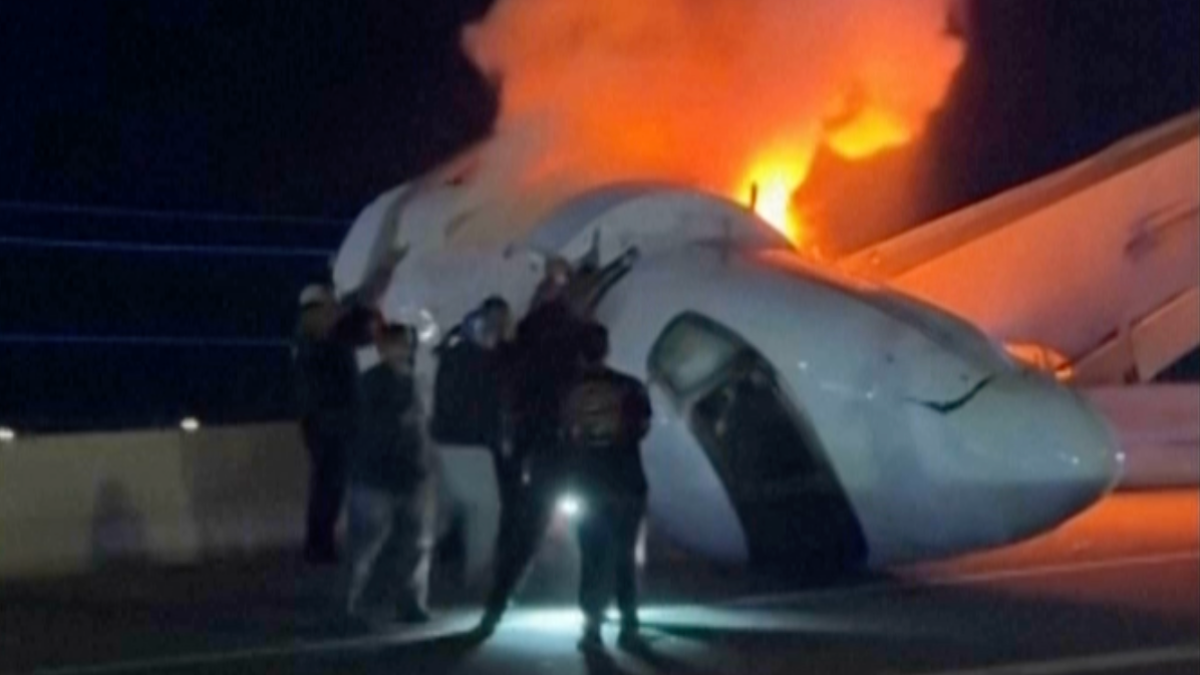
A small plane crashed onto a highway in Laredo, Texas. Witnesses rushed to rescue passengers trapped inside the burning aircraft. Five people survived and one was reported killed.
Published On 17 Jun 202617 Jun 2026
Share

TINA Daheley’s BBC Radio 2 Breakfast Show replacement has been revealed just a day after she announced she’s quitting.
The newsreader has spent nearly eight years on the programme and was dubbed former host Scott Mills’ “work wife”, but now she’s moving on.
Filling her sizeable shoes is journalist Matt Carter, and he can’t wait to get going.
Writing on Instagram, he said: “Thrilled to finally be able to spill the beans and tell you I’ll be joining a stellar cast of @djsaracox, @theelliebrennan and the fantastic prod team as your newsreader on the NEW breakfast show next month! Big (and very stylish) shoes to fill – wish me luck…
“See you on the 6th!”
The news was well received by listeners and station legends.
Zoe Ball said: “Fantastic news Matthew [heart].”
While OJ Borg posted: “Mate this is wicked! You were wicked when we did breakfast together.”
Tina, 45, told how the role had been “one of the greatest privileges of my life” and admitted it was “humbling” to “deliver the biggest breakfast show in Europe”.
She then made the reveal she is staying in the Radio 2 fold and on Jeremy Vine‘s 12-2pm show over summer.
In an emotional statement, she wrote: “After more than seven years of early alarm calls on Radio 2, I’m stepping away from Radio 2 breakfast.
“It’s been one of the greatest privileges of my life to wake up with you every morning, and humbling to have been trusted to deliver the news on the biggest breakfast show in Europe.”
Tina went on to reminisce about her time with the BBC and said: “My breakfast run ends on Radio 2 but it all started on 1Xtra where I landed my dream job reading the news on Trevor Nelson’s Breakfast Show.
“From there, I spent a decade broadcasting to one in four young people in the UK on Radio 1.
“After 18 years and six back to back breakfast shows (probably a record) in there somewhere, I am looking forward to a lie in”.
Tina, who began her BBC radio career on Trevor Nelson’s show, reads the early-morning news and contributes to lively discussions.
Earlier this year, she went “missing” amid an “awful week” after being struck down by illness.

SCOTT Mills has been sacked from BBC Radio 2 – yet what’s happening?
She was absent at the same time as her former co-host Scott was pulled off-air.
It was revealed earlier this year that fan-favourite host Scott, 53, had been fired from his Radio 2 Breakfast Show over allegations surrounding his “personal conduct“.
Scott was dismissed after new information about a police investigation about alleged sex offences with a boy aged under 16 in 2018 came to light at the BBC.
As well as losing his role on Radio 2, Mills was also sacked from working on the BBC’s Eurovision coverage and from a new podcast spin off from Race Across The World, which he won the celebrity series of in 2024.
It was revealed shortly afterwards that Sara Cox would take over the sought after Breakfast Show slot earlier this year, with insiders saying the talented star was seen as the “heir apparent” for the job.

Emanuel M Schwermer/DigitalVision via Getty Images


The place you want to retire may be about to change(Image: Getty)
While you might be drawn to these sunny spots for a holiday, have you ever considered they could be the perfect place to spend your retirement?
As Brits approach retirement age, plenty contemplate purchasing a property in well-loved retirement havens such as Spain and France, but there are warmer, more affordable locations that could offer greater advantages, according to the latest figures.
The Expatriate Group, a specialist provider of international health insurance serving expats and retirees globally, has published The Retirement Abroad Index for 2026. The study assessed 20 countries, evaluating them across five crucial categories, including healthcare, visa accessibility, health insurance requirements, cost of living, and community and integration.
Drawing from these essential factors, it’s evident which destinations emerged as frontrunners for retirees and which have fallen in the rankings, with some surprising contenders.
Lee Gerry, director of Expatriate Group, said: “Retiring abroad has never been more achievable, but the decisions that matter most – healthcare access, visa routes, and the reality of day-to-day costs – are often the least well understood.”
“This index is designed to cut through the noise and give people an honest, data-led picture of where the real opportunities are.”
The top destination for retirement, according to the index, was the Philippines, with a Special Resident Retiree’s Visa that ranks among the most accessible globally. It requires a fixed deposit of roughly £11,000 for those receiving a pension.
What’s more, it achieved impressive marks for affordability and anticipated integration, which, combined with its tranquil beaches and stunning scenery, makes it an idyllic spot to enjoy your retirement years.
The second choice is perhaps less of a shock, as it’s certainly more familiar to Brits, though still not typically considered the top pick: Thailand.
The nation boasts several well-established and vibrant cities, each providing a flavour of its rich culture, but most prominently, Bangkok, Chiang Mai and Phuket all feature internationally recognised private hospital networks.
Thailand secured a perfect 20 out of 20 on the scoring index, excelling in the healthcare category alongside Spain and France. Regarding visas, their Non-Immigrant O-A Visa demands coverage of at least $100,000, approximately £74,000, per policy, per year, as a visa requirement.
The third country, which may surprise some retirees, is Colombia, offering one of the most straightforward retirement visa routes among the 20 destinations and, remarkably, achieving a cost of living score of 18 out of 20.
According to their findings, the report indicates a retired couple can generally enjoy a comfortable lifestyle in Medellín, the capital of Colombia, on roughly £1,000 to £1,500 per month. In contrast to most British cities, it boasts reliably warm weather and possesses a lively atmosphere that’s difficult to match elsewhere.
Portugal emerged as the first European nation to feature on the list as an ideal spot to spend your golden years, claiming fourth place. Joint fifth went to Sri Lanka and South Africa, while Malaysia and the UAE shared sixth position, before Mexico secured a solid seventh spot.
While Spain continues to be among the most favoured destinations for British retirees, it didn’t appear until eighth on the list, achieving 18 out of 20 for healthcare, though it was let down by the cost of living and visa complications.
It also shares eighth place with Indonesia, which is cherished for its relaxed way of life and renowned for its strong emphasis on wellness culture. Packed with stunning beaches and particularly attracting visitors to Bali, it has climbed to the top of countless people’s bucket lists as a must-visit destination.
Coming in at number nine is Panama, followed by Qatar. Panama has made headlines in recent years for its ‘Pensionado’ programme, which offers a generous range of discounts designed to make retirement far more affordable.
The scheme also requires retirees to demonstrate a lifetime income of just £738 or so per month, with an extra £184 for each dependant.
Due to several countries sharing identical scores, the top 10 is actually made up of 13 nations in total. These are:
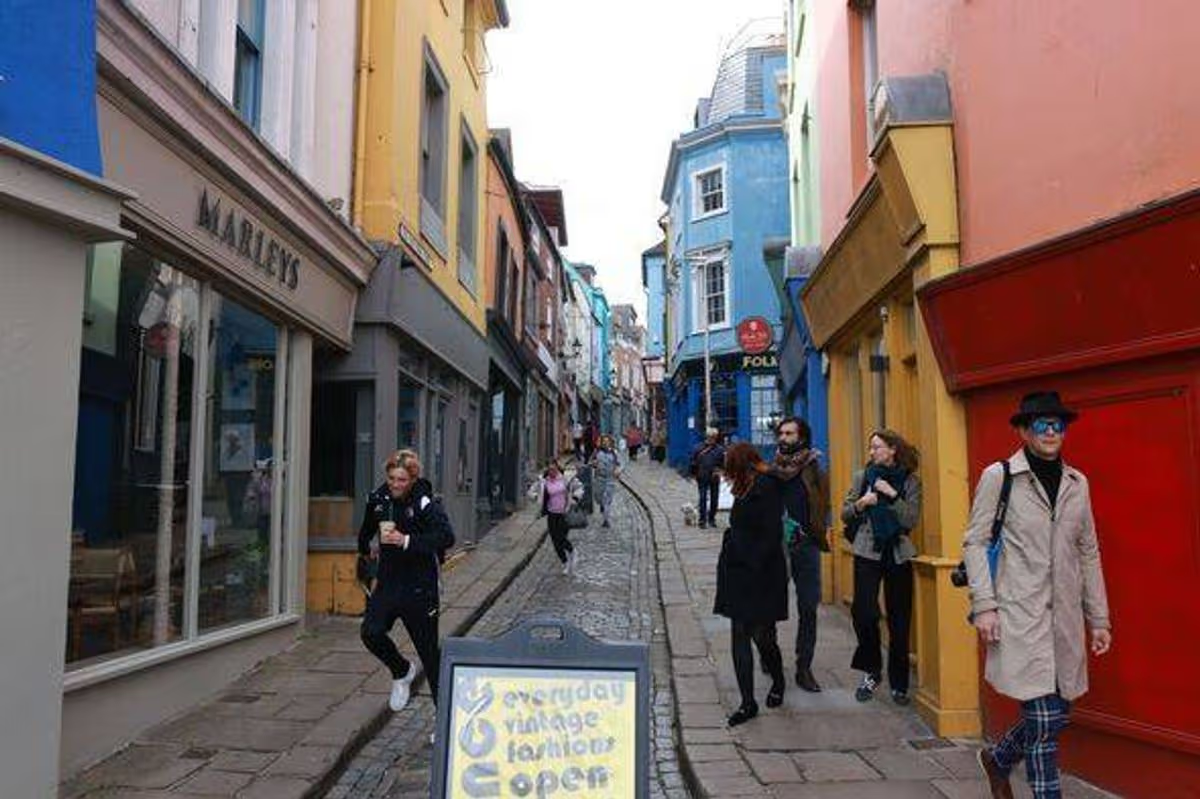

Folkestone has been transformed from being derelict to trendy(Image: Tim Merry )
Thanks to the arrival of the long-awaited King Charles III Coastal Path, the UK’s coastline can now be walked in its entirety, and many are setting their sights on its stunning seaside towns to experience it all this summer.
According to Time Out, this is one of the must-visit destinations in 2026, and with an abundance of attractions set against a stunning seaside setting, it’s not difficult to understand why.
Outshining the likes of its well-known neighbours such as Margate, Whitstable and Brighton, Folkestone has carved out a reputation as a rewarding coastal escape for a picture-perfect break. Situated on the southern fringe of the North Downs, tucked into a valley between two cliffs, lies the historic town, overflowing with offbeat character.
With greater incentive than ever to forgo the flights and discover the UK coastline, Folkstone makes an excellent starting point, coming in at number four on the list of seaside destinations.
At the centre of this town lies a thriving cultural hub, overseen by the arts charity Creative Folkestone. Its mission has led to the restoration of more than 90 buildings, now home to a wealth of independent studios, cafes and businesses all rooted in creativity, which permeates the entire town.
Awash with colour, it’s this quarter, comprising winding and meandering streets, that makes Folkestone stand out as a destination. The rainbow-hued painted shopfronts and flourishing independent businesses are what distinguish it and make it immediately identifiable from a single photograph.
On visiting for the first time, one guest wrote on TripAdvisor: “Today was my first visit to Folkestone, and we wanted to visit the Creative Quarter. Was not disappointed.
“Fabulous sunny day, helps, of course. Cobble streets and set on a hill. So might not be great for some. Wonderful galleries and fabulous eateries. Quirky shops and friendly people. I will visit again.”
Visitors could easily find themselves whiling away hours browsing in and out of shops, picking up unique souvenirs, books, homeware and artwork.
Steeped in history and buzzing with events throughout the week, the Harbour Arm is a true centrepiece of Folkestone. Once serving as the railway terminal for the Folkestone-Boulogne Ferry and a departure point for troops heading to the Western Front, it has since been transformed into a stunning setting for drinks, food and live entertainment with family and friends.
The picturesque promenade, stretching out towards the sea, is home to more than 70 independent food, drink and retail vendors, meaning visitors are genuinely spoilt for choice. If there’s one thing that rings true about Folkestone, it’s the town’s wholehearted dedication to championing local businesses throughout every corner of its tourist offering.
One impressed visitor shared: “Folkestone Harbour Arm has been transformed into a remarkable destination – a vibrant blend of artistic flair, seaside heritage, and excellent food.
“We thoroughly enjoyed the wonderful walk to the lighthouse, passing a compact market area and plenty of great food stalls. The fresh sea air and creative atmosphere made it a joy.”
Folkestone boasts several sandy bays and pebble beaches, but one in particular has earned a reputation as a firm favourite with visitors, and tends to get packed out during the warmer summer months.
Nestled by the harbour is Sunny Sands, the go-to beach for many, thanks to its soft sands perfect for sandcastle building and sunbathing, plus its convenient location near the heart of the town.
According to visitors, while it suits everyone, it’s ” especially great for children”, owing to its well-maintained facilities and opportunities for water sports. What’s more, this is among the nearest beaches to London, less than an hour’s journey from the capital, making it a popular choice for Londoners craving a breath of seaside air.
Adding to its appeal is the parking available directly beside the beach at the Harbour Arm Car Park, though expect it to fill up rapidly during peak tourist season.
One visitor summed it up simply, saying: “Beautiful beach, lovely day out. fabulous views and scenery. Great for all ages. Lots to see and do. Very clean beach, worth a visit.”


You can upgrade to a swim-up room and enjoy the pool on your doorstep(Image: Stella Island)
If you’ve dreamed of soaking up the sun in an overwater bungalow or swim-up room, then the good news is that you no longer need a long-haul flight to enjoy an island paradise.
Just a four-hour flight from the UK, Stella Island Luxury Resort & Spa could easily be found on a tiny island in the middle of the Indian Ocean. But it’s actually set in the north of Crete, sitting on a long stretch of beach on the sparkling Med. This vast, adults-only resort has a lagoon that meanders through the mega-resort, which is so large that there’s a fleet of golf carts to zip guests around.
But the lagoon is just the start of the watery fun. There are eight pools in total, most of them outdoors, and you’ll find plenty of spots with wooden decking and sunbeds set up for those relaxing days by the water enjoying the Greek sunshine.
Opt for a swim-up room and your accommodation will be set directly on the edge of the lagoon pool, meaning you can swim your way around the resort. There’s no need to find a sunbed in the morning; you can simply relax on your private deck from the moment you get up until bedtime if you want to.
If you don’t feel like walking to the vast breakfast buffet, you can get it delivered right to your door by a mermaid. Nothing quite beats having your morning coffee and a selection of fresh pastries and fruit delivered on a vast floating tray by a mythical creature.
Prices at the hotel tend to compare favourably with luxury Maldives resorts. Outside of peak season, standard rooms with a pool view start at £257 a night based on two sharing on a half-board basis. Overwater nests start at £434 per night for half-board, or £547 for all-inclusive, if you book directly with the hotel.
You can also book the Stella Island Luxury Resort & Spa as a package with TUI or other holiday operators. Deals with TUI include a 7-night break for two, departing October 29 from London Gatwick including easyJet flights and a sharing a double luxury room on a half-board basis. This is currently priced at £1235.97 per person, and if you’d like to upgrade to all-inclusive this is an extra £342 per person for the week.
Stella Island is set in the Analipsi area of Crete, a traditional seaside village with cosy tavernas, mountain scenery and Cretan archaeological sites. If you prefer more lively vibes, Hersonissos is just a short drive away, where you’ll find sandy coves, waterparks, museums, and lots of fun days out.
There are also other accommodation options in the area, such as the NEMA Design Hotel & Spa, a modern, adult-only resort that has rooms with private jacuzzis or pools and a restaurant serving elevated Crete cuisine. Those bringing older kids could also consider Lyttos Mare, a premium all-inclusive that caters to guests over 12 years old, and has room options with private pools.
Have a story you want to share? Email us at webtravel@reachplc.com
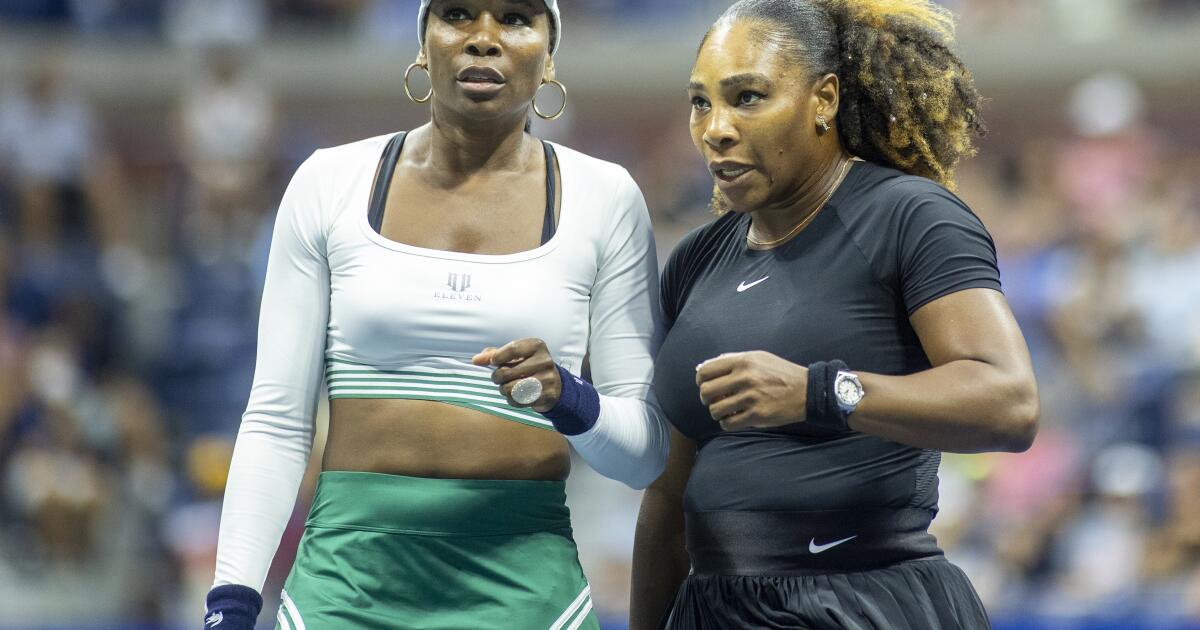
A duo for the ages is convening once again.
The Williams sisters — Venus, 45, and Serena, 44 — will bring back their doubles partnership at Wimbledon in under two weeks. The All England Club announced the doubles wild card invitation on Tuesday.
Should they win for a record seventh time, the Williams sisters would make history as the oldest Grand Slam-winning doubles combo by nearly 16 years.
The record of 74 years and 303 days is held by Hsieh Su-wei and Barbora Strýcová, who won at Wimbledon in 2023. Venus will turn 46 on Wednesday and Serena will be 45 on Sept. 26, putting their combined age by the tournament’s end at 90 years and roughly 290 days.
The Williams sisters have won six doubles titles together at Wimbledon, most recently in 2016 with the first coming in 2000. They have won 14 Grand Slam doubles titles together, the second most by any women’s team in the Open Era behind the 20 won by Martina Navratilova and Pam Shriver.
Serena recently returned to competition after almost four years away from professional tennis. She will compete in the Berlin Open doubles alongside world No. 10 singles player Karolína Muchová on Tuesday against Erin Routliffe and Giuliana Olmos.
The initial tournament in Serena’s comeback was abbreviated. Her playing partner, Canadian teenager Victoria Mboko, suffered a knee injury that ended their effort at the Queen’s Club Championship after one match, a 7-6(2), 6-2 victory over No. 3 seeds Erin Routliffe and Nicole Melichar-Martinez.
Venus, who will turn 46 on Wednesday, is in the midst of her record 33rd consecutive WTA season. She has been eliminated in the first round of singles at several tournaments while faring better in doubles.
The pairing at Wimbledon will be the first since 2022 for the Williams sisters. Serena took a long hiatus beginning that year and gave birth in 2023 to her second child, Adira River Ohanian.
Many of the sisters’ career highlights have come at Wimbledon. Serena has 14 titles on the hallowed grass court — six in doubles, one mixed doubles and seven in singles. Venus Williams has won 11 Wimbledon titles — five in singles and six in doubles.
Neither Williams sister is slated to play singles in this year’s tournament, although one women’s singles wild card has not been allocated.

US drivers may have to wait until 2027 for gasoline prices to fall below 79 cents per litre, according to Patrick De Haan, Head of Petroleum Analysis at GasBuddy. He says global oil inventories could take more than a year to recover from disruptions linked to the war on Iran.
Published On 17 Jun 202617 Jun 2026
Share

The 2026 World Cup will have 13 different kickoff times. You can use the Al Jazeera Sport widget to find out exactly when your team is playing in your local time.
Who: England vs Croatia
What: FIFA World Cup 2026 Group L match
Where: AT&T Stadium, Dallas, Texas
When: Wednesday, 3pm local time (20:00 GMT)
How to follow: We’ll have all the build-up on Al Jazeera Sport from 17:00 GMT in advance of our live text commentary stream.
list of 4 itemsend of list
Chants of “It’s Coming Home” will ring around parts of England on Wednesday as the European heavyweights begin their 2026 World Cup title bid with a test against familiar foes, Croatia.
It has been 60 years since England were last crowned world champions, but they are genuine contenders for the title this year.
While coach Thomas Tuchel’s squad selection divided fan opinion in the run-up to their journey to North America, bookmakers still believe this crop of English talent, headlined by Harry Kane, can achieve a deep run in the tournament.
Their first hurdle, though, is a challenging one.
Once labelled underdogs, Croatia have grown into one of international football’s most consistent tournament performers, finishing as World Cup runners-up in 2018 and earning third place at the last edition, in 2022, as well as 1998.
Their 40-year-old captain Luka Modric may well be heading into his last tournament, but he remains the heartbeat of the team, and as has been the case for years, Croatia pose a threat under his leadership.
Al Jazeera tells you everything you need to know about England vs Croatia:
After a string of near-misses at recent European Championships and World Cups, England head into the 2026 tournament chasing their first world title since 1966.
They are led by captain Kane, who has arrived in North America in some of the best form of his career, and fresh off the high of lifting his second Bundesliga title with Bayern Munich.
“For sure, it’s one of the best opportunities we will have as a team to win it,” Kane told reporters, talking about England’s odds of winning the tournament.
“I think everyone is eager to just start well and prove that we have the capabilities of going far in this tournament.”

The 32-year-old has urged his team, who had a 100 percent record in the qualifiers, to “go for it” and be “free in the mind” when they launch their World Cup title charge in Texas.
Tuchel, too, knows the expectations from fans are high, with England among the top contenders in the 48-team tournament.
Their best run in recent times has been reaching the semifinals in 2018, while their last campaign ended in the quarterfinals in 2022 – both under former manager Gareth Southgate.
“We have a right to dream, but we don’t want to be delusional,” Tuchel has said.
Croatia’s head coach Zlatko Dalic has warned his team to be wary of goal-scoring machine Kane, who netted a whopping 61 times in 51 matches in all competitions for Bayern Munich last season.
“They have the best striker in the world, they have Kane, and Kane can do a hell of a lot,” said Dalic. “We will do a lot, we will do our best not only to defend ourselves but to attack, to go forward.
“There will be set pieces, which will be quite difficult, but we are prepared for that. I expect a great game, and it will be great preparation for the next two games in the group.”
Just as Kane is central to England’s hopes of a deep run, veteran Modric is crucial to Croatia’s World Cup dreams. After playing a key role in Croatia’s previous World Cup campaigns, Modric is set for his fifth and possibly final appearance.

The ageing midfielder, also the Balkan nation’s captain, still enjoys a hero’s status among a side that has often defied expectations on the global stage. And by Dalic’s own admission, the team still relies heavily on him, not least for his playmaking prowess.
“He means a lot, both as a captain of our team and as a person,” Dalic said of Modric, ahead of his 199th appearance for the team.
“He is my right hand on the pitch.
“It means a lot to the team that we have a couple of older players alongside Luka who are leading the younger players, and they can do very good things,” Dalic added.
“They are very lucky to have him, Luka, as a role model in how to fight for the national team jersey, and we’re lucky to still have him with us.”
Stats provider Opta’s supercomputer has handed England a 55.9 percent probability of winning against Croatia, who have a 20.8 percent chance of winning. There is a 23.3 percent probability of a draw.
Overall, England are fourth in the list of title favourites – with a 10.02 percent probability – behind Spain, France and Argentina.
In the United Kingdom, England vs Croatia kicks off at 9pm BST and will be shown on STV, STV Player, ITV1 and ITVX.
For fans in Croatia, the match is scheduled for 10pm and will be shown on HRT.
In the United States, viewers can tune into FOX One, Telemundo App, Telemundo Network, FOX and Peacock.
To check the TV listings for your country, head to FIFA’s TV listing schedule here.

England, Croatia, Ghana and Panama are in Group L.
The top two teams from each of the 12 groups – along with the eight best third-placed teams – proceed to the next phase, the round of 32, which has been introduced at the World Cup for the first time.
(Last five games, latest first)
England: W-W-L-D-W
Croatia: W-L-L-W-W
England have a slightly better record than Croatia in their last five matches. Both teams have won three games each, but England lost and drew the other two, while Croatia suffered defeats in both games.
England won against Costa Rica and New Zealand in pre-World Cup friendlies earlier this month, but lost to Japan in an unexpected result in late March. Before that, they drew with Uruguay in a friendly and beat Albania in a World Cup qualifier.
Croatia won against Slovakia but fell to Belgium in their World Cup warm-up matches, while also losing to Brazil in a friendly in late March. But before that, they beat Colombia in a friendly and won against Montenegro in a World Cup qualifier.
Wednesday will be the 12th meeting between the two sides, with England holding a big advantage over Croatia in their head-to-head record.
England have won six times against Croatia, who have won three times. Two matches ended in a draw.
They have met at the World Cup three times before, with England losing their last tournament encounter 2-1 at the 2018 World Cup semifinal in Moscow.

On Tuesday, England defender Tino Livramento was ruled out of the tournament after suffering a calf injury and was replaced by Trevoh Chalobah. The Newcastle United right-back sustained the injury during a training session at the team’s Kansas City base on Sunday.
No injury concerns in the Croatia camp.
(4-2-3-1): Pickford; James, Konsa, Guehi, O’Reilly; Anderson, Rice; Saka, Bellingham, Gordon; Kane
(4-2-3-1): Livakovic; Stanisic, Sutalo, Vuskovic, Gvardiol; Modric, Kovacic; Pasalic, Kramaric, Perisic; Budimir

Corey Feldman was rushed to an L.A. hospital after his plane arrived at Los Angeles International Airport on Monday.
The “Stand by Me” star, 54, started feeling unwell on his flight from Chicago to Los Angeles and was met by medical professionals at his gate. A doctor happened to be on board and checked on the former child star while in the air, but it was unclear what the issue was.
Doctors at a Los Angeles hospital were able to rule out gallstones, and on Tuesday, a representative for the “Goonies” star told The Times that they cracked the case, and Feldman is on the mend.
“Corey is doing much better and is now out of the hospital,” a rep for the actor and singer said. “They determined it was a really bad case of food poisoning (which no one ever wants to have on a plane!). Corey wants to thank everyone for all of the love and well wishes. He has definitely seen a lot of the messages and really appreciates everything.”
As for what soured Feldman’s stomach, his rep said, “Corey is vegetarian so I can definitely confirm it was not shrimp!”
Feldman was in Chicago to participate in a 40th anniversary celebration of the 1986 classic “Stand by Me,” one of the earlier films that put Feldman on the map as a young actor. He appeared at anniversary events alongside co-stars Jerry O’Connell and Wil Wheaton.
Feldman is dropping the single “What Am I Here 4” on Monday and is slated to perform two birthday shows, on July 25 at the Arrow Room in Rancho Cucamonga and on July 26 at the Garden Amp in Garden Grove.

CFOs lag on the AI curve, risking the growth and value creation they want, EY warns.
CFOs are sitting on a goldmine of tech potential—but most aren’t ready to dig in. That’s the major takeaway from a new Ernst & Young survey titled the DNA of the CFO.
Finance chiefs want to make investment decisions and create value. Yet, the majority of these bosses remain constrained by skills gaps, limited AI readiness and outdated measurement frameworks.
The London-based accounting firm sourced responses from more than 1,600 CFOs and senior finance leaders across 28 countries and 22 industries. The consensus shows a widening gap between CFO ambition and actually getting the job done.
“While CFO ambitions are clear, there’s quite a gap when it comes to execution,” Myles Corson, EY Global Strategy and Markets Leader for Financial Accounting Advisory Services, told Global Finance.
Consider the numbers: 60% of CFOs wish to lead on value creation, but only about a quarter currently guide value-creation discussions or make key investment decisions.
Another finding from the EY CFO survey reinforces that disconnect: Only 27% of respondents say their organizations view finance as a key partner in value creation.
“Organizations that treat finance as a key partner have a common trait: their finance functions demonstrate insight beyond the ‘comfort zone’ of financial performance,” Corson said. “They are also more actively involved in decisions—and it’s this that builds their reputation as valuable business partners.”
A majority of respondents (68%) also say the definition of enterprise value needs to change. This reflects frustration with traditional metrics that fail to capture newer sources of growth. Nearly half (49%) say conventional measurement tools cannot adequately reflect value created by technology, data and long-term investments, while half (50%) cite difficulty in demonstrating upfront returns on investment.
The report also points to significant barriers in AI adoption across finance functions. Only 21% of CFOs say their organization’s AI readiness is “leading” or “advanced,” while fewer than 15% describe their teams as highly adaptable or confident using new technologies. Less than half of CFOs see strong AI potential in areas such as data analysis (49%), growth forecasting (45%), and dynamic pricing (41%).
However, confidence rises sharply among those further along the maturity curve: 71% of CFOs who describe their organizations as fully AI-ready say the technology can meaningfully support growth forecasting.
Finance teams continue to face structural hurdles in scaling AI, with 61% citing poor data quality, 51% struggling to articulate AI’s benefits clearly, and 50% reporting insufficient skills or capacity to use the technology fully.
The survey also highlights talent pool challenges within finance organizations. About 38% of CFOs say they are evolving faster than their wider finance leadership teams, and 68% of CFOs say they require new leadership styles and skills to remain effective.
Just 12% of CFOs say their transformation outcomes exceeded expectations. Organizations with highly adaptable teams are three times more likely to achieve successful transformation outcomes, so leaders who foster a culture of adaptability and continuous learning are more likely to drive differentiated outcomes.
“For finance leaders, one of the key questions is: What is the right balance between specialist and generalist roles?” Corson said.
In the current high-tech environment of continuous change, generalists with broad experience are increasingly important.
“Finance leaders need to assess how to consistently develop broader skills, whether through rotations or other structured programs, including the opportunity to develop collaboration skills across functions,” Corson added. “Future finance leaders will need to be more than simply stronger technicians: they will need to demonstrate the skills of a complete enterprise leader—financial discipline, strategic thinking, technological fluency, and the ability to lead change.”
Contact the author: anoto@gfmag.com
Whenever Shohei Ohtani is questioned, it seems, he does something spectacular.
On Tuesday, with discussion still swirling over whether his knee problem from the week before would influence his two-way availability when he took the mound Wednesday, Ohtani broke open a scoreless standoff with a sixth-inning solo home run.
It held as the winning run, and the Dodgers went on to beat the Tampa Bay Rays 1-0.
“That’s just him,” Dodgers starting pitcher Justin Wrobleski said of Ohtani. “He’s obviously the best player of all time. I’m super lucky and blessed to be his teammate and watch him play. It’s been super cool.”
Up to that point, neither team’s starting pitcher had flinched.
Wrobleski had given up just three hits in six scoreless innings. And, along with five strikeouts, he hadn’t had more than one baserunner in any inning, squashing the scrappy Rays’ ability to manufacture a run.
Though the Dodgers had made more viable scoring threats against Rays starter Drew Rasmussen, they’d come up short for five innings.
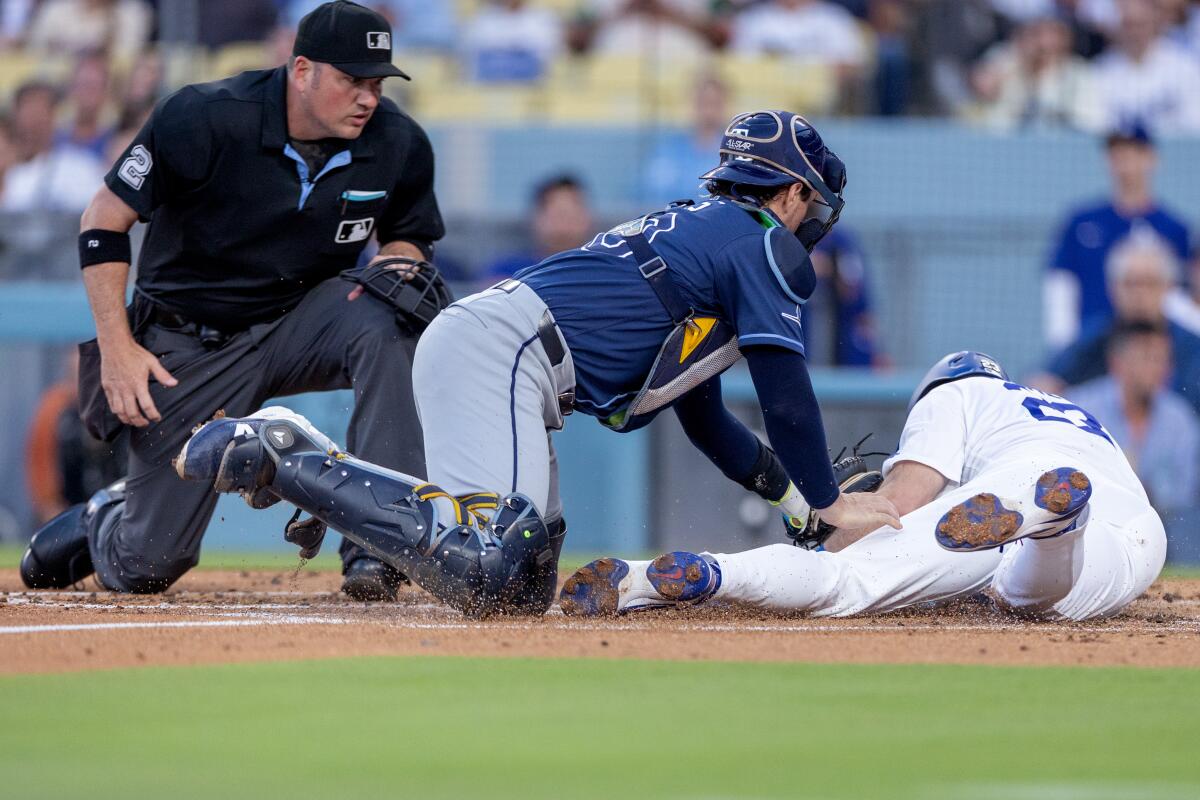
They came within a couple of feet of scoring in the second inning, but the Rays pulled off a trick play to throw out Kyle Tucker at home.

Rays catcher Nick Fortes tags out Kyle Tucker trying to score in the second inning.
(Eric Thayer / Los Angeles Times)
With runners on first and third, Alex Freeland laid down a bunt to Rasmussen. When he fielded it cleanly, Tucker shuffled back toward third base. But then Rasmussen turned and fired toward second base, and Tucker took off. Rays shortstop Taylor Ward cut off the throw in front of the base and cut down Tucker as he slid headfirst for the plate.
For the next three innings, the Dodgers (47-27) failed to reach base.
Then Ohtani happened.
Leading off the sixth inning, Ohtani pounced on a cutter that drifted toward the heart of the plate.
He launched it to straightaway center field, where it bounced on the netting beyond the fence.
Rasmussen lasted through the seventh inning, leaving that home run as the only blemish on his outing. Then the two bullpens duked it out to a draw in the late innings.

Justin Wrobleski pitched six scoreless innings.
(Eric Thayer / Los Angeles Times)
Ohtani’s home run stood alone.
It was his fifth home run in nine games, bringing his season total to 14.
After a slow start, by his standards, Ohtani lamented his lack of power. Now, with the second-highest on-base-plus-slugging percentage in the National League (.966), just barely trailing the Washington Nationals’ James Wood (.967), Ohtani has that going for him too.
“He was hitting the ball hard, some doubles, singles,” manager Dave Roberts said. “And if he was just missing a little bit [before], there was going to be slug. So that’s what’s happening. Seeing the baseball well. Swinging at good pitches. And when he uses the big part of the field, there’s just no one better.”
The home run Tuesday, however, was not enough to claim a spot in the batting order Wednesday. Not in an extra-early 12:10 p.m. game. Not just days removed from a bout of inflammation in his left knee.
Before the game, Ohtani threw off a mound to test his knee before his scheduled pitching start the next day. It went well enough that he’ll be taking the mound, Roberts confirmed Tuesday night. But he will not be hitting.
Roberts will keep a close eye on Ohtani, who left the game last Thursday with a swollen knee and then sat out Friday. Ohtani theorized over the weekend that issues with his pitching mechanics may have aggravated his knee.
Said Roberts: “He wouldn’t start if we felt that we were going to put him in harm’s way.”
In retrospect, it’s clear to right-hander Tyler Glasnow that he tried to start throwing a little too quickly after back spasms pulled him out of his start against the Houston Astros on May 6. But at the time of the injury, Glasnow, who is no stranger to back problems, was encouraged.
“It didn’t feel as bad when I first did it,” Glasnow told The Times on Tuesday.
Nearly a month and a half later, Glasnow has twice tried to restart throwing, and twice he’s had to shut it down.
“Frustrating, for sure,” Glasnow said. “Just because it happens so frequently. A lot of times I just want to find a way to address the underlying issues of why it happens.”
He has yet to find that long-term solution, but he does not expect to have surgery.
Glasnow, encouraged by his recent improvement, expects to start throwing again “soon.”
“We’re just waiting for it to be fully, fully healed,” he said.
As expected, the Dodgers activated Tommy Edman (right ankle surgery) off the injured list Tuesday and designated utility man Santiago Espinal for assignment.
Edman didn’t make his season debut, but Roberts said he’ll play a mixture of second base, third and left field, with his playing time dictated by factors such as pitcher matchups and the availability of left fielder Teoscar Hernández’s (strained left hamstring), who’s still on the IL.
07:20, 17 Jun 2026Updated 07:20, 17 Jun 2026

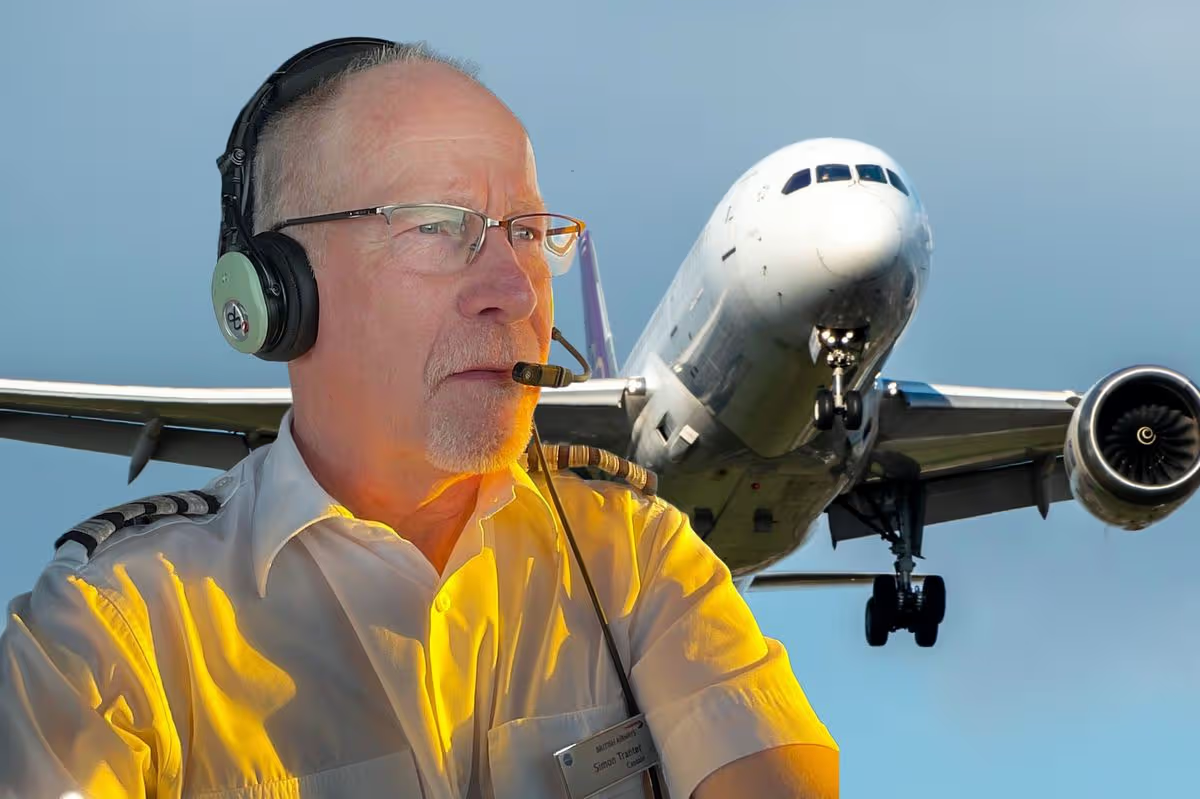
I hate flying — I asked a pilot all the questions nervous flyers need answered(Image: Simon Tranter/Getty)
Flying fills me with dread, meaning every holiday is a rollercoaster of anticipation and anxiety. Aviophobia, or fear of flying, is remarkably widespread and, for those of us who suffer from it, likely stems from the same fundamental issue — our brains struggling to cope with an environment where we feel utterly powerless. Chances are we’re all asking the same questions:.
Sound familiar? Sadly, while anyone can turn to Reddit or Facebook for tips from fellow nervous passengers, very few of us ever get the chance to quiz the real experts — the pilots themselves. Fortunately, I managed to put my questions to Simon Tranter, a pilot with 18,000 flight hours spanning a 17-year career in the Royal Air Force and 25 years as a commercial pilot at British Airways who is now head of training at EmPower Flight, reports the Express.
I also had the opportunity to speak with Dan Bubb, a former commercial pilot who currently teaches aviation courses at the University of Nevada, Las Vegas.
“In the aviation world, the price for your ticket dictates your legroom and whether you get a free sandwich – it has zero bearing on safety,” said Simon. “Every single airline operating in our skies must adhere to the exact same stringent regulatory laws and safety standards. Budget airlines actually tend to fly younger fleets of aircraft, which means they are equipped with the newest safety technology. They save money on business models, not on maintenance or pilot training.”
Dan continued: “Budget airlines are just as safe as safe as more expensive airlines. Even though the pay scale is different, all airline pilots are trained and held to the same rigorous standard whether they fly a 15-passenger Beech 99 or a 400-passenger Boeing 747.”
“Aircraft are engineered to withstand forces far greater than anything nature can throw at them,” Simon explained.
“Higher levels of turbulence can be uncomfortable for the pilots, crew and passengers, but generally the most turbulence will affect a flight is intermittent and rather like driving slowly over cobblestones. Most importantly, if you don’t have your seatbelt fastened, a sudden turbulent bump can cause you to spill your drink – that’s one of the main reasons we ask you to buckle up.”
“It is physically impossible for a passenger to open the plane door because aircraft doors are designed as ‘plug doors’,” Simon stated. “Due to the air pressure inside the cabin being much higher than the thin air outside at 35,000 feet, the cabin pressure effectively seals the door shut with thousands of pounds of force. You could get the strongest person on Earth, give them a crowbar, and they still couldn’t open that door while we are in flight.”
Dan added: “In the past, we have seen passengers try to open the door, but they were unsuccessful.”
Dan explained: “Cabin crew are trained to handle emergencies with calm and discretion to avoid alarming passengers. Even though the situation might be stressful, pilots and flight attendants are trained to remain calm and keep passengers calm.”
Simon added: “Cabin crew are primarily safety professionals and they undergo rigorous, regular emergency training. If you look at a crew member and they look calm, it’s because they are in control of the situation.”
“This is something we practice to perfection in flight simulators,” Simon said. “Aircraft have multiple backup systems to get the wheels down. If the main hydraulic system fails, we can use an alternate system, or even let gravity ‘free-fall’ the gear into place where it locks automatically. In the extremely rare event that the gear completely jams, planes are designed to land safely on their bellies. Fire crews might decide to foam the runway, and the aircraft slides to a halt. It makes for a dramatic news headline, but it is entirely survivable.”
“Modern airliners are built with massive amounts of redundancy,” said Simon. “If one engine fails, the aircraft is completely capable of climbing, cruising and landing safely on the remaining engine. Even if both engines were to fail (which is virtually unheard of), a plane does not suddenly drop but instead becomes a very large glider. From a normal cruising altitude, an airliner can glide for about 80 to 100 miles, giving us plenty of time to head for a safe runway and to re-start the engines in the glide.”
Dan revealed he has actually witnessed an engine failure mid-flight – it occurred during take-off while transporting passengers to the Grand Canyon: “We shut down the failed engine, declared an emergency and landed on the single, good engine without any problem.”
“Statistically, you are far safer in a commercial airliner than you are walking down the pavement or driving to the supermarket,” said Simon. “The International Air Transport Association (IATA) say there is ‘one fatal accident for every 5.6 million flights (2021-2025)’. You’d have to fly every single day for thousands of years to statistically encounter an accident.”
Dan explained: “Given the rigorous training through which pilots have to do, the chance of a commercial passenger plane crashing is slim. As a colleague of mine likes to say, you have much higher chances of getting into a car accident on your way to the airport than in a commercial passenger plane.”
“The technical reason is that older phones used to occasionally cause a harmless but annoying ‘click-click-buzz’ sound in the pilots’ headsets, similar to putting a mobile phone right next to an old audio speaker,” Simon revealed.
“The real-world reason is that take-off and landing are the most dynamic parts of the flight. We need you alert and not looking at a screen, in case we need to give you important instructions.”
Dan supported this, stating: “Take-off and landing are the most critical phases of flight, which is why flight attendants are adamant about enforcing this regulation.”
“No,” Simon stated. “The windows you see are made of incredibly tough, multi-layered aerospace acrylic, not household glass. They can easily withstand immense pressure and impact. If an outer pane were to crack, the inner layers are more than strong enough to hold the cabin pressure perfectly.”
Meanwhile, Dan also noted it would be “difficult for a passenger to break a window”, but referenced a harrowing 2018 incident in which a window shattered, apparently as a result of an exploding engine, tragically claiming the life of a woman who was partially sucked out.
“We don’t fly through severe storms,” said Simon. “Our onboard weather radar allows us to see them miles in advance and simply steer around them. If a plane does happen to get struck by lightning, it’s surprisingly uneventful. The skin of the aircraft acts like a protective shield (a Faraday cage). The electricity strikes the plane, flows harmlessly along the outside skin and through specific lightning conductors, and leaves through the tail. Passengers might hear a loud crack or bang, but the aircraft systems are built to handle it effortlessly.”
In 2019, a plane landing in Cardiff Airport from Ibiza was hit by lightning and passengers reported a “huge bang”. The flight landed safely with no reported injuries.
“Most bird strikes happen at low altitudes, when the aircraft is at slower speeds near airports, and the vast majority of them are entirely harmless events”, said Simon. “Aircraft engines and structures are specifically designed and tested to ingest birds without catastrophic failure. As a precaution, if we suspect a bird strike, we will always make an assessment of any possible damage and let our engineers give the plane a thorough inspection.”
Nevertheless, Dan warned that bird strikes “can be very dangerous”, pointing to the famous incident where Captain Chelsey Sullenberger landed his US Airways Airbus on the Hudson River in New York City after a flock of Canadian geese struck and disabled both of the aircraft’s engines.
“We have a very strict, no-blame safety culture in aviation called fatigue reporting,” Simon explained. “If a pilot hasn’t slept well or feels unfit to fly for any reason, they simply log into the system and declare themselves unfit due to fatigue. The airline immediately calls in a standby pilot, no questions asked. There is absolutely no pressure to fly if you aren’t at 100%.”
“The computer — or autopilot in an aircraft — is like a highly sophisticated cruise control on a modern car,” Simon noted. “It’s an incredible tool that does the heavy lifting of flying the aircraft while the pilots are managing the busy flight.
“However, the computer only does what we tell it to do. We manually fly the aircraft during take-off and generally during the landing. The humans are always the ones making the strategic decisions. Occasionally, the autopilot will land the aircraft but this is only in situations of extreme fog when the aircraft is programmed by the pilots for an automatic landing and the airport is specifically authorised to apply the very special protections and safeguards needed for an ‘autoland’.”
“We have highly structured protocols whilst airborne to keep us engaged,” Simon explained. “We are constantly monitoring aircraft performance, the autopilot function, fuel logs, cross-checking weather reports and communicating with air traffic control. On ultra-long-haul flights, we carry an ‘augmented crew’ (three or four pilots total). This allows us to take turns sleeping in dedicated pilot bunk beds built into the aircraft, ensuring that the two pilots at the controls are always fresh and focused.”
“Not at all,” Simon responded. “In fact, at night the high-intensity lights of other aircraft and runways stand out perfectly against the dark background.”
“Not in civil flying, but yes as an RAF fighter pilot!” said Simon. “Furthermore, all commercial planes are fitted with a system called TCAS (Traffic Collision Avoidance System). It talks to other aircraft automatically and if another plane ever wandered even slightly too close, our cockpits would warn us and tell us exactly what manoeuvre to fly to stay completely safe.”
“It’s a rigorous journey,” Simon explained. “It starts with strict medical clearance, followed by months of ground school training where you learn everything from meteorology to aerodynamics. From there, you start in small, single-engine aircraft to master the basics, progress to twin-engine planes, and eventually step into full-flight simulators to learn the specifics of the jet you will be flying for the airline.
“After a pilot passes all their simulator checks, they step into the real cockpit with real passengers. However, they are not amateurs. They are already fully qualified commercial pilots. During this phase, they fly with a highly experienced training captain (someone like me) sitting next to them, guiding them through the real-world nuances of airline operations until they are completely polished.”
“Honestly, after many years flying fighter jets in the Royal Air Force and later as an airline captain, the thing that would raise my heart rate in commercial aviation is a very, very occasional turbulent and gusty crosswind landing towards the maximum crosswind component allowed,” said Simon.
“But in fairness, after 44 years as a professional pilot it’s not overly difficult, it’s simply a matter of following procedure. As our training is so intensive, when something unexpected does happen – like a sudden change in weather or a technical glitch – fear doesn’t enter the equation. Your brain instantly switches into ‘training mode’ and you calmly execute the checklist. It feels like just another busy day at the office.”
Meanwhile, Dan revealed his most terrifying moment in the cockpit came when an engine failed during take-off while carrying passengers to the Grand Canyon. Despite the harrowing ordeal, he recalled: “We shut down the failed engine, declared an emergency and landed on the single, good engine without any problem. Even though we appeared calm and collected, our adrenaline was pumping.”


June 17 (UPI) — Oklahoma voters have rejected raising the state’s nation-lowest minimum wage as several states held primaries on Tuesday.
The Sooner State sets its minimum at $7.25, the federal minimum wage floor, tying it with 19 other mostly Republican-led or -leaning states for the nation’s lowest. Oklahoma raised its minimum wage to $7.25 in 2009 to comply with federal law.
Voters were asked in State Question 832 whether Oklahoma employers must pay employees at least $15 per hour by 2029, putting the state above the median of $11.63 an hour but still below the highest-wage states.
However, voters rejected the move. Unofficial state results show that with 1,984 precincts reporting, 55.3% of voters said “no” to State Question 832, compared to 44.6% in favor of raising the minimum wage.
“Oklahomans sent a clear message: We can grow our economy, create opportunities and keep life affordable without one-size-fits-all mandates that make it harder for businesses to hire and grow,” Chad Warmington, State Chamber of Oklahoma president and CEO, said in a press release.
The initiative was championed by Raise the Wage Oklahoma, which had argued that raising the state’s minimum wage would ensure tens of thousands of workers are better paid while helping wages keep up with rising costs.
“Tonight did not go as we hoped,” the initiative said in a social media statement.
“But the fight doesn’t end here. Because a better Oklahoma is worth fighting for.”
Oklahoma voters also heavily backed Rep. Kevin Hern for the Republican nomination for the Senate seat held by Markwayne Mullin until March, when he was sworn in as secretary of Homeland Security, replacing Kristi Noem.
“Oklahomans deserve strong conservative leadership and a senator who will fight for your values,” he said on social media Tuesday night.
“I look forward to earning your support again in November and serving as your next United States senator!”
Unofficial state results show he secured 69.7% of the vote, with only one other candidate — Gary England — netting a double-digit vote share with 13.5%.
Hern will face the winner of the Aug. 25 Democratic runoff between N’Kiyla “Jasmine” Thomas and Jim Priest.
Meanwhile, the GOP gubernatorial primary appears to be heading to a runoff.
Nine Republican candidates vied for the governorship, but none surpassed the 50% threshold. Gentner Drummond had secured the highest number of votes with 26.26% of the vote share, followed by Mike Mazzei with nearly 26%. No other candidate broke 20%.
The TWZ Newsletter
Weekly insights and analysis on the latest developments in military technology, strategy, and foreign policy.
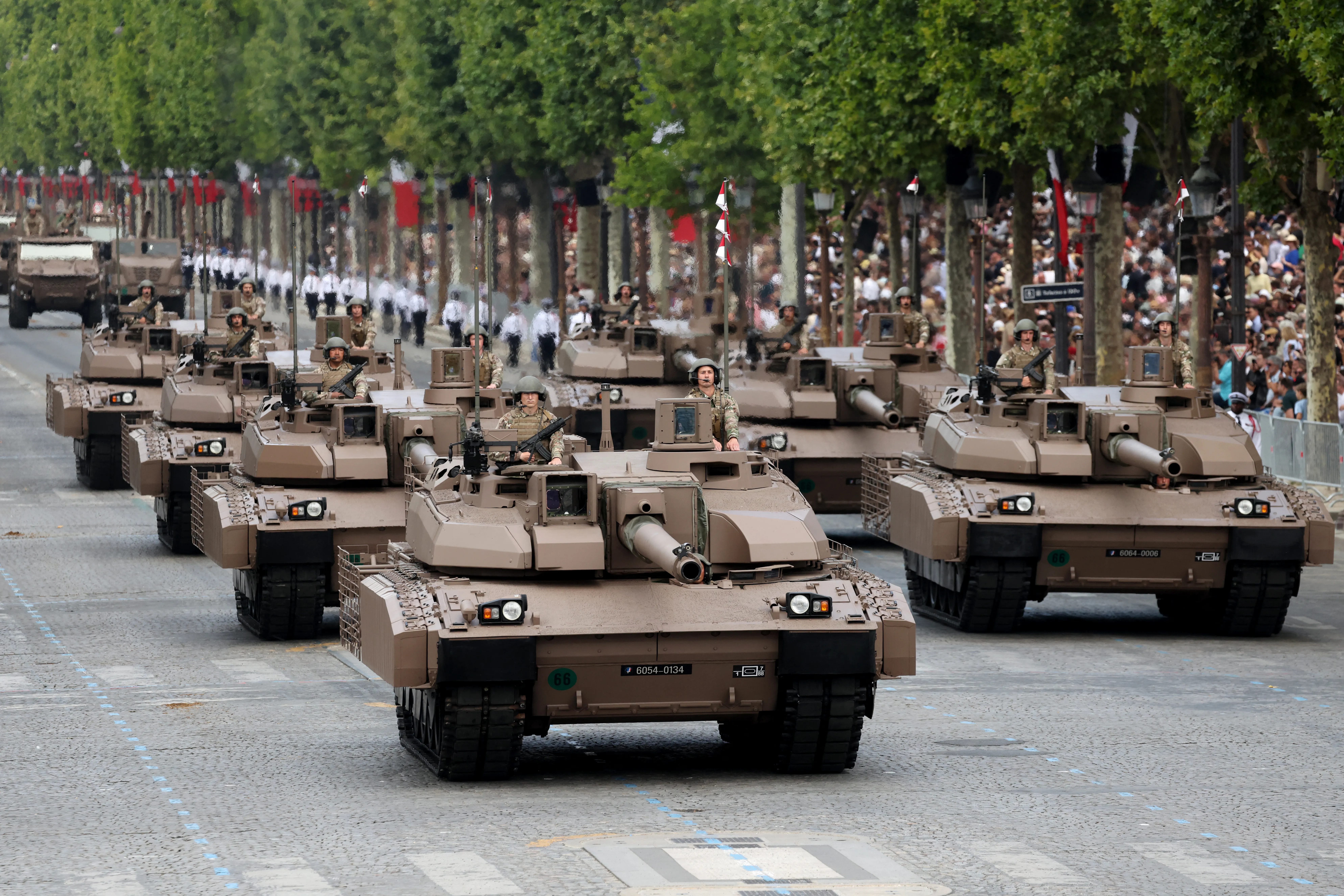
The Franco-German KNDS company has presented a new main battle tank, which it is offering to France as an interim replacement for its Leclerc fleet. The development comes as France recognizes that it will need a Leclerc successor before the next-generation Main Ground Combat System (MGCS) becomes available. This joint French and German program is complicated and already delayed, while Europe at large is increasingly alert to the need for capable tanks and other armored vehicles as the threat from Russia grows, and trust around U.S. military backing diminishes.
The proposed CAPINT tank was unveiled at the Eurosatory defense show on the outskirts of Paris this week.
Europe currently has four major lines of development effort for future main battle tanks (excluding the United Kingdom), ranging from multinational programs to national developments. The landscape has become much more fragmented over the past two years, as nations have increasingly understood the urgency of fielding new-generation armored vehicles.
Arguably the most ambitious of these programs is the now-delayed Franco-German MGCS, which began in 2017 and is now expected to arrive in service some time in the mid-2040s. With the MGCS delayed by roughly a decade, both France and Germany have a looming capability gap. In the case of France, its Leclerc tanks are due to be taken out of service by 2038.

As well as the main battle tank that is supposed to be its centerpiece, the MGCS program, as a ‘system of systems,’ is expected to field other crewed and uncrewed vehicles. These will likely be tasked with electronic warfare, air defense, or as platforms from which to launch drones or loitering munitions or fire directed-energy weapons.
Alongside this effort, around a dozen European nations (excluding France) are currently working on research and development under the MARTE (Main ARmored Tank of Europe) program, which is looking at tank requirements for the post-2040 period.
Against this complicated backdrop, France and Germany have both come to the realization that they will need new tanks before the MGCS arrives in service.
As a result, Germany is now working on the Leopard 3, also known as the Leopard 2AX, expected to provide a service-ready fighting vehicle around the early 2030s.
Back in April of this year, French Armed Forces Minister Catherine Vautrin told parliament that Paris had decided to launch an “intermediate” tank program to mitigate delays affecting MGCS.
To meet the French requirement for a stopgap tank, KNDS is now proposing its CAPINT (CAPacité INTérmédiaire, or Interim Capability).
This will combine a French turret and main gun on the hull of a German Leopard 2, a tank that is already in production for a variety of customers. Should this solution be chosen, a new Leopard 2 would likely be set up in France to manage the demand.
Interestingly, another new tank on show in Paris this week, the New Main Battle Tank (NMBT) concept demonstrator, from the Leonardo Rheinmetall Military Vehicles (LRMV) joint venture, also uses a Leopard 2 hull as its starting point, although that may change in the future. Derived from the Rheinmetall Panther KF51, the new tank is being offered to the Italian Army, which is also looking for a successor to its current Ariete main battle tank.

Returning to the CAPINT tank, the turret will be uncrewed and armed with the 120mm ASCALON smoothbore gun from KNDS France. The plan is to have the turret able to accommodate a 140mm cannon in the future. The 120mm ASCALON has already undergone firing trials using an uncrewed turret on a moving vehicle. Meanwhile, the 140mm version of the ASCALON is planned for the MGCS.

#ASCALON
Unlike larger-caliber guns that have been proposed for future tank programs in the past, the 120 mm ASCALON offers the advantage of being fully compatible with all NATO-standard 120 mm ammunition. This means operators can maintain and leverage their existing ammo stockpiles.
The three crew of the CAPINT will be carried in an “armored citadel” at the front of the vehicle, which will be defended by passive composite armor as well as reactive and active protection systems.
The active protection system will be developed by KNDS and will be distributed around the turret and hull, so its defensive effectors provide more complete coverage.
In the meantime, it is interesting to note that a Leclerc outfitted with an anti-drone “cope cage” on top of its turret is part of the dynamic demonstration of military equipment at Eurosatory this week.

KNDS says it will complete a CAPINT demonstrator tank as early as 2030 and, should France choose to go with it, it could deliver the first series-production examples in 2035, leading to frontline deployment in 2037.
There is also a plan to incorporate into the CAPINT some of the advanced systems that are intended for the MGCS.
These elements are likely to include fully integrated AI, the aforementioned passive/reactive/active protection systems, counter-drone warfare, and beyond-line-of-sight engagement capability.
Another feature of the MGCS program that would likely be brought forward for the CAPINT tank is accompanying uncrewed ground vehicles (UGVs). According to MGCS, one or two types of “robotic wingmen” are planned for the interim tank. These UGVs will be able to keep up with the tank, but will be small enough to be affordable. Their cost will also be governed by offering different levels of passive protection.

The renewed focus on tank programs reflects a broader resurgence of armored warfare across Europe, driven largely by lessons from Russia’s full-scale invasion of Ukraine. While that conflict has highlighted the vulnerability of tanks to drones, loitering munitions, and precision anti-tank weapons, it has also underscored that heavily protected, mobile firepower remains indispensable for combined-arms operations. As a result, European militaries that once downsized or delayed armored modernization are now investing heavily in new main battle tanks and upgrades.
While the need for interim tanks in both France and Germany is becoming increasingly urgent, the current push for the CAPINT and for the German Leopard 3/Leopard 2AX does risk putting the MGCS program under threat.

“We are already working to create what will be the combat of tomorrow,” KNDS CEO Jean-Paul Alary said during a press conference at Eurosatory yesterday. “Maybe the combat of tomorrow, the ambition of MGCS, will come a little bit earlier than the project itself.”
Meanwhile, according to Reuters, a German government spokesperson raised doubts about the future of MGCS, saying that the project would be focused on “platform-independent” technologies, adding that it was not clear whether a joint tank would still be built.
Depending on how capable these stopgap tanks prove to be, the decision of France and/or Germany to walk away from the more complex MGCS program could become easier. Much will likely also depend on the path that the MARTE program takes, with the possibility that MGCS requirements could be superseded. Meanwhile, recent experience with the Franco-German-led pan-European Future Combat Air System (FCAS) has highlighted just how difficult it can be to keep programs like these on track, regardless of how badly they may be needed.
Contact the author: thomas@thewarzone.com

04:56, 17 Jun 2026Updated 04:58, 17 Jun 2026

Kaleb breaks down in tears as Clarkson breaks the news (Image: Prime)
Jeremy Clarkson’s devastating cancer diagnosis left farm manager Kaleb Cooper in tears.
The 66-year-old shared the news in the final episodes of his series Clarkson’s Farm, as he sat down to chat with Kaleb Cooper and Charlie Ireland.
“I’ve got cancer,” Clarkson said during a conversation about the farm’s harvest.
Kaleb replied, “No, you haven’t. Where?”
The former Top Gear host has continued: “Where it is, is of no concern of anybody. I’ve known since May.”
“I had a medical, you remember back in May? I disappeared off the other week and I had a biopsy and it is cancer and it’s aggressive, but it’s really early so the treatment will be, you know…
“I was praying we could get the harvest done and then I could go and get some treatment but it’s going to be slap bang in the middle.”
Kaleb, wiping away tears, then said, “Look after yourself, you go and do… if you need anything just ring.”
Later in the show, Clarkson spoke about how the year had been challenging while talking to Kaleb, his girlfriend Lisa, and his two other employees.
“We started the year and I had coronary heart disease and ended it with me with cancer,” he explained.
“We can dwell as much as we like on all the bad things that have happened on the farm, but I think it’s better now, at the end of the year, to focus on things that have happened that are good.”
Kaleb asked, “When will we know the treatments worked?”
In response to Kaleb’s tears, the Who Wants to be a Millionaire host jests at him to “cheer up”.
“Not for another few weeks. Come on cheer up, it probably did work.”
The emotional episode has now been added to Prime Video.
Ahead of the episodes the TV star warned fans that they may be “a difficult watch”.
He posted on Instagram: “Ordinarily we try to keep the show bucolic and charming and cheerful. But the final two episodes which drop in the middle of the night tonight are none of those things really.”
In the clip, he took a deep breath and added: “They’re a difficult watch. They’re really, really difficult.”
After he announces the news to the farmers, Clarkson is later seen in a hospital bed set to undergo surgery.
However, Clarkson appears to maintain a positive attitude as he says he hopes to be back for a sixth season, before joking that if the treatment isn’t successful ‘take care everyone’.

Skylarks call out a cascading trill as I pedal between the pink and white hawthorn blossoms that make my path look like a May Day parade. I’m on the outskirts of Oxford, a city I thought I knew well, yet as I follow the National Cycle Route 57 on the e-bike I’d picked up in Jericho, it feels as though I’ve discovered a secret passageway.
This year the Camping and Caravanning Club (CCC) turns 125 – and I’m celebrating with a 60-mile cycling and camping trip, leaving from the city where the organisation was born and heading to Walton-on-Thames to stay at one of the oldest campsites in the CCC network.
The CCC began life as the Association of Cycle Campers before becoming the club it is today. It all started when founder Thomas Hiram Holding, already a keen camper, was visiting his friend Rev EC Pitt-Johnson’s Oxford home in 1901 and they decided there was enough demand and interest in the hobby to form a club. They elected each other president and secretary respectively and the rest, as they say, is history.
Back then, Holding had a “safety cycle” – not dissimilar to a modern-day bike, which replaced the tricky-to-master penny farthing. He proudly invented much camping gear, too, from early lightweight tents and folding poles to cycle touring bags. “Holding understood the health and wellbeing benefits people gained from camping,” explains Jo Cartwright, archivist at the CCC, when I tell her my e-bike plan, “so I think he would’ve embraced any new form of transport.”
While all-singing, all-dancing motorhomes and caravans are ubiquitous these days, and along with pre-pitched glamping options are squeezing the space left for regular campers, the CCC assure me that humble tents are very much still welcomed on its sites. So with mine firmly stowed on my e-bike, I set off, deciding to break my journey with an overnight stop at Bella Vista Camping in Radnage, a family-run club site that sits on the Chiltern Cycleway.
Quiet roads lead me east from Oxford toward Wheatley and Thame, where I stop at the Old Fisherman to grab a sandwich and coffee, before continuing on the Phoenix Trail (part of Route 57), its straight lines a nod to its former life as the disused railway track to Princes Risborough. Red kites replace skylarks as I glide on the easy track away from any road traffic, passing the old station building at Bledlow and going under the former railway bridge and past the abandoned platform where Towersey Halt stop, closed since 1963, would have been.
Before he started the Association of Cycle Campers, Holding’s method of camping – after a childhood wagon trek on the prairies of North America had him hooked – was by canoe in Ireland. That was until a friend of his in England announced that he and his wife were planning to spend a week camping by tandem bike in Britain, and asked him to come to help with attaching his kit to the frame – after which he wrote, “We succeeded,” and declared in his book, Cycle and Camp, published in 1897, “There was something in it.”
While more people arrive in motorhomes than by bike these days, I’m pleased to see that Bella Vista Camping still has a huge field for tents, next to a paddock of Soay sheep and alpacas, and there are hot showers and proper toilets in a big mess tent.
After dinner at the Crown Pub, just a five-minute walk away, and a quiet night’s sleep while my bike battery charged, I am ready for the next part of my cycle tour to Walton-on-Thames. Opened in 1913, the Walton CCC campsite was described in a Golden Jubilee Souvenir booklet from 1963 as a place full of “homemade tents, bamboo poles, hurricane lamps and wood fires”.
Curious at what I’d encounter now, I leave the highs of the Chilterns and Route 57 to bear south on country lanes that skirt the edge of High Wycombe, through the busy streets of the Thames-side towns of Marlow and Cookham, and on narrow cycle paths between Maidenhead and Eton. When I stop for lunch at the Crocus cafe in Dorney, I’m amazed at how curious people are about my set-up. I feel a little like Holding, showcasing another way of holidaying in Britain.
Windsor Great Park is an unexpected highlight – its easy roads contrasting starkly with the quite hairy gravel tracks I descend into Egham. But then designated bike lanes through Staines and Chertsey see me ticking off my remaining miles with ease.
A final treat is a ferry crossing over the Thames at Shepperton to Weybridge – fitting given that the very first campsite in the CCC network used to sit on one of the islands here (it closed in 1909).
Given that the Walton campsite has no facilities, it’s primarily frequented by motorhomes and caravans that have their own chemical toilets. I’ve brought my own eco-friendly option, though, in the form of a Poopaloo dry-powder toilet. My pitch was next to a small hut filled with sepia photographs of tents from 100 years ago.
That night I read Holding’s The Campers Handbook, published in 1908, and chuckle at the description of the correct attire for female cycle campers including a skirt “that finishes three inches off the ground, with no slippery lining to avoid catching on the knickerbockers”.
The next day, without a knickerbocker (or skirt) in sight, I undertake one of Holding’s favoured activities: canoeing. Swapping pedals for oars, thanks to owner Andy of Hampton Court Paddle Sports, which is located just a 10-minute (3-mile) cycle from my tent, I spend most of the day on the water, sightseeing at a slow pace, stopping for falafel at Mezzet Box (beats the fried herring and boiled trout of Holding’s day), and ending with a drink at the Anglers, built on these banks in 1870, my canoe tied up beside my table.
Things have undoubtedly changed for campers over the past 125 years. The tents – A-frames and “wigwams” made of silk – have been swapped for nylon tunnels with inflatable poles, campervans have overtaken bicycles, and even, at Walton, the Thames itself has been rerouted so that it no longer sweeps by the pitches. But not all change is bad. Back then, strict gender rules meant that, as a lone woman, I wouldn’t have been permitted to do this trip, never mind in leggings. And an e-bike made the whole experience (and hills) much more enjoyable.
Holding called cycle camping a “power” that helped popularise camping – and the CCC’s membership reflects that, having grown from its initial 150 to more than 300,000 households. And though camping using a bicycle is now a minority pursuit, after my weekend tracing old routes and visiting the first campsite, I like to think that within the secret passageways of towns and cities, there are those of us who realise that the best journeys are still powered by pedals and curiosity.
eBike hire was provided by Bainton Bikes in Oxford (e-bikes from £65 for 3 days). A pitch was given by Bella Vista Radnage (from £19 a night) and Walton-on-Thames campsite (from £20 for two nights members, £35 non-members). Annual CCC membership from £56.95

PHOENIX — Mike Trout hit a two-run home run and an RBI double for the Angels in a 7-0 shutout of the Arizona Diamondbacks on Tuesday night.
Trout’s 436-foot two-run shot to center came in the fifth inning and gave the Angels a 5-0 lead, and his sixth-inning double drove in Denzer Guzman.
Reid Detmers (3-5) worked seven innings for the Angels, giving up no runs and three hits while striking out three. He has given up three or fewer earned runs in each of his past five outings and nine of his last 10.
Wade Meckler hit an RBI single in the second to get the Angels on the board first, followed by a solo home run by Zach Neto in the third. Donovan Walton hit an RBI single in the fourth and a ground-rule double in the eighth to bring Logan O’Hoppe across.
The Angels combined for 14 hits, paced by O’Hoppe’s three-for-four night.
Adrian Del Castillo got the first hit of the game for the Diamondbacks in the third inning. Ketel Marte and Geraldo Perdomo both singled in the sixth, and Corbin Carroll had a one-out infield base hit in the ninth. Arizona went 0 for 3 with runners in scoring position and stranded five baserunners.
Kirby Yates and Chase Silseth combined for two scoreless innings of relief to close out the game.
Merrill Kelly (5-6) gave up 11 hits and six earned runs in 5 1/3 innings for Arizona. He struck out four and walked one.

June 17 (UPI) — Rep. Mike Collins was projected Tuesday night to win Georgia’s Republican Senate primary runoff, defeating former football coach Derek Dooley as voters cast ballots in contests across the country.
The Collins-Dooley race was the highest-profile race on a primary night.
President Donald Trump has loomed large over November’s midterm elections, encouraging GOP-led states to redraw congressional maps, warning of impeachment and investigations if Democrats win control of the House and endorsing candidates who align with his agenda.
The Georgia Senate runoff drew national attention as a race that could help decide control of the Senate and test Trump’s influence in a battleground state.
Collins of Georgia’s 10th Congressional District ran with Trump’s endorsement, while Dooley had the support of Georgia Gov. Brian Kemp.
With all 159 localities reporting, Collins had secured 55.5% of the vote to Dooley’s 44.4%, according to unofficial results from the office of Georgia Secretary of State Brad Raffensperger.
Collins, speaking to supporters Tuesday night, projected an image of GOP unity, stating he had spoken with both Dooley, thanking him for running a “spirited campaign,” and Kemp “for his leadership and his friendship over the years.”
“We’re going to have some robust primaries out there. Sometimes, we got some strong disagreements, but I can tell you we stand united around one mission,” he said to applause.
“That’s right. And y’all know what the mission is: Is to put a Republican in that seat and get rid of that Jon Ossoff in November.”
Ossoff, a Democrat, won the Senate seat in 2021, flipping control of the chamber from the Republicans.
In his victory speech, Collins attacked Ossoff for voting in favor of President Joe Biden‘s landmark Inflation Reduction Act and the American Rescue Plan as well as voting against banning transgender athletes from competing in female-segregated sports.
Following Collins’ victory, Ossoff attacked him on social media, calling him a “notorious bigot, antisemite and extremist” who is being investigated by the House Committee on Ethics for illegal misuse of tax dollars.
“Collins, who is only a congressman because his daddy was a congressman, voted to double health insurance premiums for more than a million Georgians, for the Iran War and for the Trump tariffs,” he said in a statement.
Dooley conceded defeat.
“While tonight didn’t go our way, I want you to know that I’ll continue to be in this fight,” he said on social media.
“No matter who you voted for or what you believe, one thing we all can agree on is Jon Ossoff does not represent our Georgia values. In November, we’re sending him to the bench!”
Trump endorsed Collins on Friday after early voting ended, while Kemp endorsed Dooley in August.
But Tuesday night was not a clean sweep for Trump-backed candidates in Georgia. Rick Jackson, the billionaire founder of Jackson Healthcare, was poised to defeat Trump-endorsed Georgia Lt. Gov. Burt Jones in the GOP governor runoff race.
According to unofficial results, Jackson had secured 52.65% of the vote share to Jones’ 47%.
The Georgia governor’s mansion is up for grabs as Kemp, a Republican, has been term limited. He faced Democrat Stacy Abrams in the last two gubernatorial elections.
Jones had won 38% of the vote in the primary election last month. Jackson received 32% of the vote. The runoff was scheduled as neither candidate surpassed the 50% threshold needed to win the GOP nomination outright.
Joe Fisher contributed reporting.

The TWZ Newsletter
Weekly insights and analysis on the latest developments in military technology, strategy, and foreign policy.
A plan to attack the UFC America 250 event at the White House on June 14 with explosive drones was thwarted by the FBI, according to federal records. Exactly how capable those involved were of actually pulling it off remains unclear. However, the alleged plot amplifies concerns that TWZ has been documenting for years about threats posed by drones to critical facilities in the homeland and how they continue to change the national security picture at home and abroad.
The long-standing potential for a drone attack on the White House was something we recently discussed last month in an examination of President Donald Trump’s plans to fortify the under-construction ballroom. More on that later in this story.

The plot involved a group of individuals who wanted to “attack the UFC event and involved staging a ‘demonstration’ on the north side of the White House,” CBS News reported, citing the court filings. “The group would then fly drones ‘laden with unspecified explosive devices which would detonate over the north side of the UFC arena,’” according to the filing in the case of one of the five people arrested, 19-year-old Tycen Proper.
When the drones exploded, “the group then planned to force attendees of the UFC event and ‘high value targets’ to evacuate to the south,” Proper’s affidavit read. The suspect told investigators that the plan was for group members to “act as snipers and additional shooters,” shooting fight attendees and the “high value targets” as they fled from the explosions.
The affidavit said the “high value targets” were “wealthy people” and politicians, CBS noted.
Proper allegedly told investigators the goal of the attack was to “jumpstart” a revolution in the U.S. He was interviewed from a hospital, according to the document, where he was admitted on an emergency basis due to “homicidal ideations.”
NEW: Tycen Proper, one of five suspects arrested in the White House UFC drone attack plot, allegedly wanted to target Sen. Marsha Blackburn because she received money from “the pro Israel lobby and supports them.”
“These are the people we’re going to focus on,” Proper texted… pic.twitter.com/e3Wf8YJbDH
— Kaelan Deese (@KaelanDC) June 16, 2026
In addition to Proper, Bryan Omar Roa, 24, of Calimesa, California; Michael Alan Thomas, 32, of Pinon Hills, California; Daniel K. Eskridge, 32, of Kidder, Missouri; and Abraham Hermosillo Alvarez, 31, of Omaha, Nebraska were also charged, according to the Justice Department.
BREAKING: Details via federal arrest affidavit reveal that a California man named Michael Alan Thomas was one of the alleged organizers of the alleged UFC White House terror plot. Feds say he admitted he believes the U.S. government is run by elites who sacrifice and eat… pic.twitter.com/L8i1bTR9Em
— Bill Melugin (@BillMelugin_) June 16, 2026
Fox News was the first to report details about the plot.
BREAKING: FBI, law enforcement partners disrupt alleged plot against UFC Freedom 250 event at White House; 5 in custody, officials say https://t.co/CEBKJA5zPt
— Fox News (@FoxNews) June 16, 2026
TWZ cannot independently verify any of these details at this time and it remains publicly unclear what capabilities, training, funding and equipment the suspects had to actually carry out a complex attack like the one described. Proper’s mother said her son “began interacting with a group online that was comprised of individuals who claimed to be ex-military and Christian-based,” according to the court documents. They espoused anti-government and anti-Semitic sentiments.
At the very least, it would have taken unique skills and some level of discipline, coordination and operational security to pull off this kind of a plot. It would have also required funding and time. The FBI and other law enforcement agencies disrupt attack plans long before they get close to becoming operational, and many of those have a low chance they could actually been implemented as dreamed-up. That does not mean the individuals involved or their plans are not still a significant threat. In this case, there is no information available on whether anyone involved had the means and ability to stage an attack like the one described.

Regardless, it is important to note it would be a challenge to stop people simply from bringing weaponized uncrewed aircraft into range of the White House without law enforcement having prior knowledge. Actually employing those drones as weapons successfully is another story. Still, the danger of such an attack looms large and is growing by the day.
As we have frequently highlighted, two incidents last year highlight the alarming danger of near-field drone attacks that raised lingering concerns in the U.S.
On June 1, 2025, Ukraine launched drones hidden in trucks at air bases across Russia, causing severe damage to its strategic aviation fleet. Weeks later, Israel fired drones from deep inside Iran at the country’s air defenses during the 12-Day War.
TWZ raised concerns about just these kinds of attacks for years long before the ones in Russia and Iran took place.
The following video shows one of the Ukrainian drone attacks on Russian bombers during Operation Spider Web.
In both Russia and Iran, the drones were set up undetected deep in enemy territory during armed conflict against military targets. The plot on the White House, as characterized in the court documents, is of course different on many levels and was to be planned and executed by citizens, not sponsored by another nation at war with its neighbor. At the same time, both presents a host of challenges to defend against, many of which overlap.
Given the presence of the president, his family and thousands of VIP guests on the White House lawn at the time, as well as the event’s extremely high-profile nature, UFC Freedom 250 was “designated a Special Event Assessment Review 1 event, like the Super Bowl, Indianapolis 500, Kentucky Derby and college football games, according to the Department of Homeland Security,” ABC News reported last week.
Security was also tightened at the Ellipse outside the White House, where thousands more watched the event on large screens.

The increased precautions included concern about drones, said Tara McLeese, special agent in charge of the Secret Service’s Washington Field Office.
Federal law prohibits flying drones in the airspace over the National Capital Region, so McLeese advised fans ahead of the event to “leave their drones at home.”
“We will have law enforcement drones for overwatch, but just to make it simple for the public, if they see a drone, we want them to report that,” she said, according to ABC.
The Secret Service declined to talk about its concerns over drone threats, instead pointing us to its post on X.
Protective intelligence cases are on the rise, and our teams work tirelessly behind the scenes to investigate threats, identify those responsible, and ensure accountability. Statement from Director Curran on the events of this past weekend: pic.twitter.com/Oca3QVLg9o
— U.S. Secret Service Office of Communications (@SecretSvcSpox) June 16, 2026
While we don’t know the extent of the counter-drone measures deployed by the FBI, Secret Service or even the military, they certainly included devices to detect and, if needed, jam the signals of threatening drones. However, as the war in Ukraine and Israel’s push into Lebanon have proven, the efficacy of these methods is far from assured. This is especially so since the introduction of drones controlled via fiber optic cables, which mitigate the effects of radio frequency passive detection and active jamming with a direct hardwired link between a drone and its operator.

Meanwhile, as we noted in our story about Trump using the ballroom he is building as a kind of defensive fortification, using traditional kinetic protection from drones and other aerial threats in and around the White House is limited and risky. The advent of interceptor drones, many that are hit-to-kill or use electromagnetic pulses and other low collateral damage means instead of explosive warheads, is starting to mitigate some of those concerns.
From the story about Trump’s ballroom:
“Clearly, the drone issue is a massive one and has been for many years. This structure will serve as a secure place to do daily business if needed. Based on Trump’s comments, it will also act as a critical active defense node with its roof hosting air defenses, and apparently ones that are capable of at least a limited degree of area defense, not just highly-localized point defense. This is where drones could come into play. Drone interceptors (drones that intercept other drones) are well suited for the unique challenges of defending the White House and the Mall area as a whole, where collateral damage is a huge concern. Some of these systems use warheads, while others do not, physically smashing into their targets or blasting them with electrical pulses and other non-traditional effects instead. Drone interceptor capabilities are expanding rapidly now, equipping forward bases and warships. They proved critical in defending U.S. interests against Iranian attacks during the recent war. In Ukraine, they have proven indispensable in countering waves of Russian Shaheds.”

Directed energy, such as lasers and high-power microwave weapons are another potential countermeasure, but these systems remain somewhat in their infancy and have very short range. Above all else, using them in dense urban areas, especially those with nearby low-flying air traffic, can be extremely problematic. They are not widely deployed for the counter drone role in the United States and won’t be in the near term.
It’s also worth remembering that the alleged plan did not necessarily rely on the accuracy of the drones or the damage they could inflict. The goal was to induce panic by their very presence and drive people into a field of fire to be attacked by snipers.
Even if counter-drone measures were able to provide a relatively robust protective bubble over UFC 250 at the White House, the plot as described in the documents further highlights the vulnerability large events have from even the lowliest of drone attack attempts.
The U.S. at the moment is protecting several facilities across the country with huge crowds during the World Cup soccer tournament at a time of heightened global tensions. Countering drone attacks was a central component of pre-event security measures as well as ongoing efforts.

This all comes as the U.S. is working to increase authorities to allow the military and law enforcement to better protect against drone threats.
We were the first to report numerous unauthorized drone flights over U.S. military facilities and other sensitive areas. The defensive capabilities have been constrained by a labyrinth of often confusing legal and regulatory hurdles. Incursions by cartels along the U.S.-Mexico border have sharpened the need for reforms, some of which are underway.
As we reported back in February, in advance of the U.S. hosting the 2026 World Cup and 2028 Olympic Games, the Trump administration pushed to expand counter-drone authorities. Congress granted that when it passed the Fiscal Year 2026 National Defense Authorization Act (NDAA).
Officials have already taken action against drone operators using these new authorities. Last week, FBI Los Angeles said it seized drones and issued citations to pilots near SoFi Stadium for alleged violations of temporary flight restrictions during last Friday’s World Cup match, The Los Angeles Times reported. The bureau “shared photos showing confiscated drones as well as an image of a drone operator being cited,” the newspaper noted. “However, it did not specify how many drones were taken or how many pilots were issued citations. It also did not provide details on the technology used to locate or track the drone operators.”
The bureau did not say if the operators of these drones had nefarious intent or whether they were armed, though neither of those are prerequisites for violating the no-drone-zone rules.
The FBI’s Counter Drone Enforcement Team has been busy around last night’s #WorldCup game and related events ensuring drone pilots aren’t violating @FAA Temporary Flight Restrictions. But some were, and as promised, they were cited and had their drones seized. Meanwhile,… pic.twitter.com/s0vy75E73E
— FBI Los Angeles (@FBILosAngeles) June 13, 2026
While the actual ability of the alleged perpetrators to pull off the combined drone and sniper attack on the White House like what’s described remains unknown, the threats to the homeland from uncrewed aircraft are only growing by the day, as are nefarious actors’ experience and creativity with the technology.
Contact the author: howard@twz.com