1 of 2 | Former Japanese Prime Minister Fumio Kishida speaks at the Foreign Correspondents’ Club of Japan in Tokyo on June 26, 2026. Photo by Asia Today
June 26 (Asia Today) — Former Japanese Prime Minister Fumio Kishida said Friday that North Korea’s nuclear weapons and missile programs have made the pursuit of nuclear disarmament increasingly difficult, but Japan must not abandon its goal of a world without nuclear weapons.
Speaking at the Foreign Correspondents’ Club of Japan in Tokyo, Kishida said East Asia is facing its most severe security environment since the end of World War II.
“Japan must strengthen its defense capabilities and further reinforce the Japan-U.S. alliance,” Kishida said. “At the same time, we must not give up the ideal of pursuing a world without nuclear weapons.”
Kishida, a lawmaker whose constituency is in Hiroshima, made nuclear disarmament a major diplomatic priority during his tenure as prime minister.
He cited Russia’s invasion of Ukraine, instability in the Middle East and North Korea’s nuclear and missile programs as evidence that the international security situation surrounding nuclear weapons is “undeniably severe.”
Kishida said stronger national security and nuclear disarmament should not be viewed as mutually exclusive goals.
“Reality and ideals are not incompatible,” he said. “The issue is not choosing one or the other, but determining how to bring reality closer to the ideal.”
Kishida recalled becoming the first Japanese prime minister to attend a review conference of the Treaty on the Non-Proliferation of Nuclear Weapons in 2022.
At the conference, he presented the Hiroshima Action Plan, a series of practical steps intended to advance nuclear disarmament while acknowledging the international security environment.
The plan calls for maintaining the record of non-use of nuclear weapons, increasing transparency surrounding nuclear forces, continuing reductions in global nuclear stockpiles, strengthening nuclear nonproliferation and promoting the peaceful use of nuclear energy.
“We must narrow the gap between reality and the ideal one step at a time,” Kishida said.
Ukraine warning for East Asia
Kishida linked the war in Ukraine to security concerns in East Asia.
He recalled his unannounced visit to Kyiv in March 2023, when he met Ukrainian President Volodymyr Zelensky and expressed Japan’s solidarity with Ukraine.
Kishida said he delivered the message that “Ukraine today may be East Asia tomorrow.”
Russia’s invasion demonstrated that security in Europe and the Atlantic cannot be separated from security in the Indo-Pacific, he said.
East Asia faces overlapping concerns including North Korea’s nuclear and missile development, China’s growing military power and tensions across the Taiwan Strait.
Kishida said Japan’s vision of a free and open Indo-Pacific seeks to improve regional connectivity, promote prosperity, reject coercion and intimidation and uphold freedom and the rule of law.
Kishida stresses U.S. alliance and international rules
Addressing U.S. foreign policy under President Donald Trump, Kishida said “America First” should be regarded as a structural trend rather than a temporary development.
He said countries such as Japan, which have limited natural resources and relatively constrained domestic markets, depend on international law, multilateralism, free trade and the rule of law.
Kishida emphasized the importance of maintaining the Japan-U.S. alliance while preserving an international system governed by widely accepted rules.
Dialogue with China remains necessary
Kishida also called for continued dialogue with China despite security concerns and political tensions between Tokyo and Beijing.
China is Japan’s largest trading partner, while Japan remains one of China’s major economic partners, he said.
“That is precisely why dialogue is important,” Kishida said.
He recalled meeting Chinese President Xi Jinping twice during international gatherings while serving as prime minister. Kishida also held talks with Chinese Premier Li Qiang during meetings connected to Southeast Asian nations and a trilateral summit involving Japan, China and South Korea.
“It is regrettable that fewer people are now willing to engage in dialogue between Japan and China,” Kishida said.
He called for communication not only between governments but also through business, people-to-people exchanges, sports and culture.
Stable relations between Japan and China would serve both countries’ national interests and contribute to regional peace and stability, he said.
Seattle, United States – There were goals. There were jubilations and heartbreak. There were raucous crowds, confrontations and comradery. There were protests, politics and Palestinian flags. There was a missed penalty. There was joy. There was disappointment.
Egypt’s 1-1 draw with Iran in Seattle at the FIFA World Cup on Friday had it all. Iran is still in contention to qualify as one of the eight best third-place finishers, depending on Saturday’s results.
Recommended Stories
list of 4 itemsend of list
Wild celebrations among the Egyptian fans erupted outside the stadium after the match, as the country proceeded past the World Cup group stages for the first time.
“The feeling is outstanding,” Daniel Salib, who was draped with an Egyptian flag, told Al Jazeera.
“After this game, and the game we played against New Zealand, and how we played against Belgium, we absolutely deserve it. So, I couldn’t be more proud of this country and this team.”
Egypt survived a late Iranian onslaught that saw Team Melli, as the Iran team is known, hit the woodwork and have a goal chalked off by VAR for offside.
Iran also had a penalty saved in the first half, but the entire match was action-packed, going blow-for-blow.
Iran supporter Saeed Nassef said he was disappointed with Friday’s result but hopeful that Iran would still make it through to the round of 32, all depending on the results of Sunday night’s games.
“The Iranian team did a beautiful job. They faced a lot of hardship, but we’re really happy how they played,” Nassef told Al Jazeera.
Protests
Protesters against the Iranian government had gathered outside the stadium, waving US and Israeli flags and holding up photos of Iranian opposition figure Reza Pahlavi.
Nassef, who carried the official Iranian flag, which features the name of God, was one of several fans who told Al Jazeera they faced harassment from opposition activists.
“We’re here to support the team. We’re here to support sports… It’s not cool for people to come here and say bad things because we are here to support the players. We want some happiness,” he said.
After the match, Al Jazeera witnessed a confrontation between antigovernment activists and a supporter carrying an Iranian flag.
The protesters hurled insults at the fan, calling him a “terrorist” and saying he should leave the country. They also engaged in expletive-laden Islamophobic chants.
The fan, who identified himself by his first name only as Milad, approached a man leading the chants on a megaphone and criticising Team Melli fans. He stood inches away from the protester before police officers intervened to pull them apart.
“My issue is not political. My issue is: Players, they play for the country, they play for the people. I support the people. That’s it,” Milad said.
“Good or bad, it doesn’t matter. Our people went and they tried to create joy for other people, and that’s all that matters,” he added.
But the commotion did little to overshadow the nearby festivities where Egyptians had gathered, singing and dancing at their country’s historic moment.
Protesters against the Iranian government outside the Seattle Stadium, June 26 [Ali Harb/Al Jazeera]
Electric atmosphere
Inside the stadium, the atmosphere was electric throughout the match – not an empty seat, not a quiet moment.
When the first half concluded, several sets of Iranian and Egyptian fans started taking pictures together.
The players also showed support for each other. After the final whistle, several Egyptian players consoled their Iranian counterparts, who were visibly upset with the result.
Throughout the 90 minutes, spectators appeared to be alternating in their chants between “Iran, Iran” and “Misr, Misr”, Arabic for Egypt, rather than chanting over each other.
There were a few pre-Islamic revolution Iranian flags in the crowd – featuring a regal lion and sun – but they were far outnumbered by the country’s official flag.
Some people waved LGBTQ+ pride flags and rainbow paraphernalia, due to the game being designated the World Cup’s “Pride Match”. But there did not appear to be any problems in the stadium, despite the hype around the issue.
The Egypt supporters boasted their ancient heritage with pharaohs’ headdresses and outfits.
“We’re so proud to be Egyptian and so proud of our national team,” said Karim Elshabini, who was sporting a gold and black pharaoh’s headpiece and a red Egypt football top.
“It feels amazing. Everybody’s vibing really well. People are really cool. The Egyptian fans, the Iranian fans, we’re all having a really good time.”
There were numerous Palestinian flags at the match, including a couple that were prominently displayed behind the goals.
Egypt fan Bilal Ali, who brought a Palestinian flag to the stadium, told Al Jazeera he would like to keep politics out of football, but with Israeli atrocities continuing in Gaza and elsewhere, he could not remain silent.
“I feel guilty sometimes when I get to [see] the game and our people in Palestine just get bombed and killed,” Ali added.
Several Egyptian and Iranian fans shouted “Free Palestine” as they walked past Ali with his flag.
Iranian fan Hameed with his children outside the Seattle Stadium, June 26 [Ali Harb/Al Jazeera]
‘Minab 168’
There was more than football at the game.
Hameed, an Iranian fan who wished to be identified by his first name only, wore a shirt that said Minab 168.
The message is meant to honour the victims of the school in southern Iran that was bombed on the first day of the US-Israel war on the country.
“I just want to remind the world that the plight of these kids who were bombed, either intentionally or not intentionally, should not be forgotten,” Hameed told Al Jazeera.
“This is why we should not have wars.”
He added that there must be a credible investigation into the incident.
“Politics aside, humanity needs to survive, and the only way to do it, whether the kids are being blown up in Palestine, in Lebanon, in Iran, in Sudan, in Congo, we’ve got to protect them,” Hameed said.
Political statements, flags and protests aside, at the final whistle, the moment belonged to Egypt with a historic sporting achievement.
“Seeing your country after all these years of cheering them, all the highs and lows, finally putting in all the high, good effort and getting good results is a surreal feeling,” said Rafael Youssef, who had the colours of the Egyptian flag painted on his cheek.
“I’m very happy for them, very happy to be here with them.”
Two Weeks in August’s cast is led by none other than a Call the Midwife legend.
Hayley Anderson Screen Time TV Reporter
10:02, 27 Jun 2026Updated 10:03, 27 Jun 2026
Two Weeks in August stars Call the Midwife actress Jessica Raine. (Image: BBC)
Two Weeks in August is drawing to a close, but the BBC has already revealed what’s stepping in to fill the gap.
Call the Midwife star Jessica Raine heads up the cast of black comedy Two Weeks in August, an eight-part series following a group of old friends who reunite for a well-deserved holiday in Greece.
However, a stolen kiss triggers a “chain reaction of infidelity, breakdowns, and escalating chaos”.
The final two 45-minute episodes air tonight, Saturday, June 27, on BBC One, with the complete boxset also available to watch on BBC iPlayer.
Ahead of its BBC One broadcast, it has now been confirmed that not one but two programmes will be stepping into its coveted Saturday primetime slot next week.
The first of the two shows taking over from Two Weeks in August on Saturday, July 4, at the slightly earlier time of 8.30pm, is The Weakest Link.
With comedian Romesh Ranganathan assuming hosting duties from the iconic Anne Robinson, celebrity contestants will include JLS star JB Gill, actress Helen Flanagan and singer Toyah Willcox.
The Weakest Link will run for 45 minutes before BBC News and Weather, paving the way for the second replacement programme at 9.30pm.
Rounding off the evening, football enthusiasts will be treated to Match of the Day Live: Fifa World Cup 2026, as the BBC broadcasts coverage of the second round-of-16 match at the Philadelphia Stadium in the US.
The official description reads: “Lionel Messi made his 1,000th career appearance and scored a 789th career goal as he inspired Argentina to a 2-1 victory over Australia at this stage in Qatar in 2022.
“Julian Alvarez capitalised on an error by Aussie goalkeeper Mathew Ryan to double Argentina’s lead in the second-half, but the Socceroos halved the deficit when Craig Goodwin’s strike took a huge deflection off Enzo Fernández with a little under 15 minutes left, and if not for the excellence of Argentine goalkeeper Emiliano Martínez could have found a late equalizer.”
Match of the Day’s broadcast will run for three hours, with the special edition due to wrap up at 12.30am.
Two Weeks in August is available to stream on BBC iPlayer.
Here’s who doesn’t need to scan their fingerprints to enter the Schengen area
Millions of Brits are expected to head to Spain this summer(Image: fhm via Getty Images)
Under new regulations, those travelling on a UK passport are permitted to visit the Schengen area for no more than 90 days within any 180-day period.
On top of this, upon entering the zone, which includes Spain, most British travellers will be required to scan their passport, have their photo taken, and provide four fingerprint scans under the new Entry/Exit System (EES). Once registered for travel via the EES, your digital record remains valid for three years or until your passport expires, whichever occurs first within that three-year window.
The Schengen area comprises the following countries: Austria, Belgium, Bulgaria, Croatia, Czech Republic, Denmark, Estonia, Finland, France, Germany, Greece, Hungary, Iceland, Italy, Latvia, Liechtenstein, Lithuania, Luxembourg, Malta, Netherlands, Norway, Poland, Portugal, Romania, Slovakia, Slovenia, Spain, Sweden, and Switzerland.
That said, not every traveller departing from the UK will be required to scan their fingerprints upon arrival in the Schengen zone.
The Government has confirmed that all children under 12 will not be fingerprinted. However, under the new EU regulations, all travellers, including babies, will be photographed and have digital records created.
British holidaymakers may be exempt from the EES if they are travelling on a non-UK passport. For instance, those holding an Irish passport will not be required to use the EES scheme.
According to recent estimates, more than a third of a million UK residents hold both UK and Irish passports – a figure that has risen sharply in the wake of Brexit.
A mum of twins was left baffled when her two infants were refused to sit next to each other on a flight, and she’s now urging others to be aware of little-known rule
10:43, 27 Jun 2026Updated 10:43, 27 Jun 2026
Parents with multiple kids are urged to beware of one rule on flights that many have ‘no idea’ even exists (stock image)(Image: Getty Images/iStockphoto)
As summer is officially here, many people will be taking the opportunity to travel for the summer holidays, either to soak up the sunshine in a tropical country, or even to visit people in a different part of the world. And if you’re bringing a young infant under the age of two, you’ll be happy to learn that most airlines will offer a cheaper fare if they don’t require their own seat.
But one twin mum named Savannah Gavigan was left baffled as she and her husband boarded their flight recently, as they had been forced to split up their twins on the flight due to a little-known rule they had ‘no idea’ even existed.
“Friendly reminder to all twin parents: two in-lap infants can’t sit in the same row,” Savannah wrote in the overlay text of her TikTok video, which showed her two twins playing with each other despite sitting on separate rows on the plane.
Content cannot be displayed without consent
“But they still find a way to spend time together,” Savannah jokingly added in the caption of her post.
Why can’t babies and young kids be seated next to each other on flights?
The main reason why only one lap infant (an infant sat in an adult’s lap) can be seated on each row of two or three seats of a plane is because of airline safety rules, as there are generally only enough oxygen masks in a row for the main passengers with one extra. So if there are multiple kids under the age of two in one row sitting in an adult’s lap, there would not be enough oxygen masks for them all to use.
Passengers will most likely encounter this on flights across most airlines as they often all follow the same rules and precautions.
But there are ways to get around this, such as if you’re flying with twins or just two infants under the age of 2. Many airlines will offer the opportunity to buy an extra, separate seat for one of the infants. If one infant is in their own seat (often in an approved car seat or with a harness), you can all sit together in the same row. Some airlines will also offer seats with bassinets that babies can lay in throughout the flight.
If both infants that you’re travelling with are lap babies, the closest you can sit together is across the aisle or directly in the row in front/behind each other, as it’s every three rows that will have four oxygen masks.
Keep in mind that some airlines require an additional accompanying adult if one adult is traveling with two infants, and at least one of the babies may need to be secured in a safety-approved car seat.
People soon took to the comment section of Savannah’s video to share their bafflement as many parents shared they’d never heard of the rule before.
“This should be in the disclaimer when you book a flight. How random I would’ve never known!” one person commented. Someone else said: “Will be traveling with the family in October and the grandbabies will be six months so this is a good thing to know now!”
Some flight attendants also appeared in the comments to verify the statement, as one said: “Hey flight attendant here! Thanks for bringing this up!!! It has to do with oxygen masks! Should they deploy we want everyone to have one in reach and easily accessible, reaching may take extra time that could be detrimental!”
Someone else went on to say: “You can though BUT – it depends on the aircraft type and where the bassinets are located. 2 bassinets on D & G on B777, A380 etc on many airlines ( Ex cabin crew )”
During their first two games, Panama have taken a dynamic approach depending on the phase of play the game is in.
From opposition goal-kicks, Panama have stepped up to press aggressively in a 4-4-2 shape.
If the opponents have quality on the ball and find themselves in possession higher up the pitch, Panama’s high press falls into a mid-block, and they move from a 4-4-2 into a 5-3-2. Their focus is on making it hard for teams to play through them.
As Croatia, in particular, grew into the game, Panama took an even more defensive approach.
Their 5-3-2 became a 5-4-1, a shape they adopted with a deeper defensive line for large parts of the game.
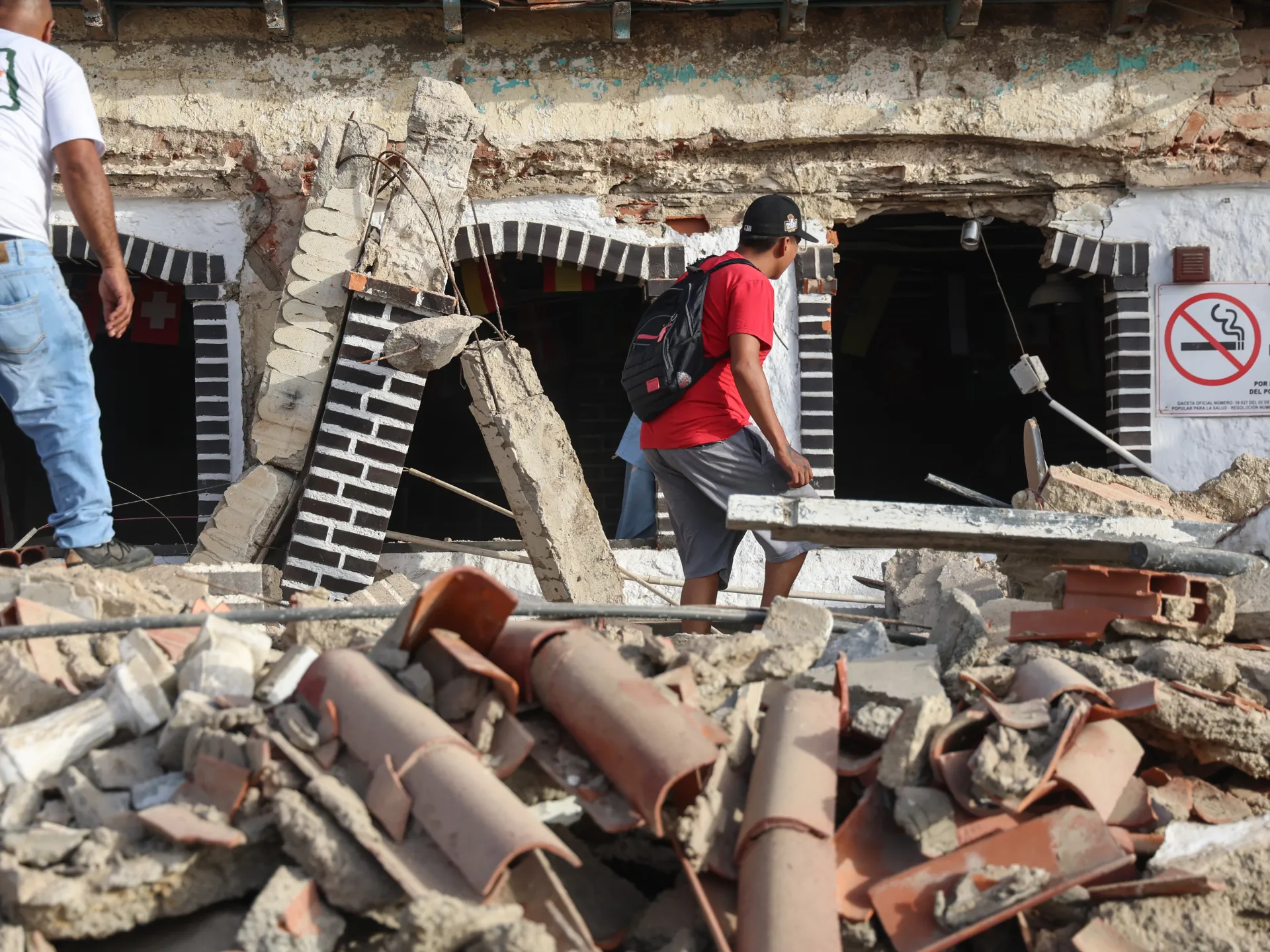
At least 920 people are confirmed dead and more than 51,000 missing after two earthquakes struck Venezuela on Wednesday.
By Al Jazeera Staff and AP
Published On 27 Jun 202627 Jun 2026
Rescuers are racing against time in Venezuela, three days after two powerful earthquakes struck, with at least 920 people confirmed dead and more than 51,000 still missing.
The twin, magnitude 7.2 and 7.5 quakes hit on Wednesday, devastating the coastal area around La Guaira, where authorities moved on Friday night to restrict access as traffic chaos began to hamper search efforts.
Recommended Stories
list of 4 itemsend of list
With a scarcity of government rescue teams, Venezuelans have become desperate in the hardest-hit areas, digging through rubble with their hands, with aid agencies warning the critical 72-hour survival window is closing fast.
Officials said anyone who wants to enter the area around La Guaira would now have to seek official permits, but provided few details of who would be allowed in.
People reported seeing few state rescue teams in the hardest-hit areas, despite authorities projecting an image of a robust government response.
“Each person saved is a miracle,” said Jorge Rodriguez, president of the National Assembly.
“We are not going to hide absolutely anything about the magnitude of this tragedy.”
Government forces distributed food and water to survivors in La Guaira, and Acting President Delcy Rodriguez said her government was mounting a full response during these “critical hours for rescuing people alive”.
She welcomed the arrival of international rescuers and humanitarian aid.
Rodriguez said La Guaira had been “militarised” and more help was on the way, even as residents said it was just a fraction of what they needed.
Rodriguez, the former vice president, took office in January after the United States captured and removed then-President Nicolas Maduro.
Venezuela has been facing economic disarray for more than a decade, and many people reject the legitimacy of the political movement Rodriguez represents.
‘People are still terrified to re-enter what were their homes’
The number of dead was expected to climb, as people reported tens of thousands of missing on independent digital databases.
Those figures likely included people who have been incommunicado due to the lack of phone signals, and some reports may be duplicates.
The number of injured was more than 3,300 as of midday Friday, and authorities said they had rescued 243 people.
The International Organization for Migration said up to 6.76 million people could be affected, some two million of them in Caracas alone.
The destruction was amplified by the quick succession of shallow quakes, experts said.
Loyce Pace, the International Red Cross regional director for the Americas, said “people are still terrified to re-enter what were their homes.”
Venezuelan authorities said 861 volunteers from Mexico, the US, El Salvador, Switzerland, Colombia and beyond were in the country, and more were coming from elsewhere.
THE two nepo-baby sons of an iconic American pop star have made their modelling debut at Paris Fashion Week – can you guess who their mum is?
Her debut single skyrocketed her to fame in the late 1990s and at the time she was just 16-years-old.
Sign up for the Showbiz newsletter
Thank you!
Sean Preston Federline made his debut at Paris Fashion WeekCredit: GettyJayden Federline was also spotted on the runway of Vetements’ Spring/Summer 2027 showCredit: GettySean and Jayden’s famous mum is none other than music legend Britney SpearsCredit: @britneyspears / instagramBritney Spears is best known for her hits Baby, One More Time and Oops!… I Did It AgainCredit: Getty
The hitmaker, from Louisiana, bagged herself nine Billboard Music Awards, one Grammy and one American Music Award throughout the years she was actively performing and making new music.
She is best known for her tunes Toxic, Baby, One More Time, Oops!… I did It Again and Gimme More.
The princess of pop thrilled her millions of fans with her high-energy performances, memorable outfits and complex dance moves.
Her most unforgettable moment was perhaps when she danced to I’m A Slave 4 You at the VMAs with a huge yellow python.
Singer Britney Spears was spotted with her sons Sean (right) and Jayden (left) at the Los Angeles Premiere of Smurfs 2 in 2013Credit: GettyBritney Spears was arrested earlier this year and charged with a DUICredit: @britneyspears / instagram
The legendary singer in question is of course Britney Spears.
Her two sons – Sean Preston and Jayden – made their official runway debut in Paris on Friday.
THIS may sound strange, but as we finished our first circuit around Yorkshire Wildlife Park, I was pleased we hadn’t seen all the animals who call this place home.
We hadn’t spotted them all because the amazing beasts — including giraffes, rhinos, zebras, lions, tigers, polar bears and wallabies — live in huge, free-roaming enclosures.
Sign up for the Travel newsletter
Thank you!
Visitors at Yorkshire Wildlife Park can see the baby cheetahs that were born on Valentine’s Day this yearCredit: Dominic Lipinski/Yorkshire Wildlife ParkThe attraction is home to amazing beasts including giraffes, rhinos, zebras, lions, tigers, polar bears and wallabiesCredit: supplied
They have areas to play, relax, eat and sleep instead of being squashed in small cages just so humans can instantly peer at them.
The humans on my trip included my son Alex and his friends Jack and Finn, together with their mum Laura. They travelled from London and we went from Manchester, meeting at the park in Auckley, Doncaster.
Even though our visit to the 175- acre adventure park was in February we were lucky with the weather and by the end of our day we were lucky with the animals we saw, too.
It takes about 90 minutes to walk the 3km circular route, and once you’ve done it the first time, you can do it all over again.
As we passed by the 30 life-size dinosaur models and then watched sea lions, the boys used the park’s app to decide which animals they wanted to see.
For Alex, it was the six polar bears. They live in ten acres, with grassy plains, rocky beaches, water pools and shaded caves, but thankfully seemed to love being near visitors.
One gigantic bear dipped in the pool and had a kickabout with a football right in front of us.
Finn chose the red pandas. Visitors can book 30-minute experiences with several of the animals, including the red panda, and feed them.
But Finn was thrilled just to see the “real-life Kung Fu Panda”. Jack’s wish was to see the tigers.
As we headed there, we first saw monkeys swinging through trees and playing, which the boys loved. Then we stopped at Leopard Heights, which has a large elevated viewing platform plus ground-level glass wall to see the big cats play on their huge wooden climbing frames.
The polar bears live in ten acres, with grassy plains, rocky beaches, water pools and shaded cavesCredit: suppliedVisitor Alex loved the Jungle lookout, climbing through wooden tree forts and over obstacle coursesCredit: Supplied
But as big cats go, they weren’t as majestic as the lions who sprawled out on rocks, seemingly oblivious to everyone gazing at their splendour.
Throughout the park, signs explain each animal’s back story. There is a big focus on environmental projects and it was lovely to read how the lions had been rescued from dangerous situations, including from Ukraine.
The Amur tigers were a highlight. One wandered right past us making moaning noises, which apparently indicated contentment. But as one man behind me rightly commented: “You wouldn’t want to hear that on a dark night, would you?”
There are several picnic spots here, too. One is sensibly inside and next time I visit I’ll shove a sandwich or two in a backpack.
But we weren’t that organised so had lunch at the Safari Cafe. Two very decent coffees for the adults, plus sandwiches and quiche with salad, and three portions of nuggets, chips, beans and apple juices for the kids came to £45 which, for a tourist spot, didn’t seem like bad value.
There are also many play areas and the boys loved the Jungle lookout, climbing through wooden tree forts, over obstacle courses and down slides as us adults had a catch-up.
Finally we returned to the Yorkshire Hive — a hub at the centre of the park with a beauty salon, shops, cafes and fitness centre plus hotel the Hex, where we were staying.
After dumping our bags, we went to Evolution Experience Restaurant where there were more roaring dinosaurs, illuminated dragons, smoke effects, crayons and colouring sheets for the boys.
They each had home-made pizza, apple juice and organic fruit lollies for £10 while we had ribs for £12 with a decent sauvignon blanc and prosecco.
The hotel ticked a lot of boxes — bunk beds and giant bean bags for the boys to sit on and watch Netflix plus black-out blinds, Temple Spa bathroom products, fresh coffee sachets and the cutest packets of mini Jammie Dodgers I’ve ever seen.
But without doubt the best bit of that room was two oblong windows in the walls — one at kids’ level and one at adult height — giving a bird’s eye view over the park.
We watched the wolves prowling and then eating their breakfast. It was the highlight of our trip.
After we had our own breakfast — a full English buffet at the Wilds Cafe Bistro — the boys had a final run around at the large soft play centre, while we relaxed and chatted.
That’s what is so perfect about this place — they catered for the needs of the animals, the kids and us. And for me, that was the real winner.
GO: Yorkshire
STAYING THERE: This summer, you can enjoy a stay at the Hex Hotel, including a one-day pass for the Yorkshire Wildlife Park, from £45pp, based on two adults and two children sharing a standard family room.
SAN DIEGO — The home run that Roki Sasaki gave up to San Diego’s Ty France was more dramatic than the two walks he issued to open the inning. But it was the free passes that really hurt him.
In the Dodgers’ 7-1 loss to the Padres on Friday, Sasaki was out of the game before he could record an out in the fifth inning. He gave up only three hits but issued five walks, tying his season high, and hit a batter.
“I actually felt different than I ever felt before, mechanically,” Sasaki said through interpreter Kensuke Okubo, noting that his lower body felt a little off. “So I need to go over it and see what was really happening.”
Sasaki successfully pitched around traffic for much of his outing, other than the three-run homer to France in the second inning. But the inefficiency sent his pitch count past 80 before he exited with runners on first and second in the fifth.
“I’m not going to have it every time out, so that’s something I have to improve,” Sasaki said. “And also the game plan. I was able to execute some of the pitches, but some of the pitches I couldn’t, so that’s something I have to go through before next start.”
Earlier this month, when Sasaki held the Angels scoreless through seven two-hit innings, it seemed as if he’d had a breakthrough. But in three starts since, including a seven-run dud against the Chicago White Sox two weeks ago, he has yet to pitch through the sixth inning.
“I am a little surprised, because there was such good momentum going on,” manager Dave Roberts said. “Hopefully we can get him back to throwing the way he did in May.”
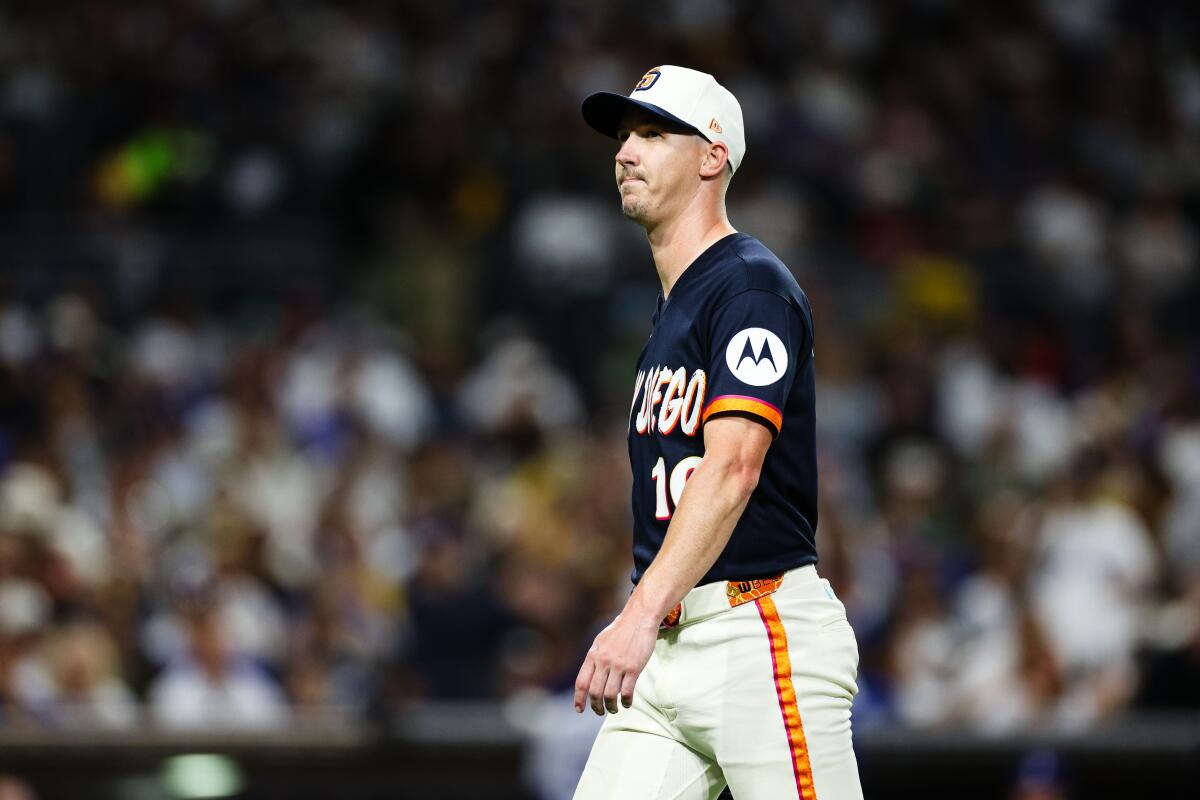
The Padres’ Walker Buehler walks off after holding his old team to one run for 5-1/3 innings Friday at Petco Park.
(Derrick Tuskan / Ap Photo/derrick Tuskan)
Sasaki’s command issues Friday showed up almost immediately. After striking out Padres leadoff hitter Fernando Tatis Jr., Sasaki walked Samad Taylor on 10 pitches. But Sasaki bounced back by inducing a double play.
The next inning, there would be no such escape. Sasaki walked both Manny Machado, whom he also battled for 10 pitches, and Gavin Sheets to open the frame. Then Xander Bogaerts’ sharp line drive to center field found leather.
France’s long fly ball to left field, however, found the seats.
Sasaki’s only clean inning, the third, was made possible by catcher Dalton Rushing’s successful challenge of a called ball four against Tatís, flipping a walk into a strikeout.
“I know that there’s confidence in there,” Roberts said. “But when you feel good and you don’t feel good mechanically and can’t execute pitches, then the results are walks, and 1-2 [count] homers, and things like that. But I do think that we can kind of tackle the mechanical things that he’s probably looking for right now.”
The Padres piled on in the eighth inning against reliever Jonathan Hernandez, as the sold-out crowd chanted “Beat L.A.!”
Mookie Betts hit a home run off former teammate Walker Buehler for his second homer in as many games. Betts seems to have come out of his offensive funk, entering Friday with a 1.061 on-base-plus-slugging percentage over the previous 11 games.
Buehler earned the win, delivering five strikeouts in 5⅓ innings.
“[Buehler] is reinventing himself,” Roberts said. “He’s throwing the kitchen sink at you. Cutter, slider, changeup, two-seamers. He doesn’t just try to bully you, and he’s finding ways to just get guys out. So yeah, he’s gonna still go up there and compete.”
The Dodgers went 0 for 4 with runners in scoring position and squandered a bases-loaded opportunity with one out in the sixth inning after chasing Buehler. Max Muncy popped out and Kyle Tucker, back in the lineup after exiting Monday’s game because of back spasms, flied out.
The Dodgers have built such a big lead in the division that the loss barely made a dent. The Padres, in second place, trail by eight games.
1 of 6 | On June 27, 2005, Dennis Rader, the so-called “BTK” (bind, torture, kill) killer, pleaded guilty to 10 slayings in the Wichita, Kan., area. He was sentenced to life in prison. File Phot courtesy of the Sedgwick County Sheriff’s Dept. | License Photo
On this date in history:
In 1829, English scientist James Smithson left a will that eventually funded the establishment of the Smithsonian Institution in Washington — in a country he never visited.
In 1844, Mormon founder Joseph Smith was slain by a mob at a jail in Carthage, Ill.
In 1847, the first telegraph wire links were established between New York City and Boston.
In 1859, Louisville, Ky., schoolteacher Mildred Hill composed a tune for her students and called it “Good Morning To You.” Her sister, Patty, who wrote the lyrics, later added a verse that began “Happy Birthday To You.”
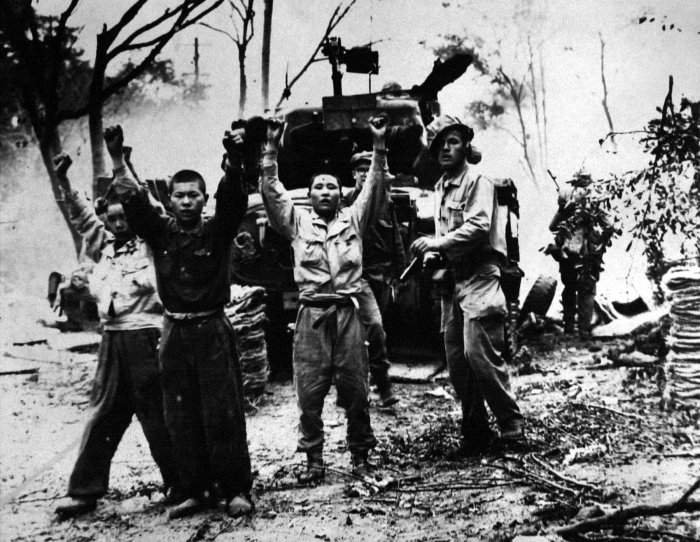
In 1950, U.S. President Harry S. Truman ordered naval and air forces to help repel the North Korean invasion of South Korea.
UPI File Photo
In 1979, the U.S. Supreme Court ruled private employers could give special preferences to Black people to eliminate “manifest racial imbalance” in traditionally white-only jobs.
In 1991, Associate Justice Thurgood Marshall announced he was retiring from the U.S. Supreme Court. He was the first African American to sit on the high court.
In 2003, the U.S. Federal Trade Commission opened a long-awaited nationwide registry for people who want to block unwanted telemarketing calls.
In 2005, Dennis Rader, the so-called “BTK” (bind, torture, kill) killer, pleaded guilty to 10 slayings in the Wichita, Kan., area. He was sentenced to life in prison.
In 2007, Tony Blair officially stepped down after a decade as British prime minister, submitting his resignation to Queen Elizabeth II. Blair was succeeded by Gordon Brown and became Britain’s envoy to the Middle East.
In 2011, a federal court jury in Chicago convicted former Illinois Gov. Rod Blagojevich on 17 felony corruption charges that included trying to sell the U.S. Senate seat vacated by Barack Obama after the 2008 presidential election. Blagojevich was sentenced to 14 years in prison.
In 2017, the FARC rebel group officially disarmed in a ceremony with the Colombian government.
In 2019, the Supreme Court ruled the federal government can’t include a question about citizenship in the U.S. census.
In 2023, producers of Wheel of Fortune announced Ryan Seacrest would succeed Pat Sajak as the host of the long-running game show. Sajak’s final episode aired June 7, 2024.
US prosecutors reach into Somalia for a suspect in US fraud case.
Published On 27 Jun 202627 Jun 2026
Mogadishu, Somalia – United States prosecutors have reached across the world to seize a leading suspect in a Minnesota fraud case, arresting him in the Somali capital, Mogadishu.
Abdikerm Abdelahi Eidleh, 42, was taken into custody on Thursday, with US authorities announcing the arrest on Friday. His capture is the clearest sign yet that the pursuit of those behind the scheme has gone international.
Recommended Stories
list of 3 itemsend of list
Neither US nor Somali officials have disclosed how Eidleh was located. However, the Department of Justice said his arrest was the result of cooperation between the Federal Bureau of Investigation (FBI) and Somalia’s National Intelligence and Security Agency.
Prosecutors describe Eidleh as the alleged second-in-command to Aimee Bock, the convicted mastermind of a scheme built around Feeding Our Future, a Minnesota nonprofit that channelled federal money meant to feed needy children during the COVID-19 pandemic.
In 2022, the US charged 47 people over a roughly $250m fraud that exploited a federal child-nutrition programme, the largest pandemic-relief fraud prosecuted in the country to that point.
Eidleh fled to Somalia as the scheme unravelled. Bock was recently sentenced to more than 40 years in prison.
According to prosecutors, Eidleh recruited operators into the scheme and collected bribes and kickbacks, often disguised as consulting fees and funnelled through shell companies.
He is accused of setting up his own meal sites under the names of stand-in owners, falsely claiming they were serving thousands of children a day, and inventing supplier firms to bill the government for food never delivered.
“This is a big fish,” US Attorney for Minnesota Daniel Rosen told CBS News, calling Eidleh a key figure who recruited businesses and paid bribes to loot public money.
Crackdown on Somali community
The Trump administration has seized on the Feeding Our Future case to target Minnesota’s Somali community, the largest in the country, with about 84,000 people of Somali descent in the Minneapolis-St Paul area.
Most were born in the US or are naturalised citizens.
Somalia was placed among a list of countries on Trump’s travel ban when he returned to power in 2025 and he has also threatened to revoke the citizenship of naturalised Americans convicted of fraud.
Late last year, he also described Somalis as “garbage” in one of his many rhetorical attacks on both Somalia and the Somali American community.
Federal immigration enforcement agents flooded the Minneapolis area, and two people were killed by ICE agents – Renee Good in early January and the nurse Alex Pretti weeks later – igniting weeks of protest.
In January, Homeland Security Secretary Kristi Noem moved to end Temporary Protected Status, a designation shielding people from deportation to dangerous homelands, for about 1,100 Somalis, ending protections that had stood since 1991.
A federal judge blocked the termination in March, and the legal fight continues.
The Bear fans might be wondering who Tom Skilling is in real life as the Chicago meteorologist makes a surprise appearance in the final season
Meet The Bear Season 5’s surprise guest star Tom Skilling
The latest guest star is Chicago royalty with an unexpected family connection.
**Warning – this article contains minor spoilers for The Bear Season 5.**
UK fans of The Bear tuning in may well be seeking some background on the fifth season’s thrilling new guest star.
Jeremy Allen White, Ebon Moss-Bachrach and Ayo Edebiri headline the smash-hit FX and Disney+ series centred on a chaotic Chicago restaurant whose lofty ambitions are more than matched by the mayhem unfolding in its kitchen.
Season 5 picks up immediately after the moment Carmen ‘Carmy’ Berzatto (played by White) announced he was walking away from the restaurant business for good, breaking the news to Sydney (Edebiri), Richie (Moss-Bachrach) and his sister Natalie, known as ‘Sugar’ (Abby Elliott), reports Wales Online.
With their finances in dire straits, a fierce storm raging outside and a packed dining room to cater for, the Bear team face one final night to demonstrate they’ve got what it takes to land that much-coveted Michelin star.
Adding to the pressure, a local celebrity has secured a table for their most crucial evening yet, as meteorologist Tom Skilling has made a reservation. But just who is he?
Who is Tom Skilling?
Tom Skilling, 74, is a former weather presenter who served as WGN-TV Chicago’s chief meteorologist from 1978 until his retirement in 2024.
Though he was born in Pittsburgh, Pennsylvania, Skilling grew up in Westfield, New Jersey before his family relocated to the Chicago suburb of Aurora, Illinois, where he completed his secondary education. At just 14 years old, he started working for WKKD and WKKD-FM where he spotted that their weather reports were incorrect as they relied on forecasts for Chicago instead of Aurora.
He struck a deal with the station to deliver his own reports which, if accurate, would earn him his own weather programme.
They proved correct and he started presenting Aurora forecasts three times weekly. He subsequently secured a position at Aurora’s WLXT-TV aged only 18.
Skilling went on to work at WKOW-TV and WTSO radio while studying at the University of Wisconsin in Madison, before securing his first major television role in 1975 for WITI-TV in Milwaukee, where his forecasts were accompanied by a sock puppet named Albert the Alley Cat.
Following a return to Chicago, he became WGN-TV’s chief meteorologist in 1978, where he stayed until his retirement in 2024. He is believed to have become the highest-paid weather broadcaster in the United States and also maintained a popular column in the Chicago Tribute, Ask Tom, until 2022.
Skilling has never married and remarkably little is known about his private life. However, he is the brother of disgraced Enron CEO Jeffrey Skilling.
The energy giant, Enron Corporation, declared bankruptcy in 2001 after fraudulent practices were exposed. This resulted in the collapse of the company’s accounting firm, Arthur Andersen, which was amongst the five largest firms globally, and is regarded as one of the biggest bankruptcy reorganisations in American history.
Get Disney+ for £1.99 a month
This article contains affiliate links, we will receive a commission on any sales we generate from it. Learn more
Disney+ has brought back its popular deal that lets new and returning customers join its Standard with Ads plan for £1.99 per month for four months.
This means members can stream hit shows like Andor, The Bear and Alien: Earth, plus countless titles from Star Wars and Marvel, for a fraction of the usual price.
Jeffrey Skilling, who served as CEO at the time, faced 35 criminal charges linked to the scandal, encompassing conspiracy, insider trading and securities fraud.
He received a $45 million (£34 million) fine and a 24-year prison sentence. Following numerous appeals, he ultimately served 12 years behind bars before being released in 2019.
The Bear Season 5 is available to stream on Disney+.
Narin Flanders hit le road with her family, stopping off at Disneyland and Eurocamp as part of a tour of the country that began with Brittany Ferries and ended with Le Shuttle
Writer Narin Flanders took her family on a road trip through France for half term instead of flying and was surprised by many of the perks(Image: Narin Flanders)
There are plenty of good reasons to swap flying for a driving holiday this summer: airline prices are creeping up, airport strikes are planned in several European hub cities and rumblings about jet fuel availability with the ongoing issues in the Strait of Hormuz.
However, why my family and I finally took the plunge, after months of reading about roadtrips online, was a reason much closer to home. As a family of four allergic to the concept of travelling light, the idea of being able to fill our Kia Sportage with everyone’s (admittedly often non-essential) essentials and travel to a few different places in one trip was a tempting prospect.
So we took the plunge and put together an itinerary, including a bit of something for everybody. We started by getting on a Brittany Ferry at Portsmouth, travelling five hours to Caen and then two hours cross-country to a Eurocamp in Domaine des Ormes, Brittany.
Do you have a travel story to share? Email webtravel@reachplc.com
We started with four days of Center Parcs style, living at a fraction of the price of a hotel. Swimming, ziplines, and playgrounds were aplenty (along with unlimited wifi – it wasn’t all Swallows and Amazons ). Then we meandered across to Le Mans as a treat for my husband and I, who are both major racing fans.
From the hallowed tarmac, we headed towards the capital to visit Disneyland Paris. After two full days at the European House of the Mouse, soaking up the new Adventure World Park as well as fulfilling all my son’s and my Marvel nerd dreams, we took Le Shuttle home.
While we were definitely nervous about driving abroad, what I realised quickly was that Gemini could answer lots of questions and even help plot the itinerary, right down to recommending great towns between our main destinations with things to do with the kids.
Planning ahead allowed us to get organised with essentials. In France, there’s a lot to consider to stay road legal. All cars driving in France need to have a safety kit in the boot in case of an emergency by law. They’re easily bought from Amazon for around £20, although make sure to buy extra high viz jackets if needed – everyone in the car needs their own.
Meanwhile, an Emovis tag is a £9 Bluetooth gadget that you can place on your dashboard and then just drive through tolls and be billed afterwards. It arrived in the UK in plenty of time for our trip, and we loved not having to faff with coins or payment cards at tolls along the way.
Cars driving in major cities that have been designated low-emission zones also need a Crit’Air sticker. These cost €4.71 (£4) including delivery and can be ordered from the French transport ministry – although beware the scam sites that come up on Google suggesting you order through them at a higher price. Cars without a Crit’Air can be fined €68, so if you think you’re going to stray into low-emission zones, it’s worth getting one for peace of mind.
While, of course, driving in France involves getting used to being on the wrong side of the road, once we were actually there, the experience was largely stress-free. I’d say French drivers are better at using motorways properly than we are – middle lane hogs didn’t seem to be much of a thing.
There are some differences, though. Notably, the responsibility for drivers to give way to cars joining the motorway, so remembering to move over took some getting used to. We were relieved to find Google Maps worked effectively everywhere we went, so it’s definitely worth paying for roaming data or picking up a temporary SIM from brands like Lebara or Smarty that include it free.
While a driving holiday was slightly out of our comfort zone, it turned into a fun family adventure we’d absolutely do again.
As well as the joys of the individual stops – and surprise diversions along the way, including discovering an unassuming restaurant with steak frites so epic it has become the stuff of family legend – we found, much to my surprise, that the time spent in the car watching the French landscape go by became part of the fun.
At home we’d be firmly in ‘are we there yet?’ territory, but a family Spotify playlist sharing our favourite songs and regular stops at French petrol stations for snacks made the drive as much a part of the adventure as everything else.
Book it
Narin stayed at the Domaine des Ormes Eurocamp. Currently, a four night stay for a two bedroom lodge through Eurocamp starting on Monday, July 20 is £975. For the October half term, Eurocamp is £289.64 for four nights.
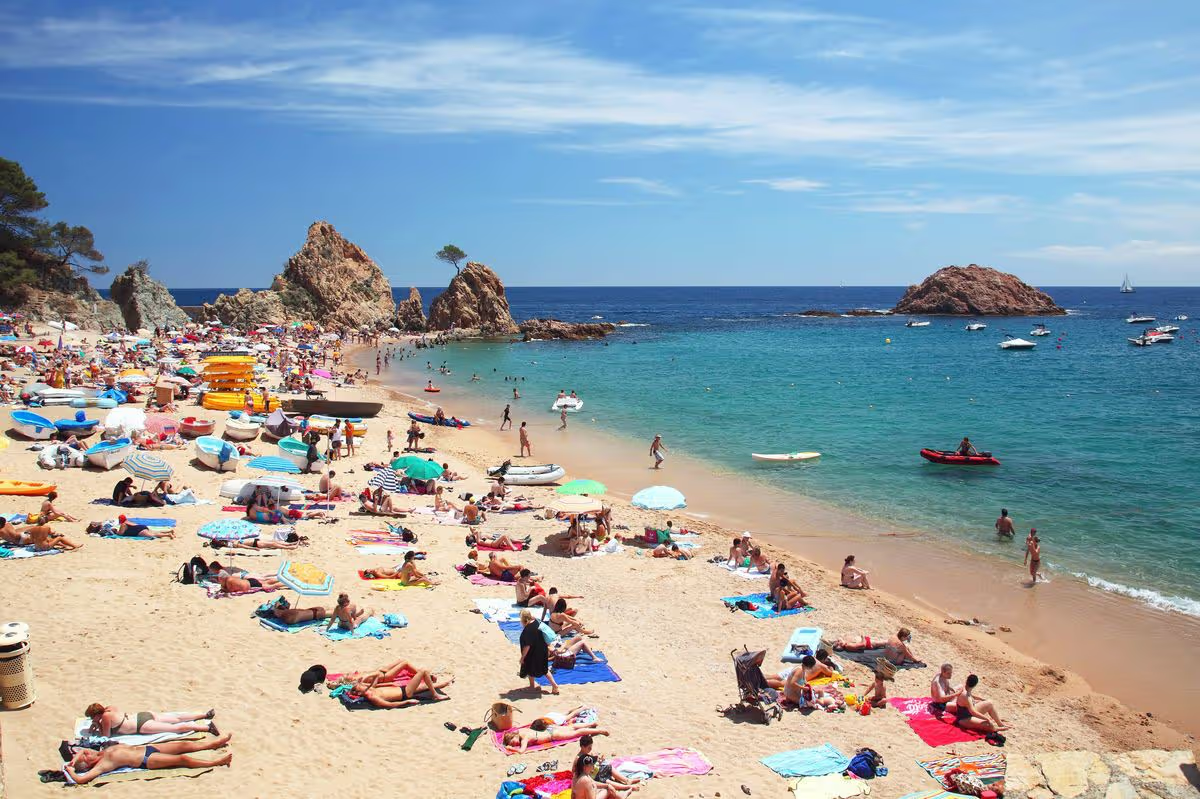
A short trip from Benidorm will take you to a picturesque Costa Blanca town that is often compared to the Greek island of Mykonos – and it’s a must-see hidden gem for anyone visiting the area
08:57, 27 Jun 2026Updated 08:58, 27 Jun 2026
The Spanish town near Benidorm is often compared to Mykonos (stock image)(Image: MiniMoon Photo via Getty Images)
Benidorm, a firm favourite among British holidaymakers, is renowned for its sun-drenched beaches, budget-friendly breaks, and the vibrant Calle Gerona, lovingly known as ‘the strip’. However, beneath the surface of stag and hen parties, Benidorm conceals beautiful spots that countless visitors have yet to discover.
For those seeking an escape from the party scene, a brief trip unveils a peaceful town. Located just moments from Benidorm, it provides a calm alternative to the raucous nightlife, with comparisons drawn to the allure of Mykonos. A quick 18-minute drive or a short 12-minute bus journey from Benidorm Intermodal brings you to the picturesque Altea, Alicante.
Hailed as one of Spain’s “most iconic” towns, Altea whisks visitors back in time with its captivating old quarter, complete with winding cobbled streets and sparkling white houses. Wandering through Altea’s alleyways, the tempting aromas of freshly made coffee and mouth-watering food drift from intimate cafés and delightful restaurants.
The town’s jewel in the crown is the parish church, Nuestra Señora del Consuelo or Iglesia de Arriba, which mesmerises tourists with its splendour. From this elevated spot, the sweeping views stretch across the brilliant blue sea to the vast beach beneath.
Alice, an influencer who highlights Benidorm’s best features and reveals her favourite recommendations online, recently visited Altea and proclaimed it a must-see destination for any travel bucket list.
Content cannot be displayed without consent
Boasting more than 37,000 TikTok followers, Alice gushed: “Hidden gem only 15 mins from Benidorm! Maybe Altea isn’t a hidden gem for those in the know, but the way you could lowkey be just 15 mins away from this gorgeous slice of history and culture while on your holibobs in Benidorm!”
She went on to say: “It’s an absolute MUST see if you’re looking to escape for an afternoon to see some of the best views on the entire Costa Blanca. It’s giving cheeky Altea day trip, don’t you think?”.
The response was overwhelmingly positive — the short clip has racked up more than 17,900 likes alongside a flood of glowing comments.
One visitor shared: “I went there in December. Very nice.”
Another remarked: “There are stunning restaurants and bars. It’s not Benidorm. They may be close but they are worlds apart. Altea is beautiful.”
A third chimed in: “It’s simply a stunning old and new town.”
One commenter went as far as calling it their “favourite place of all time”, while another declared it had firmly earned a spot on their bucket list, writing: “Definitely heading here.. never knew it was so close.”
Flights from the UK to Alicante can be snapped up from as little as £40.
From there, you can hop on a bus, grab a cab or take the tram to Benidorm, which should take roughly 40 minutes by road.
The decision of where to sit on a plane could impact the rest of your holiday
08:31, 27 Jun 2026Updated 08:35, 27 Jun 2026
Picking the right seat could make a big difference(Image: Getty)
As millions of Brits gear up to jet off on their summer holidays, one decision that many may have overlooked could make or break their entire trip. Choosing the right seat on the plane might be the difference between relaxing on a sun-soaked beach or making endless trips to the toilet.
Research has revealed that whether passengers opt for a window, middle, or aisle seat could potentially affect their chances of catching a viral infection before the holiday has even got underway. However, your seat selection alone won’t be the sole factor determining your overall risk of falling ill.
How close you are to someone carrying a virus is the single biggest indicator of how likely you are to pick up an infection. This is followed by how busy the flight is, as the greater the number of passengers on board, the higher the likelihood that some will be carrying viruses.
Airflow throughout the cabin, passenger movement, contact with shared surfaces (such as in the bathroom) and whether or not you wear a mask will all have a bearing on your risk of catching a viral infection during a flight.
Dr Sophie Dix, Head of Medical Affairs at online pharmacy MedExpress, has offered guidance on how travellers can lower their risk of falling ill while flying, including advice on where to sit. She said: “Although there is no guaranteed way to avoid picking up an illness while flying, there are practical steps people can take to reduce their exposure to germs and viruses on planes.”
She shared her top tips for travellers looking to lower their chances of picking up an infection. Here’s what she advised.
Seat selection matters
“The best advice to avoid getting sick on the plane is to try and reduce as much contact with germs and other passengers as possible, so choosing where you sit may have more impact than you might have originally thought.
“Window seats are a great option as they are often far away from high traffic areas such as bathrooms and busy walkways. Aisle seats also increase your exposure to people who frequently pass by throughout the flight, queue for the toilet, and access luggage from overhead compartments. One study found that sitting in a window seat can reduce your interactions with other passengers or crew by up to five times compared to if you sit in a middle or aisle seat.”
She added: “Additionally, research may suggest that leaving the middle aisle free reduces the spread of airborne diseases by 37%, so choosing seats that appear to have middle aisles empty could be a strong choice. Whilst protection from illness is never guaranteed, this highlights that creating distance between other passengers greatly reduces your chances of getting sick.”
Wipe down any surfaces
“Surfaces such as tray tables, armrests, seatbelt buckles, touchscreens, magazines and window shutters can harbour germs easily as they are used so frequently by previous passengers. Wiping down surfaces with disinfectant wipes or sanitiser greatly reduces your risk of coming into contact with germs on them.
Wash your hands regularly
“Maintaining good hygiene standards while travelling can greatly reduce your chances of getting sick. Washing your hands regularly with soapy water or hand sanitiser, especially after coming into contact with surfaces, is a simple but effective way to stop the spread of germs while you’re on the plane.
Stay hydrated
“Cabin air on planes can be extremely dry and irritate your nose and throat whilst travelling, leaving you feeling more run down and vulnerable to picking up any viral infections. Make sure to drink plenty of water and keep on top of hydration throughout the flight to strengthen your immune system. Keep water easily accessible throughout the flight, and drink regularly, especially if you’re travelling with children.
Wear a face mask
“Wearing a face mask greatly reduces the spread of any airborne viruses, as we saw throughout the COVID-19 pandemic. Crowded flights may become a hotspot for any infections due to the cramped space and close proximity to other passengers, so taking preventative measures may help reduce the spread of any current infections.
Ensure you’re well rested
“Those who don’t get adequate rest before a flight are over 4 times more likely to catch a cold compared to those who are fully rested. This is due to your immune system being weaker when you haven’t got enough sleep, making you more susceptible to picking up any infections.
Ginn (6-4) gave up three runs and eight hits, striking out five and walking one, to provide a much-needed boost to a pitching staff that had major league highs in June with a 6.14 ERA and 44 home runs given up.
The last-place Angels appointed former St. Louis Cardinals general manager John Mozeliak to be their interim GM and baseball operations consultant.
Angels starter Walbert Ureña (5-6) was perfect through four innings, opening the game with 15 straight strikes and needing only 36 pitches — 31 strikes — to retire his first 12 batters.
But the 22-year-old right-hander, who had a 1.93 ERA in his previous 10 starts, walked two of his first three batters in the fifth, throwing nearly as many pitches in the inning (36) as he did in the first four.
Max Muncy broke up Ureña’s no-hit bid with an infield single that load the bases, and the A’s followed with Jeff McNeil’s two-run single, Alika Williams’ RBI single, Henry Bolte’s two-run single and RBI singles by Nick Kurtz and Langeliers that built a 7-1 lead.
Donovan Walton’s RBI single had put the Angels ahead in the fourth. Jo Adell hit a two-run homer in the fifth.
Up next: Athletics RHP Jack Perkins (2-3, 6.26 ERA) and Angels LHP Reid Detmers (3-5, 3.93 ERA) start Saturday night.
Johannesburg, South Africa – Mansa Musa, the 14th-century emperor of the Malian Empire, often comes to mind whenever African gold enters the conversation. Renowned for his immense wealth, he is often described as the richest man in history, largely due to the vast gold resources of his empire.
Yet centuries after Mansa Musa’s reign, Africa’s relationship with gold remains paradoxical. The continent possesses some of the world’s richest gold deposits, but much of the wealth generated by the industry continues to be captured elsewhere. According to the United Nations Environment Programme (UNEP), Africa holds about 40 percent of the world’s gold reserves.
Although Africa remains one of the world’s most gold-rich regions, it continues to occupy the lower end of the global value chain. Gold extracted across the continent is largely exported, mainly to the United Kingdom, where it is refined, traded and priced. As a result, the most profitable stages of the industry remain concentrated elsewhere, creating a persistent gap between extraction and value capture.
“Africa’s position reflects structural constraints, including limited refining capacity, capital bottlenecks and historical trade patterns that favour exporting unrefined gold, allowing offshore markets to capture the highest-value margins in refining and trading,” Kate Collett, insights analyst at Africa Practice, told Al Jazeera.
Increasingly, African governments are not only seeking to extract more gold but also to retain greater control over it. That ambition extends beyond mining policy. Across the continent, policymakers are increasingly viewing gold as a strategic financial asset that can strengthen reserves, reduce external vulnerabilities and support greater economic sovereignty.
A shift in global reserves
Gold has re-emerged as a strategic reserve asset in an increasingly fragmented global economy. Unlike fiat currencies, it is widely seen as retaining value during periods of inflation, geopolitical tension and financial uncertainty.
Across the Global South, central banks have increased gold accumulation in recent years as part of efforts to diversify reserves and reduce exposure to external financial systems. This trend is visible in major emerging-market economies, including China, Russia, India and Turkiye, according to data from the World Gold Council.
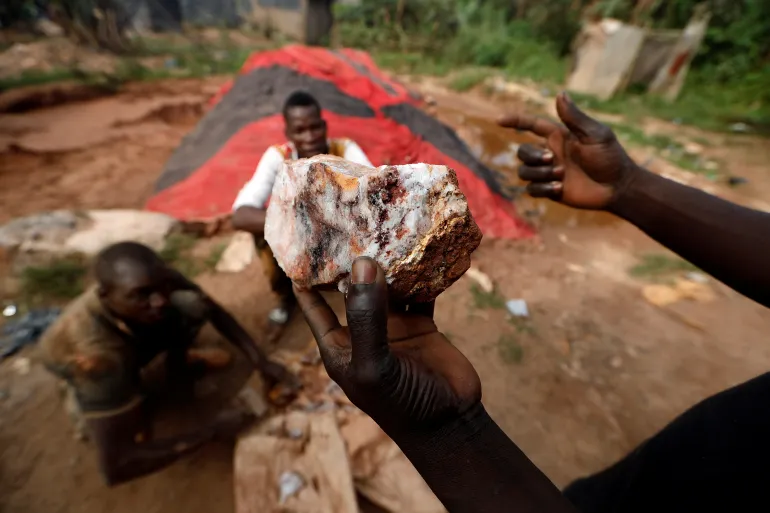
An artisanal gold miner holds up a rock recovered from inside a gold mine before it is ground down for processing at the site of Nsuaem-Top, Ghana [Zohra Bensemra/Reuters]
By accumulating gold, central banks reduce reliance on foreign currencies and hold reserves outside the direct control of any single financial system.
African countries have joined this shift in an effort to strengthen economic stability, build reserve buffers and increase financial sovereignty.
Within Africa, Ghana, one of Africa’s leading gold producers, has increased the proportion of locally produced gold purchased by the central bank under its domestic gold accumulation programme, according to Bank of Ghana reporting and policy communications.
Nigeria has pursued broader reserve diversification strategies, including increased interest in gold as part of efforts to strengthen the composition of its external reserves, according to central bank statements and analysis by international financial institutions, including the International Monetary Fund (IMF) and the World Gold Council.
Tanzania requires approximately 20 percent of gold output from mining companies and traders to be allocated for sale to the central bank under its reserve-building framework, according to Bank of Tanzania regulations. Guinea has tightened licensing and export controls in its mining sector, part of wider efforts to increase state oversight and capture more domestic value.
According to analyst Thea Fourie, head of regional analysis for the Middle East and Africa at S&P Global Market Intelligence, rising gold prices have reinforced these shifts. “This trend aligns with a broader geopolitical shift towards de-dollarisation … including the development of alternative payment systems and increased use of local currencies in trade,” she told Al Jazeera.
For African producers, this changing global financial environment has accelerated the use of gold as a tool of economic sovereignty, analysts say.
Capturing more of the value chain
Across the continent, governments are also trying to retain more value from domestic production by tightening oversight of mining and reshaping how gold moves from extraction to export.
Ghana has expanded its central bank gold purchasing programme. Tanzania has strengthened regulatory control linked to domestic sales and reserve-building requirements, while Guinea has tightened licensing enforcement and export rules aimed at improving domestic processing and value retention.
An artisanal gold miner digs at the Bantakokouta gold mine, one of the largest artisanal gold mining sites in southeastern Senegal, near the Mali border [John Wessels/AFP]
In Guinea, authorities have also cancelled mining licences deemed unproductive and restricted exports of unprocessed gold in an effort to encourage local refining. Namibia continues to restrict the export of unprocessed minerals, reinforcing efforts to increase domestic value capture.
Artisanal mining, often operating outside formal systems, is increasingly being treated as part of the formal gold economy rather than a parallel informal sector. Governments are seeking to formalise production, reduce smuggling and increase tax and export revenues.
“These programmes can help countries retain more value from their mineral resources by reducing smuggling, formalising artisanal mining and creating incentives for local refining and downstream industries,” Collett said.
But integration remains uneven. Many small-scale miners still operate outside formal channels due to limited access to finance, markets and technical support.
“As commodity prices rise, this gap between legal status and how the sector operates on the ground is widening, with value still flowing outside formal systems,” she added.
Resource nationalism in the Sahel
In the Sahel, military-led governments in Mali and Burkina Faso have pushed further towards state control of mining assets, framing reforms as part of a broader effort to reduce economic dependence on former colonial partners.
Mali’s President Assimi Goita has overseen a restructuring of the mining sector, expanding state involvement and promoting domestic processing capacity. With Russia emerging as a key partner after a break with France, the government is also developing a state-controlled gold refinery in Bamako.
Gold miners scratch a living by digging in primitive mines and panning for flecks of gold for a licensed supervisor on the outskirts of Bulawayo, Zimbabwe [John Moore/Getty Images]
Burkina Faso has increased state participation in mining and sought to expand national gold reserves. Alongside Mali and Niger under the Alliance of Sahel States, it has pursued deeper economic coordination. Plans for closer monetary cooperation have been discussed, though they remain in development.
However, most large-scale mines in the region remain operated by foreign companies due to limited domestic technical capacity.
According to Fourie, of S&P Global Market Intelligence, this shift reflects a broader wave of resource nationalism driven by fiscal pressures and security challenges.
“These governments have also deepened ties with non-Western partners, reshaping longstanding trade and diplomatic relationships,” she said.
But analysts caution that tighter state control can deter investment if regulatory frameworks are unclear or not consistently applied.
“The quest for African resource sovereignty should not be reduced to the Sahel juntas’ spectacular enforcement, with executives locked up in jail, and inflammatory narratives,” Collett said.
A long road to control
Despite growing policy momentum, full control over the gold value chain remains distant. Moving from extraction to refining and pricing within African economies requires sustained investment in infrastructure, skills and industrial capacity.
Building internationally certified refineries and attracting long-term capital will take time, even as governments push for greater oversight.
For now, much of the value generated by African gold continues to flow abroad [John Wessels/AFP]
“When the measures are introduced in an opaque manner, when there is no stakeholder engagement, is when investor confidence starts to slip,” said Beverly Ochieng, senior analyst at Control Risks.
Some governments have managed to balance tighter control with investor confidence by maintaining clearer regulatory engagement and consultation with industry stakeholders.
For now, much of the value generated by African gold continues to flow abroad.
“The experiment with the state mining operators will be one to watch … whether they are able to meet international standards, sell the gold and set prices,” Ochieng said. “And ultimately, at the back of it is whether this government will be stable enough to see through this process.”
Still, many analysts believe the direction of travel is set.
“I think in the long run, we are seeing more African governments taking steps to ensure the entire value chain remains in-country … Maybe in a couple of decades, we might see a sort of gold OPEC emerging from African countries,” she said.
A double strike from Arsenal’s Leandro Trossard against New Zealand carried Belgium to top of Group G, ahead of Egypt on goal difference.
Published On 27 Jun 202627 Jun 2026
Belgium defeated New Zealand 5-1 to book their place in the knockout rounds of the 2026 World Cup on Friday, eliminating the All Whites from the tournament. The result secured the European nation’s first win of the World Cup, as they finished on top of Group G in Vancouver.
A double strike from Arsenal’s Leandro Trossard and goals from Kevin De Bruyne, Romelu Lukaku and Alexis Saelemaekers carried Belgium into the last 32 in first place ahead of Egypt on goal difference.
Recommended Stories
list of 4 itemsend of list
Egypt claimed the runners-up spot after a 1-1 draw with Iran in Seattle. The Iranians finished third in the group and face an anxious wait to know about their knockout fate.
Belgium dominated a lopsided first half and had alarm bells ringing in the New Zealand defence early on when Trossard’s angled shot cannoned off the inside of the upright only to be cleared off the line by Tyler Bindon.
Belgium looked poised to take the lead moments later when Jordanian referee Adham Makhadmeh pointed to the penalty spot after Trossard’s shot hit the arm of covering defender Finn Surman.
But VAR sent Makhadmeh to the monitor to take another look at the decision, which was subsequently overturned and New Zealand breathed again.
Yet Belgium did not have long to wait before the breakthrough and again it was Trossard who proved to be in the right place at the right time, bundling home from close range after De Bruyne’s corner sowed panic in the six-yard box.
Trossard effectively made the game safe five minutes into the second half, controlling a rebound in a crowded area to volley home past New Zealand goalkeeper Max Crocombe at the near post.
Kevin De Bruyne #7 of Belgium celebrates after scoring his team’s third goal [Emilee Chinn/Getty Images via AFP]
De Bruyne then stroked home an elegant low finish in the 66th minute to make it 3-0, a crucial goal which saw the Belgians leapfrog over Egypt into first place on goal difference.
Yet there was to be a dramatic end when New Zealand’s Elijah Just volleyed home a consolation strike from the edge of the area to make it 3-1.
That could have been potentially costly, with the goal suddenly bumping Belgium down into second place.
But Lukaku nodded home his team’s fourth in the 86th minute with his first touch just a minute after coming on as a substitute to return Belgium to the top of the table.
Saelemaekers completed the scoring with a shot from the edge of the area.
When David Jacks published a biography of Peter Asher in 2022, the veteran record producer and manager expressed surprise that anyone would have deemed his life worthy of the treatment. Four years later, he’s no less baffled to have become the subject of a new documentary, “Peter Asher: Everywhere Man,” directed by the filmmakers Dan Geller and Dayna Goldfine.
“It just seemed to me,” he says, “that I wouldn’t be that fascinating.”
The movie, in theaters now, argues otherwise: A child actor alongside his two younger sisters, the bespectacled Asher became an unlikely pop star during the British invasion as half of the duo Peter & Gordon, whose debut single, “A World Without Love” — written by Paul McCartney — hit No. 1 on Billboard’s Hot 100 in 1964. (McCartney offered the song to Asher while the Beatle was dating Asher’s sister Jane.) In 1968, the Beatles made Asher head of A&R at Apple Records, where he signed James Taylor; the two soon moved to Los Angeles and turned Taylor into music’s biggest heartthrob folkie.
Asher went on to shepherd Linda Ronstadt to stardom and to produce records by Diana Ross, Cher, Bonnie Raitt, Randy Newman, Neil Diamond and 10,000 Maniacs, among many others. And at 82 he’s still at it: Last year he produced Barbra Streisand’s latest duets album — they’re due to start work on a new Streisand solo LP, he says — and he’ll perform a show of his own July 19 at the Grammy Museum. Asher, who broke his leg in a recent fall, spoke about it all the other morning at his home in Malibu, where he walked into the kitchen using a cane before sitting down at a table set with pastries and several of the day’s newspapers.
What unites the jobs of musician, producer, executive, manager? What’s the through line? Love of music and admiration for the people who do it. They’re very different jobs, and I came at them from very different perspectives. Record production was something I set out to do once I understood what a record producer did. Hire musicians much better than yourself and tell them what to do? That’s a cool job — how do I get in on that racket? Whereas I never had any ambitions to be a manager. It’s just that when James and I decided to go out on our own and try to put a career together, we didn’t know who we trusted to do it, so I kind of went, I’ll do it.
What’d you discover about the job of management? The ingredients are common sense, not being a crook and having a great client.
Which is the hardest of those three? The last one. I got to induct the first managers inducted into the Rock & Roll Hall of Fame: Brian Epstein and Andrew Loog Oldham — the Beatles and the Stones. That’s the hard part. The only thing that would tempt me back into management would be lightning striking for a third time — to see James, to see Linda, then to see somebody comparably brilliant, which I occasionally do. But usually they have a manager already.
What’s the last new act that knocked you out? Ed Sheeran.
Was that just because he looks like he could be your grandson? That certainly crossed my mind.
As a producer, your records helped define the sound of rock in the ’70s. The so-called California sound.
Then the zeitgeist shifted. One became aware of that. Pop music got very electronic, which I loved.
Was there a place for you in that style? I didn’t consciously try to make records in that style because I don’t think I could have — not as well as they were being made anyway.
What’s a record from the early ’80s that made you think that? “Sweet Dreams (Are Made of This).” I couldn’t do that.
Back to the ’70s: The doc is filled with pictures of James looking — Like a movie star. With the cover of “JT,” I finally went all the way and said, “We’re doing the the glamour shot.” Then we did “Flag,” which everyone hated.
With the maritime flag. A truly perverse album cover. I loved it. James loved it. Everyone thought we were crazy.
How crucial do you think James’ good looks were to his whole proposition? I don’t know.
Oh, come on. I really don’t. I mean, how would you gauge that? There’s probably girls who fell in love with him without listening to the record.
I think you just gauged it. If he was ugly, would he be as big a star? Probably not.
(Evan Mulling / For The Times)
Same applies to Linda, right? When I first saw Linda, it was stages of realization. Someone said to me, “You’ve got to go down and see this girl at the Bitter End.” I walk in and she’s singing so well — unspeakably good. Then she looks incredibly great — barefoot, short-shorts. Oh, my God, my heart. Then you meet her, and it turns out she’s a remarkably brilliant woman — extremely well read. You just kind of go, “All these things together — how can it be?” It’s the same thing talking about the Beatles: If you cast it like the Spice Girls, you still couldn’t have gotten four to fit together so perfectly.
Did you like the Spice Girls? Terrific. “Tell me what you want / What you really, really want” — it’s a smash. And yet none of them are particularly good singers, which is kind of the point.
I went to an event not long ago where Paul McCartney played his new album for a small group of fans. It was fascinating to see the spell McCartney casts over people. He’s had to get used to it — to admit to himself that he can’t meet people who aren’t amazed that they’re meeting him. Even as someone who’s known him off and on for a long time, you still get the wave of: Holy s—.
You’re still amazed to be around him? Of course. I get it less — I’m ready for it. But you can’t pretend he’s not Paul McCartney. And he’s gotta live with that his whole life.
You grew up a member of the upper crust, I think it’s fair to say. I don’t think we were that crusty. But upper, probably, yes.
I wondered how that situated you to live and work among artistic types. If anything, the upper crust have more time to be artistic — less preoccupied with getting a job and making a living. But my parents worked incredibly hard — we weren’t upper crust in the sense of inherited wealth. My father was a doctor, my mother was a professor of music. But I never struggled, to be honest. I had a comfortable allowance, and then I went to school and worked hard. Everyone talks about sharing a flat with a million people, living on borrowed sandwiches — I skipped that phase.
Did that shape you in any meaningful way? I don’t know. But I think when people do struggle, it becomes a meaningful part of their lives to get away from it. With someone like James, the struggle was a struggle with drugs. Now he says the worst thing about drugs is they’re a complete waste of time — you waste time doing nothing except looking for drugs. And I think that made him anxious to succeed and to be taken seriously.
I’m sure you saw the New York Times’ list of the 30 greatest living American songwriters. You knew it was gonna be silly. Randy Newman, for God’s sake — you just cannot not include him.
No Neil Diamond either. Insane.
And no Billy Joel. [Shrugs].
How’s your health? High blood pressure, high cholesterol, need to work out more — old man stuff. Other than that and a broken leg, great.
You’re OK with the cane? It’s a considerable upgrade from the wheelchair. I like the cane — it’s kind of elegant.
What seems scarier: the body going or the mind going? The mind going. And it is, slightly. I had a stroke, and bits of my brain aren’t quite working right. But compared to other people I know, I’m fine.
We’re at a moment when a lot of foundational rock ’n’ roll figures — Are dying. It’s all the rage.
What’s it feel like to see your friends and colleagues go? Better them than me.
Couple more for you: You managed Courtney Love for a spell. I met her here in Malibu. I also managed Pamela Anderson for a while because she was a neighbor and asked me to help.
What, you put a shingle out? “Manager for hire.” I’m trying to remember how I first met Courtney — I think Merck Mercuriadis was talking to her about publishing and Kurt stuff. I liked her. Very smart. I like smart women.
She’s easy to work with? Hard to work with? Impossible to work with.
What’s James Taylor’s best album? “JT,” maybe.
What’s Linda Ronstadt’s best album? “Heart Like a Wheel.” With Linda, it’s unfair because they’re so radically different. How do you compare that to a mariachi record and then to Nelson Riddle?
Working with Riddle on those albums must have been a thrill. He told us all these incredible stories about Frank Sinatra, who he didn’t like although he admired him enormously. It was John David Souther who originally suggested Nelson. Linda had tried doing the album a different way — did some versions with Jerry Wexler and it didn’t work out. So we had a meeting with Nelson: Would he consider doing a couple of arrangements for us? He went, “No.” We said, “What?” He said, “I’ll do an album, though.”
“A World Without Love” was one of eight songs to top the chart in 1964 with “love” in the title. What’s that say about pop music in the mid-’60s? Same thing it says about pop music of all time: It’s either “I love you” or “She loves you” or “Why don’t you love me?” Weird Al pointed out to me that when you’re looking for a parody of a song, any song that has “love” in the title, substitute “lunch” and it’s funny. “A World Without Lunch” — I mean, who would want to live in such a place?