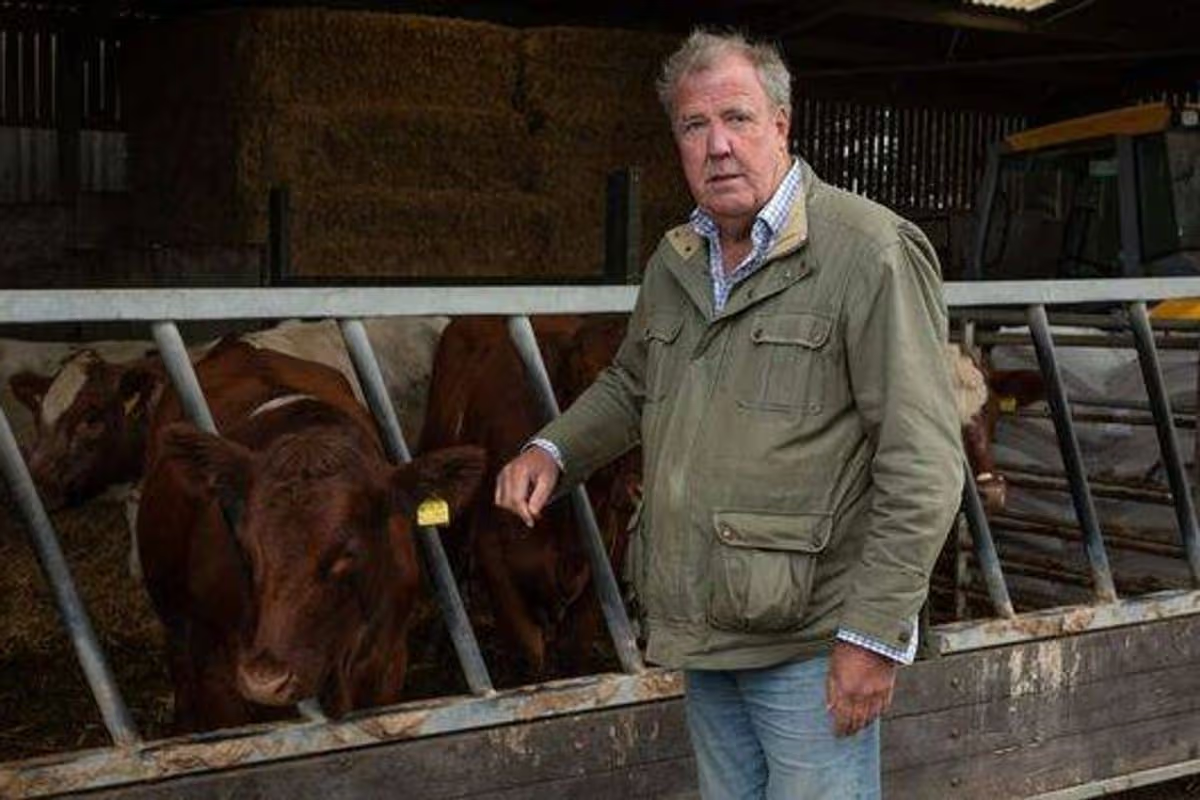
Clarkson’s Farm Season 5 ended with a devastating turn of events for Jeremy Clarkson.
Jeremy Clarkson was left devastated in Season 5(Image: Amazon Prime)
Jeremy Clarkson discovered the shocking truth about the TB results at the end of Clarkson’s Farm Season 5.
Clarkson’s Farm fans are keen to find out what happened to Diddly Squat Farm after it was suspected one of Jeremy Clarkson’s pregnant cows had TB (Bovine tuberculosis).
Welsh vet Dilwyn Evans had been carrying out routine tests on Clarkson’s cattle when he found a potential ‘fail’ on one of the cows, who happened to be pregnant.
In heartbreaking scenes in the final episode of Season 5, the first ever cow to have been bought to the farm, whilst pregnant with two calves, was taken to be slaughtered after the suspected outbreak of TB lead to two inconclusive tests.
Clarkson was later left with his “blood boiling” after a post-mortem of the cow showed she did not actually have TB, but the farm was still required to stay in lockdown.
Here is all you need to know about the current status of Diddly Squat following the TB scare.
The outbreak took place in August of 2025, before Season 5 of Clarkson’s Farm was released, with the former Top Gear host announcing it on X.
Whenever a cow fails a TB test, the entire herd has to be placed on lockdown and any offending cows are legally required to be slaughtered. Thankfully, Clarkson revealed in a column for The Sun in March 2026 that the farm was out of lockdown measures.
He said: “After seven months of lockdown, Diddly Squat farm became officially TB-free this week.”
Unfortunately, there was some bad news to share, as he went on to explain: “But before we had a chance to celebrate, we found out that one of our donkeys has laminitis and must be put down.
“In farming, it seems you are allowed one bit of good news, but it must always be accompanied by some kind of disaster.”
The star previously explained how much of a toll the TB lockdown had on the farm, as it was not allowed to operate as a business.
He said in his column for The Times: “All the barns we needed to store the grain in, we now have to convert into a cow hospital.
“We’ve got another calf with pneumonia, so that needs to be housed. And we can’t buy or sell a cow now because the farm officially, you know, has TB.”
After a devastating time, Clarkson and the rest of the team can now look forward to better luck with TB no longer looming over them.
Russian President Vladimir Putin has admitted that the country is facing a “certain shortage” of fuel following Ukrainian drone strikes targeting its energy infrastructure, but insisted that “it’s not critical.”
“We need to minimize the consequences of terrorist attacks on
Visit Medellín, and everyone will tell you to try one dish: bandeja paisa.
Translated as a “countryside tray,” you’ll find the loaded meat platter at any restaurant in Colombia’s second-largest city. The spread is loaded with savory red beans; white rice; ground beef or grilled steak; a long, curved strip of crispy chicharrón; chorizo; morcilla (blood sausage); a fried egg; golden lobes of sweet plantain; a mini arepa; and a slice of avocado.
Though its origins lie in the mountainous, coffee-growing region of Antioquia, known as the home of the paisas (derived from the Spanish word for countryman), the dish is widely celebrated and eaten across the country. It’s a hearty lunch meal meant for one person, a combination of flavors and textures that transport you straight to Medellín, known for its rich coffee landscape, blooming flowers and eternal spring weather.
“The bandeja paisa is the seal of the Colombians,” said Gloria Hernandez, owner of Nene’s Colombian Food in Lawndale.
The dish is believed to have started as a filling, nourishing meal for campesinos (field workers), providing strength to get through a day working in the fields. “There’s a gathering of various dishes to make a bandeja paisa,” said Cesar Gutierrez, owner of Arepa’s Colombianas in Redondo Beach.
Over 40,000 Colombians live in L.A., according to the Los Angeles Almanac. Three-thousand miles from home, the city is host to several Colombian restaurants, food trucks and even a rooftop night market in downtown L.A.
From a longstanding restaurant in Larchmont to a favorite for modern Colombian cuisine in Long Beach, here are seven places where you can devour a bandeja paisa.
Heinrich Malan has stood down as head coach of Ireland’s men’s cricket team, less than 24 hours after the historic Twenty20 series win over world champions India.
The South African will leave as part of what Cricket Ireland says as a “planned transition”, and a new head coach is set to be in place for a five-game one-day international series with Afghanistan in August.
The 45-year-old has been in charge of Ireland since 2022 and his final game was a dramatic one-run victory over India to clinch the T20 series on Sunday in Belfast, which followed a first-ever victory over the world champions in any format on Friday.
Unionized members of Kakao Corp. stage a rally outside of the company’s headquarters in Pangyo, south of Seoul, in this file photo taken on June 10. Photo by Yonhap
Unionized workers of Kakao Corp., South Korea’s messenger app operator, took a day off en masse on Monday in a sign of protest amid a continued gridlock in wage negotiations.
In their second collective action, unionized members staged what they called a “Log-out Day” by taking simultaneous annual leave.
Some 2,100 workers from five units of Kakao, including its headquarters, Kakao Pay and Kakao Enterprise, have participated, the labor union claimed.
The company, however, said it estimates only 800 employees from Kakao’s headquarters took part in the latest industrial action.
Wage talks between Kakao’s labor union and management have been at a standstill since May, after the two sides failed to narrow differences in performance-based incentives.
The union is reportedly demanding the company pay around 13 to 14 percent of operating profit as bonuses, while the management has rejected such demands, claiming they put too much burden on the company.
On June 10, workers staged their first-ever strike. Some 1,500 union members walked out from their jobs for four hours and rallied near the company’s headquarters in Pangyo, south of Seoul.
Despite concerns from industry watchers, no disruptions were reported on Monday, including in the company’s key messenger service, KakaoTalk.
Kakao’s management had previously said it plans to continue negotiations with the union, while remaining on standby to ensure stable service operations.
Copyright (c) Yonhap News Agency prohibits its content from being redistributed or reprinted without consent, and forbids the content from being learned and used by artificial intelligence systems.
As holiday prices go up, it’s always helpful to take on any advice you can to make it that little bit cheaper and as it turns out, that includes which day of the week you fly
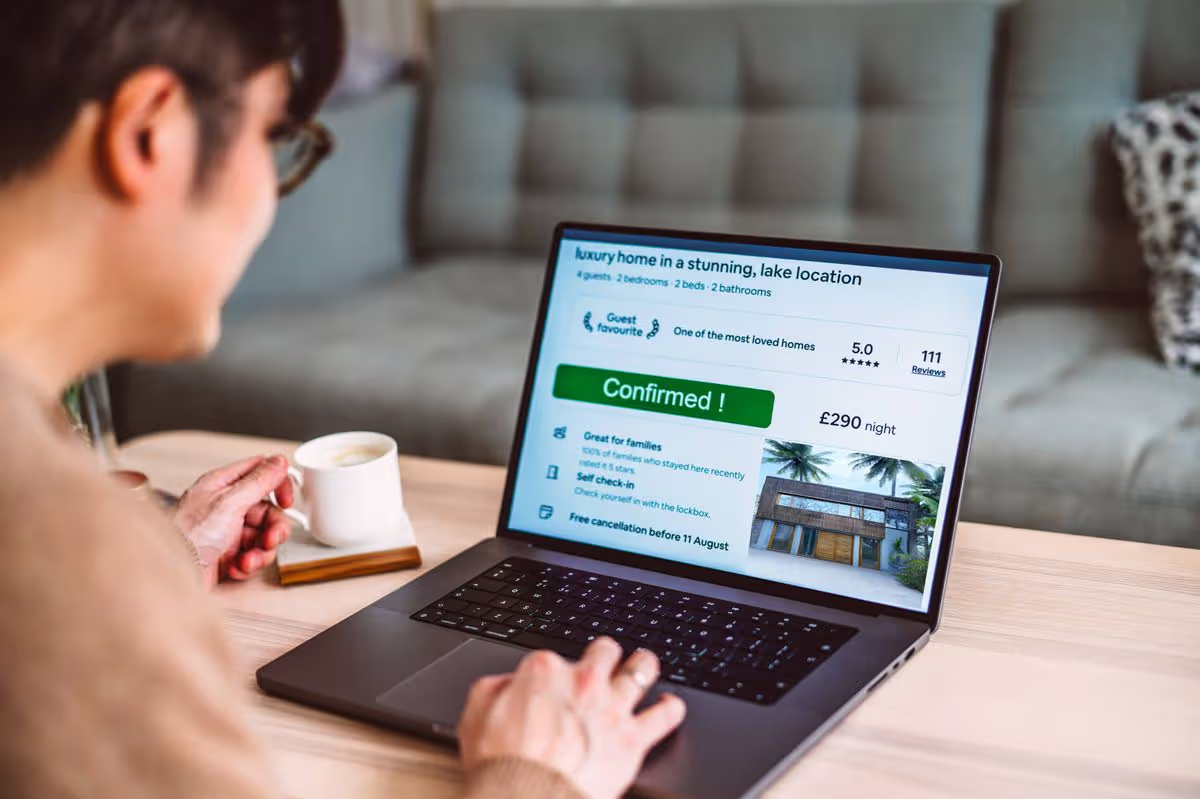
This simple booking step could save your family £100s (Image: Getty)
Ahead of your last-minute summer trips or 2027 getaways, it’s best to be smart about your bookings, and a travel expert is here to tell you exactly why.
Flights are one of the most expensive aspects of any holiday, especially if you’re traveling further afield. If you’re not following these simple steps, you could be doing it all wrong.
To help holidaymakers navigate their bookings abroad with confidence, travel expert and head of aviation at Loveholidays, Gavin Brewer, has shared his expert advice for a stress-free getaway.
With three decades of experience in the aviation industry, he offers practical advice on securing cheap, last-minute deals and ensuring your trip is protected.
Something many people overlook when booking a holiday is the day they fly. While they often make sure to consider key dates, outside of school holidays for cheaper packages or outside of peak summer times altogether, they don’t stop to think about the difference flying on a Monday could have to flying on a Sunday, for example.
As it turns out, that difference could be quite a lot, especially if you’re booking for a family, where all those saved pounds soon add up.
Gavin suggests being super strategic with your departure date to ensure you’re saving money and getting the best flights for the best price. He explains that the start of the week is always the cheapest to depart, according to recent analysis of flights, meaning Sundays, Mondays and Tuesdays are the best days to begin your holiday.
“If you’re on a budget, be flexible with your departure date and look at holidays departing on either a Sunday, Monday or Tuesday. Our research shows you could save up to £24 per person on the flight element of your package holiday, and every little bit helps,” he said.
To ensure you have the safest, stress-free holiday, the expert advises booking your travel insurance at the same moment in time you book your holiday and avoiding putting it off. This means it protects you from the moment the trip is secured, making it “one of the smartest moves you can make”.
Getting to grips with your cover is just as important as picking your destination, because when the unexpected happens, the right policy can be the difference between spending big bucks and flying away without a care in the world.
If you want a little extra protection, package holidays are ideal. In the UK you get built-in protections you don’t get when booking separately. In the event of any disruption ahead of your travels, such as a cancelled flight with no suitable alternative, as a traveller you are fully protected, thanks to a set of consumer laws called the Package Travel Regulations. As a result of this, you are entitled to a full refund on your package holiday.
Rescue teams and volunteers are working around the clock in search for survivors trapped beneath the rubble in Venezuela, as families cling to hope days after the June 24 twin earthquakes, with tens of thousands of people still missing. Zein Basravi reports from Caracas.
“The Pitt” has put “ER” veteran Noah Wyle back where he excels: a fictional emergency room. But this time, Wyle has assumed far more control over the Emmy chaos by producing and directing as well as acting.
2
In 2025, Wyle won the lead drama actor Emmy for playing complicated miracle worker Dr. Michael “Robby” Robinavitch, plus a producing prize for drama series.
5
Wyle was nominated five times (1995-1999) without winning for his supporting performance as Dr. John Carter on “ER,” his first hospital-set collaboration with producer John Wells.
29
Nominations that “ER” actors Wyle, Julianna Margulies, Anthony Edwards, Sherry Stringfield, Eriq La Salle, George Clooney, Laura Innes, Gloria Reuben, CCH Pounder and Maura Tierney amassed in supporting and lead categories.
1
Emmy wins that resulted from those nominations: Margulies’ supporting triumph in 1995.
200%
“The Pitt” doubled that haul in one season, with Wyle’s lead and Katherine LaNasa’s supporting wins. (And added a guest actor Emmy for Shawn Hatosy, who moves up to supporting in Season 2.)
3
Wyle could grab three more nominations this time around, including for his “Pitt” directing debut (Season 2, Episode 6).
8
He also no longer competes against his co-stars, as he did with La Salle, and as at least eight “Pitt” performers (LaNasa, Taylor Dearden, Fiona Dourif, Sepideh Moafi, Isa Briones, Patrick Ball, Gerran Howell and Hatosy) could this year.
Australian sixth seed Alex de Minaur was involved in the protests at last month’s French Open but decided he did not want to take part at Wimbledon.
“I think the sense that we had at Roland Garros was everyone was on board, even though we didn’t, as a collective, achieve the numbers that we were looking for,” he said.
“I thought that Wimbledon made a big step in the right direction, and something that should be noted. So this is for me to acknowledge their big step.”
Germany’s Alexander Zverev, who claimed his first major win in Paris earlier this month, also decided to step back.
“I still want to be part of the players’ movement, but also I realised the media can’t really do anything about it, or can’t really change it,” said Zverev, who represented the players in talks with the Grand Slams at Wimbledon last year.
“It’s not good to take it [out] on someone that doesn’t have the power of control, so I’m doing half an hour [of media]. But I still hope for some change in tennis, for sure.”
This year’s Wimbledon singles champions will each take home £3.6m, up from £3m last year, while first-round losers will earn £80,000.
South Korean president frames the push as a race against time to secure the country’s domination in AI boom.
Published On 29 Jun 202629 Jun 2026
South Korea has laid out a sweeping industrial strategy focused on semiconductor chips and artificial intelligence projects as President Lee Jae Myung pledges to cement overwhelming industry leadership with investments of hundreds of billions of dollars over several years.
Flanked by the heads of the world’s two biggest memory chipmakers, Lee cast the initiative on Monday as a “great leap forward” centred on the “triple axis” of semiconductors, physical AI and data centres.
Recommended Stories
list of 4 itemsend of list
“We must secure the core elements of AI faster than any other country,” the president said in a televised address.
The world’s two largest memory chipmakers, Samsung Electronics and SK Hynix, will invest 800 trillion won ($518bn) with suppliers to build two new chip fabrication sites each in South Korea’s southwest, Industry Minister Kim Jung-kwan said.
Lee said the country’s southwestern city of Gwangju and South Jeolla province will also invest 5 trillion to 20 trillion won ($3.2bn to $13bn) in the projects. Kim said a further 81 trillion won ($52.5bn) is expected to be invested for a chip-packaging cluster in the Chungcheong area near Seoul.
The government also unveiled plans to build AI data centres in the region, backed by 550 trillion won ($356bn) in investments from the SK Group, GS Group and Naver.
“By 2035, an additional 10-gigawatt AI data centre will be built with a total investment exceeding 18.4 gigawatts and 1,000 trillion won,” or $648bn, Science Minister Bae Kyung-hoon announced.
The announcement marks the government’s boldest push yet to align South Korea’s AI and chip ambitions with Lee’s pledge to narrow regional disparities and revive economies beyond the Seoul metropolitan area.
The opposition has criticised the plan, arguing that his government’s decision to locate a second semiconductor cluster in Honam, the traditional electoral stronghold of his liberal Democratic Party, is driven more by regional politics than by industrial logic.
They have accused the government of pressuring memory chipmakers to invest in the region to bolster political support rather than allowing companies to choose the most commercially viable locations.
As part of the overall initiative, the southwest would be the home of new, large chip production clusters, Lee said, in part to use the rich power resources yet untapped there.
The president defended the proposed southwestern chip hub in a series of X posts over the weekend, rejecting criticism that it favours a region where 85 percent of voters backed him in last year’s presidential election.
A UK travel company has entered administration with future trips cancelled.
Groupia Ltd, which used to create group-based trips within the UK and Europe including hen and stag dos, weekend adventures, spa days and ski trips, has shut down.
Sign up for the Travel newsletter
Thank you!
Groupia Ltd, which used to sell adventure holidays as well as trips to Barcelona and Prague, has entered administrationCredit: PA
More than 750,000 people have travelled with the company since it opened in 2002, with destinations including Prague and Barcelona.
The company also traded under other names including Groupia Golf, GoHen, StagWeb, Groupia School Trips and Company Away Days.
According to the company’s website, Groupia Ltd entered administration on June 16.
The website states: “Nigel Fox and Christopher Marsden of S&W Partners LLP appointed as Joint Administrators.
“The Company has now ceased taking new bookings, and arrangements are in place with ABTOT (a UK government-approved travel protection scheme) to support customers with existing bookings.”
For anyone who had an upcoming event or holiday on or before August 31, “ABTOT have arrangements in place”with events “expected to go ahead as planned”.
Travellers can use the company’s existing VIP booking system to manage their bookings.
On the other hand, if you had something booked from September 1 onwards, the website states: “Your event will unfortunately be cancelled and is subject to a refund claim.”
You can claim back in different ways – either by requesting a credit card refund or a debit card back-charge, with different letters for each available on the company’s website for customers can send to their banks.
There is also an option for anyone who paid a different way to either credit or debit cards.
The website also warns that refunds might take up to six weeks.
Five wins to go. How can your team reach the final and win World Cup 2026? Click here.
Who: Brazil vs Japan What: FIFA World Cup 2026 – round of 32 Where: Houston Stadium, Houston, United States When: Monday, June 29, at 12pm (17:00 GMT) How to follow: We will have all the build-up on Al Jazeera Sport from 14:00 GMT ahead of our live text commentary stream.
Recommended Stories
list of 4 itemsend of list
Carlo Ancelotti faces his first major test as the Brazil coach when the record five-time world champions take on Japan, arguably the best Asian team at the tournament, in the round of 32.
Monday’s meeting in Houston offers Brazil the chance to exact revenge for their friendly defeat to Japan late last year, as the South American giants lock in on their target of a deep run in North America.
The odds are heavily in Brazil’s favour, but after Japan came out of a tricky group with flying colours, it would be foolish to write them off.
There is also a mutual respect and camaraderie between the nations, given the overwhelming Brazilian influence on professional football in Japan.
Al Jazeera tells you everything about the second game of the round of 32:
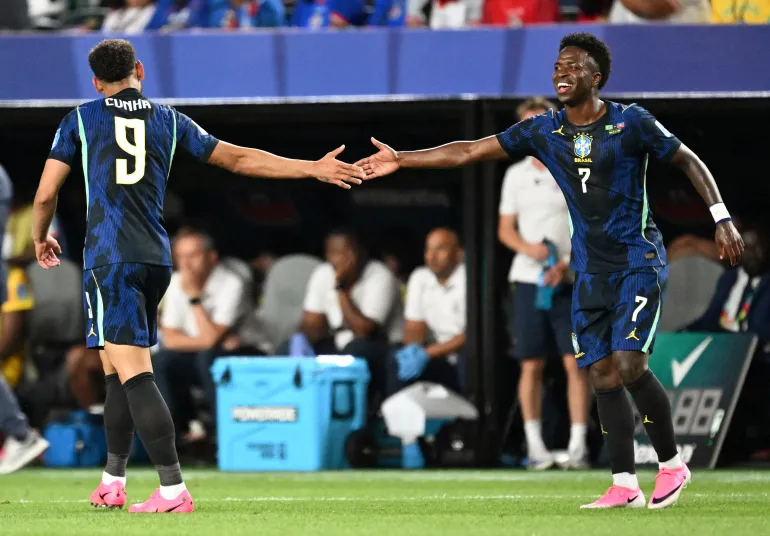
Of all the seven goals Brazil registered across three games, Real Madrid star forward Vinicius Jr scored four of them, while Matheus Cunha netted three. Bruno Guimaraes bagged the most assists (three).
Brazil’s forwards Matheus Cunha, left, and Vinicius Jr are spearheading Brazil’s attack at the World Cup [Roberto Schmidt/AFP]
Ancelotti in relaxed mood ahead of Japan clash
Since their low-key display in the first game, Brazil appear to be growing into the tournament, showing glimpses of their all-round potential, with some of the Selecao stars finding their rhythm.
Ancelotti knows Japan will be no pushovers, describing the record four-time Asian champions as “one of the best teams” in the world.
During Sunday’s pre-match press conference, the Italian was relaxed and betrayed no signs of feeling the pressure, despite Brazil being cast as the clear favourites for the knockout tie.
“We need a lot of things: A strong mind, a strong heart, a clear mind,” he told the media. “I think we have to be ready for anything that might take place in a knockout match, and a lot can happen in a knockout match.
“I think the team is ready. They’re motivated, they’re confident,” added Ancelotti, who is leading Brazil’s charge for a record-extending sixth world title.
How did Japan reach the round of 32?
Japan started their campaign by holding the Netherlands to a 2-2 draw before thrashing Tunisia 4-0 in the second game. They wrapped up the first round with a 1-1 draw with Sweden, which saw them finish with five points, confirming a second spot in Group F.
Ayase Ueda and Daichi Kamada are the joint top scorers for Japan so far, with two strikes each, while Keito Nakamura, Junya Ito and Daizen Maeda have also scored one each.
Japan’s Junya Ito, right, has scored once in the tournament, while Ayase Ueda, left, and Daichi Kamada, centre, have two goals each [Daniel Becerril/Reuters]
Dark horses Japan are ‘united’, says Moriyasu
Japan have lived up to their billing as the “dark horses” at the tournament, holding two formidable European sides – the Netherlands and Sweden – to draws.
After beating Germany and Spain en route to a round of 16 run at the 2022 World Cup, Japan have shown the world they are capable of pulling off upsets, especially on the sport’s biggest stage.
Japan coach Hajime Moriyasu said his side’s collective spirit can fire them into the last 16 again.
“All the players will do what they can for the team and contribute,” Moriyasu said on Sunday. “The team is united, and that feeling is getting even stronger now.”
Japan’s best finish at the World Cup has been reaching the round of 16 on four occasions: 2002, 2010, 2018 and 2022. They have never won a World Cup knockout game.
Brazil vs Japan: master vs the apprentice
Launched in 1993, Japan’s top-flight, the J-League, took much of its inspiration from Brazil and also employed plenty of their players.
Zico, the creative lynchpin of Brazil’s fabled 1982 World Cup team, was enticed out of retirement to join Kashima Antlers, while internationals Bismarck and Elivelton started a run of Brazil national team players making the move to Japan.
By the late 1990s, seven of the Brazil team that won the 1994 World Cup, including captain Dunga, had played or were playing for Japanese clubs and, by extension, lent their influence to a rapidly developing scene.
Brazil vs Japan predictions
Opta’s supercomputer has calculated a 58.3 percent probability of Brazil winning this fixture in regulation time, while Japan is assessed an 18.1 percent chance of victory.
The probability of going to extra time – or potentially penalties – is 23.6 percent.
Who will the winner face in the round of 16?
The winner of Brazil vs Japan will face either Norway or the Ivory Coast in the round of 16.
Brazil vs Japan: Kickoff time, TV channel
Brazil: CazeTV, TV Globo, GETV, Globoplay, sportv (2pm, Brasilia Time)
Japan: NHKBS1, DAZN, Fuji TV (2am on Tuesday, Japan Standard Time)
United Kingdom: ITVX, ITV1, STV Player, STV (6pm, British Summer Time)
To check the TV listings for your country, head to FIFA’s TV listing schedule here.
Brazil vs Japan: head-to-head
In the all-time head-to-head record, Brazil have only lost once to Japan (W11 D2 L1). In their only World Cup contest 20 years ago at Germany 2006, Brazil won 4-1.
Significantly, Japan’s sole victory over Brazil came in their most recent clash, a 3-2 victory in a friendly in October 2025 in which Brazil let a two-goal lead slip in Tokyo, with Ueda scoring the hosts’ winner.
Brazil vs Japan: Team news
Raphinha remains sidelined for Brazil due to a hamstring injury, while Japan’s Takefusa Kubo is out with a sprained knee.
Neymar, who made his first appearance for Brazil since October 2023 when he came off the bench in the last game, will be available to play more minutes against Japan. The star forward is working his way back to full fitness after dealing with a lingering calf injury.
A new South Korean action thriller has taken Netflix by storm with fans desperate to see more.
Agent Kim Reactivated is climbing the Netflix chart(Image: NETFLIX)
Netflix fans are eager to find out what happens next following Agent Kim Reactivated’s jaw-dropping premiere.
Netflix has just unveiled a new action thriller starring So Ji-sub in the titular role of Agent Kim, and it is already climbing the UK Top 10 chart.
Based on the webtoon Manager Kim, the series, which is one of many Netflix k-dramas, follows an ordinary, hardworking father who is forced to reveal his secret identity to rescue his missing daughter.
The series premiered on SBS TV on June 26 and the episodes are also streaming on Netflix, however, only two instalments have been released so far. The epic premiere introduced Kim Do-hyeon, a former North-South Korean covert operative who retired to fulfil his late wife’s wishes.
But when his daughter, Min-ji, is kidnapped, Kim jumps back into action and he quickly draws the attention of the National Special Missions Bureau. Here is all you need to know about how many episodes are in the series.
How many episodes in Agent Kim Reactivated?
As the series continues, Kim comes across two other fathers who are also former operatives: Seong Han-su (Choi Dae-hoon) and Park Jin-cheol (Yoon Kyung-ho). Together, they face opposition from various figures, including a construction executive and a North Korean agent.
Fans have already been left hooked after two episodes and they are keen to find out how many there are in total.
The entire series is made up of 10 episodes, with two episodes airing each week, on Fridays and Saturdays. The final two episodes are expected to drop on July 24 and 25.
Viewership figures have been released for the first two episodes, with 1.9million people watching episode one and 3.2million people watching episode two.
The huge jump in viewership is expected to continue as fans eagerly await the next two episodes on July 3 and July 4. The weekly release approach is unusual for Netflix as the streamer tends to drop all episodes at the same time for most shows.
Fans have taken to IMDb reviews to share their thoughts on the series so far, with one saying: “One of the most brutal k-dramas. Emotional as well.
“I have watch a lot of Action-thriller film and series from Korea, most of them were the same. Thrilling, yes, but not emotional in a way that makes my heartbeat escalated. Yet this k-drama gave me that feeling.”
Another said: “I think the first episode was already superbly done, it was so much fun to finally watch it, and I’m already looking forward to the next episodes of the series.”
A third shared: “Agent Kim Reactivated has already pulled me in completely. The story starts on a strong note, setting up an intriguing plot with excellent pacing, suspense, and enough mystery to keep you wanting the next episode immediately.”
Agent Kim Reactivated airs on Netflix with two episodes airing each week, on Fridays and Saturdays.
SAN DIEGO — The Dodgers claimed a series win against the San Diego Padres with a 4-2 victory Sunday, widening the gap between division rivals to 10 games.
The Dodgers (54-30), who have the best record in the majors, have won five of the first six games of a three-city trip that ends in Sacramento.
A bounce-back start from right-hander Emmet Sheehan made the Dodgers’ win Sunday possible. He held the Padres to one run, on Manny Machado’s fourth-inning homer, through five innings.
“Maybe being a little more comfortable in my mechanics,” Sheehan said after limiting the Padres to two hits. “But also just the focus in between starts of trying to get a little more execution instead of delivery thoughts. I had seven days, so I got to throw two bullpens this week, which is nice.”
It was the first time Sheehan held an opponent to a single run since May 8, when he threw 4⅔ innings against the Atlanta Braves.
“He just beared down and made pitches when he needed to,” manager Dave Roberts said, “versus feeling it with the mechanics or being uncertain.”
Mookie Betts stayed hot with his bases-loaded, two-run single off Padres starter Michael King to spearhead a three-run rally in the fifth. Betts also singled in the seventh.
Freddie Freeman had an RBI on a nine-pitch walk in the fifth, and Shohei Ohtani drove in the Dodgers’ first run with a single in the third.
“The last six weeks, Shohei’s been out of this world,” Roberts said. “Freddie’s been very consistent all year, and then now we got Mookie this last week on track. So it has been the better part of the season that we haven’t had all three of those guys. You can see it — when those three guys are threats, it just kind of takes a lot of pressure off everybody else.”
Over the three-game series, the Dodgers outscored the Padres 20-12. Here are offensive takeaways from the series:
Tucker ‘grinding’ through
Kyle Tucker hits a two-run home run against the San Diego Padres on Saturday in the Dodgers’ 15-3 win.
(Orlando Ramirez / Getty Images)
Dodgers right fielder Kyle Tucker never had been through a stretch like this. He entered Sunday with a .719 on-base-plus-slugging percentage, the lowest he’s had 77 games into a season in his career.
“I feel fine coming to the field and everything, it’s just not being as productive as I normally am, or as I want to be, kind of sucks,” Tucker said in a conversation with The Times a couple of weeks ago. “But I’ve just got to come back for the next at-bat, or the next day, and whatever, and just move on.”
Has battling this uncharacteristic slump taught him anything?
“I’d rather not suck,” he said. “But just try and grab through and just whenever anything works or clicks or whatever, just don’t let it go.”
Tucker has had moments this season when it looked like he was heading toward an offensive turnaround.
In mid-April, he homered twice in three games, including a three-hit performance. In early May, he went on a six-game hitting streak. He hit .303 over a nine-game stretch in mid-June. But none led to sustained success.
So, when Tucker logged three hits, including a home run, on Saturday as the Dodgers routed the Padres 15-3, he was cautious in his optimism. Tucker even nitpicked the nine-pitch at-bat that ended in the pull-side homer.
“There were some pitches I swung at earlier in the at-bat that I thought should’ve gotten the job done earlier, just didn’t put a great swing on it,” he said after the game.
Manager Dave Roberts was more enthusiastic about that at-bat.
“He’s handled it well,” Roberts said. “He’s frustrated, certainly. But he hasn’t run from the work. Even [Friday] night after the game, he was hitting in the cage. … You hear the word ‘grind’ a lot, but he’s grinding. It’s good to see him have some success. I just liked that one at-bat tonight where it was just compete. It wasn’t about mechanics. It was about competing and getting the job done.”
On Sunday, Tucker singled in four at-bats.
Edman’s consistency
Tommy Edman hits against the San Diego Padres on Friday.
(Derrick Tuskan / Associated Press)
There were times last year when utility player Tommy Edman could look at video of his swing and think, “OK, that doesn’t look like how I want it to look.” But there was only so much he could do in the middle of the season, while playing through nagging ankle issues.
“Part of it is kind of just breaking habits that I built last year,” said Edman, who underwent surgery on his right ankle in the offseason. “Was just getting into some bad movements with the lower body, probably just compensating for the ankle, and hips get out of whack, and that kind of stuff. So I’m hopeful that I’ll just be able to keep this up the rest of the year and just be consistent with it.”
Since returning from the injured list on June 16 to make his season debut, Edman is hitting .333 (11 for 33) with a .405 .on-base percentage. He hit his first triple and second double of the season in the Dodgers’ blowout win Saturday.
“I feel like this is kind of one of the rare times where both swings feel good, both from the right and left,” switch-hitting Edman said after that game. “It’s really tough to maintain both swings over the course of the season, so just happy that I feel that way.”
Betts is back
When Betts went three for four, a triple short of the cycle, in the Dodgers’ series finale in Minnesota last week, he couldn’t put his finger on a cue that had snapped his swing into shape over the last couple of weeks.
“Today, I was able to just find something,” he said then. “I don’t even know really what I found. After the home run the first at bat, I wasn’t sure what I did, but I just kind of stayed there. And I think that was the beauty of it. And not really fully knowing and just kind of going to play kind of let me know my training is paying off.”
It continued playing off. That performance kicked off a three-game homer streak. And by the end of his two-week heater, Betts had raised his OPS from .591 to .737.
By Saturday night, Roberts was ready to declare that Betts was back.
“I say ‘back’ because I just think there’s more intent with him in the batter’s box and a lot less indecisiveness,” Roberts said. “So for me, if he can have that kind of proactive approach, aggressive approach, then everything else is going to take care of itself.”
Betts credited his resurgence to a shift in how he prepares for games. Instead of taking 100 swings in the cage with a specific cue, he’s building up from a blank slate every day.
“I used to have things I would think about that would produce a swing, and now I’m actually just training my body every day,” he said. “So kind of one in the same, but they’re just two completely different ways of going about it. And still trying to get fully used to it, but it’s working, so I’m not changing it.”
South Korea’s dismal World Cup first-round exit has prompted fury at home, and calls for a complete overhaul at the top have not been silenced by coach Hong Myung-bo’s resignation.
South Korea, World Cup semifinalists as cohosts in 2002, limped out of the tournament after failing to squeeze into the knockout rounds as one of the top eight third-place finishers.
They had the last 32 within their reach only to suffer a shock 1-0 loss to lower-ranked South Africa.
Their early exit prompted coach Hong to quit on Sunday and cast doubt over the international future of captain Son Heung-min.
It also earned the team a rebuke from the country’s president, Lee Jae Myung, who pointed the finger at “incompetent people” and apologised to the nation.
The president’s comments reflect public anger that has reached a boiling point after years of simmering discontent with South Korean football chiefs.
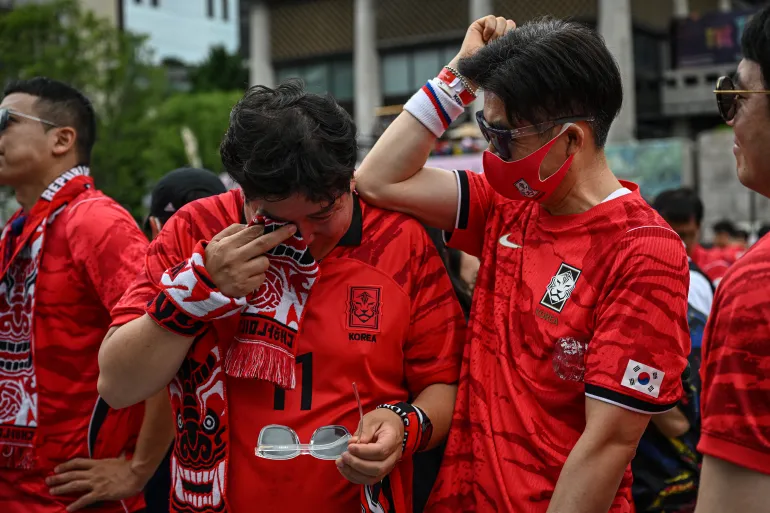
South Korean fans at the Gwanghwamun Square in Seoul react after their team lost against South Africa [Jade Gao/AFP]
Former captain Park Ji-sung said, “We may have expected this outcome years ago.
“We have to look back and ask ourselves why things have come to this,” the former Manchester United player said after the team’s elimination was confirmed.
“Even after spending a decade learning how to prepare for the World Cup and develop Korean football, we have forgotten those lessons once again.”
South Korea was expected to emerge from Group A that included cohosts Mexico, South Africa and Czechia.
The team were expected to arrive home on Tuesday morning, but local media reported that the Korea Football Association (KFA) were not planning to organise an event to welcome them back.
In 2014, angry fans pelted the team with Korean candies – seen as a deeply offensive insult – when they returned from the World Cup in Brazil, where they went out in the group stage during Hong’s first spell as coach.
South Korea’s head coach Hong Myung-bo stepped down after the team failed to reach the World Cup 2026 knockouts [Ulises Ruiz/AFP]
‘Message to change’
Hong has been a lightning rod for criticism since he returned to the job in July 2024, five months after his predecessor, German World Cup-winner Jurgen Klinsmann, was axed.
The KFA came under fire for the process that led to Hong’s reappointment, with questions asked over its transparency and fairness.
Hong, who was regularly booed by fans, did himself no favours at the World Cup by dropping star player Son for the South Africa game, in which South Korea needed only a point to progress.
Hong admitted afterwards that he was struggling to understand what had gone wrong, as the nation nervously waited for results in other games to decide their fate.
Son Heung-min was benched against South Africa, a game South Korea went on to lose and ultimately exit from the World Cup [Eloisa Sanchez/Reuters]
Lee Chun-soo, a member of the 2002 World Cup team, said he “felt pathetic and frustrated rooting for Uzbekistan” against the Democratic Republic of the Congo in the hope that the result would send South Korea through.
“This is a message to change,” Lee said on his YouTube channel. “Everyone should be ready to step down.”
South Korean fans reserved a sizeable chunk of their anger for KFA President Chung Mong-gyu.
Chung said before the World Cup that he would quit after the tournament, blaming his “lack of virtue” following fierce criticism of his 13-year tenure.
The 65-year-old, who is in his fourth term as KFA president, came under fire for trying to pardon former players who were banned for life for match-fixing.
Chung and Hong might not be the only ones to bow out, with captain Son yet to comment on his future.
The skipper, who turns 34 next month, had previously hinted at retiring from international football.
Former captain Park said South Korea needed to learn from the past.
“It’s unfortunate that this kind of cycle keeps repeating,” he said.
“We must dream of and shape a better future, and move forward step by step so that we don’t repeat these mistakes.”
There’s more than meets the eye with this picture-perfect market town, jam packed with independent shops and an idyllic river meandering through, as rowing boats pass by
Many are opting to move out of the city to this picture-perfect town (Image: Getty)
Away from the hustle and bustle of London life, just a little further down the Thames, is a much quieter tow where people are flocking for an escape into independent shops and riverside walks.
With a real sense of vibrancy about it, this Buckinghamshire town is being put on the map as it continues to evolve into a cool and quirky hotspot for the capital’s commuters. Not just that, but for people wanting a day trip that feels a lot more wholesome and doesn’t cost quite as much.
Marlow is one to watch, especially for those looking to relocate out of the city. Its location along the River Thames makes for a peaceful spot, which could compare to the likes of Richmond or Cambridge, where people can hire both rowing boats and self-driving boats to explore the town from the water.
What makes it most recognisable to passers-by or those travelling through is its eye-catching suspension bridge which spans the River Thames, joining Buckinghamshire with Berkshire. It first opened in 1832 and has been somewhat of a landmark for the area ever since, as a distinctive feature that helped the town to grow as an inland port.
High Street
The charming town is made up of historic streets with listed buildings and an abundance of independent boutiques, cafes and bistros, adding to the atmosphere of the place. But above all, it’s Marlow’s High Street that has received the most considerable amount of attention. Recently, when it was dubbed the best in the UK.
Estate agent Knight Frank named the UK’s best high streets after the property experts took a look at some of the streets that offer the most charm, and this was their favourite. Their focus was on the areas that home buyers were flocking to, and Marlow came out as a seriously desirable spot that they described as both “charming and lively”.
Matt Davies, partner at Knight Frank, said: “We tend to see a slightly younger buyer base in Marlow, driven in large part by its outstanding educational institutions, including grammar schools such as Sir William Borlase’s.”
There’s an endless amount of unique little shops selling clothing, gifts, homeware, stationery and more. Some of the standout stalls include the gift shop Twenty Three Living, The Marlow Bookshop, URU Home and Saddle Safari, all joined by an array of local pubs, cafes, galleries and salons.
Marlow has also made a name for itself in the realm of food, with high-end chefs operating out of the area and it being home to Michelin-star cuisine. Celeb chef Tom Kerridge runs a pub in the heart of the town named The Hand of Flowers, a short walk off of the high street, which stands as the only UK pub to hold an impressive two Michelin stars.
A customer described their experience at the highly acclaimed pub on TripAdvisor. They said: “Service was excellent from the minute we arrived, and the atmosphere in the restaurant was great. We’d highly recommend!”
And of course, like any higher-end high street, it’s home to The Ivy and other high street chains such as Zizi, as well as having smaller bistros and traditional pubs to choose from.
New Delhi, India – Brajesh Kumar climbs three floors every evening to sit in solitude on the rooftop terrace of his house overlooking the Ram Temple in Ayodhya in northern India’s Uttar Pradesh.
Over decades, the 65-year-old has seen the once-sleepy town metamorphose into the biggest flashpoint of the Hindu majoritarian movement, championed by Prime Minister Narendra Modi’s Bharatiya Janata Party (BJP). Where the temple stands used to be the site of the 16th-century Babri Mosque, but in 1992 a Hindu mob tore it down, sparking religious riots that killed nearly 2,000 people across the country, mostly Muslims.
Two and a half years ago, Modi presided over the consecration ceremony of the new temple, devoted to the Hindu god Ram. Many Hindus believe Ram, the god worshipped as an epitome of righteousness, was born there.
To Hindu devotees like Kumar, the temple – despite the controversy and deaths that defined its birth – brought a sense of serenity.
Until recently.
For the past month, the temple has been embroiled in allegations that those entrusted with its management have instead embezzled donations worth potentially millions of dollars that the site attracted from devotees.
“We have been betrayed [by the management], who have looted our faith, nothing less,” Kumar told Al Jazeera. “Left to them, they will sell us all one day in the name of religion and stuff their own pockets.”
The allegations have led to police investigations, arrests and political fallout that could shape elections in India’s most populous state that are only months away.
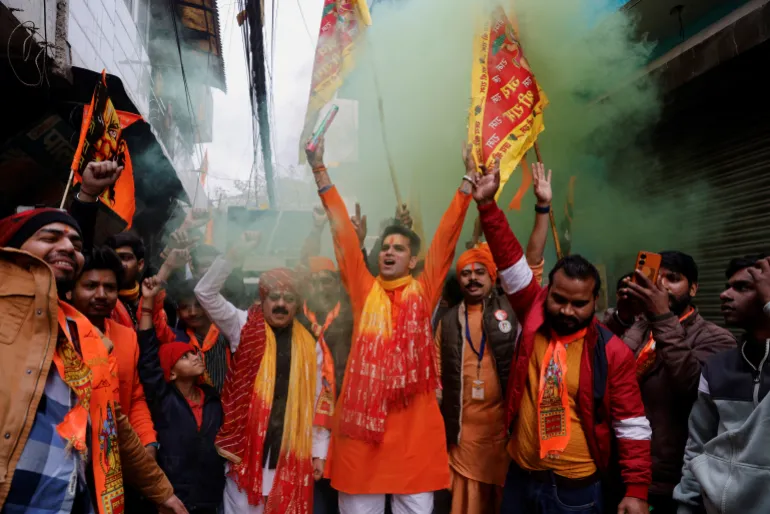
People celebrate the opening of the temple of the Hindu god Ram in the northern town of Ayodhya in a street in New Delhi, India, on January 22, 2024 [Anushree Fadnavis/Reuters]
Ayodhya’s can of worms
Since its inauguration, the Ram Temple has been among the top religious sites in India, attracting millions of Hindu devotees.
An independent trust, the Shri Ram Janmabhoomi Teerth Kshetra Trust, manages the shrine. Although it is outside the purview of the government, its executive members wield political influence, and some of them come from the Rashtriya Swayamsevak Sangh, the ideological wellspring of the BJP.
The corruption allegations first surfaced this month after Mahipal Singh, a former supervisor of the trust’s accounting team, publicly called out irregularities. Al Jazeera could not reach him for comment.
After a public uproar, Akhilesh Yadav, a former chief minister of Uttar Pradesh from the opposition Samajwadi Party, picked up the issue, alleging that millions of rupees in donations had gone missing.
The mounting pressure pushed the state government, ruled by the BJP, to form a three-member investigation team, which has submitted a report on the alleged misappropriation of donations.
Although the content of the report has not been made public, the state police registered a criminal case and have arrested at least eight people, including those involved in counting cash and valuable offerings at the temple.
More devotees have come forward since, seeking the whereabouts of their valuables, including silver bricks and gold jewellery and artefacts, that they had handed over to the trust’s executives.
On Friday, the trust’s longstanding general secretary, Champat Rai, stepped down with other high-profile trustees. The allegations have been particularly damning for Rai, who has been a central figure in the movement for the Ram Temple.
But it has done little to cool down the tensions in the state, where thousands of devotees, including some BJP supporters, feel cheated.
The Ram Temple is illuminated after its inauguration in Ayodhya on January 22, 2024. [Adnan Abidi/Reuters]
‘Cunning thieves running Ram Temple’
Santosh Dubey was among those tried for tearing down the Babri Mosque in 1992. He has never shied away from his role and instead has flaunted it.
After the mosque’s demolition, Dubey waited for a final verdict about what was to happen to the site from the courts, where both sides fought bitterly for decades. In 2019, the Supreme Court awarded the site to Hindus – even though it deemed the destruction of the mosque illegal. The top court gave a piece of land to Muslims outside Ayodhya to build a new mosque. In 2020, Dubey and others accused of roles in demolishing the mosque were acquitted — the court cited a lack of adequate evidence.
If those verdicts felt like vindication to Dubey, the alleged embezzlement at the temple has enraged him.
“This corruption causes me deep anguish, a pain that words cannot express,” Dubey told Al Jazeera, speaking from Ayodhya. “All I can say is that nothing less than the death penalty would suffice for them.”
“Cunning, dishonest and ruthless thieves are running the Ram Temple, and they have created such an atmosphere of fear that no one is willing to speak out against them,” he said.
Dubey said the government will struggle to ignore the anger among devotees because the episode batters the BJP’s narrative that it is a saviour of the Hindu faith.
This is not the first time that the temple trust has been the subject of controversy. In 2021, the trust allegedly bought land at highly inflated prices using public donations.
BJP spokespeople refused to comment on the recent allegations when Al Jazeera reached them.
Indian Prime Minister Narendra Modi (with his arms outstretched) and Uttar Pradesh Chief Minister Yogi Adityanath (just to the left of Modi) show the BJP symbol during a roadshow as part of an election campaign in Varanasi, India, on May 13, 2024 [Adnan Abidi/Reuters]
‘Impact on upcoming election’
Devotees of the temple and critics of the government are accusing authorities of attempting a cover-up.
Opposition leader Yadav described the state government’s initial handling of the case as “suspicious”. “The government is arresting the counting staff while shielding the big fish who orchestrated the structural rot,” Yadav said while demanding transparency in the investigation.
Karpatri Maharaj, a prominent Hindu seer associated with the Ram Temple movement, told Al Jazeera that the government is using junior employees as scapegoats and arresting them.
Uttar Pradesh, India’s most populous state, is led by the firebrand Hindu monk-turned-politician Yogi Adityanath, who is often seen as a potential successor to Modi within the RSS-led Hindu majoritarian movement known as Hindutva.
Modi’s party lost a significant base in the state in the 2024 national elections when the BJP fell short of a majority, forcing it to rely on allies’ support to stay in power.
For the BJP, which has long used the campaign for the Ram Temple as a central political plank, the new controversy could prove a challenge before elections in Uttar Pradesh scheduled for early next year, political analyst Rasheed Kidwai said.
“It would have a massive negative impact on the BJP if more religious leaders came forward to speak on this,” Kidwai told Al Jazeera. “This is not something that would be forgotten because it is a matter of faith, and the state chief comes from a religious order himself.”
The episode carries broader lessons, he said: Pandering to religious emotions and fanning divisions can bite back. “What has been benefitting the BJP in these years can also cause immense damage,” Kidwai said.
Hindus shout and wave banners as they celebrate the destruction of the 16th century Babri Mosque in Ayodhya on December 6, 1992 [Douglas E. Curran/AFP]
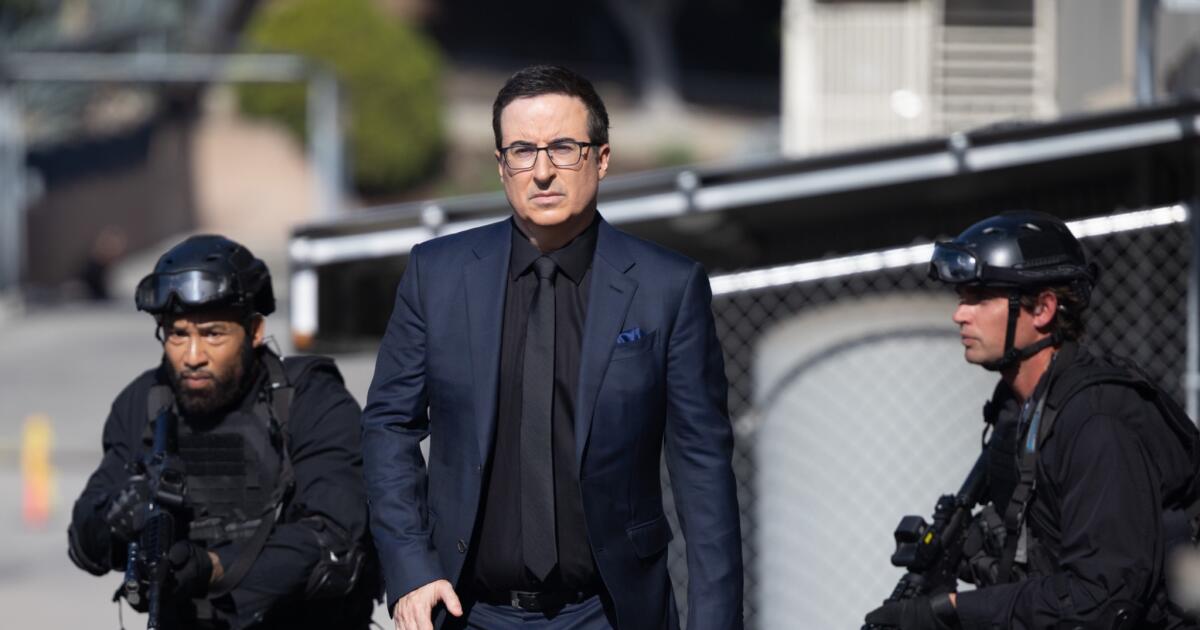
It’s no joke: John Oliver of HBO’s “Last Week Tonight” is checking into “General Hospital,” the ABC soap opera.
The host of the weekly series that takes sharply comedic aim at government and institutions announced during his June 28 episode that he will appear on the daytime soap “General Hospital” on July 2, 3 and 6. No details about his role were revealed except that it will be a “substantial guest role.”
And that’s not the only soap he’ll be in this summer. He will also have a role on “Days of Our Lives,” streaming on Peacock, on Aug. 11, 12 and 14.
The appearances are the culmination of Oliver’s pleas to soap opera producers during the March 8 installment of his show that they consider him for a part. An unapologetic devotee of the outrageous antics and high melodrama which characterize the genre, Oliver said, “Write me a role and I will be on your set so fast it will make your head swim.”
In a statement, Oliver celebrated the realization of his dream: “‘General Hospital’ was everything I hoped it would be. It’s a true honor to be a small stain on the history of this illustrious show.”
The series’ executive producer Frank Valentini said in a separate statement that Oliver made an offer they could not refuse.
“When John Oliver publicly threw down the gauntlet and said he wanted to appear on a soap, we didn’t hesitate for a second,” he said. “He was everything you’d hope he’d be: prepared, professional, funny, and genuinely kind to everyone on set. He plays an integral character in the story, and I can’t wait for fans to see who he crosses paths within Port Charles.”
“General Hospital,” which airs weekdays on ABC and streams on Hulu, is in its 64th year and stands as the longest-running American soap opera currently in production.
On the March 8 episode, Oliver said he was jealous of celebrities such as Katy Perry, Snoop Dogg and Smokey Robinson who would pop up on various soaps. He was particularly envious of sports pundit Stephen A. Smith who has had a recurring role on “General Hospital,” playing a shady figure known only as “Brick.”
Oliver made it clear that he was not interested in a brief walk-on playing himself. He wanted to play a character, and have a “juicy role” that involved murder or “slapping.” He also required that there be a close-up of his face.
Holidaymakers have been advised to carry out amateur detective work to ensure they do not book into fake accommodation this summer, as research showed a third of travellers had seen an increase in potential travel scams on social media.
Consumer experts have urged holidaymakers to do a reverse image search on photographs of holiday homes and check their locations on an online map to verify they are real.
People may be booking in a hurry this year as many have left it later than usual because of uncertainty around the impact of the Iran war, increasing the risk of falling victim to an online or telephone scam.
George Ralchev, head of risk at payment service provider emerchantpay, which commissioned the research, said holidaymakers were being targeted by social media scammers “looking to take advantage of the peak travel season”.
Seven in 10 people said they were wary of promotional emails related to holidays because of potential scams, according to the survey carried out by Opinium in May among 2,000 people in the UK.
Two-fifths of holidaymakers said they changed their behaviour while on holiday because of financial safety concerns.
Half now prefer to book holidays with online or high street travel businesses if they clearly explain how they are protecting consumers from fraud.
One woman scammed out of £6,500 while trying to book a Greek holiday villa previously told the Guardian that she had begged her bank to halt the money transfer, only to be told by staff that there was nothing they could do.
To help avoid scams, people could do research to check that a destination actually exists, look for independent reviews and check website links, emerchantpay said.
Holidaymakers may also want to check whether the company involved is a member of Abta, a trade association for UK travel agents, tour operators and the wider travel industry.
People booking package deals with a flight could also check if they are covered under the Air Travel Organisers’ Licensing (Atol) financial protection scheme.
Lisa Webb, consumer law expert at the consumer group Which?, said the findings were “sadly unsurprising” and reflected its own research that social media firms were “failing to take meaningful action to tackle the flood of scams on their platforms”.
Webb said: “The onus should not fall on consumers, but there are ways to help you spot fake holiday listings – such as using a reverse image search to check for stolen images or checking the property’s location on an online map to see that it exists.”
She advised travellers to book through trusted channels and avoid paying by bank transfer for anything advertised on social media. Anyone who thinks they have lost money to a holiday booking scam should contact their bank immediately and report it to Report Fraud or Police Scotland.
According to separate research from Which? undertaken in the summer of 2024 and spring 2025 on Booking.com reviews, hundreds of people complained that they had paid for accommodation that did not exist. Booking.com provided a detailed response at the time and said cybersecurity was a top priority. Expedia customers were also targeted in 2024.
Scotland’s Lewis Ferguson reportedly told Bologna he will assess his future after the World Cup, while Wolfsburg are said to be closing in on Celtic-linked goalkeeper Tjark Ernst.
Russian President Vladimir Putin says Ukraine has proposed a mutual halt to long-range strikes and a meeting with Kyiv’s leadership. But, though he says he is considering the proposal, he believes the deal would benefit Ukraine more than Russia.