Park Wang-yeol (C), a South Korean national detained in the Philippines, arrives at Incheon International Airport in Incheon, South Korea, 25 March 2026. Photo by YONHAP / EPA
May 1 (Asia Today) — South Korean police have taken custody of a man suspected of supplying drugs to a major narcotics figure, following his arrest in Thailand, authorities said Friday.
The suspect, identified only by his surname Choi, 51, is accused of smuggling and distributing about 22 kilograms of methamphetamine, valued at roughly 10 billion won ($7.4 million), into South Korea since 2019.
Police said Choi, who allegedly operated under the aliases “Cheongdam” or “Cheongdam Boss” on the messaging app Telegram, was identified as a key supplier to drug trafficker Park Wang-yeol, often referred to as a “drug kingpin.”
The National Police Agency’s drug and organized crime unit said it received custody of Choi from Thai authorities and has launched a full investigation into his activities and connections.
Investigators began tracking Choi while probing Park, who was previously arrested in the Philippines. Authorities combined five outstanding cases involving Choi and designated the Gyeonggi Nambu Provincial Police Agency as the lead investigative body.
Although no official departure record for Choi had been found since 2018, police developed intelligence suggesting he was living in Thailand. Working through liaison officers stationed in both countries, South Korean and Thai police coordinated the operation.
Authorities located Choi in Samut Prakan province, about an hour from Bangkok, and conducted a three-day joint surveillance operation before arresting him on April 10 on charges of illegal stay.
Police said the suspect was apprehended within seven days of the formal request for cooperation, and repatriated to South Korea about three weeks later with assistance from the South Korean Embassy in Thailand and related agencies.
Items seized at the time of arrest, including a passport under another person’s name and electronic devices, will undergo digital forensic analysis to determine links to Park and to identify additional accomplices and distribution networks.
Police said the investigation will expand to include possible conspiracy with Park, violations of passport laws and broader drug trafficking activities. Authorities are also pursuing asset recovery tied to alleged criminal proceeds.
Acting National Police Commissioner Yoo Jae-sung said interagency cooperation – including coordination with customs, financial regulators, tax authorities, the food and drug safety agency and the National Intelligence Service – has been mobilized to track and dismantle transnational drug networks.
“This case sends a clear message that drug criminals will be pursued and apprehended to the ends of the earth,” Yoo said.
In recent years, the evolution of women in Saudi Arabia has become one of the most scrutinized aspects of the kingdom’s reforms of recent times. These reforms have frequently served as proof of a broader transformation under Vision 2030, an ambitious pathway designed to modernize Saudi Arabia and decrease its reliance on oil revenues. However, behind these apparent advancements arises an intricate question: are these reforms a genuine move towards social emancipation or primarily a tactical element of state-led goals of economic diversification, modernization, and enhancing global reputation?
In 2016, Saudi Arabia introduced Vision 2030, launched and guided by King Salman bin Abdulaziz Al Saud and Muhammad bin Salman as a comprehensive and holistic strategy aimed to reform the country’s future. This initiative leverages the Kingdom’s strengths, including its pivotal role in the Arab and Islamic world, robust investment capabilities, and advantageous strategic position. The goal is to establish Saudi Arabia as a global leader while improving quality of life and broadening growth opportunities for citizens. At its essence, Vision 2030 seeks to reposition Saudi Arabia in the global economy by diversifying the non-oil sectors, drawing in foreign investment, and cultivating a dynamic workforce.
The women’s research compendium has gained significant attention from the government in alignment with the kingdom’s Vision 2030 and its associated programs. Consequently, relevant authorities, including the Ministry of Human Resources and Social Development, have allocated one of the visions’ goals to improve the public and private lives of Saudi women. From this perspective, the progress of Saudi women towards empowerment has condensed. This perspective of ministry is facilitated by numerous policies, legislations, and regulations that bolster the female’s status in society. In this context, women have become a pivotal component of reform. Enhancing female participation in the labor force is not just a social aspiration but also an economic imperative. By incorporating women into sectors like tourism, mass markets, and technology, the government intends to harness previously underutilized human capacity and accelerate economic growth. Hence, women’s empowerment is intricately aligned with the national development goals. It is important to acknowledge the considerable progress the country has made so far, such as the removal of the driving ban; increased employment; and enhanced public representation signify substantial changes in the everyday life of numerous women in Saudi Arabia.
Comparatively, these reforms demonstrate a prominent departure from more prudent norms of Saudi society and have formed new avenues for both personal and professional initiatives. Recognizing these developments is important for sustaining a fair and substantiated analysis. However, a deeper evaluation reveals that this empowerment is closely associated with the economic strategy and development. The consolidation of women in the workforce is consistently presented not just as a matter of rights but as a roadmap to enhance productivity and to boost the country’s GDP. This realistic perspective implies that empowerment is being pursued not just as a fundamental social objective but as a calculated countermove to fulfill economic demands. In this context, women are viewed not just as citizens, but also as economic assets that are essential to the success of Vision 2030.
In addition to the economic considerations, these reforms significantly contribute to the international image of Saudi Arabia. As the kingdom aims to enhance foreign investment and establish itself as a contemporary progressive nation, the advancement of women’s rights acts as a strong emblem of transformation. These developments are visible as a form of strategic liberalization, a deliberate opening intended to synchronize domestic policies with the international standards. Within this framework, women’s empowerment is integrated into a broader soft power strategy, boosting nations’ appealing image on the world stage. However, this transformation is still being meticulously overseen. Although new liberties have been introduced, they operate within a well-defined structure and are regulated by the state. The pace and scope of these structural initiatives are not propelled by grassroots institutions but are instead orchestrated by the governing bodies. This top-down approach limits the acceleration of the independent voices and limits the growth of a more autonomous civil society. Consequently, empowerment is allocated rather than asserted, therefore prompting the queries regarding its substantive nature and sustainability.
Therefore, this dynamic creates a striking paradox: “advancement without complete autonomy.” Currently, Saudi women experience enhanced mobility and visible participation in public life, but their capacity to independently shape the trajectory of reform is still constrained. The expansion of opportunities has not been accompanied by a similar increase in agency. This conflict highlights an important question: can empowerment truly exist in the absence of independent expression and participation in decision-making processes? However, the future prediction denotes that the sustainability of these reforms depends on their ability to progress beyond their strategic foundations. Women’s empowerment continues to be closely linked to economic and image-building objectives of the state; it risks being susceptible to shifts in governmental priorities and policies. On the other hand, lasting transformation necessitates more profound structural alterations that are way beyond mere participation to encompass genuine agency and proper representation.
In this context, the transformations unfolding under Vision 2030 are the embodiment of both advancement and limitation. They indicate a notable departure from the previous practices and traditional norms while also underscoring the constraints of government-driven modernization. Ultimately, the issue is not if change will lead to enduring empowerment, for true empowerment is not just about participation in the workforce or recognition in public spheres; it is about having the capacity to influence one’s own future. This aspect remains the most vital and a pending dimension of Saudi Arabia’s evolution.
In conclusion, the trajectory of advancing gender diversity as articulated in Vision 2030 demonstrates both meaningful advancements and fundamental structural limitations. Although reforms have undeniably broadened strategic growth indicators and transformed the social norms, they’re still closely intertwined with economic needs and strategic initiatives for international status. This top-down model of reform prompts essential inquiries regarding the depth, independence, and long-term durability of women’s empowerment. For Saudi Arabia, the operating complexities will be whether these transformations can progress beyond mere instrumental milestones to cultivate true agency and representation. Only then can women’s empowerment shift from being a facet of national strategy to a lasting anchoring principle of societal advancement.
In new pictures, Ross appeared to be thrilled to join them, flashing a thumbs up at a camera before getting into a waiting car. Other snaps showed his fellow soap legend Julie Hesmondhalgh jetting to the area ahead of filming.
Teasing what led to the Grant Mitchell star deciding to take part, an insider told the Sun: “He loves Traitors and thinks it’s a programme on another level, which is why he really wanted to take part.
“Ross loved the mix of psychological intrigue paired with some of the very physical trials that the group have to complete – both suit him perfectly.”
He is also reportedly hoping to appeal to a younger generation of viewers, who could be less familiar with his career so far.
“Plus he knows The Celebrity Traitors won’t just be watched by people who are familiar with his work, but by younger viewers who may be less familiar with Ross, and this opens him up to a whole new audience. He’s also a very BBC name and this is another big BBC show,” they added.
Joanne McNally, James Acaster and Joe Lycett were also named in the line-up, alongside social media content creator King Kenny, Love Island presenter Maya Jama and Romesh Ranganathan.
Industry actress Myha’la and Professor Hannah Fry rounded out the cast with Sharon Rooney, James Blunt, Sebastian Croft and Sharon Rooney.
While the gang have been all smiles so far while heading to Scotland, things will get very tense once filming kicks off and suspicion over the game sets in. Shortly after filming, the 21 celebs will be sorted into “faithfuls” and “traitors” as they battle it out for the charity cash prize.
It will be up to those faithfuls to weed out the sneaky traitors, who have been tasked with secretly killing them off in nightly visits to the turret.
Following the huge success of the first season, where around 15million people tuned in to see Alan Carr win the competition as a Traitor, fans have been eagerly-awaiting news of a second series, and have already predicted Michael, Richard and Miranda could be this year’s “big dogs ”.
The air date has not yet been announced, but the hit show is expected to return to screens in autumn.
For the next week or so, in homes all over California, ballots will be arriving for the June 2 primary.
Since 2020, a ballot has been mailed to every active registered voter in the state — more than 23 million, by last count. The time to choose is drawing nigh.
In addition to the race for governor, Californians will vote in contests for seven other statewide offices, the Board of Equalization — which oversees the property tax system — and a great many congressional, legislative and local races, including the primary for Los Angeles mayor.
What’s a voter to do?
If you’ve waited your entire life for a candidate like Republican Chad Bianco, the Riverside County sheriff running for governor, or you’ve been jonesing to cast a gubernatorial ballot for Democrat Katie Porter from the moment she whipped out her famous whiteboard, the choice is easy. Fill out that ballot and toss it in the mail, stat! No postage needed.
“Don’t mess around,” said Paul Maslin, a veteran Democratic campaign strategist. (His candidate for governor, Betty Yee, quit the race late last month, so he’s a neutral observer at this point.)
“If you have pretty good inkling what you want to do,” Maslin urged, “vote.”
But if, like many, you’re not wed to a particular candidate, what then? If you’re worried about mailing in your ballot and then having some awful, Eric Swalwell-like revelations surface, or if you fret about wasting your vote by supporting someone who drops out before June 2, then what?
There are no do-overs in a California election. Once you’ve cast your ballot, you’ve made your choice. That’s it, however sorry you may be.
Which is why Republican strategist Rob Stutzman, who’s worked in California politics for decades, urged voters not to mail their ballot too soon. Like Maslin, he’s unaffiliated with any of the gubernatorial campaigns.
“It’s a slow-developing race,” Stutzman said of the contest for governor, the marquee attraction on the June ballot. “These are still relatively little-known candidates. There’s going to be a lot more campaigning to go in the weeks ahead. [So] unless you feel really strongly about somebody, I’d hang on to that ballot and see what happens over the next several weeks.”
Then again, with all the talk of clamping down on mail-in ballots and concerns about processing delays by a stretched-thin Postal Service, is there a danger of waiting too long to vote? What if your ballot arrives past the deadline to be tallied?
In March, the U.S. Supreme Court strongly signaled a likelihood it would require mail ballots to be received by election day if they are to be counted as legal. As it stands, California accepts mail-in ballots that were cast before the end of election day, so long as they arrive no later than seven days after.
The court seems unlikely to issue its ruling before the June primary — but that’s not guaranteed.
So is there a sweet spot, somewhere between voting in haste and having your ballot go to waste?
The Official Voter Information Guide, produced by California’s secretary of state, urges those voting by mail to “return your ballot … as soon as you receive it.”
But Kim Alexander, head of the nonpartisan California Voter Foundation, falls into the wait-a-bit camp. “Don’t vote too early,” she counseled, “because this is a very dynamic election.”
Once you’ve made up your mind, her best advice is to mail your ballot at least a full week before election day, which is May 26, to ensure it arrives on time to be processed and counted. If someone wants to drop their ballot off in person, either at a vote center or secure drop box, Alexander suggests doing so by May 30, which is three days before the election.
“The good news,” she said, “is that under a new state law … all county election offices will be open at least six hours on Saturday, May 30, for voters to come vote in person or to turn in their vote-by-mail ballots.”
Voting in person is an option right up until 8 p.m. on election day, even if you received a ballot in the mail. That applies everywhere in California, save for three sparsely populated, rural counties — Alpine, Plumas and Sierra — which conduct their elections entirely by mail. Bring your unused vote-by-mail ballot to your local polling place and swap it for a polling-place ballot you can use instead.
For procrastinators or those wanting to wait until election day to mail their ballot, they run the risk that it won’t be postmarked until after June 2. That means it won’t be counted, regardless of when it arrives at their county elections office.
“Voters who want to hold out as long as possible … ought to be planning to turn their ballot into a drop box or a voting site and not use the mail at all,” Alexander said.
Her suggestion is to find other ways to mark the occasion.
“Help somebody else go and vote,” Alexander suggested, “or volunteer to help with an organization” running a get-out-the-vote operation.
“If you want to help election officials get ahead on the vote count” — a source of repeated upset as the country awaits California’s lagging results — “you can be part of the solution by getting your own ballot in just a little bit earlier.”
All of which sound like fine ideas. That way you can celebrate election day and make sure your ballot isn’t cast for naught.
For teenagers dreaming of playing in the NFL, former Corona Centennial high defensive back Camryn Bynum has first-hand knowledge of what it takes. It involves more than a star ranking or posting videos on social media.
“It’s a simple formula to make it to where you want to go,” said Bynum, who recently signed a $60-million contract with the Indianapolis Colts and will be holding a youth camp at his alma mater on May 23.
“It’s just hard to stay on the right track and do every single thing to the best of your ability and consistently do everything the right way,” he said. “You play a few good years of high school ball, you’ll get a chance to play college ball. If you become a starter, maybe one or two years and play well enough, you’ll get a chance at the league, whether you get drafted in the first round, like everybody wants to, or you you’re an undrafted free agent. If you get your foot in the door, there’s hundreds of stories about people getting in.”
Bynum says there’s a big sacrifice that many teenagers are unwilling to accept. It’s called avoiding distractions at all costs. At least it worked for him. He didn’t start on varsity until his junior year. He became a four-year starter at Cal, was a fourth-round draft pick of the Vikings, who immediately told him he’s switching from cornerback to safety. He was ready for anything.
“I think the best way to reach the point where you want to go is to stay distraction free,” he said. “Stay working towards that goal and don’t let anything come in between. That’s been the biggest part of my journey, my faith, and being able to just trust that God will put me exactly where I need to be, but also putting in the work myself knowing that if I want to play college ball, I need to keep my grades up in high school, stay away from all the distractions, the parties, the drinking, the drugs, like a lot of people unfortunately fall into.”
His first major test was dealing with adversity. He started on JSerra’s freshman team, then transferred back home to Centennial. He said he was fifth string on the JV team. “I was literally not playing,” he said. He gave serious consideration to leaving. But Centennial coach Matt Logan and others made it clear he had to earn his playing time.
Detroit Lions tight end Sam LaPorta (87) is tackled by Minnesota Vikings safety Camryn Bynum in 2024.
(Paul Sancya / Associated Press)
“Coach Logan, he’s like, ‘No, you gotta work. You gotta work, figure it out and grind. You’re good. You’re plenty good enough, but you have to earn your spot.’ And I remember a few other coaches telling me, ‘It’s all up to you, if you want to put the work in and you want to compete, This is a competitive program, you got to figure out how to earn your playing time.’”
Bynum went to a private coach and started training morning and night. He became stronger, faster and more confident. As a junior, he became a standout. He still uses that same private coach, Jordan Brown, in his training.
Bynum, born to a Filipino mother, now lives in the offseason with his Filipino wife and young daughter on the outskirts of Manila.
Asked if Manila traffic is worse than Los Angeles traffic, he said, “They’re both pretty bad. They’re just bad in different ways.”
His first youth camp will help raise funds for his foundation that is supporting causes such as teaching flag football in the Philippines. The camp will be for youth and high school-age players and provide a vehicle for exposure along with football development.
“We want it to be a learning environment and a competitive environment to help kids get recruited and be seen more,” Bynum said.
Just remember the path is simple but the road blocks are many to overcome.
FANCY holiday abroad vibes without actually leaving the country?
There’s some great hotels across the UK that feel like you’re somewhere like the Med or even Miami – so we’ve rounded up some of the best.
Sign up for the Travel newsletter
Thank you!
There’s some spots in the UK where you can be forgiven for thinking they were abroadCredit: booking.comRoslin Beach Hotel has been compared to Florida Keys, while the wider area is nicknamed Miami-on-Thames
Roslin Beach Hotel, Southend -on-Sea
Roslin Beach Hotel is on the sandy beach of Thorpe Bay Beach is often compared to places in the US.
One previous guest said: “We could have been staying on the Florida Keys”.
It’s not the first time Southend-on-Sea has been compared to the US either.
In 2023, Tory councillor Daniel Nelson told the Southend Echo that tourism events played an important role “in the reinvigoration of the city and that Southend has the potential to become a Miami-on-Thames.”
The Hamptons is known for its white wooden buildings and sandy beaches. And The Gallivant in Camber Sands is often said to be similar.
The American comparison to the Essex seaside is because of the shaker style it’s built in – and you can even book a room called the ‘Large Hampton’.
Not only that, but the dune-backed beaches of Camber Sands are a spitting image of the ones in Montauk, a hamlet in East Hampton.
The Times said “think New York’s Hamptons by way of Camber Sands” while House & Garden added it “brings a bit of the Hamptons and Scandi-vibe to Sussex”.
The white washed panels have seen the Gallivant Hotel compared to the HamptonsEnjoy Miami vibes in Bournemouth at either the pool or the restaurant in The Nici hotelCredit: Supplied by hotel
The Nici, Bournemouth
If you’ve ever wanted a slice of Miami without wanting to leave the country, then why not head to… Bournemouth?
The Nici Hotel, found on the seafront of the seaside town, opened in 2022.
There’s the South Beach Restaurant, which serves “champagne afternoon teas and classics with a Miami twist”.
Otherwise other nods include retro cocktail cabinets in the rooms, faux palm trees throughout and even art of Che Guevara.
Previous guests have raved about it too – one said: “Beautiful setting and very cool decor. Feels like Miami!”
Gara Rock, Devon
A rarity in the UK, Gara Rock has its own private swimming pool overlooking the ocean more comment in the Med.
Grab some pizza and a glass of rose wine and you’ll feel like you’re hundreds of miles away.
It even has a private beach too, if you fancy an ocean dip, or plash out on a “beach butler” and you can get unlimited cocktails delivered straight to you.
Embrace the Italian Riviera at Hotel Tresanton in CornwallCredit: Hotel TresantonThe art’otel at Battersea Power Station has a rooftop infinity pool that could rival DubaiCredit: Matthew Shaw
Hotel Tresanton, Cornwall
In St Mawes is Hotel Tresanton and at first glance may not look much like Italy, but head down to the hotel’s own Beach Club which overlooks the cliffs and, with the blue and white striped umbrellas, will transport you straight to the Italian Riviera.
The website states: “The Mediterranean style brings a feel of the Amalfi coast, with blue and white striped umbrellas and semi-tropical planting.”
Or, splash out on the classic Italian sailing yacht–Pinuccia where you can spend the night onboard with dinner and breakfast – and a bottle of champagne.
One person even said: “It’s like a perfectly decorated small Italian hotel on the Amalfi Coast but further north on the sea in Cornwall.”
Art’otel, London
One of the new hotels to open in the Battersea Power Station, Art’otel has some of the best views from the top.
The rooftop infinity pool could even double for Dubai, with its luxury sunloungers and skyscraper views.
This includes as aqua aerobics, aqua board pilates and yoga, all of which come with breakfast and start from £25.
Other UK hotels we love
*If you click on a link in this box, we will earn affiliate revenue.
The Queen at Chester Hotel
This historic hotel has welcomed the likes of Charles Dickens and Lillie Langtry through its doors. Rooms have richly-patterned carpets with super soft bed linen and premium toiletries in the bathroom. Go for a superior room for extra goodies including bathrobes and snack boxes.
This Cambridge hotel is in the ideal spot, within walking distance to bars, shops and hotspots like the university colleges and Parker’s Piece. The inside couldn’t be prettier, with huge stained glass windows, grand chandeliers, and rooms with enormous clawfoot bath tubs.
Iran has offered a new 14-point proposal to the United States in the latest diplomatic step to reach a permanent end to the war, which has exposed the limits of US military dominance and shaken the global economy.
Responding to the new proposal on Saturday, US President Donald Trump said he is studying it but is not sure he can make a deal with Iran, a day after he voiced frustration with a previous offer from Tehran through the mediator Pakistan.
Recommended Stories
list of 3 itemsend of list
Late on Thursday, Tehran sent the proposal to Pakistan, which got the two sides to agree on the ceasefire. According to the Iranian Tasnim news agency, the 14-point plan was formulated in response to a nine-point US plan.
But weeks since the ceasefire began on April 8, Washington and Tehran have been unable to negotiate a peace deal. Tehran wants a permanent end to the war, while Trump has insisted that Iran first end the effective blockade of the Strait of Hormuz, through which a fifth of global oil and gas exports pass. The US president has also made the issue of Iran’s nuclear capability a “red line”.
Iran’s de facto blockade of the strait came in response to the US and Israel launching attacks on the country on February 28. A naval blockade of Iranian ports by the Trump administration, despite the ceasefire deal, has heightened tensions.
The US and Iran have also been continuing to attack, capture, and intercept each other’s ships, pointing to an ongoing naval war still playing out in the Strait of Hormuz.
So what’s the new proposal, and will President Trump accept it?
Here’s what we know:
(Al Jazeera)
What is Iran’s 14-point proposal to end the war?
According to Iranian media reports, Tehran’s new proposal came in response to a Washington-backed nine-point peace proposal, which primarily sought a two-month ceasefire.
However, in its latest peace proposal, Iran said it wants to focus on ending the war instead of extending the truce and wants all issues resolved within 30 days.
The new proposal calls for guarantees against future attacks, a withdrawal of US forces from around Iran, the release of frozen Iranian assets worth billions of dollars and the lifting of sanctions, war reparations, ending all hostilities, including in Lebanon, and “a new mechanism for the Strait of Hormuz”.
Iran, which was also attacked by the US and Israel last June, wants a guarantee against future aggression. Israel has previously targeted Iranian nuclear scientists and run campaigns to sabotage its nuclear sites.
Tehran also wants its right to uranium enrichment guaranteed as a signatory to the Non-Proliferation of Nuclear Weapons (NPT), but Trump has made the nuclear issue a “red line”. Iran wants decades of sanctions, which have devastated its economy, to be lifted as part of any deal. The navigation through the strait and demands for war reparations are other sticking points in the talks.
According to a report by Iranian state broadcaster IRIB, after delivering the proposal, Deputy Foreign Minister Kazem Gharibabadi said, “Now the ball is in the United States’ court to choose the path of diplomacy or the continuation of a confrontational approach.”
Paul Musgrave, an associate professor of government at Georgetown University in Qatar, said Iran has “slightly softened” its proposal.
“The news reports on it indicate that there is a slight softening in the proposal, or rather a run-up to discussing the proposal, namely that the Iranian side may have given up its precondition that the US cease its distant blockade of Iranian traffic [in the Strait of Hormuz],” he told Al Jazeera.
“Beyond that, though, a lot of the things that are reportedly in the proposal include maintaining Iran’s sovereign ability to enrich uranium, its nuclear programme and, of course, what it delicately refers to as a ‘control mechanism’ over shipping in the Strait of Hormuz.”
Musgrave said on the two biggest issues – enrichment of uranium and transferring its highly enriched uranium – the US and Iran remain “far apart”.
“President Trump has been unyielding that Iran must surrender its nuclear capability,” he said.
Kenneth Katzman, a senior fellow at New York-based nonprofit Soufan Center, said Iran’s mistrust of Trump remains a bigger obstacle.
“The differences on the nuclear issues are actually … not that great a difference any more. It’s still substantial, but can be narrowed. The issue is that Iran really mistrusts Trump and the United States and does not want to move, really, into full discussion until this blockade is lifted,” he said.
“That’s a problem that could lead to US escalation. As Trump knows, he must break this Iranian control of the strait, so that’s where the issue is.”
Katzman said while both sides are “frustrated”, neither is likely to give up on the negotiations in the immediate future.
The MSC Francesca captured by the Islamic Revolutionary Guard Corps in the Strait of Hormuz on April 24, 2026 [Meysam Mirzadeh/Tasnim/WANA via Reuters]
How did the US respond?
Trump has said he is reviewing Iran’s proposal, but warned that Washington could resume attacks if Tehran “misbehaves”.
Speaking to reporters in Florida before boarding Air Force One on Saturday, Trump confirmed that he had been briefed on the “concept of the deal”.
Despite the diplomatic opening, the president struck a characteristically blunt tone regarding the possibility of renewed hostilities, which have been paused since the ceasefire.
“If they do something bad, there is a possibility it could happen,” Trump said when asked if strikes would resume.
Trump addedthat the US was “doing very well” and claimed that Iran was desperate for a settlement because the country had been “decimated” by months of conflict and a naval blockade.
Trita Parsi from the Quincy Institute for Responsible Statecraft told Al Jazeera the economic cost of the blockade on Iranian ports has exceeded what the White House anticipated and argued that the broader strategic damage to the US was probably more significant.
“Iran has been under all kinds of economic pressure and sanctions for 47 years,” Parsi told Al Jazeera. “None of them has managed to break the Iranians or force them to capitulate,” he said.
In a post on Truth Social later on Saturday, Trump said it was difficult to imagine that the Iranian proposal would be acceptable as Tehran had “not yet paid a big enough price for what they have done to Humanity, and the World, over the last 47 years”.
Trump seems to have rejectedthe new Iranian proposal “without reading it or being briefed on it”, according to Musgrave from Georgetown University.
What are the previous peace proposals to end the conflict?
Iran’s latest proposal comes amid a fragile three-week truce that came into effect on April 8 and has put a pause on the US-Israel war on Iran.
A day before the ceasefire, Iran had proposed a 10-point peace plan, which included an end to conflicts in the region, a protocol for safe passage through the Strait of Hormuz, the lifting of sanctions and reconstruction, state-run news agency IRNA reported.
Trump had said Iran’s 10-point plan was a “significant proposal” but “not good enough”.
The April 7 proposal from Iran came in response to a 15-point plan drafted by the US on March 25.
Washington’s plan included a one-month ceasefire while the two sides negotiated terms to end the war, via Pakistan.
According to Israel’s Channel 12, it also included the dismantling of Iran’s nuclear facilities in Natanz, Isfahan and Fordow, a permanent commitment from Iran to never develop nuclear weapons, the handover of Iran’s stockpile of already enriched uranium to the International Atomic Energy Agency (IAEA), a commitment from Iran to allow the United Nations watchdog to monitor all elements of the country’s remaining nuclear infrastructure, reopening of the Strait of Hormuz and end of all sanctions on Iran, alongside the ending of the UN mechanism that allows sanctions to be reimposed.
Iran, however, rejected this plan and said a temporary ceasefire would give the US and Israel time to regroup and launch further attacks and in turn proposed its 10-point plan.
What is the situation on the ground now?
Despite a ceasefire, the Islamic Revolutionary Guard Corps (IRGC) said on Saturday that it remains on “full standby” for a return to hostilities, citing the US’s lack of commitment to previous treaties.
In a post on X on Sunday, the IRGC’s intelligence unit said, “There is only one way to read this: Trump must choose between an impossible military operation or a bad deal with the Islamic Republic of Iran. The room for US decision-making has narrowed.”
The impasse is further complicated by technical obstacles to reopening the Strait of Hormuz, including the presence of Iranian sea mines. Tehran has closed the strait since the war began on February 28, upending global oil and gas prices.
To pressure Iran to open the strait, the US imposed a blockade of all Iranian ports on April 13, stoking the oil and gas crisis. On Friday, Brent crude, the international benchmark, was at $111.29 per barrel at 08:08 GMT, compared with about $65 before the war.
Tensions have been further stoked by Trump’s recent characterisation of the US naval blockade as a “very profitable business”.
“We took over the cargo. Took over the oil, a very profitable business. Who would have thought, we’re sort of like pirates, but we’re not playing games,” Trump said at an event in the US state of Florida on Saturday.
Tehran’s Ministry of Foreign Affairs seized on the remarks, labelling them a “damning admission of piracy”.
Parsi from the Quincy Institute told Al Jazeera the US naval blockade of Iran has backfired on Trump and is making the situation worse.
“The negotiations were taking place and could have continued regardless of the blockade,” he said.
“The blockade has nothing to do with the Iranians being at the table. If anything, it is blocking diplomatic progress more than anything else,” Parsi noted.
He argued that Trump had actually secured his greatest advantage through diplomacy before the blockade was imposed.
“Once he managed to get the ceasefire, the primary pressure on him, the war itself and the way it was pushing up gas prices, was lifted. Had he stayed in that scenario and used time to his advantage, he would have been in a much stronger position vis-a-vis the Iranians, because the Iranians had not managed to get the key thing they wanted: sanctions relief.”
Instead, by imposing the blockade, Trump took more oil off the market.
“Oil prices are now higher during the ceasefire than they were during the war itself. All of these economic indicators show that the blockade is making the situation worse for Trump,” Parsi said.
However, Trump has been looking at options to resolve the oil crisis, including setting up a naval coalition called the Maritime Freedom Construct (MFC) to restore freedom of navigation in the Strait of Hormuz.
According to US media reports, core functions of the naval coalition would be to share intelligence among member nations, coordinate diplomatic efforts, and enforce sanctions to manage shipping traffic through the strait.
The Strait of Hormuz, a narrow waterway once carrying roughly a fifth of the world’s oil and gas, remains effectively closed after the United States and Iran imposed competing blockades.
Naval blockades are one of the oldest weapons in warfare, requiring no ground troops or invasion, just the ability to cut off what an enemy needs to survive. These blockades have reshaped economies, societies and alliances across generations, sometimes with instant shockwaves, sometimes with effects only seen later.
Recommended Stories
list of 4 itemsend of list
From Israel’s ongoing siege of the Gaza Strip to blockades during World War I, here are some notable naval blockades in modern history:
Israel’s siege of Gaza (2007-present)
A view of the severely damaged Gaza City port as fishermen work under difficult conditions due to Israeli attacks, March 8, 2025 [Hamza ZH Qraiqea/Anadolu]
Israel’s complete land, sea and air blockade of the Gaza Strip is one of the longest sieges in modern history.
Launched in 2007, Israel has limited the entry of goods and essential supplies, causing a prolonged humanitarian and economic crisis for the Strip’s 2.3 million people, who cannot travel freely.
Before Israel’s genocidal war on Gaza began in October 2023, fishermen were restricted to 6-15 nautical miles (11-28km) from shore, well below the 20-nautical-mile (37km) zone guaranteed by the Oslo Accords.
After 2023, with Israel’s policy of starving the population, fishermen have taken extreme measures to feed their families, leading to many being killed by Israeli fire.
Since 2008, several Freedom Flotilla vessels have attempted to break the Israeli blockade. Since 2010, all flotillas attempting to break the Gaza blockade have been intercepted or attacked by Israel in international waters.
On April 30, Israel raided 22 out of the 58 vessels in the most recent Global Sumud Flotilla campaign in international waters more than 1,000km (620 miles) from Gaza.
Blockade of Biafra (1967-70)
Nigerian troops entering Port Harcourt, after routing Biafran troops during the Nigerian Civil War [File: Evening Standard/Getty Images]
During the Nigerian Civil War, which began in July 1967, the Nigerian federal government imposed a land, sea and air blockade on the secessionist Republic of Biafra shortly after it declared independence.
The blockade led to widespread starvation, widely seen as a deliberate wartime strategy, transforming a territorial conflict into a global humanitarian crisis. Death tolls vary, but it is estimated that one to two million people died, the vast majority from hunger and disease rather than direct conflict.
The nearly three-year-long blockade ended with the Biafran surrender in January 1970.
Beira Patrol blockade (1966-75):
HMS Cleopatra’s Wasp helicopter encounters an engine failure at high altitude during the blockade on the Port du Beira in 1971; the aircraft was recovered after it crash-landed [File: 50tony Wikimedia Commons]
The Beira Patrol was a nine-year-long blockade by the British navy to prevent oil from reaching Rhodesia, present-day Zimbabwe, through the Mozambican port of Beira, enforced under United Nations sanctions following Rhodesia’s unilateral declaration of independence.
The blockade largely failed its strategic goal. Rhodesia continued receiving oil via South Africa and other Mozambican ports, which the UN resolution did not authorise the British navy to intercept.
Additionally, the cost to the United Kingdom was substantial. The operation tied up 76 naval ships over nine years, with two frigates required on station at all times.
The blockade ended in July 1975, when Mozambique’s newly gained independence from Portugal allowed it to credibly commit to blocking oil transit to Rhodesia, rendering the naval patrol redundant.
Cuban Missile Crisis ‘quarantine’ (1962)
A US official shows aerial views of one of the Cuban medium-range missile bases, taken in October 1962, to the members of the UN Security Council [File: AFP]
In October 1962, the US ordered a naval “quarantine” of Cuba after US U-2 spy planes discovered Soviet nuclear missile sites under construction on the island.
The US deliberately called it a “quarantine” rather than a blockade, which would have been legally an act of war, aiming to prevent the Soviets from bringing in more military supplies and to pressure them to remove the missiles already there.
The quarantine drew a line 500 nautical miles (920km) from Cuba’s coast, with US warships authorised to stop, search, and turn back any vessel carrying offensive weapons if necessary.
The crisis brought the world to the brink of nuclear war. The then-Soviet First Secretary Nikita Khrushchev called the blockade “outright piracy” and an act of aggression, and initially ordered ships to proceed. For several days, Soviet vessels steamed towards the quarantine line as the world watched.
The most dangerous phase of the standoff lasted 13 days. An agreement was reached in which the Soviets would dismantle their offensive weapons in Cuba in exchange for a US public declaration not to invade Cuba, and a secret agreement to remove US Jupiter missiles from Turkiye.
The naval quarantine was formally ended on November 20, 1962, after all offensive missiles and bombers had been withdrawn.
Blockade of Wonsan (1951-53)
US B-26 Invaders dropped para-demolition bombs at supply warehouses and dock facilities at the Wonsan port in North Korea in 1951 [File: Wikimedia Commons]
During the Korean War, UN naval forces led by the US imposed a blockade of the North Korean port of Wonsan in February 1951, lasting nearly two and a half years.
It aimed to deny the North Korean navy access to the city, which was strategically significant for its large harbour, airfield and petroleum refinery.
The blockade was preceded by a dangerous mine-clearance operation in October 1950. North Korean forces had been well supplied by the Soviet Union and China with sea mines, and during the clearance, the sweepers USS Pledge and USS Pirate were sunk, killing 12 men and wounding dozens.
The operation successfully constrained North Korean and Chinese forces on the east coast, forcing them to divert thousands of troops and artillery pieces away from the front line. UN forces also captured several harbour islands, which strengthened the blockade’s grip on the port.
The blockade ended after 861 days with the signing of the Korean Armistice Agreement in July 1953. By that point, allied naval fire had almost levelled Wonsan.
US submarine blockade of Japan (1942-45)
The US sinking of the Japanese destroyer Yamakaze on June 25, 1942 [File: US Navy via Wikimedia Commons]
The US imposed a submarine blockade against Japan during the Pacific War.
The blockade began taking shape in 1942, combining US naval submarine attacks on merchant shipping with minelaying operations to cripple Japan’s war capabilities, disrupt shipping and cut off vital supplies such as food and fuel.
As an island nation, Japan was especially vulnerable, almost entirely dependent on imports of oil, rubber and raw materials. Its economy and military could not function without open sea lanes.
Over the course of the war, US submarines sank some 1,300 Japanese merchant ships and roughly 200 warships. By 1945, oil imports had effectively ceased.
Food imports collapsed, causing significant shortages and malnutrition across Japan by 1945, though the extent of civilian starvation is disputed.
After the US dropped atomic bombs on Hiroshima on August 6 and Nagasaki on August 9, 1945, Japan announced its surrender on August 15, bringing the blockade and the Pacific War to an end.
Blockade of eastern Mediterranean (1915-18)
World War I map shows modern Palestine and Syria, published in 1918 [File: Wikimedia Commons]
In August 1915, during World War I, the Allied forces imposed a blockade of the eastern coast of the Mediterranean to cut off military supplies and weaken the Ottoman Empire’s war effort.
The declared area ran from the intersection of the Aegean Sea and the Mediterranean Sea in the north to the Egyptian frontier in the south. The blockade was initiated by Britain and France, later assisted by Italy and other Allied powers.
The consequences were devastating. Military supplies, munitions, oil, food and medicine were all targeted. The food crisis was compounded by a locust plague in 1915 and a severe drought, contributing to severe famine across Lebanon and Greater Syria.
Reports suggest the famine led to 500,000 deaths by 1918, mostly civilians, with Mount Lebanon losing an estimated one-third of its population. Mass migration followed.
The blockade remained in place throughout the war and lifted only when Allied forces occupied Beirut and Mount Lebanon in October 1918.
Allied blockade of Germany (1914-19)
German U-35 submarine sinking the French steamer, Herault, in the Mediterranean, off Cabo San Antonio, Spain, June 23, 1916 [Courtesy of the Library of Congress]
The British navy began blockading Germany almost immediately after the outbreak of the war in August 1914.
The naval blockade extended from the English Channel to Norway, cutting off Germany from the oceans.
Britain mined international waters to prevent ships from entering the ocean, creating danger even for neutral vessels.
Germany responded by declaring the seas around the British Isles a “military area”, prompting Britain and France to ban all goods to and from Germany.
The blockade’s most devastating consequence was famine. The winter of 1916-17, known as the Turnip Winter, marked one of the harshest years in wartime Germany.
The blockade had cut off food and fertiliser imports, a failed potato harvest left little to fall back on, and a breakdown in food distribution compounded the crisis. It is estimated that between 424,000 and 763,000 civilians died from diseases related to hunger and malnutrition.
The blockade was not yet fully lifted until July 1919, after the Treaty of Versailles had been signed.
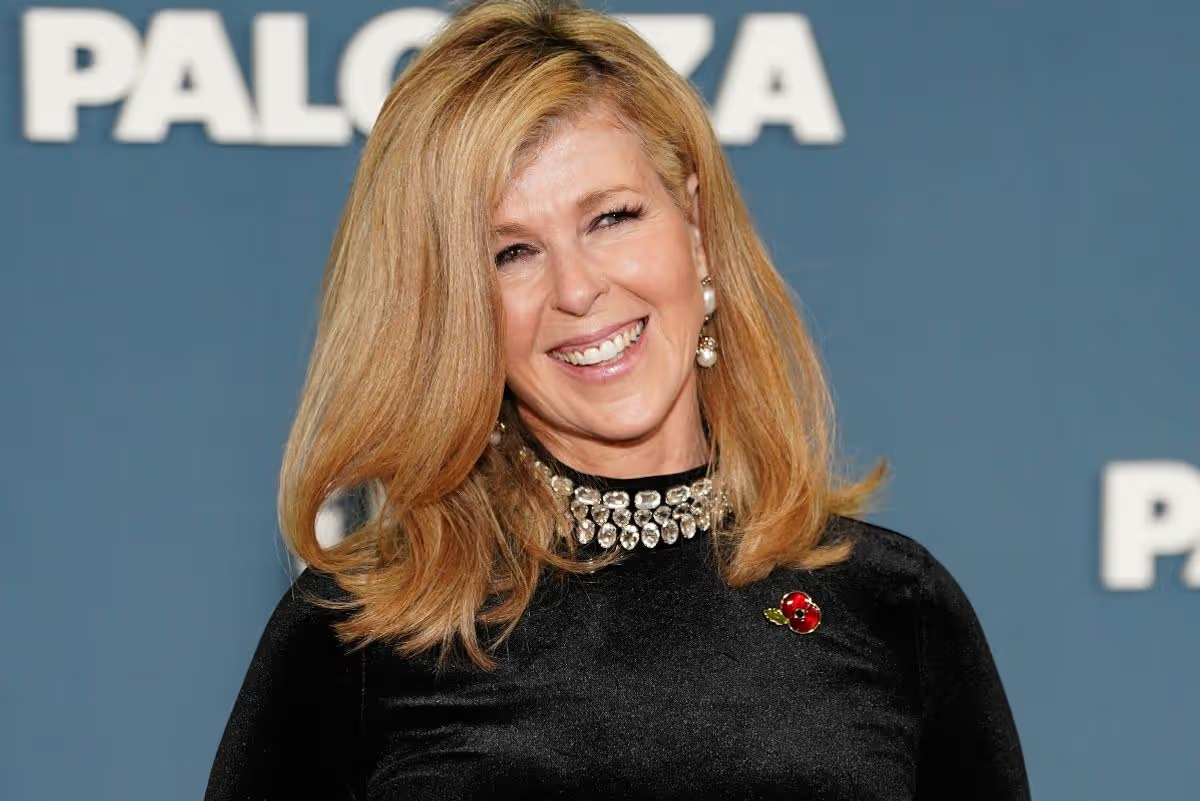
Good Morning Britain presenter Kate Garraway lost her husband Derek Draper in 2024
Kate Garraway lost her husband Derek Draper in 2024(Image: PA)
Kate Garraway had been married to late husband Derek Draper for 18 years when he died in 2024.
The Good Morning Britain presenter was left heartbroken when the former political advisor died at the age of 56, weeks after suffering a cardiac arrest. Derek had spent more than a year in hospital after falling ill with the coronavirus in 2020. He suffered several health setbacks and had needed round the clock care after he returned home to Kate and their two children Darcey and Billy.
“Rest gently and peacefully now Derek, my love, I was so lucky to have you in my life,” Kate said in a moving tribute after announcing that he had died.
The star has since been open about what life is like for the family as they try and deal with their loss, sharing touching milestones and opening up about their grief journey.
Kate has occasionally addressed whether she might dip her toe in the dating pool again. However, two years on, she is still thought to be single, although there have been persistent rumours about her meeting someone.
What has Kate Garraway said about finding love again?
In February 2025, Kate opened up about life after Derek in a chat with Hello! magazine.
While she didn’t specifically talk about relationships, the TV presenter did say that she knew her late husband would want her to live her life.
“Derek would want me to be grabbing life, because you learn how fast, and how easily, it can be snatched away,” she said. “I know he’d be saying, ‘You’ve got to get out and live, because I can’t’.”
A few months later, the star told The Sun that all the speculation about her love life had “made me think about it”.
“And honestly, I don’t feel as if I can,” she said. “It’s a weird one, because I wouldn’t like to think I’d spend the rest of my life without love, but also it feels preposterous at the moment to think of being with anyone else.”
However, Kate said she knew she was “going to have to think about the future at some point”.
The Celebrity Traitors star said expanding her social circle was on the agenda, so that she could try to have a social life that “isn’t based on being a mummy”. “There’s no point in worrying about it – it will happen organically when I am ready,” she said.
Kate, who took part in the first celebrity series of The Traitors, has also admitted that living the rest of her life without finding love again would be “sad”.
Opening up to Jamie Laing on his Great Company podcast, she said: “Well I wouldn’t like to think that I’d never had romantic love in my life again. I think that would be rather a sad way to go through life wouldn’t it?
“But, no, I’m not there yet. I don’t know if anybody would want me.”
She quipped: “Talk to your mates, find out if any of their dads are single.”
Kate Garraway is on the Great Celebrity Bake Off for Stand Up To Cancer, which airs at 7pm on Channel 4 on Sunday May 3.
Good Morning Britain airs weekdays from 6am on ITV1 and ITVX.
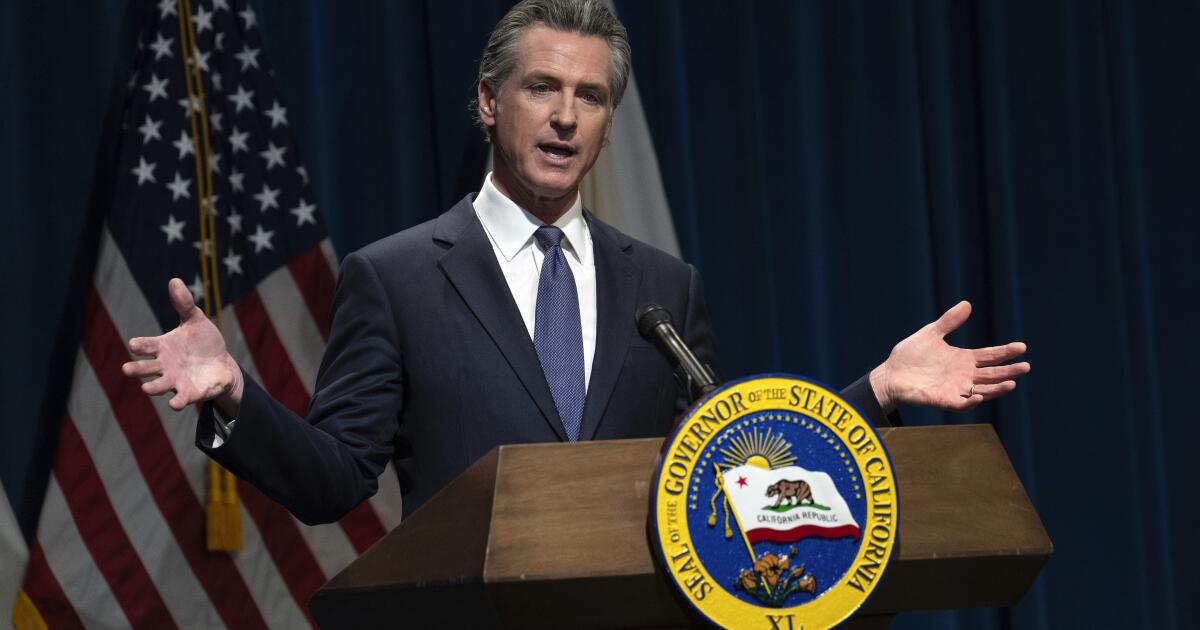
SACRAMENTO — One of Gavin Newsom’s top goals as he winds down his final year as California governor is to leave the state with a balanced budget.
After years of the state spending more money than it brings in, it’s Newsom’s last opportunity to fix a chronic deficit or dump the problem on the next governor.
How far he goes to solve the state’s structural spending imbalance will define his legacy as a steward of trillions in taxpayer dollars. As a potential candidate for president in 2028, he could also have a political incentive to do as little as possible.
“Any cuts you make are going to cause people to scream,” said Darry Sragow, a veteran Democratic strategist. “Any increases in taxes are going to cause people to scream and in terms of what’s best for a presidential run, it would be nice if people weren’t screaming.”
As California’s 40th governor, Newsom expanded publicly funded healthcare to income-eligible undocumented immigrants, increased state-subsidized child-care slots and provided free meals for schoolchildren among a wishlist of progressive wins since he took office in 2019.
His achievements have helped struggling Californians live in an increasingly unaffordable state and given him bona fides to tout to voters if he launches a bid for the White House.
But the state could never afford to pay for existing services and the new programs that Newsom and Democratic lawmakers enacted, according to an analysis of ongoing state spending since before the pandemic released by the Legislative Analyst’s Office last week.
Spending from the state’s principal operating fund has grown about $100 billion since Newsom’s first full fiscal year in office in 2019-20, mostly due to the growing cost of existing programs that he inherited. State spending has outpaced California’s strong revenue growth by about 10%, creating a perennial budget shortfall — a structural deficit — that Newsom and the Democratic-led Legislature solve with largely temporary fixes each year.
Instead of making across-the-board program cuts or raising taxes to align spending with revenue, Democrats have tapped into reserves designed to preserve social services for the state’s most disadvantaged communities during economic downturns.
While the California economy remains stable and state revenue has increased, Newsom and lawmakers have taken $12.2 billion from the rainy day fund. Democrats have borrowed $28 billion more from other state funds to cover their spending in recent years, according to the LAO.
“Taken together, these trends raise serious concerns about the state’s fiscal sustainability,” Legislative Analyst Gabriel Petek wrote in a review of Newsom’s January budget proposal.
Fiscal watchdogs have warned that the spending trends will leave California in a precarious position if the stock market tanks and tax receipts bottom out.
Personal income taxes are driving higher-than-expected revenue now, which analysts attribute to an artificial intelligence boom on Wall Street, and suggest the state could have no deficit in the upcoming year. In January, the Newsom administration anticipated significant operating deficits in the years ahead: $27 billion in 2027-28, $22 billion in 2028-29 and $23 billion in 2029-30.
“This issue is really whether they’re going to take seriously the structural deficit that is several years in the making now, where the spending has outpaced revenue, and to address that, they’re going to either have to make some fairly deep cuts or raise revenue and or both,” said former state Controller Betty Yee, who worked as a budget aide under Gov. Gray Davis and recently dropped her own campaign for governor. “But they have to be real. I think resorting to these one-time solutions has really exacerbated the problem.”
H.D. Palmer, a spokesperson for the California Department of Finance, said the governor is looking to solve the budget problem with more than a temporary fix.
“Although he is still finalizing his proposal that he’ll put forth to the Legislature, as he has said, he wants those solutions to be durable, and he wants them to have an impact beyond a single fiscal year,” Palmer said.
To stabilize California’s budget, Democrats will probably have to raise taxes or fees to generate new revenue and cut programs, according to the LAO. At least 40 cents for every dollar in revenue is dedicated to education under the state Constitution, requiring policymakers to find between $30 billion and $60 billion annually in additional revenue to cover projected shortfalls in 2027-28 and beyond if relying on new taxes alone.
President Trump’s cuts to healthcare are adding to the problem.
HR 1 will add $1.4 billion in state costs to the general fund. Newsom’s January budget proposal did not include a plan to help millions of low-income Californians who are expected to lose access to healthcare under the federal cuts.
To temper those cuts in California, other groups proposed a new tax on billionaires that appears poised to qualify for the November ballot.
Spearheaded by Service Employees International Union-United Healthcare Workers West, the initiative would apply a one-time 5% tax on taxpayers with assets exceeding $1 billion. If approved by voters, the tax would generate roughly $100 billion, which would fund healthcare programs.
The measure has divided unions and Democrats at the state Capitol.
Newsom has criticized the initiative, citing concerns that increasing taxes on the wealthy will have the opposite intended effect and drive the highest earners out of California. Under a progressive tax structure, the state budget is dependent on income taxes paid by the ultra-rich on earnings largely from capital gains.
Larry Page and Sergey Brin, the co-founders of Google, have already purchased residences in Florida, along with others looking to escape the tax if it goes through in November. Billionaires launched their own ballot measure campaign to undercut the tax proposal.
State lawmakers are also considering avenues to raise revenue, which include repealing a “water’s edge” tax break. Under the change, multinational companies would no longer be allowed to shield the income of their foreign subsidiaries from state taxes. California loses about $3 billion in revenue from the tax break each year.
In its budget plan released in April, the state Senate proposed a new fee on the largest corporations in the state to provide $5 billion to $8 billion annually for Medi-Cal.
The upper house said 42% of Medi-Cal enrollees are full-time workers who are not enrolled in their company’s healthcare plan because their wages are low enough to qualify for state-subsidized healthcare. As a result, corporations aren’t paying for healthcare for many of their employees and instead taxpayers are picking up the bill through Medi-Cal.
SEIU California, the powerful state union council representing over 700,000 workers, endorsed the plan. The union said Trump’s tax policy will reduce corporate taxes by $900 billion, while 3 million Californians lose healthcare.
“In this urgent moment, California’s workers need to see our leaders show us what they’re made of,” said Tia Orr, executive director of SEIU California. “The Senate is showing the courage to demand corporations pay their fair share, rather than making working people pay with their lives.”
The change is being described as a more politically palatable “fee” and not a tax.
“We explored multiple revenue options, and this was the one that felt more narrow, it felt more focused, and it also felt like it was directly going for the subsidy that’s being lost because of the Trump HR 1 cuts,” said Senate President Pro Tem Monique Limón (D-Goleta), who leads the upper house of the Legislature.
Limón said her caucus believes it’s important to address potential revenue streams because of the depth of federal healthcare reductions.
“If we don’t address the structural deficit, we are looking at severe cuts,” she said. “You are looking at people without health insurance. You are looking at hospitals closing down. You are looking at medical providers not being able to take more patients. You are looking at our emergency rooms over capacity, with not enough medical providers. I mean, you’re looking at a place that’s really, really, really difficult, and we feel like we have to, at least, look at what are viable options that are conditional on these cuts coming.”
Newsom has not commented publicly on the Senate’s plan. As governor, he’s been reluctant to embrace new taxes and fees.
Newsom could reject all the proposals for new taxes or fees and continue what he’s done before: take advantage of higher-than-expected tax collections, shift funds around, delay program implementation and borrow money to knock the deficit down to zero, or forecast a surplus, for his last budget year that begins July 1.
If he doesn’t take on California’s larger budget imbalance, then the problem would be the next governor’s to solve. A stock market crash, or economic recession, could force his successor to make drastic cuts across the board with limited reserves to support programs.
Kicking the can again would cement Newsom’s fiscal legacy as a governor who championed bold headline-making policies that bolstered the safety net for low-income Californians, but who failed to provide a solution to pay for his agenda.
“Not only has he not come up with a plan, he has pretended we don’t need one,” said Patrick Murphy, a professor of public affairs at the University of San Francisco.
Newsom’s interest in running for president could seemingly discourage him from slashing the budget and raising attention to the state’s financial woes, Sragow said. Newsom is setting himself up as a potential front-runner for his party. He has said he remains undecided about officially launching a 2028 campaign.
As a Democrat from California, his opponents would automatically label him as financially irresponsible and tax-happy. Calling out the massive budget problem on the horizon, raising taxes and making painful cuts will give them ammunition.
“There’s a long list of things that he’s going to be charged with, and this is likely to be one more,” Sragow said. “But I guess the question is, is he going to be charged with a political misdemeanor or a political felony?”
Former state Sen. Steve Glazer said Newsom is standing on political quicksand either way. State budget projections are based on assumptions about the future that often don’t bear out, leaving his choices exposed to criticism that he went too far, didn’t do enough, and everything in between.
“Whatever the governor decides to do in his May revise and in his final budget, it’s fraught with political risks, because it can be manipulated so easily by all sides,” Glazer said.
If Newsom ignores the spending problem, his successor could blame him for California’s financial woes when they take office in January and provide their own outlook of the state’s fiscal future. At the time, Newsom could be trying to convince America to make him the nation’s next president.
Murphy said Newsom has championed major policies and been reluctant to back off them later when revenue doesn’t pencil out.
In terms of spending, he’s governed similarly to the men who led California before him, with the exception of Jerry Brown, who cut programs to reduce a deficit he inherited in his second stint in the governor’s office and left Newsom with a surplus.
“It’s not all that different than most of the governors have done, which is finding it very hard to say no and finding it very hard to take on a tough choice of going to the ballot to ask for more money or raise taxes,” Murphy said.
Deukmejian left a budget disaster for his successor, Gov. Pete Wilson. Deukmejian publicly claimed he passed a balanced budget in his final year and blamed an economic downturn for the problems Wilson encountered.
When Wilson announced a record $13-billion budget deficit early in his first year in office in 1991, he said the Persian Gulf War, an economic downturn and natural disasters added to a structural deficit in the budget.
The Legislature and Deukmejian, Wilson said, had “papered over” the problem.
Salesian High School held its 15th Salesian Gala on Saturday night, with defensive back Deommodore Lenoir from the San Francisco 49ers and a Salesian graduate being honored.
Deommodore Lenoir of Salesian in 2016. Now he’s NFL defensive back for 49ers.
(Eric Sondheimer / Los Angeles Times)
Lenoir used Salesian as a key path to playing college football at Oregon and then the NFL. He received a $92 million contract extension in 2024.
Jet2 has issued a major announcement for British holidaymakers after its inaugural flight to the Greek island of Samos departed from Manchester Airport on Friday
Jet2’s inaugural flight to Samos departed from Manchester Airport on Friday (stock)(Image: Getty)
Jet2 has announced a major “first” for the airline, in a huge boost to British tourists.
The airline revealed its inaugural flight to Samos departed from Manchester Airport on Friday, marking “the start of the brand-new Greek route for summer 2026”.
Jet2 says it will now be offering flights and holidays to the island. Samos is “for holidaymakers looking to discover the beautiful Greek island”, it says. The island lies just off the coast of Turkey and is renowned for its golden beaches as well as lush, mountainous landscapes.
Jet2 will operate twice weekly services on Tuesday and Friday until the end of October. The Manchester flight will be followed by one to Samos from Birmingham Airport on May 4, and another from London Stansted Airport on May 7.
Weekly Monday services will operate from Birmingham until October 26, and twice weekly services on Monday and Thursday will go from Stansted until October 29, BirminghamLive reports.
Steve Heapy, CEO of Jet2.com and Jet2holidays, said: “As we commence our biggest ever summer programme to Greece, we are pleased to see our first flight to Samos take off from Manchester Airport for Summer 2026.
“We are already looking forward to seeing our first flights depart from a further two additional UK airport bases, offering customers and independent travel agents fantastic choice and flexibility when it comes to enjoying a sun-kissed holiday.
“Samos is a fantastic addition to our portfolio, and since putting these new flights and holidays on sale they have been proven very popular with holidaymakers looking for a laid-back Greek island experience.”
British holidaymakers have been suffering delays at airports on continental Europe because of the rollout of the EU’s Entry/Exit System (EES), which involves people from external countries such as the UK having their fingerprints registered and photograph taken to enter the Schengen Area.
More than 100 easyJet passengers stuck in delays at passport desks at Milan Linate airport missed a flight to Manchester last month. Greece has already ditched the new rules for UK holidaymakers until September after they led to huge queues.
Airports in Portugal are reportedly already waving passengers through if queues get too big. Italy is expected to follow Greece and allow people to enter on a passport stamp as the May half-term looms. Places like Spain, France and Croatia could do the same.
Japan’s Prime Minister Sanae Takaichi delivers a speech during the annual Japanese Trade Union Confederation (Rengo) May Day rally in Tokyo, Japan, 29 April 2026. It is the fourth consecutive year that a sitting prime minister has attended the rally of Japan’s largest labor organization. Photo by FRANCK ROBICHON / EPA
May 1 (Asia Today) — Japanese Prime Minister Sanae Takaichi said Japan is expected to secure stable supplies of naphtha-based chemical products beyond the end of the year, easing immediate fears of a petrochemical supply shock.
Takaichi told a ministerial meeting on the Middle East situation Wednesday that Japan has expanded naphtha procurement from non-Middle Eastern sources, including the United States, Algeria and Peru. The government is also using crude oil reserves for domestic refining and drawing on downstream inventories.
Naphtha is a key feedstock for basic petrochemical products such as ethylene and propylene. It is used in plastics, synthetic resins, packaging, auto parts, electronics materials and household goods.
Japan’s response amounts to more than emergency imports. Government data show Japan sourced about 40% of its naphtha from the Middle East in 2024, produced about 40% domestically and imported about 20% from other regions.
Takaichi said supply concentration and distribution bottlenecks remain a concern. Some companies have placed larger-than-usual orders to guard against shortages, creating pressure at certain stages of the supply chain.
The supply strain has already affected Japan’s manufacturing indicators. Industrial output in March fell 0.5% from the previous month, with lower production of petroleum and chemical products contributing to the decline.
Japan has operated a task force since early April to monitor supplies of key materials, including naphtha, petrochemical products, fuel oil and goods tied to healthcare, logistics and agriculture.
The issue also carries implications for South Korea, whose petrochemical industry depends heavily on naphtha and is closely linked to refining, autos, electronics and packaging.
Japan’s move to diversify procurement, manage inventories and control supply information offers a possible model for South Korean policymakers and companies as Middle East tensions continue to pressure energy and industrial supply chains.
Ukrainian forces also strike two shadow fleet tankers near port of Novorossiysk, President Volodymyr Zelenskyy says.
Published On 3 May 20263 May 2026
Ukrainian forces have launched a drone attack on the Russian Baltic Sea port of Primorsk, the governor says, as Kyiv and Moscow accuse each other of killing civilians in overnight air raids.
There was no oil spill caused by Sunday’s attack on Primorsk, a major oil-exporting outlet, but it caused a fire in the town that was extinguished, Leningrad Governor Alexander Drozdenko said. More than 60 drones were downed overnight over the northwestern region, he added.
Recommended Stories
list of 3 itemsend of list
Primorsk, one of Russia’s largest export gateways, has the capacity to handle one million barrels per day of oil.
It has been hit multiple times in recent months as Ukraine has stepped up attacks on Russian energy infrastructure and other targets and United States-brokered talks to end the Ukraine war have stalled.
Ukrainian President Volodymyr Zelenskyy said his country’s forces also struck two shadow fleet tankers in waters at the entrance to the Russian Black Sea port of Novorossiysk.
“These tankers had been actively used to transport oil – not anymore,” Zelenskyy said on Telegram. “Ukraine’s long-range capabilities will continue to be developed comprehensively – at sea, in the air, and on land.”
The two neighbours have been launching hundreds of explosive-packed drones at each other on a near-daily basis throughout the four-year war.
Other Russian regions also reported drone attacks on Saturday and Sunday. Moscow Governor Andrei Vorobyov said on Saturday evening that a 77-year-old man died in a village in a drone strike.
Sergei Sobyanin, the mayor of Moscow, said four drones were downed on their way to the Russian capital.
Vasily Anokhin, the governor of the western region of Smolensk, said three people, including a child, were injured on Sunday in a drone attack on an apartment block.
Attacks in Ukraine
Russian drone strikes on Ukraine killed at least three people across the country, local officials said on Sunday.
Attacks on southern Ukraine’s Odesa region, home to key export terminals, killed two people, including a truck driver at a port, Governor Oleh Kiper said on social media.
“Enemy drones hit three residential buildings, and two more were damaged. … Facilities and equipment for the port infrastructure were also damaged,” he said.
Elsewhere, Russian strikes on the front-line region of Kherson in southern Ukraine also killed one person, officials said.
Russia fired 268 drones and one ballistic missile in the overnight attacks, Ukraine’s air force said.
In eastern Ukraine, Russian troops were inching towards the city of Kostiantynivka in the Donetsk region, Ukraine’s top army official said on Saturday.
HE’s the man whose been putting a smile on Katie Price’s face in her online videos – but it’s not her new husband Lee Andrews.
Last month, the former glamour model was hit with a six-month driving ban – her seventh one to date – and has had to find other means of getting around.
Sign up for the Showbiz newsletter
Thank you!
Katie Price has been leaning on a new man for support following her driving banCredit: GettyFans are curious about her relationship with cameraman Ben Algar
Thankfully, Katie hasn’t had to look too far from home for help, with cameraman Ben Algar taking on unofficial chauffeur duties of late.
As a result, ‘Big Ben’ – as he’s nicknamed – has found himself on the other side of the lens, making an increased appearance in her unfiltered day-in-the-life videos on her socials – and it’s not escaped fan attention.
“Car pool with Benjamin,” read the caption of one recent karaoke themed video that sees the two crack up as they give a very different rendition of Guns n Roses’ Sweet Child of Mine.
“You like a bit of 80s don’t you,” Ben says clearly knowing Katie intimately.
The two have a good rapport in videos, often cracking a laugh together on-cameraBen has known Katie for decadesCredit: FacebookUnlike Katie’s new husband Lee Andrews, Ben has met and knows her kidsCredit: wesleeeandrews/instagram
“Yeah but what song did you sing at mine during karaoke the other night?” Katie replies, hinting at a late-night jam together.
“New man??” asked one curious fan in the comments, with another concerned follower penning: “have you split with Lee?”
While a third pondered: “I wonder if Lee is jealous of Benjamin and his wife getting all cosy and having banter lol.”
But contrary to speculation, Ben has been a firm fixture in Katie’s life for decades, with their friendship striking up after filming a number of her reality TV shows over the years.
Sources credit Ben as a ‘stable influence’ and the ‘second man’ in the ex-glamour model’s life, in what has been another whirlwind few months for the star, following her driving suspension and surprise Dubai wedding to Lee Andrews in late January.
“The second man in Katie’s life is Ben, who has been by her side for years,” a source tells The Sun. “But he’s really stepped up recently amid her latest drama.
“He is probably the only stable man she’s ever had in her life outside of her family.
“They’re incredibly close friends and Ben has always quietly guided Katie, not only in her career but in her private life
“The whole family love him- he’s a really great friend to Katie and the entire Price gang. They all think he’s a legend.”
The Sun has reached out to representatives for Katie Price.
Ben is such a trusted ally, in fact that he even has a sweet relationship with her children – most notably Harvey, who has been back home with Katie over Easter.
Katie’s eldest even has a cute nickname for Ben, who is a dad-of-five himself, and calls him ‘Bouncy Ben’.
The reality TV star revealed in it how he’s known as ‘Bouncy Ben’ to Harvey and shared the anecdote behind it.
“Harvey calls him Bouncy Ben because when Harvey was smaller, Ben used to lift him up and bounce him like that,” she said on camera, doing an impression of a toddler being thrown into the air.
“But we tried to explain to Harvey that Bouncy Ben can’t do that anymore.
“One, because you’re bigger than Ben now and you weigh a ton and a half,” she added, before Ben cut in: “And two, I’m not that strong.”
Ben’s closeness to Katie and her clan must be something of a blow to Lee, whose distance is claimed to be due to a travel technicality.
But air miles aside, Katie revealed in an interview on Good Morning Britain that she “wants to get to know him more” before they meet in real life, even if the kids have spoken to Lee over FaceTime.
Lee is on a travel ban and is unable to leave DubaiCredit: mistraesthetics/InstagramKatie said she also “wants to get to know him more” before Lee meets her kidsCredit: ITV
Lee’s travel ban isn’t the only scandal that’s come out about him, with Katie’s fourth husband having used AI to fake photos with Kim Kardashian and Elon Musk to drum up interest in his business, Aura Group.
Before authorities charged him with attempting to assassinate President Trump and top administration officials in a brazen attack at the Washington Hilton, Cole Tomas Allen lived what those who knew him described as a quiet, simple existence.
He worked as a tutor and enjoyed video games, manga and riding his blue scooter. Acquaintances said Allen rarely talked about his political views through much of his adult life.
But on social media, he appears to have expressed concerns about the morality of U.S. policy, particularly its role in the wars in Ukraine and Iran.
Now, those who crossed paths with him are struggling to square the accusations against him with the man they knew as an unassuming student, gamer and teacher.
Allen grew up in a middle-class, suburban part of Torrance, one of four siblings who would each go on to study at reputable universities.
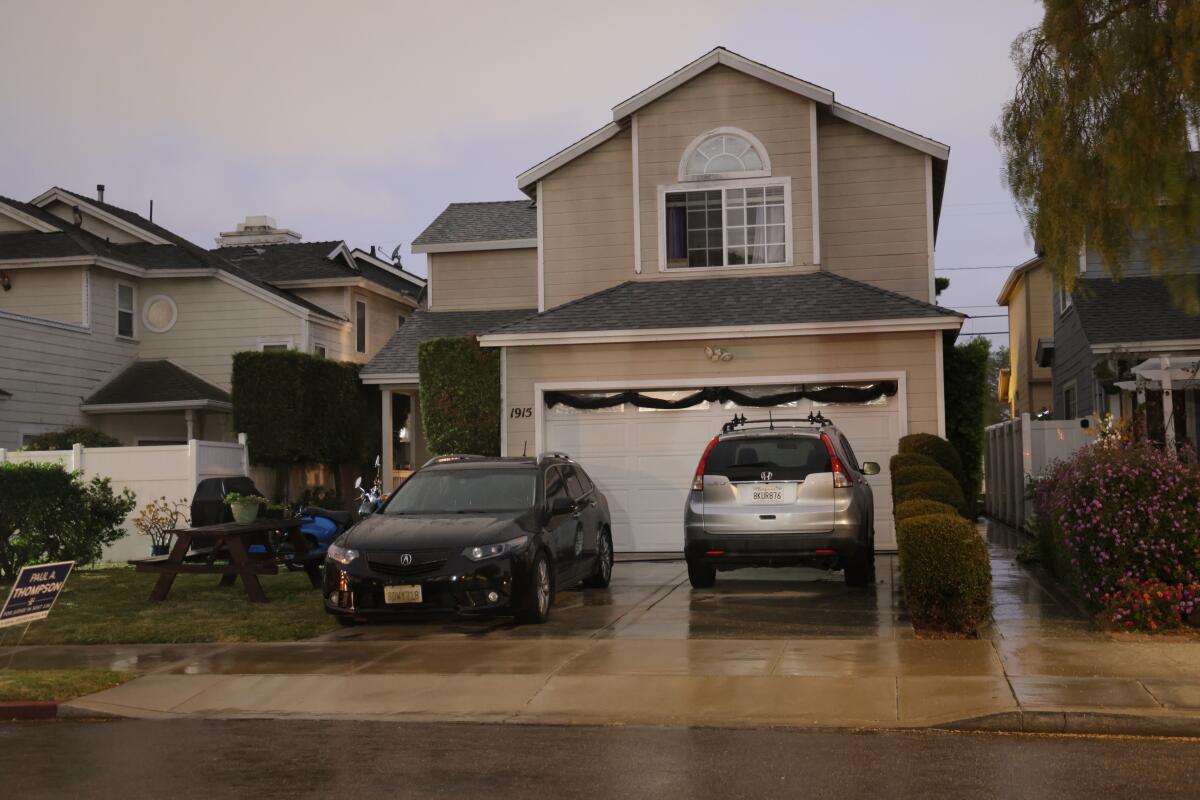
His parents were both teachers and “really solid members of their community,” according to Paul Thompson, a Los Angeles County prosecutor who lives next door to the family’s two-story house. Allen’s father knew many people on the block of single-family homes by their first names, Thompson said, and the suspect’s mother once saved Thompson’s dog when it ran into the road.
As a high school junior, Allen led Pacific Lutheran’s volleyball team in a three-set win over Junipero Serra High School. He was homeschooled, but was allowed via a special program to take a class at Pacific Lutheran in Gardena and to play for its respected squad, according to the private school’s principal.
Allen was “a godly person” who never cursed or shared his political views at the time, a former teammate told The Times, but he was also “very competitive.”
That drive extended to academics. After finishing his homeschooling, he was accepted into Caltech, one of the best universities in the nation for aspiring engineers like Allen.
He joined the Caltech Christian Fellowship, taking on a leadership role in which he organized Bible discussions, as well as the fencing team and the Nerf Club. He interned at the Jet Propulsion Laboratory in La Cañada Flintridge for three months.
In 2016, he was part of a five-person team that won an annual robotics and design competition in which teams built robots to play in soccer matches at Caltech. Allen was a teaching assistant at the Pasadena school, where he graduated with a mechanical engineering degree the following year.
Elizabeth Terlinden met Allen through the Caltech Christian Fellowship, where she was co-president during the 2014-15 school year.
“Quiet guy, kind of nondescript, generally polite, got good grades,” she told The Times, describing her impression of Allen. “Christian definitely, but that’s because I interacted with him primarily in that context.”
Michael D’Asaro, who coached fencing at Caltech around the time Allen was in college, said that he didn’t remember Allen but that generally none of the students attended practice regularly.
“Those kids were more interested in studying than sports, as you can imagine,” he said in a text message. “They would spend days and nights in the lab.”
After Caltech, Allen went on to work as a mechanical engineer for a South Pasadena firm called IJK Controls.
Kevin Baragona said he and Allen worked together “making stabilized gimbals for Hollywood” at IJK for about six months.
Baragona, who left IJK in January 2018 to found the company DeepAI, said in an interview via FaceTime from rural China that Allen seemed “kind of tired, unmotivated, like he didn’t want to really work hard, and maybe depressed.”
Baragona said that Allen was mainly interested in video games, and that Allen even showed him a couple of games he had made or was working on.
Allen was at IJK for less than a year and a half, according to his LinkedIn profile, which states that he worked as a self-employed “Indie Game Developer” from September 2018 to March 2020.
In 2019, he registered a trademark for an esoteric video game called “Bohrdom,” a “hybrid of a bullet hell and a racing game” based on atomic theory, in which electrons and protons compete. “Bohrdom” languished on the Steam gaming platform. Three other projects Allen detailed in his professional bio remained unfinished.
Then, in March 2020, he took a job as a tutor at C2 Education. In December 2024, he was named teacher of the year at the test preparation and tutoring company in a Spanish-tiled Torrance shopping center. People who knew him through his work there described him in interviews as intelligent and professional.
In May 2025, Allen received a master’s degree from Cal State Dominguez Hills in Carson, six miles from his parents’ home in Torrance.
Bin Tang, a professor in the university’s computer science department, described Allen as a “very good student. … Soft-spoken, very polite, a good fellow.”
“I am very shocked to see the news,” he told the Associated Press.
Joaquin Miranda knew he recognized the photo circulating online of a man posing in a graduation gown at Cal State Dominguez Hills, but he couldn’t quite place it. So on Monday, the 48-year-old showed the picture to his 13-year-old daughter, who told him it was of Allen, “my tutor guy,” who had tutored her in English at C2.
“She can’t believe it, because he was very nice, very professional and a very cool guy,” Miranda said of his daughter. “So yeah, it’s crazy.”
The Torrance home connected to Cole Tomas Allen.
(Robbin Goddard / Los Angeles Times)
At the heart of the case against Allen is a document federal authorities allege he sent family members.
The writer of the document apologized to his parents, colleagues and others before laying out his “rules of engagement” — guests, hotel security and staff and other people not in elected office or government were “not targets.” The author says he was targeting top Trump administration officials because he was “no longer willing to permit a pedophile, rapist, and traitor to coat my hands with his crimes.”
If the document was indeed written by Allen, Baragona said it would represent a fundamental change from the person he knew when they were making gimbals together at IJK Controls.
“It’s kind of sad, really,” Baragona said of the transformation Allen’s worldview apparently underwent in recent years. “It’s tragic and sad.”
The document was signed “Cole ‘coldForce’ ‘Friendly Federal Assassin’ Allen,” echoing the usernames the FBI in a court filing said Allen used online.
Federal authorities have not identified the specific accounts, but The Times found multiple similarly named social media profiles likely used by Allen, with close variations of the same distinctive username, @coldForce3000, that Allen used on a chess account created with his confirmed email addresses. The accounts have been taken down, but much of their contents remain accessible on the Internet Archive.
Across more than 5,000 posts extending from 2021 to days before last weekend’s White House Correspondents’ Assn. dinner, where the attack attributed to him took place, Allen’s social media history shows that what started as a singular immersion into the online gaming world became consumed in condemnation of Trump, his administration and war. The rhetoric was often harsh — likening the president to a mob boss or calling him a sociopath — but did not espouse violence.
A sketch of Cole Tomas Allen in court.
(Dana Verkouteren / Associated Press)
For years, SoCal Twitter user @CForce3000, under the name “coldForce,” posted almost exclusively about gaming, and “Super Smash Bros. Ultimate” in particular, the same fighting game Allen played competitively as an online brawler.
The account changed abruptly the day after Russia’s April 2023 missile attack on Slovyansk, in eastern Ukraine. Eleven people, including a toddler, died in the shelling of a residential building. The feed from @CForce3000 carried images of the bloodshed.
Subsequent Ukraine-related posts followed, along with pleas for donations to buy jeeps, equipment and supplies for combatants in the country. By early 2024, the account had broadened to domestic concerns, including opinions on student activism at Columbia University in solidarity with Palestinians in Gaza.
“Everyone makes mistakes in college,” @CForce3000 wrote in May 2024, criticizing the activists, who risked expulsion. “Burning down your parents’ life accomplishments and your own future to demonstrably degrade the image of your (presumably) recent cause is not really one I’d recommend,” the user posted, “like, my parents woulda *buried* me if i picked this as a ‘hill to die on.’”
For the next year, @CForce3000 shared hundreds of posts from sources as diverse as Rep. Ted Lieu (D-Torrance), Republican former Rep. Liz Cheney of Wyoming and former Ukrainian diplomat Maria Drutska. The account became a repeater of condemnations by Trump critics calling the president an ally of Russia and decrying his failure to support Ukraine and his involvement with late sex offender Jeffrey Epstein.
In November 2024, @CForce3000 announced the account was migrating to BlueSky, saying of X, “I don’t think there’s much reason to be on here anymore.” In early 2025 on BlueSky, coldForce chose an avatar plucked from the anime series “Gintama”: the heroine Kagura in her berserk state, insane with rage.
“Hi! I’m a random Californian guy with posts about American politics, support for Ukraine, and observations of small creatures,” read the new coldForce account bio. “I choose my own battlefields. Not through my blood, but with my heart. I stand on the battlefield to protect what I want.”
The BlueSky user continued to forward requests for donations to equip Ukrainian troops. It decried federal immigration raids and posted about a toddler who nearly died at an Immigration and Customs Enforcement detention facility in Texas. In reposting a feed that called Elon Musk a white supremacist, coldForce mused that the Tesla CEO and X owner was a “genius with effective(?) autism” struggling to understand humanity.
The rhetoric sharpened this spring when Trump began posting threats to bomb Iran, saying that “a whole civilization will die tonight.” On BlueSky, coldForce shared posts from Democratic pundits and leaders, including in Congress, who called for Trump’s impeachment, and those who described the president as “deranged” and “a sociopathic mob boss.”
Cole Allen reportedly purchased a handgun at CAP Tactical Firearms in Lawndale.
(Eric Thayer / Los Angeles Times)
“Trump must be removed from office. He has no capacity to do the job, and he’s destroying the US and the world with incoherent flailing,” read an April 12 message by Minnesota liberal activist Will Stancil that coldForce reposted. “He thinks he can bully and blackmail the whole world and will start WW3 or nuke someone eventually. He absolutely cannot [be] allowed to continue.”
To these, coldForce added:
“If we can call for russians to oppose putin, we can and must oppose trump no less.”
On April 6, federal authorities say Allen used his phone to search “white house correspondents dinner 2026” and booked a room at the Washington Hilton.
Allen allegedly traveled by train across the country from California, arriving in Washington, D.C., on April 23 and checking into his room at the Washington Hilton, where the White House correspondents’ dinner was scheduled two nights later.
At 8:03 p.m. April 25, he snapped a mirror selfie in his hotel room, according to a pretrial detention memo filed by prosecutors Wednesday. He looked into the camera, eyebrows raised with a hint of a smile. Allen wore a black dress shirt and slacks, a red tie tucked into his pants and a small leather bag prosecutors say was filled with ammunition. He also allegedly wore a shoulder holster and knife in his waistband.
At 8:27 p.m., he pulled up a live feed of Trump en route to the event. Minutes later, as the president sat on an open stage during the fete, Allen allegedly ran through a magnetometer and past Secret Service agents toward the ballroom before firing at least one shotgun round in the direction of the stairs leading down to the ballroom, the memo said.
Secret Service agents respond during the White House correspondents’ dinner.
(Tom Brenner / Associated Press)
A Secret Service officer saw him and fired five shots — all of which missed him — and Allen fell to the ground and was arrested before he could reach the event space. The Department of Justice has said it is investigating whether Allen fired the round that hit one of the agents in the chest; the agent avoided major injuries because he was wearing a bulletproof vest.
People who knew Allen before he was accused of attempting to gun down American leaders told The Times that they never would have thought he was capable of such a violent act.
Terlinden, of the Caltech Christian Fellowship, said she and Allen once got into a heated argument over how to spend the group’s charity money. He advocated for sending toys to children abroad through an organization that was explicitly Christian, whereas Terlinden pushed to feed the homeless locally, which she thought was more pragmatic.
“I think he said it’s not about helping people, it’s about showing the love of Christ,” she recalled. “After I talked about efficiency and helping people.”
She left the room and didn’t return.
“Part of the reason I’m bringing that up is to demonstrate that that’s the most scandalous incident I could come up with,” Terlinden said. “We were arguing over whether we should send toys to poor children or feed homeless people — that’s the big tea.”
Reflecting on the allegations, she said she wondered whether Allen was “acting out of perceived moral duty. … In a twisted way, there is a sense of, you know, standing up for people that can’t defend themselves.”
Mathias Laborda scored in the 82nd minute for the Vancouver Whitecaps on Saturday night, sealing a 1-1 tie with the Galaxy at Dignity Health Sports Park in Carson.
The Whitecaps (8-1-1), who were only the second MLS team in the post-shootout era (since 2000) to win eight of their first nine games to begin a season, had their club regular-season record four-game win streak snapped.
Sebastian Berhalter played a free kick from the left side to the back post and Laborda headed home the finish from point-blank range to cap the scoring.
The Whitecaps had 58% possession and outshot the Galaxy 19-7, including a 5-2 edge in on target shots.
Joseph Paintsil opened the scoring in the 46th minute. Lucas Sanabria, in the opening seconds of the second half, stole a misplayed ball from Whitecaps goalkeeper Yohei Takaoka and fed Paintsil for a finish from the right side of the area.
JT Marcinkowski had four saves for the Galaxy (3-4-4).
A Korean Air plane takes off from Incheon International Airport, west of Seoul, South Korea, 01 April 2026. Fuel surcharges for flights operated by South Korean airlines have surged by as much as threefold from the previous month in April due to the spike in global oil prices, industry watchers said. Photo by YONHAP / EPA
May 1 (Asia Today) — Fuel surcharges on airline tickets issued in South Korea nearly doubled Friday as carriers respond to a sharp rise in oil prices driven by escalating tensions in the Middle East.
The airline industry said tickets issued this month will be subject to the highest surcharge level, Stage 33, for the first time since the current system was introduced in 2016.
Korean Air set one-way international fuel surcharges from 75,000 won ($51) to 564,000 won ($383), up from 42,000 won ($29) to 303,000 won ($206) in April. The lowest charge applies to short-haul routes such as Fukuoka and Qingdao, while the highest applies to long-haul destinations including New York, Atlanta, Washington and Toronto.
Asiana Airlines set its international one-way surcharge at 85,400 won ($58) to 476,200 won ($323), nearly double April’s range of 43,900 won ($30) to 251,900 won ($171).
Jeju Air, a low-cost carrier, will charge $52 to $126 one way on international flights departing South Korea, compared with $29 to $68 last month.
The higher surcharges are still not enough to fully offset rising costs. Some low-cost carriers saw fuel expenses rise more than 120% from the previous month and 130% from a year earlier, while surcharge revenue covered only about half of the increase.
Airlines are responding by cutting less profitable routes. Asiana expanded planned reductions on some international routes from eight flights to 13, while Jin Air plans to cut 131 flights across 14 routes this month after canceling 45 flights on eight routes in April.
Air Premia plans to cut 22 flights in July, including eight on the Incheon-Da Nang route, six to Los Angeles and four each to San Francisco and Honolulu.
Korean Air has not announced route reductions but is closely monitoring market conditions.
Luxmy Gopal and Roger Johnson brought viewers up to speed with the latest news on BBC Breakfast
09:40, 03 May 2026Updated 09:41, 03 May 2026
The news presenter shared the breaking news announcement live on air(Image: BBC)
BBC Breakfast hosts issued a devastating breaking news announcement live on air.
During Sunday’s (May 3) episode of the popular morning show, Luxmy Gopal and Roger Johnson brought viewers up to speed with the latest news from across Britain and internationally.
They were joined in the studio by Elizabeth Rizzini , who provided regular weather updates, whilst Olly Foster covered the sports news.
However towards the end of the show, Luxmy made the tragic announcement following the news that two migrants have died after a boat sank in the Channel while attempting to cross over to the UK overnight.
Speaking to viewers at home, Luxmy revealed: “Some breaking news to bring you. Reports have just come through in the past few minutes that two people have died off the coast of northern France after a boat carrying migrants came into difficulty overnight.”
Co-host Roger continued: “Lets go live to our reporter Simon Jones, who has got the latest on this for us. Simon what more do we know about what happened.”
The show then cut over to Simon, who appeared on the breakfast show via video link and updated viewers on the devastating news.
A huge rescue operation was launched in the early hours, after a migrant dinghy carrying 65 people got into difficulties off Hardelot beach, south of Boulogne.
French authorities have confirmed two female migrants died in the incident involving a so-called taxi boat, as dozens of people tried to scramble on board.
Authorities say a second migrant boat nearby continued on its journey to the UK, as the incident unfolded around 3am.
It is believed that there were 82 people packed on the boat that “ran aground” on a beach at Neufchatel-Hardelot, about 12 kilometers (seven miles) south of the port of Boulogne, said Christophe Marx, a regional government official.
It comes as at least eight people have now died this year on small boats trying to make the risky trip across the English Channel to the southern coast of the UK.
Last month, Britain and France signed a new three-year deal on security operations to stop the crossings.
France will increase the number of police and gendarmes patrolling the coast while the British government will increase its contribution to the cost, according to an AFP tally based on official French and British sources.
BBC Breakfast airs daily from 6am on BBC One and iPlayer
A flight attendant has shared the reason cabin crew greet every passenger boarding the plane, and it has nothing to do with just being polite. There’s a lot more to the simple act
10:15, 03 May 2026Updated 10:16, 03 May 2026
The flight attendant said why they greet passengers (stock image)(Image: Amorn Suriyan via Getty Images)
Whenever we board a plane, we inevitably interact with flight attendants who, beyond keeping us safe throughout the journey, are also on hand to offer some genuinely useful guidance. After all, they possess an unrivalled knowledge of air travel safety.
Now, one flight attendant has lifted the lid on a secret that most holidaymakers are likely completely unaware of. She revealed that the greeting you receive as you board the plane actually serves a very specific purpose, and it has nothing to do with being courteous. In fact, cabin crew are carrying out an important assessment of passengers from the very moment they step on board.
As it turns out, flight attendants are sizing passengers up right from the off, and it’s all been laid bare in a candid TikTok video. Flight attendant Mrs Miva has blown the whistle on one of the industry’s best-kept secrets.
In her viral clip, she revealed the true reason behind the cabin crew’s welcoming routine as passengers make their way on board. It seems that saying “hello” is about far more than simple courtesy.
Over footage of herself, she wrote: “Did you know that your flight attendant greets you not only out of politeness, but also to check whether you are too drunk or sick to fly?”
Content cannot be displayed without consent
The video has since racked up millions of views, leaving countless viewers genuinely stunned. The notion of being discreetly assessed upon boarding came as a complete surprise to many.
One viewer said: “Wait, is there a reason why they always ask me where I sit when I go onboard? ” Another noted: “To see if you’re 1. Safe to fly (not intoxicated) and to see if you could help in an emergency.”
A third also wrote: “And looking for suspicious behaviour.” Meanwhile, a fourth added: “We are also picking out good candidates in the event of an emergency.”
Some even shared their own experiences to back up the theory. One recounted: “I was denied an international flight from England to America because they thought I’d die en route from being so sick.”
Another wrote: “True, and it’s the toughest part of the day. Without being paid!”
What you need to know
While cabin crew clearly aim to be friendly and welcome passengers as they embark on their journey, there’s far more happening when they greet you at the aircraft door than meets the eye. In reality, they’re carrying out a comprehensive head-to-toe safety evaluation of passengers before takeoff.
This process involves checking for intoxicated or disruptive passengers, ensuring travellers are capable of following emergency procedures, identifying potential security risks, and also spotting physically capable individuals who might be able to assist during an emergency. Crew members receive thorough training to enable them to detect any possible threats effectively.
They also watch passengers to gauge whether they can comprehend and follow safety instructions, which becomes vital should an emergency arise. While the assessment can be completed in mere seconds, it plays a really important role in helping to maintain aircraft safety.
Beyond this, it also contributes to fostering a relaxed environment. After all, it helps to establish a welcoming atmosphere for the journey ahead.
Flight attendants carry out genuinely crucial duties, and this simply demonstrates the lengths they go to in order to keep travellers as safe as humanly possible throughout. Now you understand what they’re actually up to.



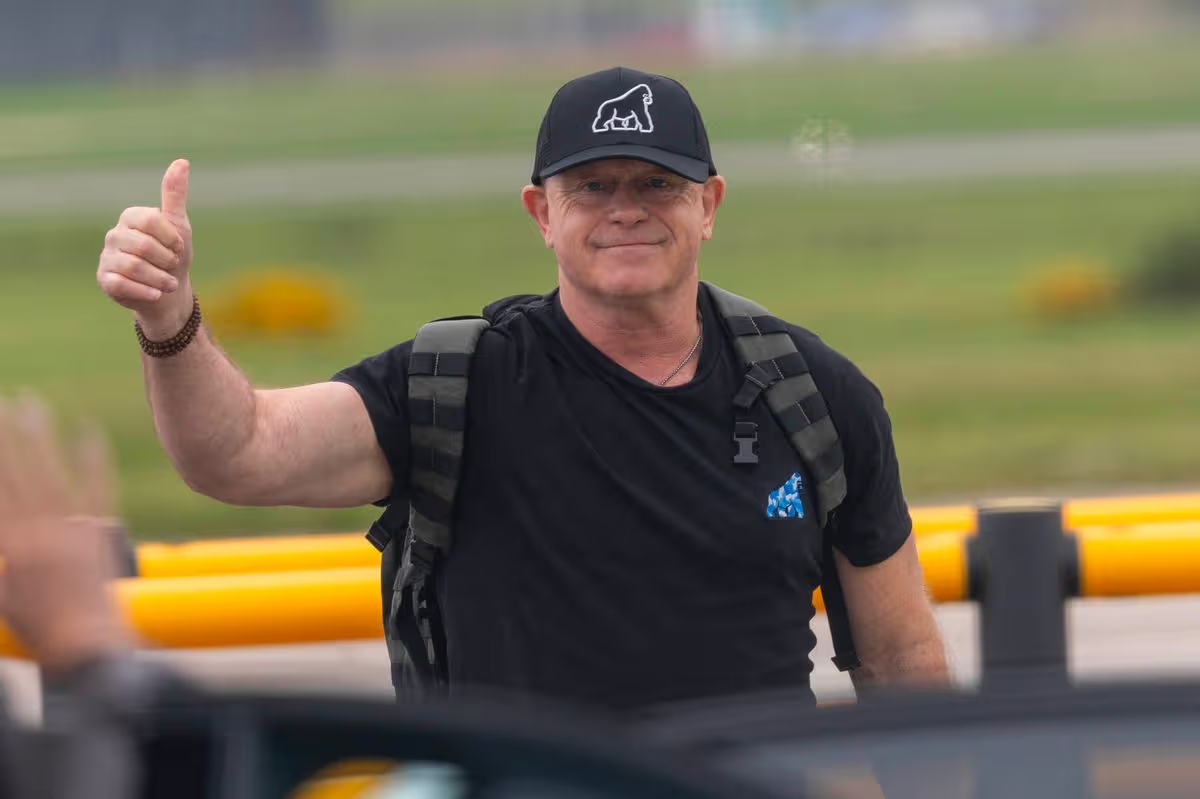


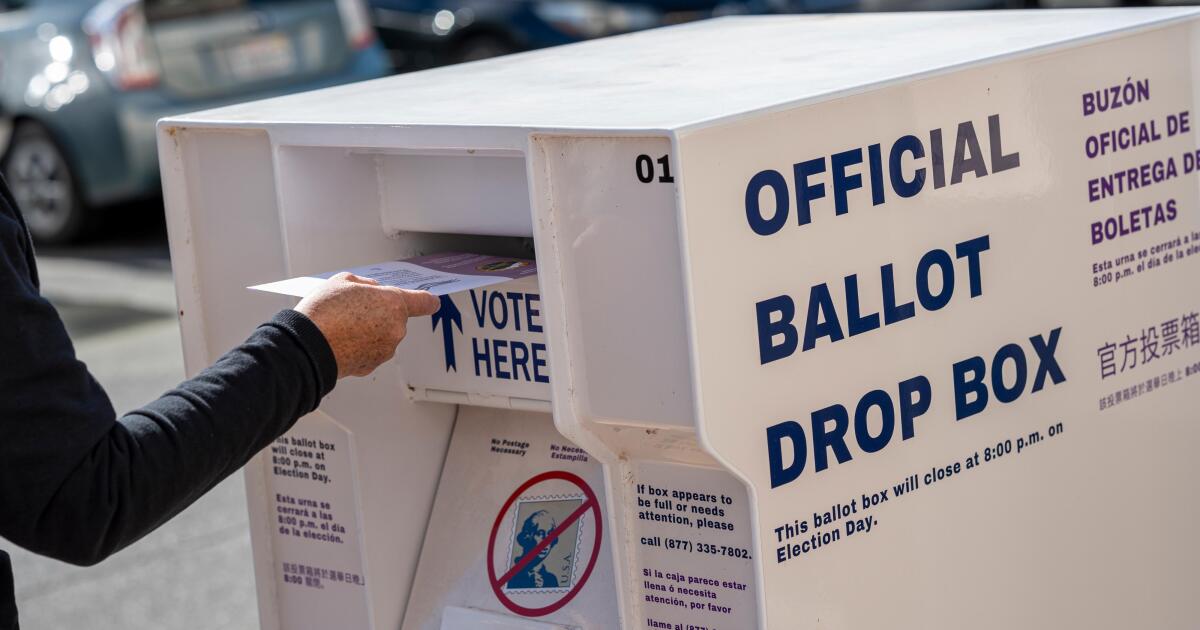
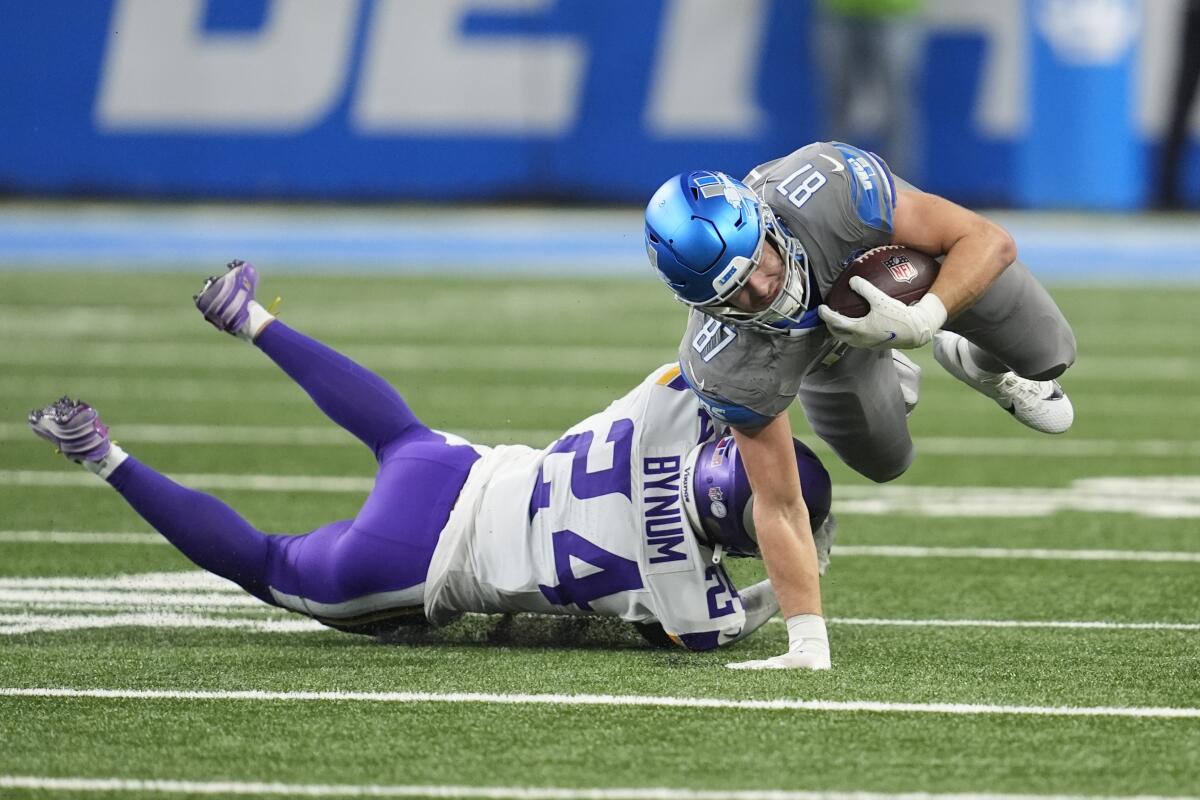

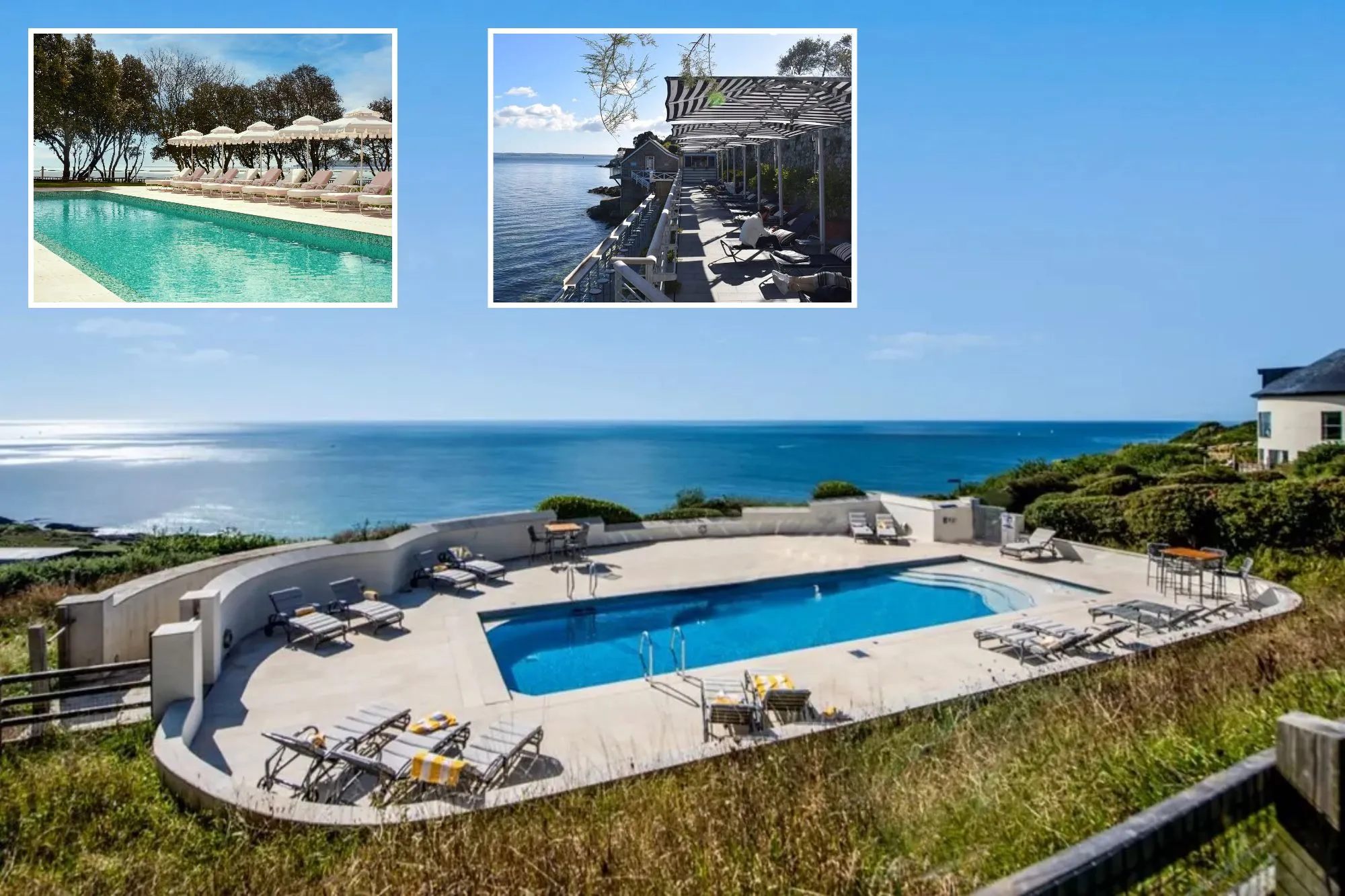


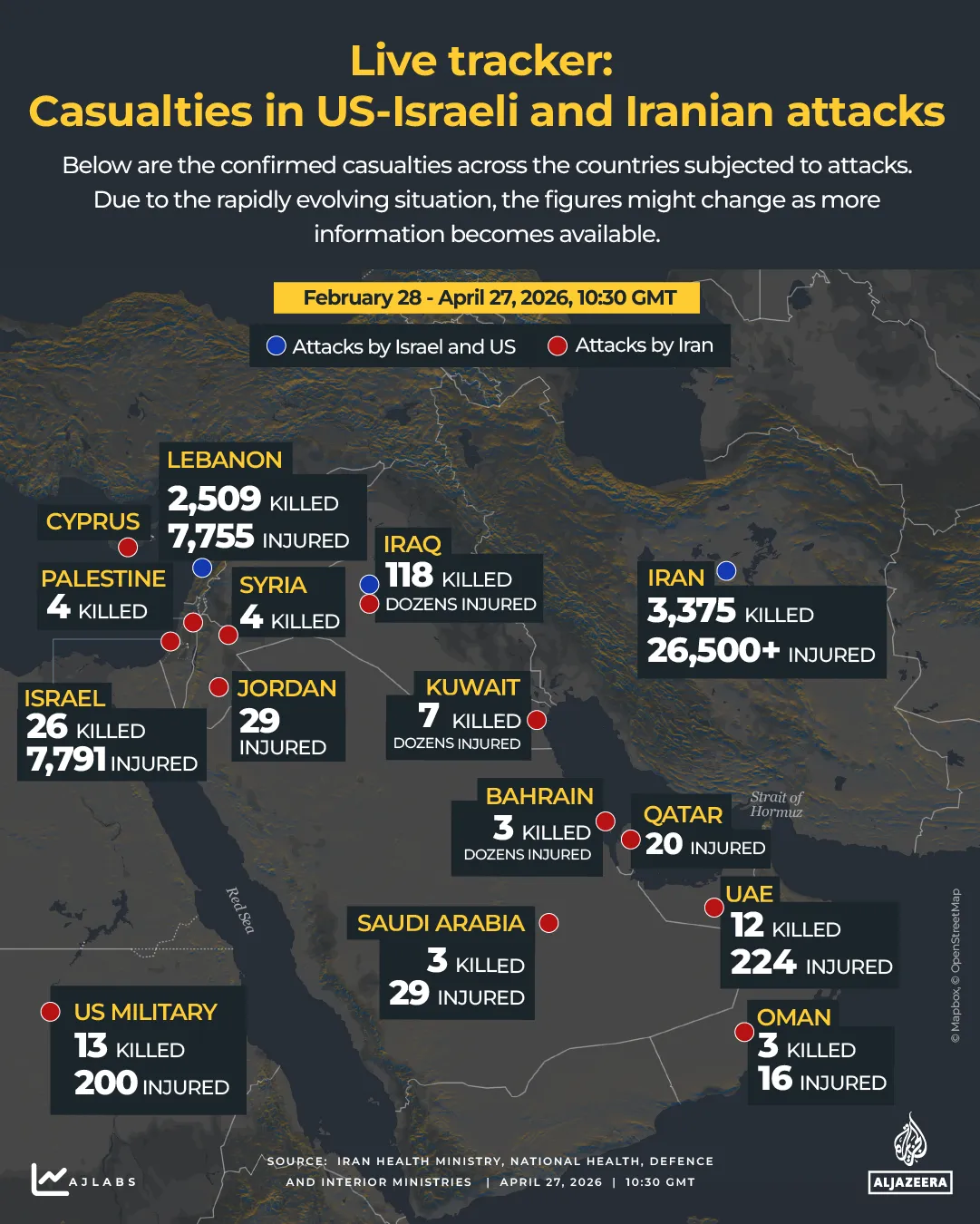





![HMS Cleopatra's Wasp helicopter, No.463, encountered an engine failure at high altitude during the blockade on the Port du Beira in 1971. A crash landing occurred at sea and the aircraft was recovered. [File image.]](https://i0.wp.com/www.aljazeera.com/wp-content/uploads/2026/05/Wasp_463_a-1777774554.jpg?w=640&ssl=1)