Month: April 2026

Giving way is a sign of weakness, drivers confirm

ALLOWING another road-user to take precedence over you is an unforgivable sign of weakness and should incur points, motorists have agreed.

Giving way, whether to a car, a cyclist or a pedestrian is an act of submission which should, if repeated, lead to the loss of a driving licence and in extreme cases a full ban because of the danger it poses.

Qashqai driver Karen, not her real name,  said: “It’s basic biology. Do rhinos give way to a herd of antelope? No. They charge ahead because they’re top of the food chain.

“By hesitating around being courteous and prioritising others, these idiots are causing crashes among real drivers like me: confident, brake seldom, basically apex predators with windscreen wipers.”

Shane, not his real name, a Ford Ranger Raptor driver from Stafford, agreed: “There are rules about who has right of way at junctions, and there are unwritten rules about self-respect and what it takes to get ahead.

“I’m not giving way just to be ‘nice’. It’s not the 14th century and I’m not a gallant knight. I’m a 43-year-old man on the way to the big Sainsbury’s to buy toilet roll.”

Reform MP Robert Jenrick said: “This nation has been weakened by the constant nanny-state need to make sure others are not ‘at risk’ of an ‘imminent collision’. When we should be ruling the road and dominating every junction, instead we ‘give way’.

“I don’t even stop for red lights. I go straight through them.”

Prep talk: Mt. SAC Relays to feature Servite, Rosary relay teams

After record-setting performances in the 4×100 relays last weekend at the Arcadia Invitational, the Servite and Rosary relay teams will try to do it again on Saturday at the Mt. SAC Relays at Mt. San Antonio College.

The Servite relay team of sophomores Jace Wells, Jorden Wells and Kamil Pelovello and junior Benjamin Harris ran it in 39.70 seconds at Arcadia, the fastest in state history.

Rosary, which is the sister school for Servite, featured sophomore Tra’via Flournoy, senior Justine Wilson, junior Pfeiffer Lee and sophomore Maliyah Collins running 44.23, breaking Long Beach Poly’s 22-year-old state record of 44.50.

Coach Brandon Thomas works with both teams and said he wanted to support the track community by having both participate.

Defending state high jump champion JJ Harel will compete in his specialty after winning at Arcadia with a mark of 6 feet, 9 inches. He’s still only a few weeks into training because of a previous injury.

This is a daily look at the positive happenings in high school sports. To submit any news, please email eric.sondheimer@latimes.com.

Source link

I tried the Peaky Blinders Nights experience at the English attraction named one of the best in the UK

THE crowd gasps. Arched backwards in a dramatic display, a woman has just breathed fire across the audience.

She continues dancing, swinging flaming sticks against the inky night while a flatcap-wearing crowd looks on, transfixed.

Four actors dressed in 1920s-era "Peaky Blinders" costumes.
Actors play the Shelby gang for Peaky Blinders Night
Fire breather performing in the dark.
A woman breathing fire across the audience Credit: Supplied

I’ve arrived at Black Country Living Museum in Dudley, near Birmingham, which was crowned the best large visitor attraction in England last year.

There for a special Peaky Blinders night, I enter a replica village featuring streets any fan will recognise – as this is a filming location for the hit series.

The show’s creator, Steven Knight, has gone as far as describing the museum as “home”.

The event costs £21 and instructions are enticingly vague: “Arrive in 1920s attire and expect mayhem.”

WAIL OF A TIME

I drove Irish Route 66 with deserted golden beaches and pirate-like islands


TEMPTED?

Tiny ‘Bali of Europe’ town with stunning beaches, €3 cocktails and £20 flights

Judging by the fire dancers at the entrance, I’m in for one hell of a night.

Wobbling across the cobbles in heels, I’m wrapped warmly in a thick trenchcoat. If someone had told me I’d accidentally wandered back in time to the actual 1920s, I could have believed them.

Visitors drift between functional stores, from a post office to a barber shop, where one teen exchanged £15 for a Shelby-inspired undercut while their girlfriend laughed from the sidelines.

At the bottom, past a WWI memorial, sits a ruckus of flashing gold fairground rides.

It is so authentic, the only indication that I’m standing on a film set and not a real street corner is the vintage signage and outfits.

I’m jolted to attention by a 1920s car rumbling towards me, open-topped and overflowing with cackling passengers.

“I swear that was Ada,” someone remarks, in a nod to Arthur Shelby’s daughter in the show.

In dim lighting, strangers do have a habit of morphing into familiar faces.

Down a flight of steps sits Canal Street Bridge, a secret meeting place for Ada and Freddie. From there, I can see queues forming for the village pubs, as jaunty piano tunes drift from their doorways.

Having snagged a £4.50 bottle of Cobra, my attention is drawn towards two storefronts: a bakery and a traditional sweet shop. For £10, I secure a bag of lemon sherbets, lemon bonbons and cinder toffee.

Clutching my treats, I teeter down the steps of Canal Street Bridge to enter Charlie’s Yard. This sits on the banks of a canal, where Charlie Strong smuggles illicit goods for the Shelbys.

“Welcome to 1910,” a chainmaker yells, wielding a hammer over a glowing link.

This event is strictly 16+ , and judging by the three street brawls I’ve witnessed already, that’s probably for the best. All incidents involved actors and the colourful language sparked waves of giggles.

My final hurrah is horse racing at St James’ School.

Shuttled into wooden rows, the atmosphere is electric and, after picking their horses, everybody is on the edge of their seats.

Celebrating the flutter with a portion of fish and chips “to go”, it’s time for the steady walk to the exit. By 10.30pm, it feels like I’ve just scratched the surface.

Straddling 29 acres, the site has events exploding on a spitfire schedule. Catching it all seems impossible.

Ticket included, I’ve spent around £50, so this evening has been a steal.

Like Cillian Murphy, I’m leaving with a “great fondness” for the Black Country Living Museum.

The Shelby legacy is alive and well.

GO: PEAKY BLINDERS NIGHTS

Source link

Gunfire reported by vessel in Strait of Hormuz | US-Israel war on Iran

NewsFeed

A maritime agency reported that a tanker was fired on by gunboats in the Strait of Hormuz. The United ⁠Kingdom ⁠Maritime Trade Operations agency says it received a report ⁠of a tanker being fired upon by what it ‌said were two gunboats linked to Iran’s Revolutionary Guard Corps. The vessel and ‌its crew were reported safe.

Source link

Iran closes Strait of Hormuz again over US blockade of its ports | US-Israel war on Iran News

Reports of Iranian gunboats opening fire on a tanker in strait, after Tehran said it is closing the waterway until the US lifts the blockade of its ports.

Iran says it has closed the Strait of Hormuz again, calling the decision a response to a continued blockade of its ports by the United States.

The Iranian military on Saturday said control of the strategic waterway, through which 20 percent of the global oil flows, has “returned to its previous state”, with reports saying Iranian gunboats fired at a merchant vessel as it attempted to ‌cross.

Recommended Stories

list of 4 itemsend of list

The closure of the strait came hours after it was reopened, with more than a dozen commercial ships passing through the waterway, after a US-mediated 10-day ceasefire deal was reached between Israel and Lebanon.

The Islamic Revolutionary Guard Corps (IRGC) on Saturday said in a statement, cited by the Iranian media, that the ongoing US blockade of Iranian ports represented “acts of piracy and maritime theft”, adding that the control over Hormuz is “under the strict management and control of the armed forces”.

“Until the US restores full freedom of navigation for vessels travelling from Iran to their destinations and back, the status of the Strait of Hormuz will remain tightly controlled and in its previous condition,” it said.

By 10:30 GMT on Saturday, no fewer than eight oil and gas tankers had crossed the strait, but at least as many ships appeared to have turned back, having begun to exit the Gulf, the AFP news agency reported.

The toing and froing over the strait cast doubt on US President Donald Trump’s optimism the day before, that a peace deal to end the US-Israel war on Iran was “very close”.

Trump had celebrated the reopening of the strait on Friday, but warned the US attacks would resume until Iran agreed to a deal, which included its nuclear programme.

“Maybe I won’t extend it,” Trump told reporters on board Air Force One about the temporary ceasefire agreement in place. “So you’ll have a blockade, and unfortunately we’ll have to start dropping bombs again.”

Asked whether a potential deal could be made in this short timeframe, Trump said: “I think it’s going to happen.”

But Iran says no date has been agreed for another round of peace talks, accusing the US of “betraying” diplomacy in all negotiations.

The conflicting and changing reports about the strait and how much freedom ships have to transit through it have deterred many vessels from crossing, according to John-Paul Rodrigue, a maritime shipping specialist at Texas A&M University.

“Ships have been attempting transit since the announcement, but it looks like many of them are heading back because the situation is unclear,” Rodrigue told Al Jazeera. “There is contradictory information being issued by all parties.”

Reporting from Tehran, Al Jazeera’s Tohid Asadi said “uncertainty is the name of the game” as far as the Strait of Hormuz is concerned.

“Iran is looking for a comprehensive end to the war across the region, security assurances, sanctions relief, the unfreezing of frozen assets, regional relations – and on top of all of that – the nuclear dossier and Iran’s stockpile of highly enriched uranium,” he said.

“But right now, uncertainty is the name of the game. The fragile situation makes it hard to talk about the possibility of successful negotiations down the road.”

Source link

‘Lee Cronin’s The Mummy’ review: Generic horror better kept under wraps

How’s Lee Cronin doing? Fine. You know, still making movies. This one’s his third feature. Somebody — perhaps it was Lee Cronin himself, probably not — wanted us to know that his latest project, “Lee Cronin’s The Mummy,” was no mere mummy movie. Certainly not the one you have in mind: bandaged dead guy, ominous hieroglyphics, maybe Brendan Fraser. This is not that mummy movie. This is “Lee Cronin’s The Mummy.”

As for what that possessive credit means, we’re still in a haze. Cronin’s previous outing was “Evil Dead Rise,” a sequel heavily devoted to the gooey game plan mapped out by Fede Alvarez’s 2013 rethink of Sam Raimi’s gross-out comedies. In our current moment, when horror seems to be mining an especially rich vein (we’ve even seen an Oscar go to an unforgettable witch in “Weapons”), Lee Cronin represents the safe old ways of dutiful stewardship, getting the job done for a generic night out.

There are worse sins in the world. And sometimes the best way to introduce an ancient Egyptian curse is via a prologue that’s tonally very much like the one in “The Exorcist.” Who is the spooky, smiling woman beckoning to a young girl at the edge of her garden? No matter. The kid goes missing and, eight years later, her American family, since relocated to suburban New Mexico, is still feeling the loss: TV reporter Charlie (Jack Reynor), his haunted wife Larissa (Laia Costa) and their two semi-surly children, Maud (Billie Roy) and Sebastián (Shylo Molina).

When their precious Katie (a game Natalie Grace) is somehow returned to them, though, nearly catatonic with wrinkled, desiccated skin and gnarly toenails that would make a pedi technician shriek, it’s hard to blame them for feeling euphoric. Working from his own screenplay, Cronin barrels over the gaping plot holes — a doctor might have some thoughts here — and gets to the good stuff with the family at home in squirm-inducing close quarters, a live-in demon resting in her bedroom.

“Lee Cronin’s The Mummy” works best as a variation on Ari Aster’s career-making “Hereditary,” slicker and less guilt-ridden, with Grace’s Katie prone to jaw-snapping clicks and faraway looks, a spin on Milly Shapiro’s hypnotic turn as a doomed host. Eventually, things get more obvious: a levitating wheelchair, some skittering around on the ceiling. If Cronin does have a signature — more of a penchant, really — it’s for juicy gore, Katie’s skin peeling off in sheets. She goes to town on her own teeth.

All these moments are good for audience groans and there’s an enjoyable bad movie here for the seizing — that is when Cronin isn’t steering the action back to Egypt for an underpowered mystery thread involving a one-dimensional Cairo detective (May Calamawy) pursuing the root of the trouble. Why deploy a plummy archaeology professor (Mark Mitchinson) if you’re only going to give him a single scene to cut loose? He’s the kind of character who usually makes it to the big finale.

The film is tangled in its mess of references: a possession thriller that also wants to dish out some grainy video footage à la “The Ring” or “Bring Her Back” along with the expected mouth-to-mouth vomiting. Ironically, an honest-to-goodness mummy movie consumed with exotica (the first one from 1932 was released in the wake of the global mania over King Tut’s tomb) makes a lot of sense right now, with America straying into foreign deserts.

Was that in mind at any point? You’d have to ask Lee Cronin. It’s his movie and these are his mummy issues.

‘Lee Cronin’s The Mummy’

In English and Arabic, with subtitles

Rated: R, for strong disturbing violent content, gore, language and brief drug use

Running time: 2 hours, 13 minutes

Playing: Opens Friday, April 17 in wide release

Source link

She’s a housekeeper with a side job: cleaning the trashed streets of her own neighborhood

The first stop on Sabine Phillips’ three-hour inspection of her neighborhood was at Fountain Avenue and St. Andrew’s Place, where detached pieces of a sofa had been plopped onto the sidewalk as if this were an outdoor living room.

Phillips slid off her yellow Huffy cruiser, grabbed a pen, and entered the finding into her spiral notebook.

“This stretch is a common dumping ground,” she told me, eyes hidden behind sunglasses under a floppy sun hat.

Her part-time assistant, Keith Johnson, was wearing a “Trash Club Hollyood” T-shirt. He squeezed the handle of his garbage-grabbing tool to snare cookie and chip wrappers that floated near some empty Pacifico beer bottles and a Big Gulp container the size of a drum. When they report neighborhood problems to the city, Johnson said, “sometimes they’re helpful and many times they’re not, so we end up doing things on our own.”

Sabine Phillips, 66, and Keith Johnson, 71, right, ride their bikes documenting debris left on sidewalks.

Sabine Phillips, 66, and Keith Johnson, 71, right, ride their bikes documenting debris left on sidewalks of their East Hollywood neighborhood on April 15.

(Genaro Molina / Los Angeles Times)

Much of the discarded furniture and other goods left on the streets ends up being used to build homeless encampments, Phillips said. That often leads to more trash, fires, drug activity and other nuisances that threaten public safety and set residents on edge.

Phillips doesn’t just take notes. She reports her findings into the city’s MyLA311 system on Wednesdays, so city crews can make pickups on Thursdays and Fridays. And they usually do respond, Phillips said. But the cycle immediately repeats, and she has typically reported 50 or more additional items, week after week, month after month.

In a quarter of a century of writing about the many plundered patches of paradise, I’ve been repeatedly impressed by those who step up and make a difference out of some combination of pride, frustration and the spirit of volunteerism. But I also understand the rage of taxpayers who wonder why Los Angeles City Hall is so incapable of managing the basics.

In the race for leadership of the city, even Mayor Karen Bass and Councilmember Nithya Raman say things have got to change, which isn’t necessarily the best commentary on their stewardship.

“Unfortunately, it’s become fairly universal across all 99 neighborhoods in this city that L.A. government isn’t working,” mayoral candidate Adam Miller said at a recent West L.A. appearance I dropped in on, and he added that he’d use his business and nonprofit experience to tackle homelessness, housing and public safety challenges, among other issues. “We pay some of the highest taxes in the country, where people feel like we’re not getting our money’s worth anymore.”

Last week, after my column about the substantial inventory of blight around City Hall — including a graffiti-scarred fountain that’s been out of operation for most of the last 60 years (no lie) — I heard from readers with their own problems.

Richard Vasquez wrote to say the Plaza de Mexico in Lincoln Heights is still a cemetery of missing statues. Richard Zaldivar wrote to say the nearby AIDS memorial was vandalized and multiple calls for help fell on deaf ears. Estela Lopez of the downtown industrial improvement district, where trash is routinely dumped illegally, wrote to say a county report warned that typhus levels downtown had reached an all-time high.

Sabine Phillips documents abandoned furniture and debris found on sidewalks.

Sabine Phillips documents abandoned furniture and debris found on sidewalks of her neighborhood on Wednesday in East Hollywood.

(Genaro Molina / Los Angeles Times)

I also heard from Stefanie Keenan, who had a clever idea a few years ago, born of exasperation with City Hall. She hired her own housekeeper — that would be Phillips — to help patrol and clean the neighborhood they both live in, and Phillips’ work was featured by NBCLA and substacker Sam Quinones.

“It’s not getting done otherwise, and our neighborhood would have burned down,” Keenan told me.

Keenan, who has been tending to her streets for several years, has been paying Phillips $100 for Wednesday scouting forays and another $100 to fill four or five huge bags on Saturday trash patrol. Keenan, a photographer, told me she has spent tens of thousands of dollars out of her own pocket.

But Keenan doesn’t have unlimited funds, and this was Phillips’ last week on the job. Lord knows what the neighborhood will look like without her on patrol. As she pedaled along her regular route Wednesday, Phillips found several more sofas, among other things.

A freezer. A refrigerator. Rugs. Chairs. Stools. Dressers. Drawers. Bed frames. Mattresses. Box springs. A printer. Electronics. Televisions.

And heaps of trash, some of which blocked sidewalks and some of which spilled off curbs and into streets.

On Lexington Avenue she stopped to make the following entry in her log:

“3 toilets.”

Nothing surprised her, and nothing slowed her down. At a house where a construction worker dumped lumber onto the sidewalk, Phillips strode up and asked what the thought would happen to the scrap pile. He said he had no idea; she made an entry in her log.

Sabine Phillips takes a break from documenting addresses of abandoned furniture and debris.

Phillips takes a break from documenting addresses of abandoned furniture and debris.

(Genaro Molina / Los Angeles Times)

I tried to recruit Phillips to run for mayor, but the native of Germany wasn’t interested. She did say, however, that she was “the first female bouncer in Berlin,” and that was “at a Hells Angel discotheque.”

The Berlin bouncer kept moving, and scribbling. She filled three pages in her notebook with more than 60 notations, including sidewalk graffiti.

“I’ve seen some weird stuff,” Phillips said. “Twice I found safes outside, just on the side of the curb.”

The studio-adjacent neighborhood she patrols has an eclectic mix of upscale houses and block-long stretches of apartment buildings, with people moving in and out and leaving possessions on the curb as they come and go.

That’s not the city’s fault. But the city could do a better job of educating residents on how to arrange for pickups, and a better job of cracking down when they don’t. I reached out to the office of Councilmember Hugo Soto-Martinez, but we hadn’t yet connected when I hit my deadline.

At the Lexington Avenue pocket park, Phillips told me she had never seen kids on the grounds.

“I will show you why I would never have kids playing here,” she said, pointing into the sandbox. “There is glass … needles, and … you will see human waste there in the corner.”

A blue tarp covered a makeshift home next to the sandbox. Someone slept on a bench. The slide had a gang tag painted onto it, and two people hovered under the slide on the edge of the sandbox. Phillips said she has seen homeless people use the water fountain to bathe, and a 15-year-old from a nearby high school died in 2022 after buying drugs here.

Jenny Carpio and her dog, Sky, walk past debris along a sidewalk in East Hollywood.

Jenny Carpio and her dog, Sky, walk past debris along a sidewalk in East Hollywood.

(Genaro Molina / Los Angeles Times)

While Phillips and Johnson were in the park, a city rec and parks employee pulled up. He said he was there to check the condition of the park, which was slated for a new playground that would cost about $300,000. He said a body had been found in the park not long ago. He guessed about 30% to 50% of the city’s parks have similar iproblems.

I’m reminded of Kurt Vonnegut’s refrain in “Slaughterhouse-Five.”

So it goes.

The insanity of investing in a new playground when a dozen festering issues make the park unsafe should be crystal clear to one and all. Surely there’s more to the plan, one would hope — something substantive and sustainable. But that’s a risky bet.

It might be better to admit defeat for now, close the park, and do something else with that $300,000.

Use it to put Phillips, and a team trained and supervised by her, on a fleet of yellow Huffys.

I guarantee it would be money well spent.

steve.lopez@latimes.com

Source link

Historic palace used to film Bridgerton that’s perfect for family day trips from Magic Garden playground to Beano trails

HAMPTON Court Palace has everything families need for a fun day out and it’s all within the grounds of an enormous former royal home.

From seeing inside the historic building itself to the pretty gardens, a kids’ playground and there’s even a comic-book themed takeover this summer.

The playground and trail is on the grounds of Hampton Court Palace Credit: Alamy
During the summer kids will be able to have a go at the Beano trail Credit: Hampton Court Palace

Follow The Sun’s award-winning travel team on Instagram and Tiktok for top holiday tips and inspiration @thesuntravel.

When you’re at a loss with how to keep the kids entertained over the weekend, or the next warm day during the week – head to Hampton Court Palace in London.

Kids in particular will love its enormous playground called the Magic Garden.

It’s aimed at children under 12 and has so much to keep them entertained from climbing up the huge towers to even facing a ‘dragon’.

GO SEA IT

£9.50 holiday spot with shipwrecks, seals offshore & horseshoe-shaped waterfalls


SIGHT SEA

£9.50 holidaymakers’ favourite Skegness activities… away from the beach

There’s a secret grotto with hidden pathways, plenty of slides and a sandpit, while a nearby cafe is the best spot to stop for hot drinks and snacks.

Another popular spot is the maze – which is the oldest surviving hedge maze in the country.

It covers a third of an acre on the grounds of Hampton Court Palace with plenty of twists and turns throughout.

And this summer, a new Beano-themed trail is set to launch.

From July 25 to August 23, kids will be able to see some of their favourite characters like Dennis the Menace and Gnasher.

More information about the trail says “Dennis, Minnie, Harsha, Rubi and Gnasher were late for their Bash Street School trip to Henry VIII’s palace.

“To save the day, Dennis has turned his go-kart into a time machine with Rubi’s flux capacitor – but “whoops”! it has malfunctioned and crash-landed in Hampton Court Palace.

“Now the timeline’s in a right royal muddle and Henry VIII is not amused. It’s utter chaos! It’s up to YOU to help the Beano friends fix their busted time machine.

“Grab your special Hampton Court Palace Beano comic strip story on arrival, packed with clues to track down the missing pieces scattered around the palace.”

There will even be some historic residents like Henry VIII and Elizabeth I dressed in the classic Beano red and black stripes.

During May half-term kids can enjoy The Big Bahooey which has cabaret performances, world-class street theatre and circus workshops.

To step back in time, head back in July to watch knights take on a jousting tournament – families can pick a favourite and cheer them on until the winner is crowned.

The jousting is on during on the weekends of July 11-12 and July 18-19.

The palace has pruned gardens with pretty flower beds and ponds Credit: Getty

For more family fun, check out our favourite UK holiday parks…

*If you click on a link in this box, we will earn affiliate revenue

Park Holidays UK Sand le Mere, Yorkshire

This holiday park in Yorkshire is a thriving family resort, just steps from Tunstall Beach. Entertainment is what this resort does best, with costume character performances, Link-up Bingo and cabaret shows. Accommodation ranges from fully-equipped Gold Caravans to Platinum Lodges with sun decks and luxury bedding.

BOOK A BREAK

St Ives Bay Beach Resort, Cornwall

This beachfront resort in St Ives, Cornwall is a true beach bum’s paradise – whether you want to laze out on the sand, or take to the waves for some surfing. Activities include disc golf, a Nerf challenge and an outdoor cinema, as well as indoor activities for the colder months like karaoke, bingo and DJ sets.

BOOK A BREAK

Billing Aquadrome Holiday Park, Northampton

This holiday park has loads of unique activities on offer, including TikTok dance classes, alpaca feeding, a pump track for BMX riding, and taking a ride on the resort’s very own miniature railway. Throw in bug hotel and den building, pond dipping, survival skills workshops and a lake for paddleboard and pedalo hire, and you’ve got yourself an action-packed park.

BOOK A BREAK

Parkdean Resorts Camber Sands, Sussex
This beachfront resort is a classic family favourite. If you’re not up to swimming in the sea, there’s four fantastic pools here, as well as water flumes, underwater jets, inflatable jet skis and kayak races. Plus if you’ve got any little fans of Paw Patrol or Milkshake!, you’ll be glad to know there’s Milkshake! Mornings and Paw Patrol Mighty Missions to keep your tots entertained.

BOOK A BREAK

If you want to steer clear of chaotic cartoons, head to the Hampton Court Gardens for a more relaxing stroll.

The formal gardens are pruned to perfection with neat hedges, immaculate lawns, ponds and pretty flower beds – especially in the Rose Garden.

During particular days of the year, the gardens are open free of charge with no pre-booking required.

This year these are May 9-10, September 12-13, October 10-11, November 21-22, December 26 (Wilderness garden only).

Then of course there’s the palace itself, which was famously the home of Henry VIII and his six wives.

The former royal residence has appeared most recently on Bridgerton Credit: Getty

For those who want to learn even more about Hampton Court Palace, a free audio guide is included in the price of admission.

The tour explores the highlights when it was lived in by Henry VIII and even how the palace has appeared on the back-drop of TV and film since the 1920s.

More recently it was used in Bridgerton as the home of Queen Charlotte, and the gardens are frequently used when characters are strolling around London.

It’s also appeared in Wolf Hall: The Mirror and the Light, My Lady Jane, The Favourite starring Olivia Coleman, and Lily James‘ Cinderella.

For more on family days out, this adventure attraction is inside the UK’s biggest park huge playground and ‘roller slide’.

And this huge new wooden play attraction is set to open at historic English house with den building, zip lines and racing slides.

The Magic Garden playground is at Hampton Court Palace in London Credit: Alamy


Source link

Women’s Six Nations: Dallavalle starts as Cox withdraws with injury

Wales: Powell; Singleton, Dallavalle, Keight, Joyce; George, Lockwood; Pyrs, Jones, Tuipulotu, Aiono, Crabb, Lewis, Williams (capt), King

Replacements: Reardon, Davies, Rose, John, Metcalfe, Evans, Bevan, De Vera.

France: Barrat; Grando, Rousset, Vernier, Murie; Arbez, Bourdon Sansus; Brosseau, Lazarko, Khalfaoui, Zago, Fall Raclot, Berthoumieu, M Feleu (capt), L Champon

Replacements: Riffonneau, Mwayembe, Deshaye, Soqeta, Escudero, A Chambon, T Feleu.

Source link

Corporate loan delinquencies rise faster than household debt

An AI-generated image illustrating banking sector risk. Generated by Asia Today

April 17 (Asia Today) — Corporate loan delinquency rates in South Korea are rising three times faster than household debt, increasing pressure on banks as lending expands, financial data showed Thursday.

According to the Financial Supervisory Service, the delinquency rate on corporate loans at domestic banks reached 0.76% at the end of February, up 0.09 percentage points from a month earlier and 0.08 points from a year earlier.

By comparison, the household loan delinquency rate rose 0.03 percentage points from the previous month to 0.45%, highlighting a much steeper increase in corporate defaults.

The corporate delinquency rate marked its highest level in nine months. Small and medium-sized enterprises recorded a rate of 0.92%, with small corporations at 1.02% and sole proprietors at 0.78%, indicating rising stress across the sector.

Delinquency rates among large corporations also increased, reaching 0.19% – the highest level in 28 months – suggesting that financial strain is spreading beyond smaller firms.

The trend comes as banks expand corporate lending under policies aimed at boosting “productive financing.” Outstanding corporate loans at the country’s five major commercial banks totaled about 859.8 trillion won ($573 billion) as of the end of March, up roughly 15.0 trillion won ($10 billion) in three months.

Loans to small and medium-sized enterprises accounted for about 79% of the total, while large corporate loans made up about 21%.

Regulators said rising delinquencies are most pronounced among smaller firms but warned that broader economic uncertainty could push default risks higher across the corporate sector.

Banks are responding by tightening risk management while maintaining lending growth. Major lenders are strengthening oversight from initial loan screening to post-loan monitoring, using systems such as early warning tools and AI-based credit assessments to identify high-risk borrowers.

Industry officials said the combination of expanding corporate lending and rising delinquency rates is rapidly increasing the burden on banks to maintain asset quality.

— Reported by Asia Today; translated by UPI

© Asia Today. Unauthorized reproduction or redistribution prohibited.

Original Korean report: https://www.asiatoday.co.kr/kn/view.php?key=20260417010005508

Source link

Madonna makes surprise appearance at Coachella as she strips down to lingerie for duo with Sabrina Carpenter

POP icon Madonna stunned festival-goers with a racy return to the Coachella stage as a surprise guest alongside Sabrina Carpenter.

The 67-year-old music legend teamed up with Espresso singer Sabrina for a show-stopping finale – dressed-to-impress in purple lingerie.

Madonna joined Sabrina Carpenter on the Coachella stage in a surprise appearance Credit: Supplied
The hand-holding duo were a hit with the Californian crowds Credit: YouTube/Coachella

Two decades after her own epic headlining slot at the Californian festival, the queen of pop turned heads in a flesh-flashing frilly outfit.

Wearing a purple corset with matching lilac gloves, purple stockings and knee-high stiletto boots, the comeback queen accessorised with tinted shades and her long blonde hair down in waves.

She joined a lingerie-clad Sabrina, 26, who wowed in a white lace sparkly bodice and heels during her headline set at Coachella.

The duo delighted the crowds with classic hits including Vogue, Like A Prayer and I Feel So Free from Madonna’s new album.

PEACHY SNAP

Sabrina Carpenter flashes bum in tiny denim hotpants ahead of Coachella


HER MADGESTY

How Madonna became the queen of cool aged 67 with club-inspired album & toyboy

Sabrina had been mid-performance when an instrumental tease of Madonna‘s 1990 hit song Vogue weaved in.

Madonna told the cheering audience: “Wow, thank you.

“Sabrina, thank you so much for inviting me on your show.”

Holding hands, she replied: “No thanks needed, Madonna.”

“Well, I have a few things I want to get off my chest. So, 20 years ago today I performed at Coachella,” admitted the Ray of Light singer.

“I was in the dance tent and it was the first time I performed Confessions On The Dance Floor part one in America.

“It’s a full circle moment, you know? Very meaningful for me.” 

She urged: “Let’s try to be together. Let’s try to avoid disagreements.

“And to that point, the great thing about music is that it brings people together. 

“It’s the one place that people have to put their differences aside, put their s**t down and just everybody have a good time together, right?

“So I am thrilled to be a part of that healing experience…”

The Vogue singer confirmed this week that she will release her first record in seven years this July — a sequel to her 2005 smash Confessions On A Dance Floor.

The original, inspired by disco and Eighties electropop, shifted more than 10million copies.

It featured No1 singles Hung Up and Sorry, and ushered in a new era of dance music.

In 2024, Sabrina paid ­tribute to Madge by attending the MTV VMAs in a vintage strapless gown previously worn to the Oscars by her musical hero in 1991.

Sabrina said of Madonna last year: “She’s so lovely and exactly how you expect her to be — just, like, so magnetic.”

The Please Please Please singer has thrilled fans sharing a photo dump containing some sizzling snaps of her festival stint – including a mini dress, knee-high boots and beret combo.

The pair dueted on hits including Vogue and Like A Prayer Credit: Supplied
The crowds watched in awe as the superstars performed together Credit: YouTube/Coachella
It marked 20 years after Madonna’s headline set at Coachella Credit: YouTube/Coachella
Sabrina shared pictures of her Coachella experience in a range of cute outfits Credit: Instagram

Source link

The ‘new kid on the block’ in LAUSD’s union coalition

When the heads of three Los Angeles Unified School District unions stood side by side at City Hall to announce their new contracts after nearly going on strike hours earlier, one of them looked out of place.

Max Arias was decked out in a purple letterman’s cardigan emblazoned with “99,” for Service Employees International Union Local 99. United Teachers Los Angeles President Cecily Myart-Cruz wore a tie-dyed T-shirt that read “Solidarity LA.”

And then there was Maria Nichols, who looked like the school principal she once was.

Shiny black shoes. Black slacks. Light makeup. Tight smile. The only flash of color was her green V-neck union T-shirt, the logo peeking out of a black blazer.

Arias and Myart-Cruz gave impassioned speeches hailing the last-minute deals, which still need to be approved by union members and the school board. Nichols, who leads the Associated Administrators of Los Angeles/Teamsters Local 2010, started with a joke about her mere year and 10 months as a union leader.

“I’m the new kid on the block,” the 60-year-old said. “But we made a commitment. It’s not about equality, it’s about equity. … We are all better today for our collective work.”

AALA’s tentative contract calls for raises of more than 11% for the LAUSD’s 3,000 principals, assistant principals and middle managers — a lower percentage increase than SEIU’s 24% and UTLA’s 14%. But the contract also secured a 40-hour week with flex time off for extra hours, addressing long-standing complaints about grueling schedules.

On top of all that, Nichols has led her members into a new era.

“For a long time, principals have been perceived” as a class apart from other school employees, Arias said at the City Hall news conference Tuesday.

Not only are they many workers’ bosses, but with median salaries of $160,139 for elementary schools and $174,628 for higher grades, they make a lot more money. When UTLA went on strike in 2019, AALA stayed on the job.

This time, AALA and the other two unions vowed to all go on strike together if any one of them failed to get a contract.

“So them coming in,” Arias continued, “really shows our members that it is important to start figuring out how we work in solidarity.”

Nichols “called us and said, ‘I know that you guys have already been rolling, but I want to join in,’” Myart-Cruz added. “Having the leadership to be able to articulate that message to her administrators is a great thing. Solidarity is a great thing, but we now have unity.”

“I may be the new kid on the block,” Nichols told me afterward with a grin, “but I’ve been fighting for better schools for 42 years.”

We met a few days later at AALA’s Echo Park office.

“Excuse the mess,” Nichols cracked as we walked to her corner suite. She now wore a bright red pantsuit, union pins on her lapel. Hundreds of signs reading “Enough is Enough” leaned upside down against desks and cabinets. Chips, water and other snacks were piled inside collapsible carts.

“This was all going to be used for the strike,” she said. “You know what they say — expect the best but prepare for the worst.”

AALA /Teamsters 2010 President Maria Nichols hugs UTLA President Cecily Myart-Cruz

AALA /Teamsters 2010 President Maria Nichols hugs UTLA President Cecily Myart-Cruz during a news conference announcing a tentative agreement between LAUSD and the unions representing teachers, principals and workers at City Hall in Los Angeles on April 14, 2026. Above them is SEIU Local 99 President Max Arias.

(Robert Gauthier / Los Angeles Times)

A breakfast of blueberries and yogurt sat untouched as Nichols recounted her life story. She moved to Los Angeles at age 5 from her native Peru to join parents who left after a military coup. A star volleyball setter at Fairfax High, she gave up a University of Arizona scholarship her freshman year after breaking her wrist and finding it “too hard to watch the games and not be involved.”

Back home, she joined LAUSD as a bilingual teacher’s assistant while pursuing a degree in physical therapy at Cal State Northridge. Thanks to a succession of bosses she called “angels,” she stayed in public education. She worked in San Fernando Valley elementary schools as an assistant, a teacher and an assistant principal before a decade-long run as principal at Vena Avenue Elementary in Arleta, which was designated a California Distinguished School during her tenure.

That led to a promotion as a regional director for Valley schools, a job she loved despite the difficulties of shrinking budgets and enrollment. Nichols credited then-LAUSD Superintendent Austin Beutner with granting autonomy to principals in the district.

“We were all administrators from the field that had served time in this district and gone up the ranks,” she said. “That disappeared with [current Supt. Alberto] Carvalho. Gone. Gone.”

She pointed to a flow chart on the wall, titled “Ready for the World,” that Carvalho’s team distributed after he arrived in 2022. He brought in his own people instead of empowering existing administrators, she said.

“It’s a great plan,” Nichols said with no sarcasm while reading its goals aloud. “Because that is what we want. But we don’t invest in staff because we have a shortage. … We can’t have joy and wellness if your people are drying on the vine because they’re exhausted.”

Friction between principals and teachers over budgets and educational strategies increased. Frustrated, Nichols attended her first AALA meeting about two years ago.

“There were like 20 people there. And I thought, ‘This is it? This is where we are?’” she recalled.

Some principals urged her to run against the union’s incumbent president. One of them was Kathie Galan-Jaramillo, whom Nichols had hired to lead Sylmar Leadership Academy.

“Our union was very small, and it was very difficult for us to stand for what we believe in,” Galan-Jaramillo said. “But Maria knew all of the things and hurdles that we [administrators] had to do and go through, and the expectations.”

To prepare for negotiating a new contract, Nichols studied the existing one.

“It was so weak. The language was so antiquated,” she remembered thinking, especially when it came to making sure members weren’t being overworked. “And then I looked at UTLA’s contract and I said, ‘Holy crap. No wonder they get everything.’”

At the end of 2024, 85% of AALA members approved a Nichols-backed merger with Teamsters 2010, which represents higher education workers in California, to shore up their resources and try a different, tougher mindset.

“She has what’s lacking among many leaders — she has the judgment and humility to say, ‘I have things to learn and I’m up to it,’” said Teamsters 2010 Secretary-Treasurer Jason Rabinowitz, who sat with Nichols in contract negotiations. “And she’s a learner and quick study. That’s not always easy to do, because labor leaders have ego.”

After contract talks hit an impasse in February, Nichols reached out to Arias and Myart-Cruz to share research and strategy. They sold her on a united front. But initially, not all AALA members embraced the move, with some questioning why the union would still strike after getting a new contract.

“I was getting a lot of push back from members — ‘But if we get a TA [temporary agreement], why would we strike?” Nichols said. “But it wasn’t about the TA anymore. It was about the coalition. It was about sticking together. It was about power and unity. … My folks were not used to that.”

Nichols expects that AALA members will ratify the agreement.

“We’ll be done, and in May, we [Arias and Myart-Cruz] will go out and have some dinner, and, you know, adult beverages,” she said with a loud laugh.

Maria Nichols, head of the LAUSD principals union (AALA/Teamster 2010)

Maria Nichols, head of the LAUSD principals union, AALA/Teamsters 2010, at her AALA office in Echo Park.

(Robert Gauthier / Los Angeles Times)

Then comes what she describes as the new alliance’s “heavy lies the crown” moment.

LAUSD plans to bankroll the contracts with money from Sacramento that may or may not come through, even as it plans to cut more than 600 jobs and school enrollment keeps dropping. SEIU’s new contract includes extra hours for members — who include custodians, bus drivers and cafeteria workers — so they can qualify for health benefits, Nichols pointed out.

“They deserve it,” she said, citing her respect for them because her father was a dishwasher and her mother cleaned houses. “But that impact of health benefits, it’s going to be directed at school budgets. OK, great. We got all of these wins, but how is that going to impact our budget at schools? Where’s the money going to come from?”

But these were issues for another day.

The conference room table was now covered in stacks of the same green T-shirt Nichols had worn at City Hall.

“We were going to give them out during the strike,” she said as her staff busied for a flurry of meetings. “But we’ll still give them out. We’ve got a job to do.”

Source link

I went on a tropical island cruise with rainforest hikes, white sand beaches… and Yorkshire tea on tap

SUNDAY may be a day of rest in Europe, but that’s not the case for Puerto Rico. 

The shops were shut, but the city of Ponce was very much awake.  

St Thomas, one of the US Virgin Islands, where you can snorkel in the crystal-clear water of Magens Bay Credit: Getty
In the city of Ponce men play a leisurely game of dominoes in the main square Credit: Jenny Green
Ponce is an Art Deco delight Credit: Getty

As I wandered the streets, locals cruised past in their vintage cars, music blasted from lively bars and groups of youngsters burst into spontaneous dance on the streets. 

In the main square, families strolled past colourful murals and beautiful yet crumbling Art Deco buildings, while old men put the world to rights over a leisurely game of dominoes in the main square. 

Ponce (pronounced Pon-say) was the last stop on my Tropical Isles cruise onboard the recently refurbished Marella Discovery. 

It’s a new port for Marella so, like ­Christopher Columbus — who discovered the Caribbean island of Puerto Rico back in 1493 — I was excited to be one of the first people to explore. 

BEST BAR NONE

Enjoy the full F1 Grand Prix plus cruise experience for under £2,000


TAKE THE MEDS

Spanish GP and cruise to Ibiza on 11-night adventure from just £2,149pp

Week-long sailings start and finish in La Romana, in the Dominican Republic, calling at the nearby nature reserve of Isla Catalina, the Puerto Rican capital of San Juan and the US Virgin Islands of St Thomas and St Croix. 

Now I’ve been lucky enough to visit the Caribbean a few times before, but I was still surprised by how green these islands were.  

The Marella Discovery Credit: Supplied
Puerto Rico’s El Yunque National Forest Credit: Getty
Dominican Republic’s Isla Catalina Credit: Supplied

And while this itinerary gave me plenty of opportunity to sunbathe on white-sand beaches and sample local rum (I recommend Ron del Barrilito), I was still able to go hiking in the rainforest and kayak through beautiful coves. 

Staying active is something I would definitely recommend on a Marella cruise — not just because you’ll miss out on amazing experiences if you don’t, but because you’ll need to burn off all the extra calories you’re bound to consume on board. 

With nine restaurants and seven bars spread over 11 decks, you certainly won’t go hungry or thirsty — especially as Marella cruises are all-inclusive as standard.  

This means your flights, cabin, transfers to and from the ship, drinks, food and entertainment are all included in the price. 

Even your bags go straight from your home airport to your cabin door so you don’t have to worry about collecting them from a carousel or lugging them around. 

Compared to other cruise ships, Marella Discovery is quite small, accommodating up to 1,800 passengers.  

It’s really set up for British tourists, though, with Yorkshire Tea on tap and dishes such as steak and ale pie readily available in the excellent Islands buffet. 

Passengers can find their way out of an escape room on the ship Credit: Supplied
Jenny pictured at Magens Bay Credit: Jenny Green
Catch a West End style-show at the Broadway Show Lounge Credit: Unknown

Entertainment-wise, passengers can find their way out of an escape room, play a round of mini-golf or enjoy a musical afternoon tea. Plus there are West End-style shows, quizzes and gameshows galore. 

For better-quality booze and speciality ­coffees, you can upgrade to a Premium All Inclusive package, while speciality restaurants, including the Surf & Turf Steakhouse and Sushi Bar, come at an extra charge. 

But be sure to leave room for some traditional Caribbean delicacies when you leave the ship. At Café Manolin, in San Juan, I joined locals queuing to tuck into giant plates of mofongo, a much-loved Puerto Rican dish of fried green plantain stuffed with meat or veggies. 

Coffee is also big business here — and almost as popular as rapper Bad Bunny, who hails from the island.  

Many coffee plantations welcome visitors to sample their wares but I got my caffeine fix at Hacienda Jacana, in the mountainous region of Adjuntas, where owner Jonathan and his ex-cop father proudly showed off their farm while explaining details of the coffee-making process. 

I was buzzing after a few cups of their delicious Latitude 18° coffee — but it couldn’t possibly compare to the buzz I got in St Thomas after snorkelling with a group of green turtles in the crystal-clear water of Magens Bay. 

Granted, I had to keep reminding myself that I wouldn’t die if I tried to breathe ­normally underwater, but I forgot all about breathing when a metre-long turtle paddled right past my face. Just wow. 

As an animal lover, and a keen traveller missing my two dogs back home, I was also thrilled to stumble across the Ruff Night — Hair Of The Dog Bar in St Croix (pronounced Croy), just steps from where Marella Discovery docked in Frederiksted.

The lively bar, in the courtyard of the Victoria House Inn, is run by volunteers from the Ruff Start STX animal charity who love nothing more than mixing super-strong cocktails and bringing in puppies for punters to cuddle.  

And if that’s not reason enough to visit, all money raised from the bar goes directly to local dogs in need, so go armed with plenty of cash in your pocket! 

I’d certainly worked up a thirst after a morning kayaking in the nearby Salt River Bay, and I enjoyed getting back to nature there almost as much as I did at El Yunque National Forest — the jewel in the crown of Puerto Rico. 

The 28,000-acre site is the only tropical rainforest in the US and it has more than 100 miles of walking trails just waiting to be explored. With enormous trees providing canopies of greenery and exotic birds and frogs creating a cacophony of noise, it was just how I imagined a rainforest to be. 

While mosquitoes are rife here after dark, I managed to avoid being savaged by the pesky wee beasties during the daytime. 

One thing was for sure, though — I had definitely been bitten by the Caribbean cruise bug.

GO: TROPICAL ISLES CRUISE

SAILING THERE: A seven-night Tropical Isles round-trip on board Marella Discovery is from £1,573pp, departing from La Romana, Dominican Republic.

Price is based on two adults sharing a Deck 2/3 inside cabin on an all-inclusive basis and includes flights from Gatwick on November 24, 20kg of luggage per person, transfers, tips and service charges.

See tui.co.uk/cruise or call 0203 451 2688.

Source link

Pakistan PM, army chief wrap up key trips in push for more US-Iran talks | US-Israel war on Iran News

Field Marshal Asim Munir leaves Tehran while premier Shehbaz Sharif heads home from Turkiye amid hopes of another round of US-Iran talks.

Pakistan’s army chief and the prime minister have wrapped up separate diplomatic visits aimed at advancing efforts to end the United States-Iran conflict, with Field Marshal Asim Munir leaving Tehran and Prime Minister Shehbaz Sharif returning from Turkiye.

Munir met Iran’s leadership and peace negotiators during a three-day visit to Tehran, a Pakistani military statement said on Saturday.

Recommended Stories

list of 4 itemsend of list

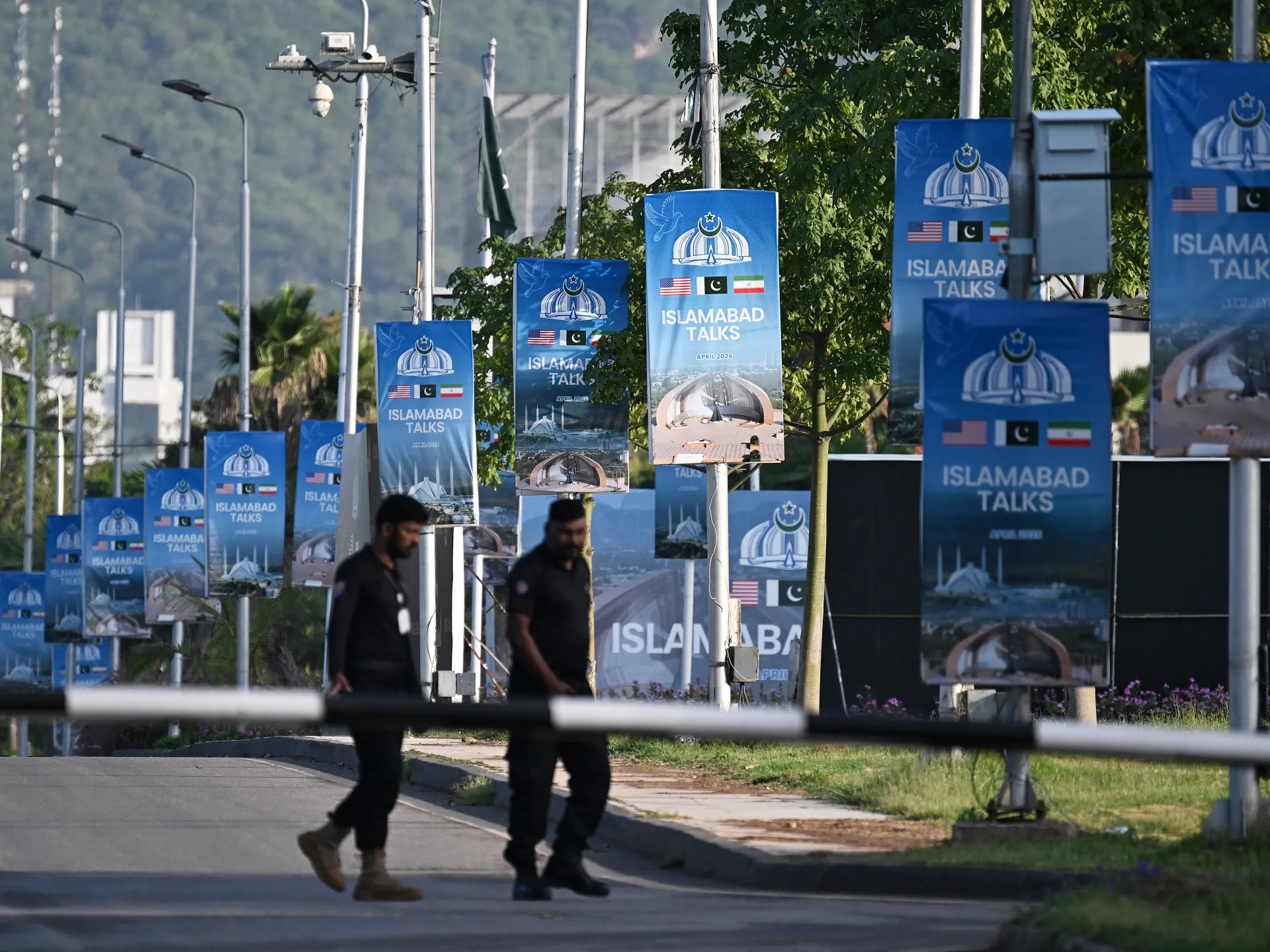
The visit demonstrated Pakistan’s “unwavering resolve to facilitate a negotiated settlement… and to promote peace, stability and prosperity,” the military said ahead of expected US-Iran talks in Islamabad in the coming days.

Munir held talks with the country’s president, foreign minister, parliament speaker and head of Iran’s military central command centre.

Parliament Speaker, Mohammad Bagher Ghalibaf, and Foreign Minister, Abbas Araghchi, led the Iranian delegation to Islamabad for peace talks with the US last week, the highest level face-to-face contact between Washington and Tehran in decades.

Those talks ended without agreement, and a ceasefire is due to expire on April 22.

But diplomacy has continued, with Pakistan’s Prime Minister, Shehbaz Sharif, visiting Saudi Arabia, Qatar and Turkiye to push the peace process.

His three-country trip concluded on Saturday, with Sharif and Foreign Minister Ishaq Dar departing a diplomacy forum in Antalya, according to statements from both officials.

“I leave Antalya [Turkish city] with fond memories and a renewed commitment to further strengthening the enduring fraternal bonds between our two nations, and to continuing our close cooperation to advance dialogue and diplomacy for lasting peace and stability in the region,” Sharif posted on X.

The flurry of diplomacy comes as further negotiations are expected in Pakistan in the coming days as Islamabad intensifies contacts with regional and global leaders in an effort to sustain momentum towards a US-Iran deal.

Pressure for a deal between the two countries has grown after Iran reimposed restrictions on the Strait of Hormuz, hours after its reopening following the start of a ceasefire in Lebanon. Tehran accused the US of violating a deal to reopen the strategically important waterway.

Donald Trump has said a second round of talks with Iran could be held in Pakistan in the coming days. The New York Post reported that Trump praised Munir, saying he was “doing a great job”.

Reporting from Islamabad, Al Jazeera’s Kamal Hyder said Munir landed back home on Saturday as Pakistan prepared for another round of US-Iran talks expected “within the next few days”.

“We have also seen a lot of praise from the Trump administration on social media, praising the Pakistani leadership. So all eyes are on Islamabad. Serious differences remain, but there is a flurry of diplomatic activity and a hope and expectation that some sort of breakthrough may happen,” he said.

Source link

As oil prices plunge below $91 after weeks, a new Hormuz crisis emerges | Oil and Gas News

Brent crude falls more than 9 percent after Iran said it will reopen the strategic waterway, only to shut it down again over US blockade of its ports.

Oil prices have plummeted to their lowest point in weeks after Iran said the Strait of Hormuz was open for passage during a ceasefire in Lebanon, and United States President Donald Trump said he expected to ⁠reach a deal to end the war soon.

Brent crude, the international benchmark, fell more than 9 percent to $90.38 a barrel on Friday, taking it below $91 for the first time since March 10.

Recommended Stories

list of 4 itemsend of list

The plunge came after Iranian Foreign Minister Abbas Araghchi said the strait was “completely open” and would remain so for the duration of the 10-day ceasefire between Israel and Lebanon, which took effect on Friday.

Hailing Tehran’s announcement, Trump declared the waterway “ready for business and full passage,” but said the US Navy’s blockade of Iranian ports would remain in “full force” until the sides reached a peace deal.

On Saturday, however, Iran rowed back on its decision to reopen the Strait of Hormuz, warning that it would continue to block transit through the key waterway as long as the US blockade of Iranian ports remained in effect.

The announcement came after Trump said the blockade “will remain in full force” until Tehran reaches a deal with the US, including on its nuclear programme.

Roughly one-fifth of the world’s oil passes through Hormuz and further limits would squeeze already constrained supply, driving prices higher once again.

Amid the escalation, Pakistani officials say they are trying for more talks between the US and Iran ahead of the April 22 ceasefire deadline.

Meanwhile, ship tracking data displayed by MarineTraffic earlier on Saturday showed a significant uptick in vessels crossing the strait, which is located between Iran, the United Arab Emirates and Oman.

“It’s busy out there, the busiest I’ve seen it since the Strait of Hormuz was effectively closed at the beginning of the war,” Michelle Wiese Bockmann, an analyst at maritime intelligence firm Windward, said in a post on X.

“Last night there were few ships taking the risk but overnight there seems to have been a change.”

While Iran allowed a limited number of vetted ships to transit the waterway since the start of the war, traffic has remained at a trickle compared with pre-conflict levels.

The near-total closure of the strait has triggered one of the worst energy shocks in history, driving up fuel prices and prompting governments to roll out emergency measures.

Oil prices have swung wildly since the US and Israel launched strikes on Iran on February 28, hitting a post-conflict peak of $119 a barrel on March 19.

Source link

Why Meghan Trainor canceled her entire Get in Girl tour

Meghan Trainor is turning off the microphone.

The singer announced in an Instagram Story that she is canceling her Get in Girl tour. “This is the right decision for my family and me right now,” Trainor explained Thursday, saying that the decision came “after a lot of reflection and some really tough conversations.”

“Balancing the release of a new album, preparing for a nationwide tour and welcoming our new baby girl to our growing family of five has just been more than I can take on right now, and I need to be home and present for each and all of them at this time,” Trainor wrote.

Trainor apologized to her fans, but promised that she will be “back soon.” She also shared that she “can’t wait” for fans to hear her new album, “Toy With Me,” which will be released April 24.

“I know this will come as a disappointment to my fans, and I am so sorry to let you down,” Trainor said. “I’m endlessly grateful for your love and support always.”

Trainor announced the Get in Girl tour in November and was set to kick it off June 12 in Clarkston, Mich. The tour included stops at Madison Square Garden in New York City and the United Center in Chicago and was to conclude at the Kia Forum in Los Angeles.

Social media users speculated that the tour’s cancellation was due to low ticket sales, with Ticketmaster seating charts in some stadiums showing very few seats sold. Influencer and Trainor’s close friend Chris Olsen took to TikTok to push back against the “predictably vicious” online comments about the tour.

“This is a bigger conversation than just her and people’s feelings toward Meghan,” Olsen said. “The question that always comes up for me is ‘Why? And what is the end goal?’”

The singer welcomed her third child with her husband, Daryl Sabara, via surrogate in January. Trainor, who has been candid about her struggles during her first two pregnancies, explained on Instagram that she was “forever grateful to all the doctors, nurses, teams who made this dream possible.”

“We had endless conversations with our doctors in this journey and this was the safest way for us to be able to continue growing our family,” Trainor wrote.


Source link

Dodgers Dugout: Readers show their love for Charley Steiner

Hi, and welcome to another edition of Dodgers Dugout. My name is Houston Mitchell, and the Dodgers keep rolling. When will the first bad stretch of games begin?

Are you a true-blue fan?

Get our Dodgers Dugout newsletter for insights, news and much more.

Last week, I asked you to show some support for Dodgers broadcaster Charley Steiner, who battled cancer and has been heard infrequently on broadcasts since 2024.

And boy did you respond. We received over 1,000 emails from people who wanted to pass along best wishes. Obviously, we can’t run all 1,000 emails, but here are a selected few.

John Peterson of Pleasant Hill: I had the great fortune of meeting Charley Steiner in Las Vegas in the early ‘90s. At the time, I was an assistant athletic director at UNLV, and our men’s basketball team had played in three Final Fours (1987, 1990, 1991), so tickets to home games were super scarce in those days. Charley was in town to call a boxing match for ESPN, so he and Rich Rose, former president of Caesars World Sports, were desperate enough to sit in my staff seats (at least they weren’t in the balcony!). I was in total awe of those two giants of the sports entertainment landscape. We even took a photo together. I was already a huge Charley Steiner fan, but after meeting him in person, I became a fanboy for life, so when he became a Dodger announcer, I was over the moon. I will always remember how gracious he was — like any other fan who wanted to see for himself what all the fuss was about the Runnin’ Rebels. Have cherished the memory ever since.

Tara Elkinton: My husband and I are huge Dodger fans and it’s been said I Bleed Blue. We always enjoyed listening to Charley and Rick. Charley’s commentary was always honest, interesting, personal and made you feel like you were at the game. We love and miss him.

Steven Booth: Charley, thank you for bringing peace, love and happiness into our lives. Hearing you call games is like having a coffee or beer with your friend at the ballpark. We love you and are praying for you.

Darin Axel-Adams of Pendleton, Ind.: I was a teenager when he started at ESPN and always enjoyed watching him on SportsCenter. I was a budding high school radio broadcaster and Charley was one of the ESPN anchors I attempted (not very successfully!) to mimic. I also thought he had some of the funniest “This is SportsCenter” promos … it was pretty obvious that he didn’t take himself or his profession too seriously. Living in the Midwest, I haven’t been able to enjoy much of Charley’s time with the Dodgers, but when I do, I am reminded again of what a truly gifted broadcaster he is!

Kim Haack: My father was a Dodger fan for more than 50 years. He is the reason I’m a Dodger fan today. He died three weeks before the Dodgers won the World Series in 2020. We often listened to the radio in the car and enjoyed listening to Charley and Mo. The radio call from Charley at Game 6 of the 2020 World Series when the Dodgers won was absolutely amazing. Of course, I was sobbing when they won, thinking of my father. It was a balm to hear Charley’s familiar voice and I think he spoke for all of us when he said, “In a year like no other, when joy has been so hard to come by, tonight tears of joy, let ‘em flow …” Charley’s call of that game is something I will never forget for the rest of my life. Whenever I see that clip and hear Charley’s voice, I tear up remembering how much I appreciated his familiar voice when facing a bittersweet time in my life.

Kirk Stitt: Charley, I’m a 76-year-old Dodger fan since 1958. I know you value your privacy, I get that. You need to know that thousands of Dodgers fans everywhere are thinking of you and wishing you the best and hoping to hear you.

Donald Golightly of Russell, Ky.: Being an old Brooklyn Dodger fan myself, I can relate to Charley. While I don’t feel the connection to the new Dodgers, in recent years I really enjoyed listening to Charley and Rick on the internet. So here’s wishing Charley the best now and always! Keep your head up and keep smiling!

Philip Nelson: The absolute best ESPN SportsCenter commercial is the Y2K commercial. Near the end Steiner is wearing his tie around his head like a bandana. War paint as if he is in The Lord of the Flies and says, “Follow me. Follow me to freedom!” (Note: You can watch that commercial here.)

Jim Carlisle: I have “followed you to freedom” for years and have greatly appreciated your integrity, personality, accuracy and humor on the air. It was so great to hear you on the air on opening day with Rick Monday. It was like having a reunion with an old friend. I’m hoping you’ll be able to return to the booth whenever you feel up to it. You have many fans who are hoping the same thing.

Stephen Knight: I’ve enjoyed your calls since, like, forever. As a cancer survivor myself with what I like to call unremission, the choice of how you deal with it is a personal one and is yours, and your family’s. And I just want to thank you for putting me inside the park for all of those Dodger games. You made me feel so alive, so connected with each call of every strike, ball, hit or miss.

Jimie Murray of Redondo Beach: One of my favorite memories was a totally random call about 10 years ago. A Dodgers runner slid into second base head first and got up after time was called to shake his belt and pants. Charley said, (Runner) is getting the dirt out of all the places dirt shouldn’t be.” It just made me laugh and now any time a player slides head first, I repeat it for my wife.

Tom Schulz: I’ve always been a Dodger fan, initially (and continuing so) because of Jackie Robinson. But I really became a fan in 2020 while living in Arkansas (now thankfully in California), and Charley and Rick helped me preserve my sanity during COVID. In the midst of that bizarre and unsettling year, Charley and Rick were voices of normalcy. Since then, I have caught at least part of every Dodgers radio broadcast. Charley and Rick became my friends.

Eliza Rubenstein: I’m a third-generation Cardinals fan living in SoCal, and it takes a LOT to get me to say nice things about the Dodgers. But I spent years listening to Dodger games on the radio in large part because I found Charley Steiner to be so completely and consistently delightful. His intelligence, his dry wit, his charming habit of saying “he’s been struck out” rather than “he struck out” … his rhythm and diction and humor have always spoken directly to my baseball-obsessed heart, and considering that I grew up with Jack Buck in my ear and high standards in my soul, that’s saying a lot.

Nancy Shattuck: Thank you for voicing joy and Dodger blue to this grateful fan.

Lydia Valenzuela: You’ve been missed. It was so nice to hear you on opening day. I’m sure I speak for all the fans when I say we can’t wait until you’re back again on the radio. I love to hear the banter between you and Rick. You both always bring a smile to my face. That warm soothing voice of yours is missed. Hope to hear from you again soon.

Howard Hancock: Thank you for being such a terrific part of my sports enjoyment for so many years. I greatly hope to hear you call many more innings in the future.

Scott Snyder: You have been the most underrated voice in my 55 years of loving baseball. Best of wishes to you.

Linda Seidman: We fans miss you and your calling the games so very much! Nobody calls a game like you, especially the home runs. The games just aren’t as good or as fun or as exciting without your calls, so please get back in the booth whenever you can!

Larry Oppenheim: What I love most about Charley Steiner is the sheer joy he brings to announcing the Dodgers. And his joy is contagious. A friend and I would text back and forth while listening to Dodgers games. I would say ‘did you hear what Charley just said’ and I would write it down in my text. Thankfully, I found these messages. Delving into my old text messages has brought back so many joyful memories. Charley, I miss you terribly.

Samuel Contreras of Chino Hills: Charley, we haven’t forgotten you at all. Dodger fans miss you and look forward to your return to the broadcast booth on a regular basis. My family’s life has been affected by multiple myeloma as my wife was diagnosed in October 2024. Thankfully, she’s doing well and I wish the same for you. Please know that Dodger broadcasts are not the same without you.

Keith Putirka: Charley Steiner is one of my all-time favorite baseball announcers and when I heard he was headed to L.A. to cover the Dodgers, I was thrilled. I grew up listening to Vin Scully and was clearly very spoiled. Until I moved to New York in the early 1990s, I had no idea how much of a gap there was between Vin and everyone else. But I still loved listening to baseball games, especially on ESPN, and I first heard Charley on the radio when he called the 1997 World Series on ESPN radio. He was terrific. He made the games come to life, conveying the environment, the stories and the excitement, in his own inimitable style. After that, I would always tune in to any ESPN-broadcast game so that I could hear Charley Steiner call the games. I’m 63 and I’ve been listening to and watching baseball for a very long time. Growing up in L.A. I heard a lot of great announcers, but my list for the top three announcers in baseball is an easy choice; it is in order, Vin Scully, Charley Steiner and Jon Miller. Thank you, Mr. Steiner, for making a great sport even greater to listen to.

Hoyt Adams: I used to work at the Genius Bar at the Apple Store in Santa Monica, and one day I helped Charley. He was so easygoing, funny and genuinely delighted to talk baseball with a stranger who was helping him with his computer.

When I told him the hard drive on his laptop was failing, he said in that wonderful radio voice, “So that’s your story and you’re sticking to it.” But he immediately lit up when we started talking baseball again. For one reason or another, I brought up how much I loved players like Jamey Carroll, who was getting a lot of time at shortstop that season. When I was driving home from work that night, I turned on the game, and Jamey Carroll just so happened to be having a killer night. Charley talked about him and even mentioned several beats from our conversation — it absolutely made my season.

Patrick Hennes of Corona: I have “worshipped” Vin Scully since I was one of millions of young fans that had my transistor radio under my pillow listening to my Dodgers, beginning in the early 1960s. No one could ever be better. But for this one night, I think Charley surpassed the GOAT. It’s always a good time to go back to this incredible game, when the Dodgers hit four straight home runs in the bottom of the ninth to tie San Diego. And to appreciate Charley Steiner as a fantastic announcer. (Note: You can watch and listen here.)

George Martin of Virginia: Listening to Charley Steiner call a game is like a warm blanket on a cold and rainy day. Whatever your troubles, hearing him brings security, relief and joy.

Jason Hashmi: The line, “we’ll find out together” is the classic Steiner phrase for me. Will Freeman’s ankle heal in time for the World Series and will he be a liability on the bases if he does return? “We’ll find out together.” I’ve adopted the phrase myself, and often for things unrelated to baseball. I always give a wink to Steiner in my mind when I do. I wish him health and peace.

Kathy Pratt: In 2014 my husband and I drove up from Tucson to see a spring training game. As we were walking into Camelback Ranch Stadium we looked up and there was Charley Steiner. My husband asked if he could take a picture of him and his wife. Charlie’s reply was, “I always love to have my picture taken with a beautiful woman!” Charley’s kindness was so appreciated and it made our day.

Candi Hersch: I miss hearing you on the radio. You are much younger than my father, but listening to the game with you is like hanging out with my dear departed dad. It’s comforting and you always have great insight.

Doug Weber of Carlsbad: For every note you receive, please know that there are thousands more who wish you all the best. Thank you for everything and we’ll look forward to hearing from you soon.

Bill Walsh of Oceanside: I miss Charley’s voice on the radio. While working I always had the Dodger radio broadcasts playing behind my desk. Charley and Rick became my daily companions. I miss you greatly Charley.

Andrew Mounts of Clovis: You’re part of this wonderful thing we call the Dodger family. Your enthusiasm and love for this crazy game and the Dodgers is greatly appreciated and very sorely missed. Never forget your voice paints a picture of this game that we love so much. You and Mo put us in the ballpark when we couldn’t be there. Thank you so very much. Get well Dodger friend and may God bless you and your family.

Geoff King of Bakersfield: The Dodgers have been blessed with the best radio and TV broadcast personalities ever, with Vin Scully at the top of the list. But Charley was a great addition to the Dodger broadcast crew years ago. His demeanor, stories and mannerisms calling the game were like Scully. We went several years without TV because of the Direct TV dispute so we would listen to the games on the radio. Charley was a lifesaver of Dodger baseball for us.

Rich Mortimer: My family and I have enjoyed your Dodger coverage for many years. I am 73 and have been a Dodger fan my whole life and Charley’s reporting has made our viewing and listening so much more enjoyable. Thank you Charley. Please know that there are thousands of Dodger fans, Charley Steiner fans, who are praying for your recovery.

John Sotos of Leesburg, Va.: I have always been a Charley Steiner fan, from his days at ESPN to his time broadcasting Dodgers games. That ESPN commercial — no, not “follow me to freedom!” — but the one in which he has to hide under his desk while an angry Evander Holyfield, having been told that Charley disparaged his boxing, prowls the ESPN spaces shouting “Charley Steiner! Come out and get your whoopin’!” Still one of my favorites. (Note: You can watch that ad here.)

Ohtani out of the batting lineup

Much concern was raised when Shohei Ohtani wasn’t in the hitting lineup Wednesday when he was the starting pitcher against the Mets. Nothing to worry about. Ohtani was hit in the right shoulder by a pitch Monday, and the Dodgers were just being cautious. As Maddie Lee reported:

“If it weren’t for the hit by pitch [Monday], he would’ve been DHing and pitching tonight,” Dave Roberts said before Wednesday’s game.

“Just feeling what gives him the best chance to stay loose during the outing, feel good,” Roberts said. “There’s still some soreness in there. When he’s hitting, there’s a component that he’s in the cage getting ready to hit, and if we can take that off his plate and just focus on one thing tonight, we felt — training staff, pitching coaches, myself — we just felt it was the best thing for him. So, once I told him, he completely understood.”

Up next

Friday: Dodgers (Tyler Glasnow, 1-0, 4.00 ERA) at Colorado (Ryan Feltner, 1-1, 7.30 ERA), 5:40 p.m., Sportsnet LA, AM 570, KTNQ 1020

Saturday: Dodgers (Emmet Sheehan, 2-0, 6.60 ERA) at Colorado (TBD), 5:10 p.m., Sportsnet LA, AM 570, KTNQ 1020

Sunday: Dodgers (Roki Sasaki, 0-2, 6.23 ERA) at Colorado (Michael Lorenzen, 1-2, 8.10 ERA), 12:10 p.m., Sportsnet LA, AM 570, KTNQ 1020

Monday: Dodgers (*-Justin Wrobleski, 2-0, 2.12 ERA) at Colorado (*-Jose Quintana, 0-0, 4.15 ERA), 5:40 p.m., Sportsnet LA, AM 570, KTNQ 1020

*-left-handed

And finally

Charley Steiner on the 30th anniversary of his famous Carl Lewis call. Watch and listen here.

Until next time….

Have a comment or something you’d like to see in a future Dodgers newsletter? Email me at houston.mitchell@latimes.com. To get this newsletter in your inbox, click here.

Source link

South Korea to aid war-hit businesses with emergency funds

SMEs and Startups Minister Han Seong-sook (R) speaks during a meeting with representatives of small and midsize companies, chaired by President Lee Jae Myung (4th L), at the presidential office Cheong Wa Dae in Seoul, South Korea, 20 March 2026. Photo by YONHAP /EPA

April 17 (Asia Today) — South Korea will provide 462.2 billion won ($308 million) in emergency support for small businesses and exporters affected by the prolonged Middle East war, the government said Thursday.

Han Seong-sook, minister of SMEs and Startups, visited South Gyeongsang Province to inspect local business conditions and pledged swift policy support for small businesses, exporters and young entrepreneurs.

Han first toured a “glocal” commercial district in Tongyeong, where officials highlighted a local revitalization model that has helped boost sales in the area. The ministry said it plans to expand support for local entrepreneurs and foreign tourism infrastructure beginning in 2026.

Han then visited the Korea SMEs and Startups Agency in Jinju and emphasized special extensions of policy loan maturities and expanded emergency financing. The ministry is pushing to disburse more than 90% of the supplementary budget for logistics support by June to help exporters cope with rising shipping costs.

At Gyeongsang National University, Han discussed expanding the government’s “Startup for All” project with aspiring young entrepreneurs before heading to K-Tech, a defense exporter, for the final stop of the trip.

Companies at the meeting cited soaring raw material costs and higher logistics expenses caused by shipping delays as major difficulties. Han said it could take considerable time for logistics to normalize and for Middle East energy facilities to be fully restored.

“This is a critical moment for a closely woven support safety net to prepare for the fallout from the war,” Han said, pledging to relay companies’ concerns through an inter-ministerial emergency economic response system and to mobilize all available policy tools.

The ministry said the emergency support is part of a broader 1.69 trillion won ($1.13 billion) supplementary budget approved this month, with 462.2 billion won ($308 million) earmarked to minimize damage to export-oriented small and medium-sized firms from the Middle East conflict.

— Reported by Asia Today; translated by UPI

© Asia Today. Unauthorized reproduction or redistribution prohibited.

Original Korean report: https://www.asiatoday.co.kr/kn/view.php?key=20260417010005540

Source link

Why The Middle East Crisis Cannot Be Read Through Power Alone

There is another way to read the ongoing Middle East crisis, one that makes legible what standard analysis consistently struggles to explain. It begins not with capability but with the geometry of the system through which capability must travel to produce effects. The United States and its partners possess overwhelming military superiority over Iran, and that superiority is not in question, yet the conflict has produced a pattern that defies its logic. A superpower coalition has been unable to impose coherent strategic outcomes against an adversary operating through proxies, low-cost disruption, and the systematic exploitation of global commercial vulnerabilities.

Over the past two years, we have seen multiple instances of this kind of disruption with consequential effects on the global system. Houthi drones force the rerouting of global shipping, with Red Sea cargo volumes falling by roughly 50% through early 2024 as major carriers diverted around the Cape of Good Hope, adding up to two weeks to transit times, driving freight costs sharply higher across European markets, and costing Egypt nearly $800 million per month at peak in lost Suez Canal revenue. A non-state network spanning Lebanon, Yemen, Iraq, Syria, and Gaza has absorbed sustained air campaigns, targeted eliminations of senior commanders, and repeated ground operations without losing its capacity to generate coordinated pressure across multiple theaters simultaneously. The asymmetry seems to follow a deliberate strategic logic that raw power analysis struggles to read, precisely because the conflict operates on a surface that capability assessments were never designed to map. What this suggests is that the decisive variable is not what actors possess but whether the relationships connecting them can transmit coordinated action when the system is under strain.

When that system cannot coordinate, something important breaks down. An alliance that formally exists but faces operational friction at every decision point ceases to be an alliance in any meaningful strategic sense. A security guarantee that cannot be transmitted rapidly to the partner it is meant to protect has, in effect, already failed its primary function. It follows that the gap between what a system formally is and what it can actually do under pressure is not a secondary consideration but the surface on which this conflict is being decided. Conventional analysis, calibrated to count warheads and assess intentions, consistently leaves this gap unmapped.

Analysts know that Saudi Arabia’s OPEC production decisions have repeatedly positioned Riyadh against Washington’s economic preferences, they know that European energy dependency complicates transatlantic alignment, and they know that Iran’s proxy network extends across five countries and absorbs military pressure without fracturing. Yet what the available frameworks cannot do is convert that knowledge into a structural reading of the system. They show that these conditions exist. What they cannot show is how those conditions interact, where they compound, and what the aggregate geometry of their interaction means for whether coordinated action is possible at all.

Power analysis was built to read capability differentials between states, and it does that well. Alliance theory was built to read the conditions under which formal commitments hold or fail, and it does that too. Neither, however, was built to read the operational weight of the ties through which capability and commitment must travel to produce effects.

The instruments available are calibrated to answer questions different from those the current situation poses. Deploying them on a problem they were not designed to read produces the consistent failure to explain what is actually happening that has marked analysis of this conflict from the start.

Adjacency mapping is an instrument designed to read that gap by mapping connectivity, by which I mean their operational weight, specifically their capacity to carry coordinated action under strain. What distinguishes it from standard approaches is its unit of analysis. Rather than the actors themselves, it treats the weight of the relationships as primary. The question it asks is not who holds power but whether the ties connecting power-holders can transmit that power when the system needs them to. Two states can be formally allied, operationally integrated in name, and structurally disconnected at the same time, and nothing in standard analysis will tell you which of those conditions is actually operative until the moment of crisis reveals it.

The instrument assigns each significant relationship in the system a weight between 0 and 1, reflecting how frequently the two actors interact operationally, how reliably information moves between them, how the tie has behaved under recent stress, and how quickly it transmits pressure when the system is under strain. At the higher end of the scale, a weight at or above 0.6 indicates that coordination approaches automaticity, and the tie carries load without constant investment to maintain it. Around 0.3, friction accumulates. In this setting, decisions require deliberate effort at every juncture, slowing the system and making it susceptible to gradual degradation that never triggers a visible rupture. At or below 0.2, the tie has effectively ceased to function as a transmission pathway, leaving the actors operationally disconnected regardless of what their formal relationship nominally says.

These weights are analytical judgements calibrated against observable evidence. In other words, their value lies in making visible what experienced analysts already carry as intuition and in giving that intuition a structure precise enough to argue about. The numbers are therefore analytical judgements, not measurements. A more rigorous application would derive them from quantifiable indicators across each dimension, including military interoperability, intelligence exchange depth, crisis responsiveness, economic interdependence, and signaling consistency, averaged and weighted systematically. That work lies beyond the scope of this piece, but the architecture is designed to accommodate it.

There is a risk management dimension to this reading that is worth making explicit. Standard geopolitical risk assessment focuses on actor-level variables such as regime stability, military capability, and leadership intentions. What adjacency mapping adds is a structural layer that those assessments typically miss. A coalition whose load-bearing relationships operate in the friction zone is exposed to a category of risk that capability assessments do not capture and that becomes visible only when the system is read structurally.

What the matrix adds is the ability to see how compound weakness across multiple relationships produces cascading effects that bilateral assessment alone would struggle to predict. A system whose dominant actor holds several weak partnerships faces more than friction. As a consequence, the geometry of those weaknesses determines whether any concerted response is structurally possible at all. Aggregate capability becomes, in that light, secondary to that question.

If we apply this to the Middle East security complex, the instrument produces one possible reading. This reading differs considerably from the picture conventional analysis generates. Its value is not in the precision of the numbers but in making the system’s geometry visible enough to argue about.

The matrix below maps operational connectivity across the system’s key actors. The numbers are analytical judgements, not measurements.

The geometry they make visible is what matters here.

  US IL SA QA UAE OM KW BH PK IR PN
US 0.8 0.4 0.8 0.6 0.5 0.7 0.8 0.6 0.1 0.1
IL 0.8 0.5 0.4 0.6 0.2 0.2 0.4 0.1 0.1 0.1
SA 0.4 0.5 0.5 0.6 0.4 0.6 0.7 0.6 0.2 0.1
QA 0.8 0.4 0.5 0.4 0.4 0.4 0.3 0.3 0.2 0.1
UAE 0.6 0.6 0.6 0.4 0.3 0.5 0.6 0.4 0.1 0.1
OM 0.5 0.2 0.4 0.4 0.3 0.3 0.3 0.3 0.4 0.1
KW 0.7 0.2 0.6 0.4 0.5 0.3 0.5 0.2 0.2 0.1
BH 0.8 0.4 0.7 0.3 0.6 0.3 0.5 0.2 0.2 0.1
PK 0.6 0.1 0.6 0.3 0.4 0.3 0.2 0.2 0.5 0.1
IR 0.1 0.1 0.2 0.2 0.1 0.4 0.2 0.2 0.5 0.7
PN 0.1 0.1 0.1 0.1 0.1 0.1 0.1 0.1 0.1 0.5

The matrix is intentionally non-symmetric. Where operational influence flows asymmetrically between two actors, the weights reflect that directionality.

The matrix reveals, in this light, a system whose dominant actors are connected at fundamentally different weights. And more significantly, its most important bilateral relationship is operating in the friction zone. It’s formally excluded adversary has constructed the only alternative connectivity architecture in the system. What this implies is that the geometry of the conflict runs considerably deeper than standard alliance analysis tends to suggest.

On the coalition side, the US has high adjacency with Qatar, Bahrain, Israel, and Kuwait, ties that enable rapid coordination and require little maintenance, constituting the operational backbone of what Washington can actually activate quickly.

Its relationship with Saudi Arabia, however, sits at 0.4. That number is analytically more significant than almost anything else in the matrix. Saudi Arabia remains, on most readings, the relationship on which Gulf order coherence formally depends, the anchor of the security architecture since the 1970s, and it is operating in the friction zone where every significant decision requires renegotiation from scratch rather than flowing through an established channel. Saudi Arabia’s invitation to join BRICS in August 2023, yuan-denominated oil transactions with China, and its participation in the Chinese-brokered rapprochement with Iran in March 2023 all point in the same direction. Riyadh is hedging structurally toward China and the broader non-Western order, a posture that sits uneasily alongside its formal security alignment with Washington. Taken together, these are not isolated political episodes but evidence of a tie that has been operating below the coordination threshold for years and whose weakness is, on this reading, the system’s most consequential structural vulnerability.

Through the normalization architecture, the UAE has arguably become the system’s most structurally reliable node at 0.6 with both the US and Israel, its operational integration exceeding Saudi Arabia’s despite Saudi Arabia’s formal primacy. The Abraham Accords of September 2020 established the formal foundation for that integration. The operational depth it has since generated, across intelligence sharing, defence cooperation, and coordinated positioning on Iran, has made the UAE the coalition’s most functionally connected Gulf partner. Oman holds what is perhaps the system’s most anomalous position, meaningful adjacency with both the US coalition and Iran simultaneously, a profile no other state actor in the matrix replicates. That structural position gave Oman the back-channel role it played through the early phases of the conflict, with documented precedent in the secret US-Iran nuclear negotiations that began in Muscat in 2012 and ran through 2013. As the conflict has intensified, Pakistan has assumed the primary mediation function, but Oman’s position as a quiet facilitator has not disappeared; it has simply been supplemented by a node with more direct access to both capitals at this particular moment.

Pakistan has emerged as the conflict’s primary mediation node, hosting the highest-level direct negotiations between Washington and Tehran since 1979 and brokering the April 2026 ceasefire. That role reflects a structural position the matrix makes legible: high Saudi adjacency, a functioning Iran tie, and a rehabilitated relationship with Washington that no other regional actor currently combines. China’s influence over both Pakistani and Iranian decision-making operates as an exogenous pressure that the matrix only partially captures, and Pakistan’s own domestic constraints, including its difficulty developing direct channels with the IRGC, limit how far that mediation role can ultimately reach.

Iran’s position is where the matrix becomes most analytically revealing. Across the state actors in the system, Iran’s adjacency sits at or near fragmentation, built up through sanctions, absent operational channels, and decades of adversarial signalling that have left Tehran formally isolated from the coordination architecture the United States and its partners have constructed.

And yet the only high-weight tie Iran holds is with its proxy network at 0.7. That single number may go further toward explaining the architecture of the entire campaign than any other figure in the matrix.

It is an asymmetric relationship in which Tehran’s capacity to activate and direct exceeds the reverse influence those actors exert over Iranian strategic decisions. What that single structural condition implies goes further toward explaining the architecture of Iranian pressure operations than most analyses of Iranian intentions or capabilities tend to reach. Iran is geographically central and formally excluded. It is precisely that combination, positioned to apply pressure across every theatre while bearing none of the coordination costs that formal inclusion imposes. That, from this vantage point, is what makes legible a strategy that standard analysis, focused on actors and their capabilities, cannot see.

Seen through this lens, what Iran is doing across the region is something more structurally ambitious than a military campaign. It is attempting to restructure the matrix itself. The goal appears to be less about battlefield victory than about the gradual degradation of the ties connecting the United States to its regional partners, below the threshold at which coordinated response becomes automatic, eroding the will to keep paying the price of alignment while simultaneously building alternative adjacency in the nodes where US-aligned connectivity is weakest.

The Houthi campaign against Red Sea shipping is calibrated to stay below the threshold that would compel a unified military response. It introduces friction into the economic relationships connecting European states to the Gulf system, raising the cost of alignment with Washington’s regional posture without forcing the kind of direct confrontation that would unite the coalition. Strikes on Gulf infrastructure follow the same calibration, persistent enough to signal that the US security guarantee cannot insulate its partners from costs, yet restrained enough to avoid crossing the point at which coalition fragmentation becomes irrelevant because a unified response becomes compulsory. Across Iraq and Syria, simultaneous pressure from affiliated militias prevents the concentration of attention that sustained coalition coordination requires. In each case, the instrument targets a relationship rather than a capability, specifically the weight of the ties whose degradation would restructure the system’s geometry without requiring Iran to displace the existing order directly.

The US-Saudi tie at 0.4 is the primary focus of that degradation effort. Should that threshold be breached, Saudi Arabia hedges. As hedging reduces operational interactivity the tie weakens further. The process risks becoming self-reinforcing. Iranian military superiority over any individual partner is not required to sustain it.

The same logic extends across European actors, though not uniformly. Germany’s industrial exposure to energy price volatility, France’s residual strategic autonomy instinct, and the EU’s institutional preference for de-escalation all produce different thresholds for continued alignment with Washington. Their shared energy dependency gives them asymmetric stakes in the Gulf system’s stability, but their appetite for risk diverges from Washington’s in ways that are not identical across capitals, and each time Iran forces a decision about the cost of continued alignment, that divergence fragments the coalition’s coordination surface further.

By sustaining operational ties with non-state actors across the region, Iran is constructing alternative adjacency in precisely the nodes where US-aligned connectivity is weakest. These are populations and factions that the existing regional order has excluded from the dominant coalition’s coordination architecture. Deliberately so — Iran is building in the structural gaps the system leaves open. Displacing the existing order appears unnecessary. Becoming the more reliable pole of alignment for the actors that order has failed to integrate may be sufficient. All that is required is that the order fragment sufficiently at its margins for that offer to appear credible, and the current trajectory of US-Saudi friction and European hedging is steadily moving in that direction.

The coalition’s instruments are calibrated to military threats. The system, however, is failing along a different surface entirely, or so this reading suggests. The formal architecture remains largely intact, security guarantees have not been withdrawn, Gulf states remain formally aligned, and normalisation agreements hold. And yet the operational adjacency that gives that architecture its functional weight is under sustained pressure from an actor that has correctly identified the gap between formal commitment and operational tie as the system’s primary vulnerability. That identification is outpacing the coalition’s capacity to respond.

On this reading, the surface on which the conflict appears to be decided is not the one the coalition is defending.

What adjacency mapping reveals is a story about geometry. The system’s dominant actor holds formal commitments at weights the system cannot sustain under the pressure being applied to it. Its adversary, in turn, has built the only alternative coordination architecture in the space that those weakening ties leave open. The conflict is likely to be determined by which ties the system can no longer afford to lose under sustained and calibrated pressure. The question is whether the actors currently holding those ties in the friction zone can rebuild them to the coordination threshold before the process of degradation becomes irreversible. That is a question that capability assessments are not well-positioned to answer, and one that a structural reading of the system’s connectivity at least helps to make visible.

Source link