Ryanair, easyJet, and TUI ban electrical item – what passengers need to know – The Mirror
Need to know
Airlines have strict rules on power banks and batteries, with some banning them entirely while others only allow them in cabin hand luggage
Airline passengers have been told some items must only be put in cabin luggage and not used while taking off(Image: Getty Images)
Power Bank Flight Rules: What You Need to Know
Airlines have issued strict warnings to passengers about packing power banks and electrical items in hold baggage due to serious safety concerns.
Some carriers including Vietnam Airlines, Vietjet Air and Emirates have completely banned power banks, while budget airlines like Ryanair, EasyJet and TUI still permit them but only with tight restrictions.
According to UK Civil Aviation Authority (CAA) safety experts, lithium batteries pose a danger on planes primarily due to their potential to enter “thermal runaway,” a phenomenon where a battery experiences a rapid, uncontrollable rise in temperature, resulting in fire, explosion, and the release of toxic fumes.
Ryanair allows up to 15 personal electronic devices but requires spare batteries to be individually protected in original packaging or with taped terminals. Power banks must be stored under seats, not in overhead lockers, and cannot exceed 100Wh.
EasyJet strictly bans all lithium batteries from hold luggage and requires power banks under 100Wh to be carried in cabin baggage only. Those between 100-160Wh need airline authorisation.
TUI forbids loose lithium batteries in checked luggage and caps power bank capacity at 100Wh, with terminals safeguarded against short circuits.
The new rules reflect growing concerns about battery fires mid-flight, with some airlines now prohibiting the use of power banks during flights entirely.
After last year’s disastrous Eaton fire, Southern California Edison executives vowed to be transparent about what caused the inferno that killed at least 19 people and left thousands of families homeless in Altadena.
“As we better understand exactly what happened on Jan. 7, we do so with a commitment to remain transparent,” Pedro Pizarro, chief executive of Edison International, the utility’s parent company, said in a published statement after the fire.
In court, however, Edison is keeping crucial documents of the cause of the Eaton fire secret, a legal strategy it has used to shield what happened in at least seven earlier wildfires it was blamed for igniting, according to a Times review.
Edison’s stance has caused mounting frustration with attorneys representing fire victims who are seeking compensation for their losses.
“The Eaton Fire cases should be decided on their merits, not on what information that SCE has been able to withhold,” lawyers for the victims wrote in a recent court filing.
State regulators have repeatedly criticized Edison for its secrecy in previous fires, saying it violated safety regulations and stopped officials from learning the root cause so that similar disasters could be prevented.
For more than a year, Edison employees have been gathering detailed information about what ignited the fire in an investigation the company is required to perform under state utility regulations.
But most of that information is being withheld by Edison’s claim of attorney-client privilege, as well as a protective order that it asked a judge to approve soon after the fire.
Protective orders are commonly used in civil lawsuits, but most cases do not have the broad ramifications to the public as the Eaton fire.
Pedro Pizarro, chief executive of Edison International, at the Semafor World Economy Summit in Washington on April 14.
(Aaron Schwartz / Bloomberg)
Because of the secrecy, it’s not possible to know just what Edison has found, attorneys for Eaton fire victims said in a filing.
In past fires, regulators have requested from the company — and been denied — photographs, notes, text messages and other records generated by the Edison crew that was first to arrive at the site where the blaze ignited. The company has argued its attorney directed the crew, making the evidence privileged.
The victims’ lawyers say Edison shouldn’t be able to withhold from them most evidence from its investigation into the blaze by claiming that the findings and related documents are covered by attorney-client privilege and therefore confidential.
Sealed Eaton fire documents
Lawyers for victims say that documents sealed by a protective order show evidence of where Southern California Edison’s safety measures fell short before the deadly fire.
Poor inspection and repair of the idle transmission line suspected of igniting the fire
Tower holding the idle line was “virtually unattended for decades”
Dried vegetation removed under electrified wires but not beneath the idle line
Problems with contractors inspecting the line
In a recent interview with The Times, Pizarro disagreed that the company was keeping information on the cause of the Eaton fire secret.
“We believe we’ve been transparent,” Pizarro said. “Facts are not privileged, and so we provided facts as we have known them.”
He said the company’s investigation was continuing. “We still, to this day, don’t fully understand what happened,” he said.
Pizarro said the protective order was needed to keep many things confidential, including some not related to the fire’s cause. For example, he said, it protects maps of the electrical system, which can’t be revealed because of terrorism concerns.
Signs blaming Southern California Edison for the Eaton fire are seen near cleared lots in the Altadena area of Los Angeles County on Jan. 5.
(Josh Edelson / AFP via Getty Images)
He pointed to several company disclosures, including two letters it sent to regulators soon after the Eaton fire that said it was evaluating whether a century-old transmission line, which hadn’t carried power since 1971, “could have become energized” and helped lead to the fire.
Pizarro said last year that the possible reenergization of that old line is a leading theory of the fire’s cause.
The company has said little else about the fire’s cause, other than it safely maintained and inspected the idle line, just like it did its energized lines.
Edison faces thousands of lawsuits from victims of the fire, which burned 14,021 acres and leveled a wide swath of Altadena. The lawsuits allege, in part, that the company was negligent for failing to safely maintain its transmission lines and for leaving the idle line in place when it knew it could become energized. Edison denies the claims of the lawsuits, which have been consolidated in L.A. County Superior Court.
Some documents that Edison says are not privileged and agreed to provide to the victims’ lawyers are sealed by a protective order that the company and the plaintiffs’ lawyers requested.
Plaintiffs’ attorneys often agree to such protective orders on the theory that doing so would allow the utility to more freely share information that could help their case.
Power lines hang from towers carrying power from the Southern California Edison Gould Station.
(Carlin Stiehl / For The Times)
Two months after the fire, Los Angeles County Superior Court Judge Laura Seigle signed the protective order — which covers documents that both sides provide in discovery — including business information deemed proprietary and personal customer data.
According to the protective order, if the case is settled, the lawyers will decide whether the sealed documents should be returned to Edison or destroyed.
If the case proceeds to trial, some of the evidence could become public.
Yet even with the protective order in place, plantiffs’ attorneys say Edison has refused to provide them with evidence from its investigation into the fire, saying it’s protected by attorney-client privilege.
The state-required investigations “are not private inquiries undertaken for SCE’s benefit and legal protection,” the plaintiffs’ lawyers wrote in a filing last year. “Those investigations are regulated activities that exist to protect the public and enhance public safety by preventing future fires.”
To begin those investigations, Edison’s crews often get to the ignition site before government officials. In the 2019 Saddleridge fire in Sylmar, an investigator from the Los Angeles Fire Department found the yellow police tape at the road leading to where the blaze started on the ground and an Edison truck leaving the site, according to his report.
California utility regulators have said the earliest observations at the scene are critical in determining what happened.
L.A. Fire Justice attorney Mikal Watts presents findings on the cause of the Eaton fire at transmission tower 3 at a January 2025 news conference in Pasadena.
(Robert Gauthier / Los Angeles Times)
Loretta Lynch, former president of the California Public Utilities Commission, which regulates the electric companies, said she believed Edison was wrongly using attorney-client privilege and protective orders “as a sword to prevent justice.”
Lynch said the confidentiality could keep evidence of Edison’s possible negligence from being used at a future state hearing that will look at whether the company acted safely and prudently before the Eaton fire.
In that hearing, if the commission finds the company acted prudently, all damage costs will be covered by a state wildfire fund and Edison customers. The company and its shareholders would pay nothing.
“It’s time to stop this game of allowing utilities to be negligent and then walk away with their customers paying for it,” Lynch said.
Kathleen Dunleavy, an Edison spokeswoman, said the company’s “assertions of privilege in civil court have nothing to do” with the future state hearing on whether the company acted prudently.
Dunleavy added that the company has been cooperating with government fire investigators and the plaintiff lawyers, responding to their requests for data.
The government’s investigation into the cause of the fire has not yet been released.
Asked about the company’s withholding of documents in court, Pizarro pointed to a 2024 California Appeals Court decision that found that Edison’s assertion of attorney-client privilege to keep evidence sealed in litigation over the 2017 Creek fire was appropriate under the law. The court said that protecting the documents generated in the internal investigation from public disclosure allowed the company’s attorneys “to investigate not only the favorable but the unfavorable aspects” of their client’s situation.
Lawyers for victims of the Creek fire, which destroyed more than 100 homes and structures near Sylmar, say Edison failed to provide evidence that showed its line was a likely cause of the blaze, leading government investigators to initially wrongly blame electrical equipment owned by the L.A. Department of Water and Power. Edison continues to deny it caused the fire.
A fire truck makes its way past a portion of the Creek fire along Wheatland Avenue in Sylmar on Dec. 5, 2017.
(Genaro Molina / Los Angeles Times)
In the Eaton fire case, a few details of what’s in the confidential documents have been revealed in court, showing they could be significant when the first trial begins next year.
In February, plaintiff lawyers filed 13 sealed exhibits for only the judge to review, saying they showed how Edison had neglected inspections, maintenance and repair of the idle line. The records are subject to the protective order, shielding them from public view.
“There is ample evidence in this case that SCE performed more frequent and higher quality inspections and maintenance on its live equipment than it did on its inactive facilities,” they wrote.
“From all indications, SCE left Tower 208 virtually unattended for decades,” they added, referring to the pylon that held the idle line and was found to be the location of the fire’s first flames.
The plaintiff lawyers also said the protective order prevents them from disclosing photos to the public that show Edison left vegetation growing under the idle line while removing it from beneath the live wires running parallel to it, according to the court filing. Utility regulations require vegetation to be removed from under and around electric lines to reduce the risk of fire.
The lawyers added that the sealed documents showed that Edison was having problems with an outside contractor it had hired to inspect its transmission lines.
Asked about the filing, Pizarro said the claims were assertions by the plaintiff attorneys that would be debated in court.
Some legal experts have criticized the use of protective orders for keeping the public in the dark about dangerous corporate actions or products.
Lynch said protective orders and confidential settlements in wildfire litigation are preventing the public from learning information that could stop future deadly fires. She said California should consider legislation to ban the use of the secrecy tactics in wildfire lawsuits.
Firefighters work to contain the Saddleridge fire on Oct. 10, 2019, in the Sylmar neighborhood of Los Angeles.
(Patrick T. Fallon / For The Times)
The Times found protective orders in lawsuits against Edison for the 2017 Thomas fire and mudslides, which killed 23; the 2018 Woolsey fire, which killed three; the 2019 Saddleridge fire, which killed one; and the 2022 Fairview fire, which killed two. Those fires together caused billions of dollars in damages and destroyed thousands of homes.
Lawyers for the Eaton fire victims told the judge in February that the protective order, as well as similar secrecy orders in lawsuits over other fires, had kept them from speaking publicly about certain subjects in the courtroom, including what they knew about Edison’s line inspections.
“This is a significant case, against one of the world’s largest providers of electricity, which has, through the use of Confidentiality Protective Orders in other cases, impaired the Plaintiffs’ ability to fully inform the Court,” they wrote.
Late last month, Judge Seigle ordered Edison to give the victims’ lawyers more of the documents they had requested. The protective order limits the public’s access to them.
If Ty Simpson develops into a top NFL quarterback who leads the Rams to a Super Bowl title, the club will look back at the 2026 draft as one of the best and shrewdest in its history.
Until then, it will be remembered for a news conference.
Yeah, that one.
The post-Day 1 session on Thursday night when coach Sean McVay and general manager Les Snead — the personable and ebullient duo that playfully channeled Top Gun’s “Maverick” and “Goose” in 2025 — appeared dour and subdued after selecting Simpson with the 13th overall pick.
The choice brought a collective groan from much of the fan base. And who could blame it?
They were eager to see their favorite team add a final piece — hello, USC receiver Makai Lemon? — to a roster perhaps one playmaker away from making the Rams the favorite to win Super Bowl LXI at SoFi Stadium next February.
That’s no knock on Simpson, a charming and mature Tennessee native who started 15 games for Alabama before the Rams made him the heir apparent to Matthew Stafford.
The next day, Snead and McVay gave Simpson his flowers and repeated the same talking point: They are in “lockstep” as decision-makers. And McVay explained that his “grumpy” demeanor the night before was related to personal issues and his desire to delicately handle Stafford’s reaction to the pick.
On Saturday, the Rams did not make Snead or McVay available to reporters to summarize their draft, which included Simpson, Ohio State tight end Max Klare, Missouri offensive lineman Keagen Trost, Miami receiver CJ Daniels and Alabama defensive lineman Tim Keenan III. It is the smallest draft class in Rams history, which befits a team with no glaring roster holes.
Ostensibly, Snead and McVay stepped aside to give assistant general manager John McKay and Nicole Blake, the director of scouting, strategy and analytics, experience dealing with questions from reporters, which they handled with aplomb.
But the braintrust’s absence only magnified that this draft was unlike any other it has overseen during 10 years of working as a team.
Alabama quarterback Ty Simpson laughs while standing on the draft stage with NFL Commissioner Roger Goodell on Thursday.
(Vera Nieuwenhuis / Associated Press)
It would have been difficult to top 2025.
The Rams won last year’s draft when they traded out of the first round in exchange for the Atlanta Falcons’ first-round pick this year. That gave the Rams the Falcons’ pick at No. 13 and their own at No. 29.
In March, the Rams traded the No. 29 pick to the Kansas City Chiefs in a package for All-Pro cornerback Trent McDuffie. The masterful move addressed the Rams’ most pressing need and gave them a Super Bowl-ready roster. Classic Snead.
The Rams, set up for a boom-or-bust season akin to 2021, were primed for another typical big swing with the 13th pick. But instead of giving Stafford another weapon, they gave him… his eventual replacement.
Choosing Simpson might prove a savvy move. Especially if Stafford is injured this season or retires in the next year or two. But the pick stunned many. And gauging his public reaction afterward, it appeared to unnerve McVay.
During their time together, Snead and McVay built teams that have played in two Super Bowls, winning one, and made eight playoff appearances. Some interpreted McVay’s demeanor on Thursday night as evidence of a splinter in one of the league’s most successful partnerships.
But that does not appear to be the case.
Recall that after the Rams lost in the NFC championship last January, team president Kevin Demoff’s first order of business was signing Snead and McVay to extensions that had been on the table all season.
Several days before the draft, McVay and Snead described their connection. And they did it with heartfelt comments.
“I truly love Les and I have such respect for the job that he does,” McVay said, adding, “There is nobody I’d rather be partnered up with.”
Said Snead: “From a life perspective, you hear it when players retire, they miss the locker room. Whenever that time comes for me, I’ll miss showing up and doing hard things with Sean just because that’s a relationship that probably makes life worth a living.’”
McVay probably feels that way about Stafford. During the 2021 season, Stafford led the Rams to a Super Bowl title. At 38, he is the reigning NFL most valuable player. He also is in negotiations for a contract adjustment.
But McVay’s desire to not hurt Stafford’s feelings by not publicly giving Simpson a trademark, positive-infused welcome-to-L.A. moment seemed misguided. Stafford is one of the toughest and most resilient players in the NFL. He is bound for the Hall of Fame. The guy seems pretty secure in who he is and where he stands with the team and in NFL history.
So the Rams broke from script. They abandoned an all-in pick for an investment in the future.
“You’re never one player away,” McVay said Saturday during a television interview with NFL Network. “We know that we have a chance to be a good football team but you earn it every single year.
“And if you could tell me that taking somebody would ensure us, I think we would do that. But it doesn’t quite work like that.”
No, it doesn’t.
And if Simpson lives up to the potential that the Rams see in him, it will be another in a string of genius decisions by Snead and McVay.
But if Lemon makes a big catch for the Philadelphia Eagles against the Rams in the NFC playoffs, the Rams might look back at it as the swing they should have taken.
The family of Mohamed Sabry Soliman, pictured after his arrest for attacking a group of people demonstrating in support of the release of Israeli hostages in June 2025, was rearrested early Saturday morning after being released by ICE earlier this week. Photo via Boulder Police Department/UPI | License Photo
April 25 (UPI) — An Egyptian family of six that was released from custody by Immigration and Customs Enforcement days ago was rearrested on Saturday and may be headed for a quick deportation, their lawyer said.
After an emergency appeal earlier in the day, U.S. District Court Judge Fred Biery said the family’s immediate deportation should be paused, The Guardian and The Texas Tribune reported.
Hayam El Gamal and her five children had been held in the Dilley detention center outside San Antonio, Texas, which has been criticized for lack of medical care and food, for ten months.
U.S. Magistrate Judge Elizabeth Chestney on Thursday ruled that the family, which came to the United States in 2022 on a tourist visa and applied for asylum, should be freed while they wait for a decision on their case.
After the family was arrested again on Saturday morning, El Gamal’s attorney, Eric Lee, posted on X that the family had already been put on a flight to Michigan, where they are expected to be deported to Egypt.
Calling the agency’s actions “an absolutely brazen violation of separation of powers,” Lee said the flight “constitutionally” should not be permitted to take off, posting “stop this travesty of justice from taking place.”
The family was arrested in June after El Gamal’s husband, Mohamed Sabry Soliman, allegedly threw Molotov cocktails into a crowd rallying in support of Israeli hostages being held in Gaza.
President Donald Trump speaks during a Health Care Affordability event in the Oval Office at the White House on Thursday. Trump announced announced a new drug price deal with Regeneron. Photo by Will Oliver/UPI | License Photo
Sanaa, Yemen – It was August 2023, and Enaya Dastor was reading a school textbook while also keeping an eye on her goats as they grazed near her village, Jabal Habashy, in central Yemen’s Taiz governorate.
Whenever the livestock moved away, the then-13-year-old would walk or run to bring them back to the pasture near her house.
Recommended Stories
list of 3 itemsend of list
That afternoon, she was following them as usual when an explosion rang out.
A landmine had detonated beneath her.
“People gathered around me after the blast, and I was taken to the hospital immediately. It was a horrible moment, ” Dastor told Al Jazeera. Surgeons were forced to amputate her left leg, leaving her with a lifelong disability.
The incident took place more than a year after fighting between Yemen’s government and Houthi forces largely stopped, following a ceasefire in April 2022.
But landmines left behind on former battlefields and front lines continue to kill and injure Yemenis.
The hidden risks have turned fields, roads, and villages into areas of ongoing danger. Landmines and other explosives have killed at least 339 children and injured 843 since the 2022 truce, according to Save the Children. The organisation found that nearly half of child casualties related to the conflict were due to landmines and explosive remnants of war.
‘Sleeping killers’
The parties to Yemen’s conflict planted thousands of mines during the civil war, which began in 2014.
Two months before Dastor’s incident, a boy in a nearby village had stepped on a landmine. One of the boy’s legs was amputated in the explosion, she told Al Jazeera.
“Landmines are sleeping killers, waiting for the innocents to step on them or move them without caution. That is how they wake up to shed blood and take human souls,” said Dastor.
“I used to go with other girls to the pasture. We grazed the cattle and play for hours. We were not aware of the danger, and we did not know when these deadly objects were planted,” she added.
After the landmine explosion took her leg, her family and others fled the village, which had previously been on a front line.
To date, Dastor’s family has not returned. They now live in the city of Taiz.
“I do not want to see another child harmed or hear another landmine explosion. I loathe walking on the soil under which mines were planted,” she said.
In the first half of 2025 alone, 107 civilians were killed or injured, most of them children, according to Save the Children. Included in that number are five children who were killed while playing football on a dirt field in Taiz.
Lost hope
From 2015 through 2021, ground fighting was brutal, and warplanes continuously bombed across Yemen, killing and injuring thousands of civilians.
The landmines have added a lasting layer of danger. A study carried out in 2022 by Yemeni human rights groups found that 534 children and 177 women were killed by mines between April 2014 and March 2022.
In addition, 854 children, 255 women, and 147 elderly people were injured during the same period in 17 Yemeni provinces, with the heavily fought-over Taiz recording the highest number.
In 2018, Mohammed Mustafa lost his left leg in a landmine explosion in Taiz’s Maqbna district. He was only 20 years old. Eight years on, he can still recall the details of that moment.
“I stepped on a landmine when I was walking in a mountainous area at sunset time. After the blast, I looked towards my feet, and I found my left leg was gone,” he told Al Jazeera.
Mustafa was in a rural area with no hospitals nearby. He had to travel five hours by ambulance to the city of Taiz, and the distance he covered to reach a healthcare centre added to his pain.
“I fainted repeatedly on the way to Taiz city. The next day, I woke up in the hospital, and saw my leg amputated up to the knee,” he said.
With support from family, relatives and friends, he recovered. Mustafa is now a member of the Yemeni Amputee Football Federation, a father, and a small business owner.
“My family and friends stood by me, lifted my morale, and accompanied me on outings in the city to help me forget my pain and worry. I realised I was not alone,” he said.
De-mining challenges
Efforts to remove landmines from many areas in Yemen continue. But totally ridding the country of the problem remains complex, particularly as no final deal has been agreed upon to end the war.
Project Masam, a de-mining team funded and initiated by Saudi Arabia, said in a statement in March that, since the project’s launch in July 2018, a total of 549,452 mines, unexploded ordnance, and improvised explosive devices (IEDs) had been removed by March 20, 2026.
During the same period, the project’s teams cleared explosives from 7,799 hectares (19,272 acres) in Yemen. Similarly, the Danish Refugee Council (DRC) said early this month it has cleared more than 23,302 square metres (250,820sq ft) of Yemeni land from mines and explosive remnants of war.
Adel Dashela, a Yemeni researcher and non-resident fellow at the MESA Global Academy, focusing on conflict and peace building studies, said that many factors make the de-mining process challenging.
“The mines have been planted indiscriminately in different areas, and some of the territories are under the control of different armed groups, which makes them inaccessible to de-miners,” Dashela told Al Jazeera.
“Other challenges facing the de-mining process in Yemen include the lack of clear maps and the lack of qualified local personnel to handle these mines effectively. There is also a shortage of government’s modern equipment for detecting these devices and explosives,” he added.
Dashela noted that flash floods, such as those Yemen experienced in August 2025, sweep away explosives from one area to another, complicating the clearance process and exposing more people to further risks.
This means many more Yemenis will likely suffer.
The loss of a limb might bring lasting sorrow to landmine survivors, but some, like Dastor, are determined not to dwell on the past. She is focusing on the future.
“Today, I am in tenth grade, and I will finish high school in two years,” she said. “After that, I will enrol in law college and will graduate as a lawyer. I want to defend those who face injustice.”
“The injury has changed how I move or walk, and separated my family from our home,” she said. “But it cannot disable my mind or stop my dreams.”
MOLLY-MAE Hague appears to have confirmed her second child may be her last.
Back in February, the businesswoman and influencer revealed she was expecting a sibling for her and partner Tommy Fury‘s three-year-old daughter Bambi.
Sign up for the Showbiz newsletter
Thank you!
Molly-Mae Hague has suggested her second child may be her lastCredit: Youtube/MollyMaeIt came as the influencer, 26, celebrated her second pregnancy with a special baby brunchCredit: InstagramShe told her YouTube fans she wanted to celebrate because ‘this might be my last baby’Credit: InstagramMolly-Mae and Tommy Fury revealed they were adding to their family in FebruaryCredit: Instagram
Though now Molly-Mae has hinted this pregnancy could be her final maternity journey.
In her new YouTube clip entitled A Week With Me and Prepping For My Baby Shower, she told how she had originally planned her celebrations to be an outdoor cinema event at her home.
Yet she changed things up after thinking she would be “dreading” it and feeling “anxious” about bringing friends together from different groups.
She said: “I thought no it’s just a lot, so I thought just swerve it basically.
“So I ended up swerving it – sorry I have really got verbal diarrhrea – but I also was like well this might be my last baby.
“I really want to do something to celebrate it”.
Molly-Mae then planned a baby brunch event in Manchester, with a jeans and a nice top dress code.
Though her family plans might have poured cold water on Tommy’s dreams of a bigger brood.
Previously, Tommy told a Love Island spin off show: “In 10 years’ time I’d definitely like to see myself married with kids; four kids, five kids, 20 kids – whatever.”
During the chat, Molly’s mouth then dropped open as she exclaimed: “FIVE kids?”
He smiled: “Yeah, I want an army of kids.”
Molly-Mae and Tommy Fury’s relationship timeline
From Love Island to a diamond ring and baby – we look at how Molly and Tommy have got to where they are today.
But the influencer refused to entertain the idea, and told him: “Well that’s not happening, we’re not doing five kids. Two, maximum.”
In another chat, he explained: “Apart from boxing, having a family is what I’m really looking forward to”.
Tyson admitted: “My love life’s thriving, I’m having sex at least four or five times a week.
“Paris, she is that ride-or-die chick. The woman’s been my wife for 20 years near on.
“Is she the luckiest lady on Earth? One hundred per cent.”
The pair share daughter Bambi, aged threeCredit: Refer to sourceShe previously told boxer Tommy two kids would be a maximumCredit: instagram/mollymaeTommy’s big brother Tyson Fury has revealed his dream of 10 kidsCredit: Splash
IF you’re tired of battling the crowds – and the soaring prices – of Europe’s busiest tourist spots, it’s time to rewrite your travel bucket list.
That’s where our travel experts come in. We’ve spoken to a range of holiday experts, from seasoned Travel Editors to Travel Supermarket pros, who have revealed their favourite lesser-known holiday destinations.
If you love the hustle and bustle of Marrakech, Casablanca is just as beautiful… and much cheaperCredit: Alamy
Follow The Sun’s award-winning travel team on Instagram and Tiktok for top holiday tips and inspiration @TheSunTravel
These are underrated spots where you can visit beautiful remote beaches, wander historic cobbled streets, or dine at authentic restaurants without the dreaded “tourist tax”.
From Amalfi Coast breaks that are actually affordable, to Spanish destinations where you can fly and flop for under £200 – here’s our travel experts’ underrated favourites.
*Price were correct at time of publication
Casablanca, Morocco
Kara Godfrey, Deputy Travel Editor
While I love the hustle and bustle of Marrakech, Casablanca is just as beautiful… and much cheaper.
The cost savings are huge, according to Kayak. The average hotel room price in Marrakech is £298 per night, while Casablanca is just £140.
Even if you want to splurge, you could pay £421 to stay at the five-star Four Seasons Casablanca.
Visit the five-star La Mamounia in Marrakech on the same day, and you’re splashing out more than £1,000.
When there, you can still haggle for a bargain at the medinas, just with far fewer crowds than in Marrakech.
Book a break to Casablanca
If you click on a link in this box, we will earn affiliate revenue
Loveholidays offer seven nights’ room-only stay at the Ibis Casablanca Nearshore, including return flights from London Heathrow, from £369pp.
The Hassan II Mosque shouldn’t be missed either – it’s one of the biggest in the world.
Cheap street food is easy to find, with ‘Sfenj’ doughnuts costing less than 50p.
Make sure to visit Rick’s Cafe too, based on the 1942 classic movie. Here’s looking at you, kid.
Tignabruaich, Scotland
Heather Lowrie, Travel Editor at The Scottish Sun
Tignabruaich sits on Scotland’s Cowal Peninsula and offers stunning natural landscapesCredit: Alamy
Book a break to Tignabruaich
If you click on a link in this box, we will earn affiliate revenue
Tighnabruaich on the The Cowal Peninsula offers stunning coastal views, including the Kyles of Bute – that and the utter quietness are just some of the reasons to go.
The Waverley, the last sea-going paddle steamer in the world, offers sailings through the Kyles from Tighnabruaich in spring, summer and autumn.
Kilbride Bay is a beautiful sandy beach with wide open views and clear waters. You could go beachcombing, swim or just let the kids go wild. And best of all, it’s free.
You can also go wildlife watching, which includes spotting seals and dolphins, and head to Caladh Lighthouse, and the ruins of Asgog Castle and explore – all for free.
There’s also lots of cheap things to do. Head to the Benmore Botanic Gardens just over 30 minutes drive away, and gaze at its 160-year-old giant redwoods and exotic blooms (£10.80 per adult, kids go free). Or visit Caol Ruadh Sculpture Park, an 18-acre outdoor art gallery (£5 per adult, kids go free).
There’s also plenty of sailing and watersports opportunities, lovely restaurants and quiet places to stay without the price tag of bigger, more well-known Scottish tourist spots like St Andrews and Edinburgh.
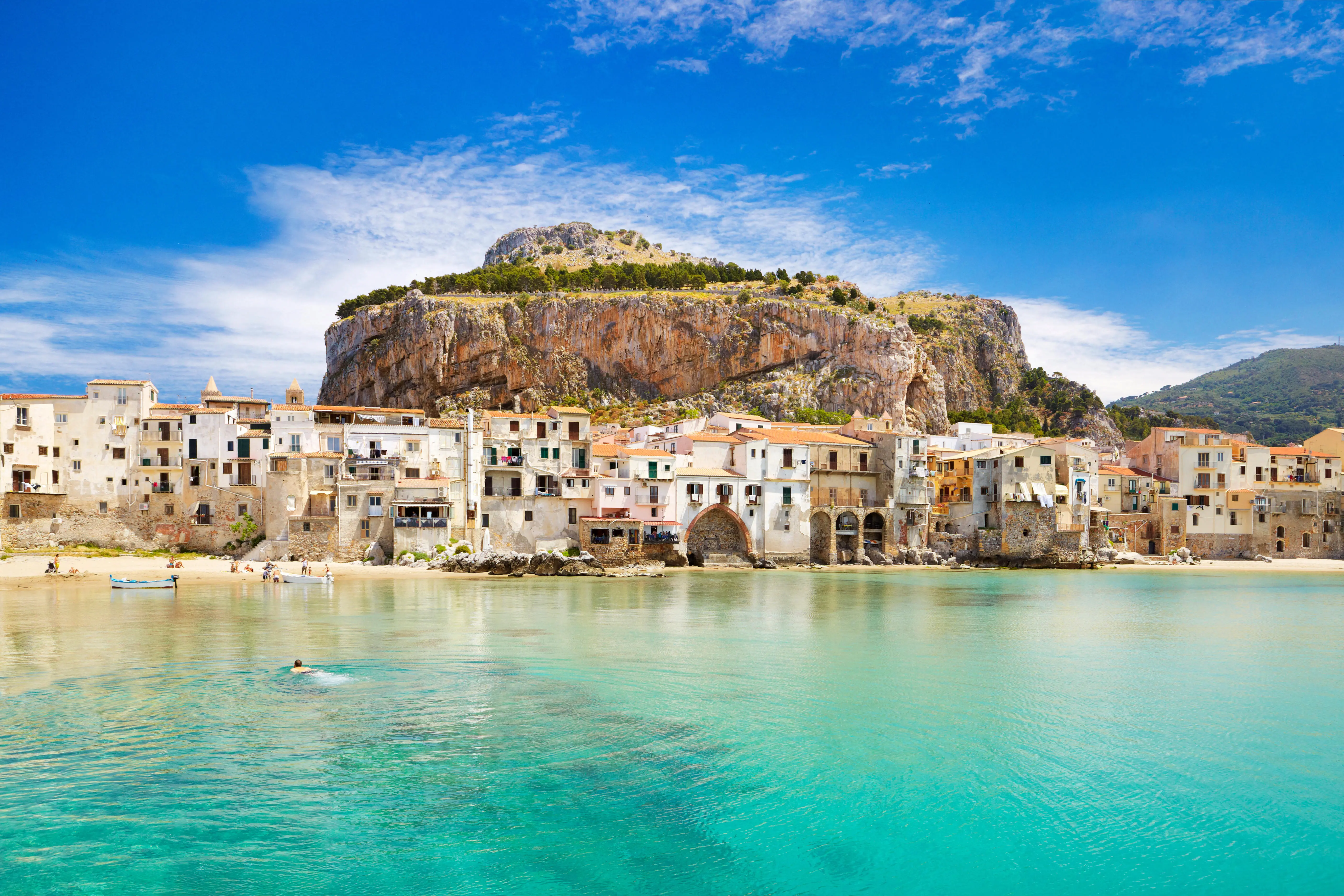
Cefalu, Italy
Lisa Minot, Head of Travel
Sun Head of Travel Lisa Minot recommends Cefalu for an affordable Italian breakCredit: Alamy
Book a break to Cefalu
If you click on a link in this box, we will earn affiliate revenue
Lastminute.com offer a five-night stay with breakfast at the Hotel Costa Verde, including return flights from London Luton, from £306pp.
The charming Sicilian beach town of Cefalu is a great value alternative to the glitzy towns of the Italian Riviera or Amalfi Coast.
It has the same Italian aesthetic – think cobbled streets, medieval architecture and dramatic cliffs – without the ‘luxury tax’ found on the mainland.
I had a superb burrata salad at Porta Ossuna restaurant right on the seafront in Cefalu for just £10 – washed down with a £3 glass of rose.
My husband was delighted with his foaming beer – a large one cost just £4.
Accommodation is also cheaper with a 4* hotel in Cefalu priced around £115 per night, compared to similar in Sorrento setting you back around £260 a night.
It’s also a great, compact city to explore with the walk from the Norman cathedral to the beachfront taking just ten minutes.
The hike up to La Rocca costs only a few euros and provides panoramic views that rival those of the expensive clifftop terraces of the Riviera.
Efteling, the Netherlands
Helen Wright, Travel Writer
Efteling Theme Park in the Netherlands is a budget-friendly, thrilling break for familiesCredit: Getty
Book a break to Efteling
If you click on a link in this box, we will earn affiliate revenue
Hotels.com offer a stay in a family room sleeping three at the Efteling Wonder Hotel, including breakfast and theme park tickets, from £368 per night.
One of Europe‘s best-kept secrets is Efteling Theme Park in the Netherlands.
With lots of families planning to visit Disneyland Paris in France, Efteling is largely overlooked.
However, at only £35 to get in, this theme park is fantastic value and has so many fantastic rides for families.
There are white-knuckle rollercoasters and attractions for all ages. Plus, the lines are usually manageable, meaning no need to pay extra for fast passes to jump to the front of the queue.
Efteling has been open for over 70 years and still has areas preserved as it was when it opened, including a forest trail mapping out classic fairy tales like Red Riding Hood. Princess and the Pea and The Little Mermaid.
Food and drink tends to come in cheaper than at Disneyland too, don’t miss the classic Stroopwafel for only £3.50, which goes perfectly with a coffee as the kids play.
There are two hotels at Efteling, with rooms starting from £220 per night, including theme park access for the whole family.
It’s easy to get to by car (parking is £12 a day) or you can travel by Eurostar to Amsterdam and hop on the local train directly to the theme park. Allow for at least 2 days at the parks because there is so much to do.
Albanian Riviera
Rob Brooks, Holiday Expert
Ksamil in Albania has turquoise waters and parasol-dotted golden beachesCredit: Alamy
Book a break to the Albanian Riviera
If you click on a link in this box, we will earn affiliate revenue
On the Beach offer a five-night stay at the Hotel Vola in Sarande, including return flights from London Luton, from £175pp.
If you’ve ever looked at the Greek islands or the Amalfi Coast and thought it looks amazing, but you’re not up for paying the price, this is where you go instead.
The Albanian Riviera – especially around Sarandë and Ksamil – has that same crystal-clear water, white beaches and relaxed beach club feel, just without the crowds or the price tag.
It genuinely feels like Greece and southern Italy combined, but way earlier in its tourism story.
What I love about it is how unspoilt it still feels. You’ve got small beach bars, simple but brilliant restaurants, and loads of coastline that hasn’t been overbuilt yet.
And the value is ridiculous once you’re there. You can sit down for fresh seafood, drinks and a proper meal for under £15, and you’ll still find pints for around 250 Lek, or about £2.30, in most places.
The deal I found is for Hotel Vola in Sarande, flying direct from London Luton in May.
It’s coming in at £175pp for five nights, bed and breakfast, so you’ve got a base with a sea view and pool, then loads of freedom to eat and drink out for next to nothing.
Hua Hin, Thailand
Sophie Swietochowski, Assistant Travel Editor
Hua Hin in Thailand has paradise beaches like those in the popular resort of PhuketCredit: Getty
Book a break to Hua Hin
If you click on a link in this box, we will earn affiliate revenue
On the Beach offer a seven-night stay at the ibis Hua Hin, including return flights from London Heathrow to Bangkok, from £860pp.
Most beach-seeking travellers in Thailand will make a beeline for the island of Phuket.
But I’d always opt for the less commercial and far more affordable Hua Hin over this.
Not only is the coastal town relatively crowd-free, you can stay in some pretty high-end hotels with stylish rooms that cost a fraction of the price they would at sister resorts elsewhere in the world.
You’ve got everything you’d want from a typical getaway in Thailand: excellent night markets where you can pick up budget fashion pieces, quality restaurants dishing up traditional grub in fuss-free settings, and sun-drenched sands overlooking an endless ocean.
It’s also under three hours from Bangkok, so makes for a great twin-centre beach and city break.
Fuerteventura, Canary Islands
Jacob Lewis, Guest Travel Expert at TravelSupermarket
Fuerteventura is the second biggest of the Canary Islands, and has 160 miles of beachesCredit: Getty
Book a break to Fuerteventura
If you click on a link in this box, we will earn affiliate revenue
Travel Supermarket offer a seven-night self-catering stay at the Elba Lucia Sport & Suite Hotel, including return flights from Manchester, from £399pp.
Swap Tenerife for this cheaper Canary with better beaches.
When most Brits think Canary Islands, they go straight to Tenerife, Lanzarote or Gran Canaria – and prices reflect it. But there’s a cheaper alternative hiding in plain sight.
Based on TravelSupermarket searches between 1 January and 12 April 2026, holidays to Fuerteventura average around £622pp – compared to £702pp for Tenerife, £667pp for Lanzarote and £776pp for Gran Canaria. That’s a saving of up to £154pp. And you’re not exactly slumming it.
Fuerteventura is the second-largest Canary Island and has arguably the best beaches in the archipelago – huge sweeps of pale sand that feel closer to the Caribbean than Spain.
It’s also quieter and more stripped-back than its neighbours, with fewer mega-resorts and a slower pace overall.
Corralejo in the north is the liveliest base, with plenty of bars and restaurants, while the Jandía peninsula in the south is calmer, with more space and smarter hotels.
The island is also a magnet for windsurfers and kitesurfers, with reliable conditions year-round at spots like Flag Beach.
Weather-wise, it’s one of the safest bets in Europe. Fuerteventura is one of the Canary Islands closest to Africa, and its flat landscape means it’s generally drier and sunnier than the more mountainous islands. Even in midwinter, average high temperatures hover around 20°C.
Food is simple but good – expect plenty of fresh fish and local goat’s cheese – and all-inclusive deals tend to be well-priced across the island.
Flights take around four hours from the UK, just like the bigger-name islands.
The difference is you’ll often pay less – and get a more relaxed version of the Canaries.
Faro, Portugal
Kara Godfrey, Deputy Travel Editor
Deputy Travel Editor Kara Godfrey recommends a trip to Faro in the Algarve, PortugalCredit: Alamy
Book a break to Faro
If you click on a link in this box. we will earn affiliate revenue
Lastminute.com offer a five-night room-only stay at the Faro Boutique Hotel, including return flights from London Stansted, from £205pp.
The city of Faro is often used as the gateway to the rest of the Algarve, but I’m fighting its case as a holiday destination in its own right.
Sure, it has far fewer hotels than the rest of the Portuguese coastline, but it is just as affordable.
For example, pay a few euros and you’ll find yourself on one of the Parque Natural da Ria Formosa islands, which feel like you paid to have it all to yourself.
Try Ilha Deserta, home to just one restaurant and nothing else, to feel like Robinson Crusoe discovering new lands.
Otherwise stay on the mainland and hop in some of the beachfront bars where pints of beer are easily found under two euros.
Costa de la Luz, Spain
Rob Brooks, Holiday Expert
Spain’s Costa de la Luz has a calmer feel than busy Costa BravaCredit: Getty
Book a break to Costa de la Luz
if you click on a link in this box, we will earn affiliate revenue
On the Beach offer a five-night stay at the Alegria Costa Ballena AquaFUN Hotel in Costa Ballena, including return flights from London Stansted, from £195pp.
If you like Marbella or Malaga, but not the prices or how busy it gets, this is the upgrade most people don’t know about.
Down on the Costa de la Luz, around Cádiz and Costa Ballena, you get the same golden beaches, proper Spanish food and hot weather – just with a much calmer, more local feel.
This is where Spanish holidaymakers go, which is usually a very good sign.
The big difference is space. The beaches here are huge, sandy, and never rammed.
You’ve still got beach bars and restaurants dotted along the coast, but without the ‘popular-location tax’ you get further along in the Costa del Sol.
And it’s properly affordable once you’re there. A beer will set you back about €2 (the cheapest I found here was just €1.30) and you can still find really good tapas and fresh seafood dinners for €10-15 a head if you go local.
The deal I found is for the Alegria Costa Ballena AquaFUN Hotel, flying from London Stansted in May for £195pp. It’s a solid, well-rated hotel with big pools and a waterpark on site – so you’ve got loads going on without needing to spend loads once you’re there.
Patmos, Greece
Lisa Minot, Head of Travel
Patmos in Greece delivers the classic Greek island experience without the high costsCredit: Alamy
Book a break to Patmos
If you click on a link in this box, we will earn affiliate revenue
Expedia offer a four-night stay with breakfast at the Skala Hotel from £316pp.
With their labyrinthine white-washed cobbled alleys and blue domes, Mykonos and Santorini are the classic Greek island experiences but their popularity means prices have soared.
Pretty Patmos is a fantastic alternative. The UNESCO World Heritage site offers a quieter, arguably more authentic version with boutique-filled streets and stunning hilltop views of the Aegean.
A sunset cocktail could set you back up to £25 in Santorini – but you can find the same chic venues and prices half of that in Patmos’ Chora.
Mykonos beach clubs sell sunbeds at £130 a day but you can have the same sand between your toes experience facing stunning turquoise waters at Patmos’ Grikos Beach for pennies.
And when it comes to food, the tavernas on Patmos are more than capable of giving those big chef restaurants of Mykonos and Santorini a run for their money.
Fish is still a highlight but a high-end, fancy dinner for two on Patmos with wine will set you back £100 as opposed to nearly £250 on the trendy islands.
Isle of Whithorn, Scotland
Heather Lowrie, Travel Editor at The Scottish Sun
The Isle of Whithorn in Scotland is a scenic Scottish destination that’s affordable, tooCredit: Alamy
Book a break to the Isle of Whithorn
If you click on a link in this box, we will earn affiliate revenue
Booking.com offer a stay in a cosy wooden lodge, Wigtown by Wigwam Holidays, from £123 per night.
One of the most southerly Scottish villages, this is a fabulous place to escape the crowds but still with plenty to occupy your time – most of it free!
Visit St Nina’s sea-side cave, said to be the hideaway of the early Christian saint.
As one of Scotland’s earliest Christian sites, it brought travellers, traders, pilgrims and royalty to Whithorn for more than 1,000 years.
Ten crosses are cut into the cave wall, and the 18 early Christian carved stones found inside are at Whithorn Priory and Museum.
The Latinus Stone – Scotland’s earliest Christian monument is also housed here. Entry is just £7.50 for adults and children 4-15 are £4.50.
There are three tall standing stones at nearby Drumtroddan, dating to the second or third millennium BC which are part of a unique prehistoric landscape, including the nearby Drumtroddan Cup and Ring Marked Rocks. All free.
Take the Isle of Whithorn Loop, to the Priory, stopping at the iron age roundhouse and finish with coffee and cake at the lovely community cafe and shop and bed down at the Steampacket Inn to explore nearby towns and villages like Garlieston, Sorbie and Monreith.
Salerno, Italy
Sophie Swietochowski, Assistant Travel Editor
Salerno in Italy is a cheap spot to stay in on the dramatic Amalfi Coast of ItalyCredit: Getty
Book a break to Salerno
If you click on a link in this box, we will earn affiliate revenue
Loveholidays offer a five-night room-only stay at the 4* Hotel Cetus, including return flights from London Luton, from £599pp.
Sipping Aperol spritz from a cliffside restaurant on Italy’s rugged Amalfi Coast should be on everyone’s bucket list.
Don’t waste your cash staying there, though. The charming town of Salerno sits just a short (around 30 minutes or so) and cheap ferry ride away – and you can save yourself hundreds by staying here instead.
When you’re not daytripping to Positano, explore Salerno’s cobbled side alleys, teeming with pokey restaurants where nonnas are cooking up huge portions of fried fish and pasta from family recipe books.
Sopot, Poland
Helen Wright, Travel Writer
Sopot in Poland has a pretty traditional pier, beaches and cheap places to eatCredit: Alamy
Book a break to Sopot
If you click on a link in this box, we will earn affiliate revenue
Loveholidays offer a seven-night room-only stay at the Hotel Aqua Sopot, including return flights from Newcastle, from £239pp.
If you are looking for a wide, golden sand beach, lined with beach bars and cafes, a busy promenade and a seaside destination with a lot of character, consider Sopot in Poland.
This beach town is less than half hour from the nearest city, Gdansk. Flights direct to Gdansk from the UK start from £12 each way on Ryanair and it’s an easy (and cheap) train ride to get to the coast.
Hotels start from £40 per night for two people, so it’s ideal for those on a budget.
The coastline is so stunning, you could be forgiven for thinking you ‘re on the beach in Italy or the South of France but for the bargain prices everywhere.
Beautiful, historic buildings sit along the coastal road, including the Sofitel Grand Hotel, which looks like the setting of an Agatha Christie thriller.
The beach is huge and, although popular in the summer months, never feels crowded. The sea here is calm and ideal for a paddle or swim – although the water can be on the chilly side.
At beach cafes along the front, you can grab a cold beer for £2 and cocktails for £5.
Prosto, a pizzeria with a beautiful garden and outdoor seating is just steps from the beach. Here, a huge pizza will only set you back £10 and is definitely enough for two adults to share.
You can lay down a blanket and spend the whole day basking in the sun, or take position in one of the fancy beach clubs, which have Ibiza vibes but start from £10 per day for a comfy sunbed and umbrella.
Kefalonia, Greece
Jacob Lewis, Guest Travel Expert at TravelSupermarket
Kefalonia in Greece is a cheaper alternatife to SkiathosCredit: Alamy
Book a break to Kefalonia
If you click on a link in this box, we will earn affiliate revenue
Loveholidays offer a seven-night stay at Efrosini Village, including return flights from London Gatwick, from £239pp.
Swap Skiathos for this Greek island that’s £370 cheaper.
Skiathos might be one of Greece’s best-loved islands – but you’ll pay for it.
TravelSupermarket data shows average prices at around £955pp. That’s nearly £370 more than Kefalonia, which comes in closer to £588pp. For families, that’s a serious saving.
Kefalonia is the largest of the Ionian Islands – and one of the most dramatic. Think steep limestone mountains, dense forests and electric-blue bays, including Myrtos, regularly ranked among Europe’s best beaches.
It shot to global fame thanks to Captain Corelli’s Mandolin, but it’s long been a favourite with travellers who want something a bit less built-up.
That’s partly down to stricter planning rules, which have limited large-scale development and kept much of the island feeling low-key. You’ll find more small hotels, villas and apartments than huge resort blocks.
Argostoli, the capital, feels more like a proper Greek town than a purpose-built resort – with a lively waterfront, good tavernas and a laid-back atmosphere.
Up north, Fiskardo is one of the prettiest harbour villages in Greece. It survived the 1953 earthquake that flattened much of the island, so its Venetian buildings are still intact – and it’s easily worth a day trip.
You still get the same essentials as Skiathos – clear, warm water, great beaches and reliable sunshine – just spread across a bigger, less crowded island. Flights from the UK take around three hours, so there’s no extra hassle.
After the big talk in the build-up, Ireland blew France away in the opening 40 minutes but, largely, were left unrewarded for their efforts.
Cliodhna Moloney-MacDonald crossed for Ireland but had two efforts chalked off, while Brittany Hogan and Fiona Tuite were also denied first-half scores.
France, who are tipped to meet England in a Grand Slam decider on the final day of the Six Nations, showed a clinical edge and moved clear after the restart through Carla Arbez, Anais Grando and Lea Champon, while Ireland could not back up their first-half performance and fell short.
Under head coach Scott Bemand, Ireland have moved up to fifth in the world and stunned New Zealand and Australia in 2024, but the elusive Six Nations scalp goes on.
England had too much on the opening day, when a slow start was punished, and defeat by France shows there is still work to be done.
“In these kinds of Test matches the margins become finer, so we’re after finer margins than we were,” Bemand said.
“Nail your kick to touch and nail your exit – they are the type of things that don’t let France in.
“We will keep going after the finer margins and keep trying to get better. I’ve got a group who is up for that.”
People cast votes in the municipal elections in Deir al-Balah, in the central Gaza Strip, on Saturday — the first election held in Gaza in 20 years, and the first in the West Bank since the outbreak of the war. Photo by Haitham Imad/EPA
April 25 (UPI) — Palestinians in Gaza held an election for the first time in 20 years as municipal elections were held there and in the West Bank on Saturday.
People in Deir al-Balah, a city in central Gaza, voted for the first time since 2006 because it was the least destroyed area after two years of airstrikes by Israel after the attacks of Oct. 7, 2023, CNN reported.
The elections, which also were held in many parts of the West Bank, were run by the Palestinian Authority and required candidates to agree with Palestinian Liberation Organization to recognize the state of Israel and support a two-state solution.
Elections were last held in the West Bank in 2022, The BBC reported, and had not been held in Gaza since Hamas took the enclave over two decades ago. Hamas was not permitted to participate in the elections.
Election results will be reported either late Saturday or on Sunday.
Salama Badwan, who voted with his wife and daughter, told Al Jazeera that the first election “is a truly Palestinian democratic celebration.”
“We must change everything through the ballot box,” Badwan said. “Whoever wins, it is their right, but not through inheritance … change must be through the hands of the people.”
Roughly 70,000 Palestinians — or 5% of the entire Gazan population — in Deir al-Balah were eligible to vote because many of the places that would have been used for voting were destroyed, as were supplies like ballot boxes.
The Palestinian Authority’s Fatah party dominated ballots as votes were held for 90 municipal councils and 93 village councils — leaving 42 other municipal councils and 155 village councils to be decided without votes.
Hamas praised the vote in Gaza and expressed hope for the rest of the territory to also choose its own leaders, although after its election in 2006 it forced Fatah out of Gaza in often violent battles and had not held an election since.
Thousands of displaced Palestinians walk along the Rashid coastal road toward Gaza City on October 10, 2025, after the implementation of a cease-fire agreement between Israel and Hamas. Photo by Hassan Al-Jadi/UPI | License Photo
A travel creator has shared his experience of visiting what he branded the ‘cheapest country’ in the world, where you can get a beer for under £1 and a meal for just £2.60
10:12, 26 Apr 2026Updated 11:02, 26 Apr 2026
One travel creator has shared his experience of going to the country(Image: abalcazar via Getty Images)
Many of us enjoy jetting off on holiday every so often, yet the expenses can quickly mount up – from flights and accommodation to food and excursions. Now, one travel content creator has shared his experience of visiting what he calls the ‘cheapest country in the world‘.
Lourens, known as @l.ourens on Instagram, is a Dutch travel creator with more than 15,000 followers. He regularly posts content about ‘discovering unknown destinations around the world’ and says he’s aiming to visit every country in Europe – having “already gone to 47 of them”. In one of his most recent reels, he gave his followers an insight into his trip to what he described as the “cheapest country in the world” – Uzbekistan.
In the clip, he tells fans: “I went to the cheapest country in the world, where you can have a beer on a terrace for about €1 (87p) and stay in a local apartment for about €15 (£13) per night.
“It’s capital city feels like a mini Dubai with modern glass towers and a spotless metro. Yet this city also has ancient buildings with lots of culture and a rich local cuisine.
“For example, we went to this restaurant and we ordered a local dish for about €3 (£2.60) per person.”
The creator added that those put off by the Dubai-style architecture can hop aboard a luxury high-speed train for around €15, whisking you away to the cultural hub of Samarkand, where he “saw one of the most beautiful buildings of the ancient Silk Road”. He continued: “On top of that, you can also take from this city a guided day trip over the border to Tajikistan to see the Seven Lakes. These lakes contain clear water and pristine mountain views, which we really enjoyed.”
Lourens also noted in the caption that Uzbekistan was the “best budget friendly country” he’d visited after “visiting 60+ countries”.
Content cannot be displayed without consent
The post proved a massive hit with followers, amassing more than 70,000 likes.
One delighted user exclaimed: “One of my favourite countries ever!”
While another enthusiastically agreed: “I just left Uzbekistan and it’s amazing.”
A third chimed in: “Looks so interesting, I love the idea of going somewhere that’s not over-touristy.”
Is Uzbekistan actually the cheapest country in the world?
While Uzbekistan ranks amongst the most wallet-friendly destinations on the planet, it isn’t technically the absolute cheapest. Despite offering remarkable value for money, several other nations typically boast lower overall costs for both locals and tourists.
Uzbekistan frequently features in the “Top 10” or “Top 20” most affordable destinations, though countries such as Pakistan, Egypt, Libya and India generally rank as having a lower cost of living according to global indices.
Within Central Asia specifically, nations such as Kyrgyzstan and Tajikistan are frequently regarded as even more budget-conscious destinations than Uzbekistan.
Is Uzbekistan safe to travel to?
Uzbekistan is widely regarded as a safe destination for tourists, with numerous visitors rating it among the safest countries they have ever travelled to. That said, official guidance differs depending on your country of origin, and certain precautions are advised.
UK government advice suggests the country is generally safe, though travellers are cautioned to remain vigilant of terrorism risks and to steer clear of any protests or demonstrations.
The majority of the country, including popular tourist destinations such as Tashkent, Samarkand, and Bukhara, benefit from strong security and a prominent police presence. Particular areas of concern include the border with Afghanistan, where travel is strongly discouraged, as well as regions bordering Tajikistan and Kyrgyzstan, notably the Fergana Valley, where parts remain mined or have a history of unrest.
Uzbekistan is increasingly making a name for itself as a premier destination for solo female travellers, having recently claimed the #1 position in the Solo Female Travel Safety Index. Reports of harassment are notably low in comparison to many other major tourist hotspots.
Street crime is uncommon, and walking alone after dark in the main cities is broadly considered safe, with most streets remaining well-lit and regularly patrolled.
A travel creator has shared his experience of visiting what he branded the ‘cheapest country’ in the world, where you can get a beer for under £1 and a meal for just £2.60
One travel creator has shared his experience of going to the country(Image: abalcazar via Getty Images)
Many of us enjoy jetting off on holiday every so often, yet the expenses can quickly mount up – from flights and accommodation to food and excursions. Now, one travel content creator has shared his experience of visiting what he calls the ‘cheapest country in the world‘.
Lourens, known as @l.ourens on Instagram, is a Dutch travel creator with more than 15,000 followers. He regularly posts content about ‘discovering unknown destinations around the world’ and says he’s aiming to visit every country in Europe – having “already gone to 47 of them”. In one of his most recent reels, he gave his followers an insight into his trip to what he described as the “cheapest country in the world” – Uzbekistan.
In the clip, he tells fans: “I went to the cheapest country in the world, where you can have a beer on a terrace for about €1 (87p) and stay in a local apartment for about €15 (£13) per night.
“It’s capital city feels like a mini Dubai with modern glass towers and a spotless metro. Yet this city also has ancient buildings with lots of culture and a rich local cuisine.
“For example, we went to this restaurant and we ordered a local dish for about €3 (£2.60) per person.”
The creator added that those put off by the Dubai-style architecture can hop aboard a luxury high-speed train for around €15, whisking you away to the cultural hub of Samarkand, where he “saw one of the most beautiful buildings of the ancient Silk Road”. He continued: “On top of that, you can also take from this city a guided day trip over the border to Tajikistan to see the Seven Lakes. These lakes contain clear water and pristine mountain views, which we really enjoyed.”
Lourens also noted in the caption that Uzbekistan was the “best budget friendly country” he’d visited after “visiting 60+ countries”.
Content cannot be displayed without consent
The post proved a massive hit with followers, amassing more than 70,000 likes.
One delighted user exclaimed: “One of my favourite countries ever!”
While another enthusiastically agreed: “I just left Uzbekistan and it’s amazing.”
A third chimed in: “Looks so interesting, I love the idea of going somewhere that’s not over-touristy.”
Is Uzbekistan actually the cheapest country in the world?
While Uzbekistan ranks amongst the most wallet-friendly destinations on the planet, it isn’t technically the absolute cheapest. Despite offering remarkable value for money, several other nations typically boast lower overall costs for both locals and tourists.
Uzbekistan frequently features in the “Top 10” or “Top 20” most affordable destinations, though countries such as Pakistan, Egypt, Libya and India generally rank as having a lower cost of living according to global indices.
Within Central Asia specifically, nations such as Kyrgyzstan and Tajikistan are frequently regarded as even more budget-conscious destinations than Uzbekistan.
Is Uzbekistan safe to travel to?
Uzbekistan is widely regarded as a safe destination for tourists, with numerous visitors rating it among the safest countries they have ever travelled to. That said, official guidance differs depending on your country of origin, and certain precautions are advised.
UK government advice suggests the country is generally safe, though travellers are cautioned to remain vigilant of terrorism risks and to steer clear of any protests or demonstrations.
The majority of the country, including popular tourist destinations such as Tashkent, Samarkand, and Bukhara, benefit from strong security and a prominent police presence. Particular areas of concern include the border with Afghanistan, where travel is strongly discouraged, as well as regions bordering Tajikistan and Kyrgyzstan, notably the Fergana Valley, where parts remain mined or have a history of unrest.
Uzbekistan is increasingly making a name for itself as a premier destination for solo female travellers, having recently claimed the #1 position in the Solo Female Travel Safety Index. Reports of harassment are notably low in comparison to many other major tourist hotspots.
Street crime is uncommon, and walking alone after dark in the main cities is broadly considered safe, with most streets remaining well-lit and regularly patrolled.
Ukraine’s attacks on Russia injure at least six people in the region of Vologda and the annexed Crimea.
Published On 26 Apr 202626 Apr 2026
Ukrainian officials say Russian attacks in several regions have killed at least five people and damaged a ship in the port of Odesa – as Moscow claimed to have intercepted more than 200 Ukrainian drones.
A Russian drone attack killed two men on Saturday in Ukraine’s northeastern Sumy region, according to Governor Oleh Hryhorov. He said civilians were hit in Bilopil close to the Russian border.
Recommended Stories
list of 4 itemsend of list
In the central Dnipropetrovsk region, Russian attacks on four districts killed one person and injured four others, Governor Oleksandr Ganzha said.
In the southern region of Kherson, Governor Oleksandr Prokudin said Russian shelling wounded seven people.
Further east, Russian forces launched more than 700 attacks on 50 settlements in the Zaporizhia region over the past 24 hours, killing two people and injuring four, according to Governor Ivan Fedorov.
Homes, vehicles and infrastructure were damaged, he added.
In Odesa region, Deputy Prime Minister Oleksii Kuleba said Russian forces again targeted port infrastructure.
“The attack damaged port and logistics infrastructure facilities, warehouses, technical equipment, cargo storage tanks, administrative buildings, as well as freight transport,” Kuleba said on Telegram.
He added that a civilian vessel flying the flag of Palau was damaged while loading in port. No injuries to the crew were reported.
Ukraine’s air force said it shot down or disabled 124 of 144 drones launched by Russia overnight with impacts recorded at 11 locations.
Russia reports Ukrainian drone attacks
Russia’s Ministry of Defence said its air defences destroyed 203 Ukrainian drones between Saturday evening and Sunday morning over Russian regions and the Black Sea.
The ministry said 95 Ukrainian drone control centres were destroyed over the previous 24 hours.
In Russia’s Vologda region, Governor Georgy Filimonov said five people were injured in a Ukrainian drone attack on a nitrogen complex.
In Sevastopol in Crimea, which was annexed by Russia, debris from downed drones struck the cardiology department of a hospital, injuring one person, according to Governor Mikhail Razvozhayev. He said 16 Ukrainian drones were shot down over the city overnight.
Razvozhayev added that drone debris also fell on rail tracks, damaging overhead power lines and causing train delays.
Peace efforts continue
The latest attacks came as diplomatic efforts to end the war, now in its fourth year, remained stalled.
Ukrainian President, Volodymyr Zelenskyy, said he signed agreements on security and energy cooperation with Azerbaijan’s President Ilham Aliyev in Baku on Saturday.
Zelenskyy said Kyiv wanted to draw on its experience defending airspace from Russian attacks. He also said he had discussed the possibility of holding future talks between Ukraine and Russia in Azerbaijan.
“We are ready for the next talks to be in Azerbaijan, if Russia will be ready for diplomacy,” Zelenskyy said.
Michael Tilson Thomas came onto the scene as a great hope for classical music, American music, Los Angeles music, modern music, multifaceted pop music, maverick music, Russian music, Broadway music and just plain music, whatever it might be and from wherever it might be found. He lived his 81 years as conductor, pianist, composer, educator and media personality promoting that hope, and died Wednesday having shown how hope is done. He looked ahead. He looked back. Yet he lived for the now.
It wasn’t always easy. He wasn’t, to say the least, always easy. But MTT made music matter by making hope matter. He was, moreover, one of us. He achieved greatness though an epic amplification of a uniquely L.A. positivity in which grumpy became wistful.
I first encountered MTT as a kid clarinetist and he, Michael Thomas back then, a student conductor at USC and already, at 19, music director of the Young Musicians Foundation Debut Orchestra. He was soon everywhere. A piano prodigy, he regularly performed (and hobnobbed) with the likes of Stravinsky, Copland, Boulez and Cage at Monday Evening Concerts programs when the Los Angeles County Museum of Art opened in 1965. That summer, he appeared at the Ojai Music Festival, which he would go on to lead as music director seven times.
MTT liked to describe his L.A. youth as driving from Jascha Heifetz’s house in the Hollywood Hills (where he accompanied the famed Russian violinist in classes) to LACMA to rehearse Ives and Renaissance music, to composition and conducting classes at USC. Then it was home to the San Fernando Valley to practice Beethoven.
All the while, he listened to the hip L.A. 1960s pop music stations on his car radio. He was particularly keen on, and became friends with, Chuck Berry. Home was where he would also encounter screen legends. Tilson Thomas’ father worked in films and television as a screenwriter, producer and dialogue coach. Theodor Thomas was, as well, a painter with a visionary sensibility and a pianist, self-taught other than a handful of lessons from Gershwin.
But it was Tilson Thomas’ mother and grandmother who may have had the biggest influence. His mother was a public school teacher. She instilled what became a key trait in her only child, who treated conducting as an exercise in learning both for the musicians and the audience (if not for him, because he basically knew it all). His grandmother, Bessie Thomashefsky and her husband, Boris, were stars of Yiddish theater on New York’s Lower East Side.
Boris died in 1939, five years before MTT was born. But Bessie and young Michael were close. She recognized that, like her, he was born for the stage, and regaled him with stage lore that put the stardust in his eyes. As a young kid, MTT played Beethoven piano sonatas so impressively that he wowed his babysitter, an architecture student at USC named Frank Owen Goldberg, who needed extra cash.
Frank Gehry, as he became, told me that MTT was already an entrancing showman. The two remained lifelong friends.
While MTT did not actually reside in L.A. for most of his life, he never really left it. It prepared him for all that was to follow. In high school, he met Joshua Robison, who became his lifelong partner and ultimately husband. Whether in New York, Miami, London or San Francisco, wherever they lived, they always talked about L.A. His father’s paintings were on the walls, as were Boris’ Yiddish theater posters, one proclaiming “King Lear,” translated and improved.
The Tilson Thomas package that emerged from L.A. was unlike any conductor the world had seen. He doted on the music of Rachmaninoff when Rachmaninoff was unfashionable and on Steve Reich when Reich was found unfathomable. He adopted classical music’s neglected outsiders and especially such key West Coast “mavericks” as Lou Harrison and Henry Cowell. He convinced Meredith Monk to write for orchestra and enticed everyone from Sarah Vaughan to the Mahavishnu Orchestra onto the symphony stage.
Studying at Tanglewood, the Boston Symphony’s summer home, MTT won the Koussevitzky Prize in 1969 and, with the encouragement of Leonard Bernstein, was appointed assistant conductor to music director William Steinberg. Before long, MTT became principal guest conductor, filling in frequently for Steinberg, who was in poor health.
MTT in his early 20s was vibrant, arrogant, fearless, full of ideas, a chance taker. Ever the Angeleno, he tooled around town in a Porsche. He talked to staid symphony musicians and audiences who didn’t want to be talked to and often played music they didn’t want to play or hear. And he dazzled them. He got a contract with the distinguished German record label Deutsche Grammophon and made exciting records with the orchestra of Tchaikovsky, Stravinsky, Ives and modern Americans. They remain a thrill to hear.
By 1974, it was Tchaikovsky one moment and a wonderfully crazy avant-garde opera the next. Stanley Silverman’s “Elephant Steps,” which MTT recorded in 1974, was for pop singers, opera singers, orchestra, rock band, electronic tape, raga group, gypsy ensemble and, of course, elephants. Richard Foreman wrote the libretto. There had been nothing like it then or since. A revival could prove a sensation. The Olympic arts festival, anyone?
At the same time, Tilson Thomas, who proved a born educator, succeeded Bernstein in delivering the New York Philharmonic’s Young People’s Concerts. When Steinberg left, the Boston Symphony Orchestra passed over MTT as too young (24) and not ready (he wasn’t, nor was Boston). He was just right, though, for the Buffalo Philharmonic, which he led from 1971 to 1979. It was a wild ride, with lots of exciting new music and no small amount of controversy — arresting performances of arresting new works (Morton Feldman in particular) and an actual arrest at Kennedy International Airport when small quantities of cocaine, marijuana and amphetamines were found in his luggage.
He may have seemed ready for a homecoming in 1981, but MTT’s appointment as principal guest conductor of the Los Angeles Philharmonic did not prove to be the return of the prodigal son. These were the years of Carlo Maria Giulini’s music directorship, and MTT brought currency — new music, Gershwin, flashy showstoppers. Much of it was a breath of freshest air, but he was also remembered for his brash youth, which was now a brash 30s. He ran afoul of some in the orchestra and of its imperious head, Ernest Fleischmann.
Having been branded the next Bernstein, MTT floundered. What he needed was not L.A., but a far distant remove to find himself. That happened in two parts.
In 1987, the educator in him led to his greatest project, the creation of the New World Symphony in Miami Beach, Florida. The training orchestra guides young musicians with conservatory backgrounds into the world of professional orchestras.
Around the same time, Bernstein talked the London Symphony Orchestra into hiring Tilson Thomas as music director. Far from L.A., Boston and New York, a newly mature MTT found his bearings, no longer the next Leonard Bernstein but the first and only Michael Tilson Thomas.
Miami gave MTT meaning, and he commissioned Frank Gehry to design a revolutionary concert hall and teaching facility. In London, his conducting took on depth without losing its surface glamour. What MTT still lacked, however, was a creative outlook. He had always thought himself a composer and could, at a party, make up a clever song at the piano on the spot. He had drawers full of sketches but little finished work.
It took a return to the West Coast for MTT, having turned 50, to put all of his musical, emotional, personal and spiritual parts together and achieve greatness. For 25 years as music director of the San Francisco Symphony, MTT conducted Mahler and Tchaikovsky with a depth of soul that integrated his Russian roots and Bernsteinian character. He advocated for mavericks in summer festivals. He found his voice as a composer. He and Robison were embraced as a beloved San Francisco couple. He alchemized the San Francisco Symphony into a Bay Area beacon.
In the challenging last chapter of his life, MTT turned tragedy into triumph to became a universal inspiration. The lockdown in June 2020 meant cancellation of his farewell concerts as music director, including a production of Wagner’s “The Flying Dutchman” with a set by Gehry. The following summer, MTT fell on stage while conducting the London Symphony in Santa Barbara. He was diagnosed with late-stage glioblastoma. He likely had less than a year to live.
Remarkably, MTT continued to conduct until last April. His appearances with the L.A. Phil and the San Francisco Symphony were transformative. He guest conducted in New York, London, Prague and elsewhere. In L.A., a dying MTT led a profound performance of Mahler’s death-obsessed Ninth Symphony, not as a farewell but as a shamanistic savoring of every moment of life. He asked not for sympathy but for joy.
For MTT, the music never stopped. In his later years, he advanced the theory that what you took away from hearing a performance mattered as much, if not more, than what you experienced. That may explain why this creature of the theater who was so graceful leading an orchestra and so enjoyed talking to the audience turned stiff and awkward when bowing to acknowledged applause. Was it his reluctance to leave? Insecurity? Attempt to remove his ego from the experience, as if he was now handing the music over to you?
It was probably all of those things. During his illness, when his movement became more difficult, he let go. He was simply happy to be there, happy to share music, happy to be alive, very happy to be loved. His final bows were a celebration of life.
Sadly, Robison died Feb. 22, exactly two months before MTT, who died four days short of a year since his final concert with the San Francisco Symphony. But he lives on through about 150 recordings and his website.
He and Robison worked as tirelessly throughout his illness to archive his life. His website provides a treasure trove of compelling radio and television programs, his copious Thomashefsky Yiddish theater archive, a vast legacy of searching and believing. And hope.
It is a mantra that echoes in my head as my golf ball makes a sickening plonk into the middle of a lake.
Sign up for the Travel newsletter
Thank you!
The City of Dreams Mediterranean resortCredit: SuppliedSimon sinks a putt on the Limassol Greens courseCredit: SuppliedThe resort opened to the public in 2025Credit: Supplied
I’m hacking my way around Limassol Greens, the Mediterranean’s newest sporting crown jewel.
It only opened to the public in late 2025, but it is already making a splash (literally, in my case).
I might have lost three balls but the sun is out, the air is crisp and, true to the local spirit, I’ll survive.
The vibe is “modern luxury” from the second you pull up to the pristine clubhouse near Cyprus’s second city. We are greeted by smiley, attentive staff who make us feel more than welcome.
My hired Callaway clubs appear brand new and the Trackman technology on the range ensures my swing is dialled in before I hit the first tee.
Once on the course, the tech stays with you. Our buggy comes equipped with a GPS screen that acts as both a sat nav directing us around the 71-par course and a digital caddie, calculating yardage to the pin.
Carved out of an old orange grove, the still course has some citrus trees around the perimeter.
This is Cyprus’s fifth course, meaning the island can truly claim to be a “golf destination” for holidaymakers.
Limassol Greens is curated by the same course designer as Aphrodite Hills, the best-known course on the island, and its mix of challenging holes coupled with forgiving fairways and fast-running greens means it may soon be challenging its more established neighbour for supremacy.
After 18 holes we retreat to clubhouse restaurant The Roost. It’s a bright sanctuary serving exactly the kind of high-protein fuel a weary golfer needs.
Another restaurant is under construction, suggesting that, like the golf course itself, Limassol Greens will only flourish with time.
I’m staying at the City Of Dreams Mediterranean resort, a five-minute transfer away.
Dominated by the lively casino at its heart, the 500-room hotel is a playground for adults and a fantastic base for playing golf.
My room was a masterclass in high-spec comfort, featuring a huge comfortable bed perfect for relaxing after hours out on the course.
The pièce de résistance? A free-standing bathtub separated from the bedroom by a glass wall.
The rooms are a masterclass in high-spec comfortCredit: SuppliedThe 500-room hotel is a playground for adults and a fantastic base for playing golfCredit: Supplied
You can soak in the suds while staring at the sparkling Mediterranean Sea.
Keen to fuel up before heading out for 18 holes, the options and quality at breakfast are faultless.
The orange juice tastes as fresh as if it’s come from the groves by the golf course.
Among three premium restaurants is Prime Steakhouse, where I tackled a cut of wagyu steak imported from the US so tender it practically melted on the fork.
The next night, I swapped the steak knife for chopsticks at Amber Dragon.
The roasted duck truffle puffs — flaky, buttery and decadent — are the stars of the show.
The variation of food and inventive presentation make for a memorable evening.
The hotel provides free transfers to the popular Lady’s Mile beach during the summer months.
But I head to the spa instead. It exudes calmness with low lighting and soothing music.
I’ve booked an express treatment, with my masseuse happy to focus on my legs and shoulder, which are feeling achy after so much golf. While only 25 minutes long, I feel rejuvenated by the time I leave.
Even in January, the main city of Limassol — about 15 minutes from the hotel by taxi — feels alive. I took a breather from the greens to explore the historic centre.
While the medieval castle where Richard the Lionheart had his wedding is impressive, I was more captivated by the city’s feline residents.
Legend says St Helena imported 1,000 cats in the 4th century to hunt snakes. Today, their descendants rule the sun-drenched streets like royalty.
I finished my trip with a stroll along the marina as the sun dipped behind a forest of multi-million-pound yachts.
With a cold Keo beer in hand and the feel of a breeze blowing over the Mediterranean sea, I realised the Cypriots aren’t quite right. You don’t just survive here — you thrive.
GO: LIMASSOL
GETTING THERE: Fly to Paphos or Larnaca with easyJet from Luton, Gatwick and Bristol in May with fares from £34.99 one way.
STAYING/GOLFING THERE: Packages at the City Of Dreams Mediterranean start from £743pp in winter and £978pp in summer, including two nights’ half-board and drinks and one round of golf at Limassol Greens.
At a school with the rich athletic tradition of Santa Ana Mater Dei, it is rare to be the first to achieve anything, but Matteo Huarte made history Saturday by becoming the Monarchs’ only CIF singles champion at the Ojai Valley Tennis Tournament.
After losing in straight sets to Rishvanth Krishna from Irvine University in last year’s final, Huarte was not about to squander his second chance. He raced to an early lead in the first-set tiebreaker, then broke to open the second set on his way to a 7-6 (3), 6-1 victory over Woodbridge’s Brayden Tallakson in front of a packed grandstand at Libbey Park.
Huarte had four service breaks — the last being a cross-court passing shot on match point. The final resembled Huarte’s semifinal win versus Irvine University’s JiHyuk Im in which he took the first-set tiebreaker 7-4 then cruised 6-2 in the second set.
“I’m happy I was able to do it for my school,” said Huarte, a junior who has committed to USC. “We’ve played each other a couple times and the key was to manage his serve and get into the rally. Once I got ahead of him in the tiebreak and then won the first game of the second set I was able to run away with it.”
Mater Dei’s only other title in the Ojai tournament’s long and storied history came in doubles in 2008 when Charlie Alvarado and Chris Freeman upset top-seeded Tyler Bowman and Jon Kazarian of Peninsula in three sets.
“It’s kind of hard to believe I’m the first to do it,” said Huarte about his singles title.
Last year, Huarte fell in the Southern Section semifinals to Palos Verdes ninth-grader Andrew Johnson, who went on to beat Tallakson 6-4, 6-3 in the final.
Tallakson was trying to make history of his own Saturday at a venue near and dear to his heart.
Woodbridge’s Brayden Tallakson celebrates after his quarterfinal victory over Beckman’s Rohan Grewal at the Ojai Valley Tennis Tournament on Saturday.
(Steve Galluzzo / For The Times)
“I started playing tennis down in lower Libbey, my dad Steve grew up here and won the men’s tournament, so this place is like home for my family,” said Tallakson, who quickly downed Palisades freshman Kensho Ford 6-2, 6-1 in the semifinals. “Matteo came out real aggressive, I made a couple errors on big points and he was just the better player today.”
Tallakson won the boys’ 14s division at Ojai in 2022 and had he prevailed Saturday, he would have been the first player to capture CIF singles and doubles titles at Ojai since Santa Barbara’s Nathan Jackmon won the doubles in 1993 and the singles in 1994. Tallakson won the doubles crown in 2023 with older brother Avery, with whom he will reunite next year at Boise State.
Peninsula seniors Colin Bringas and Edward Feuer completed one of the most dominant runs through the doubles draw ever seen at Ojai by beating Harvard-Westlake’s Aaron Chung and Chase Klugo 6-4, 6-2 in the finals. The Panthers’ duo did not drop a set in six matches and did not give up more than three games in a set until the first set Saturday when they broke in the ninth game to go up 5-4 and then served it out.
Bringas and Feuer are the first Peninsula pair to reach the CIF final at Ojai since 2011 and the third tandem in history to win it, joining Rylan Rizza and Jeff Kazarian in 2001, and Kazarian and Tiege Sullivan the following year.
Peninsula seniors Colin Bringas, left, and Edward Feuer celebrate after winning the CIF boys’ doubles title at the Ojai Valley Tennis Tournament on Saturday.
(Steve Galluzzo / For The Times)
“We’ve been playing together since second or third grade and we’ve been best friends since middle school at Ridgecrest Intermediate [in Palos Verdes],” Bringas said. “I always play the ad side, he’s always played the deuce court. I think the key was big serves … they make it easy for the net person to put balls away.”
Bringas and Feuer have partnered at Ojai the last three years, losing in the quarterfinal round as sophomores and juniors but steamrolling this year. They made a measly three unforced errors in a 6-1, 6-1 semifinal wipeout of Marina’s David Tran and Alejandro Hill. Tran was playing in his second straight final, having taken the runner-up prize with Trevor Nguyen in 2025.
“We were confident we’d win, but we felt the pressure and knew there are a lot of good teams here,” said Feuer, who plays No. 1 singles for dual matches while Bringas plays the No. 1 doubles spot with another teammate. “It’ll be really strange playing against each other next year.”
Bringas is bound for Westmont College and Feuer is headed to Point Loma Nazarene — rival NCAA Division II programs in the Pacific West Conference.
Harvard-Westlake, Woodbridge and University shared the Griggs Cup trophy, presented to the school with the most combined wins in singles and doubles. All three notched seven victories to force a three-way tie for only the fifth time since the award debuted in 1955 and the first since Santa Barbara, Palisades and Fresno Bullard were tri-champions in 1997. University has won it 13 times.
Edward’s teammate Donte DiVincenzo was also hurt as Minnesota rallied to beat Denver and take a 3-1 NBA playoff series lead.
Published On 26 Apr 202626 Apr 2026
Ayo Dosunmu came off the bench to score a career-high 43 points on 13-for-17 shooting, and the short-handed Minnesota Timberwolves pulled away for a 112-96 win over the Denver Nuggets in Game 4 of their Western Conference quarterfinals series on Saturday night in Minneapolis.
The victory, which gave Minnesota a 3-1 lead in the best-of-seven series, came at a steep cost for the Timberwolves, who lost two key starters due to injury.
Recommended Stories
list of 3 itemsend of list
Anthony Edwards, a four-time All-Star and the team’s top scorer, left in the second quarter and did not return because of a left knee injury. Earlier, in the first half, Timberwolves guard Donte DiVincenzo injured his right leg on a noncontact play. Early reports indicated he might have ruptured his Achilles tendon.
Naz Reid added 17 points off the bench for Minnesota. Julius Randle finished with 15 points and nine rebounds, and Rudy Gobert grabbed a game-high-tying 15 rebounds to go along with four points.
Jamal Murray scored 30 points on 10-for-25 shooting to lead Denver. Nikola Jokic finished with 24 points, 15 rebounds and nine assists. However, he shot 8-for-22 from the field and missed all three of his 3-point attempts.
Minnesota Timberwolves guard Donte DiVincenzo #0 is helped off the floor after suffering a lower leg injury in the first quarter of Game 4 [David Berding/Getty Images via AFP]
Thunder 121, Suns 109
Shai Gilgeous-Alexander scored a playoff-career-high 42 points to lift Oklahoma City to a road win over Phoenix.
The reigning NBA Most Valuable Player finished 15 of 18 from the floor with eight assists to give the Thunder a commanding 3-0 lead in their first-round Western Conference playoff series.
Oklahoma City have won 11 consecutive first- round games. Playing without Jalen Williams, who suffered a hamstring strain in Wednesday’s Game 2 victory, the Thunder leaned even more heavily on Gilgeous-Alexander.
Dillon Brooks led the Suns with 33 points while Jalen Green added 26 points. Devin Booker scored 16 points, but was held to 6-of-16 shooting from the floor.
Knicks 114, Hawks 98
Karl Anthony-Towns totalled 20 points, 10 assists and 10 rebounds for his first career playoff triple-double as New York earned a victory over host Atlanta and evened their Eastern Conference first-round series at two games apiece.
Towns ensured Game 5 on Tuesday in New York will not be an elimination game for the Knicks and also ensured the series returns to Atlanta for Game 6 on Thursday. Towns posted his fifth career triple-double in any game. He also notched the seventh postseason triple-double in New York’s history. Anunoby led the Knicks with 22 points and 10 rebounds for his fourth career playoff double-double.
CJ McCollum led the Hawks with 17 points but was held to three points after half time. Nickell Alexander-Walker added 15 and hit five 3s, but the Hawks were a dreadful 10 of 41 (24.4 percent) from behind the arc.
New York Knicks centre Karl-Anthony Towns (#32) helped his side level their Eastern Conference playoff series with the Atlanta Hawks at 2-2 [Dale Zanine/Imagn Images via Reuters]
Magic 113, Pistons 105
Paolo Banchero and Desmond Bane scored 25 points apiece as Orlando withstood a fourth-quarter rally to beat visiting Detroit in Game 3 of their first-round Eastern Conference playoff series.
Banchero had 12 rebounds and nine assists for the eighth-seeded Magic, who improved to 7-1 in their last eight home postseason games, including play-in tournament games. Bane was 7-for-9 from 3-point range.
Cunningham scored 12 of his 27 points in the fourth quarter for the Pistons. Tobias Harris scored 23 points, Ausar Thompson had 17 and Duncan Robinson added 10.
Weekly insights and analysis on the latest developments in military technology, strategy, and foreign policy.
Secretary of the Navy John Phelan says his service is looking to wrap up a review of its aircraft carrier plans within the next month or so. The Navy has been taking a deep look at the design and capabilities, and associated costs, of the Ford class as compared to the older Nimitz class. The question has been raised about whether this might point to a major shift in the service’s carrier acquisition strategy on the horizon, including the potential cancellation of planned orders for more Ford class ships and even a transition to a new design.
Phelan talked about the carrier review yesterday at a roundtable on the sidelines of the Navy League’s Sea Air Space 2026 exposition. When asked, Phelan said that there was nothing in particular about the Ford class that prompted the Navy to take a new comprehensive look at the program and that the service is looking for ways to cut costs and be more efficient across the board.
A key question the review has been focused on is “are we getting the appropriate bang for our buck, i.e., how superior is the Ford [class] to the older Nimitz class, etc,” the Navy’s top civilian leader said. “To be honest, we’re reviewing every program, so it’s – carriers [are] just one of them.”
A stock picture of the USS Gerald R. Ford. USN
That being said, President Donald Trump has been a vocal critic of the Ford class, and its electromagnetic catapults (also known as the Electromagnetic Aircraft Launch System, or EMALS) and weapons elevators in particular, which have faced serious reliability and maintenance issues. Last October, he pledged to sign an executive order that would compel the Navy to go back to using steam-powered catapults and hydraulic elevators on new aircraft carriers, which has yet to materialize. Two months later, in announcing plans for the Trump class “battleship,” the President also said that “we have the Ford class. We’re going to be upping that to a different class of aircraft carrier,” but did not elaborate.
Electromagnetic Aircraft Launch System (EMALS)
Watch the Advanced Weapons Elevators on the aircraft carrier Gerald R. Ford
Phelan’s comments yesterday about the ongoing review were prompted, in part, by a question about whether the Navy has actually been looking at acquiring a new class of aircraft carrier. There is no indication that this is the case currently. The service has explored alternatives to the Ford class, including smaller designs, on several occasions in the past decade or so.
“What I would say on the carriers is, we are looking at [CVN-]82 and [CVN-]83 to review the costs, the designs, the systems, to make sure that they make sense and they have all the systems and requirements that we want going forward,” Phelan explained. “I think it’s a prudent and practical thing for us to do, given the costs of them, as a percentage of the budget, and how we are thinking about the force design and our needs going forward.”
CVN-82 and CVN-83 are the hull numbers assigned to a pair of future Ford class aircraft carriers currently set to be named the USS William J. Clinton and the USS George W. Bush. Construction has not begun on either of those ships, and the Navy has not even awarded contracts yet to order them. The service is asking for advance funds to support the future procurement of CVN-82 in its newly released budget request for the 2027 Fiscal Year. The budget documents also still show plans to seek funding for CVN-83 in the coming years.
The USS Gerald R. Ford is the only member of its class currently in service. It is now in the midst of a marathon deployment that has lasted some 10 months already, the longest for any carrier since the Vietnam War. In its time at sea so far, the ship and its air wing took part in the mission to capture Venezuelan dictator Nicolas Maduro, and more recently supported operations against Iran. Ford suffered a fire in March, underscoring concerns about strains on the ship and its crew, as you can read more about here.
There are three more Ford class carriers in various stages of being built. The second ship in the class, the future USS John F. Kennedy (CVN-79), left port for the first time for initial sea trials in January and is set to be formally delivered to the Navy next year.
John F. Kennedy (CVN 79) Successfully Completes Builder’s Sea Trials
Kennedy and all subsequent ships in the class are already set to have notable differences from Ford, including AN/SPY-6(V)3 radars in place of the design’s original Dual Band Radar (DBR). The immensely troublesome DBR is just one of a laundry list of issues that Ford has had to contend with over the years. The Navy has been trying to leverage lessons learned from those experiences to streamline work going forward.
However, Kennedy, as well as the next two ships in the class after that, the future USS Enterprise (CVN-80) and USS Doris Miller (CVN-81), have all continued to suffer further delays. As of last year, the estimated total procurement costs for Kennedy, Enterprise, and Doris Miller were nearly $13.2 billion, almost $14.25 billion, and just over $15.2 billion, respectively, according to the Congressional Research Service.
This, in turn, has created complications for Navy plans to begin retiring Nimitz class carriers. In May, the service announced it was extending the USS Nimitz‘s service life into 2027, in line with the latest delivery schedule for Kennedy.
The USS Nimitz seen underway in the Eastern Pacific Ocean in April 2026. USN
“So the President knows we’re reviewing it [the carrier plans], and want [sic] us to put in a review,” Phelan said. “And I think, like any businessman, he’s – okay, make sure you look at all these programs, understand the capabilities and what they’re doing.”
The Secretary of the Navy was asked what metrics the service might be looking at in order to assess the comparative capabilities of the Ford class and the preceding Nimitz class. Phelan was given, as an example, statements the Navy has made in the past about the new EMALS catapults offering improved sortie generation rates and reducing wear and tear on aircraft during launches.
“I think you’ll see the sortie rate come out and it will be eye-watering,” Navy Rear Adm. Ben Reynolds said just yesterday at the Pentagon during the rollout of the service’s proposed budget for the 2027 Fiscal Year, according to USNI News. “The capability is just absolutely incredible.”
Reynolds is currently serving as Deputy Assistant Secretary of the Navy for Budget and Director of the Fiscal Management Division within the Office of the Chief of Naval Operations.
USS Ford Launches, Recovers Fighters With Electromagnetic Aircraft Launch System (EMALS)
“So these are all things you’ve heard. These are all the same things I’ve heard,” Phelan said at the roundtable at Sea Air Space. “I go to the Ronald Reagan School of trust, but verify. That’s what I’m doing.”
“Trust me, we measure and monitor a lot of things in the Navy, including that – the airframes and how that works. So I think it’s a function of just understanding it, for example, is the sortie rate generation that much greater? And then what are the cost implications of this electric catapult, and did it really generate the savings?” Phelan continued. “You know, the Navy would like to say we’ve saved $5 billion in terms of savings in number [sic] of men and maintenance. I just need to check that back up, and that’s what I mean by that.”
“I think, like anything, it’s both understanding the cost-benefit analysis of it, because we really want to make sure we’ve got a good handle on the costs,” the Navy Secretary added. “I think one of the things we have to do a better job of in the Navy is kind of what I call total cost of ownership. So what does it really cost to sustain and maintain these things? I think we do a reasonable job at that, to be honest. But the infrastructure needs on these are also costs you have to understand going in.”
Another stock picture of the USS Gerald R. Ford. USN
As Phelan noted, the Navy has been conducting reviews of major programs across the service. The Navy Secretary has also shown a willingness to curtail high-profile, but seriously underperforming efforts despite high sunk costs. Last November, the service axed the Constellation class frigate program, long touted as a major priority, but which had become mired in delays and at risk of ballooning costs. Earlier this month, the Navy finally abandoned plans to return the Los Angeles class attack submarine USS Boise to active service, closing out a more than 10-year-long saga that had already cost it $800 million.
Yesterday, Phelan was also asked whether the Ford class could be curtailed as a result of the ongoing review. The possibility of truncating the program has been raised in the past.
“It’s too early to say, but we will have carriers. So, carriers are an important component to [sic] the force, and we will need that,” the Navy Secretary said. “I think it’s more, how do we figure out – like, again, this comes back to every program we’re looking at. What can we do to cut costs? What can we do to make this more efficient? What can we do to make the design more simple [sic]? What are the areas where we think we can save or not save?”
Even just cancelling future orders for Ford class ships would have major downstream impacts, including on the shipbuilding industrial base and its many suppliers. At the same time, the Navy’s shipbuilding priorities also now include the Trump class “battleships,” the first of which may cost $17 billion, according to the latest official estimates. If that price point holds, these large surface combatants will be more expensive than a Ford class aircraft carrier.
A rendering of the first Trump class large surface combatant, set to be named the USS Defiant, depicted firing various weapons. USN
“These are very important decisions to be made, and you’re locking into very big contracts and very big platforms that are going to be around for a long time. And so I just think we’re trying to make prudent decisions across everything,” he added. “I think what I found a little bit is, I have a lot of people who know how to do finance. I don’t have a lot of people who necessarily understand finance, understand incentives and deal structures, and that’s something we just need to fix.”
How the Navy’s plans for the Ford class, and aircraft carriers in general, may evolve going forward will likely become clearer after the current review is completed.
[Update: At of 8:42 p.m., the festival advised via its mobile app that Stagecoach will resume momentarily. “We are working to open doors and prep the site for your safety,” the alert said. Just before 9p.m. the gates were reopened.
Stagecoach updated its schedule for Saturday night after a temporary evacuation due to high winds. Journey, which had been scheduled to play the Mustang Stage, will no longer perform; Riley Green, set to play the Mane Stage will also not perform. Lainey Wilson, who was set to headline the Mane stage, will play an hour later than originally scheduled at 10:30 p.m.]
Due to high winds at Stagecoach, the festival promoter Goldenvoice postponed the festival Saturday night until further notice and crowds are currently being evacuated.
An “Emergency Evacuation” message showed up on screens on the festival’s Mane Stage saying “the festival is been postponed until further notice. Please move quickly and calmly to the nearest exit.”
The city of Indio where the fest is located is under a strong wind advisory until 11 a.m. Sunday morning. The advisory issued by the National Weather Service was in effect at 2 p.m. but the gusts didn’t pick up until Teddy swims’ Mane Stage set just after 5 p.m.
Thousands of people poured out of the festival. Despite there being messaging on the screen to evacuate, some emergency exits were still closed by security staff between the main stage and the main entrance. In addition to messaging on screens, the Stagecoach app sent an alert for people to evacuate.
Fans at the festival reported that the winds earlier were much stronger than the evening gusts that resulted in the spontaneous postponement.
“The show was pretty windy when we got there but we went into a saloon to see one of our friends do karaoke,” said Krystine Malins, 58. “When we came out palm trees were like bending in half.”
Malins, who has attended the festival since the first installment in 2007, said an evacuation was “the best call.”
“I just feel bad for these girls walking around half-naked in this wind,” she said.
Two Stagecoach festival attendees, Ellie, 27, and Angelique, 22, sat at tables farther back from the stage watching people filing out of the festival.
“We were trying to see Pitbull at the end of the night, so that’s kind of like our whole night, I don’t know, ruined I guess,” Angelique said. “We were kind of hoping for a refund.” Asked about whether the wind felt seriousness enough to stop the show, the pair were cautiously optimistic. “Honestly I would say yeah [it’s bad], but I feel like there could still be potential for it to go down, but it felt worse earlier,” Angelique said.
Despite the evacuation, the general atmosphere among many festival goers was calm as crowds were walking back to their cars.
“I didn’t even know what was going on until I saw the screen [at the Mane Stage] and then I started hearing “Hey they’re evacuating, get out,” one festival goer told the Times. “But then we had to sit it out because there was a clog at the exit. It’s not that bad.”
A TINY village in the Cotswolds is home to a huge Indian-style palace – and you can easily visit it.
Sezincote House, which calls itself “India in the Cotswolds,” is a 200-year-old estate in the village of Sezincote near Moreton-on-Marsh.
Sign up for the Travel newsletter
Thank you!
There’s an Indian-style house right in the middle of the Cotswolds that most people don’t know existsCredit: AlamySezincote House is near Moreton in Marsh and dates back more than 200 yearsCredit: Alamy
Follow The Sun’s award-winning travel team on Instagram and Tiktok for top holiday tips and inspiration @thesuntravel.
Said to have been inspired by the Taj Mahal, it was created by Colonel John Cockerell who returned to the UK with money from the East India Company.
The house, designed with Hindu and Muslin architecture seen in Rajasthan, was created by his brother Samuel who was an architect.
Works started in 1805 and completed two years later, before being restored again after World War II.
It was even to have then inspired another famous Indian building – the Brighton Pavilion – after The Prince Regent visited in 1807.
It is now thought to be the only surviving building of its kind in Western Europe.
The house is still family run, who also run the nearby farm as well.
Across the 3,500 acres is the Mogul palace, as well as temples, gardens and pools.
You can also have some tea and cake at the Orangery Tearoom.
Just make sure to keep your phone in your pocket when exploring inside the house – still being privately owned, photos are not allwoed inside.
Previous tourists have praised its unique designs, with one saying: “The setting is absolutely stunning – from the moment you arrive, the house and grounds feel like stepping into another world.”
There are set opening times for the house throughout the year, usually from May to September, and only from Wednesday to Friday (along with some bank holidays).
Visits to the house need to be booked ahead, costing £15 for adults and £9 for kids.
This also includes access to the garden, but if you only want to visit that part, you don’t need to prebook and it is instead open from March to October.
Tickets are also cheaper, being £9 for adults and £3 for kids.
For something even more special, they even host a limited number of weddings every summer.
Other UK hotels we love
*If you click on a link in this box, we will earn affiliate revenue.
The Queen at Chester Hotel
This historic hotel has welcomed the likes of Charles Dickens and Lillie Langtry through its doors. Rooms have richly-patterned carpets with super soft bed linen and premium toiletries in the bathroom. Go for a superior room for extra goodies including bathrobes and snack boxes.
This Cambridge hotel is in the ideal spot, within walking distance to bars, shops and hotspots like the university colleges and Parker’s Piece. The inside couldn’t be prettier, with huge stained glass windows, grand chandeliers, and rooms with enormous clawfoot bath tubs.
You can’t take pictures inside but you can of the gardensCredit: AlamyYou can visit the house from May to September although you need to prebookCredit: Alamy
US President Donald Trump calls off a planned trip to Pakistan by his envoys, in the latest setback to efforts to end the war with Iran.
Published On 26 Apr 202626 Apr 2026
Prospects for a diplomatic breakthrough in the US-Israeli war with Iran appear to have dimmed, with negotiations to end the two-month conflict stalled as both Tehran and Washington show little sign of easing their positions.
US President Donald Trump cancelled a planned visit to Islamabad by his envoys, Steve Witkoff and Jared Kushner, dealing blows to peace prospects, while Iranian Foreign Minister, Abbas Araghchi, left Pakistan at the weekend. There, he presented mediators with a potential framework for ending the conflict.
Recommended Stories
list of 3 itemsend of list
The US president has said that Washington has received a new peace proposal from Tehran, but it has already been rejected.
The conflict has already pushed energy prices to multi-year highs, stoked inflation and darkened global growth prospects.
Here is what we know on day 58 of the conflict:
In Iran
Araghchi left for Oman, saying he would return to Pakistan again on Sunday before heading to Russia, Iran’s state-run IRNA news agency reported.
According to a statement posted on X by US Central Command (CENTCOM), US forces intercepted a sanctioned ship linked to Iran’s so-called “shadow fleet”.
The ship, identified as the Sevan, was part of a 19-vessel “shadow fleet” transporting Iranian oil and gas products to foreign markets, the US military said.
Iran executed a man convicted of being a member of the armed group Jaish al-Adl and carrying out attacks on Iranian security forces, the semi-official Tasnim news agency reported.
War diplomacy
Iranian President Masoud Pezeshkian told Pakistani Prime Minister Shehbaz Sharif by phone that Tehran would not enter “imposed negotiations” under threats or blockade, an Iranian government statement said.
Pezeshkian said the United States should first remove “operational obstacles”, including its blockade on Iranian ports, before negotiators can lay any groundwork to resolve the conflict.
Iran’s IRNA news agency is reporting that Araghchi and his Egyptian counterpart, Badr Abdelatty, “discussed and exchanged views on issues related to diplomacy and ceasefire, as well as the latest regional developments”.
Araghchi also had a call with Turkiye’s Foreign Minister, Hakan Fidan, but the agency did not provide further details.
In the US
Trump told reporters in Florida that he scrapped the envoys’ visit because the talks involved too much travel and expense to consider an inadequate offer from the Iranians. After the diplomatic trip was called off, Iran “offered a lot, but not enough”, Trump said.
On Truth Social, he wrote that there was “tremendous infighting and confusion” within Iran’s leadership.
“Nobody knows who is in charge, including them,” he posted. “Also, we have all the cards, they have none! If they want to talk, all they have to do is call!”
Trump said that the shooting at the White House Correspondents’ dinner on Saturday was unrelated to the Iran war. “It’s not going to deter me from winning the war in Iran. I don’t know if that had anything to do with it, I really don’t think so, based on what we know,” Trump told reporters.
In Lebanon
Israeli Prime Minister Benjamin Netanyahu ordered troops to attack Hezbollah targets in Lebanon, his office said, further testing the three-week ceasefire.
Lebanon’s Ministry of Public Health’s emergency operations centre said two Israeli raids on a truck and a motorcycle in the town of Yohmor al-Shaqif in Nabatieh district killed four people, the Lebanese National News Agency reported.
Also in southern Lebanon, Israeli soldiers reportedly blew up buildings in the city of Bint Jbeil.
Weekly insights and analysis on the latest developments in military technology, strategy, and foreign policy.
The U.S. Air Force’s budget for the 2027 Fiscal Year looks like it will bring a massive boost for the F-15EX program, with the planned buy now reportedly standing at 267 jets. TWZ was the first to report on the existence of what was then known as the F-15X, and has repeatedly argued in the past that investing in the Eagle II is a very logical decision for the Air Force. This is especially the case as the service looks to a future without its F-15E Strike Eagles, which have borne the brunt of combat operations for decades.
According to Breaking Defense, the Air Force’s fiscal 2027 budget, revealed yesterday, looks to buy another 24 F-15EXs at a cost of $3 billion, but this is just the start, according to the new plan. Ultimately, the service wants to more than double its previous Eagle II buy, which previously stood at 129 jets, with the total having fluctuated in recent years.
A formation of four U.S. Air Force F-15EXs assigned to Eglin Air Force Base, Florida, flies over the Gulf of Mexico. U.S. Air Force photo by Staff Sgt. Blake Wiles
The new move is primarily a response to the need to “begin to recapitalize the aging F-15E fleet,” an Air Force spokesperson toldBreaking Defense.
The plan will be supported by the Trump administration’s gargantuan defense budget for fiscal 2027, which requests approximately $1.5 trillion in total funding. You can read more about this development in our previous coverage of the budget, which includes munitions, missile defense, shipbuilding, and other programs, as well as aircraft. It’s important to note that this controversial proposal still has to pass through Congress, and some changes to it will be made, at the very least.
When the budget was first rolled out, it included funding sought for another 24 F-15EXs, but didn’t include details on the dramatic change to the planned total fleet size for the aircraft.
An F-15EX assigned to Eglin Air Force Base, Florida, flies a training mission over the southeast United States. U.S. Air Force photo by Staff Sgt. Blake Wiles
Now, the Air Force has made clear that it wants to keep the F-15EX production line open for longer, ensuring that it will receive both fifth-generation F-35As and F-15EXs — the latest iteration of the F-15 that first entered service with the Air Force in 1976. Ultimately, a third line will spin up once the sixth-generation F-47 combat jet enters series production. As for the F-35, these are still being bought in the latest budget request, and they also get a boost, but they are not currently being delivered with radar, as the Block 4 upgrade is in limbo.
The Pentagon in its budget request says it can speed up fielding of the F-35’s Block 4 by a year, to 2030, as it increases spending on the program. This is reliant on reconciliation approvalhttps://t.co/F5NdnDxpKT
Overall, the Air Force expects to see its budget increase by around a whopping 38 percent compared to fiscal 2026, to $338.8 billion. Of those funds, a significant proportion will go into procurement, driving this up by around 30 percent, although that covers all assets, and not just new fighters.
The budget also includes significant increases for weapon system sustainment and flying hours.
At the same time, the Air Force budget includes requests to retire a number of aging aircraft, something that the increased F-15EX numbers will help address.
In particular, for fiscal 2027, the Air Force wants to get rid of 20 F-15Es. These would be the oldest examples, which include the aircraft fitted with the less powerful Pratt & Whitney F100-PW-220 engines.
The F-15EX sits alongside an F-15E Strike Eagle at Eglin Air Force Base, Florida. U.S. Air Force photo/1st Lt. Karissa Rodriguez
Of course, it remains possible that lawmakers will block such a move, although having more F-15EXs to replace these jets should make it a more acceptable proposal.
Additional F-15EXs mean more capability for the Air Force.
While the F-15EX will almost certainly take on a multirole mission once it’s more established in service, the air-to-air mission is currently the priority due to the Air National Guard getting the first of these jets. These units are tasked with the homeland air sovereignty mission, which focuses on intercepting aircraft and shooting down potential barrages of cruise missiles and, now, long-range one-way attack drones. As we have outlined in the past, the F-15EX is ideal for this role, especially, and a much more reasonable proposition for this mission than a more complex fifth-generation platform:
In the homeland defense role, which is the bread and butter of the F-15C/D ANG units, the F-15EX’s payload, range, open architecture, very advanced electronic surveillance and warfare suite, and overall adaptability will be of incredible use over many decades of service. You do not need a stealth fighter to do this mission. In fact, much of what is traded in terms of reliability, performance, and sustainment cost for low observability hinders the homeland defense mission. This includes raw kinematic performance. The F-15 can get places very fast when it needs to and still has fuel left over to do something once it is there, which is critical for quick reaction alert missions.
U.S. Air Force Lt. Col. Matthew Olde, the F-15 director of programs and operations at Defense Contract Management Agency Boeing St. Louis, exits an F-15EX at Selfridge Air National Guard Base, Michigan. U.S. Air National Guard photo by Tech. Sgt. Andrew Schumann
The customer also seems very happy with the jets.
In its 2025 annual report, the Office of the Director, Operational Test & Evaluation (DOT&E) provided an absolutely glowing assessment of the F-15EX, as you can read about here.
In terms of the air-to-air mission set, the report noted:
“Against the level of threat tested, the F-15EX is operationally effective in all its air superiority roles, including defensive and offensive counter-air against surrogate fifth-generation adversary aircraft, as well as basic air-to-ground capability against the tested threats.”
The reference to the F-15EX’s effectiveness against fifth-generation threats is especially notable. While it’s unclear exactly what kinds of threats are being referred to, a fifth-generation fighter will typically have a low-observable design, advanced ‘sensor-fused’ avionics, and generally high performance, among other attributes. In fact, very much the kind of threat that the Air Force would expect to face in a potential conflict with China.
Once the F-15EX takes on more offensive missions, it becomes even more relevant, especially as an F-15E successor, including carrying outsized payloads, among them hypersonic missiles, over long distances, which would likely be critical in a conflict in the Pacific.
But even without these offensive attributes, the Eagle II offers capabilities that are unique in the Air Force.
An F-15EX fires an AIM-120D missile during a test mission near Eglin Air Force Base, Florida. The F-15EX can carry up to 12 AIM-120 missiles. U.S. Air Force photo by Tech. Sgt. John Raven
Using the F-15EX as an arsenal ship of sorts, especially when equipped with long-range missiles, in cooperation with its stealthy counterparts operating silently and forward, is a tactic, among others, we have long discussed. Equally compelling is the case for the two-seat Eagle II serving as a ‘drone controller’ for the Air Force’s forthcoming Collaborative Combat Aircraft (CCA).
Beyond all this, the F-15EX can carry a lot of payload over a long distance, to include traditional air-to-ground weapons. If the F-15EXs replace F-15Es, they will certainly have a focus on air-to-ground missions, as well.
Just as important as its capabilities and its proven airframe, the F-15EX promises to deliver a lot on the investment. The jets should provide lower operational and sustainment costs compared to both legacy and fifth-generation types, and over many decades.
In the past, Boeing told TWZ that the F-15EX has a 20,000-hour airframe service life. “This has been enabled by running a full-scale fatigue test long enough to show structure that is good beyond 20,000 hours, and structural redesigns purposely implemented by Boeing have addressed known fatigue-critical locations,” the company’s Rob Novotny explained. This is a major benefit of an extremely mature and evolved airframe. It will be able to serve for the better part of a century at common usage rates. When you amortize the unit cost over, in some cases, two and a half times the service life of most fast jets, it offers a very clear value proposition. The cost per flight hour is also well understood after decades of Eagle operations, including years of service of similar advanced variants.
The airframe life alone is key here. 20k on these! Most tactical jets are roughly around 8k then SLEP to 10k. It’s not just about the cost of acquisition, that is really a smaller factor. Operational and sustainment cost and longevity are critical factors.
The program was then slated to grow from 98 aircraft to 129 in the Fiscal Year 2026 budget proposal.
That decision came only weeks after President Trump made the surprise announcement that the Michigan Air National Guard, which is losing its A-10 attack jets, will be reequipped with the F-15EX.
At that point, Portland, Fresno, New Orleans, and two squadrons at Kadena Air Base in Okinawa, Japan, were slated to get the F-15EX. This plan would have required some 90 jets out of the 98-aircraft inventory. Adding Michigan, and based on those squadrons expanding to 21 jets, would require 126 aircraft. That would have left just three aircraft to satisfy test, evaluation, and training requirements.
F-15 Eagle Crew Chiefs inspect their aircraft on the flight line at Kadena Air Base, Japan. DoD photo by Master Sgt. Val Gempis, U.S. Air Force. (Released)
Increasing the planned buy to 267 jets opens up the possibility of creating 13 squadrons of 21 jets, with three F-15EXs left over. Exactly what final balance the Air Force decides upon remains to be seen, but whichever way you look at it, it’s a major boon for the Combat Air Forces.
It seems almost inevitable that at least some of the additional F-15EXs will be used to replace aging F-15Es.
The possibility of swapping out F-15Es for F-15EXs is something we discussed back in 2020.
In an official Justification and Approval document at the time, the Air Force stated:
“The objective of this program is to rapidly develop, integrate, and field the F-15EX weapon system to refresh/replace aging F-15C/D aircraft. A decision to also refresh F-15E aircraft has not yet been made, but remains an option.”
After four losses in Operation Epic Fury, the relatively small 215-strong Strike Eagle fleet remains in high demand with an enduring commitment in the U.S. Central Command region that leverages many impressive niche capabilities. With just six frontline Strike Eagle squadrons, at least one is always deployed. The F-15E is also capable of delivering nuclear weapons and is the first jet certified to employ the newest variant of the B61 tactical nuclear bomb.
An F-15E from Mountain Home Air Force Base, Idaho, carrying a B61 Joint Test Assembly, departs Nellis Air Force Base, Nevada, for the Tonopah Test Range. U.S. Air Force/Courtesy photo by Santos Torres
Replacing these critical jets is fast becoming a priority, and one that the F-15EX is uniquely suited to fulfill.
The F-15E shares similar cutting-edge technology as found in the F-15EX. It has been upgraded with the Raytheon AN/APG-82(V)1 active electronically scanned array (AESA) radar, the new Advanced Display Core Processor (ADCP) II, and it too is receiving the new Eagle Passive/Active Warning Survivability System, or EPAWSS, self-protection system.
With the F-15EX numbers outlined in its fiscal 2027 budget request, the Air Force would be well placed to replace a significant proportion of its Strike Eagle inventory.
As well as the F-15E, the Air Force needs to replace F-16s and A-10s. At least some of the planned retirements of these types could be covered by F-15EXs. Having the line healthy and warm could allow for more Eagle IIs to be bought to cover the F-15E fleet and some F-16 and A-10 retirements beyond the 267 F-15EXs currently planned. This may make even more sense as the F-16 ages and becomes more expensive to operate, in particular.
With the Air Force at large feeling the effects of years of underinvestment in new fighters, and with China presenting a massive pacing challenge, the Air National Guard is now pushing Congress to approve multiyear funding for the acquisition of between 72 and 100 new fighters each year. Again, the Eagle II could help meet this need, although there are limits to what the production line can support, especially with foreign orders.
An F-15C assigned to the 123rd Fighter Squadron, Portland Air National Guard Base, Oregon, taxis to the runway at Nellis Air Force Base, Nevada, while an F-15EX assigned to the 85th Test and Evaluation Squadron, Eglin Air Force Base, Florida, prepares to take off. U.S. Air Force photo by William R. Lewis
It remains to be seen exactly how the jets will be fielded and, as noted earlier, Congress will have to approve this budget request for it to be signed into law.
As it stands, however, the F-15EX appears to be going from strength to strength, with the Air Force increasingly enthusiastic about the latest iteration of the iconic Eagle.