
Month: April 2026

Five things that happen the second you enter London, by your terrified mum

LONDON is the most dangerous place in the country according to your mother who last visited in 1981 for the Royal Wedding. This is what she thinks happens there:

Your phone will get stolen

Every resident of London has their phone stolen by youths on e-bikes at least five times a day. It’s in the Mail. Statistically, that means your phone will be snatched within 28 seconds of getting off the train then twice again before lunch. You’d be much better visiting somewhere safer, like Banbury or Dubai.

You’ll encounter a migrant

Not that there’s anything wrong with migrants, of course. They’re perfectly welcome to seek refuge in London so long as they stay there. It’s just they sell vapes and aren’t qualified to cut hair and I don’t understand why they can’t be migrants in their own country. It would save them the trouble of crossing the Channel.

You’ll commit knife crime

They’re all at it: wealth managers, PR girls, Tube drivers. Everyone in London indulges in knife crime on a daily basis. Honestly, before you’ve got to Cockfosters you’ll find a big deadly blade in your coat pocket and a burning desire to use it. Do you really want to stab someone just for having the wrong postcode when you could stay here in Uttoxeter?

You’ll question your entire identity

London is a diverse, multi-cultural melting pot, and worse they think that’s normal. Even just a day trip to the Big Smoke can have you reassessing whether you’re heterosexual or need to mix race. And the evidence shows that makes property prices go through the absolute roof.

You’ll get gentrified

You as you are? Not good enough for fancy Londoners. They’ll tear down your charming, homely features and replace them with a soulless glass-and-steel construction too expensive for anyone who isn’t a finance wanker to enjoy. Bad enough, but when you come back here you’ll look terribly out-of-place and your friends will rightly bully you.

Spain hotspot ‘doubles’ charge for UK travellers from today

Depending on where people stay, they could be paying more than £13 a night in the municipal surcharge

UK travellers to Spain have been told of a ‘doubling’ of a charge for all tourists going to a popular hotspot from today. It has been reported in Spain that the doubling of the municipal surcharge comes into effect on April 1.

Depending on the type of accommodation, tourists may pay up to €15 more per night in Barcelona. This is due to an increase in the tourist tax on the one hand now ranging from €1 to €7 depending on the category of accommodation and a municipal tax which rises from €4 to €8.

Applicable to stays in hotels, hostels and short-term rentals, these taxes can, when combined, amount to up to €15 per night per person, LeFigaro reported.

The measure was announced in March 2025 but was only approved by the Catalan parliament a few weeks ago. Barcelona City Council has voted in favour of increasing the council tax by one euro per year until 2029. The aim is to tackle the housing crisis. Residents regularly protest against rising rents, which they believe are partly due to the growing number of short-term rentals such as Airbnb.

In a four-star hotel – which accounts for nearly half of the local hotel stock – a two-night stay for a couple could therefore cost up to €45 more. Cruise ship passengers must also pay these taxes: they will pay €12 – instead of €8 – if they disembark for more than twelve hours, or €14 (instead of €11) if they stay for less than twelve hours. One exception remains for a specific category of accommodation: hostels listed in the Generalitat de Catalunya’s Youth Hostel Register, for which the fee remains at €1.

With these new rules, the Autonomous Community of Catalonia hopes to raise 200 million euros a year. On its website, the Catalan government states that “25% of the revenue from the tourist tax will be allocated to the Generalitat’s housing policies, whilst 75% will be channelled into the Tourism Promotion Fund, [in particular] for housing policies [and] economic development policies.”

With the new regulation, the tax will rise to seven euros per night in five-star accommodations in Barcelona and to 3.40 euros in four-star accommodations. It will also be more expensive for cruise passengers, especially those disembarking in the Catalan capital. Those staying for less than 12 hours will pay six euros in Barcelona and 4.50 euros in the rest of the ports in Catalonia , 20 Minutos reported.

The tax increase will be phased in over two years. The first increase will take place this April, while the remainder will be implemented a year later, in April 2027. At that point, the tourist tax will be completely doubled. However, in Barcelona, the increase will be more immediate and will begin this month to address the high tourist pressure the city experiences, unlike the rest of Catalonia.

The revenue from the tourist tax will be divided into two parts. 25% of the total income will be allocated to housing policies of the Generalitat (Catalan government), one of the main pillars of Catalan President Salvador Illa’s policies. The remaining 75% of the revenue will be integrated into the Tourism Promotion Fund.

The increase in the tourist tax in Catalonia already has the support of a majority of the parliamentary groups, as well as the backing of a large part of the population. This is especially true in Barcelona, where overtourism has wreaked havoc on both housing and community life. In fact, in the Catalan capital, there have already been demonstrations by residents against the massive influx of visitors, and proof of this is that 76.7% of the population says the city has reached its maximum capacity for receiving tourists.

These data are reflected in the latest survey on tourism perception in Barcelona, published by the city council itself, in which 56% of residents support the increase in the tourist surcharge.

Public support for the increase in the tourist tax contrasts sharply with the total opposition from the Catalan tourism sector. Following the announcement of the agreement between the PSC, ERC, and Comuns parties, business owners in Catalonia’s tourist accommodation sector expressed their “total and unanimous rejection.” The employers’ association Confecat asserted that the measure is “improvised, lacking strategic rigour, disconnected from the country’s real needs, and driven solely by revenue collection.”

Furthermore, the Catalan Federation of Tourist Apartments (Federatur) warned that the tax increase will lead to a loss of competitiveness for the region and make Catalans’ holidays more expensive. This position is also supported by other employers’ associations, trade groups, and federations within the sector, such as Foment del Treball, the Barcelona Hotel Guild, Pimec, and the Barcelona Tourist Apartment Association.

According to Jordi Clos, president of the Hotel Association, there is some concern among representatives of the tourism sector about how the tax increase will affect business. “It will be necessary to monitor the impact this measure may have to prevent a significant and lasting decline,” he stated after the Catalan Parliament approved the increase in February.

Source link

Supreme Court to hear arguments in birthright citzenship case

April 1 (UPI) — The U.S. Supreme Court is hearing oral arguments in a case on Wednesday that could reshape what it means to be a U.S. citizen.

The case, Trump vs. Barbara, is over President Donald Trump‘s Jan. 20, 2025, executive order “Protecting the meaning and value of American citizenship,” which seeks to change the application of the Citizenship Clause, ending birthright citizenship.

In his executive order, Trump argued that the 14th Amendment of the U.S. Constitution “has never been interpreted to extend citizenship universally to everyone born within the United States.”

The law of the land, as it has been recognized since the ratification of the 14th Amendment in 1868, has been that “all persons born or naturalized in the United States, and subject to the jurisdiction thereof, are citizens of the United States and of the State wherein they reside.”

Trump’s executive order remains blocked from taking effect, with lower courts affirming that his attempt to end birthright citizenship is unconstitutional. In December, the Supreme Court agreed to take up the case, beginning with oral arguments starting on Wednesday.

U.S. Solicitor General John Sauer will argue on behalf of the Trump administration.

“If the Trump executive order is upheld, it would mark an enormous change in how the United States understands who is a citizen and who is not,” Kate Masur, John D. MacArthur Professor of History at Northwestern University, told UPI.

Masur filed an amicus brief supporting a challenge to Trump’s executive order.

“There’s certainly never been a president who issued an executive order trying to undermine birthright citizenship in this way,” Masur said. “Congress has repeatedly, through legislation, affirmed birthright citizenship and the Supreme Court has also affirmed birthright citizenship.”

The Trump administration’s argument against birthright citizenship hinges on its interpretation of the term “jurisdiction” in the context of the clause “subject to the jurisdiction thereof.”

In an amicus brief by Sen. Ted Cruz, R-Texas, Sen. Lindsey Graham, R-S.C., and other Republican lawmakers, they contest that the authors of the 14th Amendment could have written “subject to the laws.” Instead, the use of the term “jurisdiction” requires “allegiance” to the United States.

“Allegiance is also a reciprocal relationship. The person must be present with the consent of the sovereign, a factor on which this Court extensively relied in United States v. Wong Kim Ark,” the Republican lawmakers argue. “But illegal aliens and their children are present in the United States without consent, i.e., only by defying its laws.”

The lawmakers also argue that their interpretation of total allegiance looks to “early English caselaw.”

The challenges to birthright citizenship by Republicans are not new, Masur said.

The Wong Kim Ark case that the Republican lawmakers referred to affirmed birthright citizenship under the 14th Amendment. The case was brought on when the U.S. government denied the son of Chinese Immigrants, Wong Kim Ark, re-entry into the United States.

Ark, who was born in San Francisco, had taken a trip to China and was detained upon his return to the United States. The case took place in 1898, more than a decade after the passage of the Chinese Exclusion Act, which prohibited Chinese workers from seeking citizenship in the United States.

Since Wong Kim Ark, there have continued to be opponents of birthright citizenship, though the immigrant groups their movements targeted have changed. Since the 1990s, immigrants from Spanish-speaking countries have largely been the central focus of those seeking to end birthright citizenship.

Former Sen. Steve King, R-Iowa, repeatedly introduced legislation on Capitol Hill trying to end birthright citizenship. His most recent effort was in 2015. In 2019, King was removed from all committee assignments after defending white supremacy and white nationalism, following years of racist comments throughout his 17-year career.

“The thing that these movements have in common over time is their desire to limit who among people born in the United States gets to be a citizen,” Masur said. “Usually it is driven by various anti-immigrant sentiments.”

Daisy Hernandez, author of Citizenship: Notes on an American Myth, told UPI that there are modern examples of what happens when birthright citizenship is taken away.

The Dominican Republic amended its constitution in 2010 to remove birthright citizenship for Haitians in the country. In 2013, it made the law retroactive to 1929, removing the citizenship of an estimated 200,000 people overnight.

“That is an example of what would happen in the United States. However, for us it would happen in terms of millions of people,” Hernandez said.

Children of immigrants who have their citizenship revoked become stateless, Hernandez explained. With no country to call home, they are left adrift without the right to exist anywhere.

“Statelessness means that you have no government which you can turn to in any way,” she said. “It means you do not have any documentation of any kind. You don’t have documentation that you have a right to be anywhere. The philosopher Hannah Arendt said ‘citizenship is the right to have rights.’ You need a government to recognize that you have rights.”

There are more than 4 million children in the United States who have parents who are undocumented immigrants.

If Trump’s executive order is allowed to stand by the Supreme Court, Hernandez and Masur said the United States could return to an era of the 19th century when citizenship varied from state to state.

“It is really jarring to remember once upon a time certain states within the United States recognized the citizenship and humanity of Black Americans and we had other states that did not,” Hernandez said. “So are we going to end up in a situation where a child born to an undocumented parent is recognized as a citizen as long as they stay within the state of New York or of Massachusetts but would then become stateless if they crossed into Connecticut or further south or further west?”

Most countries in the Western Hemisphere recognize birthright citizenship. The Dominican Republic and Colombia are rare exceptions.

“We have always understood being American as being very closely tied with birthright citizenship,” Hernandez said. “It would be a collapse of how we understand American identity in the United States.”

President Donald Trump stands with U.S. Secretary of Agriculture Brooke Rollins during an event celebrating farmers on the South Lawn of the White House on Friday. Photo by Aaron Schwartz/UPI | License Photo

Source link

Scott Mills’ ‘work wife’ Tina Daheley breaks silence on why she’s been missing from Radio 2 after he’s axed by BBC

SCOTT Mills’ “work wife” Tina Daheley has revealed the “real reason” she was missing from Radio 2 this week.

It was revealed this week that fan-favourite host Scott had been fired from his Radio 2 Breakfast Show over allegations surrounding his “personal conduct.”

Scott Mills’ ‘work wife’ Tina Daheley has broken her silence on an ‘awful week’Credit: Instagram
Scott was fired this week over allegations surrounding his ‘personal conduct’Credit: BBC
Tina shared a photo of her in bed as she recovered from fluCredit: Instagram

The Sun understands that his contract was terminated within five days of the complaint being made.

It then came to light how Scott’s sacking was linked to a complaint about a 2016 police probe into historic “serious sexual offences” against a teenage boy, with the timeline of proceedings showing the BBC took seven years to act.

Scott’s co-presenter Tina took to social media on Wednesday to admit that it’s been an “awful week” after she went “missing”.

She shared a photo of herself in bed with a cup of tea and wrote: “Good morning! Just about recovered from this awful cold/flu.

POLL OF THE DAY

Should BBC reveal what they know about Scott Mills ‘sex probe’? VOTE NOW


no trace

Scott Mills’ podcast disappears as he’s dropped by charity after Radio 2 sacking

“I’ve had for the past week (being parent to a primary school aged child is like having a subscription service to viruses!).”

Tina then revealed when she would be returning to her hosting duties.

“Good news is I’m over the worst of it and looking forward to spending two weeks with my family over the Easter hols from tomorrow after what’s been an incredibly difficult past week,” she said.

“I’ll be back on the radio Tuesday 21st April.”

It comes after Scott’s podcast was pulled by the BBC.

His Mercedes-Benz Vans Under the Bonnet: On the Road podcast has also been taken off Spotify.

The four part series created in 2025 with the Under the Bonnet report, shone the spotlight on varying issues for van drivers including everything from road conditions to mental health.

Scott has previously opened up on his own mental health battles and the podcast saw him reveal how 65 per cent of drivers had also struggled.

Yet when users search for it on Spotify, from a Google link that previously worked, a caption now states: “Couldn’t find that podcast.

“Search for something else?”

Scott’s podcast was pulled by the BBC and SpotifyCredit: Shutterstock Editorial

The BBC have also removed him from a Race Across The World podcast and pulled scenes he filmed for EastEnders.

Yesterday, we exclusively reported how charity Neuroblastoma UK dropped him as a patron.

Recently, we reported how Scott had been wiped from the BBC’s social media.

It comes after it was confirmed the Scott Mills Bridge at the M3 service station was now set to be re-named.

Additionally, The Sun was first to report how his Eurovision replacement is his fellow BBC Radio 2 DJ, Sara Cox.

Since 2011, he has commentated on the semi-finals, which air on BBC One on Tuesday and Thursday in the week leading up to the grand final.

Scott Mills Scandal in Brief

SCOTT Mills has been sacked from BBC Radio 2 – yet what’s happening?

  • Scott Mills has been sensationally sacked by the BBC in a “tense” meeting with bosses
  • The sudden axing is understood to be linked to a 2016 police probe into historical sex offences involving a teen boy
  • Mills was questioned by police under caution in 2018 but the case was dropped in full due to a lack of evidence it is understood
  • The race is now on to find a replacement for Mills, with fellow BBC DJ Gary Davies standing in
  • And uncertainty now surrounds his future projects

In recent years, he has been joined by Rylan Clark to commentate on the shows, as well as the final live on Radio 2.

It comes after it transpired the broadcaster was questioned by police under caution in 2018 – when he was in his 40s, the Mirror reports.

The interview was related to alleged offences which took place between 1997 and 2000.

The case was dropped in full due to a lack of evidence.

A Metropolitan Police spokesperson told The Mirror: “In December 2016, the Met began an investigation following a referral from another police force.

“The investigation related to allegations of serious sexual offences against a teenage boy.”

The spokesperson said a man, who was in his 40s at the time of the interview, was questioned by police under caution in July 2018.

“A full file of evidence was submitted to the Crown Prosecution Service, who determined the evidential threshold had not been met to bring charges,” the Met said.

“Following this advice, the investigation was closed in May 2019.”

The allegations, which did not result in any charges, were reported to have taken place between 1997 and 2000.

Scott began at Radio 1 in 1998 presenting the early morning slot before earning his own breakfast show The Scott Mills Show.

Scott’s pals have also claimed they “can’t reach him” amid the “teen boy sex probe”.

A BBC spokesperson told The Sun: “While we do not comment on matters relating to individuals, we can confirm Scott Mills is no longer contracted to work with the BBC.”

Scott’s pals have also claimed they ‘can’t reach him’ amid the ‘teen boy sex probe’Credit: Splash

Source link

Most Californians still disapprove of immigration crackdown, poll says

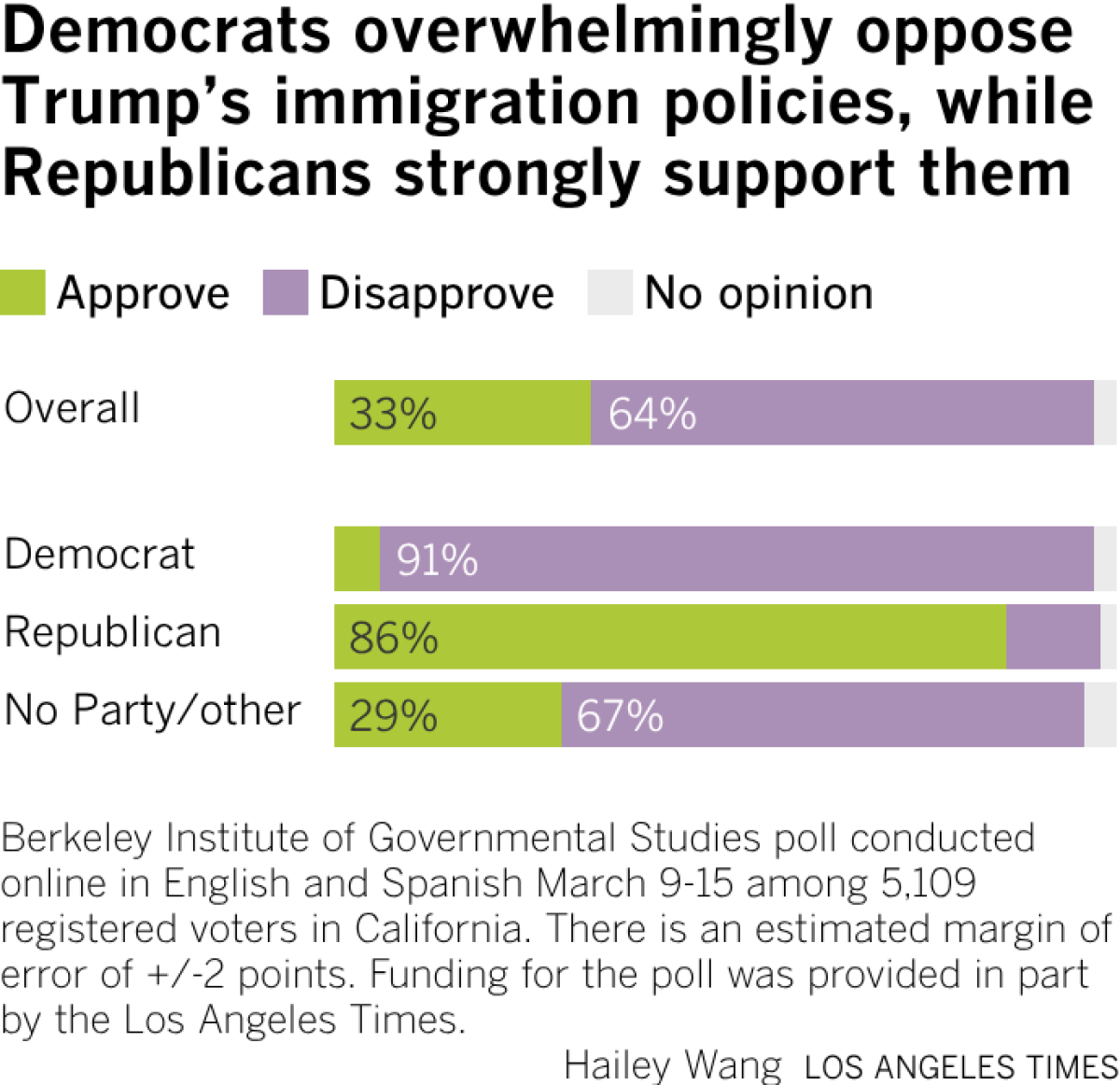
Two-thirds of California voters disapprove of President Trump’s immigration policies and a majority believe those policies are discriminating against Latinos, according to a new poll.

Nearly half of the voters said they were concerned that they, a family member or a close friend could be detained because of Trump’s immigration policies.

The findings of the UC Berkeley Institute of Governmental Studies poll, released Wednesday, show that most Californians haven’t budged on their thoughts about the president’s approach to immigration since he returned to office. A poll last August similarly showed strong disapproval of the Trump administration’s approach to immigration enforcement.

The poll, which was conducted for the Los Angeles Times, showed the usual division along party lines when voters were asked whether they trust the U.S. Border Patrol and Immigration and Customs Enforcement, whether agents should wear masks while on duty, and whether Latinos are being discriminated against.

“This suggests that a significant number of voters see ICE infringement on the individual rights of the undocumented as also potentially leading to broader infringements on citizens’ rights,” said G. Cristina Mora, co-director of the institute and a sociology professor at UC Berkeley who studies race and immigration.

“Latino voters also seem to particularly worry about the way that racism is motivating current immigration practices,” she said, which is likely tied to the Supreme Court’s approval of immigration agents detaining people on the basis of their perceived race, ethnicity, language or occupation.

The overall disapproval among voters of Trump’s immigration policies — 64% — was down a bit from the August poll, in which 69% of respondents said they disapproved of how immigration enforcement was being carried out in California.

Republicans appear to be more approving of immigration policies now, with 86% saying they approve of Trump’s immigration policies — up from 79% approval of enforcement in California last August.

Mora said the tilt among California Republicans toward the Trump administration could be due, in part, to the framing of the question, which asked about “President Trump’s immigration policies.”

Any time Trump’s name is included, Republicans are more likely to agree with him, she said. The same effect is seen when asking about other issues, such as the economy.

Another factor could be the timing, Mora said. Last summer, federal agents conducted widespread raids in Los Angeles before moving on to target other cities, such as Chicago and Minneapolis.

Now that the administration has shifted away from some tactics that resulted in escalations of violence, Republicans are “falling in line” again with the administration, she said.

“My hunch is it was shocking,” Mora said of the immigration raids last summer. “Things have normalized because the tension is somewhere else.”

Seeking to de-escalate after two protesters were shot and killed by federal agents in Minneapolis, the president tapped his border advisor Tom Homan to take control of the immigration enforcement operation there.

Republican strategist Ford O’Connell said that’s why voters are more supportive.

“Tom Homan being in charge and publicly taking a much lighter touch and appearing reasonable to the average voter is why you’re seeing this turnaround,” he said.

But Democratic strategist Maria Cardona said that that’s wishful thinking and that ICE’s approach hasn’t substantially changed.

“It only went down five points,” she said, referring to the disapproval of Trump’s policies. “That’s not the American people being on the side of the administration — it’s that they’re not seeing American citizens murdered on their screens every day.”

One question saw strong division among Republicans: Should immigration agents be allowed to enter the homes of suspected undocumented immigrants without a judge-approved search warrant?

Among California Republicans, 45% said no, 38% said yes, and 17% said they have no opinion.

O’Connell said that’s because Republicans strongly value civil liberties, especially around property.

Republicans were more strongly in favor of a different policy, allowing ICE agents to wear masks while on duty. While 91% of Democrats opposed the policy, 68% of Republicans favored it.

In the August poll, 45% of Republicans said federal agents should be required to show clear identification when carrying out their work. That desire for identification doesn’t appear to extend to being fully identifiable by face.

O’Connell said Republicans understand the concern over agents increasingly being doxxed.

“The administration wants to find a happy medium there, whether it’s a nameplate or a badge number,” he said. “There is wiggle room.”

Nearly 7 in 10 respondents said they want state and local authorities to intervene when they witness unlawful detentions or excessive use of force by federal immigration agents.

Voters were also asked about their level of concern that they, a family member or a close friend could be detained because of Trump’s immigration policies. While 85% of Republicans said they are not too concerned or not concerned at all, 63% of Democrats said they are somewhat or very concerned.

Overall, nearly half of the respondents, 45%, said they are somewhat or very concerned. Among racial and ethnic groups, 62% of Latino voters, 46% of Black voters and 43% of Asian or Pacific Islander voters said they are somewhat or very concerned.

“The Latino community has always wanted to think the best of this country and they still do,” Cardona said. “Our positivism, our optimism, our hope in a better future is second to none. I think that’s what you’re seeing in those numbers, even as our community feels totally attacked.”

Mora said the high concern among Black residents is notable because, while most Black Californians aren’t immigrants themselves, Los Angeles has one of the largest concentrations of Blaxicans — the children of one Black parent and one Latino parent.

Beyond intermarriages, Black residents in California are also likely to have immigrant friends or neighbors, she said.

O’Connell took a different view: “I don’t think we can glean anything from it other than how one party focuses more on identity politics than the other.”

The Institute of Governmental Studies poll was completed online in English and Spanish from March 9 to 15 by 5,109 registered voters in California.

Source link

World Men’s Curling Championships: Scotland beat Germany and South Korea, face China next live on BBC

After the China tie, Team Whyte, who are ranked in the world’s top five but are making their debut at this level, continue the round-robin against Norway (02:00). They conclude it with matches against the Swiss and Czech Republic on Thursday, with the tie with Switzerland available to watch on the BBC Sport website and app.

Whyte – along with Robin Brydone, Euan Kyle and Craig Waddell – are representing Scotland after world top-ranked rink Team Mouat elected not to compete after their silver medal at the Olympics in Cortina earlier this year.

The top six progress, with the top two going straight into the semi-finals and the other four teams competing to join them.

“We have two tough games [on Wednesday] in China and Norway,” said Whyte.

“Both teams seem to be playing quite well, so if we can try to come out firing and put in some good performances then that would be great to allow in the last stage to maybe get us two more wins and hopefully secure us the semi-final spot.

“However, there are a lot of teams around that area that could easily also get that semi-final spot, so there a lot of big games still to be played, but we are feeling positive.”

Source link

Which teams are in the FIFA World Cup 2026? | World Cup 2026 News

A breakdown of the teams and groups of the FIFA World Cup in Canada, Mexico and the US after the final playoffs.

Iraq’s qualification for the FIFA World Cup 2026 has completed the lineup of 48 nations for the tournament hosted by Canada, Mexico and the United States.

The Lions of Mesopotamia edged Bolivia 2-1 on Tuesday to win the second final of the FIFA Playoff tournament in Mexico. In the first final earlier, Democratic Republic of the Congo beat Jamaica 1-0.

Recommended Stories

list of 4 itemsend of list

In the other games, Turkiye, Bosnia and Herzegovina, Sweden and Czechia were the final four teams to complete the European quota of World Cup qualification.

Widely considered the most famous sporting event in the world, the 2026 FIFA World Cup will be its biggest ever. Forty-eight nations will play instead of the usual 32, with 104 matches in 16 venues across the three host nations.

Argentina will look to defend the trophy lifted by iconic captain, Lionel Messi at Qatar 2022. Cape Verde, Curacao, Jordan and Uzbekistan will make their debut.

The World Cup’s first game will be a throwback to 2010 when Mexico take on South Africa on June 11 in Mexico City in a replay of the tournament opener then. Football fans will hope the opening goal this year matches the screamer scored by Lawrence Tshabalala from the South African hosts then.

Mexico in group A – which includes South Korea and Czechia – will be one of the toughest of the 12 groups.

Team USA are alongside Australia, Paraguay and Turkiye.

Canada, too, face the challenging task of making it out of a group comprising Switzerland, Qatar and Bosnia.

Here’s a breakdown of the 48 teams in the 12 groups:

Group A:

  • Mexico
  • South Korea
  • South Africa
  • Czechia

Group B:

  • Canada
  • Switzerland
  • Qatar
  • Bosnia and Herzegovina

Group C:

  • Brazil
  • Morocco
  • Scotland
  • Haiti

Group D:

  • USA
  • Australia
  • Paraguay
  • Turkiye

Group E:

  • Germany
  • Ecuador
  • Ivory Coast
  • Curacao

Group F:

  • Netherlands
  • Japan
  • Tunisia
  • Sweden

Group G:

  • Belgium
  • Iran
  • Egypt
  • New Zealand

Group H:

  • Spain
  • Uruguay
  • Saudi Arabia
  • Cape Verde

Group I:

  • France
  • Senegal
  • Norway
  • Iraq

Group J:

  • Argentina
  • Austria
  • Algeria
  • Jordan

Group K:

  • Portugal
  • Colombia
  • Uzbekistan
  • DRC

Group L:

  • England
  • Croatia
  • Panama
  • Ghana

Source link

Spain strikes at 12 airports Wednesday update as unions say planes taking off with unloaded luggage

Aircraft also forced to take off without possessions, Spanish media report

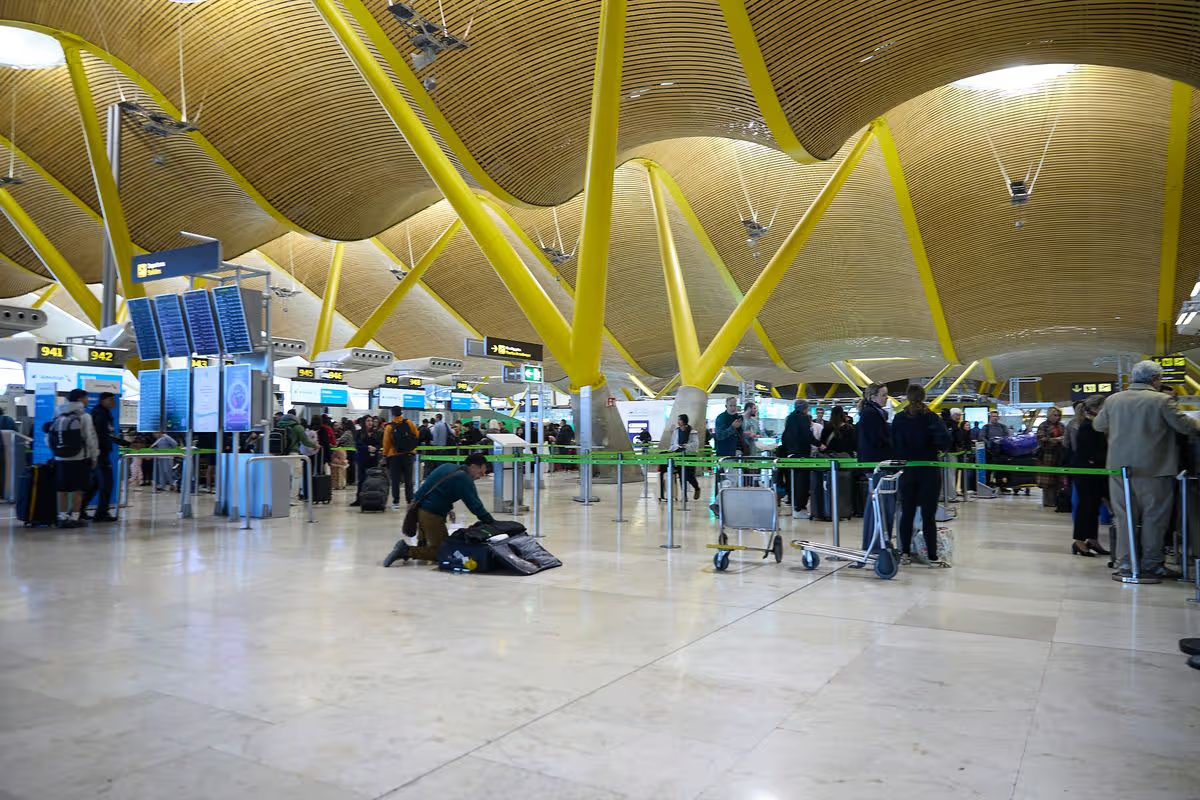
Spanish media have reported that luggage has been left behind or simply not been unloaded from aircraft as a massive strike across 12 airports continues in the run-up to Easter. After the second day of the indefinite strike called at 12 Spanish airports by Groundforce, at least six planes had to depart this Monday from Madrid-Barajas Airport without passengers’ luggage, ABC reported

The strike continues at Groundforce’s ground handling facility, a Globalia group company that provides services to the airports of Madrid, Barcelona, Palma de Mallorca, Alicante, Málaga, Gran Canaria, Valencia, Ibiza, Bilbao, Lanzarote, Fuerteventura, and air cargo in Zaragoza.

These work stoppages, called by the unions CCOO, UGT, and USO due to wage disputes with the company, are scheduled for Mondays, Wednesdays, and Fridays during the morning, afternoon, and night shifts – from 5 to 7am, 11am to 5pm, and from 10pm to midnight.

Some airports have had little disruption, Europress reported. Palma Airport was said to be operating almost as normal early on Wednesday morning, with isolated delays due to a ground staff strike.

Specifically, there have been two delays to departures and four delays to arrivals, according to information from Aena obtained by Europa Press. Ibiza Airport, which is also affected by the ground staff strike, has not reported any incidents.

READ MORE: Spain 12 airports strike Monday update on flights delayed as lawyer says ‘get there 3 hours early’READ MORE: Spain 12 airport strikes Tuesday update as aircraft take off ‘without luggage’

Union FeSMC-UGT said widespread impacts include widespread delays averaging nearly one hour per flight, flights left unattended, with essential ground handling services clearly overwhelmed, and cancellations, especially during peak hours.

They also claimed thousands of bags have been left unloaded or delivered late, generating an unprecedented logistical collapse.

A spokesman said: “All of this constitutes the epilogue to irresponsible management by the company, which has opted for conflict instead of dialogue. A company that, judging by the facts, seems to care very little about its workers, its customers, and the thousands of affected passengers.

“The current situation reflects a complete breakdown in labour relations and an unprecedented deterioration of the internal climate, with an uncertain future if there is no immediate change in attitude.”

Meanwhile, ground handling company Menzies, which provides services to airlines such as Norwegian, EasyJet, and Canaryfly in the Canary Islands, reached an agreement and called off a strike planned for April 2nd, 3rd, 4th, 5th, and 6th, coinciding with the peak days of Holy Week.

The strike, which had been called due to the company’s “organisational insolvency,” was going to affect approximately 3,000 of the group’s employees in Spain, 600 of them in the Canary Islands. It should be noted that the first days of the strike were scheduled for last Saturday and Sunday, but were cancelled due to the start of negotiations between the union representatives and the company.

Negotiations have concluded with an agreement between all parties, representing significant progress in labour rights and improved working conditions, thanks to the “constant effort and advocacy of UGT,” the union stated in a press release.

Source link

‘Death of a Salesman’ at Noise Within disappoints, ‘The Price’ thrives

When the world is topsy-turvy, the theatergoing public seeks explanations. Arthur Miller provides something better: moral intelligence. He doesn’t tell his audience what to think but challenges them to think harder.

There’s clearly a hunger right now for Miller’s work. His plays are back in high demand in Los Angeles, New York and London.

A new revival of “Death of a Salesman,” starring Nathan Lane and Laurie Metcalf, is in previews on Broadway. And a less starry production of Miller’s masterpiece opened last weekend at Pasadena’s A Noise Within.

“All My Sons,” Miller’s breakthrough play about capitalism’s warped ethics in the guise of a domestic drama, just finished a successful run at Antaeus Theatre Company in Glendale. And National Theatre Live will screen the recent London production, starring Bryan Cranston and Marianne Jean-Baptiste, in April and May courtesy of Boston Court Pasadena and L.A. Theatre Works. (Late last year, I caught a screening at the Wallis of another London revival, the 2019 production starring Bill Pullman and Sally Field.)

Dana Dewes and Scott G. Jackson stand in a living room in "The Price."

Dana Dewes and Scott G. Jackson in “The Price” at Pacific Resident Theatre in Venice.

(Ian Cardamone)

“A View From the Bridge,” a play whose revenge plot hinges on a tip to immigration authorities, could hardly be more timely. The same could just as unnervingly be said about “The Crucible,” Miller’s parable about the McCarthy witch hunts. The play, always front of mind when power is being abused, has given rise to a modern feminist riposte, Kimberly Belflower’s thrilling “John Proctor Is the Villain,” which is coming to the Mark Taper Forum next year.

Not to be missed right now is a small, exquisitely acted production of “The Price” at Pacific Resident Theatre. Miller’s 1968 play, written during the agonizing days of the Vietnam War, concerns the disposition of the remains of a once-illustrious estate. As two estranged brothers working with an 89-year-old appraiser try to put a price on the antiques and personal effects their father — a casualty of the Great Depression — left behind, the family history they both tried to bury explodes.

Miller’s plays compel theatergoers to connect the dots not only between the past and the present but also between the political and the personal. His dramas set domestic conflicts against the backdrop of societal systems that insidiously warp the playing field for their characters.

Miller is often contrasted with Tennessee Williams. And while it’s true that Miller is more of a social realist and Williams is more of a dramatic poet, Miller’s carefully carpentered plays are emotionally supple and Williams’ lyrical dramas are acutely mindful of the power dynamics of our collective life.

Jason Huber, Dana Dewes and Scott G. Jackson stand in a living room in "The Price."

The realism of “The Price” is as heavy as the old wooden furniture that the Franz brothers, Victor (Scott G. Jackson) and Walter (Jason Huber), are trying to profitably offload.

(Ian Cardamone)

Director Elia Kazan was drawn to both playwrights because he understood that they were as interested in the stories of individual Americans as they were in the larger tale of America itself. Kazan found in both writers more than enough poetry and grit to satisfy the new breed of realistic actor he was showcasing on stage and screen.

“Death of a Salesman” and “The Price” are vastly different plays. The former, which Miller once considered calling “The Inside of His Head,” is fluidly constructed, playing fast and loose with time as it tracks the disintegrating mental life of down-and-out salesman Willy Loman. “The Price,” by contrast, is set inside what looks at first glance to be a crowded antique shop but turns out to be the apartment once inhabited by the Franz family after the market crash changed everything.

The realism of “The Price” is as heavy as the old wooden furniture (stacked and sorted on Rich Rose’s eye-catching set) that the Franz brothers, Victor (Scott G. Jackson) and Walter (Jason Huber), are trying to profitably offload on a shrewd antique dealer named Gregory Solomon (Richard Fancy). “Salesman” is more limber in its dramaturgy, shifting locations and blurring chronologies. But it too depends on the ability of actors to embody the biographical weight of its finely detailed characters.

Richard Fancy and Scott G. Jackson in "The Price."

Arthur Miller’s 1968 play “The Price,” written during the Vietnam War, concerns the disposition of the remains of a once-illustrious estate.

(Ian Cardamone)

“The Price,” directed by Elina de Santos, thrives in the intimacy of Pacific Resident Theatre’s main stage. There’s not a moment in the play that isn’t deeply inhabited by a cast that understands the value of listening.

The drama builds toward a confrontation between Victor, a cop who dropped out of college to support his dad, and Walter, a wealthy doctor who made no such sacrifices and resents the guilt that he’s spent a lifetime trying to elude. Miller gives both characters some claim on the truth, making the twisting argument that breaks out between the brothers enthralling to follow.

But just as insightfully handled are the complicated emotional dynamics between Victor and his wife, Esther (Dana Dewes), who is frustrated by her husband’s resignation and blunted ambition but loyal to him and prepared to fight for his due. As for Solomon, the scene-stealing appraiser who dispenses old world wisdom while toting up an estimate for the furniture haul in between bites of a hard-boiled egg, is deliciously brought to life by Fancy, who has starred in both “All My Sons” and “Death of a Salesman” at PRT and enlivens this production with his veteran experience.

I saw “The Price” on Sunday after having been dismally disappointed at the Saturday night opening of “Death of a Salesman” at A Noise Within. That production, directed by Julia Rodriguez-Elliott, seems completely deracinated on a set by Frederica Nascimento that registers no Brooklyn ZIP Code or locatable address anywhere.

Deborah Strang, Ian Littleworth, David Nevell and Geoff Elliott in "Death of a Salesman."

Deborah Strang, Ian Littleworth, David Nevell and Geoff Elliott in “Death of a Salesman” at A Noise Within.

(Craig Schwartz)

But the bigger problem is that the performances are ungrounded. Geoff Elliott, who shares the title of producing artistic director at A Noise Within with wife Rodriguez-Elliott, doesn’t so much play Willy Loman as try on various accents, none of them remotely convincing to this native Brooklynite. Are the Lomans meant to be Irish immigrants or is that a Boston dialect that is being affected when the cartoonish New Yorkese takes a breather?

The house needn’t be fleshed out to be made to seem real, but since it plays such an important role in the play, its presence onstage ought to at least be palpable to the characters. At one point near the play’s tragic climax, Willy is feverishly planting seeds in the backyard, but Elliott gives no credibility to any of his character’s actions. Willy might as well be delivering newspapers or mopping the kitchen floor, so disconnected are his gestures.

It’s true he’s not in his right mind, but it’s just another instance of the casual disregard of the character’s moment-to-moment reality. Willy’s world never comes into being onstage, and the rest of the cast seems to wander in the limbo that’s left behind.

Geoff Elliott and Deborah Strang in "Death of a Salesman."

“Death of a Salesman” is more limber in its dramaturgy, shifting locations and blurring chronologies.

(Craig Schwartz)

As Linda Loman, Deborah Strang, normally so reliable, tries to follow the lead of husband Willy, but that turns out to be a dead end. Ian Littleworth’s Happy, the dissolute son always looking for an easy way out, seems unsettled not only in his bearings but in his command of the script.

David Kepner’s Biff, the prodigal son who rediscovers the reasons he ran off in the first place, delivers the most centered performance. It’s at least possible to believe what his character is supposed to be feeling, but the placelessness of the production doesn’t give him enough to dig into. The emotional combustion of his climactic scenes with Willy fail to reach cathartic levels.

Still, I found myself listening attentively to the warning Miller was issuing about buying into the salesman ethos. Willy’s belief that good connections matter more than skill and that blarney and bluff can substitute for hard work explains a good deal about our current national disorder.

David Kepner and Ian Littleworth in "Death of a Salesman."

David Kepner, who delivers the most centered performance, and Ian Littleworth in “Death of a Salesman.”

(Craig Schwartz)

But Miller’s dramatic vision requires actors to relive the experiences of their characters, the way they do in De Santos’ production. “The Price” might not be an indisputable masterpiece like “Death of a Salesman,” but its solid construction reveals tremendous complexity when the human story is scrupulously observed and the societal forces shaping our lives are suddenly thrust into view.

‘The Price’

Where: Pacific Resident Theatre, 703 Venice Blvd., Venice

When: 8 p.m. Thursdays to Saturdays, 3 p.m. Sundays. (Check for exceptions). Ends May 11

Tickets: $45

Contact: (310) 822-8392 or https://app.arts-people.com/index.php?show=302016

Running time: 2 hours, 30 minutes (including intermission)

‘Death of a Salesman’

Where: A Noise Within, 3352 E Foothill Blvd., Pasadena

When: 7:30 p.m. Thursdays to Fridays, 2 and 7:30 p.m. Saturdays, 2 p.m. Sundays. Ends April 19

Tickets: Start at $41.75

Contact: anoisewithin.org or (626) 356-3100

Running time: 2 hours, 45 minutes (including intermission)

Source link

Contributor: Investigate the AI campaigns flooding public agencies with fake comments

California built its tradition of open government — including for citizen boards that set the rules for such functions as automotive repair and security guard licensing — precisely to keep well-funded corporate interests in check. Lobbyists and special interests are constantly scheming to defeat the will of the majority. Now they are able to do more damage using artificial intelligence to simulate fake grassroots opposition to clean air measures, and they are surreptitiously using the identities of real people to deceive regulators.

Last June, the South Coast Air Quality Management District received more than 20,000 comments opposing a pair of clean air rules that would have prevented 2,500 premature deaths and 10,000 new cases of asthma. A February investigation by the Los Angeles Times revealed that those comments were submitted through CiviClick, a Washington-based AI-powered comment generation platform, orchestrated by a local political consultant with ties to the natural gas industry. When the district’s cybersecurity team reached out to a small sample of commenters to verify their identities, a majority of respondents said that they had not submitted the comments in their names.

Even so, the flood of fake comments seemingly worked. These rules, vehemently opposed by the natural gas industry, already watered down by the district to near-toothlessness, were ultimately rejected by the board — apparently overwhelmed by the flood of fake opposition to even the mildest effort to limit pollution from gas-burning appliances.

This Southern California campaign was not an isolated incident. A recent investigation by the San Francisco Chronicle also revealed that an industry front group used Speak4, a platform that advertises its use of AI, to submit dozens of comments regurgitating talking points from the fossil fuel industry in an attempt to weaken and delay clean air rules in the Bay Area. The scheme was exposed when 10 residents whose identities were used on these emails said they absolutely did not send them, calling the messages “forged.”

In both cases, organizations submitted emails and comments to regulators using real people’s identities without their knowledge or consent. This playbook has been employed in other states: CiviClick was used by fossil fuel companies to support a gas-pipeline-expansion project in North Carolina last year. When elected officials reached out to a few respondents to verify the messages, some constituents stated they had no knowledge of the emails sent under their names.

The opposition campaign to South Coast’s clean air rules was run by one of the state’s most powerful lobbying firms. Its client list includes Sempra, the parent company of SoCalGas, which opposed the clean air standards, which would have encouraged the sale of pollution-free heat pumps and threatened the utility’s business.

The industry front group using AI to undermine clean air rules in the Bay Area, Common Sense Coalition, also has ties to fossil fuel companies. Common Sense Coalition is a project of the Bay Area Council, a local business group that features members such as the Western States Petroleum Assn., Chevron, Martinez Refining Co. and Phillips 66.

The question of whether fossil fuel interests financed astroturf AI campaigns to defeat clean air rules should be answered through full investigations, which also ought to address whether the campaigns committed fraud and identity theft.

Californians deserve to know what is going on — how AI was used, where the lobbyists got the names and addresses they attached to the robo-messages and who paid for the deceptive campaigns. What’s most concerning is the use of actual residents’ identities — without their knowledge or consent — to oppose life-saving clean air standards.

Top law enforcement officials should be investigating — including Atty. Gen. Rob Bonta, Los Angeles Dist. Atty. Nathan Hochman and San Francisco Dist. Atty. Brooke Jenkins.
If the law on using a person’s name in a scheme to thwart action by a public agency is not clear enough to support prosecutions, then the law needs to be tightened up — and there is legislation, Senate Bill 1159, aiming to do that.

If this seems like a niche issue, I can assure you it is not. I spent 17 years at the helm of the California Air Resources Board, and I am deeply disturbed by the potential co-opting of public input processes using forgery through automated tools. Gathering public input is fundamental to the legitimacy of regulatory agencies.

We frequently heard from individuals or business associations concerned about the cost or burden of proposed regulation, and we worked hard to understand and tailor our rules to make them as streamlined and cost-effective as we could, while still making progress toward reducing the air and climate harms of a wide array of equipment and activities.

The destruction of meaningful public input through deceit isn’t just an environmental issue; it’s a democracy issue — and it demands urgent attention and accountability. California should draw the line to protect our democratic institutions.

Mary Nichols was chair of the California Air Resources Board, where she occupied the attorney seat. She is distinguished counsel to the Emmett Institute on Climate and Sustainability at UCLA Law School.

Source link

Cost of holidays to go up from today after new tourist tax on flights

HOLIDAYS are getting more expensive from today with a rise in Air Passenger Duty (APD).

ADP, first introduced in 1994, is the ‘tax’ that passengers have to pay when flying from the majority of UK airports, which is built into the cost of flights.

Going on holiday is getting more expensive from todayCredit: Alamy
Air Passenger Duty has increased from today – and will go up again this time next yearCredit: Alamy

From today, the rates have increased, and how much you pay depends on the final destination and the class of travel.

Band A is any destination abroad whose capital city is 2,000 miles or less from London, which covers all of Europe and parts of North Africa.

For example, flying in economy to a short-haul destination like Spain, Greece or Portugal has some of the lowest rates from £15.

A family of four could therefore expect to pay £60 under the new rules if travelling in economy.

DIG IN

We found 20 of the cheapest all-inclusive hotels for summer… with breaks from £349pp


GET IT BOOKED

The ‘cheap luxury’ beach resorts under 4 hours from UK with breaks from £75pp

However, this can go up to £32 per passenger depending on the class they are flying in.

When flying further afield, or in a premium economy or higher, the tax goes up.

Band B is any destination whose capital city is 2,001-5,500 miles from London, so long-haul destinations such as Egypt or the Maldives.

These range from £102 to £244 – so it would be £408 for a family of four in economy flying to resort towns like Sharm El Sheikh.

Band C is for destinations whose capital city is over 5,500 miles from London.

These include Bangkok, Singapore, Hong Kong, Tokyo, Buenos Aires and all Australia.

The rates range from £106 to £253 – meaning it could be more than £1,000 for a family of four at the top rate.

There is an even higher rate which in line with Band C can be as high as £1,141 – but this applies to private jets.

UK domestic flights range from £8 to £16 depending on class.

The government will review the rates of APD again on April 1, 2027.

The new APD rates can range from £8 to £1141Credit: gov.uk

There aren’t many ways to avoid paying APD, but if you still want to go abroad and avoid the extra fee, there are a few ways to do so.

Passengers under 16 who are travelling in basic economy are exempt from paying APD – although if they fly premium economy or above, they will be charged.

One is to fly into the UK on one plane and out within 24 hours on another.

But you need to have them both included in the same ticket.

Or, fly on a route from a UK airport that is not subject to APD.

Scottish Highlands and Islands region are exempt like Inverness, Oban, Sumburgh and Stornoway.

Direct long-haul flights from Northern Ireland are also exempt as long as the first part of the journey is to a destination not in the UK or in Band A.

When the departure tax was first introduced, it was just £5 European flight and £10 on long-haul services.

For how to save money on holiday, TUI expert reveals how to save hundreds on the same break – as well as the little-known money saving tool.

And from someone who has travelled to 41 countries – the simple hotel trick that saved my family of four hundreds.

Holidays are getting more expensive for Brits from todayCredit: Alamy

Source link

New Zealand’s Amelia Kerr hits 179 not out against South Africa in record women’s ODI chase

New Zealand all-rounder Amelia Kerr hit a stunning 179 not out off 139 balls to inspire her side to chase down 346 against South Africa in the highest successful run chase in women’s one-day international history.

Laura Wolvaardt’s 69 from 74 balls, a 91 from 90 balls by Anneke Bosch and Chloe Tryon’s 25-ball 52 helped South Africa post 346-6 in the second ODI of their series against the Kiwis.

Kerr came in at 21-1 in New Zealand’s reply and struck 23 fours and one six at a strike rate of 128.78 during her match-winning knock.

She was helped by Izzy Gaze, who made 68 from 48 balls, as the Kiwis made 350-8 in reaching their target with two balls to spare and levelling the series.

The previous highest successful chase in women’s ODI cricket was when India made 341-5 in reaching a 338 target set by Australia in their World Cup semi-final last October.

Kerr is no stranger to producing heroics, especially against South Africa, as she inspired New Zealand to victory against them in a T20 World Cup final in 2024.

She was also the ICC’s women’s cricketer of the year in 2024.

Kerr also holds the record for the highest individual innings in a women’s ODI, having hit an unbeaten 232 against Ireland when aged 17 in 2018.

Source link

New restaurants and pop-ups to try in Los Angeles in April 2026

Spring has sprung in Los Angeles. In just a couple weeks, thousands of music lovers will make the trek to Indio’s Empire Polo Club for the Coachella Valley Music & Arts Festival, with dozens of L.A. chefs joining them. While in the desert, many festival goers take a detour through neighboring Palm Springs to explore museums, restaurants and bars before the dry climate climbs into the triple digits.

Closer to home, Los Angeles’ food scene is mourning the loss of two legendary haunts forced to permanently close their doors. After months of extensions, Cole’s French Dip closed at the end of March, though owner Cedd Moses said he was still hopeful that the city’s longest-running public house and rumored creator of the French dip sandwich would sell to a new owner. In Echo Park, Taix restaurant closed after 99 years of operation to make way for a six-story housing complex.

But it’s not all bad news for local restaurants. In Melrose Hill, a Bangladeshi chef has returned to the kitchen after a two-decade-long break from the industry. Across town, a viral smashburger spot from a celebrated chef is drawing lines for its juicy Wagyu patties. And for those heading to the desert, restaurant critic Bill Addison insists a modern Mexican pop-up is worth the weekday trip. Here are 13 places to put on your dining agenda this month:

Source link

US messages via Witkoff and intermediaries are not negotiations: Araghchi | US-Israel war on Iran

Iran’s foreign minister says message exchanges continue with Washington, but insists there are no negotiations, and no trust.

Iran’s Foreign Minister Abbas Araghchi tells Talk to Al Jazeera that Iran is not negotiating with the United States, despite ongoing exchanges of messages, including direct communication from US envoy Steve Witkoff.

Araghchi says talks lack trust, adding that no response has been given to US proposals, and that there is no basis for negotiations. Araghchi outlines Iran’s conditions for ending the war, warns against threats and deadlines, and signals a readiness to continue defending the country as regional tensions escalate.

Source link

‘An incredible feeling’: Turkiye beat Kosovo to end 24-year World Cup wait | Football News

Turkiye secure a return to football’s biggest tournament for the first time since 2002, when they finished third.

When Turkiye finished third at the 2002 World Cup, few Turkish fans thought it would be almost a quarter of a century before their side’s next appearance at football’s showcase event.

So Turkiye’s qualification for World Cup 2026 on Tuesday was greeted with joy and a fair amount of relief, with a tense 1-0 playoff win at Kosovo prompting wild celebrations among the players and the 700-strong travelling support.

Recommended Stories

list of 4 itemsend of list

Back in Turkiye, people took to the streets in celebration, with many hanging out of honking cars and waving flags.

Turkiye rode their luck at times during the game at the Fadil Vokrri Stadium in Pristina, but emerged victorious thanks to a 53rd-minute goal from Kerem Akturkoglu, who poked the ball home from close range after Kenan Yildiz’s cross was turned into his path by Orkun Kokcu.

“Thank God. It has been ⁠24 years. Some of us were not even born the last time we qualified, and some were too young to remember. We always dreamed of moments like this,” Akturkoglu told the Turkish media.

“We talked about 2002 and the success there; we always dreamed of it. Most of us don’t even ‌remember 2002. Now we will give the next generation something to dream about at the 2026 World Cup. We want to make our country proud,” he added.

Translation: We can’t find the words to describe the beauty of this video! The one thing we’ll say is that we deserved it, and we are in the World Cup!

Turkiye have only appeared at the FIFA World Cup on two occasions. In 1954, they exited in the group stage, while in 2002 they beat cohosts Japan en route to a narrow 1-0 semifinal defeat to eventual champions Brazil.

Hakan Sukur scored just 11 seconds into the third-place playoff to score the fastest World Cup goal in history as Turkiye went on to beat the other cohosts, South Korea, to win the bronze medal.

Since then, Turkiye, currently 22nd in FIFA’s world rankings, have endured a series of near World Cup qualification misses and playoff losses.

Hopes were high among Turkish fans for this campaign as coach Vincenzo Montella had a particularly talented squad at his disposal, featuring a blend of emerging young stars such as Real Madrid’s Arda Guler and the Juventus forward Kenan Yildiz, alongside more seasoned players such as captain Hakan Calhanoglu.

“I am incredibly proud,” Montella told Turkish state news agency Anadolu.

“I wouldn’t ⁠change my players for a thing. Anyone who does this job ⁠dreams of the World Cup. I am incredibly grateful to my players. We have achieved our dream.

“It is an incredible feeling, I cannot describe it in words. The World Cup ⁠is the pinnacle.”

Australia, Paraguay and cohosts the United States await Turkiye in Group D of the World Cup, which is also being hosted by Canada and Mexico.

While Turkiye have appeared in several European Championships over the last two decades – including a run to the semifinals at Euro 2008 – those tournaments pale in significance to the World Cup.

Turkish Football Federation President Ibrahim Haciosmanoglu had even said Montella would be granted Turkish citizenship if his side qualified for the 2026 edition, which the Italian coach mentioned during his post-match media conference.

“I feel like a Turk, I think like a Turk in every step I take. The passport is just a formality for me, I am always like a Turk,” he said.

It is clear that Montella is beloved by his players, who mobbed him in celebration and drenched him in water during the media conference.

Montella also had some kind words for Kosovo and congratulated them on a fierce performance that pushed Turkiye to their limits.

“We are two friendly countries,” he said. “I wish we could have gone to the World Cup together, but they put up an incredible fight.”

Translation: A classic news conference!

Source link

Why is Paul Anderson not in The Immortal Man?

Peaky Blinders fans were left baffled over Arthur Shelby’s glaring absence.

Peaky Blinders’ Arthur Shelby actor has finally opened up about his absence from The Immortal Man.

Peaky Blinders: The Immortal Man is on Netflix and the follow-up film explores Tommy Shelby’s (played by Cillian Murphy) redemption arc as he attempts to right his wrongs.

The Peaky Blinders film, which sees Barry Keoghan star as Tommy’s son Duke Shelby, focuses on the father and son relationship as Duke begins to head down a dangerous path.

Tommy, reluctant to return to his family, is forced to face the demons of his past following an unprecedented tragedy and viewers discover some hidden secrets about Tommy’s life in the events between the series and the film.

The film begins with Tommy living away from his family in a derelict mansion, which features a graveyard he regularly visits.

Viewers were shocked to see Arthur Shelby’s name written on one of the gravestones, and here is all you need to know about actor Paul Anderson’s absence.

Why is Paul Anderson not in The Immortal Man?

Arthur Shelby was last seen in season six of the flagship series, while he was battling an opium addiction following a relapse.

Paul Anderson played Arthur in all six seasons of the show, and is one of only three stars to have appeared in every episode, besides Cillian Murphy and Sophie Rundle.

Anderson opened up on the film and his absence to LADbible, explaining: “Well, what can you do eh? It is how it is. I thought I’d just leave them to it. I think it’s great. I [wasn’t] very nice to people in it [the series]. But people loved me.”

Creator Steven Knight said there were no plans to bring Anderson back, telling The Hollywood Reporter his character had been written out of the film.

He explained: “What I’ll say is that the story determines the cast, and the story was set. I knew that Tommy needed to have done something that he couldn’t forgive himself for.

“Therefore, that’s why the plot went in that particular direction. But in terms of Paul, all I’ll say is that he’s a fantastic actor.”

Get Netflix free with Sky

This article contains affiliate links, we will receive a commission on any sales we generate from it. Learn more
Content Image

£5.99

£0

Sky

Get the deal here

Sky is giving away a free Netflix subscription with its new Sky Stream TV bundles, including the £15 Essential TV plan.

This lets members watch live and on-demand TV content without a satellite dish or aerial and includes hit shows like Stranger Things and The Last of Us.

What happened to Arthur Shelby in Peaky Blinders: The Immortal Man?

In the sequel film, Tommy was seen living in isolation as he was haunted by the ghosts of his past, including his brother, Arthur.

He often visited his brother’s grave, though it was not mentioned for a long time how his brother really died.

At first it was suggested he had died by suicide, but by the end of the film Tommy revealed what really happened as a flashback played out on screen.

He explained how he had killed his own brother in a drunken fit of rage, while they were both in a car together.

Tommy was seen strangling Arthur during a struggle, which ended with Arthur laying lifeless and Tommy almost instantly regretting his actions.

Peaky Blinders: The Immortal Man is on Netflix

Source link

Justices uphold life, no parole for some juvenile offenders

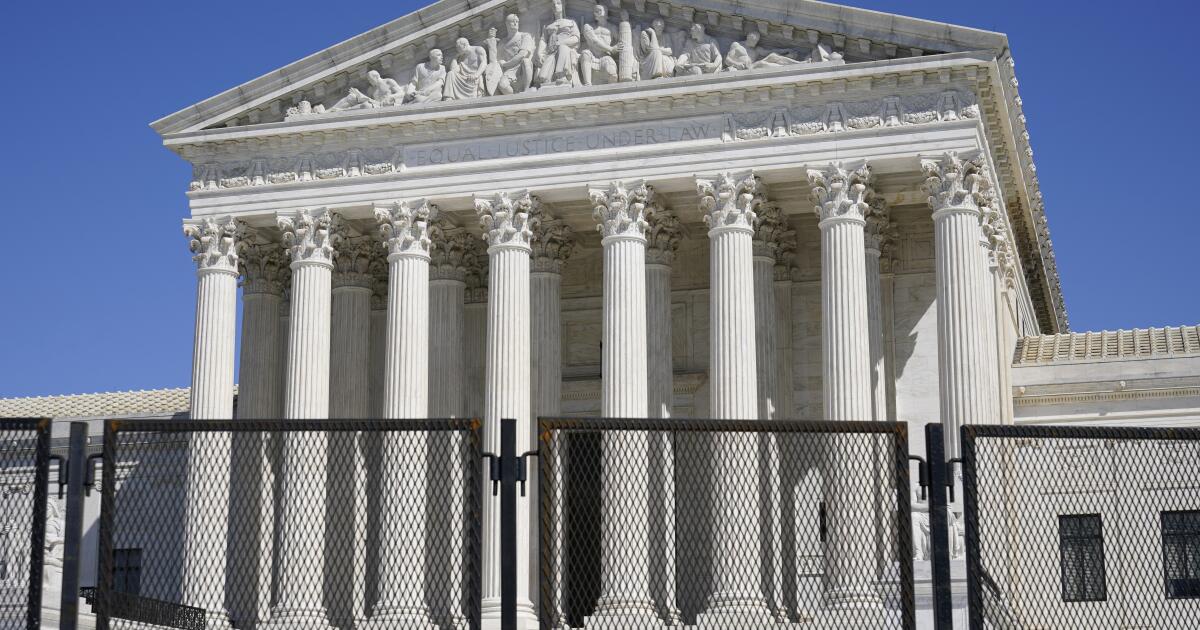
The Supreme Court on Thursday upheld a life term in prison without parole for a defendant who was 15 when he fatally stabbed his grandfather in Mississippi, ruling that a sentencing judge need not decide that the young person was “permanently incorrigible.”

The 6-3 decision retreats somewhat from a pair of earlier rulings, which said that such life sentences for minors convicted of murder should be extremely rare and limited to cases in which there was no reason to hope the young person could be rehabilitated.

California and 24 other states have abolished life terms with no hope for parole for offenders under 18. But Justice Sonia Sotomayor said such prison terms remain shockingly common in parts of the Deep South, particularly for young people of color.

As of last year, “Louisiana had imposed LWOP [Life Without Parole] on an astonishing 57% of eligible juvenile offenders” since 2012, when the court called for restricting such sentences, she said. In 2016, the court gave these inmates a chance to seek a new sentence with possible parole, but the Mississippi courts have rejected one-fourth of such appeals, she said.

“The harm of from these sentences will not fall equally,” Sotomayor added. “The racial disparities in juvenile LWOP sentencing are stark: 70% of all youth sentenced to LWOP are children of color,” she said, citing a study from the Juvenile Law Center.

Five years ago, the court gave new hope to the more than 2,000 inmates who had been sentenced to life terms for crimes they committed as minors. The justices said they had a right to seek a new sentencing hearing and possible parole in the future. But the court’s opinion did not say precisely what judges must consider in deciding such cases.

At issue Thursday was whether the defendant’s life term with no parole should be set aside unless the judges concluded he was “incorrigible” and could not be rehabilitated.

The justices divided along ideological lines, with the six conservatives in the majority and the three liberals in dissent.

Justice Brett M. Kavanaugh, speaking for the court in Jones vs. Mississippi, said judges are required to weigh the defendant’s age as a mitigating factor before imposing a punishment for a homicide. “The court’s decision today carefully follows” the earlier rulings, which did not prohibit such life terms, he said. Kavanaugh added that the sentencing decision remains in the hands of the judge who heard the case, and the judge need not go further and decide the defendant was beyond redemption.

“Today the court guts” its earlier rulings restricting such life terms, Sotomayor said in a sharp dissent for three liberals. She noted that one of the decisions held that “a lifetime in prison is a disproportionate sentence for all but the rarest children, those whose crimes reflect ‘irreparable corruption.’”

The outcome reflects the retirement of Justice Anthony M. Kennedy and the death of Justice Ruth Bader Ginsburg. Kennedy had repeatedly spoken out against harsh punishments for juvenile offenders, and he wrote the court’s ruling that ended capital punishment for them, as well as those that limited the circumstances for imposing life prison terms on those under 18.

Sotomayor said Thursday’s ruling means that even if a “juvenile’s crime reflects ‘unfortunate yet transient immaturity’, he can be sentenced to die in prison,” quoting a passage from Kennedy’s earlier opinion. Justices Stephen G. Breyer and Elena Kagan joined the dissent.

The case before the court began in 2004 when Brett Jones, age 15, was living with his grandparents Bertis and Madge in a small town in northern Mississippi. He and his grandfather exchanged angry words when it was learned that Jones’ girlfriend was in a bedroom upstairs. The two later fought in the kitchen, and the teenager stabbed his grandfather and fled.

He was convicted of the murder and at the time, state law mandated a sentence of life in prison without parole.

The Supreme Court overturned such mandatory sentences in 2012 and ruled in 2016 inmates may seek a new and lesser sentence. But a judge decided the life term was the proper sentence for Jones, and that decision was upheld by the state courts.

In upholding the sentence, Kavanaugh said such sentencing decisions should remain in the hands of judges who can weigh all the facts. Moreover, “our holding today does not preclude the states from imposing additional sentencing limits in cases involving defendants under 18 convicted of murder,” he said. “States may categorically prohibit life without parole for all offenders under 18. Or states may require sentencers to make extra factual findings before sentencing an offender under 18 to life without parole.”

Source link

What Wales need to stop World Cup heartbreak hitting Euro 2028 hopes

Having done more than most to step into the boots of talisman Gareth Bale, Harry Wilson still has time on his side.

The forward, who has scored 17 international goals, will be 31 when the Euros come around and there is no real reason why he cannot build on the brilliant form he has shown this season.

With Wilson being tipped to leave Fulham at the end of his contract this summer, Wales and Bellamy will cross fingers he picks the right club from what is expected to be a lengthy list of suitors.

Former England captain Wayne Rooney recently suggested Wilson fitted Fulham perfectly and wondered whether he would get lost at one of the Premier League’s top clubs.

It would be natural for Liverpool academy graduate Wilson to want to test himself at the highest level possible, but Wales will certainly want to feel the benefit of him being a certain starter with his club side.

Where Harry heads might well be significant.

Source link

MORE holiday flight cancellations loom next month as fuel shortages to ramp up, Ryanair boss warns

RYANAIR boss Michael O’Leary has warned jet fuel supplies could be disrupted in May as the war in Iran chokes off global oil routes.

The budget airline kingpin warned that holidaymakers could face a summer of uncertainty if the Middle East war continues to throttle global oil routes.

: Ryanair AGM in Dublin
Michael O’Leary revealed that while Ryanair is “reasonably well hedged” on 80% of its fuel, the company is being forced to shell out nearly double for the remaining 20%.Credit: Reuters
A Ryanair airplane in flight against a cloudy blue sky.
O’Leary confirmed the airline is paying around $150 a barrel for the unhedged portion of its suppliesCredit: Splash

Prices have spiralled since the outbreak of fighting at the end of February, with Iran blocking vital tankers from passing through the Strait of Hormuz.

Speaking to Sky News, the airline chief revealed that while Ryanair is “reasonably well hedged” on 80% of its fuel, the company is being forced to shell out nearly double for the remaining 20%.

O’Leary confirmed the airline is paying around $150 a barrel for the unhedged portion of its supplies.

The outspoken boss warned that while rising costs are a major headache, the more “immediate concern” is whether there will be enough fuel to keep planes in the sky.

TRAVEL ADVICE

Is it safe to travel to Turkey? Latest holiday advice and flight news


BAGGED UP

Airlines are now hiking luggage fees due to soaring fuel costs

He admitted that the industry is at the mercy of the conflict and the ongoing blockade of the world’s most important shipping passage.

“Fuel suppliers are constantly looking at the market. We don’t expect any disruption until early May, but if the war continues, we do run the risk of supply disruptions in Europe in May and June, and we hope the war will finish sooner than that and the risk to supply will be eliminated,” he said.

O’Leary calculated that the threat to the airline’s operations is now a very real possibility for millions of passengers planning their early summer getaways.

He warned that there is a “reasonable risk” that between 10% and 25% of supplies could be at risk through May and June, adding that like everyone else in the industry, he hopes the war ends sooner rather than later.

The Ryanair chief made it clear that the fate of the summer season rests on the reopening of the Strait of Hormuz.

He stated that if the war finishes by April and the shipping lane reopens, then there is “almost no risk to supply.”

Despite the looming threat of shortages, O’Leary struck a defiant tone regarding his own flight schedule.

He told Sky News that he does not expect to cancel any flights, even as some of Ryanair’s rivals struggle to cope with the volatile market.

However, the pressure on the industry is mounting across the board.

EasyJet boss Kenton Jarvis has already sounded the alarm for passengers’ wallets, warning that European consumers should expect higher ticket prices towards the end of summer when existing fuel hedges come to an end.

So far, a number of airlines have already said they will be raising the cost of flights due to the fuel crisis.

Cathay Pacific, AirAsia and Thai Airways are just some that are increasing fares, along with Air New Zealand.

United Airlines said it could eventually see fares increase as much as 20 per cent.

Other airlines have said they are cancelling flights altogether.

United Airlines confirmed that it would be cutting five per cent of flights for the next few months, which works out to around 250 a month.

Air New Zealand has cancelled 1,100 fights, affecting 44,000 passengers, while Scandinavian airline SAS also cancelled 1,000 flights.

Source link

Iran attacks cause fire in Kuwait, Bahrain; kill man in UAE | US-Israel war on Iran News

Shrapnel from an Iranian drone interception kills a Bangladeshi national in the UAE’s Fujairah city.

Iran’s drones have hit fuel tanks at Kuwait’s international airport, causing a large blaze, and authorities in Bahrain have reported a fire at an undisclosed company facility, as the United States-Israel war on Iran continues for a fifth ⁠week.

Abdullah al-Rajhi, a spokesman for the General Directorate of Civil Aviation in Kuwait, on Wednesday said the airport had been subjected to “brazen attacks by drones from Iran and the armed factions it supports”.

Recommended Stories

list of 3 itemsend of list

The raids targeted fuel tanks at the airport, “leading to a large fire breaking out at the site”, al-Rajhi was quoted as saying by the official Kuwait News Agency (KUNA).

Emergency teams were on site, and “the damage is material with no human injuries,” he said.

Bahrain’s Ministry of Interior said civil defence crews were “extinguishing a fire in a facility of a company as a result of the Iranian aggression”.

“Relevant authorities are taking their measures at the site,” it added, without naming the company.

Vessel hit

A tanker was ‌hit by an unknown projectile near the Qatari capital Doha, causing damage to the hull at the waterline, the United Kingdom Maritime Trade Operations said, adding the crew were safe.

The vessel was struck about 17 nautical miles (equivalent to about 32km) north of Qatar’s Ras Laffan industrial hub, the country’s main gas production facility, which was hit by Iranian missiles last month, causing significant damage.

Confirming the incident, Qatar’s Ministry of Defence said the country was targeted by three cruise missiles launched from Iran, one of which struck an oil tanker.

In a post on X, the ministry said it intercepted two of the missiles, while the third hit a tanker leased to QatarEnergy. The tanker’s 21-person crew was evacuated, the ministry said. No injuries were reported.

In the United Arab Emirates (UAE), the official WAM news agency said shrapnel from a drone interception fell on a farm in the al-Rifaa area of Fujairah city and killed a Bangladeshi national. It said authorities were dealing with the incident.

Saudi Arabia’s Ministry of Defense said several drones were “intercepted and destroyed”, without reporting any injuries.

The oil-rich Gulf has borne the brunt of Iran’s attacks in response to the US-Israeli air strikes on the country.

Iran has claimed to be attacking US assets in the region, but Gulf nations say Tehran has targeted civilian infrastructure.

On Tuesday, a United Nations Development Programme (UNDP) report said gross domestic product (GDP) in the Arab world was estimated to decline by approximately 3.7 to 6 percent after a month of war, equivalent to a contraction of $120bn to $194bn.

Meanwhile, US President Donald Trump and his administration have sent contradictory statements about how and when the war might end.

“We’ll be leaving very soon,” Trump told reporters at the White House on Tuesday, saying the exit could take place “within two weeks, maybe two weeks, maybe three”.

Washington had previously threatened to intensify operations if Tehran did not accept a 15-point US ceasefire ⁠framework that had, among its core demands, commitments by Iran not to pursue nuclear weapons, halt all uranium enrichment and fully reopen the Strait of Hormuz.

Tehran dismissed the proposal as “maximalist” and “unreasonable”, stressing it is not seeking war and wants a permanent end to the conflict. It also demanded compensation for the destruction caused by US-Israeli attacks against the country.

Source link