WASHINGTON — President Trump said Tuesday that he expects the United States to end its involvement in the war with Iran within three weeks, declaring there probably will be “no reason” for American forces to stay in the region even as top defense officials maintain Tehran’s military capabilities have not been fully eliminated.
Trump told reporters during an Oval Office event that he is confident the U.S. objectives in the conflict will be largely achieved by then, whether Iran makes a “deal” with the United States or not.
“If they come to the table that will be good, but it doesn’t matter whether they come or not,” Trump said. “We’ve set them back. It will take 15 to 20 years to rebuild what we have done to them.”
Trump added that he believes the threats to the Strait of Hormuz, a key oil route, will be “all cleared up” by the time the U.S. leaves the region. But if issues remain, he said, that will not be a problem for the United States.
“That’s not for us,” he said. “That will be for whoever is using the strait.”
Trump’s comments came hours after Defense Secretary Pete Hegseth said that, a month into the war, Iran still has the ability to launch offensive missiles, despite ongoing U.S. and Israeli efforts to weaken Tehran’s military capabilities and weapons programs.
“Yes, they will shoot some missiles, but we will shoot them down,” Hegseth told reporters at a Pentagon briefing, acknowledging the remaining threat.
The comment, made during the first public briefing on the conflict in nearly two weeks, underscored that despite weeks of intensive U.S. military operations and repeated assertions by Trump that Iran’s military has been “obliterated,” the threats posed by Iranian forces have not been fully eliminated.
Gen. Dan Caine, the chairman of the Joint Chiefs of Staff, told reporters at the briefing that the U.S. military remains focused on “interdicting and destroying” Iran’s weapons warehouses and facilities.
“We’ve continued to do the work against Iran’s missile, drone and naval production facilities,” Caine said.
Although air and naval strikes have been the primary focus so far, U.S. officials have not ruled out the possibility of ground operations as thousands of American soldiers and Marines have begun arriving in the Middle East.
Hegseth said it is up to Trump to determine whether ground operations in Iran will become the next phase in the conflict, which the president has said he is open to ending through diplomatic talks.
Trump repeated over the weekend that Iran is “begging to make a deal” to end the war, but on Monday, the president threatened to target Iran’s power-generating plans and oil wells and even desalination plants if a “deal is not shortly reached.”
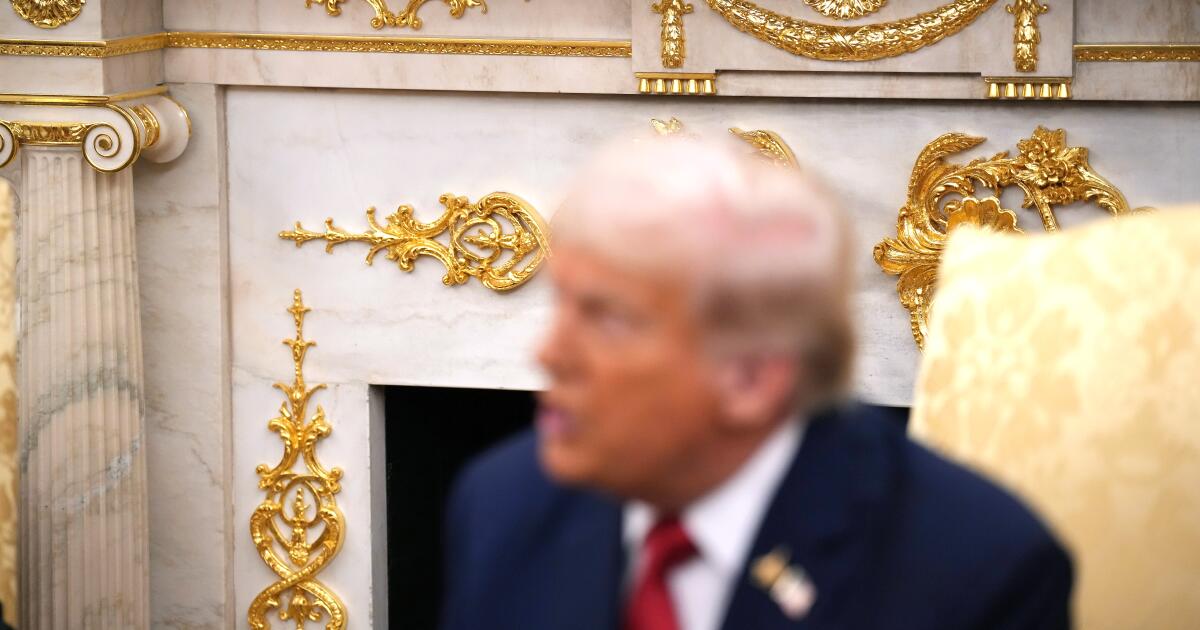
President Trump speaking Tuesday in the Oval Office.
(Alex Brandon / Associated Press)
White House Press Secretary Karoline Leavitt told reporters Monday that the administration will “operate within the confines of the law,” when asked about Trump’s threat to target infrastructure that would potentially harm civilians.
Caine told reporters Tuesday that the U.S. would only “strike lawful targets” when asked about American military considerations for civilian targets.
“We are always thinking about those considerations and developing options to be able to mitigate those risks,” Caine said.
Since the start of the war, Iranian officials have condemned a series of U.S. military attacks that have hit schools, including a Feb. 28 strike at an elementary school that killed at least 175 people, many of them children.
As Trump issues a new wave of threats on key infrastructure, he has at the same time touted ongoing diplomatic talks with Iran and reportedly told aides he’s willing to end the war without resolving Iran’s de facto blockade of the Strait of Hormuz that has rattled global energy markets.
Americans have also felt the financial pinch because of the war when it comes to energy prices. Gasoline prices in the United States reached an average of $4 a gallon Tuesday, a price that Trump says Americans are willing to pay to endure because “they are also feeling a lot safer.”
“All I have to do is leave Iran, and I will be doing that very soon and, [prices] will come tumbling down,” Trump said.
Hegseth, for example, said those diplomatic talks are “very real,” but stressed that the military pressure will continue alongside those negotiations and that ground operations remain an option.
“Our adversary right now thinks there are 15 different ways we can come at them with boots on the ground. And guess what? There are,” Hegseth said. “If we needed to, we could execute those options on behalf of the president of the United States and this department, or maybe we don’t have to use them at all. Maybe negotiations will work.”
He said the goal was to remain “unpredictable.” Caine added that the presence of U.S. ground forces in the region can serve as a “pressure point” as diplomatic efforts continue.
As the hostilities continued in the region on Tuesday, the State Department warned American citizens in Saudi Arabia that U.S. officials were “tracking reports of threats against locations where American citizens gather.
“We advise U.S. citizens that hotels and other gathering points including U.S. businesses and U.S. educational institutions may be potential targets,” officials wrote in a new warning.
And in Rome, Pope Leo XIV told reporters that he hopes Trump is “looking for an offramp” to end the war in Iran and made an appeal to “decrease the amount of violence,” according to the Associated Press.
Meanwhile, Trump administration officials have faced challenges in securing support from some U.S. allies, an issue that Hegseth and the president have publicly pointed out.
On Tuesday, Trump complained that countries have “refused to get involved” in the war and efforts to reopen the Strait of Hormuz.
U.S. allies’ access to oil has been affected by Iran’s chokehold on the key waterway as a result of the joint operation launched by U.S. and Israel. But now, Trump wants those countries to deal with the strait.
“All of those countries that can’t get jet fuel because of the Strait of Hormuz, like the United Kingdom, which refused to get involved in the decapitation of Iran, I have a suggestion for you: Number 1, buy from the U.S., we have plenty, and Number 2, build up some delayed courage, go to the Strait, and just TAKE IT,” Trump wrote on his social media website.
Trump added that countries will have to “start learning how to fight” for themselves.
“The U.S.A. won’t be there to help you anymore, just like you weren’t there for us,” Trump wrote. “Iran has been, essentially, decimated. The hard part is done. Go get your own oil!”
In a separate post, Trump singled out France for barring Israeli military planes from flying over its airspace.
“The USA will REMEMBER!!!” Trump posted on his social media website.
At the Pentagon, Hegseth acknowledged that the U.S. military has faced “roadblocks or hesitations” from U.S. allies when asking for assistance or use of their bases — and said the president is simply noting that “we don’t have much of an alliance.”
“A lot has been shown to the world about what our allies would be willing to do for the United States of America when we undertake an effort of this scope on behalf of the free world,” Hegseth said.
Northern Ireland manager Michael O’Neill praised the “character” of his side in Tuesday’s 1-1 draw in Wales.
Both Wales and Northern Ireland lost their respective World Cup play-offs to set up the friendly that nobody wanted.
Jamie Donley scored a deserved opener but Wales hit back less than 60 seconds after the restart as Sorba Thomas tucked home.
Eoin Toal and Callum Marshall had chances to snatch victory, but it was the response to the equaliser which impressed O’Neill as his young side bounced back from the World Cup defeat by Italy with a solid performance in Cardiff.
“The team has good resilience because at the end of the day, as much as we sat deep and it was difficult for us to get out in the last 20 minutes, we still had an opportunity to win the game,” O’Neill, who also hit back at concerns over a conflict of interest with his dual role with Blackburn Rovers.
“To come away, with the age profile of the team and where the team is at this minute at time, and not be beaten here was a real positive.”
O’Neill added it was “a good night’s work for us” as he “asked a huge amount” of young players in a second half that was littered with substitutions, but Northern Ireland deserved their draw in Cardiff.
He handed a debut to 19-year-old defender Tom Atcheson, who plays under him at Blackburn Rovers, but Liverpool’s Kieran Morrison did not make his senior bow as O’Neill made eight substitutions.
“He’s a very young player. I think he’s shown up well in the camp all week,” O’Neill said on Atcheson.
“We would have liked to have got Kieran Morrison on the pitch as well at some point, but you wouldn’t have been able to do it without having to take a sub that you put on, off again, without asking someone to play in a position which was totally alien to them.
“Given the number of substitutions we made, we’re pleased with the response we got from the players.”
April 1 (UPI) — A federal judge has blocked construction of President Donald Trump‘s $400 million White House ballroom, ruling the New York real estate developer does not have congressional authorization to continue the project.
“The President of the United States is the steward of the White House for future generations of First Families. He is not, however, the owner!” U.S. District Judge Richard Leon for the District of Columbia wrote in the ruling.
Trump has said building a White House ballroom had been a dream of his since before he was president. Construction of the 90,000-square-foot building began with the demolition of the East Wing of the White House in October. Initially said to cost $200 million, the ballroom’s price tag has since doubled. Trump has said it will be financed by private donors.
In December, the National Trust for Historic Preservation sued the Trump administration to halt construction, arguing the project has not been authorized by Congress as required by U.S. law.
In response, the Trump administration has claimed Congress has already given him authority to construct the project, pointing to a statute that Leon, a President George W. Bush appointee, said only permits the president “to conduct ordinary maintenance and repair of the White House.”
Leon said the Trump administration’s understanding of the law assumes Congress has granted “nearly unlimited power to the President to construct anything, anywhere on federal land in the District of Columbia, regardless of the source of funds.”
“This clearly is not how Congress and former Presidents have managed the White House for centuries, and this Court will not be the first to hold that Congress has ceded its powers in such a significant fashion,” he said in the 35-page ruling.
For Trump to continue with the project, he can ask Congress to either appropriate the funds or approve of another funding scheme, he said.
“Unfortunately for Defendants, unless and until Congress blesses this project through statutory authorization, construction has to stop!”
In awarding the National Trust for Historic Preservation an injunction, Leon delayed its enforcement for 14 days in acknowledgment that the Trump administration intends to appeal his decision and that stopping an ongoing construction project may raise logistical issues.
“We are pleased with Judge Leon’s ruling today to order a halt to any further ballroom construction until the Administration complies with the law and obtains express authorization to go forward,” Carol Quillen, president and CEO of the nonprofit organization, said in a statement.
“This is a win for the American people on a project that forever impacts one of the most beloved and iconic places in our nation.”
Trump lambasted the decision on his Truth Social platform.
“He is WRONG! Congressional approval has never been given on anything in these circumstances, big or small, having to do with construction at the White House,” he said in a statement.
In an earlier statement issued after the ruling was made, Trump insulted the National Trust for Historic Preservation as “a Radical Left Group of Lunatics.”
According to the White House Historical Association, Congress has long been responsible for appropriating funds for the care, repair, refurnishing and maintenance of the White House, and Congress approved the Truman-era reconstruction project from 1948 to 1952.
Demolition equipment continues to break up the East Wing of the White House in Washington on October 22, 2025. Photo by Pat Benic/UPI | License Photo
Weekly insights and analysis on the latest developments in military technology, strategy, and foreign policy.
As Epic Fury grinds into a second month, the Air Force continues to rely heavily on its fleet of aerial refueling tankers, the majority of which are over 60 years old, to gas up aircraft attacking Iran and those still pouring into the Middle East. The strain on the force has been exacerbated by the loss of a KC-135 Stratotanker and damage to another after a collision over Iraq and several more tankers being destroyed and damaged on the ground by Iranian long-range weapons. Meanwhile, given this large commitment of aircraft and personnel, there are questions about how the U.S. tanker fleet can respond to a fight in the Pacific should one break out tonight. To get a better sense of that, we spoke to retired Air Force Col. Troy Pananon, who flew tankers and commanded a tanker wing.
In the second installment of our two-hour, wide-ranging exclusive interview – the first centering on Epic Fury’s strain on the force – Pananon offers insights into whether there are enough tankers and crews to sustain combat in two theaters more than 4,000 miles apart, the challenges of flying long distance over contested airspace and what, if any, countermeasures tankers should be given to survive.
Some of the questions and answers have been lightly edited for clarity.
Col. Troy Pananon, 100th Air Refueling Wing commander, prepares for take-off aboard a KC-135 Stratotanker at RAF Mildenhall, England, April 23, 2020. (U.S. Air Force photo by Tech. Sgt. Emerson Nuñez) Tech. Sgt. Emerson Nunez
Q: Given the heavy use of aerial refueling for Epic Fury, how concerned are you about the ability to fuel a fight in the Pacific, if one should break out tonight or in the near term?
A: There is a high demand on the tanker community. We retired the KC-10s, so that is a void that can’t be filled as quickly as we would like. But the tanker force is robust, and even though we have a contingency of aircraft in the Middle East region and parts of Europe, we still have tankers that are all over the world, to include the Pacific. Kadena has its own wing of tankers there. And so the ability for our tanker fleet to pivot or to surge and scale to another region – there is not another military out there that can do it – but it puts that demand on the total force.
I think that we could do it, sure, but it would put a significant strain if we were trying to operate in two different parts of the globe, especially if it was involving major combat operations. And not to mention, there’s an element of protecting the homeland as well. Tankers are required to do that too. So you can’t just say, ‘Oh well, we’ll deplete the entire force and focus abroad.’ There’s an element required to support homeland operations as well.
A KC-10 Extender assigned to the 908th Air Refueling Squadron lands after conducting the airframe’s final combat sortie before inactivation at Prince Sultan Air Base, Kingdom of Saudi Arabia, Oct. 3, 2023. The flight served as a capstone for the KC-10 after over 30 years of service within the U.S. Air Forces Central (AFCENT) Area of Responsibility. By September 2024, the U.S. Air Force’s fleet of KC-10s will be decommissioned and gradually replaced by the KC-46 aircraft. (U.S. Air Force photo by Tech. Sgt. Alexander Frank) A KC-10 Extender assigned to the 908th Air Refueling Squadron touches down at Prince Sultan Air Base, Oct. 3, 2023. U.S. Air Force photo by Tech. Sgt. Alexander Frank
Q: Does the need to do all those missions at once worry you?
A: At my level, when I was at the tactical level or the operational level, I always felt that we were adequately supported. There was certainly a stressor involved with trying to manage all that. But whenever there was a concern, you always would go up to your higher headquarters, and say, ‘Hey, here’s the current situation. We don’t need help now, or we do need help, and this is how you can help.’
It was their ability to resource those needs that really made my job easier and made the jobs of those who worked with me easier, knowing that they had support from above. But it’s not an unlimited resource. It’d be hard for me to say what would be required if we needed to pivot, or if we needed to support two operations in different parts of the world. But I would say that we were certainly capable of doing it.
I just don’t know the duration of that, and unfortunately we always tend to think of these things in short-term snippets. But there are long-lasting impacts to things where high operations tempo means higher strain on the resources, higher strain on the aircraft.
Looking at the long view, if you have to increase your operational tempo on a particular platform versus what you had planned for that, it is going to put a strain on the acquisition process. It’s going to put a strain on the supply system. All these things, they do have an impact, not only in the short, but in the long-view as well.
Tech. Sgt. Jessica Dear, a 507th Aircraft Maintenance Squadron crew chief, tracks the amount of fuel being loaded into a KC-135 Stratotanker aircraft. (U.S. Air Force photo by Senior Airman Katriel Coffee) Airman 1st Class Katriel Coffee
Q: Considering how long it took to build up forces in the Middle East, how concerned are you about being able to fly long distances to protect Taiwan from attack by China? Can the current fleet sustain a major conflict with China, where fighters will need to fly thousands of miles on each sortie just to get to the effective fighting range?
A: I can’t completely comment on this for various reasons. There are certainly war plans in place. There have been studies that have taken place that are certainly higher classification levels, and we can’t discuss in this session or in public, right? It’s been looked at. I would say that there are plans in place that would prove that we could support operations in the Pacific region.
Is it complex? Yes. Does it require certain things to be successful? Yes, There are certain dominoes that need to fall into place in support of an operation like that.
Maintainers from the 718th Aircraft Maintenance Squadron attach a drogue to a KC-135 Stratotanker at Kadena Air Base, Japan, Aug. 25, 2023. (U.S. Air Force photo by Airman 1st Class Tylir Meyer) Staff Sgt. Tylir Meyer
Q: But from a tanker pilot and wing commander perspective, what are the challenges of flying over these long distances through a very robust Chinese anti-aircraft, area denial environment?
A: I like to use the term, it’s a young man’s or woman’s game. It’s fatigue that is the enemy here, because when you have to operate at these distances and for the duration that is involved, it is certainly a physical stressor. Often, we’re operating in multiple time zones, and we’re not probably getting adequate rest, and that’s a cumulative effect, as you are asked to operate for these long durations.
I’ve been on a cruise where we operated for 24 hours straight, and to do that over a sustained length of time – I don’t know that you can do it. In order to do that, it means you need more personnel. And so where an operation might be successful with – and I’ll just use easy numbers here – with 100 personnel that don’t have to range like you would in the Pacific or in Europe or even in the Middle East, depending on basing. Well, you’re probably going to need maybe twice as many to operate in the Pacific, because of the human element. You don’t want personnel to be fatigued to the point where they are not operating in a safe manner, and so you need to give them the appropriate rest.
It goes all the way down the line, from air traffic control to ground personnel to maintenance to logistics. You need more personnel to support that effort at the distances and the range that you’re talking about. And the Pacific is a challenge, and it would require more personnel to just operate the aircraft, let alone the logistics tail required to support those aircraft. It is a significant challenge. And I’ve certainly endured operations where you bring in multiple energy drinks or keep the coffee brewing for long periods of time.
Aircraft propulsion technicians with the 6th Aircraft Maintenance Squadron install an engine on a KC-135 Stratotanker at MacDill Air Force Base, Florida, March 28, 2023. Replacing this engine was a 72-hour task that required a team of highly trained maintainers with a keen sense of attention to detail. (U.S. Air Force photo by Senior Airman Lauren Cobin) Staff Sgt. Lauren Diaz
Q: What about the addition of robust Chinese air defenses into that equation? How much additional concern does that raise?
A: Tanker aircraft are not inherently survivable from enemy aircraft or missiles. There are upgrades or updates that could help in certain ways. The [AN/AAQ-24(V)N Large Aircraft Infrared Countermeasure] LAIRCM is one of those technologies that would certainly help some of those aircraft. But, again, that means that we’ve got to stay out of harm’s way. Typically, we’ve got to set our tanker orbits up further away from the enemy’s reach and their engagement zone.
It is a team effort, right. The role of our strike aircraft and joint partners to eliminate that threat is probably more important than our ability to add protection to these aircraft. I think they go hand in hand. It would be nice for tankers to have protective measures in place to make sure that they are survivable if we need them to operate in a contested environment, but in their current state, I would be definitely worried about pushing tankers closer to that engagement zone, because they don’t have the survivability or protections that maybe even aircraft like the F-22 or F-35 might have.
We don’t have chaff or flares. We don’t have other measures that would protect our fleet, and so I think it’s the role of the warfighting commander to protect those assets and to ensure that they’re operating in a safe zone. And if they’re moved closer to that Weapon Engagement Zone, then they have the ability to retrograde or the connectivity and communication ability to ensure that those tankers can move back or retrograde away from the threat. There are some technology solutions out there, but I don’t know if that’s the sole solution. It is a comprehensive solution that is required to kind of go after that challenge.
U.S. Air Force Capt. Nick ‘Laz’ Le Tourneau, F-22 Raptor Demonstration Team commander and pilot, releases flares during an aerial demonstration at the 2025 Marine Corps Air Station Miramar Air Show in San Diego, Sept. 28, 2025. (U.S. Air Force photo by Staff Sgt. Lauren Cobin) Staff Sgt. Lauren Diaz
Q: How difficult is to get, say, an F-35 into effective combat range and to fuel them up outside of the Chinese Weapons Engagement Zone?
A: It’s layers, right? In order for those aircraft to move into those high threat areas, it will probably require preparation of that environment. I think there are other elements of our military that would go to great lengths to create lanes or passageways to allow those aircraft to move closer to wherever they’re trying to get to their objective.
The preparation of the environment that’s required probably is not the F-35 – the shorter range aircraft. There are other elements that would be used to prepare certain areas to allow our aircraft to move closer. There are other aircraft that would probably be capable of penetrating those air defenses and eliminating some of those threats.
Q: Which aircraft?
A: You have highly capable B-2A Spirit bombers and maybe in the future, B-21 Raider aircraft. There’s other non-manned platforms that I would assume could be used to help eliminate some of the threat, but not all of it.
The Chinese have a very, very robust air defense environment and system of systems in place. But I think that we as a military certainly have capabilities that could give us moments of opportunity. And I think once we find an opportunity, our trained airmen and joint force can leverage that. I don’t think that we want to go toe-to-toe right now. I don’t think we ever want to go toe-to-toe with an adversary like China. I hope that we don’t have to do that, but I know that our joint force is preparing for that if it ever happens.
A U.S. Air Force B-21 Raider stealth bomber undergoing a test flight. (USAF)
A: Prevention is the best cure here. Not putting them in harm’s way would be the best way for them to survive. But I think it would be certainly comforting to know that they have onboard systems or bolt-on systems that would help them at least have a chance against some of these threats. There are certainly a lot of opportunities out there. I’ve heard of efforts where you would outfit certain aircraft with certain defensive measures.
If you got into a situation and we needed to do it, I think the KC-46 Pegasus is a great platform to utilize for this, because it has so much advanced avionics architecture already on board. Trying to do it on the KC-135? That is because you’re trying to answer a scale problem. We don’t have enough KC-46s and we need more. And I know that they’re trying to procure more and and they’re coming, but they’re not to the scale that we have with the KC-135. And so the problem with trying to work with that is that now we’ve got an older airframe, and we’re trying to bolt on new technology that may or may not be compatible, and so we’re gonna have to upgrade other elements on board the aircraft, just to make sure that it can work.
We have an old aircraft. We have some things that have been updated, like the avionics have been updated. But is it the same technological advancement as what is going to be required to bolt on to protect that particular aircraft? Well, no, because it probably – from a data infrastructure set – is not going to operate at the same speed. It’s not going to operate in a similar fashion. There’s some latency that gets introduced if you’re trying to onboard new technology with older technology.
KC-46 Pegasus aerial refueling tankers. (USAF)
Q: What about adding electronic warfare pods, CCAs or mini interceptors?
A: I think nothing is off the table. I think those are fantastic ideas, and I know that there are people that have probably experimented or modeled to and then probably proven that it’s a successful option. But you have to resource it. We have a lot of mouths to feed here – it’s not a limitless pot, and there’s the research and development and then product production of that.
It doesn’t happen overnight and with every new technology that is offered to the warfighter, it is a challenge to make sure that all the personnel are trained and learn how to leverage these resources, not just individually, but collectively, as a team, as an organization, to really harness that and make sure that anything that’s introduced is successful.
You can’t just say, ‘Oh, well, look, I got this bright, shiny object. I’m just going to bolt it onto this aircraft, and everything is going to be working beautifully.’ No, there’s a whole host of problems that creates because you don’t have personnel that are all collectively trained, that have all operated with it, that have all that is integrated with it, that ensures that when you add this to that platform, that it is operating the way it was designed or intended to be operated. You can’t just snap your fingers and think that it’s gonna work right away.
A view of one of the repurposed Multipoint Refueling System (MPRS) pods under the wing of a Utah Air National Guard KC-135. (MSgt Nicholas Perez/Utah Air National Guard)
Q: As a flight commander, would you like to have been able to have air-to-air interceptors under the wings of your tanker?
A: The one thing about airmen, and I would say Air Force in general, is that we tend to like new technologies. We’re not afraid of technology in general. We embrace it. The people that we attract into our service are people that embrace technology, that are innovative themselves. So, yeah, sure if I could roll back time, and that technology was introduced to me, I’d be first in awe. And two, I’d say, ‘Okay, well, how can we make this work? How can I integrate? How can I be able to leverage that and exceed expectations, and ensure that we meet the potential for that new technology?’
A graphic from 2019 describing “tech enablers” for various AFRL projects, including the MSDM’s seeker. (USAF)
Q: There’s been a great deal of discussion about the importance of improving communications connectivity on the tanker fleet. We’ve already talked a little about it. Why is connectivity an issue? And what’s your advice to improve it?
A: Connectivity provides us situational awareness, and that situational awareness improves our ability to operate. It’s a team effort, and in order to do things collectively as a team, we have to be connected. And then the challenge is deciding, well, how should we connect? What sole-source platform should we be all collectively using because it does us no good to be connected as an Air Force, but not be able to talk to a Marine Corps or Navy, or Army or a coalition partner.
And so the challenge is not only do we need to find the right technological solution, we have to ensure that it is able to integrate and communicate harmoniously with all our other partners, because it is not just an Air Force by itself, game. It is a joint force coalition game in terms of what we’re doing right now and what we’ll do in the future.
I know that it’s a huge discussion about, okay, what platform do we use? How do we get it to our airmen right away? How do we make sure that it can integrate with the joint force? And then, ok, now we’ve got the solution. Where’s the money, right? There are so many elements to ensure that we can do this at scale and at speed. I trust that our leadership has been advocating with Congress and with other elements of the administration to get this in place. I don’t know how long it’ll take, but it certainly will help from a situational awareness perspective.
The Roll-On Beyond Line-of-Sight Enhancement (ROBE) package seen here is among the add-on communications and data-sharing capabilities that has been available for use on the KC-135, as well as other aircraft, for years now already. USAF
Q: Is there any particular system that you think would help improve situational awareness?
A: I think there are some age-old systems that have been in place. Link 16 architecture comes to mind. There are probably other modern solutions out there, but I don’t want to say that ‘this is the right system,’ because I’m not in the position to really argue for that. There are some systems out there that help, that are already in place, that would help us immensely, if we were to have that particular system across all platforms, right where the AOC [air operations center] can talk directly to the tanker element, who is also receiving data from other elements in the air, whether it be fighter aircraft, bomber aircraft, reconnaissance aircraft, and then, feeding that through our platform – maybe a KC-46 – back to the AOC, instantaneously. I know there are efforts out there to enhance that pipeline, but it’s not my place to say one system’s better than the other.
I just know that’s the panacea. That’s where you have to get to. You have to get to where the shooter is, all the way back to where the decisions are being made, and harness that data and then allow that data to help inform a decision, so that now you can give that decision over to the activity that’s operating. And so this constant cycle, and they use the term OODA loop, right? This constant cycle of observe, orient, decide, act – it’s got to happen faster than the enemy cycle for us to be successful. Connecting those points with technology can help us do that faster.
A stock picture of a KC-46A refueling an F-15E Strike Eagle. USAF
Q: You’re in the aircraft, you’ve got a receiver coming up. You don’t necessarily know where everything is. How does it help a pilot and the crew to have better connectivity?
A: Let me just put a hypothesis out there as an example. Say we have a receiver that was coming up, and they’ve got a really good understanding of where the threat rings are, what enemy positions are, where our friendly forces are, and that’s all in a data packet on board their aircraft. And if you don’t have a secure connection over the air, but you do have a secure connection once you’re connected with the boom, that data packet can then be uploaded to our aircraft and then displayed for our airmen to see, right? Because now, it’s like that whole moving map idea, like you may have a navigation system in your car that says, ‘hey, where’s the nearest gas station?’ and then it pops up and it tells you where the nearest gas stations are.
Same thing can be said if you’re operating a tanker aircraft, and now you get a data packet that gives you the full display of what the battlefield looks like in front of you. You now know, okay, here’s where I want to go, and here’s where I don’t want to go. So, if the technologies in place or are available now, it’s just a matter of connecting the dots. And this is a huge situational awareness improvement, if we can get to the point where the tanker crew on board has the ability to see exactly what is taking place, where the threats are, where the green zones are, where it’s safe to operate. And if they can do this in a secure manner that’s impenetrable by enemy forces, that is where we need to get to.
In our next installment, Pananon talks about drone incursions, the challenges of creating a new tanker fleet and whether single-pilot operations are a good idea.
MEGAN Thee Stallion has been rushed to hospital after suddenly falling “very ill” during a performance of Moulin Rouge on Broadway.
The 31-year-old rap star managed to get through the opening scenes of the hit musical in New York before the show had to be halted so she could get treatment.
Sign up for the Showbiz newsletter
Thank you!
Megan Thee Stallion has been rushed to hospital after suddenly falling ill during a performance of Moulin Rouge on BroadwayCredit: GettyThe 31-year-old rap star managed to get through the opening scenes of the hit musical in New York before the show had to be halted so she could get treatmentCredit: Getty
Megan, who plays Zidler in the beloved Broadway production, was quickly taken to hospital and is still undergoing an evaluation, it is believed.
A representative of the Savage rapper told TMZ: “During Tuesday night’s production, Megan started feeling very ill and was promptly transported to a local hospital, where her symptoms are currently being evaluated.”
There is yet to be any further update on her condition.
Megan’s personal hairstylist and close friend Kellon Deryck has come out since to ask fans to say “a prayer” for the rapper.
Megan is due to appear in Moulin Rouge! The Musical until May 17 at the Al Hirschfeld Theatre.
Her casting as Zidler marks a history making moment for the star as she becomes the first female-identifying performer to play the role in any production of Moulin Rouge worldwide.
Concerned audience members said they were told to “stay inside and seated” while medics assessed Megan off stage.
After she left the theatre, the show continued as a male performer took on the role of Zidler.
Most read in Entertainment
Megan’s first show came on March 24 where she was congratulated for putting on an impressive act in New York City.
Earlier this year, the Hot Girl Summer artist spoke about how big of an honor it is to be able to perform on Broadway.
She released a statement when she was announced for the musical saying: “Stepping onto the Broadway stage and joining the Moulin Rouge! The Musical team is an absolute honor.
“I’ve always believed in pushing myself creatively and theatre is definitely a new opportunity that I’m excited to embrace.
“Broadway demands a different level of discipline, preparation, and storytelling, but I’m up for the challenge and can’t wait for the Hotties to see a new side of me.”
Megan’s first show came on March 24 where she was congratulated for putting on an impressive act in New York CityCredit: GettyThere is yet to be any further update on her conditionCredit: Getty
A UK budget airline has added new routes and destinations to their summer itinerary with prices of return flights only costing around £50 for British holidaymakers
The airline has announced a £50 summer sale with new routes(Image: Horacio Villalobos, Corbis via Getty Images)
A popular UK budget airline has announced a £50 summer flight sale from London airports with the launch of new travel destinations.
Wizz Air has announced it will take holidaymakers to 77 destinations from the UK this summer – with return prices starting as low as £50 per person.
The budget carrier will run more than 104 routes from the UK, with 69 routes from Luton Airport and 20 from Gatwick.
Luton will now carry passengers to Bilbao, Barcelona, Madrid, Valencia, Alicante and Seville.
It will also continue to run daily flights to Madrid and two daily services to Barcelona.
The airline will also serve seven destinations in Greece from London, including Athens, Mykonos and Crete.
Flights between London and destinations in Europe between June and September are currently on sale for bargain prices.
A return flight from London Luton to Kosice in Slovakia in June cost £42.98 per person and a return flight to Lyon in September is on sale for £31.98.
These prices do not include cabin bags or hold luggage.
Wizz Air UK managing director Yvonne Moynihan said: “ This summer, our customers told us exactly what they wanted – more sunshine, more choice and unbeatable value – and we listened.
“We’re stepping up while others step back, launching more routes, more flights and even better prices to Europe’s most loved destinations.
“From buzzing Spanish cities to iconic Greek escapes, we’re delivering the routes people actually want, at the best prices in the market.”
WASHINGTON — The Supreme Court ruled Tuesday that state laws forbidding “conversion therapy” for minors may violate the free speech rights of licensed counselors.
In an 8-1 decision, the justices said Colorado’s ban on “talk therapy” may prevent Christian counselors from helping teens work through their feelings about sexual attractions or their gender identity.
State lawmakers passed the new measures in response to healthcare professionals who said that efforts to change a teenager’s sexual orientation were both ineffective and harmful.
Kaley Chiles, a licensed counselor in Colorado Springs, sued and argued the state’s law violated her rights to free speech and the free exercise of religion.
She said she does not seek to “cure” young clients of same-sex attractions or to “change” their sexual orientation. Instead, she said she is guided by their goals.
“As a talk therapist, all Ms. Chiles does is speak with clients; she does not prescribe medication, use medical devices or employ any physical methods,” Justice Neil M. Gorsuch said for the court.
But she could run afoul of the state’s law because she said she may help some of her clients “reduce or eliminate unwanted sexual attractions or change sexual behaviors.”
If so, the law “censors speech based on viewpoint” and is therefore unconstitutional, he said.
“Colorado may regard its policy as essential to public health and safety. But the 1st Amendment stands as a shield against any effort to enforce orthodoxy in thought or speech in this country,” Gorsuch wrote.
Justice Ketanji Brown Jackson dissented alone in a 35-page opinion. She said the issue was one of regulating medical practice.
“The 1st Amendment cares about government efforts to suppress ‘speech as speech’ (based on its expressive content), not laws, like [Colorado’s] that restrict speech incidentally, due to the government’s traditional, garden-variety regulation of such speakers’ professional conduct,” Jackson wrote. “States have traditionally regulated the provision of medical care through licensing schemes and malpractice regimes without constitutional incident.” she continued.
The Trevor Project, a crisis intervention organization for LGBTQ+ young people, condemned the ruling.
“The Supreme Court’s decision to treat the dangerous practice of conversion therapy as constitutionally protected speech is a tragic step backward for our country that will put young lives at risk. These efforts, no matter what proponents call them, no matter what any court says, are still proven to cause lasting psychological harm,” Chief Executive Jaymes Black said in a statement.
The conservative First Liberty Institute called the ruling a “great victory for religious liberty.”
“Americans should never have their professional speech censored simply because the government disfavors that speech,” said Kelly Shackelford, the group’s president.
The ruling is the third significant defeat for LGBTQ+ rights advocates in the last year.
The conservative majority upheld state laws that prohibit puberty blockers and other “gender affirming” care for minors. And last month, the justices said parents in California have a right to know about their child’s gender identity at school.
They said California’s student privacy policy violated parents’ rights, including the free exercise of religion.
The Alliance Defending Freedom appealed her case to the Supreme Court and described her as “a practicing Christian [who] believes that people flourish when they live consistently with God’s design.”
Her clients “seek her counsel precisely because they believe that their faith and their relationship with God establishes the foundation upon which to understand their identity and desires,” they said. “But Colorado bans these consensual conversations based on the viewpoints they express.”
The state law defines “conversion therapy” as “any practice or treatment by a licensee that attempts or purports to change an individual’s sexual orientation or gender identity, including efforts to … eliminate or reduce sexual or romantic attraction or feelings toward individuals of the same sex.”
Violators may be fined up to $5,000, but no one had been fined, the state says.
The challengers had lost in the lower courts.
A federal judge and the 10th Circuit Court of Appeals in Denver rejected the free speech claim. By a 2-1 vote, the appeals court said the state law was not a ban on free expression. Rather, it regulated the conduct of licensed medical professionals. States have the authority to regulate the practice of medicine.
In their appeal to the high court, lawyers for Chiles said the state was “censoring” voluntary conversations and forbidding speech on only one side of a controversy.
The Trump administration supported the 1st Amendment challenge because the state seeks “to suppress a disfavored viewpoint.”
In response, the state said its law “safeguards public health” by prohibiting “a discredited practice” that was shown to be harmful. It stressed the law regulates licensed professionals only and does not extend to religious ministers or others who provide private counseling to young people.
In 2012, California was the first state to ban licensed counselors from using conversion therapy for minors.
Then-Gov. Jerry Brown said these “change” therapies “have no basis in science or medicine and they will now be relegated to the dustbin of quackery.”
Equality California condemned the court’s ruling and said it “has weakened the ability of state licensing boards to intervene if clinicians use unproven, misleading, or coercive techniques.”
The group urged support for a pending bill in Sacramento that would “extend the statute of limitations for survivors to pursue civil claims against licensed mental health providers who subjected them to these harmful practices.”
Tuesday’s ruling was also criticized for undercutting state regulations of medical practice a year after taking the opposite view in a Tennessee case.
In June 2025, the court in a 6-3 decision upheld laws in Tennessee and 24 other red states that prohibit “gender affirming” puberty blockers and hormone treatments for minors.
The majority said then it was deferring to the state and their lawmakers who decided to prohibit such medical treatments for minors.
But in the Colorado case, the court majority did not defer to the state’s judgment that conversion therapy was harmful and potentially dangerous.
The decision is also the third victory for the Arizona-based Alliance Defending Freedom in its free speech challenges to Colorado laws. A maker of custom wedding cakes and the designer of websites won suits seeking an exemption from the state law that required them to provide equal service for same-sex weddings.
Deni Avdija had 28 points, 11 rebounds and eight assists, Jrue Holiday hit seven threes and finished with 30 points, and the Portland Trail Blazers snapped the Clippers’ five-game win streak, 114-104 on Tuesday night.
The Clippers (39-37) are eighth in the Western Conference, a half-game in front of the ninth-place Blazers (39-38). The Clippers lead the season series — which wraps up April 10 in Portland — with the Blazers 2-1.
Toumani Camara scored 17 points and Scoot Henderson added 15 for the Trail Blazers.
Leonard has scored at least 20 points in 52 consecutive games, the second-longest active streak of its kind in the NBA (Oklahoma City’s Shai Gilgeous-Alexander has a 136-game streak).
Matisse Thybulle hit a three-pointer that made it 31-29 with 1:06 left in the first quarter and the Blazers led the rest of the way.
Garland made a bucket in the lane that trimmed the Clippers’ deficit to eight with 3:44 left in the third quarter but they got no closer. Henderson hit a step-back three at the buzzer to cap a 16-5 run that made it 91-74 going into the fourth.
Portland had 18 offensive rebounds and 32 second-chance points. The Blazers went into the game leading the NBA in second-chance points (18.2 per game) and are second in offensive rebounds (14.1 per game).
Avdija made 11 of 12 from the free-throw line and has 31 games this season with at least 10 free-throw attempts, second most in the NBA behind Luka Doncic.
Portland’s Jerami Grant (calf) missed his second consecutive game.
Up next for the Clippers: vs. San Antonio at Intuit Dome on Thursday.
The rising sun sets fire to the snow-covered caps of the Atlas mountains. Within moments, the shadowy gorges are gleaming with warm terracotta hues. I turn my back on north Africa’s highest peaks and look north where Marrakech – nicknamed the Red City – rests like a jagged ruby amid the jade swathes of palms and the silvery sheen of olive groves.
Swinging 800 metres (2,625ft) above the stony desert in a giant wicker basket, I try to imagine what this scene would have looked like when camel trains trooped this way, loaded with salt, spices and enslaved humans bound for Marrakech’s souks.
The sky around us is filled with dozens of hot-air balloons, drifting like pollen on a Saharan breeze. The biggest of the suspended baskets hold 16 passengers, most of whom will have left guesthouses and riads in the labyrinthine old town before the dawn prayer call.
“That’s the Koutoubia minaret there, to the west,” says our pilot Daniel Penet, founder of Ciel d’Afrique. “That shadowy area to the north of the minaret is the medina [the old town].”
‘Drifting like pollen on a Saharan breeze’. Photograph: Igor Paszkiewicz/Getty Images
I realise that “shadowy” may be the perfect word to describe the medina. While the high-rise tower-blocks of Gueliz (the new town) are tall enough to catch the first rays, it takes longer for the sunlight to seep into the medina’s alleys and marketplaces. I can now make out the vast triangular Djemaa el-Fna (Place of the Dead), said to be named for the heads of rebels and criminals that once decorated the walls of the vast plaza. I’d been to Marrakech perhaps a dozen times but this unique aerial vantage point provides a proper chance to get my bearings.
Ever since I first visited 30 years ago, I’ve delighted in the atmosphere of “shadowiness” whenever I step through the gates in the city walls. I revelled in the jolt of adrenaline that came with running the gauntlet of the phalanx of hustlers and faux guides on each foray into old Marrakech, though the city is an infinitely more relaxing place these days, thanks to the efforts of the tourist police.
But the medina still defies orientation. It swallows you whole. No matter how carefully I study the warren of tunnels, arches and boltholes around my accommodation there’s only thing I can be certain of; I will, at some point, become utterly and hopelessly lost.
Safely back on land at the city gates after my early morning balloon ride, I fall into step behind a djellaba-clad figure driving a heavily loaded mule ahead of him. The rabbit warren leads me in the general direction of Derb Farnatchi (Farnatchi Alley). Farnatchis are the wood-burning ovens that serve two crucial purposes: the fire that heats the hammam steam baths is also used by the quarter’s residents to bake their day’s supply of bread.
Finally I arrive at the old mansion that has been converted into Riad Le Farnatchi, a collection of suites, restaurant, spa and even swimming pool – a respite from the world outside. There are now more than 7,000 riads (historic houses, converted into boutique hotels) in Marrakech and this is among my favourites. Many are hidden deep in nondescript alleys and I’ve come to realise that the best of them – such as Le Farnatchi – shun signs so that you’re forced to memorise the doors’ ancient features, like the familiar lines in an elderly face. Guests should look on the challenge of navigation as part of the thrill.
Riad Farnatchi … ‘a respite from the world outside’. Photograph: Alan Keohane/alan@still-images.net
Marrakech has its share of world-famous sights, of course, but if you want to dig more deeply into the secrets of this mysterious city an experienced local guide is priceless.
I sign up for a tour with Intrepid, who have been working to help Moroccan women make an inroad into the traditionally male-dominated tourism industry. Their tours provide fascinating insights on this conservatively Muslim city from a female viewpoint.
Atika Aït Nejjar leads us into timeless sections of the souks where donkeys outnumber tourists and introduces us to the owners of tiny stalls where the best pastries, olives and mint tea have been sold for several generations. She knows many of the local women who gather at the few surviving farnatchiovens each morning with loaded trays of dough balanced on their heads ready for baking khobz flatbread. She leads us through a humble quarter, where crumbling adobe walls still stand (barely) as testament to the devastating earthquake that struck in 2023, to the house of her friend Fatima, an Amazigh (Berber) friend who prepares a huge plate of delicious vegetable couscous for us.
Later, when the subterranean fires have heated the steam rooms she guides my wife through the complexities of a session in the most authentic of the women’s hammam. The largest hammam have male and female sections but in humbler quarters the afternoons are typically for men while mornings are reserved for the women: “Sometimes they spend hours gently steaming,” Atika smiles. “It’s one of the few places where women can gather to gossip and joke … far removed from the ears of men.”
After leaving Atika, I wander more, enjoying getting lost. The never-ending street theatre of old Marrakech continues its parade across the stage of the street. Countless historic fondouk (caravanserais) remain, recognisable from the big gateways that would have been wide enough to drive loaded camels through. Some have been gentrified and turned into designer stores selling cedarwood furniture and ornate lamps. The most fascinating are in varying states of decay but with such an air of timelessness that you can still imagine Saharan salt trains being offloaded at the end of a long journey from Timbuktu.
While there are souks that appear a thousand times a day on Instagram, others you’ll find by searching them out, or more likely through being lost and drawing on all your senses. Place des Epices (the spice souks) has a scent all of its own, while the less well-known Souk Haddadine (the tinsmith souk) is best found by straining your ears for the rhythmic clatter of hammering. Souk Laghzal is just round the corner from the tour groups in the Spice Souk yet few outsiders ever find it. Those who do should spare a moment’s contemplation since this tiny square was once the slavery souk. These days it’s heaped with mountains of fascinating bric-a-brac and traditional remedies in the form of herbs, potions, dried reptiles and animal skins. There’s also a nameless restaurant here where Fatima – known to traders as “the mother of the souks” – serves the heartiest tajines to stallholders (for a fraction of the price charged in the bazaar thoroughfares).
One of the medina’s souks, ‘heaped with mountains of fascinating bric-a-brac’. Photograph: Robert Harding/Alamy
You can use all the tricks in the book to learn your way around the medina: turn backwards frequently to register how the path will look on the return journey, but be sure to memorise landmarks and architectural quirks that will remain visible even when the stalls have closed. Souks that are vibrant during the day can become almost unrecognisable when the shutters are pulled down.
When the sun sets the medina is wrapped in a dark shawl. Lamps flicker to life and a smokescreen of barbecues billows across the Djemaa el-Fna. Musicians make a few tentative initial rolls on their drums and storytellers call out to gather crowds around them. The stage is set for a new chapter in Marrakech’s medina.
Residents living near Erbil’s international airport in northern Iraq, say falling drone debris has damaged vehicles and properties amid the escalating war on Iran.
After his October 2015 overdose at a Nevada brothel, Lamar Odom says, he had “12 strokes and six heart attacks. All my doctors say, like, I’m a walking miracle.”
Now, more than a decade later, the Love Ranch brothel has been demolished, but Odom is still around.
The former Laker and onetime husband of Khloé Kardashian is telling his story for “The Death and Life of Lamar Odom,” the newest episode of Netflix’s documentary series “Untold,” along with Kardashian, former coach Phil Jackson and others who were around during his Oct. 13, 2015, health emergency. The episode premiered Tuesday.
“You know what’s funny?” the 46-year-old former player told Sports Illustrated in an interview published Monday. “I haven’t even watched it yet. You know why? Because I lived it.”
Odom, who just got out of another month of rehab in February, insists that the 2015 episode was not a mere overdose but a “hit,” an attempt on his life.
“Right when I signed the divorce papers, I was like, ‘I’m gonna get it in.’ The Bunny Ranch I used to always see on TV, but I don’t have any coke to take,” he says in the documentary. “ … It’s crazy when you think about [how] one decision, so big or so minor, could be so pivotal to you and to people that you really love.”
The late Dennis Hof, owner of the Bunny Ranch, where HBO’s “Cathouse: The Series” was shot, owned other Nevada brothels. Odom set off that October for Hof’s Love Ranch in Crystal, about 80 miles outside of Las Vegas.
“It was pretty rare that a celebrity — certainly anybody above the D-list — would be actively trying to come out to one of the brothels,” former Love Ranch manager Richard Hunter says in the “Untold” episode. “This was kind of a myth. This was something Dennis perpetuated.”
But, Hunter said, “Lamar Odom actually began contacting several of the girls from the Love Ranch on Instagram. … Being a professional athlete, there’s a lot of easier ways to do this than to drive an hour outside of the city into the desert, walk into a brothel, such as it was, and want to live there for a few days.
“As the days progressed, I remember that him or one of his handlers … actually contacted the brothel and wanted a car to pick him up. So it definitely became real when he gave us the address of where he was at.” The driver called the Love Ranch and let them know his passenger really was Odom. They put him in a house behind the brothel, Hunter said, where they put folks who were “spending enough money.”
Odom told USA Today in an interview published Monday that what transpired at the Love Ranch — which was demolished in November 2024, after Hof’s 2018 death — “was like a hit. Obviously they missed. I don’t know if they want to finish the job.”
Kardashian explains in the episode that her divorce from Odom came as a result of an ultimatum she was told to deliver during a planned intervention: a three-month rehab stint or a split. Odom surprised them, she said, when he said that all he wanted was his passport — and the divorce.
“I was like, looking around like, ‘Wait. Wait. I — I don’t want the divorce,’” she said. “‘You guys [who assembled for the intervention] told me I have to say this.’”
Odom and Kardashian had signed their papers before the OD, but a judge hadn’t yet signed off on the dissolution, which allowed her to keep him insured and, as his wife and next of kin, to make decisions regarding his health. Kobe Bryant, Odom’s Lakers teammate and Kardashian’s close friend, flew to Nevada to help her decide whether to proceed with surgery to fix Odom’s lung that had collapsed. She said yes, even though there was only “like a 10% chance” that it would work and that he would survive the procedure.
Odom made it through, recovering at Cedars-Sinai Medical Center. Bryant died in a helicopter crash less than five years later.
After the OD, Kardashian never left the hospital. She put their divorce — finalized in 2016 — on hold. When Odom awakened from his coma, he couldn’t control his bowels and needed six hours a day of dialysis, according to the documentary. “So you can understand the humility … I’ve won two championships. I’m Lamar Odom. I can’t walk, can’t talk. And they come in to check my diaper.”
He was 35 at the time. The next summer, he was removed from a flight at LAX before takeoff while drunk and vomiting, having been seen earlier slamming beer and whiskey in the Delta Airlines lounge.
So what would Odom tell his younger self, if he could, after suffering a dozen strokes and six heart attacks after that visit to the Love Ranch?
“Stay away from your weakness. And my weakness, obviously, was drugs because I’m a drug addict,” he told SI. “It could have been passed down to me from my father. But I’m not blaming anybody. Makes no sense to blame anybody. On or off the court, you have to work with what you’ve got. And I had an incredible stat line in terms of skills and how to play the game.
“And just work on being the best player that you can be. Anybody who offers you that s—, drugs, whether it be coke, pot, alcohol, they probably ain’t your friend. And to choose my friends wisely, because they could affect you on or off the court.”
Odom also wasn’t sure why Netflix had tapped him at this moment, but hopes that by telling his story he might help other people who are trying to get out of addiction.
“I was telling my girlfriend on the way here, it’s like swimming in a cesspool of trauma,” he told USA Today, mentioning a partner who has not been identified. “And I’m trying to get out of it, but the story reels me back into that pool every time. But I just know I’m bigger than the situation, and I hope to help a lot of people by giving my testimony. Not just with the story, but just in life, that we can all overcome addiction.”
That and, well, “Netflix had a good paycheck, bro,” he told SI with a laugh. “No, but it’s a time and place for everything. I don’t know what made me relevant now.”
The recently revised food pyramid may put fruit as a medium priority, but there is nothing the Trump administration likes more than the apple of discord.
Every news cycle, the president seems intent on introducing something new for Americans to argue about: the wisdom (and legality) of war in Iraq; the term “affordability”; the efficacy of mail-in ballots (which the president recently used); the meaning of birthright; the legitimacy of a vice president who has been publicly admonished by two popes for writing a book about his conversion to Catholicism — heck, we’re still arguing about that new food pyramid.
But there is one recent development upon which we really should all agree — erecting a gold statue of President Trump in the middle of his proposed presidential library is a No Good, Very Bad Idea.
On Tuesday, the president’s son Eric posted a first-look video for said library, which will reside on the waterfront in Miami. While questions were raised about the inclusion of the Boeing 747-8 the president controversially accepted as a gift from Qatar and the apparent lack of space in the sky-scraping library for, you know, books, it was the enormous gold statue of Trump towering over the stage in a proposed auditorium that drew the most immediate attention.
That Trump chose to reveal this little (well, actually quite big) beauty mere days after millions of Americans across the country participated in a coordinated No Kings march can be taken as either breathtaking irony or, more probably, a rage-baiting metaphoric middle finger.
As he has been recently wont to do, California Gov. Gavin Newsom quickly responded on his press office X account with photos of gold statuary depicting former chairman of the Chinese Communist Party Mao Zedong, North Korea’s Kim Il-Sung and Turkmenistan’s Saparmurat Niyazov and the observation that “The gold statue in Trump’s new library (of himself) looks awfully familiar to a few others from around the world.”
Trump’s obsession with gold will no doubt obsess future generations of historians, artists, psychoanalysts and Wikipedia editors — the guerrilla art group Secret Handshake on Monday put up a gold toilet statue on the National Mall mocking the president’s plans to renovate the Lincoln bathroom during a time of war and strife, as tribute, according to the statue’s plaque, “to an unwavering visionary who looked down, saw a problem and painted it gold.”
But even allowing for personal taste, a big golden statue of Trump is a terrible idea. For him.
In times of trouble and/or leadership changes, statues are often the first to go — as Trump knows well, since he’s working to replace the Confederate generals displaced after the Black Lives Matter movement and recently erected, near the White House, a replica of the Christopher Columbus statue thrown into Baltimore’s Inner Harbor during 2020 protests.
After hearing the Declaration of Independence read publicly for the first time, members of the Sons of Liberty tore down a statue of King George III from Bowling Green; during the French Revolution, the kings all across Paris came down; ditto Napoleon when he fell out of favor. In Russia, tsarist monuments were replaced by statues of Communist leaders, which in turn were torn down — statues of Stalin also fell in Hungary, Georgia and Albania. More recently, a statue of Saddam Hussein famously met the same fate.
As Robert Frost might have put it: Something there is that doesn’t love a statue of a divisive leader. Especially if it’s gold.
OK, I added that last bit.
There are plenty of famous and popular gold statues — Thailand’s Golden Buddha; the Golden Madonna of Essen in Germany; Jeanne d’Arc in Paris; Prometheus at Rockefeller Center in New York; even Tutankhamun’s death mask and solid gold coffin, which travel the world. But, as perhaps you have noticed, they trend toward the religious, mythic or historic, i.e. dead.
In the lavish memorial erected by his grieving widow, Queen Victoria, Prince Albert is golden, but few world leaders are permanently gilded, and certainly not before their deaths. (London’s golden statue of King Charles II was erected during his lifetime but originally in bronze — the gold was added later. It also depicts Charles in Roman garb, so I suppose the Trump statue could be worse — at least we don’t see his naked knees.)
In the United States, golden statuary is rare and usually metaphoric — the Oregon Pioneer, the Golden Driller, the Spirit of Communication. Gold remains captivating, an aspirational symbol of success (“gold standard”) and wealth (“golden touch”), but it can also bring with it an air of mockery (“golden boy”) and warning. The original golden touch belonged to King Midas, who loved it until he accidentally killed his daughter by turning her into a gold statue.
Displays of it, particularly in architecture or public art, are often perceived as tacky, kitschy or, heaven forbid, nouveau riche. Trump is fine being perceived as all of these things; he has long embraced the gleaming excesses of Versailles — the golden elevator will also be featured in the new proposed library.
His personal taste is his right and is shared by many.
In terms of statuary, however, “golden” is most typically associated with “idol,” figures that are erected specifically to be worshiped — the Golden Calf that made God and Moses so angry comes to mind — and Americans, historically, have not been big fans of idolatry.
Hence the separation of church and state, a three-branch government and a president with a limited term. The early colonists were very much anti-idol worshippers and even modern Catholics, as Vice President Vance surely knows, have long been criticized by their Protestant counterparts for a love of statuary, reliquaries and other iconography that some have argued fall into idolatry.
Trump clearly has no problem with idolatry, as long as he is the idol in question — he has long characterized his supporters as people who will love him no matter what he does. So no one should be surprised that his son would anchor the Trump presidential library with an enormous golden statue of his father — Trump is not a man to be satisfied with bronze or, heaven forbid, a marble bust.
No doubt, any criticism of that statue will be met with derision from Trump supporters. In its many guises, idolatry has survived, despite regular and often cataclysmic proof of its dangers, for centuries and many people will consider a much-larger-than-life golden statue of a president to be perfectly splendid.
But someone might want to mention to the president that flashing a big gold statue of himself while cities are still doing cleanup from enormous No Kings marches might seem funny to some. But to others … well, Versailles was once a dazzling royal residence.
March 31 (UPI) — Unknown assailants abducted a foreign journalist, reportedly an American, Tuesday night in Iraq, according to Baghdad officials, who said security forces are working to secure her release.
The journalist was identified as American Shelly Kittleson by Al-Monitor, a Washington-based online news organization covering the Middle East where she is a contributor.
Iraqi specialized security forces were immediately deployed following the kidnapping and tracked down one of the assailants’ vehicles attempting to flee, causing it to overturn, Iraq’s Ministry of Interior said in a statement.
One suspect was arrested, according to the ministry, which said efforts continue to track down the remaining suspects and secure the journalist’s release.
The U.S. State Department, which said it was aware of the kidnapping of an American journalist, described the detained suspect as having ties to Kata’ib Hezbollah, a pro-Iran militia designated by the United States as a terrorist organization.
Dylan Johnson, the State Department’s assistant secretary for global public affairs, said in a statement, without naming Kittleson, that the department had “previously fulfilled our duty” by warning that there were threats against her.
“We will continue to coordinate with the FBI to ensure their release as quickly as possible,” Johnson said in a statement, adding that Iraq is under a Level 4 Travel Advisory.
“Americans are advised not to travel to Iraq for any reason and to leave Iraq now,” he said.
“The State Department strongly advise all Americans, including members of the press, to adhere to all travel advisories.”
Al-Monitor said it is calling for Kittleson’s “safe and immediate release.”
“We stand by her vital reporting from the region and call for her swift return to continue her important work,” it said.
President Mark Schoeff of the Washington-based National Press Club called Kittleson’s kidnapping “alarming and unacceptable.”
“Journalists are not targets and treating them as such is an assault on press freedom everywhere,” he said in a statement.
“We call for her immediate and safe release and urge those responsible to ensure her well-being.”
“Trump’s taunt exposes a PM without a plan” says the Daily Mail. The paper says MPs have accused Sir Keir Starmer of not having a clear plan after it emerged that the UK’s last known shipment of jet fuel from the Middle East is due to arrive within two days. Elsewhere, the paper continues its coverage on the BBC’s sacking of radio presenter Scott Mills. The broadcaster sacked Mills on Monday over allegations related to his personal conduct. The BBC has not given any further details over the allegations and it is not clear what, if any, role a police investigation into sexual offences played in his sacking. The investigation, which began in 2016, was closed in 2019 after the Crown Prosecution Service (CPS) deemed there was insufficient evidence to bring charges. Mills has been approached for comment.
British singer-songwriter Lola Young is opening up about the “breaking point” that steered her toward recovery.
The “Messy” hitmaker told Rolling Stone in a recent interview that she was grateful that she fainted onstage late last year, and framed the scary ordeal as a wake-up call. “What do you call that? Like, a breaking point which allowed me to then be able to be here today, allowed me to be better for my fans, better for the future, and better for myself,” she told the outlet.
In September, the Grammy winner collapsed onstage during a performance at the All Things Go Music Festival in New York City. Following the health scare — which drew speculation and worry from fans who’d watched the viral video of Young stumbling and dropping her microphone before falling backward — Young canceled the remainder of her tour, which included a 21-stop North American run.
The tour, in support of her third album, “I’m Only F— Myself,” was expected to conclude with two dates at the Hollywood Palladium in December. Instead, she spent two months seeking holistic addiction treatment in a facility that prioritizes psychotherapy. She’s now attending 12-step meetings and working with a sponsor.
When announcing that she would have to nix forthcoming performances to prioritize her health, Young told fans on social media that she was “going away for a while” and apologized, writing, “I love this job and I never take my commitments and audience for granted so I’m sorry to those who will be disappointed by this. … I really hope you’ll give me a second chance … once I’ve had some time to work on myself and come back stronger.”
Young told Rolling Stone that, naturally, some folks were really angry that she’d canceled her tour. “[I]t was a decision that I had to make, and it was sad that I had to do that. What else was I going to do, die? That was the reality of where my addiction was heading.”
This wasn’t the first health incident for Young, who is known for her chart-topping breakout hit, “Messy.” The budding megastar performed at the Coachella Valley Music & Arts Festival in 2025, and during her Weekend 1 performance, she struggled to get through. The heat lingered around 100 degrees, and while Young danced and sang, she began to visibly gag and retch before running off the stage and asking for a bucket.
The acclaimed artist has been candid about her struggles with cocaine and alcohol addiction and often explores those struggles in her lyrics. In the song “d£aler,” a bouncy goodbye letter to her drug dealer, she sings about spending the day trying to be sober but feeling miserable nonetheless: “I wanna get away, far from here / Pack my bags, my drugs, and disappear.” … “Pack my bags and tell my dealer I’ll miss him.”
Young also sat down with the Times UK and said that she didn’t want to say too much but confirmed that she was in recovery for drug addiction. “But what I would say is that recovery is an ongoing process. I’m not the finished article, but I’m doing a hell of a lot better.”
WASHINGTON — Three fired FBI agents sued on Tuesday to try to get their jobs back, saying in a class-action lawsuit that they were illegally punished for their participation in an investigation into President Trump’s efforts to overturn his 2020 election defeat.
The federal lawsuit adds to the mounting list of court challenges to a personnel purge by FBI Director Kash Patel that over the last year has resulted in the ousters of dozens of agents, either because of their involvement in investigations related to Trump or because they were perceived as insufficiently loyal to the Republican president’s agenda.
The lawsuit in federal court in Washington was technically filed on behalf of just three agents but may have much broader implications given that its request for class-action status could open the door for agents fired since the start of the Trump administration to get their jobs back.
The three agents — Michelle Ball, Jamie Garman and Blaire Toleman — were fired last October and November in what they say was a “retribution campaign” targeting them for their work on the investigation into Trump. The agents had between eight and 14 years of “exemplary and unblemished” service in the FBI and expected to spend the remainder of their careers at the bureau but were abruptly fired without cause and without being given a chance to respond, the lawsuit says.
“Serving the American people as FBI agents was the highest honor of our lives,” they said in a statement. “We took an oath to uphold the Constitution, followed the facts wherever they led and never compromised our integrity. Our removal from federal service — without due process and based on a false perception of political bias — is a profound injustice that raises serious concerns about political interference in federal law enforcement.”
Trump’s indictment
The investigation the agents worked on culminated in a 2023 indictment from special counsel Jack Smith that accused Trump of illegally scheming to undo the results of the presidential election he lost to Democrat Joe Biden in 2020. Smith ultimately abandoned that case, along with a separate one accusing Trump of illegally retaining classified records at his Mar-a-Lago estate in Palm Beach, Fla., after Trump won back the White House in 2024, citing Justice Department legal opinions that prohibit the federal indictments of sitting presidents.
The lawsuit notes that the firings followed the release by Sen. Chuck Grassley, the Republican chair of the Senate Judiciary Committee, of documents about the election investigation — known as Arctic Frost — that he said had come from within the FBI. Those records included files showing that Smith’s team had subpoenaed several days of phone records of some Republican lawmakers, an investigative step that angered Trump allies inside Congress.
The complaint names as defendants Patel and Atty. Gen. Pam Bondi, accusing them of having orchestrated the firings despite being “personally embroiled” either as witnesses or attorneys in some of the legal troubles Trump has faced.
Patel, for instance, was subpoenaed to appear before a federal grand jury investigating Trump’s retention of classified documents at Mar-a-Lago and had his phone records subpoenaed, while Bondi was part of the legal team that represented Trump at his first impeachment trial, which resulted in his acquittal.
“And now, by virtue of presidential appointment to the pinnacle of federal law enforcement, Defendants are abusing their positions to claim victories that eluded them on the merits,” the lawsuit states.
Spokespeople for the FBI and the Justice Department declined to comment on the ongoing litigation. Patel and Bondi have said the fired agents and prosecutors who worked on Smith’s team were responsible for weaponizing federal law enforcement, a claim that was also asserted in their termination letters but that the plaintiffs call defamatory and baseless.
Fired agents call for ‘fundamental constitutional protections’
Dan Eisenberg, a lawyer for the agents, said in a statement that his clients were fired without any investigation, notice of charges or chance to be heard.
“This lawsuit seeks to reaffirm fundamental constitutional protections for FBI employees, ensuring they can perform their duties without fear or favor. We all benefit when law enforcement officers’ only loyalty is to facts and the truth,” said Eisenberg, who is with the firm of Emery Celli Brinckerhoff Abady Ward & Maazel.
The lawsuit asks for the agents to be reinstated to their positions and for a court declaration affirming that their rights had been violated. It also seeks to represent a class of at least 50 agents who have been terminated since Jan. 20, 2025, or will be. Those agents also stand to recover their jobs in the event the case is successful and the requested class-action status is granted.
Others have been fired too
Other fired employees who have sued include agents who were photographed kneeling during a racial justice protest in 2020; an agent trainee who displayed an LGBTQ+ flag at his workspace; and a group of senior officials, including the former acting director of the FBI, who were terminated last summer.
The firings have continued, with Patel last month pushing out a group of agents in the Washington field office who had been involved in investigating Trump’s hoarding of classified documents. Trump has insisted he was entitled to keep the documents when he left the White House and has claimed without evidence that he had declassified them.
One of the greatest strikers of the past 15 years – Poland’s Robert Lewandowski – is among the big names who will not be playing at the 2026 World Cup in Canada, the United States and Mexico.
The 37-year-old Barcelona striker, who has scored 89 goals for his country, was not able to inspire his side as they lost 3-2 in Stockholm against Sweden in Tuesday’s play-off final.
Lewandowski, who won the German Bundesliga title on 10 occasions – twice with Borussia Dortmund and then in eight successive seasons with Bayern Munich, before winning La Liga twice with Barca – may have played in his last major international tournament.
We have taken a look at six players who have missed out on qualifying for this summer’s finals.
March 31 (UPI) — Secretary of Defense Pete Hegseth announced Tuesday that helicopter pilots who conducted a flyby of musician Kid Rock‘s Nashville estate over the weekend would not be punished, an abrupt reversal of the U.S. Army’s decision to suspend the Apache helicopter crews amid review of their conduct.
“@USArmy pilots suspension LIFTED,” Hegseth said on X. “No punishment. No investigation.
“You’re a disgrace,” Adam Kinzinger, a former Republican House of Representative from Illinois and a retired U.S. Air Force and Air National Guard officer, said in an expletive-laced statement responding to Hegseth’s announcement, in which he called the defense secretary an “unqualified clown.”
Rock published a pair of videos to social media on Saturday showing him cheering on a pair of Apache helicopters flying by and hovering near his Nashville estate, which he has called “The Southern White House.”
“This is a level of respect that [expletive] for brains Governor of California will never know,” Rock wrote in the caption to the videos. “God bless America and all those who have made the ultimate sacrifice to defend her.”
After the videos went viral, the U.S. Army announced Monday that it was conducting an administrative review of the incident.
Army spokesman Maj. Montrell Russell confirmed Tuesday that two Apache helicopters from the 101st Combat Aviation Brigade at Fort Campbell, Ky., located about 60 miles north of Nashville, had conducted a flight in the Nashville area that has attracted media and the public’s attention.
“The personnel involved have been suspended from flight duties while the Army reviews the circumstances surrounding the mission, including compliance with relevant [Federal Aviation Administration] regulations, aviation safety protocols and approval requirements,” Russell said in a statement.
Hegseth offered no explanation for the reversal, which came not long after Trump told reporters at the White House that he had not seen the video.
Asked what he thought of the crews’ suspension, Trump said, “Well, they probably shouldn’t have been doing it.”
“Yes, you’re not supposed to be playing games, right? I’d take a look at it,” he said.
“They like Kid Rock. I like Kid Rock. Maybe they were trying to defend him. I don’t know.”
Rock has long been a vocal supporter of Trump and has appeared at the White House and in a recent Health and Human Services Department promotional video where he is seen working out bare-chested with HHS Secretary Robert F. Kennedy.
He has also lashed out at Trump’s critics, notably California Gov. Gavin Newsom.
Weekly insights and analysis on the latest developments in military technology, strategy, and foreign policy.
A pair of the U.S. Air Force’s new EA-37B Compass Call electronic warfare jets have touched down at RAF Mildenhall in England, from where they could move forward and join America’s growing aerial armada in the Middle East.
Last night, open-source flight trackers began to track the progress of the two jets — tail numbers 19-1587 and 17-5579 — that were flying with the callsigns AXIS41 and AXIS43. Photos of the aircraft arriving at Mildenhall were provided to TWZ by g.lockaviation.
One of the two EA-37B Compass Call jets after landing at RAF Mildenhall yesterday evening. g.lockaviation
A pair of U.S. Air Force EA-37B Compass Call electronic warfare aircraft arrived today at RAF Mildenhall in the UK, likely in preparation for a deployment to the Middle East.
This could become the EA-37B’s first operational deployment, but we cannot say that for certain at this time. One of the EA-37Bs was in Europe earlier this year to introduce airmen to the platform, but it was not yet operational. You can read more about that here.
It is worth bearing in mind that, during Operation Desert Storm in 1991, a pair of E-8 Joint STARS surveillance aircraft were also deployed, but were operated by civilian crews. The same could be the case here, or at least mixed crews.
The 55th Wing at Offutt Air Force Base, which operates the Compass Calls, declined to provide TWZ with a comment, deferring us to CENTCOM, which could not immediately comment.
g.lockaviation
The Air Force plans to acquire 10 EA-37Bs to replace its aging and steadily shrinking fleet of turboprop-powered EC-130H Compass Call planes, of which only four are still in service. Two are deployed to the Middle East for Operation Epic Fury. There have been some unconfirmed reports that these aircraft may have been damaged in the attack on Prince Sultan Air Base that saw an E-3 destroyed. Losing EC-130H capability in the region could have very well prompted an emergency deployment of EA-37Bs, even ahead of their planned entry into full operational availability. But we cannot confirm that is the case at this time.
Electromagnetic warfare, evolved
The new aircraft are designed to provide critical standoff jamming support against enemy communications systems, including hostile air defense systems.
At the same time, while air defenses are certainly part of the equation, simply keeping the Iranian military from communicating and (further) disrupting their already fractured command-and-control infrastructure is a highly significant capability to bring to bear.
The EA-37B also has an important intelligence, surveillance, and reconnaissance (ISR) function, given its ability to spot, track, and geolocate various types of emitters.
This aircraft, which represents the cutting edge in U.S. electronic warfare capabilities, would be highly important for any ground operation, helping to protect troops put in harms way, should this come to pass.
We will have to wait and see if the EA-37Bs make the leap to the CENTCOM area of responsibility. If they do, it will be something of a baptism by fire for America’s new Compass Call.
A full deep-dive into the various capabilities of the EA-37B can be found in this interview with top executives from the two co-primes that are working on the electronic attack aircraft program.
UPDATES:
Our coverage for the day has concluded.
UPDATE: 5:38 PM EST –
CENTCOM spokesman Capt. Tim Hawkins provided us with the latest casualty figures for Epic Fury.
There have been 348 troops wounded, six seriously and 315 have returned to duty. There have been 13 troops killed.
Trump told reporters at the White House that the U.S. military will soon depart from the Strait of Hormuz.
“We’ll be leaving very soon,” he proclaimed. “What happens [there] we’ll have nothing to do with.
Trump: “We’ll be leaving very soon… what happens in [Hormuz] we’ll have nothing to do with”
Other countries can “fend for themselves” if they want gas or oil from the Persian Gulf. pic.twitter.com/mZbaQNLCjA
CNN said top administration officials acknowledge that the U.S. cannot swiftly end the war within the Trump-imposed four to six week timeline and keep the Strait of Hormuz.
As the White House stares down Trump’s self-imposed four- to six-week deadline for ending the war, top administration officials have privately acknowledged that they can’t both achieve their military objectives swiftly and vow to reopen the strait within the same timeline,…
Secretary of State Marco Rubio reiterated the Trump administration’s rationale for going to war with Iran, stating “we were on the verge of having an Iran that had so many missiles and so many drones that nobody could do anything about their nuclear weapons program…”
From Day One, the mission was crystal clear: This was the final, best chance to wipe out Iran’s threat for good – so they can never have a nuclear weapon.@SecRubio breaks it down ⬇️ pic.twitter.com/eChlkRPzyb
It appears that USS Tulsa and USS Santa Barbara, a pair of U.S. Navy Independence class Littoral Combat Ships (LCS) configured for minesweeping, remain in the Pacific.
According to open-source researcher MT Anderson, satellite imagery shows vessels moored alongside each other at Sembawang Shipyard in Singapore. As we have previously noted, ships remain thousands of miles away from their primary assigned operating area in the Middle East, where the conflict with Iran grinds on. That despite concerns that the Strait of Hormuz could be mined.
🇺🇸LCS WATCH: The Sembawang Sit-In Mar 30 imagery confirms 2x Independence-class Littoral Combat Ships remain moored alongside at Sembawang Shipyard in Singapore.
➡️The distinct trimaran hulls are clearly visible taking up pier space in this false-color capture. ➡️Given the… pic.twitter.com/HL4UjJ2qaX
Iran released new video of its Eagle 44 underground airbase showing it still has some aircraft. As TWZ editor-in-chief Tyler Rogoway notes in a post on X, low-resolution satellite imagery from March 16 shows relatively little damage at the site. However, things may have changed since then and the site may have been it. Regardless, it doesn’t matter if Eagle 44 only has jets, which wouldn’t last very long even if they got off the ground. However, if the facility were stuffed with missiles, that would be a concern. You can read more about Eagle 44 here.
He’s talking about the Eagle 44 installation. Low res imagery up to 16th doesn’t show signs of major destruction, but it really doesn’t matter at this point as far as the aircraft go. If it has missiles stuffed in there still then yes. More on Eagle 44: https://t.co/cA9hYI8RzXhttps://t.co/UX01AwvGUL
In a brief exchange during an interview with NBC News Tuesday afternoon, Trump hinted that Epic Fury might be drawing to a close.
“We’re doing great,” Trump told the network. “And it’s coming to an end.”
He offered no further details.
The U.K. is sending more troops and Sky Sabre air defense systems to the Middle East to defend against Iranian attacks. This will bring the total number of UK personnel in the Gulf and Cyprus to around 1,000, the BBC noted.
“On a trip to the Gulf nations, Defense Secretary John Healey said extra air defence teams and systems would be deployed to Saudi Arabia, Bahrain and Kuwait while the use of Typhoon jets in Qatar will be extended,” the outlet added. “My message to Gulf partners is: Britain’s best will help you defend your skies.”
Iran’s foreign minister Abbas Araghchi told Al Jazeerathat his country is exchanging messages with the U.S. either directly or through friends in the region.
But that doesn’t mean there are peace talks with Washington, Araghchi posited.
“I receive messages from [U.S. envoy Steve] Witkoff directly, as before, and this does not mean that we are in negotiations,” he told the news outlet.
Araghchi added that Iran has no “faith that negotiations with the U.S. will yield any results. The Trust level is zero.”
Netanyahu said that as a result of constant Israeli attacks on Iran, “sooner or later, it will end up falling.”
The Israeli leader also said “we are working on transforming Israel into a super nation in the region and globally.”
The IRGC confirmed the killing of another Iranian leader, this time Jamshid Eshaghi, head of budget and financial affairs for the Iranian Armed Forces General Staff. He was killed in a missile strike in Tehran on an unspecified date, according to the IRGC.
Eshaghi played a key role in evading oil sanctions and financing the group’s missile projects, according to Ariel Oseran, senior Middle East correspondent for Israel’sI24 News in a post on X.
The IRGC confirms the elimination of Jamshid Eshaghi, head of budget and financial affairs for the Iranian Armed Forces General Staff, in an Israeli airstrike in Tehran, without specifying the date. Eshaghi played a key role in evading oil sanctions and financing the IRGC’s… pic.twitter.com/hs2npoQTt5
— Ariel Oseran أريئل أوسيران (@ariel_oseran) March 31, 2026
The State Department said it is “tracking reports of threats against locations where American citizens gather” in Saudi Arabia. ”We advise U.S. citizens that hotels and other gathering points including U.S. businesses and U.S. educational institutions may be potential targets.”
Saudi Arabia: We are tracking reports of threats against locations where American citizens gather. We advise U.S. citizens that hotels and other gathering points including U.S. businesses and U.S. educational institutions may be potential targets. On March 22, the Department of… pic.twitter.com/9Xm2oLzxzr
📍NORFOLK, Va. – The Nimitz-class aircraft carrier USS George H.W. Bush (CVN 77), the flagship of the George H.W. Bush Carrier Strike Group, departs Naval Station Norfolk to begin operations in support of its scheduled deployment, March 31, 2026. pic.twitter.com/ePDTv4IcPE
Israeli Prime Minister Benjamin Netanyahu hinted at something on Tuesday that at one time was unthinkable – a military alliance with Saudi Arabia and other Arab nations.
According to Israeli media, “Netanyahu told ministers at a cabinet meeting that new alliances are being formed with leaders of Arab countries who ‘are talking about fighting together on our side,’” The Times of Israel reported.
“In the past, I had secret conversations with Arab leaders,” Netanyahu reportedly said. “I told them, ‘As soon as Iran can, it will conquer you and overthrow your kingdoms.’ Back then, they didn’t really internalize things. Today they understand.”
BREAKING 🇮🇱🇦🇪🇸🇦: Israeli PM Netanyahu says talks underway to form alliance with Arab countries to fight alongside Israel. pic.twitter.com/BOmDeCr8H9
Lebanon has informed the United Nations in a letter that it has outlawed Hezbollah’s military wing. Beirut’s letter, dated a few weeks ago but made public today, also mentioned the Lebanese government’s March 2 decision to ban all military activity by the group.
Lebanon has informed the United Nations in a letter that it has outlawed Hezbollah’s military wing. Beirut’s letter, dated a few weeks ago but made public today, also mentioned the Lebanese government’s March 2 decision to ban all military activity by the group. pic.twitter.com/2npN5Fckpa
— Ariel Oseran أريئل أوسيران (@ariel_oseran) March 31, 2026
Hegseth not only validated Trump’s idea to move forward with plans to attack Iran, he also downplayed the inherent risks of the conflict spiraling out of control, according to CNN.
In the immediate lead-up to Iran war, Hegseth not only validated the Trump’s idea to move forward, he also downplayed the inherent risks of the conflict spiraling out of control, three sources tell me & @KristenhCNN.
Nobody in the room during that critical meeting emphasized…
Poland has no intention of shipping any Patriot batteries to the Middle East despite a request from the U.S. to do so, says Polish Defense Minister Władysław Kosiniak-Kamysz.
“Our Patriot batteries and their armament are used to protect Polish skies and NATO’s eastern flank,” he stated on X. “Nothing is changing in this regard, and we are not planning to relocate them anywhere! Our allies know full well and understand how important the tasks we have here are. Poland’s security is an absolute priority.”
Nasze baterie Patriot i ich uzbrojenie służą do ochrony polskiego nieba i wschodniej flanki NATO. Nic w tej kwestii się nie zmienia i nigdzie nie planujemy ich przemieszczać! Nasi sojusznicy dobrze wiedzą i rozumieją jak ważne mamy tu zadania. Bezpieczeństwo Polski jest…
— Władysław Kosiniak-Kamysz (@KosiniakKamysz) March 31, 2026
The Islamic Revolutionary Guard Corps (IRGC) has threatened to strike 18 U.S. technology and defense-related companies operating in the Middle East, Israel’s I24 News reported. The IRGC warned the action could begin as early as tomorrow night if Iran’s senior commanders are targeted.
“In a statement, the IRGC urged employees of the listed firms to evacuate immediately, and advised nearby residents to leave surrounding areas, describing the companies as ‘terrorist’ entities allegedly supporting US and Israeli operations against Iran,” the publication added.
The IRGC threatens to attack 18 U.S. tech companies’ sites in the Middle East, including Apple, Google and Tesla, in response to any future targeted eliminations of its senior commanders as of tomorrow night.
“We advise employees of these companies to leave their workplaces…
— Ariel Oseran أريئل أوسيران (@ariel_oseran) March 31, 2026
U.S. President Donald Trump said today that countries should be prepared to go to the Strait of Hormuz and “take” fuel themselves, urging them to show greater resolve. Writing on Truth Social, he argued that nations would need to “learn how to fight for yourselves,” adding that the United States would no longer step in to assist, particularly after what he described as their refusal to support efforts to topple Iran’s leadership.
Trump suggested that countries facing shortages could instead purchase jet fuel from the United States, where supplies are abundant. He added that Iran had effectively been “decimated” and concluded by telling nations to secure their own oil.
“All of those countries that can’t get jet fuel because of the Strait of Hormuz, like the United Kingdom, which refused to get involved in the decapitation of Iran, I have a suggestion for you…” – President Donald J. Trump pic.twitter.com/aPYmL0qspa
NEWS 🧵: I called President Trump for some clarity on this post. He says the U.S. is not pulling assets in and around the Strait of Hormuz yet: “At some point I will, not quite yet, but countries have to come in and take care of it. Iran has been decimated, but they’re going to… pic.twitter.com/67BRdrOkRV
In a press conference today, U.S. Secretary of War Pete Hegseth stressed that Operation Epic Fury would conclude “on our terms” and that the United States remains committed to shaping the outcome of the conflict according to its own objectives.
The next days of the Iran war will be “decisive,” Pentagon chief Hegseth said at his first news conference in nearly two weeks. He adds: “We have more and more options, and they have less… in only one month, we set the terms, the upcoming days will be decisive. Iran knows that, and there’s almost nothing they can militarily do about it.”
The war secretary reaffirmed that the option of some kind of ground campaign has not been ruled out. Hegseth said that “maybe negotiations will work,” but he was unwilling to commit one way or the other when asked about the potential for American boots on the ground.
Hegseth continued:
“You can’t fight and win a war if you tell your adversary what you are willing to do or what you are not willing to do, to include boots on the ground. Our adversary right now thinks there are 15 different ways we could come at them with boots on the ground, and guess what? There are. And so if we needed to, we could execute those options on behalf of the president of the United States and this department.”
“Or maybe we don’t have to use them at all. Maybe negotiations work, or maybe there’s a different approach. But the point is to be unpredictable in that you certainly do not let anybody know what you’re willing to do or not do.”
More here. Hegseth, speaking to concerns about the war in Iran from some of Trump’s political base:
“As far as President Trump and boots on the ground, I don’t understand why the base, which they have already, they understand wouldn’t have faith in his ability to execute on… https://t.co/7wBzUlntGI
Hegseth went on to argue that recent events have exposed the level of support the United States can expect from its allies, suggesting that their responses have fallen short. According to Hegseth, while the missiles in question do not threaten the United States directly but rather its allies, requests for assistance — or even basic overflight access — have often been met with hesitation or obstacles.
Hegseth also confirmed that he had briefly visited the U.S. Central Command region recently.
Press conference at Pentagon just began. Hegseth says he was in the Centcom region for half a day recently — something not previously disclosed.
He has a notably different tone in his opener today, sharing details about what he saw and gratefulness to the service members in the…
He concluded by warning that an alliance loses its meaning if member countries are unwilling to stand together when it matters most.
When it comes to overflight access, France has apparently joined Spain in denying U.S. military access to their airspace for taking part in attacks on Iran. In a statement, Trump slammed France for refusing to let U.S. military aircraft carrying military supplies operate in its airspace.
Trump:
The Country of France wouldn’t let planes headed to Israel, loaded up with military supplies, fly over French territory.
France has been VERY UNHELPFUL with respect to the “Butcher of Iran,” who has been successfully eliminated! The U.S.A. will REMEMBER!!! pic.twitter.com/uu7hezFJUq
In other France-related news, Israel has apparently stopped defense exports to the European country, citing “hostile attitude,” sources told The Jerusalem Post.
Meanwhile, Italy confirmed that it denied permission for U.S. military aircraft to land at Sigonella Air Base in Sicily last week, before heading to the Middle East; this was due to Washington having not sought prior authorization from the government in Rome, Reutersreports. A source at the Italian defense ministry toldThe Guardian that “some US bombers” had been due to land at Sigonella en route to the Middle East. Otherwise, U.S. military aircraft continue to operate from Italian airbases as a matter of course, the defense ministry confirmed.
Italian MOD just released this:
Someone is trying to push the narrative that Italy has decided to suspend the use of its bases by U.S. assets.
That is simply false, because the bases are active, in use, and nothing has changed.
Gen. Dan Caine, the Chairman of the Joint Chiefs of Staff, has said the U.S. military is delivering precision strikes against manufacturing nodes “deep within Iran.”
He says around 11,000 targets have been hit in the past 30 days. The U.S. military “continues to assert dominance over the Iranian Navy,” he added.
Caine added that more than 150 ships have been “taken out.”
An underground missile storage facility in Sofeh, in Isfahan province, appears to be among the hardened facilities targeted in recent strikes. Earlier accounts suggested that the target was an Iranian underground missile base, but that seems to be refuted by the geolocation of the imagery available.
Videos purporting to show the aftermath of the strikes include multiple secondary explosions, suggesting that bunker-busting munitions managed to penetrate the vaults and then detonate the missiles stored there. As we have described in the past, a key vulnerability of Iranian subterranean installations is the risk that even a single weapon penetrating their hardened exterior by any means could have absolutely catastrophic results.
Last night, President Trump published footage on his Truth Social account showing massive explosions and secondary detonations in Iran. Reports indicated that the strike took place in the Safeh–Havanirooz area, south Esfahan.@NASA Fire monitoring maps indeed detected active… https://t.co/69f3khsLiwpic.twitter.com/6ffTI0xZIk
Officials familiar with U.S. and Western intelligence assessments say the U.S.-Israeli war on Iran has fractured the Iranian government, making it harder for the country to make decisions or coordinate large-scale retaliatory attacks, TheNew York Timesreports.
Since the conflict began four weeks ago, several dozen Iranian leaders and their deputies have been killed. Survivors face significant communication challenges and are unable to meet in person, fearing that their calls could be intercepted by the United States or Israel and lead to airstrikes.
Although Iran’s security and military agencies remain operational, the government’s capacity to develop new strategies or policies has been significantly weakened.
The U.S.-Israeli war against Iran has fractured the Iranian government, complicating its ability to make decisions and coordinate larger retaliatory attacks.
Several dozen Iranian leaders and their deputies have been killed since the war began four weeks ago. Those who survive…
Iranian state media reported yesterday that a parliamentary committee has approved a plan to impose tolls on ships passing through the Strait of Hormuz.
According to a Telegram post by the FarsNews Agency, the strait would remain closed to vessels from the United States, Israel, and countries involved in sanctions against Iran. The report added that Iran would play a “sovereign” role in enforcing the new system.
The proposal, which has been backed by Iran’s parliament security committee, would still require agreement from other countries bordering the strait. Details on the level of the proposed tolls have not been disclosed.
Meanwhile, as you can read about in our previous coverage, President Trump warned that if no agreement is reached with Iran — including reopening the Strait of Hormuz shipping route — the U.S. military forces would destroy “all of their Electric Generating Plants, Oil Wells and Kharg Island (and possibly all desalinization plants!).”
More information on the proposed toll arrangement emerged today, including the surprising suggestion that Oman is slated to help shape the legal framework. This was reported by Fars and later picked up by Bloomberg, but has yet to be independently verified. Oman has strong relations with the United States, including extensive security cooperation. Oman also plays a key role as a regional mediator, particularly between the United States and Iran.
A pair of container ships operated by the Chinese shipping giant Cosco have successfully transited the Strait of Hormuz and exited the Gulf, according to ship-tracking data.
The vessels, CSCL Indian Ocean and CSCL Arctic Ocean, sailed near the Iranian-controlled island of Larak and are now heading toward Port Klang in Malaysia.
While Iran has largely restricted traffic through the key waterway, it appears to be permitting limited passage for ships from countries it considers “non-hostile,” including Thailand, China, Pakistan, and India.
Two COSCO Container Ships Make First Major Commercial Crossing of Strait of Hormuz Since War Began
After turning back on an initial attempt, the CSCL Indian Ocean and CSCL Arctic Ocean sailed through the strategic waterway on Monday toward Malaysia, a rare transit for major… pic.twitter.com/kBwscFC7qU
Iran struck a fully laden crude oil tanker anchored in the port of Dubai, setting it on fire and damaging its hull in what marks the latest attack on commercial shipping in the Gulf and the Strait of Hormuz during the conflict.
Authorities in Dubai said the drone strike on the Al Salmi tanker sparked a blaze that was brought under control early Tuesday, several hours after the incident was first reported. They later confirmed that no oil spill had occurred.
Dubai authorities confirm that response teams have successfully contained the incident involving the Kuwaiti oil tanker in Dubai waters, with no oil leakage and no injuries reported.
Iran is reportedly pushing the Houthis to prepare for a renewed campaign against Red Sea shipping, contingent upon any further escalation by the United States in the conflict with Iran. This was reported by Bloomberg, citing European officials familiar with the matter.
An Israeli military spokesperson has said the country is ready to continue its offensive against Iran for an extended period. According to Reuters, Lt. Col. Nadav Shoshani told reporters that Israel is prepared for “weeks” more of fighting in the conflict, which began on February 28 when joint U.S.-Israeli airstrikes killed Iran’s supreme leader, Ali Khamenei. He emphasized that while the final decision rests with political leaders, “we are prepared to keep operating for weeks to come. We have the targets for that, the munitions for that, the manpower for that, and it’s up to the leadership to decide”.
His remarks follow comments from Israeli Prime Minister Benjamin Netanyahu, who said the campaign was “definitely beyond the halfway point,” later clarifying that he was referring to progress in terms of “missions” rather than “not necessarily in terms of time.”
A photo released by the Israeli Air Force today shows an F-16D Barak armed with 2,000-pound-class Joint Direct Attack Munitions (JDAMs), apparently heading out to attack infrastructure belonging to Hezbollah in Beirut. IAF
In a televised interview, Netanyahu has claimed that Iran has tried to kill President Trump twice, although he did not provide a timeline for when these attempts were made or how. “They’re still trying to kill him,” the Israeli leader added.
The Israeli military claimed today that all of its critical and essential pre-war targets in Iran will have been destroyed by Wednesday.
This represents the complete elimination of the top two priority categories of pre-war targets and is part of the broader campaign in which the IDF has destroyed roughly 60 to 70 percent of all designated targets within the Islamic Republic.
The Israeli Air Force carried out over 230 strikes in Iran in the past day, the military says, publishing footage showing attacks on Iranian air defense systems in Tehran.
The IDF says other targets hit in the past day included primed ballistic missile launchers and weapon… pic.twitter.com/sLuUZFqYV8
— Emanuel (Mannie) Fabian (@manniefabian) March 31, 2026
“Critical” targets include those posing an immediate threat to Israel, such as ballistic missile facilities, as well as key sites central to the objectives of the campaign, including the few remaining nuclear-related installations.
The IDF announced that all of its critical and essential pre-war Iran targets, including ballistic missile industry targets and nuclear-related targets, will have been destroyed by Wednesday.
On the topic of nuclear-related targets, President Trump disclosed today that he considers that Iran’s nuclear facilities are buried so deeply that it would be difficult to raid them to secure their enriched uranium stockpiles.
“I don’t even think about it. I just know that, you know, that’s so deeply buried it’s gonna be very hard for anybody,” Trump told CBS News.
TWZ has previously explored the possibility of U.S. and/or Israeli authorities launching a special operations ground raid to extract or otherwise neutralize Iran’s stockpile of enriched uranium. While noting that it is far from easy to achieve this objective from the air alone, it is also true that Israel has demonstrated its ability and willingness to carry out complex raids on subterranean facilities in the past. Nevertheless, any such operation would still face immense risks and uncertainties.
Four Israeli soldiers have been killed during fighting in southern Lebanon, the Israeli military said on Tuesday, as its forces continue to clash with the Iran-backed Hezbollah.
In a statement, the military identified three soldiers from the same battalion who “fell during combat,” while a separate statement said a fourth soldier, whose name has not yet been released, was also killed in the same incident, according to Agence France-Presse.
The military added that another soldier was seriously injured, while a reservist sustained moderate wounds.
All 3 soldiers, a team commander and 2 soldiers, from the Nahal Reconnaissance Battalion (934th), Nahal Brigade, fell during combat in southern Lebanon.
Saudi Arabia’s defence ministry has said it intercepted and destroyed 10 drones in recent hours, along with eight missiles targeting the Riyadh area and the country’s eastern region.
The United Arab Emirates says its air defenses engaged eight ballistic missiles, four cruise missiles, and 36 drones launched from Iran earlier today.
UAE air defences engaged 8 Ballistic missiles and 4 Cruise missiles and 36 UAV’s.
The UAE air defences on 31th March 2026 engaged 8 Ballistic missiles, 4 Cruise missiles and 36 UAV’s launched from Iran.
Furthermore, Kuwait reported that its air defences were responding to hostile missile and drone attacks. Neither country specified the origin of the projectiles.
Gulf partners of the United States, especially Saudi Arabia and the United Arab Emirates, are pressing President Trump to keep up military operations against Iran, asserting that Tehran has not been sufficiently weakened by the month‑long U.S.‑led bombing campaign, according to U.S., Gulf, and Israeli officials, APreports.
“Officials from Saudi Arabia, United Arab Emirates, Kuwait and Bahrain have conveyed in private conversations that they do not want the military operation to end until there are significant changes in the Iranian leadership…” https://t.co/WRh4iTIwx5
A recent video released by U.S. Central Command includes footage of attacks on pickup trucks configured to launch drones, including Shahed-136 one-way attack drones.
🇮🇷🇺🇸 This is, to my knowledge, the first indication that Iran is launching Shahed-136 strike drones, among other designs, from pickup trucks (without the use of a rocket booster/RATO) during this war. This is a low-signature approach that is well-suited for use in surprise… https://t.co/R1AJdAoG4hpic.twitter.com/cGUoAOqE2b
NPR has reported that the Iranian strike on Saudi Arabia’s Prince Sultan Air Base last week damaged two U.S. Air Force E-3G Sentry AWACS aircraft. Previously, we had gotten confirmation that one aircraft was entirely destroyed. The extent of the damage to the other is unclear.
NPR now reports that Iranian strike on Saudi Arabia’s Prince Sultan Air Base damaged two U.S. E-3 Sentry AWACS aircraft.
Ukraine’s president, Volodymyr Zelensky, has claimed that Ukrainian intelligence had information that a Russian spy satellite had photographed the base three times before the attack, with targeting data provided to Iran. While that may be true, commercially available satellite imagery over the same period also revealed the likely position of the E-3s at the base.
Comparative images in planet labs of Prince Sultan Air Base from two weeks ago (delayed) and days before tell you everything you need to know about how Iran could have targeted certain aircraft on that airfield even without real time intel.
A video circulating on social media appears to show an Iranian ballistic missile maneuvering to evade an Israeli interceptor. If verified, this would not be the first occasion that we have seen evidence of more advanced types of Iranian missiles still being fired at Israel and eluding air defenses. We have seen multiple occasions where Iranian maneuverable reentry vehicles (MaRVs) have been able to pierce interceptor barrages during the terminal stage.
At least some of the aircrews of the three U.S. Air Force F-15E Strike Eagles that were shot down in a friendly-fire incident by Kuwaiti air defenses are still flying missions in Epic Fury, Secretary of War Pete Hegseth has confirmed. “Admiral Cooper noted this morning that the three Air Force captains who were shot down by Kuwaiti friendly fire early in the fight never left the theater. All dropped bombs over Tehran last night.”
.@SECWAR “Admiral Cooper noted this morning that the three Air Force captains who were shot down by Kuwaiti friendly fire early in the fight never left the theater.
BBC bosses were tonight urged to say why they kept Scott Mills on air while he was probed for sex offences with a boy under 16, only to fire him seven years later.
The Beeb also remain tight-lipped over what changed since their original decision not to act — knowing the star, 53, had been quizzed under caution between 2018 and 2019.
Sign up for the Showbiz newsletter
Thank you!
BBC bosses have been urged to explain why they kept Scott Mills on air while he was probed for sex offencesCredit: Darren FletcherAllegations are reported to relate to events between 1997 and 2000, when Mills was in his 20sCredit: BBC
The allegations are reported to relate to events between 1997 and 2000, when Mills was in his 20s.
Broadcasters and MPs demanded answers over the latest of multiple scandals to rock the corporation in recent years.
TV presenter Piers Morgan said: “I don’t understand. He was investigated by police 10yrs ago over alleged offences 25+ years ago, but no action was taken and case was closed.
“Now he gets instantly fired over same thing? The BBC needs to explain why, surely?”
Insiders have claimed the BBC moved swiftly over Mills following criticism they were slow to act over shamed newsreader Huw Edwards.
Discussing the cases yesterday Radio 2 host Jeremy Vine said: “There is a thought here they decided to treat Scott how they wish they’d treated Huw. Which would be a bit unfair would it not?
“Regarding the inconsistency here, we were told Huw Edwards couldn’t be sacked because he was in a fragile mental state, everything I have read about Scott’s history today goes back to his own anxiety and depression and everything else but there doesn’t seem to be the same break cut for him.”
Tory Shadow Crime Minister Matt Vickers told The Sun: “This pattern of failure by the BBC is letting the public down whilst the institution continues to protect its own reputation over addressing serious internal concerns.
“Time and again, the public are asked to place their trust in an institution that too often seems unwilling to come clean when it matters most.
Mills was sacked as the £360,000-a-year host of Radio 2’s Breakfast ShowCredit: BBCAllegations about Mills were first reported to police in 2012Credit: PAMills is understood not to have spoken to colleagues or pals since being axedCredit: PA:Press Association
“For a broadcaster funded by the public and serving audiences of all ages, any failure to act on safeguarding concerns is unacceptable.”
Mills joined Radio 1 in 1998. Allegations about him were first reported to Hampshire Police by a third party in 2012.
The force logged the details and later passed on information to the Met’s Operation Winter Key.
In December 2016 Winter Key cops launched an investigation.
At that time, Mills was the Drivetime DJ for Radio 1 and hosted the Official Chart Show, which has a target age range of 15-plus.
Mills was interviewed under caution in July 2018 and denied the claims against him.
In March that year The Sun on Sunday revealed how an investigation was being carried out into an unnamed radio presenter.
A file was submitted to the Crown Prosecution Service, which ruled there was insufficient evidence to charge. The investigation was then closed in May 2019.
BBC bosses, including Ben Cooper, the then-controller of Radio 1 and 1Xtra, chose not to take Mills off air despite the investigation.
“Scott said he denied the allegations that had been made against him. Ben stood by Scott and allowed him to continue working while the police investigated.
“Given how serious the complaint was, it raises questions about why the BBC decided to keep him on air on Radio 1 — whose target audience is teenagers — rather than removing him while the police continued the investigation.”
The BBC have now removed Mills from a Race Across The World podcast and pulled scenes he filmed for EastEndersCredit: PAScott Mills joined Radio 1 in 1998Credit: PA
Mr Cooper left his position as the controller of Radio 1 in 2020 after nine years.
Yesterday the Met issued a new statement and confirmed: “In December 2016, the Met began an investigation following a referral from another police force.
“The investigation related to allegations of serious sexual offences against a teenage boy. These were reported to have taken place between 1997 and 2000.
“As part of these enquiries, a man who was in his 40s at the time of the interview, was questioned by police under caution in July 2018.
“A full file of evidence was submitted to the Crown Prosecution Service, who determined the evidential threshold had not been met to bring charges.
“Following this advice, the investigation was closed in May 2019.”
A source said: “The BBC’s second probe into this saw them speaking to Scott, as well as individuals with knowledge of Scott’s dealings with the police in 2018.
“Whatever they discovered this time around clearly was treated more seriously, or given more credence than when it was first discussed with Scott in 2018, as this time they decided to sack him.”
The Sun revealed Huw Edwards paid a teenager thousands of pounds for explicit imagesCredit: PA
KEY MOMENTS IN COPS’ INVESTIGATION
1997-2000:
The alleged incidents take place, with Mills joining BBC Radio 1 in 1998.
DECEMBER 2016:
The Metropolitan Police start looking into claims regarding Mills.
JULY 2018:
Mills is questioned under caution by police about historical serious sexual offences against a teenage boy.
He tells the BBC about the investigation and denies the allegation.
MAY 2019:
The investigation ends as the CPS decide there is not enough evidence to charge.
OCTOBER 2022:
He joins BBC Radio 2, taking over the afternoon slot from Steve Wright.
JANUARY 2025:
Mills takes over as new Radio 2 Breakfast Show host after Zoe Ball stepped down — calling the role his “dream job”.
MARCH 24 2026:
He signs off “See you tomorrow,” in his slot only to be taken off air the following day.
MARCH 25 2026:
An investigation begins at BBC into the 2016 complaint.
MARCH 30 2026:
The BBC announce Mills is sacked and no longer works for the BBC.
MARCH 31 2026:
Metropolitan Police confirm the boy at the centre of the investigation was under 16 at time of the alleged offences.
APRIL 1 2026:
Insiders tell The Sun the BBC was aware of the investigation in 2018 after Mills told them about it and denied the allegations.
Insiders at the BBC also pointed to Channel 5’s documentary, Power: The Downfall of Huw Edwards, as a possible reason for the complainant to contact the BBC.
It came after The Sun revealed Edwards paid a teenager thousands of pounds for explicit images.
The source added: “With the timing of the Huw film it makes sense why the person at the centre of the original (Mills) complaint may have decided to speak to the BBC again.
“Many in the BBC are saying the timing doesn’t feel like a coincidence.
“The drama showed actions do have consequences.” Separately, The Telegraph reported former BBC presenter Anna Brees contacted the Beeb in May 2025 to say she had received information about alleged “inappropriate communications” involving Mills.
She also asked whether the BBC had ever received any “formal or informal complaints” about Mills “relating to safeguarding, inappropriate conduct or harassment” and whether it had ever conducted an internal investigation into him.
She did not receive a response. The BBC admitted her information “should have been followed up and we should have asked further questions”.
There is no suggestion the inquiries by Ms Brees related to the same alleged victim whose complaint to the police led to Mills being questioned in 2018.
BBC bosses were left with “no choice” but to sack Mills after being passed compelling new information, it was claimed last night.
The Mirror reported the fresh details are different to the claims probed by police in 2016 but relate to the same complainant.
Yesterday charity Neuroblastoma UK dropped him as a patron. Dermot O’Leary who hosts the Saturday morning Breakfast Show, said yesterday: “This was a shock to everyone. It came from nowhere.”
Insiders said the BBC were now discussing who would take over the Breakfast Show – which in the latest round of Rajar figures in February revealed Mills had 6.5million listeners.