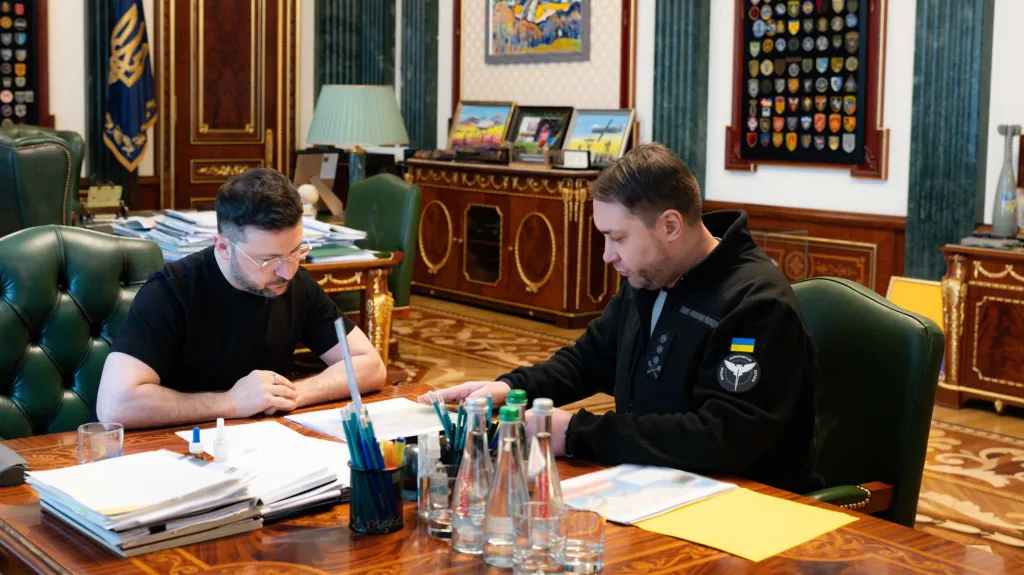
Lt. Gen. Kyrylo Budanov, who Ukrainian President Volodymyr Zelensky named as his new chief of staff on Friday, tells The War Zone that the job will center on figuring out a way to end the war and helping to calm his country’s political turmoil. Until today, Budanov served as the head of Ukraine’s Defense Intelligence Directorate (GUR). Budanov’s frequent high-profile attacks on Russia and cool demeanor have made him so famous that memes of him have gone viral. He takes over from Andrii Yermak, a controversial and polarizing figure recently fired for his role in a burgeoning corruption scandal.
In a brief but exclusive conversation, Budanov told us his main goals for his new position are “negotiations and stabilization of the internal situation and of course, coordination.” He added that he will no longer have a role with GUR’s operations.
“It’s absolutely a new page,” he told us, noting that he will still be in the military and retain his rank, but will “miss” direct involvement in GUR actions.
As for the internal issues he is most concerned about, Budanov said, “I’ll see.”

Budanov’s appointment comes at a perilous moment. Ukraine is facing an intense fight in the east and south, under constant Russian missile and drone attacks and negotiations are ongoing to end the full-on war.
“I met with Kyrylo Budanov and offered him to head the Office of the President of Ukraine,” Zelensky explained. “Right now, Ukraine needs to focus more on security issues, the development of the Defense and Security Forces of Ukraine, as well as on the diplomatic track in negotiations, and the Office of the President will serve to fulfill primarily such tasks of our state.”
Budanov “has special experience in these areas and sufficient strength to achieve results,” Zelensky noted. “I also instructed the new head of the President’s Office to, in cooperation with the Secretary of the National Security and Defense Council of Ukraine and other necessary leaders and institutions, update and present for approval the strategic foundations of defense and development of our state and further steps.”
Naming Budanov gives Zelensky a degree of political and military cover at a precarious time. The former GUR commander is well-regarded both at home and abroad, and his presence at the top of the government gives Zelensky a key aide with gravitas. On the downside, Budanov comes to the job with little experience dealing with the political and bureaucratic minutiae that a chief of staff must master to keep the government running at a time of war.
For Budanov, the move is the latest step in a career that saw him become a national hero after being thrice wounded fighting against Russians since they first invaded in 2014. He was promoted to brigadier general and named head of GUR in 2020 and burst onto the international scene a year later when he laid out how and when Russia would launch its full-on invasion three months before it would happen.
Since then, Budanov has transformed GUR into a cutting-edge military and intelligence unit that helped develop uncrewed surface vessel warfare, staged helicopter raids behind the lines as well as cyber attacks and suspected assassinations of Russian military leaders. He has also survived several assassination attempts and was charged in absentia with committing acts of terrorism related to the Oct. 8, 2022 Kerch Bridge attack.

Budanov recently ventured into the world of diplomacy, taking part last month in the ongoing peace talks.
The exploits of Budanov, who has frequently commented on the conflict for The War Zone and other publications, has made him a top contender to succeed Zelensky in the next election despite making no public suggestions that he is interested in the position.
“Although Budanov has never announced plans to pursue a political career, he is regularly featured in opinion polls and ranks among the top presidential contenders, behind only Zelensky and Ukraine’s Ambassador to the U.K. Valerii Zaluzhny,” the Kyiv Independent noted on Friday. “According to a recent poll conducted by Socis, Budanov would secure 5.7% in the first round. In a hypothetical runoff between Zelensky and Budanov, the latter one would defeat Zelensky with 56% of the vote against 44%.”
There is another benefit to this move for Zelensky. Bringing Budanov into his administration adds layers of complication should the new chief of staff decide to challenge Ukraine’s president in a future election.
Zelensky named Lt. Gen. Oleg Ivashchenko to replace Budanov. Ivashchenko most recently headed the Foreign Intelligence Service of Ukraine (SVR).

The Latest
On the battlefield, Ukraine is continuing to hold onto parts of the embattled city of Pokrovsk despite Russian President Vladimir Putin’s proclamation last month of its capture. Though Russian troops broke into the city in late October after more than a year of bloody assaults.
Ukraine’s defense of portions of Pokrovsk has been aided by the recent delivery of the last 12 of 49 Abrams main battle tanks from Australia.
The Australian Abrams “entered the fight during a critical phase of the battle for Pokrovsk, where Ukrainian forces are conducting counterattacks to keep Russian troops south of the railway line and prevent them from breaking out, which would cut off withdrawal operations from Myrnohrad,” Euromaidan Press reported.

The operation “was carefully structured, with Abrams tanks moving forward alongside infantry fighting vehicles, acting as both shield and hammer,” the publication added. “The primary task of the tanks was to suppress Russian firing points with their main cannons, draw enemy drone attention, and create corridors for the Ukrainian BMPs to advance.”
Under the Abrams’ cover, “the BMP’s pushed toward the outskirts of Pokrovsk, dismounted assault troops, and secured key positions that had previously been under heavy Russian pressure.”
The delivery of the last tranche of Australian Abrams came as Ukraine had already lost at least 23 of the 31 variants provided by the U.S., according to the Oryx open source tracking group. The losses are likely significantly higher because Oryx only provides information for which is has visual confirmation.
Meanwhile the Pokrovsk front is also seeing a blend of the most modern warfare with a throwback to a centuries-old tactic.
Ukraine’s Third Assault Brigade claims one of its uncrewed ground vehicles (UGV), mounted with a 12.7 mm machine gun, helped hold a position in this region for 1.5 months.
“For 45 days in a row, the ground robotic complex of the Third Assault Brigade went on combat duty and suppressed all enemy attempts to break into our sector with machine gun fire,” the unit proclaimed on Telegram. “The operators of the NC13 NRC shock unit controlled the DevDroid TW 12.7 robot from a safe shelter. During the mission, the enemy failed to infiltrate or occupy our position. And the fighters held the lines with zero losses in manpower.“
The War Zone cannot independently verify the Ukrainian claim, however, both ground drones are playing an increasing role for both sides because of the way aerial drones are attacking troops and vehicles. The UGVs are being used mainly for logisitcal support and casualty evacuation.
In contrast, Russia has been using soldiers on horseback to attack Ukrainian positions.
“Russian occupiers lose so much equipment during their ‘meat-grinder assaults’ that they’re forced to move on horseback,” the 5th Assault Battalion of the 92nd Motor Rifle Brigade stated on Telegram. “But even that doesn’t help them – the drone operators ‘take out’ the enemy as soon as they spot a target.”
The commander of the Russian Storm special forces unit of the 9th Brigade of the 51st Army, started training horse assault groups in September for attacks at the front, according to the Ukrainian Militarnyi news outlet.
The commander “stated that the idea of reviving the cavalry, which was disbanded in the Soviet army in 1955, is not a ‘return to the past’ and has a number of advantages,” the outlet noted. The horses, said the commander, “see well in the dark, do not need roads to accelerate at the final stage of the offensive, and thanks to instincts, they can allegedly bypass mines.”
While the fighting remains intense in and around Pokrovsk, the Russians are also advancing in the Zaporizhzhia region of the south.
At a meeting on Sunday attended by Russian President Vladimir Putin, the Russian commander in the region, Col. Gen. Andrei Ivanaev, claimed the town of Huliaipole has been captured.
“Ivanaev told Putin that his forces had taken over 210 square kilometers of territory in the Dnipropetrovsk and Zaporizhzhia regions since early December, feeding the Kremlin’s narrative that ultimately Russia will achieve its goal of occupying four regions of eastern and southern Ukraine,” CNN reported.
“The Ukrainian Defense Forces continue to hold positions in most of Hulyaypole, but further defense of the city is becoming extremely difficult due to the terrain,” the Ukrainian conflict tracking group DeepState posited. “The city is completely in a grey zone, because the enemy, like our forces, is present almost everywhere. In one basement there may be fighters of the Ukrainian Defense Forces, and in the neighboring one – the enemy. Only assault groups operate in the open, of which the enemy has significantly more, so he can afford to shoot a video in the center of Hulyaypole with a flag.”
Beyond the front lines, Ukraine is continuing its campaign of attacking Russian energy infrastructure.
“On the night of January 2, Ukrainian strike drones struck an oil refinery in Russia’s Samara Region,” according to Militarnyi. “Local residents reported hearing explosions, and the Supernova+ Telegram channel shared footage believed to show a fire at the site.
The target was the Novokuybyshevsk Oil Refinery, which is owned by the state-run company Rosneft, the outlet explained. Video shot from a distance shows flames erupting, though the extent of the damage is unclear.
The Russians have also continued their airstrikes on Ukrainian cities well beyond the front lines.
In the early morning hours of Jan. 2, “the enemy attacked with 116 strike drones of the Shahed, Gerbera and other types,” the Ukrainian Air Force stated. While the air defense “shot down/destroyed 86 enemy drones…27 strike drones were hit at 23 locations, and the wreckage of the downed drones fell at two locations.”
Ukraine’s war efforts have been greatly assisted by supportive partisan groups inside Russia. GUR recently announced that it carried out a plot to fake the killing of the leader of one of those groups.
The murder of Denis Kapustin, the commander of the “Russian Volunteer Corps” unit, was ordered by Russian special services and a $500,000 bounty was placed on his head, GUR claimed. Kapustin, 41, was previously reported killed by a Russian drone while carrying out a combat mission in the southeastern Zaporizhzhia region overnight on Saturday, Dec. 27, according to the Kyiv Post.
However, Kapustin’s death was faked as a ruse to get him out of Russia and he is now safe in Ukraine, GUR noted. In addition to saving an asset, GUR claimed it also pocketed the reward money.
“The half a million dollars received for his elimination will strengthen the special units of the Main Intelligence Directorate,” GUR exclaimed.
Amid all the bloodshed and political machinations, negotiations to end the war drag on.
Zelensky, who just returned to Kyiv after a visit with U.S. President Donald Trump in Florida, said the agreement was largely in place.
“The peace agreement is 90% ready,” the Ukrainian leader said in his New Year’s Eve address. “Ten percent remains. And that is far more than just numbers. Those 10% contain, in fact, everything. Those are the 10% that will determine the fate of peace, the fate of Ukraine and Europe.”
For his part, Putin said little about the peace process in his New Year’s speech. He told Russia’s soldiers that they were shouldering the responsibility of fighting for their “native land, for truth and justice.” Russia’s people, he added, believe that victory will be achieved, according to The New York Times.
Earlier this week, Russia claimed that Ukraine tried to attack Putin’s residence to derail the peace process, a charge Ukraine denied. The CIA pushed back on that assertion, which sparked Trump’s ire.
The biggest sticking point is the hardest one to overcome. Russia wants full control of the Donbas, including the territory Ukraine still holds. The cities still in Ukrainian hands provide an important bulwark against further Russian advances deeper into the country.
After meeting Zelensky at Mar-a-Lago on Sunday, the two leaders said they had advanced a 20-point peace proposal. Trump claimed they had covered “95 percent” of the issues needed to end the war.
Pressed on unresolved issues, Trump pointed to territory – land seized by Russia that Putin has shown no signs of agreeing to return.
“You’re better off making a deal now,” Trump told Zelensky, warning that time favors Moscow.
Contact the author: howard@thewarzone.com