WASHINGTON — Sipping tea from beer mugs with his co-workers, Kyle Bos listed the ways his life is changing.
Bos has two daughters, with a third due in January. At the grocery store, five items cost as much as a full cart once did. And on Wednesday, Bos and nearly 1,400 other people were laid off from their jobs as the Navistar truck factory in southwestern Ohio shut down.
The layoffs — occurring three days before President Trump’s rally Saturday at a nearby high school — were large enough to essentially erase an entire year of job growth in the greater Dayton area. And they are one reason why Bos, 30, plans to spend the final weeks before the November election canvassing votes for Democrats.
Asked how many times he voted for Trump, Bos held up three tattooed fingers. But he said he’s done with the president.
“Something has to change politically in this country,” said Bos, a member of the United Auto Workers who identifies as a centrist.
A Trump campaign stop
This election is a test for the working-class coalition that lifted Trump into the White House again and gave majorities to Republicans in the House and Senate. The outcome will be decided in places like Dayton, which once sprouted factories but shed about half of its 90,000 factory jobs since 1990 after the North American Free Trade Agreement and trade with China made it cheaper to buy auto parts from abroad.
Trump’s blunt talk and status as a celebrity businessman initially helped him in and around Dayton, where some said politics as usual had failed them. But voters this year are disgruntled about inflation and the war in Iran.
An Ohio race could help determine control of the Senate. Republican Sen. Jon Husted is facing a challenge from Democratic former Sen. Sherrod Brown, who is trying to harness that disenchantment as he attempts a comeback two years after losing his seat.
Americans increasingly blame Trump for the high cost of living, with just 17% approving of his handling of the issue, according to a new AP-NORC poll. Trump didn’t talk about grocery prices or gas prices or layoffs at his Saturday night rally in Vandalia, part of what he says will be a 32-day marathon of rallies to try to convince the public that the economy is better than they think.
“The fake news media, they refuse to talk about our record-setting numbers. So tonight, if you don’t mind, I’m going to do it myself,” he said at the rally.
Trump largely has scoffed at concerns about affordability, but is promising to give people $5,000 checks if Republicans win the House and Senate next month— something Bos said he found offensive.
“It feels like a bribe, a slap in the face, and, like, that we’re all ignorant,” Bos said.
Factory work moved abroad
As steady paychecks vanished in the 1990s, drug addiction and crime increased. Things seemed to hit bottom after the 2008 financial crisis, prompting Phil Plummer, who was then Montgomery County sheriff, to enter politics.
“My jail was 40% drug addicts, 50% mental health patients, 10% criminals,” said Plummer, the Montgomery County GOP chairman who has been a Republican state representative since 2019. “We got it upside down — that’s what drove me to the statehouse.”
Plummer is now on the ballot for the Ohio state Senate and thinks Trump is what keeps the GOP’s coalition of businesses and working-class families together.
In recent years, the local economy has improved as the Wright-Patterson Air Force Base steadily added government workers. The base has drawn new aerospace companies to the area such as Joby Aviation, Electra and the Sierra Nevada Corp.
“In economic development, it takes time, and you have got to give it a little bit of time to bake, and then once it does, then you’re going to have something special,” said Jeff Hoagland, chief of the Dayton Development Coalition.
Demand at plant fell
Trump pointed to the $850-million investment by aircraft maker Electra — along with a new project in Ohio from Stellantis and a Friday announcement from Bayer for a $2.2-billion drug plant near Columbus — as evidence that his policies were creating jobs.
But at the Navistar plant, Trump’s broad tariffs never boosted demand, and the plant’s former owner, International Motors, chose to offload the facility.
Trump’s major legislative achievement, the One Big Beautiful Bill Act, contributed little to people’s take-home pay, even as it temporarily stripped taxes from tips and overtime.
“We weren’t getting a lot of overtime because of the economy,” said Marianne Donnelly, who drove a forklift at the factory. “There just wasn’t any to be had, very little to be had.”
Laid-off workers like Donnelly say they expect to be rehired in six to 12 months by Roshel, a Canadian manufacturer of armored vehicles, which is buying the plant. Roshel said in a statement that it’s “working with everyone involved not only to protect the current workforce, but to more than double it over the coming years through a phased process.”
Laid-off workers looking for hope
On the Monday before the layoffs, Morgan Hughes and JoJo Burkhard were knocking on doors in Kettering, a Dayton suburb. They were trying to convince union members and retirees to vote for Democrats.
The Navistar job had helped Hughes, 35, buy a house at age 21 and work alongside her father. Burkhard said inflation had made it easier to swing voters to their side.
“It isn’t a hard pitch at all,” she said. “And even if they don’t want to stay Democratic long term, they’ll at least give the candidates a chance this election, which could be a turning point for us.”
After a morning of talking to voters, the pair settled down at a Chinese restaurant for some pot stickers, and the weight of the week hit them.
Burkhard cracked open a fortune cookie and tears began to well up. The layoffs meant no work for her, her boyfriend and her mother — and the words in small print almost seemed prophetic.
Her fortune read: “You’ll find your inner strength to overcome challenges.”
Boak writes for the Associated Press. AP writer Seung Min Kim in Vandalia contributed to this report.
Job growth in the United States slowed in September, falling short of economists’ expectations as the unemployment rate rose in the final jobs report before the consequential midterm elections.
The US economy added 29,000 jobs in September, according to the Labor Department’s report released on Friday, far below economists’ expectations. Dow Jones had forecast 84,000 jobs, while economists polled by Reuters said they expected 90,000 job additions.
Recommended Stories
list of 3 itemsend of list
The unemployment rate also rose by 0.1 percentage point, from 4.1 percent to 4.2 percent.
The healthcare sector led the gains, accounting for the majority of new jobs. The industry added 17,000 jobs, marking a slowdown from an average of 33,000 jobs per month over the past year. Construction added 11,000 jobs, while manufacturing added 9,000.
Financial activities, which include sectors such as commercial banking and insurance, shed 7,000 jobs.
Most other sectors were largely unchanged, including retail, oil and gas extraction, and leisure and hospitality.
“Today’s disappointing report shows the labour market is grinding to a halt, marked by slow hiring and declining real wages that leave workers with very little leverage,” Kyle Moore, chief economist at the think tank The Century Foundation, said in remarks provided to Al Jazeera.
Previous jobs reports were also revised downward. July was revised from an initial gain of 21,000 jobs to a loss of 10,000 jobs. August was revised down by 29,000 jobs, from 162,000 to 133,000.
Wages grew by 3 percent, marking the slowest annual wage increase in five years.
Friday’s jobs report caps a week of weakening economic data before the consequential midterm election on November 3.
According to an AP-NORC poll released on Thursday, 61 percent of Americans polled said the US economy is worse off now than when Trump took office in January 2025.
“When businesses are barely hiring and raises aren’t keeping up with rising prices, it’s a stalled economy – and working families are stuck in it,” Breyon Williams, chief economist for Groundwork Collaborative, an economic policy think tank, said in a statement.
Trump has been trying to change the narrative on the slumping economy. On Monday, he said in a Truth Social post that “The United States has the BEST Employment Numbers in HISTORY.”
Stalling growth
On Tuesday, the US Labor Department released the Job Openings and Labor Turnover Survey, or JOLTS report, which showed little change, suggesting what economists call a low-hire, low-fire environment. That means those who have jobs are generally not leaving for new ones, while employers are maintaining the status quo rather than expanding.
On the other hand, ADP’s private payroll report, released on Wednesday, showed that 90,000 jobs were created across the private sector. The sheer number of layoffs fell, too, according to Challenger, Gray & Christmas. The report, released Thursday, showed that employers cut more than 43,000 jobs in September, marking an 18 percent decline in layoffs from August.
Friday’s jobs report comes before the Federal Reserve’s final policy decision before the midterm election. During its two-day policy meeting on October 27-28, the central bank will decide whether to raise, cut or maintain interest rates.
The odds increasingly suggest the Fed will hold rates steady in the 3.75-4.00 percent range, according to CME FedWatch, a tool that tracks the likelihood of monetary policy decisions. The FedWatch tool indicates there is currently a 77.3 percent chance that rates will hold steady, up from 35.8 percent this time last week.
US markets are trending upward on the heels of the report. The tech-heavy Nasdaq is up 1.5 percent, the Dow Jones Industrial Average is up 0.6 percent and the S&P 500 is up 1.1 percent in midday trading.
The price of gold, which is largely considered a safe investment during times of economic uncertainty, rose 1.1 percent to $4,223.49 amid the jobs report.
Stuttgart, Germany – Minutes after the results of the first exit polls flashed across German screens, Chancellor Friedrich Merz of the conservative Christian Democratic Union (CDU) declared in a televised statement at the party’s headquarters that he was going nowhere.
“It’s a disaster,” he said of the state elections in Mecklenburg-Western Pomerania on September 20. “What needs to be done now requires backbone, steadfastness and patience. I will muster them – as party chairman of the CDU and, above all, as chancellor of our country.”
Recommended Stories
list of 4 itemsend of list
But pressure on Merz is mounting.
On Thursday, a survey by Germany’s public broadcaster ARD found that only one in 10 respondents were satisfied or very satisfied with his work. That is the lowest figure for any chancellor since the survey began in 1997.
His party crashed out of the state parliament in Mecklenburg-Western Pomerania, failing to clear the 5 percent threshold needed to win seats – the first time this has happened since the Federal Republic of Germany was founded in 1949. The far-right Alternative for Germany (AfD) came first with more than a third of the vote.
On the same day in Berlin’s state elections, the CDU suffered another major setback. It came second after The Left party, which won 25.7 percent of the vote. The Left now hopes to form a government in the capital although it will need coalition partners.
Just two weeks earlier, the CDU suffered another blow. The AfD won the state elections in Saxony-Anhalt, receiving more than 40 percent of the vote, compared with 17 percent for the CDU.
No obvious successor
Merz could face a revolt within his own party, but removing him as chancellor would be considerably harder.
Under Germany’s Constitution, the Bundestag can replace a chancellor only by simultaneously electing a successor with an absolute majority.
Wolfgang Schroeder, a professor of political science at the University of Kassel, told Al Jazeera: “The CDU is in a situation where it can’t really get any further with Merz, but it also doesn’t know how things would work without him. There is no attractive replacement, so there is no alternative.”
A former chairman of the BlackRock investment company’s German supervisory board, Merz had long harboured ambitions of becoming chancellor but was sidelined by then-Chancellor and -CDU leader Angela Merkel in the early 2000s. He staged an unexpected comeback, finally taking office in May 2025.
Then-designated German Christian Democratic Party (CDU) parliamentary floor leader, Friedrich Merz (left) is pictured with then-party secretary general Angela Merkel (right). In the centre is lawmaker Rudolf Seiters before a meeting of the CDU parliamentary group in the Berlin Reichstag, February 18, 2000 [Reuters]
At the helm, Merz has drawn criticism for remarks about the country’s “Stadtbild” (cityscape), widely interpreted as a suggestion that there were too many refugees and migrants on the streets. The debate has resurfaced in recent days with prominent CDU figures returning to the issue after the party’s poor election results.
The AfD’s surge is but one factor behind the decline of Germany’s long-dominant conservative party, which has produced six chancellors in its history.
The CDU and its Bavarian sister party, the Christian Social Union, govern Germany in coalition with the Social Democratic Party (SPD). The government is struggling amid the rising cost of living, deindustrialisation, crumbling infrastructure and a housing crisis in major cities.
Nils Diederich, a professor emeritus of political science at the Free University of Berlin and a former SPD member in the Bundestag, said Merz has failed to make a good impression but argued he is not the main reason for the CDU’s poor results.
“Overall, I see the coalition itself as the main problem,” he said. “The Social Democrats have worn themselves out in the coalition. They have lost their sense of direction and are putting the brakes on reforms. That, in turn, is dragging the CDU down with them.”
Schroeder told Al Jazeera: “It’s possible that the crisis surrounding the chancellor could develop into a fundamental crisis for the CDU and from there into a crisis for the coalition.”
The reform dilemma
In July, the German government announced a package of 34 measures, including reforms to pensions, taxation, bureaucracy and the labour market. Merz originally intended to push through his repeatedly promised reforms by the end of the year.
But the state elections have put the coalition parties under greater pressure to stake out their own positions.
To ease the burden on people in need of long-term care and to plug multibillion-euro deficits, the SPD is calling for a cap on care costs and for people with private health insurance to share the costs. The CDU firmly rejects both proposals on legal and financial grounds.
State premiers from both major parties and the SPD leadership want to retain the option of retiring without a pension reduction after 45 years of contributions, which they see as a reward for a lifetime of work. The conservative bloc’s business wing, however, insists that the provision be phased out.
Finance Minister Lars Klingbeil of the SPD is planning new revenue measures to consolidate the budget but faces fierce resistance from CDU state premiers and conservative legislators determined to block any tax increases.
Schroeder warned that the coming months could be difficult.
“The CDU is caught in a dilemma. If Merz continues down the path of reforms that place a burden on society, the likelihood of cooperative governance with the SPD will diminish further. If he goes along with the course the SPD is proposing, pressure within the party will increase.”
Diederich said: “If the reforms fall through, then either Merz or the Social Democrats would have to act and let the coalition collapse.”
The next major election test will come in North Rhine-Westphalia, Germany’s most populous state, where voters elect a new parliament in April.
FAO director said he was informed his contract would not be renewed because of allegedly breaching impartiality rules.
Published On 2 Oct 20262 Oct 2026
A senior UN agency director has said that he lost his job because he criticised Israeli policies in Gaza.
Ben Davis, who had been Director of Rural Transformation and Gender Equality at the Food and Agriculture Organization (FAO), told AFP news agency on Wednesday that he was informed in July that his contract would not be renewed because he had allegedly breached impartiality rules.
Recommended Stories
list of 3 itemsend of list
He said that he was accused of organising weekly silent protests at the Rome-based organisation.
“They accused me of organising these moments of silence on the situation of starvation and famine in Gaza,” Davis said.
Davis was also criticised for a report he worked on about food availability in Gaza and humanitarian law, published in May.
“We were told to take it down,” he said. “We weren’t allowed to make any references to humanitarian law.”
‘Game of human rights’
FAO Director-General Qu Dongyu appeared to warn FAO staff on Tuesday that “we don’t allow you to play the game here of human rights”.
He was speaking in public comments made at the start of a filmed session on forestry.
“Of course, human rights is very important, but we have the human rights agency in Geneva,” he added. “If you want to take care, go there.
“That’s why some senior members play the political game here, I fire him … You should follow the FAO constitution … You are against staff regulations … But I’m a very soft person, I didn’t fire that many,” he said.
“I will fire more people if they are against the law,” he added.
Director-General of the Food and Agriculture Organization of the United Nations Qu Dongyu delivers his speech during a World Food Forum meeting [File: Andrew Medichini/AP]
FAO did not respond to an AFP request for comment.
Asked if he thought the director-general’s comments were about him, Davis said “absolutely”.
“He has already scolded me in public in the past for being too political.”
Davis also said he was “concerned” about the director-general’s comments on firing more people.
Hundreds of people attended the moments of silence at their height, while now there are only 30 to 40 people coming on a weekly basis, he said.
Israel’s genocidal war on Gaza has killed over 74,000 people since October 2023, and at least 1,431 Palestinians have been killed in Israeli attacks since the so-called ceasefire between Hamas and Israel was agreed upon in October 2025.
They mentioned “The Odyssey,” they talked about “Lord of the Rings,” they referenced “The Hobbit,” they cited the hero’s journey, they predicted a season filled with mythological tales of triumph.
What they didn’t promise was that their Lakers’ team would contend for a championship.
What they couldn’t mention was what will happen to them if they don’t.
In their annual pre-training camp news conference at their practice facility Thursday, Pelinka and Redick talked about fictional characters perhaps because the reality is too grim for words.
Their jobs are on the line with a rebuilding team that might not be good enough to save them, and no amount of cute Gandalf references can change that.
With new ownership, the Lakers’ braintrust no longer has the protection of the benevolent Buss family or the baseball-centric Mark Walter.
Here’s guessing Bob Iger and Joshua Kushner will want any excuse to put their own people in charge of their $12.5-billion investment. And if this clearly rebuilding Lakers team doesn’t quickly measure up to the brand that Iger and Kushner purchased, they’ll have that excuse.
In his nine full seasons as the Lakers’ basketball boss, Pelinka constructed the 2020 bubble championship team, but destroyed it soon thereafter and hasn’t won since.
In his two seasons as Lakers coach, Redick became the first Lakers coach to win 50-plus games in consecutive seasons since Phil Jackson. But Redick was always LeBron James’ choice, and now that James is gone — thank goodness! — Redick will have to prove himself all over again to the new guys.
He’s already off to an awkward start considering his answer to a question about who would join Luka Doncic, Austin Reaves and Walker Kessler in the starting lineup. He referenced the lame internet criticism that the Lakers couldn’t win because they were now led by too many white guys.
“I’m pretty confident in three of the spots,” he said. “The other two spots will not be two white guys.”
Um, OK.
Redick acknowledged that all those new potential starters — Quentin Grimes, Collin Sexton, Kevon Looney, Matisse Thybulle and others — can band together to turn this season into a mythological masterpiece.
“Part of the Hero’s journey is allies and gods,” he said, referring to stories about ordinary folk who are transformed by triumphant adventures. “And so I think if you look at “Lord of the Rings,” right? All the guys from “The Hobbit,” those guys had to be connected. They had to embrace the fact that they were allies, right? … You’re not gonna get through the journey without that. Or the journey’s gonna be even more tumultuous than it is because the reality is there will be ordeals and trials along the way.”
At this point Pelinka jumped in, saying, “So I’m a big Tolkien guy. Are you Samwise or Frodo?”
Answered Redick, “Uh, I’m simultaneously Samwise and Gandalf.”
Replied Pelinka: “Gandalf. That’s even better.”
Rob Pelinka (left), the Lakers general manager/president of basketball operations, speaks to the media with coach JJ Redick on Thursday at the team’s training facility in El Segundo.
(Allen J. Schaben / Los Angeles Times)
In San Antonio they’re talking about Wemby, in Oklahoma City they’re talking about SGA, and in Los Angeles they’re talking about … Frodo?
Tumultuous indeed. Welcome to life after LeBron, with Pelinka essentially starting the news conference by answering the biggest question of the summer — why did the James and Laker marriage fail?
Except he didn’t answer it.
“I’m so thankful for the partnership that we had that continued up until this summer when a decision was made for him to play for another team,” he said.
A decision was made by whom? James said it was him. It says here it was the Lakers, who needed to move him out if they were going to move ahead.
Pelinka didn’t elaborate, instead focusing on a popular reference that he sort of botched.
“We’ve talked about every season is a little bit like ‘The Odyssey,’ if anyone has seen the movie,” he said before someone corrected him. “Oh, it was actually a poem. Fair enough.”
The poem wasn’t this complicated.
“You launch a season, and there’s things that happen throughout that you can’t predict, but you have to stay together as a group and stay strong,” Pelinka said. “That’s a great theme for us.”
Pelinka will be going through his own Odyssey this season, as evidenced by his defense of his accomplishments.
“If you look at the teams that we’re wanting to go shoulder-to-shoulder with, the Thunder and the Spurs maybe in the West. … They had to lose many seasons to get high picks and we just don’t have the luxury of that here,” he said. “Again, the expectations are every year (to) win, get in the playoffs, make a run, and so we feel like we’ve been able to do that. As I’ve started, since I’ve been here in the leadership position, we’ve been a playoff team and we have to continue to do that.”
Redick was also playing defense, saying, “No one is a championship-level team on September 29. There’s not a team in the league that is a championship-level team. That is an ongoing process throughout the year. Rob talks about his job in that. Well, I have a job in that. Our players have a job in that. I’m confident we’re gonna develop as a team into a championship-level team this year. “
This season will live forever in Lakers folklore if they do.
There could be a medieval bloodbath if they don’t.
Tens of thousands of people walk in and out of Dodger Stadium on any given night, paying scant attention to the trees, plants, and other foliage surrounding it on all sides. Chaz Perea made his peace with that a long time ago.
“Getting to Dodger Stadium is not a small thing,” said Perea, 41, the stadium’s landscape manager. “You’ve got to park in this monster,” he said, motioning to the acres of asphalt around him, “and then go find your seat in that monster.”
1
2
3
1.The agave garden sits outside Lot B at Dodger Stadium on Friday.(Gina Ferazzi/Los Angeles Times)2.Dodgers fans walk past vibrant plants behind photos of former Dodgerss outside center field at Dodger Stadium on Friday.(Gina Ferazzi/Los Angeles Times)3. A group visits agave island during a tour of Dodger Stadium’s botanic garden on Tuesday.(Christina House/Los Angeles Times)
For the past 17 years, Perea and his four-person crew have been responsible for every bit of stadium landscaping that isn’t the field itself. That’s roughly 300 acres, encompassing the parking lots, the hillsides meeting the 110 Freeway, and 149 concrete planters nicknamed “martinis” for their glass-like shape. The planters are original to the stadium’s 1962 construction, and many had crumbled badly enough over the decades to need painstaking repair.
The landscaping isn’t just about plants and planters. Behind a fence beyond the iconic orange 76 ball in the parking lot once sat a hidden garden. Its centerpiece was an eight-foot-tall stone lantern given to then-Dodgers owner Walter O’Malley by Japanese sports columnist Sotaro Suzuki and his wife, Toku, who had attended the stadium’s grand opening in 1962. Suzuki commissioned the 3,921-pound Kasuga-style lantern, which arrived in five pieces in late 1965 and became the centerpiece of a garden that also featured a small wooden bridge and a collection of rocks.
“For years, it was maintained by our gardener with great pride,” said former Dodgers owner Peter O’Malley, Walter’s son. “But it was remote, and fans couldn’t really get up there easily to see it or sit in the garden. And it got neglected for a few years. Some years later, I forget how many, we had to fence in the whole property.”
In 2024, shortly after the Dodgers signed two-way sensation Shohei Ohtani, the club moved the lantern to a place of prominence outside the top-deck gates, overlooking the downtown skyline. The move was an elaborate, delicate production. Bundled and boarded up, the lantern inched across the parking lot on the back of a flatbed truck that climbed a ring road steep enough to cause concern.
“It was like they were moving the Ark of the Covenant,” Perea said.
No one exhaled until the cargo was unloaded, unswaddled, and confirmed to be in one piece.
An 8-foot-tall stone Kasuga-style lantern is displayed at Dodger Stadium on Tuesday.
(Christina House/Los Angeles Times)
Perea’s crew works out of a large metal shed at the far end of a parking lot, a shop they affectionately call “the Oasis.” Much of what’s inside was retrieved from a dumpster, or scavenged before it landed in one. Perea, who describes himself as a bargain shopper, is passionate about repurposing whatever he can; many of the succulents at the stadium came from his own clippings.
“My general philosophy is I don’t treat the Dodgers like I’m salaried management,” he said. “I treat them like I’m a contractor that they don’t want to get rid of. So I manage the expenses and the labor as such.”
He doesn’t have much interaction with players and executives, though he’s occasionally been called to their homes to help with landscaping problems. One visit stands out.
“Vin Scully is the coolest one I’d stake a claim to,” he said of the legendary play-by-play man. “He was an unbelievable class act. He had a tree issue. He had us out, and was so attentive and appreciative, it was just stunning to me.”
1
2
3
4
1.Landscape manager Chaz Perea gives a tour of Dodger Stadium’s botanic garden.(Christina House/Los Angeles Times)2.A ceramic dog and monkey sit on a golf cart inside the Dodger Stadium landscape team’s shed on Tuesday.(Christina House/Los Angeles Times)3.A photo of Jim Lefebvre, Dodger player from 1965-1972, is surrounded by plants at Dodger Stadium on Tuesday.(Christina House/Los Angeles Times)4.Adolfo Hinojosa checks on the planters near center field at Dodger Stadium on Tuesday.(Christina House/Los Angeles Times)
On the hillside above the shop is an open-air lunch area, its seating made from wooden bleachers salvaged from the old right-field pavilion. Peek through the bushes and the stadium is visible in the distance. Inside the shop, the walls are lined with neatly organized shovels, pickaxes, and ladders. Above them hang paintings, art being another of Perea’s passions, most of them made by his friends.
Perea freely admits he’s an odd fit for the job. He’s not a baseball fan; he prefers beach volleyball and mixed martial arts. He had a rough upbringing in Arizona, dropped out of high school, and got by on $6.75 an hour doing golf-course maintenance, supplementing it with landscaping gigs he ran out of his pickup truck before eventually returning to school.
He came back to the classroom with a purpose, not only finishing high school but going on to earn multiple advanced degrees and, ultimately, a Ph.D. He’s now a professor of horticultural science and co-chair of agricultural science at Mt. San Antonio College.
But it’s his day job that draws clusters of Dodger fans willing to pay $52.25 each for his 90-minute botanic garden tour of the grounds. They explore “Agave Island” near the main entrance, a wedge of land planted with nine palm trees to match the number of players on a baseball field, and the planters outside the club-level entrance, where the crew grows chilies (jalapeños, serranos, habaneros), along with basil, mint, tomatoes, onions, and garlic. That garden spawned an annual salsa competition, in which club employees harvest their own ingredients from the planters, make salsa at home, and bring it back to be judged. Perea and his crew make handmade tortillas and quesadillas for the event.
Landscape manager Chaz Perea gives a tour of Dodger Stadium’s botanic gardens on Tuesday.
(Christina House/Los Angeles Times)
Two more planted islands are devoted entirely to tequila agave. It takes nearly a decade for the plant to mature, and about 110 pounds of its core to yield a single liter of tequila through processing. Perea and his crew hope to eventually try making some themselves, as an in-house project rather than a commercial one.
The landscape looked very different before Perea arrived. He describes the old look as Disneyland-esque: heavy on lawns and flowers, constantly in need of replacement, and thirsty for water. About two years into the job, he began swapping annual flower beds for drought-tolerant succulents. When one executive noticed and ordered the flowers put back in a particular spot, Perea complied there, then made the same swap a little farther down the hillside, out of view.
Turnover among executives and ownership gave him repeated openings to make wholesale changes, a shift that coincided with California’s drought crisis. Within a few years, he had planted 10,000 cuttings and stripped every flower bed from the property.
“A lot of people look at this as the last unpainted canvas in Los Angeles,” Perea said.
Chaz of Chavez Ravine, perpetually painting the corners.
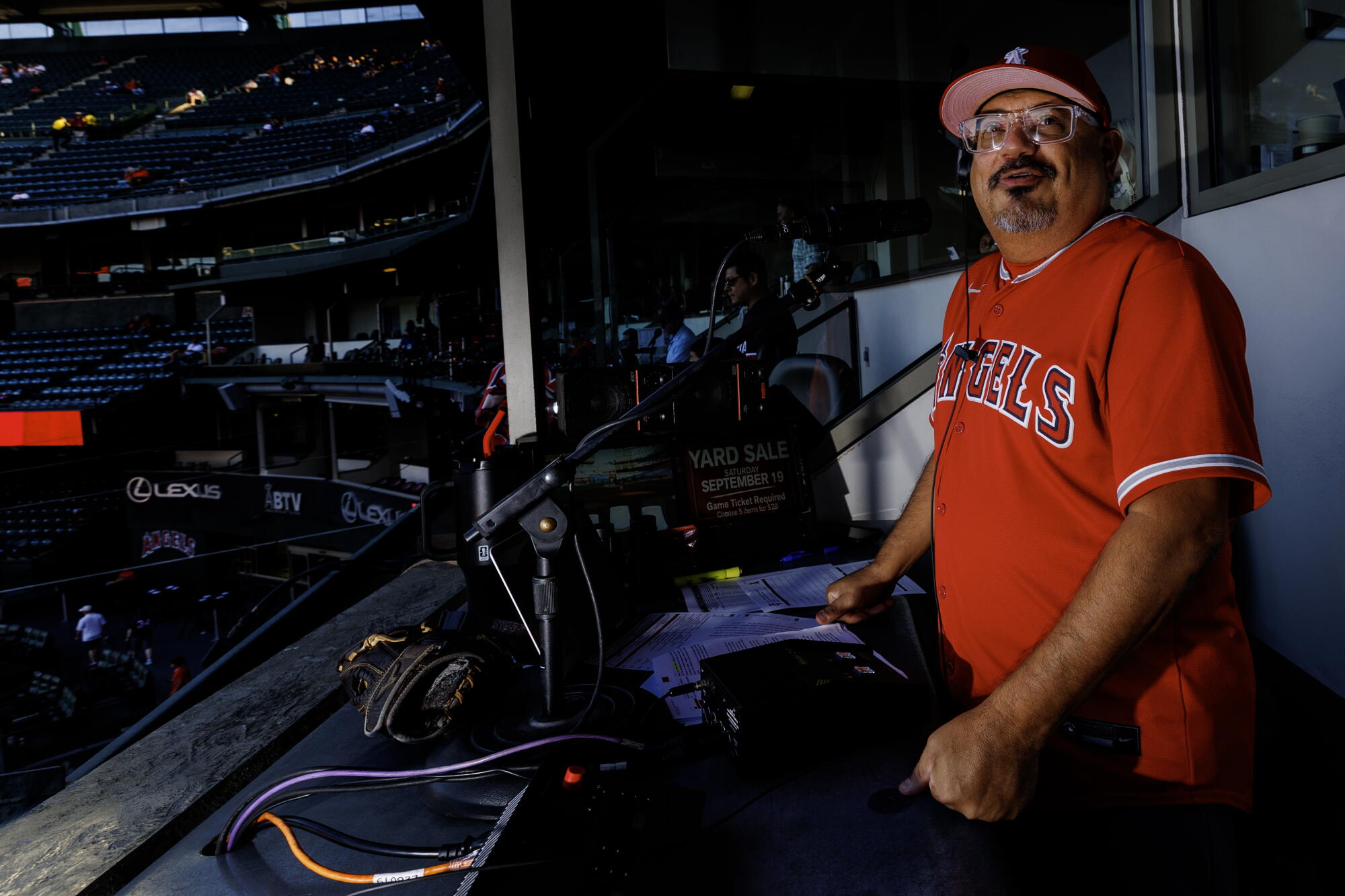
You’ve probably never seen Michael Araujo, but if you’ve attended an Angels game since 2013, you’ve definitely heard him.
On Sunday, Araujo will work the final game of his 14th season as the Angels’ public address announcer. During that time he has started more home games than Mike Trout and finished hundreds more than any reliever to come out of the bullpen.
Yet for most fans, his voice has been little more than background noise, an acapella Muzak that only gets noticed when Araujo makes a mistake.
And mistakes just don’t happen, said Davin Maske, the Angels’ director of entertainment and production.
“I don’t remember any,” said Maske, Araujo’s boss. “There isn’t that one major mistake since I’ve been here that I could recall.”
Araujo, who is also the stadium voice for the Galaxy, has worked Gold Cup and Copa América soccer matches, eight World Cup games and the 2003 Women’s World Cup final. But the Angels’ gig is his dream job and he passed 1,000 games as the team’s PA announcer last month.
“He loves sports,” said his wife Kathryn Casey. “He really does enjoy being there and being part of it because he’s a huge fan. It’s not just a job.”
It is a job that comes with high expectations, though. Because if the broadcasts of the late Vin Scully were the soundtrack for baseball fans in Southern California, for people of a certain age, the booming baritone of John Ramsey will forever be the template for what a PA announcer should sound like.
Ramsey, who died in 1990, was the original PA voice of the Angels, as well as the Dodgers, Kings, Lakers and L.A. Raiders. He also did the Rams and USC football with a calm, articulate and authoritative delivery that was so powerful, it had its own echo.
“Would you all please rise (rise, rise, rise) and honor America in the singing of our national anthem (anthem, anthem, anthem).”
It was like being spoken to by God, an impression aided by the fact that Ramsey, hidden in a small booth near the press box, was heard but never seen.
“That’s not me, Araujo said. “So I try not to emulate that.”
Angels public address announcer Michael Araujo overlooks the field in his booth before a game against the Minnesota Twins on September 17.
(Gina Ferazzi / Los Angeles Times)
Still, like Ramsey, Araujo’s gift is his voice. And though his delivery isn’t nearly as deep and commanding as Ramsey’s, it is unique in that it has a distinct, enthusiastic lilt, one he’s been able to maintain through what will likely be the Angels’ first 100-loss season.
“I try to bring the energy,” he said.
“It’s all about riding your vibes,” Maske added. That’s why Araujo’s perch on the club level behind home plate is exposed to the crowd rather than enclosed, like the booths to his right used by the radio and TV broadcasters. The idea is to feed off the fans, not lock them out.
“Baseball is gnarly. It’s repetitive. It’s a sport that’s inherently, at times, very boring,” Maske said. “So you’ve got to find those little moments to make it entertaining.
“It’s not NFL. It’s not the NBA. It’s baseball. Mike’s good at kind of finding that balance of excitement and traditionalism.”
And the excitement, even at the end of a blowout loss, is genuine, he said.
“The Angels were my team growing up, so the Angels was my dream job,” said Araujo, a former season-ticket holder. “I’ve been very fortunate.”
“I want to get paid to watch sports and that’s it,” he continued. “So whatever I’ve got to do to be invaluable so that I stay there, that’s kind of my mission.”
It’s not a mission that pays much, however, with most PA announcers across the majors earning between $100-$500 a game to announce each hitter as he comes to plate, read commercial copy between innings and, in Araujo’s case at least, to handle the play-by-play for the cartoon races that run on the scoreboard late in the game.
“It’s fun money,” said Casey who, like Araujo, is a teacher as well as the clock operator at Galaxy games, where she works alongside her husband. “We use it for travel.”
The job is one Araujo stumbled into. Despite a rich voice and a lifelong passion for sports, pairing the two was something that just happened, not something that was planned.
A teacher at an alternative-education high school in La Puente, Araujo, 54, has worked for the Galaxy since the MLS team’s second game in 1996, filling a number of roles from glorified errand boy to assistant game-day producer. That last job required him to stand behind the PA announcer and relay silent cues, and since he knew the gig, Araujo was handed a microphone and asked to fill in a few times during absences, sick days and other emergencies.
The biggest emergency came when Victor Villalba, the Galaxy’s regular announcer, left in the middle of a season to join the Dallas Cowboys radio team. Araujo was the natural choice to finish out the year and he’s been there ever since.
“That was 2002,” he said. “So I’m in my 25th season.”
It was similar desperation that led to his job with the Angels. When David Courtney, who had been with the team for nearly two decades, died at 56 two months after the 2012 season, the Angels began asking around for a replacement and Araujo’s name was the one they heard most frequently. So he was invited to spring training the following year to audition and he beat out two others to claim the job.
On game days Araujo gets to the ballpark about 2½ hours before first pitch, pausing in the parking lot to pull on an Angels cap and jersey with his name on the back. If the team wins, he’ll wear the same jersey the next day; if not, he’ll rotate through a closet of red, white, gray and City Connect jerseys.
Araujo’s only other tools are a microphone and a laptop, on which he’s installed an interactive software program he created that tracks the lineups of both teams. He can also call up pronunciation guides for players on all 30 major league teams, though he’s found the radio broadcasters for the visiting clubs are often more helpful.
Angels public address announcer Michael Araujo has worked more than 1,000 games at Angel Stadium and has been the Galaxy’s public address announcer since 2002.
(Gina Ferazzi / Los Angeles Times)
His cramped work space, about 90 feet from the field, has enough room for two green vinyl chairs, though Araujo prefers to stand when he’s working. And unlike many people whose vocal chords are their livelihood, Araujo says he has few ritualistic habits to protect his voice.
“In my bag I have a gazillion cough drops; a couple of different kinds, some with honey,” he said. “I definitely wouldn’t do anything carbonated before a game. Makes you burp and all that kind of stuff.”
Araujo is one of three Latino PA announcers in the majors, alongside Marysol Castro, who works for the New York Mets, and Frank Fernandez of the Miami Marlins. Given that 30% of big-league players are from Latin America, the fact that just 10% of the PA announcers are Latino is something Araujo said he thinks about during Hispanic Heritage Month.
“Did I grow up in Boyle Heights or anything like that? No, I’m no poster child or miracle story or anything like that,” said Araujo, who was raised middle class in La Verne, where his father, a sheriff’s deputy, and mother, a nurse, often spoke to one another in Spanish.
“We are here in 2026 and it’s not a little more prevalent. It can be an aspiration to any kid, even one of my students, that bigger things are possible.”
For a PA announcer, it turns out, there are times when it’s important to be heard and seen.
The new incentive is aimed at bringing back jobs for the industry’s editors, sound mixers, composers and visual effects artists. It will allow a 35% to 50% credit on qualified expenses related specifically to post-production work done in California, and unlike the state’s existing film and TV credit, it doesn’t require productions to shoot here.
“This legislation protects the extraordinary people who make this industry possible and makes it unmistakably clear: California is still the future of film and television,” said Gov. Newsom in a statement. “We have the talent. We have the infrastructure.”
The bill, AB 2319, was authored by Assemblymember Nick Schultz (D-Burbank) and introduced earlier this year. It cleared the state Senate 33 to 5 on Aug. 30, and the Assembly approved the final version 72 to 2 the same day. Schultz originally sought $100 million for the program. It is expected to start in January with $10 million, according to the Assemblymember Schulz’s office.
“It’s a historic moment for California’s post-production community. But it’s also just the beginning of what we really need to do to to fight for our industry,” said Marielle Abaunza, president of the California Post Alliance, a group advocating for the bill. She said the group is readying its strategy to get more funding for the program next year.
As Hollywood productions continue chase tax credits to other states and countries, much of the post-production work is going with them. California’s share of U.S. post-production employment has fallen from 53% to 42% over the last 13 years, according to CVL Economics, an economic consulting firm tied to California Post Alliance. The state had about 12,000 post-production jobs last year, per CVL Economics.
Ben Urquhart, 51, spent 18 years as a post-production executive at NBCUniversal. The Culver City resident hasn’t been able to find work in the two and a half years since he was laid off.
“It’s grim and it’s hard. There are jobs, but we have a large amount of extremely qualified people competing for every level of job,” Urquhart said. “When I was a kid, I was a [production assistant] in the 90s, and you could get a job within a couple of weeks. But when I got laid off a couple of years ago, I realized that is certainly not the case at all anymore. It’s been a large-scale transformation.”
Urquhart said the new incentive would help California compete with jurisdictions that already offer these credits and “level the playing field.”
Last year, California expanded its film and TV tax credit program, more than doubling the old $330-million cap to $750 million through June 30, 2030. The existing program already covers post-production, but only if 75% of filming or the overall budget is spent in the state.
Newsom also signed a bill that would strengthen the current tax incentive program overall. In June he revealed a state budget measure that capped how much in tax credits a business can claim each year, a limit industry groups warned would undercut the expanded program. But the new Senate Bill 186 enhances refundability for the industry and exempts independent productions from the credit limits, starting next year.
Sam Catling lived the dream by ditching a supermarket job for a supposedly fun role as a cruise ship entertainer. He opens up about his day to day life on a cruise ship, the long hours he worked, and how much he took home each month
Sam Catling landed the dream job despite never working on a ship before(Image: Sam Catling)
Working on a cruise ship is the kind of job everyone fantasises about now and again. And when Sam Catling was just 18, he landed what many people would consider a dream role – a cruise ship entertainer.
Sam, now 38, now shares his memories of his time at sea, as well as interviewing others from across the maritime industry in his podcast Deck Tales, and he’s even written a book, Seems Like Smooth Sailing, that gives an unflinching account of what it’s like to work at sea for months on end.
He jokingly refers to himself as a former ‘trolley wally’ and says his CV consisted of a paper round and a job collecting trollies at Asda when family members suggested he’d be a great cruise ship entertainer. His mum and granny had just come back from a cruise and had chatted to onboard entertainers about how they got into the role, before suggesting the idea to the outgoing Sam.
He spoke about how he managed to land the role, despite his lack of previous boating experience: “I used to get The Stage magazine delivered to my newsagent on a weekly basis, and I kept looking through the ads, and eventually I saw one that said ‘now receiving applications for entertainment hosts’ so I applied.
“The first question was ‘What previous experience do you have working in entertainment?’, and eventually I wrote ‘Ive had extensive experience pushing trolleys around Asda car park for the past two years’.”
With a drama GCSE and a few workshops under his belt, Sam soon found himself in Gibraltar on a boat that was in dry dock, attending two weeks of rehearsals as the ship was refurbished. In addition to entertainers such as himself, who did events from game shows to karaoke, there were a show team with West End-style performers who Sam said were a “triple threat” with dancing, singing, and acting skills.
The job was gruelling, with Sam revealing he worked seven days a week. Visits home were extremely rare, crew stayed on the ship the duration of their contracts, which for Sam’s first cruise was six months. The days were long too, with Sam admitting he became “quite the social drinker” due to his schedules requiring him to sit down and socialise with guests.
His shifts would often finish past midnight, and he’d head to the crew bar after work until 2am, before getting up at 7am to face the next day. Sam said he became skilled at power napping: “Between your different activities that you’d host I was down in my cabin having a power nap. If I had an indoor cabin I’d just close the door and you were in pitch black darkness, so it was really easy to just have a 30 minute nap.” But he admitted: “You wouldn’t know what time of day it was because you’re cutting out all the sunlight.”
His accommodation was included, as was food and expenses, and Sam said: “You’re not paying rent, your food’s taken care of, you’ve no heating and electric and gas bills and all of that stuff. It’s all taken care of, which is nice! You don’t have to worry about all those things. But then you are spending money when you go ashore, you know, going to eat out, because after a couple of weeks of being on board you are sick of the food.”
Sam revealed that, when he worked on ships around 2006, he was taking home about £1,200 to £1,300 a month from working seven days a week. Accommodation was shared, and Sam said only managers and the top talent such as the main singers in the shows would get their own cabins.
Despite this salary being representative of a job over 20 years ago, cruise ships don’t pay much more now. According to career site prospects.ac.uk, which advises students on employment routes, those with little experience shouldn’t expect big money for their long hours: “Entry-level cruise ship jobs, such as hospitality, housekeeping, retail, or waiting staff positions, typically pay around £1,000 to £1,500 per month, often with accommodation and meals included.”
But it claims that experienced crew can get decent salaries at sea: “With experience and progression into specialist or management roles, salaries can rise to between £2,000 and £4,000 per month. Senior officers, entertainment managers, engineers, and technical staff may earn considerably more.”
Sam worked on cruise ships for four years, and nowadays he runs his podcast, which he describes as his “passion” with over 60 episodes available, as well as taking on handyman jobs and occasionally working as a TV extra.
“I want to continue doing this until I’m an old man, because there’s 70% of the planet that’s covered in ocean, so I don’t think I’m going to run out of guests anytime soon. The podcast started with just being a platform for cruise ship crew, but now it’s something else. It’s cargo ship captains, I’ve spoken to a pirate, I’ve had a deep sea salvage scuba diver and tugboat captains.”
He added: “I just really wanted to drill down into something unique and authentic, and within a specific niche that people might not know about; the stories at sea that most people don’t hear. The public might not have an interest in ships, but people are still people, and the stories that happen at sea are there for everyone to hear about.”
Kids’ favourite TV character Bob the Builder – complete with a voice over by actor Neil Morrissey – has been hired to encourage more people to learn green energy skills
Bob the Builder has returned for a one-off advert in his original stock motion form (Image: E.on)
Much-loved cartoon character Bob the Builder is making a return in his original form after 15 years – to plug green energy.
The kids TV favourite, voiced by Men Behaving Badly actor Neil Morrissey, appears in a new advert from energy giant E.on.
And he also reveals what he has been doing since the original stop motion version of the show ended in 2011, including taking up yoga, bird watching and travelling to Australia.
It is Down Under, so the new story goes, that Britain’s best known tradesman twigs the importance of green energy, such as solar panels and home batteries. On returning home, he decides to learn the skills needed to fit the new kit, with the advert ending with his famous catchphrase: “Can we fix it? Yes we can.”
The 90 second piece, which will run across E.ON UK’s social media channels, is designed to encourage many more people to learn the same type of skills.
It comes as new research commissioned by the company found that around one third of professionals in the UK energy sector believe the workforce is not yet fully equipped to install the technologies needed for the transition to green energy.
At the same time, 89% agree that greater investment and closer collaboration between government and industry are needed. And the vast majority say that upskilling the existing workforce will be just as important as attracting new talent to meet future demand.
Helen Bradbury, chief people officer at E.ON UK, said: “Bob the Builder has always inspired people to solve problems and build things that matter. Today, those same qualities are needed to help deliver the UK’s transition to clean power.
“By embracing green skills and fronting this campaign, he’s a shining example of how we can make new energy work for everyone.
“If we invest in people’s homes, we can build a new energy system from the ground up. One that uses low-carbon, connected technologies like solar panels and batteries to put customers back in control of their energy use and lower their bills.”
The reporter may have misheard the comment, or maybe the person being quoted actually said it, or something odd happened in the editing process.
For the record:
4:45 p.m. Sept. 9, 2026A previous version of the story misspelled the name of the curator of a new exhibit at the California Museum in Sacramento. His name is Sean Manwaring.
Whatever: This is what appeared in the Feb. 20, 1985 edition of the Oakland Tribune, quoting a UC Berkeley professor about a protest against immigration sweeps in the Bay Area.
“This probably won’t stop the Iron Ass [federal government] from making raids in the Eastbay.”
“Iron Ass” is how someone might hear the acronym INS, the Immigration and Naturalization Service, the forerunner to ICE.
And now, 40 years on, it fits right into the kind of angry, derisory language many Americans use for the present-day hammer-handed operations of federal immigration officers, around the country, especially here in California.
California has always been — and that’s a couple of centuries of “always” — at the fulcrum of the immigration-deportation seesaw in the U.S., with national policies yo-yoing between kicking workers out and inviting them in. Consider the foreign-born who joined the Gold Rush, the Chinese railroad workers, and still and always the Latino population along the long, wide international border.
Get the latest from Patt Morrison
Los Angeles is a complex place. Luckily, there’s someone who can provide context, history and culture.
By continuing, you agree to our Terms of Service, which include arbitration and a class action waiver. You agree that we and our third-party vendors may collect and use your information, including through cookies, pixels and similar technologies, for the purposes set forth in our Privacy Policy such as personalizing your experience and ads.
That underlies the name of a new exhibition at the California Museum in Sacramento, “Help Wanted/Leave Now!” about the “revolving door” of programs and practices that have alternately enticed and expelled workers, legal and undocumented.
The U.S. border with Mexico represents a political borderline but it cannot sever many decades of complicated history and culture. And it’s left us with endless paradoxes and contradictions of who belongs where, with the U.S. government shifting to and fro on deciding and enforcing that, depending on the American economy, and American politics.
Sean Manwaring is curator of the exhibit. “We have historically recruited foreign workers who set down roots, become members of the community, and then, when there’s an economic downturn or it becomes politically expedient, it’s kind of a revolving door.”
The endless argument is that undocumented immigrants, who work for less because of their needs and their vulnerability, take jobs that Americans will, or that Americans won’t do. Something else Americans won’t do: pay higher prices for food, 90 years ago or now.
Last year, the Kansas City Federal Reserve bank, one of 12 regional Feds, noted on its website, “Historically, the supply of U.S.-born farm workers has not been sufficient to meet demand for farm jobs at the going wage rate, contributing to a largely foreign-born workforce.” Even the H-2A legal process for hiring seasonal foreign workers “would likely be more expensive than employing undocumented workers.”
A 1924 immigration law that created the Border Patrol also revealingly put it under the control of the federal labor department. Cheaper Mexican workers had been welcomed during World War I, and were still coming north more casually back then, even as a U.S. labor group was beginning to agitate for organizing American migrant farmworkers.
But when the 1929 market crash and the Depression knifed the American economy, the blame for unemployment in the southwest and California in particular fell on these Mexicans, and the government’s “Mexican Repatriation” program sent hundreds of thousands back to Mexico, some voluntarily, some not, and some numbers of them American citizens.
Once, border migration patterns resembled a loop: thousands of laborers, mostly men, commuted here once or twice a year from Mexico to jobs in the fields, then on to other jobs once harvests were over. Then they’d take their earnings home to Mexico as breadwinners and comparatively rich men, and stay until the next year’s season.
But as U.S. policies over decades squeezed the border shut on this back-and-forth commuting, some workers chose to stay on the side of the border where they could find work, and a number brought their families north to settle, legally or otherwise.
Oct. 15, 1963: Mexican workers in the bracero program work in pepper fields in the Firebaugh area in Fresno County. This image is from the Los Angeles Times Archive at UCLA.
(Bill Murphy / Los Angeles Times)
And then that pendulum swung again. In 1942, Americans by the millions left their peacetime jobs for the war and wartime industries, and the “Bracero” program — from “brazo,” the Spanish word for “arm” — filled in the gaps in the domestic workforce with contracts for employers of Mexican workers, usually in agriculture or on railroads.
Under the program, the U.S. screened Mexicans for aptitude for the work, and for attitude. Manwaring shared with me the notes of Henry P. Anderson, a historian and farm labor organizer, who took a guided tour of a Calexico bracero processing center in 1958:
“Those deemed expendable were described one at a time: this one is too tall, he is too ‘cocky,’ that one a ‘loafer,’ another ‘lazy and irresponsible,’ he’s a ‘smart aleck,’ this one a ‘ladykiller’ and not ‘peon’ enough. On the other hand the ‘right man,’ according to the guide, was ‘built right. He’s a farm worker, you can tell that … he hasn’t got any big ideas. He’s got the right attitude. He’s humble, not fresh and cocky. He’s an Indian type, probably from Jalisco or Guanajuato.’”
Feb. 1, 1954: Unpublished photo from the Mexicali border crossing during the bracero program. Not known if these men are entering or leaving United States.
(Frank Q. Brown / Los Angeles Times)
Through the bracero program’s 22-year span, as many as 4 million workers came in and presumably went home — though not always; a generation of families came here, or were born here, and stayed. About 15 years after it ended, a former Texas labor commissioner and ranking Labor Department official overseeing the program went public. He characterized wages for braceros as unconscionably low, the food substandard and the housing prison-like. “It was not altruistic at all. The bracero program was definitely created by the farmer who needed to make a dollar.”
And then America’s policy yo-yoed again: in 1953, even as the bracero program was still operating, the federal government launched “Operation Wetback,” to rid the country of undocumented immigrants.
With its heavy-handed “sweeps” of labor camps and factories, American citizens were indiscriminately caught up in the operations, just as ICE is doing now.
Consider the breezy tone of a 1931 story in the Los Angeles Evening Citizen News, reporting on 1,200 Mexicans deported from L.A. County in a day, with the casual note that “virtually none of them” was “an undesirable alien — many are American citizens.”
“L.A. was really ground zero for these raids during Operation Wetback and the Mexican deportation,” said Manwaring. Those 1,200 deportees were among at least 50,000 deported from LA County in five months of 1931 — as much as a third of the county’s Mexican and Mexican American population.
Emilia Castaneda was no more than 10 years old when her Boyle Heights family was deported in the 1930s. In an archival videotaped interview made when she was in her late 70s or 80s, and now part of the exhibition, she remembered being teased by the girls in the parochial school she ended up attending in Mexico. “You’re not one of us,” they mocked her. “Go home.”
Just like today, as agriculture and other food chain businesses were hard-hit by Trump’s aggressive deportations, some industries and regions in earlier “sweeps” also asked for carve-outs and exemptions.
“I wouldn’t say there was a backlash but it really impacted agricultural networks across California and Arizona,” said Manwaring. “We came across specific requests from county officials like in Yuma, Arizona, asking for exceptions because they needed these workers, they didn’t have enough help.”
What’s called the Texas Proviso was a wink-and-nudge agribusiness-friendly federal loophole crafted in the early 1950s that for more than 30 years made it a crime to harbor or transport undocumented immigrants — but not a crime to hire them. (Federal law criminalized that in 1986.)
From the Los Angeles Times, June 18, 1954 front page headline: 500 Nabbed by L.A. Wetback Raiders.
(Los Angeles Times)
The 1950s enforcement drive also put the word “wetback” into casual use. Official statements and news stories used it to mean anyone here without documentation. It was derived from the people who waded across Texas’ Rio Grande into the U.S., but it was sometimes used interchangeably with any Latino workers. Sometimes it just got clipped to “wets.”
In 1961, as astronaut Alan Shepard sat aboard his Redstone rocket waiting to become the first American launched in space, hours of delays forced him to urinate in his space suit. “Well,” he remarked nonchalantly, “I’m a wetback now.”
Not much has changed. Court records released this July confirmed that ICE agents had been referring to immigrants during raids with such slurs as “wet” and “tonk,” the last term reportedly derived from the sound an agent’s utility flashlight makes when hitting a migrant’s head.
A 1956 crime drama called “Wetbacks” was a B picture about a human smuggling ring victimizing the undocumented. The Los Angeles Examiner’s movie reviewer called it a “tedious, amateurishly made picture [that] supposedly deals with how illegal Mexican immigrants are smuggled into this country.”
One of the paradoxes of these periodic anti-undocumented worker campaigns is how they divided Latino communities: the “I did it the right way” people who managed to get visas, the people whose forebears may have come illegally but are now themselves established, and the paperless people who have just arrived, or who have lived here for years under the radar.
Cesar Chavez with Richard Ybarra during the 1973 Coachella Grape Strike.
(Richard Ybarra)
César Chávez lived that paradox. The co-founder of the United Farm Workers — along with Dolores Huerta, an advisor on this exhibition — was a U.S. citizen. In the 1960s and into the 1970s, he wanted immigration officials to keep out undocumented workers, believing they’d be exploited as strikebreakers for growers and erode his union’s bargaining power. By the 1980s, though, he was endorsing immigration reform and protections, especially in the face of President Reagan’s recession-era 1982 “Operation Jobs” sweeps.
A Los Angeles Times survey that same year found that within three months of those raids, 80% of the booted-out workers were back on the job. Many of the Americans hired to replace them soon quit. They didn’t like the wages or the working conditions.
The employment manager of B.P. John furniture maker, in Santa Ana, told The Times, 75 of the American-born workers soon quit on him. “They told me they found another job, that the work was too hard, that there wasn’t enough pay.”
In June 1954, The Times covered the Border Patrol’s plans for L.A. Herman Landon, the local immigration chief, described a “stockade” being built in Elysian Park to “imprison illegal Mexicans flushed out” of factories, hotels, and “skid row saloons” at the rate of a thousand or two per day.
Farmers had once requested immigrant workers from smugglers by the truckload, and counted by “the head,” like livestock. When the feds moved in, workers were deported south of the border, sometimes far south, by bus, by ship, by plane. The feds briefly charged each worker $10 each for the cost of being deported.
The caption of a June 1952 photo in the McAllen, Texas, Evening Monitor that showed men boarding a deportation plane read, “It’s a quick bite to eat then off into the wild blue yonder for these wetbacks.” The newspaper offered a $5 prize in a contest to name the airborne deportations. Not all readers were cheering. One acidly suggested calling it “Truman’s Gestapo Airlift.”
The human numbers for any of these programs, coming in or kicking out, are hardly ever confirmed, but over all this time we are talking about the movement of millions — and the deaths, still uncounted.
Trump said he always planned to model his deportations on the Eisenhower-era operation.
“We’re rounding them up in a very humane way, a very nice way,” Trump told “60 Minutes.”
In July 1954, under Eisenhower, 88 workers died of sunstroke in the desert below Calexico, where they’d been deported.
A poster size photo in San Pedro of Alex Pretti, a registered nurse who was fatally shot by ICE agents in Minneapolis.
(Gina Ferazzi / Los Angeles Times)
In the first 17 months of the second Trump administration, at least 52 people died in ICE custody. ICE agents have shot and killed at least six more people, some in their cars, and some right out in public, like Alex Pretti in Minneapolis, and Keith Porter Jr., shot last New Year’s Eve in front of his L.A. apartment building by an off-duty ICE agent.
The deaths recall a deportation sweep in 1948, when a plane carrying 28 workers back to Mexico, with a crew of four, caught fire and crashed near Coalinga. The press coverage then identified the crew but not the dead Mexican workers, whose individual stories were finally told 70 years later in Tim Z. Hernandez’s book “All They Will Call You.”
The grave marker for the Mexican nationals killed in a 1948 plane crash did not include their names.
(Michael Robinson Chavez / Los Angeles Times)
The title is a line from Woody Guthrie’s celebrated song “Deportees,” about the crash, and what it signified in a nation that used and used up its foreign workers, and it ends like this:
“Is this the best way we can grow our big orchards?/Is this the best way we can grow our good fruit?/To fall like dry leaves to rot on my topsoil/And be called by no name except ‘deportees’?”
Explaining L.A. With Patt Morrison
Los Angeles is a complex place. In this weekly feature, Patt Morrison is explaining how it works, its history and its culture.
Monty Don recently quit Gardener’s World after more than two decades but has now landed something new, teaming up with one of the most famous footwear brands in the country
22:53, 10 Sep 2026Updated 22:53, 10 Sep 2026
Mont Don has landed a new job after quitting Gardeners’ World (Image: ACN / New Balance)
Monty Don has landed a new job just days after quitting Gardener’s World. The TV star,71, is best known for having fronted the BBC agricultural programme, and on air for more than two decades.
“Created as a dedicated space for rest, reflection and connection, the garden brought New Balance’s manufacturing heritage with Burnham’s distinctive creative language and longstanding relationship with the natural world.”
Just days ago, the presenter said the time had come for change and he was ready for his next adventure, but promised his fans that the move does not signal the end of his TV career.
Monty said: “I have decided that the current series of Gardeners’ World is to be my last. I began hosting the programme 23 years ago, first at Berryfields and for the past 16 years here in my own garden, Longmeadow.
“Throughout that time – and around seven hundred programmes – I have had the privilege of sharing my own abiding passion for gardens and gardening with an equally passionate, and often equally knowledgeable audience.
“That connection with millions, not just in Britain but across the world, who share a love of gardens, plants and the natural world is something I have always treasured and which I increasingly believe to be at the heart of a life well lived.
“I have also always relished the craft of programme making and to do so, week in week out, as part of a superlative BBC team has been a deeply rewarding experience. But now is the right time for a change.
“I look forward to continuing to work with and for the BBC on other projects, as well as following new avenues. There are more books to write, more programmes to make. And of course, I will still be gardening, dog by side, here at Longmeadow.”
Born in Germany and raised in England, Monty made his television debut on This Morning in 1989 after his home garden was featured in several publications. After repeat appearances, he got additional TV work on BBC shows Holiday and Tomorrow’s World.
He also began putting his ideas and tips into words, and has published over 25 books since 1990. In 2002, he was recommended by Alan Titchmarsh to replace him as the lead presenter of Gardeners’ World. Monty then became the first self-taught horticulturist presenter in the show’s history.
Strictly Come Dancing’s new hosts were summoned to a shock zoom call at short notice which meant Emma Willis was sat on the loo when she was told she was told she had a new job.
Johannes Radebe, Emma Willis and Josh Widdicombe in the promo for the new Strictly series.(Image: Guy Levy/BBC/PA Wire)
Comedian Josh Widdecombe was in grave danger of giving away the news he was a new Strictly Come Dancing host whilst it was top secret – after finding out the news whilst walking around a cemetery.
Stand up star Josh, 43, revealed the bizarre moment as he and co-hosts Emma Willis and Johannes Radebe were quizzed in a new podcast. And he wasn’t the only one being given the life changing news in a weird place, with Emma flushed with the success of a new job whilst in the toilet at her hairdressers.
The trio said after their final audition they had to wait around two weeks before they were summoned to a zoom call at short notice by BBC execs.
Emma said: “We were all in very random places. But we also didn’t know the call was happening did we? It was a very weird situation.
“The reason it kept getting put back was because I was at the hairdressers.
“I was like this could be an either way Zoom so I’m not going to get excited. And I said ‘I can’ [go on a call] but literally I’m just I’m having my hair washed. And she said okay okay.
“And then they took ages washing my hair. And they’re like ‘do you want a massage?’ I’m like ‘no no just crack on’.
“She[show boss] said can you go somewhere private? And I said the only place I can go is outside in the street or in the loo.
“So I was sat on a toilet at the hairdressers.”
Johannes was at his home when he was on the same call waiting to head out to do a stage show, and then there was also Josh who was desperately trying to find a quiet spot.
Josh explained: “I was in Birmingham because I was on tour. So I was sat in a graveyard in Birmingham because I wanted somewhere quiet.”
Looking back on the moment he knew he had the job, he added: “I didn’t like stand up and go ‘yes’ because obviously it wasn’t public then either.
“Not that anyone would have gone ‘wait a minute, he got the Strictly gig – that guy punching the air by the grave’.”
Speaking on The Rest Is Entertainment podcast, the trio also explained the role of Johannes on the show, and denied previous reports he would act as a ‘roving reporter’ with the other two as main hosts.
The trio, who start fronting the show later this month, are replacing Tess Daly and Claudia Winkleman who previously hosted the BBC hit series together for 11 years.
Emma said: “There’s no like for like, so no one’s kind of replacing anybody and at the minute it’s all very kind of open. We’re having lots of production days where we go in and we play around and we’re kind of feeling each other out – well, they’re feeling us out really.”
Josh Widdicombe: “It’s going to be like total football. We’re going to be moving everywhere.”
And Emma added: “There’s definitely no backstage roving reporter, which is what has been reported quite a bit. That’s not a thing.”
* The full interview is on The Rest Is Entertainment Podcast out today.