Ukrainian

Russia’s Baltic Fleet Successfully Attacked By Ukrainian Drones

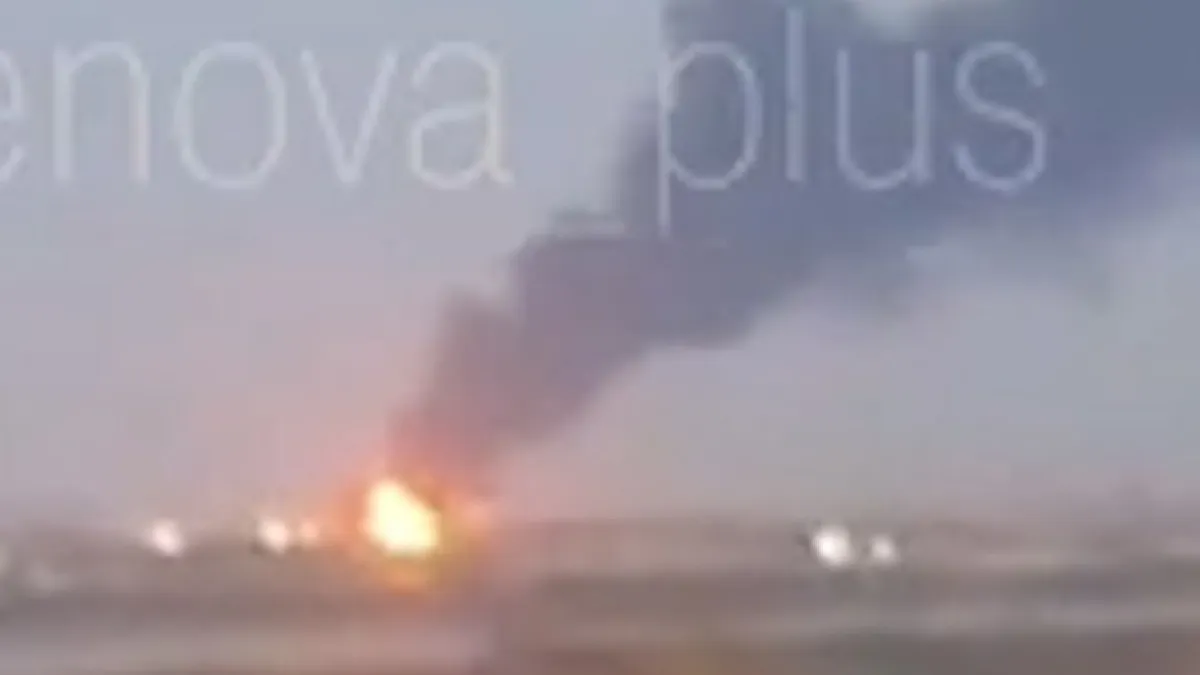
The prestigious Russian Navy base at Kronstadt, near St. Petersburg, came under Ukrainian drone attack overnight, in what may well be the first strike of its kind against the Baltic Fleet. Ukrainian drones targeted the naval base, including the Project 20380 Steregushchiy class corvette Boikiy, highlighting the fact that Russian warships are vulnerable even when hundreds of miles from Ukraine’s borders.

According to the official account of the Ukrainian 414th Separate Unmanned Strike Aviation System Brigade on X, the corvette was set ablaze while in the Veleshchynskyi dry dock in Kronstadt, where it is said to have entered scheduled maintenance in February of this year. The same account posted a video showing the attack. While we are used to kamikaze drone video feeds cutting out just before detonation, the fact that multiple drones were involved means we can see the burning vessel from several angles.

Reportedly, the drones that hit the corvette were from the 1st Separate Center of Ukraine’s Unmanned Systems Forces. Considering the long distance to the target, it is interesting to note that video from the seekers was available. This indicates that either a local operator on the ground was involved in targeting and recording the feed, or otherwise a satcom link was used to do the same. While it is conceivable that the drones used autonomous guidance, they would still have needed someone nearby or connected via satcom to record the seeker’s view. Another possibility is that shorter-range drones were used for the attack, something that Ukraine has done before for attacks deep in Russia, although this seems less likely here.

A drone’s eye view of the Russian corvette Boikiy ablaze in the Veleshchynskyi dry dock in Kronstadt. Ukrainian Ministry of Defense screencap

Ukraine’s Unmanned Systems Forces stated that the Boikiy was involved in escorting ships associated with Russia’s so-called shadow fleet, the collection of older tankers operating under foreign flags that Moscow relies on to export oil despite Western sanctions. According to Ukrainian officials, Russia has increasingly tasked Baltic Fleet vessels with escort, monitoring, and security missions for these tankers as they transit the Baltic Sea carrying sanctioned Russian oil to markets prepared to bypass Western restrictions.

The Steregushchiy class ships are among Russia’s more modern corvettes. With a standard displacement of 1,800 tons, a length of 343 feet, and a flight deck for a helicopter, the corvettes are closer to frigates, according to some classification systems. Their primary armament consists of two quadruple launchers for Uran anti-ship missiles, a 12-cell Redut vertical launch system for various air defense missiles, and two quadruple tubes for Paket-NK anti-torpedo/anti-submarine torpedoes.

The British offshore patrol vessels HMS Mersey and HMS Severn shadow the Russian corvette Boikiy in the English Channel in 2017.

The attack on the naval base was part of a wider Ukrainian drone barrage directed against other military and energy sites in and around St. Petersburg early on Wednesday. Footage of the attacks showed drones, reportedly FP-1/2 types, low over the Gulf of Finland and in the skies above the city.

The attacks occurred just hours before international guests gathered for the city’s flagship economic forum. “The Petersburg forum is opening with a nice plume of black smoke in the background after Ukrainian strikes,” posted Serhiy Sternenko, an adviser to the Ukrainian defence minister.

Several long-range drones also crashed into oil storage facilities in St. Petersburg after Russian air defenses reportedly tried unsuccessfully to shoot them down. Loud explosions were heard, and black smoke could be seen rising from the blazing oil terminal, one of the largest on Russia’s Baltic Sea coast.

Russian authorities confirmed that the attacks had taken place, with St. Petersburg’s governor, Alexander Beglov, saying that the Kirovsky and Krasnoselsky districts had been targeted.

Ukrainian President Volodymyr Zelensky, writing on social media, said that drones had hit “important facilities on Russian territory,” including the St. Petersburg oil terminal, the Kronstadt base, and a weapons factory in the Tambov region.

“I thank our warriors for their precision. Ukraine’s plan for long-range sanctions is being implemented exactly as needed to bring peace closer,” Zelensky said.

The significance of the strikes is manifold.

First off, the drone strikes have a highly symbolic value, and will be especially embarrassing for the Kremlin, since they come immediately in advance of the three-day annual summit being held in St. Petersburg, and billed as Russia’s answer to Davos.

Guests arrived for today’s opening ceremony under a pall of thick smoke, and Russian President Vladimir Putin is due to make a keynote speech at the event on Friday. There was further disruption for arriving guests as St. Petersburg’s airport was temporarily closed.

Secondly, the drone strikes underscore Ukraine’s ability to strike targets deep within Russia, using a growing array of long-range one-way attack drones and cruise missiles. The targets are around 680 miles from the nearest Ukrainian border.

The approximate location of Kronstadt and St. Petersburg in relation to Ukraine. Google Earth

Finally, by targeting Kronstadt, the attacks also signify the opening up of a new front in the drone war, namely against the Baltic Fleet while it is in port.

Located on Kotlin Island in the Gulf of Finland, about 18 miles west of St. Petersburg, Kronstadt is one of the principal bases associated with the Baltic Fleet. Today, it primarily hosts corvettes and patrol vessels, naval support ships, training units, as well as repair and maintenance facilities. Since any naval threat approaching St. Petersburg from the Gulf of Finland must pass near Kronstadt, the base effectively acts as the maritime gateway to Russia’s second-largest city.

The approximate location of Kronstadt, at the gateway to St. Petersburg, and at the far east end of the Baltic. Google Earth

There have been very few confirmed Ukrainian attacks of any kind on the Baltic Fleet compared with the extensive campaign waged against Russia’s Black Sea Fleet.

In April 2024, there was a fire on a Russian warship at Baltiysk in Kaliningrad. The fire damaged communications and electronic systems aboard the Buyan class corvette Serpukhov. A Ukrainian military intelligence official subsequently claimed that this was the result of a covert joint operation conducted by his GUR agency and a pro-Kyiv Russian military group.

So far, of course, Ukraine’s naval campaign has focused overwhelmingly on the Russian Black Sea Fleet. Many successful attacks have been recorded against Black Sea Fleet vessels and facilities, forcing the general evacuation of Russian naval assets from occupied Crimea and to bases in Russia proper.

In recent months, Ukraine has waged an aerial campaign to disrupt Russia’s economy. Long-range drones have hit ports and oil storage facilities, military factories, and airbases. There has also been an uptick in attacks against tankers and trucks moving between occupied southern Ukraine and Crimea, leading to fuel shortages across the peninsula.

Meanwhile, the scale of Russian missile and drone attacks on Ukraine remains undiminished. On Monday, a barrage of Russian strikes killed 23 people across Ukraine and injured many more. This led Zelenskyy to renew his plea for the U.S. government to provide Kyiv with more Patriot missiles. Today, he said that “an agreement at the highest political level on the purchase of Patriot systems […] is awaiting implementation at the financial, legal, and technical levels.”

Whether or not the overnight strike caused significant damage, its strategic message was unmistakable. By reaching Kronstadt, one of Russia’s most historic naval bases, Ukraine demonstrated that even the Baltic Fleet is no longer beyond its reach. The attack highlights Kyiv’s growing long-range capabilities and signals that Russia’s efforts to protect both its regular fleet and its shadow oil-export network may face increasing pressure, even far from the front lines.

Contact the author: thomas@thewarzone.com

Thomas is a defense writer and editor with over 20 years of experience covering military aerospace topics and conflicts. He’s written a number of books, edited many more, and has contributed to many of the world’s leading aviation publications. Before joining The War Zone in 2020, he was the editor of AirForces Monthly.


Source link

Are Ukrainian Mirage 2000s Now Flying Air-To-Ground Strike Missions?

A French-made Mirage 2000-5F, streaking low over Ukraine in a newly emerged video, provides a relatively rare glimpse of the fighter in Ukrainian Air Force service. Compared with the more numerous F-16 fleet, Ukrainian Mirage operations are much less widely seen. Until now, accounts and imagery have shown the delta-wing fighters being used for air-to-air missions, primarily in the fight against Russian long-range attack drones and cruise missiles. The latest footage may suggest that they now have started to embark on air-to-ground sorties, too.

The footage, taken from a ground position possibly close to the front lines, shows a Mirage flying at very low-level along a tree line, before pulling up into a steep climb. Potentially, the jet was engaged in an air defense patrol before pulling up to transit outside of the ground-based air defense threat ‘umbrella,’ but this exact maneuver is one we have frequently seen for air-to-ground weapons releases from other platforms.

While the moment of weapons release is not visible, the flight profile is consistent with toss bombing attacks. In particular, the French-made AASM-250 Hammer rocket-boosted munition, associated with the Mirage, has often been seen delivered by other platforms using this technique, which is exactly how the weapon was designed to be used, among other modes of delivery.

After all, toss bombing is a key way to help mitigate the risks to combat jets over the battlefield, specifically ground-based air defenses. Russia’s surface-to-air missile umbrella is well layered and penetrates far beyond the front lines.

“Obviously, the lower you are, and the further away from the surface-to-air missiles that can detect you because of the curvature of the Earth” affect how far the bomb can travel, U.S. Air Force Gen. James Hecker, head of U.S. Air Forces in Europe (USAFE), as well as NATO’s Allied Air Command and U.S. Air Forces Africa (AFAFRICA), explained back in 2023. Hecker was speaking about Ukraine’s use of unpowered JDAM-ER glide bombs, but the same applies to Hammer. “There are tactics where you can go in low and do some things… and get back,” Hecker added.

Head-on view of a Ukrainian Mirage 2000 at a forward operating location. Ukrainian Air Force screencap

The toss/lofted technique does not reduce the accuracy of the Hammer or the U.S.-supplied JDAM-ER, which both come as standard with GPS-assisted inertial navigation system (INS) guidance packages that allow them to zero in on set coordinates even when employed indirectly.

Additionally, the Hammer can offer multi-mode guidance options with either imaging infrared or semi-active laser homing added in, which enables the engagement of moving targets and helps improve overall accuracy. This also offers alternative guidance options in GPS-degraded environments against some targets. So far, however, only the GPS/INS version has been positively identified in Ukrainian service.

A GPS/INS-guided AASM-250 Hammer rocket-assisted precision-guided bomb under the wing of a Ukrainian MiG-29 Fulcrum. via X

Hammers come in a variety of sizes, but Ukraine is understood to have received 250-kilogram (551-pound) class types, also sometimes referred to as AASM-250s.

Safran Electronics & Defense - Missile AASM thumbnail

Safran Electronics & Defense – Missile AASM


To date, the Hammer has been seen in use on Ukrainian Air Force MiG-29 Fulcrums, which appear to be the service’s primary launch platform for the munitions, at least so far. Ukraine has also integrated the French-made bombs onto its Su-25 Frogfoot attack jets.

Hammer’s solid-fuel rocket booster also gives the bomb unique benefits. The manufacturer, Safran, says the AASM-250 version can still hit targets at least up to nine miles away (15 kilometers) when released from low altitude. This can increase to around 43 miles (70 kilometers) when launched from higher altitude.

In its original form, the Mirage 2000-5F was not cleared to use the Hammer, reflecting the fighter’s primary air defense mission in French service. However, in March of last year, France confirmed that the Mirages being transferred to Ukraine would have Hammer compatibility. In the past, the Mirage has been tested in France with a six-Hammer load-out.

Earlier this year, the Ukrainian Air Force published a video including brief interviews with a Mirage pilot, as well as two members of the ground crew. The unnamed Mirage 2000 fighter pilot came to the delta-wing jet after serving on the Soviet-era Su-27 Flanker.

Український пілот про ефективність Mirage2000/Ukrainian Pilot on the Effectiveness of the Mirage2000 thumbnail

Український пілот про ефективність Mirage2000/Ukrainian Pilot on the Effectiveness of the Mirage2000


“Now I pilot the Mirage 2000, and my impressions of this aircraft are extremely positive,” he explained. “I trained in the French Republic together with French fighter pilots for about six months. I learned to fly and employ weapons on the twin-seat Mirage 2000B. Later, we transitioned to the single-seat version, the very aircraft I am flying now.”

The Ukrainian Mirage 2000 pilot in his jet. Ukrainian Air Force screencap

Two Ukrainian Air Force fighter jet technicians, David and Dmytro, shared their experiences of day-to-day combat operations with the Mirage.

“Right now, we’re at a forward operating airfield, our third one this week,” David pointed out, indicating the missile-armed Mirage behind him. “The enemy constantly tries to destroy our aircraft and equipment. Our forward team keeps relocating from site to site.”

Ukraine’s F-16s also routinely operate from dispersed locations around the country, supported, among others, by a fleet of vehicles dedicated to helping maintain them, as you can read about here. Moreover, these kinds of operations, and the challenges of generating air combat power under the constant threat of Russian attack, are something that is being keenly felt in the U.S. military. After all, the Pentagon is planning to operate crewed and uncrewed aircraft from distributed forward locations in future high-end fights, such as one against China in the Pacific. These concepts of operations would also be relevant in the event of a major conflict elsewhere in Europe.

Project 61: an ecosystem for F-16s by Come Back Alive Foundation thumbnail

Project 61: an ecosystem for F-16s by Come Back Alive Foundation


Dmytro added: “During our last combat mission, we came under fire [from Shahed-series long-range one-way attack drones] and missiles, but fortunately, we managed to evacuate the aircraft and save our lives.”

The pilot and technicians praised the Magic 2 infrared-guided air-to-air missile that appears to be the primary air-to-air armament of the Ukrainian Mirage.

Ukrainian Mirage 2000 armed with a Magic 2 missile. Ukrainian Air Force screencap

“It has performed exceptionally well,” one technician said, before claiming that it has a kill probability of “practically 100 percent.”

The pilot further added that the kill probability against enemy drones and cruise missiles stands at 98 percent. No mention was made of the Mirage’s twin onboard 30mm cannons, although these are shown in detail in the video.

A 30mm DEFA 553 cannon on a Ukrainian Mirage 2000. Ukrainian Air Force screencap

As regards air-to-air kills, the particular Mirage seen in the video from earlier this year is marked with six silhouettes denoting Russian Kh-101 air-launched cruise missiles.

However, as the ground crew points out, another six still needed to be added to the same jet.

Six Kh-101 kill markings on a Ukrainian Mirage 2000. Ukrainian Air Force screencap

The prosaic reason behind this: “We don’t always have stencils with us at forward airfields… Sometimes we simply don’t have the time to apply all the markings.”

The reason the Mirage is less frequently seen in Ukrainian hands is chiefly due to numbers.

It’s unclear exactly how many Mirages have now been pledged to Ukraine by France. At first, France offered six, but last October, French President Emmanuel Macron said he would offer more. At least one has so far been lost in Ukrainian service.

On the subject of improving the combat potential of the Ukrainian Air Force, the pilot made a call for continued development, including “more modern aircraft [and] more modern weapons to counter the horde threatening us.” The appearance of the Hammer would provide evidence that this aspiration is being, to some extent, met.

Pre-flight checks on a Ukrainian Mirage 2000 at a forward operating location. The RDY marking behind the radome indicates the RDY radar, a mechanically scanned pulse-Doppler type with look-down/shoot-down capability, found on the Mirage 2000-5F version. Ukrainian Air Force screencap

As regards the particular deficiencies of the Mirage, the pilot said: “In my opinion, and in the opinion of my fellow pilots, this aircraft lacks longer-range air-to-air weapons.” He called for a weapon that represents “something in the middle ground between efficiency and cost so that we can engage the massive number of enemy aerial threats we face.”

It’s unclear if the pilot in question was including the more modern and capable MICA air-to-air missile within this assessment.

The first imagery of Ukrainian Mirages showed the jets exclusively armed with a pair of Magic 2 missiles, broadly analogous to the AIM-9L Sidewinder, rather than the MICA that the aircraft can also carry. At the start of this year, however, the MICA also began to appear on the fighters.

Unusual for a modern Western beyond-visual-range AAM, the MICA can be fitted with either an active radar seeker or an infrared seeker head. When using the latter option, the seeker can act as a ‘poor man’s’ infrared search and track system and provide target detection indication in the pilot’s head-up display (HUD).

MICA missile thumbnail

MICA missile


The MICA uses a thrust-vectoring motor for improved agility and has a reported maximum range of around 37 miles, far superior to the roughly nine-mile range of the Magic 2.

Despite the arrival of Western-supplied equipment, Ukraine continues to rely heavily on its Soviet-era fighters. The entirety of its combat fleet — Mirages and F-16s included — is in the latter stages of its service life and needs to be replaced before too long. With that in mind, Kyiv is planning to bolster its air force with more modern equipment.

“If I had the opportunity to transition to another aircraft superior to the Mirage, I would probably choose the Rafale,” the pilot continued. “It’s from the same country, and retraining for the Rafale would be much faster than transitioning to aircraft from other nations. The Rafale can also carry the Meteor, a missile with very long reach.”

Thanks to its ramjet motor, the Meteor’s all-important ‘no-escape zone’ is much larger than for comparable weapons. This means the enemy’s chance of evading the missile at the endgame of the engagement, using high-energy maneuvering, is considerably reduced. Another advantage of being able to throttle the motor is that the Meteor’s autopilot can calculate the most efficient route to the target for very long-range shots. Ukraine now looks set to receive the Meteor to arm its first Gripen C/D fighters, now scheduled to arrive next year.

Meteor thumbnail

Meteor


Last November, Ukraine signed a letter of intent to buy up to 100 Rafale F4 multirole fighters from France over the next 10 years. The agreement came less than a month after Sweden and Ukraine unveiled a plan to export as many as 150 Gripen E fighters to Kyiv — last week, it was confirmed that Kyiv plans to buy an initial batch of 20 of the new-generation Gripens.

While the Rafale and Gripen E/F would be the most advanced combat aircraft in Ukraine’s inventory, there remain glaring questions about whether the acquisition of one of these aircraft types, let alone two, is actually feasible, especially in such numbers, as we discussed at the time.

At the same time, the Mirage pilot would be happy to get his hands on any kind of modern Western-made equipment.

“If I were offered something like the F-35, Rafale, or Gripen, I would gladly, without hesitation, transition to that platform.”

The possibility of Ukraine using Mirage 2000-5F fighters in an air-to-ground strike role would mark an important expansion of their combat role. If the aircraft are now contributing to both defensive and offensive operations, they will be further enhancing Ukraine’s steadily growing Western-origin air capabilities.

Contact the author: thomas@thewarzone.com

Thomas is a defense writer and editor with over 20 years of experience covering military aerospace topics and conflicts. He’s written a number of books, edited many more, and has contributed to many of the world’s leading aviation publications. Before joining The War Zone in 2020, he was the editor of AirForces Monthly.


Source link

Ukrainian Gripen Fighters To Arrive In 2027, Long-Range Meteor Missiles Claimed To Be Included

A timeline has been provided for the arrival of Saab Gripen fighters in Ukraine, with the first jets to be delivered early next year. Significantly, as well as getting another modern Western combat jet, Ukraine expects to receive highly capable Meteor beyond-visual-range air-to-air missiles, Ukraine’s President Volodymyr Zelensky has announced.

After meeting Zelensky in the city of Uppsala, Sweden today, Sweden’s Prime Minister Ulf Kristersson announced that his country will donate up to 16 Gripen C/Ds to Ukraine. These will be secondhand jets drawn from Swedish stocks, to expedite delivery. Handover of the jets in Ukraine will take place in early 2027, Kristersson added.

Ukraine's President Volodymyr Zelensky (L) and Swedish Prime Minister Ulf Kristersson address a press conference at the F16 air flotilla in Uppsala, Sweden on May 28, 2026. Ukraine plans to buy up to 20 latest model Gripen fighter jets and Sweden will donate 16 older models to boost its air defence, the two countries said on May 28, 2026 during a surprise visit to Sweden by the Ukrainian president. Ukraine plans to allocate 2.5 billion euros ($2.9 billion) from an EU loan for the new aircraft, the Swedish government said in a statement. (Photo by Christine Olsson/TT / various sources / AFP via Getty Images) / Sweden OUT
Ukrainian President Volodymyr Zelensky (left) and Swedish Prime Minister Ulf Kristersson address a press conference in Uppsala, Sweden on May 28, 2026. Photo by Christine Olsson/TT / various sources / AFP via Getty Images

According to Swedish officials, the training of Ukrainian pilots and technicians on the Gripen C/D is already underway and will be expanded this fall.

In the longer term, Kristersson confirmed that Ukraine plans to acquire an initial batch of up to 20 of the more advanced Gripen E/F versions. Writing on X today, Swedish Minister for Defense Pål Jonson said that the Gripen E/F would be financed with a $2.9-billion European Union loan. The long-term ambition remains 100-150 Gripen aircraft, he added.

Despite it having a similar outward appearance to the Gripen C/D, the Gripen E (and the two-seat Gripen F version) is regarded as a completely new aircraft type — as you can read about here.

A two-ship formation of Gripen E (left) and Gripen C (right). Saab

“Ukraine has clearly identified the Gripen aircraft as a priority option for its air force in the long term and intends to purchase the newest version, the Gripen E,” Kristersson said. “Negotiations are ongoing, and we will be able to transfer these aircraft by 2030.”

In a press release, Saab reiterated that it has not yet signed any contract nor received an order relating to the Gripen E/F for Ukraine, meaning this transfer only exists as a statement of intent for now.

According to Saab, “The next steps for the Ukrainian and Swedish authorities will be to complete the negotiations regarding Ukraine’s acquisition of Gripen E/F, which is expected to take place in batches, and Saab will support this process.”

In the meantime, the Swedish government has also announced that it will replace the donated Gripen C/D aircraft in the Swedish Air Force inventory. “Dialogue regarding Sweden’s replacement of the donated capability will be initiated soon,” Saab said.

A pair of Swedish Air Force Gripen Cs. Saab

Last October, as we reported, Kristersson and Zelensky signed a letter of intent (LOI) including a potential export deal covering “likely between 100 and 150 fighter jets,” according to Kristersson. The LOI was signed at Linköping, the site of Saab’s manufacturing facility for the Gripen.

As for second-hand Gripens, Ukraine has repeatedly been linked with a possible transfer of secondhand Swedish Air Force Gripen C/Ds, and Zelensky previously said he would like to see the first of these delivered from 2026.

While the Gripen C/Ds are now set to arrive later than hoped, it remains a big deal for the Ukrainian Air Force. Although the service has already received Western-supplied F-16s and a smaller number of Mirage 2000s, the Ukrainian Air Force still relies heavily on its Soviet-era fighters. The MiG-29, in particular, has been continually adapted to carry new weaponry, both Western-supplied and locally developed, but these are aging jets and the fleet has been steadily reduced by attrition.

Perhaps the most important part of the Gripen transfer will involve the armament for the fighter.

Zelensky specifically mentioned that he expects the Gripen C/Ds to be armed with the Meteor missile.

Swedish Minister for Defense Pål Jonson said that the Gripen C/D “can be delivered with weapons such as IRIS-T, AMRAAM, and the long-range Meteor missile. This is about aircraft, weapons, skills and sustainment.”

Earlier this year, the Ukrainian Ministry of Defense confirmed that the Meteor was one of the weapons being lined up for the next Swedish security aid package for Ukraine.

As we have discussed in the past, the Meteor would provide Ukraine with a class of air-to-air weapon that it badly needs to redress the balance against Russian fighter jets.

Undoubtedly, the Meteor is among the most capable air-to-air missiles in operational service anywhere in the world. Thanks to its ramjet propulsion, which can be throttled during different phases of flight, the Meteor is generally considered to be effective against certain types of targets out to around 130 miles.

Meteor thumbnail

Meteor


The Meteor also features an active radar seeker for the terminal phase and a two-way datalink that feeds it with in-flight updates as it flies out to its target and provides information to the pilot in the launch aircraft.

While the AIM-120 Advanced Medium-Range Air-to-Air Missile (AMRAAM) that arms Ukraine’s F-16 fighters also has an active radar seeker, it lacks the range of the Meteor.

The most capable AMRAAM identified as being used by Ukraine is the AIM-120C-8, which is generally assumed to be able to hit targets at a distance of between 75 and 100 miles.

The wreckage of an AIM-120C-8 missile, apparently found in the aftermath of a Russian air attack on Dnipro, last month. via Dnipro Main News/Telegram

Of course, in practical applications, the range of both the Meteor and AMRAAM is affected by a whole range of factors, above all, the energy and altitude state of the launching aircraft and the target.

However, the Meteor could bring a significant shift to the airpower balance over Ukraine.

Russia has repeatedly exploited the long range of its R-37M air-to-air missile, known to NATO as AA-13 Axehead, typically launching them from jets flying outside the range of the missiles carried by Ukrainian fighters, as well as from most ground-based air defense systems.

A Russian Su-35S launches an R-37M air-to-air missile. Russian Ministry of Defense screencap

With a reported range of 124 miles against certain types of targets, the R-37M flies to its target on a lofted trajectory, controlled by an inertial navigation system with mid-course radio correction, and uses an active radar seeker for its terminal phase attack.

Mainly used by Su-35S Flanker multirole fighters and MiG-31BM Foxhound interceptors, the R-37M is a missile we have examined in detail in the past. It has long been a thorn in the side of Ukrainian Air Force fighter pilots.

As TWZ had previously pointed out, Meteor is the best candidate for Ukraine to try and redress the balance in the air war when faced by the far-reaching R-37M and would finally put Russian aircraft at risk within their own missile ranges.

At the same time, the Meteor would give Ukraine a weapon that can target Russian jets delivering standoff munitions, again from outside the range of Ukrainian air defenses. Zelensky today said the missile “would stop Russian glide bomb attacks,” something that has been a huge problem for Ukrainian air defenses since this class of weapons was introduced.

A Russian UMPK-series glide bomb under the wing of a Su-34 Fullback strike fighter. Russian Ministry of Defense screencap

As we’ve highlighted in detail as far back as April of 2022, aside from its Meteor capability, the Gripen, even in its earlier C/D versions, would be the best fit for Ukraine.

Designed during the Cold War to meet the Soviet threat, the Gripen was engineered for efficiency, durability, and ease of operation under wartime conditions. It was specifically designed to be serviced and rearmed by small teams — often including conscript personnel — while operating from dispersed locations such as roads and improvised airstrips instead of traditional air bases. The aircraft’s entire concept centers on maintaining combat operations in demanding environments, including prolonged cold-weather conditions.

A Swedish Air Force Gripen C at a remote base. Saab

“Gripen was built for a country that may have to fight outnumbered, under pressure and from dispersed bases,” Swedish Minister for Defense Pål Jonson said. “That makes it highly relevant for Ukraine: high readiness, rapid turnaround, modern weapons and the ability to operate under constant threat,” he added.

Overall, the Gripen is particularly compatible with the decentralized and highly mobile style of warfare Ukraine is currently practicing.

At the same time, it should be noted that even with the F-16, the Ukrainian Air Force has developed tactics and equipment to operate these jets from dispersed locations around the country. Even before the current conflict, Ukrainian fighters were training to make use of highways as alternatives to traditional runways.

A video shows vehicles intended to help with distributed operations of Ukrainian F-16s:

Project 61: an ecosystem for F-16s by Come Back Alive Foundation thumbnail

Project 61: an ecosystem for F-16s by Come Back Alive Foundation


The capabilities of the Gripen and Meteor would also be enhanced by working in combination with the two Saab 340 airborne early warning and control (AEW&C) aircraft equipped with Erieye radar that have been donated by Sweden.

Ukraine’s Saab 340 AEW&C can function as an airborne fighter control platform by detecting and tracking Russian targets, prioritizing threats, and directing fighters to intercept them. Through its datalink system, the aircraft can also transmit mid-course guidance updates directly to missiles in flight. As a result, fighter pilots may not even need to activate their own radar when engaging a target. Instead, the missile can be assigned a target before launch, fired, and then continuously guided by updates from the AEW&C aircraft throughout its flight.

The first evidence of the Saab 340 AEW&C being used over Ukraine emerged in March this year, but its activities have remained closely under wraps.

Taken together, the arrival of the Gripen and Meteor missile would represent one of the most significant upgrades yet for the Ukrainian Air Force. Beyond simply adding another Western fighter type, the package would introduce a highly survivable, dispersed-operating combat jet paired with one of the world’s most capable long-range air-to-air missiles and supported by Swedish AEW&C assets.

Even without the Meteor, the Gripen C/D could help Ukraine challenge Russia’s long-standing advantage in beyond-visual-range air combat while fitting naturally into the more decentralized operating model the Ukrainian Air Force has already been forced to adopt throughout the war. At the same time, it will provide valuable experience for crews and serve as a stepping stone for the future Gripen E/F.

Contact the author: thomas@thewarzone.com

Thomas is a defense writer and editor with over 20 years of experience covering military aerospace topics and conflicts. He’s written a number of books, edited many more, and has contributed to many of the world’s leading aviation publications. Before joining The War Zone in 2020, he was the editor of AirForces Monthly.


Source link

Usyk vs Rico: Ukrainian heavyweight champion stops novice in controversial 11th-round stoppage win

The Pyramids of Giza loomed over a purpose-built open-air arena for one of boxing’s most unusual world title fights in recent memory.

A kickboxing heavyweight legend who ruled his sport for more than 4,000 days, Verhoeven sprinted to the ring at around 01:10 local time, flanked by performers dressed as Egyptian pharaohs, before Usyk emerged in a gladiator-style outfit complete with a golden helmet.

Verhoeven, who insisted his unpredictability could trouble Usyk, made a lively start with constant movement and energy, landing a solid right hand to the body.

Usyk responded with a sharp double uppercut in the second, but Verhoeven absorbed it well and fired back with two right hands of his own.

Boxing royalty including Saul ‘Canelo’ Alvarez, Terence Crawford, Gennady Golovkin and Anthony Joshua watched on from ringside, alongside Hollywood star Jason Statham – the man credited with helping to bring the fight together.

Another right hand from Verhoeven landed flush on Usyk in the third round.

Usyk – so often the sport’s master of patience – was forced to dig deep. He briefly responded in the fourth, hurting Verhoeven with a straight right and stinging left.

“Get back to your boxing, you’re getting too greedy, trying to land and getting caught,” Verhoeven’s trainer Peter Fury warned his man.

Verhoeven entered the sixth round for the first time in his fighting career – kickboxing bouts are capped at five rounds, and his only previous professional boxing fight ended inside two.

He stuck to the trainer’s instruction and a lethargic Usyk was rocked again in the eighth by a right hand, but the champion came alive in the 10th and 11th, unleashing a flurry of punches and repeatedly finding the uppercut – the shot that had given him his most success all night.

Verhoeven spat out his gumshield while Usyk immediately protested at the added time his opponent was given to recover.

Usyk surged again and sensed the finish. Verhoeven was visibly hurt and a stoppage may have come in the 12th round had the fight continued.

Arguably, Verhoeven should have been allowed the chance to see it through.

Instead, the referee stepped in and waved off what will go down as a contentious stoppage.

Source link

Ukrainian strike on dormitory in Russian-occupied Starobilsk kills four | Russia-Ukraine war

NewsFeed

A Ukrainian strike collapsed a five-storey college dormitory in the Russian-occupied city of Starobilsk, killing four people and injuring at least 39 others. Rescue operations continue as more people are believed to be trapped under the rubble.

Source link

Latvian PM resigns over handling of stray Ukrainian drones | Newsfeed

NewsFeed

Latvia’s Prime Minister Evika Silina resigned following criticism of her government’s handling of stray drones, believed to be Ukrainian, crossing into Latvian territory. The controversy deepened divisions within the ruling coalition, causing it to lose its parliamentary majority.

Source link

EU, UK sanction Russians over deportations of Ukrainian children | Russia-Ukraine war News

Russian institutions and officials accused of systemic deportation and indoctrination of children during the war on Ukraine.

The European Union and United Kingdom have imposed sanctions on Russian institutions and officials accused of systematically deporting and indoctrinating Ukrainian children.

The EU announced measures against 23 state institutions and people on Monday. The UK simultaneously unveiled a broader package targeting 85 people and entities, roughly a third of them linked to what was described as Russia’s campaign to forcibly deport and militarise Ukrainian children.

Recommended Stories

list of 3 itemsend of list

Russia has deported and forcibly transferred nearly 20,500 Ukrainian children since Moscow launched its full-scale invasion in February 2022, an EU statement noted. It branded the actions as grave breaches of international law.

The EU said its designations target institutions and individuals involved in programmes subjecting children to pro-Russian indoctrination, including patriotic events, ideological education and military-oriented activities.

The sanctions, which include asset freezes and travel bans, were approved by the EU’s 27 nations in coordination with Canada and the UK, which announced similar measures.

“Stealing children is not incidental. It is a deliberate Russian policy, a calculated attack on Ukraine’s future,” the EU’s top diplomat, Kaja Kallas, told a news conference.

The UK sanctions announcement named the Centre for Military and Patriotic Training and Education of Youth, known as the warrior centre, a Russian state institution at which Ukrainian children are reportedly subjected to military training and pro-Kremlin ideology.

Also targeted was Yulia Sergeevna Velichko, the Moscow-installed minister for youth policy in the so-called Luhansk People’s Republic, for her role in implementing state-led initiatives.

UK Secretary of State for Foreign Affairs Yvette Cooper said the UK would continue working alongside allies to support every effort to identify and trace children who had been taken.

Russia does not deny taking the children but has said it has done so for their protection, moving them away from front-line areas, and claims it is willing to return them when relatives come forward and can be verified.

The International Criminal Court (ICC) issued an arrest warrant for Russian President Vladimir Putin in 2023 for the war crime of illegal deportation of children from Ukraine.

Responding to the announced sanctions, Ukrainian President Volodymyr Zelenskyy said: “These are the ones who ‘rewire’ the identity of Ukrainian children, help make them hate their homeland, and one day take up arms to fight against Ukraine.”

The UK’s broader sanctions package also took aim at Russian information warfare operations, with the remaining measures targeting individuals and entities linked to alleged Kremlin propaganda campaigns.

Among them were 49 people working for the Social Design Agency, a state-funded Russian organisation accused of running disinformation and interference operations, including attempts to establish pro-Russia organisations in Armenia and influence the outcome of upcoming elections.

Traditionally a strong Russian ally, the Caucasian country has recently been moving away from Moscow’s orbit.

Last week, the Armenian ambassador was summoned to protest what the Kremlin described as “terrorist threats against Russia” made by Zelenskyy in a speech delivered in Yerevan.

Source link

Man offered Ukrainian men money to carry out Starmer arson attacks, court hears

Shortly before 22:00 BST on 7 May, Lavryovych sent Pochynok a message on Telegram saying: “Look, we won’t talk much on the phone. At that address, there’ll be a car, need to check if it’s there. If it is there then basically today we’ll do the job. We’ll have money. And this week, if we plan everything well today, tomorrow there may be another one, we’ll make more money.”

Source link