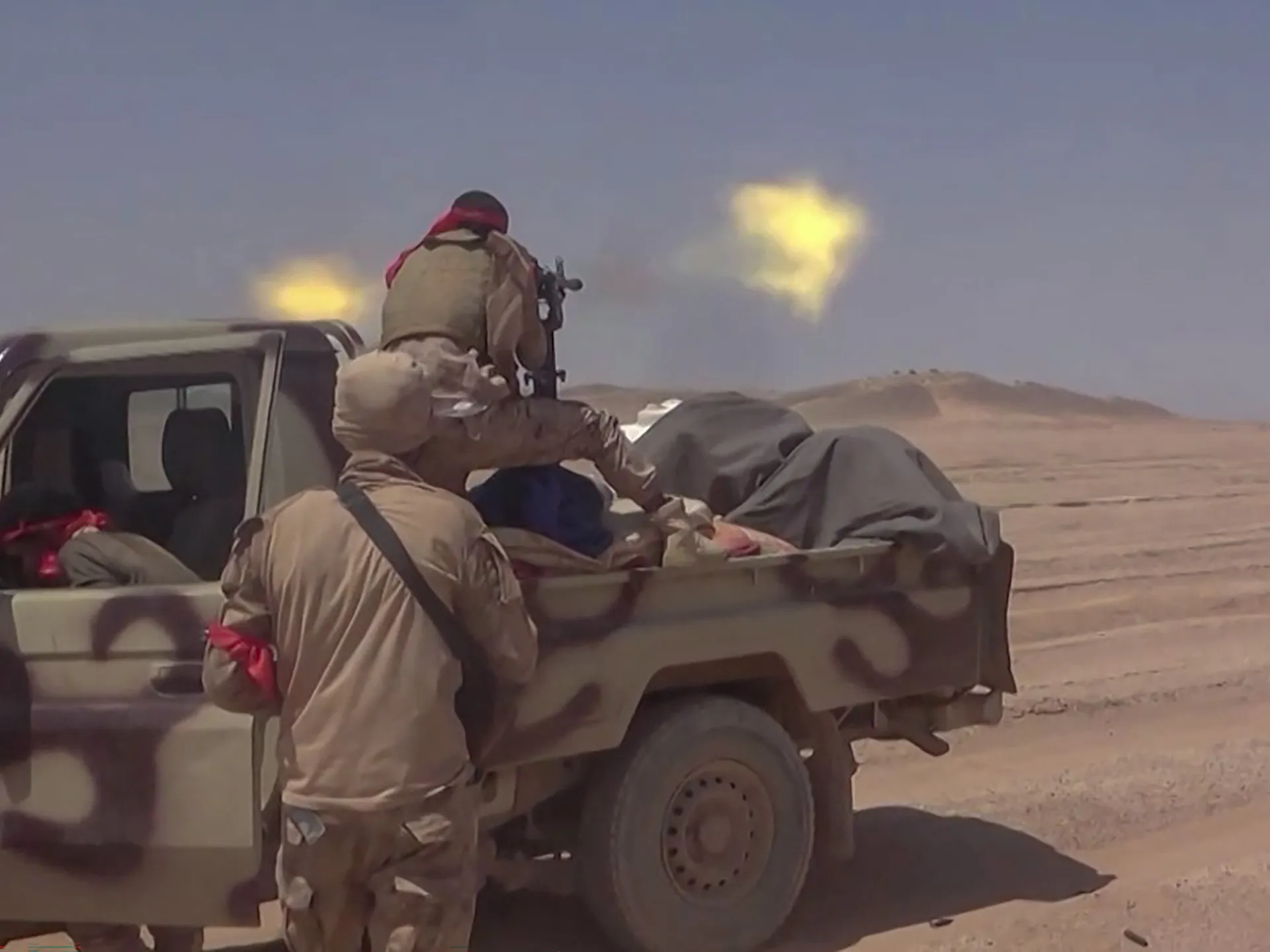
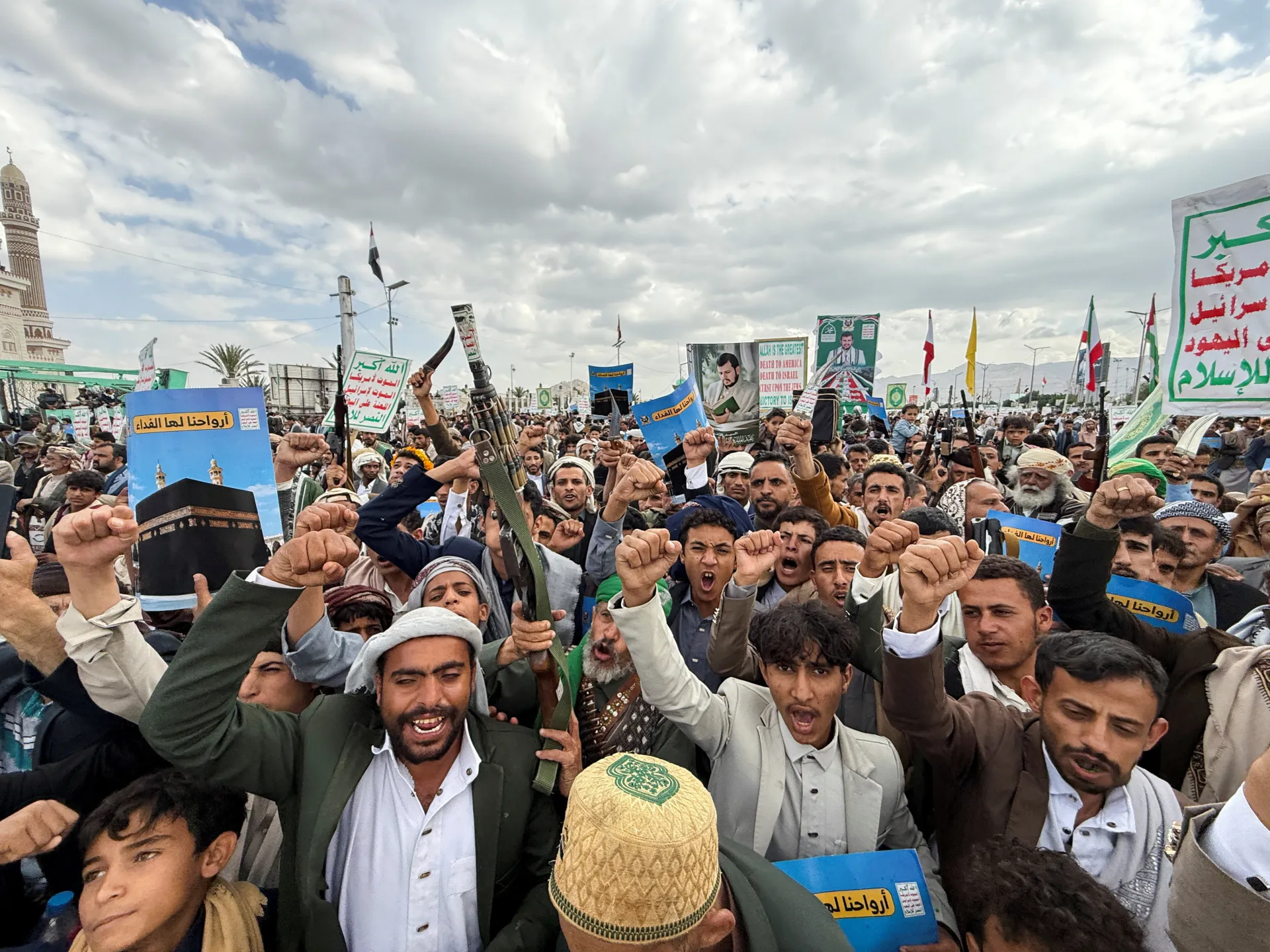
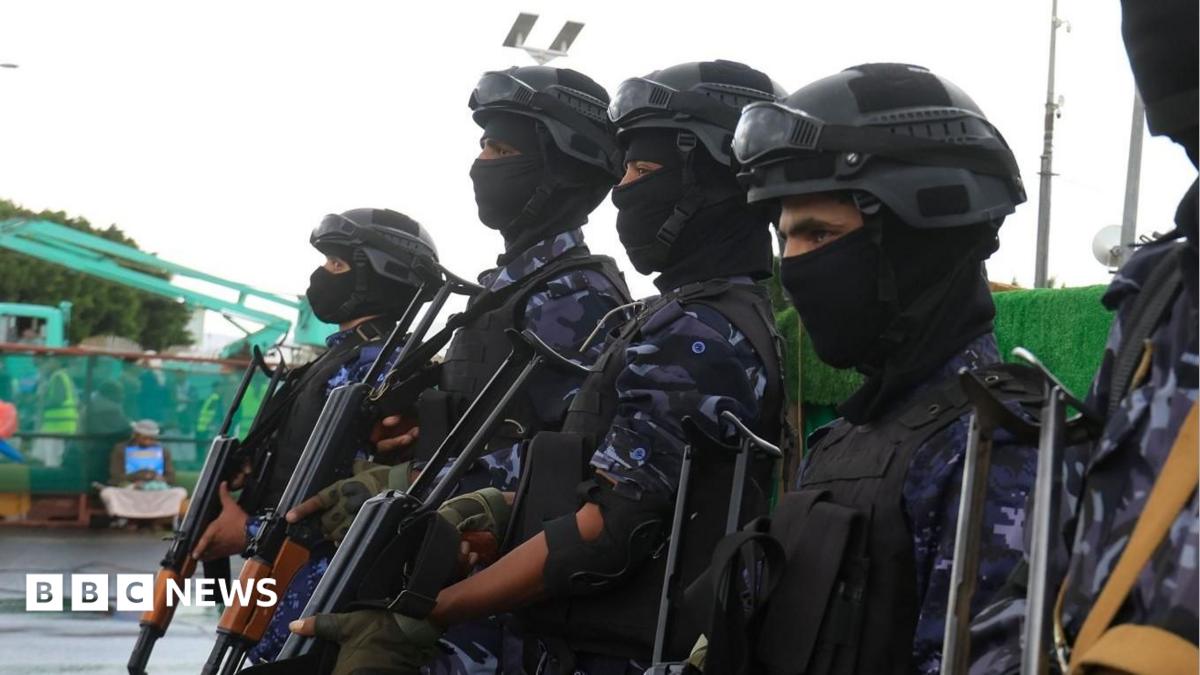
Yemen’s Saudi-backed government forces claim to have killed hundreds of Houthi fighters as they attempt to retake swathes of lost territory. The Houthis said they targeted an Aramco facility in Riyadh, although Saudi authorities have not confirmed the strike.
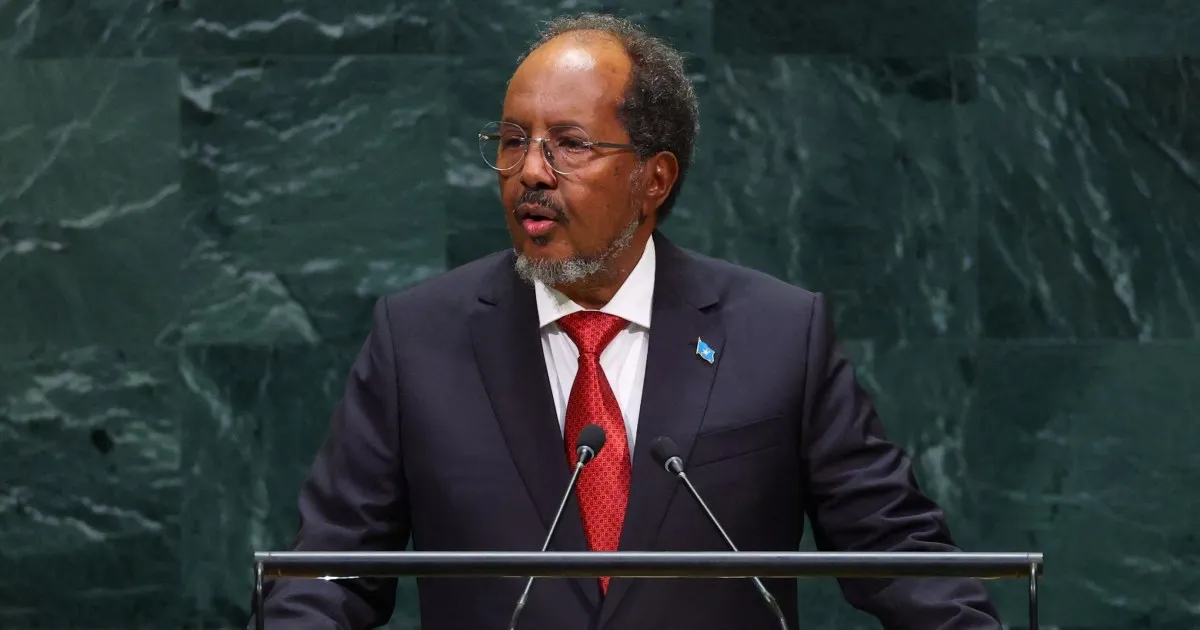
In exclusive Al Jazeera interview, President Hassan Sheikh Mohamud says attempts to pull Somalia into Middle East crises won’t succeed.
Somalia will not accept Israeli presence in the country “under any circumstances” and will resist any attempts to be pulled into the Middle East’s crises, its President Hassan Sheikh Mohamud tells Al Jazeera.
Speaking in an exclusive interview, Mohamud said that Israel was planning to establish a naval base in Berbera and use the city’s airport, adding that its real aim was to get closer to the Gulf states and Iran.
Recommended Stories
list of 3 itemsend of list
Berbera is a port city on the Gulf of Aden coast in Somaliland – the self-declared republic in northwestern Somalia that Israel recognised last year, but which is claimed by Mogadishu.
Berbera faces Yemen across the water near the strategic Bab al-Mandeb strait. The Iran-aligned Houthis have previously enforced a blockade on Israel-linked ships in the area.
“We will overcome the challenges posed to our country by Israeli moves,” Mohamud said in his wide-ranging interview.
He added that the Israeli plans fall under the “Greater Israel” project – referring to a term for various proposals, often rooted in biblical interpretations, for Israeli control over territory beyond its current borders. Some versions extend from the Nile to the Euphrates.
Israel has not adopted it as official policy, but Prime Minister Benjamin Netanyahu said in an August 2025 interview that he felt connected to the vision, prompting condemnation from Arab governments.
The Somali president described Israel as a “destabilising force” that does not abide by international law.
He also criticised Tel Aviv’s recognition of Somaliland in December.
No country other than Israel recognises Somaliland, while the region’s own residents are completely opposed to an Israeli presence, Mohamud said.
Somaliland declared independence from Somalia in 1991 and has governed itself independently for more than three decades. But it had not secured recognition from any United Nations member state until Israel’s move.
Fight against armed groups
The Somali president told Al Jazeera the United States remains his country’s strongest partner in the fight against “terrorism”, and added that al-Shabab has no presence in the major cities, leaving no possibility of the group taking control in Somalia.
Al-Shabab is a Somali armed group that emerged from the Islamic Courts Union in the mid-2000s and pledged allegiance to al-Qaeda in 2012. It has fought Somalia’s federal government for years, holds territory in parts of southern and central Somalia, and has carried out deadly attacks, including in Mogadishu and in neighbouring Kenya.
Regarding the East Africa region, Mohamud said Somalia’s relations with neighbouring Ethiopia are good, and Mogadishu does not object to Addis Ababa gaining access to the sea through Somali territory.
Ethiopia has been landlocked since Eritrea became independent in 1993 and relies largely on Djibouti’s ports for trade. In January 2024, Addis Ababa signed a memorandum of understanding with Somaliland on sea access, which Somalia condemned as a violation of its sovereignty. Somalia and Ethiopia later agreed to ease tensions.
Houthis ‘destabilising’ region
Mohamud also accused Yemen’s Houthis of “destabilising” the region and disrupting navigation in the Bab al-Mandeb strait.
His comments come as the group attempts to build on its lightning offensive that captured the country’s Red Sea coast last month.
Thus far, Yemeni government forces have been able to hold their positions on the front lines and even claimed to have inflicted heavy losses against the Houthis.
The Houthis have also intensified their attacks on Saudi Arabia, but the kingdom’s Crown Prince Mohammed bin Salman (MBS) has promised not to compromise on its security, saying the Yemeni rebels chose “chaos and destruction, threatening the Yemeni people and the region”.
The full interview with President Mohamud will be broadcast on Al Jazeera Arabic on Sunday.
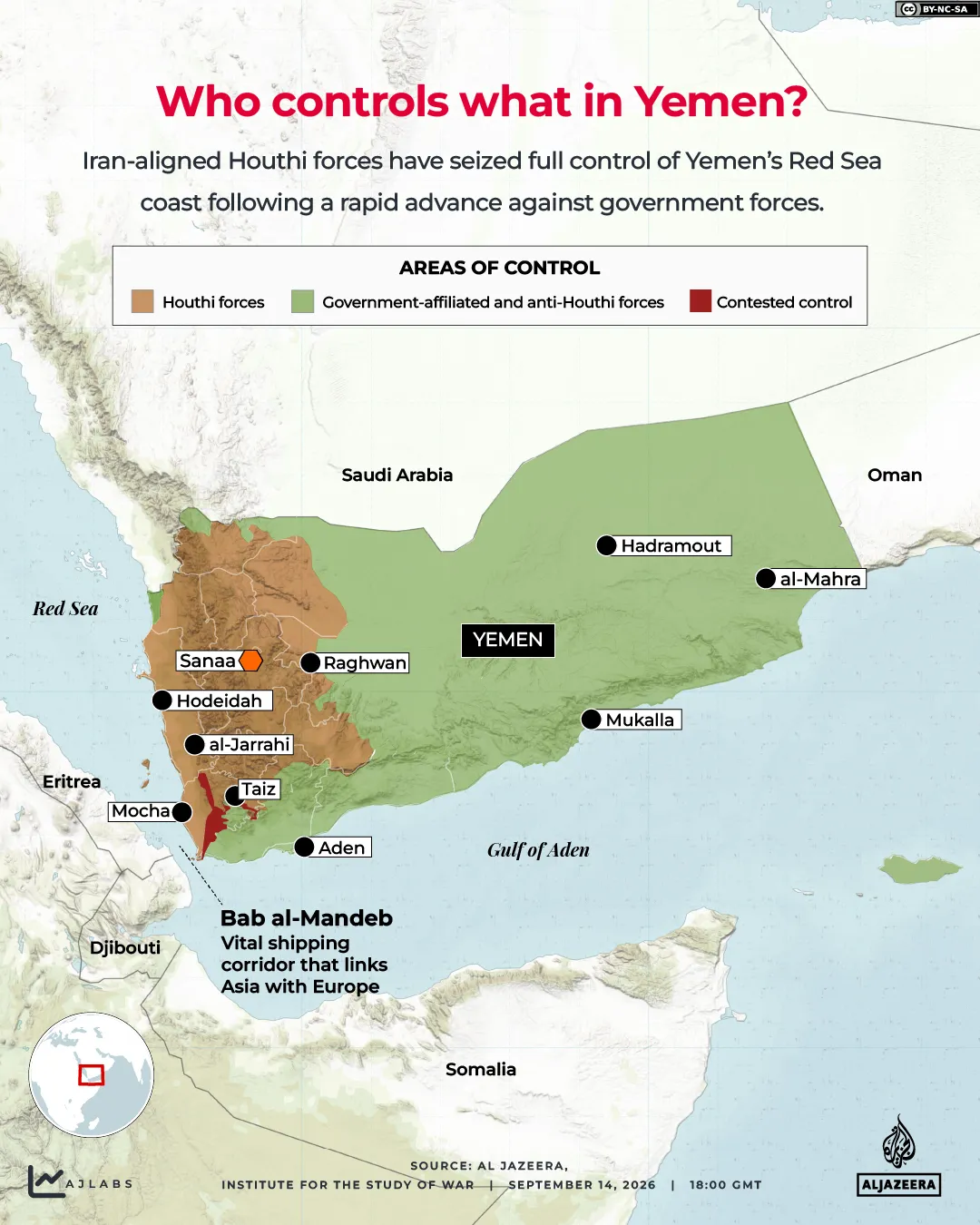
Government forces close a key crossing connecting Houthi-held al-Houban to government-held Taiz city.
Published On 3 Oct 20263 Oct 2026
Yemen’s internationally recognised government forces have carried out nearly 500 military operations, killing or wounding 1,540 Houthi rebels in the past 24 hours, according to the army.
Warplanes, drones, artillery, missiles and rocket launchers were used to target Houthi positions in various parts of Yemen, military spokesman Colonel Majed Abdullah al-Nazili said on Friday evening.
Recommended Stories
list of 3 itemsend of list
Most of the casualties came in the governorate of Taiz where the operations halted the Houthi advance, al-Nazili said. The government-held city of Taiz has become a focal point of the renewed fighting.
The army spokesman did not mention any casualties among government forces.
Key border crossing closed
On Saturday, the army’s media official Ammar al-Sami’i told Al Jazeera that the government had closed the al-Houban crossing in Taiz.
The crossing had previously been closed for nine years and was later reopened to civilians in 2024 for “humanitarian reasons”, Sami’i said, as the road is one of Yemen’s most important connections between territory held by the opposing sides. It connects Houthi-held al-Houban to government-held Taiz city.
Sami’i said security reasons are behind the closure, following an attempt by the Houthis to infiltrate Taiz via the road, attacks in the vicinity and a general military buildup.
A fragile truce struck between the government and the Houthis in 2022 collapsed in July this year, and fighting in Yemen has escalated significantly since then.
In mid-September, the Houthis swept across parts of western Yemen, seizing the port city of Mocha and key strategic islands in the Bab al-Mandeb strait.
Since then, anti-Houthi forces have largely stabilised the front lines.
Yemen has been embroiled in civil war since the Houthis seized the capital of Sanaa in 2014, forcing the internationally recognised government to retreat to Aden.
Crown Prince Mohammed bin Salman says the kingdom ‘will not hesitate to respond firmly to any threat’.
Published On 30 Sep 202630 Sep 2026
Saudi Arabia’s Crown Prince Mohammed bin Salman (MBS) has promised not to compromise on the kingdom’s security in the face of attacks by the Houthi armed group, saying the Yemeni rebels chose “chaos and destruction, threatening the Yemeni people and the region”.
In a speech delivered Wednesday on behalf of King Salman bin Abdulaziz Al Saud during the opening of the third year of the ninth session of Saudi Arabia’s Shura Council, Prince Mohammed said the country “will not hesitate to respond firmly to any threat or attack aimed at undermining” its security.
He pointed to the trilateral Mecca Joint Defence Agreement with Turkiye and Pakistan that was formalised in August, saying the alliance shows the Saudi leadership’s intent “to strengthen regional stability, shield it from the repercussions of tensions and conflicts and coordinate efforts”.
At the same time, the crown prince said, Saudi Arabia is making “every possible effort to de-escalate tensions and support diplomatic solutions without the slightest compromise on preserving our security”.
Maritime coalition to defend Red Sea
MBS also addressed the targeting of vessels by the Houthis in the Red Sea along the Bab al-Mandeb strait, rejecting the use of international waterways as a tool for political or economic pressure.
He said a “multinational defensive maritime coalition” was set up to ensure “common interests” are protected in international waterways.
In recent weeks, the Houthis have ramped up attacks on Saudi Arabia, as they fight Yemen’s internationally recognised, Saudi-backed government forces.
Last week, Riyadh said it intercepted six ballistic missiles aimed at Taif in western Saudi Arabia and the Yanbu port area on the Red Sea.
The Houthis also said they attacked “a sensitive target” in the Saudi capital, Riyadh, and Saudi Aramco facilities in Yanbu.
On Tuesday, Pakistan’s Defence Minister Khawaja Muhammad Asif said Islamabad will make “whatever means” available to Saudi Arabia under the mutual defence pact if the Houthi attacks on the kingdom continue.
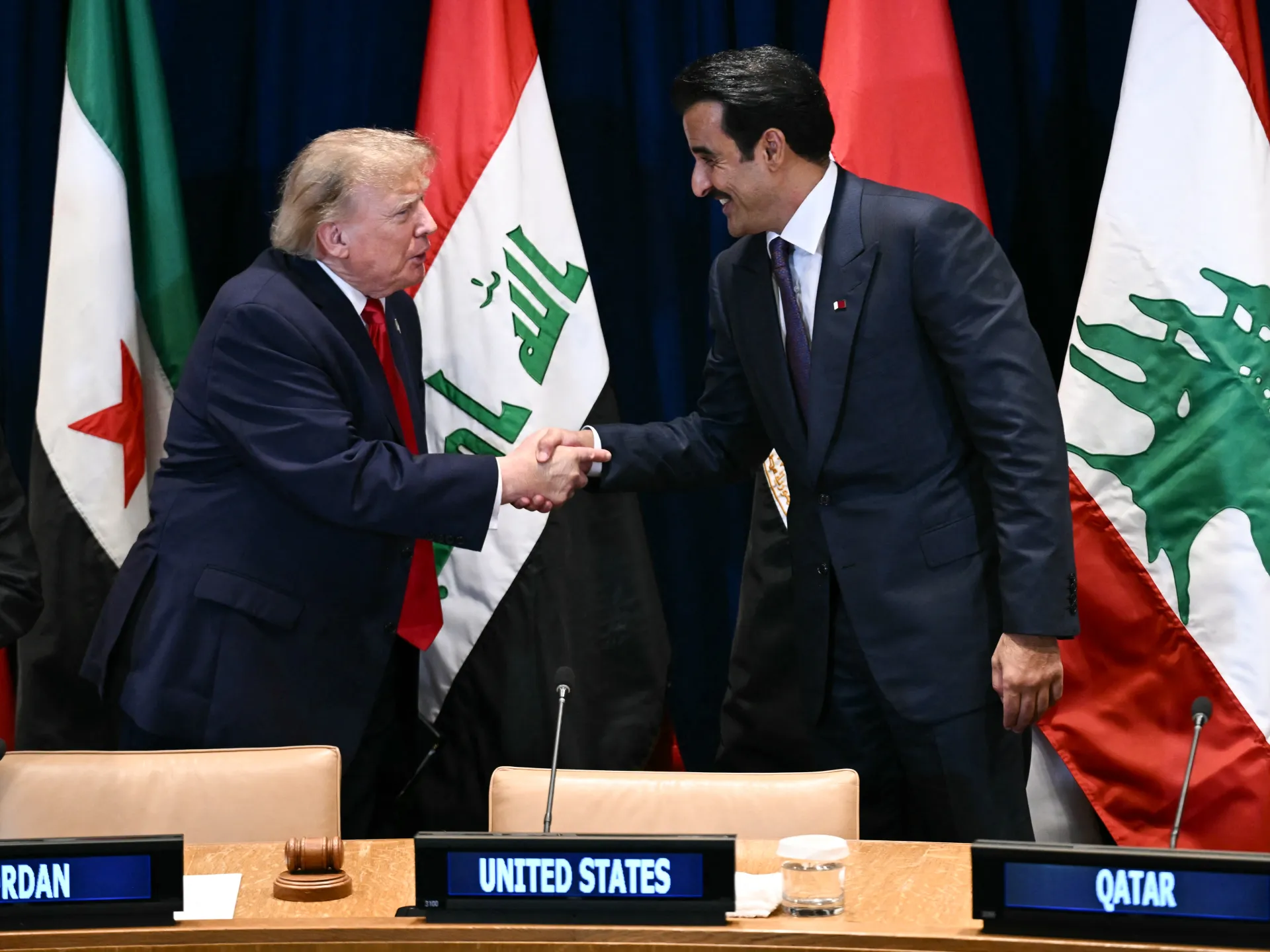
Indirect talks between the United States and Iran aimed at ending the seven-month-long war continue – most recently via Qatar as mediator on the sidelines of the United Nations General Assembly (UNGA) in New York – but the two sides still disagree about the agenda.
Iranian Foreign Minister Abbas Araghchi left New York on Tuesday after telling state-run Islamic Republic of Iran Broadcasting (IRIB) that he expects an official response to Tehran’s proposal to reopen the Strait of Hormuz by the end of the day. The proposal, which Iran said would see the strait reopened within seven days, was first passed to the US via Qatari mediators last week.
Recommended Stories
list of 3 itemsend of list
United States President Donald Trump was reported to have rejected that offer, under which Tehran would reopen the strait in return for Washington lifting its naval blockade, waiving sanctions, releasing an estimated $12bn in frozen Iranian assets and enforcing a wider regional ceasefire that includes Lebanon.
Under Iran’s proposal, wider peace talks, including discussions of its nuclear programme, would begin only then
Despite Trump’s public rejection, Araghchi says he has not yet received a formal response from Washington. Meanwhile, US media reports that Trump may well be willing to relax sanctions and unfreeze Iranian assets have been strongly denied by the US president.
Instead, US officials say, the US wants a deal that resolves all outstanding issues, particularly Tehran’s nuclear programme, in one go, rather than pursuing a gradual, step-by-step approach.
Here’s what we know about the talks:
Qatari mediators met Araghchi in New York on Monday to discuss how to advance Tehran’s proposal for reopening the Strait of Hormuz and then progressing to wider peace talks.
In a post on Telegram, Araghchi insisted that the talks focused solely on the Strait of Hormuz. He denied that the US had formally rejected the Iranian proposal.
“Despite what the US president said, I said that we were waiting for the official US response through the mediators … They [Qatar] had ideas, and we discussed them. They are going to raise this issue with the American side again, and then the final response from the American side will be conveyed to us through the Qatari mediator,” Araghchi said late on Monday.
Araghchi also said negotiations had become more “serious”, but cautioned that Tehran’s position has not changed.
“I state firmly that there has been no change in Iran’s position. Our conditions for opening the strait are clear. Our position on other issues is also clear. At present, there has been no discussion at all about flexibility,” he added.
Tehran’s proposal includes elements of the Islamabad memorandum of understanding (MoU), which was signed by both the US and Iran on June 17.
Is Trump willing to accept some Iranian demands?
A US official told The Associated Press news agency last week that Trump is not willing to make a final peace deal with Iran until the issue of its nuclear programme is addressed. According to the official, who has not been named, the US president would be willing, however, to grant Iran sanctions relief and release some frozen funds if progress is made on the nuclear file.
Then, on Monday, US-based news outlet Axios also reported that Trump had offered Iran sanctions relief in return for concessions on its nuclear programme. The report also cited US officials, one of whom told Axios that the indirect talks had been “positive and constructive”, adding that Tehran had indicated it was “flexible” on nuclear issues.
Trump, however, angrily denounced the story as a “hoax” in a post on Truth Social, the social media platform he owns. He said the story was “not true” and demanded Axios remove the article.
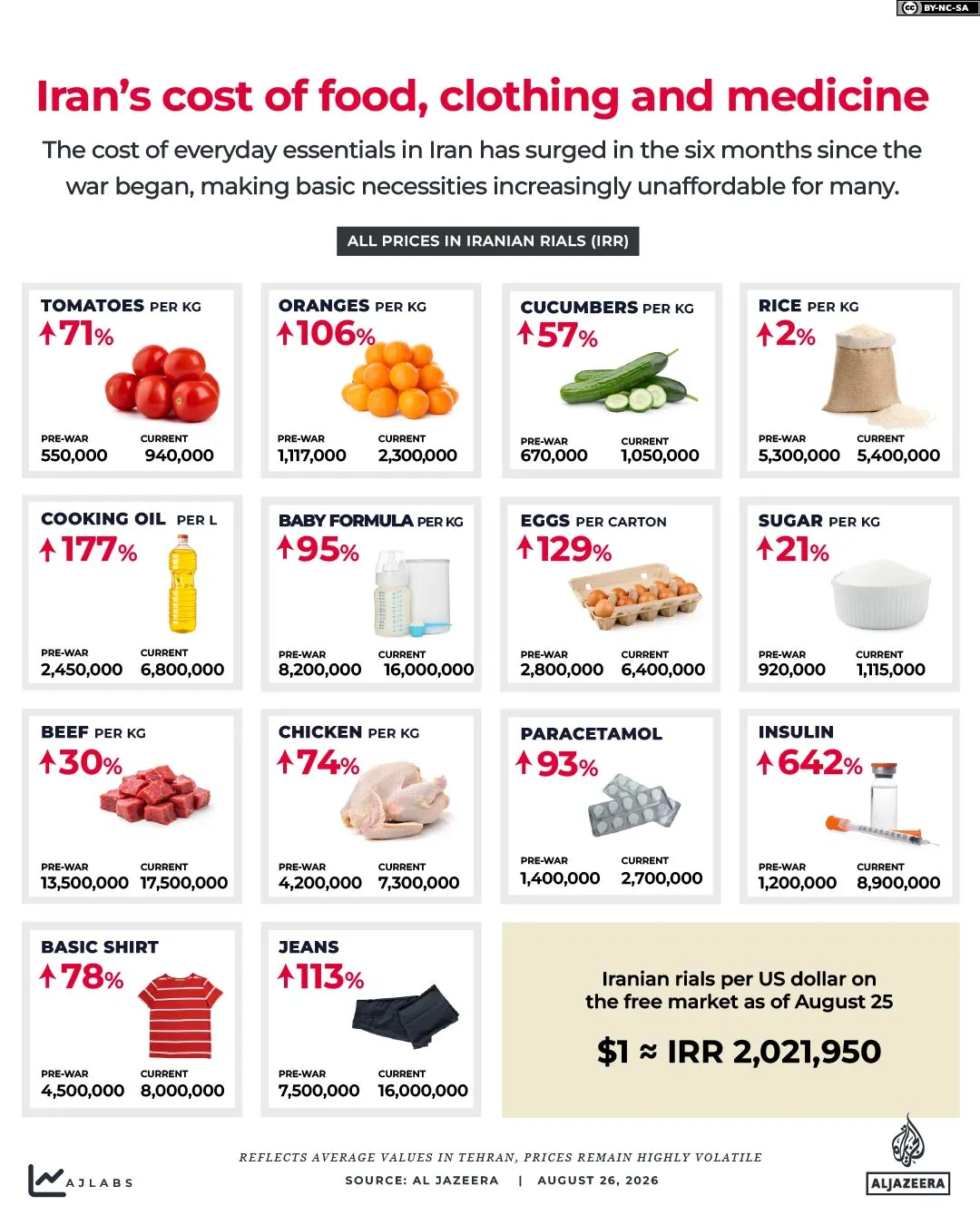
Iran has been heavily sanctioned for decades. The restrictions have severely affected Iranians’ quality of life, including their access to essential medicines and healthcare.
In August, the US announced yet more sweeping economic sanctions on Iran and countries that trade with it as it sought to apply more economic pressure to isolate the country from the global economy during the diplomatic deadlock in their war.
US Treasury Secretary Scott Bessent described the campaign as the “economic asphyxiation” of Iran.
It is difficult to quantify exactly how many Iranians have been killed by what Tehran views as “economic warfare”. However, a study published last year by the highly regarded medical journal The Lancet Global Health concluded that more than 564,250 people worldwide die annually as a result of US sanctions.
What does the US want?
In late February, just before the US launched its first strikes on Iran, the two sides were already holding talks hosted by Oman, which included the issue of Iran’s nuclear programme.
But before those talks could conclude, the US and Israel launched strikes, triggering the closure of the Strait of Hormuz, through which one-fifth of the world’s oil and natural gas is shipped in peacetime, by Iran. The closure of the strait has since become the primary point of contention between the two sides, when it had not been an issue before the war began. The strait is currently subject to blockades by both sides.
Throughout the war, Trump has repeatedly expressed his desire to strike a deal with Tehran. However, serious differences between the two sides will need to be resolved first, including the order in which issues are addressed for the purpose of peace talks.
Iran wants to establish its control of the Strait of Hormuz, have sanctions lifted and assets unfrozen, as well as ensure an end to US-Israeli strikes before it will go back to negotiating other issues, such as its nuclear programme. This was the order of events laid out in the MoU agreed between Iran and the US in June, but which quickly fell apart.
The US, however, wants everything to be on the table at the same time – it does not want to agree to anything relating to these Iranian demands before it addresses the other issues.
Scott Lucas, professor of US politics and international relations at University College Dublin, told Al Jazeera that Washington effectively wants Iran to surrender.
“The Strait of Hormuz has become a fundamental issue. The question here is, will both sides give? The memorandum of understanding clearly gave Iran a role in the management of the strait,” Lucas said.
“When the Trump administration pulled away from negotiating on the basis of the memorandum, they effectively went back to the idea of Iran having to completely allow passage through the Strait of Hormuz with no guarantees over it, in terms of not only what it means for Iran financially, but [also] in terms of Iranian security. The Iranian government is not going to agree to that, so we’re stuck in this limbo right now,” he added.
“Are the Trump folks going to come back to the talks on the basis of the memorandum of understanding or something that is a revised version of it, or are they going to try and break the government with economic warfare until at least after the US elections in November? That’s where we are right now.”
What does Iran want?
After half a century of bitter enmity with Washington, Iran wants to consolidate what it sees as the strategic gains it has made during a war it did not start. This specifically includes its newly established ability to close the Strait of Hormuz, sending global energy markets into a tailspin and placing additional pressure on the Trump administration.
Since US-Israeli strikes on Iran began on February 28, Hormuz has dominated talks aimed at ending the war and emerged as Tehran’s greatest point of leverage. Prior to the conflict, Iran did not exert control over the waterway and all commercial shipping passed through freely.
For this reason, Iran will not move on to wider peace talks until it has leveraged its control of the strait to get its demands met. “Our discussion is clear. Right now, it is only about the Strait of Hormuz,” Araghchi said late on Monday.
“The opening of the Strait of Hormuz is also subject to the fulfilment of a series of conditions that we announced to the other side.”
Ali Salehian, director of the Center for Intellectual Diplomacy at the Governance and Policy Think Tank in Iran, told Al Jazeera that Tehran does not believe Washington will honour any future deal as it did not honour what was agreed under the Pakistan-brokered June MoU.
“For Iran, the bottom line of every negotiation with Trump, considering all of his misbehaving and [military] targeting of Iran during negotiations, is the Islamabad MoU,” Salehian said.
“Tehran thinks that if the US doesn’t fulfil its commitments based on the MoU, there is no guarantee that any kind of future deal would be sustainable.”
Iranian-made Zolfaghar missiles are seen on display beside a large portrait of Iran’s Supreme Leader Mojtaba Khamenei at Baharestan Square in Tehran on September 28, 2026 [AFP]
What is likely to happen next?
It does not look likely that the diplomatic standoff will be eased anytime soon, analysts say.
Both the US and Iran have indicated throughout the war that they would prefer a diplomatic settlement to a continuation of the war. However, Trump has continued to threaten Iran with more strikes if it does not agree to a deal, and Araghchi told US news outlet NBC on Sunday that Tehran is also prepared to resume fighting, even though it has not abandoned diplomacy.
“We are fully prepared for the time for the war to be resumed, and I repeat, we stand firm in the face of any new aggression, even if it comes to a doomsday war,” he said.
Trump said last week that he expects a deal will be reached, but not until after the US midterms on November 3.
“For the moment, the Trump administration is going to try to make the Iranian government capitulate through economic warfare,” Lucas said.
However, a deep sense of distrust remains between the two sides. Senior Iranian officials believe Trump will restart the war after the midterms on a far greater scale and that Israel would also participate.
If that theory proves true, Tehran may well prefer the fighting to resume before November’s elections, as it would allow Iran to impose a greater cost on Trump.
“The reaction of the Iranians to that might be to actually trigger the war themselves, early, right before the midterm elections in order to maximise the pain that [it] will impose on the US president,” Trita Parsi, executive vice president of the US-based Quincy Institute for Responsible Statecraft, told Al Jazeera earlier this month.
Iran’s foreign minister says his visit to the UN General Assembly last week was mainly to outline Tehran’s position on regional conflicts and the critical security situation in the Strait of Hormuz.
Yemen’s government forces have conducted multiple air and ground operations in the southwestern governorate of Taiz in 24 hours as they intensify attacks against the Iran-backed Houthi group.
The government’s military media centre on Sunday claimed a number of operations against the rebels, including air strikes on Houthi positions in five locations across the governorate.
Recommended Stories
list of 4 itemsend of list
More than 146,000 people have been displaced since the fighting erupted in July after a period of relative calm since a United Nations-brokered ceasefire in 2022.
In recent weeks, the Houthis have made dramatic territorial gains against the government forces, seizing the strategic Red Sea coastal city of Mocha and expanding their control over the Bab al-Mandeb strait, a global maritime chokepoint connecting Europe to Asia.
Rashad al-Alimi, the head of the Presidential Leadership Council, has called on citizens to mobilise and join the fight against the Houthis as the government has stepped up its attacks against the Iran-backed group in an effort to stop their advance and regain lost territory.
Meanwhile, Saudi Arabia, which has faced Houthi attacks on its soil since fighting escalated further this month, has been turning to its allies, including Pakistan and Turkiye, for support.
Saudi Arabia backs Yemen’s internationally recognised government.
Here’s what we know about the latest fighting and the humanitarian conditions the impoverished country faces:
What to know about the latest fighting
According to the military media centre on Sunday, dozens of Houthi fighters, including field commanders, were killed or wounded in the previous 24 hours of fighting near Taiz’s capital, which is also named Taiz.
Government forces have carried out operations in several areas of the governorate, including the al-Waziiya district in the west, weapons sites and ammunition depots at Mafraq Mawiya and al-Dhukrah in the east, a Houthi gathering in the Hayfan district in the south and against military vehicles in the Gurab area in the northwest.
Government forces also thwarted infiltration attempts on the al-Ahtoub front and in Hadran as they carried out shelling of Houthi gatherings on the al-Kadha and al-Aqroud fronts, the media centre said.
It added that several Houthi military vehicles were damaged in the attacks.
Al Jazeera could not verify the battlefield claims.
“Government forces say they have made advances in the southern Taiz governorate, taking control of several areas and higher ground. Among them is Jabal Bazel, a mountaintop that places Houthi supply lines within target range,” Al Jazeera’s Maha Ali said on Saturday, reporting from Taiz.
“These developments point to significant and potentially decisive ground operations in recent hours.”
Ali said al-Alimi expressed confidence that government forces were capable of restoring control over the whole country. Houthis currently control vast swaths of northern and western Yemen while the government controls the south and east.
Since the current fighting erupted, the Houthis have accused the Saudis of carrying out attacks in Yemen and promised to prevent Saudi tankers from passing through Bab al-Mandeb, which Riyadh has been using as an alternative shipping route to the Strait of Hormuz. Tehran in effect has closed the Strait of Hormuz since the United States and Israel began a war on it in February. Before the conflict, a fifth of the world’s oil supplies had passed through that waterway.
Government forces, meanwhile, accused the Houthis of using Iranian air defence weapons and said they pose a danger to aircraft.
“These Houthi weapons pose a serious threat to international flight paths over the Red Sea and operate using a heat-tracking system,” Brigadier General Majed al-Nazili, the official spokesperson for the Yemeni government forces, said on social media.
“The weapons employed are capable of attacking military or civilian targets without the ability to distinguish between them, thereby endangering the safety of civil aviation and the lives of passengers.”
Early on Saturday, a Saudi-led coalition in Yemen said its air defence systems intercepted and destroyed two ballistic missiles and two drones launched by the Houthis towards Riyadh and Khamis Mushait in Saudi Arabia.
What has been the regional response to the conflict?
On Saturday, Saudi Foreign Minister Faisal bin Farhan Al Saud, addressed the UN General Assembly and called on the international community to condemn Houthi actions against the kingdom and in Yemen.
At the same forum, Yemeni Vice President Abdullah Abdulkader al-Alimi-Bawzer warned that the Houthis were using shipping security “as a tool for blackmail”.
“It is taking hostage the entire global economy,” he said.
The secretary-general of the Gulf Cooperation Council (GCC), Jassim Mohammed al-Budaiwi, on Saturday strongly condemned the recent Houthi attacks against Saudi Arabia.
“This dangerous escalation constitutes a flagrant violation of the Kingdom’s sovereignty and poses a direct threat to the security and safety of civilians and the stability of the region,” al-Budaiwi said in a statement.
Iran has denied it has any role in the Yemen conflict. Iranian President Masoud Pezeshkian told Al Jazeera that the actions of the Houthis were not connected to Iran and Tehran stands in solidarity with “everyone subjected to injustice”.
He urged the Houthis and Saudi Arabia to resolve their differences through dialogue, saying “a brother should not fight his brother,” and offered Iran’s help in ending the dispute. “We will not be warmongers,” he said.
On Friday, Iran delivered a ceasefire offer, which US President Donald Trump has rejected. It included Yemen and Lebanon. Tehran offered to open the Strait of Hormuz if the US fulfils its conditions, which include the lifting of Washington’s naval blockade on Iranian ports, a sanctions waiver and the release of Iran’s frozen assets.
(Al Jazeera)
Could Saudi allies join the conflict?
Saudi Arabia’s allies have rallied behind it amid intense fighting between the Yemeni government forces and Houthis.
Saudi Defence Minister Khalid bin Salman said on Saturday that there would be continued joint efforts with Pakistan to confront attacks against the kingdom in accordance with the Mecca Joint Defence Agreement signed last month.
He held talks with Pakistani Field Marshal Asim Munir on Thursday. A day earlier, the military chiefs of Saudi Arabia, Pakistan and Turkiye jointly reviewed threats facing Saudi Arabia at a meeting in the Saudi capital.
Multiple Saudi cities, including Riyadh, have been hit by drones and missiles attributed to the Houthis.
Meanwhile, France confirmed on Friday that it was sending troops to guard the major oil terminal at Yanbu, a Saudi port city on the Red Sea, but added that it was not joining the conflict. Yanbu has major oil storage and refining facilities and is connected by the East-West Pipeline, which can carry up to seven million barrels a day. The pipeline was damaged in a drone attack carried out from a group based in Iraq.
The US has so far not pledged military involvement, but the Saudi foreign minister said the kingdom was “continuing to work with our partners in the US”. On September 14, the commander of the US military’s Central Command, Brad Cooper, met the de facto Saudi ruler, Crown Prince Mohammed bin Salman, in Jeddah in the wake of the Houthis’ seizure of Mocha.
What’s the state of humanitarian conditions?
At least 146,000 people have been displaced in the Arab region’s most impoverished country over the past three weeks, most of whom were uprooted from or within Taiz governorate, according to Yemen’s UNICEF country representative, Akhil Iyer.
The number of casualties is still not confirmed as the rival sides have made conflicting claims. As per media reports, the death toll runs into the hundreds.
UNICEF has verified that at least 15 children have been killed and 14 injured in the conflict since early September while three have been reported missing.
According to the UN Office for the Coordination of Humanitarian Affairs, more than 22 million people in Yemen require humanitarian assistance and protection services; 18.3 million people face acute food insecurity; and more than 2.2 million children under five are acutely malnourished.
Since antiquity, the region of modern-day Yemen has been an important strategic and commercial location, effectively forming a long land bridge between North Africa and Asia.
When the Ottoman Empire collapsed in 1918, Imam Yahya Muhammad declared northern Yemen an independent sovereign state and proclaimed the Mutawakkilite Kingdom of Yemen in 1926. A King and an Imam, Yaha ruled Yemen until his death in 1948, when he was succeeded by Ahmad bin Yahya
On September 19th 1962 Ahmad died in his sleep. His son, Muhammad al-Badr was proclaimed Imam and King.
From its inception, the kingdom had proved unstable with various revolts and assassinations taking place and Al-Badr’s reign would prove very short-lived.
Only a week after he ascended to the throne, army officers with the support of Egypt, staged a coup overthrowing the monarchy and deposing al-Badr on September 26th 1962. Abdullah as-Sallal, the commander of the royal guard, declared himself president of the Yemen Arab Republic. This event marked the start of the North Yemen Civil War which would last for the next six years.
Shehbaz Sharif speaks as Islamabad, Riyadh and Ankara army chiefs meet to discuss Mecca pact, closer military ties.
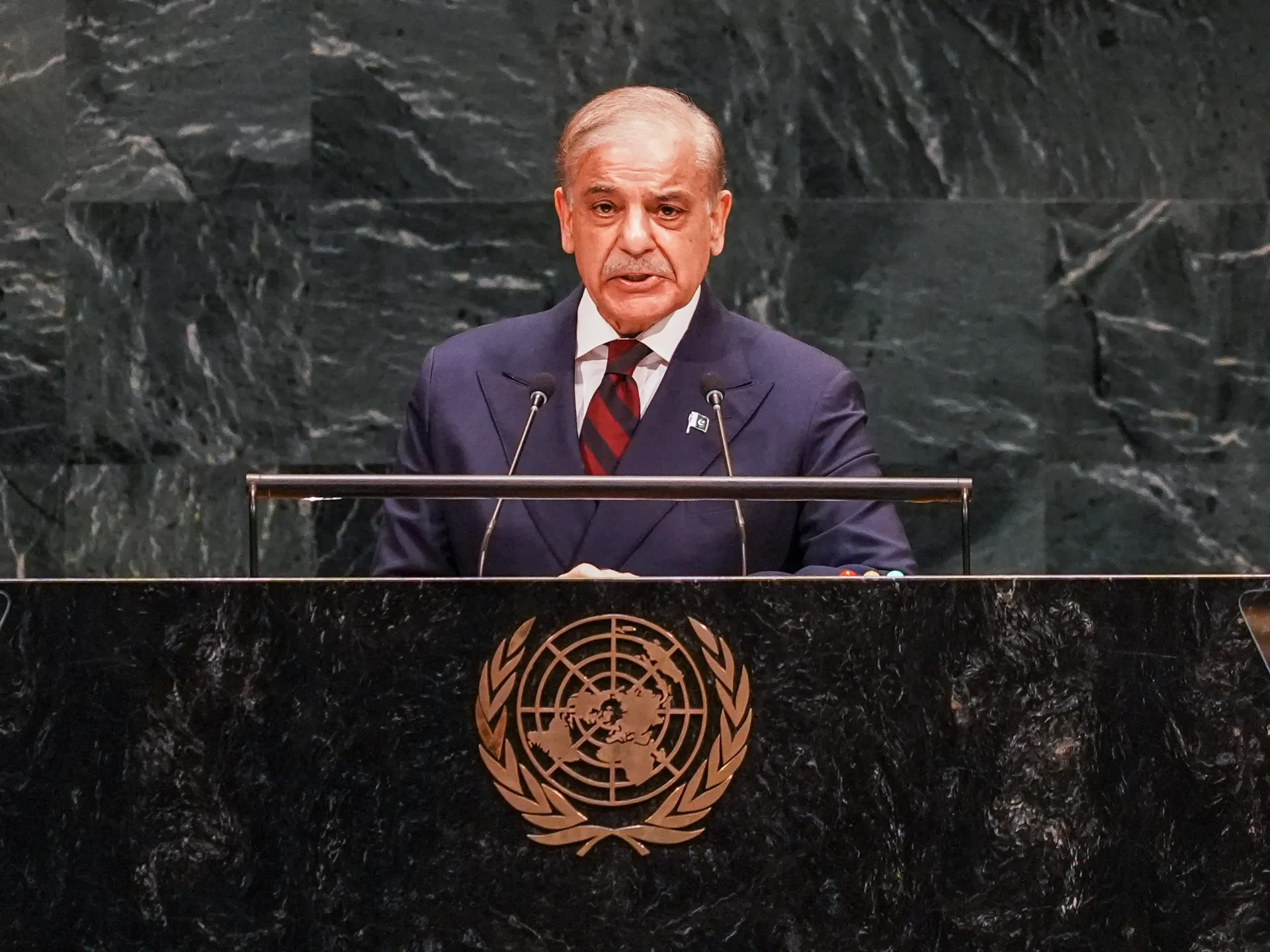
Pakistan’s prime minister has condemned Houthi attacks on Saudi Arabia, warning that any “threat to the sanctity” of the Muslim holy cities of Mecca and Medina is a “red line that must never be crossed”.
Addressing the United Nations General Assembly in New York on Friday, Shehbaz Sharif denounced recent Houthi attacks as “deplorable”.
Recommended Stories
list of 3 itemsend of list
He added that an attack by the Iran-aligned Yemeni group, which Riyadh says targeted Mecca, “outraged Muslims across the globe”. The Houthis have dismissed the accusations as a “heinous lie”.
Last month, Pakistan, Saudi Arabia and Turkiye signed a trilateral defence pact, formally known as the Mecca Joint Defence Agreement. The pact states that an attack on any member will be treated as an attack on all. However, Islamabad and Ankara have refrained from getting involved in Riyadh’s ongoing fight with the Houthis.
The military chiefs of all three countries met in Riyadh on Friday and discussed enhancing intelligence sharing and military coordination, the Pakistani military said. The chiefs reviewed the security situation and threats facing Saudi Arabia, affirmed a commitment to collective defence and pledged to turn Mecca Agreement commitments into effective cooperation, the army added.
It is not clear what, if any, support Ankara and Islamabad may provide to Riyadh. In a written interview published by the US media outlet Newsweek on Friday, Turkish President Recep Tayyip Erdogan said support could include “intelligence, logistics or ammunition, with more extensive military assistance possible depending on the scale of the threat”.
Iran and Palestine
In Sharif’s UN address, he also referenced the US-Israeli war that was launched against Iran in late February, as well as Islamabad’s role as a co-mediator.
Pakistan’s efforts culminated in the Islamabad Memorandum of Understanding, signed by Washington and Tehran, which was intended to help end the conflict.
The accord has since unravelled while regional countries push for a conclusive end to the war, which has caused a global energy crisis and exacerbated tensions across the Middle East.
“Yet amid the roar of missiles, drones and guns, the voice for diplomacy must echo even louder and stronger,” Sharif said.
He added that the Strait of Hormuz, which Iran has effectively blockaded, and the Bab al-Mandeb waterway, which is now largely under Houthi control, are “arteries of the global economy” that should remain free and safe.
The Pakistani prime minister also denounced what he described as Israel’s “genocidal agenda” in Palestine, while condemning “Israeli aggression against Lebanon and Syria”. These were sentiments echoed earlier in the day by Lebanese Prime Minister Nawaf Salam in his UN General Assembly address.
India, Kashmir, Afghanistan
Closer to home, Sharif’s speech touched on tensions with Pakistan’s neighbours.
Criticising India, he accused New Delhi of weaponising the Indus waters, which both countries have jointly managed for more than six decades. The two neighbours heavily rely on the Himalayan river network.
Sharif warned that “any attempt to stop, impede or divert Pakistan’s share of the waters will be treated as an act of war”.
He also called for what he described as a “just and fair solution” to the Kashmir dispute, which both Pakistan and India claim in its entirety. Sharif alleged that there have been attempts to “alter the legal status” of Kashmir through demographic engineering.
Another pressing issue for Islamabad is the threat posed by the Tehrik-e-Taliban (TTP), or Pakistani Taliban. Sharif said groups operate from “sanctuaries inside Afghanistan, with the aim of destabilising Pakistan”, insisting that attacks launched from Afghanistan “must come to a grinding halt”.
This comes as the latest cross-border fighting left several Afghan Taliban fighters dead on Friday.
France is sending its military to protect key Yanbu oil terminal; Pakistan and Turkiye to hold military talks with Riyadh.
By Al Jazeera Staff, AP, DPA and Reuters
Published On 25 Sep 202625 Sep 2026
Saudi Arabia’s allies are rallying to support the country as the Houthi rebels step up attacks.
France confirmed on Friday that it is sending troops to guard the major oil terminal at Yanbu. Meanwhile, Saudi officials are meeting with peers from Pakistan and Turkiye to discuss options under their mutual defence pact.
Recommended Stories
list of 4 itemsend of list
French President Emmanuel Macron told broadcasters TF1 and France 2 that Paris is to send “soldiers, radars, and defence systems” to the Red Sea port of Yanbu.
“Not to involve ourselves in any conflict, but to protect the site,” he said.
Yanbu hosts major oil storage and refining facilities and is connected by the East-West Pipeline, which can carry up to seven million barrels a day.
The Houthis, also known as Ansar Allah (supporters of God), have repeatedly fired missiles and drones into Saudi Arabia, disrupting oil flows from the world’s largest energy exporter.
On Thursday, the rebel group said it had struck the facilities of state oil firm Aramco in Yanbu, and a “sensitive target” in Riyadh. Saudi forces said they had intercepted six ballistic missiles. Authorities have not confirmed any damage.
The foreign ministers of Saudi Arabia, Pakistan and Turkiye met on Thursday to arrange an “urgent meeting” of their military chiefs of staff under the Mecca Joint Defence Agreement, which treats an attack on one member as an attack on all, the Saudi foreign ministry said in a statement.
They also condemned Houthi attacks that they claimed targeted Mecca and other civilian sites.
However, doubt persists over what action Turkiye and Pakistan might take under the pact, which is yet to be officially triggered. Both of the Saudi allies are heavily involved as mediators seeking to bring an end to the conflicts across the Middle East.
Saudi Arabia’s grand mufti called on soldiers to be ready to lay down their lives to fight the Houthis, according to the Saudi state news agency.
The Iran-aligned Houthis have been battling the Saudi-backed government of Yemen for more than a decade. That conflict has been rekindled amid Israel’s wars against the Iran-aligned Hamas group in Gaza and the Hezbollah group in Lebanon, and the United States war on Iran.
At the United Nations General Assembly in New York, Yemen’s Vice President Abdullah Abdulkader al-Alimi-Bawzer warned that the Houthis were using shipping security “as a tool for blackmail”.
“It is taking hostage the entire global economy,” he said.
The US has not renewed military involvement, but Saudi Foreign Minister Prince Faisal bin Farhan Al Saud said the kingdom was “continuing to work with our partners in the US”.
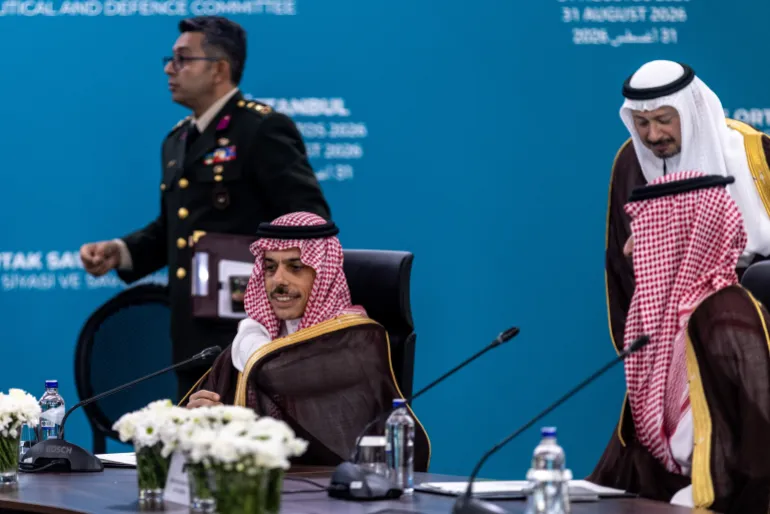
Saudi Foreign Minister Prince Faisal bin Farhan Al Saud in Istanbul, Turkiye [Burak Kara/Getty]
The Houthi targeting of Yanbu adds to the pressure on Saudi Arabia’s oil exports.
Earlier this month, the Houthis seized the Yemeni port of Mocha and several Red Sea islands, giving them significant control over the Bab al-Mandeb strait, which usually carries about 12 percent of global oil trade.
Strikes have also disrupted the operation of the East-West Pipeline linking Yanbu to export routes. Riyadh had been using it to export crude bypassing the Strait of Hormuz, which is restricted amid the Iran-US war.
However, the Houthis have now forced the Saudis to switch some exports back to Hormuz.
Brent crude rose more than 3 percent on Thursday, briefly topping $108 a barrel, before easing to $105.77 on Friday morning.
June Goh, a senior oil market analyst at Sparta Commodities in Singapore, said oil would likely stay above $100 a barrel as long as the war on Iran continued.
“With no clear resolution in sight, the gap in oil inventories globally is getting wider,” Goh told Al Jazeera.
The pact stipulates that an attack on one of the three countries is considered an attack on all of them.
Saudi Arabia, Turkiye and Pakistan have announced they are planning an urgent meeting of their chiefs of staff to discuss ways to support the kingdom under the Mecca Joint Defence Agreement.
The announcement followed a meeting on Thursday in New York between Saudi Foreign Minister Prince Faisal bin Farhan Al Saud, Pakistan’s Deputy Prime Minister and Foreign Minister Ishaq Dar and Turkish Foreign Minister Hakan Fidan, according to the Saudi Press Agency.
Recommended Stories
list of 4 itemsend of list
The statement did not say when the military chiefs would meet or what form of support could be considered.
Saudi Arabia, Turkiye and Pakistan signed the Mecca Joint Defence Agreement on August 7 to strengthen collective deterrence and expand defence cooperation.
The pact stipulates that an attack on one of the three countries is considered an attack on them all.
The three countries have since begun setting up mechanisms under the pact. Their foreign and defence ministers and military chiefs met in Istanbul on August 31 for the first meeting of the Strategic Political and Defence Committee, agreeing to establish a secretariat in Saudi Arabia and to deepen military cooperation.
Thursday’s foreign ministers’ meeting also condemned attacks targeting Mecca as well as civilian and economic facilities in Saudi Arabia, and it affirmed the kingdom’s right to defend itself under Article 51 of the UN Charter.
The diplomatic moves came as Saudi Arabia reported a fresh wave of attacks from Yemen.
Saudi Arabia said its air defences shot down six ballistic missiles launched towards Taif and Yanbu on Thursday.
Major-General Turki al-Malki, the coalition spokesman, said further Houthi escalation would be “dealt with firmly”. Saudi Civil Defence authorities had issued alerts in several areas before later saying the danger had passed.
The Houthis separately claimed missile and drone attacks on a “sensitive target” in Riyadh and Saudi Aramco facilities in Yanbu.
France has also offered to provide defensive support to Saudi Arabia. President Emmanuel Macron said Paris would send military assets to help protect Yanbu.
“We are going to send military assets, meaning soldiers, radars and defence systems to protect this site,” Macron said in an interview with TF1 on Thursday.
Yemen clashes drive rising casualties and displacement
The cross-border attacks have coincided with some of the heaviest fighting inside Yemen since hostilities escalated again.
Fighting across several fronts in Yemen killed at least 150 Houthi fighters and members of government-aligned forces in the 24 hours leading into Friday, according to an AFP news agency tally.
The toll compiled by AFP included 98 fighters on the government side and 52 from the Houthis, with clashes reported around the Kahboub Mountains and areas between Lahj and Taiz overlooking the Bab al-Mandeb strait.
The Houthis have also expanded their presence along Yemen’s Red Sea coast, including by taking the port city of Mocha and strategic islands. The gains have strengthened the group’s position around Bab al-Mandeb, one of the world’s busiest shipping corridors. About 12 percent of global trade normally passes through the waterway, according to AP.
Yemen’s internationally recognised government has urged greater international involvement, warning at the UN General Assembly that Houthi control around the strait poses a wider economic risk.
Vice President Abdullah Abdulkader Al Alimi-Bawzer accused the Houthis of using freedom of navigation as leverage, saying their actions were “taking hostage the entire global economy”.
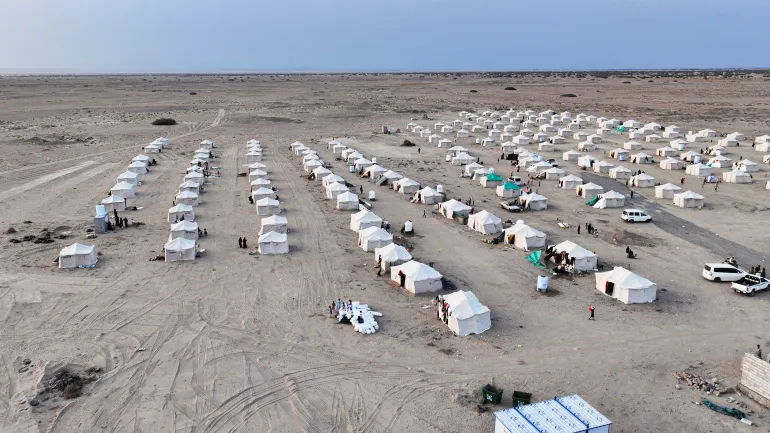
The renewed fighting has forced more than 230,000 people from their homes since the beginning of September, according to UNHCR, as clashes spread across multiple front lines. The agency said the latest displacement has added to about 5.2 million people already internally displaced across Yemen.
A drone view of a camp for internally displaced people, who fled fighting between the Houthis and government forces, erected near Aden, Yemen, September 19, 2026 [Stringer/Reuters]
UNHCR said families have been uprooted across governorates, including Hodeidah, Taiz, Lahj, Aden, Abyan, Marib, al-Dhalea and Shabwah, with many fleeing at short notice and leaving with few belongings.
Shelter, food, clean water, healthcare and protection services are among the most urgent needs, while host communities and displacement sites are becoming increasingly overstretched.
No response by Yemen’s Houthis to a claim by the coalition forces that its missiles targeted Taif and Yanbu.
Published On 24 Sep 202624 Sep 2026
Saudi-led coalition forces fighting Yemen’s Houthis say they have intercepted six ballistic missiles allegedly fired by the Iran-allied group towards cities in Saudi Arabia.
The missiles were destroyed on Thursday in the direction of the Saudi cities of Taif and the strategically important port of Yanbu, according to Major General Turki al-Malki, the spokesman for the Saudi-backed Coalition to Restore Legitimacy in Yemen.
Recommended Stories
list of 3 itemsend of list
Saudi air defences intercepted some of the missiles attempting to target the cities, Al-Malki told the Saudi Press Agency (SPA).
There was no immediate claim of responsibility from the Houthis or other groups.
The coalition statement came as the Reuters news agency reported that an air defence system operated by Greek military personnel in Saudi Arabia intercepted a ballistic missile and a drone on Thursday in the wider Yanbu region, home to major oil refining facilities.
“Both were shot down,” a Greek security source told Reuters, adding that the Greek Patriot system launched two missiles but did not give details on the origin of the drone and the ballistic missile. A second source confirmed the information to the news agency.
Yanbu port is key to Saudi crude when shipments through the Strait of Hormuz are disrupted.
Earlier on Thursday, Saudi Arabia’s General Directorate of Civil Defence issued alerts warning of potential danger in the holy city of Mecca, the northwestern area of Tabuk, the Red Sea areas of Jeddah and Yanbu and the southern area of Taif. They later said the threat had passed and the cities were out of danger.
It was the first time in nearly 10 years that a security alert had been activated in Mecca, home to the Kaaba, Islam’s holiest site.
The Houthis have largely attacked southern areas of Saudi Arabia.
They stepped up attacks on the kingdom after declaring a naval blockade in July, a second theatre for the US-Iran war. The Houthis also seized the whole of Yemen’s western coast in a lightning offensive nearly two weeks ago that brought them to the shores of the Red Sea’s strategic Bab al-Mandeb waterway.
Forces with Yemen’s Saudi-backed internationally recognised government said on Thursday they repelled Houthi attacks along several fronts in Yemen’s southwestern Taiz governorate.
Colonel Majid al-Nuzaili, spokesman for the Yemeni government forces, said that the Houthis launched coordinated attacks on Wednesday night in a bid to reach positions on a key road connecting the Aden, Lahj and Taiz governorates.
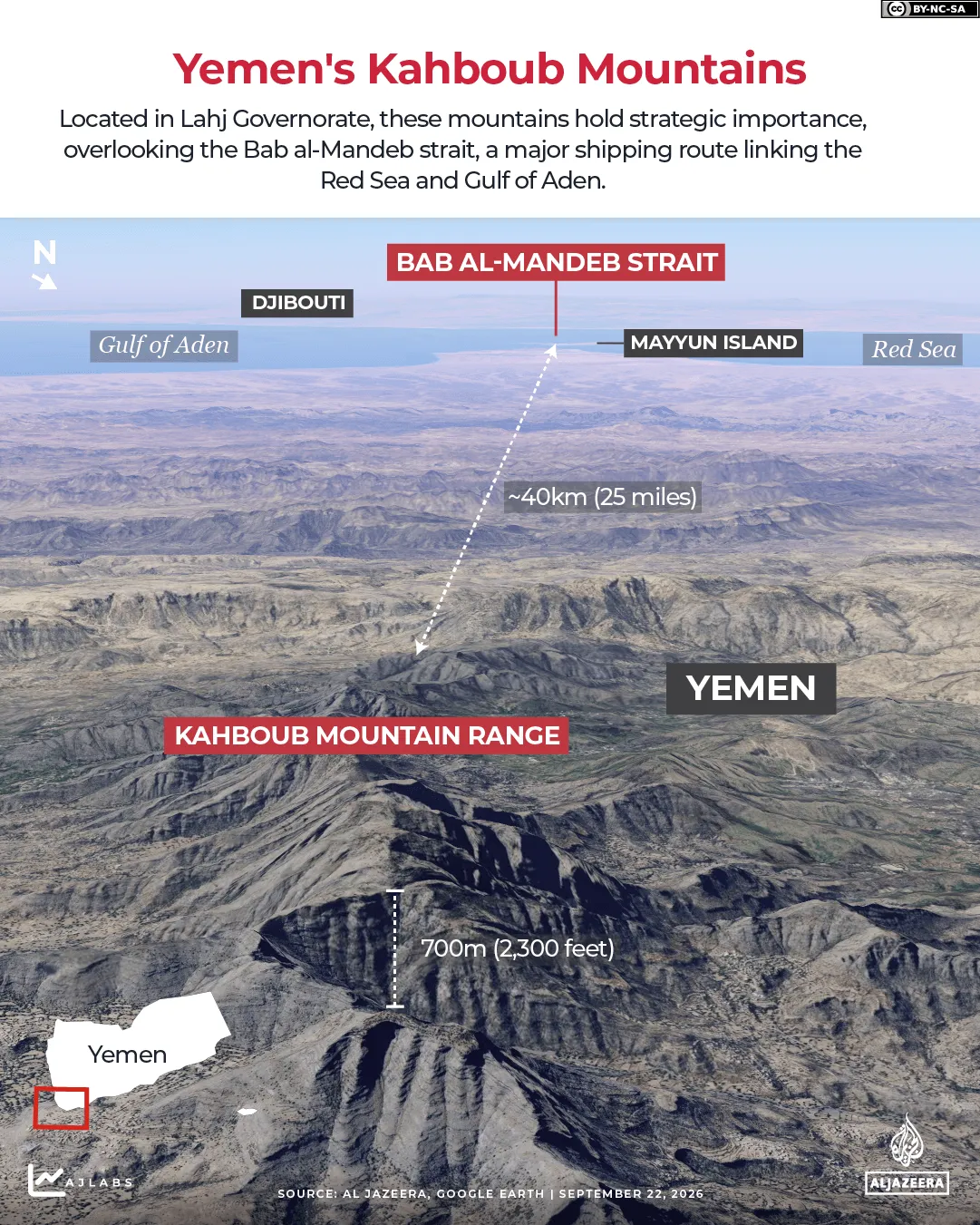
The Houthis are attempting to push into the Kahboub Mountains after seizing much of Yemen’s Red Sea coast in a lightning offensive this month – an advance that experts say could dramatically shift the balance of power in the country’s war if successful.
The renewed fighting in recent months with forces aligned with Yemen’s Saudi-backed, internationally recognised government has brought an end to the relative calm that had largely held since 2022. In recent days, the conflict has moved into the rugged highlands overlooking the approaches to Bab al-Mandeb, one of the world’s most important shipping routes.
Recommended Stories
list of 3 itemsend of list
The strait connects the Indian Ocean to the Red Sea and the Suez Canal, and its importance is only growing as shipping through the Strait of Hormuz remains disrupted by the Houthis’ main ally: Iran.
Experts said taking the high ground would help the Houthis defend the newly captured coastline and make it far harder for government forces to push them back. While the mountains may not necessarily be used as a launchpad for attacks on ships, controlling them would provide defensive depth and cover for Houthi positions closer to the coast, making missile and drone operations in the Red Sea easier to sustain and harder to disrupt.
The Houthis have said they do not intend to target United States shipping and attacks would be limited to vessels linked to Saudi Arabia. But the group has repeatedly attacked ships in the Red Sea in previous years, including vessels with no clear connection to its stated targets.
The Houthi advance has taken on added urgency after The New York Times reported that US President Donald Trump came close to ordering air attacks against the Houthis on Sunday, only to call them off at the last minute. Britain, meanwhile, said it will support Saudi Arabia with defensive refuelling.
Why is Kahboub strategically important?
Kahboub, a mountainous region spanning parts of the Lahj and Taiz governorates in southern Yemen, derives much of its strategic importance from its proximity to Bab al-Mandeb. Some of its heights lie about 40km (25 miles) from the waterway, providing commanding views across a stretch of the Red Sea, through which a significant share of global maritime trade and millions of barrels of oil pass each day.
While that vantage point has considerable military value, experts said the mountains are unlikely to serve directly as a launchpad for attacks in the Red Sea. Their more immediate importance for the Houthis lies in securing the territory the group has already captured.
“The mountains are the natural wall that protects the Houthis’ rear on the coast. Controlling them would cut the coast off from the government-held south and place direct pressure on Lahj and, in the longer term, Aden,” Faozi Al-Goidi, a visiting fellow at the Middle East Council on Global Affairs, told Al Jazeera.
Securing their rear would help the Houthis prevent government forces from attacking their coastal positions from behind or severing the routes connecting their newly captured territory. Until the high ground is secured, Houthi forces stationed along the Red Sea remain vulnerable to attacks from government-held areas to the south and east.
Capturing the elevated positions, therefore, would make Kahboub less important as a potential launchpad for maritime attacks than as a defensive shield for the Houthis’ military gains along the coast.
Ewa K Strzelecka, a visiting senior fellow at the London School of Economics, told Al Jazeera that controlling the coastline, Mayyun Island and the neighbouring highlands would give the Houthis “strategic resilience”.
(Al Jazeera)
“Holding the coastline, Mayyun and the adjacent highlands together would give the Houthis a much deeper and more defensible position around one of the world’s principal maritime chokepoints,” she said.
Those positions would allow the Houthis to move fighters, weapons and supplies along the coast with less risk of their routes being severed from behind.
“From the high ground, the Houthis could monitor movements along the coast, around Mayyun Island and towards the chokepoint while protecting missile, drone and potentially unmanned-boat infrastructure positioned farther inland,” Andreas Krieg, a senior lecturer at the School of Security Studies at King’s College London, told Al Jazeera.
The battle is already proving slower than the Houthis’ rapid advance across the coastal plains. Footage circulated on X by the Taiz Military Axis Command’s media centre appears to show intense fighting between forces aligned with the Yemeni government, local fighters and the Houthis on mountain fronts. The footage could not be independently verified by Al Jazeera.
“This is not an easy battle,” said Mohammed al-Basha, an analyst and a former spokesperson for Yemen’s embassy in Washington. “The fighting is taking place across some of Yemen’s most unforgiving terrain where control of a single hilltop or mountain peak can come at a heavy cost.”
Could the Houthis isolate Taiz by controlling Kahboub?
Control of Kahboub could also place greater pressure on Taiz, a symbolically and strategically important city, as the Taiz governorate forms a bridge between the Houthi-held north and the government-held south and the Red Sea coast. Whoever controls it gains the upper hand in the movement of weapons and supplies between the interior and the southern port city of Aden. Losing it, therefore, could deal a serious blow to the government.
Murad Al-Arefi, an editor at the Sana’a Center, told Al Jazeera that taking Kahboub would “increase pressure on the southern and western approaches to Taiz” although he cautioned that it should not yet be seen as evidence of a broader attempt to encircle the city.
The immediate threat to the Taiz-Aden connection is less direct because Kahboub does not itself sit across the route. “What matters is whether the Houthis can subsequently push farther east through Al-Wazi’iyah and towards the Al-Turbah-Lahj axis, which would place much greater pressure on the southern approaches to Taiz and potentially weaken its connection with Aden,” Strzelecka said.
A further advance, therefore, could leave government forces defending several mountain fronts simultaneously while relying on fewer secure routes to move troops, weapons and supplies, leaving Taiz increasingly exposed. One of Yemen’s largest population centres, Taiz became an important centre of resistance to the Houthis after they seized Sanaa in 2014, and was besieged by the rebel group for years. A major Houthi breakthrough there, therefore, would carry symbolic significance far beyond the territory captured.
What could it mean for Red Sea shipping?
Officially, the Houthis have said their current restrictions in Bab al-Mandeb would apply only to Saudi-linked shipping.
But during its previous Red Sea campaign, the group struck or endangered ships with no clear connection to Israel – their purported target during Israel’s genocidal war on Gaza – raising questions about how narrowly any new restrictions would be applied. Seizing the Kahboub Mountains would further strengthen the Houthis’ position by helping them secure the coastline overlooking Bab al-Mandeb and making it harder for their opponents to push them back.
Simon Mabon, a professor of international relations at Lancaster University, told Al Jazeera that the offensive showed the Houthis using their momentum to capture more territory, weaken their opponents and “dominate Yemen further”.
“This is the Houthis trying to seize more ground and diminish the capacity of their enemies while increasing their strategic ability to close Bab al-Mandeb,” Mabon said.
Ministers demand an end to maritime shipping attacks and urge Iran to stop arming the Yemeni group.
Published On 22 Sep 202622 Sep 2026
The foreign ministers of the Group of Seven (G7) nations have condemned what they called “unacceptable continued strikes” by Yemen’s Houthis against Saudi Arabia.
The ministers issued the statement on Monday following an informal meeting on the sidelines of the United Nations General Assembly in New York.
Recommended Stories
list of 3 itemsend of list
“We condemn in the strongest terms the unacceptable continued strikes carried out by the Houthis in Yemen and against the Kingdom of Saudi Arabia,” the ministers of the UK, Canada, France, Germany, Italy, Japan and the United States said in the statement.
The ministers urged the Houthis “to immediately cease all military actions, all threats and attacks against civilian shipping, and to return to the political process in good faith”.
They also called on Iran to stop arming and supporting the group, saying Tehran is in violation of past UN Security Council resolutions. They added that Iran’s backing of the Houthis constituted a dangerous pattern of escalation that risked undermining international trade and creating global instability.
The latest escalation in the Arab region’s most impoverished nation follows a period of relative calm that had largely held since the UN-brokered ceasefire in 2022 between the Iran-aligned group and the Saudi-backed Yemeni government.
Iran must “end its arming of and support” for the Houthis in Yemen, the foreign ministers of G7 nations have said in a joint statement.
The G7 also condemned “in the strongest terms” Houthi attacks on Saudi Arabia, adding that the recent escalation in fighting against Saudi-backed forces in Yemen represented a threat to regional and global energy security.
Thousands of refugees have fled Yemen in recent days after the Iran-backed group seized territory along the country’s Red Sea coastline, including near the Bab al-Mandab Strait, a critical shipping route for global trade.
The statement comes ahead of the annual UN General Assembly in New York, where senior Iranian officials are due to speak.
“We call on the Houthis to immediately cease all military actions, all threats and attacks against civilian shipping, and to return to the political process in good faith,” said the foreign ministers of the UK, Canada, France, Germany, Italy, Japan and the United States.
It went on: “Their reprehensible actions constitute a dangerous pattern of escalation that risks further exacerbating the conflict, undermining international trade and creating global economic instability.”
“Looking forward, we will continue to support the legitimate Government of Yemen and reaffirm our strong commitment to the unity, sovereignty, independence, and territorial integrity of Yemen,” the ministers said.
Their statement was issued following a meeting on the sidelines of the UN General Assembly.




![Iranian-made Zolfaghar missiles are seen on display beside a large portrait of Iran’s Supreme Leader Mojtaba Khamenei at Baharestan Square in Tehran on September 28, 2026 [AFP]](https://i0.wp.com/occasionaldigest.com/wp-content/uploads/2026/09/afp_6abbb983ec1b-1790687619.jpg?w=640&ssl=1)