The same hotel has been crowned the best of its kind for 11 consecutive years, thanks to its connectivity, innovation, technology and the unusual experiences it offers
The hotel provides privileged access to its neighbouring airport
A five-star stay at one of the world’s busiest hubs has been named the best airport hotel in the world for the 11th consecutive year.
Skytrax’s 2026 World Airport Awards are commonly referred to as the “Oscars of the airport industry,” and are based on the largest annual airport customer satisfaction surveys in the world, which gather feedback from travellers across more than 550 airports.
This year, the awards have crowned the Crowne Plaza Changi Airport in Singapore as the World’s Best Airport Hotel yet again this year, in a ceremony at PTE World in London.
Pushing the boundaries of what is expected of a stereotypical airport hotel – business-focused, strictly practical and visually simple – the hotel transports guests into the world of aviation in more ways than simply by giving them seamless access to terminals.
Crowne Plaza Chang has aviation-themed family suites designed in collaboration with Kiztopia. There, kids can make their trip even more exciting by playing with plane-inspired spaces and interactive features.
For those looking for special experiences without having to venture into cities, the Crowne Plaza Changi also offers a range of curated experiences, from hands-on cooking to cocktail sessions: all part of the hotel’s Crowne Plaza Social feature.
And if you just want to kick your feet up and rest for the entire time you’re there, you’re also in for a treat with the wellness-focused routines called Daily Rituals, which are designed to help guests recover from travel.
But the hotel’s innovations don’t stop at interior design and experiences. It is the first hotel in Singapore to offer in-room NuCalm sleep technology in every room, making use of the patented neuroscience techniques for stress relief, better sleep, focus & recovery, and ensuring you wake up refreshed before or after that long flight.
If all of that wasn’t enough to justify its top spot on the ranking of best airport hotels, the Crowne’s location is another major highlight. It gives guests direct access to all of Singapore Changi Airport’s terminals and the impressive Jewel Changi Airport complex – so no need to stress about what time to catch the airport shuttle.
General manager Greg Gublani said: “We are deeply honoured to be named the World’s Best Airport Hotel by Skytrax for the 11th consecutive year. This remarkable milestone is a celebration of our incredible team and unwavering dedication to deliver True Hospitality every day. In addition to delivering unique experiences, our stays are designed to enrich guest journeys, bringing blended travel to life through curated experiences. – from Crowne Plaza Social, where guests engage in hands-on activities crafting fresh pastas and classic Negronis, to energising Daily Rituals that support well-being.”
Singapore Changi Airport itself once again topped the list of the world’s best airports for 2026, followed by Incheon International Airport in Seoul, Tokyo International Airport, Hong Kong International Airport and Narita International Airport in Greater Tokyo.
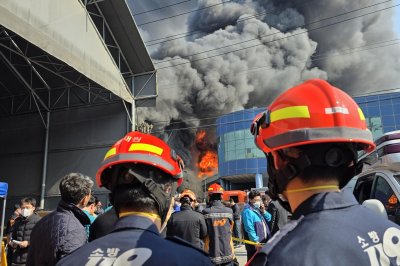
Fire authorities are on the scene of a fire that broke out at a car parts plant in the central city of Daejeon on Friday, injuring at least 53 people, with 14 others unaccounted for. Photo by Yonhap
A fire broke out at a car parts plant in the central city of Daejeon on Friday, injuring at least 53 people, with 14 others unaccounted for, authorities said.
The fire was reported at around 1:17 p.m., prompting the National Fire Agency to issue a national firefighting mobilization order, which is given when the scale of the fire is deemed to surpass the firefighting capacity of the local government.
A total of 170 workers were inside the plant when the blaze started, and 14 of them have been unreachable, officials said.
Of the injured, including 24 with serious injuries, many had inhaled toxic gas or fallen from the building, they said.
More than 200 firefighters and 90 pieces of equipment have been deployed to the scene to put out the blaze, aided by helicopters from the forestry service.
Of the two buildings making up the plant, one has completely burned down, while the other is still burning. Firefighters have not been able to enter the structure due to concerns it could collapse.
Also complicating the firefighting effort is 200 kilograms of sodium inside the building, which could explode if poorly handled.
President Lee Jae Myung ordered authorities to mobilize all available resources to rescue the victims and contain the fire, his office said.
Earlier, Prime Minister Kim Min-seok gave similar instructions to the interior ministry and the fire agency, while ordering the Daejeon metropolitan government and the police to ensure no further damage by implementing traffic control and evacuation measures.
Copyright (c) Yonhap News Agency prohibits its content from being redistributed or reprinted without consent, and forbids the content from being learned and used by artificial intelligence systems.
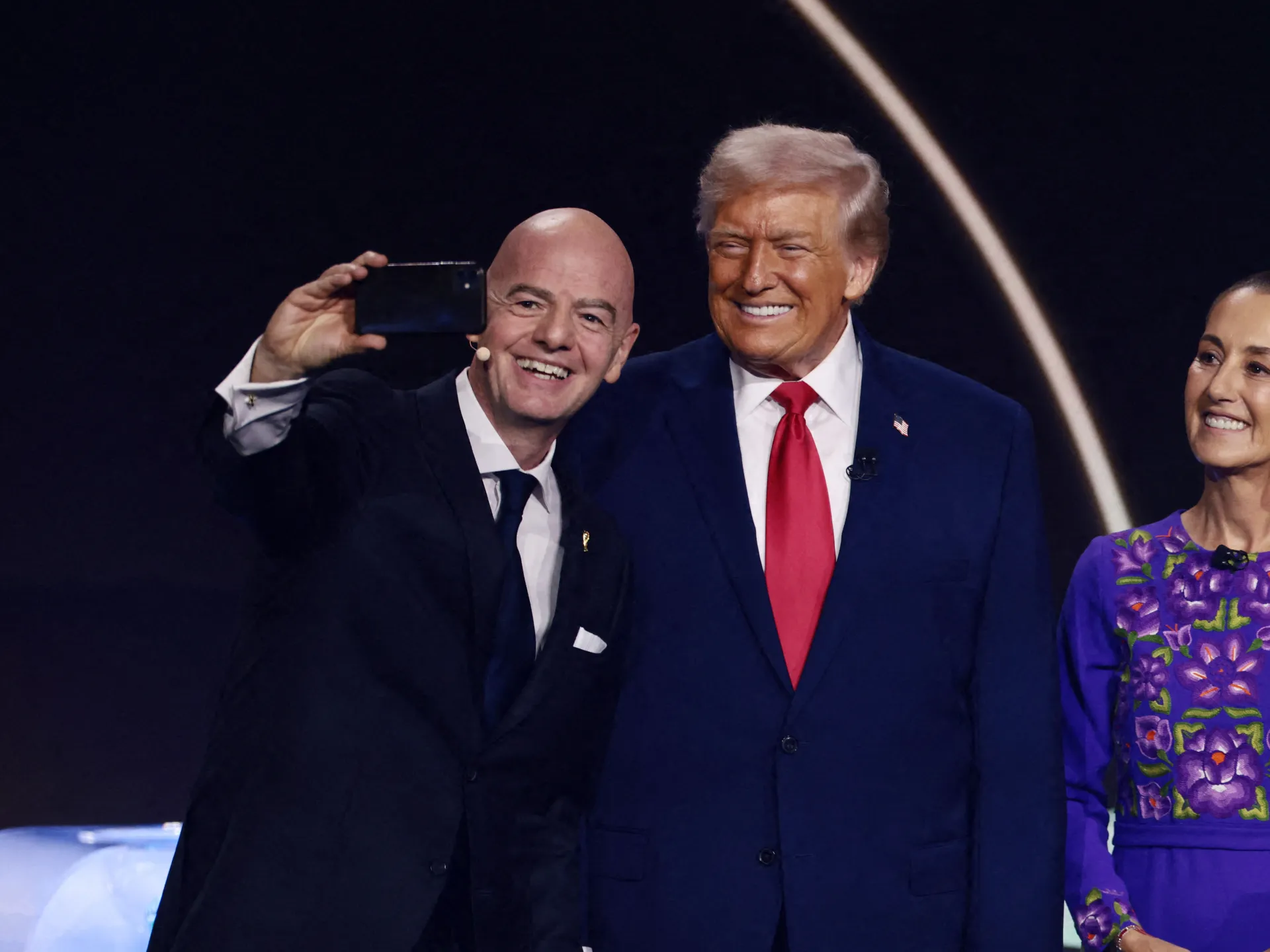
Months after awarding the “FIFA Peace Prize” to Donald Trump, FIFA President Gianni Infantino said his organisation “can certainly not solve geopolitical conflicts.”
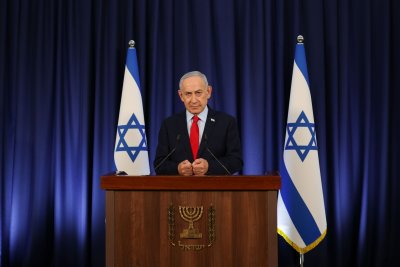
March 20 (UPI) — Prime Minister Benjamin Netanyahu said Thursday that Israel “acted alone” in striking Iran’s South Pars gas field, an attack that escalated the war in the Middle East and prompted President Donald Trump to declare that the U.S. ally would not target the site again.
Israel attacked the South Pars field on Wednesday. In retaliation, Iran targeted major Persian Gulf energy facilities of U.S. allies, causing damage to Qatar’s Ras Laffan Industrial City and the United Arab Emirates’ Bab gas field.
The tit-for-tat strikes have edged the region closer to all-out war while soaring the price of oil, leading Trump to state the United States had known nothing of Israel’s plans before it struck the South Pars gas field and to threaten Iran if it attacked Qatar again. He also said Israel would not attack Iranian energy infrastructure unless Iran attacked Qatar again.
Trump’s comments and his administration’s rationale for entering the war have come under scrutiny after reporting challenged his claim that Washington had no prior knowledge of the South Pars attack, while critics accused the United States of being lured into the war by Israel.
Speaking to reporters in English on Thursday, Netanyahu mostly backed Trump’s account, saying “Israel acted alone against the Asaluyeh gas compound,” using the name of the nearby Iranian port and industrial complex that is often used as a shorthand for the gas field.
He did not directly address whether Trump or the United States knew of the attack beforehand, but pivoted to state that further attacks would not occur, as the American president had ordered.
“President Trump asked us to hold off on future attacks, and we’re holding off,” he said.
The press conference was held following reporting, including by CNN, citing U.S. and Israeli officials who said the attack had been conducted in coordination with the United States.
It was also held as accusations mount that the United States was dragged into the war by Israel. After the United States launched initial attacks with Israel on Feb. 28, Secretary of State Marco Rubiotold reporters that it was a preemptive strike to reduce U.S. casualties and deaths because they knew Israel was going to strike Iran and believed Tehran would retaliate against American forces.
The Trump administration has attempted to thwart the notion that Israel forced the United States into war, with officials repeatedly stating that Trump’s decision to attack was not influenced by others.
Netanyahu echoed this sentiment.
“Does anyone really think that someone can tell President Trump what to do? Come on,” he said. “President Trump always makes his decision on what he thinks is good for America, and may I add, I think what is also good for future generations.”
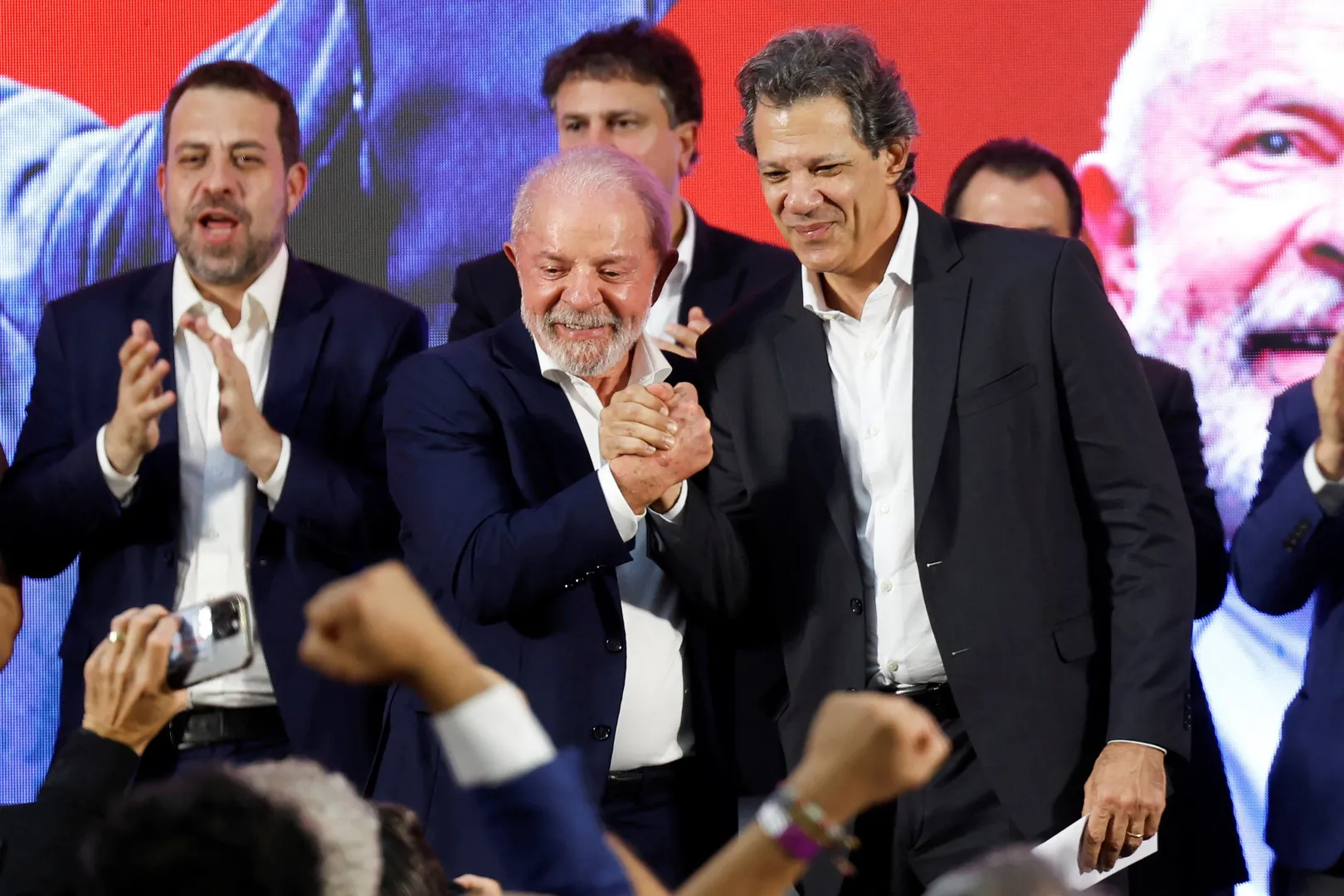
President of Brazil Lula de Silva criticised the United States’ aggressive foreign policy under President Trump and called on the UN Security Council to prevent war.
Marius Borg Hoiby and his mother Norwegian Crown Princess Mette-Marit attend a government party event in Oslo, Norway, in 2022. Hoiby is facing 39 charges, including four counts of rape. File Photo by Lise Aserud/EPA
March 19 (UPI) — Prosecutors said that if Marius Borg Høiby, son of Norway’s crown princess, is found guilty, he should serve more than seven years in prison for the 39 charges he faces.
The charges include four rapes and assaults, rape and domestic abuse, multiple breaches of restraining orders, and drug and driving offenses.
One charge of violation of a restraining order has been dropped.
The final day of the trial is Thursday, but it could take months for the judges to give a verdict.
Several alleged victims have testified, including Høiby’s former girlfriend, influencer Nora Haukland.
In all four rape cases the victims were either asleep or incapacitated. Early in the trial, Høiby told the court, “I don’t sleep with women who aren’t awake.”
His mother is Mette-Marit, who is married to the crown prince of Norway. Høiby is her son from a previous relationship. He grew up in the royal family, but is not an official member of it.
Mette-Marit was a friend of the late sex offender Jeffrey Epstein, which was revealed from one of the Epstein files releases from the U.S. Justice Department. Her health has declined due to pulmonary fibrosis, and she has said needs a lung transplant.
The prosecution asked the court for Høiby to be in prison for seven years and seven months. It also asked that he be banned from contacting one of his alleged victims for two years and asked that several devices, including three iPhones and a MacBook, be confiscated. It also wants his driver’s license to be taken away for two years, and for him to have to take a new driving test after that time is up.
“These are very serious acts,” said state attorney Sturla Henriksbø. “It is among the most serious offenses in our criminal code to apply to violations of integrity. And it should entail a strict and tangible reaction in each case.”
Police attorney Andreas Kruszewski said Høiby should not be given a “penalty discount” because of media attention.
“The fact that you commit criminal acts after the media spotlight has been directed at you as a well-known person contributes to the fact that he should not receive a reduction in sentence,” Kruszewski said.
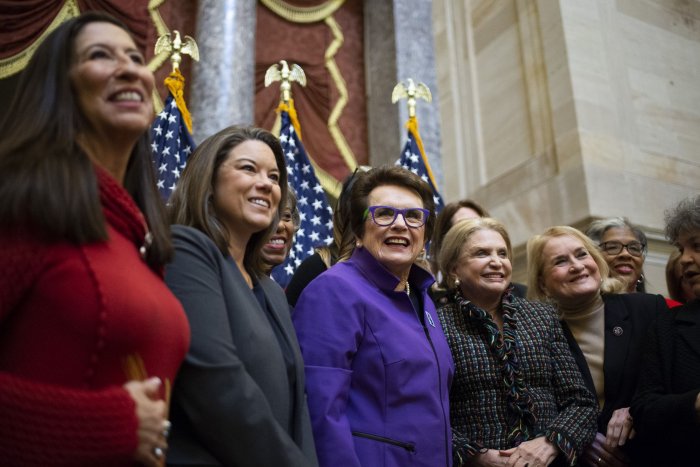
Founder of the Women’s Tennis Association and tennis great Billie Jean King (C) smiles with representatives after speaking during an annual Women’s History Month event in celebration of the 50th anniversary of Title IX in Statuary Hall at the U.S .Capitol in Washington on March 9, 2022. Women’s History Month is celebrated every March. Photo by Bonnie Cash/UPI | License Photo
March 19 (UPI) — The number of cases of meningitis in Kent has risen to 27, the United Kingdom Health Security Agency reported.
There are 15 confirmed cases, and 12 suspected cases, meaning health professionals suspect the illness based on symptoms.
Two people have died since the outbreak began: One high school student and a college student at the University of Kent.
“What is particularly remarkable about this case, and unexpected about this case, is the large number of cases all originating from what seems to be a single event,” Robin May, chief scientific officer at the UKHSA, told The Guardian.
Officials believe some students picked up the disease at Club Chemistry, a nightclub in Canterbury.
“There are two possible reasons for that,” May said. “One is that there might be something about the kind of behaviors that individual people are doing. The other possibility is the bacteria itself may have evolved to be better at transmitting.”
Students at the university are being given preventive antibiotics and vaccines effective against the strain of meningitis B. Officials have given 600 vaccines and 6,500 doses of antibiotics.
Canterbury Christ Church University in Kent confirmed that a student had meningitis, and four schools have seen confirmed cases.
The UKHSA said there was one student with meningitis at a college in London whose case was linked to the Kent outbreak.
Meningitis is an infection of the protective lining of the brain and spinal cord. It can be caused by bacteria or viruses. Meningitis B is caused by the Neisseria meningitidis bacteria, which is also called meningococcus.
Doctors in England were told on Wednesday to prescribe antibiotics to anyone who was at Club Chemistry between March 5 and 7 and to University of Kent students who had left the campus.
“Two doses of the MenB vaccine helps protect individuals against meningococcal B disease,” but not other strains of meningitis, said Trish Mannes, UKHSA regional deputy director for the south east, in a statement. “It is therefore still hugely important that people are aware of the signs and symptoms of invasive meningococcal disease and that they seek immediate medical attention if they or anyone they know develops these signs and symptoms.”
The UKHSA said the National Health Service was well stocked with vaccines after pharmacies reported they were struggling to get them.
Health Secretary Wes Streeting told the BBC there is no reason for people to buy it privately.
“We make it available through the NHS to those groups at risk based on independent scientific advice,” he said.
“In recent days, here in Canterbury we’ve made it more widely available than we normally would to targeted groups of students, club-goers, sixth-formers [older teens] where we think there is a higher risk. We’re doing this as a precaution.”
Founder of the Women’s Tennis Association and tennis great Billie Jean King (C) smiles with representatives after speaking during an annual Women’s History Month event in celebration of the 50th anniversary of Title IX in Statuary Hall at the U.S .Capitol in Washington on March 9, 2022. Women’s History Month is celebrated every March. Photo by Bonnie Cash/UPI | License Photo
Founder of the Women’s Tennis Association and tennis great Billie Jean King (C) smiles with representatives after speaking during an annual Women’s History Month event in celebration of the 50th anniversary of Title IX in Statuary Hall at the U.S .Capitol in Washington on March 9, 2022. Women’s History Month is celebrated every March. Photo by Bonnie Cash/UPI | License Photo
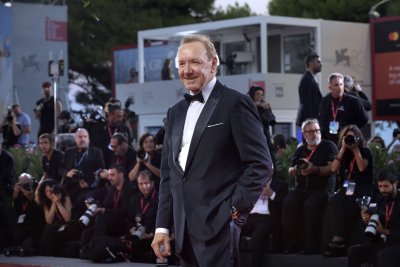
March 19 (UPI) — Actor Kevin Spacey settled out of court in England with three men who sued him, accusing him of sexual assault.
The cases were set for trial in the High Court this year.
The men alleged that between 2000 and 2013 Spacey, 66, assaulted them, but Spacey denies any wrongdoing.
In 2023, he was found not guilty of nine criminal sexual assault charges. Two of the accusers in the criminal trial filed the civil cases.
One accuser, known as LNP, alleged that Spacey “deliberately assaulted” him 12 times between 2000 and 2005. Another, known as GHI, said he “suffered psychiatric damage and financial loss” from an assault in 2008.
Actor Ruari Cannon, who has waived his right to anonymity, said that when he was in the Tennessee Williams play Sweet Bird of Youth at the Old Vic Theater in 2013, Spacey groped him at a party. Spacey was the artistic director at the theater at the time.
Cannon also settled with the Old Vic in a civil suit two weeks ago.
Cannon was on a BBC Channel 4 documentary, Spacey Unmasked, in 2024. Spacey called the allegation “ridiculous and it never happened.”
Spacey has been trying to win back his career, Deadline reported. Last year he said he has no home and was living out of hotels and Airbnbs and working as a lounge singer in Cyprus. He claims his struggles are like the actors who were blacklisted during McCarthyism, Deadline said.
Spacey also won a civil case in the United States in which actor Anthony Rapp said Spacey sexually assaulted him when he was 14.
The issue that has created the most noise since Tuchel took charge is about how he has dealt with Jude Bellingham and the battle for the number 10 position.
The Real Madrid midfielder was left out of the October camp after injury despite wanting to join up as Tuchel favoured keeping a settled group after excellent performances.
Aston Villa midfielder Morgan Rogers impressed in qualifying, starting five of England’s eight group games, and has become the first-choice number 10.
“Rather than finding positions for my best players just so that I can have them on the field, I prefer to put everyone in their best positions and have some competition,” Tuchel said when speaking about the pair going up against each other.
There is no denying Bellingham is one of the best midfielders in the world when he is fit and in form, but the midfielder is currently working his way back from a hamstring injury and has not played since 1 February.
It’s easy to forget that Bellingham is just 22, given he has already produced some iconic moments for England such as his last-gasp bicycle kick against Slovakia at Euro 2024 and his assist for Cole Palmer’s goal in the final.
Tuchel has made a point about how his England team need to be settled and united, but if Bellingham is producing his best for Madrid at the end of the season, the England manager has a very difficult decision on his hands.
Chelsea’s Cole Palmer, who has also had injury problems this season, has barely played under Tuchel, featuring for just 65 minutes.
And Phil Foden’s role is not clear in this England squad – he was called up as a back-up striker for the last camp and assisted Eberechi Eze in the win over Serbia at Wembley in November from that position.
Venezuelans took to the streets to celebrate the WBC title. (AFP)
Caracas, March 18, 2026 (venezuelanalysis.com) – Venezuela won the World Baseball Classic after defeating the United States 3–2 on Tuesday at LoanDepot Park in Miami.
The Caribbean nation’s first major international baseball title was secured thanks to a decisive double by Eugenio Suárez that broke a tie in the top of the ninth inning.
“I have no words. Seeing Javier (Sanoja) score on my double in the ninth was the greatest moment of my life. We knew we could do it. Nobody believed in Venezuela, but now we are the champions. This is a celebration for the whole country,” Suárez told Fox Sports after the game.
The United States had tied the score at 2-2 in the eighth inning when Bryce Harper launched a two-run home run against Venezuelan reliever Andrés Machado.
Earlier in the game, a sacrifice fly from Maikel García in the third inning and a home run by Wilyer Abreu in the fifth—off rookie pitcher Nolan McLean—had given Venezuela a 2–0 lead before a crowd of 36,490 people that was heavily in favor of the South American team.
Sports journalist Jason Mackey said he had never witnessed such passionate fan support at a sporting event—not even at the Super Bowl. Venezuela’s victory also sparked spontaneous celebrations in several cities across the country, including the capital, with fireworks displays and caravans blaring horns along the main avenues.
Venezuela finished the tournament with six wins and one loss, the latter coming against the Dominican Republic during the group stage. Before reaching the championship, the Venezuelan squad defeated three-time tournament champion Japan 8–5 in the quarterfinals and Italy 4–2 in the semifinals.
The tournament’s Most Valuable Player, Maikel García, emphasized that the team’s motivation centered on representing the country. “We didn’t play the final to represent Dominicans or Latinos. We did it for Venezuela. Maybe some people didn’t like that, but the jersey said Venezuela, not Latin America,” he said.
Meanwhile, the US team fielded the most star-studded roster in its history but fell short in its second consecutive final to extend its winless draught to nine years. The Americans had previously lost the 2023 final 3–2 to Japan.
Following the victory, Venezuela’s Acting President Delcy Rodríguez declared Wednesday a National Day of Jubilation, encouraging people to celebrate in public squares, parks, and sports fields. She also invited the public to attend a large concert titled “Venezuela Triunfa Unida” (“Venezuela Triumphs United”).
For his part, US President Donald Trump used the moment to again suggest that Venezuela could become a US state. “Statehood,” he wrote on his Truth Social account.
In the run-up to the final, Trump had posted a similar message: “Good things have been happening to Venezuela lately. I wonder what this magic is… the 51st state?”
Tuesday’s final happened in the wake of the US’ January 3 military strikes against Caracas and nearby areas that also saw special forces kidnap Venezuelan President Nicolás Maduro. In the two months since, the two countries have fast-tracked a rapprochement and reestablished diplomatic ties. Despite the strong political overtones surrounding the matchup, players and coaches largely avoided commenting on the state of relations between the two nations.
Walt Disney Co. installed Josh D’Amaro as chief executive Wednesday, beginning a new chapter for the storied Burbank entertainment giant.
Bob Iger passed the reins during Disney’s virtual annual meeting of shareholders, completing the company’s high-stakes and tightly choreographed changing of the guard. After spending two decades molding Disney into a media colossus, Iger segued into a senior advisory role, which will run through December when he officially retires.
The leadership shift comes amid an upheaval in Hollywood as traditional companies wage a desperate battle for survival.
D’Amaro, in his first address to shareholders, pointed to Disney’s signature storytelling as its competitive edge.
“While others in our industry are consolidating just to compete, or struggling to be relevant in a fragmented and disrupted world, Disney is in a category of one,” D’Amaro said during a video segment at the meeting. “This next chapter will be driven by staying focused on world-class creativity, enhanced by technology, bringing unforgettable stories to audiences wherever they are.”
D’Amaro, 55, becomes the ninth leader in Disney’s 102-year history. He was selected last month by Disney board members after a two-year internal bake-off among high-ranking division leaders. Board members were impressed with his business acumen, charisma and his deep love for Disney and its fabled history.
D’Amaro inherits a company that is beloved by millions. It generates $94 billion a year in revenue and employs 230,000 people.
He faces enormous challenges as he steers the ship through a turbulent media environment and tense geopolitics. The war in Iran prompted a sharp increase in fuel costs, which could become a drag on Disney’s critically important tourism business. Executives already have signaled “headwinds” in international visitation at its U.S. theme parks this year.
Lingering Middle East tensions also could weigh on Disney’s plans for a new Persian Gulf waterfront theme park and resort near Abu Dhabi.
D’Amaro, who served as parks and experiences chief until Wednesday, got his corporate start at Disneyland 28 years ago.
“Like so many of you, my connection to Disney goes back to my childhood, long before I began my career here,” D’Amaro told shareholders. “I grew up in a Disney family. We watched ‘The Wonderful World of Disney’ on Sunday nights. I was 10 years old when my family visited Disneyland for the first time. … Disney has always been a place of imagination, innovation and infinite potential.”
Disney previously announced a $60-billion, 10-year expansion program, which D’Amaro has led. But executives must strike a balance by keeping attractions true to their nostalgic core. In Anaheim, the expansion could result in at least $1.9 billion of development.
Disney also must continue to grow its animation business and manage revenue declines from its traditional linear television channels, including ESPN and ABC. It needs to turbocharge its streaming services with compelling movies and TV shows to remain competitive with Netflix and other leaders in the field.
Disney teased upcoming fan favorites, including the May release of Lucasfilm’s “Star Wars: The Mandalorian & Grogu,” a “Bluey” feature film (the kids show featuring an animated puppy, a blue heeler) and a sequel to a “Lilo & Stitch” film for 2028.
Streaming is key to Disney’s future, D’Amaro said.
“Disney+ will continue to evolve beyond a traditional streaming service to become the digital centerpiece of our company,” D’Amaro said, calling the service “a portal that connects our stories, experiences, games, films, and more in entirely new ways.”
The company plans to unify Disney+ and Hulu later this year.
Disney also must continue to incorporate technology while safeguarding its characters and franchises.
“We will continue to develop and embrace new technologies to empower our storytellers — but never at the expense of our characters and worlds, our creative partners, or the trust people place in us,” D’Amaro said. “Because Disney at its core is a company that celebrates human creativity.”
Wednesday also marked a reorganization of the company, configured by Iger, D’Amaro and Disney’s board.
Board members recognized that D’Amaro, who has spent most of his career in the parks division, lacks deep connections among Hollywood’s writers and producers. They elevated longtime television executive Dana Walden, who had been vying for the top job, to the newly formed role of chief creative officer and the company’s first woman president.
ESPN will continue to be managed by Jimmy Pitaro and Disney Entertainment, Studios chairman Alan Bergman will remain in his influential role overseeing film studios including production, marketing and distribution, and sharing oversight for streaming programming with Walden.
D’Amaro’s total compensation package is valued at about $40 million a year, including a $2-million annual base salary, $26.2 million in annual long-term stock incentives, a cash bonus and a one-time promotion award of $9.7 million.
“Josh is a wonderful choice to lead the Walt Disney Co.,” Iger said in a pre-recorded video. “He has passion for our businesses and brands, respect for our people, and he appreciates what makes this company so unique.”
Iger is wrapping up an unprecedented 52-year career at ABC and Disney.
He first stepped into the CEO role in 2005; his first 15 years were almost magical.
Iger led acquisitions of Pixar Animation, Marvel Entertainment and Lucasfilm, the studio behind “Star Wars,” that turned Disney into a blockbuster machine. Sports king ESPN spawned staggering profits, and Disney’s theme parks set industry standards.
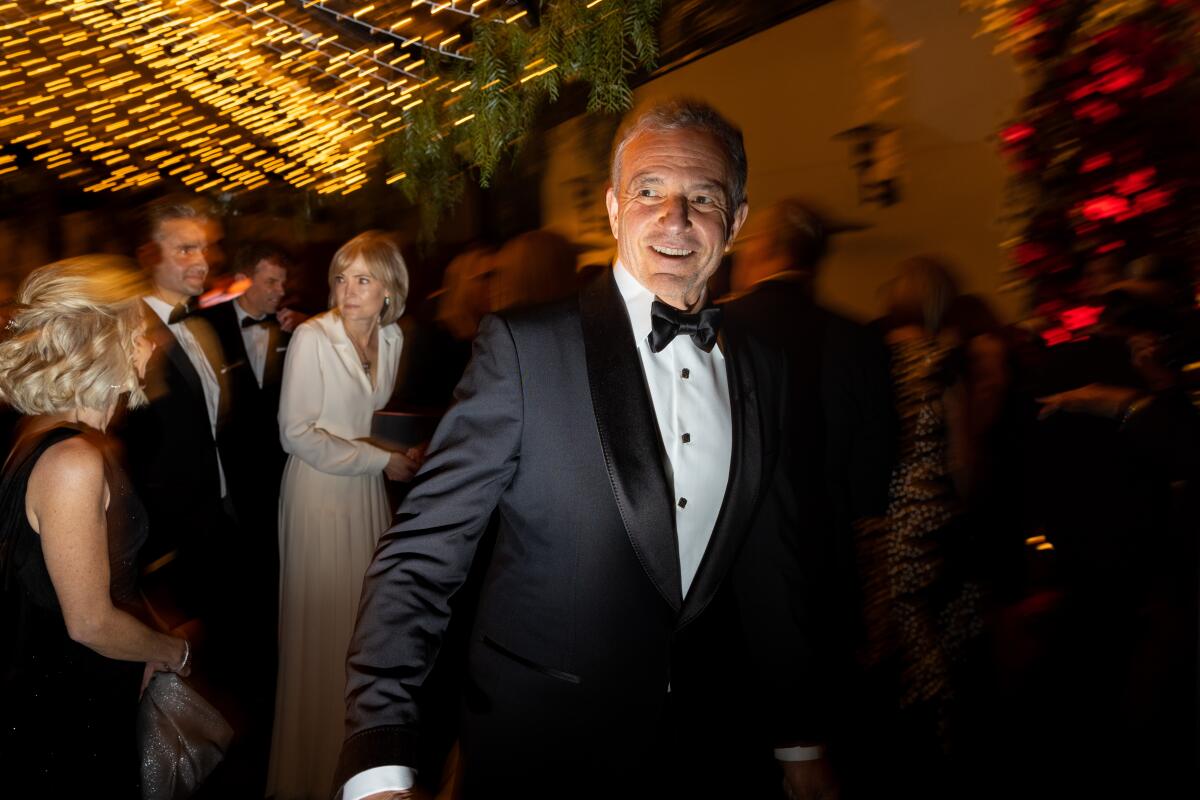
Disney’s former Chief Executive Bob Iger will stay on through the end of the year as a senior advisor.
(Jay L. Clendenin / Los Angeles Times)
His decision to buy much of Rupert Murdoch’s 21st Century Fox, a $71-billion deal that closed in 2019, boosted Disney’s television production, refreshed its TV executive bench, and provided a controlling stake in general entertainment streaming service Hulu. The acquisition also gave Disney access to fan-favorite franchises, including “Deadpool,” “The Simpsons,” and James Cameron’s “Avatar.”
But the purchase left Disney saddled with debt just as the COVID-19 pandemic prompted production shutdowns and closures at theme parks and sports venues. It would take several years for Disney to recover.
Iger initially passed the CEO baton to Bob Chapek in February 2020. Iger, then chairman, retired the following year but came back in November 2022 to a mess. At the time, the company was losing billions of dollars on its shift to streaming but that unit is now profitable.
Iger spent the next three years focusing on four business pillars, including improving the quality and profitability of its film studios.
During the last two years, Disney has produced five franchise films that racked up more than $1 billion in worldwide ticket sales, including “Inside Out 2,” “Zootopia 2,” and “Avatar: Fire and Ash.”
The company is banking this year on several other films with blockbuster potential, including Disney and Pixar’s “Toy Story 5,” “Star Wars: The Mandalorian & Grogu” and Marvel Studios’ “Avengers: Doomsday.”
“I would want to be known as someone who was given the keys to this kingdom and brought it to a place that even Walt would be proud of — more storytelling, more innovation, more risk‑taking, and more creation of happiness,” Iger said during a “The Rest is History” podcast last year.
During the meeting, Iger appeared in a prerecorded video that celebrated his numerous career highlights. Shown were clips from his cub years when Iger was a newscaster with bushy black hair. His journey was depicted, including his orchestration of multi-billion-dollar acquisitions that strengthened Disney with more characters and franchises.
Iger, 75 and now gray, ended by thanking shareholders “for the trust you placed in me, for the memories we created together, and for allowing me the honor of serving,” he said. “It has meant more to me than I can say.”
Animated pixie dust twinkled on the screen, courtesy of the fairy, Tinker Bell.
“Bob, on behalf of our employees, cast members, shareholders, and fans around the world, thank you so much for your tremendous leadership, your steadfast support, and your countless contributions to The Walt Disney Co.,” D’Amaro said, as the hand-off was complete.
“You’ve set an incredible example for all of us. … You will be missed,” D’Amaro said.
There was little fanfare during the business portion of the investor meeting.
The company’s slate of board directors were elected with 93% of the vote. Shareholders also approved executive compensation packages with about 85% of votes.
Shareholder-led proposals to compel reports on charities eligible for Disney’s gift-matching program, a review of the company’s accessibility practices in its theme parks for disabled guests, and a push for cumulative voting at future meetings all failed to muster support.
Disney shares closed at $99.41, down roughly 1% on the day.
The logo of the National Police Agency is displayed in Seoul. Photo by Asia Today
March 18 (Asia Today) — A South Korean civic group on Wednesday called for changes to ethics laws after finding that dozens of former police officers took jobs at law firms shortly after retirement, raising concerns about potential conflicts of interest.
The People’s Solidarity for Participatory Democracy said 144 retired police officials joined law firms between January 2020 and February 2026, based on data from the government ethics oversight body.
Of 228 post-retirement employment reviews during that period, 63.2% were approved, allowing former officers to take positions at law firms, the group said.
Nearly half of those cases – 68 out of 144 – involved individuals who joined law firms within three months of leaving the police force.
The group said the trend raises concerns that former officers could still wield influence over active investigators, particularly because many held mid-level supervisory roles directly involved in criminal investigations.
Such overlap could undermine the neutrality and fairness of police work, it added.
The civic group also noted that the expanding role of police following recent criminal justice reforms has increased the need for stronger safeguards to ensure impartial investigations.
It called for revising the Public Officials Ethics Act, arguing that current rules do not sufficiently restrict employment at law firms for retired officials who hold legal qualifications.
The group urged lawmakers to amend the law to require stricter review of such employment and prevent potential conflicts of interest.
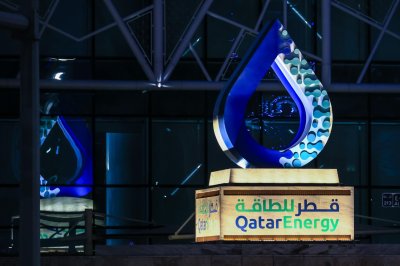
The logo of state-owned petroleum company QatarEnergy in front of the headquarters, in Doha, Qatar, March 3. QatarEnergy has halted production of liquefied natural gas and related products due to military attacks on its facilities in Ras Laffan Industrial City and Mesaieed Industrial City. Photo by Hannibal Hanschke/EPA
March 19 (UPI) — Iran on Thursday attacked major energy facilities in Qatar and the United Arab Emirates after vowing to retaliate for Israel striking its gas field a day earlier, escalating a war that is driving up energy prices and rattling global markets.
Qatar said Iranian ballistic missiles struck its Ras Laffan Industrial City, the centerpiece of the nation’s LNG production and export, while the United Arab Emirates said its Habshan gas facilities and Bab field had come under attack.
Several liquefied natural gas facilities at the Ras Laffan Industrial City, which is responsible for about one-fifth of global LNG supplies, were struck early Thursday, igniting what state-owned QatarEnergy said in a statement were “sizeable fires.” Extensive damage was reported.
Two of three fires that ignited from the attack were contained as of 5 a.m. local time Thursday, according to a statement from Qatar’s Ministry of the Interior.
Iran attacked the complex’s Pearl gas-to-liquids facility late Wednesday, which was dealt “extensive damage” and prompted emergency teams to be deployed to the site.
Rockets launched at the UAE facilities were successfully intercepted, but falling debris prompted Abu Dhabi authorities to respond to unspecified incidents at the Habshan gas facilities and the Bab gas field, the Abu Dhabi Media Office said in a statement.
The facilities have been shut down in response, it said, adding that no casualties were reported.
Iran also targeted gas facilities in eastern Saudi Arabia, but all projectiles and drones were intercepted, its Ministry of Defense said in a statement.
The attacks mark an escalation in the war, and come after Israel attacked Iran’s South Pars gas field, one of the world’s largest resources of natural gas.
Israel’s attack was condemned by several countries, including Qatar. Foreign Ministry spokesman Majed Al Ansari said it was “a dangerous & irresponsible step amid the current military escalation in the region.”
“Targeting energy infrastructure constitutes a threat to global energy security, as well as to the peoples of the region & its environment,” he said in a statement.
Following Iran’s attack on Wednesday night, Qatar gave Tehran’s embassy officials 24 hours to leave the country.
The targeting of Persian Gulf energy facilities is expected to further drive surging energy costs. On Thursday, Brent crude reached nearly $110 a barrel, up sharply from $71 before the war began in late February.
Iran had vowed to attack the region’s energy facilities after Israel attacked its South Pars gas field.
Oil facilities “associated with America are now on par with American bases and will come under fire with full force,” Alireza Tangsiri, chief of Iran’s Islamic Revolutionary Guards Corps Navy, said on X.
“You have heard a lot about #hell; we will paint its picture for you,” the IRGC said Thursday in a social media statement.
“Stay away from energy facilities…”
Following the attacks, U.S. President Donald Trumpsaid on his Truth Social platform that there would be no more Israeli attacks on the South Pars field.
Trump claimed the United States “knew nothing” about Israel’s plan to attack the gas site and that Qatar was also neither involved.
He said Iran was unaware of that, but warned that if it again attacks Qatar, the United States will join Israel and “massively blow up the entirety of the South Pars gas field at an amount of strength and power that Iran has never seen or witnessed before.”
Drivers pump gas into their cargo trucks at a gas station in Incheon, South Korea, 13 March 2026. The government implemented a temporary fuel price cap system the same day to ease cost burdens amid supply concerns linked to the Middle East crisis. YONHAP / EPA
March 18 (Asia Today) — South Korea’s four major oil refiners are ramping up production and delaying maintenance to stabilize domestic fuel supply amid rising global energy risks, industry officials said Tuesday.
The move comes as refining margins approach $30 per barrel, far above the industry break-even level of about $4 to $5, signaling what analysts describe as a “super cycle.”
Despite strong profitability, refiners said the decision reflects a priority on supply stability as concerns grow over potential fuel shortages linked to Middle East tensions and disruptions in the Strait of Hormuz.
GS Caltex has postponed major maintenance at its Yeosu refinery by about two months to May, opting to keep production running during the current high-margin period. Such maintenance typically lasts about 40 days and costs hundreds of billions of won.
Industry officials said the delay was driven not only by profitability but also by the need to ensure stable supply, including naphtha, a key feedstock for petrochemical production.
Naphtha prices have surged to about $1,009 per ton, roughly double the level seen a year earlier.
Refiners said maintaining high operating rates will also support petrochemical companies by ensuring a steady supply of raw materials.
SK Energy said it will continue operating at full capacity while complying with the government’s oil price cap policy. Authorities are monitoring refinery inventories and shipments in real time through a joint task force.
S-Oil and HD Hyundai Oilbank are also prioritizing domestic supply in line with government measures limiting exports of gasoline and diesel.
Industry sources said other refiners may follow GS Caltex in adjusting maintenance schedules, as shutting down facilities during a period of elevated margins would reduce efficiency.
Analysts said refiners are seeking to balance strong earnings with their role in preventing a domestic fuel crisis as geopolitical tensions persist.
WASHINGTON — U.S. companies will be allowed to do business with Venezuela’s state-owned oil and gas company after the Treasury Department eased sanctions, with some limitations, on Wednesday as the Trump administration looks for ways to boost world oil supplies during the Iran war.
The Treasury issued a broad authorization allowing Petróleos de Venezuela S.A, or PDVSA, to directly sell Venezuelan oil to U.S. companies and on global markets, a massive shift after Washington for years had largely blocked dealings with Venezuela’s government and its oil sector.
Separately, the White House said President Trump would waive, for 60 days, Jones Act requirements for goods shipped between U.S. ports to be moved on U.S.-flagged vessels. The 1920s law, designed to protect the American shipbuilding sector, is often blamed for making gas more expensive.
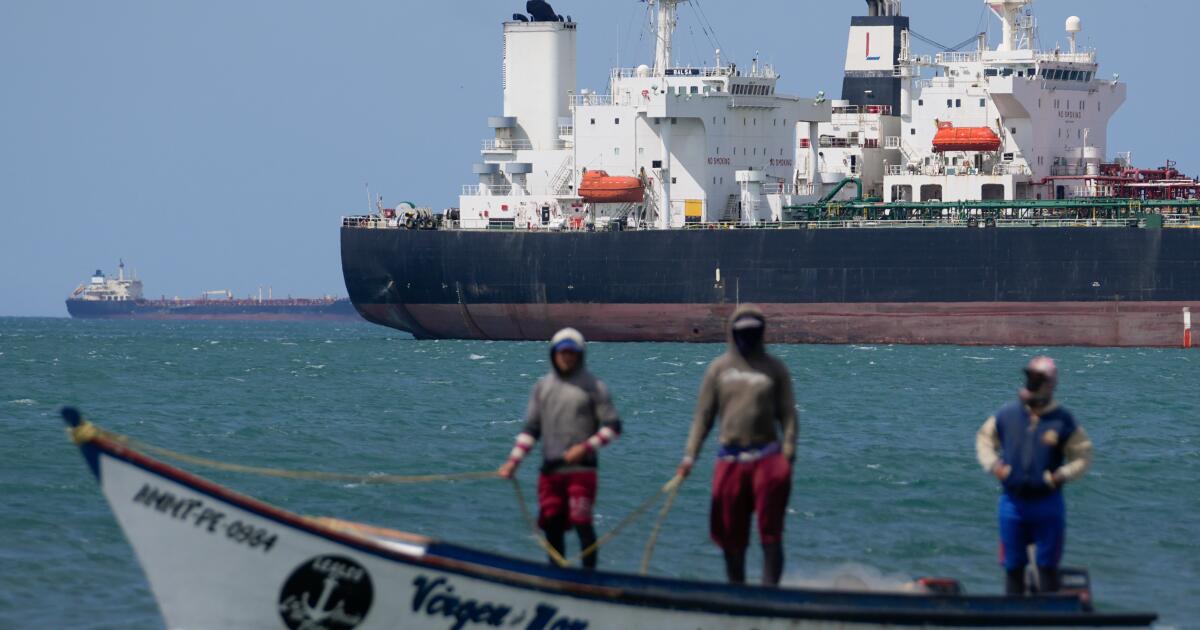
The moves highlight the increased pressure that the Republican administration is under to ease soaring oil prices as the United States, along with Israel, wages a war with Iran without a foreseeable end date. Global oil prices have since spiked as Iran halted traffic through the narrow Strait of Hormuz, where one-fifth of the world’s oil typically passes through from the Persian Gulf to customers worldwide.
The Treasury’s license is designed to incentivize new investment in Venezuela’s energy sector and is intended to benefit both the U.S and Venezuela, while increasing the global oil supply, a Treasury official told the Associated Press. The official was not authorized to discuss the matter publicly and spoke on condition of anonymity.
Since the ouster and arrest of Nicolás Maduro as Venezuela’s president during a U.S. military operation in January, Trump has said the U.S. would effectively “run” Venezuela and sell its oil.
The U.S. license provides targeted relief from sanctions, but does not lift the penalties altogether. The license allows companies that existed before Jan. 29, 2025, to buy Venezuelan oil and engage in transactions that would normally be banned under American sanctions, reopening trade for a major oil producer to global markets.
There are some limits.
Payments cannot go directly to sanctioned Venezuelan entities such as PDVSA, but must be sent instead to a special U.S.-controlled account. In other words, the U.S. will allow the oil trade but will control the cash flow.
Additionally, deals involving Russia, Iran, North Korea, Cuba and some Chinese entities will not be allowed. Transactions involving Venezuelan debt or bonds will not be allowed.
The license is expected to give a massive boost to Venezuela’s oil-dependent economy and help encourage companies that have been apprehensive to invest. The decision is part of the Trump administration’s phased-in plan to turn around Venezuela. But critics of the acting Venezuelan government argue that the move rewards Venezuela’s leadership — all loyal to Maduro and the ruling party — while repression, corruption and human rights abuses continue.
Many public sector workers survive on roughly $160 per month, while the average private sector employee earned about $237 last year, when the annual inflation rate soared to 475%, according to Venezuela’s central bank, and sent the cost of food beyond what many can afford.
Venezuela sits atop the world’s largest oil reserves and used them to power what was once Latin America’s strongest economy. But corruption, mismanagement and U.S. economic sanctions saw production steadily decline from the 3.5 million barrels per day pumped in 1999, when Maduro’s mentor, Hugo Chávez, took power, to less than 400,000 barrels per day in 2020.
A year earlier, the Treasury Department under the first Trump administration locked Venezuela out of world oil markets when it sanctioned PDVSA as part of a policy punishing Maduro’s government for corrupt, anti-democratic and criminal activities. That forced the government to sell its remaining oil output at a discount — about 40% below market prices — to buyers such as China and in other Asian markets. Venezuela even started accepting payments in Russian rubles, bartered goods or cryptocurrency.
The new license does not allow payments in gold or cryptocurrency, including the petro, which was a crypto token issued by the Venezuelan government in 2018.
Meantime, White House press secretary Karoline Leavitt said the Jones Act waiver would help “mitigate the short-term disruptions to the oil market” during the Iran war and would “allow vital resources like oil, natural gas, fertilizer, and coal to flow freely to U.S. ports.”
Hussein and Cano write for the Associated Press. Cano reported from Caracas, Venezuela. AP writer Seung Min Kim contributed to this report.
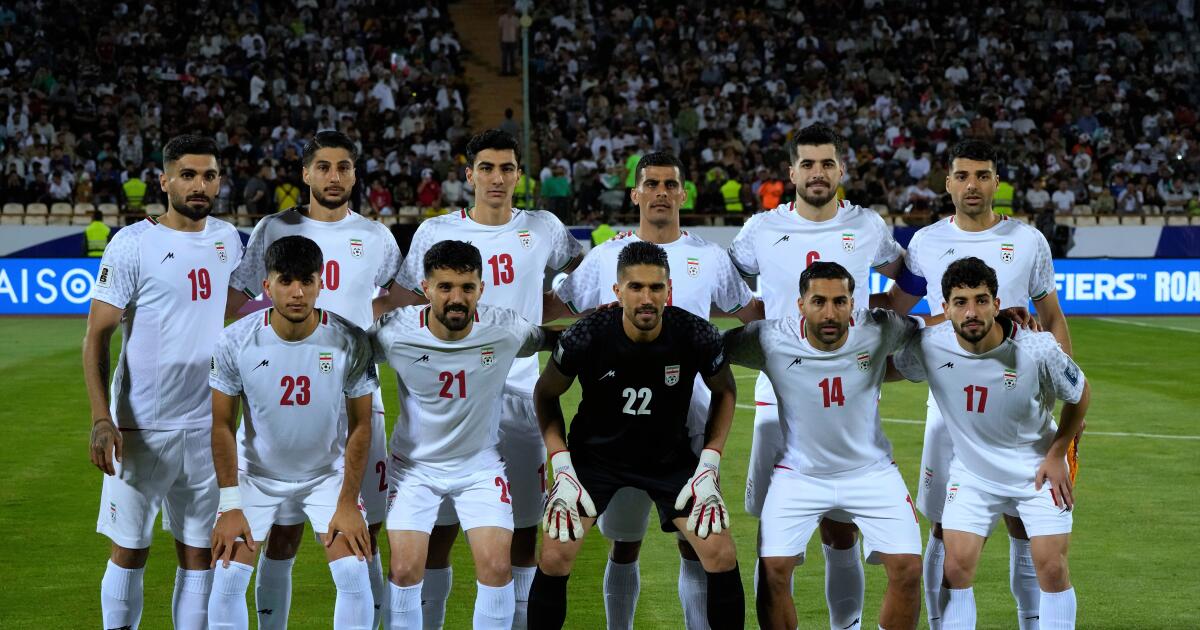
GENEVA — The public wrangling between Iran, FIFA and U.S. President Donald Trump over the narrative of playing in the World Cup shifted on Tuesday to Mexico where President Claudia Sheinbaum seemed open to a suggestion by Islamic Republic diplomats that Iran’s games in June be moved to her country.
The Iranian ambassador and embassy in Mexico City said the country was negotiating with FIFA to move Iran’s three group-stage matches from the United States to Mexico after Trump last week discouraged the team from attending the 48-nation tournament, citing safety concerns.
It was already unclear whether such talks were even happening before FIFA said such unprecedented changes in World Cup history were not planned to a match schedule agreed three months ago.
Sheinbaum was asked about it Tuesday during her daily briefing.
“They are discussing with FIFA whether it’s feasible because they were going to hold the [games] in the United States,” she said. “They are looking into whether they can hold [them] in Mexico, and we will inform you when the time comes. Mexico has relations with all countries in the world. We’ll see what FIFA decides and then we’ll announce it.”
In a statement, FIFA said it is “in regular contact with all participating member associations, including [the Islamic Republic of] Iran, to discuss planning for the FIFA World Cup 2026. FIFA is looking forward to all participating teams competing as per the match schedule announced on Dec. 6, 2025.”
The Feb. 28 start of U.S. and Israeli bombing of Iran that killed the Islamic Republic’s Supreme Leader Ayatollah Ali Khamenei and senior officials immediately cast doubt on the national soccer team going to play at least three World Cup games in the U.S., which is co-hosting the most watched global sports event with Mexico and Canada.
Iran’s soccer federation has not canceled its World Cup entry with FIFA, though official comments have variously suggested the U.S. is unable or unwilling to ensure the delegation’s secure arrival and accommodation.
Since last week, Trump has variously said “I don’t really care” if the Iran team comes, that it was welcome and would be treated like all players as stars, and that the players’ safety was at risk.
In comments posted late Monday on the embassy website, Iran’s Ambassador to Mexico Abolfazl Pasandideh urged FIFA to move the team’s games to Mexico, saying the U.S. was not cooperative on visas.
“We love the Mexican people very much and for us, the best situation is for our games to be held in Mexico,” he was quoted as saying by state-run news agency IRNA.
An Iranian government spokesman and the team itself have said in recent days it is up to FIFA and the U.S. to keep the team safe during the World Cup. The Iran team’s planned training camp is in Tucson.
Pasandideh’s embassy in Mexico City also posted a statement attributed to national soccer federation president Mehdi Taj saying Iran wants to move its group-stage matches out of the U.S.
“When Trump has explicitly stated that he cannot ensure the security of the Iranian national team, we will certainly not travel to America,” the statement said. “We are currently negotiating with FIFA to hold Iran’s matches in the World Cup in Mexico.”
Iran is scheduled to play New Zealand on June 15 and Belgium on June 21 at SoFi Stadium before finishing group play in Seattle against Egypt on June 26.
Moving the games would be remarkable less than three months before the World Cup and risks being judged a failure in the history of tournament hosting.
It also is not envisaged by Iran’s first opponent.
New Zealand soccer federation chief executive Andrew Pragnell said Monday: “I also don’t foresee it as remotely feasible” to move scheduled games to another country. Tens of thousands of tickets have been sold for Iran games, including to visiting fans who have booked flights to the U.S.
“By trying to move the match schedule, you actually create more problems down the track,” Pragnell told New Zealand media outlet Stuff, adding “I don’t think it’ll happen.”
The Belgian soccer federation declined to comment Tuesday.
Trump said last week that the Iran team was welcome at the World Cup despite the ongoing war in the Middle East but “I really don’t believe it is appropriate that they be there, for their own life and safety.”
Iran’s mixed signals include Sports Minister Ahmad Donyamali telling state TV last week that it was not possible to play “due to the wicked acts they have done against Iran.”
But after Trump’s post the national team said on Instagram that “no one can exclude” it from the tournament and a government spokesman in Tehran stressed it was the responsibility of FIFA and the U.S. as a co-host nation to keep players safe and secure.
“FIFA is the organizer of the World Cup,” Iran Foreign Ministry spokesman Esmail Baghaei said. “When warnings are issued at the highest level about the environment being unsafe for Iranian football players, this indicates that the host country apparently lacks the capacity and ability to provide security for such an important sporting event.”
Soccer is followed passionately in Iran, a nation of more than 90 million people which has qualified for seven men’s World Cups and each of the past four editions. The team is ranked No. 20 in the world by FIFA and behind only Japan from Asia.
FIFA has not commented in recent days beyond an Instagram post by president Gianni Infantino last week that he’d received assurances from Trump that Iran was welcome at the tournament.
Dunbar and Pye write for the Associated Press. Amir-Hussein Rajdy in Cairo and Fabiola Sanchez in Mexico City contributed to this report.
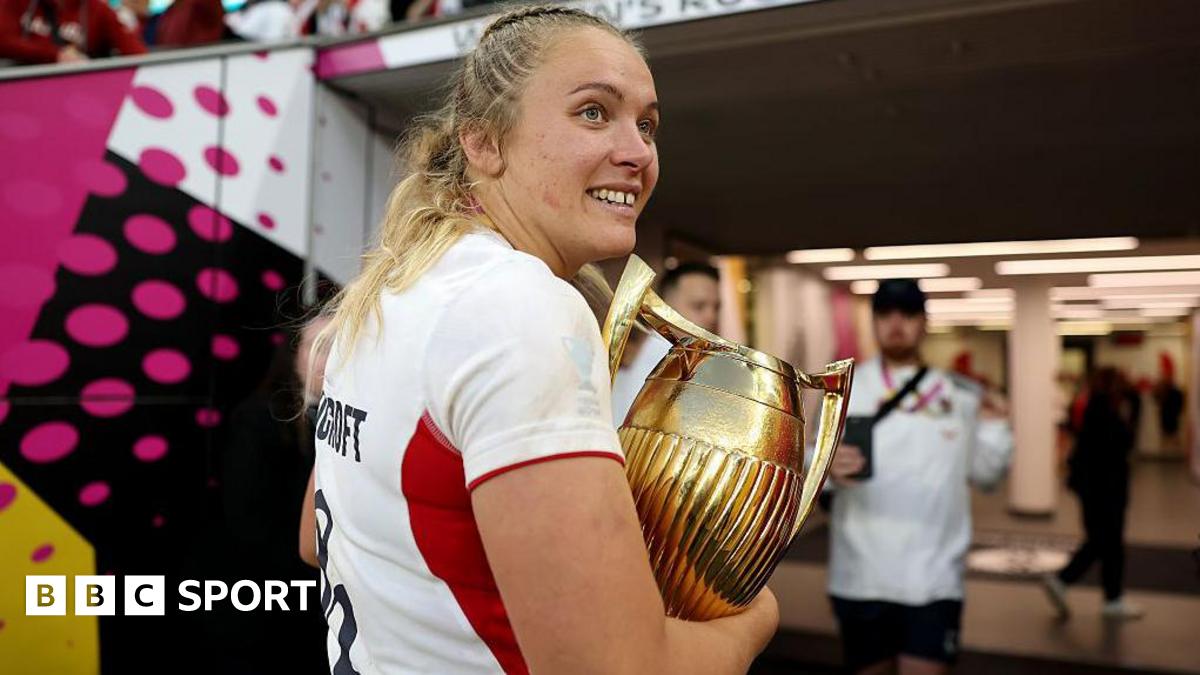
England’s World Cup-winning captain Zoe Stratford has announced she is pregnant with her first child.
Announcing the news on Instagram the 29-year-old said the baby is due in September.
“We are so incredibly grateful and excited,” added Stratford.
The news comes seven months after she led the Red Roses to a World Cup triumph on home soil.
Stratford’s news will rule her out of the Women’s Six Nations, where England will open their campaign against Ireland at Allianz Stadium, Twickenham on Saturday, 11 April.
England are yet to confirm who will lead the side in the 2026 campaign, but Marlie Packer and Meg Jones were vice-captains during the World Cup, with Alex Matthews taking the skipper’s armband for their pool match against Australia.
Red Roses head coach John Mitchell will name his Six Nations squad on Friday.
Stratford was named World Player of the Year in 2021 and has also co-captained her club Gloucester-Hartpury to three back-to-back Premiership Women’s Rugby titles.
SANTIAGO, Chile, March 18 (UPI) — The United States is continuing efforts to secure supplies of critical minerals deemed vital to national security. Alongside copper, lithium and silver, one lesser-known metal is drawing increased attention: rhenium.
Used primarily in the aerospace, energy and petrochemical industries, rhenium plays a key role in high-performance applications. Experts say it also holds potential in the global energy transition because it can act as a catalyst in producing green hydrogen.
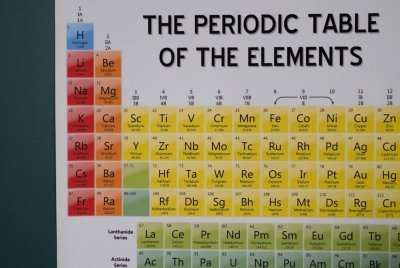
Chile is the world’s largest rhenium producer, accounting for about 50% of global output. The metal is atomic No. 75 on the Periodic Table of Elements.
Since Friday, Chilean officials have held consultations on critical minerals and rare earth elements with the administration of President Donald Trump, seeking a bilateral agreement to strengthen supply chains and promote strategic investment.
“Chile controls nearly half of a mineral that the United States and China cannot produce in sufficient quantities. Washington reinstated rhenium to its critical minerals list in 2025 and explicitly included it in the bilateral mining agreement with Chile. That makes it a genuine geopolitical asset, not just a mining one,” mining market specialist Víctor Pérez, an engineering professor at Adolfo Ibáñez University, told UPI.
Manuel Reyes, a mining engineering professor at Andrés Bello University, said the United States considers rhenium a national security priority because of its critical role and a lack of substitutes in aerospace and defense.
“Although rhenium does not carry the financial weight of copper or lithium, it functions as a reputational asset that keeps Chile on global strategic radars. More as a necessary logistics partner than as a decision-making power,” he said.
Pérez said Chile’s rhenium exports are expected to range between $100 million and $200 million this year, compared with an estimated $60 billion in copper exports. Still, he said its strategic importance is unique “because it has no real substitute in aerospace and defense applications.”
Chile holds the world’s largest reserves at 1,300 metric tons, followed by the United States with 400 metric tons, Russia with 310 metric tons and Kazakhstan with 190 metric tons, according to Reyes.
Rhenium trades at about $2,000 per kilogram, though prices have climbed in 2026 to roughly $6,000 per kilogram, he said.
About 70% to 80% of global rhenium is used in superalloys for aviation and defense turbines. “It is the metal that allows aircraft engines and military turbines to withstand extreme temperatures without deforming,” Pérez said.
Rhenium is known as a by-product mineral because it is not found alone, but rather extracted from copper-related ores, which makes production complex. Chile’s large-scale copper mining operations enable its recovery, as processing captures gases released during molybdenum concentrate roasting and chemically extracts the metal.
Reyes said Chile remains highly dependent on external demand.
“Reserve management and supply continuity depend on the technical and national security requirements of powers such as the United States, which ultimately drive demand,” he said.
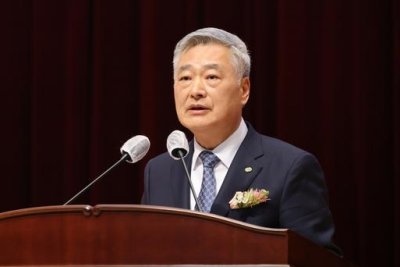
Korea Hydro & Nuclear Power CEO Kim Hoe-chun speaks during his inauguration ceremony
at the state-run company’s head office in Gyeongju on Wednesday. Photo courtesy of Korea Hydro & Nuclear Power
March 18 (UPI) — Korea Hydro & Nuclear Power said Wednesday that new CEO Kim Hoe-chun has officially taken office to lead the state-run company over the next three years.
The chief executive said that he would establish a dual-track strategy of focusing on large-scale nuclear reactors and small modular reactors, or SMRs, at the same time to gain a stronger foothold in the global market.
SMRs refer to next-generation nuclear power plants, which are smaller but considered safer than traditional massive reactors. Korea Hydro & Nuclear Power, or KHNP, has worked on its own models, known as “innovative SMRs.”
“We will successfully carry out already secured overseas projects while pursuing tailored bidding strategies to enter new markets,” Kim said during an inauguration ceremony at the firm’s head office in Gyeongju, around 180 miles southeast of Seoul.
“We will develop the KHNP-style integrated management model as an export product and take a leading position in the international nuclear power market through innovative SMR technologies,” he said.
In June 2025, KHNP signed a contract to build two nuclear reactors in the Dukovany region of the Czech Republic. The agreement is estimated to be worth about $18 billion.
The company also has been competing with global players to win nuclear contracts in other countries.
Before taking the helm at KHNP, Kim spent decades at Korea Electric Power Corp., where he held a series of key positions after joining it in 1985. Between 2021 and 2024, he served as CEO of Korea South-East Power, an affiliate of KEPCO.
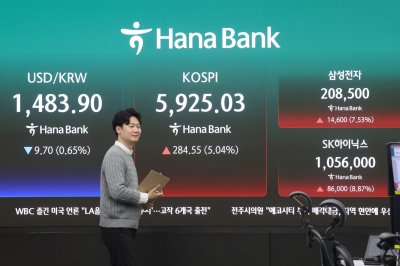
This photo, taken Wednesday, shows the trading room of Hana Bank in central Seoul as South Korean stocks surged more than 5 percent on a semiconductor rally. Photo by Yonhap
South Korean stocks surged more than 5 percent Wednesday, on a semiconductor rally boosted by the ongoing U.S. chip giant Nvidia’s global artificial intelligence (AI) conference. The Korean won strengthened against the U.S. dollar.
The benchmark Korea Composite Stock Price Index (KOSPI) closed up 284.55 points, or 5.04 percent, to 5,925.03.
The index came under strong buying pressure from foreigners and institutional investors, triggering the Korea Exchange (KRX), the country’s main bourse operator, to issue a buy-side sidecar near the closing bell.
Program trading for the KOSPI was suspended for five minutes at 2:34 p.m., according to the KRX.
Offshore and institutional investors snapped up a combined net 4 trillion won (US$2.7 billion) worth of equities. Retail investors, on the other hand, offloaded 3.9 trillion won.
Trade volume was heavy at 1.1 billion shares worth 26.1 trillion won, with winners far outnumbering losers 614 to 278.
Investors’ appetite for semiconductors increased, following remarks from Nvidia’s Chief Executive Officer (CEO) Jensen Huang on Samsung Electronics, Lee Kyoung-min, an analyst at Daishin Securities, said.
During the ongoing four-day event in California, Huang said on Monday he wants to “thank Samsung, who manufactures the Groq LP30 chip” for the company, adding that the chips are in production and would be shipped in the second half of this year.
“The stock market’s sensitivity to geopolitical issues in the Middle East is markedly declining,” Lee added.
Most large cap shares ended bullish.
Top-cap Samsung Electronics jumped 7.53 percent to 208,500 won, while its chipmaking rival SK hynix climbed 8.87 percent to 1,056,000 won.
Nuclear power plant builder Doosan Enerbility rose 2.78 percent to 107,300 won, on anticipations alternative energy sources would benefit from the recent spike in oil prices.
Brent crude, the international oil benchmark, has remained at the US$100 per barrel level for the past five sessions.
In contrast, defense shares lost ground as investors went to lock in profits. Hanwha Aerospace inched down 0.43 percent to 1,390,000 won, and LIG Nex1 retreated 2.27 percent to 689,000 won.
The Korean won was quoted at 1,483.1 won against the U.S. dollar as of 3:30 p.m., up 10.5 won from the previous session.
Bond prices, which move inversely to yields, closed higher. The yield on three-year Treasurys fell 6.3 basis points to 3.261 percent, and the return on the benchmark five-year government bonds retreated 6.7 basis points to 3.511 percent.
Copyright (c) Yonhap News Agency prohibits its content from being redistributed or reprinted without consent, and forbids the content from being learned and used by artificial intelligence systems.
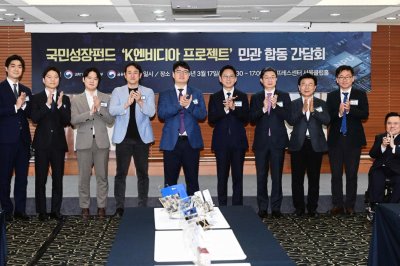
1 of 2 | Deputy Prime Minister Bae Kyung-hoon, sixth from left, and Financial Services Commission Chairman Lee Eun-won pose for a group photo at a public-private meeting on the “K-NVIDIA Project” at the Seoul Press Center on Tuesday. Photo by Asia Today
March 17 (Asia Today) — South Korea’s government has launched a major initiative to foster domestic artificial intelligence semiconductor companies, committing tens of billions of dollars as part of a broader national investment plan.
The Ministry of Science and ICT and the Financial Services Commission held a public-private meeting in Seoul on Tuesday to introduce the so-called “K-NVIDIA Project,” a strategy aimed at building globally competitive AI chipmakers.
Under the plan, the government will allocate 30 trillion won (about $22.5 billion) to artificial intelligence and about 21 trillion won (about $15.8 billion) to semiconductors from a 150 trillion won ($112.5 billion) National Growth Fund to be created over five years.
Officials said the initiative is designed to nurture homegrown AI chip firms capable of competing with global industry leaders, strengthening South Korea’s position in next-generation technologies.
Participants at the meeting included Deputy Prime Minister and Science and ICT Minister Bae Kyung-hoon, Financial Services Commission Chairman Lee Eun-won and Korea Development Bank Chairman Park Sang-jin, along with executives from local AI semiconductor firms.
Industry representatives from companies such as FuriosaAI, DeepX, Mobilint, HyperExcel and Rebellion also attended the session.
The meeting brought together government officials and private-sector leaders to discuss investment strategies, technological development and policy support for the emerging AI semiconductor ecosystem.
The stars appear to be aligning for both club and country.
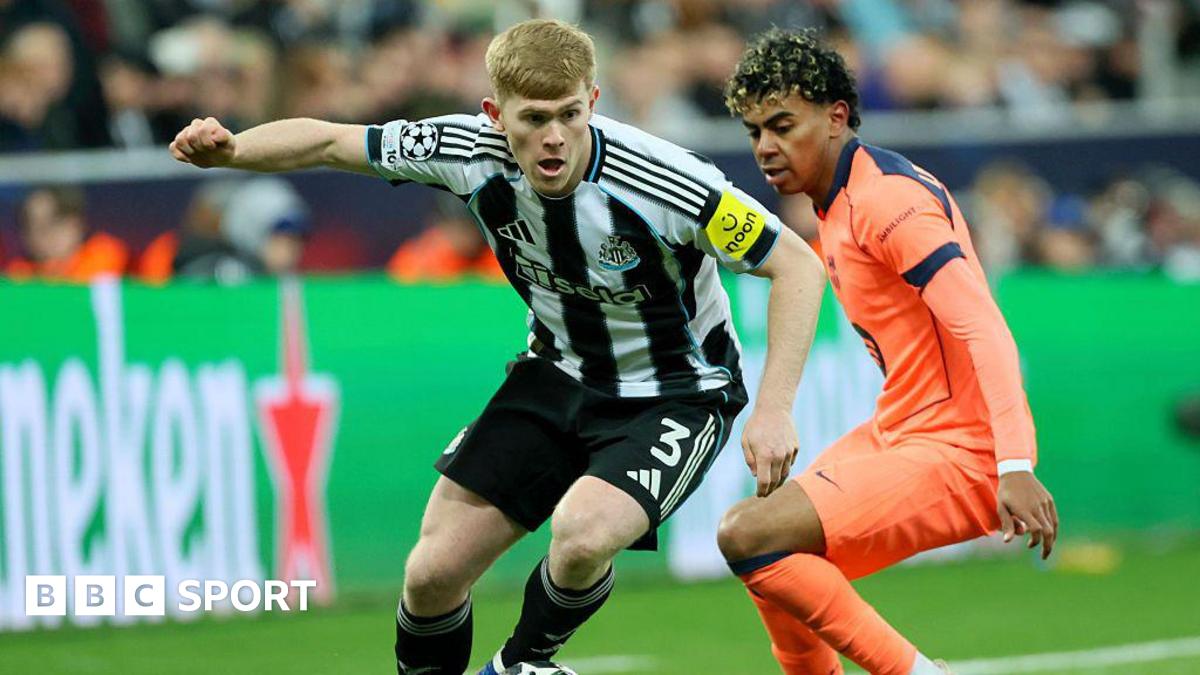
The World Cup is a “motivating factor” for Hall, and there remain question marks surrounding just who will line up in his position for England this summer.
Hall, who has won two caps for his country, has yet to earn a call-up under Thomas Tuchel following an injury-disrupted period in his fledgling career.
But that will surely change when the England manager announces his squad for the friendlies against Uruguay and Japan on Thursday.
Tuchel certainly knows him well.
The England boss handed Hall his debut at Chelsea at the age of just 17 in 2022, and has watched the left-back play against his former club and Manchester City this month.
Hall was a highly-rated talent at Chelsea, but he has come a long way since Tuchel first trialled him in a back three against Chesterfield.
Arno Michels, Tuchel’s long-serving assistant at Chelsea, Bayern Munich and Paris St-Germain, knows that better than most.
“It’s incredible to see how Lewis has developed – and he’s still only 21,” he said.
Yet Hall will not be getting carried away.
Hall, by his nature, is a level-headed character, who does not tend to look beyond the next game, and has been kept grounded by a tight-knit family.
He has never lost touch with his roots.
The defender still has a small circle of close friends from his native Binfield, where it all started in Slough, and has returned to the village in each of the past three summers to hand out trophies and medals at the annual junior football tournament he once played in.
Hall has even been back to represent his local cricket club as relatively recently as 2024.
The left-back has not forgotten those who have helped him along the way, either, such as Mark Robinson, his former manager with Chelsea‘s under-23s.
Hall even jumped into the stands to catch up with Robinson after Newcastle‘s 1-0 win at Stamford Bridge at the weekend.
“There’s lots more to come because Lewis is a very humble lad,” Robinson said.
“I can’t see that ever changing. You have got to keep learning, keep improving, and he will do that.”