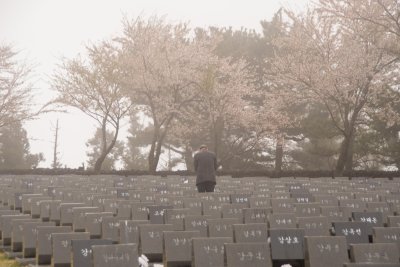
A man pays his respects during the 76th anniversary of the Jeju 4.3 memorial ceremony at the Jeju 4.3 Peace Park in Jeju City, South Korea, on April 3, 2024. File Photo by Darryl Coote/UPI
JEJU ISLAND, South Korea, Aug. 12 (UPI) — The Korea Heritage Service announced Wednesday that Jeju Island’s Darangshi Cave was under final consideration for registration as a national cultural heritage site, highlighting its importance in exposing the government’s role in an early Cold War-era massacre and catalyzing a decades-long truth and reconciliation movement.
The cave was discovered on Dec. 22, 1991, in Jeju’s northeastern Sehwa village by researchers investigating the Jeju Massacre, the slaughter of some 30,000 islanders from 1947-54 mainly by government forces in an effort to snuff out a communist uprising. Inside were the remains of 11 people, including three women and a 9-year-old boy, local villagers who were hiding from the government’s scorched-earth operations of 1948.
The Korea Heritage Service described the site in a statement as being of “considerable academic value as a vivid historical location of the Jeju 4.3 Incident because it served as a catalyst for the movement to uncover the truth about the incident, became widely known to the general public through media coverage, and preserves much of the original form of the refuge.”
In the fall and winter of 1948-49, government forces under the government of newly inaugurated President Syngman Rhee conducted a scorched-earth campaign through Jeju’s mid-mountain region. Under an October order, all but a 5-kilometer band of the island’s coast was prohibited and anyone found within that quarantine zone would be considered a rebel and shot on sight.
On Dec. 18, 1948, residents of Hado and Jongdal villages were living inside Darangshi Cave when it was discovered by punitive forces. Fires were lit at the cave’s mouth and all inside asphyxiated.
Thousands of islanders fleeing government repression took to hiding in the mountains and were killed during the four-month scorched-earth operation. Hundreds of villages in the zone were razed, many never to be restored. For decades after, public discussion of the state’s responsibility was suppressed while families of victims and survivors were forced to live stigmatized as communists and communist sympathizers.
After the cave was publicized, the government sealed its entrance and forced the families of the victims to cremate the bodies of their loved ones who were found inside, and to scatter their ashes at sea.
The discovery of the cave is considered a watershed moment in literally unearthing the truth of the Jeju Massacre and galvanizing a truth movement that would culminate in President Roh Moo-hyun offering Jeju an official state apology on Oct. 31, 2003.
Ko Chang-hoon, a retired professor at Jeju National University, was the head of the Jeju 4.3 Research Institute at the time when it discovered the cave. He told UPI that he and his team publicized the cave’s discovery on April 2, 1992, so reports would be published in newspapers the following day, the 44th anniversary of the start of the massacre.
The discovery of Darangshi Cave was “the cornerstone” of the movement, he said.
Compared to other massacres and incidents of state violence, the Jeju Massacre had little evidence up until that point that the majority of the deaths were committed by the government, he said.
“It is a first as a whole document,” he said.
According to a statement from the Jeju Special Self-Governing Province, artifacts illustrating the circumstances at the time and what life in hiding from government forces was like remain in the cave, while the area around it has been transformed in recent years into a site of education and remembrance.
The province last year applied to the Korea Heritage Service to register the cave as a National Registered Cultural Heritage propertty after it obtained approval from the provincial Cultural Heritage Committee.
“Darangshi Cave is a historic site that bears the pain of residents seeking refuge and being killed en masse during Jeju 4.3,” Kim In-young, director general of Jeju Province’s Special Self-Governing Administration Bureau, said in a statement.
“We will actively cooperate with the Korea Heritage Service so that, following the Suak Garrison Post, it can become the second Jeju 4.3 site to be formally registered as National Registered Cultural Heritage.”
The Suak Garrison Post used in operations against communist guerrillas was designated in 2018.
The Korea Heritage Service will seek to register Darangshi Cave as national cultural heritage after a 30-day notice period to collect public opinions on the registration.
For Ko, who was among those who helped find the cave and make it nationally known, this recognition is “very, very important,” he said.
Russian President Vladimir Putin (R), joins Pacific Fleet Commander-in-Chief Admiral Viktor Liina (L), on the bridge of the Guards missile cruiser Varyag on Wednesday during naval exercises off the coast of Sakhalin region. Photo by Gavril Grigorov/Kremlin Pool/EPA
Aug. 13 (UPI) — Japan issued a stern rebuke to Moscow on Thursday after Russian President Vladimir Putin visited a disputed chain of islands off Hokkaido that were occupied by Russia at the end of World War II.
Foreign Minister Toshimitsu Motegi in a post on X strongly condemned Putin’s visit to Etorofu Island — Iturup to the Russians — the third of the four southernmost Kiril Islands about 80 miles northeast of the Japanese mainland, saying it was part of Japan.
“We have received reports today that Russian President Putin has visited Etorofu Island. The Northern Four Islands, including Etorofu Island, are an inherent part of Japan’s territory — both historically and under international law — and Japan strongly protests this visit,” said Motegi.
Russia’s state-run TASS news agency said Putin visited Iturup as part of a trip to Russia’s Sakhalin region.
On the island, he met with Sakhalin region Governor Valery Limarenko, toured a fish-packing factory, visited a secondary school and spoke with residents.
Prior to visiting Iturup, Putin attended the final stage of drills of Russia’s Pacific Fleet off Yuzhno-Sakhalinsk.
TASS said it was his first visit to the islands which Russia calls the Kurils, and claims as part of its far eastern Sakhalin province, and Japan calls its Northern Territories.
The last senior Russian government official to visit the area was in 2021 when Prime Minister Mikhail Mishustin visited Iturup.
The dispute is over the four islands at the southern end of the volcanic archipelago with Russia claiming them under the post-World War II world map that came out of the 1945 Yalta Agreement, months before the war ended, first in Europe, and then in the Pacific.
Japan’s position is that Yalta only contained a non-binding recommendation that the islands should go to Russia, that it was not a party to the agreement and that Russia’s invasion of the Kirils in 1945 was in breach of a neutrality pact signed by the two countries in 1941.
The long-running dispute means that as far as Russia and Japan are concerned, World War II hostilities technically never ended as they never formally signed a peace treaty.
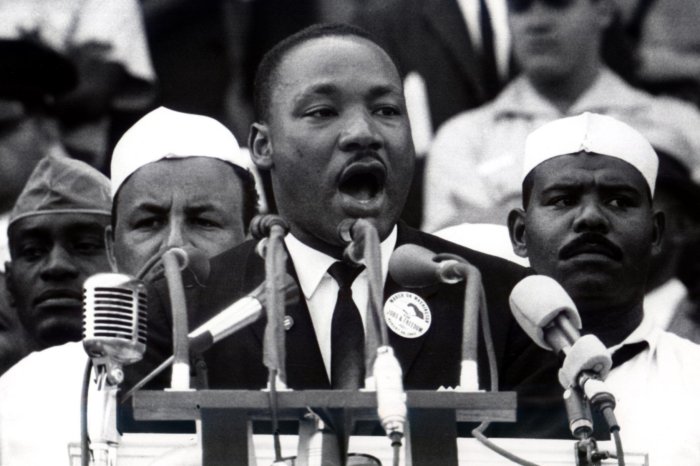
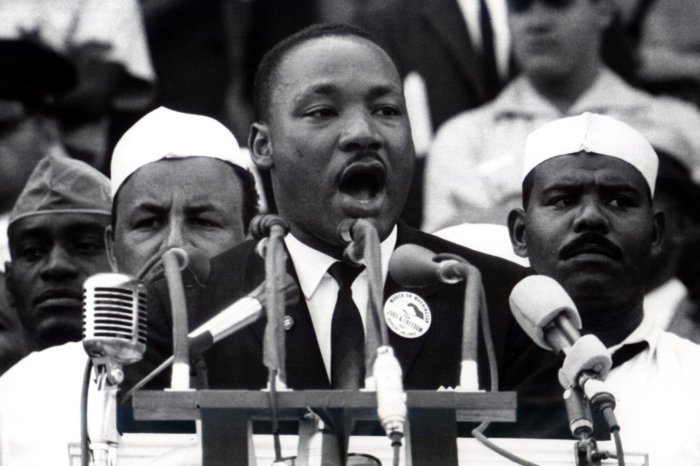
Martin Luther King Jr. delivers his famed “I Have a Dream” speech from the steps of the Lincoln Memorial in Washington on August 28, 1963. The speech galvanized the nation’s civil rights movements and led to the passage of the 1964 Civil Rights Act, the 1965 Voting Rights Act and the 1968 Fair Housing Act. File photo by UPI | License Photo
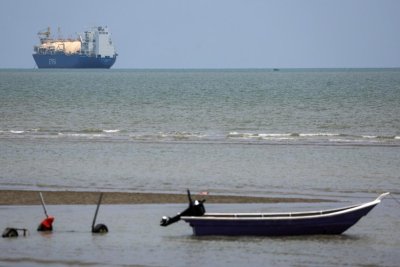
The United States is considering closing its consulate in Medan, Indonesia, which is near the highly strategic Strait of Malacca. File Photo by Fazry Ismail/EPA
Aug. 13 (UPI) — The Trump administration’s decision to close the U.S. Consulate in Medan, Indonesia, may save relatively little money. But it risks weakening American influence in one of the Indo-Pacific’s most strategically important regions at a time when Washington says competition with China is its foremost foreign policy priority.
The Medan consulate is small compared with the U.S. Embassy in Jakarta or major diplomatic posts elsewhere in Asia. Yet, its strategic value has long exceeded its size.
Situated on the island of Sumatra, the consulate serves roughly 60 million Indonesians across 10 provinces, supports U.S. commercial interests, advances educational and environmental partnerships and provides Washington with a permanent presence near the Strait of Malacca — one of the world’s busiest maritime corridors.
The proposed closure comes as the United States seeks to deepen its Comprehensive Strategic Partnership with Indonesia, Southeast Asia’s largest economy, the world’s largest Muslim-majority democracy and an increasingly influential G20 member.
Those ambitions sit uneasily alongside a shrinking American diplomatic footprint in one of Indonesia’s most important regions.
For years, U.S. officials have argued that competition with China extends beyond military deployments and naval exercises. It also depends on trade, investment, educational exchanges, environmental cooperation and people-to-people ties.
Those objectives require diplomats on the ground, particularly outside national capitals where many of today’s political and commercial relationships are forged.
“The administration should reconsider closing a strategically located consulate near the Strait of Malacca,” Patrick Cronin, chair for Asia-Pacific Security at the Hudson Institute, told UPI. “Recent tensions around the Strait of Hormuz remind us how indispensable the Strait of Malacca remains to global commerce.”
Sumatra is one of Indonesia’s economic engines, producing energy, palm oil, coffee, rubber and other commodities, while anchoring important shipping and trade routes across the Malacca Strait and the Indian Ocean.
The island accounts for a large share of Indonesia’s palm oil production, while its provinces are also major exporters of rubber, coal, agricultural products and manufactured goods.
North Sumatra recorded more than $3.5 billion in exports in 2025, while South Sumatra recorded $6.3 billion. American companies operating in energy, agribusiness, manufacturing and logistics therefore have commercial interests that extend well beyond Jakarta, including relationships with provincial governments, suppliers, ports, industrial estates and local business communities.
A diplomatic presence in Medan provides U.S. officials with a base for supporting those relationships, monitoring commercial conditions and helping American companies navigate regulatory and administrative issues in a region central to Indonesia’s trade and resource economy.
“It will reinforce the perception that the United States is shrinking its footprint in Southeast Asia,” Murray Hiebert, head of research at BowerGroupAsia, told UPI. “Closing Medan also removes the only permanent U.S. diplomatic presence near the Strait of Malacca.”
Unlike many countries where political authority is concentrated in one capital, Indonesia’s decentralized system gives provincial governments considerable influence over investment, environmental management and economic development. Relationships built through a regional consulate cannot easily be replicated through periodic visits from embassy officials based in Jakarta.
Indonesia also occupies a distinctive place in Washington’s Indo-Pacific strategy. It is neither a treaty ally nor a strategic adversary, but an independent regional power that has consistently pursued its long-standing “free and active” foreign policy. Jakarta has resisted choosing sides between Washington and Beijing, preferring to cultivate strong ties with both.
Ted Osius, former U.S. Ambassador to Vietnam, who also served as president and CEO of the U.S.-ASEAN Business Council, said Washington has spent years strengthening its partnership with Indonesia as both countries seek closer trade and defense cooperation.
“The annual cost of operating the U.S. Consulate in Medan, staffed by just two American diplomats serving an island of more than 60 million people, is roughly equivalent to one minute of Pentagon spending during the conflict with Iran,” Osius told UPI. “The modest savings from closing the post would come at a disproportionate strategic cost.”
China has long recognized that influence is built through sustained local engagement as much as national diplomacy. Over the past decade, Beijing has expanded its presence across Indonesia through infrastructure projects, mining investments, industrial cooperation and Belt and Road financing.
Chinese companies dominate Indonesia’s rapidly growing nickel-processing industry, while the Jakarta-Bandung high-speed railway has become Beijing’s flagship infrastructure project in Southeast Asia.
Chinese engagement extends well beyond Jakarta. Provincial governments across the archipelago work directly with Chinese companies, universities and local officials, allowing Beijing to deepen relationships through consistent local engagement rather than high-profile diplomatic initiatives alone.
Against that backdrop, reducing the American presence outside the capital risks reinforcing perceptions that Washington’s commitment is narrowing rather than expanding.
The implications extend beyond geopolitics. Sumatra contains some of the world’s richest tropical forests, including the Leuser Ecosystem, one of the few places where orangutans, elephants, rhinos and tigers still co-exist in the wild. These forests also rank among the world’s most important carbon sinks, making them central to global biodiversity and climate efforts.
“We should not be closing the U.S. Consulate in Medan,” Robert Blake, a former U.S. ambassador and now senior managing director at McLarty Associates, told UPI. “Despite its relatively small operating cost, the consulate punches well above its weight.
“It enables U.S. diplomats to engage with Sumatra’s 60 million people, promotes American business in a region rich in energy, palm oil and coffee, and supports Indonesia’s efforts to protect Sumatra’s unique biodiversity — a globally significant natural heritage and one of the world’s most important carbon sinks.”
That work has included support for conservation partnerships, scientific cooperation, educational exchanges and civil society initiatives. As climate change increasingly intersects with national security and economic policy, environmental diplomacy has become another arena in which countries build long-term influence.
The Medan consulate has served as a regional presence in North Sumatra, providing U.S. diplomats with direct access to local officials, business leaders, universities, civil society organizations and other institutions outside Indonesia’s capital.
Its location also gives Washington a base for monitoring developments across a strategically important part of the country, including trade, investment, maritime activity and regional ties.
Closing or consolidating that presence would shift more of those functions to the U.S. Embassy in Jakarta and other regional posts, potentially changing how frequently American officials engage with counterparts in Sumatra.
Supporters of consolidation argue that modern communications and periodic travel can substitute for permanent regional offices, particularly during a period of fiscal restraint. But diplomacy remains fundamentally relational. Trust develops through sustained interaction, familiarity with local institutions and networks that cannot be built through occasional visits.
Whether the closure ultimately proceeds is less important than what it signals. Throughout the Indo-Pacific, Washington contends that strategic competition with China will be won not only through military strength, but also through sustained economic, diplomatic and societal engagement. That strategy depends on people, institutions and local relationships built over decades — not only on high-level summits or defense agreements.
The annual savings from closing a small consulate in Medan are likely to be modest. The strategic cost may be harder to measure.
James Borton is a non-resident senior fellow at Johns Hopkins SAIS Foreign Policy Institute and the author of Harvesting the Waves: How Blue Parks Shape Policy, Politics, and Peacebuilding in the South China Sea. Borton is the editor-in-chief of the South China Sea NewsWire. The views and opinions expressed in this commentary are solely those of the author.
Solar prominences flare from the sun as the moon crosses in front during a total solar eclipse, as seen in Chardon, Ohio, on April 8, 2024. Millions of people live in the path of Wednesday’s total solar eclipse, viewable mostly from Europe. File Photo by Pat Benic/UPI | License Photo
Aug. 12 (UPI) — Some 15.2 million people across the world — mostly Europe — live in the path of totality of Wednesday’s solar eclipse.
It marked the first total solar eclipse viewable from Europe since 1999, Space.com reported.
A solar eclipse happens when the moon passes between Earth and the sun, casting a shadow on Earth as it blocks the sun’s rays. In some areas, the phenomenon will be what’s known as a total solar eclipse, in which all but the very outer edges of the sun will be blocked by the moon.
About 12% of the world’s population, or 980 million people, live in areas where they were be able to view the solar eclipse. A much smaller portion, about. 0.2% or 15.2 million people, live in the path of totality.
The vast majority of the world was able to view the eclipse, though, so NASA set up a live stream of the view from multiple cameras in the path of the event.
The eclipse, which got underway around 11:30 a.m. EDT, was expected to be viewable across a chunk of the Northern Hemisphere, including most of western Europe, the very northern reaches of Russia, northwestern Africa, all of Greenland, Iceland and Canada, and the northeastern United States. The path of totality is expected to stretch in an arc from northern Russia, across the North Pole, down the east coast of Greenland and through Iceland, before passing across northern Spain and ending in the Mediterranean Sea.
The sun’s corona and solar flares appear during totality of the eclipse on April 8, 2024, in Indianapolis. Photo by Edwin Locke/UPI | License Photo
Then-Rep. Peter Hoekstra, R-Mich., speaks at a press conference in Washington, D.C., in 2009. Hoekstra, now the U.S. Ambassador to Canada, is the subject of a Canadian petition to have him removed from the country. File Photo by Roger L. Wollenberg/UPI | License Photo
Aug. 12 (UPI) — Thousands of Canadians have signed a petition demanding the government kick the U.S. ambassador to Canada out of the country.
The petition, which had almost 60,000 signatures as of Wednesday morning, will be presented to the House of Commons this fall by Green Party leader Elizabeth May. It says that Ambassador Pete Hoekstra should be declared persona non grata and the Canadian government should request his removal from the country.
The petition accuses Hoekstra of repeatedly making public statements that undermine Canada-U.S. diplomatic relations, including characterizing the 2025 Canadian federal election as “anti-American;” normalizing the Trump administration’s threats to annex Canada as the “51st state;” and accusing Canada of interfering in U.S. domestic politics while making repeated interventions in Canadian political discourse. The petition also said Hoekstra was linked to a Michigan-based voter identification app used by the Alberta separatist Centurion Project, while claiming no knowledge of its use, and that The Alberta Prosperity Project [a separatist organization] met with U.S. State Department officials three times between April 2025 and January 2026, with Hoekstra claiming to have no knowledge of those meetings.
The petition was created by a woman from Calgary.
A representative for the U.S. Embassy in Ottawa declined to comment on the petition except to say the embassy is aware of it, the CBC reported.
In June, Hoekstra said that Canada’s annexation by the United States would be a great topic of discussion for Prime Minister Mark Carney and U.S. President Donald Trump.
Hoekstra was a member of the House of Representatives representing western Michigan from 1993 to 2011. He was the ambassador to The Netherlands, his country of birth, during Trump’s first term. He was named ambassador to Canada in April 2025.
In 2023, the Canadian government declared Chinese diplomat Zhao Wei persona non grata after he was accused of gathering information in Hong Kong about the family of Conservative Member of Parliament Michael Chong.
The following year, six diplomats and consular officials from India were expelled after the Royal Canadian Mounted Police alleged that the agents were targeting Canadian citizens. They linked the tracking to the murder of Sikh activist Hardeep Singh Nijar in Surrey, British Columbia, in 2023.
The police linked the campaign to the June 2023 murder of Sikh activist Hardeep Singh Nijjar in Surrey, B.C.
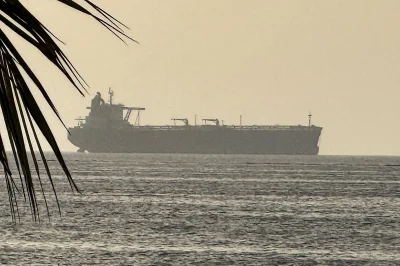
The International Energy Agency warned Wednesday of sharp drop in oil stocks amid renewed disruption to exports from Gulf producers with the Iran war seeing “lower volumes” transiting the seas to markets around the world. File photo by Olivier Matthys/EPA
Aug. 12 (UPI) — The International Energy Agency warned Wednesday of a sharp drop in global stocks oil amid renewed disruption to exports via the Hormuz Strait and Caspian Sea resulting in “lower volumes of oil” transiting the seas to markets around the world.
In its August Oil Market Report, the agency said measurable global oil inventories — strategic reserves, on tankers at sea — plunged by 69 million barrels in July to just under 7.9 million barrels, down from 410 million barrels per day at the start of the war at the end of February.
Onshore stocks declined by just 6 million barrels per day as the pace of IEA releases of its emergency stocks eased, even as China continued to draw down on its crude oil reserves.
“Although the market is projected to return to surplus towards the end of this year, risks remain substantial and the urgency of reopening the Strait has increased, as previously available inventory buffers are rapidly depleting,” the IEA said.
The IEA data comes two days after the U.S. Department of Energy said the country’s Strategic Petroleum Reserve had fallen to less than 300 million barrels in the previous week, its lowest level in 43 years — but still well above the 70 million barrel minimum for it to run as intended.
President Donald Trump ordered 172 million barrels to be released in March after exports from Gulf producers including Saudi Arabia Kuwait, Bahrain, and the UAE were severely curtailed by Iran closing the Strait of Hormuz.
Use of other routes to move oil and the drawing down of inventories, including China’s massive 1.4 billion barrel reserve which has seen a sharp drop in its oil imports, have so far helped ward off the damaging global oil shortage it was feared the closure of the Hormuz Strait would trigger.
The IEA also warned that the destruction of global demand for oil was escalating, driven by the continuing closure of the Strait of Hormuz and high fuel prices suppressing consumption, forecasting a 1.6 million barrels per day drop in demand in 2026, up from its previous estimate of 1 million barrels per day.
However, it said said the pace of market contraction would slow, down from a 4.9 million barrels per day decline in the second quarter to 2.8 million barrels per day drop in the third quarter, and return to growth in the final quarter, with expansion of global demand of 2.4 million barrels per day expected in 2027.
On the supply side, the IEA said overall production for 2026 would fall more sharply than demand, but would bounce back to outpace demand in 2027.
Production rose by 2.4 million barrels per day to 101.5 barrels per day in July, but remained well short of the 6.3 million barrels per day supply growth pace seen in July 2025, with 8.3 million barrels per day of Persian Gulf output “still shut in.”
“Renewed hostilities and maritime disruptions in July and early August undermined the recovery efforts, reducing projected third quarter 2026 oil supply by 1.7 million barrels per day compared with last month’s report.
“Global oil supply is now projected to decline by 4.3 million barrels per day on average in 2026 and rebound by 8.3 million barrels per day next year to 110.3 million barrels per day,” the IEA said.
Martin Luther King Jr. delivers his famed “I Have a Dream” speech from the steps of the Lincoln Memorial in Washington on August 28, 1963. The speech galvanized the nation’s civil rights movements and led to the passage of the 1964 Civil Rights Act, the 1965 Voting Rights Act and the 1968 Fair Housing Act. File photo by UPI | License Photo
Aug. 12 (UPI) — A retired Royal Air Force fighter pilot who is the only person to have traveled faster than the speed of sound on land, set a world land speed record for a hydrogen-powered car of more than 400 mph in Utah.
Powered by two 800 horsepower hydrogen internal combustion engines, Briton Andy Green‘s bullet-shaped Hydromax Streamliner, averaged across two runs, reached a speed of 406.32 mph on Tuesday at the Bonneville Salt Flats, smashing the previous record set in 2004 by more than 220 mph.
World motorsport’s governing body, the Fédération Internationale de l’Automobile, the governing body of world motorsport, verified the attempt as the highest speed ever achieved by a hydrogen-powered vehicle.
The engines were from an earth-moving machine made by the British heavy plant manufacturer JCB, delivering massive power to the drivetrain by mixing pressurized hydrogen gas with air which is then ignited, similar to combustion engines, but with no emissions.
Green also set a world land speed record of 350 mph for diesel power in another JCB-developed car in 2006.
“Setting a world land speed record with hydrogen power, 20 years after Dieselmax, is a huge privilege. This record is a huge achievement by a world class team and superb technology,” Green said.
JCB chairman Lord Anthony Bamford said going after the record was in part a proof of concept exercise to show that hydrogen was a viable solution to the demand from heavy industries for a clean energy that could rival traditional fuels in efficiency.
He also believes hyrdogen is more effective for construction and agricultural machinery and plant than electric battery power.
In October 1997, Green pushed his twin jet-engine powered Thrust SSC to 763.035 mph, smashing through the sound barrier as it streaked across the Black Rock Desert in northwestern Nevada.
Oil prices climbed and world stocks were mixed on Wednesday, with Asian shares mostly higher even as Wall Street slipped further from last week’s record highs, as investors awaited a crucial US inflation reading and watched for any breakthrough in the stalled Iran war talks.
ADVERTISEMENT
ADVERTISEMENT
The price of a barrel of Brent crude, the international benchmark, was up 0.9% at $89.67 early on Wednesday. US benchmark crude picked up 0.9% to $83.98.
Gold edged up 0.8% to $4,400.44 an ounce, while silver gained 1% to $65.30 an ounce.
Iran has rejected a comment by US President Donald Trump suggesting that, since Tehran is seeking compensation as part of any talks to end the war, Washington would demand the same.
The United States and Israel attacked Iran in late February, a strike that led to the closure of the Strait of Hormuz and kept much of the world’s oil pent up in the Middle East. Last month alone, Brent’s price swung between $72 and $102 a barrel.
Meanwhile, an attack by Iran-backed Houthi rebels on a vessel in the Bab el-Mandeb strait, off Yemen’s southern tip, has raised concerns that the violence could reignite civil war and further threaten regional shipping routes.
Higher oil prices worsen inflation, and they have pushed the average cost of a gallon of regular petrol in the US to $4.01, according to AAA — up from less than $3.14 a year ago.
That has Wall Street’s attention fixed on Wednesday, when the US government releases its latest monthly inflation reading. Economists expect it to show inflation slipped to 3.4% in July from 3.5% in June.
On Tuesday, the S&P 500 fell 0.3% for a second modest drop since setting its all-time high on Friday. The Dow Jones Industrial Average dipped 184 points, or 0.3%, and the Nasdaq Composite sank 0.6%.
Cooler inflation could ease pressure on the Federal Reserve to raise interest rates to tamp down price increases.
Higher rates could curb inflation, but they would also drag on the wider US economy by making it more expensive for households and businesses to borrow, while undercutting prices for stocks and other investments.
Treasury yields have jumped since the war with Iran began, driven by higher oil prices and inflation worries, sending long-term US mortgage rates to their highest levels in a year.
Tokyo’s Nikkei 225 gained 0.6% to 67,334.94.
In South Korea, the Kospi jumped more than 4% to 6,597.90 on renewed buying of computer chipmakers. Samsung Electronics gained 7.7% and memory chipmaker SK Hynix rose 7.1%.
Taiwan’s Taiex advanced 0.8%.
The Shanghai Composite index added 0.3% to 3,946.51, while Hong Kong’s Hang Seng slipped 1.2% to 25,352.13.
In Australia, the S&P/ASX 200 lost 0.6% to 9,197.00.
In other early Wednesday dealings, the dollar rose to 159.41 yen from 159.30 yen. The euro slipped to $1.1535 from $1.1544.
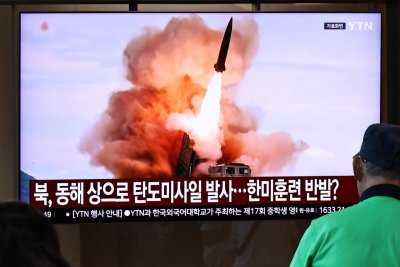
North Korea launched a ballistic missile toward the East Sea Wednesday, Seoul’s Joint Chiefs of Staff said. In this photo, people watch a news report on the launch at Seoul Station. Photo by Yonhap
SEOUL, Aug. 11 (UPI) — North Korea fired a ballistic missile toward the East Sea on Wednesday, the militaries of Seoul and Tokyo said, its second such launch in less than a week as the United States and South Korea gear up to kick off their major summertime joint military drill.
The missile was fired from the Wonsan area on North Korea’s east coast at around 6 a.m., South Korea’s Joint Chiefs of Staff said in a text message to reporters.
“The detected North Korean missile flew over 700 kilometers (435 miles), and South Korea and the U.S. are currently conducting a detailed analysis regarding its exact specifications,” the JCS said.
The military did not specify the type of missile involved, although the distance the projectile traveled falls within the range of short-range ballistic missiles.
South Korean and U.S. intelligence authorities tracked and shared information on the launch from its initial stage, while Seoul also exchanged information related to the ballistic missile with Japan, the military added.
“Under a robust South Korea-U.S. combined defense posture, the military is closely monitoring North Korea’s various movements and maintaining the capability and readiness to overwhelmingly respond to any provocation,” the JCS said.
Japan’s Defense Ministry also detected the launch, saying the missile flew about 429 miles, reached a maximum altitude of roughly 56 miles and fell outside Japan’s exclusive economic zone.
Defense Minister Shinjiro Koizumi condemned the launch at a press briefing, saying the North’s weapons tests “threaten the peace and security of our country, the region, and the international community.”
Koizumi said the launch violated relevant U.N. Security Council resolutions and noted that Japan had lodged a strong protest with North Korea through diplomatic channels at its embassy in Beijing.
Hawaii-based U.S. Indo-Pacific Command said it detected the launch and was consulting with regional allies and partners.
“Based on current assessments, this event does not pose an immediate threat to U.S. personnel or territory, or to our allies,” the command said in a statement.
The launch came days before the United States and South Korea are set to begin their annual summertime joint military drills. The 11-day Ulchi Freedom Shield exercise kicks off Monday and will focus on preparing for evolving threats from North Korea, military officials said earlier this week.
North Korea routinely denounces the allies’ joint exercises as rehearsals for an invasion and frequently responds with weapons tests. On Thursday, Pyongyang fired a short-range ballistic missile toward the East Sea.
The allies stressed that the joint exercise is defensive in nature.
“We’re up here today announcing Ulchi Freedom Shield to the entire world before it even starts,” U.S. Forces spokesman Col. Ryan Donald said at a press briefing Monday. “UFS is not a pretext, it’s not a provocation. It’s a transparent, longstanding defensive training event.”
Kim Ji-mi, an aide to special counsel Kwon Chang-young, attends a press conference at the counsel team’s office in Gwacheon, south of Seoul, South Korea, 04 May 2026. File. Photo by Yonhao/EPA
Aug. 11 (Asia Today) — A South Korean special counsel team indicted former Korea Policy Broadcasting Service chief Lee Eun-woo without detention Tuesday on a charge of promoting insurrection in connection with former President Yoon Suk Yeol’s December 2024 martial law declaration.
The second integrated special counsel team led by Kwon Chang-young said Lee was indicted under the Criminal Act on a charge of insurrection propaganda.
Lee is accused of repeatedly and intensively disseminating information between Dec. 3 and Dec. 13, 2024, asserting the legitimacy of the emergency martial law declaration and related proclamation.
Investigators also allege he selectively blocked or deleted information criticizing or opposing the martial law action.
The special counsel treated the broadcasting activity through Dec. 13, one day before the National Assembly approved Yoon’s impeachment, as a single alleged offense of promoting insurrection.
An official with the special counsel said investigators concluded that an insurrection ends when those responsible abandon their objective or become objectively unable to achieve it.
Under that interpretation, investigators determined that the alleged insurrection did not end simply when emergency martial law was formally lifted.
They instead concluded it continued until Dec. 14, when the National Assembly passed the impeachment motion against Yoon and suspended him from his presidential duties.
Lee is already on trial in a separate case involving allegations related to the deletion of broadcast captions concerning the martial law declaration.
A court in June sentenced him in that case to one year in prison, suspended for two years.
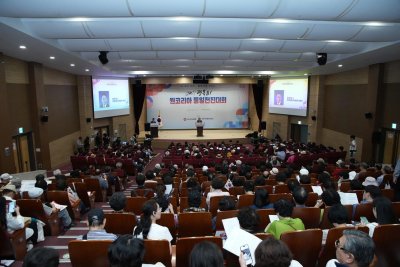
1 of 2 | About 500 civic, religious, political and academic leaders, North Korean defectors and members of separated families listen to remarks by Jang Man-soon, chairman of the Committee for Ten Million Separated Families, during the Liberation 81 One Korea Unification Rally at the National Assembly Members’ Office Building in Seoul on Aug. 11, 2026. Participants gathered in support of a “One Korea” vision.
Photo courtesy of Citizens’ Solidarity for One Korea
Aug. 11 (UPI) — About 500 South Korean civic, political and religious leaders, North Korean defectors, separated families and academics gathered at the National Assembly Members’ Office Building on Tuesday to reject the permanent division of the Korean Peninsula and call for a national movement for peaceful reunification.
The “Liberation 81 One Korea Unification Rally,” held four days before South Korea marks the 81st anniversary of liberation from Japanese colonial rule, was jointly hosted by Citizens’ Solidarity for One Korea and Rep. Song Seok-jun of the People Power Party, chairman of the National Assembly Foreign Affairs and Unification Committee.
Participants rallied under the slogan “Two Koreas No! One Korea Yes!” and framed the debate as a choice over whether South Korea should institutionalize the peninsula’s division or preserve reunification as a constitutional objective, a human rights issue and a long-term national vision.
The gathering comes as both Koreas are redefining their relationship.
North Korean leader Kim Jong Un declared in late 2023 that North and South Korea should no longer be regarded as partners pursuing reunification but as two hostile states. North Korea has since revised its constitution to remove references to reunification and define its territory as bordering the Republic of Korea to the south.
In South Korea, President Lee Jae Myung’s administration has pursued a policy of “peaceful coexistence” aimed at reducing tensions and restoring dialogue with Pyongyang.
The shift has been reflected in government policy and education materials.
In March, the National Institute for Peaceful Unification Education, which is affiliated with the Unification Ministry, published its 2026 textbooks incorporating what it described as a “peaceful two-state” framework.
The materials acknowledged the current reality of two separate systems while calling for inter-Korean relations to develop into a cooperative relationship aimed at eventual reunification. The definition of reunification was also revised from one emphasizing integration under a liberal democratic order and market economy to “the process of forming a new, unified community.”
The policy direction became clearer last week when Unification Minister Chung Dong-young presented President Lee with a blueprint for “peaceful coexistence” that includes what the ministry calls a “two-state relationship oriented toward unification,” while leaving the question of eventual reunification to future generations.
The plan also calls for referring to North Korea by its official name, the Democratic People’s Republic of Korea, and replacing terminology the ministry considers confrontational, including the “main enemy” label.
South Korea has traditionally treated inter-Korean relations as a special relationship rather than ordinary relations between two foreign states, a principle reflected in the 1991 Inter-Korean Basic Agreement.
Organizers of Tuesday’s rally said they support peace and dialogue but argued that institutionalizing the two Koreas as separate states, even under a framework intended to promote peaceful coexistence, could ultimately normalize permanent division.
In welcoming remarks, Song said the South Korean Constitution “clearly aims for peaceful unification based on the basic free and democratic order,” adding that with North Korea’s nuclear threats and a grave international environment, South Koreans “must not ignore or misjudge the reality of division.”
Jang Man-soon, co-chairman of Citizens’ Solidarity for One Korea and chairman of the Committee for Ten Million Separated Families, said recognizing North Korea as an entirely separate state could conflict with South Korea’s constitutional framework and affect the identity and rights of separated families, people displaced from North Korea and North Korean defectors.
South Korea’s Constitution defines the territory of the Republic of Korea in Article 3 as “the Korean Peninsula and its adjacent islands.” Article 4 requires the country to seek peaceful unification based on the basic free and democratic order.
Jang, a second-generation member of a separated family, also questioned whether Pyongyang’s two-state policy could be characterized as mutual respect while North Korea continues to threaten South Korea with nuclear weapons and missiles.
For separated families, he argued, the issue extends beyond diplomatic terminology. Permanently recognizing the peninsula as two foreign states could change how South Korea views people whose hometowns and relatives remain north of the border.
“True peace begins with restoring the freedom and human rights of North Korean residents,” Jang said, according to organizers.
Former lawmaker Thae Yong-ho, who defected after serving as a senior North Korean diplomat, said in a keynote speech that Pyongyang has removed concepts such as national reunification and one Korean people from its constitution and political framework, even as a “peaceful two-state” discourse has emerged in the South.
Thae warned that such an approach “could lead to the permanent division of the Korean Peninsula.”
Speakers also argued that reunification should be viewed as a human rights question involving North Korea’s roughly 25 million people, rather than solely as a territorial or political issue.
Korean American Kenneth Bae, president of New Korea Foundation International, who was detained in North Korea for 735 days, said reunification should mean more than combining two territories.
He said it should reconnect separated families and create conditions in which North Koreans can live with freedom, dignity and basic human rights.
Kang Chol-hwan, head of the North Korea Strategy Center, who spent 10 years in a North Korean political prison camp, called for expanding North Koreans’ access to outside information and making human rights a central part of reunification efforts.
The rally also sought to present an alternative national vision rather than simply oppose a two-state framework.
Seo In-taek, permanent co-chairman of Action for Korea United, proposed a civic movement centered on the “Korean Dream,” a vision of a unified Korea grounded in freedom, human rights, freedom of religion, peace and shared prosperity.
“People are moved not by slogans but by a clear vision they can share,” Seo said, according to organizers.
Seo said reunification should not belong to a single political party, ideology or administration and called for a nationwide civic movement to change perceptions that division is permanent and reunification impossible.
Citizens’ Solidarity for One Korea sent a questionnaire on the two-state debate to all 299 members of the National Assembly on Aug. 4, asking lawmakers about permanent two-state relations and South Korea’s constitutional commitment to peaceful reunification. Eight lawmakers responded, the rally’s moderator announced during the event.
Representatives of youth, Protestant and Buddhist communities, separated families, overseas Koreans and North Korean defectors then took the stage in turn to deliver “One Korea” resolutions pledging a unified Korea grounded in liberal democracy and human rights.
The rally concluded with young representatives born in the two Koreas reading a joint resolution calling for denuclearization, improvements in North Korean human rights and peaceful reunification under South Korea’s constitutional order, followed by a unification performance in which participants sang “Our Wish Is Unification” and chanted “Two Koreas No! One Korea Yes!”
Organizers said the campaign will continue with the 2026 Korean Dream Han River Festival, a public event focused on Korean reunification planned for Oct. 3 at Ttukseom Hangang Park in Seoul.
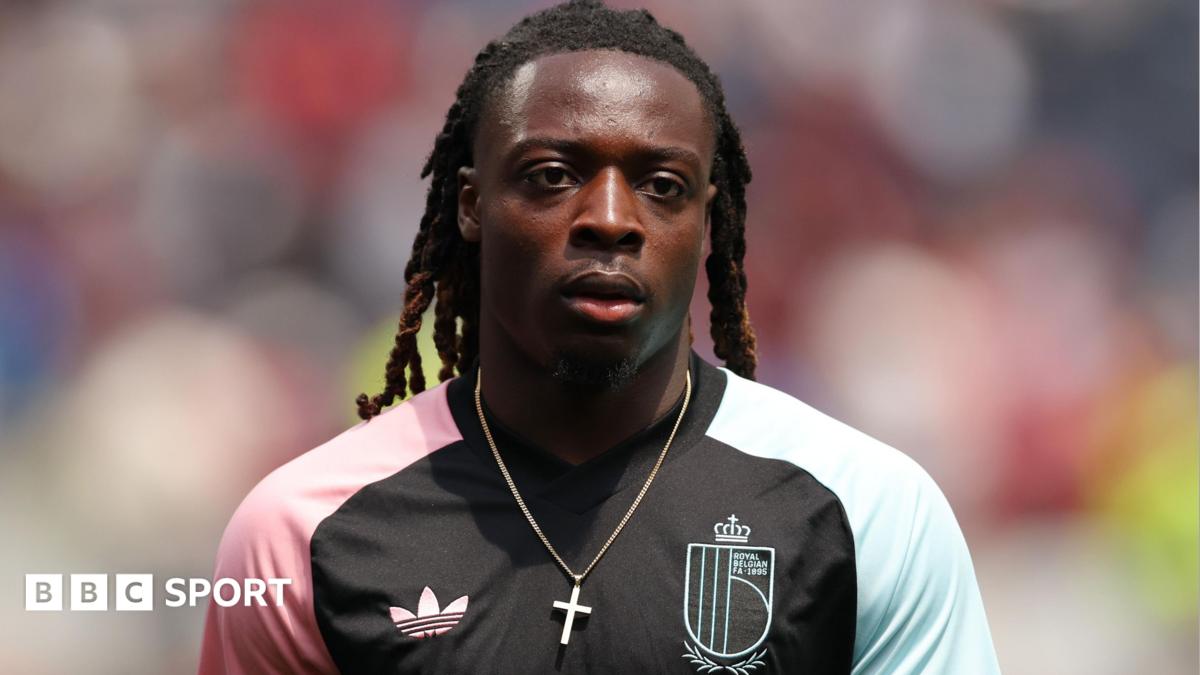
Jeremy Doku says he is “not against” the journalist who criticised his plan to leave the Belgium camp during the World Cup to attend the birth of his first child.
Doku’s wife Shireen was due to give birth during the second week of July and he told Reuters, external before the start of the tournament he intended to leave the camp to be at the birth even if his side were still in contention.
But it brought fierce criticism from L’Equipe channel presenter France Pierron, who labelled a father “completely useless” at the time of their child’s birth.
L’Equipe later apologised and said Pierron’s comments were “very far removed” from its values. The presenter also apologised but was taken off air until the end of the current season of her show.
Doku eventually missed Belgium’s 0-0 draw against Iran in the group stage to fly back to the UK for the birth of his son, Praise.
“There was a lot of noise of course,” the Manchester City winger said.
“I can understand why people felt like maybe this was orchestrated because it was too perfect.
“I also saw the journalist speak about me and the situation and all the people getting at her. But I just wanted to use this video as well to really… pray over her.
“I don’t want to come at her in a way that most people did. I don’t want people to be too harsh on her. We don’t know what she has experienced. It’s her opinion.
“She got fired and all these things. I never want this for a person. I’m not against her. I’m not angry at her or anything. She just said her opinion.”
Doku played 86 minutes of Belgium’s opening 1-1 draw with Egypt in Group G of the World Cup before missing their next game, with his absence explained as illness.
A Belgium statement later said, external that the 24-year-old travelled to London to be with his wife “with the approval of and accompanied by one of our team doctors”.
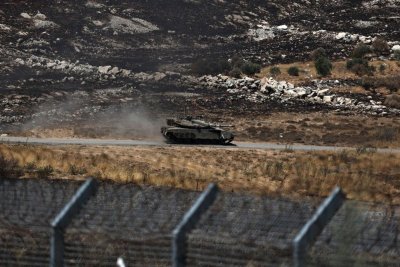
Israeli tanks cross the ceasefire line into the buffer zone near the Israeli-annexed Golan Heights village of Majdal Shams on July 23. Colombia became the second country in the world to recognize Israeli sovereignty over the Golan Heights Photo by Etaf Safadi/EPA
Aug. 11 (UPI) — Israel recorded two diplomatic advances in Latin America, as Colombia became the second country in the world to recognize Israeli sovereignty over the Golan Heights and Venezuela agreed to restore consular services with Israel for the first time since diplomatic relations were severed in 2009.
Colombia’s Foreign Ministry announced Monday its recognition of Israeli sovereignty over the Golan Heights, a strategic plateau along the border between Israel and Syria, saying the decision was in response to “persistent regional instability in the Middle East” and the territory’s strategic importance to Israel’s security.
“Colombia recognizes that Israel’s continued control and sovereignty over the Golan Heights constitutes an essential component of its national defense,” the Colombian Foreign Ministry said.
The decision makes Colombia the second country in the world, after the United States, to recognize Israeli sovereignty over the territory. The United States did so in 2019 during President Donald Trump‘s first term.
Israel captured most of the Golan Heights from Syria during the 1967 Six-Day War and extended its laws, jurisdiction and administration over the territory in 1981. The United Nations does not recognize that move and considers the Golan occupied Syrian territory.
U.N. Security Council Resolution 497 declared Israel’s decision “null and void and without international legal effect.”
Syria condemned Colombia’s recognition, saying it violates Syrian sovereignty and international resolutions concerning the territory. The Syrian Foreign Ministry said the Golan is an “integral and indivisible part” of Syria and called on Colombia to reconsider its decision.
The Arab League, Saudi Arabia and Egypt also rejected the move and reaffirmed Syria’s sovereignty over the territory.
Colombia’s decision comes amid a broader shift in relations with Israel under President Abelardo de la Espriella. His government also announced plans to relocate the Colombian Embassy from Tel Aviv to Jerusalem, reversing policies adopted under Gustavo Petro, who severed diplomatic relations with Israel in May 2024 in response to the war in Gaza.
Israeli Foreign Minister Gideon Saar described Colombia’s recognition of Israeli sovereignty over the Golan Heights as a “historic” decision, according to Israel’s Foreign Ministry.
Separately, Israel and Venezuela announced Tuesday that they had agreed to establish a coordination mechanism to provide consular services to their citizens, creating the first official link between the two countries since Caracas severed diplomatic relations with Israel 17 years ago.
The Governments of the State of Israel and the Bolivarian Republic of Venezuela announce that, following the visit of the Israeli humanitarian delegation to Venezuela in the wake of the double earthquake that occurred on June 24, and further to talks held between senior officials…— Israel Foreign Ministry (@IsraelMFA) August 11, 2026
The agreement, announced in a joint statement released by Israel’s Foreign Ministry, does not amount to the full restoration of diplomatic relations or include the reopening of embassies.
The two countries also agreed to continue bilateral technical cooperation that began after Israel sent humanitarian assistance to Venezuela following the magnitude-7.2 and 7.5 earthquakes that struck the country June 24.
An Israeli delegation composed of Foreign Ministry and Israel Defense Forces personnel traveled to Venezuela after the earthquakes and worked with Venezuelan authorities and emergency teams on disaster response, recovery and humanitarian assistance.
The rapprochement also comes amid efforts by Venezuela’s Jewish community to promote the normalization of relations.
Venezuela’s Foreign Ministry said Isaac Cohen, chief rabbi of the Venezuelan Israelite Association, delivered a letter to President Delcy Rodríguez asking her to consider restoring diplomatic relations with Israel.
Venezuelan Foreign Minister Félix Plasencia said the request was intended to “address the needs of the Jewish community in our country.”
After 17 years without diplomatic relations, Caracas may finally be reconsidering its position on Israel.
Venezuela’s Chief Rabbi Isaac Cohen delivered a letter to President Delcy Rodríguez calling for ties to be restored. Foreign Minister Félix Plasencia publicly… pic.twitter.com/J0kvQ8J2Yl— Gölge Veri (@golgeveri) August 11, 2026
In their joint statement, Israel and Venezuela highlighted the relationship between Israel and Venezuela’s Jewish community, describing it as an “important bridge of historic friendship” between the two countries.
Venezuela severed diplomatic relations with Israel in January 2009 under then-President Hugo Chávez amid the Israeli military offensive in Gaza.
Aug. 11 (UPI) — At least six people were killed Tuesday when Houthi militia attacked a cargo ship with missiles in the Red Sea, the Yemeni government said.
The Yemeni Transport Ministry said in a statement that the ship was carrying food and was hit while traveling through the Bab al-Mandab Strait. One Indonesian and three Pakistani crew members were killed in the attack after a fire broke out on board the Tihamah.
The Yemeni coast guard said later Tuesday that two members of the armed forces were also killed during a rescue mission when another Houthi missile was launched at the ship.
The Houthis have not commented on the attack, but the group has recently fired on Saudi Arabian vessels in the Red Sea as part of a blockade against its northern neighbor.
It’s unclear who owns the ship. The Transport Ministry described the Tihamah as a Yemeni commercial vessel, but Equasis, a shipping database, said it’s a small cargo ship owned by Egyptian company Thubab for Marine Services and flies the Tanzanian flag, The New York Times reported.
Yemen has been embroiled in a civil war since 2014, though a 2022 cease-fire had slowed conflict. In 2014, the Iran-backed Houthis took over the Yemeni capital Sanaa. A Saudi-led coalition intervened but failed to remove the Houthis. Now, the Houthis control the northern half of Yemen, including Sanaa.
The Red Sea has become increasingly important since the Strait of Hormuz has been blocked by Iran after the United States and Israel began a war on the country.
On Sunday, the Houthis attacked a Saudi state-owned oil refinery in Jazan, Saudi Arabia, as well as the Red Sea port of Mokha, which is controlled by the Yemeni government. The attack on Mokha killed at least seven people. It was the most recent in a spate of attacks by the rebels.
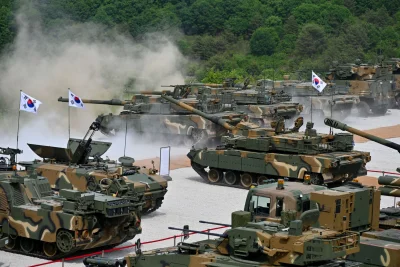
South Korea plans to upgrade a key Army battle tank and an anti-ship missile program for the Navy, the arms agency said Tuesday. In this May 2023 photo, a South Korean artillery battery fires during a live-fire drill in Pocheon. File Photo by Thomas Maresca/UPI | License Photo
South Korea plans to upgrade a key Army battle tank and an anti-ship missile program for the Navy in an effort to boost military capabilities against evolving enemy threats, the arms agency said Tuesday.
It will launch a 3.43 trillion-won (US$2.43 billion) project to upgrade the K2 main battle tank to be equipped with an active protection system (APS) to intercept anti-tank missiles and drones, a drone and improvised explosive device (IED) jammer and a remote-controlled weapons station (RCWS), the Defense Acquisition Program Administration (DAPA) said.
The APS system is dubbed a smart shield system that uses radar to automatically spot incoming enemy missiles or drones and attack them.
The drone and IED jammer blocks enemy radio signals and the RCWS enables the crew to safely aim and fire from inside the armored vehicle.
The K2 upgrade program will run from 2028 through 2046, with the new tanks expected to enter into service in 2033, DAPA said.
The agency will launch another upgrade project for the new Haeseong-II long-range anti-ship missile, aiming to double its strike range, backed by a more powerful turbofan engine.
With a budget of around 1.63 trillion won, the military aims to complete the development by 2033 and start mass production in 2034.
The upgraded Haeseong-II missiles are expected to be mounted on South Korea’s next-generation KDDX destroyer, a source familiar with the matter said. The government recently signed a formal contract with Hanwha to build its lead ship.
The upgrade plans were approved during DAPA’s key decision-making meeting on Tuesday.
Copyright (c) Yonhap News Agency prohibits its content from being redistributed or reprinted without consent, and forbids the content from being learned and used by artificial intelligence systems.
Rescuers work at the site of a Russian missile strike on a residential neighborhood of Zaporizhzhia early Tuesday after six people were killed and 19 injured in aerial attacks on the city overnight. Photo by Daryna NaumovaEPA
Aug. 11 (UPI) — At least nine people were killed and 25 injured in Russian strikes targeting Zaporizhzhia, Dnipropetrovsk and Kyiv with Ukrainian President Volodymyr Zelensky saying that Zaporizhzhia, where six people were killed and 19 injured, was hit with North Korean-made missiles.
In a post on X on Tuesday morning, Zelensky said emergency response efforts were still in progress dealing with the aftermath of a “vicious” attack on the city of Zaporizhzhia that involved North Korean ballistic missiles, Zircon hypersonic missiles and guided aerial bombs.
“It was a vicious attack, calculated to inflict maximum damage specifically on civilian infrastructure. Unfortunately, as of now, six people have been reported killed and nineteen wounded in the city. First responders are continuing to extinguish a fire at one of the impact sites,” wrote Zelensky.
He said a missile strike also damaged an infectious diseases hospital building and businesses in Kyiv and the Dnipropetrovsk, Mykolaiv and Donetsk regions also came under attack.
The other fatalities were all in Dnipropetrovsk, where five districts were attacked with artillery and drones, with Gov. Oleksandr Ghanza reporting in an online update that a middle-aged man was killed in the Synelnyky area, east of Dnipro, a teenage boy was killed In Kryvyi Rih and one person was killed in Pavlohrad.
The Russian Defense Ministry said it launched strikes against hubs for transport and logistics in Kyiv and Zaporizhzhia, as well as “defense industry” targets. Officials in Russia’s southwest said a man was killed and two were injured in a Ukrainian drone attack on the Voronezh Region with two warehouses belonging to e-commerce giant Wildberries set ablaze.
Zelensky said more than 120 drones were sent into Ukraine as frontline regions continued to experience what he described as “drone terror” on an almost daily basis, with power outages in Kherson and Kharkiv after strikes overnight.
“Every step Russia takes — increasing ballistic missile production, bringing in North Korean equipment, preparing for mobilization — all of this shows that Moscow is preparing not for peace, but for escalation. And the world needs to respond now, not wait. More sanctions pressure specifically on enterprises that fuel Russia’s war, more air defense assistance for Ukraine — all of this is needed to give peace a chance,” said Zelensky.
Tuesday’s strikes came hours after Zelensky warned in a televised address Monday that North Korea was gaining battlefield experience and boosting its military capabilities through its support for Russia, posing a growing threat to U.S. allies and other countries in the Asia-Pacific region.
Zelensky said North Korea had supplied the Russian military with additional ballistic missiles and was preparing to deploy tens of thousands of troops to Russia.
On Sunday, Zelensky called for increased co-operation between Seoul and Kyiv, particularly on air defense systems, warning that North Korea was preparing to send an additional 30,000 to 50,000 personnel to Russia on top of the 15,000 it already provided.
Martin Luther King Jr. delivers his famed “I Have a Dream” speech from the steps of the Lincoln Memorial in Washington on August 28, 1963. The speech galvanized the nation’s civil rights movements and led to the passage of the 1964 Civil Rights Act, the 1965 Voting Rights Act and the 1968 Fair Housing Act. File photo by UPI | License Photo
This geopark is full of bright colours – the best time to visit in in rainy seasonCredit: THONGCHAI.S / Shutterstock
Another colourful spot is Zhangye Danxia National Geopark in Gansu, China.
The mountainous site is full of bright colours from green to pink and orange that has formed over millions of years.
Around the geopark are dedicated paths and platforms so you can see the mountains in all their glory.
One of the best times to visit is during the wet season between May and September – the combination of rain and the sunrise or sunset make the colours more vivid.
Beehive Huts, Ireland
These beehive huts are dotted about on the Dingle PeninsulaCredit: Shutterstock / MNStudio
One secret wonder is much closer to the UK as it’s found on the south-west coast of Ireland.
Beehive Huts, or clochán, date back to the 8th century, thought to once be used to store grain or shelter against storms.
Lots are easy to visit with many on the Dingle Peninsula with views across the coastline.
Some of the most easily accessible are the Fahan Beehive Huts which cost around €3 (£2.56) to enter.
Campanile de Curon, Italy
When the lake freezes over visitors can even walk to the bell towerCredit: Shutterstock
Another is Campanile de Curon, a bell tower in the middle of a lake in Italy.
It’s actually on the site of a sunken village which was flooded when three lakes merged into one.
It submerged the village of Curon Venosta leaving only the bell tower to be seen.
In the winter when the lake freezes over, it’s possible to walk over to it.
The Chiricahua National Monument is an enormous site made up of towers of balanced rocks.
Across 12,000 acres, the protected area in Arizona is known as a ‘wonderland of rocks’.
The area is open to visitors who want to explore its creeks, volcanic formations, and grottoes.
Most head to see Big Balanced Rock which, as the name suggest, s is a large rock that is perched on a narrow pedestal in a way that doesn’t look possible.
Found deep in Alaska is a former gold rush village called Chicken – and it even has a huge chicken Mr. Eggee as the mascot.
The village got its name back in the 1900s when workers could not agree on the spelling of ptarmigan, a bird found in the local area.
Instead, they settled on chicken, and now the village even holds a Chickenstock music festival with live folk music and plenty do the chicken dance.
The village is accessible between April and September as in winter its connecting highway closes due to extreme weather like heavy snow.
Völklinger Hütte, Germany
These ironworks in Germany are the only ones of their kind left in the worldCredit: Shutterstock / Patrick Verhoef
Some of the man-made secret wonders include the Völklinger Ironworks, in Germany, which looks more like something from a steampunk film.
Found in the south-west of the country, these are the world’s only fully preserved ironworks from what was considered the “Golden Age” of the iron and steel industry.
It’s no longer in use and is actually a museum and gallery space with entry from €17 (£14.52).
There are regular exhibitions and tours of the ironworks too.
Quinta da Regaleira Wells, Portugal
These two winding staircases are across nine levelsCredit: Shutterstock / Engel Ching
Just a few hours away from the UK in Sintra, Portugal is Quinta da Regaleira Wells.
The well is made up of two staircases across nine levels, they are found beneath the UNESCO-protected Quinta da Regaleira.
Unlike traditional wells, these don’t hold any water but were rather used for secret Masonic ceremonies.
For anyone heading to Lisbon, it’s a 35-minute drive away – you need to buy a ticket and can either do a guided or self-guided tour of the site.
Moray, Peru
This secret wonder is found in the Sacred Valley region of PeruCredit: Vadim Petrakov / Shutterstock
Another man-made secret wonder is Moray in Peru which are deep carved circles with steps – essentially like an amphitheatre.
It’s in the Sacred Valley region around 11,500 feet above sea level.
It was built by the Inca Empire between the 15th and early 16th centuries believed to be used to experiment with agriculture at the time.
For those who want to visit, you have to buy a tourist ticket which covers 16 historical sites across Cusco and the Sacred Valley.
For the full 385 Secret Wonders of the World check out the book at shop.lonelyplanet.com.
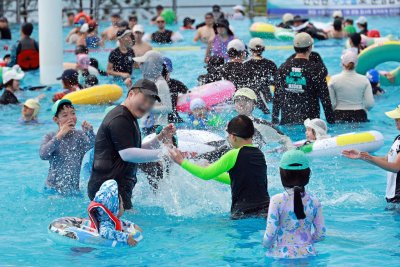
People cool off in a swimming pool at Ttukseom Hangang Park in Seoul on Saturday. The first 10 days of August were the hottest on record in South Korea. Photo by Yonhap
South Korea saw a record hot summer this year with the nationwide average temperature, excluding Jeju Island, coming to 29.1 C in the first 10 days of August, the highest on record, the state weather service said Tuesday.
The reading is on par with the 10-day average of August 2018, making it the hottest first 10-day period of August in 53 years since 1973, when the weather observation network was expanded nationwide, according to the Korea Meteorological Administration (KMA).
The average daily maximum temperature in the first 10 days of this month was 34.4 C, the second highest after 34.7 C recorded in 2018, the KMA said.
The average daily minimum temperature, which is an indicator of night heat, was 24.8 C for the same period, the third highest on record following 25 C in 2022 and 24.9 C in 2018.
The highest temperature recorded during the 10-day period was 42.5 C observed in the southeastern city of Yangsan at 1:26 p.m. on Aug. 2. It was also the highest temperature recorded in the country since 1904, when modern meteorological observations began, according to the KMA.
In total, the daily maximum temperature exceeded 40 C at 32 locations nationwide in the first 10 days of this month, the KMA noted.
Copyright (c) Yonhap News Agency prohibits its content from being redistributed or reprinted without consent, and forbids the content from being learned and used by artificial intelligence systems.
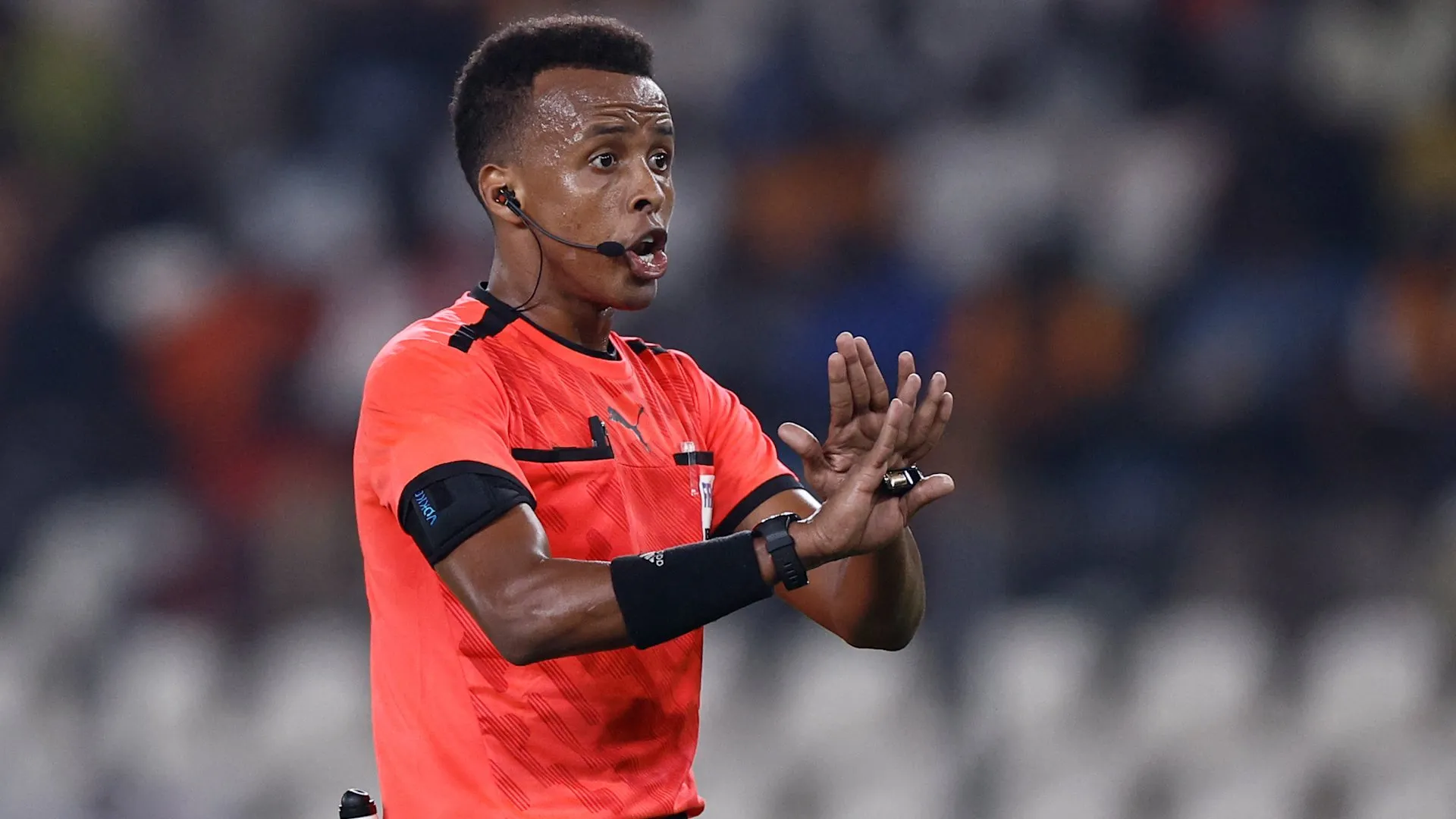
Somali referee Omar Artan will make history as the first non-European referee to officiate the UEFA Super Cup on Wednesday between PSG and Aston Villa. Artan was denied entry to the US to officiate games during the World Cup despite holding a valid visa.
It is a crucial time for Africa in terms of how it interacts with the rest of the world. Africa is no longer viewed as a place of humanitarian interest or of mere charity. Instead, Africa is increasingly seen as a prize, as a place that contains large populations and is a place where great and emerging powers struggle to win influence. With fifty-five states, more than one billion people, and the youngest population of any continent, Africa’s future will determine the politics of the world for decades to come. However, this potential strategic significance exists in an uneasy context of instability, dependency, and weak governance. The key question this paper seeks to address is whether Africa will remain a subject of outside influence and internal problems, or be able to turn its potential into real strategic power.
A Continent in Transition: Crisis, Change and Transformation
The transition of Africa is evident in its economic output. According to the IMF, it should come as no surprise that sub-Saharan Africa will grow at about 4.3% in 2026 and that the region will be one of the fastest growing in the world, even beating out developed nations facing the challenges of monetary tightening and shrinking populations. It is estimated that nations such as Ethiopia, Guinea, Uganda, Rwanda, and Benin will have growth rates of 7% or more because of mining, construction, industrial parks, and infrastructure spending. Africa’s aggregate nominal GDP will reach around 3.3 trillion dollars in 2026.
This data indicates true evolution; however, these very reports indicate that growth in Africa is uneven since economies relying on resources and importing oil experience worsening trade accounts and increasing cost of living. The contradiction within Africa’s transition process is that while there is economic momentum, there is also economic fragility, which means that growth indicators do not mean development per se.
Stay ahead of the geopolitical week.
MD Briefing delivers expert analysis across five global fronts — the Indo-Pacific, energy, geoeconomics, European security, and the Middle East — every Monday morning. Free.
Shifting Security Landscapes and the Crisis of Regional Stability
One does not have to look further than the Sahel region to see just how critical this problem of stability becomes. Military coups seized control in Burkina Faso, Mali, and Niger; in these regions, the Alliance of Sahel States was formed and left the Economic Community of West African States. According to the information available from Armed Conflict Location & Event Data Project, the level of violence in central Sahel increased dramatically from 2018 to 2024.
Humanitarian organizations working within the United Nations reported approximately nine thousand three hundred casualties in Mali, Burkina Faso, and Niger in 2025. While the withdrawal of French troops and UN peacekeepers was not completed by an improvement of local armies, the Russia-based Africa Corps, a successor to the Wagner Group, became the main security partner of junta regimes with varied success. Extremist organizations such as Jama’at Nusrat al Islam wal Muslimin and the Islamic State Sahel Province expanded their operations and started to use more often armed drones in their actions with a possibility of destabilization spreading to the countries of the Gulf of Guinea coast.
Economic Crossroads: Resources, Growth and Strategic Dependency
The development of the economy in Africa has a direct connection with the natural resources present in the continent, including the minerals used in the process of energy transition in the world such as copper, cobalt, manganese, and lithium. China has been the largest trading partner of Africa for the past sixteen years, and the expected value of the total trade between these two regions in 2025 is three hundred and forty-eight billion dollars, which is an increase by eighteen percent compared to the preceding year.
The main countries contributing to the largest share of trade include South Africa, Nigeria, Democratic Republic of Congo, Angola, and Egypt. China is involved in the continent’s economy not only in traditional sectors like natural resources but also in renewables, digitalization, and low carbon technology, as China plans to invest over fifty billion dollars in the continent by 2027 under the Beijing Action Plan. According to Boston University Global Development Policy Center, Africa’s exports to China are mostly raw material and the trade deficit with China is approximately equal to three percent of regional GDP.
Diplomatic Repositioning in an Emerging Multipolar World
The states of Africa are increasingly seeking to assert their independence in a multipolar world. With the admission of the AU to the G20 in 2023, the continent has secured a place among the major powers of the world permanently. Some of the African states have sought membership to BRICS, a power bloc which included Egypt and Ethiopia in addition to the founders and some other new members, making it another power bloc which its supporters argue is an alternative to the Western dominated groupings.
This diplomatic maneuver by the continent represents the larger strategy that the Africans follow in terms of strategic non alignment where they seek relations with all the major centers of power, including the US, China, Russia, Europe, and the Gulf countries. The Africans have used this diplomatic clout to their advantage in securing better deals on debt, trade, and security cooperation. But this diplomatic repositioning itself faces limitations because of the divide among the African states and lack of ability to capitalize on it.
Domestic Politics, Governance and the Crisis of Legitimacy
Underlying the security crossroads and the economic crossroads is a more fundamental crisis of political legitimacy. Since 2020, there have been coups across the Sahel and Central Africa as a manifestation of public discontent with corruption, poor service delivery, and the inability of the civilian government to ensure security. While military regimes in Mali, Burkina Faso, Niger, and Guinea partly justify their takeover of power by invoking issues of sovereignty and anti-colonial rhetoric – an argument that struck a chord with a lot of people while the indicators of good governance in those countries continued to decline rather than improve.
In other cases, disputed elections, the manipulation of constitutions to prolong the rule of presidents, and the constriction of civic space challenge the viability of the democratic institutions that were put in place after the opening up period of the 1990s. At the same time, a number of countries such as Ghana, Kenya, and Zambia have shown the potential for power transitions and active civil societies, which means that the crisis of legitimacy in Africa is not consistent.
External Powers and the Contest for African Influence
Today’s contest for influence in Africa is characterized by a larger and broader coalition of players than has been seen since the attainment of independence. The United States has attempted to make a comeback through efforts aimed at the development of critical minerals and infrastructure, in response to the increasing influence of China and Russia in the region, although the future of favorable trade policies like the African Growth and Opportunity Act appears to be in doubt due to changes in American trade policy.
The influence of Russia has primarily been gained through security collaboration and disinformation, rather than economic investment. Russian interests lie in forming partnerships without having to be conditional upon the governance of the partner country. Countries from the Gulf region, such as the UAE, Saudi Arabia, and Qatar, have invested heavily in ports, agriculture, and renewable energy, especially in the Horn of Africa. The influence of Turkey has been formed in the form of business and military connections, especially in the Sahel and East Africa regions. With so many external partners involved in Africa, there is an increase in the chance that the continent becomes a battleground for great powers, rather than a partner in determining the outcome.
From Strategic Importance to Strategic Agency
The concept of strategic importance and strategic capability is essential to understand the strategic positioning of Africa at present times. Strategic importance is bestowed upon a country by external actors due to the recognition of the natural resources and markets of the region. Strategic capability on the other hand involves the setting of terms by African institutions and states rather than mere reactions to the interests of external forces.
In this regard, the African Continental Free Trade Area, which seeks to create a common market of over one point three billion people is an attempt to exercise such a strategic capability through reduction of dependency on external trade partners and increased intra-African trade which currently constitutes only a limited portion of total trade in the continent. Credibility of organizations like the African Union and Economic Community of West African States in conflict and coup mediation will determine whether African diplomacy will be conducted through collective institutions or ad hoc decisions made by individual African nations.
Now which direction will Africa take?
The geopolitical position of Africa in international politics is that of a paradoxical nature. The African continent can be characterized by both immense economic potential and security crises, both rising diplomatic power and an area of contestation between foreign forces, both a land of resilient democracy and an example of authoritarianism. The statistical information provided above gives evidence of a rising continent, despite the existing weaknesses. Whether or not Africa becomes a strategic player on its own or stays an object of contestation in the new multipolar world will depend solely on decision-making of the African continent. Whether the African continent will follow the path of development or the road of stagnation depends on how Africa will deal with the issues of governance, regional integration and economic diversification.
That’s how Iván Barton described the moment he heard his last name called during the 2026 World Cup referee assignment meeting. It wasn’t to ask a question or to correct some administrative detail.
The next sentence changed his career forever: “Barton, your match is France vs. Spain. … After that, I didn’t hear anything else. I didn’t even know who my assistant referees would be.” The World Cup semifinal — one of the biggest matches a referee can officiate — had just been entrusted to the Salvadoran.
“It’s like going into shock, but a good kind of shock. ‘This is happening — it’s really happening.’ Reaching a semifinal is coming within a hair’s breadth of glory, because after a World Cup final, there’s nothing left,” Barton said.
Referee Iván Barton issues a yellow card to France’s Adrien Rabiot during a World Cup semifinal match against Spain on July 14 in Arlington, Texas.
(Lars Baron / Getty Images)
There’s one detail in that scene that captures the magnitude of the moment. While waiting for the meeting to begin, Barton was checking the airline’s app on his phone. His ticket was still scheduled for a return flight to El Salvador the next day. He had already started packing, convinced that his World Cup was over.
“I was already mentally preparing to fly back to El Salvador the next day,” Barton recalled. “When I heard ‘Barton,’ I thought, ‘What happened?’ Then they said, ‘Spain vs. France, semifinal.’ I didn’t even hear the names of my assistants.”
The first thing he did after that was call his wife.
“That’s when the tears of joy came,” he said. “It was also a moment to thank God for what was happening and immediately start preparing for the match.”
For the first time, both World Cup semifinal matches were officiated by CONCACAF referees. Barton officiated the France-Spain match, while American Ismail Elfath refereed the England-Argentina match. The confederation described both appointments as an unprecedented event for the region.
Barton said he fulfilled a dream working during the 2022 World Cup in Qatar, but he and other CONCACAF referees were determined to show their ability to call the most important games.
“Qatar meant making a dream come true. Making it to 2026 was a huge challenge because the bar had been set very high,” Barton said. “There were high expectations. We approached it with a great sense of responsibility and humility.”
When the tournament ended, the feeling was different from that of his first World Cup.
“I feel happy, very proud to have placed our little El Salvador flag practically at the very top of world soccer,” he said. “That’s what fills me with the most pride. We continue to open doors not only for my country, but also for the entire region and for CONCACAF refereeing.”
The red card that made history
Among the four matches Barton officiated, the Turkey-Paraguay game went down in history at the 45+3-minute mark.
During a confrontation between Miguel Almirón and Turkey’s Mert Muldur, the Paraguayan star covered his mouth while speaking aggressively to his opponent.
Barton had to review the play via VAR, and as stipulated by the new amendment to Law 12, the incident resulted in a red card, since the situation had elements of confrontation and the gesture served to conceal provocative, derogatory or inflammatory communication.
The review confirmed his interpretation.
Referee Iván Barton issues a red card to Miguel Almirón for covering his mouth while confronting another player during a World Cup match.
(Dean Mouhtaropoulos / Getty Images)
Almirón became the first player sent off in a World Cup under this new provision.
For Barton, however, the story isn’t simply about a player covering his mouth.
“People get confused. It’s not just the act of doing it; it’s doing it in a confrontational situation against an opponent. That’s what changes the picture,” Barton explained.
Clarity is important.
The amendment aims to prevent players from hiding insults or other abuse — including discriminatory remarks — behind their hand, arm or jersey.
In Almirón’s case, Barton believed the conditions were met.
“In that match, it was clear that it had occurred during a confrontational situation in which the players were facing off,” Barton explained. “Seeing it on the VAR footage was clear. It was evident, and at no point was there any doubt about the decision that had to be made.”
The incident occurred shortly before halftime, when Paraguay was leading 1-0. The red card left Paraguay with 10 players for the entire second half, but the team went on to win the match 1-0.
For Barton, the red card illustrates something he believes the public still misunderstands: VAR does not eliminate the need for the referee to interpret the rules.
“VAR isn’t there to eliminate 100% of errors,” he said. “Errors will always be part of soccer because there are many issues open to interpretation, and that’s what the referee is there for — to interpret them.”
Breaks that changed the pace of the matches
There was another major change fans protested during the World Cup — the hydration breaks.
FIFA decided that during the 2026 World Cup, there would be a three-minute break midway through each half, regardless of the temperature or stadium conditions. The referee was required to stop the match around the 22nd minute of each half.
The decision was motivated by concerns about player welfare in some of the hottest venues and a committee agreed it would be best to use the breaks universally rather than whenever the weather conditions required it to assure no teams were hampered by not getting breaks, but the debate did not go away.
In some cases, the breaks interrupted the flow of the game just as a team was starting to take control.
Barton understands that criticism, but he also doesn’t believe the break necessarily has a favorable or unfavorable effect on a team.
“Team A is attacking, attacking, attacking Team B. Obviously, it won’t be beneficial for Team A because they’re at their peak. For Team B, it will be,” he said.
The scenario can change in the second half.
“And what if, in the second half, the roles are reversed and it’s Team B that’s attacking Team A? For Team A, it’ll be beneficial. It’s very relative. I don’t think you can generalize whether it’s positive or not because it depends on the circumstances of the game.”
There’s also a difference between analyzing the break from the spectator’s perspective and doing so from the field.
As a referee, Barton found an immediate benefit.
“For us as referees, it’s beneficial because having a break to rest a bit, regain our strength and get feedback from our colleagues to see if anything needs adjusting — well, of course that’s positive,” said Barton. “In the United States, summers are extreme and it often becomes very difficult to say, ‘In this game, yes; in this game, no,’ because that undermines the consistency that the application of a rule must have.”
The stars’ last names don’t change the rule
What happens when the player who needs to be disciplined is named Kylian Mbappé, Lionel Messi, Lamine Yamal or James Rodríguez?
In a stadium, those names carry weight. On the lineup sheet, according to Barton, they don’t.
“As a referee — contrary to what many people might think — you detach yourself from many situations, from the noise, from the pressure,” he said.
That doesn’t mean the referee is unaware of who’s on the field. According to him, it means he can’t let a player’s name influence his decision.
“On the field, there are no big names, no big teams. You see 11 players against 11 players,” Barton said.
The Salvadoran had already officiated games featuring Messi during his career in various tournaments and at the 2026 World Cup, he faced some of the most renowned soccer players on the planet.
“At no point do we think, ‘I’m not going to speak to him firmly or show him a card because it’s this player.’ No, absolutely not,” Barton stated.
The rules must apply equally to everyone.
“If you see an incident, a foul or something someone did, you make a decision regardless of who it is,” Barton said.
Barton explains the relationship in a way that makes it clear it’s not about ignoring the players’ status in the sport. It’s about understanding that, for those 90 minutes, roles are clearly defined.
“Obviously, we respect them for what they’ve achieved, for what they represent in soccer, but when it comes to applying the rules of the game, we see 11 players against 11 players — and that’s it,” he said.
Taking El Salvador to the biggest stage
Barton speaks little about himself and a lot about his country. Every assignment, he explains, ceases to be an individual endeavor.
“The higher you climb a mountain, the stronger the wind blows. The harder it is to maintain your balance,” he said.
His philosophy has changed little since he began his career.
“I haven’t achieved these things on my own. There’s a huge team behind me. … My family, CONCACAF, FIFA, the people who have always supported me,” Barton said.
The Salvadoran acknowledges that, during international competitions, he often finds that there are still people who don’t even know where El Salvador is located.
“When you get to competitions at this level, there are people who can’t even locate our country on a map,” Barton noted. “Serving as a means for others to learn about El Salvador and ensuring that representation is dignified is one of my greatest responsibilities.”
There’s a common perception among fans that FIFA assigns the matches each referee will officiate from the very beginning of the tournament.
Instead, each assignment depends on the performance shown during the previous match.
France captain Kylian Mbappe and Spain captain Rodri pose with referee Iván Barton and match officials before a World Cup semifinal.
(Florencia Tan Jun / Getty Images)
“First, you have to earn a spot in the World Cup. Then you have to earn the privilege of officiating a match. And after that, it depends entirely on how you perform in that match,” Barton said. “It’s just like the teams. No one is guaranteed to advance. Game by game, you prove whether you deserve to stay in the competition.”
After each match, there are technical sessions during which every major match decision is analyzed.
“We have debriefing sessions to review what we did well and what we need to improve,” he said. “We also work with a technical staff that conducts tactical analyses of the teams to prepare for the different scenarios a match might present.”
Although the semifinal against France and Spain holds a special place in his heart, Barton recalls other World Cup moments that will likely stay with him forever.
“The four walkouts before the matches were impressive. Hearing the World Cup anthem and walking out of the tunnel was always special,” he said.
“When the final whistle blew in the semifinal, I felt like I’d written my name into soccer history by representing my country. It was one of the most sublime moments of my career.”
Unlike many public figures, Barton decided to stay virtually off social media before and during the World Cup.
“Our minds are what we choose to feed them. If we feed them garbage, we’ll end up thinking that way,” he said.
Barton only opened official accounts after the tournament — and, according to him, not out of personal interest.
“There were too many fake profiles impersonating me,” Barton said. “I’m not swayed by flattery, just as I’m not affected by insults. … I’ve faced the most attacks in my own country, not abroad,” Barton confessed.
Even so, he insists on always responding with the same message.
“Behind the referee is a human being. There’s a father, a husband, a son,” he said. “It’s fine to criticize the work, but don’t cross the line into personal attacks.”
People Power Party leader Jang Dong-hyeok speaks during a Supreme Council meeting at the National Assembly in Seoul on Monday. Photo by Asia Today
Aug. 10 (Asia Today) — South Korea’s main opposition People Power Party leader Jang Dong-hyeok sharply criticized President Lee Jae Myung’s government Monday, accusing it of pursuing policies opposed by the public.
Jang called the administration a “government that has given up on the people” as he attacked policies ranging from housing and the stock market to proposals addressing housing for young adults.
“The president said that policies that harm people’s lives are worse than doing nothing, yet he continues rolling out policies that people oppose, that only hurt them and that would be better left undone,” Jang said at a meeting of the party’s Supreme Council at the National Assembly in Seoul.
Jang called for the dismissal of presidential policy chief Kim Yong-beom and demanded a parliamentary investigation and special counsel investigation into single-stock leveraged exchange-traded funds.
He also criticized a recent proposal by Democratic Party lawmaker Hwang Hee to convert decommissioned buses into temporary housing for young adults.
“They say we should regard the proposal to create youth housing from discarded buses as an episode, but is that something to casually say to young people who feel they have to give up on their future?” Jang said.
Rather than telling young people to live in discarded buses, Jang said, “I hope they move the Democratic Party headquarters and Democratic lawmakers’ offices into discarded buses first.”