Mexico supporters attempted to wake up England players with music and fireworks close to their hotel the night before the sides’ last-16 World Cup tie, but were moved back by police.
Footage published on social media appears to show a group of fans chanting, playing music and letting off fireworks on a street nearby England’s hotel in Mexico City.
Early indications from the England camp are it had minimal impact on the players.
Police in riot gear have been lining the streets immediately surrounding the hotel, with anyone attempting to get close being moved away.
The increased security presence comes because Ecuador – beaten 2-0 by Mexico in the World Cup last 32 – lodged a noise complaint with world governing body Fifa after fans with loudspeakers, motorbikes and horns disrupted their sleep last week.
The World Cup co-hosts play England at Mexico City’s Azteca Stadium on Sunday evening local time (01:00 BST, Monday).
On Saturday, the team were met with a mixture of cheers and jeers from fans as they left their hotel for training under enhanced security measures.
Cape Verde’s football team is getting a hero’s welcome on its return home after a historic World Cup run, in which it became the smallest nation by population ever to reach the tournament’s knockout rounds.
But England do not have to remove direct play from their game entirely.
By managing the space and speed of the game, they can pick their moments to release the likes of Noni Madueke, Anthony Gordon, Marcus Rashford and Jude Bellingham.
If England do opt to play more slowly, they will also be hoping these ‘boring’ spells of play work to silence the Mexican home crowd.
The decision to pick a squad of similar profiles might be one of the more astute decisions Tuchel has made as England boss when it comes to this game too.
With a tactical plan in mind, making five substitutions that do not alter the dynamic of the game greatly, but instead reinforce the plan with freshness and energy as Mexico begin to tire could be the difference.
This could indeed be a match full of mini-games and picking moments in which to change things will be key.
Tuchel, as we’ve seen throughout his club career, and most recently against DR Congo, has a knack for getting mid-game tweaks right but the many variables of the game against Mexico make this one of his toughest challenges yet.
Can you tell the story of America in 10 movies? Maybe so — at least a version of it — if you stick to moments of serious national friction and those rare instances when a filmmaker meets the mood with a true vision. If you want tearjerkers about red, white and blue triumph, this is not your list (although the Space Race drama “The Right Stuff” always does the trick). Meanwhile, our current state of disunity and division will find its own expressions in time; start with “Civil War,” though it’s a bit too soon. Instead, we thought about historical pivot points and built a list of classics, along with a few alternatives for each title.
The Great Depression
Henry Fonda, left, in the 1940 film “The Grapes of Wrath,” directed by John Ford.
(20th Century-Fox)
‘The Grapes of Wrath’ (1940)
America is a broken place in John Ford’s poetically charged adaptation of the Steinbeck novel: a downbeat landscape of Oklahoma dust storms, long shadows and the teetering sight of a car turned into a truck transporting a family westward. This will always be one of those essential movies about a particular national dream — not just a myth — of emerging from economic catastrophe and being reborn in the promised land of California. Ford, with the instincts of a showman, foregrounded hope on the horizon via inspired performances by Henry Fonda and Jane Darwell’s pragmatic Ma Joad getting the final word (“We keep a’coming…”). But there is still so much darkness in “The Grapes of Wrath,” especially in its scenes of John Qualen’s Muley Graves, crumpled on the ground, suddenly a squatter on his own piece of land. He’s no match for the bulldozers. As long as the idea remains that property gets its purpose from those tending it, working it, nourishing it and dying on it, the film will never become a relic. Its binding values of labor and community remain relevant, even if today’s Hollywood rarely speaks to them. — Joshua Rothkopf
See also: “Modern Times,” “Sullivan’s Travels,” “Bonnie and Clyde”
Postwar optimism
Michael Hall, from left, Teresa Wright, Myrna Loy and Fredric March in the 1946 movie “The Best Years of Our Lives.”
(Samuel Goldwyn Productions)
‘The Best Years of Our Lives’ (1946)
World War II ended with ticker-tape parades and soaring expectations. William Wyler’s sweeping drama arrived just as America was beginning to reckon with what coming home actually meant. Harold Russell, a real-life veteran who lost both hands during the war, plays a sailor struggling to imagine a future with the woman he loves. Dana Andrews is a decorated bombardier who returns to the same soda fountain job he held before the war, discovering that military heroism doesn’t necessarily translate into peacetime opportunity. The movie became one of the biggest hits of 1946 because it understood a challenge facing millions of Americans: The war had given the country a common purpose but peace meant each person had to find their own. Yet for all its honesty about that dislocation, the film remains remarkably hopeful. Its faith that people can rebuild their lives and start over feels almost radical today. Seen from the distance of eight decades, it feels like a dispatch from a country that had just survived a catastrophe and still believed its best days lay ahead. — Josh Rottenberg
See also: “It’s a Wonderful Life,” “Miracle on 34th Street,” “Giant”
Capitalism, unchecked
Daniel Day-Lewis in the 2007 movie “There Will Be Blood,” directed by Paul Thomas Anderson.
(Paramount Vantage)
‘There Will Be Blood’ (2007)
“I drink your milkshake — I drink it up!” Oil man Daniel Plainview’s deranged metaphor, allegedly taken from congressional transcripts from the 1920s Teapot Dome scandal in which Interior Secretary Albert Fall defended the practice of directional oil drilling, a.k.a. drainage, became a catchphrase when “There Will Be Blood” arrived in 2007. Elon Musk probably has a T-shirt in the back of a drawer emblazoned with the line. It epitomizes the American ethos of extracting resources that belong to someone else and then brutally bragging about the beatdown. Paul Thomas Anderson’s movie is part history lesson, part horror film, which, when it comes to chronicling the American experience, feels like the perfect blend. The oil man’s exploits take place more than a century ago, but seem particularly relevant now with Musk newly minted as the world’s first trillionaire and income inequality rapidly widening. Plainview confesses, “I have a competition in me. I want no one else to succeed.” It neatly sums up the endgame in which we find ourselves — and his vanquishing of the preacher Eli speaks to what we worship in the United States. He’s finished and sometimes it feels like we are too. — Glenn Whipp
See also: “The Wolf of Wall Street,” “WALL-E,” “Sorry to Bother You”
Post-Vietnam/Watergate cynicism
‘Nashville’ (1975)
Ronee Blakley in the 1975 movie “Nashville,” directed by Robert Altman.
(Paramount Pictures)
Could one movie capture the breadth of emotions around this year’s 250th anniversary celebrations as well as Robert Altman did the bicentennial? As the country was still reeling from the assassinations and discord of the 1960s, the despair of Vietnam and the scandals of Nixon and Watergate, there was a soul-baring uncertainty to what it even meant to be an American. With 24 main characters interwoven around the town of Nashville, home of country music and intersecting political undercurrents, the film tries to make sense of the chaos. While the conspiracy thrillers of the 1970s are seen as the most direct response to the moral malaise of the moment, Altman finds an unexpected way to gild his innate skepticism with a light filigree of hope, a complex quilt of characters capturing the contradictions inherent in the American identity. And yet as cynical and beaten-down as the film’s viewpoint can often be, there is still a spark of decency and perseverance. That is the America that Altman celebrates, even as he lets no one off the hook. Few films capture the hum of life in all its maddening beauty quite like this one. — Mark Olsen
See also: “Blow Out,” “The Conversation,” “The Parallax View”
‘Network’ (1976)
Robert Duvall, Faye Dunaway and William Holden in the 1976 movie “Network,” directed by Sidney Lumet.
(MGM Studios / Getty Images)
Much has been made over the years about how prescient this film was, as if screenwriter Paddy Chayefsky and director Sidney Lumet saw the constrictive dangers of corporate consolidation in the distance and came back to warn us. But if these rumbling premonitions have remained true across multiple eras of an ever-evolving media landscape, have we really learned anything? Perhaps we really do live in a “demented slaughterhouse of a world,” as the unhinged newsman Howard Beale says in one of his apocalyptic broadcasts, and have all along. Maybe what “Network” nails most of all is apathy: that even the most righteously committed can have their heads turned from their true goals and then struggle to get back on track. What may be most shocking rewatching the film today is the suspicion that some current media figures see the maneuverings of villainous executives played by Robert Duvall and Faye Dunaway and somehow think that they were the heroes of the story all along. Not even Lumet or Chayefsky would have predicted that. — Mark Olsen
See also: “Broadcast News,” “The Insider,” “Nightcrawler”
Gentrification and racial tensions
Spike Lee, left, and Danny Aiello in the 1989 movie “Do the Right Thing.”
(Universal Pictures)
‘Do the Right Thing’ (1989)
Spike Lee’s masterpiece was met with hand-wringing when it arrived in theaters 37 summers ago, with white critics fretting how “urban audiences” would react to its shocking ending of brutality and angry protest. “If some audiences go wild, [Lee] is partly responsible,” critic David Denby wrote in New York Magazine. Nobody rioted. “Do the Right Thing” made some people uncomfortable because it told truths from a Black perspective that they did not want to accept. That unwillingness to have hard conversations and learn from them remains evident today as we prepare to celebrate our nation’s 250th birthday without an honest reckoning of the anguish that lies beneath the storybook version of America’s founding. The paradox is that Lee’s movie is itself that conversation, its characters engaging in a series of arguments, evenhanded and empathetic, about how race affects the lives we lead in America. Until our country engages in that dialogue, nothing will change. For a moment, the Black Lives Matter movement signaled a willingness to grapple with the past. But the pendulum swung and we’re back to days of “Driving Miss Daisy” denial. But “Do the Right Thing” remains with us, its urgency and relevance undiminished, waiting for an America open to listen and live up to its idealized aspirations. — Glenn Whipp
See also: “Get Out,” “12 Years a Slave,” “Fruitvale Station”
The rise of the yuppies
Roddy Piper, left, and Keith David in the 1988 movie “They Live,” directed by John Carpenter.
(Universal Pictures)
‘They Live’ (1988)
“I believe in America,” the guy says, but we’re not in the private office of some all-powerful Corleone. Rather, this is a working man in a plaid shirt and denim. As the sun sets on his sad L.A. tent city (inspired by the real-life Justiceville), he only wants what everyone else wants: a hard day’s work for fair pay and the chance to get ahead. “It’ll come,” he says, serenely. He doesn’t know he’s in a John Carpenter movie — Roddy Piper was never put to better on-screen use — and that those keeping him down are, in fact, aliens hypnotizing us into an unseeing stupor as they carve up the world’s resources. Released at the tail end of Reaganomics, Carpenter’s most politically forward thriller now feels like a decoder ring for ’80s-era greed, detachment, complacency and ruthlessness. Carpenter meant us to to see his bug-eyed space invaders as yuppies. He also intended us to question whether we were selling each other out, just to join the “human power elite” for a tiny piece of pie. “They Live” looms just on the other side of appreciated. Many genre films say what our more prestigious dramas can’t about the creeping forces that are changing America; this one still feels like it’s getting away with murder. — Joshua Rothkopf
See also: “American Psycho,” “Invasion of the Body Snatchers,” “After Hours”
’80s women in the workplace
Harrison Ford, left, Melanie Griffith and Sigourney Weaver in the 1988 movie “Working Girl.”
(20th Century Fox)
‘Working Girl’ (1988)
Mike Nichols’ zeitgeisty hit opens on a shot of the Statue of Liberty hoisting her torch like a paycheck. Down by her green toes, Melanie Griffith’s Staten Island secretary Tess McGill ferries to Manhattan to type memos for important men. Tess has a job, not a career. But 1988 was the first year that female undergraduates outnumbered men on college campuses. Even without a degree, Tess is ambitious to climb the corporate ladder — once she swaps out her practical white sneakers for a pair of pumps. The script by Kevin Wade throws up hurdles of sexism and class snobbery, never sugarcoating how Tess’ male co-workers treat her like a blow-up doll. (Critics dismissed Griffith, too, until this performance earned her an Oscar nomination.) Yet note how her Ivy League-educated boss Katharine (Sigourney Weaver) isn’t immune to harassment either; she’s just mastered how to parry her colleagues’ advances. Fantastic as it is, “Working Girl’s” core flaw is that Tess can’t snag her seat at the conference table until she yanks Katharine out of it. Weaver said that when she showed the script to real-life working girls on Wall Street, they asked, “This awful secretary steals your man, wears your clothes, takes your office — who’s going to sympathize with her?” Millions did and still do. — Amy Nicholson
See also: “9 to 5,” “Baby Boom,” “Silkwood”
Digital alienation
Justin Timberlake, left, and Jesse Eisenberg in the 2010 movie “The Social Network,” directed by David Fincher.
(Merrick Morton / Columbia TriStar )
‘The Social Network’ (2010)
In 2010, Apple introduced the iPad, Instagram launched its app and Silicon Valley still looked to many tech-besotted Americans like a force for progress. At a moment when technology companies were promising to bring people closer together, David Fincher’s acerbic drama about the founding of Facebook had a darker theory about why people wanted to connect in the first place. Aaron Sorkin’s screenplay traces Facebook’s creation back to a very old human desire: getting noticed by the people who matter. Instead of celebrating innovation, the movie unfolds through lawsuits and broken friendships. At Harvard, Jesse Eisenberg’s Mark Zuckerberg fixates on the exclusive final clubs that won’t quite accept him. It’s a surprisingly sour approach for a Facebook origin story. Years before social media became a political battleground, Fincher was focused on something more basic — the fear that everyone else had been invited to a party you couldn’t get into. The movie ends with Zuckerberg alone at a computer, refreshing the Facebook page of the woman who dumped him and waiting for her to accept his friend request. More than 15 years later, it’s still hard to think of a better image for the loneliness and insecurity lurking beneath our connected lives. — Josh Rottenberg
See also: “Her,” “Eighth Grade,” “Ingrid Goes West”
Post-9/11 anxieties
A scene from the 2004 movie “Team America: World Police,” directed by Trey Parker.
(Melinda Sue Gordon / Paramount Pictures)
‘Team America: World Police’ (2004)
To add drama to the ennui over the 2000 U.S. presidential campaign, “South Park” creators Trey Parker and Matt Stone pledged to immediately produce a silly sitcom about the winner. “That’s My Bush!” ran for eight episodes in the spring of 2001, with plans to spin off into a feature called “George W. Bush and the Secret of the Glass Tiger.” But the Sept. 11 attacks changed everything, including the work of satirists. Parker and Stone pivoted to “Team America: World Police,” a bomb-throwing comedy about our country’s napalm-strength combination of naiveté and swagger. To prevent an attack hailed as “9/11 times a thousand,” a squadron of puppet commandos blows up the planet themselves. The dark joke is these marionettes aren’t behaving much differently than the action heroes who have shaped the national id — it’s a through-the-looking-glass lens into our Hollywoodized view of the globe, down to the Parisian streets made of cobblestone croissants. At once straight-faced, sacrilegious and scatological, “Team America” needed nine tries to eke past the MPAA. Yet in divided times, it was a unifier. The political spectrum from Kim Jong Il to Alec Baldwin got equally savaged and the film’s eff-yeah patriotic theme song (“Rock and roll! The internet! Slavery!”) could even be heard blaring from real-life tanks in Fallujah. — Amy Nicholson
See also: “Eddington,” “Idiocracy,” “Harold & Kumar Escape From Guantanamo Bay”
A factory of Celltrion in South Korea. The biopharmaceutical company saw its second-quarter profit surge more than 77% from a year ago. Photo by Celltrion
July 3 (UPI) — South Korea’s biopharmaceutical company Celltrion said Friday that its sales amounted to $840 million in the second quarter of this year, up 35.2% from a year earlier.
The firm noted that its operating income for the April-June period jumped 77.3% year-on-year to reach $280 million, lifting its operating profit margin to 33% from 25% a year ago.
Celltrion attributed the solid performance to an improved product mix and lower manufacturing costs. In particular, its newly launched products accounted for more than 60% of total revenue during the latest three months.
On the cost side, Celltrion said that profitability has gotbetter following the completion of post-merger integration. In late 2023, the Incheon-based company, located west of Seoul, merged with its sales affiliate, Celltrion Healthcare.
Celltrion expects growth momentum to strengthen in the second half, when the biosimilar industry typically benefits from increased government procurement deliveries and year-end inventory replenishment.
The company also plans to further broaden its pipeline of biosimilars and novel drugs beyond its current portfolio.
“This performance shows that our efforts to expand new products and improve profitability are beginning to deliver meaningful results, “Celltrion said in a statement.
“We expect stronger participation in major national tenders and continued growth from new products, which will be reflected more fully in the second half,” it added.
The share price of Celltrion rose 3.96% on the Seoul bourse on Friday, while the benchmark KOSPI gained 5.76%.
England famously found itself on the wrong side of World Cup history at Azteca Stadium, surrendering Diego Maradona’s iconic “Hand of God” goal and another strike known as the tournament’s “most beautiful goal.”
Maradona and eventual champion Argentina eliminated England 2-1 in the quarterfinals of the 1986 World Cup, leaving the Brits to stew over their link to a soccer legend.
England will return to Azteca Stadium on Sunday to take on World Cup co-host Mexico in a round-of-16 match kicking off at 5 p.m. PDT and airing on Fox and Telemundo.
England coach Thomas Tuchel said during interviews before their departure for Mexico that this will be a way to “make amends” with the stadium that hosted a goal Maradona punched in with his fist, and “karma will come back for us.”
Argentina’s Diego Maradona punches the ball past England goalkeeper Peter Shilton to score his “Hand of God” goal during a 1986 World Cup match at Azteca Stadium.
(Getty Images / Getty Images)
“It’s one of the most beautiful, most exciting matchups you can have — playing Mexico at the Azteca,” Tuchel said during a news conference after defeating the Democratic Republic of the Congo in the round of 32.
But the road to Azteca Stadium hasn’t been easy for England.
England enters this matchup after a hard-fought victory over Congo. The African team took the lead and had chances to extend it, but ultimately paid dearly for squandering those opportunities. Top England scorer Harry Kane stepped up with two decisive goals that helped his team advance. It was England’s first World Cup victory after trailing 1-0 since the 1966 final, which the English team won as a tournament host.
The English have to contend with not only the ghost of Maradona’s two goals, but also the altitude in Mexico City, which is about 7,350 feet above sea level.
Mexico has lost only two of 89 matches at Azteca Stadium, winning 70 and tying 17. The last time it lost an official match there was a 2-1 defeat to Honduras in a 2013 World Cup qualifier.
“There will be many obstacles — the altitude will be a major disadvantage because we can’t acclimate to it,” Tuchel said. “Let’s hope that when we face difficulties along the way, we’ll find the answers.”
Mexico players celebrate after the team’s World Cup win over Ecuador at Azteca Stadium on Tuesday.
(Luke Hales/Getty Images)
Tuchel noted his team got accustomed to heat and humidity while training in the United States.
“At the end of the day, it’s a soccer game,” said England’s Marcus Rashford, who also plays for Manchester United. “We’ve all been playing soccer since we were kids, and we’ve played in different environments and under different conditions — some more difficult than others, some in terrible places. But it’s up to us to find a way to win and to work as a team.”
England expects to face an intense atmosphere, with the majority of more than 80,000 fans backing Mexico.
“It’s one of the great stadiums in soccer. Playing there is a blessing. Mexico is probably the favorite. They’re at home, playing on their home turf; it will be a big challenge for us, but we’ll be ready,” England’s Marc Guehi told the BBC.
The match also will pose a significant challenge for the Mexican team, which has not conceded a goal during the World Cup but will face an English side that excels in aerial play, with lethal scorers like Kane and Jude Bellingham. Mexico’s defensive performance has been credited to the direction of Rafa Márquez, a former Barcelona player who is one of Mexico’s assistant coaches.
“They’re high-caliber players who can make a difference at any moment, and we have to take advantage of playing at home and maintain our current level of play because no one has given us anything for free,” said veteran backup goalkeeper Guillermo Ochoa, another key voice supporting Mexico’s defensive effort.
Less than 72 hours before the game, FIFA explored moving the evening kickoff to noon local time — a change that would have completely disrupted the sporting, logistical and emotional planning of both teams.
FIFA first weighed the unprecedented change reportedly because of the threat of thunderstorms. The Athletic and media outlets covering both teams later reported security concerns after the death of four Mexico fans during round-of-32 postgame celebrations triggered the potential change, but both team pushed back, and Mexico’s security officials assured FIFA they could keep fans safe. FIFA relented and did not change the start time.
Mexico’s Álvaro Fidalgo celebrates after scoring against Czechia during a World Cup match at Azteca Stadium on June 24.
(Silvia Izquierdo / Ap Photo/silvia Izquierdo)
“No one wants a celebration — such an important moment, a once-in-a-lifetime moment — to turn into a sad occasion because of certain things. We don’t want anyone to lose a loved one,” Mexico midfielder Álvaro Fidalgo said.
Contrary to what many experts expected, Mexico has breezed through the group stage and the second round at home. Coach Javier Aguirre has eased some of the pressure on himself by leading the team to its fifth World Cup match — a feat Mexico had not achieved in eight consecutive World Cups. Two of those failed attempts came under Aguirre’s leadership: in 2002, when Mexico lost to the United States, and in 2010, when it lost to Argentina — both in the round of 16.
“We’ll try to keep this momentum going at home,” Aguirre said. “We’ll try to play a complete game.”
With the support of its fans and a sense of hope that grows with every game, the Mexican team will seek to match its best performances from 1986 and 1970 — World Cups it hosted, though with fewer participating teams.
Mexico’s Raúl Jiménez celebrates after scoring against South Africa during a World Cup match at Azteca Stadium on June 11.
(Carl Recine / Getty Images)
“We have to let them know that we’re just as good,” said Raúl Jiménez, Mexico’s leading scorer. “That we can compete on equal terms, we can play a good game, and we have the support of the fans. It doesn’t matter which goalkeeper is in front of us — if we put it in the corner, no goalkeeper can stop it.”
Advancing past England would mark the first time Mexico defeated a past champion in a knockout round, and it also would be the first time the team strung together two knockout-round victories in a World Cup, after beating Ecuador in the round of 32.
Mexico defeated past champions France and Germany in 2010 and 2018, respectively, but those wins came in the group stage.
“It’s a match everyone always dreams of. Being in the round of 16 at the Azteca — not just saying it, but even thinking about it — is incredible,” Fidalgo said. “We have to rise to the occasion.”
The FIFA World Cup round of 16 on Sunday has two heavyweight ties as Brazil face Norway in New Jersey before cohosts Mexico take on England in Mexico City.
Here’s the full schedule, Opta’s predictions and the latest news from the tournament, including Morocco’s march into the quarterfinals and France’s fiery win over Paraguay.
What is Sunday’s schedule?
Brazil vs Norway: 4pm (20:00 GMT) at New York New Jersey Stadium in East Rutherford, New Jersey, United States
Mexico vs England: 6pm (00:00 GMT into Monday) at Mexico City Stadium
What are the predictions for Brazil vs Norway?
Brazil will be hoping to end an unwanted trend when they face Norway in the round of 16.
The teams have met four times previously in all competitions, and Norway have yet to lose the fixture. The Scandinavians have won twice and drawn twice, including a memorable 2-1 victory over Brazil at the 1998 World Cup.
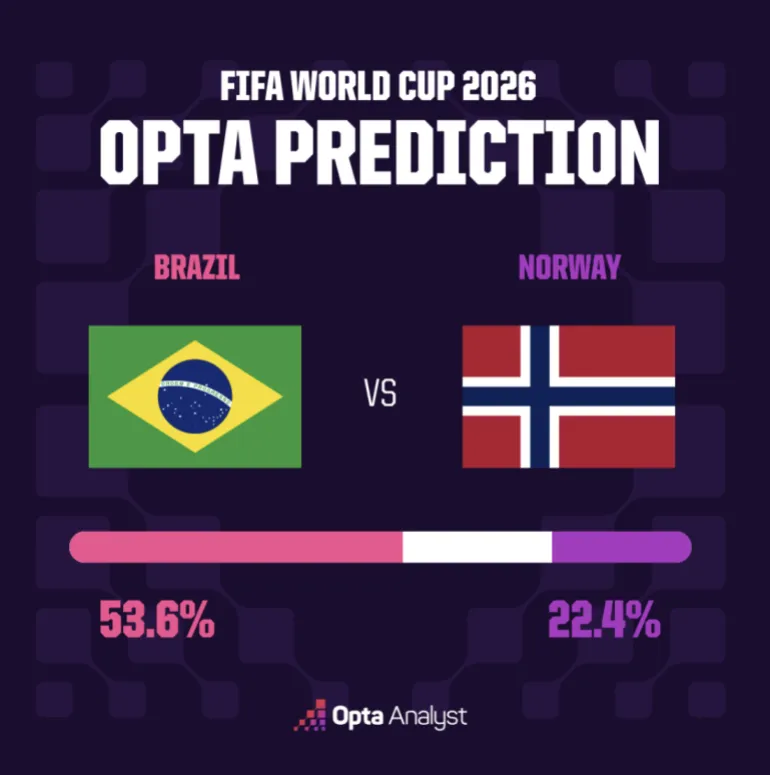
Despite those historical trends, the Opta supercomputer calculates Brazil as the clear favourites. After running 25,000 pre-match simulations, Brazil won in regulation time in 53.6 percent of the outcomes.
Norway claimed victory within 90 minutes in 22.4 percent of the simulations while 24 percent ended level after normal time, sending the tie to extra time and potentially penalties.
What are the predictions for Mexico vs England?
England and Mexico have crossed paths only once before at the World Cup, and that meeting dates back nearly 60 years.
The encounter came during the group stage of the 1966 tournament when tournament hosts England secured a 2-0 victory, thanks to goals from Bobby Charlton and Roger Hunt. The Three Lions went on to lift the trophy that summer, claiming the only World Cup title in their history.
England have also enjoyed the upper hand in the fixture outside the World Cup, winning each of their last four meetings with Mexico. Those victories all came in international friendlies played from 1986 to 2010.
Opta’s supercomputer predicted one of the closest contests of the round of 16 with neither side holding a decisive advantage.
England enter the tie with a favourable historical record against Mexico, but El Tri’s home support and familiarity with the conditions help narrow the gap.
Across 25,000 simulations, England won in normal time 40.6 percent of the time, while Mexico did so in 31.5 percent. A further 27.9 percent of simulations ended level after 90 minutes, meaning the match would require extra time and possibly a penalty shootout.
Remaining round of 16 schedule:
Brazil vs Norway: Sunday, New York New Jersey Stadium, 20:00 GMT
Mexico vs England: Sunday, Mexico City Stadium, 00:00 GMT going into Monday
Portugal vs Spain: Monday, Dallas Stadium, 19:00 GMT
USA vs Belgium: Monday, Seattle Stadium, 00:00 GMT going into Tuesday
Argentina vs Egypt: Tuesday, Atlanta Stadium, 16:00 GMT
Switzerland vs Colombia: Tuesday, BC Place Vancouver, 20:00 GMT
What else is happening?
Morocco’s historic quarterfinal run
Morocco reached the World Cup quarterfinals for a second consecutive tournament after defeating cohosts Canada 3-0 on Saturday with Azzedine Ounahi scoring twice to end the North Americans’ historic run.
The final score did not reflect the balance of the game. Canada controlled much of the first half, creating several promising chances while keeping Morocco from registering their first shot until the 28th minute.
Morocco coach Mohamed Ouahbi was visibly frustrated on the touchline before the break as misplaced passes and sloppy errors disrupted his side’s rhythm, but the team responded with a much-improved display after half-time.
“It’s a World Cup match, and these are difficult games with teams playing for their lives,” Ouahbi said. “We reacted very well in the second half, especially in the duels and in winning the second balls.
Was Paraguay’s play ‘dirty’?
France captain Kylian Mbappe insisted his side were prepared to match Paraguay’s physical approach after securing a hard-fought 1-0 victory on Saturday to reach the World Cup quarterfinals.
Mbappe, who converted the decisive penalty in the 70th minute after Desire Doue was fouled in the area, dismissed the suggestion that France were unsettled by Paraguay’s aggressive tactics.
“They thought we’d come out in tuxedos, trying fancy tricks and one-twos,” Mbappe said. “But we know how to play dirty football too. If that’s what the game requires, we have no problem doing it.”
The winning penalty was awarded only after a VAR review with France coach Didier Deschamps questioning referee Ilgiz Tantashev’s handling of the increasingly physical contest.
“We received three yellow cards while they kept fouling us throughout the game,” Deschamps said. “Every team is entitled to play in its own way, but I could have done without some of the insults from the opposition.”
Mexico’s fortress awaits England
Mexico will look to end a 40-year wait to advance to the World Cup quarterfinals when they face England on Sunday, backed by one of international football’s strongest home records.
The cohosts have lost only two official matches at Mexico City Stadium since it opened in 1966 with the last defeat coming against Honduras in a World Cup qualifier in 2013.
Former Mexico striker Hugo Sanchez believes the stadium could once again make the difference.
“The stadium is a monster; that explains the high number of wins and draws and the few losses, which were just accidents. We approach this with optimism because we know it’s England, but if we play the way we did against Ecuador, we can beat them.”
Mexico’s World Cup record at the stadium reflects that dominance. Across the 1970, 1986 and 2026 tournaments, El Tri have played 10 World Cup matches there, winning eight and drawing two. In this year’s tournament, they have beaten South Africa, Czechia and Ecuador in Mexico City without conceding a goal while also defeating South Korea in Guadalajara.
One of the Premier League’s most gripping personal feuds goes global on Sunday when Brazil face Norway in the World Cup last 16.
Norway’s irresistible force of Manchester City striker Erling Haaland comes up against Brazil’s immovable object in the shape of Arsenal defender Gabriel in New York New Jersey Stadium.
Haaland and Gabriel have been central figures as their clubs battle for domestic supremacy, creating a rivalry that regularly boils over into animosity.
The outcome of their latest confrontation will go a long way to deciding whether it is Brazil or Norway who advance to the quarter-finals, where they will face either England or Mexico.
Former England striker Chris Sutton told BBC Sport: “For all the battling for the Golden Boot between the greats such as Lionel Messi, Kylian Mbappe, Harry Kane and Haaland, there have not been any great personal duels. Now we have one.
“This is the standout personal duel of the World Cup so far and make no mistake, it will have a huge bearing on the outcome of the game.
“It is the standout because of the bad feeling we know exists between the pair. I am sure there is a level of respect great players have for each other, but everything we’ve seen between them suggests they don’t like each other too much.”
Former England captain Alan Shearer is also relishing the confrontation between the pair, saying: “That will be a great battle because there is definitely a bit of niggle there.
“They don’t like each other which is fine, you don’t have to like your opponent, and we have seen them have clashes before so that’s definitely one to look forward to.”
Adding further intrigue is the statistical quirk that five-time world champions Brazil have never beaten Norway in four attempts – drawing two and losing two.
This makes Norway the only side the Selecao have faced, but never won against.
The power of the people is what makes the Azteca truly special.
Whether cheering on Mexico, home club sides Club America or Cruz Azul, or hosting neutral sides in the World Cup, the Azteca crowd is renowned for generating a ferocious soundtrack like nowhere else.
“It is next to impossible to communicate on the pitch because the Azteca is full of sound swirling all around you”, says Jason de Vos, one of the few men to have both played and coached against Mexico at the stadium, doing so with the Canadian national team.
“The Mexicans know they have an advantage because of the crowd and they try to swarm you on the pitch too.
“When you arrive the team bus drives under the stadium, down a ramp and then you walk to the dressing room.
“When you walk to the pitch you have to go through a very tight tunnel and you can hear a buzzing sound, like a swarm of bees.
“To get outside, you approach the pitch from below, going up a staircase, and when you crest the top and see the light, you realise that the buzzing is the people.
“It’s the vibration of the horns, the screaming, the jumping. It’s crazy
“But that’s exactly why you want to play football.”
Egypt and Morocco fans celebrated their World Cup success by singing ‘My Blood is Palestinian’ at a Dallas fan zone, in a show of Arab solidarity with Palestinians.
Four wins to go. How can your team reach the final and win the World Cup 2026? Click here to find out.
Who: Brazil vs Norway What: FIFA World Cup 2026 – Round of 16 Where: New York New Jersey Stadium, East Rutherford, New Jersey, US When: Sunday, July 5, at 4pm (20:00 GMT) How to follow: We will have all the build-up on Al Jazeera Sport from 17:00 GMT before our live text commentary stream.
Recommended Stories
list of 3 itemsend of list
Two of the world’s most exciting forwards, Vinicius Jr and Erling Haaland, will light up Sunday evening in New Jersey when Brazil face Norway in a blockbuster round of 16 clash.
For all their dominance on the world stage, Brazil have historically struggled to find a way past Norway, and after four failed attempts, the Selecao will hope the fifth time is the charm.
Carlo Ancelotti’s talented side has its fair share of flaws, and having narrowly escaped elimination in the last 32 against Japan, they need an improved performance against Norway – one of the dark horses at this tournament.
Spearheaded by Haaland and Martin Odegaard, Norway arrive with bragging rights – they are one of only three countries Brazil have faced at a World Cup without registering at least one victory.
How did Brazil and Norway reach the round of 16?
Brazil finished at the top of Group C, with wins over Scotland and Haiti, and a draw with Morocco. They fought from a goal down to beat Japan 2-1 in stoppage time in the last 32.
Norway came second in Group I, winning against Iraq and Senegal and falling to France. They sealed a late 2-1 victory over Ivory Coast in the last 32 – the Scandinavian nation’s first World Cup knockout victory after previous exits to Italy in 1938 and 1998.
Can Haaland extend Norway’s dream run?
Be it for club or country, towering forward Haaland’s impact cannot be understated.
Of the 10 goals Norway have scored at the tournament, Haaland is responsible for half – numbers that are remarkable for a 25-year-old making his World Cup debut.
Come Sunday, Norway will need their 1.95-metre- (6.4ft)-tall, pony-tailed talisman to strike again if they are to reach the quarterfinals for the first time.
Brazil will be wary of Norway’s lethal striker Erling Haaland [Paul Ellis/AFP]
Norway could take inspiration from their 1998 World Cup side, which famously beat Brazil 2-1 in a group game. And they need not look further than their coach Stale Solbakken – a midfielder in that Norwegian squad – for words of advice.
“Brazil are favourites, of course they are, but we are hopeful that we will give them a match, and we are not playing the game for fun – we are playing to win the game and to reach the quarterfinals,” said Solbakken. “It’s possible, but it’s very difficult.”
The Norwegians will be wary of Brazil’s very own trump card Vinicius, whose four goals at the tournament have made him the team’s leading scorer and most influential player. Vinicius became the first Brazilian since Ronaldo and Rivaldo in 2002 to score in all three group stage matches at a World Cup. That was the last time Brazil lifted the trophy.
Brazil vs Norway prediction
The Opta supercomputer gives Brazil a 53.6 percent likelihood of winning in regulation time, while Norway’s chances of winning are 22.4 percent.
The model estimates a 24 percent probability of the game going to extra time.
Brazil vs Norway: Kickoff time, TV channel
Brazil: SBT, CazeTV (4pm, Brasilia Standard Time)
Norway: TV2, NRK (9pm, Central European Summer Time)
United Kingdom: ITV1, ITVX, STV, STV Player (8pm, British Summer Time)
United States: FOX, FOX One, Telemundo App, Telemundo Network, Peacock (4pm, Eastern Daylight Time)
To check the TV listings for your country, head to FIFA’s TV listing schedule here.
Norway fans do the traditional rowing celebration in the stands [Dylan Martinez/Reuters]
Who will the winner face in the quarterfinals?
The winner of the Brazil vs Norway match will face either Mexico or England in the quarterfinals in Miami on Saturday, July 11.
Brazil vs Norway: Head-to-head
Norway hold the rare distinction of never having lost to Brazil, with two wins and two draws from their four previous meetings, including a memorable 2-1 victory over Brazil in the group stage of the 1998 World Cup.
Brazil and Norway last met in a friendly in 2006, which ended 1-1.
More worryingly for Ancelotti, Brazil have been eliminated from each of their last six World Cup knockout ties against European opponents since beating Germany in the 2002 final.
Brazil vs Norway: Team news
Brazil’s Lucas Paqueta picked up a hamstring injury in the last game, while Raphinha, who also picked up the same issue in the second game, has resumed individual training and could make the bench.
Norway’s Julian Ryerson is out with a thigh injury.
Brazil’s Bruno Guimaraes has four assists at the World Cup – only Pele recorded more (six) for the five-time world champions at a World Cup [Annegret Hilse/Reuters]
Demonstrators gather to protest against the Alternative for Germany party, which is this weekend. Photo by Christoph Rutenolk/EPA
July 4 (UPI) — Thousands of protesters on Saturday blocked roads in Erfurt, Germany, in an effort to prevent members of the far right Alternative fur Deutschland party from meeting.
The gathering of the party’s delegates to choose new leaders garnered the large protest at least partially because of the date of the conference, which coincides with the date that Adolf Hitler introduced the Hitler Youth, as well as the Hitler salute, The Guardian reported.
The AfD, which finished with roughly 20% of the vote in the most recent German federal election, has been regarded by many in Germany to be too extremist, with Politico reporting that other European far-right parties — including France’s National Rally — have cut ties with it.
“Who’s making headlines today? WE ARE,” the anti-AfD group Widersetzen, which organized the protests, said in a post on Instagram.
“Who’s hiding in glass halls?” the group said in its post. “The fascists of the AfD. 17,000 people in the blockades and the tens of thousands in the demonstrations are a powerful counterforce. We are ready to stand up for social justice and security.”
In a speech, AfD national leader Alice Weidel said that “troublemakers out there at the door: you won’t bring us down.”
The protesters, as well as many historians and politicians, in Germany said that AfD deliberately held its conference on the centennial of the Nazi conference in Weimar where Hitler introduced both the youth “movement” and salute.
The party previously has been accused of racist, anti-Semitic and anti-Muslim policies, as well as downplaying Nazi actions during their rule in Germany and World War II.
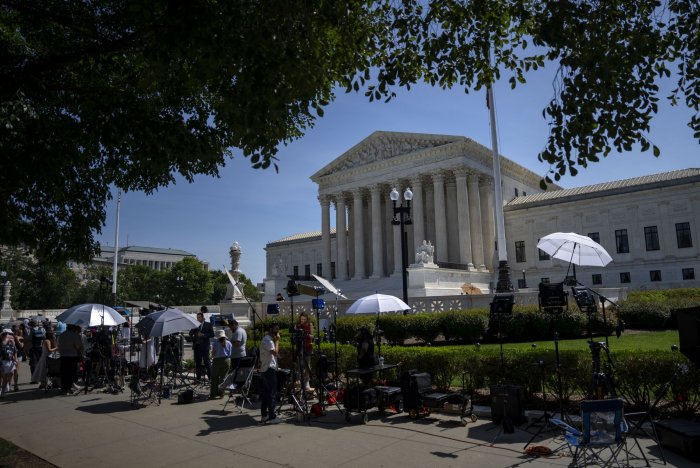
News anchors are seen outside the Supreme Court of the United States as the court releases their final opinions before summer recess on Tuesday. The court upheld birthright citizenship and also state laws banning transgender women and girls from playing on school athletic teams. Photo by Bonnie Cash/UPI | License Photo
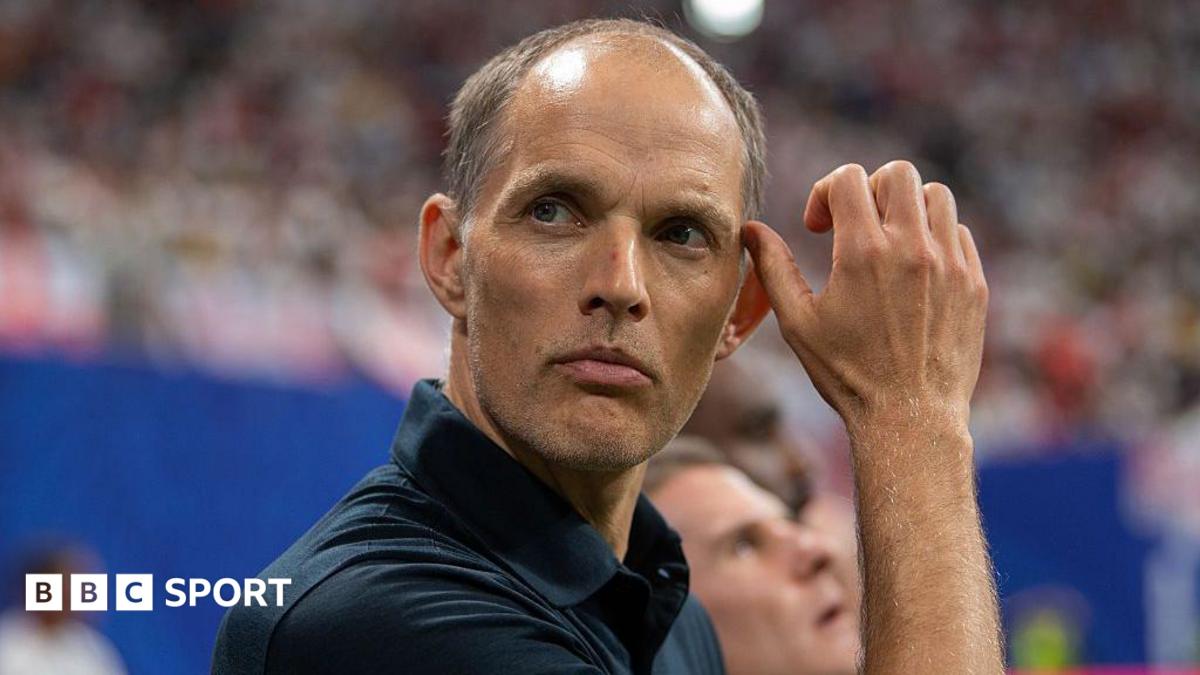
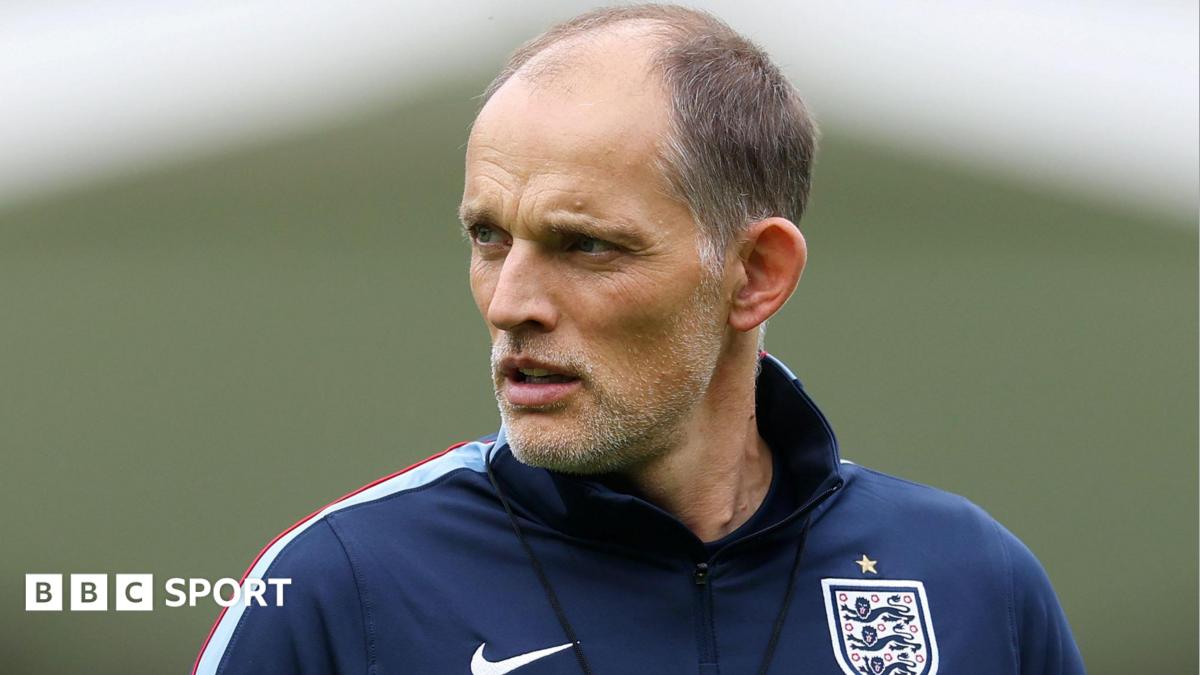
Thomas Tuchel has dismissed concerns over England’s treatment in Mexico as they prepare to face the World Cup co-hosts – saying it had been “nicer than I expected” and that home fans were “friendly and respectful”.
Tuchel’s side take on Mexico in a last-16 match that kicks off at 18:00 local time on Sunday (Monday 01:00 BST, live on BBC One, iPlayer and Radio 5 Live).
On Saturday, the team were met with a mixture of cheers and jeers from fans as they left their hotel for training under enhanced security measures in Mexico City.
Ecuador – beaten 2-0 by Mexico in the World Cup last 32 – lodged a noise complaint with Fifa after fans with loudspeakers, motorbikes and horns disrupted their sleep last week.
As a result, members of Mexico’s National Guard lined the entrance to England’s hotel, while police officers in riot gear stood next to barriers on the road outside.
“We had no issues tonight and I think Fifa took care of the situation,” head coach Tuchel said. “We have security around the hotel so we expect a good night’s sleep.
“I don’t want to talk about problems that don’t exist yet. If they come, we will accept them. The best way to approach is to be relaxed and calm.
“We have a six o’clock kick-off, so if we miss some hours of sleep we will have time to get some other hours in the late morning.
“What I experienced until now was very respectful and emotional and very supportive to towards our teams so are very respectful towards everyone. We expect to be treated with respect and that was the case.
“It was even nicer than I expected.”
Tuchel said he had felt the energy in Mexico City.
“It just catches you straight away once you land here and saw the excitement and the emotions,” he said.
“This will be a proper World Cup match. We are in an iconic place, an iconic stadium and a massive knockout game.
“It is a big stage and we feel it. It makes you sharper and brings the best out of you. It makes you feel alive.”
The price for the final 2026 World Cup match in Seattle hit nearly $4,000 but dipped as low as $1,549 on Tuesday.
Published On 4 Jul 20264 Jul 2026
Ticket prices for the United States’ highly anticipated round of 16 game against Belgium on Monday plunged by more than 30 percent before rebounding slightly early Saturday evening.
The get-in price for the final 2026 World Cup match in Seattle hit nearly $4,000 on June 1, according to ticket-tracking service TicketData.com. After dipping to as low as $1,549 on Tuesday, the get-in price spiked to $2,836 after the USA solidified their spot in the round of 16 with a 2-0 win over Bosnia and Herzegovina.
Recommended Stories
list of 4 itemsend of list
However, the get-in price has steadily declined in the days since. It dropped to $1,423 on Saturday afternoon – a 32 percent decrease over the past three days – but the get-in price rebounded to $1,635 at 6pm Eastern Time (23:00 GMT).
That late boost pushed the USA-Belgium game from the fourth-highest get-in price to the second-highest price among the eight round of 16 matches. Mexico’s game against England in Mexico City on Sunday sits at $3,574.
ROUND OF 16 TICKET PRICES*:
Mexico-England, 7/5 (Houston): $3,574
USA-Belgium: 7/6 (Seattle): $1,635
Argentina-Egypt: 7/7 (Atlanta): $1,599
Brazil-Norway: 7/5 (New Jersey): $1,537
Portugal-Spain: 7/6 (Dallas): $1,367
Switzerland-Colombia: $959 (Vancouver): $972
Paraguay-France: 7/4 (Philadelphia): $914
Canada-Morocco: 7/4 (Houston): $721
*TicketData.com as of 6 p.m. ET on July 4.
The significant drop in the get-in price for the US-Belgium game is somewhat surprising considering the Red Devils’ base camp is located just 16 kilometres (10 miles) south of Seattle Stadium at the Sounders FC Performance Center. Monday will mark Belgium’s third match in Seattle following a 1-1 draw with Egypt in the group stage and a dramatic 3-2 comeback victory over Senegal in the round of 32.
Canada was the first team eliminated from the round of 16 with their 3-0 loss to Morocco on Saturday. The get-in price for that match dropped 14 percent from $838 over the final 72 hours.
French President Emmanuel Macron (R) meets with the CEO of Anthropic Dario Amodei during a bilateral meeting on the sidelines of the G7 summit in Evian-les-Bains, France, 17 June 2026. Photo by THIBAULT CAMUS / EPA
July 3 (Asia Today) — Anthropic, the developer of the Claude artificial intelligence model, is in early discussions with Samsung Electronics about manufacturing a custom AI chip, according to a U.S. technology news report.
The Information reported Thursday, citing multiple people familiar with the discussions, that Anthropic is considering using Samsung’s 2-nanometer manufacturing process and advanced chip-packaging facilities.
The project remains at an early stage. Anthropic has not begun detailed chip design, testing or manufacturing, the report said.
Samsung’s 2-nanometer process is among the most advanced semiconductor manufacturing technologies available. Smaller manufacturing nodes can allow more transistors to be placed on a chip, potentially improving computing performance and energy efficiency.
Advanced packaging places processors, high-bandwidth memory and other chip components closer together. The shorter distance can increase data-transfer speeds and reduce bottlenecks when running large AI models.
Anthropic is studying the functions and performance required for the chip as well as how it could be integrated into servers, people familiar with the matter said. The company is also reportedly holding discussions with several chip-design companies.
Anthropic is considering using processors developed by Microsoft and British chip startup Fractile as it evaluates different approaches to expanding its computing infrastructure.
The company hired Clive Chan in June. Chan was the second hardware engineer to join OpenAI’s custom-chip program and worked on the project from its early stages.
Chan announced his departure from OpenAI and move to Anthropic in a June 7 post on the social media platform X. He said he was drawn by the opportunity to begin climbing a new technological mountain from the bottom.
The recruitment suggests Anthropic is building an internal team capable of designing specialized processors as competition with OpenAI expands from AI models into hardware and data-center infrastructure.
Anthropic raised $65 billion in a Series H investment round completed May 28, giving the company a post-investment valuation of $965 billion.
The funding was led by Altimeter Capital, Dragoneer, Greenoaks and Sequoia Capital. Samsung Electronics, SK hynix and Micron participated as strategic infrastructure partners.
Anthropic said the three semiconductor companies provide technologies that play important roles in supplying memory, storage and logic chips.
Samsung is the only one of the three companies that also operates a large contract chip-manufacturing business, raising expectations that its relationship with Anthropic could expand beyond memory supplies.
A manufacturing agreement with Anthropic would give Samsung another major AI customer as the South Korean chipmaker seeks to challenge Taiwan Semiconductor Manufacturing Co. in the market for advanced processors.
Samsung previously signed a $16.5 billion agreement to manufacture next-generation AI chips for Tesla. Google is also reportedly considering using Samsung to manufacture part of a future tensor processing unit.
The potential Anthropic contract could strengthen Samsung’s position as demand for alternatives to Taiwan Semiconductor’s manufacturing capacity increases.
Major technology companies are developing specialized processors to reduce computing costs, improve energy efficiency and gain greater control over their AI infrastructure.
Google has developed several generations of its tensor processing units, while Amazon Web Services operates its Trainium processors for AI training.
OpenAI and Broadcom unveiled Jalapeño, OpenAI’s first custom inference processor, on June 24. Inference refers to the process through which a trained AI model generates responses to user requests.
OpenAI said the processor was developed from initial design to production in nine months. Early deployment is expected by the end of the year.
Broadcom Chief Executive Officer Hock Tan described Jalapeño as the beginning of a multigeneration processor roadmap. The companies plan to install the chips in large-scale data centers operated with partners including Microsoft.
Anthropic said its custom-chip work would not replace its existing relationships with hardware suppliers.
“Nvidia GPUs, Google TPUs and AWS Trainium chips will continue to play a central role in our computing resources,” the company said in response to a request for comment from The Information.
South Korea on Monday unveiled a wider semiconductor investment plan under which Samsung and SK hynix are expected to invest about 800 trillion won ($523 billion) over the next decade.
The plan includes four new semiconductor fabrication plants and expanded production of high-bandwidth memory and advanced packaging technologies used in AI systems.
Samsung has faced yield problems in some previous advanced manufacturing processes. Yield refers to the percentage of usable chips produced from each semiconductor wafer.
The performance and production stability of Samsung’s 2-nanometer process are therefore expected to be critical to its ability to compete with Taiwan Semiconductor for major AI-chip orders.
An industry official said Samsung has become more selective about accepting manufacturing orders, focusing resources on projects considered commercially and technologically viable.
Anthropic is entering the custom-chip competition later than several major AI and cloud-computing companies. However, rapidly rising demand for AI infrastructure is creating opportunities for specialized processors.
TrendForce projects that shipments of servers using cloud companies’ custom application-specific integrated circuits will grow 44.6% in 2026. Shipments of servers using general-purpose graphics processors are expected to grow 16.1%.
Nvidia remains the dominant supplier of AI processors, but the development of chips by OpenAI, Google, Amazon and other technology companies could gradually reduce their reliance on its hardware.
South Korean Finance Minister Koo Yun-cheol (C), who serves concurrently as the deputy prime minister for economic affairs, attends a meeting of the emergency economic headquarters at the government complex in Sejong, South Korea, 03 July 2026. Photo by YONHAP / EPA
July 3 (Asia Today) — South Korea will provide 14.9 trillion won ($9.7 billion) in emergency financing and expand tax and trade-insurance support for small and midsize companies struggling with higher import costs caused by the weak won.
The government announced the measures Friday during an emergency economic meeting chaired by Deputy Prime Minister and Minister of Finance and Economy Koo Yun Cheol at Government Complex Sejong.
The package is intended to improve liquidity for companies facing rising raw-material costs and financing pressures as the won remains weak against the U.S. dollar.
The government will redirect 13.8 trillion won ($9 billion) in unused capacity from a 23.7 trillion won ($15.5 billion) policy-financing program previously established in response to the Middle East crisis.
An additional 1.1 trillion won ($719 million) in new financing will also be provided. The government said the total could be increased depending on demand and the pace at which available funding is used.
The Korea SMEs and Startups Agency will establish a special emergency stabilization fund for companies affected by the exchange rate.
Small companies that import raw materials or components worth at least 20% of annual sales will be allowed to apply without meeting an existing requirement that sales or operating profit must have fallen by at least 10%.
The Export-Import Bank of Korea will increase its special crisis-response program from 7 trillion won ($4.6 billion) to 8 trillion won ($5.2 billion).
The bank will also increase its maximum interest-rate reduction from 2 percentage points to 2.2 percentage points.
A new ultralow-interest loan program will provide financing at rates close to the state-run bank’s own funding costs for companies affected by the high won-dollar exchange rate.
The Korea Technology Finance Corp. will raise the coverage ratio for its emergency business stabilization guarantees from 95% to 100%. The reduction in guarantee fees will increase from 0.3 percentage points to 0.4 percentage points.
Companies already using government policy loans may also receive repayment deferrals and loan-maturity extensions.
The government will expand import insurance and currency fluctuation insurance to help businesses manage exchange-rate risks.
Small and midsize companies without an export record will be allowed to purchase import insurance, which was previously more difficult for companies focused primarily on the domestic market to obtain.
Import insurance premiums will be discounted by 50% through April 2027.
Companies facing higher costs for essential imported raw materials may also receive up to twice the normal loan-guarantee limit from the state-run Korea Trade Insurance Corp.
The amount available under the government’s currency fluctuation insurance program will increase from 1.2 trillion won ($785 million) to 1.3 trillion won ($850 million).
Premium discounts for small companies will double from 15% to 30%.
Eligibility for the insurance will also expand from selected raw-material importers to companies importing nearly all categories of goods, excluding luxury products.
The government will establish a separate 10 billion won ($6.5 million) export-voucher program for companies affected by the exchange rate.
The maximum trade-insurance premium support available through the voucher system will temporarily double from 10 million won ($6,500) to 20 million won ($13,100).
The government also plans to allow insurance support to be paid in advance rather than reimbursed after the insurance contract ends.
Small companies borrowing from the Export-Import Bank of Korea will be offered a free option to convert loans between the won and foreign currencies or between two foreign currencies.
Tax relief will be provided alongside the financing programs.
Payment deadlines for corporate income tax, value-added tax, individual income tax and customs duties may be extended for companies experiencing exchange-rate-related financial difficulties.
The government will also provide consulting to help companies reflect currency movements in agreements that link subcontracting payments to changes in raw-material costs.
Companies that effectively operate the system may receive incentives, including exemptions from certain government-initiated investigations into subcontracting practices.
Financial institutions will receive credit under a government evaluation index for providing assistance to small companies affected by the weak won.
Regional export support centers will serve as one-stop contact points for companies seeking information on financing, insurance, tax relief and other assistance.
The government said it would continue reviewing the difficulties faced by businesses and consider additional measures if needed.
On a recent summer day at Crossroads School for Arts & Sciences, students ambled through yawns, braces and acne into their creative writing class. The day’s lesson tackled “style,” that elusive, ultra-subjective choice of expression.
“Who was the first author you encountered to do something different on the page?” asked the teacher, Clarke E. Andros.
They named Dr. Seuss, Shel Silverstein and Lemony Snicket before moving on to a précis of Joy Williams’ flash fiction. “These stories are weird — she’s weird,” Andros warned.
In some ways, high school looks much the same as it did 20, even 100 years ago: sleepy eyes either light up or glaze over when a teacher poses a Socratic question. Nervous laughs and unexpected insights emerge as young people use stories to make sense of themselves and the world around them.
(Fingerprint; Penguin Classics; Pantheon)
The idea of the “Great American Novel” took shape in the aftermath of the Civil War, when a fractured nation looked to literature to define itself. As classrooms evolved, so did the canon that reflected America’s changing identity.
But the syllabus today is at a tipping point. Forces — some visible, some harder to see — are upending literature and education itself. American students are in a decade-long reading recession, while fewer students are reading for pleasure than in previous generations.
Reading scores among high school seniors are at their lowest in decades, according to federal testing data, while schools across the country are grappling with how to respond to waning attention spans and artificial intelligence. The Los Angeles Unified School District has begun a course correction, voting to limit student use of laptops and tablets during class — the first major American school system to do so.
We spoke with five high school English teachers across the city — three from LAUSD, one from a charter and one from a private school — to find out what literature belongs in today’s classroom, and which stories can help us understand America, past and present.
Interviews have been edited and condensed for clarity.
Raquel Olvera, Roosevelt High School, Boyle Heights
What books in the American literary canon are you teaching (old and new)?
In 11th-grade American Literature, as part of the LAUSD-approved Odell curriculum, we read four book options: “Friday Night Lights,” “Beloved,” “The Great Gatsby” and “The Warmth of Other Suns.” For my 10th-grade World Literature course, I like “Antigone” and “Things Fall Apart.” I also teach “In Cold Blood,” using it to explore Americans’ fascination with true crime and what the genre reveals about race, gender, class and the justice system.
(Simon & Schuster; Sky Publishing; Vintage)
What’s one work from the canon adults should revisit today?
“The Great Gatsby.” When I read it in high school, I wasn’t engaging with its undercurrents of racism, xenophobia, antisemitism, gender or sexuality in the way I do now. Its themes of power, wealth, consumerism and American identity remain as relevant as ever.
What are English teachers up against in the classroom in 2026?
Besides large class sizes and underfunding, I think public educators are largely battling apathy. Students and young people aren’t engaging with books like they used to. A side effect of that is a lack of empathy and curiosity. At the very least, you can model what it means to be a reader and a writer, and hope that years later, students remember that one nerd English teacher who showed them what humanity can look like.
Schehrezade Lodhy, Da Vinci Schools, El Segundo
What books in the American literary canon are you teaching (old and new)?
Students really enjoy Arthur Miller’s “The Crucible” — it’s all about the human condition and cancel culture, forbidden love and lies and deceit, with witches in the forest. In poetry, we explore a range of American voices, from Walt Whitman and Langston Hughes to Amanda Gorman, and sometimes even song lyrics. I also use “The Moth: Storytelling” podcast when students are working on personal essays. The goal is to make literature, poetry and storytelling as accessible as possible. At a charter school, we have quite a bit of autonomy with what we teach.
What’s one work from the canon adults should revisit today?
James Baldwin’s “Giovanni’s Room” and “Go Tell It on the Mountain.” I read Baldwin a few summers ago, and that was quite an education for me. Unfortunately, some of the content is a bit too mature for high school, but I do talk about Baldwin a bit in my classes when we cover African American authors.
(Reader’s Library Classics; W. W. Norton & Company; Simon & Schuster)
What are English teachers up against in the classroom in 2026?
Artificial intelligence, big time. I really pared back technology in my class, and we’ve pivoted back to paper and pencil. Going into my 18th year of teaching, my biggest goal is re-creating that experience of thinking critically for oneself and studying literature through a critical lens. We’re in this era of going back to the basics. With decreased attention spans, teachers are being forced to become even more creative. It feels like we’re reinventing ourselves every year.
Aiden Brown, John F. Kennedy High School, Granada Hills
What books in the American literary canon are you teaching (old and new)?
From an educationally traditional background, I still believe in canon disruption — mixing the new and old. In American Lit, I’ve taught “Their Eyes Were Watching God” 11 times now. It’s a hard one to get on the first try because the vernacular is so particular, but when we read it physically while also listening to the audiobook, it’s such a great novel to hear. I pair it with bell hooks’ “All About Love.” I teach “Macbeth” from a performance-based lens, making it less intimidating. My favorite book is “Frankenstein,” written by a teenage girl who invented science fiction. My ninth-graders’ favorites were “Fahrenheit 451,” “The Odyssey” (Emily Wilson translation) and “Persepolis,” a graphic novel about a girl discovering punk rock and rebelling against the established order.
What’s one work from the canon adults should revisit today?
All of the lonely young men need to reread “The Great Gatsby,” and anyone freaked out by the state of the world should read “Parable of the Sower.” One quote from the book hangs on a poster board in my classroom: “A community’s first responsibility is to protect its children — the ones we have now and the ones we will have.”
What are English teachers up against in the classroom?
Teenagers are still the funniest people on the planet. As the world around them becomes more atomized, I find that they’re increasingly interested in connection. In the classroom, we are seeing skill loss and a decreased ability to focus on a task. I don’t think that’s just because of AI or the pandemic — it’s also phones, screens and the world kids are growing up in. One thing teachers seem to agree on is a return to pen and paper.
Clarke E. Andros, Crossroads School, Santa Monica
What books in the American literary canon are you teaching (old and new)?
A newer addition I would recommend is “Hunger: A Novella and Stories” by Lan Samantha Chang. Especially in California, we have a lot of great Asian American literature, including works by Amy Tan, but I enjoy the writing level in Lan’s — it’s accessible to students but pushes them, all about intersectional identity and the first-gen experience. A lot of the Latino students I’ve taught in Los Angeles also connect with that book.
(Penguin Classics; Grand Central Publishing; Mariner Books Classics)
What’s one work from the canon adults should revisit today?
“Of Mice and Men.” Revisiting it today opens up deeper conversations about labor, social conciousness and power. Steinbeck creates a microcosm of American society, where disability, gender, race and class are all represented and shaped by an economic hierarchy. The characters are left navigating a world where people often turn on each other rather than challenge the systems around them. It’s novella-length, so you could read it in a Sunday morning.
What are English teachers up against in the classroom in 2026?
We’re up against systems that often prioritize ed-tech and third-party vendors over smaller class sizes and more teachers. When I was at LAUSD, it was clear from our superintendent — who just stepped down over his fraud investigation — was just in bed with tech. It’s hard for me to imagine the folks in power didn’t look at [the failed AI chatbot venture] and see it as a grift.
On the flip side, at hyper-competitive, elite schools like this, students are approaching high school with college in mind rather than with high school in mind. When students understand the value of the process, they’re less likely to look for an easy shortcut like AI.
Adam Tan, Los Angeles Center for Enriched Studies, Mid-City
What books in the American literary canon are you teaching (old and new)?
With independent reading, memoirs are big, like “Crying in H Mart” and Sylvia Plath’s fictionalized “The Bell Jar.” Younger kids gravitate to “Musashi,” a celebrated epic based on a famous samurai. We have a lot of Korean American students here, so they like “Pachinko,” dealing with racism and the Korean population in post-World War II Japan. I’ll also throw in “The Bluest Eye.”
In ninth grade, we read “Slaughterhouse-Five,” “Of Mice and Men,” “The Thief and the Dogs” and “Romeo and Juliet,” with the film adaptations to use media literacy. In American Literature, the major texts are “The Great Gatsby,” “The Things They Carried” and “The Crucible.” We also read nonfiction articles, including pieces on AI and robots, while focusing on rhetorical devices.
(Blackstone Publishing; Knopf; Little, Brown and Company)
What’s one work from the canon adults should revisit today?
“The Catcher in the Rye” benefits from the distance of adulthood. It’s a novel about disillusionment and the search for identity, but when you revisit it, you also see that it’s very much a love story. I often encourage students to look for forms of love beyond romance — love for family, friends and fellow human beings. Even today, students can tell you that the biggest phony in the book is Holden himself. The novel reminds us that while literature may not have answers to the world’s problems, it can help us examine our wounds and find solace in art.
What are English teachers up against in the classroom in 2026?
A lack of accountability in the modern world. In general, we have a school district focused on 100% graduation rates, no F’s. [LAUSD] wanted everything on computer, and now they want less computer time, which is great, but not everyone at top management is on the same page. Teachers are often trying to balance what the district wants with what we know our students need.
What I try to instill instead is an intrinsic desire to grow as a thinker. How do you make sure students are reading without taking the joy out of it? A lot of us are going back to pen and paper. Despite all the concerns about AI, I still think the soul and spirit of young people is as strong as ever. The core is not rotting.
Pope Leo XIV greets migrants at the Favaloro Pier to bless a plaque dedicating the pier to late Pope Francis during his pastoral visit to the island of Lampedusa, Italy, Saturday. Photo by Ciro Fusco/EPA
July 4 (UPI) — Pope Leo XIV, the first American pope, spent his second Fourth of July as the pontiff at Lampedusa, Italy, an island at the forefront of the European migrant crisis, and appealed to Americans to treat immigrants with “compassion and generosity.”
Leo visited Lampedusa, an Italian island in the Mediterranean Sea between Tunisia and Malta, instead of celebrating the day in the United States.
Soon after his arrival, he released a letter to Americans about the 250th Anniversary of the country’s birth, reflecting on the principles that have shaped the United States for two and a half centuries, particularly religious freedom and human dignity.
In the letter Leo said that, “among the principles that have guided the development of this country is the God-given dignity of every human life, each person being endowed with an inherent worth that calls for reverence, protection and care … and of building a society in which the vulnerable, the suffering and the forgotten are always met with compassion, solidarity and love.
“Defending human life also includes welcoming, protecting and assisting immigrants, whose hopes, sacrifices and contribution have formed part of the history of this country from its very beginning. In every generation, those who have arrived seeking freedom, opportunity and a place to belong have helped to shape the nation’s character. To receive them with compassion and generosity is not only an act of charity, but also a recognition of the dignity that belongs to every human person,” Leo said.
He said he hopes Americans “honor the courage and vision of those who came before them by strengthening their communities, respecting their differences and working together toward a more perfect union.”
Upon landing at Lampedusa, the pope visited the “Door to Europe,” a piece of art that is a memorial to thousands of migrants who died or disappeared trying to cross the sea.
He also visited the Cemetery of the Nameless in Cala Pisana to pray over the graves of migrants who died at sea. The graves are marked with crosses made from the wood of boats that sank off the island’s coast, Euro News reported.
Leo then visited Molo Favaloro, a site where migrant boats are brought to shore. He unveiled and blessed a plaque dedicated to Pope Francis there. The quay there will now be named Molo Francisco. Francis visited the island in 2013.
The pope met and shook hands with 15 migrants brought from a migrant housing center run by the Red Cross. It now houses 138 people, including 51 unaccompanied minors. On Friday night, the Italian coast guard rescued 17 people aboard a small boat, Euro News said.
“By deciding to name Molo Favaloro after Pope Francis you are giving a sign of the bond my predecessor forged with your community and with migrant brothers and sisters: the Pope has stood by you in these very demanding times. And today I am here to tell you that the Pope continues to walk alongside you, to support you and encourage you,” Leo wrote in a letter to the mayor of Lampedusa.
On Friday, Leo gave a virtual speech to Philadelphia when he was awarded the Liberty Medal. The medal has been awarded since 1989 and was managed by the Philadelphia Foundation until 2006, when it became part of the National Constitution Center in Philadelphia.
Visitors look around an LG Energy Solution booth at the InterBattery 2021 at COEX in Seoul, South Korea. Photo by YONHAP / EPA
July 3 (Asia Today) — A U.S. battery joint venture between South Korea’s LG Energy Solution and Honda has begun mass-producing lithium-ion cells for energy storage systems at its Ohio plant, the company said.
L-H Battery Company began production Thursday at its factory in Jeffersonville, Fayette County.
The cells will be supplied through LG Energy Solution Vertech, the South Korean company’s North American energy-storage system integration subsidiary.
They are expected to be used in utility power grids as well as commercial, industrial and residential energy-storage systems across the United States.
The Ohio plant was originally built primarily to manufacture batteries for Honda electric vehicles.
The partners adjusted the factory’s production strategy as growth in the electric-vehicle market slowed and changes in the U.S. regulatory and policy environment increased uncertainty for automakers and battery manufacturers.
The joint venture decided to prioritize the faster-growing energy-storage market while maintaining the flexibility to produce cells for other applications.
It plans to consider manufacturing batteries for hybrid-electric vehicles at the plant as market conditions evolve.
Honda said in May that it would convert part of the joint venture’s electric-vehicle battery production lines to make batteries for hybrid vehicles.
The company also said it would use the Ohio battery facilities for other applications as it restructures its North American vehicle and battery production network.
Honda canceled plans in March to develop and launch three electric-vehicle models that had been scheduled for production in North America, citing changes in the business environment.
The start of storage-battery production marks a significant step in LG Energy Solution’s strategy to manufacture more energy-storage products within North America.
Demand is rising as utilities add renewable-energy capacity and seek batteries that can store electricity when supply exceeds consumption.
Artificial intelligence data centers are also increasing electricity demand and creating a need for additional power-generation, transmission and storage infrastructure.
Energy-storage systems can help stabilize power grids by storing electricity during periods of low demand and releasing it when demand rises.
LG Energy Solution has been converting or adapting electric-vehicle battery facilities to produce storage batteries as manufacturers respond to slower electric-vehicle growth.
The company plans to operate five energy-storage battery manufacturing sites in North America.
The network includes plants in Holland and Lansing, Mich., the NextStar Energy facility in Windsor, Ontario, the Ultium Cells factory in Spring Hill, Tenn., and the L-H Battery Company plant in Ohio.
LG Energy Solution said it aims to secure more than 50 gigawatt-hours of annual energy-storage battery production capacity in North America by the end of 2026.
The company said batteries manufactured in Ohio will support projects serving power grids, businesses and homes.
BloombergNEF has projected that the U.S. energy-storage market could expand to 485 gigawatt-hours in 2030 and 976 gigawatt-hours in 2035.
“Energy storage systems are an important future business for L-H Battery Company and will become a core business pillar along with the production of battery cells for hybrid-electric vehicles,” L-H Battery Company Chief Executive Officer Koo Ja-hoon said.
Chief Operating Officer Rick Riggle said the company has hired employees and begun production since the joint venture was established in 2023.
“This start of mass production is significant because it goes beyond simply operating a plant and establishes a stable production base for our North American business,” Riggle said.
LG Energy Solution and Honda formally established L-H Battery Company in 2023 to manufacture lithium-ion batteries in Ohio.
The joint venture was initially designed to support Honda’s expanding electric-vehicle production in North America.
The revised production strategy allows the companies to use the plant for energy storage and hybrid vehicles while retaining the ability to respond if electric-vehicle demand recovers.
1 of 3 | Foreign visitors dine at an outdoor izakaya in Tokyo’s Shimbashi district. The weak yen has made Japan cheaper for tourists while raising import costs for Japanese households. Photo by Asia Today
July 3 (Asia Today) — Japan has become an increasingly affordable destination for foreign visitors, but the weaker yen has sharply reduced the ability of Japanese households and businesses to buy goods and services from abroad.
The yen’s real effective exchange rate, a broad measure of its inflation-adjusted value against the currencies of Japan’s trading partners, fell to 65.93 in May, The Yomiuri Shimbun reported Friday.
That was less than half the 141.77 recorded in December 1986, when the nominal dollar-yen exchange rate was near levels recently seen in foreign-exchange markets.
The comparison indicates that even when the dollar-yen rate appears similar to its level 40 years ago, the yen’s actual external purchasing power is substantially weaker.
The real effective exchange rate is not based on the yen’s value against one currency, such as the U.S. dollar.
The index combines exchange rates with multiple trading partners, gives each currency a weight based largely on trade and adjusts for differences in inflation. The Bank for International Settlements and the Bank of Japan publish the data with 2020 set at 100.
A lower figure indicates that the yen has weakened after inflation and trade relationships are taken into account.
The Yomiuri illustrated the difference using the price of a pizza.
Even when the nominal exchange rate is similar to the rate in the 1980s, prices in the United States have risen much more than prices in Japan over the past four decades. A Japanese consumer carrying the same amount of yen can therefore buy far less in the United States today.
The distinction helps explain why the current period of yen weakness differs from the weak-yen environment of the 1980s.
Japan’s long period of low inflation contributed to the decline.
After the collapse of the country’s asset-price bubble, consumer prices and wages remained stagnant for much of the period beginning in the 1990s. Prices continued to increase in the United States, Europe and many other economies.
The Bank of Japan’s large-scale monetary easing, introduced in 2013 to end deflation, also placed downward pressure on the yen’s nominal value.
The combination of low domestic inflation and nominal depreciation accelerated the decline in the currency’s real effective value.
Cheap Japan, expensive world
The weak yen has made hotels, restaurants, clothing and consumer products in Japan appear less expensive to South Korean travelers and other foreign visitors.
For South Koreans, the effects of yen depreciation are often most visible through lower travel costs in Tokyo, Osaka and other Japanese destinations.
Foreign visitors’ spending has supported department stores, convenience stores, drugstores, restaurants and regional tourism businesses across Japan.
The same trend can create competition for South Korean tourism destinations and retailers as consumers choose between spending money domestically and traveling to Japan.
The weaker yen has the opposite effect on Japanese households.
Japan imports much of its energy, food and industrial raw materials. A weaker currency raises the yen-denominated cost of those imports, increasing pressure on household budgets and companies that cannot fully pass their higher costs on to customers.
The prolonged decline of the currency has become a policy concern as Japanese consumers face higher prices for fuel, food and other imported goods.
Japanese companies experience both advantages and disadvantages from the exchange rate.
Manufacturers must pay more for imported energy, raw materials and components. Exporters, however, can convert overseas earnings into more yen and may be able to offer more competitive prices abroad.
The price advantage can affect South Korean companies competing with Japanese manufacturers in automobiles, machinery, materials and components.
South Korean exporters doing business in Japan may face a different challenge.
As the purchasing power of Japanese consumers and businesses declines, Japanese buyers may become more sensitive to the prices of imported South Korean products and services.
Japanese importers could seek lower contract prices while consumers turn toward less expensive alternatives.
The Japanese market may therefore remain large in nominal terms while becoming increasingly price-sensitive for foreign suppliers.
The real effective exchange rate does not directly measure every household’s standard of living. It does, however, show how the yen’s value has changed after accounting for trade patterns and differences in inflation.
Its decline suggests that the effects of yen weakness extend beyond making Japan a less expensive place for tourists.
The trend is changing Japanese households’ consumption power, companies’ purchasing structures and the competitive environment facing businesses in South Korea and Japan.
For South Korea, the weak yen offers the immediate benefit of less expensive travel to Japan.
It can also contribute to an outflow of domestic consumer spending, stronger price competition from Japanese exporters and greater resistance to foreign product prices inside Japan.
Japan has become cheaper for South Korean visitors, but much of the world has become more expensive for Japanese consumers.
That widening gap is likely to remain an important factor shaping tourism, consumption and export competition between the two countries.