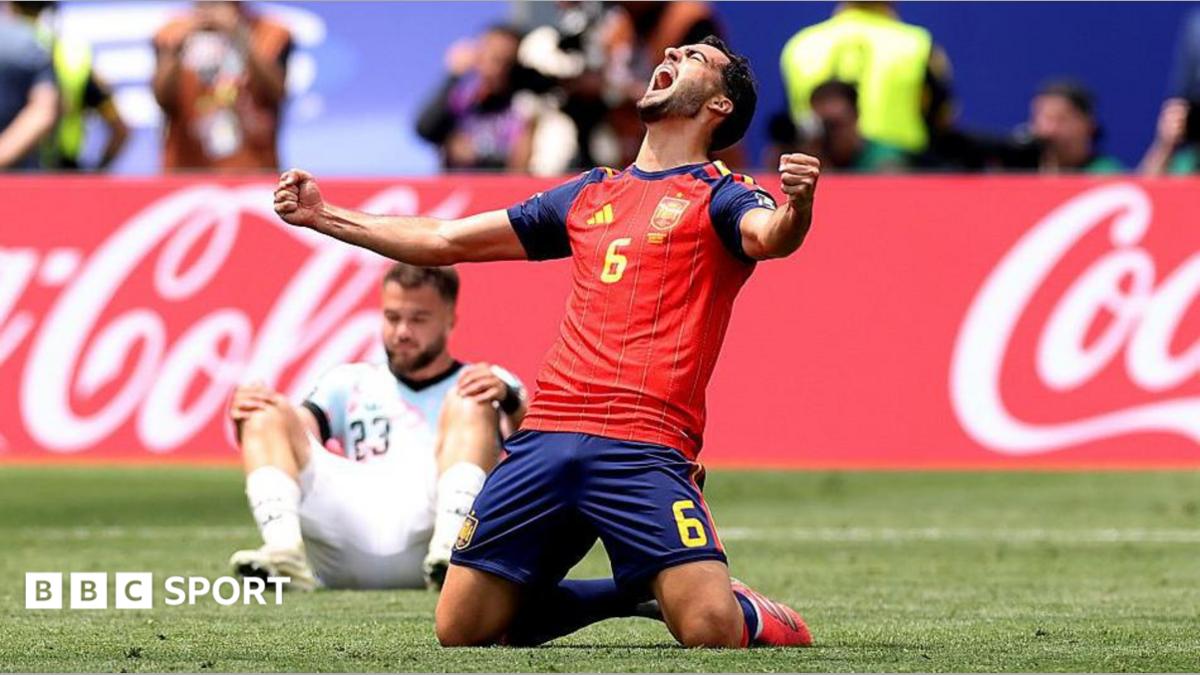
“Mikel is incredible,” Spain boss Luis de la Fuente said after the quarter-final win.
“He has many qualities. He is a player that across the whole World Cup could have played in whatever team and done great.
“For us he is the standard of this idea, of this model. It is a pleasure to have him, and others but especially him. We know that without fail he is always there.”
Always there he may be, but Merino himself feared he would not be fit enough to play at this World Cup.
“The fact of being here a few months ago was unthinkable,” Merino said after the Portugal win.
“Now I am, as I said before, at the highest point, enjoying one of the happiest moments of my career.
“Now I remember all those bad moments, all the people who have supported me, all the people who have pushed me when even I sometimes found it difficult to believe I could be here.”
Merino’s heroics will be a familiar sight for Arsenal fans, with the 30-year-old having done similar at the Gunners.
Traditionally a midfielder, his height has seen him utilised as a striker by Arsenal boss Mikel Arteta, and the first time he was used in such a role was when he memorably came off the bench to score twice against Leicester in a 2-0 win in February last year.
“Merino is just one of those players who arrives at the right time, at the right moment in big games,” former England striker Wayne Rooney said on Match of the Day.
De la Fuente added: “He can be the best striker and the best midfielder because of his understanding of the game. He interprets the game perfectly.
“He is committed, he is generous, he is happy to do the work.”
Campaz was threatened after failing to score in the last-16 match against Switzerland, which Colombia lost on penalties.
Published On 10 Jul 202610 Jul 2026
Colombia’s Jaminton Campaz has received death threats following his team’s exit from the World Cup, the country’s football federation said, as it condemned the threats.
“No athlete, nor any member of their inner circle, should be subjected to intimidation for representing their country in a sporting arena,” the Colombian Football Federation (FCF) said in a statement on Friday.
Colombia’s tournament ended Tuesday in a penalty shootout loss to Switzerland in the round of 16. During extra time, Campaz — who plays for Argentine club Rosario Central — missed a critical scoring opportunity when his shot went wide.
On Instagram, Campaz shared a photo of himself covering his face in frustration, alongside a plea for respect.
“Football is also made up of difficult moments,” he wrote. “My Colombia, please let us never lose sight of respect. We may think differently or feel frustration and sadness, but no passion justifies hatred or living in fear.”
In response to the harassment, the Colombian federation has urged the country’s attorney general’s office to expedite an investigation to identify those behind the threats.
“Football must be a space for unity, respect, and hope — never a setting for hatred, intimidation or violence,” the federation said, calling on fans to ensure that sporting disappointments never translate into real-world aggression.
The threats evoke a dark chapter in Colombian football history. During the 1994 World Cup in the United States, defender Andres Escobar scored an own-goal in a 2-1 loss to the host nation. Days after the team was eliminated and returned home, Escobar was murdered in Medellin.
Belgium became the first team to beat Spanish goalie Unai Simón on Friday. But they couldn’t beat his team, with second-half substitute Mikel Merino scoring in the 88th minute to lift Spain to a 2-1 victory in a World Cup quarterfinal before a sold-out crowd at SoFi Stadium.
The win, which extended Spain’s unbeaten streak to 36 games, sends the team on to Tuesday’s semifinal with France in Arlington, Texas. For Belgium, its first loss in 19 games ended its tournament.
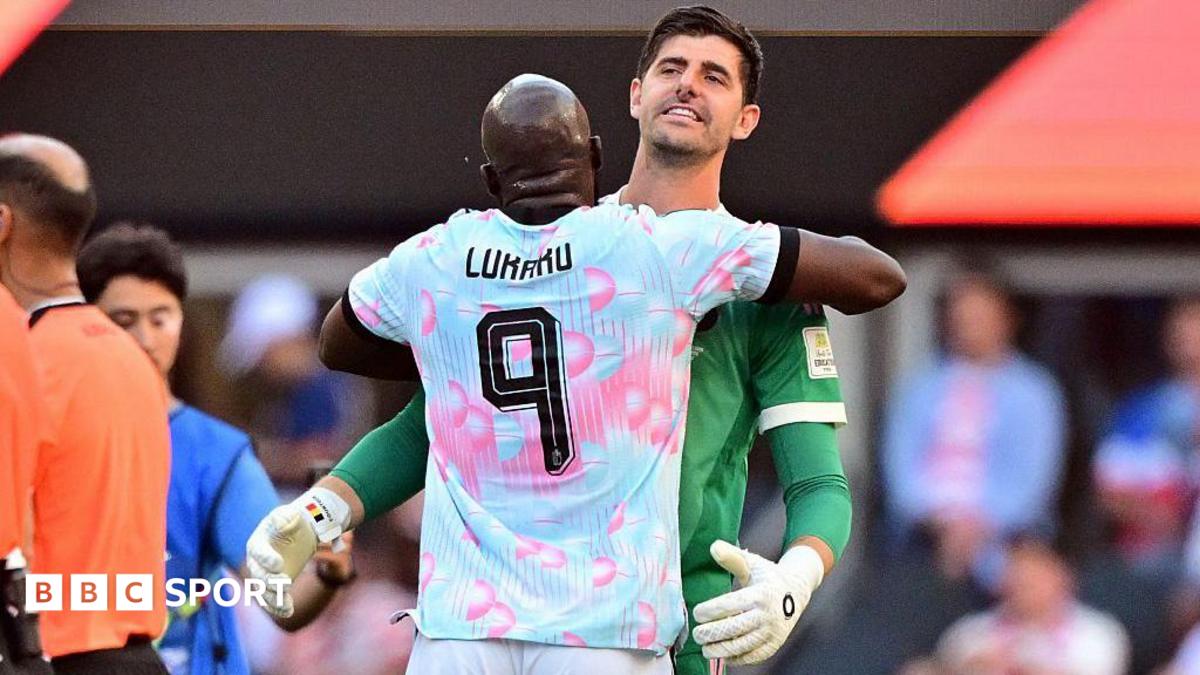
The turning point came not on the pitch but on the Belgium bench, where coach Luis de la Fuente sent backup goalkeeper Senne Lammens on for an injured Thibaut Courtois in the 71st minute.
The dropoff in talent wasn’t great — Lammens started 32 times for Manchester United this season — but the difference in experience was. Courtois was playing in his 21st World Cup game, second-most all time, and had been brilliant up to then against Spain, making four saves.
But just before the second-half hydration break, he dropped to the turf with a thigh injury that required attention from trainers. He tried to continue, but moments later De la Fuente made the change, with Courtois walking to the bench in tears.
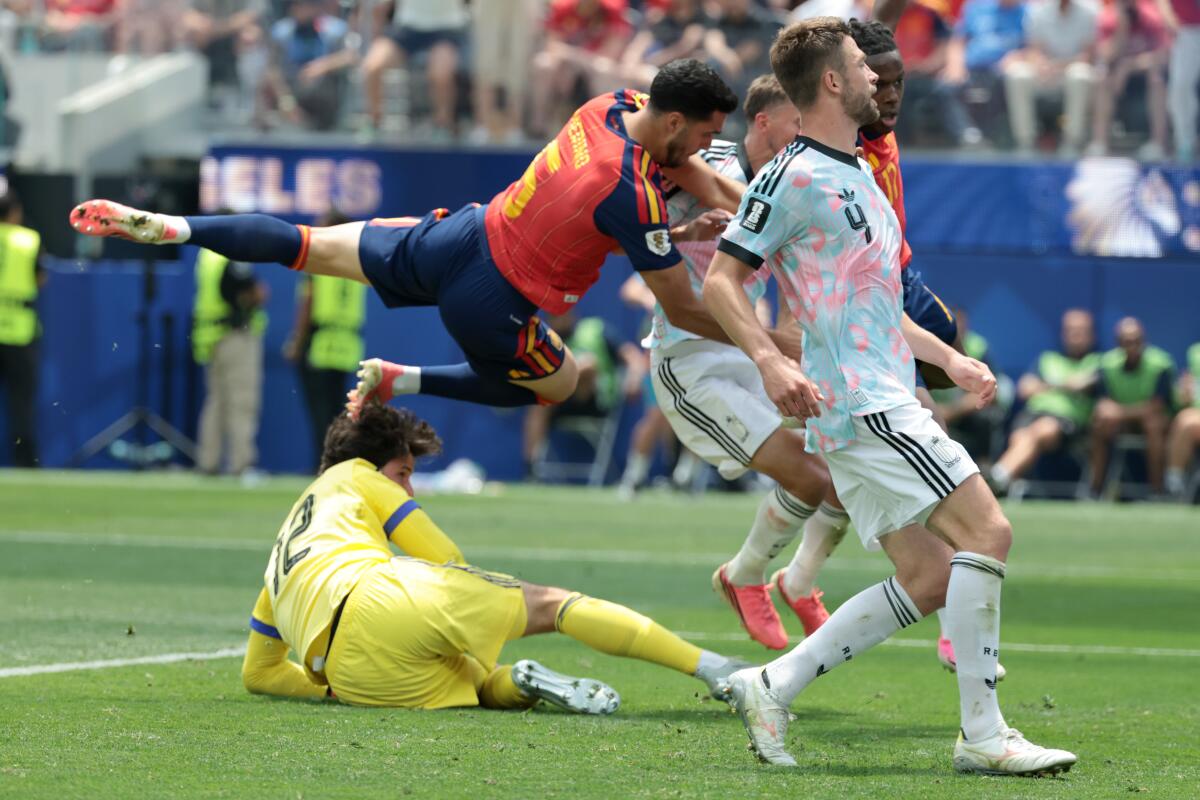
Lammens stopped the first shot he faced, a low shot from close range by Pau Cubarsí in the 88th minute, but he pushed the rebound right at Merino, who had come on less than two minutes earlier. His tap-in was his second winning goal in as many games for Spain.
The goal overcame a score from Belgium’s Charles De Keterlaere, who became the first player to score on Spain in this World Cup when he beat Simón with a spectacular goal late in the first half.
Spain midfielder Mikel Merino scores off a header in front of Belgium goalkeeper Senne Lammens during the second half of Spain’s 2-1 quarterfinal win in the World Cup quarterfinals Friday at SoFi Stadium.
(Robert Gauthier / Los Angeles Times)
Not only has Spain given up the fewest goals in this tournament, it has given up the fewest shots as well. Before De Keterlaere, no one had come close to scoring against Simón since the final group-play game — of the last World Cup.
But if La Roja, ranked third in the world by FIFA, had been an immovable object in this World Cup, Belgium had been an unstoppable force, scoring 12 times in its previous three games. Entering the quarterfinals, only France and Argentina had scored more often.
And no team had taken more shots than Belgium’s 107.
Spain struck first Friday, with Fabián Ruiz giving Simón a 1-0 lead with his first goal of the tournament in the 30th minute. The sequence started with Pedro Porro sending a cross into the box for Dani Olmo, whose shot was parried away by Courtois. But Ruiz pounced on the rebound and deflected a shot past defender Timothy Castagne and into the back of the net.
De Keterlaere matched that 11 minutes later, shielding Cubarsí with his body and one-hopping a Castagne cross past a flat-footed Simón for his third goal in two games, one Courtois reacted to by charging out of the his penalty area toward the Belgian bench, waving his gloved fists in celebration.
Spain, the reigning European champion, last advanced beyond the round of 16 at the World Cup in 2010, when it allowed just two goals en route to its only title. Belgium, ranked eighth in the world, was playing in the quarterfinals for the third time in four World Cups.
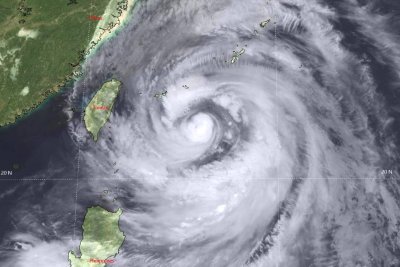
Typhoon Bavi was moving off the Philippines on Friday after pouring rain caused landslides linked to at least 15 deaths, and now has its sights set on Japan, Taiwan and China. Photo courtesy Joint Typhoon Warning Center/Naval Meteorology and Oceanography Command/U.S. Navy
July 10 (UPI) — Typhoon Bavi weakened as it moved off the Philippines on Friday but was expected to bring heavy rain to Taiwan and parts of Japan before it makes landfall in China.
Bavi, which was called Inday in the Philippines, killed at least 15 people after heavy rains caused flash floods and landslides in several villages and cities, and affected tens of thousands of people there, The BBC and The Philippine Star reported.
The typhoon on Friday brought storm surge and rain to Okinawa, Japan, and was expected Saturday to pound the north and east sides of Taiwan, potentially bringing nearly 40 inches of rain in some areas.
Once past Taiwan, the storm could make two landfalls in China, part of which is still recovering after Typhoon Maysak earlier this week.
Maysak’s havoc is linked to at least 39 deaths, though searches were underway for people reported missing.
Hundreds of flights in Japan, including Okinawa and the Sakishima Islands, were canceled on Friday and Saturday as residents braced for Bavi’s pounding rain.
Forecasters in China warned of two potential landfalls as it moves toward the north, noting that Bavi’s size — at it’s widest point, the typhoon is as wide as France — means that both its remnants and outer rain bands are likely to affect a huge swath of people and property.
Striker Haaland has scored seven goals during Norway’s historic run to the quarter-finals.
This is their first World Cup since 1998 – and the furthest they have gone.
It has turned into a summer to remember after wins over Iraq, Senegal, Ivory Coast and Brazil, with Haaland hitting form.
On Friday, the main focus of the last-eight tie was on Haaland and England captain Harry Kane, who has scored six times in five games at the tournament.
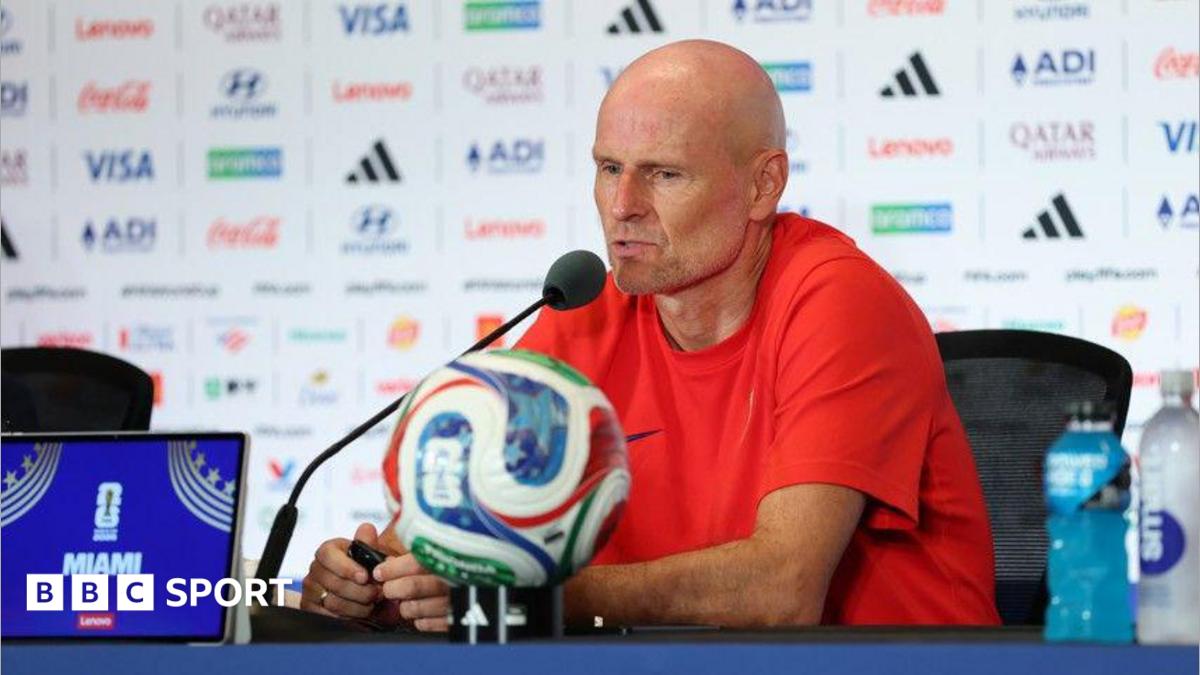
Asked if it would be a straight shootout between the prolific goalscoring pair to determine the outcome, Solbakken said “it’s Norway against England”.
“It’s not a secret that Kane is match-winner number one for England and Erling is match-winner number one for us,” he added.
“There’s no doubt that he [Haaland] is our biggest match-winner, but I think you underestimate some of the other players if you think that’s the whole theme.
“He also needs service but you can’t deny that he is a big, big match-winner for us.”
After battling past co-hosts Mexico 3-2 in the last 16, despite having defender Jarell Quansah sent off in the 54th minute at a hostile Azteca Stadium, Solbakken is a big admirer of England.
He said: “We need to compete and defend properly. We need to concentrate on the pitch and then we can be ourselves.
“Jude Bellingham and Kane score from great positions. I think the most impressive [England] game came when they were better than Mexico.
“Mexico created very few chances and I think [Thomas] Tuchel managed to get their best players in good position. And being match-winners like Bellingham, Kane – they have several options on the wings which means that if one doesn’t have the day, another comes in and then obviously does something good, then steady out in the middle of the park with Elliot Anderson and Declan Rice.”
Norway had 66.4% possession during the memorable win over Brazil.
Asked if he expected his side to have a similar amount against England, Solbakken added: “No I don’t.
“It’s getting hotter. We have trained very lightly. We’ve not done as much hard work [in training]. We have had technical sessions but in a lower tempo.
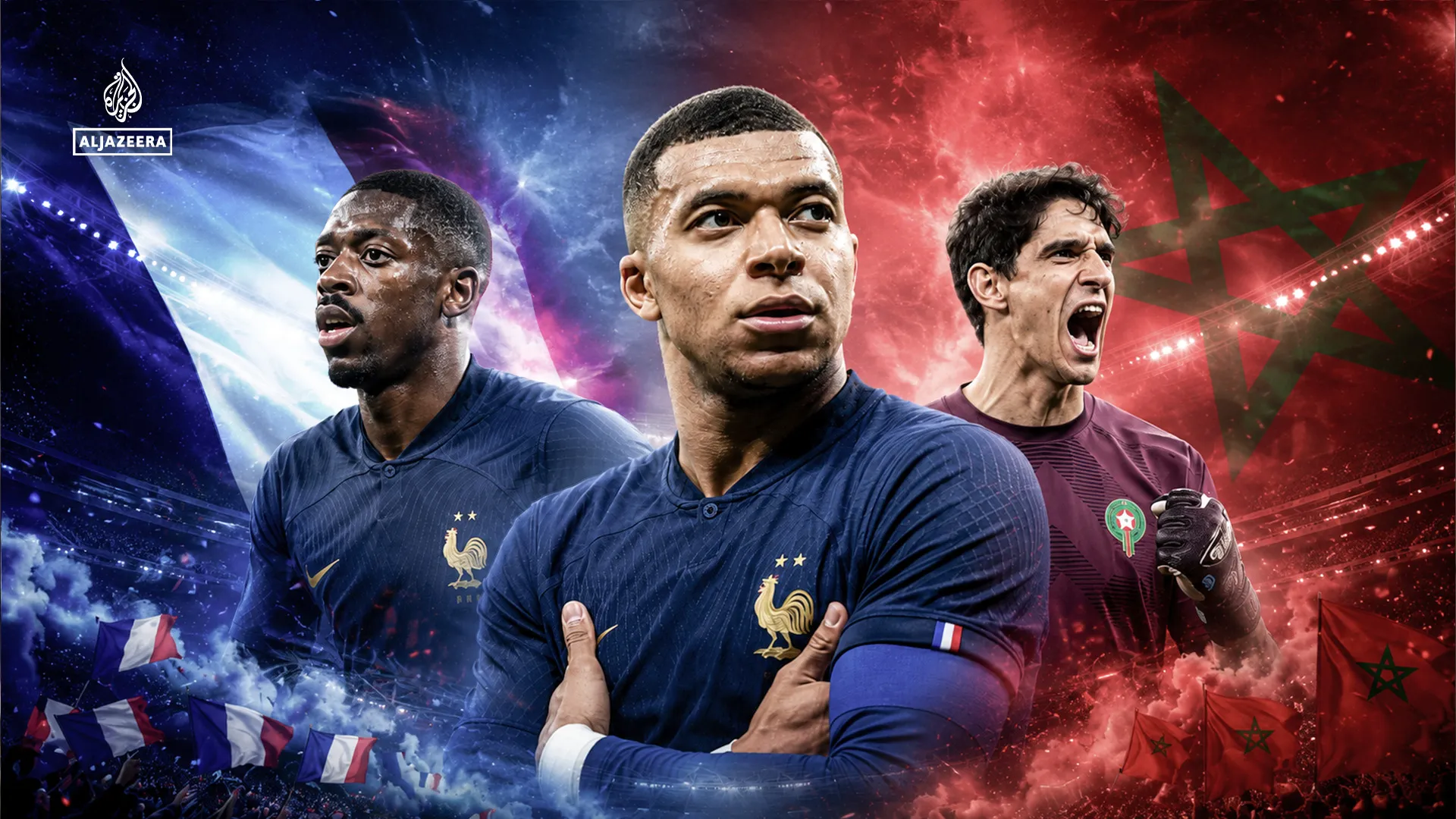
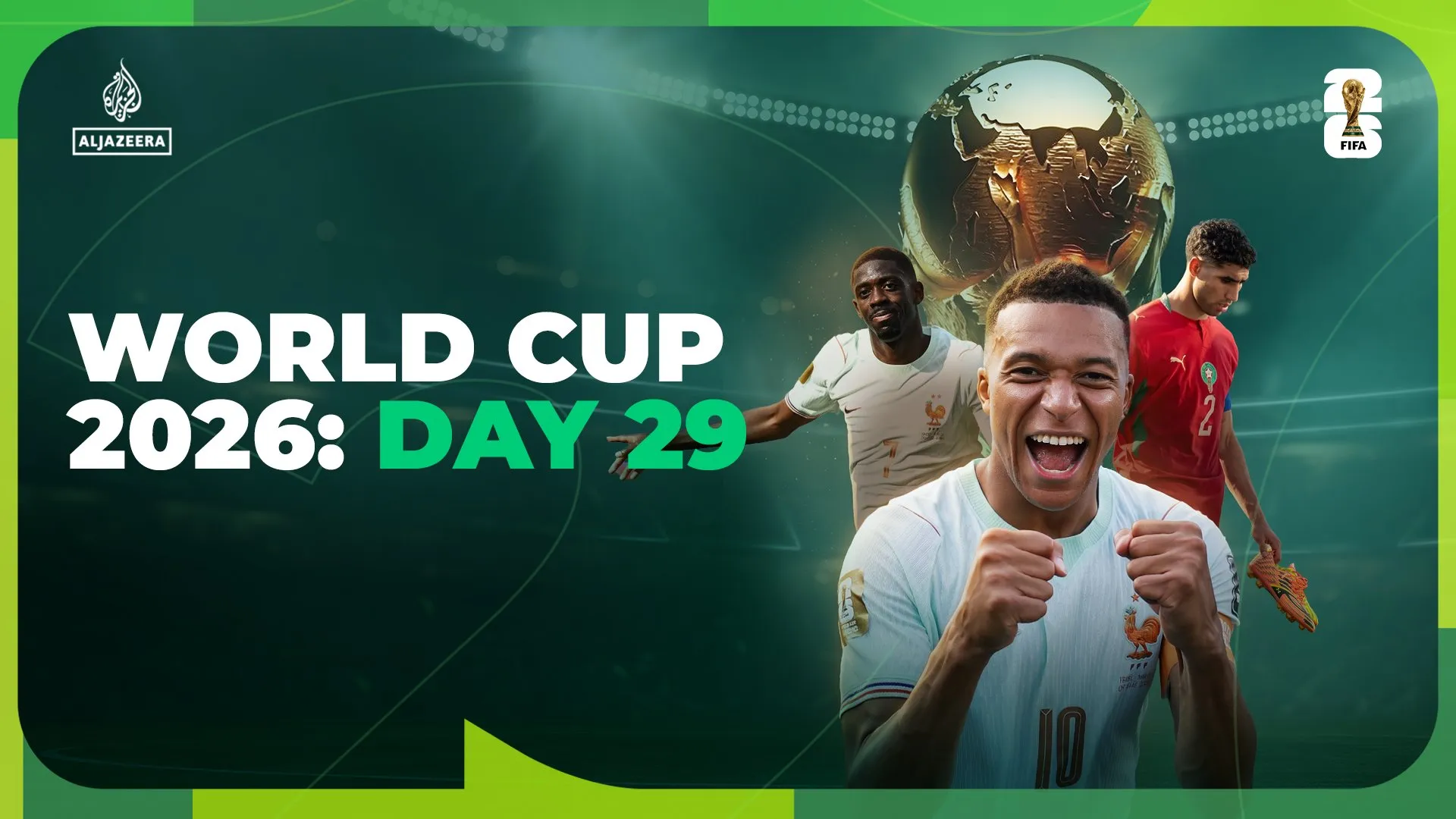
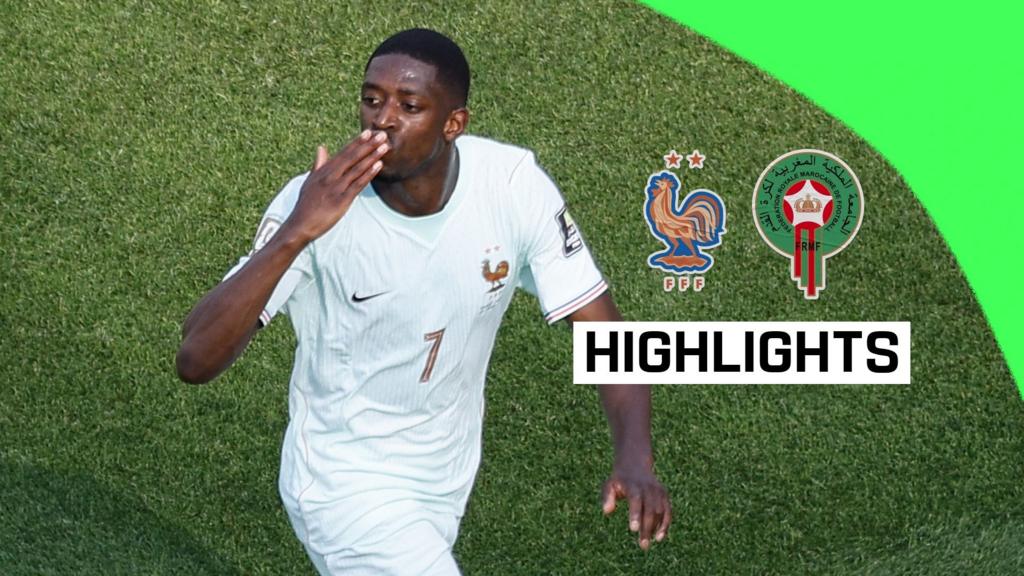
France faced Morocco in a rematch of the 2022 World Cup semi-final. Al Jazeera’s Samantha Johnson was in Boston to soak up the atmosphere, speak to fans from both sides, and see whether Morocco would finally get their revenge.
July 10 (UPI) — Brazilian labor authorities rescued a 62-year-old woman from conditions they described as analogous to slavery after she spent more than five decades working as an unpaid domestic worker for the same family in the northeastern state of Ceará.
The rescue was carried out by Brazil’s Labor Inspection Office, part of the Ministry of Labor and Employment, after an anonymous complaint came through the government’s hotline for reporting labor abuses.
Labor officials told local media the woman, whose identity was not disclosed, performed household duties and cared for the family’s children. Her daily routine began around 4:30 a.m. as she prepared breakfast and got the children ready for school. She worked for 55 years without receiving a salary.
According to O Globo, the Labor Inspection Office found that the woman began working for the family at age 7 and remained employed continuously across three generations.
Throughout that period, she received no regular wages, had no financial independence and was denied the educational and economic opportunities available to members of the employing family.
Labor inspectors estimated the labor rights owed to the woman exceed 1.5 million Brazilian reais, or about $290,000. The calculation includes unpaid wages, vacation pay, annual bonuses, contributions to Brazil’s severance indemnity fund, overtime and other employment benefits, according to O Dia.
The employers signed a conduct adjustment agreement with the Labor Prosecutor’s Office in an effort to partially compensate the victim. Under the agreement, they committed to paying 50,000 reais, or about $10,000, in severance benefits, purchasing a home worth at least 150,000 reais, or about $29,000, for the worker and covering her social security contributions until retirement., according to Folha de S.Paulo.
The agreement does not fully settle the woman’s labor claims, and she may still seek additional compensation through the courts.
Under a joint decision by oversight agencies and a Brazilian human rights assistance center, the woman will temporarily remain at the family’s home but will no longer perform any work.
Authorities said an immediate separation could cause severe emotional distress because of her long-standing dependency and the abrupt loss of her only source of companionship after more than five decades.
The arrangement is temporary while social workers help her through a gradual process of gaining independence, learning to read and write, rebuilding ties with her biological family and preparing for an autonomous life.
The employers’ legal team challenged the findings authorities issued.
In a statement, the family’s attorneys said there had been no “rescue” and denied any criminal wrongdoing. They argued the decades-long relationship with the woman was based on shared living arrangements, care and mutual affection.
Although forced labor in Brazil has historically been concentrated in rural areas, cases of domestic servitude in urban households highlight what labor authorities describe as a serious structural problem. Labor inspectors reported a 400% increase in inspections involving domestic work in 2025.
The Labor Prosecutor’s Office has found that such cases predominantly involve Black women with limited education who are subjected from childhood to conditions of servitude disguised as “family affection.”
A man was reportedly nearly sucked through an airplane window Friday morning. Four people were injured. File Photo by Stringer/EPA
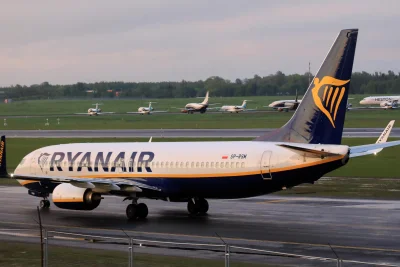
July 10 (UPI) — A man was nearly sucked out the window of a plane on a Ryanair flight from Greece to Germany on Friday, passengers said.
Not long after takeoff from Thessaloniki, in northern Greece, on Flight FR1879 operated by subsidiary Malta Air, a piece of an engine came off and hit a passenger window, shattering it. A 61-year-old Serbian man was lifted out of his seat and hung headfirst out of the window, and was kept from flying out by his wife, who held his legs, The Guardian reported.
Oxygen masks were deployed on the Boeing 737-800 as a precaution.
Data from FlightRadar24 shows the flight was airborne for just over an hour and reached 16,000 feet before descending back to Thessaloniki airport.
“According to reports, the passenger seated next to the affected window was pulled towards it and hit their head. Oxygen masks deployed and passengers seated in the row were relocated.
“The crew descended below 10,000 feet, burned off fuel and safely landed back in Thessaloniki around 75 minutes after departure,” the post said.
Euro News reported that authorities said there was no crack or breach in the aircraft’s fuselage, despite initial concerns about the damage.
Four passengers went to a hospital as a precaution, and one was kept for observation and tests.
Ryanair sent the rest of the passengers on to Germany with a replacement plane.
The airline sent a statement to media Friday.
“A Ryanair flight from Thessaloniki to Memmingen [Germany] on Friday morning (July 10) returned to Thessaloniki shortly after take-off when a passenger window dislodged inflight. The aircraft landed normally, and passengers returned to the terminal. One passenger requested and received medical assistance on the ground in Thessaloniki. In order to minimize any delay, a replacement aircraft was arranged to bring passengers to Memmingen which departed Thessaloniki at 9:53 local this morning,” the statement said.
Three wins to go. How can your team reach the final and win the World Cup 2026? Click here to find out.
Who: Norway vs England What: FIFA World Cup 2026 – Quarterfinals Where: Miami Stadium, Miami Gardens, Florida, the United States When: Saturday, July 11, at 5pm (21:00 GMT) How to follow: We will have all the build-up on Al Jazeera Sport from 18:00 GMT before our live text commentary stream.
Recommended Stories
list of 3 itemsend of list
Four weeks ago, if you told Norwegians their team would be in the World Cup quarterfinals, they might have laughed it off. But this weekend, the Scandinavian country is set to break new ground.
Norway’s dream run in North America enters a new chapter when the tournament’s dark horses take on title contenders England for a place in the semifinals.
It took Norway a whopping 28 years to return to the sport’s biggest stage, and they have made their mark in style – from their traditional Viking row celebrations capturing global attention to striker Erling Haaland becoming the internet’s darling.
A lethal presence in the box and a goofy, no-nonsense personality off the pitch, Haaland has become somewhat of an all-round entertainer for viewers. His exemplary goal-scoring figures make you almost forget he’s playing in his debut World Cup – and next up, the towering striker will go toe-to-toe with England’s Harry Kane, another number nine who delivers when it matters most.
How did Norway and England reach the round of 16?
Norway finished second in Group I with six points, beating Senegal and Iraq and losing to France. They started their knockout phase with a late 2-1 win over the Ivory Coast before stunning Brazil by the same scoreline to reach the quarterfinals for the first time.
England topped Group L with seven points, beating Croatia and Panama and drawing with Ghana. They needed a second-half comeback to beat the Democratic Republic of the Congo in the round of 32 and knocked out cohosts Mexico 3-2 in a scintillating last-16 contest at the iconic Azteca Stadium.
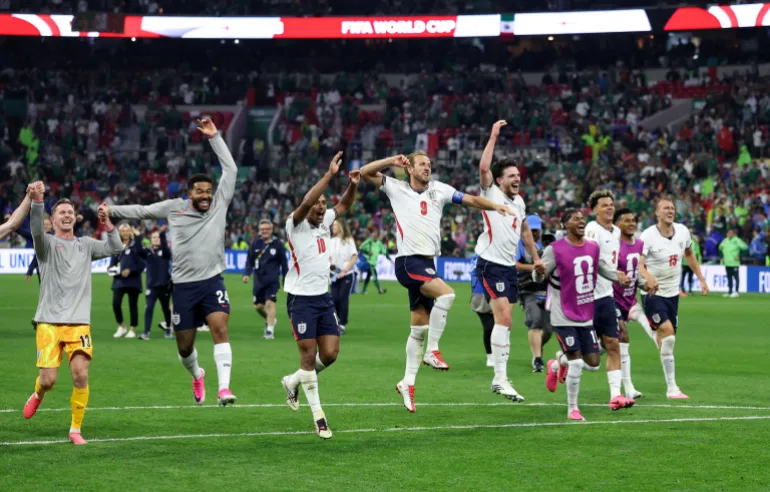
England players celebrate after reaching a third consecutive quarterfinal [Paul Childs/Reuters]
Pressure firmly on England
The chants of “It’s Coming Home” were louder than ever when England’s fighting spirit – against the background of high altitude, history and a red card – steered them to victory against the home side Mexico.
Sharing 10 of the team’s 11 goals between them, the dynamic duo of Kane and Jude Bellingham has kept England alive in the title race, especially at a time when there are defensive deficiencies in the squad.
The in-form side, which also boasts more World Cup experience than Norway, are deemed favourites to reach the semifinals for the first time since 2018.
“We’ve been here a few times,” said England winger Bukayo Saka. “But the best team on the day is going to be the team that wins, so we’re aware of that and that’s where our focus is.”
England’s leaky defence – which has kept only two clean sheets in five games – will face its toughest test yet against Haaland, whose seven goals rank him third in the Golden Boot race, only behind Lionel Messi and Kylian Mbappe.
Haaland: The most recognisable face at the World Cup
In their first World Cup since 1998, Norway, a nation of just more than five million people, has exceeded expectations.
After stunning the record five-time world champions Brazil to reach their first-ever quarterfinal, Norway will be eager to take down another giant and extend their fairytale run.
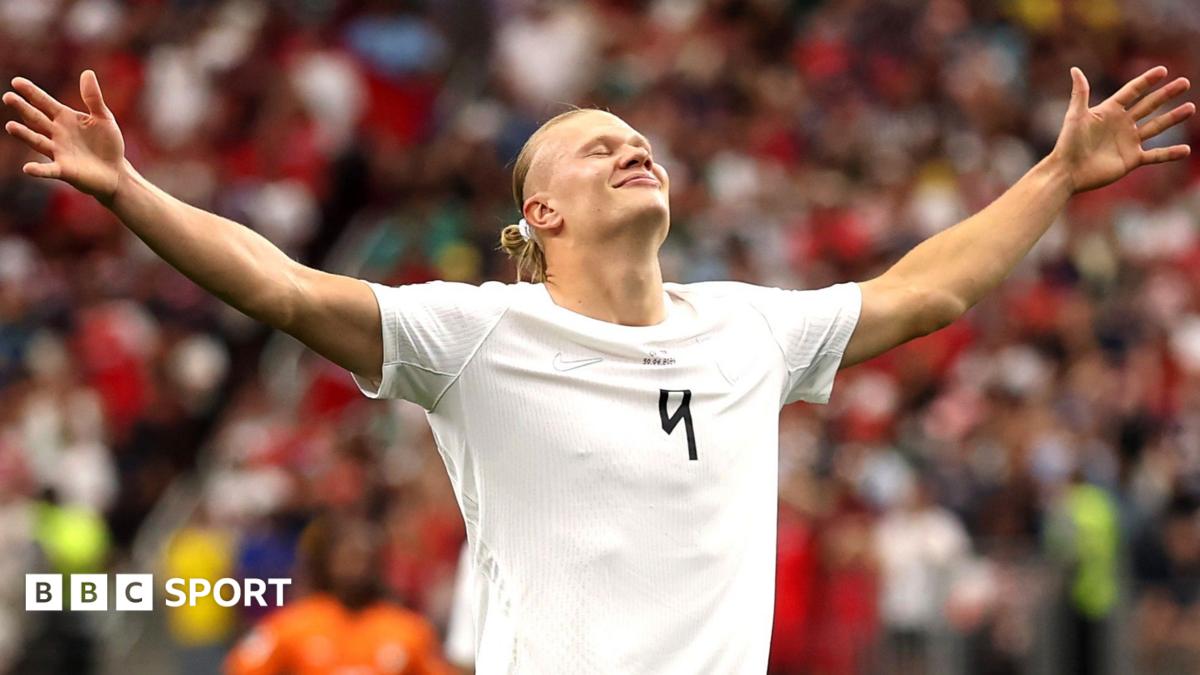
As much as their success has been a team effort, the spotlight has centred on their poster boy, Haaland – the blond, pony-tailed, 1.95-metre- (6ft4-) tall striker and a new social media sensation.
With his nonchalant replies in news conferences, awkward post-match selfies on Snapchat and a glittering collection of luxury handbags, the striker has drawn attention for more than just his goal-scoring prowess. In fact, “Haaland mania” has reached a fever pitch during the course of the World Cup.
Instagram is flooded with AI-generated and animated videos of him, stitched with his now-famous song “Ha-ha-ha-Haaland”.
“It’s important to joke around … I like to joke a little bit, and I like to have fun,” Haaland said. “That’s a key for my daily life – to joke around and, of course, train well and prepare well.”
Haaland’s top-notch preparation has delivered outcomes that even the 25-year-old did not expect.
“To be in the quarterfinals with Norway in the World Cup is quite surprising, even for me,” he said.
“Just to be able to play in the World Cup is, for me, a huge honour, and it was a huge goal for me in my career. To be able to be here and play on the biggest stage with my Norwegian friends against the best teams in the world, it’s really special.”
Norway vs England predictions
The Opta supercomputer gives England a 50.4 percent likelihood of winning in regulation time, while Norway’s chances of winning are 25.1 percent.
The model estimates a 24.6 percent probability of the game going to extra time.
What time is Norway vs England?
Norway: NRK1, NRK2, TV 2 (11pm, Central European Summer Time)
United Kingdom: STV, STV Player, ITV1, ITVX (10pm, British Summer Time)
To check the TV listings for your country, head to FIFA’s TV listing schedule here.
Who will the winner face in the semifinals?
The winner of the Norway vs England match will play Argentina or Switzerland in the semifinals in Atlanta on Wednesday.
Norway vs England: Head-to-head
Norway and England have never met at the World Cup, but have previously faced each other 12 times. England have won seven times, Norway twice, while three matches ended in a draw.
Their most recent encounter came in a 2014 international friendly, which England won 1-0 at Wembley.
Norway vs England: Team news
England will be without defender Jarell Quansah after he was handed a two-match ban for picking up a red card in the game against Mexico. He will miss the quarterfinal and a potential semifinal should England advance.
Centre-back Marc Guehi has a slight hamstring strain and will be assessed later on Friday to see if he is fit to play, while Reece James remains doubtful with a hamstring injury.
Defensive midfielder Jordan Henderson has been ruled out of the rest of the tournament with a broken wrist.
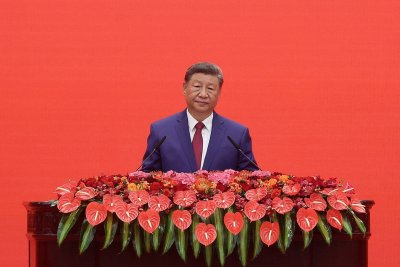
Chinese President Xi Jinping, seen here at a reception in Beijing’s Great Hall of the People in September 2025, met with North Korean Premier Pak Thae Song on Friday, Chinese media reported. File Photo by Kremlin Press Office/UPI | License Photo
Chinese President Xi Jinping met North Korea‘s premier in Beijing on Friday ahead of an event marking the 65th anniversary of the signing of a friendship treaty between the two nations, news footage aired by Chinese state broadcaster CCTV showed.
North Korean Premier Pak Thae-song arrived there earlier in the day for a three-day visit to attend the event commemorating the treaty anniversary at the invitation of China’s Communist Party, according to the report.
The Treaty of Friendship, Cooperation and Mutual Assistance was signed July 11, 1961, by late North Korea founder and former leader Kim Il-sung and then Chinese Premier Zhou Enlai.
The Korean Central News Agency (KCNA), Pyongyang’s state media, reported on Pak’s planned visit to Beijing the previous day, without specifying a detailed schedule.
North Korean leader Kim Jong-un and Chinese President Xi Jinping held summit talks in Pyongyang last month and vowed to strengthen bilateral ties through expanded exchanges across multiple sectors, from economy to culture, as well as more frequent high-level visits.
At that time, Xi stressed the importance of marking the anniversary, fueling speculation that the two countries would hold a large-scale event.
In socialist nations like North Korea and China, anniversaries that fall on five- or 10-year intervals carry particular significance and are typically celebrated with grand events. High-level official visits and exchanges of congratulatory messages had been widely expected.
South Korea’s unification ministry said at a briefing earlier in the day it will “closely monitor” related developments in Beijing.
According to the ministry, this marks the first time in seven years that a North Korean government delegation has been dispatched to Beijing in celebration of the treaty’s anniversary.
The ministry also noted that North Korea has elevated the rank of its chief delegate to premier this year from vice chairman of the Standing Committee of the Supreme People’s Assembly back in 2019.
Copyright (c) Yonhap News Agency prohibits its content from being redistributed or reprinted without consent, and forbids the content from being learned and used by artificial intelligence systems.
Of the four survivors from 2014 and 2018, 34-year-old Courtois has played every minute of this tournament, but De Bruyne, Lukaku and Witsel have featured far less regularly.
Central midfielder Witsel, 37, who left relegated Girona at the end of the La Liga season, was brought on for a single minute at the end of the win over the USA.
At 33, Lukaku has scored an impressive three goals but has done so by playing fewer than 50% of minutes, often coming on as a substitute and taking advantage of a tired defence reeling from the strong pressing of 25-year-old Atalanta forward Charles De Ketelaere.
And De Bruyne, now 35, was injured during the Senegal game – before his departure Belgium had won one out of three matches, but since then they have won twice and scored seven goals in roughly 130 minutes of play.
Full-back Thomas Meunier also played in the 2018 tournament, but not 2014, and his minutes played have decreased as the tournament has gone on.
None of that is to say the more senior players are not contributing – Courtois remains one of the world’s best goalkeepers, Lukaku’s goals have been crucial, and De Bruyne’s performances were among the team’s best before his unfortunate injury.
But their role in the squad is changing, with a greater reliance on them making the difference in key moments rather than taking responsibility for the overall quality of the team’s performances.
So far at least, Garcia and Belgium appear to handling the transition better than many teams do when their stars begin to fade.
A fire-fighting helicopter battles a deadly wildfire early Friday near Los Gallardos in Spain’s southern Almeria region. Photo by Carlos Barba/EPA
July 10 (UPI) — A huge wildfire raging in southern Spain killed at least 11 people with another 19 unaccounted for, authorities said Friday as more than 700 firefighters and troops, nearly 200 firetrucks and 16 aircraft battled the flames.
The Andalusian government said in a post on X that all indications pointed to the main blaze, which had already burned through more than 3,000 acres near Los Gallardos in Almeria province, being sparked by a fallen power pole before spreading to woods nearby.
Warning casualty numbers could increase substantially, Andalusian President Juanma Moreno said eight people were injured, four of them seriously.
“I’m on my way to Almeria. The consequences of Los Gallardos are devastating. Right now, all efforts are focused on controlling the fire and preventing further loss of human life,” he said in an update online.
The fatalities occurred in and around Bedar village, just northwest of Los Gallardos, with Andalusia’s health minister saying he believed four of those killed whose bodies were found in a car were likely Britons.
Health and Emergencies Minister Antonio Sanz said he had reason to believe they were British because the vehicle was right-hand drive whereas European cars are all left-hand drive — with the exception of Ireland, Cyprus and Malta.
The Spanish armed forces’ Military Emergencies Unit said in a post on X that it had 220 soldiers and 70 fire vehicles on the scene “attacking the frontline of the wildfire head-on to contain its advance.”
The provincial government said around 600 area residents remained evacuated.
More than 200 miles away in western Malaga Province, 1,000 people were evacuated from two residential complexes in the mountain village of Benahavis as a precautionary measure due to an “urban wildfire” that broke out on Thursday afternoon, the government said in a statement.
Authorities said more than 230 firefighters and other emergency personnel and 10 firetrucks were continuing to work to bring the fire under control and that the region’s Wildfire Prevention and Suppression Plan had been activated.
Residents forced to leave their homes were accommodated in a sports center, by the Red Cross and with family and friends or in local hotels.
Weeks of unseasonably hot weather across western and southern Europe, including three heatwaves with temperatures topping 40 degrees Celsius, has triggered a series of wildfires that have burnt at least 49,000 acres across Spain, Portugal, Greece and France.
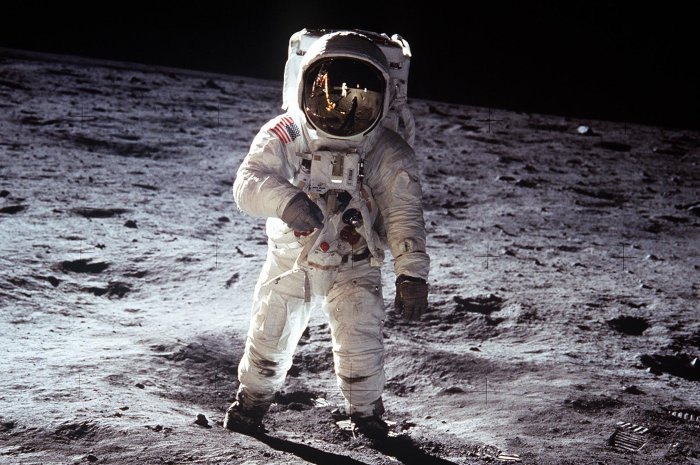
Astronaut Buzz Aldrin walks on the surface of the Moon during the Apollo 11 mission on July 20, 1969. Photo by NASA/UPI | License Photo
This photo, taken Friday, shows the trading room of Hana Bank in Seoul as South Korean stocks closed higher on a semiconductor rally. Photo by Yonhap
South Korean stocks closed higher Friday, extending their winning streak to a second consecutive session, as semiconductor shares rallied following overnight gains on Wall Street. The local currency gained ground against the U.S. dollar.
After choppy trading, the benchmark Korea Composite Stock Price Index (KOSPI) added 184.03 points, or 2.52 percent, to close at 7,475.94.
Trade volume was moderate at 449.53 million shares worth 31.16 trillion won (US$20.73 billion), with gainers far outnumbering losers 799 to 92.
Institutions purchased a net 1.13 trillion won worth of shares, while individuals and foreigners sold a net 772.82 billion won and 322.56 billion won, respectively. Foreign investors turned net sellers after two consecutive sessions of net buying.
After opening more than 3 percent higher, the KOSPI climbed as much as 5.7 percent during the session, triggering a buy-side sidecar that temporarily halted program trading in KOSPI-listed shares for five minutes. It marked the third activation of the trading curb this week.
The KOSPI gave up some of its earlier gains in afternoon trading as investors locked in profits.
Investor sentiment improved after U.S. stocks closed higher overnight, supported by a strong rebound in semiconductor shares and easing oil prices.
The Dow Jones Industrial Average gained 0.27 percent, while the S&P 500 rose 0.81 percent. The tech-heavy Nasdaq Composite climbed 1.3 percent.
In Seoul, large-cap stocks finished broadly higher.
Semiconductor heavyweight Samsung Electronics went up 2.52 percent to 285,000 won.
In contrast, SK hynix edged down 0.27 percent to 2.18 million won after opening higher. The company is set to make its debut on the tech-heavy Nasdaq through the listing of its American depositary receipts (ADRs).
“Investor sentiment toward the semiconductor sector improved as Meta’s capital spending plans and Micron’s investment outlook helped ease concerns about the industry’s prospects,” said Lee Kyung-min, an analyst at Daeshin Securities. “Strong investor demand for SK hynix’s ADR offering also supported sentiment toward semiconductor stocks, adding upward momentum to the broader market.”
Artificial intelligence investment firm SK Square advanced 6.18 percent to 1.41 million won, while chip components maker Samsung Electro-Mechanics gained 6.1 percent to 1.58 million won.
The Korean won was quoted at 1,501.4 won against the U.S. dollar at 3:30 p.m., up 4.7 won from the previous session.
Bond prices, which move inversely to yields, closed higher. The yield on three-year Treasurys went down 1 basis point to 3.768 percent, and the return on the benchmark five-year government bonds lost 0.8 basis point at 4.008 percent.
Copyright (c) Yonhap News Agency prohibits its content from being redistributed or reprinted without consent, and forbids the content from being learned and used by artificial intelligence systems.
There has been unrest on the streets of London where Morocco fans were confronted by police following their team’s 2-0 loss to France and exit from the World Cup. Several arrests were reportedly made late on Thursday night around London’s Edgware road.
Three wins to go. How can your team reach the final and win World Cup 2026? Click here to find out.
Who: Spain vs Belgium What: FIFA World Cup 2026 – quarterfinal Where: Los Angeles Stadium in California, United States When: Friday at noon (19:00 GMT) How to follow: We will have all the build-up on Al Jazeera Sport from 15:30 GMT before our live text commentary stream.
Recommended Stories
list of 3 itemsend of list
After crushing the “American dream” by taking down cohosts USA in a politically influenced encounter, Belgium are gearing up for their next big challenge.
They face the daunting task of tackling Spain, whose robust defence and careful, possession-based football have made them one of the bookmakers’ favourites at the tournament.
Since an unconvincing performance in the first match, Spain have improved with each contest and punched their ticket to the quarterfinals in style.
They are the first team in history to keep six consecutive World Cup clean sheets – a record achieved by taking out Portugal on Monday and ending Cristiano Ronaldo’s last bid for a world title.
Belgium’s knockout campaign in North America has been nothing short of a roller-coaster, and come Friday, it could take another turn if they upset the reigning European champions to reach the semifinals.
Al Jazeera tells you everything about Spain vs Belgium:
How did Spain and Belgium reach the quarterfinals?
Spain topped Group H with seven points, beating Saudi Arabia and Uruguay and drawing with Cape Verde. They began their knockout campaign with a 3-0 thrashing of Austria in the round of 32 before beating Portugal 1-0 with a late goal in an Iberian football derby in the round of 16.
Belgium topped Group G with five points, winning against New Zealand, and drawing with Iran and Egypt. They defeated Senegal 3-2 in extra time in the round of 32 before thrashing the USA 4-1 in the last 16 contest that was eclipsed by the bitter row over Folarin Balogun’s red card ban.
Courtois is confident Belgium can take down Spain
There may be only five spots between Spain’s and Belgium’s FIFA rankings with La Roja third and Belgium eighth, but the gap in their quality is quite stark.
Spain, the 2010 world champions, are unbeaten in 35 matches, a run that has turned coach Luis de la Fuente’s side from promising European champions into a team that exert confident control over their opponents.
Historically, Belgium have been far behind their Spanish counterparts, especially at major tournaments, having been knocked out in the group stage at the 2022 World Cup and in the last 16 at Euro 2024.
Yet goalkeeper Thibaut Courtois believes Belgium can pull off an upset after finally beginning to show some form at the tournament with a come-from-behind extra-time win and a statement performance in their last two games.
“Everyone on our team realises it’s possible. I think we have a strong squad with qualities that Spain will have to take into account,” Courtois told reporters on Wednesday.
“There are always surprises, and I think we can be one of them. Eliminating the European champions would obviously be a huge upset. The confidence is there.
“People were a bit disappointed in us, but we’ve set that right. We’re getting better and better,” he added about Belgium, whose best finish was third place at the 2018 World Cup.
The World Cup is likely the last hurrah for the remainder of Belgium’s so-called golden generation, including creative midfielder Kevin De Bruyne and striker Romelu Lukaku.
Lukaku is Belgium’s top scorer at the tournament with three goals while Leandro Trossard has made an all-round impact with two goals and two assists. Charles De Ketelaere and Youri Tielemans also have two goals each.
‘Yamal brings so much to the team’: Olmo
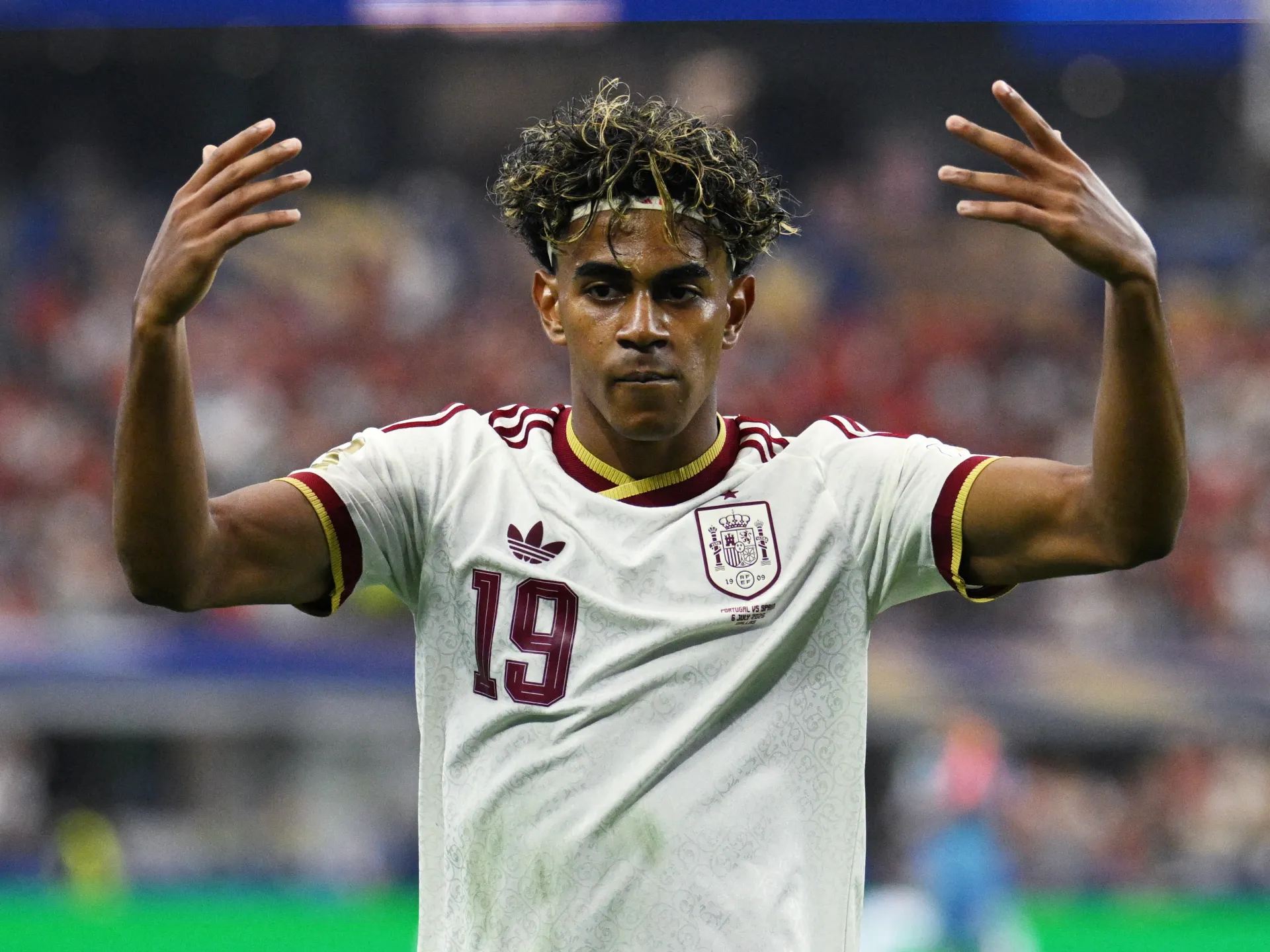
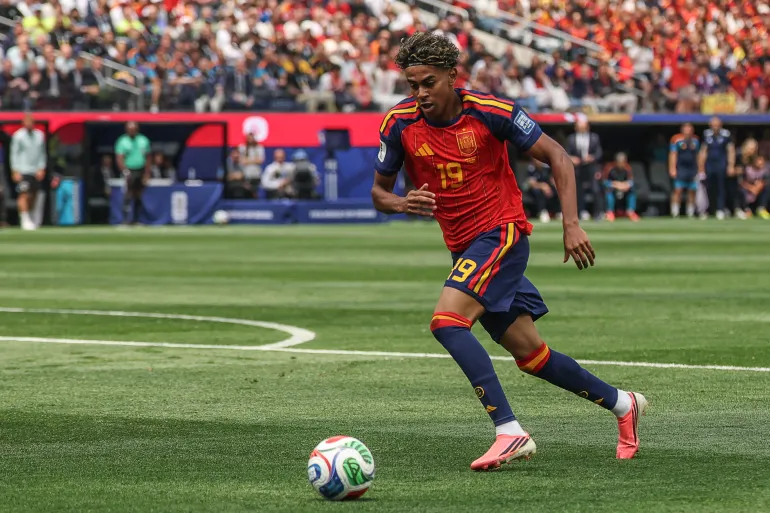
Slowly finding his feet in his debut World Cup, the prodigiously gifted Lamine Yamal has not enjoyed the hero’s status he’s often used to.
With one goal in five games, the 18-year-old winger – who came into the World Cup on the back of a hamstring injury – is playing catch-up with Mikel Oyarzabal, Spain’s leading tournament scorer with four goals.
Midfielder Dani Olmo said his Barcelona teammate Yamal is growing into the tournament.
“He brings so much to the team with his dribbling and presence. When he receives the ball, two or three opposing players close in on him, which opens up space,” he said.
“Lamine scores and assists. He’s always done that in his short career, and even when he doesn’t, he’ll keep helping us with the work he’s doing.”
Spain forward Lamine Yamal is playing at his maiden World Cup [Etienne Laurent/AFP]
Spain vs Belgium prediction
The Opta supercomputer gives Spain a 59.3 percent likelihood of winning in regulation time while Belgium’s chances of winning are 18.3 percent.
The model estimated a 22.4 percent probability of the game going to extra time.
Kickoff time, TV schedule
Spain: LA1, Teledeporte, RTVE Play, DAZN Mundial (9pm, Central European Summer Time)
Belgium: VRT Max, Tipik, Auvio, Sportz, VRT (9pm, Central European Summer Time)
United Kingdom: STV, STV Player, ITVX, ITV1 (8pm, British Summer Time)
To check the TV listings for your country, head to FIFA’s TV listing schedule here.
Who will the winner face in the semifinals?
The winner of the Spain vs Belgium match will face France in the semifinals on Tuesday in Dallas, Texas. France defeated Morocco 2-0 on Thursday to reach the last-four.
Head-to-head
Spain and Belgium have met twice at the World Cup with honours even at one victory apiece.
Their first meeting dates back to 1986 when Belgium beat Spain 5-4 on penalties in the quarterfinals. Then they met in the group stage in 1990 with Spain winning 2-1.
Friday’s match will be Belgium’s third quarterfinal in four World Cups and fourth overall.
For Spain, the quarterfinals have not often been a happy hunting ground. They have only cleared this stage twice, making it to the final group stage in 1950 and beating Paraguay on their way to lifting the trophy in South Africa in 2010.
Team news
Belgium’s midfielder Amadou Onana will miss the remainder of the World Cup after suffering a torn anterior cruciate ligament (ACL) in his right knee during the last match.
When then England manager Gareth Southgate was asked in 2020 whether there was a chance Haaland might have played for the Three Lions, he shut it down quickly.
“With players like him, they’re quite clear where they want to play,” Southgate said. “He feels that allegiance to the country that he’s playing for now and you’re always very respectful of that.”
Haaland was born in Leeds – where his father Alf-Inge was still based, having just left Leeds United for Manchester City – in 2000.
The family moved to Bryne in Norway three years later following his father’s retirement through injury.
The young Haaland’s talent was spotted early and he quickly moved through the youth teams at Bryne before signing for Molde in 2017, managed by Ole Gunnar Solskjaer.
He helped turn Haaland into an attacking force and has often spoken highly of his former player, expressing regret that he could not sign him when he became manager at Manchester United.
The young forward caught the eye during his time at Red Bull Salzburg before his spell at Borussia Dortmund – where he formed a close friendship with England’s Jude Bellingham – really announced him on the world stage.
His move to Manchester City came in 2022 – a transfer many felt had been inevitable given his father’s history and his own love of English football.
Yet even with his rapid ascension to stardom, Haaland continues to return to Norway frequently where he owns several properties.
“Despite Haaland’s global superstar status, he remains the exact same guy,” Norwegian football journalist Andreas Korssund told BBC Sport.
“He knows exactly where he comes from and regularly visits his small hometown in Rogaland. He is incredibly proud of his roots and always makes himself available to the Norwegian press when representing his country.”
Haaland has discussed his desire to run a farm in his home country when he retires and can frequently be spotted strolling around Oslo, where he owns an apartment.
He has leaned into Norway’s Viking history and is fiercely proud of representing his country, as illustrated by leading his team-mates in the Viking Row after beating Brazil.
It is that affinity with his heritage that has also led to him sporting his full title of Braut Haaland on the back of his national shirt – Braut is his mother’s maiden name and combining that with his father’s name is a Norwegian tradition.
“Haaland means everything to Norway,” says Korssund.
“He has become an unprecedented superstar in the world’s biggest sport. For a nation of just over 5.5 million people to produce one of the absolute greatest footballers on the planet is immense.”
Democratic Party lawmakers Kim Seung-won, Kim Han-kyu, Park Sang-hyuk and Lee Hae-sik, members of the party’s Criminal Procedure Act revision task force, submit a partial revision bill at the National Assembly on Thursday. Photo by Asia Today
July 9 (Asia Today) — South Korea’s ruling Democratic Party introduced a revision to the Criminal Procedure Act on Thursday that would abolish prosecutors’ supplementary investigation power.
The bill would remove prosecutors as investigative agents while strengthening their authority to request supplementary investigations from police. The party said the measures are intended to reduce investigative gaps.
The Democratic Party’s task force on revising the Criminal Procedure Act submitted the bill to the National Assembly’s bill office. The proposal would completely separate investigation and indictment. It would abolish prosecutors’ supplementary investigation power while strengthening their authority to request further investigations and introducing the power to request the replacement of investigators, increasing oversight of investigative agencies.
Kim Han-kyu, the party’s senior deputy floor leader for policy, told reporters after submitting the bill that the revision is designed to adjust investigative authority, strengthen checks and supervision over investigative agencies and enhance protections for victims and complainants ahead of the planned Oct. 2 launch of new investigation and prosecution agencies.
The Democratic Party removed the legal basis for prosecutors’ direct investigations from the bill. But it added a one-month deadline for police to complete supplementary investigations requested by prosecutors. In cases in which the statute of limitations is about to expire, prosecutors would be allowed to set a shorter deadline. The bill also allows one extension.
If a judicial police officer assigned to a supplementary investigation is deemed inappropriate to handle the case, the head of the prosecution office would be allowed to request the replacement of the investigator. The bill also allows supplementary investigations to be assigned to another investigative agency.
Prosecutors’ authority to demand corrective measures would also be strengthened. Even before a case is referred to prosecutors, if a prosecutor confirms that an investigative agency conducted an improper investigation, the prosecutor would be allowed to receive the case from judicial police and transfer it to another investigative agency.
Police would also be required to submit investigative records and lists of materials to prosecutors in cases they decide not to refer for prosecution.
The bill strengthens victim protection provisions. If an improper investigation is suspected, suspects as well as complainants, victims and legal representatives would be allowed to file reports about the case. Prosecutors receiving such reports would be allowed to demand corrective measures from the investigative agency or transfer the case to another agency.
The Democratic Party plans to review the bill Friday at the National Assembly Legislation and Judiciary Committee together with previously submitted bills.
Rep. Kim Seung-won said the committee’s first bill review subcommittee plans to meet once or more than twice a week to conduct an intensive and swift review.
Kylian Mbappe scores his eighth goal of this World Cup to make up for an earlier penalty miss with Ousmane Dembele adding a second as France prove too good for Morocco and move into the semi-finals.
Whether or not France’s World Cup campaign ends with a third world title, few will remember Kylian Mbappe’s penalty miss in their quarter-final victory over Morocco.
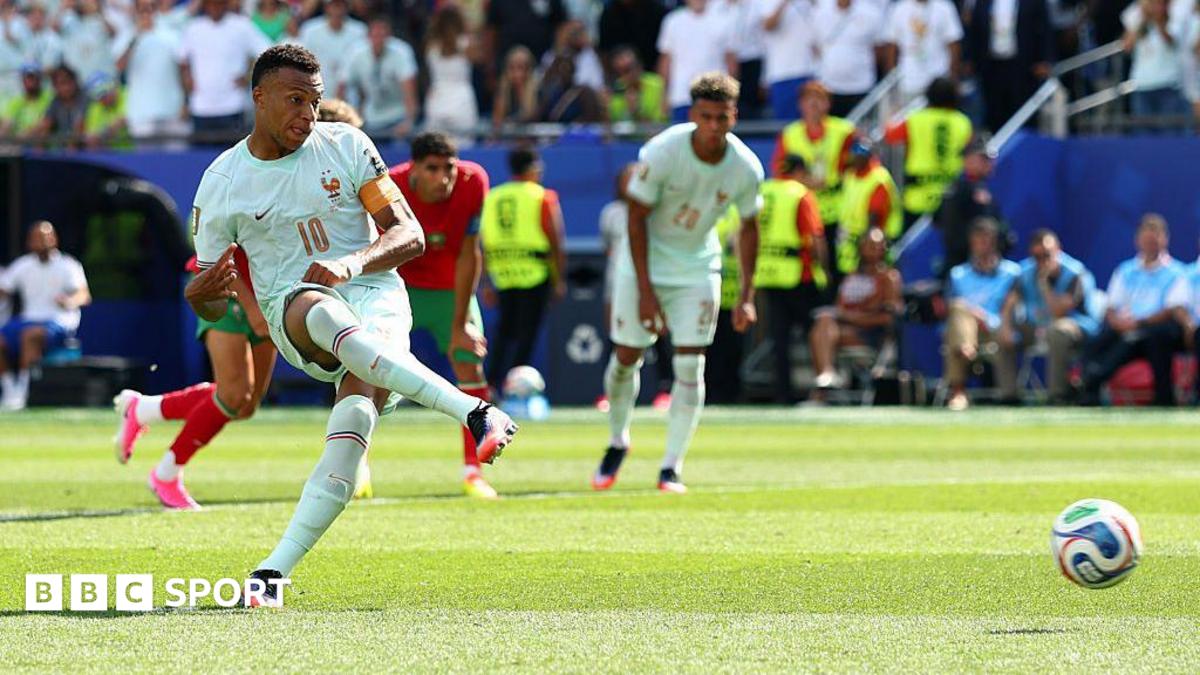
The match in Foxborough was goalless when Mbappe was fouled by Noussair Mazraoui. The France captain stuttered in his run up, looked up at goalkeeper Yassine Bounou, and saw his tame penalty easily saved.
Mbappe made amends on the hour mark when his sensational curling effort broke a stubborn Morocco defence, before Ousmane Dembele doubled France’s lead six minutes later to secure a 2-0 win.
But his earlier blunder, uncharacteristic for the joint-top scorer in this tournament, begs the question: Is it time players stopped with the ‘stuttering’ penalty kicks?
In the list of things football traditionalists hate about the modern game, stuttering run ups are high up alongside players wearing gloves with short sleeve shirts, diving, and of course the video assistant referee (VAR).
There is no strict definition of a stutter, but under Fifa rules, a player is allowed to stop or feint during the run-up as long as they don’t do it directly before kicking the ball.
It’s nothing new – John Aldridge, Mexico legend Hugo Sanchez and Pele all used the stutter to gain an advantage – but it can backfire spectacularly if the goalkeeper doesn’t commit to diving early.
Mbappe joins Bruno Guimaraes, Jorgen Strand Larsen, Lionel Messi and Harry Kane (though he was able to retake his penalty against Croatia, which he scored without having a stutter in his approach) in missing penalties after stuttering in the run-up.
Of the 26 ‘stutter’ penalties taken during this World Cup – penalty shootouts included – 11 have not been scored, which leads to a conversion rate of 57%.
“This stuttering penalty seems to be the one. The goalkeepers seem to have got a march on it now,” said Ian Wright on ITV.
Marko Arnautovic, Raul Jimenez, Neymar, Mbappe, Cristiano Ronalo, Yoane Wissa and Kai Havertz have used the technique successfully.
Meanwhile, 24 of the 35 ‘non-stutter’ penalties taken have been scored, a conversion rate of 68%.
In general, this has been a poor World Cup for players looking to convert from 12 yards.
A total of 30% of non-shootout penalties have been missed this summer, the second most of any World Cup since records began in 1966.
When shootout penalties are added to the equation, then the miss rate rises to 35%, the highest of any World Cup since 1966.
“There is an arms race going on. It is definitely harder to score a penalty now. The reason being, the goalkeepers are bigger now, more athletic,” former Scotland winger Pat Nevin said on BBC Radio 5 Live.
“If your keeper goes the right way, you must hit the side netting with pace, even then it still might be saved.
“A very good penalty is no longer a certainty, so you have to re-think it. I need to make sure he goes the wrong way, hence the stutter, you try to send them the wrong way.
“Of course the goalkeepers have the data, they know what everybody does, there is no hiding what you prefer because it shows up. There is a constant running battle to figure out how you get the advantage.
“Mbappe knows what his advantage is: preparation. He has a set up [placing the ball before taking the penalty], he went through it twice today but problem is that he had to go through it three times, and the third time [he missed].”
Before the game against Morocco, former England striker Ian Wright called Deschamps’ side “one of the most clear favourites for a World Cup tournament I have ever seen”.
After a dominant victory in Boston, in which France had 22 attempts compared to only five from Morocco, who had their only shot on target in the 83rd minute, Wright remained impressed.
“It is difficult to see the weakness,” said Wright. “If Spain get through they have the quality to maybe pass through them and maybe the pace of Lamine Yamal to try and punish them, but France look imperious. Then you have got individual brilliance.”
As well as Mbappe and Dembele, France also have plenty of further attacking options in their squad, including Bayern Munich’s Michael Olise, Paris St-Germain pair Bradley Barcola and Desire Doue, Manchester City’s Rayan Cherki and Crystal Palace striker Jean-Philippe Mateta.
At the opposite end, France have now only conceded two goals in six games – late on in a 3-1 win over Senegal and once in the 4-1 victory over Norway, albeit a side that had rested most of their first 11 having already qualified for the knockout phases.
“France have got more gears to go,” said former Manchester United captain Roy Keane. “France were so much better in every aspect of the game, but it doesn’t mean they cannot be beaten.
“France are in a great place. You have your attacking players scoring goals and your individual players going past people. Any chance of beating France you have got to score the first goal. Even if they get the first goal, teams have to come at them, and they will pick you off for fun.”