World

Dumbfoundead reveals his hip-hop survival story in new book ‘Spit’

Jonnie Park has always gone by many names. The most Google-able is his hip-hop moniker “Dumbfoundead,” which he’s gone by for decades as a seasoned battle rapper and an artist who’s put out a jaw-dropping 13 albums while becoming one of the kings of legendary Leimert Park hip-hop crew, record label and open mic Project Blowed. As a resident of L.A.’s Koreatown since childhood, he’s still known as “The Mayor of K-town.” To his friends, he’s just “Dumb.” Of all the aliases and titles he’s fought for, “author” might seem to be the most unlikely. But as a professional when it comes to producing scathing hot bars in battle raps, it felt only right to put his journey down the warpath of rhymes on paper in his debut memoir “Spit: A Life in Battles,” released April 14 on Third State Books.

The memoir (which includes a foreword by Park’s longtime friend, R&B star Anderson .Paak) recounts razor-sharp memories starting from childhood, including the harrowing story of his family’s immigration from Argentina to L.A. when he was 3. He talks frankly about the perils and prejudice of growing up Korean American in Southern California and thrusting himself into the hip-hop scene, where, after stumbling in as an outsider to Black culture, he ultimately found his voice on stage. It speaks to the foundation that later served him well as an actor, podcaster, comedian and recently TV writer for season 2 of the hit show “Beef.” But he says his reputation as a battle rapper is the one that will always matter most.

Recently Park spoke to the Times about the hardest parts of writing his new memoir, the importance of Project Blowed and taking his underground rap mentality with him from the gutter to the stars.

For your memoir you purposely take the parts of your life from childhood until about age of 30, the peak of your hip-hop career. What was it like to go back and take that journey again?

To me, it’s always kind of the core of who I am. Even as a multi-hyphenate, I always say I’m first and foremost a battle rapper. It was such a pivotal moment at a time in my life and I take that label with me wherever I go, so it doesn’t feel too distant. But to actually be in that arena feels very distant. I look back and I just think about the audacity of a young Asian kid in that world. I’m just like “Wow, I really had the balls to do this at one point.” And I still love the subculture of battle rap. It’s something I’m a part of and a story that I want to tell in all these other mediums — whether it’s screenwriting or developing a TV show, I still feel like there’s a lot to be done with that subculture.

Why was it important for you to help your readers learn about the technical aspect of battle rap and what it takes to be a battle rapper?

There’s a lot more layers to it than people know. Obviously we know Eminem’s “Eight Mile” was the height of the story of where battle rap got to, and it did a great job of that. Obviously it’s been many years since then. But I also wanted to let people know that the people involved in this subculture aren’t just in poverty trying to make it out and get on a record label. This is a real subculture that people obsess over and I just wanted to find an excuse to nerd about it and also teach people this kind of new era of battle rap. I also highlight some of my peers really deserved it, and including the open mic I went through called Project Blowed. That’s the one thing I love about this book is that I can immortalize some of my personal heroes and places that I hold dear to my heart.

But mechanics of how our brains work when freestyling is something I find interesting. People always ask me “How do you guys freestyle or battle?” And I was really nervous about explaining it. I just didn’t know how I would do that. I had the help of my co-author, Donnie Kwak, who I’ve known for many years. He’s never written a book either, but he’s just kind of like a big brother to me and we’ve had many conversations about this. So being able to break that down was really cool for me. And I still really love that chapter about freestyling and battling for dummies.

Dumbfoundead smiles against a wall

Dumbfoundead’s memoir “Spit” chronicles his rise through underground battle rap, offering deeper insight into the subculture.

(Lenne Chai)

What was it like for you as you were discovering your voice through open mics at Project Blowed?

Project Blowed freed such a big part of me. I think when I saw the other rappers there, and they were taking [rapping] to heights I never imagined, the styles of raps that I would see here, from there, were so unorthodox. At that point, I was listening to everything on the radio along with mix tapes and stuff. But this was not even that. This wasn’t even like the underground mix tapes. It was the most raw and purest form of rap. It was so weird and abstract, even for me, just the young Korean kid at the age of 14 that hadn’t gone south of Pico Boulevard, growing up on Third Street, and all of a sudden I’m on 43rd. It was like another world for me. Next thing I know, I’m immersed in this world where there’s black kids that are into anime, punk rock and rapping their a— off. And I’m like, “This is insane!” So it did a lot for my perception of everything, more than just hip-hop.

Why was it so important for you to kind of showcase your Korean from not only the standpoint of a rapper but also as a writer?

Definitely the Korean American part was very important to me, because we see Korean culture, Korea especially being this global powerhouse, and what we know of it is the “Squid Games,” and the K-Pop of it all. And so I did want to share this more in the perspective of a Korean American. Even more specifically, in Southern California, in Los Angeles, there is a different vibe of Asian American life than the rest of the country. I’m the epitome of that. A lot of our parents have these wholesale businesses downtown or dry cleaners or liquor stores. Growing up in K-town, a lot of Korean families have a dad who’s an alcoholic, and there’s a lot of domestic violence situations. I think through my story, a lot of people will see themselves in these situations.

Cover of Park's memoir "Spit."

Jonnie Park, a.k.a. Dumbfoundead, writes in his memoir about growing up in Koreatown.

(Third State Books)

I think it also just speaks to all the different layers of struggle, battles that you and your family have gone through. Were there any aspects of this book that were really challenging for you?

The hardest part was definitely writing about my father, and knowing that this book is going to be out in the public because it’s so revealing. There’s affairs, there’s businesses that he worked at that are named. These families do exist — I grew up with that family that my dad had an affair with. I don’t talk to them or anything, but it’s all in the book. And I did want to be honest, I just felt like this is a place to do it if I’m going to do it. I don’t know if my dad will read it, but if it ever got translated into Korean, he’s definitely reading it. I still don’t have a great relationship with my father and I just feel like there wasn’t, there’s not much of a closure to that still. And maybe the book will help open up some new conversations between him and I. So that part was a little difficult, and also talking about some of the domestic violence in my house. Growing up with my dad and my mom, it made me feel for my mom a lot.

The beginning and the end is the most difficult part, because the end really discusses kind of like that insecurity as an artist, and where I’m at in my life as an artist, seeing a lot of my friends becoming extremely successful. I really wanted to be honest about that. The book doesn’t necessarily end with me being triumphant and feeling at ease.I still feel that as an artist, and I think that’s why it’s just an ongoing battle.

Describe what that’s like having come out of that underground rap scene and showing your skills to the world in TV and film while holding on to that underground mentality.

Even being in a writer’s room for “Beef” Season 2 — that was my first writer’s room — felt like a cypher. Knowing when to jump into the conversation at the right time, and knowing when to fall back. That just tells you that the skills that I acquired from freestyling and battle rap, I was able to take into the real world and apply it in so many different places.

I think it’s so interesting that I got that “Beef” Season 2 gig because the showrunner and the creator of the show really loves my perspective on Asian American culture on my podcast [“Fun With Dumb”], just based off of that. I got to a place in my life where I just felt very comfortable being vulnerable and self-deprecating through all the things I’ve done in battle rap. I was able to apply it to podcasting, too. And to have that humor and wit and that vulnerability, that comedic sense that I’ve acquired from battling and freestyling, one thing just led to the other. I still have the same kind of slate of stories and ideas that I’ve been trying to get made for many years. That includes stories on battle rap, K-town and being Korean, American. Those are always kind of the things I take with me to whatever I’m trying to make right now, and maybe once I make those, I can move on, but I’m still working on that.

Source link

Ex-Samsung manager gets 6 years, 4 months in chip leak case

Seoul Central District Court and Seoul High Court buildings in Seoul. Photo by Asia Today

April 23 (Asia Today) — A former Samsung Electronics manager was sentenced to 6 years and 4 months in prison on Thursday in a retrial over charges that he leaked key semiconductor technology to a Chinese competitor.

The Seoul High Court also fined the former manager, identified by his surname Kim, 200 million won ($145,000).

The ruling came after South Korea’s Supreme Court sent the case back for a new trial, saying lower courts had wrongly treated some acts involving trade secret disclosure as part of a single offense rather than separate crimes.

Kim was accused of illegally leaking Samsung Electronics’ 18-nanometer DRAM process technology, classified as a national core technology, to Chinese memory chipmaker ChangXin Memory Technologies, also known as CXMT. He was indicted and detained in 2024. He was also accused of leaking technical data belonging to another company.

The appeals court said Kim had illegally acquired Samsung trade secrets and used them in China, calling the offense extremely serious.

The court said violations involving industrial technology, trade secrets and national core technologies waste the massive time and money invested in developing DRAM technology, severely undermine fair business order and could damage national competitiveness.

Two other defendants tried in the same case also received sentences after parts of the earlier acquittals were overturned. A former executive at a partner company was sentenced to three months in prison, while a company employee received a two-month prison term suspended for one year.

In the first trial, Kim was sentenced to seven years in prison after the court found him guilty on most charges related to trade secret leaks. The second trial upheld much of that reasoning but reduced the sentence to six years, citing findings that he had not directly participated in leaking some of Samsung’s core technology.

The Supreme Court later reversed that judgment and ordered a retrial. It said obtaining or disclosing trade secrets among accomplices during the process of leaking technology overseas should be treated as distinct crimes.

The court said South Korea’s unfair competition law defines the acquisition, use and disclosure of trade secrets to third parties as independent offenses, and separately punishes the knowing use of such secrets.

On Tuesday, another former Samsung employee charged in a related case was sentenced to seven years in prison. Authorities said that case was uncovered during an additional investigation into Kim.

— Reported by Asia Today; translated by UPI

© Asia Today. Unauthorized reproduction or redistribution prohibited.

Original Korean report: https://www.asiatoday.co.kr/kn/view.php?key=20260423010007596

Source link

2026 World Snooker Championship: Neil Robertson victory equals Crucible seeds record

In the first of the last-16 matches, 2005 winner Shaun Murphy moved into a dominant 6-2 lead over China’s Xiao Guodong.

Murphy scraped through 10-9 against Fan Zhengyi in the first round, calling his match-winning break of 50 in the decider the best break he had ever made at the Crucible after he had trailed 53-17.

But the 43-year-old Englishman found this session to be calmer as he made breaks of 79, 103, 63 and 64 to go 5-0 ahead.

World number nine Xiao took the next two frames, but Murphy ended the session well and took the last with a run of 61 to have a four-frame lead in the first-to-13 match.

That match resumes on Friday at 10:00 BST and Murphy could win it with a session to spare if he wins seven of the eight frames in that session. The third session, if needed, will take place from 19:00.

Northern Ireland’s Mark Allen holds a 5-3 lead against England’s Kyren Wilson, the 2024 champion.

Two-time semi-finalist Allen made breaks of 50 and 78 to race into a 5-0 lead, but Wilson won the last three frames of the session, helped by runs of 75 and 50.

The second session is on Friday from 14:30, before it is played to a finish on Saturday morning.

Source link

South Korea youth drawn into crime disguised as part-time work

An infographic illustrates declining employment rates and rising crime involvement among South Korean youth, highlighting how economic hardship and online platforms are fueling participation in high-profit illegal activities disguised as part-time jobs. Graphic by Asia Today and translated by UPI

April 23 (Asia Today) — Economic hardship among young people in South Korea is reshaping crime patterns, with more youths turning to high-profit illegal activities disguised as part-time jobs, experts warn.

The shift marks a departure from traditional survival-driven crimes such as theft toward organized fraud, digital financial crime and so-called “crime-for-hire” schemes promising quick cash.

Economists have long noted the link between opportunity and crime. Gary Becker argued that individuals weigh expected criminal gains against legal income opportunities when deciding whether to commit offenses.

Recent data suggest that calculation is changing for young Koreans.

According to government employment data, the youth employment rate for those ages 15 to 29 fell to 43.6% in March, well below the overall rate of 69.7%. Youth employment declined for 41 consecutive months, with 147,000 fewer young workers compared with a year earlier.

In contrast, employment among older age groups increased, deepening what analysts describe as a “K-shaped” divide in the labor market.

At the same time, youth crime is rising. Prosecutors’ data show the number of young offenders per 100,000 people increased from 3,130 in 2021 to 3,363 in 2024. Fraud is particularly prevalent, with people in their 20s accounting for 23.7% of cases – the highest share among all age groups.

Researchers say unemployment and crime are closely linked. A 2023 study found that a 1 percentage point increase in unemployment leads to a 1.5% rise in theft-related crime.

Experts argue the issue is not just an increase in crime, but a structural shift.

“Young people are no longer committing crimes out of necessity alone, but increasingly pursuing one-time, high-reward opportunities,” one analyst said.

The appeal is stark. While unstable jobs may pay about 2 million won (about $1,480) a month, illegal activities can promise hourly earnings exceeding 500,000 won (about $370), widening the perceived gap between legal and illegal income.

Underlying the trend is growing relative poverty – a sense of falling behind others despite overall economic development. Rising real estate and financial asset values have deepened wealth disparities, reinforcing frustration among young people who see limited chances for upward mobility.

Some openly acknowledge the temptation.

“Sometimes it feels better to go to prison than live in this kind of hardship,” a 27-year-old job seeker said. “I know it’s wrong, but it’s hard just to get by.”

Digital platforms are accelerating the problem.

Recruitment for illegal work now spreads through social media and messaging apps, lowering barriers to entry. Schemes such as “yamibaito,” which advertise high-paying short-term jobs, often involve tasks like money transfers, account lending or acting as intermediaries in voice phishing scams.

Many participants are first-time offenders in their early 20s.

Authorities say similar “crime outsourcing” operations are increasingly coordinated through encrypted platforms such as Telegram, making them difficult to trace due to their decentralized structure.

Young people’s familiarity with online tools, cryptocurrencies and non-face-to-face transactions makes them especially suited to the technical roles required in such operations, further concentrating recruitment within the demographic.

Experts caution that the consequences can be lasting.

“Some young people treat these illegal jobs as simple labor and underestimate the risks,” said criminal profiler Bae Sang-hoon. “Even minor involvement can lead to a criminal record that affects the rest of their lives.”

Analysts stress that the problem cannot be addressed through policing alone.

“Poverty is the mother of crime,” said Kim Yoon-tae, a professor of public sociology at Korea University. “We need to examine structural factors such as employment, education and housing, rather than framing this purely as an issue of personal responsibility.”

He added that stable jobs, fair access to education and stronger housing support are essential to reducing the appeal of illegal income opportunities.

Without such changes, experts warn, more young people could be drawn into a cycle where economic hardship leads to crime – and a criminal record further limits future opportunities.

— Reported by Asia Today; translated by UPI

© Asia Today. Unauthorized reproduction or redistribution prohibited.

Original Korean report: https://www.asiatoday.co.kr/kn/view.php?key=20260422010007027

Source link

World Cup 2026 injury watch: Lamine Yamal, Ter Stegen, Romero among key players in fitness race

Mohammed Kudus (Tottenham Hotspur and Ghana)

Kudus is awaiting further assessment on a quad injury that could require surgery. Ghana risk losing their key creative figure if recovery takes longer than expected. His availability remains uncertain as crucial decisions loom. The Ghana international has been out for more than three months after limping out of Spurs’ 1-1 draw with Sunderland on 4 January.

Eder Militao (Real Madrid and Brazil)

Militao has been ruled out for the rest of Real Madrid’s season after suffering a hamstring tear. The 28-year-old centre-back is targeting a return for the World Cup, but Brazil’s medical staff are cautious given his recent history of muscle injuries.

Reece James (Chelsea and England)

England defender James is once again dealing with hamstring issues while sidelined at Chelsea. Having missed the past two major tournaments, his hopes depend on avoiding further setbacks. The 26-year-old sustained the injury in a 1-0 Premier League defeat by Newcastle in March. Any delay in recovery would put his place in serious doubt.

Alphonso Davies (Bayern Munich and Canada)

Canada’s talisman is once again struggling with the recurring muscle issues that have plagued his recent seasons at Bayern Munich. His explosive pace is central to Canada’s threat, but his body seems to be pushing back at the worst possible moment. If he is not fully fit, Canada’s chances take a massive hit.

Source link

How bad is Lamine Yamal’s injury? Will he make Spain’s World Cup opener? | World Cup 2026 News

Barcelona have announced that Lamine Yamal’s domestic season in Spain is over, but that the international forward should be fit to represent his country at this summer’s World Cup.

The 18-year-old striker helped Spain to the Euro 2024 title, while also lifting La Liga with Barca last season.

Recommended Stories

list of 4 itemsend of list

His club side are well on the way to defending that title, with a nine-point lead over Real Madrid, although they will have to do so now without their iconic starlet.

Al Jazeera Sport looks at how Yamal’s injury grabbed global headlines after their football game on Wednesday, and what the road to World Cup 2026 may now look like for the Catalan.

What happened to Lamine Yamal?

Barcelona were looking to re-establish their nine-point advantage over Real when they played Celta Vigo on Wednesday, April 22.

With the deadlock yet to be broken, Yamal won a penalty for his side – which he scored.

In the immediate aftermath of striking the ball, however, he crumpled to the ground in pain and was quickly substituted.

The strike would prove enough to score a 1-0 win for Barca, but it has come at some cost.

Barcelona's Lamine Yamal
Yoel Lago of Celta Vigo fouls Lamine Yamal of Barcelona, leading to a penalty during the La Liga match [Alex Caparros/Getty Images]

What is Lamine Yamal’s injury?

Rumours swirled into Thursday morning that Yamal’s participation at this summer’s World Cup for Spain could be in doubt.

The early exit from Barca’s win suggested the injury would be serious enough to keep him out for at least a couple of weeks.

The Catalan club, however, confirmed in a statement on Thursday that the injury was to his hamstring and that he would no longer play any part in the club’s defence of their title with six games to play as a result.

How bad is Lamine Yamal’s injury?

“The tests carried out have confirmed that first-team player Lamine Yamal has a hamstring injury in his left leg (biceps femoris muscle),” read Barcelona’s statement, which was first posted on social media platform X.

Such injuries are grouped into three grades: minor, moderate or severe strain/tear.

The recovery periods range from one week to six months.

“The player will follow a conservative treatment plan. Lamine Yamal will miss ‌the remainder of the season, and he is expected to be available for the World Cup,” Barcelona’s statement concluded.

Given the Spanish season runs for another four weeks, until May 24, it is likely that Yamal has at very least a moderate strain.

Such an injury ranges from a four-to-six-week recovery.

Barcelona and Spain forward Lamine Yamal injured
Barcelona’s Lamine Yamal reacts to the injury sustained when taking the penalty [Albert Gea/Reuters]

Will Lamine Yamal be fit for Spain’s World Cup opener?

What Barcelona’s statement on Thursday did not reveal was just how long the recovery period is expected to be, as the World Cup is set to begin on June 11, when Mexico face South Africa in the first match.

Spain’s first game is being played four days later, against Cape Verde. They then face Saudi Arabia on June 21, before completing the initial group phase with what could be a crunch game against Uruguay on June 27.

Whether Yamal is risked for the opening match on June 15, only seven-and-a-half weeks after he sustained the injury, remains to be seen.

The final game of the group stages is just over nine weeks from the now infamous penalty kick against Celta. That is more than week clear of the longest expected recovery time for a moderate strain.

Why is Lamine Yamal so important to Spain?

Yamal was an integral part of the Spain side that lifted the Euro 2024 title with their 2-1 win against England.

While he was only 16 years of age at the time, his speed and guile on the ball marked him as one of the hottest properties in global football.

His stock rose dramatically with a memorable curled effort from outside the box – now his trademark effort – against France in the semifinals.

Despite his young age, Yamal has already scored six goals in total for Spain in 25 international appearances.

Has Lamine Yamal given an update following his injury?

“This injury is keeping me off the pitch just when I wanted to be there ⁠the most, and it hurts more than I can put into words,” Yamal wrote on his social media ⁠accounts on Thursday.

“It hurts not to be able to fight ⁠alongside my teammates, not to be able to help when the team needs me … But I’ll be there, even if it’s from the sidelines, supporting, cheering and pushing them on just ‌like one of the lads.

“This isn’t the end, it’s just a break. I’ll come back stronger, more determined than ever, and next season will be ‌better.”

How well did Lamine Yamal do for Barcelona this season?

A year after the Euro 2024 triumph, Yamal lifted the La Liga title for the first time when he helped his native Barcelona pip Real Madrid in a closely fought affair that saw just four points separating the sides in the end.

Yamal scored 18 goals that season, including three in the last four games of the La Liga season.

His penalty against Celta was his 24th goal of this season for Barcelona, which ends for him with his side still having six further games to play.

Source link

From Ukraine to Taiwan: Drone warfare lessons meet Indo-Pacific reality

A C-230 Overkill (Striker)) one-way attack drone is on display during a press tour in Taichung, Taiwan, on Tuesday. Thunder Tiger Corp. is a Taiwanese company that designs and manufactures defense-oriented unmanned vehicles, including UAVs, unmanned surface vessels, underwater ROVs and all-terrain ground vehicles. Photo by Ritchie B. Tongo/EPA

April 23 (UPI) — As tensions simmer across the Taiwan Strait, Taiwan is quietly accelerating a shift toward drone-centric defense.

The nation is betting that swarms of low-cost, domestically produced systems can help offset the numerical and industrial advantages of China’s People’s Liberation Army Navy and its expanding network of maritime auxiliaries.

This approach reflects a broader recalibration in Taipei — a move away from expensive, vulnerable platforms toward distributed, resilient and scalable capabilities designed to complicate any attempt at invasion or blockade.

At its core lies a simple calculation. In a high-intensity Indo-Pacific conflict, quantity, adaptability and survivability may matter more than traditional firepower.

From platforms to swarms

Taiwan’s embrace of drones is rooted in the concept of asymmetric warfare. Rather than matching China ship-for-ship or missile-for-missile, Taipei is investing in systems that can be mass-produced, dispersed and rapidly replaced.

“It’s not really about ‘swarms’ yet — it’s about mass. Large volumes of drones used in salvos to overwhelm defenses and increase the probability of a successful strike,” said Molly Campbell, analyst at the Center for a New American Security in Washington, D.C.

Government plans call for the procurement of up to 200,000 drones over the coming decade, spanning aerial, maritime and hybrid platforms in what officials describe as a whole-of-society approach to resilience.

These include a broad mix of air (UAV), surface (USV) and underwater (UUV) drones, designed to operate in contested littoral environments.

The objective is clear: saturate defenses, disrupt amphibious operations and raise the cost of any Chinese military action.

“What Taiwan is trying to do is shift from heavy, high-end defense platforms to a more dispersed and resilient model,” Simona Alba Grano, a senior fellow at the Asia Society Policy Institute, told UPI.

In Taiwan’s case, where the goal is not to defeat China outright, but to make any invasion “extremely costly and uncertain,” such systems fit squarely within a broader denial strategy.

Lessons from Ukraine — with limits

Taiwan’s drone push has been influenced by Ukraine’s battlefield innovations, where low-cost unmanned systems have reshaped modern warfare.

Ukraine’s use of maritime drones in the Black Sea, striking high-value naval targets with relatively inexpensive systems, provides a compelling reference point. It has also highlighted the importance of rapid iteration, short development cycles and close integration between operators and industry.

Taiwanese companies have begun engaging with this ecosystem, supplying components and spare parts to Ukrainian operators and seeking to gain exposure to combat-driven innovation.

Yet, the analogy has limits.

The Taiwan Strait presents a far more demanding operational environment as it is wider, more exposed and subject to extreme weather conditions. Systems must operate over longer distances, carry heavier payloads and withstand harsher maritime conditions.

At the same time, Ukraine’s drone ecosystem is shaped by continuous battlefield validation, giving its manufacturers a level of operational credibility that remains difficult to replicate elsewhere.

Advances in unmanned systems, including long-range platforms and “mothership” concepts, also are eroding the Taiwan Strait’s traditional role as a natural buffer, increasing the tempo of gray-zone interactions.

Ukraine has demonstrated what is possible. Taiwan must now determine what is adaptable to its own operational environment.

Industrial ambition meets resistance

Taiwan’s challenge is no longer strategic clarity, but execution on the ground. The gap between planning and implementation, particularly in scaling capabilities and coordinating across agencies, now defines the island’s defense posture.

“Ukraine’s drone production is on a completely different scale. It’s nowhere near comparable to what Taiwan is currently able to produce, ” Campbell said.

Authorities have signaled openness to integrating foreign expertise, pursuing joint production and accelerating domestic manufacturing. Yet, progress has been uneven.

Industry insiders point to reluctance among local manufacturers to share market opportunities within a rapidly expanding defense budget. This has constrained collaboration both domestically and internationally, slowing efforts to build a more integrated ecosystem.

This dynamic is particularly visible in Taiwan’s interactions with Ukraine. Despite Kyiv’s operational experience and willingness to cooperate, Taiwanese firms have at times resisted incorporating Ukrainian know-how into their platforms, limiting co-development opportunities.

At the same time, Taiwanese companies have sought to market their own systems abroad, often with limited success in operationally mature environments. The result is a mismatch between industrial ambition and battlefield credibility in a highly competitive, experience-driven sector.

The fragmentation of Taiwan’s drone ecosystem comes at a critical moment, when speed, scale and integration are essential.

Cutting the China supply chain

Another pillar of Taiwan’s strategy is reducing reliance on Chinese components, long a structural vulnerability in the global drone industry.

“Taiwan is making a concerted effort to eliminate Chinese components from its drone supply chain to reduce dependence and mitigate security risks, said Ava Shen, an analyst at the Eurasia Group.

Taipei is working with international partners, particularly the United States, to develop a secure, China-free supply chain for unmanned systems. This effort is now backed by policy initiatives in Washington, where bipartisan legislation seeks to expand joint drone production and strengthen industrial resilience between the two partners.

The objective is not only to secure supply chains, but also to align production ecosystems in ways that enhance interoperability and long-term sustainability.

However, decoupling comes with trade-offs. Eliminating Chinese components increases production costs, extends timelines and complicates scaling. These constraints risk slowing deployment at a moment when speed is critical.

Meanwhile, China continues to expand its own unmanned capabilities, including drone swarms, electronic warfare systems and the conversion of legacy platforms into remotely operated assets. The scale of its industrial base and the integration of civilian and military sectors present a formidable challenge.

If Taiwan’s approach emphasizes agility and innovation, China’s rests on mass, coordination and systemic depth.

Southeast Asia as regional test bed

Beyond Taiwan, Southeast Asia, particularly along the South China Sea littoral, is emerging as a practical testing ground for unmanned systems.

The United States has expanded drone support to regional partners, providing intelligence, surveillance and reconnaissance platforms such as the ScanEagle, RQ-20 Puma and Skydio X10 UAVs to countries including the Philippines, Vietnam, Malaysia and Indonesia. These systems are primarily used to enhance maritime awareness in contested areas.

The Philippines, under sustained pressure from Beijing, has become a focal point. The United States has deployed MQ-9A Reaper for extended surveillance missions and introduced maritime drones, such as the Devil Ray T-38.

Together, these deployments are turning parts of Southeast Asia into a real-world environment for testing unmanned concepts short of conflict, particularly in maritime surveillance and denial.

China has also deployed uncrewed surface vehicles such as the Sea Wing and Wave Glider types, many of which have been lost or recovered by fishermen and coast guards, in the South China Sea as well as in the Java Sea, highlighting both the spread and the fragility of these systems in contested waters.

Deterrence, escalation and uncertainty

Drones offer Taiwan a pathway to strengthen deterrence by denial, increasing the cost, complexity and uncertainty of any military action. But they also introduce new risks.

The proliferation of low-cost systems may lower the threshold for escalation, especially in ambiguous encounters involving coast guard or maritime militia vessels. What begins as signaling or harassment could escalate more rapidly in an environment saturated with autonomous or semi-autonomous platforms.

Moreover, drone networks depend heavily on communications, data links and supply chains – all of which are vulnerable to disruption through cyber operations or electronic warfare.

Race against time

For Taiwan, the shift toward drone-centric defense is both an opportunity and a race against time.

Drones offer a scalable and cost-effective means of offsetting China’s advantages. But success depends on overcoming internal fragmentation, accelerating production and adapting technologies to local operational realities.

The central question is no longer whether drones will shape the balance in the Taiwan Strait, but whether Taiwan can scale and integrate them fast enough to make deterrence credible.

As China continues to refine its own capabilities, the balance in the Strait may increasingly hinge on a simple but decisive factor: which side can deploy, adapt and sustain unmanned systems at scale.

Source link

Refik Anadol’s AI arts museum, Dataland, sets opening date

After more than two and a half years of research, planning and construction, Dataland, the world’s first museum of AI arts, will open June 20.

Co-founded by new media artists Refik Anadol and Efsun Erkılıç, the museum anchors the $1-billion Frank Gehry-designed Grand LA complex across the street from Walt Disney Concert Hall in downtown Los Angeles. Its first exhibition, “Machine Dreams: Rainforest,” created by Refik Anadol Studio, was inspired by a trip to the Amazon and uses vast data sets to immerse visitors in a machine-generated sensory experience of the natural world.

The architecture of the space, which Anadol calls “a living museum,” is used to reflect distant rainforest ecosystems, including changing temperature, light, smell and visuals. Anadol refers to these large-scale, shimmering tableaus as “digital sculptures.”

“This is such an important technology, and represents such an important transformation of humanity,” Anadol said in an interview. “And we found it so meaningful and purposeful to be sure that there is a place to talk about it, to create with it.”

The 35,000-square-foot privately funded museum devotes 25,000 square feet to public space, with the remaining 10,000 square feet holding the in-house technology that makes the space run. Dataland contains five immersive galleries and a 30-foot ceiling. An escalator by the entrance will transport guests to the experiences below. The museum declined to say how much Dataland, designed by architecture firm Gensler, cost to build.

An architectural rendering of a museum.

An isometric architectural rendering of Dataland. The 25,000-square-foot AI arts museum also contains an additional 10,000 square feet of non-public space that holds its operational technology.

(Refik Anadol Studio for Dataland)

Dataland will collect and preserve artificial intelligence art and is powered by an open-access AI model created by Anadol’s studio called the Large Nature Model. The model, which does not source without permission, culls mountains of data about the natural world from partners including the Smithsonian, London’s Natural History Museum and the Cornell Lab of Ornithology. This data, including up to half a billion images of nature, will form the basis for the creation of a variety of AI artworks, including “Machine Dreams.”

“AI art is a part of digital art, meaning a lineage that uses software, data and computers to create a form of art,” Anadol explained. “I know that many artists don’t want to disclose their technologies, but for me, AI means possibilities. And possibilities come with responsibilities. We have to disclose exactly where our data comes from.”

Sustainability is another responsibility that Anadol takes seriously. For more than a decade, Anadol has devoted much thought to the massive carbon footprint associated with AI models. The Large Nature Model is hosted on Google Cloud servers in Oregon that use 87% carbon-free, renewable energy. Anadol says the energy used to support an individual visit to the museum is equivalent to what it takes to charge a single smartphone.

Anadol believes AI can form a powerful bridge to nature — serving as a means to access and preserve it — and that the swiftly evolving technology can be harnessed to illuminate essential truths about humanity’s relationship to an interconnected planet. During a time of great anxiety about the power of AI to disrupt lives and livelihoods, Anadol maintains it can be a revolutionary tool in service of a never-before-seen form of art.

“The works generate an emergent, living reality, a machine’s dream shaped by continuous streams of environmental and biological data. Within this evolving system, moments of recognition and interpretation emerge across different forms of knowledge,” a news release about the museum explains. “At the same time, the exhibition registers loss as part of this expanded field of perception, most notably in the Infinity Room, where visitors encounter the 1987 recording of the last known Kauaʻi ʻŌʻō, a now-extinct bird whose unanswered call becomes part of the work.”

“It’s very exciting to say that AI art is not image only,” Anadol said. “It’s a very multisensory, multimedium experience — meaning sound, image, video, text, smell, taste and touch. They are all together in conversation.”

Source link

S. Korean special envoy calls for safe Hormuz transit in meeting with Iran’s FM

This photo, released by Iran’s foreign ministry on Thursday, shows South Korea’s special envoy, Chung Byung-ha (L), meeting with Iranian Foreign Minister Abbas Araghchi in Tehran. Photo Courtesy of Ministry of Foreign Affairs of the Islamic Republic of Iran

South Korea’s special envoy to Iran has met with Iranian Foreign Minister Abbas Araghchi in Tehran and called for efforts to ensure safe passage through the Strait of Hormuz and the safety of Korean nationals, Seoul’s foreign ministry said Thursday.

Chung Byung-ha, special envoy for South Korea’s foreign minister, has been in Iran since March 11 as Seoul seeks to secure the safety of its vessels and seafarers stranded in the vital waterway blocked by both Iran and the United States amid the Middle East crisis.

“Special envoy Chung requested Iran’s continued support for the safety of 40 South Korean nationals remaining in Tehran, and 26 Korean vessels and crew on board,” ministry spokesperson Park Il said in a press briefing. The meeting took place late Wednesday (Iran time).

A total of 173 Korean crew members remain aboard the stranded ships.

South Korea has been in talks with Iran and neighboring countries to ensure their safety, sharing details of the vessels and crew with relevant parties, including Iran and the U.S.

Chung expressed hope in his meeting with Araghchi that peace talks between Iran and the United States will resume so as to restore regional peace and stability, the ministry said in a press release.

Chung also noted the importance of developing bilateral relations between Seoul and Tehran.

Echoing Chung’s remark on their ties, Araghchi expressed Iran’s readiness to cooperate in that regard, adding that Tehran will continue to pay attention to Korean nationals staying in the country.

Seoul’s decision to dispatch a special envoy to Iran has sent a positive signal to Tehran in terms of bilateral relations and is seen as contributing to potential future talks with Tehran on the ships and nationals, according to sources familiar with the matter.

South Korea is among a handful of countries that still maintain their embassy operations in Iran. Seoul also recently provided humanitarian aid to the war-hit country through the International Committee of the Red Cross.

Regarding Iran’s blockade of the strait, Araghchi defended the measure as an effort to safeguard its national security and interests, saying that “responsibility for any resulting consequences lies with the parties carrying out the aggression,” Iran’s foreign ministry said on a social media post.

Copyright (c) Yonhap News Agency prohibits its content from being redistributed or reprinted without consent, and forbids the content from being learned and used by artificial intelligence systems.

Source link

Mother sentenced to life for brutal abuse, murder of 4-month-old son

Demonstrators calling for heavy punishment against a woman on trial for murdering her four-month-old son block an inmate bus carrying the woman near Gwangju District Court in Suncheon on Thursday. Photo by Yonhap

A woman who brutally beat her four-month-old son and left him to die in a bathtub was sentenced Thursday to life imprisonment in a child abuse case that stunned the nation.

The Suncheon branch of the Gwangju District Court ruled that the mother, in her 30s, had “cruelly” abused her child for half of his short life before ending it.

The woman was indicted for indiscriminately beating her son and leaving him in a running bathtub at their home in Yeosu, about 310 kilometers south of Seoul, on Oct. 22. The infant died of multiple fractures and internal bleeding.

The court also sentenced the child’s father to four years and six months in prison on charges of neglecting the abuse and threatening a witness in the case.

“Despite the defendants having the infinite responsibility of raising their child safely as parents, the child died 133 days after being born due to the abuse from his own parents, who should have been the world to him,” the court said.

Prosecutors had sought a life sentence for the mother and a 10-year term for her husband.

Investigators earlier determined that the woman had abused her child on 19 separate occasions since Aug. 24, and found multiple bruises and signs of internal bleeding on the infant’s body.

The case drew nationwide attention after footage of the abuse was aired by local broadcaster SBS’ investigative series “Unanswered Questions.”

A group of protestors staged a rally outside the court earlier in the day calling for heavy punishment.

Copyright (c) Yonhap News Agency prohibits its content from being redistributed or reprinted without consent, and forbids the content from being learned and used by artificial intelligence systems.

Source link

Lamine Yamal’s World Cup status unclear after Barcelona injury | Football News

Lamine Yamal pulled up injured when scoring the winning goal for Barcelona in their La Liga win against Celta Vigo.

The consensus World Cup favourite could ‌be in danger of missing its top attacking option after Spanish ⁠forward Lamine Yamal ⁠sustained an injury while playing for Barcelona on Wednesday in a La Liga match.

According to reports, club officials believe Yamal sustained a ⁠torn hamstring, though a full prognosis won’t be known until he undergoes scans on Thursday.

Recommended Stories

list of 4 itemsend of list

The 18-year-old superstar drew a foul that led to a penalty kick, ⁠which Yamal stepped up and scored in the 40th minute against visiting Celta Vigo. However, once the ball hit the net, Yamal didn’t celebrate. Instead, he went down injured, clutching his left hamstring.

“We have to wait,” Barcelona ‌coach Hansi Flick said after the game. “We have to see what it is. There is something. He felt it. After the goal, he would not leave the pitch without reason.

“So it’s something. Something happened. Hopefully it’s not so bad, but we have to wait until tomorrow.”

Midfielder Pedri, Yamal’s teammate with both Barca and the Spanish national team, said, according to ESPN: “Hopefully Lamine will only miss ⁠a few weeks. I wish him the best of luck. ⁠He needs to remain calm because he’s young and will surely recover well”.

The goal was Yamal’s 16th in 28 La Liga matches this season (his 24th in 45 games in all competitions), and ⁠led Barcelona to a 1-0 win. The result leaves Barcelona with a nine-point lead on second-place Real Madrid in ⁠the league standings, so Barca are comfortably on course ⁠to claim the league title, regardless of Yamal’s health.

The bigger question is whether the injury could impact Spain’s chances at the World Cup this summer in North America.

Spain are scheduled for Group H ‌matches on June 15 against Cape Verde and on June 21 against Saudi Arabia, both in Atlanta, then play Uruguay on June 26 in Zapopan, Mexico.

Spain won ‌UEFA ‌Euro 2024, in part due to contributions from the then-16-year-old Yamal. A sublime playmaker and finisher, Yamal has six goals in 25 career appearances for the Spanish national team.

Source link

Global nuclear leaders gather in Busan for AI-era energy

Visitors look at a South Korea-developed innovative small modular reactor model during this year’s International Nuclear Energy Expo at the BEXCO exhibition center in Busan, South Korea, 22 April 2026. Photo by YONHAP / EPA

April 22 (Asia Today) — Global nuclear industry leaders gathered in Busan on Tuesday, highlighting the growing role of nuclear power in meeting surging electricity demand driven by artificial intelligence and data centers.

The Korea Atomic Industrial Forum opened its annual conference at BEXCO, bringing together policymakers, industry leaders and researchers under the theme “Nuclear energy for the AI era.”

This year’s event is being held alongside the Pacific Basin Nuclear Conference, which returned to South Korea for the first time in 14 years, and the Busan International Nuclear Industry Exhibition. Organizers expect around 19,000 participants.

The event features representatives from 19 countries and 156 companies, making it the largest exhibition of its kind to date.

Participants emphasized that rapid growth in AI technologies is fundamentally reshaping global energy demand. Electricity consumption by data centers is projected to reach 1,300 terawatt-hours by 2035, while AI-related power demand is expected to grow at an annual rate exceeding 120% through 2028.

To meet this demand, major technology companies have significantly increased investments in nuclear energy, with total spending surpassing $30 billion over the past 18 months.

Government policy is also shifting. The United States has set a target to expand nuclear capacity to 400 gigawatts by 2050 – roughly four times current levels – while about 15 new nuclear reactors are expected to come online globally in 2026.

Keynote speakers included Mesut Ozman of Fermi Nuclear, who is leading an 11-gigawatt nuclear project in Texas, and Tomas Ehler of the Czech Ministry of Industry and Trade, along with other senior officials and industry executives.

The conference also includes sessions focused on Southeast Asia, where countries such as Singapore, Malaysia and Vietnam are exploring nuclear energy adoption.

Discussions are covering a wide range of issues, including reactor lifetime extensions, carbon neutrality, artificial intelligence, energy security, small modular reactors and radioactive waste management.

South Korean companies are also expanding their global footprint. Hyundai Engineering & Construction is participating as an engineering, procurement and construction partner in negotiations for four AP1000 reactor projects, while Doosan Enerbility is supplying key components such as reactor vessels and steam generators.

The Czech Republic is also pursuing an expanded nuclear strategy, aiming to increase the share of nuclear power in its energy mix to as much as 50% to 60% through new projects at Dukovany and Temelin.

As energy demand accelerates in the AI era, industry leaders said nuclear power is increasingly being viewed as a reliable and scalable solution to ensure energy security and meet climate goals.

— Reported by Asia Today; translated by UPI

© Asia Today. Unauthorized reproduction or redistribution prohibited.

Original Korean report: https://www.asiatoday.co.kr/kn/view.php?key=20260422010007146

Source link

Czech Republic deepens nuclear partnership with Korea

An old chapel stands in a field in front of cooling towers operating at the Dukovany nuclear power plant operated by CEZ AS, near the village of Dukovany, Czech Republic. Photo by MARTIN DIVISEK / EPA

April 22 (Asia Today) — The Czech Republic said its nuclear power project with South Korea is progressing on schedule, signaling potential expansion of cooperation that could extend to additional reactor construction and broader entry into the European market.

Petr Závodský, head of the Czech project company EDU II, said the Dukovany nuclear project has entered a key design phase just 10 months after the contract was signed with Korea Hydro & Nuclear Power.

“We received the first large-scale engineering package, including the conceptual design, last week,” Závodský said at a conference in Busan. “This marks a major contractual milestone, and site investigations have already been completed.”

He added that the next step is to submit licensing documents to Czech nuclear regulators within a year.

Tomas Ehler said the Czech government selected Korea Hydro & Nuclear Power based on its proven ability to complete projects on time and within budget.

“In nuclear projects, the most important factor is execution capability,” Ehler said. “The Korean proposal was evaluated as the best across all criteria.”

He emphasized that nuclear construction involves complex risks and requires close coordination between partners to identify and manage challenges early.

Officials also addressed concerns over a dispute involving France, saying the issue has effectively been resolved after being dismissed by Czech courts. They added that approval procedures with the European Commission for expanded reactor plans are ongoing and expected to be finalized by early 2027.

The Czech government reaffirmed its strategy to increase nuclear power’s share in its energy mix from about 30% currently to 50%-60% in the coming years.

A final decision on constructing additional reactors at the Temelin Nuclear Power Plant is expected next year, with progress on the Dukovany project serving as a key benchmark.

Ehler said that if both projects move forward with Korean participation, significant synergies could be achieved.

Závodský stressed that the partnership goes beyond a typical supplier relationship.

“The Czech Republic cannot build nuclear plants without Korean companies, and Korean firms cannot carry out the project without Czech partners,” he said. “This is a joint project, not just a client-supplier arrangement.”

Officials added that the cooperation could expand beyond the Czech Republic to other European countries, including Slovakia and Poland.

— Reported by Asia Today; translated by UPI

© Asia Today. Unauthorized reproduction or redistribution prohibited.

Original Korean report: https://www.asiatoday.co.kr/kn/view.php?key=20260422010007168

Source link

South Korea, Vietnam discuss nuclear, supply chain cooperation

President of Vietnam and General Secretary of the Communist Party To Lam (2-R) and his wife Ngo Phuong Ly (R), South Korean President Lee Jae Myung (2-L) and his wife Kim Hea Kyung (L) pose for a group photo at the Presidential Palace in Hanoi, Vietnam, 22 April 2026. President Lee is on a state visit to Vietnam from 21 to 24 April 2026. Photo by LUONG THAI LINH / EPA

April 22 (Asia Today) — South Korean President Lee Jae-myung held summit talks with Vietnam’s top leader on Tuesday to strengthen cooperation in nuclear energy, infrastructure and supply chains, as both countries seek to navigate rising global uncertainties.

Lee met with To Lam in Hanoi during a state visit, where the two sides discussed expanding strategic cooperation across key sectors, including energy security and critical minerals.

The talks come as prolonged conflict in the Middle East heightens concerns over global energy supply disruptions, prompting both countries to pursue more resilient and diversified supply chains.

South Korea and Vietnam, each among the other’s top three trading partners, agreed to deepen cooperation not only in trade and investment but also in nuclear power, infrastructure, defense and other strategic industries.

The two countries have set a goal of increasing bilateral trade from $94.6 billion in 2025 to $150 billion by 2030.

Lee is expected to express support for South Korean companies seeking to participate in major Vietnamese infrastructure projects, including a new urban development project valued at about 1.1 trillion won ($740 million) and a new airport project estimated at 102.7 billion won ($69 million).

The leaders are also expected to discuss expanding cooperation in science and technology, climate response, artificial intelligence semiconductors and cultural industries, as well as boosting people-to-people exchanges such as tourism.

Ahead of the summit, Lee said relations between the two countries had reached a “comprehensive strategic partnership” following the 30th anniversary of diplomatic ties in 2022.

“Through this visit, we aim to further develop our highest-level cooperation into a more future-oriented and strategic partnership,” Lee said during a meeting with Korean residents in Vietnam.

Lee also paid tribute at the mausoleum of Ho Chi Minh before the summit and is scheduled to attend a state banquet hosted by the Vietnamese leadership.

On Wednesday, Lee is expected to meet Vietnam’s prime minister and National Assembly chair, and attend a business forum with executives from major South Korean conglomerates, including Lee Jae-yong, Chey Tae-won and Koo Kwang-mo.

— Reported by Asia Today; translated by UPI

© Asia Today. Unauthorized reproduction or redistribution prohibited.

Original Korean report: https://www.asiatoday.co.kr/kn/view.php?key=20260422010007161

Source link

Venezuela’s repressive system still active, Amnesty International says

Repression in Venezuela has continued under interim President Delcy Rodriguez, Amnesty International says. File Photo by Henry Chirinos/EPA

April 22 (UPI) — Amnesty International said Venezuela has not dismantled its “repressive apparatus” nearly four months after former President Nicolás Maduro was arrested in a U.S. military operation.

During the presentation of its annual report in Bogotá, the organization said the country’s system of repression remains fully operational under the interim government led by Delcy Rodríguez.

Valentina Ballesta, research director for the Americas at Amnesty International, said Tuesday that Venezuela’s repressive structure continues to operate despite the political transition, according to reports by Infobae.

According to the report, Maduro’s government maintained a policy of systematic repression throughout 2025, with all branches of the state acting in coordination.

Amnesty International said authorities continue to use arbitrary detentions, forced disappearances and torture as tools of social control.

“These are not isolated incidents, but rather a pattern that amounts to crimes against humanity,” the report said.

The organization documented hundreds of cases in which detainees faced judicial proceedings without basic legal guarantees, including ineffective public defenders, the use of special anti-terrorism courts, lack of access to charges and repeated violations of due process rights.

Amnesty International also criticized the implementation of the Amnesty Law approved in February, saying its enforcement has been arbitrary and selective.

Many requests for relief were rejected without explanation, while some people initially granted benefits later had those measures reversed, according to Venezuelan news outlet Efecto Cocuyo.

While the nongovernmental organization Foro Penal and other groups confirmed the release of 673 political prisoners between Maduro’s capture and mid-April, Rodríguez’s government has reported much higher figures as part of what it described as “peace and reconciliation” measures.

In March 2026, government spokespeople said as many as 7,000 people had been granted full release or alternative legal measures. That figure, however, includes common criminals and people already serving conditional release.

Foro Penal said nearly 500 political prisoners remain in detention.

The Amnesty International report said impunity remains the driving force behind Venezuela’s repressive system and warned that the lack of an independent judiciary prevents victims from obtaining justice inside the country.

Analist also pointed to the recent restructuring of the Attorney General’s Office as an example of political control. The move replaced an official close to Maduro with another figure aligned with the Rodríguez political faction, which currently controls both the interim presidency and the National Assembly.

About 7.9 million Venezuelans have fled the country since 2015. Nearly 2 million people depend on international humanitarian aid, while severe shortages in basic services such as water, electricity and food persist, the report said.

Amnesty International further warned about the growing use of new technologies and artificial intelligence for population surveillance, along with continued harassment of journalists and human rights advocates.

Without a genuine dismantling of coercive state structures, Amnesty International said, Venezuela will not be able to restore fundamental freedoms.

Source link

Iran says ‘fully prepared’ for football team’s World Cup participation | World Cup 2026 News

Tehran says all necessary arrangements has been made for participation in the tournament cohosted by the US.

Iran says that the country’s institutions are fully prepared for its national football team’s participation in the 2026 FIFA World Cup in the United States, Canada and Mexico.

In a statement made to state broadcaster IRIB, government spokesperson Fatemeh Mohajerani said on Wednesday that the Ministry of Youth and Sports ensured all necessary arrangements for the team’s effective participation in the tournament.

Recommended Stories

list of 4 itemsend of list

She also said the preparations were made under the directive of the sport minister, with a focus on providing the required facilities for a successful performance.

FIFA President Gianni Infantino said on April 16 that Iran is expected to participate in the upcoming World Cup, taking place from June 11 to July 19, noting that the team has qualified and expressed its willingness to compete despite the ongoing US-Israeli war on Iran.

“But Iran has to come, they represent their people, they have qualified, the players want to play,” he said of the Iranian team’s upcoming matches scheduled in the United States in June.

“Sports should be outside of politics,” Infantino said.

Group matches in the US

US President Donald Trump said in March that while Iran’s team would be welcome at the tournament, he questioned whether it would be appropriate for them to attend, citing concerns over their “life and safety”.

Iran is scheduled to play its three Group G matches in the United States – two in Los Angeles, one in Seattle – with their base for the tournament in Tucson, Arizona.

Iran’s participation in the global tournament being cohosted by the three North American countries had been thrown into doubt by the conflict launched by the United States and Israel on February 28.

Iran raised the prospect of a “boycott” of the competition before asking FIFA to move its matches from the United States to Mexico, a request the world governing body rejected.

After several weeks of air strikes on Iran and Iranian reprisals against Israel and other countries in the region, a fragile truce came into effect on April 8.

The announcement of the two-week ceasefire was followed by rare direct talks in Islamabad on April 11–12, which ended without an agreement. The ceasefire was later extended by the US as diplomatic efforts continue.

The World Cup, the first to feature 48 teams, starts on June 11.

Source link

Milei pushes sweeping overhaul of Argentina’s electoral system

Proposed electoral reform revives one of Argentine President Javier Milei’s campaign promises. File Photo by Demian Alday Estevez/EPA

BUENOS AIRES, April 22 (UPI) — President Javier Milei said he will send Congress a bill Wednesday to overhaul Argentina’s electoral system, including eliminating primary elections and changing the way political parties are financed.

The proposal revives one of Milei’s campaign promises and places renewed focus on a contentious issue in Argentina: how candidates are selected and how political campaigns are funded.

Milei announced the initiative on X, where he defended the reforms and intensified his criticism of the country’s traditional political establishment.

“We are eliminating the PASO: enough of forcing Argentines to pay for the internal elections of the political caste,” Milei wrote.

PASO, the Spanish acronym for Open, Simultaneous and Mandatory Primaries, is a nationwide system used in Argentina to determine candidates ahead of general elections. Under the current model, all political parties participate in a unified primary election to select candidates for national offices.

The government proposal would eliminate the mandatory national primary process and allow each political party to choose its candidates through its own internal mechanisms.

The PASO system has been in place since the 2011 elections and applies to national offices. The primaries are held every two years in August and determine party lists for congressional races, as well as presidential tickets that compete in the October general elections.

If approved, the reform would mark a significant change to Argentina’s electoral structure. Since its implementation, the PASO system has served both as a mechanism to organize internal party disputes and as an early measure of political strength before general elections.

The government also proposes changes to political financing, an issue that has long generated controversy in Argentina amid concerns over campaign funding sources and the use of public resources. A bill seeks to reduce public financing for political parties and strengthen oversight mechanisms.

Another central component of the proposal is the so-called “Clean Record” initiative, which would bar individuals with final corruption convictions from running for elected office.

In his post, Milei sharpened his confrontational rhetoric.

“Impunity is over. The party is over. Long live liberty, damn it,” he wrote.

According to Argentine newspaper La Nación, the bill also includes broader disqualifications for candidates. Those barred from the electoral registry under existing laws would be ineligible to run, as would people charged with serious crimes that include genocide, crimes against humanity, war crimes and human rights violations.

The proposal also would prohibit members of the armed forces and security services, judges, judicial officials and executives or representatives of companies holding public service concessions or linked to gambling operations from seeking elected office.

The measure further provides that people affected by these restrictions could not hold key executive branch positions, diplomatic posts or leadership roles in state-owned companies.

With the proposal, Milei adds another measure to his broader reform agenda and shifts the debate to Congress, where lawmakers are expected to face intense negotiations in a politically divided environment.


Source link

LG strengthens alliance with NVIDIA for AI

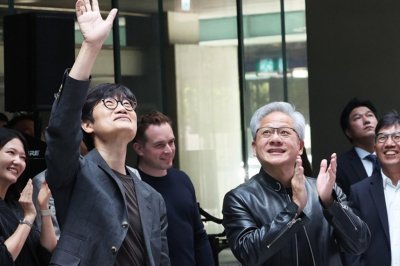
LG AI Research head Lim Woo-hyung (L) speaks with NVIDIA Vice President Bryan Catanzaro at the company’s head office in Seoul on Tuesday. Photo by LG Group

SEOUL, April 22 (UPI) — South Korea’s LG AI Research said that it has agreed to strengthen cooperation with NVIDIA to develop next-generation AI technologies and expand the ecosystem of its flagship AI model, EXAONE.

Toward that goal, LG AI Research’s chief Lim Woo-hyung met with NVIDIA Vice President Bryan Catanzaro, who visited Korea to attend the NVIDIA Nemotron Developer Days Seoul 2026.

The two companies have collaborated before. LG AI Research said that it has leveraged datasets of NVIDIA’s Nemotron open ecosystems to develop and upgrade its EXAONE models.

“Purpose-built, domain-specific models unlock the full value of AI by using culture- and language-specific data aligned with what makes nations and industries unique,” Catanzaro said in a statement.

“By integrating the LG AI Research EXAONE platform with NVIDIA Nemotron, organizations can create high-quality local models that advance sovereign AI initiatives-opening the door to new business opportunities and enhanced social services.”

Lim stressed that NVIDIA has been a key partner throughout the development of EXAONE.

“We will expand our collaboration with NVIDIA beyond research into a broader innovation ecosystem to deliver tangible sovereign AI outcomes that can be realized across industries,” he said.

As one of the leaders in South Korea’s sovereign AI project, LG Group has recently sought to accelerate the conglomerate’s AI transformation.

Earlier this month, for example, Chairman Koo Kwang-mo flew to Silicon Valley to meet with chiefs of global tech companies Palantir Technologies and Skild AI.

The share price of LG Corp., the holding company of LG Group, gained 0.95% on the Seoul bourse Wednesday.

Source link

The Second Nuclear Age: Why the World is Betting on the Atom Again

Data centres, climate targets and energy security – three forces pushing nuclear power back to the forefront of the global agenda. But behind the technological shift lies a human dimension: the story of nuclear host communities, where quality of life has long defied the familiar fears.

Three Forces Behind the Renaissance

The AI Data Centre Surge   Climate Commitments Energy Security
Data centres already consume ~2% of global electricity and the figure is set to multiply as AI model training becomes industrial. Only nuclear can deliver baseload power at scale, 24/7, regardless of weather At COP28, 20+ nations pledged to triple nuclear capacity by 2050. Nuclear emits less CO₂ per kWh over its full lifecycle than solar panels – and far less than any fossil fuel alternative The crises of 2021-2022 exposed the vulnerability of single-source energy systems. Now, the 2026 Middle East conflict has delivered an even starker lesson: severe disruption of flows through the Strait of Hormuz has triggered what the IEA has described as “the largest supply disruption in the history of the global oil market” – worse than the oil shocks of the 1970s. The crisis has made one argument impossible to ignore: energy that is generated at home cannot be blockaded.

In 2024, Microsoft signed a deal to restart a unit at Three Mile Island – the very plant in Pennsylvania whose partial meltdown in 1979 shaped public anxiety about nuclear for decades. The reasoning was simple: the data centres powering AI require enormous quantities of electricity, continuous and ideally carbon-free. A nuclear plant delivers all three. That deal has since become something of a symbol for a much broader shift playing out across dozens of countries.

The industry already calls it a renaissance – not the first in nuclear’s history, but arguably the most structurally grounded. Three things are happening at once: explosive electricity demand from the digital economy, binding climate targets set by governments, and a growing reckoning with the limits of intermittent renewables. Wind and solar are essential to decarbonisation – but they cannot guarantee baseload supply in all weather, at all hours. Nuclear can.

“We need a source that delivers around the clock, every day of the year – sun or no sun, wind or no wind.” That, roughly, is how energy executives frame the problem when they look at what AI actually needs from the grid.

ARTIFICIAL INTELLIGENCE: AN UNLIKELY ALLY FOR NUCLEAR

Data centres already account for about 2% of global electricity consumption, and that figure could rise dramatically by 2030 as training and running large language models becomes routine. Google, Amazon, Meta and Microsoft are all in the market for long-term clean power contracts – and nuclear plants are almost the only sellers that can offer both the scale and the certainty those contracts require.

One example already up and running: the Kalinin Data Centre, built directly on the site of the Kalinin nuclear power plant in Russia. It draws up to 80 MW of guaranteed power straight from the plant’s substations – giving it some of the lowest electricity costs in central Russia – and operates to Tier III reliability standards. It has been included in Russia’s national Digital Economy programme. This is not a concept for the future: a nuclear plant is already powering real digital infrastructure today.

In the United States, after decades of stagnation, the first licensing procedures in a generation have begun for new reactors, including small modular reactors – SMRs – that promise lower capital costs and shorter build times. In the United Kingdom, Hinkley Point C is under construction. France has announced six new EPR-2 reactors. Canada has approved a major refurbishment of the Pickering station. These are not isolated decisions. They represent a change of direction that is now systemic.

THE CLIMATE CASE: THE NUMBERS SPEAK FOR THEMSELVES

Nuclear energy produces less carbon dioxide per kilowatt-hour over its full lifecycle than a solar panel, and many times less than a gas turbine. For governments that have committed to climate neutrality by 2050, this is becoming a decisive argument – particularly given that large-scale battery storage, the main alternative for backing up renewables, carries its own considerable environmental costs.

It is no coincidence that at COP28 in Dubai, more than 20 nations signed a declaration committing to triple nuclear capacity by 2050. The list includes the United States, France, the United Kingdom, Japan, Canada and South Korea. After years on the political margins, nuclear is back in the official climate conversation.

  87%     +$9K     €59B   >$2B
of residents in 24 Russian nuclear cities report satisfaction with their quality of life   average household income between US counties near nuclear plants vs. neighbouring counties   projected average annual household income generated by EU nuclear industry, 2025–2050   annual economic impact of Palo Verde nuclear plant in Arizona, the largest in the US
Nuclear cities sociological survey, Russia Good Energy Collective / Carnegie Mellon, 2022 Deloitte / NuclearEurope, 2025   APS – Arizona Public Service  

NUCLEAR CITIES: THE LIFE THAT RARELY MAKES THE NEWS

In the middle of the technology and climate debate, it is easy to miss a different dimension entirely – the human one. Nuclear energy does not exist in the abstract: it lives in specific towns and regions, alongside real communities. And the data on quality of life in those places tell a story that sits rather awkwardly alongside the image embedded in popular culture.

Research from multiple countries consistently finds that cities and regions hosting nuclear facilities tend to have higher household incomes, better infrastructure, stable employment, and often stronger demographic indicators than comparable areas without nuclear presence. A nuclear plant is not simply a generator. It is an anchor employer, a leading taxpayer, and a structural pillar of the local economy for decades at a stretch.

EVIDENCE FROM AROUND THE WORLD

CANADA – Bruce Power (Ontario)

Bruce Power is the largest employer in Ontario’s Bruce County. Ipsos polling found that 93% of local residents consider the company a “good neighbour” and 96% are confident the plant operates safely. That level of sustained public support sits alongside major refurbishment programmes that will go on creating thousands of regional jobs for years ahead.

HUNGARY – Paks

Paks is a small town on the Danube, 100 kilometres south of Budapest. According to Hungary’s Central Statistical Office (KSH), it ranks among the country’s leaders in per capita income – GDP per capita and purchasing power run roughly 1.5 to 2 times the national average. Male life expectancy in Paks is around 75-76 years, against 73 nationally; female life expectancy is 81-82, against 79 across Hungary. 

FINLAND – Eurajoki (Olkiluoto NPP)

The Finnish municipality of Eurajoki, home to the Olkiluoto plant, has a population of around 9,000 and is one of the most financially secure municipalities in the region. In 2022, the plant’s operator TVO paid €20 million in property tax, out of the municipality’s total tax revenue of €57 million. Local authorities describe Eurajoki as debt-free. It also maintains a stable population, which is a genuinely rare achievement for small Finnish communities. 

RUSSIA – Udomlya (Kalinin NPP, Tver Region)

The Kalinin nuclear power plant is the largest electricity producer in central Russia, located 3 kilometres from the town of Udomlya. The plant generates 82% of all electricity produced in the Tver Region and 14% of the output of the entire Central Federal District. It is also a major regional employer: together with contractor organisations, the station accounts for around 30% of all jobs among the working-age population of the Udomlya municipal district. The plant supplies the town with heat and hot water, and the construction of the station marked the beginning of rapid development across the entire surrounding area.

UNITED STATES – Palo Verde (Arizona)

Palo Verde is the largest nuclear plant in the United States and generates more than $2 billion in annual economic impact for Arizona. The station directly employs 2,500 people, with a further 5,800 jobs supported in related industries. It is Arizona’s largest private taxpayer – a contribution that matters directly to the funding of local schools and public infrastructure. 

SWEDEN – Forsmark

A Novus survey from spring 2023 found that at least 86% of residents in Östhammar municipality – where Forsmark is located – support the construction of a permanent spent fuel repository. Nine in ten local residents believe the presence of operator SKB has a positive impact on regional development. 

UNITED KINGDOM – Hinkley Point C (Somerset)

Britain’s largest infrastructure project will employ up to 15,000 workers at peak construction. More than 1,500 apprentices have already been trained, 500 more than originally planned. Three Skills Centres of Excellence in Somerset have put over 8,000 people through training in welding, electrical and mechanical trades. The effects on the regional labour market will be felt for a long time. 

CANADA – Pickering (Ontario)

The Pickering refurbishment is expected to create around 30,500 jobs during construction and sustain 6,700 permanent positions during operation. The project received government approval in November 2025, with construction due to begin in 2027. 

FRANCE – Nuclear host regions

Analysis by France’s national statistics agency INSEE indicates that nuclear plants generate economic clusters that sustain employment and population in smaller municipalities across the country. 

THE PROXIMITY PARADOX: WHY NUCLEAR COMMUNITIES SUPPORT NUCLEAR ENERGY

Sociologists have long noted a pattern that tends to surprise outsiders: the further people live from a nuclear plant, the more they fear it. The closer they live, the more they trust it. A Nuclear Energy Institute study found that 89% of residents within ten miles of a reactor view nuclear energy favourably. Surveys across nuclear host cities in Russia show that 78% of residents feel proud of the industry’s achievements, and more than two-thirds rate its contribution to their city’s development positively. Across 24 such cities, 87% of residents report satisfaction with their quality of life – in some, the figure exceeds 90%.

This is not a coincidence, and it has nothing to do with messaging campaigns. It is the product of lived experience. When a nuclear plant is the largest employer in the area, the main source of local tax revenue, and the sponsor of community sports clubs and healthcare facilities, people’s relationship with it is shaped not by what they read in the news, but by the texture of their daily lives.

The Proximity Paradox: Trust Rises Near the Plant

  The closer people live to a reactor, the more they support it Sociologists have long documented a consistent pattern: public support for nuclear energy is significantly higher among people who live close to a plant. Daily life near a facility creates a different picture than the one shaped by media coverage from a distance. The effect holds across countries, cultures and decades of polling.       Within 10 miles of a reactor (US, Nuclear Energy Inst.) Bruce Power region (Canada, Ipsos) Forsmark area (Sweden, Novus 2023) Nuclear cities, Russia (satisfied with life)     89%   96%    86%  87%

CONCLUSION: AN OLD SOURCE OF ENERGY FOR NEW CHALLENGES

The nuclear renaissance that gathered momentum through the mid-2020s is neither nostalgia nor ideology. It is a practical response to several problems that landed at roughly the same time: exponential growth in electricity demand from the digital economy; climate targets that cannot realistically be met without firm, low-carbon baseload generation; and hard lessons from successive energy crises about the fragility of systems built around a single source or a single supplier.

Against that backdrop, the accumulated experience of nuclear communities around the world: from Eurajoki in Finland to Paks in Hungary, from the shores of Lake Ontario to the Arizona desert, makes for a substantial body of evidence. Living near a nuclear plant is not a losing proposition for a community. More often than not, it has been the foundation of lasting prosperity, decent public services, and demographic stability that many non-nuclear towns can only envy. That, too, belongs in the conversation about what the future of energy actually looks like.

This analysis draws on data from: Deloitte / NuclearEurope (2025); Good Energy Collective / Carnegie Mellon University (2022); Ipsos Canada; Novus / SKB (Sweden, 2023); KSH — Hungarian Central Statistical Office; TVO (Finland); APS — Arizona Public Service; EDF Energy (United Kingdom); Government of Ontario; INSEE (France); Nuclear Energy Institute (United States); IEA; sociological surveys of nuclear host cities in Russia; Rosenergoatom

Source link

Five major issues affecting the FIFA World Cup with 50 days to go | World Cup 2026 News

With 50 days to go until the World Cup kicks off, FIFA and the tournament’s host nations face criticism over wide-ranging social, political and logistical issues surrounding the global event.

Canada and Mexico will cohost the tournament with the United States, which, alongside Israel, launched a war on World Cup participant nation Iran on February 28. While the war is currently under a fragile temporary ceasefire, Iran’s participation in the tournament remains uncertain.

Recommended Stories

list of 3 itemsend of list

Fans across the three host countries are in uproar over exorbitant ticket prices, which have affected sales and interest in the world’s most popular quadrennial sporting event.

Local politicians and the public have also raised concerns over the hike in transport fares on routes connecting match venues in the US.

Al Jazeera Sport takes a look at the growing concerns in the run-up to the tournament, which begins on June 11 with the opening fixture between Mexico and South Africa:

What’s the latest on Iran’s participation in the World Cup?

Iran’s football team is preparing for the championship. However, officials say a final decision on the team’s participation will be taken by the government and the National Security Council after they review the players’ safety in the US.

Iran had said last month that it would not participate in the tournament amid the war, especially if the host nation could not guarantee players’ security. It followed a social media post from President Donald Trump, where he suggested that the Iranian team’s safety and security could not be guaranteed in the US, where Iranians are scheduled to play all their games.

The Iranian football federation then asked FIFA to relocate its games from the US to Mexico. FIFA rejected the request.

FIFA chief Gianni Infantino said last week that Iran “has to come” to the tournament.

Iran will play all their group stage matches on the US West Coast. Should they advance to the knockouts, the remaining games would also be held in the US.

Outrageous commuter fare prices in US host cities

Fans can expect to pay nearly 12 times the regular $12.90 fare for a round-trip train ride from Manhattan’s Penn Station to the MetLife Stadium in East Rutherford, New Jersey, venue of the World Cup final and seven other major fixtures.

New Jersey Governor Mikie Sherrill and FIFA have chided each other on the $150 price tag for a roughly 15-minute, 14km (9-mile) ride; Sherrill said FIFA should bear the costs, while the global body hit back, saying it is not obligated to do so.

Train commutes to Gillette Stadium in Boston’s suburbs cost roughly four times the regular price ($20), while round-trip bus fares to Foxborough cost $95.

Host cities Los Angeles and Philadelphia have pledged to keep their transit fares unchanged, while Kansas City is offering a $15 round-trip fare to Arrowhead Stadium. Houston said it has added buses and train cars to serve fans but intends to keep fares at current levels: $1.25 for buses and light rail trains, and park-and-ride options ranging from $2 to $4.50.

High prices, low demand for match tickets

Sky-high ticket prices have left fans outraged at what they say is pricing that excludes supporters from the tournament. A lag in ticket sales for blockbuster matches, including hosts USA vs Paraguay, seems to be a testament to the high price tag.

FIFA put tickets on sale in December at prices ranging from $140 for Category 3 in the first round to $8,680 for the final. Later, it raised prices to as high as $10,990 when sales reopened on April 1.

The North American bid had initially promised tickets would be available for as little as $21; however, the cheapest ticket has been priced at $60. Most tickets cost at least $200 for matches involving higher-ranked teams.

FIFA announced another round of ticket sales on Wednesday to coincide with the 50-day countdown. Tickets will be available across categories 1 to 3 for all 104 matches on a first-come, first-served basis.

Pushback against immigration raids during World Cup matches

The Trump administration’s push for mass deportation and its efforts to tighten legal immigration pathways have spurred concerns about whether the World Cup’s international audience might be targeted by US immigration authorities.

Infantino was approached last week to pressure Trump to avoid immigration raids at this year’s tournament. Reporters suggested that agents from Immigration and Customs Enforcement (ICE) and Customs and Border Protection (CBP) were present at last year’s FIFA Club World Cup matches, though the Trump administration denied conducting enforcement efforts.

A report by The Athletic explained that FIFA executives have framed the possibility of an immigration moratorium as a potential public relations boon for the Trump administration. It also indicated that the executives hoped Infantino would leverage his friendly relationship with Trump to assuage any immigration-related fears.

Violence in Mexico raises fears over tournament security

World Cup cohost Mexico is also under the spotlight due to concerns for fan safety after a lone attacker opened fire on tourists near the country’s capital on Monday.

The accused opened fire on top of one of the Teotihuacan pyramids — a UNESCO World Heritage Site and one of Mexico’s most frequented tourist attractions — and killed one Canadian tourist and injured 13 others.

It raised questions about security protocols taken by Mexican President Claudia Sheinbaum’s government in the run-up to the global football tournament.

Sheinbaum said Mexico will beef up security ahead of the World Cup.

“Our obligation as a government is to take the appropriate measures to ensure that a situation like this does not happen again. But clearly, we all know — Mexicans know — that this is something that had not previously taken place,” she said on Tuesday.

Source link

Childbirths grow at record high pace in Feb.: data

The number of babies born in South Korea rose at a record high pace in February of this year, government data showed Wednesday. In this photo, taken Wednesday, a nurse looks after newborns at a hospital in Goyang. Photo by Yonhap

The number of babies born rose at a record high pace in February of this year, driven largely by an increase in childbirths by women in their 30s, government data showed Wednesday.

A total of 22,898 babies were born during the month, up a solid 13.6 percent from the same period a year earlier, according to findings by the Ministry of Data and Statistics.

The figure was the highest for the month since 2019, when 25,710 babies were born, and the growth pace was also the highest for any February since record keeping began in 1981, the ministry said

The number of newborns has been on an upward trend since July 2024.

The country’s total fertility rate, the average number of children a woman is expected to have in her lifetime, rose 0.1 from a year earlier to 0.93 in February.

The ministry said the recent rise in births was mainly led by women in their 30s, with the number of births per 1,000 women in their early 30s rising by 9.1 to 86.1 and the corresponding tally for women in their late 30s increasing by 9.2 to 61.5.

The number of births per 1,000 women in their late 20s only rose by 1.6 to 23.9.

The number of marriages in February declined 4.2 percent on-year to 18,557, turning lower after 22 straight months of increase, on the fewer number of working days due to the extended Lunar New Year holiday.

The number of divorces went down 15.6 percent on-year to 6,197 in the cited month, the data showed.

Meanwhile, the number of deaths dropped by 3.5 percent from a year earlier to 29,172, resulting in a natural population decline of 6,275.

Copyright (c) Yonhap News Agency prohibits its content from being redistributed or reprinted without consent, and forbids the content from being learned and used by artificial intelligence systems.

Source link

World Cup 2026: Pick your favourite kits from the tournament

Scotland are back at the World Cup, after a 28-year hiatus. Steve Clarke’s men will be hoping to make it past the group stages for the first time in the nation’s history, but face a tough task in Group C, which they share with five-time winners Brazil and Africa Cup of Nations champions Morocco, as well as Haiti.

Their away kit comes in a bold coral colour, reminiscent of Scotland’s 1999 away strip.

Source link