The promotion of Conservative MP Alistair Burt to Minister for the Middle East within Britain’s Foreign and Commonwealth Office (FCO) demonstrates that the UK’s friendship with the Saudi-aligned Gulf Cooperation Council (GCC) states will remain toxic.
Between May 2010 and October 2013, Burt was only an Under-Secretary of State at the FCO, with responsibility for “Counter Terrorism, Counter Proliferation, Counter Piracy, North America, Middle East and North Africa, the Maldives and Sri Lanka.” As of earlier this month, he is now a full minister of state, responsible solely for the Middle East; he also holds a second ministerial position at the Department for International Development.
As Under-Secretary, Burt had a long record of protecting the Bahrain-Britain intimate relationship. It was not just, as one activist put it, the usual “meaningless FCO shtick” in which he repeatedly claimed that progress was being made on reforms even when it patently wasn’t. It was a serious of smears, lies and fabrications which went above and beyond the call of duty. There is no reason to believe that his time as a full minister will be any different; in his time out of government office he engaged deeply with GCC lobbyists.
That the lobbyists were interested in him is unsurprising. From 2011 (“the Arab Spring”) until he left the FCO in 2013, despite repeated requests, Burt never admitted that British equipment had been used against pro-democracy demonstrators in Bahrain. He claimed there was no evidence that British-supplied shotguns, teargas and stun grenades had been used in the suppression of protests, despite ample photographic proof. When asked whether AssetCo, a private fire equipment company based in Britain, was involved in the crackdown, he twisted away from the truth; it was.
It was BAE Systems armoured cars, manufactured in Newcastle, which were used by the Saudis when they intervened to save the Al-Khalifa ruling family from wipe-out by deploying troops during the Bahrain protests. Burt claimed meekly that they were only there to “safeguard installations.” The Campaign Against The Arms Trade (CAAT) pointed out that even if this was the case, “the Saudi presence in that country increases the capacity of the Bahraini authorities to suppress protests.”
Burt then smeared a Bahraini human rights organisation for offering criticism of the regime; a group which had, coincidentally, helped to organise the 2011 protests.
In the summer of 2013, a Labour MP asked about rights allegations raised by “the Bahrain Youth Society for Human Rights”. “I have not seen the report,” Burt replied bluntly. The report in question dealt with specific cases of the abuse of prisoners, but he still seemed to know a lot about the specific society. It was almost as if he had been briefed on what to say. He told parliament that the BYSHR was merely “an unregistered non-governmental organisation… and its credibility is untested.” It was a naked attempt to discredit the group.
Mohammed Al-Maskati founded the BYSHR some six years previously. He had applied for it to be registered under Bahrain’s onerous charity regulations, but had been turned down for being too critical of the state. His father-in-law is a prominent political prisoner.
Al-Maskati is now a senior consultant for the highly credible Frontline Defenders organisation. In 2011, Amnesty International adopted his case after the regime sent out a mass text message calling for his death because his society had been a leading organisation in the Pearl Roundabout protests.
Since the mid-2000s, Al-Maskati has been subject to constant judicial and other forms of harassment, including public discrediting. Minister Alistair Burt has looked comfortable about joining in with these attacks.
Burt also displayed studied indifference to anyone facilitating the crackdown and refused to engage with the organisers of the Formula One Grand Prix who were heavily criticised for repeatedly hosting their events in Manama in subsequent years. He also refused to raise with European allies the allegations that they were shipping surveillance technologies to the regime in Bahrain, and completely ignored reports that a British social media monitoring firm, Olton, was also involved, working for the Bahrain ministry of the interior.
What Burt has done since October 2013 until his re-appointment as a senior minister is even more of a concern. He is clearly a man beholden to Saudi-aligned GCC interests. Two months after he stepped down, the Bahrain parliament paid for him to attend the Manama Dialogue, arranged by the PR firm Meade Hall & Associates.
Although he was despatched temporarily to the Department of Health for another ministerial role, when the Saudi Arabian Shura (Consultative) Council arrived on a flying visit to London in 2015, Burt sat down with its members for a cosy meeting.
The new minister’s relationship with the UAE has also remained close. This April, before he was re-appointed to the FCO, Burt took it upon himself to lead a delegation of British MPs to the country, and appeared in the de facto state-controlled media encouraging further economic co-operation. He also became chairman of the All Party Parliamentary Group (APPG) for the UAE.
Burt has also maintained a relationship with Bell Pottinger, the PR firm enlisted to defend the State of Bahrain during the 2011 crackdown. In 2015, he was appointed as a non-executive director of the oil and gas exploration company President Energy, whose own lobbying and public relations are also handled by Bell Pottinger. The PR agency also handles secretariat functions for the APPG on Bahrain, a pressure group for Bahraini state interests; Burt is a member. There is an alternative grouping for those British politicians in favour of democratisation, known as the APPG for Democracy in Bahrain; Burt is not a member.
Even after Alistair Burt left the Foreign and Commonwealth Office, the APPG Bahrain continued to court him, perhaps in the hope that, one day, he might be returned to greater office; so did the UAE and Saudi Arabia, and he has. The minister is clearly the GCC’s man at the FCO; we should be wary about who he really works for.
The views expressed in this article belong to the author and do not necessarily reflect the editorial policy of Middle East Monitor.
So asked a Times colleague on our morning editorial call earlier this week, sharing her impression that the Oscars — which were handed out March 15 — just concluded. And though it may feel like Hollywood was awarding gold statuettes just yesterday, the Emmys wait for no man, least of all this one.
I’m Matt Brennan, editor in chief of the Envelope and I’ll be back in your inboxes for the next three weeks to share highlights from our four pre-nominations issues, starting with the June 4 edition. Whether you’re a voter prioritizing what to catch up with or an observer trying to get a handle on what’s in this year’s race, read on.
The Emmy Comedy Roundtable
(Christina House / Los Angeles Times)
Leave it to comedy legend Steve Carell to deliver a sage piece of advice on The Envelope’s 2026 Emmy Comedy Roundtable — without even participating in the conversation.
“Steve says this beautiful thing that characters don’t know whether they’re in a comedy or a drama,” Carell’s “Rooster” co-star Danielle Deadwyler relayed to nods of agreement and appreciation from the panel. “And that’s about as true as it gets. You bring full rigor and development and discipline to the making of a role, regardless of what genre.”
Of course, with Deadwyler, Donald Faison (“Scrubs”), Sabrina Impacciatore (“The Paper”), Justine Lupe (“Nobody Wants This”), Lamorne Morris (“Spider-Noir”) and Chris Perfetti (“Abbott Elementary”) around the table, the conversation, moderated by The Times’ Lorraine Ali, came with plenty of laughs too — about surviving bad reviews, being mistaken for other performers, breaking one’s castmates and much more. You can also watch it on YouTube here.
Meet ‘SNL’s’ resident ‘quiet little freak’
(Sela Shiloni / For The Times)
As someone who counts ex-Trump voters among my own family, “Saturday Night Live” cast member Ashley Padilla’s character in “Mom Confession” — about a stubborn MAGA parent who finally admits to her kids that she may have been wrong about the president — struck a chord with me when it aired in January. So I was delighted to see contributor Tim Grierson’s profile of the actor (and former Diane Keaton assistant) dig into what makes the sketch, like so much of her work on NBC’s variety series, tick.
“Padilla, who sports an ebullient manner and warm smile, has become a fan favorite by exploring how much humor (and tension) you can derive from stillness,” he writes. “Her best sketches … sparkle because of how expertly she builds suspense regarding where the setup is going.”
‘Margo’s Got Money Troubles’
Sex work is work. And in the right hands, it’s highly creative work. Case in point: HungryGhost, the alien alter ego Margot Millet (Elle Fanning) assumes when she launches an OnlyFans to make ends meet in “Margo’s Got Money Troubles.”
As contributor Tomris Laffly reports, the DIY artistry that brings HungryGhost to life in “Margo” reflects the layers of craftsmanship required to bring her to the screen, from hand-bedazzled cowboy boots to bulk-bought containers of turquoise eye shadow. “She’s a director,” executive producer and director Dearbhla Walsh says of Margo, an aspiring writer. “You could always see the creation [process], how Margo brought theater into her OnlyFans.”
In the debut episode of “The De Los Podcast,” hosts Fidel Martinez and Suzy Exposito spoke with the Latin Grammy-nominated singer and actor Leslie Grace about her long-awaited new music — plus some of the highlights and pain points throughout her film career.
Released in May, Grace’s bilingual record “Amor, ¿Quién Eres?” is the first album she’s released in over a decade. Suffused with what Exposito described as “tropical eleganza,” the album is a far cry from the Christian music Grace recorded in her teen years — and a marked shift from the Latin Grammy-nominated self-titled project she released in 2013. She touched on some of the personal developments required to reach the more sensual sonic landscape she explored in her latest release.
“The biggest learning has been how to protect my creative space, while I grow it and discover at the same time,” she told De Los.
The 31-year-old also discussed her work in the 2021 movie musical “In the Heights” — and the online backlash the film received due to the lack of other Afro-Latinos in the cast.
“The lack of representation within film [and] diversity within the Latin community is a conversation we haven’t touched on as much,” she said. “Only so many films [are] given a shot. There [are] certain ways that Latinos are portrayed that are very narrowed down in film. I think it’s a worthwhile conversation at any time. I’m glad that people started to talk about that, so [we] can get more stories.”
Reflecting further on her filmography, Grace talked about the canceled release of “Batgirl,” in which she played the titular role. The film, which was originally for a late 2022 debut on the HBO Max streaming service, was axed by its studio Warner Bros. for financial reasons.
“It was disappointing because we knew the film that we were making,” Grace said of the movie, which was in postproduction when it was scrapped. “I knew that it wasn’t a reflection of our work, because this is something that happens. But I think because of the context of the conversation around representation, and the way that films can be discarded, after a lot of work and time and money has gone into something … the creative community really felt for me.”
During that period, Grace said the support from other creatives helped her move forward. She has since starred in more independent films in recent years — including “In the Summers,” which won a grand jury prize at the Sundance Film Festival in 2024 — and the 2026 features “Stages” and “Campeón Gabacho,” which premiered at this year’s edition of South By Southwest.
“I really am grateful for every person that reached out to me and was like: ‘Hey, I’ve got you, whatever you need,’ or ‘This is wrong,’” Grace said. “When something happens to me, I focus on my experience and what I gained from it, that no one could really take away.”
Mindy Kaling was in her early 30s when the first TV series she created, “The Mindy Project,” made its debut and set in motion her attempt at forging an identity as a prolific multi-hyphenate after “The Office,” where she was a writer and cast member for eight seasons. But if you ask her to reflect on that time of her life, she says, it’s a bit of a blur.
As she explained recently, “I remember it, but not all that distinctly. It was such a grind — waking up at 6 a.m. to be on camera, wrapping late. And I did that for 117 episodes.”
But ask her about her 20s, when she was living in New York City and trying to figure out how she could break into the industry as a comedy writer? “I remember incredibly vividly,” she says. “I’m like, did I feel things more intensely back then? I’m not sure. But that period of time … there was just so many highs and lows. And it felt cinematic to me.”
So she made a TV show about it.
Premiering Tuesday with three episodes, “Not Suitable for Work” follows five ambitious 20-somethings living in Manhattan who are navigating the early stages of their careers while trying to have a semblance of a life and the heightened emotions they experience during this period. Kaling calls it the third chapter in her semi-autobiographical TV trilogy, which includes “Never Have I Ever,” about a first-generation Indian American teenager coping with her father’s death while trying to be popular (or at least not super uncool), and “The Sex Lives of College Girls,” about four young women who dorm together and boldly maneuver their new, uninhibited lives on campus.
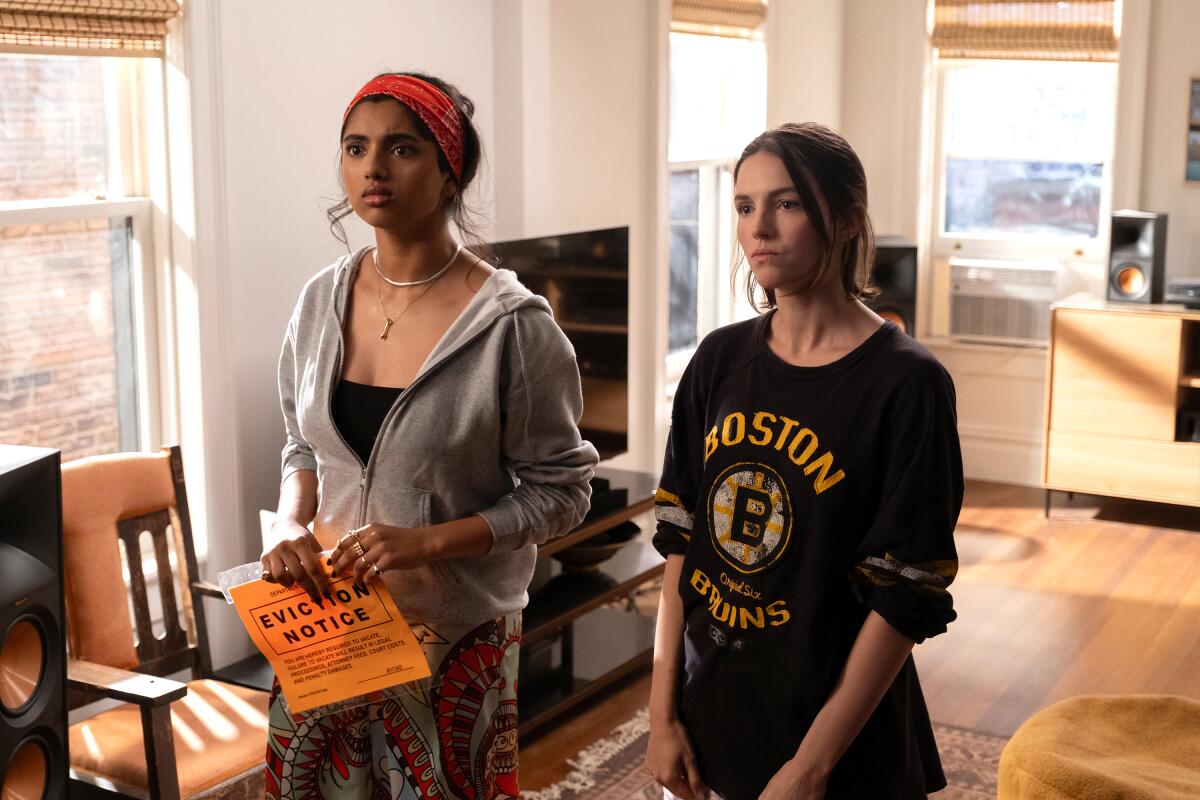
In the new Hulu series, viewers are introduced to AJ Pascarelli (Ella Hunt), a hard-working and disciplined young woman who moves to town to start a high-pressure finance job, and her roommate Abhinaya “Abby” Chilukuri (Avantika), a savvy and fashion-obsessed assistant to a celebrity stylist. They live across the hall from Josh Teitelbaum (Jack Martin), an idealistic nepo baby of a media titan — he’ll lean into his privilege when it suits him while also trying to distance himself from it — with ambitions of making it in journalism. His two roommates are Kel Washington (Nicholas Duvernay), an insecure but earnest med student who would rather be acting, and Davis Beau Bradley Barrett III (Will Angus), a high-energy, bumbling financial analyst who works at the same corporate firm as AJ and is an undercover hopeless romantic. As one might expect, there are some messy entanglements within and outside the group.
1
2
1.Abby (Avantika), left, and AJ (Ella Hunt) move in together.2.Across the hall live Davis (Will Angus), left, Josh (Jack Martin) and Kel (Nicholas Duvernay).(Gwen Capistran / Disney)
“I hope that young people will respond to the show, “ Kaling says. “We did so much research in it because at a certain point it is funny — I’m in my 40s, and I am often like, ‘I wonder if young people are suspicious about why I’m so obsessed with writing shows about young people.’”
So, why is she?
“Because I find it almost impossible to reflect on the current time I’m in,” she says. “It would be too painful to be too introspective about the time that I’m in. I need a real sense of distance to look back on it, especially since having kids. Once you have kids, it triggers these memories of your own childhood.”
Over video call from New York City, Kaling reflected on the series and her early years of trying to make it. These are edited excerpts from the conversation.
How did you land on the professions that your characters would be pursuing and what did you want to say about ambition at this stage of life?
I love people who have big wants, and sometimes the audience is like, “Maybe you want the wrong thing” and they [the characters] don’t quite know that yet. I love writing about the underdog. And with their particular professions, they’re all things that I had some interest in researching. I’ve always been fascinated by investment bankers. I went to Dartmouth, so I have a lot of friends who went into that, and I swear I’ve had my friends explain their job so many times to me, and I still didn’t totally understand it. We were lucky; a very famous investment bank very generously offered to let me come for a day and meet with young bankers. I also … write about the children of immigrants. I’m very, very interested in that story, and so we got to research what it’s like being the child of Nigerian immigrants. But every single character has a journey, or there’s an aspect of them that I feel like I really relate to, and that is in almost all my shows.
What was it like observing young people in the investment banking world?
They were wary — because they’re smart — of someone from Hollywood coming in to document what they were doing and asking questions. It helped that a lot of the guys liked “The Office” and a lot of the women liked “The Mindy Project” and “Sex Lives of College Girls” because they’re all kind of young. I think that made them trust me a little bit more. For the AJ and Davis characters, so much of what I researched when I was there fed into their plot line … almost all the characters have a boss they fear and idolize, and the way that first-year bankers feel about their managing directors is not dissimilar to the way I felt about Greg Daniels when I started at “The Office.” And the hours are actually not dissimilar.
There’s a moment early on where Jay Ellis’ character, Bill, who is a managing director at this fictional investment banking firm, is asked about work-life balance. I’m curious how you thought about that at the start of your career versus now.
I didn’t care at all about anything except my job for 16 years. It was my entire personality and purpose. When I was in my 20s, the only thing that mattered was being a good comedy writer and succeeding, and one day maybe being able to create my own shows. There was no balance. I didn’t want balance. I wanted to live and breathe comedy writing for my entire life. I hated the weekends, actually. And who wouldn’t? I was a friendless transplant in Los Angeles and I just wanted to get back to working at “The Office.” Every year I was there, I got more ambitious and I wanted to go off and create my own show and have a bigger part as an actor and everything.
It wasn’t until after I did that on “The Mindy Project” … that I just felt like, “OK, I get this. I want to now try being a mom.” Once I had my daughter, Katherine [at 37], it wasn’t that the balance changed, it was my first real, legitimate interest outside of work — that I cared about more than work.
“When I was in my 20s, the only thing that mattered was being a good comedy writer and succeeding, and one day maybe being able to create my own shows,” Kaling says. “There was no balance. I didn’t want balance.”
(Ebru Yildiz / For The Times)
After college, you moved to Brooklyn with two Dartmouth friends to pursue a career in comedy. You eventually got a full-time job as a production assistant on “Crossing Over with John Edward,” a program where people would receive psychic readings. Tell me about that time in your life.
I remember feeling like I had no access and that I didn’t have any place to put my ambition. It was so far away from anything I wanted to do — scripted comedy and reality television could not be further apart. It was a fascinating time because there were such highs and lows. There was the excitement of new crushes and having fun in a new city with two friends, but there was also the crushing disappointment of feeling like I was never gonna make it. I didn’t even have a path forward to making it, but I was lucky, because I lived with my two best friends. We would go to open mic nights, and we would go to restaurant week and see how the rich people in Manhattan were living. We would take the subway uptown to Central Park and walk along Fifth Avenue and like look at these amazing homes and just dream what it was like to be like a wealthy New Yorker who could buy everything that they read about on DailyCandy — now I’m really dating myself here, back when DailyCandy was a thing. But that’s what it was like, I just I felt a lot of extreme emotions.
How did you approach that job?
My boss was a producer and would approach the families and get their information, and then we would have to do research on them, but it was mostly because they would do a little clip package on the different families. I had to get them to sign releases to be on the show and get photographs of their deceased [loved ones] and them. I actually thought it was pretty interesting work. It just had nothing to do with comedy writing, and that job was not clearly going to lead anywhere toward comedy writing, and I came to New York because of “Saturday Night Live.” When I was working there is when my friend Brenda [Withers] … and I started writing this play “Matt & Ben” [a satirical play that imagines the story of Matt Damon and Ben Affleck before “Good Will Hunting” made them famous] in the time we had off. We started writing it, then I got that job as a PA, then the show went up at the Fringe Festival, and then it was going to go off off Broadway, and when it went off-off-Broadway, and I had a steady income, that’s when I quit my job there. I was only at “Crossing Over” for three or so months.
Greg Daniels attended a performance of “Matt & Ben” and it’s what led to you getting on “The Office” at 24.What was that first meeting like?
Back then, because the internet was so different, when I looked up Greg, besides his credits, you couldn’t find a lot of biographical information about him, or even a photo. I don’t think I even knew what he looked like. When I met him, I don’t think I had seen the British “Office” yet; I wasn’t cool. At that time, I had put so much pressure on this job. I only had two interviews — it was this and there was a show that ended up getting canceled while I was waiting to meet the showrunner. It was a pilot called “Nevermind Nirvana,” about an Indian man who married a white woman, and Ajay Sahgal was the writer. I was like, “Oh my God, if anyone is going to get hired to work on the show, it has to be me.” I was pretty excited about that meeting, but when I was sitting in the waiting room at the production offices to meet with Ajay, they told them they weren’t going to pick up the pilot, so I never even got to meet him, and they just told me I could leave.
I’d only had that interview, and then I met with Greg. This is my memory: it was a high-rise building in Century City, in the offices of “King of the Hill,” so there was a lot of like “King of the Hill” cutouts and stuff there. And he’s just a very thoughtful, quiet guy who doesn’t push conversation … I’m someone who’s pathologically chatty, and so talking to Greg, who is completely fine with there being pauses in conversation, and is just a confident grown-up, it was incredibly intimidating. I was very stressed out in our meeting, but I also was blown away by him.
That first season, you were also the only female writer on staff and the youngest —
B.J.[Novak] is a month younger than me. I want to correct that because he’ll read this and go, “Hey … !”
How did that play into how you felt in the room?
I haven’t really ever had imposter syndrome. And this is my probably my personality defect — I felt that even if I hadn’t seen anyone like me in these roles, that I was just going to be the first one, and I was going to work really hard and prove it to them. The staff was super competitive, but they were smart feminist guys. It was hierarchical and stressful, but it was not because of my fellow writers, except that I wanted to impress them. I felt nervous because I wanted to be contributing, but I don’t know why — I just loved the pilot so much that Greg had made, and I loved these characters, and this world — I was like, I can’t possibly lose my job, I love it too much. Which is probably really stupid, I didn’t ever think there’s a possibility that I could get fired here.
Phyllis (Phyllis Smith), Kelly (Mindy Kaling), Dwight (Rainn Wilson) and Michael (Steve Carell) in a scene from Season 2 of “The Office.”
(Paul Drinkwater / NBCUniversal via Getty Images)
We see how AJ wants to impress the boss and takes on more than she can chew and screws up some data before a big presentation. What was that first big mistake or misstep that you made in those early years that you still think about?
I remember Season 2 — because I just wanted to prove to Greg and to the cast and to the director, the cinematographer, and everyone that I was super invested — we were shooting “The Dundies” [episode]. I was an actor on the show as well, but I wasn’t acting in this scene, but it was my episode [that I wrote], and in between takes, John [Krasinski, who played Jim Halpert] and Jenna [Fischer, who played Pam Beesly] were just on set, and I remember going up to them and being like, “Guys, that take was so great!” And I walked away. Greg came up to me and was like, “You know, we really should let just the director talk to the cast between takes.” Greg, he’s my mentor, but he definitely, over the course of the eight years I lived there, had corrected me many times, as he should have, but that was one of the first times. I remember I was so embarrassed, but I didn’t understand it’s not the role of a story editor to be giving feedback to the cast between takes on a show.
The bosses on the show all have different styles and expectations that may seem demanding or annoying on the surface. How do they reflect where you’re at now?
No one trains you on how to be a good boss. And bad bosses are so prevalent. The entire premise of “The Office” hinges on this funny concept that terrible bosses exist. It wasn’t until I was on “The Mindy Project” that I was the employer for the first time. Every single year of that show, it was a battle getting a new season. One of the challenges of being a good boss is being able to put aside those personal, professional battles you’re fighting … but then also realizing that you’re a mentor to other people, and you have to start thinking about things that you never thought you needed to — overtime, maternity leave, respect in the workplace, the things that make the workplace enjoyable for everyone else who’s there working for you. And it’s not like that comes naturally.
The double blessing of having a good boss, which I did in Greg Daniels and Howard Klein [an executive producer on “The Office”], is that they modeled that for me. Even though I could not be more different than Greg. Even to this day, I’m realizing I have all the unique challenges of being a single mom, being the creator of these shows with crews and casts, but then also being able to be empathetic for all the people that work for me and making sure I make time to listen to them when they want to talk to me about an issue that they’re having; it’s a continual challenge that I’m hoping I’m getting better and better at [managing].
When Bill is asked about work-life balance, he’s also asked if he has inspirational words to impart. It’s very much about overworking and being productive. How do you tackle the question today?
I used to say “you have to write your own part.” And everyone would get annoyed because they’re like, “I’m not a writer.” I’ve had to really think about the question so I could be helpful. We all want a linear path to success. And if my career has taught me anything, it’s that the linear path just was not how I got my job. You know when you go on Google Maps and it shows you all the different paths — the fastest, one path with the toll road and one path that’s going to take seven minutes longer. I’ve only ever taken the one that’s seven minutes longer, or the toll; it’s never been the easy way. The sooner I got used to that, the better.
Before I let you go, in the show, one of the celebrity clients Abby is dealing with is Austin Blanchett, Cate Blanchett’s fictional nephew. Was it always going to be Cate? What other celebs were in the running?
It was Cate Blanchett’s nephew before we had Harry Richardson. When I worked on “Ocean’s Eight,” one of the biggest surprises on it was that Cate Blanchett was incredibly funny and did not take herself seriously at all. I suspect if anyone was going to think it was funny that in this fictional world of the show she had this useless nepo nephew that she had to help get jobs, it would be Cate. I hope she doesn’t sue me. I think she would think it was funny.
June 1 (UPI) — The Trump administration unveiled a new rule Monday adding work requirements to Medicaid eligibility, attracting concern from patient groups and condemnation from Democrats.
Republicans instituted the requirement as part of President Donald Trump‘s massive tax cut and spending bill signed into law in July.
The Centers for Medicaid & Medicare Services said in a statement that the Interim Final Rule tying eligibility to an 80-hour-per-month work requirement promotes “economic stability, self-sufficiency and independence.”
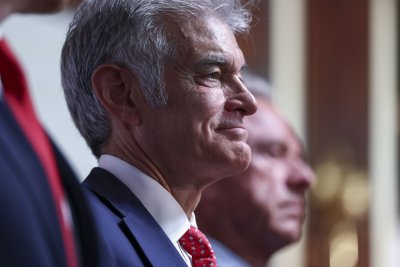
“This rule helps Americans build skills and independence through work, education, job training or community service, creating new opportunities for themselves and their families,” CMS Administrator Mehmet Oz said in a statement.
Medicaid is a joint federal-state program helping those with limited income and resources pay their medical bills. The new rule will is the implementation of a Medicaid work requirement provision that Congress put into President Donald Trump’s so-called One Big Beautiful Bill.
Democrats had vocally opposed the measure before the Republican-controlled Congress passed it into law, arguing it would create bureaucratic obstacles to hinder the ability of those who need the coverage.
Sen. Ron Wyden, D-Ore., and the ranking member of the Senate Finance Committee, said Monday that the rule is “the dark heart of Republican plan to kick millions of working Americans and their children off their health insurance by placing a mountain of paperwork in front of them.”
“When these requirements go into effect at the beginning of next year, it’s going to be a complete train wreck for America, and not just for the Americans caught in the bureaucratic maze Republicans have created: every community will be left with worse healthcare,” he said in a statement.
The provision requires most adults ages 19 through 64 to “demonstrate work requirement activities,” including employment, participating in certain work programs or community service.
Those exempt include people who are pregnant or have recently given birth, parents and caretakers of children or those with disabilities, the disabled or medically frail and American Indians and Alaska Natives, among others.
States generally have until Jan. 1 to implement the new rule, according to a CMS fact sheet.
While Republicans and the White House have described the move as installing safeguards against fraud, medical groups are voicing concern that it will cut patients, including those fighting cancer, from coverage.
American Cancer Society Cancer Action Network President Lisa Lacasse said the requirements mean those with cancer or suffering from sides effects of the disease or treatment would have to prove that they can’t work, a task she said is likely too difficult and time-consuming for them.
The 80-hour requirement may also be too much even for those who are able to work, she said.
“Cancer patients who can still work — and many want to, for example, when they are well enough to work in between chemo rounds — will have to choose between losing their Medicaid coverage, working the required 80 hours per month or giving up working altogether to qualify for an exemption,” she said in a statement.
The social welfare advocacy group Protect Our Care lambasted Republicans for “weaponizing government bureaucracy against the American People” instead of using the government to lower medical costs or make care more accessible.
“They are betting that if they make the process confusing and exhausting enough, millions of people will fall through the cracks and lose the care they depend on to survive,” Protect Our Care President Brad Woodhouse said in a statement.
“Hospitals will suffer, providers will be pushed further to the brink and families across the country will pay the price while Republicans once again put wealthy donors and corporate greed ahead of the health and well-being of everyday Americans.”
Researchers from the Federal Reserve Bank of New York say that the rise of remote work is linked to the rise in unemployment among more recent college graduates. File photo by Tony Avelar/EPA-EFE
June 1 (UPI) — Research shows that a rise in remote work since the COVID-19 pandemic is connected to a rise in unemployment among younger employees, the Federal Reserve Bank of New York reported Monday.
In a blog post, the research authors said they estimate about 64% of the rise in unemployment among recent college graduates has to do with the connection to remote work, which “makes it more difficult for manager sto train and mentor new employees,” they wrote.
“Accordingly, companies may be reluctant to hire less-experienced workers in distributed work arrangements,” the post continued.
The authors said that unemployment among those younger than 29 was an average of 3.1% in 2017-19, compared to an average of 3.7% in 2022-25. Conversely, they wrote, the unemployment rate for more experienced college graduates fell from 1.9% in 2017-19 to 1.8% in 2022-25.
The researchers said they used data on both “remotable” and “non-remotable” jobs, comparing how easily common tasks for a given job can be done remotely. They also used proprietary data from an unnamed Fortune 500 company.
“We show that when people work next to their colleagues, they receive more feedback on their output and more mentorship,” the authors wrote. “When they are separated by even a short distance, that feedback tapers off dramatically. The loss in feedback is more pronounced for younger workers, who miss out on constructive comments that spur their development.”
However, Nicholas Bloom, an economics professor at Stanford University who studies remote work, said that even companies that have remote work often have opportunities for time on site, CNBC reported.
“I don’t think there is any evidence this is slowing employment,” Bloom said. “Indeed, quite the reverse, as it’s easier for people to work and so labor supply looks to be rising.”
Maybe you can use a laugh this morning. Maybe you’re still deep in your feelings, thinking about the “Hacks” series finale and that shot of Hannah Einbinder looking at Jean Smart on the dance floor, grief seeping into her eyes. Maybe you’re lamenting the chaos at our treasured national parks. Hell … maybe you took out a loan to buy a tomato over the weekend.
If you’re feeling down, Gary Oldman would like a word. And that word is: Hufflepuff.
I’m Glenn Whipp, columnist for the Los Angeles Times and host of The Envelope newsletter, back in your inbox for the next few weeks as we navigate our way through Emmy season.
Sign up for The Envelope
Get exclusive awards season news, in-depth interviews and columnist Glenn Whipp’s must-read analysis straight to your inbox.
By continuing, you agree to our Terms of Service, which include arbitration and a class action waiver. You agree that we and our third-party vendors may collect and use your information, including through cookies, pixels and similar technologies, for the purposes set forth in our Privacy Policy such as personalizing your experience and ads.
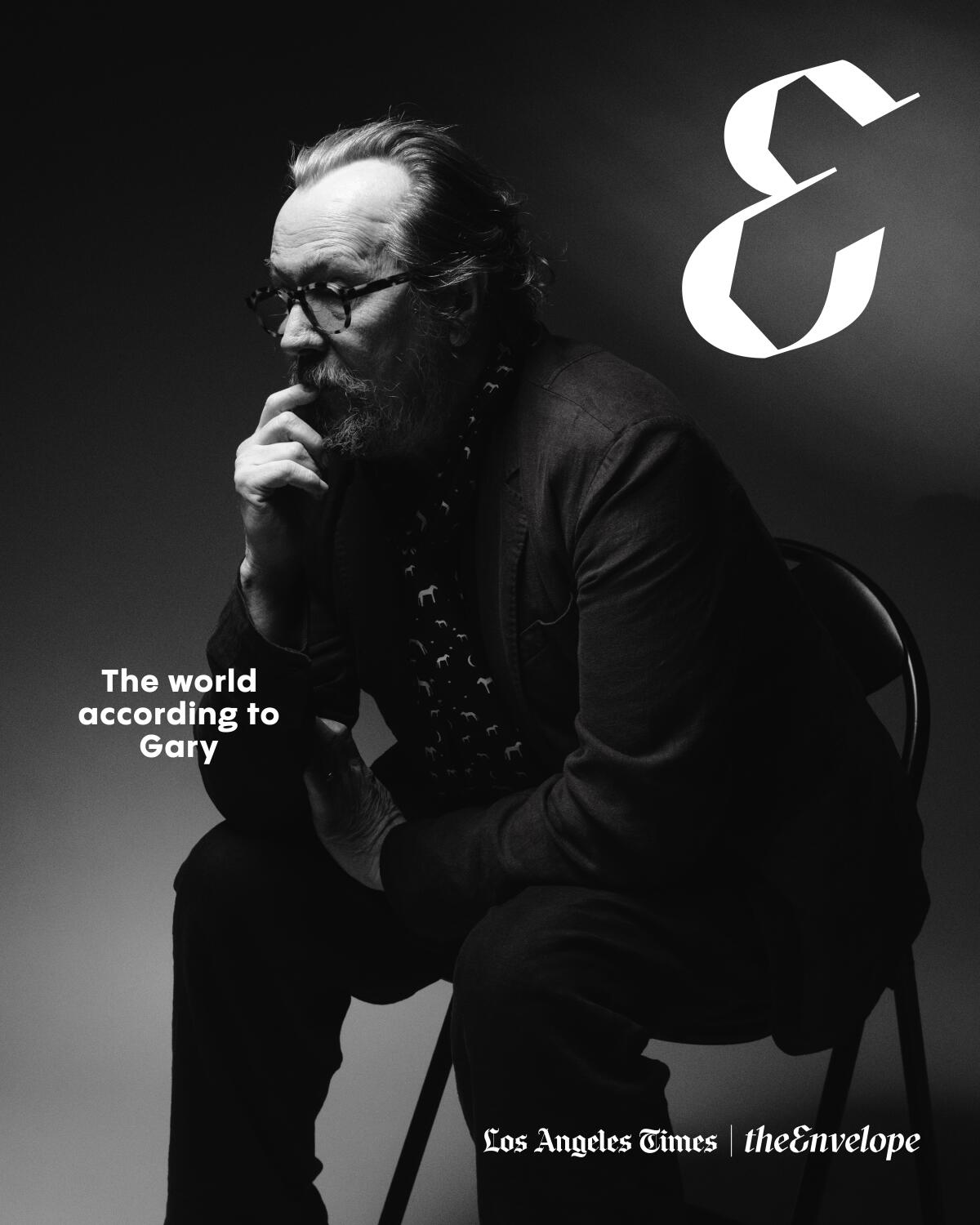
Digital cover story: The world according to Gary
(Jennifer McCord / For The Times)
Gary Oldman is a Hufflepuff.
Never mind that the 68-year-old actor, who played the rebellious, impulsive wizard Sirius Black in the Harry Potter film franchise, couldn’t tell you the difference between a Hufflepuff and, say, a Gryffindor.
When journalist Josh Horowitz reads a list of core personality qualities — loyalty, hard work, patience, fairness, dedication — and asks Oldman if that describes him, he nods his head.
You’re a Hufflepuff.
“I’m a Hufflepuff?” Oldman says, trying the word on for size. He likes it. “I’m a Hufflepuff!”
This video clip is a favorite of mine, one I could watch on a loop for the sheer delight Oldman takes in pronouncing the word Hufflepuff.
It’s easy to see why Oldman takes such pleasure in being a granddad these days, one of the things we talked about at length not long ago for an Envelope digital cover story. He can access his silly side with ease.
I asked Oldman about the upcoming HBO “Harry Potter” television series, a decade-spanning endeavor that will spend a season adapting each of J.K. Rowling’s seven fantasy books.
“I’ve seen a trailer for it, and I think it’s a great idea,” Oldman says. “They’re doing the whole book, which I love, because there were a lot of wonderful things, fabric and character detail, we had to lose for the sake of telling the story in two hours.”
Would Oldman be keen to don a distressed velvet overcoat again and participate in the reboot?
“I don’t think they want any of us from the movies contaminating or muddying the waters,” Oldman says, pleasantly. “Besides, I’m too old.”
But with AI, is anyone too old now? Oldman could drop into “Harry Potter and the Prisoner of Azkaban” and look like he hasn’t aged a day since the movie was released 22 years ago.
“I don’t know where we’re going with it because it seems to advance every week,” Oldman says. He ponders the advances made since Martin Scorsese used digital deaging in his 2019 film “The Irishman.”
“I think that was the least successful thing about it,” Oldman says of the technology, “and I’ve been a huge Martin Scorsese fan forever. Ultimately, I don’t know why they wanted to make [Robert] De Niro’s eyes blue.” He pauses, considering the change and why it bothered him. “I guess it’s a blue-eyed Irishman. If I had one negative takeaway, it would be that.”
Oldman prefers directors like Christopher Nolan, whom he worked with on the “Dark Knight” movies and “Oppenheimer,” who think technology should be used sparingly to enhance the storytelling.
“Otherwise it leaves me a bit cold,” he says. “You’re just looking at ones and zeroes.”
“I don’t want to be replaced entirely,” Oldman continues, shaking his head. “I don’t think anyone does.”
The battleship and frigate provisions are included in an early draft of the annual defense policy bill, or National Defense Authorization Act (NDAA), for the 2027 Fiscal Year, which the House Armed Services Committee released late yesterday. The Trump class battleship and FF(X) are set to be some of the Navy’s top shipbuilding priorities in the coming years.
A model of the Trump class design on display at the Surface Navy Association’s (SNA) annual symposium in January 2026. A model of the FF(X) frigate is also seen in part at the left. Eric Tegler
Tying the battleship construction timeline to weapon system progress
The section in the proposed legislation regarding the Trump class battleship is brief, reading as follows:
“The Secretary of the Navy may not enter into a contract or other agreement that includes a scope of work for the construction of the lead ship of the Battleship program until the date on which the Secretary certifies to the congressional defense committees that the weapon systems planned for inclusion in such lead ship are at a sufficiently mature technology readiness level.”
The provision does not name any particular weapon systems or define what level of “technology readiness” would be accepted as “sufficiently mature.”
A rendering of a Trump class battleship firing various weapons. USN
In terms of technological maturity, the railgun presents particular questions. Between 2005 and 2021, the Navy had an active railgun program. Despite promising developments, plans for an at-sea test were repeatedly pushed back before the entire effort was shelved. Major technical hurdles were cited as a key factor in that decision. The railgun itself was effectively placed in storage at White Sands Missile Range (WSMR) in New Mexico.
However, it emerged earlier this year that the Navy had conducted a new round of testing of the railgun at WSMR in February 2025. Whether the Navy has any plans to pick up where it left off with this prototype design, which was developed by BAE Systems, or pursue a new one remains unclear. General Atomics, which previously supported U.S. Army railgun efforts, has publicly expressed interest in being involved in arming the Trump class.
A picture showing the Navy’s prototype railgun being fired at WSMR. USN
While the Navy has been very active in developing and fielding laser directed energy weapons, this is another area where the service has faced continued challenges in expanding their operational use. The plans for the Trump class specifically call for a 300-kilowatt-class laser, which is far more powerful than any of the designs the Navy has integrated on its warships to date. The service currently has eight Arleigh Burke class destroyers with the Optical Dazzling Interdictor, Navy (ODIN), as well as another one of those warships with the High Energy Laser with Integrated Optical-dazzler and Surveillance (HELIOS). HELIOS is a 60-kilowatt-class design, though there has been talk about scaling up its power rating to 150 kilowatts. ODIN’s power rating does not appear to be officially confirmed, but it is understood to be significantly lower than that of HELIOS. You can read more about all of this here.
The Arleigh Burke class destroyer USS Preble fires its HELIOS laser directed energy weapon during a test. US Military
The Intermediate Range Conventional Prompt Strike (IRCPS) hypersonic missile, another key component of the future Trump class arsenal, is also still in development. The first test launch from a warship, the stealth destroyer USS Zumwalt, is expected to come next year. IRCPS is the Navy half of a joint program with the U.S. Army, which is working to field a land-based version of the same missile. The Army refers to its complete weapon system as the Dark Eagle. The Army had suffered significant setbacks in the past with the Dark Eagle, but the service had blamed those issues on the launcher rather than the missile.
The hypersonic missile common to the Navy’s IRCPS and Army’s Dark Eagle systems seen being test fired from a launch pad on land. US MilitaryA briefing slide showing the integration of launch tubes for IRCPS missiles on the USS Zumwalt. The Trump class battleship design is set to include a similar launch tube array for these missiles. USN
More context about what planned weapons systems for the Trump class may have prompted the House Armed Services Committee to include this section in the draft NDAA are likely to emerge as the proposed bill is refined. Nuclear propulsion and other planned aspects of the ship could present their own challenges during development and production. The U.S. Navy has not procured a nuclear-powered surface combatant of any kind since the Cold War.
“We intend to, with all we can do, use pull-through technologies, [including] things from that we’ve worked on with DDG(X),” Chief of Naval Operations Adm. Daryl Caudle said at a hearing earlier this month. “It will have the SPY-6 radar. It will have the Baseline 10 Aegis combat system. It will pull through, of course, the A1B Ford class reactor plant and all the design that goes with that. The only thing inherently new to it will be the actual hull itself, and so most of the fixtures in it. And I would say the directed energy [weapons] and up gunning, that will also be new.”
One of the “mistakes that we’ve done before, quite frankly,” is “we’ve started to build before the design is mature enough,” the CNO also said at a roundtable on the sidelines of the Navy League’s Sea Air Space 2026 in April. “And we want to make sure that we’re at [sic] least a very, very high level – I won’t try to give a percentage, but you can think like 80% or more design – before the first weld is done.”
The Navy is understood to still be in the very early phases of laying out the Trump class design.
Another rendering of a future Trump class battleship. White House/USN
The provision in the draft NDAA could easily delay the start of work on the first of these battleships, which could set back the entire schedule for the program. As it stands now, the Navy is looking to order the lead ship, set to be named the USS Defiant, in Fiscal Year 2028. With an estimated price tag of $17 billion, this ship would cost more than each of the next three Ford class aircraft carriers, and is not expected to enter service in 2036. The Navy also currently plans to buy 14 more battleships between Fiscal Years 2029 and 2055. As TWZ has previously explored in detail, many significant questions remain about the future of the Trump class, including whether the program will ultimately come to fruition at all.
Plans for future FF(X) frigate subvariants
In its current form, the draft NDAA would also require the Secretary of the Navy to “submit to the congressional defense committees a strategy for the iterative development of the FF(X) class frigate” within 180 days of the bill becoming law. The Secretary would also be compelled to provide a briefing to update legislators on their progress in devising this strategy within 90 days.
The strategy would have to include the following:
“Information on the estimated timeline for each planned variant (commonly known as a ‘‘Flight’’) of the FF(X) class frigate”
“Details on the integration of additional capabilities for future Flights of the frigate, such as vertical launch systems or improved sensors, and implications for the space, weight, power, and cost of the hull form.”
Any additional mission sets or combat functions that may be added to the concept of operation for FF(X) class frigates.”
The Navy has already confirmed that the FF(X) design will based on that of the Legend class cutter currently in service with the U.S. Coast Guard. As mentioned, the fact that the first of these frigates, at least, will lack a VLS array has raised significant questions about this program.
A rendering of the FF(X) frigate. USNThe US Coast Guard’s Legend class cutter USCGC Hamilton. USCG
The Constellation class would have featured a 32-cell Mk 41 VLS array. There had already been a debate about whether this was sufficient VLS capacity to meet operational requirements, something TWZ previously explored in detail.
A rendering of a Constellation class frigate. USN
The Navy’s current stated vision for the Flight I FF(X) configuration is to utilize containerized weapons and other systems to make up for gaps in integrated capabilities. The frigates are also expected to act as motherships for future fleets of uncrewed surface vessels, which could provide additional distributed weapons and sensor capabilities and capacity.
A briefing slide with details about the FF(X) design, including its armament package, shown at the Surface Navy Association’s (SNA) 2026 annual symposium. Eric Tegler
“While Flight I of the FF(X) Class (currently planned as at least the first 2 ships) does not incorporate a traditional fixed VLS battery, it retains the capability to deploy VLS-equivalent payloads through modular, mission-tailored configurations,” according to the Navy’s 2027 Fiscal Year budget request. “This approach provides an inherent growth path for VLS and other capabilities through containerized solutions in early flights, reinforcing the platform’s adaptability while mitigating cost, schedule, and integration risks associated with fixed VLS installation.”
A containerized VLS, in particular, would be far more limited in capacity than a traditional built-in Mk 41 and Mk 57 array.
At the same time, the Navy’s budget documents make clear that there are already plans for “studies for future flights [that] will consider expanded capabilities including Vertical Launch Systems, and Anti-Submarine Warfare systems.”
Huntington Ingalls Industries (HII), the shipbuilder behind the Legend class design on which the FF(X) will be based, has shown multiple concepts for derivatives with integrated VLS arrays and other additional capabilities in the past, as seen in the video below.
Patrol Frigate Variants – Information Video
When it comes to the battleship and FF(X) provisions in the draft NDAA, it is also important to remember that this legislation is not yet finalized and could easily change in the weeks and months ahead. The House’s version of the bill will also need to be reconciled with what the Senate puts forward, a process often marked by lengthy negotiations. The House and Senate will both need to pass the finalized version, and then the President has to sign it into law.
As the name makes clear, the battleship program is of particular significance to President Donald Trump, which will be an important factor in these processes. Even before his first term, Trump had expressed interest in returning battleships to the Navy’s combat fleets, but there had been no indications of any formal moves to pursue this ship before last year. With the schedule the Navy has laid out now, major decisions about how to proceed in the production of these ships, if at all, will fall to the next administration. There are already massive competing priorities, and some members of Congress have already questioned whether the battleship effort is the best use of available resources.
The House Armed Services Committee has at least taken steps now toward putting a hold on production of the first Trump class battleship until it is confident that key weapon systems are mature, as well as pushing the Navy to lay a formal plan for future versions of the FF(X) frigate.
DES MOINES, Iowa — The former superintendent of Iowa’s largest school district who was arrested last year in the Trump administration’s immigration crackdown was sentenced Friday to two years in prison.
Ian Roberts is likely to be deported to his native Guyana in South America once he serves the sentence. He pleaded guilty in January to falsely claiming to be a U.S. citizen and illegally possessing firearms, which together carry a maximum sentence of 20 years in prison. His lawyers had proposed that he be put on probation “to facilitate his removal from the United States,” but prosecutors had argued that his likely deportation should not be a factor.
Prosecutors alleged Roberts knowingly lacked employment authorization for nearly all of his two-decade career in urban education and submitted a counterfeit Social Security card when he was hired as superintendent of the Des Moines public school district, which serves 30,000 students.
Roberts’ stunning case bookended the school year. His September arrest occurred as President Trump’s administration was sending increased numbers of federal immigration officers into American cities to round up immigrants.
Des Moines Public Schools said last month that it revised its conflict-of-interest policy after an audit found Roberts awarded district business to a consulting firm he worked for, affirming findings first reported by the Associated Press in the weeks after federal immigration officers detained him.
Roberts was in his school-issued vehicle when officers stopped him on Sept. 26 in a targeted U.S. Immigration and Customs Enforcement operation. He allegedly fled before he was located with the help of state troopers. Authorities said a loaded handgun was wrapped in a towel under the seat and $3,000 in cash was in the car. Three other weapons were recovered during a search of his home.
In a court filing, attorneys for Roberts said he has dedicated his life in the U.S. to public service and has not been a threat to public safety. After Roberts married a U.S. citizen, his attorneys said, he was denied lawful permanent residency because he failed to disclose that he had been arrested. He said he did not think he needed to because the charges against him were dropped.
“While Dr. Roberts tried to adjust his status three more times, this initial mistake by Dr. Roberts sealed his fate,” his attorneys wrote. “In the background of his career for the next 24 years, this denial of his adjustment of status haunted Dr. Roberts like a ghost, eventually derailing his life and career.”
Dozens of people submitted letters on Roberts’ behalf to dispute how he has been portrayed and provide details of his positive impact. His lawyers wrote that he likely faces deportation to Guyana, where he will “be left without his career, without his wife, without his children, in a country where he has not lived for thirty years.”
In recommending a three-year sentence, prosecutors described a yearslong and deliberate misrepresentation of his legal status. Prosecutors said a reduced sentence is not appropriate just because Roberts is likely to be deported.
They said they do not know what documents Roberts presented to show eligibility for work dating back to 2008, years before he was approved for temporary status in 2018, but he “deliberately obtained employment without work authorization at school after school, within state after state.”
What’s 2,030-feet long-by-167-feet wide and blue all over? If you guessed the Lincoln Memorial Reflecting Pool, you’re right!
Bonus points for triggering someone in your immediate orbit, because ever since President Trump announced his intention to apply blue paint to the basin of architect Henry Bacon’s 1923 pool, the mere mention of the project can make certain people’s heads explode. To wit, a lawsuit filed this month in district court by the Cultural Landscape Foundation and a former Park Service landscape architect, Charles Birnbaum, claims Trump’s actions have caused Birnbaum to suffer “aesthetic injury.”
The phrase might sound humorous at first read, but anyone who cares about art, architecture and the experience of shared public space knows there’s nothing funny about it. We’ve all felt the empty sorrow of staring into the abyss of a boxy Walmart superstore, and experienced a deep malaise of the soul when driving past an endless crush of fast food chains on the outskirts of a major metropolitan area.
It’s doubtful this sadness is shared by Trump, for whom an “aesthetic injury” might best be represented by a McDonald’s without its golden arches. Plus, our president clearly thinks a great deal of good will come from painting the reflecting pool at the center of the National Mall American Flag Blue.
Only a few days ago Trump posted what I can only assume was an AI-generated image of the final product on Truth Social. The blue in question is shockingly bright — like the sky over the Aegean Sea at noon on a cloudless day. That kind of blue can be breathtakingly beautiful, but in this case it swallows up everything around it, including the Lincoln Memorial and the Washington Monument, which it was built to reflect.
The blue pool, in other words, is the main event — and that is not what was intended by its creators. Indeed, Birnbaum’s lawsuit notes the value of various design choices including, “the grey, achromatic basin of the Reflecting Pool as the source of the pool’s profound reflective depth.”
The lawsuit continues, “The ongoing resurfacing of the basin in vivid blue has materially degraded Mr. Birnbaum’s aesthetic experience. Mr. Birnbaum’s aesthetic enjoyment of the Reflecting Pool — as a historic designed landscape whose character he has documented, championed, and personally appreciated over many years — is being concretely harmed by Defendants’ ongoing alteration of its character defining features.”
Many other critics and vocal members of the public have claimed similar harm resulting from the numerous renovations Trump is making in the nation’s Capitol — mostly without court approval or congressional oversight — including his demolition of the White House’s East Wing, his construction of a massive ballroom to replace it, the building of a towering triumphal arch, and the creation of a Hero’s Garden in a public park space along the Potomac river.
Painting the Reflecting Pool American Flag Blue may not be the most intrusive of these impulsive, self-aggrandizing acts, but it was the pigment that broke the camel’s back.
I’m Arts editor Jessica Gelt, in blue. This is your arts and culture news for the week.
You’re reading Essential Arts
Our critics and reporters guide you through events and happenings of L.A.
By continuing, you agree to our Terms of Service, which include arbitration and a class action waiver. You agree that we and our third-party vendors may collect and use your information, including through cookies, pixels and similar technologies, for the purposes set forth in our Privacy Policy such as personalizing your experience and ads.
The week ahead: A curated calendar
FRIDAY
Gustavo Dudamel conducting the 2025-26 season opener at Walt Disney Concert Hall on September 25.
(Timothy Norris/Los Angeles Philharmonic)
Gustavo Dudamel and the Los Angeles Philharmonic The departing maestro and his colleagues are in the homestretch and it’s a busy one. This weekend, there are performances of world premieres of Roberto Sierra’s “Estudios Sinfónicos” (Friday and Sunday) and Angélica Negrón’s “Mundillo (Little World)” (Saturday, featuring YoYo Ma). Both new works are paired with Richard Strauss’ “Ein Heldenleben, Op. 40.” On Thursday, Dudamel celebrates the musicians of the L.A. Phil with an eclectic program including compositions by Rossini, Paganini, Mozart, Mendelssohn, Tchaikovsky and Philip Glass, plus the world premieres of “Bravo Gustavo!” by John Williams and Gabriela Ortiz’s “Mujer Arena.” Strauss, 11 a.m. Friday; 2 p.m. Sunday; Yo-Yo Ma, 8 p.m. Saturday; Celebrating the Musicians of the L.A. Phil, 8 p.m. Thursday. Walt Disney Concert Hall, 111 S. Grand Ave., downtown L.A. laphil.com
Grangeville A 2025 drama by the bard of Idaho, Samuel D. Hunter, the play considers the complex relationship of two half-brothers connecting virtually to discuss the care of their ailing mother. Tim Cummings and Jeff LeBeau star. Directed by John Perrin Flynn. Through July 12. Ruskin Group Theatre, 2800 Airport Ave., Santa Monica. ruskingrouptheatre.com
How to Have Sex Again The Rebel & the Warrior, a new theater producing collective, present their first L.A. production, the world premiere of a romantic comedy by Louis Reyes McWilliams. 8 p.m. Friday, Saturday, Sunday ; 7:30 p.m. Thursday; 8 p.m. June 5; 3 and 8 p.m. June 6; and 7:30 p.m. June 7. June Odyssey Theatre, 2055 S. Sepulveda Blvd. sanguinenyc.com
Jodie Landau The composer-performer presents the West Coast premiere of “Performance of Self,” combining memoir, concert, cabaret with original chamber rock compositions, backed by a six-piece ensemble. Directed by Diana Wyenn. Part of OperaFest LA. 8 p.m. Friday and Saturday. REDCAT, 631 W. 2nd St., downtown L.A. redcat.org
Let’s Get It On: The Wearable Art of Betye Saar The exhibition highlights the role of costume design in the artist’s life and work, including more than 200 objects, including photographs, drawings, garments, jewelry, artworks and historical materials from the 1950s-1970s. Opening reception, 5-7 p.m. Friday; exhibition continues through Aug. 22. Roberts Projects, 442 S. La Brea Ave. robertsprojectsla.com
Shelley Conducts America @ 250 Pacific Symphony concludes its season with incoming new music director Alexander Shelley conducting the premiere of Peter Boyer’s “American Mosaic,” with accompanying video imagery by award-winning photographer Joe Sohm. 8 p.m. Friday and Saturday. Renée and Henry Segerstrom Concert Hall, 615 Town Center Drive, Costa Mesa. pacificsymphony.org
Leslie Uggams in 1972’s ‘Black Girl.’
(UCLA Film & Television Archive)
UCLA Festival of Preservation “Don’t miss your chance to see these rarely screened films on the big screen where they belong,” writes former Times movie critic Kenneth Turan in his preview of the event. The 22nd festival, which opens with Ossie Davis’ 1972 drama “Black Girl,” presents 11 feature films, four television programs and 30 short works, cartoons and newsreels, all newly preserved and restored by the UCLA Film & Television Archive and its partners and funders. Through Sunday. Billy Wilder Theater, UCLA Hammer Museum, 10899 Wilshire Blvd., Westwood. cinema.ucla.edu
SATURDAY
Actor Alec Baldwin will narrate “Lincoln’s Portrait,” part of Pasadena Symphony’s America @ 250 concert.
(Pasadena Symphony)
America @ 250 The Pasadena Symphony’s season ending concert, celebrating the nation’s sesquicentennial, includes John Williams’ “Liberty Fanfare,” George Gershwin’s “Concerto in F for Piano and Orchestra,” and Aaron Copland‘s “Appalachian Spring” Suite and “Lincoln Portrait,” the latter narrated by actor Alec Baldwin. 2 and 8 p.m. Ambassador Auditorium, 131 S. St. John Ave., Pasadena. pasadenasymphony-pops.org
Baroque in Bloom Soprano Amanda Forsythe joins the Los Angeles Chamber Orchestra for arias from Handel’s “Giulio Cesare” and Bach’s “Wedding Cantata.” The program also includes LACO’s principal bassoon Andrew Brady performing “Vivaldi’s Concerto for Bassoon in A minor, RV 497,” Telemann’s “Don Quixote Suite” and Biber’s “Battalia.” 7:30 p.m. Saturday. Rothenberg Hall, the Huntington, 1151 Oxford Road, San Marino; 4 p.m. Sunday. The Wallis, 9390 N. Santa Monica Blvd., Beverly Hills. laco.org
From Hell to Hollywood: Films Music’s First Golden Age and the Émigré Community The Scott Dunn Orchestra performs the music of Arnold Schoenberg, Max Steiner, Erich Wolfgang Korngold, Franz Waxman, Dimitri Tiomkin, Bronisław Kaper, Kurt Weill, Ernest Gold and Miklós Rózsa. 7:30 p.m. Saturday. The Wallis, 9390 N. Santa Monica Blvd., Beverly Hills. thewallis.org
Life, Liberty, and Los Angeles Through historical and contemporary objects, media, art and community collaborations, the exhibition brings together stories of diverse Angelenos and demonstrates the ways their hopes and dreams built the city while reflecting the values of a burgeoning nation. Opening May 30-Jan. 31. Autry Museum of the American West, 4700 Western Heritage Way, Griffith Park. theautry.org
Sydney Mancasola as Pamina in LA Opera’s 2026 presentation of “The Magic Flute.”
(Cory Weaver)
The Magic Flute LA Opera music director James Conlon’s final production will be Wolfgang Amadeus Mozart’s fan favorite about a prince, a princess and an enchanted instrument. Starring Miles Mykkanen in his LA Opera debut as Prince Tamino, Sydney Mancasola as Princess Pamina, Kyle Miller as the sidekick Papageno, Aigul Khismatullina as Queen of the Night and Kwangchul Youn and Sarastro. Through June 21 Dorothy Chandler Pavilion, 135 N. Grand Ave., downtown L.A. laopera.org
The Satie Project The artists of Piano Spheres perform the complete four-hand works of French composer and pianist Erik Satie, plus seven newly-commissioned response pieces, alongside the experimental puppetry David Gordezky in what promises to be a truly zany show. 8 p.m. Saturday; 2 p.m. Sunday. Boston Court Pasadena. 70 N. Mentor Ave., Pasadena. bostoncourtpasadena.org
SUNDAY
Bleak Week: The Cinema of Despair Isabelle Huppert, Ari Aster, Denis Villeneuve, Werner Herzog and many others are the scheduled guests for the fifth edition of the global festival. The L.A. festivities, featuring 48 films from 18 countries, start with Béla Tarr’s 1994 film “Sátántangó” (2 p.m. Sunday at the Aero). Through June 7. Aero Theatre, 1328 Montana Ave., Santa Monica; Egyptian Theatre, 6712 Hollywood Blvd.; Los Feliz Theatre, 1822 N Vermont Ave. americancinematheque.com
Exhibition photography for “Marilyn Monroe: Hollywood Icon” at the the Academy Museum of Motion Pictures in Los Angeles.
(Emily Shur / Academy Museum Foundation)
Marilyn Monroe: Hollywood Icon A reevaluation of the actor’s artistry and image-making, the exhibition presents hundreds of original objects, including posters, portraits, photographs, production documents, letters, and rarely seen personal materials. A companion screening series also kicks off this week. Times culture critic Mary McNamara attended the opening and wrote about the enduring mystery that still surrounds the life and legacy of the film star 100 years after her birth. “Gentleman Prefer Blondes,” 6:30 p.m. Sunday; “The Asphalt Jungle,” 7:30 p.m. Monday, with guests author and filmmaker Mark A. Fortin, actor Jack Huston, author, filmmaker and actor Joshua John Miller, and journalist Nancy Jo Sales; “Niagara,” 8 p.m. Wednesday; and “All About Eve,” 7:30 p.m. Thursday, with guest Vanity Fair contributing editor Lorraine Nicholson. Screening series runs through July 3; exhibition continues through Feb. 28. Academy Museum, 6067 Wilshire Blvd. academymuseum.org
Museums of the Arroyo Day The theme is “Life in the Past Lane” as five local institutions celebrate Arroyo Culture with a day of free admission. Noon-4 p.m. The Gamble House, 4 Westmoreland Place, Pasadena; Heritage Square, 3510 Pasadena Ave., L.A.; Los Angeles Police Museum, 6045 York Blvd., L.A.; Lummis Home, 200 E. Avenue 43, L.A.; Pasadena Museum of History, 470 W. Walnut St., Pasadena. museumsofthearroyo.com
Now Be Here’s first photograph in Los Angeles, 2016, Hauser & Wirth DTLA.
(Isabel Avila & Carrie Yury, courtesy of Kim Schoenstadt, Now Be Here)
Now Be Here: 2026 Los Angeles Anniversary A decade ago, the organization launched as a means to “give visibility to women and non-binary artists, bringing equity to the art world,” and was commemorated by the above group photo. To mark the moment, Now Be Here and OXY ARTS present a free day of events (including a new community photo) open to all on the Occidental College campus. 9 a.m.-3 p.m. Occidental College, 1600 Campus Road. oxyarts.oxy.edu/events
Tierra Craft Contemporary’s 4th Clay Biennial focuses on the work of Latinx, Indigenous and Black artists, emphasizing their deep connections to the geographies that yield the materials they work with. Also opening this week is “Earthen Comforts: Airing Earth,” a courtyard installation led by architect Liz Gálvez, the latest partnership in the ongoing experimental architectural project curated by M&A (Materials & Applications). Sunday-Oct. 25. Craft Contemporary, 5814 Wilshire Blvd. craftcontemporary.org
TUESDAY
The Sun Rises in Harlem: Black Brilliance and the Harlem Renaissance The performing arts collaborative MUSE/IQUE, led by artistic and music director Rachael Worby, pays tribute to this transformative era in American arts featuring the music of jazz greats such as Duke Ellington, Cab Calloway and Bessie Smith. With Kecia Lewis, Sy Smith, Leo Manzari, DC6 Singers Collective and the MUSE/IQUE Orchestra. 7:30 p.m. Tuesday-Wednesday. The Huntington, 1151 Oxford Road, San Marino; 3 and 7:30 p.m. June 7. Skirball Cultural Center, 2701 N. Sepulveda Blvd., Los Angeles. muse-ique.com
WEDNESDAY
Colburn Celebrity Recital: Joshua Bell/Jeremy Denk Frequent collaborators, the acclaimed violinist and pianist perform works by Schubert, Grieg, Ives, Ysaÿe and Ravel in their first joint appearance at Disney Hall since 2010. 8 p.m. Walt Disney Concert Hall, 111 S. Grand Ave., downtown L.A. laphil.com
THURSDAY
Bodytraffic The contemporary dance troupe closes out a 20-year run with its final three hometown shows, including works by choreographers Fernando Magadan, Cayetano Soto, Joan Rodriguez, Richard Siegal and Trey McIntyre. 7:30 p.m. Thursday and June 4; 2 p.m. June 6; the Wallis, 9390 N. Santa Monica Blvd., Beverly Hills. thewallis.org
Arturo Sandoval The legendary trumpeter and bandleader, a protégé of jazz great Dizzy Gillespie, performs an eight-show residency at the Blue Note. 7 and 9:30 p.m., Thursday-June 7. Blue Note LA, 6372 W. Sunset Blvd. bluenotejazz.com
Spectacular Balanchine! American Contemporary Ballet continues its deep dive into the master choreographer’s work with dances from “Who Cares?,” “Stars and Stripes,” “Western Symphony” and “Union Jack” to music by George Gershwin, John Philip Sousa and Hershey Kay. 8 p.m. Thursday-Saturday, through June 20. Bank of America Plaza, 333 S. Hope St., downtown L.A. acbdances.com
Arts anywhere
New and recent releases of arts-related media.
The book jacket for “Miles: The Autobiography.”
(Simon & Schuster)
Miles: The Autobiography May 26 would have been jazz legend Miles Davis’ 100th birthday and Simon & Schuster has released a centennial edition of his award-winning 1989 memoir, in which he reflects on his career, relationships and battles with racism and addiction. Also check out filmmaker Stanley Nelson’s 2020 documentary, “Miles Davis: The Birth of Cool,” featuring studio outtakes from Davis’ recording sessions, rare photos and interviews with Quincy Jones, Carlos Santana, Clive Davis, Wayne Shorter, Ron Carter, Davis’s family and other notables. Simon & Schuster: 448 pages, $23; “Miles Davis: Birth of the Cool,” streaming on PBS platform.
— Kevin Crust
Culture news and the SoCal scene
Daniel Harding, Los Angeles Philharmonic’s new music director, visited In-N-Out among other iconic L.A. locations upon his arrival Tuesday.
(Kayla Bartkowski / Los Angeles Times)
The big news of the week was the long-awaited, much-speculated-upon announcement of who will become the next music director of the Los Angeles Philharmonic when Gustavo Dudamel departs later this summer to take his new role at the New York Philharmonic. Surprise (or rather not too much of a surprise depending on who you are and how closely you were watching), the L.A. Phil’s 12th music director will be Daniel Harding, a 50-year-old, Oxford-born conductor and part-time Air France pilot who made his U.S. debut as a young prodigy conducting the L.A. Phil at the 1997 Ojai Festival, writes Times classical music critic Mark Swed.
Gustavo Dudamel, the current Los Angeles Philharmonic music director, left, hugs newly announced L.A. Phil music director Daniel Harding, right, at Dodger Stadium.
(Kayla Bartkowski / Los Angeles Times)
The Times scored an exclusive ride-along with Harding the day after the L.A. Phil’s big announcement. His day included stops at In-N-Out Burger, the Beckmen YOLA Center and the Hollywood Bowl. The evening was spent at a Dodgers game with Dudamel where the two sported matching jerseys emblazoned with their names.
Artist Diana Thater’s new video projection at LACMA’s David Geffen Galleries will debut in the fall.
(Carlin Stiehl / For The Times)
We also got a first look at a new video installation scheduled to light up the underside of LACMA’s new David Geffen Galleries where it forms a bridge over Wilshire Boulevard. Designed by artist Diana Thater, the installation was filmed in Claude Monet’s garden in Giverny, France, and will officially debut in the fall, after which it will run from dusk to dawn, 365 days per year.
Times contributor Jane Horowitz sat down with photographer Catherine Opie to chronicle a moment in time that finds Opie experiencing “one of the most visible stretches of her career, with work appearing simultaneously across Europe and Los Angeles. This includes a career-spanning survey at London’s National Portrait Gallery that will travel to Edinburgh’s Royal Scottish Academy, as well as exhibitions in Kassel, Germany, and Trondheim, Norway. Closer to home, a new exhibit, ‘Holding Blue,’ opens May 28 at Regen Projects.”
Alicia Keys’ musical “Hell’s Kitchen” staged its L.A. premiere at the Hollywood Pantages Theatre.
Firefighters worked to free riders stranded 30.4 metres in the air after a rollercoaster malfunctioned and their car became stuck at Pleasure Pier amusement park in Galveston, Texas. No injuries were immediately reported.
BRAD PITT and Channing Tatum have halted work on their new Isle Of Man motorbike film after a serious crash at the TT Races over the weekend.
The pair are working on a new movie about the annual gathering, which is regarded as one of the world’s most dangerous motorsport events.
Sign up for the Showbiz newsletter
Thank you!
Brad Pitt has halted work on the new Isle Of Man motorbike film after a serious crash at the TT Races over the weekendCredit: GettyChanning Tatum has also stopped working on the filmCredit: Getty
Filming had started on the Amazon MGM Studio production over the weekend but was stopped on Sunday following an accident on the opening practice day.
My on-set source said: “Channing was filming on location when the crash happened with one of the professional motorbike riders.
“It ended up being very serious, with eight people taken to hospital after one of the riders crashed into spectators.
“They were taken to hospital for treatment immediately.
“The film is being made around the same areas so they have an authentic backdrop. As soon as the incident happened, filming was halted. Everyone on set was gravely worried about those involved in the incident.
“There is a reason the Isle of Man TT is known as the most dangerous motorbike race.
“The accident brought home to everyone the risks that are involved in this sport.”
Channing has the starring role as one of the bikers.
Channing first started preparing for the film in 2023 when he was seen on the track meeting the riders and their teams.
A documentary series about the Isle of Man TT and called The Greatest Show on Earth, will be released in conjunction with the film.
Earlier this month, TT veteran John McGuinness said he had been helping Channing get ready for the role.
He said: “I speak to Channing a little bit and have a bit of a chat with him, and he just loves it — loves the bikes — I think it’s fantastic.
“It’s a big Hollywood thing. I know some of the guys who are involved in it and, you know, let’s hope it’s a success.”
Suki’s a belter
Suki Waterhouse looks stunning in a new fashion campaign for Miu MiuCredit: Miu Miu/Alasdair McLellan
SUKI WATERHOUSE looks stunning in a new fashion campaign for Miu Miu.
The model-turned-singer posed in co-ords for the brand’s Upcycled collection as she gears up to release her third studio album, Loveland.
Suki, who signed a deal with Island Records last summer, will drop the record on July 10.
And it will be her first since she and actor boyfriend Robert Pattinson became parents.
She said: “I finished my last record right as I had my daughter, and this one has been everything since then. The process has been somewhat different because, I think, at the beginning of writing it, I was quite fragile.”
BRITNEY: I WISH FANS WOULD STOP RAKING UP MY PAST
Britney Speats has called for an end to ’embarrassing things’ from her past being shown onlineCredit: Getty
BRITNEY SPEARS has called for an end to “embarrassing things” from her past being shown online – which doesn’t bode well for her big-budget biopic currently in the works.
The pop star made the plea to fans on Instagram weeks after being arrested for driving under the influence and subsequently checking herself into rehab.
In a post online, she wrote: “When you get that awkward, weird feeling you can start to feel that perhaps too much chatter is going on behind your back.
“It actually affects people. I still send them love but most importantly, I hope they feel my smile.
“The media has been a bit much in my opinion and I hope they can respect my unbelievable and miraculous spiritual journey.
“I’m so excited to embrace my journey and hope they stop showing embarrassing things from my past.”
Britney’s biopic was first announced in 2024, when Universal Pictures said it was working on an adaptation of her memoir, The Woman In Me, with Wicked filmmaker Jon M Chu as director.
I told last year how work on the much-publicised project was “not going at full speed” because of concerns that Britney was getting cold feet.
As it stands, the lead role has still not even been cast.
So perhaps Britney doesn’t need to worry about things being dredged up again quite yet.
Timothee Nicks kiss from Kylie
Kylie Jenner and Timothee Chalamet watched the New York KnicksCredit: GettyThe couple were seen going bananas courtside – with Kylie giving Timothee a big kissCredit: Action Images
The couple were seen going bananas courtside – with Kylie giving Timothee a big kiss – after the Nicks beat the Cleveland Cavaliers to reach the NBA finals over the weekend.
It was the first time they have got there in 27 years, having last made an appearance when Timothee was four.
The joy wasn’t shared by everyone though, as across the court Taylor Swift was seen trying to cheer up her Cavaliers fan fiancé Travis Kelce.
As a Spurs supporter who almost chewed off every fingernail over the weekend, I feel his anguish.
SWIFTLY ON TO EMMYS
Taylor Swift was snubbed at the American Music Awards this week, but she’s not letting that stop herCredit: Getty
TAYLOR SWIFT was snubbed at the American Music Awards this week, but she’s not letting that stop her.
The chart-topper has already set her sights on September’s Emmys.
The Look What You Made Me Do singer has submitted her Eras Tour: The Final Show for Outstanding Variety Series and The End Of An Era show for Outstanding Docuseries.
Both were released on Disney+ last year and have become two of its most streamed shows.
Something tells me that Taylor could be getting at least one win in a few months’ time.
KYLIE MINOGUE has only just released her Netflix docuseries, but she is already giving fans more with Kylie: Tension Tour Live, out today on the streamer.
The behind-the-scenes look at her 2025 arena shows gives fans the chance to relive the concerts and her biggest tour in a decade.
PINK P’S BID WAS POINTLESS
PinkPantheress has discovered that there really is such a thing as being too famousCredit: Getty
PINKPANTHERESS has discovered that there really is such a thing as being too famous.
The Boy’s A Liar singer told fans during her Manchester show on Monday that she once tried to go on BBC quiz show Pointless, only to be rejected because producers thought viewers would recognise her.
She said with a laugh: “I applied for Pointless once and they said I was too famous.”
Given most contestants dream of being remembered for something on the show, that’s really quite a nice problem to have.
MAISIE PETERS is on course to score her second No1 with third album Florescence, two years after The Good Witch topped the charts.
She has competition though from Michael Jackson’s The Essential hits compilation, which is behind at No2 in the midweek figures from the Official Charts.
ARRDEE’S DRUG PAIN
Arrdee has opened up about his secret battles with alcohol and ketamine addictionCredit: Getty
ARRDEE has opened up about his secret battles with alcohol and ketamine addiction, admitting he blew the entire £300,000 from his first record deal on booze and designer clothes.
The Brighton rapper revealed he landed the huge payday aged 18 after bluffing rival labels into a bidding war.
But instead of saving the cash, he confessed: “I p**sed it up the wall.
“I didn’t save a penny even for the tax man. I didn’t even know what tax was.”
ArrDee admitted splashing thousands at Selfridges on Stone Island jumpers and Ralph Lauren polos before spiralling into years of heavy drinking and drug use.
He said: “I was super-numb. We was rock-star living.”
The rapper revealed he would drink heavily while filming videos and eventually developed addictions to alcohol and ketamine.
Asked if he believed he was addicted, he replied: “100 per cent.”
But speaking to Paul C Brunson on his We Need To Talk podcast, he said his older brother suffered a drug-induced psychosis, which changed his outlook on life.
He added: “If I could turn back time and not have fame and music, but have my brother be how he was before, I would.”
The rapper has since settled down with his partner Ocean and they now have a child together, which helped him re-evaluate life.
And he admitted: “I always thought I’d be a bad dad because I didn’t know what a good one looked like.”
It’s Baller or nothing for AJ
AJ Tracey brought the heat to the Baller League final when he debuted his new track Quaresma live at London’s O2 ArenaCredit: SuppliedPrime FC, run by KSI, took the crown, beating YouTuber Niko Omilana’s NDL FC 5-2 in the finalCredit: Supplied
AJ TRACEY brought the heat to the Baller League final when he debuted his new track Quaresma live at London’s O2 Arena.
The song was inspired by Portuguese football great Ricardo Quaresma, and rapper AJ walked out with the man himself in front of a packed crowd
The football wasn’t bad either.
Prime FC, run by KSI, took the crown, beating YouTuber Niko Omilana’s NDL FC 5-2 in the final to become Baller League Season Three champions.
Prime FC knocked out Deportrio FC, managed by former Premier League stars Micah Richards and Daniel Sturridge, in a chaotic 5-3 semi-final.
Where else can you watch football legends, YouTubers and AJ Tracey all share the same pitch?
That sound of breaking glass? It’s Hong Kong-born conductor Elim Chan, 39, shattering a particularly stubborn ceiling after being named the first woman to lead the San Francisco Symphony in its 115-year history. Her title is currently Music Director Designate, and when she officially steps into the job of music director in September 2027, she will become the first woman to lead a major American orchestra.
Chan arrives as the orchestra’s 13th music director at a precarious moment for the organization, which in 2024 was rocked by the resignation of its last music director, Esa-Pekka Salonen, who declined to renew his contract after five years and said he didn’t share the same vision as the orchestra’s board of governors. Like many arts organizations, the symphony is still struggling with a pandemic-precipitated drop in attendance and a shrinking budget.
Fans will get their first chance to see Chan in action on June 5 and 6 when she’ll take the stage in a program including Richard Wagner’s Prelude from “Tristan und Isolde,” Hector Berlioz’s “Les Nuits d’été” wih mezzo-soprano soloist Sasha Cooke, and Claude Debussy’s “La Mer.”
“In Elim Chan, we have found a musician of unusual gifts and a leader of equal substance — a rare combination, and the one behind her remarkable international rise,” said San Francisco Symphony Chief Executive Matthew Spivey in a news release. “What sets her apart on the podium is the conviction she brings to the music itself. Works orchestras have played a hundred times sound newly made under her hand, lit by a feeling for structure, color, and emotional architecture that audiences hear before they can name.”
Chan studied piano and cello in Hong Kong before moving to the U.S. to attend Smith College. She went to graduate school at University of Michigan, Ann Arbor, where she ultimately earned a Doctor of Musical Arts degree in 2015. The year before that she became the first woman to win the prestigious Donatella Flick LSO Conducting Competition, and was named assistant conductor of the London Symphony Orchestra.
Chan made her conducting debut with SF Symphony in January 2023 and has conducted the orchestra twice since. A rep for the the group said the feedback they’ve received from “our Orchestra, press, our audiences, and donors has been remarkable.” Chan is, indeed, a electrifying presence to behold onstage, a fact that no doubt played a major role in the search committee’s decision.
And now audiences get to delight in her fresh, invigorating approach to the conductor’s podium. Glass ceilings should be broken more often.
I’m Arts editor Jessica Gelt rooting for something new and different. This is your arts and culture news for the week.
You’re reading Essential Arts
Our critics and reporters guide you through events and happenings of L.A.
By continuing, you agree to our Terms of Service, which include arbitration and a class action waiver. You agree that we and our third-party vendors may collect and use your information, including through cookies, pixels and similar technologies, for the purposes set forth in our Privacy Policy such as personalizing your experience and ads.
The week ahead: A curated calendar
FRIDAY
David E. Frank and Nicolet Anton in “Limonade Tous les Jours: A Paris Love Story” at City Garage.
(Paul Rubenstein)
Limonade Tous les Jours: A Paris Love Story Romance in the City of Lights from Obie Award-winning playwright Charles L. Mee, in which a young chanteuse and a reserved American in his 50s ponder amour amid classic French cabaret songs. 8 p.m. Fridays and Saturdays; 4 p.m. Sundays, through June 28. City Garage, 2525 Michigan Ave., Building T1, Santa Monica. citygarage.org
Three Lives Written, directed by and starring Alex Xander Luu, this solo theater performance shares the dramatic, sometimes humorous, story of the Luu family’s escape from Saigon in 1975 through the perspectives of a father, son and grandson. 8 p.m. Friday-Saturday; 2 and 8 p.m. Sunday. Sierra Madre Playhouse, 87 W. Sierra Madre Blvd. sierramadreplayhouse.org
David Call and Lena Dunham in the movie “Tiny Furniture.”
(Joe Anderson / IFC Films)
Tiny Furniture Multi-hyphenate Lena Dunham’s breakout 2010 indie feature about a new college graduate adrift in New York City screens with “Welcome to Bushwick a.k.a The Crackcident,” an episode from Dunham’s series “Girls.” 7:30 p.m. Friday; 6 p.m. Saturday. The Eastwood (Oxford Underground), 1089 N Oxford Ave. eastwoodpac.stagey.net
SATURDAY
Daisuke Ryu in Akira Kurosawa’s 1985 film “Ran,” screening Saturday at the Academy Museum.
(Winstar Cinema)
Darkness and Humanity: The Complete Akira Kurosawa The series continues with 35 mm screenings of “Ran,” the filmmaker’s 1985 adaptation of Shakespeare’s “King Lear” transported to 16th century Japan; and “Kagemusha,” a 1980 feudal epic executive produced by George Lucas that helped revive Kurosawa’s career and cement his legacy. “Ran,” 7:30 p.m. Saturday; “Kagemusha,” 6:30 p.m. Sunday. 6067 Wilshire Blvd. academymuseum.org
“Cut Piece,” 1964, performed in “New Works of Yoko Ono,” Carnegie Recital Hall, New York, filmed by David and Albert Maysles. Part of the exhibit “Yoko Ono: Music of the Mind” at the Broad.
Yoko Ono: Music of the Mind The first solo museum exhibition in Southern California of the singular artist, musician and activist, organized in collaboration with Tate Modern, London, includes work from her seven-decade career; direct participation by visitors will be invited in many of Ono’s transformational works. Through Oct. 11. The Broad, 221 S. Grand Ave., downtown L.A. thebroad.org
Artist Kyungmi Shin, whose solo exhibition “My Fantasy’s Burdens” is currently showing at Perrotin Los Angeles, talks with Aleesa Pitchamarn Alexander on Sunday.
(Todd Gray)
Kyungmi Shin The L.A.-based artist will discuss her work, including the current exhibition “My Fantasy’s Burdens,” with Aleesa Pitchamarn Alexander, curator of Modern and Contemporary Art at the Cantor Arts Center and co-director of the Asian American Art Initiative at Stanford University. “My Fantasy’s Burden” includes both paintings and ceramics by Shin, featuring the artist’s practice of interrogating the Asian American diasporic identity, focusing on the cultural, economic and scientific consequences of colonialism. 4 p.m. Saturday; the exhibition concludes May 30. Perrotin Los Angeles, 5036 W Pico Blvd. perrotin.com
SUNDAY Bob Dylan double feature It’s the music icon’s 85th birthday and what better way to celebrate than with screenings of his 2021 concert film “Shadow Kingdom,” directed by Alma Har’el, and the 1987 musical melodrama “Hearts Of Fire” — one of Dylan’s forays into acting — directed by Richard Marquand. 7:30 p.m. Aero Theatre, 1328 Montana Ave., Santa Monica. americancinematheque.com
Stephen Schwartz performs during the Songwriters Hall of Fame induction and awards gala in 2025.
(Charles Sykes /Invision / AP)
An Evening With Stephen Schwartz Katharine McPhee, Joey McIntyre, Loren Allred and other performers join the celebrated composer-lyricist for a benefit concert to help the Altadena Music Theatre recover from the Eaton fire. Schwartz has won three Oscars, three Grammys, four Drama Desk Awards, a Golden Globe and the Richard Rodgers Award for Excellence in Musical Theater, in addition to six Tony nominations for shows including “Wicked,” “Pippin” and “Godspell.” Preceded by a VIP cocktail hour. 7:30 p.m. Manoukian Cultural Performing Arts Center, 2495 E. Mountain St., Pasadena. altadenamusictheatre.com
Arts anywhere
New and recent releases of arts-related media.
An Evening with Nicole Scherzinger
The lead singer of the Pussycat Dolls crowned her triumphant, Olivier- and Tony-winning turn as Norma Desmond in the musical revival of “Sunset Boulevard” with a series of solo concerts at prestigious venues (including Walt Disney Concert Hall). The latest edition of “Great Performances” captured Scherzinger’s performance at London’s Royal Albert Hall in October 2025, when she sang showtunes, covers and songs from her own repertoire. 9 p.m. Friday on PBS and streaming on the PBS app
“Reading Pictures: A History of Illustration,” by D.B. Dowd.
(Princeton University Press)
Reading Pictures: A History of Illustration
In this visual chronicle, D.B. Dowd, a professor of design and American culture studies at Washington University in St. Louis, follows this unique art form from relief prints and woodcuts in ancient China and Japan, through the development of the printing press in 15th century Europe, and on to modern developments such as illustrated news, recreational reading and ad-driven consumer culture. Dowd reconsiders the traditional narrative to view illustration in the context of race, gender, literacy and cultural memory. The book examines the integration of reading and looking, the increasing prevalence of images in the digital age, and what it means to be literate in the 21st century. Princeton University Press: 400 pages, $60
— Kevin Crust
Culture news and the SoCal scene
Kylie Victoria Edwards and Daniel Yearwood in “Brigadoon” at Pasadena Playhouse.
(Jeff Lorch)
Theater lovers rejoice: “Brigadoon” at the Pasadena Playhouse may be the “best local staging of a musical” Times theater critic Charles McNulty has seen in 20 years covering the scene for The Times. The revival, directed by Katie Spelman with an updated book by playwright Alexandra Silber, is “the high-water mark so far of Pasadena Playhouse producing artistic director Danny Feldman’s ongoing reexamination of the American musical canon,” McNulty writes. In the same column, McNulty notes that another classic musical revival, “Flower Drum Song” at East West Players, does not hit its mark.
The Skirball Cultural Center‘s latest exhibit takes on the genesis of Punk rock in the 1970s, and traces its rise from the UK to New York and Los Angeles. The exhibit, “Outsiders, Outcasts, Rebels + Weirdos: Punk Culture 1976-86,” pegs punk’s year zero to 1976, “when the Ramones debuted their self-titled record. That same year, the Sex Pistols cursed on live TV, John Holmstrom and Legs McNeil co-founded Punk magazine, and the Damned released the first British punk single, ‘New Rose’.”
Erin Davis, son of Miles Davis, poses for a portrait during Musichead Gallery’s photography exhibition marking a centennial celebration of the jazz musician.
(Jason Armond / Los Angeles Times)
As the world celebrates the centennial of jazz legend Miles Davis, a unique photo show is happening at Musichead Gallery on Sunset Boulevard. “The show celebrates the late jazz musician’s centennial through imagery captured over a career spanning nearly five decades,” writes staff writer Julius Miller, noting that some of those photos have not even been seen by members of the Davis family.
Times classical music critic Mark Swed sat down for an exclusive interview with Los Angeles Philharmonic Music and Artistic Director Gustavo Dudamel as he readied to play his final shows with the orchestra at Walt Disney Concert Hall before departing for the New York Philharmonic. “I’m living here and I’m not living here,” Dudamel told Swed. “The connection will always be here.”
Swed also weighed in on two performances marking composer Philip Glass’ 90th birthday (which arrives at the end of January): Paris Opera’s “shocking” new “noir” production of Glass’ “Satyagraha”; and a UC Santa Barbara Arts & Lectures-commissioned show called “Philip Glass and the Poets,” which premiered at Campbell Hall featuring readings by performance artist Taylor Mac and dancer/choreographer Lucinda Childs.
Lisa Waund’s work in the Joy Department at the Hospital of Emotions at St. Vincent Medical Center.
(Carlin Stiehl / For The Times)
The Times got an exclusive first look inside the soon-to-open Hospital of Emotions, which features 70 artists in a takeover of 80 rooms at the shuttered St. Vincent’s Medical Center on the outskirts of downtown L.A. The sprawling immersive art project is divided into various departments including joy, fear and sadness, and shines a spotlight on wellness and mental health.
Meow Wolf L.A. won’t open until later this year, but The Times got an early look at a new character that will be featured in the immersive art space. Its name is WoWoW and it’s the creation of the experimental video art collective Everything Is Terrible. Read all about the “20-foot-tall, 1,000-pound amoeba-like creature” here.
Enjoying this newsletter? Consider subscribing to the Los Angeles Times
Guests enjoy wine and friendship at the Barnsdall Art Park Foundation’s weekly wine tasting.
(Janna Ireland / Barnsdall Art Park Foundation)
Barnsdall Friday Wine Nights are returning for a 17th year. The event is set to begin May 29 and run through Sept. 11, every Friday evening from 5:30 to 9:00 p.m. Located on the West Lawn of Frank Lloyd Wright’s magnificent Hollyhock House, the gathering occupies one of the city’s most magical outdoor spots. A $55 general admission ticket gets you four glasses of wine from Silverlake Wine, along with a rotating lineup of food trucks. DJs also regularly perform throughout the series. Best of all: Proceeds support arts programming and preservation at Barnsdall Art Park. A rep for the event notes that, “this year’s fundraiser is especially critical amid proposed budget and staffing cuts to the City of Los Angeles Department of Cultural Affairs.”
Break out your best picnic basket and blanket: Independent Shakespeare Co. has announced this summer’s Griffith Park Free Shakespeare Festival, which runs outdoors every year at the park’s Old Zoo. This year’s lineup includes the Bard’s “Coriolanus” and “The Comedy of Errors.” Performances are free, but registration is requested at www.IndieShakes.org.
Media company Run-A-Muck has announced that it is developing “Courtside,” a sports romantic comedy set in the world of professional basketball. WNBA All-Star Gabby Williams, two-time WNBA champion Sydney Colson and 2022 WNBA champion Theresa Plaisance are among those set to appear in the movie, according to Deadline.
“If you like ‘Love & Basketball’ and ‘Bend It Like Beckham’ and ‘Bring It On’ but you found yourself wondering, ‘Could this maybe be a little bit gayer?’ We have great news for you,” Colson said in a Thursday Instagram post. “The answer is yeah, you could always make it gayer.”
Colson, a Texas A&M standout who was drafted to the WNBA in 2011, is also one of the executive producers on “Courtside.”
Written by “Abbott Elementary” writer-producer Brittani Nichols and directed by Carly Usdin, the movie will follow an injury-plagued women’s basketball superstar with championship ambitions who is thrown for a loop when she falls for a teammate.
“Making a movie like this is super exciting to me because I grew up playing basketball,” Colson added. “I would have loved as a young person to see my story depicted … on screen so to see a team of people who want to ensure that others can see characters and storylines that feel personal and familiar to them. I’m so excited about it.”
Colsen and Plaisance, who won a championship together as teammates on the Las Vegas Aces in 2022, share a podcast and also starred in the unscripted buddy comedy “The Syd + TP Show” together. Williams, who plays for France in international competition, currently plays on the Golden State Valkyries.
“It feels like I’ve been waiting my whole life for this kind of excitement to surround women’s basketball, and I’m excited to blend my love of sports, lesbian tension, and comedy into one project,” Nichols told Deadline. According to the outlet, Run-A-Muck co-founder and “The L Word” star Jennifer Beals is also slated to appear in the project.
JASON ISBELL is a song writer’s song writer. You can tell by the company he keeps.
He’ll never forget the moment some years ago when he heard a certain person singing one of his choruses back to him in unmistakeable tones.
Sign up for the Showbiz newsletter
Thank you!
Grammy-winning Isbell and his band play the UK and Ireland next monthIsbell says recovering from addiction meant dealing with his emotionsCredit: Unknown
“I’ve grown tired of travelling alone. Won’t you ride with me? Won’t you ride? Won’t you ride? ”
Isbell recalls: “At first, I thought it was somebody doing a Bruce Springsteen impersonation of singing my song. And then I realised, ‘No, that’s actually him!’
“It was a huge deal for me to meet Bruce, and for him to know who I was.”
Turned out that one of Springsteen’s sons had brought to his dad’s attention Isbell’s breakthrough 2013 solo album Southeastern, complete with the track Traveling Alone.
To the 47-year-old born in northern Alabama, two miles from the Tennessee state line, it was validation — just like his six Grammys and the fact that Southeastern appears in Rolling Stone magazine’s list of greatest albums of all time.
“I’m a punk but I’m not that big of a punk to pretend something’s not an honour,” the one-time member of Drive-By Truckers decides in his Southern drawl.
“I met Randy Newman and it was the same kind of thing,” he continues, casting his mind back to the 2021 Newport Folk Festival when both artists were on the same bill.
“I was so nervous to talk to Randy but I said to him, ‘Man, your songs are very important to me as a musician, as a human being’ — and he leaned in and said, ‘I like your songs, too’.
“I knew Randy was probably not the sort of person to bulls**t you.”
I’m speaking to Isbell as he prepares to hit these shores with his ace band, The 400 Unit, for a tour of the UK and Ireland which culminates with a night at London’s hallowed Royal Albert Hall on June 11.
But on this day, the hard- working singer is in Dallas for a solo acoustic show, showcasing last year’s captivating, intimate Foxes In The Snow album, when we’re connected via video call.
“My flight was cancelled last night because of bad weather so I drove here — took me nine and a half hours,” he reports from his hotel.
It’s 10am US Central Time and 4pm UK time and, despite the previous day’s exertions, Isbell seems fresh and focused for a deep dive into his life in music — and the songs that define him.
It’s clear from talking to this thoughtful soul that his career can be divided into two distinct categories — before and after he got sober — which he describes in depth later.
But first, we go back to his early life as the son of teenage parents, the subject of his song Children Of Children, and his early introduction to music.
Mom Angela was 17 and dad Mike was 19 when he was born so “I got to spend a lot of time with my grandad, who preached in a Pentecostal church in Alabama, and played guitar, mandolin, fiddle, banjo.
A big moment for Isbell arrived with a yearning composition on his third album, Here We Rest, his second with his band The 400 Unit and the last before he went into rehabCredit: ALYSSE GAFKJENIsbell became ‘obsessed’ with blues after hearing Robert Johnson’s recordings
“And my uncle, my dad’s little brother, played guitar in a rock band.
“When I was around four, my parents would take me to band practice in his friend’s garage, and I would fall asleep, usually when they did Neil Young’s Like A Hurricane.
“Though my dad and mom didn’t play music, pretty much everybody else in my family did, at least as a hobby. It was seen as a birthright thing.
“I know this sounds like down-home Southern horses**t, but my grandad would make me play gospel music with him for a couple of hours a day.
“Then if I could get through it without getting lazy, I could play rhythm guitar. The guitar was huge, and I was small, and it would take a lot of work.”
Isbell became “obsessed” with blues after hearing Robert Johnson’s recordings and “this little white kid from a hillbilly town” would bombard his music teacher with questions about the Mississippi Delta pioneers.
“My teacher was a big rock and roll guy who had a different Rolling Stones T-shirt for every day of the week,” he says.
“He would call me out of class on the loudspeaker in a really gruff voice, so it sounded like I was in trouble. But I knew that he had made me a mixtape.
“There were a lot of people who took an interest in me early on. I got very lucky that way.”
As a teenager in the Eighties, “radio was huge” for Isbell, who singles out Crowded House and Elvis Costello in particular.
“As my parents were not much older than me, we listened to a lot of the same music,” he says.
“In those days, it was big arena bands like Journey and Foreigner, My dad liked country music, too, so he had Merle Haggard and Hank Williams records.”
At this time, Isbell started playing bars in the Southern music mecca of Florence and Muscle Shoals, which, “because of the liquor laws”, also had to sell food.
He says: “They would check the receipts to make sure you sold more food than alcohol, which was terrible for any kind of music scene — but really good for a 15-year-old kid because they couldn’t kick me out!”
In these places, he got to see legendary session men like Spooner Oldham, Donnie Fritts and, crucially, bass player and trombonist David Hood, father of Drive-By Truckers frontman Patterson Hood.
In 2001, Isbell joined the Truckers and hit the ground running by contributing two outstanding songs to their 2003 album Decoration Day, the title track and Outfit.
The singer is touring the UK this summer – kicking off in Belfast on June 2Credit: Getty ImagesIsbell, who battled alcohol addiction, pictured with his bandCredit: Unknown
He says: “I liked playing guitar and singing background vocals, but I had a lot to prove.”
He describes how his dark, Southern gothic magnum opus about a multi-generational family feud came into being: “I wrote Decoration Day on the road, in Carbondale, Illinois, I think.
“We were staying at a friend’s and everybody else was asleep in the house.
“One person always had to sleep in the van to stop people stealing our gear. That night, it was me.
“I woke up early — around eight o’clock in the morning. So I had a couple of hours before everybody else started moving and I came up with Decoration Day.”
Another memorable Drive-By Truckers effort by Isbell is Danko/Manuel, his tribute to roots rock icons The Band, which appeared on the 2004 album The Dirty South.
He says: “At the time, Rick Danko and Richard Manuel were the only two not still alive. Now, none of them are.
“I was reading [drummer] Levon Helm’s book, This Wheel’s On Fire. He talked about having to siphon gas out of cars in parking lots while the rest of them were on stage. They were a bunch of feral kids in the early days.”
In 2007, largely thanks to heavy drinking and unreliable behaviour, Isbell left the Truckers and went solo.
It’s good to report that he’s on friendly terms with his old bandmates these days and joined them on stage last year for Stephen Colbert’s The Late Show.
He says: “We were very close at one point. It’s not easy to make friends in general so I try to keep the ones that I can.
“Even after I got sober, I didn’t quite know why I’d had drinking problems to start with.
“At first, you’re just hanging on for dear life and trying to stay sober. Eventually, if you do it right, you do repair the parts of yourself that you were ignoring.
“Once that happened for me, I was able to reconnect with those guys. We were able to be friends again and they’ve continued to make really valuable music.”
When it came to Isbell making his first solo album, Sirens Of The Ditch in 2007, highlighted by a couple of fan favourites, Dress Blues and The Magician, he had a lot to learn — and fast.
“I didn’t know what the hell I was doing,” he sighs. “I know I had to argue a lot, which actually turned out to be a good thing.”
A big moment for him arrived with a yearning composition on his third album, Here We Rest (2011), his second with his band The 400 Unit and the last before he went into rehab for alcohol addiction.
To this day, Alabama Pines is one of his most performed live songs.
“When I wrote it, everything else in my life sucked,” he says. “It was a very dark time. I was in physical and psychological pain. Working on it was the most relief I got.”
He adds: “The complication in that song adds a lot of value to it — the fact that you’re yearning for a place that isn’t perfect.
“It’s a dynamic that finds its way into a lot of Drive-By Truckers’ work and a lot of my own. It’s very possible to miss a place that wasn’t necessarily all that good to you.
“That song doesn’t have a chorus, it never gets huge so it’s not an anthem. But it stands out in my solo work and I still like it. It has never let me down.”
Everything changed for Isbell after rehab and first notice of his sober approach is 2013’s breathtaking Southeastern with its enduring keepers, Cover Me Up, Stockholm, Elephant and the aforementioned Traveling Alone.
“I wasn’t in the same type of pain,” he says. “Recovering from addiction heavily involved dealing with myself — my life, my emotions, my situation — not postponing it.
“When I was drinking, I would write until the sun went down and then I’d think, ‘I need a drink’.
“With Southeastern, I would stay working for hours and hours at a time because I didn’t have anything else to do. It’s not like I was going to the bar.”
The record proved a big commercial success even if a song like Cover Me Up, recently covered by Morgan Wallen, is about recovering from addiction and the healing power of love, while Elephant is an unflinching study of mortality and the impact of cancer.
Today, Isbell performs such tracks from a slightly different perspective.
“With a room full of people cheering for these songs, we get to celebrate the fact that these horribly sad songs exist,” he smiles.
Next, we rattle through a few more Isbell staples like 24 Frames from 2015’s Something More Than Free with its sparkling electric guitar passages.
“I may have doubled up two exact same slide-guitar parts on that. It’s the old George Harrison trick from My Sweet Lord and it works every f***ing time.”
He sees guitar playing as his “hobby”. “My girlfriend paints very seriously and that’s her work,” he says by way of example.
“Lately she started working with miniatures and building doll houses, and that’s her hobby. It’s very close to painting but it’s not a commercialised part of her life.
“That’s how I look at guitar playing. Singing, songwriting, touring — that’s my job. If left alone for a couple of hours, I just sit and play guitar — that’s my hobby.”
There’s a profound Isbell song on 2017’s The Nashville Sound, If We Were Vampires, a big favourite of his friend, the late, great singer John Prine, who he describes as “thoughtful, witty, highly intelligent and emotionally open”.
“There’s some magic in that song,” he says. “Everything else on the album was written when I thought, ‘There’s so many f***ing love songs, why would I bother to do another one?’
“By the time I got to the chorus of If We Were Vampires, something hit me — the reason you love somebody, go through all that effort and pain, is because you’re going to die.
“Without death, we wouldn’t be motivated to live. It was one of those moments where I was like, ‘Wow! Thank God I weaved my way to that path’.”
A telling Isbell insight is revealed by It Gets Easier with its line, “it gets easier, but it never gets easy”, from the 2020 album Reunions.
It addresses his sobriety and brings this reflection: “I don’t think about drinking as much as I used to, but I do sometimes, not necessarily when things are bad.
“When it is going badly, the first thing you do is you make a plan – talk to friends, talk to a therapist, go to a meeting.
“For quite a few years, the hardest times have been to not think about drinking when things are going really well.”
Isbell’s consistently fine recorded output includes 2023’s Weathervanes, with standouts like reflective acoustic ballad Cast Iron Skillet and gritty rocker King Of Oklahoma, about the downward spiral of a blue-collar worker who turns to prescription meds.
Mention of them is cue for him to offer a warning to those attending his upcoming shows.
“When I’m writing a record, I think, ‘How am I going to make these people hold their pee for four more minutes?’
“Because when the new material comes out, that’s usually when everybody heads to the bar!”
Jason Isbell & The 400 Unit play Belfast June 2, Dublin June 3, Bristol June 5, Gateshead June 6, Glasgow June 7, Manchester June 8, Birmingham June 10 and London’s Royal Albert Hall June 11
Finance leaders shift from AI experimentation to measurable ROI across corporate operations.
We get it. Artificial intelligence is impressive. But how is it saving CFOs money?
Prithwijit Chaki has a take. As Global Leader for Finance Advisory at Genpact, a global professional services firm, Chaki helps chief financial officers harness AI and data to drive measurable business outcomes. With more than two decades of experience advising companies on finance strategy and large-scale transformation, he has seen firsthand how enterprises are rewiring their finance operations for an AI-first era.
Global Finance asked Chaki how that vision is taking shape and whether the conversation is no longer just about how AI can enhance productivity, but about bottom-line business value.
Prithwijit Chaki, Global Finance Advisory Leader, Genpact
Global Finance: CFOs have spent the last two years experimenting with AI pilots. What’s different in 2026?
Prithwijit Chaki: CFOs are moving from AI experimentation to AI accountability. After years of pilots, the question is no longer whether AI can improve individual productivity, but whether those gains translate into enterprise value across the finance function: faster close cycles, better working capital, lower manual review burden, stronger controls, or measurable business outcomes.
According to a Genpact/HFS Research report, investment in agentic AI is expected to rise 38% over the next year. However, 67% of enterprises still rely on outdated productivity metrics that fail to capture the value of autonomous decision-making. That’s the gap CFOs are trying to close in 2026: cutting through the ‘sea of sameness’ in the AI market to determine which applications can deliver real, achievable value versus which are simply adding to the noise.
GF:How does agentic AI change day-to-day finance operations?
Chaki: Traditional automation follows basic rules, and generative AI can help an individual complete a task faster. Agentic AI goes even further. It operates inside finance workflows — deciding, acting, learning, and orchestrating work across processes with people still in the loop where needed. In practical terms, that could mean moving from someone using a copilot to draft a dunning letter faster to a more integrated workflow that identifies the right action, drafts the communication, routes exceptions, applies policy guardrails, and connects the work back to measurable enterprise value.
GF:What’s one example of cost savings or business impact that CFOs see from implementing agentic AI?
Chaki: A good example is a global supply chain and distribution company processing close to 3.5 million invoices a year. After a major merger, their finance team was dealing with disconnected ERP systems, heavy manual intervention, and slow exception resolution—the kind of last-mile complexity that generic automation can’t solve. Working with Genpact, they deployed our AI-powered Genpact AP Suite combined with our agentic operations model — 21 pretrained, domain-specific AI agents that autonomously route, prioritize, and resolve invoice exceptions, with human experts validating where needed.
GF: What were the results?
Chaki: Significant. Touchless invoice processing went from 7% to 65%. Invoice cycle times were nearly halved — from 18–29 days down to 9–14 days. On-time payment rates jumped from 60% to 95%. Data extraction accuracy improved from 40% to 92%. And the system identified approximately $350 million in duplicate invoices, while early-payment discounts captured grew from $35 million to $44 million — real dollars added to the bottom line.
This isn’t a pilot or a proof of concept. It’s agentic AI operating at scale inside a core finance workflow, delivering measurable cost savings, stronger cash flow, and a fundamentally better supplier experience. That’s the kind of outcome CFOs are looking for.
GF:Which finance function is currently seeing the fastest returnsfrom AI deployment—and why?
Chaki: Accounts payable is one of the clearest areas where finance teams can see tangible value. The process has high volume and repeatable workflows, but it also has a clear ‘last mile’ problem. Invoices, approvals, exceptions, regulatory nuances, and fragmented systems still require heavy manual intervention. Generic AI can automate a large share of structured work. However, the final 20% requires domain-driven AI that understands real-world complexity, from vendor history and regional rules to exception patterns, approval chains, and master data issues. That is where agentic AI can move beyond simple extraction or automation. It can start resolving mismatches, escalating exceptions, improving first-pass yield, reducing manual touchpoints, and shortening cycle times.
GF:Through Genpact’s expanded work with Google Cloud, what are CFOs specifically asking for from hyperscalers right now? Is the conversation more about cost reduction or something else?
Chaki: The CFO conversation with hyperscalers has moved beyond ‘what’s the cheapest cloud?’ or ‘show me another AI demo.’ CFOs want production-ready finance operations that deliver real, measurable business outcomes. That’s what Genpact’s alliance with Google Cloud aims to address. By pairing Google’s AI infrastructure with Genpact’s finance expertise, CFOs can improve forecasting accuracy, strengthen cash flow, and scale AI within their existing cloud environments.
The goal is not just to reduce costs. It’s about boosting process efficiency and accuracy, freeing finance teams from manual work, improving decision-making, and giving CFOs a clearer path from AI investment to strategic value.
GF:Are there any guardrails that must be in place before agentic AI can be trusted within core financial workflows?
Chaki: Think of the guardrails for agentic AI as needing to scale alongside the technology itself. The more finance use cases it touches, the more important it becomes to build controls directly into the workflow. What we’re seeing today is the first wave of “agent-ification.” It operates on a machine-led, human-validated model, combining automation efficiency with expert oversight to ensure quality and compliance. Companies will build tools with that future standard in mind—where the guardrails and technology scale together—will be the ones who truly innovate what finance is capable of.
GF:Are there specific examples you can share of how you see AI augmenting finance teams?
Chaki: We’re already seeing AI reshape how finance teams spend their time. In accounts payable, for example, AI agents are handling invoice extraction, three-way matching, and exception routing. This work used to consume entire teams. In financial planning and analysis, AI is accelerating variance analysis, generating narrative commentary on actuals, and enabling rolling forecasts that would have been extremely time-consuming and practically impractical to run manually. When it comes to record-to-report, it’s compressing close cycles by automating reconciliations and surfacing anomalies before they become audit issues.
GF:Do you expect job cuts?
Chaki: The shift this creates is less about job cuts and more about role evolution. Finance teams won’t shrink overnight, but the composition will change. You’ll see fewer people doing repetitive transactional work and more people in roles that require judgment, such as interpreting AI-generated insights, managing agent workflows, overseeing controls, and partnering with the business on strategic decisions. The finance professional of the future looks more like a combination of business partner and orchestrator than a processor.
Over the next three to five years, as agentic AI matures and enterprise vendors begin offering subscription-based finance capabilities built on entire agentic libraries, the operating model will shift. Finance functions will become leaner, faster, and more insight-driven but the organizations that get there first will be the ones investing now in both technology and the talent to work alongside it.
A lot has changed since Jacori Perry attended Morningside High School.
Perry is now a renowned artist who goes by the names Mr. Ace and AiseBorn.
The school is now known as Inglewood High School United.
And the lecture hall on that campus now features a large, ornate mural of a soccer ball being grasped by the hands of two people — freshly painted by the 2004 Morningside graduate as the city of Inglewood prepares to host eight World Cup games at SoFi Stadium starting next month.
Local artist Mr. Ace works on his mural at Inglewood High School United on May 11. The artist, whose real name is Jacori Perry, attended the school when it was known as Morningside High more than two decades ago.
(Eric Thayer / Los Angeles Times)
“If you told me that I would be back here painting one of the walls on this campus when I was in high school, I don’t think that I necessarily would have foreseen it,” Mr. Ace said as he put the finishing touches on his mural last week. “So I’m a little in amazement about just the way life works in that sense.”
He was one of several Los Angeles-based artists to participate in a Road to World Cup Community Day last month at Inglewood High United. Many of the artists — including Juan Pablo Reyes (“JP murals”), Michelle Ruby Guerrero (“Mr. B Baby”) and Angel Acordagoitia — sketched designs on portable panels (12-feet by 8-feet) and picnic tables for community members to paint.
The picnic tables will remain at the high school in front of Mr. Ace’s mural. The mobile murals will be placed throughout LAX to welcome visitors arriving for the World Cup.
Kathryn Schloessman, chief executive of the Los Angeles World Cup 2026 Host Committee, said in a news release that the event was “just one example of how the energy of the World Cup can be felt in neighborhoods across our region.”
“Students, artists, and volunteers came together to create a work of art that will live on well beyond the end of the tournament,” Schloessman said. “It’s a reflection of the creativity, diversity, and community pride that makes our region so special as we prepare to host the world for FIFA World Cup 2026.”
Community members were encouraged to take part in the painting process, no matter their skill level.
“We made it easy enough for people that have zero experience to a proficient level of experience, for them to all be involved,” said Reyes, who designed and helped paint two mural panels and three tables. “We did the sketch, and then I tried to dab a little bit of color — whatever color is supposed to be there, I dabbed a little bit of color right there, so they would have a guide. …
Students and community members help paint a mural panel during a Road to World Cup Community Day event May 2 at Inglewood High School.
(Dawn M. Burkes / Los Angeles Times)
“I was right there, kind of supervising, making sure that everything went as planned. And if anybody has questions, they’re more than welcome to let me know about them. But, yeah, it’s pretty easy for them to kind of be involved and feel that sense of ownership and have a sense of pride that, ‘Yeah, I was part of that mural-creation process.’ It’s a rich experience for them.”
Acordagoitia sketched several tabletop designs for the public to paint at the event.
“They did great,” he said of the community members. “They helped a lot. They were asking questions. They got all the other colors correct. So, yeah, they were excited. A lot of kids were excited to see the live painting, because now kids are used to being on their phones. So that was a great experience for them.”
Acordagoitia also opted to paint a mural panel on his own because “it was a little more technical,” involving portraits of his 8-year-old son, a nephew and a friend.
“I wanted to focus more on the youth because that’s really our future,” he said. “So that’s, that’s the main thing about the mural, just about the kids, soccer, culture, community. It’s exciting for me, because I grew up playing soccer and to include soccer with art, it’s just a dream come true.”
Guerrero said “the community was a big help in filling in all the background colors that I need in order to build the detail and layers” on the two mural panels she designed.
“My whole style is based on culture. And I think that there’s a connection there with the World Cup and how I feel like it brings together all the culture and just, like, celebration,” Guerrero said. “It kind of goes hand in hand with the type of work I do, because my stuff is really festive, celebrating culture. And just as an L.A.-based artist, I think the collaboration made sense.”
The four artists also took part in another Road to World Cup Community Day in downtown L.A. at Gloria Molina Grand Park on March 14. At that event, the artists sketched designs on large sculptures shaped like soccer balls and on an oversized picnic table, also for community members to paint.
While Mr. Ace opted to paint his permanent mural at Inglewood High School United on his own, he was sure to include the community theme into his work.
“The idea was really centered around just creating something that was community-based — something that represented the World Cup but also represented some sense of community,” he said. “And so what I did was try to create something that was symbolic, very direct in terms of its relationship to soccer and figuring out through that how to create something simple that [brings] into that a sense of community. And that’s how I landed on the two hands holding the soccer ball.”
Local artist Mr. Ace works on his World Cup-themed mural at Inglewood High School United on May 11.
(Eric Thayer / Los Angeles Times)
Back when he was a student on that campus, Mr. Ace said he was always involved in art and knew he wanted a career as an artist. He struggled to come up with the right words to describe how it felt being back there creating a work of art to be shared with the students, all of the community and everyone who happens to see it on the way to a World Cup match.
“I guess there’s no words to really describe it,” he said. “I think if any artist gets the opportunity to paint at their own high school — especially if they’ve been doing large-scale works around the city, the country or the world — I think that is a little touching. When it’s attached to something like the World Cup … you know, a large part of my childhood was spent in Inglewood, so coming from my circumstances and life, I think it’s even more intriguing.”
Spanish actor Javier Bardem says speaking out against Israel’s genocide on Gaza has actually landed him more offers for work. Speaking at the Cannes Film Festival, he said he believes the global narrative about Gaza has changed.
Brian Lindstrom, a filmmaker whose documentaries shined a light on society’s underdogs and inspired social change, has died. He was 65.
Lindstrom’s wife, author Cheryl Strayed, confirmed the news on Instagram Friday.
“Brian Lindstrom died this morning the way he lived — with gentleness and courage, grace and gratitude for his beautiful life,” she wrote. “Our children, Carver and Bobbi, and I held him as he took his last breath and we will hold him forever in our hearts. The only thing more immense than our sorrow that Progressive Supranuclear Palsy took our beloved Brian from us is the endless love we have for him.”
According to the National Institute of Neurological Disorders and Stroke, PSP is caused by damage to nerve cells in areas of the brain that control thinking and body movements. The rare neurological disease progresses rapidly.
Strayed, who penned the bestselling memoir “Wild,” which was later adapted for the big screen and starred Reese Witherspoon, announced just weeks ago that Lindstrom had been diagnosed “with a serious, fatal illness.”
Lindstrom was born Feb. 12, 1961. The son of a bartender and a liquor salesman, he was raised in Portland, Ore. — which he and his family still called home.
He was the first member of his family to attend college, which he paid for by taking out student loans, landing work-study jobs and working summers in a salmon cannery in Cordova, Alaska. During a 2013 TEDx Talk, Lindstrom said that after he’d exhausted all the video production classes at Portland’s Lewis & Clark College, his professor Stuart Kaplan gave him a gift certificate to a class at the Northwest Film Center. There, Lindstrom made a short film about his grandpa that landed him a spot in the MFA program at Columbia University.
It was a train trip with his grandpa that inspired Lindstrom to tackle challenging topics with a lens that restored dignity to his subjects. His grandpa was a binge-drinker, and on day three of the trip, he woke up with a hangover and was missing his dentures. Lindstrom, only 5 at the time, noticed the way other passengers treated him and his grandpa differently.
“I think what my films are about is that search for my grandfather’s dentures, the humanizing narrative that bridges the gap between us and them and arrives at we,” he said.
Lindstrom said he returned to Portland after film school and “did several projects with the Northwest Film Center that had me putting a camera in the hands of kids on probation, homeless teens, newly recovering addicts, hard-hit people who had hard-hitting stories to share.”
“Those projects taught me so much about the transformative power of art, and they gave me permission I felt in my personal films to ask people if I might follow them, so that an audience could better understand what they were going through, and by extension, better understand themselves,” he said.
Lindstrom’s 2007 award-winning cinéma-vérité-style film, “Finding Normal,” followed long-term drug addicts as they left prison or detox and tried to rebuild their lives with the help of a recovery mentor.
“What I’m most proud about is that ‘Finding Normal’ is the only film to ever be shown to inmates in solitary confinement at Oregon State Penitentiary, and not, I might add, as a punishment,” Lindstrom said.
In 2013, he released “Alien Boy: The Life and Death of James Chasse,” a documentary that illuminated the life of a man who grappled with schizophrenia and examined his death, which happened in police custody. Discussing the film with LA Progressive in 2018, Lindstrom said that he doesn’t make films for audiences.
“I make them for the people in the film. It is my small way of honoring them,” he told the outlet. “That doesn’t mean I don’t delve into dark areas or that I ignore that person’s struggles. I’m much more concerned with trying to achieve an honest depiction of that person’s life than I am with any potential audience reaction.”
Lindstrom’s work aimed to inspire empathy and humanize those suffering in the margins of society, but it also catalyzed policy change. His acclaimed 2015 documentary, “Mothering Inside,” followed participants in the Family Preservation Project (FPP), an initiative helping incarnated moms establish and maintain bonds with their children.
Midway through filming the documentary, the Oregon Department of Corrections announced it planned to nix funding for the FPP. Lindstrom hosted early screenings of the film, which inspired grassroots advocacy that reached then-Gov. Kate Brown, who subsequently signed legislation that restored funding. The film’s release also helped make Oregon the first state in the U.S. to pass a bill of rights for children of incarcerated parents.
Partnering with Strayed, Lindstrom made the documentary short, “I Am Not Untouchable. I Just Have My Period,” for the New York Times in 2019. The film highlighted the experience of teen girls in Surkhet, Nepal, and the menstrual stigma they faced. Most recently, the filmmaker released, “Lost Angel: The Genius of Judee Sill,” which examined the folk-rock singer’s life from her traumatic childhood and drug-addled adolescence through her rise in the Laurel Canyon music scene and untimely death.
Lindstrom, discussing “Judee Sill” and his style as a filmmaker, told Oregon ArtsWatch, “It’s the chance to kind of focus on the question: What does it mean to be human? The person that the film is about, what can they teach us, what can we learn from them? What can they learn from themselves?”
In 2017, Lindstrom received the Civil Liberties Award from the American Civil Liberties Union of Oregon for his work advancing civil rights and liberties. That same year, he received the Distinguished Alumni Award from Lewis & Clark College.
In Strayed’s post announcing Lindstrom’s death, she described their more than 30-year partnership as a stroke of “tremendous luck.”
“We loved each other and our kids with deep devotion and true delight. He was a stellar husband. He was the most magnificent dad. He was a man whose every word and deed was driven by kindness, compassion, and generosity,” she wrote. “He saw the goodness in everyone. He believed that we are all sacred and redeemable.
“His work as a documentary filmmaker was dedicated to telling stories of people who, as he put it, ‘society puts an X through.’ He erased that X with his camera and his astonishing heart.”
Strayed’s memoir — which followed her as she hiked 1,100 miles along the Pacific Crest Trail in the wake of her mother’s death, a battle with drug addiction and divorce from her first husband — concludes with a happy ending. She finished the months-long hike and sat on a white bench near the Bridge of the Gods, a stone’s throw from the spot where, she writes, she’d marry Lindstrom four years later.
“His greatest legacy is Carver and Bobbi, who embody everything good and true about their father. Their extraordinary grace, courage, and fortitude during this harrowing time was unfaltering and grounded in the undying love Brian poured into them every day of their lives,” she wrote. “We do not know how we will live without him. We’re utterly bereft. We can only walk this dark path and search for the beauty Brian knew was there. It will be his eternal light that guides us.”
Professional visual artists hate generative AI. This should come as no surprise, but a new survey released last month by a trio of researchers at Carnegie Mellon University breaks down just how much: 99% of respondents out of a pool of 378 verified professional visual artists noted their dislike for the technology, with 92% categorizing it as “strong dislike.”
Even more jarring, the survey found that 80% of respondents believe that they’re in competition with the technology. The artists expressed deep concerns about the impact AI is having on their careers, with 54% saying it has diminished their income, 75% their job and clientele security, and 90% their income opportunities. Another 77% said it had negatively impacted their career growth, 61% the future of their career, and 74% their career sustainability.
The jobs most heavily affected include commercial artists, graphic designers and concept artists in entertainment whose work is sometimes entirely replaced — or largely commandeered — by images generated using tools like Midjourney, Adobe Fireplay or DALL-E; but fine artists working in traditional media are also experiencing a devaluation of their work and a shrinking pool of employers.
“I’m working on getting out of the field and planning to get my PhD in something non-art related because I can’t see my current work as being sustainable when I see them actively replacing me [with] chatGPT,” a costume designer and illustrator said in the survey, which notes, “Demoralization, disempowerment, disrespect, stress, and fear are also commonly expressed, not only regarding individual careers but also extending towards the field at large.”
“It’s been pretty demoralizing at times seeing a lot of younger artists giving up because they don’t see a future in art. That they’re abandoning their creative passions because of AI,” another illustrator said. A comic artist, writer and painter noted that AI underscores that art is not important to the general public. “It has been demoralizing largely because generated AI images look like crap but there is a segment of the population who seem to not care,” the artist said.
Then there is the unnervingly meta task of artists trying to prove they are human, or that they did not generate their work using AI.
“I find users online to be more critical, looking at art less to enjoy it and more so to figure out if it’s AI generated or not. There’s a lot of pressure and anxiety in proving you are a real person now,” one illustrator and designer said. Another artist and sculptor said, “I have seen false accusations for use of AI in work from other artists who do not use AI and I am fearful of being accused of this as well, I now record the creation process of most things so that I have proof AI was not utilized.”
In that column, Merchant discusses the “good enough” principle of AI-generated art, noting, “Creative workers aren’t typically worried that AI systems are so good they’ll be rendered obsolete as artists, or that AI-generated work will be better than theirs. Their fear is that clients, managers, and even consumers will deem AI art ‘good enough’ as the companies that produce it push down their wages and corrode their ability to earn a living.”
An idea highlighted in the following letter published by Merchant from an anonymous source:
“I’ve been out of work for a while now. I made children’s book illustrations, stock art, and took various art commissions.
Now I have several maxed out credit cards and use a donation bin for food. I haven’t had a steady contract in over a year. two weeks ago, when a client who has switched to AI found out about this he gave me $50 out of ‘a sense of guilt.’ Basically pity for the fact that Illustrator, as a job, does not exist anymore.”
One thing Merchant is exceedingly good at is reminding readers that there is a surge of dissent swelling from the proletariat — and that after you’re done feeling the necessary despair, you can join the anti-AI resistance. For visual artists that can be as simple as utilizing a growing number of defensive tools when it comes to protecting art, most notably Glaze and Nightshade. The former adds the smallest pixel-sized changes to your artwork, which serves to confuse AI so it can’t train on your style; the latter — as the name implies — acts more like a poison that corrupts AI training data so it can’t scrape from a protected image.
I’m Arts editor — and proud Luddite — Jessica Gelt. This is your arts and culture news for the week.
You’re reading Essential Arts
Our critics and reporters guide you through events and happenings of L.A.
By continuing, you agree to our Terms of Service, which include arbitration and a class action waiver. You agree that we and our third-party vendors may collect and use your information, including through cookies, pixels and similar technologies, for the purposes set forth in our Privacy Policy such as personalizing your experience and ads.
The week ahead: A curated calendar
FRIDAY
Celeste Butler-Clayton as Coretta Scott King in “Experiencing the Dream: The MLK Musical.”
(Triple T Photography)
Experiencing the Dream: MLK the Musical The show’s 26 songs will be recorded live with an orchestra of 27 musicians under the direction of Leon Lacy, with orchestrations by Felipe Paccagnella, vocal arrangements by Tony Jones and musical direction by arranger/producer William Taylor. The cast includes Eric Dawkins, Bishop Jonathan Mason, Yolanda Gibbons, Patricia Jackson, James Singleton, Melvin Crispell, Pam Blackmon Kendle and Celeste Butler-Clayton. Written by Kesha L. Ealy and Marcus S. Mason. Mason also composed the music. 7 p.m. Greater Emmanuel Temple, 3740 E. Imperial Hwy., Lynwood. MLKthemusical.com
Riverdance 30 — The New Generation The Irish music and dance phenomenon marks its three decades with a special anniversary tour. 7:30 p.m. Friday; 2 and 7:30 p.m. Saturday; 1 and 6:30 p.m. Sunday. Segerstrom Center for the Arts, 600 Town Center Drive, Costa Mesa. scfta.org
SATURDAY
Ryuichi Sakamoto, left; Bang on a Can All-Stars.
(The Wallis)
Ryuichi Sakamoto Contemporary music sextet Bang on a Can All-Stars pay tribute to the Japanese composer with works from his album “1996,” which included pieces from his film scores, including “Merry Christmas, Mr. Lawrence” (1983), “The Last Emperor” (1987), for which he won an Academy Award, “The Sheltering Sky” (1990) and “Little Buddha” (1993). 7:30 p.m. The Wallis, 9390 N. Santa Monica Blvd., Beverly Hills. thewallis.org
Vijay Iyer and Wadada Leo Smith The longtime collaborators perform music from their 2025 album “Defiant Life” which Iyer noted “was shaped by our ongoing sorrow and outrage over the past year’s cruelties, but also by our faith in human possibility.” 8 p.m. UCLA Nimoy Theater, 1262 Westwood Blvd. cap.ucla.edu
Radiance + Reverie Los Angeles Chamber Orchestra music director Jaime Martín leads the group in Mozart’s “Haffner” Symphony, “Selah,” a world premiere of a new Double Concerto by Christopher Cerrone performed by violinist Anthony Marwood and cellist Coleman Itzkoff, and Tchaikovsky’s “Mozartiana.” 7:30 p.m. Saturday. Zipper Hall, 200 S. Grand Ave., downtown L.A.; 4 p.m. Sunday. The Wallis, 9390 N. Santa Monica Blvd., Beverly Hills. laco.org
Mads Mikkelsen and Zlatko Burić in ‘Pusher II: With Blood on My Hands.”
(Jens Juncker-Jensen / NWR / Magnolia Pictures )
Pusher trilogy Danish filmmaker Nicolas Winding Refn’s gritty triptych takes us through the violent criminal underworld of Copenhagen in three interconnected films, each with a different protagonist: “Pusher” (1996), starring Kim Bodnia; “Pusher II: With Blood On My Hands” (2004), starring Mads Mikkelsen; “Pusher III: I’m The Angel Of Death,” starring Zlatko Burić. 5 p.m. Egyptian Theatre, 6712 Hollywood Blvd. americancinematheque.com
Jodi Siegel The singer-songwriter and guitarist is joined by guitarist Greg Porée and percussionist Justin Porée for an evening of blues, R&B, soul and jazz. 8 p.m. Sierra Madre Playhouse, Sierra Madre Playhouse, 87 W. Sierra Madre Blvd. sierramadreplayhouse.org
SUNDAY Celebrating Photography The Getty has a series of events inspired by the exhibition “Photography and the Black Arts Movement, 1955–1985” (which continues through June 14). It begins Sunday with a free, daylong Family Festival featuring live music, dance, storytelling and interactive workshops. On Wednesday evening, moderator Karen Grigsby Bates and authors Dr. Karin L. Stanford and Mark Speltz discuss the new book “Marching West: The Los Angeles Civil Rights Movement in Photographs.” Thursday morning, the panel “Backstage: An Unfurling of the JPC: Black Photography & Visual Culture” examines how the Johnson Publishing Company and its photographers impacted Black visual culture and the larger field of photography. Finally, on June 7, authors Jeanne Moutoussamy-Ashe (“Viewfinders: Black Women Photographers”) and Deborah Willis (“Black Photographers, 1840 to 1940: An Illustrated Bio-Bibliography”) discuss their work as artists and historians. Family Festival, 10 a.m.-5 p.m. Sunday; “Backstage: An Unfurling of the JPC,” 10 a.m. Thursday (also online); “Marching West,” 7 p.m. Wednesday (also online); “Viewfinders,” 4 p.m. June 7 (also online). Getty Center, 1200 Getty Center Drive, L.A. getty.edu
F For Fake A 35 mm screening of Orson Welles’ 1973 enigmatic docudrama profiles professional art forger Elmyr de Hory as a starting point for examining authenticity and authorship. 6 p.m. Brain-Dead Studios, 611 N. Fairfax Ave. studios.wearebraindead.com
Philip Glass and the Poets The first major Philip Glass 90th birthday celebration (he was born Jan. 31, 1927) features Timo Andres on piano and spoken word performance by Taylor Mac, with special guest appearances by Lucinda Childs and the San Francisco Girls Chorus and their artistic director Valérie Sainte-Agathe. 7 p.m. UC Santa Barbara, Campbell Hall. artsandlectures.ucsb.edu
TUESDAY
Gustavo Dudamel will lead the L.A. Phil in Wagner’s “Die Walküre” in three parts, Tuessday-Sunday at Disney Concert Hall.
(Etienne Laurent / For The Times)
Die Walküre Conductor Gustavo Dudamel and the L.A. Phil, along with director Alberto Arvelo, tackle the second installment in Wagner’s epic Ring Cycle in three stand-alone parts with opera stars Jamez McCorkle, Jessica Faselt, Christine Goerke and Ryan Speedo Green, and scenic designs by Frank Gehry. Act I, 8 p.m. Tuesday and Friday; Act II, 8 p.m. Wednesday and Saturday; Act II, 8 p.m. Thursday and 2 p.m. Sunday. Walt Disney Concert Hall, 111 S. Grand Ave., downtown L.A. laphil.com
WEDNESDAY Being There Peter Sellers received an Oscar nomination for his portrayal of a simple gardener catapulted into the media spotlight and presidential politics in Hal Ashby’s prescient 1979 satire. Shirley MacLaine, Jack Warden and Melvyn Douglas co-star. Screening in 35 mm with an appearance by cinematographer Caleb Deschanel. 7:30 p.m. Academy Museum, 6067 Wilshire Blvd. academymuseum.org
Life of Mozart The Pasadena Choral Society presents the composer’s unfinished “Requiem” within a dramatic framework using Mozart’s own words. Milo Brody plays Mozart, accompanied by pianist Tali Tadmor, with solos by soprano Erika Boychenko, alto Ali Frazzini, tenor Eric Wernerand bass Chris Tickner. 7:30 p.m. San Marino Community Church, 1750 Virginia Rd #0412. givebutter.com/lifeofmozart
Primary Trust Times theater critic Charles McNulty described Eboni Booth’s 2024 Pulitzer Prize-winning play as “a quirky, small-scale, quietly reflective work that’s as tenderhearted as it is spryly comic and as poignant as it is ultimately uplifting,” when it had its West Coast premiere at La Jolla Playhouse. Once again directed by Knud Adams, it arrives in Los Angeles with a cast that includes Ugo Chukwu, Rebecca S’manga Frank, Petey McGee and James Urbaniak, with music by Luke Wygodny. Through June 28 Mark Taper Forum, 135 N. Grand Ave., downtown L.A. centertheatregroup.org
Studio installation view from “A Palace in Time” at the Skirball beginning May 20.
(Courtesy of Robert Russell and Lisa Edelstein.)
Skirball Spring Exhibitions The Skirball Cultural Center launches three new exhibitions next week: “Inventing America: The Comic Book Revolution”; “Outsiders, Outcasts, Rebels + Weirdos: Punk Culture 1976–1986”; and “Robert Russell and Lisa Edelstein: A Palace in Time.” All three open May 20, Skirball Cultural Center, 2701 N. Sepulveda Blvd., Los Angeles. skirball.org
THURSDAY
Ain’t Misbehavin’ Grammy Award-winning artist Ledisi headlines this Ebony Repertory Theatre production, in association with Fig Street Films, of the Tony Award-winning revue, a tribute to the music of Fats Waller. Directed by Wren T. Brown, with choreography by Dominique Kelley and music direction by William Foster McDaniel. Chester Gregory, Connie Jackson, Marty Austin Lamar and Natalie Wachen co-star. May 21 through June 8. Nate Holden Performing Arts Center, 4718 W. Washington Blvd. L.A. ebony rep.org.
Arts anywhere
New and recent releases of arts-related media.
Shaina Taub, Jenna Bainbridge and the cast of “Suffs” during the 77th Annual Tony Awards in 2024.
(Theo Wargo / Getty Images for Tony Awards Productions)
Suffs When the national tour of Shaina Taub’s musical about the suffragette movement marched through the Hollywood Pantages last fall, Times theater critic Charles McNulty wrote that it “is as informative as it is uplifting. It is above all a moving testament to the power of sisterhood. The struggle for equality continues to face crushing setbacks today, but Taub wants us to remember what can happen when people stand united for a just cause.” Captured on Broadway in December 2024, “Suffs,” starring Taub, who also wrote the book, music and lyrics for the show, debuted on PBS’ “Great Performances” earlier this month and is streaming online until the end of July. pbs.org
— Kevin Crust
Culture news and the SoCal scene
Johnie’s Coffee Shop in Los Angeles May 8.
(Ariana Drehsler / For The Times)
Artist Gary Baseman staged his first hometown show in more than a decade at the long-shuttered, but still iconic Johnie’s Coffee Shop along Miracle Mile on Wilshire Blvd. The Googie-style structure opened its doors for the exhibit, which featured a variety of Baseman’s drawings on menus from L.A.-area restaurants.
McNulty also weighed in with a review of a revival of Eugène Ionesco’s “Exit the King,” directed by Michael Michetti at A Noise Within. Ionesco, a Romanian-born French playwright, is one of the pillars of the Theatre of the Absurd, McNulty writes, adding, “The existential philosophy of Camus and Sartre, self-evident truths for these absurdist writers, is conveyed less through the content than through the style of their plays. Language is no longer a means of communication but a mark of the unbridgeable distance between human beings.”
People play a satirical video game installation titled “Operation Epic Furious Strait to Hell,” created by guerrilla art group Secret Handshake.
(Heather Diehl / Getty Images)
You can order a Diet Coke, or bomb Iran in a new video game about the Iran war called “Operation Epic Furious: Strait to Hell,” which was installed near the National Mall in Washington, D.C. by the anonymous arts activist group Secret Handshake. For the past year and a half the group has secured permits to erect an ongoing series of satirical public sculptures — mostly about President Trump’s alleged ties to convicted sex trafficker Jeffrey Epstein — on and around the National Mall. This is the group’s first foray into video games.
Times classical music critic Mark Swed devoted a recent column to the genius of the American theater director, playwright and performer Robert Wilson, who died last year at the age of 83. “So far this year, there have been, or will be through the end of June, major Wilson opera and theater productions in Moscow; Paris; Ljubljana, Slovenia; Düsseldorf, Germany; Adelaide, Australia; Kaunas, Lithuania; Vienna; Rome; Tokyo; Luxembourg City, Luxembourg; Berlin; Riga, Latvia; and Sophia, Bulgaria. That is to say, pretty much Wilson business as usual,” Swed writes, before examining two new performances of Wilson’s work in Brooklyn and Houston.
Artist Todd Gray stands in front of his work inside the Wilshire/La Cienega Metro Station on May 1 in Los Angeles.
(Carlin Stiehl / For The Times)
Iris Kwok marked the opening of L.A. Metro’s new D Line extension by profiling four of the artists behind the public artwork in three new stations. Nine artists in total worked on site-specific installations: Mariana Castillo Deball, Eamon Ore-Giron, Ken Gonzales-Day, Todd Gray, Karl Haendel, Soo Kim, Fran Siegel, Susan Silton and Mark Dean Veca.
Culver City’s Wende Museum of the Cold War announced it will build a $16-million expansion in Hawthorne. It plans to transform a newly purchased Midcentury Modern building into a research institute and interactive storage facility for its collections — “a ‘living archive,’ as it’s calling the facility,” writes Deborah Vankin. The opening is currently set for 2028.
Enjoying this newsletter? Consider subscribing to the Los Angeles Times
Alvin Ailey’s American Dance Theatre’s Chalvar Montei leaps for the stars. The troupe will perform as part of the Glorya Kaufman Presents Dance at the Music Center.
(Dario Calmese / Courtesy La Jolla Music Society )
The Music Center announced its lineup this week for the 2026–27 season of Glorya Kaufman Presents Dance at the Music Center. Highlights include the Joffrey Ballet’s West Coast premiere of “The Sleeping Beauty,” Compañía Nacional de Danza’s North American premiere of “Don Quixote,” and the Los Angeles premiere of a Jerome Robbins ballet festival curated by Tiler Peck. Alvin Ailey Dance Theater is also part of the lineup, and choreographer Sonya Tayeh will unveil an L.A. premiere set to the music of Sinéad O’Connor.
The Los Angeles Philharmonic has announced the 2026 summer season at the Ford. The open-air venue across from the Hollywood Bowl is now in its seventh season under LA Phil leadership, and shows are set to run through Oct. 31. Grab your picnic basket and select a date from a wide variety of shows including dance, music and film. Stand-out acts include Bilal and DJ Rashida, Matteo Bocelli, Jacob Collier, Judy Collins and Bruce Cockburn, Ani DiFranco and Valerie June, Helado Negro and Reyna Tropical, Joe Hisaishi, Iron & Wine, the L.A. Phil, and Punch Brothers.
The Institute of Latino Art has opened in Pomona, with a grand opening reception scheduled for June 13. Occupying the former Latino Art Museum space, the new gallery was founded by artist Oscar Magallanes. A news release notes, “ILA represents a new artist-led institution in the Inland Empire, working to connect regional communities with contemporary Latin American and Chicano art. The inaugural exhibition, ‘Reclamation: Art in Contested Spaces,’ features NSRGNTS, Lapiztola, and Rubén Ortiz-Torres.”
EastEnders’ Mark Fowler has resorted to desperate tactics to clear his debt to gangster Delaney, but fans think there’s a further twist on the way that will be fatal for one character
20:16, 14 May 2026Updated 20:16, 14 May 2026
Mark Fowler in EastEnders(Image: BBC/EASTENDERS)
EastEnders fans are convinced Mark Fowler’s latest desperate antics will prove fatal for one character. In Thursday’s episode, airing on 14 May, Mark learned that his debt to gangster Russell Delaney had been doubled after his father, Grant Mitchell, threatened the drug lord. In his panic, his aunt Sam, managed to convince him to do something drastic.
Sam told Mark that he needed Lauren Beale to start working with him on stealing cars and selling them on her car lot. Lauren refused to do that before but Sam suggested that if Mark made it so that she had no choice but to turn to him, then he could get his money. As such, they took a car Lauren was due to sell and set fire to it.
Fans noticed that just before this scene, Bea Pollard, who had been kicked out of Honey and Billy Mitchell’s home after stealing Honey’s identity, was sleeping rough on some bin bags. Some thought she might be too close to the fire and die as a result, as the character is thought to be leaving soon.
“I think Bea was bedding down in one of the lock ups by the car,” one fan said. “Hopefully that will be her leaving scene.” Another added: “Was that Bea asleep on the ground when Mark threw petrol all over the car and put a lighter to it?” A third said: “I thought the same thing. Near the car – bet she saw it all.”
But others pointed out that it looked more like Bea was in McClunky’s, the chicken shop where she works. One wrote: “Bea camping out at mcklunky’s on a bin bag…”
Another said: “Sure she was in the chicken shop.” A third added: “She was in the chicken shop, you could see counter in the background.”
This comes as Bea’s actions left Honey hospitalised. When it was revealed that Bea used Honey’s identity to open a credit card account, which landed her friend in £5,000 debt, Bea tried to convince Honey that it was all a misunderstanding.
When that didn’t work, she said she only did it so that she could buy things for people and make them like her. It was close to persuading Honey to let her stay, until Honey’s husband Billy came home.
Billy threw Bea out on her ear. In a fit of rage, Bea flipped the safety lever on his ladder, so that when he went up to clear the drains, he would fall.
But in a sick twist, it was Honey who went up the ladder. She fell from the ladder and couldn’t be roused by Billy, as Bea watched on from the shadows.
Honey was rushed to hospital, where she eventually woke up. But despite convincing everyone that she wasn’t responsible for Honey’s fall, Bea was not allowed to stay with them in Walford and was told to leave.
A pivotal moment early in “Harry Potter and the Sorcerer’s Stone” arrives when Harry’s suburban house is swarmed and flooded with letters of acceptance for the Hogwarts School of Witchcraft and Wizardry. Harry’s aunt and uncle have been preventing such dispatches from reaching the young wizard-to-be, but the boarding school’s messenger owls are having none of it.
Letters flood in from the fireplace, windows and nearly seem to cause the house to burst. And while watching the film recently at Inglewood’s Cosm, home to an all-encompassing high-definition spherical screen, I half expected a letter to fall upon my lap. Cosm specializes in sports, but has released three collaborations with Warner Bros. for what it deems “experiential film.” A framed screen displaying the original 2001 work from director Chris Columbus is untouched, but surrounding it are newly added digital animations designed to envelop guests.
And in this early “Sorcerer’s Stone” scene, letters were a-flying any which way I looked. Up, down, left and right — mail missives were rocketing toward the center screen. As the world closed in on Daniel Radcliffe’s Potter and family, it did so, too, at Cosm. I’ve seen Cosm’s take on “The Matrix” and “Willy Wonka and the Chocolate Factory,” so I knew a letter wouldn’t come zapping my way, but one could be forgiven for protecting their cocktail — themed, of course — from being knocked over.
The famed “sorting hat” scene at Cosm’s interpretation of “Harry Potter and the Sorcerer’s Stone.”
(Cosm)
Such is the power of Cosm’s curved screen, which brings a sense of dimension, and even at times movement, to the film. Think of Cosm, perhaps, as a mini version of Las Vegas’ Sphere, but smaller doesn’t mean any less sweeping. No, “Harry Potter and the Sorcerer’s Stone” in Cosm’s hands is often quite grand, as the first glimpse of Hogwarts Castle inspired cheers from the opening night audience, its cliffside towers, a romanticized spin on medieval architecture, towering above us in such a way that we will crane our necks. Only in Universal’s theme parks does the palace seem more real and welcoming.
“Harry Potter and the Sorcerer’s Stone” arrives at Cosm during what is a big year for the franchise. It’s the 25th anniversary, of course, of the first film in the series, and later this year on Christmas Day a new television series based on author J.K. Rowling’s popular book series is set to premiere on HBO Max. This summer, Harry Potter: A Hogwarts Express Adventure will open at the Southern California Railway Museum for guests to experience the Wizarding World rite of passage aboard a real moving train in the Inland Empire.
All of this activity is happening as Rowling has become the center of heated debate for her controversial views on trans women. None of it, however, has seemed to curtail fan interest in the series. The 2023 video game “Hogwarts Legacy” became a massive hit despite calls for a boycott, and Universal Studios last year opened in Florida a brand new theme park land based upon the franchise at its Epic Universe park, with its centerpiece ride, Harry Potter and the Battle at the Ministry, often commanding some of the longest waits at the park.
At the film’s early May premiere at Cosm, Rowling was mentioned little, and wasn’t among the massive list of names being thanked by studio and Cosm execs. “Harry Potter” in 2026 is perhaps best viewed as a franchise that has outgrown its creator to take on a life of its own, and Cosm’s approach is that of a love letter to its many fans, recognizing that this is a magical, enchanting world that generations have long wished to find themselves immersed in.
A climatic scene in “Harry Potter and the Sorcerer’s Stone” is outfitted with additional effects at Cosm.
(Cosm)
To that end, I’d rank “Harry Potter and the Sorcerer’s Stone” as the most successful of Cosm’s three cinematic interpretations. Certainly the subject matter plays a role, and while Cosm has been successful in matching the high-energy of “The Matrix” or the trippiness of “Willy Wonka,” here Cosm and its partners — experiential firm Little Cinema and effects house MakeMake — can simply luxuriate in atmosphere. The train to Hogwarts, for instance, is especially well done, seemingly stretched to infinity. The famed “sorting hat” scene, too, as Cosm’s wizards contrast the internal anxiety of being assigned a role with the external one of doing so in front of an audience, bringing to exaggerated life the cavernous Hogwarts assembly hall.
‘Harry Potter and the Sorcerer’s Stone’
Cosm works best when it’s able to use its venue to create the illusion of no longer being a spectator, when the space itself starts to feel like a living theater. Feel this, for instance, when Harry and pals traverse the moving staircase. The frame of the screen may move, creating a slight sense of disorientation as the stairs themselves shift. The portraits on the wall, whose characters occasionally come alive, start to envelop us. Cosm used some restraint here, keeping us guessing as to which framed pictures may seek to speak or nod our way.
If there’s any qualm in Cosm’s work it’s that at times there could be a tinge more self-control in order to let the film do its work. Stepping into the hidden magic nook of London’s Diagon Alley is a showcase moment in Columbus’ film, and at times it is in Cosm’s interpretation as well. Out on the street, the shops circle around us, further conveying the cramped nature of the neighborhood. It feels, more than ever, like a real-life space. Inside an intimate pub, however, filling out the scene with empty tables could distract from the hurried, nervous nature of the filmmaker’s original intent.
But we live in an immersive age. Art, increasingly, is maximized to encompass us, and Cosm understands this moment well. Once again, the venue has made the argument that cinema can feel like communal, live entertainment.