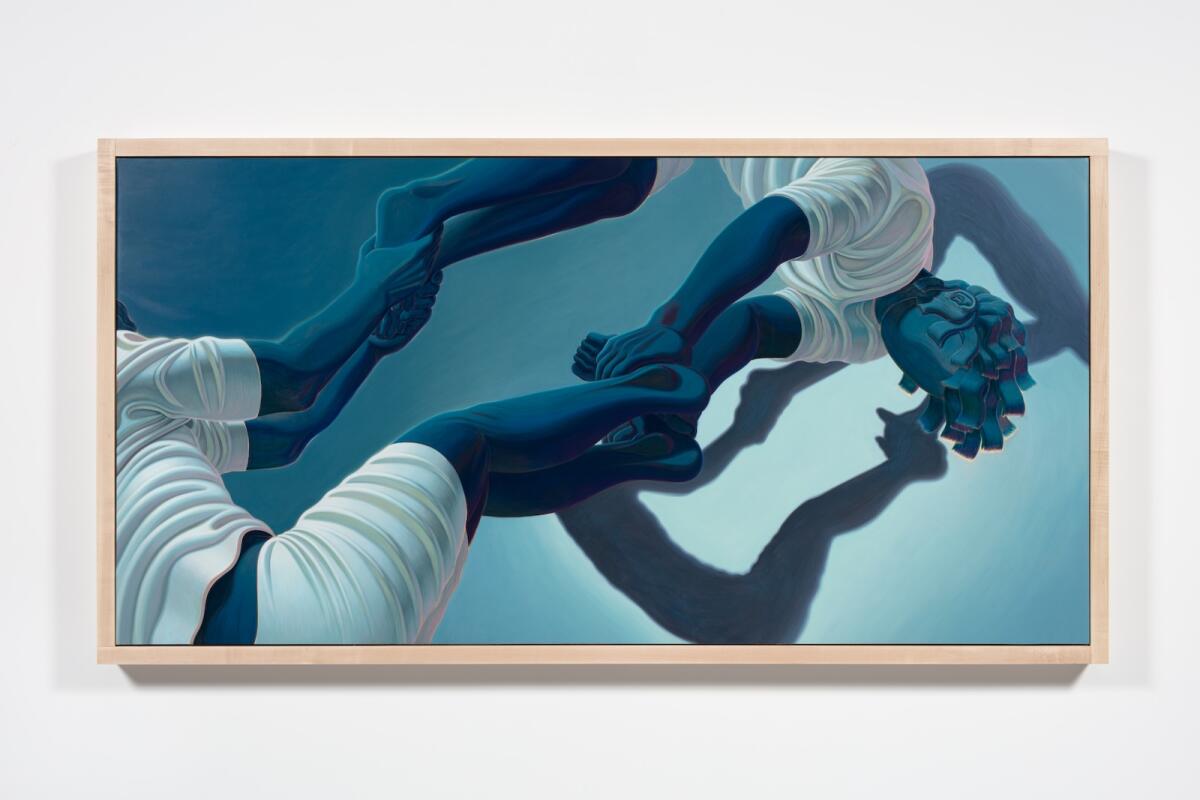
Spanish painter Nieves González arrives in Los Angeles for her first U.S. solo exhibition having already experienced a taste of fame.
The 29-year-old caught the attention of the art and fashion worlds last year after being discovered on Instagram and commissioned to paint the cover of Lily Allen’s album “West End Girl.” Depicting the singer as a Baroque aristocrat clad in contemporary designer fashion, the portrait helped propel González onto an international stage.
Collectors have taken notice. The 13 paintings in “A Friendship Story,” opening Saturday at Richard Heller Gallery in Santa Monica, have already sold out, according to the gallery, with prices ranging from $4,000 to $20,000.
Share via
Elle magazine dubbed González “Fashion’s Favorite New Artist,” while exhibitions in Rome, Paris, Belfast and Bilbao, Spain, expanded her reputation across Europe.
González developed her classic yet defiantly modern approach while studying at the University of Seville, where Spanish masters such as Diego Velázquez and Francisco de Zurbarán painted in the naturalist Baroque tradition. Drawing liberally from fashion, art history and everyday life, she often dresses the subjects of her portraits in puffer jackets — garments she wears herself during the cold winters of Granada, Spain, where she lives. The material, she said, recalls the sculptural rendering of fabric in paintings by Zurbarán and Velázquez: the folds, the volumes, the high shine.
Nieves González often dresses her subjects in puffer jackets.
(Genaro Molina / Los Angeles Times)
“It works beautifully from a visual standpoint,” she said, speaking Spanish during an interview at Santa Monica’s Bergamot Station a few days before the exhibition opened. Wearing blue jeans and a pink button-down blouse, she echoed the pastel blues and pinks that appear throughout many of the works surrounding her.
“Fashion inspires me,” she said. “Just as 17th century artists drew inspiration from the fashion of their day — often creating paintings that served as catalogs of current styles — I do the same,” she said. “The goal is to not merely convey a specific message or ideology but to create a testament to a generation and the era in which we live.”
This fall, González’s painting “La Sfida” (2025) will appear in the Städel Museum’s exhibition “Mary Magdalene. Sin. Pray. Love” in Frankfurt, Germany, alongside works by Lady Gaga, Marlene Dumas and Auguste Rodin. The painting depicts Mary Magdalene with long, flowing hair, draped in a regal red garment and clutching a skull — a contemporary interpretation of one of Christianity’s most enduring figures.
“Nieves González is the youngest of these artists and, at the same time, probably the one who most closely follows in the tradition of the Old Masters,” curators Bastian Eclercy and Stefan Roller wrote in an email.
The Santa Monica exhibition marks an evolution from the paintings that established González’s reputation. Earlier works often centered on solitary women posed with the self-possession of royal portraits or religious icons. “A Friendship Story” focuses on relationships between pairs of women, exploring friendship, intimacy, support and shared experience.
For González, friendship is one of the most profound aspects of women’s lives and a subject she felt deserved greater attention in painting.
Victoria Rios, a curator who works with González, said the artist’s paintings “rewrite the narratives of the past, rewrite the history of martyrdom and place women at the center.”
“Nothing in her painting is arbitrary,” Rios said in an email. “Every formal decision is also an ethical one.”
“The horse elevates the art; symbolically, it carries connotations of elegance and nobility,” Nieves González said. “It seemed like a way to elevate the concept of friendship.”
(Genaro Molina / Los Angeles Times)
González frequently turns art historical conventions on their head. In “Salir a robar caballos: Go out to steal horses,” she replaces the archetypal portrait of a gallant man on horseback with two young women dressed in puffer and vinyl jackets, posed like contemporary Amazons atop rearing horses.
“The horse elevates the art; symbolically, it carries connotations of elegance and nobility,” González said. “It seemed like a way to elevate the concept of friendship. It also has an element of play, adventure and fun, since having fun is part of the bond too.”
The artist also sees her work through a feminist lens.
“We live in a patriarchal society, and so, unfortunately, I belong to the oppressed segment of that society, and my work relates to that,” she said. “It stems from a struggle, an understanding and a process of redefining concepts that we have historically established as normal, natural and habitual.”
“I am interested in portraying us as brave and powerful, sometimes even with an air of haughtiness,” she said.
Another painting, “Something’s crossed over me and I can’t go back” (2026), captures González’s fusion of historical and contemporary references. Two women dressed in green and pink fur cradle each other’s heads, reimagining medieval depictions of cephalophores — Christian martyrs who carry their severed heads while continuing to preach or pray.
The title comes from a pivotal line in the 1991 film “Thelma & Louise,” marking the turning point for Geena Davis’ character Thelma, fully committing to her ultimately fatal adventure with Susan Sarandon’s Louise.
Nieves González, “Holding You,” 2026 (oil on canvas).
(Genaro Molina / Los Angeles Times)
González builds each painting from what she calls a “Frankenstein” — a digital composite assembled from archival photographs, found images and reference material. The painting process then takes over. A mid-project visit to the Prado Museum in Madrid, for instance, might send her back to the digital sketch to pull in a compositional element from Velázquez before returning to the canvas. “The final result often ends up being completely different from what I initially envisioned,” she said.
Heller began representing González, whom he calls an “original voice,” last year after being introduced to her work by another painter.
Staging her first U.S. solo exhibition in Los Angeles rather than New York reflects what he sees as a more relaxed environment for an emerging artist, without the glare and expectations of the New York art world.
“L.A. feels a little less constrained,” Heller said. “It feels a little more free.”
González’s portrait of Allen is currently on view at London’s National Portrait Gallery, hanging in the same room as a self-portrait by David Hockney. She said while it “has been very significant in terms of media exposure,” exhibitions and professional opportunities were already in motion before the album cover brought wider attention.
“I’ve always said that what I want to do in life is make a living from painting,” she said.
Mission accomplished.
‘Nieves González: A Friendship Story’
Where: Richard Heller Gallery, 2525 Michigan Ave. #B-5A, Santa Monica
PERRIE Edwards is already booked and busy following her stunning wedding to Alex Oxlade-Chamberlain.
The former Little Mix songstress, 32, and her footballer husband tied the knot in an intimate ceremony less than a week ago after after nine years of dating.
Sign up for the Showbiz newsletter
Thank you!
Perrie Oxlade-Chamberlain is already back to work after her weddingCredit: Not known, clear with picture deskThe songstress was beaming as she performedCredit: Not known, clear with picture desk
But it appears Perrie is already getting back to work, and was pictured dressed up behind the scenes at the Isle of Wight Festival yesterday.
The singer got up on stage and performed for a buzzing crowd while wearing an all black skintight outfit.
Though she couldn’t help but take a moment to gush about her wedding to everyone, sharing how she is utterly “obsessed” with being able to call Alex her husband now.
Perrie and Alex jetted off to Portugal for their big day alongside friends and family.
She was performing at Isle of Wight Festival yesterdayCredit: Not known, clear with picture deskPerrie’s wedding to beau Alex was only days agoCredit: InstagramThe happy couple had been dating for nearly a decade before tying the knotCredit: InstagramPerrie debuted three gorgeous wedding dresses before jetting back to the UKCredit: Instagram
Insiders said the pair married in a low-key ceremony before hosting their closest family friends at the posh Parrilla Natural restaurant.
The pair said their vows in the Igreja Matriz de Estoi church in the village of Estoi in Faro, close to where they own a villa.
Perrie, who had six bridesmaids including her sister Caitlyn wore a long-sleeved, lace gown, while Alex looked smart in a tux.
Her bandmate Jade Thirlwall missed the celebrations as she was booked to perform at Primavera Sound Festival on the same day.
A source said: “Perrie and Alex’s wedding day could not have been more special.
“It was intimate and emotional.
“Perrie and Alex’s son Axel had a special role to play in the ceremony. It was adorable to see.
“She looked absolutely radiant and Alex didn’t stop smiling. It was a truly beautiful day.”
In the days after the wedding Perrie debuted two more wedding dresses in Portugal, including a gorgeous sparkly mini dress with a detachable jacket.
Former Little Mix bandmate Jesy Nelson is said to have not received an invitation.
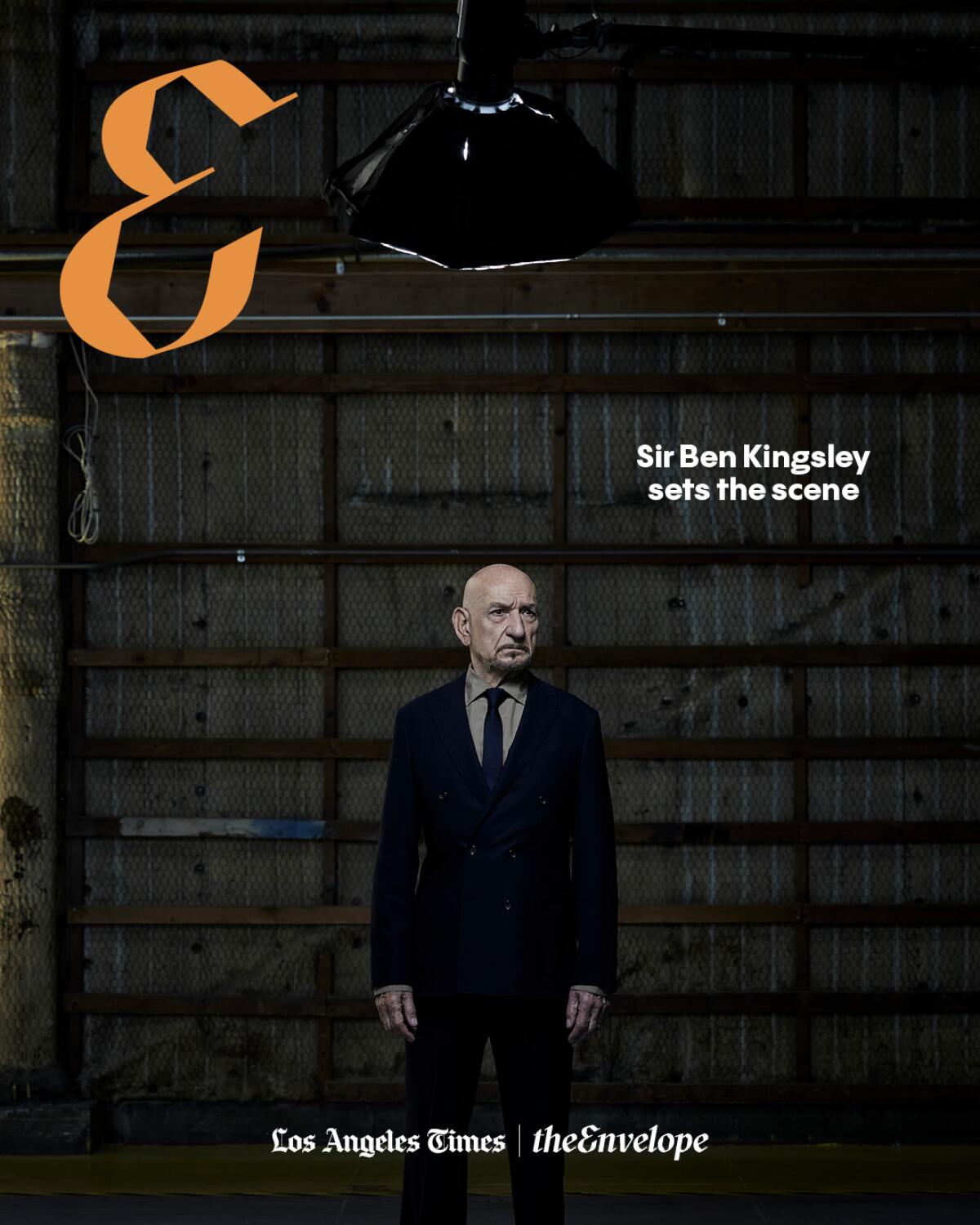
Did Ben Kingsley in “Gandhi” cross your mind? Probably not.
The 82-year-old Oscar winner thinks it should.
I’m Glenn Whipp, columnist for the Los Angeles Times and host of The Envelope newsletter. Don Logan or Mahatma Gandhi? The answer isn’t as plain as you might think.
Sign up for The Envelope
Get exclusive awards season news, in-depth interviews and columnist Glenn Whipp’s must-read analysis straight to your inbox.
By continuing, you agree to our Terms of Service, which include arbitration and a class action waiver. You agree that we and our third-party vendors may collect and use your information, including through cookies, pixels and similar technologies, for the purposes set forth in our Privacy Policy such as personalizing your experience and ads.
Not long ago, I spoke with Kingsley just before an Emmy FYC event for “Wonder Man,” the enjoyable new Marvel TV series that finds him revisiting Trevor Slattery, the washed-up, drug-addled actor he first played in 2013’s “Iron Man 3.”
“Wonder Man” follows struggling actor Simon Williams (Yahya Abdul-Mateen II), trying to land a big break in Hollywood while keeping his superpowers hidden. Trevor befriends Simon. Initially he has ulterior motives, but soon becomes Simon’s mentor, turning the series into a look at the indignities that actors face while pursuing their profession.
Taking notes while watching the show’s eight episodes, I wrote, “Ben Kingsley’s seething anger is everything.”
You may remember Kingsley’s bullying and badgering and swaggering menace playing the underworld sociopath in Jonathan Glazer’s 2000 crime-thriller “Sexy Beast,” still my favorite Kingsley performance, one that earned him a supporting actor Oscar nomination. (He lost to Jim Broadbent in “Iris.”)
Is that kind of boiling rage as fun to play as it is to watch?
“If the expression of rage or indignation is completely dramatically justified and that expression of indignation is of enormous benefit to the tribe, yes,” Kingsley answers.
(Larsen&Talbert / For The Times)
Kingsley says Itzhak Stern, Oskar Schindler’s loyal aide and factory manager in “Schindler’s List,” was, “bless him,” all about “contained rage.”
“And a colleague of mine who saw ‘Gandhi’ said, ‘That’s the angriest performance I’ve ever seen on screen,’” Kingsley continues. “That righteous indignation propelled him, and it can be expressed in many ways. Sometimes the safety valve is efficient enough to allow it to come through language and gesture, and sometimes the safety valve can’t hold it.
“That was Don Logan in ‘Sexy Beast.’ No safety valve.”
Let’s circle back to that thought of how rage can help the “tribe.” In “Wonder Man,” Trevor proclaims that “acting is not a job. It’s a calling, the single most consequential thing anyone could ever do with their life.”
“I would broaden the definition and refine it back to its origins,” Kingsley says when I ask if he shares Trevor’s view on acting. “There are images, thoughts and threads that I find nourishing and sustaining, and I treasure them. The tribal storyteller is a very consequential figure in the tribe, and if the mantle of the tribal storyteller falls upon that person’s shoulders, that is the single most consequential thing that person can do in their lives.”
“Trevor expresses it quite differently, and that’s fine,” Kingsley says. “That’s in the script. I honor the lines. But for me personally, as a rather convoluted answer, the tribal storyteller is the hand I hold and the baton I want passed on to me. Maybe it has. I hope I’m worthy, but it’s …” Kingsley widens his eyes and whispers, “Wow.”
“It is the single most consequential thing I can do with my life.”
There’s something delightful about plays about grand divas in crisis.
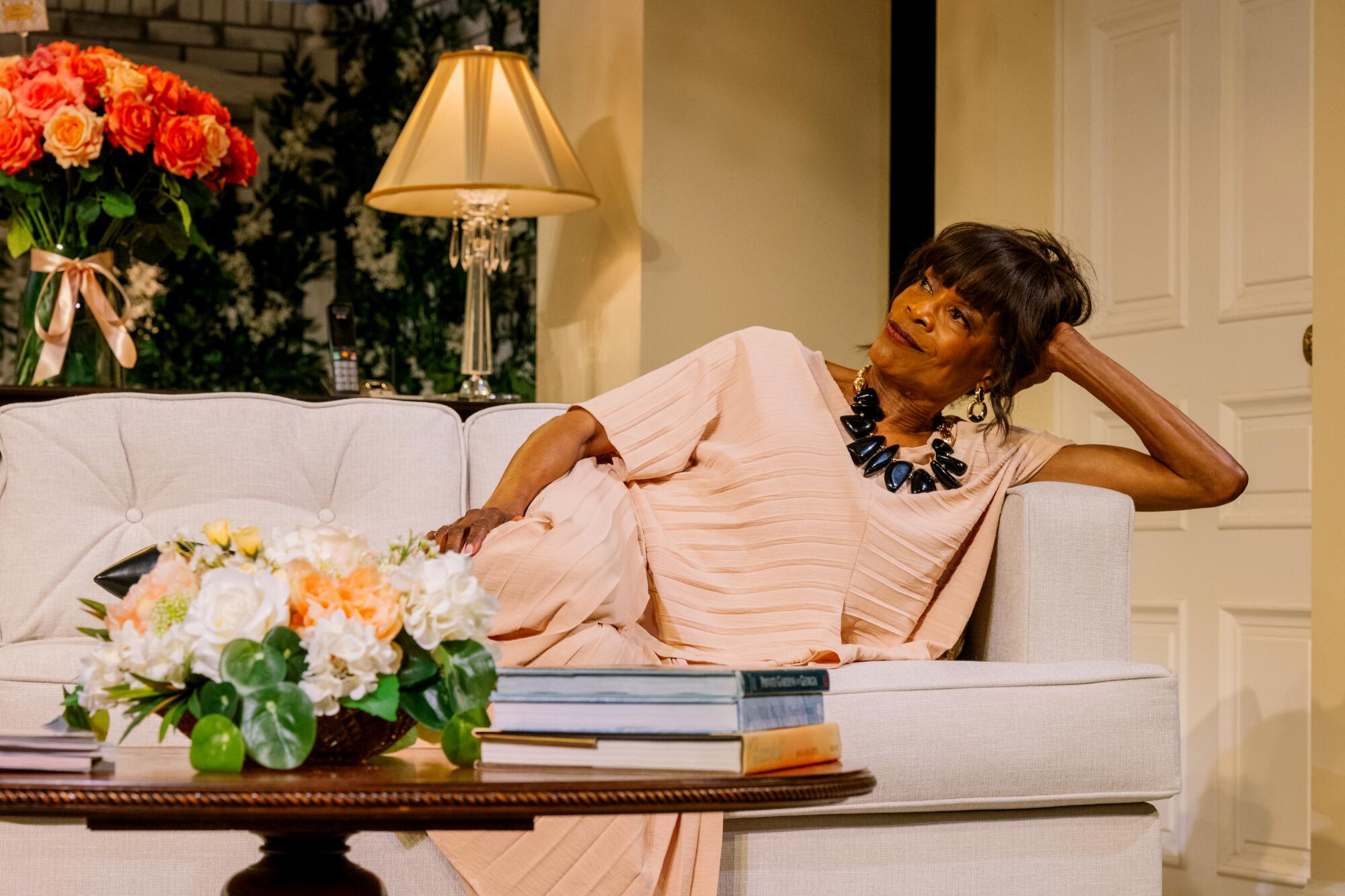
The prima donna in extremis in Pearl Cleage’s “Angry, Raucous, and Shamelessly Gorgeous,” which is having its Los Angeles premiere at the Geffen Playhouse, has an air of Bette Davis extravagance to her. When Anna Campbell (Charlayne Woodard) struts around her elegant hotel suite in Atlanta, she can’t resist delivering one of Davis’ signature lines: “What a dump!”
She’s not at all dissatisfied with the accommodations. She’s just frustrated that the weather isn’t cooperating with her upcoming outdoor performance and agitated that this might be a bad omen for her big American comeback.
More than 30 years ago, Anna and her manager and trusted companion, Betsy Samson (a formidable Denise Burse), fled to Europe on the heels of a highbrow scandal. Anna made waves when she performed “Naked Wilson,” a protest piece that had her delivering male monologues from August Wilson’s plays while standing stark naked before a divided audience.
The idea was to call attention to the way women have been de-centered in the male canon, but some felt it was sacrilege to subject Wilson’s work to a feminist stunt. Acting opportunities dried up, and Anna high-tailed it to Amsterdam, where her histrionic grandeur was put to good use in European classics.
Charlayne Woodard in “Angry, Raucous, and Shamelessly Gorgeous” at Geffen Playhouse.
(Jeff Lorch)
Woodard brings Anna to life with a smokey voice, a statuesque presence and an arch demeanor. When her arms are in flamboyant motion, she leaves the impression of a seductive windmill that might slice you to bits if you come too close.
The sumptuous production, directed by LaTanya Richardson Jackson with solidarity for Cleage’s characters, provides a marvelous showcase for Woodward to slink around on Beowulf Boritt’s glamorous five-star set in costume designer Emilio Sosa’s inspired Pucci-esque outfits. Her Anna doesn’t do much but give attitude. Ah, but what delicious attitude she gives!
Cleage’s play, it must be said, is hamstrung with exposition. More time is devoted to setting up the dramatic situation than to activating it. Author of “Blues for an Alabama Sky,” a 1995 abortion drama still ahead of its time, Cleage is telling a backstage story that’s clearly close to home. She’s also spinning an intergenerational tale of Black women groping past their initial distrust to a deeper understanding of what they have in common.
The intentions are noble and the themes are handled with admirable complexity, but the writing is sluggish. The plot is like an old car whose engine just refuses to start on a cold winter morning.
Anna has returned to Atlanta to headline a festival that is rebooting her “Naked Wilson” piece. She’s worried about disrobing at her age, but it turns out that she’s only being honored for her work. A much younger and far less experienced performer has been cast in the part that made her a cause célèbre.
Denise Burse, from left, Deborah Joy Winans, Charlayne Woodard and Olivia Washington in “Angry, Raucous, and Shamelessly Gorgeous” at Geffen Playhouse.
(Jeff Lorch)
Precious Watson (Olivia Washington), who goes by Pete, has not only never performed in a Wilson play but she’s never even seen one on stage. She’s a stripper whose only real dramatic experience has come from the adult entertainment industry. (Don’t call her a porn star, not because she’s ashamed of the films she made but because she’s too modest about her screen credits.)
Anna, her hauteur hardening like a protective shell, is aghast. She’s also fearful about her future. She’s run out of money, and this festival was to have launched her return to the U.S.
Betty, whose fate is tied to Anna’s, has been dangling the prospect of a national tour. But when Kate Hughes (an appealingly grounded Deborah Joy Winans), the producer of the festival, hears of this idea, she thinks it’s completely unrealistic.
“I love Anna,” she tells Betty. “ I’m honoring Anna, but there just isn’t an audience for the kind of presentation you’re talking about.”
Time marches on, and one era’s sensational renegade becomes a footnote in the next. But Anna can’t believe that all she holds sacred — study, discipline, seriousness, commitment — is of little value in the social media world.
Deborah Joy Winans, left, and Denise Burse in “Angry, Raucous, and Shamelessly Gorgeous” at Geffen Playhouse.
(Jeff Lorch)
Pete (whom Washington plays with impressive self-possession) doesn’t seem at all bothered about what she doesn’t know. Anna keeps prefacing her remarks with the words “no offense,” but Pete can’t help being offended by her pointed disdain. Their standoff energizes the play, but this jolt of momentum comes a little too late.
“Angry, Raucous, and Shamelessly Gorgeous” is not just the title. It’s also a plot summary. The gorgeous part is the richness of Cleage’s characters, radiantly realized by all four actors under Jackson’s warm direction.
Cleage gives the women plenty of substance, though her novelistic mode — more telling than showing — deprives her drama of style. The elegant staging tries to compensate, but the performers have to rely a little too heavily on their own charms to make up the difference in a play that swerves unexpectedly at the end into a cutesy fairy tale.
‘Angry, Raucous, and Shamelessly Gorgeous’
Where: Gil Cates Theater at Geffen Playhouse, 10886 Le Conte Ave., L.A.
When: 7:30 p.m. Wednesdays-Thursdays, 8 p.m. Fridays, 3 and 8 p.m. Saturdays, 2 and 7 p.m. Sundays. (Check for exceptions.) Ends July 12
Walter Parazaider, the saxophonist and co-founder of the rock group Chicago, has died. He was 81.
Parazaider died June 17 of complications from Alzheimers disease. In a statement posted to social media on Wednesday, the band said that “Chicago is heartbroken at the sad news of Walter Parazaider’s passing this morning. We extend our deepest condolences to his family, friends and countless Chicago fans who are all grieving his loss today.”
His daughter, Felicia Helen Parazaider, also posted on Facebook that “I love you poppy, my Pal…You coloured our world.”
Born in Maywood, Ill., Parazaider began his music career as a clarinetist, before founding Chicago with childhood friends in the group’s namesake city. The band’s pop hits like “25 or 6 to 4” and “Saturday in the Park” were staples of the ‘70s and remain beloved fixtures of classic rock. His diverse woodwind skills helped give the band its regal sound, adding saxophone riffs to hits like “Just You ‘n’ Me” and a poignant flute solo on “Colour My World.”
While Chicago’s lineup changed often, Parazaider remained with the group until retiring in 2018. In April of 2021, Parazaider wrote in a statement on Chicago’s website that “I was diagnosed with Alzheimers disease. Needless to say, my wife, daughters and myself were shocked and devastated. It has taken awhile to process this news and the fact is, we still are. The good news is we have a wonderful medical facility here and I have a very good doctor. I am working hard and not going to give up.”
Chicago gave credit to Parazaider for conceiving of the band’s distinct instrumentation, and the work ethic that made them stars. “A Rock & Roll band with horns was Walt’s idea,” Chicago’s statement continued. “He put the band together and they rehearsed in the basement of his mother’s home. He is also the one who did the hard work to book shows for the young, unknown band, performing top 40 covers at local bars in and around Chicago.
“We are forever grateful for his contribution,” they continued. “Perhaps his greatest gift was bringing people together. This amazing music may have never been heard had it not been for Walt’s vision.”
Parazaider is survived by wife JacLynn and daughters Laura and Felicia.
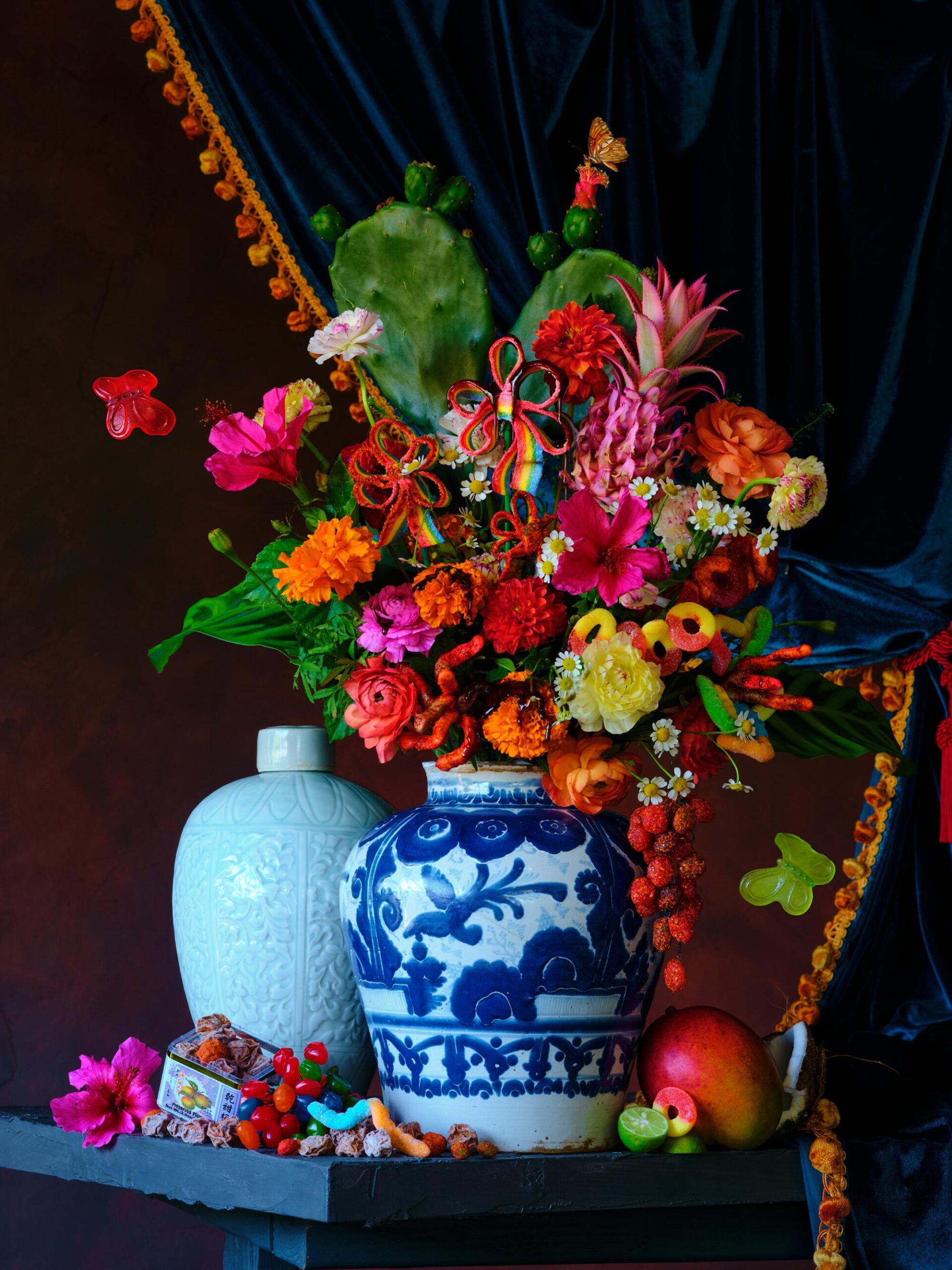
Stephanie Shih, “梅國 (Still life with chamoy and Dirty T Tamarindo),” 2025/2026. Archival pigment print on wood panel, varnish, glue, acrylic, frame. 38.25×48.25×3.75.
(From the artist)
Much has been written about the experience of aimlessness in the new David Geffen Galleries at LACMA, but it is another thing to experience it firsthand. The meandering floor plan, with its rooms of various sizes and orientations alongside their resulting passageways and corners, demands that you wander, not map, your perusal of the galleries. As a result, a visitor can easily feel disoriented, or in my case, a touch deconstructed. A little depersonalized, if you will.
Fortuitously, I was there to meet with multidisciplinary artist Stephanie Shih, whose photo-based compositions have the opposite effect, grounding the viewer in their personhood and experience. Her still lifes are made both beautiful and meaningful through their intentional arrangement of specific food, florals and ephemera, touching on diasporic understandings of self, Western and European appropriations of the “exotic” and the juxtaposition of the natural with the fabricated. In other words, to view a Shih piece is to collaborate with the artist on reconstructing or, in some cases, reclaiming an understanding of place and self.
We were talking about, and in front of, Shih’s new piece, “梅國 (Still life with chamoy and Dirty T Tamarindo),” which was not only commissioned by LACMA, but created in a temporary studio Shih constructed within the gallery itself over the course of two weeks late last year. The image features two ceramic vessels, one slightly in front of the other, within a traditional still life scene. The background jar stands alone, while the piece in the foreground overflows with a rainbow of plants, flowers, fruit, chamoy candies, gummies and a single real butterfly. To get to the small but sunny corridor that houses the work, one might make a few indirect turns and cross the gallery containing Andreas Gursky’s “Ocean” series. Flanked by four wall-size photographs of vast, overhead perspectives of the deep blue Indian Ocean, it’s easy to feel small among the giant panels. Luckily, when I met Shih at LACMA, she intercepted me outside and led us confidently up the Geffen’s dramatic exterior staircase and to “The Global Appeal of Blue-and-White Ceramics” installation — no crossing of oceans necessary.
After our conversation, I stayed to wander the galleries for a few more hours. I am a completist and I wanted, no, needed to see everything. Without the prescribed navigation I was accustomed to in a museum, this became a fool’s errand. I got physically lost and a bit lost to myself. Had I already seen that statue or did it just look like another visage also rendered in marble a few galleries back? I was pretty sure I had already taken these two rights and then a left before, but what if I hadn’t and would then miss a whole other room? The 360-degree curved glass walls encasing the galleries offered many glimpses of a face that belonged to me but somehow wasn’t mine. Who was I? I felt like I would never see everything on display, but also maybe never again exist beyond the funhouse of the Geffen Galleries. In my confusion, I passed by “梅國 (Still life with chamoy and Dirty T Tamarindo)” more than once and was reminded of Shih’s ability to articulate complex reconstructions of self through her exquisite, serene compositions. It was enough to reassure me that I could find myself again, if only I slowed down and considered my context with curiosity instead of fear.
This curiosity led me to “Shaping Dutch Identity: The Mr. and Mrs. Edward Carter Collection.” It was a serendipitous encounter for two reasons: One, the visual and symbolic correlation between Shih’s painterly use of shadow in her food- and floral-centered compositions, and the still life masterpieces of the 17th century Dutch. And two, because much like her work itself, our interview included layered discussion of constructing and shaping identities. Take the new Peter Zumthor-designed building in which we found (and in my case, lost) ourselves, which builds upon the existing galleries of LACMA while redefining the museum’s identity. Or Shih’s in-situ studio, which was created for creation’s sake, then taken down with only a photo of its contents remaining — contents which were constructed by the artist, too.
There was also the progression across cultures and continents of blue-and-white ceramics, which mirrors the evolution of chamoy, a pickled fruit condiment in Mexican cuisine that, along with a blue-and-white Talavera jar, is at the center of Shih’s piece. Both the ceramic and the chamoy traditions symbolize layers of culture as shaped by globalism and localism.
At one point in our conversation, I was momentarily embarrassed when I couldn’t recall the Filipino term for dried sour plums (kiamoy), a precursor to Mexico’s chamoy. It was an aspect of my identity as a third-generation Filipina that was also irretrievable to me that day. Shih was understanding and gracious in her response: “One of the really fun parts of the work I get to do is learning a lot of these histories that get hidden from us.” Given Shih’s academic background — she holds a PhD from Stanford University in linguistics — it makes sense that she brings deep research to her practice. Her art is rich with symbolism and history. But Shih’s work is also playful and, much like her response to me, generous in the invitation it extends to viewers to bring their own identities to her pieces in order to construct meaning for themselves. I may have felt unmoored among the Geffen’s myriad corners and paths, but never when I was standing in front of Shih’s piece.
Installation view of the inaugural presentation in the David Geffen Galleries, April 2026, featuring (top) Stephanie Shih’s 梅國 (Still life with chamoy and Dirty T Tamarindo) (2025- 26) and (bottom) Jar (c. 1700-50).
(Museum Associates / LACMA)
Claire Salinda: Your composition captures flowers, chamoy and other candies and fruit sumptuously arranged in and around a ceramic jar from LACMA’s permanent collection. How did you decide on chamoy as a subject? And how is it contextualized within the new David Geffen Galleries?
Stephanie Shih: “梅國 (Still life with chamoy and Dirty T Tamarindo)” is on display in “The Global Appeal of Blue-and-White Ceramics.” The gallery presents a condensed history of blue-and-white ceramics globally in dishes, starting in the Middle East with a 9th century Iraqi piece. From the Middle East we really got the use of cobalt in designs, and that married with the introduction of porcelain from China. We also have the Iznik kilns in Turkey, which are still operating today, and influences into Southeast Asia, and so on. Later on, the influence spread farther afield into Japan and France, where they started adding even more to it. The blue-and-white tradition has really spread globally, so this gallery is a nice microcosmic story of the effects of globalism before modern globalism.
For a long time I’ve been wanting to make a piece about chamoy and was just waiting for the opportunity to do so. The story of chamoy really parallels this journey of blue-and-white ceramics, which got to Mexico because of Spanish colonialism and then was adopted by local artisans. They really made it their own in the Talavera tradition. Chamoy similarly comes from Asia through pickled plums, particularly China via the Philippines. Filipino laborers came to Mexico via colonialism, and adapted and adopted champoy with spices and chilies from Mexico to become chamoy.
The curator, Susie Ferrell, gave me a whole list of blue-and-white surveys that they were looking at. We went to storage and to the conservation labs to look at all the pieces and we ended up choosing two pieces to work with. The one in “梅國 (Still life with chamoy and Dirty T Tamarindo)” is a Mexican Talavera jar from the 1700s. It’s the first non-Asian origin institutional ceramic I’ve gotten to work with in my career, which is the reason that I gravitated toward it.
Chamoy has been used by a lot of modern day food makers and chefs with American nostalgic candies, like peach rings and gummy worms, and my personal favorite, Gushers. One of these food makers, Alana Solis, who’s based in Tucson, runs Dirty T Tamarindo, a chamoy candy business she started during the pandemic. It was from her that I learned the history of chamoy, and so I wanted to do a piece with her candies for a long time. And this is just a really perfect opportunity with the Talavera jar.
I had pitched to Susie that it might be nice to have a second ceramic in the piece, a companion that demonstrates the origins and precursors of the blue-and-white ceramics in Mexico, a Chinese piece or something. She actually picked the one pictured here, which is also from the LACMA collection. It’s a 12th century Qingbai ware prunus vase, a meiping jar. When Susie pitched it to me, I didn’t even realize how perfect it was: A prunus vase is usually what they put plum blossoms in, and meiping means beautiful plum vase. It just ended up being a really, really good pick from her.
CS: You built a studio space within the gallery to create the piece. I’m curious about the constraints and what was surprising for you.
Artist Stephanie Shih’s makeshift set in the Los Angeles County Museum of Art (LACMA) David Geffen Galleries for her two-week commission project residency; Light test detail.
(Stephanie Shih)
SS: I was here for two weeks. I had a friend build a wall, we painted it downstairs and then brought it in and had it in the gallery with the light coming in through the windows. They gave me a refrigerator to store all the food, because I wasn’t supposed to have it out in the gallery space. We built out work tables too … it’s hard to kind of imagine with all the other stuff here now.
It was in December, and so the building was in several stages of installation with the art. There were just stacks of crates and boxes, which is amazing — it was very cool to just see statues half unpacked.
And actually, seeing everything get installed affected my thinking about the frame. Originally I wasn’t going to do a framed piece, it was just going to be on a panel. But then as I saw everything else go up, there was a weightiness to the way everything was framed and thought about. A lot of the frames are gold gilded, which are incredibly beautiful and historical. I wanted something that played off of that tradition, but using a red frame made it really obvious that it’s not 100% within tradition.
CS: How does this commission fit into your practice?
SS: My work started out really thinking about the artistic references we get as people working in food and still life. So many of the references are of this very Eurocentric art historical tradition. But if you look at that tradition, many things are taken from other cultures and used to symbolize the access and wealth and value that was assigned to these objects from the perspective of European imperialists, to put it nicely. It wasn’t until very recently that people were even thinking, “Well, where are these things from? What other artistic traditions does that mean that we’ve sort of borrowed from?” And so a lot of my work thinks about responding to that, but also taking back some of that tradition to tell stories of diaspora communities today here in the U.S.
From there, I’ve really started thinking a lot about the construction of identity and how we get to the things that symbolize who we are, and how we use symbols as we move through the world. As a cognitive scientist and linguist, a lot of my research training is about symbols and about the construction of identity in that way.
CS: Do you think that this piece could have been made anywhere else?
SS: No, I don’t think so. There’s something so special about the mission with the new building, how it’s so much more fluidly built and how LACMA is trying to think curatorially outside of the silos that have been set up by traditional art history. Thinking about that really, really influenced my approach to these pieces in terms of trying to collapse in each piece the timescales of historical influences and contemporary identity, but also the locality.
There’s stuff in “梅國 (Still life with chamoy and Dirty T Tamarindo)” that’s very global and far away, but also hyper local and here in L.A. For instance, the butterfly was found by my friend just a couple miles north in WeHo while I was working at LACMA. It’s native to California.
Do you know who Rachel Ruysch is? She was one of the big Dutch still life painters and in some of her later work, she was able to access flowers and plants from the American West, which was really rare at that time. She has a piece with prickly pear cactus as well as datura in it, which is crazy. We see those plants right here, but not in England and the Netherlands, where she was working at the time. Seeing that piece was part of the influence as well. In my piece, we have candy stripe ranunculus, which I was able to find for the candy. The cactus is from my backyard. There’s marigold and chamomile for their significance in Mexican culture, and the hibiscus flower, which has a long history across the Pacific Rim, tracing a lot of the places that ended up with chamoy and sour plums. I wanted a little nod to Hawaii with the pineapple because that’s where we also get salted plum culture.
Artist Stephanie Shih poses on set.
(From the artist)
CS: As we stand and chat in front of “梅國 (Still life with chamoy and Dirty T Tamarindo),” I can’t help but notice folks stopping to take it in. How is it being here and seeing people interact with the work?
SS: Oh, really fun!
CS: Do you ever want to interrupt them to answer a question you overhear?
SS: No. I think my favorite part of watching people interact with the pieces is what they bring to it. Some people see the chamoy immediately and they recognize their experiences in it, which is really lovely to see. Like, I can see someone’s been pointing at it, there’s a nice fingerprint mark. That’s funny. Some people recognize the candy in it. Kids often ask me, “How did the gummy butterflies fly?” and that’s really fun to answer. I appreciate that everyone brings their own experiences to it, and that sort of completes the piece for me.
There are more than 100 Emmy categories, and if you scroll through each and every one of them on the Television Academy’s website, you’re probably one of those people who read the terms and conditions on a document before signing your name.
This hasn’t been the greatest year for television, which has had the converse effect of prompting me to sample more shows than ever in a quest to unearth that one hidden gem that merits a place on my mock Emmy ballot. Truth be told, I’m still looking. I’m sure I’ve missed something. And I’m sure you’ll let me know.
In the meantime, here are my picks for the top 15 categories — five each for comedy, drama and limited series — along with a brief line of reasoning for each. And if it’s predictions you’re after, you can find our full BuzzMeter panel’s choices here. Emmy nominations will be announced July 8.
Sign up for The Envelope
Get exclusive awards season news, in-depth interviews and columnist Glenn Whipp’s must-read analysis straight to your inbox.
By continuing, you agree to our Terms of Service, which include arbitration and a class action waiver. You agree that we and our third-party vendors may collect and use your information, including through cookies, pixels and similar technologies, for the purposes set forth in our Privacy Policy such as personalizing your experience and ads.
Comedy series
“Abbott Elementary” “The Bear” “The Comeback” “Hacks” “The Lowdown” “Margo’s Got Money Troubles” “The Fall and Rise of Reggie Dinkins” “Shrinking”
Sterlin Harjo’s “The Lowdown” feels like it’s on the same trajectory as his last series, “Reservation Dogs,” an under-the-radar charmer that grows in estimation as its audience builds. Noir crime stories don’t come more delightful.
Comedy actress
Quinta Brunson, “Abbott Elementary” Rose Byrne, “Platonic” Ayo Edebiri, “The Bear” Elle Fanning, “Margo’s Got Money Troubles” Lisa Kudrow, “The Comeback” Jean Smart, “Hacks”
“Platonic” heightened the chaos and conflict in its second season, affording the gifted Byrne additional room to flex her comic chops. How do you sleep on a show starring a newly minted Oscar nominee?
Comedy actor
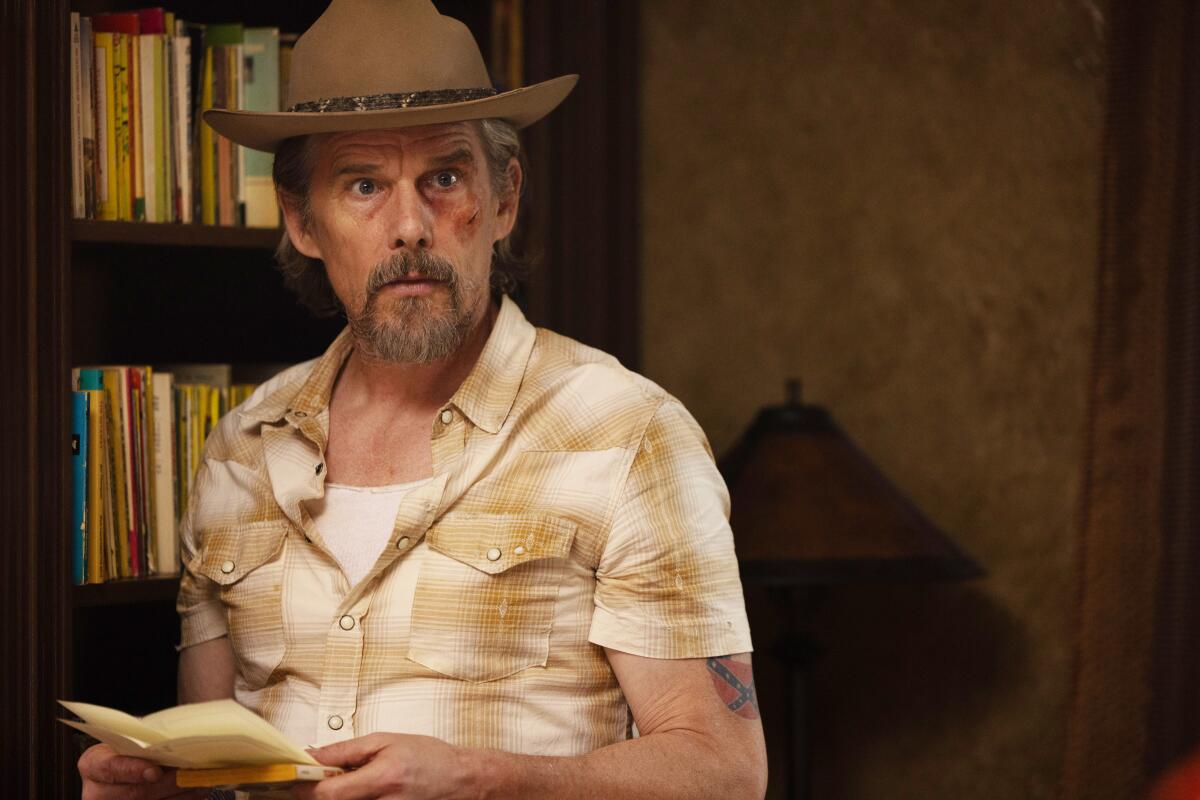
Yahya Abdul-Mateen II, “Wonder Man” Ethan Hawke, “The Lowdown” Tracy Morgan, “The Fall and Rise of Reggie Dinkins” Jason Segel, “Shrinking” Martin Short, “Only Murders in the Building” Jeremy Allen White, “The Bear”
Morgan acting oblivious is one of the funniest things ever.
Comedy supporting actress
Hannah Einbinder, “Hacks” Janelle James, “Abbott Elementary” Ashley Padilla, “Saturday Night Live” Michelle Pfeiffer, “Margo’s Got Money Troubles” Sheryl Lee Ralph, “Abbott Elementary” Jeanne Tripplehorn, “The Lowdown” Jessica Williams, “Shrinking”
The Padilla Pause is one reason I’m watching “Saturday Night Live” again.
Comedy supporting actor
Harrison Ford, “Shrinking” Marcello Hernández, “Saturday Night Live” Ben Kingsley, “Wonder Man” Ebon Moss-Bachrach, “The Bear” Nick Offerman, “Margo’s Got Money Troubles” Stephen Root, “Widow’s Bay” Tyler James Williams, “Abbott Elementary”
Hernández’s charisma and physical comedy is another.
Drama series
“Industry” “A Knight of the Seven Kingdoms” “The Night Manager” “Paradise” “The Pitt” “Pluribus” “Slow Horses” “Task”
How many Emmy voters finally caught up on “Industry,” the fast-paced drama about a group of cutthroat Gen Zers? Four seasons in, it’s more addictive than ever.
Drama actress
Caitriona Balfe, “Outlander” Myha’la, “Industry” Chase Infiniti, “The Testaments” Michelle Pfeiffer, “The Madison” Rhea Seehorn, “Pluribus” Zendaya, “Euphoria”
Now that “Outlander” is over, it’s time to pour one out for Balfe. Over the course of eight seasons, she hopscotched through time, enduring and overcoming numerous assaults and kidnappings, dealing with grief and trauma and enjoying lots of emotionally grounded sex. Balfe has earned a final reward.
Drama actor
Sterling K. Brown, “Paradise” Peter Claffey, “A Knight of the Seven Kingdoms” Tom Hiddleston, “The Night Manager” Gary Oldman, “Slow Horses” Mark Ruffalo, “Task” Noah Wyle, “The Pitt”
Claffey turned bumbling into art.
Drama supporting actress
Isa Briones, “The Pitt” Taylor Dearden, “The Pitt” Fiona Dourif, “The Pitt” Supriya Ganesh, “The Pitt” Katherine LaNasa, “The Pitt” Sepideh Moafi, “The Pitt” Karolina Wydra, “Pluribus”
LaNasa should have bumped herself up to lead. As Whitaker explains to Langdon in Season 2’s penultimate episode, Robby’s the Professor of the ER and LaNasa’s Dana is the Skipper. And the Skipper should be lead.
Drama supporting actor
Patrick Ball, “The Pitt” Diego Calva, “The Night Manager” Shawn Hatosy, “The Pitt” Gerran Howell, “The Pitt” Ken Leung, “Industry” Tom Pelphrey, “Task” Carlos-Manuel Vesga, “Pluribus”
Pelphrey has called his desperate single dad on “Task” the role of a lifetime. No argument here.
Limited series
“Bait” “Beef” “DTF St. Louis” “Death by Lightning” “Half Man”
I put off watching the finale of the punishing “Half Man” for weeks. Does that mean the show worked?
Limited series/TV movie actress
Sally Field, “Remarkably Bright Creatures” Camila Morrone, “Something Very Bad Is Going to Happen” Carey Mulligan, “Beef” Sarah Pidgeon, “Love Story” Robin Wright, “The Girlfriend”
Riz Ahmed, “Bait” Charlie Hunnam, “Monster: The Ed Gein Story” Matthew Macfadyen, “Death by Lightning” Mitchell Robertson, “Half Man” Michael Shannon, “Death by Lightning”
The young actors on “Half Man” — Robertson and Stuart Campbell — outshone their well-known counterparts.
Limited series/TV movie supporting actress
Linda Cardellini, “DTF St. Louis” Grace Gummer, “Love Story” Laurie Metcalf, “Monster: The Ed Gein Story” Cailee Spaeny, “Beef” Joy Sunday, “DTF St. Louis” Constance Zimmer, “Love Story”
Both Cardellini and Sunday for “DTF St. Louis”? No way, José, you say? Yes way, I say. All the way!
Limited series/TV movie supporting actor
(Larry Horricks / Netflix)
Jason Bateman, “DTF St. Louis” Stuart Campbell, “Half Man” Richard Gadd, “Half Man” David Harbour, “DTF St. Louis” Charles Melton, “Beef” Nick Offerman, “Death by Lightning”
The mutton-chopped Chester A. Arthur joins Ron Swanson’s ’stache in television’s facial hair hall of fame.
“Nothing has changed since the last time I talked about all this,” Rogen said, “and I haven’t worked with him in a really long time and I have no plans to.”
The actors got their start in Hollywood on the cult classic TV show “Freaks and Geeks.” At the time, Rogen was 16 and Franco was 21. As they continued to make their way through the industry, they became known for a string of well-loved early-2000s and 2010s comedies including “This Is the End,” “The Disaster Artist” and “Pineapple Express.”
Franco’s illustrious movie career came to a halt when five women, including several of his acting students, accused him of sexual exploitation. Some of the allegations included removing protective plastic guards covering actresses’ vaginas during the filming of intimate scenes, and Franco getting angry when actresses didn’t want to go topless.
Two of the accusers filed a class action in 2019, claiming sex discrimination, sexual harassment, fraudulent business practices and intimidation. Franco settled the case in 2021 for $2.2 million.
Rogen and Franco’s friendship has been a point of contention for the actor, as Rogen continues to climb the ranks in Hollywood. Just last year, “The Studio,” a show that Rogen created, writes, stars in, directs and produces won 13 Emmys and is currently filming its second season.
Rogen previously said he regretted saying that he could work with Franco again after the allegations surfaced.
“What I can say is that I despise abuse and harassment and I would never cover or conceal the actions of someone doing it, or knowingly put someone in a situation where they were around someone like that,” Rogen said in 2021, in an interview with the U.K.’s Sunday Times. “I also look back to that interview in 2018 where I comment that I would keep working with James, and the truth is that I have not and I do not plan to right now.”
The actor is still hesitant to detail the nuances of his friendship with Franco. He told the New York Times that it’s “a very personal thing.”
“There’s the public-facing side of it, which I’ve spoken about, and I have the same stance publicly that I’ve had, and I think the proof is in the pudding — I have not worked with him in years,” Rogen said. “But the personal side of it is just so nuanced, and it involves people that I don’t know if I should be dragging into this.”
WASHINGTON — Republican Sen. Mitch McConnell of Kentucky was admitted to a hospital Sunday, his spokesperson said, but there was no immediate information about why he was there or his prognosis.
McConnell, 84, was the longest-serving Senate leader in history before stepping aside from that role while finishing his final term, which ends in January.
“Senator McConnell was admitted to the hospital this morning. He is receiving excellent care,” spokesperson David Popp said in a statement without elaboration. It was not immediately clear whether McConnell was in Washington, Kentucky or elsewhere.
McConnell’s health has been a subject of scrutiny for years.
He fell and sprained his wrist while walking out of a GOP luncheon in December 2024. He was hospitalized with a concussion in March 2023 and missed several weeks of work after falling in a Washington hotel. After he returned, he twice froze up during news conferences that summer, staring vacantly ahead before colleagues and staff came to his assistance.
McConnell had polio in his early childhood, and he has long acknowledged some difficulty as an adult in walking and climbing stairs. In addition to his 2023 fall, he tripped and fell in 2019 at his home in Kentucky. He had surgery for a fractured shoulder.
McConnell was first elected to the Senate in 1984 and was the Republican leader from 2007 until 2025, serving as both majority and minority leader during that period.
He remains active in the Senate, showing up for work when the chamber is in session, and recently chairing public hearings and grilling officials from his perch as chair of the Senate appropriations subcommittee on defense. He has intermittently used a wheelchair to navigate the Capitol and is routinely accompanied by his security detail, as a former congressional leader.
If you buy books linked on our site, The Times may earn a commission from Bookshop.org, whose fees support independent bookstores.
What does it mean to lack ambition in a country that worships wealth? It means you are a capitalist wallflower, a laggard with a serious character flaw. No field of endeavor is immune from this attitude, the art world least of all. But artists with a desire for riches and fame must not declare their intentions so brazenly. At a time when the plastic arts are about as marginalized as they ever have been, and media buzz is generated by dead painters whose works sell for enormous sums at auction, creation in and of itself has little value unless it is lashed to something marketable.
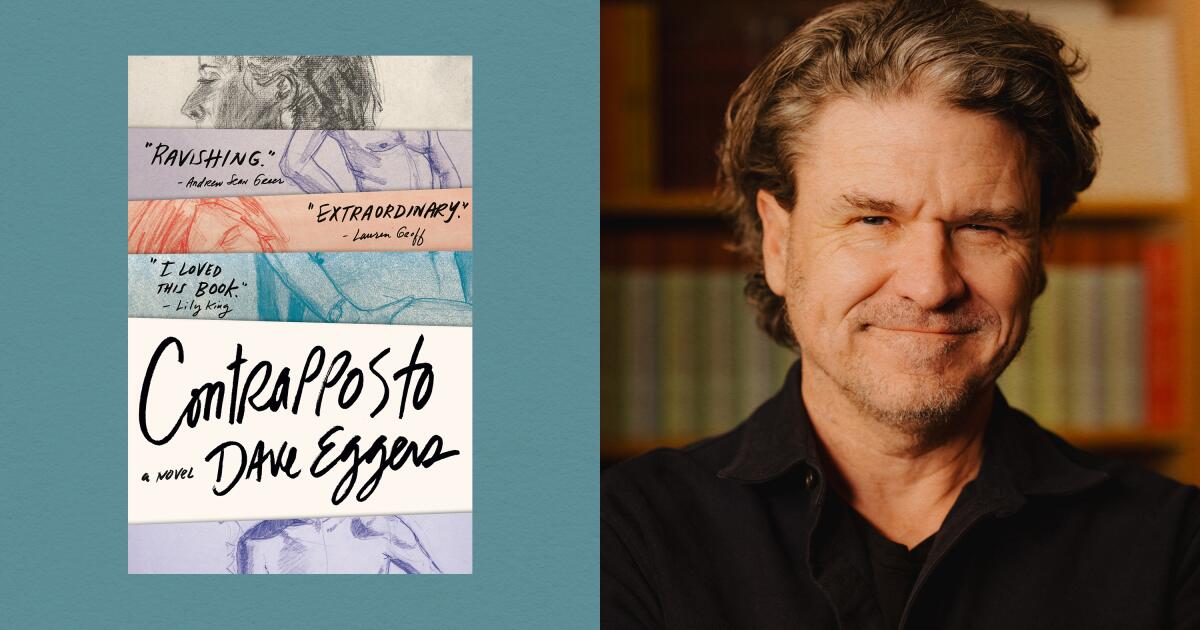
With his new novel “Contrapposto,” Dave Eggers has written a big-hearted, deeply moving story about the choices artists make, or don’t make, to square up their own notions of success and happiness. The book is dual bildungsroman, following two friends across the long span of their lives from adolescence to their 70s, as they fall in and out of each other’s lives, make their way in the world, and fumble around for meaning and purpose in their art.
The protagonist in “Contrapposto” is Rob “Cricket” Dibb, an underclass Midwestern kid, raised by a single mother in a North Indiana suburb that’s about as nowheresville as it gets for budding artists with dreams of glory. Cricket doesn’t dream big. He’s just trying to endure without bodily harm, seeking refuge from his mother’s abusive boyfriend in the basement with his grandfather Silas, who teaches him about jazz and the beauty of a glorious sunset. He draws so he doesn’t have to think. Immersion in art is his escape hatch from the dreariness of his pinched world: “The drawing meant nothing, would never mean anything to anyone, but it was true to how he saw it. His hand had recorded what he saw and felt about this thing. He was an ugly, common creature who could occasionally freeze time. That was enough.”
Cricket’s apprenticeship is decidedly informal. No full scholarship rides to Bard or Pratt for him; instead he saves up to enroll himself in a life drawing class in Chicago, where he discovers the beauty of applying rigor and rules to his work, how to break down pictures into the geometry of circles and squares, planes and angles. “He measured proportions and improved,” writes Eggers. “He grew more confident with each pass on his drawing, and realized … that much of the rightness of the drawing, of any drawing, came through time and diligence and discernment.”
He meets his slightly older schoolmate Olympia, one of Eggers’ most beguiling creations, when she implores him to scrawl scatological bathroom graffiti on a playground structure in Old-English typography. Unlike Cricket, Olympia is earnest and sincere about her art in the way that only a young person untainted by cynicism can be. She claims to inhabit the soul of Albert Camus, and flings around aphorisms about art that fly over Cricket’s head. She is an aesthete, someone who likes to go to the race track just to revel in the colors on display there. She wants to create an art scene in their little world. “You know all the great art movements have friends at their core, right?,” she tells Cricket. “A lot of time they’re jammed together by some critics and the artists reject the name and the association. But think about Patti Smith and Sam Shepard. Did you know they dated for a while?”
Cricket is beguiled by her, and Olympia in turn is taken in by Cricket’s talent. When the local library pulls a few of Cricket’s semi-nude life drawing portraits down for fear of offending their patrons, Olympia becomes his advocate and champion. In contrast to Cricket, who skates along with no end plan, Olympia is a committed careerist, an artist who insists on a captive audience to justify her work. She wants to earn money as an artist; Cricket just wants to be left alone. This push and pull between the two frame Eggers’ novel across the six decades of his narrative.
One of many joys of “Contrapposto” is observing Cricket’s artistic awakening via the mentors who guide him into his artistic consciousness. Marcus Carpenter, a wizened sage in battered work boots (one imagines him as the art world analogue to the late novelist Jim Harrison), is the moral conscience of the novel, fighting the good fight for personal expression and railing against the “new, paradoxical tyranny wherein those without technical skill terrorize those who possess it.” Carpenter plucks Cricket from arts college and its meaningless pontificating to his “atelier in the corn,” a ramshackle Victorian where Cricket learns how to transmute what he sees with color and light. “The talented have talent,” Carpenter tells Cricket during one of his endearing rants. “The untalented have theories.”
From there, Cicket’s life is a crooked line. He doesn’t abandon art, but he can’t summon the urge to sell himself or his work, to graft his joy in making things onto the caprices of the marketplace. As Eggers jumps through time, we find Cricket working as an intern in an art gallery, an arid, lifeless space where nothing inspiring can possibly exist. As a young man he works as a ship-breaker in Turkey; in middle-age, we find him in a coastal town in Cambodia, making replicas of great paintings for tourists. Olympia, his elusive love and sporadic muse, flits in and out of his life as she works her way up the tiers of the art world’s ziggurat. She gently berates him for his timidity: “This is how artists have power. We sell work. You’re implying there’s nobility in powerlessness. That’s been an idiotic trope for too long — that participating in the business side of it taints you. Do you know how dumb that is? That artists have to be these fragile little wood nymphs that are too precious to touch the money?”
As “Contrapposto” arrives at its beautiful, life-affirming conclusion, we are left pondering the significance of artistic endeavor in a world that commodifies everything, including our bodies and brains. At a time when even the greatest achievements are debased in a culture that gives equal weight to meretricious novelty, is it even worth the trouble? Eggers’ brilliant novel has the answer: Follow your bliss. In the final analysis, it is all that matters.
Last January, Spencer Pratt’s house in Pacific Palisades was razed by the raging flames of the Palisades Fire. Now, there has been what he called a “very suspicious fire” in a building in the neighborhood’s tony Highlands where he maintained an office for his crystals company.
Pratt, a former reality TV star who ran a high-profile campaign for Los Angeles mayor that he appeared to concede on Friday, talked to the California Post about the incident, which was first reported by the Palisadian-Post. According to the company’s website, the business sells precious and semi-precious crystal pendants, carvings and chains.
“I want to be careful to not compromise an arson investigation, but this incident is very suspicious,” Pratt told the California Post.
“I will wait for the investigators to make public the details, but this was no accident, and the timing of this … on the heels of all of the contentious election tomfoolery of the last two weeks, it is very suspect, indeed.”
Fire officials have not determined what sparked the blaze, and, in an interview with the Palisadian-Post, the building superintendent said he doesn’t believe the fire is related to Pratt’s campaign for mayor.
A spokesperson for Pratt did not immediately respond to phone calls and a text message seeking comment Saturday afternoon. Pratt suggested in his remarks to the California Post that he believes the fire may have been a politically motivated arson.
“This fire was not an accident, and it would not surprise me in the least if this were a reprisal for my work in opposing Karen Bass and Nithya Raman,” he said.
LAFD Public Service Officer Jamie Stewart told The Times in a phone interview Saturday afternoon that the department received a call at 6:09 p.m. Thursday reporting “a two-story commercial building with light smoke showing.” Stewart added that “arson was notified” and that LAFD arson personnel “did respond and they were on scene” of what he said was a one-alarm fire.
According to the Palisadian-Post, on Thursday, “Multiple firefighting units, including two ladder trucks, were dispatched by LAFD from Fire Stations 23 and 69 in the Palisades and Station 92 in Cheviot Hills to respond to the fire.”
The complex’s superintendent, Oscar Chang, told the local publication that the building was being remediated while waiting for a permit for work on its roof. Eyewitnesses, he told the Palisadian-Post, “saw two guys exiting the building shortly before the fire was reported.”
Chang added that he did not believe the fire was related to Pratt’s political campaign.
“One of the tenants shared a video with me of a homeless person right around the corner,” Chang told the publication, but “no one was living in the building.”
On Saturday morning, Pratt posted on social media about the Thursday fire, which tore through the Highlands Circle commercial complex at 1515 Palisades Drive. The complex was best known as the longtime home of the beloved Italian eatery Casa Nostra Ristorante, which closed a week before the Jan. 7, 2025, Palisades Fire and never reopened.
In the social media posting, he referred to the Los Angeles Times as the El Segundo Times — a derisive moniker referring to the location of its building in the coastal city near LAX Airport — and his repeated allegation that the newspaper “doxxed” him by reporting in April that he was staying in Santa Barbara County, not L.A.
“The El Segundo Times were very eager to dox where my children sleep; they thought that was newsworthy,” he wrote on X, formerly known as Twitter. “Have they reported on the arsonists who set fire to my office in the middle of my election?”
Overhead video footage of the fire posted on the Palisadian-Post’s YouTube channel showed smoke rising from the building as firefighters stood on the roof.
A filing in February with the L.A. City Department of Buildings and Safety proposed work for “change of use from commercial to retail, 2-story” at the property. In September, the department issued a code enforcement violation for “ABANDONED OR VACANT BUILDING LEFT OPEN TO THE PUBLIC.”
Get exclusive awards season news, in-depth interviews and columnist Glenn Whipp’s must-read analysis straight to your inbox.
By continuing, you agree to our Terms of Service, which include arbitration and a class action waiver. You agree that we and our third-party vendors may collect and use your information, including through cookies, pixels and similar technologies, for the purposes set forth in our Privacy Policy such as personalizing your experience and ads.
That Super Bowl in question was Super Bowl LIX, pitting the Philadelphia Eagles against the Kansas City Chiefs. Melton hosted a watch party, and since he considers Kansas home and played football for Kansas State University, you might think he’d be rooting for the Chiefs.
Nope.
“When I was living in Germany, I fell in love with Donovan McNabb,” Melton, an army brat, tells me, name-checking the longtime Eagles quarterback.
Spaeny, it turns out, was the only Chiefs fan at the party. To enter Melton’s home, she had to step on a doormat that was fitted with a red-and-white Chiefs jersey. (“It got real dirty,” Melton says with pride.)
Melton and Spaeny enjoy a relaxed and playful give-and-take, borne from the months they spent preparing to play Austin and Ashley, a Gen-Z couple working at a Montecito country club, dreaming and scheming toward upward mobility in “Beef.”
(Erik Carter / For The Times)
The most memorable episode they shared found the couple in an overcrowded, ninth-circle-of-hell emergency room with Ashley, uninsured, experiencing severe ovarian torsion. Her concerns are dismissed and she begs for someone to save her.
“Unfortunately, it’s an all-too-common experience,” Spaeny says. “I probably have a conversation once a month with female friends who go to the doctor’s office and are gaslit by the system, just being made to feel like what they’re experiencing isn’t really happening or they’re making it up. It’s scary.”
Still, being “Beef,” the episode has its share of mordant humor, like the scene where a nurse asks Ashley to rate her pain, zero being pain-free and 10 being excruciating.
“Oh, I thought it was like Letterboxd,” Ashley replies, referring to the movie review social platform. “Two-and-a-half stars out of five is average.”
“My whole life I’ve been a six or seven,” Melton says, noting his own personal pain scale. “I’ll have a cold and I’ll be like, ‘Six or seven.’”
“That sounds like you,” Spaeny says.
“I can get pretty dramatic,” Melton says. “It’s really like the end of the world when I’m sick.”
Spaeny deleted her Letterboxd account because she gets anxious about anything online containing reviews.
“It takes two buttons to click on a movie that I’ve been in and see what people say about me,” Spaeny says. “So I forgot my password and left it that way.”
Melton is an enthusiastic adopter and says he has twice shared his four favorite films, a feature where actors, usually on the red carpet, list a quartet of beloved movies. (Here’s one at the “May December” premiere where Melton enthuses over “The Matrix,” “In the Mood for Love,” “Brokeback Mountain” and “Persona.”)
“I saw them at another event and they were like, ‘Charles, so good to see you.’ And I was like, ‘Do you want my four favorite films?’ And they said, ‘No, you’ve already done it enough,’” Melton laughs. “What can I say? I love movies!”
David Hockney, the innovative and prolific British artist who arrived in Los Angeles in 1964, soon celebrating its sun-drenched life and landscapes in colorful, wildly popular paintings, has died.
He was 88.
Calling himself “an English Los Angeleno,” Hockney immortalized the city’s sparkling swimming pools, palm trees and beautiful young men, then went on to experiment with intricate photo collages, portrait suites, painted and filmed images of Yorkshire landscapes, iPad drawings and more.
Since his Pop Art paintings in the early ‘60s at London’s Royal College of Art, Hockney was rarely out of the limelight and, more important, rarely out of fresh ideas for how to draw, paint, film, print, photograph or otherwise express his creativity. The David Hockney Foundation owns more than 8,000 of his works, including about 200 sketchbooks, more than 230 self-portraits, opera designs and portraits of family and friends.
Hockney loved Hollywood — the people and the place — and liked to say he was brought up in England and Hollywood because of the time he spent at the movies. His peroxide blonde hair reportedly was inspired when he was a student and saw Clairol TV ads claiming “blondes have more fun.” But it was his interest in everything from Elvis Presley to the Hubble Space Telescope and his sense of humor that set him apart. Time Magazine art critic Robert Hughes once called him “the Cole Porter of modern art.”
He was open about being gay, even when homosexuality was outlawed in Britain. His early love affair with artist Peter Schlesinger, a younger man he met when teaching a summer drawing class at UCLA in 1966, inspired Hockney’s monumental 1972 painting “Portrait of an Artist (Pool with Two Figures),” a centerpiece of Jack Hazan’s 1974 film “A Bigger Splash.” The painting’s 2018 auction at Christie’s drew a record $90 million for a living artist.
He was a dedicated reader and student of art, paying homage in his work to Picasso and Cubism as well as to Monet, Matisse, Van Gogh and Cezanne. A lover of opera, he often had it playing loudly in the studio and enjoyed taking visitors on curated car trips through the Hollywood Hills or Malibu while listening to Wagner. He designed sets for major companies in Los Angeles, Chicago, New York, London and elsewhere over the years, and some of his set models were later shown in museums.
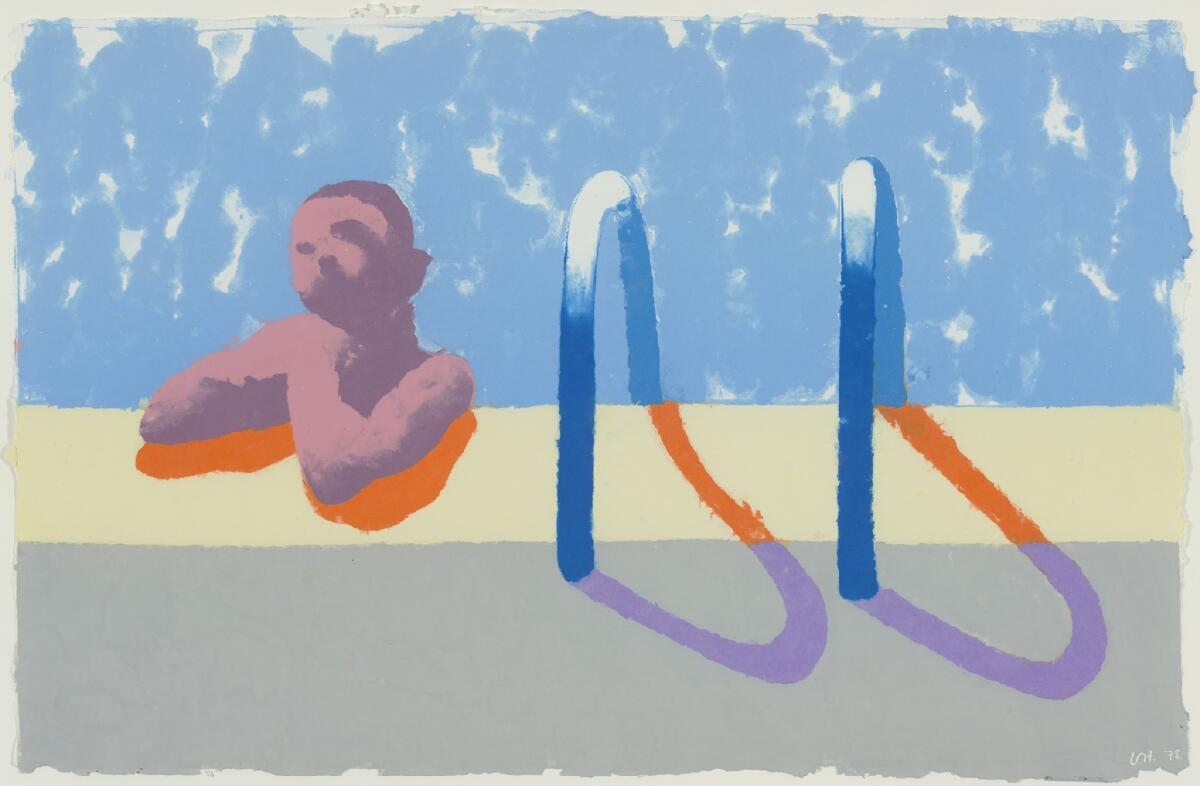
David Hockney’s work “Gregory in the Pool (Paper Pool 4)” is part of his solo exhibition “David Hockney: Perspective Should Be Reversed” at the Palm Springs Art Museum in Palm Springs. (Courtesy of the Palm Springs Art Museum)
(Courtesy of the Palm Springs Art Museum)
His solo shows drew enormous crowds to the Los Angeles County Museum of Art as early as 1988. In 2017 a major retrospective of his work, keyed to his 80th birthday, was presented at New York’s Metropolitan Museum of Art, Paris’ Centre Pompidou and London’s Tate Modern. Chronicling Hockney’s arrival as an important artist in the “ravishing” Met retrospective, the New Yorker writer Andrea K. Scott called it “a revelation.” It was, she wrote, “a retort to all the eye-rollers,” including herself, who dismissed his work “as, at best, a guilty pleasure.”
In 2012 he received the coveted Order of Merit, which Queen Elizabeth II presented to him at Buckingham Palace.
David Hockney was born the fourth of five children to a working-class family in Bradford, Yorkshire, on July 9, 1937. He has said he started “making marks on paper” at 8 and received private painting lessons before moving on to Bradford School of Art in 1953. The first painting he sold was a portrait of his father in 1955. He attended the Royal College of Art in London from 1959 until his graduation in 1962 and received the school’s Gold Medal.
After college he did not slack off, noted his biographer Christopher Simon Sykes. In his 2014 book, “Hockney: The Biography,” Sykes pointed out that the artist’s first flat had a chest of drawers near the bed on which he had painted, in large capital letters, the words “get up and work immediately.”
David Hockney in 2017.
(Catherine Opie, Courtesy of Regen Projects, Los Angeles and Lehmann Maupin, New York, Hong Kong and Seoul.)
Hockney lived by that command for the rest of his life, turning out canvas after canvas, photo after photo. In the ‘80s came his extraordinary multi-image photographic collages of friends including writer Christopher Isherwood and artist Don Bachardy and such landmarks as the Brooklyn Bridge, Grand Canyon and Pearblossom Highway.
“The Polaroids started oddly enough when I’d just finished a long period of work in the theater, which is of course playing with perspective and illusion,” he once told The Times. “People say, ‘You are a painter, and photography is a sideline.’ But nothing is a sideline for me.”
That included his continuing fascination with technology. The artist’s long career swept in artworks made not only on cameras and canvases, but on such things as fax machines and photocopiers. Hockney liked to experiment, whether it was with state-of-the-art printing devices or centuries old painting techniques. He went several times to a show of portraits by Jean Auguste Dominique Ingres at London’s National Gallery in 1999 and was greatly taken with the photographic’ quality of Ingres’ 19th century drawings. Certain that Ingres had used something optical to achieve that quality, Hockney bought himself a camera lucida, a small device that works like a prism. He then applied Ingres’ methods–as Hockney imagined them–to his own portraits of friends and family, and in 2001, he published “Secret Knowledge,” exploring his theories on early artistic uses of optical devices.
His death was confirmed by the Associated Press and New York Times.
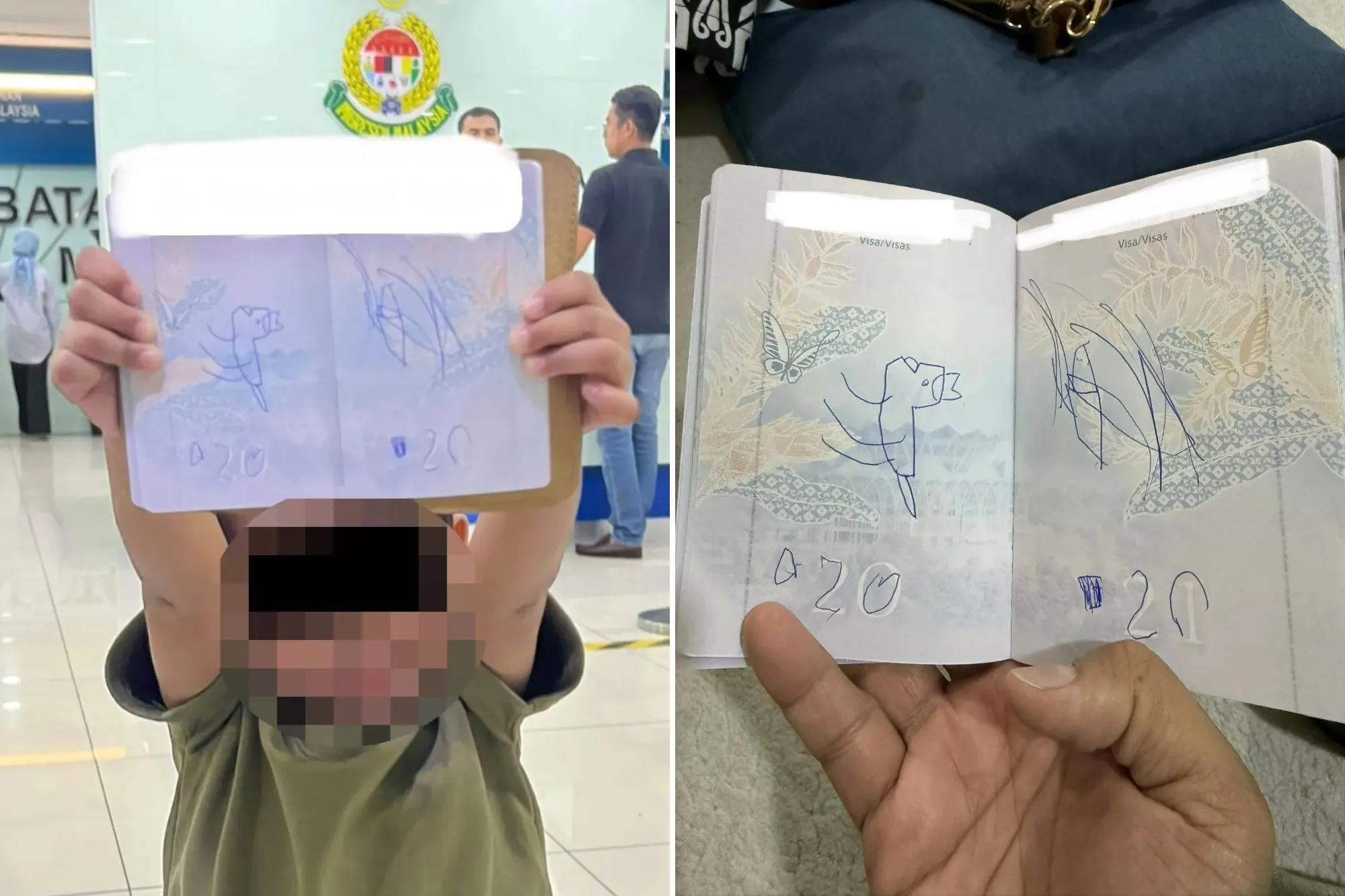
A MUM was forced to cancel her flight after discovering her son doodled a dinosaur in her passport just hours before a work trip abroad.
The distraught parent shared the stressful experience online, along with photos of the ballpoint scribbles, captioned: “I hate dinosaurs!”
Sign up for the Travel newsletter
Thank you!
A mum in Malaysia was forced to change her flight after her son drew dinosaurs in her passportCredit: Jam PressOfficials declared the passport damaged and not valid for travelCredit: Jam Press
“I feel like crying. My flight is tonight,” she said.
“I was packing, and my little one was busy scribbling on my passport. I didn’t notice when he got hold of it.
“This morning I was running around queuing at immigration.
“I’m hoping I don’t have to declare the passport as damaged.”
The woman then went to the Immigration Department in Kajang, Malaysia before being sent to Putrajaya.
Unfortunately, her worst fears were realised.
Officials told her her passport was damaged and not valid for travel.
To make matters worse, as it was a weekend, she could not get a replacement until Monday.
She said: “I’m now on the way to Kuala Lumpur International Airport to ask Qatar Airways if I can change my ticket to Monday night.
“Please pray that everything is made easier.”
Fortunately, she was able to change her flight to Monday – though at a not insignificant price of £114.
Accepting the outcome, she wrote: “To those asking about the little one who scribbled on the passport, he’s still smiling without any sense of guilt and still saying, ‘Let’s go to the airport!’
“Please pray that our affairs are made easier as we continue our 11,977km journey soon… amen.
“Also, thank you to the immigration officer in Putrajaya who was on duty this morning and helped us accept fate with more calmness.
“God willing, there is a blessing in it.”
This is not the first time passport issues have caused last-minute travel chaos.
Martin Mull was best known to audiences for playing comedic characters like Col. Mustard in “Clue” and Gene Parmesan in “Arrested Development,” but a new exhibit opening next year at the Santa Barbara Museum of Art seeks to elevate the role Mull was most proud to inhabit: a respected painter.
“Martin Mull: The Joys of Indoor/Outdoor Living,” co-curated by comedian Steve Martin and Hammer Museum Director Emerita Ann Philbin, comes to SBMA next June and runs through October. It will be the first major museum exhibition of Mull’s artwork in 20 years.
The paintings featured include scenes of unassuming houses visited by otherworldly guests, dead-eyed office workers, gravity-defying displays and lambs being led to the slaughter. They play with perspective, color, space and time to illuminate postwar American tensions, be they racial, political or existential.
“Martin Mull’s work as an artist will certainly be his primary legacy,” Martin said in a statement. “After a full-time career in painting, in the last 20 years of his life with his technical gifts fully developed, Martin’s art coalesced into tight, narrative paintings of a peculiar nature. Combining surreal elements with family idioms, he formed his own worried portrayal of American life.”
Martin Mull’s “Band on the Run,” 2014. Oil on panel.
(Estate of Martin Mull)
The exhibit, which will take over the museum’s 6,000 square feet of main galleries, will feature more than 50 paintings and drawings by Mull, most of which come from the artist’s estate and the private collections of Mull’s entertainment industry colleagues, including Steve Martin, Jennifer Tilly, and Ted and Nicole Sarandos .
“Steve talked about how Mull’s painting practice was his deepest passion, despite the fact that his fame was as an actor and comedian. It prompted me to do a little research, and I became very intrigued by his body of work. I wrote to Steve, ‘Martin Mull. There’s something there.’ That’s how the project began,” she said.
Along with Martin and Philbin, the upcoming exhibition is led by SBMA Chief Curator James Glisson and Amada Cruz, the museum’s director and CEO. In a news release, a museum spokesperson said Mull’s work “upsets any storybook picture of perfection” and resists nostalgia while acknowledging its allure.
Martin Mull’s “Envy,” 2008, from the series “Seven Deadly Sins.” Oil on linen.
(Estate of Martin Mull)
“It’s so deeply strange — dark and funny, hopeful and menacing all at once,” Philbin said. “The paintings are about the smoldering tensions that underlie the American dream, so I think it’s a particularly apt moment to bring them back into the public eye.”
Mull, who died in 2024, received his master of fine arts degree in painting from the Rhode Island School of Design in 1967. Though he went on to craft a career in the public eye as a musician, comedian and actor, painting remained his “true vocation.”
Martin, a longtime friend of the multidisciplinary artist, echoed this sentiment in an email to The Times.
“If a comedian says he is also a painter, run. Except this once.”
Musicians have been left out of settlements between major record labels and AI companies, a new lawsuit alleges.
The American Federation of Musicians of the United States and Canada (AFM), which has 70,000 members, said Universal Music Group and Warner Music Group “received significant compensation” from the AI companies for past copyright violations and licensed “substantial” portions of their music catalogs to them, but haven’t shared that with the musicians.
UMG and WMG sued AI companies Udio and Suno in 2024, accusing them of copyright infringement. Both companies settled with Udio last year. In November, WMG announced a partnership with Suno, but Universal Music Group’s lawsuit against Suno is pending.
“While the Defendants protected their own interests and created a significant source of new revenue with the retrospective settlements and prospective licenses, they have refused to compensate the musicians whose work — created with their own instruments and through their talent, creativity, and hard work — is fed into AI machines for profit,” AFM said in its lawsuit, filed in U.S. District Court in New York on Friday.
AFM said it believes the AI settlements fall under the “new use” provision of its collective bargaining agreements, which requires music companies to notify the union of new licenses for purposes not covered by the contract and to compensate musicians, whose work was used to train AI models.
UMG and WMG said in statements that they are in negotiations on a collective bargaining agreement with AFM.
“Warner Music Group is growing the value of music by establishing guardrails and architecting a healthy AI ecosystem on behalf of artists everywhere,” the company said in a statement.
Universal Music Group said it will continue to work to resolve issues during the negotiations.
“Universal Music Group has been at the forefront of protecting the rights and advancing the interests of artists and songwriters in the age of AI — striking responsible AI licensing agreements to ensure they are compensated, leading the charge for legislation to further protect them and taking legal action against bad actors,” the company said in a statement. “We expect to continue our strong working relationship with the AFM built on mutual respect for the talented musicians in our industry.”
AI has become more popular among consumers, dramatically changing the landscape in the entertainment industry. Many startups have popped up allowing users to type text prompts into AI systems to generate original songs, video clips and stories.
Some creatives say the AI tools help them brainstorm or illustrate bold ideas on a budget. But critics have raised concerns about whether AI systems are trained on copyrighted works without permission or payment to artists. Others are worried AI could eliminate their livelihoods.
Udio said it would create a new platform that would train on licensed and authorized music with artists having the ability to opt-in. Suno agreed to change its platform, launching new licensed models, and place download restrictions.
Bradford Auerbach, a partner at law firm OGC, said he expects to see more of these types of lawsuits filed by unions.
“You’ve got the unions always protecting the status quo, so you’ve got this invariable conflict of new technology coming in, and moving the cheese for a lot of people that were accustomed to having their business set up the way it was,” Auerbach said.
It seems sensible in theory, but thousands of budget travellers won’t benefit
Wizz Air issued the advice to passengers ahead of summer holiday season(Image: Bloomberg via Getty Images)
Earlier this month, budget airline Wizz Air told all travellers to get to the airport three hours ahead of their flight due to new border control checks that have been brought in. Managing director Yvonne Moynihan warns that holidaymakers have missed their return or connecting flights due to lengthy airport queues since the rollout of the Entry Exit System (EES).
Problems were flagged when the travel system was launched in April, but as more people pass through airports this summer for the first time since regulations changed, travellers may face hold-ups. Taking to TikTok, travel specialist Kate Donnelly (@Thedonnellyedit) argues that the latest guidance from the airline is “useless” for most people jetting off this summer.
She said: “We know when you’re travelling short haul that the general advice is to get to the airport two hours before your flight. Wizz Air is advising people to arrive three hours before their departure to beat queues and reduce the risk of missing their flight due to the EES system.
“So, while this advice appears sensible, the reality is that most check-in desks only open two hours before departure, in some cases two and a half hours,” Kate argues that only certain travellers would actually gain from turning up at the airport three hours before take-off.
Details available directly on Wizz Air’s website (as of June 7) state: “Airport check-in and baggage drop-off start two hours and close 40 minutes before departure. It’s worth noting that at some airports, the check-in desk may open or close earlier.”
Content cannot be displayed without consent
Nearly all airports listed with an earlier-than-standard check-in time are international. London Luton Airport was the only UK airport with differing rules, with check-in desks that open “180 minutes (three hours) before the scheduled time of departure” for all travellers, reports the Express.
Kate also suggested that passengers travelling with hand luggage only could be among those who stand to gain the most from arriving early. Without any luggage to weigh and drop off, the whole process becomes considerably faster, and passengers “would be allowed to get straight through security and into duty-free”.
The airport itself remains one of the most significant factors that could cause delays, even for those who arrive earliest. Kate claims: “A lot of airports have more than one border control, meaning that you are still going to have to wait until the announcement is made for your gate so that you know which border control you need to go to.”
What is the general advice on when to arrive at the airport?
To avoid any issues, it is best to double-check with your specific airline about the earliest time check-in opens. Arriving as early as possible can give extra time for delays, but being ready too soon could result in pointless delays just by waiting around.
Kate said: “If you are travelling to the Schengen area this summer, two hours before your departure is enough time, based on the fact that the airport processes have not changed. Unless [airlines] decide to start opening up check-in desks earlier and announcing gates sooner, you might as well stick with the two-hour rule.”
The Schengen area is an extensive, border-free travel zone encompassing 29 European countries. It features numerous popular summer holiday destinations such as Spain, Turkey and Greece – which means many British holidaymakers will encounter EES checks.
Hold-ups are likely to come from first-time EES users who are required to scan their passport, have a photo taken, and submit a 4-fingerprint scan (children under 12 are exempt from fingerprints). This establishes a digital record valid for three years, and during new trips within that timeframe, travellers just need to scan their passport and provide one biometric identifier (photo or fingerprint).
What was the moment from the season finale of “The Pitt” that finally broke you?
Was it the shot of the day-shift staff watching the Fourth of July fireworks from the hospital roof, the sound of “America the Beautiful” playing in the distance? Maybe it was Dr. Al-Hashimi (Sepideh Moafi) crying in her car, realizing she can’t work around the seizure disorder that makes her a liability in the ER. Or perhaps it came when Noah Wyle’s Dr. Robinavitch (a.k.a. Dr. Robby) swaddled Baby Jane Doe, telling her that “everything’s gonna be just fine,” because she has “so many wonderful things to see and so many people to love.”
But what opened the floodgates for me, after the last half-hour of the episode left me completely dazed and dumbfounded, was Drs. Santos (Isa Briones) and King (Taylor Dearden) exorcising the day’s demons by belting out Alanis Morissette’s “You Oughta Know” at a karaoke bar and demonstrating that primal scream therapy is alive and well three decades into the 21st century.
Sign up for The Envelope
Get exclusive awards season news, in-depth interviews and columnist Glenn Whipp’s must-read analysis straight to your inbox.
By continuing, you agree to our Terms of Service, which include arbitration and a class action waiver. You agree that we and our third-party vendors may collect and use your information, including through cookies, pixels and similar technologies, for the purposes set forth in our Privacy Policy such as personalizing your experience and ads.
Which is all to say: “The Pitt” is the only television show I’ve watched that gives me the same feeling I have when I read a great, immersive novel. When the end is near, I’m bereft. I’m Al-Hashimi in her car, wanting to pound the dashboard. I do not want to let these characters go. They’ve given me 15 hours and I still crave more. I would devour a series of short films about odd couple Santos and Whitaker (Gerran Howell) sharing an apartment or a summer spinoff showing Dr. Abbot (Shawn Hatosy) working off-hours as a SWAT medic. Anything to fill the long, “Pitt”-less weeks between seasons.
“The Pitt” won five Emmys from 13 nominations, including best drama series, for its celebrated first season, a 15-episode run that began with Dr. Robby up on the hospital roof talking down Dr. Abbot after an intense shift. The season ended with Dr. Abbot returning the favor after Robby and his staff ground their way through a day that included a mass shooting, a child drowning and a patient assaulting LaNasa’s no-nonsense charge nurse.
How do you follow that?
For a few episodes this new season, it looked like “The Pitt” wasn’t up to the task. We watched the ER staff dealing with a series of bloody, messy (the disimpaction!) medical maladies, an avert-your-eyes spectacle that felt like the writers were trying to one-up themselves and find the worst possible affliction to make viewers double over. Worse, the thrill of discovery that kept us invested throughout the first season, the slow drip of information about the characters, wasn’t quite there. Something was missing, and it wasn’t just Dr. Robby’s motorcycle helmet.
But the luxury of having 15 episodes is that the writers can take their time laying the groundwork for the story they want to tell.
And what a story it was.
Over the course of the season, we watched Dr. Robby disintegrate, his mental health more precarious than ever because he has done nothing to address his apparent PTSD. “You need help,” Dr. Langdon (Patrick Ball) tells Robby, confronting him in the finale. “Be honest with yourself.”
Robby isn’t the only one struggling, as Dr. Abbot puts it, to “dance through the darkness.” Langdon is back, managing his sobriety. Dr. Mohan (Supriya Ganesh) is having panic attacks. Santos is still dealing with self-harm. Dana remains haunted by that Season 1 patient assault and now carries a syringe containing a heavy sedative just in case somebody emerging from that overcrowded waiting room crosses the line again.
“I’ve seen so many people die that I feel like it’s leaching something from my soul,” Robby says. “I’m tired of feeling like I’m drowning every day.”
And there you have it, the subject of Season 2 of “The Pitt.” Medical professionals are gasping for air, and the American healthcare system, with its focus on profit above all else, is failing them and the patients they treat.
Remember Orlando, the patient with severe diabetic ketoacidosis who arrives at the ER after fainting? Orlando had to ration his insulin because he lacked insurance and felt he had to cut corners. He ends up leaving the hospital early, fearing the cost of treatment. Later he returns, having fallen (jumped) from a catwalk at his construction job, fracturing his skull. But good news: He now qualifies for Medicare and Medicaid due to long-term disability.
It’s a tragedy, one of many reasons the season finale shot of the ER staff holding back tears as they watched the Fourth of July fireworks felt like a body blow. “America the Beautiful”? How can that be true when the current administration is seeking $1.5 trillion for defense spending — nearly 50% more than this year — while cutting healthcare and social safety nets? How can that be true when an act known as the “Big, Beautiful Bill” removed funding from an already frayed healthcare system and exacerbated the shortage of care in rural areas of the country?
That one scene, the culmination of hours of careful, patient storytelling, said more about the disconnect between American ideals and America’s reality than anything else I’ve read or watched this year.
Give “The Pitt” all the Emmys. It has more than earned them.
Bellamy has regularly been keen to stress the need for Wales to increase and improve their player pool.
The 46-year-old has used 37 different players during his tenure to date.
He has also handed seven players – Karl Darlow, Dylan Lawlor, Ronan Kpakio, Kai Andrews, Joel Colwill, Isaak Davies and Cameron Congreve – their senior Wales debuts.
Qualifying for Euro 2028 remains the long-term aim for Wales and Bellamy, and blooding young talent has been viewed as a necessity to strengthen the nation’s long-term prospects.
Now halfway through his four-year contract with the Football Association of Wales, there are clearly signs of evolution, although there is work still to be done.
Assessing his two years in the hotseat after the loss to Romania, Bellamy said: “We’re definitely very different, two years older.
“It’s been really enjoyable, there’s a lot of stuff I really like that we’ve been able to do.
“But also it’s so, so clear, I feel that if we want to improve, these are the areas we need to improve on.”
Bellamy, who has been linked with several clubs in recent months, has clearly not lost his appetite for the Wales job.
“That excites me as well because I do like the team, I like how we play, but we need to be better in certain areas,” he added.
“That’s going to allow us to be able to compete with the top, top teams on a regular basis – because that’s where we want to be and we’re going to be tested now on that in Nations League A.
“It’s going to test everything about us. That’s where we want to be and that’s where we want to stay, so a lot of work to do.”
The World Cup arrives in L.A. on Thursday. This marks the first time the festivities have taken place in the Southland since 1994, when Pasadena’s Rose Bowl hosted the final between Brazil and Italy, which famously ended in a scoreless tie and was decided by a penalty shootout that led to Brazil winning its fourth World Cup title. (The U.S. hosted the Women’s World Cup in 1999 and 2003, with the finals at the Rose Bowl and Home Depot Center [now known as Dignity Health Sports Park], respectively.)
Soccer is art and art is soccer and soccer is life — and also one of the most beloved sports on the planet — and thankfully for you, dear arts lover, you can mix your passion for art and fútbol by heading to a free public viewing party at a number of local museums and cultural institutions.
This year sees Spain and France as favorites, with England, Brazil, Portugal and defending champions Argentina all in the running. No matter who your team is, there is a museum watch party for you. Here are your top choices, in no particular order:
The Getty Center: A variety of watch parties will take place on newly installed big screens at the museum’s Trellis Bar & Lounge and Garden Terrace Cafe, which will also feature themed menu items and drinks. The Getty will stay open until 9 p.m. on June 12, 19, 26 and July 3 to accommodate evening games. Normal Friday hours will resume July 10. Admission is free, but a reservation is required. Parking is free after 5 p.m.
Los Angeles County Museum of Art: The museum is hosting two free outdoor watch parties on large screens located on its Smidt Welcome Plaza on Wilshire Boulevard. Mexico vs. Korea can be seen from 6 to 8 p.m. on June 18; and Uruguay vs. Cape Verde will take place at 3p.m. on June 21.
LACMA is also hosting a few soccer-themed events, including “Andell Family Sundays: ‘Fútbol Is Life’,” set to take place on June 7, 14 and 28 from 12:30 to 3:30 pm. The event features art-making workshops inspired by the museum’s ‘Fútbol Is Life’ exhibit featuring soccer miniatures by Lyndon J. Barrois Sr., and led by artists Karl Petion and Patricia Yossen. There is also an event called “Let’s Play: Soccer Juggling,” from noon to 3 p.m. on June 21. This is also tied to the exhibit and offers lessons in soccer basics through a drop-in juggling and accuracy workshop led by representatives from American Youth Soccer Organization. All ages and experience levels are welcome. RSVP required.
The Autry Museum of the American West: The Autry’s free Griffith Park watch party will take place at 4 p.m. June 12 when Paraguay takes on USA. The event will feature food trucks, themed cocktails, soccer-inspired games and activities, and local vendors selling specialty wares. Free, but an RSVP is required.
The Music Center: It’s not a museum, but it’s one of the city’s most beloved cultural centers. It’s also hosting a free public screening of Spain vs. Uruguay from 5 to 7 p.m. on June 26 on its lovely Jerry Moss Plaza, including family-friendly activities and themed refreshments. Bring a picnic or pick your dinner from an on-site restaurant. Stick around after the game for a free global dance party celebrating the start of the 22nd season of the Music Center’s Dance DTLA.
I’m Arts editor Jessica Gelt putting my game face on. This is your arts and culture news for the week.
You’re reading Essential Arts
Our critics and reporters guide you through events and happenings of L.A.
By continuing, you agree to our Terms of Service, which include arbitration and a class action waiver. You agree that we and our third-party vendors may collect and use your information, including through cookies, pixels and similar technologies, for the purposes set forth in our Privacy Policy such as personalizing your experience and ads.
The week ahead: A curated calendar
FRIDAY
Gustavo Dudamel: Celebrating 17 Years In his final concert as L.A. Phil music director at Disney Hall, the maestro joins his Venezuelan and American identities, conducting two poetry-inspired choral symphonic works. John Adams’ “Harmonium” borrows texts from Emily Dickinson and John Donne to explore time, harmony and rhythm. “Cantata Criolla” by composer Antonio Estévez follows a Venezuelan troubadour who squares off against the devil. 8 p.m. Friday and Saturday; 2 p.m. Sunday. Walt Disney Concert Hall, 111 S. Grand Ave., downtown L.A. laphil.com
Haunted In this one-act dance opera, composer Paul Salerni unites poetry and music to share a tale of doomed love entwined with a ghost story with an unexpected conclusion. Based on a libretto by former California Poet Laureate Dana Gioia. 8 p.m. Friday and Saturday. Sierra Madre Playhouse, 87 W. Sierra Madre Blvd. sierramadreplayhouse.org
SATURDAY
Family Fest: Pride A free, outdoor event celebrating love, identity and inclusivity, featuring Bob Baker Marionette Theater, Iwalani Music, Everybody Dance LA, Drag Story Time, Color Me Face Painting and more. 11 a.m.-2 p.m. The Wallis, 9390 N. Santa Monica Blvd., Beverly Hills. thewallis.org
“Catapult” by Alex Gardner, 2025. Acrylic on canvas. 48 1/16 x 96 1/16 inches.
(Wild Don Lewis Photography; courtesy of Alex Garden and Perrotin)
Alex Gardner, Gabriel Rico and Makiko Kudo A trio of new exhibitions connected through the natural world and the creatures, great and small, who inhabit it: In “Animals,” painter Alex Gardner explores his experience of fatherhood; Gabriel Rico’s “Gabrielinos (I Am You And What I See Is Me),” the artist’s first solo show in Los Angeles, uses textile, assemblage and sculpture to encourage viewers to think about the world around them; the life and death of Japanese painter Makiko Kudo’s pet cat inspired “Reincarnation,” a series of oil paintings. Opening reception, 6-8 p.m.; exhibitions run through July 11. Perrotin Los Angeles, 5036 W. Pico Blvd. perrotin.com
Magnificent Mozart & Mahler Eckart Preu conducts the Long Beach Symphony in two classical masterpieces, “Eine Kleine Nachtmusik” and Mahler’s Fifth. 7:30 p.m. Long Beach Terrace Theater, 300 E. Ocean Blvd. longbeachsymphony.org
Will Geer Theatricum Botanicum The summer repertory season launches with Shakespeare’s “Romeo and Juliet” and “A Midsummer Night’s Dream” in the great outdoors of Topanga Canyon. “Romeo and Juliet,” 7:30 p.m. Saturday-Sept. 26; “A Midsummer’s Night Dream,” Sunday-Oct. 10. Will Geer Theatricum Botanicum, 1419 Topanga Canyon Blvd., Topanga. theatricum.com
SUNDAY
Juneteenth Block Party Debbie Allen Dance Academy (DADA) hosts its annual free community celebration featuring free dance master classes, live performances, carnival rides, games, food trucks, music and a marketplace for local and minority-owned businesses. Noon-7 p.m. Debbie Allen Dance Academy, 1850 S. Manhattan Place, L.A. debbieallendanceacademy.com
L’Chaim America! The Braid theater company performs real stories of American Jewish life centered on gratitude and possibility. 2:30 p.m. Skirball Cultural Center, 2701 N. Sepulveda Blvd., L.A. skirball.org
MONDAY National Museum of the Aftermath The project, conceived and titled by Cauleen Smith and curated by Jon Rubin and Harrison Kinnane Smith, travels from city to city adopting a different name and form in each location. For two months, it will operate within Oxy Arts, challenging the status quo of history and speculating on the future. 11 a.m.-4 p.m. Tuesday-Saturday; through Aug. 8. Oxy Arts, 4757 York Blvd., L.A. oxyarts.oxy.edu
WEDNESDAY
Denise Burse, from left, Charlayne Woodard and Deborah Joy Winans in rehearsal for “Angry, Raucous, and Shamelessly Gorgeous” at Geffen Playhouse.
(Isaak Berliner.)
Angry, Raucous, and Shamelessly Gorgeous An expat actor of a certain age returns to the U.S. primed for a comeback, only to face a new generation with very different ideas from her own. Written by Pearl Cleage and directed by LaTanya Richardson Jackson. Denise Burse, Olivia Washington, Deborah Joy Winans and Charlayne Woodard star. Through July 12. Geffen Playhouse, 10886 Le Conte Ave., Westwood. geffenplayhouse.org
The Revolutionists Playwright Lauren Gunderson turns France’s Reign of Terror on its ear in this raucous comedy about women fighting for égalité. Directed by Jamie Torcellini. Previews, 7:30 p.m. Wednesday and Thursday; 7:30 p.m. Thursday-Saturdays and 2 p.m. Sundays, through June 28. International City Theatre, 330 E. Seaside Way, Long Beach. https://ictlongbeach.org/therevolutionists/
THURSDAY
Double Take: Photographs in Pairs An intriguing exhibition matching photographs based on their formal qualities: the angle of a body, the geometry of a space, the relationship between figures and the interpretation of color. Photographers featured include Diane Arbus, Walker Evans, Robert Frank, Lauren Greenfield, Mary Ellen Mark, Helmut Newton, Irving Penn, Herb Ritts, Sam Taylor-Johnson, Bruce Weber and Bastiaan Woudt. Opening reception 7-9 p.m. Thursday; exhibition runs through July 18. Fahey/Klein Gallery, 148 N. La Brea Ave. faheykleingallery.com
Esa-Pekka Salonen conducts the Los Angeles Philharmonic at the Walt Disney Concert Hall in 2025.
(David Swanson/For The Times)
Ojai Music Festival This year’s music director, Esa-Pekka Salonen, is in the spotlight as a composer with the U.S. premiere of his new work for violin and cello and the first complete performance of his “Six Preludes” for piano, and other works; Salonen also conducts the Friday, Saturday and Sunday evening concerts. In its 80th year, the festival pays tribute to its defining musical figures and welcomes L.A. Phil New Music Group, Colburn Orchestra, L.A. Dance Project and many other noteworthy artists. Through June 14, 2026. Libbey Bowl, 210 S Signal St., Ojai. ojaifestival.org
Rheology This experimental play by Pulitzer Prize finalist and Obie winner Shayok Misha Chowdhury is a collaboration with his mother, physicist Bulbul Chakraborty, filled with dramatic urgency. 8 p.m. Thursday, and June 12-13. REDCAT, 631 W. 2nd St., downtown L.A. redcat.org
Thursday Night Jazz Weekly series featuring guest musicians backed by the Jack Lieberman Trio. Upcoming guests include the Tyler Hammond Jazz Experience (June 11); Ido Eylon and Willem Jochems (June 18); and Joey Du Bois with Kahlil Childs (June 25). 8 p.m. Thursdays. The Spotlight, 1601 N. Cahuenga Blvd., Hollywood. thespotlight.la
Arts anywhere
New and recent releases of arts-related media.
Ann Patchett and her novel “Whistler.”
(Los Angeles Times illustration; images from Emily Dorio, Harper)
Ann Patchett, ‘Whistler’ What does a literary novelist have to do with the performing and visual arts? In Patchett’s stories, the past is often inextricably entwined with the present and within those threaded timeframes lie traces of genetic code leading to the arts and art-adjacent worlds. In “Taft” (1994), the protagonist is a former jazz musician turned Memphis bar owner; “The Magician’s Assistant” (1997) finds the title character unraveling the illusions of her own life; “Bel Canto” (2021) features a famous American soprano at the center of a hostage crisis; and “Tom Lake” (2023) revolves around a Michigan woman’s long ago love affair with a soon to be famous actor during a summer stock production of Thornton Wilder’s “Our Town.” Of the writer’s latest book, “Whistler,” Times contributor Leigh Haber wrote, “This exquisite writer has once again delivered an incandescent work of fiction — sweet, but never sentimental, infinitely wise and suffused with love. It’s also an ode to New York City itself.” And that ode notably begins with the protagonist and her husband at the Metropolitan Museum of Art. A place that Haber notes, “one gets the sense, they know by heart.” This connection to art may prove to be tangential — I’ve only read a quarter of the book — but Patchett’s appreciation of these worlds is anything but. Harper: 304 pages, $30
— Kevin Crust
Culture news and the SoCal scene
Jeff LeBeau, left, and Tim Cummings in the West Coast premiere of Samuel D. Hunter’s “Grangeville” at the Ruskin Group Theatre Arts Center, dairected by John Perrin Flynn.
(John Perrin Flynn)
Times theater critic Charles McNulty reviewed the West Coast premiere of playwright Samuel D. Hunter’s “Grangeville,” directed by John Perrin Flynn, at the Ruskin Group Theatre. The play, which explores the lives of two estranged half brothers from a small Idaho town, is “beautifully acted,” McNulty writes, adding, that Hunter, “the bard of Idaho,” is “one of the theater’s outstanding American realists.”
McNulty also loved the Alicia Keys jukebox musical, “Hell’s Kitchen,” which staged its L.A. debut last week at the Hollywood Pantages Theatre. The musical tells the story of Key’s upbringing in the Manhattan neighborhood of the show’s title, but the story isn’t where the show shines, writes McNulty, noting that the joy comes from the way Keys’ music is seamlessly integrated into the narrative.
Yo-Yo Ma plays the solo for the premiere of Angelica Negron’s “Mudillo” on Thursday, May 28, 2026.
(Jason Armond / Los Angeles Times)
“Our streets are garlanded with ‘Gracias, Gustavo’ banners and billboards. The Walt Disney Concert Hall shop has become a Dudamel-torium, aisles bursting with Gustavo T-shirts, hoodies, tote bags, refrigerator magnets and this and that,” writes Times classical music critic Mark Swed in a review of Dudamel’s penultimate weekend at Walt Disney Concert Hall, including one featuring cellist Yo-Yo Ma.
Dancers from choreographer Benjamin Millepied’s L.A. Dance Project rehearse at LACMA’s David Geffen Galleries on Friday, May 22, 2026, in Los Angeles.
(Carlin Stiehl / For The Times)
Benjamin Millepied’s L.A. Dance Project is staging a free, two-week-long series of public shows called “City of Dance” which take place at nine Southern California landmarks, including LACMA, Hollywood Forever Cemetery, Tongva Park and Stearns Wharf. Read all about how the project came to be, including its use of Philip Glass’ score from the critically acclaimed 1982 documentary film, “Koyaanisqatsi.”
Enjoying this newsletter? Consider subscribing to the Los Angeles Times
Wallis Annenberg Center for the Performing Arts announced its 2026-27 season.
(Jason Kempin / Getty Images for Wallis Annenber)
Wallis Annenberg Center for the Performing Arts has unveiled its 2026-27 season, its first under the leadership of its new executive director and CEO, Jean Davidson. Highlights include music by Joshua Redman Quartet; Ronald K. Brown and his dance company Evidence, comedy and cabaret by performers including Sandra Bernhard and designer Isaac Mizrahi; recitals by L.A. Opera, concerts featuring Los Angeles Chamber Orchestra and much more. “At the heart of this season is a belief in the power of live performance to connect people to ideas, to one another, and to the shared human experience. We are proud to support artists who spark curiosity, foster empathy, and invite dialogue, while continuing to strengthen The Wallis as a vibrant gathering place for all audiences,” said Davidson in a news release. See the full schedule here.
Pacific Jazz Orchestra also announced its 2026-27 season led by composer, arranger and conductor Chris Walden. The 40-piece string orchestra and big band hybrid is entering its fourth season with five programs dedicated to jazz, swing, soul R&B, Broadway and pop, staged in six venues across the region, including in Beverly Hills, Irvine, Northridge, Palm Desert, Santa Barbara and Ventura. Featured guest artists include Broadway star Sutton Foster, pianist David Benoit and vocalist Nayanna Holley. See the full schedule here.
UCLA’s Center for the Art of Performance has announced “Far Away, Here,” a new multiyear international opera initiative that will launch in the 2026-27 season with the U.S. premiere of a new adaptation of “Kafka’s Letter to His Father, “ scheduled to run Nov. 12-14 at the UCLA Nimoy Theater. The initiative will continue to present U.S. premieres of under-the-radar operas by artists from around the world, and is curated and produced by tenor Timur Bekbosunov, in collaboration with CAP UCLA’s executive and artistic director, Edgar Miramontes.
BUENOS AIRES, June 5 (UPI) — Argentine retirees have become one of the groups hardest hit by President Javier Milei’s fiscal austerity measures, which have pushed a growing number of older adults back into the workforce to supplement incomes that no longer cover the cost of living.
Over the past two years, the number of employed Argentines age 65 and older increased 12.7%, sociologist Candelaria Rueda, a researcher at the Argentina Grande Institute, told UPI.
The trend has had a particularly strong impact on women. Labor force participation among people older than 65 increased 14.5% for women, nearly four percentage points higher than the 10.8% increase recorded among men, according to a report by the think tank based on official data from the National Institute of Statistics and Census, known as INDEC.
One of those women is Patricia Guscione, 63. She worked as a teacher for decades and retired in 2021 at age 60, the legal retirement age for women in Argentina.
But rising living costs gradually eroded the value of her pension, leaving her unable to cover household expenses. When a call for retired teachers was issued in 2024, she applied. Today, she is back teaching in public schools.
“I lived on my pension for three years, but the reality is that it lost so much value that there came a point when I could no longer make it to the end of the month. I still have two teenage children who depend on me,” she told UPI.
Rueda said inflation remains a defining factor in Argentina’s economy and “causes incomes to lose value at an unusually rapid pace.”
“In addition, there has been a clear political decision to deregulate prices, which has led private health insurance premiums to rise 400% over the past two years,” she said.
At the center of the issue is Argentina’s minimum pension, the basic benefit received by more than half of the country’s retirees. It currently totals 450,300 Argentine pesos per month, or about $320. That includes a government assistance bonus that has remained frozen since early 2024.
Because the supplement has not been adjusted, the purchasing power of the minimum pension has fallen by nearly 10% compared with late 2023.
At the same time, food prices have continued to rise sharply, further reducing retirees’ spending power. Economic pressures have also intensified following cuts to free prescription drug coverage provided through the Comprehensive Medical Care Program, known as PAMI, Argentina’s main public healthcare system for retirees and pensioners.
Mario Perelli, 70, spent most of his career as an accountant, but now drives for ride-shareing platforms to supplement his income.
“I had never seen an economic situation like the one we are living through now. It keeps getting harder. I thought I had completed my working years and that retirement would allow me to enjoy life, travel and rest. Instead, I ended up driving for an app because I need to help support my household,” he said.
Juan Gómez, 76, faces a similar reality. After years working at an accounting firm, he now work for Uber and drives a taxi.
“I lived through different economic periods, and there were difficult moments under other governments, but this is terrible. I see it in retail stores, butcher shops, auto parts stores and oil-change businesses. There are hardly any customers. I hope things can be resolved and that we can move forward,” he said.
Gala Díaz Langou, executive director of the International Panel on Social Progress, linked the crisis to public spending cuts implemented by the current administration.
“In 2024, which was the year of the deepest adjustment, 19% of fiscal spending cuts were applied to the pension system,” she told UPI.
She also pointed to the continued freeze on the bonus supplement for lower pensions and the end of a program that allowed workers who had not completed the legally required 30 years of contributions to qualify for retirement benefits.
The trend of older adults extending their working lives is not limited to Argentina. It has become a regional phenomenon as Latin America faces a rapid demographic transition, lower levels of economic development and weaker social protection systems.
According to the Economic Commission for Latin America and the Caribbean, employment among older adults is increasing across much of the region because pensions are insufficient to cover basic living expenses.
“As a result, employment among retirees functions as a refuge from the shortcomings of the system rather than a choice. When someone who contributed for decades ends up cleaning houses at age 82 or selling goods on the street, what that reflects is a protection system that failed to sustain the old age it helped create,” the commission said.
Carlos Román, executive director of SeniorLab UC, an aging innovation laboratory at the Pontifical Catholic University of Chile, told UPI that 1 in 4 older adults in Latin America was part of the labor force in 2024.
He said the trend is particularly visible in Chile among older age groups, where a significant share of people who have already reached retirement age continue working.
For Román, the phenomenon raises two key questions: Under what conditions do older adults work and what drives them to remain economically active?
Regarding working conditions, he warned that labor informality rises sharply with age.
“Labor informality does not decline over time. It accelerates, rising from 27.7% among people ages 60 to 64 to nearly 48% in the next age group and exceeding 60% among those older than 70,” he said.
He added that the impact is uneven across social groups.
“Among the poorest women ages 65 to 69, nearly 9 out of 10 work without a contract or pension coverage. About half of older adults working informally are self-employed workers without access to social protection,” he said.
While some older adults continue working because they are living longer and want to remain active, Román said “the evidence shows that, in most cases, the primary reason is economic necessity.”
He contended that the trend reflects a deeper structural problem that goes beyond national circumstances.
“Aging arrived in Latin America before the region built the economic model and social protection system capable of supporting it,” he said. “Economists often summarize this reality with a phrase that has become common in regional discussions: We will grow old before we grow rich.”
He said the region’s long-term challenge is to ensure that longer life expectancy does not translate into more years of economic insecurity and precarious living conditions.
PARIS — Acclaimed Iranian-French cartoonist and filmmaker Marjane Satrapi, a prominent advocate for women’s rights, has died at 56, the French presidency said Thursday.
“Her passing marks the loss of a leading figure of French culture and an artist devoted to freedom, whose work carried a universal message and earned her immense international acclaim,” the French presidency said in a statement.
President Emmanuel Macron and his wife “pay tribute to a remarkable artist who transformed an Iranian childhood into a universal fable,” the statement said.
News broadcaster BFM TV and other French media reported Satrapi has “died of sadness” a little over a year after the death of her husband, Swedish film producer and actor Mattias Ripa, according to a statement from people close to the artist.
The French Academy of Fine Arts, of which she was a member, expressed its deep sadness in a social media statement, paying tribute to “a passionate advocate for cinema and film education” who earlier this year created a foundation to help international students come to Paris to study film.
Satrapi is best-known for her monochrome autobiographical comic book and film “Persepolis,” a coming-of-age tale set against the Islamic Revolution in her native Iran.
“Persepolis” won the Film Critics Grand Prix at the Cannes Festival in 2007 and the César Award for adapted screenplay in 2008, in addition to being nominated for animated feature at the 2008 Oscars.
The film, which details her life in Tehran as the willful daughter of intellectual Marxists, is a reminder that Iranians are just like everyone else, Satrapi told The Associated Press in a 2007 interview in Cannes.
“What we wanted to say is, if these people scare you, look closer: They have parents, they have lovers, they have hope, they have stories,” she said.
Iranian authorities at the time protested the movie’s inclusion at Cannes, sending a letter to the French Embassy in Tehran.
Satrapi was born on Nov. 22, 1969, in Rasht, Iran, but her parents sent her to Vienna, Austria, in 1983 to finish her studies because of the extremism in their country following the 1979 Revolution that brought Ayatollah Khomeini to power.
But Satrapi, who found Austria hostile and who desperately missed her parents, returned to Iran in 1989 to attend Tehran University, where she earned a degree in visual communications.
By the time she graduated, Satrapi decided she finally was ready to leave Iran and accept the opportunities her parents had been so desperate to give her a decade before. In 1994 she moved to France. She studied in Strasbourg and later moved to Paris.
Her graphic novels also include “Broderies” (“Embroideries”) and “Poulet aux prunes” (“Chicken with plums”), which also was adapted into a film. As a filmmaker, she has directed several works including “La Bande des Jotas” (“The Gang of Jotas”) and “Radioactive” (“Madame Curie”), a biography about the Polish physicist Marie Curie.
Satrapi in 2023 coordinated the book “Femme, vie, liberté” (“Woman, Life, Freedom”) together with a group of artists and academics to illustrate the revolts that occurred in Iran after the death of Mahsa Amini in 2022 at the hands of the so-called “morality police.” The work denounces the repression and lack of human rights that Iranian society, especially women, suffers at the hands of the Iranian regime, the foundation said.
Satrapi was elected member of the French Academy of Fine Arts in 2024. She also was offered France’s highest award, the Legion of Honor, that same year but declined it, arguing France was not doing enough to support Iranian people fighting for democracy.
“Supporting the women’s revolution in Iran cannot be reduced to photos or speeches,” she wrote in a January 2025 letter to French authorities. “When people are fighting for democracy, we should support them.”
In 2024, Satrapi won the Princess of Asturias Foundation award in Spain for communication and humanities. The organization said she was “an essential voice in the defense of human rights and freedom.” The judges described her as “a symbol of civic engagement led by women.”
Satrapi’s husband, Ripa, died in April 2025 at 53. On her Instagram page, only one message was left in a series of posts: “Because I have lost the love of my life.”