Hundreds of flights have been cancelled, official data from June 3 indicates
Robert Rowlands Deputy editor, money and lifestyle, content hub and Maria Ortega
17:33, 03 Jun 2026
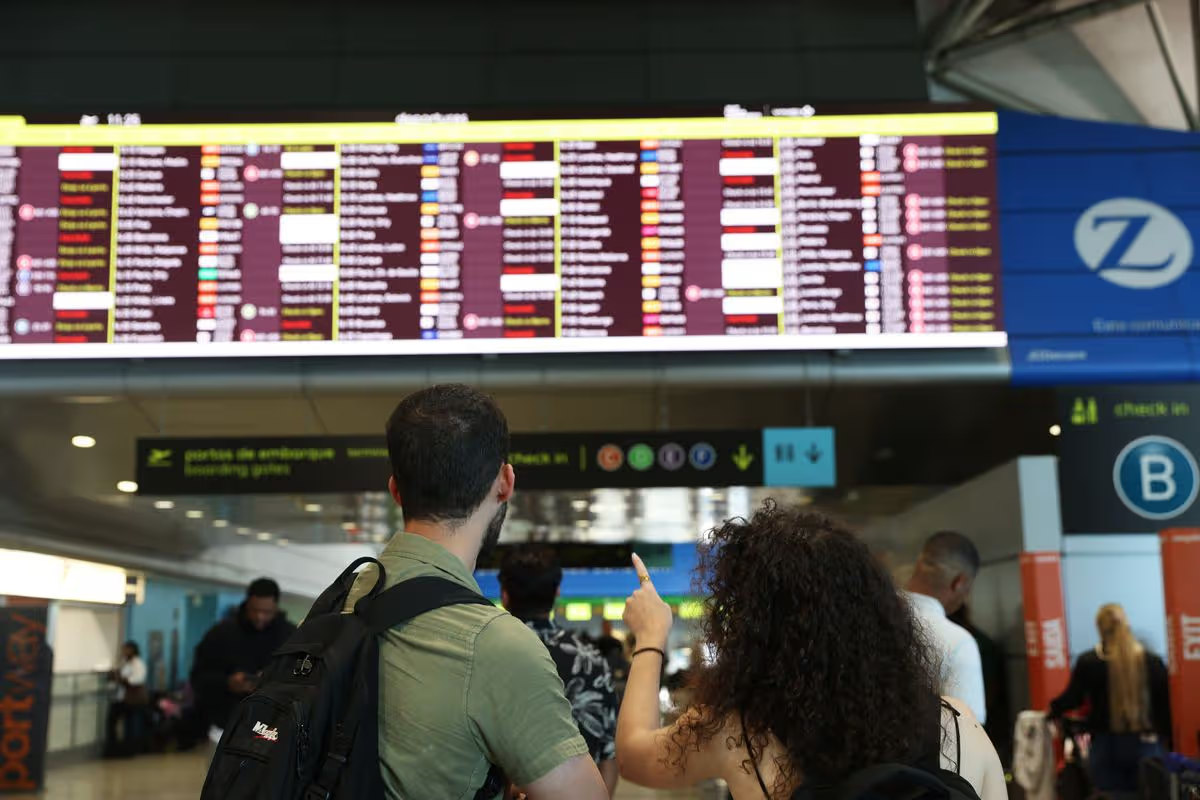
Airline passengers look at departures information during flight disruptions caused by a nationwide unions strike at Humberto Delgado Airport in Lisbon, Portugal, on Wednesday, June 3, 2026(Image: Getty)
A UK tourist hotspot has been rocked by disruption today. Officials in Portugal say 44.7% of flights scheduled to Portuguese airports on the day of a general strike today, Wednesday, June 3, were cancelled.
Portuguese media reports say that out of 1,472 flights scheduled across the country, at least 658 were cancelled, officials say. Of the 658 flights scheduled for Lisbon Airport, 408 have been cancelled, equivalent to 62%.
EasyJet had said in advance that its passengers would be affected. It said on the eve of the strike: “Due to a national strike in Portugal on 3 June, like all airlines operating to and from the country we can expect some disruption to our flying programme. We will be doing all we can to minimise the impact of the strike action and will contact customers directly with their options if their flights are affected.
“While this is outside of our control we are sorry for any inconvenience this strike action may cause.” Ryanair said it would not be affected.
Sapo reports that the second-highest percentage of cancelled flights is in Ponta Delgada, where 41% of the 118 scheduled flights will not take place, according to ANA information. In Porto and Faro, nearly a third of flights will be cancelled.
In Madeira, 23% of the 102 scheduled flights were cancelled. Almost all flights were reportedly cancelled in advance. This enabled notifying passengers and rescheduling flights, local media reports said.
The National Union of Civil Aviation Flight Personnel (SNPAC) said that of the 508 scheduled flights, “329 flights have already been cancelled, that is, 65% of the operations planned for June 3”.
The strikes, which also affected public transport and other services in the country, were the second in six month called over proposed government labour reforms.
Tiki, an offshoot of the Midcentury Modern movement, flourished in the ’40s, ’50s and ’60s, but began to experience a decline in the ’70s. Thus, by the ’90s, there were concerns at Disney that the Enchanted Tiki Room — the pivotal 1963 attraction that pioneered audio-animatronics — was no longer in vogue, its singing birds, totems and flowers a relic of another era.
You’re reading Mr. Todd’s Wild Ride newsletter
Todd Martens’ newsletter delivers news and commentary on the past, present and future of theme parks, right from the theme park capital of the world — Southern California.
By continuing, you agree to our Terms of Service, which include arbitration and a class action waiver. You agree that we and our third-party vendors may collect and use your information, including through cookies, pixels and similar technologies, for the purposes set forth in our Privacy Policy such as personalizing your experience and ads.
The company explored some early concepts to remake the Enchanted Tiki Room. One idea was to transform it into an ecological, save-the-rainforest show. Another was to redesign it with a “Lion King” theme.
“Let me tell you, we hated it,” says artist and designer Kevin Kidney of the latter concept.
Kidney, who worked in Disneyland’s art department in the ’90s, says he and his longtime collaborator Jody Daily were “terrified” the Enchanted Tiki Room would disappear, so much so that they began making fliers to advertise the show and putting them up all over L.A., in restaurants, bars and museums. “We started an underground movement to save the Tiki Room even while we were working on these projects. We tried to frame it in a cool, hip way, like, ‘Everyone needs to go and re-experience this amazing show.’”
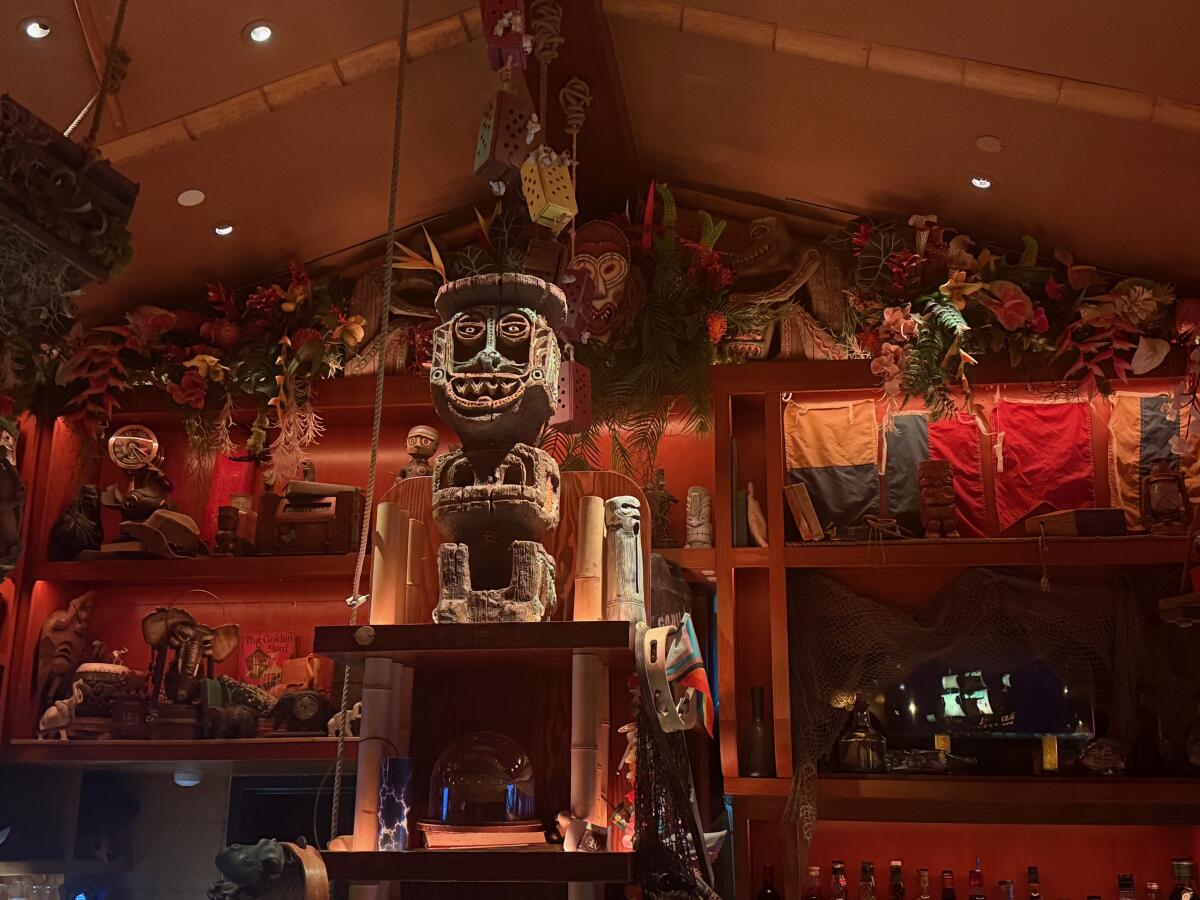
Trader Sam’s Enchanted Tiki Bar took its influence from Disneyland’s Adventureland attractions, namely the Enchanted Tiki Room and the Jungle Cruise.
(Todd Martens / Los Angeles Times)
Thankfully, cooler heads prevailed, and the Enchanted Tiki Room remains to this day a vital piece of Disneyland history. And now with the modern tiki revival, it’s no longer an archival curiosity. In fact, the connection between Disney and tiki may be as strong as it has ever been, as this spring the Disneyland Hotel’s Trader Sam’s Enchanted Tiki Bar turned 15. Trader Sam’s took its cues heavily from the Adventureland attraction, its bar flanked by tiki totems with slowly wandering eyes. And watching over guests and bartenders is a re-creation of one of the show’s tiki gods.
“The totem pole on the bar, and Koro up in the rafters above the bar, are all original designs and sculpts for the Tiki Room at Disneyland,” Kidney says. “They made new castings for the bar off of the elements from the attraction.”
Kidney and Daily collaborated with Walt Disney Imagineering, the arm of the company devoted to theme park experiences, on some of the early designs for Trader Sam’s. It’s their mug collection, for instance, that was seen in the bar on opening day. And the pair designed a magnificent glowing ship in a bottle, which thanks to a Pepper’s ghost illusion, occasionally looks as if it’s breaking apart and sinking.
Trader Sam’s, says author and historian Sven Kirsten, writer of “The Book of Tiki,” is one of the more influential bars on the modern tiki landscape. Though it didn’t kickstart today’s movement, says Kirsten, it often serves as “a gateway,” introducing Disney’s millions of guests to the scene.
Kirsten says Trader Sam’s has rightfully earned its place among SoCal’s most respected tiki bars. And most popular. An unofficial Instagram page devoted to the bar, keeping tabs on its mug releases and off-menu bartender creations, has more than 39,000 followers.
The erupting volcano “windows” of Trader Sam’s Enchanted Tiki Bar.
(Todd Martens / Los Angeles Times)
“In the early 2010s the craft cocktail revival brought forth these so-called tiki bars that thought if they had a tiki cocktail menu they were a tiki bar,” Kirsten says. “But it was basket lamps and palm leaf wallpaper and that was it. Places like Trader Sam’s and Strong Water and Royal Hawaiian are floor-to-ceiling fully decorated. They’re what a tiki bar should be.”
Before the Disneyland Hotel had Trader Sam’s, the space was home to Hook’s Pointe, which was lightly themed to “Peter Pan.” Yet about a decade after the Walt Disney Co. completed a purchase to assume control of the Disneyland Hotel, Hook’s Pointe was earmaked for renovation.
“We were designing a Caribbean-style bar where Trader Sam’s is now, and that was where I said, ‘Let’s rethink this,’” said Kyle Barnes, an Imagineer who was instrumental in the creation of Trader Sam’s. Barnes was speaking at a recent event hosted by Disney’s fan club D23 on the history of Adventureland and Trader Sam’s.
“I said, ‘That’s more East Coast. This is West Coast.’ Hawaii and Midcentury really fit together with the tiki theme,” Barnes said, noting that the park’s Enchanted Tiki Room was initially pitched as a restaurant and once sat next to the Tahitian Terrace, a Polynesian-themed restaurant complete with hula dancers.
Trader Sam’s is home to many show elements. In addition to the sinking ship, there are bar seats that will begin to drop the longer guests sit in them. Also, there are two theatrical windows looking out toward a volcano, which will erupt when guests order a specific drink. The ship in a bottle and dipping barstools, said Barnes, were inspired by the Adventurers Club at Florida’s Walt Disney World, while the volcano windows were influenced by Florida’s version of the Enchanted Tiki Room.
The Kungaloosh cocktail at Trader Sam’s Enchanted Tiki Bar.
(Todd Martens / Los Angeles Times)
The Adventurers Club closed in 2008, but I was fortunate enough to visit it as a child, and it was instrumental in my love of Disney, theater and, well, bars. Full of actors, puppets and walls filled with artifacts that seemed to spring to life, the Adventurers Club was a place of play, and I still remember as a kid being asked by one of the actors to join the imaginary guild. It was a glimpse into a grown-up world full of revelry, silliness and colorful cocktails.
Trader Sam’s fills a similar niche for me today, and as part of its 15th anniversary, it added the Adventurers Club signature drink, the sweetly tropical Kungaloosh, to its menu. As a kid, I longed to enter an adult world. As a grown-up, I love an adult world with a childlike playfulness.
Tiki bars aren’t perfect, and have occasionally come under criticism as escapist fantasy that appropriates Hawaiian or Polynesian iconography. As such, Trader Sam’s has changed over the years. Shrunken heads, for instance, that once hung from the walls, were years ago removed.
Progress, and part of Trader Sam’s enduring appeal. “The jokes that we accepted long ago, they were jokes for only a part of the population,” says Kidney.
And Trader Sam’s remains full of absurdities — spend some time just soaking up the puns and ephemera that dot the walls. Just be prepared to duck when you see the bartenders reach for a spray bottle.
So cheers to another 15 years, and I hope to see you at the bar.
This week in SoCal theme parks
Space Mountain at night.
(Paul Hiffmeyer / Disneyland Resort)
A refreshed cartoon world. Magic Mountain will on Saturday unveil its new kid-targeted Looney Tunes Land, which is a makeover of its previous Bugs Bunny-focused area. Expect a brand new live show, and spaces designed to represent the personality of characters such as Bugs, Daffy Duck, the Tasmanian Devil, and Wile E. Coyote and Road Runner. Each of the attractions, such as calming train and balloon rides, has received a tune-up. I’ll take a closer look next week!
‘The Odyssey’ comes to Universal. While theme park fans await the opening date of Universal Studios Hollywood’s new “Fast & Furious” coaster, the park is zooming ahead with its Mega Movie Summer promotion. As part of the latter, a ship from Christopher Nolan’s “The Odyssey” will be added to the park’s tram tour. Elsewhere, Minions from “Minions & Monsters” will start meeting with guests, and various dining locations will receive light makeovers to represent films such as “Jaws” and the “Fast & Furious” franchise.
Changes afoot at CityWalk. Universal’s CityWalk is in the midst of a multiyear transformation. New spaces, such as one from Malibu Brewing Co., are on the way, while some legacy retailers are unfortunately disappearing. The latest: Publisher Dark Horse Comics is closing its Things From Another World retail location. The pop-culture shop is slated to close in September. No word yet on what may move into the space.
Space Mountain is back! After a brief overlay as the “Star Wars”-themed Hyperspace Mountain, Disneyland’s classic Space Mountain has returned just in time for the busy summer season. The coaster, which tops off at about 32 mph in near total darkness, should be back in all its vintage glory as of today.
A renewal perk. The Disneyland Resort in a move to create more loyalty among its Magic Key passholders is offering a bonus for those who opt to stick around for another year. A dining promotion, in which annual passholders can receive a dining gift card for as much as $100 if they choose to re-up, is underway through May of next year.
Tell us your stories. Ask us your questions.
Have a theme park tale to share? Whether it was a good day or less-than-perfect day, I would love to hear about it. Have a question? A tip? A fun photo from the parks to share? Email me at todd.martens@latimes.com. I may feature your note in an upcoming newsletter.
Ride on,
Todd Martens
P.S.
I’m curious if any longtime Disneyland fans have any memories of the Carousel of Progress. I’d love to hear them. The theater show, built around a rotating auditorium, debuted at the 1964 World’s Fair before making its way to Disneyland in 1967. It was moved to Florida’s Walt Disney World in 1975.
In case anyone missed it, the Walt Disney Co. announced last week that Carousel of Progress would be undergoing a top-to-bottom overhaul to update the show. No longer will it begin in the distant past, as the refreshed attraction will now start in the 1960s and take guests into the ’80s, the late ’90s and beyond. An ode to technological optimism, the original show was overseen by Walt Disney, but had undergone multiple changes throughout the decades, most notably in its final scene.
I’ll miss its glimpses of the 1920s and 1940s, but concede the attraction was notable today more for its Disney history than its cultural relevancy. Thus, I’m cautiously hopeful that this makeover can ensure the Carousel of Progress remains a Disney staple for decades to come.
Official orders have spelt out what flights must be provided
Robert Rowlands Deputy editor, money and lifestyle, content hub and Maria Ortega
18:11, 02 Jun 2026
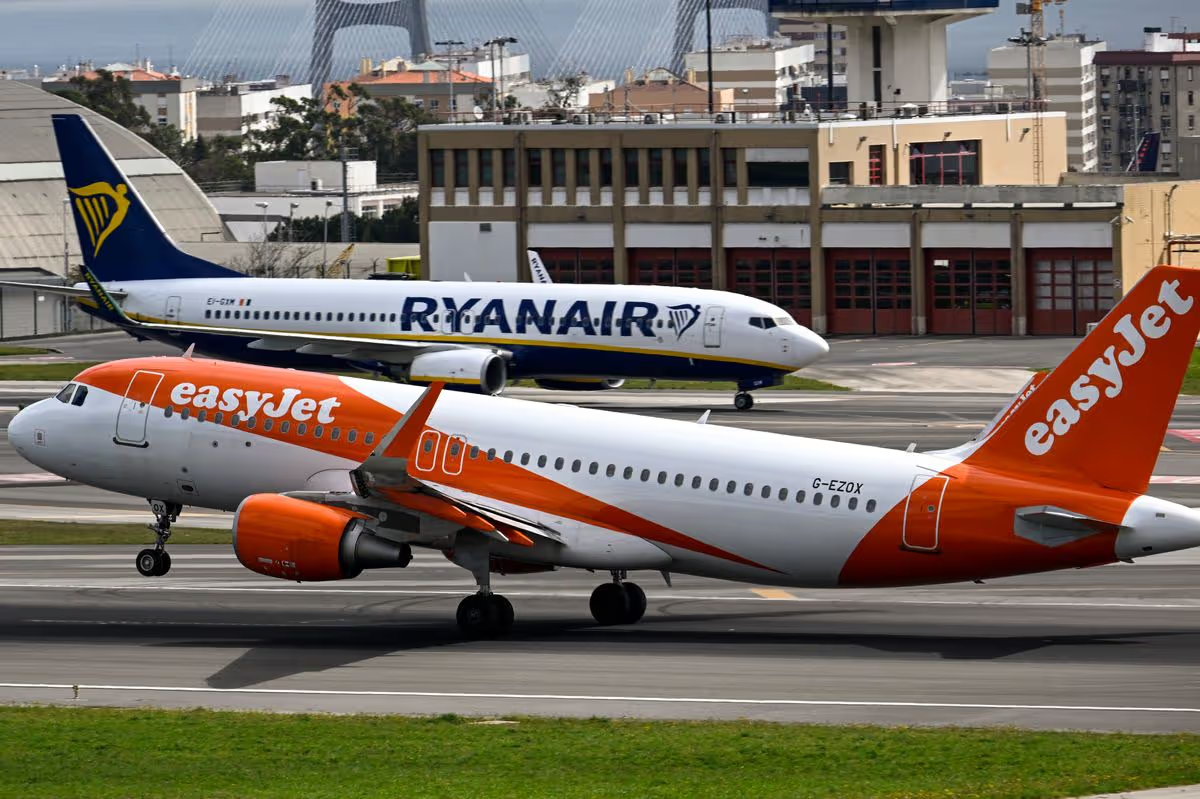
An EasyJet aircraft moves past a Ryanair airplane while taking off for London at Lisbon Airport in Portugal – file image(Image: Getty)
EasyJet and Ryanair travellers have been issued with an official update as a UK holiday spot prepares for a major strike. Portugal will see a general strike on Wednesday, June 3.
It has previously been reported that around 500 flights from different airlines could be affected. EasyJet has said there could be some disruption for passengers on the day.
TAP Air Portugal says it is planning to operate at least 79 flights. The airline is also reportedly rebooking travel options for affected passengers.
Air Europa has reportedly cancelled all flights between Madrid and Lisbon and Porto. Tram services in Porto are also set to be affected.
Ryanair has said it will operate as normal. It will be the second time the nation has been hit by a general strike in recent months in protest at labour reforms the Portuguese government is planning. The disruption is likely to affect many areas of the country.
Portuguese media reports say that for those providing essential social services, minimum service levels have been established. Information has been reported in local media, based on official documents, about what minimum services are therefore expected for some airlines.
EasyJet ‘minimum services in Portugal on June 3’
Local media reports say that some flights involving major national carrier TAP will go ahead. Sapo reports that a deal has been reached between easyJet and the trade unions, providing for the following minimum services:
two flights from Lisbon to Funchal;
one flight from Porto to Funchal;
one flight from Lisbon to Basel; one Lisbon-Nice flight;
one Porto-Paris flight;
one Porto-Geneva flight;
one Porto-Luxembourg flight;
one Lisbon-Luxembourg flight;
and one Lisbon-London flight.
That information emerged in reports published by the Directorate-General for Employment and Labour Relations (DGERT). It stated that the National Union of Civil Aviation Flight Crew also warns that, “if striking staff are replaced by crew from other bases, the conditions for future agreements will no longer exist”.
Full list of ‘Ryanair minimum services on June 3’
Sapo also reports that in the case of Ryanair, minimum services have been set by order of the Minister for Infrastructure and Housing. These reportedly state that, on the day of the strike, staff must report for duty to ensure the following connections:
two Lisbon–Funchal–Lisbon connecting flights;
one Lisbon–London–Lisbon connecting flight;
one Lisbon–Luxembourg–Lisbon connecting flight;
one Porto–London–Porto connecting flight;
one Porto–Luxembourg–Porto connecting flight;
one Porto–Paris–Porto connecting flight;
and one Faro–London–Faro connecting flight.
“The staff required to ensure minimum services shall be designated by the trade unions that have called the strike no later than 24 hours before the start of each of the declared strike days or, if they fail to do so, the companies must make such a designation,” the order states.
EasyJet told the Sun: “Due to a national strike in Portugal on 3 June, like all airlines operating to and from the country we can expect some disruption to our flying programme. We will be doing all we can to minimise the impact of the strike action and will contact customers directly with their options if their flights are affected.
“While this is outside of our control we are sorry for any inconvenience this strike action may cause.”
WASHINGTON — An upcoming celebration of the nation’s 250th anniversary, “The Great American State Fair,” recently had several musical guests back out, partly over the event’s ties to President Trump. Now, Trump himself is slated to headline the festivities.
“I understand Artists are getting ‘the yips’ having to do with their performance,” Trump posted on his social media platform Saturday. With a boastful and derisive flourish, he adding that he was thinking of bringing “the man who some say is the Greatest President in History (THE GOAT!), DONALD J. TRUMP, to take the place of these highly paid, Third Rate ‘Artists.’”
The group organizing the June fair on Washington’s National Mall, Freedom 250, confirmed the billing in a statement Saturday, writing, “We are excited to announce that President Trump will personally kick off this historic celebration on Wednesday, June 24.”
Danielle Alvarez, a spokesperson for Freedom 250, said the fair that is officially scheduled from June 25 through July 10 will feature exhibits, family friendly attractions, flyovers and musical performances — by those still remaining on the program.
Trump was dismissive of the acts that backed out, insulting them and suggesting in a follow-up post that the solution is to “Cancel it.”
“We should have a giant MAKE AMERICA GREAT AGAIN RALLY, for 250, instead of having overpriced singers, who nobody wants to hear, whose music is boring, and yet who do nothing but complain,” he wrote.
Freedom 250 is billed as nonpartisan, but it was launched last year by Trump and is led by a former State Department appointee from the president’s first term. Several artists, including Bret Michaels, the Commodores and Martina McBride dropped out last week.
Michaels and other artists have said that they were misled about the theme of the shows or were otherwise wary of being caught up in a political fight. McBride, in a statement on Instagram, said she had been “presented with an opportunity to perform at a nonpartisan event but that turned out to be misleading.”
Other artists plan to attend, including Flo Rida, Fab Morvan of Milli Vanilli and Vanilla Ice. The latter’s representative previously said that the “Ice Ice Baby” rapper was “proud to help celebrate America’s 250th Anniversary!”
Bedayn and Binkley write for the Associated Press. AP writer Eric Tucker contributed to this report.