weber

‘Who? Weekly’’s Lindsey Weber and Bobby Finger’s new book excavates fame culture

“Crunch, crunch.”

If the above sounds familiar, then you might already be a Wholigan — someone who routinely listens to the long-running celebrity podcast “Who? Weekly.” Part of the fun of listening to the thrice-weekly show (one being for Patreon members), aside from its hosts contextualizing a dizzying array of tabloid headlines, is learning its lexicon. For example, “Crunch, Crunch” spoofs a bit of sponsored content the pop singer Bebe Rexha did for Lay’s Potato Chips in 2019. Other popular phrases unique to the Who-verse: “Good form, Bella Thorne.” “Scar-Jo Yummy Pop.”

Launched in 2016 by pop culture journalists Bobby Finger and Lindsey Weber, “Who? Weekly” eagerly mines the growing world of lower-tier celebrity, with the two hosts categorizing trending names under two main umbrellas: the fame-hungry “Whos” (influencers, reality stars, a pre-royal Meghan Markle) and the instantly recognizable, likely critically acclaimed “Thems” (Tom Cruise, Taylor Swift, Beyoncé). Rounding out the paradigm are the “Nahs,” or folks who aren’t well known enough to claim “Who” status.

On the Shelf

“I Want to Be Famous: When Everybody and Nobody Is a Celebrity”

By Bobby Finger and Lindsey Weber
Crown, $33

If you buy books linked on our site, The Times may earn a commission from Bookshop.org, whose fees support independent bookstores.

“We came of age reading all the [gossip] bloggers, from Perez Hilton to Liz Smith,” Weber tells The Times of why she and Finger originally started “Who? Weekly,” which technically began as a newsletter before it morphed into a podcast.

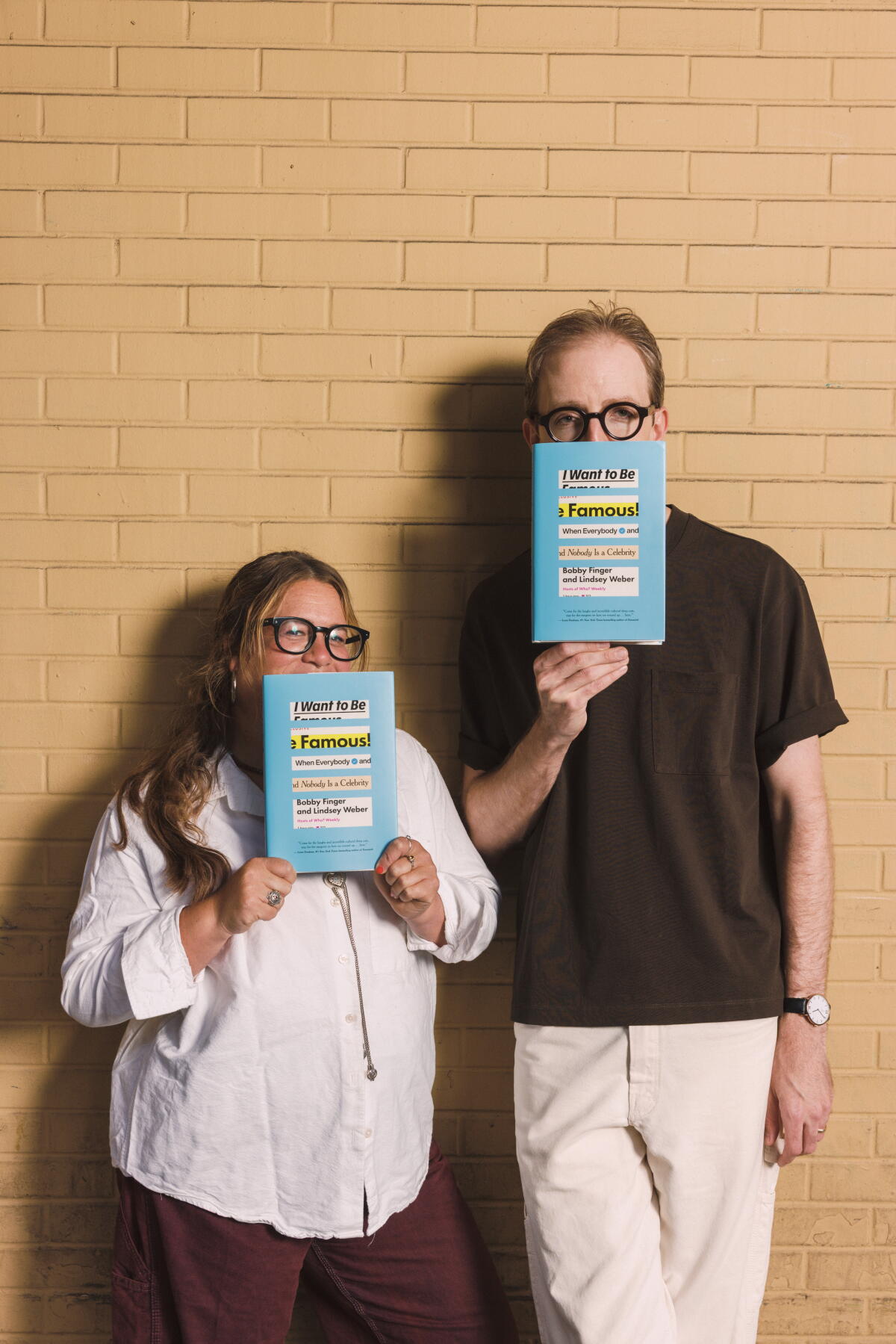
Lindsey Weber and Bobby Finger pose with copies of their new book

Lindsey Weber and Bobby Finger have co-written the newly released book, “I Want to Be Famous: When Everybody and Nobody Is a Celebrity.”

(Justin Jun Lee / For The Times)

Finger also cites influence from “Oh No They Didn’t,” a 2000s-era LiveJournal page that aggregated celebrity headlines and invited users to comment (kind of like a proto-Subreddit). “You read the story just as you read the comments, which were integral to the story,” Finger says. “All of the inside jokes, the additional commentary. That’s what ‘Who? Weekly’ has become, especially in our Patreon Discord. [Listeners] are always chiming in and creating their own language and extensions of the ‘Who? Weekly’ universe.”

That universe is about to expand again: In conjunction with the pod turning 10 this year, Weber and Finger are releasing a new book, “I Want to Be Famous: When Everybody and Nobody Is a Celebrity,” which looks at fame and celebrity through a historical lens while also exploring how the line between Whos and Thems got that much blurrier in the social media age. “I feel like we were always barreling towards a book,” Weber says. “Both of us are trained journalists. We were always kind of like, ‘When are we going to put our money where our mouth is?’”

To demonstrate how the binary is evolving into a spectrum, Weber and Finger revisit juicy pop cultural anecdotes (remember when Courtney Love threw her compact at Madonna at the VMAs? Or when Ariana Grande dated Pete Davidson? Or when Katy Perry flew into space on the Blue Origin?) while blanketing every chapter with an elucidation of why, no matter what decade we’re in, society just can never get enough gossip.

Meanwhile, unlike the podcast, “I Want to Be Famous” gives the hosts ample room to go deeper into the cultural framework of modern celebrity than they normally have time for. Each week, Weber and Finger dedicate one episode to unpacking a prepared list of Who-y headlines, and a follow-up episode, titled “Who’s There?,” is dedicated to listener calls. Which is to say, Weber and Finger usually spend more time explaining and trading jokes about what each micro-celeb is known for rather than how celebrity itself has evolved.

Lindsey Weber and Bobby Finger are celebrating the 10th year of their podcast

Lindsey Weber and Bobby Finger are celebrating the 10th year of their podcast “Who? Weekly.”

(Justin Jun Lee / For The Times)

“The pod is on the surface funny, [but] if you are a real fan, you’re like, ‘Oh, there’s actually some interesting stuff beneath the funny,’” Finger says. “We wanted this book to be the opposite, where it’s actually outwardly interesting and smart, and then inwardly funny when it can be.”

The writers’ tone might lean more academic within “I Want To Be Famous,” but longtime fans of the pod will recognize dozens of niche names, stories and extremely online subjects that were at one point or another discussed on the show. The authors present their grand theory of Whos and Thems by opening with the story of how former Who Meghan Markle shot to Them-dom after marrying Prince Harry. Other chapters observe what happens when Thems date or marry Whos. There’s a history of how celebrities say sorry (where there were once press releases there are now Notes app apologies) and a conversation about how nepo babies fit into the framework. As the book moves across history and demonstrates how the internet has completely upended the binary, they also show what hasn’t changed about the way fans relate to their favorites. “What we want most in a celebrity is authenticity,” Weber theorizes.

For Weber and Finger, the chance to tie the disparate threads they discuss on “Who? Weekly” was a major incentive to work on their book. “I kept being like, ‘Is this the first time anyone’s ever written about this in a book?’” Weber says with a laugh. “Because some of it was so stupid — these references to fandoms and Club Chalamet and niche things that are newer … I’m like, ‘Oh my God, are we doing this thing where now people have to read about Club Chalamet in 100 years?’ Obviously that would be incredible.”

“There’s a temporality to our show that is not the case with this book, which is very exciting,” Finger adds. “Because our show kind of exists to go in one ear and out the other. And I say that because it goes in one of our ears and out the other too, as the creators.”

Woven into the conversations around Whos, Thems, Thems behaving like Whos (see: brand deals), and Whos aspiring to be Thems is the authors’ palpable anxiety about the decaying role of entertainment journalism in an age in which celebrities can simply promote themselves via social media — or host their own podcasts. The authors are also painfully aware that most audiences have less of an appetite for reading, period. A chapter titled “The 2010s Killed the Cover Star” looks back what is thought to be the greatest piece of celebrity journalism ever written (Gay Talese’s 1966 Esquire classic, “Frank Sinatra Has a Cold”) and contrasts it with today’s style of uncritical, PR-friendly celebrity Q&As that boast nothingburger headlines that don’t tell us much of anything.

Conversations about media and journalism itself run through the podcast too, and that’s by design. “Sometimes we go so niche that it’s like, ‘Are we just making a podcast for our friends that work in media?’ And sometimes the answer is yes,” Weber says. “We can only speak from our experience. … But the most shocking thing about ‘Who? Weekly’ is that [media discourse] is actually quite interesting for lots of people.”

Finger adds, “Our past in media and our abundance of friendships with people who are still in media is like a crucial part of our show. It’s an industry we respect so much, you know, and we’re obsessed with the way it evolves. If we didn’t have that background, I don’t think the show would exist the way it does at this current moment.”

Even with a massive archive of episodes and no plans to stop, Weber and Finger are thrilled to have cemented their legacy with a book that could (and really should) be taught in media and communications classes. “Bobby and I both obviously love celebrities,” Weber says. “But we love media more.”

Brodsky is an L.A. culture and music writer. Her biography of Stevie Nicks, “Lessons & Lace,” published by Penguin Random House, is out now.
Source link

Despite court wins, California election war with Trump rages on

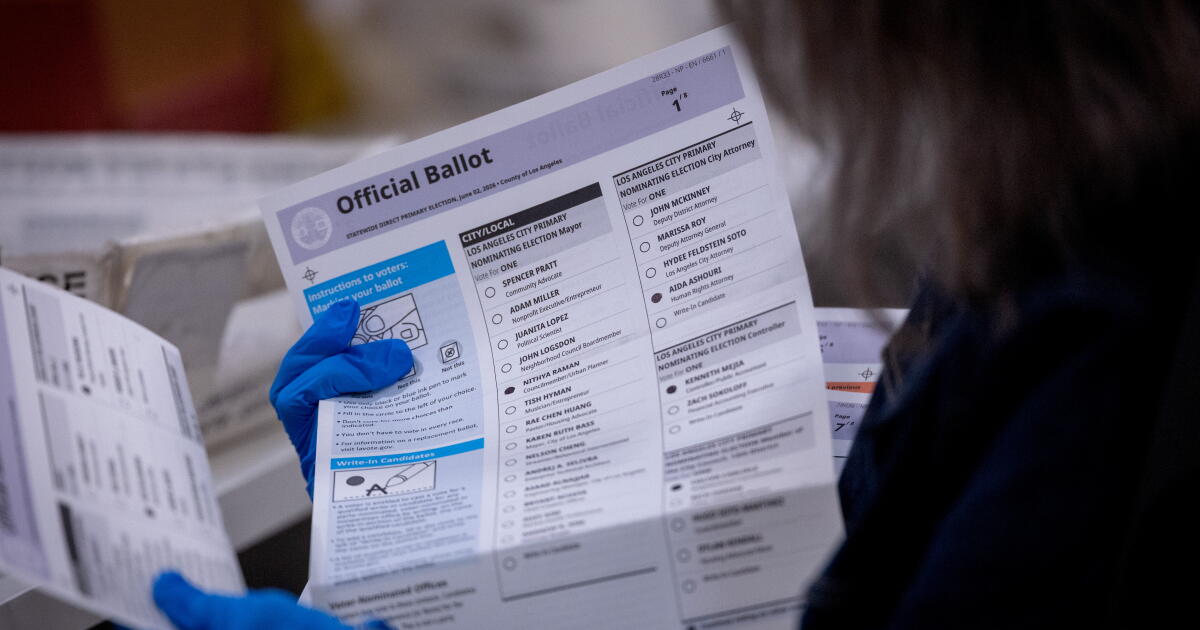
With the deadline for mailing out millions of California ballots nearing, Los Angeles County’s top election official welcomed the U.S. Postal Service’s recent assurance that it will process those ballots as normal — not under the untested new vetting system backed by President Trump and rejected as unworkable by the U.S. Supreme Court.

“That certainly serves as a stabilizing force, as we’re literally weeks away from mailing the ballots,” said Dean Logan, head of the L.A. County Registrar-Recorder/County Clerk’s office.

Still, there are other Trump administration challenges to deal with, he said — including unsubstantiated public claims of widespread voter fraud, refusals by top-ranking officials to rule out deployments of armed federal agents to polling places, and behind-the-scenes criminal probes into local voter lists.

Since March, Logan’s office has received a series of federal grand jury subpoenas demanding voter registration and other information on dozens of individuals who the Trump administration says may not be U.S. citizens, Logan confirmed to The Times.

Logan said his office is now in the “interesting place” of having to comply with the subpoenas despite suspecting that the Department of Homeland Security relied on inaccurate or outdated voter information to compile the names to investigate.

“We’re responding appropriately as directed through a subpoena, but that doesn’t afford the dialogue for us to get the background on what they’re looking for and how they came up with the names that they did,” Logan said. “There’s really no information being provided to us on that.”

The subpoenas appear to mirror others received by elections officials elsewhere in the country as part of a new Homeland Security effort to identify noncitizen voting, which Trump has long alleged without evidence is widespread.

In July, Homeland Security Secretary Markwayne Mullin publicly claimed, again without evidence, that there may be more than 190,000 such voters on California rolls. On Friday, the Justice Department announced it had charged 16 noncitizens in six states with illegal voting and other election-related crimes following investigations alongside its Homeland Security partners.

California Secretary of State Shirley Weber dismissed Mullin’s claims. Independent elections experts and Democratic officials say voter fraud should be taken seriously, but is exceedingly rare. California has more than 23 million registered voters.

Mullin’s remarks and the subpoenas appear part of a much larger and unprecedented federal effort to bolster allegations from Trump that the upcoming Nov. 3 elections are unsafe and corrupted by noncitizen voters.

Trump issued two executive orders, one requiring voters to provide additional identification and proof of citizenship, and one ordering the Postal Service to refuse mail ballots it deems illegitimate. The Justice Department has sued California and other states for their voter rolls, and Homeland Security has threatened state elections officials with criminal sanctions if they don’t purge noncitizens from their rolls.

Trump gave a speech in July alleging that the American election system is “so vulnerable that no one can possibly defend it.” Earlier this month, he encouraged his supporters to “cheat like hell” to keep Republicans in power, and told them they would receive $5,000 each if they succeed — which many experts derided as a “bribe.”

Last week, FBI Director Kash Patel refused to rule out sending federal agents to polls.

Despite all that, California officials and independent elections experts have maintained the election will be safe — in part because Trump’s executive orders and the Justice Department’s many lawsuits seeking state voter rolls have all been blocked by the courts.

“The bottom line for voters in California right now is nothing has changed. We’ve had safe and secure elections, and we will continue to do so,” said Sen. Alex Padilla (D-Calif.).

Logan said it “is clear that the administration is aggressively pursuing their narrative” about voter fraud being widespread as part of Trump’s old “playbook” of questioning votes he expects to lose — but that the election in California will nonetheless “be fair and secure and transparent.”

The fight over fraud

At least three subpoenas have been issued to Logan’s office — one in March, one in July and one this month — including from the U.S. attorney’s office for the Southern District of California, The Times confirmed.

U.S. Atty. Adam Gordon, who leads the federal prosecutor’s office in San Diego, did not respond to a request for comment. First Assistant U.S. Atty. Bill Essayli, who leads the federal prosecutor’s office in Los Angeles and has announced two voter fraud cases in recent weeks, also did not respond to questions about his office’s election work.

Essayli did say Saturday, in response to Gov. Gavin Newsom touting new state laws aimed at safeguarding California elections from Trump administration interference, that no state law can prevent the Justice Department from investigating voter fraud and that his office “will continue to investigate, arrest, and prosecute all violations of federal election laws.”

Additional information, including how the subpoenas may relate to Mullin’s claims, wasn’t immediately available.

Mullin in July alleged in a letter to Weber that a federal review of unspecified data found “as many as 190,832 non-citizens registered to vote in California.”

Weber responded in writing that she had “serious doubts about the reliability” of that analysis, as California election officials “work every day to maintain accurate voter rolls” and have never shared their rolls with the Trump administration — despite the administration’s failed lawsuit demanding them.

Weber criticized Mullin for having made such claims with “no detail whatsoever that my office can use to evaluate the veracity of your allegations,” and asked that he provide a “detailed description” of the data and methodology used to reach such conclusions.

Weber’s office said Mullin’s letter was “part of a broader effort to intimidate Californians and make it burdensome to participate in our democracy.”

In a statement to The Times, a Homeland Security spokesperson said the department offered to meet with Weber and her staff “to engage in a collaborative good faith discussion” about identifying noncitizens on state rolls, which she declined.

The spokesperson said Mullin’s count of potential noncitizens on California rolls was based on “publicly available data from states’ voter rolls” that was cross-referenced with its own lists of “known” noncitizens. “It’s not rocket science; it’s an easy step to secure our elections.”

Independent experts also have questioned Mullin’s claims, pointing to investigations elsewhere — including in Texas — that found Homeland Security data on alleged noncitizen voters were substantially inaccurate. A federal judge recently blocked the use of a Trump administration database known as the Systematic Alien Verification for Entitlements program based on the likelihood that it could lead to legitimate voters being purged from rolls.

Last week, Padilla and Senate Majority Leader Chuck Schumer (D-N.Y.) released a Homeland Security whistleblower report alleging that department leaders, under a new “Unlawful Voter Initiative,” were requiring poorly trained employees to identify at least five potentially illegal voters per hour — one every 12 minutes — using questionable data the department said it compiled using “magic.”

In a letter to Mullin, the senators demanded the initiative be halted, arguing that work at such a “breakneck pace” is bound to produce errors and that agency officials appeared to be circumventing court orders blocking their access to state vote rolls by gathering such information “by any means, regardless of state laws.”

Padilla on Friday asked California Atty. Gen. Rob Bonta’s office to investigate the whistleblower’s claims. A spokesperson for Bonta’s office said the allegations “describe yet another fishing expedition by the Trump Administration to uncover evidence of widespread voter fraud despite repeated findings that there is none,” but otherwise declined to comment.

The Homeland Security spokesperson rejected the whistleblower claims, saying its work has been “conducted diligently and professionally” as part of a “commonplace law enforcement” effort. The spokesperson said that the agency cannot comment on active investigations, but that its investigative branch — Homeland Security Investigations, or HSI — is “actively rooting out and investigating election fraud wherever it can be found.”

“There is no quota on criminality. DHS will pursue each and every illegal voter to the fullest extent of the law,” the spokesperson said.

Fears and reassurances

Recent polling has shown that fewer than half of Americans expect the midterms to be “free and fair,” and that Californians are more concerned about Trump administration interference than voter fraud.

Election experts said some of the worst threats have already been blocked, but acknowledged remaining worries.

Rick Hasen, director of the Safeguarding Democracy Project at UCLA Law, said he is concerned the Trump administration will try to deny the outcome or seize ballots in close congressional races — but only if control of the House or Senate rests on them.

Brendan Nyhan, a political scientist at Dartmouth College and co-director of Bright Line Watch, said he worries that isolated incidents of federal agents intimidating voters or seizing ballots in key races will throw the legitimacy of the entire election into question — and that the Trump administration will capitalize on that to serve its own agenda.

Sen. Adam Schiff (D-Calif.), part of a Democratic task force preparing for such issues, said that Trump and other administration officials are trying to interfere in the election because they know they have “failed to deliver for the American people” and the Republican Party stands to lose power as a result.

Schiff said that Democratic leaders are fighting back “and largely succeeding,” but that “the best way to uphold the integrity of our elections” remains voters making their voices heard.

Padilla said the attempt by Homeland Security to push its way into elections has been “shoddy” in part because “they don’t have the expertise [and] it’s not their charge,” but also because Trump has put Mullin and other election “conspiracy theorists” in charge.

“If you install a conspiracy theorist into these roles, then they’re gonna come out with these claims that are not based on facts, not based on evidence, not based on any data,” he said.

Padilla said Trump and his supporters are “absolutely laying the groundwork” to question November election results they don’t like, but voters should know that “there’s even more of us standing up and fighting back and protecting their right to vote.”

Source link