way

3 L.A. hikes that offer quick escapes from city life

Whenever I want to escape the city, I have a tendency to go deep into the backcountry of Angeles National Forest.

But I don’t always have time for an all-day adventure. Luckily, Los Angeles has several local parks that make it easy to disappear into an old woodland or thicket of pine trees to briefly forget you’re one of 10 million people living in the county.

You are reading The Wild newsletter

Sign up to get expert tips on the best of Southern California’s beaches, trails, parks, deserts, forests and mountains in your inbox every Thursday

By continuing, you agree to our Terms of Service and our Privacy Policy.

The three hikes below are either in L.A. or close by and require only a short drive for many Angelenos. (And for my readers in the South Bay, I promise I will hike down your way soon.)

Regardless of whether you want to take an afternoon off to explore one of these hikes or try one after a weekend brunch, I hope you find a gentle peacefulness that restores you back to feeling more like yourself. Time in nature can do that and more.

A large gnarled tree with huge brown branches with small green leaves over a dirt path

A large oak tree provides shade over a trail in Franklin Canyon Park.

(Jaclyn Cosgrove / Los Angeles Times)

1. Loop trail around Franklin Canyon Park

Distance: 1.2-mile loop with options to extend (see map)
Elevation gained: About 200 feet
Difficulty: Moderate
Dogs allowed? Yes
Accessible alternative: Franklin Canyon Drive loop

Franklin Canyon Park is 605 acres of public land north of Beverly Hills that features chaparral and oak woodlands. The park has three bodies of water: the three-acre Franklin Canyon Lake, Heavenly Pond and Wild Pond.

To reach the park, you’ll take the southern entrance, as the northern entrance is closed while the L.A. Department of Water and Power repairs the roadway. Take good care as you drive into the park, as there are a few tight corners with low visibility.

Upon arrival, I’d recommend taking a 1.2-mile loop, which I’ve mapped out here, that will take you past the lake and ponds and up into the park’s hillsides. I went on a recent afternoon when it was in the mid-80s in L.A. and found the park to be cooler thanks to the abundant shade provided by oaks, sumac and other trees.

A turtle on a hunk of wood with the mirror reflection in the water below

A turtle rests on a hunk of wood in the Heavenly Pond in Franklin Canyon Park.

(Jaclyn Cosgrove / Los Angeles Times)

To begin your hike, you’ll park in the large dirt main parking lot. Signs around the lot warn visitors of frequent break-ins, so either leave your treasure at home or hike in your pearls.

From the parking lot, head south on Franklin Canyon Drive, where you’ll quickly find a trail entrance with wooden steps that lead down near Franklin Canyon Lake. I hope you’re greeted by the sound of quacking waterfowl like I was! (And I bet if you go in the morning or evening, you’ll hear bullfrogs.)

Continue in the southerly direction, appreciating the gnarled coast live oaks and sound of shy red-eared sliders plopping off their logs into the water. This short trail will lead you back up to the road where you’ll walk south for just a bit before turning onto the gentle path that loops around Heavenly Pond. This is an especially good spot to find turtles, ducks and at least one orange-and-white koi.

From Heavenly Pond, continue south on the paved road, following it past the private residence to the wooden steps at the reservoir’s southern end. Take these stairs down onto Chernoff Trail. You’ll quickly spot toyon and pine trees, among other natural delights. Soon, you’ll bear right (or northeast) to take stairs onto the road. Cross the road and continue northeast onto the trail. Take the next set of steps up past thick bunches of black sage and chaparral nightshade.

Plants with flowers blooming in Franklin Canyon include ceanothus, California brittlebush and wishbone bush.

Plants with flowers blooming in Franklin Canyon include ceanothus, California brittlebush and wishbone bush.

(Jaclyn Cosgrove / Los Angeles Times)

Continue north on Blinderman Trail, following it as it bears east before it loops back around west. Along the way, you’ll pass well-maintained benches and bridges. Between the rustic bridges and frequent tree canopy, this trail made me feel, at times, like I was entering a fairy tale. I spotted lots of blooming California brittlebush and desert wishbone bushes along Blinderman Trail as well as some deer tracks near a forested area where the trail ends near the parking lot.

A portion of Blinderman Trail is a bit washed out, so I’d recommend carrying hiking poles, especially for the trip down. If you need to refill your water bottle, there are water fountains near the Eugene and Michael Rosenfeld Auditorium, which is just southeast of the main lot.

I left Franklin Canyon Park grateful for my short jaunt in nature, amazed by yet another well-maintained public park in the heart of L.A.

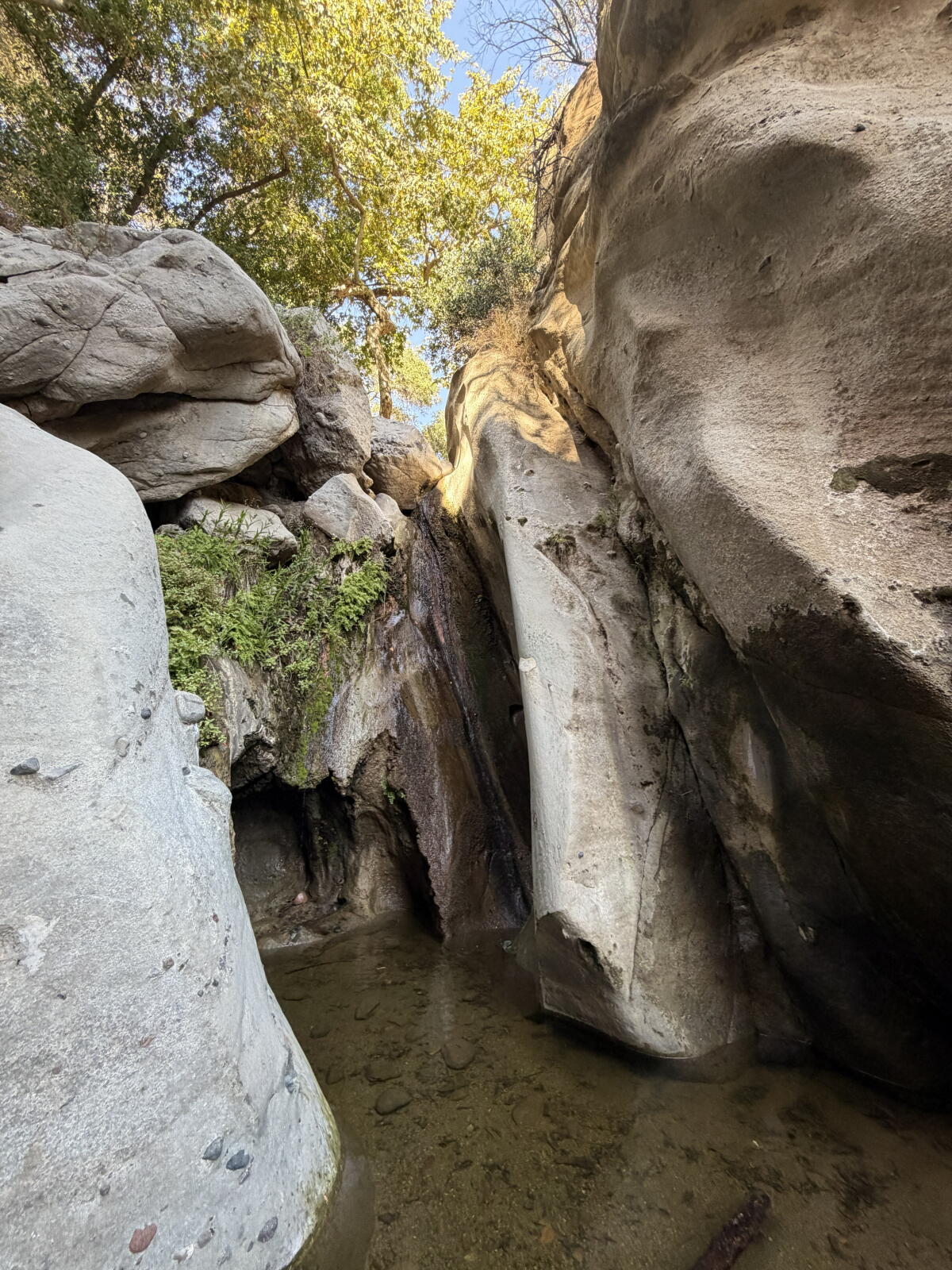
Cave of Munits.

Cave of Munits.

(Jaclyn Cosgrove / Los Angeles Times)

2. Cave of Munits

Distance: 1.3-mile loop
Elevation gained: About 230 feet
Difficulty: Moderate
Dogs allowed? Yes
Accessible alternative: Orcutt Ranch Horticulture Center trail

This 1.3-mile loop trail follows El Escorpión Trail in the 61-acre El Escorpión Park to the Cave of Munits, a chimney cave named after a sorcerer in a local Indigenous legend.

To begin, you’ll park on the street near the trailhead. To reach the cave, you can either take El Escorpión Trail, a wide exposed dirt path that starts at El Escorpión Park gate, or the path along the riverbed, which provides more shade but is more narrow. Both are visible on maps on outdoors navigation apps. When I hiked to the Cave of Munits, I took El Escorpión Trail to the cave and the shadier trail along the creek on the way back.

The cave isn’t immediately visible when you start. Once you see a large rocky gash in the mountain, you know you’re getting close. Once inside the cave, be mindful not to cause any damage and be careful when climbing.

The steepest part of this hike is as you approach the largest cave. Grippy shoes are a must, and trekking poles could be helpful.

The Cave of Munits is an easy place to reconnect with your childlike wonder, but please explore with respect and reverence for the place. The cave’s name relates to a Fernandeño and Western Tongva story of tragic misunderstanding, which you can read here.

Shaded path lined with shrubs headed toward a glowing hillside.

Dunsmore Canyon in Glendale.

(Jaclyn Cosgrove / Los Angeles Times)

3. Dunsmore Canyon & Le Mesnager Loop Trail

Distance: 2.6 miles
Elevation gained: About 800 feet
Difficulty: Moderate
Dogs allowed? Yes
Accessible alternative: Brand Park history walk

This hike through the 709-acre Deukmejian Wilderness Park in Glendale will offer you not only great views of the surrounding cities but also an opportunity to spend time among blooming trees and native plants, including California peonies and California brittlebush.

You’ll park in a lot near the Stone Barn Nature Center. Several signs warn that the park closes one hour after sunset and to leave before you get locked in. I think they’re serious, so take note.

You’ll start your hike on Dunsmore Canyon Trail, headed northeast up a straight gravel path covered on both sides with several native plants including ceanothus (both white and purple blooms), yerba santa and sagebrush.

Just .2 miles in, there’s a massive old coast live oak where kids could easily create an imaginary forest kingdom under its large branches.

As you continue to climb, you might hear Dunsmore Creek, which runs parallel to the trail. Remember to turn around as you gain elevation, as this trail rewards you with substantial views of Glendale and the Crescenta Valley soon after you start. All the while, you have the San Gabriel Mountains right in front of you, including Mt. Lukens, which you can hike to from the same park.

Half a mile in, you have the option to continue on the Dunsmore Canyon Trail or Le Mesnager Trail to make a shorter loop. Le Mesnager Trail includes a lookout point at about 2,750 feet, a great spot for a sunset as long as you don’t get locked in! As you meander down the trail, you’ll find a nice shady canopy and continued views of the city below.

A wiggly line break

3 things to do

Volunteers work at the Debs Park Test Plot.

Volunteers work at the Debs Park Test Plot.

(Test Plot)

1. Protect native habitat in L.A.
The Audubon Center at Debs Park needs volunteers from 8:30 to 10:30 a.m. Friday for its monthly maintenance on the test plot. Volunteers will meet in the center’s courtyard before heading out. Participants should wear closed-toed shoes and clothing they don’t mind getting dirty. They should also bring a reusable water bottle and gardening gloves. Register at act.audubon.org.

2. Nurture nature in Glendale
The Arroyos & Foothills Conservancy needs volunteers from 9 to 11 a.m. Sunday for a restoration workday in the Sycamore Canyon Preserve. Volunteers will help improve the health of plant life in the preserve to better ensure it is inviting and healthy for wildlife, which use it as a corridor to travel through the area. Participants should bring water, sunscreen and work gloves. Pants, long sleeves and sturdy shoes are recommended. If able, volunteers are encouraged to bring shovels, loppers or trowels. Other tools and equipment will be available.⁠ Learn more at arroyosfoothills.org.

3. Wander the wetlands in Huntington Beach
Amigos de Bolsa Chica will host a free tour from 9 to 10:30 a.m. Saturday through the Bolsa Chica Ecological Reserve in Huntington Beach. Visitors should meet their guides in the south parking lot off Pacific Coast Highway, halfway between Warner Avenue and Seapoint Street. Volunteer naturalists will present information on the preserve’s history, bird life and more. Register at amigosdebolsachica.charityproud.org.

A wiggly line break

The must-read

Skiers on a snow-covered mountain side.

Skiers navigate their way down Lincoln Mountain at Mammoth Mountain ski area, located in the Sierra Nevada mountain range.

(Christian Pondella / For The Times)

Two ski patrollers at Mammoth Mountain have died in separate avalanches over the past year. These workers are responsible for clearing popular ski routes by using handheld explosives to prevent avalanches from harming guests. “Were the resort’s managers pushing too hard to open the mountain after major storms? Had training standards slipped, pushing relatively inexperienced ski patrollers into dangerous situations? Are young ski patrollers afraid to speak up, even when they think they’ve been asked to take unreasonable risks?” wrote Times staff writer Jack Dolan. Read Dolan’s story to find the answer to those questions and more.

Happy adventuring,

Jaclyn Cosgrove's signature

P.S.

Let’s end with good news! A volunteer was monitoring Eastern Pacific green sea turtles that live near the mouth of the San Gabriel River when they spotted a shelled reptile in trouble. The turtle had fishing line wound around her right flipper and into her mouth. “She was also attached to a medley of debris — clothes, algae, plastic,” wrote Times staff writer Lila Seidman. “When she came up for air, aquarium staffer Aaron Hovis jumped in and grabbed her. Once freed from the garbage, she was loaded onto a stretcher and brought to the aquarium.” The turtle, now named Porkchop for her voracious appetite, is now happily recovering at the Aquarium of the Pacific in Long Beach. Although the aquarium has been helping injured sea turtles for more than 25 years, the public can now see the little cuties on display in a new exhibit about the turtles. You can visit Porkchop until she’s returned to the wild, where veterinary staff are confident she’ll keep thriving — and eating!

For more insider tips on Southern California’s beaches, trails and parks, check out past editions of The Wild. And to view this newsletter in your browser, click here.


Source link

Kiki Rice and Gabriela Jaquez help No. 2 UCLA rout Rutgers

Headlined by first and third quarter dominance, No. 2 UCLA women’s basketball picked up a 86-46 win over Rutgers (9-14, 1-11) at Pauley Pavilion on Wednesday night.

Kiki Rice led the Bruins (22-1, 12-0 Big Ten) with 17 points and seven rebounds, while Gabriela Jaquez got things started, scoring 10 of her 14 points in the first quarter.

Rutgers, playing without its two leading scorers in Nene Ndiaye and Imani Lester, committed 18 turnovers that the Bruins converted into 25 points.

During the Bruins’ first possession of the game, Rice stepped back from the three-point line, shooting an air ball. But she followed that miss with the Bruins’ next three scores from the field, all three coming off the break.

UCLA center Lauren Betts shoots while being guarded by Rutgers' Kaylah Ivey Wednesday at Pauley Pavilion.

UCLA center Lauren Betts shoots while being guarded by Rutgers’ Kaylah Ivey Wednesday at Pauley Pavilion.

(Caroline Brehman / Associated Press)

And while the Scarlet Knights got on the scoreboard first with a three-pointer, they missed five layups and committed five turnovers, with the Bruins taking advantage for 11 points in the quarter. The Scarlet Knights’ six first-quarter points were the fewest scored by a Bruin opponent in the first period this season.

UCLA jumped to a 26-6 lead over the Scarlet Knights by the end of the first quarter, but it couldn’t extend that lead in the second, scoring just 14 points to Rutgers’ 13.

The Bruins also struggled to hold onto the ball in the second quarter, committing seven turnovers — although the Scarlet Knights scored just three points off the miscues. And while UCLA went three for eight on three pointers in the first period, it couldn’t bury one in the second off five attempts.

UCLA struggled to separate itself from Rutgers during the fourth quarter when the Bruins substituted in their bench players. UCLA was outscored 19-18 in the final period.

Two-thirds of the way through conference play, UCLA has six games remaining before the Big Ten tournament, with a game at No. 8 Michigan at noon PST Sunday.

Source link

Tulsi Gabbard is putting Trump’s interests over America’s

Tulsi Gabbard’s political journey has been anything but straightforward.

As a teenager, she worked for her father, a prominent anti-gay activist, and his political organization, which opposed same-sex marriage. In 2002, she was elected to Hawaii’s House of Representatives, becoming — at age 21 — the youngest person to serve in the Legislature.

Gabbard was a Democrat and remained so for two decades, as she cycled from the statehouse to Honolulu’s City Council to the U.S. House of Representatives.

In 2020, she ran for president, renouncing her anti-LGBTQ views and apologizing for her earlier stance. She was a Bernie Sanders acolyte and a fierce critic of Donald Trump and, especially, his foreign policy. She denounced him at one point for “being Saudi Arabia’s bitch.”

Now, Gabbard is MAGA down to her stocking feet.

Despite no obvious qualifications — save for her fawning appearances on Fox News — Trump selected her to be the director of national intelligence, the nation’s spymaster-in-chief. Despite no earthly reason, Gabbard was present last week when the FBI conducted a heavy-handed raid at the Fulton County elections office in Georgia, pursuing a harebrained theory the 2020 election was stolen from Trump.

Instead of, say, poring over the latest intelligence gleanings from Ukraine or Gaza, Gabbard stood watch as a team of flak-jacketed agents carted off hundreds of boxes of ballots and other election materials.

That’ll keep the homeland safe.

But as bizarre and unaccountable as it was, Gabbard’s presence outside Atlanta did make a certain amount of sense. She’s a longtime dabbler in crackpot conspiracies. And she’ll bend, like a swaying palm, whichever way the prevailing winds blow.

Some refer to her as the “Manchurian candidate,” said John Hart, a communication professor at Hawaii Pacific University, referring to the malleable cipher in the famous political thriller. In a different world, he suggested, Gabbard might have been Sanders’ running mate.

“It does take a certain amount of flexibility to think that someone who could have been the Democratic VP is now in Trump’s cabinet,” Hart observed.

The job of the nation’s director of national intelligence — a position created to address some of the failings that led to the 9/11 attacks — is to act as the president’s top intelligence adviser, synthesizing voluminous amounts of foreign, military and domestic information to help defend the country and protect its interests abroad.

It has nothing whatsoever to do with re-litigating U.S. elections, or tending to the bruised feelings of an onion-skinned president.

The job is supposed to be nonpartisan and apolitical, which should go without saying. Except it needs to be said in this time when all roads (and the actions of each cabinet member) lead to Trump, his ego, his whims and his insecurities.

There were ample signs Gabbard was a spectacularly bad pick for intelligence chief.

She blamed NATO and the Biden administration for Russia’s invasion of Ukraine. She claimed the U.S. was funding dangerous biological laboratories in the country — “parroting fake Russian propaganda,” in the words of then-Utah Sen. Mitt Romney.

She opposed U.S. aid to the rebels fighting Bashar Assad, met with Syria’s then-dictator and defended him against allegations he used chemical weapons against his own people.

She defended Edward Snowden and Julian Assange, who were indicted for masterminding two of the biggest leaks of intelligence secrets in U.S. history.

Still, Gabbard was narrowly confirmed by the Senate, 52 to 48. The vote, almost entirely along party lines, was an inauspicious start and nothing since had dispelled lawmakers’ well-placed lack of confidence.

Trump brushed aside Gabbard’s congressional testimony on Iran’s nuclear capabilities — “I don’t care what she said” — and bombed the country’s nuclear facilities. The putative intelligence chief was apparently irrelevant in the administration’s ouster of former Venezuelan President Nicolás Maduro.

Her bizarre presence in Georgia — where Gabbard reportedly arranged for FBI agents to make a post-raid call to the president — looks like nothing more than a way to worm her way back into his good graces.

(Separately, the Wall Street Journal reported this week that a U.S. intelligence official has filed a whistleblower complaint against Gabbard, which is caught up in wrangling over sharing details with Congress.)

California Sen. Adam Schiff said it’s “patently obvious to everyone Gabbard lacks the capability and credibility” to lead the country’s intelligence community.

“She has been sidelined by the White House, ignored by the agencies, and has zero credibility with Congress,” the Democrat wrote in an email. She’s responded by parroting Trump’s Big Lie “complete with cosplaying [a] secret agent in Fulton County and violating all norms and rules by connecting the President of the United States with line law enforcement officers executing a warrant. The only contribution that Tulsi Gabbard can make now would be to resign.”

Back in Hawaii, the former congresswoman has been in bad odor for years.

“It started with the criticism of President Obama” — a revered Hawaii native — over foreign policy “and a sense in Hawaii that she was more interested in appearing on the national media than working for the state,” said Colin Moore, a University of Hawaii political science professor and another longtime Gabbard watcher.

“Hawaii politicians have, with a few exceptions, tended to be kind of low-drama dealmakers, not the sort who attract national attention,” Moore said. “The goal is to rise in seniority and bring benefits back to the state. And that was never the model Tulsi followed.”

In recent years, as she sidled into Trump’s orbit, Hawaiian sightings of Gabbard have been few and far between, according to Honolulu Civil Beat, a statewide nonprofit news organization. Not that she’s been terribly missed in the deeply Democratic state.

“I’ve heard some less-charitable people say, ‘Don’t let the door hit your [rear end] on the way out,” said Hart.

But it’s not as though Gabbard’s ascension to director of intelligence was Hawaii’s loss and America’s gain. It’s been America’s loss, too.

Source link

The best places to celebrate Black History Month in Los Angeles 2026

There are plenty of ways to celebrate Black History Month here in Los Angeles, whether you’re looking to honor jazz innovators like Miles Davis or recognize those who are making history now, including a Black woman-founded grocery store that provides organic vegan produce to South L.A. neighborhoods.

This year marks the centennial celebration of Black history across the United States — though that time frame spans only a fragment of how long African Americans have been contributing to this country.

In 1926, historian Carter G. Woodson and the Assn. for the Study of Negro Life and History spearheaded the first celebration of Negro History Week during the second week of February, overlapping with Frederick Douglass’ birthday on Feb. 14 — to encourage the study of African American history. President Gerald Ford officially designated February as Black History Month in 1976, during the U.S. Bicentennial.

The culinary achievements of Black Americans are countless, from the early cooks who codified the foundations of Southern cuisine to activists who launched affordable food hubs in underserved neighborhoods and restaurateurs helming some of the best restaurants in the country.

Here are 15 ways to celebrate Black History Month 2026 deliciously in Los Angeles.

Source link

Grammy-nominated jazz vocalists Samara Joy and Dee Dee Bridgewater share intergenerational wisdom

As is always the case, the Grammys this year will be dominated by pop, rap, country and rock. But the best races often lie in the less mainstream genres. Take best jazz vocal album, where Samara Joy, Dee Dee Bridgewater and Bill Charlap, Michael Mayo, Terri Lyne Carrington and Christie Dashiell and Nicole Zuraitis are competing for the honor.

The highly impressive group reflects the current state of jazz, where both young guns and veterans are combining to bring the music to a new swell of fans. To talk about the present state of jazz, The Times brought together 26-year-old Joy and 75-year-old Bridgewater. What followed is an incredible conversation on politics, race, equality and mutual fandom.

You both have had Grammy success. But is it still just as thrilling to be nominated?

Dee Dee Bridgewater: I can speak on that because I haven’t been nominated in years. And yeah, it’s a thrill when you’re nominated and you haven’t been and you’ve done something that your peers think is Grammy worthy. I don’t know about Samara, but for me, I don’t do any of my recorded projects with the intention of getting a Grammy nomination, which seems to be the goal of a lot of younger artists. So that me doing something that I just was trying to chronicle and because of this work that Bill and I have been doing off and on for the last few years, it’s like the icing on the cake. It’s wonderful.

Samara Joy: Agreed, when I say I’m just grateful to be here, like in this space, being able to talk about this in this way, I mean it. It wasn’t the intention behind making the music that I love to make with the people I love to make it with. And when kids come up to me and they say, “Because of you, now my goal is to be a Grammy winner.” I’m like, “You’ve already strayed way off course. We need to come back.” And realize that the accolades and the awards and the acknowledgment is beautiful because it’s coming from your peers and we’re celebrating each other. It’s amazing, it’s exciting, it’s wonderful. I’m grateful for it. But at the same time, the other 364 days of the year, we’re working and we’re touring and we’re performing because we love it. And it’s with the intention of seeing what else we can learn and express and finding new ways to do that. I’m grateful to be in the conversation, but also I’m using it even more as an opportunity to thank the people who support us and who listen to the music and who come to the concerts to say that that’s what I love. So, the fact that people have connected with it enough to acknowledge it on such a high level is amazing, but the love of it never goes away.

Bridgewater: Yes, I agree with that, Samara. When I do my work, because I like to call myself an artist who flies under the radar, I’m basically out there trying to bring joy to people. With the music that I do, I try to change up the projects depending on what is going on in the world or depending on what I’m thinking about and feeling about society and just trying to make a connection with people and be a conduit for the people and speak through the songs, things that I think will bring them joy or get them to think about some things that they are not wanting to say out loud. So, that’s what I’m doing right now. Then with my music, what I’m trying to do is bring more attention to women in jazz. For the last few years, aside from my occasional concerts with Bill [Charlap], I have been working with women. I have created a band. I call it We Exist! We are doing socially conscious music, some protest songs, and that is what I’m taking around the world. Generally, people come up to me and say, “Thank you so much for saying these things for us. We need to hear this.” My concern at my older age, now that I’m in my golden years, is the state of society and the world and this political crisis that we are in. So, I’m trying to speak about this in a way that people can hear it without getting on some kind of political bandstand and speaking in that way. I think that the world is in danger politically and I think our democracy is in danger. That’s my concern and that’s what I’m trying to do through my music. Also, I want people to see more women in the jazz space, and I think as an elder it’s almost an obligation of mine to lead that front and present this and present this image. I get many women that come up and say, “Thank you so much for doing this for women.” So, that’s where my head is right now.

Dee Dee Bridgewater

Dee Dee Bridgewater

(Hernan Rodriguez)

How exciting is it to see that, of the jazz vocal nominees, four of the five are women?

Bridgewater: Yeah, and isn’t that wonderful? But I can say this, for vocal jazz, it usually is women. This has been the place where we have been allowed to shine as vocalists. It’s been for many, many years, the only place where we’re allowed to shine. So, when you get female instrumentalists besides Terri Lyne [Carrington] because Terri Lyne broke through in a period of when there were not a lot of jazz drummers, so that she worked with Herbie [Hancock] and she worked with Wayne [Shorter]. They gave her a platform that most women are not granted. Of course, also, one has to be extremely talented. And Terri Lyne can stand beside any man and hold her own and outdo many men. That’s not the point. The point is that she had that opportunity. They gave her that opportunity and then she’s been able to pay it forward. But to see instrumentalists like Lakecia Benjamin who has really come to the forefront as an alto saxophonist and to see her get Grammy nominations, that’s something that, for me, is huge.

Samara, talk about what you’re seeing in the scene today in terms of gender disparity and overall vibe.

Joy: I’ve had the opportunity to play with some amazing ones. I went to the Vanguard a few weeks ago and sat in with [Christian] McBride and Savannah Harris was on drums. I played with Alexandra Ridout, who is an incredible trumpet player as well. Although I understand the disparity in the current time and throughout history, I also understand that I might be living through a privileged time where I just kind of see women around me everywhere. So, I don’t understand what it’s like to be without it on the scene. I can read about the fact that maybe at a time saxophone was taking precedence over jazz vocals or with each era, there’s a new focus. But I guess on the scene now I’m proud to be able to see all of these wonderful women composers and instrumentalists stepping to the forefront.

Both of you have made music that is very uplifting as well. In these difficult times, music is something that can lift the spirits and bring people together. For each of you talk about making music that uplifts because there are so many great jazz standards that have the point of lifting up the world.

Bridgewater: I’m here in town at Birdland with Bill Charlap and we are doing songs from the American Songbook primarily and Duke Ellington. It has nothing to do with anything that’s going on today, politically speaking. Last night was our first show and the audience just loved it. So, there is that side that one can take. And I’ve been very apolitical. It’s just since the two Trump administrations and the Gaza war that happened and some other things that I’ve seen going on outside of the United States that have really incensed me that I felt the need to speak out in the way that I am, you know. But it is wonderful to go to a show and have people come to see a show and be able to completely lose themselves and be outside of what is going on for that span of time that they are with the artists. For the other side, when I do these socially conscious songs, people come and say, “Oh my God, thank you. I needed to hear that. I needed to hear someone.” Because my point at the end of my show is I say, “We the people have the power, we can’t forget that. We are the people that can motivate the change and protect our democracy because we see democracy being chipped away around the world.” I grew up in an era where there was a distinct difference between Black and white and I was not able to be served when I would go to sit at a lunch counter as a little Black girl. So, I’ve experienced both sides. My awareness is different than Samara’s and I feel the alarms. The alarm bells are just ringing for me. But when I come back and I do a show with Bill, sometimes it’s difficult for me to get into these sweet, innocent songs because they don’t have the gravitas that I’m experiencing doing a Nina Simone song like “Mississippi Goddam.” For me, artistically speaking, it’s been interesting to find a balance. Samara, you do these beautiful songs with that stunning voice of yours. Your take is totally different. And you’ve grown up in another era.

Samara Joy

Joy: This is the first time in my life that I have not only been aware of what’s happening in the world but also feel compelled. Like, I have a responsibility to do something about it because I’ve never been so aware of what is happening around me as I am right now. I don’t know if that’s a good thing or bad thing but I just feel like, ”OK, I’m an adult and this is the world that I live in and I have a responsibility as one of the people living in this world to not only do something about it right now but do something for the next generation of people who are going to have to live in the world that results in what we do right now.” It’s scary. I don’t know how people do it, especially because it’s not as difficult right now. It’s not as difficult for me to say something that might have been for an Abbey Lincoln or Nina Simone or whoever. I’m also living in a sort of luxury in that way that I don’t have to speak out and be the only one who is doing so and then be proven right later. In that way, I’m like, “I have to because of all these women who have gone before me, who made that difference and who stood and didn’t get appreciated or thanked for it in the moment, have made it so that the world that I live in now, as crazy as it is, I’m able to have a platform in the first place and be able to lead some sort of charge — or at least spread some sort of message so that the world that we’re building for the ones who come later. It’s not just about me right now, it’s all interconnected.” It feels a little heavy, a little scary. I’m still trying to figure out where my voice fits.

Bridgewater: You know what, honey, I get that. When I was your age, I honestly was not at all concerned about politics and what was going on. I was concerned about my Blackness because I’ve experienced our people being named four different times. When I was a little girl, I was colored, then I was Negro, and when they said Black, I was incensed because your hair is black. Our skin is brown. But I understand where you’re coming from because you are coming up in a different time. And you are just beginning to navigate all of the politics, so you’re going to probably go through a similar kind of thing that I went through when I was young, and I concentrated on just writing my music and things that spoke to me. You’re fine where you are and you’re going to learn to navigate all of this in time and what I would hope for you is that you don’t feel a weight. We’re all going to feel this heaviness because of the situation that we’re in but as an artist, I want you to feel free to discover and do the things that you feel in your spirit and not feel led to do something because it’s what’s going on around you. You’ve got to continue to stay true to yourself, which you’ve been doing, which is wonderful. I’m at a different stage in my life. I’m in the last quarter of my life. I’m 75 and I’ve been through all of this stuff. I feel like I’m at a place where if I want to say something instead of not like I’ve done in the past, I’m going to speak my mind. I want to say this to Samara and I’ve said this to her before. But I am so proud of you and what you are doing. And you have a voice that the gods have blessed you with, Samara. At my age to be in the same space with you for the Grammys, I am so tickled. I love you so dearly. I truly do, and you know that. The times that we’ve been on stage together, it’s been wonderful for me. I want you to know that there are people who are your elders who, besides loving you like we do, we depend on you, Samara. You have been able to enter the space and bring jazz to the world in a way that we were not.

Joy: I love you too. I’m sitting here thinking about one of the first times I got the chance to see you perform at Blue Note. I was there with my professor at the time. I was so nervous, but I’m so honored to know you. I’m so honored to have loved you from afar and now get the chance to love you up close and honor you and appreciate you and shower you just as you have showered me.

If you were going to do one song together at the Grammys, what would you want to do?

Joy: “I Wish I Knew How it Would Feel to be Free,” [Nina Simone].

Bridgewater: That’s in my repertoire. I do that. That would be a great one, Samara. I’m on board. We would tear it up.

Source link

3 L.A. hiking trails that offer opportunities for quiet reflection

I didn’t mean to ruin anyone’s new year cheer, but I also didn’t expect so many people around me to be on news cleanses in 2026.

I was visiting a friend in a mental health facility in early January when he told me news I didn’t believe: that the U.S. had captured the Venezuelan president. I asked him how he knew. A staffer had told him. I did not believe him. Sounds like AI-generated misinformation, I thought to myself.

You are reading The Wild newsletter

Sign up to get expert tips on the best of Southern California’s beaches, trails, parks, deserts, forests and mountains in your inbox every Thursday

By continuing, you agree to our Terms of Service and our Privacy Policy.

After leaving, I called my friend, Patrick, who listens to so many podcasts, I’ve wondered if he plays them as he sleeps just to stay informed. “Can you believe the news?” I said without saying hello. He didn’t know what I was talking about.

“I’ve been taking a news cleanse with the new year,” he said. “What’s going on?”

I proceeded to tell three more people about the raid on Nicolás Maduro’s compound, including a friend on a camping trip who was probably much happier before she read my text.

And that was just Day 3 of 2026. Over the past month, Americans have faced overwhelming, heartbreaking and frightening news. I cannot be the only one who sometimes closes my eyes when I open a news app, doing a quick countdown before I read the headlines.

It’s even more important in these challenging times to take moments in the day for quiet reflection. Meditation, which can include prayer, has a tremendous number of health benefits, including lowering stress and anxiety and helping us be less reactive or quick to anger.

Below you’ll find three hikes with places along their paths where you can easily sit or lie down. If meditation isn’t your thing, consider practicing mindfulness. You could take a moment to play what I call the “color game,” where you try to spot something from each color of the rainbow (including indigo and violet, if you’re feeling lucky). I’m always amazed at how much color I can spot even just on a walk in my neighborhood.

I hope you find a moment, at least, of peace as you explore these trails.

Thousands of buildings below situated at the foothills of mountains.

The Verdugo and San Gabriel mountains, as seen from a trail to 5-Points in Griffith Park.

(Jaclyn Cosgrove / Los Angeles Times)

1. 5-Points/Beacon Hill Loop (Griffith Park Explorer Segment 11)

Distance: 6 miles
Elevation gained: About 1,200 feet
Difficulty: Moderate
Dogs allowed? Yes
Accessible alternative: Los Angeles River Bike Path from North Atwater Park

The 5-Points/Beacon Hill Loop is a six-mile excursion through the southeast corner of Griffith Park that offers epic views of L.A. and its neighboring cities.

To start your hike, you’ll park near the Griffith Park Merry-Go-Round and head south to the trailhead. You’ll take the Lower Beacon Trail east and head uphill and soon be able to spot the L.A. River and the cable-stayed, 325-foot North Atwater Bridge.

You will follow the trail as it curves and runs parallel to Griffith Park Road before meeting up with the Coolidge Trail just over a mile in. The Coolidge Trail will take you west and then north toward 5-Points at 2.3 miles into your hike. (Note: The Griffith Park Explorer version of this route includes short in-and-back jaunts that I’m not including here, so my mile markers will be different.)

The 5-Points trail is aptly named, as it’s a location where five trails converge. I’d recommend taking the 1/5-of-a-mile Upper Beacon Trail, which takes you northeast up to Beacon Hill. It’s briefly steep but is worth it for the great views of downtown L.A. and the surrounding area. And it is a great spot for you to take a moment for meditation or mindfulness.

From Beacon Hill, you can head back to 5-Points and continue southwest to the Vista Viewpoint, a lookout point that’s usually more crowded but still stunning. Or take the Fern Canyon Trail to loop back to where you parked. Or both!

As an extra treat: This weekend is the full moon. On Sunday, you can take this hike to 5-Points, a great spot to watch the moon rise. I once crested a hill at 5-Points only to witness the Strawberry Moon, June’s full moon, rise over the Elysian Valley. My friends and I cheered over our luck.

The moon is expected to rise at 5:24 p.m. Sunday. I hope you catch it from this epic lookout spot. (And yes, it’s another place to pause in quiet reflection, taking in the beauty of our Earth.)

A dirt path through a meadow dense with green and yellow plants.

The Musch Trail, or Backbone Trail, takes hikers through lush meadows.

(Jaclyn Cosgrove / Los Angeles Times)

2. Backbone Trail to Musch Trail Camp

Distance: 2 miles out and back (with option to extend)
Elevation gained: About 200 feet
Difficulty: Easier end of moderate
Dogs allowed? No
Accessible alternative: Sycamore Canyon Road

This two-mile, out-and-back jaunt through Topanga State Park takes you through lush meadows and chaparral where you’ll likely spot wildflowers and wildlife.

To begin your hike, you’ll park at Trippet Ranch and pay to park before heading out. The Musch Trail is in the northeast corner of the lot. You’ll take the paved path just 1/10 of a mile before turning on the dirt path, the Backbone Trail.

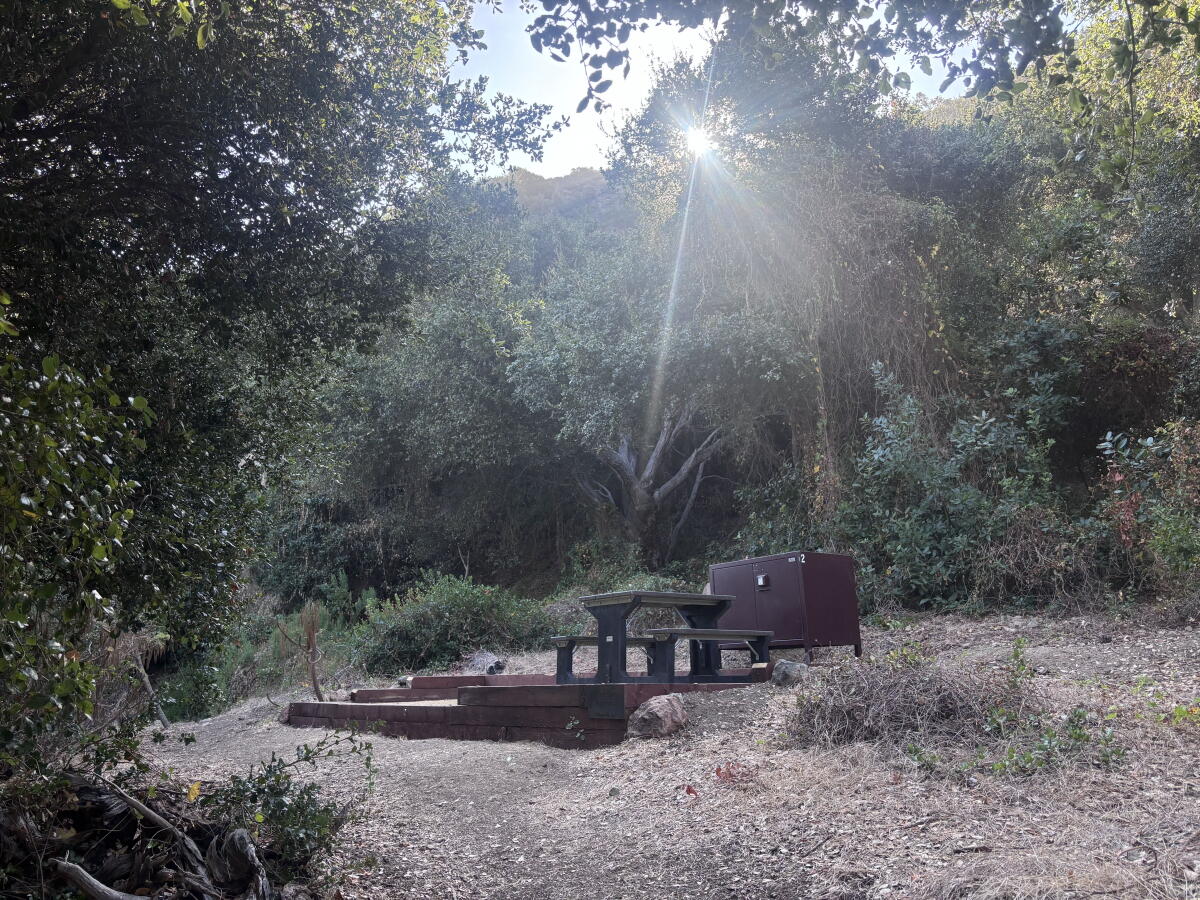
The Musch Trail Camp in the Santa Monica Mountains.

The Musch Trail Camp in the Santa Monica Mountains.

(Jaclyn Cosgrove / Los Angeles Times)

The ranch was originally called Rancho Las Lomas Celestiales by its owner Cora Larimore Trippet, which translates to “Ranch of Heavenly Hills.” You’ll find, as you hike through those hills covered in oak trees, black sage, ceanothus and more, that the name still rings true today.

A mile in, you’ll arrive at Musch Trail Camp, a small campground with picnic tables and log benches. As you pause, listen to the songs of the birds. California quail, Anna’s hummingbird and yellow-rumped warbler are commonly spotted. Stay quiet enough, and you might just spot a mule deer, desert cottontail or gray fox.

From the trail camp, you can either turn around or continue northeast to Eagle Rock, which will provide panoramic views of the park. From Eagle Rock, many hikers take Eagle Springs Fire Road to turn this trek into a loop. Regardless of which path you take, please make sure to download a map beforehand.

Large white-gray rocks jumbled together in a formation resembling a monster's lower jaw.

Boulders at Mt. Hillyer in the San Gabriel Mountains.

(Jaclyn Cosgrove / Los Angeles Times)

3. Mt. Hillyer via Silver Moccasin Trail

Distance: 5.8-mile lollipop loop
Elevation gained: About 1,100 feet
Difficulty: Moderate
Dogs allowed? Yes
Accessible alternative: Paved paths through Chilao Campground

This six-mile jaunt along the Silver Moccasin Trail, which is just over 50 miles when fully open, takes you through high desert and pine trees.

Shaped like a lollipop, the trailhead sits about half a mile northwest of the Chilao Visitor Center, which is typically open on the weekend. You will head north for a mile before turning left off the Silver Moccasin Trail.

You will follow Horse Flats Road to Rosenita Saddle, where you’ll take the trail southwest to Mt. Hillyer.

Keep an eye out for Jeffrey pines, which will have deeply furrowed bark and round prickly cones. Their bark smells like butterscotch or vanilla, which I always love pausing to sniff.

A person in a puffy hat and coat walks among tall pine trees and yellow-brown grasses.

A hiker takes the path to Mount Hillyer in Angeles National Forest.

(Jaclyn Cosgrove / Los Angeles Times)

The trail also features Coulter pines that produce massive cones nicknamed widowmakers because of their size. The Coulter pine cones can weigh up to 11 pounds. If you’re in the area when it’s windy, please watch your head.

To reach Mt. Hillyer, you’ll follow a short spur trail about half a mile southwest from the Rosenita Saddle. Mt. Hillyer features several large boulders, perfect for stopping to meditate. It’ll also offer you sweeping views of the San Gabriel Mountains.

You can make the trail a loop by continuing south until it jags back east, meeting back up the paved road you previously took.

Outside of rock climbers, this trail isn’t terribly popular, so you’ll likely have opportunities along the way to pause.

Deep breaths. We’ll get through this together!

A wiggly line break

3 things to do

Participants prepare for the Griffith Park Run during a previous year's event.

Participants prepare for the Griffith Park Run during a previous year’s event.

(Los Angeles Parks Foundation)

1. Hit the hills in L.A.
There’s still time to register for the Griffith Park Run, a half marathon and 5K through L.A.’s iconic park on Sunday. Participants will start the half marathon at 7:30 a.m. and the 5K at 10 a.m. This is the first year dogs are allowed to run alongside their owners in the 5K. Proceeds benefit the Los Angeles Parks Foundation. Register by 11:59 p.m. Saturday at rungpr.com.

2. Learn to ride a bike in El Monte
ActiveSGV, a climate justice nonprofit in San Gabriel Valley, will host a free class from 9:30 to 11:30 a.m. Sunday about how to ride a bicycle. Students will be taught about balancing atop a bike, along with tips on starting, stopping and controlling the bike. The class is open to all ages, including adults. Preregistration is required. Register at eventbrite.com.

3. Welcome the upcoming full moon near Chinatown
Clockshop, an arts and culture nonprofit, will host “Listening by Moonrise,” from 3 to 5 p.m. Sunday at Los Angeles State Historic Park. A seasonal series held around the eve of a full moon, the event will feature performances and immersive sound experiences. Learn more at clockshop.org.

A wiggly line break

The must-read

A narrow dirt path leads down a hillside covered in orange flowers.

Last summer, nature enthusiasts hiked a steep trail to see California poppies growing near the community of Elizabeth Lake.

(Raul Roa / Los Angeles Times)

Outside of Friday’s lottery numbers, few things draw more speculation than whether Southern California will experience a superbloom. Recent hot weather in January threatened our chances, Times plant queen Jeanette Marantos wrote, but that doesn’t mean all hope is lost. Wildflower expert Naomi Fraga told Marantos that more rain and lower temps would help, but even still, superblooms remain tricky to predict. That said, there will undoubtedly be flowers this spring! “We had lots of rain, so no matter what, I’m excited for the spring, because it’s a great time to enjoy the outdoors and see an incredible display by nature,” Fraga said.

Happy adventuring,

Jaclyn Cosgrove's signature

P.S.

Officials at Angeles National Forest are seeking public feedback on what, if any, changes they should make in how they manage the Mt. Baldy area of the forest. In light of recent deaths and rescues in the area, there has been increased pressure from local officials to implement a permitting process to hike in the area. You have until Feb. 28 to submit comments.

For more insider tips on Southern California’s beaches, trails and parks, check out past editions of The Wild. And to view this newsletter in your browser, click here.

Source link

Marc Anthony, Nadia Ferreira are expecting their second baby

Marc Anthony and Nadia Ferreira have plans to grow their family, announcing on Wednesday that a little one is on the way.

The couple revealed in a joint Instagram post that their son “Marquito is going to be a big brother.” They posted a photo of their hands, along with their son’s hand, cradling Ferreira‘s baby bump. The pair also wrote in their caption in Spanish that their anniversary is a gift and God is great.

Grammy-winning “Vivir mi Vida” singer Anthony, 57, married model and former Miss Universe Paraguay and 2021 Miss Universe runner-up Ferreira, 26,in January 2023 in a star-studded ceremony in Miami. David Beckham served as best man and Salma Hayek, Lin-Manuel Miranda and Luis Fonsi were on the guest list.

The child will be Anthony’s eighth. The musician (real name Marco Antonio Muñiz) shares two adult children with ex-girlfriend Debbie Rosado, and two grown children from his marriage to former Miss Universe Dayanara Torres. He also shares twin teenagers with ex-wife Jennifer Lopez.

As Ferreira revealed news of her pregnancy, Anthony teased an upcoming collaboration with singer Nathy Peluso. The pair of Grammy winners posted a clip of themselves singing and dancing in a studio and urged followers to pre-save their latest song “Como En El Idilio.”

Anthony teased additional music on Tuesday. He posted a black-and-white video of himself and musicians performing in a studio. The clip ended simply with white text reading: “Feb 06.”

What seems to be Anthony’s newest music foray will drop a week before he launches his residency at the Fontainebleau Las Vegas. His Vegas My Way circuit of 10 live performances begins Feb. 13. Additional dates and information can be found on the residency’s website.


Source link