A FedEx truck parked near the sprawling grading center of Professional Sports Authenticator (PSA) in Santa Ana was robbed a week ago of trading cards worth nearly $1 million, the Santa Ana Police Department said.
PSA reported to police that two stolen pallets of about 100 packages of cards apiece had an approximate value of $963,000. About 50 packages from a third pallet were also stolen, and their value was still being calculated as of Tuesday morning.
The cards had been sent from all over the country to PSA to be graded, a necessary step for collectors in authenticating their wares. Items included primarily sports cards and Pokémon cards, as well as one-of-one pieces. The cards had been graded and were set to be returned to their owners when they were stolen.
The FedEx driver left the vehicle, which was parked near PSA’s shipping and receiving address at 1610 E. St. Andrew Place, for an hour to 90 minutes, police said. The truck lock was busted and packages stolen while he was away.
“It remains an open case,” Santa Ana police spokesperson Natalie Garcia told NBC News, “and we have not made any arrests or recovered any stolen goods.”
PSA said it was taking measures to prevent the stolen cards from circulating through the usual venues and marketplaces while also reimbursing card owners for at least a portion of their losses. Trading cards and other collectibles are verified and assigned condition grades by PSA, which establishes their value and protects them by assigning serial numbers and certification information. PSA said it has deactivated the certificates tied to the stolen items.
“We have deactivated the certificates for the stolen items and notified marketplace partners so they can be on the lookout for rare and serialized items,” PSA said in a statement. “Our customer service team has contacted affected customers directly and is arranging compensation based on fair market value.”
PSA sent a letter to affected cards owners, detailing the steps taken to make the owners whole.
“After leaving our PSA facility in Southern California, a FedEx vehicle transporting PSA orders was burglarized, and items were stolen,” the letter read, continuing with a list of items titled “What we are doing.”
Among the items are deactivating the serial numbers on the affected items, notifying commerce partners across digital, auction and other selling platforms so they can look out for stolen items; aiding FedEx and law enforcement in their investigations; and studying what happened so a repeat can be avoided.
Nick Andrews, whose social media persona is the Boston Card Hunter, is keeping track of items reported stolen, a number that had exceeded 1,000 by Tuesday morning. He wrote on X that one victim had cards worth $500,000 stolen.
Card trader Sky-B said on a video that 104 of the cards he collected over the past two years are missing. They had been certified at PSA and were being returned to him in Michigan when he learned about the theft. He said he spent $8,000 on grading, and the cards carried insurance of up to $156,000, less than their market value.
“There were cards in that order that you can’t replace,” Sky-B said.
Longtime sports business reporter Darren Rovell, an avid trading card and memorabilia collector since childhood, said on social media that expensive collectibles are at risk any time they are shipped. Not only can shipping labels and declared insurance values reveal their potential contents, “the simple name PSA or Collectors in the address box is the threat,” Rovell wrote.
The South Korean government has released images from its first successful test of a domestically developed hypersonic boost-glide vehicle. This includes shots of the vehicle impacting the water at the end of its flight. A weapon of this kind would give South Korea a significant new way to hold targets in North Korea at risk amid an ever-deepening arms race on the Peninsula.
South Korea’s Presidential Office, more commonly referred to as the Cheong Wa Dae or the Blue House, announced the test in a Korean-language press release yesterday. The Blue House initially released a video of President Lee Jae Myung and others observing the test from a conference room at the Anheung Proving Ground, which is located in South Chungcheong Province on the country’s western coast. South Korea’s Agency for Defense Development (ADD) manages testing at Anheung. A series of still images from the test itself was subsequently posted on the Blue House’s website.
A trio of pictures showing South Korea’s new hypersonic boost-glide vehicle impacting the water during the test yesterday. The Blue HouseAnother view of the impact at the end of yesterday’s South Korea hypersonic test as seen through what looks to be an electro-optical video camera on an aircraft. The Blue House
Included in the still image gallery are shots showing the launch of the missile, a formal name for which has not yet been disclosed, from a wheeled transport-erector-launcher on a platform sitting just off the coast. The low resolution of the pictures makes it hard to tell whether the missile and/or the TEL are of an existing South Korean design or are based on one. We will come back to this later on.
A picture showing the launch of the hypersonic weapon from the platform off the coast. The Blue HouseAnother picture from the test showing the missile after launch. The Blue House
As mentioned, there are also pictures of the hypersonic boost-glide vehicle hitting the water. At first glance, the vehicle looks to have a broadly conical design with stabilizing fins at the base. However, at least one of the fins looks to be truncated. Closer inspection of the available images shows further indicators that might point to it actually having a more wedge-shaped design with a distinct top and bottom, though it is still not definitely clear given the low resolution. Conical boost-glide vehicles are generally understood to be easier to design, relatively speaking, than wedge-shaped ones. Historically, hypersonic boost-glide vehicles of any kind have proven to be technically complex and challenging to turn into viable operational weapons, even by countries with extensive past experience with their development.
Another close-up look at the hypersonic boost-glide vehicle test yesterday, showing what looks to be a truncated fin on one side. The Blue House
“This test launch was conducted to verify, for the first time, the vehicle’s core technologies in a hypersonic flight environment: the performance of ultra-high-temperature heat-resistant materials, guidance and control capabilities, and the ability to perform irregular flight maneuvers at low altitudes,” the Blue House said in its release yesterday, per a machine translation of the Korean text. “The HGV [hypersonic boost-glide vehicle] successfully separated after ascending to the target altitude and executed its planned flight path within the hypersonic environment without any issues.”
With all this in mind, the fact that the vehicle just remained intact through to impact is noteworthy. At the time of writing, South Korean authorities do not appear to have disclosed more specific details about the test, including how far the boost-glide vehicle traveled before hitting the water or what peak speed it reached. Important questions also remain about how the vehicle is guided during the mid-course and terminal phases of flight, challenges that do not appear to have been addressed by this particular test.
In general, unpowered hypersonic boost-glide vehicles need to be brought first to an optimal altitude and speed. This is typically achieved using a sufficiently sized rocket booster, with existing ballistic missile designs often serving as a starting point.
Once released from the booster, a boost-glide vehicle flies along a relatively shallow flight path within the Earth’s atmosphere. The vehicle is able to maneuver along the way, sometimes erratically, while traveling at hypersonic speeds, generally defined as anything about Mach 5.
A graphic showing, in a very rudimentary way, the differences in trajectories between a traditional ballistic missile, a hypersonic boost-glide vehicle, an aero or quasi-ballistic missile, and an air-breathing hypersonic cruise missile. GAO
All of this sets hypersonic weapons of this kind apart from traditional ballistic missiles, even ones with advanced maneuverability capabilities, which all follow a broadly arcing trajectory to their targets. The combination of speed, flight trajectory, and maneuverability offered by hypersonic boost-glide vehicles creates distinct challenges for opponents. They are hard to spot and track, let alone attempt to intercept, and there is less time for defenders to react overall. This ability to penetrate enemy air defenses and cover ground rapidly makes these weapons particularly attractive for strikes on very high-value and time-sensitive targets.
“The HGV [hypersonic boost-glide vehicle] is a ‘key strategic asset capable of changing the game on the battlefield,’ as its unpredictable flight trajectory and overwhelming speed allow it to launch surprise strikes against key strategic targets during contingencies,” the Blue House’s release explicitly noted, again according to a machine translation.
With all this in mind, South Korea does have an entire family of domestically-produced ground-launched ballistic missiles that could be suitable starting places for launching an unpowered hypersonic boost-glide vehicle. President Lee was notably shown a TEL for the country’s newest Hyunmoo-5 ballistic missile at Anheung yesterday, though no explicit connection has been drawn between that weapon and the hypersonic test. The Hyunmoo-5 is itself still a relatively new development, having only entered service around the end of last year.
President Lee Jae Myung and others inspect a Hyunmoo-5 TEL on October 8, 2026. The Blue House
When it comes to new South Korean arms developments, the Hyunmoo-5, which entered service around the end of last year, has been and continues to be a major point of discussion by itself. It is officially categorized as a short-range design, despite how big it is (35 tons gross weight), which is said to be due largely to the equally substantial size of its warhead (17,000 pounds). Past reports have raised the possibility that it could be capable of flying out to intermediate ranges if the warhead weight were reduced. Short-range ballistic missiles are defined as ones with ranges between 190 and 620 miles (300 and 1,000 kilometers), while intermediate-range ballistic missiles can hit targets out to between 1,864 and 3,418 miles (3,000 to 5,500 kilometers). Medium-range ballistic missiles (MRBM) fall in between these two categories.
A Hyunmoo-5 transporter-erector-launcher seen during a parade in 2024. Kim Jae-Hwan/SOPA Images/LightRocket via Getty Images
With its massive unitary warhead, the Hyunmoo-5 already gives South Korea an important new way to hold deeply buried and otherwise hardened targets in North Korea at risk. This fits in directly with the country’s broader Korea Massive Punishment and Retaliation (KMPR) policy, as TWZ has previously written:
“While the Hyunmoo-5 has been widely reported as a future pillar of the KMPR, its specific ability to penetrate deeply buried bunkers, such as those used by the North Korean leadership, the same functions mean that it can also fulfill elements of the ‘kill chain.’ In this way, it could be used as part of a pre-emptive strike, to try and knock out North Korea’s launch capability by targeting its hardened command-and-control facilities and missile storage areas.“
By virtue of the very high speeds they reach in the terminal phase of flight, hypersonic boost-glide vehicles also offer bunker-busting benefits on top of the other aforementioned advantages they bring to the table.
In addition, the hypersonic boost-glide vehicle test reflects a broader arms race that has been expanding in scale and scope for years now. South Korea is also developing an air-breathing hypersonic cruise missile, seen in the composite image below, as well as new air- and sea-launched ballistic missiles, the latter of which will be loaded on new surface warships and submarines.
via X
Though there are always questions about the actual maturity and viability of the designs, North Korea continues to churn out its own new missile developments. This includes two separate test launches of purported new hypersonic designs just in recent weeks. Tit-for-tat missile launches are not entirely uncommon on the peninsula, but there are limits to how quickly a test like the one South Korea conducted yesterday involving an emerging technology can reasonably be staged.
A picture of one of two new purported hypersonic missiles North Korea says it has tested in the past few weeks. North Korean State Media
An operational hypersonic boost-glide vehicle capability would also expand South Korea’s capacity to challenge opponents regionally beyond North Korea. Though the regime in Pyongyang represents the most proximate national security threat to the country, China and Russia have also been growing points of concern for South Korean authorities in recent years.
“We must secure our national security through our own strength,” President Lee said after yesterday’s hypersonic test, per the Blue House’s release. “The government must not rest on today’s success but must further advance the technology so that the hypersonic glide vehicle can establish itself as a robust strategic asset safeguarding our future security.”
South Korea’s President Lee Jae Myung, at center, and others applaud after yesterday’s test. The Blue House
South Korea’s very public test of its new hypersonic boost-glide vehicle underscores the country’s still-expanding efforts to broaden its options for striking even the best-defended targets in North Korea, as well as projecting power elsewhere regionally. At the same time, it remains to be seen when the South Koreans may field a real operational capability in this regard.
WASHINGTON — Federal immigration officers opened fire on a Dominican man in New York because he drove his car into officers’ vehicles and they believed their lives were in danger, a senior Immigration and Customs Enforcement official said Friday.
The 28-year-old man, whom New York City police identified as Oscar Belgal, was shot “superficially” in the neck as ICE officers attempted to arrest him, said Marcos Charles, head of ICE’s Enforcement and Removal Operations. Authorities have not released details of Belgal’s condition.
Officers used their vehicles to block the man as he attempted to drive away, but he accelerated toward them, Charles said during a news conference with U.S. Homeland Security Secretary Markwayne Mullin in Washington. The Department of Homeland Security said the news conference was about the “dangerous consequences of sanctuary city policies.”
“Our officers, using their training and believing that their life and the life of the partners and the general public were in danger, used their training and fired weapons,” Charles said.
Belgal had his 5-year-old son in the car with him when the shooting happened, officials said.
Mullin said ICE agents didn’t know the child was in the car, but that Belgal “was aware” and chose to put the boy at risk by trying to evade officers.
ICE previously tried to detain Belgal, Charles says
Belgal was associated with a robbery crew that used mopeds and weapons, and was convicted of grand larceny last year and sentenced to five years of probation, Charles said, adding that he evaded officers in September when ICE tried to arrest him for deportation.
The Legal Aid Society, which was representing Belgal in an ongoing drug case, called Friday for a “full and transparent” investigation of the shooting, the officers involved to be held accountable and an end to “ICE’s escalating presence in New York City.”
Federal agents walk near the scene where a man was shot by an ICE officer during an operation in the Bronx borough of New York on Oct. 8, according to local media and police.
(Charly Triballeau / AFP via Getty Images)
Belgal has pleaded not guilty to narcotics-sale charges in the drug case. The Legal Aid Society did not comment further.
New York City Mayor Zohran Mamdani and New York Gov. Kathy Hochul, both Democrats, said late Thursday that they had pressed Mullin and Republican President Trump to release Belgal, but to no avail. They also urged the administration to immediately release ICE officers’ body camera footage of the shooting and to halt immigration enforcement operations in the city.
Mullin said Belgal was being held in a “highly secured” detention facility outside New York City but declined to say where.
Attorneys representing Belgal filed an emergency petition Thursday night calling for his release. A hearing is scheduled for Friday afternoon.
He also confirmed ICE officers were wearing body cameras that were activated, but didn’t say when any of that footage would be released. Under agency policy, bodycam video can be released within 72 hours if “determined that it is in the best interests of the agency.”
On Friday, New York City police released footage from its officers as they arrived at the scene following the shooting. The department previously said its officers were not involved in the arrest and not at the scene when the shooting happened.
The video shows a city officer responding to a chaotic scene where Belgal — sitting on the ground with his hands behind his back and head drooping to one side — was surrounded by several officials. The video shows officers lifting Belgal and placing him in a black SUV. Police said he was taken to a hospital.
“Yo put pressure. Put pressure,” an officer can be heard saying as the SUV reverses down the block.
New York City Police Commissioner Jessica Tisch said Belgal was pulling into a parking space when a federal officer in plainclothes approached with his gun drawn, followed by another federal officer who also wasn’t in uniform. Belgal started to pull the car forward, and at least one of the officers fired seven rounds, hitting the man below his left ear.
Protesters and local officials decried the shooting as an example of the dangers of the Trump administration’s immigration crackdown.
New York City Mayor Zohran Mamdani arrives to speak to the media about the ICE shooting in the Bronx borough of New York on Oct. 8. Mamdani said he would ask President Trump to remove federal immigration agents from the city as tensions flared over the latest shooting involving ICE.
(Charly Triballeau / AFP via Getty Images)
Homeland Security Secretary Markwayne Mullin takes questions from reporters during a news conference at U.S. Immigration and Customs Enforcement headquarters on Friday in Washington, DC. Mullin, joined by ICE officials, addressed Thursday’s shooting of a man in New York City by a federal immigration agent as he spoke out against sanctuary city policies.
(Kevin Dietsch / Getty Images)
“There is no justification for what we have seen today,” Mamdani said late Thursday at the scene of the shooting.
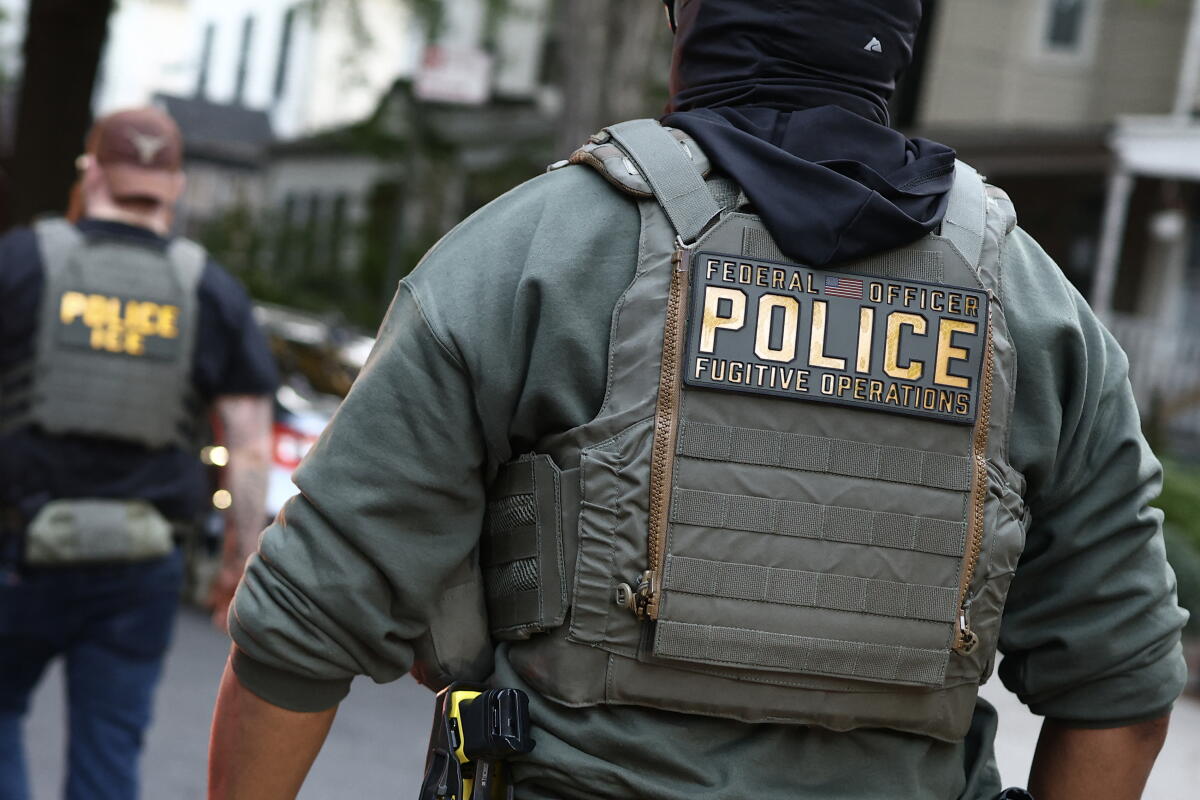
Federal officers who surrounded the vehicle wore construction vests and masks, making it difficult to identify them as immigration officers, he said.
Mullin criticizes NYC’s immigration policies
Mullin devoted much of Friday’s news conference to criticizing Mamdani and New York City’s limits on cooperation with ICE. The Democrat, who took office in January, has restricted local cooperation with immigration enforcement operations and repeatedly called for the abolition of ICE.
“Sanctuary politicians, they create an environment for criminal activity to thrive, not for the American citizens to be safe,” Mullin said.
Homeland Security Secretary Markwayne Mullin takes questions from reporters during a news conference at U.S. Immigration and Customs Enforcement headquarters on Friday in Washington, DC. Mullin, joined by ICE officials, addressed Thursday’s shooting of a man in New York City by a federal immigration agent as he spoke out against sanctuary city policies.
(Kevin Dietsch / Getty Images)
ICE has asked local officials in New York to hold onto more than 14,000 people for federal officers to collect and place in immigration detention, he said.
“Silence. Absolute silence is what we have gotten back,” the secretary said. “Why would they release these individuals back onto the streets?”
“We’re enforcing our nation’s laws. We’re not picking and choosing,” Mullin continued. “Why is that controversial? We should all want law and order on our streets.”
ICE has justified other shootings with perceived threats to officers
During Trump’s second term, Homeland Security has often accused suspects of attempting to ram officers with vehicles or otherwise pose a threat and using that as justification for opening fire. But evidence from other shootings involving immigration enforcement officers has sometimes called into question that rationale.
In the Jan. 7 shooting death of Renee Good in Minneapolis, Homeland Security officials initially claimed an ICE officer opened fire in self-defense after Good attempted to run him over with her vehicle. Videos filmed from multiple angles challenged the administration’s narrative.
On July 10, ICE officers fatally shot Lorenzo Salgado Araujo in Houston as the Mexican national was driving his construction crew to a job site. DHS maintained Salgado Araujo rammed an ICE vehicle, but the three men inside his vehicle disputed the narrative.
Last year in a Chicago suburb, immigration officers fatally shot Silverio Villegas González after they say the Mexican national drove at them and dragged one with his car, causing “serious injuries.” But body camera videos from local police showed the agent who shot Villegas González walking around afterward and dismissing his own injuries as “nothing major.”
Santana and Marcelo write for the Associated Press. Marcelo reported from New York. AP reporters Anthony Izaguirre and Jennifer Peltz in New York City and Ryan Foley in Iowa City, Iowa, contributed to this report.
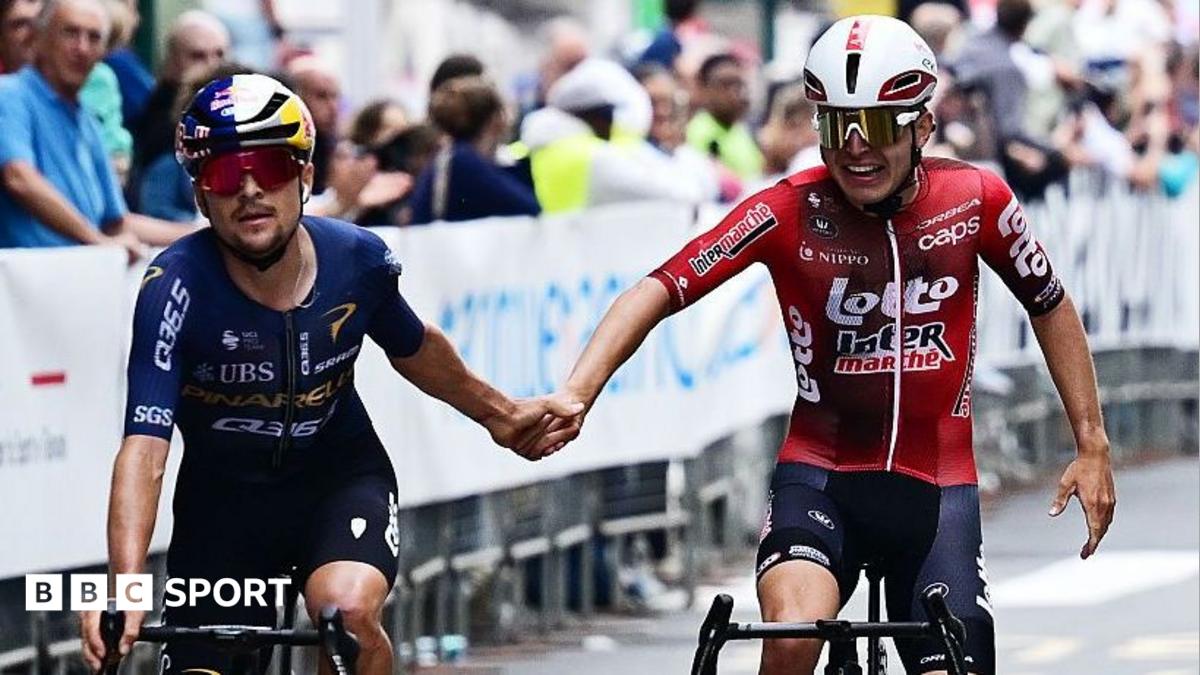
Tom Pidcock wanted to “stop racing” after saying that two of his team-mates were hit by a police vehicle travelling the wrong way down the course at the Tre Valli Varesine in Italy.
Pidcock finished second at the one-day race in Varese but was left “mad” after Pinarello-Q36.5 team-mates Marcel Camprubi and Thomas Gloag were knocked off their bikes with six laps of the finishing circuit to go.
Spain’s Camprubi was able to continue in the race but Pidcock’s fellow Briton Gloag stopped and required stitches on his knee.
“First of all, I wanted to stop the race, stop racing myself,” Pidcock told Eurosport after the race, which was won by Belgium’s Jarno Widar in a sprint finish.
“I was mad. I had guys all riding in front of me, for me, and then two of them are on the floor.
“This shouldn’t happen. But we continued and got back into the race and I’m happy that I could be on the podium.”
BBC Sport has contacted race organisers and local police for comment.
In August, two-time Olympic mountain bike champion Pidcock won his second cross-country world title at the Mountain Bike World Championships.
He dedicated that win to British cyclist Finlay Tarling, 19, who died on 14 August during the Volta a Portugal following a high-speed collision with a van that had strayed on to the closed road.
Camprubi posted a picture of a broken bike on Instagram Stories, with a caption that read: “Sad that you have to risk your life to race, one month after a tragic accident.”
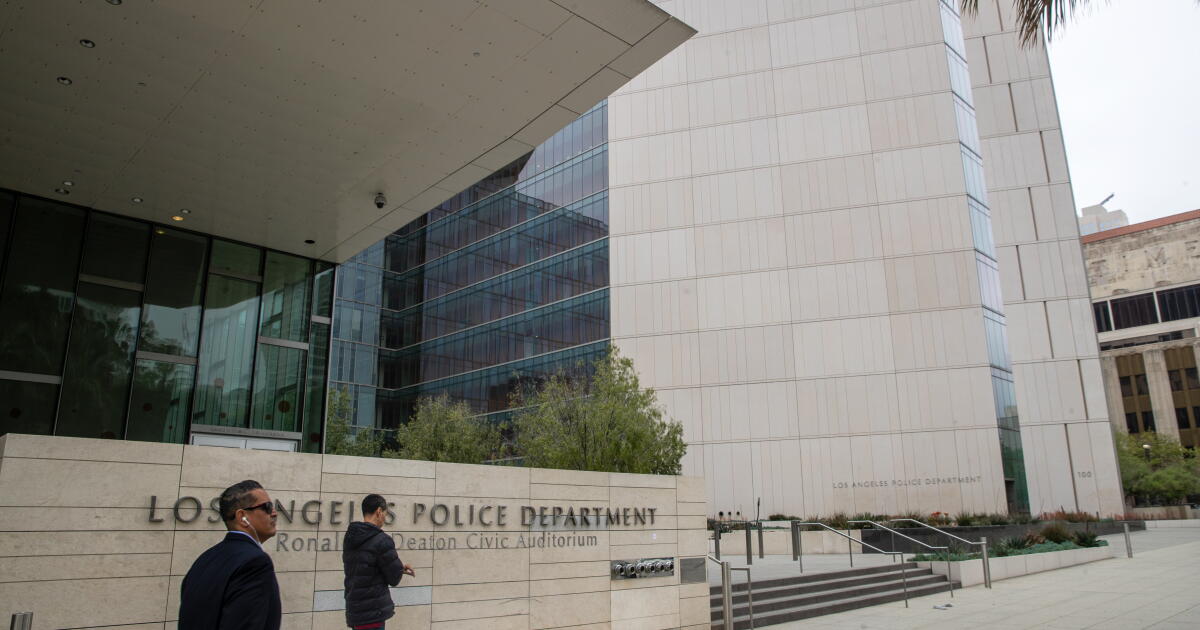
Citing lingering concerns about the potential misuse of police license plate readers, the Los Angeles City Council voted Tuesday to delay an agreement that would enable the deployment of hundreds of the controversial devices until officials are satisfied that the technology will be wielded responsibly.
By a 10-4 vote, the council opted to overrule approval of the 10-year, $235-million contract between the Los Angeles Police Department and Axon Enterprise, halting a deal that had previously been signed off on by the Board of Police Commissioners.
Axon is seeking to outfit hundreds of LAPD patrol squads with plate scanners, which track the movements of vehicles around the city. Under the agreement, the company would also replace thousands of body-worn cameras, supply new Tasers, provide cloud video storage, and roll out a program that uses artificial intelligence to assist officers in writing police reports.
In addition, Axon is seeking to launch a pilot program that would attach plate scanners to streetlights around Los Angeles, offering the LAPD a souped-up version of its current systems by using AI to identify vehicles, license plates, pedestrians and objects that appear on streets and sidewalks.
The council’s decision — which was preceded by several fiery comments from members of the public who oppose the use of license plate readers — sends the contract back to the Police Commission for reconsideration.
A commission spokesperson said that the board’s members weren’t immediately available for comment.
Several council members voiced unease about proceeding without a better sense of the LAPD’s internal policy on license plate reader use. Delaying the contract, Councilmember Hugo Soto-Martínez said, would give the public and city leaders more time to review the safeguards and policies written into the LAPD’s proposed memorandum of understanding with Axon.
Councilmember Traci Park, a staunch supporter of plate reader technology, said there is an urgent need to get the devices “up and running.”
Councilmember Eunisses Hernandez shot back that it would be irresponsible to deploy the technology, citing news reports about officers misusing plate readers to stalk romantic partners and track women seeking reproductive health services.
Earlier this year, the LAPD allowed its agreement with one of Axon’s chief competitors, Flock Safety, to lapse over concerns that the Trump administration is using the data it collects to locate immigrants targeted for deportation. Police officials say they no longer have access to the company’s cameras, many of which are owned by homeowners associations and other private groups.
LAPD Chief Jim McDonnell and other department leaders have pushed to expand the use of license plate readers, saying they are a valuable tool for solving crimes, enabling investigators to more easily locate stolen vehicles and fugitives.
Hernandez noted that other police technologies, such as a robot dog used in situations involving barricaded suspects, had quietly moved from a pilot to a full-fledged program without input from the council.
Council President Marqueece Harris-Dawson said he still had privacy concerns about license plate readers, while noting that their deployment along the Figueroa corridor had assisted in the rescue of dozens of juvenile sex trafficking victims.
“Now having said that, if I’m honest I don’t know what else the cameras are doing,” he said.
Councilmember Monica Rodriguez said that as the license plate reader technology is adopted by other, non-police agencies such as sanitation and street services, the city needs a universal policy governing its use.
The matter will next be heard by the public safety committee — likely at its Oct. 20 meeting — before being taken up by the full council later that week.
In a presentation to the Police Commission last month, the LAPD’s technology czar, Dean Gialamas, said that the department understood the privacy and civil liberty concerns raised about companies such as Flock. This summer, the department announced it was pausing its relationship with the Atlanta-based firm, but police officials have said they are still hopeful to negotiate a new deal with the company that would include more data-sharing safeguards.
Much like the initial debate over the use of forensic DNA testing, Gialamas said, the answer wasn’t to abandon the technology but to create safeguards to “ensure responsible and trusted use.”
Gialamas told commissioners that Axon had agreed to terms that would give the LAPD complete ownership of the data captured and bar the sharing of data with federal authorities. The proposed deal, he said, would also limit the use of plate readers to criminal investigations, missing persons cases and other “serious public safety matters.” Investigators, for instance, would not be able to conduct searches based solely on protests or other 1st Amendment-protected activities, he said.
Under the proposed contract, investigators would no longer be given “unfettered access” to license plate data and the retention period would be significantly cut down, he said. The department would also be permitted to conduct regular audits to flag officers who use the system frequently or conduct unusual searches.
A report issued last month by the LAPD inspector general’s office found numerous “limitations” in the department’s existing agreements with its three plate reader vendors — Flock, Axon and Motorola — including a lack of clear language about how long data are retained and how they are shared with third parties or other law enforcement agencies.
The inspector general recommended that the department update its current license plate reader contracts to address data security and privacy concerns, conduct regular audits and develop standardized rules for traffic stops based on plate reader hits.
Gov. Gavin Newsom last week signed legislation cracking down on the practice of luxury-car buyers in California registering cars out of state to avoid taxes.
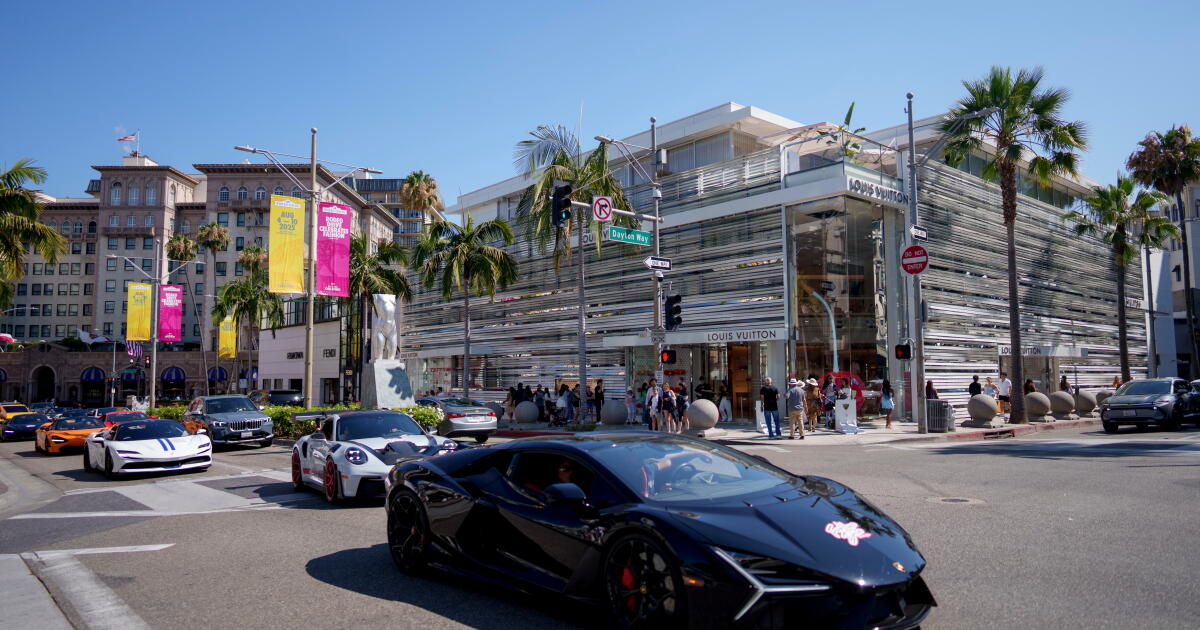
Senate Bill 1406, introduced by state Sen. Jerry McNerney (D-Pleasanton), closes the so-called Montana loophole, in which tax evaders create shell companies in Montana or other states without sales tax or vehicle registration fees and use them to purchase Ferraris, Porsches and other luxury cars. The state estimate it loses millions of dollars annually because of such schemes.
The new law expands California’s definition of who is a resident under state sales tax law in an effort to weed out phony shell companies, making a company liable for state taxes when at least one member of the business is a California resident.
The law, which went into effect immediately, also authorizes the state tax agency to impose tax liability on individual members of a business.
California had already looked to enforcement efforts to investigate suspicious out-of-state car sales, which officials estimate amount to $10 million annually in lost tax revenue.
Under state law, residents were already required to pay California sales tax on vehicles unless they are first used out of state and stay out of state for at least 12 months. Dealers are required to maintain records showing sales of vehicles so that authorities can ensure vehicles sold to buyers in another state are actually delivered there.
Earlier this year, the state’s Department of Justice charged 14 people — including auto dealers and customers purchasing cars — with concealing the purchase of more than $20 million worth of high-end vehicles including Ferraris, Porsches and Lamborghinis, and evading upward of $1.8 million in state taxes.
Text messages included in the criminal complaint showed buyers seeking to conceal their purchases. One Lamborghini buyer boasted about fees avoided: “70k saved — I can’t believe Montana registration lasts for 5 years — that’s crazy. Stupid California. Paid 3k to own a 600k car for 5 years — lol in Cali that’s like 75k for 5 years. Hella dumb.”
The new law further develops criteria to help show an LLC as a shell company involved in a potential tax evasion scheme.
If the LLC lacks a specific business activity or purpose, fails to maintain a physical location outside California, fails to employ people, or fails to file federal tax returns in another state, it could now be considered as evidence of such a scheme.
“We thank Tony for his contributions over the past nine years and wish him the best moving forward,” CBS Sports said in a statement.
J.J. Watt, who has been filling in for Romo as the color commentator on CBS Sports’ lead NFL broadcast team, will continue in the role for the remainder of the season. Romo, a former four-time Pro Bowl quarterback for the Dallas Cowboys, has been booth partners with play-by-play announcer Jim Nantz since 2017.
“I’m proud of what I accomplished at CBS Sports over the last nine years,” Romo said in a statement released soon after CBS announced the move. “I approached my role as a game analyst the way I’ve approached everything in my life — with a desire to win and be the best that I can be.
“I’m going to use this time to take a break,” he added, “something I’ve never done before, and focus on my health and my family before moving on to my next opportunity.”
On Sept. 1, Romo entered a a no-contest plea to the OWI charge from his July 23 arrest in Wisconsin. A Milwaukee County judge found Romo guilty of the charge and took away his driving privileges for six months. Romo also was ordered to pay $834, and have an ignition interlock device installed on his vehicles for a minimum of one year.
Afterward, Romo said in a statement that multiple back injuries from his playing career led to “a dependence on pain medication, and my efforts to get off those medications led to an over-reliance on alcohol.”
“None of this is an excuse,” he wrote. “These are my failures, and I take responsibility for them.”
U.S. Immigration and Customs Enforcement officers have been ordered not to engage in high-speed car chases and to make vehicle stops only if they have completed specific training, under new internal guidance issued after several drivers were shot in encounters with ICE.
A memo sent to officers in ICE’s Enforcement and Removal Operations division and obtained by the Associated Press warned they are not any under circumstances authorized to chase vehicles that fail to pull over. Instead, officers should take down the vehicles’ information for further investigation, according to the memo signed by ICE’s executive associate director, Marcos D. Charles, and dated Wednesday.
The new guidance comes after ICE-initiated vehicle stops have repeatedly escalated when drivers have refused to cooperate or tried to flee. ICE agents have opened fire during more than a dozen such encounters since last year, killing at least four people and wounding several others.
President Trump’s administration has faced internal tension over how to handle traffic stops, which are seen as particularly high-risk encounters.
After fatal shootings of drivers in Maine and Texas in July, ICE officers were directed to temporarily pause most vehicle stops. But the next day, Trump went on social media to direct the agency to continue traffic stops, calling them “one of ICE’s most important and effective Crime Fighting tools.”
ICE has faced intense pressure from the White House to deport more people who are in the country illegally, and its arrests have reached record numbers. At the same time, the agency’s rapid hiring spree last year resulted in some poorly vetted and trained officers hitting the streets.
In a statement, ICE downplayed the significance of the memo, which said the new guidance was intended to replace and amend previous directives issued earlier this year, last year and in 2018.
“Occasionally, ICE leadership issues guidance reminders to law enforcement officers,” the statement said. “Vehicle stops and arrests of illegal aliens continue.”
The new memo outlines steps intended to improve the safety of vehicle stops for ICE officers, drivers they are targeting, their passengers and the public.
The memo told ICE’s field office directors that they must ensure vehicles used for traffic stops have lights and sirens that let the public know they are law enforcement vehicles when activated. Underthe guidance, all officers on the scenes of vehicle stops must wear and activate their body cameras.
In addition, only officers who have completed one of five specific agency training courses can conduct vehicle stops. Officers who have not completed the courses can participate in vehicle stops only “in a support capacity” as passengers and cannot be the drivers of any of the vehicles involved.
The guidance says ICE officers can continue to use a controversial technique known as pinning, which is defined as “using a vehicle or physical barrier to trap or stop a car,” but only if they have received special training. Similarly, only trained officers can use spike strips that deflate tires to prevent drivers from fleeing.
The memo came the day that courtroom testimony highlighted ways in which two ICE officers involved in a vehicle stop, pursuit and shooting that wounded a delivery driver in Austin last month would not have complied with the new guidance.
During a bond hearing for Wilber Rafael Garces Perez, testimony showed that the officer who shot him wasn’t wearing a body-worn camera. The ICE officer who did have a camera was driving in a separate car and turned it off during the pursuit.
Prosecutors presented surveillance video that showed an ICE agent chasing Garces Perez at high speeds through residential streets after he fled an initial traffic stop.
Garces Perez faces federal assault charges after investigators say he struck an ICE officer with his driver’s side mirror. That officer then shot into Perez’s vehicle, lodging a bullet in his back, officials say.
Attorneys for Garces Perez have called the charges against him “retaliation” and have argued that the camera footage was inconclusive because it didn’t fully capture the moment when he allegedly tried to flee.
Foley writes for the Associated Press. AP reporter Anna Wilder contributed to this report from Austin, Texas.
For Dylan Feierabend, there are few things more life-affirming than fishing for redtail surfperch and smelt at Centerville Beach in rural Humboldt County.
His favorite spot, where the Eel River meets the Pacific Ocean, is a few miles from the main road — too far to walk with fishing poles and an ice chest in tow. He instead gets there by driving a side-by-side, a small off-road vehicle, right onto the sand.
He might not be able to do so much longer.
If the California Coastal Commission has its way, vehicular access will soon be nixed at Centerville Beach County Park outside Ferndale — one of just a handful of beaches along the state’s 840-mile coastline where driving is allowed.
This month, the Coastal Commission approved a request from Humboldt County for a coastal development permit to rebuild a 0.17-mile segment of a storm-battered road adjacent to the fast-eroding beach — but only if the county stops people from driving on the sand.
Coastal Commission staff, in a 78-page report, said motorized vehicles threaten both sensitive vegetation and critical habitat for the federally threatened western snowy plover, a small, white-bellied shorebird.
“California’s dune habitats are particularly rare and important, so where driving could damage these sensitive areas, the Coastal Act requires that we protect them,” commission spokesman Joshua Smith said in a statement to The Times.
However, he said, the agency does not “have a one-size-fits-all policy on driving on the beach.”
But Humboldt County residents and officials decry the move as just the latest example of overregulation and government overreach in liberal California — and of the disconnect between its rural and urban places.
“What you see in Southern California isn’t what we see up here,” resident Joey Sancho told the Coastal Commission during its meeting in Eureka this month. “The beaches aren’t overly populated. They’re not being torn up by ATVs and so forth. But yet, [it’s] just one more thing just to take away from us up here in the North Coast.”
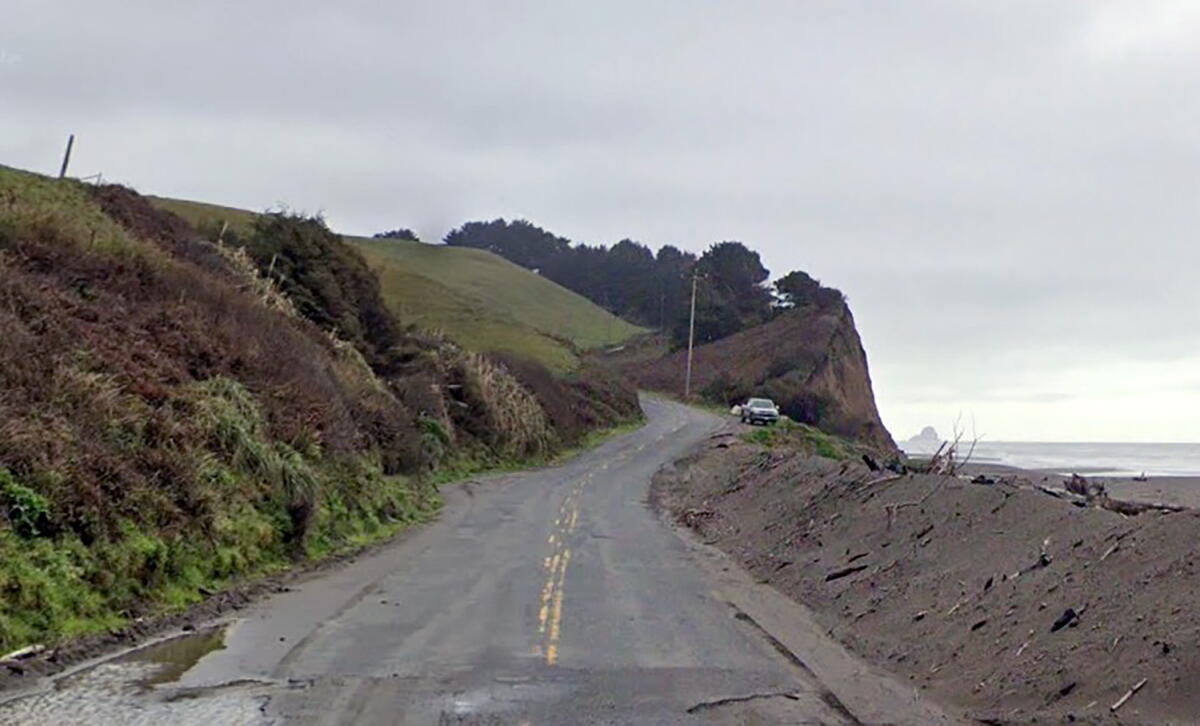
Humboldt County wants to make improvements to Centerville Road.
(Google street view)
Feierabend, a 36-year-old loan officer, told The Times: “It’s about slowly choking out the individuals that utilize the beach and gaining control under the ruse, or the guise, of conservation.”
Amid this wider debate, beach driving has emerged as an unexpected flashpoint.
Last month, Republican gubernatorial candidate Steve Hilton called coastal commissioners “idiots” for their years-long effort to end off-road driving at Oceano Dunes State Vehicular Recreation Area, the only state park that allows recreational driving on the beach.
Cars, bikes and pedestrians share the sand at Oceano Dunes State Vehicular Recreation Area near Pismo Beach in February 2021.
(Myung J. Chun / Los Angeles Times)
Oceano Dunes, near Pismo Beach in San Luis Obispo County, temporarily closed to off-roaders this spring amid long-running legal battles between recreation advocates and environmentalists who say all-terrain vehicles are tearing through western snowy plover habitat and sending clouds of unhealthy dust into nearby neighborhoods.
“Surprise, the Coastal Commission are trying to shut it down because they’re joyless bureaucrats who don’t want anyone to have fun,” Hilton said in a social media video as he leaned on a bright yellow dune buggy on the sand. “And it’s not just about fun. This is a real economic engine for this community.”
If elected, he said, he would create a state “Office of Fun and Freedom.” Its first task? Protecting off-roading at Oceano Dunes.
The campaign for Xavier Becerra, the Democratic gubernatorial candidate, did not return requests for comment.
In Humboldt County, residents have stressed that rural Centerville Beach is nothing like Oceano Dunes, where thousands of pickup trucks, ATVs and dirt bikes may carve through the sand on a given day.
Centerville Beach’s nearest town, Ferndale, the childhood home of celebrity chef Guy Fieri, has a population of just 1,500. Residents say the beach typically sees a handful of four-wheelers and side-by-sides — with most heading out to fish, not joy-riding.
“Centerville is not a beach anyone can just drive on — you’ve got to know what you’re doing,” said Shawn Griggs, a painter who surfs there most mornings. “It’s a very volatile beach with coarse sand. It’s steep right off the shore; the sand bars are transient.”
A view of Centerville Beach, near where Humboldt County is looking to repair a stretch of Centerville Road.
(Beau Sanders / For The Times)
Griggs, 57, described himself as “an environmentalist at heart” who appreciates efforts to protect threatened species. But he doubts vehicles are doing much harm at Centerville.
“With the amount of sand that is pushed off that beach every year and moved around, it’s hard for me to imagine that beach would be a super stable beach for the snowy plover,” he said.
The Coastal Commission staff report says the area is “moderately suitable for plovers,” but that “heavy human use” has degraded the habitat.
In Humboldt County, driving is allowed on a handful of county-maintained beaches, as well as portions of the Samoa Dunes Recreation Area, which is managed by the federal Bureau of Land Management.
Feierabend, who grew up next to Centerville Beach, said vehicles are not destroying the beach — the ocean is.
“No one’s going too fast,” he told the Coastal Commission. “No one’s driving through dunes. In fact, there are no dunes.”
Centerville Beach, home to some of the state’s fastest-eroding cliffs, has been shrinking for decades. The rising and warming sea has accelerated that process in recent years, and powerful El Niño-charged storms this fall and winter could wreak further havoc on the coastline.
A beach parking lot that once accommodated up to 100 vehicles has already washed away. And Centerville Road — a narrow county thoroughfare that provides access to the beach, a few rural homes and the federally managed Lost Coast Headlands — is so regularly slammed by powerful storm waves that it is often covered with sand and made impassable.
The road is what initially brought Centerville Beach to the Coastal Commission’s attention.
The Humboldt County Department of Public Works applied for a required coastal development permit to repair a short stretch of storm-damaged roadway, a project for which it had already secured federal and state funding.
The county has proposed elevating the road 10 feet and adding a new parking area. It also is looking to build a revetment — a sloping layer of rocks on the sand meant to protect the road from waves, at least for a few decades.
Humboldt County initially pushed to move the roadway farther inland, but faced resistance from private landowners.
According to the Coastal Commission staff report, beach erosion puts Centerville Road at “severe risk of being destroyed” within the next five years.
Given the urgency of the needed repairs, the decision to tie the development permit to beach driving felt like “a backroom deal stuck into the project,” Humboldt County Planning Commissioner Iver Skavdal said at the Coastal Commission meeting.
The commission is “holding the project, the residents and the county hostage,” said Skavdal, noting that seven generations of his family had enjoyed the beach.
Though the commission approved the permit on the condition beach driving will be stopped, it added an amendment after locals pushed back — giving Humboldt County an opportunity to write a plan to allow restricted driving, provided it would not harm sensitive habitats. That plan would have to come back to the commission for approval.
The Humboldt County Board of Supervisors still must decide whether to accept the stipulations of the coastal development permit before any construction begins.
The potential loss of driving on Centerville Beach — a unique attraction in California’s sparsely populated, economically depressed northwest corner — struck a chord with residents, about two dozen of whom sat through several hours of a Coastal Commission meeting on a Wednesday morning to speak about it.
“Families here don’t have a lot to do,” Sue Long, former mayor of the nearby city of Fortuna, told the commission. “There’s not a lot of the kind of entertainment you guys have, with waterslides and Disneyland and all of those things. … We count on nature.”
Mike Astry, who runs a small off-road recovery business pulling out vehicles stuck in sand or mud throughout the region, told the commission most people towed off Centerville Beach are out-of-town tourists who traveled just to drive on the beach.
Stopping vehicular access is “a big deal to a lot of people,” Astry, 49, said in an interview. “People driving from out of town that want to come drive on that beach are not going to come to our town and spend money on hotels and food.”
Astry, who also is an automotive maintenance supervisor for Humboldt County, started the towing business with his souped-up Jeep during the COVID-19 pandemic, when people flocked to outdoor spaces during lockdowns. Now, he typically gets one or two calls a week.
At Centerville Beach, he said, “I’ve had some pretty gnarly tows,” including some “little old ladies who thought, ‘Oh, I thought my Prius could go here,’ and it can’t.”
A few years ago, he yanked a Tesla out of the ocean. Powerful waves ripped off its bumper. The driver was from the Bay Area.
“People are just sick of California, their mandates, and this is just one more thing to add to it,” he said of the coastal commission decision. “It’s just a power trip. We pay our frickin taxes.”
Jennifer Savage — California policy associate director for the Surfrider Foundation, a coastal protection nonprofit — was one of the few speakers at the Coastal Commission meeting who focused on a different aspect of the county’s Centerville Beach proposal: the rock revetment next to the old, crumbling road.
Revetments and sea walls, which generally are not allowed for developments built after the Coastal Act took effect in 1977, “make a beach erode significantly faster,” she told The Times.
Erosion has been a known problem for a long time, she said, and “the failure to prepare doesn’t justify sacrificing the public beach.”
Former child star Bobb’e J. Thompson, who acted in “That’s So Raven” and “30 Rock,” has been sentenced to more than two years in federal prison.
Thompson was arrested last fall after police said he was driving 104 mph — more than 30 mph over the speed limit — in Cerro Gordo County, Iowa. A news release issued by U.S. attorney’s office of the Northern District of Iowa said an officer stopped the vehicle and spotted Thompson and the passenger switching seats. The officer reported that, when he approached the car, there was a smell of marijuana coming from the vehicle.
Officers searched the vehicle and, according to the news release, found a backpack holding bags of dispensary-bought marijuana and a .40-caliber handgun that was fully loaded with a 15-round magazine. Police said the gun had been reported stolen from a car in Kansas City, Mo.
Actor Bobb’e J. Thompson speaks at Spike TV’s 2009 Guys Choice Awards at Sony Studios in Culver City.
(Kevin Winter / Getty Images)
The “Role Models” and “Tyler Perry’s House of Payne” actor was also convicted of battery and assault in 2020. Then in 2022 he was convicted of possession of a firearm, which was prohibited because he was a felon.
In April, Thompson pleaded guilty to possession of a firearm, and last week he was sentenced by an Iowa district judge to more than two years in prison.
Thompson’s “That’s So Raven” co-star Kyle Massey told TMZ on Monday that he loved his former co-star no matter what.
“Free Bobb’e J., man, that’s my brother,” he said. “We love you, we support you, we got your back, whatever you need, man, we’re gonna take care of you. It just always sucks to see one of your friends or someone that you love go through something hard like that. So we’re just gonna be rooting for him no matter what.
“Keep your head up, we’re here and we love you,” he added. “We love you so much, bro. No matter what.”