USMC Says It Needs Nine More Amphibious Warships To Carry Out Its Missions
Navy and Marine Corps leaders have recently come to the agreement that the Corps needs 40 amphibious ships to meet its goal of keeping three Marine Expeditionary Units (MEU) deployed at the same time. However, at the moment, the Navy has only 31 of these vessels, a minimum mandated by Congress, and now an effort is underway to convince lawmakers to increase the fleet.
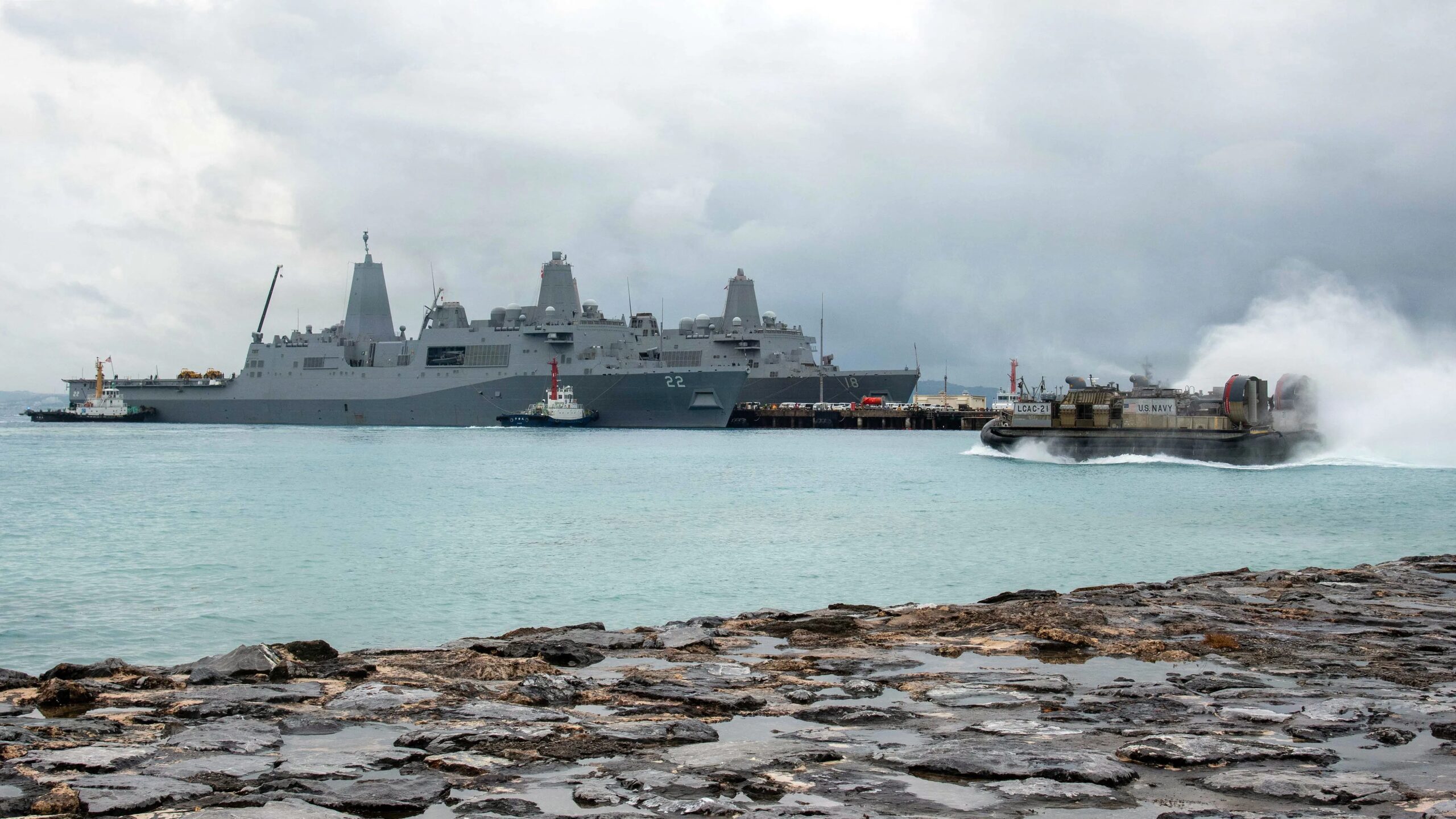
MEUs, made up of about 2,200 Marines, are typically embarked on Amphibious Ready Groups (ARGs), which usually consist of an assault ship, two transport docks or dock landing ships. Support vessels, surface combatants and in some cases a nuclear fast attack submarine can make up the larger Expeditionary Strike Group.

Marine Corps Commandant Gen. Eric Smith’s top priority is meeting what is called the 3.0 ARG/MEU presence, said Shon Brodie, director of Maritime Expeditionary Warfare at the Corps’ Combat Development and Integration (CD&I) Directorate tasked with modernizing the Marines.
Smith “believes that the best thing that we as a service can do for the nation is provide the highly trained Marine Expeditionary Units, one from the East Coast, one from the West Coast, and that one in Japan, persistently,” Brodie told a small group of reporters, including from TWZ, on Wednesday.
To ensure that happens, Vice Chief of Naval Operations (VCNO) Adm. James W. Kilby and the Assistant Commandant of the Marine Corps (ACMC) Gen. Bradford J. Gering “have worked really close together to try to understand the number of ships it would require to achieve 3.0 based on current readiness,” Brodie noted.
“The two analytical arms of both services have come to the conclusion that it takes 40 ships. That’s 13 big decks and 27 LPDs,” the Maritime Expeditionary Warfare director explained.
Big decks are the Navy’s Wasp class (LHD) and America class (LHA) amphibious assault ships. Their embarked Aviation Combat Elements (ACEs) can include F-35B Joint Strike Fighters, MV-22 tiltrotor aircraft, UH-1, AH-1 and CH-53 helicopters, as well as Navy Seahawk helicopters. The LPDs are smaller [Amphibious Transport Dock ships], which also embark MV-22s and helicopters.
The capabilities of MEUs have grown over the past decade, allowing them, in limited cases, to take on tasks that once required an aircraft carrier strike group. MV-22 tiltrotors, and, more recently, F-35Bs, which can be embarked in large numbers in the so-called “Lightning carrier” configuration, have boosted the utility of these fighting units.

The amphibious ship requirements, which had been in discussion for a while, were finally hammered out over the past few months by the new Amphibious Force Readiness Board (AFRB), stated Brodie. The AFRB is a joint Navy-Marine Corps effort created to better track the readiness of the amphibious fleet, which has been a huge issue as we have frequently noted.
“Right now, I have 31 amphibious warfare ships,” stated Brodie. The biggest need at the moment, he added, is for additional amphibious assault ships.
The law calls for the service to have 10, but currently it has only nine. That’s because the USS Bonhomme Richard (LHD-6) was sent to the scrapyard in 2021 after being ravaged by a fire in 2020.
Brodie said the Marines want to increase the number of mandated amphibious assault ships from 10 to 13.
“When I have a problem generating this force, it really revolves around the big deck,” he stated.

The call for a fleet of 40 amphibious ships, and especially 13 big decks, is a sharp departure from the guidance former Commandant Gen. David Berger introduced in 2019 that led to his Force Design 2030 plan. In these documents, Berger called for fewer amphibious assault ships and more smaller vessels. Berger was concerned about the growing array of threats to these large, slow-moving vessels from anti-ship cruise and ballistic missiles, and that was before one-way attack drones became such ubiquitous weapons of war. This strategy was seen as better suited for fighting in the Pacific in a modern context, not large scale beach landings of the past.
He also wanted to return the Corps to its naval roots; small, dispersed stand-in forces working inside an adversary’s weapons engagement zone after two decades of ground pounding in Afghanistan and Iraq.

Given how much of a sea-change this new plan represents, reaching a 40 amphibious ship fleet that includes 13 big decks is no small task.
“I’ve got a sheet sitting right here in front of me that tells me how we get there,” Brodie added. “You can’t get there tomorrow, right? The only way for me to realistically increase that inventory is for me to build new ships and do a service-life extension on some of the selective ships that I currently have in the inventory.”
Brodie said that Kilby and Gering are going to approach Congress later this month to convey the need for more ships.
There is no set timeline to reach the 40-ship goal, the Marines told TWZ.
“We will have to await future congressional funding for these,” Lt. Col. Eric D. Flanagan, a USMC spokesman, told us, adding that there is a multi-ship procurement contract underway for several amphibious vessels. He was referring to HII being awarded a $9.6 billion multi-ship procurement contract in 2024 for the construction of three San Antonio class amphibious ships and a contract modification for the next America class large-deck amphibious ship.
“This combined procurement — the first of its kind for amphibious ships — begins the journey for the construction of LPDs 33, 34, 35 and LHA 10 for the U.S. Navy,” HII stated at the time.

The request for additional shipbuilding funds will likely face far stiffer headwinds now that the Democrats have won control of both the Senate and the House.
While the Trump administration continues to pursue a roughly $1.5 trillion defense budget for Fiscal Year 2027, which includes some $350 billion that would come from outside normal defense spending streams via the reconciliation process, a letter leaked yesterday from a top Democrat offers a glimpse into the challenges the new amphibious ship plan may face.
The letter from Rep. Adam Smith, a Washington state Democrat who is in line to become chairman of the House Armed Services Committee, makes clear that many programs and policy issues, as well as defense spending writ large, are set to be put under the microscope when the Democrats take control of Congress in the new year.
“We must thoroughly review our national defense strategy and develop a more realistic and sustainable approach that does not require a defense budget in excess of $1 trillion or paid for through draconian cuts to critical domestic programs,” Smith wrote in his ‘dear colleagues’ letter.
All of this comes at a time when the Navy has been struggling to meet operational demands for surface combatants with its existing fleet. This has been further exacerbated by shakeups in separate plans to acquire new frigates and larger uncrewed surface vessels (USVs), as well as rising costs associated with its workhorse Arleigh Burke class destroyers.
On top of everything, conflicts in the Middle East have taken a toll on the Navy, incurring costs that need to be paid for.
In August, Chief of Naval Operations Adm. Daryl Caudle estimated as a result of the Operation Epic Fury fight against Iran, the Navy needed between $6 billion and $8 billion more than what was budgeted for in the 2026 fiscal year “to be whole and solvent for [Fiscal Year] 26,” Navy Times reported.
Overall, the U.S. military “has spent over $47 billion so far to prosecute the war in Iran, more than 25% higher than the Defense Department’s estimate in July,” according to Pentagon data obtained by Reuters last month.

In addition to not having enough ships to fulfill the mission, there is a big problem keeping the existing ones available. The Navy’s amphibious ship fleet had just a 47% combat surge readiness rate as of April, according to Kilby’s Fiscal Year 2027 budget request statement. As we have pointed out previously, chronic maintenance delays, competing budget priorities, ill-planned early-retirement efforts that went forward without required congressional approval, scarce spare parts, shoddy contractor oversight and other issues have contributed to these problems.
The Navy and Marines are working to change that and meet the requirements set out by the commandant, Brodie stated. This has involved getting a better handle on how long and how often ships need to be deployed and improving maintenance once underway.
“We’re at the very beginning stage of that, but the indications are, and the models tell us, that we will actually be able to shrink the days in maintenance and improve force generation by some percentage that will be helpful,” Brodie explained. “Without getting into numbers that are probably sensitive, but we’re marginally better than we were before, and the expectation is that we can increase beyond marginally better here over the next couple of maintenance cycles.”

“There’s another factor here that sort of you can’t model in your framework, and that’s extended deployment,” Brodie added. “You’ve got to bring the ship back on time, get it in maintenance on time. If you extend the deployments — and you’ll find that’s true with the whole Navy fleet — if you extend the deployment, and you miss a maintenance cycle, it sort of blows that forecast that you had.”
The problems created by extended deployments are something TWZ frequently highlights.
When regular maintenance doesn’t happen, it creates a cascading series of problems that affect not just the ships and crews, but the facilities that have scheduled repairs and lined up workers to make them happen.
The bottom line is that the longer these vessels stay out on cruise, the longer they have to stay in on deep maintenance, and past a certain point, the magnitude of this relationship skyrockets. Extra days out can turn into extra weeks in the yard, and so on. With yard facilities at a premium, especially those capable of dealing with a supercarrier and big deck amphibious vessels, critical schedules can quickly implode, with work stacking up across multiple vessels, resulting in them being sidelined much longer than planned. This is something we have discussed in great detail when it comes to aircraft carriers.
While the Marines and Navy say they need 40 amphibious ships, whether they reach that level is still an open question that will have to be addressed in future budget cycles. There are a lot of competing needs and only so much money that can be allocated.
Contact the author: howard@twz.com