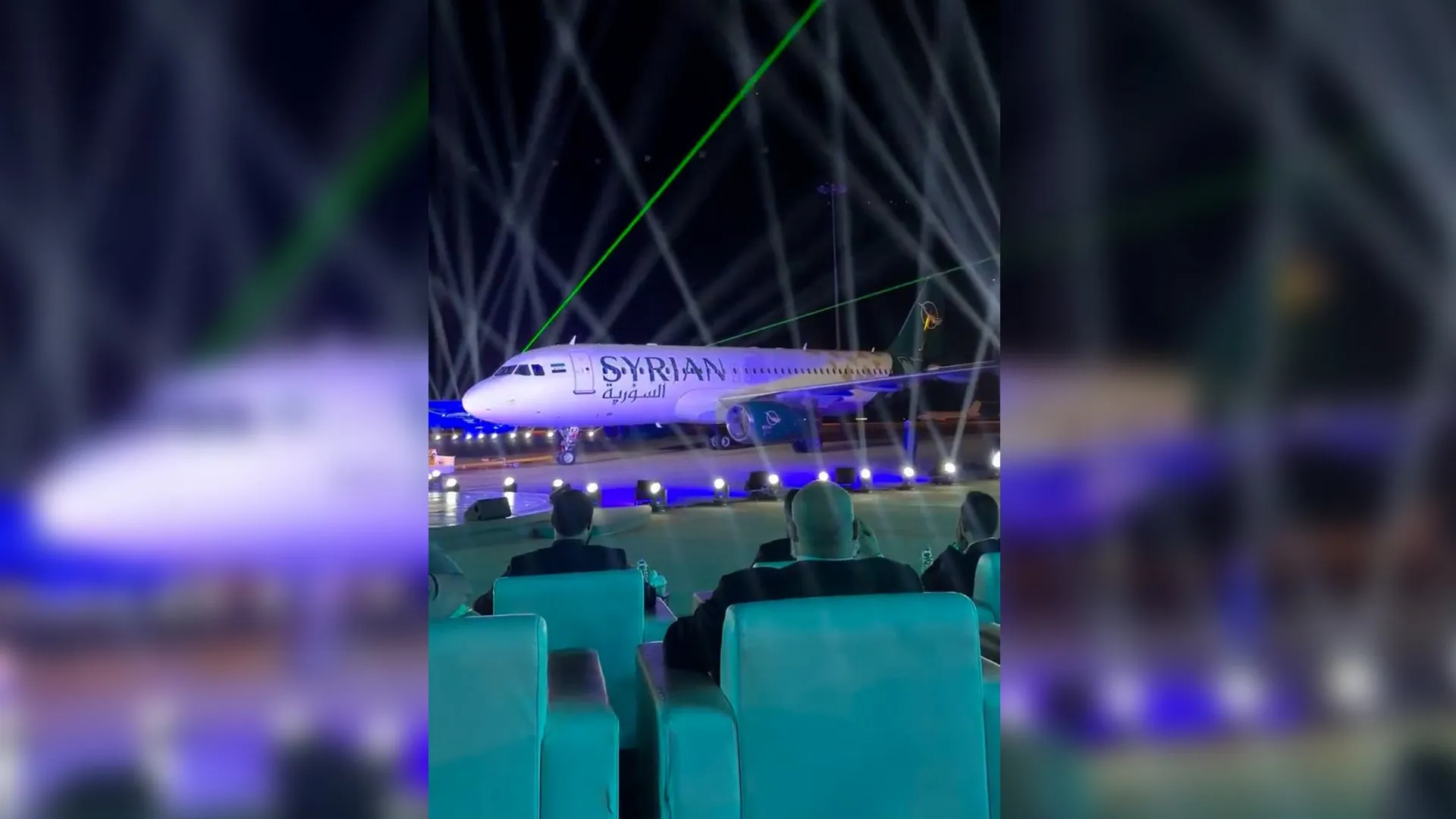
Syrian Airlines unveiled its new visual identity in a ceremony at Damascus Airport, featuring a revamped colour scheme, modernised booking and payment platforms, and a mobile app launching in November.
America.gov for now functions like a chatbot comparable to ChatGPT or Claude, pointing users to official gov’t websites.
Published On 29 Sep 202629 Sep 2026
The administration of United States President Donald Trump has launched a new website called America.gov aimed at simplifying access to government information.
The website functions much like a chatbot comparable to OpenAI’s ChatGPT and Anthropic’s Claude and points users to official government sources for questions such as passport renewals.
Recommended Stories
list of 3 itemsend of list
The president announced the new site on Tuesday alongside several Cabinet officials, including Secretary of State Marco Rubio and Transportation Secretary Sean Duffy.
In a speech, the president claimed that the website would not store user information and used the opportunity to tout simplified access to information about elections and applications for citizenship.
The site is powered by Google’s Gemini AI and xAI’s Grok, according to the chief design officer, Joe Gebbia.
The executive order announcing the new site calls it “a unified digital front door to the Federal Government for every individual in the United States seeking Federal information or services”.
It also says the site will provide “an entry through which an individual may sign in, communicate in plain language, receive accurate answers, and, where authorized and technically available, complete Government transactions without being required to navigate the websites of multiple agencies.”
White House officials told Al Jazeera that the website will abide by the security protocols of the government agency users inquire about, and it will be retained by those agencies and not America.gov, for example, Medicare.
Al Jazeera tested the answers the website provides to see how they align with the president’s views.
When asked “who is the fake news?”, it said, “I don’t label news outlets or comment on media.” When asked who won the 2020 presidential election, it said Joe Biden. When asked whether the department in which Pete Hegseth is secretary is the Department of Defense or Department of War, it said, “Department of Defense (DoD). That is still the name in statute until Congress changes it.”
When asked about obtaining specific records, such as individual tax information, citizenship records, political donations or Securities and Exchange Commission filings, it directed users to the government websites that provide that data for individuals.
However, in the presentation announcing the new site, Rubio showed that, in the future, the website may be able to help Americans apply for passports directly through the site and even take and upload their passport photos.
The website was created in coordination with the National Design Studio, which is part of the Executive Office of the President and was established by Trump in August 2025.
At a press conference on Wednesday Michael O’Leary, the CEO of budget airline Ryanair, unveiled new routes from UK airports including Birmingham, Edinburgh, Liverpool, and London
Ryanair has unveiled its newly expanded winter schedule, with 22 new routes from UK airports added.
The budget airline will be adding 22 destinations to its schedule this winter, with Birmingham, Edinburgh, Liverpool, and London airports benefiting the most.
This morning, Ryanair also announced that it was adding nineteenth-based aircraft at Manchester Airport this winter, helping it to run one extra route from the North West hub. Ryanair is increasing its flight frequencies on another 26 routes from Manchester, including holiday hotspots like Malaga, Palma de Mallorca and Madrid, as well as city break destinations like Barcelona, Belfast, Venice, Porto, Prague and Krakow.
There are many eye-catching flights among the list, including the new winter sunshine route from Birmingham to Marrakech, which regularly enjoys mild winter temperatures. The bulk of the other routes are to northern and western European destinations where more festive pleasures are on the itinerary.
The new routes are:
Birmingham – Copenhagen
Birmingham – Rome Fiumicino
Birmingham – Marrakech
Birmingham – Tirana
Birmingham – Warsaw Modlin
Bristol – Knock
Bristol – Warsaw Modlin
East Midlands – Budapest
Edinburgh – Milan Malpensa
Edinburgh – Tirana
Edinburgh – Warsaw Modlin
London Stansted – Glasgow
London Stansted – Malmö
London Stansted – Parma
London Luton – Venice
Liverpool – Milan Bergamo
Liverpool – Copenhagen
Liverpool – Gdańsk
Liverpool – Porto
Liverpool – Tirana
Liverpool – Warsaw
Manchester – Warsaw Modlin
The new route announcement came as the boss of Ryanair warned that air fares would “no doubt” rise next year for summer holidaymakers amid the surging price of oil and the Iran war. Earlier this month, oil prices rose above 100 dollars a barrel for the first time since July after the latest round of strikes in the conflict.
At a press conference yesterday Michael O’Leary, chief executive of the budget airline, said ticket prices were “only going one way”, which is “significantly upward”. He said: “Fares for Ryanair passengers and every other passenger into the summer of 2027 are going to rise materially, I believe, because of significantly higher oil prices.
“I have no doubt fares are rising next year. “The question is by how much. We’re essentially hedged this year at about 80 dollars a barrel. If we hedge next year at 100 dollars a barrel, our oil bill goes up by 25%. Our oil bill this year is six billion. If it goes up by 25%, that’s seven-and-a-half billion next year.”
The airline has previously warned that it believes some of its competitors will “struggle to maintain capacity or even survive” this winter if oil prices remain high. According to the International Air Transport Association (IATA), the average global price of jet fuel rose 7.4% last week compared to the week before to 194.90 dollars per barrel.
Washington — Two leading progressive lawmakers, Sen. Bernie Sanders and Rep. Greg Casar, are unveiling legislation Wednesday that would ban artificial superintelligence and create a federal agency to oversee advanced AI as some of the industry’s own leaders urge Congress to impose guardrails on the advancing technology.
The bill, provided first to the Associated Press, would also pause advanced AI development until guidelines are implemented while creating the Department of Artificial Intelligence. Multiple employees at leading AI companies are endorsing the bill.
“It doesn’t take a genius to say, ‘slow it down,’” Sanders, I-Vt., said in an interview with AP. “Do we really want to develop a super intelligence that when it becomes smarter than human beings could act independently of human control? I don’t think we do.”
Congress has so far done little to rein in the AI industry even as some of its most prominent leaders warn about potentially catastrophic risks. President Trump has resisted recent calls for greater government oversight, putting him at odds with tech leaders including Anthropic’s Dario Amodei, OpenAI’s Sam Altman and xAI’s Elon Musk.
The bill aims to dramatically slow down AI development
The legislation would permanently prohibit artificial superintelligence, which it defines as a system that exceeds human cognitive ability or has sufficient capabilities to plan and execute the destruction or disempowerment of humanity.
It would temporarily pause development of the most advanced AI systems until new federal safety rules are established by a new Department of Artificial Intelligence. Advanced AI systems would then need federal approval before they could be deployed. Violations could carry significant penalties, including up to 20 years in prison in some cases.
A number of current employees at AI companies and experts signed on in support of the bill, according to a statement shared with AP.
Juan Felipe Cerón Uribe, a researcher in OpenAI’s Safety Systems, said in a statement supporting the bill that “superintelligence could either go extremely right or extremely wrong” and that “we shouldn’t be playing such games.”
Swante Scholz, a software engineer at Google DeepMind who said he was not speaking on behalf of his employer, said on the current path of development, the “most likely outcome is an existential catastrophe for humanity.”
“A ban on superintelligence development would be a positive change for the foreseeable future,” Scholz said in a statement.
The bill faces long odds but draws a line in a growing fight
The bill from Sanders and Casar faces long odds in the Republican-controlled Congress, where lawmakers have struggled to coalesce around even less sweeping AI regulations.
But it offers a window into how the progressive wing of the Democratic Party is approaching AI regulation ahead of November’s midterms and a 2028 presidential campaign in which the technology is expected to be an increasingly prominent issue. Casar, a Democrat from Texas, is the chair of the Congressional Progressive Caucus.
Potential 2028 presidential candidates have rushed in recent weeks to release proposals showing they’re taking the issue seriously. Maryland Democratic Gov. Wes Moore announced a plan to regulate AI on Tuesday, while California Democratic Gov. Gavin Newsom signed an executive order to accelerate implementation of a California law that calls for independent oversight of AI companies last week.
Sanders, a two-time presidential candidate who is now 85, has especially focused on the issue in recent months. In June, he introduced legislation to create a sovereign wealth fund financed through a one-time tax on the stock of the largest AI companies. Last week, he hosted colleagues for a briefing with experts and also attended a conference focused on the issue alongside Republicans, including former White House adviser Steve Bannon.
The debate over AI regulations has scrambled political alliances both in Washington and for voters across the country.
The survey data say about half, 53%, of Americans are “extremely” or “very” concerned about artificial intelligence’s environmental impacts. That is up from 41% last year. Democrats are driving much of the increase in environmental concern, but the poll also reveals broader worries about the local impact of data centers, which power AI and cloud computing.
Trump has shown little interest in curbing AI risks
While some industry leaders have called for new safeguards, Trump has pushed in the opposite direction. On Tuesday, Trump told the United Nations General Assembly that artificial intelligence will be renamed “super intelligence.”
“I think Trump has very little understanding of what this issue is about,” Sanders said. “I think he’s mainly concerned about the economic implications of a slowdown.”
AI safety is expected to be a central part of talks between Trump and China’s Xi Jinping at the White House this week as the countries compete for dominance in the sector. The prospect of slowing development in the United States while China continues on has also been one of the central arguments against sweeping restrictions.
Sanders argued that avoiding the most dangerous forms of AI would ultimately require cooperation between the two countries, comparing the challenge to nuclear arms control during the Cold War.
“Ronald Reagan, arch-conservative, was smart enough to understand that he had to sit down with Gorbachev, a communist, and work out a nuclear treaty that protected humanity,” Sanders said. “I think we can do that again now.”
A HUGE estate with beautiful grounds, tea room and even a museum could be set to completely transform.
Waterperry Gardens in Oxford has submitted plans for a complete change-up including the building of a brand-new tea room additions to the courtyard.
Waterperry Gardens is an estate with a huge house, gardens, and tea roomCredit: AlamyNew designs have been submitted for a new tea room with enormous windowsCredit: Cowper Griffith Architects / South Oxfordshire District Council
Waterperry Gardens is a popular spot thanks to its beautiful ornamental gardens, award-winning tea rooms, garden shop, gift barn, gallery and museum.
It even has an outdoor amphitheatre for opera, theatre and music with performances through the summer months.
Sign up for the Travel newsletter
Thank you!
It’s visited year-round thanks to its various flower and plant displays with lots saying it’s still worth a trip out of season in autumn.
One visitor said: “We have visited Waterperry several times and in the early autumn the aster borders are at their best.”
Another added: “Lovely little place. Great gardens (even in late October there was still plenty of colour). Nice cafe. Good shop and gallery.”
A third wrote: “This is difficult to describe how wonderful these gardens are. Even at the beginning of September they were full of bloom.”
But the Waterperry Gardens could well transform as it submits plans to build a brand new home for its tea room – and reconfigure the site.
The plans say “there is an urgent need to replace the existing catering building with a new facility that serves both the current and future needs of the site“.
The building which houses the tearooms was a former laboratory which has “exceeded its lifespan.”
Visitors say that the gardens are worth visiting all year-roundCredit: Getty
Other plans include relocating the car park to the west of the picnic lawn and seating on a courtyard between the museum and the new building.
These proposals are currently in its consultation period – so there’s plenty of time to see Waterperry Gardens as it is now.
Anyone visiting will definitely want to pop into its award-winning tea room.
Last year it won Afternoon Tea of the Year 2025 by the Garden Centre Catering Awards.
The redevelopment reveals new building and courtyard seatingCredit: Cowper Griffith Architects / South Oxfordshire District CouncilThe new plans are in the consultation phaseCredit: Cowper Griffith Architects / South Oxfordshire District Council
At lunchtimes it serves up jacket potatoes , soups, salads and homemade cakes.
It also has two afternoon tea options; Waterperry Tea or Celebration Tea.
Each comes with a selection of cakes, homemade jam, scones and clotted cream, sandwiches and mini vegetarian quiche tart, along with loose leaf tea, coffee or Prosecco.
Visitors can also pop into its on-site museum which reveals what rural life was like 100 years ago, and kids can enjoy the play outdoor play area too.
BlackRock (BLK) has launched LifePath Solutions, a framework that brings large retirement plan capabilities to a broader set of plan sponsors.
The customizable target date design framework combines sophisticated plan and participant analysis with the option to leverage BlackRock’s whole-portfolio
CAMB.AI is introducing its new Streaming SDK and Streaming Dashboard at IBC2026, with integrations into NVIDIA Holoscan for Media open reference architecture
The release gives developers and broadcast teams new ways to integrate, manage and deploy real-time multilingual broadcasting within their existing workflows.
Multilingual broadcasting, now live as an SDK
Available for C++, Python, Java and Rust, the SDKs allow developers to start broadcasting in multiple languages with as little as three lines of code, making it easier to integrate multilingual capabilities directly into existing applications and workflows.
CAMB.AI’s live streaming platform supports 150+ languages, producing dubbed audio and subtitles for live content. It supports source-speaker voice cloning, studio voices and custom terminology, allowing names, venues, sponsors and other specific terminology to remain consistent across languages.
The release features the latest quality enhancements backed by CAMB’s foundational models MARS and BOLI.
Bringing live dubbing to NVIDIA Holoscan for Media open reference architecture
CAMB.AI’s new capabilities will be available within the NVIDIA Holoscan for Media reference architecture as a hybrid SaaS.
Holoscan for Media is NVIDIA’s open reference architecture and developer toolkit for building AI-powered live media solutions on NVIDIA infrastructure.
Program audio can be processed by CAMB.AI’s models to produce dubbed commentary in each target language, with outputs returned to the production network or delivered directly to destinations including CDN, OTT and YouTube Live.
For broadcasters, this allows live localization to operate alongside other production applications. It reduces the need to send feeds to a separate cloud localization environment and back, reducing infrastructure hops while allowing media to remain within the broadcaster’s facility or own cloud environment when required.
New Streaming Dashboard
The new Streaming Dashboard provides a visual environment for building, launching and monitoring multilingual streams.
Operators can configure sources, select audio, set processing profiles, create language pipelines and manage output destinations from a single interface. During a live broadcast, teams can monitor stream health, outputs, runtime and live transcripts, as well as pause and resume dubbing without stopping the stream.
CAMB.AI’s live localization technology has already been used across Ligue 1+, NASCAR and Eurovision Sport, including live AI-dubbed commentary and multilingual subtitling.
See It at IBC2026
CAMB.AI will preview its new dashboard and SDKs atIBC2026. Visitors will be able to see live multilingual dubbing in action at the CAMB.AI booth.
CAMB.AI builds localization AI for content, entertainment and sport.
Its MARS family of speech models and livestreaming platform deliver dubbing, translation and subtitles in more than 150 languages, live and on demand.
Founded in 2022, CAMB.AI has offices in Dubai and San Francisco.
Hermeus is developing an expendable ramjet-powered aircraft, Ramjet-X, which will be air-launched from its reusable, F-16-sized Quarterhorse high-speed drone. The result aims to create a two-vehicle architecture intended to make high-speed flight testing less dependent on expensive, single-use test platforms. That would give Hermeus and potential customers a way to conduct repeated high-Mach flight tests without expending a large booster on every mission.
America didn’t lose ground in high-speed flight because of a lack of ideas. We slowed down because flight tests became too expensive, too rare, and too cautious.
Meet Ramjet-X. Air-launched from the Quarterhorse program, it’s a low-cost, repeatable test vehicle built to fly and… pic.twitter.com/rMed6NhcvD
The company unveiled the concept today. Hermeus says the Ramjet-X will be carried beneath Quarterhorse and released at a speed of around Mach 3, at which its ramjet can begin operating. The smaller vehicle will then accelerate, climbing to around 100,000 feet, and a speed in the region of Mach 4. Quarterhorse will then return to base and be available for another mission.
Imagery released by Hermeus shows a Quarterhorse carrying a Ramjet-X mounted on a pylon under each wing, indicating that two different high-speed tests can be carried out in a single sortie. Intriguingly, the Quarterhorse is shown with no fewer than six underwing hardpoints in all, suggesting that other kinds of external payloads are envisaged.
Hermeus has not released detailed performance specifications for Ramjet-X, including its range, payload capacity, or the critical expected cost per flight. We have reached out to the company for more information.
Images released by the company show a relatively compact, missile-like vehicle with delta wings incorporating prominent dihedral. There are no horizontal tail surfaces, but a conventional vertical fin is complemented by a ventral fin. Axiosreports that Ramjet-X is approximately 22 feet long and 7 feet wide.
In terms of appearance, and also thanks to its ramjet propulsion system, the vehicle is outwardly veryreminiscent of the Lockheed’s D-21 Tagboard supersonic spy drone. However, at more than 40 feet long and with a wingspan of 20 feet, the D-21 was significantly bigger. Overall, the entire concept recalls the Cold War-era D-21 and its M-21 mothership, on a smaller scale.
A D-21 drone. U.S. Air ForceM-21 and D-21 paired together. CIA
The basic concept aims to address a longstanding problem with ramjet flight testing. Unlike a conventional jet engine, a ramjet cannot provide useful thrust from a standstill. The vehicle therefore has to be accelerated to a sufficiently high speed before the ramjet can take over.
That acceleration can traditionally require another propulsion system, including an expendable rocket booster. Hermeus is proposing to substitute a reusable aircraft for that initial boost. It is unclear if the Ramjet-X vehicles are similarly recoverable, but we have asked Hermeus for more details here, too.
As it stands, flight-test programs of this kind are often constrained not only by the cost and availability of test infrastructure, but also by the limited availability of suitable airspace and range access. A reusable carrier aircraft could help address both challenges, allowing multiple Ramjet-X vehicles to be deployed from airports near a designated test range as required and launched only once the vehicle is within the approved test area. That flexibility could reduce the need for a new large booster for every experiment while also making it easier to conduct tests, including at shorter notice, within increasingly constrained airspace.
Hermeus says Ramjet-X is being designed not just for its own development work but as a potential test platform for outside customers. The company is calling the concept “Flight Test as a Service,” with customers able to fly payloads including sensors, communications equipment, computing and autonomy systems, materials, and propulsion hardware.
The program reflects a broader push toward increasing the availability of commercial high-speed flight testing that has attracted U.S. government interest.
Hermeus was also selected by the Defense Innovation Unit for work under its Hypersonic and High-Cadence Airborne Testing, or HyCAT, effort. That program is intended to use commercial flight-test capabilities to expand the government’s access to relevant high-speed environments.
The company is also pursuing its own increasingly ambitious Quarterhorse aircraft. Its Quarterhorse Mk 2.1 completed an uncrewed supersonic flight earlier this year, reaching Mach 1.21 on its third test flight. The company’s roadmap calls for subsequent Quarterhorse variants to progressively increase speed and address the thermal and propulsion challenges associated with high-Mach flight.
Quarterhorse Mk 2.1. Hermeus
Supersonic. Mach 1.21.
Quarterhorse Mk 2.1 is now the world’s first privately developed, unmanned supersonic jet and the fastest unmanned aircraft flying today.
This flight makes Hermeus the fastest company in aviation history to go from founding to supersonic flight – exactly… pic.twitter.com/wjoIcdiEOj
The imagery released for Ramjet-X shows a different Quarterhorse configuration than the 2.1 version, including beefed-up landing gear with twin nosewheels. The requirement for release of the Ramjet-X at Mach 3 suggests that its launch platform will be the Quarterhorse Mk 2.3, which will be the first to reach this kind of speed. This summer, Hermeus confirmed that its second supersonic aircraft, the Quarterhorse Mk 2.2, and the Mach 3-capable Mk 2.3 aircraft were under construction.
For its future Quarterhorse Mk 3, Hermeus has been developing Chimera, a turbine-based combined-cycle propulsion system. This is intended to transition from turbine operation to ramjet operation as speed increases.
Ramjet-X effectively separates part of that problem into another aircraft and the system could also be useful for experiments that do not require an entire hypersonic aircraft.
For example, an organization developing a high-temperature material might need to know how it behaves in an actual high-speed flight environment, rather than only in a ground test. The same could apply to weapons, sensors, communications systems, guidance hardware, onboard computers, or other components intended for high-speed vehicles.
So far, however, it’s not clear what kind of flight profiles Ramjet-X will provide. Hermeus has mentioned a cruise phase lasting “tens of minutes.”
The ramjet intake on the Ramjet-X. Hermeus
But a short-duration dash through a high-Mach regime is not equivalent to sustained flight at those speeds. The duration available to an experiment, thermal loads, acceleration, vibration, available electrical power, telemetry, maneuverability, and payload mass will all determine what can actually be tested.
The company says it is already testing the Ramjet-X propulsion system at its High Enthalpy Air-Breathing Test facility in Jacksonville, Florida. High-temperature structures are also under development at its El Segundo, California, headquarters. Integrated vehicle testing is currently planned for 2027.
The HEAT facility itself is part of Hermeus’ effort to establish high-speed propulsion test infrastructure. The company says the facility is being developed to eventually provide continuous high-Mach airflow for more flight-like ground testing.
Ramjet-X has yet to fly, but if it performs as intended, it could help lower one of the major barriers to obtaining real-world flight data at high Mach numbers. At the same time, the company is entering a market that is attracting growing interest from other aerospace firms, which are also expanding their high-speed flight-test capabilities, especially to capitalize on the broader hypersonics boom, including Stratolaunch.
There is fairly clear potential weaponization of this concept, for strike and surveillance missions, as well, although there has been no indication of that being in the works at this time.
The planned 2027 integrated testing should provide the first meaningful indication of whether the concept can progress to become a practical high-speed test capability.