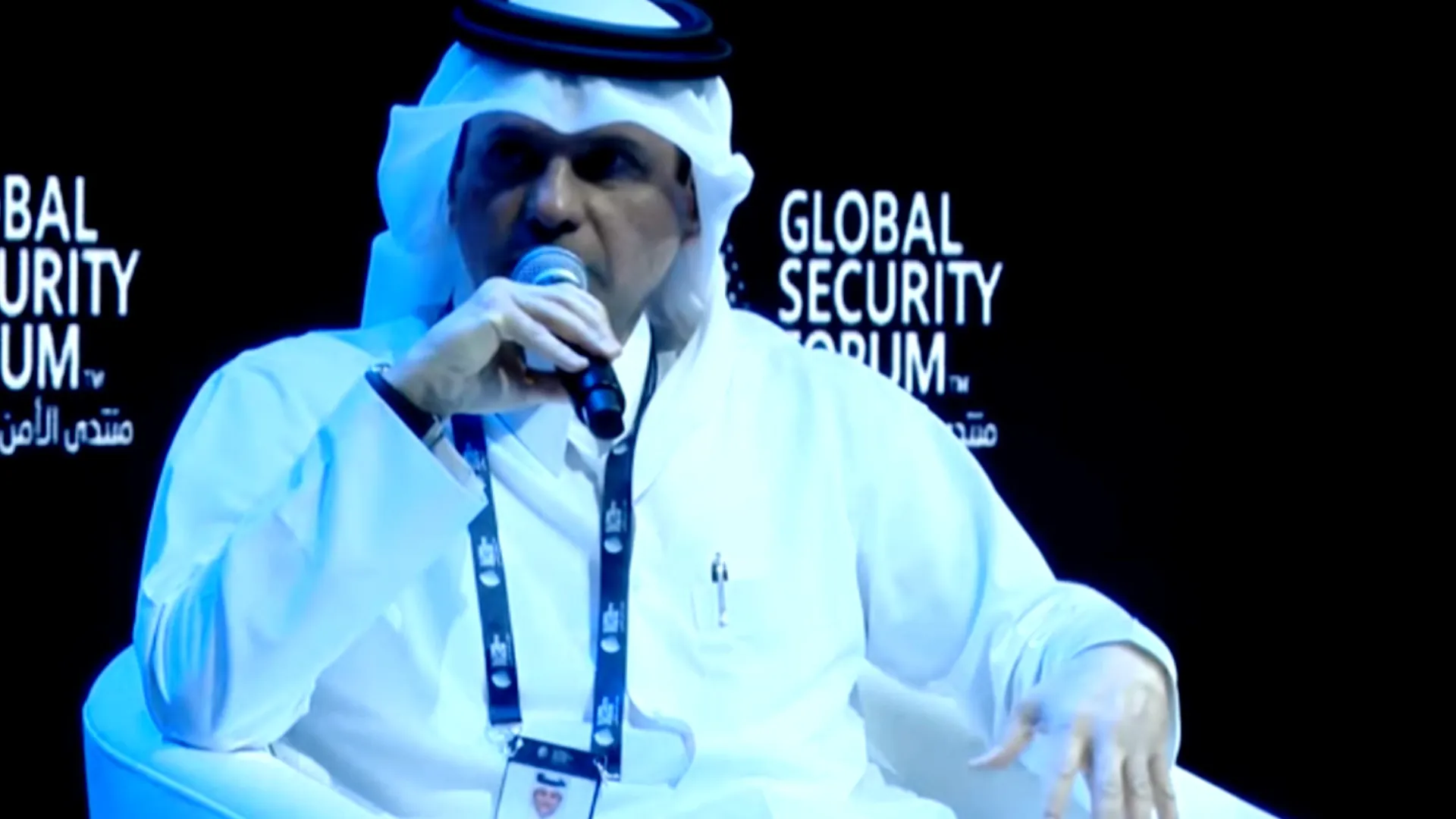
Qatar is preparing to announce a new regional defence partnership aimed at strengthening its military capabilities, Qatar’s Deputy Prime Minister and Minister of State for Defence Affairs, Sheikh Saoud bin Abdulrahman al-Thani, told the Global Security Forum in Doha.
SACRAMENTO — The Lakers pressed, switched and swarmed from the opening whistle. After the Sacramento Kings were caught for a shot-clock violation on the first possession of Monday’s preseason game, Luka Doncic raised his fists toward the Lakers bench with a triumphant grin to symbolize the successful start.
But Doncic’s smile toward his teammates had a hint of sarcasm; this is still just an exhibition.
The Lakers teased their new defensive identity in a 127-103 preseason win against the Sacramento Kings on Monday at Golden 1 Center, rolling out their deep group of wings to overcome a short-handed bench.
Playing without star center Walker Kessler, who missed the game with a finger injury, and guard Austin Reaves (ankle), Doncic led the Lakers with 21 points. He took a hard knee to the side of his quad midway through the second quarter, but stayed in the game. With the Lakers up 26 points at halftime, Doncic didn’t need to return.
The star guard actually was bringing down the team’s shooting average. While he was three-for-nine from three-point range in the first half, his teammates combined to make nine of their first 13 three-pointers. Ziaire Williams led with perfect three-for-three shooting from distance with 13 points and one steal while serving as the Lakers’ top on-ball defender. Matisse Thybulle, another key defensive offseason addition, had two steals and made two threes.
The lengthy wings could unlock a new style of defense for the Lakers, who remade their team to support Doncic with three-and-D wings and a rim-running center.
“I think for the first time since I’ve been here, we have multiple guys that go pick up the ball full court and be disruptive at the point of attack,” coach JJ Redick said before the game. “We’re going to ask those guys to do that.”
The Lakers deployed what they call “a line of confrontation.” Williams, Thybulle, second-year forward Adou Thiero and guard Quentin Grimes were among the players who guarded the ball full court. The Lakers forced four steals in the first quarter and 15 for the game. They averaged 8.5 per game last season.
The product Monday is far from what the Lakers hope to show in their regular-season opener Oct. 21 against the Golden State Warriors.
Kessler was wearing a splint on his left pinky finger after he jammed it on the backboard during practice last week. Redick doesn’t expect any of the injuries that kept Reaves, guard Collin Sexton (lower body) and two-way forward Arthur Kaluma (lower body) to be long-term.
Reaves, who tweaked his ankle in practice, still went through his pregame warmup routine Monday.
Even without two of their three top players, the Lakers overwhelmed the Kings, who are expected to be among the worst teams in the Western Conference again. Rookie point guard Darius Acuff, the No. 7 pick in last April’s draft, had 19 points with four assists and five turnovers.
Academy Award-winning filmmaker Alejandro González Iñárritu and Pop artist Ed Ruscha have a long history of admiring each other’s work. Twenty-four years ago, a nervous Iñárritu visited Ruscha’s Venice studio to offer him the role of the gynecologist in “21 Grams.” They needed a doctor with noble features and blue, believable eyes. That plan didn’t pan out, schedule-wise, but the filmmaker and the artist finally found a way to collaborate.
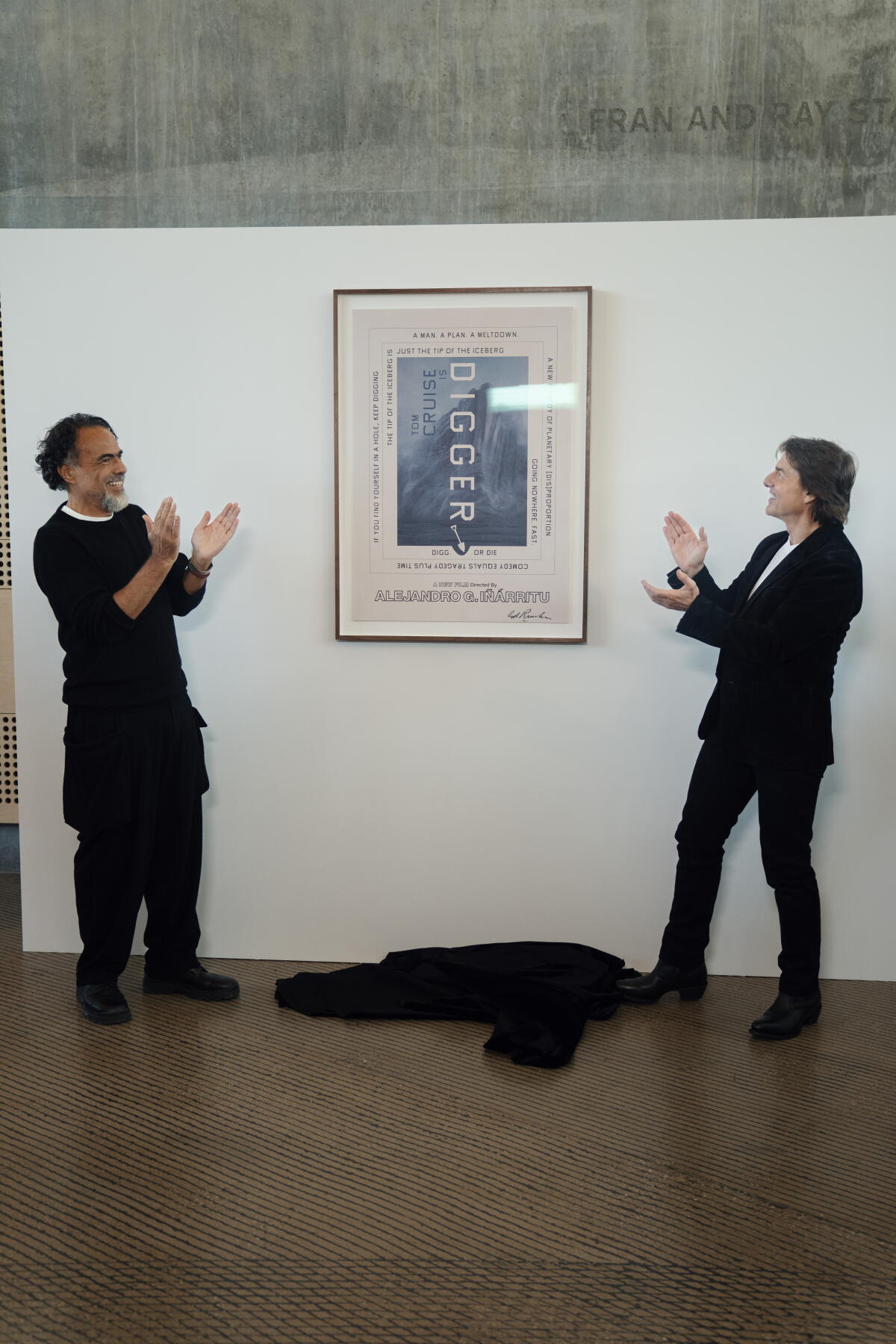
The result — a Ruscha-designed poster for Iñárritu’s new film “Digger,” starring Tom Cruise — was unveiled Sunday at an intimate brunch at the Los Angeles County Museum of Art, attended by Iñárritu, Ruscha and Cruise, as well as “Digger” actors John Goodman, Jesse Plemons, Michael Stuhlbarg and Ross Hatt.
Iñárritu and Cruise laughed as they made a clumsy attempt at a countdown before whipping aside a black velvet curtain to reveal the poster for the first time: a very Ruscha, text-heavy work on a slate gray background with a beige border. A looming ice shelf in the background is surrounded by phrases including, “A Man. A Plan. A Meltdown,” and “Comedy equals tragedy plus time.”
Filmmaker Alejandro Iñárritu and “Digger” star Tom Cruise unveil Ed Ruscha’s new poster for the film. (They just pulled off the black velvet curtain on the floor below.)
(Kevin Garrison)
“Well, the movie blew my hair back,” Ruscha said at the unveiling brunch inside LACMA’s new (still unopened) restaurant, with LACMA Director and Chief Executive Michael Govan by his side. “And not only that, it parted it down the middle. It has since grown back.”
The crowd laughed knowingly. “Digger,” which opens Friday, is a satirical black comedy that follows oil tycoon Digger Rockwell as one of his drilling rigs in Greenland explodes, dislodging an ice shelf that floats away to cause a global disaster. As a dark parable for the dangers of climate change, the film has already proved polarizing, with early reviews coming in mixed.
Ruscha noted that he first saw “Digger” at a screening about six months ago, alongside Govan. “I knew I had seen an epic production, an epic product from an epic producer,” Ruscha said. “So I jumped at the idea of doing the poster. And I thought about it, and I think about this movie, and it reminded me of a kaleidoscope. It’s got so many running-around ideas. It was kaleidoscopic in its message, and its content and its humor.”
Ruscha turned his attention to Iñárritu, “It’s got something to offer to the world, and I thank you for that.”
The filmmaker loved the poster, and the fact that the ice shelf sat front and center.
From left to right — “Digger” actors John Goodman and Jesse Plemons, filmmaker Alejandro G. Iñárritu, artist Ed Ruscha, actor Tom Cruise, LACMA director Michael Govan and actors Ross Hatt and Michael Stuhlbarg — pose with Ruscha’s new poster for the film.
(David Jon)
“The billing is nature: We are human beings, we are in a war against nature,” Iñárritu said — describing what he feels the poster relays — in a phone interview from Mexico City a day before the event. “We think that we are different from nature. So nature, in a way, becomes our enemy. We are fighting a fight against nature, and the enemy is an ice shelf going to Europe. And he just put [that] in the center of it, [like] a disaster movie, which is very clever, as he always is.”
“Those decisions that he made with a very prominent element in a simple way, with one or two words, it just says so much with so little,” Iñárritu continued. “And then he [put] some lines around [it], very Ruscha, that in a way convey the spine or the character itself.”
The director had the same feelings two years ago, at LACMA’s Ruscha retrospective. He said so much with so little, Iñárritu thought, and that “less is more” thinking could hold so much power in a film poster.
Iñárritu, too, has been exhibited at LACMA: earlier this year, with the film installation “Sueño Perro,” a resurrection of lost footage from “Amores Perros;” and in 2017-2018, with the virtual reality installation “CARNE y ARENA,” which explored the human condition of immigrants and refugees.
The director’s collaboration with Ruscha is proof of concept for LACMA’s annual Art + Film gala, entering its 15th year, which seeks to highlight and strengthen the connections between film and visual art by bringing the two communities together at a splashy party — often creating lasting connections between the two groups.
Both Ruscha and Iñárritu have been honored at the gala, the former in 2012 (with Stanley Kubrick) and the latter in 2015 (with James Turrell). “This is a beautiful encounter of art and film,” Govan said at the unveiling.
“Digger” has evolved over nine years, Iñárritu said. It’s been a long journey of taking note of current events, including where the world is going, as well as people’s obsessions and fears.
“The film is a love letter for the young generation,” Iñárritu said. “I think it’s kind of a warning, or a wake-up call. But you can have fun about it, because it’s the only way to — humor allows us to have space and recognize ourselves in that absurdity. So I feel that it’s a human, urgent, now film.”