united states

Fifth woman accuses former US lawmaker Eric Swalwell of sexual misconduct | Sexual Assault News

The Democratic representative from California has resigned his seat in Congress over multiple sexual misconduct allegations.

Democratic Representative Eric Swalwell has resigned from the United States Congress, amid mounting allegations of sexual misconduct.

On Tuesday, a fifth woman came forward to accuse Swalwell of unwanted sexual contact, saying the Democratic lawmaker drugged and raped her during an encounter in 2018.

Recommended Stories

list of 3 itemsend of list

“My delay in taking action against Eric was driven by fear, not doubt – fear of his political power,” Lonna Drewes said during a news conference in Los Angeles.

Drewes’s lawyer, Lisa Bloom, said her firm would be filing a police report with the Los Angeles County Sheriff’s office.

Swalwell has denied allegations of wrongdoing. But on Monday, he announced he would resign from Congress, one day after suspending his gubernatorial campaign.

Polls had shown the 45-year-old leading the race to replace Gavin Newsom as governor of California.

But his campaign imploded last week after reports from the San Francisco Chronicle and CNN detailed allegations of sexual misconduct from several women.

One woman, identified as a former staffer, told CNN that Swalwell raped her in a New York City hotel in 2024, an encounter that left her bleeding and bruised.

Three other women told US news outlets that they had received inappropriate messages from Swalwell on the app Snapchat, which automatically deletes interactions.

Lonna Drewes, followed by her lawyer Lisa Bloom, arrives to a press conference where she described her claims about sexual misconduct by former US Representative Eric Swalwell, Democrat of California, in Beverly Hills, California, on April 14, 2026.
Lonna Drewes, followed by her lawyer Lisa Bloom, arrives at a news conference in Beverly Hills, California, on April 14 [Patrick T Fallon/AFP]

The accusations quickly prompted backlash to Swalwell’s gubernatorial campaign. Supporters withdrew their endorsements, and a handful of bipartisan lawmakers said they would push for a vote to expel Swalwell from Congress.

The Manhattan District Attorney’s Office also announced on Saturday that it is investigating the sexual assault allegations.

In a statement on Monday, Swalwell apologised to his family, staff and constituents for what he called “mistakes in judgment”.

Although he confirmed he would resign his seat in Congress, he nevertheless criticised his colleagues for seeking his expulsion.

“I will fight the serious, false allegations made against me,” Swalwell wrote.

“I am aware of the efforts to bring an immediate expulsion vote against me and other members. Expelling anyone in Congress without due process, within days of an allegation being made, is wrong.”

Republican Representative Anna Paulina Luna had said she would withdraw her motion to expel Swalwell once he stepped down, and she confirmed on Tuesday that he had submitted a resignation letter, “effective immediately”.

Republican Representative Tony Gonzales also announced on Monday that he would retire from Congress amid calls for his expulsion over allegations of sexual misconduct.

Source link

No ships ‘make it past US blockade’ in Hormuz strait in first day: Pentagon | US-Israel war on Iran News

CENTCOM contradicts reports on ships breaking blockade as Trump says US-Iran talks could resume in the next two days.

The Pentagon says no ships “made it past” the United States military blockade in the Strait of Hormuz in its first 24 hours and six merchant ships followed orders to turn around.

The statement on Tuesday from the US military’s Central Command (CENTCOM) was the first update since US President Donald Trump announced the blockade of the waterway after US-Iran talks over the weekend in Pakistan failed to yield an agreement on ending the war the US and Israel launched on February 28.

Recommended Stories

list of 3 itemsend of list

CENTCOM said the blockade applies only to vessels “entering and exiting Iranian ports” and other vessels remain free to transit the waterway.

It added: “US forces are supporting freedom of navigation for vessels transiting the Strait of Hormuz to and from non-Iranian ports.”

The Reuters news agency reported at least three vessels transited the strait during the first 24 hours of the blockade, citing shipping data. They included two tankers sanctioned by the US. The three ships were not heading to Iranian ports, according to Reuters.

However, the AFP news agency and several US media outlets, citing data from the maritime tracker Kpler, reported two ships had transited the waterway after leaving Iranian ports on Monday.

CENTCOM said 10,000 US sailors, Marines and airmen were involved in the operation, along with more than a dozen US warships and dozens of aircraft.

Military observers have widely said US forces have the capability to maintain the blockade for the foreseeable future but the continued pressure increases the likelihood of Iranian attacks. That in turn could see a two-week ceasefire that began on Wednesday collapse.

Meanwhile, any efforts to intercept vessels from strategic foes, including China, could create new escalations. The strategy is also likely to continue to roil global oil markets.

Iran has decried the US approach as “piracy” while Trump on Monday promised to “eliminate” any Iranian ships that seek to break the blockade.

Trump says more talks are possible

The update on Tuesday came as both sides signalled they would be open to further talks after failing to reach a breakthrough during 21 hours of negotiations between a US delegation led by Vice President JD Vance and an Iranian delegation led by parliamentary Speaker Mohammad Bagher Ghalibaf.

The talks were the highest-level face-to-face contact between the two countries since the 1979 Islamic revolution.

Key unresolved sticking points include control of the Strait of Hormuz, the future of Iran’s nuclear programme and whether the ceasefire extended to Israel’s ongoing invasion and bombardment of Lebanon.

In an interview with the New York Post newspaper on Tuesday, Trump said “something could be happening over the next two days” in Islamabad as he hailed Pakistani Field Marshal Asim Munir, who has been among the officials shepherding the negotiations.

Reporting from Tehran, Al Jazeera’s Ali Hashem said sources stated there are already messages being exchanged regarding what both sides consider to be “bridgeable issues”.

“Iran is open to talks, and it showed that from last week when it went to Islamabad. The main hurdle always is the mistrust, distrust between both sides,” Hashem said.

“For the Iranians, they’ve been repeating that they’re open. If the Americans want to fight, they’re going to fight. And if they want to talk, they can talk.”

Source link

Who controls the Strait of Hormuz? | US-Israel war on Iran

A US move to block the strait has intensified a broader struggle over who controls access and under what terms.

Now, the United States is the one shutting the Strait of Hormuz, even as President Donald Trump was calling for it to reopen just a few days ago. He said ships entering or leaving Iranian ports would be stopped by the navy after talks between Tehran and Washington fell apart.

However, this is not just about a blockade. Iran is tightening its grip on the strait, demanding the right to impose tolls on ships passing through it.

The ripple effects could go beyond energy and trade flows, challenging the dominance of the US dollar in global shipping.

Source link

Iran war: What is happening on day 46 of the US-Iran conflict? | US-Israel war on Iran News

The US started a blockade on Iranian ports, but Trump said there is still a chance for Tehran to reach a deal.

President Donald Trump said there is still room for Iran to strike a deal, despite the US blockade of Iranian ports, as Israel intensified its invasion of southern Lebanon.

Iran has accused Washington of “piracy” as thousands rally in Tehran against the move, which targets shipping through the Strait of Hormuz.

Recommended Stories

list of 1 itemend of list

The Associated Press news agency reported on Tuesday that diplomatic efforts to revive US-Iran talks are continuing, with Pakistan offering to host a second round of negotiations in Islamabad this week.

Here is what we know:

In Iran

  • US blockade and protests: The US measures are now being enforced, prompting Iranian accusations of “piracy” and demonstrations in Tehran against the restrictions on maritime traffic.
  • Tehran calls blockade ‘illegal’: Iran’s armed forces condemned the move as unlawful, warning that targeting its ports could put shipping across the Gulf at risk.
  • IRGC warns of escalation: A Revolutionary Guard spokesperson said Iran still has “unused capabilities” and could deploy new tactics if the conflict deepens.
  • Tehran backs pope: Iran’s Parliament Speaker Mohammad Bagher Ghalibaf praised Pope Leo XIV for condemning the war, calling his stance “fearless”.
  • Russia withdraws nuclear staff: Russia has pulled most of its personnel from Iran’s only nuclear power plant, built with Moscow’s support, according to the head of the country’s atomic energy agency.

War diplomacy

  • Qatar urges mediation: Qatar’s Foreign Minister Sheikh Mohammed bin Abdulrahman bin Jassim Al Thani urged Iran and the US to engage constructively in mediation efforts.
  • Pakistan says truce ‘holding’: Prime Minister Shehbaz Sharif said the ceasefire between the US and Iran was “holding”, with efforts ongoing to reach a deal after weekend talks failed.
  • Shipping disruption grows: A UN spokesperson said there is “no military solution”, warning that instability in the Strait of Hormuz is worsening global economic fragility. About 20,000 vessels are reported stranded, with supply chains, including fertiliser, under strain.
  • Push to include Lebanon: The United Kingdom urged Lebanon’s inclusion in a broader US-Iran ceasefire framework, which currently excludes fighting involving Hezbollah.
  • Talks planned with Lebanon despite fighting: Israeli and Lebanese ambassadors will hold talks on Tuesday in Washington, DC, aimed at halting the war.
  • Hezbollah rejects negotiations: Hezbollah leader Naim Qassem on Monday urged Lebanon to cancel the planned meeting in Washington, reiterating his group’s opposition to any direct engagement with Israel.
  • Russia to accept Iran’s uranium: The Kremlin has repeated an offer to accept Iran’s enriched uranium as part of a potential agreement with the US. In comments carried by Russia’s state-owned RIA Novosti news agency, Kremlin spokesman Dmitry Peskov said the proposal “was voiced by President [Vladimir] Putin in contacts with both the United States and regional states”.

INTERACTIVE_LIVETRACKER_IRAN_US_ISRAEL_MIDDLEEAST_ATTACKS_April 13_2026_GMT1645-1776099548

In the US

  • Iran ‘wants a deal’: Trump said Iranian representatives had reached out to pursue a peace agreement after talks in Pakistan ended without a breakthrough. “They’d like to make a deal. Very badly,” he told reporters, without specifying who made contact.
  • No apology over pope remarks: Trump said he had “nothing to apologise for” after criticising Pope Leo XIV for calling for an end to the conflict. He described the pope as “weak” on key issues, including Iran.
  • Warning over Iranian vessels: Trump said US forces would destroy any Iranian “fast attack ships” approaching the naval blockade now in effect.
  • Domestic politics and war powers: Senate Democrats, led by Chuck Schumer, are pushing for another vote to curb Trump’s authority to wage war on Iran. Schumer criticised the campaign as an “epic fail”, citing rising US fuel prices, while previous efforts have been blocked by Republicans.
  • Arrests of protesters: Police in New York City have arrested about 90 protesters in Manhattan as they stopped traffic to protest against the war on Iran and the US’s arms sales to Israel. Jewish Voice for Peace, the group leading the protest, said those taken into custody included whistleblower Chelsea Manning, actor Hari Nef and New York City Council Member Alexa Aviles.
  • Trump rails at pope: Trump has doubled down on his criticism of Pope Leo XIV, saying the pontiff’s opposition to the war in Iran was “wrong” and accusing him of being “weak on crime”.

In Israel

  • Israel pushes ‘buffer zone’: Israel’s military is continuing ground operations and air raids across southern Lebanon, bulldozing buildings in border towns such as Naqoura as part of efforts to create a “buffer zone”.
  • Hezbollah steps up attacks: Fighters have launched rockets and drones at Israeli troops and vehicles in areas including Bint Jbeil and Biyyada.
  • Accusations against Israel: Hezbollah chief Qassem accused Israeli Prime Minister Benjamin Netanyahu of pursuing a “Greater Israel” agenda with US backing.
  • Tensions with Italy: Israel summoned Italy’s ambassador after Foreign Minister Antonio Tajani condemned attacks on Beirut as “unacceptable”, following reports of more than 300 deaths.
  • The Israeli military said one soldier has been killed and three others have been wounded during battle in southern Lebanon.

In Lebanon

  • Israel continues to attack Lebanon: Israel has intensified its invasion of southern Lebanon, as the death toll from Israeli attacks since March 2 rises to at least 2,089.
  • An Israeli drone attack has hit a car travelling near southern Lebanon’s Nabatieh, killing at least two people, the National News Agency reported on Tuesday. Our colleagues at Al Jazeera Arabic say Israeli forces have launched two raids on the towns of Machgharah and Sohmor in the eastern Bekaa Valley.
  • Public opinion divided: Lebanese citizens appear split about negotiations, with some expressing fatigue from the war and hoping for a diplomatic breakthrough, while others remain sceptical of Israel’s intentions and doubt any deal will hold.
  • Canadian Foreign Minister Anita Anand confirmed in a statement posted on X that a Canadian national has died in southern Lebanon. The minister did not provide details on the events that led to the Canadian’s death.

Strait of Hormuz and energy crisis

  • The Reuters news agency is reporting that a Chinese tanker sanctioned ⁠by Washington has passed through the Strait of Hormuz despite a ⁠US blockade on the waterway. The tanker and its ‌owner, Shanghai Xuanrun Shipping Co Ltd, were previously sanctioned by the US for dealing with Iran.
  • US Energy Secretary Chris Wright said oil prices could keep rising until “we get meaningful ship traffic through the Strait of Hormuz”.

Source link

Trump slams Pope Leo as ‘weak,’ but the U.S.-born pontiff stands firm on peace

President Trump was propelled into office in large part by support from evangelicals and Catholics, at times framing his political rise in divine terms.

But that relationship is now fraying, and, in some corners of the Catholic Church, breaking, after Trump spent the weekend maligning Pope Leo XIV — “Leo is WEAK on Crime” — and circulating a widely condemned social media post depicting himself as Jesus Christ.

Leo, meanwhile, on Monday repeated his calls for an end of hostilities between the U.S. and Iran. “I have no fear of neither the Trump administration nor of speaking out loudly about the message of the Gospel,” Leo told reporters. “Blessed are the peacemakers.”

Trump had lashed out at the pontiff in a Truth Social post on Sunday night and repeated those criticisms Monday. “I’m not a big fan of Pope Leo,” he said. “He’s a very liberal person, and he’s a man that doesn’t believe in stopping crime. He’s a man that doesn’t think we should be toying with a country that wants a nuclear weapon so they can blow up the world.”

The tirade drew swift backlash from Catholic leaders and rank-and-file believers alike, who have increasingly withdrawn support from the president since he and Israel launched attacks on Iran, according to recent polls.

Also fueling backlash was the artificial-intelligence-generated image of Trump, in a white robe and a red stole, placing his hand on the forehead of a man in a hospital bed. Trump confirmed he had posted the image but insisted he thought it portrayed him as a doctor, not Jesus healing the sick.

That’s not how many people viewed it.

“In the Christian faith, this is considered blasphemy: depicting yourself as Christ, elevating yourself to the level of Christ,” conservative commentator Alyssa Farah Griffin said on “The View.” “Our faith is bigger than our politics. That is one thing that will always trump politics for people who are practicing in their faith. He clearly doesn’t understand that.”

The Rev. Thomas Reese, who also works as an analyst at Religious News Service, called Trump’s AI-generated image “an absolute disaster and blasphemous,” adding that it appeared to unsettle even some of the president’s religious supporters. The post was later removed from Truth Social.

More broadly, Reese said the war itself, and the way it has been framed, is colliding with core church teaching.

“To invoke God for a war of choice is just wrong,” he said, noting that Catholic leaders have increasingly emphasized diplomacy and reconciliation over military action.

“The Catholics who voted for him feel betrayed,” Reese said. “I think they’re beginning to say, ‘This is not what we voted for,’ especially when you tie the war to higher gasoline prices, higher food prices.”

In his Truth Social post, Trump also took some credit for Leo’s election as pontiff last year after the death of Pope Francis, writing that Leo was chosen “because he was an American, and they thought that would be the best way to deal with President Donald J. Trump. If I wasn’t in the White House, Leo wouldn’t be in the Vatican.”

Tensions had been simmering between the two leaders for months, but boiled over after Trump issued a threat to use the U.S. military to wipe out all of Iranian civilization.

At a peace vigil at St. Peter’s Basilica on Saturday, Leo said that a “delusion of omnipotence” is fueling the war that has left thousands dead. Though he did not name Trump, the pope has repeatedly cautioned against invoking religion to justify violence.

Many Trump supporters have claimed he had a divine mandate, and Trump himself has repeatedly asserted that God saved him in the July 2024 assassination attempt so that he could lead the United States.

His administration has undertaken extraordinary efforts to infuse Christianity into government functions — establishing a White House Faith Office and holding prayer services at the Pentagon and the Labor Department.

After Iran shot down a U.S. fighter jet on April 3, Defense Secretary Pete Hegseth compared the rescue of one of the aviators to Jesus’ crucifixion and resurrection: “Shot down on a Friday, Good Friday. Hidden in a cave, a crevice, all of Saturday and rescued on Sunday. Flown out of Iran as the sun was rising on Easter Sunday. A pilot reborn, all home and accounted for, a nation rejoicing.”

A military watchdog group last month said it had received more than 200 complaints from U.S. service members reporting that military commanders were telling troops that the Iran war was part of a divine plan by God to trigger Armageddon. A group of Democratic lawmakers called for an investigation into whether military operations were being guided by “end-times prophecy.”

Catholics rallied for Trump in 2024, when 55% of voting Catholics cast their ballots for Trump, clocking in at 12 points higher than his Democratic opponent, Kamala Harris.

But he’s steadily lost their support since the onset of the war, according to new bipartisan polling. Some 52% of Catholics say they disapprove of the president’s job performance, according to one survey by Republican pollster Shaw & Co. Research and Democratic pollster Beacon Research. Another 23% say they strongly approve of the job he is doing and another 25% somewhat approve.

Consisting of about a quarter of the U.S. population, the Catholic voting bloc has long been regarded as the bellwether demographic, having historically chosen the winner of the popular vote in nearly every presidential election for the last 50 years.

Since ascending to the throne of St. Peter, Leo has frequently clashed with the administration on issues ranging from immigration to foreign policy, emphasizing humanitarian concerns and diplomacy over force.

That attitude appears to be resonating in the pews. Reese, the commentator and priest, pointed to growing frustration among Catholic voters, including some who backed Trump in 2024 expecting an end to prolonged Middle East conflicts.

Reflecting on church history, he said: “The papacy survived Attila the Hun. They survived Napoleon, they survived Mussolini and they survived Hitler. They will survive Trump.”

In AD 452, when Attila the Hun sacked city after city in his conquest of the known world, it was the Catholic Church, not the Roman military, that met him in a show of diplomacy. The pontiff of the time, who persuaded Attila to turn his army back and spare Rome, was called Pope Leo I.

Source link

US military kills two men in new strike on vessel in eastern Pacific | Crimes Against Humanity News

Latest attack brings death toll from US strikes on vessels in the Pacific and Caribbean to at least 170 since September.

The ⁠United States military has ⁠carried out another attack on a vessel in the eastern Pacific, killing two people, in the latest deadly strike by US forces on boats that Washington alleges have links to Latin American drug trafficking cartels.

US Southern Command (SOUTHCOM), which is responsible for Washington’s military operations in Latin America and the Caribbean, confirmed the attack in a post on social media late on Monday, claiming to have killed two “male narco-terrorists”, without providing any evidence.

Recommended Stories

list of 4 itemsend of list

SOUTHCOM claimed that, based on intelligence reports, the boat was “⁠transiting along known narco-trafficking routes ⁠in the ⁠Eastern Pacific” and was targeted with “a lethal kinetic strike” on the orders of US Commander General Francis L Donovan.

A grainy video clip released with the statement shows a stationary boat with outboard engines and what appear to be floats from fishing nets nearby. The boat comes under attack from the air and explodes into flames.

The attack marked the second day in a row that SOUTHCOM announced a deadly strike on boats in the Pacific. On Sunday, the US military said it blew up two boats in the eastern Pacific a day earlier, killing five people and leaving one survivor. It was not immediately clear what happened to the person who survived the attack, though SOUTHCOM said the US coastguard was notified.

With the attack on Monday, the US military has now killed at least 170 people in dozens of strikes on vessels in the eastern Pacific and Caribbean Ocean since September.

International law experts, human rights groups and regional governments have accused the administration of US President Donald Trump of carrying out extrajudicial killings in international waters, which have likely targeted civilians, often fishing crews, who do not pose an immediate threat to the US.

The Trump administration claims that such attacks are part of its war on drug trafficking cartels in Latin America, but has provided no solid evidence that any of the vessels targeted since last year have been involved in drug trafficking.

Source link

Anti-war protesters arrested in New York urging end to Israel weapon sales | US-Israel war on Iran News

Police in New York have arrested around 100 anti-war protesters who were staging a sit-in outside the offices of Senators Chuck Schumer and Kirsten Gillibrand, demanding an end to US weapons sales to Israel. The demonstration comes as Senator Bernie Sanders pushes to block more than $600m worth of bombs bound for Israel’s military.

Source link

Man charged with attempted murder after attack on OpenAI CEO Altman’s home | Technology News

A 20-year-old Texan faces potential life imprisonment after an arson attack on Sam Altman’s San Francisco residence.

Authorities in the United States have charged a 20-year-old Texas man with attempted murder and arson after he allegedly threw a Molotov cocktail at the home of OpenAI CEO Sam Altman.

Daniel Moreno-Gama faces two counts of attempted murder and nine other charges following last week’s arson attack on Altman’s residence in San Francisco, District Attorney of San Francisco Brooke Jenkins said on Monday.

Recommended Stories

list of 4 itemsend of list

“We interpret this behaviour for just what it is: An attempt on Mr Altman’s life and an extreme danger to those around him and those who work for his company,” Jenkins said at a news conference.

“As the DA, my office will prosecute this case to the fullest extent of the law.”

Moreno-Gama is also separately facing federal charges of attempted damage and destruction of property by means of explosives, and possession of an unregistered firearm.

Moreno-Gama faces the possibility of life in prison under the charges.

BJ
San Francisco District Attorney Brooke Jenkins speaks during a news conference on Monday in San Francisco [Jeff Chiu/AP]

Moreno-Gama, from Houston, Texas, was captured on a security camera hurling an incendiary device at Altman’s home shortly after 3:30am local time on Friday, according to an FBI affidavit.

The suspect then travelled to OpenAI’s San Francisco headquarters, where he struck the building’s glass doors with a chair and stated his intention to “burn it down and kill anyone inside”, according to the affidavit filed in US District Court for the Northern District of California.

After arresting Moreno-Gama at the scene, police recovered incendiary devices, a container of kerosene, a lighter, and a document espousing opposition to artificial intelligence and tech executives, including Altman, according to the affidavit.

The document recovered at the scene stated that Moreno-Gama had killed or attempted to kill Altman, and that he “must lead by example and show that I am fully sincere in my message”, according to the filing.

Altman, whose company’s release of ChatGPT in 2022 marked a watershed in the rollout of AI, has become a lightning rod for heated discussion about the potential risks and benefits of the rapidly advancing technology.

In a blog post after Friday’s arson attack, Altman said that while much criticism of the tech industry was driven by sincere concerns about the “incredibly high stakes” of AI, it was time to turn down the heat of the public debate.

“While we have that debate, we should de-escalate the rhetoric and tactics and try to have fewer explosions in fewer homes, figuratively and literally,” Altman said.

In her news conference, Jenkins criticised what she described as “incendiary rhetoric” about the potential impact of AI on society.

“In no way should we be at the point where a man could have lost his life over differences of opinion and concerns,” she said.

Source link

Energy prices rise despite Jones Act suspension by Trump | Shipping News

Shipping costs have increased by more than 10 percent in the past month due to the US-Israel war on Iran.

Shipping and oil costs have continued to surge a month after United States President Donald Trump issued a waiver for the Jones Act, a maritime law that bars foreign-flagged vessels from transporting goods between US ports.

The 60-day waiver came into effect on March 18, as the movement of energy supplies through the Strait of Hormuz, a strategic waterway that carries roughly 20 percent of the world’s oil and liquefied natural gas supply, was choked off on account of the US-Israel war on Iran.

Recommended Stories

list of 4 itemsend of list

Under the Jones Act, goods shipped between US ports must be carried on vessels that are US-built, US-flagged and mostly US-owned, limiting the number of tankers available for domestic shipments.

The Trump administration argued that the temporary waiver of the law would lower energy costs. As the waiver approaches the 30-day mark, it has had little impact on oil prices.

“It is estimated that it’s going to be about 3 cents on the East Coast and it might go up on the Gulf Coast, but these changes are so small that they’re overshadowed by the spikes in oil prices, and the oil prices keep going up,” Usha Haley, a professor of management at the Wichita State University, told Al Jazeera.

“It is minuscule, a drop in the bucket compared to the rise in oil prices.”

Oil prices have continued to rise amid the ongoing conflict, which is disrupting transit through the Strait of Hormuz.

Brent crude futures rose 4 percent on the day amid a US blockade of Iranian ports, reaching $98.91 after hitting $101.03 earlier in the day. US West Texas Intermediate (WTI) crude rose $2.53, or 2.6 percent, to $99.10.

The US Navy imposed a blockade of Iranian ports on Monday to prevent the movement of oil to and from Iran after talks between US and Iranian negotiators failed to reach an agreement.

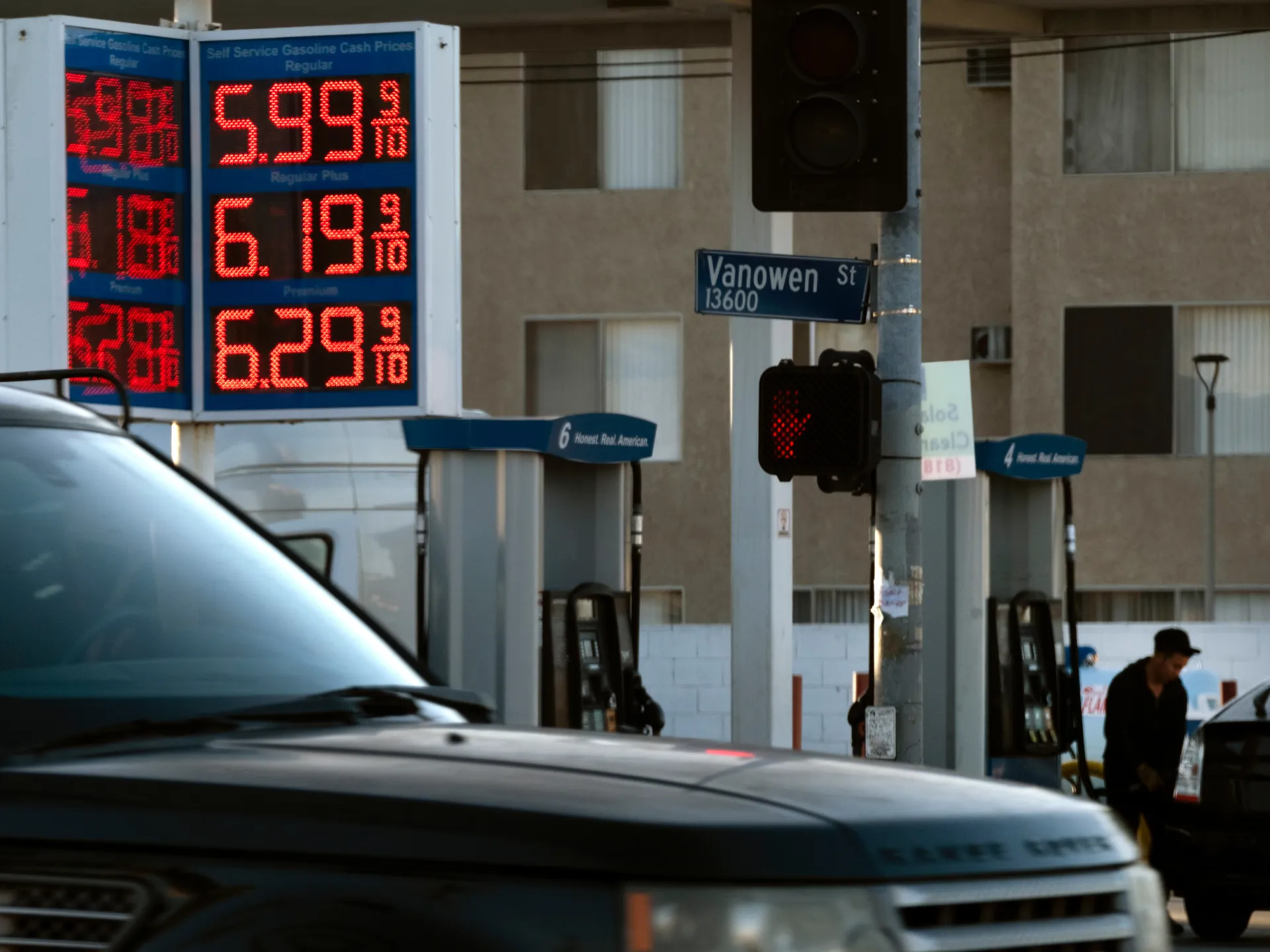
The strain is also hitting consumers at the petrol pump in the US. The American Automobile Association reports that the average price of gas is $4.125 per gallon (3.78 litres), compared with $3.63 at this time last month.

Meanwhile, shippers have adapted their routes, with more than 34,000 ships diverting from the strait over the past month.

The Containerized Freight Index, the benchmark for shipping container costs, jumped more than 10 percent over the last month, and is up more than 35 percent from this time last year, amid pressure on the market to find alternative shipping strategies.

In March, Maersk and Hapag-Lloyd suspended vessel routes through the strait, a waterway connecting the Gulf of Oman and the Gulf.

Also in March, within days of the start of the US-Israel war on Iran, several major vessel insurers cancelled war risk coverage for ships travelling through the waterway, including Norwegian insurers Gard and Skuld, as well as the United Kingdom’s NorthStandard, dissuading ship owners from going through the Gulf.

Since then, even though maritime insurance has become available – at 10 times the price as before the war on Iran – fuel prices are expected to normalise only once traffic through the strait goes back to pre-war levels, experts have said.

Source link

Brazilian ex-intelligence chief detained by US immigration authorities | Crime News

Brazilian media reports that Alexandre Ramagem fled the country after being convicted for involvement in a coup plot.

Brazilian media have reported that the country’s former intelligence chief, Alexandre Ramagem, has been detained by immigration authorities in the United States, where he had fled after being convicted in connection with a coup plot on behalf of former right-wing President Jair Bolsonaro.

CNN Brazil reported that Ramagem was arrested by US Immigration and Customs Enforcement (ICE) on Monday, citing Brazilian Federal Police and the Ministry of Justice and Public Security. The Brazilian outlet Globo reported that the arrest took place in Florida.

Recommended Stories

list of 3 itemsend of list

The Brazilian government has sought the extradition of Ramagem, who was sentenced to 16 years in prison for his involvement in efforts to keep Bolsonaro in power after he lost the country’s 2022 election to leftist challenger Luiz Inacio Lula da Silva.

Reports state that Ramagem fled Brazil in September, illegally crossing the border into Guyana before taking a plane to the US.

Globo reported that the Brazilian embassy in Washington, DC filed documentation with the US Department of State seeking his extradition on December 30, 2025.

Paulo Figueiredo, a political ally of Bolsonaro who lives in the US, said the detention was not related to Brazil’s extradition request.

“Ramagem was not arrested, but detained following a police approach in Orlando, initially for a minor traffic infraction and, subsequently, referred to ICE – a common procedure in Florida,” Figueiredo said in a social media post.

He added that Ramagem has a pending asylum application and is optimistic that he will be released “as soon as possible” rather than deported.

Al Jazeera is not able to verify the reason for Ramagem’s arrest by US authorities.

Bolsonaro himself is currently serving a 27-year prison sentence after being convicted in September.

His trial was depicted by Bolsonaro’s allies as a political witch hunt, and sparked the ire of US President Donald Trump, who placed large tariffs on Brazil and called for the trial to be thrown out. Trump later relaxed some of those tariffs following improved relations with President Lula.

Source link

EU: No peace possible while “Lebanon is in flames” | Israel attacks Lebanon

NewsFeed

European Commission President Ursula von der Leyen warned that a potential closure of the Strait of Hormuz and ongoing Israeli strikes on Lebanon threaten regional stability after a meeting in Brussels on the fallout from the Iran conflict. Al Jazeera’s Abdullah Elshamy reports on the bloc’s response.

Source link

What are the pros and cons of Trump’s Iranian naval blockade? | US-Israel war on Iran

NewsFeed

What does Donald Trump’s naval blockade of Iranian ports look like and can it achieve what the US president wants? It is hard to know when the planning appears to have been done on the fly, according to war studies lecturer Samir Puri.

Source link

US judge dismisses Trump’s $10bn lawsuit against WSJ over Epstein story | Donald Trump News

Dismissed lawsuit follows Wall Street Journal’s report on a letter allegedly signed by Trump for Epstein’s 50th birthday.

A United States federal judge has dismissed US President Donald Trump’s $10bn defamation lawsuit against the Wall Street Journal and its owner Rupert Murdoch over a story on Trump’s ties to Jeffrey Epstein.

Miami-based ‌US District Judge Darrin Gayles said on Monday that Trump did not meet the “actual malice” standard that public figures must clear in defamation cases.

Recommended Stories

list of 3 itemsend of list

That means public figures must prove not only that a public statement about them was false, but also that the media outlet or person who made the statement ‌acted with reckless disregard for the truth or should have known that it was false.

“This complaint comes nowhere close to this standard,” Gayles wrote. “Quite the opposite.”

The judge noted that reporters from the Wall Street Journal (WSJ) reached out to Trump for comment beforehand and printed his denial. That allowed readers to decide for themselves what to conclude, cutting against Trump’s assertion that the newspaper acted with actual malice, the judge said.

Gayles said Trump could file an amended version of ⁠the lawsuit by April 27.

In ⁠his lawsuit, Trump called a birthday greeting that he allegedly sent to Epstein, a convicted sex offender, a “fake”. The US president sought $10bn for what he called damage to ‌his reputation. News Corp’s Dow Jones & Company, the WSJ’s parent company, defended the accuracy of its July ‌17, ‌2025 article.

Trump filed the lawsuit after promising to sue the paper almost immediately after it put a new spotlight on his well-documented relationship with Epstein by publishing an article that described a sexually suggestive letter that the newspaper said bore Trump’s signature and was included in a 2003 album compiled for Epstein’s 50th birthday.

A birthday letter that US President Donald Trump allegedly wrote to sex offender Jeffrey Epstein more than 20 years ago is seen as presented by the Democrats in the U.S. House of Representatives on their X account September 8, 2025. The letter, the existence of which was reported by the Wall Street Journal in July, appears to have been signed by Trump, but he has denied doing so and has said the card does not exist, and the White House has denied its authenticity. Handout via REUTERS
A birthday letter that US President Donald Trump allegedly wrote to sex offender Jeffrey Epstein more than 20 years ago is seen as presented by Democrats in the US House of Representatives on their X account on September 8, 2025 [Handout via Reuters]

The letter was subsequently released publicly by the US Congress, which subpoenaed the records from Epstein’s estate.

The ruling marks yet another blow in the Trump administration’s efforts to manage fallout over its release of the Epstein files and the president’s attempts to use the legal system to curb reporting that he finds critical of him.

The White House didn’t immediately respond to a request by AP for comment.

Source link

Pakistan eyes narrow window to resuscitate US-Iran talks after breakdown | US-Israel war on Iran News

Islamabad, Pakistan – More than 12 hours of face-to-face negotiations between the United States and Iran ended without agreement in Islamabad on Sunday, leaving a fragile two-week ceasefire as the only barrier between diplomacy and a return to war.

Pakistan, which spent weeks positioning itself as a mediator and succeeded in bringing both sides into the same room, emerged with its role intact. But officials acknowledge the harder phase now begins — getting American and Iranian negotiators back into talks before their differences explode into full-fledged war again.

Recommended Stories

list of 4 itemsend of list

“Pakistan has been and will continue to play its role to facilitate engagements and dialogue between the Islamic Republic of Iran and the United States of America in the days to come,” Pakistan’s Deputy Prime Minister and Foreign Minister Ishaq Dar said in a statement after the conclusion of the talks.

The talks, the highest-level direct engagement between Washington and Tehran since the 1979 Islamic Revolution, faltered over differences surrounding Iran’s nuclear programme.

“The simple fact is that we need to see an affirmative commitment that they will not seek a nuclear weapon, and they will not seek the tools that would enable them to quickly achieve a nuclear weapon,” said US Vice President JD Vance, who led the American delegation alongside special envoy Steve Witkoff and US President Donald Trump’s son-in-law Jared Kushner.

However, Vance left a narrow opening for the resumption of talks.

“We leave here with a very simple proposal, a method of understanding that is our final and best offer. We’ll see if the Iranians accept it,” Vance said, tapping the podium for emphasis, before ending his brief remarks, which lasted for less than five minutes.

Pakistani and Iranian sources confirmed that the Iranian delegation met senior Pakistani officials later on Sunday before departing for Tehran, though details of those discussions remain unclear.

What is clear is that Pakistan isn’t giving up yet.

Washington’s red lines

US officials said that Iran had entered negotiations misreading its leverage, believing it held advantages that, in Washington’s assessment, it did not.

.
US Vice President JD Vance speaks during a news conference after meeting with representatives from Pakistan and Iran, on Sunday, April 12, 2026, in Islamabad, Pakistan [Jacquelyn Martin/Pool via Reuters]

According to these officials, Vance spent much of his time during the talks correcting what they described as Iranian misperceptions about the US position — asserting that no deal would be possible without a full commitment on the nuclear issue.

Officials also suggested that Trump’s subsequent announcement of a blockade in the Strait of Hormuz was not an impulsive reaction, but a pre-planned step aimed at removing the waterway as an Iranian bargaining tool and forcing the nuclear issue back to the centre of any future talks.

But the US officials, speaking on background, also acknowledged that the gulf in the positions between Washington and Tehran that they failed to bridge extended to issues beyond Iran’s nuclear programme.

In essence, they said, the two sides failed to agree on six key points: ending all uranium enrichment; dismantling major enrichment facilities; removing Iran’s stockpile of highly enriched uranium; accepting a broader regional security framework involving US allies; ending funding for groups Washington designates as “terrorist” organisations, including Hamas, Hezbollah and the Houthis; and fully reopening the Strait of Hormuz without tolls.

Hours after the talks ended, Trump acknowledged partial progress, but underscored the central impasse.

“The meeting went well, most points were agreed to, but the only point that really mattered, NUCLEAR, was not,” he wrote on Truth Social.

“Effective immediately, the United States Navy, the Finest in the World, will begin the process of BLOCKADING any and all Ships trying to enter, or leave, the Strait of Hormuz,” Trump said. “Iran will not be allowed to profit off this Illegal Act of EXTORTION.”

Iran has effectively controlled access to the Strait of Hormuz, through which roughly 20 percent of global oil supplies pass, since the US-Israeli attacks began on February 28.

Iran’s Islamic Revolutionary Guard Corps (IRGC) has imposed what analysts describe as a de facto toll system, requiring vessels to secure clearance codes and transit under escort through a controlled corridor.

The disruption has pushed oil prices above $100 per barrel at times, unsettling global markets and placing sustained pressure on energy-importing countries across Asia and Europe.

Tehran has framed its control of the strait as both a security measure and a key negotiating lever, one it has shown little willingness to relinquish without a broader settlement.

Tehran’s point of view

Iran’s account of the breakdown differed sharply.

In a post on X early on April 13, after returning to Tehran, Iran’s Foreign Minister Abbas Araghchi said his country had engaged in “good faith”, only to face shifting demands.

Pakistani Prime Minister Shehbaz Sharif meets with Iranian Parliament Speaker Mohammad Bagher Ghalibaf, as delegations from the United States and Iran are expected to hold peace talks, in Islamabad, Pakistan, April 11, 2026. Pakistan's Prime Minister Office/Handout via REUTERS THIS IMAGE HAS BEEN SUPPLIED BY A THIRD PARTY. BEST QUALITY AVAILABLE. REFILE - ADDING NATIONALITY 'PAKISTANI PRIME MINISTER SHEHBAZ SHARIF'.
Iranian Parliament Speaker Mohammad Bagher Ghalibaf, left, meets with Pakistani Prime Minister Shehbaz Sharif, right, in Islamabad on April 11, 2026 [Handout/Prime Minister’s Office via Reuters]

“When just inches away from an Islamabad MoU, we encountered maximalism, shifting goalposts, and blockade,” he wrote. “Zero lessons learned. Good will begets good will. Enmity begets enmity.”

The reference to an “Islamabad MoU”, a memorandum of understanding, was the clearest public signal yet that the two sides had come closer to a formal agreement than either government had previously acknowledged.

Iran’s Parliament Speaker Mohammad Bagher Ghalibaf, who led the country’s delegation, said his team had proposed “forward-looking initiatives”, but failed to secure trust.

“Due to the experiences of the two previous wars, we have no trust in the opposing side,” he wrote on Sunday.

Foreign Ministry spokesperson Esmaeil Baghaei also pointed to partial progress but unresolved differences.

“On some issues we actually reached mutual understanding, but there was a gap over two or three important issues and ultimately the talks didn’t result in an agreement,” he said.

Tehran’s key demands, including an end to Israeli strikes on Lebanon, the release of $6bn in frozen assets, guarantees on its nuclear programme and the right to charge vessels transiting the Strait of Hormuz, remained unmet.

Iran’s ambassador to Pakistan, Reza Amiri Moghadam, however, offered a more measured view — suggesting that Tehran was not closing the window on talks.

“The Islamabad Talks is not an event but a process,” he wrote in his message on X on Sunday. “The Islamabad Talks laid the foundation for a diplomatic process that, if trust and will are strengthened, can create a sustainable framework for the interests of all parties.”

Pakistan’s balancing act

For Pakistan, analysts say, the outcome represents a setback but not a failure.

Officials were careful to describe the talks as “an important opening step in a continuing diplomatic process”, stressing that issues of such complexity cannot be resolved in a single round.

The emphasis, they said, was on keeping the channel open.

Muhammad Obaidullah, a former Pakistan Navy commodore who has served in Iran as a diplomat, said expectations of a breakthrough were always unrealistic.

“The mere fact of bringing both parties face to face is a significant diplomatic achievement in itself,” he told Al Jazeera. “The diplomacy is not dead.”

Ishtiaq Ahmad, professor emeritus of international relations at Quaid-i-Azam University in Islamabad, went further.

“The talks did not collapse; they concluded without agreement but with a defined US offer on the table and the channel still intact,” he said.

“Pakistan’s role was to move the crisis from escalation to structured engagement, which it achieved. The absence of convergence reflects structural differences between the US and Iran, not a failure of mediation.”

Both Trump and Iranian officials have praised Pakistan’s Prime Minister Shehbaz Sharif and Chief of Army Staff Field Marshal Asim Munir for their efforts to secure the ceasefire, and for hosting the talks in Islamabad. That, say analysts, suggests that they remain open to further Pakistan-brokered negotiations.

Sahar Baloch, a Germany-based scholar of Iran, said that trust remains Pakistan’s most valuable asset.

“The real test of credibility is not preventing breakdowns, but remaining relevant after them,” she said.

U.S.-Iran peace talks in Islamabad
A man walks past a billboard announcing peace negotiations as delegations from the United States and Iran hold high-level talks in Islamabad, Pakistan, April 11, 2026 [Asim Hafeez/Reuters]

Fragile ceasefire

The immediate threat to Pakistan’s role comes from the evolving situation in the Strait of Hormuz and in Lebanon.

Iran has already warned that continued Israeli strikes on Lebanon could render negotiations meaningless. Iran’s President Masoud Pezeshkian has framed such attacks as a direct challenge to the ceasefire.

Trump’s blockade announcement now adds pressure from a second front.

Ahmad, a former Pakistan chair at Oxford University, warned that a collapse of the truce would sharply narrow diplomatic options.

“If the ceasefire collapses, the immediate consequence is the loss of the diplomatic window,” he said. “A second round becomes far more difficult because both sides would return to negotiating under active escalation, where positions tend to harden rather than converge.”

Obaidullah drew a historical parallel with the US naval quarantine of Cuba during the 1962 missile crisis. What if China were to use its own ships to import Iranian oil? Would the US attack them?

“The world will again be watching who blinks first,” Obaidullah said. “However, it may turn into a far greater conflict if neither side does.”

The Cuban Missile Crisis of October 1962 brought the US and the Soviet Union to the brink of nuclear war, after Washington discovered Moscow had installed nuclear missiles on Cuban soil, within striking distance of the American mainland.

The US blocked the Soviets from providing more equipment to Cuba, and eventually, a diplomatic settlement was reached, with the Soviets agreeing to withdraw the missiles in exchange for a US pledge not to invade Cuba.

Baloch, the Berlin-based scholar, agreed that the situation remains volatile.

“The ceasefire risks becoming more symbolic than substantive,” she said. “But paradoxically, escalation can sometimes force a return to talks, even if under more urgent and less favourable conditions.”

What is the road ahead?

Pakistan’s room for manoeuvring is also shaped by its economic fragility.

The disruption in the Strait of Hormuz has driven up energy prices, compounding pressures on an economy already under strain before the conflict.

Ahmad said this creates both urgency and limits.

“Economic exposure, especially to energy shocks and external financing, creates urgency for Pakistan to prevent a prolonged conflict,” he said.

“But it also reinforces a constraint: Pakistan cannot afford escalation with either side. Its leverage is not coercive; it is positional. It comes from being the only channel acceptable to both sides, not from the ability to impose outcomes,” Ahmad said.

Eight days remain until the end of the initial two-week truce, a window Pakistani officials said privately represents a genuine opportunity for further technical and political alignment, if both sides choose to use it.

Ahmad suggested that any breakthrough would depend on creating a sequence of steps acceptable to both sides.

“The US is asking for early nuclear commitments; Iran is asking for guarantees and relief first,” he said.

Pakistan’s role, he added, would be to help “structure this sequencing, keep both sides engaged, and prevent breakdown at each stage”.

Islamabad won’t be the one drafting a deal itself, he emphasised, noting, “At this point, maintaining the channel is as important as the substance of the deal itself.”

Source link

Starmer says UK will not support US blockade of Strait of Hormuz | US-Israel war on Iran News

Other US allies criticise Trump’s move, including France, Spain and Turkiye, and China also condemns the plan.

British Prime Minister Keir Starmer says his country will not join the blockade of the Strait of Hormuz announced by United States President Donald Trump, a move also criticised by other US allies.

“We are not supporting the blockade,” Starmer told BBC radio on Monday, adding that the United Kingdom “is not getting dragged in” to the US-Israel war on Iran.

Recommended Stories

list of 4 itemsend of list

Starmer said it was vital to get the strait reopened. In peacetime, about 20 percent of the world’s oil supplies pass through the strategic waterway that links the Gulf to the Indian Ocean.

“It is in my view vital that we get the strait open and fully open, and that’s where we’ve put all of our efforts in the last few weeks, and we’ll continue to do so,” he said.

Al Jazeera’s Rory Challands, reporting from London, said Starmer has continued to “maintain a delicate balancing act” of saying the UK will not be joining the war while being careful not to level any criticism directly at Trump regarding his actions in the war.

Traffic through the strait has been heavily restricted since the start of the war. Iran has allowed through only some vessels serving friendly countries, such as China.

Starmer made his statement as the US military announced it would block all maritime traffic entering and exiting Iranian ports starting from 14:00 GMT. It was unclear, however, how the US military would enforce the blockade.

“The blockade will be enforced impartially against vessels of all nations entering or departing Iranian ports and coastal areas, including all Iranian ports on the Arabian Gulf and Gulf of Oman,” the US military’s Central Command said.

US forces would not impede vessels transiting the Strait of Hormuz to and from non-Iranian ports, it added.

A map of the Strait of Hormuz
A map of the Strait of Hormuz [Courtesy of Roudi Baroudi]


In a lengthy social media post on Sunday, Trump said his goal was to clear the strait of mines and reopen it to all shipping and Iran must not be allowed to profit from controlling the waterway.

Meanwhile, French President Emmanuel Macron announced that France and the UK would hold a conference in the coming days aimed at restoring freedom of navigation in the strait.

Macron reiterated that no diplomatic effort be spared in reaching a lasting end to the US-Israel war on Iran.

Nicole Grajewski, assistant professor at the Center for International Research at the Paris Institute of Political Studies, said a US blockade was “not a minor coercive signal” but could rather be considered essentially a resumption of the war.

Other US allies also criticised Trump’s move, including Spanish Defence Minister Margarita Robles, who said the planned naval blockade “makes no sense”.

“It’s one more episode in this whole downward spiral into which we’ve been dragged,” she said.

Fellow NATO ally Turkiye said the Strait of Hormuz should open “as soon as possible”.

“Negotiations with Iran should be conducted, persuasion methods should be used and the strait should be opened as soon as possible,” Turkish Foreign Minister Hakan Fidan told the state-run Anadolu news agency.

China, Washington’s great power rival and a big importer of Iranian oil, also criticised the plan.

“The Strait of Hormuz is an important international trade route for goods and energy, and maintaining its security, stability and unimpeded flow is in the common interest of the international community,” Ministry of Foreign Affairs spokesman Guo Jiakun said, urging Iran and the US not to reignite the war.

Source link

‘Terrible for foreign policy’: Trump attacks Pope Leo after peace appeal | Donald Trump News

Leo, ​who last year became the first US-born pope, has emerged as an outspoken critic of the US-Israeli ⁠war on Iran.

United States President Donald Trump has unleashed a storm of criticism at Pope Leo XIV, calling him “weak on crime” and “terrible for foreign policy”.

Trump delivered the unusual criticism of the head of the Catholic Church in a Sunday night post on social media, saying he does not “want a Pope who criticises the President of the United States”.

Recommended Stories

list of 3 itemsend of list

Trump’s outburst appeared to be triggered by recent remarks from Pope Leo critical of the US-Israel war on Iran.

Last week, Leo issued a rare direct rebuke of Trump’s threat to destroy Iranian civilisation, calling it “truly unacceptable“. And then, on Sunday, the 70-year-old pontiff implored leaders to end ongoing bloodshed, condemning what he described as a “delusion of omnipotence” fuelling war – comments that appeared directed at Trump.

The pope has also previously questioned the Trump administration’s hardline immigration policies, saying, “I don’t know if that’s ⁠pro-life.”

Taking to Truth Social, Trump wrote: “I don’t want a Pope who thinks it’s OK for Iran to have a Nuclear Weapon. I don’t want a Pope who thinks it’s terrible that America attacked Venezuela.”

“Leo should get his act together as Pope, use Common Sense, stop catering to the Radical Left, and focus on being a Great Pope, not a Politician,” said the US president.

Trump also claimed credit for Leo’s leadership in the Catholic Church, suggesting the Vatican picked the first US-born pontiff – elected last year – to curry favour with the White House. “If I wasn’t in the White House, Leo wouldn’t be in the Vatican,” Trump said.

Asked about the comments later on Sunday, Trump reiterated that he is “not a big fan” of Leo, who he said “is not doing a very good job”.

“He likes crime, I guess,” said Trump. “He’s a very liberal person.”

Trump also had a rocky relationship with Leo’s predecessor, Pope Francis, who criticised Trump’s ‌immigration ‌policy proposals when he first ran for president and suggested Trump was “not a Christian“. Trump had called Francis “disgraceful” in early 2016.

Leo is set to begin an 11-day trip to Africa on Monday, starting with a historic visit to Muslim-majority Algeria.

Source link

Eric Swalwell exits California governor race after sex assault allegations | Sexual Assault News

Democratic Representative Eric Swalwell suspends campaign to succeed Gavin Newsom after media reports detailed alleged accounts of sexual assault.

US Congressman Eric Swalwell has dropped out of the California state gubernatorial race following sexual assault allegations.

“I am suspending my campaign for Governor,” he said in a social media statement on Sunday.

Recommended Stories

list of 3 itemsend of list

“To my family, staff, friends, and supporters, I am deeply sorry for mistakes in judgment I’ve made in my past. I will fight the serious, false allegations that have been made – but that’s my fight, not a campaign’s,” the Democrat added.

Swalwell’s statement came after several influential Democratic Party lawmakers called on him to exit the race and resign from the United States Congress following reports from CNN and the San Francisco Chronicle that detailed alleged accounts of sexual assault from a former staffer and misconduct allegations from several other women.

“What he did is sick and disgusting,” Congressman Ro Khanna told the news programme Fox News Sunday, calling for investigations into the allegations by law enforcement and the US House of Representatives.

A March poll from Emerson College suggested that Swalwell was ahead of Democratic and Republican challengers by several points in the race to replace Governor Gavin Newsom.

But the reports shook his campaign, with powerful figures and organisations revoking their endorsements and calling for him to drop out over the weekend. The Manhattan District Attorney’s Office confirmed on Saturday that it was investigating the allegations.

California gubernatorial candidate, Rep. Eric Swalwell, D-CA, appears at a town hall meeting in Sacramento, Calif., Tuesday, April 7, 2026. (AP Photo/Rich Pedroncelli)
Eric Swalwell appears at a town hall meeting in Sacramento, California, on Tuesday, April 7, 2026 [Rich Pedroncelli/AP Photo]

Republican US Representative Anna Paulina Luna said she would submit a motion to begin the process of expelling Swalwell, a move some Democrats in Congress said they could support.

“This is not a partisan issue,” Representative Pramila Jayapal said on Sunday. “This cuts across party lines. And it is the depravity of the way that women have been treated.”

Democrats have also called for the expulsion of Representative Tony Gonzales, a Republican from Texas, who is also facing sexual misconduct allegations.

Khanna and Republican Representative Byron Donalds have said they could support a bid to eject both Gonzales and Swalwell from Congress.

“As far as I’m concerned, both gentlemen need to go home,” Donalds said.

Source link

Rory McIlroy wins Masters to become fourth back-to-back champion | Golf News

The Northern Irishman becomes the first player to repeat at Augusta National since Tiger Woods back in 2001-2002.

Jack Nicklaus, Nick Faldo, Tiger Woods, and now, Rory McIlroy.

The Northern ‌Irishman emerged from a tight pack of contenders to win the 90th Masters Tournament on Sunday, joining the trio of golf icons as the only players in history ⁠to conquer Augusta National in back-to-back years.

Recommended Stories

list of 4 itemsend of list

McIlroy ⁠said earlier this week that winning one Masters would make it easier to win a second, and he dug deep into that belief on Sunday to rally from a three-shot deficit on the front nine to post a one-under-par round of 71 for the winning score of 12-under 276 – one better ⁠than Scottie Scheffler.

“I can’t believe that I waited 17 years to get one green jacket, and I get two in a row,” McIlroy told CBS in Butler Cabin. “I think that all of my perseverance at this golf tournament over the years has really started to pay off.”

McIlroy’s sixth career major also tied him with Faldo for the most by a European player in the modern era, and they are tied for 12th-most all-time by any player.

Cameron Young, Russell Henley, England’s Tyrrell Hatton and Justin Rose finished another shot back at 10 under.

Rory McIlroy in action.
McIlroy putts on the 18th hole to win The Masters [Mike Segar/Reuters]

McIlroy rallies

McIlroy began the final round tied for the 54-hole lead at 11 under with Young, who birdied the second hole to reach 12 under and take the outright lead. It appeared that McIlroy’s repeat quest might unravel when he went three over on the two par-threes on the front nine to fall to 9 under for the tournament.

Suddenly, McIlroy’s name was looking up on the leaderboard at Young and Rose, who reached 12 under with ‌four birdies in a five-hole stretch through No 9. Scheffler was also making a run several holes ahead, and Henley reached 10 under through eight holes.

This is when McIlroy kicked it back into gear for the first time since closing with six birdies over his final seven holes on Friday. A birdie on the seventh hole got McIlroy back to double digits under par, and he pulled within one shot of the lead with another on the par-five eighth.

While Scheffler’s rally stalled for a long stretch with 11 consecutive pars, and Rose and Young struggled to hole putts on the back nine, McIlroy kept ratcheting up the pressure. He birdied the 12th and 13th holes to go 2 under through “Amen Corner” and build a two-shot lead.

Scheffler kept it interesting with birdies on numbers 15 and 16 to get to 11 under. Another birdie attempt on 17 stayed on the lip of ⁠the cup, and Scheffler parred out to post a 4-under round of 68, with McIlroy on the course with three holes to play.

The two-shot ⁠cushion proved helpful for McIlroy when he pushed his drive on the 18th hole well right into the trees. He was able to punch the ball forward into a greenside bunker and put it on the putting surface with his third shot.

From there, McIlroy easily converted the two-putt bogey, and became the fourth player in history to successfully defend at the Masters.

“It’s nice to have that two-shot cushion instead of the one [shot] like I ⁠had last year,” McIlroy said. “I looked at the [leader]board after I made the bogey on six, and I went back to 9 under at that point. And I said, ‘If I can get to 14 under, I think I’ve got a really good chance of winning this tournament.’

“I didn’t quite ⁠get there, I got to 13, but 13 was good enough standing on the 18th tee.”

After setting a Masters record ⁠with a six-shot lead after 36 holes, McIlroy played the final 36 holes in even par. That brought a host of players back into the mix, with at least four different players leading at some point during the final round.

McIlroy admitted that he kept a close eye on the leaderboard after falling back to 9 under to know where he stood in the tournament.

“It was a tough weekend,” he said. “I did the bulk of my work on Thursday and Friday, ‌but just so happy to hang in there and get the job done.”

Rory McIlroy reacts.
McIlroy holds the Masters championship trophy during the green jacket ceremony after the final round of the Masters Tournament at Augusta National Golf Club [Kyle Terada/Imagn Images via Reuters]

Source link