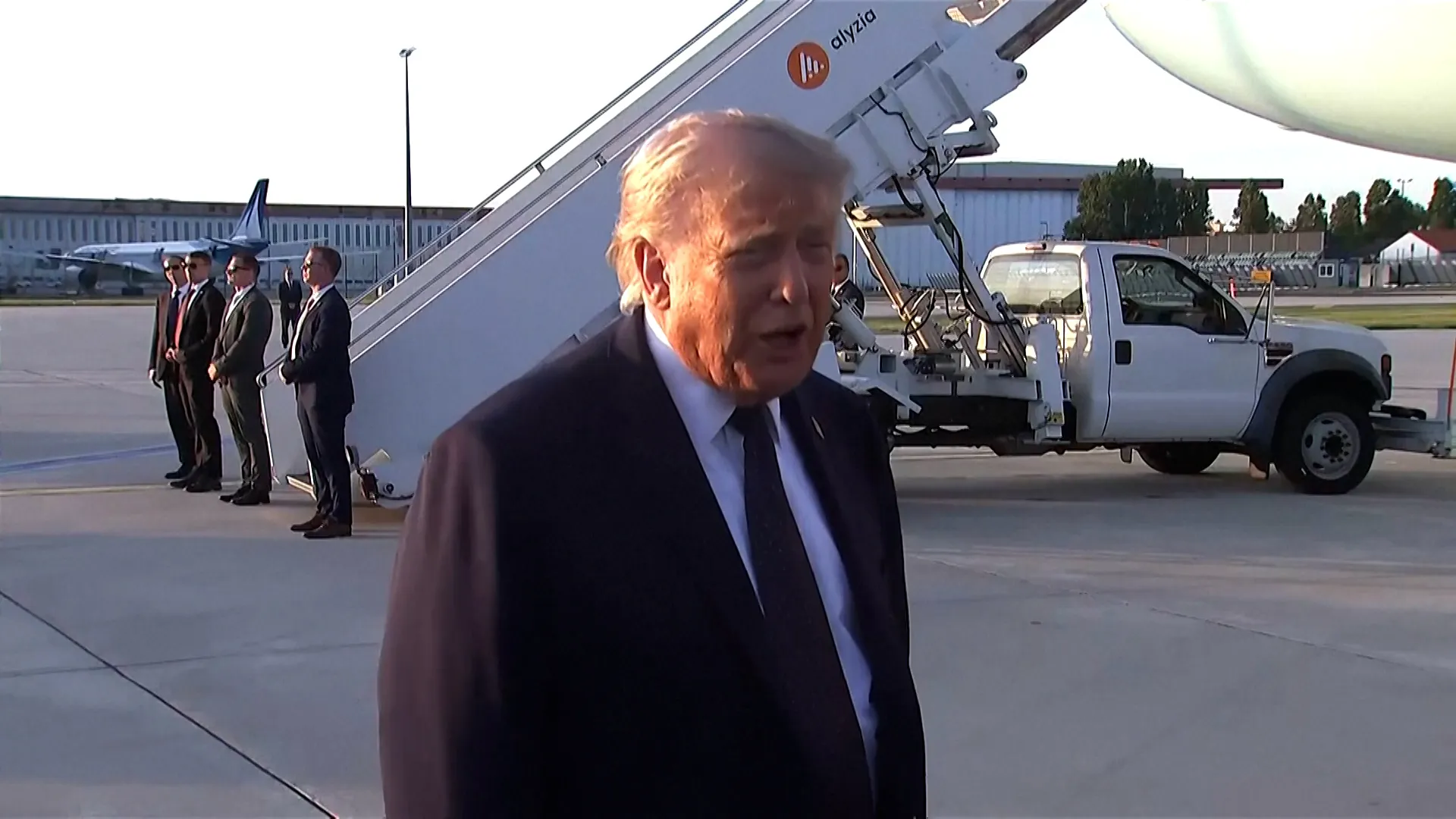
WASHINGTON — President Trump expressed frustration Monday that U.S. allies were not enthusiastic about sending warships to protect merchant vessels passing through the Strait of Hormuz, a sign of Washington’s growing isolation as it tries to stabilize one of the world’s most critical shipping lanes amid its war against Iran.
Trump declined to name the “numerous countries” he said had agreed to help reopen the oil route, which has come under the threat of retaliation from Iran, but was annoyed that most longtime allies were hesitant about joining his international police force. He said they should be “jumping to help us.”
“Some countries that we have helped for many, many years, we’ve protected them from horrible outside sources and they weren’t that enthusiastic — and the level of enthusiasm, it matters to me,” Trump said at the White House.
For Trump, securing allies’ help is as much a domestic economic need as it is international diplomacy. Since the hostilities against Iran began on Feb. 28, Tehran has retaliated by targeting regional oil facilities and at least 20 vessels operating in and around the Persian Gulf, the Strait of Hormuz and the Gulf of Oman.
The result has been “the largest supply disruption in the history of the global oil market,” according to the International Energy Agency, and it has led to international oil prices surging more than 30% to over $100 a barrel as the war entered its third week with no clear end in sight.
The diplomatic friction, meanwhile, reflects the limits of Trump’s influence at a moment when the global economy is absorbing one of the worst oil supply shocks in modern history, a dynamic that has prompted Trump to warn that countries refusing to help may find Washington a far less generous partner in turn.
Despite Trump‘s demands, several key allies have publicly rebuffed his calls for support.
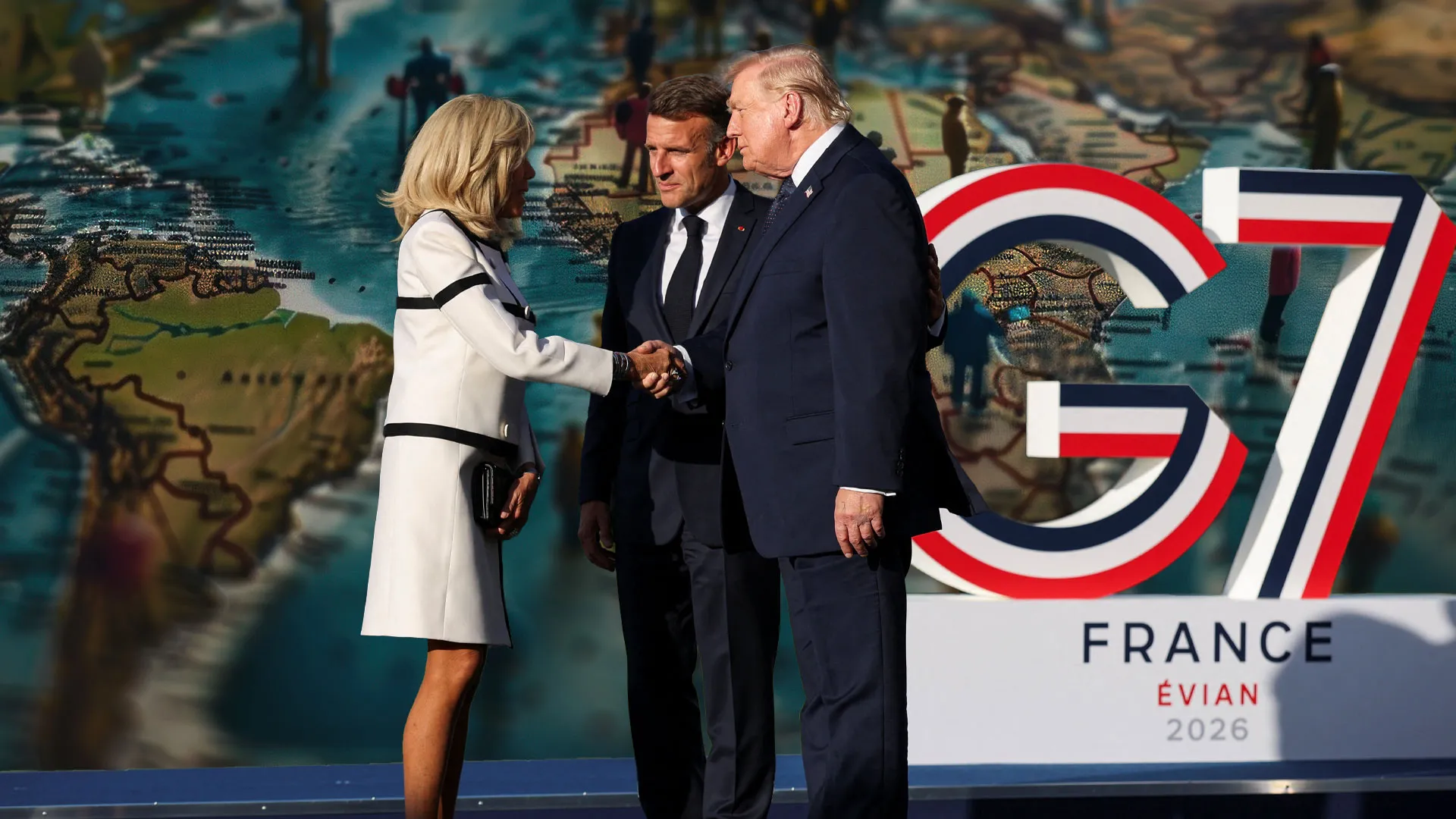
French President Emmanuel Macron formally rejected the request, saying that France would maintain a “defensive and protective” posture focused on stability rather than escalation.
German Foreign Minister Boris Pistorius was blunter, saying, “This is not our war; we didn’t start it.”
British Prime Minister Keir Starmer also declined to commit, saying the U.K. “will not be drawn into the wider war.” Italy, Spain, Australia and Japan similarly declined, while South Korea and China have not publicly stated their intentions.
The rejections seems to have only sharpened Trump’s demands. At one point during an event Monday, the president turned to House Speaker Mike Johnson (R-La.) and said he would share a list of nations that declined to help, suggesting Congress could have a role in any retaliatory measures against reluctant allies.
“Why are we protecting countries that don’t protect us?” Trump said.
Yet Trump also sent conflicting signals about how much allied help he actually needs. At one point he claimed the United States did not require assistance from other countries.
“We don’t need them, but it’s interesting — I am doing it, in some cases, not because we need them, but because I want to see how they react,” Trump said.
On the threat to merchant ships, Trump projected uncertainty. He said the possibility of mines was “enough to keep people” from transiting the waterway, but said that “we don’t even know” if Iran has placed any mines in the strait.
“They may have no mines,” he said. “We hit every one of their mine ships. Every one of them is gone — but it only takes one.”
Speaking aboard Air Force One on Sunday, Trump also sent mixed messages about the threats and the need for help. He said the United States was coordinating with roughly seven countries to deploy naval forces to “police the straits — before adding, in the same remarks, that “maybe we shouldn’t even be there at all.”
He suggested American forces should not be there because other nations depend more heavily on oil shipments through the oil route, an about-face that drew criticism from allies, who said it created confusion about Washington’s strategy in a conflict the United States had itself started.
“To keep the strait open, I have a very hard time believing that China and the other countries the president enlisted are really going to be escorting ships through the strait. That just really doesn’t add up to me,” Sen. Adam Schiff (D-Calif.) said in an NBC “Meet the Press” interview Sunday.
“The bottom line is, we really don’t know how long this war is going to be,” he added.
Trump, however, is keeping the pressure on allied countries, making the future of the conflict more open-ended depending on their response.
Trump insisted Monday that “numerous countries have told me they are on their way,” but said he would “rather not say” who they are.
He then said the tepid responses from some U.S. allies had reinforced his skepticism about the value of the NATO alliance, echoing comments he made over the weekend when he warned that a failure to assist would be “very bad for the future of NATO” and that the U.S. would “remember” those who did not step up.
When asked if he was confident Macron will help with the reopening of the strait, Trump told reporters: “Yeah, I mean sure. … I think he’s gonna help. I mean I’ll let you know.”
Europe has nonetheless been drawn deeper into the conflict.
The U.K. initially refused to support U.S. military operations, but softened its position after Trump mocked Starmer as “no Winston Churchill” and called Britain a “once great ally.” France also said last week that it was preparing a separate “purely defensive” naval mission to escort commercial vessels through the strait once it was safe to do so.
Moving forward, it is unclear how the European Union and other nations around the world will respond to Trump’s pressure.
“Nobody wants to go actively in this war. And of course, everybody is concerned what will be the outcome,” Kaja Kallas, the European Union’s top diplomat, said Monday after a meeting of foreign ministers in Brussels. “This is not Europe’s war, but Europe’s interests are directly at stake.”
The 33-year-old Columbia University protester had been held in immigration detention centre for a year.
Published On 16 Mar 202616 Mar 2026
Share
Leqaa Kordia, a Palestinian woman detained in the United States after taking part in pro-Palestine demonstrations in 2024, has been released after a year in custody.
The 33-year-old, who grew up in the occupied West Bank before moving to the US in 2016, was held at a detention facility in the state of Texas since March last year.
“I don’t know what to say. I’m free! I’m free! Finally, after one year,” a smiling Kordia told reporters after leaving the detention centre on Monday.
An immigration judge had ruled Kordia was eligible to be released on bond three times. Immigration officials appealed the first two rulings but Kordia was freed on $100,000 bond after government lawyers did not challenge the third.
After her release, Kordia said she was looking forward to going home and hugging her mother “so hard.” But she also said she would keep fighting on behalf of people still being held at the detention centre
“There is a lot of injustice in this place,” she said. “There is a lot of people that shouldn’t be here the first place.”
Kordia, who lost nearly 200 members of his family during Israel’s genocidal war against Palestinians in the Gaza Strip, was among several protesters targeted by immigration officials for taking part in pro-Palestine demonstrations at Columbia University in 2024.
Until Monday, she was the only person targeted in connection with the demonstration who was still in immigration detention after the release of others, including Mahmoud Khalil and Mohsen Mahdawi.
Kordia, who was held at Prairieland Detention Center in Alvarado, was recently hospitalised for three days following a seizure after fainting and hitting her head at the privately run detention facility.
At a hearing on Friday, Kordia’s lawyers said she had a neurological condition that had worsened while in custody, putting her at an elevated risk of seizure. They reiterated that she could stay with US citizen family members and did not pose a flight risk.
The immigration judge, Tara Naslow, agreed.
“I’ve heard testimony. I’ve seen thousands of pages of evidence presented by the respondent, and very little evidence presented by the government in any of this,” Naslow said.
Offering another rationale for the US-Israeli war on Iran, Donald Trump claimed he ordered strikes to prevent a nuclear conflict that would have turned into World War III. He also said not even the “greatest experts” thought Iran would retaliate with attacks on Gulf states.
Speaking at the Oval office, US President Donald Trump stated that Somalia is a “fourth world nation” while repeating claims without evidence that Congresswoman Ilhan Omar had illegally entered the country by marrying her brother. Omar has consistently denied the “sick” allegations.
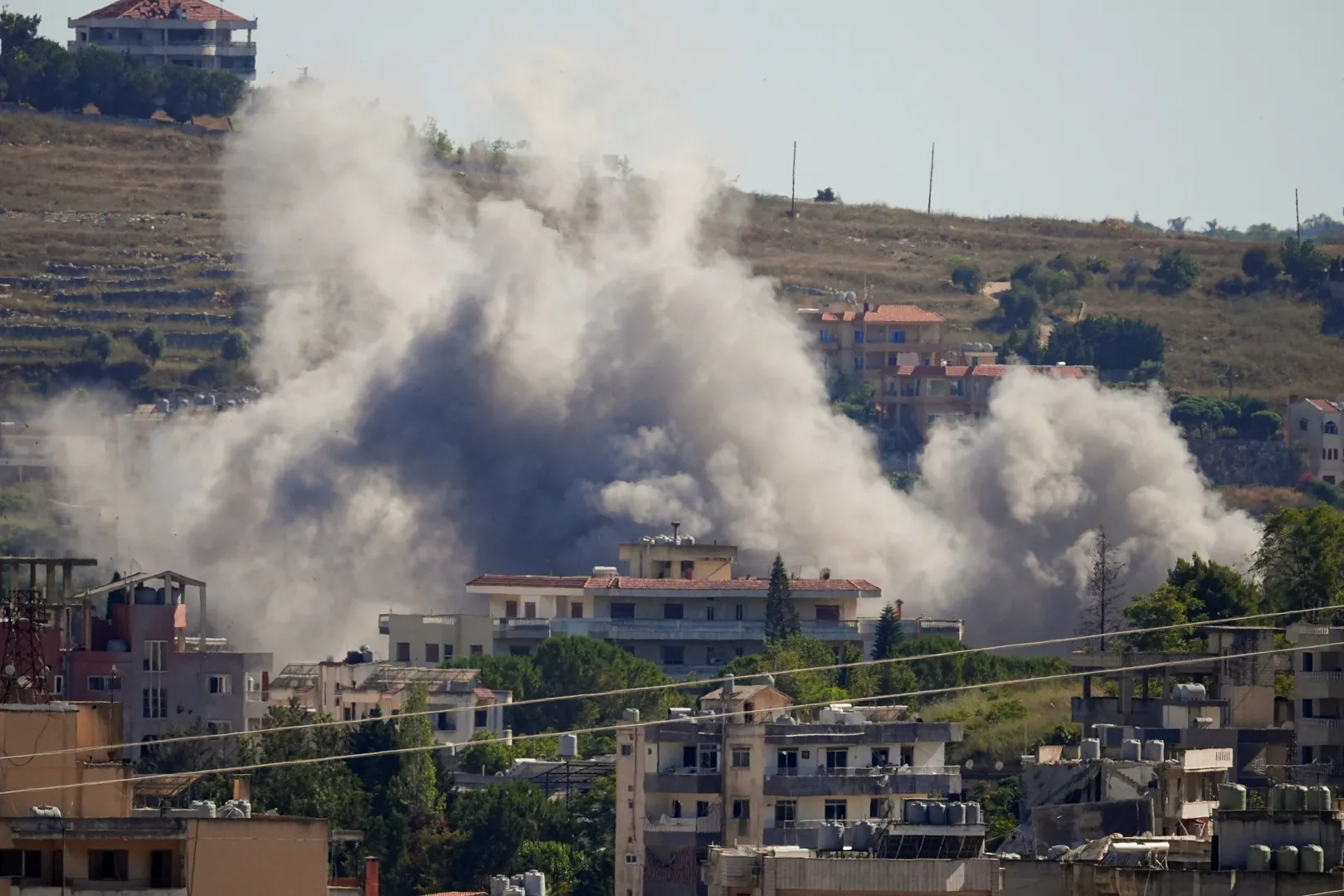
Israeli forces have attacked multiple towns in southern Lebanon after announcing “limited and targeted ground operations” against Hezbollah. Israel has warned residents will not be able to return to their homes until the military says so.
Joint attacks by the United States and Israel have severely reduced Iran’s capacity to fire missiles and drones, experts say, but Iran retains enough capabilities to inflict significant damage.
“Iran’s ballistic missile capacity is functionally destroyed. Their navy assessed combat ineffective. Complete and total aerial dominance over Iran,” the White House said on Saturday. “Operation Epic Fury is yielding massive results,” it said in reference to the war launched by Israel and the US on February 28.
Recommended Stories
list of 3 itemsend of list
On Sunday, President Donald Trump said US forces had decimated Iran’s drone manufacturing capacity.
Still, on Monday afternoon, Qatar announced it had intercepted the latest in a series of missiles fired from Iran towards the country. Saudi Arabia, the United Arab Emirates and Bahrain also issued alerts. A missile landed on a car in Abu Dhabi, killing a person.
So are Iran’s missile capabilities severely reduced? And how is it still firing projectiles at its neighbours and Israel?
Is Iran firing fewer missiles now?
Indeed, the number of retaliatory missiles and drones that Iran has fired towards Gulf countries, Israel and other nations in the region has seen a steep decline since the start of the war.
In the first 24 hours of the conflict, Iran had fired 167 missiles (ballistic and cruise) and 541 drones at the United Arab Emirates, for instance. By contrast, on day 15 of the conflict, it had shot four missiles and six drones, according to a tally compiled by Al Jazeera based on the emirate’s Defence Ministry statements.
The barrage against Israel has also decreased, from nearly 100 projectiles over the first two days to a single-digit number in the past few days, according to Israel’s Institute for National Security Studies.
Last week, the Pentagon said missile launches were down 90 percent from the first day of fighting and drone attacks were down by 86 percent.
How big is Iran’s missile arsenal – and how much has it been hit?
Iran has the largest inventory of ballistic missiles in the region, the US Office of the Director of National Intelligence assessed in 2022. While there are no official accounts on how many missiles it has, Israeli intelligence reports suggest it counted around 3,000 missiles, a figure that dropped to 2,500 following the 12-day war last June.
Key to the US-Israel strategy has been hunting down Iran’s launchers. Each missile launch generates a signature, such as a large explosion, that can be picked up by a satellite and radar systems.
According to a senior Israeli military official cited by the Institute for the Study of the War, Israel has put up to 290 launchers out of service, out of an estimated 410 to 440 launchers.
But Iran is a vast country, and without boots on the ground, it will be hard to completely eliminate Iran’s capacity to shoot despite the US and Israel having nearly full control of the country’s airspace, said David Des Roches, an associate professor at the National Defense University in Washington, DC.
“It is not obvious to identify launchers,” Des Roches told Al Jazeera. “What we see are missiles that were put in hidden places or places not associated with the military before the war, when there was less observation”.
According to Des Roches, the slowdown in launches is due to Iranian forces having lost the capacity to launch volleys. As a result, Iran has been firing one or two missiles at a time towards civilian and commercial infrastructure, especially in Gulf countries, instead of aiming volleys at military targets. Iran insists that it is targeting only US interests in the region.
“Militarily speaking [Iran’s action] is not significant – this is what is called harassment fire to exhaust alert systems in nearby countries and scare people off,” Des Roches said.
What’s Iran’s strategy?
According to Hamidreza Azizi, an expert on Iran and visiting fellow with the German Institute for International and Security Affairs (SWB), Tehran’s central calculation is that the Gulf and Israel may run out of their defensive capabilities before Iran runs out of missiles.
“There might be some interest in making this a war of attrition,” he said, pointing at the lower, yet constant, number of weapons launched from Iran each day.
“Although the US and Israel have been successful in taking out some of the launchers and major missile bases, the Iranians have decentralised the missile bases and missile command and they have been increasingly relying on mobile launchers which makes it more difficult for the other side to detect and target,” Azizi said. “This is a race about time.”
And in that race, Iran believes it has a chance, say experts.
“It does not matter how many you launch as long as you maintain a credible threat,” Muhanad Seloom, an assistant professor in critical security studies at the Doha Institute for Graduate Studies, told Al Jazeera. “It takes one successful drone to shatter a sense of security.”
Iran has long experience in producing cheap yet effective drones. The Shahed 136 can be made quickly and in large numbers in relatively simple factories, and several of them can be fired at once, overwhelming defences. It also doesn’t need complex launchers that can be targeted in air strikes. With a speed of just 185km/h (115mph), Shaheds can be shot down by helicopters. Still, many have managed to get through US and Gulf air defence systems.
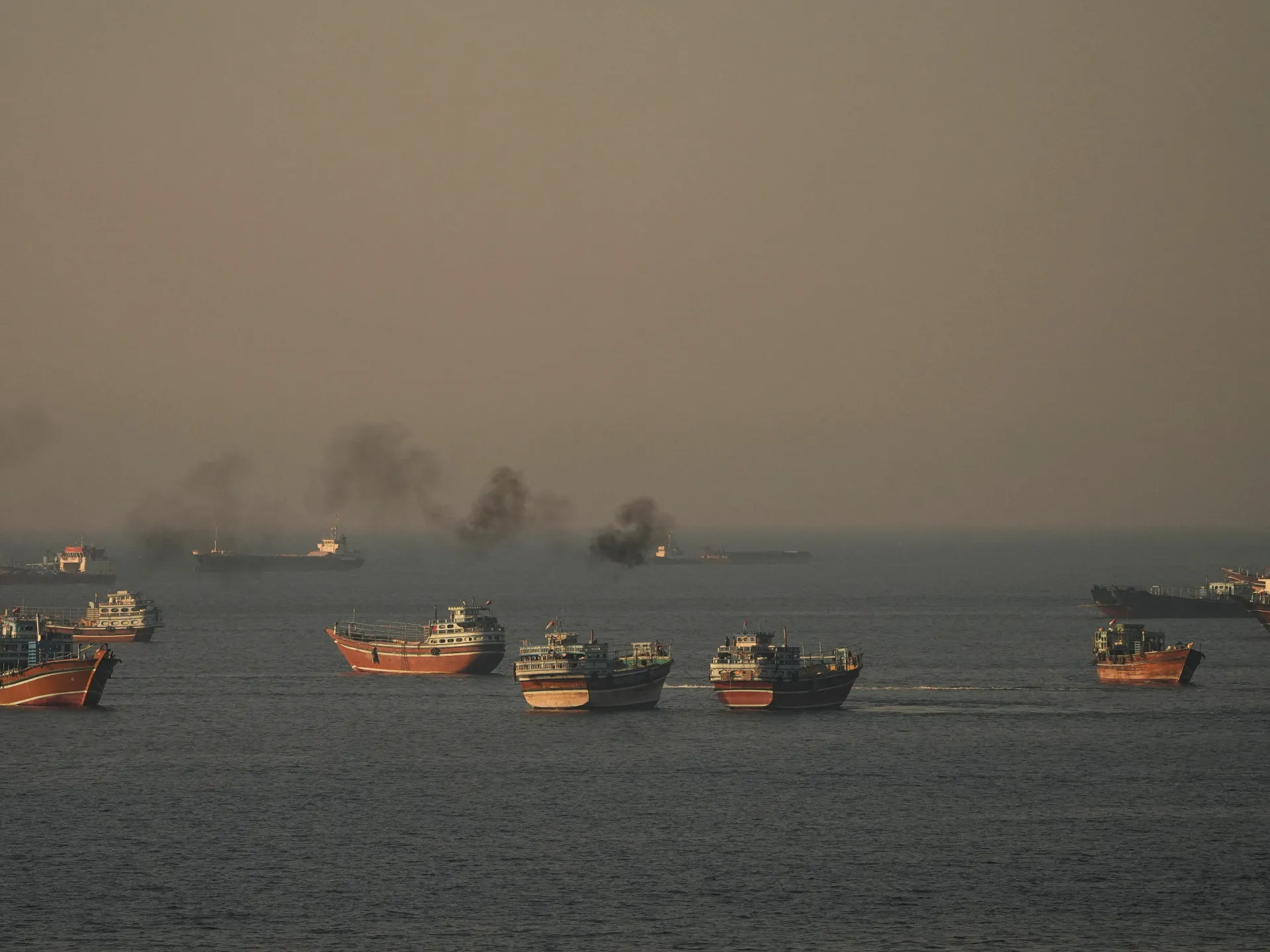
Just on Monday, a fire broke out near the UAE’s Dubai International Airport in a drone-related incident that temporarily disrupted flights; another drone attack caused a fire at the Fujairah industrial area, also in the UAE; air sirens sounded in central Israel due to a missile fired from Iran; and in the Strait of Hormuz – a key waterway through which 20 percent of global energy supplies are shipped – hundreds of vessels remain paralysed over fear of being struck despite few attacks on ships. Since the start of the war, a maritime tracker has reported 20 incidents related to vessels.
This, say experts, is part of Iran’s defensive doctrine of asymmetric warfare against militarily superior powers, such as the US and Israel. The weaker party, Iran in this case, turns to unconventional methods of warfare, wearing down the enemy by targeting key infrastructure to inflict economic pain.
Tehran has already pushed oil prices to higher than $100 a barrel and sent global markets into panic mode. The second-biggest exporter of natural gas, Qatar, continues to keep shut its production; Bahrain’s state oil company has declared force majeure on its shipments, and oil production from Iraq’s main southern oilfields has plunged 70 percent.
If Iran can keep raising global oil prices, “it will inflict equal or more damage to the US than American bombs in Iran,” said Vali Nasr, a professor of international affairs and Middle East studies at Johns Hopkins University.
Sometimes, journalists indulge in myths and delusions they claim to decry.
This grating inclination has been on almost giddy display in the still evolving aftermath of United States President Donald Trump’s rash decision to join Israeli Prime Minister Benjamin Netanyahu in launching a war with Iran.
Like falling dominoes, a “narrative” gathered momentum among the America’s “progressive” commentariat, insisting that Trump’s order to go to war offended large swaths of the MAGA movement and set off a seismic split in his ardent base.
It is a silly myth and a seductive delusion.
Sure, a handful of familiar MAGA personalities have grumbled that another Middle East conflict betrays the “America First” pledge that helped propel Trump back to the White House.
Conservative commentator Megyn Kelly has questioned whether the US is drifting, yet again, into an endless war without purpose or meaning. Podcaster Joe Rogan has talked about the conflict’s disastrous, unintended consequences. Former Fox News host Tucker Carlson has warned that the unprovoked attack could trigger chaos across an already volatile region.
Trump, of course, parried the backlash with trademark coarseness. He lashed out. He dismissed the naysayers. He mocked allies who briefly turned detractors.
Headlines blared that a domestic quarrel threatened to engulf his MAGA disciples in a “civil war.”
The idea that MAGA has fractured is fantasy. Disquiet is not rupture. Dissent is not rebellion.
The MAGA “movement” is not a conventional coalition held together by consensus around a coherent, considered set of principles or policies.
MAGA remains what it has always been: a political phenomenon built to burnish one man’s ego and narcissism. As long as that man is Trump, the “movement” bends to his designs and whims. It adjusts; and, inevitably, snaps back into loyal line.
That loyalty remains the movement’s signature force.
For nearly a decade, Trump has tested its limits. He has weathered scandals that would have devoured most politicians. Two impeachments. Criminal convictions. A litany of controversies, including his close and lengthy friendship with the architect of a worldwide sex trafficking ring, the notorious paedophile, Jeffrey Epstein.
Through it all, MAGA has, if anything, tightened its loving embrace of Trump.
The notion that a fraternal dispute over foreign policy would shatter the vice-like bond is absurd. That bond is emotion. It is visceral.
For his embittered supporters, Trump is the embodiment of grievance-fuelled defiance. He is a charismatic champion against enemies in Washington — the gilded establishment, the media, the global order who treats them with derision and contempt.
Within that parochial framework, Trump’s actions at home and abroad are filtered through the prism of fidelity. When Trump unleashes a war that he once opposed, his devout followers accept his shifting rationales — however obtuse or contradictory. They believe he sees threats others ignore. They believe he acts when others hesitate.
Indeed, polls confirm their steadfast confidence in Trump’s judgement and his enduring appeal.
The Republican Party has always harboured different instincts. Some supporters lean towards isolationism. Others favour aggressive displays of the America’s unparalleled power.
While there may be hints of unease among Republicans about the prospect of a long, costly war with Iran, that unease has not led, and likely will not lead, to a broad revolt anytime soon.
Trump’s standing within the Republican Party remains strong. His approval among Republican voters remains high. They trust him.
That trust trumps the simmering doubts raised by a small, albeit prominent, slice of MAGA fawning pundits and a few recalcitrant members of Congress.
Kelly knows it. Rogan knows it. Carlson knows it.
The trio understands that they operate inside a MAGA universe fashioned and controlled by Trump. Their popularity and influence depend on staying there. They know the defining rule of Trump’s gravitational pull: stray too far and you will be cast out.
Predictably, Carlson avoided escalation.
Instead, he declared his allegiance. He made plain that he still “loves” Trump. He reminded listeners that Trump had reshaped American politics.
Kelly and Rogan may question the risks and dangers of war, but neither would wage a sustained attack on the president. Neither would dare tell Trump’s loyalists to abandon him.
A fleeting disagreement over Trump’s reckless adventure in Iran will not translate into a lasting break.
Even the most high-profile MAGA hucksters recognise that confronting Trump invites retribution and disaster. Their audiences overlap. Their reach thrives in the same ideological ecosystem.
Picking an ultimately losing fight with the ecosystem’s vengeful anchor is rarely good business.
So, MAGA is, at the moment, experiencing a touch of turbulence. It will pass.
Which is why the constant search by establishment media for a dramatic MAGA schism keeps producing the standard result.
Nothing much changes.
Every time Trump sparks outrage, the same prediction appears. This time, the base will rebel. This time, the coalition will splinter.
This forecast is a tired ritual. It ignores the fundamental nature of the MAGA compact. That connection is not rooted in briefs or blueprints. It is a secular religion where the leader is never wrong.
Myopic scribes mistake a fracas for a collapse. They see tension and hope for a divorce. The believers are not preoccupied with the logistics of war or the mercurial logic of “America First”. They care about the man who gave them a voice.
Once the friction fades, the sceptics will retreat. They have nowhere else to go. The undeniable magnetism of Trump’s celebrity and command of MAGA reels most reluctant strays back.
To leave that agreeable orbit permanently is to vanish into irrelevance — a bleak fate for provocateurs who have forged lucrative careers amplifying Trump’s ignorance, intolerance, and fury.
The views expressed in this article are the author’s own and do not necessarily reflect Al Jazeera’s editorial stance.
As anticipated, it ended up being One Battle After Another’s night at the 98th annual Academy Awards, with the political thriller carting away six Oscars out of a total of 13 nominations.
But while Paul Thomas Anderson’s magnum opus continued its march towards award-season domination, there were moments of genuine surprise and subversion in Sunday’s ceremony.
Recommended Stories
list of 3 itemsend of list
Some of those moments had to do with the current political climate in the United States.
Host Conan O’Brien and his fellow presenters deftly avoided mentioning President Donald Trump by name, but their barbs took direct aim at his policies since returning to office.
Other surprises came from within the filmmaking community itself. For only the seventh time in Oscar history, a tie was announced: Two films had gotten an equal number of votes for Best Live Action Short.
As a result, both the surrealist thriller Two People Exchanging Saliva and the moody bar-room drama The Singers shared the Academy Award.
Here are six key takeaways from the night.
Actor Michael B Jordan holds the Oscar for Best Actor next to director Ryan Coogler, who earned an Oscar for Best Original Screenplay [Valerie Macon/AFP]
A two-horse race between Sinners and One Battle
The vampire film Sinners came into Sunday night’s ceremony with a record 16 Oscar nominations. But the big question of the night was: How many nods could it actually convert into wins?
Its biggest competition was, of course, Anderson’s One Battle After Another, which had the second highest tally of nominations.
Sinners director Ryan Coogler and Anderson were in direct competition in several top categories, including Best Picture and Best Director.
In both cases, Anderson came out ahead, though he acknowledged how fickle such awards can be.
“ I just want to say that, in 1975, the Oscar nominees for Best Picture were Dog Day Afternoon, One Flew Over the Cuckoo’s Nest, Jaws, Nashville and Barry Lyndon,” the four-time Best Director nominee said, listing films now considered to be Hollywood classics.
“There is no best among them. There is just what the mood might be that day.”
In the categories for Best Supporting Actor and Best Film Editing, One Battle After Another also triumphed, as well as for the inaugural award for Best Casting.
But in a sign of how well matched their two films were, both Coogler and Anderson emerged from the night with writing Oscars.
Anderson picked up Best Adapted Screenplay award for his use of the Thomas Pynchon novel Vineland, while Coogler made off with the Best Original Screenplay Oscar for Sinners, a work inspired by his uncle’s love of the blues.
US cinematographer Autumn Durald Arkapaw poses in the press room with her Oscar for Best Cinematography [Valerie Macon/AFP]
Jordan dunks on Chalamet in Best Actor race
Sinners, which won four Academy Awards overall, earned some of the most emotional, nail-biting victories of the night.
In the Best Cinematography category, for instance, Autumn Durald Arkapaw became the first woman to top the field.
It was her first nomination and first win, with Arkapaw besting veteran cinematographers like Marty Supreme’s Darius Khondji and Frankenstein’s Dan Laustsen, both multiple nominees.
Another big win for Sinners came in the form of Michael B Jordan, the actor whom Coogler has cast in every film since his directorial breakout in 2013’s Fruitvale Station.
Jordan, 39, was in a tight race for Best Actor with another young performer, 30-year-old Timothee Chalamet of the 1950s ping-pong drama Marty Supreme.
But Chalamet’s aggressive campaigning may have ultimately sabotaged his prospects. Multiple cracks were taken throughout the night at Chalamet’s recent comments disparaging opera and ballet.
“Nobody cares anymore” about either art form, Chalamet said in an interview last month.
“We can change society through art, through creativity, through theatre and ballet and also cinema,” director Alexandre Singh said pointedly during his acceptance speech for Best Live Action Short.
O’Brien, meanwhile, acknowledged the backlash with a joke about heightened security at the night’s Oscar ceremony.
“I’m told there are concerns about attacks from both the opera and ballet communities,” O’Brien said, before turning to Chalamet. “They’re just mad you left out jazz.”
Irish actress Jessie Buckley celebrates her win during the 98th Annual Academy Awards [AFP]
A conga line of snubs
Given the dominant performances from Sinners and One Battle After Another, plenty of critically acclaimed films left empty-handed, or nearly so.
Guillermo del Toro’s Frankenstein, as expected, earned three wins in technical categories, including Best Production Design, Best Costumes and Best Hairstyling and Makeup.
Netflix’s smash hit KPop Demon Hunters, meanwhile, also fulfilled expectations that it would dominate in its categories, Best Animated Feature and Best Original Song.
But then there were former frontrunners like Hamnet that failed to generate much traction, including for director Chloe Zhao, a past Oscar winner. Out of eight nominations total, it only came away with one win: a Best Actress trophy for Irish performer Jessie Buckley.
Marty Supreme and the Brazilian film The Secret Agent fared worse, however. Despite having nine nominations and being considered an early shoo-in for Best Actor, Marty Supreme scored no wins.
The Secret Agent, which swept the Best Actor and Best Director categories at the 2025 Cannes Film Festival, also earned nothing at this year’s Oscars.
Same was true for the quirky kidnapping drama Bugonia, from Oscar darling Yorgos Lanthimos.
South Korean-US singer Ejae poses with the Oscar for Best Original Song for the film KPop Demon Hunters[Angela Weiss/AFP]
Fears about artificial intelligence
The ceremony, however, did occasionally veer away from the competition between the films to discuss issues facing the film industry and the country as a whole.
Among those was the creeping growth of artificial intelligence (AI) in the creative sector.
In the weeks leading up to the 98th Oscars, an AI-generated video clip had gone viral, appearing to show Hollywood icons Brad Pitt and Tom Cruise in a rooftop brawl worthy of a James Bond movie.
The clip had been generated through AI software developed by the Chinese firm ByteDance, and Hollywood leaders quickly denounced it as a threat to their livelihood, not to mention a copyright infringement.
Those concerns reverberated on the Oscar stage on Sunday, with O’Brien and others addressing the growing use of AI.
“Tonight we are celebrating people, not AI, because animation – it’s more than a prompt,” actor Will Arnett said emphatically as he introduced the animation awards.
O’Brien, meanwhile, joked that, by next year, his hosting gig would be taken by “a Waymo in a tux”.
Host Conan O’Brien performs onstage during the 98th Annual Academy Awards [Patrick T Fallon/AFP]
Trump skewered for threatening free speech
Another concern looming over the night’s Oscar ceremony came in the form of President Donald Trump, who has courted controversy by launching deadly military attacks in Venezuela and Iran, as well as leading a violent immigration crackdown in the US.
At no point was Trump mentioned by name. But his leadership was alluded to throughout the night.
O’Brien, the host, set the tone early on with his oblique jabs at the Republican president in his opening monologue.
“When I hosted last year, Los Angeles was on fire,” the two-time Oscar emcee said in remarks dripping with sarcasm. “But this year, everything’s going great.”
Fellow comedian Jimmy Kimmel was even more direct. Last September, his show was briefly suspended after Trump criticised the comedian.
The head of the Federal Communications Commission, a Trump appointee, subsequently threatened the broadcasting license of the TV channel Kimmel performs on.
“There are some countries whose leaders don’t support free speech. I’m not at liberty to say which. Let’s just leave it at North Korea and CBS,” Kimmel quipped, referring to another channel that cancelled a fellow late-night comedy show.
Several filmmakers honoured at the Oscars likewise waded into the controversies surrounding Trump.
Best Documentary Feature winner David Borenstein, for instance, implied a parallel between his film — an exploration of authoritarianism in Russia — and what is currently happening in the US.
“Mr Nobody against Putin is about how you lose your country,” Borenstein explained.
“What we saw when working with this footage is that you lose it through countless small little acts of complicity: when we act complicit, when a government murders people on the streets of our major cities, when we don’t say anything, when oligarchs take over the media.”
Indian actress Priyanka Chopra and Spanish actor Javier Bardem present the award for Best International Feature Film [Patrick T Fallon/AFP]
Political speeches avoid mention of Iran war
The Oscars come roughly seven months ahead of the pivotal midterm elections in the US, which could see Trump’s Republican Party lose its majorities in Congress.
But while several filmmakers did hint at their anti-Trump stances, few explicitly denounced his policies.
For example, Norway’s Joaquim Trier, the winner of the Best International Feature category, veiled his criticism in a James Baldwin quote about the duty to protect children.
“Let’s not vote for politicians who don’t take this seriously into account,” Trier said.
No artist during the night referenced the US and Israeli war against Iran either, though its effects were felt among the participants of this year’s Oscar crop.
Writer-director Jafar Panahi, whose work was up for two Oscars on Sunday, has already said he plans to return to his native Iran after the awards season concludes.
Meanwhile, Iranian politician Sara Shahverdi — the subject of a nominee in the Best Documentary Short category — was prevented from attending the Oscars at all due to Trump’s ban on visas for 39 countries.
Palestinian actor Motaz Malhees, star of the Oscar nominee The Voice of Hind Rajab, likewise told media outlets he could not be present at the ceremony due to the travel ban.
The most pointed acknowledgements of the US-led and US-backed conflicts in the world were brief. When Spanish actor Javier Barden took the Oscar stage to present an award, he offered up six words, “No to war, and free Palestine!”
Russian filmmaker Pavel Talankin, meanwhile, made a similar appeal to the audience. “In the name of our future, in the name of all of our children, stop all of these wars now,” he said.
But by and large, the Oscar winners and presenters kept their remarks vague, emphasising global unity over political criticism.
“If I can be serious for just a moment, everyone watching right now around the world is all too aware that these are very chaotic, frightening times,” O’Brien told the audience at the outset of the night.
“It is at moments like these that I believe that the Oscars are particularly resonant. Check it out. Thirty-one countries across six continents are represented this evening, and every film we salute is the product of thousands of people speaking different languages.”
Cinema, he and others argued, transcended borders. The talent on stage was not the US’s alone.
Several Gulf energy producers have declared force majeure on oil and gas shipments after disruptions to shipping through the Strait of Hormuz due to the US-Israeli war on Iran. Al Jazeera’s Alma Milisic explains what the legal term means and how it could affect global energy markets.
United States President Donald Trump has called for a naval coalition to deploy warships to secure the Strait of Hormuz, through which one-fifth of world oil shipments transit, as oil markets reel from supply disruptions caused by the US-Israeli war with Iran.
What is essentially the closure of the Strait of Hormuz by Iran in response to the attacks by the US and Israel has sent oil prices soaring to more than $100 per barrel.
Iran’s new supreme leader, Mojtaba Khamenei, has promised to keep the maritime artery closed while another top official in Tehran warned that oil prices could shoot up beyond $200 per barrel.
Trump said he hoped a naval coalition could secure the vital waterway, which connects the Gulf to the Gulf of Oman and the Arabian Sea. Iran has struck more than a dozen ships trying to sail through the narrow waterway since the hostilities started two weeks ago.
But will Trump’s solution work?
A tanker sits at anchor in Port Sultan Qaboos in Muscat, Oman, as oil shipments through the Strait of Hormuz have plummeted [File: Benoit Tessier/Reuters]
What has Trump said?
The US president has been facing domestic pressure over starting the war alongside Israel with no endgame or off-ramps in sight.
“On the strait of Hormuz, they had NO PLAN,” US Democratic Senator Chris Murphy wrote in a post on X. “I can’t go into more detail about how Iran gums up the Strait, but suffice it [to] say, right now, they don’t know how to get it safely back open.”
After threatening to bomb Iran more, Trump called on China, France, Japan, South Korea and the United Kingdom to send warships to secure the strait.
Trump claimed “100% of Iran’s military capability” had already been destroyed but added that Tehran could still “send a drone or two, drop a mine, or deliver a close-range missile somewhere along, or in, this waterway”.
“Hopefully China, France, Japan, South Korea, the UK, and others, that are affected by this artificial constraint will send ships to the area so that the Hormuz Strait will no longer be a threat by a nation that has been totally decapitated,” Trump wrote in a post on his Truth Social platform.
“In the meantime, the United States will be bombing the hell out of the shoreline, and continually shooting Iranian Boats and Ships out of the water. One way or the other, we will soon get the Hormuz Strait OPEN, SAFE, and FREE!”
Not long after, Trump returned to the keyboard, extending the invitation to all “the Countries of the World that receive Oil through the Hormuz Strait” to send warships, adding that the US would provide “a lot” of support to those who participated.
Israeli soldiers walk by a billboard commissioned by the evangelical Christian group Friends of Zion during the US-Israel war on Iran in Tel Aviv, Israel [File: Nir Elias/Reuters]
What has Iran said?
Alireza Tangsiri, commander of the Islamic Revolutionary Guard Corps Navy, said in a statement that claims by the US about destroying Iran’s navy or providing safe escort for oil tankers were false.
“The Strait of Hormuz has not been militarily blocked and is merely under control,” he said in a statement.
Iranian Foreign Minister Abbas Araghchi later doubled down on this, saying the strait remained open to international shipping except for vessels belonging to the US and its allies.
“The Strait of Hormuz is open. It is only closed to the tankers and ships belonging to our enemies, to those who are attacking us and their allies. Others are free to pass,” Araghchi said.
Khamenei – son of the late Supreme Leader Ali Khamenei, who was killed on the first day of the US-Israeli strikes – suggested in his first statement since taking power that the Strait of Hormuz would remain closed to provide leverage for Iran during the conflict.
F-18 combat aircraft are parked on the deck of the USS Abraham Lincoln aircraft carrier in the Gulf of Oman near the Strait of Hormuz during a 2019 deployment [File: Ahmed Jadallah/Reuters]
What are the challenges in the Strait of Hormuz?
The strait, which is just 21 nautical miles (39km) wide at its narrowest point, is the only maritime passage into the Arabian Gulf (known as the Persian Gulf in Iran). Shipping lanes in the waterway are even narrower and more vulnerable to attacks.
It separates Iran on one side from Oman and the United Arab Emirates on the other.
In brief, there is no way in or out by sea when the Strait of Hormuz is closed.
Alexandru Hudisteanu, a maritime security expert who served 13 years in the Romanian navy, told Al Jazeera that in the type of coalition that Trump is hinting at, “interoperability is the biggest hurdle.”
“That’s the ability of cruises to work together or with different units and different doctrine when basic communication would be an issue,” he said.
Then, there is the geography of the Strait of Hormuz: “a very unforgiving environment to sail with this type of wartime threats”, Hudisteanu said. “Especially difficult under missile threats and these asymmetric potential mines or unmanned systems that could damage or destroy ships.”
Providing escorts to ships would be a costly option, and it would pose risks to participating foreign warships from possible Iranian attacks, which would likely further drag more countries into the ongoing war.
From Iran’s point of view, “the fact that the shoreline is so close and the actual maritime passage is highly congested and confined is an advantage by default,” Hudisteanu added. Geographically, Iran keeps it as a gauntlet, with no way out for the ships unless Tehran allows it.
Another major challenge for any naval coalition trying to secure the passage would be the timeline of any operation. ”The security of the strait could be achieved. It’s just a matter of how much time you need and how many assets you need,” the analyst said. Rushing through it “could have negative implications for the security of the mission and the region”.
Smoke rises from the Thai bulk carrier Mayuree Naree near the Strait of Hormuz after an attack on March 11, 2026 [Handout/Royal Thai Navy via AFP]
How have countries responded?
No country has so far publicly agreed to Trump’s call to send warships to secure the Strait of Hormuz.
London said it is “intensively looking” at what it can do to help reopen the maritime passage. British Energy Secretary Ed Miliband said: “We are intensively looking with our allies at what can be done because it’s so important that we get the strait reopened.”
Chinese Ministry of Foreign Affairs officials said Beijing is calling for hostilities to stop and “all parties have the responsibility to ensure stable and unimpeded energy supply.”
Japan said the threshold is “extremely high” to send its warships on such a mission. “Legally speaking, we do not rule out the possibility, but given the current situation in which this conflict is ongoing, I believe this is something that must be considered with great caution,” said Takayuki Kobayashi, policy chief of Japan’s ruling Liberal Democratic Party.
France also confirmed that it will not send ships. The Ministry for Europe and Foreign Affairs said in a statement on Saturday: “Posture has not changed: defensive it is,” in reference to President Emanuel Macron’s assertion that France will not join the war against Iran.
South Korea, which imports 70 percent of its oil from the Gulf, said it was “closely monitoring” Trump’s statements and “comprehensively considering and exploring various measures … to ensure the safety of energy transport routes”.
(Al Jazeera)
Are countries negotiating with Iran?
Some countries have been negotiating with Iran to secure passage for their petroleum shipments.
Two Indian-flagged tankers carrying liquefied petroleum gas (LPG) have sailed through the Strait of Hormuz. New Delhi depends on this passage for 80 percent of its LPG imports.
The war on Iran has caused a critical shortage of cooking gas for India’s 333 million households. New Delhi has long had ties with Iran, but the government of Prime Minister Narendra Modi has not condemned the killing of Ali Khamenei. It has condemned Iran’s retaliatory attacks on Gulf countries, where millions of Indian citizens work and send $51bn in remittances home every year.
Iran’s ambassador to India, Mohammad Fathali, said Tehran had allowed some Indian vessels to pass through the Strait of Hormuz in a rare exception to the blockade but did not confirm the number of vessels.
A Turkish-owned vessel was similarly granted permission last week after Ankara negotiated passage directly with Tehran. Fourteen more Turkish vessels are awaiting clearance.
France and Italy also reportedly opened talks with Iranian officials to negotiate a deal to allow their vessels through the strait, but there has been no official confirmation yet.
“Iran is affecting maritime supply,” Hudisteanu said. “It’s affecting the maritime security of the region and the entire ecosystem and bringing the entire world to the table as the global price for oil and gas increases.”
Hundreds of tankers sit idle on both sides of the Strait of Hormuz as Iran has effectively closed the waterway, pushing oil prices above $100 – the highest since 2022, after the start of the Russia-Ukraine war.
Oil tanker traffic in the strait, through which one-fifth of global oil passes, has plunged after Israel and the United States launched attacks on Tehran on February 28. Asian countries, including India, China and Japan, as well as some European countries, source large portions of their energy needs from the Gulf. A disruption in supply will rattle the global economy.
With an aim to cushion from the shock, the International Energy Agency (IEA) has decided to release 400 million barrels of oil from emergency reserves, the largest coordinated drawdown in the agency’s history. But it has failed to push the prices down.
The agency had released about 182 million barrels after Russia’s invasion of Ukraine to stablise the oil prices.
According to the agency, oil shipments through the strategic waterway have fallen to less than 10 percent of pre-war levels, threatening one of the most critical arteries in the global energy system.
IEA members collectively hold about 1.25 billion barrels in government-controlled emergency reserves, alongside roughly 600 million barrels in industry stocks tied to government obligations.
A large number in a massive market
The figure may appear vast, but it shrinks quickly against the scale of global energy demand.
“This feels like a small bandage on a large wound,” energy strategist Naif Aldandeni said, describing the world’s largest coordinated emergency oil release as governments scramble to steady markets shaken by war.
The US Energy Information Administration (EIA) estimates world consumption of petroleum and other liquids will average 105.17 million barrels per day in 2026. At that rate, 400 million barrels would theoretically cover just four days of global consumption.
Even when compared with normal traffic through the Strait of Hormuz – around 20 million barrels per day – the released oil equals only about 20 days of typical flows.
Aldandeni told Al Jazeera that emergency reserves can calm panic in markets but cannot replace the lost function of a disrupted shipping corridor.
“The release may soften the shock and calm nerves temporarily,” he said, “but it will remain limited as long as the fundamental problem — the freedom of supply and tanker movement through Hormuz – remains unresolved.”
Oil prices reflect those anxieties. Brent crude ended trading on Friday at $103.14 per barrel, after surging to nearly $120 earlier as fears of disrupted production and shipping intensified.
Geopolitical risk premium
Oil expert Nabil al-Marsoumi said the price surge cannot be explained by supply fundamentals alone.
“The closure of the Strait of Hormuz added roughly $40 per barrel as a geopolitical risk premium above what market fundamentals would normally dictate,” he told Al Jazeera.
From that perspective, releasing strategic reserves serves primarily as a temporary tool to dampen that premium rather than fundamentally rebalance the market.
Prices above $100 per barrel are uncomfortable for major consuming economies already struggling to curb inflation and protect economic growth.
Recent EIA projections suggest global demand has not yet declined significantly because of the war, remaining close to 105 million barrels per day. The market pressure, therefore, stems less from falling consumption and more from fears of supply shortages and delays in deliveries to refineries and consumers.
Threats to oil infrastructure
The latest escalation could deepen those fears.
United States President Donald Trump said on Friday that the US Central Command (CENTCOM) had “executed one of the most powerful bombing raids in the History of the Middle East and totally obliterated every MILITARY target in Iran’s crown jewel, Kharg Island”.
He added that “for reasons of decency” he had “chosen NOT to wipe out the Oil Infrastructure on the Island”, but warned Washington could reconsider that restraint if Iran continues to disrupt shipping through the Strait of Hormuz.
CENTCOM confirmed the operation, stating US forces had struck “more than 90 Iranian military targets on Kharg Island, while preserving the oil infrastructure”.
Iranian officials have meanwhile warned they would target energy facilities linked to the US across the region if Iranian oil infrastructure comes under direct attack.
Kharg Island is not simply a military location. It serves as the primary export terminal for Iranian crude, making it a critical node in the country’s oil supply network.
If attacks move from obstructing shipping to targeting export infrastructure itself, the crisis could shift from a chokepoint disruption scenario to one involving direct losses of production and export capacity.
In such circumstances, the oil released from emergency reserves would act only as a temporary bridge rather than a lasting solution to lost supply.
Major oil companies such as QatarEnergy, the world’s largest producer of liquefied natural gas (LNG), Kuwait Petroleum Corporation and Bahrain state oil company Bapco have shut production and declared force majeure, while Saudi Aramco, the world’s largest oil producer, and UAE state oil company ADNOC have shut down their refineries.
Limits of emergency reserves
Even under a less severe scenario – where maritime disruption persists but infrastructure remains intact — the ability of strategic reserves to stabilise markets remains constrained by logistics.
The US Department of Energy said the US Strategic Petroleum Reserve held 415.4 million barrels as of 18 February 2026. Its maximum drawdown capacity is 4.4 million barrels per day, and oil requires about 13 days to reach US markets after a presidential release order.
That means even the world’s largest emergency stockpile cannot flood the market with crude immediately. The release must move through pipelines, shipping networks and refining capacity before reaching consumers.
Aldandeni said the current intervention would likely produce only a temporary stabilising effect, while al-Marsoumi warned that prolonged disruption in the Strait of Hormuz – or the spread of threats to other chokepoints such as the Bab al-Mandeb Strait in the Red Sea could quickly send prices further higher.
WASHINGTON — The Trump administration is stepping up its ambitious effort to replace about $1.6 trillion in lost tariff revenue that was eliminated by the Supreme Court’s decision to strike down a range of the president’s import taxes.
Recovering that lost revenue, which the White House was counting on to help offset the steep, multitrillion-dollar cost of its tax cuts, is possible but will be challenging, experts say. The administration has to use different legal provisions to impose new import taxes, and those provisions require longer, complex processes that U.S. companies can use to seek exemptions. It could be months or more before it is clear how much revenue the replacement tariffs will yield.
“I wouldn’t bet against this administration being able to get back on paper the same effective tariff rate they had before,” said Elena Patel, co-director of the Urban-Brookings Tax Policy Center. But the new approach will “make it easier for people to contest the tariffs, which is going to put a big asterisk on the revenue until all that is settled.”
On Wednesday, U.S. Trade Representative Jamieson Greer said the administration will investigate 16 economies — including the European Union — over whether their governments are subsidizing excessive factory capacity in a way that disadvantages U.S. manufacturing. The investigation will also cover China, South Korea and Japan, Greer said.
In addition, he said, there would be a second investigation of dozens of countries to see whether their failure to ban goods made by forced labor amounts to an unfair trade practice that harms the United States. That investigation will also cover the EU and China, as well as Mexico, Canada, Australia and Brazil.
Both investigations are being conducted under Section 301 of the 1974 Trade Act, which requires the administration to consult with the targeted countries, as well as hold public hearings and allow affected U.S. industries to comment. A hearing as part of the factory capacity investigation will be held May 5, while a hearing on the forced labor investigation will occur April 28.
It’s a far cry from the emergency law that President Trump relied on in his first year in office, which allowed him to immediately impose tariffs on any country, at nearly any level, simply by issuing an executive order.
Moments after the Supreme Court’s ruling, Trump imposed a 10% tariff on all imports under a separate legal authority, but that duty can only last for 150 days. The president has said he would raise it to 15%, the maximum allowed, but has yet to do so. Some two dozen states have already challenged the new taxes. The administration is aiming to complete its Section 301 investigations before the 10% duties expire.
The effort underscores the importance that the Trump White House has placed on tariffs as a revenue-raiser at a time when the federal government is facing huge annual budget deficits for decades into the future. Previous administrations, by contrast, used tariffs more sparingly to narrowly protect specific industries.
Erica York, vice president of federal tax policy at the Tax Foundation, noted that the first investigation covers roughly 70% of imports, while the second would cover nearly all of them.
“That breadth suggests the goal isn’t to address the issues at hand, but instead to re-create a sweeping tariff tool,” she said.
Trump portrays tariffs as a way to force foreign countries to essentially help pay the cost of U.S. government services, even though all recent economic studies find that American companies and consumers are paying the duties, including analyses by the Federal Reserve Bank of New York and economists at Harvard University. In his State of the Union address last month, Trump even touted his tariffs as a potential replacement for the income tax, which would return the United States’ tax regime to the late 19th century.
Trump also wants tariffs to help pay for the tax cuts he extended in key legislation last year. The tax cut legislation is expected, according to the most recent estimates by the nonpartisan Congressional Budget Office, to add $4.7 trillion to the national debt over a decade, while all Trump’s import taxes, including ones not struck down by the court, were projected to offset about $3 trillion — or two-thirds of that cost.
The high court’s ruling Feb. 20 that he could no longer impose emergency tariffs eliminated about $1.6 trillion in expected revenue over the next decade, according to the CBO.
Some of Trump’s import taxes remain place, including previous tariffs on China and Canada that were imposed after earlier 301 investigations. The administration has also imposed tariffs on some specific products, including steel, lumber and cars. Those, combined with the 10% tariff for part of this year, should yield about $668 billion over the next decade, the Tax Foundation estimates.
“It’s going to take a really big patchwork of these other investigations to make up for the [lost] tariffs,” York said.
The administration’s efforts are also unusual because they reflect an overreliance on tariffs to bring in more government revenue. Trump has also said the import taxes are intended to return manufacturing to the United States — manufacturing jobs, however, are down since he returned to office — and he has used the tariffs to leverage trade deals.
“What makes this really different,” said Kent Smetters, executive director of the Penn Wharton Budget Model, “it is really the first time tariffs have been mainly used as a revenue raiser.”
Patel, meanwhile, argues that raising revenue can be done more reliably and straightforwardly by Congress. Laws like Section 301 are traditionally intended to be used to address specific trade policy concerns in particular countries.
“It’s not supposed to be there to raise revenue,” she said. “If we want to raise revenue through tariffs, then Congress should impose a broad based tariff.”
The decision by United States President Donald Trump to launch a war on Iran has left many international law experts questioning if the world order established after World War II is actually working.
In his second presidential term, Trump seems to be wielding total power without restraint, and the system of checks and balances enshrined in the US Constitution appears to be failing to limit his power.
Recommended Stories
list of 4 itemsend of list
Since Trump was sworn in in January 2025, he has ordered two unprovoked attacks on independent states, Venezuela and Iran; threatened to annex Greenland; strained traditional alliances with Europe; undermined the United Nations; and rattled international trade with his sweeping tariffs.
Previous constraints set by the UN system and international law appear supplanted by what Trump told reporters in January was a vision of power limited only by his “own morality”.
President Donald Trump holds the key to unlock the FIFA Club World Cup trophy, which he said is staying at the White House, requiring a replica to be presented to the tournament’s winners, Chelsea, in July 2025 [File: Pool via AP]
So what checks are there on Trump? Is he really free to attack states, set tariffs at will and, as leader of the world’s most powerful state, essentially dictate global policy? And if so, why are so many observers now saying his war on Iran is faltering?
Has international law put any checks on Trump?
Not so far.
According to analysts, both his attacks on Venezuela and Iran were in clear breach of international law and the UN Charter, principally the prohibition on the use of force under Article 2(4).
Debates about international law, how it has been geared over the decades to underpin the interests of the West and the US specifically, are hardly new. However, experts said, the Trump presidency has seen even the notional restraints of international law trampled underfoot.
Trump himself has brushed aside international law, saying in January that it would be up to him to decide when and how much international law applied to the US and his actions.
“In many respects, international law has historically served US interests, and self-interest should continue to generate US support for a rules-based order organised around the core principles enshrined in the UN Charter,” Michael Becker, a professor of international human rights law at Trinity College in Dublin who previously worked at the International Court of Justice in The Hague, told Al Jazeera, “But finding value in international law often requires adopting a long-term outlook that does not sit easily with short-term political agendas.”
“In the current geopolitical climate, the capacity of international law to provide a meaningful constraint on US action under Donald Trump has proven negligible,” Becker added. “That seems unlikely to change, especially given the failure by other states to strike a united front against Trump’s gangsterism.”
What about the UN?
Not so much.
From its founding, the role of the UN has been to promote dialogue instead of conflict and provide a global response to international challenges. However, Trump’s relationship with the body, like so many of the president’s associations, has rarely been so straightforward. On the one hand, while appearing to try to supplant the body with his members-only Board of Peace as well as sidelining UN aid efforts in Gaza, he has on occasion sought the legitimacy of the UN for a number of his projects, such as his calls in August for the UN to establish a Support Office in Haiti, to help limit migration to the US.
However, while the support of the UN may be helpful, it is clear that Trump has no intention of abiding by its charter, Richard Gowan, the Crisis Group’s UN director from 2019 to 2025, said.
“While other UN members see the US is breaking international law on a regular basis, they often hold back from criticising Washington too loudly in forums like the Security Council because they fear blowback from Trump,” Gowan said. “So Trump is learning he can sidestep the UN when he wants to and get away with it while occasionally using it for instrumental purposes.”
What about other powers?
Up to a point.
Many countries known as “middle powers”, such as Canada, the United Kingdom, France, and other Western and European states, have proven successful so far in pushing back against Trump’s efforts to unilaterally annex Greenland. But European powers have failed to condemn Trump’s unprovoked war on Venezuela and Iran, exposing their double standards in conflicts in the Middle East and the Global South.
Many analysts expect that a withdrawal of investments in the US by Gulf states, which are bearing the brunt of Iran’s retaliation to US and Israeli attacks, may also hasten the war’s end.
“Middle powers can generate friction but not a veto,” HA Hellyer of the Royal United Services Institute for Defence and Security Studies in London said. “Collective action – European governments, Gulf states – can raise costs and extract tactical adjustments. The structural imbalance remains: The US retains decisive military, financial and institutional primacy.”
Smaller states often hedge their bets, follow Washington or look to regional alliances for protection, Hellyer added, continuing that while pressure was strongest in Europe, where the US is no longer seen as a reliable security guarantor, the idea of establishing an alternative continues to be a hurdle. “The logic of an alternative model is accepted; the capacity to execute it quickly is not. A prolonged interregnum follows. The Gulf Arab states are in an analogous position,” he said.
In the meantime, Trump and the US are free to act as they choose. “These are exposure-management strategies, pursued until structural dependence on the US security umbrella can be reduced,” he said.
China and Russia have so far criticised the breaches of international law while avoiding clear escalation, and India and other members of the BRICS bloc have largely stayed silent, suggesting a preference for strategic ambiguity over confronting Washington directly.
Canadian Prime Minister Mark Carney warned Trump of a ‘rupture’ in the Western alliance at the World Economic Forum in Davos, Switzerland, in January 2026 [File: Denis Balibouse/Reuters]
What about domestic restraints?
Not really.
The US Supreme Court was able to block Trump’s use of tariffs to manage large parts of his foreign policy by rewarding allies with lower tariffs and punishing critics with punitive import duties.
But none of the other traditional guardrails – such as Congress; the Department of Justice, which has provided unwavering support to the president; and even the news media – has contained the president’s ambitions. This isn’t entirely new. Previous presidents have ordered wars without congressional approval. However, with Trump, analysts suggested, it has been systematic.
Powerful US institutions have largely failed to hold the Trump administration accountable, analysts, such as Kim Lane Scheppele, a professor of international affairs at Princeton University, said.
“His base of strong supporters are saying that they are willing to experience short-term increases in gasoline prices if it leads to a friendly government in Iran in the long term. His opponents have been his opponents on everything, so he simply ignores and threatens them,” Scheppele told Al Jazeera.
“Trump pays more attention to market performance than to public opinion, so he started saying that he was minimising costs and saying that the Iran war is short term to boost markets again.”
“What the US is spectacularly missing is leadership to oppose Trump. Congress is not doing its constitutional job to constrain him. The Supreme Court is in his pocket because he packed the court in his first term. Lower court judges are heroic and have done amazing work under serious pressures, but they don’t get foreign policy questions, given the difficulty of anyone getting ‘standing’ … in the area of international matters,” she said, referring to the requirement that parties to a lawsuit must show actual or future direct harm to themselves to bring a case to court.
She noted that lower federal courts, although limited on foreign policy, have repeatedly checked executive overreach on immigration, sanctions designations and emergency powers, often under intense political pressure.
A bulk carrier and tanker at anchor in Muscat, Oman, as Iran has essentially closed the Strait of Hormuz by threatening to attack vessels transiting the waterway [File: Benoit Tessier/Reuters]
So why are so many people saying Trump’s war is faltering?
In the eyes of many observers, Trump, with no clear war aims or a defined resolution, is in danger of losing control of a conflict that appears to be both growing and reaching into economic areas apparently unforeseen by his administration, so while traditional restraints don’t apply, market forces, like gravity, always do.
Trump has repeatedly said the war would be over soon despite none of his claimed war aims being achieved.
Oil prices have surged due to his attacks on Iran, Tehran’s counterstrikes and threats to shipping in the Strait of Hormuz, through which about 20 percent of the world’s oil and liquefied natural gas passes.
The International Energy Agency’s decision on Wednesday to release 400 million barrels of oil from international petroleum reserves has failed to tame the prices. Iran has warned that oil could hit $200 a barrel as it continues its stranglehold of the waterway.
“Ultimately, the factors that might be most likely to constrain Donald Trump’s neoimperialist impulses – or his willingness to pursue the policy goals of those who have his ear – are the economic fallout from disrupting global energy markets and a broader disenchantment among US voters with his globe-trotting militarism, his rampant self-dealing and his callous disregard for the human costs of war,” Becker said.
Ebrahim Zolfaghari, spokesperson for Iran’s Khatam al-Anbiya Central Headquarters, accused the US and Israel of orchestrating a ‘diabolical plot’, claiming they copied Iran’s Shahed-136 drone design and repurposed it as a modified ‘Lucas’ drone to falsely blame Tehran for drone attacks across the region.
The 98th Academy Awards, known as the Oscars, will celebrate some of the top films released in 2025 on Sunday.
The ceremony will take place in Los Angeles with actors, directors and filmmakers from around the world competing for Hollywood’s most prestigious prizes.
Recommended Stories
list of 3 itemsend of list
But this year’s ceremony comes at a time of global tension, with the ongoing war in Iran serving as a sombre backdrop to Hollywood’s annual celebration.
“My job is always to try to walk a very thin line between entertaining people and also acknowledging some of the realities,” host Conan O’Brien said during a Wednesday news conference with the Oscars creative team.
Here is what we know about the upcoming ceremony:
Where will the Oscars be held?
The 98th Academy Awards will take place at the Dolby Theatre at Ovation Hollywood in Los Angeles on March 15.
The ceremony will start at 4pm West Coast time in the United States (23:00 GMT), with official red carpet coverage beginning at 3:30pm (22:30 GMT).
Where can I watch the ceremony?
The 2026 Oscars will be broadcast in the US on the TV channel ABC. Viewers with a cable subscription can also watch online by signing in through the ABC app or ABC.com.
The ceremony will also be streamed live on the video platform Hulu.
Those without traditional cable can access the broadcast through live TV streaming services that carry ABC, including Hulu + Live TV, YouTube TV, AT&T TV and FuboTV.
But the Oscars’ ties with ABC may soon be at an end. Last year, the Academy announced that, beginning in 2029, the Oscars will sever its decades-long relationship with ABC and stream exclusively on YouTube.
The shift to an online-only platform is a big shake-up for the Academy Awards, ending a tradition more than half a century old.
ABC began broadcasting the Oscars in 1976, and before that, it aired on a rival channel, NBC, starting in 1953.
Who is hosting the Academy Awards?
O’Brien is hosting the 98th Academy Awards, marking his second consecutive year emceeing the ceremony.
“This year, I know where the doughnuts are. I know my way around a little bit, and so, I think that’s going to be fun,” Conan said.
In remarks this week, the comedian explained he believes the key to success on the Oscar stage is having a good time and staying in the moment.
He added that he and his writing team are still refining the material ahead of the show, to keep it as current as possible.
“What’s happening in the world will be reflected in the show,” he said.
How can I watch the red carpet?
The Oscars red carpet is broadcast several hours before the ceremony, as filmmakers and other celebrities arrive for the ceremony.
The red carpet has long served as a stage for Hollywood’s best fashions, and actors often pause for interviews with social media and television hosts to discuss the awards and what they’re wearing.
Several shows will broadcast from the red carpet:
The official Oscars red carpet (“On the Red Carpet at the Oscars”): 20:30 GMT, hosted by Tamron Hall and Jesse Palmer
Streaming services: Viewers without cable can watch through platforms that carry ABC, including Hulu + Live TV, YouTube TV, fuboTV and Sling TV.
E! Live from the Red Carpet: 21:00 GMT
Streaming services: The E! network will carry the live coverage, as will the streaming platform Peacock and live TV service providers like Roku, Hulu + Live TV, YouTube TV and more.
British comedian Amelia Dimoldenberg also returns for the third year as the official Oscars social media correspondent.
Who is presenting?
As is tradition, last year’s acting winners will return to present awards at the ceremony. They include Adrien Brody (The Brutalist), Kieran Culkin (A Real Pain), Mikey Madison (Anora) and Zoe Saldana (Emilia Perez).
They will be joined by a wide range of actors and filmmakers presenting throughout the night, including Javier Bardem, Chris Evans, Chase Infiniti, Demi Moore, Kumail Nanjiani, Maya Rudolph, Will Arnett, Priyanka Chopra Jonas, Robert Downey Jr, Anne Hathaway, Paul Mescal, Gwyneth Paltrow, Rose Byrne, Nicole Kidman, Jimmy Kimmel, Delroy Lindo, Ewan McGregor, Wagner Moura, Pedro Pascal, Bill Pullman, Lewis Pullman, Channing Tatum and Sigourney Weaver.
Top row from left: Rose Byrne, Nicole Kidman, Delroy Lindo, Ewan McGregor and Wagner Moura. Bottom row from left: Pedro Pascal, Bill Pullman, Lewis Pullman, Channing Tatum and Sigourney Weaver [AP]
Who is performing at the Oscars?
This year’s show will feature two musical performances tied to the Best Original Song nominees.
Rei Ami, EJAE and Audrey Nuna are set to perform the hit single Golden from the animated film KPop Demon Hunters, and actor Miles Caton will reprise the song he sang in the movie Sinners, called I Lied to You, alongside songwriter Raphael Saadiq.
Like the film itself, the Sinners musical performance at the Oscars will serve as a tribute to Black artistry across generations and genres.
As such, it will include an array of artists, from ballerina Misty Copeland to rocker Brittany Howard to blues and jazz musicians like Eric Gales, Bobby Rush and Alice Smith, among others.
What movies have the most nominations?
Sinners is the most-nominated film in Academy Award history with 16 nominations.
That tally broke the previous record of 14 nominations, which was held by three films: All About Eve (1950), Titanic (1997) and La La Land (2016).
Ryan Coogler’s feature mixes supernatural horror, romance and blues culture. Set in 1932 Clarksdale, Mississippi, the story centres on a community opening a juke joint that soon finds itself under siege by vampires.
“I wrote this script for my uncle who passed away 11 years ago,” Ryan Coogler said in an interview with The Associated Press. “I got to imagine that he’s listening to some blues music right now to celebrate.”
One Battle After Another follows with 13 nods at this year’s Oscars, while Frankenstein, Marty Supreme and Sentimental Value each secured nine nominations.
The Academy also continued its tilt towards international films with this year’s lineup of nominees. Every major acting category, for instance, included at least one international nominee.
Is there any Arab representation at this year’s Oscars?
Arab cinema had a strong presence during the awards season. Several films from the region were shortlisted for Best International Feature Film, including:
The Voice of Hind Rajab (Tunisia)
Palestine 36 (Palestine)
All That’s Left of You (Jordan)
The President’s Cake (Iraq)
One of them, The Voice of Hind Rajab, ultimately secured an Oscar nomination, marking a significant moment for Arab cinema.
Actors Nesbat Serhan, Motaz Malhees, Saja Kilani and Clara Khoury play first responders from the film The Voice of Hind Rajab [CineCanibal/AP]
What is the Voice of Hind Rajab?
The Voice of Hind Rajab is a 2025 docudrama directed by Kaouther Ben Hania.
It dramatises the final hours in the life of five-year-old Palestinian girl Hind Rajab, who was killed by Israeli forces in Gaza in 2024. But the film weaves in real-life recordings of Rajab’s desperate phone calls to emergency personnel from the Red Crescent group.
“The arrival of Hind Rajab’s voice to these platforms — and its ability to break through the indifference that exists there — is in itself something extremely valuable,” Gaza-based filmmaker Mohammed al-Sawwaf told Al Jazeera’s journalist Maram Humaid.
To al-Sawwaf, the film’s Oscar nomination means that Rajab’s death is no longer a passing news item or a single tally in a growing death toll. It is a cultural event, a memorial that forces viewers to confront the horrors facing Gaza’s young children.
“A story of a human being from Gaza has been presented as the story of a person with a life and meaning, rather than the image of a Palestinian appearing as a number on news screens,” he said.
“Palestinians have tried for many years to tell their stories and to be visible, but they were often met with rejection, doubt, or barriers placed in front of them.”
Al-Sawwaf believes Hind Rajab’s story can help illuminate the humanitarian crisis facing thousands of other Palestinians suffering in Gaza.
“A story like Hind Rajab’s represents a symbol of thousands of other stories,” he said. “There are thousands of women and men who had full lives, details, and dreams that are no less human than hers.”
Why was an Iranian film submitted by France?
It Was Just an Accident, directed by Iranian filmmaker Jafar Panahi, is also among the nominees on Sunday night, competing in two categories: Best International Film and Best Original Screenplay.
Though It Was Just an Accident was a co-production from several countries, France ultimately submitted the film as its entry in the Best International Feature competition.
Panahi’s work is often critical of the Iranian government, and in the past, he faced prison time and a ban on his filmmaking as a result. It was not considered as Iran’s entry.
France instead has championed the film as evidence that the country is a safe haven for “singular and courageous cinema”.
But Panahi said his thoughts remain focused on those back home in Iran.
“I am constantly thinking about them,” he told Bloomberg from New York, four days after the US and Israel launched their offensive against Iran.
Panahi shot the film clandestinely in Iran without government approval.
What are the best picture nominees?
Ten films are in competition in the Best Picture category:
Bugonia: A science-fiction story about two men who kidnap a powerful executive, believing she is an alien threatening Earth.
F1: A sports drama starring Brad Pitt as a veteran Formula One driver who returns to racing to mentor a promising young teammate.
Frankenstein: Guillermo del Toro’s adaptation of Mary Shelley’s novel, following scientist Victor Frankenstein and the tragic creature he brings to life.
Hamnet: A historical drama focusing on the grief of Agnes and William Shakespeare following the death of their 11-year-old son, Hamnet.
Marty Supreme: A sports drama starring Timothee Chalamet as an ambitious table tennis player determined to prove he is the greatest at his sport.
One Battle After Another: A dark action-comedy directed by Paul Thomas Anderson, following a father and daughter on the run from a racist military leader intent on tracking them down.
The Secret Agent: A political thriller about a widowed college professor on the run from a vengeful government minister during Brazil’s dictatorship in the 1970s.
Sentimental Value: A drama exploring grief, memory and complicated relationships in a family of artists in modern-day Oslo.
Sinners: A supernatural thriller about twin brothers who return to their hometown to found a juke joint, only to be confronted by past relationships, racism and a gang of vampires.
Train Dreams: A portrait of a railroad worker on the Idaho frontier at the start of the 20th century, questioning whether his past decisions may have doomed him to a life of heartbreak.
Who are the nominees for the Best Director category?
Chloe Zhao for Hamnet
Josh Safdie for Marty Supreme
Paul Thomas Anderson for One Battle After Another
Joachim Trier for Sentimental Value
Ryan Coogler for Sinners
Joachim Trier, Josh Safdie, Chloe Zhao, Ryan Coogler and Paul Thomas Anderson are in competition in the Best Director category [Mike Blake, Benoit Tessier, Mario Anzuoni, Mario Anzuoni and Mario Anzuoni/Reuters]
Who are the nominees for best actor?
Timothee Chalamet for Marty Supreme
Leonardo DiCaprio for One Battle After Another
Ethan Hawke for Blue Moon
Michael B Jordan for Sinners
Wagner Moura for The Secret Agent
Ethan Hawke, Leonardo DiCaprio, Michael B Jordan, Wagner Moura and Timothee Chalamet face off in the Best Actor category [Mario Anzuoni, Daniel Cole, Mario Anzuoni, Mike Blake and Daniel Cole/Reuters]
Who are the nominees for Best Actress?
Jessie Buckley for Hamnet
Rose Byrne for If I Had Legs I’d Kick You
Kate Hudson for Song Sung Blue
Renate Reinsve for Sentimental Value
Emma Stone for Bugonia
Rose Byrne, Emma Stone, Jessie Buckley, Renate Reinsve and Kate Hudson have been honoured as Best Actress nominees [Daniel Cole, Mario Anzuoni, Daniel Cole, Mike Blake and Daniel Cole/Reuters]
What are the biggest surprises and snubs?
This year’s nominations included several unexpected picks and notable omissions.
Among the biggest surprises was Delroy Lindo’s first-ever Oscar nomination for his supporting role in Sinners, a recognition many felt was long overdue.
“The best part of this process has been that people are so genuinely happy for me,” Lindo, 73, told The New York Times.
“It’s not an ego thing. It’s nothing to do with that. It has everything to do with affirmation.”
Another unexpected nod came in the Best Picture category for the racing drama F1, an action-packed summer blockbuster.
In an interview with the racing tournament Formula 1, director Joseph Kosinski explained that the team created an entirely new filming system to capture the kind of visuals he had imagined.
“We had to develop a new camera system, taking everything we learned on Top Gun: Maverick and pushing it much further,” Kosinski said.
Actress Kate Hudson was also a surprise in the highly competitive Best Actress category, earning her first Oscar nod in 25 years for the musical drama Song Sung Blue.
She said the film offered a rare opportunity to portray a mature female character with depth and ambition. Her role is based on the real-life story of Claire Sardina, who performed as part of a Neil Diamond cover band.
“I got to play the comedy, some sense of humour. I got to play the love story, the desire. I got to play being a mother, and then I got to go into a place of where my life force is taken out of me,” Hudson said in an interview with NPR’s Fresh Air with Terry Gross.
Among the most notable snubs was the sequel Wicked: For Good, which received no nominations amid mixed reviews. The first Wicked film earned a whopping 10 nominations last year, winning two Oscars, for Best Costumes and Best Production Design.
Actor Paul Mescal also missed out on a nomination for his performance as William Shakespeare in Hamnet, while director Guillermo del Toro was overlooked in the Best Director category for Frankenstein.
Other notable omissions included Chase Infiniti (One Battle After Another) and Jesse Plemons (Bugonia).
What are the predictions for the winners?
For months, One Battle After Another was considered the clear favourite for Best Picture and Best Director. But in the final stretch of the awards season, the competition has tightened, with Sinners gaining momentum.
Jessie Buckley is widely expected to win Best Actress for Hamnet. Michael B Jordan, meanwhile, is predicted to win Best Actor for Sinners, overtaking stiff competition from Timothee Chalamet, star of the film Marty Supreme.
In the supporting actor categories, Teyana Taylor (One Battle After Another) is considered a strong contender for Best Supporting Actress, and Sean Penn (One Battle After Another) is favoured for Best Supporting Actor.
Thousands in Paris protest military operations in the Middle East. One of more than 85 coordinated protests across France. The rally opposed US and Israeli military operations in Iran, Lebanon, and Palestine.
Activists gathered outside the White House to protest the war with Iran, reenacting the Minab school strike, a deadly missile attack on a girl’s school in southern Iran that killed more than 170 people during early US-Israeli operations.
Medvedev, who arrived in the US after leaving the UAE via Oman amid Iranian attacks, ends world number one’s 16-match run.
Published On 15 Mar 202615 Mar 2026
Share
Daniil Medvedev has handed top-seeded Carlos Alcaraz his first loss of the year and advanced to the final at the Indian Wells Open after arriving at the tournament from the midst of the ongoing conflict in the Middle East.
The 11th-seeded Medvedev advanced with a 6-3, 7-6 (3) victory on Saturday and will face second-seeded Jannik Sinner, who beat Alexander Zverev 6-2, 6-4 in the California-based tournament.
Recommended Stories
list of 3 itemsend of list
Alcaraz had won 16 straight matches this year, including titles at the Australian Open and Qatar Open, but Medvedev ended the possibility of an Alcaraz versus Sinner final.
Medvedev had dropped his last four meetings against Alcaraz, including a loss in the Indian Wells final in 2024. This was Medvedev’s first victory over him since the US Open semifinals in 2023.
The Russian player was stuck in the United Arab Emirates for three days following his title win at the Dubai Tennis Championship on February 28, the day the United States and Israel attacked Iran to launch a region-wide conflict.
Medvedev’s participation in the premier US West Coast-based tournament looked doubtful after he was unable to leave Dubai for two days due to airspace closure.
The 30-year-old was able to exit on the third day by crossing over into Oman by land after a six-hour drive along with fellow players Andrey Rublev and Karen Khachanov.
From Oman, the players boarded a flight to Istanbul before leaving the Turkish city to arrive in the US two days before their opening matches at Indian Wells.
“You feel like you’re in a Hollywood movie,” Medvedev told the Russian media outlet Bolshe of his multi-leg journey to arrive at the tournament that he seemed likely to miss.
Medvedev had been scheduled to play in the Eisenhower Cup, a one-night Tie Break Tens doubles event alongside fellow Russian Mirra Andreeva on March 3, but missed the exhibition event.
Alcaraz, right, congratulates Medvedev after their semifinal in Indian Wells, California [Mark J Terrill/AP Photo]
Meanwhile, Sinner made quick work of Zverev in the second semifinal, beating the German in one hour, 23 minutes. Sinner notched six aces against the fourth-seeded Zverev.
Zverev won his first eight points on serve. But Sinner broke Zverev in the fifth and seventh games to secure the first set. Sinner now leads the head-to-head series against Zverev 7-4.
Neither Medvedev nor Sinner has dropped a set yet in this tournament. Sinner has won his last three matches against Medvedev, including the US Open quarterfinals in 2024.
In the women’s doubles final, Taylor Townsend and Katerina Siniakova beat Anna Danilina and Aleksandra Krunic 7-6 (4), 6-4. The victory marked Townsend’s first at Indian Wells and Siniakova’s second. Siniakova also won in 2023 alongside longtime partner Barbora Krejcikova.
In the men’s doubles final, Guido Andreozzi and Manuel Guinard topped Arthur Rinderknech and Valentin Vacherot 7-6 (3), 6-3. In mixed doubles, Belinda Bencic and Flavio Cobolli beat top-seeded Gabriela Dabrowski and Lloyd Glasspool 6-3, 2-6, 10-7.
Sinner celebrates after his win over Zverev [Mark J Terrill/AP Photo]
Iran has held a funeral for the country’s most influential defence figure, Ali Shamkhani, who was killed in Israeli-US strikes on February 28. Shamkhani was a key figure in Iran nuclear talks, chief of the country’s Defence Council and advisor to the late Supreme Leader. He lost a leg in an Israeli assassination attempt last June.