Private dinner will be the first one-on-one meeting between the two men, according to reports.
By Agence France Presse and Reuters
Published On 28 Sep 202628 Sep 2026
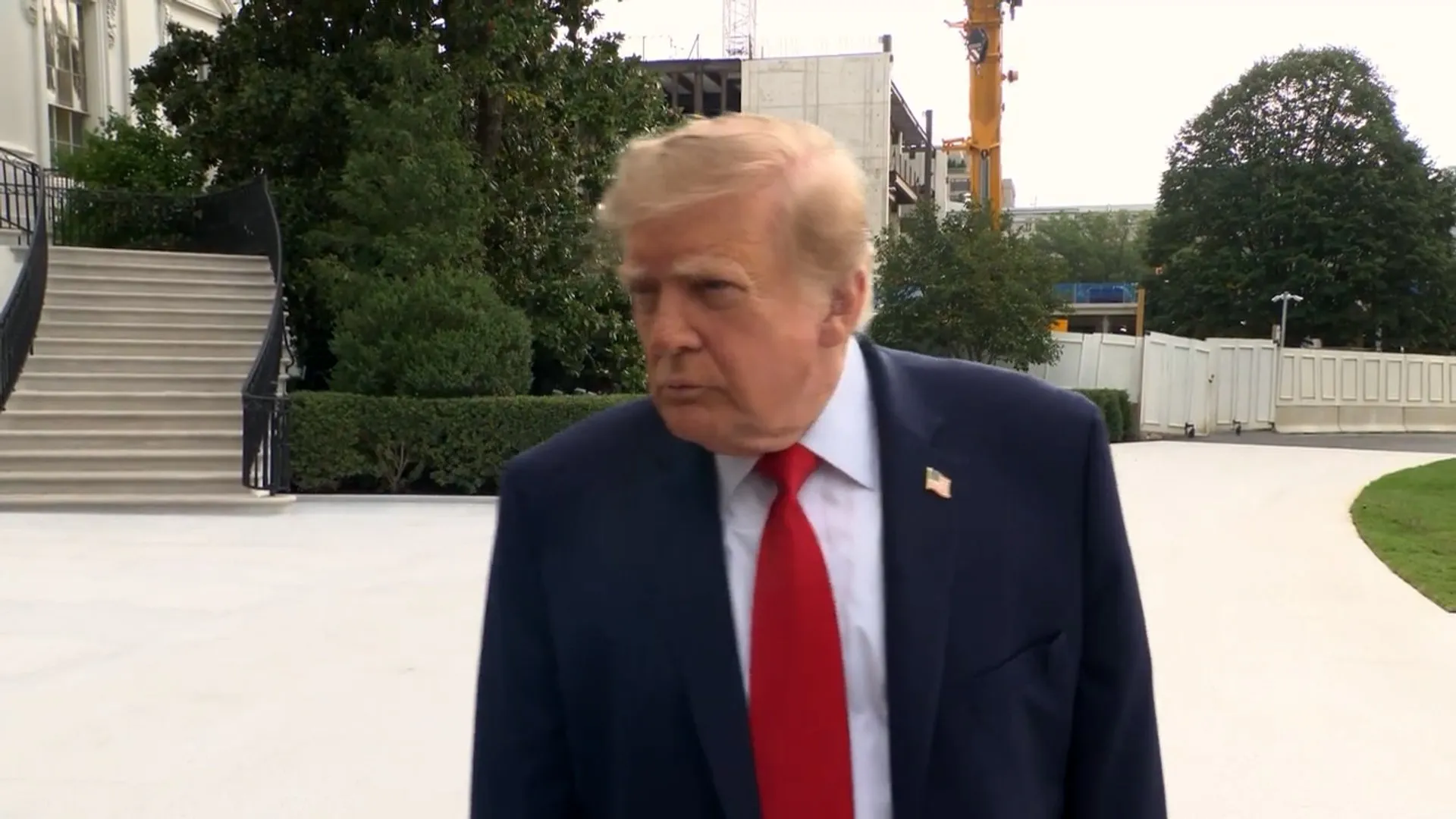
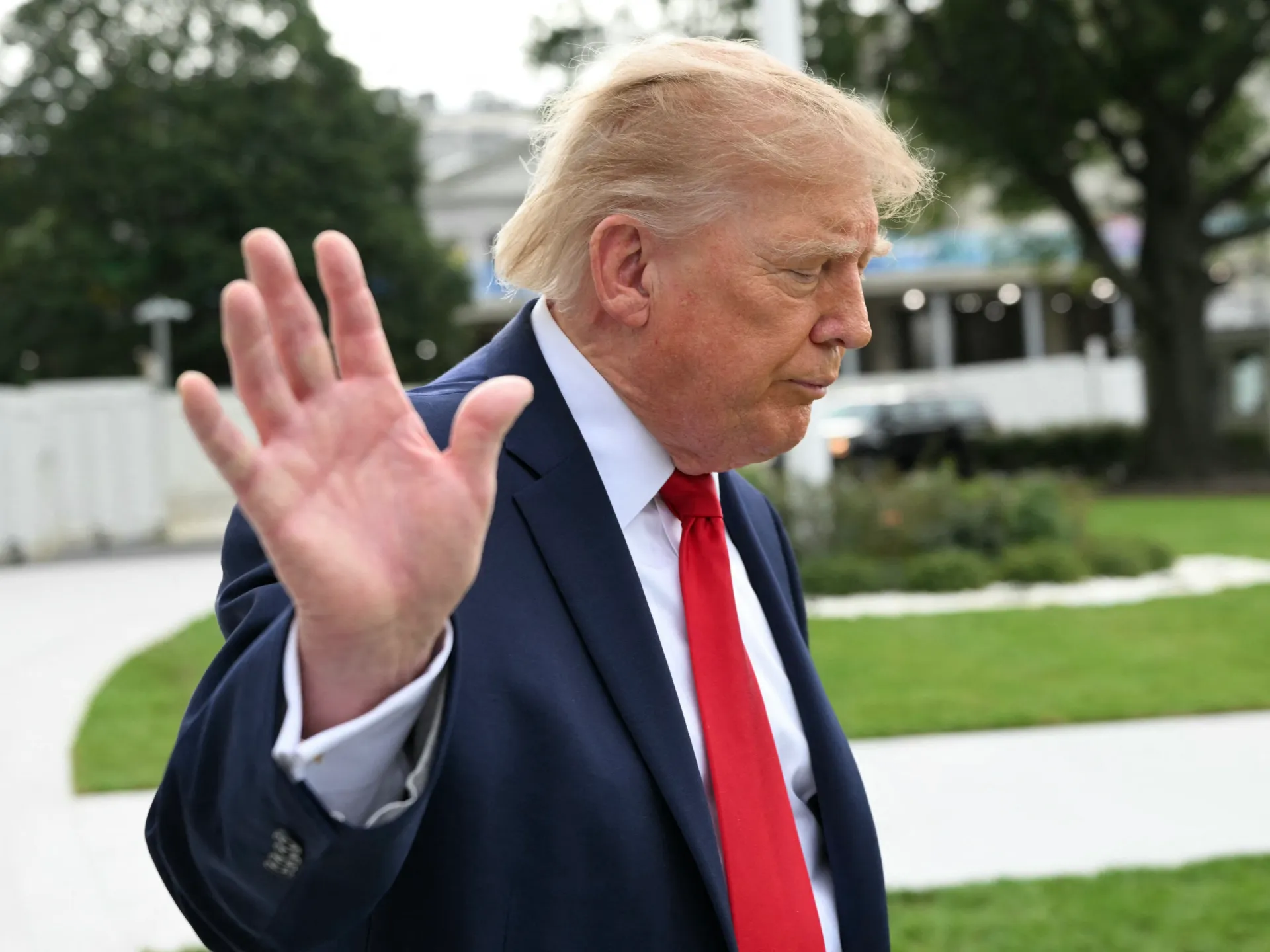
Anthropic CEO Dario Amodei is set to dine one-on-one with US President Donald Trump at the White House.
The meeting on Sunday evening, confirmed by Trump, comes after months of open conflict between the artificial intelligence startup and the Trump administration.
Recommended Stories
list of 4 itemsend of list
The private dinner would be the first one-on-one meeting between the two men, according to US media, including Axios, which first reported the dinner.
Trump confirmed the dinner on Sunday evening and reaffirmed his stance against slowing the pace of AI development.
Trump also reiterated his belief that new regulations would open the door for China to outpace the United States in AI advancement.
Although he acknowledged Amodei’s concern that going too fast on artificial intelligence could expand risks, Trump said it was more important for the US to maintain a technological edge over China.
“We’re about maybe a year and a half up on China,” Trump told Fox News while attending the Presidents Cup golf tournament in Illinois.
“We’re leading, and we’re building tremendous, trillions of dollars’ worth of places. And why should we give that up?”
The meeting comes two days after a federal appeals court upheld the Pentagon’s decision to classify Anthropic as a “supply chain risk”, which prohibits the US military from using its models.
The startup was sanctioned by the Trump administration after refusing in February to allow its tools to be used for fully autonomous weapons or domestic mass surveillance.
Trump also badmouthed Amodei, saying he was trying to be “a perfect little angel” after the Anthropic chief called for a pause in AI development.
Amodei was absent from the state dinner held for Chinese President Xi Jinping on Thursday, attended by AI industry leaders, including Amodei’s rival Sam Altman of OpenAI.
Despite mounting calls to slow down AI development due to the risk of losing control of the technology, the US government believes that the sector’s major players – OpenAI, Anthropic, Google, and Meta – cannot afford to slow down for fear that China will gain the upper hand.
Trump and Mike Johnson, the speaker of the House of Representatives, are set to meet with leading AI executives on Tuesday.
The nor’easter causes another round of flooding in low-lying areas in New Jersey and New York City and knocks out power to tens of thousands of homes into New England.
Published On 27 Sep 202627 Sep 2026
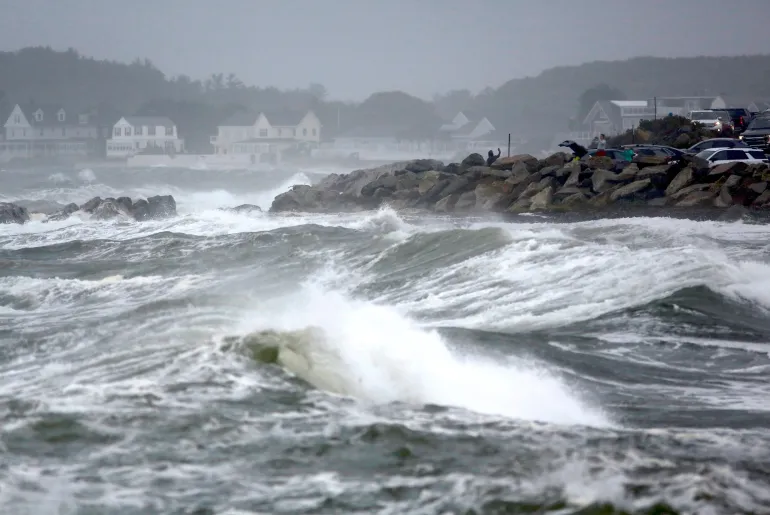
A powerful storm is pummelling the shoreline in the northeastern United States for a second day, causing another round of flooding in low-lying areas and knocking out power to tens of thousands of homes.
Tidal surges swamped low-lying neighbourhoods in New Jersey on Sunday, while wind gusts toppled trees on New York’s Long Island, damaging homes and bringing down utility poles.
Recommended Stories
list of 3 itemsend of list
In New York City, streets in the Howard Beach neighbourhood of Queens were inundated.
The slow-moving storm, which killed a New York City housing authority worker when a tree fell on Saturday, was expected to linger through Sunday, with heavy rain, strong winds and dangerous surf all the way to New England.
Extreme amounts of rain – more than 10cm (4 inches) since Friday in some spots in New Jersey – combined with a surging ocean led to flooding amounts not seen for close to a decade in places used to dealing with high water, residents said.
The storm, known as a nor’easter, triggered memories of Hurricane Sandy, which left behind more than $60bn in damage across the eastern US in 2012. While this storm’s impact has been nowhere near that, it could be the first of several along the East Coast this fall because of an El Nino climate pattern disrupting this year’s weather.
Images of waves crashing into sea walls and onto beaches raised concerns about coastal erosion.
More than 100,000 customers were without power across the Northeast and mid-Atlantic at times on Sunday, according to PowerOutage.us. The most widespread outages were in counties along the coast from New Jersey to Connecticut.
Numerous flights were cancelled or delayed up and down the coast. More than 250 flights had been cancelled at Boston Logan International airport by late Sunday morning as wind gusts reached 64km/hour (40 mph), according to the Massachusetts Port Authority.
The worst of the remaining rainfall was expected on Sunday from northern New Jersey into southern New England.
While the storm was gradually weakening, tidal flooding would stay through high-tide cycles Sunday night, said Bob Oravec, a lead forecaster with the National Weather Service in College Park, Maryland.
People watch the ocean as a nor’easter storm hits Rye, New Hampshire, US, on September 27, 2026 [Caleb Jones/AP Photo]
Cuba’s deputy foreign minister slams US sanctions, labelling them ‘equivalent to genocide’.
Published On 27 Sep 202627 Sep 2026
A senior official in Cuba has warned that any prospective United States military action taken against the island nation would constitute a serious international crime, and has rejected claims made by US President Donald Trump that Cuba is a failed state.
On Sunday, Carlos Fernandez de Cossio, the country’s deputy foreign minister, told the US cable television channel C-SPAN’s flagship programme, Washington Journal, that it would be an “atrocious international crime for the US to use military force against Cuba, which is a peaceful neighbouring country”.
His comments come after Trump said during his Tuesday speech at the United Nations General Assembly (UNGA) that “freedom will be coming” to the island. His remarks prompted the Cuban delegation to exit the assembly hall. On Saturday, Trump brought up military action, telling reporters, “I don’t think we’ll need the military. Cuba is failing very badly.”
Fernandez de Cossio said that coercing nations who do not “submit” by disrupting their commercial shipments, attempting to handicap a population through starvation, depriving it of stable healthcare and withholding fuel, as the US has “done for nine months now”, is “equivalent to a genocide”.
The US has maintained a foreign policy of maximum economic pressure against Cuba for more than 60 years. The Trump administration has previously said that it wants a shake-up in Cuba’s government. Earlier this year, the administration enforced an additional oil and fuel blockade against the island, which has crippled the nation’s infrastructure, causing widespread fuel scarcity and rolling power outages. Government officials in Cuba cited systemic difficulties in securing food supplies and other basic necessities for the country of more than 10 million.
Fernandez de Cossio said Havana must ready its citizens for the prospect of US military aggression, adding that while Cuba recognises it might stand alone, it will still exercise its legitimate right to self-defence.
He explained that bilateral diplomatic channels with the US remain open but have yielded minimal results due to the economic stranglehold of ongoing sanctions, adding that Havana remains willing to engage with Washington in a “respectful manner” only if discussions accommodate mutual dignity, benefit both populations, and respect state sovereignty.
Several countries condemned the US’s continued economic sanctions and blockade of Cuba during the UNGA earlier this week.
The two pandas, Ping Ping and Fu Shuang, arrived from southwestern China.
Published On 27 Sep 202627 Sep 2026
Two giant pandas, Ping Ping and Fu Shuang, have arrived in the US state of Georgia on a 10-year loan as a soft-power gesture from China.
A new agreement between Zoo Atlanta and the China Wildlife Conservation Association makes Atlanta one of three zoos in the US to house giant pandas.
The diplomatic gifts departed early on Sunday from Chengdu Shuangliu International Airport in southwestern China, according to Chinese state media. They arrived after the high-level three-day Washington summit with China last week, where closed-door talks between United States President Donald Trump and Chinese President Xi Jinping yielded no major policy breakthroughs on prickly issues such as AI, trade, Taiwan and the war with Iran.
Although the pandas’ transfer had been finalised back in April, Xi officially announced the arrival timeline on Thursday at the White House, noting that the black and white mammals could reach Zoo Atlanta from the Chengdu Research Base, China’s premier hub for giant panda conservation, breeding and research, within the next few days. The dispatch of the vulnerable species aimed to signal a renewed bilateral friendship between the leaders of the world’s two biggest economies.
Ahead of their arrival, Zoo Atlanta had upgraded its panda habitats and secured a stable, long-term supply of locally grown Atlanta bamboo, which shares a near-identical climate with Chengdu.
The bears completed a 16-hour charter flight across the International Date Line, landing in Atlanta, Georgia, shortly before 7:00am (11:00am GMT).
Midway through its journey through Alaska, the FedEx Boeing 777 had spiked to the top of Flightradar24’s global tracking charts.
Steamed corn buns, bamboo shoots and carrots were prepared to keep the pandas nourished during their flight, Chinese state-run media reported. The US also mobilised a specialised care team to accompany the duo on their flight, they said.
A spokesperson for the zoo told Al Jazeera that their team had “done everything possible to accommodate them”, but a definitive timeline for their arrival – much less their public debut – remains “unconfirmed”.
“This is a thrilling day for Zoo Atlanta and a historic moment for the City of Atlanta, the state of Georgia and beyond,” Zoo Atlanta President and CEO Raymond B. King said in a statement. “We are elated to welcome Ping Ping and Fu Shuang and could not be more excited about sharing that joy with our Members, guests, city and community in the coming weeks.”
Zoo visitors will have to wait a while to see Ping Ping and Fu Shuang, officials said. The bears will be quarantined for about a month in a biosecure area of the wildlife park’s new giant panda complex. The zoo last had pandas in 2024.
Ping Ping, a male, and Fu Shuang, a female, were born in 2020.
Globally revered, the iconic furry animals have been sent across the globe for decades, serving as diplomatic emissaries loaned by China under its infamous “panda diplomacy” initiative through soft-power projection. Beijing leverages the animals’ immense public appeal to cultivate international goodwill, seal lucrative trade deals and burnish its geopolitical image abroad. Similarly, when foreign relationships fray or tensions arise, Beijing lets the loan agreements expire.
Xi has said this latest loan programme was an example of “friendship between the Chinese and Americans”.
Last week’s summit was Xi’s first visit to Washington in more than a decade and the second meeting this year with Trump.
Tangible outcomes of the meetings remain modest, restricted to a two-month extension of the trade truce, Beijing’s revival of giant panda loans and Xi’s support for Trump’s rebranding of artificial intelligence as “super intelligence”.
Tehran, Iran – Hours after US President Donald Trump rejected a diplomatic solution put forward by Iran to reopen the Strait of Hormuz, explosions were heard in the waterway, according to Iranian media.
Reports of blasts near southern Iran’s Qeshm Island in the Strait of Hormuz suggested that multiple antiship missiles and drones were fired at vessels transiting the waterway against Tehran’s wishes.
Recommended Stories
list of 4 itemsend of list
While Iranian authorities did not confirm any attacks in the Strait of Hormuz that day, shipping continues to be attacked in the waters, including an Indian cargo ship last week, which killed a sailor.
The Islamic Revolutionary Guard Corps (IRGC) maintains that the strait is closed to any ship that does not coordinate with Iranian authorities. On Sunday afternoon, it released video of what it said was a second US underwater drone seized this month.
Tehran has issued instructions to shipping companies transiting the Strait of Hormuz to use a temporary route approved by Iranian authorities and pay relevant fees. But it has also said the strait will not fully reopen until the US blockade on Iranian ports ends.
Iran’s Persian Gulf Strait Authority announced on Saturday that it would blacklist any shipping charterer company which orders crews to use routes it considers to be unauthorised.
It also published what it described as an apology from an unnamed shipowner blaming commercial pressure from its charterer for trying to pass through the strait.
Washington still insists that its warships are successfully guiding oil tankers out of the strait via a different route. US Energy Secretary Chris Wright told Fox News on Sunday that the “running average” of crude oil in transit was nearly 13 million barrels per day.
A September 19 operational update by US Central Command claimed that its forces had helped move more than one billion barrels of crude out of the Gulf over roughly two months.
The US military also says its forces have redirected 122 commercial vessels to enforce the naval blockade of Iran’s ports, halting all Iranian crude exports.
Tehran has claimed that the US is providing false information regarding Strait of Hormuz traffic to project control over the key waterway. Shipping has been severely disrupted since the US and Israel started their war on Iran on February 28.
Andreas Krieg, associate professor at King’s College London, said Iran’s strategy of launching maritime attacks has spread the economic costs of the conflict beyond its borders.
While Iran has suffered economically from war damages, the US naval blockade and sanctions, it would be a mistake “to assume that reaching that threshold produces submission”.
“The next Iranian move is therefore likely to be an attempt to increase the pain experienced by the Gulf rather than simply absorb further American pressure,” Krieg said.
“That could mean more aggressive vessel interdictions in Hormuz, attacks on energy infrastructure, greater Houthi pressure around Bab al-Mandeb and pressure from Iranian-aligned groups against alternative Saudi export routes. We are already seeing how pressure on Hormuz, the Red Sea and Saudi infrastructure can interact.”
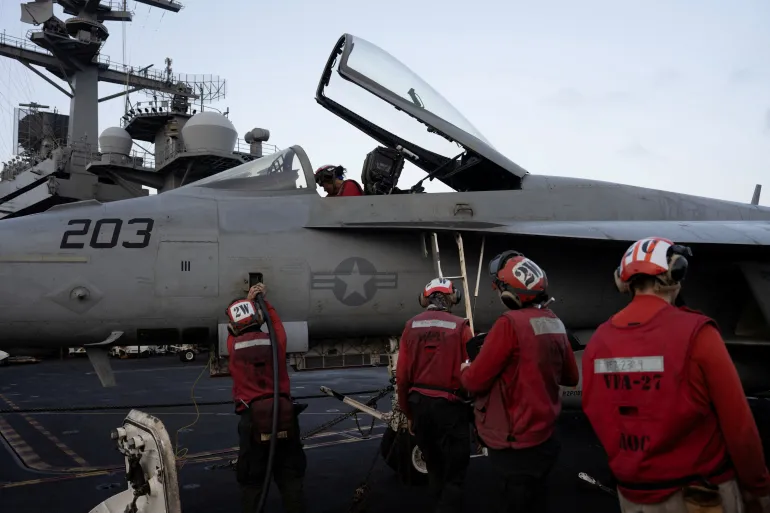
The flight deck of the USS George Washington aircraft carrier in the Arabian Sea, September 11, 2026 [Ed Ou/Reuters]
More escalation on the way
At the United Nations General Assembly in New York, Iran projected a message of defiance while also proposing to reopen the Strait of Hormuz within a week if its seven conditions were met.
They included lifting the blockade on Iran, the release of frozen Iranian funds and an end to attacks on all fronts, including Israel’s assault on Lebanon. The demands mostly amounted to a return to the June memorandum of understanding between the US and Israel.
Tehran has added that reopening the strait must be undertaken through a bilateral arrangement already finalised with Oman, the only other country with territorial waters in Hormuz.
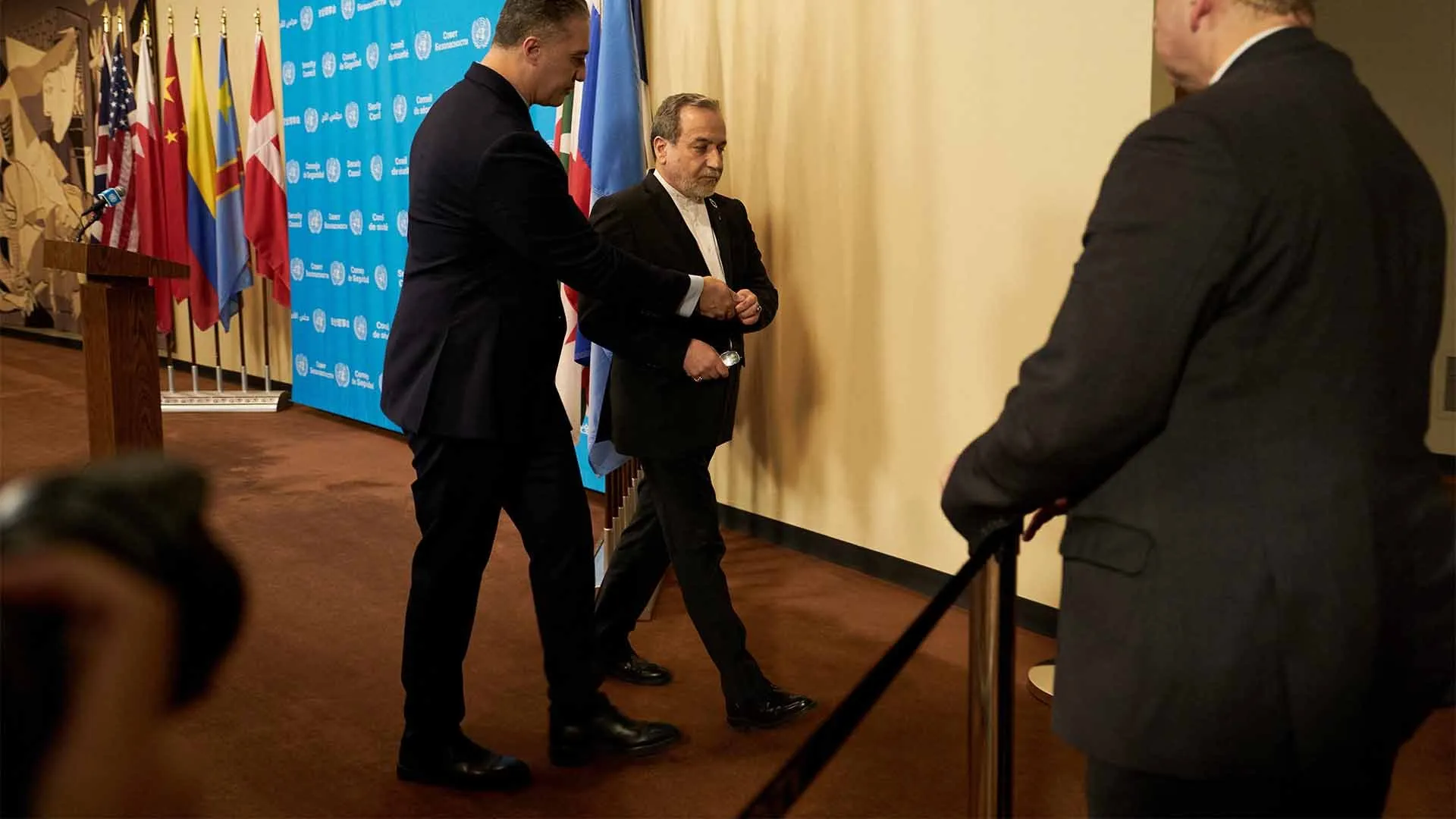
US President Donald Trump told reporters he rejected the offer, but Iran’s Foreign Minister Abbas Araghchi said on Sunday they were adamant about the conditions and would await an official response through mediators, such as Pakistan, Qatar and Oman.
Abolfazl Shekarchi, chief spokesman of the Iranian armed forces, warned that if the US further intervenes in the Strait of Hormuz, “it will get slapped”.
“The Americans have no way out other than withdrawing from the West Asia region. The sooner they leave, the fewer losses they will incur and the region will certainly become safe after that,” he said.
Iranian army spokesman Mohammad Akraminia said conditions were deteriorating so badly for the US that it might launch another “military aggression” on Iran.
Krieg said that as the US moves to isolate Iran via sanctions, Tehran, unable to respond with mutual financial measures against Washington, will be forced to rely on continued coercion in the Strait of Hormuz.
“The most likely level remains controlled attrition rather than an immediate return to the massive air campaign of the opening months,” Krieg said.
“Over the coming weeks, I would expect further attacks or attempted attacks on tankers, US-enabled shipping and regional infrastructure, followed by limited US strikes against IRGC maritime assets, coastal missile positions, drones or vessels involved in those operations. That tit-for-tat cycle has already re-emerged around Hormuz.”
Memorial crosses installed in Washington DC have revived erroneous claims of a ‘white genocide’ against farmers in South Africa, a narrative echoed by US President Donald Trump. South Africa’s government rejects the allegation as baseless, saying crime and violence affect people across all racial groups.
Donald Trump has rejected Iran’s latest proposal to end the war and reopen the Strait of Hormuz as experts say the United States president believes Washington has more to gain by waiting than by accepting Tehran’s terms at this moment.
“I reject their proposal,” Trump told reporters on Saturday, arguing that Iran wants an agreement because it is “losing so badly”.
Recommended Stories
list of 3 itemsend of list
“They want to make a deal, and I think that’s fine,” Trump said. “I’d like to make a deal too. But that deal would not be acceptable.”
On Sunday, Iranian Foreign Minister Abbas Araghchi said Tehran had seen the initial reaction from Trump to its proposal but had yet to receive a response through mediators. In the latest diplomatic efforts, Qatar has played a role in mediating talks between Iran and the US on the sidelines of the United Nations General Assembly meeting in New York.
Iran’s seven-day proposal included Washington lifting its naval blockade of Iranian ports, waiving sanctions on Iranian oil sales, releasing an estimated $12bn in frozen Iranian assets and observing a wider regional ceasefire, including in Lebanon and Yemen.
Iran would then reopen the Strait of Hormuz and begin negotiations with Washington on a final agreement.
The latest proposals are similar to the June memorandum of understanding (MoU) the two countries signed. But the MoU collapsed last month due to differences on the terms of the deal, which resulted in an escalation in attacks, particularly in and around the Strait of Hormuz, which essentially remains under Iranian blockade.
According to experts, Trump’s rejection suggested that while both sides continue to publicly leave the door open for diplomacy, they remain far apart over who should make the first concessions.
“Trump’s calculation looks fairly straightforward. He believes the combination of the naval blockade and economic isolation is finally squeezing Iran hard enough that Tehran’s latest proposal is evidence of weakness rather than an offer Washington needs to seize,” Andreas Krieg, associate professor at King’s College London, told Al Jazeera.
His public argument that Iran is “losing badly” is important because it suggests he thinks time is improving the US bargaining position, Krieg said.
(Al Jazeera)
Why does Trump think he can wait?
A key part of Trump’s calculation appears to be a belief that the economic pressure on Iran has not yet run its course.
The Trump administration has escalated economic pressure on Tehran, tightening its naval blockade while imposing sanctions targeting Iranian oil revenues and threatening secondary sanctions against countries doing business with Tehran.
Last week, the US imposed aviation sanctions on Iran, disrupting flights. This came weeks after US Treasury Secretary Scott Bessent announced an economic pressure campaign against Iran, promising to target Tehran’s financial interests across the world.
Richard Weitz, a senior nonresident associate fellow at the NATO Defence College, told Al Jazeera that the White House may believe it can “wait a bit and get better terms”.
There is also concern in Washington about Iran’s proposed sequencing, he said.
Therefore, Weitz said Washington may be calculating that “economic pressure over time will induce the Iranian government to make more concessions”.
“This is what occurred arguably a decade ago, leading to the 2015 Iran nuclear deal as the Iranian government decided it [the US] needed to end the economic sanctions in return for making concessions on its nuclear programme,” he added.
It is, therefore, possible that “we could see the same kind of trade-off in the coming months”.
Iran could make Trump ‘pay’
However, waiting for a deal also carries considerable political risk for the US president, experts said, because his Republican Party could lose November’s midterm elections.
A late August Reuters/Ipsos poll suggested 63 percent of Americans opposed the US-Israel war on Iran while 31 percent supported it. Rising fuel and transportation costs could also feed into broader cost-of-living concerns before the elections.
The problem for Trump is that time does not only increase pressure on Iran, Krieg said. “The gamble is that time cuts both ways,” he noted.
With the midterms approaching, Trump does not want to appear to lift the blockade, waive oil sanctions and release Iranian assets simply to regain access to a waterway that Iran itself disrupted, Krieg said.
“But every additional week also means elevated energy prices, continued military exposure and mounting pressure on Gulf partners.”
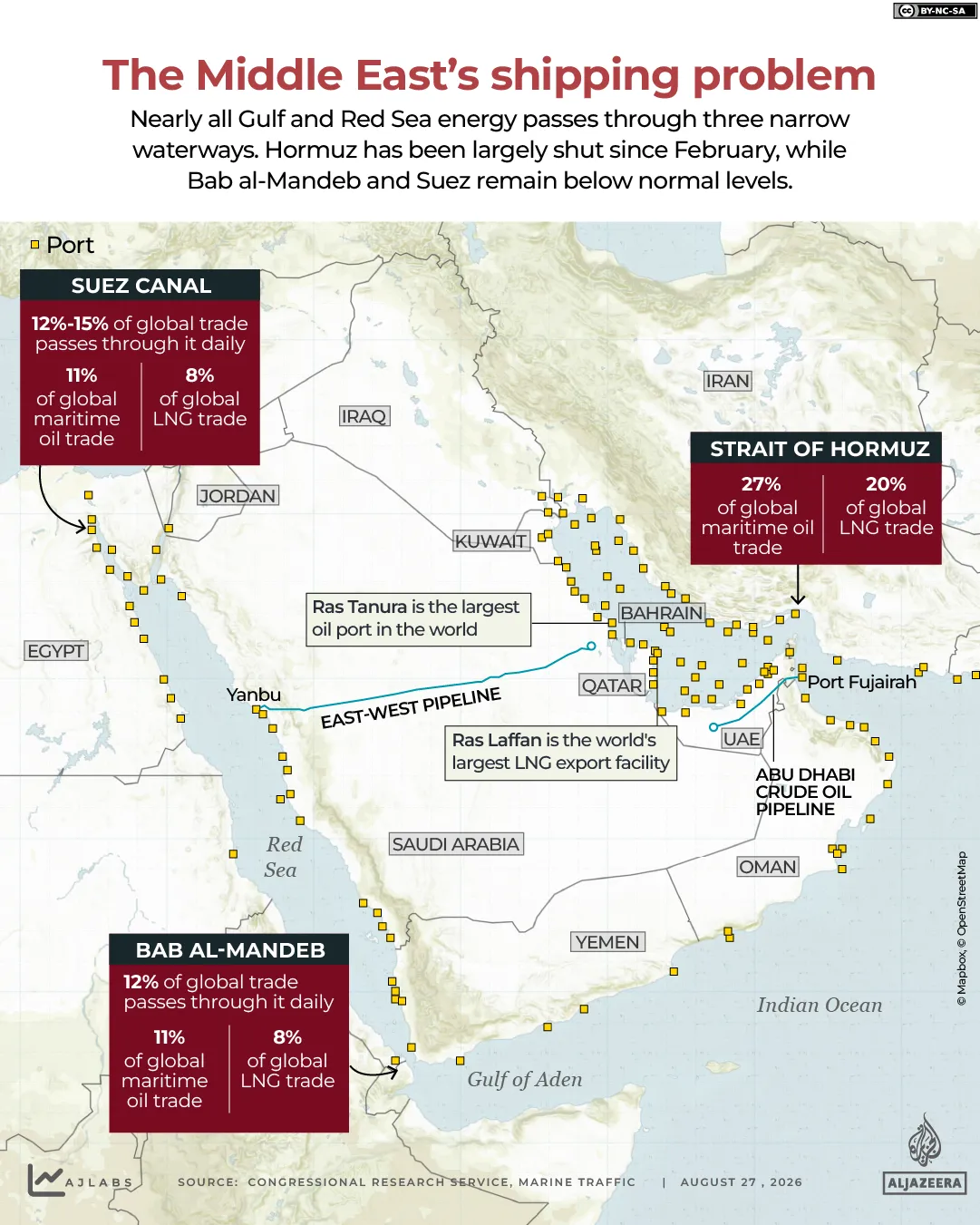
The essential closure of the Strait of Hormuz has disrupted oil and gas flows from the Gulf nations, which depend on energy exports to finance their budgets.
Mohamad Elmasry, a professor at the Doha Institute for Graduate Studies, told Al Jazeera that Iran’s proposal could be viewed as “kind of throwing a bone to Trump” by offering a potential route towards lower oil and gas prices before the vote.
However, Iran may decide “to make Trump pay for declining the proposal and the increased economic pressure the country is under”, he told Al Jazeera.
“They may decide that this is the time to escalate … just as the midterms are approaching.”
The Republican Party is not doing well in the polls, and a number of its candidates are “distancing themselves” from Trump, he noted. Polls indicated that Republicans could lose their slim majorities in the US Congress.
It’s not just the Iranians under severe economic pressure because of the US naval blockade and ongoing sanctions, “it’s also the Trump administration,” Elmasry said.
Trump’s wait for more Iranian concessions could ‘backfire’
Trump “wants Tehran to reopen Hormuz without Washington paying the full economic and political price Iran is currently demanding”, Krieg said.
“The danger is that he is confusing Iranian pain with Iranian willingness to capitulate. Those are not the same thing.”
Iran is undoubtedly under pressure. Krieg said the sanctions and blockade are “biting”, which is precisely why Tehran needs an agreement.
But additional pressure does not necessarily produce additional concessions.
Iran could instead increase the costs of the conflict for its adversaries, Krieg said, including through the Strait of Hormuz, regional infrastructure and potentially Bab al-Mandeb, another strait between Yemen and the Horn of Africa.
In recent weeks, the strategic weight of Bab al-Mandeb has increased dramatically after the Iran-aligned Houthis expanded their control of Yemen’s Red Sea coastline.
This advance in effect has handed the Houthis unrestricted access to the narrow waterway, a worrying development for global shipping given the group’s track record of targeting vessels, including Israeli-linked ships, in solidarity with Palestinians in Gaza.
The Houthis have already declared a naval blockade on Saudi ships in the Red Sea, which Riyadh began to use as an alternative shipping route to Hormuz for its oil exports.
“So this can backfire,” Krieg warned. “Trump thinks Iran’s clock is running faster than America’s. Tehran thinks the opposite: that Qatar, Saudi Arabia, the UAE, global energy markets and ultimately Trump himself have a lower tolerance for prolonged disruption than Iran has for economic punishment.”
Ross Harrison, a senior fellow at the Middle East Institute, similarly told Al Jazeera that Tehran may now be “less worried about overplaying their hand than they are underplaying their hand”.
According to Harrison, Tehran now sees the risk of escalation as less costly than agreeing to something prematurely or appearing willing to compromise, particularly after Washington’s response to the proposal.
In an interview with Al Jazeera that aired on Saturday, Iranian President Masoud Pezeshkian said his country no longer trusts negotiations with Washington after attacks occurred during previous rounds of talks and were followed by sanctions.
“We have no trust in the American side and do not know on what basis an understanding can be reached with it,” Pezeshkian said.
Tehran betting ‘heavily’ on time
US-based analyst Harrison noted that Tehran was probably “not surprised at all” by Trump’s rejection and viewed the offer partly as a way to demonstrate to Iranians and the American public that it remained willing to negotiate.
Experts said Tehran understands the US president wants an exit he can present as a victory.
“Iran is betting heavily on time. … Its strategy is to keep the pressure high enough that he eventually comes back to negotiations while making that exit progressively more expensive,” Krieg said.
“The Iranian calculation is essentially: Do not give Trump the deal cheaply when he may need it more badly several weeks or months from now.”
Harrison said the Iranian offer was a “show of goodwill” intended to demonstrate Iran’s willingness to negotiate to both its domestic audience and the American public.
According to Krieg, “protraction” of the conflict was the “most likely outcome”.
“Both sides need a deal, but both currently think waiting will improve the deal they eventually get,” he added.
Two women reportedly injured in blast in Athens’ historic Plaka district, buildings evacuated.
Published On 26 Sep 202626 Sep 2026
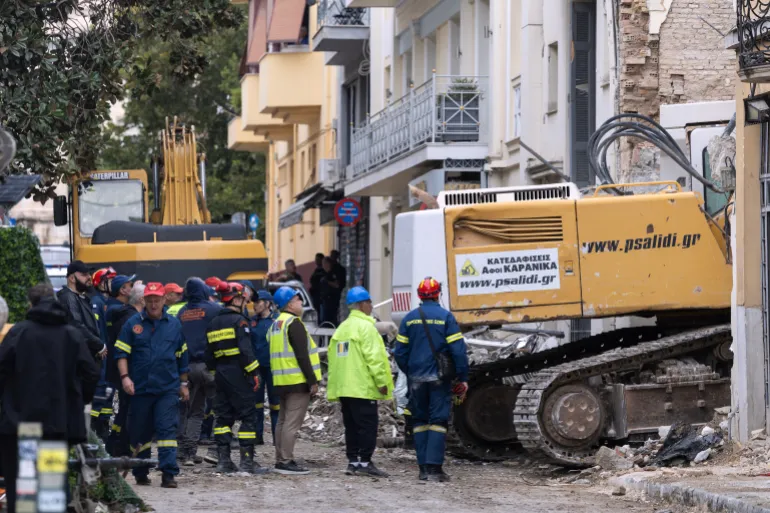
Rescue teams have recovered the bodies of six people killed in a building collapse following a a blast in the historic centre of Athens, Greece, according to local authorities.
Documents and belongings found with four of the victims – two men and two women – on Saturday indicated they were United States citizens, Greek state broadcaster ERT and other local media reported.
Recommended Stories
list of 3 itemsend of list
The other two victims were reportedly an elderly couple, a British man and a Greek woman, who lived on the building’s second floor.
Two women were injured in an adjacent building, according to the fire department.
The blast that brought down the small, two-storey building in the popular tourist district of Plaka on Friday was believed to have been caused by a major gas leak, Athens Mayor Haris Doukas said. Neighbouring buildings were damaged and evacuated, he said.
“The damage extends to the entire street as well as the street behind [the building],” Doukas said. “We are talking about an unimaginable catastrophe.”
Two adjoining buildings severely damaged might have to be demolished, he said.
The Greek daily newspaper Kathimerini reported on Friday that the four tourists, who were due to leave their accommodation at about 11:00am (08:00 GMT), failed to board their flight back to the US.
Rescuers work at the scene on September 26, 2026, one day after a powerful blast hit Athens’ Plaka district [Yorgos Karahalis/AP]
Plaka residents issued warning
A group of Plaka residents had alerted the municipality and the managers of the electricity and gas networks about the risks of short circuits or gas leaks in the area a year ago.
In a letter published by Kathimerini, the group called for the organisation of a security exercise to identify any potential shortcomings in the emergency response system.
The citizen movement “We Remain Active” also stated on social media that a resident of the street where the explosion occurred had reported a smell of gas for several weeks and had warned the authorities.
A Greek police spokeswoman confirmed on ERT that residents had made the report. However, the nature of the substance and its origin have not yet been determined.
Plaka lies at the foot of the Acropolis, Greece’s most visited ancient monument.
Authorities warn residents that extreme conditions could pose risks and urge people to stay away from flooded areas.
Published On 26 Sep 202626 Sep 2026
Residents of the northeastern United States are facing a powerful storm known as a nor’easter that has knocked out power and caused flooding across the region.
The storm has led to the cancellation of more than 400 flights and power outages affecting more than 88,000 homes and businesses as of Saturday afternoon local time. That figure is down from a high of 119,000 earlier in the day.
Recommended Stories
list of 3 itemsend of list
Bob Oravec, lead forecaster with the National Weather Service in College Park, Maryland, said that the storm is likely to persist, with “a lot of high winds, a lot of high tides and heavy rain possibility over the next few days for the northeastern US”.
The governors of New York and New Jersey declared states of emergency in counties expected to see the worst of the storm, including New York City, on Friday.
Large puddles and debris line a walkway in the Dumbo neighbourhood in Brooklyn as a nor’easter moves through the area on September 26, 2026 in New York [Spencer Platt/Getty Images via AFP]
Authorities have also warned residents about the risks of flooding and high tides, cautioning people to stay away from the beach and areas inundated with water.
“Anyone who goes in or near the water this weekend is literally gambling with their life,” New York Governor Kathy Hochul said.
Despite the warnings, people have been seen kayaking down flooded streets in Long Island, New York, while others took advantage of large swells in Hampton, New Hampshire.
“In all the canals, the water is up really high and coming into people’s back yards,” Jay Boyd, a resident of Ocean City, Maryland, told The Associated Press news agency.
Oravec said that nor’easters are not unusual as the region of New England enters the autumn season, but that “this might be a little earlier than average for a big storm”.
A surfer catches a wave as a nor’easter batters the US northeast coast, in Rockaway, New Jersey, on September 26, 2026 [Caitlin Ochs/Reuters]
About 425 flights have been cancelled and 1,338 delayed so far on Saturday, according to data from the flight tracker FlightAware.
Concerts and sporting events have also been cancelled, including musician Ed Sheeran’s scheduled shows in the state of Massachusetts on Friday and Saturday.
The US president said he would end a so-called ‘EV mandate’ that steered consumers to electric vehicles.
Published On 26 Sep 202626 Sep 2026
United States President Donald Trump has announced new fuel economy standards that roll back requirements adopted under his predecessor, arguing they will lower automobile prices and encourage manufacturers to expand production in the US.
In a social media post on Saturday, Trump said the new standards would “TERMINATE” what he called former US President Joe Biden’s “EV (electric vehicle) mandate”, accusing the previous administration of imposing costly requirements on carmakers and steering consumers towards electric vehicles.
Recommended Stories
list of 3 itemsend of list
“These new Standards will take the waste out of building cars in America. That means LOWER PRICES, saving families thousands on a new, beautiful, and safe car,” Trump wrote.
The changes form part of a broader Trump administration effort to reverse Biden-era policies supporting lower-emission vehicles, increasing the gap between US policy and global trends favouring electric vehicles.
While Trump and US Republicans have used the term “EV mandate” to describe higher fuel efficiency requirements instituted under Biden, a Democrat, there are no federal guidelines or laws that require Americans to buy electric cars or bar the sale of ones powered by petrol.
At the centre are Corporate Average Fuel Economy (CAFE) standards. This system, established by the US Congress in 1975, requires automakers to meet average fuel economy targets across all cars and light trucks they sell, meaning that a brand that sells an inefficient vehicle would also have to sell a more efficient one to help comply with the government’s standards.
Under rules finalised by the Biden administration in 2024, the required fleetwide fuel economy was scheduled to rise from 39.1 miles per gallon (mpg) to about 50.4mpg by 2031. The administration said then the measures would reduce fuel consumption and emissions to combat climate change while helping motorists save money at the pump.
As a result, auto manufacturers have ramped up production of EVs to help meet the Biden-imposed fuel economy requirements. The Republican-controlled US Congress, however, gutted consumer tax incentives last year for electric vehicles as part of Trump’s One Big Beautiful Bill Act.
Trump did not provide details regarding what the new fuel economy standards would be. But in December 2025, he announced a proposal that would set the industry fleetwide average for light-duty vehicles at roughly 34.5mpg by 2031, more than 30 percent lower than the Biden-era rule.
In a reposting of Trump’s announcement, US Transportation Secretary Sean Duffy said an announcement would be “COMING MONDAY”.
Al Jazeera has reached out to the White House for comment.
US President Donald Trump has rejected Iran’s latest proposal to reopen the Strait of Hormuz to shipping. Speaking to reporters at the White House, Trump insisted Tehran was attempting to strike a deal because “the money isn’t coming in” under an American naval blockade.
United States President Donald Trump has rejected a roadmap submitted by Iran to open the Strait of Hormuz within a week.
“I reject their proposal,” Trump told reporters outside the White House on Saturday, before departing for Tennessee by helicopter.
Recommended Stories
list of 3 itemsend of list
Iranian Foreign Minister Abbas Araghchi said on Friday that Tehran formally submitted a seven-day roadmap to the US via mediator Qatar, and was awaiting Washington’s response.
“It appears as though the proposal is dead in the water,” said Al Jazeera’s Mike Hanna, reporting from Washington, DC.
Trump was “privately sceptical” that Tehran would meet his demands, and reportedly told aides that he expects a renewed bombing campaign on Iran after the November US midterm elections, The Wall Street Journal reported, quoting unnamed US officials.
“President Trump has vacillated between extreme optimism, saying that ‘talks are going well’ to ‘I want to annihilate Iran’,” Hanna said about the recent diplomacy between Washington and Tehran.
“There is no consistency in terms of the [Trump] administration’s reaction,” he said.
But “the one thing that has been made clear by President Trump is that he is content to stay in the status of limbo”, Hanna added, despite concerns from much of the American public that the Iran conflict is turning into another “never-ending war”.
The Strait of Hormuz, a waterway key to the world’s oil supply, is central to the conflict between the US and Iran, which is at an impasse after nearly seven months, though new mediation efforts took place this week.
Earlier in the week, Araghchi held talks with Trump’s envoy Steve Witkoff, and previously set out conditions for ending the war and reopening the vital shipping channel.
On Friday, the top Iranian diplomat said: “Iran has conveyed to the United States, through Qatar, a concrete seven-day plan. If the necessary conditions are met, the strait can be reopened, and normal maritime passage restored within seven days.”
He was speaking at the United Nations in New York, where he and other senior Iranian officials were attending the General Assembly.
Under the plan, Washington would lift its naval blockade of Iranian ports, waive sanctions on Iranian oil sales, release an estimated $12bn in frozen Iranian assets and observe a ceasefire covering the region, including Lebanon and Yemen.
“The choice now rests with the United States. Iran does not accept coercion, threats or intimidation, and Iran will not surrender its sovereign rights under pressure,” Araghchi had said.
On Saturday, Iranian President Masoud Pezeshkian told Al Jazeera that Tehran no longer trusts negotiations with the US after previous rounds of talks were followed by attacks and sanctions.
“We have no trust in the American side and do not know on what basis an understanding can be reached with it,” said Pezeshkian, who was also in New York for the UNGA.
He denied that Iran was responsible for blocking the Strait of Hormuz, saying the US “closed the routes before us”. He described the closure as “a natural response when routes are cut off to Iran”.
The Iranian president said the crisis could be resolved through negotiations rather than force, and that the waterway would reopen to commercial shipping if talks ended the war.
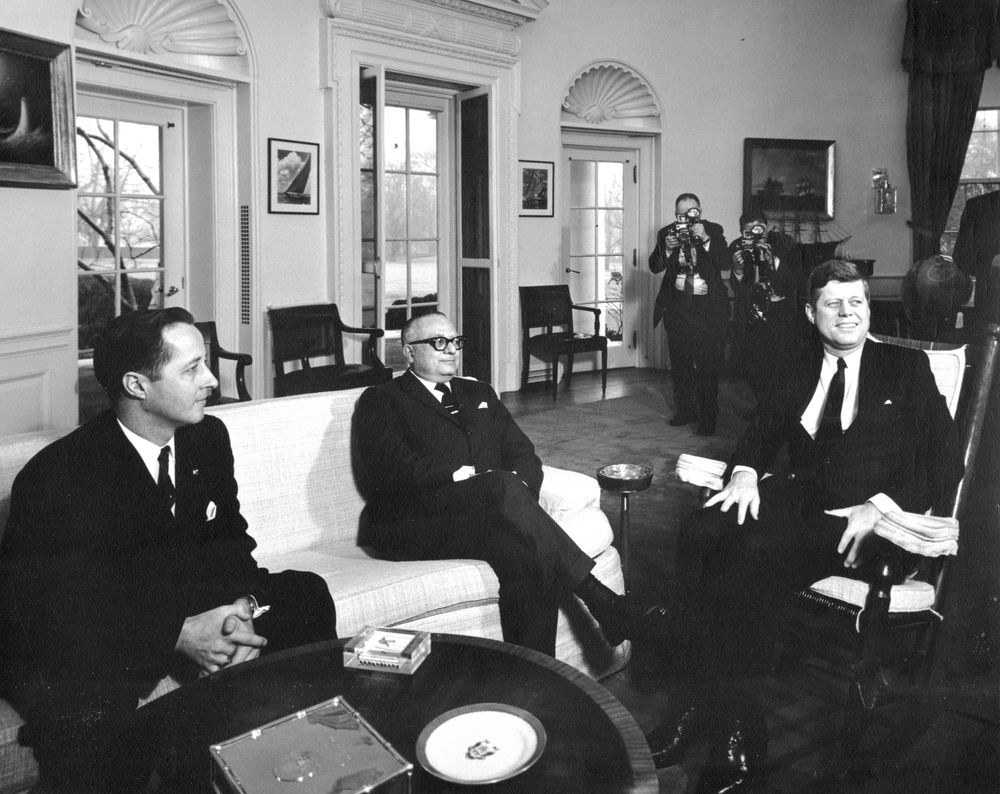
John F. Kennedy receives Betancourt in the Oval Office on February 19, 1963. White House photograph by Abbie Rowe, JFK Presidential Library and Museum.
In 1898, the United States entered Cuba promising to liberate a nation; the subsequent occupation and the Platt Amendment ultimately granted it the right to intervene in the country’s affairs. A century before chavismo, Juan Vicente Gómez found a different formula: domestic order, foreign capital, and oil, all while leaving the citizenry out of the equation. Rafael Osío Cabrices and Marcus Golding have revisited both precedents to reflect on the Venezuela that would emerge after January 3. These two mirrors are uncomfortable, yet they are not the only ones; a third exists—also born of the relationship between Venezuela and the US—though it is based on a different idea of how to build stability.
During the 1950s, Venezuelan social democrat leader Rómulo Betancourt wrote from exile to convince Washington that its policy toward Latin America was based on a flawed premise. While military dictatorships might declare themselves anti-communist and guarantee a certain level of stability, repression, inequality, and a lack of civic participation paved the way for the very radicalization the US wished to contain. A democracy capable of enacting social reforms could serve as a more reliable ally.
This wasn’t Betancourt’s idea alone. Within the US government, there were already officials who viewed reformist forces as a more effective bulwark against communism. Betancourt’s own contribution lay elsewhere: articulating this argument from within Latin America and attempting to prove its validity while in power. Research by Steven Schwartzberg shows that this approach had begun even before the long exile triggered by the 1948 coup.
Upon returning to Venezuela after January 23, 1958, Betancourt did not ask the White House to build Venezuelan democracy. The major political parties agreed on rules for coexistence and the country held elections, which he won. His government undertook agrarian, educational, and social reforms starting in 1959, all while facing military conspiracies, guerrilla violence, and hostility from neighboring dictatorships. There were abuses, restrictions on civil liberties, and incomplete results. It was not a conflict-free democracy, but a democracy struggling to survive.
Both voting and finding a way out of the economic crisis remain priorities that oil alone cannot resolve.
That experience bolstered Betancourt’s argument before Washington. A State Department report from the time described Venezuela as a hemispheric leader in promoting social reform and economic development within a constitutional framework. This foreign alliance rested on a domestic political foundation: it did not rely solely on oil or on a shared stance against a common enemy.
The Cuban Revolution had made this discussion more urgent since January 1959. Upon arriving at the White House in 1961, John F. Kennedy understood that anti-communism alone was insufficient, and he found an exceptional partner in Betancourt. The Alliance for Progress sought to link development, social reform, and representative democracy. When Kennedy visited Venezuela in December 1961, the two governments issued a joint declaration framing economic cooperation within the context of “the effective practice of representative democracy.” Democracy was not a destination to be reached only when conditions became more favorable. It was an integral part of the journey itself.
1961 versus 2026
We can’t idealize that era. The Alliance for Progress yielded uneven results, and the US continued to tolerate dictatorships when it served its interests. Years later, Betancourt would welcome Jimmy Carter’s emphasis on human rights—as Guillermo Ramos Flamerich notes—precisely because such a stance had never been a constant in US foreign policy, which has historically oscillated between democratic values and the immediate benefits of partnering with governments capable of maintaining order.
That tension has returned. Democratization expert Thomas Carothers argues that the Trump administration has departed from five decades of bipartisan US commitment to promoting democracy, adopting policies that favor autocratic regimes instead. Other intellectual figures such as Ricardo Hausmann and Paul Krugman have also questioned the direction of the process: Hausmann warned that if Trump does not facilitate the transition, Venezuelans will have to oppose his strategy; Krugman criticized the agreement with former members of the Maduro government while the democratic opposition is sidelined.
For her part, María Corina Machado continues to regard Trump as a “key ally” but calls for a democratic transition. Nor does Venezuelan society appear willing to trade its vote for a promise of stability: an in-person poll cited by the Financial Times found greater optimism following Maduro’s removal on January 3, but also revealed that the majority wanted free elections in 2026. After the electoral fraud of July 28, 2024, both voting and finding a way out of the economic crisis remain priorities that oil alone cannot resolve.
On July 24, 2026, Donald Trump stated in the Oval Office that Venezuela was “not yet” ready to hold elections. He praised the “fantastic work” of Delcy Rodríguez and linked his assessment of her to the volume of oil the country is shipping—according to the Republican president—to the US. On September 2, he reiterated that Venezuelans were not ready, while Rodríguez avoided setting an election date during a press conference focused on oil deals.
The solution, however, does not lie in waiting for Trump to become Kennedy. Betancourt did not simply wait for a sympathetic US president, either.
The difference compared to 1961 lies in more than just words. Kennedy and Betancourt framed their cooperation within a shared democratic commitment. Current rhetoric allows oil interests to advance in the present while democracy waits for an undated future. This does not mean Washington has permanently abandoned the idea of Venezuelan elections, but it does reveal its priorities: barrels can be counted, legitimacy can be deferred.
This exemplifies what I termed “asymmetric reconstruction” in a previous article for CEBRI: the recovery of certain economic and geopolitical capabilities, while institutions, rights, and public wellbeing progress at a different pace. Here, the warnings of Osío Cabrices and Golding converge. An intervention can displace the actors who fought for democracy; an opening of the oil sector can coexist with opaque deals, unelected authorities, and power structures that have learned to survive by switching partners.
The solution, however, does not lie in waiting for Trump to become Kennedy. Betancourt did not simply wait for a sympathetic US president, either. He organized a political party, built consensus within Venezuela, formulated a vision for the country, and then sought to alter Washington’s calculations. He understood that while a nation like ours cannot dictate the priorities of a major power, it can present itself to that power as a political actor rather than merely as available territory.
The United States’ best ally will not be the most obedient Venezuela.
Venezuela can once again become a solid ally of the United States. To achieve this, it requires competitive elections with a set date; institutions capable of protecting rights, providing services, and managing resources; and an economy that transforms investment into a better life for its citizens. Oil-driven growth can help. It is no substitute for any of that.
It also requires a mature international relationship. Cooperating with the United States should not mean ceding to Washington the decision of who governs Venezuela or when its citizens are ready to vote. Sovereignty does not consist of isolating oneself from the world. It consists of participating in it without losing one’s identity.
History offers three possibilities: the tutelage experienced by Cuba starting in 1898, the order-without-citizenship of the Gómez era, and the democratic alliance Betancourt sought to build with Kennedy. None can be replicated exactly as they were at the time. Yet, we can still decide which model we wish to emulate.
The United States’ best ally will not be the most obedient Venezuela. It will be the Venezuela that regains legitimacy in the eyes of Venezuelans themselves.
US State Department Spokesman Tommy Pigott says President Donald Trump ‘holds all of the cards’ in talks with Tehran. Officials from both countries met with mediators on the UNGA sidelines, but so far, there is no deal.
A Pew Research poll in April indicated 60 percent of the US adult population held an unfavourable view of Israel.
Published On 26 Sep 202626 Sep 2026
US ambassador to Israel Mike Huckabee says that the recent souring of public opinion in the United States towards Israel is the result of a lack of “biblical literacy”.
In an interview with NewsNation on Thursday, the ambassador suggested there were three sources of declining support for Israel.
Recommended Stories
list of 3 itemsend of list
He cited disinformation and foreign propaganda, a hatred of those who believe “there is a God and that he’s made up the rules for life”, and not knowing the Bible.
“You add all that together, I guess you just want to be mad at Israel and blame them for everything,” he said.
Huckabee claimed that accusations of genocide in Gaza and that Israel is an apartheid state are false, and Americans would have a more favourable view of Israel if they would “look at the truth”.
A Pew Research poll in April indicated that, although favourable opinion of Israel remained relatively strong at 65 percent among white evangelicals, such as Huckabee, 60 percent of the US adult population held an unfavourable view of Israel.
An AP-NORC poll from July suggested that Americans who believed Israel committed genocide in Gaza outnumbered those who did not, although roughly half said they did not know enough to answer.
For Israel, the decline in support has become alarming as prominent critics of Israel won several elections, including Zohran Mamdani, who became New York City mayor.
Israeli Prime Minister Benjamin Netanyahu used part of his speech at the United Nations General Assembly to lambast Mamdani, claiming that Jews in New York told him that they no longer feel safe in the city.
Netanyahu, too, has seen declining popularity in the US, with the same Pew survey indicating more than half of Americans did not trust him to do the right thing regarding world affairs.
Mamdani has previously said that he opposes hatred and bigotry, including anti-Semitism, but promised to execute an International Criminal Court warrant for Netanyahu for war crimes when the Israeli leader next visited New York City – before eventually concluding that the city did not have the legal authority to do so.
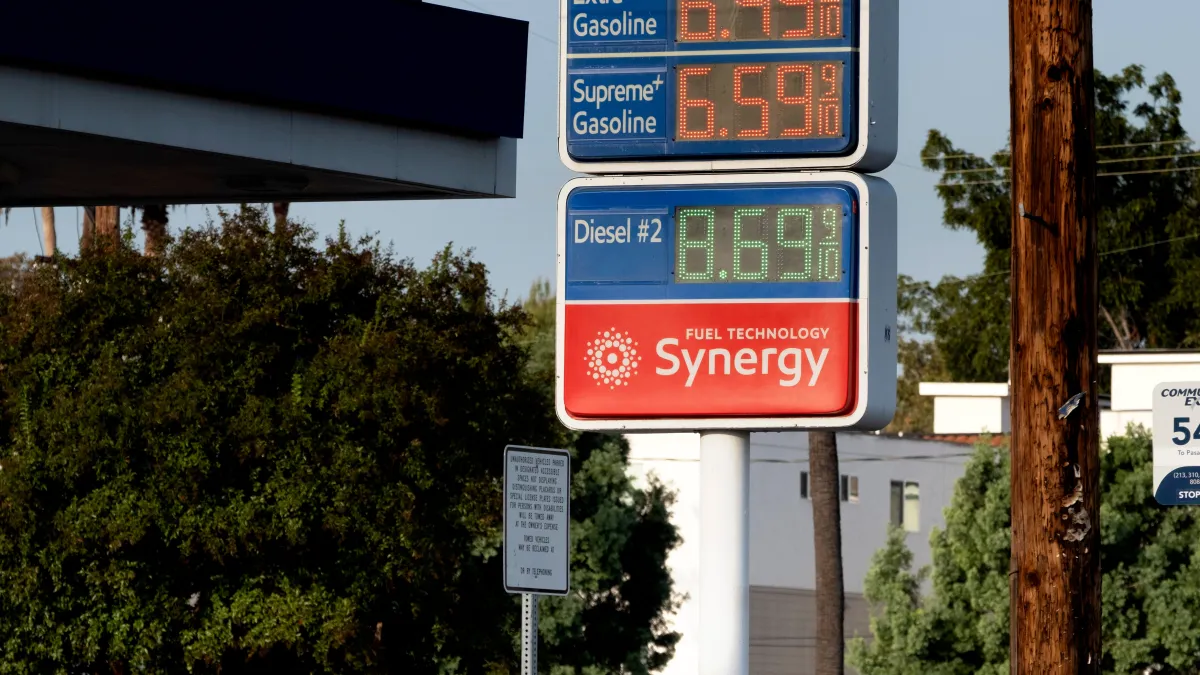
Diesel prices have hit record highs as the tensions between the United States and Iran, along with the war between Russia and Ukraine, disrupt key oil and fuel trade routes.
On Friday, the average price for a gallon (3.79 litres) of diesel was $6.50, up from $5.61 a month earlier, according to the American Automobile Association (AAA), which tracks fuel prices daily.
Recommended Stories
list of 4 itemsend of list
The spike has prompted the administration of US President Donald Trump and Republican lawmakers to consider restricting US diesel exports ahead of upcoming midterm elections.
A Reuters/Ipsos poll conducted in August found that 47 percent of voters said the cost of living was the single most important factor in deciding how they would vote in the midterms — more than twice the share who cited the next-most important issue, “democratic values and norms”.
A new Marist poll also found that Americans have more confidence in Democrats than Republicans to handle the economy, with 42 percent choosing Democrats compared with 34 percent for Republicans.
Amid that voter sentiment, US Energy Secretary Chris Wright said on Thursday that he was in touch with major oil refiners to gauge interest in a potential voluntary restriction on diesel exports, according to the Reuters news agency.
That followed remarks by Trump on Tuesday that he supported restricting diesel exports from the US, the world’s largest diesel exporter.
Energy analysts and industry groups have warned that an export ban could have unintended consequences, potentially pushing up fuel prices in the US and abroad.
Why are diesel prices so high?
Even though the US is the world’s largest diesel exporter, diesel is traded on a global market.
Disruptions to refineries in Russia and the Middle East have reduced the amount of fuel available worldwide, putting more pressure on US producers to fill the gap. In Russia, for example, drone attacks have damaged major refineries, forcing a cutback or halt in production.
“While US refineries are running at full tilt and higher than normal, the global gaps remain,” Rachel Ziemba, senior adjunct fellow at the Center for a New American Security, told Al Jazeera.
It comes as US diesel supplies are also shrinking. As of September 11, inventories had fallen to 107.9 million barrels, the lowest in more than four decades, according to the US Energy Information Administration.
With global supplies tightening, diesel prices have risen around the world — including in the US. Because American producers can sell their fuel into the global market, they are drawn to the soaring global prices rather than simply setting a lower price for domestic consumers.
Why is the US considering an export ban?
In Washington, DC, leaders have flirted with the idea of pushing US companies to stop or slow exporting diesel.
Republicans have been pushing for a slowdown or outright ban of exports in an effort to lower costs for consumers ahead of the pivotal midterm elections, where cost of living is becoming a critical issue.
Such a move, they hope, would reduce local diesel prices, which is significant as diesel is used in trucks to haul food and most products, Ziemba said, adding that US diesel exports are equivalent to about 40 percent of domestic consumption.
On Tuesday, Chuck Grassley, a Republican from Iowa, called on the president to put in place a temporary halt on exports.
“I encourage President Trump to put a temporary embargo on diesel exports through executive action,” Grassley said.
Republican Senator Dan Sullivan of Alaska made a similar call: “The cost of diesel is just too damn high. I’m calling for a temporary pause of American diesel exports so that we can rebuild our reserves ahead of winter,” Sullivan said in a statement on Tuesday.
In the House of Representatives, Congressman Tim Burchett of Tennessee introduced two bills that would restrict US diesel exports: One would impose a ban through January 2027, while the other would restrict exports if the national average price reaches $5 a gallon.
The administration has not made any official policy announcements, and the White House told Al Jazeera that the president is evaluating all options.
Oil and gas industry experts say that a ban could drive up prices rather than bringing them down.
“Diesel trades on a world market, just like corn. farmers don’t sell cheaper to Americans, and refiners can’t either since they buy crude at global prices. force a lower price and they’ll make less diesel. less supply means higher prices, not lower,” Patrick De Haan, head of petroleum analysis at GasBuddy, said in a post on X.
How would an export ban work?
A ban would prevent or restrict US refiners from selling diesel to buyers overseas, theoretically leaving more fuel available in the domestic market.
Analysts at Wood Mackenzie, a research and consulting firm, say that keeping more diesel stateside would ultimately fill up US storage tanks but also force refineries to cut production. That could affect other markets that rely heavily on US fuel, including Latin America and Europe, forcing them to compete with other global buyers for supplies and driving up prices for the global market.
Wood Mackenzie says China is the only major producer with enough spare refining capacity to potentially make up much of the shortfall.
“China is currently the only country with material spare refining capacity that could cover the loss of US refinery throughputs. However, China may well decide it is not in its interest to intercede,” analysts said.
Wood Mackenzie has warned that a ban could quickly fill US diesel inventories, forcing refiners to cut crude runs and potentially increasing US petrol imports.
That was also the view of an S&P Global analysis, which found that a complete ban could also mean that production would be reduced as storage capacity is filled up with unsold diesel. According to the analysis, that could lead to production cuts of as much as 750,000 barrels a day, which could put the US into being a net importer of petrol in the fourth quarter of this year.
Who would an export ban affect?
An export ban would affect US refiners and consumers, as well as countries that rely on US diesel.
“They [export bans] may provide temporary relief, but diesel is a global commodity. Treat one part of the system, and the effects travel elsewhere. Trade-offs are inevitable. Refiners are unlikely to cheer a blanket ban. Voluntary, controlled export reductions would generally be less disruptive in the short term,” Maksim Sonin, visiting scholar at Stanford University’s Precourt Institute for Energy, told Al Jazeera.
Disruptions to US exports could reduce the amount of fuel available on the global market. Wood Mackenzie analysts say countries in Europe and Latin America that rely heavily on US fuel could be forced to compete with other producers for supplies.
“If implemented, it would lead to European and Asian product prices increasing as the buyers of US fuel, mostly in Latin America, scramble to find new supplies, bidding up supplies. European crack spreads could widen, and overall we might see more disruptions,” Ziemba added.
“Given these issues, the US may opt for a mixture of carrots and sticks aiming to incentivise refineries to keep producing, perhaps including penalties if they cut production. There may be voluntary export quotas rather than a formal ban, and there may be exemptions for countries that provide crude oil to the US, like Mexico,” Ziemba said.
That could put pressure on consumers not only at the petrol pump but in the skies as well.
Airlines for America, an airline industry trade group, has also warned that an export ban could lead to higher prices for airlines and travellers, according to the Reuters news agency. The trade group did not respond to Al Jazeera’s request for comment.
The broader concern from analysts is that restricting exports could reduce US refinery production rather than simply redirecting diesel to US consumers, potentially putting upward pressure on fuel prices both domestically and internationally.
“It’s unlikely to help US consumers much given how it fails to solve underlying problems and could backfire if refineries hold on to production. The best way to address this is to end the conflicts prompting the shortages,” Ziemba said.

![People watch the ocean as a nor'easter storm hits Rye, New Hampshire, US on Sunday, September 27, 2026 [Caleb Jones/AP Photo]](https://i0.wp.com/occasionaldigest.com/wp-content/uploads/2026/09/AP26270677753401-1790545375.jpg?w=640&ssl=1)





![Rescuers work at the scene following Friday's powerful blast in Athens' Plaka district, Saturday, September 26, 2026 [Yorgos Karahalis/AP]](https://i0.wp.com/www.aljazeera.com/wp-content/uploads/2026/09/AP26269443758394-1790459604.jpg?w=640&ssl=1)