Ukraine

Pentagon’s Ability To Supply Ukraine With More Patriot Interceptors Questioned By Congress

Concerned with Ukraine’s ability to protect itself from the onslaught of Russian missile and drone attacks, the Senate Armed Services Committee (SASC) is demanding to know if the Pentagon can increase deliveries of Patriot air defense system interceptors to that war-torn nation. This comes against the backdrop of extreme U.S. and allied demand on dwindling supplies of these weapons. 

As we have previously noted, between U.S. usage in recent Middle East conflicts and commitments to Ukraine and nearly 20 other nations, there have long been concerns about the supply of Patriot interceptors. Still, the Pentagon has maintained that it has sufficient supplies.

The U.S. Army is pressing defense contractors to come up with proposals for a new interceptor for the Patriot surface-to-air missile system with a unit cost under $1 million.
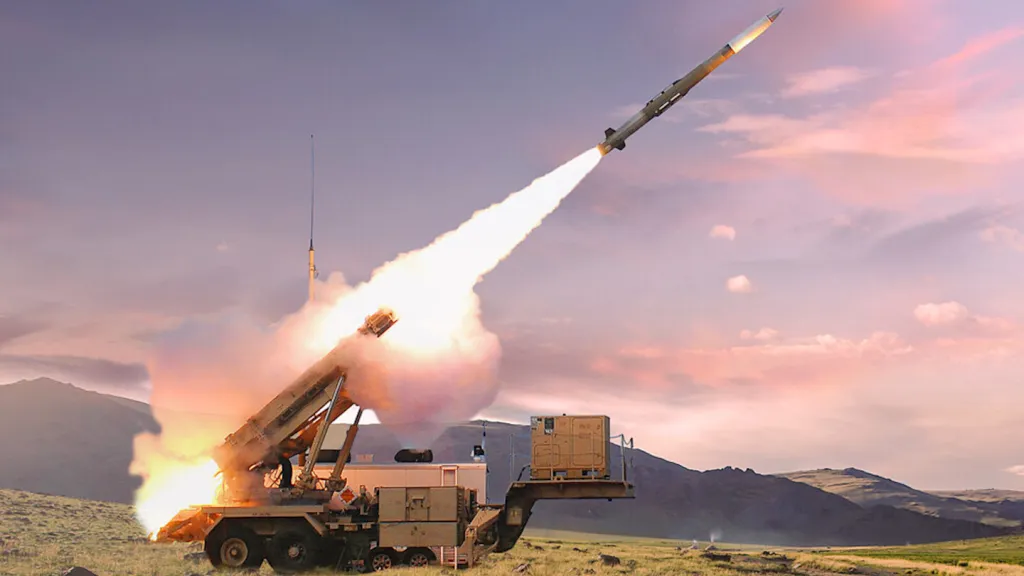
A Patriot air defense interceptor. (Lockheed Martin) Lockheed Martin

It is hard to say precisely how many Patriot interceptors remain in Ukraine’s stockpile, The New York Times recently noted

“The number is classified. At the end of June last year, there were as few as 16 in Ukraine’s arsenal,” the publication stated. Given the low supplies and constant Russian bombardment, Ukrainian President Volodymyr Zelensky has frequently requested additional interceptors from the U.S. and allies.

SASC said it “recognizes the importance of Patriot air defense systems and Patriot Advanced Capability-3 (PAC-3) interceptors in supporting Ukraine’s self-defense and notes continued concerns regarding interceptor availability, production capacity, and the impact of transfers on United States military readiness.”

“Accordingly, the committee directs the Secretary of Defense, in coordination with the Under Secretary of Defense for Acquisition and Sustainment, to submit a report to the congressional defense committees, not later than October 1, 2026, assessing the feasibility of increasing deliveries of PAC-3 interceptors to Ukraine,” its directive states.

We have reached out to the committee to find out which variant of the PAC-3 they are referring to. Lockheed Martin is boosting production of the more advanced current-generation Patriot PAC-3 Missile Segment Enhancement (MSE) interceptors and it is unclear how many of the other variants are still being made or are in U.S. stockpiles.

A Patriot Advanced Capability-3 (PAC-3) Cost Reduction Initiative (CRI) missile is launched during the recent successful Integrated Battle Command System (IBCS) flight test at White Sands Missile Range.
A Patriot Advanced Capability-3 (PAC-3) Cost Reduction Initiative (CRI) missile is launched during an Integrated Battle Command System (IBCS) flight test at White Sands Missile Range in 2021. (Darrell Ames) Darrell Ames

SASC wants the following information from the Pentagon:

  • “An assessment of current and projected Ukrainian requirements for PAC-3 interceptors over the next 12 months;”
  • “An assessment of the availability of PAC-3 interceptors from existing Department of Defense inventories for transfer to Ukraine and the impact of such transfers on United States military readiness and operational plans;”
  • “An evaluation of options to accelerate production of PAC-3 interceptors, including through multiyear procurement authorities, advance procurement, expanded supplier capacity, and other industrial-base investments;”
  • “An assessment of the feasibility of increasing annual PAC-3 interceptor production and the anticipated timeline for achieving such increases;”
  • “An identification of any statutory, regulatory, contractual, or supply-chain barriers to increasing interceptor deliveries to Ukraine;”
  • “An assessment of opportunities for allied and partner nations operating Patriot systems to contribute additional PAC-3 interceptors to Ukraine, including options for United States backfill arrangements;” and
  • “Recommendations for legislative or administrative actions that would enable increased interceptor deliveries to Ukraine while maintaining acceptable levels of U.S. military readiness.”

In addition, the committee said the secretary should “brief the congressional defense committees on the findings of the report, not later than 15 days after its submission.”

The Pentagon on Wednesday declined comment on the committee’s report, how many interceptors it has provided to Ukraine or whether it has the ability to increase that supply. We have reached out to Lockheed Martin as well and are awaiting a response.

Soldiers from the 11th Air Defense Artillery Brigade conduct a Patriot missile live-fire exercise at MacGregor Range near Fort Bliss, Texas, Aug. 23, 2025. The exercise is designed to validate crew proficiency, ensure equipment reliability, and send a clear message of deterrence to potential adversaries. (U.S. Army photo by Sgt. JaDarius Duncan)
Soldiers from the 11th Air Defense Artillery Brigade conduct a Patriot missile live-fire exercise at MacGregor Range near Fort Bliss, Texas, Aug. 23, 2025. (U.S. Army photo by Sgt. JaDarius Duncan) Sgt. JaDarius Duncan

TWZ recently addressed the supply of these munitions in a story about a new report from the Center for Strategic and International Studies (CSIS).

The report, on the severity of the depletion of U.S. advanced weapons stockpiles, found that current production PAC-3 MSE “is around the baseline rate of 650 interceptors per year, with half the deliveries going to the United States and the rest to allies and partners.” 

Under a contract with the Pentagon inked in January, Lockheed is committed to boosting Patriot annual production to 2,000.

“Because U.S. procurement in the last decade has averaged 225 missiles per year, deliveries from prior years will not be enough to fully replace expenditures,” CSIS cautioned. “For that, the United States will need to wait for the 3,203 Patriot missiles requested in the Army’s FY 2027 budget. These are projected to start delivery in May 2029.”

As we noted earlier in this story, in addition to the Patriot interceptors already provided to Ukraine, the U.S. used a large amount during the conflict with Iran defending its assets, as well as those of allies.

The CSIS report found that at the start of the war with Iran, “there were about 2,500 Patriot interceptors in the U.S. inventory,” though its accompanying chart does not specify which variant. “During the course of the conflict, between 1,060 and 1,430 Patriots were fired.” We don’t know what that tally includes, but we do know that PAC-2 and PAC-3 series interceptors have been employed in the latest conflict with Iran.

CSIS

Adding to questions about the ability to supply Ukraine with more Patriots, a top official from Lockheed Martin recently warned that the company cannot give U.S. allies any certainty over when they will receive interceptors despite plans to triple capacity, according to Financial Times.

Brian Dunn, vice president for strategy and business development of missiles and fire control, recently said that the company was working hard to scale up production of critical PAC-3 interceptor missiles amid a supply crunch exacerbated by the war in Iran. 

But in remarks to journalists at the ILA Berlin Air Show, “he sent a sobering message to American allies including Germany, Japan, Poland, the UAE and Saudi Arabia that operate the Patriot air defense system,” the publication reported.

Dunn said the extra capacity “is obviously going to be able to satisfy multiple user requirements in a faster timeline.” However, he added that Lockheed Martin does not “control what the allocation of those missiles is going to be. We can’t tell anybody where you’re going to be on that [priority list].

“Obviously there’s a lot of rhetoric coming right now from the Department of War . . . about how they’re going to reorder, reorganize, who’s going to get missiles first,” he continued. “We don’t control any of that.”

Dunn’s statements highlight concerns we raised long before and during Operation Epic Fury about the rapid expenditure of critical munitions and how that could affect a potential future fight against China. It also goes along with our reporting about the overall inadequacy of the U.S. Patriot force, an issue we have been highlighting for years.

Meanwhile, for Ukraine, the influx of new Patriot interceptors cannot come soon enough. Two nights ago, for instance, Russian forces launched 70 missiles and over 600 drones in a mass assault, according to the Kyiv Independent.

“Of the 34 ballistic missiles fired, 19 were aimed at the capital,” the publication noted.

You can see a video of one of those strikes below.

“Kyiv’s beleaguered Patriot batteries did a valiant job, intercepting 15 of them, along with five of the six 3M22 Zircon hypersonic cruise missiles launched in the attack,” the news outlet added. “Still, even layered defenses were stretched beyond the limit.”

Contact the author: howard@twz.com
Howard is a Senior Staff Writer for TWZ. He writes frequently about conflict, focusing heavily on the Middle East and Ukraine, and interviews with military and intelligence officials and industry leaders from around the globe. He lives near Tampa, Florida, home of U.S. Central Command, U.S. Special Operations Command.


Source link

Trump signals swift return of sanctions on Russian oil as G7 refocuses on Ukraine

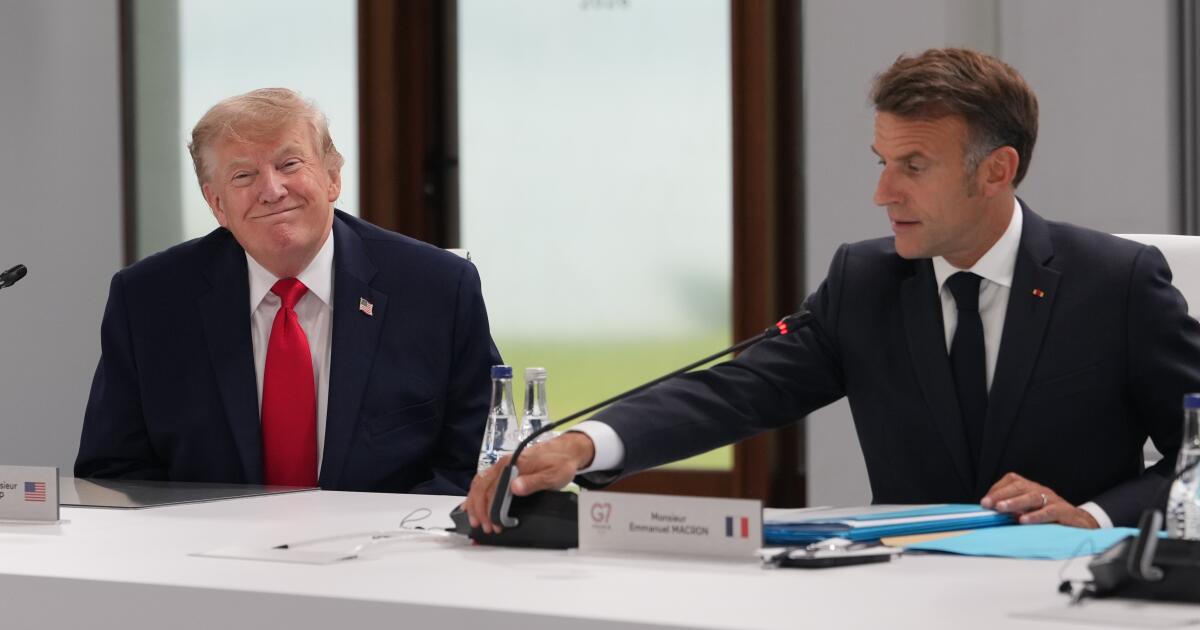
The United States could soon reimpose sanctions on Russian oil shipments after President Trump and fellow leaders at the Group of Seven summit of major industrialized democracies moved Tuesday to put the war in Ukraine back on top of their agenda, more than four years after Russia launched its full-scale invasion.

The Iran war has recently overshadowed Ukraine, but Trump said he wants to shift the focus following the announcement of an agreement to end the 3½-month-old conflict in the Gulf.

Trump said Iran will soon be “back in the rearview mirror.”

Trump said the sanctions on Russia that were eased during the Iran war to help lower oil prices can go back in place as more oil moves through the Strait of Hormuz.

“Soon we’ll be able to do that because the oil is now flowing,” Trump told reporters in Evian, the French spa town close to the Swiss border that is hosting the summit. “We’re in a position to do that soon.”

The U.S. in March temporarily eased some sanctions on some Russian oil shipments as crude prices sharply increased. The waiver has been extended.

Zelensky joins G7 leaders for talks

Ukrainian President Volodymyr Zelensky joined the G7 leaders for talks on the war in his country. They wrapped quickly, after just 75 minutes.

Zelensky said Ukraine is serious about peace while Russia toys with world leaders. “The entire ‘Seven’ supports Ukraine unanimously today,” he said.

Zelensky added that G7 leaders supported Ukraine’s need for more Patriot missiles and discussed how to increase production by licensing production. Patriot missiles are able to counter Russian ballistic missile attacks on Ukraine’s power grid and cities.

As the U.S. under Trump has cut back aid to Ukraine, France and its European allies are now the biggest providers of military and financial support to Kyiv.

Trump downplayed the impact of the Russia-Ukraine war on the U.S. but lamented the death toll.

“The whole thing is ridiculous,” Trump said. “So, yeah, I’m going to do whatever I can.”

Meanwhile, the U.K. announced new sanctions targeting the “shadow fleet ” Russia uses to ship oil and gas, and the finance networks used by Moscow to evade Western sanctions. The ships targeted include several recently purchased by Russia to transport liquefied natural gas from its sanctioned Arctic LNG 2 project.

Russia fires again at Ukraine’s biggest cities

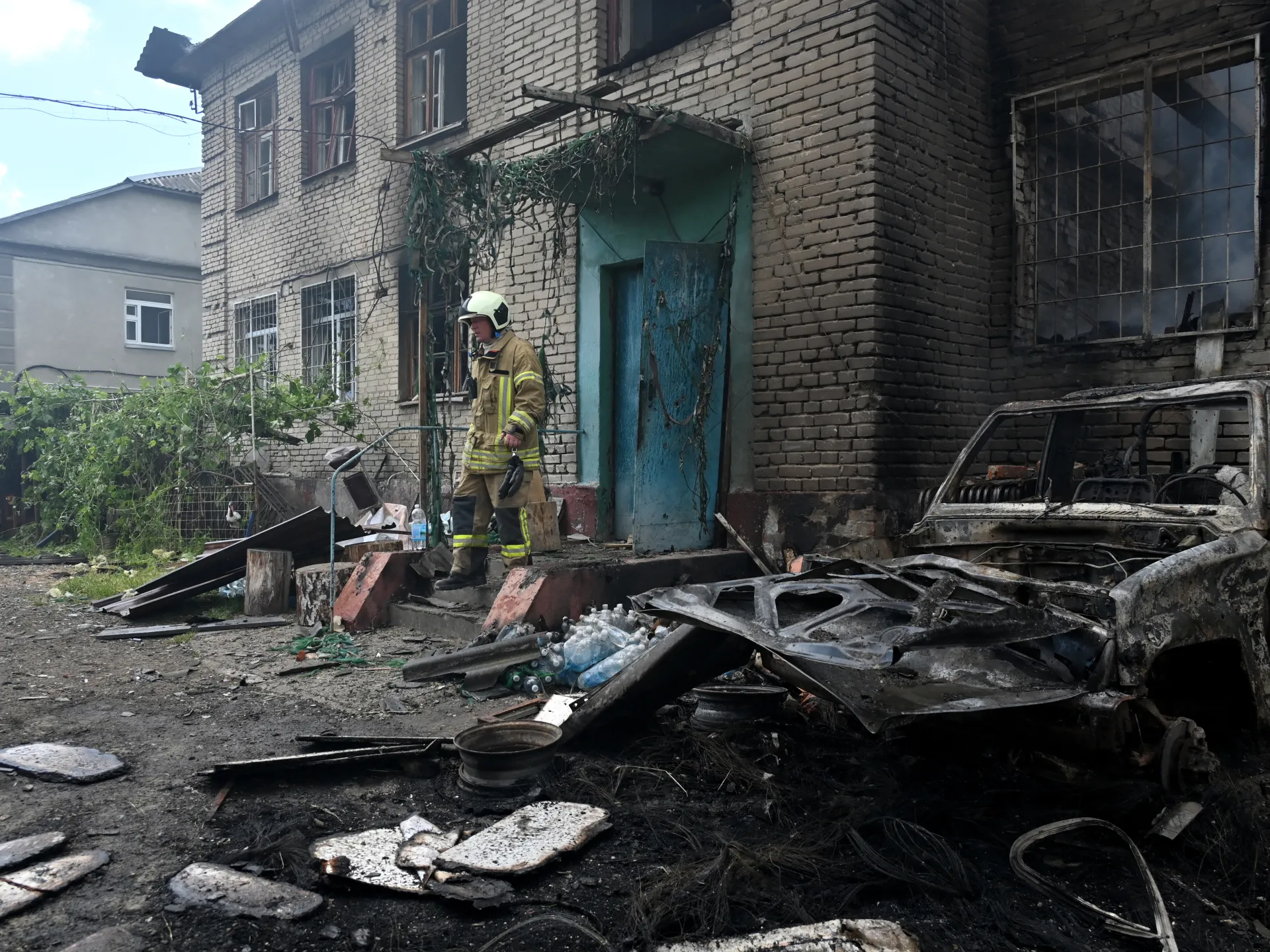
Hours before the summit began Monday, Russia fired hundreds of drones and dozens of missiles at Ukraine’s biggest cities in a barrage that killed 11 people and set fire to a religious landmark.

The attacks came after Zelensky and Putin spoke separately by phone with Trump on Sunday, the U.S. leader’s 80th birthday.

While campaigning in 2024 for a return to the White House, Trump claimed he could end the Russia-Ukraine war within 24 hours of taking office. However, negotiations have faltered and Trump has acknowledged it has proved much harder than he thought.

Ukraine on Monday officially started European Union membership negotiations, launching a process that will require its government to commit to years of political reforms even as it fights the Russian invasion.

Ukraine sees EU membership as a security guarantee for a stable future once the war ends. Its best guarantee would be membership in the NATO military alliance, but the Trump administration insists that cannot happen, and others are wary of Ukraine joining while the war continues.

Trump says he may send Iran deal to Congress

The U.S.-Iran ceasefire deal got plenty of attention at Tuesday’s sessions, with Trump voicing his openness to sending the deal to Congress for review. The text has not been made public.

“I like the idea, send it to Congress please,” Trump said at the start of a meeting with United Arab Emirates President Sheikh Mohamed bin Zayed Al Nahyan on the summit’s sidelines. He added, “I mean who wouldn’t approve it?”

Republicans on Capitol Hill say they want Trump to provide more information about the agreement, with some expressing skepticism that the deal can deter Iran from pursuing a nuclear weapon.

Trump also met with the Emir of Qatar, Sheikh Tamim bin Hamad al-Thani. The Gulf nations are not part of the G7, but French President Emmanuel Macron extended invitations to their leaders at a fraught moment for their region.

Trump also expressed frustration over Israel’s continued hostilities with the Iranian-backed militia Hezbollah in Lebanon, telling reporters he’s “not happy with the way Israel has handled themselves with Lebanon and with Hezbollah.”

Trump said Israeli operations to target Hezbollah “should have been able to deal with them faster,” adding: “It just goes on forever. And when that happens, it throws a negative light on the big deal. And that’s the deal with Iran.”

Macron said France and other Western partners are “ready to take action very quickly” to help reopen the Strait of Hormuz peacefully to ease the economic impact of rising oil prices. France and the U.K. have championed a mission to restore maritime security there as soon as conditions allow.

The G7 comprises France, the United States, Canada, Germany, Italy, Japan and the United Kingdom. Other guest nations, including Brazil, India, Kenya and South Korea, were invited to participate in some discussions.

Superville, Corbet and Madhani write for the Associated Press. Madhani reported from Geneva. AP writers Jill Lawless and Samuel Petrequin in London, Collin Binkley in Washington and Illia Novikov in Kyiv contributed to this report.

Source link

‘Island surrounded by war’: Crimeans panic amid Ukrainian attacks | Russia-Ukraine war News

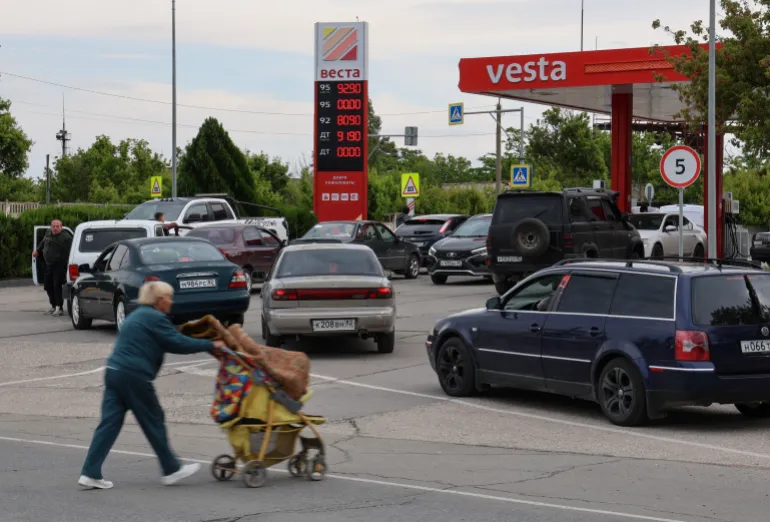
Kyiv, Ukraine – After almost seven hours in a kilometres-long, snail-paced line made up of hundreds of cars at a gas station near Crimea’s administrative capital, Simferopol, Dilyaver was lucky enough to buy gas.

He paid $22 for 20 litres (5.3 gallons).

Recommended Stories

list of 4 itemsend of list

“There were teenagers running around offering gas for 300 rubles [$4.2], one almost got beaten up by angry guys in the line,” the 52-year-old Crimean Tatar man told Al Jazeera on Saturday.

He withheld his last name and personal details because an interview with foreign media could land him in jail.

Judging by licence plates and accents, some of the men in the line were Russian tourists who decided to cut their vacations short and flee via the $4bn, 19km (12-mile) long Crimean Bridge, Dilyaver said.

“The [tourism] season is ruined, that’s bad news for almost everyone here,” he said, referring to the annual arrival of millions of tourists that feeds many on the arid peninsula, where agriculture has suffered after Kyiv dammed a key water artery.

Dilyaver does not know when he will fill up his rundown Skoda again because he expects fuel shortages to get worse.

But the fuel problem is just the tip of the iceberg of problems Crimea has been facing.

“Crimea’s key problem is not because there’s no fuel,” Nikolay Mitrokhin, a researcher with Germany’s Bremen University who analyses the Russia-Ukraine war, told Al Jazeera. “The problem is that Ukrainian drones began barraging over the peninsula’s domestic roads.”

Cars queue for fuel at a gas station after the authorities restricted fuel sales amid a supply shortage following Ukrainian attacks on logistics routes in the course of Russia-Ukraine conflict, in the Black Sea resort city of Yevpatoriya, Crimea, June 3, 2026. REUTERS/Alexey Pavlishak
Cars queue for fuel at a gas station after the authorities restricted fuel sales amid a supply shortage following Ukrainian attacks on logistics routes in the course of the Russia-Ukraine conflict, in the Black Sea resort city of Yevpatoriya, Crimea, June 3, 2026 [Alexey Pavlishak/Reuters]

Since mid-May, Ukrainian drones have attacked hundreds of trucks carrying fuel, ammunition and other supplies from southwestern Russia to Crimea via the “land bridge” through occupied Ukrainian regions.

The drones, whose operators sit in bunkers up to 200km (124 miles) away from the “land bridge”, also pepper roads with mines that weigh only 500 grams (1.1 pounds) and have magnetic or motion sensors.

Cargo ships trying to get fuel and food to Crimea or transporting steel and grain from occupied regions of southeastern Ukraine have also been attacked.

The attacks “illustrate Crimea’s vulnerability”. Volodymyr Fesenko, head of the Kyiv-based Penta think tank, told Al Jazeera. “Ukraine can regularly, daily strike military, infrastructure sites in Crimea … Ukraine turned Crimea into an island surrounded by war and fire.”

‘Just the beginning’

Ukraine’s Third Special Battalion said earlier this month that its drone operators have “taken aerial control” of the strategic supply route from the occupied southern city of Melitopol to the Chongar bridge in northern Crimea.

“That’s just the beginning! There’s more to come!” the Battalion said in a Facebook video with footage of exploding and burning trucks.

Chongar is a key entry to Crimea that can barely be called a peninsula because Sivash, also known as The Rotten Sea, a labyrinth of lagoons, salt marshes and wetlands, divides it from mainland Ukraine, leaving only three strips of land wide and firm enough for roads and a railway.

Just more than a week ago, the Chongar bridge was damaged by drones and is only capable of letting light vehicles through, while buses and trucks take a pontoon bridge nearby.

“The bridge is open, the damaged part is cordoned off, one lane is operational, there are no traffic jams because there’s few cars,” a driver who passed through it wrote on Telegram.

Ukrainian drones also struck fuel depots inside Crimea – along with air defence systems, airfields, military bases, command centres and the facilities of Russia’s Black Sea Fleet that relocated to the Russian port of Novorossiysk after losing at least a third of its vessels.

After Russia’s annexation of the peninsula in 2014, Moscow spent billions of dollars to militarise Crimea by deploying frigates and diesel submarines; advanced S-400 air defence systems; tens of thousands of servicemen; and building new military bases, airfields, radar stations, garrisons and living quarters.

“Putin turned Crimea into a military base, and thus made it the most vulnerable place in the war with Ukraine,” Fesenko said.

The Crimean bridge alone cannot handle the redirected traffic as trucks weighing more than 1.5 tonnes are no longer allowed to pass through.

Early Monday, a Ukrainian drone struck a moving train, killing one of the drivers and prompting Moscow to halt the movement of nine other trains.

Their passengers are being evacuated by buses, Kremlin-appointed authorities said.

Days earlier, one of Russia’s most outspoken warmongers raised his voice about the panic in Crimea.

“What’s happening at Crimean gas stations is a real nightmare for locals and servicemen,” Igor Girkin, an ex-intelligence officer who led the first group of Moscow-backed separatists in southeastern Ukraine in 2014, wrote on Telegram on June 1.

Kyiv “acts brazenly … trying to cut off the peninsula and our southern [military] groups from fuel supply,” Girkin, who was sentenced to four years in jail in 2024 after lambasting Moscow’s military failures in Ukraine, wrote from behind bars.

“To some, Crimea seems like a resort. No, today it’s a front-line region,” he wrote.

And to Crimean Tatars such as Dilyaver, what’s happening around them is part of a decades-old struggle for survival in Moscow’s shadow.

Firefighters extinguish a fire at the "Panorama of the Defence of Sevastopol" museum, which, according to local authorities, was damaged in a Ukrainian drone attack in the course of Russia-Ukraine conflict in Sevastopol, Crimea, in this image released on June 10, 2026. Governor of Sevastopol Mikhail Razvozhayev/Handout via REUTERS ATTENTION EDITORS - THIS IMAGE WAS PROVIDED BY A THIRD PARTY. NO RESALES. NO ARCHIVES. MANDATORY CREDIT.
Russian patrol ship Svetlyak in Yurkyne, Crimea, in this screengrab from footage released by Ukraine’s Unmanned Systems Forces commander Robert Brovdi on June 4, 2026 [Robert Brovdi via Telegram/Handout via Reuters]

Since the annexation, his community of about 250,000, or about one-tenth of Crimea’s population, has been under constant pressure.

Masked officers break into the houses of community leaders, activists or observant Muslims at dawn to search for “extremist materials” that in many cases turn out to be religious texts, including The Quran for Children.

Arrests and trials follow – more than 100 Tatars have been sentenced to jail for “extremism,” “separatism” and “terrorism.”

Another dozen went missing without a trace and are believed to have been abducted and killed by Russian intelligence.

Dilyaver owned a tiny grocery store near Simferopol.

But he faced higher taxes and visits by government inspectors who demanded bribes, so Dilyaver, who also suffered a scam, closed the store. He barely makes ends meet now by selling deep-fried meat and cheese pies next to a bus stop.

Dilyaver’s parents were born in Soviet Uzbekistan after the 1944 deportation of every Crimean Tatar by Soviet leader Joseph Stalin, who thought their cultural ties to Turkiye posed a threat to the USSR’s security.

“We have a saying, ‘If a Russian lives next to you, keep an axe ready,’” Dilyaver’s 77-year-old mother Gulsum told Al Jazeera. “We suffered from them so much, and it’s far from over.”

Ukrainian attacks triggered food shortages.

Macaroni, flour, canned meat, fish and vegetables have already been swept off the shelves in some stores and supermarkets, Dilyaver said.

“The Soviet mentality is still at work. If there’s a problem – buy buckwheat,” he quipped, about the cheap and nutritious grain that symbolises resilience in the former Soviet Union.

Source link

EU set to hold membership talks with Ukraine | European Union

NewsFeed

The European Union will begin accession talks with Ukraine and Moldova after Hungary’s new government withdrew its veto, paving the way for negotiations. Both countries believe EU membership would provide them with greater security against Russian aggression.

Source link

Ukraine Sees AI Driving Next Revolution in Warfare

Ukraine’s defence ministry believes artificial intelligence is set to fundamentally transform modern warfare, as Kyiv accelerates efforts to integrate AI into battlefield operations amid its ongoing war with Russia.

According to Danylo Tsvok, head of Ukraine’s Defence Ministry AI Research Centre, the country is already employing artificial intelligence across multiple military functions, including drone operations, battlefield planning, intelligence analysis, and missile attack assessments.

The centre, established in March, is part of a broader effort to make data driven decision making a core component of Ukraine’s defence strategy. Officials envision a future where AI systems, sensors, drones, command centres, and weapons platforms operate through a unified digital network capable of processing battlefield information and recommending military actions in real time.

Why It Matters

Ukraine’s experience is increasingly being viewed as a preview of how future wars may be fought. The conflict has already demonstrated the growing importance of drones, autonomous systems, and real time intelligence, but AI could push military operations into an entirely new phase.

Rather than merely supporting commanders, future AI systems may become central to battlefield decision making by processing vast quantities of data faster than human operators can manage. This could dramatically shorten the time between identifying a target and launching an attack.

The implications extend far beyond Ukraine. Military planners around the world are closely monitoring the conflict as a testing ground for next generation warfare technologies.

The Rise of AI Driven Combat

The war has already evolved into a technological competition in which both Ukraine and Russia are attempting to gain advantages through automation, data analysis, and autonomous systems.

Ukraine is working toward a battlefield operating system capable of integrating information from drones, reconnaissance assets, weapons systems, and frontline units into a single decision making framework. The objective is to create a comprehensive operational picture that enables faster and more effective responses.

Russia is pursuing similar capabilities, particularly in drone warfare and strike planning, creating what Ukrainian officials describe as an emerging competition between military operating systems rather than simply armies.

Global Defence Implications

The conflict has attracted significant attention from defence technology firms and AI developers seeking real world operational data. Companies and governments increasingly view Ukraine as one of the most important testing environments for military AI applications.

The lessons learned from the war could influence defence procurement, military doctrine, and security planning across NATO, Asia, and other regions facing evolving security challenges.

As AI becomes more deeply embedded in military systems, countries may be forced to rethink command structures, training requirements, and the role of human decision makers in combat.

Key Stakeholders

  • Ukraine military
  • Russian military
  • Defence technology companies
  • NATO members
  • Artificial intelligence developers
  • Defence ministries worldwide
  • Military planners and strategists

Future Outlook

Over the next three to five years, military competition is likely to shift increasingly toward AI enabled command systems, autonomous platforms, and integrated battlefield networks.

Countries capable of rapidly processing information and converting it into actionable decisions may gain a significant operational advantage. At the same time, concerns about autonomy, accountability, and human oversight will become more prominent as AI systems assume larger roles in combat operations.

The race to integrate AI into warfare is expected to intensify, making technological superiority as important as traditional military strength.

Analysis

Ukraine’s assessment points to a deeper transformation than simply adding artificial intelligence to existing weapons systems. What is emerging is a shift from platform centric warfare to data centric warfare, where military advantage depends less on the number of tanks, aircraft, or soldiers and more on the ability to collect, process, and act on information faster than an opponent.

The most significant aspect of this transition is the compression of decision making time. Historically, military success depended on commanders interpreting information and issuing orders. AI has the potential to reduce that cycle from hours or minutes to seconds, creating a battlefield where speed of analysis becomes as important as firepower.

This evolution could fundamentally alter military hierarchies. If AI systems become capable of generating reliable operational recommendations faster than humans can assess them, commanders may increasingly act as supervisors rather than primary decision makers. The challenge will be balancing military effectiveness with accountability and ethical oversight.

The Ukraine conflict is therefore becoming more than a territorial war; it is also serving as a laboratory for the future of warfare. The countries that emerge with the most effective integration of AI, autonomous systems, and battlefield data networks may define military power for decades to come. In this sense, the competition between Ukraine and Russia increasingly resembles a contest between technological ecosystems, foreshadowing a future in which wars are won not only through weapons but through algorithms and information dominance.

With information from Reuters.

Source link

EU agrees launch of accession process for Ukraine and Moldova | European Union News

Progress for Kyiv’s membership bid given the green light after Hungary’s new government lifts Budapest’s veto.

The European Union has announced that the accession process for Ukraine and Moldova will launch next week.

At a meeting in Brussels on Friday, ambassadors from the 27 EU nations agreed to officially recommence negotiations with the two countries in Luxembourg on Monday.

Recommended Stories

list of 3 itemsend of list

EU leaders agreed to open accession talks with Ukraine and Moldova in December 2023. However, negotiations were paused due to opposition from Hungary, led at the time by pro-Russian Prime Minister Viktor Orban, to Kyiv’s membership bid.

Both Kyiv and Chisinau view EU membership as additional security against Russian aggression. Moscow insists that maintaining control over its “near abroad” – its term for the post-Soviet states – is key to its national security.

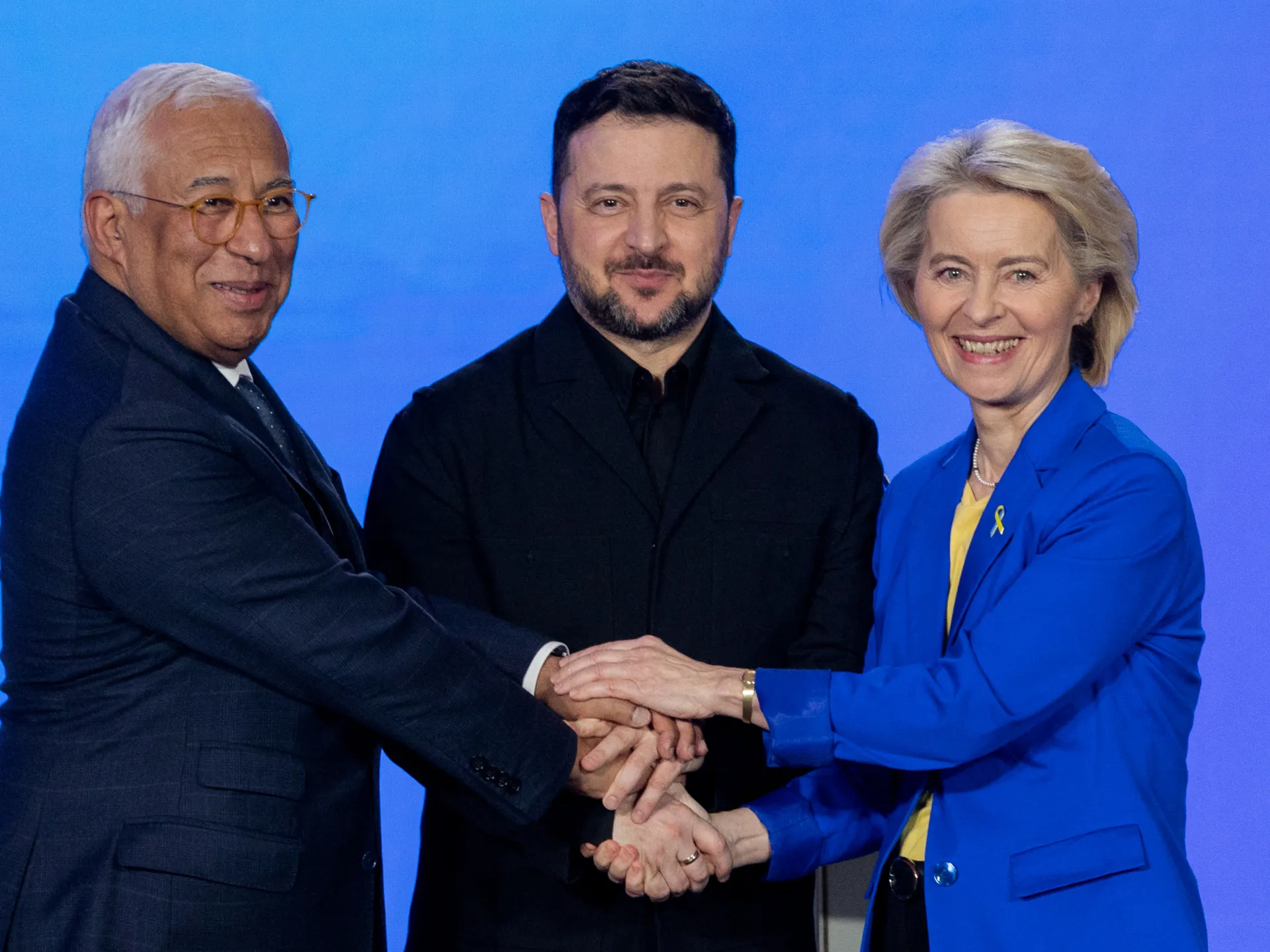
“All member states agreed to open the first accession negotiations cluster with Ukraine and Moldova,” European Council President Antonio Costa and European Commission President Ursula von der Leyen said in a joint social media post.

Hungary’s new government, which took power in May, agreed last week to drop Orban’s veto, allowing the accession process to resume.

“This is a recognition of the determination, courage and hard work shown by both countries in advancing reforms, even in the face of immense challenges,” Costa and von der Leyen said.

“Enlargement is a strategic choice,” they said, adding, “In a world marked by growing uncertainty, a larger European Union is in our common interest.”

Entry negotiations with Kyiv were formally opened in June 2024, kickstarting a complex process that usually takes years and involves negotiations on everything from agriculture to the rule of law.

The move was largely symbolic, intended as a powerful show of support for Ukraine after Russia’s full-scale invasion in 2022.

New Hungarian Prime Minister Peter Magyar struck a deal with Kyiv on the rights of Ukraine’s Hungarian ethnic minority last week. The issue has long been a sticking point between the neighbouring countries.

But Magyar has said Hungary does not support a fast-track procedure for Ukraine to join the EU.

He said Budapest will hold a referendum on Ukraine’s membership, should it “succeed in closing all 33 accession chapters within the next 10 to 15 years”.

Talks will begin on Monday with the opening of the “fundamentals” section of the process, Costa and van der Leyen said in their statement.

This covers basic principles such as rule of law that the two candidate countries will be expected to adhere to.

Source link

Macron once had a knack for managing Trump. The G7 may test it

The relationship between President Trump and French President Emmanuel Macron started simply enough, with a handshake, nearly a decade ago.

But even then, there were signs of strain in their relationship — tensions that could be on full display during next week’s G7 summit in France.

Back in 2017, Trump was a brash businessman just elected to America’s most powerful office, and Macron was an upstart politician who had won his race in a landslide. At a NATO summit in Brussels, they clinched hands far longer than most people do when they meet for the first time. Neither seemed to want to be the first to break a grip so tight that it exposed white knuckles.

Nevertheless, a friendship was born. And early on, Macron seemed to be the one European leader with a knack for managing his mercurial, three-decades-older counterpart.

Macron invited the Republican president to join him for Bastille Day celebrations in July 2017, including an Eiffel Tower dinner date with their wives. Trump reciprocated by making Macron the guest of honor the following year at his first White House state dinner, the highest diplomatic honor the United States can extend to an ally.

But by the end of Trump’s first term, the bromance had faded. And in his second term, the leaders now openly trade barbs, disagreeing over tariffs, Ukraine and the Iran war. That dynamic will be scrutinized next week when Trump and the leaders of Britain, Canada, Germany, Italy and Japan join Macron in the French lakeside resort of Evian-les-Bains for the G7 summit.

Trump’s long-simmering frustrations with US allies could be on display

There could be awkward moments between Trump and Macron, as well as among Trump and the other G7 leaders he’s criticized for not joining him in Iran.

“But I also think European leaders are quite professionals when it comes to politics, and in some ways diplomacy at this point, and will maybe see it as an opportunity as well,” Max Bergmann, director of the Europe, Russia, and Eurasia Program at the Center for Strategic and International Studies, said in an interview.

Kurt Volker, a former U.S. ambassador to NATO, said the Trump-Macron relationship has been further complicated by the Iran war and Trump’s complaints “that Europeans weren’t helping, when they hadn’t been consulted, and their interests are very much affected by this.”

“I think that was a negative for Macron,” Volker said.

Trump joined Israel in a war against Iran over its nuclear program back in February without consulting other U.S. allies. He then complained publicly when European countries spurned his requests for their help.

Waning support for Ukraine in its war against Russia from the Trump administration “has really irritated the French,” Volker said. “They feel this is important and we’re not paying attention to it.” Macron invited Ukrainian President Volodymyr Zelenskyy to join the leaders’ discussions on Tuesday.

Macron is the G7 member who has dealt with Trump the longest

In Trump’s first term, Macron appeared confident that he could persuade and influence the U.S. leader, but the relationship increasingly has come to be defined by their disagreements.

Macron now says he is “careful” about Trump’s statements, suggesting he no longer takes them at face value. Their relationship remains cordial as each calls the other “my friend.” But the relationship has also experienced some ups and downs.

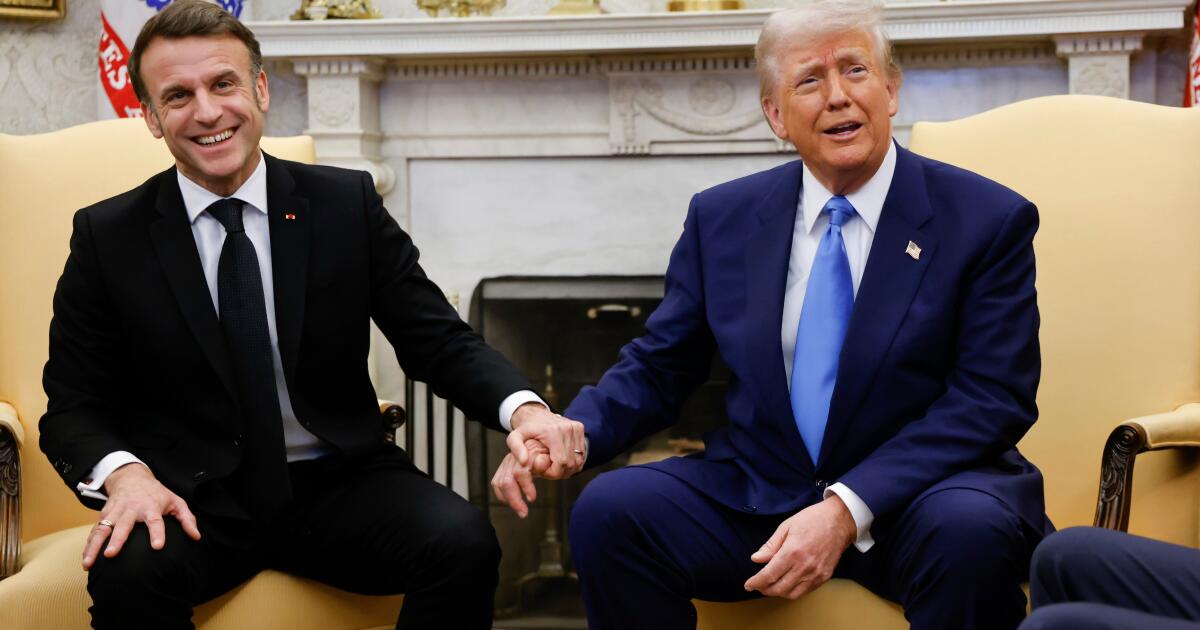
As president-elect, Trump attended the reopening of Notre Dame Cathedral in Paris in late 2024 at Macron’s invitation. After Trump began his second term in 2025, Macron was an early Oval Office visitor. The president wrote on social media that he was “delighted” to welcome Macron back to the White House and said the relationship with France has been “very special.”

But at one point during the meeting, the French president publicly corrected Trump after he wrongly suggested that Europe would recover the money it had provided to support Ukraine. With a smile, Macron touched Trump’s forearm and replied, “We provided real money.”

Macron also condemned as “brutal and unfounded” new tariffs that Trump slapped on steel, aluminum and a broader range of European imports in early 2025.

But there have also been some lighter moments mixed with the tensions.

A documentary aired last year on French television showed Macron telling Trump during a phone call that Zelenskyy had agreed to a U.S.-backed ceasefire proposal. Trump replied, “You’re the greatest.”

Macron has often said he can reach Trump directly whenever he needs to — and proved his point during last year’s U.N. General Assembly session in New York. After police officers blocked the French leader from crossing a street because traffic had been halted for Trump’s motorcade, Macron whipped out his cellphone and dialed the U.S. president.

“How are you?” Macron said. “Guess what? I’m waiting in the street because everything is frozen for you!”

‘This is not a show,’ Macron has said about Trump’s NATO ambiguity

Macron has argued that Trump’s “America first” policies bolstered his case for a stronger European defense capability that would lessen reliance on the United States.

In April of this year, as Trump sent mixed signals about Washington’s commitment to NATO after the start of the war in Iran, Macron delivered some of his sharpest criticism of the U.S. president.

“There is too much talk, and it’s going in all directions,” Macron said. “We all need stability, calm and a return to peace. This is not a show.”

“You have to be serious, and when you want to be serious, you don’t say the opposite every day of what you said the day before,” he said.

Trump, while mimicking a French accent, recently has taken to reenacting a conversation he says he had with Macron over drug prices and tariffs. Trump also poked Macron by telling a private luncheon in April that his wife, Brigitte Macron, treats her husband badly. The comments were in a video the White House had posted on its YouTube channel before blocking access.

Macron didn’t see any humor in Trump’s comments. “The remarks I heard were neither elegant nor appropriate,” he said. “They do not deserve a response.”

Still, Macron has tried to accommodate Trump’s schedule to ensure his presence at the summit in Evian-les-Bains, knowing that he has a record of leaving such gatherings early.

Macron originally had set Sunday, which is Trump’s 80th birthday, as the opening day of the summit, but he pushed the start back a day because Trump is celebrating the occasion with a UFC show staged on the White House grounds.

Superville and Corbet write for the Associated Press. Corbet reported from Paris.

Source link

Ukraine reclaims territory as it doubles attacks on Russian logistics | News

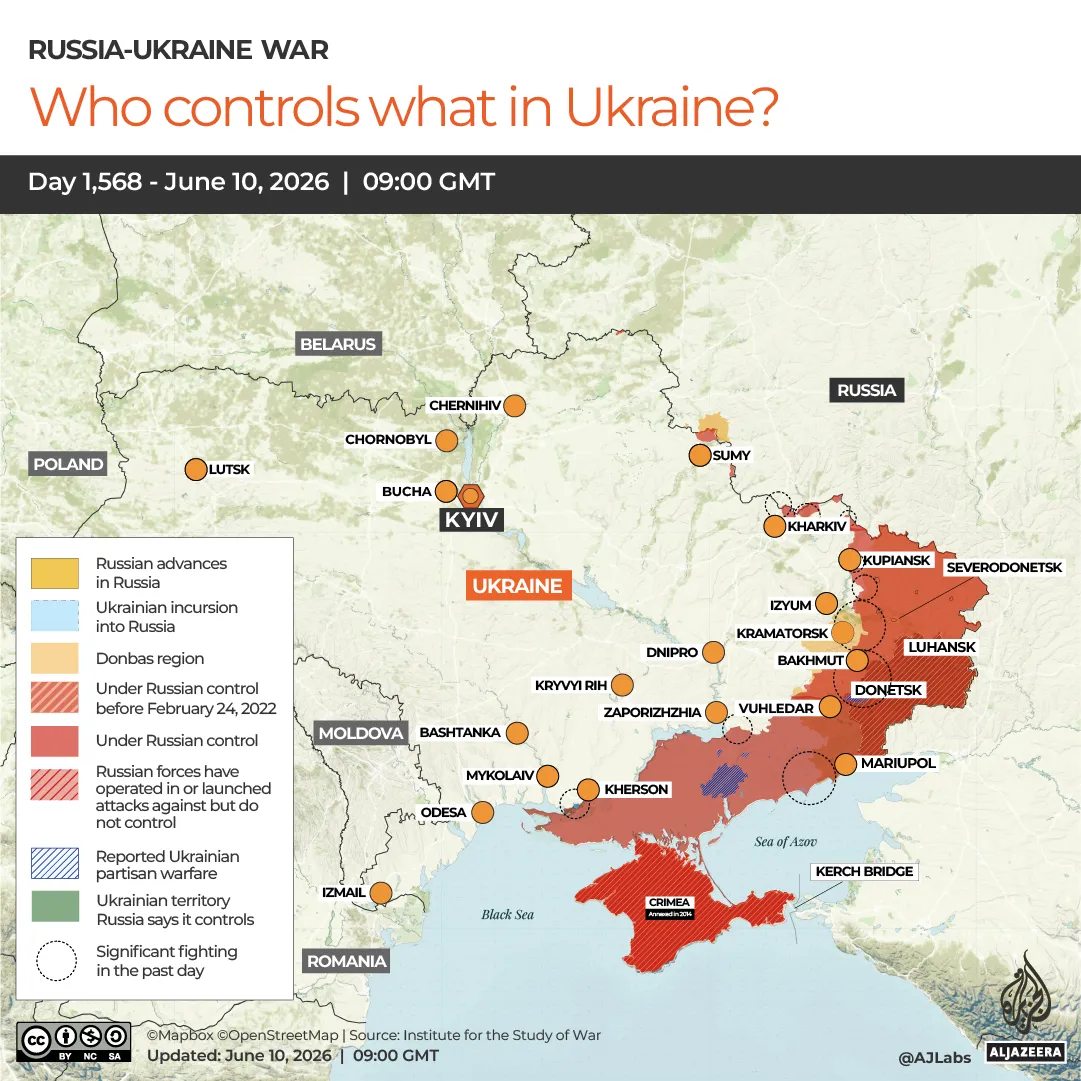
Ukraine said it reclaimed more of its territory than it lost during May, reversing a Russian trend of monthly net gains.

“The ratio of liberated and lost territories is almost 100 square kilometres (40 square miles) in our favour,” wrote Ukrainian commander-in-chief Oleksandr Syrskii on his Telegram messaging channel.

Recommended Stories

list of 4 itemsend of list

Ukrainian defence news outlet Militarnyi estimated net gains slightly higher, at 120 sq km (46 sq miles), citing sources within the military. Militarnyi said Russia seized 130 sq km (50 sq miles) and lost 250 sq km (100 sq miles) during the month.

The Institute for the Study of War, a Washington-based think tank using open source geolocated information, assessed Ukrainian gains higher still, saying Russia had seized or infiltrated 40 sq km (15 sq miles) in May but lost control of about 280 sq km (108 sq miles).

INTERACTIVE-WHO CONTROLS WHAT IN UKRAINE-1780491991
(Al Jazeera)

The ISW believed Ukraine actually reversed Russian gains in April, when it estimated Moscow’s gains at 28 sq km (11 sq miles) of Ukrainian land and lost 116 sq km (45 sq miles).

The ISW’s assessments suggest Ukrainian gains are growing.

Syrskii said Ukraine reclaimed 600 sq km (230 sq miles) during the first five months of 2026.

However, Russia was successful on one part of the front

Ukrainian military observer Kostyantyn Mashovets reported on June 10 that Russian forces had advanced into eastern Konstiantynivka, the southernmost of a “fortress belt” of four cities in the eastern region of Donetsk. Russian forces first infiltrated parts of the city last October, and now hold about 13 percent of it, said the ISW.

INTERACTIVE-WHO CONTROLS WHAT IN EASTERN UKRAINE copy-1780491964
(Al Jazeera)

Russian President Vladimir Putin has prioritised the capture of the remaining one-fifth of Donetsk he does not possess, but his set deadlines to achieve this have been missed several times.

Putin may be putting out feelers for potential ceasefire talks. Although on June 5 he rejected a call from Zelenskyy for direct talks, Zelenskyy said he had met with Russian oligarch Roman Abramovich who acted as Putin’s intermediary.

Mid-range attacks devastate Russian logistics

Ukraine says its battlefield achievements are thanks to a strategy of disrupting Russian supply lines by striking fuel and ammunition in warehouses and in transit.

“The logistical lockdown is working,” said Ukrainian Defence Minister Mykhailo Fedorov. “The number of hits on enemy targets at a distance of over 50km (30 miles) from the (frontline) has doubled,” he said, comparing May to April.

Syrskii put the May total at almost 2,000 strikes.

The effects of Ukraine’s strategy have begun to build up.

Weeks of attacks in the southern regions of Kherson and Zaporizhia reduced Russian military traffic by more than 70 percent along the M-14 motorway, the main east-west route, said Robert Brovdi, commander of Ukraine’s Unmanned Systems Forces.

INTERACTIVE-WHO CONTROLS WHAT IN SOUTHERN UKRAINE-1781084299
(Al Jazeera)

On June 7, regional authorities prohibited traffic along the M-14 altogether, Brovdi said.

That forced Russian planners to route more supplies along two highways that reach Kherson and Zaporizhia, via Crimea – the E105 and E97.

The following day, Ukraine struck a bridge that shoulders the E105 over the Chonhar Strait, leaving only the E97 passable. On June 9, as about 50 Russian fuel and ammunition trucks were routed to the E97, Ukrainian forces ambushed and destroyed some of them at Armyansk, commander Dmitry Filatov told Suspilne Radio.

“This operation would not have been possible if other units had not struck at Mariupol and the road to Berdyansk,” Filatov said, referring to the mainland routes. “This is what led to the units stationed in the Hulyaipil direction starting to be supplied, not via the Mariupol highways, but via Crimea.”

Civilians in Crimea have faced severe fuel shortages as a result of Ukrainian strikes, and these became dramatically worse in the past week.

On June 7, Sevastopol occupation governor Mikhail Razvozhaev rationed fuel to 20 litres per car per day. He later changed that to 20 litres per week.

Shortages were reportedly forcing troop evacuations from some outlying positions.

The Ukrainian underground group Atesh, which operates in Crimea, said Russian units were abandoning their positions on the Kinburn Spit because they were running out of food and fuel.

“We will create conditions under which it will be extremely difficult for military personnel and defence industry workers to remain in Crimea, in the temporarily occupied territories, or to use the routes leading to them,” Brovdi told Reuters.

Although Russia’s air force continues to command the skies over eastern Ukraine and to drop large ordnance there, Ukraine’s own figures suggest its drone superiority is the more effective tool.

Ukrainian short-and medium-range drones hit 180,000 targets in May, said Syrskii, 12.7 percent more than in April.

Ukrainian defenders are also reportedly becoming more adept at shooting down Russian Shahed drones with their own interceptor drones. Although Russia launched 25 percent more Shaheds in May compared to April, shoot-downs increased by 50 percent to about 4,000, said Fedorov,

Fedorov expected a step-change in Shahed elimination once a new generation of interceptor goes into full production which “automates 95 percent of the entire interception process”.

Beyond these mid-range strikes, Ukraine has also continued a successful long-range strike campaign that has devastated Russian refineries, oil depots and offloading terminals, reducing Russian oil production and export revenue.

Russian recruitment is low

Aware of the Ukrainian drone threat, Russia has created unmanned systems units of its own but appears to be having trouble manning them.

Since the beginning of the year, 14,500 people have signed contracts to serve in these units, about 21 percent of the annual recruitment target, said Syrskii. Overall, Ukraine has killed or wounded 12,500 more troops than Russia has been able to recruit this year, he said.

That is both because casualty figures have been rising since last autumn there – Ukraine estimated 31,500 Russian casualties in May – and because Moscow’s recruitment has been falling, despite increased bonuses to sign-up.

Russian opposition source Vazhnye Istorii said 71,200 people had been paid enlistment bonuses in the first quarter of 2026 according to budget data, compared to almost 90,000 in the first quarter of 2025.

It estimated that recruitment in 2025 was already 10 percent lower than in 2024.

Source link

Three killed as Ukraine and Russia exchange cross-border attacks | Russia-Ukraine war News

Three people have been killed in the border region between Russia and Ukraine, according to officials, as the two sides launched attacks on each other in the latest exchange of fire.

In Russia, two civilians were killed and two wounded in the region of Bryansk after Kyiv struck the settlement of Suzemka with artillery, Acting Governor Egor Kovalchuk said in a post on Telegram on Friday.

Recommended Stories

list of 4 itemsend of list

A ⁠drone ⁠also hit an apartment building in Russia’s ⁠central region of Tatarstan, ⁠injuring three people, while industrial facilities were ‌hit, regional head Rustam Minnikhanov said on the Telegram messaging app.

Production work was ⁠not suspended, ⁠however, he added, but did not identify ⁠any plants. ⁠The region ⁠is home to key oil processing and petrochemical ‌facilities, among others.

⁠Russia’s ⁠city of Togliatti, home to ⁠the country’s biggest ⁠carmaker Avtovaz, also came under a drone attack overnight, Samara ‌region Governor Vyacheslav Fedorishchev said on Telegram.

“Attention! Drone attack regime ⁠for Togliatti,” he ⁠wrote. Togliatti is a city ⁠on the ⁠Volga River some 800 km (500 miles) southeast ‌of Moscow.

These strikes are what Ukraine refers to as a “logistics lockdown”, said Al Jazeera’s Audrey MacAlpine, reported from Kyiv. She explained that they are mid-range strikes anywhere over 30 kilometres (17 miles) from the front line, using long-range drones and sometimes heavy weaponry to target things like oil refineries, bridges, logistics, and roads as a means of halting Russia’s front-line operations.

At the same time, she said, Ukraine also launches what it calls “long-range sanctions” against Russian targets – a “tongue-in-cheek term … that we’ve seen escalating over the past several months, where Ukraine is targeting Russia’s oil refineries and oil industry,” MacAlpine explained.

In Ukraine, a drone attack in the border region of Sumy caused casualties.

A 44-year-old woman working as a rail station operator died on her way to a shelter during the strike, according to the head of Ukrainian Railways, Oleksandr Pertsovkyi.

Another woman, a station attendant, was wounded in the attack, Pertsovkyi added.

Three people were wounded in separate attacks on Ukraine’s southern Mykolaiv region.

“We’ve seen continual threats by Russia before massive attacks, and we have certainly seen the results of those actions here in cities like Kyiv, where ballistics continue to be the Achilles heel for Ukraine”, MacAlpine said.

Russian fuel shortages after Ukrainian attacks

In recent months, Kyiv has carried out an increasing number of attacks on Russia and Russian-occupied territories.

On Thursday, fuel stations on the Russian-held Crimean Peninsula ran out of petrol after a Ukrainian campaign against the peninsula’s supply lines escalated.

A witness in Sevastopol, the peninsula’s largest city, told the Reuters news agency there was no fuel at most local petrol stations, with supplies struggling to keep up with a rationing regime imposed in recent weeks.

Another witness, in the resort town of Yevpatoriya, ⁠said there was a long queue outside the only petrol station open there.

Ukraine has been intensifying drone attacks on supply lines to the peninsula, which Russia seized from Kyiv in 2014. Local authorities have imposed fuel rationing regimes, with some foodstuffs also running short.

Besides Russian-held Crimea, only ‌two regions in Siberia have officially confirmed the shortages.

Most other regions have said the situation is under control, and that some disruptions were caused by panic buying. Moscow has denied there were any problems with fuel supplies.

Source link

Baltic states fear Russia-Ukraine war spillover after drone incursions | Russia-Ukraine war News

  • Population: 1.37 million
  • Defence spending: 5.4 percent of GDP
  • Border with Russia: 338km (210 miles)

Estonia, the smallest of the Baltic states, has experienced some dramatic incidents.

In September, Tallinn said Russian MiG-31 fighter jets entered its airspace for 12 minutes. NATO scrambled Italian F-35s stationed in Estonia as part of the Baltic Air Policing mission. Russia denied violating Estonian airspace.

In March, a stray Ukrainian military drone crashed into Estonia’s Auvere power station.

In April and May, Estonian authorities said drones entered their airspace, grounding flights and prompting warnings issued to citizens.

Estonia’s intelligence services have said that the country does not believe Russia is preparing an imminent military attack on NATO, but that Moscow may be rebuilding its forces for the long term while engaging in hybrid attacks through drones, cyber operations, and sabotage.

Tallinn claims one such hybrid method is the so-called “Narva People’s Republic”, a pro-Russian separatist narrative that casts Estonia’s Russian-speaking border region as a distinct political entity, echoing the Donetsk and Luhansk “people’s republics” used by Moscow as a pretext for intervention in Ukraine.

Estonian authorities say it is part of a disinformation campaign rather than a credible separatist movement.

Its military has, at times, been bellicose in its statements.

In May, Estonia’s Lieutenant General Andrus Merilo argued that Russia is rebuilding its military much faster than many Europeans realise and that Estonia must be ready for a renewed military threat within the next few years, marking 2027 as a critical benchmark for readiness.

In September 2024, in an interview with the Estonian public broadcaster ERR, Estonian General Vahur Karus stated that if Moscow showed signs of preparing for an attack, Estonia could strike the Russians first.

“Our capability to neutralise the enemy on its own territory is crucial,” he said.

However, the government’s rhetoric has been more measured.

In April, Ukrainian President Volodomyr Zelenskyy suggested in an interview that a new wave of Russian mobilisation may be used to launch an attack on the Baltic states.

But Estonian politicians, including the foreign minister, warned that the remarks echoed Moscow’s objective of stoking fears and made cooperation difficult.

“We do not see Russia concentrating its forces or preparing in any way militarily to attack NATO or the Baltic states; rather, it is the opposite. Russia is not in a very strong position on the Ukrainian front, and economically as well,” Estonian Foreign Minister Margus Tsahkna told ERR.

“No one is in the streets panicking,” Tony Lawrence, a research fellow at the International Centre for Defence and Security in Tallinn, told Al Jazeera.

The air incursions have “put people on edge”, but there is a sense that Russian forces are too preoccupied in Ukraine, he said.

Source link

EU Unveils 21st Sanctions Package on Russia, Targets Banks

The EU has proposed a new package of sanctions against Russia, aimed primarily at its banks, cryptocurrency networks, and drone production in response to the ongoing war in Ukraine. This 21st package targets 170 individuals and entities, including close to 90 banks, which would raise the total number of Russian banks under EU sanctions to over 100, or more than half of the country’s internationally connected lenders. These banks will face asset freezes and bans on travel and transactions. The proposal will be presented to EU ambassadors for discussion, requiring unanimous approval to be enacted.

Existing Western sanctions already restrict Russia’s banking system heavily. Many major banks were disconnected from the SWIFT payment system in 2022. Nevertheless, Russian companies have turned to smaller lenders to evade these sanctions. The goal of the new sanctions is to significantly harm Russia’s financial sector and push it toward negotiating peace with Ukraine.

As Russia’s economic growth has sharply slowed, warnings of a potential banking crisis have surfaced, though the central bank claims no crisis is present. The proposed sanctions package includes transaction bans on 35 banks, including some outside Russia, and 11 cryptocurrency platforms that aid in circumventing sanctions. EU leaders indicated plans for even stricter crypto measures in the future.

Additionally, the EU wants to freeze the oil price cap to prevent Moscow from gaining increased revenue amidst geopolitical tensions. Other measures include tighter restrictions on Russian liquefied natural gas, listings of vessels associated with sanctioned activities, and new import restrictions on fish and high-performance metal alloys vital for defense and aerospace sectors.

With information from Reuters

Source link

NATO jets shoot down drone over Latvia, extending Ukraine spillover fears | Russia-Ukraine war News

The drone entered Latvian airspace due to ‘Russian electronic warfare’, the military says.

NATO fighters have scrambled to shoot down a drone that entered Latvian airspace from Russia.

The Latvian military said on Monday that French aircraft had destroyed “a foreign unmanned aerial vehicle that had entered Latvian airspace as a result of Russian electronic warfare”, without saying where the drone originated.

Recommended Stories

list of 4 itemsend of list

The incident adds a growing list of incursions from the Russia-Ukraine war into neighbouring countries that are part of the NATO alliance, sparking fears of escalating spillover effects as Moscow’s siege on Ukraine continues apace.

“Thank you to our French allies for shooting down the drone that penetrated Latvian airspace!” Riga’s Foreign Minister Baiba Braze wrote on social media.

Latvian Prime Minister Andris Kulbergs heralded the “swift decision-making and professional action”.

Defence Minister Raivis Melnis told reporters the drone was shot down just after 9am local time (07:00 GMT) near the village of Berzgale, located about 30km (18 miles) from the Russian border. No one was hurt, and no property was damaged, Melnis said.

The French military said in a statement that the jets took off from Siauliai airbase in northern Lithuania and destroyed the drone “over an uninhabited area”.

It added that the incident demonstrated France’s “commitment to contributing to the security of Europe’s eastern flank”.

Authorities had previously warned residents in some parts of eastern Latvia to shelter in place because of the threat.

Ongoing threat

Countries in the region have reported repeated drone incursions from air and sea in recent months, spawning concerns over the widening impact of Russia’s war on Ukraine.

The issue has raised the political pressure in Latvia, leading to the resignation of Prime Minister Evika Silina last month.

The increased frequency of the reports comes as Ukraine has increased its attacks on Russia, with Moscow deflecting drones using electronic jamming. The statement from the Latvian military regarding “Russian electronic warfare” appears to suggest the drone shot down likely came from Ukraine.

Fragments of a Ukrainian drone were also found in a field in Moldova on Monday after it entered from Ukraine, an incident that officials also blamed on Moscow.

Last week, a maritime drone exploded in Romania’s Constanta port. Kyiv later confirmed it involved a Ukrainian drone that was knocked off course by Russian electronic interference.

However, it was a Russian drone that hit an apartment building in eastern Romania in late May, injuring two people and prompting Bucharest to call for NATO to speed up the transfer of anti-drone capabilities.

European Commission President Ursula von der Leyen warned after that crash that Russia’s war on Ukraine is “increasingly becoming a direct threat to countries on our Eastern border” and said solidarity with them was “absolute”.

The French military jet that shot down Monday’s drone is part of the NATO Baltic Air Policing mission, which has patrolled the skies of Latvia, Lithuania and Estonia since they became part of NATO in 2004.

Source link

Ukraine hits St. Petersburg in overnight strikes

Saturday is the last day of Russian President Vladimir Putin’s St. Petersburt International Economic Forum. Ukraine struck military targets near the city overnight Friday. Photo by Anatoly Maltsev/EPA

June 6 (UPI) — A drone attack launched by Ukraine hit St. Petersburg, Russia, overnight as Russian President Vladimir Putin wraps up an economic forum there.

Ukrainian President Volodymyr Zelinsky had asked Putin to meet face to face and discuss peace talks, but Putin responded that there was no point.

“It is time to end this war. But Russia’s ruler wants to keep fighting,” Zelensky wrote on X early Saturday. “That is why Ukrainian sanctions against this aggression are working. Last night, our drones covered a distance of about 1,000 kilometers to the St. Petersburg region — to the enemy navy’s arsenals and a base in Kronstadt. Our long-range sanctions also reached about 500 kilometers into the Krasnodar region — and hit an oil depot.”

Kronstadt is home to a naval academy and is the main base, repair and supply hub for the Russian navy in the Eastern Baltic.

Leningrad Governor Aleksandr Drozdenko said more than 140 drones were shot down in his region. St. Petersburg Governor Alexander Beglov told residents to stay indoors, CNN reported. He also said three people were injured.

Drozdenko said more than 600 people were evacuated from Bolshaya Izhora, a village on the Gulf of Finland near St. Petersburg, as efforts continued to put out a fire. The area is also home to a Russian naval arsenal, CNN reported.

St. Petersburg is Russia’s second-largest city, behind Moscow.

The New York Times reported that St. Petersburg’s main airport, Pulkovo, suspended operations for almost five hours, according to Rosaviatsia, the Russian aviation authority. Residents reported smoke in the sky and roaring noises and bangs, according to Fontanka, a local news website.

Ukrainian Foreign Minister Andrii Sybiha said on X Saturday that “Things will only get worse for Russia. Battlefield losses will continue to grow. Failures will get more humiliating. … “The international pressure will not ease. It will only get stronger. Including the use of frozen assets, travel bans and inevitable accountability for crimes,” Sybiha said.

Zelensky is scheduled to meet with leaders of France, Germany and Great Britain in London Sunday to discuss support for Ukraine and peace talks, Politico reported.

President Donald Trump discusses renovations to the Lincoln Reflecting Pool and makes an announcement on coal in the Oval Office at the White House on Thursday. Photo by Samuel Corum/UPI | License Photo


Source link

Zelenskyy: Putin choosing war by rejecting offer for in-person talks | Russia-Ukraine war

NewsFeed

Russian President Vladimir Putin has turned down an offer for in-person talks with Ukrainian President Volodymyr Zelenskyy, saying he sees no point in meeting. Zelenskyy said Russia “has again chosen war” by rejecting his open letter appealing for a face-to-face meeting.

Source link

House passes bill to aid Ukraine and impose new sanctions on Russia

The House passed legislation Thursday that would aid Ukraine and sanction key segments of the Russian economy, overriding objections from Republican leaders who warned the bill would undermine negotiations designed to achieve a comparable but stronger result.

The legislation, sponsored by Rep. Gregory Meeks, D-N.Y., seeks to cement U.S. assistance for Ukraine by providing more than $1 billion in security and reconstruction aid. It would make another $8 billion available for Ukraine’s defense through loans.

The 226-195 vote is a sign of impatience with President Trump’s approach to the war and represents the House’s second major foreign policy break with Trump this week. The day before, the House, for the first time, approved a war powers resolution aimed at halting U.S. military action against Iran.

Supporters were able to force action on the Ukraine bill by gathering 218 signatures on a discharge petition, a legislative tool that allows a majority of the House to effectively bypass leadership.

Once rarely successful, House members have used the petition tool this Congress to pass bills on releasing the government’s files on Jeffrey Epstein and to extend health care subsidies to many of those who get health coverage through the Affordable Care Act, though the latter measure faltered in the Senate.

Meeks said the question before the House was simple. Would it help Ukraine negotiate from a position of strength or help Russia outlast American resolve?

“We all want this war to end,” Meeks said. “The question is how. Will we abandon Ukraine and force it into a terrible deal? That is what Vladimir Putin is counting on. Or will this body live up to the commitments we’ve made since the start of this war?”

The vast majority of Republicans opposed the measure. Rep. French Hill, the chairman of the House Financial Services Committee, said he is a steadfast supporter of Ukraine. However, the Arkansas Republican said the House was confronted with a flawed, outdated measure that actually calls for less funding for Ukraine security assistance compared to what Congress had agreed to as part of this year’s defense policy. Another section could lead to a decrease in defense spending by some NATO members, he warned.

Rep. Brian Mast, the chairman of the House Committee on Foreign Affairs, said he believed the bill was “a cudgel to fight against President Trump.”

“This bill, in my opinion, is an unserious bill that was crafted basically a year-and-a-half ago,” Mast, R-Fla., said.

Rep. Don Bacon, R-Neb., broke with most of his Republican colleagues in voicing support for the measure.

“Are we going to stand with good or are we going to stand with evil? That’s what this is about tonight,” he said.

In the end, 18 Republicans, 207 Democrats and one independent voted for the bill. Democratic Rep. Ilhan Omar joined with 194 Republicans in voting against it.

Lawmakers want to send a message

Supporters are hopeful that the House’s passage of the Ukraine bill would put pressure on the Senate to do the same. But they also know the Senate likely won’t go along unless Trump endorses the bill.

“It’s probably not going to get 60 votes in the Senate, but it’s going to hopefully force the Senate to address the issue,” said Rep. Brian Fitzpatrick, R-Pa., who signed the discharge petition and voted for the bill. “It’s going to send a great message to the soldiers of Ukraine.”

He said the vote would also send a message to Putin that “we do have a pulse here, that we do care about Ukraine and that we are going to utilize our authority to help them.”

As the war has dragged on, it’s gotten more difficult for supporters of Ukraine in Congress to provide additional financial support to help Ukraine defend itself.

The U.S. has approved some $195 billion for the Ukraine response, according to the latest quarterly inspector general report for Operation Atlantic Resolve, with roughly a quarter of that going to replenish weapons stockpiles for the U.S. military. The last major legislation designed to bolster the Ukraine response occurred in April 2024, though modest amounts have since been included in annual appropriations bills.

Republican leaders tried to stop the bill

Republican leaders urged their members to oppose the legislation. House Majority Leader Steve Scalise, R-La., said there are good-faith negotiations between members of Congress and the White House to boost Ukraine. He described the negotiations as complicated.

“I think they are going to yield positive results, but you set that back if you pass legislation that doesn’t go as far as the negotiations are going,” Scalise said.

The war that followed Russia’s full-scale invasion of its neighbor is more than four years old, with no end in sight. In recent days, both sides have sought an edge by launching long-range missile strikes.

U.S.-led peace efforts have fizzled out as the sides made no progress on key differences and after the war in Iran grabbed Washington’s attention. Ukrainian President Volodymyr Zelensky accepted an unconditional ceasefire demanded by Trump, but Putin refused.

Action in the Senate on Ukraine has revolved around a bill that would impose sweeping tariffs and secondary sanctions on countries that purchase Russia’s oil, gas, uranium and other exports, which are crucial to financing Russia’s military. But the bill has languished.

Freking writes for the Associated Press. AP writer Lisa Mascaro contributed to this report.

Source link

Drone explosion in Romanian port spurs Ukraine war spillover fears | Russia-Ukraine war News

European Commission President Ursula von der Leyen warned that the maritime drone was a ‘direct consequence’ of the Russia-Ukraine war. 

A maritime drone has exploded in Romania’s Constanta port, with several other drones discovered nearby.

The Romanian Ministry of National Defence said on Friday that the drone had self-detonated at 10:30am local time (07:30 GMT). The incident is just the latest incursion along NATO’s eastern flank, raising concern over the increasing spillover from Russia’s war on Ukraine to neighbouring states that are part of the Western military alliance.

Recommended Stories

list of 3 itemsend of list

The drone exploded near an oil terminal, without causing injuries. Interior Minister Raed Arafat said the port was evacuated after the detonation, and residents along the Black Sea coast were warned to take cover as helicopters surveyed the area for other vessels.

Kyiv later said it had informed Bucharest that Friday’s incident involved a Ukrainian maritime drone that was knocked off course by Russian electronic interference.

“While carrying out missions in the Black Sea operational area, one of the Ukrainian Navy’s unmanned surface vessels came under the influence of the enemy’s electronic warfare systems, lost control, and ended up near the coast of Romania,” the Ukrainian navy said.

Romanian President Nicusor Dan noted on Facebook that this was the “second security incident this week on the Romanian seaside”.

Earlier this week, Romania’s navy detonated a Russian YaRM-type anti-landing mine that had drifted to its Black Sea shore.

Last week, a Russian drone crashed into an apartment building in Romania, increasing fears that the war started by Russia’s invasion of Ukraine in February 2022 increasingly risks spilling over to the region.

European Commission President Ursula von der Leyen warned on Friday that the maritime drone was a “direct consequence” of the Russia-Ukraine war.

“It is increasingly becoming a direct threat to countries on our Eastern border. Our solidarity with every Member State exposed to these threats is absolute,” von der Leyen wrote.

“And our response must match the urgency. Europe is investing massively in anti-drone capabilities, air defence and early warning systems,” she added.

Romania, which shares a 650km (400-mile) land border with Ukraine, has reported dozens of airspace breaches amid the four-year war, generally blaming Russia, and has asked NATO to help it bolster air defences.

The spillover of the war is also affecting non-NATO countries.

Azerbaijan’s Ministry of Foreign Affairs reported on Friday that five of its citizens were killed and three injured after attacks on two cargo vessels, which did not belong to Baku, in the Sea of Azov.

Kyiv said earlier that its drones had hit five ships in the ports of Mariupol and Berdyansk – which sits between Russia and the Russian-occupied eastern regions of Ukraine.

Commander of the Ukrainian drone forces, Robert Brovdi, asserted that the vessels were involved in “stealing” Ukrainian grain and transferring military cargo.

Source link

Ukraine Tests New Missile In Hopes Of Leading To Low Cost Patriot Alternative

Tests of Ukraine’s new FP-7.X missile could pave the way to a cheaper and more plentiful, albeit far less capable, alternative to the U.S.-made Patriot air defense system effectors. A recent uptick in Russian missile and drone attacks against Ukraine, combined with a critical shortage of Patriot interceptors, underscores the need for more robust air defenses, especially with anti-ballistic missile capabilities. The development parallels a similar program in the United States, which seeks a drastically lower-cost interceptor for the Patriot system.

A video showing a test launch of an FP-7.X missile was published yesterday by its manufacturer, Fire Point, also responsible for the FP-5 Flamingo cruise missile and a series of long-range one-way attack drones. Fire Point’s chief technology officer Iryna Terekh described the depicted test as a “fully controlled maneuvering flight” conducted “just the other day.” The pink-painted missile recalls the early Flamingoes, and now seems to have been adopted as something of a company trademark.

The FP-7.X missile is planned as the stepping-stone toward the productionized Freyja missile, which is primarily intended to provide Ukraine with its first homegrown anti-ballistic missile defense system. While ballistic missile threats are being prioritized here, the system would be equally able to defend against a variety of crewed aircraft threats, as well as drones and cruise missiles.

“No matter how unrealistic and ambitious this goal may sound today, we are exerting all possible and impossible efforts to make it a reality as soon as possible, so that Ukraine can close its skies on its own,” Terekh wrote.

Back in April, Fire Point’s co-founder and chief designer Denys Shtilierman told Reuters that the company was aiming to develop an anti-ballistic missile with a unit cost of less than $1 million.

A rendering of the FP-7 surface-to-surface ballistic missile on which the FP-7.X missile is based. Fire Point

“If we can decrease it to less than $1 million, it will be … a game changer in air defense solutions,” Shtilierman said. “We plan to intercept the first ballistic missile at the end of 2027,” he added, apparently referring to the aim to field the Freyja system by that date.

This compares to a unit price of approximately $5.3 million for each example of the most modern and highly capable PAC-3 MSE variant, which is one of the types provided to Ukraine. This figure comes from the Army’s latest proposed budget for the 2027 Fiscal Year. This is up from a historical average of around $4 million for each one of these missiles. These munitions also take years of lead time to produce, meaning that managing limited stocks is a big challenge.

Fire Point has developed the FP-7.X missile on the basis of the previous FP-7 surface-to-surface ballistic missile, a weapon with a range of around 124 miles, and a warhead of approximately 331 pounds. Deriving an anti-ballistic missile from a ballistic missile is an unusual move, but Fire Point will hope that the commonality should accelerate the process.

As it stands, Ukraine’s anti-ballistic missile capabilities are strictly limited. It relies heavily upon the Patriot, batteries and components of which have been provided by Germany, the Netherlands, and the United States.

When the Patriot began to arrive in 2023, it provided Ukraine with an enhanced long-range, high-altitude engagement capability that was previously only offered, to a lesser degree, by Ukraine’s S-300s, with their depleting stocks of missiles. Importantly, the Patriot also brought an anti-ballistic missile capability, something that was previously only provided by the small number of Ukrainian S-300V1 systems, and even those don’t come anywhere close to the Patriot in this regard.

Providing somewhat similar capabilities to the Patriot is the SAMP/T, a joint Franco-Italian SAM system, which has also been supplied to Ukraine, but only in limited numbers. Overall, the SAMP/T is limited simply by the fact that it is produced in relatively small numbers.

As for the Patriot, this has claimed notable successes and high-profile victims in Ukrainian hands. However, as Russia has adapted its ballistic missiles, specifically adding enhanced maneuvering capabilities, the effectiveness of the U.S.-made system has been reduced.

A screen capture of a Ukrainian Air Force video shows images of three Russian helicopters and two Russian fighters painted on the side of a Patriot air defense battery. Defense Industry of Ukraine image

According to Shtilierman, the Patriot system often requires two or three air defence missiles, each costing several million ​dollars, to bring down a ballistic projectile. This is a mismatch that Fire Point also hopes to address with the Freyja.

It is notable that the U.S. Army is currently also pressing defense contractors to come up with proposals for a new interceptor for the Patriot system with a unit cost under $1 million, as you can read more about here. Whether by design or coincidence, U.S. Army Maj. Gen. Frank Lozano, the Army’s Portfolio Acquisition Executive for Fires (PAE Fires), included a rendering of the FP-7.X in a recent LinkedIn post, as seen below, to illustrate a notional low-cost interceptor.

The latest development comes as Ukraine’s political and military leaders continue to warn about critical shortcomings in the country’s air defense capabilities. As well as expending the missiles it already has, the United States has reportedly suspended further Patriot deliveries to Ukraine because of concerns over the state of its own stockpile.

Ukrainian President Volodymyr Zelensky has repeatedly urged U.S. President Donald Trump and members of Congress to provide additional missiles for its Patriot systems, warning that Ukraine faces a severe air defense shortfall.

Yesterday, Zelensky said that Ukrainian officials have one week to finalize outstanding legal, financial, and technical issues related to the purchase of additional Patriot systems.

Zelensky said that a political agreement to buy the systems has already been reached, but the process has stalled.

Ukraine’s ambassador to the United States, Olha Stefanishyna, added that Kyiv is prepared to finance additional Patriot systems and interceptor missiles if Washington agrees to deliver them.

Ukrainian personnel remove camouflage netting from a Patriot launcher, which is loaded with missile canisters associated with older interceptors like the PAC-2-series. Ukrainian Air Force

Commander-in-Chief of the Armed Forces of Ukraine Oleksandr Syrsky also recently pointed to Ukraine’s lack of sufficient modern air defense systems and interceptor missiles.

Clearly, continued Russian missile and drone strikes are putting a heavy strain on Ukraine’s air defenses.

Plugging the gaps with the Freyja system would make a lot of sense, providing a locally developed and manufactured solution to the problem, provided that the technical hurdles can be overcome.

Even so, the deadline of the end of 2027 is very ambitious for such a project.

With that in mind, Ukraine is also looking to foreign support for the Freyja program.

Earlier this year, Fire Point confirmed it was in talks to get European and Middle Eastern companies onboard the program. With various nations struggling to meet their air defense needs amid the demands of the conflicts in Ukraine and the Middle East, investing here could also bring dividends.

This photograph shows parts of long-range drones stored in a workshop of the Fire Point company which manufactures FP-1 deep-strike drones and FP-2 strike drones in an undisclosed location in Ukraine on January 29, 2026, amid the Russian invasion of Ukraine. (Photo by Serhii Okunev / AFP via Getty Images)
Parts of long-range drones stored in a workshop of the Fire Point company at an undisclosed location in Ukraine on January 29, 2026. Photo by Serhii Okunev / AFP SERHII OKUNEV

Shtilierman told Reuters in April that he was awaiting government approval for an investment in Fire Point by a Middle Eastern conglomerate, which would provide a major boost to Freyja and other programs, including longer-reaching ballistic missiles.

In terms of European companies, Shtilierman mentioned his interest in collaborating on radar, missile target-seeking, and communications systems. He named Hensoldt, Saab, and Thales as potential suppliers of radar solutions, an area where Fire Point lacks expertise.

Fire Point has also previously described the Freyja interceptor being fitted with an infrared imaging seeker for the terminal phase, as well as a semi-active radar homing seeker from Diehl Defence of Germany.

Few details are available about the launch system, other than reports of a lightweight, mobile launcher of domestic origin.

Globally, there is a clear demand for alternatives to the increasingly hard-to-source Patriot, especially for anti-ballistic missile defense.

A video shows a PAC-2 in a test against a Lance ballistic missile:

MIM-104C Patriot PAC-2 vs. Lance TBM thumbnail

MIM-104C Patriot PAC-2 vs. Lance TBM


Ukraine’s combination of battlefield experience, rapid innovation, and low-cost defense technologies could put it in a good position to fill the gap. Even if the Freyja ends up with a significantly lower kill rate per missile than the Patriot, if it is far cheaper, that would be less of a problem.

At the same time, it remains unclear if Fire Point is able to fulfil the promises it has made in terms of output. In the past, the company has said it aims to build at least seven of its Flamingo cruise missiles per day, for a total of 2,555 built annually. To reach this target, the firm might need to call upon foreign partnerships to help expand its production capacity. The same would likely be the case for Freyja. By way of comparison, in 2024, Lockheed Martin produced more than 500 PAC-3 MSEs, with a plan to increase this to 600 in 2025.

A video of the Flamingo cruise missile in action:

Випробувальний пуск ракети “Фламінго" thumbnail

Випробувальний пуск ракети “Фламінго”


One unknown factor in this is the possibility that Ukraine and/or NATO allies in Europe might obtain additional licenses for local production of Patriot missiles. Zelensky wants Patriot production in Ukraine and has said he has been discussing it with the United States. Still, while these might address the production capacity issues for the weapons, it would still be a more expensive solution than what Fire Point is proposing and it would take years to realize any output.

For now, the FP-7.X appears to be an early-stage technology demonstrator, and turning it into the operational Freyja interceptor by 2027 will require overcoming massive technical and logistical hurdles — as well as holding off Russian air attacks in the meantime.

However, the program reflects a broader trend in Ukraine’s wartime defense sector: rapidly developing indigenous capabilities to fill critical gaps left by limited and/or unreliable foreign supplies. If Fire Point can translate its ambitions into a viable anti-ballistic missile system, Ukraine could gain not only a more sustainable means of defending its skies, but also a potentially attractive export alternative in a global market increasingly hungry for affordable air defense solutions.

Contact the author: thomas@thewarzone.com

Thomas is a defense writer and editor with over 20 years of experience covering military aerospace topics and conflicts. He’s written a number of books, edited many more, and has contributed to many of the world’s leading aviation publications. Before joining The War Zone in 2020, he was the editor of AirForces Monthly.


Source link

Russia’s Andreeva beats Ukraine’s Kostyuk in no-handshake French Open semi | Tennis News

No handshake and no photo as Mirra Andreeva of Russia beats Marta Kostyuk of Ukraine to reach French Open tennis final.

Russian teenager Mirra Andreeva reached her first Grand Slam final by beating Marta Kostyuk of Ukraine 6-1, 6-3 in a tense encounter at the French Open.

Andreeva converted her first match point when she served for the tennis match on Thursday.

Recommended Stories

list of 4 itemsend of list

There was no post-match handshake between the pair, however, and Kostyuk walked off quickly, turning only to wave and blow kisses to the crowd at Court Philippe-Chatrier, where some fans were draped in Ukrainian flags.

The atmosphere beforehand was somewhat tense as the players had separate photos taken as they each stood next to two children on their respective sides of the net. Usually, the players pose for the same photo, standing right next to each other by the net.

Kostyuk and countrywoman Oleksandra Oliynykova have spoken out during the tournament about the impact Russia’s four-year invasion of Ukraine is having on their country.

The eighth seed seized control from the outset and never loosened her grip on the contest, overwhelming Kostyuk with her ⁠depth and aggression on Court Philippe-Chatrier to set up a title clash against compatriot Diana Shnaider or Polish qualifier Maja Chwalinska.

Andreeva, 19, raced into a 4-0 lead in the opening set and barely looked back in the third meeting between the two ⁠players, the Ukrainian having won the first ⁠two.

Kostyuk briefly threatened to make a contest of it in the second set, but the Russian swiftly snuffed out any hopes of a comeback before serving ⁠out the match to complete a dominant display.

“I’m still very nervous, very nervous coming to ⁠this match as she’s had an ⁠amazing season, she hadn’t lost on clay, so that put pressure,” said Andreeva.

“She’s an amazing player, a tough opponent, so I’m super happy with the way ‌I played. I’m happy I got revenge for the Madrid final, and to reach my first Grand Slam final.

“All of these ‌feelings ‌combined, I’ve never felt anything like this. I’m very excited about the last match here in Paris.”

Top-seeded Sara Errani and Andrea Vavassori of Italy won the mixed doubles final earlier Thursday, beating Gabriela Dabrowski of Canada and Evan King of the US 4-6, 6-3, 10-4.

An Italian is guaranteed to be in Sunday’s men’s French Open singles final, with Flavio Cobolli facing fellow Italian Matteo Arnaldi on Friday in the first Grand Slam semifinal for both players.

Source link

Putin Pressures Armenia as Russia Struggles to Maintain Global Influence

Russia’s influence across its traditional sphere of influence is facing growing challenges as the war in Ukraine continues to consume military, economic and diplomatic resources. For decades, Moscow maintained strong ties with former Soviet states through security guarantees, energy supplies and economic integration. However, several longtime partners have increasingly sought closer relations with the West, raising concerns in the Kremlin about the erosion of its geopolitical position.

One of the most notable examples is Armenia, a longtime Russian ally that has recently deepened engagement with the United States and Europe while exploring a path toward eventual European Union membership.

What Happened

Russian President Vladimir Putin has warned Armenia that pursuing closer integration with the European Union could come at a significant economic cost. Ahead of Armenia’s parliamentary elections, Putin suggested that Yerevan could lose access to discounted Russian oil and gas if it continues moving toward the EU.

The warning comes as polls indicate that the party of Armenian Prime Minister Nikol Pashinyan, who has pursued a more Western-oriented foreign policy, is likely to perform strongly in the vote.

Russia has already taken measures that many observers view as pressure tactics, including temporary restrictions on certain Armenian exports and warnings about possible reductions in economic cooperation.

Why Armenia Is Moving Closer to the West

Relations between Moscow and Yerevan have cooled significantly in recent years. Armenia signed a partnership agreement with the United States last month and has taken legislative steps that could eventually support EU membership aspirations.

Pashinyan’s government argues that Armenia must diversify its international partnerships and reduce its dependence on any single power. Supporters of closer Western ties point to economic opportunities, political reforms and security cooperation as key motivations behind the shift.

Russian officials, however, view Armenia’s growing engagement with Western institutions as part of a broader effort by the United States and Europe to weaken Moscow’s influence in the South Caucasus region.

Russia’s Wider Struggle to Retain Influence

The dispute with Armenia highlights a broader challenge facing Russia as it attempts to preserve its global standing while remaining heavily focused on the war in Ukraine.

Across multiple regions, Moscow is confronting increasing competition from Western powers. In Europe, countries once considered friendly to Russia are strengthening ties with the European Union and NATO. In the Balkans, political pressure is growing on governments that have traditionally maintained close relations with Moscow.

Russia also faces challenges in Moldova’s breakaway region of Transdniestria, where pro-European political forces are gaining influence. In Central Asia, Moscow is closely watching expanding Western engagement in a region it has long regarded as part of its strategic sphere.

Beyond its neighborhood, Russia’s relationships with partners such as Cuba, Venezuela and Iran are being tested as geopolitical dynamics shift and Western pressure intensifies.

What Comes Next

The outcome of Armenia’s parliamentary election will be closely watched in both Moscow and Western capitals. A victory for Pashinyan’s party could strengthen Armenia’s efforts to deepen ties with Europe and the United States, potentially leading to further tensions with Russia.

For the Kremlin, the situation represents a broader strategic dilemma. As the war in Ukraine continues without a clear resolution, Russia must balance military commitments with the need to maintain influence among traditional allies increasingly exploring alternative partnerships.

The coming months are likely to reveal whether Moscow can preserve its position in regions it has long considered part of its sphere of influence or whether Western engagement will continue to reshape the geopolitical landscape across Eastern Europe, the South Caucasus and beyond.

With information from Reuters.

Source link