U.S.

Appeals court says Trump’s asylum ban at the border is illegal, agreeing with lower court

An appeals court on Friday blocked President Trump’s executive order suspending asylum access, a key pillar of the Republican president’s plan to crack down on migration at the southern border of the U.S.

A three-judge panel from the U.S. Court of Appeals for the District of Columbia Circuit found that immigration laws give people the right to apply for asylum at the border, and the president can’t circumvent that.

The panel concluded that the Immigration and Nationality Act doesn’t authorize the president to remove the plaintiffs under “procedures of his own making,” allow him to suspend plaintiffs’ right to apply for asylum or curtail procedures for adjudicating their anti-torture claims.

“The power by proclamation to temporarily suspend the entry of specified foreign individuals into the United States does not contain implicit authority to override the INA’s mandatory process to summarily remove foreign individuals,” wrote Judge J. Michelle Childs, who was nominated to the bench by Democratic President Biden.

The White House didn’t immediately respond to a request for comment.

ACLU attorney Lee Gelernt said in a statement that the appellate ruling is “essential for those fleeing danger who have been denied even a hearing to present asylum claims under the Trump administration’s unlawful and inhumane executive order.”

Judge Justin Walker, a Trump nominee, wrote a partial dissent. He said the law gives immigrants protections against removal to countries where they would be persecuted, but the administration can issue broad denials of asylum applications.

Walker, however, agreed with the majority that the president cannot deport migrants to countries where they will be persecuted or strip them of mandatory procedures that protect against their removal.

Judge Cornelia Pillard, who was nominated by Democratic President Obama, also heard the case.

Source link

Amnesty International and rights groups issue a World Cup travel advisory for the U.S.

Amnesty International and dozens of U.S. civil and human rights groups issued a “ World Cup travel advisory” Thursday, warning tournament visitors of “rising authoritarianism and increasing violence” in the United States during President Trump’s aggressive immigration enforcement.

The groups said the advisory was necessary “in light of the deteriorating human rights situation in the United States and in the absence of meaningful action and concrete guarantees from FIFA, host cities, or the U.S. government.”

The advisory says visitors may be arbitrarily denied entry to the country, detained in “inhumane” conditions or subjected to invasive phone and social media searches. It points to the aggressive immigration surges in cities including Los Angeles, Chicago and Minneapolis that led to accusations of racial profiling and the violent suppression of protests.

The message was condemned by tourism officials, who said the groups were threatening the livelihoods of service industry workers in an attempt to achieve their political goals.

Geoff Freeman, president & CEO of the U.S. Travel Association, said there are legitimate concerns about U.S. entry policies but they’re being blown out of proportion. There were 67 million international travelers to the United States last year, he said in a statement.

“The notion that visiting America poses a meaningful safety risk is not a good-faith warning, it’s a political tactic designed to cause economic harm,” Freeman said.

A FIFA spokesperson pointed to several statements and policies, including the federation’s governing documents, which say, “FIFA is committed to respecting all internationally recognized human rights and shall strive to promote the protection of these rights.”

The U.S. has seen a decline in international travelers since Trump returned to the White House last year and offended U.S. allies with talk of making Canada a U.S. state, taking control of Greenland and questioning the value of NATO. The tourism industry is counting on a major boost from World Cup visitors, even as Trump’s travel ban for citizens of 19 countries has injected further uncertainty.

The administration is betting that its push to expedite visa processing for visitors and excitement about the tournament will outweigh concerns that Trump’s immigration messaging undercuts the theme of global unity that the World Cup is meant to represent.

The tournament kicks off June 11 with games spread across North America, including 11 stadiums in the U.S. along with two in Canada and three in Mexico.

Cooper writes for the Associated Press.

Source link

Coupang denies lobbying U.S. to pressure S. Korea

E-commerce firm Coupang on Friday denied allegations that it lobbied U.S. government officials to pressure South Korea after a data leak controversy. This February 27 photo shows a Coupang distribution center in Seoul. File Photo by Yonhap

E-commerce firm Coupang Inc. on Friday denied allegations that it lobbied U.S. government officials to pressure the South Korean government following a data leak controversy that emerged in November.

The company also rejected claims that its lobbying activities involved security-related issues, calling such assertions unfounded.

Citing disclosures under the U.S. Lobbying Disclosure Act (LDA), Coupang said its lobbying efforts focused on promoting economic cooperation between Seoul and Washington and expanding professional visa opportunities for South Koreans seeking employment in the United States.

The filings show the company also engaged with U.S. authorities on plans to expand investment and commercial activity in South Korea, Taiwan and Japan, without addressing security matters, Coupang said in a text message.

Coupang said it has prioritized communication on artificial intelligence (AI) innovation, investment, job creation and cross-border commerce involving the U.S. and other markets, including South Korea.

The company said it spent 1.6 billion won (US$1.09 million) on lobbying in the January-March period.

“Lobbying activities by both U.S. and South Korean companies are conducted within legal frameworks,” Coupang said, adding that major U.S. firms typically spend three to four times more than it does.

Copyright (c) Yonhap News Agency prohibits its content from being redistributed or reprinted without consent, and forbids the content from being learned and used by artificial intelligence systems.

Source link

Soldier charged with using classified information to bet on Maduro capture

April 23 (UPI) — A U.S. Army special forces soldier who participated in capturing Venezuelan leader Nicolas Maduro has been charged with using classified information about the operation to make bets on Polymarket, a decentralized prediction platform, federal prosecutors said Thursday.

Gannon Ken Van Dyke, stationed at Fort Bragg in Fayetteville, N.C., is alleged to have profited by more than $400,000 through wagers he made on Polymarket concerning the future of Venezuela, Maduro and U.S. military intervention.

“Our men and women in uniform are trusted with classified information in order to accomplish their mission as safely and effectively as possible, and are prohibited from using this highly sensitive information for personal financial gain,” Acting Attorney General Todd Blanche said in a statement.

Polymarket is one of several crypto-based prediction markets that grew in popularity during the 2024 general election, allowing users to make wagers on seemingly anything, from who will be drafted first overall in the NFL Draft to when President Donald Trump will announce the war in Iran is over.

In the indictment unsealed Thursday, federal prosecutors alleged that starting from around Dec. 8, Van Dyke participated in the planning and execution of Operation Absolute Resolve.

On Dec. 26, Van Dyke allegedly created a Polymarket account, which he used to make 13 bets from Dec. 27, wagering a combined $33,034 on contracts concerning U.S. military involvement in Venezuela.

Before dawn on Jan. 3, U.S. military forces conducted a clandestine operation in Venezuela, resulting in the capture of Maduro and his wife, who were brought back to the United States to face narco-trafficking charges.

After Trump announced the operation that night, Van Dyke allegedly made $409,881 off his bets, which he withdrew to a foreign cryptocurrency vault before depositing them into a newly created online brokerage account, federal prosecutors said.

After the operation, news broke that one user had wagered $32,000 that Maduro would be ousted by the end of January, netting the multi-hundred-thousand-dollar payout.

Prosecutors alleged that as reports of the unusual wager spread, Van Dyke asked the platform on Jan. 6 to delete his account and he allegedly changed the email address registered to his cryptocurrency exchange account.

The indictment charges him with use of confidential government information for personal gain, theft of nonpublic government information, commodities fraud, wire fraud and making an unlawful monetary transaction.

If convicted, Van Dyke faces up to 10 years in prison for each of the three Commodity Exchange Act counts, 20 years for the one wire fraud count and 10 years for the unlawful monetary transaction charge.

The charges come amid concern about such decentralized markets that allow for betting on real-world events and calls for them to be regulated

In late March, dozens of lawmakers called on the Commodity Futures Trading Commission and the Office of Government Ethics to address illegal insider trading on these platforms by federal employees following the Polymarket payout on the capture of Maduro and other suspicious trades.

Asked about the development and if he is concerned about bets being placed on the Iran war, Trump told reporters at the White House that he will look into it.

“The whole world, unfortunately, has become somewhat of a casino. And you look at what’s going on all over the world, in Europe and every place, they’re doing these betting things,” he said.

“I was never much in favor of it. I don’t like it, conceptually, but it is what it is.”

Source link

Trump: Israel, Lebanon to extend cease-fire for 3 weeks

April 23 (UPI) — President Donald Trump on Thursday announced that Israeli and Lebanese diplomats agreed to extend their cease-fire by three weeks in talks held at the White House.

The announcement came after the president hosted the countries’ ambassadors for negotiations along with Vice President JD Vance, Secretary of State Marco Rubio, U.S. Ambassador to Israel Mike Huckabee and U.S. Ambassador to Lebanon Michael Issa.

“The Meeting went very well!” Trump posted on Truth Social.

“The United States is going to work with Lebanon in order to help it protect itself from Hezbollah. The Ceasefire between Israel and Lebanon will be extended by THREE WEEKS.

“I look forward in the near future to hosting the Prime Minister of Israel, Bibi Netanyahu, and the President of Lebanon, Joseph Aoun. It was a Great Honor to be a participant at this very Historic Meeting!”

During an Oval Office press conference on Thursday evening, Trump announced that Lebanese President Joseph Aoun and Israeli Prime Minister Benjamin Netanyahu would both be visit Washington in the next few weeks, though it was unclear if the trips were to occur at the same time.

“They actually like each other, Lebanon and Israel,” Trump said.

U.S. Ambassador to Lebanon Michel Issa thanked Trump and Rubio for arranging the rare meeting between Lebanon and Israel.

“This is 60, 70 years in the making and today is really a historical day,” he said.

“I’m going to keep going, working for a peace that we hope we’ll get it as soon as possible.”

Earlier Thursday, a senior White House official told The New York Times the ambassador-level negotiations originally expected to take place at the State Department. Israeli officials confirmed the meeting with The Times of Israel.

The two countries agreed to a 10-day cease-fire agreement after a first round of talks in Washington, D.C., on April 17, which was the first meeting between Israel and Lebanon in decades. The truce is shaky, though, as Israeli airstrikes have occurred since then, with Hezbollah responding with its own rocket fire.

Secretary of Health and Human Services Robert F. Kennedy, Jr. speaks during a Senate Committee on Health, Education, Labor, and Pensions hearing on the Department of Health and Human Services proposed fiscal year budget for 2027 in the Dirksen Senate Office Building near the U.S. Capitol on Wednesday. Photo by Bonnie Cash/UPI | License Photo

Source link

Trump promotes new drug price deal with Regeneron

April 23 (UPI) — On Thursday, President Donald Trump announced a new drug price deal with Regeneron, the latest to agree to the “most favored nation” price policy the White House has pushed since last year.

The price deals involve voluntary price cuts by manufacturers for drugs sold to the public and the government through the TrumpRx website. In return, the manufacturers get breaks on Trump’s tariffs and other perks.

In addition, Regeneron also announced Thursday that the Federal Food and Drug Administration has approved Otarmeni, a gene therapy for genetic hearing loss. The company said the therapy would be available free in the United States.

The company is the last of the 17 the administration sought for the price policy, but officials said that more will follow. Smaller companies may also look to make deals.

“It’s not the finish line,” said Chris Klomp of the Department of Health and Human Services, who was chief negotiator on the deals, the Washington Post reported.

For the most part, the discounts do not affect people with private insurance or those on Medicaid, Axios reported. They do affect Medicaid drug prices and those buying through the TrumpRx website.

Trump called the program “the biggest price reduction in drugs in history.”

However, some have said the prices are higher through TrumpRx than through other sources, the Washington Post reported. Some lawmakers also are calling for the confidential terms of the agreements to be released, a subject that came up in hearings this week with Health and Human Service Secretary Robert F. Kennedy Jr, who has not committed to such a release.

Source link

U.S. weighs plan to send Afghans who helped with war effort from Qatar to a third country

The Trump administration is in discussions to potentially send more than 1,000 Afghans who assisted America’s war effort and relatives of U.S. service members stuck in Qatar to a third country, the U.S. government and some advocates said. Congo is an option, the advocates said.

Shawn VanDiver, a Navy veteran who heads a coalition that supports Afghan resettlement efforts called #AfghanEvac, said Wednesday that U.S. officials informed him and other groups of discussions between the United States and Congo about taking the Afghan refugees who have been in limbo at a U.S. base in Doha for the last year.

The 1,100 refugees at Camp As-Sayliyah include Afghans who served as interpreters and with Special Operations Forces as well as the immediate families of more than 150 active-duty U.S. military members.

The State Department said Wednesday that it is working to identify options to “voluntarily” resettle the refugees in a third country, but it did not confirm which nations were being discussed.

An alternative provided to the refugees, VanDiver said, is to return to Afghanistan, where they face likely reprisal or even death at the hands of the Taliban for working alongside the U.S. during the two-decade war.

“You cannot call a choice voluntary when the two options are Congo and the Taliban, civil war or an oppressor who wants to kill you,” VanDiver said at a virtual news conference. “That is not a choice. That is a confession extracted under duress.”

The discussions — which were reported earlier by the New York Times — come more than a year after President Trump paused his predecessor’s Afghan resettlement program as part of a series of executive orders cracking down on immigration.

That policy left thousands of refugees who fled war and persecution, and had gone through a sometimes years-long vetting process to start new lives in America, stranded at places worldwide, including the base in Qatar.

From one war-torn country to another

Negotiations between the U.S. and several other countries, including Botswana and Malaysia, started months ago, according to an executive at a refugee resettlement agency who was briefed by U.S. officials. The executive, who spoke on condition of anonymity to share private negotiations, said that Botswana was seen by many refugee advocates as the most promising option but that talks between senior U.S. officials and the country’s leadership fell through. In early April, the executive was briefed that Congo was now the main option being discussed.

A person familiar with the matter who was not authorized to comment publicly and spoke on condition of anonymity said they had heard from State Department personnel that the U.S. was looking at sending the Afghans at the base in Qatar to countries in sub-Saharan Africa. The person said the Afghans were told Wednesday that there was no final deal on where to send them.

The base in Doha “was always intended as a transit platform. It was never designed to hold families for months or years, which is the situation that people are currently in,” said Jon Finer, who was deputy national security advisor to then-President Biden. “What I want to emphasize is that this was intended to honor a wartime commitment.”

Finer and other former U.S. officials and refugee advocates warned of the risk of resettling Afghans in Congo, a country that U.N. officials say is facing “one of the most acute humanitarian emergencies in the world.”

The African country has been battered by decades-long fighting between government forces and Rwanda-backed rebels in its eastern region.

Congolese authorities did not immediately respond to AP’s request for comment on the discussions, which did not come as a surprise to some there. Congo is one of at least eight African nations that were paid millions in controversial deals with the Trump administration to receive migrants deported from the U.S. to countries other than their own.

Like most other African nations involved in the deportation program, Congo is also among the worst-hit by the Trump administration’s policies on aid and trade. At least 70% of the country’s humanitarian aid came from the U.S. before Trump’s second term, and aid workers say American aid cuts have led to avoidable deaths in the conflict-hit region.

Sean Jamshidi — an Afghan American who served in the U.S. military, including a stint in Congo — said he was deeply concerned about his brother possibly being sent from the Doha base to the war-torn country.

“I saw the security situation and what it looked like there. I saw the displacement camps. … I stood in places where the United Nations has counted the dead,” Jamshidi said. “I’m telling you, as someone who has been in uniform, the Democratic Republic of the Congo is not a place you send vetted Afghan allies and their children to live.”

Refugees are in the dark as they await their fate

Negina Khalili, a former prosecutor in Afghanistan who fled during the 2021 U.S. withdrawal, has been waiting to hear about the resettlement status of her father, brother and stepmother since they arrived at the Doha base in January 2025. That was just days before Trump suspended the refugee program soon after he returned to the White House.

Khalili told the Associated Press on Wednesday that she spoke to her family about reports that they could be sent to Congo.

“They are not giving them any information or updates regarding which countries they will go to,” she said. “They were so stressed and worried about it and said that Congo is not a safe place either. They don’t know if it’s a temporary location for them there or a permanent location. They are worried.”

She said U.S. officials at the camp have been suggesting to refugees that they go back to Afghanistan and offering them money to do so.

Amiri, Santana and Asadu write for the Associated Press. Amiri reported from New York and Asadu from Abuja, Nigeria. AP writer Matthew Lee contributed to this report.

Source link

19 injured in head-on train crash in Denmark

1 of 2 | Two trains collided between Hilleroed and Kagerup at Isteroedvejen, Denmark, Thursday morning. At least 19 are injured. Photo by Steven Knap/EPA

April 23 (UPI) — Two passenger trains crashed head-on in Denmark on Thursday leaving 18 injured, five of them critically, law enforcement officials said.

The trains collided at 6:29 a.m. CEST, traveling on a line that connects Hillerød and Kagerup in the North Zealand region of northeast Denmark. Hillerød is about 19 miles from Copenhagen. There were 37 people aboard. North Zealand police said the trains were traveling fast, but the exact speed wasn’t known.

No cause of the crash has been determined, said Tim Ole Simonsen of the Greater Copenhagen Fire Department, but he told Danish TV that all the injured were taken to the hospital by either ambulance or air.

“I am deeply shaken and shocked, and my thoughts are with all those involved,” Gribskov Mayor Trine Egetved posted on Facebook. “The local track is used by many Gribskov citizens, employees and pupils. Emergency services are working at full pressure, and we are trying from the central team to get an overview of what has happened more accurately and make sure that everyone gets the help they need.”

Fire and rescue service leader Christoffer Buhl Martekilde told reporters, “The two trains collided head-on, causing large damage to them and sending broken glass flying everywhere.”

North Zealand Police Inspector Morten Pedersen said his agency will work with Denmark’s Accident Investigation Board to find out what happened, the BBC reported.

Klaus Jensen, accident board manager, told TV2 that investigators were exploring “all hypotheses,” including “a failure in the signalling system or whether there may have been a failure due to human factors,” the BBC reported.

Several train staff were injured, said Claus Pedersson, safety director at Lokaltog, the Danish railway company, to Danish broadcaster DR.

He said the crash was “one of the worst we can imagine in the railway industry.”

“We see accidents like this happen from time to time, and the most important thing is that we learn from it,” Pedersson said.

Danish Prime Minister Mette Frederiksen said in a statement that she was “very moved by the terrible train accident on the Gribskov line this morning.” She told TV2, “Several people are in a critical condition. My thoughts go out to the injured, their relatives and everyone affected by the accident.”

Swedish Prime Minister Ulf Kristersson said he offered help for the incident response, but Danish police declined the offer.

Source link

Senate passes resolution to begin budget reconciliation to fund DHS

April 23 (UPI) — Senate Republicans were up all night voting, eventually adopting a budget reconciliation package Thursday morning to prepare to fund the Department of Homeland Security.

The Senate plans to fund the department without Democrats’ help. The resolution was adopted at around 3:30 a.m. EDT Thursday by a vote of 50-48 after about six hours.

The only Republicans to vote against the resolution were Sens. Lisa Murkowski, R-Alaska, and Rand Paul, R-Ky. The bill now goes to the House. If the House adopts the resolution, the final funding bill can be written and voted on by Congress.

They are following a deadline of June 1 set by President Donald Trump.

“We have a multistep process ahead of us, but at the end Republicans will have helped ensure that America’s borders are secure and prevented Democrats from defunding these important agencies,” said Senate Republican Leader John Thune, R-N.D.

Thune told fellow senators to keep the package narrow to ensure speedy passage.

Since the January deaths of Renee Good and Alex Pretti in Minnesota, both shot and killed by DHS officers, Democrats have refused to support funding the department without reforms. The department has been shut down since Feb, 14, though Trump told the department to use emergency funds to pay essential workers.

Just before the Easter recess, the Senate passed a bill that would fund most of DHS but not ICE and Border Patrol. But the House rejected it.

Republicans are hoping to fund the department through 2029 at a cost of between $70 and $80 billion.

The late-night vote-a-rama included votes about amendments that could be added to the resolution. Two Republican Senators who are vulnerable in the November elections — Sens. Susan Collins, R-Maine, and Dan Sullivan, R-Alaska — broke ranks on some amendments.

Collins and Sullivan voted for amendments to lower health care costs, to reverse last year’s Supplemental Nutrition Assistance Program cuts and to tackle insurance companies that delay or deny medical care. Sen. Josh Hawley, R-Mo., joined with Collins and Sullivan on the latter.

Sen. Bernie Sanders, I-Vt., also sponsored an amendment that would tell the budget committee chair to help cut prescription drug prices by half. Hawley, Collins and Sullivan supported Sanders on it. Sanders said his amendment would codify ensuring that Americans wouldn’t pay more for prescriptions than Canadians or Europeans.

The amendments wouldn’t have the power to force Republicans’ hands, but they would make Republicans go on record about their views of these items.

“This reconciliation, or this budget act, will show who’s on whose side, and clearly if Republicans vote against our amendments, they’re not on the side of the American people,” Democratic Leader Chuck Schumer, D-N.Y., said on the Senate floor.

Homeland Security Secretary Markwayne Mullin told Fox and Friends on Tuesday that the department will run out of money for salaries next month.

“I’ve got one payroll left, and there is no more emergency funds so the president can’t do another executive order because there’s no more money there,” The Hill reported he said.

The resolution does not include the SAVE America Act, the voter security bill that Trump and other Republicans have pushed for. Sen. John Kennedy, R-La., sponsored an amendment to add similar restrictions, but it failed 48-50. Collins, Murkowski, Sen. Thom Tillis, R-S.C., and Sen. Mitch McConnell, R-Ky., voted against it.

FBI Director Kash Patel speaks during a press conference at Department of Justice Headquarters on Tuesday. The Trump Administration announced charges against the Southern Poverty Law Center, which the government alleges funneled over $3 million toward white supremacist and extremists groups. Photo by Bonnie Cash/UPI | License Photo

Source link

Senate Republicans again block Democrats’ bid to limit war powers

April 23 (UPI) — Senate Republicans have again blocked the Democrats from curbing President Donald Trump‘s ability to wage war with Iran, as negotiators try to find a diplomatic end to the conflict during the fragile cease-fire.

The Senate voted 51-46 on Wednesday afternoon against Sen. Tammy Baldwin‘s War Powers Resolution, the fifth time since March 4 that the Senate has voted against directing the removal of U.S. Armed Forces from hostilities with Iran until authorized by Congress.

As with previous votes, Wednesday’s was mostly along party lines with Republican Sen. Rand Paul of Kentucky again voting with his Democratic colleagues, and Democratic Sen. John Fetterman of Pennsylvania again voting with the Republicans.

“This entire war has been unnecessary, illegal and unwise. And we need to put a check on this president before it gets even worse,” Baldwin said from the Senate floor on Wednesday.

“Unfortunately, the president has shown us that he did not have a plan after day one. The president said the war would be over in a matter of days; we are coming up on the two-month mark with no real end in sight. And over the course of 50-plus days we have seen nothing short of a disaster.”

Sen. Tammy Duckworth, D-Ill., a veteran, vowed in a statement that the Democrats will continue to do all in their power to end the war.

“It’s infuriating that Senate Republicans keep shirking their oaths and giving Donald Trump the green light to plunge our nation even deeper into his war of choice, further endangering our troops abroad and surging prices at home,” she said.

“This wanna-be dictator keeps breaking every single promise he’s made to the American people who are sick and tired of watching Republicans duck their responsibility to stop this chaos.”

The war began Feb. 28 with the United States and Israel attacking Iran.

Since then, 13 Americans have been killed. At least 3,646 people have been killed in Iran, according to HRANA.

Gas prices have surged as Iran has restricted access to the important Strait of Hormuz energy transportation route, and the United States is enforcing a blockade of Iran’s ports, cutting it off from sea-based trade.

The vote was held as a two-week cease-fire was to end before President Donald Trump announced an indefinite extension amid negotiations. On Wednesday, Iran’s military claimed to have seized two cargo ships in the conflict over the waterway.

Since the war began, Democrats have been seeking to rein in Trump’s war powers, arguing the ongoing war with Iran violates the Constitution, which mandates that only Congress has the power to declare war.

Democrats in the Senate have pledged to use their powers to force weekly debates on the war as well as weekly votes, forcing Republicans to repeatedly and publicly state their position on the conflict.

The vote was held less than a week before the 60-day limit of the war passes. On April 28, the War Powers Act will compel Trump to seek congressional authorization for the war.

Sen. Lisa Murkowski, R-Alaska, has said that Trump should have sought Congress’ authorization, and appears to be leading Republican efforts to draft legislation for the continuation of the use of military force as that deadline comes.

“My focus is on the safety of America’s armed forces and the American civilians who are on the ground in the Middle East,” she said in a statement in early March, just days after the war began.

“At this point, we have little choice but to continue the military operation to degrade and destroy Iran’s capability for nuclear weapons.”

Source link

2 killed, 1 critically injured following West Virginia chemical leak

April 23 (UPI) — A chemical leak at a decommissioning plant in West Virginia has killed two people and left a third in critical condition, according to officials.

More than 30 people required medical treatment because of the leak Wednesday at Catalyst Refiners, a silver recovery plant in Institute, an unincorporated community west of Charleston.

Kanawha County Commissioners President Ben Salango told reporters at a press conference that workers were cleaning and decontaminating the site ahead of its shutdown when at about 9:31 a.m. EDT Wednesday a chemical reaction occurred, creating hydrogen sulfide, a flammable, colorless gas that can be fatal to those who breathe it, according to the Environmental Protection Agency.

Twenty-one people at the site were initially reported by county officials to have either been transported to the hospital or sought medical attention, a number that West Virginia Gov. Patrick Morrisey told reporters during a second press conference held Wednesday night had increased to more than 30.

“To the families we lost today, our hearts are with you and our state grieves with you,” Morrisey said.

“We stand ready to support you in every possible way.”

Among the injured were seven emergency ambulance employees who had responded to the scene, Kanawha County Emergency Management Agency Director C.W. Sigman said.

“When I got there, firefighters and EMS were doing CPR on two of the patients, trying to revive them,” he said.

He said the hydrogen sulfide was the product of nitric acid and M2000A mixing while workers were decommissioning a tank on the site. Sigman explained he was told by the plant manager that it’s “not uncommon” for workers to mix the two together as part of the decommissioning work.

“But there was something going on that was different,” he said. “But that will be for the investigators to determine.”

Officials said an investigation is ongoing and will involve local, state and federal agencies.

A one-mile-radius shelter-in-place order around the plant that was issued has since been lifted and several roads that were closed have been reopened, officials said.

Source link

Judge blocks results of Virginia referendum on new congressional map

April 22 (UPI) — A judge in rural Virginia on Wednesday blocked the results of Tuesday’s state referendum, barring lawmakers, at least temporarily, from implementing a new congressional map that favored Democrats in November’s midterm elections.

The five-page ruling by Judge Jack Hurley of the Tazewell County Circuit Court sided with the Republican National Committee, which was challenging the results of Tuesday’s special election.

On Tuesday, 51.4% of the more than 3 million Virginians who voted approved amending the state’s Constitution to permit a mid-decade congressional district map redraw, according to unofficial results from the Virginia Department of Elections.

The new map is expected to favor Democrats to win 10 of the state’s 11 congressional districts. The Democrats currently hold six of the state’s 11 congressional seats and Republicans hold five.

Hurley agreed with each of the RNC’s claims, including that the legislation supporting the map redraw violated General Assembly rules and that the question voters were asked — “Should the Constitution of Virginia be amended to allow the General Assembly to temporarily adopt new congressional districts to restore fairness in the upcoming elections” — was “a flagrantly misleading question to the voters, and because the ballot language did not accurately describe the proposed amendment as it was passed by the General Assembly.”

The order declares that all votes from the referendum are “ineffective,” and the state is enjoined from certifying them and instituting the new congressional district map.

“This ruling is a major victory for Virginians,” RNC Chair Joe Gruters said in a statement.

“Democrats attempted to force an unconstitutional scheme to tilt congressional maps in their favor, but the court recognized it for what it is — a blatant power grab.”

Virginia said it will immediately appeal the ruling.

“As I said last night, Virginia voters have spoken, and an activist judge should not have veto power over the people’s vote,” Virginia’s Democratic attorney general, Jay Jones, said in a statement.

“We look forward to defending the outcome of last night’s election in court.”

Virginia Democrats first moved for a mid-decade congressional map redraw in the fall after Texas, under pressure from President Donald Trump, approved a map expected to favor Republicans, kicking off a gerrymandering arms race. Four Republican-led states have approved new maps compared with two Democratic-led states, though several other states under majority leadership of each party are seeking to do likewise.

Trump — who has repeatedly warned Republicans that losing the House in November could lead to his impeachment — has taken several executive actions, including tightening voting regulations, that could affect November’s midterms and that Democrats and critics argue are unlawful measures that could help Republicans maintain their narrow House majority.

He has also repeatedly cast doubt on election legitimacy.

On Wednesday, Trump made unfounded claims that the Virginia referendum was “RIGGED,” citing mail-in voting, a common voting practice that the president has targeted as a vehicle for election fraud, though Trump himself has voted by mail in Florida.

“The Democrats eked out another Crooked Victory,” he said in a statement on his Truth Social media platform before Hurley’s ruling. “Let’s see if the Courts will fix this travesty of ‘Justice.'”

Hurley previously ruled to block the Democrats’ redistricting plan twice, though the Supreme Court of Virginia allowed the referendum to move forward amid litigation.

Democratic-led states California and Virginia pursued their redraws through voter-approved ballot measures, while GOP-led Texas, Missouri, Ohio and North Carolina passed actions through their Republican-controlled state institutions, without voter-approved measures.

Source link

More than 150 million Americans exposed to dangerous air pollution, American Lung Association report says

1 of 2 | A layer of smog covers downtown and the nearby areas in 2019 in Los Angeles. California has some of the worst rankings in air pollution in the United States, the 2026 State of the Air report from the American Lung Association said Wednesday. File photo by Etienne Laurent

April 22 (UPI) — More than 152 million people in the United States – about 44%– live in areas that have unhealthy levels of ozone or particle pollution, the American Lung Association said in the 2026 State of the Air report released Wednesday.

The report also noted that 44.6% of U.S. children live in counties that have failing grades for at least one measure of air pollution,while 10% of children live in counties with failing grades in all three measures. These measures include ground-level ozone (smog) and both short-term and year-round particle pollution (soot).

“Infants, children and teens are especially vulnerable to the health harms of breathing pollution,” the report said. “Their lungs are still developing, they breathe more air for their body size than adults and they frequently spend more time outdoors.”

The report showed that trends from last year’s edition continued and often grew worse, including extreme heat in many places that affected ozone levels and wildfires in Canada that affected ozone and particle pollution.

“Clean air is not something we can take for granted,” American Lung Association President Harold Wimmer said in announcing the report, the Washington Post reported. “For decades, people in the U.S. have breathed cleaner air thanks to the Clean Air Act. Unfortunately, that process is now at risk due to extreme heat and wildfires, fueled by climate change, and policy changes that are making the problem worse.”

The Clean Air Act became effective in 1963. This is the 27th edition of the State of the Air report, which was first released in 2000. The report has reflected the act’s successes over the years, but over the past decade, also the challenges of the changing climate, the American Lung Association said.

“Increases in high ozone days and spikes in particle pollution related to extreme heat, drought and wildfires are putting millions of people at risk and adding challenges to the work that states and cities are doing across the nation to clean up air pollution,” the report said.

The authors of the State of the Air report noted that levels of unhealthy air vary widely across the country and that people of color disproportionately live in areas with poor scores. A person of color is 2.42 times as likely as a white person to live in an area with poor scores for all three air pollution measures.

For the seventh year in a row, Bakersfield, Calif., was the metropolitan area with the worst level of year-round particle pollution. Fairbanks, Ala., moved to the worst spot for short-term particle pollution. Los Angeles remained the metropolitan area with the worst ozone pollution. It’s held that spot for 26 years of the report’s 27-year history.

Only one city – Bangor, Maine – had good marks in all three measures.

In county rankings, San Bernardino in California had the highest level of ozone pollution; the five worst counties in the country in this measure were all in California. In short-term particle pollution, Fairbanks North Star Borough in Alaska was ranked as the worst. In long-term particle pollution, Kern County in California held that spot.

Twenty counties throughout the United States had failing grades for all three measures of air pollution: Maricopa in Arizona; Fresno, Imperial, Kern, Kings, Los Angeles, Merced, Riverside, San Bernardino, Stanislaus and Tulare in California; Lake and Marion in Indiana; Wayne County in Michigan; Butler and Cuyahoga in Ohio; Allegheny, Dauphin and Philadelphia in Pennsylvania; and Bexar County in Texas.

Source link

Noem purse thief sentenced to three years in prison

Kristi Noem, then Secretary of Homeland Security, testifies during a Senate Judiciary Committee oversight hearing on March in Washington, D.C. Mario Bustamante Leiva, who stole Noem’s purse from a Washington, D.C., restaurant in April 2025, was sentenced Wednesday for his part in that theft and others. File Photo by Bonnie Cash/UPI | License Photo

April 22 (UPI) — On Wednesday, a U.S. District judge sentenced the man who stole a purse from former Homeland Security Secretary Kristi Noem to three years in prison for that theft and others in Washington, D.C.

Noem was eating with her family April 25 at a restaurant in the presence of Secret Service agents when Mario Bustamante Leiva took her Gucci purse from the floor, NBC News reported. Police later found the bag, which had credit cards and more than $3,000 in cash, in Bustamante Leiva’s room.

The U.S. attorney’s office said that Bustamante Leiva, 50, a native of Chili, did not recognize Noem when he took the purse. The theft was part of a string of similar incidents in which Bustamante Leiva stole bags that belonged to women at restaurants throughout the District of Columbia.

Police arrested Bustamante Leiva on April 26, 2025. He pleaded guilty in November to three counts of wire fraud and one count of first-degree theft. He will face deportation after his prison sentence, the U.S. attorney’s office said.

“Bustamante Leiva came to Washington illegally to prey on citizens of the district,” Jeanine Pirro, U.S. attorney for the District of Columbia, said in a press release. “He methodically targeted women at restaurants, stealing their purses and monetizing the stolen cards within minutes. His pattern of theft ends here.”

Court records show that, in three cases last April, Bustamante Leiva took bags from women at district restaurants and used their cards to make purchases, including gift cards worth hundreds of dollars, soon afterward. The incidents took place April 12, 17 and 20, 2025, with the last involving Noem.

In the April 12 case, Bustamante Leiva worked with codefendant Cristian Montecino-Sanzana, the U.S. attorney’s office said. Montecino-Sanzana was sentenced March 13 to 13 months in prison and three years of supervised release. He also faces deportation after his sentence.

Source link

U.S. troops may sue military contractors for their injuries, Supreme Court rules

The Supreme Court ruled Wednesday that U.S. troops may sue military contractors for their injuries, siding with a soldier who was badly injured when a Taliban operative working at the Bagram Airfield detonated a suicide bomb.

Five soldiers were killed and 17 were wounded, including 20-year-old Winston Henceley, who suffered a fractured skull and brain injuries and is permanently disabled.

In a 6-3 decision, the court ruled that neither federal law nor the Constitution shields military contractors if their mistakes or negligence result in solders being injured in a combat zone.

Justice Clarence Thomas wrote the court’s opinion for an unusual majority that included Justices Sonia Sotomayor, Elena Kagan, Neil M. Gorsuch, Amy Coney Barrett and Ketanji Brown Jackson.

In the past, Thomas has objected to court precedents that prevented troops from suing the U.S. government for their injuries, including from medical practice.

And he said that rule should not be expanded to shield military contractors.

Justice Samuel A. Alito Jr. dissented, along with Chief Justice John G. Roberts and Justice Brett M. Kavanaugh.

“Because the Constitution gives the federal government exclusive authority over foreign affairs and the conduct of wars, federal law preempts all state law that substantially interferes with the Government’s exercise of those powers,” Alito wrote.

Hencely had tried to stop and question Ahmad Nayeb, an Afghan employee, as he walked toward soldiers who had gathered for a Veteran’s Day 5K race in 2016.

The Army concluded that Hencely’s intervention “likely prevented a far greater tragedy,” and its investigation concluded that the Fluor Corporation that had a contract to run operations at the base was primarily responsible for the attack.

The report said Fluor was negligent in hiring an Afghan who had been a Taliban operative, and it failed to closely supervise him.

But Henceley sued Fluor for his injuries; a federal judge in South Carolina and the 4th Circuit threw out his suit.

“During wartime, where a private service contractor is integrated into combatant activities over which the military retains command authority, a tort claim arising out of the contractor’s engagement in such activities shall be preempted,” the 4th Circuit said.

The court agreed to hear his appeal and overturn the 4th Circuit, clearing his suit to proceed.

Source link

Trump vs. Powell: Interest rates, investigation and a replacement

April 22 (UPI) — Federal Reserve Chairman Jerome Powell‘s term is nearing its end and President Donald Trump is pushing for his replacement but an investigation into Powell may hold up the appointment of a new chair.

The Justice Department opened an investigation into Powell over the renovation of the Marriner S. Eccles Federal Reserve Board Building in Washington, D.C., which Trump claims has exceeded $3 billion. The renovation was not the beginning of Trump’s feud with Powell but it has added to his effort to oust the chairman before the end of his term.

Powell’s term as chairman of the Federal Reserve will end in May but he will remain on the Board of Governors until January 2028.

Typically when a Fed chair’s term ends, they resign. However, Powell said he plans to stay put until a replacement is appointed.

At least one lawmaker, Sen. Thom Tillis, R-N.C., said he would not vote on a new chairman until the investigation into Powell is over.

The Justice Department alleges that Powell made false or misleading statements to Congress about the cost of the renovation project at the Federal Reserve headquarters during his testimony to the House Committee on Financial Services in June.

Powell’s testimony was part of his semiannual report to Congress on monetary policy.

Following the hearing, Rep. Anna Paulina Luna, R-Fla., submitted a request to then-Attorney General Pam Bondi for Powell to be investigated for perjury and making false statements. Luna said that Powell denied there would be “luxury features” included in the renovations, including a “VIP dining room, premium marble, water features and a roof terrace garden.”

Luna added that Powell “falsely claimed that the Eccles building ‘never had’ a serious renovation.” She notes that the building underwent renovations in 1999 and 2003.

“These are not minor misstatements,” Luna said. “Chairman Powell knowingly misled both Congress and executive branch officials about the true nature of a taxpayer-funded project. Lying under oath is a serious offense — especially from someone tasked with overseeing our monetary system and public trust.”

No charges have been formally filed against Powell. The challenge the Justice Department faces in convicting Powell of perjury or false statements is in proving that he willfully, knowingly made statements he knew to be false at the time.

Powell, who was Trump’s nominee for chairman in 2017, has said that the investigation into him and the Federal Reserve renovation is “pretext” to punish him for not following Trump’s direction to lower interest rates.

“No one, certainly not the chair of the Federal Reserve, is above the law, but this unprecedented action should be seen in the broader context of the administration’s threats and ongoing pressure,” Powell said in a video message in January. “This is about whether the Feed will be able to continue to set interest rates based on evidence and economic conditions — or whether instead monetary policy will be directed by political pressure or intimidation.”

Last month, federal prosecutor George A. Massucco-LaTaif told Chief U.S. District Judge James E. Boasberg that the Justice Department does not know of any evidence that a crime has been committed in the Federal Reserve renovation project.

“We do not know at this time,” Massucco-LaTaif said. “However, there are 1.2 billion reasons for us to look into it.”

The fissure between Powell and Trump began and has continued over the Federal Reserve’s decision to maintain elevated interest rates in response to inflation. Trump has repeatedly called on the Federal Reserve to lower interest rates, saying the United States should “have the lowest interest rate in the world.”

All along the Federal Reserve continues to hold an elevated interest rate, currently between 3.5% and 3.75%, in an effort to tame inflation. Its target rate of inflation is 2% on an annual basis.

Economic markers from the U.S. Bureau of Labor statistics show the rate of inflation remains at about 3%.

Trump has nominated Kevin Warsh to succeed Powell. Warsh served on the Fed’s board for five years after being appointed by President George W. Bush in 2006.

“I have known Kevin for a long period of time, and have no doubt that he will go down as one of the great Fed chairmen, maybe the best,” Trump posted on social media in January. “On top of everything else, he is ‘central casting,’ and he will never let you down.”

Warsh faced his first hearing on the path toward confirmation on Tuesday when he testified before the Senate Banking Committee. Questions by senators centered on the Federal Reserve’s independence, something Trump’s influence has called into question.

If appointed, Warsh would be the wealthiest person to lead the Federal Reserve.

Presidents have butted heads with the Federal Reserve throughout its history, as monetary policy can reflect on how the U.S. population views the president’s performance. A president has never tried to fire the chairman of the Federal Reserve.

The Federal Reserve is a non-partisan, independent agency made up of a board of governors posted in Washington, D.C., and 12 regional banks located across the United States.

Independence is key to the Federal Reserve’s function, keeping it from choosing policy based on the political goals of those occupying the White House and other branches of government.

Trump has not attempted to fire Powell yet but he did attempt to fire Fed board Gov. Lisa Cook. The attempt was unsuccessful as the U.S. Supreme Court intervened in October and ruled that she can remain at her post on an interim basis, at least for 2026.

The president does have some authority over choosing or designating a new Federal Reserve chair, Peter Shane, a constitutional law scholar in residence at NYU Law School, told UPI. However, a president must demonstrate a good reason for doing so.

There are two mechanisms in place that are meant to protect the independence of the Federal Reserve and its chair from political influence.

First, there is Supreme Court precedent. In 1935, the high court made a ruling in the landmark case Humphrey’s Executor vs. the United States. In this case, the court ruled that President Franklin D. Roosevelt could not fire the commissioner of the Federal Trade Commission, another independent agency, without cause.

The ruling affirmed that the authority to remove the head of any independent agency falls to Congress.

Second, there is the Federal Reserve Act. President Woodrow Wilson signed the Federal Reserve Act of 1913 to decentralize the control over monetary policy in the United States. This established the Federal Reserve and set its independence as a foundational feature of its existence.

The Federal Reserve Act makes the Federal Reserve independent in setting monetary policy without the influence of the president or Congress.

Congress has the ability to change the Federal Reserve Act. It did so in 1977 with the Federal Reserve Reform Act.

This amendment, signed into law by President Jimmy Carter, codified the objectives of the agency and established a requirement for the board of governors to report to Congress in hearings twice a year. It also added the requirement of Senate confirmation hearings for the chairman and vice chairman of the board of governors.

Last year, Rep. Thomas Massie, R-Ky., introduced the Federal Reserve Board Abolition Act, calling for the board of governors of the Federal Reserve and all Federal Reserve banks to be abolished.

“Americans have suffered under crippling inflation and the Federal Reserve is to blame,” Massie said in a statement.

Since being introduced in March 2025 the bill has not progressed beyond being referred to the House Committee on Financial Services.

FBI Director Kash Patel speaks during a press conference at Department of Justice Headquarters on Tuesday. The Trump Administration announced charges against the Southern Poverty Law Center, which the government alleges funneled over $3 million toward white supremacist and extremists groups. Photo by Bonnie Cash/UPI | License Photo

Source link

Worst-run state? In Britain, Steve Hilton was inspired by California

Steve Hilton is a former Fox News host who has unexpectedly emerged as a leading candidate in the race for governor with a message that California is a failed state in need of radical reform.

But his sudden rise in California politics comes a decade and a half after he pitched the U.K. Conservative Party with a very different idea: Britain could learn a lot from the Golden State.

Back in 2010, when Hilton was a top strategist during David Cameron’s rise to power as Conservative prime minister, he looked to Silicon Valley’s high-charged ethos of techno-optimism and green innovation for inspiration as he sought to revitalize the ailing Conservative Party and the U.K.

Splitting his time between London and the Bay Area — his wife worked for Google — Hilton was instrumental in getting California companies to invest in the U.K. and persuading Google to open its first wholly owned and designed building outside the U.S. in London. So infatuated was he with California that one British political commentator dubbed the Cameron administration’s philosophy ”Thatcherism on a surfboard.”

But Hilton is now utterly unsparing in his criticism of California.

After moving to the Bay Area full time, teaching at Stanford University and hosting Fox News’ “The Next Revolution,” Hilton is running as a Republican on a platform of “Making California Golden Again.”

To the dismay of many Democrats, the 56-year-old British immigrant, a supporter of President Trump who dubs California “America’s worst-run state,” is ahead in multiple polls in a crowded race with no front-runner.

Even after former Democratic Rep. Eric Swalwell dropped out April 12 after multiple women accused him of sexual assault, Democrats are struggling to unite around one candidate. And Trump’s endorsement of Hilton this month almost seems to guarantee Hilton will secure enough Republican votes to make it past the June primary.

Hilton accuses Democratic leaders of turning the state into the “Wuhan lab of modern leftism.” As Democrats amassed power in Sacramento, seizing control of statewide offices and the Legislature, he argues, California government has become “a massive, bloated, bureaucratic nanny state,” so overregulated and poorly run, it is failing its people.

“We have the highest poverty rate in the country in California, tied with Louisiana, which is shameful, really, for a state that prides itself on being the home of innovation and opportunity,” he told The Times. “We’re ranked by U.S. News and World Report 50 out of 50 for opportunity. The performance of California, when measured against the rest of the country, is really dire.”

Most California voters rank affordability and cost of living as important as they weigh whom to elect as governor. But whether Hilton can persuade them that Democrats are responsible for the state’s problems, or make inroads as a Republican aligned with Trump on immigration and abortion, is unlikely in a state where Democrats outnumber Republicans nearly two to one.

Many Californians who do not watch Fox News know little about Hilton. Even some of Britain’s political observers who followed Hilton for years admit it’s been a struggle at times to make sense of his political odyssey.

Dubbed a “barefoot revolutionary” for his habit of striding around Downing Street without shoes, Hilton was credited with pulling the Conservatives into the 21st century and ushering in a more green, socially liberal strain of British conservatism. He helped turn around their image by highlighting climate change and supporting gay marriage.

Fraser Nelson, a columnist for the Times in London, said Hilton had been seen in Britain as a figure closer to Democratic Gov. Gavin Newsom than to Trump.

“When he popped up on Fox, it was like somebody reborn,” Nelson said. “Somebody who seemed to be on the left of politics was somehow on the Trumpish right. We thought it was like a joke. I’m not saying he is not sincere, just … the political journey of Steve Hilton … to being Newsom’s nemesis is something to behold.”

Born in London to Hungarian refugees who fled their homeland during the 1956 revolution, Hilton grew up in a household without much money.

After studying at Oxford University, a life-changing experience for a son of immigrants, Hilton worked at Conservative Party headquarters and as an ad executive on the Conservatives’ 1997 election campaign. When Labour’s Tony Blair won in a landslide, Hilton co-founded a consulting firm, Good Business, advising corporations on how to make money by investing in social and environmental causes.

In 2001, Hilton voted Green. But he returned to the Conservative fold in 2005 to try to detoxify the Tory brand. As an author of the party’s 2010 manifesto, he came up with Cameron’s “Big Society” agenda, which sought to scale back the state and hand more power to local communities. Critics, however, argued that the focus on local control was a fig leaf for austerity and dismantling the welfare state.

When Cameron won in 2010, Hilton infuriated colleagues in the coalition government, the British press reported, proposing a stream of wacky ideas: scrapping maternity leave, abolishing job centers, even buying cloud-bursting technology so Britain would have more sunshine.

Hilton ultimately became disillusioned with Westminster, deciding U.K. politics was stymied by excessive bureaucracy. In 2012, he moved full time to the Bay Area.

Hilton says he was drawn to California because of its “rebel spirit.”

But what he liked about California was the specific Silicon Valley ethos of disruption that emphasized meritocracy and risk-taking, not the state’s ascendant liberal identity politics.

Hilton settled in California precisely when Democrats were consolidating their political and cultural power. Just months after his move, Democrats gained full control of the Legislature with a two-thirds supermajority.

Meanwhile, populism was rising across the U.S. and Britain.

On the 2016 Brexit referendum on whether the U.K. should leave the European Union, Hilton was firmly pro Leave.

Hilton also disagreed with many fellow conservatives on Trump. In November 2016, George Osborne, chancellor of the exchequer under Cameron, watched the U.S. election on Hilton’s couch in Atherton, Calif. “Steve was the only person in the room who said, ‘I think Donald Trump’s going to win,’” Osborne said. “I think he identifies with Trump, although they’re obviously very different. … The outsider challenging the system.”

After the election, Hilton joined Fox News as a contributor and in 2017 was given his own Sunday night show, “The Next Revolution.” Produced out of Los Angeles, it explored populism in the U.S. and globally.

Like many conservatives, Hilton became agitated in 2020 by the COVID-19 lockdowns and Black Lives Matter protests that swept U.S. cities.

Early in the pandemic, Hilton invited Jay Bhattacharya, a professor of health policy at Stanford, to discuss COVID-19 after his study in Santa Clara County indicated the virus was more widespread and less deadly than initially thought. Bhattacharya argued the best path forward was not a general lockdown, but focused protection of the vulnerable. California leaders went on to impose some of the nation’s most stringent lockdowns.

After Joe Biden defeated Trump in November 2020, Hilton repeated Trump’s false allegations of voter fraud on air and called for an investigation.

Hilton became a U.S. citizen in 2021. Asked how his worldview changed in 2020, Hilton said: “I don’t think it changed. I think it actually enhanced my skepticism of centralized bureaucracy and it made me even more determined to dismantle it in California, because you saw all the worst features of it in California.”

In 2023, Hilton left Fox to launch a supposedly nonpartisan policy group, Golden Together, to develop “common sense” solutions to California’s problems. Two years later, he published “Califailure: Reversing the Ruin of America’s Worst-Run State,” a screed against Democrats. He accused them of spending “their time — and taxpayers’ money — pushing increasingly fringe race, gender, and ‘climate’ extremism instead of attending to the basics of good governance.”

A month later, Hilton announced he was running for governor “to make this beautiful state, that we love so much, truly golden again.”

On the campaign trail, Hilton has pledged to slash taxes, make housing more affordable and bring the cost of gas down to $3 a gallon. But how he plans to achieve some of these goals is controversial.

Hilton advocates scaling back environmental regulations. State agencies such as the California Coastal Commission and the California Air Resources Board, he argues, are a “massive roadblock” to housing development.

To lower gasoline prices, Hilton would ramp up California domestic production of oil and natural gas and reduce regulations on refineries.

Hilton would likely struggle to persuade a majority of voters to roll back environmental protections. According to the Public Policy Institute of California, about 55% of Californians think stricter state environmental regulations are worth the cost, while 43% believe they hurt the economy and jobs market.

Hilton is also at odds with most Californians on major issues from immigration to abortion.

If elected, he would foster more local cooperation with U.S. Immigration and Customs Enforcement and rescind state healthcare to undocumented immigrants. He would work with states such as Louisiana to extradite California doctors accused of prescribing and mailing abortion pills to women in states where abortion is illegal. He would also establish a Covid Accountability Commission to examine officials’ decisions during the pandemic.

Asked if Newsom and other Democrats could face prosecution, Hilton said: “They need to be held accountable for these crimes.”

With Trump in the White House, 2026 is a difficult year to mount a right-wing populist campaign for California governor, said Christian Grose, a professor of political science and public policy at USC.

“That message of ‘Newsom and the Democrats have been a disaster for California,’ that’s like, if you’re running in South Carolina,” Grose said. “It’s a caricature of California. While many California voters think there have been problems and the state is not doing as well, a Fox News presentation for East Coast viewers … that’s not going to win 50%.”

To make inroads past the primary, Grose said, Hilton would need to focus on governance and affordability and ditch the anti-Democratic red meat: “He has to massively soft pedal the kind of Fox News conservative stuff.”

Hilton’s Republican rival in the race, Riverside County Sheriff Chad Bianco, has questioned Hilton’s MAGA credentials, raising his green advocacy in the U.K. to cast him as an unprincipled opportunist.

Hilton, however, said he considers himself a “very strong environmentalist.” The problem, he argued, is the movement has become too narrowly focused on climate change and CO2 reduction. As crude oil production within California has fallen in recent decades and refineries have closed, he questioned California importing the bulk of its oil from as far away as Iraq and Ecuador.

“We are shipping oil halfway across the world in giant supertankers that run on bunker fuel, the most polluting form of transportation you can think of, rather than producing in Kern County and sending it in a nice, clean pipeline to the refineries in Long Beach,” Hilton said. “It’s total insanity. We are increasing carbon emissions in the name of climate change.”

Some political observers in the U.K. argue that Hilton’s questioning of California’s policy isn’t necessarily intellectually inconsistent.

“Perhaps in 2010 we needed more environmental policies,” Nelson said. “Perhaps in 2026 they’re doing more harm than good.”

Nor is it so odd, he argued, that Hilton now views California with a more critical eye.

“Even from a distance, when you look at California, there’s so much going fundamentally wrong,” Nelson said, citing its energy policy, homelessness and the exodus of residents to other states. “I’m not surprised by that, and I think it’s entirely consistent with Steve Hilton in 2010.”

Times staff writer Stephen Battaglio contributed to this report

Source link

Meet New York’s talk radio king — and Marty Supreme’s landlord

Some billionaires put their money into space rocket launches. Others invest in longevity treatments to extend their time on Earth.

But when New York grocery and oil magnate John Catsimatidis tapped into his fortune for a passion project, he chose WABC, an AM radio station well past its glory years.

Catsimatidis , 77, acquired WABC in 2019 and has turned it into the most listened to talk station in the U.S., according to Nielsen data, reaching more than 400,000 listeners a week.

He is also on the air every day as part of the station’s award-winning evening program “Cats & Cosby,” where he and veteran journalist Rita Cosby hold a daily salon with like-minded friends and big-name political figures.

In a windowed studio overlooking Third Avenue in midtown Manhattan, Catsimatidis can be seen scrolling through his mobile phone and looking as if his mind is elsewhere while on the air. But he quickly snaps into delivering a concise opinion or question whenever Cosby directs him.

“John can look like he’s taking a little bit of a nap, but he’s always ahead of you in the conversation,” said radio consultant Jerry Crowley, who first gave Catsimatidis his own program at Salem Broadcasting’s WNYM.

Catsimatidis is among the circle of media commentators who speak regularly with President Trump, whom he’s known for 45 years and strongly supports. The relationship has made WABC part of the national political conversation.

In December, Trump revealed the U.S. military’s first land strike on Venezuela to Catsimatidis during a morning call into WABC, to the surprise of some national security TV correspondents.

Catsimatidis may become even more well-known soon thanks to his cameo role in the Oscar-nominated film “Marty Supreme,” which will be available April 22 to the 60 million U.S. subscribers of streaming service HBO Max.

“Marty Supreme” director Josh Safdie cast Catsimatidis as Christopher Galanis, a financial backer of the table tennis phenom played by Timothée Chalamet in the film. Safdie told Vanity Fair he liked Catsimatidis’ “larger-than-life regional business man” look, which he noticed when the mogul ran for New York City mayor in 2013.

Rita Cosby and John Catsimatidis in WABC's New York studio with former NY Gov. David Paterson and Edward Cox.

Rita Cosby and John Catsimatidis in WABC’s New York studio with former NY Gov. David Paterson and Edward Cox.

(Justin Jun Lee/For The Times)

Catsimatidis added some verisimilitude to the role as he once rented a basement apartment to Marty Reisman, the table tennis champion who inspired the film.

“He put 20 pingpong tables in there,” Catsimatidis said. “And he was such a hustler. He’d give you 18 points and he’d still beat you.”

The brief scene required five days of shooting. “Even though it was a pain in the ass to do so many takes, I admire Josh for being a perfectionist,” Catsimatidis said during a recent interview at his office, where a plate of peeled or cut fresh fruit is always nearby.

After the film’s Christmas release Catsimatidis was getting calls from people he had not heard from in years.

“I didn’t know how important a movie this was,” Catsimatidis said. “When Josh said he had a role for me, I said, ‘OK. Why not? It’s a new adventure.”

Catsimatidis has had more than his share of adventures.

His father was a lighthouse keeper, living in solitude on the Greek island of Kandelioussa for 16 years before entering a family-arranged marriage with his mother. The couple emigrated from Greece to the U.S. when Catsimatidis was a toddler.

Catsimatidis grew up in West Harlem and studied electrical engineering at New York University. But he showed a talent for selling as a teenager when he hawked bottles of aftershave lotion out of the trunk of his Buick. In the late 1960s, he bought out a 50% share in an upper Manhattan supermarket where he worked as a clerk and, to the chagrin of his parents, dropped out of college to work full time in the grocery business.

John Catsimatidis during a live broadcast of his WABC radio show "Cats & Cosby" at the station's New York studio.

John Catsimatidis during a live broadcast of his WABC radio show “Cats & Cosby” at the station’s New York studio.

(Justin Jun Lee/For The Times)

By the age of 25, he had opened 10 stores under the name Red Apple and was earning $1 million a year. In his 30s, he became a jet pilot and owned a regional airline. Investments in real estate and an oil refinery he bought out of bankruptcy have driven his current net worth up to $4.8 billion, according to Forbes.

Business success earned Catsimatidis a seat at the table in national politics. He backed the 1988 presidential campaign of fellow Greek American Michael Dukakis and donated to Bill Clinton. By 2016, he was aligned with Trump, as are most of the hosts on WABC, including Newsmax’s Greg Kelly and Fox Business Network’s Larry Kudlow.

Catsimatidis has been a fixture in the New York tabloids for decades, not always in a positive way as he’s had legal battles with unions at his businesses over the years. He now deals with the occasional furors that arise when managing outspoken on-air personalities in the current divisive political media environment.

He clashed with Rudy Giuliani, who is suing Catsimatidis for removing the former mayor from his hosting role at the station in 2024. Giuliani was pulled off the air after he refused to stop talking about false claims of voter fraud in the 2020 presidential election — a matter that cost Fox News $787 million in a defamation suit.

When WABC’s fiery morning host Sid Rosenberg is mentioned, Catsimatidis bows his head and performs the sign of the cross.

Rosenberg, a relentless Trump supporter, called New York Mayor Zohran Mamdani a “radical Islam cockroach” during an on-air rant last month. Catsimatidis had the host deliver an on-air apology and issued one of his own online.

Catsimatidis, who is also chief executive of the Gristides supermarket chain, is no fan of Mamdani’s policies and is among the New York business types who declared they would leave the city if the Democratic Socialist took office. But he said he maintains a cordial relationship with Mamdani and offered advice on the mayor’s proposal to open city-run grocery stores.

“I don’t care if you’re a socialist, a Republican, a Democrat or an independent,” he said. “As long as you have common sense.”

Catsimatidis made millions from buying New York real estate on the cheap in the 1970s when the city was in deep economic trouble. So he recognized a bargain when his Red Apple Media group bought WABC for $12 million from Cumulus Media.

WABC was the most listened-to station in the country during the heyday of top 40 radio in the 1960s — riding the wave of the Beatles — and well into the ‘70s. The station’s booming 50,000-watt signal at 770 on the AM dial reached 40 states.

WABC switched to an all-talk format in 1982 and boosted the careers of conservative radio personalities Rush Limbaugh and Sean Hannity.

The station’s fortunes declined under Cumulus, which was crushed by debt and losing ground to new competition from digital media.

The challenges did not discourage Catsimatidis, who recalls listening to WABC on his transistor radio as a student attending Brooklyn Tech High School in the 1960s. He loves the station’s legacy, and brought back its famous jingles with the dial position and call letters put to the tune of Rodgers and Hart’s “Manhattan.”

Catsimatidis even hired one of WABC’s legendary disc jockeys, Bruce Morrow — known to millions of baby boomers as Cousin Brucie. Morrow, now 89, plays oldies on Saturday nights.

But the investment has gone beyond nostalgia. After taking over, Catsimatidis told its president, Chad Lopez, to drop its weekend infomercials and replace them with locally produced shows. The decision meant walking away from $2.7 million in annual revenue, but Catsimatidis insisted.

“John said, ‘I want to make WABC great,’” Lopez said. “Once we went to more live and local programming, you could see the audience start coming in.”

The station also reduced its commercial load. A typical talk station carries up to 21 minutes of ads in an hour. WABC carries about six to eight minutes per hour at most.

WABC does not break out its finances, but Catsimatidis said it turns a profit, which he puts back into the business. The station has expanded its digital presence, creating podcasts of its daily programs and bite-size versions of longer interviews on the station for downloads.

Every bit of news made on the station’s programs is quickly turned into social media content. The livestream of the station attracts listeners in all 50 U.S. states and 176 countries. WABC programs are syndicated to 532 radio stations in the U.S., including 16 in California such as KINS in Eureka.

Catsimatidis speaks of grandiose-sounding plans to take on the BBC or replace the Voice of America with WABC content, while keeping an eye out for other distressed radio properties he could turn around.

“Whatever we can buy for nothing, we’ll buy,” he said. “They became distressed because of stupid management.”

Source link

Appeals court rules Texas can require Ten Commandments in school

Texas Attorney General Ken Paxton, seen here in April 2024, celebrated an appeals court ruling on Tuesday in favor of Senate Bill 10, which mandates public schools to display the Ten Commandments in all classrooms. Pool File Photo by Justin Lane/UPI | License Photo

April 22 (UPI) — A U.S. appeals court has ruled that Texas can require schools to display a copy of the Ten Commandments, finding the legislation that mandates the Decalogue in classrooms does not require students to believe in the religious teachings.

The Tuesday ruling from the Fifth Circuit Court of Appeals is a victory for Texas conservatives and Christians who have fought to further include religion in public spaces. The decision is expected to be appealed to the Supreme Court.

“This is a major victory for Texas and our moral values,” the state’s Republican attorney general, Ken Paxton, said in a statement.

“The Ten Commandments have had a profound impact on our nation, and it’s important that students learn from them every single day.”

Texas Gov. Greg Abbott signed Senate Bill 10 into law June 10, directing every classroom in all Texas public schools to display the Ten Commandments starting Sept. 1, but has been tied up in litigation since.

While proponents argue the Decalogue is foundational to American life, opponents state that mandating it in schools is an unconstitutional violation of the separation of church and state.

The American Civil Liberties Union, which represented multi-faith Texas families in the case, said it was “extremely disappointed” by the decision and expects the Supreme Court to reverse it.

“The court’s ruling goes against fundamental First Amendment principles and binding U.S. Supreme Court authority,” the ACLU of Texas said in a statement.

“The First Amendment safeguards the separation of church and state, and the freedom of families to choose how, when and if to provide their children with religious instruction. This decision tramples those rights.”

The appeals court on Tuesday ruled 9-7 to overturn a lower court’s preliminary injunction that found S.B. 10 likely unconstitutional.

In its ruling, the appeals court found S.B. 10 “looks nothing like a historical religious establishment.”

“S.B. 10 authorizes no religious instruction and gives teachers no license to contradict children’s religious beliefs (or their parents’). No child is made to recite the Commandments, believe them or affirm their divine origin,” the court said.

Source link

Justice Department indicts Southern Poverty Law Center on financial fraud charges

April 22 (UPI) — Federal prosecutors Tuesday evening announced an 11-count indictment against the Southern Poverty Law Center, accusing the non-profit of defrauding donors by using their money to pay informants within hate groups they were monitoring.

Acting Attorney General Todd Blanche announced the indictment from a Montgomery, Ala., grand jury during a press conference, alleging that between 2014 and 2023, the SPLC paid more than $3 million to informants in hate groups the organization had vowed to dismantle.

“As the indictment described, the SPLC was not dismantling these groups, but it was instead manufacturing the extremism it purports to oppose by paying sources to stoke racial hatred,” he said, alongside FBI Director Kash Patel.

The indictment, which was returned by an Alabama grand jury just minutes before the press conference, details payments to informants in groups such as the neo-Nazi National Alliance and the Ku Klux Klan, but does not detail extensive evidence that the money was “used to fund the leaders and organizers of racist groups.”

Federal prosecutors allege that the SPLC obtained money via donations by making “‘materially false representations and omissions about” what the money would be used for and utilized bank accounts linked to “fictitious entities” to covertly pay their field sources.

One SPLC informant is described in the court document as a member of the online leadership chat group behind the 2017 Unite The Right protest in Charlottesville, Va., where one person was killed when a car rammed counterprotesters.

This informant was paid more than $270,000 between 2015 and 2023, according to the indictment, which alleges that they attended the Unite the Right event “at the direction of the SPLC,” made “racist postings under the supervision of the SPLC and helped coordinate transportation to the event for several attendees.

Another SPLC informant described by federal prosecutors as being affiliated with the neo-Nazi National Alliance organization stole 25 boxes of documents from the headquarters of a violent extremist group, copied the materials for the SPLC and returned the originals. The court document alleges that the SPLC paid the informant more than $1 million between 2014 and 2023.

Blanche told reporters during the press conference that the informants were paid via pre-paid cards with funds from donors that were moved from bank accounts that the SPLC created for five fictitious organizations in order to shield the source of the funds.

“They attempted to hide their criminal activity from our financial banking network,” Patel said.

“They set up shell companies and entities around America so that the financial system that we rely on as everyday Americans were deceived into believing that money is not coming from the Southern Poverty Law Center in the perpetration of this scheme and fraud but rather fictitious entities they stood up to perpetuate this ongoing fraud.”

The indictment charges the SPLC with six counts of wire fraud, four counts of bank fraud and one count of conspiracy to commit money laundering.

Ahead of the press conference, SPLC CEO Bryan Fair announced in a video statement that the organization and its employees were the target of a federal investigation focused on its use of informants, though they had yet to know all the details.

He defended the SPLC’s use of informants as necessary to protect themselves and the public after decades of being “engaged in unprecedented litigation to dismantle the Klan and other hate groups.”

Information the SPLC gained from the informants was frequently shared with local and federal law enforcement, including the FBI, he said, adding that they did not broadly share their use of informants to protect their identities.

“While we no longer work with paid informants, we continue to take their safety seriously. These individuals risked their lives to infiltrate and inform on the activities of our nation’s most radical and violent extremist groups,” he said, vowing to fight the allegations.

“We will not be intimidated into silence or contrition, and we will not abandon our mission or the communities we serve.”

The SPLC has long faced criticism from some Republicans and conservatives, who say the prominent anti-hate nonprofit has drifted from its mission of fighting extremism and White supremacy by labeling several right-wing organizations as hate groups.

In October, Patel announced that the FBI severed ties with the SPLC, accusing it of having “long abandoned civil rights work and turned into a partisan smear machine.”

Democrats, SPLC supporters and critics of the Trump administration lambasted the indictment as politically motivated, with the American Civil Liberties Union calling it “another example of the Trump administration’s extreme attempts to silence its critics.”

“Let’s be clear about what’s happening here. This administration is using the full weight of federal prosecution to target an organization whose mission is rooting out violent extremism,” Sen. Cory Booker, D-N.J., said online.

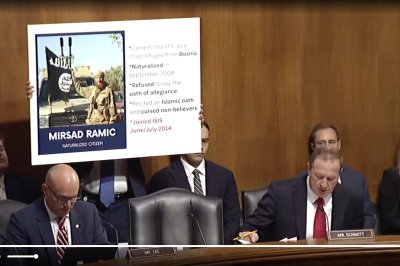
“This is part and parcel of Trump’s assault on free speech, on nonprofits and on anyone who dares to disagree with him.”

House Majority Leader Hakeem Jeffries, D-N.Y., called the indictment “baseless and illegitimate.”

“These partisan hacks who continue to weaponize the criminal justice system against perceived opponents will never intimidate us,” he said.

Source link

High court to examine rights of green-card holders charged with crime

WASHINGTON, April 22 (UPI) — The Supreme Court will hear arguments Wednesday whether immigration officers can place permanent residents charged with a crime on parole if they leave and then re-enter the country.

In immigration, parole is a temporary, discretionary permission granted by the Department of Homeland Security that allows a person to enter or remain in the United States, even though they are not formally admitted.

Parole does not cancel a person’s green card, but essentially gives the Department of Homeland Security time to decide whether the person should be admitted or deported based on how the issue is resolved.

The court is poised to hear oral arguments in Blanche vs. Lau, which would determine when immigration officers can demote a permanent resident’s status to parole, a temporary status that can be revoked and result in deportation.

Lau is Chinese immigrant Muk Lau, a permanent resident with a green card. Blanche is Todd Blanche, the acting U.S. attorney general and named defendant in the case.

Typically, permanent residents are allowed to leave and re-enter the United States as they wish, with a few exceptions. If these immigrants have committed certain kinds of crimes, for example, officers can have them placed on parole when they return to the country after going abroad.

The case stems from an event on June 15, 2012, when 69-year-old Lau, who had gained permanent residency five years earlier, landed in a New York-area airport after traveling to China.

He presented his green card and passport to border control. His entry triggered an FBI match because a month earlier, Lau was charged with third-degree trademark counterfeiting for selling nearly $300,000 of fake designer shorts.

“I was arrested at a warehouse that contained some merchandise I had stored there,” Lau told the Customs and Border Protection agent, according to court documents. “I went to the warehouse to retrieve the merchandise because I had not paid rent, and when I got there, the cops were there and arrested me.”

The agent declared Lau inadmissible as a returning permanent resident due to the crime exception, and decided to let him in on parole, instead. A year later, Lau pled guilty to the counterfeiting, and in 2014, the Department of Homeland Security began deportation proceedings against him.

At the time, the Customs and Border Patrol agent did not know whether Lau was guilty — just that he had been charged with a crime. The crux of Lau’s case is whether the CBP agent needed “clear and convincing” evidence of a crime when placing him on parole or whether just charges were enough without such evidence.

Immigrant advocates argue the agent erred.

“Mr. Lau was absolutely, unequivocally, at that time, admissible,” said Jonathan Weinberg, who worked on the American Immigration Lawyers Association’s brief to the court. “He just was. He hadn’t been convicted of a crime. There was nothing else that would render him inadmissible.”

After an immigration judge and the Board of Immigration Appeals sided with the government, Lau appealed to the U.S. 2nd Circuit Court of Appeals. The appellate court, agreeing with Weinberg’s reasoning, granted Lau’s petition in March 2025.

The Federation for American Immigration Reform, a nonprofit advocating for lower immigration rates, also submitted a brief to the court. It argued that the border patrol officer did the right thing by paroling Lau into the country, and that the clear and convincing standard was too high.

“If you’re going to say that the officer in an airport is supposed to have all this information, you’re assigning that individual with an impossible task,” FAIR spokesman Ira Mehlman said. “You have thousands of people coming through the airports every day, and these are decisions that have to be made on the spot.”

Mehlman also said that the decision “shouldn’t be a problem” for green-card holders without any criminal history.

“When you come to the United States as a non-citizen, you are here on a conditional basis,” Mehlman said. “Even if you’re a green card holder, you’re subject to removal if you violate the terms of your presence here in the United States.”

There are nearly 13 million legal permanent residents in the United States. Legal immigrants, including green card holders, commit crimes at lower rates than natural-born citizens, according to research by the Migration Policy Institute. However, Weinberg said the ultimate decision would impact all legal permanent residents, including those who have not been convicted of any crime.

“If the government can admit Lau on parole, then the government can basically admit any returning green card holder on parole if it chooses to,” Weinberg said.

Lau’s case joins several immigration-related issues, including birthright citizenship and temporary protected status, which have made their way to the Supreme Court this spring.

“The immigrant advocacy community is, I think, fighting an uphill battle,” Weinberg said. “But that doesn’t mean you don’t give it your best shot.”

Source link

Vance’s trip to Pakistan for Iran talks delayed; Trump expects bombing or ‘great deal’

April 21 (UPI) — Uncertainty over Iran peace talks put Vice President JD Vance’s trip to Pakistan on hold Tuesday, as Iranian officials were silent on whether they intend to take part in the talks at all.

The New York Times reported that talks could, however, restart at any time. Officials in Tehran were divided on whether to take part in negotiations while the United States held firm on its embargo on ports in Iran, Axios reported.

President Donald Trump said earlier in the day that he expects to reach a deal with Iran in negotiations to end the war on Tuesday, but if no deal is made, he is prepared to resume bombing.

The two-week cease-fire Trump agreed to is set to expire on Wednesday, with the Strait of Hormuz remaining a centerpiece to the conflict between the United States and Iran.

“What I think is that we’re going to end up with a great deal,” Trump said in an interview on CNBC on Tuesday. “I think they have no choice. We’ve taken out their navy. We’ve taken out their air force. We’ve taken out their leaders, frankly. It is regime change, no matter what you want to call it. Which is not something I said I was going to do but I’ve done, indirectly maybe, but I’ve done it.”

Trump said the United States’ blockade of the Strait of Hormuz has been a “tremendous success,” adding that “we totally control the strait.”

The president added that he does not want to extend the cease-fire, noting that negotiations will take place near the time the two-week cease-fire ends.

If a deal is not agreed to on Tuesday and Wednesday, Trump said, “I expect to be bombing,” and “we are raring to go.”

“We’re totally loaded up. We have so much of everything; much more powerful than it was four or five weeks ago,” Trump said. “We caught a ship yesterday that had some things on it, which wasn’t very nice. A gift from China perhaps, I don’t know.”

Trump claimed that Iran has executed 42,000 protesters in the last two months, a number that has not been verified, though former Iranian Supreme Leader Ayatollah Ali Khamenei said thousands were killed earlier this year.

On social media, Trump shared a post saying the Islamic Republic is “preparing to hang eight women.” Trump called on Iranian leaders to release the women.

“I would greatly appreciate the release of these women,” Trump wrote. “I am sure that they will respect the fact that you did so. Please do them no harm! Would be a great start to our negotiations!”

Secretary of Health and Human Services Robert F. Kennedy, Jr. speaks during a House Appropriations Subcommittee on Labor, Health and Human Services, Education, and Related Agencies hearing on the budget for the Department of Health and Human Services in the Rayburn House Office Building near the U.S. Capitol on Thursday. Photo by Bonnie Cash/UPI | License Photo

Source link