trump

Trump’s failed strong-arming of allies on Iran shows that pressure is losing its effect

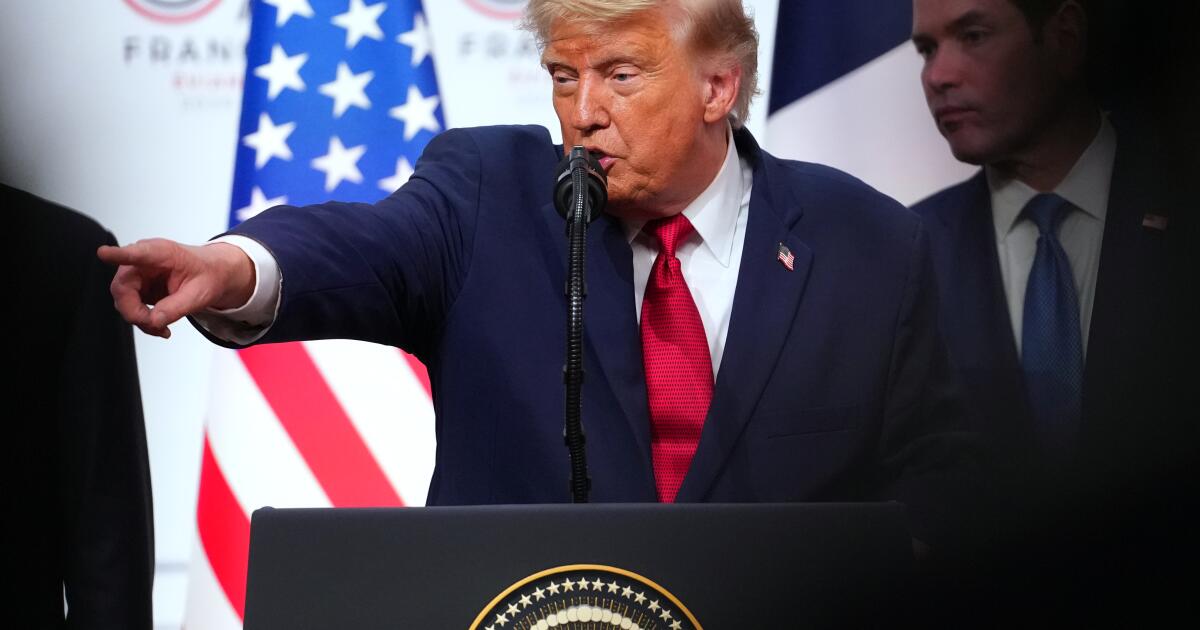
We’ve long had your back, now it’s our turn. That is how the famously transactional President Trump is framing his demands that allies help him with the Iran war. He wants to call in IOUs for decades of U.S. security guarantees.

The string of refusals indicates his stock of European goodwill is low. He has put allies through the wringer since returning to the White House, bullying them over tariffs, Greenland and other issues, and disparaging the sacrifices their soldiers made alongside U.S. troops in Afghanistan.

Now he’s demanding — not just requesting — that they send warships to help the U.S. unblock the Strait of Hormuz, through which a fifth of the world’s traded oil passes — essentially mop up behind the conflagration that he and Israel ignited in the Middle East.

The reply has been a “global raspberry.”

That’s how a veteran French defense analyst, François Heisbourg, described allied responses.

No close ally has come forward with immediate help. Britain is flat-out refusing to be drawn into the war. France says the fighting would have to die down first. Others are non-committal. China, which is not an ally but was also asked to help, is ignoring Trump’s call.

“This is not Europe’s war. We didn’t start the war. We were not consulted,” European Union foreign policy chief Kaja Kallas said Tuesday.

Trump’s frustration with the ‘Rolls-Royce of allies’

Trump has singled out the refusal from the United Kingdom. Prime Minister Keir Starmer cultivated ties with Trump and reached an early trade deal with the administration, but is now among allies who refuse to join a regional war with no clear endgame.

The U.K. “was sort of considered the Rolls-Royce of allies,” Trump said Monday, adding that he’d asked for British minesweeping ships.

“I was not happy with the U.K,” Trump said. “They should be involved enthusiastically. We’ve been protecting these countries for years.”

Starmer said Britain “will not be drawn into the wider war” and that British troops require the backing of international law and “a proper thought-through plan” — suggesting those were not in place.

He initially refused to let U.S. bombers attack Iran from British bases before accepting their use for strikes on Iran’s ballistic missile program.

Retired Lt. Gen. Ben Hodges, former commanding general of the U.S. Army in Europe, said allies are “looking at the United States in a way that they never have before. And this is bad for the United States.”

Having previously appeased Trump, some European leaders are “starting to realize that there’s no benefit or value in using flattery,” he said.

European leaders say it’s not their war

Going to war without consulting allies was in keeping with Trump’s America-first outlook.

“My attitude is: We don’t need anybody. We’re the strongest nation in the world,” he said Monday.

But failing to get an international mandate, as the U.S. did before intervening in the 1990 Gulf War, is boomeranging.

“It is not our war; we did not start it,” German Defense Minister Boris Pistorius said. “We want diplomatic solutions and a swift end to the conflict. Sending more warships to the region will certainly not contribute to that.”

French President Emmanuel Macron envisions possible naval escorts in the Strait of Hormuz — but only once fighting has died down.

“France didn’t choose this war. We’re not taking part,” he said.

After bruising tariff battles with Trump last year, the first months of 2026 have further strained alliances. Trump’s renewed pressure for U.S. control of Greenland, including a tariff threat against eight European nations, and his false assertion that allied troops avoided front-line fighting in the Afghanistan War, upset partners in the NATO military alliance.

“Allies, or at least the Europeans, aren’t willing to be at the beck and call of a demand from Donald Trump,” said Sylvie Bermann, a French former ambassador to China, the U.K. and Russia.

“And even in asking for a helping hand, he is doing so in a brutal manner, saying: ‘You’re useless, we’re the strongest, we don’t need you, but come,’” she said.

A dangerous mission

Retired naval officers say that unblocking the Strait of Hormuz with military escorts while the war rages and without Iran’s consent would be dangerous.

France, which has rushed its Charles de Gaulle aircraft carrier to the Mediterranean, is working with other countries to prepare such a mission once the air war has subsided. French military spokesman Col. Guillaume Vernet said any escorting would be conditional on talks with Iran, and Macron has publicized two calls in eight days with Iranian President Masoud Pezeshkian.

That has won points with Trump.

“On a scale of zero to 10, I’d say he’s been an eight,” Trump said Monday. “Not perfect, but it’s France. We don’t expect perfect.”

But he’s fuming at other allies.

“We will protect them, but they will do nothing for us, in particular, in a time of need,” Trump said Tuesday.

Trump has leverage, including in Ukraine

Allies in Europe and Asia need oil, gas and other products from the Middle East to flow again. That gives Trump some leverage.

Allies also know from experience that resisting Trump carries risks of retaliation.

“It really could be anything. Are the Europeans prepared for that?” asked Ed Arnold, a former British army officer and now a researcher at the Royal United Services Institute, a London think tank.

European allies need Trump’s continued blessing for U.S. weaponry, intelligence, and other support for Ukraine, as well as financial pressure on Russia. The U.S. has started to chip away at some sanctions on Moscow by temporarily allowing shipments of Russian oil to ease shortages stemming from the Iran war. Allies also want him to reengage in talks to end the war.

“That was what kept European leaders quiet for a lot of last year in the face of the rhetoric and actions,” said Amanda Sloat, a former U.S. national security adviser who now teaches at Spain’s IE University.

“It is also the thing that is making them a little bit nervous now.”

Leicester and Burrows write for the Associated Press. Burrows reported from London. AP journalists Jill Lawless in London, Lorne Cook in Brussels, Suman Naishadham in Madrid, Geir Moulson and Kirsten Grieshaber in Berlin, Simina Mistreanu in Taipei, Taiwan, and Mari Yamaguchi in Tokyo contributed to this report.

Source link

Japan’s leader heads to Washington for a visit complicated by the Iran war fallout

Japanese Prime Minister Sanae Takaichi is traveling Wednesday to the United States for what she expects to be a “very difficult” meeting with President Trump after he called on Japan and other allies to send warships to secure the Strait of Hormuz.

The three-day visit to Washington was originally expected to focus on trade and strengthening the U.S.-Japanese alliance as China’s influence grows in Asia. It is now expected to be overshadowed by the war the United States and Israel launched against Iran on Feb. 28.

”I think the U.S. visit will be a very difficult one, but I will do everything to maximize our national interest and to protect the daily lives of the people when the situation changes daily,” Takaichi told parliament on Wednesday, hours before her departure.

Takaichi held her first meeting with Trump in October in Tokyo, days after becoming Japan’s first female prime minister. A hard-line conservative, Takaichi is a protege of former leader Shinzo Abe, who developed a close friendship with Trump.

Her initial plan was to focus largely on China and strengthen the Japan-U.S. alliance ahead of Trump ‘s highly anticipated diplomatic trip to China that had been planned for months. The White House announced Tuesday that it is being delayed due to the war in the Middle East.

Takaichi will be in the hot seat figuring out what best to offer to Trump. Experts say showing commitment and progress in investment deals is key to a successful summit.

Japanese officials say the two sides will work to deepen cooperation in regional security, critical minerals, energy and dealing with China.

No plan to send warship to the Strait of Hormuz

A key U.S. ally in Asia, Japan has carefully avoided clear support for the U.S.-Israel strikes on Iran or a decision over a warship deployment. That’s mainly because of Japan’s constitutional constraints but also due to a legal question over the U.S. action and strong public opinion against it.

She told parliament that Japan hopes to see a de-escalation of the war, which has disrupted deliveries of oil and gas that Japan is highly dependent on.

“Without early de-escalation of the situation, our economy will be in trouble,” she said. “Early de-escalation is important for both the U.S. and global economy.”

Japan also hopes to secure its traditional ties with Iran, where most of Japanese oil imports come from.

Takaichi and her ministers have denied that Washington officially requested Japanese warships sent to the Strait of Hormuz. Trump on X asked a number of countries, including Japan, to volunteer. He then said he no longer needs them, complaining about a lack of enthusiasm.

That takes some pressure off Takaichi.

“We have no plans to send warships right now,” Takaichi told the parliamentary session Wednesday. A dispatch for survey and intelligence missions are possible but only after a ceasefire, she said. Some Japanese experts have commented that minesweeping would be a mission that the country could carry out when hostilities end.

“I will clearly explain what we can do and cannot do based on the Japanese law,” Takaichi said. “I’m sure (Trump) is fully aware of the Japanese law.”

China and security

Takaichi wants to discuss China’s security and economic coercion and ensure the U.S. commitment in the Indo-Pacific region, especially as some U.S. troops stationed in Japan are being shifted to the Middle East — a change seen by Japan as a potential risk for Asia as China’s clout grows.

Takaichi plans to reassure Trump of Japan’s military buildup, emphasizing the acceleration of long-range missile deployment to enhance offensive capabilities. This breaks from Japan’s postwar self-defense-only principle and reflects closer alignment with the U.S.

At the summit, Takaichi is expected to convey Japan’s interest in joining America’s “ Golden Dome “ multi-billion dollar, multi-layered missile defense system.

Japan considers China a growing security threat and has pushed a military buildup on southwestern islands near the East China Sea.

Takaichi has pledged to revise Japan’s security and defense policy by December and seeks to further bolster Japan’s military with unmanned combative weapons and long-range missiles.

Her government is to scrap a lethal arms exports ban in the coming weeks to promote Japan’s defense industry and cooperation with the United States and other friendly nations.

Oil in Alaska, rare earths in Japan

A resource-poor nation, Japan is seeking to diversify oil suppliers and is finalizing a Japanese investment for increased oil production in Alaska and stockpiles in Japan, according to media reports. A Japanese investment in small modular reactors and natural gas in the U.S. is also a possibility.

If agreed, the projects would be part of a $550 billion investment package that Japan pledged in October. In February, the two sides announced Japan’s commitment to the $36 billion first batch of projects — a natural gas plant in Ohio, a U.S. Gulf Coast crude oil export facility and a synthetic diamond manufacturing site — whose progress is also to be disccused with Trump.

Japan reportedly plans to propose a joint development of rare earths discovered in undersea soil around the remote Japanese island of Minamitorishima as part of the investment package.

Diplomatic and trade disputes have escalated further since Takaichi’s comment that any Chinese military action against Taiwan could be grounds for a Japanese military response.

Yamaguchi writes for the Associated Press.

Source link

How Iran defied Trump threats to emerge as Strait of Hormuz gatekeeper | US-Israel war on Iran News

As United States President Donald Trump tries to build a coalition of navies willing to open the Strait of Hormuz, some countries are negotiating safe passage directly with Iran, underscoring a new de facto reality, analysts say: Regardless of military results, Tehran is calling the shots on who gets to use the world’s most important energy waterway.

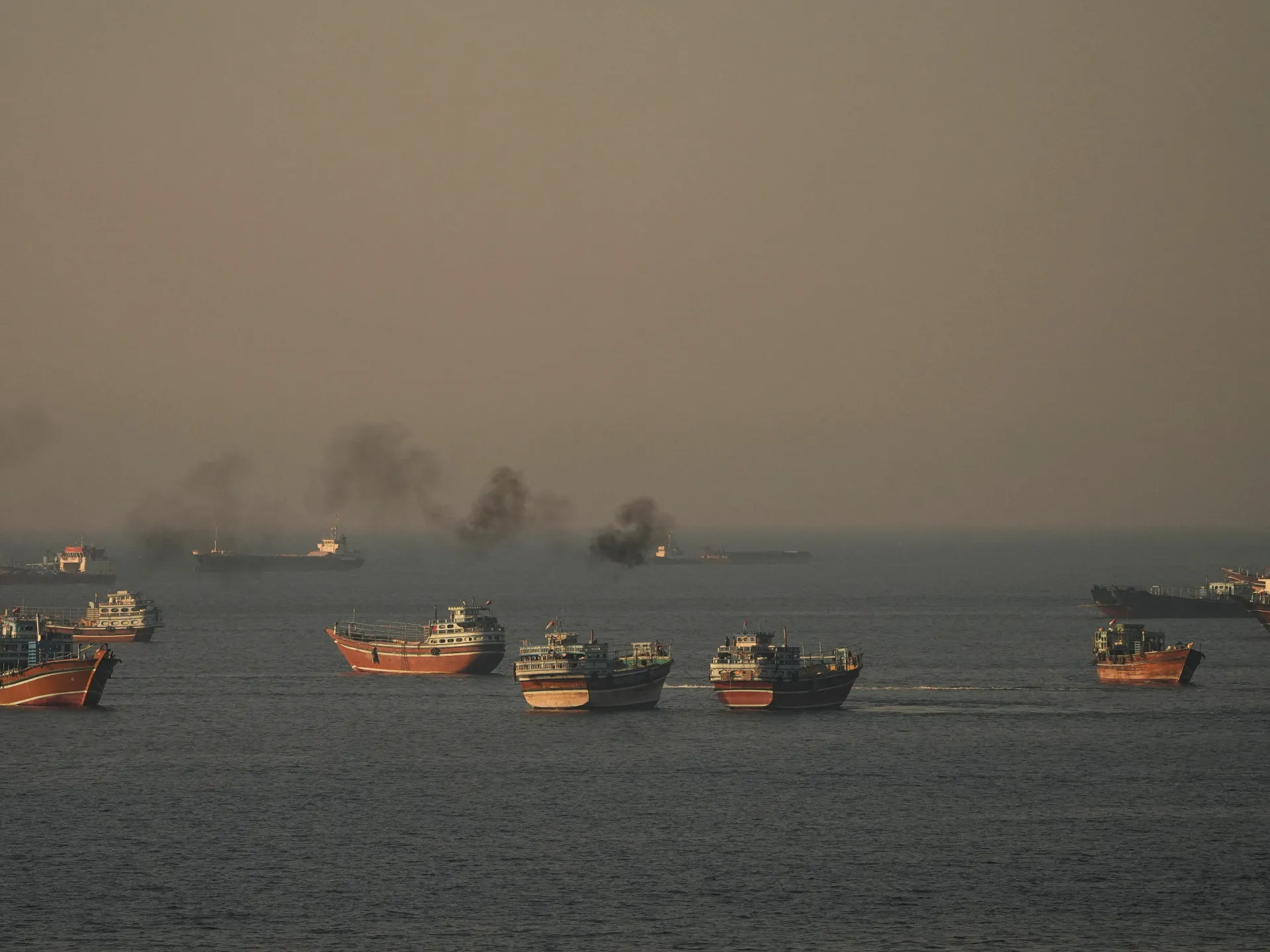
After US-Israeli strikes on Iran began on February 28 and killed Supreme Leader Ali Khamenei, the Iranian military leadership responded by focusing on its most potent form of leverage – Iran’s geography. The country controls the northern shore of the Strait of Hormuz, through which 20 percent of global crude oil and natural gas supplies pass. It is 33km (20 miles) wide at its narrowest point, so any naval force that wants to cross it becomes easy prey for Iranian attacks coming from the mainland.

Recommended Stories

list of 3 itemsend of list

Considering insurance companies’ low appetite for risk, it took relatively few attacks on vessels in the strait – or just the threat of them – to undermine market confidence and send insurance premiums shooting up, causing a near paralysis in maritime traffic. About 20 vessels have been attacked since the start of the war.

“Iran has effectively proven that it dictates the terms of passage through the strait. They have now shown they are the gatekeeper of this important chokepoint. This will elevate the status of Iran in the geography of the Gulf,” said Andreas Krieg, an associate professor in Security Studies at King’s College London and a fellow at King’s Institute of Middle Eastern Studies. This will be the new reality for the foreseeable future, he added.

Meanwhile, crude prices have risen above $100 a barrel, more than 20 percent higher than pre-war prices, forcing countries to make the biggest releases of emergency reserves in history. Gas prices have risen by more than 40 percent since the war began.

Trump initially floated the idea of ordering the US Navy to escort vessels through the waterway. He then appealed to some countries to send warships and warned NATO members they would face “a very bad” future if these allies failed to help in opening the strait. But the appeal was either turned down or received noncommittal responses. Japan said it had no plans to deploy naval vessels. Australia ruled out sending ships. The United Kingdom said it would not be drawn into the wider war. Germany sent a clear message: “This is not our war”.

Others decided to take action – but not of the kind that Trump asked for. On Saturday, two India-flagged gas tankers passed through the strait after days of negotiations between New Delhi and Tehran, including a phone call between Indian Prime Minister Narendra Modi and Iranian President Masoud Pezeshkian. Ships from Pakistan, Turkiye and China also have transited through the Strait of Hormuz. The Financial Times has reported that Italy and France have also reached out to Iran for deals although Italian authorities have rejected making such an overture.

Meanwhile, Windward, a maritime intelligence tracking group, said that while traffic in the strait on Tuesday remained 97 percent below average, a growing number of ships have been passing through Iran’s territorial waters, suggesting that Tehran is allowing “permission-based transit”.

‘It is up to us to decide’

There is a precedent for US naval forces to escort convoys through the strait dating back to the Iran-Iraq War in the 1980s. But today’s scenario is different, experts said. Back then, the US, while it was backing Iraqi leader Saddam Hussein, was not a direct party to the conflict. Iran was still in a post-revolutionary process of consolidating power, and its Islamic Revolutionary Guard Corps was nowhere near as organised as it is today.

Today, Iran has drones that its factories are capable of producing on a large scale and has been using them. Iranian forces could also use small boats to assault tankers, deploy mines and engage in other guerrilla-style tactics. While there are conflicting reports on whether Iran has placed mines in the strait, experts said it would be a counterproductive move for Tehran because it would disrupt the passage for any ships – Iranian vessels included – and it would take away from Tehran the power to choose who may pass.

Iranian officials are aware of their geographic advantage. “This is up to our military to decide,” Iranian Foreign Minister Abbas Araghchi said on Sunday, referring to who will be allowed to use the strait.

Pro-government figures increasingly frame the Strait of Hormuz as a strategic bargaining tool beyond the war itself, suggesting the waterway could be used to extract compensation, sanctions relief or broader economic concessions after the war, Hamidreza Azizi, an expert on Iran and visiting fellow with the German Institute for International and Security Affairs, commented on X.

Recent attacks seem to suggest that Iran wants to increase its pressure on the energy market.

On Tuesday, a drone attack caused a fire at the port of Fujairah, the United Arab Emirates’s only crude export terminal. It is located outside the eastern entrance of the Strait of Hormuz, allowing its exports to circumvent it. The Iran-backed Houthis in Yemen could also further squeeze oil prices by disrupting the Bab al-Mandeb strait. That would force the US to operate across multiple maritime theatres. So far, the Houthis have not carried out such attacks, but this month, they said they were ready to strike at any ‌moment.

Still, the US is focused on applying maximum pressure on Tehran and forcing it to open the Strait of Hormuz. The US Central Command, the US military’s combat command responsible for operations in the Middle East, said early on Wednesday that its forces had used 2,270kg (5,000lb) bunker-busting munitions against antiship missile sites along Iran’s coastline near the Strait of Hormuz.

Trump has also ordered amphibious ships carrying thousands of US Marines to move to the Middle East, and some experts believe the US might try to seize Kharg Island, a tiny piece of land in the northern Gulf where 90 percent of Iranian crude oil is exported from. The US has already bombed what it said were military sites on the island.

Such an operation, however, might do little to force Iran into opening the Strait of Hormuz, Krieg said. The island is 500km 310 miles) from the strait, and should the US take control of it, it would expose US Marines to Iranian fire. Should Iran see its key terminal being seized, it could also opt to mine the strait outright, having fewer reasons to allow some vessels to pass through.

“The issue with the Strait of Hormuz is really not a military one. … It’s a market issue, and confidence cannot be restored by the military. Confidence can be restored through diplomacy only,” Krieg said.

Source link

Trump administration defends Anthropic blacklisting in US court | Science and Technology News

The US defence secretary designated the AI company a ‘supply chain risk’ after it refused to remove guardrails on its technology.

The administration of United States President Donald Trump has said in a court filing that the Pentagon’s blacklisting of Anthropic was justified and lawful, opposing the artificial intelligence company’s high-stakes lawsuit challenging the decision.

The administration made its comments in a court filing on Tuesday.

Recommended Stories

list of 3 itemsend of list

Defense Secretary Pete Hegseth designated Anthropic, the maker of popular AI assistant Claude, a national security supply chain risk on March 3 after the company refused to remove guardrails against its technology being used for autonomous weapons and domestic surveillance.

The Trump administration’s filing says Anthropic is unlikely to succeed in its claims that the US government’s action violated speech protections under the US Constitution’s First Amendment, asserting that the dispute stems from contract negotiations and national security concerns, not retaliation.

“It was only when Anthropic refused to release the restrictions on the use of its products — which refusal is conduct, not protected speech — that the President directed all federal agencies to terminate their business relationships with Anthropic,” the administration’s legal filing said. The filing, from the US Justice Department, said that “no one has purported to restrict Anthropic’s expressive activity”.

Anthropic’s lawsuit in California federal court asks a judge to block the Pentagon’s decision while the case plays out. Some legal experts say the company appears to have a strong case that the government overreached.

In a statement, Anthropic said it was reviewing the government’s filing. The company said that “seeking judicial review does not change our longstanding commitment to harnessing AI to protect our national security, but this is a necessary step to protect our business, our customers, and our partners.”

The White House did not immediately respond to a request for comment.

Supply chain risk

Trump has backed Hegseth’s move, which excludes Anthropic from a limited set of military contracts. But it could damage the company’s reputation and cause billions of dollars in losses this year, according to its executives.

The designation came after months of negotiations between the Pentagon and Anthropic reached an impasse, prompting Trump and Hegseth to denounce the company and accuse it of endangering American lives with its use restrictions.

Anthropic has disputed those claims and said AI is not yet safe enough to be used in autonomous weapons. The company said it opposes domestic surveillance as a matter of principle.

In its March 9 lawsuit, Anthropic said that the “unprecedented and unlawful” designation violated its free speech and due process rights, while running afoul of a law requiring federal agencies to follow specific procedures when making decisions.

The Pentagon separately designated Anthropic a supply chain risk under a different law that could expand the order to the entire government.

Anthropic is challenging that move in a second lawsuit in a Washington, DC, appeals court.

Source link

Trump’s counterterrorism chief quits over Iran war

Joe Kent, the director of the National Counterterrorism Center, abruptly resigned Tuesday, becoming the most senior national security official to break publicly with the Trump administration over its military campaign against Iran.

In a statement posted on social media, Kent said he “cannot in good conscience” continue serving in the administration, contending that Iran had “posed no imminent threat to our nation” and that the United States had been drawn into the conflict through “pressure from Israel and its powerful American lobby.”

“I cannot support sending the next generation off to fight and die in a war that serves no benefit to the American people nor justifies the cost of American lives,” Kent wrote in a letter addressed to President Trump. “I pray that you will reflect upon what we are doing in Iran, and who we are doing it for.”

Trump, speaking in the Oval Office, dismissed Kent’s concerns, telling reporters that he had long believed the counterterrorism director — whom he nominated to the post in February 2025 — was “very weak on security.” The president insisted that Iran has been a threat to the U.S. “for a long time,” and said that it was a “good thing” Kent is leaving.

The resignation came at an uncertain moment for the administration. The war, which has repeatedly been sold to Americans as “short term” and contained, is now in its third week, with fraying alliances, renewed missile and drone fire on gulf Arab nations from Iran, new Israeli strikes on Iran and Lebanon, mounting casualties and no clear exit strategy.

“If we left right now it would take 10 years for them to rebuild,” Trump told reporters. “We’re not ready to leave yet, but we’ll be leaving in the near future. We’ll be leaving pretty much in the very near future.”

The uncertainty was compounded Tuesday by Israel’s killing of Ali Larijani, the head of Iran’s Supreme National Security Council, as well as Gholamreza Soleimani, the head of the Basij, Iran’s militia force.

Trump made reference to the Iranian officials killed without naming them, saying one was “their actual top” and the other was responsible for the killing of 32,000 Iranian protesters in recent weeks.

“It’s an evil group,” he said.

Effect of Larijani’s killing

Iranian officials confirmed the deaths of Larijani and Soleimani via state media Tuesday. In addition to killing the Basij leader, Israel reported striking more than 10 Basij posts, part of an effort to destroy the Islamic Republic’s ability to contain internal unrest and protests.

Benjamin Radd, a political scientist and senior fellow at the UCLA Burkle Center for International Relations, said Larijani’s killing would greatly diminish the Iranian diplomatic and institutional experience, as he was perceived to be “the last of the competent bunch” in power.

Those remaining in power are “generally not the sharpest people, they’re not the people who understand the subtleties of diplomacy, of what negotiating with the U.S. is like,” which clears a path for “a country run by a military junta” comprising Islamic Revolutionary Guard Corps leaders, Radd said.

“We’re really going to be moving more toward a military-style dictatorship — behind a clerical robe, if you will,” he said.

The battlefield developments have done little to reassure Washington’s closest allies, most of which have declined to join the fight despite Trump’s recent pleas to allied nations to send warships to help reopen the Strait of Hormuz, a crucial oil route that has been threatened by Iran’s war efforts.

In a social media post Tuesday, Trump said the United States had been informed by most of its allies in the North Atlantic Treaty Organization that they “don’t want to get involved” in the expanding Middle East war — and he claimed the American military no longer needs or wants their help.

“In fact, speaking as President of the United States of America, by far the Most Powerful Country Anywhere in the World, WE DO NOT NEED THE HELP OF ANYONE!” Trump wrote.

Trump cannot unilaterally remove the U.S. from NATO. In 2023, Sens. Tim Kaine (D-Va.) and Marco Rubio (R-Fla.) — who is now Trump’s secretary of State — successfully pushed a measure barring any president from removing the U.S. from the treaty organization without approval from the Senate or an act of Congress.

“The Senate should maintain oversight on whether or not our nation withdraws from NATO. We must ensure we are protecting our national interests and protecting the security of our democratic allies,” Rubio said at the time.

Some experts viewed Trump’s latest remarks about not needing NATO allies as a result of him having misplayed his hand at the start of the conflict with Iran, which has attempted to widen the war by targeting Gulf Cooperation Council nations in the region.

When Trump started demanding that many other nations join the U.S. in the war effort, or at least in safeguarding the Strait of Hormuz, it was “an attempt on Trump’s side to widen the war the other way,” Radd said, based in part on the fact that other nations, including China and in Europe, are much more reliant on oil from the region than the U.S.

However, it was a “clumsy” move by Trump given his alienation of NATO allies in the past, including during a major speech in Davos, Switzerland, in January, in which the president was “basically shaming and criticizing NATO and European states,” Radd said.

Calling on allies to “step up” after ridiculing them was “ham-handed,” Radd said.

Intelligence official’s departure

In Washington, Kent’s resignation exposed new divisions over the administration’s handling of the war.

On Capitol Hill, House Speaker Mike Johnson (R-La.) told reporters that he did not know where Kent was “getting his information” to conclude that Iran posed no imminent threat to the U.S. He said Trump administration officials in classified briefings have asserted that “they had exquisite intelligence and they understood that this was a serious moment for us.”

“The president felt that he had to strike first to prevent mass casualties,” Johnson said.

Several Democrats called on Kent to appear before Congress and tell the American people more about why the administration dragged the U.S. into war in Iran.

“If even officials like Joe Kent do not believe Iran posed an imminent threat, why are we sending more Americans to die in this war?” Rep. Ro Khanna (D-Fremont) wrote on X.

White House Press Secretary Karoline Leavitt said Kent’s letter contained “many false claims,” including that Iran posed no imminent threat to the U.S.

“This is the same false claim that Democrats and some in the liberal media have been repeating over and over,” Leavitt wrote on X. “As President Trump has clearly and explicitly stated, he had strong and compelling evidence that Iran was going to attack the United States first.”

She said that evidence, which has never been detailed publicly, “was compiled from many sources and factors,” and that Trump “would never make the decision to deploy military assets against a foreign adversary in a vacuum.”

Leavitt then repeated past justifications for the attack, including that Iran sponsors terrorism abroad and that it was building out its missile capabilities as “a shield” for protection as it continued to develop nuclear capabilities.

The press secretary previously said that Trump had a “feeling” that Iran was going to attack the U.S. or its assets. The president has alleged, without evidence, that Iran was within weeks of having a nuclear weapon.

Leavitt said the added assertion by Kent that Trump decided to attack Iran “based on the influence of others, even foreign countries, is both insulting and laughable.”

Kent, a former political candidate with connections to right-wing extremists, was confirmed in July as head of the National Counterterrorism Center, which analyzes and detects terrorist threats. Before joining the Trump administration, Kent ran two unsuccessful campaigns for Congress in Washington state. He also served in the military, serving 11 deployments as a Green Beret, followed by work at the CIA.

Democrats strongly opposed Kent’s confirmation in the Senate, in part because they were concerned about his ties to far-right figures and promotion of conspiracy theories. During his 2022 congressional campaign, Kent paid Graham Jorgensen, a member of the far-right military group the Proud Boys, for consulting work. He also worked closely with Joey Gibson, the founder of the Christian nationalist group Patriot Prayer, and attracted support from a variety of far-right figures.

During his Senate confirmation hearing, Kent refused to distance himself from a conspiracy theory that federal agents instigated the Jan. 6, 2021, attack at the U.S. Capitol, as well as false claims that Trump, a Republican, won the 2020 election over Democrat Joe Biden.

Democrats grilled Kent on his participation in a group chat on Signal where Trump’s national security team discussed sensitive military plans.

Republicans, meanwhile, were drawn to Kent’s experience in the military and intelligence.

Sen. Tom Cotton (R-Ark.), the GOP chair of the Intelligence Committee, said in a floor speech that Kent had “dedicated his career to fighting terrorism and keeping Americans safe.” On Tuesday, Cotton said that he disagreed with Kent’s “misguided assessment” on Iran.

“Iran’s vast missile arsenal and support for terrorism posed a grave and growing threat to America. Indeed, the ayatollahs have maimed and killed thousands of Americans,” Cotton said. “President Trump recognized this threat and made the right call to eliminate it.”

Other conservatives — including former Rep. Marjorie Taylor Greene and commentator Candace Owens — called Kent an “American hero.”

Ilan Goldenberg, a former Biden administration official who dealt with the Middle East, wrote on X that while he disagrees with the Iran war, Kent claiming that Israel pressured Trump into the conflict is “ugly stuff that plays on the worst antisemitic tropes.”

“Donald Trump is the President of the United States and he is the one ultimately responsible for sending American troops into harms way,” he said.

Source link

Trump No Longer Wants Allies To Send Warships To Open The Strait Of Hormuz (Updated)

A day after several allies rejected his demand they send warships to the Strait of Hormuz, President Donald Trump said he no longer wants their help. In a post on his Truth Social platform, the U.S. leader excoriated the NATO alliance and other countries for not coming to America’s aid when needed.

Trump’s comments come as the global economy is roiled by rising energy costs in the wake of Iran closing the Strait of Hormuz for most ships and attacking fuel infrastructure across the Middle East. Trump wanted international help in forcing Iran to reopen the Strait.

The Strait of Hormuz. (Google Earth)

“…I am not surprised by their action, however, because I always considered NATO, where we spend Hundreds of Billions of Dollars per year protecting these same Countries, to be a one way street,” Trump fumed. “We will protect them, but they will do nothing for us, in particular, in a time of need.”

“Fortunately, we have decimated Iran’s Military — Their Navy is gone, their Air Force is gone, their Anti-Aircraft and Radar is gone and perhaps, most importantly, their Leaders, at virtually every level, are gone, never to threaten us, our Middle Eastern Allies, or the World, again!,” Trump added. “Because of the fact that we have had such Military Success, we no longer “need,” or desire, the NATO Countries’ assistance — WE NEVER DID! Likewise, Japan, Australia, or South Korea. In fact, speaking as President of the United States of America, by far the Most Powerful Country Anywhere in the World, WE DO NOT NEED THE HELP OF ANYONE!”

BREAKING: Trump now says he doesn’t need any help for Iran & Strait of Hormuz:

The United States has been informed by most NATO “Allies” that they don’t want to get involved in our military operation against Iran, despite agreeing that Iran must not have a nuclear weapon.

I’m… pic.twitter.com/hm7HqKsciV

— Clash Report (@clashreport) March 17, 2026

As we noted yesterday, the U.K., Germany, Luxembourg, Japan and Australia rejected Trump’s demand while other countries were on the fence. In a post on X, Axios reported that the U.K. has drafted a plan for a Strait of Hormuz coalition and shared it with the U.S. and several other countries.

🚢🇬🇧🇺🇸🛢️The U.K. has drafted a plan for the strait of Hormuz coalition and shared it with the U.S. and several other countries, two sources said https://t.co/amETYiI5QN

— Barak Ravid (@BarakRavid) March 17, 2026

Highlighting the threat posed by Iran, the United Kingdom Maritime Trade Operations (UKMTO) Center reported that an oil tanker was hit by debris from an interception near the ship, located 23 nautical miles east of Fujairah, UAE. The vessel received minor structural damage and the whole crew was confirmed safe. A maritime industry official told The War Zone that the ship was the Kuwaiti-registered Gas Al Ahmadiah.

Despite increased concerns, this was the first incident involving a ship in the area since March 11, according to UKMTO.

Since the start of Epic Fury, UKMTO has received 21 reports of incidents affecting vessels operating in and around the Arabian Gulf, Strait of Hormuz, and Gulf of Oman. There have been 17 attacks and four suspicious activity reports.

As a result of Iran’s closure of the Strait of Hormuz and attacks on oil facilities throughout the Middle East, energy prices are again climbing.

“Brent crude climbed 3% to trade near $103 as Iran stepped up its attacks on energy infrastructure across the Gulf,” Financial Times reported. Brent still remains below its conflict high of $119.50 but has risen more than 40 percent since the war began, the outlet added.

Diesel fuel prices at the pump “have topped the $5-per-gallon barrier for the second time ever,” according to a post on X by Bloomberg News energy and commodities columnist Javier Blas.

This will have a ripple effect across the country, with everything that moves by truck likely to cost more to make up for the increased fuel costs.

CHART OF THE DAY: US retail average diesel prices have topped the $5-per-gallon barrier for the 2nd time ever.

That’s freight inflation — and another big hit to the country’s farming economy (and it has received many hit since Trump came into office) pic.twitter.com/lIUDbhqsC4

— Javier Blas (@JavierBlas) March 17, 2026

UPDATES

Our coverage has ended for the day. Stay tuned for more.

7:07 PM EST—

Zelensky reposted an address to officials in the UK about Ukrainian counter-drone capabilities, stating that he can provide up to 1,000 interceptors per day and sensor networks for detecting and tracking the drones, as well as the software that underpins it.

First, we are capable of producing at least 2,000 effective and combat-proven interceptors every day. We can produce more – it depends on investment. We need about 1,000 interceptors a day, and we can supply at least another 1,000 a day to our allies.

Second, we know how to… pic.twitter.com/vIB2qRho8P

— Volodymyr Zelenskyy / Володимир Зеленський (@ZelenskyyUa) March 17, 2026

A ballistic missile attack on Israel included a very large cluster munition warhead:

Spectacular footage showing the fall of submunitions from the Iranian Khorramshahr-4 medium-range ballistic missile carrying cluster warhead on Israel short time ago. pic.twitter.com/n6LsbZwp1C

— Status-6 (War & Military News) (@Archer83Able) March 17, 2026

Dubai under heavy attack again tonight.

Over a dozen interceptor missiles seen earlier in the sky over Dubai in the United Arab Emirates, following a possible attack by Iran using “advanced ballistic missiles” in an attempt to target Dubai International Airport. pic.twitter.com/PxI7EQ5N6W

— OSINTdefender (@sentdefender) March 17, 2026

We are now seeing the damage done to the energy storage area in Tehran from IAF strikes:

5:24 PM EST—

NYTs reports that Russia is providing drone components and targeting support to Iran. This would loosely mirror the U.S. in Ukraine. The report reads, in part:

The technology provided includes components of modified Shahed drones, which are meant to improve communication, navigation and targeting, the people said. Russia has also been drawing on its experience using drones in Ukraine, offering tactical guidance on how many drones should be used in operations and what altitudes they should strike from, said the people, who included a senior European intelligence officer.

Russia has been providing Iran with the locations of U.S. military forces in the Middle East as well as those of its regional allies, The Wall Street Journal has reported. That cooperation has deepened in early days of the war, with Russia recently providing satellite imagery directly to Iran, said two of the people, the officer and a Middle Eastern diplomat.

U.S. embassies around the globe are being ordered to review security posture:

The U.S. has ordered all embassies worldwide to urgently review security due to escalating threats linked to the Iran conflict, after hundreds of attacks—mainly in the Middle East—targeted U.S. facilities.

Source: WaPo pic.twitter.com/C3EEfCVWjk

— Clash Report (@clashreport) March 17, 2026

4:04 PM EST—

Growlers are now flying in a relatively rare loadout of four AGM-88 HARM-family of weapons under their wings on Epic Fury missions. This underscores that pop-up radar-guided air defenses still are a potential issue. The latest HARMs can also be used to hit targets that are not emitting radiation, as well.

Trump is now threatening to leave NATO after key members rejected sending ships to open the Strait of Hormuz:

JUST IN: President Trump says he is thinking about leaving NATO, says he doesn’t need approval from Congress.

Reporter: Are you rethinking the United States’ relationship with NATO? Possibly getting out?

Trump: I’m disappointed in NATO that we spend trillions of dollars on… pic.twitter.com/zNVkPrZQOa

— Collin Rugg (@CollinRugg) March 17, 2026

Another night of strings of C-RAM 20mm fire being seen at key locations in Baghdad:

A Counter-Rocket, Artillery, and Mortar System (C-RAM) seen firing into the sky over Baghdad during tonight’s drone attack against the U.S. Embassy and Baghdad International Airport by Iran. pic.twitter.com/Sv8ceqAicY

— OSINTdefender (@sentdefender) March 17, 2026

Israel is attacking Basij personnel and checkpoints in urban areas in Iran:

The Israeli Air Force has been striking Basij soldiers and its checkpoints across Tehran in the past few hours, the IDF says. pic.twitter.com/I1KVH9eDfx

— Emanuel (Mannie) Fabian (@manniefabian) March 17, 2026

A delta-wing fighter was supposedly spotted over the city of Shiraz, indicating a gulf state ally that flies the EF2000, Rafale, or Mirage 2000 could be executing penetrating missions over Iran.

INTERESTING: Footage from Shiraz, Iran shows a fighter jet resembling a Mirage 2000 or Eurofighter Typhoon (not typical of US, Israeli, or Iranian aircraft.)

This fuels rumors of covert Gulf countries’ involvement in strikes on Iran. pic.twitter.com/UKVG7OI9Ks

— Clash Report (@clashreport) March 17, 2026

@MarineTraffic writes:

“Strait of Hormuz activity remains limited

According to #MarineTraffic data, a total of 15 vessels transited the strait over the past three days, including 8 dry bulk vessels, 5 tankers, and 2 LPG carriers. Around 87% were outbound transits, with many vessels taking unusual routes through Iranian territorial waters. Only 13% entered the Gulf, highlighting the continued imbalance in traffic flows. Watch the playback of vessel activity in the Strait of Hormuz over the past three days.”

Strait of Hormuz activity remains limited

According to #MarineTraffic data, a total of 15 vessels transited the strait over the past three days, including 8 dry bulk vessels, 5 tankers, and 2 LPG carriers. Around 87% were outbound transits, with many vessels taking unusual… pic.twitter.com/vlTkpLy7LS

— MarineTraffic (@MarineTraffic) March 17, 2026

2:28 PM EST –

The United Arab Emirates could take part in a U.S.-led effort to safeguard shipping through the Strait of Hormuz, a senior Emirati official said on Tuesday, Reuters reported on X, adding that no formal plan had been agreed to and discussions were ongoing.

“We all have a responsibility to ensure the flow of trade, the flow of energy,” Anwar Gargash, the diplomatic adviser to the country’s president, said at an online event hosted by the Council on Foreign Relations, an American think tank.

MORE –

(Reuters) – The United Arab Emirates could take part in a U.S.-led effort to safeguard shipping through the Strait of Hormuz, a senior Emirati official said on Tuesday, though he also said that no formal plan had been agreed and discussions were ongoing.

“We all have a… https://t.co/YCM51skWkf

— Phil Stewart (@phildstewart) March 17, 2026

During a meeting with Irish officials at the White House on St. Patrick’s Day, Trump said he could order attacks on Iran’s electrical systems and wipe them out “in a matter of minutes.”

Trump on Iran:

We could take out their electric capacity in one hour. There’s nothing they can do right now because everything is knocked out. They have no radar, no anti-aircraft. They have nothing.

We can knock out their electricity in a matter of minutes if we wanted to.… pic.twitter.com/mpQC1MngwW

— Clash Report (@clashreport) March 17, 2026

The president also stated he was not afraid to send U.S. troops into Iran if needed.

Reporter: “As the Iranian regime told Sky News, if you put boots on the ground in Iran, it will be another Vietnam. Are you afraid of that?”

Trump: “I’m really not afraid of anything.” pic.twitter.com/csLNYgduaB

— Faytuks Network (@FaytuksNetwork) March 17, 2026

The United States has encouraged Syria to consider sending forces into eastern Lebanon to help disarm Hezbollah, but Damascus is reluctant to embark on such a ​mission for fear of being sucked into the war in the Middle East and inflaming sectarian tensions, Reuters reported, citing five people briefed on the matter.

The proposal to Syria’s U.S.-allied government reflects intensifying moves ‌to disarm Iran-backed Hezbollah, which opened fire at Israel in support of Tehran on March 2, prompting an Israeli offensive in Lebanon.

The proposal to Syria’s U.S.-allied government reflects intensifying moves ‌to disarm Iran-backed Hezbollah, which opened fire at Israel in support of Tehran on March 2, prompting an Israeli offensive in Lebanon.

w/ @FerasDalatey @GebeilyM https://t.co/qb3tx2WRWt

— Timour Azhari (@timourazhari) March 17, 2026

Ukrainian President Volodymyr Zelensky insisted that his country is not just a country seeking assistance.

“I would like the U.S. not to perceive Ukraine as a country that merely asks for help,” he stated on X. “That is not the case. Ukraine is defending interests and values. Of course, the U.S. is right when it says it is farther from this war than Europe. That is understandable. But we see U.S. allies in the Middle East, and we see what – and who – threatens them.”

I would like the U.S. not to perceive Ukraine as a country that merely asks for help. That is not the case. Ukraine is defending interests and values. Of course, the U.S. is right when it says it is farther from this war than Europe. That is understandable. But we see U.S. allies…

— Volodymyr Zelenskyy / Володимир Зеленський (@ZelenskyyUa) March 17, 2026

Speaking of Ukraine, a technology prevalent in the war may now be employed by Iranian-backed militias attacking U.S. facilities in Iraq. Video emerged on social media showing what is likely a first-person view (FPV) drone surveilling the U.S. Embassy in Baghdad. These types of drones have been used by both sides in the Ukraine war to devastating effect.

An Iranian-backed militia successfully used a (likely fiber optic) FPV drone to carry out a reconnaissance mission through the U.S. Embassy in Baghdad yesterday.

Seen here, the drone flies unchallenged through the embassy complex for nearly two minutes. pic.twitter.com/S1Ky3eVUv0

— OSINTtechnical (@Osinttechnical) March 17, 2026

U.S. counter rocket, artillery, and mortar C-RAM systems have been engaging with drones over Baghdad.

Israeli residents exclaimed “wow” after watching the interception seen in the following video.

2:15PM EST—

Israel announced two decapitation strikes on Iranian leaders, the latest in a series of strikes against top Iranian government and military officials. It claims to have killed Ali Larijani, Secretary of Iran’s Supreme National Security Council and the regime’s effective leader as well as Gholamreza Soleimani, commander of the Basij paramilitary unit for the past 6 years. Tehran has yet to comment on these claims which The War Zone cannot independently verify.

“The Israeli Air Force, acting on IDF intelligence, and through the integration of unique operational capabilities, conducted a precise strike that eliminated Ali Larijani, the Secretary of Iranian Supreme National Security Council, who operated as the de facto leader of the Iranian terror regime,” the IDF claimed. “The strike was conducted while he was located near Tehran.”

“During the most recent wave of protests against the Iranian terror regime, Larijani personally oversaw the massacre that was carried out against Iranian protestors,” the IDF added.

🔴Ali Larijani, Secretary of Iran’s Supreme National Security Council and the regime’s effective leader, has been eliminated.

Throughout the years, Larijani was considered one of the most veteran and senior figures within the Iranian regime leadership, and was a close associate… pic.twitter.com/kBIgSSGBm0

— Israel Defense Forces (@IDF) March 17, 2026

“Under Soleimani, the Basij unit led the main repression operations in Iran, employing severe violence, widespread arrests, and the use of force against civilian demonstrators,” the IDF stated.

The Soleimani killing would add “to that of dozens of senior commanders from the armed forces of the Iranian regime who have been eliminated during the operation, and constitutes an additional significant blow to the regime’s security command-and-control structures,” the IDF added. 

🔴 COMMANDER OF THE BASIJ UNIT ELIMINATED

Yesterday, the IDF targeted & eliminated Gholamreza Soleimani, who operated as commander of the Basij unit for the past 6 years.

Under Soleimani, the Basij unit led the main repression operations in Iran, employing severe violence,… pic.twitter.com/aJ0dNtCFz0

— Israel Defense Forces (@IDF) March 17, 2026

In a video posted on X, Israeli Prime Minister Benjamin Netanyahu offered his rationale for ordering the strike on Larijani.

PM Netanyahu:

“We eliminated Ali Larijani, who is the boss of the IRGC or the gangsters’ mob. We are dismantling the regime in the hope of giving the people a chance to remove it. It won’t happen all at once; it won’t happen easily. But if we persist, we will allow them to take… pic.twitter.com/c0MAnLaQoA

— Open Source Intel (@Osint613) March 17, 2026

While there was no immediate response from officials in Tehran, after reports of Larijani’s death began to circulate, his X account posted a handwritten memorial to Iranian sailors aboard the IRIS Dena killed in a U.S. submarine attack.

“The martyrdom of the brave members of the Navy of the Army of the Islamic Republic in Dena is part of the sacrifices of the proud nation that has emerged in this time of struggle against international oppressors,” Larijani wrote.

به مناسبت مراسم تشییع سلحشوران نیروی دریایی ارتش جمهوری اسلامی ایران: یاد آنان همواره در قلب ملت ایران خواهد بود و این شهادت‌ها بنیان ارتش جمهوری اسلامی را برای سالها در ساختار نیروهای مسلح استوار می‌نماید. ازخداوند متعال علو درجات برای این شهدای عزیز خواستارم. pic.twitter.com/dvTdhyDYbY

— Ali Larijani | علی لاریجانی (@alilarijani_ir) March 17, 2026

Larijani became Iran’s de facto leader after U.S.-Israeli airstrikes killed top government and military officials. Iran has a multi-faceted leadership structure, ostensibly headed by the Supreme Leader, who is now Mojtaba Khamenei. He was appointed to replace his father, Ali Khamenei, killed in an airstrike on the opening day of the war. While there are claims Mojtaba Khamenei has been killed or badly wounded, Iranian officials insist that despite being wounded, he is still running the country.

In addition to the clerics, Iran also has a very strong security leadership that includes the Islamic Revolutionary Guard Corps (IRGC). Larijani, as security chief, was part of that structure. While his death, if confirmed, will further complicate Iran’s command and control capabilities, it won’t necessarily eliminate it or be followed by regime change.

Israeli Foreign Minister Gideon Sa’ar said that while the Iranian regime can only be toppled by its people, they cannot liberate the nation alone.

Israeli Foreign Minister Gideon Sa’ar:

The regime can only be toppled by the Iranian people, yet without external help, the Iranian people cannot liberate themselves. pic.twitter.com/Bxy6NpjwnB

— Clash Report (@clashreport) March 17, 2026

Meanwhile, Mojtaba Khamenei said Iran has no plans to de-escalate, according to a Reuters post on X.

Iran’s new supreme leader has rejected de-escalation proposals conveyed to Tehran by intermediaries, demanding Israel and the United States first be “brought to their knees”, a senior Iranian official said on Tuesday. @PHREUTERS

— Idrees Ali (@idreesali114) March 17, 2026

In a stunning rebuke of the war on Iran, the director of the U.S. National Counterterrorism Center (NCTC) publicly announced his resignation in a post on X. In his announcement, which largely blamed Israeli influence for the decision to launch Epic Fury, Joe Kent becomes the highest-ranking Trump administration official to publicly disavow President Donald Trump’s decision to attack Iran.

“I cannot in good conscience support the ongoing war in Iran,” Kent stated in his letter. “Iran posed no imminent threat to our nation, and it is clear that we started this war due to pressure from Israel and its powerful lobby.”

Kent, a staunch conservative and noted Trump supporter, said he still backed the president but not his decision to change policy about avoiding wars in the Middle East.

“Until June of 2025, you understood that the wars in the Middle East were a trap that robbed America of the precious lives of our patriots and depleted the wealth and prosperity of our nation.”

Kent added that early in the Trump administration, “high-ranking Israeli officials and influential members of the American media deployed a misinformation campaign that wholly undermined your America First platform and sowed pro-war sentiments to encourage a war with Iran.”

After much reflection, I have decided to resign from my position as Director of the National Counterterrorism Center, effective today.

I cannot in good conscience support the ongoing war in Iran. Iran posed no imminent threat to our nation, and it is clear that we started this… pic.twitter.com/prtu86DpEr

— Joe Kent (@joekent16jan19) March 17, 2026

Kent served in the U.S. Army for 20 years and made 11 combat deployments in the Middle East and other high-threat regions, according to his official bio. He served with the 75th Ranger Regiment, Army Special Forces and U.S. Army Special Operations Command, and received numerous military commendations, including six bronze stars. After retiring from the Army in 2018, he served as a paramilitary officer in the CIA’s Special Activities Center.

His wife, Shannon Kent, was a Navy senior chief cryptologist. She was killed in suicide bombing in Syria on Jan. 16, 2019. 

In his role as NCTC director, Kent oversaw a staff of more than 1,000 personnel from across the U.S. intelligence community, federal government and federal contractors. The center “produces analysis, maintains the authoritative database of known and suspected terrorists, shares information, and conducts strategic operational planning,” according to its website. 

Trump lauded Kent and his wife when nominating the former Green Beret to lead the NCTC.

In addition to his service, Kent “has long had a penchant for conspiracy theories, claiming without evidence that intelligence officials had a hand in the violence around the Jan. 6 attack on the Capitol,” The New York Times noted.

White House Press Secretary Karoline Leavitt strongly pushed back against Kent’s assertions that Iran posed no immediate threat and that Trump was influenced by Israel.

There are many false claims in this letter but let me address one specifically: that “Iran posed no imminent threat to our nation.”
 
This is the same false claim that Democrats and some in the liberal media have been repeating over and over.
 
As President Trump has clearly and… https://t.co/AC8M5L8lye

— Karoline Leavitt (@PressSec) March 17, 2026

Some Republicans were quick to call out Kent’s remarks on Israel. Representative Don Bacon, a former Air Force brigadier general, took to X, reposting Kent’s letter with the comment “good riddance.”

Good riddance. Iran has murdered more than a thousand Americans. Their EFP land mines were the deadliest in Iraq. Anti-Semitism is an evil I detest, and we surely don’t want it in our government. https://t.co/XuJBctblsd

— Rep. Don Bacon 🇺🇸✈️🏍️⭐️🎖️ (@RepDonBacon) March 17, 2026

Kent’s announcement was met with derision from other top Trump supporters as well.

Joe Kent is a crazed egomaniac who was often at the center of national security leaks, while rarely (never?) producing any actual work.

He spent all of his time working to subvert the chain of command and undermine the President of the United States.

This isn’t some principled… https://t.co/bcv0Kh6XVH

— Taylor Budowich (@Budowich) March 17, 2026

I wonder if this guy Joe Kent was about to be fired but quickly resigned first.  That’s how these things typically work.  He’s part of that radical isolationist Woke Right cabal.  Watch how the leftwing media use him to attack the president and the military campaign against Iran.…

— Mark R. Levin (@marklevinshow) March 17, 2026

We have reached out to Kent for comment.

In addition to the decapitation strikes, the IDF said it hit command centers and UAV, ballistic missiles and air defense storage sites in Tehran, the internal security forces’ command center and a ballistic missile site in Shiraz and additional Iranian air defense systems in Tabriz.

🎯STRUCK: Iranian regime infrastructure in different areas across Iran:

📍In Tehran, dozens of munitions were dropped on command centers and UAV, ballistic missiles and air defense storage sites were stuck.

📍In Shiraz, the internal security forces’ command center and a… pic.twitter.com/8RX2NS4tnH

— Israel Defense Forces (@IDF) March 17, 2026

Iran also struck Israel. Video and images emerged on social media of damage caused by an apparent cluster munition from an Iranian ballistic missile.

Damage was caused in central Israel by an apparent cluster munition from an Iranian ballistic missile, following Iran’s latest attack. pic.twitter.com/gFKUhLhbcx

— Emanuel (Mannie) Fabian (@manniefabian) March 17, 2026

Baghdad continues to come under attack as well.

🇮🇶 #Iraq‘s capital city #Baghdad was under fire early Tuesday morning, drawing the nation further into the war.

Attacks on Monday targeted the #US embassy and hit a house that was reportedly hosting Iranian advisors, killing four.

Watch to learn more ⤵️ pic.twitter.com/r6MzO7M2kN

— FRANCE 24 English (@France24_en) March 17, 2026

Amid ongoing attacks by the U.S. and Israel, “signs of discontent, low morale, financial strain and desertion are spreading among parts of Iran’s security and military forces,” according to Iran International, a London-based Persian-language news outlet.

“Members of the Special Units Command received a notice on Friday saying salary payments for some units had run into problems, according to people familiar with the matter,” the outlet added. “The delay marked the third time this year that wages for those forces are being paid late.”

We cannot verify this claim, and it should be noted that Iran International has an anti-regime focus.

Signs of discontent, low morale, financial strain and desertion are spreading among parts of Iran’s security and military forces, Iran International has learned.

Members of the Special Units Command received a notice on Friday saying salary payments for some units had run into… pic.twitter.com/LCAeX5evUV

— Iran International English (@IranIntl_En) March 17, 2026

Israel is sending more troops into southern Lebanon, according to the IDF.

⭕️ Operational Update: Lebanon

Additional IDF troops have been deployed in Lebanon, continuing efforts to establish a forward defense posture in order to remove threats and create an additional layer of security for residents of northern Israel against Hezbollah’s threat. pic.twitter.com/Q7dOLsT4Bd

— Israel Defense Forces (@IDF) March 17, 2026

The Israeli Air Force said it struck an underground facility in Lebanon Hezbollah used to store weapons.

The Israeli Air Force struck an underground Hezbollah site in southern Lebanon used by the terror group to store weapons, the military says.

According to the IDF, Hezbollah stored cruise missiles and hundreds of rockets at the subterranean facility, located in the Kafra area.… pic.twitter.com/PMtlrYpA3X

— Emanuel (Mannie) Fabian (@manniefabian) March 17, 2026

CENTCOM released more video of its attacks on Iranian targets.

Iran is continuing to block access to the internet for all but a handful of select individuals, according to NETBLOCKS cyber security and digital governance organization.

⚠️ Update: #Iran‘s internet blackout is now entering its 18th day after 408 hours without international connectivity for the general public. Chosen users are granted privileged access, while the remainder are left with a limited domestic intranet under increasingly tight control. pic.twitter.com/nujpYomBAa

— NetBlocks (@netblocks) March 17, 2026

China called for the end to hostilities.

The recent tense situation in the Strait of Hormuz and waters nearby has impacted the route for international goods and energy trade, disrupting peace and stability in the region and beyond.

China once again calls on parties to immediately stop military operations, avoid further… pic.twitter.com/rDvMQcuRj4

— Lin Jian 林剑 (@SpoxCHN_LinJian) March 17, 2026

In its latest  report, the U.S.-China Economic AND Security Review Commission said that “Beijing enables Tehran but the relationship is asymmetric… Iran depends heavily on China, while Beijing calibrates support, offering diplomatic cover & dual-use supplies, but stops short of formal defense commitments that may alienate Gulf partners,” the report notes.

New China–Iran Fact Sheet

Beijing enables Tehran but the relationship is asymmetric: Iran depends heavily on China, while Beijing calibrates support, offering diplomatic cover & dual-use supplies, but stops short of formal defense commitments that may alienate Gulf partners. pic.twitter.com/yhzWEZ5xz7

— U.S.-China Commission (@USCC_GOV) March 16, 2026

Contact the author: howard@thewarzone.com

Howard is a Senior Staff Writer for The War Zone, and a former Senior Managing Editor for Military Times. Prior to this, he covered military affairs for the Tampa Bay Times as a Senior Writer. Howard’s work has appeared in various publications including Yahoo News, RealClearDefense, and Air Force Times.


Source link

Republicans launch a voting bill debate that could last days or even weeks

Republicans launched an unprecedented effort on Tuesday to hold the Senate floor and talk for days about a bill that they know won’t pass — an attempt to capture public attention on legislation requiring stricter voter registration rules as President Trump pressures Congress to act before November’s midterm elections.

The talkathon could last a week or longer, potentially through the weekend, as Senate Majority Leader John Thune (R-S.D.) tries to navigate Trump’s insistence on the issue and Democrats’ united opposition. Trump has urged Thune to scrap the legislative filibuster, which triggers a 60-vote threshold in the 100-member Senate, or find another workaround to pass the bill, but Thune has repeatedly said he doesn’t have the votes to do that.

Instead, Republicans intend to make a long, noisy show of support for the legislation, which would require Americans to prove they are U.S. citizens before they register to vote and to show identification at the polls, among other things. It’s a risky strategy, with no guarantee it will be enough for Trump, who has said he won’t sign other bills until the Safeguard American Voter Eligibility Act — also known as the SAVE America Act or the SAVE Act — is passed.

The floor debate is expected to eventually end with a failed vote. Republicans need 60 votes to advance the bill to a final vote, but they hold 53 seats, and all 45 Democrats and both independents, who caucus with the Democrats, oppose it.

The debate will “put Democrats on the record,” Thune said. He added that “how it ends remains to be seen.”

The Senate voted 51 to 48 Tuesday to begin the debate, with Alaska Sen. Lisa Murkowski the only Republican voting against moving forward on the bill.

In a social media post on Tuesday morning, Trump issued a warning to any Republican who doesn’t support the bill: “I WILL NEVER (EVER!) ENDORSE ANYONE WHO VOTES AGAINST ‘SAVE AMERICA!!!’”

Creating strict voter registration rules

Trump says, without evidence, that Democrats can only win in the midterms if they cheat and explicitly said Republicans need the SAVE America Act to win in November. The House passed the legislation earlier this year, but the Senate turned to other issues as it became evident that Republicans didn’t have the votes to pass it.

But Trump made clear he wasn’t satisfied and pushed the Senate to act. The Republican president has said he won’t sign other legislation, including a bipartisan housing bill backed by the White House, until the voting bill passes.

The bill contains a slew of provisions that Trump and his most loyal supporters have pushed as part of a broad effort to assert federal control over elections. It would require voters nationwide to provide proof of citizenship when they register and to show accepted voter identification when casting a ballot.

It would also create new penalties for election workers who register voters without proof of citizenship and require states to hand voter data over to the Department of Homeland Security so federal officials could screen for voters who are in the country illegally.

Trump also wants new provisions added to the bill, including a ban on most mail-in ballots.

“It’ll guarantee the midterms,” Trump said of the bill last week. “If you don’t get it, big trouble.”

Democratic opposition to the bill is firm

Democrats and many groups that champion voter access say there is little evidence of noncitizens voting and say the bill would disenfranchise millions of voters — including Republicans — by creating new burdens to prove citizenship.

It is already illegal to vote if you are not a U.S. citizen, but the bill would lay out strict new rules for paperwork that most people would have to present in person to register to vote. Opponents of the measure say those documents are not always readily available for many people and argue that it would kill voter registration efforts and unfairly penalize young people who are registering to vote for the first time, married women who change their last name and people who cannot travel to present their documents, among other groups.

While Republicans have focused on the bill’s new requirements to show identification when they show up to vote, Democrats say they are most concerned that the legislation would allow the federal government to take voters off the rolls.

Senate Minority Leader Chuck Schumer (D-N.Y.) said that Democrats are not opposed to voter identification but “this is about purging the voter rolls in a massive way, so you never even get the chance to show a voter ID when you showed up to vote.”

Expect a show on the Senate floor

Trump, backed by Republican Sen. Mike Lee of Utah, has pushed for a talking filibuster, which would force Democrats to talk for days or weeks to delay passage of the bill. But Thune and the larger GOP conference rejected that idea, arguing that it would end in failure after giving Democrats a stage and the opportunity to offer endless amendments, potentially adding their priorities to the bill.

Republicans are instead taking over the floor with their own speeches, proceeding under regular order but operating outside the normal time limits that are customary when debating legislation. Democrats are expected to answer with their own procedural hijinks, potentially forcing Republicans to come to the floor at all hours for votes, meaning they will need to stay close to the Senate for the duration.

Lee said last week that it’s unclear how it will all play out. He said he thinks Trump “understands that we need to put in an aggressive effort here.”

“And a lot of that,” he said, “is going to have to be determined in real time as we go about it.”

The extent of Trump’s satisfaction with the process, Lee said, “will depend on whether, in his view, we gave it everything we have.”

On Monday night, Lee was rallying voters in Trump’s base on X.

“Once we’re on this bill,” he wrote, “we must stay on it until it’s passed into law.”

Jalonick writes for the Associated Press. AP writer Lisa Mascaro contributed to this report.

Source link

Trump attacks Newsom again for having dyslexia, says it disqualifies him from being president

President Trump has once again mocked Gov. Gavin Newsom’s dyslexia as “disqualifying” for leadership, marking at least the fourth time in a week that the president has targeted the California Democrat for being open about his diagnosis.

In remarks Monday in the Oval Office, Trump said Newsom was “dumb” and should never be allowed to be president because he has “admitted that he has learning disabilities, dyslexia.”

“That’s how crazy it’s gotten with a low-IQ person,” Trump said. “Honestly, I’m all for people with learning disabilities but not for my president. … And I know it’s highly controversial to say such a horrible thing.”

But in the course of his needling, Trump mistakenly elevated his political rival to the rank of commander in chief — repeatedly referring to Newsom as “the president of the United States.” Newsom took the opportunity to turn the tables on the president.

“I, GAVIN C. NEWSOM, AM OFFICIALLY PRESIDENT OF THE UNITED STATES (THANK YOU DONALD!)” he wrote on X Monday.

The clash is the latest in a storied contest of chest-beating between Trump and Newsom, who have made sport of bad-mouthing one another across campaign rallies, interviews and social media.

A model stealth bomber in front of US President Donald Trump during an executive order signing

A model stealth bomber sits in front of President Trump during an executive order signing in the Oval Office Monday.

(Aaron Schwartz / Bloomberg via Getty Images)

The president has frequently cast Newsom as a symbol of the liberal governance he opposes, while the governor has leaned into the confrontations, often using them to elevate his national profile and position himself as a leading Democratic counterweight. His sparring with the president appears to be part of an aggressive strategy to amplify his own messaging as he weighs a potential run for president in 2028. This time, Newsom used the spotlight to support young people with dyslexia.

“To every kid with a learning disability: don’t let anyone — not even the President of the United States — bully you,” Newsom wrote on X. “Dyslexia isn’t a weakness. It’s your strength.”

The insults first materialized when a video went viral of Newsom speaking at a book tour appearance with Atlanta Mayor Andre Dickens during which he discussed his lifelong struggle with the learning disability. Since then, the president has repeatedly poked at the vulnerability.

Trump has brought up the governor’s dyslexia at least four times in the last week. He mentioned it at a political rally in Kentucky last week, where he equated dyslexia with a “mental lack of ability,” and again during a Fox News Radio interview on Friday, in which he reiterated that “presidents can’t have a learning disability.” In a post on Truth Social, Trump labeled Newsom’s admission a “politically suicidal act,” calling him “dumb” and “A Cognitive Mess!”

After the Kentucky rally, Newsom responded to Trump.

“I spoke about my dyslexia, I know that’s hard for a brain-dead moron who bombs children and protects pedophiles to understand,” he said.

Dyslexia affects as much as 20% of the population, according to the Yale Center for Dyslexia and Creativity. Despite affecting a such a wide portion of the population, the condition is widely misunderstood, according to dyslexia researcher Dr. Helen Taylor of the University of Cambridge.

“In some ways, Trump’s awful comments are just a cruder version of assumptions that already run through our culture,” she said. “If anything, [it’s] the opposite. There is evidence of an overrepresentation of people with dyslexia in business leadership roles.”

According to Taylor, there is a link between dyslexia and “enhanced abilities” in areas such as discovery, invention and creativity.

“The same cognitive trade-offs that can make routine tasks like reading more difficult support strengths in navigating complexity and guiding groups toward better future outcomes,” she said.

Newsom often describes his early experiences with dyslexia as a source of insecurity when he was growing up. In his memoir, the governor writes about his mother, Tessa Newsom, attempting to help him with homework. The lessons ended with him “running out of the room screaming that I didn’t know what was wrong with my brain.”

Back when Newsom was a boy in the 1970s, dyslexia was recognized but still not fully understood. He recalls a day when his mother grew so concerned that she took a deep breath and told him, “It’s OK to be average, Gavin.”

“I understood even back then that this, too, came from her deep reservoir of love for me,” Newsom writes in his book “Young Man in a Hurry.” “But I don’t recall crueler words ever said about me.”

The challenges from his learning disorder persist in his work at the state Capitol. Newsom finds reading off a teleprompter challenging. His aides describe days of painstaking preparation before major addresses to live audiences. Late edits to a speech, and the resulting changes to the words on the screen, threaten to throw off his delivery.

All memos in the governor’s office are written in 12 point Century Gothic font with specific spacing between lines, formatting that his aides say helps him with his disability.

The governor reads his daily briefings a few times in the morning, underlines sentences and writes down notes to retain the information on yellow cards he keeps in his suit pockets.

The ritual, he has said, helps him compensate for his dyslexia and feel confident communicating. But it also adds to the public perception of Newsom as a smooth-talking, and at times rehearsed, politician. His excessive preparation has become a trait he considers a “super power.”

His effort to thoroughly absorb reading material and desire to understand issues before he speaks about them means he’s often well-prepared. In his perception, the learning disorder has brought out his grit and resilience, and helped him hone other skills, such as quickly reading a crowd.

It has also sharpened his memory.

At a news conference revealing his budget proposal in 2020, a reporter asked the governor what he would do to address 500,000 housing units that had been approved by developers in California, but hadn’t been constructed.

Without missing a beat, Newsom directed the journalist to the exact page in his 246-page budget that touched on the issue.

“While people with dyslexia are slow readers, they often, paradoxically, are very fast and creative thinkers with strong reasoning abilities,” according to the Yale Center for Dyslexia and Creativity.

The governor’s wife, Jennifer Siebel Newsom, discussed the president’s attacks Tuesday in a video on X in which she emphasized that “learning differences do not determine someone’s potential.” She listed a number of qualities she considered disqualifying for the presidency, including being a convicted felon, bankrupting businesses, having numerous associations with convicted sex offender Jeffrey Epstein, and sending “masked extremists to terrorize Black and brown communities and rip kids away from their families.”

“Everything that Donald Trump represents is frankly beyond disqualifying,” she said. “Day in and day out, Trump says things that make him unfit for office. He degrades our vulnerable communities, our institutions, even the Constitution itself.”

Two of the Newsoms’ four children have also been diagnosed with dyslexia.

Quinton reported from Washington, D.C., and Luna from Sacramento.

Source link

Trump delays trip to China to focus on Iran

President Donald Trump and China’s President Xi Jinping arrive at a state dinner at the Great Hall of the People in Beijing in 2017. Trump announced Tuesday that he is delaying his planned trip to visit Xi. File Photo Thomas Peter/EPA

March 17 (UPI) — President Donald Trump told reporters Tuesday that he has delayed his trip to China for “five or six weeks” to focus on the war against Iran.

Trump told the Financial Times Sunday that he would postpone the trip if Chinese President Xi Jinping wouldn’t help secure the Strait of Hormuz.

“It’s only appropriate that people who are the beneficiaries of the Strait will help to make sure that nothing bad happens there,” Trump said. He said that 90% of China’s oil comes from the Middle East.

“We’re resetting the meeting, and it looks like it’ll take place in about five weeks,” Trump said. “We’re working with China. They were fine with it.”

The trip was scheduled for March 31 to April 2 and focused on trade.

Treasury Secretary Scott Bessent said Monday that “we will see whether the visit takes place as scheduled,” adding that if the trip were delayed, “it wouldn’t be delayed because the president’s demanded that China police the Straits of Hormuz,” NBC News reported.

After Bessent’s comments, White House press secretary Karoline Leavitt told Fox News that the president’s “utmost responsibility right now as commander in chief is to ensure the continued success of Operation Epic Fury, as he’s doing 24/7 here at the White House and here at home.”

Official Chinese customs data show that in 2025, China got less than half of its oil from the Middle East. Russia supplied just under one-fifth of China’s oil, and sanctioned Iranian oil accounted for 11.5 %.

President Donald Trump meets with Taoiseach of Ireland Micheal Martin in the Oval Office of the White House on Tuesday. They will both attend a Friends of Ireland luncheon on Capitol Hill for St. Patrick’s Day. Photo by Yuri Gripas/UPI | License Photo

Source link

Rubio says Cuba needs to ‘get new people in charge’ as US ratchets pressure | Donald Trump News

Washington continues to block fuel to island nation, as Trump floats ‘doing something with Cuba very soon’.

United States Secretary of State Marco Rubio has said that Cuba “has to get new people in charge,” and the administration of US President Donald Trump continues to heap pressure on the island nation.

Rubio made the comment on Tuesday during an Oval Office event, saying Cuba “has an economy that doesn’t work in a political and governmental system”.

Recommended Stories

list of 3 itemsend of list

He spoke as the US has continued to impose a de facto fuel embargo on Cuba since the abduction of Venezuelan leader Nicolas Maduro. The threat of sanctions against any country that delivers fuel to the island has worsened a years-long economic crisis and stoked humanitarian fallout.

Rubio said that Cuba’s decision announced this week to let citizens living in exile invest and own businesses in the country did not go far enough.

“What they announced yesterday is not dramatic enough. It’s not going to fix it. So they’ve got some big decisions to make,” he said.

Rubio further said Cuba has survived “on subsidies” since the Cuban revolution in the 1950s, adding “the people in charge, they don’t know how to fix it”.

“So they have to get new people in charge,” he said.

Trump floats imminent action

For his part, Trump, who on Monday said he could “take” Cuba, and has previously floated a “friendly takeover” of the country, said on Tuesday that a new action was imminent.

“We’ll be doing something with Cuba very soon,” he said.

Last week, the US and Cuba announced they had entered into talks to end the pressure campaign.

Several US media outlets have since reported that the Trump administration is calling for President Miguel Diaz-Canel to step down, although no details have emerged about his possible replacement.

The US has maintained a decades-long trade embargo against Cuba and its communist government.

On Monday, a national power outage further underscored the dire situation on the island, where periodic blackouts have long been common.

By early Tuesday, power had been restored to two-thirds of the country, including to 45 percent of the capital Havana, which is home to 1.7 million people.

Source link

Man in pipe bomb case argues Trump’s Jan. 6 riot pardons apply to him

President Trump’s sweeping act of clemency for rioters who stormed the U.S. Capitol also should apply to a man charged with planting pipe bombs near the national headquarters of the Democratic and Republican parties on the eve of the Jan. 6, 2021, riot, the suspect’s attorneys argue in a bid to get his case dismissed.

In a court filing Monday, defense attorneys assert that Trump’s blanket pardons extend to the charges against Brian J. Cole Jr. because his alleged conduct on Jan. 5, 2021, is “inextricably tethered” to what happened at the Capitol the next day. They’re asking U.S. District Judge Amir Ali to throw out the case before trial.

Justice Department prosecutors didn’t immediately respond in writing to the defense’s request. In a previous court filing, prosecutors said Cole, under questioning by FBI agents, denied that his actions were related to the Jan. 6 proceedings at the Capitol.

On his first day back in the White House last year, Trump pardoned, commuted prison sentences and ordered the dismissal of all 1,500-plus people charged in the attack by a mob of his supporters.

Nearly a year later, Cole was arrested on charges that he placed two pipe bombs outside both the Republican and the Democratic national committees’ headquarters in Washington the night before the riot. The devices didn’t detonate before law enforcement officers discovered them Jan. 6.

Cole’s attorneys said the Justice Department’s framing of the case has explicitly linked Cole’s alleged conduct on Jan. 5 to the events of Jan. 6, when rioters disrupted the joint session of Congress for certifying Joe Biden’s electoral victory over Trump.

“That is not happenstance sequencing in time. It is the government’s theory of Mr. Cole’s alleged motive and context,” defense lawyers wrote. “According to the government, the timing was chosen because of what was scheduled to occur at the Capitol on January 6.”

They also argued that prosecutors’ theory of a possible motive places Cole’s alleged conduct “in the same political controversy that animated the January 6 crowd.”

In court filings, prosecutors have said that Cole confessed to investigators after his Dec. 4 arrest. He told FBI agents that he felt “bewildered” by conspiracy theories related to the 2020 presidential election and “something just snapped” after “watching everything, just everything getting worse,” prosecutors said.

Cole has remained jailed since his arrest. His attorneys have appealed Ali’s refusal to order Cole’s pretrial release from custody. The judge hasn’t set a trial date yet.

Cole, 30, of Woodbridge, Virginia, has been diagnosed with autism and obsessive-compulsive disorder. His attorneys say he has no criminal record.

Authorities said they used phone records and other evidence to identify him as a suspect in a crime that confounded the FBI for more than four years.

Kunzelman writes for the Associated Press.

Source link

Trump says it’s a ‘good thing’ counterterrorism director resigned over Iran | Nuclear Energy

NewsFeed

US President Donald Trump has reacted to the resignation of the US National Counterterrorism Centre’s director, Joe Kent, saying that he couldn’t work with somebody who didn’t believe Iran was a threat. Trump also said his decision to bomb Iran avoided a ‘nuclear holocaust’.

Source link

US envoys meet Hamas in Cairo to salvage fragile Gaza truce | Donald Trump

In a devastated enclave where more than two million Palestinians remain crammed into a shrinking strip of land under the overwhelming shadow of Israeli military occupation and bombardment, daily survival is tethered to a fragile October “ceasefire”.

But as Israeli and US bombs rain down on Iran, and Tehran retaliates across the region, that battered truce faces a breaking point, prompting an unprecedented diplomatic manoeuvre: direct talks between United States President Donald Trump’s “Board of Peace” and Hamas.

Recommended Stories

list of 4 itemsend of list

Envoys from the new body, personally headed by Trump to oversee post-war Gaza, but with more far-reaching designs, met with Hamas representatives in the Egyptian capital over the weekend, according to the Reuters news agency.

The meetings aimed to safeguard the “ceasefire”, which has been under even more severe strain since the regional war began on February 28.

Following the talks, Israel announced it would partially reopen the Rafah border crossing between Gaza and Egypt on Wednesday. The crossing, Gaza’s sole pedestrian lifeline outside direct Israeli control, was shut when the Iran offensive began.

Despite the diplomatic push, violence in the enclave persists. Israeli strikes on Sunday killed at least 13 Palestinians including two boys, a pregnant woman, and nine police officers, serving as a stark reminder of Israel’s all-encompassing military grip on the territory.

A pragmatic shift or tactical ploy?

While the talks mark a notable engagement by Washington, analysts view the move not as a legitimisation of the Palestinian group, but as a calculated tactic underpinned by the threat of renewed violence.

Abdullah Aqrabawi, a Palestinian political analyst, noted that Washington’s willingness to meet Hamas reflects a stark reality on the ground. “There is a comprehensive, realistic acknowledgement that the main military, political, and social actor in the Gaza Strip is Hamas,” Aqrabawi told Al Jazeera.

However, he warned against viewing the meetings as a fundamental shift in US policy. In the era of the Trump administration, diplomatic meetings do not equate with political recognition. Instead, Aqrabawi argued, the approach is framed by the constant threat of a return to a “war of extermination”.

The ultimate goal of these talks, he explained, is to empower a newly formed technocratic committee in Gaza to build a social base capable of challenging the armed group.

The illusion of ‘reverse blackmail’

Initial reports suggested that Hamas had threatened to abandon the “ceasefire” if Gaza border restrictions continued, purportedly using the regional chaos of the Iran war to force Israel’s hand.

Aqrabawi dismissed this assessment, noting that Hamas has consistently expressed a desire to avoid a return to full-scale war. Rather than a successful Palestinian pressure campaign, he said the reopening of the Rafah crossing serves a different strategic purpose for Washington and Tel Aviv.

“Any facilities, whether the Rafah crossing or allowing aid entry, come through the “Board of Peace” and the new technocratic committee formed in the Gaza Strip,” Aqrabawi said. “It is not a response to negotiations or Palestinian pressure, but rather in the context of allowing this committee to penetrate Palestinian society.”

He added that this aims to establish a security foundation that allows for the disarmament of the resistance, even if it leads to internal Palestinian civil conflict.

Disarmament and the 20-point plan

Prior to the regional escalation, Trump’s flagship Middle East initiative – a 20-point plan for Gaza – had partially halted the mass killings and secured the release of Israeli military captives and some Palestinian prisoners. In exchange, Hamas accepted a ceasefire that left the Israeli military occupying more than half of the enclave.

But the second phase of Trump’s plan, which hinges on Hamas laying down its weapons in exchange for amnesty and reconstruction, remains deadlocked. While some might assume the regional conflict gives Hamas leverage to scrap the disarmament clause entirely, Aqrabawi suggested the opposite is unfolding.

The US and Israel, heavily engaged in Iran, are likely intensifying pressure on the Palestinian group to secure a swift, enforceable victory in Gaza. “The pressure happening today on the occupation government and the American perspective of the war with Iran may push them to pressure Hamas to accomplish this task as quickly as possible,” Aqrabawi said.

Yet, Hamas remains resolute. The group views its weapons as essential for resisting the occupation and forming the foundation of future Palestinian security institutions.

As Washington and Tel Aviv attempt to use the spectre of renewed genocide to engineer Gaza’s political future, the reality for the Palestinians trapped inside the enclave remains unchanged. For them, the partial reopening of a single border crossing is not a diplomatic breakthrough, but a fleeting gasp of air in a besieged Gaza Strip where daily survival is held hostage to the demands of the military occupation.

Source link

Marine turned anti-war protester says Trump wrong on Israel, Iran | US-Israel war on Iran

NewsFeed

“Right is right, wrong is wrong, and Trump’s wrong.” Former Marine Brian McGinnis, whose hand was broken by police and a congressman earlier this month in a protest at the US Capitol, says Donald Trump is “wrong” when it comes to the joint US-Israeli war on Iran.

Source link

Trump calls on allies to help guard the Strait of Hormuz. Most have refused

President Trump expressed frustration Monday that U.S. allies were not enthusiastic about sending warships to protect merchant vessels passing through the Strait of Hormuz, a sign of Washington’s growing isolation as it tries to stabilize one of the world’s most critical shipping lanes amid its war against Iran.

Trump declined to name the “numerous countries” he said had agreed to help reopen the oil route, which has come under the threat of retaliation from Iran, but was annoyed that most longtime allies were hesitant about joining his international police force. He said they should be “jumping to help us.”

“Some countries that we have helped for many, many years, we’ve protected them from horrible outside sources and they weren’t that enthusiastic — and the level of enthusiasm, it matters to me,” Trump said at the White House.

For Trump, securing allies’ help is as much a domestic economic need as it is international diplomacy. Since the hostilities against Iran began on Feb. 28, Tehran has retaliated by targeting regional oil facilities and at least 20 vessels operating in and around the Persian Gulf, the Strait of Hormuz and the Gulf of Oman.

The result has been “the largest supply disruption in the history of the global oil market,” according to the International Energy Agency, and it has led to international oil prices surging more than 30% to over $100 a barrel as the war entered its third week with no clear end in sight.

The diplomatic friction, meanwhile, reflects the limits of Trump’s influence at a moment when the global economy is absorbing one of the worst oil supply shocks in modern history, a dynamic that has prompted Trump to warn that countries refusing to help may find Washington a far less generous partner in turn.

Despite Trump‘s demands, several key allies have publicly rebuffed his calls for support.

French President Emmanuel Macron formally rejected the request, saying that France would maintain a “defensive and protective” posture focused on stability rather than escalation.

German Foreign Minister Boris Pistorius was blunter, saying, “This is not our war; we didn’t start it.”

British Prime Minister Keir Starmer also declined to commit, saying the U.K. “will not be drawn into the wider war.” Italy, Spain, Australia and Japan similarly declined, while South Korea and China have not publicly stated their intentions.

The rejections seems to have only sharpened Trump’s demands. At one point during an event Monday, the president turned to House Speaker Mike Johnson (R-La.) and said he would share a list of nations that declined to help, suggesting Congress could have a role in any retaliatory measures against reluctant allies.

“Why are we protecting countries that don’t protect us?” Trump said.

Yet Trump also sent conflicting signals about how much allied help he actually needs. At one point he claimed the United States did not require assistance from other countries.

“We don’t need them, but it’s interesting — I am doing it, in some cases, not because we need them, but because I want to see how they react,” Trump said.

On the threat to merchant ships, Trump projected uncertainty. He said the possibility of mines was “enough to keep people” from transiting the waterway, but said that “we don’t even know” if Iran has placed any mines in the strait.

“They may have no mines,” he said. “We hit every one of their mine ships. Every one of them is gone — but it only takes one.”

Speaking aboard Air Force One on Sunday, Trump also sent mixed messages about the threats and the need for help. He said the United States was coordinating with roughly seven countries to deploy naval forces to “police the straits — before adding, in the same remarks, that “maybe we shouldn’t even be there at all.”

He suggested American forces should not be there because other nations depend more heavily on oil shipments through the oil route, an about-face that drew criticism from allies, who said it created confusion about Washington’s strategy in a conflict the United States had itself started.

“To keep the strait open, I have a very hard time believing that China and the other countries the president enlisted are really going to be escorting ships through the strait. That just really doesn’t add up to me,” Sen. Adam Schiff (D-Calif.) said in an NBC “Meet the Press” interview Sunday.

“The bottom line is, we really don’t know how long this war is going to be,” he added.

Trump, however, is keeping the pressure on allied countries, making the future of the conflict more open-ended depending on their response.

Trump insisted Monday that “numerous countries have told me they are on their way,” but said he would “rather not say” who they are.

He then said the tepid responses from some U.S. allies had reinforced his skepticism about the value of the NATO alliance, echoing comments he made over the weekend when he warned that a failure to assist would be “very bad for the future of NATO” and that the U.S. would “remember” those who did not step up.

When asked if he was confident Macron will help with the reopening of the strait, Trump told reporters: “Yeah, I mean sure. … I think he’s gonna help. I mean I’ll let you know.”

Europe has nonetheless been drawn deeper into the conflict.

The U.K. initially refused to support U.S. military operations, but softened its position after Trump mocked Starmer as “no Winston Churchill” and called Britain a “once great ally.” France also said last week that it was preparing a separate “purely defensive” naval mission to escort commercial vessels through the strait once it was safe to do so.

Moving forward, it is unclear how the European Union and other nations around the world will respond to Trump’s pressure.

“Nobody wants to go actively in this war. And of course, everybody is concerned what will be the outcome,” Kaja Kallas, the European Union’s top diplomat, said Monday after a meeting of foreign ministers in Brussels. “This is not Europe’s war, but Europe’s interests are directly at stake.”

Source link

Trump’s mass deportation agenda is at a crossroads with the Homeland Security shake-up

The Department of Homeland Security will soon be under new management, an opportunity to reset President Trump’s immigration agenda or to double down on his signature campaign promise to conduct the largest deportation operation in American history.

The White House’s political director recently encouraged party lawmakers during a retreat at the Republican president’s golf club in Florida to focus on immigration enforcement against criminals, a pivot from the mass deportation agenda he ran on. House Speaker Mike Johnson said the aggressive operations have created a “hiccup” for the party, which is now embarking on a “course correction.”

Yet all indications are that Trump’s mass deportation operation is not stalling but intensifying, with billions of dollars being spent to hire Immigration and Customs Enforcement officers, build warehouse detention sites and meet the administration’s goal of rounding up and removing some 1 million immigrants from the U.S. this year.

“We are at an interesting moment where it has been an inflection point — the public has finally seen what mass detention and mass deportation mean,” said Sarah Mehta, who tracks the issue at the American Civil Liberties Union.

“This is not an agency that’s slowing down,” she said. “They’re really going forward with some of the cruelest policies.”

White House spokeswoman Abigail Jackson said the president’s policies have sent immigrants out of the U.S., either through forced deportations or on their own, and sealed up the U.S.-Mexico border.

“Nobody is changing the administration’s immigration enforcement agenda,” she said.

Senators ready to grill Trump’s DHS nominee over deportations

The questions put Homeland Security at a crossroads. Secretary Kristi Noem is on her way out, and Trump’s nominee to replace her, Sen. Markwayne Mullin of Oklahoma, appears this week for Senate confirmation hearings.

After the intense deportation sweeps in Minneapolis and other cities — and the deaths of at least three U.S. citizens at the hands of officers — Democratic lawmakers are refusing to provide routine funding unless the department changes its policies.

At the same time, those who believe Trump won the White House with his mass deportation agenda are disappointed the administration did not achieve its goals last year and insist he must do better.

“There has been a lot of talk in Congress and now in the White House about kind of backing away from President Trump’s, candidate Trump’s, mass deportation promise,” said Rosemary Jenks, co-founder of the Immigration Accountability Project, which argues for deportations.

“We believe that now is an opportunity,” she said. “We’ve got to get the deportation numbers up.”

A nation of immigrants no longer?

The debate is playing out as the United States, celebrating its 250th year, squares its founding as a nation of immigrants with images of masked federal agents breaking car windows and detaining people suspected of being in the U.S. without proper legal standing.

The Congress, controlled by Republicans, provided some $170 billion in last year’s tax cuts bill to fuel the effort, more than tripling the budget of ICE.

GOP Sen. Eric Schmitt of Missouri, in a fiery speech, fought back against the Democrats’ proposed restraints. “This question about deporting illegal immigrants was on the ballot. President Trump was not bashful,” he said. “And the American people supported the idea that we are going to deport people.”

Yet there are signs of cracks in the Trump coalition. Some Republicans prefer what one called a more humane approach and are sharing their views with Mullin.

Sen. Ron Johnson (R-Wis.), considered a stalwart against illegal immigration, said in his state it’s immigrants who milk most of the dairy cows, and he’s heard from restaurant groups that rely on immigrants to fill jobs.

“Can we just turn back the clock and have … all these people who came in here illegally, just be back home?” he asked.

“In terms of actually implementing that, it’s a lot tougher — particularly, in fact, when you realize a lot of these people, most of them, came here to seek opportunity, wanting freedom,” he said. “They’re working, supporting their family, contributing to organizations and community.”

Mass deportation group wants more

The Mass Deportation Coalition, a group of conservative organizations including the Heritage Foundation and Erik Prince, founder of the security firm Blackwater, was formed recently to keep the administration on track.

It calls last year’s focus on removing violent criminal immigrants “phase one” and says “phase two” should focus this year on deporting immigrants beyond those with violent criminal histories.

Mark Morgan, who served as acting head of ICE and Customs and Border Protection during Trump’s first term and is part of the coalition, said that doesn’t mean roving patrols through Home Depot parking lots. It’s about strategic enforcement focused on immigrants at worksites and those who have overstayed visas and whom a judge has already ordered removed, he said.

But they’re facing opposition from within the Republican Party, Morgan said, particularly from those who want to narrow deportation to mainly criminals and from business groups that want to ease up on worksite enforcement.

“The Republicans that are saying that their definition of targeted enforcement is only criminal, they’re wrong. They’re on the wrong side of this,” he said.

“That’s why you see some of the base that’s really becoming apoplectic because they’re like, ‘Wait a minute. You’re talking about only removing criminals now? That’s not what you promised,’” Morgan said.

What’s coming next

The deportation advocates as well as those working to protect the rights of immigrants see that the Trump administration’s best chance at reaching its goals is creating an environment so unwelcoming for immigrants that they just leave — what’s often called self-deportation.

Mehta, at the ACLU, expects the administration will step up efforts to end temporary permissions that allow immigrants to remain in the U.S. — particularly refugees and asylum seekers — while their cases are making their way through the system. She called it a “deliberate attempt to make people undocumented — to take away lawful status — and then to be able to enforce against them.”

Sen. Alex Padilla (D-Calif.) said he fears that more nonviolent immigrants will be rounded up to fill the new warehouses being equipped as the Trump administration tries to reach its deportation goals.

That’s unacceptable, he said, and among “the key questions that Senator Mullin will have to answer at his confirmation hearing.”

Mascaro, Santana and Cappelletti write for the Associated Press.

Source link

Pro-Palestine protester Leqaa Kordia freed from US immigration detention | Donald Trump News

The 33-year-old Columbia University protester had been held in immigration detention centre for a year.

Leqaa Kordia, a Palestinian woman detained in the United States after taking part in pro-Palestine demonstrations in 2024, has been released after a year in custody.

The 33-year-old, who grew up in the occupied West Bank before moving to the US in 2016, was held at a detention facility in the state of Texas since March last year.

“I don’t know what to say. I’m free! I’m free! Finally, after one year,” a smiling Kordia told reporters after leaving the detention centre on Monday.

An immigration judge had ruled Kordia was eligible to be released on bond three times. Immigration officials appealed the first two rulings but Kordia was freed on $100,000 bond after government lawyers did not challenge the third.

After her release, Kordia said she was looking forward to going home and hugging her mother “so hard.” But she also said she would keep fighting on behalf of people still being held at the detention centre

“There is a lot of injustice in this place,” she said. “There is a lot of people that shouldn’t be here the first place.”

Kordia, who lost nearly 200 members of his family during Israel’s genocidal war against Palestinians in the Gaza Strip, was among several protesters targeted by immigration officials for taking part in pro-Palestine demonstrations at Columbia University in 2024.

Until Monday, she was the only person targeted in connection with the demonstration who was still in immigration detention after the release of others, including Mahmoud Khalil and Mohsen Mahdawi.

Kordia, who was held at Prairieland Detention Center in Alvarado, was recently hospitalised for three days following a seizure after fainting and hitting her head at the privately run detention facility.

At a hearing on Friday, Kordia’s lawyers said she had a neurological condition that had worsened while in custody, putting her at an elevated risk of seizure. They reiterated that she could stay with US citizen family members and did not pose a flight risk.

The immigration judge, Tara Naslow, agreed.

“I’ve heard testimony. I’ve seen thousands of pages of evidence presented by the respondent, and very little evidence presented by the government in any of this,” Naslow said.

Source link

Why the FCC is unlikely to pull TV licenses over Iran news coverage

Federal Communications Commission Chairman Brendan Carr is using his bully pulpit to push back against coverage of the U.S. military action in Iran that his boss President Trump doesn’t like, marking an extraordinary escalation in his clashes with the media.

On Saturday, Carr posted a message on X suggesting TV stations could lose their government licenses to use the public airwaves if they “don’t operate in the public interest.”

Underneath his statement, Carr shared a social media post from Trump, who complained about the New York Times and Wall Street Journal stories on the five refueling tankers were hit during an Iranian missile strike on the Prince Sultan Air Base in Saudi Arabia.

Carr seized on Trump’s missive to issue a warning to TV outlets, which are frequently threatened by the president when he is angry at their coverage.

It’s the latest attempt by the FCC chair to apply pressure on media companies that irritate Trump with critical coverage of his administration.

Since becoming FCC chairman last year, Carr has repeatedly threatened to use the levers of power he has to punish TV and radio stations when they get in Trump’s crosshairs. His behavior has alarmed free speech advocates.

“Broadcasters that are running hoaxes and news distortions — also known as the fake news — have a chance now to correct course before their license renewals come up,” Carr wrote, without providing evidence to back up his claims. “The law is clear. Broadcasters must operate in the public interest, and they will lose their licenses if they do not.”

Carr’s threats are based on his assertions that said he wants to enforce the FCC’s public interest obligation for broadcasters that use the airwaves. He made similar remarks in the fall, which prompted two major TV station groups to keep ABC’s “Jimmy Kimmel Live!” off the air for a week due to remarks the host made regarding slain right-wing activist Charlie Kirk.

Trump and Defense Secretary Pete Hegseth have repeatedly attacked news organizations for any reporting that doesn’t say the war in Iran is anything but a rousing success.

On Friday, Hegseth said took aim at CNN and said “the sooner David Ellison takes over that network the better.”

Ellison, the chief executive of Paramount who, along with his father, has forged strong ties to the White House, will have control over CNN in addition to CBS if the company’s deal to acquire the news outlet’s parent Warner Bros. Discovery is completed.

Carr made the appointment of an ombudsman for CBS News a condition to approve Ellison’s Skydance Partners deal to acquire Paramount last year. Paramount also drew scrutiny over its controversial decision to pay $16 million to settle Trump’s legal salvo against “60 Minutes” over the editing of an interview with his 2024 opponent, then-Vice President Kamala Harris. Most legal analysts viewed the case as frivolous.

The FCC has no jurisdiction over CNN, which is why most of Carr’s barbs are aimed at ABC, CBS and NBC, which air on local TV stations. He once wrote on X, “More Americans trust gas station sushi than the legacy national media.”

Trump said in a social media post Sunday that he was “thrilled” with Carr’s remarks and would support his efforts to go after what he called “Highly Unpatriotic ‘News’ Organizations.”

“They get Billions of Dollars of FREE American Airwaves, and use it to perpetuate LIES, both in News and almost all of their Shows, including the Late Night Morons, who get gigantic Salaries for horrible ratings,” Trump wrote.

Andrew Jay Schwartzman, a Washington-based public interest communications attorney, believes Carr’s conduct and threats violate the 1st Amendment, adding that any serious attempt to revoke licenses would be tied up in legal challenges.

“Even if he started to try to deny a license renewal as quickly as he could, Brendan Carr would be long gone before that case would be over,” Schwartzman said. “The law intentionally sets out a very steep burden for the FCC to deny a license renewal; the process takes many years, during which time the licensee continues to operate normally under ‘continuing operating authority.’”

Carr’s remarks Saturday drew immediate blowback from Democrats and 1st Amendment advocates, noting the FCC’s role does not include policing the free press.

“Once again, this FCC pretends it has the power to control news coverage,” FCC Commissioner Anna Gomez said Monday in a statement. “In reality, the FCC has vanishingly little power over national news networks. It licenses local broadcast stations, not networks, and no licenses are up for renewal until 2028.”

Calif. Gov. Gavin Newsom weighed in as well, posting, “If Trump doesn’t like your coverage of the war, his FCC will pull your broadcast license. That is flagrantly unconstitutional.”

Sen. Ron Johnson (R-Wis.), usually a reliable voice of support for the Trump administration, expressed his concerns over Carr’s remarks.

“I’m a big supporter of the 1st Amendment,” Johnson told Fox News on Sunday. “I do not like the heavy hand of government no matter who’s wielding it. I’d rather the federal government stay out of the private sector as much as possible.”

Gomez added that while attempts to pull licenses border on folly, Carr’s threats and attacks on the media can create a chilling effect and erode the public’s confidence in the press.

“Over the past year, this FCC has attacked the media as part of a years-long campaign by this Administration and its allies to discredit factual, independent coverage while blaming the press for growing public distrust,” Gomez said. “Meanwhile, it is the FCC’s own credibility and public trust that are rapidly eroding.”

Trump is not the first president to target TV station licenses in response to negative news coverage. At the height of the Watergate scandal in the 1970s, Richard Nixon’s allies attempted to challenge the TV licenses for three stations owned at the time by the Washington Post.

The effort didn’t get far.

The last Los Angeles outlet to lose its broadcast license was KHJ in 1987, when the station was part of RKO General, a media company owned by the General Tire and Rubber Co. The case was related to corporate malfeasance and not broadcast content on the stations.

The process to revoke the RKO licenses took seven years from the moment the FCC voted in favor of the move.

“Since then, only small mom-and-pop radio stations have been litigated,” Schwartzman said. “The cases nearly always involve lying to the government, felony convictions or failure to pay regulatory fees. In one recent case, a small owner convicted of tax evasion still kept his license.”

There would be other logistical hurdles to the FCC making good on Carr’s threats.

As Gomez noted, Carr’s FCC only has regulatory control over the TV stations that carry the network signals. If stations were drop network programming for any reason, they could violate their affiliation contracts and lose the right to carry NFL football and other content that delivers big ratings and revenue.

Sinclair Broadcast Group wanted Kimmel to apologize to Kirk‘s family and contribute to his organization Turning Point USA before putting the host’s late night show on the air.

That did not happen and “Jimmy Kimmel Live!” returned to Sinclair’s stations anyway.

Source link

Supreme Court will rule on Trump’s plan to end temporary protection for Haitians, Syrians

The Supreme Court agreed Monday to rule on whether the Trump administration may end the temporary protection that had been extended in the past to migrants who live and work in the United States.

At issue are legal protections for about 6,000 Syrians and up to 350,000 Haitians.

The court’s announcement signals the justices want to resolve this issue in a written opinion rather through emergency appeals.

Twice last year, the court’s conservatives set aside decisions from judges in San Francisco who said President Trump’s Homeland Security secretary had overstepped her authority.

Those cases involved the temporary protection status extended to about 600,000 Venezuelans.

But those decisions did not set clear precedents, and in recent weeks, judges in New York and Washington, D.C., blocked the administration’s plan to end the special protections for Haitians and Syrians.

Frustrated by what he labeled “indefensible” decisions, Trump’s Solicitor Gen. D. John Sauer advised the court to hear arguments and issue a written ruling on the issue.

The justices on Monday agreed to just that. Arguments will be heard in April, and a decision will be handed down by July.

Immigrant-rights advocates argued the repeal of the special protection would be cruel and unjust to migrants who have established lives and careers in this country.

In 1990, Congress authorized giving temporary shelter to non-citizens from countries experiencing armed conflict, natural disaster or “extraordinary and temporary conditions” that prevent them from returning there.

In 2012, the Homeland Security secretary extended this protection to Syrians in response to a “brutal crackdown” engineered by its then-President Bashar al-Assad.

Last year, citing Assad’s fall from power, Trump’s Secretary Kristi Noem proposed to cancel the temporary protection for Syrians. Lawyers for the Syrians questioned how this could be seen as an emergency requiring an immediate ruling.

They said about 6,100 Syrians who have lived here lawfully for years.

They are “highly sought-after doctors and medical professionals, reporters, students, teachers, business owners, caretakers, and others who have been repeatedly vetted and by definition have virtually no criminal history. The government apparently needs urgent authority to send them to a country in the middle of an active war,” the lawyers said.

In 2010, the Obama administration extended the protection to Haiti after an earthquake caused death and damage in Port-au-Prince, the capital.

Judges in New York and Washington blocked those repeals and said the high court had given “no explanation” for its decision upholding the repeal for Venezuelans.

Those judges said the Supreme Court’s earlier orders orders “involved a TPS designation of a different country, with different factual circumstances, and different grounds for resolution by the district court.”

Sauer pointed to a provision in the 1990 law that says judges have no authority to second-guess the government’s decision to end it.

“There is no judicial review of any determination of the [Secretary] with respect to the designation, or termination or extension of a designation, of a foreign state under this subsection,” the law says.

In the three weeks since Trump’s attorney filed his emergency appeal, there have been two significant changes since then.

Trump fired Homeland Security Secretary Kristi Noem. And his war launched against Iran threatens countries throughout the Mideast, including Syria.

In agreeing to hear the pair of cases, the justices did not disturb the lower court rulings that blocked the repeals for now.

Source link