People holidaying in France might bring this keepsake home without thinking twice
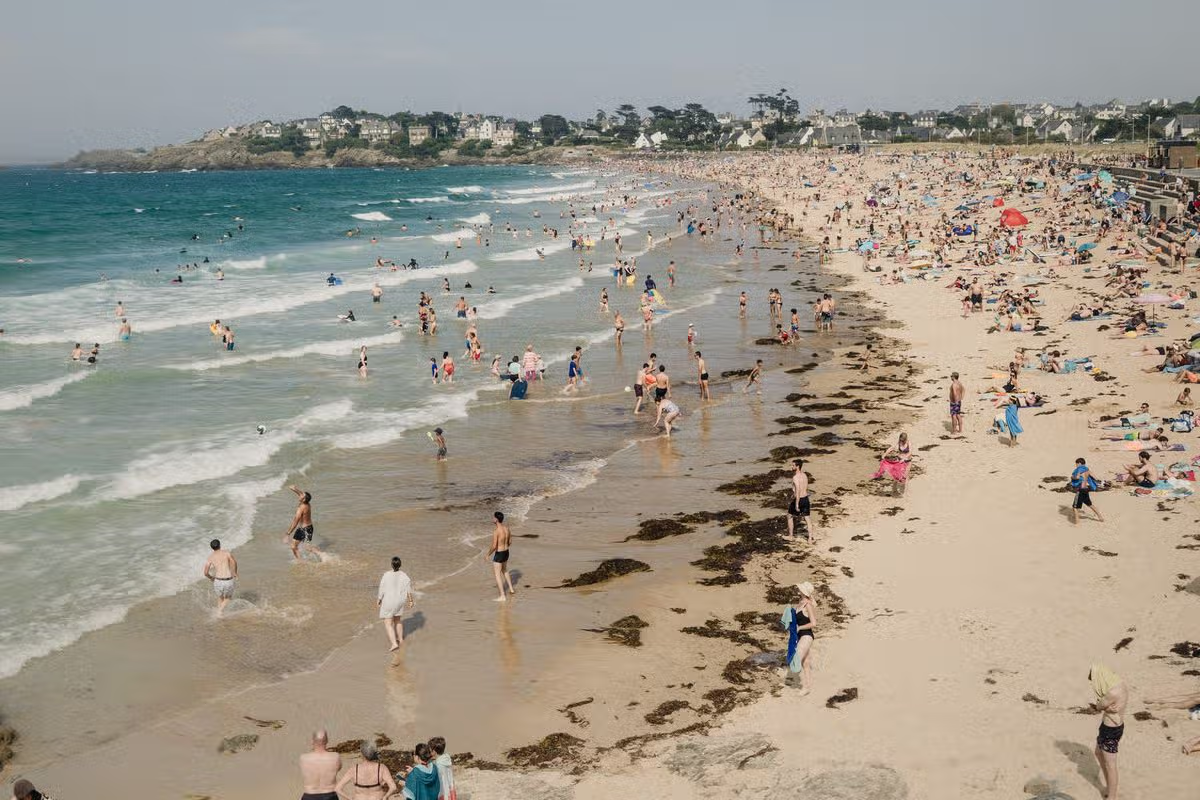
The beach of Longchamp situated between the towns of Saint Lunaire and Saint Briac sur Mer in France(Image: Bastien Ohier / Hans Lucas)
It may seem like a harmless memento to slip into your suitcase before heading home, but one common holiday habit could end up proving very expensive. Beach holidays are hugely popular, and while many travellers like to collect natural souvenirs as keepsakes or gifts, doing so in France could land them with a fine of up to €1,500 – which is around £1,300.
The little-known rule applies to natural materials including sea shells, pebbles and sand collected from French beaches. While many holidaymakers think nothing of taking home a small reminder of their trip, doing so is prohibited under French environmental laws designed to protect the country’s coastline.
Authorities say taking such items from beaches contributes to coastal erosion and can damage fragile ecosystems. Shells provide shelter for small marine creatures, while pebbles and sand play an important role in maintaining the stability of beaches.
France is home to more than 5,500 kilometres of mainland coastline and thousands of beaches stretching from the English Channel and Atlantic Ocean to the Mediterranean Sea. According to Atout France, the country’s official tourism development agency, its coastline attracts millions of visitors every year, making conservation efforts increasingly important.
The restrictions form part of France’s Environmental Code (Code de l’environnement), which protects the country’s natural coastal heritage. Anyone caught removing these materials without authorisation can face fines of up to €1,500, depending on the circumstances.
Environmental experts say the impact of individual tourists taking just a handful of sand or shells can quickly add up when millions of people visit beaches each year. According to the European Environment Agency, coastal erosion is already affecting many parts of Europe’s shoreline because of a combination of natural processes and human activity.
France remains one of the world’s most popular holiday destinations, welcoming millions of international visitors every year. Many head to coastal hotspots along the French Riviera, Normandy and the Atlantic coast, where authorities encourage people to leave beaches exactly as they found them.
The UK Foreign, Commonwealth and Development Office advises travellers to familiarise themselves with local laws before visiting overseas destinations. Even seemingly harmless actions can carry penalties if they breach environmental regulations.
Holidaymakers planning a trip to France are therefore encouraged to resist the temptation to pocket shells, pebbles or sand as souvenirs. Taking photographs instead is a simple way to preserve memories without risking an expensive fine or harming the environment.
Argentina fans responded with gestures of their own, with one punching the bus windows.
“Henry’s full of character,” Borthwick said. “We want character in our game and we want character in our squad.
“This squad really embraces what he brings. It takes all kinds of different personalities and we’ve got some players who wouldn’t do that and then you’ve got Henry who would go and do that.
“We embrace it. I think it was done in good nature and it came from a very good place.”
England have won nine of their past 10 meetings with the Pumas, including both Tests while on tour without their British and Irish Lions last summer.
After their most recent meeting – a 27-23 win for England at Twickenham’s Allianz Stadium – Argentina coach Felipe Contepomi was involved in a confrontation with England flanker Tom Curry in the tunnel.
England have named the same starting XV that beat Fiji 73-8 last weekend while Argentina’s team contains a clutch of players based in England, including Bath full-back Santiago Carreras, Bristol centre Matias Moroni and Harlequins second row Guido Petti.
Argentina; S Carreras; Delguy, Moroni, Piccardo, M Carreras; Albornoz, Garcia; Vivas, Montoya (capt), Rapetti, Petti, Alemanno, Grondona, Kremer, Oviedo.
Experts have warned parts of Southern Europe could exceed 50C this summer or next, with holidaymakers urged to rethink holiday destinations or could be forced to spend their vacation indoors
Temperatures in parts of southern Europe could exceed 50c(Image: Getty Images)
A sweltering 50C heatwave could hit parts of Europe as experts warned British holidaymakers to prepare for dangerous conditions this summer.
Holidaymakers heading to the Mediterranean have been warned temperatures could soar to 50C, with experts saying the record-breaking heat seen across southern Europe may only be the beginning. Large parts of Spain have already endured temperatures of 44C in recent days, while the heat has fuelled wildfires across Spain and France, forcing thousands of people to flee their homes.
Professor Bill McGuire, Emeritus Professor of Geophysical & Climate Hazards at UCL said even hotter weather could be yet to come. He said: “It would be no surprise if 50C was exceeded, either later this summer or next year, when the heating impact of the unprecedented El Niño building in the Pacific will be at its greatest.”
He urged anyone travelling to the Mediterranean to be prepared to spend far more time indoors than they might have planned. He told the Daily Mail: “I wouldn’t say that they would be a total write-off, but I think holidaymakers will need to be prepared to spend a lot of time in air-conditioned hotel rooms, due to it simply being too hot to do anything outside.”
The highest air temperature ever officially recorded in Europe is 48.8C, set in Sicily in 2021. Before that, the record stood at 48C, recorded in Elefsina and Athens in 1977.
Professor Hanna Cloke, Regius Professor of Meteorology and Climate Science at the University of Reading, said parts of Spain and Portugal could see temperatures climb into the high 40s. She said: “Temperatures in the high 40s are possible in the hottest parts of Spain and Portugal. And where humidity is high it can feel even hotter than that, well above what the thermometer says. That’s the kind of heat that kills.”
She urged holidaymakers to take extra care if temperatures continued to climb. She said: “The old and vulnerable need to be very careful; keeping out of the sun and drinking plenty of water, as they can easily suffer and become ill in 40C+ temperatures.”
Professor McGuire said there was “no doubt whatsoever” climate change was driving the extreme heat. He said: “Europe is heating faster than any other continent as we continue to add more than 40 billion tonnes of CO2 to the atmosphere every year – equivalent to the weight of 800,000 Titanics.
“The average temperature of Europe is now more than 2°C hotter than it was 100 years ago, and high temperature extremes are going up even faster. Heatwaves are getting hotter and longer, and taking many thousands of lives every year.
“But this isn’t the new normal, this is just the beginning. Summers across the Mediterranean region are just going to keep on getting hotter as long as we continue to do next to nothing in terms of reining in carbon emissions.”
Local residents living in the Lake District National Park have complained of visitors leaving litter and leaving tents behind after illegally wild camping on the banks of lakes
“Some people have no social conscience and do not care about the impact of their behaviour on the environment or other people. We see litter on the fells, on lakesides and thrown out of cars onto grass verges. We even saw someone having a BBQ sat right next to a sign prohibiting it on Ullswater last year,” one unhappy local wrote in this year’s survey.
Another added: “I’m from the Lakes and have always appreciated the tourism and what it does for the area. However, I feel we have now got to the stage where tourism is over capacity and negatively impacting the area and the quality of life for residents and animals. Frequent traffic jams, poorly parked cars, and most upsetting of all, litter. Today we came across a discarded used nappy and a tampon. My children and I frequently go out with our litter pickers. It really saddens me to see the Lake District in environmental decline.”
It is difficult to know quite how acute the problem is. The surveys collect anecdotal evidence and solid figures on littering and anti-social behaviour are hard to come by.
What is undeniable is the shifting demographic of those coming. In 2018, 52% of visitors to Cumbria were under 50. By 2022, that’d risen to 74%.
Surprisingly, overall visitor numbers were down at the last count (2024) compared to both 2023 and the pre-Covid year of 2019. Roughly five million fewer people visited in 2024 than in 2019.
Jeremy Smith is head of campaigns and engagement at Friends of the Lake District. He believes that relations between visitors and locals have been tense since the Covid years, in part due to the changing nature of the tourists coming.
“With the increase in the number of people taking holidays in the UK, in terms of behavior, what may have been happening in Ibiza and Cyprus has been domesticated in places like the Lake District,” he told the Mirror.
Local laws were tightened earlier this year in response to resident complaints. Those causing environmental damage by littering, starting fires, or committing anti-social behaviour linked to camping or the “inappropriate use” of motorhomes can now be fined up to £100, under Westmorland and Furness Council public protection orders.
Wild camping rules are a little more complex. It isn’t legally permitted without landowner consent, but is widely tolerated if strict ‘Leave No Trace’ guidelines are followed. These require visitors to camp only above the highest fell wall (around 400m+), well away from roads and towns, stay for just one night, and never light a fire.
According to some locals, the rules are being flouted regularly.
“The path by the shore had a tent pitched in the middle of it, and when I politely pointed this out to the occupants, they swore at me aggressively,” one survey respondent wrote.
“People do not like to be questioned about leaving litter, loose dogs, motorbikes, it’s a sense of entitlement to do just as they like. There are very few authority figures, such as police or wardens. It should not be up to pensioners to police the park.”
This double act of “Lancashire” locations is my final celebration of Britain’s bypassed towns. My native county has dominated my life of late, and one key question asked in these columns has been: can you holiday right at home?
The French author Xavier de Maistre believed you could fit a journey inside a single room. And in Instructions on How to Climb a Staircase the Argentine-French writer Julio Cortázar turned a walk upstairs into a quest. An entire county offers enough adventures to fill a life.
Touring seldom-trod places, I’ve witnessed a lot of regeneration and redevelopment, demolition and disappearance. Preston, my closest city, has a £45m leisure complex, a revamped museum and a new bridge over the River Ribble, with lots more planned. St Helens, my childhood town – proudly in historic Lancashire, but administered as Merseyside, and now part of the Liverpool city region – looks and feels like a drawing board at the moment. But both are changing for the better, if you look beyond the frayed fabric of their townscapes.
Preston
St Walburge’s church, Preston. Photograph: Paul Melling/Alamy
At first, I was struck by the city’s low-slung eastern edges, as if land had been cleared. It was simply that areas have been Americanised – all squat, boxed retail, yawning carparks, and ring roads. It left me feeling flat. But Preston began to grow on me the minute I stood beneath the extraordinary hypodermic spire of St Walburge’s church – the tallest parish church in the UK, designed by Joseph Hansom (of cab fame), and a testament to the strong Roman Catholic presence in “Priest’s Town”. Looking up signifies hope; doing it is primitive cognitive therapy.
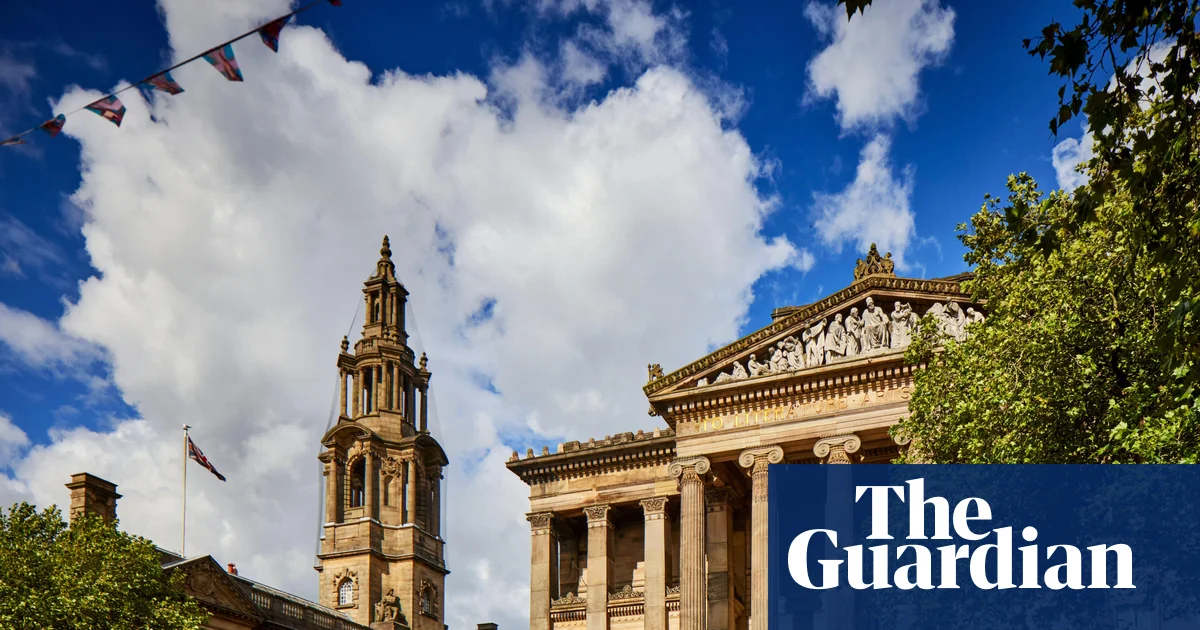
Then I discovered the imposing Harris museum and gallery, which reopened after a £19m refurbishment last September. It’s become the place to go for art, local history, textiles, fashion, ceramics, coffee, library books – the ultimate rainy-day or, indeed, heatwave refuge. It’s a regional treasure (and perhaps the Ashmolean and British Museum might like to return the complete Cuerdale hoard, the largest Viking hoard found in England, unearthed beside the River Ribble).
I used the Harris a lot while doing jury service at the crown court and turned my walks to town from the park-and-ride into sightseeing tours. Highlights include the brutalist bus station and Guild Hall, built for an unrealised new town; the monument to the 1842 martyrs gunned down by infantry and coppers during the General Strike; the Victorian market hall and court and Miller Arcade; Winckley Square with its park and Georgian terraces; St Wilfrid’s, St John’s Minster, the Saint Alphonsa Syro-Malabar Cathedral.
Preston’s brutalist bus station. Photograph: Radharc Images/Alamy
Made a city in 2002, Preston has long been a place of power and influence. It’s where the cotton-town trail through east Lancashire begins, geographically and chronologically. Richard Arkwright, father of the factory system and co-creator of the water-powered spinning frame, was born here in 1732. Centenary Mill was built for the empire-spanning textile firm Horrockses, Crewdson & Co – its magnificent chimney was mammon’s shameless challenge to the churches; an annexe off the yard contains a magical emporium of antiques, and fixtures and fittings culled from mouldering mansions.
Industry, one way or another, led to many of Preston’s other inventions. Temperance and teetotalism, spearheaded by the nearby Walton-le-Dale’s Joseph Livesey, son of a clothier, were partly reactions to urban “immorality”. Professional football was what professional workers wanted on Saturdays. Preston North End was a founder member of the English Football League. Deepdale, on the same site since 1875, is one of England’s oldest grounds. Dick, Kerr Ladies, founded in 1917, was one of the first women’s teams.
In fine fettle … the interior of the Black Horse pub. Photograph: Kevin Walsh/Alamy
I respect the temperance movement, but love the Black Horse – to me, Preston’s most beautiful old pub, with etched windows, fixed snug-like seating, gorgeous tiling and a rare ceramic bar. Trad spaces have been complemented by new food venues, with the cool Korean restaurant Kimji, authentic Spanish dishes at Pintxos and modern British at Aven.
When they hacked up counties in the 1974 local government overhaul, they accidentally made Preston a future “capital” of sorts. It’s beginning to live up to the billing.
Reflection Court on Canal Street, St Helens. Photograph: Radharc Images/Alamy
Till now, I had never been inside St Helens Minster, though I was born nearby. In my defence, it was just the parish church till May of this year, when the name was changed to reflect its role as mother-church of the whole community.
The town began here, with four ancient rural manors ranged around a chapel of ease where wayfarers could rest and pray. Windle, Parr, Sutton, Eccleston; old names that contain even prettier-sounding villages: Clinkham Wood, Thatto Heath, Nutgrove. St Helens was once fields. Then it was shops, pits and workplaces. Now it’s something else.
Two big things are unfolding to that end. One looks small on a map but is mightily symbolic. Conservation work is progressing at No 7 Cannington Shaw Bottle Shop. Built in 1886, there were originally nine such shops – factories – making up the largest glass bottle production site in the world. This lovely redbrick circular building, with a classic conical roof, is the sole survivor, occupying a rare patch of rough land beside a big Tesco and Saints’ flashy rugby league arena. Once tons of molten glass were heated here, with glassblowers scooping up gobs to skilfully inflate, shape and place in a mould to create bottles.
On the first Saturday of every month, No 7 Cannington Shaw Bottle Shop now hosts artisan craft markets, with a bar and food stalls. After serving as an air raid shelter and storage depot, the site was abandoned and was only spared demolition by happy accident. John Tabern, director of the project, says: “As an ex-glassman, it’s extremely important to me. I’m proud of St Helens and want people to know its story. But we must monetise it with gigs and markets and all those things.”
No 7 Cannington Shaw Bottle Shop. Photograph: Liam Bluck/Alamy
The other thing is large on the map, equally important, if less evocative. Following blitz-level demolition, a large area east and south of the town hall is being given a new bus station, homes, offices, a hotel, green spaces, piazzas and “revitalised retail spaces”.
They’re always knocking things down here. But the Gamble building will soon house a smart new library, youth space and offices. This and the town hall are solid examples of redbrick Victoriana. The Beecham’s building, built in 1887, cost a fortune at the time and is topped by a coquettish clock tower. Its founder, Thomas Beecham, began selling laxatives to costive Wiganers; St Helens, like a crucible, allowed his business to flourish. The smart St Helens college faces the former HQ and the marriage of old and new works well.
Reflection Court, the old Pilkington’s headquarters on Canal Street, has a streamlined brick facade, influenced by the architecture of the Dutch modernist Willem Marinus Dudok. The former Pilkington’s complex at Alexandra Park on the edge of town was built by modernist architects Jane Drew and Maxwell Fry – who collaborated with Walter Gropius and Le Corbusier. Everything seems to be earmarked for apartment conversions.
I leave town via the Book Stop community bookstore, which I have “shares” in and where I gave a talk on my recent Lancashire book earlier this year. With no prompting from me, the manager titled it “Don’t Call Us Merseyside”. The newer “Liverpool City Region” is equally unpopular. I pass a church that, as a child, I thought was huge and ominous. Renowned architectural historian Nikolaus Pevsner wasn’t overly keen on St Mary’s Lowe House Catholic church, but I like the competing Byzantine dome and gothic tower. It’s as if the architect couldn’t make up his mind. The brickwork is black – the patina of two centuries of factory fumes. I pass the Turks Head pub, routinely lauded by Camra, and FC St Helens, where the rugby league team played in the 1880s.
The Camra-lauded Turks Head pub. Photograph: PSC-Photography/Alamy
Finally, I come to St Helens cemetery and crematorium. I have been here too often this past couple of decades. St Helens was built on furnaces; this one is still busy. I head to an area beyond the neat ranks of modern gravestones, walking on a path that, from the sky, is heart-shaped. In the wooded corner stands St Helens most ancient structure: Windleshaw Chantry, dating from 1415, when this was open countryside.
Beneath it is a large tomb, with a flat tablet full of abbreviated words. Spelled out, they say, “Here lie the remains of Jean Baptiste François Graux de la Bruyere – He was the first Who brought to Perfection A Work of very considerable Magnitude And Importance To the Commercial Interest of the British Nation.” This immigrant from Picardy, who died in 1787, aged 48, is thought to be the hero who brought glass-making to St Helens. I’m sure he’d be pleased that the town is at last celebrating his legacy. Things to see and do: World of Glass, The Book Stop, North West Museum of Road Transport, the Dream sculpture, Café Laziz
The warning comes as many Brits to prepare to go on their summer holidays
It is worth buying repellent before you travel
Holidaymakers have been warned to protect themselves against mosquitoes as health officials published new data on infections imported into the UK. The UK Health Security Agency (UKHSA) said diseases spread by mosquitoes, such as dengue fever and Zika virus, can be harmful for some people.
It urged travellers to use insect repellent, wear long sleeves and trousers and sleep under a treated bed net if necessary. People should also get any jabs they need for travel and check whether they need malaria tablets.
Dengue fever can feel similar to flu and symptoms include high temperature, severe headache, pain behind the eyes, muscle and joint pain and feeling sick. Chikungunya symptoms include fever, joint pain, headache, muscle pain, joint swelling and rash.
Most people with Zika suffer a mild illness, but it is serious in pregnant women and can cause stillbirth, miscarriage, problems with development and unusually small heads. Meanwhile, malaria can prove fatal, with symptoms including fever, vomiting and pain.
The UKHSA said eight Zika virus cases were reported from January to June 2026 – already above the seven cases recorded in 2025. Four of these were from Indonesia. Some 137 cases of imported dengue were reported in England from January to June this year, with South-East Asia and South Asia remaining the most common regions where people caught it. Some 27 cases were linked to travel to Thailand and 19 to the Maldives.
For comparison, the overall number of cases by the end of June last year was 161, though cases also tend to rise later in the year. A total of 59 chikungunya cases were reported from January to June this year, with Sri Lanka being the most commonly reported country of travel, accounting for 18 cases. There were 73 in the same period last year.
Meanwhile, 557 malaria cases were reported in England, Wales and Northern Ireland from January to May. Last year at the same point, there were 548. As well as mosquito-borne illnesses, there were 287 cases of typhoid and paratyphoid fever between January and June this year.
Typhoid and paratyphoid are caused by Salmonella bacteria, which is usually spread through contaminated food or water. Mosquitoes rely on standing water to lay their eggs. It then needs to be warm enough for the eggs to hatch, which can take just a few days if temperatures are high enough.
Dr Hilary Kirkbride, consultant epidemiologist and head of travel health at UKHSA, said: “Summer is a popular time to travel – don’t let illness spoil your holidays. Good preparation and planning is important for a safe and enjoyable trip.
“Check the TravelHealthPro website for the latest health advice for your destination, including which vaccines you may need and any important medications, such as anti-malarial tablets.
“To protect against mosquito-borne infections, use insect repellent, cover exposed skin and sleep under a treated bed net where needed. For enteric fever and other stomach bugs, make sure you take good food and water hygiene precautions.
“Even if you have visited a country before, you do not have the same level of natural protection against infections as permanent residents, so it is important to take precautions every time you travel.
“And if you are pregnant or trying to conceive, there are special precautions you should take, so please speak to a doctor, nurse or local travel clinic before planning your trip.”
Natalie Hitchins, Which? head of home products and services, said: “If you’re travelling somewhere that has mosquitoes, it’s worth checking that your repellent will actually do the job before you go.
“Which? tests found that while some repellents provided effective protection for almost 10 hours, some trendy alternatives failed to prevent bites for longer than a few minutes.
“Look for products containing active ingredients such as Deet, Icaridin (picaridin) or PMD, rather than relying on marketing claims alone.
“Insect repellent can help protect against mosquito bites, but it should be used alongside – never as a replacement for – any vaccinations or medications recommended by a healthcare professional.”
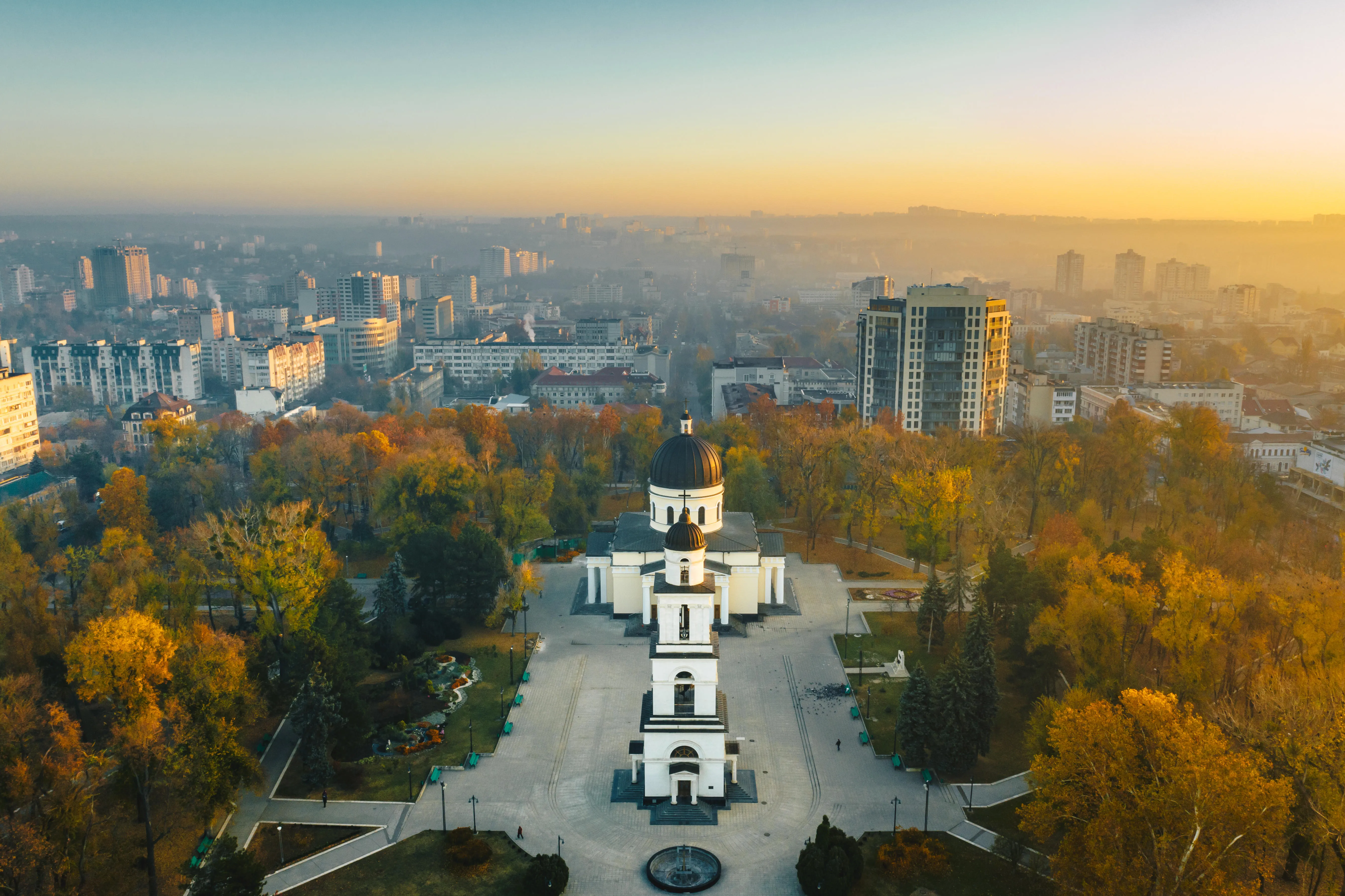
Wizz Air is launching new flights to MoldovaCredit: Alamy
The route will operate year-round, four times a week on Mondays, Wednesdays, Fridays and Sundays.
Flights will take off on October 25 and cost from £36.99.
Sign up for the Travel newsletter
Thank you!
Yvonne Moynihan, Managing Director at Wizz Air UK, said: “We’re delighted to give our UK customers another opportunity to discover Chișinău with the launch of our new service from London Gatwick.
“Moldova is one of Europe’s emerging destinations, offering everything from fascinating history and vibrant culture to some of the world’s oldest wine regions.
Sun reporter Felix Naylor Marlow visited the country last year and here are his thoughts:
“Despite sharing a continent, Chisinau feels a world away from the UK with its stark Soviet design
“Once there, pretty much every local I met was shocked to see a tourist doing a spot of sightseeing.
The flights will launch from London Gatwick on October 25Credit: AlamyThey will the operate year-round, four times a weekCredit: Alamy
“Their confusion was understandable though, as the largely forgotten country of Moldova – squeezed between Ukraine and Romania – holds the title of ‘least visited country in Europe’.
“Chisinau is a city that has been through a lot – a mind-boggling 70 per cent of it was destroyed in wars across the twentieth century.
“During my stay in the city in early March, as the UK was seeing temperatures of 6C, I was wandering around the city in a T-shirt thanks to highs of 24C.
“I spent a very pleasant evening ordering several martinis in the bar’s cute cocktail garden, enjoying the unseasonably warm weather.
“If you fancy somewhere completely different, cheap as chips, and where people are genuinely pleased to see you, book a flight.”
Leah Norman said many of the beds would then lie empty all day with just a towel on them
09:25, 09 Jul 2026Updated 09:28, 09 Jul 2026
Leah Norman watched tourists rush for sunbeds after waiting for two hours(Image: SWNS)
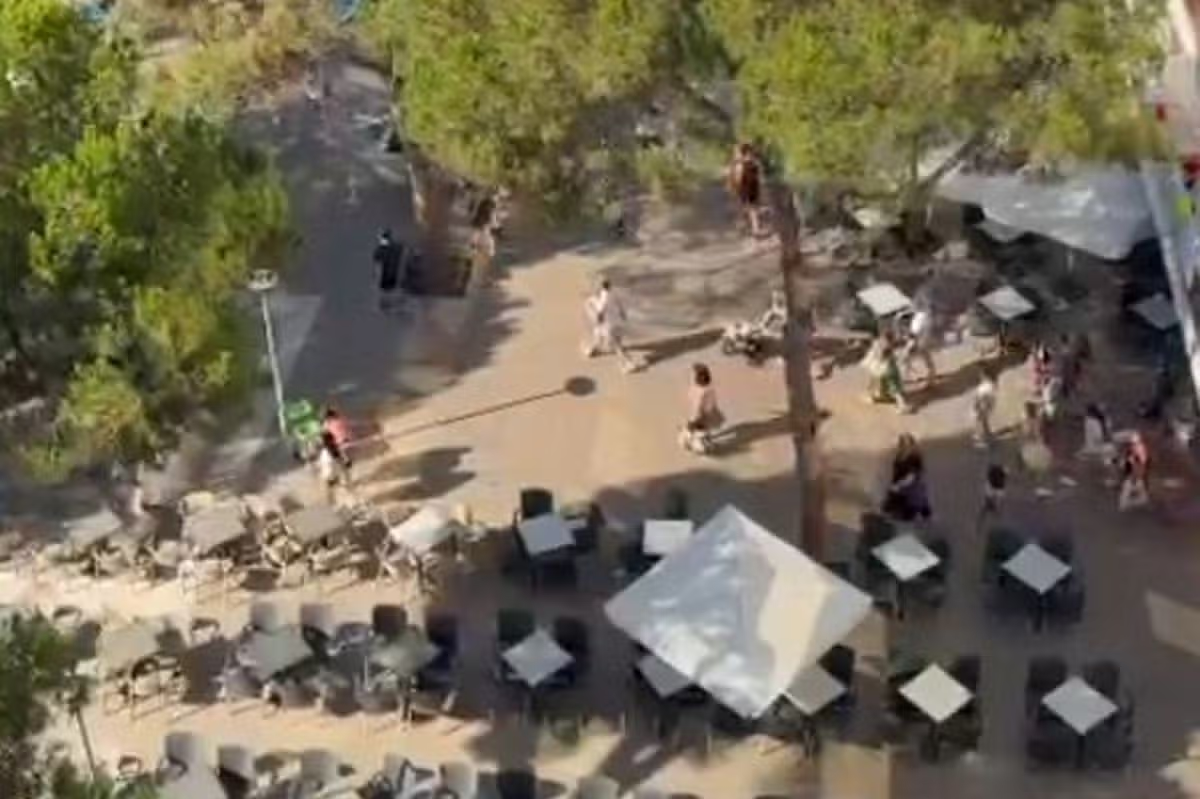
A Scottish tourist has confirmed that holidaymakers sprinted to grab a sunbed after queuing for two hours at the pool gates. Leah Norman, 37, was on holiday at the Best Oasis Hotel in Salou, Spain, when she witnessed crowds of tourists flooding through the pool gates on July 4 in what she described as “Hunger Games style”.
The holidaymakers had been waiting since 8am until the doors opened at 10am. Leah, from Ayrshire, Scotland, said she spotted a “big queue” of sunbed-hoggers every morning, all desperate to secure a seat throughout her week-long stay.
She noted that beds with towels draped over them would remain unoccupied for the entire day, leaving families without any poolside shade for their young children.
Leah, from Ayrshire, Scotland, said: “Every morning there was a big queue inside hotel full of people waiting on the doors to open at pool area. The door was locked and would open at 10am.
“People would start queuing up from around 8am and when the doors opened at 10am, everyone would start running to grab sunbeds that were stacked up to place next to the pool, like the Hunger Games had just started.”
“Some families with young children were unable to get sunbeds or parasol shades for their babies as they would be taken. Some days, beds would lie empty all day with towels lying on them.”
Watch tourists’ ‘manic race’ for sunbeds after hour-long queue
Manic tourists race for sunbeds at Spanish hotel
Having secured a spot with a towel, holidaymakers would then make their way inside for breakfast. Chris said: “It was a manic race and scramble for the sunbeds surrounding the pool at the hotel. I don’t judge but found it funny so had to film it.
“Some people just rolled out their bed, queued up, mad-dashed to secure the bed then they were seen going back to their hotel rooms or off for breakfast.
“It doesn’t leave room for those who don’t queue for an hour.”
Harry Poulton moved from Brighton and moved to Benidorm after visiting the city with his mates when he was 18 – but there are certain spots he says tourists should avoid
Harry said his decision to move to Benidorm was the best choice he’s made(Image: Jam Press/@harrytokky)
Benidorm is one of the most popular European holiday destinations among Brits and attracts approximately five million tourists annually. Harry Poulton, 24, grew fond of the resort following a visit with mates at 18 and now regards his decision to relocate there as the finest decision he’s ever made.
Nevertheless, he wishes to pass on his expertise to holidaymakers preparing to explore the seaside city on Spain’s Costa Blanca. Taking to TikTok, where he’s amassed more than 40,000 followers, he highlighted three locations in the nightlife hotspot that he believes are best avoided owing to safety concerns.
First on his list is the ‘Yellow Brick Road’, a centre of bars and eateries that represents the core of local nightlife, covering streets such as Leanto, Ibiza, and Leerida.
Harry cautioned: “The Yellow Brick Road – this little public pathway […] leads all the way up to the Rio Park. Now, it has been known for a few things, mainly small thefts like pickpocketing. Generally, during the day, it’s absolutely fine. I’d recommend avoiding it at night.”
The second spot Harry suggests swerving is Pueblo Alley, situated close to Levante Beach.
“This is one I definitely recommend avoiding, especially late at night, as you do get the pickpockets hanging around this area,” he warned. “You also get the odd lady of the night. There are plenty of other ways around”.
Topping Harry’s list of places to steer clear of is ‘Mugger’s Alley’, meanwhile.
“It is the most notorious – it’s the one we all know,” he exclaimed. “Known for pickpocketing, ladies of the night, it’s just an area I would avoid. They’re even doing these new taxi scams. It’s crazy. Save yourself the hassle and cross the road.”
Despite acknowledging these risks, Harry remains a devoted admirer of this popular holiday hotspot.
He argues that many British holidaymakers hold misconceptions about Benidorm, insisting that concerns over crafty scams and overpriced goods are often way off the mark.
What’s more, since swapping Brighton for Benidorm, Harry has watched his living expenses drop considerably, with monthly outgoings now falling between £500 and £1,000, including bills.
Harry proclaimed: “If you live here, you get it. Benidorm is paradise – and anyone who says otherwise is lying.”
A POPULAR destination in Europe is cracking down on tourists – with fines dished out to rule-breakers.
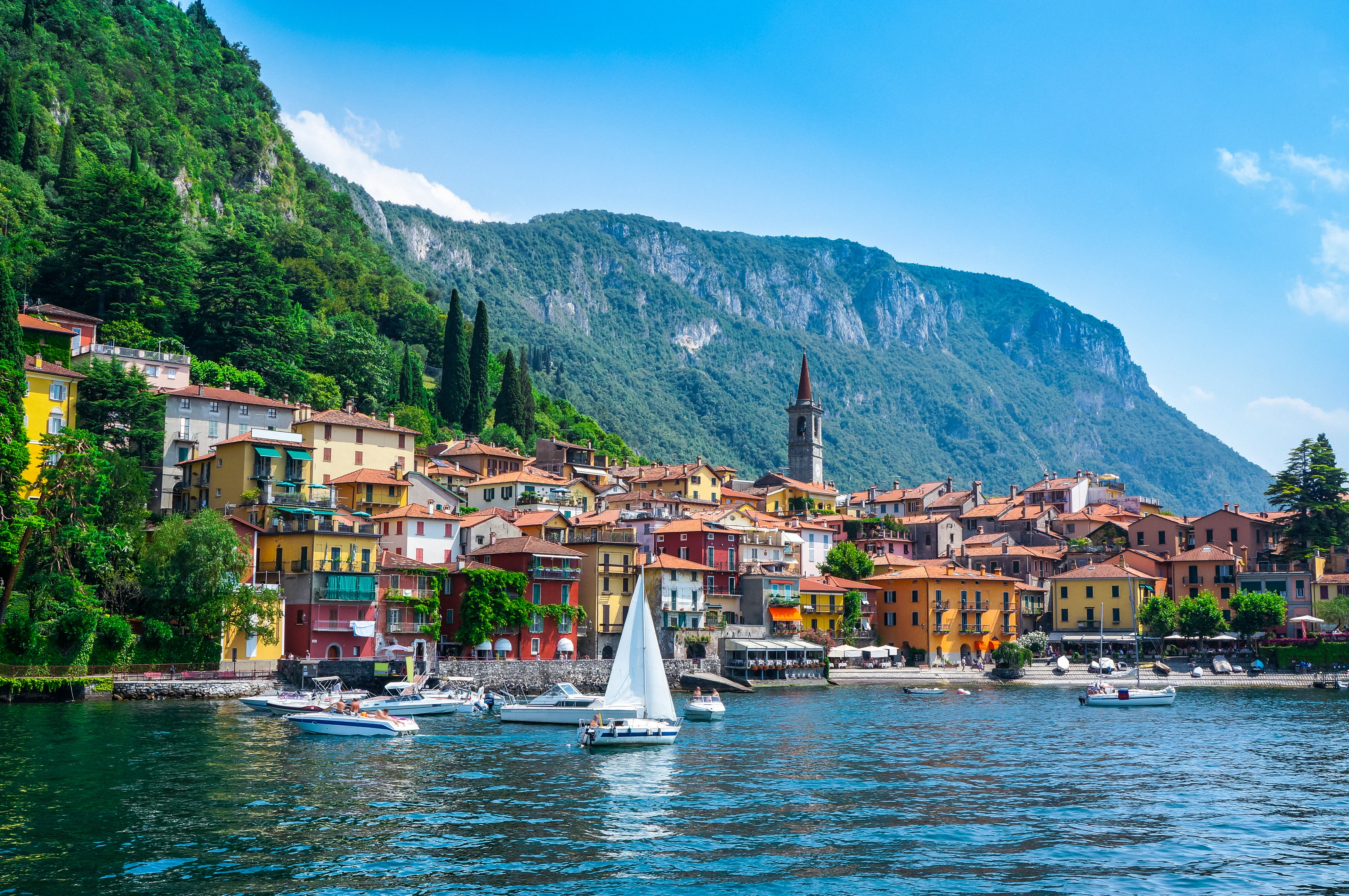
The small village of Varenna, near Lake Como, is banning anyone from walking around its historic streets either bare-chested or wearing swimwear.
Sign up for the Travel newsletter
Thank you!
Varenna village on Lake Como is now fining people who are bare-chested or wearing swimwear in its streetsCredit: Getty
The new rules come as the village, which is home to only 650 people, is experiencing high levels of tourism each summer.
Tourists heading to the town will still be able to have a bare chest or wear their swimwear if they are at one of the lake’s beaches or if they are enjoying a boat trip on the lake itself.
However, if they are caught in the wrong place in the swimwear or with no shirt on, they could be fined between €50 (£42.74) and €200 (£170).
Varenna isn’t the only Italian spot to ban being shirtless and wearing swimwear in the town centre.
It is also banned to walk shirtless, barefoot or in a bikini in the town centres of Sorrento and the Amalfi Coast, with fines ranging from €25 (£21.37) to €500 (£427.48).
Varenna has also introduced a number of other rules impacting tourists.
There’s also a clampdown on crowds, as tour groups are now capped at 25 people.
The aim of this is so that the village’s lanes will not be blocked.
Guides have been banned from using speakers as well.
According to The Guardian, Mauro Manzoni, Varenna’s mayor, said: “Varenna is a wonderful village, and we are proud to welcome hundreds of thousands of visitors from all over the world every year.
“However, our residents’ quality of life cannot be sacrificed on the altar of mass tourism.”
Many popular holiday spots are struggling with overtourism
One country has taken the top three spots(Image: Berk Ucak/Getty)
Holidays are a chance to get away and immerse yourself in new culture, see world-famous landmarks and experience new foods. However, it can be less than enjoyable if there are hundreds of other tourists there as well.
After years not travelling due to the pandemic, it seems most of us want to get back out there and see as much as we can. Tourists from all over the world have headed to popular destinations, with some now feeling overcrowded.
In the UK, Edinburgh Castle claimed the top spot of the world’s most overcrowded landmark. But, a 2023 study from MoneyTransfers.com revealed the most overcrowded destinations in the world.
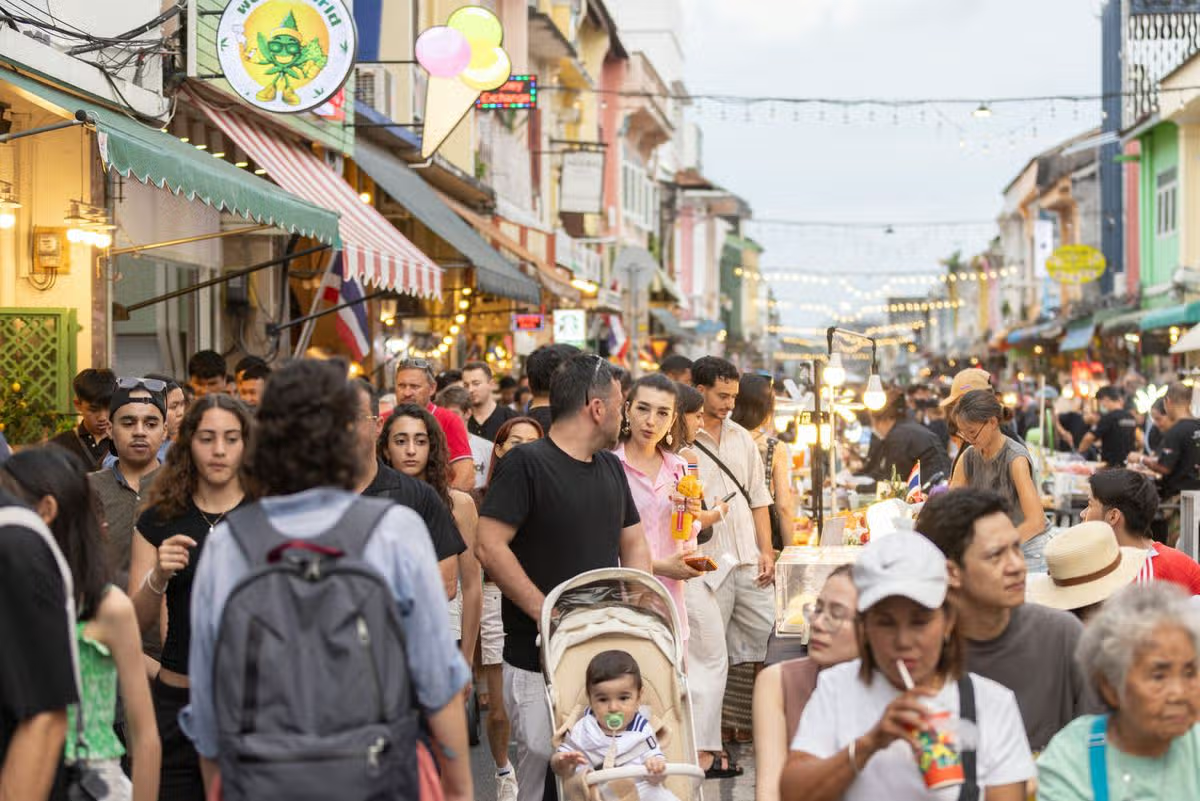
According to their research, Phuket in Thailand is the most crowded tourist destination in the world. It has staggering 118 tourists to every local resident.
Phuket is one of the leading beach destinations in Thailand and is home to several of the world’s best. Kata and Karon rank as some of the best beaches in the world.
Due to its stunning scenery and popularity, tourists may find overcrowded beaches particularly during peak season. Thailand’s Pattaya and Krabi also ranked as the second and third most overcrowded spots in the world.
It means Thailand has the most spots on the top 10 list, followed by Greece and Turkey. Heraklion in Greece took the seventh spot on the overcrowded list as it has 22 tourists to every local resident.
Not surprisingly, Venice in Italy also ranked on the list as it has 21 tourists to every resident.
Now, Mr Venturini is now pushing to raise the entry fee to as much as €50. Rhodes in Greece also made the list with over 20 tourists for every resident, while Miami in the US has 18 tourists to every local.
Many holiday hotspots have seen anti-tourism protests thanks to overcrowding and the issues it causes for locals. But the European island that’s the most overcrowded wants to pack more visitors in
The island has a tourist to local ratio of seven to one(Image: Getty Images/iStockphoto)
The most overcrowded island in Europe has seen no over-tourism protests – and bosses want more visitors.
A study has named the Continent’s most packed island, based on tourism density, and it’s not in the Balearics or Canaries.
In fact, the local tourism board wants to bring more visitors to the island and triple the tourism sector’s contribution to the economy. The plans would see the island’s visitor numbers rise from just over four million last year to 4.5 million by 2035.
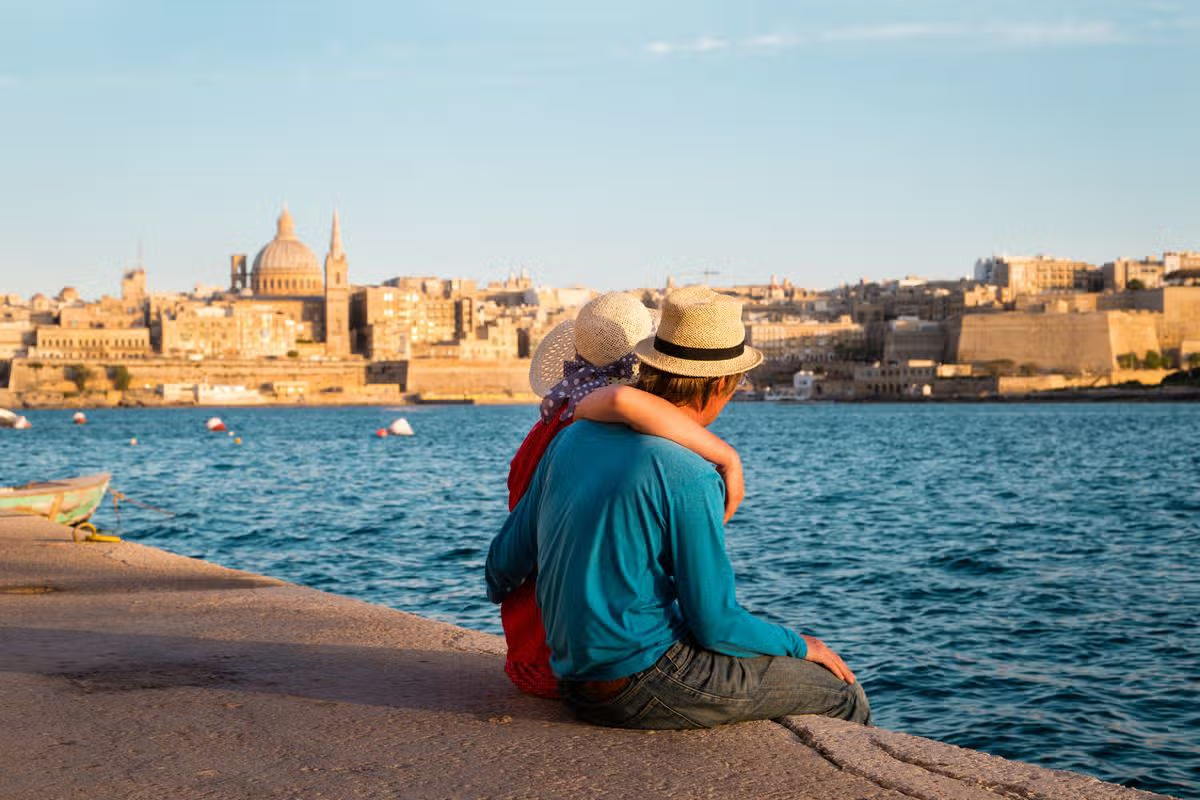
With a total area of 316 km², Malta is roughly a fifth of the size of London and has a population of around 575,000, about a third of which are foreign residents. This means there’s a ratio of roughly seven tourists for each resident, so locals are already outnumbered.
The study was carried out by BookRetreats.com, which “analysed the latest data from the European Commission, focusing on overnight stays in tourist accommodation per square kilometre (km²)—a measure of tourism density.”
While Mallorca (Majorca) had the most visitors out of the islands in the study, nearly 14 million last year, Malta’s mainland came on top as the most overcrowded island due to its relatively small size. Brits account for the largest number of visitors year-round, and the island has long been a winter sun destination thanks to its 16C days in January and a majority of the island being fluent in English.
The capital, Valletta, has become a popular spot for sun-soaked city breaks thanks to its colourful 16th-century architecture, and the ancient walled city of Mdina is also a hit with tourists thanks to its winding medieval streets. It’s also famous for its beaches, especially in the north of the island, which has turquoise blue seas and calm, shallow waters.
But there have been some measures put in place on Malta’s islands to help ease overcrowding. For example, the Blue Lagoon on Comino used to get daily crowds of up to 12,000 in the summer, and in response, authorities capped tourist numbers to the white sand beach at 4,000 a day. There have since been calls to halve this number to protect the delicate ecosystem.
The islands of Gozo and Comino came 14th on the list, meaning while they’re still overcrowded, they don’t have the same tourism density as Malta’s mainland.
Perhaps unsurprisingly, Spanish islands dominated much of the list of the most overcrowded spots, with Lanzarote, Ibiza, Tenerife, and Gran Canaria ranking highly. Greek islands including Corfu and Zakynthos (Zante), also made the top ten, as well as the Portuguese island of Madeira, which is also a winter sun favourite with Brits.
COMMUTERS were left stunned when they realised they were sharing a train platform with A-list acting royalty.
One eagle-eyed passenger spotted a Hollywood star casually waiting at the station before boarding a train – but would you recognise her?
Sign up for the Showbiz newsletter
Thank you!
Tourists were left shocked when they spotted a major Hollywood actress in a Paris train station recentlyCredit: TikTok/@livingthedevinelifeMargot Robbie was simply amongst other commuters as she kept a low profile in a hat and floral dressCredit: TikTok/@livingthedevinelife
With no security team in sight and not even a friend with her, Margot Robbie was seen alone at a Paris train station.
Disguised beneath a huge floppy hat, the actress blended into the commuters going through the station as she patiently waited for her train to arrive.
The 35-year-old stood scrolling on her phone, seemingly oblivious to both the video being recorded and the excited fans around her.
An onlooker later shared the clip online, soundtracked by a song from Barbie, the blockbuster film in which Margot famously starred.
Margot is known for appearing in blockbusters such as Wuthering Heights and BarbieCredit: GettyShe spent time in France earlier this year for Paris Fashion Week and has been in the country gearing up for the new Ocean’s 11 prequel, which will begin filming in ParisCredit: Alamy
In the short video, the fan appeared unable to believe their luck after spotting the Australian-born actress.
Fans quickly took to the comments to speculate about why Margot might be in the French capital, with one suggesting she is likely gearing up for filming of the new Ocean’s 11 prequel.
Production on the prequel is expected to begin in Paris in July before moving to the south of France,
The movie is set at the 1962 Monaco Grand Prix and filming is set to take place in Nice and Monaco from August to October.
The film, which Margot is producing and which stars and is directed by Bradley Cooper, is due for release nextsummer.
Another commenter said the fan should have introduced themselves, before sharing their own story about meeting the actress.
They wrote: “In 2022, I met her and her husband in a small pub in the Lake District, of all places.
“I had just got engaged 10 minutes earlier, so everything already felt surreal. I went over to her table and told her about the engagement. She was the first person I told and the first person to congratulate me.
“She introduced herself and was just so, so lovely. I love telling that story.”
From its famous monthly markets to artisan boutiques, this charming town should be on your radar
07:00, 03 Jul 2026Updated 07:18, 03 Jul 2026
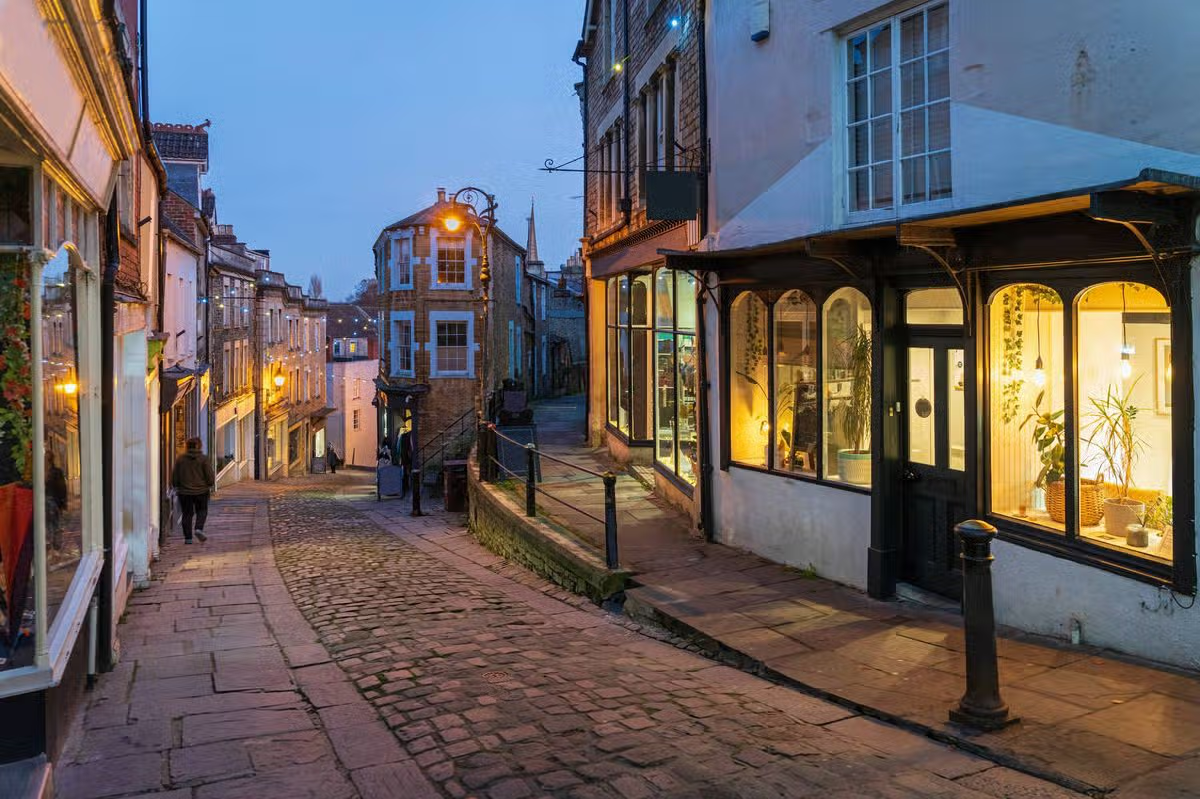
I visited a quiet UK town with cobbled streets and independent shops – I’d live there(Image: GordonBellPhotography via Getty Images)
The UK is brimming with stunning towns and villages, and I’ve been fortunate enough to explore quite a few. One aspect that has consistently struck me is how distinct they all are, even when they’re situated close together.
Some are bustling and contemporary, while others seem stuck in the past. That’s precisely why I adore discovering the UK, as you’re never quite sure what you’ll encounter.
Frome in Somerset is one of those destinations that genuinely lingers in your memory afterwards. It isn’t one of those household-name tourist hotspots like Bath or Wells, but that’s part of what makes it special.
Nestled in eastern Somerset near the Wiltshire border, Frome wasn’t particularly high on my list of places to visit, but I’m absolutely delighted I made the trip.
Frome, pronounced Froom, is positioned in a valley along the River Frome, roughly 13 miles from Bath. Historically, it flourished as a wool and textile town, and you can still spot remnants of its heritage in the architecture and street patterns today.
What made the town particularly memorable for me was its blend of historic and contemporary elements, which seemed to resonate with virtually everyone.
There are twisting medieval lanes, Georgian terraces, and former industrial structures sitting alongside modern cafes and independent retailers.
It has long been a market town, and that heritage remains central to its character, which is largely why I chose to visit after spotting it on TikTok.
The highlight is the Frome Independent Market, held on the first Sunday of each month. The entire town centre essentially transforms for the day.
Streets become packed with stalls offering everything from artisan food and freshly baked bread to handcrafted goods, antiques and clothing. There’s frequently live music and street food on offer too.
Even when the big monthly market isn’t on, smaller regular markets maintain that community atmosphere throughout the week.
Its high street has also been recognised as one of the finest in the UK on multiple occasions, and it was easy to see why.
Beyond markets and shopping, one of the most enjoyable aspects of Frome is simply wandering around it. It’s compact enough to navigate with ease, yet packed with hidden treasures waiting to be discovered.
Catherine Hill is arguably the most iconic street in the town. It’s steep and cobbled, lined with independent shops.
But it’s also among the finest vantage points, offering views back across the town’s rooftops.
There’s also a thriving arts and culture scene there. Galleries, studios and numerous creative venues are dotted throughout the centre, and the Frome Festival in July brings the town alive with music.
If you’re after something more peaceful, there are numerous riverside walks, as well as being far from open fields and rolling hills. The town is ideal for anyone and everyone.
Salzburg has begun enforcing a summer ban on visitors driving into its historic centre, picking up a policy modelled by other car-choked European cities plagued by overtourism.
Authorities in Austria’s fourth largest municipal area said they hoped the “less traffic, more city” restrictions in July and August would reduce the number of vehicle entries by 1,000 a day.
As part of the campaign against gridlock, park-and-ride facilities are offering a day ticket including travel on local public transport for five people for €7.50 (£6.45).
“We don’t want chaotic traffic situations like we saw last year,” said the mayor, Bernhard Auinger, when he announced the measure in May. “It is aimed at day trippers who travel by car from farther afield. It is important to me that residents of the central Salzburg area and business-related traffic are not affected by this.”
Auinger said tourists themselves, drawn to attractions such as Mozart’s birthplace and the baroque-style 17th-century cathedral, would also benefit from the policy. “It’s certainly much better than spending hours stuck in traffic. And it also makes life a lot easier for the people who live and work in the city of Salzburg.”
The restrictions will make life ‘a lot easier for the people who live and work in the city’, said the mayor. Photograph: Westend61/Getty Images
The mayor said mounting complaints by residents about traffic during the summer months had prompted the city to take action. “We basically allowed tourists to drive into our sitting room,” he told the news website Salzburg24.
Patrolling police officers will impose fines of up to €80 on any drivers with numberplates from outside the Salzburg region entering the old town in the radius around the Staatsbrücke (state bridge) spanning the Salzach River.
Exceptions will be granted to commuters, delivery vehicles, taxis and rental cars, as well as disabled visitors and hotel guests with a reservation confirmation in the restricted zone. German motorists from the neighbouring Bavarian areas of Berchtesgaden and Bad Reichenhall are also exempted.
Heidi Strobl, of the local tourism board, said Salzburg’s policy, approved by the city council in May, had taken a page from the zona a traffico limitato (limited traffic zones) in Italian cities such as Rome, Florence and Pisa as well as a ban in Dubrovnik, Croatia, after they had become inundated with tourist vehicles during the summer months.
A POPULAR Victorian-era attraction used to spy on tourists will stay closed for weeks while essential maintenance work is carried out.
The “hidden gem” is a beloved tourist spot that offers 360 degree views of the area.
Sign up for the Travel newsletter
Thank you!
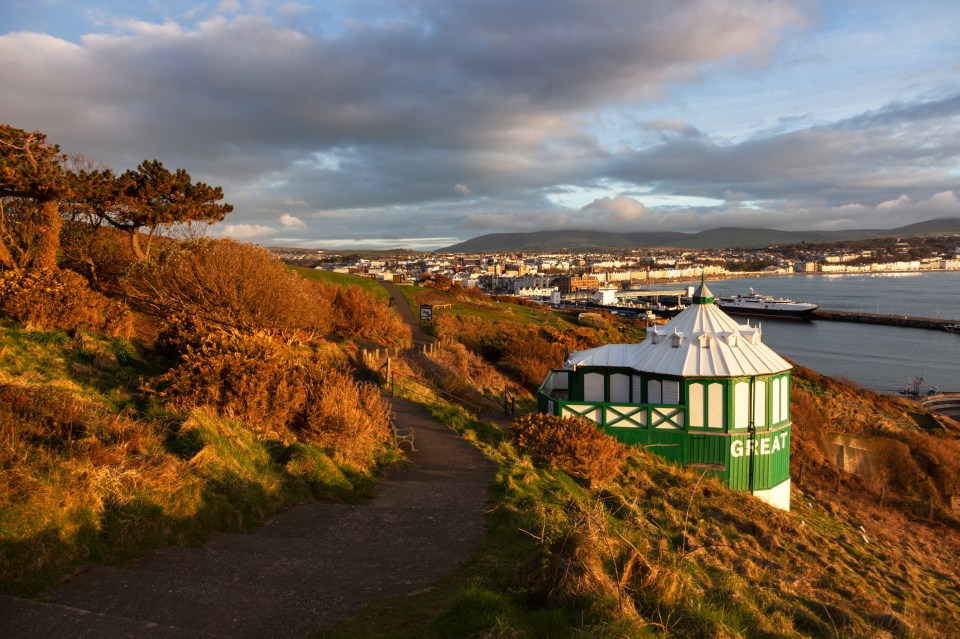
A popular tourist attraction will remain closed for several weeks while essential repair work is carried outCredit: Getty ImagesThe Great Union Camera Obscura offers 360 views of the coastlineCredit: Handout
The Great Union Camera Obscura will stay temporarily closed for several more weeks while a number of repairs are carried out.
The tourist attraction, located on the Isle of Man, first shut down on June 14, with a notice posted online by volunteers.
The notice read: “Please note that the Camera Obscura is currently closed while essential work is being carried out.
“The closure may last for several weeks, but we’ll keep you updated and let everyone know as soon as we’re able to reopen.”
Now, it has been revealed that the site will need to remain closed for longer as the latest condition survey unearthed a series of repairs that would need to be carried out.
Department of Education, Sport and Culture Minister Daphne Caine confirmed the repairs when responding to a written question about the work.
She said: “Since the last condition survey, issues have been found that require further repairs and maintenance, and the Department of Infrastructure is currently engaging with a contractor to address these issues.
“At the present time, these include the removal and replacement of wooden joists and decking, and the removal and replacement of corroded steelwork, fastenings and bolts located underneath the decking.”
The latest condition survey occurred in March 2025, and also identified areas of the sailcloth roof edging that had begun to fail and nails used to fix timber panels that were showing signs of decay.
According to Mrs Caine, the Camera Obscura underwent extensive repairs in 2017-18.
The Great Union Camera Obscura was first built in 1892, offering visitors a 360 degree view of the surrounding area, including the Douglas harbour and lighthouse.
According to the Isle of Man tourist website, the optical effect of the camera works through a series of mirrors and lenses located around the roof line above a darkened room with views of the surrounding area then projected onto a circular table.
The “unique” Camera Obscura boasts eleven lenses to create its views, whereas most only have one.
The “hidden gem” tourist attraction offers visitors a look into how Victorians first saw moving pictures and according to reviews is “well worth visiting to see how things were”.
Visitors have praised the “knowledgeable volunteers” at the attraction and the “stunning” views.
“You have to go to understand it,” wrote one visitor. “Like watching an old movie with movement.”
However on Sunday, in a post on X, formerly Twitter, Spain’s Ministerio del Interior has issued a warning to visitors. The Ministry of the Interior of Spain (Ministerio del Interior) is the executive government department responsible for public safety, law enforcement, national security, civil protection, and the country’s prison system and overseas domestic policy.
It is keen to raise awareness that crime is an issue when on holiday just as it is back in the UK. In its post it said: “You’re away for a few days, but your safety doesn’t go on vacation. Before leaving the car parked:
Remove valuables
Don’t leave documents visible
Choose well-lit and busy areas
Save the vehicle’s location
It added: “Prevention is the best protection.” The warning came as Spain, along with much of the rest of Europe, basks in a heatwave.
Content cannot be displayed without consent
The Ministry, in a separate post, had other advice for people to help them stay safe. It said: “In the forest, every gesture counts.
“Don’t throw away cigarette butts or matches. Don’t make fire outside of authorised areas. Don’t abandon flammable waste.” It added: “With heat and wind, the risk increases. A small oversight can turn into a big fire.”
The Foreign Office in the UK (FO) also has advice for holidaymakers and other visitors to the country. It warned of a number of different types of crime in the country including street and vehicle crime to drink spiking and sexual assaults.
Street crime
The Foreign Office warned: “Be alert to the risk of street crime. Thieves use distraction techniques and often work in teams. Take care of your passports, money and personal belongings, particularly when collecting or checking in luggage at the airport, and while arranging car hire.
“Do not carry all your valuables in one place. Keep a copy of the photo page of your passport somewhere safe.
“Make sure your accommodation has adequate security. Keep all doors and windows locked. If you’re concerned about the security of your accommodation, speak to your travel operator or the property owner.
“The Spanish Police and Civil Guard have a mobile app which offers a number of services, including simple and discreet communication with police forces if you experience or witness a crime – more information can be found on the ALERT COPS webpage.”
Vehicle crime
‘Highway pirates’ target foreign-registered and hire cars, especially those towing caravans, warns the FO. “They may flag you down, claiming there is something wrong with your car or that you have damaged theirs. If you decide to stop to check the condition of a vehicle, stop in a public area with lights, such as a service station. Be wary of anyone offering help.
“When driving, be wary of approaches from people posing as plainclothes police in unmarked cars. In all traffic-related matters, police officers will usually be in uniform. Unmarked police vehicles have a flashing electronic sign on the rear window saying ‘Policía’ or ‘Guardia Civil’. Genuine police will only ask you to show vehicle documents – not to hand over your bag or wallet.”
Attacks and sexual assault
Attacks, including sexual assaults, are rare but do occur, avised the FO. “In an emergency call 112. Avoid splitting up from your friends, do not leave drinks unattended and do not go off with people you do not know. Save the location of your accommodation on your maps app, so it’s easy to find.”
Drink spiking and alcohol
The FO said: “Be alert to the possible use of ‘date rape’ and other drugs including GHB and liquid ecstasy. Buy your own drinks and always keep them in sight to avoid them being spiked.
“Alcohol and drugs can reduce your vigilance, making you less in control. If you drink, know your limit. Drinks served in bars in Spain are often stronger than those in the UK.”
Scams
“Thieves posing as police officers may ask to see your wallet, claiming they need to see it for identification.” it warned. “Genuine police officers will ask to see ID but will not ask for wallets or purses. All police officers, including those in plain clothes, carry official ID.”
Timeshares and holiday clubs
The FO said: “Be cautious if you are planning to buy or sell a timeshare. There are companies who offer false incentives.”
A ranking of Europe’s most underrated cities has named a historic spot that many Brits may not have even heard of, and visitors can explore Roman ruins, gothic monasteries, and a doll museum
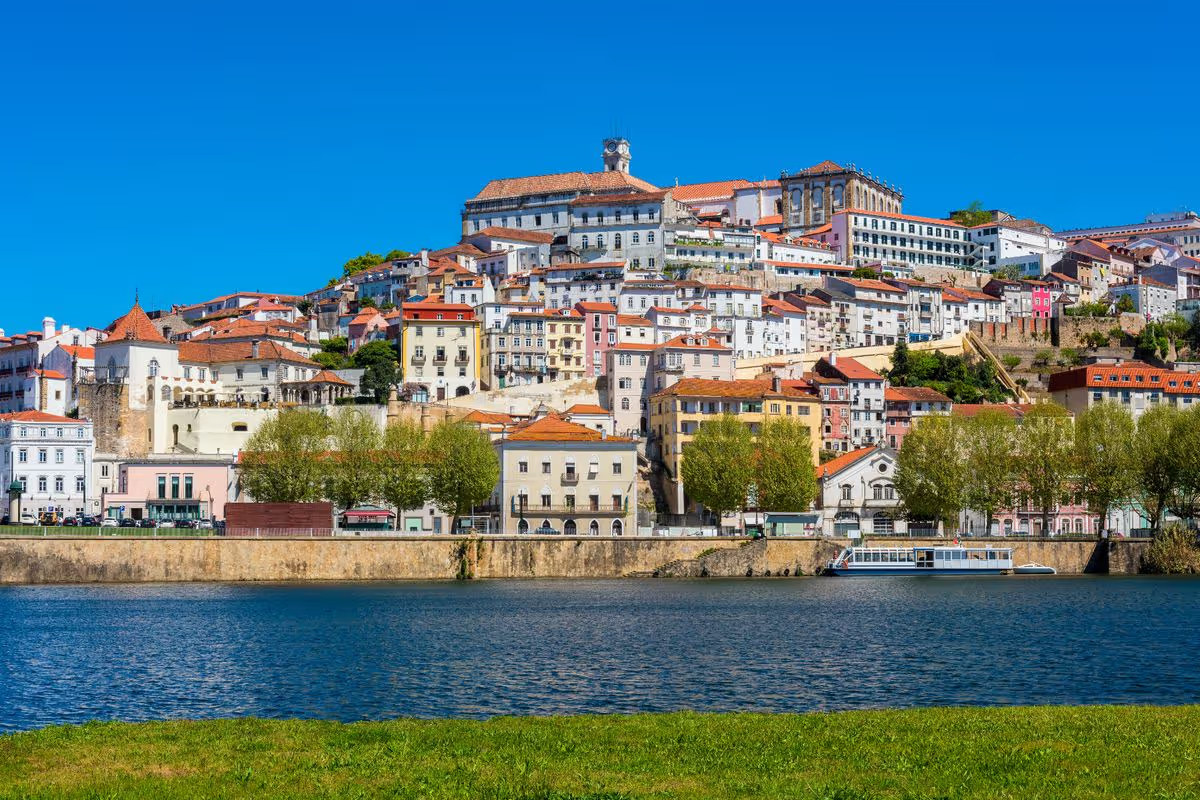
The riverfront city was once Portugal’s capital(Image: Getty Images)
Portugal has long been a major city break destination for Brits, and while most head to either Porto to explore its colourful, hilly streets, or Lisbon for a lively, cultural atmosphere, there’s one spot that gets overlooked.
For over a hundred years, Coimbra was Portugal’s capital, a thriving walled city that had monasteries, grand cathedrals, and a university that’s still operational today making it one of the world’s oldest. When the King moved the capital to Lisbon, it became a centre of Renaissance art, bringing French and Italian influences to the area and becoming a town where intellectuals flocked, inspired by the peaceful riverfront scenery.
Recently, Which? identified Coimbra as one of Europe’s underrated cities, noting: “It’s a historic, cultural and academic hub, with a Unesco-listed university complete with a gilded baroque library that’s open to the public for visits and tours.
There’s also a winding old town that, unlike Lisbon and Porto, isn’t bottlenecked with tourists in peak season — and you’ll also find plenty of atmospheric tascas for truly Portuguese lunches and dinners.”
Despite its close proximity to Lisbon and Porto, trains take 90 minutes and an hour, respectively.
It’s not a destination visited by many Brits. It’s perfect for a day trip from the Portuguese coast, although you may want to stay longer and soak up the authentic atmosphere among its sun-soaked streets.
Visit the ruins of Mosteiro de Santa Clara-a-Velha, a Gothic monastery that dates back to the 1300s, which has become a major archaeological site, and explore a museum full of treasures from ancient tombs.
Santa Cruz Church is another must-see in the town. The whitewashed church has incredible blue-tiled mosaic murals that cover entire walls, and a peaceful, if eerie, mausoleum that is the final resting place of Portugal’s first king.
National Museum Machado de Castro has artworks and sculptures from the Renaissance artists who once lived in this town and honed their skills.
Built on a set of Roman tunnels, the museum is housed in a serene 11th-century cloister where you can enjoy the peaceful atmosphere of its cool marble walls.
A short drive outside the city are a number of tiny Schist Villages, traditional mountain settlements that are being restored to capture the country’s heritage. There are 12 villages in the Lousã Mountain, and from Coimbra you can take a guided tour through the winding mountain roads to explore these areas where time stands still.
Popular stops include Cerdeira, once abandoned but now the home of an arts and crafts school, and Talasnal – famous for its rustic stone cottages and incredible views across the pine-covered. mountains. On the way back, visit Arouce Castle, a medieval fortress that overlooks a river beach. There are areas for swimming in the pure mountain waters, and waterfalls that add to the untamed scenery.
Have a story you want to share? Email us at webtravel@reachplc.com
Tourists have been told they need change a key phone setting before travelling to airports. Failing to do so could land them with a “major problem”, so it’s best to act
15:41, 22 Jun 2026Updated 07:02, 28 Jun 2026
Tourists need to make a phone setting change (stock image)(Image: Getty Images)
There’s so much to think about when you travel abroad, but something that probably slips your mind is safely using your phone during your journey. It’s something you need to pay attention to, as you are required to follow a few rules to keep safe.
While it may be something that rarely crosses your mind, it should actually be on the top of your travel list, as making some simple mistakes can be super costly when you’re on a holiday adventure. We all use our mobile phones when we’re at airports but, little you may know, some dangers can come with making the decision to use them in certain ways.
Free airport Wi-Fi feels like a small win when you’re killing time before a flight. However, William Thackray, IT expert at AGT Computer Services, claims it’s one of the riskiest things you can do on your phone.
What you need to know
William explained: “The biggest threat isn’t the airport’s actual network. It’s the fake ones sitting right next to it.
“Criminals can set up a hotspot called something like ‘Heathrow Free Wi-Fi’ or ‘Gatwick Passenger Network’ that looks completely legitimate. The moment you connect, they can intercept your data including passwords, emails, anything you’re sending or receiving.”
This technique, known as an “evil twin” attack, is increasingly common in busy public spaces and airports and, with thousands of distracted travellers all hunting for a signal, they are prime targets.
You may not realise, but connecting to airport Wi-Fi can leave your personal data exposed to hackers in seconds. Criminals can set up fake networks designed to look identical to the real thing.
Airport Wi-Fi is rarely considered completely safe. While it is generally fine for browsing the news or checking your flight status, public networks leave you vulnerable to hackers, phishing attempts and rogue “evil twin” hotspots.
You should avoid online banking or entering passwords without taking precautions. This is why the guidance is so essential.
However, one simple phone setting can keep you protected without costing you a penny. It’s easy to sort out once you know what to do.
How to avoid a problem
The fix is straightforward. Before you leave for the airport, go into your phone’s Wi-Fi settings and turn off “Auto-Join” or “Auto-Connect” for public networks. On iPhone, you can also go to Settings > Wi-Fi and toggle off “Ask to Join Networks”.
That way your phone won’t go hunting for a signal without your say-so. “Better still, use your mobile data if you have it,” added William.
“It costs a little more, but it’s your own private connection. If you do need to use airport Wi-Fi, avoid logging into anything sensitive like banking, work email, anything with a password – until you’re somewhere you trust.”
The rule of thumb? If you didn’t set up the network yourself, treat it with caution. This is a rule that’s really worth paying attention to, as failing to follow it could lead to major problems.
British tourists have been warned to be careful in France this summer after new rules were brought in during a heatwave as temperatures rise across the country
Tourists have been warned not to go topless in France(Image: Getty)
British tourists have been warned they could be hit with a fine of up to £129 this summer if they visit France. The ban, which applies to non-Brits as well, is in relation to public decency.
Just like the UK, though to a greater extent, France has been experiencing incredibly high temperatures in recent days. In response, several measures have been put in place to protect the public.
One of the laws brought into place has been a ban on men being topless in public places, resulting in a fine that could be as high as €150 (£129.62). The bans have been brought into force in coastal towns including Narbonne in southern France.
In some cases, the ban has been brought in to maintain respect for urban spaces, whilst others have brought it in for hygiene reasons. In places such as Narbonne, the ban will be in place until the end of September.
Residents have so far, it appears, backed the plan. Speaking to the Times, an Australian living in the town, Anthony Hill, 53, said: “This isn’t something the staff of our café can easily police on their own without getting into arguments with customers.
“So I think it’s a very good thing. Having bare-chested guys on the terrace can put off other customers.”
Meanwhile the local mayor Bertrand Malquier, added: “It’s about hygiene and avoiding exhibitionism.”
The attitude has been reflected in La Grande-Motte where local Marie, 37, expressed her support to the publication. She said: “If I’m out with my kids in the town centre I really don’t want to see guys without shirts. It’s a matter of decency — and there’s also the smell when they walk past you.”
A French Twitter user, Yannick Moreau, agreed: “This is inappropriate behaviour that has an unfortunate tendency to increase year after year. So it’s time to make it clear: it is forbidden to walk around shirtless or in swimwear in Les Sables d’Olonne. A bit of decency, please!”
This isn’t the only ban that has been introduced in France, with the country’s capital Paris also introducing a ban on drinking takeaway alcohol in the street.
The ban began at midday today (June 26) and will run all the way until 7 o’clock France time on Saturday morning. It will then return at midday on Saturday and the end again at seven o’clock on Sunday morning.
Talking about the ban, the city’s police chief Patrice Faure, told BFM TV: “As you know, drinking alcohol with the sun beating down can have a devastating effect. We are reaching a saturation point in hospital facilities.
“I must ensure that the pressure decreases.”
Hospitals in the city have been under increasing pressure as more people have come in after being affected by the heat which has been so high that the city’s LGBTQ+ Pride march has been delayed until September.
A haven for the rich and famous, the Cotswolds reportedly welcomes more than 35 million visitors each year, but one writer suggests it’s on something of a “downturn”
A luxury hotel chain has chosen a county known for its “chocolate box” villages(Image: Getty Images)
A plush hotel group has passed over the picturesque Cotswolds for its newest venture, instead setting its sights on a county renowned for its “chocolate box” villages. Nobu Hotels, co-founded by celebrity chef Nobu Matsuhisa and actor Robert De Niro, boasts properties in some of the world’s most chic destinations, including Malibu, Ibiza, Las Vegas and Dubai.
Casting its eye across the UK for a potential location, there is no shortage of contenders — perhaps the Lake District or the Scottish Highlands — though many would argue the Cotswolds would be the most obvious fit.
A haven for the rich and famous, including Simon Cowell, Michael McIntyre and Jeremy Clarkson (whose Diddly Squat Farm sits near Chipping Norton), the Cotswolds reportedly attracts more than 35 million visitors each year.
Yet it appears Nobu has opted for somewhere even more exclusive: Britain’s smallest county, Rutland in the East Midlands. Indeed, one writer suggests the Cotswolds are experiencing something of a “downturn”.
The Mail’s Claudia Connell writes: “The East Midlands may seem an unlikely venue for such a venture, but for those watching the quiet rise of Rutland it makes perfect sense.”
“While other places — most notably the Cotswolds — are experiencing a downturn, Rutland and surrounding areas are riding high thanks to a combination of beautiful countryside, historic towns, chocolate box villages and excellent schools.”
Nobu Woolfox will be situated near the town of Stamford on 185 acres and will include a hotel, restaurants, gym, spa and private residences, combining what its website describes as luxury hospitality, dining and “refined living with a slower, more restorative pace”.
Nobu Hospitality CEO Trevor Horwell said: “This is a truly special location in the heart of England. For the first time within our portfolio, we have the opportunity to create a countryside retreat experience in a setting defined by nature, tranquillity and a sense of escape.”
To understand why the Cotswolds was off the menu for the plush hotel group, Claudia pointed to Rutland’s comparative lack of celebrities.
It was also noted that the county offers all the joys of the English countryside while remaining within reach of the capital (around 2 hours and 32 minutes by car).
House prices in the Cotswolds are said to have fallen by 12 per cent, with reported complaints of overcrowding, escalating prices and claims of being “Disney-fied”. Locals have also reportedly pointed to an influx of “trendy” coffee shops.
Adding to the apparent dissatisfaction is the rise of so-called “TikTok tourists” — influencers who visit the area largely to film content and take selfies for social media.
Meanwhile, Rutland is viewed as a quieter alternative, with the county’s schools proving to be a key pull factor.
The overcrowding one of the most popular tourist islands in Europe has sparked comparisons to a ‘long toilet line’ – with large crowds gathering as early as 7am
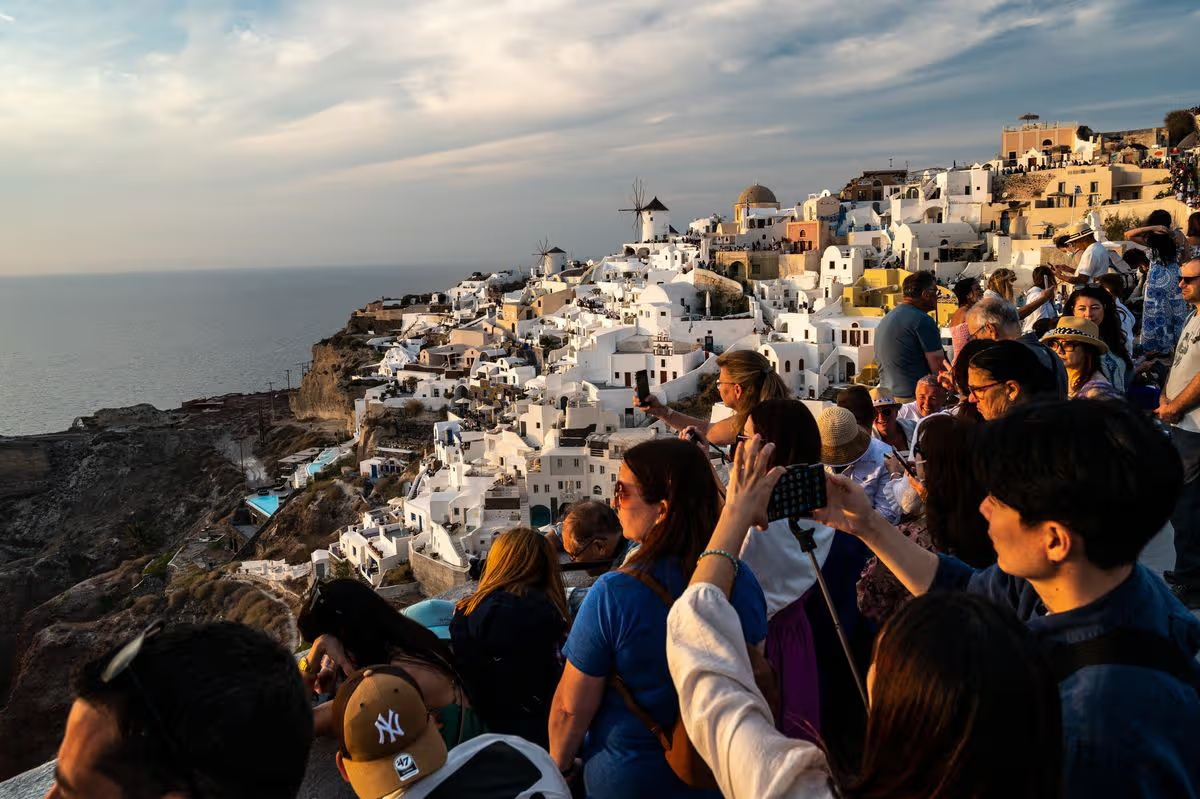
Tourists taking pictures and selfies during sunset in the town of Oia with its limewashed houses and windmills(Image: Marcos del Mazo/LightRocket via Getty Images)
Holidaymakers have been warned a beautiful Greek island and one of the most popular sunshine resorts in Europe has descended into “one long toilet line”.
Travel content creator Mambo Italiano took to X to share footage of the scene recorded at 7am – with dozens of men, women and children tourists queuing into the streets at a photo spot. “Social media trends have turned the world’s most beautiful places into endless bathroom lines at a concert, where everyone waits for hours just to take the same photo to show to people who couldn’t care less,” she ranted in a caption.
“Nothing captures the shallow decay of our time better than this.”
Content cannot be displayed without consent
The clip in question was recorded in Oia on the island of Santorini, which is located in the southern Aegean Sea – around 120 miles from the Greek mainland.
Mambo Italiano’s video followed the queue around several corners to reach its end – a lookout point over the crystal-blue sea overlooking Santorini’s famous blue-domed Greek Orthodox churches from an excellent vantage point.
“Oia is an over touristed,” one X user exclaimed in response. “One of the worst places I’ve been. Other parts of Santorini are lovely.”
A second person concurred: “I have to agree – there are much better areas on the island. Oia is good for photos and that’s about it.”
While a third explained: “People are no longer visiting places to see and enjoy. They want to visit and photograph themselves on those places, so then they can post them social media for likes and attention, with the only intent of saying, ‘oh look at me, I was here and you not’ and ‘look how special I am’ etc etc etc.
“That’s the only reason for those long queues, it is not to see and enjoy, it’s only to show off.”
And a fourth X user agreed: “Everything has turned into an influencers Instagram photo shoot. Beautiful places are ruined by main character syndrome narcissists.
“Every new eatery has a grass wall outside the entrance, loud music and serves high priced s*** on a plate.”
According to Greek Trip Planner figures from INSETE and municipal data show approximately 3.4 million visitors reach Santorini through a combination of air arrivals, cruise ship tenders, and inter-island ferries each year.
“The 3.4 million annual visitors produce a ratio of approximately 220 tourists for every resident per year – or, expressed differently, 107.8 tourists per 100 inhabitants at any given time during peak season,” they added.
“This density figure, documented in a 2018 European Commission study, placed Santorini beyond the measurable limits of standard overtourism indicators.”