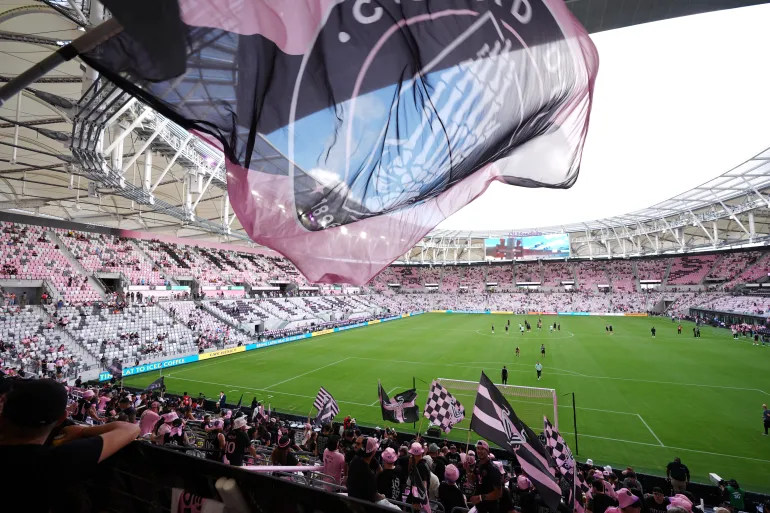
Miami captain scored his team’s first goal after David Beckham said the Nu Stadium was a ‘dream come true’ for Miami.
Published On 5 Apr 20265 Apr 2026
Lionel Messi marked the opening of Inter Miami’s gleaming new stadium with a goal as the Major League Soccer (MLS) champions battled to a 2-2 draw against Austin FC.
Inter Miami’s co-owner, David Beckham, was among the star-studded crowd as the club’s 26,000-capacity Nu Stadium made its debut on Saturday, marking the end of a more-than-a-decade-long journey to find a permanent home.
Recommended Stories
list of 4 itemsend of list
“To see this stadium come to life, after years and years of trying to get this stadium up and running in Miami, is something that’s very special,” Beckham said shortly before kickoff.
“I came to America in the MLS 20 years ago, and I made a lot of promises. And 13 years ago, I made a lot of promises again, announcing I was coming to Miami.
“Today it’s just a dream come true for us.”
Inter Miami fans wave flags in Nu Stadium before the team’s first MLS match at their new home stadium [Rebecca Blackwell/AP]
While the match kicked off in celebratory fashion, with Beckham joining billionaire Inter Miami managing owner Jorge Mas in a pre-game ribbon-cutting ceremony, Austin refused to follow the script.
The Texas club, who went into the game with only one win from five matches, stunned the home crowd after only six minutes, with Guilherme Biro nodding in a corner from Facundo Torres to make it 1-0 to the visitors.
Messi, though, did not take long to open his account in his new surroundings.
Right-back Ian Fray burst down the flank and crossed for Messi, who equalised with a rare headed goal to make it 1-1 four minutes later.
Inter Miami dominated possession thereafter and carved out a string of chances, with Mateo Silvetti twice going close with a shot in the 34th minute before heading wide four minutes later.
But Austin’s dogged defence and speed on the counter continued to pose problems for the hosts, and they once again took the lead after 53 minutes.
Messi was dispossessed deep in the Austin half by Joseph Rosales, who released Myrto Uzuni, who in turn sent substitute Jayden Nelson clean through on goal to score.
With Miami increasingly desperate, coach Javier Mascherano sent on veteran striker Luis Suarez in the 73rd minute.
The Uruguayan duly delivered eight minutes later, prodding home from close range after a Messi corner was flicked on by German Berterame in the Austin defence.
Suarez thought he had scored a dramatic winner when he finished from close range after Messi’s free-kick came back off the woodwork, but it was ruled out for offside.
Former WBC champion comes out on top in the closely-contested fight against his British opponent in London.
Published On 5 Apr 20265 Apr 2026
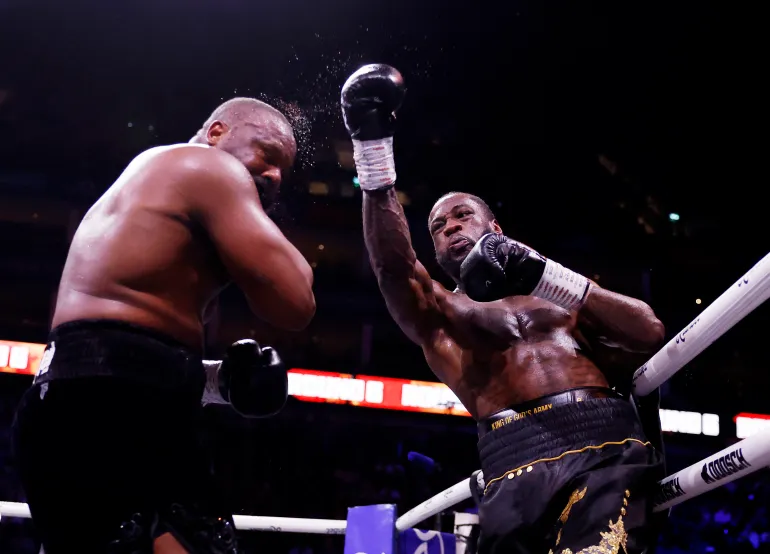
Former world champion Deontay Wilder sent Derek Chisora into retirement by edging their engaging yet chaotic heavyweight fight in London, United Kingdom.
The boxers, aged 40 and 42 respectively, threw hopeful knockout punches and barely jabbed. Both slipped and fell to the canvas frequently during the bout at the O2 Arena on Saturday.
Wilder got the only knockdown in the eighth round, sending Chisora through the ropes, but the American was deducted a point in the same round for pushing. Chisora was rattled, but Wilder did not press his advantage.
Wilder dominated the early rounds, and Chisora rallied late. The judges were split in their scoring: Wilder received scores of 115-111 and 115-113, and the third picked Chisora by 115-112.
Deontay Wilder throws a punch at Derek Chisora [Peter Cziborra/Action Images via Reuters]
Wilder said the fight was fun and suggested he didn’t want to knock out Chisora.
“Tonight, I looked out for him. I want him to live for his kids,” he told broadcaster DAZN. “It’s time for us to take care of each other.”
Chisora said in the build-up that the fight was to be his last, but the Londoner was reluctant to confirm it afterwards.
“I’m going to go home with the boss lady and see,” he told DAZN. “I’m going to go home and drop the kids, do the school run.”
It was the 50th fight for both in the professional ranks.
Wilder improved his record to 45-4-1. The WBC titleholder from 2015 to 2020 came to London having lost four of his last six fights.
Chisora’s record since 2007, when he turned pro a year before Wilder, dropped to 36-14. He lost his only two title shots against Vitali Klitschko in 2012 and Tyson Fury in 2022.
The Uffizi Galleries, home to Italy’s most precious art, were hit by a cyberattack, the museum said. The museum claims there was no data stolen. File Photo by Claudio Giovannini/EPA
April 3 (UPI) — The Uffizi Galleries in Florence, Italy, said Friday it suffered a cyberattack, but not a breach of data earlier this year.
The country’s top art museum said nothing had been damaged or stolen in the attack.
Italian newspaper Corriere della Sera reported that hackers had infiltrated the museums’ IT systems and taken access codes, internal maps and the locations of closed-circuit cameras and alarms, then demanded ransom.
But the museum disputed that report, saying its security systems are inaccessible from outside the museum, the BBC reported.
Corriere reported that the attackers moved through interconnected systems, computers and phones, learning the museum’s operations. It said a ransom demand was later sent to museum director Simone Verde’s personal phone threatening to sell data on the dark web.
The Uffizi houses priceless masterpieces by Michelangelo, Sandro Botticelli, Leonardo da Vinci and Raphael. It’s the home of The Birth of Venus, by Botticelli; Venus de’ Medici, a Greek sculpture by an unknown artist; and Annunciation by Leonardo.
Italian media have reported that the attack forced authorities to move some of the museum’s collection into secure vaults. But the Uffizi stressed in a note shared with Politico that the attack was “nothing like the Louvre,” referencing the $100 million jewel heist last year that eventually forced its director to resign. The items stolen from the Louvre have not been recovered.
The movement of items to vaults, which included Medici-era treasures, was because of ongoing renovations, the museum said.
Former Prime Minister and former Florence Mayor Matteo Renzi criticized Culture Minister Alessandro Giuli, an ally of Prime Minister Giorgia Meloni, for not protecting the important museum.
“Hackers are attacking the Uffizi Gallery and threatening our cultural heritage. I wonder: what is Minister Giuli doing and what has he done?” Renzi posted on X Thursday. “Did he notice or is he too busy playing the flute in honor of the god Pan … ? And what is the National Cybersecurity Agency doing? Or is Italians’ money just going into software like Paragon that spies on journalists? I’ll submit a question. I’m curious to see if anyone will have the courage to respond.”
On March 22, a three-minute heist resulted in the loss of three paintings by Renoir, Cezanne and Matisse from the Magnani-Rocca Foundation in Parma, Italy.
A fourth man has been arrested in the arson of several Jewish ambulances parked in front of a synagogue that belonged to a volunteer service. Three that have already been charged will next appear in court in late April. File by Andy Rain/EPA
April 4 (UPI) — A fourth man suspected of being involved in an attack on a Jewish volunteer ambulance service was arrested when he attended a hearing for three of his alleged accomplices.
On March 26, four ambulances that belong to a Jewish community organization were torched in the Golders Green area of North London in an attack that police said was aimed at terrorizing the Jewish community there.
Police on Saturday arrested a fourth suspect in the attack during a hearing for three people — two British citizens, Hamza Iqbal, 20, and Rehan Khan, 19, as well as a 17-year-old with dual British-Pakistani citizenship — who had already been charged in the crime, The BBC reported.
Officers, who already were aware that four people were responsible for the arson, recognized a 19-year-old man who was suspected of participating and arrested him at Westminster Magistrates’ Court.
Golders Green has a large Jewish population and the four people are suspected for being responsible for oxygen cylinders in four ambulances parked outside a synagogue there that exploded on March 23, The New York Times reported.
All four were arrested, although the 19-year-old arrested while entering the courthouse has not formally been charged, while the other three face an April 24 court date.
Two other men also had been arrested and released on bail, but also will be expected in court in April.
The four ambulances were operated by Hatzolah, an organization that was started in 1973 in New York by a group of Orthodox Jews trained in First Aid and CPR looking to assist their local community, according to the group’s website.
Court records show well over $1 million in damage in what prosecutors called a “premeditated and targeted attack against the Jewish community.”
Since its founding, volunteer ambulance groups associated with the organization have been established across the United States, United Kingdom, Canada, Mexico, South Africa and Australia, among other places.
Violence against Jewish people and organizations has increased over the course of the past year globally, including in London.
The Metropolitan Police said it has deployed “highly visible armed police patrols” to areas with larger Jewish populations because of a series of fires and attacks across Europe and the United States that have been blamed on doing business with Jewish people.
Metropolitan Police Commissioner Mark Rowley said at the beginning of the week that a claim of responsibility by a group with links to Iran was being investigated but stopped short of officially placing blame.
“Whoever was responsible, the impact is serious,” Rowley said.
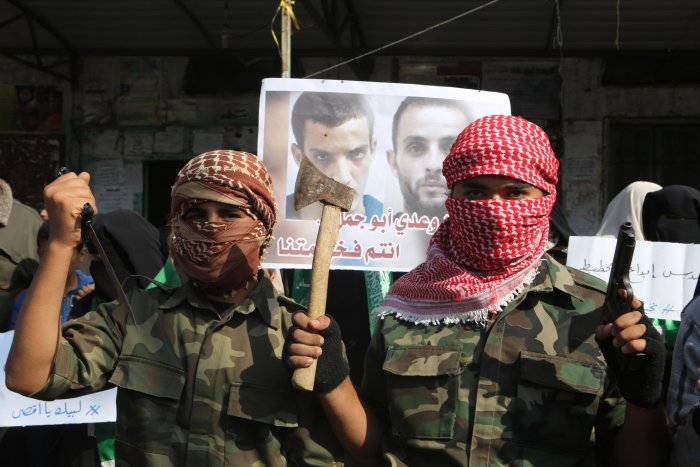
Masked Palestinians hold knives and axes as they celebrate an attack on a Jerusalem synagogue while standing in front of a poster of the attackers,Ghassan and Uday Abu Jamal, during a rally in Rafah in the southern Gaza Strip November 18, 2014. Two Palestinians armed with a meat cleaver and a gun killed fiver people in a Jerusalem synagogue on Tuesday before being shot dead by police, the deadliest such incident in six years in the holy city amid a surge in religious conflict. UPI/Ismael Mohamad | License Photo
Hebron, occupied West Bank – Hebron’s Ibrahimi Mosque is no more than 50 metres from Aref Jaber’s home, in the neighbourhood that bears his surname, reflecting his family’s long history in the Palestinian city.
The 51-year-old has taken advantage of that proximity since his childhood, regularly praying at the mosque, one of the most important Islamic sites, and a Palestinian national symbol.
Recommended Stories
list of 3 itemsend of list
But the Ibrahimi Mosque of Jaber’s childhood is not the one of today. A 1994 massacre of Muslim worshippers by the Israeli settler Baruch Goldstein killed 29 Palestinians. Instead of getting justice, Palestinians faced more restrictions in the aftermath of the attack.
Israeli settlers began establishing an illegal presence in Hebron, part of the occupied West Bank, in 1968, the year after Israel seized control of the Palestinian territory. The settlers have been working to grow their presence ever since, with increased support from the Israeli government.
After 1994, Israel began taking steps to, in effect, control the Ibrahimi Mosque – known to Jews as the Cave of the Patriarchs – by closing off large areas in Hebron’s Old City and the southern area surrounding the mosque, then dividing it between Muslims and a few hundred Jewish settlers, granting the latter the right to pray there.
This was followed by the signing of the Hebron Agreement with the Palestinian Authority in 1997, which stipulated the division of the city into two parts: H1, under Palestinian control, comprising 80 percent of the area, and H2, under Israeli control, comprising 20 percent, but including the Ibrahimi Mosque and the Old City.
Following this series of events, settlement activity intensified in the heart of Hebron. Settlers established illegal outposts within the Old City and began gradually expanding and seizing new homes under the protection of the Israeli army.
Meanwhile, Palestinians were subjected to closures, restrictions and repressive measures aimed at forcing them to leave the Old City, thus facilitating Israeli control over the mosque.
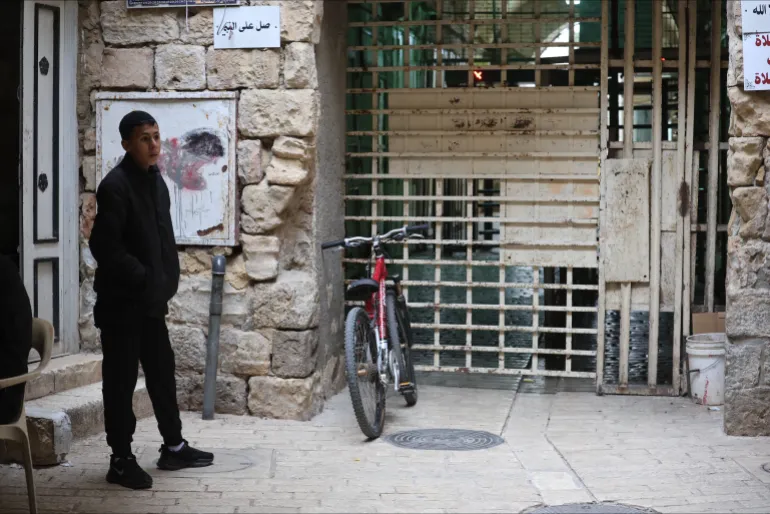
Israeli forces have erected metal barriers throughout the neighbourhoods surrounding the Ibrahimi Mosque, restricting access for Palestinians [Mosab Shawer/Al Jazeera]
Neighbours of the Ibrahimi Mosque
Jaber had hoped that his children would pray at the mosque daily and become familiar with it, but Israeli measures prevented this.
He explained that since 1994, the southern gate of the mosque, which residents of his neighbourhood used for access, has been closed. They have instead been forced to take alternative routes, turning a journey of 50 metres into one that now spans almost three kilometres.
Things have gotten worse since the beginning of Israel’s genocidal war on Gaza in October 2023, when Israel also ramped up its attacks in the West Bank.
Israel tightened its grip on the mosque and its surroundings, closing more of the alternative routes.
“The difficulty of reaching the mosque is compounded by the procedures at the iron and electronic gates installed at its entrances and in its vicinity,” Jaber said. “We are subjected to searches, detention, and harassment without any justification, and often young men, boys, and even women are arrested.”
The Israeli government says that the restrictions are necessary for security reasons – to protect Israeli settlers whose presence in the West Bank’s most populous city is illegal under international law.
Jaber explained how the Israeli army closes barriers and gates around the mosque and the neighbourhoods that surround it for extended periods under security pretexts. Palestinian residents are not allowed to leave their homes, even to shop, while settlers are permitted to move freely throughout the Old City.
Israeli authorities also used the justification of the current conflict with Iran to close access to the Ibrahimi Mosque for Palestinians for six days from February 28, allowing it to reopen for a limited number of worshippers on March 6.
The Ibrahimi Mosque is an important Islamic holy site and a Palestinian national symbol, also holy to Jews who call it the Cave of the Patriarchs [Mosab Shawer/Al Jazeera]
Increased control
But these measures aren’t only aimed at restricting Palestinians in the vicinity of the mosque, but also seem to be an attempt to establish complete Israeli security control over it, with measures similar to those Israel employs at the Al-Aqsa Mosque in occupied East Jerusalem.
In Al-Aqsa, the third holiest site in Islam, renewable expulsion orders are used to prevent the entry of worshippers deemed troublesome. Searches are also regularly conducted at the gates of Al-Aqsa, as well as detentions, confiscation of identity cards and restrictions on entry to certain parts of the mosque compound.
Israel now regularly conducts similar actions at the Ibrahimi Mosque.
The Israeli army issued orders to remove Moataz Abu Sneineh, the director of the Ibrahimi Mosque, and other employees from the mosque for 15 days in January. The Palestinian Authority said that the orders were part of “an attempt to reduce their role in the administration and supervision of the Ibrahimi Mosque’s religious and administrative affairs”.
Israeli officials have also tried to push through construction work in the mosque without the approval of Palestinian officials.
On February 9, the Israeli cabinet approved the transfer of licensing, building and municipal administration powers in Hebron from the municipality to the Israeli Civil Administration, in addition to establishing a separate settlement municipality within the city.
The change, part of an internationally condemned Israeli push to increase control over the West Bank and make Israeli settlement easier, is seen as illegitimate and dangerous to the existing status quo, threatening freedom of worship and public order, according to a statement issued by the Hebron Municipality in response to the decision.
Abu Sneineh told Al Jazeera that Israel has transformed the mosque into something resembling a “military barracks” due to the stringent measures it imposes, which “aim to reduce the number of worshippers there”.
According to Abu Sneineh, the Israeli government interfered in the authority of the Ministry of Religious Endowments, and the call to prayer was prevented from being performed dozens of times a month. Worshippers were subjected to humiliating treatment at the mosque entrance, including beatings, verbal abuse and expulsion. Abu Sneineh said the measures were part of a systematic Israeli policy aimed at transforming the mosque into a Jewish synagogue.
“Israel is trying to impose a new reality by controlling the mosque and obstructing worshippers’ access to it, whether during Ramadan or at other times. After October 2023, the measures became even more stringent to erase the Islamic identity of the place, as if it were racing against time to seize control of it,” he added.
On February 28, coinciding with the start of Israeli-American strikes on Iran, the Israeli army expelled worshippers and staff from the mosque and informed them of its closure until further notice, just as it had done at Al-Aqsa Mosque in Jerusalem on the same day under the declared state of emergency measures.
The director of the Youth Against Settlements group and a resident of the Old City, Issa Amro, believes that the situation at the Ibrahimi Mosque is more dangerous than at Al-Aqsa Mosque because it has suffered from temporal and spatial division since 1994.
The “arbitrary” barriers, the closure of surrounding markets and main roads leading to it, and recently the closure of checkpoints in the southern area of the city – which includes the Old City and the Ibrahimi Mosque – prevent approximately 50,000 citizens from accessing it, along with the transfer of supervisory authority of parts of the mosque to the Religious Council in the illegal Kiryat Arba settlement, are extremely dangerous steps that threaten the Palestinian identity of the site, Amro said.
“The Jewish area [of the mosque] has been expanded, and recently, residents around the mosque have been living a difficult life due to soldier violence, settler terrorism, the constant closure of barriers, and restrictions on leaving their homes. They live as prisoners in their own homes in fear of settlers and soldiers, and disturbed by the constant gatherings held by settlers in the mosque,” he added.
According to the Applied Research Institute – Jerusalem (ARIJ) – a Palestinian research institute – approximately 40,000 Palestinians live in the H2 area, alongside about 800 Israeli settlers residing in 14 small illegal settlement outposts. These outposts are under heavy protection from thousands of Israeli soldiers deployed around the perimeter of the area and in the streets of the Old City, preventing Palestinians from leading normal lives.
The outposts are managed by the Hebron Settlements Council, which is linked to the parent settlement, Kiryat Arba, located east of the city.
A research study published by the institute in November 2025 revealed a significant increase in the forced displacement of Palestinians from the H2 area over the past two decades.
The Israeli human rights group B’Tselem said in a 2019 report that about 35,000 Palestinians lived in Hebron’s H2 area when the Hebron Agreement was signed in 1997. Today, only around 7,000 remain. Roughly 1,000 of them live in a particularly restricted zone around the Tel Rumeida neighbourhood and Shuhada Street – formerly Hebron’s main shopping street, which is now closed to Palestinians, due to the presence of several illegal Israeli settlements.
Palestinian families in the Old City and the vicinity of the Ibrahimi Mosque are subjected to various forms of pressure, including demolition orders under the pretext of unlicensed construction, frequent arrests, settler attacks on residents and students travelling to and from school, economic restrictions, shop closures, and movement restrictions, particularly regarding access to places of worship and hospitals.
According to the United Nations Office for the Coordination of Humanitarian Affairs, the area contains 97 various military checkpoints and barriers.
These are often closed for hours or even days at a time without prior notice, paralysing movement within the Old City and the residential areas adjacent to the mosque.
Towards full annexation
Observers see these measures in Hebron as a prelude to establishing a fait accompli in the West Bank as a whole, which has been subjected for more than two years to accelerated policies aimed at controlling the largest possible area of land and expanding settlements.
Settlement affairs researcher Mahmoud al-Saifi told Al Jazeera that Israel has sought over the past two years to solidify the annexation of the West Bank, particularly Area C, which constitutes more than 61 percent of the total area of the West Bank.
Israeli authorities have approved 54 new official settlements and 86 smaller outposts in 2025 alone, according to data from Peace Now, which monitors settlement activity.
Planning was approved or advanced for some 51,370 settlement units in the West Bank from late 2022 to the end of 2025, a figure also announced by Israeli government agencies based on data from the Higher Planning Council.
In addition, 222 kilometres of secondary and bypass roads were constructed in the two years preceding January 2025, aimed at connecting outposts to main settlements.
As a result of these policies, the Palestinian presence has dwindled in many areas, particularly the Jordan Valley, where their number has decreased to no more than 65,000.
“Israel is implementing a policy of encirclement and strangulation of small villages in the West Bank by confiscating land and preventing Palestinian construction, in contrast to the frenzied settlement wave that Smotrich called a ‘settlement revolution,’ and the accompanying bitter reality for Palestinians,” al-Saifi said.
There are now thousands of armed settlers spread throughout the West Bank, al-Saifi noted. Skilfully trained and often called settlement guards, they are essentially a rear guard force for the Israeli army, used to attack and intimidate Palestinians and seize their land.
“All Bedouin communities are located in Area C, and 47 of them have been forcibly displaced since October 2023, meaning more than 4,000 Palestinians have been displaced in just two and a half years,” al-Saifi said. “This is part of ethnic cleansing and de facto annexation on the ground.”
Tehran says Iraq will face no restrictions in waterway, praising country’s ‘struggle’ against the US.
Published On 5 Apr 20265 Apr 2026
Iran has announced that Iraqi ships are free to pass the Strait of Hormuz, the latest sign of Tehran easing its stranglehold on the critical conduit for global energy supplies.
Iraq will be exempt from all restrictions in the strait, with controls only applying to “enemy countries”, Iran’s Khatam al-Anbiya Central Headquarters said in a statement on Saturday.
Recommended Stories
list of 4 itemsend of list
“We hold profound respect for Iraq’s national sovereignty,” the military command said in the statement carried by the semi-official Tasnim News Agency.
“You are a nation that bears the scars of American occupation, and your struggle against the US is worthy of praise and admiration.”
Iran’s announcement came as US President Donald Trump reiterated his demands for Tehran to make a deal or relinquish control of the waterway, warning in a social media post that “all hell” would rain down within 48 hours otherwise.
Iran’s Khatam al-Anbiya Central Headquarters rejected Trump’s demand, calling his threat a “helpless, nervous, unbalanced and stupid action”.
Iran has effectively blockaded the strait, which usually carries about one-fifth of global oil and liquified natural gas supplies, since the US and Israel launched their war on the country on February 28.
While maritime traffic has ticked up in recent weeks under a de facto toll booth system imposed by Tehran, it is still down more than 90 percent from normal levels, according to ship tracking data.
According to Lloyd’s List Intelligence, there were 53 transits through the strait last week, up from 36 the previous week and the most since the war began.
The collapse of shipping in the waterway has thrown a wrench in global energy markets, pushing up fuel prices and prompting authorities in many countries to roll out emergency energy conservation measures.
Brent crude, the international benchmark, has hovered above $109 a barrel in recent days, with many analysts predicting prices to surge much higher if the waterway is not unblocked soon.
Iraq’s oil production, which provides most of Baghdad’s revenues, has been hit especially hard by the war.
Iraq’s oil ministry announced last month that production had fallen to 1.2 million barrels a day, down from 4.3 million barrels, amid declining crude shortage capacity due to the effective halt of exports through the strait.
Iraq was the world’s six-biggest oil producer in 2023, accounting for 4 percent of global supply, according to the US Energy Information Administration.
Authorities in New Iberia, Louisiana, have said the incident does not appear to be an intentional car-ramming.
Published On 4 Apr 20264 Apr 2026
An estimated 15 people have been injured in Louisiana’s Iberia Parish, after a car struck participants at a Lao New Year parade in the United States.
According to a statement from the Iberia Parish Sheriff’s Office on Saturday, some attendees were seriously injured.
Recommended Stories
list of 3 itemsend of list
“Based on the preliminary investigation, this does not appear to be an intentional act,” said Rebecca Melancon, a sheriff’s office spokesperson.
The Acadian Ambulance company confirmed on social media that it had taken 11 people to the hospital using ground transport, and another two victims were airlifted to seek urgent care. Ten ambulances and two medical helicopters were deployed to the scene.
The incident took place in New Iberia, a city of more than 28,000 in Iberia Parish, some 34km (21 miles) south of Lafayette, Louisiana. It is situated roughly 214km (130 miles) west of New Orleans.
The Louisiana Lao New Year Festival parade is an annual tradition on Easter weekend in the parish, and the celebration features live music, food vendors and a beauty pageant.
In the aftermath of the car crash, the festival issued a statement on social media, saying that all of its security resources had been surged to the scene.
“We are profoundly saddened by the news of the incident near the festival grounds,” festival organisers wrote. “We are awaiting additional details from authorities as they become available.”
They added that Saturday’s musical events were cancelled, though vendors were permitted to stay open until 9pm local time (2:00am GMT, Sunday).
“We are praying for the victims and for their families during this difficult time,” the organisers wrote. “As of now, and if security resources are restored for tomorrow (Sunday) we will reopen only the religious services of the festival, and vendors will stay open.”
The Lao New Year is a tradition typically associated with Buddhism, and it takes place each year in April, as the dry heat in Laos gives way to the wet monsoon season.
Louisiana is home to a small but vibrant Lao community. In New Iberia, one neighbourhood is called Lanexang Village — roughly translated to the “million elephants” village — and it is reportedly home to hundreds of Lao people.
Many arrived as a result of the Vietnam War, which bled into Laos, with communist and US-backed forces clashing over the course of nearly 16 years.
The Pathet Lao, a communist movement, ultimately took over the country in 1975, ending Laos’s monarchy. Hundreds of thousands of people fled in the aftermath, with many resettling in countries like Thailand and the US.
April 4 (UPI) — President Donald Trump on Saturday reminded Iran that his 10-day deadline for it to reopen the Strait of Hormuz is 48 hours away and “all Hell will reign down” if the trade route is not made passable.
Trump said on March 26 that he had given Iran 10 days to start allowing ships to transit the Strait of Hormuz, through which roughly 20% of the world’s oil and gas supply travels, or he would direct the U.S. military to attack the nations energy sites.
Iran on Wednesday requested a ceasefire in the war launched in February by the United States and Israel, which Trump said he would consider when the Strait is “open, free and clear.”
Saturday morning, in a post on Truth Social, Trump reiterated his expected time frame for the Strait to open, the deadline for which is April 6.
“Remember when I gave Iran ten days to MAKE A DEAL or OPEN UP THE HORMUZ STRAIT,” Trump said. “Time is running out — 48 hours before all Hell will reign [sic] down on them. Glory be to GOD!”
U.S. Sen. Lindsey Graham, R-S.C., said later Saturday after speaking with Trump that he is “convinced that he will use overwhelming military force against the regime if they continue to impede the Strait of Hormuz and refuse a diplomatic solution to achieve our military objectives,” Axios reported.
Iran’s Gen. Ali Abdollah Aliabadi in a statement reportedly called Trump’s post “a helpless, nervous, unbalanced and stupid action,” and then Aliabadi returned Trump’s threat that “the gates of hell will open for you.”
In indirect negotiations, Iran has said that it would not accept a temporary ceasefire, and instead wants an end to the war and promises that the United States and Israel will not stage future attacks against it.
President Donald Trump delivers a prime-time address to the nation from the Cross Hall in the White House on Wednesday. President Trump used the address to update the public on the month-long war in Iran. Pool photo by Alex Brandon/UPI | License Photo
Barcelona move seven points clear of Real Madrid at the top of Spanish football’s La Liga after beating Atletico 2-1.
Published On 4 Apr 20264 Apr 2026
Robert Lewandowski shouldered home a dramatic late winner for Barcelona as they edged Atletico Madrid 2-1 to move seven points clear at the top of La Liga after Real Madrid slipped up.
Second-placed Real were beaten 2-1 at Mallorca earlier on Saturday, and Barca capitalised at the Metropolitano stadium to take a big step towards defending the league title.
Recommended Stories
list of 4 itemsend of list
Marcus Rashford pulled Barca level after Giuliano Simeone opened the scoring for the hosts in the first half.
Atletico midfielder Nico Gonzalez was sent off just before the break, and his team dug deep with 10 men to try and avoid defeat, which they almost managed.
Veteran Polish striker Lewandowski had other ideas and used his shoulder to deflect home a rebound from point-blank range after 87 minutes.
With little left to play for in La Liga, Atletico coach Diego Simeone rotated heavily, with Wednesday’s visit to Camp Nou in mind.
His Barca counterpart, Hansi Flick, opted for Dani Olmo as a false nine to rest Lewandowski, while starting Rashford in place of the injured Raphinha on the left wing.
The England international, on loan from Manchester United, tested Juan Musso early on with a free-kick, which the goalkeeper fielded comfortably.
At the other end, Antoine Griezmann, playing for Atletico for the first time since announcing his departure at the end of the season to MLS side Orlando City, was profligate.
The forward skipped into the box and cleverly nutmegged Gerard Martin, but his shot was too close to Barca stopper Joan Garcia to trouble the new Spain international.
Fermin Lopez was similarly wasteful at the other end, unable to find Rashford, who had a clear sight of goal, and prodding wide himself when Lamine Yamal sent him scuttling through with a sensational pass.
Barca’s 18-year-old star Yamal hit the post with a dinked effort after Lopez laid the ball off to him as the game flowed from end to end.
Atletico took the lead in the 39th minute through Giuliano Simeone, the coach’s son, bursting in behind Barca’s high defensive line onto Clement Lenglet’s pass and slamming past Garcia.
The visitors pulled level just three minutes later, Rashford exchanging passes with Olmo and drilling past Musso on only his third league start since January.
Atletico were reduced to 10 men just before half-time, when Gonzalez scythed down Yamal on the edge of the box as he ran towards goal.
Barcelona defender Martin was dismissed early in the second half as he thumped the ball away, but then clattered Thiago Almada with a high foot. However, after a VAR review, the red card was revoked, much to Atletico’s fury.
Barca substitute Ferran Torres, without a goal since January, was twice thwarted by Musso as the visitors probed for a winner but struggled to make their numerical advantage count.
Eventually, their winner came when Joao Cancelo cut his way into the penalty area, and his cross-shot was pushed out by Musso, only for wily striker Lewandowski to knock it home with his shoulder.
April 4 (UPI) — A federal judge has blocked the Trump administration’s attempt to collect data on students on public universities in their attempt to stop them from considering race as part of the admissions process.
Seventeen states had sued to stop the administration from forcing several universities from submitting seven years of data on applicants and admitted students to prove that they have not factored race into admission decisions, Politico and The Los Angeles Times reported.
U.S. District Court Judge Dennis Saylor on Friday night issued a preliminary injunction that will allow universities in California, Colorado, Connecticut, Delaware, Hawaii, Illinois, Maryland, Massachusetts, Nevada, New Jersey, New York, Oregon, Rhode Island, Vermont, Virginia, Washington and Wisconsin to retain their records until the trial is over.
The injunction said that the administration’s efforts to gather the information are “rushed” and “chaotic,” and moves to shut down the federal Department of Education would not only make collecting and analyzing the data difficult, but it may also become illegal.
“This is not a merely technical issue,” Saylor said in the ruling, explaining that if the department no longer exists, the work “cannot be turned over to States and local communities; they have no authority … to conduct such surveys.”
He added that that only federal agency with that authority is the DOE and its National Center for Education Services, meaning that if the department is shut down, the federal government’s authority to collect and analyze university data “vanishes.”
The Supreme Court in 2023 ruled against using affirmative action — the consideration of race to increase the diversity of university populations — in the admissions process.
The Trump administration has worked to enforce the ruling as part of its antagonistic view of diversity, equity and inclusion (DEI) programs. Gathering and analyzing public university data, as well as lawsuits, are among the ways they are doing so.
The federal DOE was created by Congress under President Jimmy Carter in 1979 with the aim of improving coordination and management of federal education programs, but Trump ordered the department to be dismantled in a March 2025 executive order.
Twenty states have sued the administration to prevent that effort, as well.
President Donald Trump delivers a prime-time address to the nation from the Cross Hall in the White House on Wednesday. President Trump used the address to update the public on the month-long war in Iran. Pool photo by Alex Brandon/UPI | License Photo
Many international shipping vessels, such as the one pictured in March, have been anchored and idling in the Middle East after Iran closed the Strait of Hormuz to non-Iranian traffic after the United States and Israel engaged in a war there. Friday, Iran allowed vessels linked to France and Japan to transit the Straight for the first time in weeks. File Photo by stringer/EPA
April 3 (UPI) — A French-owned shipping vessel on Friday was the first Western ship permitted to transit the Strait of Hormuz since the United States and Israel started the war in Iran.
The container ship, owned by the company CMA CGM, is one of several that were permitted to transit the Strait after weeks of Iran permitting few, if any, vessels to pass through it.
The French ship sailed under the flag of Malta and is believed to have been idling in the Persian Gulf since early March, similar to many other vessels, after Iran choked off non-Iranian traffic in response to the war.
The ship switched on its transponder and looked to leave the gulf Thursday afternoon after Iran permitted several ships to transit the Strait, Euronews and The Guardian reported.
The other vessels were three tankers, at least one of which was a liquefied natural gas tanker with a Panamian flag that is owned by a Japanese company.
The Strait of Hormuz is one of the busiest trade routes in the world and, among other things that are shipped through it, sees roughly 20% of the world’s oil and gas supply transit daily under normal circumstances.
The United States has discussed sending U.S. Navy vessels to escort ships through the Strait, although that could be expensive, time consuming and put U.S. troops and assets in danger. Other nations — including Britain — were beginning to look for ways to move vessels through the Strait regardless of the war in Iran.
France, for example, struck a deal with South Korea on Friday to work together to secure safe passage for their vessels through the strait.
Both nations rely on oil and gas from the region, on top of other parts of the global supply chain in which they participate, and said they are working together to deal with the economic and energy crises that have been triggered by the war in Iran.
President Donald Trump delivers a prime-time address to the nation from the Cross Hall in the White House on Wednesday. President Trump used the address to update the public on the month-long war in Iran. Pool photo by Alex Brandon/UPI | License Photo
Artemis II astronauts are inside the Orion capsule as they make their way to the moon. Photo courtesy NASA
April 4 (UPI) — NASA announced Saturday that the four astronauts of the Artemis II mission were closer to moon than to the Earth.
NASA shared photos from the mission on X, declaring that the astronauts were officially “moonbound.”
“Artemis II astronauts are more than halfway to their destination, and preparations for lunar flyby are underway,” NASA said. “During the trip around the far side of the moon, they will capture imagery to share with scientists (and you, too!).
The photos included two images of the moon and one of the interior of the Orion capsule as the astronauts worked and looked out at space.
Lock in, we’re Moonbound.
Artemis II astronauts are more than halfway to their destination, and preparations for lunar flyby are underway. During their trip around the far side of the Moon, they will capture imagery to share with scientists (and you, too!). pic.twitter.com/T2z4W2XLCt— NASA (@NASA) April 4, 2026
“We can see the moon out of the docking hatch right now. It’s a beautiful sight,” an earlier NASA post quoting the astronauts said.
On Sunday, Artemis II is expected to reach the lunar sphere of influence, meaning the moon’s gravity will be stronger than Earth’s on the spacecraft.
The astronauts are expected to make their flyby of the moon on Monday, coming to within 6,000 miles of the lunar surface. They’ll fly around the far side of the moon for about 6 hours, taking photos and making observations. During this time, the astronauts will lose communication with Earth for about 30 to 50 minutes.
Tuesday marks the start of Artemis II’s four-day return to Earth, and splashdown is scheduled for Friday.
NASA’s Space Launch System rocket carrying the Artemis II crew is launched from Complex 39B at Kennedy Space Center in Florida on April 1, 2026. Photo by Joe Marino/UPI | License Photo
A Russian strike on a market in Nikopol, Ukraine, killed five people and injured at least 19 others. Photo courtesy Ukraine’s prosecutor’s office
April 4 (UPI) — A Russian drone attack on a market in Nikopol, Ukraine, killed five people and injured at least 19 others Saturday, local officials said.
The strike hit the town in southeastern Ukraine, just across the Dnipro river from Ukrainian land now occupied by Russia, the BBC reported. Nikopol faces regular attacks from Russia due to its proximity.
Oleksandr Hanzha, the head of the regional military administration, said there were three women and two men among the dead. The injured included a 14-year-old girl, Sky News reported.
The nearby city of Sumy was also targeted by strikes overnight, with 11 people injured, the national police said. Among the damaged buildings were residential areas and utility networks.
The country’s State Emergency Service also reported strikes at a three-story office building in Kyiv, causing a fire on the first floor.
All told, the Ukrainian military said it down 260 of the 286 drone strikes launched toward its airspace overnight.
President Donald Trump meets with Ukrainian President Volodymyr Zelensky inside the Oval Office of the White House in Washington on February 28, 2025. Photo by Jim Lo Scalzo/UPI | License Photo
The Metropolitan police said the three men were charged with arson ‘being reckless as to whether life would be endangered’.
Published On 4 Apr 20264 Apr 2026
Two British nationals and one UK-Pakistani national have been remanded in custody after they appeared in a court charged with arson in relation to four ambulances owned by a Jewish charity in London that were torched.
The March 23 attack in Golders Green, an area of North London with a large Jewish community, destroyed four ambulances belonging to the volunteer organisation Hatzola.
Recommended Stories
list of 3 itemsend of list
Two of the suspects were identified by police on Saturday as British nationals, Hamza Iqbal, 20, and Rehan Khan, 19. The third suspect, a 17-year-old UK-Pakistani dual national, cannnot be named for legal reasons.
According to a statement by the Metropolitan Police, the three suspects, who had been arrested at different locations in East London on Wednesday, were charged with arson and “being reckless as to whether life would be endangered”.
The suspects did not enter a plea in a 45-minute appearance at the Westminster Magistrates Court.
The court heard that British police also arrested a fourth person in connection with the arson attack.
‘Deeply shocking’
The ambulances that were set on fire were run by Hatzola, a volunteer organisation which provides free medical transportation and emergency response primarily for the Orthodox Jewish community.
According to the London Fire Brigade, the explosions from cylinders on the vehicles had shattered nearby windows, but no one was injured.
Since the fire, the police have promised to increase security around Jewish community sites across the capital.
British Prime Minister Keir Starmer described the incident as a “deeply shocking antisemitic arson attack”.
The police have said they are treating the incident as an anti-Semitic hate crime. So far, the incident has not been declared a “terror offence”, but counterterrorism officers are leading the investigation.
The three defendants are set to appear at London’s Central Criminal Court, better known as the Old Bailey, on April 24.
The Iran-aligned Harakat Ashab al-Yamin al-Islamiya (HAYI) group claimed responsibility for the attack. It has also previously claimed responsibility for similar attacks in Belgium and the Netherlands.
U.S. special forces were in a race against Iran to find a U.S. airman missing after their F-14E Strike Eagle fighter jet went down in Iran. File Photo courtesy the Department of Defense
April 4 (UPI) — Israel’s military suspended attacks in an area of Iran where a U.S. airman is believed to be lost as U.S. forces carried out a second day of search-and-rescue operations Saturday.
The service member was one of two pilots on board an F-15E fighter jet that Iran shot down over its airspace on Friday. U.S. officials were able to safely rescue one of the pilots, but the second was missing.
An unnamed Israeli official told The New York Times that the Israeli military halted its operations in the area — the mountainous regions of Kohgiluyeh, Boyer-Ahmad and Khuzestan provinces — amid the search. The official said it was also sharing information with U.S. officials to aid in the rescue mission.
Meanwhile, state-run media in Iran encouraged civilians in the region to also look for the missing U.S. airman, The Guardian reported.
Speaking Friday with NBC News, President Donald Trump said the downed U.S. fighter jet won’t affect the United States’ negotiations with Iran more than a month after U.S. and Israeli forces began strikes on the country.
“No, not at all,” Trump said of the possibility. “No, it’s war. We’re in war.”
A U.S. official told NBC News that it’s believed that the downed F-14E fighter jet was originally based out of Royal Air Force Lakenheath in Britain.
Elsewhere, Iraq closed its border crossing with Iran at Shalamja on Saturday after an Iranian missile strike at the site killed one person and injured five others. Lt. Gen. Omar al-Waeli, who heads the Border Ports Authority, said the injured were injured were taken to a hospital in Iran.
All trade and passenger traffic were halted, the Iraqi News Agency reported.
“There are alternatives to Shalamja crossing, regarding the entry of goods, such as the Safwan border crossing, in addition to the existence of other land crossings operating in the rest of the govern orates in order to secure the entry of goods and commodities,” al-Waeli said.
Erling Haaland treble and goal by Antoine Semenyo gives City 4-0 win, as Liverpool’s Mohamed Salah misses a penalty.
Erling Haaland hit a hat-trick as Manchester City thrashed Liverpool 4-0 to reach the FA Cup semifinals and increase the pressure on Reds boss Arne Slot.
Haaland netted twice late in the first half of the quarterfinal at the Etihad Stadium on Saturday and completed his treble after the interval following an Antoine Semenyo strike.
Recommended Stories
list of 4 itemsend of list
With Liverpool trailing by four, Mohamed Salah had a penalty saved by City goalkeeper James Trafford to compound a miserable afternoon for the under-fire Slot.
Liverpool’s tame surrender was a bitter blow to Slot, who had to endure chants of “you’re getting sacked in the morning” from gloating City fans.
They head to Paris Saint-Germain for the Champions League quarterfinal first leg on Wednesday with Slot desperately needing a victory over the holders to keep the critics at bay.
Slot’s team, who have just two wins in their last seven matches in all competitions, are fifth in the Premier League and far from certain to qualify for next season’s Champions League.
It is a remarkable decline for Slot, who just 12 months ago was on the brink of leading Liverpool to their record-equalling 20th English title.
City’s ruthless performance took them into the FA Cup semifinals for an eighth successive season.
Liverpool made a bright start but Hugo Ekitike fired just wide from the edge of the area before Salah wasted a golden opportunity in the 14th minute, dragging his shot wide from just six yards out.
Ekitike lashed wastefully wide with a snap-shot from nine metres [10 yards] out as Liverpool paid the price for failing to make the pressure count.
Fresh from scoring twice in City’s recent League Cup final victory over Arsenal, Nico O’Reilly was key to City’s 39th-minute opener.
Matheus Nunes picked out O’Reilly in the Liverpool area and as he twisted away from Virgil van Dijk, the defender’s clumsy trip conceded a penalty that Haaland converted in clinical fashion.
Haaland had scored just once in his previous six games in all competitions. But the prolific Norway striker is never far from a hot streak and he doubled City’s advantage on the stroke of half-time.
Rayan Cherki found Semenyo’s run and he lofted a pin-point cross towards Haaland, who made a perfectly-timed run in front of Ibrahima Konate to glance a superb header past Giorgi Mamardashvili.
Liverpool were in disarray and Semenyo landed the knockout blow five minutes after the interval.
Cherki’s pass sent Semenyo sprinting in behind the flat-footed Van Dijk to clip a deft finish over Mamardashvili.
Haaland completed the 28th treble of his career in the 57th minute, drilling home via the underside of the bar after O’Reilly teed him up 11 metres [12 yards] from goal.
On a prolonged farewell tour after announcing he will leave Liverpool at the end of the season, Salah produced the latest in a long line of lacklustre performances.
The Egyptian’s struggles were encapsulated by his second-half penalty miss after Nunes fouled Ekitike.
Haaland, meanwhile, praised his teammates for recovering from a difficult opening period to take charge of the game.
“Honestly, in the first half, we struggled a bit, but after 30 minutes, we kept going, and in the end, it was an amazing game at home,” Haaland told broadcaster TNT Sport.
“Another Wembley trip for us, it’s amazing and important.”
Asked if it was City’s best performance this season, he replied: “I think so. Between 30 and 60 minutes, it was one of the better ones.”
Later on Saturday, Chelsea host third tier strugglers Port Vale and Premier League leaders Arsenal visit Championship side Southampton.
West Ham meet Leeds at the London Stadium in the last quarterfinal on Sunday.
A federal district court judge denied a Department of Justice motion asking the court to reconsider its quashing of subpoenas aimed at U.S. Federal Reserve Chair Jerome Powell, pictured in January at a press conference, and the Fed Board. File Photo by Annabelle Gordon/UPI | License Photo
April 3 (UPI) — A federal judge on Friday refused a Department of Justice request for him to reconsider his earlier ruling to block grand jury subpoenas it issued to Fed Chairman Jerome Powell.
U.S. District Judge James Boasberg on Friday said he would not lift his block on subpoenas that the Justice Department issued to board of the Federal Reserve regarding the $2.5 billion renovation of the Fed’s complex in Washington, D.C.
The judge had previously blocked the subpoenas because, he said, they had nothing to do with a Justice Department probe about the renovations, but rather were intended to pressure Powell into adjusting interest rates, as President Donald Trump had been chiding him to do for months.
“On March 11, 2026, this Court issued a Memorandum Opinion and Order that quashed the Government’s subpoenas directed to the Board of Governors of the Federal Research System,” Boasberg wrote in a response to the Justice Department request that was filed on Friday.
“The Government promptly moved for reconsideration of that decision,” he wrote. “As its cursory brief neither offers new evidence nor points to any material error, the Court will deny the Motion.”
The DOJ launched its criminal investigation into the Fed’s renovation budget, which Powell at the time called “pretexts” to punish him for not setting interest rates based on Trump demands.
Boasberg, in his response to the Justice when he blocked the subpoenas said that the government “has produced essentially zero evidence to suspect Chair Powell of a crime.”
The Justice Department later acknowledged when appealing Boasberg’s quashing of the subpoenas that it did not have evidence that a crime had been committed, instead saying that there were “1.2 billion reasons for us to look into it.”
President Donald Trump delivers a prime-time address to the nation from the Cross Hall in the White House on Wednesday. President Trump used the address to update the public on the month-long war in Iran. Pool photo by Alex Brandon/UPI | License Photo
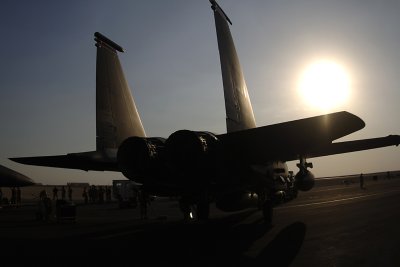
The Iranian military shot down a U.S. F-15E similar to the one pictured on Friday. File Photo by Senior Airman Mitch Fuqua/U.S. Air Force.
April 3 (UPI) — The U.S. forces rescued at least one crew member after Iran shot down a U.S. F-15E fighter jet Friday, unnamed U.S. military sources told multiple media outlets.
Officials confirmed the rescue to CBS News but said search-and-rescue operations were still taking place. CNN reported they were looking for one other pilot before Iranian forces could reach them. The F-15E has a standard crew of two pilots, The New York Times reported.
Iran’s state-run Tasnim news agency reported that Iranian officials’ efforts to locate the two U.S. pilot had “so far been unsuccessful.” Another Iranian news outlet, Fars News, said the government was offering a reward to anyone who captured an “enemy pilot or pilots.”
The New York Times reported that amid the search-and-rescue efforts, Iranian ground fire also hit a U.S. Air Force UH-60 Black Hawk helicopter. Officials told the news outlet that the crew was able to fly the aircraft back to safety in Iraq.
The Times also reported that another aircraft, an A-10 Thunderbolt, or Warthog, crashed near the Strait of Hormuz around the same time as the F-15E fighter jet. Two U.S. officials told the outlet that the only pilot on board the aircraft was rescued.
Iranian media outlets published photos of what appears to be a shot-down F-15 fighter jet.
White House press secretary Karoline Leavitt told CNN that President Donald Trump had been briefed on the incident.
This is the first U.S. aircraft to be shot down by Iran since the start of U.S. and Israeli bombing on Feb. 28. Three other F-15 jets were shot down by mistake in Kuwait.
President Donald Trump delivers a prime-time address to the nation from the Cross Hall in the White House on Wednesday. President Trump used the address to update the public on the month-long war in Iran. Pool photo by Alex Brandon/UPI | License Photo
Song Eon-seok, floor leader of the People Power Party, speaks at a party Supreme Council meeting at the National Assembly in Seoul on Wednesday. At right is party leader Jang Dong-hyuk. Photo by Asia Today
April 3 (Asia Today) — Song Eon-seok, floor leader of the People Power Party, on Thursday criticized the government’s proposed 26.2 trillion won (about $19.6 billion) supplementary budget, calling it a “misguided plan” that relies on cash handouts instead of addressing the impact of high oil prices.
Speaking at a party strategy meeting at the National Assembly, Song said the proposal “diagnoses high oil prices but prescribes cash handouts,” arguing that it fails to support those most affected by rising fuel costs.
He said the government has become overly focused on distributing cash while neglecting vulnerable groups, adding that one-time payments of 100,000 won (about $75) would not meaningfully help people facing mounting living costs.
Song also criticized the exclusion of workers directly impacted by fuel prices, including truck drivers, delivery workers and taxi drivers, from key support measures.
“We will transform this supplementary budget from a war-related or election-driven budget into a ‘people’s survival budget,'” he said, pledging to shift from broad cash payments to targeted assistance.
He said the party would seek to cut spending items deemed unrelated to high oil prices during the review process, including renewable energy projects, independent film production support and regional development programs in Changwon. Savings from those cuts, he added, would be redirected to groups most affected by fuel price increases.
Song proposed expanding the fuel tax reduction from 15% to 30% and providing fuel subsidies of 600,000 won (about $450) to roughly 700,000 workers in transportation and delivery sectors.
He also suggested additional support measures, including subsidies for delivery and takeout packaging costs for about 670,000 self-employed business owners, as well as a 50% discount on the K-Pass public transportation program for six months.
Regarding the government’s plan to implement an odd-even license plate driving system, Song said the policy should be reconsidered. If implemented, he said, it should be accompanied by adequate compensation for affected citizens.