“The US Navy at this point can’t even get anywhere close to the Strait of Hormuz without being attacked.” Experts are pouring cold water on Pete Hegseth’s claims that the US is working effectively to reopen the world’s most crucial shipping lane.
Voters in the Republic of Congo will choose their next president on Sunday, although longtime leader Dennis Sassou Nguesso is likely to be elected unchallenged, analysts say.
The central African nation, which has been led almost continuously by Nguesso for more than 40 years, is one of the most politically repressive in the world, with Freedom House giving it a 17 out of 100 rating for freedom.
Recommended Stories
list of 4 itemsend of list
The country is Africa’s third-largest oil exporter. It sells between 236,000 and 252,000 barrels per day, alongside copper and diamonds.
Congo is also highly biodiverse. Sprawling expanses of tropical rainforest in the country form part of the Congo Basin – the second-largest rainforest network in the world after the Amazon. The Nouabale-Ndoki National Park in the north is a UNESCO World Heritage site and is home to elephants, endangered lowland gorillas, and chimpanzees.
Still, the country of 6 million people is racked by economic woes. Corruption and mismanagement, analysts say, contribute to Congo being 171st of 193 countries on the United Nations Human Development Index.
A fractured political opposition, meanwhile, has only allowed Nguesso’s governing Congolese Labour Party (PCT) to consolidate power over the years, although a newcomer is raising hopes.
Here’s what we know about Sunday’s polls:
Supporters of outgoing President Denis Sassou Nguesso, who is running for re-election, take part in a campaign rally before the March 15 presidential election, in Brazzaville, Republic of Congo, March 7, 2026 [Roch Bouka/Reuters]
When do polls open?
Polls will open on Saturday, March 15, between 6am (05:00 GMT) and 6pm (05:00 GMT). More than 2.6 million people are eligible to vote; that is, they are more than 18 years old and have been registered.
Voter turnout in 2021 — during the last election — was 67.70 percent according to the International Foundation for Electoral Systems (IFES). Authorities have announced that borders will be closed during voting.
Candidates with an absolute majority usually win the elections, or in rare cases, a run-off will be called between the two top polling candidates.
Presidential terms in Congo are for five years. While the constitution had previously allowed a maximum of two terms and an age limit of 70, those were removed in 2015.
France’s President Emmanuel Macron speaks with President of Congo Denis Sassou Nguesso during the signing of a letter of intent by Denis Christel Sassou Nguesso, Congolese minister of international cooperation and promotion of partnership, and France’s Delegate Minister for Francophonie and International Partnerships Thani Mohamed Soilihi at The Elysee Presidential Palace in Paris on May 23, 2025 [File: Thomas Samson/Reuters]
Who’s running?
Dennis Sassou Nguesso: The 82-year-old was first elected to office in 1979 and led the country for 12 years under a one-party state. He lost elections after opposition lawmakers voted to introduce a multiparty system. On his second attempt in 1997, he seized power in a bloody civil war and has remained in office since. He is Africa’s third-longest serving ruler.
Nguesso’s legacy has been one of gross underdevelopment and corruption, said Andrea Ngombet, the exiled founder of Sassoufit, a group advocating for Nguesso’s exit. In 2015, Nguesso pushed through a controversial referendum that reset presidential term limits from two to three. It also completely removed age restrictions, allowing him to run for the fifth consecutive time in 2021.
A strong hold on the country’s judiciary and the Independent National Electoral Body (CENI) has helped secure Nguesso’s hold, analysts say. His strategic international alliances, from Beijing to Moscow to Paris, have ensured foreign investments and boosted his influence, according to Ngombet. However, since 2013, France has launched investigations into his family’s numerous assets in Europe and the US under pressure from civil society. French authorities seized property belonging to his son, Denis-Christel Sassou Nguesso, in 2022.
Melaine Deston Gavet Elengo: At only 35, Elengo’s candidacy has caused ripples. The oil sector engineer leads the Republican Movement and is the youngest contender in the race. Although a first-time presidential candidate, Elengo appears to be pulling an unusual amount of interest as he presents himself as a departure from the old system. His campaign has emphasised a government built on transparency, an independent justice system, and inclusive development.
“He could secure at least 20 percent of the vote, signalling a generational shift,” Ngombet said.
“His unique advantage lies in the unspoken support from UPADS dissidents frustrated with the boycott,” he added, referring to the opposition party, Pan-African Union for Social Democracy (UPADS), which boycotted the March 21, 2021, presidential election over concerns of integrity. UPADS is doing the same this year but has called on its supporters to go out and vote according to their “conscience”.
Elengo is also closely allied with political heavyweights like the opposition Union of Humanist Democrats, founded by the popular opposition figure, late Guy-Brice Parfait Kolelas, who came second in 2016.
A man walks past a campaign banner of presidential candidate Destin Gavet, before the presidential election scheduled for March 15, in Brazzaville, Republic of Congo, March 11, 2026 [Roch Bouka/Reuters]
Joseph Kignoumbi Kia Mboungou, 73: The veteran lawmaker is the leader of the political party The Chain and represents the southwestern Lekoumou department. He has run several times in the past without much success, with his 2021 bid resulting in just 0.62 percent of the vote. Mboungou’s campaign promised political change and an economy that diversifies from oil, while reducing poverty.
Uphrem Dave Mafoula, 43: The economist is leader of the New Start party. He is making his second bid for the top post after running as the youngest candidate in 2021 and securing just 0.52 percent of the vote. Mafoula’s goal, he says, is to implement governance reforms, create jobs, and reduce inequalities.
Vivien Romain Manangou, 43: The independent first-timer is a university lecturer campaigning on institutional reforms, improving public finances, and promoting national unity.
Mabio Mavoungou Zinga, 69: Running under the opposition coalition Alliance party, the retired customs inspector and former member of parliament promises to tackle corruption and free jailed opposition leaders. It’s his first bid.
Anguios Nganguia Engambe, about 60: The president of the Party for Action of the Republic is running for his fourth time as presidential candidate. In 2021, he won only 0.18 percent of the vote. This time, he has pledged to bridge political divisions in the country and foster better political participation.
Which opposition leaders have been targeted?
Several opposition leaders are either jailed or have fled into exile. Some are:
Jean-Marie Michel Mokoko,78: A former chief of the army and an adviser to Nguesso, who turned against the president and ran for elections in 2016. He called for protests after the results showed that he won 13.74 percent and placed third. He was arrested afterwards on charges of undermining state security and was in 2018 sentenced to 20 years in prison.
Andre Okombi Salissa: a one-time leading member of the governing Congolese Labour Party, and a former minister, Salissa also switched to the opposition in 2016 to contest the polls. He was arrested shortly after, also on security charges. In 2019, he was sentenced to 20 years of hard labour.
What are the key issues?
Poverty despite oil riches
Analysts have long warned that a lack of economic diversification hurts the country’s prospects. As Africa’s third-largest oil producer, Congo earns more than 80 percent of its export revenue from oil, according to the World Bank, making the economy vulnerable to shocks.
Government investment in hydrocarbons has only intensified in recent years. In 2015, authorities aimed to boost daily output to 500,000 barrels of oil per day within three years. Liquefied natural gas (LNG) production and export also began in 2024.
Despite this, around half the population lives below the poverty line. Most live in the main cities of Brazzaville and Pointe-Noire where access to electricity and roads is available but dismal. The situation is even worse in rural areas, analysts say.
While the population is young, with nearly half under 18, job creation is weak. Many young people with degrees have to turn to menial work for survival. The unemployment rate hovers at approximately 40 percent, with inadequate electricity being one of the major barriers for business, according to the World Bank.
Forests and agriculture
Before it began extracting oil in the 1970s, agricultural produce and timber were the biggest revenue generators in Congo.
However, Congo has become reliant on food imports amid the shift to oil.
Although the country has up to 10 million hectares (24 milllion acres) of arable land, only a small percentage is being cultivated, and that’s mostly for low-yield subsistence farming.
The government has touted plans to boost cassava, maize, sorghum, and soy farming, along with developing fisheries and poultry.
Meanwhile, deforestation in the Congo Basin, which encompasses parts of Congo and five neighbouring countries, nearly doubled between 2010 and 2020, compared to the previous decade.
Political freedom and post-Nguesso race
Protests are rare in the country as authorities don’t provide permits and respond with violence when demonstrators gather, according to the Africa Center for Strategic Studies.
Opposition members are routinely jailed. Nguesso appoints national judges himself, meaning the judiciary is not independent.
Many Congolese expect Nguesso to win Sunday’s elections, so much attention is now on who will likely take over leadership in the country in the coming years.
Analysts say an intense succession race is already brewing behind the scenes.
Denis-Christel Nguesso, the president’s son and minister of international cooperation, is the clear favourite, but he faces challenges from the president’s nephew and Head of National Security Jean-Dominique Okemba.
The Nguessos’ cousin, Jean-Jacques Bouya, who is currently the minister of planning and works, is another contender.
Seoul Mayor Oh Se-hoon speaks during a New Year’s greeting event at the headquarters of the Korea Chamber of Commerce and Industry in Seoul, South Korea, 07 January 2026. Photo by YONHAP / EPA
March 13 (Asia Today) — Several candidates from South Korea’s conservative People Power Party publicly urged Seoul Mayor Oh Se-hoon on Friday to apply for the party’s nomination for the upcoming local elections, as his refusal to do so has prolonged internal tensions.
Oh has delayed submitting his candidacy application while calling for broader party reforms, prompting criticism from party members who say the standoff is deepening divisions ahead of the June 3 local elections.
Incheon Mayor Yoo Jeong-bok, who has secured the party’s nomination for his reelection bid, visited the party’s headquarters in Seoul and called on Oh to move forward with the nomination process.
“The party is in confusion,” Yoo said. “I hope Mayor Oh will quickly apply for the nomination and confidently join the party’s path forward.”
Yoo also urged former nomination committee chairman Lee Jung-hyun – who abruptly resigned earlier in the day – to reconsider his decision and return to the role.
“I ask Chairman Lee to withdraw his resignation and fulfill his responsibility to ensure a successful nomination process,” Yoo said, while also calling on party leader Jang Dong-hyuk to strengthen unity within the party.
South Chungcheong Province Gov. Kim Tae-heum also called on Oh to demonstrate leadership as a senior party figure.
“I understand Mayor Oh’s position,” Kim said. “But as a senior member of the party, I hope he will show dedication to keeping the party united.”
Kim had previously delayed submitting his own nomination application alongside Oh but completed the process Thursday after discussions with party leadership.
Some party figures have issued sharper criticism.
Lee Sang-kyu, a People Power Party candidate for Seoul mayor, accused Oh of creating unnecessary pressure within the party while insisting on the creation of an “innovation campaign committee.”
Another mayoral hopeful, Yoon Hee-sook, wrote on social media that it is not the time for internal disputes over candidate registration.
“Primary candidates must unite and focus on confronting the Lee Jae-myung administration while working toward party reform,” she said.
Criticism has also emerged within the party leadership over Oh’s proposal to launch a reform-oriented campaign committee.
Park Jun-tae, chief of staff to the party leader, questioned whether the proposal effectively amounted to a demand for Jang to step down.
“If the proposal implies that the party leader should resign, it would be difficult for the party to accept,” Park said.
Senior lawmaker Na Kyung-won also criticized Oh’s position in a social media post Thursday, urging him to stop escalating tensions within the party.
March 13 (UPI) — Michigan Gov. Gretchen Whitmer on Friday thanked security personnel for risking their lives to thwart a potentially deadly attack on a temple this week.
Whitmer spoke at a news conference one day after a person drove a vehicle into Temple Israel in West Bloomfield, Mich., calling the attack “anti-Semitism at its absolute worst.”
Her comments followed the attack at the temple on Thursday, where more than 100 children were attending school at the time.
“I want to thank Temple Israel’s security personnel — they were selfless in their courage and they saved lives,” Whitmer said. “Let’s be very clear: Yes, this is a place of worship, but at the time that this attack occurred, it was a school. One hundred and four children aged 5 and younger.”
The attacker, according to police, drove through the doors of the temple and down a hallway “with purpose” when a fire started inside the vehicle.
A security guard was hit by the vehicle, but security guards also responded to the driver with gunfire and the driver died.
Temple Israel is one of the largest reform Jewish congregations in the country, Whitmer noted, attracting more than 1,000 people for Friday night Shabbat services.
“Parents bring their children to daycare and school, and it’s a place of peace, unity, light and life,” Whitmer said. “Yesterday’s attack was anti-Semitism. It was hate, plain and simple.”
“We will fight this ancient and rampant evil,” she said.
There has been an uptick in anti-Semitic incidents in recent years and, according to the American Jewish Committee, roughly 70% of all religiously motivated hate crimes in the United States are committed against Jewish people.
President Donald Trump speaks during an event celebrating Women’s History Month in the East Room of the White House on Thursday. Photo by Bonnie Cash/UPI | License Photo
The USS Tripoli, right, pictured in February sending fuel to the USS Rafael Peralta in a replenishment-at-sea, is heading to the Middle East near Iran as U.S. military commanders have asked the Pentagon for additional options in the ongoing operation in Iran. Photo by Mass Communication Specialist 1st Class Ryre Arciaga/U.S. Navy
March 13 (UPI) — The USS Tripoli, and the 2,500 Marines on the amphibious assault ship, are headed to the Middle East to bolster U.S. military power there as the war in Iran enters its third week.
The Tripoli, along with Marines of the 31st Marine Expeditionary Group, had been operating in the Philippine Sea but is now headed west south of Taiwan through the Luzon Strait, USNI News reported.
Although the Tripoli had been with the USS San Diego and USS New Orleans in the Philippine Sea, it is not clear if the San Diego and the New Orleans are also being moved closer to Iran.
As Iran has closed the Strait of Hormuz to most traffic, and is targeting vessels that transit it, the move comes as U.S. Central Command asked the Pentagon for additional military options in the conflict, Axios reported.
The 31st MEU can conduct ground operations, which have not been announced but have not been ruled out, according to the Trump administration.
The deployment comes as President Donald Trump said he is considering sending U.S. Navy vessels to escort shipping vessels through the strait, the military is planning to take out anti-ship missiles that have been sent by Iran to the area.
CENTCOM is particularly focused on ensuring freedom of navigation in the straight, Joint Chiefs of Staff Chair Gen. Dan Caine told reporters on Friday, which “means going after Iran’s mine-laying capability and destroying their ability to attack commercial vessels.
Oil prices have surged over the last week after Iran shut down the strait, though Caine noted that some traffic is moving through it.
Defense Secretary Pete Hegseth also said Friday that the military is “dealing with” Iranian attacks on the strait, saying that “we have been dealing with it and don’t need to worry about it.”
Hegseth added that as the military campaign continues and Iran’s military capabilities weaken, the United States has also been taking out Iranian defense companies to prevent the ability to build more weapons.
An Iranian man raises a portrait of new supreme leader Mojtaba Khamenei during a rally on Revolution Street in Tehran on March 9, 2026. Photo by Hossein Esmaeili/UPI | License Photo
March 13 (UPI) — A federal judge this week quashed subpoenas the Department of Justice had issued to Federal Reserve Chair Jerome Powell because they were issued to pressure him into adjusting interest rates.
Judge James Boasberg redressed the DOJ for the subpoenas, saying that their purpose had nothing to do with a probe about renovations at the Federal Reserve in Washington, D.C.
The DOJ in January launched a criminal investigation into Powell’s testimony last year about the renovations, which Powell at the time said were “pretexts” to punish him and the Fed after they did not set interest rates at levels demanded by President Donald Trump.
“The Government has produced essentially zero evidence to suspect Chair Powell of a crime; indeed, its justifications are so thin and unsubstantiated that the Court can only conclude that they are pretextual,” Boasberg wrote in the opinion.
The department in January issued grand jury subpoenas in reference to Powell’s comments about the multi-year project to renovate the Fed’s office buildings during his June 2025 testimony before the Senate Banking Committee.
During a tour of the renovations, Powell disputed Trump’s over-estimates of the renovation’s cost, and threatened to sue him for the “horrible and grossly incompetent job” Powell had done on the project.
Overall, however, Trump has repeatedly ripped into and mused about firing Powell, which he cannot do, because the Fed chair has repeatedly said that interest rate changes would be dictated by only the market, rather than the preferences of any one person.
In the opinion, which was unsealed Friday, Boasberg said he blocked the subpoenas because “a mountain of evidence suggests that the Government served these subpoenas on the Board to pressure its Chair into voting for lower interest rates or resigning.”
President Donald Trump speaks during an event celebrating Women’s History Month in the East Room of the White House on Thursday. Photo by Bonnie Cash/UPI | License Photo
1 of 2 | A damaged building stands in the Dubai International Financial Center. The damage was caused by debris from the interception of an Iranian drone attack in Dubai, United Arab Emirates, Friday. Those in the UAE are being warned not to take photos or videos of damage or they could be charged under cybercrime laws. Photo by a stringer/EPA
March 13 (UPI) — Several people, including tourists and influencers, have been arrested in Dubai, United Arab Emirates, for possessing, sharing or commenting on digital content that shows attacks or damage from attacks by Iran in the country.
There have been 21 people arrested in the emirate, said advocacy organization Detained in Dubai.
“The charges sound extremely vague but serious on paper. In reality, the alleged conduct could be something as simple as sharing or commenting on a video that is already circulating online,” said Radha Stirling, CEO of Detained in Dubai and Due Process International.
“Under UAE cybercrime laws, the person who originally posts content can be charged, but so can anyone who reshapes, reposts or comments on it. One video can quickly lead to dozens of people facing criminal charges,” Stirling said.
Penalties can include up to two years in prison, fines ranging from about $5,500 to $55,000, and foreign nationals will face deportation.
“Foreigners need to understand that what may seem like normal social media behavior elsewhere can lead to arrest in the UAE,” Stirling said. “In some circumstances people can find themselves treated as national security suspects before the facts are even clarified.”
One 60-year-old British tourist has been charged under cybercrime laws for allegedly filming Iranian missiles over the city.
“We are in contact with the local authorities following the detention of a British man in the UAE,” the United Kingdom’s Foreign Office told CNN.
The UAE’s ambassador to the United Kingdom told British radio station LBC that the “United Arab Emirates is very safe.”
“The guidelines and regulations are there in the UAE to ensure people’s safety,” he said. He added that people filming could be hit by “falling debris.”
Stirling also said that Qatar has already charged more than 200 people under similar laws since the Iran war began.
The UAE defense ministry said on X Friday that 1,800 drones and missiles have been fired at the UAE since the war with Iran began.
Six people from the Emirates, Pakistan, Nepal and Bangladesh have been killed, and 141 people have suffered mild to moderate injuries.
Iranians attend a funeral for a person killed in recent U.S.-Israel airstrikes at Behesht-e Zahra cemetery on the southern outskirts of Tehran in Iran on March 9, 2026. Photo by Hossein Esmaeili/UPI | License Photo
Sheikh Khalifa bin Hamad says Qatar will ‘not hesitate’ to ensure its stability as US-Israeli war on Iran continues.
Published On 13 Mar 202613 Mar 2026
Share
Qatar’s Interior Minister Sheikh Khalifa bin Hamad has said the situation in the Gulf country is “stable” amid Iranian drone and missile attacks launched across the Middle East in response to the US-Israeli war on Iran.
In an interview with Qatar Television on Friday, Sheikh Khalifa said the Qatari government had a plan in place to deal with the prospect of more Iranian attacks amid a regional war.
Recommended Stories
list of 3 itemsend of list
“The security situation in the country is stable, and we will not hesitate to take any measure that ensures the stability of our nation,” he said.
The interior minister said Qatar’s early warning system has been effective as authorities responded to reports of falling missile fragments at more than 600 sites across the country.
He added that Qatar has enough water to last for several months, as well as food reserves that will cover the nation’s needs for a year and a half.
Sheikh Khalifa’s remarks come as Qatar and other countries in the Gulf region have faced a barrage of Iranian attacks since the United States and Israel launched a war against Iran on February 28.
While Iran has said it is targeting US and Israeli military interests in the wider Middle East, the strikes have hit civilian infrastructure, including oil and gas facilities.
That has prompted a slowdown in regional energy production, which – coupled with Iran’s closure of the Strait of Hormuz, a key Gulf waterway – has raised concerns around the war’s effects on global economies.
Earlier this week, the United Nations Security Council passed a resolution denouncing the Iranian attacks on Gulf Cooperation Council (GCC) countries.
Sheikha Alya Ahmed bin Saif Al Thani, Qatar’s ambassador to the UN, had condemned the firings as “a clear violation of international law and the UN Charter”.
The attacks, she told reporters in New York on Wednesday, “impacts deeply the foundation of understanding upon which bilateral relations between our countries have been built”.
Members of the Bolivian armed forces conduct an operation in Santa Cruz, Bolivia, on Friday, during which alleged Uruguayan drug trafficker Sebastian Marset was captured. Three other people were reportedly apprehended and several weapons seized. Photo by Juan Carlos Torrejon/EPA
March 13 (UPI) — Uruguayan drug trafficker Sebastián Enrique Marset Cabrera, known as the “King of the South” and considered a priority fugitive for the U.S. Drug Enforcement Administration, was captured Friday in Bolivia and was being transferred to the United States, authorities said.
The arrest occurred during a raid early in the morning in Las Palmas, an upscale residential neighborhood in Santa Cruz de la Sierra, where Bolivian security forces began the operation about 2 a.m., according to regional media reports.
Bolivia’s Ministry of Government said Marset was to be transported from Viru Viru International Airport in Santa Cruz under a heavy police guard.
The minister of Paraguay’s National Anti-Drug Secretariat, Jalil Rachid, said his office received information from Bolivian authorities confirming the arrest.
“The operation began early in the morning. Around 2 a.m. The information I received is positive. He has already been secured,” Rachid said.
“ESTO ESTÁ CONFIRMADO, LAS AUTORIDADES DE BOLIVIA NOS CONFIRMARON QUE DETUVIERON A MARSET” |
➡El ministro de la Senad, Jalil Rachid mencionó que los organismos de Bolivia le confirmaron la captura de Marset y que continúan los procedimientos.
“He was one of the most wanted people worldwide, Rachid said. Many will be seeking his head. I am sure the American government is also interested in that because he used its financial system.”
Images circulated by regional media show Marset under the custody of U.S. agents.
PRIMERAS IMÁGENES DE SEBASTIÁN MARSET, ESPOSADO, ANTE LA DEA‼️
El narcotraficante uruguayo fue capturado en Santa Cruz de la Sierra, Bolivia.
Paraguay’s interior minister, Enrique Riera, said the capture could provide new information about the drug trafficker’s criminal structure in the region.
“More than one person will be worried right now if he tells everything he knows about past events and his connections in Paraguay” Riera said.
Paraguayan Sen. Eduardo Nakayama wrote on X that Marset’s capture was linked to renewed international cooperation.
“Marset’s capture is a key blow to organized crime and was not a coincidence. It coincides with the restoration of cooperation with the United States Drug Enforcement Administration under the government of Rodrigo Paz in Bolivia after 18 years of rupture (2008-2025), during which the country made no progress in the fight against drug trafficking, demonstrating the importance of shared intelligence,” Nakayama wrote.
Images shared by local media also show police escorting other handcuffed individuals while securing the perimeter of the raided residence.
La primera imagen de la detención de Sebastián Marset en Bolivia
La Policía de Bolivia logró la detención de Sebastián Marset, considerado el narcotraficante más buscado de la región, tras un megaoperativo en la madrugada de este viernes 13 de marzo en distintos puntos de… pic.twitter.com/PTBJ03GOuW— Diario La Tribuna Paraguay (@TribunaParaguay) March 13, 2026
“The information provided to us is that there are five Venezuelan citizens, four men and one woman, who would be part of the operational arm of the Uruguayan Sebastián Marset,” Bolivian journalist Jaime Herrera told ABC TV Paraguay.
Marset, 34, a Uruguayan national, has been identified by authorities in several countries as the leader of an international network involved in cocaine trafficking and money laundering that operated between Bolivia, Paraguay, Uruguay and Europe.
Investigations indicate his organization coordinated cocaine shipments departed from Bolivia, crossed Paraguay and were later sent to European ports.
Authorities link his network to seizures involving more than 16 tons of cocaine as part of the Paraguayan investigation known as Operation A Ultranza PY, considered the largest operation against organized crime in Paraguay’s history.
Marset’s first known links to drug trafficking date to 2013, when he was arrested in Uruguay after receiving a marijuana shipment connected to Paraguayan traffickers. He was convicted of drug trafficking and regained his freedom in 2018 after serving five years in prison.
After leaving prison, according to investigations, he expanded his criminal network across several countries in the region.
Paraguayan authorities have also linked him to contacts within the Insfrán clan, an organization associated with drug trafficking in Paraguay.
According to statements cited by Colombian authorities and judicial investigations, Marset was identified as the “determining figure” in the crime, meaning the person who allegedly ordered the assassination.
The international search for Marset intensified in May when the U.S. Sate Department offered a reward of up to $2 million for information leading to his capture.
The U.S. Department of Justice also filed money laundering charges, accusing him of using the U.S. financial system in his operations.
Iranian state TV video shows the Chief Justice Gholam-Hossein Mohseni-Eje’i speaking to a reporter when a blast, described by officials as an Israeli strike, hit near the al-Quds Day rally in Tehran. Despite the explosion, he continued marching with crowds taking part in the annual pro-Palestinian demonstration.
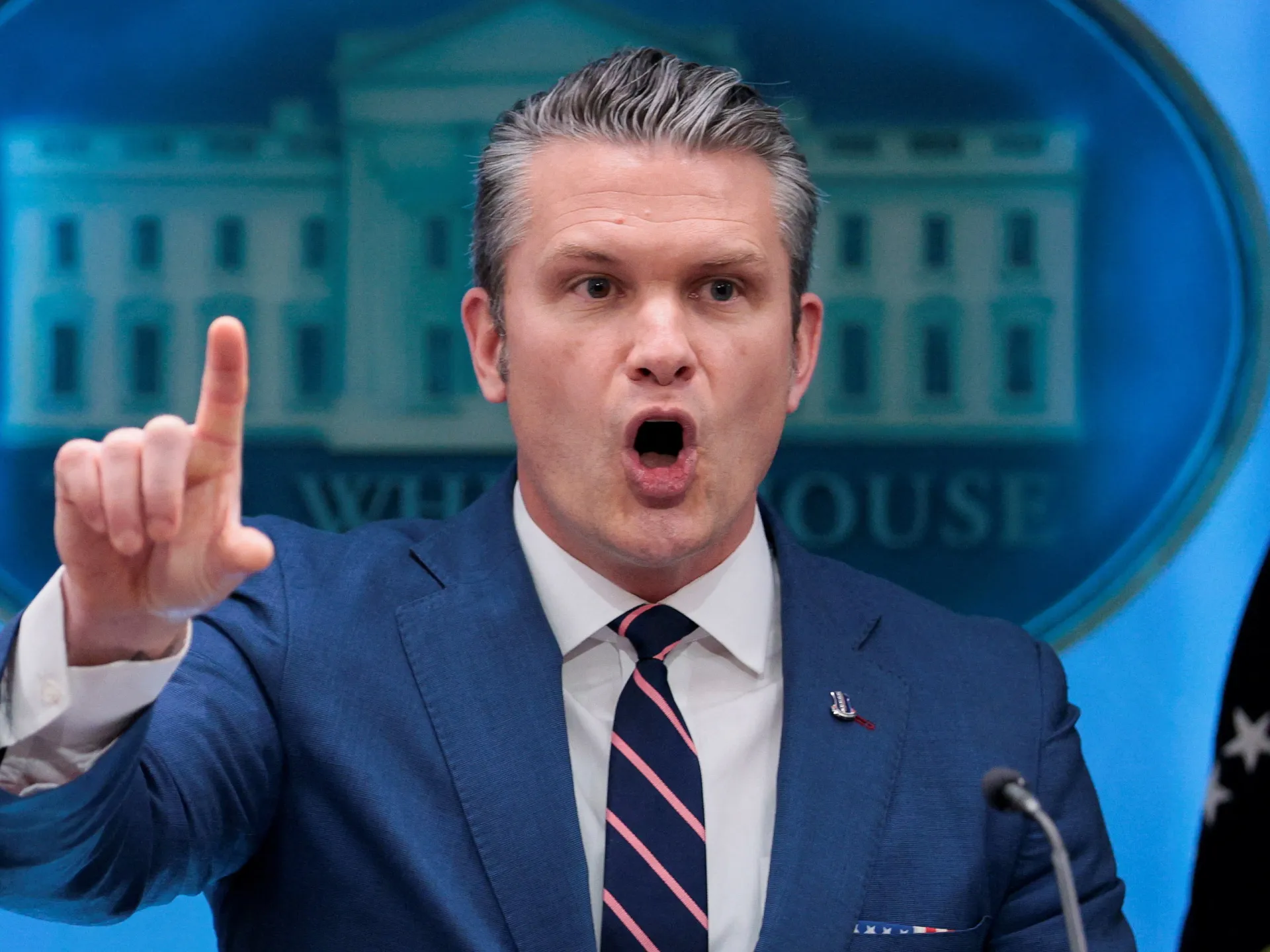
March 13 (UPI) — Secretary of Defense Pete Hegseth downplayed the shutdown of the Strait of Hormuz during a press briefing Friday and claimed 15,000 Iranian targets have been struck.
Hegseth said the U.S. and Israeli air forces are flying over Iran and Tehran Friday, the 13th day of the operation. He claimed that Iran’s air defenses, navy and munitions supply have been defeated.
Iran’s missile volume was down by 90% and its one-way attack drones were down by 95% on Thursday, Hegseth said.
“Today as we speak we fly over the top of Iran and Tehran,” Hegseth said. “Fighters and bombers, all day picking targets as they choose.”
The defense secretary opened Friday’s briefing at the Pentagon, joined again by Gen. Dan Caine, saying that the United States is “decimating the radical Iranian regime’s military in a way the world has never seen before.”
“We said it would not be a fair fight and it has not been,” he said.
Caine lauded the use of the first precision-strike missiles used in combat by the United States, praising the troops that fired them. One of those soldiers was 20 years old and has only been in the U.S. Army for six months.
Caine’s comments on the precision of U.S. strikes come as the military is investigating a deadly strike on an elementary school for girls in Iran that took place on Feb. 28. The preliminary investigation has found that the United States is likely responsible for the attack that killed more than 170 people, most of them children.
“They’ve done all of this with the precision and determination that comes from relentless training and trust in each other and their weapons systems,” Caine said.
Hegseth said the United States is “dealing with” Iran’s attacks on vessels on the Strait of Hormuz, which has dramatically disrupted the oil trade.
“It’s something we’re dealing with, we have been dealing with it and don’t need to worry about it,” Hegseth said. “We’re on plan to defeat, destroy and disable all of their meaningful military capabilities on a pace the world has never seen before.”
Caine later said that there is some traffic moving through the strait.
As Iran’s military capabilities weaken, Hegseth said, more importantly, it does not possess the capability to build more weapons.
“Soon and very soon all of Iran’s defense companies will be destroyed,” Hegseth. “For example, as of two days ago, all of Iran’s ballistic missile production capacity, every company that builds every component of those missiles, has been functionally defeated, destroyed.”
As for Iran’s new supreme leader, Mojtaba Khamenei, Hegseth said he is “likely disfigured.” Khamenei was wounded during the initial strikes by the United States and Israel on Tehran on Feb. 28, which killed his father, former supreme leader Ali Khamenei.
President Donald Trump shared similar speculation about the new supreme leader on Fox News on Friday, saying he believes he is alive but “damaged.”
“I think he probably is,” Trump said. “I think he’s damaged but I think he’s probably alive in some form.”
President Donald Trump speaks during an event celebrating Women’s History Month in the East Room of the White House on Thursday. Photo by Bonnie Cash/UPI | License Photo
Israel has killed almost 600 people in Lebanon and displaced more than 750,000 in less than two weeks. This is the opening act of Israel’s Gaza doctrine applied to a new front. The formula is consistent: Displace – either by ordering people to leave or by destroying their means of survival. Demolish civilian infrastructure to prevent return and expand territory through so-called “buffer zones”. Fragment any coherent governance by carving territory into disconnected enclaves where military action continues at a lower intensity.
I spent three years working in Palestine before being expelled by Israeli authorities. I watched this doctrine develop in real time. Now, from Beirut, I am witnessing its replication.
In the West Bank, Israel has spent decades fragmenting territory and denying Palestinians any contiguous geography. Water wells sealed with cement, homes demolished over impossible-to-obtain permits, herders pushed from their land by illegal settlement outposts. In Gaza, the same logic was applied with far greater speed and fury.
In October 2023, Israel announced that every Palestinian north of Wadi Gaza had to leave immediately. Days earlier, Israel’s defence minister had declared a complete siege: No electricity, no food, no water. By labelling an entire population as the enemy, Israel created a class of expendable people. The military released maps with Gaza divided into numbered blocks. When your number was called, you were forced to leave. Evacuation orders became the alibi for the crimes that followed. People were ordered into al-Mawasi, a stretch of coastline Israel designated a “safe zone”, a concentration area for hundreds of thousands living in tents, where air attacks continued. So-called evacuation zones were depopulated and destroyed.
Classic counterinsurgency logic would have entailed “clear, hold, and rebuild”. Israel’s approach was radically different: Destroy, displace, dismantle. The goal was not to pacify territory but to empty it. In both Gaza and southern Lebanon, Israel has treated civilian populations as indistinguishable from the resistance they support. Their displacement is the objective. The collapse of their political representation is a condition Israel seeks to make permanent. This is settler-colonial logic in contemporary military form.
The same playbook has now arrived in Lebanon, but with a revealing difference from previous Israeli operations here. In the first Lebanon war in the 1980s, Israel sought to install a sympathetic government. Gaza has shown that Israel has abandoned that aspiration. The goal is no longer to determine who governs a territory but to ensure that no coherent governance exists at all. Nor is Israel alone in this; the UAE’s approach in Yemen and the Horn of Africa – and its support to Israel in Gaza – reflects the same preference for isolated enclaves. What has emerged is a regional doctrine of fragmentation shared between aligned powers.
Israel has issued evacuation orders for the entirety of southern Lebanon and southern Beirut. The familiar map that appeared on my screen in Beirut last week had the same design and the same deadly ambiguity as the ones we dealt with in Gaza; announced evacuation zones failed to match those shown on the map. In Gaza, those who crossed the invisible lines were killed.
Hundreds of thousands of people are now on the move. Schools have become shelters, health workers have been killed, and people are sleeping on the seafront where just two nights ago a tent was bombed. Israel has threatened to attack Lebanese state infrastructure if the government fails to act against Hezbollah – extending its aims from displacement and infrastructure destruction towards the forced destabilisation of the state itself. The Lebanese government has responded by forbidding Hezbollah from firing. This is precisely the internal fracturing that Israel’s strategy appears designed to provoke.
But Lebanon is not Gaza. Hamas was fighting with an improvised arsenal inside a besieged strip of land, and this already proved challenging for Israeli forces. Hezbollah commands more sophisticated weaponry, hardened infrastructure, and decades of preparation for this kind of war. It has shown it can absorb heavy blows and strike back, surprising both Israel and outside observers with the depth of its capabilities. Israeli ground operations in southern Lebanon and the Bekaa have already met significant resistance. It is here that the doctrine may encounter its limits – not through diplomatic pressure, which has failed to materialise, but through asymmetric military reality. Iran has made Lebanon’s fate explicitly part of any ceasefire calculus, signalling a unification of fronts that Israel had thought were weakened.
A doctrine built on the assumption of impunity has encountered little resistance in the conference halls of a so-called rules-based order. The Gaza doctrine is the expanded version of what Israel previously called the “Dahiyeh doctrine” – the use of overwhelming force against civilian infrastructure – now weaponised towards a larger end: The permanent redrawing of the region’s geography, demography, and political order.
This doctrine has developed in a vacuum of accountability. The International Court of Justice has been ignored. The Security Council has been paralysed. Governments have continued trading with Israel as it steadily normalised the unacceptable. Daniel Reisner, who headed the international legal division of Israel’s military advocate general’s office, was candid in saying that “If you do something for long enough, the world will accept it […] International law progresses through violations.”
The United States is not a bystander to this failure; it is an active participant in deepening it. At the Munich Security Conference earlier this year, Secretary of State Marco Rubio framed the transatlantic alliance in ethnonationalist terms and cast colonialism as a Western achievement. At an event in Tel Aviv, US Ambassador Mike Huckabee expressed confidence that Washington would “neuter” both the ICC and the ICJ – the very institutions through which accountability might otherwise be pursued.
What is unfolding in Lebanon is the political continuation of an ongoing settler-colonial project. The evacuation orders are precursors to mass destruction, designed to prevent return and permanently alter the landscape. Stability in the Middle East demands more than ceasefire agreements that manage fragmented populations while permitting lower-grade warfare to continue. It requires unconditional enforcement of international law, full accountability for those prosecuting this doctrine, and the right of return and reconstruction – from Beit Hanoon to Beirut.
The views expressed in this article are the author’s own and do not necessarily reflect Al Jazeera’s editorial stance.
A signboard at a gas station in Seoul shows gasoline and diesel prices in Seoul, South Korea, File. Photo by YONHAP / EPA
March 12 (Asia Today) — South Korea will impose a temporary price cap on petroleum products starting Friday, setting the first ceiling for gasoline at 1,724 won ($1.29) per liter as the government moves to curb surging fuel prices.
The Ministry of Trade, Industry and Energy said Thursday the “petroleum product maximum price system” will take effect at midnight and apply to fuel prices supplied by refiners to gas stations and distributors.
The first price caps are set at 1,724 won ($1.29) per liter for gasoline, 1,713 won ($1.28) for automotive diesel and 1,320 won ($0.99) for kerosene.
The measure will remain in place for two weeks through March 26 and will be reviewed every two weeks based on fluctuations in global petroleum product prices.
The government said the caps are significantly lower than the average supply prices submitted by refiners on Tuesday. At that time gasoline averaged 1,833 won ($1.37) per liter, diesel 1,931 won ($1.45) and kerosene 1,728 won ($1.30).
Compared with those levels the new caps are lower by 109 won for gasoline, 218 won for diesel and 408 won for kerosene.
Officials said the policy aims to quickly slow the recent surge in oil prices and ease instability in the fuel market.
The price cap will apply only to wholesale supply prices set by refiners rather than the retail prices at individual gas stations. Officials expect pump prices to gradually decline as stations adjust prices once lower-cost fuel enters inventories.
Price changes typically appear two to three days after new supply prices take effect, depending on station inventories, the ministry said.
If refiners incur losses because of the price caps the government plans to compensate them through a post-settlement system. Refiners will submit loss estimates which will be verified through accounting reviews before quarterly compensation payments are made.
Minister of Trade, Industry and Energy Kim Jeong-gwan said the policy would allow limited price adjustments in line with international fuel price trends while preventing excessive increases that diverge from global markets.
March 13 (UPI) — The U.S. military confirmed Friday that four of six crew members of a refueling jet on combat operations in the Iran war were killed when it went down over western Iraq in an incident with another U.S. military aircraft.
A rescue operation mounted following the crash on Thursday night was ongoing. The second aircraft landed safely following the incident, which involved neither enemy or friendly fire, U.S. Central Command said in a news release.
“The circumstances of the incident are under investigation. The incident occurred in friendly airspace during Operation Epic Fury, and rescue efforts are ongoing. More information will be made available as the situation develops,” CENTCOM said
The identities of the service members were being withheld until 24 hours after their next of kin had been notified, it added.
CBS News said that the second aircraft, also a Boeing Stratotanker, declared an emergency before landing in Tel Aviv.
The BBC reported that there were six crew on board — a pilot, co-pilot, a boom operator responsible for operating the refueling arm and three others.
An Iraqi intelligence source told CBS the aircraft crashed on the border with Jordan, near the town of Turaibil.
The Iranian military claimed responsibility, saying that an allied militia group in Iraq had downed the aircraft with a missile.
Thursday’s crash came 10 days after three U.S. F-15E Strike Eagles crashed in Kuwait in a friendly-fire incident in which Kuwaiti air defenses “mistakenly shot down” the fighter jets. All six aircrew were rescued after safely ejecting.
The U.S. military’s Stratotanker fleet is a critical asset in its in-flight refueling capability, enabling aircraft to remain airborne for extended periods during missions without having to land to take on more fuel.
The crash in Iraq brings to 11 the number of U.S. military personnel killed since the United States and Israel launched their airborne offensive against Iran on Feb. 28.
Iranians attend a funeral for a person killed in recent U.S.-Israel airstrikes at Behesht-e Zahra cemetery on the southern outskirts of Tehran in Iran on March 9, 2026. Photo by Hossein Esmaeili/UPI | License Photo
Black smoke could be seen in Dubai’s financial district where witnesses reported hearing explosions on Friday morning. Authorities there said a building was hit by debris from an intercepted missile.
Pointe-Noire and Brazzaville, Republic of Congo – In Pointe-Noire, the economic capital of the Republic of Congo, the aisles of the Grand Marche come alive in the early hours of the morning. Among the market stalls, street vendors, and shoppers pushing their way through the crowd, Romain Tchicaya is selling medicines on the sly.
As the price of basics – including pharmaceutical products – rises, and people turn to more affordable unregulated options, merchants like Tchicaya step in to fill the gap while trying to earn a living in a struggling economy.
Recommended Stories
list of 3 itemsend of list
However, the 37-year-old’s background is far from typical for a street vendor.
With a degree in management, he thought he would find a stable job after graduating from university. But like many young Congolese, he found himself facing a tight job market with few opportunities.
“We are told that the country is rich in oil. But I don’t see that wealth in my daily life,” he told Al Jazeera. “Look at Pointe-Noire, formerly nicknamedas Ponton la Belle [Beautiful Pointe-Noire]. Today, the city is unrecognisable.”
Around the Grand Marche, the main roads are potholed, and when it rains, the streets get flooded, making it almost impossible to drive.
Like Tchicaya, Brice Makaya, in his 40s, has never managed to find a stable job here despite having a degree in computer science.
With no stable employment, he is unable to rent a house and now lives outside the church where he prays.
“I am still underhoused at my age and have no prospects for the future,” he told Al Jazeera. “Without a job, I can’t plan ahead. I’m just trying to survive.”
For many young Congolese, daily life is a paradox: though they live in a resource-rich country – the third largest oil producer in sub-Saharan Africa and a producer of liquefied natural gas (LNG) – nearly half the population live below the poverty line.
This Sunday, Congo goes to the polls in which President Denis Sassou Nguesso, 82, is again seeking another term. For young voters, jobs and the economy are a big concern. But for the government, there appear to be limitations to what is possible.
During one of his speeches in the election campaign, Nguesso pointed out that the civil service could not absorb all job seekers, and urged young people to take charge of their own futures by encouraging self-employment.
A market in the Republic of the Congo before the 2026 presidential election [Al Jazeera]
Oil: ‘Fuel of the political system’
According to the World Bank, oil accounts for about 70 percent of Congo’s exports and nearly 40 percent of its gross domestic product (GDP).
But this wealth does not automatically translate into an improvement in living standards for most of the populace.
The World Bank estimates that more than 40 percent of Congolese people live below the poverty line, despite the country’s significant natural resources.
For economist Charles Kombo, this can be explained in large part by the very structure of the Congolese economy, which is dependent on oil revenues.
“Oil dependency plays a structuring role in many African economies. In what some call a ‘rentier state’, a large part of public resources comes from the exploitation of natural resources rather than taxation,” he explained.
In a rentier state, the country generates substantial revenue from “renting out” natural resources, such as oil, to foreign companies. In exchange for the exploitation rights granted on these resources, the state receives royalties, taxes, or a share of production.
In this type of system, Kombo explains, the management of revenues becomes central to political power.
“Control of this revenue often reinforces institutional centralisation,” he said, explaining that dependence is no longer solely economic, but becomes institutional and sometimes psychological, as it influences budgetary priorities, political strategies, and even perceptions of development.
He points out that when the economy relies heavily on extractive revenues, economic and political resources tend to become intertwined, which can limit electoral competitiveness.
“Oil revenues can generate significant income, but they do not guarantee the structural transformation of the economy,” he said.
This oil dependence also exposes the country to fluctuations in oil prices on international markets.
After the fall in crude oil prices in 2014, the Congolese economy experienced a severe crisis. Public debt exceeded 90 percent of GDP, before being restructured under agreements with the International Monetary Fund and several international creditors.
Although this has helped stabilise the macroeconomic situation, the country remains heavily indebted. According to the World Bank, public debt fell from 103.6 percent of GDP in 2020 to about 93.6 percent in 2024, reflecting a gradual improvement, but also the continued vulnerability of Congo’s economy to fluctuations in global oil prices.
For political analyst Alphonse Ndongo, oil revenues also influence political life in Congo.
“Oil has become the fuel of the political system. It is used to finance parties, co-opt elites, and maintain social balance,” he said.
According to him, “oil money comes easily and quickly”, but this financial windfall has long delayed necessary structural reforms such as economic diversification.
In his view, the steady flow of money from the oil sector can create a sense of complacency within the system, reducing the pressure to pursue deeper structural reforms. As a result, debates around economic diversification tend to emerge mainly during periods of financial stress, when falling oil prices expose the limits of the model. But when revenues rise again, he argues, the urgency to diversify often fades, leaving the economy heavily dependent on the same resource.
A man walks past a campaign banner of first-time presidential candidate Destin Gavet, in advance of the election [Roch Bouka/Reuters]
‘An uphill battle’
As the country’s oil wealth fails to filter to the majority of the population, young people are particularly affected and many face unemployment.
According to data from the World Bank and the International Labour Organization, the youth unemployment rate in Congo is among the highest in Central Africa, while the informal sector absorbs the majority of new entrants to the labour market.
During a news conference on March 4 in Brazzaville, Prime Minister Anatole Collinet Makosso, who is also spokesperson for presidential candidate and incumbent leader Nguesso, said that young people were at the heart of the government’s policy.
“Youth has always been at the centre of Denis Sassou Nguesso’s policies and social projects,” he said, citing investments in education and the construction of universities.
He also claimed that the unemployment rate had fallen from 44 percent to 39 percent in recent years.
But on the ground, many young people remain sceptical.
Landry, 23, a student in the capital Brazzaville who did not want to give his last name, says he has lost faith in political promises.
“Promises of jobs come back every election. It’s become a cycle,” he said.
A months-long strike at Marien Ngouabi University, the country’s main institution of higher education, forced him to interrupt his studies.
“I went back to my parents’ house to wait and see what I could do. Today, I’m seriously thinking about going abroad.”
Another student in Brazzaville, a 26-year-old woman who did not want to give her name, expressed similar frustration.
“The only sector that is really recruiting today is the army. But not everyone can become a soldier. Becoming a civil servant is also an uphill battle,” she said.
Even sectors that are supposed to be structured are not immune to precariousness. Regine, a young journalist who also did not want to provide her last name, said she works without a stable employment contract.
“In the media, many young people live off ‘camora’, one-off payments for services. It’s not a real salary.”
She also lamented the difficulties of everyday life, including infrastructure issues, such as power cuts and inconsistent water supplies, despite repeated government investment plans.
“In the 21st century, people rejoice when the electricity comes back on. And when the water finally flows, everyone rushes to fill buckets,” she said.
President of Congo Denis Sassou Nguesso [File: Minasse Wondimu Hailu/Anadolu Agency]
‘Social time bomb’
Congo’s infrastructure problems are a reminder to Regine and many others that economic difficulties go beyond the issue of employment.
At the same time, the consequences of the country’s youth employment crisis also reverberate more widely and into the social sphere.
Analyst Ndongo sees this as a potentially explosive situation.
“When there are large numbers of young people who are unemployed and have no prospects, it can become a social time bomb,” he said.
This dynamic is already visible in the tensions that emerge when unemployment and inequality intersect, Ndongo explained: As large numbers of young people struggle to find work while wealth linked to the oil sector remains visible, frustration can build among those excluded from economic opportunities.
He says pressure can be contained for a time, but without meaningful job opportunities and stronger education systems, resentment may deepen. Over time, he warns, groups of unemployed and poorly trained youth can become more vulnerable to crime or gang activity.
The Congolese population is very young: more than 60 percent of people are under 25, according to United Nations data. This demographic reality represents both economic potential and a major challenge for the authorities.
For economist Kombo, the issue goes far beyond just unemployment.
“Demographics are a major political factor in many African countries. When the population is predominantly young, expectations for employment and social mobility are particularly high.”
According to him, long-term political stability will depend on the ability to create economic opportunities.
“Development is not distributed,” he said, “it is built.”
Despite the frustrations, political mobilisation remains limited, even as several candidates rally to compete against Nguesso in this weekend’s vote.
Chris Taty, a young student in Brazzaville, says he is not interested in the current election, as it is clear that the president who has already been in power for more than 40 years will once again reign supreme.
“Everyone already knows who is going to win. So why bother voting? I’d rather stay at home and do other things,” he said.
“Sometimes we joke that Sassou [Nguesso] is our grandfather,” the young journalist Regine said. “He has been ruling for so long that many of us have never known another president”
Nguesso has been a dominant figure in Congolese politics for decades, first ruling the country from 1979 to 1992 before returning to power in 1997 following a brief period out of office. His long tenure has enabled him to consolidate influence over key state institutions. Meanwhile, analysts say the country’s opposition remains fragmented and lacks the organisational capacity to pose a strong challenge.
For some potential voters, the perception of a largely predictable outcome has contributed to a degree of political disengagement, which Ndogo says is a “feeling of resignation”.
“Resignation is ingrained in everyone … Students, politicians, intellectuals … everyone is forced to scramble for a piece of the pie,” he said.
“We are all lulled into resignation because we tell ourselves that if we stand up against the established order, against those in power, we risk ending up in prison or even six feet under. It’s risky to oppose the system today.”
This combination of economic frustrations and limited political participation is a main challenge facing Congo, observers say. And the issue of youth unemployment risks becoming a major crisis in the coming years if nothing is done to fix it.
For many educated yet underemployed young people in the oil-rich country, the question is whether or not Congo can transform its natural wealth into concrete opportunities for its people.
“We are not asking for much,” said Regine. “Just the chance to work, to live in our own country with dignity and to believe that our future can be built here, without connections, with equal opportunities for young people, and without conditions.”
Gulf countries, including Qatar, Bahrain and Kuwait, have declared force majeure on gas exports following the United States-Israel war on Iran, now in its third week, and the disruptions to shipping through the Strait of Hormuz, as Tehran has retaliated across the region, targeting US assets.
QatarEnergy was among the first to halt production, shutting down gas liquefaction on March 2 and sending ripples through global energy markets. Kuwait Petroleum Corporation and Bahrain’s Bapco Energies followed days later, while India invoked emergency measures to redirect gas supplies to priority sectors.
Oil prices also soared to more $100 a barrel as war intensified and uncertainty grew over energy shipments through one of the world’s most critical maritime chokepoints.
Here’s what we know about force majeure and what Gulf countries invoking it means for global oil and gas markets.
What is force majeure?
Force majeure, from the French meaning “superior force”, is a clause in contracts that allows a party to be excused from its obligations when an event beyond its control prevents performance.
This legal move can allow a party to suspend its obligations temporarily, be released from them partially or fully, or adjust them to reflect the new circumstances.
Why are Gulf countries invoking force majeure?
Companies in Qatar, Kuwait and Bahrain have invoked it following severe disruptions to shipping through the Strait of Hormuz caused by US-Israeli military strikes against Iran that started on February 28.
Following these attacks, a commander in Iran’s Islamic Revolutionary Guard Corps (IRGC) said on March 2 that the Strait of Hormuz was closed and warned that any vessel attempting to pass through would be attacked, a statement echoed by Iran’s new supreme leader, Mojtaba Khamenei, on Thursday.
As a result, Gulf companies started invoking force majeure, in order “to avoid paying damages or other financial penalties under their contracts”, Ilias Bantekas, a professor of transnational law at Hamad bin Khalifa University in Qatar, told Al Jazeera.
“These companies are most likely unable to fulfil their obligations, for example, to deliver shipments of oil and gas to other countries, or for shippers to transport them across the Arabian Gulf,” he said.
Does war automatically qualify as force majeure?
No. For war to qualify as force majeure, it must either be covered by the contract or actually prevent one or both parties from performing their obligations.
Companies and states typically include force majeure clauses that define which events qualify, meaning that when force majeure is invoked, the parties rely on provisions they previously agreed upon.
“War can always be foreseen, but perhaps not at the level at which it is being waged right now,” Bantekas said, adding that under general contract provisions, ships carrying goods are usually expected to find another route, “even if it is more costly to them”.
“What we could never have foreseen is that the Strait of Hormuz could be closed to shipping altogether, even if Iran were attacked in the brutal way it is now. I think that, on its own, could be sufficient to constitute a force majeure event,” he said.
“However, only a court would have the authority to make a definitive determination as to whether this kind of war, under these particular circumstances, amounts to force majeure,” he added.
Will LNG and oil markets be affected?
Yes. QatarEnergy’s declaration of force majeure alone has already significantly disrupted the global LNG market, as Qatar accounts for nearly 20% of global supply.
Gas prices soared immediately following the country’s halt of gas production, and global gas markets are expected to experience shortages for weeks, if not longer.
“The lack of visibility over the likely duration of force majeure, and of the broader military conflict, is injecting extreme uncertainty into global oil, gas and LNG prices,” Seb Kennedy, global gas and LNG analyst, told Al Jazeera.
“Prices will necessarily keep rising as volumes are withheld from the market, until price pain triggers demand destruction in price-sensitive areas of the economy,” he noted.
Which other countries have invoked force majeure?
On Tuesday, India invoked force majeure to redirect gas supplies from non-priority sectors to key users after disruptions to liquefied natural gas shipments through the Strait of Hormuz, according to a government notification.
But India’s measures are a “domestic demand-management response”, Kennedy said, as its government is relocating its limited gas supplies internally “to protect critical sectors such as households, small businesses, power generation and city gas distribution”.
(Al Jazeera)
Kennedy said the move reflects the difficult choices facing LNG-dependent economies, where governments may prioritise households and power generation over industrial users.
This prioritisation of LNG for domestic use “highlights the tough choices facing LNG-dependent countries”, he noted.
Aside from India, Omani trading house OQ also declared force majeure to a customer in Bangladesh after the Qatari supply was halted.
How will this affect US and European markets?
US LNG exporters are likely to benefit from the disruption. Analysis by Energy Flux estimates that US LNG exporters could generate about $4bn in windfall profits in the first month of the disruption alone.
If the situation persists, “US LNG windfall profits could reach $33bn above the pre-Iran average within four months. Over eight months, that figure rises to $108bn,” says Kennedy.
(Al Jazeera)
These gains largely come at the expense of European consumers, Kennedy notes, as Europe is the main destination for US LNG and remains heavily reliant on those supplies to refill gas storage and ensure winter supply security.
European stock markets fell last week, while the region’s natural gas prices rose sharply again.
What does this mean for Asian markets?
Major Asian economies such as India, China and South Korea rely heavily on imported LNG.
On the other hand, Southeast Asia alone has significant fossil fuel resources, but the region still depends heavily on imported oil and gas, much of which is transported through the Strait of Hormuz.
“Wealthier buyers such as Japan and South Korea can generally outbid others to secure cargoes during periods of extreme scarcity,” Kennedy said, noting that price-sensitive importers, especially in South and Southeast Asia, tend to be “forced out of the market” whenever prices soar, “leading to demand destruction, fuel switching, or industrial curtailment”.
“In that sense, the crisis does not hit all LNG importers equally: It becomes a contest of balance sheets as much as a question of physical supply.”
Can force majeure be challenged?
If a force majeure clause is written in the contract, then it stands because the parties have consented to it.
Contrary to that, if it has not been written in the contract, then any unforeseen event would potentially be open to legal challenge, and it becomes a matter of convincing the courts that the event could never have been foreseen and that it makes obligations on one of the parties impossible to perform.
“However, in the present circumstances, the stronger parties – the ones waiting for deliveries of oil and gas elsewhere in the world – may actually be harming themselves if they refuse to accept force majeure,” Bantekas said.
“Doing business with Gulf countries could become more difficult in the future, and premiums would likely rise significantly. So, I do not think they will be taking these matters to court,” he noted.
In this photo taken Wednesday, police stand in front of a promotional video in central Seoul for the upcoming BTS live performance in Gwanghwamun Square. Photo by Yonhap
Police vowed Friday to detain any suspects behind possible terror threats targeting K-pop juggernaut BTS‘ comeback concert set to draw hundreds of thousands to downtown Seoul next week.
The group is scheduled to perform before some 22,000 fans in Gwanghwamun Square on March 21, with police estimating as many as 260,000 people to gather around the area that day.
The Seoul Metropolitan Police Agency said it would deploy police commandos to inspect the site, noting it could not rule out the possibility of terror in connection with the current conflict in the Middle East.
“If police resources are wasted or the event is disrupted due to public threats, such as bomb threats, (we) will pursue and apprehend (the suspects) to the end under the principle of investigation under detention,” it said.
Police plan to set up metal detectors at the venue’s entrances as well as barricades to prevent possible accidents or acts of terror, such as a vehicle-ramming attack.
They also asked concertgoers to minimize personal items as security checks will be strengthened.
Copyright (c) Yonhap News Agency prohibits its content from being redistributed or reprinted without consent, and forbids the content from being learned and used by artificial intelligence systems.
Occupied East Jerusalem – Basema Dabash sheds tears daily for the home she and her husband, Raed, were forced to demolish in Sur Baher, in the south of occupied East Jerusalem.
For years, the couple lived under the spectre of losing their home, ever since the Israeli authorities issued a demolition order in 2014. In January of this year, the eviction notice came. And then, on February 12, the family were forced to demolish their home. If they didn’t, they would have been forced to pay the municipality to carry out the demolition.
Recommended Stories
list of 3 itemsend of list
“We were forced to start demolishing the house ourselves to avoid the municipality’s demolition fees, which can reach 100,000 shekels [$32,000],” Basema, 51, said. “We started by breaking down the inside of the house and sent the municipality photos to confirm that we had begun the demolition, but they demanded that we demolish it from the outside as soon as possible.”
The family soon completed the demolition of the two houses where eight people, including three children, lived. However, this didn’t waive the fine of 45,000 shekels ($14,600), which will continue to be paid in instalments until 2029.
‘Self-demolition’ haunts Palestinians living in East Jerusalem, which has been controlled by Israel since 1967, and illegally merged with West Jerusalem under one Israeli-run administration.
The choice between self-demolition and paying a further fee to the municipality is a simple one – the vast majority of Palestinians can’t afford to pay the exorbitant amount, and resort to demolishing their own homes, despite the immense pain and profound psychological impact it causes.
‘How did we come to this?’
Basema’s troubles started in 2014, when she received a building violation notice from the Israeli municipality in Jerusalem for the building she and her husband shared with their married son, Mohammed, and his family. They appealed at the time to an Israeli court in an attempt to freeze the demolition order.
For more than a decade, the family was forced to pay accumulated fines in an attempt to keep their home. Then, on January 28, they received an eviction notice, giving them a deadline to vacate the house and have it demolished.
The house slated for demolition was 45 square metres (485sq feet), an extension Basema had added to her existing 45-square-metre home. She had also built a similar-sized residence for her married son on top of the extension. The demolition order targeted both the extension and her son’s residence.
The Dabash family tried to obtain a building permit for the house several times, but their requests were rejected by Israel. Despite this, the municipality fines Palestinians and demolishes their homes under the pretext of lacking permits.
“We chose to demolish our own house not only to avoid the fine, but also because the municipal crews show no mercy to anything around the house and deliberately vandalise the entire area under the pretext of demolition, breaking trees and causing extensive damage that we could have done without,” Basema said.
Basema, along with her husband and one of her sons, Abdelaziz, now lives in what remains of their home. Mohammed has also moved in with them, while his wife and children live in her family’s home. The demolition has thus scattered her son’s family, who haven’t yet been able to find a small house to rent due to the high cost of housing.
The family also incurred significant expenses removing the rubble and redesigning the older section of the house to accommodate everyone, not to mention the psychological toll, which has been devastating.
“I stand to wash the dishes and find my tears falling on their own. How did we come to this? Why are we being subjected to this injustice? The house has become cramped and barely fits us. My grandchildren visit us and then cry bitterly when they leave for their grandfather’s house because we have no space,” Basema said sadly.
Increased demolitions
As illegal Israeli settlements continue to expand in East Jerusalem and the occupied West Bank, with building permits easily obtained, Palestinians say the double standards are obvious.
Human Rights Watch has found that Israeli authorities make it “virtually impossible for Palestinians to obtain building permits”, and the Israeli human rights organisation B’Tselem said planning policies in East Jerusalem make it “very difficult for residents to obtain building permits”.
Marouf al-Rifai, spokesperson for the Palestinian Authority’s Jerusalem Governorate, told Al Jazeera that 15 self-demolitions were carried out last February, five in January, and 104 in December.
Demolitions, in general, escalated to unprecedented levels after October 2023, when Israel’s genocidal war on Gaza began. Al-Rifai said that 400 demolitions were carried out in 2025 in East Jerusalem and its surrounding area, either by municipal crews or by homeowners themselves. Prior to that, the number of demolitions had reached a maximum of 180 per year.
The United Nations has reported that demolitions in 2025 displaced 1,500 Palestinians.
“Even the method of carrying out demolitions changed after the war on Gaza,” al-Rifai said. “Previously, demolitions were only carried out after exhausting all legal avenues and giving residents the opportunity to appeal to the courts and freeze the demolitions.”
But Israeli authorities have taken a more punitive position since demolition policy fell under the influence of far-right Israeli National Security Minister Itamar Ben-Gvir, who began pushing for Israeli army bulldozers to carry out demolitions without even notifying the homeowners, al-Rifai said.
In addition, the Palestinian Authority official said, demolition notices for Palestinian homes in Jerusalem increased from 25,000 before the war to 35,000. The town of Silwan alone has received 7,000 demolition notices since 1967.
Fakhri Abu Diab, a member of the Committee for the Defence of al-Bustan Neighborhood in East Jerusalem, told Al Jazeera that self-demolition is a double punishment and pain for the homeowner after the effort and hardship involved in building the house.
“Israel’s goal is to break the morale of the Palestinians and to brainwash them into becoming tools for implementing its plans to demolish homes. When we demolish our own homes, it’s as if we are demolishing a part of our own body,” he explained.
Israel can only demolish a limited number of Palestinian homes annually due to logistical, financial, budgetary, and logistical constraints. Demolition by Palestinians multiplies the number of homes demolished, thus turning the victim into a “demolition contractor”, as he put it.
“I refused to demolish my house myself because of the negative consequences that I and my family would have to live with for the rest of our lives, and the Israeli bulldozers demolished it. If I had done it myself, it would have remained a nightmare that would haunt me.”
Saqr Qunbur says he has already received a total of $26,000 in fines for building his house, and so can’t afford to pay more for Israeli crews to demolish it [Ahmad Jalajel/Al Jazeera]
No alternative
But the cost of a demolition carried out by Israeli municipal crews ranges between 80,000 and 120,000 shekels ($26,000-$39,000).
Saqr Qunbur couldn’t pay that, and was forced instead, on December 26, to demolish his 100-square-metre (1,076sq-foot) house in Jabal al-Mukabber under the pretext of lacking a permit. He had built it in 2013 and was immediately issued a building violation notice.
Saqr told Al Jazeera that he had lived in the house with his wife and four-year-old child. Since building the house, he has received a total of 80,000 shekels ($26,000) in fines that he’s still paying despite his home being demolished.
Saqr had nowhere to live after being forced to demolish his house, so his neighbour gave him a dilapidated room to live in while he found a place to rent.
“My child has been suffering psychologically since we demolished the house. Every day he asks me why I demolished it, and I don’t know what to tell him. I say it’s so I can build him a better house, but deep down I know I won’t even be able to rent a suitable place,” he explained with anguish.
Saqr chose to demolish his house himself after he says an Israeli officer threatened him, saying, “Demolish it, or I’ll demolish it over your head”. He also wanted to avoid the humiliation that accompanies demolitions carried out by Israel, where police sometimes fire live ammunition and tear gas at family members and carry out assaults, as documented by human rights groups.
“I developed diabetes and high blood pressure after my house was demolished. The doctor said it was due to anger and grief. This is an occupation that wants to expel us from our land, and we want to stay,” he concluded.
Energy markets remain on tenterhooks as the prospect of prolonged war in the Middle East grows.
Published On 13 Mar 202613 Mar 2026
Share
Oil prices have again risen above $100 per barrel as energy markets see little relief amid the biggest disruption to global energy supplies in a generation.
Brent crude, the international benchmark, surged more than 9 percent on Thursday as traders weighed the prospect of weeks, or even months, of turmoil in energy markets as the United States and Israel wage war on Iran.
Recommended Stories
list of 4 itemsend of list
Brent futures, which are traded outside of regular market hours, were priced at $101.13 as of 03:00 GMT.
Asian stock markets, including exchanges in Tokyo, Seoul and Hong Kong, opened sharply lower on Friday, following steep losses on Wall Street overnight.
The latest surge in oil prices came after Iran’s Supreme Leader Mojtaba Khamenei pledged to maintain the effective closure of the Strait of Hormuz, which normally transports about one-fifth of global oil supplies.
In a statement read out on his behalf on Iranian state television, Khamenei described Tehran’s threats against shipping in the waterway as a “lever” that “must continue to be used”.
US President Donald Trump struck a similarly defiant tone on Thursday, posting on Truth Social that stopping Iran from getting nuclear weapons was of “far greater interest and importance” than rising oil prices.
‘Lack of tangible goals in this war’
Traffic through the strait has effectively ground to a halt due to Iranian threats, with only a handful of vessels passing through each day, many of them claiming links to China, Iran’s key economic partner.
According to the United Kingdom Maritime Trade Operations (UKMTO) centre, no more than five ships have passed through the waterway each day since the US and Israel launched joint strikes on Iran on February 28, compared with an average of 138 daily transits before the war. At least 16 commercial vessels have been attacked in the region since the start of the conflict, according to the UKMTO.
Tehran has claimed responsibility for several of the attacks, including a strike on Wednesday that crippled a Thai-flagged vessel off the coast of Oman.
Efforts to bring calm to the market have so far done little to tame prices, which are up nearly 40 percent compared with before the start of the war.
The International Energy Agency’s (IEA) announcement on Wednesday that member countries would release 400 million barrels of oil from emergency stockpiles drew a tepid response among traders eyeing a daily shortfall in global supplies estimated at 15-20 million barrels.
The US Department of the Treasury’s issuance on Thursday of a temporary licence authorising countries to purchase sanctioned Russian oil that has been stranded at sea also failed to move the market, with Brent crude staying above $100 a barrel after the Treasury announcement.
“The key problem is a lack of tangible goals in this war,” said Adi Imsirovic, an energy security expert at the University of Oxford.
“It makes it hard for oil traders to see the light at the end of the tunnel,” he said.
Trump has repeatedly floated the possibility of using the US Navy to escort commercial shipping through the strait, but the Pentagon has yet to conduct such operations amid concerns about the risks posed by Iranian attacks in the narrow waterway.
In an interview with CNBC on Thursday, US Energy Secretary Chris Wright said that Washington was “not ready” to provide navy escorts but that such operations could begin by the end of the month.
“It’ll happen relatively soon but it can’t happen now,” Wright said.
ideo from northern Israel captured the moment an Iranian missile impacted in a residential area early Friday morning. The aftermath shows a fire and scattered debris next to damaged vehicles and buildings.