Reporters from CNN, MS NOW and Politico have been denied White House access after Donald Trump banned the three outlets. The organisations say the move infringes First Amendment protections for a free press and restricts access based on coverage.
Morocco’s Justice and Development Party (PJD) went from a decade of being the main political beneficiary of the country’s post-2011 reforms to suffering a dramatic electoral defeat in 2021.
The party won 107 of the 395 seats in Parliament in the November 2011 election, after protests that year called for political reform, greater accountability and a more responsive government. Its leader, Abdelilah Benkirane, became head of government.
Morocco’s 2011 constitutional changes expanded the formal powers of Parliament and government while retaining significant authority for the monarchy. The king appoints the head of government from the party that comes first in the House of Representatives, while he chairs the Council of Ministers, where strategic orientations of state policy are considered.
In the 2016 election, the PJD increased its seats to 125, but Benkirane spent months unable to form a governing coalition. In March 2017, King Mohammed VI ended his mandate and appointed Saadeddine Othmani to replace him. The PJD remained in government until its electoral collapse four years later.
In the September 2021 election, the party fell from 125 seats to just 13, losing 112. The National Rally of Independents (RNI) won 102 seats and became the largest party.
How much of the comeback rests on Benkirane?
Benkirane’s return raises another question: How much of the PJD’s comeback is being built around him?
A recent Al Jazeera Studies analysis describes Benkirane as a political “brand” whose long public career, media presence and direct communication style have created a personal profile that can function as electoral capital for the party.
It examines whether his visibility and personal appeal can help the PJD rebuild after its 2021 collapse.
Benkirane remains one of Morocco’s most recognisable political figures. But his return does not by itself show that the PJD has rebuilt its support.
The party lost 112 seats in 2021; its task now is to turn the attention generated by its leader into support for the party itself.
A broader programme
The PJD’s 2026 programme contains 467 measures across five broad areas: identity and family; political and institutional reform; public services and social protection; the economy and employment; and foreign policy.
It calls for greater transparency in public procurement, rules addressing conflicts of interest and illicit enrichment, and improvements to public services. It also highlights housing, social protection, food, water and energy sovereignty.
Its programme foregrounds practical issues such as prices, jobs, schools, hospitals and corruption.
The PJD is campaigning on public services, jobs, purchasing power and political reform as it seeks to rebuild after its 2021 electoral collapse [Abdel Majid Bziouat/AFP]
Saad al-Sabahi, 38, who works with the PJD’s regional secretariat in Casablanca-Settat, said the programme was developed through studies, consultation meetings and proposals submitted through an online platform.
“These commitments cover a range of sectors and areas affecting the lives of the Moroccan people,” he told Al Jazeera, pointing to political participation, fighting corruption, public education, healthcare, employment and economic sovereignty.
“These commitments, among others, form the basis of the agreement between the party and voters. We will work to fulfil and implement them with integrity and competence,” al-Sabahi said.
What changed after 2021?
The PJD says one of its main lessons from the 2021 defeat has been the need to reorganise internally and examine more critically its years in government.
“The party was able to overcome its crisis following its extraordinary and regular congresses, and after Secretary-General Abdelilah Benkirane took over the leadership,” al-Sabahi said. “The party also reorganised its internal affairs through communication and the renewal of its structures.”
The party’s own assessment of the 2021 defeat includes criticism of its political and organisational choices. It has also accused unnamed actors of undermining democratic choice and pointed to what it describes as electoral corruption and disinformation.
Those are the PJD’s explanations for the result, rather than independently established findings. But the scale of its losses forced the party to confront how far its record in government had separated it from parts of its former support base.
That matters particularly when it comes to younger voters.
Imane Traifi, 37, of the PJD Youth, said the party needed to create sustained opportunities for young people to take part in political life rather than treating them simply as voters during election campaigns.
“We are keen to ensure that young people move from being recipients to becoming participants, initiators and people who take on responsibility,” she told Al Jazeera.
The ghosts and crocodiles
However, a question for any future PJD government is not only what it would seek to change, but what it could change once in office.
Benkirane repeatedly referred to “ghosts and crocodiles” as a metaphor for powerful or hidden interests that he said had obstructed his government when it was in power.
The clearest example is the party’s position on Israel.
The PJD has campaigned against Morocco’s normalisation with Israel and continues to support the Palestinian cause. Its 2026 programme explicitly calls for opposition to normalisation. Yet Morocco restored diplomatic ties with Israel in 2020 while the PJD was in government and Saadeddine Othmani was head of government.
The PJD opposed the move, while Othmani later defended it as a state decision and said Morocco’s support for the Palestinian cause remained unchanged. The agreement went ahead in December 2020 as part of a US-brokered deal that included Washington’s recognition of Moroccan sovereignty over Western Sahara.
Six years later, the relationship has moved further. On September 16, Morocco and Israel agreed to elevate their diplomatic missions to embassy level and appoint ambassadors, while also expanding air travel and advancing economic and trade agreements.
The PJD reaffirmed its opposition to normalisation and cooperation with Israel the following day, describing its position as longstanding.
But it also leaves a question for the party’s return: If such forces were powerful enough to constrain the government then, what has changed?
Has the PJD developed a different understanding of the limits of government authority or will it find itself once again beset by “ghosts and crocodiles”?
The limits of government power
The PJD has made clear on several occasions that the change it seeks is from within Morocco’s existing political and constitutional system, rather than a challenge to the monarchy itself.
Benkirane has repeatedly reaffirmed his support for the monarchy while arguing that elected institutions should play their role in governing and improving the country.
That distinction is important to understanding the PJD’s return. Its opposition to policies such as normalisation with Israel sits alongside its acceptance of a constitutional and political framework in which the monarchy retains a central role in strategic state decisions.
Under the constitution, the king chairs the Council of Ministers, which considers the strategic orientations of state policy.
That applies not only to Israel but to other areas where major policy decisions remain closely tied to the monarchy.
For the PJD, rebuilding means more than recovering the seats it lost in 2021. It means showing what it learned from a decade in government, what it can deliver and how it would avoid the political costs of its collapse.
Al-Sabahi said the party wanted to regain what he described as the gains citizens had previously enjoyed.
“We will work to restore the gains that citizens previously enjoyed and to restore their dignity and rights,” he told Al Jazeera.
Yassine Elachiri, a member of the National Bureau of PJD Youth and the party’s National Council, said the relationship with younger Moroccans had to be built over time rather than during campaigns.
“Earning the trust of a new generation of young people cannot be reduced to electoral mobilisation or short-term campaigns in the run-up to voting day,” he said. “Rather, it is a cumulative process built on sustained engagement, guidance, training and creating opportunities for young people to participate actively in public affairs.”
“Our goal is not simply to reach young people at the moment of an election, but to build a lasting relationship with them based on trust, training and active participation,” Elachiri said.
PM Anthony Albanese asks Apple CEO Tim Cook to back Canberra’s online safety laws to ‘keep Australians safe’.
Published On 20 Sep 202620 Sep 2026
The Australian government is seeking support from global tech giants as it works to strengthen the country’s online safety laws and artificial intelligence (AI) regulations.
Prime Minister Anthony Albanese, who met Apple CEO Tim Cook at the tech company’s headquarters in Cupertino, California, on Saturday, said that “Australia can’t do it alone” when it came to protecting children from the dangers of the internet.
Recommended Stories
list of 3 itemsend of list
“We spoke about what we’re doing to protect children from online harm and the work ahead,” Albanese wrote on social media.
“We’re putting stronger rules in place to keep Australians safe online,” he said. “And now, big tech companies like Apple are stepping up too.”
Albanese, who is also in the United States for the United Nations General Assembly, used his trip to call for stronger AI regulation after dire safety warnings from industry leaders.
Australia will introduce new standards for AI by the end of the year, he said.
In a video posted to his X account, Albanese said his Labor government is “making sure technology works for Australians”, and not the other way around.
In a post on X, Cook also said he shared with Albanese new “strong and intuitive controls to help keep kids safe online”.
New Australian legislation unveiled this month would place a “duty of care” requirement on the firms behind popular platforms, such as Facebook, TikTok and Instagram, and allow users to turn off their algorithms.
The draft laws will be introduced to parliament later this year after consultation with social media companies, industry bodies and civil society groups.
The opposition Liberal-National Coalition opposes the bill “in its current form”, according to a statement published on September 10, saying that it “contains inadequate safeguards for free speech and journalism, and leaves too much power in the hands of the Communications Minister”.
Australia implemented legislation barring children under 16 from social media platforms last year as part of a world-first crackdown designed to protect children from online bullying and “predatory algorithms”.
However, data last month found that Australians under 16 continued using social media apps such as Instagram and TikTok despite the ban.
DR Congo is rolling out vaccine trials for health workers at the centre of the country’s Ebola crisis. Health officials hope the Ervebo vaccine, used in previous outbreaks, will be effective against the current strain.
Trump has wanted a foothold in Greenland for some time, as a strategic battle unfolds for supremacy in a warming Arctic.
Published On 19 Sep 202619 Sep 2026
Denmark has hailed a “binding” deal by United States President Donald Trump to give Washington “permanent control” over Greenland’s security and bar Russian and Chinese military bases from the Arctic territory.
But Denmark and Greenland – an autonomous Danish territory – said on Saturday that any deal with the US would not compromise Greenland’s sovereignty, and the two countries would sign the agreement next week at the United Nations General Assembly in New York.
Recommended Stories
list of 4 itemsend of list
“A long period of uncertainty will hopefully be replaced by a binding agreement that strengthens security in the Arctic and North Atlantic, and thereby our shared security within NATO and Europe – while respecting the [Danish] Kingdom’s red lines,” Danish Foreign Minister Lars Lokke Rasmussen said in a social media post.
Since returning to the White House in January 2025, Trump has repeatedly insisted that Washington needed to control Greenland for strategic reasons, alarming NATO ally Denmark and sparking fierce pushback from the alliance.
Key details of the agreement have not been made public, including the scale of the US military presence in the self-governing Danish territory and whether any formal power over foreign policy and resources would be ceded to Washington.
Greenland’s Prime Minister Jens-Frederik Nielsen said the agreement “recognises Greenland’s interests” and is “to the benefit of us all”.
Denmark’s Prime Minister Mette Frederiksen said it is “great for NATO and Europe”, as it “strengthens our common security in the Arctic and the North Atlantic Area”.
‘I have mixed feelings’
But in Greenland’s capital Nuuk, residents had mixed feelings.
“I don’t know exactly what the agreement is or what has been signed. But whenever the US and Trump are mentioned, I have mixed feelings. I’m not entirely comfortable with how much attention Greenland has right now,” Soren Kreutzmann, a 29-year-old hairdresser, told the AFP news agency.
“We hope the leaders have made a good agreement, because our country needs to be protected, both from the air and sea. Denmark had not given that enough attention for many years,” said Bibbi Kleist Jepsen, a 64-year-old educator.
Trump, who had previously said the US needs “ownership” of Greenland, announced that Washington would immediately start building up a large military presence in the territory.
“From now on, no US adversary can EVER have a base in Greenland, have a military presence in Greenland, or make sensitive investments in Greenland, without our express written approval”, he said.
Trump has repeatedly warned of Russia and China trying to establish a foothold in Greenland as a strategic battle unfolds for supremacy in the warming Arctic region. The State Department left no doubt that they would not be allowed to do so.
“This agreement guarantees that China and Russia cannot have a base in Greenland, they cannot send troops to Greenland and the necessary mechanisms are in place to prevent investment in sensitive sectors,” a State Department official said.
US Secretary of Defence Pete Hegseth has kicked off his ‘Send Me Tour’ in Texas, invoking the biblical words, “Whom shall I send?”, a reference to Isaiah’s declaration, “Here am I. Send me.” The military outreach comes as Hegseth’s net favourability fell to a record low of -24 points amid growing public frustration over the Iran war.
Deir el-Balah, Gaza – A handful of electronic components, a few wires and a basic programmable circuit board are enough to bring a group of curious children around a table in central Gaza to learn about robotics.
Students at The Next Gen Team: Rising Robotics Engineer Project in Deir el-Balah learn how to integrate sensors into alarm systems, study robotics, understand how motors and drive units work, as well as get firsthand experience with programming.
Recommended Stories
list of 4 itemsend of list
The children’s research could save lives in the future. The robotics and early warning systems they are working on could make way for bigger developments such as early detection of gas leaks and fires or help rescue workers access hard-to-reach areas, such as victims trapped under rubble.
Today’s lesson will also teach students the sciences of the future and help them keep pace with technological advancements happening outside Gaza’s borders.
Before the war, students had access to schools, universities, incubators and training programmes to pursue an interest in technology.
With much of that infrastructure now destroyed or damaged during Israel’s genocidal war on Gaza, there are few places and tools for students to work with.
But their interest in robotics and will to learn are helping them maintain their skills and ambitions for the future, something they hope will be of benefit when the bombs stop falling on Gaza.
Hamza al-Atrash, 16, is a student taking part in the “Next Gen” project and learning how electronic components can be used to develop robots and early-warning systems. To do this, he is using an Arduino controller – a programmable circuit board which connects sensors – and some other electronics.
Students work with what they have, but a shortage of equipment and electricity outages make studying a challenge.
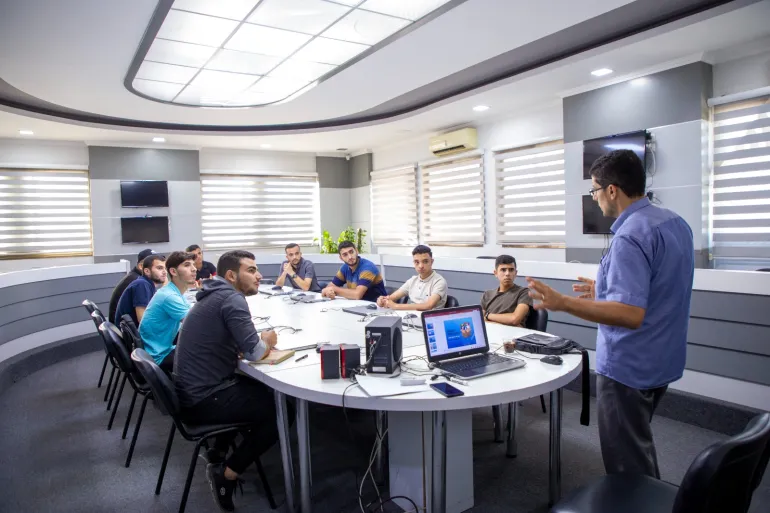
A view of a technology incubator in Gaza before the war, where students received training in technology and innovation [Iyad Al-Qatrawi/Al Jazeera]
“We have capabilities and aspirations that we want to develop, and we try to take advantage of every available opportunity for learning and training,” Hamza tells Al Jazeera.
Hamza hopes the skills that he and his cohort learn in class will benefit his community and provide new opportunities for young people in Gaza.
“The lack of devices and equipment doesn’t mean we’ll stop. It pushes us to look for solutions and make the most of the simple tools we have,” he said.
The challenges facing these students are part of a wider disruption to Gaza’s technology and innovation sector.
Before the war, Gaza had several incubators that supported technology projects and startups. Bahaa al-Masri, head of the training team for the Early Warning Systems and Robotics Project, said it provided a rare bit of hope for children and young adults in the besieged enclave.
“These incubators provided an environment for training and development. They helped innovators and entrepreneurs turn their ideas and projects into prototypes and ventures,” he told Al Jazeera.
The war severely damaged this ecosystem: training spaces were lost, equipment difficult to find, and students and innovators left with limited opportunities to experiment and develop their ideas.
A view of a technology incubator in Gaza prior to the war, which provided an environment for training, incubating tech projects, and supporting students in the fields of technology and innovation [Iyad Al-Qatrawi/Al Jazeera]
Although challenges remain, the trainers are continuing their mission of educating budding tech experts in Gaza.
“We have a generation of students who possess genuine passion and talent in technology and digital systems,” he told Al Jazeera. “They need the environment and tools to develop these abilities and turn their ideas into projects that can serve their community and their future.”
Education pays the price
The near-collapse of Gaza’s technology sector has coincided with the widespread destruction of the education system, with schools, universities and research facilities repeatedly targeted by Israel during the war.
Preliminary estimates from the Government Media Office in Gaza put direct losses to the education sector at approximately $4bn. Seventeen higher education institutions have been completely or partially destroyed since October 2023, preventing about 620,000 high school students and 90,000 university students from continuing their education.
Approximately 20,228 students and 830 teachers and educational staff have also been killed, along with 194 scientists, academics and researchers.
For students seeking to enter technical fields, the loss of such educational facilities and teachers means fewer opportunities to gain practical experience and hone their skills.
Before the war, the IT industry was one of the promising sectors of Gaza’s economy and a rare source of foreign income, said Ahmad Abu Qamar, an economic affairs specialist and board member of the Palestinian Economists Syndicate.
It was also an opportunity for employment for thousands of university graduates entering a job market with high unemployment, with roughly 80 percent of its economic activities directed towards foreign markets.
Abu Qamar estimates that the IT sector now runs at less than 25 percent of pre-war levels, while more than 70 percent of IT companies in Gaza have completely or partially halted operations.
But even if a company’s offices or equipment survived the war on Gaza, damage to digital infrastructure has also made it difficult for companies to continue functioning.
Prices of some technical equipment – including computers, mobile devices, servers, routers, fibre-optic lines, and cabling – used in the industry have increased by more than 600 percent due to the difficulties of importing devices during Israel’s ongoing siege on the enclave.
According to his estimates, about 30,000 IT professionals have lost their jobs since the war began. General unemployment is at nearly 80 percent and poverty at more than 90 percent in the enclave.
UCAS Technology Incubator, one of the most prominent incubators of the University College of Applied Sciences in Gaza, was destroyed during the war, as part of extensive damage to the institutions and structure of the technology and digitisation sector in the Strip [Iyad Al-Qatrawi/Al Jazeera]
Brain drain
A severe shortage of vital IT equipment – such as storage devices, routers, and laptops – has been compounded by the destruction of supporting internet and electricity infrastructure, including primary and secondary networks, according to technology and digital economy expert Abdullah Altahrawi with the UCAS Technology Incubator. This makes the task of rebuilding Gaza’s IT sector an even bigger challenge than before the war, particularly with Israel’s more crippling siege on Gaza.
“The repercussions have extended to dealings with foreign markets, including the purchase of servers and electronic services, the management of digital accounts, the use of cards and e-commerce,” Altahrawi said.
Before the war, Gaza’s five main incubators provided training, mentoring, workspaces and support for tech startups. Perhaps most crucially, it also gave students a place to develop their skills, connect with foreign markets, and find job opportunities.
Just two incubators – the UCAS Technology Incubator, affiliated with the University College of Applied Sciences, and the Ma’an Center for Innovation and Entrepreneurship Incubator, have resumed operations since the October 2025 ceasefire. But their capacity has not managed to exceed 20 percent of pre-2023 levels.
Due to the damage caused by three years of Israeli bombing and a shortage of real estate, just 1 percent of technology companies now have offices, while only 10 percent of business incubators have an operational office space.
Companies looking to rebuild and universities ready to teach a new cohort of tech students have also been hit by a brain drain in the sector, severely hindering development and innovation.
“More than 80 percent of highly skilled and experienced professionals in the technology and digital fields have left the Gaza Strip,” Altahrawi said. “Gaza’s future is inseparable from its ability to restore and develop its technology sector.”
Man United have won only one league game this season, leaving Michael Carrick under pressure ahead of Fulham trip.
Published On 19 Sep 202619 Sep 2026
Who: Fulham vs Manchester United What: English Premier League Where: Craven Cottage, London in United Kingdom When: Sunday, September 20, at 4:30pm (15:30 GMT) How to follow: Al Jazeera Sport will have all the build-up to our live text commentary stream from 12:30 GMT.
One month into the new Premier League season, excuses about bedding-in processes and newly assembled squads needing time to gel are wearing thin and for Manchester United there is an acute sense of urgency as the international break looms.
Recommended Stories
list of 4 itemsend of list
United are by no means the only ‘big club’ enduring a faltering start to the campaign but after so much pre-season optimism, the spotlight has fallen very much on manager Michael Carrick ahead of Sunday’s trip to Fulham.
Al Jazeera takes a closer look at the game:
How have Manchester United started the new season?
United have lost three of their six matches in all competitions and suffered a damaging League Cup exit on Wednesday, surrendering a 2-0 lead to Brighton & Hove Albion.
Their only win in four league games came at home to promoted Ipswich Town.
United started the better in the VAR-dominated Manchester derby last Sunday, but played second fiddle to the away team after City were reduced to ten men.
How have Fulham started the new season?
The London club have made a slow start under new manager Alvaro Arbeloa and are yet to win in the league.
A draw at Liverpool last week and a League Cup win at West Ham United in midweek offered glimpses of better things to come.
What has Carrick said about United’s start to the season?
Carrick accepted responsibility for the team’s poor start but said the focus must remain on finding solutions rather than assigning blame.
“It’s my responsibility and I’m fine with that. It’s not a blame game. Blame me, no problem, but it’s not about blaming people,” said the 45-year-old boss.
“It’s about finding solutions. It’s a whole collective thing. It’s about what you focus on. I know where we want to get to and we want to get there fast.”
What happened the last time Fulham played Man Utd?
United won 3-2 in their last meeting which came in the Premier League at Old Trafford on February 1.
Casemiro and Matheus Cunha put United two up before a chaotic finale that saw Raul Jiminez net an 85th minute penalty for the Londoners before Benjamin Sesko and Kevin traded injury time strikes.
What happened between Fulham and Man Utd at Craven Cottage last season?
The teams shared a 1-1 draw in the Premier League match. Emile Smith Rowe’s 73rd minute goal levelled matters after Rodrigo Muniz put through his own net in the 58th minute.
When did Fulham last beat Manchester United?
Fulham won 2-1 at Old Trafford in the Premier League on February 24, 2024. Harry Maguire appeared to have sealed a point for United in the 90th minute when he cancelled out Calvin Bassey’s 65th minute goal, but Alex Iwobi got Fulham’s winner in injury time.
United have won three of the five meetings since then.
When did Fulham last beat Man Utd at Craven Cottage?
Fulham have not recorded a home win against United since December 2009. Danny Murphy, Bobby Zamora and Damien Duff sealing a 3-0 home win.
Of the 10 matches since then, United have won nine, scoring 21 and conceding six.
Prediction: Fulham vs Manchester United
Opta’s supercomputer has given Manchester United a 47.4 percent chance of winning, while offering Fulham only a 28.3 percent chance of victory.
Head-to-head: Fulham vs Manchester United
This will be their 94th meeting, with Manchester United winning 59 of the encounters and Fulham 14.
Fulham team news
Kenny Tete misses out due to concussion at Anfield last week.
Tom Cairney is also absent with a knee injury, but Ryan Sessegnon will have a late fitness test as he returns from a groin problem.
Justice minister condemns ‘Hitler salutes, antisemitic slogans, violence’ at the anti-immigration rally.
Published On 19 Sep 202619 Sep 2026
Dutch riot police have intervened at a protest against immigration and asylum policies after about 500 far-right demonstrators pelted them with projectiles and fireworks .
Police used baton charges and dogs to break up the demonstration in The Hague on Saturday, reported the AFP news agency.
Recommended Stories
list of 4 itemsend of list
Local authorities said the demonstration was ended because of continued violence, and protesters were escorted away from Malieveld park in the city centre.
Police said they arrested 24 people and deployed water cannon to disperse the rioters. Further investigations were underway, they added.
Prime Minister Rob Jetten said on X that the demonstrators deliberately sought confrontation with the police and chanted “abhorrent” far-right and antisemitic slogans
Justice Minister David van Weel condemned the violent scenes and slogans.
“Identical images from the Malieveld. Hitler salutes, antisemitic slogans, violence against the police and throwing fireworks at the riot squad,” he posted on X. “It is important that hardline action is taken against this.”
He also thanked police officers for helping to maintain the democratic rule of law.
The “Wij zijn het volk” rally, which translates to “We are the people”, was organised to protest against government policies in the Netherlands’, specifically on immigration.
The protesters had planned to march through The Hague, but local authorities banned it when violence began and ordered the demonstration to be broken up.
The Prince’s flag with the symbol of the Dutch East India Company during the far-right demonstration in The Hague on Saturday [Nicolas Economou/Reuters]
Someone at the rally was seen giving a Hitler salute, while a truck serving as a stage displayed a screen reading “The Netherlands is for the Dutch,” according to the country’s largest national news agency, Algemeen Nederlands Persbureau (ANP).
Protester Thijs Jansen, a 31-year-old mechanic, told AFP: “We’re losing our country. We’re literally losing our country to mass migration”.
A police car was then set on fire in clashes between black-clad protesters and police, as the headquarters of the centrist D66 party were attacked. Its leader, Rob Jetten, is now prime minister.
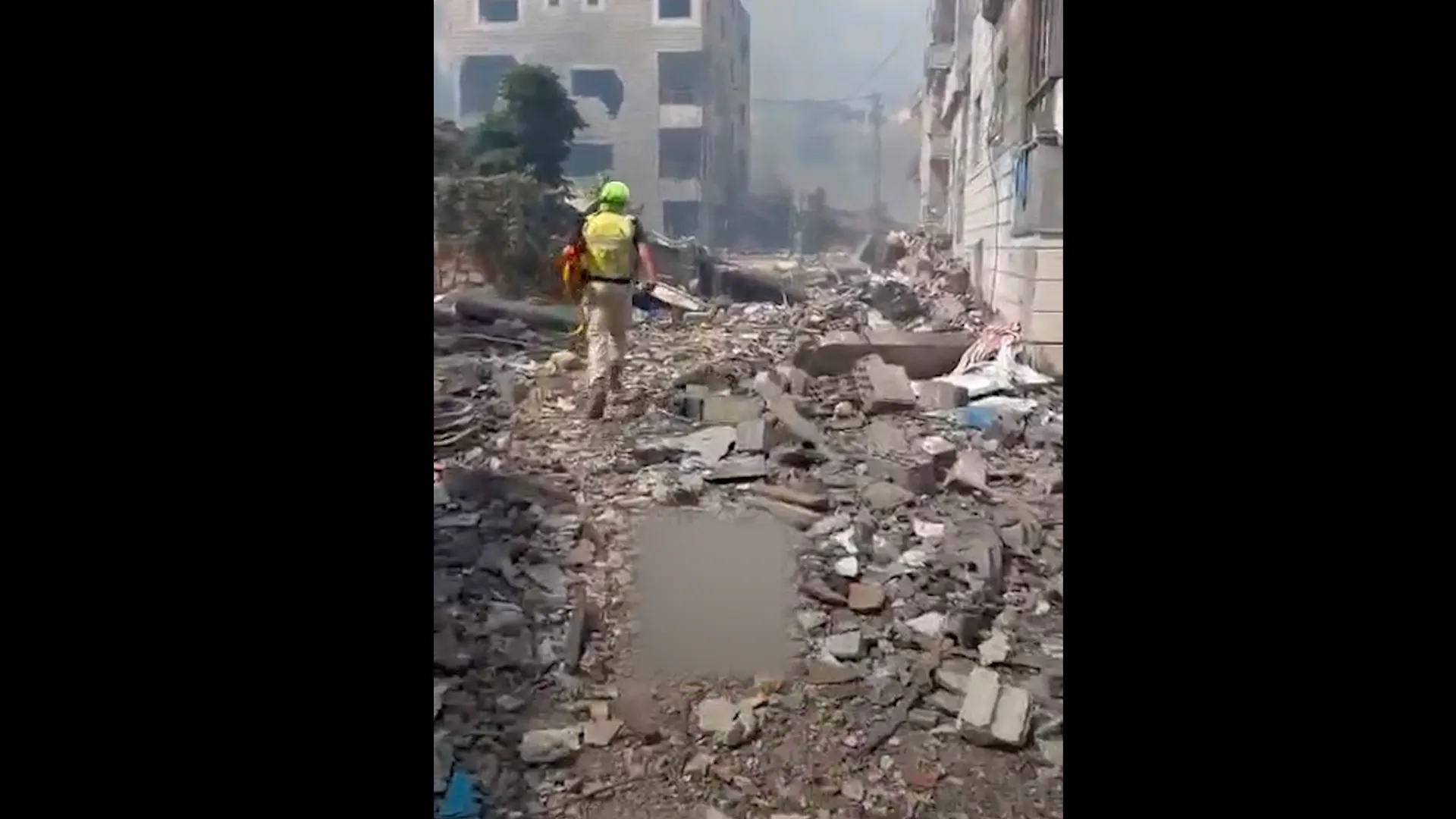
Two back-to-back Israeli air strikes hit Lebanon’s southern city of Nabatieh, while a third strike targeted an ambulance team responding to the attacks. At least 4,386 people have been killed and 12,400 injured since 2 March, when the current Israel-Hezbollah war began.
Reporters from CNN, MS NOW, and Politico were denied access to White House after Trump calls news outlets ‘fake news’.
Journalists from CNN, MS NOW and Politico have been barred from entering the White House and have had their press credentials deactivated or confiscated, as United States President Donald Trump’s ban on the three news organisations took effect.
Journalists were turned away from the grounds on Saturday after Trump announced on Friday that CNN, MS NOW and Politico would be barred from the White House, accusing the outlets of reporting what he called “fake news”. Trump has said other outlets could also face bans.
Recommended Stories
list of 3 itemsend of list
CNN White House reporter Betsy Klein and MS NOW White House correspondent Akayla Gardner both reported on air that they had been denied access. Gardner said an officer confiscated her badge after telling her it had been disabled and that the decision was “above him”. An MS NOW photographer also had their badge disabled, she said.
Politico reporter Cheyenne Haslett was subsequently turned away, with Politico saying the Secret Service denied her entry and confiscated her White House access pass.
“A few minutes ago, our colleague Cheyenne Haslett attempted to enter the White House to do her job as a POLITICO reporter,” the news organisation said. “Secret Service denied her entry to the complex and confiscated the pass that allows her access to the White House.”
“We stand by her and all reporters here covering the White House,” Politico added. “As we said yesterday, we will vigorously defend our First Amendment rights.”
“The White House belongs to the American people and the decisions made inside are funded by our tax dollars,” MS NOW said in a statement. “MS NOW intends to take any and all steps necessary to defend our First Amendment rights and the essential role of independent journalism in our democracy.”’
CNN media analyst Brian Stelter called the move “a direct threat to press freedom in the United States”.
“It’s so much bigger than CNN,” Stelter said. “This is a free speech test in America.”
The White House Correspondents’ Association said Trump had described “his own planned action as a ‘ban on the free press’”, and said constitutional press protections do not depend on whether a president approves of a news organisation’s coverage.
The ban is the latest in a series of confrontations Trump has had with news organisations during his first and second term.
In 2025, his administration restricted Associated Press access to the Oval Office and presidential travel after the agency declined to adopt the administration’s preferred name, “Gulf of America”, for the Gulf of Mexico. That case remains ongoing.
A key precedent is a 1977 federal appeals court ruling, Sherrill v Knight. The court found that once the White House establishes press facilities for credentialed journalists, access cannot be denied arbitrarily or for less than compelling reasons. It also said journalists denied credentials must receive notice of the factual basis, an opportunity to respond, and a final written explanation.
It is not yet clear what legal recourse CNN, MS NOW or Politico may pursue, or how courts would apply Sherrill to the administration’s decision to revoke existing credentials.
Al Jazeera’s Alan Fisher reported from Washington, DC, on Friday that Trump’s ban will likely be challenged soon.
“The United States has the First Amendment [of its Constitution] that says the government cannot restrict access to this sort of thing,” he said.
Press freedom advocates are watching closely.
Jameel Jaffer, executive director of the Knight First Amendment Institute at Columbia University, said in a news release that the move raises constitutional concerns.
“If President Trump means to expel these news organizations from the White House press pool, his action is doubly unconstitutional because the press pool is a ‘public forum’ under the First Amendment, which means the president can’t exclude journalists from it on the basis of their viewpoints,” Jaffer said.
The fight over access could now become a broader test of the limits on the White House’s ability to control which journalists can cover the administration.
“It’s difficult to imagine a more blatant violation of the First Amendment than Trump banning news outlets from the People’s House for criticizing the government,” said Seth Stern, chief of advocacy at the Freedom of the Press Foundation. “It’s also hard to imagine a dumber move.”
Arsenal in shock 3-0 loss at Brighton to lose top spot in the Premier League on goal difference to Manchester City.
Published On 19 Sep 202619 Sep 2026
Arsenal slumped to a first loss in their Premier League title defence – and it was a heavy one at Brighton.
After four straight wins for the champions, the 3-0 defeat at the Amex Stadium on Saturday came out of nowhere. Conceding the third goal from a corner — typically an area of strength for Arsenal – summed up an unusually sloppy performance from Mikel Arteta’s team.
Pascal Gross and Charalampos Kostoulas scored in the first half with shots from outside the penalty area, before Chema Andres completed the win with a header at the back post from Gross’s corner.
The victory will have been especially sweet for Brighton manager Fabian Hurzeler, who said “only one team tried to play football” after his team’s narrow home loss to Arsenal last season.
Arsenal have often struggled against Brighton, which was the last team to inflict such a heavy defeat on the Gunners in any competition — winning 3-0 at Emirates Stadium in May 2023.
It completed a brilliant week for Brighton, after beating Coventry 5-0 in the league last weekend and coming from two goals down in midweek to beat Manchester United 3-2 away in the English League Cup.
Manchester City — the other team to win their first four games — can now move three points clear in the standings by beating Sunderland on Sunday.
It’s the first official day back to school for Gaza’s children, but whether they’ll make it home alive is their parents’ biggest concern. Meanwhile, Israeli settlers and soldiers continue pogroms across the occupied West Bank.
Unai Emery’s side get first league win of season with goals from Johan Manzambi, Nicolas Jackson and Emi Buendia.
Published On 19 Sep 202619 Sep 2026
48he end to Tottenham’s Premier League goal drought came too late as Aston Villa won 3-2 in north London to compound a miserable start for Roberto De Zerbi’s men.
Spurs remain without a league win this season and only netted their first goals of the campaign after the visitors had surged into a 3-0 lead on Saturday.
Villa had also struggled for goals themselves since the side that won the Europa League last season was torn apart during the transfer window.
But new signings Johan Manzambi and Nicolas Jackson struck either side of half-time to give Unai Emery’s new-look team their first league win before Emi Buendia’s wonder strike.
Even Tottenham’s first late consolation needed the aid of a Villa deflection when Conor Gallagher’s effort went in off Matty Cash before Jan Paul van Hecke headed home in stoppage time.
Spurs splashed out more than 300 million pounds ($400m) on new players to try and avoid a repeat of the battle for survival they endured last season.
Yet there remains little return on that investment.
In keeping with recent performances, Spurs started brightly before fizzling out.
Twice in a matter of seconds, Savio was kept out by Suzuki before the Japanese goalkeeper spread himself to turn behind Archie Gray’s powerful strike.
Villa had picked up just one point from their opening four league games but have missed their club record signing Manzambi for most of that period.
The Swiss international opened his Villa account when he tapped home Boubacar Kamara’s cross.
However, Tottenham will protest about new laws that force a player off the field for at least a minute after receiving treatment for an injury.
A head knock to centre-back Micky Van de Ven left them a man down at the back when Manzambi swept home.
Spurs only had themselves to blame for the second goal as van Hecke failed to deal with a long ball straight down the middle.
Jackson did well to evade the Dutch defender and then fired down into the ground and past Antonin Kinsky.
The Czech goalkeeper was powerless to stop Villa’s third 11 minutes from time when Buendia took aim from long range and brilliantly picked out the top corner.
A chorus of boos greeted Buendia’s strike as thousands of home fans headed for an early exit.
But those that left missed finally have something to celebrate.
Fine persistence from Mohammed Kudus teed up Gallagher to find the bottom corner via the outstretched foot of Cash.
Van Hecke then bulleted in from Andy Robertson’s free-kick with virtually the last touch of the game.
Spurs now must stew on another defeat for a three-week international break while rooted in the relegation zone.
Villa, by contrast, will hope victory can prove the catalyst to storm up the table as they did last season.
Emery’s men failed to win any of their first five league games a year ago, but ultimately finished fourth.
Tehran, Iran – Hossein, a 32-year-old marketing specialist based in Tehran, has been thinking of replacing his 13-year-old Iranian-made car with a newer model.
Even though he earns about four-and-a-half times the minimum wage after a recent pay rise – his salary is now close to 900 million rials (about $390 at the current exchange rate) – imported vehicles are not even remotely affordable for him.
Recommended Stories
list of 4 itemsend of list
Even finding a locally made car might be out of his budget, with an economic crisis gripping the country since the United States and Israel launched a surprise war on Iran on February 28 and later enacted a crippling siege and sanctions on the country.
“I’m losing hope of ever being able to buy a new domestic production car too, unless the country opens up and becomes a bit more normal again,” Hossein, who asked to keep his full name confidential for security reasons, told Al Jazeera.
His old manual Peugeot 206 model, an originally French-made car but now produced domestically after foreign counterparts left Iran due to sanctions, can fetch up to 10 billion rials ($4,350) if he sells it towards making a new purchase. However, his replacement options are limited.
Upgrading to a slightly improved Peugeot 207 with an automatic gearbox could cost him 28 billion rials ($12,170) now. This means that, after selling his car, he would need more than 20 months of his entire salary.
A domestic sedan Shahin model costs more than 31 billion rials ($13,480), and a crossover Reera is priced at more than 43 billion rials ($18,700).
With these options, he would need to save about 24 months and 37 months of his whole salary, respectively, and that is if prices remain stable and he does not spend a rial on anything else. But the reality of the fast-rising living costs and lagging incomes in Iran means he can barely put aside any money, let alone afford a new car.
Domestic car prices have mostly risen 40 to 80 percent since the start of the war, while some vehicles sell for more than 130 percent of their September 2025 costs.
The costs of maintaining the vehicles are also rising much faster than people’s salaries. Domestically produced tyres, motor oil, brake pads and clutch kits have at least doubled since last year, with some car parts having more than tripled in price.
Domestic vehicles have generally low safety standards, meaning that they contribute to staggering road accident deaths. At least 1,609 Iranians have been killed so far on intercity roads in the current month of Shahrivar of the solar Hijri calendar, which ends on September 22. More than 20,000 people lose their lives on the roads every year. In comparison, fewer people in the whole of the European Union, nearly five times Iran’s population, died on roads last year.
Iran’s fuel-guzzling cars also contribute to smoke-congested city streets, degrade vehicles faster and increase fuel costs, just as petrol prices have risen for users.
How did we get here?
Experts say, due to a combination of protected state-linked businesses, privileged access, economic isolation and a curtailing of imports, Iranian households have no choice but to pay exorbitant prices – compared with their salaries – to buy low-quality cars.
The damage from the war, including the extensive bombing of multiple steel giants by Israel and the US, has only added insult to injury. The naval blockade of Iran’s southern ports has prevented goods coming in from popular neighbouring markets like the United Arab Emirates.
Under such circumstances, domestic vehicle manufacturers have little incentive to improve.
End customers are also beset by government charges, currency and financing costs, margins levied by murky intermediaries – and in numerous documented cases, industry corruption.
“People are forced to buy expensive low-quality cars whose real prices should be a quarter of global prices, and this is a direct harm done to them,” Mohammad Rashidi, a member of the presiding board of Iran’s parliament, told local media on Saturday. “The traces of a mafia system are visible throughout the process.”
His claims echo those of other officials and state-linked media, who have openly described the industry as resembling an organised crime operation.
According to the latest figures released by state media, about 233,000 cars were manufactured or assembled in Iran in the first five months of 2026, compared with 366,000 the year before. Only about 25,000 vehicles were imported in that period.
Only a handful of state-linked companies or intermediaries are allowed to import vehicles, with duties plus value-added tax increasing final prices up to 200 percent.
The government and parliament have discussed lowering import tariffs this year, with no agreement announced so far.
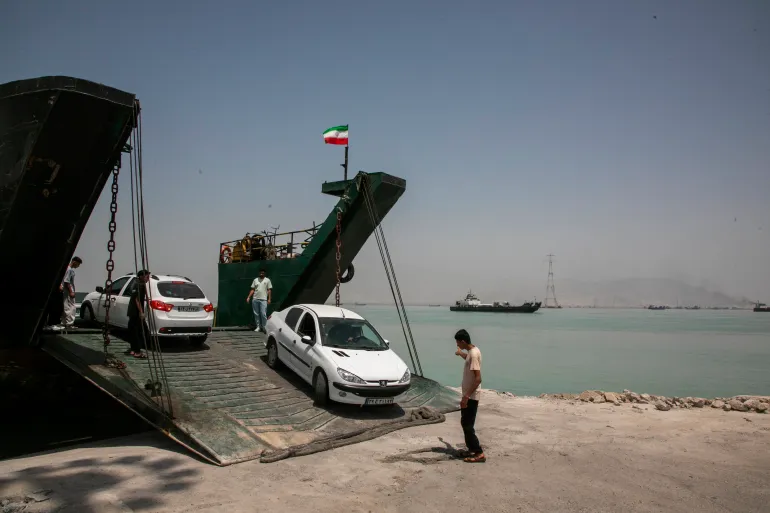
Cars leave a ferry as ships remain anchored on May 16, 2026 in the Strait of Hormuz near Larak Island, Iran [File: Majid Saeedi/Getty Images]
The premiums are more visible for high-end cars, with a 2026 Toyota Land Cruiser VXR going for approximately 660 billion rials ($287,000) in Iran at the moment, while the same model is available for about $86,000 in the UAE. The same story applies to most other models, at different rates depending on the rarity of the vehicle and the availability of parts.
The price of a mid-range Chinese-designed SUV sold as Exeed VX in international markets is listed at about $32,000 in China, while it is priced at about $42,000 in the UAE. The same car, assembled from imported parts by a state-linked company in Iran under a different name, currently costs Iranian customers the equivalent of $53,000.
The bizarre situation was on full display during a three-day “international” car exhibition in Tehran last week that mostly featured Chinese-manufactured vehicles. These remain available in Iran despite the US sanctions, since Tehran exports almost all of its oil to China and barters this for goods, including cars.
Some domestic manufacturers and importers were absent, either because they had no products to offer or because they had angry customers who registered months ago to get vehicles they never received. Spare parts for some of the vehicles on display are currently either not available in the Iranian market or cost several times their price in international markets.
Even the cheapest vehicles offered at the exhibition were completely unaffordable to the average Iranian. It would take a worker on the minimum wage with standard allowances 50 years to buy an XPENG G9, a Chinese-made electric SUV priced at 120 billion rials ($52,150), on his or her salary, without spending a rial on food, housing or clothing.
Still, there were huge queues outside the exhibition centre each of the three days.
“It was sad because most people just came to take pictures with the cars they knew they could never afford,” a young man who attended the exhibition told Al Jazeera. “The doors of the cars were locked too.”
Asia’s biggest sport stars will descend on Japan this week to battle it out for continental glory as the Asian Games get under way.
Aichi-Nagoya 2026 will see several athletes eyeing first-time podium finishes while others look to defend their crown.
Recommended Stories
list of 4 itemsend of list
This year’s edition will see six sports make their debut, while in some sports, a gold medal will double as automatic qualification for the LA 2028 Olympics.
From Olympic champions to teen sensations to breakout stars, Al Jazeera Sport takes a look at some of the top athletes to watch:
Alex Eala, Philippines — tennis
Tennis’s newest sweetheart will be the favourite for gold in women’s singles. The 21-year-old Filipino star is coming off a career-high season that saw her first WTA 1000 title last month and a third-round finish at the US Open.
Eala will compete at the Singapore Open just before the games, but will skip the concurrent Beijing Open – regardless of whether the WTA decide to punish her – since a gold medal at the Asian Games serves as automatic qualification for the LA 2028 Olympics.
Defending champion Zheng Qinwen and former world number one Naomi Osaka will not be competing in Japan, leaving it wide open for Eala to claim gold and upgrade from the bronze she won in 2022.
Eala acknowledges the crowd after defeating Mary Stoiana in the first round of the US Open in New York [Adam Hunger/AP Photo]
Rumesh Pathirage, Sri Lanka — javelin
The javelin phenom has been collecting gold medals like Pokemon cards this year, and another one at the Asian Games will add to his Diamond League, Commonwealth, and Ultimate Champion crowns.
But gold is not the biggest prize for the 23-year-old, although it is almost guaranteed after his nearest contender, India’s Neeraj Chopra, withdrew with injury. Pathirage is eyeing the Asian record of 92.97m set by Arshad Nadeem at the Paris 2024 Olympics, which he is poised to break after becoming the only thrower this season to breach 92m twice.
Pakistan’s Nadeem, on the other hand, is far from fit and will be lucky to end his season with a medal after a string of subpar throws.
Pathirage celebrates with the trophy after his victory in men’s javelin at the World Athletics Ultimate Championship in Budapest on September 13, 2026 [Ben Stansall/AFP]
Haruka Kitaguchi, Japan — javelin
Home favourite Kitaguchi is eyeing gold in the women’s javelin after being crowned Ultimate Champion in Budapest last week. Her 68.92m throw landed her a new national record and is tied for 10th-best in the world and second-best this season.
Surprisingly, the 28-year-old is making her Asian Games debut and will look to add continental gold in front of the home crowd after floundering at last year’s World Athletics Championships in Tokyo.
Yan Ziyi, China — javelin
Another javelin powerhouse to watch is world number one Yan Ziyi. She became only the sixth woman in history to surpass the 70m mark with her 71.74m throw in May that became a new Asian and World Under-20 record.
The Chinese teen sensation was unbeaten throughout the five Diamond League competitions she contested, but finished second to Kitaguchi at the Ultimate Championship after withdrawing with injury after one throw.
Should she recover in time, the 18-year-old can snatch back the crown from the Japanese veteran thrower to end the season on a high note.
Yan Ziyi heads to the Asian Games as world number one in the women’s javelin throw [Lintao Zhang/Getty Images/File]
Vaibhav Sooryavanshi, India — cricket
As India look to defend their men’s cricket crown, all eyes are on 15-year-old Sooryavanshi to produce another phenomenal result on the pitch.
India’s Vaibhav Sooryavanshi in action at the third India v England T20I in Nottingham [Andrew Boyers/Reuters]
Pan Zhanle, China — swimming
The Olympic champion returns to the stomping grounds where he first went sub-47 seconds in the men’s 100m freestyle – and became the first Asian male to do so – to break his own Asian record.
It was also on home soil at the Hangzhou 2022 games that he bagged a silver in the 200m and 400m freestyle, a bronze in the 50m, and a gold in the men’s 4x100m freestyle relay and 4x100m medley relay.
Pan Zhanle celebrates after winning the men’s 100m freestyle final at the 2024 Summer Olympics [Petr David Josek/AP Photo]
Yu Zidi, China — swimming
The Chinese prodigy was only 12 when she made waves as the youngest-ever medallist at the 2025 World Swimming Championships. She narrowly missed a podium finish in her individual events but found redemption at the Chinese National Swimming Championships later that year with two golds, one silver, and an Asian record in the 200m Individual Medley.
Now 13, she is looking to dominate at her first, hopefully of many, Asian Games where she’s entered in the 200m IM, 400m IM and 200m butterfly events, alongside relays.
While training with the China team in Beijing, she told local media this month she was “excited” for her Asian Games debut.
“Train well, don’t slack off. Demonstrate the level of your training and work hard to break past yourself,” she said, according to state news agency Xinhua.
Yu Zidi of China competes in the Women’s 200m individual medley final at the China Open Swimming Championship in Shenzhen, China on March 22, 2026 [Lintao Zhang/Getty]
101 East meets innovators across East Asia using digital technology to transform how we grieve those we love.
East Asia is facing a demographic reckoning, with societies in Japan, South Korea and Taiwan ageing rapidly.
With a drastic shortage of burial space, a lucrative new market is emerging.
From AI avatars to DNA gems, technology is bringing loved ones back to life – in digital forms – raising questions about whether it will help heal or hinder the grieving process.
101 East investigates how new technology is transforming the way we bid farewell to those we love.
Houston Texans’ linebacker Azeez Al-Shaair has spoken to sports journalists about his $11,941 fine by the NFL for wearing the name of Palestinian child Hind Rajab, who was killed by Israeli forces in Gaza, on his eye black during a game.
The United Nations General Assembly will allow Palestinian President Mahmoud Abbas to address via a prerecorded video.
Published On 19 Sep 202619 Sep 2026
The European Union says it regrets the denial of visas by the United States for the second year running to Palestinian Authority (PA) officials seeking to attend the United Nations General Assembly (UNGA) in New York, urging it to reconsider the decision.
The statement on Saturday comes just days after the UNGA voted to allow Palestinian President Mahmoud Abbas to address the body during the upcoming 81st session via a prerecorded statement.
Recommended Stories
list of 3 itemsend of list
“In light of its existing headquarters agreements with the UN and its obligations as host state, we urge the United States for this decision to be reconsidered,” said Anouar El Anouni, a spokesman for the EU’s diplomatic service.
On Friday, UN Secretary-General Antonio Guterres also expressed regret at Washington’s decision, adding he was concerned about its impact “on the ability of the State of Palestine to participate fully in the work of the United Nations”.
The US Department of State announced on Wednesday that it would prolong visa sanctions on officials of the PA and members of the Palestine Liberation Organization (PLO).
“As a consequence of their failure to reform, contrary to their commitments to the United States, and their ongoing activities that undermine the prospects for peace, the United States will extend sanctions that deny visas to PLO members and PA officials,” the State Department said in a statement.
The department accused the PA of violating US law by bypassing direct negotiations to seek international recognition of Palestinian statehood.
It also cited the PA’s decision to take its dispute with Israel to international courts and its financial support for people the US and Israel label as convicted attackers and their families.
No Israeli officials face equivalent US travel restrictions, despite an International Criminal Court arrest warrant issued against Israeli Prime Minister Benjamin Netanyahu over alleged war crimes in Gaza.
Abbas’s address this year is expected to push for international recognition of Palestinian statehood and revive momentum for a two-state solution, building on a wave of formal recognitions by the United Kingdom, France, Canada and other Western nations last year.
His speech will also highlight the severe humanitarian crisis in Gaza alongside the rapid growth of illegal Israeli settlements and settler pogroms across the occupied West Bank.
Palestine’s Ministry of Foreign Affairs and Expatriates welcomed the UN resolution passed on Thursday allowing Abbas to address the assembly next week, saying it “represents a breaking of the attempt to prevent Palestine’s participation” in the UNGA’s annual session.
The Iranian lender has faced years of Western sanctions over alleged ties to Tehran’s nuclear programme.
Published On 19 Sep 202619 Sep 2026
Turkiye’s banking watchdog has revoked the operating licence of Iranian lender Bank Mellat’s branch in the Turkish city of Istanbul.
“It has been decided to revoke the operating licence of Bank Mellat, Head Office in Tehran, Istanbul Turkey Central Branch,” read the decision by the Banking Regulation and Supervision Agency (BDDK), published in the Official Gazette on Saturday.
Recommended Stories
list of 3 itemsend of list
The regulator said the decision was taken under a clause of Turkiye’s banking law allowing a bank’s licence to be revoked or withdrawn if its continued operation is deemed to pose a risk to depositors’ rights or to the security and stability of the financial system.
Bank Mellat has been subject to Western sanctions for years over accusations that Tehran was pursuing a nuclear weapon under the cover of a civil nuclear programme.
Those sanctions were lifted as part of a landmark 2015 deal between Tehran and world powers to curb Iran’s nuclear ambitions. However, the United States unilaterally pulled out of the agreement in May 2018, reimposing economic sanctions on the country.
Bank Mellat was hit by further US and Gulf sanctions in 2019 after being named as one of 25 entities linked to Iran’s Islamic Revolutionary Guard Corps (IRGC).
The Turkish notice did not cite the US measures or specify operational issues.
Earlier this month, the US Treasury Department imposed sanctions on a small Turkish investment bank and two subsidiaries over alleged ties to Iran.
The Treasury Department accused Golden Global Yatirim Bankasi Anonim Sirketi (Golden Global Bank) of facilitating “tens of millions of dollars’ worth of transactions for the Islamic Revolutionary Guard Corps-Qods Force” and providing the Iranian government with banking access to move its funds internationally.



![The PJD is campaigning on public services, jobs, purchasing power and political reform as it seeks to rebuild after its 2021 electoral collapse [Abdel Majid BZIOUAT / AFP]](https://i0.wp.com/occasionaldigest.com/wp-content/uploads/2026/09/AFP__20260912__C84F3GR__v1__MidRes__MoroccoPoliticsElection-1789565328.jpg?w=640&ssl=1)





![A view of a technology incubator in Gaza before the war, where students received training in technology and innovation [Iyad Al-Qatrawi/Al Jazeera]](https://i0.wp.com/occasionaldigest.com/wp-content/uploads/2026/09/1-1789814125.jpeg?w=640&ssl=1)
![A view of a technology incubator in Gaza prior to the war, which provided an environment for training, incubating tech projects, and supporting students in the fields of technology and innovation [Iyad Al-Qatrawi/ Al Jazeera]](https://i0.wp.com/occasionaldigest.com/wp-content/uploads/2026/09/3-1789814366.jpeg?w=640&ssl=1)
![UCAS Technology Incubator, one of the most prominent incubators of the University College of Applied Sciences in Gaza, after its destruction during the war, as part of extensive damage to the institutions and structure of the technology and digitization sector in the Strip [Iyad Al-Qatrawi/Al Jazeera]](https://i0.wp.com/occasionaldigest.com/wp-content/uploads/2026/09/2-1-1789814285.jpg?w=640&ssl=1)