top news

Court chiefs voice regret over judicial reform bills

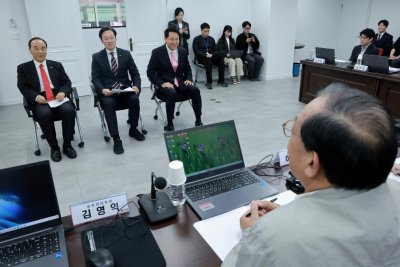
Park Young-jae (C), head of the National Court Administration, and justices salute the national flag during a meeting with chiefs of district and appellate courts nationwide at the top court in Seoul, South Korea, 25 February 2026. Park said that the opinions of the judiciary should be reflected in deliberations for controversial judicial reform bills pushed by the ruling Democratic Party (DP), after three DP-led bills were met by strong opposition from the judiciary. Photo by YONHAP / EPA

Feb. 25 (Asia Today) — Senior judges from courts across South Korea expressed “serious regret” Tuesday over a package of judicial reform bills advanced by the ruling party, warning of potential side effects and calling for broader consultation.

At an extraordinary meeting held at the Supreme Court in Seoul, court presidents reviewed the so-called three judicial reform bills – which include creating a new offense of “distortion of law,” introducing a constitutional complaint system against court rulings and expanding the number of Supreme Court justices.

The meeting was led by Court Administration Chief Park Young-jae and attended by chief judges from courts nationwide.

In a joint statement, the judges said fundamental changes to the judicial system could produce irreversible and significant consequences and should be subject to in-depth discussion through a consultative body that includes multiple institutions and experts.

Regarding the proposed “distortion of law” offense, the judges said the elements of the crime remain abstract even under a revised draft and warned that the scope of punishment could be overly broad. They cautioned that the measure could lead to a surge in complaints and accusations against judges, potentially undermining the swift administration of justice and the protection of citizens’ fundamental rights.

On the proposed constitutional complaint system against court rulings, the court presidents said it could delay the finality of judgments and subject litigants to repeated proceedings.

While acknowledging the need to increase the number of justices at the Supreme Court of Korea, the judges said adding a large number in a short period could weaken trial quality. They suggested first expanding the bench by four justices and reviewing the impact before considering further increases.

In opening remarks, Park said the bills would significantly affect the judiciary’s core role in safeguarding constitutional order and citizens’ rights and stressed that the courts’ views should be reflected in the legislative process.

— Reported by Asia Today; translated by UPI

© Asia Today. Unauthorized reproduction or redistribution prohibited.

Original Korean report: https://www.asiatoday.co.kr/kn/view.php?key=20260225010007747

Source link

Former US F-35 fighter pilot arrested for training Chinese air force | Military News

US Justice Department accuses former Air Force officer Gerald Brown of training Chinese military pilots.

A former United States Air Force officer and “elite fighter pilot” has been arrested and accused of betraying his country for illegally providing training to Chinese military pilots.

The US Department of Justice said ex-Air Force Major Gerald Brown, once known by his pilot’s call sign “Runner”, was arrested on Wednesday in Indiana and charged with a criminal complaint for providing and conspiring to provide defence services to Chinese pilots without authorisation.

Recommended Stories

list of 4 itemsend of list

Brown, 65, a former F-35 Lightning II instructor pilot with decades of experience in the Air Force, “allegedly betrayed his country by training Chinese pilots to fight against those he swore to protect”, Roman Rozhavsky, assistant director at the FBI’s Counterintelligence and Espionage Division, said in a statement.

“The Chinese government continues to exploit the expertise of current and former members of the US armed forces to modernise China’s military capabilities. This arrest serves as a warning,” Rozhavsky said.

US Attorney Jeanine Ferris Pirro for the District of Columbia said Brown “and anyone conspiring against our Nation” will be held accountable for their actions.

According to the Justice Department, Brown served in the US Air Force for 24 years, had led combat missions and was responsible for commanding “sensitive units”, including those involved in nuclear weapons delivery systems.

After leaving the US military in 1996, Brown worked as a commercial cargo pilot before working as a defence contractor training US pilots to fly F-35 and A-10 warplanes.

Brown is alleged to have travelled to China in December 2023 to begin his work training Chinese pilots, and he remained in the country until returning to the US in early February 2026.

His contract to train Chinese pilots was negotiated by Stephen Su Bin, a Chinese national who in 2016 pleaded guilty and was sentenced to four years in prison for conspiring to hack a defence contractor in the US to steal military secrets for China, according to the Justice Department.

The department said Brown faces charges similar to those levelled against former US Marine Corps pilot Daniel Duggan, who was arrested in Australia in 2022 and is currently fighting his extradition back to the US, where he faces prosecution for violating the US Arms Export Control Act for providing pilot training to the Chinese armed forces.

Duggan appeared in an Australian court in October 2025 to appeal against his extradition, which was approved in December 2024 by Australia’s then Attorney General Mark Dreyfus.

Duggan, 57, a naturalised Australian citizen, was arrested by Australian police in 2022 shortly after returning from China, where he had lived since 2014.

According to the Reuters news agency. Duggan’s lawyer, Christopher Parkin, told the court that his client’s extradition to the US was “uncharted territory” for Australia.

He argued that his client’s conduct was not an offence in Australia at the time or when the US requested extradition, and so did not meet the requirement for dual criminality in Australia’s extradition treaty with the US.

The governments of Australia, Canada, New Zealand, the United Kingdom and the US published a notice in 2024 warning current and former members of their armed forces that China was seeking to recruit them and other NATO military personnel in order to harness Western military expertise and bolster its own capabilities.

“The insight the PLA [People’s Liberation Army] gains from Western military talent threatens the safety of the targeted recruits, their fellow service members, and US and allied security,” the notice stated.

“Those providing unauthorized training or expertise services to a foreign military can face civil and criminal penalties,” it added.

Source link

Lee touts large rewards for reporting stock manipulation

South Korean President Lee Jae Myung speaks during a Cabinet meeting at the presidential office Cheong Wa Dae in Seoul, South Korea, 10 February 2026. File. Photo by YONHAP / EPA

Feb. 25 (Asia Today) — President Lee Jae-myung on Tuesday promoted expanded financial rewards for whistleblowers who report stock price manipulation, saying payouts could reach tens or even hundreds of billions of won.

“Now, reporting stock manipulation can earn you tens of billions or even hundreds of billions of won in rewards,” Lee wrote on social media. “It is certainly easier than winning the lottery to change your life.”

Lee urged individuals to refrain from engaging in stock manipulation, warning that such conduct would lead to severe consequences. He added that even participants in manipulation schemes could receive reduced punishment and financial rewards if they come forward.

The president shared a post by Financial Services Commission Chair Lee Won-eun outlining plans to raise whistleblower rewards to as much as 30% of illicit gains recovered.

A day earlier at a Cabinet meeting, Lee made similar remarks about rewards for reporting collusion, telling Fair Trade Commission Chair Joo Byung-ki that generous payouts could serve as a deterrent.

The administration has said it aims to strengthen enforcement against unfair market practices by increasing incentives for insiders to report wrongdoing.

— Reported by Asia Today; translated by UPI

© Asia Today. Unauthorized reproduction or redistribution prohibited.

Original Korean report: https://www.asiatoday.co.kr/kn/view.php?key=20260225010007766

Source link

Lee defends land policy, cites Syngman Rhee

South Korean President Lee Jae-myung speaks during the National Startup Era Strategy Meeting to discuss strategies to nurture startups at the main building of the Cheong Wa Dae presidential office in Seoul, South Korea, 30 January 2026. File. Photo by YONHAP / EPA

Feb. 25 (Asia Today) — President Lee Jae-myung on Tuesday defended his directive to review a comprehensive survey and possible sale orders for uncultivated farmland, rejecting criticism that the move amounts to communist-style policy.

Lee said on social media that some critics “misunderstand the constitutional principle of land to the tiller and talk about the Communist Party” in response to his order.

He clarified that the review does not target inherited farmland or land left uncultivated due to age or unavoidable circumstances. Instead, he said it focuses on cases in which individuals submit farming plans for speculative purposes, acquire farmland and then fail to cultivate it themselves.

Under South Korea’s Constitution and the Farmland Act, only those who intend to farm the land directly may acquire farmland. Prospective buyers must submit a farming plan detailing how they will cultivate it. If they fail to do so, authorities may issue a sale order through legal procedures.

Lee emphasized that the “land to the tiller” principle was enshrined in the Constitution under former President Syngman Rhee, who also led postwar land redistribution by acquiring land from non-farming landlords and distributing it to farmers.

“The government’s land reform based on this principle became the foundation of South Korea’s economic development,” Lee said, adding that even critics of Rhee acknowledge his achievements in land reform. “Syngman Rhee was not a communist,” he said.

At a Cabinet meeting Monday, Lee said high farmland prices are making it difficult for people seeking to return to farming or rural life.

“We need to lower the cost of returning to farming, and fundamentally that requires bringing down land prices,” he said, calling for a full-scale investigation and possible sale orders if illegal activity is found.

Lee added that soaring real estate prices are at the root of many social and economic problems in the country.

— Reported by Asia Today; translated by UPI

© Asia Today. Unauthorized reproduction or redistribution prohibited.

Original Korean report: https://www.asiatoday.co.kr/kn/view.php?key=20260225010007408

Source link

FBI raids LA superintendent Alberto Carvalho’s home, district offices

LAUSD Superintendent Alberto Carvalho interacts with students in a classroom at Marlton School on August 15 2022. On Wednesday, the FBI raided two homes linked to the superintendent. File Photo by Etienne Laurent/EPA-EFE

Feb. 25 (UPI) — FBI agents executed search warrants at the home of Los Angeles Unified School District Superintendent Alberto Carvalho and the district’s headquarters Wednesday, the LAUSD said.

A statement from the district provided no details about the raids. Law enforcement officials also declined to confirm the reason, Politico reported.

“The district is cooperating with the investigation, and we do not have further information at this time,” the statement read.

The FBI and Justice Department confirmed the searches to KTTV-TV in Los Angeles, adding that a third location, a Southwest Ranches residence connected to Carvalho, was also searched. They said they evacuated LAUSD employees from headquarters during the the search there.

The news outlet said its helicopter spotted agents carrying boxes out of Carvalho’s San Pedro home.

Prior to heading up the LAUSD in 2022, Carvalho was superintendent of Miami-Dade County Public Schools for nearly 14 years.

Source link

Questions for Marcos Jr 40 years after Philippines ‘People Power’ revolt | Politics News

Manila, Philippines – “Bongbong is our principal worry. He is too carefree and lazy,” then-President of the Philippines Ferdinand Marcos Sr wrote in 1972.

Marcos Sr was referring to his only son and namesake by the child’s moniker, Bongbong.

Recommended Stories

list of 4 itemsend of list

He was concerned about what the future would hold for the young Marcos.

“The boy must realise his weakness – the carefree wayward ways that may have been bred in him,” his father further warned in his diary.

Half a century later, his son – Ferdinand “Bongbong” Marcos Jr – would be sworn in as the 17th president of the Philippines, following a landslide victory in the 2022 polls.

The rise of Marcos Jr to the presidency marked his family’s dramatic rehabilitation after the mass street protests that forced Marcos Sr from power and the family into exile in 1986.

In his inaugural speech, Marcos Jr invoked memories of his late father’s presidency – though he skipped the years of brutal dictatorship and reported plunder of state resources – to project hope for “a better future” for 110 million Filipinos.

“You will get no excuses from me,” Marcos Jr said as he took his oath of office.

“You will not be disappointed.”

But three years into his term in office, Marcos Jr’s popularity has withered.

His political alliance with Vice President Sara Duterte has shattered, and his administration is ensnared in a multibillion-dollar corruption scandal that has plunged the country into a period of uncertainty.

The president who ran on a platform of unity is now struggling to lead a divided nation that is deeply disappointed over his lacklustre performance.

On the 40th anniversary of the People Power Revolution that ousted his father, Marcos Jr seems unable to escape history as some political factions in the opposition are calling for his removal – an ending that befell his father on the fateful date of February 25, 1986.

epa10042692 New Philippine President Ferdinand 'Bongbong' Marcos Jr. (4-L), son of the late president Ferdinand Marcos, celebrates with new Vice-President Sara Duterte (3- L) during Marcos' inauguration ceremony at the National Museum grounds in Manila, Philippines 30 June 2022. The former senator becomes the country’s 17th president. EPA/ROLEX DELA PENA
President Ferdinand Marcos Jr, right, with Vice President Sara Duterte, left, before their alliance completely collapsed after his administration paved the way for the International Criminal Court’s arrest of the vice president’s father, former Philippine President Rodrigo Duterte, in 2025 [File: Rolex dela Pena/EPA]

‘No plan’

Political analyst and economist Andrew Masigan pulls no punches. Masigan said what is happening in the Philippines is a consequence of an electorate choosing the “entitled son of a dictator” over a more competent candidate.

“[Marcos Jr] campaigned under the slogan and promise of unity. Economists and political pundits all assumed that there was a plan behind it. We’ve been waiting, and it has been three years. No such thing exists,” he said.

“His plan was to be president. It was a self-serving plan. It’s a presidency about Bongbong Marcos for Bongbong Marcos,” he added.

“He just wanted the opportunity to whitewash the tainted Marcos name,” he added.

As president, Marcos Jr has “squandered” the demographic advantage of the Philippines, Masigan continued, pointing to the country’s youth, who make up almost half of the population. Given such a youthful and dynamic society, the country’s economy should have been growing 7 to 8 percent annually by now, Masigan said.

Instead, the economy posted a sluggish 4.4 percent growth in 2025, well below the government target of 5.5-6.5 percent, he added.

Susan Kurdli, an assistant professor at De La Salle University in Manila, said the first three years of Marcos Jr’s six-year term were “indeed a period of missed opportunities”.

Kurdli said the “vague direction” the Philippines is heading was only to be expected, “as Marcos Jr never ran on a clear policy ticket”.

“He won the election largely by relying on the tried and tested tactics of tribalism, name recognition and alliance building,” she said.

Foreign investment has also declined by half from $9.42bn in 2024 to $4.7bn in 2025, its sharpest fall in five years, according to the Philippine Statistics Authority (PSA).

Unemployment rose at the same time from 3.8 percent in 2024 to 4.2 percent in 2025, PSA data showed. In 2025, only 172,000 jobs were added to the overall labour market, making it the fifth-worst year in job creation in 25 years, according to the think tank IBON Foundation.

A lack of economic opportunity and unemployment are the top risks for the Philippines in the next two years, the World Economic Forum (WEF) 2026 Global Risks Report notes.

If the weak economic figures have left Filipinos disgruntled, allegations of corruption have left them seething with anger.

“The scandal allegations surrounding him and his family have particularly hit a nerve with voters,” Kurdli of De La Salle University told Al Jazeera.

“They have definitely impacted the perceived legitimacy of Marcos Jr as a national leader.”

The latest corruption perceptions index conducted by Transparency International (TI) reflects that assessment.

According to the anticorruption body’s latest report, the Philippines has slipped six notches lower, ranking 120th out of 182 territories covered.

In response to the TI report, presidential spokesperson Claire Castro said Marcos Jr “has not lost interest” in fighting corruption, and is working to strengthen government institutions.

Philippine President Ferdinand Marcos delivers his speech in front of Senate President Chiz Escudero (L) and Speaker of the House Martin Romualdez (R) during the State of the Nation Address at the House of Representatives in Manila on July 28, 2025. (Photo by Ted ALJIBE / AFP)
Philippine President Ferdinand Marcos Jr delivers his 2025 State of the Nation Address at the House of Representatives in front of Senate President Chiz Escudero, back left, and House Speaker Martin Romualdez, right, both of whom have since been ousted amid allegations of corruption [File: Ted Aljibe/AFP]

‘Ghost projects’

It was in the middle of last year when allegations first emerged that Marcos Jr had abused his authority by approving three consecutive national budgets riddled with questionable infrastructure projects amounting to billions of dollars.

Among those implicated in the alleged scheme was Ferdinand Martin Romualdez, the once-powerful speaker of the House of Representatives and a first cousin of Marcos Jr, who oversaw the drafting of the national budget.

He was accused by opposition congresspeople of manipulating the budget. An investigation by a Philippine news website also linked him to multimillion-dollar homes in the Philippines and the United States that are allegedly not listed in his government disclosure forms. He has since relinquished his post but has not been called to account despite massive protests and political pressure.

Also accused of cornering millions of dollars in public funds for pet projects were the president’s sister, Senator Maria Imelda Marcos, and his son, Ferdinand Alexander Marcos, a congressman.

Combined, the three Marcos relatives secured government projects worth at least $560m in the last three years, according to public works department data and the National Expenditure Program listed in the budget. They have all denied wrongdoing related to the awarding of the lucrative projects.

Private contractors and government bureaucrats were also linked to the scandal.

Some were reported by the news media to have spent their newfound wealth on Bentley and Rolls-Royce vehicles and gambling sprees. One mid-ranking official, whose monthly salary was the equivalent of $1,250, admitted during a congressional inquiry that he owned a GMC Denali SUV worth $200,000, a Lamborghini Urus worth between $500,000 and $700,000 and a Ferrari estimated at $1m.

Further investigations revealed several nonexistent government infrastructure initiatives, described as “ghost projects”, worth millions of dollars. Marcos Jr himself discovered an abandoned flood control project estimated to be about $1m in Baliwag, a city just north of Metro Manila.

In Quezon City in Metro Manila, the local government reported that 35 flood control projects were missing out of the 331 listed, with a total budget of almost $300m.

According to estimates by the Department of Finance, alleged corruption in flood control projects cost taxpayers approximately $2bn between 2023 and 2025.

The scale of the corruption allegations has reminded some Filipinos of the time when Marcos Sr and his wife, Imelda, ruled the country in what historians have described as a “conjugal dictatorship”.

During their two decades in power, the Marcos couple were accused of emptying the Philippine treasury of up to $10bn.

Masigan, the political analyst and economist, said despite all efforts to distance himself from the ongoing scandal, it is difficult for the current president to do so.

“The three budgets were authored, presided over and approved by the president himself. He signed it,” Masigan said.

“Everything leads to him.”

‘Give Marcos some credit’

Jan Credo, political science professor at Silliman University in Dumaguete City, Philippines, said despite the fierce criticism of the president, Marcos Jr should still get some credit for his role in highlighting the massive corruption scandal during his annual State of the Nation Address last year.

“President Marcos, in fact, started the expose when he chastised members of Congress and told them, ‘Shame on you’, for their involvement in the alleged massive bribery,” Credo told Al Jazeera.

“What this has generated is the consciousness among the public about the issue that led to the crystallisation of the social movement against corruption,” he said.

“If you ask me, Marcos Jr does not have anything to do” with the corruption, Credo said, blaming his close allies instead.

Credo also did not believe that the ongoing scandal would cost Marcos Jr the support of one of the country’s most powerful institutions, the military. Over the last four decades, two Philippine presidents, including Marcos Sr, were forced out of office in popular revolts backed by the military. Two other presidents faced coup attempts.

“Marcos Jr may be in survival mode now. But he is also fortunate to have a military that is highly professionalised and no longer politicised,” Credo said.

“The recent calls by retired military officers to withdraw support from Marcos Jr have not gained traction, because we have learned their lesson,” he explained.

Political analyst Masigan agreed, saying a move by the military was “out of the question”, noting that while there were some whispers for Marcos Jr’s removal, “nothing is being seriously considered”.

“As far as the military is concerned, they are loyal to the constitution; there is no movement to oust the president and have a caretaker government,” he added.

Philippine President Ferdinand Marcos (top R) stands with his mother, former first lady Imelda Marcos, as they visit the tomb of former president Ferdinand Marcos Sr after a mass to commemorate All Saints' Day at the Heroes Cemetery in Manila on November 1, 2024. (Photo by TED ALJIBE / AFP)
Marcos Jr stands with his mother, seated, as they visit the tomb of former President Marcos Sr at the Heroes Cemetery in Manila in 2024 [File: Ted Aljibe/AFP]

Securing a legacy

With just about two more years left in office, Marcos Jr still wields enough power to change the narrative of his administration, restore the Marcos name and implement policies that help Filipinos, political observers who spoke to Al Jazeera said.

But the president must act fast before the narrowing window of opportunity closes on him, and he becomes a “lame duck” leader, they added.

Major legislation that needs to be addressed includes government transparency, education, energy and investment reforms, as well as an overhaul of the transport and manufacturing industries, said Kurdli of De La Salle University.

But the most urgent policy reform that Marcos Jr has to address is the passage of a law banning political dynasties, which is the main culprit of corruption in the country, Masigan and Credo said.

“If he really wants to have an impact, he must get the antipolitical dynasty law passed,” Masigan said of the president.

In the Philippines, political dynasties have dominated about 80 percent of seats in the Senate and the House, according to a 2025 analysis by the Anti-Dynasty Network.

At the Philippine Senate, for instance, there are four sets of siblings occupying a third of the 24-seat chamber. At least eight other senators have close family members in the House.

President Marcos Jr comes from a dynasty himself. He has one sibling in the Senate, a son and two cousins in the House, and several relatives elected as town and provincial executives.

Vice President Duterte, who is the daughter of former President Rodrigo Duterte, is no different. Her brother, nephew and a cousin are serving in Congress. Another brother serves as the mayor of the Duterte stronghold, Davao City, while a nephew serves as the vice mayor.

While political dynasties are prohibited under the 1987 Philippine Constitution, Congress has failed to pass a supplementary law that spells out what a ban should look like.

For Credo, getting the antipolitical dynasty law passed is “a tall order” for Marcos Jr, given that a vast majority of legislators come from dynasties, guaranteeing fierce resistance.

“But if he can get it done, that would be a major achievement on his part. He will be able to secure his place in the history books,” Credo added.

Masigan said, given the Marcos family history, it is really up to the Filipino citizenry to keep the pressure on and demand real reforms from the government.

“I’ve seen how the Marcoses operate since the 1970s. They are fond of creating a semblance of reforms and giving people hope. But it will never come to fruition,” Masigan said.

“I hope this time it’s different. But I am not holding my breath.”

Source link

4 dead on U.S.-registered speedboat in shootout with Cuban border guards

The Cuban flag is raised during a ceremony to reopen the Cuban embassy to the United States in Washington, D.C., on July 20, 2015. Officials at the Embassy said Wednesday that a shootout between Cuban border guards and people aboard a U.S.-registered boat near the Cuban coast left four people dead. File Photo by Kevin Dietsch/UPI | License Photo

Feb. 25 (UPI) — Cuban border guards shot and killed four people on a U.S.-flagged speedboat that approached to about a nautical mile off the island nation’s coast Wednesday, the Cuban Embassy in the United States said.

The Embassy said the speedboat, registered in Florida, opened fire on the Cuban vessel, injuring its commander. The Cuban border guard boat with five service members had approached the speedboat to identify those aboard.

The incident took place near Cayo Falcones in the Villa Clara province.

“As a consequence of the confrontation, as of the time of this report, four aggressors on the foreign vessel were killed and six were injured,” the statement from the Embassy said. “The injured individuals were evacuated and received medical assistance.

“In the face of current challenges, Cuba reaffirms its determination to protect its territorial waters, based on the principle that national defense is a fundamental pillar of the Cuban State in safeguarding its sovereignty and ensuring stability in the region.”

Cuban officials didn’t identify those aboard the Florida-registered speedboat.

The Embassy said authorities were investigating the incident to “fully clarify the events.”

This is a developing story.

Source link

Syrian officials announce ‘mass escape’ from ISIS detention camp last month

1 of 5 | Members of the Syrian security forces stand in front of the gate of the al-Hol camp, which houses families of suspected ISIS fighters, after the Syrian government took control of the area, in Hasakeh province, Syria, on Jan. 21. The Syrian government said Wednesday that there was a “mass escape” last month at the camp. It has since been closed. Photo by Mohammed Al-Rifai/EPA

Feb. 25 (UPI) — Syrian officials announced Wednesday that there was a “mass escape” last month from the country’s Kurdish-controlled al-Hol camp, which held ISIS-linked families.

It’s believed that thousands may have escaped, CNN reported.

The Wall Street Journal reported that about 15,000 to 20,000 people, including ISIS affiliates, were at large following the escape from al-Hol, citing U.S. intelligence agencies, CNN reported. The United Nations said al-Hol camp held more than 30,000 people.

“When our forces arrived, they found cases of collective escapes due to the camp having been opened up in a haphazard manner,” Syrian Interior Ministry spokesperson Noureddine al-Baba said at a press conference Wednesday.

The Kurdish Syrian Democratic Forces were in charge of the camp and were an ally to U.S. forces fighting ISIS in Syria. But the U.S. drawdown from the country in 2019 left the SDF struggling, especially after the Assad regime fell in 2024. Syrian President Ahmad al-Sharaa joined the U.S.-led anti-ISIS coalition in November, and his forces continue to hunt for ISIS fighters

In January, the SDF said it abandoned the al-Hol camp because of “international indifference” to ISIS and “the failure of the international community to assume its responsibilities in addressing​ this serious matter,” CNN reported.

The two main camps — al-Hol and al-Roj — detained ISIS fighters and their family members, but were mostly populated with women and children.

Until mid-January, the camps together housed about 28,000 people. About 12,500 were foreign nationals from more than 60 countries, including about 4,000 Iraqis, according to Human Rights Watch.

The al-Roj camp, which holds around 2,300 foreign women and children, is still under SDF control but it is expected to close.

In 2014, ISIS declared a caliphate in a swath of land across parts of Syria and Iraq, calling Raqqa, Syria, its capital. The caliphate was led by Iraqi-born Abu Bakr al-Baghdadi. Muslims from around the world who identified with ISIS moved there to be a part of it. A U.S.-led coalition mostly destroyed the enclave in 2019, and the SDF managed the camps. Baghdadi died by suicide just before he could be captured by U.S. forces.

Countries around the world have been facing pressure to repatriate their citizens who have been stuck in the camps since the fall of the caliphate. Most of them are women and children. But most countries cite national security as a reason not to allow them back in.

Last week, Australian Prime Minister Anthony Albanese said he would not allow Australian ISIS detainees from al-Roj to repatriate.

A naturalized American citizen pleaded guilty in June to fighting against U.S. forces for ISIS in the region and was sentenced to 10 years.

The al-Roj camp also houses Shamina Begum, a British woman who left London at age 15 to marry an ISIS fighter. In 2015, she lost her British citizenship.

Source link

Influential economist Larry Summers to depart Harvard over Epstein ties | Politics News

Release of documents show close relationship between high-profile economist and disgraced sex offender.

Former United States Treasury Secretary Larry Summers says he will resign as a professor at Harvard University at the end of the semester after revelations of his close relationship with disgraced sex offender Jeffrey Epstein.

Summers, a longtime influential figure in economic policymaking circles and a former president of Harvard, said on Wednesday that he would resign from teaching at the end of the academic year.

Recommended Stories

list of 3 itemsend of list

“In connection with the ongoing review by the University of documents related to Jeffrey Epstein that were recently released by the government, Harvard Kennedy School Dean Jeremy Weinstein has accepted Professor Lawrence H Summers’ resignation from his leadership position as co-director of the Mossavar-Rahmani Center for Business and Government,” Harvard spokesperson Jason Newton said in a statement.

Documents released as part of an effort to bring greater transparency to Epstein’s relationships with powerbrokers in politics, business and culture shed light on Summers’s extensive correspondence with Epstein, whom he once emailed asking for advice on wooing women.

Summers, who has denied any wrongdoing and has not been charged with any crime, previously resigned from the board of the company OpenAI over his ties to Epstein, with whom he remained in contact as late as July 2019.

“I take full responsibility for my misguided decision to continue communicating with Mr Epstein,” Summers said in a statement to US media after releases of Epstein files in November, at which time Harvard announced a review of those named in the documents, which were compiled during criminal investigations of Epstein.

Documents released in December also showed that Summers had been designated as a successor executor in a 2014 draft of Epstein’s will, according to the student newspaper The Harvard Crimson. The paper reported that a spokesperson for Summers denied any knowledge of the matter.

Source link

U.S. Treasury Department sanctions ships, companies, people working with Iran

Feb. 25 (UPI) — The Treasury Department’s Office of Foreign Assets Control announced sanctions Wednesday on more than 30 people, entities and vessels that it said are “enabling illicit Iranian petroleum sales and Iran’s ballistic missile and advanced conventional weapons production.”

The sanctions are part of the federal government’s pressure campaign against Iran.

The vessels targeted are part of Iran’s “shadow fleet,” which the department said in a press release “serve as the regime’s primary source of revenue for financing domestic repression, terrorist proxies and weapons programs.”

“Iran exploits financial systems to sell illicit oil, launder the proceeds, procure components for its nuclear and conventional weapons programs and support its terrorist proxies,” said Secretary of Treasury Scott Bessent in a statement. “Treasury will continue to put maximum pressure on Iran to target the regime’s weapons capabilities and support for terrorism, which it has prioritized over the lives of the Iranian people.”

The vessels sanctioned are: Hoot, Ocean Koi, North Star, Felicita, Ateela 1, Ateela 2, Niba, Luma, Remiz, Danuta 1, Alaa and Gas Fate.

The organizations sanctioned are: Poros Maritime Ventures S.A., Ocean Kudos Shipping Co Ltd., Mistral Fleet Co Ltd., Vast Marine Inc., Behengam Tadbir Qeshm Shipping and Maritime Services Company, Paros Maritime S.A., Wansa Gas Shipping Co., Goldwave Maritime Services Inc. and Ithaki Maritime and Trading S.A.

OFAC also targeted the following entities based in Iran, Turkey and the United Arab Emirates that have aided in the purchase of precursor chemicals and sensitive machinery for Iran. They are Iran-based Oje Parvaz Mado Nafar Company; Turkey-based Utus Gumrukleme Gida Tekstil Ithalat Ihracat Dis Ticaret ve Sanayi Limited Sirketi, Turkey-based Arya Global Gida Sanayi ve Ticaret Limited Sirketi, Turkey-based Altis Tekstil Makina Ticaret Limited Sirketi (Altis), Iran-based Adak Pargas Pars Trading Company and UAE-based Mostafa Roknifard Prime Choice General Trading LLC.

Four people being sanctioned are Iran-based Mohammad Abedini, Mehdi Zand, Mehrdad Jafari and Ebrahim Shariatzadeh. They are allegedly employees of Iran’s Qods Aviation Industries, which was sanctioned in 2013.

President Donald Trump delivers his State of the Union address during a joint session of Congress in the House Chamber at the U.S. Capitol in Washington, on February 24, 2026. Pool photo by Kenny Holston/UPI | License Photo

w

Source link

Colombia’s president formalizes request for constituent assembly

Colombian President Gustavo Petro has been the main advocate of the initiative to reform Colombia’s Constitution. He first raised the possibility of a constituent assembly nearly two years ago and revived the proposal in recent months. Photo by Ricardo Maldonado Rozo/EPA

Feb. 25 (UPI) — Colombian President Gustavo Petro signed a formal request to begin convening a National Constituent Assembly, joining members of his Cabinet at a ceremony in Cartagena.

The initiative, the government said, responds to what it describes as an “institutional blockade” that has hindered approval of several social and economic reforms promoted by the executive branch.

The call for a constituent assembly, already authorized by the relevant electoral authority, requires support from more than 2 million citizens, equivalent to 5% of the national voter registry.

A citizen-led committee has been formed to gather the required signatures within six months. The committee aims to collect 3 million signatures, although Petro had previously suggested a goal of 10 million, local newspaper El Espectador reported.

Petro has been the main advocate of the initiative to reform Colombia’s Constitution. He first raised the possibility of a constituent assembly nearly two years ago and revived the proposal in recent months.

The president has framed the effort as a way to “deepen social reforms” that he argues are necessary for Colombians. He has said the proposals would be of “popular initiative” and that “any citizen will be able to submit proposals,” although they would ultimately be subject to the decision of a citizen committee.

Opposition sectors have criticized the proposal because it would unfold during an active electoral calendar.

Critics argue that the signature-gathering process could allow government-aligned figures, including public officials, to campaign in ways that benefit left-wing candidates in the March congressional elections and the May presidential vote, newspaper El Tiempo reported.

Petro has outlined nine thematic areas that would guide the constituent debate. These include changes to the pension system, healthcare, education, public utilities and the mining code, as well as initiatives related to data sovereignty and artificial intelligence.

He has also proposed deepening agrarian reform and strengthening Colombia’s adaptation and mitigation efforts in response to climate change.

The proposal also calls for a new territorial framework for the country, a judicial reform and changes to the political and electoral system, including adjustments to campaign financing, mandatory voting and recall mechanisms.

It further contemplates immediate legislative implementation of the 2016 peace accords with former guerrilla group FARC, policies addressing drug trafficking and measures aimed at comprehensive national security.

The possibility of holding a constituent assembly remains in its early stages.

If the required number of signatures is reached, the proposal must be debated in Congress. If lawmakers approve it, a national referendum would be called for voters to decide whether to convene the assembly, El Expreso reported. The process also would require review by Colombia’s Constitutional Court.

Source link

Where the Silence Breaks | Ep 3 – Colombia | Documentary

As part of Colombia’s peace process, former National Army soldiers confess to taking part in extrajudicial killings to the victims’ families.

Colombia continues to navigate the fragile aftermath of more than five decades of armed conflict. Although the 2016 peace agreement formally ended hostilities between the state and the FARC-EP rebels, sustaining peace has proven far more complex than signing it.

This episode follows former members of the national army accused of carrying out the so-called “falsos positivos” (false positives) — extrajudicial executions in which innocent civilians were executed, then falsely presented as combat casualties by the government as a way to bolster the numbers of enemies killed. Soldiers testified to their involvement in the assassinations to the families of the victims as part of the peace process. We also explore the suffering and anguish of those who have had their families devastated by these killings.

Their testimonies unfold within the framework of the Special Jurisdiction for Peace (JEP), the justice mechanism established under the peace agreement between the Colombian state and the Revolutionary Armed Forces of Colombia (FARC-EP).

The JEP applies a model of transitional and restorative justice centred on victims and with full guarantees of due process. Its mandate is to investigate, prosecute and sanction those most responsible for serious human rights violations. The system provides two pathways: a restorative process for those who acknowledge responsibility, provide full truth, and contribute to reparation and guarantees of non-repetition; and an adversarial process for those who do not.

Currently, more than 17,000 individuals are appearing before the JEP, including former FARC-EP members, members of the armed forces, and civilian third parties. The jurisdiction has issued indictments for maximum responsibility, delivered restorative and adversarial sentences, and conditionally waived criminal prosecution for non-most-responsible participants.

A film by Fatima Lianes

Source link

Report: Israel killed more journalists that any other country in 2025

Protesters at a World Press Freedom Day event in Kuala Lumpur hold a banner that reads, “Targeting Journalist is A Crime” and a poster of Palestinian-American Al Jazeera reporter Shireen Abu Akleh who was killed while reporting in the West Bank in 2022. Israel accepted she was likely killed by IDF fire, but said it was an accident. File photo by Fazry Ismail/EPA-EFE

Feb. 25 (UPI) — Two-third of the 129 journalists killed around the world while doing their jobs in 2025 were at the hands of Israel, said a new report out Wednesday.

The Committee to Protect Journalists said its annual tally of journalists and media workers killed, the worst in the more than three decades since it started collating the data in 1992, came amid armed conflict at historically unprecedented levels globally.

A record 86 members of the press were killed by Israeli fire, up from the previous record of 85 in 2024, more than 60% of whom were Palestinian reporters from Gaza. The others were killed in Lebanon, Yemen and Iran, said the New York-based CPJ.

There were nine recorded journalist killings in Sudan for the year, six in Mexico, four in Russia — with that figure incorporating Ukrainian press members killed by Russian forces — and three in the Philippines. A dozen-and-a-half other countries in Africa, the Middle East, Asia and Latin America accounted for the remaining 21 deaths.

Of the 129 total, CPJ said 47 were documented targeted killings, which CPJ classifies as murder.

“Within the context of rising conflict worldwide, Israel’s disregard for the lives of journalists — and the international laws intended to protect them — is unparalleled. Israel has now killed more journalists than any other government since CPJ began collecting records in 1992, making the Israel-Gaza war (which incorporates Israel’s killings in Gaza as well as its lethal attacks in Lebanon, Yemen, and Iran) the deadliest on record for journalists.

“Three of these killings, including one murder, occurred after the October 2025 ceasefire,” the committee said.

The CPJ said the surge in killings globally was being driven by an entrenched climate of impunity for attacks on press and media workers in which action to find and hold those responsible to account was increasingly rare.

“There have been almost no transparent investigations into the targeted killings in 2025 — the highest number of journalists deliberately killed for their work in the past decade — and no one has been held accountable,” said the CPJ.

“These killings of journalists violate international humanitarian law, which stipulates that journalists are civilians and should never be deliberately targeted,” it added.

That impunity emboldened those intent on silencing journalists, including in countries where there is no current armed conflict.

CPJ warned that the rise in killings was a reflection of the wider risks confronting press freedom amid the chilling effect of efforts to discredit journalists, abuse of the law to try to make fair, accurate and balanced reporting a crime and inflammatory rhetoric and harassment online, even in Western “liberal democracies.”

“Journalists are being killed in record numbers at a time when access to information is more important than ever. Attacks on the media are a leading indicator of attacks on other freedoms, and much more needs to be done to prevent these killings and punish the perpetrators,” warned CEO Jodie Ginsberg.

“We are all at risk when journalists are killed for reporting the news,” she added.

Former South African president Nelson Mandela speaks to reporters outside of the White House in Washington on October 21, 1999. Mandela was famously released from prison in South Africa on February 11, 1990. Photo by Joel Rennich/UPI | License Photo

Source link

Casey Means to appear before Senate on surgeon general nomination

Feb. 25 (UPI) — Dr. Casey Means is scheduled to appear before the Senate Wednesday to discuss her confirmation to become surgeon general.

Means, 38, a friend of Health and Human Services Secretary Robert F. Kennedy Jr., wellness influencer and Make America Healthy Again advocate, was scheduled to appear in October before the Senate Health, Education Labor and Pension Committee virtually because she was pregnant with her first child. But it was postponed because she went into labor.

Her brother, Calley Means, is a lobbyist and senior adviser to the Health and Human Services Department.

She attended Stanford University for undergrad and medical school. She published a 2024 book, Good Energy, in which she described quitting her residency at Oregon Health and Science University. She had completed almost all of the five-year residency but said she was disillusioned with modern medicine. She advocates for healthy eating, limited pharmaceutical use and alternative remedies.

Her medical license lapsed in January 2024.

Because of this, she has faced questions over qualifications for the job, which would give her the authority to issue warnings and advisories for Americans.

HHS spokesperson Emily Hilliard said that Means’ “credentials, research background, and experience in public life give her the right insights to be the surgeon general who helps make sure America never again becomes the sickest nation on Earth.”

Kennedy recommended Means to President Donald Trump, who nominated her in May. Trump had withdrawn his previous nomination, former Fox News medical contributor Dr. Janette Nesheiwat.

Means has said she is for “unbiased research” in the childhood vaccine schedule. She has specifically questioned the safety of the hepatitis B vaccine being given soon after birth.

“I bet that one vaccine probably isn’t causing autism, but what about the 20 that they’re getting before 18 months?” CNN reported she said on Joe Rogan’s podcast in 2024.

There is no evidence that vaccines cause autism.

President Donald Trump delivers his State of the Union address during a joint session of Congress in the House Chamber at the U.S. Capitol in Washington, on February 24, 2026. Pool photo by Kenny Holston/UPI | License Photo

Source link

U.S., South Korea to start large-scale joint military drills March 9

Colonel Jang Do-young (L), public affairs director of South Korea Joint Chiefs of Staff, and Colonel Ryan Donald (R), public affairs director of U.S. Forces Korea, pose for a photo during a press briefing on the 2026 Freedom Shield military exercise at the Defense Ministry in Seoul on Wednesday. Pool Photo by Jung Yeon-je/EPA

SEOUL, Feb. 25 (UPI) — The United States and South Korea will kick off a major joint military exercise next month, both countries announced Wednesday, as they prepare for the transfer of wartime operational control from Washington to Seoul.

The annual springtime Freedom Shield exercise will take place March 9 to 19 and will incorporate “realistic threats, including lessons learned from recent conflicts … to further strengthen the Alliance’s readiness and capabilities through combined, joint, all-domain operations,” the militaries said in a joint statement.

“This exercise will also serve as an opportunity to support ongoing preparations for a conditions-based wartime operational transition, consistent with alliance agreement,” the statement added.

South Korea is looking to complete the handover of wartime command from the United States before President Lee Jae Myung’s five-year term ends in 2030.

The exercise will feature computer simulation-based command post exercises as well as “Warrior Shield” field training, the allies said.

Freedom Shield comes as the Lee administration attempts to improve frayed relations with Pyongyang, which frequently condemns the allies’ joint drills as rehearsals for an invasion.

Local media have reported that Seoul is proposing scaling down field training during this year’s exercise — a move that Washington has allegedly resisted.

At the summertime Ulchi Freedom Shield exercises in August, half of the 40 planned field training exercises were rescheduled to later in the year.

“Complex combined exercises often require additional coordination, looking at the scale and sequencing of these events,” Col. Ryan Donald, public affairs director of U.S. Forces Korea, said at a press conference Wednesday. “The important thing to remember is Freedom Shield and Warrior Shield will go on this March as a major defensive-oriented exercise.”

In addition to U.S. and South Korean forces, personnel from other member countries of the United Nations Command will join the exercise, while the Neutral Nations Supervisory Commission will observe to monitor compliance with the Armistice Agreement.

“You’ll see U.S., South Korean and United Nations Command member states participating in tough, realistic, demanding training — and that is the real measure of the alliance,” Donald said.

Col. Jang Do-young, public affairs director of South Korea’s Joint Chiefs of Staff, told the press conference that field training exercises were still being coordinated.

He added that March’s Freedom Shield will not include scenarios directly related to a North Korean nuclear attack, but would include training for “deterrence of nuclear threats.”

Last week, a South Korean lawmaker said that Pyongyang is planning to hold a large-scale military parade to show off its latest weapons at the conclusion of the ongoing Workers’ Party Ninth Congress.

Source link

Bomb hoax against Australian PM linked to tour of Chinese dance troupe

Australian Prime Minister Anthony Albanese was evacuated from his residence in Canberra for several hours Tuesday after a bomb threat was received by a U.S.-based performing arts group linked to China’s Falun Gong movement. File photo by Lukas Coch/EPA

Feb. 25 (UPI) — Australian police evacuated Prime Minister Anthony Albanese from his official residence in Canberra for several hours after a bomb hoax related to a classical Chinese dance and music troupe touring the country that is banned by Beijing.

The New York-based Shen Yun group was sent an email threat on Tuesday saying that explosives had been planted at The Lodge in the Australian capital and would be detonated unless the troupe pulled out of the tour, the BBC and Australia’s ABC News reported.

“Large quantities of nitroglycerine explosives have been placed around the Australian Prime Minister’s Lodge, located on Adelaide Avenue in the Deakin area of Canberra, Australia. If you insist on proceeding with the performance, then the Prime Minister’s Lodge will be blown into ruins and blood will flow like a river,” read the email.

The group is part of the Falun Gong spiritual movement, which is proscribed in China due to its opposition to the Chinese Communist Party, with the United States and other countries accusing Beijing of a brutal campaign of suppression to deprive its estimated 20 million adherents of their rights to freedom of religion and belief.

The government says the group is a dangerous cult.

Australian authorities confirmed only that they had dealt with an “alleged security incident” at Albanese’s home but that “nothing suspicious was located.”

Police said they evacuated Albanese to a safe location for several hours on Tuesday evening local time.

ABC News said there was no evidence the incident was in any way connected to the Chinese government, citing an anonymous Australian government source as saying a member of the local Chinese community opposed to Falun Gong could have been behind the incident.

The Queensland venue where Shen Yun’s tour was due to kick off on Wednesday evening was evacuated by police on Monday after an “unverified threat” linked to the group was made against the iconic Home of the Arts complex in Surfers Paradise, 45 miles southeast of Brisbane.

A search of the site by officers found no suspicious items, police said, but Experience Gold Coast said it had tightened security for the Shen Yun performances being staged at the venue through Sunday.

“We will continue to monitor the situation closely and adjust arrangements if required as the safety of our team and patrons is always our first priority,” a spokesperson said in a statement.

A similar bomb-hoax incident in February 2025 forced the evacuation of the John F. Kennedy Center for the Performing Arts in Washington, D.C., on the day Shen Yun was due to open a 12-date tour, starting at the Kennedy Center.

A spokesperson for the Kennedy Center told The Washington Post that the threat was targeted at Shen Yun performances.

In 2024, Chinese residents of Los Angeles John Chen and Lin Feng were sentenced to 20 months and 16 months in prison for working for the Chinese government to get Shen Yun’s tax exempt status in the United States revoked by paying bribes to an undercover agent posing as an IRS staffer.

In a wiretap transcript submitted by the Justice Department, Chen is quoted as stating the bribes were to facilitate China’s aim of “toppl[ing]” Falun Gong, while in another Chen and Feng discuss orders from a Chinese government official, including deleting the instructions to avoid detection as well as procedures to notify the official if their bribery scheme failed.

A DOJ news release at the time said the Chinese Communist Party designates Falun Gong as one of the “Five Poisons,” or one of the top five threats to its rule, with Falun Gong adherents routinely subjected to “repressive and punitive measures”, including imprisonment.

However, Shen Yun has reputational issues around alleged abusive practices and behavior by the group.

In November 2024, a lawsuit was launched alleging forced labor and trafficking, while dozens of performers described being badly treated by the group in interviews given to the New York Times.

Shun Yen denies any wrongdoing, alleging the lawsuit and complaints were part of an ongoing, politically driven smear campaign by the Chinese government.

Former South African president Nelson Mandela speaks to reporters outside of the White House in Washington on October 21, 1999. Mandela was famously released from prison in South Africa on February 11, 1990. Photo by Joel Rennich/UPI | License Photo

Source link

Supreme Court tariff ruling clarifies Trump’s trade authority

Feb. 25 (UPI) — The Supreme Court‘s ruling to limit President Donald Trump‘s use of emergency powers to impose tariffs is forcing the administration to look to different statutory authorities to carry out its trade policy.

On Friday, the Supreme Court ruled that the president could not use the International Emergency Economic Powers Act to generate revenue through tariffs. While this caused Trump to seek another avenue to impose tariffs, landing on a global 15% rate through Section 122 of the Trade Act of 1974, his plans to use tariffs to negotiate trade deals have not changed.

The decision impacts a great deal of the tariffs Trump has enacted during his second term, Purba Mukerji, professor of economics at Connecticut College, told UPI. She said he has been using the IEEPA to give himself “flexibility” in trade negotiations since returning to the White House.

Trump expressed disappointment in the high court’s decision on Friday but Mukerji said it was expected by economists and is unlikely to disrupt the president’s broader economic policy. Tariffs on steel and aluminum, as well as those that target certain sectors, are likely to remain in place.

U.S. markets have not strongly reacted to the Supreme Court ruling in either direction. The Dow Jones Industrial Average fell by less than a point on Monday, only to rebound on Tuesday. The S&P 500 followed a similar path.

The yield on 10-year U.S. Treasury notes has reflected some uncertainty, though concerns about AI displacing workers, global tensions and broader trade concerns may be factors as well.

“For the business leaders who make decisions, for importers and exporters and foreign countries that are dealing with us in their trade negotiations, this is not a surprise,” Mukerji said. “So I don’t think there will be any long-lasting consequences of this particular Supreme Court ruling, except to put the whole trade negotiations and trade policy on much firmer footing.”

Consumers hoping to see prices come down are unlikely to see significant changes from the ruling either, Mukerji added.

“As far as consumer prices go, I am encouraged by the fact that we didn’t see the rise in consumer prices that was expected in all sectors coming out of tariffs,” she said. “I don’t expect that to be coming down in the future. I don’t think much will change on the ground.”

A study by the Federal Reserve Bank of New York published earlier this month reports that 94% of Trump’s tariffs imposed last year were paid by U.S. entities and consumers during the first eight months of 2025.

U.S. Customs and Border Protection reported in December that it had collected $200 billion in tariff revenue. The largest portion of tariffs collected was on imports from China, a report by the Federal Reserve Bank of Richmond said. The report is based on data from the U.S. Treasury Department and Census Bureau.

We Pay The Tariffs, a coalition of more than 800 small businesses, is circulating a petition to call for the federal government to refund businesses due to the tariffs being ruled unlawful.

“A legal victory is meaningless without actual relief for the businesses that paid these tariffs,” Dan Anthony, executive director of the organization, said in a statement. “The administration’s only responsible course of action now is to establish a fast, efficient and automatic refund process that returns tariff money to the businesses that paid it.”

It remains unclear what will happen to the revenue the court ruled has been unlawfully collected. The Supreme Court did not address refunds for tariffs paid.

Mukerji said reimbursing collected tariffs poses some practical challenges. She explained that while the United States maintains a database of who has paid what tariffs, it often shows a delivery company, like FedEx, as the entity that made the payment, not the importer who in reality incurred the costs.

“So you kind of have to reimburse FedEx, who then turns around and reimburses the importer,” she said. “That is a mess because then we depend on the account keeping, say by FedEx, so it becomes more complicated there.”

There is also a matter of fairness as some wholesalers pass the costs of tariffs on to retailers, who then pass them on to consumers, Mukerji said.

Following the court’s decision, U.S. Treasury Secretary Scott Bessent said the Trump administration will look to Section 122, as well as Section 301 of the Trade Act and Section 232 of the Trade Expansion Act of 1962 tariff authorities to pursue “virtually unchanged tariff revenue” this year.

These statutes notably do not require congressional approval to impose tariffs like the Supreme Court affirmed the IEEPA did.

Section 122 gives the president the authority to impose a maximum 15% tariff for up to 150 days. Tariffs imposed under this authority would remain in effect into July at the latest.

Section 301 of the Trade Act gives the president the authority to impose tariffs in response to unfair trade practices, theft of intellectual property and discriminatory policies by trade partners. An investigation by the Office of the U.S. Trade Representative must be completed to determine if there is a violation and allow for the use of Section 301 authority.

Trump’s broad tariffs on China were issued in 2018 under the authority of Section 301.

Section 232 of the Trade Expansion Act allows the president to impose tariffs and other trade restrictions on imports if they are determined to threaten national security. This must be preceded by an investigation by the Commerce Department into the potential of a threat.

Trump used Section 232 to place tariffs on steel and aluminum during his first term.

While President Joe Biden peeled back on many of Trump’s policies when he came into office, he kept some trade policies like these largely intact and reinforced them through investigations.

For Section 301 tariffs, Biden allowed the required four-year review to continue throughout his term, ultimately raising tariffs on electric vehicles from China as well as some semiconductors, critical minerals and other sectors.

For Section 232 tariffs, Biden kept Trump’s tariff framework largely in place and continued to use the national security justification to keep tariffs as a point of negotiations.

“Biden actually made them stronger,” Mukerji said. “Most of them continued under Biden and they were extended and made even stronger. So these trade policies now have the strength of a solid foundation. These stand on the shoulders of investigations so they have this lasting power.”

The Supreme Court’s decision has caused some ongoing negotiations to shift or pause.

Earlier this week, a planned meeting with India’s Prime Minister Narendra Modi in Washington, D.C., was put on hold. The sides were planning to meet for three days to discuss an interim trade deal that would likely go into effect in April.

The European Union’s parliament canceled a vote to ratify a trade deal with the United States on Monday in response to the Supreme Court decision and Trump’s subsequent new tariffs.

“A deal is a deal,” the European Commission said in a statement on Saturday. “As the United States’ largest trading partner, the EU expects the U.S. to honor its commitments set out in the Joint Statement — just as the EU stands by its commitments.”

With the Supreme Court’s decision, the Trump administration and future administrations definitively have one less tool to use when imposing tariffs. The ruling does not mark an end to Trump’s tariff plans. It only clarifies his authority to impose tariffs. Meanwhile, the president is left to negotiate trade deals under greater scrutiny.

Speaker of the House Mike Johnson, R-La., speaks during a press conference ahead of President Donald Trump’s State of the Union address at the U.S. Capitol on Tuesday. GOP members invited guests from their state who had benefited from the Working Families Tax Cuts to attend the address. Photo by Bonnie Cash/UPI | License Photo

Source link

‘Anti-Palestinian repression’: Legal experts document hundreds of UK cases | Israel-Palestine conflict News

London, United Kingdom – Legal experts have documented almost 1,000 incidents in which pro-Palestine voices have been allegedly targeted in the United Kingdom, data that they say represents a “systematic effort” to repress the country’s solidarity movement.

The European Legal Support Center (ELSC) said on Wednesday that it has verified 964 cases of “anti-Palestinian repression” from January 2019 until August 2025, including students being investigated over their solidarity, activists being arrested, employees facing disciplinary procedures and artists having their events cancelled.

Recommended Stories

list of 4 itemsend of list

The findings of the study, carried out in collaboration with researchers at Forensic Architecture, are a “sample indicative of a far wider and deeper pattern”, said the group comprising lawyers and legal officers.

The ELSC pitched the report as an Index of Repression, a database that is open to the public.

“We’re launching this database to show that repression of the Palestine solidarity movement in Britain is pervasive,” Amira Abdelhamid, ELSC’s director of research and monitoring, told Al Jazeera.

One documented case involves a University of Warwick student who was reported to police by their university for carrying a sign that drew parallels between Israel and Nazi Germany during a campus rally in November 2023.

INTERACTIVE - ELSC’s Index of Repression - FEB25, 2026-1772018780
(Al Jazeera)

The student was arrested for “racial aggravation against the Jewish community” and investigated by their university. But in January 2024, after the ELSC stepped in, the police dropped the student’s caution and deleted all associated records. The university confirmed in March that there would be no further disciplinary action.

ELSC said “Zionist advocacy” groups, journalists and media outlets were involved in 138 incidents – including UK Lawyers for Israel (UKLFI), a pro-Israel organisation that it said played a part in 29 of the documented cases.

“The goal of this analysis is to denaturalise this politically produced process,” the group said. “This strategic targeting across sectors represents a kind of division of repressive labour. It aims to dismantle solidarity at every stage, from the formation of political consciousness in universities and schools, to its expression in culture, to its organisation in public spaces.”

Another incident involved a football club’s kit manager who was dismissed after posting his views about Israel’s conduct on social media.

The case of Dana Abuqamar, a University of Manchester student, is also analysed in the database. The Home Office revoked her visa after she told Sky News that, after 16 years of Israel’s blockade of Gaza, “We are both in fear (of) how Israel will retaliate … but also we are full of pride.”

She later clarified that her comments were not in support of the October 7 attacks into southern Israel, during which more than 1,000 people were killed. The UKLFI reported her to the police and her university, but in 2024, she won a human rights appeal.

“The main immediate goal of this anti-Palestinian repression is to depoliticise the movement, to make it seem as though it’s not a legitimate political and ethical struggle, but rather a security problem, a problem of so-called anti-Semitism or a breach of compliance,” ELSC’s Abdelhamid said.“I don’t think that has succeeded … two years on we still see people resisting the repression happening in Britain [and] speaking up and acting for Palestine and against the genocide.”

Since Israel’s onslaught on Gaza began in October 2023, tens of thousands of Britons have rallied in support of Palestine.

According to YouGov, one in three Britons have “no sympathy at all for the Israeli side in the conflict” after Israel killed more than 70,000 people in two years and decimated the Gaza Strip.

The government, led by Labour leader Keir Starmer, has long been accused of cracking down on pro-Palestine solidarity because of a wave of arrests during demonstrations and due to its proscription of Palestine Action as a “terror” organisation – a ruling recently deemed unlawful by the High Court.

In January, Human Rights Watch said that its research found a “disproportionate targeting of certain groups, including climate change activists and Palestine protesters, undermining the right to protest freely and without fear of harassment”.

Source link

Nobel winner Richard Axel resigns from Columbia over Epstein files

Feb. 25 (UPI) — Nobel Prize-winner and scientist Richard Axel announced he is resigning as co-director of Columbia University’s premier interdisciplinary brain research center following recent revelations of his relationship with disgraced financier and convicted sex offender Jeffrey Epstein.

Axel announced in a statement that he was stepping down as co-director of the Zuckerman Mind Brain Behavior Institute “to focus on research and teaching in my lab.”

Several high-profile individuals have been fired, resigned and even arrested since late January when the Department of Justice released more than 3 million additional pages of information about its investigation into Epstein, who died by suicide in a Manhattan jail in 2019 while awaiting his sex trafficking trial.

The files — and names they contain — have drawn intense public attention, as demands for accountability grow for wealthy and well-connected associates of Epstein whose ties to him have come under renewed scrutiny.

Axel’s relationship with Epstein was revealed in the recently released documents, showing the two corresponded since at least 2010.

“My past association with Jeffrey Epstein was a serious error in judgment, which I deeply regret,” Axel, 79, said.

“I apologize for compromising the trust of friends, students and colleagues. I recognize the problems that this has caused, and I will work to restore this trust. What has emerged about Epstein’s appalling conduct, the harm that he has caused to so many people, makes my association with him all the more painful and inexcusable.”

Axel told New York Magazine in 2007 that he first met Epstein in the 1980s. The documents recently released showed that the two frequently connected over the years since at least 2010.

Columbia said in a separate statement that it has seen no evidence that Axel violated any university policy or the law.

“However, Dr. Axel made clear that in light of this past association, and the continued fallout from the release of DOJ files, he felt it appropriate to relinquish his position as co-director,” the university said.

“The university agrees with this decision, while at the same time recognizing his extraordinary contributions to the university and his dedication to his colleagues, to his students and to science.”

The school said Axel was also resigning from the Howard Hughes Medical Institute.

Axel won the Nobel Prize in Physiology or Medicine with Linda Buck in 2004 for discoveries related to how the sense of smell works, specifically their identification of odorant receptor genes and how those receptors detect and process smell, according to the Nobel Prize.

Fallout from the Justice Department’s recent release of Epstein files has impacted the lives of several high-profile individuals, including former British Ambassador to the U.S. Peter Mandelson, who was arrested this week on suspicion of misconduct in public office over accusations of leaking government information in emails to Epstein.

Andrew Mountbatten-Windsor, formerly known as Britain’s Prince Andrew, was also recently arrested on similar charges over allegations that he passed confidential information to Epstein.

Source link

Germany’s Merz arrives in China for two-day visit with focus on trade | International Trade News

Chancellor says he wants to deepen trade relationship while making it fairer during visit that sees signing of several agreements.

German Chancellor Friedrich Merz has kicked off his inaugural visit to China with a focus on resetting trade relations and deepening cooperation.

Speaking in Beijing on Wednesday, Merz told Chinese Premier Li Qiang that Germany sought to build on the decades-old economic ties with China, while emphasising the need to ensure fair cooperation and open communication.

Recommended Stories

list of 4 itemsend of list

“We have very specific concerns regarding our ⁠cooperation, which we want to improve and make fair,” said Merz, in an acknowledgement of the strain faced by Germany’s manufacturing sector from Chinese competition.

Li, who met Merz shortly after his arrival in Beijing’s Great Hall of the People, called on both sides to work together to safeguard multilateralism and free trade, in a reference to US President Donald Trump’s tariff policy that has upended the global trading system.

“China and Germany, as two of the world’s largest economies and major countries with important ‌influence, should strengthen our confidence in cooperation, jointly safeguard multilateralism and free trade, and strive to build a more just and fair global governance system,” Li said.

During the meeting, representatives from both sides signed several agreements and memorandums, including on climate change and food security.

“We share responsibility in the world, and we should live up to that responsibility together,” Merz said, adding there was “great potential for further growth”.

He added that open channels of communication were essential, as he announced visits by several ministers in the months ahead.

‘More equal playing field’ sought

Reporting from Beijing, Al Jazeera’s Rob McBride said the visit, in which Merz was being accompanied by a large delegation of German business executives, was important for both Europe’s economic powerhouse and the world’s second-largest economy.

Alongside the signing of deals with Chinese companies, a key focus of Merz’s visit would be “looking for a more equal playing field when it comes to trade”, he said.

“There is a real concern in markets like the European Union about cheaper, sometimes subsidised Chinese products that are looking for markets other than the US, suddenly flooding other marketplaces such as Germany … undercutting many domestic manufacturers there,” he said.

Germany’s imports from China increased 8.8 percent to 170.6 billion euros ($201bn) last year, while its exports to China dropped 9.7 percent to 81.3 billion euros ($96bn).

McBride noted Beijing was seeking to pitch itself as a “responsible advocate of free trade compared to the sometimes unpredictable and chaotic tariffing policy of the US”.

He said the visit would also see Merz attend a banquet with Chinese President Xi Jinping, and visits to German companies with strongly established presences in China, such as Siemens and Mercedes-Benz.

Geopolitics and human rights would also be on the table, he said, with Germany particularly concerned about Beijing’s support, tacit or otherwise, for Russia amid its war on Ukraine.

Western leaders court Beijing

Merz is the latest in a string of Western leaders to visit Beijing in recent months, including the UK’s Keir Starmer, France’s Emmanuel Macron and Canada’s Mark Carney, amid the fallout from Trump’s tariffs on long-established trade relationships.

The chancellor said on Friday he was going to Beijing in part because export-dependent Germany needs “economic relations all over the world”.

“But we should be under no illusions,” he said, adding that China, as a rival to the United States, now “claims the right to define a new multilateral order according to its own rules.”

Source link

Russian professor of Korean studies Andrey Lankov detained in Latvia: report

A Russian professor specializing in Korean studies and teaching at a South Korean university, Andrey Lankov, was detained by police in Latvia, where he was giving a lecture on North Korea, Russian media reported Wednesday. Lankov is seen here at a 2015 symposium on Korean unification held in Seoul. File photo by Yonhap

A Russian professor specializing in Korean studies and teaching at a South Korean university, Andrey Lankov, has been detained by police in Latvia, where he was giving a lecture on North Korea, Russian media has reported.

Professor Lankov of Kookmin University in Seoul was detained in Latvia and was added to the Latvian authorities’ “blacklist,” Russian news outlet RBC reported Wednesday (Russian time), citing an interview with the professor.

“Andrey Nikolaevich is safe and awaiting the arrival of his lawyer. The Australian consul has been notified of the situation,” RBC quoted the lecture organizers as saying. The professor is reported to hold both Russian and Australian citizenship.

Citing a local Latvian report, the news outlet also said the professor was taken away by Latvian police officers during a lecture in Riga. The lecture, titled “North Korea: What the Leaders Want and Fear”, was supposed to focus on North Korea, it said.

RBC did not provide reasons for Lankov’s detention.

Copyright (c) Yonhap News Agency prohibits its content from being redistributed or reprinted without consent, and forbids the content from being learned and used by artificial intelligence systems.

Source link