top news

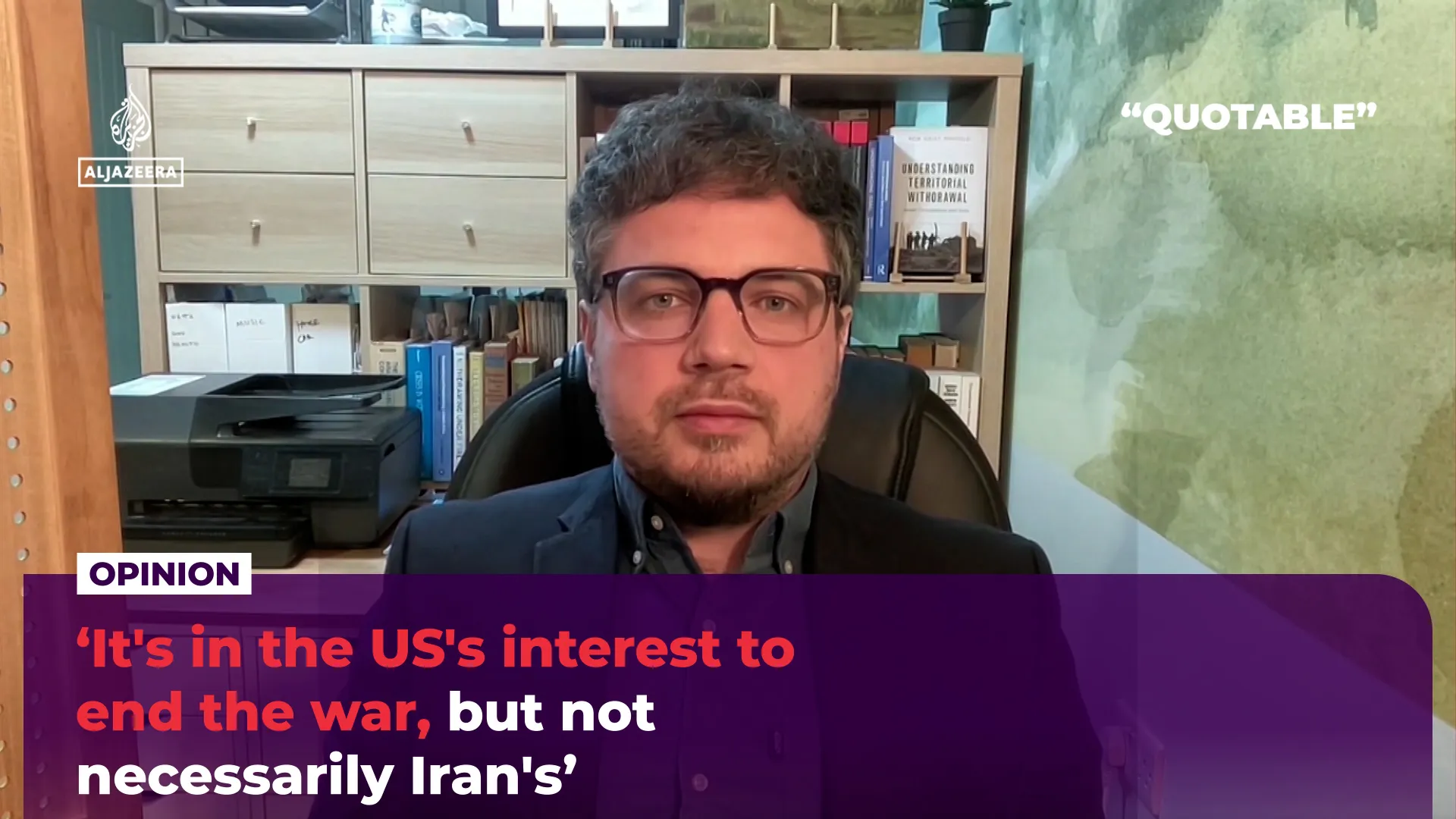
‘Trump didn’t follow legal proceedings to launch this war’ | Benjamin Netanyahu

Jeffrey Feltman, former US Assistant Secretary of State for Near Eastern Affairs, questions the legal basis and endgame of the US-Israel war on Iran, saying he does not believe Iran posed an imminent threat to the United States that would justify war.

Source link

Seoul shares plummet over 7 pct on Middle East conflict fears; won sharply down

This photo taken on Tuesday shows the trading room of Hana Bank in central Seoul, with the benchmark Korea Composite Stock Price Index down 7 percent to close below the 5,800-point mark. Photo by Yonhap

South Korean stocks plunged more than 7 percent Tuesday to close below the 5,800-point mark as investor sentiment was dampened by escalating geopolitical concerns triggered by the ongoing Middle East conflict. The Korean won lost sharply against the U.S. dollar.

The benchmark Korea Composite Stock Price Index (KOSPI) tumbled 452.22 points, or 7.24 percent, to close at 5,791.91, marking the lowest closing price since Feb. 20, when the index finished at 5,808.53.

It marked the largest-ever daily drop.

The country’s main bourse operator, the Korea Exchange (KRX), issued a sell-side sidecar for 5 minutes around noon, suspending the selling of KOSPI futures.

Trade volume was heavy at 1.2 billion shares worth 52.5 trillion won (US$35.8 billion). Losers sharply outnumbered winners 840 to 73.

Foreign and institutional investors led the daily sell-off, dumping a net 5.1 trillion won and 891.1 billion won, respectively. Retail investors, on the other hand, went bargain hunting and snapped up a net 5.8 trillion won.

Coordinated U.S. and Israeli air strikes on Iran over the weekend roiled global markets from the start of this week, but the Korean market closed on Monday in observation of the March 1 Independence Movement Day holiday.

“The main index experienced expanded volatility as the Middle East risk was realized after a long weekend,” Roh Dong-gil, an analyst at Shinhan Securities, said. “The stock market is expected to be affected by oil prices and interest rates as the situation develops.”

Most shares closed bearish.

Market bellwether Samsung Electronics tumbled 9.88 percent to 195,100 won, and its chipmaking rival SK hynix plummeted 11.5 percent to 939,000 won.

Top automaker Hyundai Motor dived 11.72 percent to 595,000 won, and leading battery maker LG Energy Solution sank 7.96 percent to 393,000 won.

Travel shares were among the biggest losers as flag air carrier Korean Air nosedived 10.32 percent to 25,200 won and major travel agency Hana Tour Service lost 6.65 percent to 44,900 won.

KB Financial Group, a leading banking group, fell 3.46 percent to 153,500 won, and Celltrion, a major pharmaceutical firm, dropped 5.66 percent to 225,000 won.

However, oil refinery and defense shares were bullish.

Leading refinery firm SK Innovation rose 2.51 percent to 130,900 won, and S-Oil, whose largest shareholder is Saudi Aramco, shot up 28.45 percent to 141,300 won.

Defense giant Hanwha Aerospace soared 19.83 percent to 1.43 million won, and LIG Nex1 surged 29.86 percent to 661,000 won.

The Korean won was quoted at 1,466.1 won against the U.S. dollar at 3:30 p.m., down 26.4 won from the previous session’s close. It marked the lowest since Feb. 6, when the won-dollar rate was 1,469.5 won.

Bond prices, which move inversely to yields, closed sharply lower. The yield on three-year Treasurys increased 13.9 basis points to 3.180 percent, and the return on the benchmark five-year government bonds declined 14.6 basis points to 3.424 percent.

Copyright (c) Yonhap News Agency prohibits its content from being redistributed or reprinted without consent, and forbids the content from being learned and used by artificial intelligence systems.

Source link

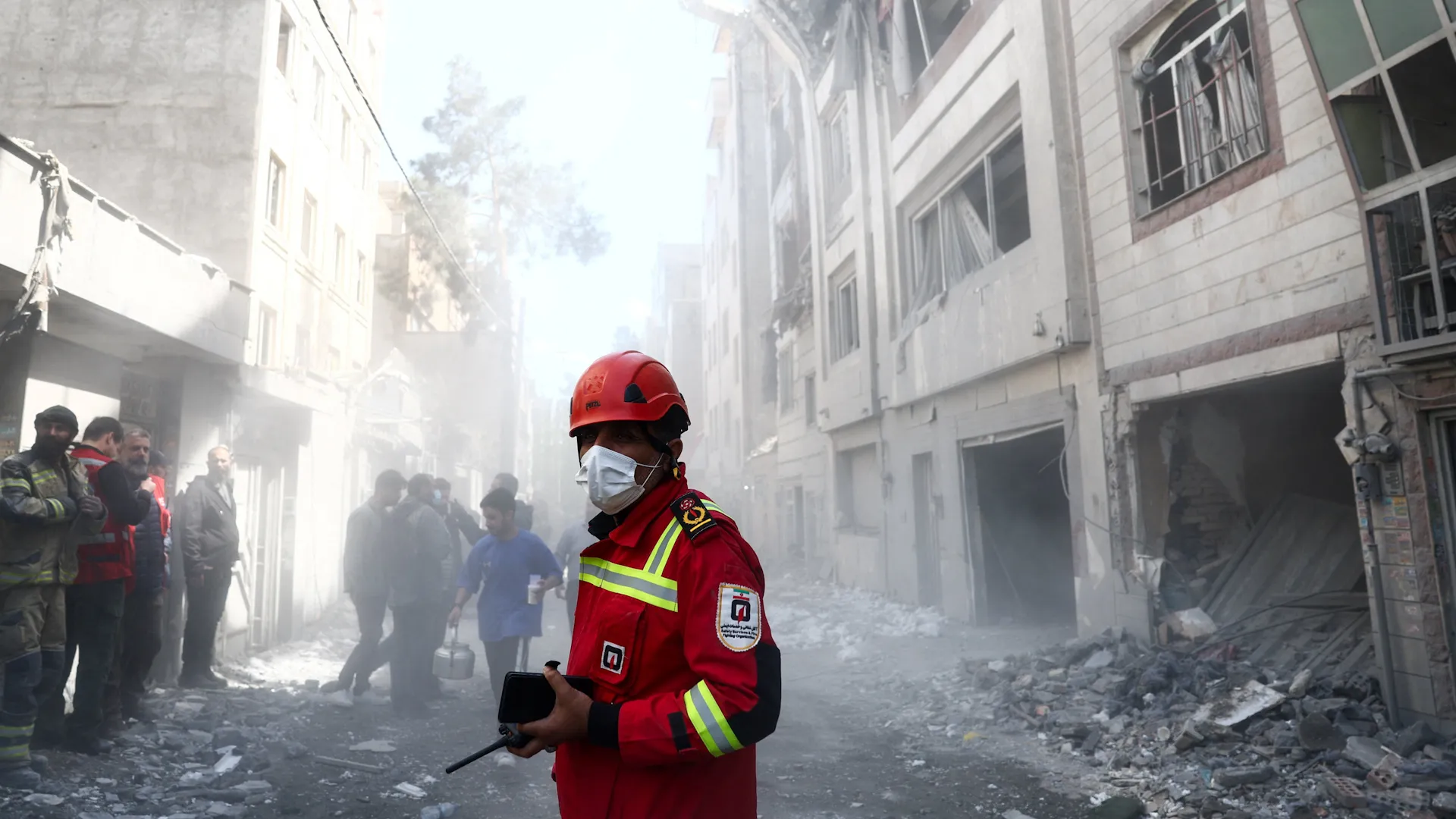
The aftermath of ongoing Israeli and US strikes on Iran’s capital, Tehran | Israel-Iran conflict News

Explosions have rung out across Tehran as the war entered its fourth day with the United States and Israel continuing to pound Iran’s capital and numerous other cities and locations after the assassination of Supreme Leader Ali Khamenei.

Iran continued on Tuesday to retaliate against Israel and throughout the Gulf where nations host US assets.

At least 787 people have been killed in US-Israeli strikes on a minimum of 131 cities across Iran, the Iranian Red Crescent Society said on Tuesday.

Israel’s military said it had “struck and dismantled” the headquarters of Iran’s state radio and television broadcaster, the Islamic Republic of Iran Broadcasting (IRIB), accusing it of “calling for the destruction of the State of Israel and for the use of nuclear weapons”.

In a post on Telegram, IRIB reported explosions near its headquarters in Tehran but said there had been no disruption to its operations.

Tehran’s streets have been largely deserted as people take shelter during the air strikes.

Iranian media also reported explosions in the city of Karaj, just outside Tehran, as well as in the central city of Isfahan.

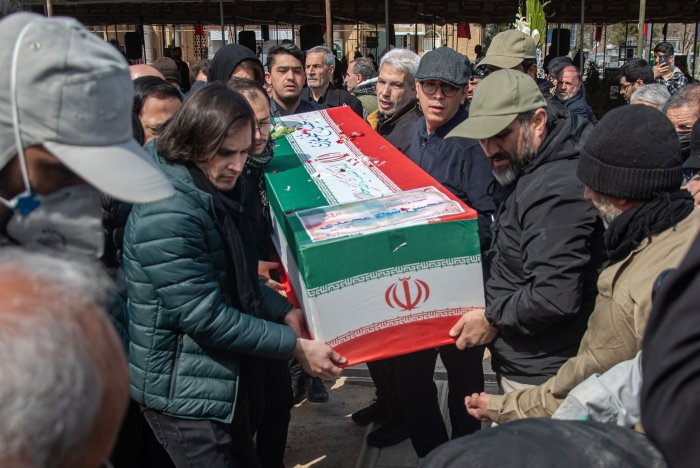
Iran held a mass funeral on Tuesday for 165 schoolgirls and staff killed on Saturday in what Iran said was a US-Israeli attack on a school in the southern city of Minab.

Source link

Drones hit U.S. Embassy in Saudi Arabia; non-emergency staff ordered out of Bahrain, Kuwait

March 3 (UPI) — Suspected Iranian drones have struck the U.S. Embassy in Riyadh, Saudi Arabia’s Ministry of Defense said early Tuesday, as the United States orders all non-emergency personnel to evacuate Bahrain and Kuwait amid Tehran’s continued retaliation strikes targeting U.S. assets and Israel.

Two drones struck the embassy, igniting “a limited fire” and causing “minor material damage” to the building, the ministry said in a statement.

The embassy confirmed in a statement that it had been attacked, urging people to avoid the facility. It said the mission was closed on Tuesday, and urged U.S. citizens throughout Saudi Arabia, but especially in the cities of Jeddah, Riyadh and Dhahran, to shelter in place.

The Saudi Defense Ministry later said it had intercepted and destroyed eight drones near Riyadh and Al-Kharj.

Asked what the U.S. response to the attack would be, President Donald Trump told NewsNation, “You’ll find out soon.”

Saudi Arabia is a U.S. ally and home to several American assets, including the U.S. Embassy and Prince Sultan Air Base, as well as other U.S. military facilities.

Since the United States and Israel began attacking Iran early Saturday, the Islamic regime has launched a barrage of missiles and drones targeting Israel as well as U.S. assets throughout the region.

Along with Saudi Arabia, Iran has attacked Kuwait, Jordan, Bahrain, Oman and the United Arab Emirates. At least six U.S. service members have been killed so far, all in Kuwait, where three U.S. fighter planes were also downed by Kuwait’s aerial defense weapons system in what is being called friendly fire.

The State Department on Tuesday ordered non-emergency U.S. government personnel and their families to leave Bahrain and Kuwait, according to statements published by their respective embassies.

On Tuesday, the State Department urged Americans throughout the Middle East to leave.

In a 4 p.m. EST statement from Assistant Secretary Mora Namdar, Americans in 14 Middle Eastern countries were told to “DEPART NOW.”

Source link

United Airlines flight makes emergency landing over possible engine fire

March 2 (UPI) — A United Airlines flight made an emergency landing at Los Angeles International Airport on Monday after a possible engine fire was reported, authorities and the airline said.

United flight 2127 from Los Angeles to Newark, N.J., departed LAX at 10:43 a.m. PST, but was diverted back to the airport about 40 minutes into the flight, according to flight traffic tracker FlightRadar24.

It landed at 11:20 a.m., the Federal Aviation Administration told UPI.

After the Boeing 787-9 Dreamliner landed, slides deployed from its fuselage, which some passengers used to deplane. Uncorroborated video posted online shows passengers going down the slide, where firefighters met them on the tarmac before they ran from the plane.

United Airlines confirmed to UPI in a statement that the flight “safely returned to Los Angeles” and that the issue was “a possible engine fire.”

“Customers deplaned via slides and airstairs and were bused to the terminal,” the company said.

No serious injuries were reported among the 265 passengers and 12 crew, United Airlines said, adding that a second aircraft was arranged to take them to Newark.

According to a statement from the Los Angeles Fire Department, no passengers required transport to the hospital.

The FAA told UPI that it was investigating.

Source link

US sanctions Rwandan army and top officials for supporting M23 in DRC | Conflict News

Kinshasa welcomed the sanctions while Kigali said the US move ‘unjustly’ targets Rwanda.

The United States has imposed sanctions on Rwanda’s military and four of its top officials for “direct operational support” of the M23 rebel group that has seized large swaths of territory in the eastern Democratic Republic of the Congo (DRC).

Rwanda has long rejected allegations from DRC, the United Nations and ⁠Western powers that it backs M23 and its affiliated Congo River Alliance (AFC), which captured key cities in the mineral-rich east, including the capitals of North and South Kivu provinces last year.

Recommended Stories

list of 3 itemsend of list

The US Department of the Treasury said on Monday that the rebels’ gains would not have been possible without Rwandan backing.

The US State Department separately added that M23 continued to capture territory even late last year “in clear violation” of a US-mediated agreement.

US President Donald Trump in December brought together the leaders of Rwanda and the DRC to sign a peace deal, predicting a “great miracle”.

But just days afterwards, the State Department noted, the M23 captured the key Congolese city of Uvira.

The Treasury Department said those included in Monday’s sanctions are Vincent Nyakarundi, the Rwandan Defence Force (RDF) army chief of staff; Ruki Karusisi, a major-general; Mubarakh Muganga, chief of defence staff; and Stanislas Gashugi, special operations force commander.

The US said they were critical to M23’s gains.

“M23, a US- and UN-sanctioned entity, is responsible for horrific human rights abuses, including summary executions and violence against civilians, including women and children,” State Department spokesman Tommy Pigott said in a statement.

“The continued backing from the RDF and its senior leadership has enabled M23 to capture DRC sovereign territory and continue these grave abuses,” he added.

‘A strong signal’

Rwandan government spokesperson Yolande Makolo said in a statement that the sanctions “unjustly” target Rwanda and “misrepresent the reality and distort the facts of the conflict” in eastern DRC.

She accused DRC of violating the peace agreement by allegedly conducting “indiscriminate” drone attacks and ground offensives.

Rwanda’s government also told the Reuters news agency that Kigali was “fully committed to disengagement of its forces in tandem with the DRC implementing their obligations” under US-led mediation, but accused DRC of failing to keep promises such as ending support for militias.

The Congolese government, however, said it welcomed the sanctions, describing them as “a strong signal in support of respect” for its territorial integrity and ⁠sovereignty.

US Treasury Secretary Scott Bessent said in a statement that the department “will use all tools at its disposal to ensure that the parties to the Washington Accords uphold their obligations”.

“We expect the immediate withdrawal of Rwanda Defence Force troops, weapons and equipment,” Bessent said.

Fighting continues in eastern DRC on several fronts, despite the accord signed between Kigali and Kinshasa in Washington, and a separate peace deal signed between M23 and the Congolese government in Qatar last year.

Though M23 later pulled out of Uvira under US pressure, the rebels still hold other key Congolese cities, including Goma and Bukavu. The US Treasury Department said on Monday that M23’s continued presence near Burundi’s border “carries the risk of escalating the conflict ‌into a broader regional war”.

M23 is the most prominent of about 100 armed factions vying for control in eastern DRC, near the border with Rwanda. The conflict has created one of the world’s most significant humanitarian crises, with more than seven million people displaced, according to the UN agency for refugees.

M23 are already under US sanctions since 2013.

Source link

Iran blocks Strait of Hormuz, taking hit at global shipping

Remaining regime forces have blocked the Strait of Hormuz after the United States and Israel launched a war against Iran on Saturday morning. An aerial view, taken with a drone, shows a crowd holding a flag during a march and rallyin support of regime change in the Middle Eastern nation. Photo by Ted Soqui/EPA

March 3 (UPI) — The Strait of Hormuz, a waterway that runs alongside Iran and through which roughly 20 percent of the world’s oil supply, in addition to other essential commodities, runs through, has been blocked.

After the United States and Israel launched a war against Iran, blocking the key trade route has been among the reactions that what is left of the nearly half-century-long regime after the attacks were launched over the weekend.

Iranian state media reported Sunday that Iran’s Revolutionary Guard announced it would fire on any ship looking to pass the route as many shippers were looking to avoid the region amid the burgeoning war, NBC News, Barron’s and The Times of Israel reported.

Ships that look to avoid the Strait of Hormuz would be forced to sail around the Cape of Good Hope, which is the southernmost tip of Africa and will add at least several days to anything taking the alternate shipping route.

“If major carriers restrict bookings and vessels reroute round the Cape of Good Hope, you’re adding weeks to global shipping schedules,” Wasel & Wasel managing partner Mahmoud Abuswasel told NBC. “That effectively removes capacity from the system.”

Cutting off access, however, may not entirely cut off shipping along the Asia-to-Europe shipping route, but according to Barron’s, the freeze on moving through the strait is “unprecedented” and most shipping companies have advised their vessels to avoid the situation and seek safe haven.

Travelling south around Africa adds roughly 10 days and may increase costs for shipping companies by 30 percent.

Abuswasel told NBC that stretching transit times by days to weeks can slow down a range of businesses, starting with raw materials showing up late and the dominoes falling from there.

“Manufacturers feel it first, and consumers feel it soon after in the form of delays, tighter inventories and rising prices,” he said.

Senate Majority Leader John Thune, R-S.D., speaks during a press conference after the weekly Republican Senate caucus luncheon at the U.S. Capitol on Wednesday. Photo by Bonnie Cash/UPI | License Photo

Source link

S. Korea, Singapore agree to deepen AI partnership

South Korean President Lee Jae Myung (L) shaking hands with Singapore’s Prime Minister Lawrence Wong (R) during their meeting at the Ministry of Foreign Affairs in Singapore, 02 March 2026. Lee is in Singapore on an official visit Photo by Ministry of Digital Development and Information (MDDI) / EPA

March 2 (Asia Today) — Lee Jae-myung and Lawrence Wong agreed Monday to pursue an artificial intelligence cooperation framework and upgrade bilateral trade ties, as the two countries seek to expand collaboration in advanced technology and energy.

During a summit in Singapore, the leaders committed to making AI a central pillar of economic cooperation and to launching negotiations to upgrade the existing free trade agreement.

According to the presidential office, the proposed AI Cooperation Framework would promote joint research, investment and industrial innovation, including the development of so-called physical AI applications and the broader use of AI in everyday life.

The two sides signed five memorandums of understanding covering science and technology cooperation, AI and digital technology in public safety, intellectual property cooperation, joint use of environmental satellites and collaboration on small modular reactors, or SMRs.

They also agreed to begin talks to modernize the free trade agreement, focusing on supply chains, the green economy, trade facilitation and aviation maintenance, repair and overhaul services.

Under the agreements, the countries plan to expand policy coordination and personnel exchanges in areas such as quantum technology, SMRs and space and satellite development. They also pledged to share information on AI policy in public safety and support promising companies in related sectors.

In a joint press statement, Lee said he hoped to “further solidify existing cooperation in trade, investment and infrastructure” while expanding collaboration into “future-oriented sectors such as AI, nuclear energy and advanced science and technology.”

— Reported by Asia Today; translated by UPI

© Asia Today. Unauthorized reproduction or redistribution prohibited.

Original Korean report: https://www.asiatoday.co.kr/kn/view.php?key=20260303010000385

Source link

“Korean Dream” author urges Korean citizens to reclaim a vision for a free and unified Korea amid heightened regional stakes

Hyun Jin Preston Moon, chairman of the Global Peace Foundation and author of The Korean Dream, speaks in Seoul on Wednesday, Feb. 25, 2026, saying Korea stands at a “historic turning point” and that the choices Koreans make now will have profound consequences for future generations. He urged a citizen-led effort to reshape public understanding of unification as North Korea hardens its stance toward the South. Photo by Ronald Park / Global Peace Foundation

March 2 (UPI) — In a recent interview with journalists from several Korean media outlets, Dr. Hyun Jin Preston Moon, Chairman of the Global Peace Foundation and author of The Korean Dream, warned that Korea stands at a pivotal crossroads where the decisions made and actions taken will determine the fate of the Korean Peninsula and the future direction of the Korean people for generations to come. With Washington focused on numerous global crises and lacking a clear policy towards North Korea, he said, it is precisely now that the Korean people must assert themselves in support of a free and unified homeland.

The interview took place amid deepening inter-Korean tensions. At the end of 2023, North Korean leader Kim Jong Un formally abandoned the goal of unification which had existed since the formation of North Korea under his grandfather Kim Il Sung’s rule. He designated the two Koreas as “hostile states” and ordered revision of the DPRK constitution to remove reunification as a national objective.

Moon defined North Korea’s formal adoption of the “two hostile states” doctrine as a structural turning point, one that exposes the fragility of the Kim regime. He said the situation demands strategic clarity rather than reliance on past engagement models, and requires that a compelling alternative vision to be placed on the table before this window of opportunity closes.

Conciliatory approaches, he said, carry meaning only when both sides share the goal of unification. When one side formally abandons that goal and redefines the other as an enemy, the entire strategic framework must be fundamentally reconsidered. Clinging to outdated models, he warned, is not diplomacy – it is self-delusion.

At the core of the alternative he is presenting is the Korean Dream – a comprehensive national vision rooted in Korea’s civilizational heritage spanning five millennia and grounded in democratic governance, economic opportunity, and fundamental human rights and freedoms for all its citizens. Rather than reacting to Pyongyang’s provocations, Moon argues, South Korea must define the peninsula’s future on its own terms. He noted that the previous Korean administration had already accepted the Korean Dream framework in principle; during the 2023 Camp David Summit, the U.S. and Japan agreed to support South Korea in its pursuit of a free and unified Korea. Moon also called for a non-governmental advisory committee to replace the current Ministry of Unification to allow for institutional continuity in how South Korea’s administration relates to North Korea, noting that the ideological reversals with each consecutive administration have long undermined inter-Korean policy.

Central to the Korean Dream vision is Hongik Ingan – the founding Korean ethos, roughly translated as “to broadly benefit humanity.” Moon describes this as the spiritual and historical bedrock of Korean identity. He emphasized that it is not an abstract ideal but a living principle that has been passed from generation to generation as part of the Korean people’s heritage and infuses unification with a high-minded purpose. Koreans must rediscover this founding spirit, he said, and see themselves not as passive pawns of geopolitical forces but as active agents with a civilizational mission.

On economic concerns, Moon was direct. Unification is not a burden but an opportunity of historic scale, he said, particularly for Korea’s younger generation. A unified Korea would integrate the more than 25 million North Korean residents into a new domestic market, rebalance its export-dependent economy, and spur large-scale infrastructure development, industrial restructuring, and expanded regional influence.

Moon drew parallels of the potential economic transformation that unification could unleash to China’s wealthy coastal cities that burgeoned with its historic shift from a centrally planned to a market economy. For the Korean Peninsula, he continued, such changes could fuel what he called a second Miracle on the Han River. The generation that seizes this moment, he said, will not merely inherit a problem but will open a new chapter of flourishing for Korean civilization.

The decisive factor shaping the Peninsula’s future, Moon argued, is neither military posture nor diplomatic maneuvering – it is public consciousness. If South Korean youth come to see unification not as a financial burden inherited from their predecessors but as a civilizational mission rooted in Hongik Ingan, that shift in public imagination will become the most powerful engine for change on the Korean Peninsula.

He pointed to North Korea’s growing internal vulnerabilities as evidence that the window for shaping the arc of history is narrowing. Rising defection rates – including among senior officials- and the regime’s deepening economic fragility suggest that the structures sustaining Kim Jong Un’s control are under mounting pressure. Moon said Kim is likely reassessing his long-term strategic options as he observes the dramatic upheaval unfolding in Iran.

“The regime’s current two-state posture is not necessarily permanent,” Moon said. “What matters is whether the right alternative is on the table.” He urged the South Korean administration to adopt the Korean Dream vision and offered to support and advise the U.S. administration as it further develops its strategy and approach to the Koreas.

Source link

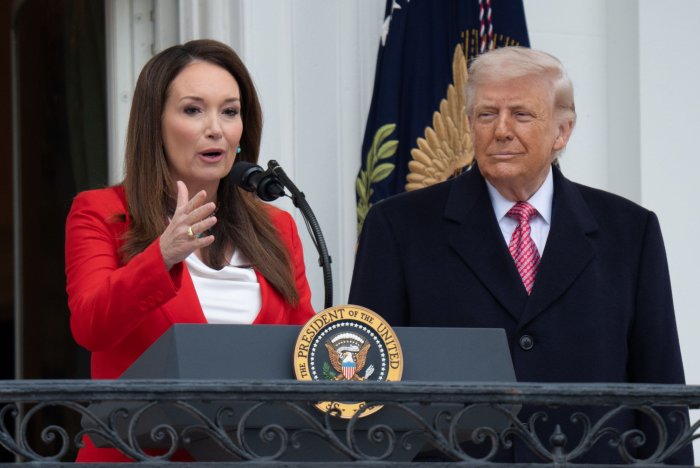
Melania Trump chairs UN meeting on children days after Iran school strike | Israel-Iran conflict

NewsFeed

US First Lady Melania Trump has presided over a UN Security Council meeting focusing on children in conflict days after dozens of children at a school in Iran were reportedly killed after Israel and the United States launched attacks.

Source link

Iran says will attack any ship trying to pass through Strait of Hormuz | Conflict News

Ebrahim Jabari, a senior adviser to the IRGC’s commander-in-chief, reiterates that the Strait of Hormuz is ‘closed’.

A commander in Iran’s Revolutionary Guard Corps (IRGC) has said the Strait of Hormuz is closed and warned that any vessel attempting to pass through will be attacked, according to Iranian state media.

“The strait is closed. If anyone tries to pass, the heroes of the Revolutionary Guard and the regular navy will set those ships ablaze,” Ebrahim Jabari, a senior adviser to the IRGC’s commander-in-chief, said on Monday.

Recommended Stories

list of 4 itemsend of list

Tehran has targeted infrastructure critical to the world’s energy production as part of its retaliation for the Israeli and US bombing campaign that began on Saturday and killed Iranian Supreme Leader Ayatollah Ali Khamenei and other senior officials.

“We will also attack oil pipelines and will not allow a single drop of oil to leave the region. Oil price will reach $200 in the coming days,” Jabbari said in a post on the IRGC’s Telegram channel.

“The Americans, with debts of thousands of billions of dollars, are dependent on the region’s oil, but they should know that not even a drop of oil will reach them,” he was also quoted as saying by the semi-official Tasnim news agency.

Rising energy prices

The Strait of Hormuz, which lies between Iran and Oman, is one of the world’s most critical oil transit routes, with roughly 20 percent of global oil supplies passing through it.

Any disruptions there will further send crude prices soaring and raise fears of a regional escalation.

Energy prices already rose sharply earlier on Monday as disruptions to tanker traffic through the strait, and damage to production facilities, raised uncertainty about how the US-Israeli attacks on Iran would affect supply to the world economy.

The biggest shock was to natural gas prices, which rose by almost 50 percent in Europe and nearly 40 percent in Asia as QatarEnergy, a major supplier, halted the production of liquefied natural gas after its LNG facilities were attacked.

Earlier, Saudi Arabia’s Ras Tanura oil refinery also came under attack from drones, and its defences downed the incoming aircraft, a military spokesman told the state-run Saudi Press Agency. The refinery has a capacity of more than half a million barrels of crude oil a day.

In response, the US said it would take action ⁠to mitigate rising energy prices due to the war with Iran, according to US Secretary of State Marco Rubio.

“Starting tomorrow, you will see us rolling out those phases to ⁠try to mitigate against ⁠that… We anticipated this could be an issue,” Rubio said.

Source link

Apple introduces updated budget iPhone 17e

Apple unveiled the iPhone 17e on Monday, the budget phone in its iPhone 17 line-up, with an upgraded camera, faster chips and MagSafe to more easily snap chargers and accessories onto the back of the phone. Photo courtesy of Apple

March 2 (UPI) — Apple on Monday introduced the iPhone 17e, the budget model in its iPhone lineup, with upgraded cameras, a stronger scratch resistant screen and MagSafe to improve attaching chargers and accessories to the phone.

The 17e will be available in three colors — black, white and pink — for pre-order on Wednesday. It is expected to hit stores on March 11, with a starting price of $599 for the 256GB-storage model, Apple said in a press release.

“iPhone 17e combines powerful performance and features our users love at an exceptional value, making it a compelling option for customers looking to upgrade to the iPhone 17 family,” Kaianne Drance, vice president of worldwide iPhone product marketing at Apple, said in the release.

“With A19 for incredible performance, double the entry storage, a smarter camera system and enhanced durability, iPhone17e is designed to stay fast, secure and valuable for years to come,” she said.

Apple launched the iPhone 16e just over a year ago in February 2025 as a lower-priced model of the iPhone 16 to replace the SE budget-level iPhone, which had been discontinued after three generations in 2022.

The 17e comes with upgrades over last year’s edition, with a 48MP fusion camera that enables optical-quality 2x telephoto and 4K Dolby Vision video, Apple said.

The new Super Retina XDR screen is said to have 3x stronger scratch resistance and reduced glare, satellite features for satellite communication when off network and Apple has added MagSafe, which allows accessories such as charges, stands and cases to more easily snap onto the back of the phone.

The 17e also includes Apple Intelligence, which is expected to include a new version of the Siri assistant on the phone, and will be powered by Google‘s Gemini AI.

Apple and many phone carriers offering trade-in deals for customers who would like to upgrade, with the oldest models available for trade-in credit starting with the iPhone 11 and the iPhone 13.

Source link

Spain refuses to let US use bases for Iran attacks | Military News

Spanish Prime Minister Pedro Sanchez has condemned US and Israeli strikes on Iran.

Spain says the United States is not using – and will not be using – joint military bases on its territory for operations against Iran, a mission condemned by Madrid.

“Based on all the information I have, the bases are not being used for this military operation,” Foreign Minister Jose Manuel Albares told Spanish public television on Monday.

Recommended Stories

list of 4 itemsend of list

Prime Minister Pedro Sanchez has condemned US and Israeli strikes on Iran that began on Saturday as an “unjustified” and “dangerous military intervention” outside the realm of international law, in another break from US policy.

“The Spanish government will not authorise the use of the bases for anything beyond the agreement or inconsistent with the United Nations,” Albares said, referring to the Rota naval base and the Moron airbase.

The US operates at the bases under a joint-use arrangement, but they remain under Spanish sovereignty.

Defence Minister Margarita Robles said the bases “will not provide support, except if, in a given case, it were necessary from a humanitarian perspective”.

Spain also condemned the retaliatory attacks by Iran on Gulf countries.

According to maps by flight-tracking website FlightRadar24 on Monday, 15 US aircraft have left bases in southern Spain since the US and Israel launched attacks on Iran. At ‌least seven of the aircraft were shown on FlightRadar24 as having landed at Ramstein airbase in Germany.

The Spanish position is an outlier among the major European countries.

Britain had also initially refused to allow the use of its bases for an attack on Iran, but on Sunday, Prime Minister Keir Starmer authorised their use for “collective self-defence”, amid Iranian counterattacks targeting US assets across the Middle East and energy infrastructure in the Gulf region.

France and Germany, meanwhile, are prepared to do the same.

The three countries’ leaders were “appalled by the indiscriminate and disproportionate missile attacks launched by Iran against countries in the region, including those who were not involved in initial US and Israeli military operations”, read a joint statement on Sunday.

“We have agreed to work together with the US and allies in the region on this matter,” they stated.

Source link

Daily Mail editor denies using PI for info for Prince Harry story

March 2 (UPI) — The royal editor for The Daily Mail on Monday denied using a private investigator to steal information about Prince Harry and his former girlfriend Chelsy Davy.

Prince Harry is suing Associated Newspapers Ltd., which owns The Daily Mail, along with six other plaintiffs including Elton John and Elizabeth Hurley, for using information they obtained illegally.

ANL denies all wrongdoing and said it gathered all information for its stories legally.

The testimony Monday mostly hinged on Mike Behr, a South Africa-based private investigator. Rebecca English, royal editor, said she knew Behr only as “a freelance journalist who could help on Africa stories,” The Guardian reported.

Lawyers asked English about an email from Behr that shared the exact flights that Davy was taking on a vacation with Harry in 2007.

Behr asked in the email if English and the Sun reporter “can plant someone next to her?”

Plaintiffs’ lawyer David Sherborne said the email “could only have been obtained from the computer system” of an airline. That means it came from a “blag” — British slang for a way of obtaining information illegally.

English responded that she didn’t remember the email or ask for those flight details.

“[Behr] was never asked for anything like this, ever,” she said. “That is something I would never even consider doing, now or then,” The Guardian reported.

Sherborne asked about planting someone next to Davy, and English replied: “It’s an absolutely shameful suggestion both by him and by you … clearly there’s no reply to this email, which emphasizes my belief that I never actually saw it.”

He then accused her of using illegal information in a story about a “make-or-break holiday” for the couple. But English said the information was likely from students at the University of Leeds, where Davy was enrolled, “who were friends with Chelsy Davy and part of her circle.”

Sherborne also asked English about a story with the headline, “How Harry fell in love,” from 2004. The story alleged that Harry had shared details of his relationship with Davy with friends at a campfire in Botswana. English said the campfire info came from her coworker Sam Greenhill.

“Sam told me that one of the people that Prince Harry had spoken with ’round the campfire got in touch with the newspaper when news of the relationship broke and gave this information to us,” The Independent reported.

“Prince Harry hadn’t told them who his girlfriend was but had described her so that, when the stories about Chelsy Davy broke, they realized the significance of what they had been told.

“I thought at the time that the tip was from a contact of Sam’s, but now understand it just came in to the news desk. I think that Sam gave it to me because he knew that I was new to my job as a royal reporter and thought it might be helpful to me.”

Harry testified last month that the people at the campfire — his “closest friends” — would not have shared that information, and if they had, there “would be a lot more out there.”

Source link

Why QatarEnergy’s LNG production halt could shake up global gas markets | Explainer News

QatarEnergy has suspended liquefied natural gas (LNG) production following a drone attack, straining the global LNG market.

On Monday, Iranian drones struck two sites, according to Qatar’s Ministry of Defence: a water tank at a power plant in Mesaieed Industrial City and an energy facility in Ras Laffan belonging to QatarEnergy, the world’s largest LNG producer.

Recommended Stories

list of 4 itemsend of list

While no casualties were reported, QatarEnergy suspended the production of LNG and other products at the impacted sites for security reasons.

Why did QatarEnergy suspend operations?

The drone attacks hit the Ras Laffan complex, which is home to processing units for liquefied natural gas set to be exported.

The state-owned energy company was forced to declare what is known as force majeure, when a company is freed from contractual obligations in the event of extraordinary circumstances, such as a drone attack, according to Reuters and Bloomberg News, citing people familiar with the matter.

This comes at a time when intensifying sea battles between Iran and the United States, coupled with missiles flying over the region, have effectively choked the Strait of Hormuz, a strategic trade route. At least 150 vessels have dropped anchor, including those carrying LNG, in the strait and surrounding areas, according to Reuters.

Traffic in the strait for both LNG and oil has declined by 86 percent, with roughly 700 ships sitting idle on either side of the passage, according to the Anadolu news agency.

How will this impact the broader global LNG market?

Qatar’s LNG exports represent 20 percent of the global market. With fewer products reaching the market, LNG supply is down, causing prices to surge.

“Definitely an escalation overnight with pressure on energy infra in the Gulf,” said Rachel Ziemba, a senior fellow at the Center for a New American Security, a think tank.

The countries hit the most directly are Asian markets, particularly Bangladesh, India, and Pakistan.

China is the world’s largest importer of natural gas, but it gets the majority of its imports from Australia, accounting for 34 percent of its imports, according to the US Energy Information Administration.

Maksim Sonin, an energy expert at Stanford University’s Center for Fuels of the Future, however, said that while QatarEnergy’s decision would bring “volatility” to energy markets, he wouldn’t describe the situation as a “crisis” just yet.

“We will see near-term volatility in the LNG market, especially if infrastructure in Qatar and other hubs is damaged,” Sonin told Al Jazeera. However, he added, “I do not expect the 2022 gas crisis to repeat in Europe,” referring to the period following Russia’s full-fledged invasion of Ukraine, when many European nations tried to dramatically scale back their dependence on Russian oil and gas.

Which are the world’s largest LNG exporters?

Until 2022, Russia was the world’s biggest exporter of LNG, but its sales have plummeted since its war on Ukraine began.

Now, the US is the world’s largest exporter of LNG, followed by Qatar and Australia.

Will this add pressure on Europe?

While 82 percent of QatarEnergy’s sales are to Asian countries, the halt puts increased pressure on other markets across the globe, too, particularly in Europe.

In effect, a smaller supply of gas will need to meet the same global demand. As a result, gas prices have already started soaring: Benchmark Dutch and British wholesale gas prices soared by almost 50 percent, while benchmark Asian LNG prices jumped almost 39 percent, on Monday after the QatarEnergy announcement.

“Not good if Qatar stays offline for long, of course,” said Ziemba. The only silver lining for Europe: “At least the worst of the winter in Europe may be behind,” Ziemba pointed out.

The European Union’s gas coordination group will meet on Wednesday to assess the impact of the widening conflict in the Middle East, a European Commission spokesperson told Reuters on Monday. The group includes representatives from member state governments. It monitors gas storage and security of supply in the EU, and coordinates response measures during crises.

Source link

Canada, India agree to new trade, AI, technology deals worth billions

Indian Prime Minister Narendra Modi (R) shakes hands with Canadian Prime Minister Mark Carney (L) in New Delhi, India, on Monday. Photo by Harish Tyagi/EPA

March 2 (UPI) — Canada and India agreed on several deals Monday including a 10-year nuclear energy deal and a goal to reach $50 billion in trade in the next five years.

The agreements were the result of Canadian Prime Minister Mark Carney’s visit with Indian Prime Minister Narendra Modi in Delhi, establishing what the two leaders called a “new partnership,” CBC reported.

“This is not merely the renewal of a relationship,” Carney said during a joint appearance with Modi. “It is the expansion of a valued partnership with new ambition, focus and foresight — a partnership between two confident countries charting our course for the future.”

Modi credited Carney for new cooperation between the two countries.

Diplomatic relations between Canada and India became strained in 2023 after former Canadian Prime Minister Justin Trudeau suggested India was linked to the assassination of Sikh separatist leader Hardeep Singh Nijjar near Vancouver, British Columbia. In the wake of the allegations, multiple Indian diplomats were expelled from Canada.

“This vision inspires us to move forward in every field. Unlocking the full potential of economic cooperation is our priority,” Modi said.

Carney said the two countries plan establish a free trade deal by the end of 2026 with the aim of taking the strain off U.S. tariffs, the BBC reported. The deal would ease tariffs between Canada and India.

Carney and Modi ultimately signed five memorandums of understanding, the CBC reported, including a $2.6 billion deal in which Canadian-based Cameco would supply about 22 million pounds of uranium to India for nuclear energy between 2027 and 2035.

Other deals focus on artificial intelligence, supercomputing, and semiconductors as well as plans to jointly host a renewable energy summit. Indian firm HCL Technologies plans to open two new AI centers in Canada and expand one in Vancouver, while OCT Therapies & Research plans to manufacture medicines in New Brunswick.

Former South African president Nelson Mandela speaks to reporters outside of the White House in Washington on October 21, 1999. Mandela was famously released from prison in South Africa on February 11, 1990. Photo by Joel Rennich/UPI | License Photo

Source link

Starmer lets US use bases for Iran clash: UK’s military, legal quagmire | Israel-Iran conflict News

Early on Monday, a suspected Iranian drone crashed into the runway at the United Kingdom’s RAF Akrotiri base in southern Cyprus. British and Cypriot officials said the damage was limited. There were no casualties.

Hours later, two drones headed for the base were “dealt with in a timely manner”, according to the Cypriot government.

Recommended Stories

list of 4 itemsend of list

The incidents came as Prime Minister Keir Starmer signalled on Sunday that the UK was prepared to support the United States in its confrontation with Iran – raising the prospect that it could be drawn deeper into a war it did not choose by its closest ally.

In a joint statement with the leaders of France and Germany, Starmer said the European group was ready to take “proportionate defensive action” to destroy threats “at their source”.

Later, in a televised address, he confirmed that Westminster approved a US request to use British bases for the “defensive purpose” of destroying Iranian missiles “at source in their storage depots, or the launches which are used to fire the missiles”.

But his agreement did little to placate US President Donald Trump, who said the decision came too late.

UK-based military analyst Sean Bell cautioned against reading too much into the Akrotiri incident.

“I understand the projectile that hit Cyprus was not armed, it hit a hangar [with] no casualties, and appears to have been fired from Lebanon,” he said, citing sources.

Al Jazeera was not able to independently verify the claim.

The broader context, he argued, is more consequential.

The US has taken the action “and everybody else is having to deal with the fallout”, he said.

Iran’s military strength lies in its extensive ballistic missile programme, he said, adding that while some have the range to threaten the UK, they do not extend far enough to strike the US.

“I don’t think [US] President Trump has yet made the legal case for attacking Iran, and … international law makes no discrimination between a nation carrying out the act of war and a nation supporting that act of war, so you’re both equally complicit,” he said.

Bell said that Washington likely reframed the issue, communicating to London that, whatever triggered the escalation, US forces were now effectively defending British personnel in the region.

That shift, he suggested, provided a legal basis to “not to attack Iran, but to protect our people”, allowing the UK to approve US operations from its bases under a “very, very clear set of instructions” tied strictly to national interest and defence.

UK officials ‘tying themselves in knots’

However, concerns of complicity had reportedly shaped earlier decisions, according to Tim Ripley, editor of the Defence Eye news service, who said the British government initially concluded that US and Israeli strikes on Iran did not meet the legal definition of self-defence under the United Nations Charter.

When Washington requested the use of bases such as RAF Fairford in Gloucestershire, UK, and Diego Garcia in the Indian Ocean, Starmer is understood to have consulted government lawyers, who advised against participation.

Up until Starmer’s televised address, in which he approved the US request, the UK had not considered the campaign a war of self-defence, said Ripley. While Washington’s legal reasoning has not changed, the war’s trajectory has.

Iranian retaliatory strikes – which have seen drones and missiles targeting Gulf states – have placed British expatriates and treaty partners under direct threat.

“The basis of our decision is the collective self-defence of longstanding friends and allies, and protecting British lives. This is in line with international law,” Starmer said.

According to Ripley, several Gulf governments, which maintain defence relationships with the UK, sought protection, allowing London to focus on protecting British personnel and partners rather than endorsing a broader campaign. However, with memories of the Iraq War hanging over Westminster, British ministers have stopped short of explicitly backing the US bombing campaign.

British officials are “tying themselves in knots” trying to describe a position that is neither fully participatory nor detached, he said.

US-UK: A strained relationship

Starmer on Monday told Parliament that the UK does not believe in “regime change from the skies” but supports the idea of defensive action.

But Ripley warned that any arrangement allowing US warplanes to operate from British air bases carries significant risks.

Iran’s missile systems are mobile and launchers mounted on trucks, he said. From RAF Fairford or Diego Garcia, US aircraft face flight times of seven to nine hours to reach Iranian airspace, necessitating patrol-based missions.

Once airborne, pilots may have only minutes to act. The idea that a US crew would pause mid-mission to seek fresh British legal approval is unrealistic, he said.

London must rely on Washington’s assurance that only agreed categories of “defensive” targets will be struck. If an opportunity arose to eliminate a senior Iranian commander in the same operational zone, the temptation could be strong. Yet such a strike might fall outside Britain’s stated defensive mandate. The aircraft would have departed from British soil, and any escalation could implicate the UK, Ripley said.

Bell highlighted another weakness: Britain has no domestic ballistic missile defence system.

If a ballistic missile were fired at London, he said, “We would not be able to shoot it down.”

Intercepting such weapons after launch is notoriously difficult, reinforcing the argument that the only reliable defence is to strike before launch.

The UK, therefore, occupies a grey zone: legally cautious, operationally exposed and strategically dependent on US decisions, it does not fully control.

Beyond the legal and military dilemmas, Starmer must also contend with a sceptical public.

A YouGov poll conducted on February 20 found that 58 percent of Britons oppose allowing the US to launch air strikes on Iran from UK bases, including 38 percent who strongly oppose.

Just 21 percent support such a move, underscoring limited domestic backing for deeper involvement.

Source link

Gas prices soar as QatarEnergy halts LNG production after Iran attacks | Energy News

Qatar’s state-run energy firm says it has halted liquefied natural gas production after Iranian attacks, sending gas prices soaring in Europe, as Saudi Arabia announced it was temporarily shutting down some units of the Ras Tanura oil refinery located near the country’s eastern region after a fire broke out following a drone attack.

“Due to military attacks on QatarEnergy’s operating facilities in Ras Laffan Industrial City and Mesaieed Industrial City in the State of Qatar, QatarEnergy has ceased production of liquefied natural gas (LNG) and associated products,” the world’s largest LNG producer said in a statement on Monday.

Recommended Stories

list of 3 itemsend of list

Shortly after the announcement, natural gas prices in Europe soared by almost 50 percent.

Earlier, Qatar’s Defence Ministry said the country was attacked by two drones launched from Iran. “One drone targeted a water tank belonging to a power plant in Mesaieed, and the other targeted an energy facility in Ras Laffan Industrial City, belonging to QatarEnergy, without reporting any human casualties,” it said in a statement.

“All damages and losses resulting from the attack will be assessed by the relevant authorities, and an official statement will be issued later,” it added.

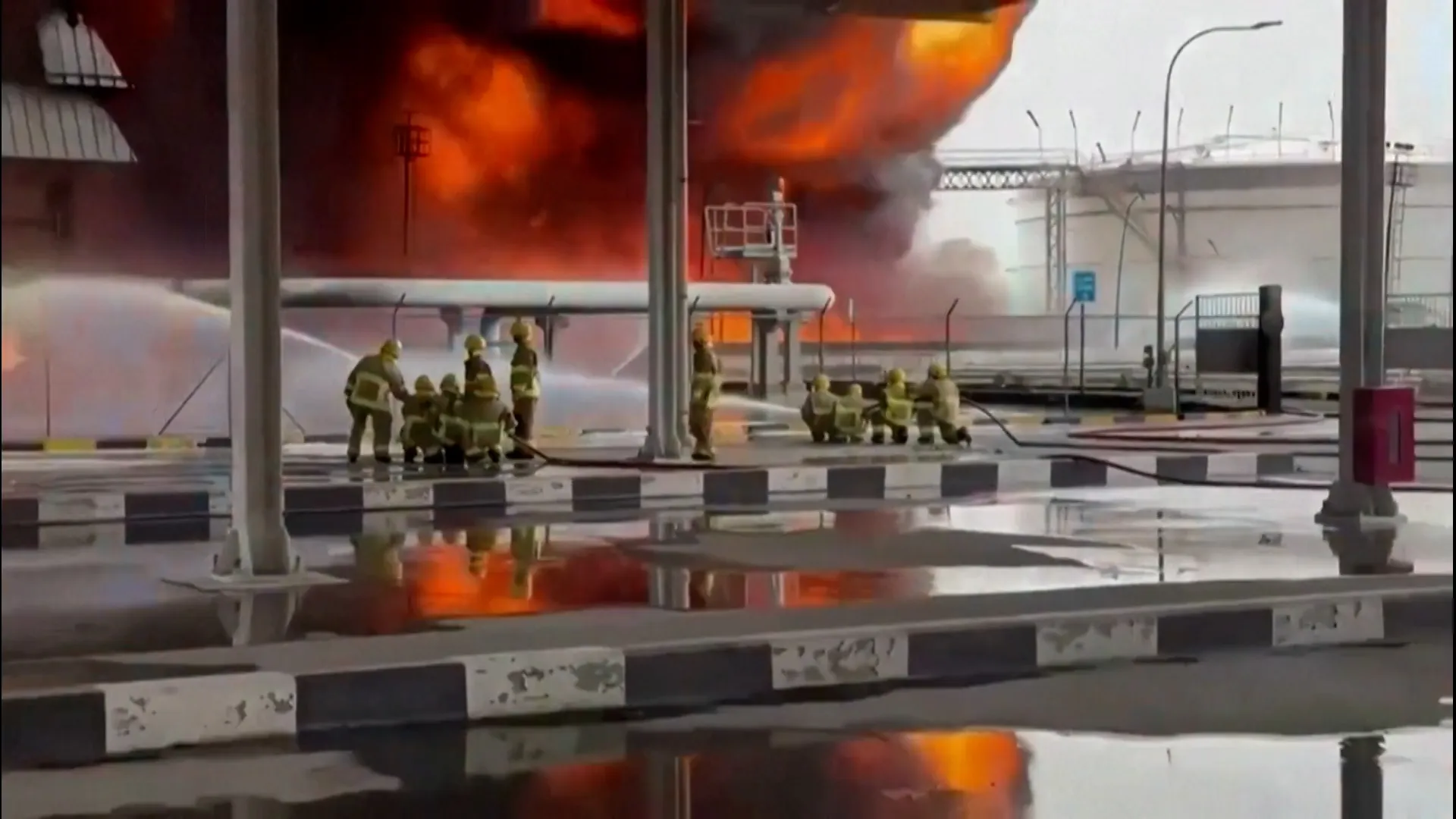
The Saudi Ministry of Defence, in reports carried by the state-run Saudi Press Agency (SPA), said two drones had “attempted to attack” the Ras Tanura refinery on Monday morning, and that a “small” fire had broken out after they were intercepted.

Footage verified by Al Jazeera showed plumes of smoke rising from the oil facility, located on Saudi Arabia’s Gulf coast. The ministry said the refinery “sustained limited damage”, but there were no casualties.

Ras Tanura oil refinery, one of the world’s largest oil processing facilities located near the eastern city of Dammam, has a capacity of 550,000 barrels per day. The facility is home to one of the largest refineries in the Middle East and is considered a cornerstone of the kingdom’s energy sector.

The attacks come as oil tankers have been piling up on either side of the Strait of Hormuz, through which about a fifth of the world’s seaborne oil and the bulk of Qatari gas flows.

The maritime disruptions and fears of a prolonged conflict have led to a sharp rise in global oil prices, which will have a significant impact on the global economy.

Iran has been launching retaliatory strikes, mainly targeting Israel and military facilities of the United States across the Middle East, after the US and Israel launched massive air strikes on the country.

In a statement published by SPA, the Saudi Ministry of Energy said some operations had been halted as a “precautionary measure” and that it did not foresee “any impact on the supply of petroleum products to local markets”.

Saudi Arabia had earlier said it would “take all necessary measures to defend its security and protect its territory, citizens, and residents, including the option of responding to the aggression” after Iran targeted the capital Riyadh and the country’s eastern region with strikes over the weekend.

The US, Bahrain, Jordan, Kuwait, Qatar, Saudi Arabia and the United Arab Emirates issued a joint statement on Sunday condemning Iranian attacks across the region and affirming their right to self-defence.

Rob Geist Pinfold, lecturer in defence studies at King’s College London, told Al Jazeera that Iran “knows exactly what it’s doing” by attacking the Gulf countries.

“These countries have less of an appetite for a fight because, at the end of the day, this is not their war. So, Iran is banking that they will want a ceasefire as soon as possible, that they will be pressuring the Trump administration. But we have no signs of that whatsoever so far,” he said.

Pinfold added that there seems to be a “show of force” and “of unity” coming from the Gulf states, at least rhetorically.

“They’re trying to get the message across that they are one and that they are united and that they are resilient,” Pinfold said. “But under the surface, there are profound disagreements here about how to engage with Iran and whether to engage with Iran at all.”

Source link