In one of his latest missives on social media, President Trump complained that he wasn’t getting enough credit for “totally destroying the terrorist regime of Iran, militarily, economically, and otherwise.”
“We have unparalleled firepower, unlimited ammunition, and plenty of time,” he wrote of a war that has crippled the global supply of oil, sharply increased gas prices, cost U.S. taxpayers billions, left thousands dead and wounded, and so far defied Trump’s own “short term” timetable.
“Watch what happens to these deranged scumbags today,” Trump added. “They’ve been killing innocent people all over the world for 47 years, and now I, as the 47th President of the United States of America, am killing them. What a great honor it is to do so!”
Again and again in recent days, Trump and other top officials in his administration — notably Secretary of Defense Pete Hegseth — have projected confidence and power in Iran in a coarse and triumphant tone that is unprecedented for U.S. wartime presidents and their Cabinet members, according to experts in presidential rhetoric and propaganda.
They have consistently described the war in terms of how hard the U.S. is hitting Iran, rather than why it must do so. They’ve talked of destroying the Iranian navy and air force, wiping out its leadership and making the U.S. “more respected” globally than it has ever been, including by showing no mercy.
“This was never meant to be a fair fight, and it is not a fair fight. We are punching them while they’re down, which is exactly how it should be,” Hegseth said.
Missing is the solemnity of past wartime leaders facing dead U.S. soldiers, a recalcitrant enemy and a precarious tactical position, replaced by a message of U.S. mercilessness — of contempt for Iran rather than concern for its civilians or a focus on the American ideals that U.S. presidents have long tried to rally the world around, especially in times of war.
“At a time when people can see the effects of the war when they fill up their gas tank, and when there have been American casualties, the triumphalist tone is just not something a president normally does,” said Robert C. Rowland, a professor of rhetoric at the University of Kansas and author of the book “The Rhetoric of Donald Trump: Nationalist Populism and American Democracy.”
“Many presidents wouldn’t have that tone for personal moral reasons,” Rowland said, “but they also know that it can backfire when things don’t go well.”
James J. Kimble, a communication professor and propaganda historian at Seton Hall University, said U.S. presidents have “by and large” struck a respectful tone in wartime, though there are some exceptions. President Truman, justifying dropping atomic bombs on Japan, wrote that “when you have to deal with a beast, you have to treat him as a beast,” while the U.S. produced World War II posters designed to “demonize and dehumanize the German enemy,” he noted.
Still, Trump’s messaging — including his “expressing glee at the death of foreign combatants” — has been “much coarser,” Kimble said.
“It’s moving beyond the idea of defeating the enemy on the field of battle, and more into a kind of defeat as humiliation — intentional humiliation,” he said. “It’s schoolyard bullying, along with the physical violence.”
Asked about Trump’s rhetoric, Anna Kelly, a White House spokeswoman, said Trump “will always be proud to recognize the incredible accomplishments of our brave service members.”
“Under the decisive leadership of President Trump, America’s heroic war fighters are meeting or surpassing all of their goals under Operation Epic Fury,” she said. “The legacy media wants us to apologize for highlighting the United States military’s incredible success, but the White House will continue showcasing the many examples of Iran’s ballistic missiles, production facilities, and dreams of owning a nuclear weapon being destroyed in real time.”
Trump has built his political career around blunt rhetoric, and his messaging on Iran has drawn applause from his supporters. Polling has shown the public is heavily divided on the war — drawing far less public support than past wars, but broad support from Republicans.
White House Press Secretary Karoline Leavitt has accused the media of ignoring “clear” objectives that the president and others have set for the war effort, including wiping out Iran’s missile systems, preventing it from developing a nuclear weapon and stopping what Trump had a “feeling” was a coming attack on the U.S.
However, Trump and Hegseth have themselves strayed from that framework with their brash rhetoric, and their focus on the killing of Supreme Leader Ayatollah Ali Khamenei and other Iranian leaders.
Trump has dismissed reports that the U.S. bombed an Iranian school full of children by suggesting that Iran may actually have been responsible, despite reported findings by U.S. intelligence that it was an American attack.
Hegseth has added to concerns about careless U.S. bombing by expressing disdain for wartime rules designed to limit civilian casualties, calling them “stupid rules of engagement.”
“Our war fighters have maximum authorities granted personally by the president and yours truly,” Hegseth said. “Our rules of engagement are bold, precise and designed to unleash American power, not shackle it.”
The White House has also pushed out a wave of wartime propaganda on social media, often striking the same irreverent, bullish tone, experts noted.
One video interspersed movie clips of superheroes and soldiers with real footage of Iranian targets getting blown up, under the words, “JUSTICE THE AMERICAN WAY.” The clip drew condemnation, including from the actor Ben Stiller, who objected to the inclusion of footage from his film “Tropic Thunder,” saying, “War is not a movie.”
Hegseth’s bravado has also been caricatured on “Saturday Night Live,” which opened two weeks in a row with a satirical portrayal of him as angry, dimwitted and hyped up on the violence of war.
All of it has come against a backdrop of Islamophobic remarks from members of Congress on X, with Rep. Andy Ogles (R-Tenn.) writing that “Muslims don’t belong in American society” and Sen. Tommy Tuberville (R-Ala.) posting a picture of the 9/11 terrorist attack next to an image of New York City Mayor Zohran Mamdani, who is Muslim, and writing “the enemy is inside the gates.”
Certainly Iranian leaders have expressed similar contempt for the U.S. for years. Khamenei, killed at the start of the war, was known for stoking anti-American sentiment, speaking to crowds amid chants of “death to America.”
However, U.S. presidents have traditionally spoken with more reserve. They have slammed U.S. enemies, but often by drawing a contrast between them, the U.S. and the values the U.S. purports to defend globally. They have expressed confidence in past U.S. missions, but been wary of taking a celebratory or triumphant tone — especially at the start of a war, amid intense fighting, as American troops are still dying.
Not so with Trump, who on Wednesday said, “You never like to say too early you won. We won. We won … . In the first hour, it was over.”
He also said, “Over the past 11 days, our military has virtually destroyed Iran,” and “they don’t have anything.”
On Thursday, six U.S. service members were killed when a refueling aircraft crashed in Iraq. On Friday, the U.S. military announced it was sending 2,500 Marines and an additional U.S. warship to the conflict.
Kimble said there are several ways to view Trump’s war rhetoric. One is “through the lens of PSYOPS, or psychological operations” — or intentional messaging aimed at discouraging the enemy, akin to the U.S. dropping leaflets in World War II telling foreign combatants that they must surrender or die. In that view, Trump is speaking directly to the Iranians, trying to get them to “perceive victory as impossible.”
Another is to view Trump and Hegseth as projecting a tough image for their MAGA base, their Democratic rivals and any other nations they might be preparing to challenge, such as Cuba.
Rowland said Trump “always has to be the big dog in the room,” and his war messaging should be viewed in that context.
“A lot of the rhetoric is performative cruelty,” Rowland said. “It’s more about him coming across as dominant than it is about making a case that the war has been good for the U.S. and the region and the West and the world.”
The 98th Academy Awards, known as the Oscars, will celebrate some of the top films released in 2025 on Sunday.
The ceremony will take place in Los Angeles with actors, directors and filmmakers from around the world competing for Hollywood’s most prestigious prizes.
Recommended Stories
list of 3 itemsend of list
But this year’s ceremony comes at a time of global tension, with the ongoing war in Iran serving as a sombre backdrop to Hollywood’s annual celebration.
“My job is always to try to walk a very thin line between entertaining people and also acknowledging some of the realities,” host Conan O’Brien said during a Wednesday news conference with the Oscars creative team.
Here is what we know about the upcoming ceremony:
Where will the Oscars be held?
The 98th Academy Awards will take place at the Dolby Theatre at Ovation Hollywood in Los Angeles on March 15.
The ceremony will start at 4pm West Coast time in the United States (23:00 GMT), with official red carpet coverage beginning at 3:30pm (22:30 GMT).
Where can I watch the ceremony?
The 2026 Oscars will be broadcast in the US on the TV channel ABC. Viewers with a cable subscription can also watch online by signing in through the ABC app or ABC.com.
The ceremony will also be streamed live on the video platform Hulu.
Those without traditional cable can access the broadcast through live TV streaming services that carry ABC, including Hulu + Live TV, YouTube TV, AT&T TV and FuboTV.
But the Oscars’ ties with ABC may soon be at an end. Last year, the Academy announced that, beginning in 2029, the Oscars will sever its decades-long relationship with ABC and stream exclusively on YouTube.
The shift to an online-only platform is a big shake-up for the Academy Awards, ending a tradition more than half a century old.
ABC began broadcasting the Oscars in 1976, and before that, it aired on a rival channel, NBC, starting in 1953.
Who is hosting the Academy Awards?
O’Brien is hosting the 98th Academy Awards, marking his second consecutive year emceeing the ceremony.
“This year, I know where the doughnuts are. I know my way around a little bit, and so, I think that’s going to be fun,” Conan said.
In remarks this week, the comedian explained he believes the key to success on the Oscar stage is having a good time and staying in the moment.
He added that he and his writing team are still refining the material ahead of the show, to keep it as current as possible.
“What’s happening in the world will be reflected in the show,” he said.
How can I watch the red carpet?
The Oscars red carpet is broadcast several hours before the ceremony, as filmmakers and other celebrities arrive for the ceremony.
The red carpet has long served as a stage for Hollywood’s best fashions, and actors often pause for interviews with social media and television hosts to discuss the awards and what they’re wearing.
Several shows will broadcast from the red carpet:
The official Oscars red carpet (“On the Red Carpet at the Oscars”): 20:30 GMT, hosted by Tamron Hall and Jesse Palmer
Streaming services: Viewers without cable can watch through platforms that carry ABC, including Hulu + Live TV, YouTube TV, fuboTV and Sling TV.
E! Live from the Red Carpet: 21:00 GMT
Streaming services: The E! network will carry the live coverage, as will the streaming platform Peacock and live TV service providers like Roku, Hulu + Live TV, YouTube TV and more.
British comedian Amelia Dimoldenberg also returns for the third year as the official Oscars social media correspondent.
Who is presenting?
As is tradition, last year’s acting winners will return to present awards at the ceremony. They include Adrien Brody (The Brutalist), Kieran Culkin (A Real Pain), Mikey Madison (Anora) and Zoe Saldana (Emilia Perez).
They will be joined by a wide range of actors and filmmakers presenting throughout the night, including Javier Bardem, Chris Evans, Chase Infiniti, Demi Moore, Kumail Nanjiani, Maya Rudolph, Will Arnett, Priyanka Chopra Jonas, Robert Downey Jr, Anne Hathaway, Paul Mescal, Gwyneth Paltrow, Rose Byrne, Nicole Kidman, Jimmy Kimmel, Delroy Lindo, Ewan McGregor, Wagner Moura, Pedro Pascal, Bill Pullman, Lewis Pullman, Channing Tatum and Sigourney Weaver.
Top row from left: Rose Byrne, Nicole Kidman, Delroy Lindo, Ewan McGregor and Wagner Moura. Bottom row from left: Pedro Pascal, Bill Pullman, Lewis Pullman, Channing Tatum and Sigourney Weaver [AP]
Who is performing at the Oscars?
This year’s show will feature two musical performances tied to the Best Original Song nominees.
Rei Ami, EJAE and Audrey Nuna are set to perform the hit single Golden from the animated film KPop Demon Hunters, and actor Miles Caton will reprise the song he sang in the movie Sinners, called I Lied to You, alongside songwriter Raphael Saadiq.
Like the film itself, the Sinners musical performance at the Oscars will serve as a tribute to Black artistry across generations and genres.
As such, it will include an array of artists, from ballerina Misty Copeland to rocker Brittany Howard to blues and jazz musicians like Eric Gales, Bobby Rush and Alice Smith, among others.
What movies have the most nominations?
Sinners is the most-nominated film in Academy Award history with 16 nominations.
That tally broke the previous record of 14 nominations, which was held by three films: All About Eve (1950), Titanic (1997) and La La Land (2016).
Ryan Coogler’s feature mixes supernatural horror, romance and blues culture. Set in 1932 Clarksdale, Mississippi, the story centres on a community opening a juke joint that soon finds itself under siege by vampires.
“I wrote this script for my uncle who passed away 11 years ago,” Ryan Coogler said in an interview with The Associated Press. “I got to imagine that he’s listening to some blues music right now to celebrate.”
One Battle After Another follows with 13 nods at this year’s Oscars, while Frankenstein, Marty Supreme and Sentimental Value each secured nine nominations.
The Academy also continued its tilt towards international films with this year’s lineup of nominees. Every major acting category, for instance, included at least one international nominee.
Is there any Arab representation at this year’s Oscars?
Arab cinema had a strong presence during the awards season. Several films from the region were shortlisted for Best International Feature Film, including:
The Voice of Hind Rajab (Tunisia)
Palestine 36 (Palestine)
All That’s Left of You (Jordan)
The President’s Cake (Iraq)
One of them, The Voice of Hind Rajab, ultimately secured an Oscar nomination, marking a significant moment for Arab cinema.
Actors Nesbat Serhan, Motaz Malhees, Saja Kilani and Clara Khoury play first responders from the film The Voice of Hind Rajab [CineCanibal/AP]
What is the Voice of Hind Rajab?
The Voice of Hind Rajab is a 2025 docudrama directed by Kaouther Ben Hania.
It dramatises the final hours in the life of five-year-old Palestinian girl Hind Rajab, who was killed by Israeli forces in Gaza in 2024. But the film weaves in real-life recordings of Rajab’s desperate phone calls to emergency personnel from the Red Crescent group.
“The arrival of Hind Rajab’s voice to these platforms — and its ability to break through the indifference that exists there — is in itself something extremely valuable,” Gaza-based filmmaker Mohammed al-Sawwaf told Al Jazeera’s journalist Maram Humaid.
To al-Sawwaf, the film’s Oscar nomination means that Rajab’s death is no longer a passing news item or a single tally in a growing death toll. It is a cultural event, a memorial that forces viewers to confront the horrors facing Gaza’s young children.
“A story of a human being from Gaza has been presented as the story of a person with a life and meaning, rather than the image of a Palestinian appearing as a number on news screens,” he said.
“Palestinians have tried for many years to tell their stories and to be visible, but they were often met with rejection, doubt, or barriers placed in front of them.”
Al-Sawwaf believes Hind Rajab’s story can help illuminate the humanitarian crisis facing thousands of other Palestinians suffering in Gaza.
“A story like Hind Rajab’s represents a symbol of thousands of other stories,” he said. “There are thousands of women and men who had full lives, details, and dreams that are no less human than hers.”
Why was an Iranian film submitted by France?
It Was Just an Accident, directed by Iranian filmmaker Jafar Panahi, is also among the nominees on Sunday night, competing in two categories: Best International Film and Best Original Screenplay.
Though It Was Just an Accident was a co-production from several countries, France ultimately submitted the film as its entry in the Best International Feature competition.
Panahi’s work is often critical of the Iranian government, and in the past, he faced prison time and a ban on his filmmaking as a result. It was not considered as Iran’s entry.
France instead has championed the film as evidence that the country is a safe haven for “singular and courageous cinema”.
But Panahi said his thoughts remain focused on those back home in Iran.
“I am constantly thinking about them,” he told Bloomberg from New York, four days after the US and Israel launched their offensive against Iran.
Panahi shot the film clandestinely in Iran without government approval.
What are the best picture nominees?
Ten films are in competition in the Best Picture category:
Bugonia: A science-fiction story about two men who kidnap a powerful executive, believing she is an alien threatening Earth.
F1: A sports drama starring Brad Pitt as a veteran Formula One driver who returns to racing to mentor a promising young teammate.
Frankenstein: Guillermo del Toro’s adaptation of Mary Shelley’s novel, following scientist Victor Frankenstein and the tragic creature he brings to life.
Hamnet: A historical drama focusing on the grief of Agnes and William Shakespeare following the death of their 11-year-old son, Hamnet.
Marty Supreme: A sports drama starring Timothee Chalamet as an ambitious table tennis player determined to prove he is the greatest at his sport.
One Battle After Another: A dark action-comedy directed by Paul Thomas Anderson, following a father and daughter on the run from a racist military leader intent on tracking them down.
The Secret Agent: A political thriller about a widowed college professor on the run from a vengeful government minister during Brazil’s dictatorship in the 1970s.
Sentimental Value: A drama exploring grief, memory and complicated relationships in a family of artists in modern-day Oslo.
Sinners: A supernatural thriller about twin brothers who return to their hometown to found a juke joint, only to be confronted by past relationships, racism and a gang of vampires.
Train Dreams: A portrait of a railroad worker on the Idaho frontier at the start of the 20th century, questioning whether his past decisions may have doomed him to a life of heartbreak.
Who are the nominees for the Best Director category?
Chloe Zhao for Hamnet
Josh Safdie for Marty Supreme
Paul Thomas Anderson for One Battle After Another
Joachim Trier for Sentimental Value
Ryan Coogler for Sinners
Joachim Trier, Josh Safdie, Chloe Zhao, Ryan Coogler and Paul Thomas Anderson are in competition in the Best Director category [Mike Blake, Benoit Tessier, Mario Anzuoni, Mario Anzuoni and Mario Anzuoni/Reuters]
Who are the nominees for best actor?
Timothee Chalamet for Marty Supreme
Leonardo DiCaprio for One Battle After Another
Ethan Hawke for Blue Moon
Michael B Jordan for Sinners
Wagner Moura for The Secret Agent
Ethan Hawke, Leonardo DiCaprio, Michael B Jordan, Wagner Moura and Timothee Chalamet face off in the Best Actor category [Mario Anzuoni, Daniel Cole, Mario Anzuoni, Mike Blake and Daniel Cole/Reuters]
Who are the nominees for Best Actress?
Jessie Buckley for Hamnet
Rose Byrne for If I Had Legs I’d Kick You
Kate Hudson for Song Sung Blue
Renate Reinsve for Sentimental Value
Emma Stone for Bugonia
Rose Byrne, Emma Stone, Jessie Buckley, Renate Reinsve and Kate Hudson have been honoured as Best Actress nominees [Daniel Cole, Mario Anzuoni, Daniel Cole, Mike Blake and Daniel Cole/Reuters]
What are the biggest surprises and snubs?
This year’s nominations included several unexpected picks and notable omissions.
Among the biggest surprises was Delroy Lindo’s first-ever Oscar nomination for his supporting role in Sinners, a recognition many felt was long overdue.
“The best part of this process has been that people are so genuinely happy for me,” Lindo, 73, told The New York Times.
“It’s not an ego thing. It’s nothing to do with that. It has everything to do with affirmation.”
Another unexpected nod came in the Best Picture category for the racing drama F1, an action-packed summer blockbuster.
In an interview with the racing tournament Formula 1, director Joseph Kosinski explained that the team created an entirely new filming system to capture the kind of visuals he had imagined.
“We had to develop a new camera system, taking everything we learned on Top Gun: Maverick and pushing it much further,” Kosinski said.
Actress Kate Hudson was also a surprise in the highly competitive Best Actress category, earning her first Oscar nod in 25 years for the musical drama Song Sung Blue.
She said the film offered a rare opportunity to portray a mature female character with depth and ambition. Her role is based on the real-life story of Claire Sardina, who performed as part of a Neil Diamond cover band.
“I got to play the comedy, some sense of humour. I got to play the love story, the desire. I got to play being a mother, and then I got to go into a place of where my life force is taken out of me,” Hudson said in an interview with NPR’s Fresh Air with Terry Gross.
Among the most notable snubs was the sequel Wicked: For Good, which received no nominations amid mixed reviews. The first Wicked film earned a whopping 10 nominations last year, winning two Oscars, for Best Costumes and Best Production Design.
Actor Paul Mescal also missed out on a nomination for his performance as William Shakespeare in Hamnet, while director Guillermo del Toro was overlooked in the Best Director category for Frankenstein.
Other notable omissions included Chase Infiniti (One Battle After Another) and Jesse Plemons (Bugonia).
What are the predictions for the winners?
For months, One Battle After Another was considered the clear favourite for Best Picture and Best Director. But in the final stretch of the awards season, the competition has tightened, with Sinners gaining momentum.
Jessie Buckley is widely expected to win Best Actress for Hamnet. Michael B Jordan, meanwhile, is predicted to win Best Actor for Sinners, overtaking stiff competition from Timothee Chalamet, star of the film Marty Supreme.
In the supporting actor categories, Teyana Taylor (One Battle After Another) is considered a strong contender for Best Supporting Actress, and Sean Penn (One Battle After Another) is favoured for Best Supporting Actor.
Russell Westbrook had 12 points, 12 rebounds and 10 assists for his 209th career triple-double and DeMar DeRozan scored 27 points to lead the Sacramento Kings to a 118-109 victory over the Clippers on Saturday night.
Kawhi Leonard scored 31 points before leaving with a sprained left ankle for the Clippers, whose four-game winning streak was stopped. It was Leonard’s 45th consecutive game with at least 20 points, topping Bob McAdoo’s franchise record set during the 1974-75 season when the team was based in Buffalo.
Leonard was injured with 9:27 left in the fourth quarter when he was guarding DeRozan and landed awkwardly before backpedaling a few steps and tumbling to the court. He popped up quickly, but limped noticeably to the Clippers’ bench before heading to the locker room. Leonard didn’t return to the game and there was no immediate word on whether he might miss time.
Precious Achiuwa added 25 points and 13 rebounds, Maxime Raynaud had 23 points and Daeqwon Plowden scored 15 for the Kings, who have won three of their last four games.
Darius Garland added 25 points and Bennedict Mathurin had 24 for Los Angeles, which had won its last five at home.
The game was close early and tied at 39 with 7:04 left in the second quarter, but Sacramento took over from there. The Kings led 68-54 at halftime and made it a 20-point game — their largest lead — at 90-70 on Plowden’s three-pointer with 2:19 left in the third quarter.
But the Clippers, even without Leonard, stormed back in the fourth and cut the deficit to 103-100 on a pullup basket by Mathurin with 4:15 remaining. Sacramento outscored Los Angeles 15-9 the rest of the way to seal the win.
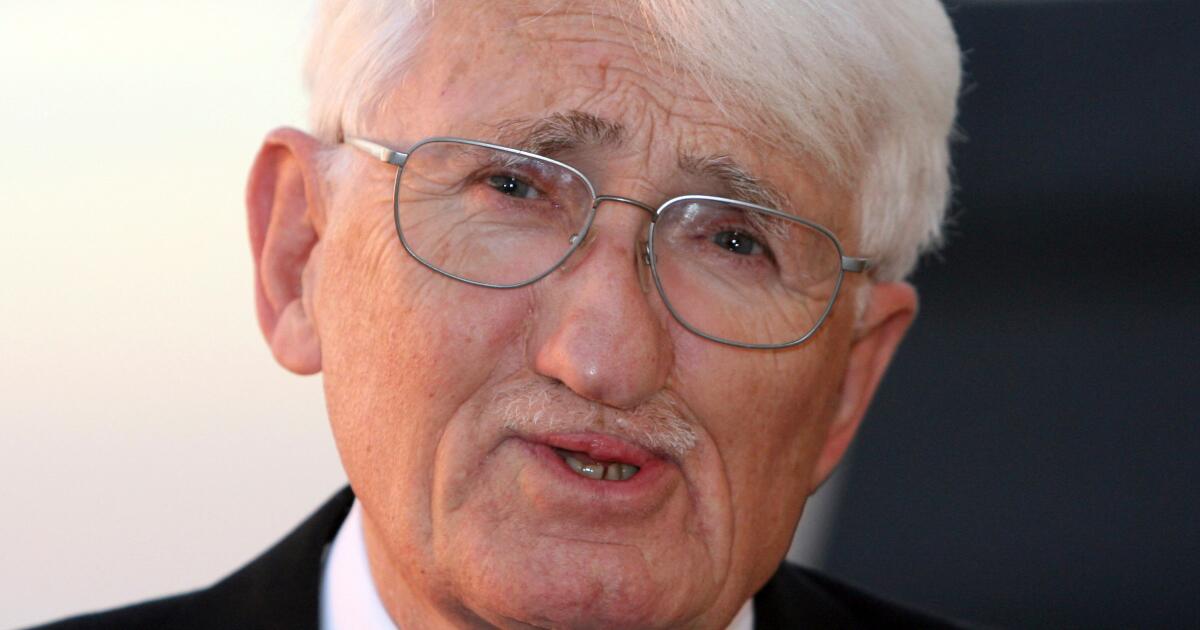
BERLIN — Juergen Habermas, whose work on communication, rationality and sociology made him one of the world’s most influential philosophers and a key intellectual figure in his native Germany, has died. He was 96.
Habermas’ publisher, Suhrkamp, said he died on Saturday in Starnberg, near Munich.
German Chancellor Friedrich Merz said that “Germany and Europe have lost one of the most significant thinkers of our time.”
Merz said that “his sociological and philosophical work had an impact on generations of researchers and thinkers.” He praised “Habermas’ intellectual forcefulness and his liberality” and said in a statement that “his voice will be missed.”
Habermas frequently weighed in on political matters over several decades. His extensive writing crossed the boundaries of academic and philosophical disciplines, providing a vision of modern society and social interaction. His best-known works included the two-volume “Theory of Communicative Action.”
Habermas, who was 15 at the time of Nazi Germany’s defeat, later recalled the dawn of a new era in 1945 and his coming to terms with the reality of Nazi crimes as something without which he wouldn’t have found his way into philosophy and social theory. He recalled that “you saw suddenly that it was a politically criminal system in which you had lived.”
He had an ambivalent relationship with the left-wing student movement of the late 1960s in Germany and beyond, engaging with it but also warning at the time against the danger of what he called “left-wing fascism” — a reaction to a firebrand speech by a student leader that he later said was “slightly out of place.” He would later recognize the movement as having driven a “fundamental liberalization” of German society.
In the 1980s, Habermas was a prominent figure in the so-called Historians’ Dispute, in which Berlin historian Ernst Nolte and others called for a new perspective on the Third Reich and German identity. They tended to compare what happened under Adolf Hitler to atrocities carried out by other governments, such as the deaths of millions in the Soviet Union under Josef Stalin. Habermas and other opponents contended that the conservative historians were trying to lessen the magnitude of Nazi crimes through such comparisons.
Habermas supported the rise to power of center-left Chancellor Gerhard Schroeder in 1998. He was critical of the “technocratic” approach and perceived lack of political vision of Schroeder’s conservative successor, Angela Merkel, complaining in 2016 of the paralyzing effects on public opinion of “the foam blanket of Merkel’s policy of sending people to sleep.”
He was particularly critical of the “limited interest” shown by German politicians, business leaders and media in “shaping a politically effective Europe.” In 2017, he praised newly elected French President Emmanuel Macron for laying out of plans for European reform, saying that “the way he speaks about Europe makes a difference.”
Habermas was born on June 18, 1929, in Duesseldorf and grew up in nearby Gummersbach, where his father headed the local chamber of commerce. He became a member of the Deutsches Jungvolk, a section of the Hitler Youth for younger boys, at 10.
He was born with a cleft palate that required repeated operations as a child, an experience that helped inform his later thinking about language.
Habermas said he had experienced the importance of spoken language as “a layer of commonality without which we as individuals cannot exist” and recalled struggling to make himself understood. He also spoke of the “superiority of the written word,” and said that “the written form conceals the flaws of the oral.”
His wife, Ute Habermas-Wesselhoeft, died last year. The couple had three children: Tilmann; Rebekka, who died in 2023; and Judith.
When I think of the solidarity of musicians, I recall an iconic scene from the film “Titanic.”
It’s the one where a quartet plays “Nearer, My God, to Thee” as the great, “unsinkable” ship sinks into the North Atlantic Ocean.
They attempted to offer calm amid a sea of panic as passengers and crew feverishly boarded lifeboats. The events were based on a true story and historians note that the body of the Titanic band leader Wallace Hartley was found floating in the ocean “with his music case strapped to it.”
Even in tragedy, we seek music to bring us solace.
Much closer to home, musicians from Pacific Palisades, Altadena and other affected areas have been challenged to keep the music going after losing instruments, studio equipment and business along with their homes in the January 2025 fires that claimed the lives of 31 people.
One organization, Altadena Musicians, launched the app Instrumental Giving to connect donors who can spare an old piano or a gently used cello with those who lost similar instruments.
KC Mancebo, an Altadena Musicians advisor, spoke with The Times about the group’s mission and success.
The campaign’s genesis
It started with composers Brandon Jay and his wife, Gwendolyn Sanford, who saw their Altadena home, music studio and several instruments destroyed by the Eaton fire.
Shortly after the fire, Jay posted about the lost equipment and what each piece meant to his family.
He said the response from that post — hundreds of people offering their instruments and other types of aid — left him “overwhelmed and gobsmacked.”
He called friends and helpers from throughout the music industry, including Mancebo, chief executive of the event production and talent booking agency Clamorhouse, hoping to offer to others the same help he received.
Mancebo had been helping homeowners navigate fire insurance paperwork and processes.
“Brandon Jay asked, ‘Why don’t we start gathering instruments for our friends,” Mancebo said. “We had 25 friends in the Palisades and 15 friends in the Eaton fire that lost everything, so we and others got involved.”
How’s it going so far?
The organization has passed out around 3,500 instruments to 1,200 families since the first donations in late January 2025, Mancebo said.
The donations range from ukuleles to Steinway & Sons pianos.
“We’re providing instruments to anyone from children who lost their first instruments to people who lost their entire studio,” she said. “The need is great.”
The gifts have come from individual donors and corporate benefactors such as JBL, which has provided speakers and equipment, as well as guitar makers Fender and Gibson, among others.
Rebuilding from the ashes
Mancebo lost her Westside home eight years ago because of a defective dryer that caught fire, she said.
“I went through the whole process of insurance, permitting and rebuilding and we didn’t have FEMA or anyone to help,” she said. “I want to provide that help to those in a similar situation.”
Mancebo said it took eight years to recover and rebuild her home.
“No one is fine after the first year,” she said. “Everyone needs help.”
Brentwood resident Amy Engelhardt, a singer/songwriter, composer, lyricist and playwright, donated her Kawai Upright Piano to the Altadena Musicians organization on March 10, 2026.
(Courtesy of Amy Engelhardt)
One person’s goodbye is another’s hello
Brentwood resident Amy Engelhardt, a singer/songwriter, composer, lyricist and playwright, loved her Kawai upright piano she purchased through a PennySaver ad in 2000.
“It was a deal for the starving artist,” she said. “I paid so little and I always considered it a gift.”
Since then, Engelhardt said she has written all of her music on that piano. She didn’t, however, play it while recording her Grammy-nominated vocal group, the Bobs.
Still, she donated her piano this week to a woman who lost her home. The instrument would not be making the permanent move with Engelhardt back to New York, where her playwriting services are in demand.
“I did get emotional about it, but it’s OK,” Engelhardt said. “It’s comforting knowing that someone else will love it and create their own memories.”
You’re reading the Essential California newsletter
The week’s biggest stories
(Hiro Komae / Associated Press)
War with Iran
Oscars on Sunday
Television and entertainment news
Dangerous situations
What else is going on
Must reads
Other meaty reads
For your downtime
Going out
Staying in
L.A. Timeless
A selection of the very best reads from The Times’ 143-year archive.
Have a great day, from the Essential California team
Jim Rainey, staff reporter Hugo Martín, assistant editor, fast break desk Kevinisha Walker, multiplatform editor Andrew J. Campa, weekend writer Karim Doumar, head of newsletters
With its ancient church ruins and historic houses, walkers and history enthusiasts flock to see the UK’s ‘best preserved’ medieval village
Emily Malia GAU Writer and Ketsuda Phoutinane Spare Time Content Editor
15:46, 14 Mar 2026Updated 15:47, 14 Mar 2026
Wharram Percy is a deserted medieval village(Image: ian driscoll via Getty Images)
Tourists flock from far and wide to witness the UK’s ‘best preserved’ medieval village. Wharram Percy has stood empty for hundreds of years and now provides a captivating destination for ramblers and heritage buffs.
Tucked away in North Yorkshire, Wharram Percy ranks amongst Britain’s largest deserted medieval settlements and is certainly the most celebrated. Guests can wander freely across the ancient site, exploring the vestiges of centuries-old dwellings, a church, and manor house remains.
Perfectly positioned midway between crowd-pulling destinations Scarborough Castle and Clifford’s Tower in York, it proves an ideal pit stop when travelling between these two landmarks. Whilst admission to the settlement is complimentary, visitors face a modest £2 parking fee.
Throughout a remarkable 60-year span, archaeologists have steadily uncovered fresh insights into Wharram Percy’s past. Their discoveries have revealed why the location was originally forsaken and how residents lived during earlier eras.
Situated on a Yorkshire valley’s rim, this extraordinary settlement was home to communities for as long as six hundred years before being abandoned following the 1500s. Experts believe that even now, traces of former dwellings remain visible in the earth, alongside the more prominent ruins that draw inquisitive sightseers.
The history requires some unpacking, but specialists reckon the first settlement stretches back to around 50 BC. This territory was later converted into agricultural land but remained abandoned throughout the 5th century, before ultimately evolving into a Middle Saxon community.
It’s worth bearing in mind that accessing the village involves approximately a 3/4 mile trek from the car park to the principal area, which is often both precipitous and waterlogged. The location presents uneven ground across its entirety, which can prove difficult for certain visitors and is largely impractical for wheelchairs or pushchairs.
A TripAdvisor reviewer emphasised this point, noting: “Parking on the Heritage car park off the B1248 prepare for a trek to the village.”
They proceeded to characterise it as a “sharp gravelled decline” and a “daunting” expedition unsuitable for those with restricted mobility, as the path traverses farmland.
After their excursion, one enthusiast commended their experience, remarking: “Lovely walk from the car park to the site, but people with mobility issues may struggle. It’s a fascinating historical site that has been really well managed. Only a few visitors when we visited, which added to the peace and tranquillity of the place. Loved it!”
Another visitor commented: “This lovely deserted mediaeval village is truly fascinating! The history is incredible, and it was wonderful to wander around and explore. We really lucked out and had beautiful weather, so we got to sit on the grass by the pond and soak it all in.”
The village was evacuated in 1943 when residents were given just one month to leave – now frozen in time, it’s a haunting tourist attraction
The abandoned church in the ghost village of Tyneham in Dorset, where locals left a heart-wrenching note(Image: Getty Images/iStockphoto)
A deserted Dorset village stands as a unique place in Britain, a relic from the past that hasn’t been erased from memory. Tragic events forced inhabitants to abandon their cherished homes many decades ago.
Tucked away on Dorset’s breathtaking Jurassic Coast, a visit to Tyneham village feels like travelling through time. Visitors can catch a window into the existence of the residents who were compelled to desert the village during the Second World War.
It was 1943 when the thriving settlement of Tyneham saw their world turned upside down forever. Britain was deep into World War Two when the military commandeered the village for training operations.
This meant heartbroken locals were handed just one month’s warning to evacuate their properties where countless families had resided for centuries.
The wartime government seized Tyneham village and its surrounding territory to establish a training facility for the Allied forces, due to its proximity to the Lulworth firing range.
Residents were convinced they were sacrificing their properties for the nation’s benefit and expected to come back after the war ended.
A message was attached to the church door, which stated: “Please treat the church and houses with care. We have given up our homes where many of us have lived for generations, to help win the war to keep men free. We will return one day and thank you for treating the village kindly.”
Tragically however, the villagers were never able to return to their homes in Tyneham as even after World War Two concluded, the village and surrounding area remained a training ground for military exercises.
Today the village, still preserved in time after more than 80 years, serves as a ‘thought-provoking and interesting’ visitor attraction. It welcomes guests at certain periods throughout the year and tourists praise its ‘fascinating insights into the lives of residents’.
When the village closes to visitors, the gates preventing entry are secured at dusk each evening.
One TripAdvisor review states: “This deserted village has such an interesting history. The boards within the church detailing the villagers fight to be allowed to return to the village and the current position are very moving.”
Another TripAdvisor user called it ‘a wonderful place – very atmospheric and sad but in a way that keeps drawing you back to visit’.
Tyneham’s final resident, Peter Wellman passed away aged 100 in April this year – the centenarian made one last journey to the village in 2024, to revisit the location where he was born and raised.
During his 2024 visit to Tyneham, Peter recalled his early years, telling the Dorset Echo at the time: “We had no electricity, no mains gas and no running water – we had to pump that from near the church.
“I remember going to the beach and fishing and we often had mackerel. We were happy until we got moved out.”
Tyneham village sits within the Isle of Purbeck, though it’s not truly an island but rather a peninsula surrounded by the English Channel in Dorset.
Fans flocked to the comments section to share their excitement as one said: “Yayy I love Dollywood!!”
Another person commented: “The girl next door who owns an amusement park. Because Dolly showed us, girls can do anything.”
Somebody else enthused: “Can’t wait to go back!!”
Dolly faced some health woes last yearCredit: AP
Yet another expressed: “The Queen of Tennessee, beautiful Dolly.”
While a fifth added: “Going in August – taking a family vacation and Dollywood is definitely on the itinerary.
This comes after Dolly sparked health concerns last fall when she canceled several performances.
At the beginning of fall in 2025, the Tennessee native announced she was forced to postpone her Las Vegas residency after dealing with a number of “health challenges.”
Dolly’s shows were scheduled for six dates in early December at The Colosseum at Caesars Palace.
Tim McGraw subsequently took her place and the rescheduled shows have been set for September 2026.
In her message to fans, Dolly explained that she couldn’t perform due to doctor’s orders and had to undergo “a few procedures.”
She previously took some time off to deal with her healthCredit: Getty
“He is telling me to slow down right now so I can be ready for more big adventures with all of you.
“I love you and thank you for understanding.”
She assured fans that she would be back on stage soon, writing, “And don’t worry about me quittin’ the business because God hasn’t said anything about stopping yet.
After taking some time off, she returned last month as she told her fans some exciting news.
Looking incredible while sitting in a colorful room, Dolly delivered the news that East Tennessee Children’s Hospital was officially becoming Dolly Parton Children’s Hospital.
In the video, she explained how she believed every child should grow up healthy and with a fair chance.
She then revealed the hospital’s name change before saying, “I can’t do it all myself,” and asking for people to get involved via her website.
Meanwhile, the caption of the video read: “A new chapter begins.
“East Tennessee Children’s Hospital is proud to share we are becoming Dolly Parton Children’s Hospital.
“Inspired by Dolly’s commitment to children, this transformation represents more than a name change, it’s a promise. A promise to bring hope, healing and world-class care to patients and families across our region.
“Together, we’re building a future where every child has the chance to grow, thrive and feel the comfort of compassionate care.
“The same dedicated team. The same trusted care. Now carrying a name that reflects the heart of our mission. Learn more at DollyChildrens.org.”
She’s opened up Dolly’s Children HospitalCredit: Instagram / dollychildrens
Twenty-three years ago, the Oscars were in turmoil. President George W. Bush had just begun an invasion of Iraq after the Sept. 11 attacks, and as the nation’s TV screens filled with the “shock and awe” campaign, many did not know quite how to proceed with Hollywood’s biggest night.
ABC wanted to postpone, presenters begged off, Jack Nicholson urged his fellow actor nominees to boycott (animated feature winner Hayao Miyazaki did), documentary winner Michael Moore attempted to directly shame Bush from the stage (to loud boos) and many of the acceptance speeches acknowledged the war and included pleas for peace.
President Trump’s recent decision to attack Iran is not precisely the same — American troops have thus far not invaded and the Bush administration’s media blitz of rockets lighting up the sky is absent. No one expected the Oscars to be canceled or delayed and there has been no talk of boycotts; whether the war and (if polls are to be believed) its general unpopularity are noted, either by host Conan O’Brien (who has already said he will not be mentioning Trump) or the winners, remains to be seen.
But if recent history is any indication, it could go unmentioned. Which would be something of a political statement in itself: It would be terrible if the false notion that awards shows have become too political had a chilling effect on anyone who wanted to use their platform to speak about something important they care about.
Thus far, film and television awards winners have stayed away from the issues that have prompted widespread public outrage and protests this year — including the often brutal methods of Immigration and Customs Enforcement, the ongoing concern over the war in Gaza and the endless revelations of the Epstein files.
Despite complaints from certain quarters, awards shows, particularly the Oscars, rarely have more than one or two truly political moments. But this year, the absence has been notable.
Compared with the Grammy Awards, where Trevor Noah, in his final stint as host, roasted Trump and anti-ICE sentiment reigned in speeches and on pins, this year’s Golden Globes (which aired three weeks before the Grammys) appeared to exist in another world. A few stars wore similar pins and spoke on the red carpet, but aside from a few digs about Epstein and CBS News from host Nikki Glaser, there was no mention of the many issues roiling the nation. (As he was beginning to make late-in-speech remarks about this being an important time to make films, Kleber Mendonça Filho, Brazilian director of the non-English language film winner “The Secret Agent,” ran over time and was played off.)
Has Hollywood lost its spine? Or, having been beset for years by grievances that the Oscars have become “too political” and “too woke,” are filmmakers and actors saving their outrage and passion for social media and bowing to pressure to keep their acceptance speeches grateful and celebratory?
“I know that there are people who find it annoying when actors take opportunities like this to talk about social and political things,” said Jean Smart on the Golden Globes red carpet, adding, when she won for actress in a TV comedy: “There’s just a lot that could be said tonight. I said my rant on the red carpet, so I won’t do it here.”
It was an echo of Jane Fonda’s famous 1972 Oscar speech: “There’s a great deal to say, and I’m not going to say it tonight.” And, perhaps, a response to more recent “shut up and dribble” criticism, as distilled by 2020 Golden Globes host Ricky Gervais, who cautioned the audience: “If you do win an award tonight, don’t use it as a platform to make a political speech. You’re in no position to lecture the public about anything. You know nothing about the real world.”
Indeed, as Oscars ratings have plummeted over the last 20 years, some have suggested that political speechifying is to blame. This is patently absurd. Viewership for just about everything except the Super Bowl has dropped dramatically, and the Oscars ratings do not take into account the millions who watch portions of the show on social media. (We’ll see what happens when the Oscars move to YouTube in 2029.)
And the Oscars have never been particularly political.
Speeches that deviate from the ubiquitous laundry list of thank yous always get more attention, whether they’re political or not, for the simple reason that they’re so dang unusual. But taken as a whole, either by decade or particular telecast, the Oscars is mostly, and consistently, apolitical. As in, almost every minute of a three-hour-plus show, year after year after year.
Unless, of course, you consider thanking God to be political. Which I do not. Nor do I categorize as such any speech that underlines the fact of a historic win (as Halle Berry did in 2002), encourages Hollywood to tell more diverse stories (as Cate Blanchett did in 2014) or reminds audiences in a general way that systemic oppression and war are bad (as Adrian Brody did amid his ramblings in 2025).
Many of the speeches that have been branded as “political” are simply underscoring the themes of the films being honored — in 2009, both Dustin Lance Black and Sean Penn advocated for gay rights when accepting Oscars for “Milk,” which chronicled the life of assassinated gay rights activist Harvey Milk. Likewise, John Irving supporting abortion rights and Planned Parenthood after winning for “The Cider House Rules” in 2000 and John Legend and Common speaking passionately about civil rights, past and present, after winning for “Glory,” a song from the civil rights drama “Selma,” in 2015 was only natural.
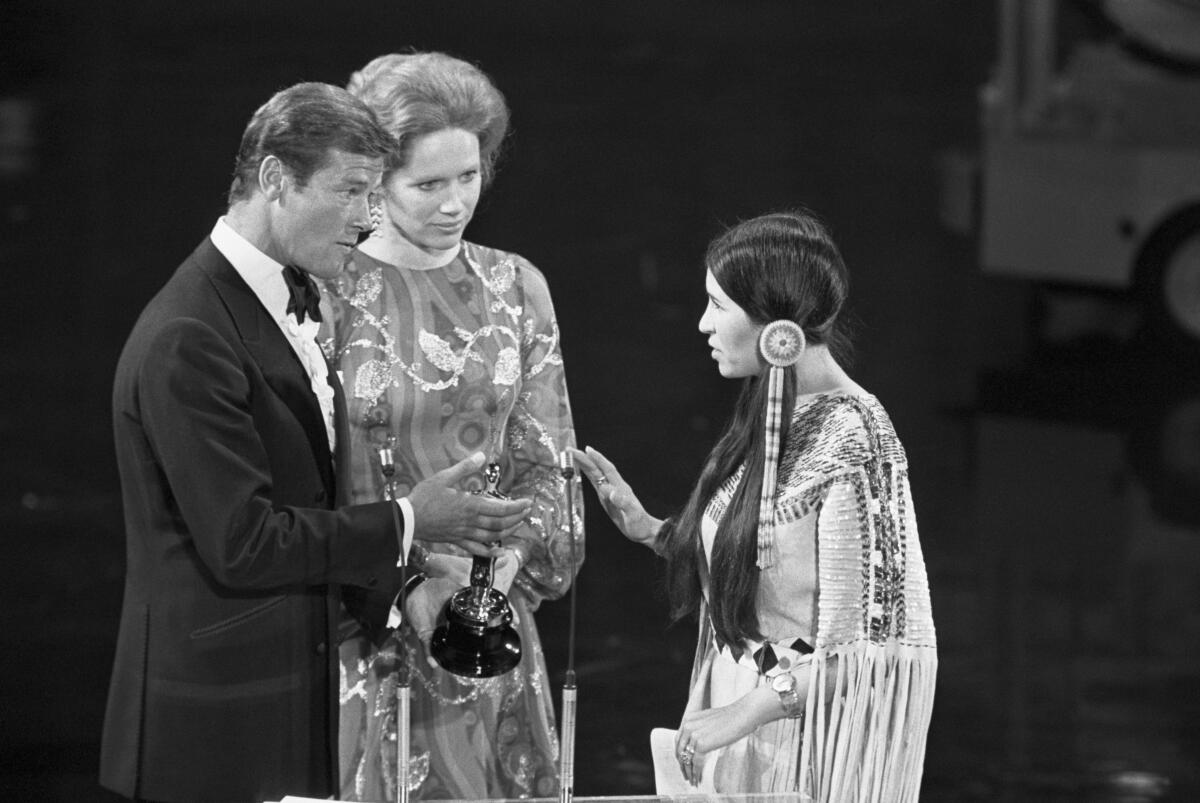
Sacheen Littlefeather refuses the lead actor Academy Award on behalf of Marlon Brando in 1973.
(Bettmann Archive)
A purely political speech, to my mind, directly calls out specific leaders, policies or crises, which may or may not have anything to do with the film being awarded. The most famous are, of course, Marlon Brando’s decision to send Sacheen Littlefeather to accept his Oscar for “The Godfather” and protest the treatment of Native Americans, and Vanessa Redgrave’s 1978 denunciation of “Zionist hoodlums” who were demonstrating against her involvement in a pro-Palestinian documentary even as she accepted for supporting actress in “Julia.”
In 1993, while many Oscars attendees wore red ribbons to honor those living with HIV/AIDS and call for government assistance, then-couple Susan Sarandon and Tim Robbins took it further, using their time as presenters to ask the U.S. government to allow HIV-positive Haitians being held at Guantanamo Bay to be let into the country. That same year, presenter Richard Gere used the fact that “1 billion people” were watching to send “sanity” to Chinese leader Deng Xiaoping in the hopes that he would allow the people of Tibet to “live free.” (Then-Oscars producer Gil Cates quickly denounced the three presenters; Gere did not return to the Oscars until 2013.)
A year after Moore blasted Bush over Iraq, Errol Morris, winning for “The Fog of War,” briefly compared the war in Iraq to the “rabbit hole” of Vietnam (which was the subject of his film). In 2015, “Boyhood” star Patricia Arquette used most of her supporting actress speech to demand equal wages for women. That same year, “Birdman” director Alejandro G. Iñárritu dedicated his award to his fellow Mexicans, with the hope that they would be treated by Americans “with dignity and respect” so that together, they could build a “great immigrant nation.” (Which frankly plays more purely political now than it did at the time.) A year later, Leonardo DiCaprio spoke about climate change after winning for “The Revenant.”
In 2019, Spike Lee, accepting for adapted screenplay (“BlacKkKlansman”), called on voters in the upcoming election to mobilize and “be on the right side of history” and in 2024, “Zone of Interest” director Jonathan Glazer, accepting for international film, riled many by comparing the dehumanization required for the Holocaust to occur with events in Gaza.
Even now, the most notable examples of political speeches, the ones that are always mentioned, are from the freaking‘70s. Which certainly obliterates the idea that the Oscars have grown more political and undermines the argument that it is a Big Problem.
Put these relatively few moments next to the endless hours of acceptance speeches that, with varying degrees of emotion, honor the art of movie-making and the legions that support those who are doing it (including God, parents, spouses, children, some random but heaven-sent teacher) and it’s difficult to see much “wokeness.”
The people who gather at the Oscars are storytellers, and many of the stories they tell deal with uncomfortable truths about our collective past, present and future (including best picture front-runners “One Battle After Another” and “Sinners”). Of course nominees and winners have opinions about politics, science, social issues, international conflict and those suffering without recourse or voice — that’s why they make movies. So if a few of them decide to skip thanking their manager or the studio head and say a few words about climate change or whatever current law/policy/presidential action they believe is making lives worse for a lot of people, that’s their choice. They just won an Oscar!
For those uncomfortable watching it, just use the 45 seconds to grab a snack and by the time you’re back, the host will be moaning about how long the show is and the next five winners will inevitably cry and smile; praise their fellow nominees; thank the producers; say something sweet about their cast, crew and mamas; before telling their kids they love them and it’s time to go to bed.
Who: Real Madrid vs Elche What: Spanish football’s La Liga Where: Bernabeu Stadium in Madrid, Spain When: Saturday, March 14 at 9pm (20:00 GMT) How to follow:Al Jazeera Sport’s live coverage begins at 17:00 GMT
After stuttering and spluttering in Spain’s La Liga of late, Real Madrid stormed back into life with a resounding win in the UEFA Champions League in midweek.
Recommended Stories
list of 4 itemsend of list
Now the record La Liga winners return their focus on catching league leaders, and defending champions, Barcelona, in the Spanish top flight.
Elche arrive in Madrid with major concerns of their own, sitting one place above the relegation zone.
Al Jazeera Sport takes a closer look at the game.
How is Real Madrid and Barcelona’s La Liga title race looking?
Barcelona are four points clear of Real, having both played 27 matches. Barca have won 22 of their matches and lost four, while Real have lost that same number but have only won 20, drawing two more games than their rivals.
Barcelona entertain 14th-placed Seville on Sunday, meaning Real can cut the lead to just a point if they beat Elche.
How have Real Madrid fared in La Liga this season?
The turbulent time that marked the end of Xabi Alonso’s spell as Real manager appeared to return in recent weeks, with Los Blancos losing two on the bounce in La Liga for the first time this season.
With a tricky trip to Celta Vigo following the defeats by Osasuna and Getafe, Real’s title challenge appeared on the line.
A 2-1 win in Vigo, thanks to goals from Aurelien Tchouameni and Federico Valverde, last Friday cut Barca’s lead at the top to only a point, only for the Catalan club to restore their advantage with a 1-0 win at Athletic Bilbao on Saturday.
Los Blancos had won 13 of their opening 14 games in all competitions this season, only dropping points in the 5-2 defeat in the Madrid derby at Atletico.
The two wins in eight that followed set the tone for the remainder of Alonso’s time in charge, even five wins on the bounce thereafter couldn’t save the former Real midfielder from the chop, with the end coming following the Spanish Super Cup final 3-2 defeat by Barcelona.
Interim head coach, Alvaro Arbeloa, endured a torrid start – with a humiliating 3-2 defeat at Albacete in the Copa del Rey, but won the next five league games on the bounce to renew hope of catching Barcelona.
How have Elche fared in La Liga this season?
Elche were unbeaten in their opening seven games of the season, all in the league, winning four.
A seven-match winless run followed in La Liga, plunging the Alicante-based club into the relegation scrap.
Their latest winless run stretches to 11 matches – 10 in La Liga – with seven defeats in that time and only four league points snared.
Eder Sarabia’s side are now just one point and one place above the bottom three and are the only side in the competition yet to win away from home this season – losing nine of their 13 games on the road.
Last up for Real Madrid
Real’s season was given a welcome boost in midweek with a resounding 3-0 win against Manchester City – led by former Barcelona manager Pep Guardiola – in the first leg of their UEFA Champions League round-of-16 tie.
Valverde, who netted the winner last weekend in Vigo, scored a first-half hat-trick to hand Los Blancos a significant advantage heading to Manchester for the return fixture.
Last up for Elche
Elche were defeated 2-1 at Villarreal in La Liga last Sunday, in what was their fifth consecutive defeat on their travels.
The last four of those came in the league, while the run began with their Copa del Rey exit at Real Betis.
Leo Petrot had given Elche the lead in the 58th minute, but a double from Chimy Avila turned the game.
Stat attack – Elche
Elche are yet to keep a clean sheet on their travels in the league this season. In the 13 games on the road, they have conceded 26 goals – but, on a more optimistic note, they have managed to score in all but two of those games.
What happened the last time Real Madrid played Elche?
Elche secured a valuable point in a 2-2 draw in the reverse match against Real in La Liga this season.
Aleix Febas and Alvaro Rodriguez twice gave the home side the lead, the latter netting in the 84th minute, but Dean Huijsen and Jude Bellingham twice levelled for Los Blancos, before Victor Chust was sent off for the home side in injury time.
What happened the last time Elche entertained Real Madrid?
Real were 3-0 winners in this fixture in October 2022, with Federico Valverde, Karim Benzema and Marco Asensio netting the goals.
Los Blancos took the reverse fixture 4-0 in February 2023.
When did Elche last beat Real Madrid?
It has been a long wait for Elche to come away with the spoils in this fixture, with their last win – a 3-1 victory – coming in 1978.
Head-to-head
The teams have met 54 times, with Real winning 35 of the encounters. Elche have emerged victorious on six occasions.
All six of Elche’s victories have come at home.
Real Madrid team news
Kylian Mbappe’s absence remains Real’s major frustration, but the French striker heads a long list of absentees.
Ferland Mendy is a major doubt, having been forced off in the victory against Manchester City due to injury.
The defender could join Mbappe, Eder Militao, Jude Bellingham, Dani Ceballos and Rodrygo on the sidelines
Franco Mastantuono is suspended for the game, but Alvaro Carreras and David Alaba are both close to shaking off calf injuries.
Elche team news
Hector Fort, who is on loan from Barcelona, is out with a shoulder injury.
Pedro Bigas and John Donald are both injury doubts and face late fitness tests.
An airline captain with 35 years of experience shares his strategy for managing jet lag on long-haul flights cutting recovery time from days to just hours
Regular travellers will know the misery of jet lag(Image: TommasoT via Getty Images)
During the late 1970s, a new range of travel options opened for holidaymakers as transatlantic journeys became much more affordable. Yet whilst the monetary cost of long-haul travel has steadily declined, the toll it takes on the body has remained unchanged.
Jet lag stems from several contributing elements, including the oxygen-poor cabin environment on aeroplanes, but the primary culprit is an abrupt shift between time zones. The body’s internal clock cannot adapt swiftly enough, and it’s typical for long-distance passengers to experience sleep disturbances alongside digestive problems.
Flying eastwards can trigger particularly brutal jet lag, with over-60s generally suffering more severely than their younger counterparts. Veteran travellers often swear by solutions like melatonin or strong coffee, but naturally the best source of wisdom on combating jet lag comes from airline personnel themselves.
Alfonso de Bertodano, an airline captain with 35 years of experience, has a straightforward and proven strategy: “To avoid jet lag, if I’m going to be in a place for two or three days, I try to meet up with people who are eating lunch or dinner at their usual time. Otherwise, it will take you six days to get over it”.
Speaking to Mundo Deportivo, Alfonso continued: “The reality is that I try to change my schedule as little as possible. I arrive at my destination at 8pm, which is 2am in Spain, and I go straight to bed. I don’t go out for dinner, I don’t go out for a drink.”
Alfonso, an airline pilot who needs to be alert and refreshed for his job, shared: “I set myself a countdown of seven or eight hours and get up at whatever time it is, regardless of what time it is in that country.
“That way, I maintain my Spanish schedule. Because jet lag isn’t just about sleep. It’s about muscle tone, it’s about the digestive tract… It’s not the same to feed your body at 3 in the morning as it is to feed it at 10 or 11 at night.”
He emphasised that mingling with locals and adapting to their routine as swiftly as possible is the secret to overcoming jet lag. “The ideal thing is to be with people who are having breakfast, lunch or dinner at their usual time, and you’re with them maintaining neural activity, brain activity and muscle tone activity,” advised the pilot.
Alfonso further added: “You’ll adjust much more quickly than if you do it on your own. And when you return, it’s exactly the same. That’s why when you arrive, you might sleep for a little whilst, but I immediately set my alarm clock to wake myself up and get on with my daily life,” explained the aircraft commander.
“It’s tiring, but you get your body used to performing like that. In the end, you have to control your body because if you let your body control you, you’ll end up curing your jet lag, or getting over your jet lag, in six days instead of 24 or 48 hours.”
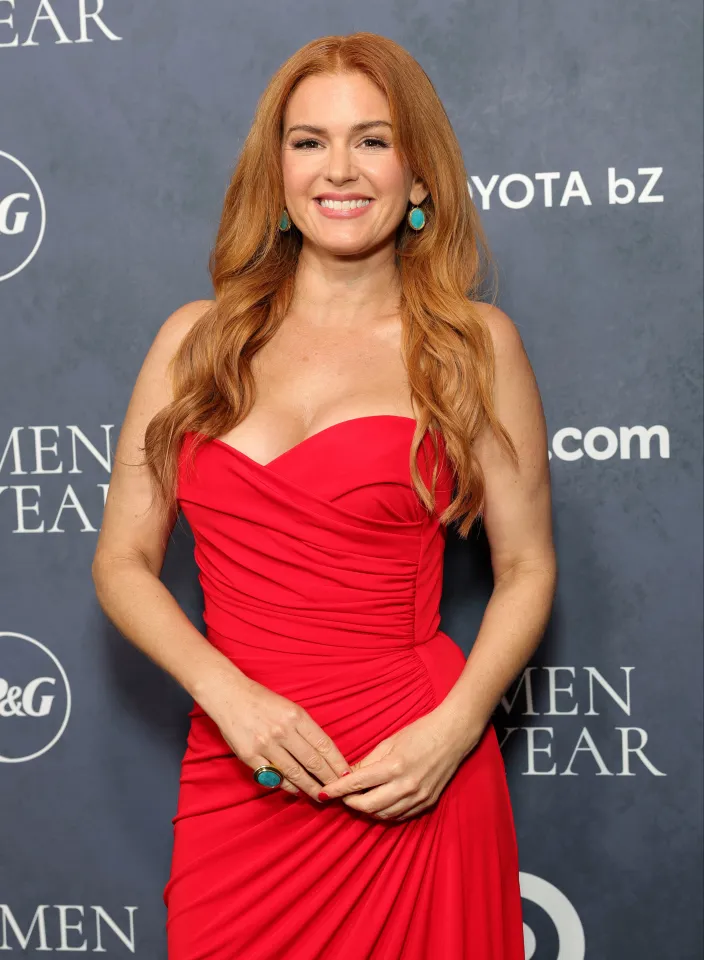
ISLA Fisher shows she’s a match for any red carpet.
The Australian star, 50, beamed in a crimson dress at the Time Women of the Year Gala.
Sign up for the Showbiz newsletter
Thank you!
Isla Fisher, 50, wows in a crimson dress at the Time Women of the Year GalaCredit: GettyIsla has revealed she is ready to embrace life following her split from Sacha Baron CohenCredit: Getty
A travel expert claims he has saved money by looking for flights at a specific time, and early risers could bag a bargain, but there are also other ways to cut the cost of your flight
Night owls could pay less for their flights(Image: MEN MEDIA)
A travel expert has claimed that the time you book a flight can be just as important as the day you choose to travel, and that setting your alarm at a very specific time could help you land the best deals.
Jamie Fraser, owner of Wild Packs, claims that the cheapest time to book flights is exactly 2:48am in what could be good news for night owls and insomniacs. He also claims that evening searches between 8pm and 2pm can also be around 5% cheaper than searching during peak morning hours.
Airlines will often raise prices when they see heavy demand for a destination, so if lots of other people are up at the same time looking for the same route and dates, this could potentially put prices up. Jamie says: “Most people search for flights first thing in the morning while they’re having coffee, but that’s exactly when everyone else is doing the same thing.
“When airline systems see that spike in demand, prices can rise quickly. It’s one of the easiest ways travellers overpay. The cheapest time to book is usually in the early hours of the morning, around 2:48 am, when far fewer people are searching, and airline pricing systems have reset overnight.”
He added: “If you’re not willing to set a 2 am alarm, the next best option is late evening. Booking between 8 pm and 10 pm can still save around 5% compared to that busy morning window.”
So does this hack work? In the early years of internet travel booking, airlines and other sites would update their fares manually overnight. This meant that savvy travellers could sometimes pick up middle of the night bargains. However, nowadays, it’s more complex because systems have evolved, so you may still need a bit of luck on your side.
You could also potentially save money by using Jamie’s other suggested hack, which is to set up price alerts rather than checking fares repeatedly. Jamie also reiterated the often given advice that travellers should be flexible with travel plans, looking out for different airlines, dates, or nearby airports.
If you use sites such as Skyscanner, you can often tick a ‘nearby airports’ box, as an airport a short drive away could end up being cheaper. If you’re flexible on destination, for example you simply want to go somewhere sunny with a beach, then choosing ‘everywhere’ as a destination will show you the cheapest options for your dates.
It’s also worth signing up for emails from specific airlines and looking out for deals such as flash sales or kids fly for free offers, which often have limited availability and need to be snapped up quickly.
Have a story you want to share? Email us at webtravel@reachplc.com
PHOENIX — When he was selected with the 13th pick of the 2024 MLB draft, outfielder James Tibbs III envisioned himself roaming the outfield of Oracle Park in a San Francisco Giants uniform for many years.
He could never have foreseen that a year and a half later, he’d be playing for a longtime Giants rival, already at the third stop of his young career.
The Giants packaged Tibbs along with Kyle Harrison, Jordan Hicks and Jose Bello in a trade to the Boston Red Sox in exchange for three-time All-Star Rafael Devers last June.
A month and a half later, Tibbs’ life was uprooted yet again, as the Red Sox moved him and Zach Ehrhard to the Dodgers in a trade for Dustin May.
MLB Pipeline prospect analyst Jim Callis has covered the draft for over 30 years, and can’t recall a situation quite like it.
“Tibbs is the only player I can think of who was taken in the top half of the first round and then traded twice during his first full pro season,” Callis said. “He really took off after joining the Dodgers, and I bet we see more consistency out of him when he’s not bouncing between [organizations] in 2026.”
Tibbs seems to have found a comfortable landing spot with the Dodgers. He posted seven home runs, 32 RBI and a .269/.407/.900 slash line over his 36 games in the Dodgers organization, rounding out his season at double-A Tulsa. And during his first camp with the Dodgers, Tibbs has turned heads. Through 15 Cactus League games, he’s hit two home runs, batting .281, with a .351 on-base percentage and .914 OPS.
He likely won’t open the season on the Dodgers’ big-league roster, but manager Dave Roberts sees his potential.
“I like James Tibbs,” Roberts said. “I like him a lot. He loves baseball, he is obsessed with getting better at the game and he just fits who I am as a baseball coach, and the players that we want, so he’s going to play in the big leagues. He’s a championship-type player.”
Tibbs was thrown for a loop by both trades, and taught him a lesson about facing adversity.
“Honestly, I might be one of the first first-round draft picks to be traded twice in their first year,” Tibbs said. “For me it was hard. I’m not going to sugarcoat it; it was hard. And really, mentally draining. [I] felt like I got punched in the face a bunch of times, and really had to learn how to get back up, and keep competing, and figure out how to be true to myself, and true to what I do well.”
Tibbs said that joining the Dodgers helped him to rediscover himself and return to his form from his time at Florida State.
“[When I joined the Dodgers, they] were like, ‘Hey, you know, we just want you to be yourself,” Tibbs said. “We want you to do what you need to do to be successful. Like, we believe in you, we believe in what you did in college. We want you to get that back and be able to be successful with how you swing the bat and how you play defense, and like, we don’t want to take that away from you.’ So obviously, there was tweaks being made, and there was things we needed to change a little bit to get to that spot, but I think for the most part, they just allowed me to be me and work within those boundaries to help figure out how to continue to make that better and better and better.
“And with that being said, I just felt a lot of relief from that.”
Tibbs clubbed 28 home runs in his junior year at Florida State, powering the Seminoles to their first College World Series trip since 2019. He received ACC Player of the Year and consensus First-Team All-American honors.
“Tibbs was one of the best offensive prospects in a loaded 2024 college class,” Callis said. “He makes good swing decisions and hits balls hard, giving him the ingredients to hit for average and power. Most of his value will come from his bat, but it’s a potentially potent bat.”
For now, Tibbs is content to be fulfilling his potential with one organization.
“Props to the Dodgers, they did everything they could to help me transition to that smoothly and make that a better process,” Tibbs said. “And it’s been a lot easier for me to go out and play every night, with the way that they’ve encouraged me and believed in me. It’s just been a blessing to be here.”
A passenger train linking North Korea and China crosses the Amnok River bridge, also known as the Yalu River bridge, on the border between two countries on Thursday. Photo by Yonhap
North Korea and China resumed an international passenger train service linking their capitals Thursday for the first time in six years, with a train spotted crossing the border bridge between the two countries.
A nine-car train traveling from Pyongyang to Beijing was seen by Yonhap News Agency passing over the Amnok River bridge, also known as the Yalu River bridge, connecting North Korea’s Sinuiju and China’s Dandong, at around 4:23 p.m.
Some train cars had closed curtains, while passengers were visible in others.
According to China’s Xinhua News Agency, a five-car passenger train departed from the Chinese border city of Dandong at 10 a.m. and was scheduled to arrive in Pyongyang at 6:07 p.m.
The Dandong-Pyongyang passenger line will operate daily in both directions, Xinhua said, quoting a Chinese official as saying the service will serve as a “dynamic link strengthening the friendship between these two nations.”
Also on Thursday, North Korea and China were set to resume a rail route connecting their capitals, Pyongyang and Beijing.
The resumption marks the first cross-border passenger train service between the two countries since operations were suspended in 2020 following the outbreak of the COVID-19 pandemic.
Last year, North Korea resumed direct flight and train services between Pyongyang and Moscow, Russia’s capital.
The reopening of the North Korea-China rail services comes as the two countries appear to be aligning more closely as they seek to repair relations frayed by Pyongyang’s military cooperation with Russia, amid speculation that the United States may seek to reengage Pyongyang for talks.
Copyright (c) Yonhap News Agency prohibits its content from being redistributed or reprinted without consent, and forbids the content from being learned and used by artificial intelligence systems.
When Jeff Bryant was playing high school basketball at Sylmar, the top teams in the City Section were annually among the best in California.
“The City dominated back in the day,” Bryant, now the head coach at Palisades, said Tuesday before Southern California Regional Division II boys’ basketball final. His Dolphins lost a heartbreaker, 59-57 at Bakersfield Christian, falling a win short of a trip to Sacramento for the state finals.
Eleven days earlier Palisades captured the City Open Division crown, going undefeated against section opponents, and with 10 players — including all five starters — returning next season, Bryant not only has his sights set on a repeat, he wants to reverse a 15-year trend during which City teams have struggled to compete at the highest level.
City boys teams won the state’s top division five times in six years from 1993-98 and seven times in nine years from 2002-10. However, since the Open Division debuted in 2013 only two City teams have advanced to the regional finals in that division — Westchester in 2014 and Fairfax in 2015 — and the last time a City team made the Open bracket was five years ago when Birmingham lost in the first round.
Bryant, who graduated in 2006, will be rooting for his former coach on Friday when his alma mater plays for the Division V state championship under the guidance of Bort Escoto, who piloted the Spartans to the City Division II title on the same night Palisades won the Open Division. Sylmar was dropped down to Division V for regionals and ran the table.
Birmingham was upset by Fairfax in the opening round of the City Open Division playoffs Feb. 11 and dropped to Division III for the regional tournament. The Patriots have since reeled off four convincing victories and will also play for a state title Friday afternoon.
Birmingham and Sylmar are the latest City teams to benefit from regional playoff expansion in which teams are placed several divisions lower from where they played in their section. Chatsworth advanced to the Division II state final last winter after losing in the City Open Division final and reached the Division IV state final after its City Open semifinal loss two years ago. Like Sylmar this season, Verdugo Hills was the City Division II champion in 2024 and went on to play for the Division V state title.
On the girls’ side, no City squad has won an Open Division state playoff game. Five teams from the section have received berths in the highest division over the last 14 years, but none since Fairfax in 2018. Narbonne is the last City team to conquer the state’s top division, claiming back-to-back Division I titles in 2000 and 2001, long before the Open debuted.
Like the boys, City girls’ teams fare well when dropped to lower divisions.
Palisades, which fell in the first round in the City Open Division, plays for the state Division IV crown Saturday while City Open Division champion Westchester was seeded 14th in Division I for regionals and lost in the first round. Granada Hills went to the Division III state finals two years ago after losing in the first round of the City’s Open Division.
Before taking the helm at Palisades, Bryant guided West Ranch of the Southern Section into the Open Division regional playoffs in 2023. Now he aims to do the same at a school in the section he once played in.
Spurs may choose to look further afield – but their current options, within the search parameters as they were a month ago, appear limited.
In addition to a track record of having an immediate impact, Spurs sought someone with top level managerial experience who plays attacking football.
When Spurs initially began their search to replace Frank, himself dismissed after less then eight months in charge, former Marseille boss Roberto de Zerbi, former Borussia Dortmund manager Edin Terzic and ex-Red Bull Leipzig boss Marco Rose were among the other potential short-term options.
Ex-Brighton boss De Zerbi left his role as manager of Marseille by mutual consent after just under two years in charge, three days before Spurs confirmed their appointment of Tudor.
Terzic has been out of work since asking Dortmund “to terminate his contract with immediate effect” in June 2024, after leading the club to the Champions League final.
Rose was sacked by RB Leipzig in March 2025, having won 72 of his 127 matches in charge and lifted the German Cup in 2023.
Within the Premier League, Oliver Glasner, Andoni Iraola and Marco Silva are among the names who will be available this summer – but would any be prepared to leave their respective clubs earlier to help Spurs’ cause?
FA Cup-winning manager Glasner has confirmed he will leave Crystal Palace this summer, but his immediate future was understood to be in doubt in February amid a poor run of results.
Just in time for the Oscars, Tilly Norwood, and by extension her creator, Eline van der Velden, gave actors at every level an unexpected gift — the chance to breathe a little easier.
AI will not be replacing you any time soon.
On Tuesday, the AI phenomenon known as Tilly debuted a single and music video titled “Take the Lead.” In it, Tilly sings a self-celebratory, pro-AI anthem with the big-eyed feisty longing of an algorithm marked “Disney princess: Big song” while she wanders through increasingly fantastic self-affirming scenarios that scream “Plus ‘Barbie.’”
Van der Velden was clearly trying to persuade actors to embrace the possibilities of AI but like Timothée Chalamet, who managed to prove that opera and ballet have many devoted fans by publicly suggesting the opposite, her attempt will likely backfire. The underlying message of the video, at least to performers, appears to be: Relax — AI hasn’t figured out how to lip sync properly, much less act.
It’s a bit of good news in a time of AI anxiety, some of which was Tilly-induced. Last year, Van der Velden, a Dutch actor and founder of the production company Particle6, debuted Tilly, via Instagram, as the “world’s first AI actress.” Around the time the account hit 50,000 followers, Van der Velden announced that several talent agents were interested in representing Tilly. Not Van der Velden, but Tilly Norwood, a “performer” who did not exist.
For a few minutes, Hollywood lost its collective mind. Not only were creators and performers facing a future in which their work, bodies and faces could be scanned and fed into an algorithm capable of imitating writing styles or creating images of actors doing things they never did (in a recent AI video, Tom Cruise and Brad Pitt duke it out on a war-torn rooftop), now some feared they would be competing for jobs with “actors” who could work 24 hours a day, required no health benefits and would never demand bowls of M&Ms with the green ones removed.
SAG-AFTRA, which had just ended a strike caused in part by concerns about AI, protested Tilly and the use of “stolen performances to put actors out of work.” Various actors were outraged and some called for the interested talent agencies to be identified. Even Emily Blunt was publicly disconcerted, begging Hollywood agencies to “please stop taking away our human connection.”
Van der Velden quickly responded, insisting that Tilly was “not a replacement for a human being, but a creative work — a piece of art … a new tool — a new paintbrush.”
Then, on Tuesday, “Tilly” released a music video that seems to argue the exact opposite.
In the video, which appears over the message “Can’t wait to go to the Oscars,” the computer-generated young woman trips through a montage of “famous person moments,” as Tilly insists that she is not a puppet but a star; she encourages all actors to embrace and use AI, to own their creativity and “be free.”
A note prefacing the video states that “18 real humans” were involved in its production (including Van der Velden who is the basis of the performance), who provide the subtext for Tilly warbling: “They say it’s not real, that it’s fake, but I’m a human, make no mistake.”
Whatever Van der Velden and her team hoped to achieve, one thing is very clear: Emily Blunt has nothing to fear from Tilly Norwood.
The questionable merits of the song, performance and production value aside, the video is the best argument yet for why AI “performers” are a limited threat. As Tilly walks the streets of London, poses for selfies, signs autographs, appears on talk shows, performs live in front of enormous audiences, interacts with photographers, we are reminded that Tilly could never do any of this. AI performances are, by their very nature, limited to a screen.
Instagram fame is a real thing and can be monetarily beneficial, just as animated and digitally enhanced characters can connect deeply with audiences. But beyond her ability to raise the spectre of wholly coded “performers” constructed from borrowed bits of humans (which, as anyone who has read or seen “Frankenstein” knows, never ends well), Tilly doesn’t appear to have anything like star power.
And to consider her as existing separate from her creators is like imagining that the ventriloquist dummy Charlie McCarthy could have a career, and an agent, separate from the real performer Edgar Bergen.
Though Charlie did have the advantage of being able to be seen live and in person.
Watching Tilly, one is reminded that the magic of actors is that they are human. Audiences are, after all, human too and whether facing a stage or a screen, we are captivated by certain performers’ ability to bring all manner of characters and stories alive, while also being, as Us Weekly says, “just like us.”
People with bodies that age and change, people who fall in love, get messy, say dumb things, say smart things, fall prey to illness and accidents, shop at Trader Joe’s, end up in court or trip when about to receive an Oscar.
Their faulty, glorious humanity allows them to connect to their art, but it also connects them to us. We may never get an Oscar or be able to masterfully deliver a Shakespeare soliloquy on a chat show, but we know what it’s like to trip or say something dumb or experience aging, illness or accident.
You can’t replace actors with algorithms, even if/when someone comes up with something more convincing than Tilly, because actors are not just about performances. They are people who are alive in the world and no amount of coding can replicate that.
Sitting in a glacial valley surrounded by vast farmland is an area that offers tranquillity and a true sense of England’s countryside with historic villages and walking trails
It’s a paradise for walkers and cyclists (Image: Philip Silverman via Getty Images)
For those seeking a sense of peace and tranquillity, this glacial valley, encircled by expansive farmland, delivers precisely that – an authentic taste of England’s rural heartland.
Littondale is a small and peaceful dale in Yorkshire, nestled in a classic u-shape, with deep historical roots and a flavour of country living from a bygone era.
Visitors to the dale experience a feeling that time has stood still, as its hamlets and way of life remain quintessentially English in every respect.
Indeed, archaeologists have discovered numerous prehistoric and later settlements that once inhabited the length of the valley. Their extensive findings also showed that throughout the mediaeval period the dale was predominantly managed by several monastic houses.
The dale now consists of several settlements, including Hawkswick, Arncliffe and Litton. Each is characterised by farmhouses dating back to the 17th century.
Save on the best holiday cottages in Yorkshire
This article contains affiliate links, we will receive a commission on any sales we generate from it. Learn more
Famous for its dramatic landscapes, historic cities, hearty food, and rich cultural heritage Yorkshire is just waiting to be explored. Sykes Cottages has a large number of properties to choose from with prices from £31 per night.
Contributing to its peaceful atmosphere is the stunning river which famously winds through the valley before eventually merging with the larger River Wharfe.
Shallow yet flowing with remarkably clear waters, the River Skirfare meanders through the farmlands and valley floor, vanishing for portions of the year.
As seasonal conditions shift, the stream trickles away and disappears beneath the ground, near Litton, revealing an unusual limestone landscape below.
Arncliffe
Arncliffe stands as one of the principal villages in the region, and despite its compact size, it boasts considerable fame. Recognised by countless households across Britain, it served as the original backdrop and filming location for the much-loved soap Emmerdale Farm.
The village pub, called the Falcon, was even featured as the Woolpack Inn. The traditional inn, according to visitor feedback, has seen better days.
However, one guest commented on TripAdvisor: “We had read about this tiny pub. It had been featured on the TV soap Emmerdale many moons ago, and it did not disappoint! The landlord was straight out of central casting.”
The area still comprises the most enchanting stone cottages, alongside a delightful church, the Church of St Oswald. Constructed sometime between the 16th and 18th centuries, the building remains a listed structure, believed to have been developed from an original Saxon place of worship.
Positioned at the centre of the village, the church continues to attract curious visitors and was once a location regularly visited by the renowned poet and novelist Charles Kingsley.
His time there during the Victorian period was believed to have influenced his celebrated children’s story, The Water Babies, penned in 1873.
Walking
Many people choose to treat the area as a base for rambling, parking in one of its villages and tackling the Yorkshire Dales terrain. Most of these trails are circular, returning you directly to your starting point, whilst exploring the valleys and peaks en route.
The Littondale to Kettlewell walk is a well-loved route, starting in the village of Arncliffe, leading you across the shoulder of Birks in Kettlewell, where you can pause for refreshments, before returning into Littondale.
Alternatively, some choose the slightly over five-mile walk that takes you from Arncliffe to Litton and loops back round.
The two-hour ramble provides a leisurely countryside stroll as you soak up the picturesque beauty of Yorkshire, with the chance to make a stop, or two, at the charming village pubs.
Located an hour from London, this National Trust village features half-timbered Tudor buildings and a grand castle with world treasures
06:00, 11 Mar 2026Updated 08:26, 11 Mar 2026
You’ll feel like a time traveller strolling its cobbled streets(Image: Tim Graham/Getty Images)
Venture just an hour from London to discover this fairytale village, transporting you backwards through time as its period buildings recreate a world from centuries past that has largely vanished today.
Chiddingstone stands as one of Britain’s finest preserved Tudor villages, making it an exceptional discovery for heritage enthusiasts and anyone seeking respite from life’s relentless pace.
The settlement is largely owned and maintained by the National Trust, helping safeguard its centuries-old structures and character which consistently attract inquisitive travellers.
This Kent village is cherished for its unmistakably English charm and period architecture, featuring half-timbered properties with stone-hung gables and red-tiled roofs. What’s more, it boasts an impressive castle and a bustling high street, perfect for leisurely wandering.
Best UK holiday cottage deals
This article contains affiliate links, we will receive a commission on any sales we generate from it. Learn more
Sykes Cottages offers a wide range of handpicked holiday homes across the UK and Ireland, from cosy countryside retreats to stunning coastal escapes. Prices start from £27 per night
The castle
Whilst the castle’s exterior presents stunning architecture, typical of what you’d anticipate seeing across England, its interior offers quite the juxtaposition.
What renders the structure so distinctive is its museum, which houses collections from across the globe spanning different eras and civilisations – Japanese, Egyptian, Stuart and Jacobite and Buddhist. Everything is accessible to visitors between March and October, allowing them to experience an entire world under one roof.
Beyond its impressive collections, the venue itself is steeped in history and magnificence, as guests explore the corridors of a 16th-century residence. Within, they can admire the Great Hall, discover a Victorian kitchen, library, and servant’s hall, and delve into its fascinating past in the Streatfeild room.
Henry Streatfeild was the figure who dramatically transformed the property during the 1800s, moving away from its Tudor design to mirror that of a mediaeval fortress.
Though, it was collector Denys Eyre Bower whose stewardship of the castle witnessed it evolve into a cultural landmark, sharing his passion with visitors worldwide.
One guest commented on TripAdvisor: “What a lovely property, from the massive holdings on display throughout the home to the acres of relaxing grounds. The reception gal was quite informative upon our arrival as to the layout for our self-guided tour as well as answering our questions post-tour. Don’t miss this gem.”
This year, guests can purchase a day ticket and enjoy complimentary returns for an entire year. Current door prices are £15.25 for an adult and £10.50 for a child, with reduced rates available for those who book online beforehand.
High street and village
With its genuine half-timber Tudor structures and cobbled walkways, wandering along the high street of Chiddingstone Road feels like stepping back through the centuries. Notable highlights include a café, shop and the 15th-century pub.
The historic Chiddingstone Stores and post office, which dates back to 1453, is situated within a traditional Tudor building and continues to function as such today.
Similarly unchanged is the village pub, known as the Castle Inn, boasting a welcoming atmosphere and superb beer garden.
It retains its Grade II*-listed status with numerous original features intact, including delightful fireplaces, tiled floors, oak panelling and bars. One visitor described their experience at the Castle Inn as ‘atmospheric’.
They commented: “If you’re looking for a traditional, friendly, country pub, this is it. Clean and friendly, with everything you need on your doorstep that goes with a village pub. Highly recommend.”
The village name, Chiddingstone, is believed to originate from the enormous sandstone located outside the settlement. Whilst unconfirmed, the ‘Chidding Stone’ is thought to mark where it all started, with several folklore tales surrounding its origins.
A number of images hit the net today showing the B-21 refueling behind a KC-135R. In this case it is a ‘Ghost Tanker’ stationed at Edwards AFB that works directly with the flight test community to provide aerial refueling support.
One image was posted by X user @minor_triad, showing the KC-135R plugged into the B-21 over the Mojave Desert. The B-21 appears to be the first aircraft to fly as it features an air-data boom jutting out from its nose.
Another set of photos comes to us from photographer Ian Recchio, who goes by the handle @Lookunderocks on Instagram. It shows the B-21 behind the KC-135R. It also shows a business jet-like aircraft passing underneath the two. It isn’t perfectly clear if the aircraft was working directly with the B-21 on this test flight, but it seems likely.
Another image shows the B-21 being chased by an F-16, which is customary for test flights.
The images also give us a good comparison of the size of the B-21 compared to the KC-135R, which has a wingspan of around 131-feet. As we have said nearly since the B-21 was unveiled, estimates as to its wingspan on the internet are significantly distorted, with some putting it at remarkably small size, around 125-feet. Our estimates stand that is significantly larger, around 145-155-feet. The larger B-2 has a wingspan of 172-feet.
A lot of people think the B-21 is a lot smaller than it actually is. I love seeing graphics that show like 125 foot wingspans. Not even close. Yes it’s smaller than the B-2 but not that much!
Regardless, it’s great to see the Raider moving forward and aerial refueling will only increase its time aloft for prolonged testing, which is critical for its extremely long-range mission set. It’s also probable that the B-21 has been refueling via tanker for some time, but this is the first time it is caught on camera.
Joshua Jackson says he knows he was “really just a footnote” in James Van Der Beek’s life, despite the “amazing” time they spent together as stars of the series “Dawson’s Creek.”
The star of “The Affair” is reflecting publicly for the first time about his former castmate, who died Feb. 11 at age 48 after a battle with colorectal cancer.
The time they shared on set was “formational” for them, Jackson said on “Today.” When the “Dawson’s Creek” pilot aired in January 1998, he was 19 and Van Der Beek was almost 21, playing characters who were 15.
“I know both of us look back on that time with great fondness, but I will also say that I know that I’m really just a footnote in what he actually accomplished in his life.”
Jackson spoke with great respect for his friend, who he said “became what we used to just call a good man, a man of the kind of belief, the kind of faith that allowed him to face the impossible with grace, an unbelievable partner and husband, just a real man who showed up for his family and a beautiful, kind, curious, interested, dedicated father.”
On the one hand, the 47-year-old said, “that’s beautiful.” On the other, “The tragedy of that loss for his family is enormous.”
Since Jackson and Van Der Beek played Pacey Witter and Dawson Leery three decades ago, both men had kids of their own — a 5-year-old daughter for Jackson, born during the pandemic with ex-wife Jodie Turner-Smith, and six kids for Van Der Beek with second wife Kimberly Brook. The latter couple’s children — two boys and four girls, ranging in age from 4 to 15 — were what Van Der Beek said changed everything for him.
“Your life becomes shared, and your joys become shared joys in a really beautiful way that expands your level of circuitry out to other people instead of just keeping it all for your own gratification,” the actor told “Good Morning America” in May 2023. “And the lessons, they keep on coming. It’s the craziest, craziest thing I’ve ever done, and it’s the thing that’s made me happiest.”
Knowing his colleague’s love for his family, Jackson said on “Today” that “for me as a father now, I think the enormity of that tragedy hits me in a very different way than just as a colleague, so I think the processing [of Van Der Beek’s death] is ongoing.”
The “Little Fires Everywhere” actor was on the morning show Tuesday to bring attention to colorectal cancer screenings.
Van Der Beek’s diagnosis, which went public in November 2024, was among the factors prompting Jackson to get involved with drugmaker AstraZeneca’s “Get Body Checked Against Cancer” campaign, which takes a lighter approach to a serious subject — cancer screening — through a partnership with Jackson, the National Hockey League and the Philadelphia Flyers’ furry orange mascot, Gritty.
“It is … true, the earlier you find something,” said “The Mighty Ducks” actor, “the better your possible outcomes are.”