El Hierro asks Spanish government for help after more than 3,300 people arrived on boats since start of November.
Published On 8 Nov 20268 Nov 2026
Authorities of El Hierro, one of Spain’s Canary Islands, have declared an emergency and asked the government in Madrid for help after a surge in migrants and refugees arriving on boats.
“We are very concerned… by this sharp increase in arrivals,” Alpidio Armas, head of the governing council for El Hierro, one of Europe’s main entry points for migrants and refugees from West Africa, told Spanish television on Saturday.
Recommended Stories
list of 3 itemsend of list
“This is precisely what has led us to declare an emergency in order to ensure a framework of cooperation with higher-level institutions.”
More than 3,300 people have arrived on the island in about 30 boats since the start of November, according to local authorities. El Hierro has about 11,400 residents.
Officials are seeking temporary accommodation for the new arrivals, while conditions at the island’s hospital have become “undesirable”, Armas said.
The situation is “absolutely unsustainable”, the Reuters news agency quoted Fernando Clavijo, the regional leader of the Canary Islands, as saying on Friday.
Maritime rescue services rescued 3,261 migrants and refugees off the coast of the Canary Islands in the first six days of November.
Clavijo said the numbers were approaching the record levels seen in 2024, and on some days, the current pace was even higher.
Buses have been diverted to migration operations, and medical staff have been brought in from other islands, he said.
Deadly route
The Atlantic route from West Africa to the Canary Islands is one of the world’s deadliest migration crossings.
Two people were found dead on a boat heading for the Canaries this week, and five others are believed to have died during the voyage, according to the AFP news agency, citing survivor accounts.
At least nine migrants or refugees have died off the islands in recent weeks.
Arrivals reached a record of more than 46,000 in 2024, then fell sharply due to tighter surveillance and greater cooperation with countries of origin and transit.
Between January and October, 13,327 irregular migrants and refugees arrived by sea, 5.5 percent fewer than in the same period last year, according to Spain’s Ministry of the Interior.
Patrols off Senegal, Mauritania and Morocco have pushed departures further south, from The Gambia, Guinea-Bissau and Guinea, making crossings longer.
Senegalese police said on Saturday that they intercepted 142 migrants, including women and young children, off Dakar.
Faraba Banta, The Gambia – For Muhammed Lamin Jallow, a student at the University of The Gambia’s School of Arts and Sciences, getting to class has become a daily struggle.
He travels about 40 km (25 miles) from home to the Faraba Banta campus, depending on university buses, to attend lectures.
But securing a seat on the bus can be challenging.
“Sometimes, it feels like survival of the fittest,” he told Al Jazeera. “We compete as to who gets in first, who gets to sit, who gets to stand and who goes to school and who does not.”
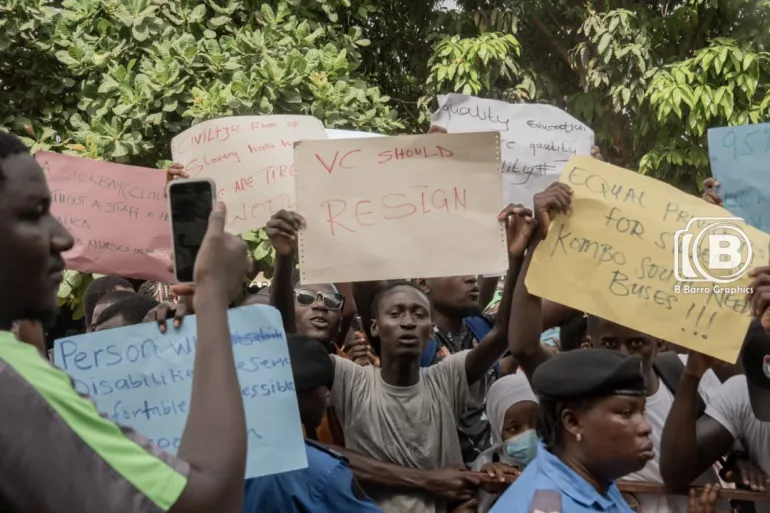
Jallow was among hundreds of students who protested at the University of The Gambia (UTG) on Monday, taking their grievances over transportation, campus facilities and student welfare to the vice chancellor’s office.
Lectures have since resumed after the government promised improvements to campus services.
But the students have more demands. They want Vice Chancellor Herbert Robinson and the director of student affairs to resign, accusing both officials of failing to perform their duties.
While the government has announced measures to address some of the concerns, the leadership dispute remains unresolved.
Students at the University of The Gambia demand the resignation of university leaders [Barra Graphics]
Transport and basic services remain concerns
The Students’ Union says its concerns affect more than 12,000 students, many of whom depend on university buses to reach campus.
Following the protest, Higher Education Minister Professor Pierre Gomez visited the campus with university representatives and officials from the Ministry of Communications and Digital Economy.
In a statement, the Ministry of Higher Education, Research, Science and Technology said the Gambia Transport Service Company had deployed 20 buses to support student transportation.
Students have also complained of limited access to safe drinking water and affordable food, as well as unreliable internet connectivity.
In response, the ministry promised that cafeterias across the university were ready to serve students and staff, but acknowledged that additional filtration was needed to make campus water safe for drinking. Water jars and dispensers have been installed at designated points, and the National Water and Electricity Company (NAWEC) had been consulted, it said.
On internet access, the ministry said work was under way to extend connectivity to the newly constructed Schools of Agriculture and Law, with completion expected within a week.
The proposals are intended to support student access to research materials and other educational resources. However, the statement did not confirm whether the work had been completed.
The ministry said it would continue working with the university, the students’ union and other relevant stakeholders to monitor implementation.
Cafeterias and practical training facilities
The reopening of cafeterias was another demand raised by students, who had complained that their closure made it difficult to find affordable meals on campus.
Ismaila Fadera, the students’ union president, said he raised the issue with Robinson on October 20 .
Fadera quoted the vice chancellor as saying: “Mister president, I have the student interest at heart, but we must balance this against administrative processes and compliance. You know I was a student too and many of us went through that. I used to carry my own water and food in my bag to university. The students should be told the reality. Having a cafeteria is a great addition to enhance the student experience but it is not right.”
The ministry said the cafeterias were ready to serve students and staff, although it provided no details on meal prices or availability at individual facilities.
Beyond food and water, students say inadequate learning facilities are affecting their education, particularly in programmes that require practical training.
At the School of Medicine and Allied Health Sciences in Banjul, students face overcrowded classrooms, inadequate ventilation, malfunctioning electrical sockets and shortages of projectors and smartboards, according to Abubacarr Manneh, president of the University of The Gambia Medical Students Association. Manneh said medical, nursing and postgraduate nursing students share the available facilities, putting pressure on classroom space.
He also worries about shortages of practical training equipment, including a promised simulation laboratory where students could develop clinical skills.
“Practical sessions are crucial in our professional training and development for better care of our patients,” he told Al Jazeera.
The university’s journalism students have similar concerns
Sukai Fatajo, a journalism student who participated in the protest, said the school needed radio and television studios to help students develop practical skills.
“We deserve better, and our demands must be met,” she told Al Jazeera.
The students’ union has also called for functional science laboratories, improvements to facilities at the medical school and adequate staffing.
Students at the University of The Gambia say classrooms are overcrowded with limited facilities [Barra Graphics]
The risks of getting to class
For Kumba Leigh, a journalism student, the struggle to reach the university has also become a question of personal safety.
One morning in April, Leigh was attacked by a knife-wielding assailant in her hometown of Bakau as she walked to a bus stop. She was trying to leave home early enough to secure a seat.
The attacker threatened to kill her if she did not hand over her bag. When she resisted, he struck her on the head and shoulder, cut her bag and dislocated her right arm. A nearby shopkeeper intervened, forcing the assailant to flee.
Months later, Leigh still has pain in her arm and suffers from trauma.
“No one should have to risk their life simply to travel to school,” she told Al Jazeera, calling for stronger security and increased police patrols.
Banjul, the Gambia – It is still early when Magistrate Muhammed Krubally arrives at the Banjul Magistrates’ Court.
Before the first case, his clerk goes over the day’s proceedings, running through the files and making sure everything is in place. Krubally listens, asks questions, and prepares to preside.
Recommended Stories
list of 3 itemsend of list
Then he enters a packed courtroom, where lawyers, witnesses and relatives have gathered for a criminal case.
The room falls quiet.
Krubally cannot see the people before him, but he can hear them. A lawyer rises. A witness speaks. Papers move across the room. His clerk is nearby.
At his desk, his computer speaks back to him.
Krubally uses JAWS, or Job Access With Speech, a screen reader that allows him to navigate his computer and read documents and judgements.
“This makes my job very easy,” he tells Al Jazeera.
He also uses AI-enabled smart glasses to access information and carry out tasks independently.
But technology is only part of how he works.
He listens for voices, remembers details and follows the rhythm of proceedings, building a picture of the courtroom through sound. When necessary, he relies on his clerk.
At 41, Krubally says he has presided over more than 1,000 civil and criminal cases since joining the bench.
In 2016, he became the Gambia’s first visually impaired magistrate. The Gambia Organisation of the Visually Impaired (GOVI) identifies him as the country’s first person with a visual impairment to hold the position.
For Krubally, this is not an experiment in what a visually impaired person might be capable of doing.
It is his profession.
And he has spent a decade doing it.
A determination shaped early
Long before he took his place on the bench, Krubally grew up in a village in the Gambia’s Central River Region, the second of nine children.
From an early age, he wanted to become a lawyer. Part of that ambition was personal: he wanted to defend his own rights. But he also wanted to advocate for others.
He wanted, he says, “to be the voice for the voiceless”, particularly people with disabilities.
The path was not straightforward.
From primary school through university, Krubally encountered limited resources and an education system that often left visually impaired students like him facing obstacles their sighted classmates did not.
He remembers being discouraged by fellow students and some teachers from pursuing the education he wanted.
Instead of making him abandon his ambition, he says, their doubts only strengthened it.
“Their discouragement kept me going. I knew what I wanted, and see where I am now,” he says.
Those experiences later shaped his decision to enter the judiciary.
“I became a magistrate to change the system, to make it inclusive,” he says.
But joining one of the country’s most important public institutions did not make those barriers disappear.
Rights on paper, barriers in practice
The Gambia’s Persons with Disabilities Act, passed in 2021, sets out principles including independence, non-discrimination, full participation, equality of opportunity and accessibility.
The law also contains provisions covering employment, public buildings and services, information and access to justice.
Yet putting those rights into practice remains a challenge.
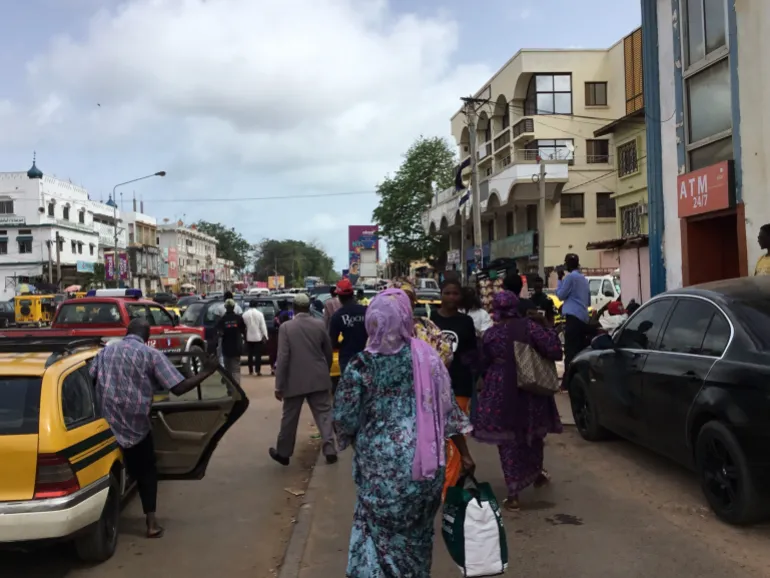
People walk along a crowded street in the Gambia, where accessibility remains a challenge for people with disabilities despite legal protections [Kaddy Jawo/Al Jazeera]
The National Human Rights Commission has identified barriers affecting people with disabilities, including discrimination and difficulties accessing services, education and employment.
Al Jazeera contacted the Ministry of Gender, Children and Social Welfare for a response on implementation of the act, including measures to improve accessibility, education and employment opportunities for people with disabilities. The ministry did not respond.
Krubally encounters those challenges not only as a judicial officer, but also as an advocate.
As president of the Gambia Federation of the Disabled, he speaks at events in the Gambia and beyond, pressing for greater recognition of the rights and potential of people with disabilities.
“I want to see a world for all; inclusion matters,” he says.
For Krubally, inclusion is not simply about opening the door. It is about having the means to participate once inside.
The barriers begin at school
For many people with disabilities, working towards full inclusion begins long before they enter a courtroom or parliament.
It begins at school.
Today, GOVI’s Resource Centre for the Blind provides specialist education for children with visual impairments before they transition into mainstream schools.
Forty-nine pupils aged between four and 14 currently attend the centre, Lamin Colley, its head of school, told Al Jazeera.
After completing their studies there, pupils are expected to enter mainstream schools, where special-needs teachers stationed across school clusters are meant to support them.
But that support is stretched.
Colley told Al Jazeera that limited learning materials and the size of the school clusters are putting pressure on the support available to students. A single special-needs teacher, he said, cannot maintain regular contact with all students across those clusters.
“The reality on the ground is that not much has changed after the disability act has been passed,” Colley says.
He attributes this partly to what he describes as insufficient government funding for disability issues in the national budget.
Colley remembers Krubally as a pupil who loved to read and could often be found in the library. He also remembers his determination to participate in activities alongside his sighted classmates.
Years later, Krubally’s journey carries a message beyond the school gates.
“Disability does not mean inability.”
But one person’s achievement does not erase the obstacles facing those coming behind him.
Entering an institution is not enough
Ndey Yassin Secka-Sallah knows what it means to enter a public institution without having the tools to participate independently.
She was nominated to the Gambia’s National Assembly and has long advocated for the rights of people with disabilities. GOVI describes her as the country’s only visually impaired parliamentarian.
She was also involved in advocacy around disability rights and the push for stronger legal protections.
Yet taking a seat in parliament did not make the institution accessible.
“I used to depend on my fellow colleagues to know what was being discussed,” she told Al Jazeera.
What she wanted was not special treatment, but independence.
“I would have loved to be independent, without depending on people for help.”
Five years after the disability law was passed, Secka-Sallah says implementation remains a major challenge.
She sees Krubally’s appointment to the bench as significant, but not as the end of the struggle.
“Inclusion is all we wish for,” she says.
Musa Barrow, another visually impaired professional, teaches media law and ethics to journalism students.
Like Krubally, Barrow has encountered assumptions about what a visually impaired person can do. Some students have questioned whether he can meet the standards they expect from a lecturer.
Technology has helped him work independently. He uses digital tools to read, write and prepare lecture notes.
“Technology has broken that barrier for me,” he says.
But students’ assumptions have not disappeared.
His response is direct.
“I can do more than what sighted people can do,” he says.
Barrow’s visual impairment has also shaped how he teaches journalism, particularly when discussing the media’s portrayal of disability.
The experiences of Krubally, Secka-Sallah and Barrow all point to the same gap: entering an institution is not the same as being equipped to participate fully in it.
What does the law look like in practice?
The scale of the challenge is difficult to measure.
The Gambia’s 2013 Population and Housing Census recorded a disability prevalence of 1.2 percent, representing 21,873 people, according to later analysis of the census data.
But that figure may understate the scale of disability in the country. The census used a narrower set of questions and did not use the Washington Group questions commonly used to measure functional difficulties.
Magistrate Muhammed Krubally presides over proceedings as the court sits in session [Kaddy Jawo/Al Jazeera]
The Gambia has since conducted a new population and housing census, with preliminary results released in September 2024. But the preliminary report did not include detailed updated national disability data.
That leaves an incomplete picture of how the country’s disability landscape may have changed over the past decade.
What is clearer is the experience of people navigating institutions that were not designed with them in mind: a parliamentarian depending on colleagues to follow proceedings, a lecturer being questioned about his ability to teach, or children entering mainstream schools with limited specialist support.
Krubally knows that journey personally.
He now mentors young people, many of them visually impaired. One is Modou Lamin Dampha, who describes Krubally as someone who encourages him to keep pursuing his ambitions.
“He advises and encourages me to keep going, that things are possible,” Dampha says.
For Dampha, Krubally is more than a magistrate.
He is evidence that professional ambition does not have to end with disability.
Has the courtroom changed?
Back inside the Banjul Magistrates’ Court, the case continues.
Krubally listens as the proceedings unfold, using voices, memory, technology and experience to follow what is happening before him.
His career raises a harder question: how much has the system itself changed?
The judiciary was asked what accommodations are available to Krubally, what accessibility measures are in place for judicial officers and court users with disabilities, and what changes it has made since the Persons with Disabilities Act was passed.
It did not respond by the time of publication.
Krubally has spent a decade adapting to the demands of the courtroom.
Whether the institution around him has also adapted remains an open question.
Asked what he sees when he looks to the future, Krubally says it is not about the obstacles he has overcome.
Gambian authorities have announced that funds from the sale of the country’s former president’s mansion in the United States would be used to pay reparations to victims of his rule.
The Gambia Reparations Commission confirmed Tuesday that it received just more than $2.5m from the sale of a property in the wealthy Washington, DC suburb of Potomac, Maryland, belonging to ex-President Yahya Jammeh.
Recommended Stories
list of 3 itemsend of list
The commission, which was set up to compensate victims of abuses committed during Jammeh’s 22-year rule ending in 2017, said in a statement that “the funds were deposited directly into the Reparations Fund account at the Central Bank of The Gambia and shall only be utilized for the payment of reparations”.
“The Commission is committed to ensuring that the funds are managed responsibly, transparently and accountably, with due regard to the rights and needs of victims and survivors,” it added.
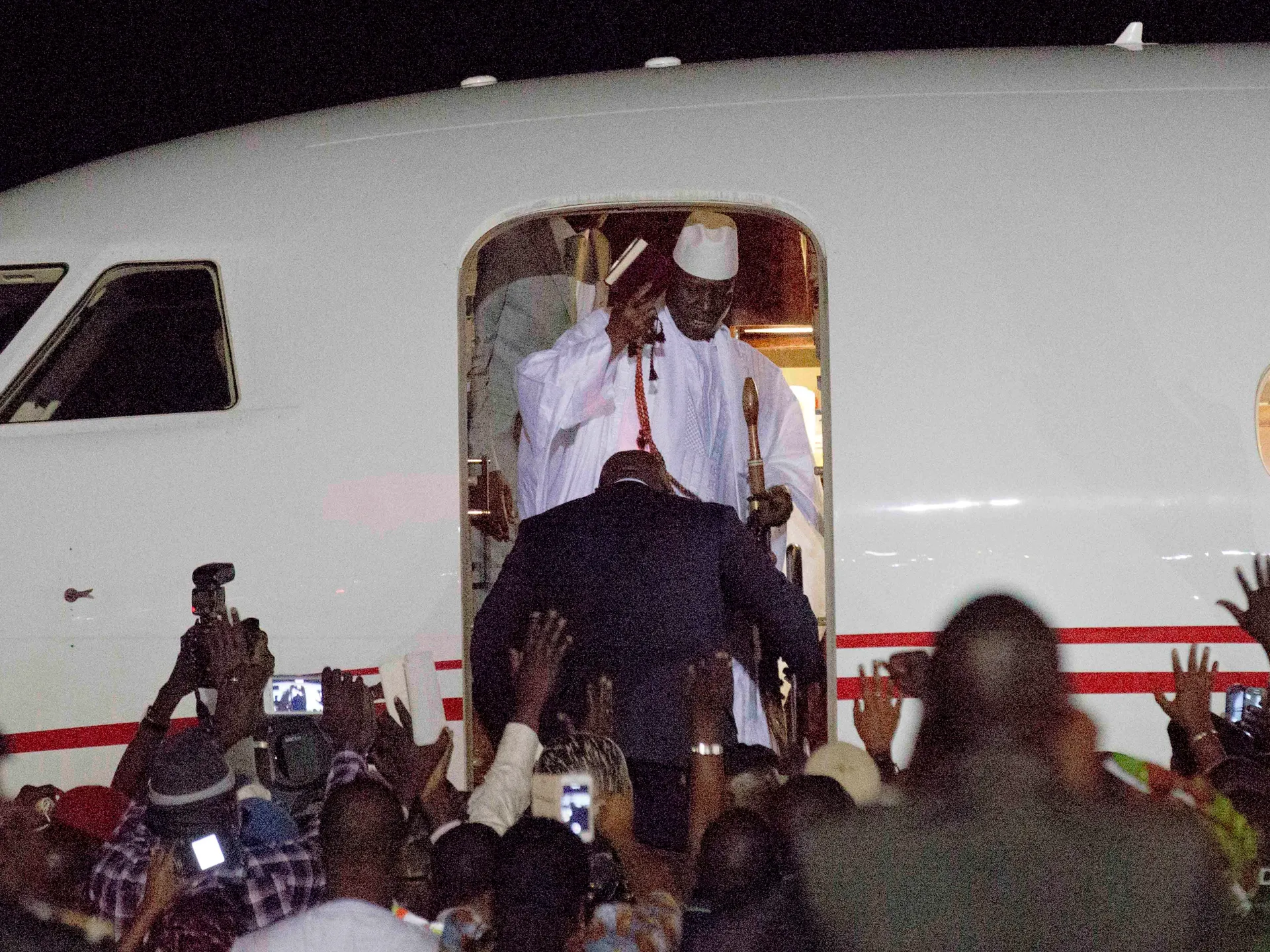
Jammeh currently lives in Equatorial Guinea, after he was forced out under pressure from The Gambia’s West African neighbours following his 2016 election loss to current President Adama Barrow.
He is accused of presiding over the murder of political opponents, disappearances, rape and torture.
A commission of inquiry estimated that between 240 and 250 victims were killed by Jammeh’s forces in the former British colony of two million people.
Proceeds from corruption
President Barrow said in a statement that his government would heed any recommendations by official auditors on how the funds would be allocated to victims.
The US Justice Department filed a civil forfeiture complaint in 2020 alleging that the property was bought with proceeds of corruption. A court ordered its forfeiture in 2022.
The property, it asserted, was purchased through a trust set up by Jammeh’s wife.
The US Justice Department had announced in September that it would return the funds from the mansion sale to The Gambia.