testing

Ukraine’s M113-Inspired Armored Personnel Carrier In Testing

Ukraine has begun testing a new homegrown armored personnel carrier, a tracked vehicle named Skif (Scythian, an ancient warrior tribe that also lived in parts of modern Ukraine). The development underscores the fact that, despite extensive losses of legacy tracked APCs, this is a class of vehicle that the Ukrainian Armed Forces still prioritizes as it tries to hold off the Russian invasion.

According to reports, UkrArmoTech has begun factory testing a prototype of the Skif, which has apparently been developed in direct response to the requirements of the Ukrainian Armed Forces, drawing from lessons learned since the full-scale Russian invasion in February 2022.

The first prototype of the Skif. UkrArmoTech

UkrArmoTech is among the leading developers and manufacturers of armored vehicles for the Ukrainian Armed Forces, but has, to date, focused on wheeled models such as the Desna, Gyurza, and Tisa. With that in mind, the Skif marks a new direction for the company.

“First and foremost, we relied on our contacts with the military, our understanding of their needs, and our experience with the use of wheeled vehicles on the battlefield,” UkrArmoTech CEO Hennadii Khirhii told the Ukrainian Defense Express website. “Active combat operations in Ukraine have demonstrated the need for a significant number of armored vehicles to ensure and maintain the mobility of units and formations of the Armed Forces and Defense Forces.”

The design of the Skif is heavily influenced by the U.S.-developed M113, a Cold War-era tracked APC, many hundreds of which have been supplied to Ukraine since February 2022.

DONETSK OBLAST, UKRAINE - JULY 4: Ukrainian soldiers exit on the M113 armored personnel carriers in a column for tasks on a military outdoor firing range during exercises on July 4, 2023 in Donetsk Oblast, Ukraine. (Photo by Viktor Fridshon/Global Images Ukraine via Getty Images)
Ukrainian soldiers ride on M113 armored personnel carriers in a column after live-firing exercises in July 2023 in the Donetsk region, Ukraine. Photo by Viktor Fridshon/Global Images Ukraine via Getty Images VIPAVLENKOFF

Despite its age, it seems the M113 has been a success in Ukrainian hands, offering a useful combination of reliability, maintainability, troop-carrying capacity, and off-road mobility.

The designers of the Skif were therefore instructed to produce a vehicle that matched the M113’s mobility while improving on its levels of protection and firepower.

According to reports, the Skif makes use of off-the-shelf components and assemblies from foreign manufacturers involved in the production of armored vehicles that are “descendants” of the M113.

The first prototype of the Skif alongside a U.S.-made Humvee. UkrArmoTech

It’s unclear if this implies that the Skif uses components from Western manufacturers that have built the M113 and its derivatives, or if the Ukrainian vehicle employs parts from other Western-made APCs. Noteworthy is the fact that members of the broader M113 family have been built under license in Belgium, Germany, Italy, the Netherlands, and Turkey, as well as several other countries outside Europe.

Reportedly, 60 percent of the vehicle’s components will initially be imported, and these will include the engine, transmission, suspension components, transfer case, and tracks. If production is launched, an increasing proportion of the components will be made locally.

In its basic form, the Skif is intended to transport soldiers from mechanized units across the battlefield and to provide them with fire support. As well as three crew (driver, commander, and gunner), located in the front section behind the power module, the Skif can accommodate eight soldiers in the rear troop compartment. The troops enter and exit via a rear ramp, as on the M113.

The Skif prototype with the rear ramp open. UkrArmoTech

The prototype of the Skif has an aluminum hull, reportedly the first time this has been used on a Ukrainian combat vehicle. However, a series-production version will likely feature an armored steel. While steel offers better ballistic resistance and is easier to repair in the field, it comes with a significant weight penalty.

With the aluminum hull, the Skif weighs around 15 tons and is driven by a 360-horsepower diesel engine. The modular design means that different engines can be installed, for example, if more power is needed for a steel hull, or when fitted with heavier weapons.

In its basic form, the Skif has a Ukrainian-made remotely controlled combat module on the hull roof. This can be armed either with a 12.7mm or 14.5mm heavy machine gun paired with a 7.62mm auxiliary machine gun. As seen in the photos, the prototype does not currently have the combat module fitted.

A diagram of the Skif with the remotely controlled combat module on the hull roof. UkrArmoTech

Armor protection is in line with NATO STANAG 4569 Level 4 over the frontal section (withstanding, for example, 14.5mm machine gun fire, or a 155mm artillery projectile detonating at 25 meters), and Level 3 on the sides and rear (resistant to 7.62mm gunfire, or a 155mm artillery projectile detonating at 60 meters). Mine protection below the hull is rated at Levels 3a and 3b. The vehicle is expected to withstand the detonation of around 13 pounds of explosives under the hull or tracks.

It’s unclear what kinds of protection are provided against the threat of attack drones, but some type of electronic warfare gear is included; it would also be expected that the vehicle receives a purpose-designed ‘cope cage’ of the kind that has appeared on most Ukrainian and Russian combat vehicle types during the conflict. Otherwise, the Skif is equipped with communications, navigation, situational awareness, and fire-control systems of Ukrainian origin. A bank of smoke grenade launchers is fitted across the front of the hull on the Skif prototype.

UNSPECIFIED, UKRAINE - NOVEMBER 2: Soldiers of the Połk Kalinoŭskaha (Kastuś Kalinoŭski Regiment) reload tracked vehicles at night on November 2, 2025 in Unspecified, Ukraine. The Kastuś Kalinoŭski Regiment is a group of Belarusian opposition volunteers, which was formed during the Russian-Ukrainian war to defend Ukraine against the Russian invasion in 2022. The unit is armed with armored personnel carriers: the US M113 and the British FV103 Spartan. All vehicles are equipped with protection against drones. The main task is logistics on the front line: delivering soldiers to the front line, rotating groups and transporting ammunition. This vehicle also takes the wounded from the battlefield directly under heavy enemy fire. (Photo by Sushchyk Kanstantsin/Global Images Ukraine via Getty Images)
Soldiers of the Połk Kalinoŭskaha (Kastuś Kalinoŭski Regiment) operate an M113 at night in November 2025. The vehicle is equipped with cage-type protection against drones. Photo by Sushchyk Kanstantsin/Global Images Ukraine via Getty Images Global Images Ukraine

The modular design means that the Skif can be adapted for other missions. These are likely to include vehicles equipped for command and control, reconnaissance, anti-armor, mortar carrier, medical evacuation, and more.

With the continued debate over wheeled versus tracked combat vehicles, it is interesting to note that Ukraine, after focusing on the local production of wheeled fighting vehicles, continues to see the necessity for tracked APCs. While heavier, more complex, and more costly, they are better able to deal with the brutal mud that is a feature of Ukrainian winters. They are also generally better in terms of armor protection.

SUMY, UKRAINE - JANUARY 15: A Ukrainian Kozak armored vehicle gets stuck in black soil mud, on its way from positions of American Bradley Fighting Vehicles used during Ukraines on-going cross-border operation into Russias Kursk region, where Ukrainians have fought both Russians and an estimated contingent of 12,000 North Korean troops, on January 15, 2025 in Sumy, Ukraine. Ukrainian officers of the 4th Company, 1st Battalion, 82nd Separate Air Assault Brigade say that this American military hardware has been crucial to their ability to cross into Russia last August, as well as to Ukraines border defense against Russias all-out invasion in February 2022. Senior Ukrainian commanders and officials have expressed concern that deep U.S. military and financial support will ease up or stop with the incoming Trump Administration, which has stated that it would swiftly end the three-year war. (Photo by Scott Peterson/Getty Images)
A Ukrainian Kozak wheeled armored vehicle gets stuck in black soil mud, in Sumy, Ukraine, during the cross-border operation into the Kursk region of Russia, in January 2025. Photo by Scott Peterson/Getty Images Scott Peterson

For that reason, the aging M113 and the Soviet-era MT-LB remain popular choices for the Ukrainian Armed Forces.

KHARKIV, UKRAINE - OCTOBER 25: Two Ukrainian army mechanics repair a broken MT-LB (light armored multi-purpose towing vehicle) in the Donetsk region in Kharkiv, Ukraine on October 25, 2024. Originally designed in the 1960s during the Soviet era, the vehicle entered service a decade later and was manufactured in Kharkiv. (Photo by Fermin Torrano/Anadolu via Getty Images)
Two Ukrainian Army mechanics repair a broken MT-LB armored multi-purpose vehicle in the Donetsk region in Kharkiv, Ukraine, in October 2024. Photo by Fermin Torrano/Anadolu via Getty Images Anadolu

According to the Oryx open-source tracking group, since the start of the current conflict, more than 500 Ukrainian M113s and more than 150 MT-LBs have been confirmed destroyed or damaged. The actual figures are certainly higher, as Oryx only tallies losses that are confirmed with visual evidence.

Despite the need for a vehicle in this class, there remain significant challenges in getting it into production. Very likely, Ukraine will have to rely heavily on foreign funds and expertise if it is to put the Skif into quantity production. Should that prove realistic, Ukraine will likely also seek to sell the Skif to foreign customers, too.

The rear view of the Skif prototype during factory trials. UkrArmoTech

Continued factory testing of the Skif prototype should provide a practical assessment of the new platform’s design maturity, including whether its mobility and running performance meet local requirements. Certainly, the new tracked APC is a bold venture for Ukraine’s war-ravaged industry, but it represents a class of vehicle for which there is a near-insatiable local demand.

Contact the author: thomas@thewarzone.com

Thomas is a defense writer and editor with over 20 years of experience covering military aerospace topics and conflicts. He’s written a number of books, edited many more, and has contributed to many of the world’s leading aviation publications. Before joining The War Zone in 2020, he was the editor of AirForces Monthly.


Source link

Angry Kitten Jamming Pod Testing On HC-130J Focuses On Receiving Threat Updates Via Satellite

The U.S. Air Force is continuing to expand on the capabilities of the Angry Kitten electronic warfare pod, which just recently made its combat debut on the F-16 fighter in the latest conflict with Iran.

New testing has focused on improving the ability of HC-130J Combat King II combat search and rescue aircraft carrying the pods to receive reprogramming updates in near-real-time via satellite. HC-130Js just recently flew extremely high-risk and high-profile sorties over Iran as part of the effort to rescue the crew of a downed F-15E Strike Eagle. Being able to rapidly refine and optimize Angry Kitten’s capabilities will help the system remain as effective as possible, even in a very quickly evolving threat environment, and could be a stepping stone to more advanced functionality.

The Air National Guard Air Force Reserve Command Test Center (AATC) recently shared details about new testing of Angry Kitten on the HC-130J during an iteration of the Bamboo Eagle exercise. Bamboo Eagle is a large-scale air combat exercise series focused on preparedness for a high-end fight in the Pacific. AATC has already been test flying Angry Kitten on the HC-130J for more than a year now.

An HC-130J Combat King II assigned to the 129th Rescue Wing seen carrying an Angry Kitten electronic warfare pod while flying in the Point Mugu, California area on September 11, 2025. Fred Taleghani / FreddyB Aviation Photography

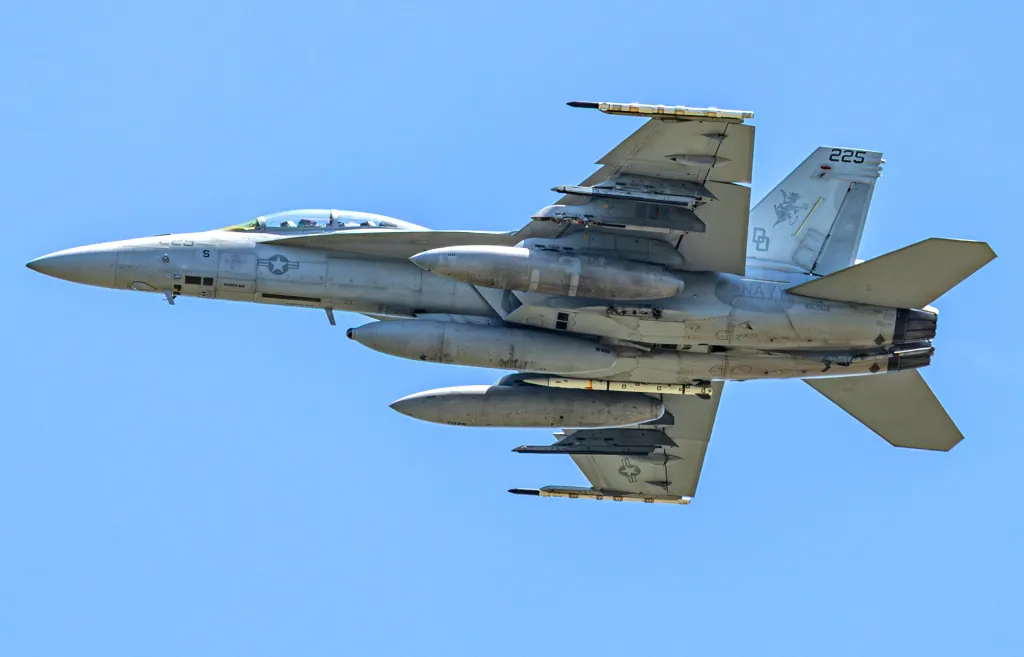
The pods have also been test flown on Air Force A-10 Warthog ground attack jets and Navy F/A-18 Super Hornet fighters. As noted, it is now being employed operationally on Air Force F-16s, as well. Angry Kitten was originally developed to replicate hostile electronic warfare threats during testing and training, as part of a cooperative effort between the Air Force and the Navy, and worked so well that it was adapted to operational use. We will come back to this later on.

An F-16C fighter with an Angry Kitten pod on its centerline station, seen flying a sortie in support of Operation Epic Fury against Iran. CENTCOM
An Angry Kitten pod under the wing of a Navy F/A-18E Super Hornet. USN Naval Air Warfare Center Weapons

During Bamboo Eagle, “AATC’s primary evaluation centered on the Angry Kitten electronic warfare pod integrated aboard a HC-130J Combat King II. The force development evaluation built directly on an operational assessment completed the previous year, which found the system potentially effective and suitable on the platform,” according to a press release that the center put out last week. “Testers incorporated recommendations from that assessment while the 130th Rescue Squadron flew the pod against simulated ship-based and ground-based threats during exercise vulnerability periods, evaluating both survivability and the system’s broader electronic attack capability.”

The 130th Rescue Squadron is part of the California Air National Guard’s 129th Rescue Wing.

“Running alongside that effort, AATC continued maturing the Ka/Ku-band communications suite, which enables over-the-horizon communications and near-real-time electronic warfare reprogramming via satellite link,” the release adds. “The suite compresses what was previously a multi-day technique development and distribution process to near-real-time between sorties.”

AATC has previously disclosed that it has been working on this capability, which looks to be unique to the integration of Angry Kitten on the HC-130J, at least currently. The Combat King II has the benefit of a wide-band satellite communication system, which is also found on U.S. special operations C-130 variants and other aircraft. The HC-130J carries the pod using a Special Airborne Mission Installation and Response (SABIR) system installed in place of its left rear paratrooper door.

An HC-130J with an Angry Kitten pod on a SABIR system mounted in place of its left rear paratrooper door. USAF
A look inside the HC-130J during testing of the Angry Kitten pod. USAF

“The C-130 testing features innovative real-time updates to electronic warfare techniques,” AATC said in a previous press release in March 2025. “Unlike the F-16 tests, where pre-programmed mission data files were used, the C-130 testing includes development engineers aboard the aircraft who can modify jamming techniques mid-mission based on feedback from range control.”

As can be seen above, to date, AATC has largely framed the benefits of this reprogramming capability within the context of accelerating continuing test and evaluation of Angry Kitten. At that same time, this would also be extremely valuable in an operational context.

In general, electronic warfare systems use built-in threat libraries to accurately detect, categorize, and respond to waveforms. In turn, their effectiveness is inherently determined by the breadth of data in that library. Specialists, often working in purpose-built reprogramming laboratories far from the front lines, have to work tirelessly to keep these systems up to date. Historically, this has been a very lengthy process, and one that has increasingly had trouble keeping pace with the rate at which threats are evolving.

A member of the 16th Electronic Warfare Squadron, another unit with the 350th Spectrum Warfare Wing, analyzes radio frequency signals at the B-1 Lab at Eglin Air Force Base in Florida. (This photo has been altered for security purposes by blurring out portions of monitors). USAF

As noted, Angry Kitten was developed first as a training and testing tool. It is a direct outgrowth of the AN/ALQ-167 electronic warfare pod, variants of which have been used in those contexts for decades to mimic hostile electronic warfare threats. However, Angry Kitten was designed from the start to be more readily updatable and modifiable in order to make it easier to adapt it to new and evolving threats.

“At the core of that technology is Angry Kitten’s Technique Description Language architecture. Georgia Tech designed TDL as a hybrid that pairs dedicated hardware modules for speed and bandwidth with software for complex decision-making,” according to a press release Naval Air Systems Command (NAVAIR) put out last month. “The practical result: government programmers can reprogram the jammer to counter new threats without sending it back to the contractor for expensive, time-consuming code changes. When an adversary adapts its radar tactics, NAWCWD’s team can update the jammer’s response in days instead of waiting months for a contract modification.”

Angry Kitten is also known to make use of advanced Digital Radio Frequency Memory (DRFM) technology. Using DRFM, radio frequency (RF) signals can be detected and ‘captured.’ Those same signals can then be manipulated and retransmitted. As an example of what this means in practice, signals from enemy air defense radars or radar seekers on incoming missiles can be recorded and pumped back in a way that creates false or otherwise confusing tracks. That same data can also be used as part of the reprogramming process to improve the stability capabilities, as well as be further exploited for general intelligence-gathering purposes.

An Angry Kitten pod on a stand during test. USN

This all already contributed to the evolution of Angry Kitten into an operational system.

“We had a jammer called ‘Angry Kitten.’ It was built to be an adversary air jamming tool,” now-retired Air Force Gen. Mark Kelly, then commander of Air Combat Command (ACC), told TWZ and other outlets back in 2022. “And all of a sudden, the blue team said, ‘you know, hey, we kind of need that, can we have that for us?’ And so I see this iterating and testing our way into this.”

When it comes to near-real-time updates for Angry Kitten, even if the communications suite used on the HC-130J won’t fit on smaller tactical jets, it could potentially be ported over into a capability that is readily deployable to forward locations. Another possibility is that an aircraft with a wide-band satellite communications system could then pass updates for Angry Kitten to other aircraft within line of sight using other datalink capabilities.

Another view of the F-16 carrying the Angry Kitten pod during a mission in support of Operation Epic Fury. CENTCOM

The underlying developments have further implications when it comes to developing so-called cognitive electronic warfare capabilities. Cognitive electronic warfare is a broad area of development focused on new technologies to further automate or otherwise accelerate the reprogramming process. The absolute ‘holy grail’ of the overall concept is an electronic warfare system that can adapt autonomously in real time to new threat waveforms, or known ones being modulated in unexpected ways, even right in the middle of a mission. You can read more about all of this here.

Ongoing work to expand and improve Angry Kitten’s capabilities will also now benefit from lessons learned from the employment of the pods in combat sorties over and around Iran.

The multi-day effort to recover the crew of an F-15E Strike Eagle downed in that country earlier this month also highlighted the immense risks involved in combat search and rescue (CSAR) operations, and the importance of adding new self-protection capabilities to the HC-130J, specifically. Air Force Combat King IIs can expect to face far greater threats while conducting CSAR missions during a conflict with a near-peer adversary like China. This has prompted questions about the utility of HC-130Js and other traditional CSAR assets in the context of any future high-end fight.

In the meantime, Angry Kitten continues to evolve in significant ways, including its growing ability to receive key updated data remotely in near-real-time when paired with the HC-130J.

Contact the author: joe@twz.com

Joseph has been a member of The War Zone team since early 2017. Prior to that, he was an Associate Editor at War Is Boring, and his byline has appeared in other publications, including Small Arms Review, Small Arms Defense Journal, Reuters, We Are the Mighty, and Task & Purpose.


Source link