tax

California governor debate: Candidates scrap over gas tax, homelessness

The top candidates for California governor clashed over the high costs of gas, housing and homeowner’s insurance in a testy debate Tuesday evening, a fiery exchange that may finally draw voter attention as the June 2 primary election fast approaches.

Former U.S. Health and Human Services Secretary Xavier Becerra, whose campaign blossomed after former Rep. Eric Swalwell dropped out amid sexual assault and misconduct allegations, came under persistent attack during the 90-minute debate but also went on the offensive.

Former Fox News host Steve Hilton, a Republican who leads all candidates in the most recent opinion polls, ripped Becerra for promising to declare a state of emergency to address rising homeowner’s insurance rates, saying the governor lacks that constitutional authority.

“We can’t have a governor who doesn’t understand how the government works,” Hilton said.

Becerra, who served as California attorney general before joining the Biden administration, quickly defended himself, saying he knows the law better than Hilton does.

“We don’t need a talking head from Fox News to tell us how the government works,” he said.

And that was after Becerra got in an early dig at Hilton, who has been endorsed by President Trump, by referring to Trump as “Hilton’s daddy.”

The debate was broadcast and livestreamed by CBS stations around the state. Hundreds of people watched from Pomona College’s historic Bridges Auditorium, a Renaissance Revival-style landmark with Art Deco flourishes that was once among the premier performance venues in Southern California.

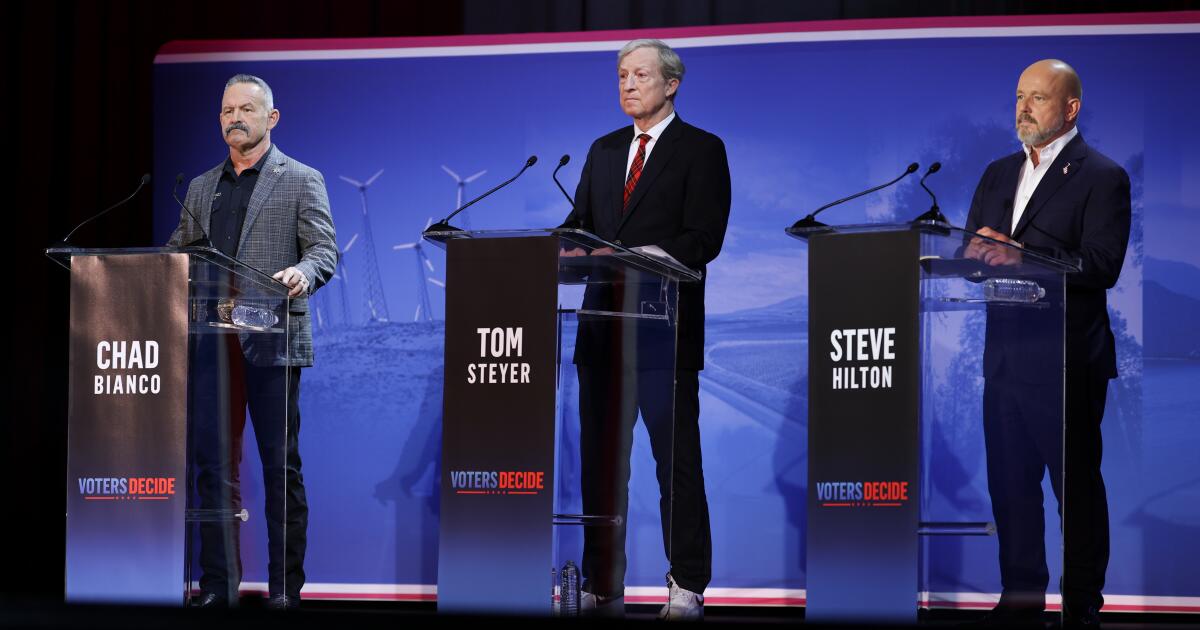
With eight major candidates from both parties participating, CBS moderators billed it as “the largest and most inclusive debate of the election.” Becerra and Hilton were joined by Republican candidate Riverside County Sheriff Chad Bianco and Democratic candidates San José Mayor Matt Mahan, former Orange County Rep. Katie Porter, billionaire Tom Steyer, state Supt. of Public Instruction Tony Thurmond and former Los Angeles Mayor Antonio Villaraigosa.

Some takeaways from the debate:

Candidates didn’t shy away from the top issues

Moderators set the theme for the first half-hour of the debate as “affordability,” a top concern among California voters, and almost immediately the candidates began sniping and talking over one another.

Almost all of them vowed to accelerate home construction in California, pivotal to reducing the state’s high cost of housing.

There was no shortage of ideas for other ways to ease the financial burdens facing Californians, but few specifics on how they would deliver on those promises given the state’s complex and arduous legislative process.

Hilton promised to cap the price of gas at $3 per gallon, and Mahan vowed to suspend the state gas tax. Bianco said Democrats have long overregulated and overtaxed Californians, and the state’s supermajority Democratic Legislature would have to get in line with him and end those things if he’s elected.

Becerra said he would reduce prescription drug prices. Thurmond said he would provide down-payment assistance grants to those trying to own their first home.

Barbs traded over climate-caused emergencies

Anchors and reporters from local CBS stations moderated the debate, including Los Angeles anchor Pat Harvey, Sacramento anchor Tony Lopez, Bay Area anchor Ryan Yamamoto and national investigative correspondent Julie Watts. They were joined by Sara Sadhwani, an assistant professor of politics at Pomona College and a member of California’s independent redistricting commission.

Moderators pointed to the surge in catastrophic wildfires across the state in recent years due to climate change, as well as the threat of earthquakes, and asked the candidates how they would respond to future emergencies.

As he did throughout most of the debate, Bianco responded by bashing California’s Democratic leadership, which he said created most of the ills facing the state.

Bianco said the root causes of fire disasters in the state are “not because of climate change” but due to “failed environmental activist policies” that prevented fire departments from clearing highly flammable brush around communities for years.

Mahan, after touting his actions as a Silicon Valley mayor during emergencies, quickly pivoted to take shots at Becerra and his role as U.S. Health and Human Services secretary during the pandemic.

He said Becerra had “never met a crisis that he couldn’t ignore” and accused Becerra of failing to deal with COVID-19, monkeypox and the surge of unaccompanied minors at the U.S.-Mexico border during the Biden administration.

Becerra responded by saying that his agency dealt with the crises by working with all 50 states and the federal government to quickly roll out vaccines and other resources.

“You’re not wearing a mask, are you, Matt? You’re not worried about catching monkeypox, right?” Becerra said.

Steyer also came under attack when he starting discussing his plans to “make polluters pay” for the effects of climate change. Porter criticized the former San Francisco hedge-fund founder for making millions off the oil and gas industry, and using those profits to fund his campaign for governor. Steyer has spent more than $143 million of his own money on his campaign, according to fundraising disclosures filed with the California secretary of state’s office.

“How about profiteers pay? You pay the lowest tax rate on this stage, and yet you made the billions that you’re using to fund your campaign off fossil fuels,” Porter said to Steyer.

Steyer responded that he is a “change agent” candidate opposed by special interests and pointed to campaign committees funded by utility and other industry groups opposing his bid. PG&E, the California Chamber of Commerce and the California Assn. of Realtors have put more than $29 million into a pair of committees to fund attack ads against the billionaire.

Republicans focus on blaming Democrats

Just weeks before the June 2 primary, the race to replace term-limited Newsom remains wide open, with many voters still undecided.

Republicans Hilton and Bianco have led numerous public opinion polls while the large field of Democrats have split the vote, leading to fears among Democrats that the party could get shut out of the general election, despite outnumbering Republicans nearly two-to-one among the state’s registered voters. In California’s open primary, the top two finishers advance to the general election, regardless of party affiliation.

The two Republicans avoided overtly attacking each other at the debate but were regularly the targets of other candidates on the stage.

Becerra, speaking about federal healthcare funding cuts approved by President Trump and congressional Republicans last year, referred to the president’s endorsement of Hilton. “The first thing we have to do is stop Steve Hilton’s daddy,” Becerra said.

Hilton responded jokingly that his father, who was the goalie for the Hungarian national ice hockey team, hadn’t weighed in on the race. And he said Becerra’s comment pointed to what is wrong with California politics — a fixation on Trump despite Democrats controlling the state for more than a decade.

“We’ve had the same people in charge for 16 years now, and it’s such a disaster and such a high cost of living for everyone, and the highest poverty rate in the country and the highest unemployment rate in the country, and the worst business plan,” Hilton said. “All these things going wrong, they can’t do anything except blame Trump. Let’s see how many times you hear that tonight.”

Bianco grew visibly frustrated several times over the debate’s format and his opponents’ answers. At different points, he compared the event to “The Twilight Zone” and called it “the hour and a half that [viewers] are never going to get back.”

Pressed on what he would do differently if elected, the Riverside sheriff also focused on criticizing Democrats and accusing them of lying.

“We have a group of of 20-ish-year-old kids and we’re just sitting here lying to them about broken Democrat policies in California for the last 20 years, and we’re going to sit here and blame a president who’s been president for a year. This is absolutely ridiculous,” he said.

Hilton has seen a bump in his polling numbers since he was endorsed by President Trump earlier this month. A CBS News/YouGov poll of more than 1,400 registered voters released Monday showed Hilton leading with 16%, followed by Steyer with 15%, Becerra with 13%, Bianco with 10%, Porter with 9%, Mahan and Villaraigosa with 4% and Thurmond with 1%. The largest group of voters — 26% — was undecided.

Nixon reported from Sacramento and Mehta reported from Claremont. Times staff writers Kevin Rector, Dakota Smith and Blanca Begert contributed to this report.
Source link

Can the new tax credits bring animation back to California?

Last year, studios and Hollywood labor unions lobbied hard to ensure animated movies and shows could compete for California’s expanded film and television tax credit program.

The payoff came last week, when three animated movies were among the nearly 40 film projects that received a production incentive in the latest round of awards, the California Film Commission announced Thursday.

Walt Disney Co.-owned 20th Century Studios received $21.9 million for “The Simpsons Movie 2,” Disney Entertainment Television got $3.5 million for “Phineas and Ferb” and DreamWorks Animation was awarded $24.7 million in credit allocation for a yet-untitled animated film.

The three are the first animated feature films to receive tax credits from the state of California. (Last month, two animated shows — a spin-off of “Rick and Morty” and “Stewie,” which branches off from the “Family Guy” cartoon — also received tax credits.)

I spoke with DreamWorks Animation Chief Operating Officer Randy Lake about the award, which he called a “potential game changer” for the Glendale-based studio known for the “Shrek” and “Kung Fu Panda” franchises.

You’re reading the Wide Shot

Samantha Masunaga delivers the latest news, analysis and insights on everything from streaming wars to production — and what it all means for the future.

“Unlike live-action, our projects are years long,” he said. “You’re talking about not just a job for six or nine months on set. It’s literally three or four years that these projects can take. It’s long-term employment.”

Like most of Hollywood, the animation industry has suffered from the effects of the 2023 dual writers’ and actors’ strikes, as well as the retrenchment in studio spending after the initial rush to invest in content for streaming services.

And like much of U.S. film and TV work — particularly in California — the animation business has been deeply affected by the increasingly rich tax credits offered by other countries.

Over the last 15 years, countries including Canada and Ireland have slowly built up animation hubs, aided by their local talent and lucrative production incentives specific to animation and visual effects.

For instance, visual effects and computer animation unit Sony Pictures Imageworks, which Lake ran for years, relocated its Culver City headquarters to Vancouver more than a decade ago.

DreamWorks, too, has outsourced work to partner studios, particularly in Vancouver and Montreal, as costs in the U.S. have increased and studios face pressure to rein in their production expenses while theatrical box-office revenue has become less reliable.

Just three years ago, DreamWorks cut about 70 jobs across its corporate functions, feature films, TV and technology departments. In 2024, Disney-owned computer animation studio Pixar laid off about 175 employees as it pulled back on its production of streaming series.

But with the recent tax credit allocation, DreamWorks will hire about 100 people in California for its upcoming untitled film. Those jobs would probably would have been outsourced to a third-party studio, Lake said. Keeping all of the jobs on that film in California helps improve collaboration among the teams and foster more creativity, he said. Today, DreamWorks has about 1,000 employees.

To understand why the new incentives are meaningful, consider that a DreamWorks Animation movie similar to the one that received the credit will typically have a crew of about 400 to 500 people.

That film is a big feature, though Lake declined to share details since the project hasn’t been announced.

Both the Animation Guild and studios have pointed to the incentive as a way to bring back animation jobs to the Golden State.

“Studios have been chasing animation tax credits in other states and countries for years, so it’s incredibly rewarding to see them use California’s for the very first time,” Marissa Bernstel, a trustee on the union’s executive board and member of the task force that helped lobby for the expanded production incentives, said in a statement last week. “The results feel very real, and I’m excited to see what future employment opportunities the incentive inspires.”

Lake said DreamWorks hopes to take advantage of the state incentives for all of its full-budget films.

“We’ll be applying for the next window,” he said, adding that he hoped they will be successful so “we’ll be able to have more and more of our films be fully produced in state. That’s the goal.”

Stuff We Wrote

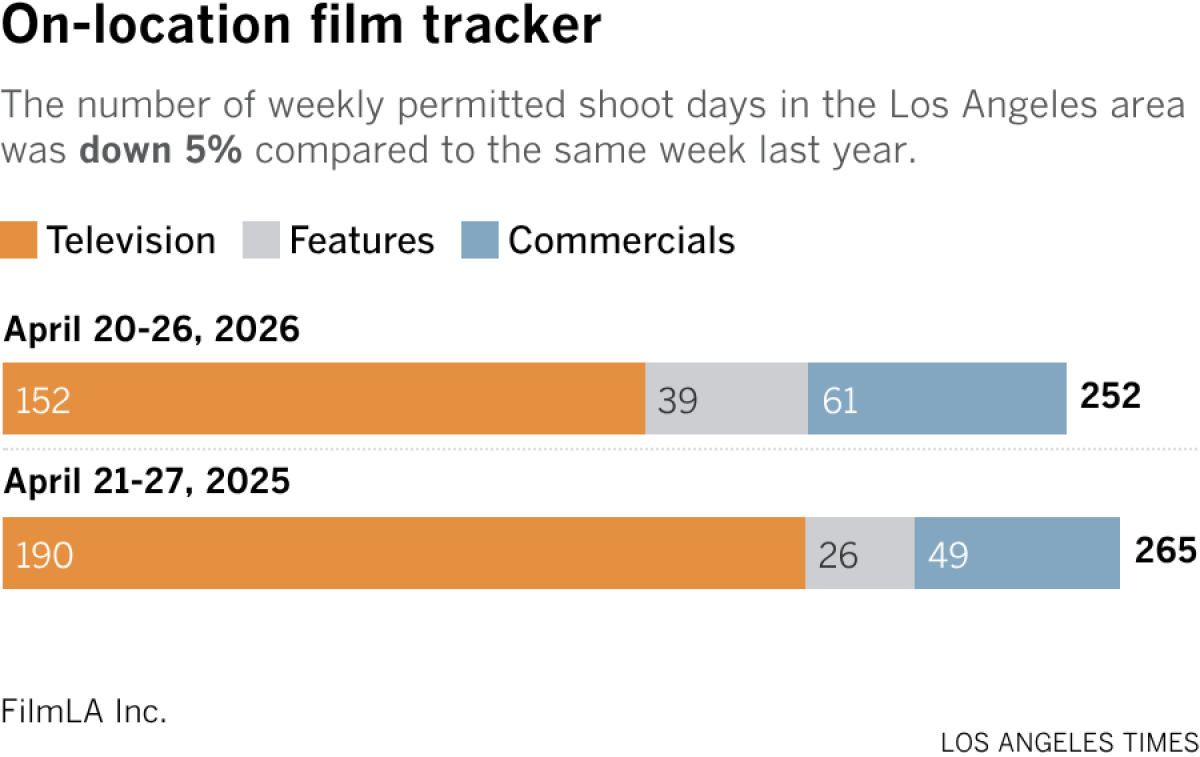
Film shoots

Number of the week

two hundred and seventeen million dollars

Lionsgate’s “Michael” had a massive opening weekend with just over $217 million in global box-office revenue. In the U.S. and Canada, the Michael Jackson biopic hauled in about $97 million, far surpassing studio expectations.

The film, which stars Jackson’s nephew, Jaafar Jackson, as the late singer, chronicles the pop star’s rise from his early days in the Jackson 5 through the growth of his solo career. The movie ends in 1988 while Jackson is on tour for his hit album “Bad.”

The premiere for “Michael” marks the biggest domestic opening for any biopic, musical or otherwise. The 2015 movie “Straight Outta Compton” previously held the record for highest opening weekend total for a musical biopic, with $60 million in the U.S. and Canada, followed by the Queen biopic “Bohemian Rhapsody” in 2018, which had a $51.1-million domestic opening.

Critics’ reviews of “Michael,” however, were largely negative. Many noted the plot sidesteps the child sexual abuse allegations against Jackson and said the film presents a more one-dimensional view of the singer.

An earlier cut of the film did end in 1993 and addressed the allegations, but that ending had to be scrapped due to a clause in a legal settlement with an accuser that stipulated he could never be pictured or mentioned in a dramatization of Jackson’s life. Jackson and his estate have denied that the pop star abused children.

What I’m watching

I finally finished the Hulu series “Paradise” this last week, which kept me guessing about literally everything all the way until the end. I’m interested in seeing where this genre-morphing show goes next season.

Source link

Hollywood residents want more for their tax dollars. Councilman says he’s trying

Hold everything. Hollywood’s Lexington Park will not be getting a new playground after all, and that’s both good news and bad news.

To explain, let me take you back to April 15, when I tagged along with Sabine Phillips on her weekly three-hour inspection of the neighborhood’s chronic trash problem. Phillips, a housekeeper by trade, was hired by one of her clients a few years ago to help clean up their streets.

So each Wednesday, Phillips went out on her yellow Huffy cruiser and routinely logged 50 or more illegally dumped items and reported them to the city’s 311 system for pickup. And each Saturday, she filled up to four or five big bags with smaller bits and scraps of debris.

Near the end of my three hours with Phillips, who got help that day from volunteer Keith Johnson, we visited the Lexington pocket park. There were no kids there, and there never are, Phillips said. That’s because of the glass and needles in the sand, drug activity, sporadic violence, gang tags on the slide and homeless camps.

A guy from the Recreation and Parks Department showed up and said the park was in line for a possible upgrade that could cost as much as $300,000. In my April 18 column, I questioned the wisdom of investing in a playground that would remain unsafe unless there was a plan to address all the aforementioned issues.

Nick Barnes-Batista, communications director for L.A. City Councilmember Hugo Soto-Martínez, wrote to tell me his office was unaware of any playground projects planned for that park.

A spokesperson for Recreation and Parks told me that despite what was said by the employee I met in the park, there is no “immediate playground replacement project on the books.” But the department is “working closely” with the councilman’s office “to identify funding sources and to work with the community on broader park improvements and/or uses.”

OK, so it’s good news that taxpayer funds won’t be plowed into a park that could well be lost to the neighborhood almost immediately, due to all the aforementioned problems.

But it’s bad news and sad commentary that a park in the densely populated heart of the city will remain unusable for the foreseeable future.

The more important consideration, though, is the question of what’s being done to prevent the illegal dumping of furniture, mattresses and other items that sit curbside and often end up as the building blocks of new homeless encampments.

There’s a concentration of social service agencies in the neighborhood, said Stefanie Keenan, a longtime neighborhood volunteer and activist. She’s the one who hired her housekeeper to help look after the neighborhood, and she insists there is not enough enforcement of existing laws to address problems that are both a nuisance and a public safety threat, given the crime and all-too-frequent fires.

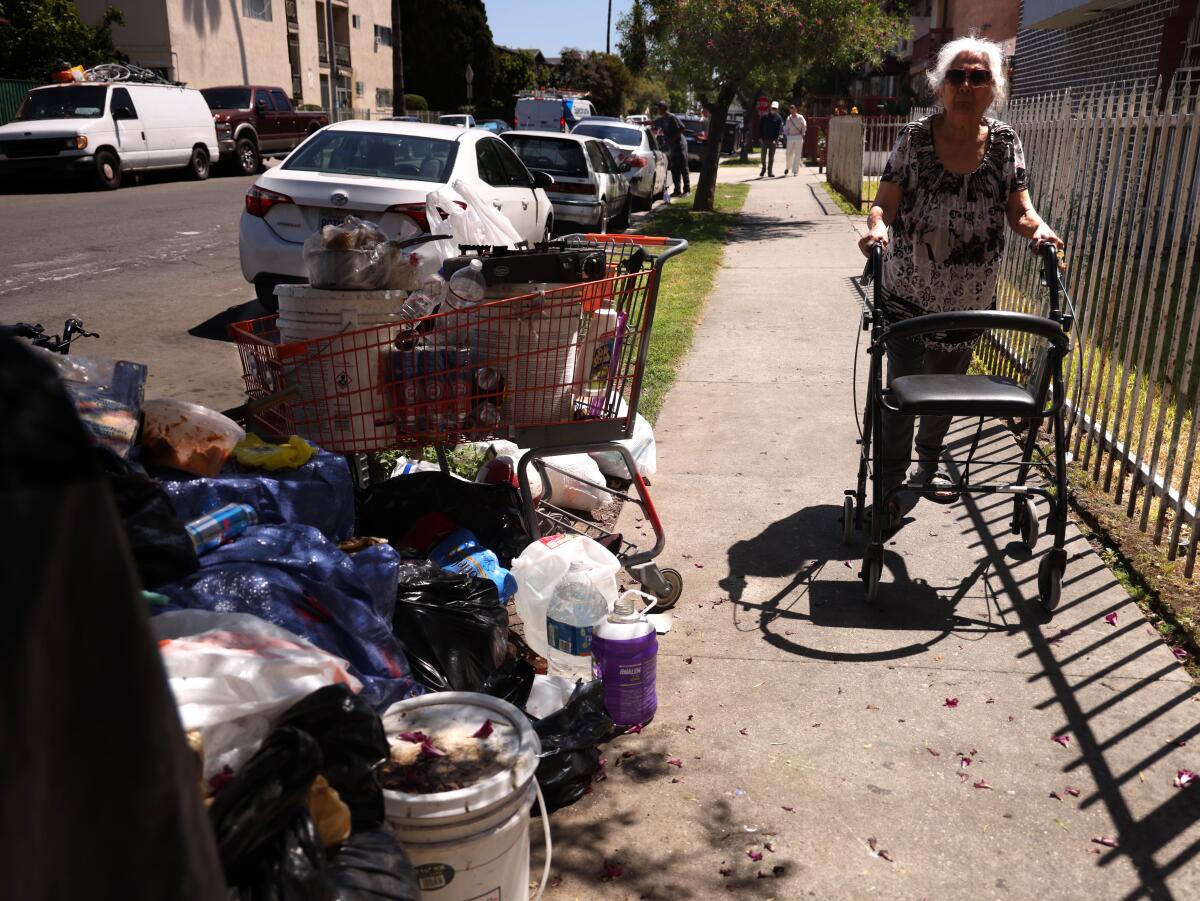
A woman pushes her walker past debris in Los Angeles.

A woman pushes her walker past debris in Council District 13 in Los Angeles on Friday.

(Genaro Molina / Los Angeles Times)

Soto-Martínez agreed to talk to me about all of this on Friday morning, when he dropped by the Bresee Foundation, a nonprofit with a range of enrichment activities for youngsters and families in the largely low-income immigrant community, as well as homelessness prevention programs. Staff and volunteers, recruited with support from the council office, were about to head into nearby streets with shovels, brooms and trash bags.

Soto-Martínez acknowledged his district’s many challenges, told the gathering that the strength of a community is its people, and thanked them for their service.

The councilman, a former labor leader who joined the growing progressive wing of the L.A. City Council in 2022 with support from the local chapter of Democratic Socialists of America, has three challengers in the June 2 primary (Colter Carlisle, Dylan Kendall and Rich Sarian). He told me the city has to do a better job of educating people about illegal dumping and how to report it. A related challenge, he said, “is how quickly can we get to it. And that is a budget issue because we’ve cut so many positions on trash pickup.”

Soto-Martínez said his office used discretionary funds to hire two crews from the L.A. Conservation Corps for trash pickup. On homelessness, he said, he has a team strategizing to address the needs, and a medical team that works the streets, and a tiny home village is in the works.

But the housing shortage is a major challenge, he said, and when it comes to entrenched homelessness, “we’re now starting to deal with much more difficult cases.” Namely severe mental illness and serious addiction, both of which generally come under county jurisdiction.

“We created another team that goes out every single day. We door-knock, email and phone-bank people who are at risk of eviction,” Soto-Martínez said, adding that homelessness has declined by 25% during his three years in office.

So what is his message to constituents who say they don’t see enough progress?

“We ask them to give us patience and grace,” he said. “There’s a lot of examples like this, where we’re not just dealing with one thing. We’re dealing with four or five things.”

All of that is true, but the patience he asks for is wearing thin among some constituents.

“We need to find common ground and work together,” Soto-Martínez said. “You know, they see trash as an issue, and they’re doing it their way and we’re doing it our way. But how can we team up and do it together? You know, we’re happy to build those networks out, and under many of the issues they describe, I’m not disagreeing. … We all have the same goal.”

Los Angeles City Councilmember Hugo Soto-Martínez talks about confronting issues in his district.

L.A. City Councilmember Hugo Soto-Martínez gives a pep talk to volunteers before they leave to clean their neighborhood streets of garbage and debris.

(Genaro Molina / Los Angeles Times)

When Soto-Martínez departed for another appointment, the volunteers took to the streets, filling trash bags. They worked their way up Vermont, and a Bresee employee told me he works the same streets every day, trying to clear a path for “safe passage” as students walk to and from school.

As I said in the earlier column, it’s an inspiration to see people step up for their communities, whether out of pride or frustration. And it’s also reasonable to expect more from City Hall.

I drove over to Western and Sierra Vista, met up with Keenan, and told her about my conversation with Soto-Martínez. She said lax city policies and frequent non-response to citizen pleas for help have created the unsolved problems residents deal with daily. She said city officials have to do a better job of helping homeless people off the streets and preventing further deterioration of neighborhoods.

She was encouraged by a message she got from a representative of Mayor Karen Bass’ office who wants to tour the neighborhood with her.

We walked west on Sierra Vista and came upon a dumped sofa, some cabinets, mattresses, and a man who has been living in a curbside encampment for months. He sat near his belongings, which spilled into the street.

Why hasn’t this been addressed? Keenan wondered aloud. She has decided to stop paying her housekeeper to help address the neighborhood’s needs, and she predicted things will only get worse because of it.

I drove over to the Lexington pocket park, which Soto-Martínez called a priority, among many other priorities. Friday was a holiday — Armenian Genocide Remembrance Day. With schools closed, the park would have been a great little neighborhood asset.

But the entrance was closed, with a lock on the gate, and two tarped dwellings were set up against the iron fencing of the empty park.

steve.lopez@latimes.com

Source link