
Antonelli’s new record – he is 19 years and 212 days old – beat the previous held by Sebastian Vettel, who was 21 years and 72 days old when he took pole at the 2008 Italian Grand Prix.
Antonelli said he was “very happy” but accepted that he might well not have taken pole had Russell had a problem-free qualifying.
He said: “George had an issue, so probably could have been a different story but happy to be on pole for the first time.”
Russell described his second place as “damage limitation” after a litany of problems through qualifying.
The championship leader said: “It was a crazy session. Front wing broke at the end of Q2. The team weren’t sure it had broken but I was sure it had. Then got stranded on track and just made it back out in time. It was more a case of just getting a lap done.
“P2 is better than I was expecting when I started the lap with no battery and tyre temperature. Really happy to be here because I could have been down in 10th.”
In the first session, Leclerc became the first driver to beat Russell in a competitive session this year with a time just under 0.1secs quicker than the Briton.
Then in the second session, Russell ended up third fastest behind Antonelli and Leclerc after he suffered a broken front wing flap.
Heading out for the final session with a new wing, Russell’s car stopped on track on his out lap as the gearbox refused to change gear.
Antonelli drove past his team-mate as he set the fastest time on his first flying lap, 0.3secs quicker than Leclerc.
After frantic work in the garage, Mercedes managed to fix Russell’s car by applying a series of default procedures such as switching the car off and on again and swapping out the steering wheel.
He got just out in time to set a lap but his rushed preparation meant the car was not in its optimum condition as he went for a time.
However, Antonelli had his own problems on his final run – he suffered the same front wing problem has Russell had done in Q2.
Hamilton, who tussled with Russell for the lead in the opening laps of the sprint race earlier on Saturday, was 0.351secs off pole and said he had hopes of challenging the Mercedes again in the grand prix.
“It was a really tough qualifying,” Hamilton said. “A bit harder with the wind. It is so gusty today. So challenging.
“Really happy and grateful to be up here with these guys. Engineers did some great work over the break and managed to get a little closer to these guys.
“It’s still going to be a challenge but I am sure we’re going to have some fun. Learned a lot in the sprint race and our goal is to break the gap to these guys somehow.”
The McLarens were just over 0.1secs behind the Ferraris and Norris said: “We’re happy we’re close to them, gives us a good shot at tomorrow.”
But Verstappen was downcast to be nearly a second off the pace in the Red Bull.
“We change a lot on the car, and it makes zero difference,” the four-time world champion said.
“The whole weekend we’ve been off. The car is completely undriveable. I cannot even put a bit of a reference in. Every lap is like survival.”
ITV has shared images from its upcoming true crime series about convicted sex offender John Worboys
14:39, 12 Mar 2026Updated 14:48, 12 Mar 2026
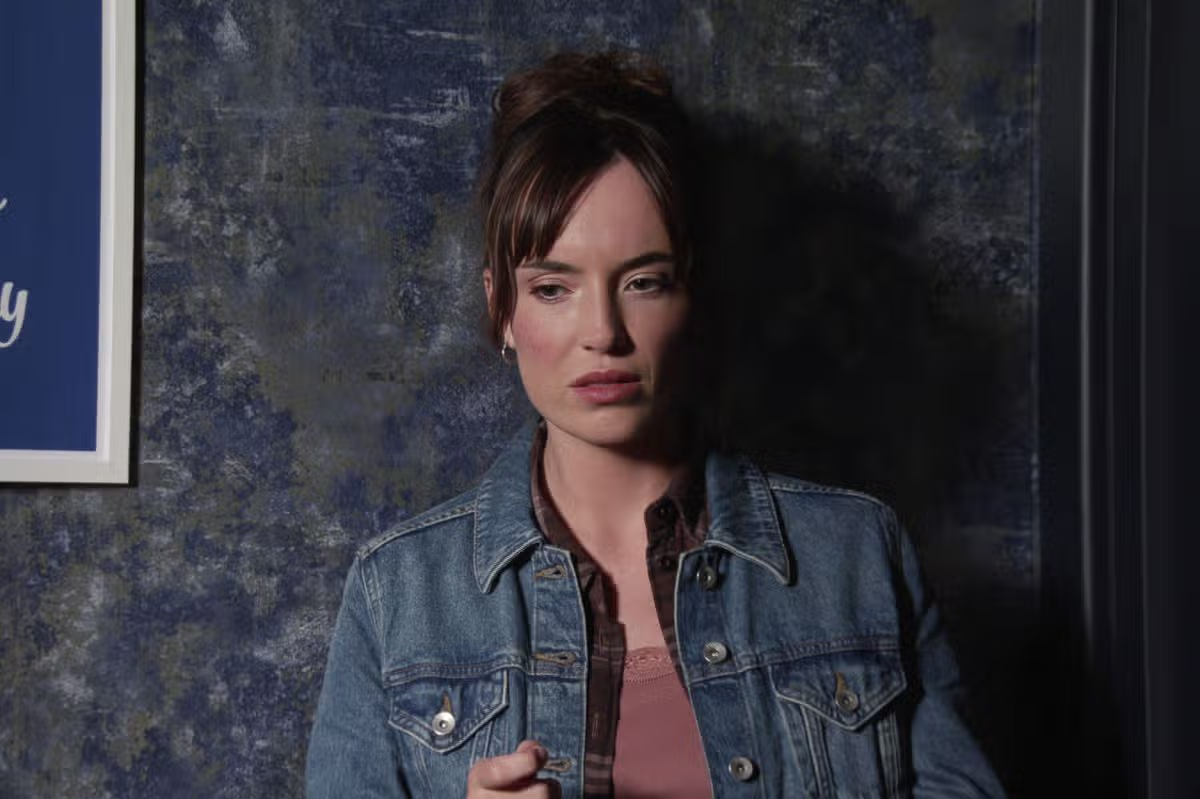
Aimée-Ffion Edwards stars in Believe Me(Image: ITV)
Broadcaster ITV has released a first look at its new true crime drama Believe Me.
Filmed in Cardiff, the four-part series tells the story of John Worboys – who was dubbed the ‘black cab rapist’ after preying on women under the cover of being a licensed taxi-cab driver.
He was convicted in 2009 for crimes including sexual assault and drugging with intent against 12 women.
His modus operandi was to claim that he’d had a win at a casino or on the lottery, then offer women he’d picked up in his cab after a night out a glass of champagne, which he’d laced with drugs, and which rendered his victims unconscious.
ITV said the drama “tells the story of how the victims of one of the most prolific sex attackers in British history were failed by the system”.
The series focuses on the ordeal of Sarah (played byPeaky Blinders‘ Aimée-Ffion Edwards) and Laila (played by Raised By Wolves’ Aasiya Shah), who reported sexual assaults by Worboys (Daniel Mays), and how their allegations were not thoroughly investigated.
Sarah and Laila – both pseudonyms – joined forces with solicitor Harriet Wistrich, played by Philippa Dunne and barrister Phillippa Kaufmann QC, played by Rachael Stirling, to sue the Metropolitan Police under the Human Rights Act for their failure to properly conduct investigations into their allegations of sexual assault, leading to their being subjected to degrading treatment and contributing to their distress.
They won, and when the Met appealed that judgment to the Supreme Court, they won again.
As these women fought to have their cases heard, looming in the background was Worboys’ first parole hearing. Eight years after he was convicted for his crimes, his victims had to fight again to keep him behind bars.
Sarah, Laila, Harriet and Phillippa were joined by Carrie Symonds (played by Industry’s Miriam Petche), a senior figure in the Conservative Party press team. She put her career on the line to spearhead a huge media and political campaign pushing for an unprecedented judicial review of the Parole Board’s decision. The campaign, with Sarah, Laila and Carrie at the forefront, was successful, and Worboys’ parole was quashed.
Sarah, whose identity has been protected, said: “Believe Me is about the courage of every woman who came forward to help put John Worboys behind bars.
“What happened to me changed my life, but in many ways the hardest part was not being believed for so many years. Without the people who stood by me, Worboys would have been freed and continued to pose a huge risk to women. Seeking justice shouldn’t mean more trauma. We shouldn’t have to fight to be believed or feel like we’re the ones on trial. The shame never belongs to the survivor.”
Believe Me will air on ITV
If you or somebody you know has been affected by this story, contact Victim Support for free, confidential advice on 08 08 16 89 111 or visit their website, http://www.victimsupport.org.uk.
Kathdhara village is a riot of colour as the early evening light turns the clouds the rosy hue of Himalayan salt. Bright red chillies lie drying in front of cornflower blue doorways. The pink of a sari and the orange of marigolds pop against a backdrop of verdant terraced fields, where cabbages grow in perfect rows like a picture from a Peter Rabbit book.
Just 22 families live in this remote hamlet in Binsar Wildlife Sanctuary, in the Kumaon region of Uttarakhand, north-east India. As we stroll with our guide, Deepak, taking in views of the layered hills and soaring, snow-capped Panchachuli peaks beyond, we are welcomed by villagers tending homes and gardens, strings of Diwali fairy lights adding extra sparkle to the scene.
I’m here to explore the foothills of the Himalayas and sample village life on a walking holiday with Village Ways, a pioneer of responsible, community-based tourism in India, which is celebrating its 21st anniversary this year. Dreamed up by Manisha and Himanshu Pande, the couple who run the Khali Estate, a small hotel in the reserve, the goal is to help address urban migration and support traditional rural life through low-impact tourism. Village Ways launched in 2005 with just five villages in the reserve, which guests hike between, and now more than 30 villages are involved in different parts of the country, from Madhya Pradesh to Kerala.
A view of the Kumaon ranges in Uttarakhand. Photograph: Monarch/Balan Madhavan/Alamy
“The idea was to bring the community together to run something collectively, training people in all aspects of business. Everyone has a role to play,” says Manisha. “The Village Ways model has captured the attention of the government, too, and we’re collaborating on various projects in other states now, which is exciting.”
Most accommodation is in small, village-built guesthouses sleeping up to eight, rather than homestays, and money is evenly distributed to everyone from cleaners to porters, with committees making joint decisions. Back at the Kathdhara guesthouse, we join Diwali celebrations, sharing sweets, lighting lamps and praying to the goddess Lakshmi by a makeshift shrine. We feast on a delicious thali – spicy yams, dal, hemp chutney and warm roti – and sleep soundly, cocooned by the silence of the mountains.
The next day brings blue skies, and after breakfast we set out on a gentle walk to the neighbouring Gonap village. Binsar Wildlife Sanctuary was created in 1988, a 47 sq km (18 sq mile) area to help protect the broadleaf oak forest and wildlife. For the people living here, it altered their relationship with the forest, ending tree felling and hunting – tempting many to abandon village life for the cities. Village Ways offered an alternative – former hunters turned guides, sharing knowledge of the land and wildlife with guests, and seeing outsiders’ interest in local customs and traditions renewed their sense of pride.
We hike through pristine pine, oak and rhododendron forests (come in March or April to see the land painted red, pink and white when they bloom). I’m fascinated by the Himalayan oaks, which play a key role in storing and releasing water and stabilising the land with their vast root networks. We see the bright red flowers of wild turmeric and countless medicinal plants, from goat weed (some believe the juice stops bleeding) to Indian tobacco (used for toothache).
Gonap village, in Binsar Wildlife Sanctuary. Photograph: Steve Taylor ARPS/Alamy
Leopards roam here too and, though they remain elusive, we spy footprints and scat, as well as porcupine quills. But the sanctuary is best known for its amazing birdlife – more than 200 species are found here – and we stop frequently as Deepak points out the crested serpent eagle, leaf warbler, black-headed jay and noisy parakeets.
Gonap itself is tiny – home to just seven families today. We’re welcomed to the guesthouse with chai and plates of warm pakora – enjoyed with staggering mountain views as Eurasian griffon vultures float on the thermals. Deepak leads us to a tiny temple, past houses with gardens heaving with jumbo lemons and air potatoes on giant stalks, the sounds of cicadas in the air.
No roads connect the five villages in the Binsar circuit, but the paths between them offer easy walking and there’s plenty of time to rest. A higher-altitude route in the nearby Saryu and Pindar valleys, close to the border with Tibet, offers more challenging hikes. But limited time means we head back to the Khali Estate from Gonap, stopping at Zero Point lookout – the highest vantage spot in the reserve, at 2,500 metres – to gawp at the 360-degree Himalayan panorama, dominated by Nanda Devi, the second highest mountain in India.
Built 150 years ago by a British commissioner, Gen Sir Henry Ramsay, the Khali Estate makes a picturesque base, with accommodation in stone rondavel cabins and a sitting room with roaring fire. During his time in Kumaon, Ramsay is credited with developing local infrastructure, founding a leper colony in the historical capital of the region, Almora, and regulating tree felling. We delve into the estate’s history on a tour with Himanshu, poring over photos and library texts, and learn how it was also a retreat for the Nehru family and an ashram for Mahatma Gandhi. Surrounded by forest, it’s utterly peaceful. Later, I fall asleep to the distant sound of barking deer.
For visitors wanting to learn more about the region’s history and the characters who shaped it, Village Ways has launched a new itinerary, Khali in Kumaon. As well as the Binsar walks, it takes in the lakeside hill station of Nainital, where we had stopped on the 270-mile journey from Delhi. Guests will also explore Almora, with its local primary school supported by Village Ways, the museum of the Anglo-Indian hunter turned conservationist Jim Corbett, and the Gandhi trail, heading into the hills to see some of the first looms he established for homespun cotton – a symbol of economic independence and resistance to British rule – at Anasakti ashram.
The Khali Estate. Photograph: Village Ways
But our last day is very much focused on the present, as a stream of villagers arrive at Khali from far and wide to join the anniversary celebrations. Other Village Ways founders – Brits who worked in development and tourism – are here too, and there are talks, feasting and dancing. I learn about the Village Ways charitable trust, which supports healthcare in these remote villages, training local women to run mobile clinics. Since Village Ways’ inception, it has hosted 7,000 guests, benefiting about 5,000 people, from artists to taxi drivers, according to Manisha, and 470 villagers are directly involved in decision-making as members of the village tourism committees in six states.
I buy locally made scarves and handicrafts, and many of the young villagers – now guides, cooks or porters – tell me about the positive impact tourism has had on their lives. “Since I joined as a guide three years ago I’ve learned lots about Binsar and our birds – and my English has really improved,” said 23-year-old Ashirwad Joshi from Dalar village. “I’m very happy to be part of it and share my knowledge with visitors – it makes me proud.”
When we leave the next morning for the long drive to Kathgodam and onward train journey to Delhi, it’s the feeling of mutual respect and warmth that stays with me. The challenges are many, from ageing village populations to a decline in international visitor numbers to the area since Covid, but the Village Ways mission is very much full steam ahead – taking its ethos to other parts of the country. This type of tourism – one that involves communities as partners and is collaborative rather than exploitative – benefits locals and travellers alike. In these times of division, it is to be celebrated more than ever.
The trip was provided by Village Ways, which creates bespoke itineraries, tailored to travellers’ interests. The suggested 10-day Khali in Kumaon itinerary (available until 30 May, and from 15 September to 30 November 2026) costs from £1,315pp, based on a party of four, including transfers, rail travel, accommodation and most meals