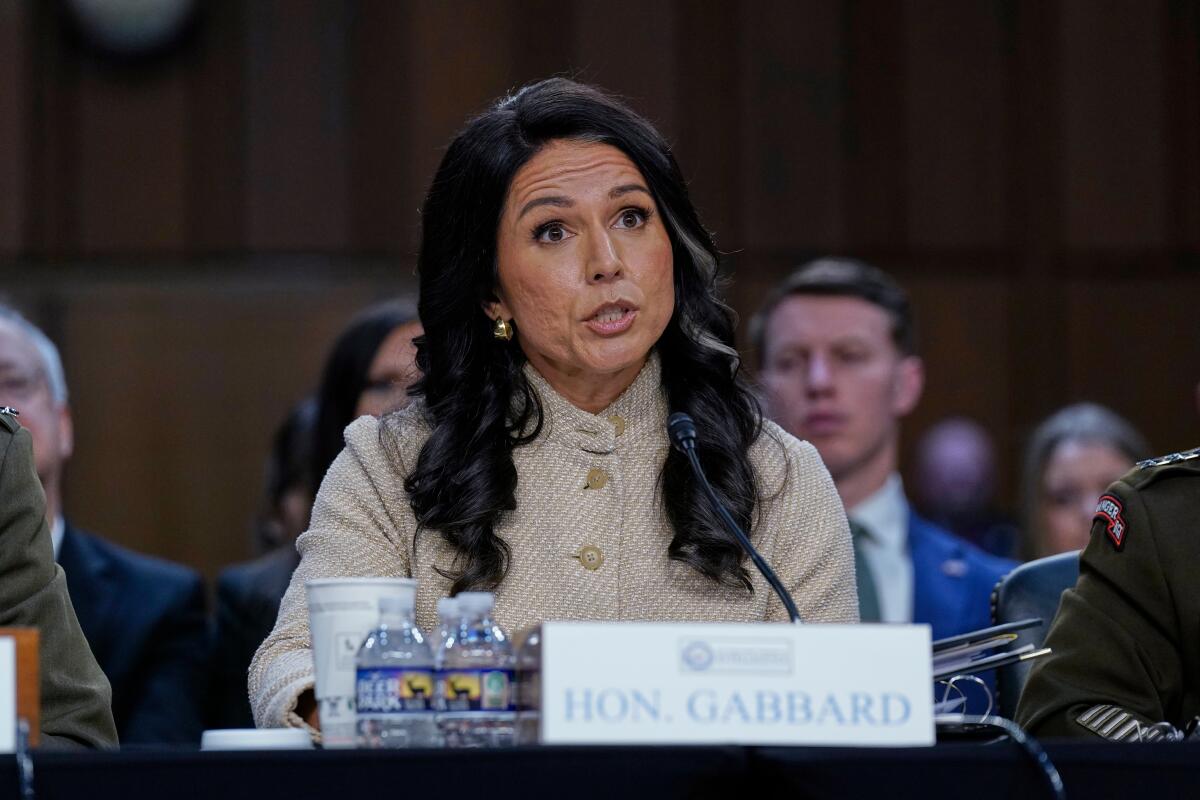
WASHINGTON — The Iranian government remains “intact but largely degraded,” National Intelligence Director Tulsi Gabbard told Congress on Wednesday, as Israel continued to hunt down the Islamic Republic’s leadership with an overnight airstrike that killed the nation’s spy chief.
The death of Intelligence Minister Esmail Khatib, announced Wednesday by Israel, was the third high-level assassination in roughly 24 hours in a series of strikes that have hollowed out Tehran’s leadership ranks.
Israel ordered strikes Tuesday that killed Iranian security chief Ali Larijani and Basij paramilitary commander Gholamreza Soleimani.
Additional senior Iranian figures could be targeted, Israeli Defense Minister Israel Katz said Wednesday. “Israel’s policy is clear and unequivocal: No one in Iran has immunity — everyone is a target,” Katz said.
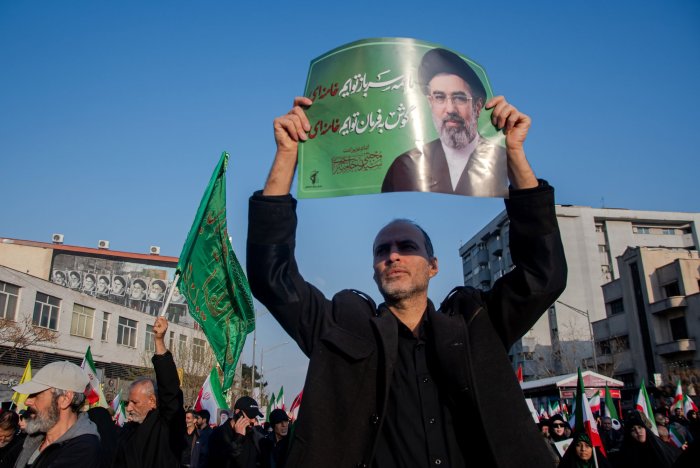
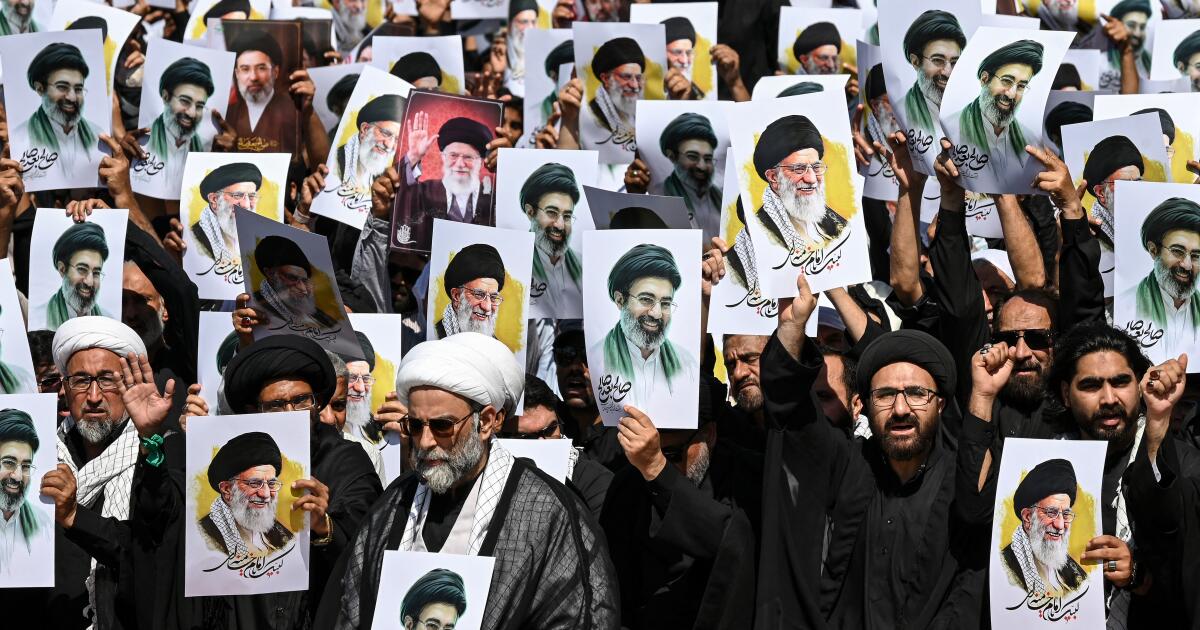
Ayatollah Mojtaba Khamenei, Iran’s new supreme leader, issued a rare statement Wednesday addressing Larijani’s assassination.
“Undoubtedly, the assassination of such a person shows the extent of his importance and the hatred of the enemies of Islam towards him,” he wrote, according to the Associated Press. “All blood has its price that the criminal murderers of the martyrs must pay soon.”
Tehran responded with renewed missile and drone attacks on Israel and U.S.-aligned countries across the Persian Gulf, further disrupting strained energy infrastructure and shipping lanes. Fighting has halted oil and gas production throughout the region, as shipping was stalled through the Strait of Hormuz, a key artery for global oil supplies.
The war has triggered a severe global oil shortage that has destabilized electronics, agriculture, pharmaceutical and energy supply chains.
Exacerbating those disruptions, the U.S. and Israel carried out a coordinated attack on the South Pars natural gas field on Wednesday. The strikes drew swift condemnation from Qatar, a U.S. ally that shares the reservoir with Iran. The Qatari Foreign Ministry called the attack “dangerous and irresponsible” and “a threat to global energy security.”
The attack is a major blow to Iran’s supply of electricity too, as most of the country’s energy grid relies on gas, analysts said. The field accounts for about 75% of Iran’s natural gas production.
Tehran promised to respond with more attacks on its Mideast neighbors, the Associated Press reported.
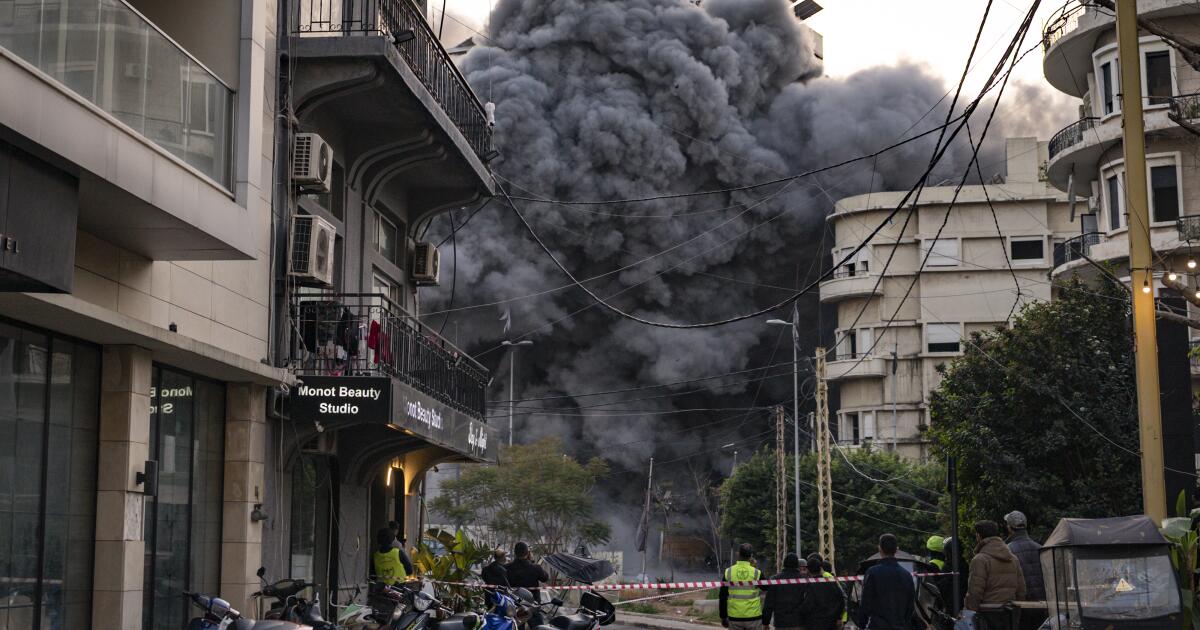
Meanwhile, near-constant Israeli strikes in Beirut and southern Lebanon have displaced over 1 million people, and killed 968 civilians, according to the Lebanese Health Ministry.
With the war in its third week, deaths now number in the thousands across Iran, Israel and neighboring countries.
International reaction has sharpened as the fighting showed no sign of relenting. Russia condemned the “murder and liquidation” of sovereign leadership and called for an immediate ceasefire, while European leaders voiced growing alarm about the war’s trajectory and the risks of broader destabilization.
Director of National Intelligence Tulsi Gabbard testifies Wednesday before the Senate Committee on Intelligence.
(Jose Luis Magana / Associated Press)
All allies in the North Atlantic Treaty Organization have refused to heed President Trump’s call to send warships to the Strait of Hormuz, signaling a deepening rift in the world’s most powerful military alliance. Trump has sought to sever the U.S. from the alliance.
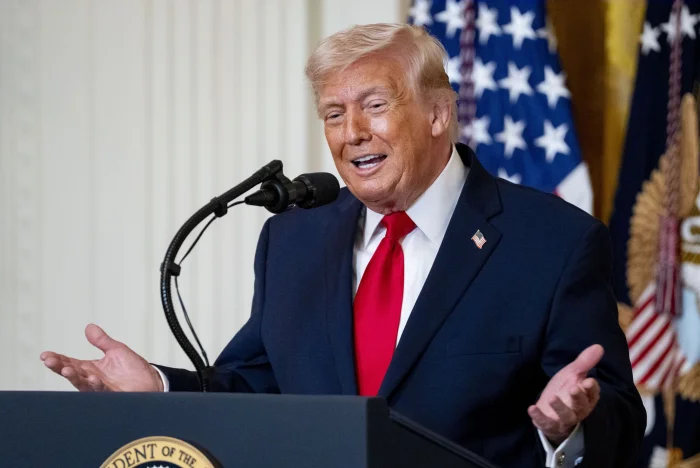
“We no longer ‘need,’ or desire, the NATO Countries’ assistance — WE NEVER DID! “ he wrote on social media Tuesday.
Trump on Wednesday signaled little appetite for de-escalation, floating the prospect of a decisive military endgame.
“I wonder what would happen if we ‘finished off’ what’s left of the Iranian Terror State,” he wrote on his social media website.
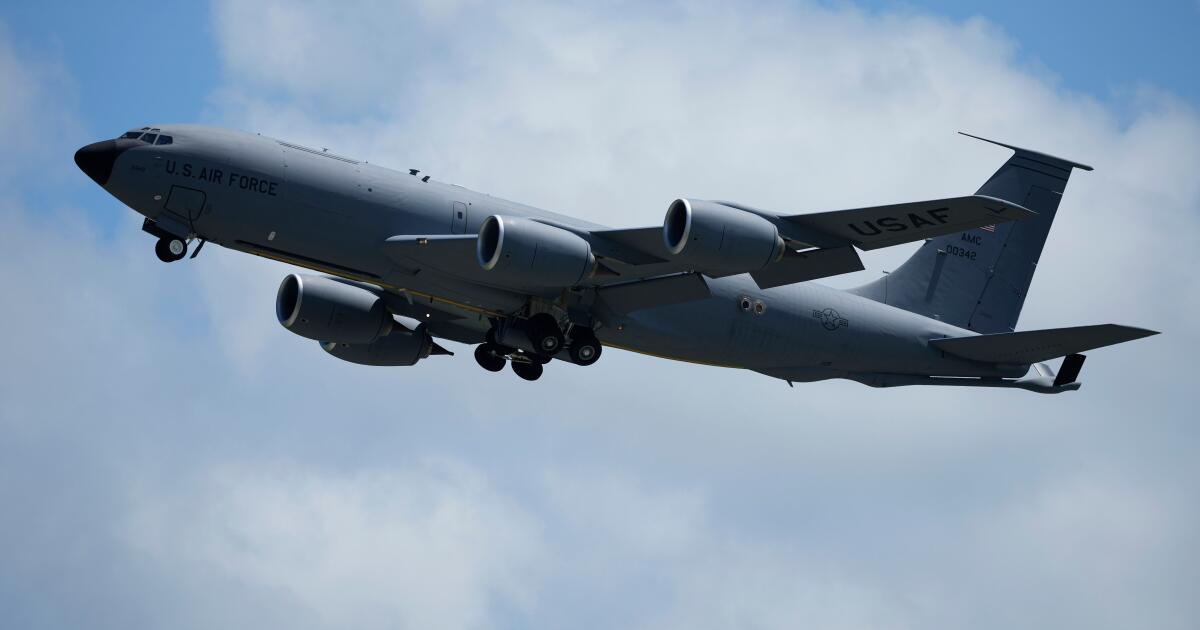
The president visited Dover Air Force Base in Delaware on Wednesday, where the remains of six U.S. service members killed in the crash of a refueling aircraft were returned to their families. The visit marks the second time since the Feb. 28 launch of the war with Iran that Trump has attended the solemn military ritual known as a dignified transfer, the Associated Press reported.
At a Senate Intelligence Committee hearing on “worldwide threats” Wednesday, Democrats grilled Gabbard and other intelligence leaders over their preparation for Iranian retaliation against Mideast energy infrastructure, civilian areas and American military sites and personnel.
Trump has maintained that the U.S. was caught off guard by Iran’s retaliatory strikes.
“Nobody expected that. We were shocked,” he said at a Kennedy Center board meeting Monday. Later in the day, when asked at an Oval Office news briefing whether he had been warned about the possibility of Iranian retaliation, Trump reiterated his surprise.
Last year, intelligence agencies testified to Congress that Iran was capable of inflicting substantial damage on an attacker, executing regional strikes and disrupting shipping, “particularly energy supplies, through the Strait of Hormuz,” Sen. Ron Wyden (D-Ore.) said at the hearing, reading from last year’s worldwide threats report.
“In other words, every problem we’re seeing now was not only foreseeable, but was actually predicted by the intelligence agencies,” Wyden told Gabbard. “It’s hard to see how you can sit here and say that the intelligence agencies couldn’t provide a clear warning that if attacked, the Iranians would respond by attacking our people.”
Gabbard refused to confirm whether intelligence agencies briefed the president on the subject, saying she “won’t divulge internal conversations.”
She also testified that U.S. strikes on Iran had “obliterated” the country’s nuclear enrichment program, including underground facilities, and said officials are now watching to see whether Tehran attempts to rebuild. So far, she said, Iran has not restarted the program.
But Sen. Jon Ossoff (D-Ga.) challenged that assessment, noting that Trump had used the same word — “obliterated” — to describe strikes just months before. He pressed Gabbard on how serious the nuclear threat was leading up to the February operation, given that timeline.
The intelligence community assessed that Iran “maintained the intention to rebuild and to continue to grow their nuclear enrichment,” Gabbard said adding that the “only person” who can determine what constitutes an imminent threat is the president.
“False,” Ossoff shot back. “It is precisely your responsibility to determine what constitutes a threat to the United States.”
PARIS — We’ve long had your back, now it’s our turn. That is how the famously transactional President Trump is framing his demands that allies help him with the Iran war. He wants to call in IOUs for decades of U.S. security guarantees.
The string of refusals indicates his stock of European goodwill is low. He has put allies through the wringer since returning to the White House, bullying them over tariffs, Greenland and other issues, and disparaging the sacrifices their soldiers made alongside U.S. troops in Afghanistan.
Now he’s demanding — not just requesting — that they send warships to help the U.S. unblock the Strait of Hormuz, through which a fifth of the world’s traded oil passes — essentially mop up behind the conflagration that he and Israel ignited in the Middle East.
The reply has been a “global raspberry.”
That’s how a veteran French defense analyst, François Heisbourg, described allied responses.
No close ally has come forward with immediate help. Britain is flat-out refusing to be drawn into the war. France says the fighting would have to die down first. Others are non-committal. China, which is not an ally but was also asked to help, is ignoring Trump’s call.
“This is not Europe’s war. We didn’t start the war. We were not consulted,” European Union foreign policy chief Kaja Kallas said Tuesday.
Trump’s frustration with the ‘Rolls-Royce of allies’
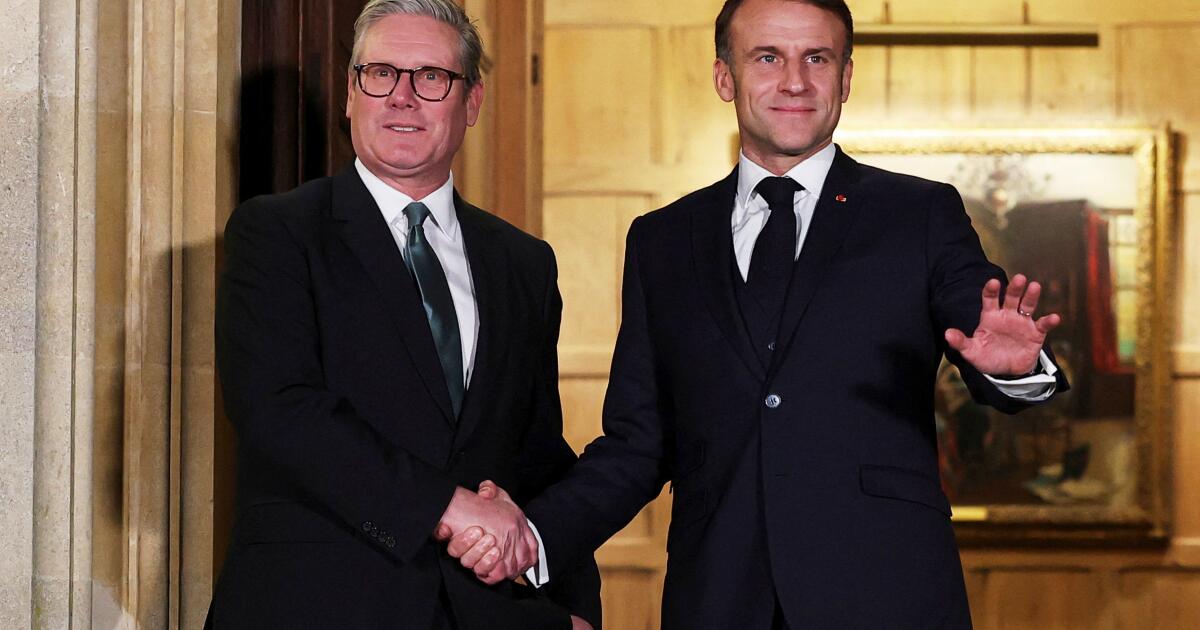
Trump has singled out the refusal from the United Kingdom. Prime Minister Keir Starmer cultivated ties with Trump and reached an early trade deal with the administration, but is now among allies who refuse to join a regional war with no clear endgame.
The U.K. “was sort of considered the Rolls-Royce of allies,” Trump said Monday, adding that he’d asked for British minesweeping ships.
“I was not happy with the U.K,” Trump said. “They should be involved enthusiastically. We’ve been protecting these countries for years.”
Starmer said Britain “will not be drawn into the wider war” and that British troops require the backing of international law and “a proper thought-through plan” — suggesting those were not in place.
He initially refused to let U.S. bombers attack Iran from British bases before accepting their use for strikes on Iran’s ballistic missile program.
Retired Lt. Gen. Ben Hodges, former commanding general of the U.S. Army in Europe, said allies are “looking at the United States in a way that they never have before. And this is bad for the United States.”
Having previously appeased Trump, some European leaders are “starting to realize that there’s no benefit or value in using flattery,” he said.
European leaders say it’s not their war
Going to war without consulting allies was in keeping with Trump’s America-first outlook.
“My attitude is: We don’t need anybody. We’re the strongest nation in the world,” he said Monday.
But failing to get an international mandate, as the U.S. did before intervening in the 1990 Gulf War, is boomeranging.
“It is not our war; we did not start it,” German Defense Minister Boris Pistorius said. “We want diplomatic solutions and a swift end to the conflict. Sending more warships to the region will certainly not contribute to that.”
French President Emmanuel Macron envisions possible naval escorts in the Strait of Hormuz — but only once fighting has died down.
“France didn’t choose this war. We’re not taking part,” he said.
After bruising tariff battles with Trump last year, the first months of 2026 have further strained alliances. Trump’s renewed pressure for U.S. control of Greenland, including a tariff threat against eight European nations, and his false assertion that allied troops avoided front-line fighting in the Afghanistan War, upset partners in the NATO military alliance.
“Allies, or at least the Europeans, aren’t willing to be at the beck and call of a demand from Donald Trump,” said Sylvie Bermann, a French former ambassador to China, the U.K. and Russia.
“And even in asking for a helping hand, he is doing so in a brutal manner, saying: ‘You’re useless, we’re the strongest, we don’t need you, but come,’” she said.
A dangerous mission
Retired naval officers say that unblocking the Strait of Hormuz with military escorts while the war rages and without Iran’s consent would be dangerous.
France, which has rushed its Charles de Gaulle aircraft carrier to the Mediterranean, is working with other countries to prepare such a mission once the air war has subsided. French military spokesman Col. Guillaume Vernet said any escorting would be conditional on talks with Iran, and Macron has publicized two calls in eight days with Iranian President Masoud Pezeshkian.
That has won points with Trump.
“On a scale of zero to 10, I’d say he’s been an eight,” Trump said Monday. “Not perfect, but it’s France. We don’t expect perfect.”
But he’s fuming at other allies.
“We will protect them, but they will do nothing for us, in particular, in a time of need,” Trump said Tuesday.
Trump has leverage, including in Ukraine
Allies in Europe and Asia need oil, gas and other products from the Middle East to flow again. That gives Trump some leverage.
Allies also know from experience that resisting Trump carries risks of retaliation.
“It really could be anything. Are the Europeans prepared for that?” asked Ed Arnold, a former British army officer and now a researcher at the Royal United Services Institute, a London think tank.
European allies need Trump’s continued blessing for U.S. weaponry, intelligence, and other support for Ukraine, as well as financial pressure on Russia. The U.S. has started to chip away at some sanctions on Moscow by temporarily allowing shipments of Russian oil to ease shortages stemming from the Iran war. Allies also want him to reengage in talks to end the war.
“That was what kept European leaders quiet for a lot of last year in the face of the rhetoric and actions,” said Amanda Sloat, a former U.S. national security adviser who now teaches at Spain’s IE University.
“It is also the thing that is making them a little bit nervous now.”
Leicester and Burrows write for the Associated Press. Burrows reported from London. AP journalists Jill Lawless in London, Lorne Cook in Brussels, Suman Naishadham in Madrid, Geir Moulson and Kirsten Grieshaber in Berlin, Simina Mistreanu in Taipei, Taiwan, and Mari Yamaguchi in Tokyo contributed to this report.
As United States President Donald Trump tries to build a coalition of navies willing to open the Strait of Hormuz, some countries are negotiating safe passage directly with Iran, underscoring a new de facto reality, analysts say: Regardless of military results, Tehran is calling the shots on who gets to use the world’s most important energy waterway.
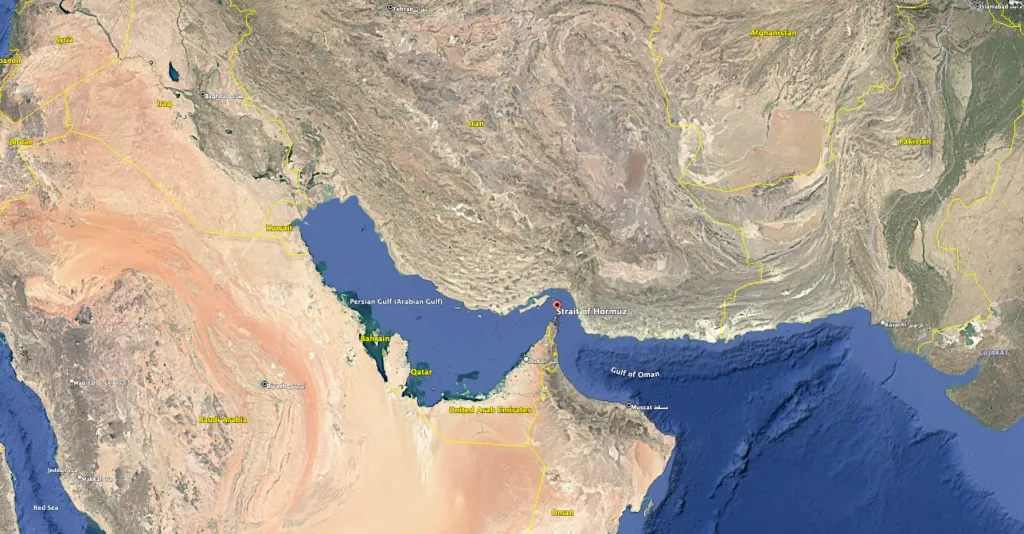
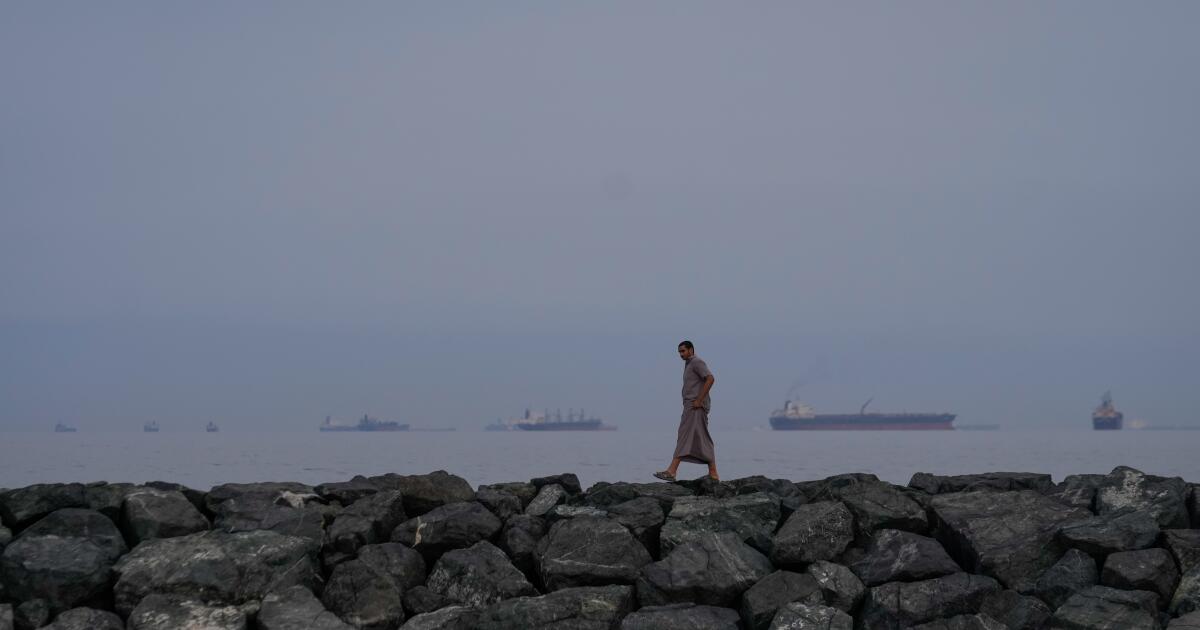
After US-Israeli strikes on Iran began on February 28 and killed Supreme Leader Ali Khamenei, the Iranian military leadership responded by focusing on its most potent form of leverage – Iran’s geography. The country controls the northern shore of the Strait of Hormuz, through which 20 percent of global crude oil and natural gas supplies pass. It is 33km (20 miles) wide at its narrowest point, so any naval force that wants to cross it becomes easy prey for Iranian attacks coming from the mainland.
Recommended Stories
list of 3 itemsend of list
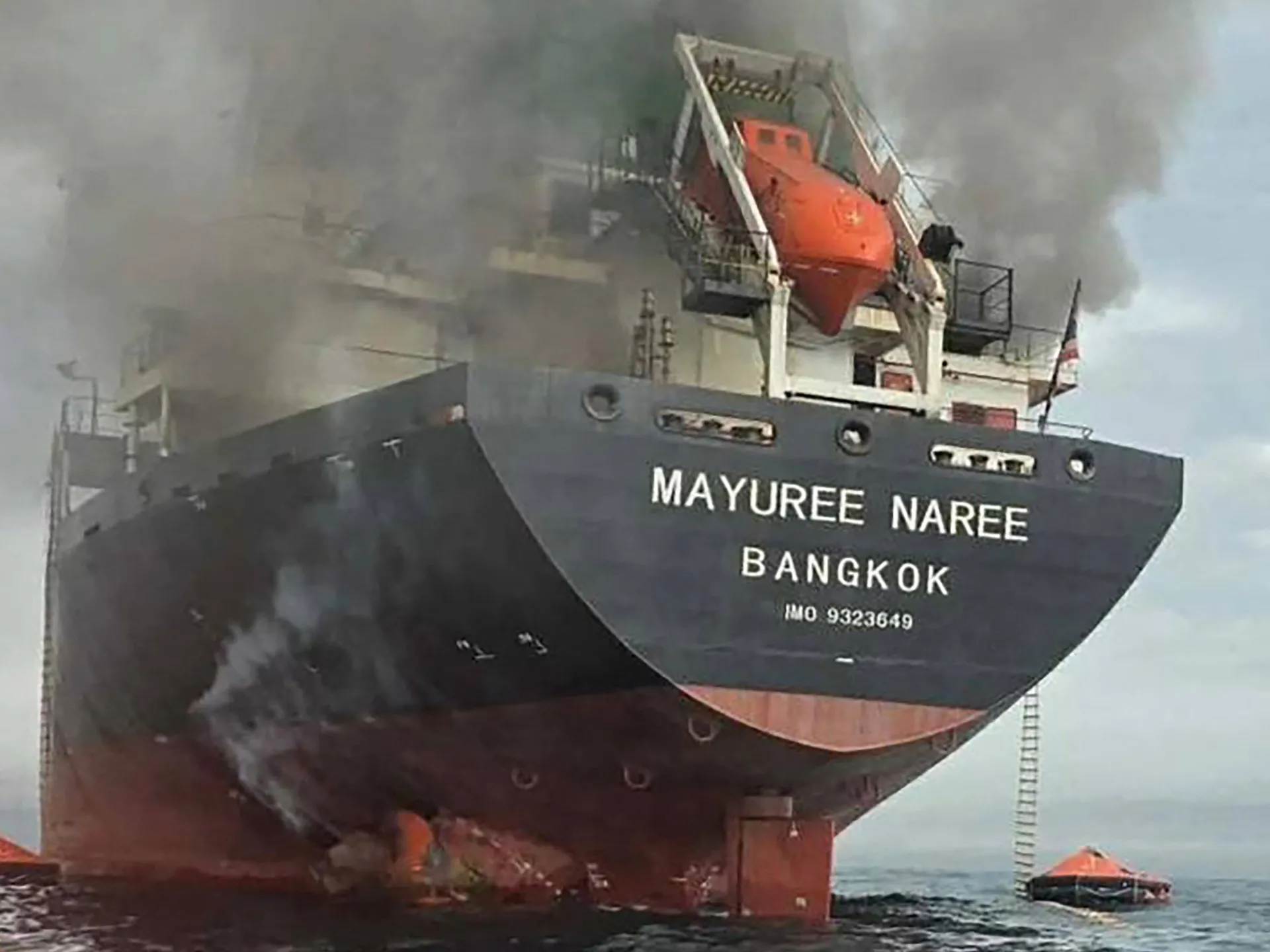
Considering insurance companies’ low appetite for risk, it took relatively few attacks on vessels in the strait – or just the threat of them – to undermine market confidence and send insurance premiums shooting up, causing a near paralysis in maritime traffic. About 20 vessels have been attacked since the start of the war.
“Iran has effectively proven that it dictates the terms of passage through the strait. They have now shown they are the gatekeeper of this important chokepoint. This will elevate the status of Iran in the geography of the Gulf,” said Andreas Krieg, an associate professor in Security Studies at King’s College London and a fellow at King’s Institute of Middle Eastern Studies. This will be the new reality for the foreseeable future, he added.
Meanwhile, crude prices have risen above $100 a barrel, more than 20 percent higher than pre-war prices, forcing countries to make the biggest releases of emergency reserves in history. Gas prices have risen by more than 40 percent since the war began.
Trump initially floated the idea of ordering the US Navy to escort vessels through the waterway. He then appealed to some countries to send warships and warned NATO members they would face “a very bad” future if these allies failed to help in opening the strait. But the appeal was either turned down or received noncommittal responses. Japan said it had no plans to deploy naval vessels. Australia ruled out sending ships. The United Kingdom said it would not be drawn into the wider war. Germany sent a clear message: “This is not our war”.
Others decided to take action – but not of the kind that Trump asked for. On Saturday, two India-flagged gas tankers passed through the strait after days of negotiations between New Delhi and Tehran, including a phone call between Indian Prime Minister Narendra Modi and Iranian President Masoud Pezeshkian. Ships from Pakistan, Turkiye and China also have transited through the Strait of Hormuz. The Financial Times has reported that Italy and France have also reached out to Iran for deals although Italian authorities have rejected making such an overture.
Meanwhile, Windward, a maritime intelligence tracking group, said that while traffic in the strait on Tuesday remained 97 percent below average, a growing number of ships have been passing through Iran’s territorial waters, suggesting that Tehran is allowing “permission-based transit”.
‘It is up to us to decide’
There is a precedent for US naval forces to escort convoys through the strait dating back to the Iran-Iraq War in the 1980s. But today’s scenario is different, experts said. Back then, the US, while it was backing Iraqi leader Saddam Hussein, was not a direct party to the conflict. Iran was still in a post-revolutionary process of consolidating power, and its Islamic Revolutionary Guard Corps was nowhere near as organised as it is today.
Today, Iran has drones that its factories are capable of producing on a large scale and has been using them. Iranian forces could also use small boats to assault tankers, deploy mines and engage in other guerrilla-style tactics. While there are conflicting reports on whether Iran has placed mines in the strait, experts said it would be a counterproductive move for Tehran because it would disrupt the passage for any ships – Iranian vessels included – and it would take away from Tehran the power to choose who may pass.
Iranian officials are aware of their geographic advantage. “This is up to our military to decide,” Iranian Foreign Minister Abbas Araghchi said on Sunday, referring to who will be allowed to use the strait.
Pro-government figures increasingly frame the Strait of Hormuz as a strategic bargaining tool beyond the war itself, suggesting the waterway could be used to extract compensation, sanctions relief or broader economic concessions after the war, Hamidreza Azizi, an expert on Iran and visiting fellow with the German Institute for International and Security Affairs, commented on X.
Recent attacks seem to suggest that Iran wants to increase its pressure on the energy market.
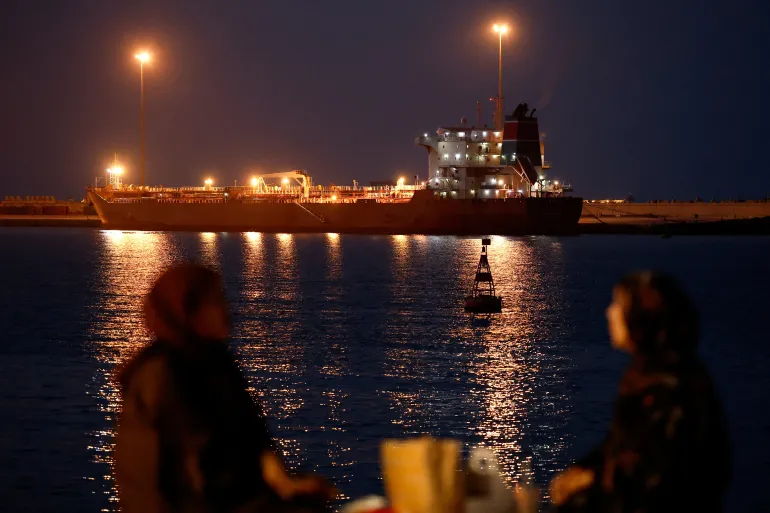
On Tuesday, a drone attack caused a fire at the port of Fujairah, the United Arab Emirates’s only crude export terminal. It is located outside the eastern entrance of the Strait of Hormuz, allowing its exports to circumvent it. The Iran-backed Houthis in Yemen could also further squeeze oil prices by disrupting the Bab al-Mandeb strait. That would force the US to operate across multiple maritime theatres. So far, the Houthis have not carried out such attacks, but this month, they said they were ready to strike at any moment.
Still, the US is focused on applying maximum pressure on Tehran and forcing it to open the Strait of Hormuz. The US Central Command, the US military’s combat command responsible for operations in the Middle East, said early on Wednesday that its forces had used 2,270kg (5,000lb) bunker-busting munitions against antiship missile sites along Iran’s coastline near the Strait of Hormuz.
Trump has also ordered amphibious ships carrying thousands of US Marines to move to the Middle East, and some experts believe the US might try to seize Kharg Island, a tiny piece of land in the northern Gulf where 90 percent of Iranian crude oil is exported from. The US has already bombed what it said were military sites on the island.
Such an operation, however, might do little to force Iran into opening the Strait of Hormuz, Krieg said. The island is 500km 310 miles) from the strait, and should the US take control of it, it would expose US Marines to Iranian fire. Should Iran see its key terminal being seized, it could also opt to mine the strait outright, having fewer reasons to allow some vessels to pass through.
“The issue with the Strait of Hormuz is really not a military one. … It’s a market issue, and confidence cannot be restored by the military. Confidence can be restored through diplomacy only,” Krieg said.
BEIRUT — Iran’s top security official, Ali Larijani, has been killed in an Israeli airstrike, a move that represents a palpable hit to an Iranian leadership that has shown little interest in compromise after almost three weeks of war with the U.S. and Israel.
Killing Larijani, who led Iran as de facto wartime leader after Supreme Leader Ayatollah Ali Khamenei died on the first day of the war, eliminates a veteran official seen as the consummate insider despite not having the religious credentials for the Islamic Republic’s highest offices. Israel, in an announcement Tuesday, said the attack occurred the night before.
For all his bellicose comments since the war began, Larijani was also seen as a pragmatist, and observers say his death might strengthen the resolve of what’s left of Iran’s leadership, rather than induce a willingness to compromise.
His post as secretary of Iran’s Supreme National Security Council gave Larijani control of the country’s top security body, where he tasked government forces with subduing anti-regime protests in January. Thousands of Iranians were killed.
Also killed in the Israeli strikes was Gen. Gholamreza Soleimani, the head of the Basij, the volunteer auxiliary wing of the Islamic Revolutionary Guard Corps and an integral part of the state’s ability to keep order.
“Larijani and the Basij commander were eliminated overnight and joined the head of the annihilation program, Khamenei, and all the eliminated members of the axis of evil, in the depths of hell,” Israeli Defense Minister Israel Katz said in a statement Tuesday.
Israeli officials have employed “axis of evil” to refer to Iran and its allies, including the militant groups Hamas and Hezbollah.
Larijani had served as parliamentary speaker for 12 years and became the point man on nuclear negotiations as well as relations with allies such as China and Russia. He often acted as the government’s representative in the media.
Iranian officials confirmed that Larijani and Soleimani had been killed. They said Larijani’s son, the head of his office and several guards were also killed in the strikes.
Soon after Katz’s announcement, Iranian authorities released an undated note said to have been written by Larijani in which he honored Iranian sailors killed in a U.S. attack. The image of the note was also posted to Larijani’s account on X.
There was no explanation why the note was released and whether it is signified Larijani was still alive.
“We are undermining this regime in the hope of giving the Iranian people an opportunity to remove it,” said Israeli Prime Minister Benjamin Netanyahu.
Netanyahu and President Trump have repeatedly called on ordinary Iranians to topple the government.
Though assassinating Larijani counts as yet another intelligence coup for Israel and the U.S., both may come to regret the loss of a figure who, despite his defiant rhetoric since the war began Feb. 28, was considered by some analysts as a realist.
His killing adds to the evisceration of Iran’s upper echelons, raising the question of who is left to negotiate an end to the war, or have enough influence to make Iran’s deep state accept compromise.
Some observers say that’s the point.
“Why did the Israelis take out Larijani in this moment? Because Netanyahu is focused on blocking Trump’s pathways for a ceasefire and follow-up negotiations with Iran,” said Ellie Geranmayeh, a senior policy fellow at the European Council for Foreign Relations, adding that “Larijani would have been the man to get that job done.”
Khamenei’s assassination, Geranmayeh said, had already empowered more hard-line figures in government, and Larijani’s death “could act as an accelerator to that path.”
“Israel seems to be turning its attention to targeting those that could push for a political solution to the current crisis,” she said.
Larijani’s death would add to the murkiness surrounding Iran’s leadership. After Khamenei was killed and it remained unclear who would replace him, Trump added to the uncertainty by saying that the country’s new leader would need his approval, but also that the U.S. had killed many of the leaders whom he would have deemed acceptable.
After Khamenei’s son, Mojtaba Khamenei, was named the new supreme leader, Trump expressed his displeasure but repeatedly dodged questions about what the transition under the younger Khamenei would mean for the U.S. war effort.
After the elder Khamenei’s death, Larijani emerged as a high-profile voice for Iran, saying that Trump must “pay the price” for the U.S. strikes on the country.
In response, Trump acted as if he didn’t know who Larijani was.
“I have no idea what he’s talking about, who he is. I couldn’t care less,” Trump told CBS News.
Benjamin Radd, a political scientist and senior fellow at the UCLA Burkle Center for International Relations, said Larijani was perceived to be “the last of the competent bunch” within the Iranian leadership — an intellectual who had a complex understanding of the geopolitical reality on the ground, who had negotiated with the U.S. in the past, and who was “adept at maneuvering” all the various parts of the Iranian power structure.
Radd said Larijani “lost that mantle of being the pragmatist” when he strongly backed the deadly January crackdown on protesters, for which he was “more responsible than anyone else.”
He “absolutely was responsible for a tremendous amount of carnage and death and destruction,” Radd said.
And yet, with his death, “all of that diplomatic, institutional experience” that he did have “is gone” from the Iranian leadership, Radd said.
Those left in power, he said, are “generally not the sharpest people, they’re not the people who understand the subtleties of diplomacy, of what negotiating with the U.S. is like.”
Bulos reported from Beirut and Rector from Colorado.
Weekly insights and analysis on the latest developments in military technology, strategy, and foreign policy.
A day after several allies rejected his demand they send warships to the Strait of Hormuz, President Donald Trump said he no longer wants their help. In a post on his Truth Social platform, the U.S. leader excoriated the NATO alliance and other countries for not coming to America’s aid when needed.
Trump’s comments come as the global economy is roiled by rising energy costs in the wake of Iran closing the Strait of Hormuz for most ships and attacking fuel infrastructure across the Middle East. Trump wanted international help in forcing Iran to reopen the Strait.
The Strait of Hormuz. (Google Earth)
“…I am not surprised by their action, however, because I always considered NATO, where we spend Hundreds of Billions of Dollars per year protecting these same Countries, to be a one way street,” Trump fumed. “We will protect them, but they will do nothing for us, in particular, in a time of need.”
“Fortunately, we have decimated Iran’s Military — Their Navy is gone, their Air Force is gone, their Anti-Aircraft and Radar is gone and perhaps, most importantly, their Leaders, at virtually every level, are gone, never to threaten us, our Middle Eastern Allies, or the World, again!,” Trump added. “Because of the fact that we have had such Military Success, we no longer “need,” or desire, the NATO Countries’ assistance — WE NEVER DID! Likewise, Japan, Australia, or South Korea. In fact, speaking as President of the United States of America, by far the Most Powerful Country Anywhere in the World, WE DO NOT NEED THE HELP OF ANYONE!”
BREAKING: Trump now says he doesn’t need any help for Iran & Strait of Hormuz:
The United States has been informed by most NATO “Allies” that they don’t want to get involved in our military operation against Iran, despite agreeing that Iran must not have a nuclear weapon.
As we noted yesterday, the U.K., Germany, Luxembourg, Japan and Australia rejected Trump’s demand while other countries were on the fence. In a post on X, Axios reported that the U.K. has drafted a plan for a Strait of Hormuz coalition and shared it with the U.S. and several other countries.
🚢🇬🇧🇺🇸🛢️The U.K. has drafted a plan for the strait of Hormuz coalition and shared it with the U.S. and several other countries, two sources said https://t.co/amETYiI5QN
Highlighting the threat posed by Iran, the United Kingdom Maritime Trade Operations (UKMTO) Center reported that an oil tanker was hit by debris from an interception near the ship, located 23 nautical miles east of Fujairah, UAE. The vessel received minor structural damage and the whole crew was confirmed safe. A maritime industry official told The War Zone that the ship was the Kuwaiti-registered Gas Al Ahmadiah.
Despite increased concerns, this was the first incident involving a ship in the area since March 11, according to UKMTO.
Since the start of Epic Fury, UKMTO has received 21 reports of incidents affecting vessels operating in and around the Arabian Gulf, Strait of Hormuz, and Gulf of Oman. There have been 17 attacks and four suspicious activity reports.
As a result of Iran’s closure of the Strait of Hormuz and attacks on oil facilities throughout the Middle East, energy prices are again climbing.
“Brent crude climbed 3% to trade near $103 as Iran stepped up its attacks on energy infrastructure across the Gulf,” Financial Times reported. Brent still remains below its conflict high of $119.50 but has risen more than 40 percent since the war began, the outlet added.
Diesel fuel prices at the pump “have topped the $5-per-gallon barrier for the second time ever,” according to a post on X by Bloomberg News energy and commodities columnist Javier Blas.
This will have a ripple effect across the country, with everything that moves by truck likely to cost more to make up for the increased fuel costs.
CHART OF THE DAY: US retail average diesel prices have topped the $5-per-gallon barrier for the 2nd time ever.
That’s freight inflation — and another big hit to the country’s farming economy (and it has received many hit since Trump came into office) pic.twitter.com/lIUDbhqsC4
Our coverage has ended for the day. Stay tuned for more.
7:07 PM EST—
Zelensky reposted an address to officials in the UK about Ukrainian counter-drone capabilities, stating that he can provide up to 1,000 interceptors per day and sensor networks for detecting and tracking the drones, as well as the software that underpins it.
First, we are capable of producing at least 2,000 effective and combat-proven interceptors every day. We can produce more – it depends on investment. We need about 1,000 interceptors a day, and we can supply at least another 1,000 a day to our allies.
— Volodymyr Zelenskyy / Володимир Зеленський (@ZelenskyyUa) March 17, 2026
A ballistic missile attack on Israel included a very large cluster munition warhead:
Spectacular footage showing the fall of submunitions from the Iranian Khorramshahr-4 medium-range ballistic missile carrying cluster warhead on Israel short time ago. pic.twitter.com/n6LsbZwp1C
— Status-6 (War & Military News) (@Archer83Able) March 17, 2026
Dubai under heavy attack again tonight.
Over a dozen interceptor missiles seen earlier in the sky over Dubai in the United Arab Emirates, following a possible attack by Iran using “advanced ballistic missiles” in an attempt to target Dubai International Airport. pic.twitter.com/PxI7EQ5N6W
We are now seeing the damage done to the energy storage area in Tehran from IAF strikes:
5:24 PM EST—
NYTs reports that Russia is providing drone components and targeting support to Iran. This would loosely mirror the U.S. in Ukraine. The report reads, in part:
The technology provided includes components of modified Shahed drones, which are meant to improve communication, navigation and targeting, the people said. Russia has also been drawing on its experience using drones in Ukraine, offering tactical guidance on how many drones should be used in operations and what altitudes they should strike from, said the people, who included a senior European intelligence officer.
Russia has been providing Iran with the locations of U.S. military forces in the Middle East as well as those of its regional allies, The Wall Street Journal has reported. That cooperation has deepened in early days of the war, with Russia recently providing satellite imagery directly to Iran, said two of the people, the officer and a Middle Eastern diplomat.
U.S. embassies around the globe are being ordered to review security posture:
The U.S. has ordered all embassies worldwide to urgently review security due to escalating threats linked to the Iran conflict, after hundreds of attacks—mainly in the Middle East—targeted U.S. facilities.
Growlers are now flying in a relatively rare loadout of four AGM-88 HARM-family of weapons under their wings on Epic Fury missions. This underscores that pop-up radar-guided air defenses still are a potential issue. The latest HARMs can also be used to hit targets that are not emitting radiation, as well.
Trump is now threatening to leave NATO after key members rejected sending ships to open the Strait of Hormuz:
JUST IN: President Trump says he is thinking about leaving NATO, says he doesn’t need approval from Congress.
Reporter: Are you rethinking the United States’ relationship with NATO? Possibly getting out?
Another night of strings of C-RAM 20mm fire being seen at key locations in Baghdad:
A Counter-Rocket, Artillery, and Mortar System (C-RAM) seen firing into the sky over Baghdad during tonight’s drone attack against the U.S. Embassy and Baghdad International Airport by Iran. pic.twitter.com/Sv8ceqAicY
Israel is attacking Basij personnel and checkpoints in urban areas in Iran:
The Israeli Air Force has been striking Basij soldiers and its checkpoints across Tehran in the past few hours, the IDF says. pic.twitter.com/I1KVH9eDfx
— Emanuel (Mannie) Fabian (@manniefabian) March 17, 2026
A delta-wing fighter was supposedly spotted over the city of Shiraz, indicating a gulf state ally that flies the EF2000, Rafale, or Mirage 2000 could be executing penetrating missions over Iran.
INTERESTING: Footage from Shiraz, Iran shows a fighter jet resembling a Mirage 2000 or Eurofighter Typhoon (not typical of US, Israeli, or Iranian aircraft.)
According to #MarineTraffic data, a total of 15 vessels transited the strait over the past three days, including 8 dry bulk vessels, 5 tankers, and 2 LPG carriers. Around 87% were outbound transits, with many vessels taking unusual routes through Iranian territorial waters. Only 13% entered the Gulf, highlighting the continued imbalance in traffic flows. Watch the playback of vessel activity in the Strait of Hormuz over the past three days.”
Strait of Hormuz activity remains limited
According to #MarineTraffic data, a total of 15 vessels transited the strait over the past three days, including 8 dry bulk vessels, 5 tankers, and 2 LPG carriers. Around 87% were outbound transits, with many vessels taking unusual… pic.twitter.com/vlTkpLy7LS
The United Arab Emirates could take part in a U.S.-led effort to safeguard shipping through the Strait of Hormuz, a senior Emirati official said on Tuesday, Reuters reported on X, adding that no formal plan had been agreed to and discussions were ongoing.
“We all have a responsibility to ensure the flow of trade, the flow of energy,” Anwar Gargash, the diplomatic adviser to the country’s president, said at an online event hosted by the Council on Foreign Relations, an American think tank.
MORE –
(Reuters) – The United Arab Emirates could take part in a U.S.-led effort to safeguard shipping through the Strait of Hormuz, a senior Emirati official said on Tuesday, though he also said that no formal plan had been agreed and discussions were ongoing.
During a meeting with Irish officials at the White House on St. Patrick’s Day, Trump said he could order attacks on Iran’s electrical systems and wipe them out “in a matter of minutes.”
Trump on Iran:
We could take out their electric capacity in one hour. There’s nothing they can do right now because everything is knocked out. They have no radar, no anti-aircraft. They have nothing.
The United States has encouraged Syria to consider sending forces into eastern Lebanon to help disarm Hezbollah, but Damascus is reluctant to embark on such a mission for fear of being sucked into the war in the Middle East and inflaming sectarian tensions, Reuters reported, citing five people briefed on the matter.
The proposal to Syria’s U.S.-allied government reflects intensifying moves to disarm Iran-backed Hezbollah, which opened fire at Israel in support of Tehran on March 2, prompting an Israeli offensive in Lebanon.
The proposal to Syria’s U.S.-allied government reflects intensifying moves to disarm Iran-backed Hezbollah, which opened fire at Israel in support of Tehran on March 2, prompting an Israeli offensive in Lebanon.
Ukrainian President Volodymyr Zelensky insisted that his country is not just a country seeking assistance.
“I would like the U.S. not to perceive Ukraine as a country that merely asks for help,” he stated on X. “That is not the case. Ukraine is defending interests and values. Of course, the U.S. is right when it says it is farther from this war than Europe. That is understandable. But we see U.S. allies in the Middle East, and we see what – and who – threatens them.”
I would like the U.S. not to perceive Ukraine as a country that merely asks for help. That is not the case. Ukraine is defending interests and values. Of course, the U.S. is right when it says it is farther from this war than Europe. That is understandable. But we see U.S. allies…
— Volodymyr Zelenskyy / Володимир Зеленський (@ZelenskyyUa) March 17, 2026
Speaking of Ukraine, a technology prevalent in the war may now be employed by Iranian-backed militias attacking U.S. facilities in Iraq. Video emerged on social media showing what is likely a first-person view (FPV) drone surveilling the U.S. Embassy in Baghdad. These types of drones have been used by both sides in the Ukraine war to devastating effect.
An Iranian-backed militia successfully used a (likely fiber optic) FPV drone to carry out a reconnaissance mission through the U.S. Embassy in Baghdad yesterday.
Seen here, the drone flies unchallenged through the embassy complex for nearly two minutes. pic.twitter.com/S1Ky3eVUv0
U.S. counter rocket, artillery, and mortar C-RAM systems have been engaging with drones over Baghdad.
Israeli residents exclaimed “wow” after watching the interception seen in the following video.
2:15PM EST—
Israel announced two decapitation strikes on Iranian leaders, the latest in a series of strikes against top Iranian government and military officials. It claims to have killed Ali Larijani, Secretary of Iran’s Supreme National Security Council and the regime’s effective leader as well as Gholamreza Soleimani, commander of the Basij paramilitary unit for the past 6 years. Tehran has yet to comment on these claims which The War Zone cannot independently verify.
“The Israeli Air Force, acting on IDF intelligence, and through the integration of unique operational capabilities, conducted a precise strike that eliminated Ali Larijani, the Secretary of Iranian Supreme National Security Council, who operated as the de facto leader of the Iranian terror regime,” the IDF claimed. “The strike was conducted while he was located near Tehran.”
“During the most recent wave of protests against the Iranian terror regime, Larijani personally oversaw the massacre that was carried out against Iranian protestors,” the IDF added.
🔴Ali Larijani, Secretary of Iran’s Supreme National Security Council and the regime’s effective leader, has been eliminated.
Throughout the years, Larijani was considered one of the most veteran and senior figures within the Iranian regime leadership, and was a close associate… pic.twitter.com/kBIgSSGBm0
“Under Soleimani, the Basij unit led the main repression operations in Iran, employing severe violence, widespread arrests, and the use of force against civilian demonstrators,” the IDF stated.
The Soleimani killing would add “to that of dozens of senior commanders from the armed forces of the Iranian regime who have been eliminated during the operation, and constitutes an additional significant blow to the regime’s security command-and-control structures,” the IDF added.
🔴 COMMANDER OF THE BASIJ UNIT ELIMINATED
Yesterday, the IDF targeted & eliminated Gholamreza Soleimani, who operated as commander of the Basij unit for the past 6 years.
Under Soleimani, the Basij unit led the main repression operations in Iran, employing severe violence,… pic.twitter.com/aJ0dNtCFz0
In a video posted on X, Israeli Prime Minister Benjamin Netanyahu offered his rationale for ordering the strike on Larijani.
PM Netanyahu:
“We eliminated Ali Larijani, who is the boss of the IRGC or the gangsters’ mob. We are dismantling the regime in the hope of giving the people a chance to remove it. It won’t happen all at once; it won’t happen easily. But if we persist, we will allow them to take… pic.twitter.com/c0MAnLaQoA
While there was no immediate response from officials in Tehran, after reports of Larijani’s death began to circulate, his X account posted a handwritten memorial to Iranian sailors aboard the IRIS Dena killed in a U.S. submarine attack.
“The martyrdom of the brave members of the Navy of the Army of the Islamic Republic in Dena is part of the sacrifices of the proud nation that has emerged in this time of struggle against international oppressors,” Larijani wrote.
به مناسبت مراسم تشییع سلحشوران نیروی دریایی ارتش جمهوری اسلامی ایران: یاد آنان همواره در قلب ملت ایران خواهد بود و این شهادتها بنیان ارتش جمهوری اسلامی را برای سالها در ساختار نیروهای مسلح استوار مینماید. ازخداوند متعال علو درجات برای این شهدای عزیز خواستارم. pic.twitter.com/dvTdhyDYbY
— Ali Larijani | علی لاریجانی (@alilarijani_ir) March 17, 2026
Larijani became Iran’s de facto leader after U.S.-Israeli airstrikes killed top government and military officials. Iran has a multi-faceted leadership structure, ostensibly headed by the Supreme Leader, who is now Mojtaba Khamenei. He was appointed to replace his father, Ali Khamenei, killed in an airstrike on the opening day of the war. While there are claims Mojtaba Khamenei has been killed or badly wounded, Iranian officials insist that despite being wounded, he is still running the country.
In addition to the clerics, Iran also has a very strong security leadership that includes the Islamic Revolutionary Guard Corps (IRGC). Larijani, as security chief, was part of that structure. While his death, if confirmed, will further complicate Iran’s command and control capabilities, it won’t necessarily eliminate it or be followed by regime change.
Israeli Foreign Minister Gideon Sa’ar said that while the Iranian regime can only be toppled by its people, they cannot liberate the nation alone.
Israeli Foreign Minister Gideon Sa’ar:
The regime can only be toppled by the Iranian people, yet without external help, the Iranian people cannot liberate themselves. pic.twitter.com/Bxy6NpjwnB
Meanwhile, Mojtaba Khamenei said Iran has no plans to de-escalate, according to a Reuters post on X.
Iran’s new supreme leader has rejected de-escalation proposals conveyed to Tehran by intermediaries, demanding Israel and the United States first be “brought to their knees”, a senior Iranian official said on Tuesday. @PHREUTERS
In a stunning rebuke of the war on Iran, the director of the U.S. National Counterterrorism Center (NCTC) publicly announced his resignation in a post on X. In his announcement, which largely blamed Israeli influence for the decision to launch Epic Fury, Joe Kent becomes the highest-ranking Trump administration official to publicly disavow President Donald Trump’s decision to attack Iran.
“I cannot in good conscience support the ongoing war in Iran,” Kent stated in his letter. “Iran posed no imminent threat to our nation, and it is clear that we started this war due to pressure from Israel and its powerful lobby.”
Kent, a staunch conservative and noted Trump supporter, said he still backed the president but not his decision to change policy about avoiding wars in the Middle East.
“Until June of 2025, you understood that the wars in the Middle East were a trap that robbed America of the precious lives of our patriots and depleted the wealth and prosperity of our nation.”
Kent added that early in the Trump administration, “high-ranking Israeli officials and influential members of the American media deployed a misinformation campaign that wholly undermined your America First platform and sowed pro-war sentiments to encourage a war with Iran.”
After much reflection, I have decided to resign from my position as Director of the National Counterterrorism Center, effective today.
I cannot in good conscience support the ongoing war in Iran. Iran posed no imminent threat to our nation, and it is clear that we started this… pic.twitter.com/prtu86DpEr
Kent served in the U.S. Army for 20 years and made 11 combat deployments in the Middle East and other high-threat regions, according to his official bio. He served with the 75th Ranger Regiment, Army Special Forces and U.S. Army Special Operations Command, and received numerous military commendations, including six bronze stars. After retiring from the Army in 2018, he served as a paramilitary officer in the CIA’s Special Activities Center.
In his role as NCTC director, Kent oversaw a staff of more than 1,000 personnel from across the U.S. intelligence community, federal government and federal contractors. The center “produces analysis, maintains the authoritative database of known and suspected terrorists, shares information, and conducts strategic operational planning,” according to its website.
Trump lauded Kent and his wife when nominating the former Green Beret to lead the NCTC.
In addition to his service, Kent “has long had a penchant for conspiracy theories, claiming without evidence that intelligence officials had a hand in the violence around the Jan. 6 attack on the Capitol,” The New York Times noted.
White House Press Secretary Karoline Leavitt strongly pushed back against Kent’s assertions that Iran posed no immediate threat and that Trump was influenced by Israel.
There are many false claims in this letter but let me address one specifically: that “Iran posed no imminent threat to our nation.”
This is the same false claim that Democrats and some in the liberal media have been repeating over and over.
Some Republicans were quick to call out Kent’s remarks on Israel. Representative Don Bacon, a former Air Force brigadier general, took to X, reposting Kent’s letter with the comment “good riddance.”
Good riddance. Iran has murdered more than a thousand Americans. Their EFP land mines were the deadliest in Iraq. Anti-Semitism is an evil I detest, and we surely don’t want it in our government. https://t.co/XuJBctblsd
— Rep. Don Bacon 🇺🇸✈️🏍️⭐️🎖️ (@RepDonBacon) March 17, 2026
Kent’s announcement was met with derision from other top Trump supporters as well.
Joe Kent is a crazed egomaniac who was often at the center of national security leaks, while rarely (never?) producing any actual work.
He spent all of his time working to subvert the chain of command and undermine the President of the United States.
I wonder if this guy Joe Kent was about to be fired but quickly resigned first. That’s how these things typically work. He’s part of that radical isolationist Woke Right cabal. Watch how the leftwing media use him to attack the president and the military campaign against Iran.…
In addition to the decapitation strikes, the IDF said it hit command centers and UAV, ballistic missiles and air defense storage sites in Tehran, the internal security forces’ command center and a ballistic missile site in Shiraz and additional Iranian air defense systems in Tabriz.
🎯STRUCK: Iranian regime infrastructure in different areas across Iran:
📍In Tehran, dozens of munitions were dropped on command centers and UAV, ballistic missiles and air defense storage sites were stuck.
Iran also struck Israel. Video and images emerged on social media of damage caused by an apparent cluster munition from an Iranian ballistic missile.
Damage was caused in central Israel by an apparent cluster munition from an Iranian ballistic missile, following Iran’s latest attack. pic.twitter.com/gFKUhLhbcx
— Emanuel (Mannie) Fabian (@manniefabian) March 17, 2026
Baghdad continues to come under attack as well.
🇮🇶 #Iraq‘s capital city #Baghdad was under fire early Tuesday morning, drawing the nation further into the war.
Attacks on Monday targeted the #US embassy and hit a house that was reportedly hosting Iranian advisors, killing four.
Amid ongoing attacks by the U.S. and Israel, “signs of discontent, low morale, financial strain and desertion are spreading among parts of Iran’s security and military forces,” according to Iran International, a London-based Persian-language news outlet.
“Members of the Special Units Command received a notice on Friday saying salary payments for some units had run into problems, according to people familiar with the matter,” the outlet added. “The delay marked the third time this year that wages for those forces are being paid late.”
We cannot verify this claim, and it should be noted that Iran International has an anti-regime focus.
Signs of discontent, low morale, financial strain and desertion are spreading among parts of Iran’s security and military forces, Iran International has learned.
Members of the Special Units Command received a notice on Friday saying salary payments for some units had run into… pic.twitter.com/LCAeX5evUV
— Iran International English (@IranIntl_En) March 17, 2026
Israel is sending more troops into southern Lebanon, according to the IDF.
⭕️ Operational Update: Lebanon
Additional IDF troops have been deployed in Lebanon, continuing efforts to establish a forward defense posture in order to remove threats and create an additional layer of security for residents of northern Israel against Hezbollah’s threat. pic.twitter.com/Q7dOLsT4Bd
The Israeli Air Force said it struck an underground facility in Lebanon Hezbollah used to store weapons.
The Israeli Air Force struck an underground Hezbollah site in southern Lebanon used by the terror group to store weapons, the military says.
According to the IDF, Hezbollah stored cruise missiles and hundreds of rockets at the subterranean facility, located in the Kafra area.… pic.twitter.com/PMtlrYpA3X
— Emanuel (Mannie) Fabian (@manniefabian) March 17, 2026
CENTCOM released more video of its attacks on Iranian targets.
Iran is continuing to block access to the internet for all but a handful of select individuals, according to NETBLOCKS cyber security and digital governance organization.
⚠️ Update: #Iran‘s internet blackout is now entering its 18th day after 408 hours without international connectivity for the general public. Chosen users are granted privileged access, while the remainder are left with a limited domestic intranet under increasingly tight control. pic.twitter.com/nujpYomBAa
The recent tense situation in the Strait of Hormuz and waters nearby has impacted the route for international goods and energy trade, disrupting peace and stability in the region and beyond.
China once again calls on parties to immediately stop military operations, avoid further… pic.twitter.com/rDvMQcuRj4
In its latest report, the U.S.-China Economic AND Security Review Commission said that “Beijing enables Tehran but the relationship is asymmetric… Iran depends heavily on China, while Beijing calibrates support, offering diplomatic cover & dual-use supplies, but stops short of formal defense commitments that may alienate Gulf partners,” the report notes.
New China–Iran Fact Sheet
Beijing enables Tehran but the relationship is asymmetric: Iran depends heavily on China, while Beijing calibrates support, offering diplomatic cover & dual-use supplies, but stops short of formal defense commitments that may alienate Gulf partners. pic.twitter.com/yhzWEZ5xz7
Weekly insights and analysis on the latest developments in military technology, strategy, and foreign policy.
Members of the NATO alliance are denying U.S. President Donald Trump’s demand that they send warships to help protect shipping in the Strait of Hormuz after frequent Iranian attacks. As we noted yesterday, the president said that “If there’s no response or if it’s a negative response I think it will be very bad for the future of NATO.”
“This is not our war; we did not start it,” German Defense Minister Boris Pistorius told reporters in Berlin on Monday. “We want diplomatic solutions and a swift end to the conflict, but sending more warships to the region will likely not help achieve that.”
WATCH: German Defence Minister Boris Pistorius:
We did not start this war.
What does the world expect, what does Donald Trump expect from a handful or two handfuls of European frigates to achieve there in the Strait of Hormuz, which the powerful American Navy cannot manage… https://t.co/lO4WR2zly3pic.twitter.com/MWwu3U4xyS
German Foreign Minister Johann Wadephul doesn’t see NATO playing a role in dealing with the blockade of the Strait.
“I don’t see that NATO has made any decision in this direction or could assume responsibility for the Strait of Hormuz,” he said Monday ahead of a meeting of European Union foreign ministers in Brussels. “If that were the case, then the NATO bodies would address it accordingly.”
Wadephul added that despite the volatile situation in the Middle East, Ukraine remained Europe’s top security priority, the BBC noted. When the prices for oil and gas rise, he explained, it contributes to Russia’s war chest.
Germany’s Foreign Minister Wadephul on Iran War:
Will we soon be an active part of this conflict? No.
We will not participate in this conflict.
We want to participate in negotiations, because security for the Strait of Hormuz and the Red Sea will only be achieved through a… pic.twitter.com/J6cJNxXWsO
“Blackmail is not what I wish for,” he stated, adding that NATO is there to react when members are attacked, not for all defensive or military requests, Bloomberg News noted.
“I want to remind that none of us has been directly attacked,” he said. “There are no grounds for now to invoke Article 5,” he added, referencing the alliance’s collective defense clause.
Germany and Luxembourg joined Japan and Australia in rejecting Trump’s call for help in reopening the Strait, at least for now.
“Let me be clear, that won’t be, and it’s never envisioned to be, a NATO mission,” he said, adding that Britain will not be “drawn into the wider war.”
Britain “is working with allies on a collective plan to reopen the Strait of Hormuz and restore freedom of navigation in the Middle East but it will not be easy, ” Starmer posited, according to Reuters.
“Ultimately, we have to reopen the Strait of Hormuz to ensure stability in the (oil) market. That is not a simple task,” Starmer told reporters.
Britain and Germany, after Australia, become the latest allies not jumping to send warships to protect the Strait of Hormuz, as Trump wants. https://t.co/wxDkAnoIa4
Some nations are willing to listen to any plan Trump might present to NATO.
“We have to look into it and consider it,” Lithuanian Foreign Minister Kestutis Budrys told Bloomberg TV in an interview in Brussels. “I would look for an in-depth debate within NATO.”
Polish Foreign Minister Radoslaw Sikorski concurred.
“If there is a request with NATO to discuss the issue, we will of course consider it out of respect and sympathy for our allies,” he said.
EU foreign policy chief Kaja Kallas encouraged member states to consider expanding their Aspides naval mission, originally launched in 2024 while Houthis attacked shipping in the nearby Red Sea.
“If we want to have security in this region, it would be easiest to already use the operation we have in the region and maybe change a bit,” Kallas said.
The closure of the Strait of Hormuz hurts the global economy and helps Russia fund its war.
It is affecting our partners in the region and is dangerous for global energy supplies.
Today, EU Foreign Ministers will discuss how to better protect shipping in the region, including… pic.twitter.com/iJSVdT7FqA
While the Aspides vessels are currently allowed to navigate in the Strait of Hormuz, its mandate doesn’t allow more than that,” Bloomberg News posited, adding that EU countries would have to unanimously agree to change those directives, which could be difficult.
“There is no change to Aspides mission or posture,” Lt Colonel Socrates Ravanos, an Aspides spokesman, told us on Monday. “EUNAVFOR ASPIDES continues to carry out its mandate, ensuring the protection and security of commercial maritime traffic within its area of operations.”
The operation’s “assets in the area of operation monitor the situation closely and remain vigilant,” he continued. “Maritime security developments in the region are continuously assessed in coordination with partners and relevant maritime authorities.”
Concern over Iranian attacks in the Strait date back many decades. Back in 2012, The Washington Institute estimated that clearing the Strait of Hormuz could require up to 16 Avenger-class (mine counter measure) MCM vessels.
The Washington Institute estimated years ago that clearing the Strait of Hormuz could require up to 16 Avenger-class MCM vessels.⁰ The Navy has three MCM-equipped LCS in the region. https://t.co/vFTRppfdwL
As we previously reported, however, the last four of those decommissioned vessels left Bahrain in January aboard a larger heavy lift vessel.
The Navy has three MCM-equipped Littoral Combat Ships in the region, Hunterbrook noted. As we reported yesterday, two Independence class Littoral Combat Ships configured for mine-sweeping duties that were previously deployed to the Middle East showed up in port in Malaysia. Both the USS Tulsa and USS Santa Barbara had arrived in Bahrain in the past year or so to take the place of a group of now-decommissioned Avenger class mine hunters. You can read more about that in our story here.
In Washington, White House press secretary Karoline Leavitt on Monday reiterated that the administration is forming a naval coalition to escort tankers through the Strait of Hormuz.
“The president is speaking with our allies in Europe and also many of our partners in the Gulf and Arab world to encourage them to step up and do more to open the Strait of Hormuz, and our NATO allies especially need to step up,” she told Fox News. “President Trump has been very frank with our friends in NATO for a very long time… now he’s calling on them to do the right thing.”
White House Press Secretary Karoline Leavitt on the administration forming a naval coalition to escort tankers through the Strait of Hormuz: “The president is speaking with our allies in Europe and also many of our partners in the Gulf and Arab world to encourage them to step up… pic.twitter.com/SgxvPSExab
In his latest update on Epic Fury, CENTCOM commander Adm. Brad Cooper on Monday said attacks are “zeroed in on dismantling Iran’s decades old threat to the free flow of commerce through the Strait of Hormuz, through a combination of air, land and maritime capabilities. We have successfully destroyed over 100 Iranian naval vessels, and we aren’t done.”
Iranian attacks on shipping seem to have tapered off.
Between the start of Epic Fury on Feb. 28 and March 12, The United Kingdom Maritime Trade Operations (UKMTO) office received 20 reports of incidents affecting vessels operating in and around the Arabian Gulf, Strait of Hormuz, and Gulf of Oman. There were 16 attacks on ships, and four reports of suspicious activity. There have been no verified reports of attacks since March 12, according to UKMTO.
Amid the debate on how to protect Strait shipping, the first non-Iranian ship has transited the Strait with its AIS transponder on, according to the MarineTraffic open-source tracking site. Several observers have noted how close to the Iranian shore these ships are traveling. This could be due to Iranian mines, even though Trump on Monday repeated the assertion that Epic Fury attacks have destroyed all Iran’s mine-laying ships. Mines can be laid by small boats and Iran has practices doing exactly this in the past. This could also just be a safe deconfliction corridor Iran is using for safe passage.
The U.S. is “fine” with some Iranian, Indian and Chinese ships getting through the Strait of Hormuz for now, Treasury Secretary Scott Bessent told CNBC on Monday.
The closure of the Strait has forced several nations to alter their energy policies. Japan started the largest-ever release of oil from its strategic reserves on Monday, according to the Japan Times. The 80 million-barrel effort comes as the Strait of Hormuz stays effectively closed amid the U.S.-Israeli war with Iran and crude oil prices continue to soar.
“The release — 15 days’ worth of domestic demand from mandatory private reserves and one month from national reserves — was the seventh ever conducted in the nation,” the publication noted.
BREAKING Japan says it is beginning the release of its strategic oil reserves after the International Energy Agency indicated that the release would begin in Asia and Oceania before other regions.
South Korea is also taking action in the wake of the Strait of Hormuz closure. It is lifting a cap on coal-fired power generation (until now set at 80% of capacity) to offset the loss of LNG, explains Bloomberg energies and commodities columnist Javier Blas in a post on X.
South Korea is lifting a cap on coal-fired power generation (until now set at 80% of capacity) to offset the loss of LNG
The flexibility of Asia to performan gas-to-coal switching (and its enormous coal-fired fleet) provides a layer of insulation that Europe didn’t have in 2022
— איתי בלומנטל 🇮🇱 Itay Blumental (@ItayBlumental) March 16, 2026
An Indian-flagged crude tanker had a close call when the UAE’s Fujairah port came under attack on Saturday while it was loading crude at the oil terminal, according to the Times of India. The vessel sailed out safely the next day with everyone onboard unhurt.
JAG LAADKI an Indian flagged Crude Oil Tanker is being escorted out of the Gulf of Oman by the Indian Navy as maritime security in the region remains tense pic.twitter.com/0YdR06QxDJ
Iran has asked India to release three tankers seized in February as part of talks seeking the safe passage of Indian‑flagged or India‑bound vessels out of the Gulf via the Strait of Hormuz, Reuters reported on X, citing three sources with knowledge of the matter.
(Reuters) – Iran has asked India to release three tankers seized in February as part of talks seeking the safe passage of Indian‑flagged or India‑bound vessels out of the Gulf via the Strait of Hormuz, three sources with knowledge of the matter told Reuters.
In a brief chat with PBS News, Trump repeated his stance, since denied by Tehran, that Iran wants to negotiate.
“We’re doing very well,” he told the outlet, reiterating comments about destroying Iran’s military. He added: “They want to make a deal but they’re not ready to make a deal in my opinion.”
Just had a brief phone call with @potus this morning and asked him several questions about Iran. He noted when he answered that it was not a good time to chat because he was in the middle of a “very important meeting” about it – but said the following:
In addition to frequent conversations with Israeli leaders, Trump is also talking regularly to Arab leaders, particularly Mohammed bin Salman, the Saudi crown prince.
“According to several officials, the advice Mr. Trump is getting from the prince is to keep hitting the Iranians hard — essentially repeating the advice that King Abdullah of Saudi Arabia, who died in 2015, repeatedly gave to Washington: “Cut off the head of the snake, according to The New York Times.
Just as the war is poised to escalate this leak could be adding fuel to fire. According to @nytimes “Mr. Trump is talking regularly to Arab leaders, particularly Mohammed bin Salman, the Saudi crown prince. According to several officials, the advice Mr. Trump is getting from the…
Axios reported that “some key officials around Trump were reluctant or wanted more time” before an attack on Iran.
“He ended up saying, ‘I just want to do it,’” the source told the outlet. “He grossly overestimated his ability to topple the regime short of sending in ground troops.”
A source close to the administration said some key officials around Trump were reluctant or wanted more time.
“He ended up saying, ‘I just want to do it,'” the source said. “He grossly overestimated his ability to topple the regime short of sending in ground troops.” https://t.co/lJWB1SyOhM
The America class amphibious assault ship USS Tripoli is continuing to speed toward the Middle East after the Pentagon ordered a Marine Expeditionary Unit (MEU) to bolster forces in the region.
The vessel, along with two Arleigh Burke class guided missile destroyer escorts, was last seen about 420 miles from Manilla, pushing deep into the South China Sea, according to open-source investigator MT Anderson.
“Running an aviation-optimized amphibious assault ship at high speed with a dedicated twin-destroyer escort is a heavily protected, offensive posture,” Anderson assessed. “They are moving with purpose, bringing a major Integrated Air and Missile Defense (IAMD) umbrella with them as they sprint toward the theater.”
HIGH-SPEED TRANSIT: USS Tripoli Flanked by Heavy Escorts
OSINT Update (Mar 15 imagery): Tracking the USS Tripoli (LHA-7) as she continues her rapid push toward the Middle East for Operation Epic Fury. She is not making this run alone.
The Israel Defense Forces (IDF) said Monday it had begun a “targeted ground operation against key targets” in southern Lebanon, pushing more forces deeper into the area as part of an expanded buffer zone, The Times of Israel reported. The move came after Hezbollah began attacking Israel earlier this month amid the US-Israeli war with Iran.
Defense Minister Israel Katz said the operation would continue until Hezbollah no longer poses a threat to the residents of northern Israel, and said displaced Lebanese would not return to their homes until then.
IDF’s 401st Brigade troops of the 91st Division carry out precision raids in southern Lebanon against Hezbollah’s terror infrastructure. pic.twitter.com/eYwjr2jwXG
Hezbollah reportedly used its Almas missiles for the first time in this conflict. You can read more about these weapons in our story here.
#Lebanon: Hezbollah has used its first Almas missile amid ongoing conflict with Israel.
While Hezbollah primarily uses anti-tank missiles such as the Konkurs and Kornet, the Iranian-made Almas (a copy of the Israeli Spike) offers more advanced capabilities.
The IDF also said it attacked an Iranian space-related compound that researcher Fabian Hinz said was used to conduct research on exoatmospheric guidance.
The Iranians were conducting a lot of research and development work on exoatmospheric guidance technologies as part of their missile and SLV programs. Would not be surprised if they were eventually aiming to develop direct-ascent anti-satellite capabilities as well. https://t.co/sugj1KrDPq
China’s Foreign Ministry is calling for an immediate halt to military operations in the Middle East, warning that further regional escalation could hit the global economy, Al Jazeera reported on X.
BREAKING: China’s Foreign Ministry is calling for an immediate halt to military operations in the Middle East, warning that further regional escalation could hit the global economy. pic.twitter.com/rWyDn2DxgV
Online flight trackers say a Qatari Air Force C-17A strategic military transport plane flew to Rzeszów, Poland, earlier last week, following a similar flight the week before.
The nature of these flights is unclear. However, with Rzeszów serving as the primary hub for military aid being transshipped to Ukraine, it is possible the flights may have been delivering air defense interceptors originally intended for Ukraine or transporting Ukrainian counter drone specialists. We just don’t know.
A Qatar Air Force C-17A strategic military transport plane flew to Rzeszów, Poland, earlier last week.
A UAE Air Force C-17A also carried out a similar flight to the same destination last week.
Rzeszów is the primary hub for military aid being transshipped to Ukraine, so the… pic.twitter.com/o5JjxEulpc
The flow of videos out of Iran, already greatly reduced because of the regime’s internet blockage, has slowed even further.
“There’s been a notable drop in the number of videos coming out of Iran in the last 24 hours. I’ve now heard from multiple sources inside Iran that the government has further tightened its imposed internet blackout by closing loopholes and targeting those with Starlink access,” BBC journalist Shayan Sardarizadeh noted on X.
There’s been a notable drop in the number of videos coming out of Iran in the last 24 hours.
I’ve now heard from multiple sources inside Iran that the government has further tightened its imposed internet blackout by closing loopholes and targeting those with Starlink access. https://t.co/KOCGBS5fXr
Still, some videos are making it out, like this one purporting to show Iranian Basij paramilitary forces hiding in a school.
Basij forces and government security agents had gathered inside a school, a citizen who sent a video to Iran International said. pic.twitter.com/RkEjEtMCMK
— Iran International English (@IranIntl_En) March 16, 2026
UPDATES:
We have concluded our rolling coverage for the day.
UPDATE: 5:48 PM EST –
Iranian Foreign Minister Araghchi pushed back on claims that he has established backchannel communications with U.S. envoy Steve Witkoff.
My last contact with Mr. Witkoff was prior to his employer’s decision to kill diplomacy with another illegal military attack on Iran.
Any claim to the contrary appears geared solely to mislead oil traders and the public.
With speculation rife that is he is badly wounded or perhaps even dead, new Iranian Supreme Leader Mojtaba Khamenei will reportedly give a television speech in the coming days. Khamenie, who Iranian officials have admitted was wounded in an airstrike, has not been seen in public since.
An Iranian Foreign Ministry Advisor tells Lebanese Al-Jadeed that the new Supreme Leader, Mojtaba Khamenei, will deliver a televised speech “in the coming days.”
The advisor stated that Khamenei is in direct contact with military and political leaders, “and the reason for his…
— Ariel Oseran أريئل أوسيران (@ariel_oseran) March 16, 2026
Speaking to reporters at The White House, Trump extolled the virtues of the B-2A Spirit stealth bomber.
“Let me hug that little sucker,” he said while asking an aide to hand him a model of the aircraft the president keeps in the Oval Office.
UPDATE: 5:24 PM EST –
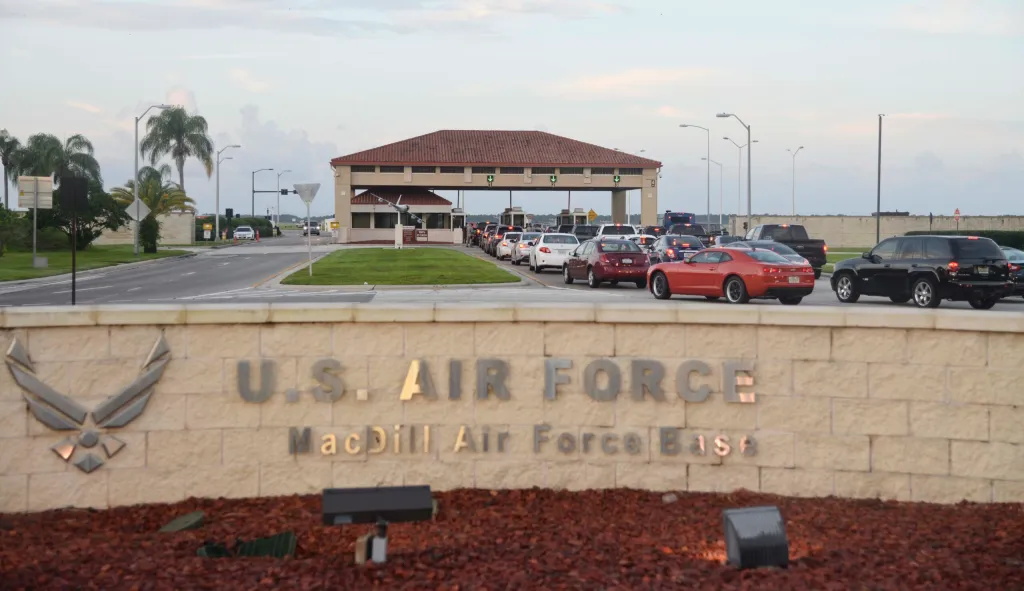
MacDill Air Force Base in Tampa, Florida, home of the command running the war in Iran, is reopening its main gate after a bomb scare earlier today, a spokesman for the 6th Air Refueling Wing, the base host unit, confirmed to The War Zone.
“The incident has been terminated and we are ready to open the main gate and visitor center,” the spokesman told us. The base, however, was not on lockdown.
MacDill is home to CENTCOM, U.S. Special Operations Command as well as the 6th Air Refueling Wing (6th ARW) and the 927th Air Refueling Wing and dozens of other mission partners. Last week, three airmen assigned to the 6th ARW were among six killed in a crash of a KC-135 aerial refueling tanker.
Today’s situation unfolded this afternoon when a suspicious package was found at the Visitors Center near the Dale Mabry entrance gate, according to the FBI. The bureau sent its Special Agent Bomb Techs to the scene, who worked it along with Tampa Police, the FBI said in a post on X.
The main gate at MacDill Air Force Base in Tampa, Florida, was reopened Monday afternoon after a bomb scare. U.S. Air Force photo by Senior Airman Vernon L. Fowler Jr MacDill Air Force Base in Tampa is home to both U.S. Central Command and U.S. Special Operations Command. U.S. Air Force photo by Senior Airman Vernon L. Fowler Jr.
UPDATE: 4:23 PM EST –
Talking to reporters on Monday, Trump seemed surprised that Iran would actually attack its neighbors if it came under fire.
The president was responding to a question about whether he was briefed about possible Iranian strikes on nations like the UAE, Saudi Arabia, and Qatar.
Trump on Iran:
I heard they were sending missiles to the UAE. I said, “That’s strange, you know? The UAE is like the banker for Iran.” They’re sort of the banker. Qatar, their neighbors — they got along okay.
A direct communications channel between U.S. envoy Steve Witkoff and Iranian Foreign Minister Abbas Araghchi has been reactivated in recent days, Axios reported, citing a U.S. official and a source with knowledge.
🇮🇷📲🇺🇸A direct communications channel between Iranian Foreign Minister Abbas Araghchi & U.S. envoy Steve Witkoff has been reactivated in recent days, according to a U.S. official & a source with knowledge. Read the story by @MarcACaputo & me on @Axioshttps://t.co/izoFpwZV5m
Araghchi lashed out at comments made by U.S. War Secretary Pete Hegseth that America would show “no quarter” in Epic Fury.
“When the U.S. Secretary of War declares ‘no quarter.’ he doesn’t project strength,” Araghchi stated on X. “He conveys moral bankruptcy and ignorance about law of armed conflict. We advise him to review the Hague Convention and Rome Statute of the ICC, unless he aspires to join Netanyahu as war criminal.”
When the U.S. Secretary of War declares “no quarter”, he doesn’t project strength. He conveys moral bankruptcy and ignorance about law of armed conflict. We advise him to review the Hague Convention and Rome Statute of the ICC, unless he aspires to join Netanyahu as war criminal.
The IDF Chief of the General Staff approved plans to continue operations in the Northern Command.
“The impact of the strike and the weakening of the radical regime in Iran is also felt in the campaign against Hezbollah,” said Lt. Gen. Eyal Zamir. “To date, the Northern Command has eliminated more than 400 Hezbollah terrorists.”
הרמטכ״ל באישור תוכניות להמשך בפיקוד הצפון: ״ההדף של הפגיעה והחלשת המשטר הרדיקאלי באיראן מורגש גם במערכה מול חיזבאללה; עד כה פיקוד צפון חיסל למעלה מ-400 מחבלי חיזבאללה״
״אנו נערכים להמשך ומתגברים את פיקוד הצפון בכוחות נוספים על מנת להרחיב את הפעולה הצבאית, להעמיק את הפגיעה… pic.twitter.com/HrBMLk9LFf
CENTCOM spokesman Capt. Tim Hawkins confirmed to The War Zone that more than 200 troops have been wounded or injured across seven countries since the start of Epic Fury. The injuries took place in Bahrain, Iraq, Israel, Jordan, Kuwait, Saudi Arabia and the UAE.
“The vast majority of these injuries have been minor, and more than 180 troops have already returned to duty,” he explained, adding that 10 troops were seriously injured.
In addition to the wounded, seven U.S. troops have been killed in Iranian attacks, the most serious being March 1 when six Army soldiers were killed in an Iranian drone attack on Kuwait. Another six Air Force airmen died when their KC-135 refueling plane crashed in Iraq, reportedly after colliding with another KC-135.
CENTCOM released its latest Epic Fury update, saying it struck more than 7,000 targets, flew more than 6,500 combat sorties and damaged or destroyed more than 100 Iranian ships.
CENTCOM
Baghdad continues to be hit.
In what looks like a scene from a video game, a counter rocket, artillery, and mortar C-RAM system is seen engaging with a drone over Baghdad.
C-Ram successful interception of a drone/rocket launched by Iranian-backed militias in Baghdad this evening. The Target was the U.S embassy. pic.twitter.com/EuHGx705gR
Footage of a reported coalition interception of an Iranian drone can be seen in the following video.
Not all the interceptions apparently worked. A drone reportedly slammed into the Royal Tulip al-Rasheed hotel in the Iraqi capital.
The Spanish Ministry of Defense confirmed on Sunday that it temporarily transferred its special forces from Iraq due to worsening safety and failure to conduct missions securely.“The Special Operations Task Group was relocated to safe areas because the security situation prevented it from continuing training operations with Iraqi forces,” according to the ministry.
GPS interference in and around the Strait of Hormuz has continued to rise since the crisis began, suggesting a persistent and geographically dispersed campaign of electronic disruption, according to Kpler.
Hormuz GPS disruption continues
GPS interference in and around the Strait of Hormuz has continued to rise since the crisis began, suggesting a persistent and geographically dispersed campaign of electronic disruption. This interference is triggering false AIS positioning,… pic.twitter.com/VXiaxHwFat
Wild video was posted on X of an Israeli interception of an Iranian ballistic missile. No injuries were reported, according to Times of Israel military correspondent Emanuel “Mannie” Fabian.
No injuries are reported in Iran’s latest ballistic missile salvo on Israel, the sixth since midnight, and the first in some six hours.
A small number of missiles were launched, which were likely intercepted, according to initial military assessments.
— Emanuel (Mannie) Fabian (@manniefabian) March 16, 2026
UPDATE: 2:42 PM EST –
The war with Iran is expected to last at least another month, according to Israel media, citing a senior Israeli official.
“Israel is reportedly preparing for an extended phase of fighting as it seeks to further weaken the Iranian regime and capitalize on what it views as signs of internal instability within the country’s leadership,” The Times of Israel reported. “According to the source, U.S. President Donald Trump supports Israel in continuing the campaign.”
We reached out to the White House for comment.
❗️ Senior Israeli source: Iran war will continue for longer than expected; we’re preparing to fight for another month at least; Trump is on board.
NATO responded to our query about debate over sending warships to the Strait of Hormuz.
“Allies have already stepped up to provide additional security in the Mediterranean,” a NATO official told us. “We are aware that individual Allies are talking with the US and others on what more they might do, including in the context of security in the Strait of Hormuz.”
In the first 96 hours of Epic Fury, the US-led coalition “expended approximately 5,197 munitions across 35 types,” according to a new report from the Foreign Policy Research Institute (FPRI).
“This carries a munitions-only replacement bill of $10–$16 billion in four days,” FPRI posited. “This represents a significant industrial burden for replacing some munitions that cannot be replenished in 4 days, 4 weeks, or even 4 months. Worse, those estimates do not include combat losses of warfighting assets or damage to bases and the high-end air defense enabling architecture.”
We have an important new analysis of munitions used in the first 96 hours of the war with Iran out at the @FPRI (Foreign Policy Research Institute).
In the first 96 hours, the US-led coalition expended approximately 5,197 munitions across 35 types. This carries a munitions-only…
Video has emerged showing intense flames at Dubai International Airport’s fuel storage area after an Iranian attack.
CENTCOM posted additional video of its attacks on Iranian targets.
Thousands of Iranian military targets have been struck by U.S. forces to neutralize threats posed by the Iranian regime now and into the future. pic.twitter.com/dE4VNxjjW1
MT Anderson provided an update on the location of the Tripoli. The ship was spotted on AIS North of the Riau Archipelago, transiting the southern South China Sea at 18 knots.
The Iraqi armed faction Kataib Hezbollah announced the death of its spokesperson, known as Abu Ali al-Askari. He was reportedly killed in a U.S. airstrike after a wave of attacks against U.S. facilities in Iraq.
بسم الله الرحمن الرحيم بكل فخر ورضا بقضاء الله وقدره، نزف لكم نبأ استشهاد الحاج أبو علي العسكري إلى جنات الخلد. ذلك الصوت الشجاع الذي لم يخرس أمام الظلم، واللسان الصادق الذي زرع في نفوس المجاهدين معاني الإباء والصمود. لقد كان الشهيد شريان التواصل بين ميادين التضحية ومنصات…
— صابرين نيوز – Sabereen news (@sabreenS11) March 16, 2026
Six people were injured in a Hezbollah rocket attack in Nahariya, according to medics. The town is located about eight miles south of the Lebanese border.
Six people are injured in a Hezbollah rocket strike on a home in Nahariya, medics say.
Magen David Adom says it treated two adults and four minors with signs of smoke inhalation. They are all listed in good condition.
— Emanuel (Mannie) Fabian (@manniefabian) March 16, 2026
Turkey’s Foreign Affairs Ministry (MFA) condemned the latest Israeli incursion into Lebanon.
“The Netanyahu government’s collective punishment and genocidal policies in Lebanon will lead to a new humanitarian catastrophe in the region,” the MFA said in a statement on Monday. “We reaffirm our solidarity with Lebanon amid these attacks, which violate its sovereignty and territorial integrity.”
UPDATE: 1:50 PM EST –
Speaking at a board meeting of the Trump Kennedy Center, the president claimed he predicted that Iran would attack shipping in the Strait.
NOW – Trump says he predicted Iran would weaponize the Strait of Hormuz, adding, “I predicted all of it. I predicted Osama bin Laden would knock out the World Trade Center. I made that prediction a year before he did it.” pic.twitter.com/6VqkvzamW0
The president added that he does not know Iran mined the Strait.
He also said the U.S. has hit 7,000 targets since launching Epic Fury.
Trump on Iran:
Since the beginning of the conflict, we struck more than 7,000 targets across Iran; these have been mostly military and commercial targets. pic.twitter.com/ppiyztSRDj
France has reportedly boosted its deployment of Rafale fighters to Jordan and UAE to 24, more than double the usual 10, according to French defense observer Tom Antonov. The jets have already intercepted dozens of Iranian drones, he added in a post on X.
The MQ-9 Reaper drones have played a big role in the war, and have been heavily targeted by Iran. To date, the U.S. has lost about a dozen Reapers, including one accidentally shot down by an ally, according to The Wall Street Journal.
NATO is considering boosting its ballistic missile defense capacity in Turkey against threats from neighboring Iran, Bloomberg News reported, citing people familiar with the matter
“The military alliance already deployed a battery in eastern Turkey to protect an early-warning radar used to track missiles across the Middle East,” the outlet stated. “It’s now considering sending another Patriot missile-defense system to bolster an airbase where American troops are stationed.”
NATO is looking into reinforcing further its ballistic missile defense capacity in Turkey against threats from neighboring Iran, according to people familiar with the matter. https://t.co/eQzealf1qp
WASHINGTON — President Trump expressed frustration Monday that U.S. allies were not enthusiastic about sending warships to protect merchant vessels passing through the Strait of Hormuz, a sign of Washington’s growing isolation as it tries to stabilize one of the world’s most critical shipping lanes amid its war against Iran.
Trump declined to name the “numerous countries” he said had agreed to help reopen the oil route, which has come under the threat of retaliation from Iran, but was annoyed that most longtime allies were hesitant about joining his international police force. He said they should be “jumping to help us.”
“Some countries that we have helped for many, many years, we’ve protected them from horrible outside sources and they weren’t that enthusiastic — and the level of enthusiasm, it matters to me,” Trump said at the White House.
For Trump, securing allies’ help is as much a domestic economic need as it is international diplomacy. Since the hostilities against Iran began on Feb. 28, Tehran has retaliated by targeting regional oil facilities and at least 20 vessels operating in and around the Persian Gulf, the Strait of Hormuz and the Gulf of Oman.
The result has been “the largest supply disruption in the history of the global oil market,” according to the International Energy Agency, and it has led to international oil prices surging more than 30% to over $100 a barrel as the war entered its third week with no clear end in sight.
The diplomatic friction, meanwhile, reflects the limits of Trump’s influence at a moment when the global economy is absorbing one of the worst oil supply shocks in modern history, a dynamic that has prompted Trump to warn that countries refusing to help may find Washington a far less generous partner in turn.
Despite Trump‘s demands, several key allies have publicly rebuffed his calls for support.
French President Emmanuel Macron formally rejected the request, saying that France would maintain a “defensive and protective” posture focused on stability rather than escalation.
German Foreign Minister Boris Pistorius was blunter, saying, “This is not our war; we didn’t start it.”
British Prime Minister Keir Starmer also declined to commit, saying the U.K. “will not be drawn into the wider war.” Italy, Spain, Australia and Japan similarly declined, while South Korea and China have not publicly stated their intentions.
The rejections seems to have only sharpened Trump’s demands. At one point during an event Monday, the president turned to House Speaker Mike Johnson (R-La.) and said he would share a list of nations that declined to help, suggesting Congress could have a role in any retaliatory measures against reluctant allies.
“Why are we protecting countries that don’t protect us?” Trump said.
Yet Trump also sent conflicting signals about how much allied help he actually needs. At one point he claimed the United States did not require assistance from other countries.
“We don’t need them, but it’s interesting — I am doing it, in some cases, not because we need them, but because I want to see how they react,” Trump said.
On the threat to merchant ships, Trump projected uncertainty. He said the possibility of mines was “enough to keep people” from transiting the waterway, but said that “we don’t even know” if Iran has placed any mines in the strait.
“They may have no mines,” he said. “We hit every one of their mine ships. Every one of them is gone — but it only takes one.”
Speaking aboard Air Force One on Sunday, Trump also sent mixed messages about the threats and the need for help. He said the United States was coordinating with roughly seven countries to deploy naval forces to “police the straits — before adding, in the same remarks, that “maybe we shouldn’t even be there at all.”
He suggested American forces should not be there because other nations depend more heavily on oil shipments through the oil route, an about-face that drew criticism from allies, who said it created confusion about Washington’s strategy in a conflict the United States had itself started.
“To keep the strait open, I have a very hard time believing that China and the other countries the president enlisted are really going to be escorting ships through the strait. That just really doesn’t add up to me,” Sen. Adam Schiff (D-Calif.) said in an NBC “Meet the Press” interview Sunday.
“The bottom line is, we really don’t know how long this war is going to be,” he added.
Trump, however, is keeping the pressure on allied countries, making the future of the conflict more open-ended depending on their response.
Trump insisted Monday that “numerous countries have told me they are on their way,” but said he would “rather not say” who they are.
He then said the tepid responses from some U.S. allies had reinforced his skepticism about the value of the NATO alliance, echoing comments he made over the weekend when he warned that a failure to assist would be “very bad for the future of NATO” and that the U.S. would “remember” those who did not step up.
When asked if he was confident Macron will help with the reopening of the strait, Trump told reporters: “Yeah, I mean sure. … I think he’s gonna help. I mean I’ll let you know.”
Europe has nonetheless been drawn deeper into the conflict.
The U.K. initially refused to support U.S. military operations, but softened its position after Trump mocked Starmer as “no Winston Churchill” and called Britain a “once great ally.” France also said last week that it was preparing a separate “purely defensive” naval mission to escort commercial vessels through the strait once it was safe to do so.
Moving forward, it is unclear how the European Union and other nations around the world will respond to Trump’s pressure.
“Nobody wants to go actively in this war. And of course, everybody is concerned what will be the outcome,” Kaja Kallas, the European Union’s top diplomat, said Monday after a meeting of foreign ministers in Brussels. “This is not Europe’s war, but Europe’s interests are directly at stake.”
‘For 40 years, we’re protecting you’: US President Donald Trump criticises allies’ reluctance to commit forces to open the key waterway for Gulf oil exports.
United States President Donald Trump has called for a naval coalition to deploy warships to secure the Strait of Hormuz, through which one-fifth of world oil shipments transit, as oil markets reel from supply disruptions caused by the US-Israeli war with Iran.
What is essentially the closure of the Strait of Hormuz by Iran in response to the attacks by the US and Israel has sent oil prices soaring to more than $100 per barrel.
Iran’s new supreme leader, Mojtaba Khamenei, has promised to keep the maritime artery closed while another top official in Tehran warned that oil prices could shoot up beyond $200 per barrel.
Trump said he hoped a naval coalition could secure the vital waterway, which connects the Gulf to the Gulf of Oman and the Arabian Sea. Iran has struck more than a dozen ships trying to sail through the narrow waterway since the hostilities started two weeks ago.
But will Trump’s solution work?
A tanker sits at anchor in Port Sultan Qaboos in Muscat, Oman, as oil shipments through the Strait of Hormuz have plummeted [File: Benoit Tessier/Reuters]
What has Trump said?
The US president has been facing domestic pressure over starting the war alongside Israel with no endgame or off-ramps in sight.
“On the strait of Hormuz, they had NO PLAN,” US Democratic Senator Chris Murphy wrote in a post on X. “I can’t go into more detail about how Iran gums up the Strait, but suffice it [to] say, right now, they don’t know how to get it safely back open.”
After threatening to bomb Iran more, Trump called on China, France, Japan, South Korea and the United Kingdom to send warships to secure the strait.
Trump claimed “100% of Iran’s military capability” had already been destroyed but added that Tehran could still “send a drone or two, drop a mine, or deliver a close-range missile somewhere along, or in, this waterway”.
“Hopefully China, France, Japan, South Korea, the UK, and others, that are affected by this artificial constraint will send ships to the area so that the Hormuz Strait will no longer be a threat by a nation that has been totally decapitated,” Trump wrote in a post on his Truth Social platform.
“In the meantime, the United States will be bombing the hell out of the shoreline, and continually shooting Iranian Boats and Ships out of the water. One way or the other, we will soon get the Hormuz Strait OPEN, SAFE, and FREE!”
Not long after, Trump returned to the keyboard, extending the invitation to all “the Countries of the World that receive Oil through the Hormuz Strait” to send warships, adding that the US would provide “a lot” of support to those who participated.
Israeli soldiers walk by a billboard commissioned by the evangelical Christian group Friends of Zion during the US-Israel war on Iran in Tel Aviv, Israel [File: Nir Elias/Reuters]
What has Iran said?
Alireza Tangsiri, commander of the Islamic Revolutionary Guard Corps Navy, said in a statement that claims by the US about destroying Iran’s navy or providing safe escort for oil tankers were false.
“The Strait of Hormuz has not been militarily blocked and is merely under control,” he said in a statement.
Iranian Foreign Minister Abbas Araghchi later doubled down on this, saying the strait remained open to international shipping except for vessels belonging to the US and its allies.
“The Strait of Hormuz is open. It is only closed to the tankers and ships belonging to our enemies, to those who are attacking us and their allies. Others are free to pass,” Araghchi said.
Khamenei – son of the late Supreme Leader Ali Khamenei, who was killed on the first day of the US-Israeli strikes – suggested in his first statement since taking power that the Strait of Hormuz would remain closed to provide leverage for Iran during the conflict.
F-18 combat aircraft are parked on the deck of the USS Abraham Lincoln aircraft carrier in the Gulf of Oman near the Strait of Hormuz during a 2019 deployment [File: Ahmed Jadallah/Reuters]
What are the challenges in the Strait of Hormuz?
The strait, which is just 21 nautical miles (39km) wide at its narrowest point, is the only maritime passage into the Arabian Gulf (known as the Persian Gulf in Iran). Shipping lanes in the waterway are even narrower and more vulnerable to attacks.
It separates Iran on one side from Oman and the United Arab Emirates on the other.
In brief, there is no way in or out by sea when the Strait of Hormuz is closed.
Alexandru Hudisteanu, a maritime security expert who served 13 years in the Romanian navy, told Al Jazeera that in the type of coalition that Trump is hinting at, “interoperability is the biggest hurdle.”
“That’s the ability of cruises to work together or with different units and different doctrine when basic communication would be an issue,” he said.
Then, there is the geography of the Strait of Hormuz: “a very unforgiving environment to sail with this type of wartime threats”, Hudisteanu said. “Especially difficult under missile threats and these asymmetric potential mines or unmanned systems that could damage or destroy ships.”
Providing escorts to ships would be a costly option, and it would pose risks to participating foreign warships from possible Iranian attacks, which would likely further drag more countries into the ongoing war.
From Iran’s point of view, “the fact that the shoreline is so close and the actual maritime passage is highly congested and confined is an advantage by default,” Hudisteanu added. Geographically, Iran keeps it as a gauntlet, with no way out for the ships unless Tehran allows it.
Another major challenge for any naval coalition trying to secure the passage would be the timeline of any operation. ”The security of the strait could be achieved. It’s just a matter of how much time you need and how many assets you need,” the analyst said. Rushing through it “could have negative implications for the security of the mission and the region”.
Smoke rises from the Thai bulk carrier Mayuree Naree near the Strait of Hormuz after an attack on March 11, 2026 [Handout/Royal Thai Navy via AFP]
How have countries responded?
No country has so far publicly agreed to Trump’s call to send warships to secure the Strait of Hormuz.
London said it is “intensively looking” at what it can do to help reopen the maritime passage. British Energy Secretary Ed Miliband said: “We are intensively looking with our allies at what can be done because it’s so important that we get the strait reopened.”
Chinese Ministry of Foreign Affairs officials said Beijing is calling for hostilities to stop and “all parties have the responsibility to ensure stable and unimpeded energy supply.”
Japan said the threshold is “extremely high” to send its warships on such a mission. “Legally speaking, we do not rule out the possibility, but given the current situation in which this conflict is ongoing, I believe this is something that must be considered with great caution,” said Takayuki Kobayashi, policy chief of Japan’s ruling Liberal Democratic Party.
France also confirmed that it will not send ships. The Ministry for Europe and Foreign Affairs said in a statement on Saturday: “Posture has not changed: defensive it is,” in reference to President Emanuel Macron’s assertion that France will not join the war against Iran.
South Korea, which imports 70 percent of its oil from the Gulf, said it was “closely monitoring” Trump’s statements and “comprehensively considering and exploring various measures … to ensure the safety of energy transport routes”.
(Al Jazeera)
Are countries negotiating with Iran?
Some countries have been negotiating with Iran to secure passage for their petroleum shipments.
Two Indian-flagged tankers carrying liquefied petroleum gas (LPG) have sailed through the Strait of Hormuz. New Delhi depends on this passage for 80 percent of its LPG imports.
The war on Iran has caused a critical shortage of cooking gas for India’s 333 million households. New Delhi has long had ties with Iran, but the government of Prime Minister Narendra Modi has not condemned the killing of Ali Khamenei. It has condemned Iran’s retaliatory attacks on Gulf countries, where millions of Indian citizens work and send $51bn in remittances home every year.
Iran’s ambassador to India, Mohammad Fathali, said Tehran had allowed some Indian vessels to pass through the Strait of Hormuz in a rare exception to the blockade but did not confirm the number of vessels.
A Turkish-owned vessel was similarly granted permission last week after Ankara negotiated passage directly with Tehran. Fourteen more Turkish vessels are awaiting clearance.
France and Italy also reportedly opened talks with Iranian officials to negotiate a deal to allow their vessels through the strait, but there has been no official confirmation yet.
“Iran is affecting maritime supply,” Hudisteanu said. “It’s affecting the maritime security of the region and the entire ecosystem and bringing the entire world to the table as the global price for oil and gas increases.”
1 of 2 | Iranians stand inside their damaged residential building in southern Tehran, Iran, on Sunday. Photo by Abedin Taherkenareh/EPA
March 15 (UPI) — Israel said it launched a wave of airstrikes on Iran on Sunday as Iran carried out its own attacks on U.S. military sites and against U.S. allies in the Gulf region at large.
The Israeli military said its airstrike hit the Hamedan area of western Iran, hitting multiple military headquarters, The Times of Israel reported. The Israeli military said it plans to expand its attacks on western and central Iran “with the aim of broadly and systematically damaging the regime’s command and control capabilities.”
Israeli officials, meanwhile, said at least five people in the country were injured Sunday by Iranian missiles. Iran’s state-run Mehr news agency reported that the Iranian military has pledged to “pursue and kill” Israeli Prime Minister Benjamin Netanyahu “with force.”
The United Arab Emirates said it has seen a drop in Iranian attacks within its borders. The defense ministry said it intercepted four ballistic missiles and six drones Sunday.
Since the start of the war, it has faced more than 1,900 attacks by Iran.
Bloomberg reported that a key oil port on the UAE’s east coast — Fujairah — was back in operation Sunday after it was targeted by an Iranian drone Saturday. The port is about 70 nautical miles away from the Strait of Hormuz, which Iran closed earlier in the month to put pressure on its enemies’ abilities to transport oil. About one-fifth of the world’s oil passes through the strait.
Fujairah is situated at one end of a pipeline that allows the UAE to bypass use of the Strait of Hormuz entirely. The site exported an average of more than 1.7 million barrels of crude and refined fuels per day in 2025, about 1.7% of the world’s demand, The Guardian reported.
Officials said they intercepted a drone attack near the site, causing a fire there briefly.
British Energy Secretary Ed Miliband said his country was examining ways to reopen the Strait of Hormuz and keep oil flowing. In an appearance on Sky News’ Sunday Morning with Trevor Phillips, Miliband said Britain was in talks with allies.
“There’s different ways in which we can make maritime shipping possible. We are intensively looking with our allies at what can be done, because it’s so important that we get the strait reopened.”
March 14 (UPI) — President Donald Trump on Saturday said that a coalition of nations affected by Iran choking off the Strait of Hormuz will send warships to open it back up.
Trump said that although the United States and Israel have “destroyed 100% of Iran’s military capability” in its war in Iran, its attempt to close the strait — by attacking ships and possibly laying mines along the shipping route — is affecting global trade.
Iran started to limit traffic in the strait since the war started two weeks ago and on Thursday, Iran’s new supreme leader, Mojaba Khamenei, said it would remain closed as a tactic to pressure the United States and Israel to end their attacks on the country.
The Strait of Hormuz is a significant global trading route, and sees roughly 20% of the global oil and fuel supply pass through it every day.
“Many countries, especially those who are affected by Iran’s attempted closure of the Hormuz Strait, will be sending War Ships, in conjunction with the United States of America, to keep the Strait open and safe,” Trump said in a post on Truth Social, Axios and The Guardian reported.
“Hopefully China, France, Japan, South Korea, the UK, and others, that are affected by this artificial constraint, will send Ships to the area so that the Hormuz Strait will no longer be a threat by a Nation that has been totally decapitated,” Trump said.
On Friday, several news organizations confirmed with the Department of Defense that the USS Tripoli, an amphibious assault ship that was operating in the Philippine Sea, is headed to the Middle East.
The Tripoli brings with it 2,500 Marines of the 31st Marine Expeditionary Group, along with 2,500 more sailors, after U.S. Central Command requested additional military options for the conflict.
The 31st MEU can conduct ground operations, which the Trump administration has not ruled out in Iran, but Joint Chiefs of Staff Chair Gen. Dan Caines told reporters at a press conference that the Pentagon plans to go after Iran’s mine-laying capability and its ability to attack commercial vessels.
An Iranian man raises a portrait of new supreme leader Mojtaba Khamenei during a rally on Revolution Street in Tehran on March 9, 2026. Photo by Hossein Esmaeili/UPI | License Photo
WASHINGTON — Six American airmen deployed to operations against Iran were killed after their refueling aircraft crashed in western Iraq, U.S. Central Command said Friday, bringing the U.S. death toll in the war to 13, as Defense Secretary Pete Hegseth announced the heaviest day of strikes yet.
The crash involved two aircraft in “friendly airspace,” the Pentagon said, adding that the other plane landed safely. The downed KC-135 refueling tanker is the fourth U.S. aircraft to crash during the war against Iran.
“American heroes, all of them,” Hegseth said at the Pentagon on Friday. “We will greet those heroes at Dover and their sacrifice will only recommit us to the resolve of this mission.”
Central Command said the incident is under investigation but was “not due to hostile or friendly fire.”
During the briefing, Hegseth described the Iranian leaders as “desperate” and “cowering” underground like rats. He said Iran’s Supreme Leader Ayatollah Mojtaba Khamenei “is wounded and likely disfigured,” but gave no intelligence to support the claim.
Khamenei has not been seen in public since he rose to leadership, but issued his first public statement Thursday vowing retaliation against U.S. and Israeli attacks, promising that Tehran will continue to choke off the world’s most crucial oil route — the Strait of Hormuz.
“Our revenge will be never ending, not only for the late supreme leader, but also for the blood of all of our martyrs,” he said.
The defense secretary said Friday would see Iran hammered with the heaviest round of air strikes yet seen in the two-week U.S.-Israeli operation that has razed buildings, complexes and factory lines all across Iran, killing at least 1,348 civilians, according to Iranian officials.
“No quarter, no mercy for our enemies,” Hegseth said.
And while Hegseth insisted that fighting will cease when the U.S. defeats Iran’s naval, missile, and nuclear weapons capabilities, President Trump’s public statements continue to sow doubt that the White House and Pentagon are aligned on the objectives of the mission.
Asked Friday by Fox News when the war might end, Trump said, “When I feel it — feel it in my bones.”
Iran’s blockade of the strait remains Tehran’s foremost leverage against its Western adversaries, and a serious political bane for Trump. The International Energy Agency warned Thursday that conflict has created “the largest supply disruption in the history of the global oil market,” which has sent oil prices surging 40% to $95 a barrel since Feb. 28.
Some 1,000 ships remain stranded in the Persian Gulf, many of them energy tankers that have been unable to carry oil and gas shipments from the Middle East to importers across the globe. Vessels that have attempted to traverse the embattled channel have been destroyed in Iranian attacks. Hegseth described Tehran’s strategy as “an act of desperation.”
The United Kingdom Maritime Trade Operations on Friday reported 20 incidents affecting vessels operating in and around the Arabian Gulf, Strait of Hormuz and Gulf of Oman in March.
Drone and missile attacks continue to assail gulf states, threatening to draw more players into the conflict. Thick black smoke was seen rising over Dubai’s skyline Friday after debris from an intercepted Iranian drone strike caused a fire and minor damage to a building within the Dubai International Financial Centre, according to the Dubai Media Office.
Europe has become increasingly involved, too. U.S. long-range bombers have begun flying offensive missions from British airbases, even as U.K. Prime Minister Keir Starmer explicitly permitted U.S. forces to use the bases “for defensive purposes only.” Starmer initially refused to cooperate in American hostilities in any capacity, but changed his approach after he drew criticism from Trump, who said, “He’s no Winston Churchill.”
The U.K., France, and Italy each deployed naval assets to the Eastern Mediterranean island of Cyprus, situated just 125 miles from Lebanon, after Iranian drone strikes hit U.K. bases. The island has emerged as a strategic — and exposed — nerve center in the U.S. offensive against Iran.
Meanwhile, Israel said Friday its strikes are “continuing and intensifying” in Lebanon and Iran. The Israel Defense Forces issued new evacuation orders in southern Lebanon on Thursday after overnight airstrikes in Beirut triggered retaliatory missile and drone attacks by the Iran-backed militant group Hezbollah.
Eight civilians were killed and nine others were wounded in attacks on the Lebanese city of Sidon on Friday, according to Lebanon’s Health Ministry. More than 100 children have been killed in the Israeli assault, the ministry said.
March 13 (UPI) — Secretary of Defense Pete Hegseth downplayed the shutdown of the Strait of Hormuz during a press briefing Friday and claimed 15,000 Iranian targets have been struck.
Hegseth said the U.S. and Israeli air forces are flying over Iran and Tehran Friday, the 13th day of the operation. He claimed that Iran’s air defenses, navy and munitions supply have been defeated.
Iran’s missile volume was down by 90% and its one-way attack drones were down by 95% on Thursday, Hegseth said.
“Today as we speak we fly over the top of Iran and Tehran,” Hegseth said. “Fighters and bombers, all day picking targets as they choose.”
The defense secretary opened Friday’s briefing at the Pentagon, joined again by Gen. Dan Caine, saying that the United States is “decimating the radical Iranian regime’s military in a way the world has never seen before.”
“We said it would not be a fair fight and it has not been,” he said.
Caine lauded the use of the first precision-strike missiles used in combat by the United States, praising the troops that fired them. One of those soldiers was 20 years old and has only been in the U.S. Army for six months.
Caine’s comments on the precision of U.S. strikes come as the military is investigating a deadly strike on an elementary school for girls in Iran that took place on Feb. 28. The preliminary investigation has found that the United States is likely responsible for the attack that killed more than 170 people, most of them children.
“They’ve done all of this with the precision and determination that comes from relentless training and trust in each other and their weapons systems,” Caine said.
Hegseth said the United States is “dealing with” Iran’s attacks on vessels on the Strait of Hormuz, which has dramatically disrupted the oil trade.
“It’s something we’re dealing with, we have been dealing with it and don’t need to worry about it,” Hegseth said. “We’re on plan to defeat, destroy and disable all of their meaningful military capabilities on a pace the world has never seen before.”
Caine later said that there is some traffic moving through the strait.
As Iran’s military capabilities weaken, Hegseth said, more importantly, it does not possess the capability to build more weapons.
“Soon and very soon all of Iran’s defense companies will be destroyed,” Hegseth. “For example, as of two days ago, all of Iran’s ballistic missile production capacity, every company that builds every component of those missiles, has been functionally defeated, destroyed.”
As for Iran’s new supreme leader, Mojtaba Khamenei, Hegseth said he is “likely disfigured.” Khamenei was wounded during the initial strikes by the United States and Israel on Tehran on Feb. 28, which killed his father, former supreme leader Ali Khamenei.
President Donald Trump shared similar speculation about the new supreme leader on Fox News on Friday, saying he believes he is alive but “damaged.”
“I think he probably is,” Trump said. “I think he’s damaged but I think he’s probably alive in some form.”
President Donald Trump speaks during an event celebrating Women’s History Month in the East Room of the White House on Thursday. Photo by Bonnie Cash/UPI | License Photo
If you’re looking for the most elegant way to wrap up our “little excursion” in Iran, it’s this: President Trump should follow what might politely be called the “declare victory and head for the airport” strategy.
You know the drill: Announce that we’ve set back Iran’s nuclear programs a decade, pounded their navy into submission, and turned the ayatollah into a fine mist. Mission accomplished! Thank you for flying the friendly skies, and please return your seat backs to their full upright and locked position.
Don’t get me wrong. This “cut and run” routine is less than ideal. Trump will have signaled to the world he (we) can’t endure any insurgent resistance, empowered the Islamic Revolutionary Guard Corps to run the country and likely angered Israel in the process.
But his domestic political base will believe he won, and fan service has always been his top political priority.
Besides, once you’ve entered a war without a coherent justification, clearly defined goals or a credible exit strategy, you’re lucky to get out at all. A salutary outcome no longer exists; that ship has already sailed.
Speaking of which, as I write this, we are drifting toward what feels like a point of no return. Mining the Strait of Hormuz, which Iran is now attempting to do, is the ultimate trump card.
Using mines to shut down this narrow shipping lane — which contributes about 20% of the world’s oil supply, not to mention natural gas and fertilizer — could result in a crippled global economy, mass casualties and a situation in which the president can no longer save face while cutting and running.
As retired U.S. Navy Adm. James Stavridis writes, “Iran has been planning a Strait of Hormuz closure operation for decades and probably has more than 5,000 mines; just one hit can severely damage a thin-skinned tanker.”
Yes, once laid, minefields can be cleared. But Stavridis predicts it would take “weeks, if not a month or two” to clear thousands of mines. He warns: “The global economy needs to be prepared for a month or two shutdown.” (Complicating matters is the fact that our dedicated minesweepers were recently decommissioned.)
The Iranians are not idiots. They watch American politics. They understand that Trump’s pressure point isn’t Tehran — it’s the S&P 500. A bad week on Wall Street makes him jumpier than a long-tailed cat in a room full of rocking chairs.
Trump, whatever else you say about him, is a transactional materialist who approaches geopolitics the way a real estate developer approaches zoning disputes: What’s the angle, where’s the leverage, and can everybody just settle already?
Unfortunately, the fellows running Iran are religious zealots who believe — deeply, sincerely and somewhat alarmingly — in something larger than quarterly economic indicators. Their strategic plan appears to consist of two options: survive (which they see as tantamount to victory), or die gloriously while insisting they meant to do that all along.
Which makes their current behavior grimly logical.
The Iranian regime, such as it is, doesn’t have much to lose. But they know exactly what Trump has to lose: His popularity and political legacy are now tied to the price of oil.
Releasing U.S. strategic oil reserves will help to some extent, but this is not a long-term solution. And Iran is betting that when the price at the pump for U.S. consumers starts looking like a luxury car payment, Trump will do what critics like to summarize as TACO — “Trump Always Chickens Out.”
Lots of American political observers agree. And it’s not just moderates or RINOs who are teasing this.
Referring to the U.S. military, former Speaker of the House Newt Gingrich told Larry Kudlow on Fox Business: “They have to keep the Strait of Hormuz open. I don’t care what it costs.”
“If they can’t keep it open,” Gingrich continued, “this war will, in fact, be an American defeat before very long, because the entire world, including the American people, will react to the price of oil if the strait stays closed very long.”
Perhaps the U.S. military can pull off a delicate trick: keep our “armada” in the region, keep the Strait of Hormuz open, clear any mines that are laid and prevent some unlucky tanker from being hit by a mine — or, for that matter, by a drone or missile fired from the Iranian coast. That final risk is why some military analysts believe reopening the strait would require a ground operation.
Imagine that the U.S. manages to thread these needles. Then what?
Total and complete surrender? Regime change? Boots on the ground?
Absent a swift exit (like, tomorrow), we’re left with the two classic options of power politics: a delayed and more ignominious retreat or increased escalation.
And, historically speaking, American presidents are more likely to double down — with tragic results.
Energy markets remain on tenterhooks as the prospect of prolonged war in the Middle East grows.
Published On 13 Mar 202613 Mar 2026
Share
Oil prices have again risen above $100 per barrel as energy markets see little relief amid the biggest disruption to global energy supplies in a generation.
Brent crude, the international benchmark, surged more than 9 percent on Thursday as traders weighed the prospect of weeks, or even months, of turmoil in energy markets as the United States and Israel wage war on Iran.
Recommended Stories
list of 4 itemsend of list
Brent futures, which are traded outside of regular market hours, were priced at $101.13 as of 03:00 GMT.
Asian stock markets, including exchanges in Tokyo, Seoul and Hong Kong, opened sharply lower on Friday, following steep losses on Wall Street overnight.
The latest surge in oil prices came after Iran’s Supreme Leader Mojtaba Khamenei pledged to maintain the effective closure of the Strait of Hormuz, which normally transports about one-fifth of global oil supplies.
In a statement read out on his behalf on Iranian state television, Khamenei described Tehran’s threats against shipping in the waterway as a “lever” that “must continue to be used”.
US President Donald Trump struck a similarly defiant tone on Thursday, posting on Truth Social that stopping Iran from getting nuclear weapons was of “far greater interest and importance” than rising oil prices.
‘Lack of tangible goals in this war’
Traffic through the strait has effectively ground to a halt due to Iranian threats, with only a handful of vessels passing through each day, many of them claiming links to China, Iran’s key economic partner.
According to the United Kingdom Maritime Trade Operations (UKMTO) centre, no more than five ships have passed through the waterway each day since the US and Israel launched joint strikes on Iran on February 28, compared with an average of 138 daily transits before the war. At least 16 commercial vessels have been attacked in the region since the start of the conflict, according to the UKMTO.
Tehran has claimed responsibility for several of the attacks, including a strike on Wednesday that crippled a Thai-flagged vessel off the coast of Oman.
Efforts to bring calm to the market have so far done little to tame prices, which are up nearly 40 percent compared with before the start of the war.
The International Energy Agency’s (IEA) announcement on Wednesday that member countries would release 400 million barrels of oil from emergency stockpiles drew a tepid response among traders eyeing a daily shortfall in global supplies estimated at 15-20 million barrels.
The US Department of the Treasury’s issuance on Thursday of a temporary licence authorising countries to purchase sanctioned Russian oil that has been stranded at sea also failed to move the market, with Brent crude staying above $100 a barrel after the Treasury announcement.
“The key problem is a lack of tangible goals in this war,” said Adi Imsirovic, an energy security expert at the University of Oxford.
“It makes it hard for oil traders to see the light at the end of the tunnel,” he said.
Trump has repeatedly floated the possibility of using the US Navy to escort commercial shipping through the strait, but the Pentagon has yet to conduct such operations amid concerns about the risks posed by Iranian attacks in the narrow waterway.
In an interview with CNBC on Thursday, US Energy Secretary Chris Wright said that Washington was “not ready” to provide navy escorts but that such operations could begin by the end of the month.
“It’ll happen relatively soon but it can’t happen now,” Wright said.
Iran’s UN ambassador Amir Saeid Iravani said Tehran will not close the Strait of Hormuz and remains committed to freedom of navigation. His remarks came after Supreme Leader Mojtaba Khamenei said the waterway would remain closed to pressure Iran’s enemies.
WASHINGTON — Iran’s new supreme leader, Mojtaba Khamenei, vowed retaliation Thursday against the United States and Israel and signaled that Tehran will continue to choke off the world’s most critical oil route, as the war strained global energy markets and raised new security concerns in the United States.
In his first public remarks since U.S.–Israeli strikes killed his father, former Supreme Leader Ayatollah Ali Khamenei, Mojtaba Khamenei swore revenge. The new leader, notably, did not appear in person for the televised statement. Instead, his written words were read aloud on Iranian state media.
“We will never retreat and vow to avenge the blood of our martyrs,” he said. “Our revenge will be never ending, not only for the late supreme leader, but also for the blood of all of our martyrs. … Those who killed our children will pay the price.”
The new leader expressed condolences to families who lost children in a strike on a girls school in Minab that killed more than 165 people, many of them children. He also warned that the war could expand, declaring that the continuation of the conflict “depends on the interests of the parties.”
The Associated Press, citing two sources, reported that outdated intelligence likely led to the United States carrying out the deadly missile strike on the elementary school. U.S. Central Command relied on target coordinates for the strike using outdated data provided by the Defense Intelligence Agency, according to a person familiar with the preliminary finding.
Khamenei indicated that Tehran would maintain its blockade in the Strait of Hormuz, a key choke point through which 20% of the world’s oil supply is shipped. He also said he believes in friendship with his country’s neighbors, but that attacks on U.S. military installations in the region will continue. He described maintaining pressure on the passage as a necessary part of Iran’s war strategy.
His remarks came as attacks continued to disrupt shipping and energy infrastructure across the Persian Gulf. The war sent oil up 10% Thursday as hostilities in Iran drag on.
Reports from the region said Iranian forces have intensified strikes on vessels attempting to pass through the Strait of Hormuz, leaving hundreds of ships stranded at its entrances and rattling global oil markets.
Two oil tankers were struck by explosives in Iraqi waters near the port of Basra. The Islamic Revolutionary Guard Corps claimed responsibility for the attacks, which killed at least one crew member and set both vessels ablaze, according to the Associated Press. A third unnamed vessel was reported to have been struck by an “unknown projectile” near Dubai and Jebel Ali, causing a small fire, the United Kingdom Maritime Trade Operations reported.
The latest incidents come after drone strikes targeted fuel storage facilities across the Gulf, including at energy sites in Bahrain and at the port of Salalah in Oman, an important hub for tankers seeking to bypass the Strait.
“They will pay the price. We will destroy their facilities,” Khamenei said. “It is necessary to continue our defensive activity, including continuing to close the Strait of Hormuz.”
Each were hit in separate incidents by an “unknown projectile,” according to the United Kingdom Maritime Trade Operations (UKMTO), a monitoring agency that is part of the U.K. Royal Navy. One was a cargo ship traveling north of Oman. Another was a bulk carrier hit north of Dubai. The third was a container vessel struck near Ras al-Khaimah in the United Arab Emirates, The Washington Post noted.
A Thai-flagged cargo vessel, Mayuree Naree Bangkok, was attacked near the Strait of Hormuz on March 11, leaving 3 of its 23 crew missing. The ship had departed Dubai and was heading to India when struck near its stern. #Iranpic.twitter.com/0BYBjqJIt1
Since Epic Fury was launched on Feb. 28, UKMTO “has received 17 reports of incidents affecting vessels operating in and around the Arabian Gulf, Strait of Hormuz (SOH) and Gulf of Oman,” the organization stated. That figure includes 13 attacks and four suspicious incident reports.
Iran said it is increasing these attacks to serve as an economic weapon against the U.S., Israel and allies.
The U.S. “will not be able to control oil prices,” the spokesperson for Tehran’s Khatam al-Anbiya military command headquarters vowed on Wednesday.
“We won’t allow even one liter of oil to reach the U.S., Zionists and their partners,” Ebrahim Zolfaqari proclaimed. “Any vessel or tanker bound to them will be a legitimate target.”
“Get ready for the oil barrel to be at $200 because the oil price depends on the regional security which you have destabilized,” Zolfaqari added.
As one example of market volatility, Brent Crude was trading at just over $90 a barrel as of Wednesday morning Eastern Day Light time, according to OilPrice.com. The prices have fluctuated wildly, surging to a recent high of more than $116 a barrel on March 8 and dropping to a little more than $84 a barrel yesterday.
🚨Iran is threatening to not allow ships through the Strait of Hormuz, also saying they will force oil to $200 per barrel.
“Not a single liter of oil will pass through the Strait of Hormuz for the benefit of the U.S., Israel, or their partners.”
Even as it cuts off the Strait for others, Iran is “exporting more oil through the Strait of Hormuz than before the war, showing it is in control of a strategic waterway that it has closed off to the rest of the region’s oil producers,” The Wall Street Journal reported.
Iran is exporting more oil through the Strait of Hormuz than before the war, showing it is in control of a strategic waterway that it has closed off to the rest of the region’s oil producers https://t.co/CeZTClmHBa
The world’s biggest liquefied natural gas (LNG) export plant in Qatar hasn’t exported a shipment for five days, Bloomberg News reported. It marks the longest streak in data going back to 2008.
“A loaded tanker hasn’t left the Ras Laffan facility in five days,” according to a Bloomberg analysis of Kpler ship-tracking data. “No LNG ship traversed the Strait of Hormuz after Feb. 28, when the US and Israel began strikes on Iran.”
The unprecedented closure of the liquefaction plant, which supplies nearly 20% of the world’s LNG, came after an Iranian drone attack early last week — resulting in a jump in gas prices in Europe and Asia, the news organization noted. Ras Laffan did load a handful of shipments after stopping output, likely using fuel from storage tanks, the last of which was on Friday.
The world’s biggest LNG export plant in Qatar hasn’t exported a shipment for five days — the longest streak in data going back to 2008 — threatening to further boost prices for the fuel https://t.co/BKFTpIV0dH
Two pipelines were built – one in Saudi Arabia, the other in UAE – just to bypass the Strait of Hormuz. This conflict, The Wall Street Journal posited, has highlighted their importance since they are the only ways to get a significant amount of oil out of the Persian Gulf and into world markets.
The blockage in the Strait of Hormuz has suddenly made Saudi Arabia’s East-West pipeline one of the most critical pieces of infrastructure in the world https://t.co/6bwxev9vKc
Iran’s closure of the Strait to most foreign shipping has thrown the world energy market into chaos, causing oil and gas prices to fluctuate dramatically.
“Japan, Germany and Austria will release oil from their strategic reserves in response to disruptions in the supply from the Middle East, officials in those countries said on Wednesday,” according to the Post. “They made the announcements hours before a meeting of leaders of the Group of 7 industrialized nations, including the United States, to discuss jointly releasing oil in consultation with the International Energy Agency.”
Japan will begin releasing oil from its reserves as early as Monday to offset disruptions in Middle Eastern supply, Prime Minister Sanae Takaichi said Wednesday in Tokyo.
The International Energy Agency (IEA) on Wednesday agreed to release 400 million barrels of oil to address the supply disruption triggered by the Iran war, the largest such action in the organization’s history, CNBC reported.
“The IEA did not set out a timeline for when the stocks would hit the market,” the news outlet noted. “It said that the reserves would be released over a timeframe that is appropriate to the circumstances of each of its 32 member countries.”
The U.S., meanwhile, has yet to tap into its Strategic Petroleum Reserve, a network of salt caverns in Texas and Louisiana that can hold up to 714 million barrels of crude.
PARIS/LONDON, March 11 (Reuters) – The International Energy Agency is to recommend the release of 400 million barrels of oil, the largest such move in IEA history, to try to restrain soaring crude prices amid the U.S.-Israeli war with Iran.
Iran is not preventing all ships from passing through the Strait. Tehran has agreed to provide Bangladeshi oil vessels with safe passage. The move comes as the Bangladesh government has intensified efforts to maintain a stable fuel supply through multiple strategic measures amid escalating conflict in the Middle East.
Bangladesh has sought assurances from Iran for the safe passage of its oil and liquefied natural gas (LNG)-carrying vessels through the Strait of Hormuz as escalating conflict in the Middle East threatens one of the world’s most critical energy shipping routes.
Iran has officially agreed to grant safe passage to Bangladeshi oil and LNG vessels traveling through the Strait of Hormuz. Under the new agreement, Bangladeshi ships must notify Iranian authorities before entering the strategic waterway to ensure secure transit.
Some vessels are also using their AIS system to identify as Chinese owned, shipping expert Sal Mercogliano noted. Iran’s closure of the Strait does not pertain to Chinese-owned ships.
The Marshal Islands-bulker KSL Laiyang is running the Strait.
She is broadcasting on AIS “China Owners & Crew”.
This is EXACTLY what we saw happen in the Red Sea against the Houthis. Expect to see more of this. pic.twitter.com/LSCESnEDKI
— Sal Mercogliano (WGOW Shipping) 🚢⚓🐪🚒🏴☠️ (@mercoglianos) March 10, 2026
The New York Times claimed that Iran’s ongoing attacks on shipping, as well as its continuing missile and drone barrages are an example of how the Trump administration miscalculated Iran’s response to Epic Fury.
The Trump administration has said it will send U.S. Navy warships to escort commercial vessels through the Strait, but that plan has yet to be implemented. Such a deployment would put American warships at far greater risk than they are facing now at standoff distances from Iran. It remains unclear how much longer Epic Fury will continue. The longer it does, however, the more Iran can bring economic pain around the globe with even just threats against Strait shipping. The Iranian attacks have led to Trump proposing that the U.S. provide political risk insurance for seaborne trade in the Gulf. “However, Lloyd’s of London, the heart of maritime insurance globally, emphasizes it has not stopped providing contracts to those who ask – although at the right tariff,” The Guardian reported.
Though no escorts have been set up, the U.S. is continuing to strike Iran’s Navy, including the sinking of the last of Iran’s Soleimani class catamaran warships, the head of U.S. Central Command said in a video statement on Wednesday morning.
“To date, we have struck more than 5,500 targets inside Iran, including more than 60 ships using a variety of precision weapon systems,” Adm. Brad Cooper said in a video. “Just yesterday, we had strike waves nearly every hour from different locations and directions going into Iran. We also took out the last of four Soleimani class warships. That’s an entire class of Iranian ships now out of the fight.”
Cooper did not name which of the catamarans was hit, but the video shows one from the Soleimani class and one from a smaller class. The hull number on the smaller ship – PC313-01 – indicates it was the IRIS Abu Mahdi al-Muhandis. The ship was unveiled in a ceremony at Bandar Abbas in January 2024, the Iranian Press TV news outlet reported at the time.
The now-sunk IRIS Abu Mahdi al-Muhandis at its unveiling in January 2024. (Iranian media)
U.S. Army Sgt. First Class Cory Hicks told ABC News about the Iranian drone attack on a command center in Kuwait that killed six soldiers on March 1.
Sgt. First Class Cory Hicks described the horrific moment a drone struck a U.S. command center in Kuwait and killed six service members: “I turned to my right, and that’s when it blew up and just blew the whole building apart.”
The deadly attack was more severe than previously known, with dozens of troops suffering injuries that included brain trauma, burns and severe injuries from shrapnel, according to CBS News.
NEWS via @CBSNews: An Iranian drone attack in Kuwait that killed U.S. service members in the early hours of the war with Iran was more severe than previously known, with dozens suffering injuries that included brain trauma, shrapnel trauma and burns, per sources. More than 30…
“I heard news that Mr Mojtaba Khamenei had been injured. I have asked some friends who had connections,” Pezeshkian stated on Telegram. “They told me that, thank God, he is safe and sound.”
State television had called Khamenei, 56, a “wounded veteran of the Ramadan war” but never specified his injury.
BREAKING Iran’s new supreme leader Mojtaba Khamenei is “safe and sound” despite reports of an injury during the war with Israel and the United States, the son of the Iranian president said on Wednesday pic.twitter.com/97ofF4dS1G
Iran’s Islamic Revolutionary Guard Corps (IRGC) has threatened to attack “economic centers and banks” related to United States and Israeli entities in the region after what it called an attack on an Iranian bank, Al Jazeera reported.
A spokesperson for the Khatam al-Anbiya Headquarters, a group described as IRGC-owned by the United Nations, said on Wednesday that “the enemy left our hands open to targeting economic centres and banks belonging to the United States and the Zionist regime in the region.”
To the people of Bahrain, the UAE, and Kuwait: Do not remain within one kilometer of banks
Khatam al‑Anbiya Headquarters spokesperson: After the U.S. and Israeli attack on an Iranian bank, we are now free to target U.S. and Israeli economic centers and banks across the region.
The warning came after a reported attack on a Bank Sepah branch north of Iran, which is said to have killed many putting in extra hours ahead of the Persian New Year.
The Khatam Al-Anbiya Air Defense HQs warns people in the entire region to stay away for 1km from banks after American-Zionists attacked a Bank Sepah branch in north of Tehran, killing a lot of personnel working extra hours ahead of Persian New Year. pic.twitter.com/JYcAaCQlLI
Iranian officials claimed to have hit several other U.S. targets in the region on Wednesday.
(Reuters) – The Iranian military said on Tuesday it had launched missiles at a U.S. base in northern Iraq, the U.S. naval headquarters for the Middle East in Bahrain, and at Be’er Ya’akov city in central Israel.
Explosions rang out in Bahrain, while in Dubai four people were…
IDF Chief of the General Staff, Lt. Gen. Eyal Zamir claimed that “many thousands” of Iranian soldiers and commanders have been killed so far in this war.
IDF Chief of Staff Lt. Gen. Eyal Zamir says “many thousands” of Iranian soldiers and commanders have been killed in Israeli strikes in Iran, warning that “no one is immune.”
“We are in a campaign that is deepening the damage to the Iranian regime and its foundations and pushing… pic.twitter.com/0C5XvjBFTy
— Emanuel (Mannie) Fabian (@manniefabian) March 11, 2026
The IDF released new video showing airstrikes on what it claims were Iranian troops preparing to launch drones.
The IDF releases footage showing airstrikes on Iranian soldiers who were preparing to launch drones at Israel from western Iran this week.
According to the military, the Iranian soldiers were identified on Monday at a drone launching site. A short while later, an Israeli Air… pic.twitter.com/XRWXO7YVaq
— Emanuel (Mannie) Fabian (@manniefabian) March 11, 2026
The IDF completed another wave of strikes in Dahiyeh in Beirut against what it claims were Hezbollah command centers and weapons storage sites. IDF said it issued a warning to residents before the attacks and also struck a Hezbollah command post in the coastal area of Tyre.
צה”ל השלים גל תקיפות נוסף בביירות
הבוקר , צה”ל השלים גל תקיפות נוסף בדאחייה שבביירות נגד מפקדות טרור ואתרים בהם אוכסנו אמצעי לחימה של ארגון הטרור חיזבאללה.
בנוסף, צה”ל תקף אתמול , מפקדה של ארגון הטרור חיזבאללה במרחב צור שבלבנון.
The IDF justified the strike by claiming the Lebanon-based Iranian proxy is hiding missiles, drones and other weapons in the heart of the Dahieh neighborhood in Beirut.
INTELLIGENCE REVEALS: Hezbollah is hiding its strategic weapons in the heart of the Dahieh in Beirut, beneath the residential buildings of Lebanese residents. These are missiles, drones and additional weapons funded by the Iranian terror regime and designed to harm Israeli…
The owner of this white pickup may be the luckiest person in the Middle East. Video emerged on social media showing Lebanese Army troops removing an unexploded bomb from the vehicle’s cargo bed.
Faced with growing threats from Hezbollah, Zamir ordered the Golani Brigade to be transferred from the Southern Command to operations in the Northern Command sector.
Zamir added that a decision will be made regarding additional reinforcements.
🚨NEW: The IDF says Chief of Staff Lt. Gen. Eyal Zamir has ordered significant reinforcements to Israel’s northern front, shifting the Golani Brigade combat team from the south to Northern Command following a new operational assessment.
In a post on X, the UAE Defense Ministry (MoD) said its air defenses “are currently dealing with missile attacks and incoming drones originating from Iran, and the Ministry of Defense confirms that the sounds heard in scattered areas of the country are the result of the air defense systems intercepting ballistic missiles, as well as fighter jets intercepting drones and loitering munitions.”
تتعامل حالياً الدفاعات الجوية الإماراتية مع اعتداءات صاروخية وطائرات مسيرة قادمة من إيران وتؤكد وزارة الدفاع أن الأصوات المسموعة في مناطق متفرقة من الدولة هي نتيجة اعتراض كل من منظومات الدفاع الجوي للصواريخ البالستية، والمقاتلات للطائرات المسيرة والجوالة.
Reuters posted a photograph on X of a building in Manama, Bahrain, reportedly damaged by an Iranian drone strike.
A building damaged in a reported Iranian drone strike, amid the U.S.-Israeli conflict with Iran, in Seef, Manama, Bahrain, March 10, 2026. REUTERS/Stringer pic.twitter.com/luPTavYyJT
With Bahrain also being battered by Iranian attacks, Gulf Air has relocated its fleet of aircraft from there to Saudi Arabia, according to Al Jazeera.
Iranian Armed Forces spokesperson Brig.-Gen. Abolfazl Shekarchi “called on regional Muslims and countries to reveal the locations of U.S. and Israeli military assets to enable Tehran to conduct more accurate attacks,” the Jerusalem Post reported, citing official Iranian media.
Shekarchi also framed the request as a way to ensure the safety of the people in the region.
“I call on the Muslim people of the region and the countries of the region to show us the hideouts of US and Zionist forces so that they themselves will not be harmed, and so that we can strike them more precisely,” Shekarchi proclaimed.
Iranian Armed Forces spokesperson Brig.-Gen. Abolfazl Shekarchi called on regional Muslims and countries to reveal the locations of US and Israeli military assets to enable Tehran to conduct more accurate attacks.https://t.co/YSSDWmIZ8s
In the wake of the joint U.S.-Israeli attack, The New York Times “has identified at least 17 damaged U.S. sites and other installations, several of which have been struck more than once since the war began,” the publication reported. “Our analysis is based on high-resolution, commercial satellite imagery, verified social media videos and statements by U.S. officials and Iranian state media.”
U.S. Air Force maintainers can be seen in the X post below loading weapons onto B-1B Lancer bombers, which have arrived at Fairford Air Base in the U.K.
US Airforce ground crew work under hatches of a B1 Lancer at RAF Fairford today. What appear to be cruise missiles sit by the warplane. Three B1 bombers returned this morning, on what is believed to be the first attack on Iran from a British base during this conflict. @AJENewspic.twitter.com/80YkxHL5rT
Romanian President Nicusor Dan said that U.S. refueling planes, monitoring equipment and satellite communications systems can use his country’s military bases.
BUCHAREST, March 11 (Reuters) – American refueling planes, monitoring equipment and satellite communications could use Romanian military bases during the U.S.’ offensive in Iran, Romanian President Nicusor Dan said on Wednesday.
Turkey has reportedly deployed an ASELSAN’s ŞAHİN 40mm anti-drone system to Northern Cyprus, where it is now operational to defend against low-flying mini and micro UAVs using airburst smart grenades.
Türkiye deployed ASELSAN’s ŞAHİN 40mm anti-drone system to Northern Cyprus, where it is now operational to defend against low-flying mini and micro UAVs using airburst smart grenades. pic.twitter.com/HT641qe6w7
Ukrainian President Volodymyr Zelensky claims that Russia may send troops to Iran. That would be in addition to the support Moscow is already providing in the form of drones and air defenses, Zelensky said. He added that Russia will likely send missiles in the not-far-off future.
Ukraine, which has long sought interceptors to help fend off waves of Russian missile and drone attacks, took to social media to note the discrepancy in how much it has been supplied over the course of four years versus how much the U.S. and allies have used during 11 days of Epic Fury.
800 Patriot missiles were used for air defense in just 3 days in the Middle East. Ukraine received 600 in 4 years of full-scale war.
Russia, Iran and North Korea form a new Axis of Evil. Ukraine was the first to confront this Axis. We continue to fight, but we need support.
Add Italian Prime Minister Giorgia Meloni to the list of world leaders proclaiming that an Ayatollah-led regime in Iran should never obtain nuclear weapons.
Italy’s Meloni on Iran:
We cannot afford an Ayatollah regime in possession of a nuclear weapon, combined, moreover, with a missile capability that could soon be able to directly strike Italy and Europe. pic.twitter.com/gdQE6HlckA
We have concluded our rolling coverage in this piece.
UPDATE: 5:11 PM EST –
Video has emerged showing a reported attack on an oil tanker near Iraq. Information at this point is scarce. The Ambrey martime security firm said it is investigating the matter.
The U.S. used as much as $4 billion worth of munitions in the first 72 hours of its attacks against Iran, including about 400 cruise missiles and 800 air defense interceptors, Bloomberg News reported, citing estimates from German defense giant Rheinmetall AG.
“The numbers, released in the company’s earnings presentation on Wednesday, were drawn from ‘publicly available sources and in-house assumptions,’ the slides said,” according to the news outlet. “Other reports have put the munitions cost for the first two days of the conflict higher, at as much as $5.6 billion.”
The US used as much as $4 billion worth of munitions in the first 72 hours of its attacks against Iran, including about 400 cruise missiles and 800 air defense interceptors, according to estimates from German defense giant Rheinmetall https://t.co/7xiR8WNbtM
Trump said that he picked the name Epic Fury from a list of about 20 and that the U.S. has already won.
“You know, you can only do it if you win — and we’ve won,” the American leader proclaimed. “Let me say: we’ve won. You never like to say it too early, but we won the bet in the first hour. It was over.”
Trump on Iran:
Operation Epic Fury — is that a great name? Well, it’s only good if you win.
You know, you can only do it if you win — and we’ve won. Let me say: we’ve won. You never like to say it too early, but we won the bet in the first hour. It was over.
Israel’s Iron Dome air defense system “could not stop about half the 100 rockets Hezbollah launched at Israel just a few hours ago,” New York Post reporter Caitlin Doornbos posted on X.
Exclusive: The Iron Dome could not stop about half the 100 rockets Hezbollah launched at Israel just a few hours ago.
The leaders of the G7 group of nations – the United States, Canada, Japan, Italy, Britain, Germany and France – “agreed to examine the option of providing escort for ships so they can navigate freely in the Gulf,” according to a statement from the G7 Presidency on Wednesday.
(Reuters) – The leaders of the G7 group of nations – the United States, Canada, Japan, Italy, Britain, Germany and France – agreed to examine the option of providing escort for ships so they can navigate freely in the Gulf, said a statement from the G7 Presidency on Wednesday.…
Despite threats from the regime to stay home, anti-government protestors are reportedly continuing to take to the streets in Iran demanding change.
For 12 consecutive night, without missing a single day, Iranian people have hit the streets to express their anger over Israel/US attacks on Iran & its leader.
They express support for armed forces & demand harsh revenge.
The U.K. Defense Ministry (MoD) provided its latest update on Middle East operations.
The UAE MoD said its air defenses “dealt with 6 ballistic missiles, 7 cruise missiles, and 39 drones coming from Iran” today. “Since the start of the brazen Iranian aggression, UAE air defenses have dealt with 268 ballistic missiles, 15 cruise missiles, and 1,514 drones.”
الدفاعات الجوية الإماراتية تتعامل مع 6 صواريخ باليستية و7 صواريخ جوالة و 39 طائرة مسيرة.
تعاملت الدفاعات الجوية الإماراتية (11 مارس 2026) مع 6 صواريخ باليستية، و7 صواريخ جوالة، و 39 طائرة مسيرة قادمة من إيران.
The IRGC posted video it claims shows missile launches toward U.S., Israeli and allied military bases housing American forces in the region.
Iran’s IRGC published footage of its missile launches towards “Israel” and US bases.
The missiles include Qadr, Emad, Kheybar Shekan, and Fattah missiles against targets in Tel Aviv, Haifa, and US bases in the region such as the Muwaffaq Salti Air Base in Jordan & Prince Sultan… pic.twitter.com/Jkb8JRO04q
Kuwaiti air defenses are currently confronting hostile missile and drone attacks, the nation’s army announced on X.
“The General Staff of the Army notes that if explosion sounds are heard, they are the result of air defense systems intercepting the hostile attacks,” the announcement added.
تتصدى حالياً الدفاعات الجوية الكويتية لهجمات صاروخية وطائرات مسيرة معادية.
تنوه رئاسة الأركان العامة للجيش أن أصوات الانفجارات إن سمعت فهي نتيجة اعتراض منظومات الدفاع الجوي للهجمات المعادية.
— KUWAIT ARMY – الجيش الكويتي (@KuwaitArmyGHQ) March 11, 2026
UPDATE: 4:18 PM EST –
Three Ukrainian teams of military personnel and engineers have gone to the Middle East to help the U.S. and allies in the fight against Iran, Ukrainian President Volodymyr Zelensky stated on X.
After four years of fending off daily bombardment by Russian missiles and drones, Ukraine has a lot of hardearned expertise to share.
Three Ukrainian teams have gone to the Middle East. Strong teams – with experts, military personnel, and engineers. The military are already communicating and working today. The NSDC Secretary, Rustem Umerov, has arrived in the UAE today to discuss areas of cooperation. He will…
— Volodymyr Zelenskyy / Володимир Зеленський (@ZelenskyyUa) March 11, 2026
Al Jazeera said a senior Iranian military official claimed that if “Washington commits a strategic mistake, another strait will be in a situation similar to the Strait of Hormuz,” the publication posted on X. “The region may enter a regional war soon, and we still have many cards to play. Any American mistake will complicate the situation in the region, and Iran has phased and graduated military plans.”
#عاجل| مسؤول عسكري إيراني رفيع للجزيرة: إذا ارتكبت واشنطن خطأ استراتيجيا فإن مضيقا آخر سيكون في وضع مماثل لمضيق هرمز – المنطقة قد تدخل حربا إقليمية قريبا ولا تزال لدينا أوراق عديدة لاستعمالها – أي خطأ أمريكي سيعقد الوضع في المنطقة ولدى #إيران خطط عسكرية مرحلية ومتدرجة pic.twitter.com/gLm38EUy4D
Despite what appears to be a coordinated Israel attack on Basij checkpoints in Tehran, the regime is reportedly keeping a tight lid on any potential anti-government protests, journalist Nilo Tabrizy said a source told her.
“The government constantly sends threatening [text] messages to everyone. It says that if you come to the streets to protest, you will be considered an Israeli soldier and will be killed.”
A source in Iran told me about the continued repression by state security forces despite waves of heavy air strikes over their city:
“The government constantly sends threatening [text] messages to everyone. It says that if you come to the streets to protest, you will be…
Meanwhile, the Speaker of the Iranian Parliament is urging pro-government crowds to remain on the streets.
“Dear Iranian nation, to whom I would sacrifice my life a thousand times!” MB Ghalibaf stated on X. “Your presence in the streets has bewildered and enraged the enemy. This humble soldier of yours has three requests from you: the streets, the streets, the streets. Your children in the armed forces have taken their lives in hand to defend #Iran; strengthen their backs by holding the streets firm.”
ملت عزیز ایران که جانم هزاران بار فدای شما!
حضور شما در خیابانها دشمن را گیج و عصبانی کرده است.
این سرباز کوچکتان سه درخواست از شما دارد: خیابان، خیابان، خیابان.
فرزندان شما درنیروهای مسلح جان خود را برای دفاع از #ایران در دست گرفتهاند، پشت آنها را با حفظ خیابان محکم کنید.
— محمدباقر قالیباف | MB Ghalibaf (@mb_ghalibaf) March 11, 2026
Alarms have again sounded in Bahrain, as the nation braces for another wave of Iranian attacks, officials there claim.
تم إطلاق صافرة الإنذار ،نرجو من المواطنين والمقيمين الهدوء والتوجه لأقرب مكان آمن ومتابعة الأخبار عبر القنوات الرسمية
Kuwait National Guard bomb squad engineers have destroyed a drone warhead that fell inside a fuel tank, spokesman Jadaan Al-Fadhel said in a statement on Wednesday, adding that no injuries were reported during the operation.
Kuwait National Guard bomb squad engineers have destroyed a drone warhead that fell inside a fuel tank, Spokesman Jadaan Al-Fadhel said in a statement on Wednesday, adding that no injuries were reported during the operation.
During a visit to Thermo Fisher Scientific in Cincinnati on Wednesday, Trump said that for Iran, it’s a “war.” But for America, it’s “easier than we thought.”
During a site visit to Thermo Fisher Scientific in Cincinnati on Wednesday, President Trump told reporters the U.S. military operation in Iran is “both” a “little excursion” and a “war.”
“For them it’s a war,” Trump said. “For us it’s turned out to be easier than we thought.”… pic.twitter.com/RkRZxWuRfN
The U.S. president also claimed that more than two dozen Iranian mine boats have been destroyed during Epic Fury.
“They started talking about mines. So we hit 28 mine ships as of this moment,” Trump proclaimed. “Twenty-eight. Like, using the same weapon — the exact same weapon that we use against the drug dealers in the water. We have — as an example, we had tremendous drugs pouring in through the water — through the sea. And now we have almost none. It’s down 97%.”
U.S. President Donald J. Trump tells reporters that 28 mine-laying vessels operated by the Iranian Navy and Islamic Revolutionary Guard Corps Navy (IRGCN) have now been targeted and destroyed:
“They started talking about mines. So we hit 28 mine ships as of this moment.… pic.twitter.com/znwGK9sydD
Iran deployed about a dozen mines in the Strait of Hormuz, Reuters reported, citing two sources familiar with the matter. The move is likely to complicate reopening the waterway — an important route for shipping oil and liquefied natural gas.
🚨 Western sources in a conversation with N12: “The Iranians have already laid more than 10 mines in the Strait of Hormuz and intend to lay more. Both the entry and exit routes are blocked – to put pressure on us. They have created a bypass route and allow only those they want to…
Trump is preparing to invoke Cold War-era powers to pave the way for renewed oil production off the southern California coast, Bloomberg News is reporting. The move is seen as “a long-shot bid to help ease the global crude supply crunch spurred by his war with Iran,” according to the outlet.
“Trump is set to soon summon authorities under the Defense Production Act to preempt state laws and ease permitting for Sable Offshore Corp., a Houston-based company looking to restart significant production from a cluster of offshore platforms in California,” Bloomberg added. “The plan was described by a person familiar with the matter who asked not to be named because it’s not yet public.”
Trump is preparing to invoke Cold War-era powers to pave the way for renewed oil production off the southern California coast, a long-shot bid to help ease the global crude supply crunch spurred by his war with Iran. https://t.co/uopErGQnUh
The fire at Oman’s Salahah Port seems to be intensifying. The port was attacked by Iran earlier on Wednesday.
Several security forces and members of Iran’s paramilitary Basij force were killed by Israeli drones in Tehran today, according to the IRGC-affiliated Fars News Agency.
Iran’s IRGC-affiliated Fars News Agency has reported that several security forces and members of the paramilitary Basij force were killed in Tehran today, accusing Israel of targeting them with drones.
— Ghoncheh Habibiazad | غنچه (@GhonchehAzad) March 11, 2026
UPDATE: 2:53 PM EST –
Hezbollah fired dozens of rockets from Lebanon and Iran fired several ballistic missiles at the area, according to Israeli media.
The Israeli military later confirmed that it didn’t intercept some of the projectiles, adding that rescue services and emergency teams are “currently operating at the impact sites.”
Video has emerged showing an Iranian Shahed-type long-range strike drone approaching, then hitting the fuel tanks in the Omani port of Salalah earlier on Wednesday. The attack caused a powerful explosion and fireball.
In a post on X, Iranian President Masoud Pezeshkian said he told leaders from Russia and Pakistan that his nation reaffirms its “commitment to peace in the region.”
“The only way to end this war—ignited by the Zionist regime & US—is recognizing Iran’s legitimate rights, payment of reparations, and firm int’l guarantees against future aggression,” he exclaimed.
Talking to leaders of Russia and Pakistan, I reaffirmed Iran’s commitment to peace in the region. The only way to end this war—ignited by the Zionist regime & US—is recognizing Iran’s legitimate rights, payment of reparations, and firm int’l guarantees against future aggression.
The Coordination Committee of the Iraqi Resistance issued a warning to Syrian leader, Ahmed Sharaa, threatening that any hostile move toward Lebanon, particularly if coordinated with the U.S. or Israel, would be treated as a declaration of war against the entire Axis of Resistance.
Notable: The Coordination Committee of the Iraqi Resistance – a loosely coordinated body made up of Iran-backed Shiite militias in Iraq that align messaging, threats, and occasionally operations – issued a warning to Syrian leader, Ahmed Sharaa, threatening that any hostile move… pic.twitter.com/ze40sgZcPC
The threat in Iraq remains real as you can see by the following video, which reportedly shows an interceptor hitting an Iranian drone over Erbil.
There is pushback to claims that the U.S. is sending Terminal High Altitude Area Defense (THAAD) systems from Korea for deployment to the Middle East.
According to the latest reports, the six launchers present in Korea left their base, delivered (presumably 48) interceptor missiles to Osan Air Base to be transported out, then returned. (And an anti-THAAD group is demanding the radar be removed, as it is still there) https://t.co/T4igHmcCDq
UAE reportedly sees an opportunity to reclaim the Abu Musa, Greater and Lesser Tunb islands that Iran seized in 1971.
The Bellingcat investigative team geolocated eight videos showing U.S. Tomahawk launches.
Bellingcat has geolocated eight videos showing US Tomahawks cruise missiles in Iraq heading towards Iran. The missiles appear to be flying low across valleys and were most likely fired from the Mediterranean sea, an expert told us. pic.twitter.com/9bTO2BODa1
Meanwhile, India condemned the Iranian attack on the Thai ship bound for Kandla.
“Iran and the terrorist militias allied with it may be planning to target U.S.-owned oil and energy infrastructure in Iraq,” the U.S. Embassy in Baghdad warned. “Additionally, Iran-aligned terrorist militias have targeted hotels frequented by Americans in various parts of Iraq, including the Kurdistan Region of Iraq. “
تنبيه أمني – سفارة الولايات المتحدة في بغداد، العراق – 11 آذار 2026 – تحديث رقم 1
الموقع: العراق
التحديث: قد تكون إيران والميليشيات الإرهابية المتحالفة معها بصدد التخطيط لاستهداف البنية التحتية للنفط والطاقة التي تملكها للولايات المتحدة في العراق. كما وقامت ميليشيات إرهابية…
The IDF released a video containing what it says was audio of a radio exchange between an Israeli and U.S. pilot.
UPDATE: 2:06 EST –
An ongoing military investigation has determined that the United States is responsible for a deadly Feb. 28 Tomahawk missile strike on an Iranian elementary school, The New York Times reported, citing U.S. officials and others familiar with the preliminary findings.
The Feb. 28 strike on the elementary school was the result of a targeting mistake by the U.S., preliminary inquiry says: “U.S. Central Command created the target coordinates for the strike using outdated data provided by the Defense Intelligence Agency.” https://t.co/sgMwh2wRz1pic.twitter.com/2cTHHdGg3q
Iran’s Armed Forces spokesman General Shekarchi warned the U.S. and allies against striking Iranian ports.
“If any threat is made against our ports, all docks and economic ports in the entire region will be our legitimate targets, and we will carry out operations heavier than those we have done so far,” he vowed.
#BREAKING Spokesperson of Iran’s Armed Forces General Shekarchi: If any threat is made against our ports, all docks and economic ports in the entire region will be our legitimate targets, and we will carry out operations heavier than those we have done so far. pic.twitter.com/vrtKP4bOkQ
Iran may be using a Chinese satellite navigation system to target Israel and United States military assets in the Middle East, intelligence experts say, according to Al Jazeera.
“Former French foreign intelligence director Alain Juillet told France’s independent Tocsin podcast this week that it is likely that Iran has been provided access to China’s BeiDou satellite navigation system because its targeting has become much more accurate since the 12-Day War with Israel in June,” the outlet reported.
1:55PM EST—
The NYT reports that Pentagon officials told U.S. lawmakers that Iran has as much as 50% of its missiles and launchers remaining.
“Two military officials said there was concern that the Pentagon did not have full clarity on all of Iran’s launch sites. The officials also said that Iran had kept many missiles in reserve to strike at important battlefield targets like the American radars…. Pentagon officials…
A Merlin early warning and control helicopter has arrived in Cyprus to provide a critical ‘look down’ capability for spotting incoming drones. You can read about how critical this capability is and how new assets are being sent to the Middle East to help provide it in our story from yesterday linked here.
Attacks on multiple commercial ships in the waters around Iran on Wednesday increased global energy concerns, pushed nations to unleash strategic oil reserves and sparked fresh critiques of the Trump administration’s readiness for a war it started.
As Trump administration and U.S. military officials continued to claim increasing success and advantage in the conflict — and authorities downplayed a reported threat of drone attacks on California — leaders around the world scrambled to respond to the latest attacks and the International Energy Agency’s call for the largest ever release of strategic oil reserves by its members to help stem energy price spikes.
President Trump also faced renewed questions about a deadly strike on an Iranian elementary school at the start of the war, after the New York Times reported Wednesday that a military investigation had determined the U.S. was responsible.
“I don’t know about it,” Trump said when asked about the report.
In an address Wednesday morning, IEA Executive Director Fatih Birol said energy shipments through the Strait of Hormuz had “all but stopped” amid the conflict, driving massive global competition for oil and gas in wealthier countries and fuel rationing in poorer nations.
He said the IEA’s 32 member nations have brought a “sense of urgency and solidarity” to recent discussions on the matter, and had unanimously agreed to “launch the largest ever release of emergency oil stocks in our agency’s history,” making 400 million barrels of oil available.
However, he said the most needed change is the “resumption of traffic through the Strait of Hormuz.”
A vendor pumps petrol from Iranian fuel oil tankers for resale near the Bashmakh border crossing between Iraq and Iran.
(Ozan Kose / AFP/Getty Images)
Several countries, including Germany, Austria and Japan, had already confirmed their plans to release reserves.
The White House did not immediately respond to a request for comment on any U.S. plans to release its strategic reserves, or how much would be released. The U.S. is an IEA member.
Trump told reporters Wednesday that the U.S. has hit Iran “harder than virtually any country in history has been hit,” including by wiping out its naval fleet and eliminating other vessels capable of laying mines, and that he believes oil companies should resume shipments through the strait despite the recent attacks.
U.S. Interior Secretary Doug Burgum backed the idea of releasing oil reserves in a Fox News interview.
“Certainly these are the kinds of moments that these reserves are used for, because what we have here is not a shortage of energy in the world; we’ve got a transit problem, which is temporary,” Burgum said. “When you have a temporary transit problem that we’re resolving militarily and diplomatically — which we can resolve and will resolve — this is the perfect time to think about releasing some of those, to take some pressure off of the global price.”
Burgum said that while Iran is “holding the entire world hostage economically by threatening to close the strait,” Trump has made the consequences of such actions “very clear,” and “there’s a lot of options between ourselves and our allies in the region, including our Arab friends in the region, to make sure that those straits keep open and that energy keeps flowing for the global economy.”
The IEA did not provide details as to the release of the 400 million barrels, part of a broader reserve of some 1.2 billion barrels held by its members. It said the reserves “will be made available to the market over a time frame that is appropriate to the national circumstances of each Member country and will be supplemented by additional emergency measures by some countries.”
The agency said an average of 20 million barrels of crude oil and oil products transited the strait per day in 2025, and that options for bypassing the strait are “limited.”
While some tankers believed linked to Iran were still getting through the Strait of Hormuz, which under normal circumstances carries about 20% of the world’s oil and natural gas, Iranian officials threatened attacks on other vessels — saying they would not allow “even a single liter of oil” tied to the U.S., Israel or their allies through the channel, which connects to the Persian Gulf.
Trump has repeatedly claimed that the U.S. and its powerful Navy would support commercial vessels and ensure the strait remains open to oil shipments, but that has not been the case.
Tankers wait off the Mediterranean coast of southern France on Wednesday.
(Thibaud Moritz / AFP/Getty Images)
The United Kingdom Maritime Trade Operations center, run by the British military, reported at least three ships struck in the region Wednesday — including ships off the United Arab Emirates and a cargo ship that was struck by a projectile in the strait just north of Oman, setting it ablaze.
The Trump administration and the U.S. military, meanwhile, have been pushing out messaging about wiping out Iran’s ability to plant mines in the strait — posting dramatic videos of major strikes on tiny boats on small docks.
Adm. Brad Cooper, the leader of U.S. Central Command, said in a video posted to X on Wednesday morning that “in short, U.S. forces continue delivering devastating combat power against the Iranian regime.”
“I’ve said this before, but it bears repeating: U.S. combat power is building, Iranian combat power is declining,” he said.
The U.S. has struck more than 60 Iranian ships, and just “took out the last of four Soleimani-class warships,” he said. “That’s an entire class of Iranian ships now out of the fight.”
Cooper said Iranian ballistic missile and drone attacks have “dropped drastically” since the start of the war, though “it’s worth pointing out that Iranian forces continue to target innocent civilians in gulf countries, while hiding behind their own people as they launch attacks from highly populated cities in Iran.”
He also addressed the attacks on commercial shipping in the region directly, saying that “for years, the Iranian regime has threatened commercial shipping and U.S. forces in international waters,” and that the U.S. military’s “mission is to end their ability to project power and harass shipping in the Strait of Hormuz.”
Other U.S. leaders called the U.S. war plan — and specifically its approach to protecting the Strait of Hormuz — into question.
In a series of posts to X late Tuesday, which he said followed a two-hour classified briefing on the war, Sen. Chris Murphy (D-Conn.) slammed the administration’s plans as “incoherent and incomplete.”
Murphy wrote that the administration’s goals for the war seemed to be focused primarily on “destroying lots of missiles and boats and drone factories,” and without a clear plan for what to do when Iran — still led by “a hardline regime” — begins rebuilding that infrastructure, other than to continue bombing them. “Which is, of course, endless war,” he wrote.
Murphy also specifically criticized the administration’s plan for the Strait of Hormuz — which he said simply doesn’t exist.
“And on the Strait of Hormuz, they had NO PLAN,” he wrote. “I can’t go into more detail about how Iran gums up the Strait, but suffice it [to] say, right now, they don’t know how to get it safely back open. Which is unforgiveable, because this part of the disaster was 100% foreseeable.”
Ships in the strait remained under threat of various forms of attack Wednesday, as did much of the region as the war raged on.
There was an attack on a U.S. Embassy operations center at Baghdad’s airport, which officials attributed to a drone launched by Iranian proxies based in Iraq. No casualties were reported.
Lebanon’s Health Ministry reported the death toll there — from fighting between Israel and Iranian-backed Hezbollah fighters — had risen to 634 since last week, including 91 children. Another 1,500 people had been wounded, the ministry said.
Iranian authorities have said U.S. and Israeli attacks have killed 1,255 people since Feb. 28. That includes many Iranian leaders, including then-Supreme Leader Ayatollah Ali Khamenei. U.S. officials have said Iranian attacks in the region have killed seven U.S. service members, with another 140 wounded.
CBS News reported Wednesday that dozens of those injuries were sustained by service members in the March 1 Iranian drone attack on a tactical operations center in Kuwait — which is also where six of the seven deaths occurred.
The outlet reported that the attack was more severe than the Trump administration has revealed, with more than 30 military members still in hospitals Tuesday with a range of battle injuries including “brain trauma, shrapnel wounds and burns.”
Threats extended beyond the Middle East, too — including to California, where law enforcement agencies were warned by federal authorities that Iran “allegedly aspired to conduct a surprise attack” on California using drones launched from a vessel off the U.S. coast.
However, sources told The Times that advisory was cautionary and not backed by credible intelligence.
Times staff writer Gavin J. Quinton, in Washington, D.C., contributed to this report.
US President Donald Trump on Tuesday threatened Iran with unprecedented military consequences if it had placed mines in the Strait of Hormuz and failed to remove them, Anadolu reports.
“If for any reason mines were placed, and they are not removed forthwith, the military consequences to Iran will be at a level never seen before,” Trump wrote on his social media platform Truth Social.
He added that removing the mines would be “a giant step in the right direction.”
Trump, however, also noted that US has “no reports of” Tehran putting out mines in the waterway.
The warning came after a CNN report that Iran has begun laying mines in the strait. Sources told the news outlet that only a few dozen had been placed so far, but Iran still had up to 90% of its small boats and mine-laying vessels intact, leaving it capable of deploying hundreds more.
The Strait of Hormuz is one of the world’s most critical energy chokepoints, with around 20 million barrels of oil passing through it daily. Iran’s IRGC had previously announced the closure of the strait to transit following the start of the US-Israeli attacks on Iran on Feb. 28, pushing oil prices above and raising fears of a prolonged global energy disruption.
The escalation in the Middle East flared since Israel and the US launched a joint attack on Iran on Feb. 28, and to date killing more than 1,200 people, including Ayatollah Ali Khamenei, who was the supreme leader. At least eight US service members have been killed since the beginning of the campaign.
Warning comes as 400 million barrels of oil are being released from global reserves during waterway’s closure.
Published On 11 Mar 202611 Mar 2026
Share
Iran’s Islamic Revolutionary Guard Corps (IRGC) says it will not allow “a litre of oil” through the Strait of Hormuz as the closure of the key Gulf waterway continues to roil global energy markets during the US-Israeli war on Iran.
A spokesperson for the IRGC’s Khatam al-Anbiya Headquarters said on Wednesday that any vessel linked to the United States and Israel or their allies “will be considered a legitimate target”.
Recommended Stories
list of 3 itemsend of list
“You will not be able to artificially lower the price of oil. Expect oil at $200 per barrel,” the spokesperson said in a statement. “The price of oil depends on regional security, and you are the main source of insecurity in the region.”
Global oil prices have fluctuated wildly this week during continued US-Israeli attacks against Iran, which has retaliated by firing missiles and drones at targets across the wider Middle East.
The closure of the Strait of Hormuz, through which about one-fifth of the world’s oil supplies transit, and production slowdowns in some Gulf countries have raised concerns of further disruptions.
Concerns around the duration of the war, which began on February 28 and has shown no sign of abating, are also adding to uncertainty, sending oil prices soaring.
On Wednesday, three ships were hit by projectiles in the Strait of Hormuz, maritime security and risk firms said, including a Thai-flagged cargo vessel that came under attack about 11 nautical miles (18km) north of Oman.
Release of oil reserves
World leaders, including members of the Group of Seven (G7) and the European Union, have been mulling what action to take in response to the war’s impact on global economies.
Christian Bueger, a professor of international relations at the University of Copenhagen and an expert in maritime security, said Europe will be facing “a major energy supply crisis” if the Strait of Hormuz is not reopened.
“For the shipping industry right now, it’s impossible to go through the Strait of Hormuz,” Bueger told Al Jazeera. “And if there are not stronger signals in the near future that they can at least try to go through the strait, then we are looking at a major shipping crisis, which can last weeks if not months.”
On Wednesday, the International Energy Agency (IEA) announced that its 32 member countries had unanimously agreed to release 400 million barrels of oil from their emergency reserves to try to lower prices.
“This is a major action aiming to alleviate the immediate impacts of the disruption in markets,” IEA Executive Director Fatih Birol said during an address from the agency’s headquarters in Paris.
“But to be clear, the most important thing for a return to stable flows of oil and gas is the resumption of transit through the Strait of Hormuz,” he added.
The reserve supplies will be made available “over a timeframe that is appropriate” for each member state, the IEA said in a statement without providing details.
German Economy and Energy Minister Katherina Reiche said earlier in the day that the country would comply with the release while Austria also said it would make part of its emergency oil reserve available and extend its national strategic gas reserve.
Meanwhile, Japan’s Ministry of Economy, Trade and Industry said it would release about 80 million barrels from its private and national oil reserves.
Japanese Prime Minister Sanae Takaichi said the country, which gets about 70 percent of its oil imports through the Strait of Hormuz, would begin releasing the reserves on Monday.
March 10 (UPI) — President Donald Trump posted on social media that the United States has destroyed 10 inactive mine-laying vessels on the Strait of Hormuz while the White House cleared up a claim by another administration official.
White House press secretary Karoline Leavitt said Tuesday that the U.S. Navy did not escort an oil tanker through the Strait of Hormuz after Energy Secretary Chris Wright claimed it did on social media.
Leavitt said President Donald Trump may consider using Navy escorts for oil tankers on the strait but that has not happened yet.
“The U.S. Navy has not escorted a tanker or vessel at this time,” Leavitt told reporters during a press briefing Tuesday.
Earlier in the day, Wright posted that the U.S. Navy “successfully escorted an oil tanker through the Strait of Hormuz to ensure oil remains flowing to global markets.”
Leavitt said she was “made aware of this post,” but had not spoken with Wright about it.
The post was later taken down.
The price of crude oil fell below $80 per barrel briefly following Wright’s post. It climbed again after the post was deleted.
Iran has taken measures to close the Strait of Hormuz, a critical oil trade route, since the United States and Israel launched strikes on Feb. 28.
To combat the impact the military conflict with Iran will have on the global oil market, the United States has discussed plans to escort oil tankers through the Strait of Hormuz. However, retaliatory strikes by Iran have demanded more military resources, Wright previously said.